EP1448571B1 - Monofunktionelle aromatische siloxan-makromonomere mit hohem brechungsindex - Google Patents
Monofunktionelle aromatische siloxan-makromonomere mit hohem brechungsindex Download PDFInfo
- Publication number
- EP1448571B1 EP1448571B1 EP02773807A EP02773807A EP1448571B1 EP 1448571 B1 EP1448571 B1 EP 1448571B1 EP 02773807 A EP02773807 A EP 02773807A EP 02773807 A EP02773807 A EP 02773807A EP 1448571 B1 EP1448571 B1 EP 1448571B1
- Authority
- EP
- European Patent Office
- Prior art keywords
- aromatic
- polymeric composition
- methacrylate
- macromonomers
- polymeric compositions
- Prior art date
- Legal status (The legal status is an assumption and is not a legal conclusion. Google has not performed a legal analysis and makes no representation as to the accuracy of the status listed.)
- Expired - Lifetime
Links
- 125000003118 aryl group Chemical group 0.000 title claims abstract description 39
- KPUWHANPEXNPJT-UHFFFAOYSA-N disiloxane Chemical class [SiH3]O[SiH3] KPUWHANPEXNPJT-UHFFFAOYSA-N 0.000 title claims abstract description 32
- 239000000203 mixture Substances 0.000 claims abstract description 51
- 239000000178 monomer Substances 0.000 claims abstract description 20
- 238000007334 copolymerization reaction Methods 0.000 claims abstract description 13
- 238000006116 polymerization reaction Methods 0.000 claims abstract description 12
- 230000002209 hydrophobic effect Effects 0.000 claims abstract description 8
- -1 cycloalkyl acrylates Chemical class 0.000 claims description 17
- 238000000034 method Methods 0.000 claims description 12
- 150000004678 hydrides Chemical class 0.000 claims description 11
- YLGYACDQVQQZSW-UHFFFAOYSA-N n,n-dimethylprop-2-enamide Chemical compound CN(C)C(=O)C=C YLGYACDQVQQZSW-UHFFFAOYSA-N 0.000 claims description 7
- MYRTYDVEIRVNKP-UHFFFAOYSA-N 1,2-Divinylbenzene Chemical compound C=CC1=CC=CC=C1C=C MYRTYDVEIRVNKP-UHFFFAOYSA-N 0.000 claims description 6
- LYCAIKOWRPUZTN-UHFFFAOYSA-N Ethylene glycol Chemical compound OCCO LYCAIKOWRPUZTN-UHFFFAOYSA-N 0.000 claims description 6
- CERQOIWHTDAKMF-UHFFFAOYSA-M Methacrylate Chemical compound CC(=C)C([O-])=O CERQOIWHTDAKMF-UHFFFAOYSA-M 0.000 claims description 6
- 229940088644 n,n-dimethylacrylamide Drugs 0.000 claims description 6
- 229910052757 nitrogen Inorganic materials 0.000 claims description 6
- 125000001424 substituent group Chemical group 0.000 claims description 6
- 239000003795 chemical substances by application Substances 0.000 claims description 5
- KIUCZUZJAYXGOQ-UHFFFAOYSA-N 3-benzhydrylsilylpropyl 2-methylprop-2-enoate Chemical compound C=1C=CC=CC=1C([SiH2]CCCOC(=O)C(=C)C)C1=CC=CC=C1 KIUCZUZJAYXGOQ-UHFFFAOYSA-N 0.000 claims description 4
- 238000005728 strengthening Methods 0.000 claims description 4
- VVQNEPGJFQJSBK-UHFFFAOYSA-N Methyl methacrylate Chemical compound COC(=O)C(C)=C VVQNEPGJFQJSBK-UHFFFAOYSA-N 0.000 claims description 3
- 125000000746 allylic group Chemical group 0.000 claims description 3
- 239000003431 cross linking reagent Substances 0.000 claims description 3
- ZXHDVRATSGZISC-UHFFFAOYSA-N 1,2-bis(ethenoxy)ethane Chemical compound C=COCCOC=C ZXHDVRATSGZISC-UHFFFAOYSA-N 0.000 claims description 2
- BJELTSYBAHKXRW-UHFFFAOYSA-N 2,4,6-triallyloxy-1,3,5-triazine Chemical compound C=CCOC1=NC(OCC=C)=NC(OCC=C)=N1 BJELTSYBAHKXRW-UHFFFAOYSA-N 0.000 claims description 2
- POAOYUHQDCAZBD-UHFFFAOYSA-N 2-butoxyethanol Chemical compound CCCCOCCO POAOYUHQDCAZBD-UHFFFAOYSA-N 0.000 claims description 2
- WDQMWEYDKDCEHT-UHFFFAOYSA-N 2-ethylhexyl 2-methylprop-2-enoate Chemical compound CCCCC(CC)COC(=O)C(C)=C WDQMWEYDKDCEHT-UHFFFAOYSA-N 0.000 claims description 2
- IXRMMRFENFYTHQ-UHFFFAOYSA-N 3,3-diphenylpropyl 2-methylprop-2-enoate Chemical compound C=1C=CC=CC=1C(CCOC(=O)C(=C)C)C1=CC=CC=C1 IXRMMRFENFYTHQ-UHFFFAOYSA-N 0.000 claims description 2
- HRPVXLWXLXDGHG-UHFFFAOYSA-N Acrylamide Chemical compound NC(=O)C=C HRPVXLWXLXDGHG-UHFFFAOYSA-N 0.000 claims description 2
- 239000004641 Diallyl-phthalate Substances 0.000 claims description 2
- QUDWYFHPNIMBFC-UHFFFAOYSA-N bis(prop-2-enyl) benzene-1,2-dicarboxylate Chemical compound C=CCOC(=O)C1=CC=CC=C1C(=O)OCC=C QUDWYFHPNIMBFC-UHFFFAOYSA-N 0.000 claims description 2
- 125000004386 diacrylate group Chemical group 0.000 claims description 2
- AFOSIXZFDONLBT-UHFFFAOYSA-N divinyl sulfone Chemical compound C=CS(=O)(=O)C=C AFOSIXZFDONLBT-UHFFFAOYSA-N 0.000 claims description 2
- XXMIOPMDWAUFGU-UHFFFAOYSA-N hexane-1,6-diol Chemical compound OCCCCCCO XXMIOPMDWAUFGU-UHFFFAOYSA-N 0.000 claims description 2
- 150000002734 metacrylic acid derivatives Chemical class 0.000 claims description 2
- SLCVBVWXLSEKPL-UHFFFAOYSA-N neopentyl glycol Chemical compound OCC(C)(C)CO SLCVBVWXLSEKPL-UHFFFAOYSA-N 0.000 claims description 2
- YODZTKMDCQEPHD-UHFFFAOYSA-N thiodiglycol Chemical compound OCCSCCO YODZTKMDCQEPHD-UHFFFAOYSA-N 0.000 claims description 2
- ZIBGPFATKBEMQZ-UHFFFAOYSA-N triethylene glycol Chemical compound OCCOCCOCCO ZIBGPFATKBEMQZ-UHFFFAOYSA-N 0.000 claims description 2
- 238000003754 machining Methods 0.000 claims 2
- CEXQWAAGPPNOQF-UHFFFAOYSA-N 2-phenoxyethyl 2-methylprop-2-enoate Chemical compound CC(=C)C(=O)OCCOC1=CC=CC=C1 CEXQWAAGPPNOQF-UHFFFAOYSA-N 0.000 claims 1
- 238000005266 casting Methods 0.000 claims 1
- 239000003054 catalyst Substances 0.000 claims 1
- 230000000379 polymerizing effect Effects 0.000 claims 1
- KFZMGEQAYNKOFK-UHFFFAOYSA-N Isopropanol Chemical compound CC(C)O KFZMGEQAYNKOFK-UHFFFAOYSA-N 0.000 description 18
- 239000000463 material Substances 0.000 description 18
- 239000007943 implant Substances 0.000 description 12
- XLYOFNOQVPJJNP-UHFFFAOYSA-N water Substances O XLYOFNOQVPJJNP-UHFFFAOYSA-N 0.000 description 12
- 239000000243 solution Substances 0.000 description 11
- 238000004519 manufacturing process Methods 0.000 description 10
- 238000011084 recovery Methods 0.000 description 9
- 238000006243 chemical reaction Methods 0.000 description 8
- 229920001296 polysiloxane Polymers 0.000 description 8
- YMWUJEATGCHHMB-UHFFFAOYSA-N Dichloromethane Chemical compound ClCCl YMWUJEATGCHHMB-UHFFFAOYSA-N 0.000 description 6
- 230000000704 physical effect Effects 0.000 description 5
- IJGRMHOSHXDMSA-UHFFFAOYSA-N Atomic nitrogen Chemical compound N#N IJGRMHOSHXDMSA-UHFFFAOYSA-N 0.000 description 4
- RTZKZFJDLAIYFH-UHFFFAOYSA-N Diethyl ether Chemical compound CCOCC RTZKZFJDLAIYFH-UHFFFAOYSA-N 0.000 description 4
- OFBQJSOFQDEBGM-UHFFFAOYSA-N Pentane Chemical compound CCCCC OFBQJSOFQDEBGM-UHFFFAOYSA-N 0.000 description 4
- 208000002847 Surgical Wound Diseases 0.000 description 4
- WYURNTSHIVDZCO-UHFFFAOYSA-N Tetrahydrofuran Chemical compound C1CCOC1 WYURNTSHIVDZCO-UHFFFAOYSA-N 0.000 description 4
- 238000007605 air drying Methods 0.000 description 4
- 230000015572 biosynthetic process Effects 0.000 description 4
- 239000011521 glass Substances 0.000 description 4
- 229910052751 metal Inorganic materials 0.000 description 4
- 239000002184 metal Substances 0.000 description 4
- 229920003229 poly(methyl methacrylate) Polymers 0.000 description 4
- 230000005855 radiation Effects 0.000 description 4
- 239000000126 substance Substances 0.000 description 4
- 238000003786 synthesis reaction Methods 0.000 description 4
- 150000003852 triazoles Chemical class 0.000 description 4
- UEXFDEKTELCPNF-UHFFFAOYSA-N 2-propoxynaphthalene Chemical compound C1=CC=CC2=CC(OCCC)=CC=C21 UEXFDEKTELCPNF-UHFFFAOYSA-N 0.000 description 3
- 229920006397 acrylic thermoplastic Polymers 0.000 description 3
- 210000002159 anterior chamber Anatomy 0.000 description 3
- 229920001577 copolymer Polymers 0.000 description 3
- 210000004087 cornea Anatomy 0.000 description 3
- 238000013461 design Methods 0.000 description 3
- 230000009477 glass transition Effects 0.000 description 3
- 239000000017 hydrogel Substances 0.000 description 3
- 239000003999 initiator Substances 0.000 description 3
- 238000003780 insertion Methods 0.000 description 3
- 230000037431 insertion Effects 0.000 description 3
- 239000011541 reaction mixture Substances 0.000 description 3
- 229920002379 silicone rubber Polymers 0.000 description 3
- 238000001356 surgical procedure Methods 0.000 description 3
- ISXSCDLOGDJUNJ-UHFFFAOYSA-N tert-butyl prop-2-enoate Chemical compound CC(C)(C)OC(=O)C=C ISXSCDLOGDJUNJ-UHFFFAOYSA-N 0.000 description 3
- 238000012719 thermal polymerization Methods 0.000 description 3
- 229940124543 ultraviolet light absorber Drugs 0.000 description 3
- RYHBNJHYFVUHQT-UHFFFAOYSA-N 1,4-Dioxane Chemical compound C1COCCO1 RYHBNJHYFVUHQT-UHFFFAOYSA-N 0.000 description 2
- 0 CCCCc(cc1*)ccc1O Chemical compound CCCCc(cc1*)ccc1O 0.000 description 2
- 208000002177 Cataract Diseases 0.000 description 2
- JIGUQPWFLRLWPJ-UHFFFAOYSA-N Ethyl acrylate Chemical compound CCOC(=O)C=C JIGUQPWFLRLWPJ-UHFFFAOYSA-N 0.000 description 2
- 238000004566 IR spectroscopy Methods 0.000 description 2
- 238000005481 NMR spectroscopy Methods 0.000 description 2
- 208000035965 Postoperative Complications Diseases 0.000 description 2
- UIIMBOGNXHQVGW-UHFFFAOYSA-M Sodium bicarbonate Chemical compound [Na+].OC([O-])=O UIIMBOGNXHQVGW-UHFFFAOYSA-M 0.000 description 2
- NIXOWILDQLNWCW-UHFFFAOYSA-N acrylic acid group Chemical group C(C=C)(=O)O NIXOWILDQLNWCW-UHFFFAOYSA-N 0.000 description 2
- 239000003618 borate buffered saline Substances 0.000 description 2
- 239000002775 capsule Substances 0.000 description 2
- 230000001886 ciliary effect Effects 0.000 description 2
- ZQMIGQNCOMNODD-UHFFFAOYSA-N diacetyl peroxide Chemical compound CC(=O)OOC(C)=O ZQMIGQNCOMNODD-UHFFFAOYSA-N 0.000 description 2
- SDIXRDNYIMOKSG-UHFFFAOYSA-L disodium methyl arsenate Chemical compound [Na+].[Na+].C[As]([O-])([O-])=O SDIXRDNYIMOKSG-UHFFFAOYSA-L 0.000 description 2
- 239000012530 fluid Substances 0.000 description 2
- 238000006459 hydrosilylation reaction Methods 0.000 description 2
- 229920002521 macromolecule Polymers 0.000 description 2
- 125000001624 naphthyl group Chemical group 0.000 description 2
- PNJWIWWMYCMZRO-UHFFFAOYSA-N pent‐4‐en‐2‐one Natural products CC(=O)CC=C PNJWIWWMYCMZRO-UHFFFAOYSA-N 0.000 description 2
- 229920000642 polymer Polymers 0.000 description 2
- 150000003254 radicals Chemical class 0.000 description 2
- YLQBMQCUIZJEEH-UHFFFAOYSA-N tetrahydrofuran Natural products C=1C=COC=1 YLQBMQCUIZJEEH-UHFFFAOYSA-N 0.000 description 2
- 230000004304 visual acuity Effects 0.000 description 2
- GVYHLYQWXHOJGV-UHFFFAOYSA-N (1-propan-2-ylcyclopentyl) prop-2-enoate Chemical compound C=CC(=O)OC1(C(C)C)CCCC1 GVYHLYQWXHOJGV-UHFFFAOYSA-N 0.000 description 1
- RWCHFQMCWQLPAS-UHFFFAOYSA-N (1-tert-butylcyclohexyl) 2-methylprop-2-enoate Chemical compound CC(=C)C(=O)OC1(C(C)(C)C)CCCCC1 RWCHFQMCWQLPAS-UHFFFAOYSA-N 0.000 description 1
- HGXJDMCMYLEZMJ-UHFFFAOYSA-N (2-methylpropan-2-yl)oxy 2,2-dimethylpropaneperoxoate Chemical compound CC(C)(C)OOOC(=O)C(C)(C)C HGXJDMCMYLEZMJ-UHFFFAOYSA-N 0.000 description 1
- IMNBHNRXUAJVQE-UHFFFAOYSA-N (4-benzoyl-3-hydroxyphenyl) 2-methylprop-2-enoate Chemical compound OC1=CC(OC(=O)C(=C)C)=CC=C1C(=O)C1=CC=CC=C1 IMNBHNRXUAJVQE-UHFFFAOYSA-N 0.000 description 1
- 125000004178 (C1-C4) alkyl group Chemical group 0.000 description 1
- BEQKKZICTDFVMG-UHFFFAOYSA-N 1,2,3,4,6-pentaoxepane-5,7-dione Chemical compound O=C1OOOOC(=O)O1 BEQKKZICTDFVMG-UHFFFAOYSA-N 0.000 description 1
- 238000005160 1H NMR spectroscopy Methods 0.000 description 1
- WZJUBBHODHNQPW-UHFFFAOYSA-N 2,4,6,8-tetramethyl-1,3,5,7,2$l^{3},4$l^{3},6$l^{3},8$l^{3}-tetraoxatetrasilocane Chemical compound C[Si]1O[Si](C)O[Si](C)O[Si](C)O1 WZJUBBHODHNQPW-UHFFFAOYSA-N 0.000 description 1
- NMMXJQKTXREVGN-UHFFFAOYSA-N 2-(4-benzoyl-3-hydroxyphenoxy)ethyl prop-2-enoate Chemical compound OC1=CC(OCCOC(=O)C=C)=CC=C1C(=O)C1=CC=CC=C1 NMMXJQKTXREVGN-UHFFFAOYSA-N 0.000 description 1
- VCYCUECVHJJFIQ-UHFFFAOYSA-N 2-[3-(benzotriazol-2-yl)-4-hydroxyphenyl]ethyl 2-methylprop-2-enoate Chemical compound CC(=C)C(=O)OCCC1=CC=C(O)C(N2N=C3C=CC=CC3=N2)=C1 VCYCUECVHJJFIQ-UHFFFAOYSA-N 0.000 description 1
- KMNCBSZOIQAUFX-UHFFFAOYSA-N 2-ethoxy-1,2-diphenylethanone Chemical compound C=1C=CC=CC=1C(OCC)C(=O)C1=CC=CC=C1 KMNCBSZOIQAUFX-UHFFFAOYSA-N 0.000 description 1
- BQZJOQXSCSZQPS-UHFFFAOYSA-N 2-methoxy-1,2-diphenylethanone Chemical compound C=1C=CC=CC=1C(OC)C(=O)C1=CC=CC=C1 BQZJOQXSCSZQPS-UHFFFAOYSA-N 0.000 description 1
- DNPYHJOJVAOLLZ-UHFFFAOYSA-N 2-tert-butyl-6-(5-methoxybenzotriazol-2-yl)-4-[3-(2-methylprop-1-enylsilyl)propoxy]phenol Chemical compound N1=C2C=C(OC)C=CC2=NN1C1=CC(OCCC[SiH2]C=C(C)C)=CC(C(C)(C)C)=C1O DNPYHJOJVAOLLZ-UHFFFAOYSA-N 0.000 description 1
- VDEYGKYGGKVVDS-UHFFFAOYSA-N 3-[3-tert-butyl-4-hydroxy-5-(5-methoxybenzotriazol-2-yl)phenoxy]propyl 2-methylprop-2-enoate Chemical compound N1=C2C=C(OC)C=CC2=NN1C1=CC(OCCCOC(=O)C(C)=C)=CC(C(C)(C)C)=C1O VDEYGKYGGKVVDS-UHFFFAOYSA-N 0.000 description 1
- BTGYQHGWZLBJOB-UHFFFAOYSA-N 3-[3-tert-butyl-5-(5-chlorobenzotriazol-2-yl)-4-hydroxyphenoxy]propyl 2-methylprop-2-enoate Chemical compound CC(C)(C)C1=CC(OCCCOC(=O)C(=C)C)=CC(N2N=C3C=C(Cl)C=CC3=N2)=C1O BTGYQHGWZLBJOB-UHFFFAOYSA-N 0.000 description 1
- RLWDBZIHAUEHLO-UHFFFAOYSA-N 3-[3-tert-butyl-5-(5-chlorobenzotriazol-2-yl)-4-hydroxyphenyl]propyl 2-methylprop-2-enoate Chemical compound CC(C)(C)C1=CC(CCCOC(=O)C(=C)C)=CC(N2N=C3C=C(Cl)C=CC3=N2)=C1O RLWDBZIHAUEHLO-UHFFFAOYSA-N 0.000 description 1
- IAYXZSLJAICHIA-UHFFFAOYSA-N 3-[methyl(diphenyl)silyl]propyl 2-methylprop-2-enoate Chemical compound C=1C=CC=CC=1[Si](C)(CCCOC(=O)C(=C)C)C1=CC=CC=C1 IAYXZSLJAICHIA-UHFFFAOYSA-N 0.000 description 1
- DFACZWMAJBYXEY-UHFFFAOYSA-N 4-[[dimethyl-[4-(2-methylprop-2-enoyloxy)butyl]silyl]oxy-dimethylsilyl]butyl 2-methylprop-2-enoate Chemical compound CC(=C)C(=O)OCCCC[Si](C)(C)O[Si](C)(C)CCCCOC(=O)C(C)=C DFACZWMAJBYXEY-UHFFFAOYSA-N 0.000 description 1
- 239000004342 Benzoyl peroxide Substances 0.000 description 1
- OMPJBNCRMGITSC-UHFFFAOYSA-N Benzoylperoxide Chemical compound C=1C=CC=CC=1C(=O)OOC(=O)C1=CC=CC=C1 OMPJBNCRMGITSC-UHFFFAOYSA-N 0.000 description 1
- CDMIQAIIIBPTRK-UHFFFAOYSA-N CCCCOc1cc2ccccc2cc1 Chemical compound CCCCOc1cc2ccccc2cc1 CDMIQAIIIBPTRK-UHFFFAOYSA-N 0.000 description 1
- YIVJZNGAASQVEM-UHFFFAOYSA-N Lauroyl peroxide Chemical compound CCCCCCCCCCCC(=O)OOC(=O)CCCCCCCCCCC YIVJZNGAASQVEM-UHFFFAOYSA-N 0.000 description 1
- VYPSYNLAJGMNEJ-UHFFFAOYSA-N Silicium dioxide Chemical compound O=[Si]=O VYPSYNLAJGMNEJ-UHFFFAOYSA-N 0.000 description 1
- XUIMIQQOPSSXEZ-UHFFFAOYSA-N Silicon Chemical group [Si] XUIMIQQOPSSXEZ-UHFFFAOYSA-N 0.000 description 1
- 229920006362 Teflon® Polymers 0.000 description 1
- IMIRTMYIIZODPG-UHFFFAOYSA-N [2-(benzotriazol-2-yl)-4-methylphenyl] 2-methylprop-2-enoate Chemical compound CC(=C)C(=O)OC1=CC=C(C)C=C1N1N=C2C=CC=CC2=N1 IMIRTMYIIZODPG-UHFFFAOYSA-N 0.000 description 1
- 239000000853 adhesive Substances 0.000 description 1
- 230000001070 adhesive effect Effects 0.000 description 1
- 201000009310 astigmatism Diseases 0.000 description 1
- BJFLSHMHTPAZHO-UHFFFAOYSA-N benzotriazole Chemical compound [CH]1C=CC=C2N=NN=C21 BJFLSHMHTPAZHO-UHFFFAOYSA-N 0.000 description 1
- 239000012964 benzotriazole Substances 0.000 description 1
- 235000019400 benzoyl peroxide Nutrition 0.000 description 1
- 238000007796 conventional method Methods 0.000 description 1
- 239000012043 crude product Substances 0.000 description 1
- 125000004122 cyclic group Chemical group 0.000 description 1
- XJOBOFWTZOKMOH-UHFFFAOYSA-N decanoyl decaneperoxoate Chemical compound CCCCCCCCCC(=O)OOC(=O)CCCCCCCCC XJOBOFWTZOKMOH-UHFFFAOYSA-N 0.000 description 1
- 230000003247 decreasing effect Effects 0.000 description 1
- 230000001419 dependent effect Effects 0.000 description 1
- 210000000871 endothelium corneal Anatomy 0.000 description 1
- 239000002360 explosive Substances 0.000 description 1
- 239000012467 final product Substances 0.000 description 1
- 238000009472 formulation Methods 0.000 description 1
- 238000002513 implantation Methods 0.000 description 1
- 238000001727 in vivo Methods 0.000 description 1
- 208000014674 injury Diseases 0.000 description 1
- 125000002496 methyl group Chemical group [H]C([H])([H])* 0.000 description 1
- 238000012986 modification Methods 0.000 description 1
- 230000004048 modification Effects 0.000 description 1
- XNTUJOTWIMFEQS-UHFFFAOYSA-N octadecanoyl octadecaneperoxoate Chemical compound CCCCCCCCCCCCCCCCCC(=O)OOC(=O)CCCCCCCCCCCCCCCCC XNTUJOTWIMFEQS-UHFFFAOYSA-N 0.000 description 1
- HMMGMWAXVFQUOA-UHFFFAOYSA-N octamethylcyclotetrasiloxane Chemical compound C[Si]1(C)O[Si](C)(C)O[Si](C)(C)O[Si](C)(C)O1 HMMGMWAXVFQUOA-UHFFFAOYSA-N 0.000 description 1
- 239000003921 oil Substances 0.000 description 1
- 150000001451 organic peroxides Chemical class 0.000 description 1
- 125000001997 phenyl group Chemical group [H]C1=C([H])C([H])=C(*)C([H])=C1[H] 0.000 description 1
- 125000004344 phenylpropyl group Chemical group 0.000 description 1
- ZKJVECLVWFUBHN-UHFFFAOYSA-N platinum trimethyl(methylsilyloxy)silane Chemical compound [Pt].C[SiH2]O[Si](C)(C)C ZKJVECLVWFUBHN-UHFFFAOYSA-N 0.000 description 1
- 229920000058 polyacrylate Polymers 0.000 description 1
- 239000003505 polymerization initiator Substances 0.000 description 1
- 239000004926 polymethyl methacrylate Substances 0.000 description 1
- 125000001436 propyl group Chemical group [H]C([*])([H])C([H])([H])C([H])([H])[H] 0.000 description 1
- 238000010992 reflux Methods 0.000 description 1
- 210000001525 retina Anatomy 0.000 description 1
- 238000007151 ring opening polymerisation reaction Methods 0.000 description 1
- 230000035945 sensitivity Effects 0.000 description 1
- 239000000741 silica gel Substances 0.000 description 1
- 229910002027 silica gel Inorganic materials 0.000 description 1
- 229910052710 silicon Inorganic materials 0.000 description 1
- 239000004945 silicone rubber Substances 0.000 description 1
- 125000004469 siloxy group Chemical group [SiH3]O* 0.000 description 1
- 229910000030 sodium bicarbonate Inorganic materials 0.000 description 1
- 235000017557 sodium bicarbonate Nutrition 0.000 description 1
- 239000007779 soft material Substances 0.000 description 1
- 239000002904 solvent Substances 0.000 description 1
- 238000003756 stirring Methods 0.000 description 1
- 238000006467 substitution reaction Methods 0.000 description 1
- 230000008733 trauma Effects 0.000 description 1
- ITMCEJHCFYSIIV-UHFFFAOYSA-N triflic acid Chemical compound OS(=O)(=O)C(F)(F)F ITMCEJHCFYSIIV-UHFFFAOYSA-N 0.000 description 1
- 239000006097 ultraviolet radiation absorber Substances 0.000 description 1
- 239000008096 xylene Substances 0.000 description 1
- 150000003738 xylenes Chemical class 0.000 description 1
Classifications
-
- C—CHEMISTRY; METALLURGY
- C07—ORGANIC CHEMISTRY
- C07F—ACYCLIC, CARBOCYCLIC OR HETEROCYCLIC COMPOUNDS CONTAINING ELEMENTS OTHER THAN CARBON, HYDROGEN, HALOGEN, OXYGEN, NITROGEN, SULFUR, SELENIUM OR TELLURIUM
- C07F7/00—Compounds containing elements of Groups 4 or 14 of the Periodic Table
- C07F7/02—Silicon compounds
- C07F7/08—Compounds having one or more C—Si linkages
-
- C—CHEMISTRY; METALLURGY
- C08—ORGANIC MACROMOLECULAR COMPOUNDS; THEIR PREPARATION OR CHEMICAL WORKING-UP; COMPOSITIONS BASED THEREON
- C08G—MACROMOLECULAR COMPOUNDS OBTAINED OTHERWISE THAN BY REACTIONS ONLY INVOLVING UNSATURATED CARBON-TO-CARBON BONDS
- C08G77/00—Macromolecular compounds obtained by reactions forming a linkage containing silicon with or without sulfur, nitrogen, oxygen or carbon in the main chain of the macromolecule
- C08G77/04—Polysiloxanes
- C08G77/38—Polysiloxanes modified by chemical after-treatment
-
- A—HUMAN NECESSITIES
- A61—MEDICAL OR VETERINARY SCIENCE; HYGIENE
- A61L—METHODS OR APPARATUS FOR STERILISING MATERIALS OR OBJECTS IN GENERAL; DISINFECTION, STERILISATION OR DEODORISATION OF AIR; CHEMICAL ASPECTS OF BANDAGES, DRESSINGS, ABSORBENT PADS OR SURGICAL ARTICLES; MATERIALS FOR BANDAGES, DRESSINGS, ABSORBENT PADS OR SURGICAL ARTICLES
- A61L27/00—Materials for grafts or prostheses or for coating grafts or prostheses
- A61L27/14—Macromolecular materials
- A61L27/18—Macromolecular materials obtained otherwise than by reactions only involving carbon-to-carbon unsaturated bonds
-
- C—CHEMISTRY; METALLURGY
- C07—ORGANIC CHEMISTRY
- C07F—ACYCLIC, CARBOCYCLIC OR HETEROCYCLIC COMPOUNDS CONTAINING ELEMENTS OTHER THAN CARBON, HYDROGEN, HALOGEN, OXYGEN, NITROGEN, SULFUR, SELENIUM OR TELLURIUM
- C07F7/00—Compounds containing elements of Groups 4 or 14 of the Periodic Table
- C07F7/02—Silicon compounds
- C07F7/08—Compounds having one or more C—Si linkages
- C07F7/0834—Compounds having one or more O-Si linkage
- C07F7/0838—Compounds with one or more Si-O-Si sequences
-
- C—CHEMISTRY; METALLURGY
- C08—ORGANIC MACROMOLECULAR COMPOUNDS; THEIR PREPARATION OR CHEMICAL WORKING-UP; COMPOSITIONS BASED THEREON
- C08F—MACROMOLECULAR COMPOUNDS OBTAINED BY REACTIONS ONLY INVOLVING CARBON-TO-CARBON UNSATURATED BONDS
- C08F283/00—Macromolecular compounds obtained by polymerising monomers on to polymers provided for in subclass C08G
- C08F283/12—Macromolecular compounds obtained by polymerising monomers on to polymers provided for in subclass C08G on to polysiloxanes
-
- C—CHEMISTRY; METALLURGY
- C08—ORGANIC MACROMOLECULAR COMPOUNDS; THEIR PREPARATION OR CHEMICAL WORKING-UP; COMPOSITIONS BASED THEREON
- C08F—MACROMOLECULAR COMPOUNDS OBTAINED BY REACTIONS ONLY INVOLVING CARBON-TO-CARBON UNSATURATED BONDS
- C08F290/00—Macromolecular compounds obtained by polymerising monomers on to polymers modified by introduction of aliphatic unsaturated end or side groups
- C08F290/02—Macromolecular compounds obtained by polymerising monomers on to polymers modified by introduction of aliphatic unsaturated end or side groups on to polymers modified by introduction of unsaturated end groups
- C08F290/06—Polymers provided for in subclass C08G
- C08F290/068—Polysiloxanes
-
- G—PHYSICS
- G02—OPTICS
- G02B—OPTICAL ELEMENTS, SYSTEMS OR APPARATUS
- G02B1/00—Optical elements characterised by the material of which they are made; Optical coatings for optical elements
- G02B1/04—Optical elements characterised by the material of which they are made; Optical coatings for optical elements made of organic materials, e.g. plastics
- G02B1/041—Lenses
- G02B1/043—Contact lenses
-
- A—HUMAN NECESSITIES
- A61—MEDICAL OR VETERINARY SCIENCE; HYGIENE
- A61L—METHODS OR APPARATUS FOR STERILISING MATERIALS OR OBJECTS IN GENERAL; DISINFECTION, STERILISATION OR DEODORISATION OF AIR; CHEMICAL ASPECTS OF BANDAGES, DRESSINGS, ABSORBENT PADS OR SURGICAL ARTICLES; MATERIALS FOR BANDAGES, DRESSINGS, ABSORBENT PADS OR SURGICAL ARTICLES
- A61L2430/00—Materials or treatment for tissue regeneration
- A61L2430/16—Materials or treatment for tissue regeneration for reconstruction of eye parts, e.g. intraocular lens, cornea
-
- Y—GENERAL TAGGING OF NEW TECHNOLOGICAL DEVELOPMENTS; GENERAL TAGGING OF CROSS-SECTIONAL TECHNOLOGIES SPANNING OVER SEVERAL SECTIONS OF THE IPC; TECHNICAL SUBJECTS COVERED BY FORMER USPC CROSS-REFERENCE ART COLLECTIONS [XRACs] AND DIGESTS
- Y10—TECHNICAL SUBJECTS COVERED BY FORMER USPC
- Y10S—TECHNICAL SUBJECTS COVERED BY FORMER USPC CROSS-REFERENCE ART COLLECTIONS [XRACs] AND DIGESTS
- Y10S623/00—Prosthesis, i.e. artificial body members, parts thereof, or aids and accessories therefor
- Y10S623/902—Method of implanting
- Y10S623/905—Eye
Definitions
- the present invention relates to macromonomers useful in the manufacture of biocompatible medical devices. More particularly, the present invention relates to aromatic-based siloxane monofunctional macromonomers capable of polymerization alone or copolymerization with other monomers. Upon polymerization or copolymerization, the subject macromonomers form polymeric compositions having desirable physical characteristics and refractive indices useful in the manufacture of ophthalmic devices.
- intraocular lens Since the 1940's ophthalmic devices in the form of intraocular lens (IOL) implants have been utilized as replacements for diseased or damaged natural ocular lenses. In most cases, an intraocular lens is implanted within an eye at the time of surgically removing the diseased or damaged natural lens, such as for example, in the case of cataracts. For decades, the preferred material for fabricating such intraocular lens implants was poly(methyl methacrylate), which is a rigid, glassy polymer.
- Softer, more flexible IOL implants have gained in popularity in more recent years due to their ability to be compressed, folded, rolled or otherwise deformed. Such softer IOL implants may be deformed prior to insertion thereof through an incision in the cornea of an eye. Following insertion of the IOL in an eye, the IOL returns to its original pre-deformed shape due to the memory characteristics of the soft material. Softer, more flexible IOL implants as just described may be implanted into an eye through an incision that is much smaller, i.e., less than 4.0 mm, than that necessary for more rigid IOLs, i.e., 5.5 to 7.0 mm.
- a larger incision is necessary for more rigid IOL implants because the lens must be inserted through an incision in the cornea slightly larger than the diameter of the inflexible IOL optic portion. Accordingly, more rigid IOL implants have become less popular in the market since larger incisions have been found to be associated with an increased incidence of postoperative complications, such as induced astigmatism.
- high water content hydrophilic acrylics or "hydrogels” have relatively low refractive indices, making them less desirable than other materials with respect to minimal incision size.
- Low refractive index materials require a thicker IOL optic portion to achieve a given refractive power.
- Silicone materials may have a higher refractive index than high-water content hydrogels, but tend to unfold explosively after being placed in the eye in a folded position. Explosive unfolding can potentially damage the corneal endothelium and/or rupture the natural lens capsule and associated zonules.
- Low glass transition temperature hydrophobic acrylic materials are desirable because they typically have a high refractive index and unfold more slowly and more controllably than silicone materials.
- GB1444110 , WO92/07013 and US5336797 disclose siloxane macromolecules useful for making contact lenses.
- the macromolecules may comprise phenyl groups linked directly to a silicon atom.
- the invention provides aromatic-based siloxane macromonomers comprising: wherein:
- Soft, foldable, high refractive index, high elongation polymeric compositions are produced through the polymerization of the above defined aromatic-based siloxane macromonomers, either alone or with other monomers.
- the subject macromonomers are synthesized through a two-phase reaction scheme.
- the polymeric compositions produced from the siloxane macromonomers so synthesized have ideal physical properties for the manufacture of ophthalmic devices.
- the polymeric compositions of the present invention are transparent, of relatively high strength for durability during surgical manipulations, of relatively high elongation, of relatively high refractive index and are biocompatible.
- the subject polymeric compositions are particularly well suited for use as intraocular lens (IOL) implants, contact lenses, keratoprostheses, corneal rings, corneal inlays and the like.
- IOL intraocular lens
- the aromatic-based siloxane macromonomers of the invention are useful in the production of biocompatible polymeric compositions.
- the polymeric compositions have particularly desirable physical properties.
- the polymeric compositions have a relatively high refractive index of approximately 1.45 of greater and a relatively high elongation of approximately 100 percent or greater.
- the aromatic-based siloxane macromonomers of the present invention are generally represented by the formula wherein the R groups may be the same or different C 6-30 aromatic-based substituents such as for example but not limited to ; R 1 is a C 6-30 aromatic-based substituent as defined for R or a C 1-4 alkyl such as for example but not limited to methyl or propyl; x is a non-negative integer; and y is a natural number.
- the aromatic-based siloxane macromonomers of the present invention may be synthesized through a two-phase reaction scheme.
- the first phase of the two-phase reaction scheme is a co-ring opening polymerization of a hydride functionalized cyclic siloxane with a methacrylate-capped disiloxane.
- the resultant silicone hydride-containing macromonomer is placed under high vacuum with heat to remove the unreacted silicone hydride cyclics.
- the second phase of the two-phase reaction scheme consists of a platinum-catalyzed hydrosilylation of an allylic functionalized aromatic with the hydride containing siloxane.
- aromatic-based siloxane macromonomers of the present invention may be polymerized alone or as a copolymer with one or more aromatic non-siloxy based monomers, non-aromatic-based hydrophilic monomers, non-aromatic-based hydrophobic monomers or a combination thereof, to produce polymeric compositions of the present invention.
- non-siloxy aromatic-based monomers useful for copolymerization with one or more aromatic-based siloxane macromonomers of the present invention include for example but are not limited to 2-phenyoxyethyl methacrylate, 3,3-diphenylpropyl methacrylate, 2-(1- naphthylethyl methacrylate) and 2-(2-naphthylethyl methacrylate) but preferably 2-(1-naphthylethyl methacrylate) for increased refractive index.
- non-aromatic-based hydrophilic monomers useful for copolymerization with one or more aromatic-based siloxane macromonomers of the present invention include for example but are not limited to N,N-dimethylacrylamide and methyl methacrylate, but preferably N,N-dimethylacrylamide for increased hydrophilicity.
- non-aromatic-based hydrophobic monomers useful for copolymerization with one or more aromatic-based siloxane macromonomers of the present invention include for example but are not limited to 2-ethylhexyl methacrylate, 3-methacryloyloxypropyldiphenylmethylsilane and 2-phenyoxyethyl methacrylate but preferably 3-methacryloyloxypropyldiphenylmethylsilane for increased refractive index.
- crosslinking agents include but are not limited to diacrylates and dimethacrylates of triethylene glycol, butyl glycol, hexane-1,6-diol, thio-diethylene glycol, ethylene glycol and neopentyl glycol, N,N'-dihydroxyethylene bisacrylamide, diallyl phthalate, triallyl cyanurate, divinylbenzene, ethylene glycol divinyl ether, N,N'-methylene-bis-(meth)acrylamide, sulfonated divinylbenzene and divinylsulfone.
- one or more strengthening agents must be used.
- One or morestrengthening agents are preferably added In amounts less than approximately 50 percent W/V, but more preferably in amounts less than 25 percent W/V, to the macromonomers of the invention prior to polymerization or copolymerization thereof.
- strengthening agents examples include cycloalkyl acrylates and methacrylates, such as for example tert -butylcyclohexyl methacrylate and isopropylcyclopentyl acrylate.
- One or more suitable ultraviolet light absorbers may optionally be used in quantities typically less than 2 percent W/V in the manufacture of the subject polymeric compositions.
- ultraviolet light absorbers include for example but are not limited to ⁇ -(4-benzotriazoyl-3-hydroxyphenoxy)ethyl acrylate, 4-(2-acryloyloxyethoxy)-2-hydroxybenzophenone, 4-methacryloyloxy-2-hydroxybenzophenone, 2-(2'-methacryloyloxy-5'-methylphenyl)benzotriazole, 2-(2'-hydroxy-5'-methacryloyloxyethylphenyl)-2H-benzotriazole, 2-[3'- tert -butyl-2'-hydroxy-5'-(3"-methacryloyloxypropyl)phenyl]-5-chlorobenzotriazole, 2-[3'- tert -butyl-5'-(3"-dimethylvinylsilylpropoxy)-2'-
- Part B General procedure for the synthesis of the methacrylate end-capped aromatic side-chain siloxanes
- the resulting solution was placed on a rotoevaporator to remove tetrahydrofuran and dioxane.
- the resultant crude product was diluted with 300 mL of a 20% methylene chloride in pentane solution and passed through a 15 gram column of silica gel using a 50% solution of methylene chloride in pentane as eluant.
- the collected solution was again placed on the rotoevaporator to remove solvent and the resultant clear oil was placed under vacuum (>0.1mm Hg) at 50°C for four hours.
- the resulting aromatic side-chain siloxane was a viscous, clear fluid.
- the clear tack-free films possessed a modulus of 222 g/mm 2 , tear strength of 29 g/mm, recovery of 80% and a refractive index of 1.563.
- Commercial grade silicone rubber exhibits a modulus of 300 g/mm 2 , a tear of 50 g/mm, recovery of 81 % and a refractive index of only 1.43.
- the polymeric compositions of the present invention are of relatively high refractive index, relatively high elongation and relatively high clarity.
- the polymeric compositions of the present invention with the desirable physical properties noted above are particularly useful in the manufacture of ophthalmic devices such as but not limited to relatively thin, foldable intraocular lens (IOL) implants and corneal inlays.
- IOL intraocular lens
- IOLs having relatively thin optic portions are critical in enabling a surgeon to minimize surgical incision size. Keeping the surgical incision size to a minimum reduces intraoperative trauma and postoperative complications.
- a relatively thin IOL optic portion is also critical for accommodating certain anatomical locations in the eye such as the anterior chamber and the ciliary sulcus. IOLs may be placed in the anterior chamber for increasing visual acuity in either aphakic or phakic eyes, or placed in the ciliary sulcus for increasing visual acuity in phakic eyes.
- the high refractive index polymeric compositions of the present invention have the flexibility required to allow implants manufactured from the same to be folded or deformed for insertion into an eye through the smallest possible surgical incision, i.e., 3.5 mm or smaller. It is unexpected that the subject polymeric compositions could possess the ideal physical properties described herein. The ideal physical properties of the subject polymeric compositions are unexpected since high refractive index monomers typically lend to polymers that have increased crystallinity and decreased clarity, which does not hold true in the case of the subject polymeric compositions.
- Ophthalmic devices such as but not limited to IOLs manufactured using the polymeric compositions of the present invention can be of any design capable of being rolled or folded for implantation through a relatively small surgical incision, i.e., 3.5 mm or less.
- ophthalmic devices such as IOLs typically comprise an optic portion and one or more haptic portions.
- the optic portion reflects light onto the retina and the permanently attached haptic portions hold the optic portion in proper alignment within an eye.
- the haptic portions may be integrally formed with the optic portion in a one-piece design or attached by staking, adhesives or other methods known to those skilled In the art in a multipiece design.
- the subject ophthalmic devices such as for example IOLs, may be manufactured to have an optic portion and haptic portions made of the same or differing materials.
- both the optic portion and the haptic portions of the IOLs are made of polymeric compositions of the present invention.
- the IOL optic portion and haptic portions may be manufactured from one or more differing materials and/or one or more differing formulations of the polymeric compositions of the present invention, such as described in U.S. Patent Numbers 5, 217,491 and 5,326,506 .
- siloxane macromonomers of the present invention may be readily cured in cast shapes, as discussed in more detail below, by one or more conventional methods. Such methods include for example but are not limited to ultraviolet light polymerization, visible light polymerization, microwave polymerization, thermal polymerization, free radical thermal polymerization or combinations thereof.
- Suitable free radical thermal polymerization initiators which may be added to the monomers of the present invention include for example but are not limited to organic peroxides, such as acetyl peroxide, lauroyl peroxide, decanoyl peroxide, stearoyl peroxide, benzoyl peroxide, tert -butyl peroxypivalate, peroxydicarbonate and the like.
- organic peroxides such as acetyl peroxide, lauroyl peroxide, decanoyl peroxide, stearoyl peroxide, benzoyl peroxide, tert -butyl peroxypivalate, peroxydicarbonate and the like.
- an initiator is employed in a concentration of approximately 0.01 to 1 percent by weight of the total monomer mixture.
- UV initiators include those known in the field such as for example but not limited to benzoin methyl ether, benzoin ethyl ether, Darocur TM 1173, 1164, 2273, 1116, 2959, 3331 (EM Industries), Irgacur TM 651 and 184 (Ciba-Geigy, Basel, Switzerland).
- the same is either cast in molds of the desired shape or cast in the form of rods and lathed or machined into disks. If cast in the form of rods and lathed or machined into disks, the disks are lathed or machined into IOLs, corneal rings or the like at low temperatures below the glass transition temperature(s) of the material(s).
- the ophthalmic devices, whether molded or lathed/machined, are then cleaned, polished, packaged and sterilized by methods known to those skilled in the art.
- the polymeric compositions of the present invention are also suitable for use in the manufacture of other ophthalmic devices such as contact lenses, keratoprostheses, capsular bag extension rings, corneal inlays, corneal rings or like devices.
- IOLs manufactured using the unique polymeric compositions of the present invention are used as customary in the field of ophthalmology.
- a surgical procedure an incision is placed in the cornea of an eye. Most commonly through the corneal incision the natural lens of the eye is removed (aphakic application) such as in the case of a cataractous natural lens.
- An IOL is then inserted into the anterior chamber, posterior chamber or lens capsule of the eye prior to closing the incision.
- the subject ophthalmic devices may be used in accordance with other surgical procedures known to those skilled in the field of ophthalmology.
Landscapes
- Chemical & Material Sciences (AREA)
- Health & Medical Sciences (AREA)
- Organic Chemistry (AREA)
- Chemical Kinetics & Catalysis (AREA)
- Medicinal Chemistry (AREA)
- Polymers & Plastics (AREA)
- Physics & Mathematics (AREA)
- Transplantation (AREA)
- General Health & Medical Sciences (AREA)
- Optics & Photonics (AREA)
- Dermatology (AREA)
- Oral & Maxillofacial Surgery (AREA)
- General Chemical & Material Sciences (AREA)
- Epidemiology (AREA)
- Life Sciences & Earth Sciences (AREA)
- Animal Behavior & Ethology (AREA)
- General Physics & Mathematics (AREA)
- Public Health (AREA)
- Veterinary Medicine (AREA)
- Materials For Medical Uses (AREA)
- Prostheses (AREA)
- Silicon Polymers (AREA)
- Macromonomer-Based Addition Polymer (AREA)
- Heterocyclic Carbon Compounds Containing A Hetero Ring Having Oxygen Or Sulfur (AREA)
Claims (16)
- Siloxan-Makromonomere auf Aromaten-Basis, umfassend:

die R-Gruppen die gleichen oder verschiedene Substituenten auf Aromaten-Basis sein können und ausgewählt werden aus:
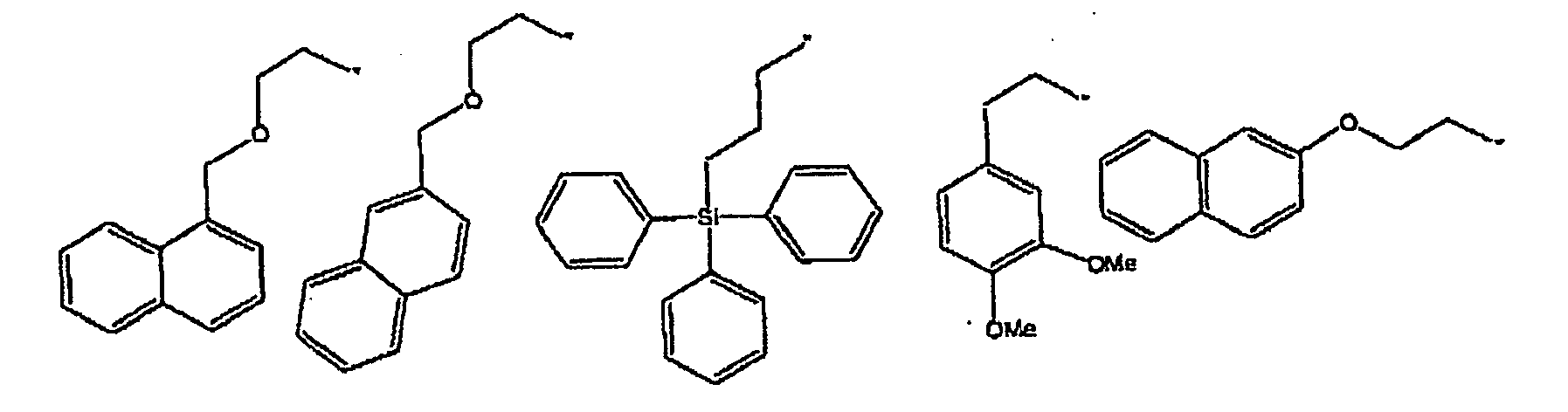


x eine nicht-negative ganze Zahl ist und
y eine natürliche Zahl ist. - Polymere Zusammensetzung, hergestellt durch die Polymerisation von einem oder mehreren Makromonomeren, wie in Patentanspruch 1 definiert.
- Polymere Zusammensetzung, hergestellt durch die Co-Polymerisation von einem oder mehreren Makromonomeren wie in Patentanspruch 1 definiert mit einem oder mehreren Nicht-Siloxy-Monomeren auf Aromaten-Basis.
- Polymere Zusammensetzung, hergestellt durch die Co-Polymerisation von einem oder mehreren Makromonomeren wie in Patentanspruch 1 definiert mit einem oder mehreren hydrophoben Monomeren auf Nichtaromaten-Basis.
- Polymere Zusammensetzung, hergestellt durch die Co-Polymerisation von einem oder mehreren Makromonomeren wie in Patentanspruch 1 definiert mit einem oder mehreren hydrophilen Monomeren auf Nichtaromaten-Basis.
- Polymere Zusammensetzung wie in Patentanspruch 3 beansprucht, bei der ein oder mehrere Nicht-Siloxy-Monomere auf Aromaten-Basis ausgewählt werden aus 2-Phenyloxyethyl-methacrylat, 3,3-Diphenylpropyl-methacrylat, 2-(1-Naphthylethyl-methacrylat) und 2-(2-Naphthylethyl-methacrylat).
- Polymere Zusammensetzung wie in Patentanspruch 4 beansprucht, bei welcher ein oder mehrere hydrophobe Monomere auf Nichtaromaten-Basis ausgewählt werden aus 2-Ethylhexyl-methacrylat, 3-Methacryloyloxypropyldiphenylmethylsilan und 2-Phenoxyethyl-methacrylat.
- Polymere Zusammensetzung wie in Patentanspruch 5 beansprucht, bei welcher ein oder mehrere hydrophile Monomere auf Nichtaromaten-Basis ausgewählt werden aus N,N-Dimethylacrylamid und Methyl-methacrylat.
- Polymere Zusammensetzung wie in einem der Patentansprüche 2 bis 5 beansprucht, bei welcher ein oder mehrere Verstärkungsmittel vor Polymerisation oder Co-Polymerisation zugesetzt werden, ausgewählt aus Cycloalkylacrylaten und -methacrylaten.
- Polymere Zusammensetzung wie in einem der Patentansprüche 2 bis 5 beansprucht, bei welcher ein oder mehrere Vernetzungsmittel vor Polymerisation oder Co-Polymerisation zugesetzt werden, ausgewählt aus Diacrylaten und Dimethacrylaten von Triethylenglykol, Butylglykol-hexan-1,6-diol, Thiodiethylenglykol, Ethylenglykol und Neopentylglykol, N,N'-Dihydroxyethylen-bisacrylamid, Diallylphthalat, Triallylcyanurat, Divinylbenzol, Ethylenglykol-divinylether, N,N'-Methylen-bis-(meth)acrylamid, sulfoniertes Divinylbenzol und Divinylsulfon.
- Ophthalmische Vorrichtung umfassend eine polymere Zusammensetzung wie in einem der Patentansprüche 2 bis 10 beansprucht.
- Ophthalmische Vorrichtung wie in Patentanspruch 11 beansprucht, welche eine Intraokular-Linse oder ein Hornhaut-Inlay ist.
- Ophthalmische Vorrichtung wie in Patentanspruch 11 beansprucht, welche eine Kontaktlinse ist.
- Verfahren zur Herstellung einer ophthalmischen Vorrichtung aus einer polymeren Zusammensetzung wie in einem der Patentansprüche 2 bis 5 definiert, wobei das Verfahren umfasst:Gießen einer oder mehrerer polymerer Zusammensetzungen in die Form eines Stabes,Drehen oder Bearbeiten des Stabes zu Scheiben, undDrehen oder Bearbeiten der Scheiben zu ophthalmischen Vorrichtungen.
- Verfahren zur Herstellung einer ophthalmischen Vorrichtung wie definiert aus polymeren Zusammensetzungen wie in einem der Patentansprüche 2 bis 5 definiert, wobei das Verfahren umfasst:Eingießen einer oder mehrerer polymerer Zusammensetzungen in eine Form vor Härtung,Härtung einer oder mehrerer polymerer Zusammensetzungen undEntfernen einer oder mehrerer polymerer Zusammensetzungen aus der Form nach Härtung von diesen.
- Verfahren zur Herstellung eines Siloxan-Makromonomers auf Aromaten-Basis wie in Patentanspruch 1 definiert, umfassend:Polymerisation eines hydridfunktionalisierten zyklischen Siloxans mit einem Methacrylatverkappten Disiloxan, um ein hydridhaltiges Siloxan zu bilden undHydrosilylierung des hydridhaltigen Siloxan mit einem Katalysator und einem allylfunktionalisierten Aromat.
Applications Claiming Priority (3)
| Application Number | Priority Date | Filing Date | Title |
|---|---|---|---|
| US137 | 2001-11-02 | ||
| US10/000,137 US6730767B2 (en) | 2001-11-02 | 2001-11-02 | High refractive index aromatic-based siloxane monofunctional macromonomers |
| PCT/US2002/033438 WO2003040155A1 (en) | 2001-11-02 | 2002-10-17 | High refractive index aromatic-based siloxane monofunctional macromonomers |
Publications (2)
| Publication Number | Publication Date |
|---|---|
| EP1448571A1 EP1448571A1 (de) | 2004-08-25 |
| EP1448571B1 true EP1448571B1 (de) | 2008-05-21 |
Family
ID=21690086
Family Applications (1)
| Application Number | Title | Priority Date | Filing Date |
|---|---|---|---|
| EP02773807A Expired - Lifetime EP1448571B1 (de) | 2001-11-02 | 2002-10-17 | Monofunktionelle aromatische siloxan-makromonomere mit hohem brechungsindex |
Country Status (9)
| Country | Link |
|---|---|
| US (5) | US6730767B2 (de) |
| EP (1) | EP1448571B1 (de) |
| JP (1) | JP2005508388A (de) |
| KR (1) | KR20050037427A (de) |
| CN (1) | CN1582291A (de) |
| AT (1) | ATE396194T1 (de) |
| CA (1) | CA2465483A1 (de) |
| DE (1) | DE60226768D1 (de) |
| WO (1) | WO2003040155A1 (de) |
Families Citing this family (31)
| Publication number | Priority date | Publication date | Assignee | Title |
|---|---|---|---|---|
| US6956087B2 (en) * | 2002-12-13 | 2005-10-18 | Bausch & Lomb Incorporated | High refractive index polysiloxane prepolymers |
| US7348447B2 (en) * | 2005-10-11 | 2008-03-25 | Xerox Corporation | Aromatic disiloxane compositions |
| US7423108B2 (en) * | 2005-12-16 | 2008-09-09 | Bausch & Lomb Incorporated | High refractive-index siloxy-containing monomers and polymers, and ophthalmic devices comprising such polymers |
| US7622512B2 (en) * | 2005-12-21 | 2009-11-24 | Bausch & Lomb Incorporated | Cationic hydrophilic siloxanyl monomers |
| US7759408B2 (en) * | 2005-12-21 | 2010-07-20 | Bausch & Lomb Incorporated | Silicon-containing monomers end-capped with polymerizable cationic hydrophilic groups |
| US20070161769A1 (en) * | 2006-01-06 | 2007-07-12 | Schorzman Derek A | Polymerizable silicon-containing monomer bearing pendant cationic hydrophilic groups |
| US7960447B2 (en) * | 2006-04-13 | 2011-06-14 | Bausch & Lomb Incorporated | Cationic end-capped siloxane prepolymer for reduced cross-link density |
| AU2007247846A1 (en) * | 2006-05-03 | 2007-11-15 | Vision Crc Limited | Biological polysiloxanes |
| CN101541271B (zh) | 2006-05-03 | 2012-10-31 | 视力Crc有限公司 | 置换材料的产生方法及其用途,眼内晶体屈光率测定法,和眼内晶体 |
| US20080001320A1 (en) | 2006-06-28 | 2008-01-03 | Knox Wayne H | Optical Material and Method for Modifying the Refractive Index |
| TW200816966A (en) * | 2006-07-21 | 2008-04-16 | Alcon Mfg Ltd | Low-tack ophthalmic and otorhinolaryngological device materials |
| US7714039B2 (en) * | 2006-07-21 | 2010-05-11 | Alcon, Inc. | Low-tack ophthalmic and otorhinolaryngological device materials |
| TWI399228B (zh) * | 2006-07-21 | 2013-06-21 | Alcon Inc | 低黏性的眼科與耳鼻喉科裝置材料(二) |
| US8058323B2 (en) * | 2006-07-21 | 2011-11-15 | Novartis Ag | Low-tack ophthalmic and otorhinolaryngological device materials |
| US20100145001A1 (en) * | 2006-12-12 | 2010-06-10 | Unilever Plc | branched organic-inorganic polymers |
| US20080152540A1 (en) * | 2006-12-22 | 2008-06-26 | Bausch & Lomb Incorporated | Packaging solutions |
| TWI449520B (zh) * | 2007-04-30 | 2014-08-21 | Alcon Inc | 含有伸苯基-矽氧烷大分子單體之眼科及耳鼻喉科裝置材料 |
| US7691917B2 (en) | 2007-06-14 | 2010-04-06 | Bausch & Lomb Incorporated | Silcone-containing prepolymers |
| JP5589202B2 (ja) | 2007-07-27 | 2014-09-17 | 株式会社メニコン | 光学性材料及びそれからなる眼用レンズ |
| WO2009070438A1 (en) | 2007-11-30 | 2009-06-04 | Bausch & Lomb Incorporated | Optical material and method for modifying the refractive index |
| JP5525821B2 (ja) * | 2007-12-14 | 2014-06-18 | 旭化成イーマテリアルズ株式会社 | 感光性樹脂組成物 |
| JP2009155442A (ja) * | 2007-12-26 | 2009-07-16 | Nippon Steel Chem Co Ltd | レンズ用樹脂組成物及びその硬化物 |
| JP5363503B2 (ja) * | 2007-12-31 | 2013-12-11 | ボーシュ アンド ローム インコーポレイティド | 眼科デバイスを含むバイオメディカルデバイスを形成するためのキャスティングモールド |
| US8940219B2 (en) | 2007-12-31 | 2015-01-27 | Ronald D. Spoor | Ophthalmic device formed by additive fabrication and method thereof |
| JP5462288B2 (ja) | 2009-03-04 | 2014-04-02 | パーフェクト アイピー エルエルシー | レンズを形成および修正するためのシステムならびにそれによって形成されたレンズ |
| US8292952B2 (en) | 2009-03-04 | 2012-10-23 | Aaren Scientific Inc. | System for forming and modifying lenses and lenses formed thereby |
| US8646916B2 (en) | 2009-03-04 | 2014-02-11 | Perfect Ip, Llc | System for characterizing a cornea and obtaining an opthalmic lens |
| EP2913042B1 (de) * | 2012-10-25 | 2019-10-02 | Yuyama Mfg. Co., Ltd. | Vorrichtung zur co-infusion |
| WO2017059446A1 (en) | 2015-10-01 | 2017-04-06 | Memorial Sloan-Kettering Cancer Center | Anthranilyl-adenosinemonosulfamate analogs and uses thereof |
| CA3000709A1 (en) * | 2015-10-01 | 2017-04-06 | Memorial Sloan-Kettering Cancer Center | Inhibitors of menaquinone biosynthesis |
| EP3897667A4 (de) | 2018-12-21 | 2023-04-19 | Memorial Sloan Kettering Cancer Center | Salicyl-adenosin-monosulfamat-analoga und ihre verwendungen |
Family Cites Families (14)
| Publication number | Priority date | Publication date | Assignee | Title |
|---|---|---|---|---|
| US3808178A (en) * | 1972-06-16 | 1974-04-30 | Polycon Laboratories | Oxygen-permeable contact lens composition,methods and article of manufacture |
| GB1444110A (en) | 1973-12-28 | 1976-07-28 | Polycon Lab Inc | Oxygen-permeable contact lens composition |
| US3996187A (en) | 1975-04-29 | 1976-12-07 | American Optical Corporation | Optically clear filled silicone elastomers |
| US3996189A (en) | 1975-04-29 | 1976-12-07 | American Optical Corporation | Optically clear filled silicone elastomers |
| US4259467A (en) * | 1979-12-10 | 1981-03-31 | Bausch & Lomb Incorporated | Hydrophilic contact lens made from polysiloxanes containing hydrophilic sidechains |
| US4418165A (en) | 1980-06-03 | 1983-11-29 | Dow Corning Corporation | Optically clear silicone compositions curable to elastomers |
| US4647282A (en) | 1985-08-27 | 1987-03-03 | Moskovsky Nauchno-Issledovatelsky Institut Mikrokhirurgii Glaza | Material for ocular prosthetics |
| US4737558A (en) | 1985-11-25 | 1988-04-12 | Alcon Laboratories, Inc. | Siloxane copolymers for ophthalmic applications |
| US4868251A (en) | 1986-12-24 | 1989-09-19 | Allergan, Inc. | Ultraviolet light absorbing silicone compositions |
| WO1992007013A1 (en) | 1990-10-11 | 1992-04-30 | Permeable Technologies, Inc. | Novel silicone-containing polymers and oxygen permeable hydrophilic contact lenses therefrom |
| US5217491A (en) | 1990-12-27 | 1993-06-08 | American Cyanamid Company | Composite intraocular lens |
| US5512609A (en) | 1992-04-14 | 1996-04-30 | Allergan, Inc. | Reinforced compositions and lens bodies made from same |
| US5336797A (en) | 1992-12-30 | 1994-08-09 | Bausch & Lomb Incorporated | Siloxane macromonomers |
| EP0865444B1 (de) | 1995-12-07 | 2001-09-19 | BAUSCH & LOMB INCORPORATED | Monomere zur reduzierung des modulus von siloxynhydrogele |
-
2001
- 2001-11-02 US US10/000,137 patent/US6730767B2/en not_active Expired - Lifetime
-
2002
- 2002-10-17 EP EP02773807A patent/EP1448571B1/de not_active Expired - Lifetime
- 2002-10-17 JP JP2003542200A patent/JP2005508388A/ja active Pending
- 2002-10-17 KR KR1020047006540A patent/KR20050037427A/ko not_active Withdrawn
- 2002-10-17 CA CA002465483A patent/CA2465483A1/en not_active Abandoned
- 2002-10-17 WO PCT/US2002/033438 patent/WO2003040155A1/en not_active Ceased
- 2002-10-17 DE DE60226768T patent/DE60226768D1/de not_active Expired - Fee Related
- 2002-10-17 CN CNA028218698A patent/CN1582291A/zh active Pending
- 2002-10-17 AT AT02773807T patent/ATE396194T1/de not_active IP Right Cessation
-
2003
- 2003-10-23 US US10/692,378 patent/US6906162B2/en not_active Expired - Fee Related
- 2003-10-23 US US10/692,426 patent/US6992162B2/en not_active Expired - Fee Related
- 2003-10-23 US US10/692,391 patent/US6989430B2/en not_active Expired - Fee Related
- 2003-10-23 US US10/692,387 patent/US7005494B2/en not_active Expired - Fee Related
Also Published As
| Publication number | Publication date |
|---|---|
| US20040087678A1 (en) | 2004-05-06 |
| WO2003040155A1 (en) | 2003-05-15 |
| DE60226768D1 (de) | 2008-07-03 |
| US20040082751A1 (en) | 2004-04-29 |
| US6730767B2 (en) | 2004-05-04 |
| CN1582291A (zh) | 2005-02-16 |
| JP2005508388A (ja) | 2005-03-31 |
| US6992162B2 (en) | 2006-01-31 |
| US6989430B2 (en) | 2006-01-24 |
| EP1448571A1 (de) | 2004-08-25 |
| US20030139557A1 (en) | 2003-07-24 |
| US20040082752A1 (en) | 2004-04-29 |
| US6906162B2 (en) | 2005-06-14 |
| CA2465483A1 (en) | 2003-05-15 |
| US7005494B2 (en) | 2006-02-28 |
| ATE396194T1 (de) | 2008-06-15 |
| KR20050037427A (ko) | 2005-04-21 |
| US20040087753A1 (en) | 2004-05-06 |
Similar Documents
| Publication | Publication Date | Title |
|---|---|---|
| US7009024B2 (en) | High refractive index aromatic-based siloxane difunctional macromonomers | |
| US6730767B2 (en) | High refractive index aromatic-based siloxane monofunctional macromonomers | |
| US7169874B2 (en) | High refractive index polymeric siloxysilane compositions | |
| US7101949B2 (en) | High refractive index polymeric siloxysilane compositions | |
| AU2002337880A1 (en) | High refractive index polymeric siloxysilane compositions | |
| AU2002347887A1 (en) | High refractive index aromatic-based siloxane difunctional macromonomers | |
| AU2002337904A1 (en) | High refractive index aromatic-based siloxane monofunctional macromonomers | |
| AU2002348475A1 (en) | High refractive index polymeric siloxysilane compositions |
Legal Events
| Date | Code | Title | Description |
|---|---|---|---|
| PUAI | Public reference made under article 153(3) epc to a published international application that has entered the european phase |
Free format text: ORIGINAL CODE: 0009012 |
|
| 17P | Request for examination filed |
Effective date: 20040427 |
|
| AK | Designated contracting states |
Kind code of ref document: A1 Designated state(s): AT BE BG CH CY CZ DE DK EE ES FI FR GB GR IE IT LI LU MC NL PT SE SK TR |
|
| AX | Request for extension of the european patent |
Extension state: AL LT LV MK RO SI |
|
| REG | Reference to a national code |
Ref country code: HK Ref legal event code: DE Ref document number: 1068892 Country of ref document: HK |
|
| 17Q | First examination report despatched |
Effective date: 20060726 |
|
| 17Q | First examination report despatched |
Effective date: 20061113 |
|
| GRAP | Despatch of communication of intention to grant a patent |
Free format text: ORIGINAL CODE: EPIDOSNIGR1 |
|
| GRAS | Grant fee paid |
Free format text: ORIGINAL CODE: EPIDOSNIGR3 |
|
| GRAA | (expected) grant |
Free format text: ORIGINAL CODE: 0009210 |
|
| AK | Designated contracting states |
Kind code of ref document: B1 Designated state(s): AT BE BG CH CY CZ DE DK EE ES FI FR GB GR IE IT LI LU MC NL PT SE SK TR |
|
| REG | Reference to a national code |
Ref country code: GB Ref legal event code: FG4D |
|
| REG | Reference to a national code |
Ref country code: CH Ref legal event code: EP |
|
| REF | Corresponds to: |
Ref document number: 60226768 Country of ref document: DE Date of ref document: 20080703 Kind code of ref document: P |
|
| REG | Reference to a national code |
Ref country code: IE Ref legal event code: FG4D |
|
| PG25 | Lapsed in a contracting state [announced via postgrant information from national office to epo] |
Ref country code: FI Free format text: LAPSE BECAUSE OF FAILURE TO SUBMIT A TRANSLATION OF THE DESCRIPTION OR TO PAY THE FEE WITHIN THE PRESCRIBED TIME-LIMIT Effective date: 20080521 Ref country code: ES Free format text: LAPSE BECAUSE OF FAILURE TO SUBMIT A TRANSLATION OF THE DESCRIPTION OR TO PAY THE FEE WITHIN THE PRESCRIBED TIME-LIMIT Effective date: 20080901 |
|
| NLV1 | Nl: lapsed or annulled due to failure to fulfill the requirements of art. 29p and 29m of the patents act | ||
| PG25 | Lapsed in a contracting state [announced via postgrant information from national office to epo] |
Ref country code: AT Free format text: LAPSE BECAUSE OF FAILURE TO SUBMIT A TRANSLATION OF THE DESCRIPTION OR TO PAY THE FEE WITHIN THE PRESCRIBED TIME-LIMIT Effective date: 20080521 Ref country code: NL Free format text: LAPSE BECAUSE OF FAILURE TO SUBMIT A TRANSLATION OF THE DESCRIPTION OR TO PAY THE FEE WITHIN THE PRESCRIBED TIME-LIMIT Effective date: 20080521 |
|
| PG25 | Lapsed in a contracting state [announced via postgrant information from national office to epo] |
Ref country code: CZ Free format text: LAPSE BECAUSE OF FAILURE TO SUBMIT A TRANSLATION OF THE DESCRIPTION OR TO PAY THE FEE WITHIN THE PRESCRIBED TIME-LIMIT Effective date: 20080521 Ref country code: SE Free format text: LAPSE BECAUSE OF FAILURE TO SUBMIT A TRANSLATION OF THE DESCRIPTION OR TO PAY THE FEE WITHIN THE PRESCRIBED TIME-LIMIT Effective date: 20080821 Ref country code: DK Free format text: LAPSE BECAUSE OF FAILURE TO SUBMIT A TRANSLATION OF THE DESCRIPTION OR TO PAY THE FEE WITHIN THE PRESCRIBED TIME-LIMIT Effective date: 20080521 Ref country code: PT Free format text: LAPSE BECAUSE OF FAILURE TO SUBMIT A TRANSLATION OF THE DESCRIPTION OR TO PAY THE FEE WITHIN THE PRESCRIBED TIME-LIMIT Effective date: 20081021 |
|
| PG25 | Lapsed in a contracting state [announced via postgrant information from national office to epo] |
Ref country code: SK Free format text: LAPSE BECAUSE OF FAILURE TO SUBMIT A TRANSLATION OF THE DESCRIPTION OR TO PAY THE FEE WITHIN THE PRESCRIBED TIME-LIMIT Effective date: 20080521 Ref country code: BE Free format text: LAPSE BECAUSE OF FAILURE TO SUBMIT A TRANSLATION OF THE DESCRIPTION OR TO PAY THE FEE WITHIN THE PRESCRIBED TIME-LIMIT Effective date: 20080521 |
|
| PLBE | No opposition filed within time limit |
Free format text: ORIGINAL CODE: 0009261 |
|
| STAA | Information on the status of an ep patent application or granted ep patent |
Free format text: STATUS: NO OPPOSITION FILED WITHIN TIME LIMIT |
|
| 26N | No opposition filed |
Effective date: 20090224 |
|
| PG25 | Lapsed in a contracting state [announced via postgrant information from national office to epo] |
Ref country code: BG Free format text: LAPSE BECAUSE OF FAILURE TO SUBMIT A TRANSLATION OF THE DESCRIPTION OR TO PAY THE FEE WITHIN THE PRESCRIBED TIME-LIMIT Effective date: 20080821 Ref country code: EE Free format text: LAPSE BECAUSE OF FAILURE TO SUBMIT A TRANSLATION OF THE DESCRIPTION OR TO PAY THE FEE WITHIN THE PRESCRIBED TIME-LIMIT Effective date: 20080521 |
|
| PG25 | Lapsed in a contracting state [announced via postgrant information from national office to epo] |
Ref country code: MC Free format text: LAPSE BECAUSE OF NON-PAYMENT OF DUE FEES Effective date: 20081031 |
|
| REG | Reference to a national code |
Ref country code: CH Ref legal event code: PL |
|
| REG | Reference to a national code |
Ref country code: IE Ref legal event code: MM4A |
|
| REG | Reference to a national code |
Ref country code: FR Ref legal event code: ST Effective date: 20090630 |
|
| PG25 | Lapsed in a contracting state [announced via postgrant information from national office to epo] |
Ref country code: DE Free format text: LAPSE BECAUSE OF NON-PAYMENT OF DUE FEES Effective date: 20090501 Ref country code: IT Free format text: LAPSE BECAUSE OF FAILURE TO SUBMIT A TRANSLATION OF THE DESCRIPTION OR TO PAY THE FEE WITHIN THE PRESCRIBED TIME-LIMIT Effective date: 20080521 |
|
| PG25 | Lapsed in a contracting state [announced via postgrant information from national office to epo] |
Ref country code: LI Free format text: LAPSE BECAUSE OF NON-PAYMENT OF DUE FEES Effective date: 20081031 Ref country code: IE Free format text: LAPSE BECAUSE OF NON-PAYMENT OF DUE FEES Effective date: 20081017 Ref country code: FR Free format text: LAPSE BECAUSE OF NON-PAYMENT OF DUE FEES Effective date: 20081031 Ref country code: CH Free format text: LAPSE BECAUSE OF NON-PAYMENT OF DUE FEES Effective date: 20081031 |
|
| PG25 | Lapsed in a contracting state [announced via postgrant information from national office to epo] |
Ref country code: LU Free format text: LAPSE BECAUSE OF NON-PAYMENT OF DUE FEES Effective date: 20081017 Ref country code: CY Free format text: LAPSE BECAUSE OF FAILURE TO SUBMIT A TRANSLATION OF THE DESCRIPTION OR TO PAY THE FEE WITHIN THE PRESCRIBED TIME-LIMIT Effective date: 20080521 |
|
| PG25 | Lapsed in a contracting state [announced via postgrant information from national office to epo] |
Ref country code: TR Free format text: LAPSE BECAUSE OF FAILURE TO SUBMIT A TRANSLATION OF THE DESCRIPTION OR TO PAY THE FEE WITHIN THE PRESCRIBED TIME-LIMIT Effective date: 20080521 |
|
| PG25 | Lapsed in a contracting state [announced via postgrant information from national office to epo] |
Ref country code: GR Free format text: LAPSE BECAUSE OF FAILURE TO SUBMIT A TRANSLATION OF THE DESCRIPTION OR TO PAY THE FEE WITHIN THE PRESCRIBED TIME-LIMIT Effective date: 20080822 |
|
| REG | Reference to a national code |
Ref country code: HK Ref legal event code: WD Ref document number: 1068892 Country of ref document: HK |
|
| PGFP | Annual fee paid to national office [announced via postgrant information from national office to epo] |
Ref country code: GB Payment date: 20190925 Year of fee payment: 18 |
|
| GBPC | Gb: european patent ceased through non-payment of renewal fee |
Effective date: 20201017 |
|
| PG25 | Lapsed in a contracting state [announced via postgrant information from national office to epo] |
Ref country code: GB Free format text: LAPSE BECAUSE OF NON-PAYMENT OF DUE FEES Effective date: 20201017 |