EP1448447B1 - Verfahren zur reinigung und/oder desinfizierung der vakuumkanäle einer siegelstation - Google Patents
Verfahren zur reinigung und/oder desinfizierung der vakuumkanäle einer siegelstation Download PDFInfo
- Publication number
- EP1448447B1 EP1448447B1 EP02802980A EP02802980A EP1448447B1 EP 1448447 B1 EP1448447 B1 EP 1448447B1 EP 02802980 A EP02802980 A EP 02802980A EP 02802980 A EP02802980 A EP 02802980A EP 1448447 B1 EP1448447 B1 EP 1448447B1
- Authority
- EP
- European Patent Office
- Prior art keywords
- cleaning
- disinfecting
- vacuum channels
- vacuum
- sealing tool
- Prior art date
- Legal status (The legal status is an assumption and is not a legal conclusion. Google has not performed a legal analysis and makes no representation as to the accuracy of the status listed.)
- Expired - Lifetime
Links
- 238000007789 sealing Methods 0.000 title claims abstract description 55
- 238000004140 cleaning Methods 0.000 title claims abstract description 38
- 230000000249 desinfective effect Effects 0.000 title claims abstract description 33
- 238000000034 method Methods 0.000 title claims abstract description 21
- ZAMOUSCENKQFHK-UHFFFAOYSA-N Chlorine atom Chemical compound [Cl] ZAMOUSCENKQFHK-UHFFFAOYSA-N 0.000 claims abstract description 5
- 229910052801 chlorine Inorganic materials 0.000 claims abstract description 5
- 239000000460 chlorine Substances 0.000 claims abstract description 5
- 239000007788 liquid Substances 0.000 claims description 18
- 239000012530 fluid Substances 0.000 abstract description 9
- 238000004806 packaging method and process Methods 0.000 description 7
- 235000013305 food Nutrition 0.000 description 5
- 238000010586 diagram Methods 0.000 description 1
- 239000010794 food waste Substances 0.000 description 1
- 239000011261 inert gas Substances 0.000 description 1
- 230000004048 modification Effects 0.000 description 1
- 238000012986 modification Methods 0.000 description 1
- 230000000422 nocturnal effect Effects 0.000 description 1
- 230000006911 nucleation Effects 0.000 description 1
- 238000010899 nucleation Methods 0.000 description 1
- 238000012858 packaging process Methods 0.000 description 1
- 238000012856 packing Methods 0.000 description 1
- 239000002245 particle Substances 0.000 description 1
- 238000004659 sterilization and disinfection Methods 0.000 description 1
Images


Classifications
-
- B—PERFORMING OPERATIONS; TRANSPORTING
- B65—CONVEYING; PACKING; STORING; HANDLING THIN OR FILAMENTARY MATERIAL
- B65B—MACHINES, APPARATUS OR DEVICES FOR, OR METHODS OF, PACKAGING ARTICLES OR MATERIALS; UNPACKING
- B65B31/00—Packaging articles or materials under special atmospheric or gaseous conditions; Adding propellants to aerosol containers
- B65B31/02—Filling, closing, or filling and closing, containers or wrappers in chambers maintained under vacuum or superatmospheric pressure or containing a special atmosphere, e.g. of inert gas
-
- B—PERFORMING OPERATIONS; TRANSPORTING
- B65—CONVEYING; PACKING; STORING; HANDLING THIN OR FILAMENTARY MATERIAL
- B65B—MACHINES, APPARATUS OR DEVICES FOR, OR METHODS OF, PACKAGING ARTICLES OR MATERIALS; UNPACKING
- B65B55/00—Preserving, protecting or purifying packages or package contents in association with packaging
- B65B55/02—Sterilising, e.g. of complete packages
-
- B—PERFORMING OPERATIONS; TRANSPORTING
- B65—CONVEYING; PACKING; STORING; HANDLING THIN OR FILAMENTARY MATERIAL
- B65B—MACHINES, APPARATUS OR DEVICES FOR, OR METHODS OF, PACKAGING ARTICLES OR MATERIALS; UNPACKING
- B65B2210/00—Specific aspects of the packaging machine
- B65B2210/06—Sterilising or cleaning machinery or conduits
Definitions
- the present invention relates to a method for cleaning and / or disinfecting the vacuum channels of a sealing station, in which the vacuum channels are separated from the vacuum pump at regular intervals and connected to a cleaning and / or disinfecting circuit.
- Object of the present invention was therefore to provide a method for cleaning and / or disinfecting the vacuum channels available.
- the inventive method can be simple and cost-effective, for example, after the daily operation of the machine are carried out before a nocturnal downtime.
- the cleaning circuit comprises a pump and a liquid reservoir.
- a cleaning and / or disinfecting liquid for example, active chlorine, which is pumped by the pump through the vacuum channels and runs from the vacuum channels back into the liquid reservoir. This cycle is maintained until it is ensured that the vacuum channels are sufficiently cleaned and / or disinfected.
- a sealing station has first and second sealing tools which cooperate to seal a lidding film to a packaging tray.
- first sealing tool above the lid film and a second sealing tool below the packaging tray is arranged.
- the second sealing tool is usually height adjustable.
- the first and second sealing tools are independently connected to a cleaning and / or disinfecting circuit.
- This embodiment has the advantage that the vacuum channels of the first upper sealing tool, in which food residues are deposited more often, can be cleaned more frequently than the vacuum channels of the second, lower sealing tool.
- the sealing station has a first and a second sealing tool, which are connected to a cleaning and / or disinfecting circuit and which are connected to one another by an adapter.
- an adapter Through the adapter, a liquid-tight connection between the vacuum channels of the first and the second sealing tool is generated, so that with a fluid circuit both sealing tools can be washed through successively with the cleaning and / or disinfecting liquid.
- any cleaning and / or disinfecting liquid known to those skilled in the art can be used, with which it is possible to clean the channels and, if necessary, to disinfect them.
- the cleaning and / or disinfecting cycle is disconnected again after cleaning and / or disinfecting.
- Germ-free compressed air is then transported through the vacuum channels until they are dried, so that in the subsequent packaging process no cleaning and / or disinfecting liquid enters the food to be packaged.
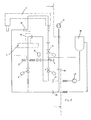
- FIG. 1 shows a process scheme for the evacuation of the vacuum channels of a sealing station according to the prior art.
- the sealing station has an upper sealing tool 1 and a lower sealing tool 2.
- Channels are incorporated, through which the air can be sucked out of the packaging. This suction takes place via the vacuum pump 3.
- the vacuum generated by the vacuum pump 3 is distributed in a desired manner to the vacuum channels of the upper sealing tool 1 and the vacuum channels of the lower sealing tool 2.
- a relaxation of the negative pressure takes place via the valves 8 and 9.
- FIG. 2 shows a diagram of the method according to the invention, in which a cleaning and disinfecting circuit for the vacuum channels of the upper sealing tool 1 and the lower sealing tool 2 has been established.
- the vacuum pump 3 has been switched off and the connecting line to the sealing station has been sealed or flattened at location 10.
- the vacuum channels of the upper sealing station 1 have been liquid-tightly connected by an adapter 13 with the vacuum channels of the lower sealing tool 2.
- the liquid circuit is closed by a pump 14, a liquid reservoir 15 and the associated piping, which are flanged to the flanges 11, 12.
- the pump 14 pumps a cleaning and disinfecting liquid, in the present case active chlorine in the vacuum channels of the upper sealing tool 1.
- the liquid passes through the adapter 13 in the vacuum channels of the lower sealing tool 2 and is returned from there into the liquid reservoir 15 to participate again in the cleaning and / or disinfecting process.
- This fluid circuit is maintained until the vacuum channels are sufficiently cleaned and disinfected.
- the valve 4 is completely closed, so that only builds a fluid circuit through the valves 5, 6 and 7.
- the pump 14 and the liquid reservoir 15 are again disconnected from the evacuation pipelines and the vacuum pump 3 is reconnected.
- the adapter 13 is removed. Through the vacuum channels of the sealing tools 1, 2 so long germ-free air is conveyed until they are completely dried, so that no cleaning and disinfecting liquid can get into the food to be packaged.
- FIG. 3 In each case, a cleaning and disinfecting circuit for the vacuum channels of the upper sealing tool 1 and the vacuum channels of the lower sealing tool 2 is shown.
- the vacuum channels of the upper sealing tool can be cleaned independently of the vacuum channels of the lower sealing tool and vice versa.
- This embodiment of the present method is particularly useful when the vacuum channels of the upper sealing tool are more contaminated than the vacuum channels of the lower sealing tool, which is often the case.
Landscapes
- Engineering & Computer Science (AREA)
- Mechanical Engineering (AREA)
- Chemical & Material Sciences (AREA)
- Dispersion Chemistry (AREA)
- Vacuum Packaging (AREA)
- Apparatus For Disinfection Or Sterilisation (AREA)
- Food Preservation Except Freezing, Refrigeration, And Drying (AREA)
Abstract
Description
- Die vorliegende Erfindung betrifft ein Verfahren zur Reinigung und/oder Desinfizierung der Vakuumkanäle einer Siegelstation, bei dem die Vakuumkanäle in regelmäßigen Abständen von der Vakuumpumpe getrennt und an einen Reinigungs- und/oder Desinfizierungskreislauf angeschlossen werden.
- An die Hygiene von Verpackungsmaschinen wie sie erispielsweise in der
EP 1 094 003 A1 beschrieben ist, insbesondere im Lebensmittelbereich, werden heutzutage immer höhere Anforderungen gestellt. Dem entsprechend muß sichergestellt sein, daß alle Teile der Verpackungsmaschine, die direkt oder indirekt mit dem Verpackungsgut in Berührung kommen, in regelmäßigen Abständen gereinigt und desinfiziert werden. Dies gilt auch für die Vakuumkanäle der Siegelstation, mit denen die Luft aus den Verpackungen abgezogen und beispielsweise durch Inertgas ersetzt wird. Beim Abziehen der Luft werden häufig kleine Lebensmittelpartikel mitgerissen, die sich in den Vakuumkanälen ablagern und insbesondere während Stillstandszeiten der Verpackungsmaschine die Keimbildung in diesen Vakuumkanälen fördern. - Aufgabe der vorliegenden Erfindung war es deshalb, ein Verfahren zur Reinigung und/oder Desinfizierung der Vakuumkanäle zur Verfügung zu stellen.
- Gelöst wird die Aufgabe durch ein Verfahren nach Patentanspruch 1.
- Es war für den Fachmann überaus erstaunlich und nicht zu erwarten, daß es durch das erfindungsgemäße Verfahren gelingt, wesentlich keimfreiere und damit haltbarere Lebensmittel herzustellen als dies mit Maschinen gemäß dem Stand der Technik möglich war. Das erfindungsgemäße Verfahren kann einfach und kostengünstig beispielsweise nach dem täglichen Betrieb der Maschine vor einer nächtlichen Stillstandszeit durchgeführt werden.
- In einer bevorzugten Ausführungsform der vorliegenden Erfindung weist der Reinigungskreislauf eine Pumpe und ein Flüssigkeitsreservoir auf. In dem Flüssigkeitsreservoir befindet sich eine Reinigungs- und/oder Desinfektionsflüssigkeit, beispielsweise aktiv Chlor, die mit der Pumpe durch die Vakuumkanäle gepumpt wird und aus den Vakuumkanälen wieder in das Flüssigkeitsreservoir läuft. Dieser Kreislauf wird solange aufrechterhalten, bis sichergestellt ist, daß die Vakuumkanäle hinreichend gereinigt und/oder desinfiziert sind.
- Eine Siegelstation weist ein erstes und ein zweites Siegelwerkzeug auf, die so zusammenwirken, daß eine Deckelfolie auf eine Verpackungsmulde gesiegelt wird. Dabei ist ein erstes Siegelwerkzeug oberhalb der Deckelfolie und ein zweites Siegelwerkzeug unterhalb der Verpackungsmulde angeordnet. Das zweite Siegelwerkzeug ist in der Regel höhenverstellbar.
- In einer erfindungsgemäßen Ausführungsform der vorliegenden Erfindung werden das erste und das zweite Siegelwerkzeug unabhängig voneinander an einen Reinigungs-und/oder Desinfizierungskreislauf angeschlossen. Diese Ausführungsform hat den Vorteil, daß die Vakuumkanäle des ersten, oberen Siegelwerkzeuges, in denen sich öfter Speisereste ablagern, häufiger gereinigt werden kann als die Vakuumkanäle des zweiten, unteren Siegelwerkzeuges.
- In einer anderen erfindungsgemäßen Ausführungsform des erfindungsgemäßen Verfahrens weist die Siegelstation ein erstes und ein zweites Siegelwerkzeug auf, die an einen Reinigungs- und/oder Desinfizierungskreislauf angeschlossen werden und die durch einen Adapter miteinander verbunden sind. Durch den Adapter wird eine flüssigkeitsdichte Verbindung zwischen den Vakuumkanälen des ersten und des zweiten Siegelwerkzeuges erzeugt, so daß mit einem Flüssigkeitskreislauf beide Siegelwerkzeuge nacheinander mit der Reinigungs- und/oder Desinfizierungsflüssigkeit durchspült werden können. Diese Ausführungsform des erfindungsgemäßen Verfahrens ist besonders einfach durchzuführen und bedarf nur eines geringen Umbaus der Verpackungsmaschine.
- Als Reinigungs- und/oder Desinfizierungsflüssigkeit kann jede dem Fachmann bekannte Reinigungs- und/oder Desinfizierungsflüssigkeit eingesetzt werden, mit der es gelingt, die Kanäle zu reinigen und gegebenenfalls zu desinfizieren. Vorzugsweise wird jedoch als Reinigungs- und/oder Desinfizierungsflüssigkeit aktiv Chlor eingesetzt.
- Vorzugsweise wird der Reinigungs- und/oder Desinfizierungskreislauf nach der Reinigung und/oder Desinfizierung wieder abgekoppelt. Keimfreie Druckluft wird dann so lange durch die Vakuumkanäle gefördert, bis diese getrocknet sind, so daß bei dem sich anschließenden Verpackungsprozeß keine Reinigungs- und/oder Desinfizierungsflüssigkeit in die zu verpackenden Lebensmittel gelangt.
- Im folgenden wird die Erfindung anhand der
Figuren 1 bis 3 erläutert, Diese Erläuterungen sind lediglich beispielhaft und schränken den allgemeinen Erfindungsgedanken nicht ein. -
Figur 1 zeigt ein Verfahrensbild zur Erzeugung eines Vakuums in dem ersten und zweiten Siegelwerkzeug. -
Figur 2 zeigt das erfindungsgemäße Verfahren, bei dem das erste und das zweite Siegelwerkzeug an einen Reinigungs- und Desinfizierungskreislauf angeschlossen ist. -
Figur 3 zeigt eine Ausführungsform des erfindungsgemäßen Verfahrens, bei dem das obere und das untere Siegelwerkzeug getrennt voneinander an einen Reinigungs- und Desinfizierungskreislauf angeschlossen ist. -
Figur 1 zeigt ein Verfahrensschema zur Evakuierung der Vakuumkanäle einer Siegelstation gemäß dem Stand der Technik. Die Siegelstation weist ein oberes Siegelwerkzeug 1 und ein unteres Siegelwerkzeug 2 auf. In diese Siegelwerkzeuge sind Kanäle eingearbeitet, durch die die Luft aus der Verpackung abgesaugt werden kann. Diese Absaugung erfolgt über die Vakuumpumpe 3. Mit den Ventilen 4 bis 7 wird der von der Vakuumpumpe 3 erzeugte Unterdruck in gewünschter Weise auf die Vakuumkanäle des oberen Siegelwerkzeuges 1 und die Vakuumkanäle des unteren Siegelwerkzeuges 2 verteilt. Nach vollendeter Siegelung erfolgt ein Entspannung des Unterdrucks über die Ventile 8 und 9. -
Figur 2 zeigt ein Schema des erfindungsgemäßen Verfahrens, bei dem ein Reinigungs- und Desinfizierungskreislauf für die Vakuumkanäle des oberen Siegelwerkzeuges 1 und des unteren Siegelwerkzeuges 2 errichtet worden ist. In dem vorliegenden Fall ist die Vakuumpumpe 3 abgeschaltet worden und die Verbindungsleitung zu der Siegelstation an der Stelle 10 abgedichtet oder abgeflanscht worden. Die Vakuumkanäle der oberen Siegelstation 1 sind durch ein Adapter 13 mit den Vakuumkanälen des unteren Siegelwerkzeuges 2 flüssigkeitsdicht verbunden worden. Der Flüssigkeitskreislauf wird durch eine Pumpe 14, ein Flüssigkeitsreservoir 15 und die dazugehörigen Rohrleitungen, die an die Flansche 11, 12 angeflanscht sind, geschlossen. Die Pumpe 14 pumpt eine Reinigungs- und Desinfizierungsflüssigkeit, in dem vorliegenden Fall aktiv Chlor, in die Vakuumkanäle des oberen Siegelwerkzeuges 1. Von dort läuft die Flüssigkeit durch den Adapter 13 in die Vakuumkanäle des unteren Siegelwerkzeuges 2 und wird von dort in das Flüssigkeitsreservoir 15 zurückgeführt, um erneut an dem Reinigungs- und/oder Desinfizierungsprozeß teilnehmen zu können. Dieser Flüssigkeitskreislauf wird solange aufrechterhalten, bis die Vakuumkanäle hinreichend gereinigt und desinfiziert sind. Zur Reinigung und/oder Desinfizierung des Ventils 5 und der dazugehörigen Rohrleitungen wird das Ventil 4 vollständig geschlossen, so daß sich lediglich ein Flüssigkeitskreislauf durch die Ventile 5, 6 und 7 aufbaut. Nach Beendigung der Reinigung bzw. Desinfektion werden die Pumpe 14 und das Flüssigkeitsreservoir 15 wieder von den Rohrleitungen der Evakuierung abgekoppelt und die Vakuumpumpe 3 wieder angeschlossen. Des weiteren wird der Adapter 13 entfernt. Durch die Vakuumkanäle der Siegelwerkzeuge 1, 2 wird so lange keimfreie Luft gefördert, bis diese vollständig getrocknet sind, so daß keine Reinigungs- und Desinfizierungsflüssigkeit in die zu verpackenden Lebensmittel gelangen kann. - In
Figur 3 ist jeweils ein Reinigungs- und Desinfizierungskreislauf für die Vakuumkanäle des oberen Siegelwerkzeuges 1 und die Vakuumkanäle des unteren Siegelwerkzeuges 2 dargestellt. Im wesentlichen treffen auf diese Ausführungsform des erfindungsgemäßen Verfahrens die Erläuterungen gemäßFigur 2 zu, nur daß in dem vorliegenden Fall durch die Adapter 13, 13` keine Verbindung zwischen den Vakuumkanälen des oberen Siegelwerkzeuges 1 und des untere Siegelwerkzeuges 2 hergestellt wird. Dadurch können die Vakuumkanäle des oberen Siegelwerkzeuges unabhängig von den Vakuumkanälen des unteren Siegelwerkzeuges gereinigt werden und umgekehrt. Diese Ausführungsform des vorliegenden Verfahrens ist insbesondere dann zweckmäßig, wenn die Vakuumkanäle des oberen Siegelwerkzeuges stärker verschmutzt sind als die Vakuumkanäle des unteren Siegelwerkzeuges, was oftmals der Fall ist. -
- 1
- Oberes Siegelwerkzeug
- 2
- Unteres Siegelwerkzeug
- 3
- Vakuumpumpe
- 4 - 7
- Ventile zum Verteilen des von der Vakuumpumpe erzeugten Unterdrucks
- 8 - 9
- Ventils zum Entspannen des Unterdrucks
- 10
- Stelle, an der die Verbindungsleitung der Vakuumpumpe zur Siegelstation abgedichtet oder abgeflanscht wunde
- 11 -12
- Flansche, an die die Rohrleitungen des Reinigungsflüssigkeitskreislaufs angeflanscht sind
- 13, 13'
- Adapter zum Verbinden der Vakuumkanäle des oberen und unteren Siegelwerkzeugs
- 14
- Pumpe des Reinigungsflüssigkeitskreislaufs
- 15
- Reinigungsflüssigkeitsreservoir
Claims (4)
- Verfahren zur Reinigung und/oder Desinfizierung der Vakuumkanäle einer Siegelstation dadurch gekennzeichnet, dass die Vakuumkanäle in regelmäßigen Abständen von der Vakuumpumpe (3) getrennt und an einen Reinigungs- und/oder Desinfizierungskreislauf angeschlossen werden und dass die Siegelstation ein erstes und ein zweites Siegelwerkzeug (1, 2) aufweist, das jeweils an einen Reinigungs- und/oder Desinfizierungskreislauf angeschlossen wird oder das erste und ein zweite Siegelwerkzeug (1, 2 an einen Reinigungs- und/oder Desinfizierungskreislauf angeschlossen und durch einen Adapter (13) miteinander verbunden werden.
- Verfahren nach Anspruch 1, dadurch gekennzeichnet, dass der Reinigungsund/oder Desinfizierungskreislauf eine Pumpe (14) und ein Reinigungsund/oder Desinfizierungsflüssigkeitsreservoir (15) aufweist.
- Verfahren nach einem der vorhergehenden Ansprüche, dadurch gekennzeichnet, dass als Reinigungs- und/oder Desinfizierungsflüssigkeit aktiv Chlor verwendet wird.
- Verfahren nach einem der vorhergehenden Ansprüche, dadurch gekennzeichnet, dass der Reinigungs- und/oder Desinfizierungskreislauf nach der Reinigung und/oder Desinfizierung abgekoppelt und die Vakuumkanäle (4 - 9) mit keimfreier Luft getrocknet werden.
Applications Claiming Priority (3)
| Application Number | Priority Date | Filing Date | Title |
|---|---|---|---|
| DE10155757 | 2001-11-14 | ||
| DE10155757A DE10155757A1 (de) | 2001-11-14 | 2001-11-14 | Verfahren zur Reinigung und/oder Desinfizierung der Vakuumkanäle einer Siegelstation |
| PCT/EP2002/011608 WO2003042043A1 (de) | 2001-11-14 | 2002-10-17 | Verfahren zur reinigung und/oder desinfizierung der vakuumkanäle einer siegelstation |
Publications (2)
| Publication Number | Publication Date |
|---|---|
| EP1448447A1 EP1448447A1 (de) | 2004-08-25 |
| EP1448447B1 true EP1448447B1 (de) | 2012-08-22 |
Family
ID=7705622
Family Applications (1)
| Application Number | Title | Priority Date | Filing Date |
|---|---|---|---|
| EP02802980A Expired - Lifetime EP1448447B1 (de) | 2001-11-14 | 2002-10-17 | Verfahren zur reinigung und/oder desinfizierung der vakuumkanäle einer siegelstation |
Country Status (7)
| Country | Link |
|---|---|
| US (1) | US7204258B2 (de) |
| EP (1) | EP1448447B1 (de) |
| CN (1) | CN1585712A (de) |
| DE (1) | DE10155757A1 (de) |
| ES (1) | ES2393283T3 (de) |
| RU (1) | RU2310589C2 (de) |
| WO (1) | WO2003042043A1 (de) |
Families Citing this family (6)
| Publication number | Priority date | Publication date | Assignee | Title |
|---|---|---|---|---|
| EP2015996B2 (de) † | 2006-05-05 | 2019-07-17 | MULTIVAC Sepp Haggenmüller SE & Co. KG | Verpackungsmaschine, insbesondere umfassend eine tiefziehmaschine |
| DE102011108092A1 (de) * | 2011-07-19 | 2013-01-24 | Multivac Sepp Haggenmüller Gmbh & Co. Kg | Reinigungsverfahren und -system für Vakuumpumpe |
| ES2503567T3 (es) | 2011-10-03 | 2014-10-07 | Tetra Laval Holdings & Finance S.A. | Máquina de envase y método para producir envases sellados de un producto alimenticio a partir de una cinta de un material de envase |
| CN104013987A (zh) * | 2013-12-28 | 2014-09-03 | 广西科技大学 | 消毒喷淋装置 |
| DE102016221560A1 (de) * | 2016-11-03 | 2018-05-03 | Leybold Gmbh | Lebensmittel-Verarbeitungs- und/oder Verpackungsvorrichtung sowie Verfahren zum Reinigen dieser Vorrichtung |
| CN116765060A (zh) * | 2023-08-11 | 2023-09-19 | 詹家绮 | 真空包装机的管路清洗系统 |
Family Cites Families (10)
| Publication number | Priority date | Publication date | Assignee | Title |
|---|---|---|---|---|
| US3832828A (en) * | 1973-01-29 | 1974-09-03 | Standard Packaging Corp | Evacuation and venting system for vacuum packages and vacuum chamber therefor |
| US4296068A (en) * | 1979-02-19 | 1981-10-20 | Dai Nippon Insatsu Kabushiki Kaisha | Apparatus for sterilizing a succession of food containers or the like |
| JPS56113528A (en) * | 1980-02-05 | 1981-09-07 | Dainippon Printing Co Ltd | Germless filling method |
| JP2668383B2 (ja) | 1988-04-27 | 1997-10-27 | テトラ ブリック リサーチ アンド ディベロプメント エス.ピー.エー. | 包装機における滅菌方法及び滅菌装置 |
| FR2639321B1 (fr) * | 1988-11-18 | 1991-02-22 | Torterotot Roland | Procede et dispositif de sterilisation d'une installation de conditionnement de produits alimentaires ou pharmaceutiques |
| DE4422713B4 (de) * | 1994-06-29 | 2004-04-08 | Robert Bosch Gmbh | Verfahren zum Sterilisieren von Teilen einer Verpackungsmaschine sowie eine Vorrichtung zum Durchführen des Verfahrens |
| JPH0938175A (ja) * | 1995-08-04 | 1997-02-10 | T R P:Kk | 液状食品の取扱い装置の洗浄殺菌方法及びその洗浄殺菌機構 |
| DE19716846C1 (de) * | 1997-04-22 | 1998-11-19 | Bosch Gmbh Robert | Evakuier- und Verschließvorrichtung |
| US6202388B1 (en) * | 1998-11-06 | 2001-03-20 | Jescorp, Inc. | Controlled environment sealing apparatus and method |
| DE29918679U1 (de) * | 1999-10-23 | 2001-03-01 | Robert Bosch Gmbh, 70469 Stuttgart | Vorrichtung zum Verschließen von mit einem Füllgut befüllten Behältern mit Verschlußstopfen |
-
2001
- 2001-11-14 DE DE10155757A patent/DE10155757A1/de not_active Withdrawn
-
2002
- 2002-10-17 RU RU2004118249/13A patent/RU2310589C2/ru not_active IP Right Cessation
- 2002-10-17 ES ES02802980T patent/ES2393283T3/es not_active Expired - Lifetime
- 2002-10-17 CN CN02822652.6A patent/CN1585712A/zh active Pending
- 2002-10-17 EP EP02802980A patent/EP1448447B1/de not_active Expired - Lifetime
- 2002-10-17 WO PCT/EP2002/011608 patent/WO2003042043A1/de not_active Ceased
- 2002-10-17 US US10/495,542 patent/US7204258B2/en not_active Expired - Lifetime
Also Published As
| Publication number | Publication date |
|---|---|
| ES2393283T3 (es) | 2012-12-20 |
| US7204258B2 (en) | 2007-04-17 |
| RU2310589C2 (ru) | 2007-11-20 |
| US20050045211A1 (en) | 2005-03-03 |
| WO2003042043A1 (de) | 2003-05-22 |
| RU2004118249A (ru) | 2006-01-10 |
| CN1585712A (zh) | 2005-02-23 |
| DE10155757A1 (de) | 2003-05-22 |
| EP1448447A1 (de) | 2004-08-25 |
Similar Documents
| Publication | Publication Date | Title |
|---|---|---|
| DE68905158T2 (de) | Wasch- und reinigungssystem an verpackungsmaschinen. | |
| EP2015996B2 (de) | Verpackungsmaschine, insbesondere umfassend eine tiefziehmaschine | |
| DE69721321T2 (de) | Verfahren zum handhaben, füllen und verschliessen von verpackungsbehältern | |
| EP3083087B1 (de) | Reinigungsvorrichtung sowie verfahren zum reinigen von behältern | |
| DE102023111480A1 (de) | System zum Verarbeiten von pharmazeutischen Behältern und Verfahren zum Betreiben eines derartigen Systems | |
| DE69419013T2 (de) | Abgabeverfahren und vorrichtung | |
| DE2509611A1 (de) | Vorrichtung zum sterilen verpacken von guetern in behaelter | |
| EP1448447A1 (de) | Verfahren zur reinigung und/oder desinfizierung der vakuumkanäle einer siegelstation | |
| DE69408408T2 (de) | Vorrichtung zum automatischen Umschalten von Rohrleitungen | |
| DE102009039180A1 (de) | Vorrichtung und Verfahren zum Bereitstellen einer sterilen Flüssigkeit für eine Abfüllanlage | |
| EP2839846B1 (de) | Vorrichtung zur behandlung von behältern in einer getränkeabfüllanlage | |
| DE2220224B1 (de) | Verfahren zur Herstellung von Flüssigkeitsgemischen vorgegebener Zusammensetzung | |
| DE102019133164A1 (de) | Transportstrecke und Behälterbehandlungsanlage mit einer solchen Transportstrecke | |
| DE19824724B4 (de) | Vorrichtung zum Sterilisieren und Reinigen kleinerer Gegenstände | |
| DE102006013367A1 (de) | Verfahren und Vorrichtung zum Reinigen einer Becherfüllmaschine | |
| DE202018000467U1 (de) | Prüfvorrrichtung, Reinigungsvorrichtung, System und Computerprogrammprodukt | |
| DE102013202847A1 (de) | Verfahren zum Reinigen eines Transportsegments | |
| DE102024103708A1 (de) | Behälterbehandlungsanlage sowie Verfahren zum Betrieb | |
| DE102014201814A1 (de) | Sterilentnahmevorrichtung mit Reinigungseinrichtung | |
| EP4705192A1 (de) | System zum verarbeiten von pharmazeutischen behältern und verfahren zum betreiben eines derartigen systems | |
| DE4422713A1 (de) | Verfahren und Vorrichtung zum Sterilisieren einer Verpackungsmaschine | |
| EP3390232A1 (de) | Verpackungsmaschine und verfahren zur herstellung von vakuumierten verpackungen | |
| EP4438064A1 (de) | Dekontaminationsverfahren, insbesondere für pharmatechnische anlagen und anwendungen sowie dekontaminationsanordnung für pharmatechnische anwendungen | |
| EP1275922A2 (de) | Koppelbare Transferhalter, Verfahren zum Transportieren und/oder Bearbeiten von Sachen und Verwendung von koppelbaren Transferhaltern | |
| DE102024103779A1 (de) | Behälterbehandlungsanlage sowie Verfahren zum Betrieb |
Legal Events
| Date | Code | Title | Description |
|---|---|---|---|
| PUAI | Public reference made under article 153(3) epc to a published international application that has entered the european phase |
Free format text: ORIGINAL CODE: 0009012 |
|
| 17P | Request for examination filed |
Effective date: 20040614 |
|
| AK | Designated contracting states |
Kind code of ref document: A1 Designated state(s): AT BE BG CH CY CZ DE DK EE ES FI FR GB GR IE IT LI LU MC NL PT SE SK TR |
|
| AX | Request for extension of the european patent |
Extension state: AL LT LV MK RO SI |
|
| 17Q | First examination report despatched |
Effective date: 20071217 |
|
| GRAP | Despatch of communication of intention to grant a patent |
Free format text: ORIGINAL CODE: EPIDOSNIGR1 |
|
| GRAS | Grant fee paid |
Free format text: ORIGINAL CODE: EPIDOSNIGR3 |
|
| GRAA | (expected) grant |
Free format text: ORIGINAL CODE: 0009210 |
|
| AK | Designated contracting states |
Kind code of ref document: B1 Designated state(s): AT BE BG CH CY CZ DE DK EE ES FI FR GB GR IE IT LI LU MC NL PT SE SK TR |
|
| REG | Reference to a national code |
Ref country code: GB Ref legal event code: FG4D Free format text: NOT ENGLISH |
|
| REG | Reference to a national code |
Ref country code: CH Ref legal event code: EP |
|
| REG | Reference to a national code |
Ref country code: IE Ref legal event code: FG4D Free format text: LANGUAGE OF EP DOCUMENT: GERMAN |
|
| REG | Reference to a national code |
Ref country code: AT Ref legal event code: REF Ref document number: 571825 Country of ref document: AT Kind code of ref document: T Effective date: 20120915 |
|
| REG | Reference to a national code |
Ref country code: DE Ref legal event code: R096 Ref document number: 50215569 Country of ref document: DE Effective date: 20121018 |
|
| RAP2 | Party data changed (patent owner data changed or rights of a patent transferred) |
Owner name: GEA FOOD SOLUTIONS GERMANY GMBH |
|
| REG | Reference to a national code |
Ref country code: NL Ref legal event code: T3 |
|
| REG | Reference to a national code |
Ref country code: ES Ref legal event code: FG2A Ref document number: 2393283 Country of ref document: ES Kind code of ref document: T3 Effective date: 20121220 |
|
| REG | Reference to a national code |
Ref country code: DE Ref legal event code: R081 Ref document number: 50215569 Country of ref document: DE Owner name: GEA FOOD SOLUTIONS GERMANY GMBH, DE Free format text: FORMER OWNER: CONVENIENCE FOOD SYSTEMS WALLAU GMBH & CO. KG, 35216 BIEDENKOPF, DE Effective date: 20120822 Ref country code: DE Ref legal event code: R081 Ref document number: 50215569 Country of ref document: DE Owner name: GEA FOOD SOLUTIONS GERMANY GMBH, DE Free format text: FORMER OWNER: CONVENIENCE FOOD SYSTEMS WALLAU GMBH & CO KG, 35216 BIEDENKOPF, DE Effective date: 20121108 |
|
| REG | Reference to a national code |
Ref country code: NL Ref legal event code: SD Effective date: 20130111 |
|
| PG25 | Lapsed in a contracting state [announced via postgrant information from national office to epo] |
Ref country code: FI Free format text: LAPSE BECAUSE OF FAILURE TO SUBMIT A TRANSLATION OF THE DESCRIPTION OR TO PAY THE FEE WITHIN THE PRESCRIBED TIME-LIMIT Effective date: 20120822 Ref country code: CY Free format text: LAPSE BECAUSE OF FAILURE TO SUBMIT A TRANSLATION OF THE DESCRIPTION OR TO PAY THE FEE WITHIN THE PRESCRIBED TIME-LIMIT Effective date: 20120822 |
|
| PG25 | Lapsed in a contracting state [announced via postgrant information from national office to epo] |
Ref country code: PT Free format text: LAPSE BECAUSE OF FAILURE TO SUBMIT A TRANSLATION OF THE DESCRIPTION OR TO PAY THE FEE WITHIN THE PRESCRIBED TIME-LIMIT Effective date: 20121224 Ref country code: SE Free format text: LAPSE BECAUSE OF FAILURE TO SUBMIT A TRANSLATION OF THE DESCRIPTION OR TO PAY THE FEE WITHIN THE PRESCRIBED TIME-LIMIT Effective date: 20120822 Ref country code: GR Free format text: LAPSE BECAUSE OF FAILURE TO SUBMIT A TRANSLATION OF THE DESCRIPTION OR TO PAY THE FEE WITHIN THE PRESCRIBED TIME-LIMIT Effective date: 20121123 |
|
| BERE | Be: lapsed |
Owner name: CONVENIENCE FOOD SYSTEMS WALLAU G.M.B.H. & CO.KG Effective date: 20121031 |
|
| PG25 | Lapsed in a contracting state [announced via postgrant information from national office to epo] |
Ref country code: CZ Free format text: LAPSE BECAUSE OF FAILURE TO SUBMIT A TRANSLATION OF THE DESCRIPTION OR TO PAY THE FEE WITHIN THE PRESCRIBED TIME-LIMIT Effective date: 20120822 Ref country code: EE Free format text: LAPSE BECAUSE OF FAILURE TO SUBMIT A TRANSLATION OF THE DESCRIPTION OR TO PAY THE FEE WITHIN THE PRESCRIBED TIME-LIMIT Effective date: 20120822 Ref country code: DK Free format text: LAPSE BECAUSE OF FAILURE TO SUBMIT A TRANSLATION OF THE DESCRIPTION OR TO PAY THE FEE WITHIN THE PRESCRIBED TIME-LIMIT Effective date: 20120822 |
|
| PG25 | Lapsed in a contracting state [announced via postgrant information from national office to epo] |
Ref country code: SK Free format text: LAPSE BECAUSE OF FAILURE TO SUBMIT A TRANSLATION OF THE DESCRIPTION OR TO PAY THE FEE WITHIN THE PRESCRIBED TIME-LIMIT Effective date: 20120822 Ref country code: MC Free format text: LAPSE BECAUSE OF NON-PAYMENT OF DUE FEES Effective date: 20121031 |
|
| REG | Reference to a national code |
Ref country code: CH Ref legal event code: PL |
|
| PLBE | No opposition filed within time limit |
Free format text: ORIGINAL CODE: 0009261 |
|
| STAA | Information on the status of an ep patent application or granted ep patent |
Free format text: STATUS: NO OPPOSITION FILED WITHIN TIME LIMIT |
|
| REG | Reference to a national code |
Ref country code: IE Ref legal event code: MM4A |
|
| 26N | No opposition filed |
Effective date: 20130523 |
|
| PG25 | Lapsed in a contracting state [announced via postgrant information from national office to epo] |
Ref country code: IE Free format text: LAPSE BECAUSE OF NON-PAYMENT OF DUE FEES Effective date: 20121017 Ref country code: BG Free format text: LAPSE BECAUSE OF FAILURE TO SUBMIT A TRANSLATION OF THE DESCRIPTION OR TO PAY THE FEE WITHIN THE PRESCRIBED TIME-LIMIT Effective date: 20121122 Ref country code: CH Free format text: LAPSE BECAUSE OF NON-PAYMENT OF DUE FEES Effective date: 20121031 Ref country code: BE Free format text: LAPSE BECAUSE OF NON-PAYMENT OF DUE FEES Effective date: 20121031 Ref country code: LI Free format text: LAPSE BECAUSE OF NON-PAYMENT OF DUE FEES Effective date: 20121031 |
|
| REG | Reference to a national code |
Ref country code: DE Ref legal event code: R097 Ref document number: 50215569 Country of ref document: DE Effective date: 20130523 |
|
| REG | Reference to a national code |
Ref country code: AT Ref legal event code: MM01 Ref document number: 571825 Country of ref document: AT Kind code of ref document: T Effective date: 20121031 |
|
| PG25 | Lapsed in a contracting state [announced via postgrant information from national office to epo] |
Ref country code: AT Free format text: LAPSE BECAUSE OF NON-PAYMENT OF DUE FEES Effective date: 20121031 |
|
| PG25 | Lapsed in a contracting state [announced via postgrant information from national office to epo] |
Ref country code: TR Free format text: LAPSE BECAUSE OF FAILURE TO SUBMIT A TRANSLATION OF THE DESCRIPTION OR TO PAY THE FEE WITHIN THE PRESCRIBED TIME-LIMIT Effective date: 20120822 |
|
| PG25 | Lapsed in a contracting state [announced via postgrant information from national office to epo] |
Ref country code: LU Free format text: LAPSE BECAUSE OF NON-PAYMENT OF DUE FEES Effective date: 20121017 |
|
| REG | Reference to a national code |
Ref country code: FR Ref legal event code: PLFP Year of fee payment: 14 |
|
| REG | Reference to a national code |
Ref country code: FR Ref legal event code: PLFP Year of fee payment: 15 |
|
| PGFP | Annual fee paid to national office [announced via postgrant information from national office to epo] |
Ref country code: NL Payment date: 20161025 Year of fee payment: 15 Ref country code: GB Payment date: 20161025 Year of fee payment: 15 |
|
| REG | Reference to a national code |
Ref country code: FR Ref legal event code: PLFP Year of fee payment: 16 |
|
| REG | Reference to a national code |
Ref country code: NL Ref legal event code: MM Effective date: 20171101 |
|
| GBPC | Gb: european patent ceased through non-payment of renewal fee |
Effective date: 20171017 |
|
| PG25 | Lapsed in a contracting state [announced via postgrant information from national office to epo] |
Ref country code: NL Free format text: LAPSE BECAUSE OF NON-PAYMENT OF DUE FEES Effective date: 20171101 Ref country code: GB Free format text: LAPSE BECAUSE OF NON-PAYMENT OF DUE FEES Effective date: 20171017 |
|
| REG | Reference to a national code |
Ref country code: FR Ref legal event code: PLFP Year of fee payment: 17 |
|
| PGFP | Annual fee paid to national office [announced via postgrant information from national office to epo] |
Ref country code: DE Payment date: 20211020 Year of fee payment: 20 Ref country code: ES Payment date: 20211117 Year of fee payment: 20 |
|
| PGFP | Annual fee paid to national office [announced via postgrant information from national office to epo] |
Ref country code: IT Payment date: 20211029 Year of fee payment: 20 Ref country code: FR Payment date: 20211021 Year of fee payment: 20 |
|
| REG | Reference to a national code |
Ref country code: DE Ref legal event code: R071 Ref document number: 50215569 Country of ref document: DE |
|
| REG | Reference to a national code |
Ref country code: ES Ref legal event code: FD2A Effective date: 20221031 |
|
| PG25 | Lapsed in a contracting state [announced via postgrant information from national office to epo] |
Ref country code: ES Free format text: LAPSE BECAUSE OF EXPIRATION OF PROTECTION Effective date: 20221018 |