EP1447434A1 - Aqueous dispersion type pressure-sensitive adhesive composition and pressure-sensitive adhesive product - Google Patents
Aqueous dispersion type pressure-sensitive adhesive composition and pressure-sensitive adhesive product Download PDFInfo
- Publication number
- EP1447434A1 EP1447434A1 EP03015886A EP03015886A EP1447434A1 EP 1447434 A1 EP1447434 A1 EP 1447434A1 EP 03015886 A EP03015886 A EP 03015886A EP 03015886 A EP03015886 A EP 03015886A EP 1447434 A1 EP1447434 A1 EP 1447434A1
- Authority
- EP
- European Patent Office
- Prior art keywords
- sensitive adhesive
- pressure
- aqueous dispersion
- dispersion type
- adhesive composition
- Prior art date
- Legal status (The legal status is an assumption and is not a legal conclusion. Google has not performed a legal analysis and makes no representation as to the accuracy of the status listed.)
- Withdrawn
Links
- 239000004820 Pressure-sensitive adhesive Substances 0.000 title claims abstract description 197
- 239000000203 mixture Substances 0.000 title claims abstract description 77
- 239000006185 dispersion Substances 0.000 title claims abstract description 72
- -1 poly(vinyl alcohol) Polymers 0.000 claims abstract description 53
- NIXOWILDQLNWCW-UHFFFAOYSA-N acrylic acid group Chemical group C(C=C)(=O)O NIXOWILDQLNWCW-UHFFFAOYSA-N 0.000 claims abstract description 38
- 229920001477 hydrophilic polymer Polymers 0.000 claims abstract description 26
- 229920001971 elastomer Polymers 0.000 claims abstract description 23
- 229920001515 polyalkylene glycol Polymers 0.000 claims abstract description 21
- 239000010410 layer Substances 0.000 claims abstract description 19
- 239000007787 solid Substances 0.000 claims abstract description 16
- 229920002451 polyvinyl alcohol Polymers 0.000 claims abstract description 10
- 229920000036 polyvinylpyrrolidone Polymers 0.000 claims abstract description 10
- 239000001267 polyvinylpyrrolidone Substances 0.000 claims abstract description 10
- 235000013855 polyvinylpyrrolidone Nutrition 0.000 claims abstract description 10
- 239000000178 monomer Substances 0.000 claims description 45
- 239000000463 material Substances 0.000 claims description 38
- 229920000058 polyacrylate Polymers 0.000 claims description 28
- CERQOIWHTDAKMF-UHFFFAOYSA-N Methacrylic acid Chemical compound CC(=C)C(O)=O CERQOIWHTDAKMF-UHFFFAOYSA-N 0.000 claims description 22
- 125000005907 alkyl ester group Chemical group 0.000 claims description 17
- 229920005601 base polymer Polymers 0.000 claims description 4
- NIXOWILDQLNWCW-UHFFFAOYSA-M Acrylate Chemical compound [O-]C(=O)C=C NIXOWILDQLNWCW-UHFFFAOYSA-M 0.000 description 44
- 239000003431 cross linking reagent Substances 0.000 description 30
- 238000006116 polymerization reaction Methods 0.000 description 16
- 230000001070 adhesive effect Effects 0.000 description 14
- 239000000123 paper Substances 0.000 description 14
- 239000011248 coating agent Substances 0.000 description 11
- 238000000576 coating method Methods 0.000 description 11
- 239000003995 emulsifying agent Substances 0.000 description 11
- 238000000034 method Methods 0.000 description 11
- 239000004593 Epoxy Substances 0.000 description 10
- 239000000853 adhesive Substances 0.000 description 10
- LYCAIKOWRPUZTN-UHFFFAOYSA-N Ethylene glycol Chemical compound OCCO LYCAIKOWRPUZTN-UHFFFAOYSA-N 0.000 description 8
- 229920003171 Poly (ethylene oxide) Polymers 0.000 description 8
- 239000000839 emulsion Substances 0.000 description 8
- 229920001223 polyethylene glycol Polymers 0.000 description 8
- 239000002202 Polyethylene glycol Substances 0.000 description 7
- 229920001577 copolymer Polymers 0.000 description 7
- 230000000694 effects Effects 0.000 description 7
- 239000007789 gas Substances 0.000 description 7
- 239000000126 substance Substances 0.000 description 7
- 238000011282 treatment Methods 0.000 description 7
- XLYOFNOQVPJJNP-UHFFFAOYSA-N water Substances O XLYOFNOQVPJJNP-UHFFFAOYSA-N 0.000 description 7
- 230000000052 comparative effect Effects 0.000 description 6
- 239000011521 glass Substances 0.000 description 6
- 230000000873 masking effect Effects 0.000 description 6
- 239000003505 polymerization initiator Substances 0.000 description 6
- 239000004745 nonwoven fabric Substances 0.000 description 5
- SMZOUWXMTYCWNB-UHFFFAOYSA-N 2-(2-methoxy-5-methylphenyl)ethanamine Chemical compound COC1=CC=C(C)C=C1CCN SMZOUWXMTYCWNB-UHFFFAOYSA-N 0.000 description 4
- IJGRMHOSHXDMSA-UHFFFAOYSA-N Atomic nitrogen Chemical compound N#N IJGRMHOSHXDMSA-UHFFFAOYSA-N 0.000 description 4
- DGAQECJNVWCQMB-PUAWFVPOSA-M Ilexoside XXIX Chemical compound C[C@@H]1CC[C@@]2(CC[C@@]3(C(=CC[C@H]4[C@]3(CC[C@@H]5[C@@]4(CC[C@@H](C5(C)C)OS(=O)(=O)[O-])C)C)[C@@H]2[C@]1(C)O)C)C(=O)O[C@H]6[C@@H]([C@H]([C@@H]([C@H](O6)CO)O)O)O.[Na+] DGAQECJNVWCQMB-PUAWFVPOSA-M 0.000 description 4
- 239000012986 chain transfer agent Substances 0.000 description 4
- 239000003795 chemical substances by application Substances 0.000 description 4
- 239000003999 initiator Substances 0.000 description 4
- 150000002978 peroxides Chemical class 0.000 description 4
- 229920000642 polymer Polymers 0.000 description 4
- 229910052708 sodium Inorganic materials 0.000 description 4
- 239000011734 sodium Substances 0.000 description 4
- GOXQRTZXKQZDDN-UHFFFAOYSA-N 2-Ethylhexyl acrylate Chemical compound CCCCC(CC)COC(=O)C=C GOXQRTZXKQZDDN-UHFFFAOYSA-N 0.000 description 3
- NLHHRLWOUZZQLW-UHFFFAOYSA-N Acrylonitrile Chemical compound C=CC#N NLHHRLWOUZZQLW-UHFFFAOYSA-N 0.000 description 3
- DBMJMQXJHONAFJ-UHFFFAOYSA-M Sodium laurylsulphate Chemical compound [Na+].CCCCCCCCCCCCOS([O-])(=O)=O DBMJMQXJHONAFJ-UHFFFAOYSA-M 0.000 description 3
- 230000002411 adverse Effects 0.000 description 3
- CQEYYJKEWSMYFG-UHFFFAOYSA-N butyl acrylate Chemical compound CCCCOC(=O)C=C CQEYYJKEWSMYFG-UHFFFAOYSA-N 0.000 description 3
- MTHSVFCYNBDYFN-UHFFFAOYSA-N diethylene glycol Chemical compound OCCOCCO MTHSVFCYNBDYFN-UHFFFAOYSA-N 0.000 description 3
- 238000007720 emulsion polymerization reaction Methods 0.000 description 3
- 238000011156 evaluation Methods 0.000 description 3
- 229920001519 homopolymer Polymers 0.000 description 3
- 239000012948 isocyanate Substances 0.000 description 3
- 150000002513 isocyanates Chemical class 0.000 description 3
- 238000004519 manufacturing process Methods 0.000 description 3
- 235000019333 sodium laurylsulphate Nutrition 0.000 description 3
- DTGKSKDOIYIVQL-WEDXCCLWSA-N (+)-borneol Chemical group C1C[C@@]2(C)[C@@H](O)C[C@@H]1C2(C)C DTGKSKDOIYIVQL-WEDXCCLWSA-N 0.000 description 2
- MYRTYDVEIRVNKP-UHFFFAOYSA-N 1,2-Divinylbenzene Chemical compound C=CC1=CC=CC=C1C=C MYRTYDVEIRVNKP-UHFFFAOYSA-N 0.000 description 2
- OZAIFHULBGXAKX-UHFFFAOYSA-N 2-(2-cyanopropan-2-yldiazenyl)-2-methylpropanenitrile Chemical compound N#CC(C)(C)N=NC(C)(C)C#N OZAIFHULBGXAKX-UHFFFAOYSA-N 0.000 description 2
- HRPVXLWXLXDGHG-UHFFFAOYSA-N Acrylamide Chemical compound NC(=O)C=C HRPVXLWXLXDGHG-UHFFFAOYSA-N 0.000 description 2
- VHUUQVKOLVNVRT-UHFFFAOYSA-N Ammonium hydroxide Chemical compound [NH4+].[OH-] VHUUQVKOLVNVRT-UHFFFAOYSA-N 0.000 description 2
- CIWBSHSKHKDKBQ-JLAZNSOCSA-N Ascorbic acid Chemical compound OC[C@H](O)[C@H]1OC(=O)C(O)=C1O CIWBSHSKHKDKBQ-JLAZNSOCSA-N 0.000 description 2
- KAKZBPTYRLMSJV-UHFFFAOYSA-N Butadiene Chemical compound C=CC=C KAKZBPTYRLMSJV-UHFFFAOYSA-N 0.000 description 2
- SOGAXMICEFXMKE-UHFFFAOYSA-N Butylmethacrylate Chemical compound CCCCOC(=O)C(C)=C SOGAXMICEFXMKE-UHFFFAOYSA-N 0.000 description 2
- VZCYOOQTPOCHFL-OWOJBTEDSA-N Fumaric acid Chemical compound OC(=O)\C=C\C(O)=O VZCYOOQTPOCHFL-OWOJBTEDSA-N 0.000 description 2
- MHAJPDPJQMAIIY-UHFFFAOYSA-N Hydrogen peroxide Chemical compound OO MHAJPDPJQMAIIY-UHFFFAOYSA-N 0.000 description 2
- WHNWPMSKXPGLAX-UHFFFAOYSA-N N-Vinyl-2-pyrrolidone Chemical compound C=CN1CCCC1=O WHNWPMSKXPGLAX-UHFFFAOYSA-N 0.000 description 2
- 229920002845 Poly(methacrylic acid) Polymers 0.000 description 2
- 239000004743 Polypropylene Substances 0.000 description 2
- 229920001131 Pulp (paper) Polymers 0.000 description 2
- 229920002125 Sokalan® Polymers 0.000 description 2
- PPBRXRYQALVLMV-UHFFFAOYSA-N Styrene Chemical compound C=CC1=CC=CC=C1 PPBRXRYQALVLMV-UHFFFAOYSA-N 0.000 description 2
- LXEKPEMOWBOYRF-UHFFFAOYSA-N [2-[(1-azaniumyl-1-imino-2-methylpropan-2-yl)diazenyl]-2-methylpropanimidoyl]azanium;dichloride Chemical compound Cl.Cl.NC(=N)C(C)(C)N=NC(C)(C)C(N)=N LXEKPEMOWBOYRF-UHFFFAOYSA-N 0.000 description 2
- 238000010521 absorption reaction Methods 0.000 description 2
- 239000000654 additive Substances 0.000 description 2
- 235000011114 ammonium hydroxide Nutrition 0.000 description 2
- ROOXNKNUYICQNP-UHFFFAOYSA-N ammonium persulfate Chemical compound [NH4+].[NH4+].[O-]S(=O)(=O)OOS([O-])(=O)=O ROOXNKNUYICQNP-UHFFFAOYSA-N 0.000 description 2
- 150000001718 carbodiimides Chemical class 0.000 description 2
- 238000001035 drying Methods 0.000 description 2
- 230000001804 emulsifying effect Effects 0.000 description 2
- 230000007613 environmental effect Effects 0.000 description 2
- RTZKZFJDLAIYFH-UHFFFAOYSA-N ether Substances CCOCC RTZKZFJDLAIYFH-UHFFFAOYSA-N 0.000 description 2
- 229910052751 metal Inorganic materials 0.000 description 2
- 239000002184 metal Substances 0.000 description 2
- DNIAPMSPPWPWGF-UHFFFAOYSA-N monopropylene glycol Natural products CC(O)CO DNIAPMSPPWPWGF-UHFFFAOYSA-N 0.000 description 2
- 229910052757 nitrogen Inorganic materials 0.000 description 2
- JRKICGRDRMAZLK-UHFFFAOYSA-L persulfate group Chemical group S(=O)(=O)([O-])OOS(=O)(=O)[O-] JRKICGRDRMAZLK-UHFFFAOYSA-L 0.000 description 2
- 229920001155 polypropylene Polymers 0.000 description 2
- 229920001451 polypropylene glycol Polymers 0.000 description 2
- 229920000915 polyvinyl chloride Polymers 0.000 description 2
- 239000004800 polyvinyl chloride Substances 0.000 description 2
- USHAGKDGDHPEEY-UHFFFAOYSA-L potassium persulfate Chemical compound [K+].[K+].[O-]S(=O)(=O)OOS([O-])(=O)=O USHAGKDGDHPEEY-UHFFFAOYSA-L 0.000 description 2
- 239000011541 reaction mixture Substances 0.000 description 2
- 238000005096 rolling process Methods 0.000 description 2
- 230000008961 swelling Effects 0.000 description 2
- 229920002994 synthetic fiber Polymers 0.000 description 2
- 239000012209 synthetic fiber Substances 0.000 description 2
- 229920001059 synthetic polymer Polymers 0.000 description 2
- CWERGRDVMFNCDR-UHFFFAOYSA-N thioglycolic acid Chemical compound OC(=O)CS CWERGRDVMFNCDR-UHFFFAOYSA-N 0.000 description 2
- VZCYOOQTPOCHFL-UHFFFAOYSA-N trans-butenedioic acid Natural products OC(=O)C=CC(O)=O VZCYOOQTPOCHFL-UHFFFAOYSA-N 0.000 description 2
- LDHQCZJRKDOVOX-UHFFFAOYSA-N trans-crotonic acid Natural products CC=CC(O)=O LDHQCZJRKDOVOX-UHFFFAOYSA-N 0.000 description 2
- DGVVWUTYPXICAM-UHFFFAOYSA-N β‐Mercaptoethanol Chemical compound OCCS DGVVWUTYPXICAM-UHFFFAOYSA-N 0.000 description 2
- 125000006273 (C1-C3) alkyl group Chemical group 0.000 description 1
- XLPJNCYCZORXHG-UHFFFAOYSA-N 1-morpholin-4-ylprop-2-en-1-one Chemical compound C=CC(=O)N1CCOCC1 XLPJNCYCZORXHG-UHFFFAOYSA-N 0.000 description 1
- BDERNNFJNOPAEC-UHFFFAOYSA-N 1-propanol Substances CCCO BDERNNFJNOPAEC-UHFFFAOYSA-N 0.000 description 1
- KQSMCAVKSJWMSI-UHFFFAOYSA-N 2,4-dimethyl-1-n,1-n,3-n,3-n-tetrakis(oxiran-2-ylmethyl)benzene-1,3-diamine Chemical compound CC1=C(N(CC2OC2)CC2OC2)C(C)=CC=C1N(CC1OC1)CC1CO1 KQSMCAVKSJWMSI-UHFFFAOYSA-N 0.000 description 1
- JAHNSTQSQJOJLO-UHFFFAOYSA-N 2-(3-fluorophenyl)-1h-imidazole Chemical compound FC1=CC=CC(C=2NC=CN=2)=C1 JAHNSTQSQJOJLO-UHFFFAOYSA-N 0.000 description 1
- IMSODMZESSGVBE-UHFFFAOYSA-N 2-Oxazoline Chemical compound C1CN=CO1 IMSODMZESSGVBE-UHFFFAOYSA-N 0.000 description 1
- GAMXOFKSAQTGLL-UHFFFAOYSA-N 2-[(1-amino-1-imino-2-methylpropan-2-yl)diazenyl]-2-methylpropanimidamide;sulfo hydrogen sulfate Chemical compound OS(=O)(=O)OS(O)(=O)=O.NC(=N)C(C)(C)N=NC(C)(C)C(N)=N GAMXOFKSAQTGLL-UHFFFAOYSA-N 0.000 description 1
- AOBIOSPNXBMOAT-UHFFFAOYSA-N 2-[2-(oxiran-2-ylmethoxy)ethoxymethyl]oxirane Chemical compound C1OC1COCCOCC1CO1 AOBIOSPNXBMOAT-UHFFFAOYSA-N 0.000 description 1
- TXBCBTDQIULDIA-UHFFFAOYSA-N 2-[[3-hydroxy-2,2-bis(hydroxymethyl)propoxy]methyl]-2-(hydroxymethyl)propane-1,3-diol Chemical compound OCC(CO)(CO)COCC(CO)(CO)CO TXBCBTDQIULDIA-UHFFFAOYSA-N 0.000 description 1
- 125000000022 2-aminoethyl group Chemical group [H]C([*])([H])C([H])([H])N([H])[H] 0.000 description 1
- OWHSTLLOZWTNTQ-UHFFFAOYSA-N 2-ethylhexyl 2-sulfanylacetate Chemical compound CCCCC(CC)COC(=O)CS OWHSTLLOZWTNTQ-UHFFFAOYSA-N 0.000 description 1
- UJTRCPVECIHPBG-UHFFFAOYSA-N 3-cyclohexylpyrrole-2,5-dione Chemical compound O=C1NC(=O)C(C2CCCCC2)=C1 UJTRCPVECIHPBG-UHFFFAOYSA-N 0.000 description 1
- SSMDYRHBKZVGNR-UHFFFAOYSA-N 3-propan-2-ylpyrrole-2,5-dione Chemical compound CC(C)C1=CC(=O)NC1=O SSMDYRHBKZVGNR-UHFFFAOYSA-N 0.000 description 1
- PGFZYOCLSPEKSN-UHFFFAOYSA-N 5,5-dimethyl-1,3-diazabicyclo[2.2.0]hex-3-ene dihydrochloride Chemical compound Cl.Cl.CC1(C)CN2CN=C12 PGFZYOCLSPEKSN-UHFFFAOYSA-N 0.000 description 1
- CUXGDKOCSSIRKK-UHFFFAOYSA-N 7-methyloctyl prop-2-enoate Chemical compound CC(C)CCCCCCOC(=O)C=C CUXGDKOCSSIRKK-UHFFFAOYSA-N 0.000 description 1
- 229920002126 Acrylic acid copolymer Polymers 0.000 description 1
- QGZKDVFQNNGYKY-UHFFFAOYSA-O Ammonium Chemical compound [NH4+] QGZKDVFQNNGYKY-UHFFFAOYSA-O 0.000 description 1
- NOWKCMXCCJGMRR-UHFFFAOYSA-N Aziridine Chemical compound C1CN1 NOWKCMXCCJGMRR-UHFFFAOYSA-N 0.000 description 1
- 239000004342 Benzoyl peroxide Substances 0.000 description 1
- OMPJBNCRMGITSC-UHFFFAOYSA-N Benzoylperoxide Chemical compound C=1C=CC=CC=1C(=O)OOC(=O)C1=CC=CC=C1 OMPJBNCRMGITSC-UHFFFAOYSA-N 0.000 description 1
- MJXQPJARQNKSRO-UHFFFAOYSA-N C(CCCCCCCCCCC)C=C(C(=O)O)C.C(C(=C)C)(=O)OCCCCCCCCCCCC Chemical compound C(CCCCCCCCCCC)C=C(C(=O)O)C.C(C(=C)C)(=O)OCCCCCCCCCCCC MJXQPJARQNKSRO-UHFFFAOYSA-N 0.000 description 1
- 239000004215 Carbon black (E152) Substances 0.000 description 1
- SNRUBQQJIBEYMU-UHFFFAOYSA-N Dodecane Natural products CCCCCCCCCCCC SNRUBQQJIBEYMU-UHFFFAOYSA-N 0.000 description 1
- VGGSQFUCUMXWEO-UHFFFAOYSA-N Ethene Chemical compound C=C VGGSQFUCUMXWEO-UHFFFAOYSA-N 0.000 description 1
- 239000005977 Ethylene Substances 0.000 description 1
- 244000043261 Hevea brasiliensis Species 0.000 description 1
- 239000005057 Hexamethylene diisocyanate Substances 0.000 description 1
- 239000004640 Melamine resin Substances 0.000 description 1
- 229920000877 Melamine resin Polymers 0.000 description 1
- CERQOIWHTDAKMF-UHFFFAOYSA-M Methacrylate Chemical compound CC(=C)C([O-])=O CERQOIWHTDAKMF-UHFFFAOYSA-M 0.000 description 1
- 239000004698 Polyethylene Substances 0.000 description 1
- 239000004372 Polyvinyl alcohol Substances 0.000 description 1
- OFOBLEOULBTSOW-UHFFFAOYSA-N Propanedioic acid Natural products OC(=O)CC(O)=O OFOBLEOULBTSOW-UHFFFAOYSA-N 0.000 description 1
- DWAQJAXMDSEUJJ-UHFFFAOYSA-M Sodium bisulfite Chemical compound [Na+].OS([O-])=O DWAQJAXMDSEUJJ-UHFFFAOYSA-M 0.000 description 1
- ZJCCRDAZUWHFQH-UHFFFAOYSA-N Trimethylolpropane Chemical compound CCC(CO)(CO)CO ZJCCRDAZUWHFQH-UHFFFAOYSA-N 0.000 description 1
- XTXRWKRVRITETP-UHFFFAOYSA-N Vinyl acetate Chemical compound CC(=O)OC=C XTXRWKRVRITETP-UHFFFAOYSA-N 0.000 description 1
- BZHJMEDXRYGGRV-UHFFFAOYSA-N Vinyl chloride Chemical compound ClC=C BZHJMEDXRYGGRV-UHFFFAOYSA-N 0.000 description 1
- 229920002978 Vinylon Polymers 0.000 description 1
- UKMBKKFLJMFCSA-UHFFFAOYSA-N [3-hydroxy-2-(2-methylprop-2-enoyloxy)propyl] 2-methylprop-2-enoate Chemical compound CC(=C)C(=O)OCC(CO)OC(=O)C(C)=C UKMBKKFLJMFCSA-UHFFFAOYSA-N 0.000 description 1
- 239000002253 acid Substances 0.000 description 1
- 150000001252 acrylic acid derivatives Chemical class 0.000 description 1
- 239000002390 adhesive tape Substances 0.000 description 1
- 150000001336 alkenes Chemical class 0.000 description 1
- 125000004849 alkoxymethyl group Chemical group 0.000 description 1
- 150000005215 alkyl ethers Chemical class 0.000 description 1
- 150000001408 amides Chemical class 0.000 description 1
- BTBJBAZGXNKLQC-UHFFFAOYSA-N ammonium lauryl sulfate Chemical compound [NH4+].CCCCCCCCCCCCOS([O-])(=O)=O BTBJBAZGXNKLQC-UHFFFAOYSA-N 0.000 description 1
- 229940063953 ammonium lauryl sulfate Drugs 0.000 description 1
- 229910001870 ammonium persulfate Inorganic materials 0.000 description 1
- 150000008064 anhydrides Chemical class 0.000 description 1
- 125000000129 anionic group Chemical group 0.000 description 1
- 239000003963 antioxidant agent Substances 0.000 description 1
- 235000006708 antioxidants Nutrition 0.000 description 1
- 239000007864 aqueous solution Substances 0.000 description 1
- 235000010323 ascorbic acid Nutrition 0.000 description 1
- 229960005070 ascorbic acid Drugs 0.000 description 1
- 239000011668 ascorbic acid Substances 0.000 description 1
- 235000019400 benzoyl peroxide Nutrition 0.000 description 1
- PZXSLFQJOZPCJG-UHFFFAOYSA-N bis[2-(5-methyl-4,5-dihydro-1h-imidazol-2-yl)propan-2-yl]diazene;dihydrochloride Chemical compound Cl.Cl.N1C(C)CN=C1C(C)(C)N=NC(C)(C)C1=NCC(C)N1 PZXSLFQJOZPCJG-UHFFFAOYSA-N 0.000 description 1
- 125000003178 carboxy group Chemical group [H]OC(*)=O 0.000 description 1
- 239000013522 chelant Substances 0.000 description 1
- 238000006243 chemical reaction Methods 0.000 description 1
- 239000003638 chemical reducing agent Substances 0.000 description 1
- 239000003086 colorant Substances 0.000 description 1
- 238000009833 condensation Methods 0.000 description 1
- 230000005494 condensation Effects 0.000 description 1
- LDHQCZJRKDOVOX-NSCUHMNNSA-N crotonic acid Chemical compound C\C=C\C(O)=O LDHQCZJRKDOVOX-NSCUHMNNSA-N 0.000 description 1
- 125000004093 cyano group Chemical group *C#N 0.000 description 1
- 125000000113 cyclohexyl group Chemical group [H]C1([H])C([H])([H])C([H])([H])C([H])(*)C([H])([H])C1([H])[H] 0.000 description 1
- 125000002704 decyl group Chemical group [H]C([H])([H])C([H])([H])C([H])([H])C([H])([H])C([H])([H])C([H])([H])C([H])([H])C([H])([H])C([H])([H])C([H])([H])* 0.000 description 1
- 238000011161 development Methods 0.000 description 1
- 230000018109 developmental process Effects 0.000 description 1
- 235000014113 dietary fatty acids Nutrition 0.000 description 1
- 238000006073 displacement reaction Methods 0.000 description 1
- WNAHIZMDSQCWRP-UHFFFAOYSA-N dodecane-1-thiol Chemical compound CCCCCCCCCCCCS WNAHIZMDSQCWRP-UHFFFAOYSA-N 0.000 description 1
- GVGUFUZHNYFZLC-UHFFFAOYSA-N dodecyl benzenesulfonate;sodium Chemical compound [Na].CCCCCCCCCCCCOS(=O)(=O)C1=CC=CC=C1 GVGUFUZHNYFZLC-UHFFFAOYSA-N 0.000 description 1
- 125000003438 dodecyl group Chemical group [H]C([H])([H])C([H])([H])C([H])([H])C([H])([H])C([H])([H])C([H])([H])C([H])([H])C([H])([H])C([H])([H])C([H])([H])C([H])([H])C([H])([H])* 0.000 description 1
- MEDYMICOBSTWBO-UHFFFAOYSA-N dodecyl prop-2-enoate;2-methylidenetetradecanoic acid Chemical compound CCCCCCCCCCCCOC(=O)C=C.CCCCCCCCCCCCC(=C)C(O)=O MEDYMICOBSTWBO-UHFFFAOYSA-N 0.000 description 1
- 239000000975 dye Substances 0.000 description 1
- 238000010556 emulsion polymerization method Methods 0.000 description 1
- 125000001495 ethyl group Chemical group [H]C([H])([H])C([H])([H])* 0.000 description 1
- 230000001747 exhibiting effect Effects 0.000 description 1
- 239000004744 fabric Substances 0.000 description 1
- 239000000194 fatty acid Substances 0.000 description 1
- 229930195729 fatty acid Natural products 0.000 description 1
- 230000002349 favourable effect Effects 0.000 description 1
- 239000000835 fiber Substances 0.000 description 1
- 239000000945 filler Substances 0.000 description 1
- 238000011049 filling Methods 0.000 description 1
- 239000011888 foil Substances 0.000 description 1
- 239000001530 fumaric acid Substances 0.000 description 1
- 230000009477 glass transition Effects 0.000 description 1
- 125000003055 glycidyl group Chemical group C(C1CO1)* 0.000 description 1
- 125000003187 heptyl group Chemical group [H]C([*])([H])C([H])([H])C([H])([H])C([H])([H])C([H])([H])C([H])([H])C([H])([H])[H] 0.000 description 1
- RRAMGCGOFNQTLD-UHFFFAOYSA-N hexamethylene diisocyanate Chemical compound O=C=NCCCCCCN=C=O RRAMGCGOFNQTLD-UHFFFAOYSA-N 0.000 description 1
- XXMIOPMDWAUFGU-UHFFFAOYSA-N hexane-1,6-diol Chemical compound OCCCCCCO XXMIOPMDWAUFGU-UHFFFAOYSA-N 0.000 description 1
- 125000004051 hexyl group Chemical group [H]C([H])([H])C([H])([H])C([H])([H])C([H])([H])C([H])([H])C([H])([H])* 0.000 description 1
- 229930195733 hydrocarbon Natural products 0.000 description 1
- 125000002887 hydroxy group Chemical group [H]O* 0.000 description 1
- WGCNASOHLSPBMP-UHFFFAOYSA-N hydroxyacetaldehyde Natural products OCC=O WGCNASOHLSPBMP-UHFFFAOYSA-N 0.000 description 1
- 125000002768 hydroxyalkyl group Chemical group 0.000 description 1
- 125000005462 imide group Chemical group 0.000 description 1
- 238000005470 impregnation Methods 0.000 description 1
- 238000011835 investigation Methods 0.000 description 1
- 125000000959 isobutyl group Chemical group [H]C([H])([H])C([H])(C([H])([H])[H])C([H])([H])* 0.000 description 1
- LDHQCZJRKDOVOX-IHWYPQMZSA-N isocrotonic acid Chemical compound C\C=C/C(O)=O LDHQCZJRKDOVOX-IHWYPQMZSA-N 0.000 description 1
- 125000001972 isopentyl group Chemical group [H]C([H])([H])C([H])(C([H])([H])[H])C([H])([H])C([H])([H])* 0.000 description 1
- 125000001449 isopropyl group Chemical group [H]C([H])([H])C([H])(*)C([H])([H])[H] 0.000 description 1
- 239000002655 kraft paper Substances 0.000 description 1
- 229920000126 latex Polymers 0.000 description 1
- 239000004816 latex Substances 0.000 description 1
- VZCYOOQTPOCHFL-UPHRSURJSA-N maleic acid Chemical compound OC(=O)\C=C/C(O)=O VZCYOOQTPOCHFL-UPHRSURJSA-N 0.000 description 1
- 239000011976 maleic acid Substances 0.000 description 1
- 238000005259 measurement Methods 0.000 description 1
- FQPSGWSUVKBHSU-UHFFFAOYSA-N methacrylamide Chemical compound CC(=C)C(N)=O FQPSGWSUVKBHSU-UHFFFAOYSA-N 0.000 description 1
- 229920003145 methacrylic acid copolymer Polymers 0.000 description 1
- 229940117841 methacrylic acid copolymer Drugs 0.000 description 1
- 125000005395 methacrylic acid group Chemical group 0.000 description 1
- RBQRWNWVPQDTJJ-UHFFFAOYSA-N methacryloyloxyethyl isocyanate Chemical compound CC(=C)C(=O)OCCN=C=O RBQRWNWVPQDTJJ-UHFFFAOYSA-N 0.000 description 1
- 125000002496 methyl group Chemical group [H]C([H])([H])* 0.000 description 1
- LVHBHZANLOWSRM-UHFFFAOYSA-N methylenebutanedioic acid Natural products OC(=O)CC(=C)C(O)=O LVHBHZANLOWSRM-UHFFFAOYSA-N 0.000 description 1
- 238000012986 modification Methods 0.000 description 1
- 230000004048 modification Effects 0.000 description 1
- 125000001421 myristyl group Chemical group [H]C([*])([H])C([H])([H])C([H])([H])C([H])([H])C([H])([H])C([H])([H])C([H])([H])C([H])([H])C([H])([H])C([H])([H])C([H])([H])C([H])([H])C([H])([H])C([H])([H])[H] 0.000 description 1
- QYZFTMMPKCOTAN-UHFFFAOYSA-N n-[2-(2-hydroxyethylamino)ethyl]-2-[[1-[2-(2-hydroxyethylamino)ethylamino]-2-methyl-1-oxopropan-2-yl]diazenyl]-2-methylpropanamide Chemical compound OCCNCCNC(=O)C(C)(C)N=NC(C)(C)C(=O)NCCNCCO QYZFTMMPKCOTAN-UHFFFAOYSA-N 0.000 description 1
- 125000004108 n-butyl group Chemical group [H]C([H])([H])C([H])([H])C([H])([H])C([H])([H])* 0.000 description 1
- 125000004123 n-propyl group Chemical group [H]C([H])([H])C([H])([H])C([H])([H])* 0.000 description 1
- 229920003052 natural elastomer Polymers 0.000 description 1
- 229920001194 natural rubber Polymers 0.000 description 1
- 229920006173 natural rubber latex Polymers 0.000 description 1
- SLCVBVWXLSEKPL-UHFFFAOYSA-N neopentyl glycol Chemical compound OCC(C)(C)CO SLCVBVWXLSEKPL-UHFFFAOYSA-N 0.000 description 1
- 125000001971 neopentyl group Chemical group [H]C([*])([H])C(C([H])([H])[H])(C([H])([H])[H])C([H])([H])[H] 0.000 description 1
- 210000005036 nerve Anatomy 0.000 description 1
- 125000001400 nonyl group Chemical group [H]C([*])([H])C([H])([H])C([H])([H])C([H])([H])C([H])([H])C([H])([H])C([H])([H])C([H])([H])C([H])([H])[H] 0.000 description 1
- 229920001778 nylon Polymers 0.000 description 1
- 125000002347 octyl group Chemical group [H]C([*])([H])C([H])([H])C([H])([H])C([H])([H])C([H])([H])C([H])([H])C([H])([H])C([H])([H])[H] 0.000 description 1
- 239000003960 organic solvent Substances 0.000 description 1
- REJKHFKLPFJGAQ-UHFFFAOYSA-N oxiran-2-ylmethanethiol Chemical compound SCC1CO1 REJKHFKLPFJGAQ-UHFFFAOYSA-N 0.000 description 1
- 238000004806 packaging method and process Methods 0.000 description 1
- 238000010422 painting Methods 0.000 description 1
- 125000000913 palmityl group Chemical group [H]C([*])([H])C([H])([H])C([H])([H])C([H])([H])C([H])([H])C([H])([H])C([H])([H])C([H])([H])C([H])([H])C([H])([H])C([H])([H])C([H])([H])C([H])([H])C([H])([H])C([H])([H])C([H])([H])[H] 0.000 description 1
- 125000002958 pentadecyl group Chemical group [H]C([*])([H])C([H])([H])C([H])([H])C([H])([H])C([H])([H])C([H])([H])C([H])([H])C([H])([H])C([H])([H])C([H])([H])C([H])([H])C([H])([H])C([H])([H])C([H])([H])C([H])([H])[H] 0.000 description 1
- WXZMFSXDPGVJKK-UHFFFAOYSA-N pentaerythritol Chemical compound OCC(CO)(CO)CO WXZMFSXDPGVJKK-UHFFFAOYSA-N 0.000 description 1
- 125000001147 pentyl group Chemical group C(CCCC)* 0.000 description 1
- 239000000049 pigment Substances 0.000 description 1
- 239000002985 plastic film Substances 0.000 description 1
- 229920006255 plastic film Polymers 0.000 description 1
- 239000004014 plasticizer Substances 0.000 description 1
- 229920000728 polyester Polymers 0.000 description 1
- 229920006267 polyester film Polymers 0.000 description 1
- 229920000573 polyethylene Polymers 0.000 description 1
- 229920001721 polyimide Polymers 0.000 description 1
- 229920000098 polyolefin Polymers 0.000 description 1
- 229920001296 polysiloxane Polymers 0.000 description 1
- 229920002689 polyvinyl acetate Polymers 0.000 description 1
- 239000011118 polyvinyl acetate Substances 0.000 description 1
- 238000002360 preparation method Methods 0.000 description 1
- 238000004321 preservation Methods 0.000 description 1
- 125000002924 primary amino group Chemical group [H]N([H])* 0.000 description 1
- 125000004368 propenyl group Chemical group C(=CC)* 0.000 description 1
- 239000012966 redox initiator Substances 0.000 description 1
- 238000010992 reflux Methods 0.000 description 1
- 230000029219 regulation of pH Effects 0.000 description 1
- 230000001105 regulatory effect Effects 0.000 description 1
- 239000011369 resultant mixture Substances 0.000 description 1
- 238000007127 saponification reaction Methods 0.000 description 1
- 238000007789 sealing Methods 0.000 description 1
- 125000002914 sec-butyl group Chemical group [H]C([H])([H])C([H])([H])C([H])(*)C([H])([H])[H] 0.000 description 1
- 239000002356 single layer Substances 0.000 description 1
- 238000004513 sizing Methods 0.000 description 1
- 229940083542 sodium Drugs 0.000 description 1
- 229940080264 sodium dodecylbenzenesulfonate Drugs 0.000 description 1
- 229940079827 sodium hydrogen sulfite Drugs 0.000 description 1
- 235000010267 sodium hydrogen sulphite Nutrition 0.000 description 1
- BWYYYTVSBPRQCN-UHFFFAOYSA-M sodium;ethenesulfonate Chemical compound [Na+].[O-]S(=O)(=O)C=C BWYYYTVSBPRQCN-UHFFFAOYSA-M 0.000 description 1
- 239000007921 spray Substances 0.000 description 1
- 125000004079 stearyl group Chemical group [H]C([*])([H])C([H])([H])C([H])([H])C([H])([H])C([H])([H])C([H])([H])C([H])([H])C([H])([H])C([H])([H])C([H])([H])C([H])([H])C([H])([H])C([H])([H])C([H])([H])C([H])([H])C([H])([H])C([H])([H])C([H])([H])[H] 0.000 description 1
- 238000003756 stirring Methods 0.000 description 1
- 150000003440 styrenes Chemical class 0.000 description 1
- 125000000020 sulfo group Chemical group O=S(=O)([*])O[H] 0.000 description 1
- 239000004094 surface-active agent Substances 0.000 description 1
- 125000000999 tert-butyl group Chemical group [H]C([H])([H])C(*)(C([H])([H])[H])C([H])([H])[H] 0.000 description 1
- CIHOLLKRGTVIJN-UHFFFAOYSA-N tert‐butyl hydroperoxide Chemical compound CC(C)(C)OO CIHOLLKRGTVIJN-UHFFFAOYSA-N 0.000 description 1
- UWHCKJMYHZGTIT-UHFFFAOYSA-N tetraethylene glycol Chemical compound OCCOCCOCCOCCO UWHCKJMYHZGTIT-UHFFFAOYSA-N 0.000 description 1
- 238000012546 transfer Methods 0.000 description 1
- 125000002889 tridecyl group Chemical group [H]C([*])([H])C([H])([H])C([H])([H])C([H])([H])C([H])([H])C([H])([H])C([H])([H])C([H])([H])C([H])([H])C([H])([H])C([H])([H])C([H])([H])C([H])([H])[H] 0.000 description 1
- ZIBGPFATKBEMQZ-UHFFFAOYSA-N triethylene glycol Chemical compound OCCOCCOCCO ZIBGPFATKBEMQZ-UHFFFAOYSA-N 0.000 description 1
- 125000002948 undecyl group Chemical group [H]C([*])([H])C([H])([H])C([H])([H])C([H])([H])C([H])([H])C([H])([H])C([H])([H])C([H])([H])C([H])([H])C([H])([H])C([H])([H])[H] 0.000 description 1
- 229920001567 vinyl ester resin Polymers 0.000 description 1
- 125000000391 vinyl group Chemical group [H]C([*])=C([H])[H] 0.000 description 1
- 229920003169 water-soluble polymer Polymers 0.000 description 1
- 239000002759 woven fabric Substances 0.000 description 1
Classifications
-
- C—CHEMISTRY; METALLURGY
- C09—DYES; PAINTS; POLISHES; NATURAL RESINS; ADHESIVES; COMPOSITIONS NOT OTHERWISE PROVIDED FOR; APPLICATIONS OF MATERIALS NOT OTHERWISE PROVIDED FOR
- C09J—ADHESIVES; NON-MECHANICAL ASPECTS OF ADHESIVE PROCESSES IN GENERAL; ADHESIVE PROCESSES NOT PROVIDED FOR ELSEWHERE; USE OF MATERIALS AS ADHESIVES
- C09J133/00—Adhesives based on homopolymers or copolymers of compounds having one or more unsaturated aliphatic radicals, each having only one carbon-to-carbon double bond, and at least one being terminated by only one carboxyl radical, or of salts, anhydrides, esters, amides, imides, or nitriles thereof; Adhesives based on derivatives of such polymers
- C09J133/04—Homopolymers or copolymers of esters
- C09J133/06—Homopolymers or copolymers of esters of esters containing only carbon, hydrogen and oxygen, the oxygen atom being present only as part of the carboxyl radical
- C09J133/08—Homopolymers or copolymers of acrylic acid esters
-
- C—CHEMISTRY; METALLURGY
- C09—DYES; PAINTS; POLISHES; NATURAL RESINS; ADHESIVES; COMPOSITIONS NOT OTHERWISE PROVIDED FOR; APPLICATIONS OF MATERIALS NOT OTHERWISE PROVIDED FOR
- C09J—ADHESIVES; NON-MECHANICAL ASPECTS OF ADHESIVE PROCESSES IN GENERAL; ADHESIVE PROCESSES NOT PROVIDED FOR ELSEWHERE; USE OF MATERIALS AS ADHESIVES
- C09J7/00—Adhesives in the form of films or foils
- C09J7/30—Adhesives in the form of films or foils characterised by the adhesive composition
- C09J7/38—Pressure-sensitive adhesives [PSA]
- C09J7/381—Pressure-sensitive adhesives [PSA] based on macromolecular compounds obtained by reactions involving only carbon-to-carbon unsaturated bonds
- C09J7/383—Natural or synthetic rubber
-
- C—CHEMISTRY; METALLURGY
- C09—DYES; PAINTS; POLISHES; NATURAL RESINS; ADHESIVES; COMPOSITIONS NOT OTHERWISE PROVIDED FOR; APPLICATIONS OF MATERIALS NOT OTHERWISE PROVIDED FOR
- C09J—ADHESIVES; NON-MECHANICAL ASPECTS OF ADHESIVE PROCESSES IN GENERAL; ADHESIVE PROCESSES NOT PROVIDED FOR ELSEWHERE; USE OF MATERIALS AS ADHESIVES
- C09J7/00—Adhesives in the form of films or foils
- C09J7/30—Adhesives in the form of films or foils characterised by the adhesive composition
- C09J7/38—Pressure-sensitive adhesives [PSA]
- C09J7/381—Pressure-sensitive adhesives [PSA] based on macromolecular compounds obtained by reactions involving only carbon-to-carbon unsaturated bonds
- C09J7/385—Acrylic polymers
-
- C—CHEMISTRY; METALLURGY
- C08—ORGANIC MACROMOLECULAR COMPOUNDS; THEIR PREPARATION OR CHEMICAL WORKING-UP; COMPOSITIONS BASED THEREON
- C08L—COMPOSITIONS OF MACROMOLECULAR COMPOUNDS
- C08L2666/00—Composition of polymers characterized by a further compound in the blend, being organic macromolecular compounds, natural resins, waxes or and bituminous materials, non-macromolecular organic substances, inorganic substances or characterized by their function in the composition
- C08L2666/02—Organic macromolecular compounds, natural resins, waxes or and bituminous materials
-
- C—CHEMISTRY; METALLURGY
- C08—ORGANIC MACROMOLECULAR COMPOUNDS; THEIR PREPARATION OR CHEMICAL WORKING-UP; COMPOSITIONS BASED THEREON
- C08L—COMPOSITIONS OF MACROMOLECULAR COMPOUNDS
- C08L29/00—Compositions of homopolymers or copolymers of compounds having one or more unsaturated aliphatic radicals, each having only one carbon-to-carbon double bond, and at least one being terminated by an alcohol, ether, aldehydo, ketonic, acetal or ketal radical; Compositions of hydrolysed polymers of esters of unsaturated alcohols with saturated carboxylic acids; Compositions of derivatives of such polymers
- C08L29/02—Homopolymers or copolymers of unsaturated alcohols
- C08L29/04—Polyvinyl alcohol; Partially hydrolysed homopolymers or copolymers of esters of unsaturated alcohols with saturated carboxylic acids
-
- C—CHEMISTRY; METALLURGY
- C08—ORGANIC MACROMOLECULAR COMPOUNDS; THEIR PREPARATION OR CHEMICAL WORKING-UP; COMPOSITIONS BASED THEREON
- C08L—COMPOSITIONS OF MACROMOLECULAR COMPOUNDS
- C08L33/00—Compositions of homopolymers or copolymers of compounds having one or more unsaturated aliphatic radicals, each having only one carbon-to-carbon double bond, and only one being terminated by only one carboxyl radical, or of salts, anhydrides, esters, amides, imides or nitriles thereof; Compositions of derivatives of such polymers
- C08L33/04—Homopolymers or copolymers of esters
- C08L33/06—Homopolymers or copolymers of esters of esters containing only carbon, hydrogen and oxygen, which oxygen atoms are present only as part of the carboxyl radical
-
- C—CHEMISTRY; METALLURGY
- C08—ORGANIC MACROMOLECULAR COMPOUNDS; THEIR PREPARATION OR CHEMICAL WORKING-UP; COMPOSITIONS BASED THEREON
- C08L—COMPOSITIONS OF MACROMOLECULAR COMPOUNDS
- C08L39/00—Compositions of homopolymers or copolymers of compounds having one or more unsaturated aliphatic radicals, each having only one carbon-to-carbon double bond, and at least one being terminated by a single or double bond to nitrogen or by a heterocyclic ring containing nitrogen; Compositions of derivatives of such polymers
- C08L39/04—Homopolymers or copolymers of monomers containing heterocyclic rings having nitrogen as ring member
- C08L39/06—Homopolymers or copolymers of N-vinyl-pyrrolidones
-
- C—CHEMISTRY; METALLURGY
- C08—ORGANIC MACROMOLECULAR COMPOUNDS; THEIR PREPARATION OR CHEMICAL WORKING-UP; COMPOSITIONS BASED THEREON
- C08L—COMPOSITIONS OF MACROMOLECULAR COMPOUNDS
- C08L71/00—Compositions of polyethers obtained by reactions forming an ether link in the main chain; Compositions of derivatives of such polymers
-
- C—CHEMISTRY; METALLURGY
- C09—DYES; PAINTS; POLISHES; NATURAL RESINS; ADHESIVES; COMPOSITIONS NOT OTHERWISE PROVIDED FOR; APPLICATIONS OF MATERIALS NOT OTHERWISE PROVIDED FOR
- C09J—ADHESIVES; NON-MECHANICAL ASPECTS OF ADHESIVE PROCESSES IN GENERAL; ADHESIVE PROCESSES NOT PROVIDED FOR ELSEWHERE; USE OF MATERIALS AS ADHESIVES
- C09J2301/00—Additional features of adhesives in the form of films or foils
- C09J2301/30—Additional features of adhesives in the form of films or foils characterized by the chemical, physicochemical or physical properties of the adhesive or the carrier
- C09J2301/302—Additional features of adhesives in the form of films or foils characterized by the chemical, physicochemical or physical properties of the adhesive or the carrier the adhesive being pressure-sensitive, i.e. tacky at temperatures inferior to 30°C
Definitions
- the present invention relates to an aqueous dispersion type pressure-sensitive adhesive composition and a pressure-sensitive adhesive product.
- Pressure-sensitive adhesives are extensively used in masking tapes, double-faced pressure-sensitive adhesive tapes, surface-protective films, packaging tapes, and the like. Developments in pressure-sensitive adhesives of the aqueous dispersion type containing no organic solvent have hitherto been proceeding from the standpoints of a measure for environmental preservation, resource saving, safety, etc., and the amount of the aqueous dispersion type pressure-sensitive adhesives to be used tends to increase.
- rubber-based pressure-sensitive adhesives of the aqueous dispersion type are most extensively used at present as they have advantages such as reduced limitations on adherend selection and excellent low-temperature adhesiveness.
- Acrylic pressure-sensitive adhesives of the aqueous dispersion type are coming to be widely used in place of the conventional rubber-based pressure-sensitive adhesives of the aqueous dispersion type because of their excellent adhesive properties, weatherability, etc.
- masking tapes for example, have had the following problem.
- a masking tape which is a tape for masking adherends on the occasion of painting, sealing or the like, is applied in the rainy season or low-temperature winter season to an adherend surface where dew condensation has formed, sufficient adhesive force sometimes cannot be obtained at the time of its application and the tape shifts or peels, resulting in poor workability.
- Double-faced pressure-sensitive adhesive tapes and the like also have had the same problem in application to dewy surfaces.
- a pressure-sensitive adhesive tape containing a water-soluble polymer as a major component has been disclosed as an adhesive tape having good adhesiveness to dewy surfaces.
- satisfactory results have been unobtainable because low-molecular weight components, which have been dissolved away as a result of water absorption/swelling, cause fouling upon peeling, the adhesive's insufficient cohesive force leaves adhesive residues upon peeling, and so on.
- a pressure-sensitive adhesive which exhibits excellent adhesiveness in humid places or when applied to surfaces covered with water, frost, ice, etc.
- the one comprising an acrylic acid ester copolymer obtained by emulsion polymerization and a specific amount of a polyethylene glycol having a weight average molecular weight of from 180 to 1,100 is known (cf. Japanese Patent Laid-Open No. 227682/1988).
- Japanese Patent Laid-Open No. 227682/1988 there has been a problem that the pressure-sensitive adhesive comprising such components as above can not give sufficient initial pressure-sensitive adhesive force toward dewy surfaces, and so on.
- an object of the invention is to provide an aqueous dispersion type pressure-sensitive adhesive composition and a pressure-sensitive adhesive product which are capable of exhibiting satisfactory initial pressure-sensitive adhesive force when applied to dewy or wet surfaces and excellent in constant-load peeling property.
- the inventors made intensive investigations in order to accomplish the above object. As a result, it has been found that when a specific polyalkylene glycol or a specific hydrophilic polymer is added in a specific amount to an aqueous dispersion type pressure-sensitive adhesive composition, the initial pressure-sensitive adhesive force of the adhesive in application to dewy or wet surfaces is improved together with its constant-load peeling property. The invention has been thus completed.
- the invention provides an aqueous dispersion type pressure-sensitive adhesive composition which contains a polyalkylene glycol having a weight average molecular weight of from 20,000 to 5,000,000 in an amount of from 0.5 to 15 parts by weight per 100 parts by weight, on a solid basis, of the acrylic or rubber-based pressure-sensitive adhesive composition of the aqueous dispersion type.
- the invention also provides an aqueous dispersion type pressure-sensitive adhesive composition which contains at least one hydrophilic polymer selected from the group consisting of polyvinylpyrrolidone, poly(vinyl alcohol)s, and poly((meth)acrylic acid) in an amount of from 0.5 to 15 parts by weight per 100 parts by weight, on a solid basis, of an acrylic or rubber-based pressure-sensitive adhesive composition of the aqueous dispersion type.
- at least one hydrophilic polymer selected from the group consisting of polyvinylpyrrolidone, poly(vinyl alcohol)s, and poly((meth)acrylic acid) in an amount of from 0.5 to 15 parts by weight per 100 parts by weight, on a solid basis, of an acrylic or rubber-based pressure-sensitive adhesive composition of the aqueous dispersion type.
- the acrylic pressure-sensitive adhesive composition of the aqueous dispersion type preferably contains as a base polymer an acrylic polymer comprising a C 4-12 alkyl ester of (meth)acrylic acid as a main monomer component.
- the hydrophilic polymer may have a weight-average molecular weight of from 500 to 5,000,000.
- the invention further provides a pressure-sensitive adhesive product which has a pressure-sensitive adhesive layer formed from the aqueous dispersion type pressure-sensitive adhesive composition described above.
- This pressure-sensitive adhesive layer formed from the aqueous dispersion type pressure-sensitive adhesive composition may be disposed on at least one side of a porous base material.
- the acrylic or rubber-based pressure-sensitive adhesive composition of the aqueous dispersion type contains an acrylic pressure-sensitive adhesive composition of the aqueous dispersion type and a rubber-based pressure-sensitive adhesive composition of the aqueous dispersion type.
- Acrylic or rubber-based pressure-sensitive adhesive compositions of the aqueous dispersion type can be used alone or in combination of two or more thereof.
- the acrylic pressure-sensitive adhesive composition of the aqueous dispersion type comprises an acrylic pressure-sensitive adhesive containing an acrylic polymer as a base polymer.
- This acrylic polymer comprises (meth)acrylic acid esters as the main monomer components and may optionally contain a copolymerizable monomer as a comonomer.
- Such acrylic polymers can be used alone or in combination of two or more thereof.
- Preferably used as the (meth)acrylic acid ester for forming the main monomer component is, for example, a C 4-12 alkyl ester of (meth)acrylic acid.
- Examples of the C 4-12 alkyl ester of (meth)acrylic acid include n-butyl (meth)acrylate, isobutyl (meth)acrylate, sec-butyl (meth)acrylate, t-butyl (meth)acrylate, pentyl (meth)acrylate, isopentyl (meth)acrylate, neopentyl (meth)acrylate, hexyl (meth)acrylate, heptyl (meth)acrylate, octyl (meth)acrylate, isooctyl (meth)acrylate, 2-ethylhexyl (meth)acrylate, nonyl (meth)acrylate, isononyl (meth)acrylate, decyl (meth)acrylate, isodecyl (meth)acrylate, undecyl (meth)acrylate, dodecyl (meth)acrylate, etc.
- Such C 4-12 alkyl esters of (meth)acrylic acid can be used alone or in combination of two or more thereof.
- (meth) acrylic refers to "acrylic and/or methacrylic
- (meth)acrylate refers to "acrylate and/or methacrylate”.
- the C 4-12 alkyl esters of (meth)acrylic acid are preferably incorporated as the main monomer component in the acrylic polymer. It is, therefore, important that the proportion of the C 4-12 alkyl esters of (meth)acrylic acid be 50% by weight or higher, preferably 60% by weight or higher, and more preferably 70% by weight or higher, based on all monomer components in the acrylic polymer.
- the upper limit of the proportion of the C 4-12 alkyl esters of (meth)acrylic acid is not particularly limited and may be, for example, 100% by weight (preferably 99% by weight, more preferably 98% by weight) based on all monomer components in the acrylic polymer.
- the proportion of the C 4-12 alkyl esters of (meth)acrylic acid may be, for example, from 50 to 98% by weight based on all monomer components.
- the proportion of the C 4-12 alkyl esters of (meth)acrylic acid is lower than 50% by weight based on all monomer components, there are cases where a pressure-sensitive adhesive showing satisfactory peel force and cohesive force cannot be obtained.
- Preferred in the invention among the C 4-12 alkyl esters of (meth)acrylic acid enumerated above are butyl acrylate, 2-ethylhexyl acrylate, isononyl acrylate, dodecyl acrylate (lauryl acrylate), butyl methacrylate, and dodecyl methacrylate (lauryl methacrylate).
- Copolymerizable monomers to be incorporated as comonomer components in the acrylic polymer are suitably selected according to the kinds of the C 4-12 alkyl esters of (meth)acrylic acid, etc.
- the monomers copolymerizable with the C 4-12 alkyl esters of (meth)acrylic acid include C 1-3 alkyl esters of (meth)acrylic acid, such as methyl (meth)acrylate, ethyl (meth)acrylate, n-propyl (meth)acrylate, isopropyl (meth)acrylate, etc.; C 13-18 alkyl esters of (meth)acrylic acid, such as tridecyl (meth)acrylate, tetradecyl (meth)acrylate, pentadecyl (meth)acrylate, hexadecyl (meth)acrylate, stearyl (meth)acrylate, etc.; (meth)acrylic acid alicyclic hydrocarbon esters
- sulfo-containing monomers such as sodium vinylsulfonate, etc.; aromatic vinyl compounds such as styrene, substituted styrenes, etc.; cyano-containing monomers such as acrylonitrile, etc.; olefins such as ethylene, butadiene, etc.; vinyl esters such as vinyl acetate, etc.; vinyl chloride; amide-containing monomers such as acrylamide, methacrylamide, N-vinylpyrrolidone, N,N-dimethyl (meth)acrylamide, etc.; hydroxyl-containing monomers such as hydroxyalkyl (meth)acrylates, glycerol dimethacrylate, etc.; amino-containing monomers such as aminoethyl (meth)acrylate, (meth)acryloylmorpholine, etc.; imide group-containing monomers such as cyclohexylmaleimide, isopropylmaleimide, etc.; epoxy-
- copolymerizable monomers examples include polyfunctional copolymerizable monomers (polyfunctional monomers) such as triethylene glycol di(meth)acrylate, diethylene glycol di(meth)acrylate, ethylene glycol di(meth)acrylate, tetraethylene glycol di(meth)acrylate, neopentyl glycol di(meth)acrylate, 1,6-hexanediol di(meth)acrylate, trimethylolpropane tri(meth)acrylate, pentaerythritol tri(meth)acrylate, dipentaerythritol hexa (meth) acrylate, divinylbenzene, etc.
- the copolymerizable monomers may be used alone or in combination of two or more thereof.
- Such copolymerizable monomers may be used in such an amount that the proportion of the components to be formed therefrom is lower than 50% by weight based on all monomer components.
- a crosslinking agent may be used in place of (or together with) any of the polyfunctional monomers shown above.
- This crosslinking agent can be added after polymerization for acrylic polymer production and before application to an adherend, so as to improve the cohesive force of the pressure-sensitive adhesive.
- a crosslinking agent for ordinary use for example, either a water-soluble crosslinking agent or an oil-soluble crosslinking agent, can be used.
- a single crosslinking agent or a combination of two or more crosslinking agents is usable.
- water-soluble crosslinking agent examples include epoxy crosslinking agents such as polyethylene glycol diglycidyl ether, etc., water-dispersible isocyanate crosslinking agents, oxazoline crosslinking agents, aziridine crosslinking agents, hydrophilized carbodiimide crosslinking agents, crosslinking agents containing an active methylol group or active alkoxymethyl group, metal chelate crosslinking agents, melamine resin crosslinking agents, and peroxide crosslinking agents, and the like.
- epoxy crosslinking agents such as polyethylene glycol diglycidyl ether, etc.
- water-dispersible isocyanate crosslinking agents such as polyethylene glycol diglycidyl ether, etc.
- oxazoline crosslinking agents such as polyethylene glycol diglycidyl ether, etc.
- aziridine crosslinking agents such as polyethylene glycol diglycidyl ether, etc.
- hydrophilized carbodiimide crosslinking agents such as sodium chelate
- oil-soluble crosslinking agent examples include epoxy crosslinking agents such as N,N,N',N'-tetraglycidyl-m-xylenediamine, etc., isocyanate crosslinking agents such as hexamethylene diisocyanate, etc., oil-soluble carbodiimide crosslinking agents, and the like.
- the amount of the crosslinking agent to be used is not particularly limited, and it may be the amount generally used for acrylic pressure-sensitive adhesives.
- the acrylic polymer can be produced from the monomers shown above by a known or usual polymerization method (especially an emulsion polymerization method). Furthermore, such methods as an en bloc charging method (an en bloc polymerization method), monomer dropping method, monomer emulsion dropping method, or the like can be used. In the case where monomers and other components are added dropwise, they may be dropped continuously or in portions.
- a polymerization temperature can be suitably selected, for example, from the range of from 5 to 100°C according to the kind of the polymerization initiator, etc.
- the polymerization initiator should not be construed as being limited to these.
- the polymerization initiator may be a water-soluble initiator or an oil-soluble initiator.
- the amount of the polymerization initiator to be used may be suitably selected according to the kind thereof, kinds of the monomers, etc. In general, it can be selected from the range of, for example, about from 0.01 to one part by weight per 100 parts by weight of the monomer components.
- a chain-transfer agent may be used for the polymerization.
- a chain-transfer agent By using a chain-transfer agent, the molecular weight of the acrylic polymer can be regulated.
- the chain-transfer agent include ordinary chain-transfer agents such as lauryl mercaptan, glycidyl mercaptan, 2-mercaptoethanol, thioglycolic acid, 2-ethylhexyl thioglycolate, 2,3-dimethylcapto-1-propanol, etc. These may be used alone or in combination of two or more thereof.
- the amount of the chain-transfer agent to be used is generally about from 0.001 to 0.5 part by weight per 100 parts by weight of the monomer components.
- An emulsifying agent can be further used in the polymerization for the purpose of securing polymerization stability.
- emulsifying agents usable for this purpose include anionic emulsifying agents such as sodium lauryl sulfate, ammonium lauryl sulfate, sodium dodecylbenzenesulfonate, sodium polyoxyethylene alkyl ether sulfates, ammonium polyoxyethylene alkylphenyl ether sulfates, sodium polyoxyethylene alkylphenyl ether sulfates, sodium polyoxyethylene alkyl sulfosuccinates, etc.; nonionic emulsifying agents such as polyoxyethylene alkyl ethers, polyoxyethylene alkylphenyl ethers, polyoxyethylene fatty acid esters, polyoxyethylene/polyoxypropylene block polymers, etc.; and the like.
- radical-polymerizable emulsifying agents obtained by incorporating a radical-reactive group such as a propenyl group, etc. into these emulsifying agents.
- Such emulsifying agents may be used alone or in combination of two or more thereof.
- the amount of the emulsifying agent to be used is, for example, preferably 0.5 part by weight or larger, more preferably 1.0 part by weight or larger, per 100 parts by weight of the monomer components from the standpoints of polymerization stability and mechanical stability. On the other hand, from the standpoint of improving water resistance, the amount thereof is preferably 5 parts by weight or smaller, more preferably 3 parts by weight or smaller.
- the monomer composition and the amount or proportion of each monomer to be used can be suitably selected as long as the acrylic polymer comprising the C 4-12 alkyl ester of (meth)acrylic acid as the main monomer component is obtained. It is, however, desirable for attaining satisfactory pressure-sensitive adhesive properties that a monomer composition and proportions thereof be determined so as to yield a polymer having a glass transition point (T g ) of generally -20°C or lower.
- T g glass transition point
- the weight-average molecular weight of the acrylic polymer may be about 200,000 or higher (e.g., from 200,000 to 1,000,000), preferably about from 250,000 to 900,000, more preferably about from 300,000 to 800,000.
- the acrylic polymer is contained in an aqueous dispersion state. Therefore, the acrylic polymer may be contained in the form of an emulsion.
- an emulsified acrylic polymer may be prepared by optionally using an emulsifying agent in producing the acrylic polymer through polymerization.
- an acrylic polymer produced by any of various polymerization methods may be emulsified with an emulsifying agent.
- the emulsion containing an acrylic polymer may be an acrylic-polymer emulsion obtained by the emulsion polymerization of a C 4-12 alkyl ester of (meth)acrylic acid optionally with a copolymerizable monomer, or may be an acrylic-polymer emulsion prepared by obtaining an acrylic polymer by a polymerization method other than emulsion polymerization and then dispersing the polymer in water with an emulsifying agent.
- the rubber-based pressure-sensitive adhesive composition of the aqueous dispersion type is constituted of a rubber-based pressure-sensitive adhesive comprising a natural-rubber latex as the main component.
- This rubber-based pressure-sensitive adhesive may contain, according to need, a latex of natural rubber which has been masticated or to which an acrylic or another monomer has been grafted.
- the acrylic pressure-sensitive adhesive composition of the aqueous dispersion type can be an aqueous dispersion type pressure-sensitive adhesive containing an acrylic pressure-sensitive adhesive as the main component
- the rubber-based pressure-sensitive adhesive composition of the aqueous dispersion type can be an aqueous dispersion type pressure-sensitive adhesive composition containing a rubber-based pressure-sensitive adhesive as the main component.
- the acrylic or rubber-based adhesive composition of the aqueous dispersion type may contain, according to need, a base (e.g., ammonia water, etc.) or acid for pH regulation and further contain additives usually used in pressure-sensitive adhesives.
- a base e.g., ammonia water, etc.
- additives usually used in pressure-sensitive adhesives include peelability regulators, tackifiers, plasticizers, softeners, fillers, colorants (e.g., pigments, dyes, etc.), antioxidants, surfactants, and the like.
- a polyalkylene glycol having a weight average molecular weight of from 20,000 to 5,000,000 or a hydrophilic polymer is contained in the aqueous dispersion type pressure-sensitive adhesive composition of the invention in an amount of from 0.5 to 15 parts by weight (preferably from 1 to 13 parts by weight, more preferably from 1.5 to 10 parts by weight) per 100 parts by weight, on a solid basis, of the acrylic or rubber-based pressure-sensitive adhesive composition of the aqueous dispersion type.
- the proportion of the polyalkylene glycol having a weight average molecular weight of from 20,000 to 5,000,000 or the hydrophilic polymer is less than 0.5 part by weight per 100 parts by weight, on a solid basis, of the aqueous dispersion type pressure-sensitive adhesive composition, the effects of improving pressure-sensitive adhesive force in application to dewy or wet surfaces and of improving constant-load peeling property lessen.
- proportions thereof higher than 15 parts by weight result in an increased viscosity of the pressure-sensitive adhesive, which sometimes affects its applicability.
- any method may be used for incorporating the polyalkylene glycol having a weight-average molecular weight of from 20,000 to 5,000,000 or the hydrophilic polymer, as long as it is contained together with an acrylic pressure-sensitive adhesive or rubber-based pressure-sensitive adhesive.
- the polyalkylene glycol or hydrophilic polymer may be incorporated before an acrylic polymer for constituting the acrylic pressure-sensitive adhesive is polymerized.
- the polyalkylene glycol has a weight average molecular weight of from 20,000 to 5,000,000 (preferably from 100,000 to 3,000,000, more preferably from 450,000 to 1,000,000).
- weight-average molecular weight of the polyalkylene glycol is less than 20,000, the effects of improving pressure-sensitive adhesive force in application to dewy or wet surfaces lessen.
- weight-average molecular weight of over 5,000,000 causes a problem of increasing the viscosity of the pressure-sensitive adhesive and adversely affects its applicability.
- polyalkylene glycol examples include homopolymers such as polyethylene glycol, polypropylene glycol, polytetramethylene glycol, etc.; and copolymers such as ethylene glycol/propylene glycol copolymers, etc.
- polyethylene glycol is especially preferable as the polyalkylene glycol from the viewpoint of a good balance among the addition amount thereof, effect of improving adhesive force in application to dewy or wet surfaces, applicability, etc.
- the hydrophilic polymer at least a polymer selected from polyvinylpyrrolidone, poly(vinyl alcohol), and poly((meth)acrylic acid) can be used.
- Preferred as the polyvinylpyrrolidone is polyvinylpyrrolidone as a homopolymer.
- copolymers of vinylpyrrolidone with another copolymerizable monomer also can be used as long as they are hydrophilic.
- the poly(vinyl alcohol) a known or ordinary poly(vinyl alcohol) can be used.
- the poly(vinyl alcohol) is not particularly limited in the degree of saponification as long as it is hydrophilic.
- poly ((meth)acrylic acid) a homopolymer such as poly(acrylic acid), poly(methacrylic acid), etc. or a copolymer such as an acrylic acid/methacrylic acid copolymer, etc. can be used. Besides these, copolymers of acrylic acid and/or methacrylic acid with another copolymerizable monomer are also usable as long as they are hydrophilic. These hydrophilic polymers can be used alone or in combination of two or more thereof.
- the weight-average molecular weight of the hydrophilic polymer is not particularly limited, and can be selected in the range of, for example, about from 0.5 x 10 3 to 5 x 10 6 (preferably about from 0.8 x 10 3 to 3 x 10 6 , more preferably about from 1 x 10 3 to 1 x 10 6 ).
- the weight-average molecular weight of the hydrophilic polymer is too low, there are cases where the effects of improving pressure-sensitive adhesive force in application to dewy or wet surfaces lessen.
- too high weight-average molecular weights thereof result in an increased viscosity of the pressure-sensitive adhesive, which may adversely affect applicability.
- the weight-average molecular weight of the hydrophilic polymer is from 1 x 10 3 to 1 x 10 6 . a highly excellent balance is obtained between the effect of improving adhesive force in application to dewy or wet surfaces and the applicability.
- hydrophilic polymer is polyvinylpyrrolidone from the viewpoints of a good balance among the addition amount thereof, weight-average molecular weight, effect of improving adhesive force in application to dewy or wet surfaces, applicability, etc.
- the aqueous dispersion type pressure-sensitive adhesive composition of the invention (i.e., the aqueous dispersion type pressure-sensitive adhesive composition containing a polyalkylene glycol having a weight-average molecular weight of from 20,000 to 5,000,000 or a hydrophilic polymer) contains a polyalkylene glycol having a weight-average molecular weight of from 20,000 to 5,000,000 or at least one hydrophilic polymer selected from polyvinylpyrrolidone, poly (vinyl alcohol) s, and poly ((meth) acrylic acid) in an amount of from 0.5 to 15 parts by weight per 100 parts by weight, on a solid basis, of the acrylic or rubber-based pressure-sensitive adhesive composition of the aqueous dispersion type.
- the adhesive composition of the invention can exhibit satisfactory initial pressure-sensitive adhesive force when applied to dewy or wet surfaces although it is an aqueous dispersion type pressure-sensitive adhesive composition.
- the composition is excellent in constant-load peeling property.
- the pressure-sensitive adhesive during peeling, is inhibited or prevented from posing the problem of fouling due to low-molecular weight components dissolved away as a result of water absorption/swelling or the problem of leaving an adhesive residue due to insufficient cohesive force. Since the acrylic or rubber-based pressure-sensitive adhesive is an aqueous composition, it is desirable from the standpoints of safety, environmental hygiene, etc.
- the aqueous dispersion type pressure-sensitive adhesive composition of the invention is useful as an aqueous dispersion type pressure-sensitive adhesive for forming a pressure-sensitive adhesive layer in a pressure-sensitive adhesive product.
- Examples of the pressure-sensitive adhesive product of the invention include pressure-sensitive adhesive tapes, pressure-sensitive adhesive sheets, pressure-sensitive adhesive films, pressure-sensitive adhesive labels, etc.
- the pressure-sensitive adhesive product has a pressure-sensitive adhesive layer formed from the aqueous dispersion type pressure-sensitive adhesive composition containing the polyalkylene glycol having a weight-average molecular weight of from 20,000 to 5,000,000 or the hydrophilic polymer as above.
- This pressure-sensitive adhesive layer formed from the aqueous dispersion type pressure-sensitive adhesive composition containing the polyalkylene glycol having a weight-average molecular weight of from 20,000 to 5,000,000 or the hydrophilic polymer may be disposed, for example, on at least one side of a base material or on a release film.
- the pressure-sensitive adhesive product either may have or may not have a base material, as long as it comprises a pressure-sensitive adhesive layer formed from the aqueous dispersion type pressure-sensitive adhesive composition containing the polyalkylene glycol having a weight-average molecular weight of from 20,000 to 5,000,000 or the hydrophilic polymer.
- the base material examples include plastic films such as polyolefin films (polyethylene film, polypropylene film, ethylene/propylene copolymer films, etc.), polyester films, polyimide films, poly(vinyl chloride) films, poly(vinyl acetate) films, etc.; metal foils; porous base materials, and the like.
- plastic films such as polyolefin films (polyethylene film, polypropylene film, ethylene/propylene copolymer films, etc.), polyester films, polyimide films, poly(vinyl chloride) films, poly(vinyl acetate) films, etc.; metal foils; porous base materials, and the like.
- the porous base material examples include porous paper base materials such as Japanese paper, kraft paper, crepe paper, etc.; porous fabric base materials such as nonwoven fabrics, woven fabrics, and the like.
- Especially effective base materials of these in improving initial pressure-sensitive adhesive force in application to dewy or wet surfaces are: Japanese paper in the case where the pressure-sensitive adhesive product is a masking tape; and a nonwoven fabric in the case where the pressure-sensitive adhesive product is a pressure-sensitive adhesive tape such as a double-faced pressure-sensitive adhesive tape, etc.
- Preferred Japanese paper is the one made from a beaten wood pulp or from a mixture of the wood pulp with short synthetic fibers.
- the synthetic polymer constituting the short synthetic fibers include various synthetic polymers such as vinylon, nylons, polyesters, polypropylene, poly(vinyl chloride), etc.
- the nonwoven fabric the one produced by sheet forming from general fibers and a pulp can be used.
- the basis weight of the porous base material is not particularly limited and may be, for example, about from 5 to 200 g/m 2 . More specifically, the basis weight of the porous base material is generally about from 20 to 100 g/m 2 in the case where the porous base material is Japanese paper, and is generally about from 10 to 20 g/m 2 in the case of a nonwoven fabric.
- the base material can have a thickness suitably selected according to the target pressure-sensitive adhesive product.
- the thickness thereof may be about from 5 to 300 ⁇ m. More specifically, the thickness of the base material is preferably from 40 to 200 ⁇ m (especially from 50 to 100 ⁇ m) in the case of a Japanese paper base material and is generally from 30 to 50 ⁇ m in the case of a nonwoven fabric base material, from the standpoints of strength, nerve, etc.
- the base material may have a single-layer or multilayer constitution.
- the base material (especially the porous base material) may be subjected to an impregnation treatment or filling treatment and any of various known or usual treatments, e.g., a release treatment, etc., according to purposes.
- the pressure-sensitive adhesive product of the invention can be produced by an ordinary process for producing pressure-sensitive adhesive products, depending on the kind of the pressure-sensitive adhesive product.
- the pressure-sensitive adhesive product has a base material
- it can be produced by subjecting the base material to such treatments as prime coating, back sizing or a backside treatment, etc., directly applying the aqueous dispersion type pressure-sensitive adhesive composition containing the aforementioned polyalkylene glycol having a weight-average molecular weight of from 20,000 to 5,000,000 or hydrophilic polymer to at least one side (one side or both sides) of the base material in a thickness of about from 5 to 300 ⁇ m on a dry basis, and then drying the coating.
- the product can be obtained by applying the pressure-sensitive adhesive composition to a release liner in a thickness of about from 5 to 300 ⁇ m on a dry basis, drying the coating, and then transferring the dried coating to the base material.
- the pressure-sensitive adhesive product e.g., a pressure-sensitive adhesive tape in a roll form
- the pressure-sensitive adhesive product can be produced.
- a coater in common use can be employed, e.g., a gravure roll coater, reverse-roll coater, kiss-roll coater, dip roll coater, bar coater, knife coater, spray coater or the like.
- a release film be superposed on the pressure-sensitive adhesive layer in order to protect the pressure-sensitive adhesive.
- a release film it is preferred that the backside of the base material is subjected to a treatment with a release agent such as a silicone release agent, long-chain-alkyl release agent, etc.
- the aqueous dispersion type pressure-sensitive adhesive composition of the invention can exhibit satisfactory initial pressure-sensitive adhesive force when applied to dewy or wet surfaces and favorable constant-load peeling property.
- Pressure-Sensitive Adhesive A To 100 parts by weight, on a solid basis, of Pressure-Sensitive Adhesive A were added 10 parts of polyvinylpyrrolidone (weight-average molecular weight: 900,000) and 0.3 part of an oil-soluble epoxy crosslinking agent (trade name "Tetrad C", manufactured by Mitsubishi Gas Chemical Company, Inc.). The resultant composition was applied to one side of Japanese paper having a basis weight of 30 g/m 2 (base material) to have a thickness of 20 ⁇ m on a dry basis, and the coating was dried. Thus, a pressure-sensitive adhesive tape was obtained.
- Pressure-Sensitive Adhesive A To 100 parts by weight, on a solid basis, of Pressure-Sensitive Adhesive A were added 0.5 part of poly(acrylic acid) (weight-average molecular weight: 90,000) and 0.3 part of an oil-soluble epoxy crosslinking agent (trade name "Tetrad C", manufactured by Mitsubishi Gas Chemical Company, Inc.). The resultant composition was applied to one side of Japanese paper having a basis weight of 30 g/m 2 (base material) to have a thickness of 20 ⁇ m on a dry basis, and the coating was dried. Thus, a pressure-sensitive adhesive tape was obtained.
- Pressure-Sensitive Adhesive A To 100 parts by weight, on a solid basis, of Pressure-Sensitive Adhesive A were added 10 parts of polyethylene glycol (weight-average molecular weight: 1,000) and 0.3 part of an oil-soluble epoxy crosslinking agent (trade name "Tetrad C", manufactured by Mitsubishi Gas Chemical Company, Inc.). The resultant composition was applied to one side of Japanese paper having a basis weight of 30 g/m 2 (base material) to have a thickness of 20 ⁇ m on a dry basis, and the coating was dried. Thus, a pressure-sensitive adhesive tape was obtained.
- a piece of glass as an adherend was stored for one hour in a box having a temperature set at 0°C which had been installed in a thermo-hygrostatic chamber of 23°C x 65% RH. Thereafter, the glass piece was taken out of the box (at this time, the glass surfaces were in a dewy or wet state). After ten seconds, the pressure-sensitive adhesive tape cut into a width of 18 mm (the pressure-sensitive adhesive tape obtained in any of Examples 1 to 4 and Comparative Examples 1 and 3) was applied to the wet glass piece by rolling a 2-kg roller backward and forward once on the tape.
- the tape was peeled off at an angle of 180° and a peeling rate of 300 mm/min to measure the pressure-sensitive adhesive force in application to the dewy or wet glass surface (sometimes referred to as "wet-surface pressure-sensitive adhesive force") (N/18-mm width). The results of this measurement are shown in the column of "Wet-Surface Pressure-sensitive adhesive force (N/18-mm width)" in Table 1.
- the pressure sensitive adhesive tape cut into a width of 18 mm was applied to an acrylic board by rolling a 500-g roller backward and forward once on the tape. After 30 minutes from the application, a load of 30 g was applied at the end of the tape and fixed to the acrylic board so as to make the peeling angle 90°. The peeling distance per hour was measured under the temperature of 23°C. The results are shown in the column of "Constant-load peeling property (cm/hr)" in Table 1.
- Table 1 shows that the pressure-sensitive adhesive tapes obtained in Examples 1 to 4 were superior to the pressure-sensitive adhesive tapes of Comparative Examples 1 to 3 in pressure-sensitive adhesive force in application to the dewy or wet glass surface.
- the tapes of the Examples were thus ascertained to have satisfactory pressure-sensitive adhesive force in application to wet surfaces.
- the pressure-sensitive adhesive tapes of Examples 1 to 4 were confirmed to be also excellent in their constant-load peeling property.
- an aqueous dispersion type pressure-sensitive adhesive composition which contains a polyalkylene glycol having a weight-average molecular weight of from 20,000 to 5,000,000 or at least one hydrophilic polymer selected from polyvinylpyrrolidone, poly(vinyl alcohol)s and poly((meth)acrylic acid) in an amount of from 0.5 to 15 parts by weight per 100 parts by weight, on a solid base, of an acrylic or rubber-based pressure-sensitive adhesive composition of the aqueous dispersion type, is used as a pressure-sensitive adhesive constituting a pressure-sensitive adhesive layer of the pressure-sensitive adhesive tape, good initial pressure-sensitive force to dewy or wet surfaces and good constant-load peeling property can be obtained
Landscapes
- Chemical & Material Sciences (AREA)
- Organic Chemistry (AREA)
- Chemical Kinetics & Catalysis (AREA)
- Adhesives Or Adhesive Processes (AREA)
- Adhesive Tapes (AREA)
Abstract
Description
- The present invention relates to an aqueous dispersion type pressure-sensitive adhesive composition and a pressure-sensitive adhesive product.
- Pressure-sensitive adhesives are extensively used in masking tapes, double-faced pressure-sensitive adhesive tapes, surface-protective films, packaging tapes, and the like. Developments in pressure-sensitive adhesives of the aqueous dispersion type containing no organic solvent have hitherto been proceeding from the standpoints of a measure for environmental preservation, resource saving, safety, etc., and the amount of the aqueous dispersion type pressure-sensitive adhesives to be used tends to increase. Of such aqueous dispersion type pressure-sensitive adhesives, rubber-based pressure-sensitive adhesives of the aqueous dispersion type are most extensively used at present as they have advantages such as reduced limitations on adherend selection and excellent low-temperature adhesiveness. Acrylic pressure-sensitive adhesives of the aqueous dispersion type are coming to be widely used in place of the conventional rubber-based pressure-sensitive adhesives of the aqueous dispersion type because of their excellent adhesive properties, weatherability, etc.
- On the other hand, masking tapes, for example, have had the following problem. When a masking tape, which is a tape for masking adherends on the occasion of painting, sealing or the like, is applied in the rainy season or low-temperature winter season to an adherend surface where dew condensation has formed, sufficient adhesive force sometimes cannot be obtained at the time of its application and the tape shifts or peels, resulting in poor workability. Double-faced pressure-sensitive adhesive tapes and the like also have had the same problem in application to dewy surfaces.
- A pressure-sensitive adhesive tape containing a water-soluble polymer as a major component has been disclosed as an adhesive tape having good adhesiveness to dewy surfaces. However, satisfactory results have been unobtainable because low-molecular weight components, which have been dissolved away as a result of water absorption/swelling, cause fouling upon peeling, the adhesive's insufficient cohesive force leaves adhesive residues upon peeling, and so on.
- Further, as a pressure-sensitive adhesive which exhibits excellent adhesiveness in humid places or when applied to surfaces covered with water, frost, ice, etc., the one comprising an acrylic acid ester copolymer obtained by emulsion polymerization and a specific amount of a polyethylene glycol having a weight average molecular weight of from 180 to 1,100 is known (cf. Japanese Patent Laid-Open No. 227682/1988). However, there has been a problem that the pressure-sensitive adhesive comprising such components as above can not give sufficient initial pressure-sensitive adhesive force toward dewy surfaces, and so on.
- In addition, when a masking tape is applied on an adherend and left as it is for several days, peeling slowly starts from the end of the tape (constant-load peeling property) during this period. This has been a problem of poor workability upon restarting the work.
- Accordingly, an object of the invention is to provide an aqueous dispersion type pressure-sensitive adhesive composition and a pressure-sensitive adhesive product which are capable of exhibiting satisfactory initial pressure-sensitive adhesive force when applied to dewy or wet surfaces and excellent in constant-load peeling property.
- The inventors made intensive investigations in order to accomplish the above object. As a result, it has been found that when a specific polyalkylene glycol or a specific hydrophilic polymer is added in a specific amount to an aqueous dispersion type pressure-sensitive adhesive composition, the initial pressure-sensitive adhesive force of the adhesive in application to dewy or wet surfaces is improved together with its constant-load peeling property. The invention has been thus completed.
- The invention provides an aqueous dispersion type pressure-sensitive adhesive composition which contains a polyalkylene glycol having a weight average molecular weight of from 20,000 to 5,000,000 in an amount of from 0.5 to 15 parts by weight per 100 parts by weight, on a solid basis, of the acrylic or rubber-based pressure-sensitive adhesive composition of the aqueous dispersion type. The invention also provides an aqueous dispersion type pressure-sensitive adhesive composition which contains at least one hydrophilic polymer selected from the group consisting of polyvinylpyrrolidone, poly(vinyl alcohol)s, and poly((meth)acrylic acid) in an amount of from 0.5 to 15 parts by weight per 100 parts by weight, on a solid basis, of an acrylic or rubber-based pressure-sensitive adhesive composition of the aqueous dispersion type.
- The acrylic pressure-sensitive adhesive composition of the aqueous dispersion type preferably contains as a base polymer an acrylic polymer comprising a C4-12 alkyl ester of (meth)acrylic acid as a main monomer component. The hydrophilic polymer may have a weight-average molecular weight of from 500 to 5,000,000.
- The invention further provides a pressure-sensitive adhesive product which has a pressure-sensitive adhesive layer formed from the aqueous dispersion type pressure-sensitive adhesive composition described above. This pressure-sensitive adhesive layer formed from the aqueous dispersion type pressure-sensitive adhesive composition may be disposed on at least one side of a porous base material.
- The acrylic or rubber-based pressure-sensitive adhesive composition of the aqueous dispersion type contains an acrylic pressure-sensitive adhesive composition of the aqueous dispersion type and a rubber-based pressure-sensitive adhesive composition of the aqueous dispersion type. Acrylic or rubber-based pressure-sensitive adhesive compositions of the aqueous dispersion type can be used alone or in combination of two or more thereof.
- The acrylic pressure-sensitive adhesive composition of the aqueous dispersion type comprises an acrylic pressure-sensitive adhesive containing an acrylic polymer as a base polymer. This acrylic polymer comprises (meth)acrylic acid esters as the main monomer components and may optionally contain a copolymerizable monomer as a comonomer. Such acrylic polymers can be used alone or in combination of two or more thereof. Preferably used as the (meth)acrylic acid ester for forming the main monomer component is, for example, a C4-12 alkyl ester of (meth)acrylic acid.
- Examples of the C4-12 alkyl ester of (meth)acrylic acid include n-butyl (meth)acrylate, isobutyl (meth)acrylate, sec-butyl (meth)acrylate, t-butyl (meth)acrylate, pentyl (meth)acrylate, isopentyl (meth)acrylate, neopentyl (meth)acrylate, hexyl (meth)acrylate, heptyl (meth)acrylate, octyl (meth)acrylate, isooctyl (meth)acrylate, 2-ethylhexyl (meth)acrylate, nonyl (meth)acrylate, isononyl (meth)acrylate, decyl (meth)acrylate, isodecyl (meth)acrylate, undecyl (meth)acrylate, dodecyl (meth)acrylate, etc. Such C4-12 alkyl esters of (meth)acrylic acid can be used alone or in combination of two or more thereof. The term "(meth) acrylic" as used herein refers to "acrylic and/or methacrylic", and the term "(meth)acrylate" as used herein refers to "acrylate and/or methacrylate".
- The C4-12 alkyl esters of (meth)acrylic acid are preferably incorporated as the main monomer component in the acrylic polymer. It is, therefore, important that the proportion of the C4-12 alkyl esters of (meth)acrylic acid be 50% by weight or higher, preferably 60% by weight or higher, and more preferably 70% by weight or higher, based on all monomer components in the acrylic polymer. The upper limit of the proportion of the C4-12 alkyl esters of (meth)acrylic acid is not particularly limited and may be, for example, 100% by weight (preferably 99% by weight, more preferably 98% by weight) based on all monomer components in the acrylic polymer. Consequently, the proportion of the C4-12 alkyl esters of (meth)acrylic acid may be, for example, from 50 to 98% by weight based on all monomer components. When the proportion of the C4-12 alkyl esters of (meth)acrylic acid is lower than 50% by weight based on all monomer components, there are cases where a pressure-sensitive adhesive showing satisfactory peel force and cohesive force cannot be obtained.
- Preferred in the invention among the C4-12 alkyl esters of (meth)acrylic acid enumerated above are butyl acrylate, 2-ethylhexyl acrylate, isononyl acrylate, dodecyl acrylate (lauryl acrylate), butyl methacrylate, and dodecyl methacrylate (lauryl methacrylate).
- Copolymerizable monomers to be incorporated as comonomer components in the acrylic polymer are suitably selected according to the kinds of the C4-12 alkyl esters of (meth)acrylic acid, etc. Examples of the monomers copolymerizable with the C4-12 alkyl esters of (meth)acrylic acid include C1-3 alkyl esters of (meth)acrylic acid, such as methyl (meth)acrylate, ethyl (meth)acrylate, n-propyl (meth)acrylate, isopropyl (meth)acrylate, etc.; C13-18 alkyl esters of (meth)acrylic acid, such as tridecyl (meth)acrylate, tetradecyl (meth)acrylate, pentadecyl (meth)acrylate, hexadecyl (meth)acrylate, stearyl (meth)acrylate, etc.; (meth)acrylic acid alicyclic hydrocarbon esters such as cyclohexyl (meth)acrylate, bornyl (meth)acrylate, isobornyl (meth)acrylate, etc.; carboxyl-containing monomers such as (meth)acrylic acid, itaconic acid, maleic acid, fumaric acid, crotonic acid, isocrotonic acid, etc. or the anhydrides thereof; sulfo-containing monomers such as sodium vinylsulfonate, etc.; aromatic vinyl compounds such as styrene, substituted styrenes, etc.; cyano-containing monomers such as acrylonitrile, etc.; olefins such as ethylene, butadiene, etc.; vinyl esters such as vinyl acetate, etc.; vinyl chloride; amide-containing monomers such as acrylamide, methacrylamide, N-vinylpyrrolidone, N,N-dimethyl (meth)acrylamide, etc.; hydroxyl-containing monomers such as hydroxyalkyl (meth)acrylates, glycerol dimethacrylate, etc.; amino-containing monomers such as aminoethyl (meth)acrylate, (meth)acryloylmorpholine, etc.; imide group-containing monomers such as cyclohexylmaleimide, isopropylmaleimide, etc.; epoxy-containing monomers such as glycidyl (meth)acrylate, methylglycidyl (meth)acrylate, etc.; and isocyanate-containing monomers such as 2-methacryloyloxyethyl isocyanate, etc.; and the like. Examples of the copolymerizable monomers, which may also be used, include polyfunctional copolymerizable monomers (polyfunctional monomers) such as triethylene glycol di(meth)acrylate, diethylene glycol di(meth)acrylate, ethylene glycol di(meth)acrylate, tetraethylene glycol di(meth)acrylate, neopentyl glycol di(meth)acrylate, 1,6-hexanediol di(meth)acrylate, trimethylolpropane tri(meth)acrylate, pentaerythritol tri(meth)acrylate, dipentaerythritol hexa (meth) acrylate, divinylbenzene, etc. The copolymerizable monomers may be used alone or in combination of two or more thereof.
- Such copolymerizable monomers may be used in such an amount that the proportion of the components to be formed therefrom is lower than 50% by weight based on all monomer components.
- In the invention, a crosslinking agent may be used in place of (or together with) any of the polyfunctional monomers shown above. This crosslinking agent can be added after polymerization for acrylic polymer production and before application to an adherend, so as to improve the cohesive force of the pressure-sensitive adhesive. As this crosslinking agent, a crosslinking agent for ordinary use, for example, either a water-soluble crosslinking agent or an oil-soluble crosslinking agent, can be used. A single crosslinking agent or a combination of two or more crosslinking agents is usable. Specific examples of the water-soluble crosslinking agent include epoxy crosslinking agents such as polyethylene glycol diglycidyl ether, etc., water-dispersible isocyanate crosslinking agents, oxazoline crosslinking agents, aziridine crosslinking agents, hydrophilized carbodiimide crosslinking agents, crosslinking agents containing an active methylol group or active alkoxymethyl group, metal chelate crosslinking agents, melamine resin crosslinking agents, and peroxide crosslinking agents, and the like. Examples of the oil-soluble crosslinking agent include epoxy crosslinking agents such as N,N,N',N'-tetraglycidyl-m-xylenediamine, etc., isocyanate crosslinking agents such as hexamethylene diisocyanate, etc., oil-soluble carbodiimide crosslinking agents, and the like. The amount of the crosslinking agent to be used is not particularly limited, and it may be the amount generally used for acrylic pressure-sensitive adhesives.
- The acrylic polymer can be produced from the monomers shown above by a known or usual polymerization method (especially an emulsion polymerization method). Furthermore, such methods as an en bloc charging method (an en bloc polymerization method), monomer dropping method, monomer emulsion dropping method, or the like can be used. In the case where monomers and other components are added dropwise, they may be dropped continuously or in portions. A polymerization temperature can be suitably selected, for example, from the range of from 5 to 100°C according to the kind of the polymerization initiator, etc.
- Examples of the polymerization initiator for use in the polymerization include azo initiators such as 2,2'-azobisisobutyronitrile, 2,2'-azobis(2-amidinopropane) dihydrochloride, 2,2'-azobis[2-(5-methyl-2-imidazolin-2-yl)propane] dihydrochloride, 2,2'-azobis(2-methylpropionamidine) disulfate, 2,2'-azobis(N,N'-dimethyleneisobutyramidine) dihydrochloride, etc.; persulfates such as potassium persulfate, ammonium persulfate, etc.; peroxide initiators such as benzoyl peroxide, t-butyl hydroperoxide, hydrogen peroxide, etc.; redox initiators comprising a combination of a peroxide and a reducing agent, such as a combination of a persulfate and sodium hydrogen sulfite, a combination of a peroxide and sodium ascorbic acid, etc.; and the like. However, the polymerization initiator should not be construed as being limited to these. The polymerization initiator may be a water-soluble initiator or an oil-soluble initiator. The amount of the polymerization initiator to be used may be suitably selected according to the kind thereof, kinds of the monomers, etc. In general, it can be selected from the range of, for example, about from 0.01 to one part by weight per 100 parts by weight of the monomer components.
- A chain-transfer agent may be used for the polymerization. By using a chain-transfer agent, the molecular weight of the acrylic polymer can be regulated. Examples of the chain-transfer agent include ordinary chain-transfer agents such as lauryl mercaptan, glycidyl mercaptan, 2-mercaptoethanol, thioglycolic acid, 2-ethylhexyl thioglycolate, 2,3-dimethylcapto-1-propanol, etc. These may be used alone or in combination of two or more thereof. The amount of the chain-transfer agent to be used is generally about from 0.001 to 0.5 part by weight per 100 parts by weight of the monomer components.
- An emulsifying agent can be further used in the polymerization for the purpose of securing polymerization stability. Examples of emulsifying agents usable for this purpose include anionic emulsifying agents such as sodium lauryl sulfate, ammonium lauryl sulfate, sodium dodecylbenzenesulfonate, sodium polyoxyethylene alkyl ether sulfates, ammonium polyoxyethylene alkylphenyl ether sulfates, sodium polyoxyethylene alkylphenyl ether sulfates, sodium polyoxyethylene alkyl sulfosuccinates, etc.; nonionic emulsifying agents such as polyoxyethylene alkyl ethers, polyoxyethylene alkylphenyl ethers, polyoxyethylene fatty acid esters, polyoxyethylene/polyoxypropylene block polymers, etc.; and the like. Also usable are radical-polymerizable emulsifying agents obtained by incorporating a radical-reactive group such as a propenyl group, etc. into these emulsifying agents. Such emulsifying agents may be used alone or in combination of two or more thereof. The amount of the emulsifying agent to be used is, for example, preferably 0.5 part by weight or larger, more preferably 1.0 part by weight or larger, per 100 parts by weight of the monomer components from the standpoints of polymerization stability and mechanical stability. On the other hand, from the standpoint of improving water resistance, the amount thereof is preferably 5 parts by weight or smaller, more preferably 3 parts by weight or smaller.
- The monomer composition and the amount or proportion of each monomer to be used can be suitably selected as long as the acrylic polymer comprising the C4-12 alkyl ester of (meth)acrylic acid as the main monomer component is obtained. It is, however, desirable for attaining satisfactory pressure-sensitive adhesive properties that a monomer composition and proportions thereof be determined so as to yield a polymer having a glass transition point (Tg) of generally -20°C or lower.
- The weight-average molecular weight of the acrylic polymer may be about 200,000 or higher (e.g., from 200,000 to 1,000,000), preferably about from 250,000 to 900,000, more preferably about from 300,000 to 800,000.
- In the acrylic pressure-sensitive adhesive, the acrylic polymer is contained in an aqueous dispersion state. Therefore, the acrylic polymer may be contained in the form of an emulsion. In the case where the acrylic polymer is contained in an emulsion form, an emulsified acrylic polymer may be prepared by optionally using an emulsifying agent in producing the acrylic polymer through polymerization. Alternatively, an acrylic polymer produced by any of various polymerization methods may be emulsified with an emulsifying agent. Namely, the emulsion containing an acrylic polymer may be an acrylic-polymer emulsion obtained by the emulsion polymerization of a C4-12 alkyl ester of (meth)acrylic acid optionally with a copolymerizable monomer, or may be an acrylic-polymer emulsion prepared by obtaining an acrylic polymer by a polymerization method other than emulsion polymerization and then dispersing the polymer in water with an emulsifying agent.
- On the other hand, the rubber-based pressure-sensitive adhesive composition of the aqueous dispersion type is constituted of a rubber-based pressure-sensitive adhesive comprising a natural-rubber latex as the main component. This rubber-based pressure-sensitive adhesive may contain, according to need, a latex of natural rubber which has been masticated or to which an acrylic or another monomer has been grafted.
- In the aqueous dispersion type pressure-sensitive adhesive composition, the acrylic pressure-sensitive adhesive composition of the aqueous dispersion type can be an aqueous dispersion type pressure-sensitive adhesive containing an acrylic pressure-sensitive adhesive as the main component, while the rubber-based pressure-sensitive adhesive composition of the aqueous dispersion type can be an aqueous dispersion type pressure-sensitive adhesive composition containing a rubber-based pressure-sensitive adhesive as the main component.
- The acrylic or rubber-based adhesive composition of the aqueous dispersion type may contain, according to need, a base (e.g., ammonia water, etc.) or acid for pH regulation and further contain additives usually used in pressure-sensitive adhesives. Examples of such additives include peelability regulators, tackifiers, plasticizers, softeners, fillers, colorants (e.g., pigments, dyes, etc.), antioxidants, surfactants, and the like.
- A polyalkylene glycol having a weight average molecular weight of from 20,000 to 5,000,000 or a hydrophilic polymer is contained in the aqueous dispersion type pressure-sensitive adhesive composition of the invention in an amount of from 0.5 to 15 parts by weight (preferably from 1 to 13 parts by weight, more preferably from 1.5 to 10 parts by weight) per 100 parts by weight, on a solid basis, of the acrylic or rubber-based pressure-sensitive adhesive composition of the aqueous dispersion type. When the proportion of the polyalkylene glycol having a weight average molecular weight of from 20,000 to 5,000,000 or the hydrophilic polymer is less than 0.5 part by weight per 100 parts by weight, on a solid basis, of the aqueous dispersion type pressure-sensitive adhesive composition, the effects of improving pressure-sensitive adhesive force in application to dewy or wet surfaces and of improving constant-load peeling property lessen. On the other hand, proportions thereof higher than 15 parts by weight result in an increased viscosity of the pressure-sensitive adhesive, which sometimes affects its applicability. Any method may be used for incorporating the polyalkylene glycol having a weight-average molecular weight of from 20,000 to 5,000,000 or the hydrophilic polymer, as long as it is contained together with an acrylic pressure-sensitive adhesive or rubber-based pressure-sensitive adhesive. For example, in the case of an acrylic pressure-sensitive adhesive composition of the aqueous dispersion type, the polyalkylene glycol or hydrophilic polymer may be incorporated before an acrylic polymer for constituting the acrylic pressure-sensitive adhesive is polymerized. However, for avoiding adverse effects on the polymerization for acrylic polymer production, it is preferred to add the polyalkylene glycol or hydrophilic polymer in the form of an aqueous solution after the polymerization for acrylic polymer production.
- It is important that the polyalkylene glycol has a weight average molecular weight of from 20,000 to 5,000,000 (preferably from 100,000 to 3,000,000, more preferably from 450,000 to 1,000,000). When the weight-average molecular weight of the polyalkylene glycol is less than 20,000, the effects of improving pressure-sensitive adhesive force in application to dewy or wet surfaces lessen. On the other hand, the weight-average molecular weight of over 5,000,000 causes a problem of increasing the viscosity of the pressure-sensitive adhesive and adversely affects its applicability.
- Examples of the above polyalkylene glycol include homopolymers such as polyethylene glycol, polypropylene glycol, polytetramethylene glycol, etc.; and copolymers such as ethylene glycol/propylene glycol copolymers, etc. Among these, polyethylene glycol is especially preferable as the polyalkylene glycol from the viewpoint of a good balance among the addition amount thereof, effect of improving adhesive force in application to dewy or wet surfaces, applicability, etc.
- As the hydrophilic polymer, at least a polymer selected from polyvinylpyrrolidone, poly(vinyl alcohol), and poly((meth)acrylic acid) can be used. Preferred as the polyvinylpyrrolidone is polyvinylpyrrolidone as a homopolymer. However, copolymers of vinylpyrrolidone with another copolymerizable monomer also can be used as long as they are hydrophilic. As the poly(vinyl alcohol), a known or ordinary poly(vinyl alcohol) can be used. The poly(vinyl alcohol) is not particularly limited in the degree of saponification as long as it is hydrophilic. As the poly ((meth)acrylic acid), a homopolymer such as poly(acrylic acid), poly(methacrylic acid), etc. or a copolymer such as an acrylic acid/methacrylic acid copolymer, etc. can be used. Besides these, copolymers of acrylic acid and/or methacrylic acid with another copolymerizable monomer are also usable as long as they are hydrophilic. These hydrophilic polymers can be used alone or in combination of two or more thereof.
- The weight-average molecular weight of the hydrophilic polymer is not particularly limited, and can be selected in the range of, for example, about from 0.5 x 10³ to 5 x 10⁶ (preferably about from 0.8 x 10³ to 3 x 10⁶, more preferably about from 1 x 10³ to 1 x 10⁶). When the weight-average molecular weight of the hydrophilic polymer is too low, there are cases where the effects of improving pressure-sensitive adhesive force in application to dewy or wet surfaces lessen. On the other hand, too high weight-average molecular weights thereof result in an increased viscosity of the pressure-sensitive adhesive, which may adversely affect applicability. In the case where the weight-average molecular weight of the hydrophilic polymer is from 1 x 10³ to 1 x 10⁶ . a highly excellent balance is obtained between the effect of improving adhesive force in application to dewy or wet surfaces and the applicability.
- An especially preferred example of the hydrophilic polymer is polyvinylpyrrolidone from the viewpoints of a good balance among the addition amount thereof, weight-average molecular weight, effect of improving adhesive force in application to dewy or wet surfaces, applicability, etc.
- The aqueous dispersion type pressure-sensitive adhesive composition of the invention (i.e., the aqueous dispersion type pressure-sensitive adhesive composition containing a polyalkylene glycol having a weight-average molecular weight of from 20,000 to 5,000,000 or a hydrophilic polymer) contains a polyalkylene glycol having a weight-average molecular weight of from 20,000 to 5,000,000 or at least one hydrophilic polymer selected from polyvinylpyrrolidone, poly (vinyl alcohol) s, and poly ((meth) acrylic acid) in an amount of from 0.5 to 15 parts by weight per 100 parts by weight, on a solid basis, of the acrylic or rubber-based pressure-sensitive adhesive composition of the aqueous dispersion type. Because of this, the adhesive composition of the invention can exhibit satisfactory initial pressure-sensitive adhesive force when applied to dewy or wet surfaces although it is an aqueous dispersion type pressure-sensitive adhesive composition. In addition, the composition is excellent in constant-load peeling property. Furthermore, the pressure-sensitive adhesive, during peeling, is inhibited or prevented from posing the problem of fouling due to low-molecular weight components dissolved away as a result of water absorption/swelling or the problem of leaving an adhesive residue due to insufficient cohesive force. Since the acrylic or rubber-based pressure-sensitive adhesive is an aqueous composition, it is desirable from the standpoints of safety, environmental hygiene, etc. Besides, the pressure-sensitive adhesive properties inherent in the acrylic or rubber-based pressure-sensitive adhesive remain intact or almost intact, and the excellent pressure-sensitive adhesive properties inherent in the acrylic or rubber-based pressure-sensitive adhesive can be exhibited. Therefore, the aqueous dispersion type pressure-sensitive adhesive composition of the invention is useful as an aqueous dispersion type pressure-sensitive adhesive for forming a pressure-sensitive adhesive layer in a pressure-sensitive adhesive product.
- Examples of the pressure-sensitive adhesive product of the invention include pressure-sensitive adhesive tapes, pressure-sensitive adhesive sheets, pressure-sensitive adhesive films, pressure-sensitive adhesive labels, etc. The pressure-sensitive adhesive product has a pressure-sensitive adhesive layer formed from the aqueous dispersion type pressure-sensitive adhesive composition containing the polyalkylene glycol having a weight-average molecular weight of from 20,000 to 5,000,000 or the hydrophilic polymer as above. This pressure-sensitive adhesive layer formed from the aqueous dispersion type pressure-sensitive adhesive composition containing the polyalkylene glycol having a weight-average molecular weight of from 20,000 to 5,000,000 or the hydrophilic polymer may be disposed, for example, on at least one side of a base material or on a release film. Namely, the pressure-sensitive adhesive product either may have or may not have a base material, as long as it comprises a pressure-sensitive adhesive layer formed from the aqueous dispersion type pressure-sensitive adhesive composition containing the polyalkylene glycol having a weight-average molecular weight of from 20,000 to 5,000,000 or the hydrophilic polymer.
- Examples of the base material include plastic films such as polyolefin films (polyethylene film, polypropylene film, ethylene/propylene copolymer films, etc.), polyester films, polyimide films, poly(vinyl chloride) films, poly(vinyl acetate) films, etc.; metal foils; porous base materials, and the like. In the invention, it is preferred to use a porous base material as the base material. Examples of the porous base material include porous paper base materials such as Japanese paper, kraft paper, crepe paper, etc.; porous fabric base materials such as nonwoven fabrics, woven fabrics, and the like. Especially effective base materials of these in improving initial pressure-sensitive adhesive force in application to dewy or wet surfaces are: Japanese paper in the case where the pressure-sensitive adhesive product is a masking tape; and a nonwoven fabric in the case where the pressure-sensitive adhesive product is a pressure-sensitive adhesive tape such as a double-faced pressure-sensitive adhesive tape, etc.
- Preferred Japanese paper is the one made from a beaten wood pulp or from a mixture of the wood pulp with short synthetic fibers. Examples of the synthetic polymer constituting the short synthetic fibers include various synthetic polymers such as vinylon, nylons, polyesters, polypropylene, poly(vinyl chloride), etc.
- As the nonwoven fabric, the one produced by sheet forming from general fibers and a pulp can be used.
- The basis weight of the porous base material is not particularly limited and may be, for example, about from 5 to 200 g/m2. More specifically, the basis weight of the porous base material is generally about from 20 to 100 g/m2 in the case where the porous base material is Japanese paper, and is generally about from 10 to 20 g/m2 in the case of a nonwoven fabric.
- The base material can have a thickness suitably selected according to the target pressure-sensitive adhesive product. For example, the thickness thereof may be about from 5 to 300 µm. More specifically, the thickness of the base material is preferably from 40 to 200 µm (especially from 50 to 100 µm) in the case of a Japanese paper base material and is generally from 30 to 50 µm in the case of a nonwoven fabric base material, from the standpoints of strength, nerve, etc.
- The base material may have a single-layer or multilayer constitution.
- The base material (especially the porous base material) may be subjected to an impregnation treatment or filling treatment and any of various known or usual treatments, e.g., a release treatment, etc., according to purposes.
- The pressure-sensitive adhesive product of the invention can be produced by an ordinary process for producing pressure-sensitive adhesive products, depending on the kind of the pressure-sensitive adhesive product. For example, in the case where the pressure-sensitive adhesive product has a base material, it can be produced by subjecting the base material to such treatments as prime coating, back sizing or a backside treatment, etc., directly applying the aqueous dispersion type pressure-sensitive adhesive composition containing the aforementioned polyalkylene glycol having a weight-average molecular weight of from 20,000 to 5,000,000 or hydrophilic polymer to at least one side (one side or both sides) of the base material in a thickness of about from 5 to 300 µm on a dry basis, and then drying the coating. Alternatively, the product can be obtained by applying the pressure-sensitive adhesive composition to a release liner in a thickness of about from 5 to 300 µm on a dry basis, drying the coating, and then transferring the dried coating to the base material. Thus, the pressure-sensitive adhesive product (e.g., a pressure-sensitive adhesive tape in a roll form) can be produced.
- For applying the aqueous dispersion type pressure-sensitive adhesive composition, a coater in common use can be employed, e.g., a gravure roll coater, reverse-roll coater, kiss-roll coater, dip roll coater, bar coater, knife coater, spray coater or the like.
- It is desirable in the invention that a release film be superposed on the pressure-sensitive adhesive layer in order to protect the pressure-sensitive adhesive. In the case where a release film is not used, it is preferred that the backside of the base material is subjected to a treatment with a release agent such as a silicone release agent, long-chain-alkyl release agent, etc.
- The aqueous dispersion type pressure-sensitive adhesive composition of the invention can exhibit satisfactory initial pressure-sensitive adhesive force when applied to dewy or wet surfaces and favorable constant-load peeling property.
- The invention will be explained below in more detail by reference to Examples, but the invention should not be construed as being limited by these Examples. Hereinafter, all parts are by weight.
- Into a reaction vessel equipped with a thermometer, stirrer, nitrogen introduction tube, and reflux condenser was introduced an emulsion prepared by emulsifying 46 parts of 2-ethylhexyl acrylate, 2.5 parts of butyl acrylate, one part of acrylonitrile, 0.5 part of acrylic acid, and one part of sodium lauryl sulfate in 75 parts of water. Nitrogen displacement was conducted at room temperature (25°C) for one hour while stirring. Thereto was then added 0.025 part of 2,2'-azobis(2-amidinopropane) dihydrochloride (polymerization initiator). The resultant mixture was polymerized at a temperature of 60°C for 3 hours (first-stage polymerization). Thereafter, 0.1 part of potassium persulfate was further introduced into the vessel. An emulsion prepared by emulsifying 46 parts of 2-ethylhexyl acrylate, 2.5 parts of butyl acrylate, one part of acrylonitrile, 0.5 part of acrylic acid, and one part of sodium lauryl sulfate in 33 parts of water was added dropwise thereto at 70°C over 3 hours, during which the reaction mixture was polymerized (second-stage polymerization). The resultant reaction mixture was aged at 75°C for 2 hours, subsequently cooled to room temperature, and then neutralized with 10% ammonia water. Thus, a pressure-sensitive adhesive (sometimes referred to as "Pressure-Sensitive Adhesive A") was prepared.
- To 100 parts by weight, on a solid basis, of Pressure-Sensitive Adhesive A were added 2 parts of polyethylene glycol (weight-average molecular weight: 500,000) and 0.3 part of an oil-soluble epoxy crosslinking agent (trade name "Tetrad C", manufactured by Mitsubishi Gas Chemical Company, Inc.). The resultant composition was applied to one side of Japanese paper having a basis weight of 30 g/m2 (base material) to have a thickness of 20 µm on a dry basis, and the coating was dried. Thus, a pressure-sensitive adhesive tape was obtained.
- To 100 parts by weight, on a solid basis, of Pressure-Sensitive Adhesive A were added 10 parts of polyvinylpyrrolidone (weight-average molecular weight: 900,000) and 0.3 part of an oil-soluble epoxy crosslinking agent (trade name "Tetrad C", manufactured by Mitsubishi Gas Chemical Company, Inc.). The resultant composition was applied to one side of Japanese paper having a basis weight of 30 g/m2 (base material) to have a thickness of 20 µm on a dry basis, and the coating was dried. Thus, a pressure-sensitive adhesive tape was obtained.
- To 100 parts by weight, on a solid basis, of Pressure-Sensitive Adhesive A were added 5 parts of polyvinyl alcohol (weight-average molecular weight: 22,000) and 0.3 part of an oil-soluble epoxy crosslinking agent (trade name "Tetrad C", manufactured by Mitsubishi Gas Chemical Company, Inc.). The resultant composition was applied to one side of Japanese paper having a basis weight of 30 g/m2 (base material) to have a thickness of 20 µm on a dry basis, and the coating was dried. Thus, a pressure-sensitive adhesive tape was obtained.
- To 100 parts by weight, on a solid basis, of Pressure-Sensitive Adhesive A were added 0.5 part of poly(acrylic acid) (weight-average molecular weight: 90,000) and 0.3 part of an oil-soluble epoxy crosslinking agent (trade name "Tetrad C", manufactured by Mitsubishi Gas Chemical Company, Inc.). The resultant composition was applied to one side of Japanese paper having a basis weight of 30 g/m2 (base material) to have a thickness of 20 µm on a dry basis, and the coating was dried. Thus, a pressure-sensitive adhesive tape was obtained.
- To 100 parts by weight, on a solid basis, of Pressure-Sensitive Adhesive A was added 0.3 part of an oil-soluble epoxy crosslinking agent (trade name "Tetrad C", manufactured by Mitsubishi Gas Chemical Company, Inc.). The resultant composition was applied to one side of Japanese paper having a basis weight of 30 g/m2 (base material) to have a thickness of 20 µm on a dry basis, and the coating was dried. Thus, a pressure-sensitive adhesive tape was obtained.
- To 100 parts by weight, on a solid basis, of Pressure-Sensitive Adhesive A were added 0.3 part of polyethylene glycol (weight-average molecular weight: 1,000) and 0.3 part of an oil-soluble epoxy crosslinking agent (trade name "Tetrad C", manufactured by Mitsubishi Gas Chemical Company, Inc.). The resultant composition was applied to one side of Japanese paper having a basis weight of 30 g/m2 (base material) to have a thickness of 20 µm on a dry basis, and the coating was dried. Thus, a pressure-sensitive adhesive tape was obtained.
- To 100 parts by weight, on a solid basis, of Pressure-Sensitive Adhesive A were added 10 parts of polyethylene glycol (weight-average molecular weight: 1,000) and 0.3 part of an oil-soluble epoxy crosslinking agent (trade name "Tetrad C", manufactured by Mitsubishi Gas Chemical Company, Inc.). The resultant composition was applied to one side of Japanese paper having a basis weight of 30 g/m2 (base material) to have a thickness of 20 µm on a dry basis, and the coating was dried. Thus, a pressure-sensitive adhesive tape was obtained.
- With respect to the pressure-sensitive adhesive tapes obtained in Examples 1 to 4 and Comparative Examples 1 to 3, wet-surface pressure-sensitive adhesive force and constant-load peeling property were evaluated according to the following methods.
- A piece of glass as an adherend was stored for one hour in a box having a temperature set at 0°C which had been installed in a thermo-hygrostatic chamber of 23°C x 65% RH. Thereafter, the glass piece was taken out of the box (at this time, the glass surfaces were in a dewy or wet state). After ten seconds, the pressure-sensitive adhesive tape cut into a width of 18 mm (the pressure-sensitive adhesive tape obtained in any of Examples 1 to 4 and Comparative Examples 1 and 3) was applied to the wet glass piece by rolling a 2-kg roller backward and forward once on the tape. After 10 seconds from the application, the tape was peeled off at an angle of 180° and a peeling rate of 300 mm/min to measure the pressure-sensitive adhesive force in application to the dewy or wet glass surface (sometimes referred to as "wet-surface pressure-sensitive adhesive force") (N/18-mm width). The results of this measurement are shown in the column of "Wet-Surface Pressure-sensitive adhesive force (N/18-mm width)" in Table 1.
- The pressure sensitive adhesive tape cut into a width of 18 mm was applied to an acrylic board by rolling a 500-g roller backward and forward once on the tape. After 30 minutes from the application, a load of 30 g was applied at the end of the tape and fixed to the acrylic board so as to make the peeling angle 90°. The peeling distance per hour was measured under the temperature of 23°C. The results are shown in the column of "Constant-load peeling property (cm/hr)" in Table 1.
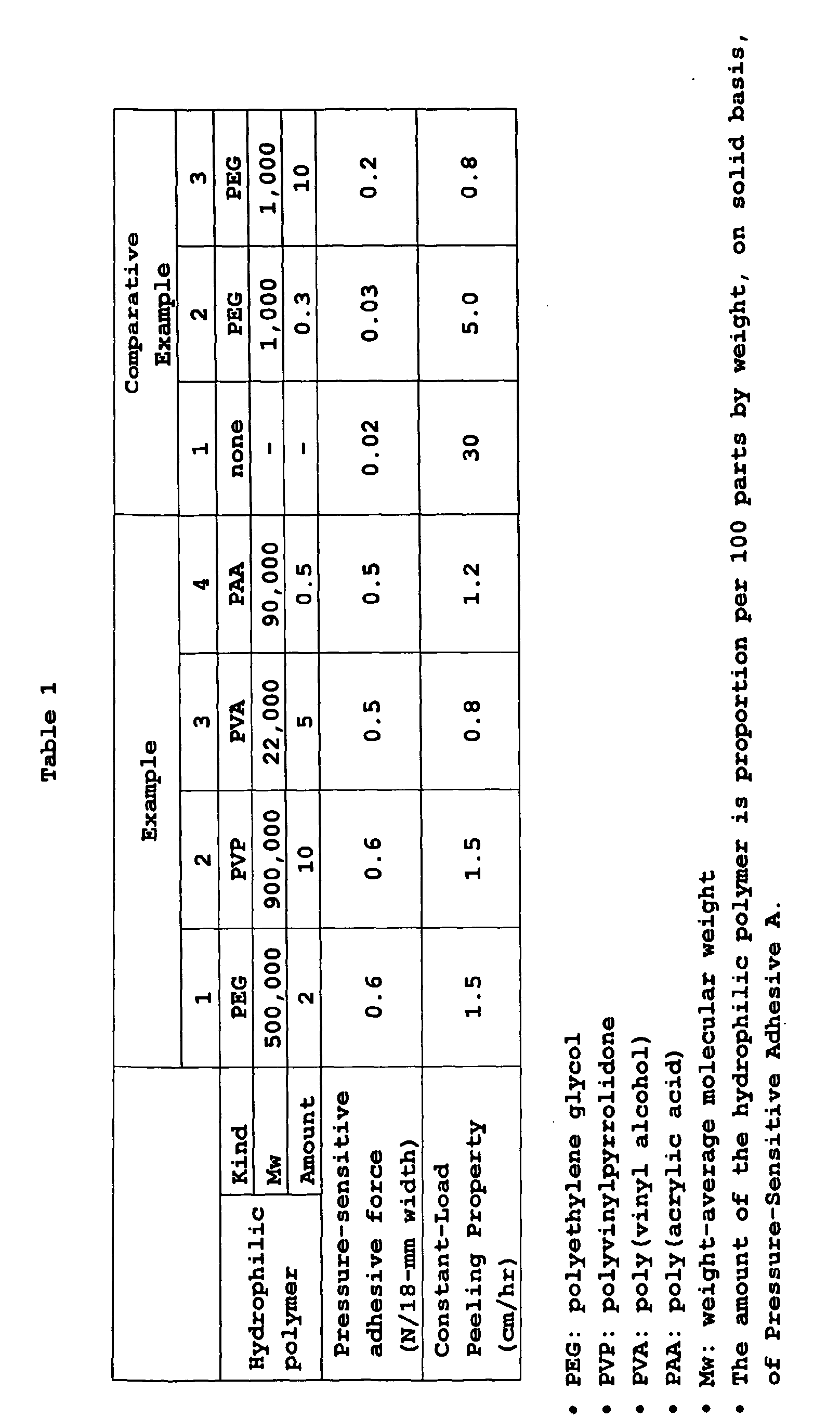
- Table 1 shows that the pressure-sensitive adhesive tapes obtained in Examples 1 to 4 were superior to the pressure-sensitive adhesive tapes of Comparative Examples 1 to 3 in pressure-sensitive adhesive force in application to the dewy or wet glass surface. The tapes of the Examples were thus ascertained to have satisfactory pressure-sensitive adhesive force in application to wet surfaces. Moreover, the pressure-sensitive adhesive tapes of Examples 1 to 4 were confirmed to be also excellent in their constant-load peeling property. Thus, it has become clear that when an aqueous dispersion type pressure-sensitive adhesive composition, which contains a polyalkylene glycol having a weight-average molecular weight of from 20,000 to 5,000,000 or at least one hydrophilic polymer selected from polyvinylpyrrolidone, poly(vinyl alcohol)s and poly((meth)acrylic acid) in an amount of from 0.5 to 15 parts by weight per 100 parts by weight, on a solid base, of an acrylic or rubber-based pressure-sensitive adhesive composition of the aqueous dispersion type, is used as a pressure-sensitive adhesive constituting a pressure-sensitive adhesive layer of the pressure-sensitive adhesive tape, good initial pressure-sensitive force to dewy or wet surfaces and good constant-load peeling property can be obtained
- While the invention has been described in detail and with reference to specific embodiments thereof, it will be apparent to one skilled in the art that various changes and modifications can be made therein without departing from the spirit and scope thereof.
Claims (16)
- An aqueous dispersion type pressure-sensitive adhesive composition which comprises a polyalkylene glycol having a weight-average molecular weight of from 20,000 to 5,000,000 in an amount of from 0.5 to 15 parts by weight per 100 parts by weight, on a solid basis, of an acrylic or rubber-based pressure-sensitive adhesive composition of the aqueous dispersion type.
- An aqueous dispersion type pressure-sensitive adhesive composition which comprises at least one hydrophilic polymer selected from the group consisting of polyvinylpyrrolidone, poly(vinyl alcohol)s, and poly((meth)acrylic acid) in an amount of from 0.5 to 15 parts by weight per 100 parts by weight, on a solid basis, of an acrylic or rubber-based pressure-sensitive adhesive composition of the aqueous dispersion type.
- The aqueous dispersion type pressure-sensitive adhesive composition as claimed in Claim 1, wherein the acrylic pressure-sensitive adhesive composition of the aqueous dispersion type comprises as a base polymer an acrylic polymer comprising a C4-12 alkyl ester of (meth)acrylic acid as a main monomer component.
- The aqueous dispersion type pressure-sensitive adhesive composition as claimed in Claim 2, wherein the acrylic pressure-sensitive adhesive composition of the aqueous dispersion type comprises as a base polymer an acrylic polymer comprising a C4-12 alkyl ester of (meth)acrylic acid as a main monomer component.
- The aqueous dispersion type pressure-sensitive adhesive composition as claimed in Claim 2, wherein the hydrophilic polymer has a weight-average molecular weight of from 500 to 5,000,000.
- The aqueous dispersion type pressure-sensitive adhesive composition as claimed in Claim 4, wherein the hydrophilic polymer has a weight-average molecular weight of from 500 to 5,000,000.
- A pressure-sensitive adhesive product which comprises a pressure-sensitive adhesive layer formed from the aqueous dispersion type pressure-sensitive adhesive composition as claimed in Claim 1.
- A pressure-sensitive adhesive product which comprises a pressure-sensitive adhesive layer formed from the aqueous dispersion type pressure-sensitive adhesive composition as claimed in Claim 3.
- A pressure-sensitive adhesive product which comprises a pressure-sensitive adhesive layer formed from the aqueous dispersion type pressure-sensitive adhesive composition as claimed in Claim 2.
- A pressure-sensitive adhesive product which comprises a pressure-sensitive adhesive layer formed from the aqueous dispersion type pressure-sensitive adhesive composition as claimed in Claim 4.
- A pressure-sensitive adhesive product which comprises a pressure-sensitive adhesive layer formed from the aqueous dispersion type pressure-sensitive adhesive composition as claimed in Claim 5.
- The pressure-sensitive adhesive product as claimed in Claim 7, wherein the pressure-sensitive adhesive layer formed from the aqueous dispersion type pressure-sensitive adhesive composition is disposed on at least one side of a porous base material.
- The pressure-sensitive adhesive product as claimed in Claim 8, wherein the pressure-sensitive adhesive layer formed from the aqueous dispersion type pressure-sensitive adhesive composition is disposed on at least one side of a porous base material.
- The pressure-sensitive adhesive product as claimed in Claim 9, wherein the pressure-sensitive adhesive layer formed from the aqueous dispersion type pressure-sensitive adhesive composition is disposed on at least one side of a porous base material.
- The pressure-sensitive adhesive product as claimed in Claim 10, wherein the pressure-sensitive adhesive layer formed from the aqueous dispersion type pressure-sensitive adhesive composition is disposed on at least one side of a porous base material.
- The pressure-sensitive adhesive product as claimed in Claim 11, wherein the pressure-sensitive adhesive layer formed from the aqueous dispersion type pressure-sensitive adhesive composition is disposed on at least one side of a porous base material.
Applications Claiming Priority (2)
| Application Number | Priority Date | Filing Date | Title |
|---|---|---|---|
| JP2003034518A JP4108499B2 (en) | 2002-02-25 | 2003-02-13 | Water-dispersed pressure-sensitive adhesive composition and pressure-sensitive adhesive product |
| JP2003034518 | 2003-02-13 |
Publications (1)
| Publication Number | Publication Date |
|---|---|
| EP1447434A1 true EP1447434A1 (en) | 2004-08-18 |
Family
ID=32677597
Family Applications (1)
| Application Number | Title | Priority Date | Filing Date |
|---|---|---|---|
| EP03015886A Withdrawn EP1447434A1 (en) | 2003-02-13 | 2003-07-11 | Aqueous dispersion type pressure-sensitive adhesive composition and pressure-sensitive adhesive product |
Country Status (4)
| Country | Link |
|---|---|
| EP (1) | EP1447434A1 (en) |
| KR (1) | KR100758072B1 (en) |
| CN (1) | CN1289624C (en) |
| SG (1) | SG121782A1 (en) |
Cited By (3)
| Publication number | Priority date | Publication date | Assignee | Title |
|---|---|---|---|---|
| EP1887063A1 (en) * | 2006-08-03 | 2008-02-13 | Nitto Denko Corporation | Method for producing aqueous pressure-sensitive adhesive composition |
| EP2452961A1 (en) * | 2010-11-12 | 2012-05-16 | Nitto Denko Corporation | Pressure-sensitive adhesive composition, pressure-sensitive adhesive layer, and pressure-sensitive adhesive tape or sheet |
| EP4141082A1 (en) * | 2021-08-25 | 2023-03-01 | Nitto Denko Corporation | Pressure-sensitive adhesive layer and pressure-sensitive adhesive sheet |
Families Citing this family (6)
| Publication number | Priority date | Publication date | Assignee | Title |
|---|---|---|---|---|
| JP4969032B2 (en) * | 2004-09-08 | 2012-07-04 | 日東電工株式会社 | Adhesive tape and video sensor mounting method using the same |
| JP4676945B2 (en) * | 2006-01-13 | 2011-04-27 | 日東電工株式会社 | Aqueous adhesive composition, adhesive tape and wire harness |
| CN101791426A (en) * | 2010-03-30 | 2010-08-04 | 绍兴振德医用敷料有限公司 | Wet adhesive for disposable surgical membrane and preparation method thereof |
| JP6517424B2 (en) * | 2015-07-10 | 2019-05-22 | エルジー・ケム・リミテッド | Adhesive polarizing plate |
| CN107979959A (en) * | 2017-12-20 | 2018-05-01 | 苏州佳值电子工业有限公司 | A kind of thermal diffusivity reflector plate |
| CN109536059A (en) * | 2018-11-08 | 2019-03-29 | 宁波激智科技股份有限公司 | A kind of novel optical protective film |
Citations (4)
| Publication number | Priority date | Publication date | Assignee | Title |
|---|---|---|---|---|
| GB1280631A (en) * | 1968-07-09 | 1972-07-05 | Smith & Nephew | Adhesive materials |
| GB1409594A (en) * | 1972-03-24 | 1975-10-08 | Beiersdorf Ag | Adhesive compositions |
| US4033918A (en) * | 1972-03-24 | 1977-07-05 | Beiersdorf Aktiengesellschaft | Water removable pressure sensitive adhesive |
| US4076661A (en) * | 1975-07-02 | 1978-02-28 | Henkel Kommanditgesellschaft Auf Aktien (Henkel Kgaa) | Adhesives based on aqueous dispersions of butadiene copolymers, polyvinylpyrrolidones and anionic macromolecular compounds |
Family Cites Families (1)
| Publication number | Priority date | Publication date | Assignee | Title |
|---|---|---|---|---|
| DE59108490D1 (en) * | 1991-01-31 | 1997-02-27 | Pfister Messtechnik | Transmission element for force or moment measuring devices |
-
2003
- 2003-07-08 SG SG200304168A patent/SG121782A1/en unknown
- 2003-07-11 EP EP03015886A patent/EP1447434A1/en not_active Withdrawn
- 2003-08-04 KR KR1020030053691A patent/KR100758072B1/en not_active Expired - Fee Related
- 2003-08-05 CN CNB031525539A patent/CN1289624C/en not_active Expired - Fee Related
Patent Citations (4)
| Publication number | Priority date | Publication date | Assignee | Title |
|---|---|---|---|---|
| GB1280631A (en) * | 1968-07-09 | 1972-07-05 | Smith & Nephew | Adhesive materials |
| GB1409594A (en) * | 1972-03-24 | 1975-10-08 | Beiersdorf Ag | Adhesive compositions |
| US4033918A (en) * | 1972-03-24 | 1977-07-05 | Beiersdorf Aktiengesellschaft | Water removable pressure sensitive adhesive |
| US4076661A (en) * | 1975-07-02 | 1978-02-28 | Henkel Kommanditgesellschaft Auf Aktien (Henkel Kgaa) | Adhesives based on aqueous dispersions of butadiene copolymers, polyvinylpyrrolidones and anionic macromolecular compounds |
Cited By (4)
| Publication number | Priority date | Publication date | Assignee | Title |
|---|---|---|---|---|
| EP1887063A1 (en) * | 2006-08-03 | 2008-02-13 | Nitto Denko Corporation | Method for producing aqueous pressure-sensitive adhesive composition |
| EP2452961A1 (en) * | 2010-11-12 | 2012-05-16 | Nitto Denko Corporation | Pressure-sensitive adhesive composition, pressure-sensitive adhesive layer, and pressure-sensitive adhesive tape or sheet |
| EP4141082A1 (en) * | 2021-08-25 | 2023-03-01 | Nitto Denko Corporation | Pressure-sensitive adhesive layer and pressure-sensitive adhesive sheet |
| US12221571B2 (en) | 2021-08-25 | 2025-02-11 | Nitto Denko Corporation | Pressure-sensitive adhesive layer and pressure-sensitive adhesive sheet |
Also Published As
| Publication number | Publication date |
|---|---|
| SG121782A1 (en) | 2006-05-26 |
| KR100758072B1 (en) | 2007-09-11 |
| KR20040073253A (en) | 2004-08-19 |
| CN1521230A (en) | 2004-08-18 |
| CN1289624C (en) | 2006-12-13 |
Similar Documents
| Publication | Publication Date | Title |
|---|---|---|
| JP5350332B2 (en) | Adhesive products | |
| EP1340797B1 (en) | Aqueous dispersion type pressure-sensitive adhesive composition and pressure-sensitive adhesive product | |
| JP3877670B2 (en) | Adhesive tape or sheet | |
| EP0554832B1 (en) | High solids moisture resistant latex pressure-sensitive adhesive | |
| EP2062955B2 (en) | Aqueous pressure-sensitive adhesive composition and utilization thereof | |
| US7396868B2 (en) | Aqueous dispersion type pressure-sensitive adhesive composition and pressure-sensitive adhesive product | |
| EP0913443A1 (en) | Heat-sensitive and pressure-sensitive adhesive sheet | |
| JP4798912B2 (en) | Water-based pressure-sensitive adhesive composition, method for producing the same, and adhesive product | |
| JP2009074083A (en) | Adhesive composition and adhesive sheet | |
| EP2818486B1 (en) | Water-dispersed pressure-sensitive adhesive composition and method for producing same | |
| US7045568B2 (en) | Aqueous dispersion type pressure-sensitive adhesive composition, and pressure-sensitive adhesive sheet | |
| KR100758072B1 (en) | Aqueous dispersion type pressure-sensitive adhesive composition and pressure-sensitive adhesive product | |
| JP4731405B2 (en) | Water-dispersed pressure-sensitive adhesive composition and pressure-sensitive adhesive product | |
| JP4326092B2 (en) | Masking tape or sheet for painting | |
| JP4514429B2 (en) | Adhesive tape and water-dispersed adhesive composition | |
| JP4087922B2 (en) | Adhesive tape | |
| JPH09286080A (en) | Surface protection film | |
| JP2007099998A (en) | Functional group-containing acrylic copolymer, method for producing the same, and pressure-sensitive adhesive composition containing the copolymer | |
| HK1006976B (en) | High solids moisture resistant latex pressure-sensitive adhesive |
Legal Events
| Date | Code | Title | Description |
|---|---|---|---|
| PUAI | Public reference made under article 153(3) epc to a published international application that has entered the european phase |
Free format text: ORIGINAL CODE: 0009012 |
|
| AK | Designated contracting states |
Kind code of ref document: A1 Designated state(s): AT BE BG CH CY CZ DE DK EE ES FI FR GB GR HU IE IT LI LU MC NL PT RO SE SI SK TR |
|
| AX | Request for extension of the european patent |
Extension state: AL LT LV MK |
|
| 17P | Request for examination filed |
Effective date: 20050215 |
|
| AKX | Designation fees paid |
Designated state(s): AT BE BG CH CY CZ DE DK EE ES FI FR GB GR HU IE IT LI LU MC NL PT RO SE SI SK TR |
|
| 17Q | First examination report despatched |
Effective date: 20071213 |
|
| STAA | Information on the status of an ep patent application or granted ep patent |
Free format text: STATUS: THE APPLICATION IS DEEMED TO BE WITHDRAWN |
|
| 18D | Application deemed to be withdrawn |
Effective date: 20101201 |