EP1431261A1 - JOINING AGENT FOR METAL OR CERAMIC, AND METHOD FOR JOINING METAL ARTICLES OR CERAMIC ARTICLES USING THE SAME - Google Patents
JOINING AGENT FOR METAL OR CERAMIC, AND METHOD FOR JOINING METAL ARTICLES OR CERAMIC ARTICLES USING THE SAME Download PDFInfo
- Publication number
- EP1431261A1 EP1431261A1 EP02800237A EP02800237A EP1431261A1 EP 1431261 A1 EP1431261 A1 EP 1431261A1 EP 02800237 A EP02800237 A EP 02800237A EP 02800237 A EP02800237 A EP 02800237A EP 1431261 A1 EP1431261 A1 EP 1431261A1
- Authority
- EP
- European Patent Office
- Prior art keywords
- bonding agent
- weight
- powder
- base body
- heat
- Prior art date
- Legal status (The legal status is an assumption and is not a legal conclusion. Google has not performed a legal analysis and makes no representation as to the accuracy of the status listed.)
- Granted
Links
Images



Classifications
-
- C—CHEMISTRY; METALLURGY
- C04—CEMENTS; CONCRETE; ARTIFICIAL STONE; CERAMICS; REFRACTORIES
- C04B—LIME, MAGNESIA; SLAG; CEMENTS; COMPOSITIONS THEREOF, e.g. MORTARS, CONCRETE OR LIKE BUILDING MATERIALS; ARTIFICIAL STONE; CERAMICS; REFRACTORIES; TREATMENT OF NATURAL STONE
- C04B37/00—Joining burned ceramic articles with other burned ceramic articles or other articles by heating
- C04B37/003—Joining burned ceramic articles with other burned ceramic articles or other articles by heating by means of an interlayer consisting of a combination of materials selected from glass, or ceramic material with metals, metal oxides or metal salts
- C04B37/006—Joining burned ceramic articles with other burned ceramic articles or other articles by heating by means of an interlayer consisting of a combination of materials selected from glass, or ceramic material with metals, metal oxides or metal salts consisting of metals or metal salts
-
- B—PERFORMING OPERATIONS; TRANSPORTING
- B23—MACHINE TOOLS; METAL-WORKING NOT OTHERWISE PROVIDED FOR
- B23K—SOLDERING OR UNSOLDERING; WELDING; CLADDING OR PLATING BY SOLDERING OR WELDING; CUTTING BY APPLYING HEAT LOCALLY, e.g. FLAME CUTTING; WORKING BY LASER BEAM
- B23K35/00—Rods, electrodes, materials, or media, for use in soldering, welding, or cutting
- B23K35/001—Interlayers, transition pieces for metallurgical bonding of workpieces
- B23K35/002—Interlayers, transition pieces for metallurgical bonding of workpieces at least one of the workpieces being of light metal
-
- B—PERFORMING OPERATIONS; TRANSPORTING
- B23—MACHINE TOOLS; METAL-WORKING NOT OTHERWISE PROVIDED FOR
- B23K—SOLDERING OR UNSOLDERING; WELDING; CLADDING OR PLATING BY SOLDERING OR WELDING; CUTTING BY APPLYING HEAT LOCALLY, e.g. FLAME CUTTING; WORKING BY LASER BEAM
- B23K35/00—Rods, electrodes, materials, or media, for use in soldering, welding, or cutting
- B23K35/22—Rods, electrodes, materials, or media, for use in soldering, welding, or cutting characterised by the composition or nature of the material
- B23K35/24—Selection of soldering or welding materials proper
-
- B—PERFORMING OPERATIONS; TRANSPORTING
- B23—MACHINE TOOLS; METAL-WORKING NOT OTHERWISE PROVIDED FOR
- B23K—SOLDERING OR UNSOLDERING; WELDING; CLADDING OR PLATING BY SOLDERING OR WELDING; CUTTING BY APPLYING HEAT LOCALLY, e.g. FLAME CUTTING; WORKING BY LASER BEAM
- B23K35/00—Rods, electrodes, materials, or media, for use in soldering, welding, or cutting
- B23K35/22—Rods, electrodes, materials, or media, for use in soldering, welding, or cutting characterised by the composition or nature of the material
- B23K35/24—Selection of soldering or welding materials proper
- B23K35/32—Selection of soldering or welding materials proper with the principal constituent melting at more than 1550°C
- B23K35/327—Selection of soldering or welding materials proper with the principal constituent melting at more than 1550°C comprising refractory compounds, e.g. carbides
-
- C—CHEMISTRY; METALLURGY
- C04—CEMENTS; CONCRETE; ARTIFICIAL STONE; CERAMICS; REFRACTORIES
- C04B—LIME, MAGNESIA; SLAG; CEMENTS; COMPOSITIONS THEREOF, e.g. MORTARS, CONCRETE OR LIKE BUILDING MATERIALS; ARTIFICIAL STONE; CERAMICS; REFRACTORIES; TREATMENT OF NATURAL STONE
- C04B37/00—Joining burned ceramic articles with other burned ceramic articles or other articles by heating
-
- C—CHEMISTRY; METALLURGY
- C04—CEMENTS; CONCRETE; ARTIFICIAL STONE; CERAMICS; REFRACTORIES
- C04B—LIME, MAGNESIA; SLAG; CEMENTS; COMPOSITIONS THEREOF, e.g. MORTARS, CONCRETE OR LIKE BUILDING MATERIALS; ARTIFICIAL STONE; CERAMICS; REFRACTORIES; TREATMENT OF NATURAL STONE
- C04B37/00—Joining burned ceramic articles with other burned ceramic articles or other articles by heating
- C04B37/003—Joining burned ceramic articles with other burned ceramic articles or other articles by heating by means of an interlayer consisting of a combination of materials selected from glass, or ceramic material with metals, metal oxides or metal salts
-
- C—CHEMISTRY; METALLURGY
- C04—CEMENTS; CONCRETE; ARTIFICIAL STONE; CERAMICS; REFRACTORIES
- C04B—LIME, MAGNESIA; SLAG; CEMENTS; COMPOSITIONS THEREOF, e.g. MORTARS, CONCRETE OR LIKE BUILDING MATERIALS; ARTIFICIAL STONE; CERAMICS; REFRACTORIES; TREATMENT OF NATURAL STONE
- C04B37/00—Joining burned ceramic articles with other burned ceramic articles or other articles by heating
- C04B37/02—Joining burned ceramic articles with other burned ceramic articles or other articles by heating with metallic articles
- C04B37/023—Joining burned ceramic articles with other burned ceramic articles or other articles by heating with metallic articles characterised by the interlayer used
-
- C—CHEMISTRY; METALLURGY
- C04—CEMENTS; CONCRETE; ARTIFICIAL STONE; CERAMICS; REFRACTORIES
- C04B—LIME, MAGNESIA; SLAG; CEMENTS; COMPOSITIONS THEREOF, e.g. MORTARS, CONCRETE OR LIKE BUILDING MATERIALS; ARTIFICIAL STONE; CERAMICS; REFRACTORIES; TREATMENT OF NATURAL STONE
- C04B37/00—Joining burned ceramic articles with other burned ceramic articles or other articles by heating
- C04B37/02—Joining burned ceramic articles with other burned ceramic articles or other articles by heating with metallic articles
- C04B37/023—Joining burned ceramic articles with other burned ceramic articles or other articles by heating with metallic articles characterised by the interlayer used
- C04B37/026—Joining burned ceramic articles with other burned ceramic articles or other articles by heating with metallic articles characterised by the interlayer used consisting of metals or metal salts
-
- B—PERFORMING OPERATIONS; TRANSPORTING
- B23—MACHINE TOOLS; METAL-WORKING NOT OTHERWISE PROVIDED FOR
- B23K—SOLDERING OR UNSOLDERING; WELDING; CLADDING OR PLATING BY SOLDERING OR WELDING; CUTTING BY APPLYING HEAT LOCALLY, e.g. FLAME CUTTING; WORKING BY LASER BEAM
- B23K2103/00—Materials to be soldered, welded or cut
- B23K2103/08—Non-ferrous metals or alloys
- B23K2103/10—Aluminium or alloys thereof
-
- B—PERFORMING OPERATIONS; TRANSPORTING
- B23—MACHINE TOOLS; METAL-WORKING NOT OTHERWISE PROVIDED FOR
- B23K—SOLDERING OR UNSOLDERING; WELDING; CLADDING OR PLATING BY SOLDERING OR WELDING; CUTTING BY APPLYING HEAT LOCALLY, e.g. FLAME CUTTING; WORKING BY LASER BEAM
- B23K35/00—Rods, electrodes, materials, or media, for use in soldering, welding, or cutting
- B23K35/22—Rods, electrodes, materials, or media, for use in soldering, welding, or cutting characterised by the composition or nature of the material
- B23K35/24—Selection of soldering or welding materials proper
- B23K35/28—Selection of soldering or welding materials proper with the principal constituent melting at less than 950°C
- B23K35/284—Mg as the principal constituent
-
- B—PERFORMING OPERATIONS; TRANSPORTING
- B23—MACHINE TOOLS; METAL-WORKING NOT OTHERWISE PROVIDED FOR
- B23K—SOLDERING OR UNSOLDERING; WELDING; CLADDING OR PLATING BY SOLDERING OR WELDING; CUTTING BY APPLYING HEAT LOCALLY, e.g. FLAME CUTTING; WORKING BY LASER BEAM
- B23K35/00—Rods, electrodes, materials, or media, for use in soldering, welding, or cutting
- B23K35/22—Rods, electrodes, materials, or media, for use in soldering, welding, or cutting characterised by the composition or nature of the material
- B23K35/24—Selection of soldering or welding materials proper
- B23K35/28—Selection of soldering or welding materials proper with the principal constituent melting at less than 950°C
- B23K35/286—Al as the principal constituent
-
- B—PERFORMING OPERATIONS; TRANSPORTING
- B23—MACHINE TOOLS; METAL-WORKING NOT OTHERWISE PROVIDED FOR
- B23K—SOLDERING OR UNSOLDERING; WELDING; CLADDING OR PLATING BY SOLDERING OR WELDING; CUTTING BY APPLYING HEAT LOCALLY, e.g. FLAME CUTTING; WORKING BY LASER BEAM
- B23K35/00—Rods, electrodes, materials, or media, for use in soldering, welding, or cutting
- B23K35/22—Rods, electrodes, materials, or media, for use in soldering, welding, or cutting characterised by the composition or nature of the material
- B23K35/34—Rods, electrodes, materials, or media, for use in soldering, welding, or cutting characterised by the composition or nature of the material comprising compounds which yield metals when heated
-
- B—PERFORMING OPERATIONS; TRANSPORTING
- B32—LAYERED PRODUCTS
- B32B—LAYERED PRODUCTS, i.e. PRODUCTS BUILT-UP OF STRATA OF FLAT OR NON-FLAT, e.g. CELLULAR OR HONEYCOMB, FORM
- B32B2309/00—Parameters for the laminating or treatment process; Apparatus details
- B32B2309/02—Temperature
- B32B2309/022—Temperature vs pressure profiles
-
- B—PERFORMING OPERATIONS; TRANSPORTING
- B32—LAYERED PRODUCTS
- B32B—LAYERED PRODUCTS, i.e. PRODUCTS BUILT-UP OF STRATA OF FLAT OR NON-FLAT, e.g. CELLULAR OR HONEYCOMB, FORM
- B32B2311/00—Metals, their alloys or their compounds
- B32B2311/12—Copper
-
- B—PERFORMING OPERATIONS; TRANSPORTING
- B32—LAYERED PRODUCTS
- B32B—LAYERED PRODUCTS, i.e. PRODUCTS BUILT-UP OF STRATA OF FLAT OR NON-FLAT, e.g. CELLULAR OR HONEYCOMB, FORM
- B32B2311/00—Metals, their alloys or their compounds
- B32B2311/24—Aluminium
-
- B—PERFORMING OPERATIONS; TRANSPORTING
- B32—LAYERED PRODUCTS
- B32B—LAYERED PRODUCTS, i.e. PRODUCTS BUILT-UP OF STRATA OF FLAT OR NON-FLAT, e.g. CELLULAR OR HONEYCOMB, FORM
- B32B2315/00—Other materials containing non-metallic inorganic compounds not provided for in groups B32B2311/00 - B32B2313/04
- B32B2315/02—Ceramics
-
- C—CHEMISTRY; METALLURGY
- C04—CEMENTS; CONCRETE; ARTIFICIAL STONE; CERAMICS; REFRACTORIES
- C04B—LIME, MAGNESIA; SLAG; CEMENTS; COMPOSITIONS THEREOF, e.g. MORTARS, CONCRETE OR LIKE BUILDING MATERIALS; ARTIFICIAL STONE; CERAMICS; REFRACTORIES; TREATMENT OF NATURAL STONE
- C04B2235/00—Aspects relating to ceramic starting mixtures or sintered ceramic products
- C04B2235/02—Composition of constituents of the starting material or of secondary phases of the final product
- C04B2235/30—Constituents and secondary phases not being of a fibrous nature
- C04B2235/32—Metal oxides, mixed metal oxides, or oxide-forming salts thereof, e.g. carbonates, nitrates, (oxy)hydroxides, chlorides
- C04B2235/3205—Alkaline earth oxides or oxide forming salts thereof, e.g. beryllium oxide
- C04B2235/3206—Magnesium oxides or oxide-forming salts thereof
-
- C—CHEMISTRY; METALLURGY
- C04—CEMENTS; CONCRETE; ARTIFICIAL STONE; CERAMICS; REFRACTORIES
- C04B—LIME, MAGNESIA; SLAG; CEMENTS; COMPOSITIONS THEREOF, e.g. MORTARS, CONCRETE OR LIKE BUILDING MATERIALS; ARTIFICIAL STONE; CERAMICS; REFRACTORIES; TREATMENT OF NATURAL STONE
- C04B2235/00—Aspects relating to ceramic starting mixtures or sintered ceramic products
- C04B2235/02—Composition of constituents of the starting material or of secondary phases of the final product
- C04B2235/30—Constituents and secondary phases not being of a fibrous nature
- C04B2235/32—Metal oxides, mixed metal oxides, or oxide-forming salts thereof, e.g. carbonates, nitrates, (oxy)hydroxides, chlorides
- C04B2235/3217—Aluminum oxide or oxide forming salts thereof, e.g. bauxite, alpha-alumina
- C04B2235/3222—Aluminates other than alumino-silicates, e.g. spinel (MgAl2O4)
-
- C—CHEMISTRY; METALLURGY
- C04—CEMENTS; CONCRETE; ARTIFICIAL STONE; CERAMICS; REFRACTORIES
- C04B—LIME, MAGNESIA; SLAG; CEMENTS; COMPOSITIONS THEREOF, e.g. MORTARS, CONCRETE OR LIKE BUILDING MATERIALS; ARTIFICIAL STONE; CERAMICS; REFRACTORIES; TREATMENT OF NATURAL STONE
- C04B2235/00—Aspects relating to ceramic starting mixtures or sintered ceramic products
- C04B2235/02—Composition of constituents of the starting material or of secondary phases of the final product
- C04B2235/30—Constituents and secondary phases not being of a fibrous nature
- C04B2235/38—Non-oxide ceramic constituents or additives
- C04B2235/3852—Nitrides, e.g. oxynitrides, carbonitrides, oxycarbonitrides, lithium nitride, magnesium nitride
- C04B2235/3865—Aluminium nitrides
-
- C—CHEMISTRY; METALLURGY
- C04—CEMENTS; CONCRETE; ARTIFICIAL STONE; CERAMICS; REFRACTORIES
- C04B—LIME, MAGNESIA; SLAG; CEMENTS; COMPOSITIONS THEREOF, e.g. MORTARS, CONCRETE OR LIKE BUILDING MATERIALS; ARTIFICIAL STONE; CERAMICS; REFRACTORIES; TREATMENT OF NATURAL STONE
- C04B2235/00—Aspects relating to ceramic starting mixtures or sintered ceramic products
- C04B2235/02—Composition of constituents of the starting material or of secondary phases of the final product
- C04B2235/30—Constituents and secondary phases not being of a fibrous nature
- C04B2235/40—Metallic constituents or additives not added as binding phase
- C04B2235/401—Alkaline earth metals
-
- C—CHEMISTRY; METALLURGY
- C04—CEMENTS; CONCRETE; ARTIFICIAL STONE; CERAMICS; REFRACTORIES
- C04B—LIME, MAGNESIA; SLAG; CEMENTS; COMPOSITIONS THEREOF, e.g. MORTARS, CONCRETE OR LIKE BUILDING MATERIALS; ARTIFICIAL STONE; CERAMICS; REFRACTORIES; TREATMENT OF NATURAL STONE
- C04B2235/00—Aspects relating to ceramic starting mixtures or sintered ceramic products
- C04B2235/02—Composition of constituents of the starting material or of secondary phases of the final product
- C04B2235/30—Constituents and secondary phases not being of a fibrous nature
- C04B2235/40—Metallic constituents or additives not added as binding phase
- C04B2235/402—Aluminium
-
- C—CHEMISTRY; METALLURGY
- C04—CEMENTS; CONCRETE; ARTIFICIAL STONE; CERAMICS; REFRACTORIES
- C04B—LIME, MAGNESIA; SLAG; CEMENTS; COMPOSITIONS THEREOF, e.g. MORTARS, CONCRETE OR LIKE BUILDING MATERIALS; ARTIFICIAL STONE; CERAMICS; REFRACTORIES; TREATMENT OF NATURAL STONE
- C04B2235/00—Aspects relating to ceramic starting mixtures or sintered ceramic products
- C04B2235/70—Aspects relating to sintered or melt-casted ceramic products
- C04B2235/80—Phases present in the sintered or melt-cast ceramic products other than the main phase
-
- C—CHEMISTRY; METALLURGY
- C04—CEMENTS; CONCRETE; ARTIFICIAL STONE; CERAMICS; REFRACTORIES
- C04B—LIME, MAGNESIA; SLAG; CEMENTS; COMPOSITIONS THEREOF, e.g. MORTARS, CONCRETE OR LIKE BUILDING MATERIALS; ARTIFICIAL STONE; CERAMICS; REFRACTORIES; TREATMENT OF NATURAL STONE
- C04B2235/00—Aspects relating to ceramic starting mixtures or sintered ceramic products
- C04B2235/70—Aspects relating to sintered or melt-casted ceramic products
- C04B2235/96—Properties of ceramic products, e.g. mechanical properties such as strength, toughness, wear resistance
-
- C—CHEMISTRY; METALLURGY
- C04—CEMENTS; CONCRETE; ARTIFICIAL STONE; CERAMICS; REFRACTORIES
- C04B—LIME, MAGNESIA; SLAG; CEMENTS; COMPOSITIONS THEREOF, e.g. MORTARS, CONCRETE OR LIKE BUILDING MATERIALS; ARTIFICIAL STONE; CERAMICS; REFRACTORIES; TREATMENT OF NATURAL STONE
- C04B2237/00—Aspects relating to ceramic laminates or to joining of ceramic articles with other articles by heating
- C04B2237/02—Aspects relating to interlayers, e.g. used to join ceramic articles with other articles by heating
- C04B2237/12—Metallic interlayers
- C04B2237/121—Metallic interlayers based on aluminium
-
- C—CHEMISTRY; METALLURGY
- C04—CEMENTS; CONCRETE; ARTIFICIAL STONE; CERAMICS; REFRACTORIES
- C04B—LIME, MAGNESIA; SLAG; CEMENTS; COMPOSITIONS THEREOF, e.g. MORTARS, CONCRETE OR LIKE BUILDING MATERIALS; ARTIFICIAL STONE; CERAMICS; REFRACTORIES; TREATMENT OF NATURAL STONE
- C04B2237/00—Aspects relating to ceramic laminates or to joining of ceramic articles with other articles by heating
- C04B2237/30—Composition of layers of ceramic laminates or of ceramic or metallic articles to be joined by heating, e.g. Si substrates
- C04B2237/32—Ceramic
- C04B2237/36—Non-oxidic
- C04B2237/365—Silicon carbide
-
- C—CHEMISTRY; METALLURGY
- C04—CEMENTS; CONCRETE; ARTIFICIAL STONE; CERAMICS; REFRACTORIES
- C04B—LIME, MAGNESIA; SLAG; CEMENTS; COMPOSITIONS THEREOF, e.g. MORTARS, CONCRETE OR LIKE BUILDING MATERIALS; ARTIFICIAL STONE; CERAMICS; REFRACTORIES; TREATMENT OF NATURAL STONE
- C04B2237/00—Aspects relating to ceramic laminates or to joining of ceramic articles with other articles by heating
- C04B2237/30—Composition of layers of ceramic laminates or of ceramic or metallic articles to be joined by heating, e.g. Si substrates
- C04B2237/40—Metallic
- C04B2237/402—Aluminium
-
- C—CHEMISTRY; METALLURGY
- C04—CEMENTS; CONCRETE; ARTIFICIAL STONE; CERAMICS; REFRACTORIES
- C04B—LIME, MAGNESIA; SLAG; CEMENTS; COMPOSITIONS THEREOF, e.g. MORTARS, CONCRETE OR LIKE BUILDING MATERIALS; ARTIFICIAL STONE; CERAMICS; REFRACTORIES; TREATMENT OF NATURAL STONE
- C04B2237/00—Aspects relating to ceramic laminates or to joining of ceramic articles with other articles by heating
- C04B2237/30—Composition of layers of ceramic laminates or of ceramic or metallic articles to be joined by heating, e.g. Si substrates
- C04B2237/40—Metallic
- C04B2237/407—Copper
-
- C—CHEMISTRY; METALLURGY
- C04—CEMENTS; CONCRETE; ARTIFICIAL STONE; CERAMICS; REFRACTORIES
- C04B—LIME, MAGNESIA; SLAG; CEMENTS; COMPOSITIONS THEREOF, e.g. MORTARS, CONCRETE OR LIKE BUILDING MATERIALS; ARTIFICIAL STONE; CERAMICS; REFRACTORIES; TREATMENT OF NATURAL STONE
- C04B2237/00—Aspects relating to ceramic laminates or to joining of ceramic articles with other articles by heating
- C04B2237/50—Processing aspects relating to ceramic laminates or to the joining of ceramic articles with other articles by heating
- C04B2237/70—Forming laminates or joined articles comprising layers of a specific, unusual thickness
- C04B2237/708—Forming laminates or joined articles comprising layers of a specific, unusual thickness of one or more of the interlayers
Definitions
- This invention relates to a bonding agent based on inorganic constituents for bonding metallic or ceramic parts together and, more particularly, to a bonding agent for metallic or ceramic parts of which hardening is promoted by heating, and a bonding process for metallic or ceramic parts employing the same.
- Soldering or a bonding method relying upon an organic adhesive is known as a method of bonding metallic or ceramic parts together.
- a bonding method relying upon an organic adhesive requires costly equipment for maintaining a proper working environment, as it uses an organic solvent, such as toluene. Moreover, it requires costly equipment for the disposal of a contaminated organic solvent.
- Soldering does not involve any problem of environment or waste disposal, but requires the heating of a base body and a part to be joined thereto with a solder in a vacuum oven to the melting temperature of the solder (640°C).
- the exposure of the base body, etc. to such a high temperature causes its thermal deformation due to a difference in temperature between its surface and interior, or between its upper and lower surfaces. It is usual to apply a high pressure to the base body to suppress its thermal deformation.
- soldering brings about a high cost of manufacture, insofar as it requires some measure to be taken to protect the base body, etc. from deformation caused by its heating to a high temperature.
- a bonding agent for metals or ceramics comprising 0.25 to 18.0% by weight of a powder of Mg and 25 to 50% by weight of a hydroxyl solvent, the balance of its composition being a powder of AlN.
- the bonding agent having the constituents stated above has a large amount of reaction heat generated by the reaction of its constituents. This reaction heat destroys thermally any strong oxide film existing on the surface of the base body or the part to be joined thereto, and forming a barrier layer hindering their bonding when the base body and the part to be joined thereto are of an aluminum alloy.
- a method relying upon a combination of self-generated heat and heat added from outside, or a method relying solely upon heat added from outside is available as a method of obtaining heat for destroying the oxide film as stated above.
- the method relying upon a combination of self-generated heat and heat added from outside requires only less heat added from outside than the method relying solely upon heat added from outside does.
- the less heat added from outside makes it possible to restrict any elevation in temperature of the base body and the part to be joined thereto.
- the restriction of any elevation in temperature makes it possible to lower the temperature of the base body and the part to be joined thereto. If their temperature is lower than what has hitherto been possible, it is not necessary to take any special measure for preventing their thermal deformation. Even when any measure may be taken for preventing deformation, it is sufficient for any such measure to employ only a low holding pressure.
- the hydroxyl solvent may be water.
- a metal or ceramic bonding process comprising: a kneading step in which a powder of Mg and a powder of AlN are kneaded for a bonding agent comprising 0.25 to 18.0% by weight of powder of Mg and 25 to 50% by weight of a hydroxyl solvent, the balance of its composition being the powder of AlN; a mixing step in which 25 to 50% by weight of hydroxyl solvent is mixed with the kneaded powders immediately before application; a coating step in which the bonding agent as obtained is applied to coat at least one of a metallic or ceramic base body and a part to be joined thereto; an intimate contact step in which the part is brought into intimate contact with the base body by the bonding agent; and a heating step in which the base body and the part held in intimate contact with each other are heated to 150 to 500°C so that their bonding may be promoted.
- the powders are mixed uniformly by kneading before the addition of the hydroxyl solvent, whereby their later reaction takes place more easily.
- the heat for destroying a strong oxide film thermally is obtained by a combination of self-generated heat and heat added from outside.
- heating to 150 to 500°C is sufficient for destroying a strong oxide film.
- 150 to 500°C is sufficiently lower than the temperature to be reached when only heat from outside is employed.
- AlN has amolecularweight of 41 (the sumof the atomic weights), which makes 328 when multiplied by 8.
- Mg has an atomic weight of about 24, which makes 72 when multiplied by 3.
- H 2 O has a molecular weight of 18, which makes 216 when multiplied by 12.
- 8:3:12 (factor ratio) is expressed as 328:72:216 when converted to the weight ratio. Its conversion to the percentage gives 53 wt%: 12 wt%: 35 wt%.
- AlN has a preferable proportion of 53% by weight
- Mg has a preferable proportion of 12% by weight
- H 2 O has a preferable proportion of 35% by weight.
- Mg is in the range of 0.25 to 18% by weight.
- the hydroxyl solvent As regards the hydroxyl solvent, it has been found that when it is less than 25% by weight, the above reaction does not proceed satisfactorily, but forms a bonding agent that is not in the form of a paste and is not applicable for satisfactory coating. It has also been found that when the hydroxyl solvent is over 50% by weight, the resulting product is too high in fluidity for successful coating. Accordingly, the hydroxyl solvent is in the range of 25 to 50% by weight.
- FIG. 1 showing in cross section a high-current power device made by the bonding process according to this invention.
- the high-current power device 10 comprises a semiconductor element 11, an insulating base 12 supporting the semiconductor element 11, a heat spreader 13 bonded to the insulating base 12 and a heat sink 15 bonded to the heat spreader 13 by a bonding agent 14 according to this invention.
- the heat generated by the semiconductor element 11 is transmitted to the heat spreader 13 and then the heat sink 15 and dissipated away, so that any elevation in temperature of the semiconductor element 11 may be restrained.
- the insulating base 12 is made of aluminum nitride.
- the heat spreader 13 is made of aluminum, copper or silicon carbide (SiC) having a high thermal conductivity.
- the heat sink 15 is also made of aluminum, copper or silicon carbide having a high thermal conductivity.
- a heat spreader 13 provided with a semiconductor element 11 and an insulating base 12, a heat sink 15 and a bonding agent 14 are prepared as shown in Fig. 2A.
- the heat spreader 13 and the heat sink 15 are of different kinds of metals, as the heat spreader is of aluminum (having a purity of 99.99%), while the heat sink is of an aluminum alloy A5052 (JIS: an aluminum alloy containing 2.5 Mg and 0.25 Cr).
- a powder of AlN 50% by weight of a powder of AlN, 10% by weight of a powder of Mg and 40% by weight of water are prepared for the bonding agent 14.
- an Al powder seven times as much as the AlN powder is prepared as an additive, since the heat spreader 13 and the heat sink 15 are of aluminum or an aluminum alloy.
- the AlN powder (50% by weight), Mg powder (10% by weight) and Al powder (seven times as much as the AlN powder) are first kneaded together thoroughly in a mortar. Water (40% by weight) is mixed with the kneaded powders to form the bonding agent 14 containing the additive.
- the bonding agent 14 is applied to coat the heat spreader 13, as shown in Fig. 2B.
- the heat sink 15 is placed on the bonding agent 14.
- the bonding agent 14 may alternatively be applied to the heat sink 15.
- the whole is charged in a vacuum heating oven 18, while the heat spreader 13 is placed on supports 16, as shown in Fig. 2C.
- the weight of the heat sink 15 bears upon the bonding agent 14. This load ought to produce a pressure of about 2 MPa. If it does not reach 2MPa, a weight 17 making up the shortage may be placed on the heat sink 15, as shown by an imaginary line.
- the vacuum oven is evacuated, and then, nitrogen is blown thereinto to create a nitrogen atmosphere having an oxygen concentration of 3 to 20 ppm.
- Heating is started at a heating rate of 10°C/min. for a target temperature of 150°C, and after 150°C is reached, two hours are allowed to pass.
- the reaction expressed by the following chemical formula takes place in the meantime and eventually produces 1120 kJ of reaction heat.
- This reaction heat serves as a part of heat required for the thermal destruction of any strong oxide film formed on the surface of a base body or a part to be joined thereto when it is of an aluminum alloy.
- the product taken out from the vacuum heating oven 18 was the power device 10 shown in Fig. 1.
- the power device 10 was examined for its mechanical properties. Their details are shown in a table below.
- Load pressure Joint thickness Tensile strength Broken portion Heat spreader (A5052) Heat sink (pure Al) 150°C 2 MPa About 100 ⁇ m About 20 MPa Inside the part joined to it
- the joint, or the bonding agent 14 had a thickness of about 100 ⁇ m, and its tensile breaking test, as well as the measurement of its tensile strength, was conducted by using a tensile testing machine. As a result, it showed a tensile strength of about 20 MPa and it was in the part joined, or the heat spreader 13 that had been broken. Thus, it was confirmed that the joint obtained by the process of this invention employing the bonding agent according to this invention was comparable in adhesive strength to any known product.
- the semiconductor element 11 is secured to the insulating base 12 by solder.
- solder softens or melts at 180°C
- the heating as shown in Fig. 2C has to be carried out at less than 180°C.
- a middle point between 125°C and 180°C was chosen as 150°C for the embodiment described above.
- a heat spreader 13, a heat sink 15 and a bonding agent 14 are first prepared as shown in Fig. 3A.
- the heat spreader 13 and the heat sink 15 are of different kinds of metals, as the heat spreader is of aluminum (having a purity of 99.99%), while the heat sink is of an aluminum alloy A5052 (an aluminum alloy containing 2.5 Mg and 0.25 Cr).
- a powder of AlN 50% by weight of a powder of AlN, 10% by weight of a powder of Mg and 40% by weight of water are prepared for the bonding agent 14.
- an Al powder seven times as much as the AlN powder is prepared as an additive, since the heat spreader 13 and the heat sink 15 are of aluminum or an aluminum alloy.
- the AlN powder (50% by weight), Mg powder (10% by weight) and Al powder (seven times as much as the AlN powder) are first kneaded together thoroughly in a mortar. Water (40% by weight) is mixed with the kneaded powders to form the bonding agent 14 containing the additive.
- the bonding agent 14 is applied to coat the heat spreader 13, as shown in Fig. 3B.
- the heat sink 15 is placed on the bonding agent 14.
- the bonding agent 14 may alternatively be applied to the heat sink 15.
- the whole is charged in a vacuum heating oven 18, while the heat spreader 13 is placed on supports 16, as shown in Fig. 3C.
- the weight of the heat sink 15 bears upon the bonding agent 14. This load ought to produce a pressure of about 2 MPa. If it does not reach 2MPa, a weight making up the shortage may be placed on the heat sink 15.
- the vacuum heating oven 18 is evacuated, and then, nitrogen is blown thereinto to create a nitrogen atmosphere having an oxygen concentration of 3 to 20 ppm.
- Heating is started at a heating rate of 10°C/min. for a target temperature of 600°C, and after 600°C is reached, two hours are allowed to pass.
- a semiconductor element 11 and an insulating base 12 are joined by solder, etc. to the heat spreader 13 after removal from the vacuum heating oven 18 and inversion.
- a high-current power device is completed as shown in Fig. 3D.
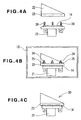
- An engine cylinder 21 and a head 23 having a fin 22 are first prepared as shown in Fig. 4A.
- the cylinder 21 has bolts 24 attached to it beforehand.
- the cylinder 21 is made of an aluminum die-casting (JIS-ADC-12) and the head 23 is also of an aluminum die-casting (JIS-ADC-12).
- the cylinder 21 has its top surface coated with a bonding agent 14.
- the bonding agent 14 is of the same composition as what has been described before.
- the head 23 is placed on the cylinder 21, and nuts 25 are put on the bolts 24 and turned to press the head 23 against the cylinder 21, as shown in Fig. 4B. Their pressure is adjusted to 2 MPa.
- the bolts 24 and the nuts 25 perform the function of a mechanical jack.
- the cylinder 21 and the head 23 are placed in a vacuum heating oven 18.
- the vacuum heating oven 18 is evacuated, and then, nitrogen is blown thereinto to create a nitrogen atmosphere having an oxygen concentration of 3 to 20 ppm.
- reaction heat serves as a part of heat required for the thermal destruction of any strong oxide film formed on the surface of a base body or a part to be joined thereto when it is of an aluminum alloy.
- the cylinder-head assembly 2 0 was examined for its mechanical properties. Their details are shown in a table below. Base body Part joined to it Heating temp. Load pressure Joint thickness Tensile strength Broken portion Cylinder (ADC12) Head (ADC12) 400°C 2 Mpa About 85 ⁇ m About 75 MPa Inside the base body
- the joint, or the bonding agent 14 had a thickness of about 85 ⁇ m, and its tensile breaking test, as well as the measurement of its tensile strength, was conducted by using a tensile testing machine. As a result, it showed a tensile strength of about 75 MPa and it was in the base body, or the cylinder 21 that had been broken. Thus, it was confirmed that the joint obtained by the process of this invention employing the bonding agent according to this invention was satisfactory in strength.
- the temperature of outside heating for promoting the adhesion of the bonding agent has to be 125°C or higher to obtain the strength comparable to what has hitherto been obtained. It is, however, desirable not to exceed 600°C inviewof the necessity of employing a temperature lower than the soldering temperature (about 640°C) to prevent deformation by temperature. Therefore, the outside heating temperature is selected from the range of 125 to 600°C.
- a preferred outside heating temperature is selected from the range of 150 to 500°C.
- the additive to be added to the bonding agent according to this invention is so altered as to suit the nature of the base body, or the part to be joined to it.
- the additive is, for example, a powder of Ni if the joining surfaces are plated with Ni.
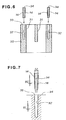
- a cylinder block 30 formed by an aluminum casting, aluminum alloy pieces 34 and a bonding agent 14 are first prepared as shown in Fig. 5. Their details will be explained in their order.
- the cylinder block 30 is an aluminum casting having adjoining cylinders 31 formed in close proximity to each other and having a narrow cylinder spacing, while water-cooling jackets 32 surrounding the cylinders 31 are open like rings in its surface 33 mating with a cylinder head. What has adjoining cylinders 31 formed in close proximity to each other as in the present example is called a Siamese type cylinder block.
- the aluminum casting is preferably an aluminum die-casting having its composition specified in JIS-ADC-12.
- the aluminum alloy pieces 34 have a thickness corresponding to the clearances defining the water-cooling jackets 32, and may be castings, or rolled products.
- the aluminum alloy piece 34 shown on its left-hand side is inserted into the water-cooling jacket 32 as shown by an arrow after it has been coated with the bonding agent 14 on both sides. The same is true of the aluminum alloy piece 34 shown on the right-hand side.
- the water-cooling jacket 32 preferably has a tapered shape widening toward its opening 35 for easy mold release.
- the cylinder block is, thus, easy to remove from the mold after its casting.
- the inclination ⁇ 1 corresponds to the release inclination formed in the casting mold.
- the aluminum alloy piece 34 prefferably has correspondingly a wedge-shaped cross section defined by its top end thickness t2 greater than its bottom end thickness t1. This taper angle of the piece is denoted as ⁇ 2.
- a compressive force of about 2 MPa is desirable for a compressive force of about 2 MPa to be exerted upon the bonding agent 14 by the wedge action mentioned above, any other mechanical clamp, or any other alternative method.
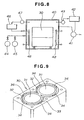
- a vacuum pump 41 is operated to evacuate the oven.
- Apressure control device 42 detects the oven pressure by a pressure sensor 43 and causes the vacuum pump 41 to work so that the oven pressure may reach a predetermined vacuum degree.
- gas is blown into the oven from a nitrogen container 44, or an inert gas container 45 filled with argon gas or the like to create a nitrogen or inert gas atmosphere having an oxygen concentration of 3 to 20 ppm in the oven.
- a temperature control device 46 detects the oven temperature by a temperature sensor 47 and regulates the heat input of heaters 48 to raise the oven temperature to the target temperature at the heating rate stated above.
- reaction heat 8AlN + 3Mg + 12H 2 O - 3Al 2 MgO 4 + 2Al + 8NH 3 - 1120 kJ (reaction heat)
- the heating oven 4 0 is discharged to yield a completed cylinder block 30 as shown in Fig. 9.
- the cylinder block 30 has a plurality of aluminum alloy pieces 34 fitted and secured with the bonding agent in the water-cooling jackets 32 surrounding the cylinders 31 and open like rings in its surface 33 mating with the cylinder head.
- the aluminum alloy pieces 34 were examined for their adhesive strength to the cylinder block 30. Its details are shown in a table below. Base body Part joined to it Heating temp. Load pressure Joint thickness Tensile strength Broken portion Cylinder block (ADC12) Aluminum alloy pieces 400°C 2 Mpa About 85 ⁇ m About 75 MPa Inside the parts joined
- the joint, or the bonding agent 14 had a thickness of about 85 ⁇ m, and its tensile breaking test, as well as the measurement of its tensile strength, was conducted by using a tensile testing machine. As a result, it showed a tensile strength of about 75 MPa and it was in the parts joined, or the aluminum alloy pieces 34 that had been broken. Thus, it was confirmed that the joint obtained by the process of this invention employing the bonding agent according to this invention was satisfactory in strength.
- the temperature of outside heating for promoting the adhesion of the bonding agent has to be 125°C or higher to obtain the strength comparable to what has hitherto been obtained. It is, however, desirable not to exceed 600°C in view of the necessity of employing a temperature lower than the soldering temperature (about 640°C) to prevent deformation by temperature. Therefore, the outside heating temperature is selected from the range of 125 to 600°C.
- a preferred outside heating temperature is selected from the range of 150 to 500°C.
- the additive to be added to the bonding agent according to this invention is so altered as to suit the nature of the base body, or the part to be joined to it.
- the additive is, for example, a powder of Ni if the joining surfaces are plated with Ni.
- the aluminum alloy pieces may be changed to aluminum alloy rings fitted in the openings of the water-cooling jackets. If such rings are coated with a bonding agent, set in the openings of the water-cooling jackets, and fixed by heating, it is possible to obtain a closed deck type cylinder block.
- An open deck type cylinder block has a low casting cost, but a closed deck type cylinder block has a high casting cost. A lower casting cost can, therefore, be achieved if an open deck type cylinder block is cast and changed to a close deck type cylinder block by applying the process of this invention.
- the cylinder block may have only one cylinder, or three ormore cylinders, though the embodiment has been described with a two-cylinder cylinder block.
- This invention is applicable to not only a Siamese type cylinder block, but also a non-Siamese type cylinder block.
- the bonding agent and process according to this invention are useful for the manufacture of engines and electrical apparatus, since they realize satis factorily the joining of metallic or ceramic parts for, e.g., an engine or a high-current power device.
Landscapes
- Chemical & Material Sciences (AREA)
- Engineering & Computer Science (AREA)
- Ceramic Engineering (AREA)
- Materials Engineering (AREA)
- Structural Engineering (AREA)
- Organic Chemistry (AREA)
- Mechanical Engineering (AREA)
- Pressure Welding/Diffusion-Bonding (AREA)
- Ceramic Products (AREA)
- Powder Metallurgy (AREA)
Abstract
Description

as shown by an imaginary line. The vacuum oven is evacuated, and then, nitrogen is blown thereinto to create a nitrogen atmosphere having an oxygen concentration of 3 to 20 ppm.
| Base body | Part joined to it | Heating temp. | Load pressure | Joint thickness | Tensile strength | Broken portion |
| Heat spreader (A5052) | Heat sink (pure Al) | 150°C | 2 MPa | About 100 µm | About 20 MPa | Inside the part joined to it |
| Base body | Part joined to it | Heating temp. | Load pressure | Joint thickness | Tensile strength | Broken portion |
| Cylinder (ADC12) | Head (ADC12) | 400°C | 2 Mpa | About 85 µm | About 75 MPa | Inside the base body |
| Base body | Part joined to it | Heating temp. | Load pressure | Joint thickness | Tensile strength | Broken portion |
| Cylinder block (ADC12) | Aluminum alloy pieces | 400°C | 2 Mpa | About 85 µm | About 75 MPa | Inside the parts joined |
Claims (3)
- A bonding agent for metals or ceramics comprising 0.25 to 18.0% by weight of a powder of Mg and 25 to 50% by weight of a hydroxyl solvent, the balance of its composition being a powder of AlN.
- The bonding agent for metals or ceramics according to claim 1, characterized in that the hydroxyl solvent is water.
- A metal or ceramic bonding process comprising:a kneading step in which a powder of Mg and a powder of AlN are kneaded for a bonding agent comprising 0.25 to 18.0% by weight of powder of Mg and 25 to 50% by weight of a hydroxyl solvent, the balance of its composition being the powder of AlN;a mixing step in which 25 to 50% by weight of hydroxyl solvent is mixed with the kneaded powders immediately before application;a coating step in which the bonding agent as obtained is applied to coat at least one of a metallic or ceramic base body and a part to be joined thereto;an intimate contact step in which the part is brought into intimate contact with the base body by the bonding agent; anda heating step in which the base body and the part held in intimate contact with each other are heated to 150 to 500°C so that their bonding may be promoted.
Applications Claiming Priority (3)
| Application Number | Priority Date | Filing Date | Title |
|---|---|---|---|
| JP2001297796 | 2001-09-27 | ||
| JP2001297796A JP4077181B2 (en) | 2001-09-27 | 2001-09-27 | Metal or ceramic bonding material and metal or ceramic bonding method |
| PCT/JP2002/009756 WO2003029165A1 (en) | 2001-09-27 | 2002-09-24 | Joining agent for metal or ceramic, and method for joining metal articles or ceramic articles using the same |
Publications (3)
| Publication Number | Publication Date |
|---|---|
| EP1431261A1 true EP1431261A1 (en) | 2004-06-23 |
| EP1431261A4 EP1431261A4 (en) | 2005-05-25 |
| EP1431261B1 EP1431261B1 (en) | 2006-01-04 |
Family
ID=19118802
Family Applications (1)
| Application Number | Title | Priority Date | Filing Date |
|---|---|---|---|
| EP02800237A Expired - Lifetime EP1431261B1 (en) | 2001-09-27 | 2002-09-24 | Joining agent for metal or ceramic; and method for joining metal articles or ceramic articles using the same |
Country Status (7)
| Country | Link |
|---|---|
| US (1) | US6923363B2 (en) |
| EP (1) | EP1431261B1 (en) |
| JP (1) | JP4077181B2 (en) |
| KR (1) | KR100851692B1 (en) |
| CN (1) | CN100509707C (en) |
| DE (1) | DE60208591T8 (en) |
| WO (1) | WO2003029165A1 (en) |
Families Citing this family (17)
| Publication number | Priority date | Publication date | Assignee | Title |
|---|---|---|---|---|
| TWI231586B (en) * | 2003-09-30 | 2005-04-21 | Neo Led Technology Co Ltd | Chip module having high heat dissipation property and its substrate |
| US7958633B2 (en) * | 2004-07-21 | 2011-06-14 | International Engine Intellectual Property Company, Llc | Engine block casting and method of manufacture |
| KR100718587B1 (en) * | 2004-10-26 | 2007-05-16 | 인하대학교 산학협력단 | Vacuum joining device and joining method for large area bonding materials |
| DE102006047395A1 (en) * | 2006-10-06 | 2008-04-10 | Robert Bosch Gmbh | Method for producing a sensor component and sensor component |
| US8093713B2 (en) * | 2007-02-09 | 2012-01-10 | Infineon Technologies Ag | Module with silicon-based layer |
| CN101971329B (en) * | 2008-03-17 | 2012-11-21 | 三菱综合材料株式会社 | Substrate for power module with heat sink and method for producing the same, power module with heat sink, and substrate for power module |
| EP2265099B1 (en) * | 2009-06-04 | 2013-11-27 | Honda Motor Co., Ltd. | Semiconductor device and method of manufacturing the same |
| JP5392272B2 (en) * | 2011-01-13 | 2014-01-22 | 株式会社豊田自動織機 | Double-sided substrate, semiconductor device, and method for manufacturing semiconductor device |
| DE102012200034A1 (en) * | 2012-01-03 | 2013-07-04 | Robert Bosch Gmbh | Method for producing a composite body with sintered joining layer and sintering device for producing such a composite body |
| CN102941419B (en) * | 2012-10-30 | 2015-04-15 | 江苏科技大学 | Active welding flux for tungsten inert gas (TIG) welding of aluminum and aluminum alloy and preparation method thereof |
| DE102012024063B4 (en) * | 2012-12-07 | 2016-12-29 | Ixys Semiconductor Gmbh | Process for producing substrates for power semiconductor components |
| US9863363B2 (en) * | 2013-07-09 | 2018-01-09 | Briggs & Stratton Corporation | Welded engine block for small internal combustion engines |
| US10202938B2 (en) | 2013-07-09 | 2019-02-12 | Briggs & Stratton Corporation | Welded engine block for small internal combustion engines |
| US9581106B2 (en) | 2013-07-09 | 2017-02-28 | Briggs & Stratton Corporation | Welded engine block for small internal combustion engines |
| CN104371560B (en) * | 2014-10-23 | 2016-09-21 | 中国电子科技集团公司第四十六研究所 | A kind of aluminum base high-temperature agglomerant for the stickup of AlN seed crystal and preparation method thereof |
| CN108435525B (en) * | 2018-03-08 | 2020-11-27 | 福州大学 | Method for separating adhesive layer and ceramic layer powder from thermal barrier coating spraying waste powder |
| WO2021176335A1 (en) | 2020-03-02 | 2021-09-10 | Briggs & Stratton, Llc | Internal combustion engine with reduced oil maintenance |
Family Cites Families (14)
| Publication number | Priority date | Publication date | Assignee | Title |
|---|---|---|---|---|
| JPS4114409B1 (en) * | 1963-08-21 | 1966-08-12 | ||
| JPS56115805A (en) * | 1980-02-20 | 1981-09-11 | Honda Motor Co Ltd | Internal combustion engine |
| JPS6077178A (en) * | 1983-09-30 | 1985-05-01 | 株式会社東芝 | Ceramic bonded body and manufacture |
| US5089172A (en) * | 1987-08-31 | 1992-02-18 | Ferro Corporation | Thick film conductor compositions for use with an aluminum nitride substrate |
| US4935055A (en) * | 1988-01-07 | 1990-06-19 | Lanxide Technology Company, Lp | Method of making metal matrix composite with the use of a barrier |
| US5376421A (en) * | 1991-08-30 | 1994-12-27 | University Of Cincinnati | Combustible slurry for joining metallic or ceramic surfaces or for coating metallic, ceramic and refractory surfaces |
| JPH05194048A (en) * | 1992-01-21 | 1993-08-03 | Mitsubishi Materials Corp | Method for joining ceramics sintered bodies |
| JP3057932B2 (en) * | 1992-10-01 | 2000-07-04 | 三菱マテリアル株式会社 | Joining method of ceramic sintered body |
| US5536686A (en) * | 1992-10-20 | 1996-07-16 | The Research Foundation Of State University Of New York At Buffalo | Phosphate binders for metal-matrix composites |
| US5733644A (en) * | 1994-04-15 | 1998-03-31 | Mitsubishi Chemical Corporation | Curable composition and method for preparing the same |
| JP3933287B2 (en) * | 1998-01-30 | 2007-06-20 | 電気化学工業株式会社 | Circuit board with heat sink |
| CN1142115C (en) * | 1999-01-28 | 2004-03-17 | 北京科技大学 | Process for preparing 'Meialong' magnesium ceramics with natural minerals as raw materials |
| JP2001114575A (en) * | 1999-10-19 | 2001-04-24 | Taiheiyo Cement Corp | Joining material of ceramics to ceramics and method for joining the same |
| JP4114409B2 (en) * | 2002-06-13 | 2008-07-09 | カシオ計算機株式会社 | Display device |
-
2001
- 2001-09-27 JP JP2001297796A patent/JP4077181B2/en not_active Expired - Fee Related
-
2002
- 2002-09-24 KR KR1020047004185A patent/KR100851692B1/en not_active Expired - Fee Related
- 2002-09-24 US US10/490,804 patent/US6923363B2/en not_active Expired - Fee Related
- 2002-09-24 DE DE60208591T patent/DE60208591T8/en active Active
- 2002-09-24 WO PCT/JP2002/009756 patent/WO2003029165A1/en not_active Ceased
- 2002-09-24 EP EP02800237A patent/EP1431261B1/en not_active Expired - Lifetime
- 2002-09-24 CN CNB028188888A patent/CN100509707C/en not_active Expired - Fee Related
Also Published As
| Publication number | Publication date |
|---|---|
| WO2003029165A1 (en) | 2003-04-10 |
| CN1558881A (en) | 2004-12-29 |
| US20040195294A1 (en) | 2004-10-07 |
| CN100509707C (en) | 2009-07-08 |
| DE60208591T8 (en) | 2006-11-02 |
| DE60208591T2 (en) | 2006-07-13 |
| DE60208591D1 (en) | 2006-03-30 |
| US6923363B2 (en) | 2005-08-02 |
| EP1431261A4 (en) | 2005-05-25 |
| KR100851692B1 (en) | 2008-08-11 |
| JP4077181B2 (en) | 2008-04-16 |
| JP2003104783A (en) | 2003-04-09 |
| EP1431261B1 (en) | 2006-01-04 |
| KR20040044974A (en) | 2004-05-31 |
Similar Documents
| Publication | Publication Date | Title |
|---|---|---|
| US6923363B2 (en) | Joining agent for metal or ceramic, and method for joining metal articles or ceramic articles using the same | |
| US20080087400A1 (en) | Method of producing base plate for circuit board, base plate for circuit board, and circuit board using the base plate | |
| JP4104253B2 (en) | Board integrated structure | |
| EP0977260B1 (en) | Semiconductor-supporting devices, processes for the production of the same, joined bodies and processes for the production of the same | |
| JP6685121B2 (en) | Method for joining metal member and ceramic member | |
| JPH04202705A (en) | Formation of sintered layer by coating | |
| KR20060051030A (en) | Composite material | |
| Jadoon | Employing reactive synthesis for metal to ceramic joining for high temperature applications | |
| JP2001217362A (en) | Laminated heat dissipating member, power semiconductor device using the heat dissipating member, and methods of manufacturing the same | |
| Kim et al. | Bonding characteristics of solder and sinter joints on active-metal-brazing substrates with nano sputtered Ag-Cu-Ti brazing filler metal | |
| JP3302714B2 (en) | Ceramic-metal joint | |
| KR100605556B1 (en) | Flux for dissimilar metal melt bonding and dissociation method for dissimilar metal using same | |
| JP3871599B2 (en) | Structure | |
| JP4436021B2 (en) | Cylinder block reinforcement method | |
| EA011380B1 (en) | Method for forming a tight-fitting silver surface on an aluminium piece | |
| JP2012091959A (en) | Method for manufacturing aluminum-ceramic composite structural component | |
| JP4461513B2 (en) | Aluminum-silicon carbide based composite material and method for producing the same | |
| JPH0427192B2 (en) | ||
| JP2002059272A (en) | Al composite material with ceramic powder layer interposed and method for producing the same | |
| JPH08158002A (en) | Silicon nitride ceramic-metal composite material and parts for molten aluminum | |
| JP2004154834A (en) | Method for manufacturing metal-ceramic composite | |
| KR20240119690A (en) | Aluminum matrix composite material with a functionally graded structure in which the distribution of aluminum nitride is controlled and its manufacturing method | |
| JPS6339739A (en) | Hot fitting method for si3n4-based ceramic | |
| WO2021025106A1 (en) | Ceramic bonding material | |
| JPH07277830A (en) | Combined ceramic sintered compact and member for molten iron-based alloy using the same |
Legal Events
| Date | Code | Title | Description |
|---|---|---|---|
| PUAI | Public reference made under article 153(3) epc to a published international application that has entered the european phase |
Free format text: ORIGINAL CODE: 0009012 |
|
| 17P | Request for examination filed |
Effective date: 20040226 |
|
| AK | Designated contracting states |
Kind code of ref document: A1 Designated state(s): AT BE BG CH CY CZ DE DK EE ES FI FR GB GR IE IT LI LU MC NL PT SE SK TR |
|
| AX | Request for extension of the european patent |
Extension state: AL LT LV MK RO SI |
|
| A4 | Supplementary search report drawn up and despatched |
Effective date: 20050408 |
|
| RIC1 | Information provided on ipc code assigned before grant |
Ipc: 7C 04B 37/00 A Ipc: 7B 23K 35/32 B Ipc: 7B 23K 35/24 B Ipc: 7C 09J 1/00 B Ipc: 7B 23K 35/34 B Ipc: 7B 23K 35/00 B |
|
| GRAP | Despatch of communication of intention to grant a patent |
Free format text: ORIGINAL CODE: EPIDOSNIGR1 |
|
| RTI1 | Title (correction) |
Free format text: JOINING AGENT FOR METAL OR CERAMIC; AND METHOD FOR JOINING METAL ARTICLES OR CERAMIC ARTICLES USING THE SAME |
|
| RBV | Designated contracting states (corrected) |
Designated state(s): DE FR |
|
| GRAS | Grant fee paid |
Free format text: ORIGINAL CODE: EPIDOSNIGR3 |
|
| GRAA | (expected) grant |
Free format text: ORIGINAL CODE: 0009210 |
|
| AK | Designated contracting states |
Kind code of ref document: B1 Designated state(s): DE FR |
|
| REF | Corresponds to: |
Ref document number: 60208591 Country of ref document: DE Date of ref document: 20060330 Kind code of ref document: P |
|
| ET | Fr: translation filed | ||
| PLBE | No opposition filed within time limit |
Free format text: ORIGINAL CODE: 0009261 |
|
| STAA | Information on the status of an ep patent application or granted ep patent |
Free format text: STATUS: NO OPPOSITION FILED WITHIN TIME LIMIT |
|
| 26N | No opposition filed |
Effective date: 20061005 |
|
| PGFP | Annual fee paid to national office [announced via postgrant information from national office to epo] |
Ref country code: FR Payment date: 20070914 Year of fee payment: 6 |
|
| REG | Reference to a national code |
Ref country code: FR Ref legal event code: ST Effective date: 20090529 |
|
| PG25 | Lapsed in a contracting state [announced via postgrant information from national office to epo] |
Ref country code: FR Free format text: LAPSE BECAUSE OF NON-PAYMENT OF DUE FEES Effective date: 20080930 |
|
| PGFP | Annual fee paid to national office [announced via postgrant information from national office to epo] |
Ref country code: DE Payment date: 20120919 Year of fee payment: 11 |
|
| REG | Reference to a national code |
Ref country code: DE Ref legal event code: R119 Ref document number: 60208591 Country of ref document: DE Effective date: 20140401 |
|
| PG25 | Lapsed in a contracting state [announced via postgrant information from national office to epo] |
Ref country code: DE Free format text: LAPSE BECAUSE OF NON-PAYMENT OF DUE FEES Effective date: 20140401 |