EP1427669B1 - An improved process for manufacturing highly concentrated hydroxylamine - Google Patents
An improved process for manufacturing highly concentrated hydroxylamine Download PDFInfo
- Publication number
- EP1427669B1 EP1427669B1 EP02776962A EP02776962A EP1427669B1 EP 1427669 B1 EP1427669 B1 EP 1427669B1 EP 02776962 A EP02776962 A EP 02776962A EP 02776962 A EP02776962 A EP 02776962A EP 1427669 B1 EP1427669 B1 EP 1427669B1
- Authority
- EP
- European Patent Office
- Prior art keywords
- ion exchange
- hydroxylamine
- ion
- aqueous
- solution
- Prior art date
- Legal status (The legal status is an assumption and is not a legal conclusion. Google has not performed a legal analysis and makes no representation as to the accuracy of the status listed.)
- Expired - Lifetime
Links
- AVXURJPOCDRRFD-UHFFFAOYSA-N Hydroxylamine Chemical compound ON AVXURJPOCDRRFD-UHFFFAOYSA-N 0.000 title claims abstract description 180
- 238000000034 method Methods 0.000 title claims abstract description 86
- 238000004519 manufacturing process Methods 0.000 title claims abstract description 18
- 239000000243 solution Substances 0.000 claims abstract description 74
- -1 hydroxylammonium ion Chemical class 0.000 claims abstract description 68
- 238000005342 ion exchange Methods 0.000 claims abstract description 68
- 239000007864 aqueous solution Substances 0.000 claims abstract description 13
- 150000001450 anions Chemical class 0.000 claims abstract description 9
- 239000011347 resin Substances 0.000 claims description 59
- 229920005989 resin Polymers 0.000 claims description 59
- NWUYHJFMYQTDRP-UHFFFAOYSA-N 1,2-bis(ethenyl)benzene;1-ethenyl-2-ethylbenzene;styrene Chemical group C=CC1=CC=CC=C1.CCC1=CC=CC=C1C=C.C=CC1=CC=CC=C1C=C NWUYHJFMYQTDRP-UHFFFAOYSA-N 0.000 claims description 45
- QGZKDVFQNNGYKY-UHFFFAOYSA-N Ammonia Chemical compound N QGZKDVFQNNGYKY-UHFFFAOYSA-N 0.000 claims description 42
- XLYOFNOQVPJJNP-UHFFFAOYSA-N water Substances O XLYOFNOQVPJJNP-UHFFFAOYSA-N 0.000 claims description 42
- 239000003729 cation exchange resin Substances 0.000 claims description 30
- 239000000356 contaminant Substances 0.000 claims description 26
- 238000003795 desorption Methods 0.000 claims description 22
- 229910052751 metal Inorganic materials 0.000 claims description 19
- 239000002184 metal Substances 0.000 claims description 19
- DNIAPMSPPWPWGF-UHFFFAOYSA-N Propylene glycol Chemical compound CC(O)CO DNIAPMSPPWPWGF-UHFFFAOYSA-N 0.000 claims description 18
- 229910000378 hydroxylammonium sulfate Inorganic materials 0.000 claims description 16
- 239000012527 feed solution Substances 0.000 claims description 15
- 239000003456 ion exchange resin Substances 0.000 claims description 15
- 229920003303 ion-exchange polymer Polymers 0.000 claims description 15
- VHUUQVKOLVNVRT-UHFFFAOYSA-N Ammonium hydroxide Chemical compound [NH4+].[OH-] VHUUQVKOLVNVRT-UHFFFAOYSA-N 0.000 claims description 14
- 239000000908 ammonium hydroxide Substances 0.000 claims description 12
- 229910021529 ammonia Inorganic materials 0.000 claims description 10
- 150000001768 cations Chemical class 0.000 claims description 10
- 239000002826 coolant Substances 0.000 claims description 10
- 239000002253 acid Substances 0.000 claims description 9
- 229910021645 metal ion Inorganic materials 0.000 claims description 8
- 239000000203 mixture Substances 0.000 claims description 8
- 239000003957 anion exchange resin Substances 0.000 claims description 7
- 150000001412 amines Chemical class 0.000 claims description 6
- XLYOFNOQVPJJNP-UHFFFAOYSA-M hydroxide Chemical compound [OH-] XLYOFNOQVPJJNP-UHFFFAOYSA-M 0.000 claims description 6
- 239000002738 chelating agent Substances 0.000 claims description 5
- 229910052739 hydrogen Inorganic materials 0.000 claims description 4
- 239000001257 hydrogen Substances 0.000 claims description 4
- 239000003795 chemical substances by application Substances 0.000 claims description 3
- 238000001816 cooling Methods 0.000 claims description 3
- 230000007423 decrease Effects 0.000 claims description 3
- ZNBNBTIDJSKEAM-UHFFFAOYSA-N 4-[7-hydroxy-2-[5-[5-[6-hydroxy-6-(hydroxymethyl)-3,5-dimethyloxan-2-yl]-3-methyloxolan-2-yl]-5-methyloxolan-2-yl]-2,8-dimethyl-1,10-dioxaspiro[4.5]decan-9-yl]-2-methyl-3-propanoyloxypentanoic acid Chemical compound C1C(O)C(C)C(C(C)C(OC(=O)CC)C(C)C(O)=O)OC11OC(C)(C2OC(C)(CC2)C2C(CC(O2)C2C(CC(C)C(O)(CO)O2)C)C)CC1 ZNBNBTIDJSKEAM-UHFFFAOYSA-N 0.000 claims description 2
- 125000004122 cyclic group Chemical group 0.000 claims description 2
- LYCAIKOWRPUZTN-UHFFFAOYSA-N Ethylene glycol Chemical compound OCCO LYCAIKOWRPUZTN-UHFFFAOYSA-N 0.000 claims 6
- UMGDCJDMYOKAJW-UHFFFAOYSA-N thiourea Chemical compound NC(N)=S UMGDCJDMYOKAJW-UHFFFAOYSA-N 0.000 claims 4
- XSQUKJJJFZCRTK-UHFFFAOYSA-N Urea Natural products NC(N)=O XSQUKJJJFZCRTK-UHFFFAOYSA-N 0.000 claims 2
- FBZONXHGGPHHIY-UHFFFAOYSA-N xanthurenic acid Chemical compound C1=CC=C(O)C2=NC(C(=O)O)=CC(O)=C21 FBZONXHGGPHHIY-UHFFFAOYSA-N 0.000 claims 2
- KUAZQDVKQLNFPE-UHFFFAOYSA-N thiram Chemical compound CN(C)C(=S)SSC(=S)N(C)C KUAZQDVKQLNFPE-UHFFFAOYSA-N 0.000 claims 1
- 229960002447 thiram Drugs 0.000 claims 1
- 238000005406 washing Methods 0.000 abstract description 7
- 238000012545 processing Methods 0.000 abstract description 3
- 239000000047 product Substances 0.000 description 51
- 239000002585 base Substances 0.000 description 18
- 229910000069 nitrogen hydride Inorganic materials 0.000 description 16
- VGYYSIDKAKXZEE-UHFFFAOYSA-L hydroxylammonium sulfate Chemical compound O[NH3+].O[NH3+].[O-]S([O-])(=O)=O VGYYSIDKAKXZEE-UHFFFAOYSA-L 0.000 description 14
- 125000002091 cationic group Chemical group 0.000 description 12
- FCKYPQBAHLOOJQ-UHFFFAOYSA-N Cyclohexane-1,2-diaminetetraacetic acid Chemical compound OC(=O)CN(CC(O)=O)C1CCCCC1N(CC(O)=O)CC(O)=O FCKYPQBAHLOOJQ-UHFFFAOYSA-N 0.000 description 10
- 235000011114 ammonium hydroxide Nutrition 0.000 description 9
- 239000012535 impurity Substances 0.000 description 9
- QAOWNCQODCNURD-UHFFFAOYSA-N Sulfuric acid Chemical compound OS(O)(=O)=O QAOWNCQODCNURD-UHFFFAOYSA-N 0.000 description 8
- 238000011068 loading method Methods 0.000 description 8
- 125000000129 anionic group Chemical group 0.000 description 7
- CRJZNQFRBUFHTE-UHFFFAOYSA-N hydroxylammonium nitrate Chemical compound O[NH3+].[O-][N+]([O-])=O CRJZNQFRBUFHTE-UHFFFAOYSA-N 0.000 description 7
- 150000002739 metals Chemical class 0.000 description 7
- 238000012360 testing method Methods 0.000 description 7
- KWYUFKZDYYNOTN-UHFFFAOYSA-M Potassium hydroxide Chemical compound [OH-].[K+] KWYUFKZDYYNOTN-UHFFFAOYSA-M 0.000 description 6
- HEMHJVSKTPXQMS-UHFFFAOYSA-M Sodium hydroxide Chemical compound [OH-].[Na+] HEMHJVSKTPXQMS-UHFFFAOYSA-M 0.000 description 6
- 239000012458 free base Substances 0.000 description 6
- 239000000523 sample Substances 0.000 description 6
- 230000000694 effects Effects 0.000 description 5
- XEEYBQQBJWHFJM-UHFFFAOYSA-N iron Substances [Fe] XEEYBQQBJWHFJM-UHFFFAOYSA-N 0.000 description 5
- 150000002923 oximes Chemical class 0.000 description 5
- 239000002245 particle Substances 0.000 description 5
- 239000003381 stabilizer Substances 0.000 description 5
- QGZKDVFQNNGYKY-UHFFFAOYSA-O Ammonium Chemical compound [NH4+] QGZKDVFQNNGYKY-UHFFFAOYSA-O 0.000 description 4
- QAOWNCQODCNURD-UHFFFAOYSA-L Sulfate Chemical compound [O-]S([O-])(=O)=O QAOWNCQODCNURD-UHFFFAOYSA-L 0.000 description 4
- 238000004458 analytical method Methods 0.000 description 4
- 238000000354 decomposition reaction Methods 0.000 description 4
- 239000008367 deionised water Substances 0.000 description 4
- 229910021641 deionized water Inorganic materials 0.000 description 4
- VLTRZXGMWDSKGL-UHFFFAOYSA-N perchloric acid Chemical compound OCl(=O)(=O)=O VLTRZXGMWDSKGL-UHFFFAOYSA-N 0.000 description 4
- 239000011734 sodium Substances 0.000 description 4
- 230000003068 static effect Effects 0.000 description 4
- 150000003467 sulfuric acid derivatives Chemical class 0.000 description 4
- 238000011282 treatment Methods 0.000 description 4
- 239000011800 void material Substances 0.000 description 4
- WMFOQBRAJBCJND-UHFFFAOYSA-M Lithium hydroxide Chemical compound [Li+].[OH-] WMFOQBRAJBCJND-UHFFFAOYSA-M 0.000 description 3
- GRYLNZFGIOXLOG-UHFFFAOYSA-N Nitric acid Chemical compound O[N+]([O-])=O GRYLNZFGIOXLOG-UHFFFAOYSA-N 0.000 description 3
- 150000007513 acids Chemical class 0.000 description 3
- 229940023913 cation exchange resins Drugs 0.000 description 3
- 238000010924 continuous production Methods 0.000 description 3
- 230000007062 hydrolysis Effects 0.000 description 3
- 238000006460 hydrolysis reaction Methods 0.000 description 3
- 150000002500 ions Chemical class 0.000 description 3
- 150000002576 ketones Chemical class 0.000 description 3
- 239000000463 material Substances 0.000 description 3
- 229910017604 nitric acid Inorganic materials 0.000 description 3
- 150000003839 salts Chemical class 0.000 description 3
- 238000000926 separation method Methods 0.000 description 3
- NLXLAEXVIDQMFP-UHFFFAOYSA-N Ammonium chloride Substances [NH4+].[Cl-] NLXLAEXVIDQMFP-UHFFFAOYSA-N 0.000 description 2
- IJGRMHOSHXDMSA-UHFFFAOYSA-N Atomic nitrogen Chemical compound N#N IJGRMHOSHXDMSA-UHFFFAOYSA-N 0.000 description 2
- 238000012935 Averaging Methods 0.000 description 2
- ROSDSFDQCJNGOL-UHFFFAOYSA-N Dimethylamine Chemical compound CNC ROSDSFDQCJNGOL-UHFFFAOYSA-N 0.000 description 2
- QUSNBJAOOMFDIB-UHFFFAOYSA-N Ethylamine Chemical compound CCN QUSNBJAOOMFDIB-UHFFFAOYSA-N 0.000 description 2
- BAVYZALUXZFZLV-UHFFFAOYSA-N Methylamine Chemical compound NC BAVYZALUXZFZLV-UHFFFAOYSA-N 0.000 description 2
- NHNBFGGVMKEFGY-UHFFFAOYSA-N Nitrate Chemical compound [O-][N+]([O-])=O NHNBFGGVMKEFGY-UHFFFAOYSA-N 0.000 description 2
- RAHZWNYVWXNFOC-UHFFFAOYSA-N Sulphur dioxide Chemical compound O=S=O RAHZWNYVWXNFOC-UHFFFAOYSA-N 0.000 description 2
- BFNBIHQBYMNNAN-UHFFFAOYSA-N ammonium sulfate Chemical compound N.N.OS(O)(=O)=O BFNBIHQBYMNNAN-UHFFFAOYSA-N 0.000 description 2
- 229910052921 ammonium sulfate Inorganic materials 0.000 description 2
- 235000011130 ammonium sulphate Nutrition 0.000 description 2
- 239000011575 calcium Substances 0.000 description 2
- 238000010668 complexation reaction Methods 0.000 description 2
- 229910052802 copper Inorganic materials 0.000 description 2
- 230000002708 enhancing effect Effects 0.000 description 2
- 238000010438 heat treatment Methods 0.000 description 2
- 150000002443 hydroxylamines Chemical class 0.000 description 2
- 229910052742 iron Inorganic materials 0.000 description 2
- 238000012423 maintenance Methods 0.000 description 2
- 150000001455 metallic ions Chemical class 0.000 description 2
- 238000012544 monitoring process Methods 0.000 description 2
- 230000003472 neutralizing effect Effects 0.000 description 2
- 238000002360 preparation method Methods 0.000 description 2
- 238000000746 purification Methods 0.000 description 2
- 238000011084 recovery Methods 0.000 description 2
- 238000004064 recycling Methods 0.000 description 2
- 229910052708 sodium Inorganic materials 0.000 description 2
- LPXPTNMVRIOKMN-UHFFFAOYSA-M sodium nitrite Chemical compound [Na+].[O-]N=O LPXPTNMVRIOKMN-UHFFFAOYSA-M 0.000 description 2
- 238000003860 storage Methods 0.000 description 2
- 239000002351 wastewater Substances 0.000 description 2
- RZVAJINKPMORJF-UHFFFAOYSA-N Acetaminophen Chemical compound CC(=O)NC1=CC=C(O)C=C1 RZVAJINKPMORJF-UHFFFAOYSA-N 0.000 description 1
- BHPQYMZQTOCNFJ-UHFFFAOYSA-N Calcium cation Chemical compound [Ca+2] BHPQYMZQTOCNFJ-UHFFFAOYSA-N 0.000 description 1
- VEXZGXHMUGYJMC-UHFFFAOYSA-M Chloride anion Chemical compound [Cl-] VEXZGXHMUGYJMC-UHFFFAOYSA-M 0.000 description 1
- CWYNVVGOOAEACU-UHFFFAOYSA-N Fe2+ Chemical compound [Fe+2] CWYNVVGOOAEACU-UHFFFAOYSA-N 0.000 description 1
- VTLYFUHAOXGGBS-UHFFFAOYSA-N Fe3+ Chemical compound [Fe+3] VTLYFUHAOXGGBS-UHFFFAOYSA-N 0.000 description 1
- DGAQECJNVWCQMB-PUAWFVPOSA-M Ilexoside XXIX Chemical compound C[C@@H]1CC[C@@]2(CC[C@@]3(C(=CC[C@H]4[C@]3(CC[C@@H]5[C@@]4(CC[C@@H](C5(C)C)OS(=O)(=O)[O-])C)C)[C@@H]2[C@]1(C)O)C)C(=O)O[C@H]6[C@@H]([C@H]([C@@H]([C@H](O6)CO)O)O)O.[Na+] DGAQECJNVWCQMB-PUAWFVPOSA-M 0.000 description 1
- 229910002651 NO3 Inorganic materials 0.000 description 1
- PMZURENOXWZQFD-UHFFFAOYSA-L Sodium Sulfate Chemical compound [Na+].[Na+].[O-]S([O-])(=O)=O PMZURENOXWZQFD-UHFFFAOYSA-L 0.000 description 1
- 230000002378 acidificating effect Effects 0.000 description 1
- 239000003463 adsorbent Substances 0.000 description 1
- 238000013459 approach Methods 0.000 description 1
- 239000011324 bead Substances 0.000 description 1
- 239000006227 byproduct Substances 0.000 description 1
- 229910001424 calcium ion Inorganic materials 0.000 description 1
- 238000005341 cation exchange Methods 0.000 description 1
- 238000006243 chemical reaction Methods 0.000 description 1
- 238000011109 contamination Methods 0.000 description 1
- 238000007796 conventional method Methods 0.000 description 1
- 230000002950 deficient Effects 0.000 description 1
- 230000001419 dependent effect Effects 0.000 description 1
- 238000013461 design Methods 0.000 description 1
- 238000011161 development Methods 0.000 description 1
- HPNMFZURTQLUMO-UHFFFAOYSA-N diethylamine Chemical compound CCNCC HPNMFZURTQLUMO-UHFFFAOYSA-N 0.000 description 1
- 238000010790 dilution Methods 0.000 description 1
- 239000012895 dilution Substances 0.000 description 1
- 238000001704 evaporation Methods 0.000 description 1
- 230000008020 evaporation Effects 0.000 description 1
- 229910001447 ferric ion Inorganic materials 0.000 description 1
- 229910001448 ferrous ion Inorganic materials 0.000 description 1
- 239000003337 fertilizer Substances 0.000 description 1
- 238000011049 filling Methods 0.000 description 1
- 239000012530 fluid Substances 0.000 description 1
- 238000007429 general method Methods 0.000 description 1
- 239000011521 glass Substances 0.000 description 1
- 239000008187 granular material Substances 0.000 description 1
- 230000003301 hydrolyzing effect Effects 0.000 description 1
- GPRLSGONYQIRFK-UHFFFAOYSA-N hydron Chemical compound [H+] GPRLSGONYQIRFK-UHFFFAOYSA-N 0.000 description 1
- RBLWMQWAHONKNC-UHFFFAOYSA-N hydroxyazanium Chemical compound O[NH3+] RBLWMQWAHONKNC-UHFFFAOYSA-N 0.000 description 1
- NILJXUMQIIUAFY-UHFFFAOYSA-N hydroxylamine;nitric acid Chemical compound ON.O[N+]([O-])=O NILJXUMQIIUAFY-UHFFFAOYSA-N 0.000 description 1
- BMMNWPYKMOFBBE-UHFFFAOYSA-N hydroxylamine;perchloric acid Chemical compound ON.OCl(=O)(=O)=O BMMNWPYKMOFBBE-UHFFFAOYSA-N 0.000 description 1
- 238000001095 inductively coupled plasma mass spectrometry Methods 0.000 description 1
- 238000002354 inductively-coupled plasma atomic emission spectroscopy Methods 0.000 description 1
- 229910052500 inorganic mineral Inorganic materials 0.000 description 1
- 239000007791 liquid phase Substances 0.000 description 1
- 238000005259 measurement Methods 0.000 description 1
- 239000011707 mineral Substances 0.000 description 1
- 238000002156 mixing Methods 0.000 description 1
- 238000012986 modification Methods 0.000 description 1
- 230000004048 modification Effects 0.000 description 1
- 238000006386 neutralization reaction Methods 0.000 description 1
- 150000002823 nitrates Chemical class 0.000 description 1
- 229910052757 nitrogen Inorganic materials 0.000 description 1
- 231100000252 nontoxic Toxicity 0.000 description 1
- 230000003000 nontoxic effect Effects 0.000 description 1
- 230000001590 oxidative effect Effects 0.000 description 1
- NBIIXXVUZAFLBC-UHFFFAOYSA-K phosphate Chemical compound [O-]P([O-])([O-])=O NBIIXXVUZAFLBC-UHFFFAOYSA-K 0.000 description 1
- 229940085991 phosphate ion Drugs 0.000 description 1
- 239000011148 porous material Substances 0.000 description 1
- 229910052700 potassium Inorganic materials 0.000 description 1
- 238000011027 product recovery Methods 0.000 description 1
- 238000010926 purge Methods 0.000 description 1
- 239000012521 purified sample Substances 0.000 description 1
- 239000005297 pyrex Substances 0.000 description 1
- 230000000717 retained effect Effects 0.000 description 1
- 229920006395 saturated elastomer Polymers 0.000 description 1
- 239000004065 semiconductor Substances 0.000 description 1
- 229910001415 sodium ion Inorganic materials 0.000 description 1
- 235000010288 sodium nitrite Nutrition 0.000 description 1
- 229910052938 sodium sulfate Inorganic materials 0.000 description 1
- 235000011152 sodium sulphate Nutrition 0.000 description 1
- 239000007787 solid Substances 0.000 description 1
- 238000001179 sorption measurement Methods 0.000 description 1
- 230000002269 spontaneous effect Effects 0.000 description 1
- 239000000126 substance Substances 0.000 description 1
- 238000005979 thermal decomposition reaction Methods 0.000 description 1
Images


Classifications
-
- C—CHEMISTRY; METALLURGY
- C01—INORGANIC CHEMISTRY
- C01B—NON-METALLIC ELEMENTS; COMPOUNDS THEREOF; METALLOIDS OR COMPOUNDS THEREOF NOT COVERED BY SUBCLASS C01C
- C01B21/00—Nitrogen; Compounds thereof
- C01B21/082—Compounds containing nitrogen and non-metals and optionally metals
- C01B21/14—Hydroxylamine; Salts thereof
- C01B21/1481—Purification
-
- C—CHEMISTRY; METALLURGY
- C01—INORGANIC CHEMISTRY
- C01B—NON-METALLIC ELEMENTS; COMPOUNDS THEREOF; METALLOIDS OR COMPOUNDS THEREOF NOT COVERED BY SUBCLASS C01C
- C01B21/00—Nitrogen; Compounds thereof
- C01B21/082—Compounds containing nitrogen and non-metals and optionally metals
- C01B21/14—Hydroxylamine; Salts thereof
- C01B21/1409—Preparation
- C01B21/1445—Preparation of hydoxylamine from its salts
Definitions
- This invention relates to a process for producing hydroxylamine, and more particularly, to such process utilizing an ion exchange resin to produce purified, concentrated solutions of hydroxylamine free base.
- Hydroxylamine is prepared commercially by the Raschig process or variations thereof in which ammonium or sodium nitrite is reacted in aqueous solution with ammonium or sodium bi-sulfite and sulfur dioxide and the resulting disulfonate salts are subsequently hydrolyzed to a solution containing essentially hydroxylammonium sulfate, sulfuric acid, ammonium sulfate and/or sodium sulfate plus minor amounts of the corresponding nitrates.
- This solution can be used, after neutralization with ammonia, as a source of hydroxylamine or pure hydroxylammonium salts from the mixture.
- One method of obtaining pure hydroxylammonium salts consists of using a hydroxylammonium containing mixture to synthesize an oxime from a ketone, separating the oxime from the spent solution and hydrolyzing this oxime with a strong mineral acid to recover hydroxylammonium salt and the ketone which can be recycled.
- This method uses long periods of heating for the hydrolysis and requires expensive equipment for the separation of the oxime from the spent solution and of the hydroxylammonium salt from the ketone.
- salts of hydroxylamine with weak or oxidizing acids cannot be prepared by this method because these acids either do not effect hydrolysis of oximes or decompose the hydroxylammonium salt formed during hydrolysis. Salts of such acids can be prepared by neutralizing cold solutions of hydroxylamine with the corresponding acid.
- hydroxylammonium perchlorate can be produced either by liberating hydroxylamine from a hydroxylammonium salt by passage through an anion exchange resin and neutralizing with perchloric acid, or by absorbing hydroxylammonium ion an a cation exchange resin and then passing perchloric acid through the resin.
- This method does not separate hydroxylamine from other cations.
- a cation exchange method is described by Earl. J. Wheel-wright in Industrial Engineering Chemistry Process Design Development, Vol. 16, No. 2 (1977), page 220 for the preparation of hydroxylammonium nitrate. This method does not separate hydroxylamine from other cations and moreover the resulting solution of hydroxylammonium nitrate contains significant amounts of nitric acid.
- U.S. Pat. No. 5,213,784 discloses a process for producing concentrated purified hydroxylammonium nitrate. The process involves admixing nitric acid having a concentration less than about 70% to solutions containing excess hydroxylamine. The process avoids spontaneous decomposition of the product.
- U.S. Pat. No. 4,725,360 discloses a process for recovering hydroxylamine from waste water in the form of hydroxylammonium sulfate. The process consists of passing the waste water over a strongly acidic ion exchanger and then eluting hydroxylamine associated with the ion exchanger with sulfuric acid.
- U.S. Pat. No. 4,202,765 discloses a method for purifying hydroxylamine using anion exchanger. The process consists of passing a hydroxylamine containing solution across a bed of cationic exchange resin and desorbing absorbed hydroxylamine using a monovalent amine or hydroxide base.
- This invention relates to a process for producing hydroxylamine, and more particularly, to such process utilizing ion exchange. Additionally, the process employs various processing steps whereby a concentrated solution of hydroxylamine is obtained in a purified state.
- This present invention rates to an ion-exchange process for manufacturing hydroxylamine from an aqueous solution including hydroxylammonium ion and ionic contaminants such as H + , NH 4 + , metal and sulfate ions.
- the ion-exchange process of this invention is useful for producing a high purity aqueous hydroxylamine solution for subsequent manufacture of hydroxylamine salts such as hydroxylamine nitrate as well as hydroxylamine sulfate, and other hydroxylamine salts for various intermediate and end uses.
- An additional advantage of the process of this invention is its ability to produce a purified aqueous hydroxylamine product that is essentially free of cationic contaminants as well as anionic contaminants such as sulfate ion.
- the term "essentially free” as used herein, refers to a purified aqueous hydroxylamine product that has less than 400 ppm anionic contaminants such as sulfates and preferably 200 ppm or less of anionic contaminants.
- the term "essentially free" when used to describe ionic contaminants means less than 200 ppb ionic contaminants including all metal cations.
- the ion exchange process of this invention is useful for purifying and concentrating hydroxylamine from hydroxylammonium ions produced in a variety of processes. Such processes are disclosed and described, for example, in U.S. Pat. Nos. 5,213,784 and 4,492,567, which describe processes for producing hydroxylammonium ion salts such as hydroxylammonium nitrate (HAN) and hydroxylammonium sulfate (HAS), and which are incorporated herein by reference in their entirety.
- a common process for preparing a hydroxylammonium ion containing solution is the Raschig process. The Raschig process produces an aqueous solution comprising hydroxylammonium ions, hydrogen ions, ammonium ions, and sulfates.
- the process of this invention is useful for producing a purified and concentrated aqueous hydroxylamine solution from any aqueous hydroxylammonium ion containing solution, including, but not limited to, Raschig solutions, HAN solutions and HAS solutions.
- any aqueous hydroxylammonium ion containing solution including, but not limited to, Raschig solutions, HAN solutions and HAS solutions.
- the process of this invention will generally be described in the context of purifying and concentrating hydroxylamine from the aqueous hydroxylammonium ion containing solution product of the Raschig process, and HAS solutions.
- the process of this invention uses an ion-exchange resin in a container, e.g. in column form, loaded with a cation exchange resin to bind to the hydroxylammonium ion in order to accomplish hydroxylamine purification and concentration.
- a suitable cation exchange resin is selected. All types of cation exchange resins are suitable, e.g., sulfonic, phosphoric or carboxylic types. Sulfonic resins are preferred because they have a high selectivity for hydroxylammonium ion over other cations and anions.
- desorption of the hydroxylammonium ion from the resin which is contained in the exchange resin must be accomplished.
- This is typically accomplished by employing a suitable base solution, e.g. sodium hydroxide, potassium hydroxide, ammonium hydroxide, etc., that has a higher affinity towards the cationic exchange resin than hydroxylamine.
- any water soluble monovalent amine or hydroxide base can be used.
- Polyvalent bases are less suitable because their cations have great affinity for the exchange sites of the cationic resin and therefore cannot be readily displaced by hydroxylammonium ion in a subsequent ion-exchange loading cycle.
- Suitable monovalent bases include, for example, sodium hydroxide, potassium hydroxide, lithium hydroxide and the like; methylamine, ethylamine, dimethylamine, diethylamine, and the like.
- the preferred base is ammonium hydroxide which has the advantages of being relatively inexpensive, non-toxic, of low molecular weight, and volatile.
- ammonium sulfate which is valuable as a fertilizer.
- a most preferred desorbent base is an aqueous ammonia solution having an ammonia concentration of at least 30% and preferably a concentration of at least 40%.
- the volatility of ammonia allows for the use of a slight excess of ammonia in the desorption step in order to displace hydroxylamine completely from the resin because small amounts of ammonia that will contaminate the product hydroxylamine (less than about 3% during this operation can easily be removed by evaporation. Furthermore, any product contaminated with an unacceptable level of ammonium ion can be recycled to feed the stream. It has been found, however, that it is possible to obtain essentially ammonia-free and ionic contaminant free hydroxylamine solutions directly from the resin using a deficient amount of ammonia to displace hydroxylamine.
- the aqueous base solution which is used to desorb hydroxylamine from the ion exchange resin during the desorption step may optionally contain hydroxylamine.
- the ion exchange column effluent which is thereafter finally obtained by subsequently rinsing the resin bed with water contains hydroxylamine at a concentration which is substantially higher than the concentration obtain if no hydroxylamine were present in the aqueous base solution. This effect allows the recovery of relatively concentrated hydroxylamine liquors in a cyclic and/or continuous ion exchange process by simply recycling part of the hydroxylamine product solution to the unloading step of the next cycle after mixing with a base.
- the ion exchange process of this invention is conducted in essentially five steps.
- the first two steps are defined as the "loading steps" and consist of: (1) an ion exchange step in which a hydroxylammonium ion containing solution is passed across the cation exchange resin in order to allow the hydroxylammonium ion to bind to the cation exchange resin; and (2) a wash step whereby deionized water or some other wash solution is directed across the cation exchange resin in order to maximize the association of hydroxylammonium ion with the cation exchange resin.
- the water wash step also removes any non-exchanged ionic contaminants such as hydrogen ions, ammonium ions, and anionic contaminants, such as anionic sulfates, and metal ions such as calcium ions, sodium ions, ferrous and ferric ions, etc., from the solution filling the void spaces between the cation exchange resin particles, i.e. becomes "associated" with the resin.
- the wash water can also be used to adjust the temperature of the resin column before the subsequent desorption step.
- the next step is a temperature maintenance step and a concentration enhancing step which comprises a wash of the resin column with an aqueous solution of hydroxylamine (HA) to displace at least a portion of water from the pores of the resin and in the void space between resin particles.
- HA hydroxylamine
- the temperature control e.g. 50°-80°C, prevents decomposition of the resultant HA, thereby leading to a more pure product.
- the utilization of the aqueous HA recycle step maintains the process temperature when the subsequent desorption of the hydroxylammonium ion from the resin is conducted, as discussed hereafter. Such desorption involves an exothermic heat of exchange which is thus modulated by the HA aqueous recycle.
- aqueous solution of HA is typically obtained by recycling a portion of the hydroxylamine product after the unloading steps hereafter described.
- the final step of the process are known as the "unloading steps".
- the unloading steps are: (4) a desorption step; and (5) a rinse step.
- the desorption step uses concentrated aqueous base solution comprising a soluble amine or hydroxide base that has a higher affinity towards the cationic exchange resin than the hydroxylammonium ion.
- the soluble amine or hydroxide base replaces hydroxylammonium ion an the cationic resin thereby desorbing hydroxylamine and making it available for collecting in the ion exchange column effluent stream.
- a rinse step follows the desorption step and uses deionized water or some other aqueous rinse solution to elute the desorbed hydroxylamine from the ion exchange column where it is collected in a purified and concentrated product.
- the rinse step also cleans the resin bed sufficiently so that no liquid phase reactions occur between the desorbent or eluted products and the subsequent feed.
- the resultant aqueous HA product contains metallic ion impurities in the range of about 10-20 ppb or below, as compared to other processes which yield a product containing about 5 ppm. And, as previously indicated, unlike other ion exchange processes, a concentration of such product is obtained in the 50% by weight concentration and higher range as compared to a yield of 12-13% by weight concentration.
- a feed solution comprising hydroxylammonium ion and ionic impurities such as sulfate or nitrate impurities is fed into and through a column of cation exchange resin during the ion exchange step.
- the feed solution may include other ionic contaminants such as hydrogen ion, ammonium ion, metal ions, sulfate ion, nitrate ion, chloride ion, and phosphate ion.
- the type and amount of feed contaminants present will depend largely on the process used to manufacture the hydroxylammonium ion containing feed. However, typically, an aqueous feed solution comprising 20 to 40 weight percent of a hydroxylammonium salt, e.g. a 30 to 35 weight percent hydroxylammonium sulfate (HAS) solution is fed into and through the resin column to form a hydroxylamine loaded resin.
- HAS hydroxylammonium sulfate
- the hydroxylammonium ion fed into the resin packed column is retained by the cation exchange resin until the resin is at least partially saturated with hydroxylammonium ion at which time the hydroxylammonium ion begins to appear in the column effluent and breakthrough is reached.
- This first method of loading the resin with hydroxylammonium ion until the breakthrough point is reached represents the maximum amount of hydroxylammonium ions that may be quantitatively removed by the cationic exchange resin from the feed solution while minimizing loss of hydroxylammonium ion in the exchange step column effluent.
- hydroxylammonium ion feed into the resin packed column after the hydroxylamine breakthrough occurs represents a second method of resin loading whereby hydroxylammonium ion appear in the column effluent stream in progressively larger concentrations until the mole-fraction of hydroxylammonium ion in the effluent approaches the mole-fraction of hydroxylammonium ion in the feed solution.
- the resin of at this point is essentially at equilibrium with the feed solution and the hydroxylammonium ion loading an the cation exchange resin represents the equilibrium capacity of the resin for hydroxylammonium ion in the presence of excess feed solution.
- the second method for loading the cation exchange resin with hydroxylammonium ion described above maximizes the ability of the cationic exchange resin to load hydroxylammonium ion but it produces an unpurified effluent that contains large amounts of desired hydroxylammonium ion. This stream can be recycled to the feed stream if necessary.
- the concentration of hydroxylammonium ion in the column effluent during the ion exchange step be minimized while maximizing the loading of hydroxylammonium ion on the cationic exchange resin. This is accomplished by carefully monitoring various parameters of the effluent stream emanating from the ion exchange column during the ion exchange step as described in U.S. Patent No. 5,762,897, incorporated herein by reference in its entirety.
- the purity and concentration of the resultant HA product is dependent on the temperature of the resin column maintained throughout the process. Hydroxylamine product containing about 10-20 ppb or less of metallic ion impurity can only be obtained if the ion-exchange resin column is maintained at a temperature of 40 to 100°C, preferably about 50° to about 70°C.
- the feed linear velocity to and through the ion exchange resin column is typically 2.0 to 5.0 cm/min. If the feed linear is not maintained at this rate the maximum loading of the hydroxylammonium ion an the resin material may not be achieved.
- the cation exchange resin that is loaded in an ion exchange column useful in the process of this invention will typically be in particulate form of a granule or a spherical bead: As a result, there are spaces between particles that are occupied or associated by any fluid fed into the ion exchange column during the various process steps.
- the hydroxylammonium ion, anionic contaminants and cationic contaminants containing feed occupies the void spaces between the cation exchange resin particles and must be flushed from the column prior to desorbing hydroxylammonium ion from the resin. This is done in order to prevent anionic contaminants and other feed contaminants from contaminating the essentially pure aqueous hydroxylamine product.
- the resultant hydroxylammonium ion loaded resin is treated with wash water in a washing step to remove any excess of hydroxylammonium ions, e.g. HAS solution and the ionic impurities (anionic and cationic), from the resin to form a purified hydroxylammonium ion loaded resin.
- wash water e.g. HAS solution and the ionic impurities (anionic and cationic)
- Such water washing is typically conducted by the process described in U.S. Patent No. 5,762,897.
- the temperature of the ion-exchange column must be controlled because of the exothermic heat of exchange which occurs during the ultimate - desorption of hydroxylamine by a base solution. This is accomplished by washing the resultant purified hydroxylammonium ion loaded resin with the aqueous hydroxylamine (HA) solution.
- the aqueous HA solution is a low concentration solution, typically 25-34 percent by weight of HA.
- the HA solution is fed into the ion exchange resin, typically at a linear velocity of 2.0 to 5.0 cm/min, to replace the water contained or associated in the void spaces between the cation exchange resin particles to form a HA loaded resin.
- the HA wash solution is typically recycled from the resultant HA product after the desorption and rinse step.
- this process step produces a lower temperature during the subsequent desorption step, which in-turn reduces the decomposition of the HA during its production and ultimately leads to a very pure HA product.
- the purpose of the desorption step is to feed a desorbent solution into the ion exchange column that includes ions that will preferentially replace hydroxylammonium ion at the cationic exchange resin binding sites thereby eluting hydroxylamine from the resin and from the column.
- useful desorbents are preferably monovalent amine bases, hydroxide bases, or any combination thereof.
- a preferred desorbent is aqueous ammonium hydroxide having a concentration of from about 40 to about 55% by weight. It is most preferred that the aqueous ammonium hydroxide solution have a concentration of at least 45%.
- the aqueous ammonium hydroxide solution is added to the aqueous HA solution washed ion exchange column at a linear velocity of from 1.5 to 3.5 cm/min. It is important to maintain this low linear velocity of the desorbent solution in order to ensure that hydroxylamine is efficiently and completely desorbed from the cation exchange resin. It is also preferred that a predetermined amount of desorbent be added to the HA solution washed ion exchange column.
- the amount used will depend upon the ion exchange resin used, the desorbent, and upon the desorbent concentration. For example, where a 48% by weight ammonia solution of aqueous ammonium hydroxide is used as a desorbent, an amount of desorbent equal to 4.5 to 4.7 milliequivalents of ammonium hydroxide per milliliter of resin should be added during the desorption step.
- the temperature of the desorbent stream can also be adjusted for thermal control of the heat generated during desorption.
- the ion exchange column contains enough desorbent material to desorb bound hydroxylammonium ion from the cation exchange resin.
- the volume of desorbent added to the ion exchange column is generally very small and hydroxylamine does not typically appear in the ion exchange column effluent stream while desorbent is added to the ion exchange column. Therefore, a rinse step is necessary to propel the desorbent through the column so as to completely desorb hydroxylamine from the cation exchange resin and to prepare the cation exchange resin for a subsequent ion exchange step.
- the rinse step performs two functions. It moves hydroxylamine out of the column and into the effluent stream from the ion exchange column and it prepares the ion exchange column for a subsequent sequence of ion exchange steps.
- the most important aspect of controlling the rinse step is to determine when to begin collecting a hydroxylamine containing ion exchange column effluent stream product and when to halt collecting the hydroxylamine containing ion exchange effluent stream product in order to maximize the volume and concentration of the hydroxylamine product while minimizing any contaminants in the collected product.
- the rinse step be performed using deionized water having a temperature from about 15° to about 30°C.
- the warm water increases the kinetics and solubility of unused desorbent and improves desorption kinetics as well.
- the linear velocity of the rinse water fed to the ion exchange column during the rinse step should be maintained at from about 2.0 to about 5.0 cm/min.
- the effluent stream from the exchange column during the rinse step be collected as soon as hydroxylamine is detected in the effluent stream. This occurs by measuring the density, conductivity of the effluent and/or the ion exchange column bed height and/or the effluent stream pH, as described in U.S. Patent 5,762,897.
- the cation exchange resin may be employed in the process in the form of a dense compact fixed bed which is alternatively contacted with the feed mixture and desorbent materials.
- the ion exchange resin is used in the form of a single static bed in a semi-continuous process.
- two or more and preferably four static ion exchange resin beds are used in association with appropriate valving so that the feed solution may be passed through one or more ion exchange resin containing beds while the desorbent solution is passed through one or more of the remaining static beds.
- the flow of feed solution and desorbent solution may be either up or down through the resin bed.
- any conventional apparatus employed in static bed fluid-solid contacting may be used to accomplish the process of this invention.
- Counter-current moving-bed or simulated moving-bed counter-current flow systems are preferably used in the process of this invention because they have a much greater separation efficiency than fixed adsorbent bed systems.
- the adsorption and desorption operations are continuously taking place which allows both continuous production of an extract and a raffinate stream and the continual use of feed and desorbent streams.
- the raffinate stream comprises feed impurities, desorbent, and so forth and is comparable to the effluent from the ion exchange step described above and to the water wash step effluent stream.
- One preferred embodiment of this process utilizes what is known in the art as the simulated moving-bed counter-current flow system, as generally described in U.S. Patent No. 5,762,897, with modification as to the number of zones.
- the HA product is treated by stripping the NH 3 from the solution.
- the stripping can be achieved by purging with nitrogen or by a vacuum stripping, e.g. at 35°-45°C at a vacuum of 60-15 mm Hg.
- an after-treatment process is employed.
- Conventional methods for the removal of metal ions utilize cation-exchange resins.
- cation-exchange resins to achieve a high purity product, several types of cation-exchange resins may be required and multi-step processes are used.
- metal chelating agents such as CDTA (cyclohexanediaminotetraacetic acid) and others, are effective for the complexation of metal ions in the presence of highly concentrated HA solutions. Furthermore, the chelating agents are negatively charged.
- a NH 4 -form of common strong acid cation exchange resin e.g. Rohm & Haas Amberjet 1500
- alkaline metals such as Na and K
- Examples 1 and 2 illustrate the invention.
- the resin was pretreated with 40% sulfuric acid to remove metals on the resin and exchanged to NH 4 + -form using a 14% aqueous NH 3 solution.
- 35% by weight aqueous HAS feed was pumped into the column at a flow rate of 16 cm 3 /min for 14 minutes. This was followed by a water wash at a flow rate of 17 cm 3 /min for 54 minutes.
- a recycled HA aqueous solution (34% by weight) was fed into the column at 16 cm 3 /min for 8 minutes and followed by the introduction of an aqueous NH 3 (45% by weight) solution at a flow rate of 17 cm 3 /min for 5 minutes.
- a water rinse was followed immediately at a flow rate of 16 cm 3 /min for 53 minutes.
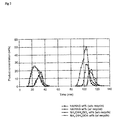
- Effluent stream samples were collected every 2 minutes. Concentrations of HA and NH 3 in the product recovery region were plotted against bed volume as illustrated in Fig. 1.
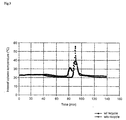
- a test run was conducted under the general procedure described above except that no addition of the recycled HA solution was employed. Effluent product concentrations with and without recycled HA were compared as shown in Fig. 2.
- a decrease in the internal column temperature with the recycled HA solution is illustrated in Fig. 3.
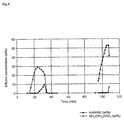
- Effluent stream samples were collected every two minutes for chemical identification and analysis while products were collected every minute to determine product concentration and yield. Products collected for the four examples are tabulated in Table 2 below while the concentrations of HA and NH 3 in the product samples are illustrated in Fig. 4. From the product concentration profile, samples of pure HA averaging 48-50% by weight were combined as the product cut. Product samples that contain pure HA with averaging concentrations at 22-34% were collected as the recycle HA cut. And lastly samples that average HA at 40% and NH 3 at 2-3% by weight were combined as the potentially HA recoverable product.
- One objective of this invention is a process to manufacture a concentrated hydroxylamine free base with high purity.
- the table illustrates the capability of this invention to manufacture concentrated HA with ppb level metals from a HAS feed that contains metals at about 1 ppm level.
- Table 5 Production of a High Purity HA with this Invention HAS feed Example 3
- Example 4 Example 5
- Example 6 Metal content (Ppb) Ca 710 ⁇ 10 ⁇ 10 ⁇ 10 ⁇ 10 ⁇ 10 Fe 850 ⁇ 10 52 73 70 Na 1200 ⁇ 10 60 11 ⁇ 10
- the recoverable product cut that contains a HA concentration of 38-42% by weight and NH 3 concentration of 2-3% by weight was transferred to a 2-liter rotary evaporator.
- a 2-liter rotary evaporator For these examples, about 1200-1400 grams of the solution were first added with 70 ppm of CDTA stabilizer and transferred to the evaporator.
- a mechanical pump was used to evacuate the system while a condenser in the evaporator was cooled with a water coolant at a temperature of about 4°C.
- the concentration of HA was also increased somewhat. Results of the stripping tests are tabulated in Table 3, below. Combining products from both the product cut and the HA recovered from the stripping process, the net product efficiencies increase substantially as shown in Table 4, below.
- Hydroxylamine solutions manufactured according to the above-mentioned embodiments were treated with a cation-exchange resin in NH 4 + -form (Rohm & Haas Amberjet 1500).
- the HA solution was stabilized with CDTA at a concentration level of 100 ppm.
- This solution was pumped at a flow rate of 15 cm 3 /min into a 1-inch column with 300 cm 3 of anion-exchange resin (Rohm and Haas Amberjet 4200).
- the resin was pretreated with sulfuric acid to remove metals and followed with the exchange of Cl-form into an OH-form.
- the effluent HA was analyzed with an ICP-MS method (Example 14). Results of the analysis were compared with initial HA solution, the effluent through a cation-exchange resin (Rohm and Haas Amberjet 1500(NH 4 + )) and a 18 Megohm water, are shown in Table 6.
- a coolant such as propylene glycol is used for the cooling of various process streams. Any leakage of the coolant into the process stream that contains a concentrated HA may cause undesired effects if metal impurities in the coolant are high.
- a commercial propylene glycol was analyzed for several key metals and the coolant was added with CDTA and treated with anionexchange resin following the general procedure described in examples 14-15. Results of metal analysis on the initial coolant and samples purified by the present invention are illustrated in Table 7 below. As shown in the table 7, the sample treated with a cation-exchange resin (PG(USP)/+ exchange) still contain high levels of Cu, and Fe.
- ARC accelerating rate calorimeter
- HA and HA with a stabilizer were introduced into a Pyrex glass test cell after the cell was washed with nitric acid and followed with rinsing by 18 Megohm deionized water.
- the test cell was sealed in air in the ARC unit with a small headspace.
- the test cell was equipped with a thermocouple contacting the bottom of the cell.
- a heater assembly was provided to head the surrounding of the sample cell and maintain the surrounding of the cell at the same temperature of the sample cell. After a uniform temperature was established, a computer software program was initiated for the heat-wait-search protocol. Once a self-heating of the sample was detected, the heating program was started to maintain an adiabatic condition for the test sample. Temperature and pressure data were collected and the self-heat rate was determined.
- CDTA in the recycle stream will stabilize the concentrated HA in the present process when it is produced.
- CDTA was added to enhance the stability of HA upon destined shipping and storage.
Landscapes
- Chemical & Material Sciences (AREA)
- Organic Chemistry (AREA)
- Inorganic Chemistry (AREA)
- Organic Low-Molecular-Weight Compounds And Preparation Thereof (AREA)
- Treatment Of Water By Ion Exchange (AREA)
Applications Claiming Priority (3)
| Application Number | Priority Date | Filing Date | Title |
|---|---|---|---|
| US31765101P | 2001-09-06 | 2001-09-06 | |
| US317651P | 2001-09-06 | ||
| PCT/EP2002/009811 WO2003022738A1 (en) | 2001-09-06 | 2002-09-03 | An improved process for manufacturing highly concentrated hydroxylamine |
Publications (2)
| Publication Number | Publication Date |
|---|---|
| EP1427669A1 EP1427669A1 (en) | 2004-06-16 |
| EP1427669B1 true EP1427669B1 (en) | 2006-01-04 |
Family
ID=23234654
Family Applications (1)
| Application Number | Title | Priority Date | Filing Date |
|---|---|---|---|
| EP02776962A Expired - Lifetime EP1427669B1 (en) | 2001-09-06 | 2002-09-03 | An improved process for manufacturing highly concentrated hydroxylamine |
Country Status (11)
| Country | Link |
|---|---|
| US (1) | US7172744B2 (enExample) |
| EP (1) | EP1427669B1 (enExample) |
| JP (1) | JP4297783B2 (enExample) |
| KR (1) | KR100907674B1 (enExample) |
| CN (1) | CN1310830C (enExample) |
| AT (1) | ATE315004T1 (enExample) |
| DE (1) | DE60208577T2 (enExample) |
| DK (1) | DK1427669T3 (enExample) |
| ES (1) | ES2254748T3 (enExample) |
| TW (1) | TWI297679B (enExample) |
| WO (1) | WO2003022738A1 (enExample) |
Families Citing this family (6)
| Publication number | Priority date | Publication date | Assignee | Title |
|---|---|---|---|---|
| TWI274041B (en) * | 2006-04-14 | 2007-02-21 | China Petrochemical Dev Corp | Method for manufacturing hydroxylamine |
| DE602007004190D1 (de) * | 2007-04-04 | 2010-02-25 | China Petrochemical Dev Corp | Verfahren zur Herstellung von Hydroxylamin |
| CN113444082B (zh) * | 2020-03-24 | 2025-05-06 | 西安固能新材料科技有限公司 | 羟铵和/或𨥙化合物及其制备方法以及作为含能材料的用途 |
| CN112723328B (zh) * | 2020-12-17 | 2022-03-11 | 浙江锦华新材料股份有限公司 | 一种高纯固体盐酸羟胺的制备方法 |
| CN112661126B (zh) * | 2021-01-05 | 2022-03-11 | 浙江锦华新材料股份有限公司 | 一种固体盐酸羟胺的制备方法 |
| CN117945366B (zh) * | 2024-01-18 | 2026-01-23 | 中国核电工程有限公司 | 一种制备硝酸羟胺的工艺及系统 |
Family Cites Families (9)
| Publication number | Priority date | Publication date | Assignee | Title |
|---|---|---|---|---|
| US3145082A (en) * | 1959-12-07 | 1964-08-18 | Dow Chemical Co | Stabilized hydroxylamine and its method of preparation |
| US4147623A (en) * | 1977-10-28 | 1979-04-03 | Allied Chemical Corporation | Hydroxylamine purification via ion exclusion |
| US4202765A (en) | 1977-10-28 | 1980-05-13 | Allied Chemical Corporation | Hydroxylamine purification via cation exchange |
| DE3026293A1 (de) * | 1980-07-11 | 1982-02-18 | Riedel-De Haen Ag, 3016 Seelze | Verfahren zur herstellung von hydroxylammoniumperchlorat |
| DE3608495A1 (de) | 1986-03-14 | 1987-09-17 | Basf Ag | Verfahren zur herstellung von waessrigen loesungen von hydroxylamin |
| US5318762A (en) * | 1992-12-09 | 1994-06-07 | Olin Corporation | Process for treating aqueous solutions of hydroxylamine salts containing excess acid |
| US5762897A (en) | 1996-05-03 | 1998-06-09 | Alliedsignal Inc. | Method for manufacturing hydroxylamine |
| US5788946A (en) * | 1997-07-16 | 1998-08-04 | Ashland Inc. | Purification of hydroxylamine |
| US5872295A (en) | 1998-02-13 | 1999-02-16 | Concept Sciences, Inc. | Purification of hydroxylamine |
-
2002
- 2002-09-03 CN CNB028174453A patent/CN1310830C/zh not_active Expired - Lifetime
- 2002-09-03 WO PCT/EP2002/009811 patent/WO2003022738A1/en not_active Ceased
- 2002-09-03 KR KR1020047003159A patent/KR100907674B1/ko not_active Expired - Lifetime
- 2002-09-03 US US10/487,592 patent/US7172744B2/en not_active Expired - Lifetime
- 2002-09-03 ES ES02776962T patent/ES2254748T3/es not_active Expired - Lifetime
- 2002-09-03 EP EP02776962A patent/EP1427669B1/en not_active Expired - Lifetime
- 2002-09-03 AT AT02776962T patent/ATE315004T1/de active
- 2002-09-03 DK DK02776962T patent/DK1427669T3/da active
- 2002-09-03 JP JP2003526821A patent/JP4297783B2/ja not_active Expired - Lifetime
- 2002-09-03 DE DE60208577T patent/DE60208577T2/de not_active Expired - Lifetime
- 2002-09-09 TW TW091120444A patent/TWI297679B/zh not_active IP Right Cessation
Also Published As
| Publication number | Publication date |
|---|---|
| CN1551854A (zh) | 2004-12-01 |
| KR100907674B1 (ko) | 2009-07-14 |
| ES2254748T3 (es) | 2006-06-16 |
| JP4297783B2 (ja) | 2009-07-15 |
| DK1427669T3 (da) | 2006-03-27 |
| US7172744B2 (en) | 2007-02-06 |
| WO2003022738A1 (en) | 2003-03-20 |
| DE60208577T2 (de) | 2006-07-06 |
| US20040213725A1 (en) | 2004-10-28 |
| CN1310830C (zh) | 2007-04-18 |
| EP1427669A1 (en) | 2004-06-16 |
| DE60208577D1 (de) | 2006-03-30 |
| ATE315004T1 (de) | 2006-02-15 |
| JP2005506944A (ja) | 2005-03-10 |
| TWI297679B (en) | 2008-06-11 |
| KR20040041594A (ko) | 2004-05-17 |
Similar Documents
| Publication | Publication Date | Title |
|---|---|---|
| EP0001787B1 (en) | Hydroxylamine purification via cation exchange | |
| US6558643B2 (en) | Method for ammonia removal from waste streams | |
| US4287162A (en) | Separation of ammonia from ammonia containing gases | |
| US6969466B1 (en) | Purification of ammonia | |
| US7172744B2 (en) | Process for manufacturing highly concentrated hydroxylamine | |
| Leszczyńska-Sejda et al. | Synthesis of perrhenic acid using ion exchange method | |
| JP3171058B2 (ja) | 過酸化水素水の精製方法 | |
| EP0958239B1 (en) | Method for manufacturing hydroxylamine | |
| CN1269766A (zh) | 羟胺的提纯 | |
| JP2005220012A (ja) | 高純度かつ高濃度の遊離型ヒドロキシルアミンの製造方法 | |
| RU2157339C2 (ru) | Способ получения бромистого лития из рассолов | |
| US3216795A (en) | Manufacture of boric acid | |
| JPH11503146A (ja) | グルタミン酸モノナトリウムの製造法 | |
| JP2004262676A (ja) | 高純度塩化ナトリウム結晶の製造方法 | |
| US6537516B2 (en) | Integrated method of preconditioning a resin for hydrogen peroxide purification and purifying hydrogen peroxide | |
| JPH0920505A (ja) | 過酸化水素水の精製方法 | |
| JP2661648B2 (ja) | 錯形成剤水溶液の精製方法 | |
| JP4662419B2 (ja) | 有機酸を分離製造する方法 | |
| JPH07213922A (ja) | ヘテロポリ酸塩系触媒からの触媒成分の回収方法 | |
| EP0122249B1 (en) | Recovery of vanadium and copper from adipic acid production | |
| JP2005298368A (ja) | アミノ酸とイミノジカルボン酸を分離回収する製造方法 | |
| JPH02215746A (ja) | グリシンの分離回収方法 | |
| JPS6251145B2 (enExample) | ||
| JPS6445325A (ja) | タンタルのアルコキシドの製造方法 | |
| HU222988B1 (hu) | Eljárás marató oldatok komponenseinek hasznosítására |
Legal Events
| Date | Code | Title | Description |
|---|---|---|---|
| PUAI | Public reference made under article 153(3) epc to a published international application that has entered the european phase |
Free format text: ORIGINAL CODE: 0009012 |
|
| 17P | Request for examination filed |
Effective date: 20040406 |
|
| AK | Designated contracting states |
Kind code of ref document: A1 Designated state(s): AT BE BG CH CY CZ DE DK EE ES FI FR GB GR IE IT LI LU MC NL PT SE SK TR |
|
| AX | Request for extension of the european patent |
Extension state: AL LT LV MK RO SI |
|
| 17Q | First examination report despatched |
Effective date: 20040616 |
|
| GRAP | Despatch of communication of intention to grant a patent |
Free format text: ORIGINAL CODE: EPIDOSNIGR1 |
|
| GRAS | Grant fee paid |
Free format text: ORIGINAL CODE: EPIDOSNIGR3 |
|
| GRAA | (expected) grant |
Free format text: ORIGINAL CODE: 0009210 |
|
| AK | Designated contracting states |
Kind code of ref document: B1 Designated state(s): AT BE BG CH CY CZ DE DK EE ES FI FR GB GR IE IT LI LU MC NL PT SE SK TR |
|
| PG25 | Lapsed in a contracting state [announced via postgrant information from national office to epo] |
Ref country code: SK Free format text: LAPSE BECAUSE OF FAILURE TO SUBMIT A TRANSLATION OF THE DESCRIPTION OR TO PAY THE FEE WITHIN THE PRESCRIBED TIME-LIMIT Effective date: 20060104 |
|
| REG | Reference to a national code |
Ref country code: GB Ref legal event code: FG4D |
|
| REG | Reference to a national code |
Ref country code: CH Ref legal event code: EP Ref country code: CH Ref legal event code: NV Representative=s name: SCHMAUDER & PARTNER AG PATENTANWALTSBUERO |
|
| REG | Reference to a national code |
Ref country code: IE Ref legal event code: FG4D |
|
| REG | Reference to a national code |
Ref country code: DK Ref legal event code: T3 |
|
| REF | Corresponds to: |
Ref document number: 60208577 Country of ref document: DE Date of ref document: 20060330 Kind code of ref document: P |
|
| PG25 | Lapsed in a contracting state [announced via postgrant information from national office to epo] |
Ref country code: BG Free format text: LAPSE BECAUSE OF FAILURE TO SUBMIT A TRANSLATION OF THE DESCRIPTION OR TO PAY THE FEE WITHIN THE PRESCRIBED TIME-LIMIT Effective date: 20060404 |
|
| REG | Reference to a national code |
Ref country code: SE Ref legal event code: TRGR |
|
| REG | Reference to a national code |
Ref country code: ES Ref legal event code: FG2A Ref document number: 2254748 Country of ref document: ES Kind code of ref document: T3 |
|
| ET | Fr: translation filed | ||
| PG25 | Lapsed in a contracting state [announced via postgrant information from national office to epo] |
Ref country code: MC Free format text: LAPSE BECAUSE OF NON-PAYMENT OF DUE FEES Effective date: 20060930 |
|
| PLBE | No opposition filed within time limit |
Free format text: ORIGINAL CODE: 0009261 |
|
| STAA | Information on the status of an ep patent application or granted ep patent |
Free format text: STATUS: NO OPPOSITION FILED WITHIN TIME LIMIT |
|
| 26N | No opposition filed |
Effective date: 20061005 |
|
| PG25 | Lapsed in a contracting state [announced via postgrant information from national office to epo] |
Ref country code: GR Free format text: LAPSE BECAUSE OF FAILURE TO SUBMIT A TRANSLATION OF THE DESCRIPTION OR TO PAY THE FEE WITHIN THE PRESCRIBED TIME-LIMIT Effective date: 20060405 |
|
| PG25 | Lapsed in a contracting state [announced via postgrant information from national office to epo] |
Ref country code: EE Free format text: LAPSE BECAUSE OF FAILURE TO SUBMIT A TRANSLATION OF THE DESCRIPTION OR TO PAY THE FEE WITHIN THE PRESCRIBED TIME-LIMIT Effective date: 20060104 |
|
| PG25 | Lapsed in a contracting state [announced via postgrant information from national office to epo] |
Ref country code: TR Free format text: LAPSE BECAUSE OF FAILURE TO SUBMIT A TRANSLATION OF THE DESCRIPTION OR TO PAY THE FEE WITHIN THE PRESCRIBED TIME-LIMIT Effective date: 20060104 Ref country code: LU Free format text: LAPSE BECAUSE OF NON-PAYMENT OF DUE FEES Effective date: 20060903 |
|
| PG25 | Lapsed in a contracting state [announced via postgrant information from national office to epo] |
Ref country code: CY Free format text: LAPSE BECAUSE OF FAILURE TO SUBMIT A TRANSLATION OF THE DESCRIPTION OR TO PAY THE FEE WITHIN THE PRESCRIBED TIME-LIMIT Effective date: 20060104 |
|
| REG | Reference to a national code |
Ref country code: CH Ref legal event code: PCAR Free format text: SCHMAUDER & PARTNER AG PATENT- UND MARKENANWAELTE VSP;ZWAENGIWEG 7;8038 ZUERICH (CH) |
|
| REG | Reference to a national code |
Ref country code: FR Ref legal event code: PLFP Year of fee payment: 14 |
|
| PGFP | Annual fee paid to national office [announced via postgrant information from national office to epo] |
Ref country code: FI Payment date: 20150922 Year of fee payment: 14 Ref country code: CH Payment date: 20150925 Year of fee payment: 14 |
|
| PGFP | Annual fee paid to national office [announced via postgrant information from national office to epo] |
Ref country code: AT Payment date: 20150925 Year of fee payment: 14 Ref country code: SE Payment date: 20150928 Year of fee payment: 14 |
|
| PGFP | Annual fee paid to national office [announced via postgrant information from national office to epo] |
Ref country code: DK Payment date: 20150925 Year of fee payment: 14 |
|
| PGFP | Annual fee paid to national office [announced via postgrant information from national office to epo] |
Ref country code: ES Payment date: 20151027 Year of fee payment: 14 Ref country code: BE Payment date: 20150930 Year of fee payment: 14 |
|
| REG | Reference to a national code |
Ref country code: FR Ref legal event code: PLFP Year of fee payment: 15 |
|
| PGFP | Annual fee paid to national office [announced via postgrant information from national office to epo] |
Ref country code: CZ Payment date: 20160901 Year of fee payment: 15 Ref country code: PT Payment date: 20160822 Year of fee payment: 15 |
|
| PG25 | Lapsed in a contracting state [announced via postgrant information from national office to epo] |
Ref country code: BE Free format text: LAPSE BECAUSE OF NON-PAYMENT OF DUE FEES Effective date: 20160930 |
|
| REG | Reference to a national code |
Ref country code: DK Ref legal event code: EBP Effective date: 20160930 |
|
| PG25 | Lapsed in a contracting state [announced via postgrant information from national office to epo] |
Ref country code: FI Free format text: LAPSE BECAUSE OF NON-PAYMENT OF DUE FEES Effective date: 20160903 Ref country code: SE Free format text: LAPSE BECAUSE OF NON-PAYMENT OF DUE FEES Effective date: 20160904 |
|
| REG | Reference to a national code |
Ref country code: CH Ref legal event code: PL |
|
| REG | Reference to a national code |
Ref country code: SE Ref legal event code: EUG |
|
| REG | Reference to a national code |
Ref country code: AT Ref legal event code: MM01 Ref document number: 315004 Country of ref document: AT Kind code of ref document: T Effective date: 20160903 |
|
| PG25 | Lapsed in a contracting state [announced via postgrant information from national office to epo] |
Ref country code: CH Free format text: LAPSE BECAUSE OF NON-PAYMENT OF DUE FEES Effective date: 20160930 Ref country code: LI Free format text: LAPSE BECAUSE OF NON-PAYMENT OF DUE FEES Effective date: 20160930 |
|
| PG25 | Lapsed in a contracting state [announced via postgrant information from national office to epo] |
Ref country code: AT Free format text: LAPSE BECAUSE OF NON-PAYMENT OF DUE FEES Effective date: 20160903 |
|
| REG | Reference to a national code |
Ref country code: FR Ref legal event code: PLFP Year of fee payment: 16 |
|
| REG | Reference to a national code |
Ref country code: BE Ref legal event code: MM Effective date: 20160930 |
|
| PG25 | Lapsed in a contracting state [announced via postgrant information from national office to epo] |
Ref country code: DK Free format text: LAPSE BECAUSE OF NON-PAYMENT OF DUE FEES Effective date: 20160930 |
|
| PG25 | Lapsed in a contracting state [announced via postgrant information from national office to epo] |
Ref country code: CZ Free format text: LAPSE BECAUSE OF NON-PAYMENT OF DUE FEES Effective date: 20170903 |
|
| PG25 | Lapsed in a contracting state [announced via postgrant information from national office to epo] |
Ref country code: PT Free format text: LAPSE BECAUSE OF NON-PAYMENT OF DUE FEES Effective date: 20180305 Ref country code: ES Free format text: LAPSE BECAUSE OF NON-PAYMENT OF DUE FEES Effective date: 20160904 |
|
| REG | Reference to a national code |
Ref country code: FR Ref legal event code: PLFP Year of fee payment: 17 |
|
| REG | Reference to a national code |
Ref country code: ES Ref legal event code: FD2A Effective date: 20181126 |
|
| PGFP | Annual fee paid to national office [announced via postgrant information from national office to epo] |
Ref country code: IE Payment date: 20210917 Year of fee payment: 20 Ref country code: IT Payment date: 20210922 Year of fee payment: 20 Ref country code: NL Payment date: 20210927 Year of fee payment: 20 Ref country code: FR Payment date: 20210927 Year of fee payment: 20 |
|
| PGFP | Annual fee paid to national office [announced via postgrant information from national office to epo] |
Ref country code: GB Payment date: 20210927 Year of fee payment: 20 Ref country code: DE Payment date: 20210929 Year of fee payment: 20 |
|
| REG | Reference to a national code |
Ref country code: DE Ref legal event code: R071 Ref document number: 60208577 Country of ref document: DE |
|
| REG | Reference to a national code |
Ref country code: NL Ref legal event code: MK Effective date: 20220902 |
|
| REG | Reference to a national code |
Ref country code: GB Ref legal event code: PE20 Expiry date: 20220902 |
|
| REG | Reference to a national code |
Ref country code: IE Ref legal event code: MK9A |
|
| PG25 | Lapsed in a contracting state [announced via postgrant information from national office to epo] |
Ref country code: GB Free format text: LAPSE BECAUSE OF EXPIRATION OF PROTECTION Effective date: 20220902 |
|
| PG25 | Lapsed in a contracting state [announced via postgrant information from national office to epo] |
Ref country code: IE Free format text: LAPSE BECAUSE OF EXPIRATION OF PROTECTION Effective date: 20220903 |