EP1427084A2 - Verfahren und Vorrichtung zum Laden einer Vielzahl von Batterien - Google Patents
Verfahren und Vorrichtung zum Laden einer Vielzahl von Batterien Download PDFInfo
- Publication number
- EP1427084A2 EP1427084A2 EP03027304A EP03027304A EP1427084A2 EP 1427084 A2 EP1427084 A2 EP 1427084A2 EP 03027304 A EP03027304 A EP 03027304A EP 03027304 A EP03027304 A EP 03027304A EP 1427084 A2 EP1427084 A2 EP 1427084A2
- Authority
- EP
- European Patent Office
- Prior art keywords
- charging
- battery
- current
- voltage
- approximately
- Prior art date
- Legal status (The legal status is an assumption and is not a legal conclusion. Google has not performed a legal analysis and makes no representation as to the accuracy of the status listed.)
- Withdrawn
Links
Images


Classifications
-
- H—ELECTRICITY
- H02—GENERATION; CONVERSION OR DISTRIBUTION OF ELECTRIC POWER
- H02J—ELECTRIC POWER NETWORKS; CIRCUIT ARRANGEMENTS OR SYSTEMS FOR SUPPLYING OR DISTRIBUTING ELECTRIC POWER; SYSTEMS FOR STORING ELECTRIC ENERGY
- H02J7/00—Circuit arrangements for charging or discharging batteries or for supplying loads from batteries
-
- H—ELECTRICITY
- H02—GENERATION; CONVERSION OR DISTRIBUTION OF ELECTRIC POWER
- H02J—ELECTRIC POWER NETWORKS; CIRCUIT ARRANGEMENTS OR SYSTEMS FOR SUPPLYING OR DISTRIBUTING ELECTRIC POWER; SYSTEMS FOR STORING ELECTRIC ENERGY
- H02J7/00—Circuit arrangements for charging or discharging batteries or for supplying loads from batteries
- H02J7/50—Circuit arrangements for charging or discharging batteries or for supplying loads from batteries acting upon multiple batteries simultaneously or sequentially
Definitions
- Embodiments of the present invention relate to a method for charging a plurality of batteries. More particularly, embodiments of the present invention relate to a method for charging a plurality of batteries based on charging voltage/current characteristics and in which charging operations among the batteries are alternatively repeated.
- FIG. 1 shows a configuration and methodology for charging batteries according to an example arrangement.
- a power supplying unit (AC/DC Adapter) 10 is connected with a constant voltage/constant current circuit 11 such that a voltage and a current input to the power supplying unit 10 are converted into a constant voltage and a constant current with constant DC levels.
- the constant voltage and the constant current converted in the constant voltage/constant current circuit 11 are input to a first battery 16 and a second battery 17 selectively through a first switching device 12 and a second switching device 13, thereby charging the first and second batteries.
- the voltages and currents output from the first switching device 12 and the second switching device 13 are supplied to the constant voltage/constant current circuit 11 through a voltage current feedback circuit 15.
- the constant voltage/constant current circuit 11, the first switching device 12 and the second switching device 13 are controlled by a microcomputer control circuit 14.
- FIG. 2 shows a procedure of charging the batteries using with the microcomputer control circuit 14.
- the horizontal axis X represents a charging time of a battery
- the vertical axis Y represents voltage and current of a battery.
- the charging time intervals t0 ⁇ t2 are charging regions of the first battery.
- the intervals t0 ⁇ t1 are constant current regions and the intervals t1 ⁇ t2 are constant voltage regions of the first battery. In the intervals, a first charging voltage and a first charging current are provided at the same time.
- the charging time intervals t2 ⁇ t4 are charging regions of the second battery.
- the intervals t2 ⁇ t3 are constant current regions and the intervals t3 ⁇ t4 are constant voltage regions of the second battery. In the intervals, a second charging voltage and a second charging current are provided at the same time.
- the microcomputer control circuit 14 controls the constant voltage/constant current circuit 11 and the first switching device 12 so that the first battery 16 can be charged during the intervals t0 ⁇ t2 and the second battery 17 is not charged during charging of the first battery 16 (based on operations of the second switching device 13).
- the microcomputer control circuit 14 controls the constant voltage/constant current circuit 11 and the second switching device 13 so that the second battery 17 can be charged during the intervals t2 ⁇ t4 and so that the first battery is not charged during charging of the second battery 17 (based on operations of the first switching device 12). Charging of the second battery 17 may also be performed prior to charging the first battery 16.
- a plurality of batteries are charged such that all the charging of the first battery is completely performed and then charging of the second battery starts.
- all the charging of the second battery may be completely performed and then charging of the first battery starts.
- the above described methodology sequentially charges the multiple batteries. Therefore, the available current supplied from an adapter of the power supplying unit 10 may be not efficiently used so that the charging time is delayed. This may be a problem.
- FIG. 3 shows a configuration and methodology for charging batteries according to an example arrangement. More specifically, FIG. 3 shows that a power supplying unit (AC/DC Adapter) 20 is connected to a first constant voltage/constant current circuit 21 and a second constant voltage/constant current circuit 22 where a voltage and a current input to the power supplying unit 20 is converted into a constant voltage and a constant current with constant DC levels.
- the constant voltage and the constant current converted with the first constant voltage/constant current circuit 21 and the second constant voltage/constant current circuit 22 are input to the first battery 28 and the second battery 29 through a first switching device 23 and a second switching device 24, respectively, thereby charging the first battery 28 and the second battery 29.
- the voltage and current output from the first switching device 23 and the second switching device 24 are supplied to a first constant voltage/constant current circuit 21 and a second constant voltage/constant current circuit 22 through a first voltage current feedback circuit 25 and a second voltage current feedback circuit 26, respectively.
- the first constant voltage/constant current circuit 21, the second constant voltage/constant current circuit 22, the first switching device 22 and the second switching device 23 are controlled by a microcomputer control circuit 27.
- FIG. 4 shows a procedure of charging the batteries using the microcomputer control circuit 27.
- the horizontal axis X represents a charging time of a battery
- the vertical axis Y represents voltage and current of a battery.
- the charging time intervals t0 ⁇ t4 are charging regions of the first battery.
- the intervals t0 ⁇ t1 are constant current regions where a first charging voltage and a first charging current are provided at the same time.
- the intervals t1 ⁇ t4 are constant voltage regions of the first battery.
- the charging time intervals t2 ⁇ t4 are charging regions of the second battery.
- the intervals t2 ⁇ t3 are constant current regions and the intervals t3 ⁇ t4 are constant voltage regions of the second battery.
- the intervals t1 ⁇ t3 are second charging voltage regions and the intervals t3 ⁇ t4 are second charging current regions of the second battery.
- the microcomputer control circuit 27 controls the first constant voltage/constant current circuit 21 and the first switching device 23 to charge the first battery 28.
- the microcomputer control circuit 27 senses that the charging current starts to drop at a cross-over time (i.e., the intervals t1 ⁇ t2 when the charging operation of the first battery 28 changes from constant current to constant voltage). Then, the microcomputer control circuit 27 controls the first constant voltage/constant current circuit 21 and the first switching device 23 to keep the first battery 28 charged.
- the microcomputer control circuit 27 controls the second constant voltage/constant current circuit 22 and the second switching device 24 so that charging of the second battery 29 can start. In other words, the control circuit 27 controls the first switching device 23 to keep the first battery 28 charged during charging of the second battery 29.
- the microcomputer control circuit 27 may sense that the charging current starts to drop at the cross-over time (i.e., the intervals t1 ⁇ t2 when charging operations of the first battery 28 changes from constant current to constant voltage). At the same time, the first battery 28 is continuously charged and charging of the second battery 29 starts using the reduced charging current of the first battery 28. The current of the second battery 29 is reduced from the constant current, and at the time of the charging voltage changed into the constant voltage, the whole charging current starts to be reduced. Then, in a predetermined time interval, the charging operations of the first battery 28 and the second battery 29 are completed. However, there is a problem that the first battery still has a long charging time.
- An object of the invention is to solve at least the above problems and/or disadvantages and to provide at least the advantages described hereinafter.
- Embodiments of the present invention may provide a method for charging multiple batteries with a minimized charging time.
- An under-charged first battery may be checked in voltage and current during charging of multiple batteries (in a mobile communication terminal).
- the checked voltage and checked current of the first battery becomes a reference voltage and reference current
- the charging operation of the first battery is temporarily stopped, and charging of a second battery proceeds.
- the voltage and current of the second battery becomes the reference voltage and reference current
- charging operations of the second battery is temporarily stopped and charging of the first battery again proceeds.
- the voltages and currents of the multiple batteries are checked and the charging operations among the multiple batteries are repeatedly performed, thereby complementarily charging the multiple batteries. This makes it possible to shorten the charging time.
- Embodiments of the present invention may include a charge starting operation wherein a charging apparatus is power-supplied to charge the multiple batteries.
- Battery mount checking operations may check whether the multiple batteries are mounted at corresponding positions on the charging apparatus.
- a charging voltage/current characteristic identifying operation may identify charging voltage/current operation characteristics of the mounted under-charged batteries.
- a first battery-cross-over charging operation may charge a predetermined first battery according to results of the battery mount checking operation and charging voltage/current operation characteristics and charging of the second battery may stop.
- the charging operation of the under-charged first battery may be temporarily stopped in a first predetermined time interval according to a first charging voltage/current characteristic of the under-charged first battery during the first battery-cross-over charging operation and charging operation of the second battery proceeds.
- the charging operation of the under-charged second battery may be temporarily stopped in a second predetermined time interval according to a charging voltage/current characteristic of the under-charged second battery during the second battery-cross-over charging operation and charging operation of the first battery resumes.
- a fourth battery-cross-over charging operation the charging operation of the under-charged first battery may be temporarily stopped in a third predetermined time interval according to a second charging voltage/current characteristic of the under-charged first battery during the third battery-cross-over charging operation and charging operation of the second battery may be resumed.
- a battery charging completion operation the charging operation of the under-charged first or second battery is completed according to full charging voltage/current characteristics of the under-charged first or second battery provided with the operations of the third and fourth battery-cross-over charging operations.
- the charging voltage/current characteristics may have a voltage gradient or a current gradient according to a charging voltage/current of a battery.
- the current When the voltage of the battery gradually rises, the current may go to a constant current and then the current gradient may go to substantially zero. Thereby, the voltage of the battery having a predetermined gradient, and when the battery is charged by some degree of charging, the current may drop, the current gradient may have a negative value and then the battery may have a constant voltage zone, such that the voltage of the voltage gradient becomes substantially zero.
- the voltage gradient may be more than zero, the charging voltage may have a reference of approximately 4.0V and the charging current may have references of approximately 100mA and approximately 200mA.
- the voltage gradient may be more than zero, the charging voltage may have a reference of approximately 4.2V and the charging current may have references of approximately 100mA and approximately 200mA.
- the voltage gradient of the under-charged first battery may be more than zero and the charging voltage of the under-charged first battery is not more than approximately 4.0V. If the voltage gradient is not more than zero and the charging current is not more than approximately 100mA and not less than approximately 200mA, then the first battery may be charged and the second battery may not be charged.
- the voltage gradient of the under-charged second battery may be more than zero and the charging voltage of the under-charged second battery may be not more than approximately 4.0V. If the voltage gradient is not more than zero and the charging current is not more than approximately 100mA and not less than approximately 200mA, then the second battery may be charged and the first battery may not be charged.
- the voltage gradient of the under-recharged first battery may be more than zero and the charging voltage of the under-recharged first battery may be less than approximately 4.2V. If the voltage gradient is not more than zero and the charging current is not less than approximately 200mA, then the first battery may be charged and the second battery may not be charged.
- the voltage gradient of the under-recharged second battery may be more than zero and the charging voltage of the under-recharged second battery may not be less than approximately 4.2V. If the voltage gradient is not more than zero and the charging current is not less than approximately 200mA, then the second battery may be charged and the first battery may not be charged.
- the charging completion operation if the voltage gradient of the under-recharged first or second battery is not more than zero and the charging current is less than approximately 200mA and not more than approximately 100mA, then charging operations may be completed.
- Embodiments of the present invention may include a voltage reference charging operation wherein after charging of a first battery with a constant current is started, if a voltage of the first battery becomes more than a reference voltage, then charging of the first battery is stopped. After charging of a second battery with the constant current is started, if a voltage of the second battery becomes more than the reference voltage, then charging of the second battery is stopped.
- a current reference charging operation after charging of the first battery is resumed, if a charging current is not more than a reference current, then charging of the first battery is stopped, and after charging of the second battery is resumed, if the charging current is not more than the reference current, then charging of the second battery is stopped.
- a charging completion operation After charging of the first battery is resumed, if the charging current is not more than a limit current indicating a state of full charging, then charging of the first battery is stopped, and after charging of the second battery is resumed, if the charging current is not more than the limit current indicating the state of full charging, then charging of the second battery is stopped.
- the reference voltage may be set to be from approximately 70% to approximately 80% of a full charging voltage.
- the reference current may be set to be a current at the time of approximately 80% of the state of full charging.
- the limit current may be set to be a current at the time of approximately 95% of the state of full charging.
- Embodiments of the present invention may include a voltage reference charging operation wherein until a charging voltage of an under-charged battery becomes a reference voltage, charging of a first battery with a constant current continues during a first predetermined time interval and then is stopped. Charging of a second battery with a constant current continues during a second predetermined time interval and then is stopped. Charging operations of a third battery and a fourth battery with a constant current continue during third and fourth predetermined time intervals, respectively, and then are stopped. Charging of the first battery may be resumed, and the series of charging may be repeated thereby the charging up to the voltage reference is performed to alternatively charge the multiple batteries until charging voltages of the multiple batteries become the reference voltages.
- a current reference charging operation After charging of the first battery is resumed, if a charging current is not more than a reference current, then charging of the first battery is stopped. After charging of the second battery is resumed, if the charging current is not more than the reference current, charging of the second battery is stopped. The same charging process for the third and fourth batteries is carried out.
- a charging completion operation after charging of the first battery is resumed, if the charging current is not more than a limit current indicating a state of full charging, then charging of the first battery is stopped. After charging of the second battery is resumed, if the charging current is not more than the limit current indicating the state of full charging, then charging of the second battery is stopped. The same charging process for the third and fourth batteries is carried out.
- the reference voltage may be set to be from approximately 70% to approximately 80% of a full charging voltage.
- the reference current may be set to be a current at the time of approximately 80% of the state of full charging.
- the limit current may be set to be a current at the time of approximately 95% of the state of full charging.
- FIG. 1 is a block diagram illustrating a battery charging operation according to an example arrangement
- FIG. 2 is a graph showing voltage/current versus time according to an example arrangement
- FIG. 3 is a block diagram illustrating a battery charging operation according to an example arrangement
- FIG. 4 is a graph showing voltage/current versus time according to an example arrangement
- FIG. 5 is a block diagram illustrating a battery charging method according to an example embodiment of the present invention.
- FIGS. 6a and 6b are graphs illustrating voltage/current cross-over charging characteristics of multiple batteries according to an example embodiment of the present invention.
- FIG. 7 is a graph illustrating a voltage/current versus time characteristic according to an example embodiment of the present invention.
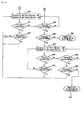
- FIGS. 8a and 8b are flow charts illustrating charging operations according to an example embodiment of the present invention.
- FIG. 5 is a block diagram illustrating a battery charging circuit according to an example embodiment of the present invention.
- a power supplying unit (AC/DC adapter) 50 is connected to a first constant voltage/constant current circuit 51 and a second constant voltage/constant current circuit 52.
- a voltage and a current input to the power supplying unit 50 are converted into a constant voltage and a constant current having a constant DC level.
- the constant voltage and the constant current generated in (or output from) the first constant voltage/constant current circuit 51 and the second constant voltage/constant current circuit 52 are input to a first battery 55 and a second battery 56, respectively.
- the first constant voltage/constant current circuit 51 and the second constant voltage/constant current circuit 52 are controlled by a microcomputer control circuit 53. Additionally, light emitting diodes LED1 and LED2 are connected to the control circuit 53 to display charging procedures.
- FIGS. 6a-6b show charging procedures of the batteries using the microcomputer control circuit 53 according to an example embodiment of the present invention. More specifically, FIG. 6a is a graph illustrating charging procedures of the first battery 55 and FIG. 6b is a view illustrating charging procedures of the second battery 56. In both FIG. 6a and FIG. 6b, the horizontal axis X represents a charging time, and the vertical axis Y represents voltage and current of a battery.
- charging time intervals t0 ⁇ t1 and t2 ⁇ t3 of the first battery 55 are constant current regions (i.e., a first charging current region) of the first battery
- charging time intervals t4 ⁇ t5 and t6 ⁇ t7 are constant voltage regions (i.e., a first charging voltage region) of the first battery
- charging time interval t7 is a charging completion time of the first battery.
- charging time intervals t1 ⁇ t2 and t3 ⁇ t4 of the second battery 56 are constant current regions (i.e., a second charging current region) of the second battery
- charging time intervals t5 ⁇ t6 and t7 ⁇ t8 are constant voltage regions (i.e., a second charging voltage region) of the second battery
- charging time interval t8 is a charging completion time of the second battery.
- the microcomputer control circuit 53 turns ON the first constant voltage/constant current circuit 51 to charge the first battery 55 at an allowable maximum constant current. The second battery is not charged at this time.
- the first constant voltage/constant current circuit 51 is turned OFF to stop charging the first battery 55, and the second constant voltage/constant current circuit 52 is turned ON to start charging the second battery 56.
- the second constant voltage/constant current circuit 52 is turned OFF to stop charging the second battery 56, and the first constant voltage/constant current circuit 51 is turned ON to start recharging the first battery 55.
- the first constant voltage/constant current circuit 51 is turned OFF to stop charging the first battery 55, and the second constant voltage/constant current circuit 52 is turned ON to start recharging the second battery 56.
- the second constant voltage/constant current circuit 52 is turned OFF to stop charging the second battery 56, and the first constant voltage/constant current circuit 51 is turned ON to start recharging the first battery 55.
- a predetermined voltage value e.g., approximately 80% to approximately 95% of the full charging voltage
- the charging current becomes a constant charging state, (e.g., approximately 80% to 90% charging state or 100% charging state) in a predetermined time after the charging current starts to be reduced. Then, at the time t5, charging of the first battery is stopped, and recharging of the second battery starts.
- the method of checking the charging state is performed by checking and calculating battery capacity, charging voltage and charging current, as will be described below.
- the second battery may be checked with a similar methodology. If the charging state of the second battery approaches a constant level, then at the time t6, charging for the second battery is stopped, and recharging of the first battery is started. A determination is made whether the charging state of the first battery approaches a full charging state or not. If the second battery is in the full charging state, then at the time t8 the charging operation is stopped, and an indication of a full charging of the second battery is displayed on a LED 2.
- a methodology of the first battery 55 and the second battery 56 being alternatively charged with maximum currents is described above.
- This methodology may also be performed in divided steps. That is, embodiments of the present invention may be performed in a manner such that charging with a maximum charging current may be carried out once and charging under the state of the reduced charging current may be divided into several steps. Further, when the charging current for the previously charged battery (i.e., the first battery) is reduced, then charging of the first battery may not be stopped while the second battery is charged. In other words, if the sum of the charging currents of the first battery 55 and the second battery 56 is less than a maximum allowable current, then the first battery 55 and the second battery 56 may be charged at the same time.
- FIG. 7 shows a curve of voltage/current versus time characteristics for the first battery 55 and the second battery 56. The curve may have a voltage gradient or current gradient depending on the voltage/current states of the under-charged battery.
- the voltage of the battery is gradually rising, charging with a constant current is performed, the current gradient substantially becomes zero, and the battery has a predetermined positive voltage.
- the charging current starts to be reduced as shown in the second region. Then, the charging current has a negative gradient, and voltage of the battery has a region of constant voltage with a voltage gradient of substantially zero.
- FIGS. 8a and 8b are flow charts illustrating charging operations according to an example embodiment of the present invention. Other operations, orders of operations and embodiments are also within the scope of the present invention.
- a charging operation is started (801).
- the first battery mount determination (803) it is determined whether the first battery is mounted in order to check the first battery mounted (802). If the result of the first battery mount determination (803) is that the first battery is mounted, it is then determined whether the second battery is mounted in a second battery mount determination (804).
- the second battery mount determination (804) is that the second battery is not mounted, then the first battery is charged (805). If the result of the first battery mount determination (803) is that the first battery has not yet been mounted, then a determination is made whether the second battery is mounted in a second battery mount determination (806).
- the procedure returns to the battery mounting check (802). If the result of the second battery mount determination (806) is that the second battery is mounted, then the mounted second battery is charged (807).
- a first battery cross-over charging (808) proceeds to turn ON charging of the first battery during a predetermined time interval and to turn OFF the second battery.
- a first reference current e.g. 100mA
- the charging current determination (811) is that the charging current is not more than 100mA
- charging of the first battery is completed (812). If the result of the charging current determination (811) is that the charging current is more than 100mA, then a determination is made in a next charging current determination (813) whether the charging current of the first battery is more than a second reference current (e.g., 200mA).
- a second reference current e.g. 200mA
- the first battery cross-over charging (808) turns ON the charging of the first battery and turns OFF the charging of the second battery during a predetermined time interval. If the result of the charging current determination (813) is that the charging current is less than 200mA, then a second battery cross-over charging (814) proceeds to turn OFF the charging of the first battery and to turn ON the charging of the second battery during a predetermined time interval.
- a charging voltage determination (810) determines whether the charging voltage of the first battery is more than the first reference voltage (e.g., 4.0V). If the result of the charging voltage determination (810) is that the charging voltage is not more than 4.0V, then the first battery cross-over charging (808) proceeds to turn ON the charging of the first battery and to turn OFF the second battery in a predetermined time interval. If the result of the charging voltage determination (810) is that the charging voltage is more than 4.0V, then the second battery cross-over charging (814) proceeds to turn OFF the charging of the first battery and to turn ON the second battery in a predetermined time interval.
- the first reference voltage e.g., 4.0V
- the charging current determination (816) is that the charging current is not more than 100mA, then the charging of the second battery is completed. If the result of the charging current determination (816) is that the charging current is more than 100mA, then a determination is made in a next charging current determination (818) whether the charging current of the second battery is more than 200mA.
- the second battery cross-over charging (814) proceeds to turn OFF the charging of the first battery and to turn ON the charging of the second battery in a predetermined time interval. If the result of the charging current determination (818) is that the charging current is less than 200mA, then a third battery cross-over charging (820) proceeds to turn ON the charging of the first battery again and to turn OFF the charging of the second battery in a predetermined time interval.
- a second reference voltage e.g., 4.2V
- the third battery cross-over recharging (820) proceeds to turn ON recharging of the first battery and to turn OFF the charging of the second battery in a predetermined time interval.
- the third battery cross-over recharging (820) proceeds to turn ON the recharging of the first battery and to turn OFF the charging of the second battery in a predetermined time interval. If the result of the charging current determination (823) is that the charging current is less than 200mA, then a determination is made in a charging current determination (824) whether the charging current of the under-recharged first battery is more than 100mA.
- a fourth battery cross-over recharging (826) proceeds to turn OFF the charging of the first battery and to turn ON the charging of the second battery again in a predetermined time interval.
- the third battery cross-over recharging (820) proceeds to turn ON the charging of the first battery and to turn OFF the charging of the second battery in a predetermined time interval.
- the charging current determination (829) determines whether the charging current of the under-recharged second battery is more than 200mA.
- the fourth battery cross-over charging (826) proceeds to turn OFF charging of the first battery and to turn ON charging of the second battery in a predetermined time interval. If the result of the charging current determination (829) is that the charging current of the under-recharged second battery is less than 200mA, then the charging current determination (830) proceeds to determine whether the charging current is more than 100mA.
- the third battery cross-over recharging (820) proceeds to turn ON charging of the first battery and to turn OFF charging of the second battery in a predetermined time interval. If the result of the charging current determination (830) is that the charging current is not more than 100mA, then charging of the second battery is complete (831).
- the reference currents and voltages described herein are illustrated only for providing examples.
- the values of the reference currents and voltages depend on the capacities and voltage/current characteristics of the battery to be charged. Therefore, the values may be chosen based on the type of battery. In other words, the reference currents and voltages may be selected and used in accordance with the type of battery.
- Embodiments of the present invention may provide a method and apparatus for charging multiple batteries.
- An under-charged first battery is checked in voltage and current during the charging of the multiple batteries in a mobile communication terminal.
- the checking voltage and current of the first battery becomes a reference voltage and current
- the charging operation of the first battery is temporarily stopped, and charging of the second battery proceeds.
- the voltage and current of the second battery becomes the reference voltage and current
- the charging operation of the second battery is temporarily stopped and charging of the first battery again proceeds. Accordingly, voltages and currents of the multiple batteries are checked and the charging operations among the multiple batteries are repeatedly performed thereby complementarily charging the multiple batteries so that it is possible to shorten the charging time.
Landscapes
- Engineering & Computer Science (AREA)
- Power Engineering (AREA)
- Charge And Discharge Circuits For Batteries Or The Like (AREA)
- Secondary Cells (AREA)
Applications Claiming Priority (2)
| Application Number | Priority Date | Filing Date | Title |
|---|---|---|---|
| KR1020020076010A KR20040048221A (ko) | 2002-12-02 | 2002-12-02 | 다수개 배터리 충전방법 |
| KR2002076010 | 2002-12-02 |
Publications (2)
| Publication Number | Publication Date |
|---|---|
| EP1427084A2 true EP1427084A2 (de) | 2004-06-09 |
| EP1427084A3 EP1427084A3 (de) | 2005-06-08 |
Family
ID=32310881
Family Applications (1)
| Application Number | Title | Priority Date | Filing Date |
|---|---|---|---|
| EP03027304A Withdrawn EP1427084A3 (de) | 2002-12-02 | 2003-11-26 | Verfahren und Vorrichtung zum Laden einer Vielzahl von Batterien |
Country Status (5)
| Country | Link |
|---|---|
| US (1) | US20040108835A1 (de) |
| EP (1) | EP1427084A3 (de) |
| JP (1) | JP2004187496A (de) |
| KR (1) | KR20040048221A (de) |
| CN (1) | CN100592598C (de) |
Cited By (3)
| Publication number | Priority date | Publication date | Assignee | Title |
|---|---|---|---|---|
| CN100424962C (zh) * | 2005-01-26 | 2008-10-08 | 兄弟工业株式会社 | 电子装置 |
| US8294427B2 (en) | 2007-04-26 | 2012-10-23 | Ntt Docomo, Inc. | Battery charger for multiple mobile devices |
| CN103269098A (zh) * | 2013-05-21 | 2013-08-28 | 东莞宇龙通信科技有限公司 | 一种提高双电池充电效率的方法及移动终端 |
Families Citing this family (18)
| Publication number | Priority date | Publication date | Assignee | Title |
|---|---|---|---|---|
| JP4528332B2 (ja) * | 2005-02-09 | 2010-08-18 | エヌエックスピー ビー ヴィ | 無線移動通信機器の安全なnfc機能を確保する方法、及び安全なnfc機能を有する無線移動通信機器 |
| ATE527738T1 (de) | 2006-06-21 | 2011-10-15 | Research In Motion Ltd | Ladeschaltung zum parallelen laden einer vielzahl von batterien |
| US7554292B2 (en) * | 2006-06-21 | 2009-06-30 | Research In Motion Limited | Battery charger for simultaneously charging a plurality of batteries |
| KR100839740B1 (ko) * | 2006-11-06 | 2008-06-19 | 삼성에스디아이 주식회사 | 하이브리드 배터리 및 그것의 충전 방법 |
| KR101283389B1 (ko) * | 2006-11-24 | 2013-07-08 | 삼성전자주식회사 | 휴대용 단말기의 배터리 충전 장치 및 방법 |
| JP2010028969A (ja) * | 2008-07-17 | 2010-02-04 | Sanyo Electric Co Ltd | 充電器 |
| DE102009001670A1 (de) * | 2009-03-19 | 2010-09-23 | Robert Bosch Gmbh | Ladeverfahren und Ladesystem |
| US20110148207A1 (en) * | 2009-12-17 | 2011-06-23 | Lineage Power Corporation, A Nevada Corporation | Hybrid architecture for dc power plants and a method of minimizing battery conductor current |
| JP5525862B2 (ja) * | 2010-02-26 | 2014-06-18 | 三洋電機株式会社 | 充電装置、プログラム |
| US20120019215A1 (en) * | 2010-07-23 | 2012-01-26 | Electric Transportation Engineering Corp., D/b/a ECOtality North America | Method for charging multiple rechargeable energy storage systems and related systems and methods |
| CN102185349B (zh) * | 2011-05-04 | 2013-07-17 | 奇瑞汽车股份有限公司 | 一种电池充电系统及其充电方法 |
| JP6432132B2 (ja) * | 2014-01-16 | 2018-12-05 | 日産自動車株式会社 | 充電制御装置 |
| CN104242397B (zh) * | 2014-09-25 | 2017-12-26 | 联想(北京)有限公司 | 多电池快速充电电路及其充电方法 |
| TWI625915B (zh) * | 2016-11-18 | 2018-06-01 | Industrial Technology Research Institute | 智慧型充電方法 |
| KR102253781B1 (ko) * | 2017-04-28 | 2021-05-20 | 주식회사 엘지화학 | 방전 제어 장치 및 방법 |
| KR102052827B1 (ko) * | 2018-06-11 | 2019-12-05 | 전자부품연구원 | 다중 에너지 저장소를 이용한 에너지 저장/관리 시스템 |
| US11777330B2 (en) * | 2020-07-22 | 2023-10-03 | Microsoft Technology Licensing, Llc | Common charge controller for electronic devices with multiple batteries |
| CN112003353B (zh) * | 2020-09-14 | 2025-04-01 | 矽力杰半导体技术(杭州)有限公司 | 充电电路及其集成电路 |
Citations (4)
| Publication number | Priority date | Publication date | Assignee | Title |
|---|---|---|---|---|
| US5576608A (en) | 1993-05-14 | 1996-11-19 | Sony Corporation | Method for charging secondary battery and charger used therefor |
| US5637979A (en) * | 1992-08-27 | 1997-06-10 | Sanyo Electric Co., Ltd. | Rechargeable battery charging method and apparatus |
| JPH09215217A (ja) * | 1996-02-07 | 1997-08-15 | Sony Corp | バッテリ充電装置およびバッテリ充電方法 |
| US20010005124A1 (en) * | 1999-12-08 | 2001-06-28 | Shigefumi Odeohhara | Charge control method and computer |
Family Cites Families (11)
| Publication number | Priority date | Publication date | Assignee | Title |
|---|---|---|---|---|
| US4387332A (en) * | 1980-01-29 | 1983-06-07 | Sanyo Electric Co., Ltd. | Apparatus for successively charging rechargeable batteries |
| US4639655A (en) * | 1984-04-19 | 1987-01-27 | Westhaver Lawrence A | Method and apparatus for battery charging |
| DE4216045A1 (de) * | 1992-05-15 | 1993-11-18 | Bosch Gmbh Robert | Mehrfach-Ladegerät |
| US5825155A (en) * | 1993-08-09 | 1998-10-20 | Kabushiki Kaisha Toshiba | Battery set structure and charge/ discharge control apparatus for lithium-ion battery |
| JPH0997629A (ja) * | 1995-09-29 | 1997-04-08 | Sanyo Electric Co Ltd | 複数のリチウムイオン二次電池の充電方法 |
| US5684384A (en) * | 1995-10-31 | 1997-11-04 | Motorola, Inc. | Apparatus and method for discharging and charging a multiple battery arrangement |
| US6198251B1 (en) * | 1997-06-03 | 2001-03-06 | Fluor Corporation | Method for sequentially charging batteries in situ |
| JP3571536B2 (ja) * | 1997-10-20 | 2004-09-29 | 富士通株式会社 | バッテリ充電装置及び方法並びに電子装置 |
| JP3890168B2 (ja) * | 1999-08-03 | 2007-03-07 | 株式会社東京アールアンドデー | 電動装置及びその電池ユニットの充放電方法 |
| FR2800212B1 (fr) * | 1999-10-21 | 2007-09-14 | Cit Alcatel | Systeme de gestion de charge pour batterie d'accumulateurs electriques et notamment d'une batterie composee de cellules au lithium |
| KR100793194B1 (ko) * | 2001-07-05 | 2008-01-10 | 엘지전자 주식회사 | 다중 배터리 충전방법 및 충전장치 |
-
2002
- 2002-12-02 KR KR1020020076010A patent/KR20040048221A/ko not_active Withdrawn
-
2003
- 2003-11-26 EP EP03027304A patent/EP1427084A3/de not_active Withdrawn
- 2003-12-02 JP JP2003403825A patent/JP2004187496A/ja active Pending
- 2003-12-02 US US10/725,021 patent/US20040108835A1/en not_active Abandoned
- 2003-12-02 CN CN200310118765A patent/CN100592598C/zh not_active Expired - Fee Related
Patent Citations (4)
| Publication number | Priority date | Publication date | Assignee | Title |
|---|---|---|---|---|
| US5637979A (en) * | 1992-08-27 | 1997-06-10 | Sanyo Electric Co., Ltd. | Rechargeable battery charging method and apparatus |
| US5576608A (en) | 1993-05-14 | 1996-11-19 | Sony Corporation | Method for charging secondary battery and charger used therefor |
| JPH09215217A (ja) * | 1996-02-07 | 1997-08-15 | Sony Corp | バッテリ充電装置およびバッテリ充電方法 |
| US20010005124A1 (en) * | 1999-12-08 | 2001-06-28 | Shigefumi Odeohhara | Charge control method and computer |
Cited By (4)
| Publication number | Priority date | Publication date | Assignee | Title |
|---|---|---|---|---|
| CN100424962C (zh) * | 2005-01-26 | 2008-10-08 | 兄弟工业株式会社 | 电子装置 |
| US8294427B2 (en) | 2007-04-26 | 2012-10-23 | Ntt Docomo, Inc. | Battery charger for multiple mobile devices |
| CN103269098A (zh) * | 2013-05-21 | 2013-08-28 | 东莞宇龙通信科技有限公司 | 一种提高双电池充电效率的方法及移动终端 |
| CN103269098B (zh) * | 2013-05-21 | 2016-01-13 | 东莞宇龙通信科技有限公司 | 一种提高双电池充电效率的方法及移动终端 |
Also Published As
| Publication number | Publication date |
|---|---|
| CN1505235A (zh) | 2004-06-16 |
| JP2004187496A (ja) | 2004-07-02 |
| KR20040048221A (ko) | 2004-06-07 |
| CN100592598C (zh) | 2010-02-24 |
| US20040108835A1 (en) | 2004-06-10 |
| EP1427084A3 (de) | 2005-06-08 |
Similar Documents
| Publication | Publication Date | Title |
|---|---|---|
| EP1427084A2 (de) | Verfahren und Vorrichtung zum Laden einer Vielzahl von Batterien | |
| US7567062B2 (en) | Charging circuit | |
| US5057762A (en) | System for determining battery charge states and charging sequence for a battery charger | |
| US6794851B2 (en) | Charging circuit and battery charger | |
| CN111532177B (zh) | 充电加热控制方法、装置、汽车和存储介质 | |
| US7525280B2 (en) | Multi-type battery charger control | |
| US5363312A (en) | Method and apparatus for battery control | |
| US7656133B2 (en) | Capacitor charger with a modulated current varying with an input voltage and method thereof | |
| EP3404794A1 (de) | Zellenausgleichssystem und steuerungsverfahren | |
| US20050116687A1 (en) | Charging device and portable electronic equipment comprising same | |
| EP0335316A2 (de) | Vorrichtung zur Batterieauswahlsteuerung | |
| US11201477B2 (en) | Electric device for supplying multiple power outputs and recharging multiple supply batteries having different operating voltages | |
| KR19990037303A (ko) | 셀용 충전 전류 어댑터 회로 또는 배터리들 | |
| KR100322859B1 (ko) | 복수개의 이차전지 고속충전 방법 및 장치 | |
| US5675235A (en) | Charging apparatus for controlling supplement of electric current to a rechargeable battery | |
| JP2004260909A (ja) | 多入力電源の充電装置 | |
| US5177430A (en) | Circuit for securing a power supply | |
| US7525282B2 (en) | Battery-operated equipment including a microcomputer | |
| KR100518007B1 (ko) | 충방전배터리 충전장치 및 방법 | |
| JPH1198700A (ja) | 鉛バッテリの交換時期認識方式及びそれを用いた無停電 電源装置 | |
| EP0450145A2 (de) | Verfahren und Vorrichtung zur Batteriesteuerung | |
| JP2000278877A (ja) | 二次電池の充電機能を備えた情報処理装置 | |
| KR100237434B1 (ko) | 휴대형 단말기의 충전용 밧데리의 수명을 연장시키는 방법 및 장치 | |
| JP3336790B2 (ja) | 充電器の電池組寿命判別装置 | |
| KR100238877B1 (ko) | 배터리 장착에 따른 충전전류 제어방법 |
Legal Events
| Date | Code | Title | Description |
|---|---|---|---|
| PUAI | Public reference made under article 153(3) epc to a published international application that has entered the european phase |
Free format text: ORIGINAL CODE: 0009012 |
|
| 17P | Request for examination filed |
Effective date: 20031126 |
|
| AK | Designated contracting states |
Kind code of ref document: A2 Designated state(s): AT BE BG CH CY CZ DE DK EE ES FI FR GB GR HU IE IT LI LU MC NL PT RO SE SI SK TR |
|
| AX | Request for extension of the european patent |
Extension state: AL LT LV MK |
|
| PUAL | Search report despatched |
Free format text: ORIGINAL CODE: 0009013 |
|
| AK | Designated contracting states |
Kind code of ref document: A3 Designated state(s): AT BE BG CH CY CZ DE DK EE ES FI FR GB GR HU IE IT LI LU MC NL PT RO SE SI SK TR |
|
| AX | Request for extension of the european patent |
Extension state: AL LT LV MK |
|
| AKX | Designation fees paid |
Designated state(s): AT BE BG CH CY CZ DE DK EE ES FI FR GB GR HU IE IT LI LU MC NL PT RO SE SI SK TR |
|
| 17Q | First examination report despatched |
Effective date: 20100212 |
|
| RAP1 | Party data changed (applicant data changed or rights of an application transferred) |
Owner name: LG ELECTRONICS INC. |
|
| STAA | Information on the status of an ep patent application or granted ep patent |
Free format text: STATUS: THE APPLICATION IS DEEMED TO BE WITHDRAWN |
|
| 18D | Application deemed to be withdrawn |
Effective date: 20150122 |