EP1423283B1 - Tröpfchenaufzeichnungsgerät - Google Patents
Tröpfchenaufzeichnungsgerät Download PDFInfo
- Publication number
- EP1423283B1 EP1423283B1 EP02758571A EP02758571A EP1423283B1 EP 1423283 B1 EP1423283 B1 EP 1423283B1 EP 02758571 A EP02758571 A EP 02758571A EP 02758571 A EP02758571 A EP 02758571A EP 1423283 B1 EP1423283 B1 EP 1423283B1
- Authority
- EP
- European Patent Office
- Prior art keywords
- support
- support according
- ink
- wall section
- manifolds
- Prior art date
- Legal status (The legal status is an assumption and is not a legal conclusion. Google has not performed a legal analysis and makes no representation as to the accuracy of the status listed.)
- Expired - Lifetime
Links
Images





Classifications
-
- B—PERFORMING OPERATIONS; TRANSPORTING
- B41—PRINTING; LINING MACHINES; TYPEWRITERS; STAMPS
- B41J—TYPEWRITERS; SELECTIVE PRINTING MECHANISMS, i.e. MECHANISMS PRINTING OTHERWISE THAN FROM A FORME; CORRECTION OF TYPOGRAPHICAL ERRORS
- B41J2/00—Typewriters or selective printing mechanisms characterised by the printing or marking process for which they are designed
- B41J2/005—Typewriters or selective printing mechanisms characterised by the printing or marking process for which they are designed characterised by bringing liquid or particles selectively into contact with a printing material
- B41J2/01—Ink jet
- B41J2/17—Ink jet characterised by ink handling
- B41J2/175—Ink supply systems ; Circuit parts therefor
-
- B—PERFORMING OPERATIONS; TRANSPORTING
- B41—PRINTING; LINING MACHINES; TYPEWRITERS; STAMPS
- B41J—TYPEWRITERS; SELECTIVE PRINTING MECHANISMS, i.e. MECHANISMS PRINTING OTHERWISE THAN FROM A FORME; CORRECTION OF TYPOGRAPHICAL ERRORS
- B41J2/00—Typewriters or selective printing mechanisms characterised by the printing or marking process for which they are designed
- B41J2/005—Typewriters or selective printing mechanisms characterised by the printing or marking process for which they are designed characterised by bringing liquid or particles selectively into contact with a printing material
- B41J2/01—Ink jet
- B41J2/135—Nozzles
- B41J2/145—Arrangement thereof
- B41J2/155—Arrangement thereof for line printing
-
- B—PERFORMING OPERATIONS; TRANSPORTING
- B41—PRINTING; LINING MACHINES; TYPEWRITERS; STAMPS
- B41J—TYPEWRITERS; SELECTIVE PRINTING MECHANISMS, i.e. MECHANISMS PRINTING OTHERWISE THAN FROM A FORME; CORRECTION OF TYPOGRAPHICAL ERRORS
- B41J2/00—Typewriters or selective printing mechanisms characterised by the printing or marking process for which they are designed
- B41J2/005—Typewriters or selective printing mechanisms characterised by the printing or marking process for which they are designed characterised by bringing liquid or particles selectively into contact with a printing material
- B41J2/01—Ink jet
- B41J2/135—Nozzles
- B41J2/14—Structure thereof only for on-demand ink jet heads
- B41J2002/14419—Manifold
-
- B—PERFORMING OPERATIONS; TRANSPORTING
- B41—PRINTING; LINING MACHINES; TYPEWRITERS; STAMPS
- B41J—TYPEWRITERS; SELECTIVE PRINTING MECHANISMS, i.e. MECHANISMS PRINTING OTHERWISE THAN FROM A FORME; CORRECTION OF TYPOGRAPHICAL ERRORS
- B41J2202/00—Embodiments of or processes related to ink-jet or thermal heads
- B41J2202/01—Embodiments of or processes related to ink-jet heads
- B41J2202/08—Embodiments of or processes related to ink-jet heads dealing with thermal variations, e.g. cooling
-
- B—PERFORMING OPERATIONS; TRANSPORTING
- B41—PRINTING; LINING MACHINES; TYPEWRITERS; STAMPS
- B41J—TYPEWRITERS; SELECTIVE PRINTING MECHANISMS, i.e. MECHANISMS PRINTING OTHERWISE THAN FROM A FORME; CORRECTION OF TYPOGRAPHICAL ERRORS
- B41J2202/00—Embodiments of or processes related to ink-jet or thermal heads
- B41J2202/01—Embodiments of or processes related to ink-jet heads
- B41J2202/12—Embodiments of or processes related to ink-jet heads with ink circulating through the whole print head
-
- B—PERFORMING OPERATIONS; TRANSPORTING
- B41—PRINTING; LINING MACHINES; TYPEWRITERS; STAMPS
- B41J—TYPEWRITERS; SELECTIVE PRINTING MECHANISMS, i.e. MECHANISMS PRINTING OTHERWISE THAN FROM A FORME; CORRECTION OF TYPOGRAPHICAL ERRORS
- B41J2202/00—Embodiments of or processes related to ink-jet or thermal heads
- B41J2202/01—Embodiments of or processes related to ink-jet heads
- B41J2202/19—Assembling head units
Definitions
- the present invention relates to printers and in particular droplet deposition ink jet printers
- Ink jet printers are no longer viewed simply as office printers, their versatility means that they are now used in digital presses and other industrial markets. It is not uncommon for print heads to contain in excess of 500 nozzles and it is anticipated that "page wide" print heads containing over 2000 nozzles will be commercially available in the near future.
- a support suitable for use for a page wide print head is described in WO 00/24584 .
- the support is formed of extruded aluminium and has a footprint of a similar size to that of the print head to which it is attached. This allows a number of arrays to be arranged in parallel to one another at a relatively close spacing. The close spacing is necessary to minimise effects caused by paper travel and to ease alignment.
- WO 00/38928 discloses a support having a similar structure.
- a support of this general nature has a number of useful advantages.
- a print head is mounted to the support of WO 00/24584 and is continually supplied with ink from the ink inlet manifold.
- the print head itself is formed of a number of parallel channels having sidewalls of a piezoelectric material. The sidewalls are polarised such that an applied electric field causes them to deflect in shear and pressurise the ink within the ejection channels.
- EP 0 278 590 and WO 00/29217 describe such an apparatus and consequently it will hot be discussed in any more detail in this application.
- any heat generated by the piezoelectric material is absorbed into the ink and removed from the head.
- the support of the prior art is formed of extruded aluminium and is sized such that there is substantially even distribution of heat along its length. This reduces thermally-induced strains that might otherwise distort the print head. Such distortion would become more pronounced as the width of the print head increases, for example to that of a page (typically 12.6 inches (32cm) for the American "Foolscap” standard) and would occur regardiess of whether a plurality of narrow ejection units or a single wide ejection unit were used in conjunction with the support member.
- the present invention consists in one aspect a support for an of inkjet print head demanding in use a continuous flow of ink, said support providing a mounting surface which is arranged to receive at least one print head and which provides ink inlet and outlet ports for communication with the print head or heads, the support comprising at least two wall sections cooperating to define inlet and outlet ink manifolds, one wall section being thermally conducting so as to promote heat transfer along the length of the support, another wall section being provided with insulating means, said insulating means inhibiting heat transfer between the inlet and outlet manifolds.
- the respective thermally conducting and thermally insulating wall sections are formed from different materials, such as metal and plastics.
- the wall sections are folded with one of the wall sections suitably being U-shaped in the cross section of the support.
- the thermally insulating wall section defines a phase barrier, such as an air filled cavity wall or cellular structure or a trapped layer of ink or other fluid.
- a support apparatus for an inkjet print head said support taking the form of a generally hollow cylinder and defining an ink inlet manifold and an ink outlet manifold each extending parallel to the axis of the support, there being means for insulating said manifolds from each other to reduce heat transfer therebetween.
- the insulating means comprises a wall separating said ink inlet manifold from said ink outlet manifold.
- the arrangement can be such that both the ink inlet manifold and ink outlet manifolds extend substantially the length of the support and are enclosed by a perimeter.
- the perimeter forms at least part of said ink outlet manifold and the wall separating the inlet and outlet manifolds is formed of a material having a lower heat transfer coefficient than said perimeter. This material may be plastic, rigid foam or any other appropriate material.
- the insulating means may be located adjacent at least one side of said wall and may be a material having a lower coefficient of thermal conduction than the remainder of said wall.
- a cavity wall is provided that allows for a greater range of insulation to be used including gasses, other liquids or even a vacuum.
- the fluid material within said cavity can be pressurised and the walls of said cavity wall flexible to accommodate said fluid material over a range of pressures.
- the insulating means comprises a heat sink disposed within one of said manifolds. This extends substantially the entire length of said one of said manifolds and ensures that the heat transfer along the support is significantly greater that the heat transfer between the outlet and inlet manifolds.
- the present invention consists in a support for an inkjet print head demanding in use a continuous flow of ink, said support providing a mounting surface which is arranged to receive at least one print head and which provides ink inlet and outlet ports for communication with the print head or heads, the support comprising at least two wall sections cooperating to define inlet and outlet ink manifolds, one wall section being formed of a thermally conducting material so as to promote heat transfer along the length of the support, another wall section being formed of a different material being thermally insulating so as to inhibit heat transfer between the inlet and outlet manifolds.
- the ink inlet and ink outlet manifolds are fluidically connected through a print head mounted onto the support. It is even more preferable that the fluid connection is through the ejection channels of the print head.
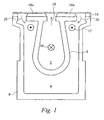
- Figure 1 depicts an ink supply support according to the prior art.
- the support is formed of extruded aluminium and consists of two separate manifolds 2, 4 that extend substantially the length of the support.
- the wall 6 dividing the two manifolds is thus formed of the same material as the exterior wall of the support.
- Ink enters and leaves through ports (not shown) situated at one end of the support.
- the ink flows down the inner manifold 2 in one direction as depicted by the symbol 10 and flows back down the outer manifold in the opposite direction as depicted by the symbol 12.
- the inner and outer manifolds 2, 4 are connected through a print head 14 attached to the top of the support.
- Two arrays of piezoelectric material containing sawn parallel channels 16a, 16b provide the ejection energy. Ink is supplied simultaneously to both arrays from a central manifold in the direction of arrow 18 and returns to the outer manifold of the support after passing through the ejection channel as shown by the arrow 20.
- the ink should enter the support at a well-controlled temperature, pass along the inlet manifold at the same temperature, flow through the channels picking up heat from the PZT, and leave via the outlet manifolds at a uniform but higher temperature.
- Constant temperature waveforms which are applied to the non ejecting channels and cause the PZT to dissipate that part of the heat generated during printing which is not removed by the ejected droplets are used to maintain the temperature within the channels at a constant temperature along the entire array.
- the chips also generate heat, the amount depending on the firing voltage and (to a lesser extent) on the image being printed.
- the chips require cooling and thus have been situated so that this heat finds its way into the outlet manifold 4.
- the aluminium chassis that forms the support provides a conduction path that attempts to equalise temperatures along the array. Ink flow along the array assists in the distribution of heat.
- Heat dissipated by the PZT is of the order of 0.015 W/channel, and the chips dissipate a similar amount. If all of this heat were to go into the ink through flow then the temperature rise of the ink in passing through the PWA would be 5.40C.
- the amount of heat removed during full black printing is 0.0015 W/channel, that is to say a small fraction of the total heat dissipation.
- the removal of heat by the drops is even less significant. Heat losses from the print head to the surroundings are modest and any covers protecting the electronics act to further reduce the heat loss.
- the aluminium chassis has the disadvantageous feature of transferring a significant amount of heat from the outlet manifold to the inlet manifold as well as the advantageous feature of transferring heat along the length of the support.
- the heat transferred through two walls, each 30 mm high and running the length of the array is 52 watts.
- the print head is operating as a counter current heat exchanger, the aluminium chassis and the ink being unable to completely equalise the temperature difference along the array.
- Figure 2 is a graphical representation of the temperature difference along the print head support.
- the support is modified such that the heat transfer coefficient between the ink inlet manifold and the ink outlet manifold is less than that of the prior art.
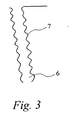
- the divider separating the two conduits is a wall that is roughened or shaped so as to provide a thick boundary or stagnant layer.
- the ridges 7 can extend either parallel to or perpendicular to the direction of fluid flow. In this case, where the support is extruded, the ridges extend parallel to the direction of fluid flow.
- an insulating coating can be applied to one or both sides of the dividing wall.
- the divider can be formed from the same material as the extruded perimeter. It is of course possible to use other materials as the dividing wall as described in the alternative embodiments of the first embodiment and as depicted in Figures 4 to 7.
- the inlet 9 and outlet 11 manifolds for the print head are formed by etching, sawing or ablation. Because an insert will be attached to the inside of the support to provide the flow features, it is not necessary to manufacture the slots to as high a degree of tolerance as in the aluminium support.
- the features of the manifolds are provided by an insert that acts as an insulator between the inlet 2 and the outlet manifolds 4 as shown in Figure 5.
- the plastic inset 22 is adhesively attached to the upper surface of the supply support 28.
- Spacers 24 are used to ensure there is no adverse movement of the spacer. In certain circumstances it is beneficial to provide baffles, ridges or a roughened surface to increase the boundary layer of ink around the dividing wall and to provide additional insulation.
- a double wall may be formed and which provides an insulating air cavity.
- the plastic wall may be replaced by a closed-cell foam rubber wall, chosen to be resistant to chemical attack by the ink, capable of being formed into an appropriate shape and which does not shed dirt particles into the ink.
- a closed-cell foam rubber wall chosen to be resistant to chemical attack by the ink, capable of being formed into an appropriate shape and which does not shed dirt particles into the ink.
- Other materials are also possible without departing from the scope of the present invention.
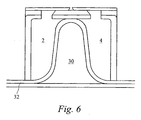
- Figure 6 shows a single row print head formed on a support.
- the piezoelectric material 16a provides a flow circuit between an inlet manifold 2 and an outlet manifold 4.
- the manifolds are separated by a plastic material formed such that there is a cavity 30 between them.
- the cavity is filled with a fluid, preferably gaseous, or a vacuum in order to provide insulation between the two manifolds.
- a fluid preferably gaseous, or a vacuum in order to provide insulation between the two manifolds.
- the dividing wall is attached to the support at least one point and may be rigid or flexible. Where the wall is flexible, a source of pressurised fluid can be used to change the pressures within the manifolds. A 3mm gap of air reduces the difference along a 20cm array to below.
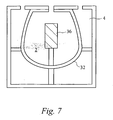
- a further method of improving the distribution of heat along the support, rather than across the walls is to provide a highly conductive heat transfer bar within one of the manifolds as depicted in Figure 7.
- the bar 36 can extend beyond the edge of the support and attached to an external heat exchanger, or alternatively it may be contained fully within the support.
- the heat transfer along the array is increased to the point where the transfer across the divider separating the inlet and outlet manifolds becomes insignificant.
- Figure 8 depicts a further design of manifold that is preferably formed of a moulded material, the manifold component having an inlet 2 and two outlet manifolds 4.
- manifolds are moulded it is possible to mould a double wall dividing the inlet and outlet manifolds.
- the double wall comprises a cavity of air that acts as an insulator reducing the amount of heat transfer across the wall.
- One of the purposes of the manifold component is to receive the heat from the driver chips bonded to its outer surfaces. Where the plastics material of the component has a low thermal conductivity this heat transfer is reduced.
- a metallic, or other higher thermally conductive material 40 may be moulded into the component during manufacture as shown in Figure 9. This allows heat transfer between the chip and the outlet manifold whilst still providing insulation to the inner manifold.
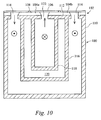
- a hollow, cylindrical support 100 serves to mount a plurality of ink jet print heads 102.
- the support 100 has a external wall section 110, folded into a U-shape.
- the support provides a mounting surface 112 on which are supported the print heads, each of which comprises a layer of piezoelectric material 104 defining ink channels extending across the support and a cover plate 106 defining nozzles 108.
- two ink channels are defined by respective sections 104a and 104b of the piezoelectric layer.
- ink flowing through inlet port 122 in the mounting surface flows continuously in opposing transverse directions through the two ink channels to be collected by respective outlet ports 114.
- the outlet ports 114 communicate with an outlet ink manifold defined by the external wall section 110.
- An internal wall section takes the form of double walls 116 and 118 defining between them a thermally insulating cavity 120.
- This cavity may contain air at atmospheric material, be evacuated or contain trapped ink or other appropriate liquid.
- the cavity may be filled with foam or other cellular material.
- the inlet ink manifold defined by the cavity wall 116,118 communicates with the ink inlet port 122.
- the structure shown in Figure 10 may be formed in one piece by - for example - extrusion or moulding or by a range of other forming techniques.
- the structure is formed of extruded aluminium or other suitable metal.
- the structure is formed of moulded plastic.
- an additional wall section is provided of metal or metal loaded plastic to promote heat transfer along the length of the support.
- the structure is formed from wall sections of different material.
- a port plate (not shown) is interposed between the wall sections and the print heads to assist in defining the ink inlet and outlet ports.
- openings defined with relatively low precision by the cooperating wall sections communicate with more precisely defined port openings in the interposed plate.
- this port plate may form part of the support or part of the print head.
Landscapes
- Particle Formation And Scattering Control In Inkjet Printers (AREA)
- Ink Jet (AREA)
- X-Ray Techniques (AREA)
- Non-Portable Lighting Devices Or Systems Thereof (AREA)
- Developing Agents For Electrophotography (AREA)
- Crystals, And After-Treatments Of Crystals (AREA)
- Confectionery (AREA)
Claims (24)
- Halterung für einen Tintenstrahldruckkopf, der bei Anwendung einen kontinuierlichen Fluss von Tinte verlangt, wobei die Halterung eine Befestigungsoberfläche bereitstellt, welche so angeordnet ist, um wenigstens einen Druckkopf aufzunehmen, und welche Tinteneinlass- und -auslassöffnungen zur Übertragung mit dem Druckkopf oder den Druckköpfen bereitstellt, wobei die Halterung wenigstens zwei Wandabschnitte umfasst, die zusammenwirken, um Tinteneingangs- und -Ausgangsverteiler zu definieren, wobei eine Wand thermisch leitend ist, um eine Wärmeübertragung entlang der Länge der Halterung zu fördern, und wobei ein anderer Wandabschnitt mit Isolierungsmitteln bereitgestellt wird, wobei das Isoliermittel einen Wärmeaustausch zwischen dem Einlass- und Auslassverteiler verhindert.
- Halterung nach Anspruch 1, wobei das Isoliermittel einen Material-Teilbereich umfasst, der an den anderen Wandabschnitt angrenzt, welcher einen niedrigeren Wärmeleitungskoeffizienten als die Wand aufweist.
- Halterung nach Anspruch 2, wobei der Material-Teilbereich ein Fluid ist.
- Halterung nach irgendeinem der Ansprüche 1 bis 3, wobei das Isoliermittel einen Luftspalt umfasst.
- Halterung nach irgendeinem der vorangegangenen Ansprüche, wobei das Isoliermittel eine Doppelwand-Anordnung aufweist.
- Halterung nach Anspruch 5, wobei die Doppelwand-Anordnung einen Hohlraum definiert, der ein Gas oder eine Flüssigkeit enthält.
- Halterung nach Anspruch 5, wobei die Doppelwand-Anordnung einen Vakuum-Hohlraum definiert.
- Halterung nach irgendeinem der vorangegangenen Ansprüche, wobei das Isoliermittel einen Bereich bzw. eine Fläche des Aufrauhens oder Formens des anderen Wandabschnitts umfasst, um eine Grenz- oder Stagnierungsschicht des Fluids bereitzustellen, das an den anderen Wandabschnitt angrenzt.
- Halterung nach Anspruch 8, wobei das Aufrauhen oder Formen die Bereitstellung von Stegen auf dem anderen Wandabschnitt umfasst, wobei sich die Stege parallel zur Richtung des Fluid-Stroms erstrecken.
- Halterung nach Anspruch 9, wobei das Fluid Tinte ist.
- Halterung nach irgendeinem der vorangegangenen Ansprüche, wobei der thermisch leitende Wandabschnitt aus Metall ausgebildet ist.
- Halterung nach irgendeinem der vorangegangenen Ansprüche, wobei die Wandabschnitte gefaltet sind.
- Halterung nach irgendeinem der vorangegangenen Ansprüche, wobei wenigstens einer der Wandabschnitte im Querschnitt der Halterung U-förmig ist.
- Halterung nach irgendeinem der vorangegangenen Ansprüche, wobei in dem Querschnitt der Halterung ein Tintenverteiler den anderen im Wesentlichen umgibt.
- Halterung nach irgendeinem der vorangegangenen Ansprüche, welche weiter eine Wärmesenke umfasst, die innerhalb einer der Verteiler angeordnet ist.
- Halterung nach Anspruch 15, wobei sich die Wärmesenke im Wesentlichen entlang der gesamten Länge des einen der Verteiler erstreckt.
- Halterung für einen Tintenstrahldruckkopf, der bei Anwendung einen kontinuierlichen Fluss von Tinte verlangt, wobei die Halterung eine Befestigungsoberfläche bereitstellt, welche so angeordnet ist, um wenigstens einen Druckkopf aufzunehmen, und welche Tinteneinlass- und -auslassöffnungen zur Übertragung mit dem Druckkopf oder den Druckköpfen bereitstellt, wobei die Halterung wenigstens zwei Wandabschnitte umfasst, die zusammenwirken, um Tinteneingangs- und Ausgangsverteiler zu definieren, wobei eine Wandabschnitt, aus einem thermischen leitenden Material ausgebildet ist, um eine Wärmeübertragung entlang der Länge der Halterung zu fördern, und ein anderer Wandabschnitt aus einem anderen Material ausgebildet ist, das thermisch isolierend ist, um Wärmeübertragung zwischen dem Eingangs- und Auslassverteiler zu verhindern.
- Halterung nach Anspruch 17, wobei der thermisch leitende Wandabschnitt aus Metall ausgebildet ist.
- Halterung nach Anspruch 17, wobei der thermisch leitende Wandabschnitt aus Keramik ausgebildet ist.
- Halterung nach irgendeinem der Ansprüche 17 bis 19, wobei der thermisch isolierende Wandabschnitt aus Schaumstoff ausgebildet ist.
- Halterung nach irgendeinem der Ansprüche 17 bis 20, wobei der thermisch isolierende Wandabschnitt aus Kunststoff ausgebildet ist.
- Halterung nach irgendeinem der Ansprüche 18 bis 21, wobei in dem Querschnitt der Halterung ein Tintenverteiler den anderen im Wesentlichen umgibt.
- Apparat, welcher eine Halterung nach irgendeinem der vorangegangenen Ansprüche umfasst, und ein Tintenstrahldruckkopf, der wenigstens eine Fluid-Kammer umfasst, wobei der Eingangsverteiler und der Ausgangsverteiler durch die wenigstens eine Fluid-Kammer fluid verbunden sind.
- Apparat nach Anspruch 23, wobei die wenigstens eine Fluid-Kammer eine Ausstoßkammer ist, die eine Ausstoßdüse aufweist.
Applications Claiming Priority (3)
| Application Number | Priority Date | Filing Date | Title |
|---|---|---|---|
| GB0121619 | 2001-09-07 | ||
| GBGB0121619.1A GB0121619D0 (en) | 2001-09-07 | 2001-09-07 | Droplet depostion apparatus |
| PCT/GB2002/004078 WO2003022587A1 (en) | 2001-09-07 | 2002-09-09 | Droplet deposition apparatus |
Publications (2)
| Publication Number | Publication Date |
|---|---|
| EP1423283A1 EP1423283A1 (de) | 2004-06-02 |
| EP1423283B1 true EP1423283B1 (de) | 2007-11-14 |
Family
ID=9921647
Family Applications (1)
| Application Number | Title | Priority Date | Filing Date |
|---|---|---|---|
| EP02758571A Expired - Lifetime EP1423283B1 (de) | 2001-09-07 | 2002-09-09 | Tröpfchenaufzeichnungsgerät |
Country Status (13)
| Country | Link |
|---|---|
| US (1) | US7204578B2 (de) |
| EP (1) | EP1423283B1 (de) |
| JP (1) | JP4382481B2 (de) |
| KR (1) | KR20040048406A (de) |
| CN (1) | CN1294021C (de) |
| AT (1) | ATE378182T1 (de) |
| AU (1) | AU2002324153B2 (de) |
| BR (1) | BR0205974A (de) |
| DE (1) | DE60223558T2 (de) |
| ES (1) | ES2295392T3 (de) |
| GB (1) | GB0121619D0 (de) |
| IL (2) | IL160671A0 (de) |
| WO (1) | WO2003022587A1 (de) |
Families Citing this family (10)
| Publication number | Priority date | Publication date | Assignee | Title |
|---|---|---|---|---|
| ATE292562T1 (de) | 1999-06-30 | 2005-04-15 | Silverbrook Res Pty Ltd | Trägerstruktur und trägeranordnung für einen druckkopf |
| US6755509B2 (en) * | 2002-11-23 | 2004-06-29 | Silverbrook Research Pty Ltd | Thermal ink jet printhead with suspended beam heater |
| GB0606685D0 (en) † | 2006-04-03 | 2006-05-10 | Xaar Technology Ltd | Droplet Deposition Apparatus |
| JP4999663B2 (ja) * | 2007-12-03 | 2012-08-15 | キヤノン株式会社 | インクジェット記録ヘッド |
| US8042927B2 (en) * | 2008-09-30 | 2011-10-25 | Xerox Corporation | Melt reservoir housing |
| JP5665363B2 (ja) * | 2010-05-14 | 2015-02-04 | キヤノン株式会社 | 液体吐出ヘッド |
| JP2012125936A (ja) * | 2010-12-13 | 2012-07-05 | Toshiba Tec Corp | インクジェットヘッド |
| CN103386815B (zh) * | 2013-07-04 | 2015-10-28 | 宁波源丰消防设备有限公司 | 一种涂层印花装置 |
| GB2546097B (en) | 2016-01-08 | 2020-12-30 | Xaar Technology Ltd | Droplet deposition head |
| US12583230B2 (en) | 2021-11-09 | 2026-03-24 | Brady Worldwide, Inc. | Fluid cartridge with vented insert |
Family Cites Families (8)
| Publication number | Priority date | Publication date | Assignee | Title |
|---|---|---|---|---|
| US4887100A (en) | 1987-01-10 | 1989-12-12 | Am International, Inc. | Droplet deposition apparatus |
| JP3114776B2 (ja) | 1992-06-23 | 2000-12-04 | セイコーエプソン株式会社 | インクジェット式ライン記録ヘッドを用いたプリンタ |
| JP2870459B2 (ja) | 1995-10-09 | 1999-03-17 | 日本電気株式会社 | インクジェット記録装置及びその製造方法 |
| DE69904743T2 (de) | 1998-10-24 | 2003-10-16 | Xaar Technology Ltd., Cambridge | Tröpfchenablageapparat |
| CN1245291C (zh) | 1998-11-14 | 2006-03-15 | 萨尔技术有限公司 | 液滴沉积装置 |
| US6428145B1 (en) * | 1998-12-17 | 2002-08-06 | Hewlett-Packard Company | Wide-array inkjet printhead assembly with internal electrical routing system |
| GB9828476D0 (en) | 1998-12-24 | 1999-02-17 | Xaar Technology Ltd | Apparatus for depositing droplets of fluid |
| AUPQ605900A0 (en) * | 2000-03-06 | 2000-03-30 | Silverbrook Research Pty Ltd | Thermal expansion compensation for printhead assemblies |
-
2001
- 2001-09-07 GB GBGB0121619.1A patent/GB0121619D0/en not_active Ceased
-
2002
- 2002-09-09 DE DE60223558T patent/DE60223558T2/de not_active Expired - Lifetime
- 2002-09-09 KR KR10-2004-7003394A patent/KR20040048406A/ko not_active Ceased
- 2002-09-09 WO PCT/GB2002/004078 patent/WO2003022587A1/en not_active Ceased
- 2002-09-09 AU AU2002324153A patent/AU2002324153B2/en not_active Ceased
- 2002-09-09 EP EP02758571A patent/EP1423283B1/de not_active Expired - Lifetime
- 2002-09-09 IL IL16067102A patent/IL160671A0/xx active IP Right Grant
- 2002-09-09 JP JP2003526691A patent/JP4382481B2/ja not_active Expired - Fee Related
- 2002-09-09 BR BR0205974-6A patent/BR0205974A/pt active Search and Examination
- 2002-09-09 AT AT02758571T patent/ATE378182T1/de not_active IP Right Cessation
- 2002-09-09 ES ES02758571T patent/ES2295392T3/es not_active Expired - Lifetime
- 2002-09-09 CN CNB028172914A patent/CN1294021C/zh not_active Expired - Fee Related
- 2002-09-09 US US10/488,620 patent/US7204578B2/en not_active Expired - Lifetime
-
2004
- 2004-03-01 IL IL160671A patent/IL160671A/en not_active IP Right Cessation
Also Published As
| Publication number | Publication date |
|---|---|
| JP2005502499A (ja) | 2005-01-27 |
| KR20040048406A (ko) | 2004-06-09 |
| EP1423283A1 (de) | 2004-06-02 |
| ATE378182T1 (de) | 2007-11-15 |
| US20050134651A1 (en) | 2005-06-23 |
| CN1294021C (zh) | 2007-01-10 |
| ES2295392T3 (es) | 2008-04-16 |
| IL160671A (en) | 2007-10-31 |
| US7204578B2 (en) | 2007-04-17 |
| GB0121619D0 (en) | 2001-10-31 |
| DE60223558T2 (de) | 2008-10-23 |
| AU2002324153B2 (en) | 2007-10-04 |
| DE60223558D1 (de) | 2007-12-27 |
| CN1551835A (zh) | 2004-12-01 |
| BR0205974A (pt) | 2003-09-30 |
| IL160671A0 (en) | 2004-08-31 |
| WO2003022587A1 (en) | 2003-03-20 |
| JP4382481B2 (ja) | 2009-12-16 |
Similar Documents
| Publication | Publication Date | Title |
|---|---|---|
| KR100771090B1 (ko) | 액적 증착장치 | |
| EP1423283B1 (de) | Tröpfchenaufzeichnungsgerät | |
| CN100402305C (zh) | 微滴沉积设备 | |
| JP6512886B2 (ja) | 液体吐出ヘッド | |
| JP5665363B2 (ja) | 液体吐出ヘッド | |
| AU2002324153A1 (en) | Droplet deposition apparatus | |
| US9457570B2 (en) | Liquid ejection head | |
| CN1165429C (zh) | 液滴沉积装置 | |
| GB2522563A (en) | Droplet deposition apparatus and method for manufacturing the same | |
| CN1883946A (zh) | 具有微型热管的阵列打印头 | |
| EP3535131B1 (de) | Flüssigkeitsströmungsstruktur | |
| US8366245B2 (en) | Fin-shaped heater stack and method for formation | |
| JP2011235481A (ja) | 液体吐出装置 | |
| EP4303010B1 (de) | Tintenstrahldruckkopf mit kontinuierlicher strömung und verbesserter temperaturgleichmässigkeit | |
| JPH03187753A (ja) | 記録装置 | |
| ES3013825T3 (en) | Manifold for an inkjet printer | |
| US20200180317A1 (en) | Dehumidifier condensing unit for an inkjet printer | |
| WO2025089296A1 (ja) | 液体吐出ヘッド及び記録装置 | |
| JPH0789075A (ja) | インクジェットヘッド、インクジェットヘッドカートリッジおよびインクジェット装置 | |
| JPH03187752A (ja) | 記録装置 |
Legal Events
| Date | Code | Title | Description |
|---|---|---|---|
| PUAI | Public reference made under article 153(3) epc to a published international application that has entered the european phase |
Free format text: ORIGINAL CODE: 0009012 |
|
| 17P | Request for examination filed |
Effective date: 20040227 |
|
| AK | Designated contracting states |
Kind code of ref document: A1 Designated state(s): AT BE BG CH CY CZ DE DK EE ES FI FR GB GR IE IT LI LU MC NL PT SE SK TR |
|
| AX | Request for extension of the european patent |
Extension state: AL LT LV MK RO SI |
|
| 17Q | First examination report despatched |
Effective date: 20041217 |
|
| GRAP | Despatch of communication of intention to grant a patent |
Free format text: ORIGINAL CODE: EPIDOSNIGR1 |
|
| GRAS | Grant fee paid |
Free format text: ORIGINAL CODE: EPIDOSNIGR3 |
|
| GRAA | (expected) grant |
Free format text: ORIGINAL CODE: 0009210 |
|
| AK | Designated contracting states |
Kind code of ref document: B1 Designated state(s): AT BE BG CH CY CZ DE DK EE ES FI FR GB GR IE IT LI LU MC NL PT SE SK TR |
|
| REG | Reference to a national code |
Ref country code: GB Ref legal event code: FG4D |
|
| REG | Reference to a national code |
Ref country code: CH Ref legal event code: EP |
|
| REG | Reference to a national code |
Ref country code: IE Ref legal event code: FG4D |
|
| REF | Corresponds to: |
Ref document number: 60223558 Country of ref document: DE Date of ref document: 20071227 Kind code of ref document: P |
|
| REG | Reference to a national code |
Ref country code: ES Ref legal event code: FG2A Ref document number: 2295392 Country of ref document: ES Kind code of ref document: T3 |
|
| PG25 | Lapsed in a contracting state [announced via postgrant information from national office to epo] |
Ref country code: SE Free format text: LAPSE BECAUSE OF FAILURE TO SUBMIT A TRANSLATION OF THE DESCRIPTION OR TO PAY THE FEE WITHIN THE PRESCRIBED TIME-LIMIT Effective date: 20080214 Ref country code: LI Free format text: LAPSE BECAUSE OF FAILURE TO SUBMIT A TRANSLATION OF THE DESCRIPTION OR TO PAY THE FEE WITHIN THE PRESCRIBED TIME-LIMIT Effective date: 20071114 Ref country code: CH Free format text: LAPSE BECAUSE OF FAILURE TO SUBMIT A TRANSLATION OF THE DESCRIPTION OR TO PAY THE FEE WITHIN THE PRESCRIBED TIME-LIMIT Effective date: 20071114 |
|
| PG25 | Lapsed in a contracting state [announced via postgrant information from national office to epo] |
Ref country code: BG Free format text: LAPSE BECAUSE OF FAILURE TO SUBMIT A TRANSLATION OF THE DESCRIPTION OR TO PAY THE FEE WITHIN THE PRESCRIBED TIME-LIMIT Effective date: 20080214 Ref country code: FI Free format text: LAPSE BECAUSE OF FAILURE TO SUBMIT A TRANSLATION OF THE DESCRIPTION OR TO PAY THE FEE WITHIN THE PRESCRIBED TIME-LIMIT Effective date: 20071114 |
|
| REG | Reference to a national code |
Ref country code: CH Ref legal event code: PL |
|
| PG25 | Lapsed in a contracting state [announced via postgrant information from national office to epo] |
Ref country code: AT Free format text: LAPSE BECAUSE OF FAILURE TO SUBMIT A TRANSLATION OF THE DESCRIPTION OR TO PAY THE FEE WITHIN THE PRESCRIBED TIME-LIMIT Effective date: 20071114 |
|
| PG25 | Lapsed in a contracting state [announced via postgrant information from national office to epo] |
Ref country code: CZ Free format text: LAPSE BECAUSE OF FAILURE TO SUBMIT A TRANSLATION OF THE DESCRIPTION OR TO PAY THE FEE WITHIN THE PRESCRIBED TIME-LIMIT Effective date: 20071114 Ref country code: DK Free format text: LAPSE BECAUSE OF FAILURE TO SUBMIT A TRANSLATION OF THE DESCRIPTION OR TO PAY THE FEE WITHIN THE PRESCRIBED TIME-LIMIT Effective date: 20071114 |
|
| ET | Fr: translation filed | ||
| PG25 | Lapsed in a contracting state [announced via postgrant information from national office to epo] |
Ref country code: BE Free format text: LAPSE BECAUSE OF FAILURE TO SUBMIT A TRANSLATION OF THE DESCRIPTION OR TO PAY THE FEE WITHIN THE PRESCRIBED TIME-LIMIT Effective date: 20071114 Ref country code: SK Free format text: LAPSE BECAUSE OF FAILURE TO SUBMIT A TRANSLATION OF THE DESCRIPTION OR TO PAY THE FEE WITHIN THE PRESCRIBED TIME-LIMIT Effective date: 20071114 |
|
| PLBE | No opposition filed within time limit |
Free format text: ORIGINAL CODE: 0009261 |
|
| STAA | Information on the status of an ep patent application or granted ep patent |
Free format text: STATUS: NO OPPOSITION FILED WITHIN TIME LIMIT |
|
| PG25 | Lapsed in a contracting state [announced via postgrant information from national office to epo] |
Ref country code: PT Free format text: LAPSE BECAUSE OF FAILURE TO SUBMIT A TRANSLATION OF THE DESCRIPTION OR TO PAY THE FEE WITHIN THE PRESCRIBED TIME-LIMIT Effective date: 20080414 |
|
| 26N | No opposition filed |
Effective date: 20080815 |
|
| PGFP | Annual fee paid to national office [announced via postgrant information from national office to epo] |
Ref country code: IE Payment date: 20080917 Year of fee payment: 7 Ref country code: NL Payment date: 20080903 Year of fee payment: 7 |
|
| PG25 | Lapsed in a contracting state [announced via postgrant information from national office to epo] |
Ref country code: GR Free format text: LAPSE BECAUSE OF FAILURE TO SUBMIT A TRANSLATION OF THE DESCRIPTION OR TO PAY THE FEE WITHIN THE PRESCRIBED TIME-LIMIT Effective date: 20080215 |
|
| PGFP | Annual fee paid to national office [announced via postgrant information from national office to epo] |
Ref country code: ES Payment date: 20081021 Year of fee payment: 7 |
|
| PGFP | Annual fee paid to national office [announced via postgrant information from national office to epo] |
Ref country code: IT Payment date: 20080927 Year of fee payment: 7 |
|
| PG25 | Lapsed in a contracting state [announced via postgrant information from national office to epo] |
Ref country code: MC Free format text: LAPSE BECAUSE OF NON-PAYMENT OF DUE FEES Effective date: 20080930 Ref country code: EE Free format text: LAPSE BECAUSE OF FAILURE TO SUBMIT A TRANSLATION OF THE DESCRIPTION OR TO PAY THE FEE WITHIN THE PRESCRIBED TIME-LIMIT Effective date: 20071114 |
|
| PG25 | Lapsed in a contracting state [announced via postgrant information from national office to epo] |
Ref country code: CY Free format text: LAPSE BECAUSE OF FAILURE TO SUBMIT A TRANSLATION OF THE DESCRIPTION OR TO PAY THE FEE WITHIN THE PRESCRIBED TIME-LIMIT Effective date: 20071114 |
|
| REG | Reference to a national code |
Ref country code: NL Ref legal event code: V1 Effective date: 20100401 |
|
| PG25 | Lapsed in a contracting state [announced via postgrant information from national office to epo] |
Ref country code: NL Free format text: LAPSE BECAUSE OF NON-PAYMENT OF DUE FEES Effective date: 20100401 Ref country code: LU Free format text: LAPSE BECAUSE OF NON-PAYMENT OF DUE FEES Effective date: 20080909 Ref country code: IE Free format text: LAPSE BECAUSE OF NON-PAYMENT OF DUE FEES Effective date: 20090909 |
|
| PG25 | Lapsed in a contracting state [announced via postgrant information from national office to epo] |
Ref country code: TR Free format text: LAPSE BECAUSE OF FAILURE TO SUBMIT A TRANSLATION OF THE DESCRIPTION OR TO PAY THE FEE WITHIN THE PRESCRIBED TIME-LIMIT Effective date: 20071114 |
|
| PG25 | Lapsed in a contracting state [announced via postgrant information from national office to epo] |
Ref country code: IT Free format text: LAPSE BECAUSE OF NON-PAYMENT OF DUE FEES Effective date: 20090909 |
|
| REG | Reference to a national code |
Ref country code: ES Ref legal event code: FD2A Effective date: 20110712 |
|
| PG25 | Lapsed in a contracting state [announced via postgrant information from national office to epo] |
Ref country code: ES Free format text: LAPSE BECAUSE OF NON-PAYMENT OF DUE FEES Effective date: 20110630 |
|
| PG25 | Lapsed in a contracting state [announced via postgrant information from national office to epo] |
Ref country code: ES Free format text: LAPSE BECAUSE OF NON-PAYMENT OF DUE FEES Effective date: 20090910 |
|
| PGFP | Annual fee paid to national office [announced via postgrant information from national office to epo] |
Ref country code: DE Payment date: 20140903 Year of fee payment: 13 |
|
| PGFP | Annual fee paid to national office [announced via postgrant information from national office to epo] |
Ref country code: GB Payment date: 20140903 Year of fee payment: 13 |
|
| PGFP | Annual fee paid to national office [announced via postgrant information from national office to epo] |
Ref country code: FR Payment date: 20140906 Year of fee payment: 13 |
|
| REG | Reference to a national code |
Ref country code: DE Ref legal event code: R119 Ref document number: 60223558 Country of ref document: DE |
|
| GBPC | Gb: european patent ceased through non-payment of renewal fee |
Effective date: 20150909 |
|
| REG | Reference to a national code |
Ref country code: FR Ref legal event code: ST Effective date: 20160531 |
|
| PG25 | Lapsed in a contracting state [announced via postgrant information from national office to epo] |
Ref country code: DE Free format text: LAPSE BECAUSE OF NON-PAYMENT OF DUE FEES Effective date: 20160401 Ref country code: GB Free format text: LAPSE BECAUSE OF NON-PAYMENT OF DUE FEES Effective date: 20150909 |
|
| PG25 | Lapsed in a contracting state [announced via postgrant information from national office to epo] |
Ref country code: FR Free format text: LAPSE BECAUSE OF NON-PAYMENT OF DUE FEES Effective date: 20150930 |