EP1421160B1 - Verwendung von fluoreszenzfarbstoffen auf basis von pyrromethendifluoroborat-komplexen zur fluoreszenzmarkierung von schmierstoffen und zur feststellung von leckage in schmierstoff-systemen sowie ein demgemässes fluoreszenzfarbstoff-konzentrat - Google Patents
Verwendung von fluoreszenzfarbstoffen auf basis von pyrromethendifluoroborat-komplexen zur fluoreszenzmarkierung von schmierstoffen und zur feststellung von leckage in schmierstoff-systemen sowie ein demgemässes fluoreszenzfarbstoff-konzentrat Download PDFInfo
- Publication number
- EP1421160B1 EP1421160B1 EP02779282A EP02779282A EP1421160B1 EP 1421160 B1 EP1421160 B1 EP 1421160B1 EP 02779282 A EP02779282 A EP 02779282A EP 02779282 A EP02779282 A EP 02779282A EP 1421160 B1 EP1421160 B1 EP 1421160B1
- Authority
- EP
- European Patent Office
- Prior art keywords
- fluorescent dye
- fluorescent
- chain
- complexes
- difluoroborate
- Prior art date
- Legal status (The legal status is an assumption and is not a legal conclusion. Google has not performed a legal analysis and makes no representation as to the accuracy of the status listed.)
- Expired - Lifetime
Links
- 0 C*C(c1c(*)c(*)c(*)[n]1[B-]1(F)F)=C(C(*)=C2*)*1=C2I Chemical compound C*C(c1c(*)c(*)c(*)[n]1[B-]1(F)F)=C(C(*)=C2*)*1=C2I 0.000 description 1
Images

Classifications
-
- C—CHEMISTRY; METALLURGY
- C10—PETROLEUM, GAS OR COKE INDUSTRIES; TECHNICAL GASES CONTAINING CARBON MONOXIDE; FUELS; LUBRICANTS; PEAT
- C10M—LUBRICATING COMPOSITIONS; USE OF CHEMICAL SUBSTANCES EITHER ALONE OR AS LUBRICATING INGREDIENTS IN A LUBRICATING COMPOSITION
- C10M171/00—Lubricating compositions characterised by purely physical criteria, e.g. containing as base-material, thickener or additive, ingredients which are characterised exclusively by their numerically specified physical properties, i.e. containing ingredients which are physically well-defined but for which the chemical nature is either unspecified or only very vaguely indicated
- C10M171/007—Coloured or dyes-containing lubricant compositions
-
- C—CHEMISTRY; METALLURGY
- C09—DYES; PAINTS; POLISHES; NATURAL RESINS; ADHESIVES; COMPOSITIONS NOT OTHERWISE PROVIDED FOR; APPLICATIONS OF MATERIALS NOT OTHERWISE PROVIDED FOR
- C09B—ORGANIC DYES OR CLOSELY-RELATED COMPOUNDS FOR PRODUCING DYES, e.g. PIGMENTS; MORDANTS; LAKES
- C09B57/00—Other synthetic dyes of known constitution
- C09B57/10—Metal complexes of organic compounds not being dyes in uncomplexed form
-
- C—CHEMISTRY; METALLURGY
- C10—PETROLEUM, GAS OR COKE INDUSTRIES; TECHNICAL GASES CONTAINING CARBON MONOXIDE; FUELS; LUBRICANTS; PEAT
- C10L—FUELS NOT OTHERWISE PROVIDED FOR; NATURAL GAS; SYNTHETIC NATURAL GAS OBTAINED BY PROCESSES NOT COVERED BY SUBCLASSES C10G OR C10K; LIQUIFIED PETROLEUM GAS; USE OF ADDITIVES TO FUELS OR FIRES; FIRE-LIGHTERS
- C10L1/00—Liquid carbonaceous fuels
- C10L1/003—Marking, e.g. coloration by addition of pigments
-
- C—CHEMISTRY; METALLURGY
- C10—PETROLEUM, GAS OR COKE INDUSTRIES; TECHNICAL GASES CONTAINING CARBON MONOXIDE; FUELS; LUBRICANTS; PEAT
- C10M—LUBRICATING COMPOSITIONS; USE OF CHEMICAL SUBSTANCES EITHER ALONE OR AS LUBRICATING INGREDIENTS IN A LUBRICATING COMPOSITION
- C10M2227/00—Organic non-macromolecular compounds containing atoms of elements not provided for in groups C10M2203/00, C10M2207/00, C10M2211/00, C10M2215/00, C10M2219/00 or C10M2223/00 as ingredients in lubricant compositions
- C10M2227/06—Organic compounds derived from inorganic acids or metal salts
-
- C—CHEMISTRY; METALLURGY
- C10—PETROLEUM, GAS OR COKE INDUSTRIES; TECHNICAL GASES CONTAINING CARBON MONOXIDE; FUELS; LUBRICANTS; PEAT
- C10M—LUBRICATING COMPOSITIONS; USE OF CHEMICAL SUBSTANCES EITHER ALONE OR AS LUBRICATING INGREDIENTS IN A LUBRICATING COMPOSITION
- C10M2227/00—Organic non-macromolecular compounds containing atoms of elements not provided for in groups C10M2203/00, C10M2207/00, C10M2211/00, C10M2215/00, C10M2219/00 or C10M2223/00 as ingredients in lubricant compositions
- C10M2227/06—Organic compounds derived from inorganic acids or metal salts
- C10M2227/063—Complexes of boron halides
Definitions
- the present invention relates to the use of fluorescent dyes based on pyrromethendifluoroborate complexes for fluorescence labeling of lubricants and for detecting leakage in lubricant systems and to a corresponding fluorescent dye concentrate.
- a leak in a lubricant system different methods can be used. Among the most sensitive methods are the optical localizations the leakage. By marking the lubricants with fluorescent dyes present in the corresponding systems, it is possible to optimize the location of a leak in a lubricant system. In the event of a leak then occurs in addition to the lubricant, and fluorescent dye. By exciting the exiting fluorescent dye with light (eg, a UV or black light lamp), the fluorescence of the dye can be observed on the surface.
- light eg, a UV or black light lamp
- the fluorescent dye be in the form of a liquid fluorescent dye concentrate, most preferably oil-based.
- the fluorescent dye concentrate can be added to the lubricant system of the corresponding system and mixes there with the lubricant.
- the fluorescent dye concentrate should be as concentrated with the dye as possible.
- fluorescent dyes such as. As rhodamine, oxazines or coumarins, which have a high fluorescence quantum yield and can be excited with a UV lamp.
- these dyes are not particularly oil-soluble. As a rule, about 2 grams of these dyes can be dissolved in one liter of oil. In order to be able to clearly recognize the fluorescence of these dyes during UV excitation with naked eyes, a concentration of these dyes of about 0.2 grams per liter of oil is required. For this reason, only fluorescent dye concentrates can be prepared with these dyes, which has a ratio of Allow fluorescent dye concentrate to lubricant from one to ten.
- Fluorescent dye concentrates can likewise be prepared from the above-mentioned and long-known fluorescent dyes, such as rhodamines, oxazines and coumarins, but solvents such as ethanol or nitrobenzene must be used for this purpose. Due to the abovementioned requirement of the Regulation on Flammable Liquids AIII, such fluorescent dye concentrates can not be used. Furthermore, solvents such as nitrobenzene are virtually eliminated due to their toxicity in almost all cases. So z. For example, nitrobenzene is known to be carcinogenic, toxic and environmentally hazardous according to EC directives classified.
- the present invention has for its object to provide a fluorescent dye system, which should be suitable for coloring lubricants, taking into account the Regulation on Flammable Liquids (VbF) AIII, the system should ensure maximum dilution and high fluorescence quantum yield.
- the pyrromethendifluoroborate complexes having the general formula (I) preferably used in octanoic acid as a solvent.
- Another object of the present invention is thus a fluorescent dye concentrate comprising at least one fluorescent dye based on Pyrromethendifluoroborat complexes having the general formula (I) wherein the radicals R 1 , R 2 , R 3 , R 5 , R 6 and R 7 independently of one another are hydrogen or straight-chain or branched-chain C 1 -C 4 -alkyl radicals, preferably methyl, ethyl or propyl, or the radicals R 1 , R 3 2 or R 6 , R 7 are part of a fused aromatic ring system, and the radical R 4 is a straight-chain or branched-chain C 1 -C 10 alkyl radical, and octanoic acid as a solvent.
- the radicals R 1 , R 2 , R 3 , R 5 , R 6 and R 7 independently of one another are hydrogen or straight-chain or branched-chain C 1 -C 4 -alkyl radicals, preferably methyl, ethyl or prop
- the concentration ratio of the fluorescent dye dissolved in the octanoic acid is in a range of about 150 g of the fluorescent dye in 100 g octanoic acid (minimum) to about 350 g of the fluorescent dye in 100 g octanoic acid (maximum); preferably, it is in a range of 210.8 g of the fluorescent dye in 100 g of octanoic acid (minimum) to 285.2 g of the fluorescent dye in 100 g of octanoic acid (maximum).
- the concentration ratio is 248 g of the fluorescent dye in 100 g of octanoic acid.
- the fluorescent dye concentrates according to the invention are based on octanoic acid as a liquid. This liquid corresponds to the VbF AIII flash point specification. Furthermore, the fluorescent dye concentrate according to the invention can be mixed with oil in any ratio.
- the concentration ratio of the mixed with the oil fluorescent dye concentrate is preferably in a range of about 0.1 g of the fluorescent dye concentrate in 1 liter of oil (minimum) to about 1 g of the fluorescent dye concentrate in 1 liter of oil (maximum), in particular in a range of 0.238 g of the fluorescent dye concentrate in 1 liter of oil (minimum) to 0.322 g of the fluorescent dye concentrate in 1 liter of oil (maximum).
- the concentration ratio is 0.28 g of the fluorescent dye concentrate in 1 liter of oil. This results in particular in a concentration of 0.17 g of the fluorescent dye in 1 liter of oil (minimum) to 0.23 g of the fluorescent dye in 1 liter of oil (maximum). Typically, the concentration ratio is 0.2 g of the fluorescent dye in 1 liter of oil.
- fluorescent dye concentrates based on oil can be produced with this fluorescent dye concentrate.
- this liquid (octanoic acid) itself is not a solvent and can also be used in solvent-critical applications.
- the fluorescence dye concentrate according to the invention shows in a particularly advantageous manner when excited with a UV lamp nor a readily visible to the eye fluorescence, up to a dilution ratio of fluorescent dye concentrates to lubricant from one to two thousand. This makes it possible to significantly reduce the amount of the fluorescent dye concentrate to be introduced into the lubricant system.
- the group of pyrromethene dyes has a high fluorescence quantum yield (> 80%).
- Fig. 1 shows the absorption and fluorescence spectrum of the pyrromethene dye 4,4-difluoro-2,6-diethyl-1,3,5,7-tetramethyl-8-heptyl-4-bora-3a, 4a-diaza-s -indacene in ethanol.
- the wavelength ⁇ in nm is plotted on the x-axis; on the right Y axis, the absorbance or absorbance to which the right graph belongs, and on the left Y axis the emission or fluorescence intensity to which the left graph belongs.
- the absorption maxima of the pyrromethene fluorescent dyes used according to the invention are in the wavelength range from 390 to 525 nm, the fluorescence maxima are in the wavelength range from 427 to 545 nm. Because of a broad absorption band in the ultraviolet spectral range (see FIG. 1), these dyes are particularly suitable for black light lamps (Wavelength - 366 nm) to fluoresce. Due to the strong fluorescence, these dyes can be used even with significant contamination of oils and fats. The fluorescence of the pyrromethene fluorescent dye used according to the invention is so high that it can still be observed well with the naked eye even with a 2000-fold dilution of the fluorescent dye concentrate with oil when excited with a commercially available black light lamp.
- R 1, R 2, R 3, R 5, R 6 and R 7 may independently hydrogen or straight or branched chain C 1 -C 4 -alkyl, preferably methyl, ethyl or propyl, or Radicals R 1 , R 2 or R 6 , R 7 may be part of an annulated aromatic ring system, for example a fused benzene ring.
- the radical R 4 denotes a straight-chain or branched-chain C 1 -C 10 -alkyl radical, preferably n-butyl, n-pentyl, n-hexyl, or n-heptyl.
- the organic phase is dried over magnesium sulfate (anhydrous) for 18 hours. After filtering off the magnesium sulfate, the solvent mixture consisting of toluene, triethylamine and unused boron trifluoride-diethyl ether complex is distilled off on a rotary evaporator. A dark red viscous residue is obtained.
- the isolation (purification) of the dye can by Column chromatography (chloroform / silica gel) take place. To prepare the fluorescent dye concentrate, the purified dye is dissolved in high concentration in octanoic acid.
- the concentration ratio of the fluorescent dye dissolved in the octanoic acid is in a range of about 150 g of the fluorescent dye in 100 g octanoic acid (minimum) to about 350 g of the fluorescent dye in 100 g octanoic acid (maximum); preferably, it is in the range of 210.8 g of the fluorescent dye in 100 g of octanoic acid (minimum) to 285.2 g of the fluorescent dye in 100 g of octanoic acid (maximum).
- the concentration ratio is 248 g of the fluorescent dye in 100 g of octanoic acid.
Landscapes
- Chemical & Material Sciences (AREA)
- Oil, Petroleum & Natural Gas (AREA)
- Organic Chemistry (AREA)
- Chemical Kinetics & Catalysis (AREA)
- General Chemical & Material Sciences (AREA)
- Engineering & Computer Science (AREA)
- Investigating, Analyzing Materials By Fluorescence Or Luminescence (AREA)
- Lubricants (AREA)
- Investigating Or Analysing Materials By The Use Of Chemical Reactions (AREA)
- Luminescent Compositions (AREA)
Description
- Die vorliegende Erfindung betrifft die Verwendung von Fluoreszenzfarbstoffen auf Basis von Pyrromethendifluoroborat-Komplexen zur Fluoreszenzmarkierung von Schmierstoffen und zur Feststellung von Leckage in Schmierstoff-Systemen sowie ein demgemäßes Fluoreszenzfarbstoff-Konzentrat.
- In verschiedensten technischen Anlagen und Anwendungsbereichen, z. B. in Hydraulik-Systemen, in Flugzeugtriebwerken, im Automotiv-Bereich, ist es besonders wichtig Undichtigkeiten und Leckagen frühzeitig zu erkennen. Hierdurch können unter anderem Maschinenausfälle, Wartungs- und Reparaturaufwand minimiert werden. Zusätzlich kann hierdurch die Betriebssicherheit der Systeme erhöht werden um z. B. Personen- oder Umweltschäden zu vermeiden.
- Zur Feststellung einer Leckage an einem Schmierstoffsystem können unterschiedliche Verfahren herangezogen werden. Zu den höchstsensitiven Verfahren gehören die optischen Lokalisierungen der Leckage. Durch die Markierung der in den entsprechenden Anlagen vorhandenen Schmierstoffe mit Fluoreszenzfarbstoffen lässt sich das Auffinden einer Leckage in einem Schmierstoffsystem optimieren. Im Falle einer Undichtigkeit tritt dann, neben dem Schmiermittel, auch Fluoreszenzfarbstoff aus. Durch die Anregung des austretenden Fluoreszenzfarbstoffs mit Licht (z. B. einer UV- oder Schwarzlichtlampe) kann auf der Oberfläche die Fluoreszenz des Farbstoffs beobachtet werden.
- Um den Aufwand der Markierung des Schmierstoffs in der entsprechenden Anlage so gering wie möglich zu halten, ist es erforderlich, dass der fluoreszierende Farbstoff in Form eines flüssigen Fluoreszenzfarbstoff-Konzentrats, am vorteilhaftesten auf Ölbasis, zur Verfügung steht. In diesem Fall kann das Fluoreszenzfarbstoff-Konzentrat dem Schmierstoffsystem der entsprechenden Anlage zugegeben werden und vermischt sich dort mit dem Schmierstoff. Um möglichst wenig des Fluoreszenzfarbstoff-Konzentrats in das Schmierstoffsystem einbringen zu müssen, sollte das Fluoreszenzfarbstoff-Konzentrat mit dem Farbstoff so hoch konzentriert sein wie irgend möglich.
- Bis zum heutigen Zeitpunkt wurden eine Vielzahl von Fluoreszenzfarbstoffen, wie z. B. Rhodamine, Oxazine oder Cumarine, entwickelt, die eine hohe Fluoreszenzquantenausbeute besitzen und sich mit einer UV-Lampe anregen lassen. Diese Farbstoffe sind jedoch nicht besonders gut öllöslich. In der Regel können ca. 2 Gramm von diesen Farbstoffen in einem Liter Öl gelöst werden. Um die Fluoreszenz dieser Farbstoffe bei einer UV-Anregung mit bloßen Augen gut erkennen zu können, ist eine Konzentration dieser Farbstoffe von ca. 0,2 Gramm pro Liter Öl erforderlich. Aus diesem Grund lassen sich mit diesen Farbstoffen nur Fluoreszenzfarbstoff-Konzentrate herstellen, die ein Verhältnis von Fluoreszenzfarbstoff-Konzentrat zu Schmierstoff von eins zu zehn zulassen.
- Bei dem 1981 eingereichten U.S. Patent (4,278,444) der Firma Mobil Oil Corporation wird das Farbstoffkonzentrat "Color No. 131 Super Concentrate" der Firma Morton Chemical Company verwendet. Dieses Fluoreszenzfarbstoff-Konzentrat besteht aus dem Fluoreszenzfarbstoff "Fluorescent Yellow" und dem Lösungsmittel Petroleum. Dieses flüssige Fluoreszenzfarbstoff-Konzentrat zeigt, bei einer Anregung mit einer UV-Lampe, noch eine gut erkennbare Fluoreszenz bis zu einem Verdünnungsverhältnis von Fluoreszenzfarbstoff-Konzentrat zu Schmierstoff von eins zu tausend.
- Aufgrund der Sicherheitsbestimmungen haben sich zum Einfärben von Schmierstoffen mit Fluoreszenzfarbstoff-Konzentraten in der Praxis Lösemittel bewährt, die der Verordnung über brennbare Flüssigkeiten (VbF) AIII entsprechen. Das Lösemittel Petroleum des oben beschriebenen Konzentrats (Farbstoffkonzentrat "Color No. 131 Super Concentrate") entspricht nicht dieser Spezifikation und ist daher für eine Reihe von Einsatzgebieten ungeeignet.
- Aus den oben genannten und seit langem bekannten Fluoreszenzfarbstoffen wie Rhodaminen, Oxazinen und Cumarinen lassen sich ebenfalls Fluoreszenzfarbstoff-Konzentrate herstellen, hierzu sind jedoch Lösemittel wie Ethanol oder Nitrobenzol zu verwenden. Aufgrund der oben genannten Anforderung der Verordnung über brennbare Flüssigkeiten AIII sind derartige Fluoreszenzfarbstoff-Konzentrate nicht einsetzbar. Des Weiteren scheiden Lösemittel wie Nitrobenzol, aufgrund Ihrer Giftigkeit in nahezu allen Fällen, völlig aus. So z. B. wird Nitrobenzol nach EG-Richtlinien als krebserregend, giftig und umweltgefährdend eingestuft.
- Somit liegt der vorliegenden Erfindung die Aufgabe zugrunde, ein Fluoreszenzfarbstoffsystem bereitzustellen, das sich unter Berücksichtigung der Verordnung über brennbare Flüssigkeiten (VbF) AIII zum Einfärben von Schmierstoffen eignen soll, wobei das System größtmögliche Verdünnung und hohe Fluoreszenzquantenausbeute gewährleisten soll.
- Diese Aufgabe wird durch die in den Ansprüchen gekennzeichneten Ausführungsformen gelöst. Insbesondere wird die Verwendung von Fluoreszenzfarbstoffen auf Basis von Pyrromethendifluoroborat-Komplexen mit der allgemeinen Formel (I)
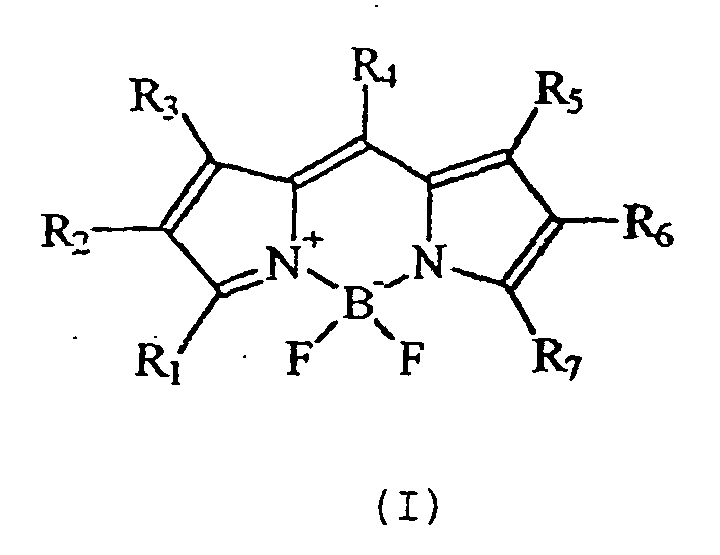
worin die Reste R1, R2, R3, R5, R6 und R7 unabhängig voneinander Wasserstoff oder geradkettige oder verzweigtkettige C1-C4-Alkylreste, vorzugsweise Methyl, Ethyl oder Propyl, bedeuten oder die Reste R1, R2 bzw. R6, R7 Teil eines annellierten aromatischen Ringsystems sind, und der Rest R4 einen geradkettigen oder verzweigtkettigen C1-C10-Alkylrest bedeutet,
zur Fluoreszenzmarkierung von Schmierstoffen und zur Feststellung von Leckage in Schmierstoff-Systemen bereitgestellt. - Im Rahmen der erfindungsgemäßen Verwendung werden dabei die Pyrromethendifluoroborat-Komplexe mit der allgemeinen Formel (I) vorzugsweise in Oktansäure als Lösemittel eingesetzt.
- Ein weiterer Gegenstand der vorliegenden Erfindung ist somit ein Fluoreszenzfarbstoff-Konzentrat, umfassend mindestens einen Fluoreszenzfarbstoff auf Basis von Pyrromethendifluoroborat-Komplexen mit der allgemeinen Formel (I)

worin die Reste R1, R2, R3, R5, R6 und R7 unabhängig voneinander Wasserstoff oder geradkettige oder verzweigtkettige C1-C4-Alkylreste, vorzugsweise Methyl, Ethyl oder Propyl, bedeuten oder die Reste R1, R2 bzw. R6, R7 Teil eines annellierten aromatischen Ringsystems sind, und der Rest R4 einen geradkettigen oder verzweigtkettigen C1-C10-Alkylrest bedeutet, und Oktansäure als Lösemittel. Das Konzentrationsverhältnis des in der Oktansäure gelösten Fluoreszenzfarbstoffs liegt dabei in einem Bereich von etwa 150 g des Fluoreszenzfarbstoffs in 100 g Oktansäure (Minimum) bis etwa 350 g des Fluoreszenzfarbstoffs in 100 g Oktansäure (Maximum); vorzugsweise liegt es in einem Bereich von 210,8 g des Fluoreszenzfarbstoffs in 100 g Oktansäure (Minimum) bis 285,2 g des Fluoreszenzfarbstoffs in 100 g Oktansäure (Maximum). Typischerweise beträgt das Konzentrationsverhältnis 248 g des Fluoreszenzfarbstoffs in 100 g Oktansäure. - Die erfindungsgemäßen Fluoreszenzfarbstoff-Konzentrate basieren auf Oktansäure als Flüssigkeit. Diese Flüssigkeit entspricht der VbF AIII - Flammpunktspezifikation. Des Weiteren kann das erfindungsgemäße Fluoreszenzfarbstoff-Konzentrat in beliebigem Verhältnis mit Öl gemischt werden. Das Konzentrationsverhältnis des mit dem Öl gemischten Fluoreszenzfarbstoff-Konzentrats liegt dabei vorzugsweise in einem Bereich von etwa 0,1 g des Fluoreszenzfarbstoff-Konzentrats in 1 Liter Öl (Minimum) bis etwa 1 g des Fluoreszenzfarbstoff-Konzentrats in 1 Liter Öl (Maximum), insbesondere in einem Bereich von 0,238 g des Fluoreszenzfarbstoff-Konzentrats in 1 Liter Öl (Minimum) bis 0,322 g des Fluoreszenzfarbstoff-Konzentrats in 1 Liter Öl (Maximum). Typischerweise beträgt das Konzentrationsverhältnis 0,28 g des Fluoreszenzfarbstoff-Konzentrats in 1 Liter Öl. Damit ergibt sich insbesondere eine Konzentration von 0,17 g des Fluoreszenzfarbstoffs in 1 Liter Öl (Minimum) bis 0,23 g des Fluoreszenzfarbstoffs in 1 Liter Öl (Maximum). Typischerweise beträgt das Konzentrationsverhältnis 0,2 g des Fluoreszenzfarbstoffs in 1 Liter Öl.
- Aus diesem Grund lassen sich mit diesem Fluoreszenzfarbstoff-Konzentrat Fluoreszenzfarbstoff-Konzentrate auf Ölbasis herstellen. Zudem stellt diese Flüssigkeit (Oktansäure) selbst kein Lösemittel dar und kann auch in lösemittelkritischen Anwendungen eingesetzt werden. Das erfindungsgemäße Fluoreszenzfarbstoff-Konzentrat zeigt in besonders vorteilhafter Weise bei einer Anregung mit einer UV-Lampe noch eine mit dem Auge gut erkennbare Fluoreszenz, und zwar bis zu einem Verdünnungsverhältnis von Fluoreszenzfarbstoff-Konzentraten zu Schmierstoff von eins zu zweitausend. Damit ist es möglich, die Menge des in das Schmierstoff-System einzubringenden Fluoreszenzfarbstoff-Konzentrats deutlich zu verringern.
- Die Gruppe der Pyrromethen-Farbstoffe besitzt eine hohe Fluoreszenzquantenausbeute (> 80 %).
- Fig. 1 zeigt das Absorptions- und Fluoreszenzspektrum des Pyrromethen-Farbstoffs 4,4-Difluor-2,6-diethyl-1,3,5,7-tetramethyl-8-heptyl-4-bora-3a, 4a-diaza-s-indacen in Ethanol. Auf der x-Achse ist die Wellenlänge λ in nm aufgetragen; auf der rechten Y-Achse die Absorption oder Extinktion, zu der der rechte Graph gehört, und auf der linken Y-Achse die Emission oder Fluoreszenzintensität, zu der der linke Graph gehört.
- Die Absorptionsmaxima der erfindungsgemäß verwendeten Pyrromethen-Fluoreszenzfarbstoffe liegen im Wellenlängenbereich von 390 bis 525 nm, die Fluoreszensmaxima liegen im Wellenlängenbereich von 427 bis 545 nm. Aufgrund einer breiten Absorptionsbande im ultravioletten Spektralbereich (siehe Fig. 1), lassen sich diese Farbstoffe besonders gut mit Schwarzlichtlampen (Wellenlänge - 366 nm) zur Fluoreszenz anregen. Bedingt durch die starke Fluoreszenz können diese Farbstoffe auch bei erheblicher Verunreinigung der Öle und Fette eingesetzt werden. Die Fluoreszenz des erfindungsgemäß verwendeten Pyrromethen-Fluoreszenzfarbstoffs ist so hoch, dass diese selbst bei einer 2000fachen Verdünnung des Fluoreszenzfarbstoff-Konzentrats mit Öl bei einer Anregung mit einer handelsüblichen Schwarzlichtlampe noch gut mit dem bloßen Auge beobachtet werden kann.
- Die in Formel (I) angeführten Reste R1, R2, R3, R5, R6 und R7 können unabhängig Wasserstoff oder geradkettige oder verzweigtkettige C1-C4-Alkylreste, vorzugsweise Methyl, Ethyl oder Propyl, bedeuten oder die Reste R1, R2 bzw. R6, R7 können Teil eines annellierten aromatischen Ringsystems, beispielsweise ein annellierter Benzolring, sein. Der Rest R4 bedeutet einen geradkettigen oder verzweigtkettigen C1-C10-Alkylrest, vorzugsweise n-Butyl, n-Pentyl, n-Hexyl, oder n-Heptyl.
- Im Folgenden wird die Herstellung eines erfindungsgemäßen Fluoreszenzfarbstoff-Konzentrats am Beispiel von 4,4-Difluor-2,6-diethyl-1,3,5,7-tetramethyl-8-heptyl-4-bora-3a,4a-diaza-s-indacen in Oktansäure beschrieben.
- In eine Lösung von 50,0 g (0,41 mol) 2,4-Dimethyl-3-ethylpyrrol in 410 m1 Methylenchlorid werden unter Rühren bei Raumtemperatur innerhalb von 30 Minuten tropfenweise 100 g (0,62 mol) Oktansäurechlorid zugeführt. Die Reaktionsmischung wird für 60 Minuten unter Rückfluss (40°C) erhitzt. Die abgekühlte Mischung wird mit 3500 ml n-Pentan versetzt und über 15 Stunden verrührt. Das Lösungsmittelgemisch Methylenchlorid / n-Pentan wird am Rotationsverdampfer abdestilliert. Es bleibt ein dunkelrotes zähflüssiges Gemisch zurück. Durch Zugabe von 1700 ml Toluol wird daraus eine Suspension hergestellt. Unter Rühren bei Raumtemperatur werden langsam 41 ml (0,30 mol) Triethylamin zugeführt. Das Reaktionsgemisch wird für weitere 15 Minuten gerührt. Unter weiterem Rühren werden tropfenweise 145 ml (1,15 mol) Bortrifluorid-Diethylether-Komplex zugegeben. Unter UV-Licht kann eine grüne Fluoreszenz beobachtet werden. Das Gemisch wird unter Rühren für 15 Minuten auf 80°C erhitzt, danach wird es auf 40°C abgekühlt und mit insgesamt 2000 ml warmen Wasser ausgeschüttelt. Hierdurch wird das nicht umgesetzte Oktansäurechlorid in Oktansäure überführt. Des Weiteren werden wasserlösliche Verunreinigungen in die wässrige Phase eingetragen. Die organische Phase wird für 18 Stunden über Magnesiumsulfat (wasserfrei) getrocknet. Nach Abfiltrieren des Magnesiumsulfats wird das Lösungsmittelgemisch bestehend aus Toluol, Triethylamin und unverbrauchtem Bortrifluorid-Diethylether-Komplex am Rotationsverdampfer abdestilliert. Es wird ein dunkelroter zähflüssiger Rückstand erhalten. Die Isolierung (Reinigung) des Farbstoffes kann durch Säulenchromatographie (Chloroform / Kieselgel) erfolgen. Zur Herstellung des Fluoreszenzfarbstoff-Konzentrats wird der gereinigte Farbstoff in hoher Konzentration in Oktansäure gelöst. Das Konzentrationsverhältnis des in der Oktansäure gelösten Fluoreszenzfarbstoffs liegt dabei in einem Bereich von etwa 150 g des Fluoreszenzfarbstoffs in 100 g Oktansäure (Minimum) bis etwa 350 g des Fluoreszenzfarbstoffs in 100 g Oktansäure (Maximum); vorzugsweise liegt es in einem Bereich von 210,8 g des Fluoreszenzfarbstoffs in 100 g Oktansäure (Minimum) bis 285,2 g des Fluoreszenzfarbstoffs in 100 g Oktansäure (Maximum). Typischerweise beträgt das Konzentrationsverhältnis 248 g des Fluoreszenzfarbstoffs in 100 g Oktansäure.
Claims (6)
- Verwendung von Fluoreszenzfarbstoffen auf Basis von Pyrromethendifluoroborat-Komplexen mit der allgemeinen Formel (I)

worin die Reste R1, R2, R3, R5, R6 und R7 unabhängig voneinander Wasserstoff oder geradkettige oder verzweigtkettige C1-C4-Alkylreste bedeuten oder die Reste R1, R2 bzw. R6, R7 Teil eines annellierten aromatischen Ringsystems sind, und der Rest R4 einen geradkettigen oder verzweigtkettigen C1-C10-Alkylrest bedeutet,
zur Fluoreszenzmarkierung von Schmierstoffen und zur Feststellung von Leckage in Schmierstoff-Systemen. - Verwendung nach Anspruch 1, wobei der Fluoreszenzfarbstoff auf Basis von Pyrromethendifluoroborat-Komplexen mit der allgemeinen Formel (I) in Oktansäure gelöst ist.
- Verwendung nach Anspruch 1 oder 2, wobei der Fluoreszenzfarbstoff auf Basis von Pyrromethendifluoroborat-Komplexen mit der allgemeinen Formel (I) 4,4-Difluor-2,6-diethyl-1,3,5,7-tetramethyl-8-heptyl-4-bora-3a, 4a-diaza-s-indacen gewählt wird.
- Fluoreszenzfarbstoff-Konzentrat, umfassend mindestens einen Fluoreszenzfarbstoff auf Basis von Pyrromethendifluoroborat-Komplexen mit der allgemeinen Formel (I)

worin die Reste R1, R2, R3, R5, R6 und R7 unabhängig voneinander Wasserstoff oder geradkettige oder verzweigtkettige C1-C4-Alkylreste bedeuten oder die Reste R1, R2 bzw. R6, R7 Teil eines annellierten aromatischen Ringsystems sind, und der Rest R4 einen geradkettigen oder verzweigtkettigen C1-C10-Alkylrest bedeutet, und Oktansäure als Lösemittel. - Fluoreszenzfarbstoff-Konzentrat nach Anspruch 4, wobei das Konzentrationsverhältnis des in der Oktansäure gelösten Fluoreszenzfarbstoffs in einem Bereich von 150 g des Fluoreszenzfarbstoffs in 100 g Oktansäure (Minimum) bis 350 g des Fluoreszenzfarbstoffs in 100 g Oktansäure (Maximum) liegt.
- Fluoreszenzfarbstoff-Konzentrat nach Anspruch 4 oder 5, wobei der Fluoreszenzfarbstoff auf Basis von Pyrromethendifluoroborat-Komplexen mit der allgemeinen Formel (I) 4,4-Difluor-2,6-diethyl-1,3,5,7-tetramethyl-8-heptyl-4-bora-3a, 4a-diaza-s-indacen gewählt wird.
Applications Claiming Priority (3)
| Application Number | Priority Date | Filing Date | Title |
|---|---|---|---|
| DE10142121A DE10142121A1 (de) | 2001-08-30 | 2001-08-30 | Neue Fluoreszenzfarbstoffe und Fluoreszenzfarbstoff-Konzentrate zur Fluoreszenzmarkierung von Schmierstoffen und zur Feststellung von Leckage in Schmierstoff-Systemen |
| DE10142121 | 2001-08-30 | ||
| PCT/EP2002/009655 WO2003020857A1 (de) | 2001-08-30 | 2002-08-29 | Verwendung von fluoreszenzfarbstoffen auf basis von pyrromethendifluoroborat-komplexen zur fluoreszenzmarkierung von schmierstoffen und zur feststellung von leckage in schmierstoff-systemen sowie ein demgemässes fluoreszenzfarbstoff-konzentrat |
Publications (2)
| Publication Number | Publication Date |
|---|---|
| EP1421160A1 EP1421160A1 (de) | 2004-05-26 |
| EP1421160B1 true EP1421160B1 (de) | 2006-02-15 |
Family
ID=7696861
Family Applications (1)
| Application Number | Title | Priority Date | Filing Date |
|---|---|---|---|
| EP02779282A Expired - Lifetime EP1421160B1 (de) | 2001-08-30 | 2002-08-29 | Verwendung von fluoreszenzfarbstoffen auf basis von pyrromethendifluoroborat-komplexen zur fluoreszenzmarkierung von schmierstoffen und zur feststellung von leckage in schmierstoff-systemen sowie ein demgemässes fluoreszenzfarbstoff-konzentrat |
Country Status (4)
| Country | Link |
|---|---|
| US (1) | US20040203159A1 (de) |
| EP (1) | EP1421160B1 (de) |
| DE (2) | DE10142121A1 (de) |
| WO (1) | WO2003020857A1 (de) |
Families Citing this family (9)
| Publication number | Priority date | Publication date | Assignee | Title |
|---|---|---|---|---|
| CN101918817B (zh) * | 2007-12-17 | 2013-06-05 | 生命技术公司 | 用于检测无机涂敷的聚合物表面中的缺陷的方法 |
| US20130020507A1 (en) | 2010-06-17 | 2013-01-24 | Life Technologies Corporation | Methods for Detecting Defects in Inorganic-Coated Polymer Surfaces |
| DE102008010974A1 (de) * | 2008-02-25 | 2009-08-27 | Robert Bosch Gmbh | Verfahren zur Quantifizierung von Leckagemengen |
| EP2166040A1 (de) | 2008-09-22 | 2010-03-24 | Radiant Color N.V. | Neue lipophile fluoreszierende Farbstoffe und ein Prozess für ihre Produktion |
| US9102355B2 (en) | 2009-06-29 | 2015-08-11 | Volvo Lastvagnar Ab | Method and a system for assisting a driver of a vehicle during operation |
| US9222043B2 (en) * | 2009-09-22 | 2015-12-29 | Authentix, Inc. | Dipyrromethenes and azadipyrromethenes as markers for petroleum products |
| WO2012168151A1 (en) | 2011-06-09 | 2012-12-13 | Castrol Limited | Compositions, methods and uses |
| GB201120924D0 (en) * | 2011-12-06 | 2012-01-18 | Johnson Matthey Plc | Tracers and method of marking hydrocarbon liquids |
| WO2021124032A1 (en) | 2019-12-19 | 2021-06-24 | 3M Innovative Properties Company | Fluorinated coumarins |
Family Cites Families (3)
| Publication number | Priority date | Publication date | Assignee | Title |
|---|---|---|---|---|
| US4278444A (en) * | 1980-04-22 | 1981-07-14 | Mobil Oil Corporation | Liquid hydrocarbons containing a fluorescent compound |
| EP1003539A4 (de) * | 1997-08-14 | 2002-09-11 | Univ California | FLUORESZIERENDE AMYLOID A beta PEPTIDE UND DEREN VERWENDUNG |
| US6521459B1 (en) * | 2000-04-18 | 2003-02-18 | Bright Solutions, Inc. | Method and apparatus for testing the acidity of a lubricant in a climate control system |
-
2001
- 2001-08-30 DE DE10142121A patent/DE10142121A1/de not_active Withdrawn
-
2002
- 2002-08-29 WO PCT/EP2002/009655 patent/WO2003020857A1/de not_active Ceased
- 2002-08-29 DE DE50205839T patent/DE50205839D1/de not_active Expired - Fee Related
- 2002-08-29 EP EP02779282A patent/EP1421160B1/de not_active Expired - Lifetime
-
2004
- 2004-02-27 US US10/789,419 patent/US20040203159A1/en not_active Abandoned
Also Published As
| Publication number | Publication date |
|---|---|
| WO2003020857A1 (de) | 2003-03-13 |
| US20040203159A1 (en) | 2004-10-14 |
| DE50205839D1 (de) | 2006-04-20 |
| DE10142121A1 (de) | 2003-03-20 |
| EP1421160A1 (de) | 2004-05-26 |
Similar Documents
| Publication | Publication Date | Title |
|---|---|---|
| DE69629306T2 (de) | Gefärbte kraftübertragungsflüssigkeit | |
| DE60026027T2 (de) | Aromatische ester zum markieren und kennzeichnen organischer produkte | |
| EP0723574B1 (de) | Verfahren zum nachweis von markierten mineralölen | |
| EP1421160A1 (de) | Verwendung von fluoreszenzfarbstoffen auf basis von pyrromethendifluoroborat-komplexen zur fluoreszenzmarkierung von schmierstoffen und zur feststellung von leckage in schmierstoff-systemen sowie ein demgemässes fluoreszenzfarbstoff-konzentrat | |
| EP2166040A1 (de) | Neue lipophile fluoreszierende Farbstoffe und ein Prozess für ihre Produktion | |
| DE2355385C3 (de) | Disazofarbstoffe, Verfahren zu deren Herstellung und ihre Verwendung zur Markierung von Erdölprodukten | |
| EP0656893B1 (de) | Photochrome oxazineverbindungen | |
| DE2532224A1 (de) | Photochromatische verbindungen und verfahren zu ihrer herstellung | |
| EP0115583A1 (de) | Immersionsöl | |
| EP1235823B1 (de) | H-annellierte benzo [f]chromene | |
| DE102009026363B4 (de) | Druckempfindliche Farbe | |
| DE102017130105B4 (de) | Verfahren zum produzieren von naphthalimid-diester-fluoreszenzfarbstoffen und zusammensetzungen davon | |
| EP0706526B1 (de) | Photochrome verbindungen | |
| EP0073008B1 (de) | Kationische Farbstoffe | |
| EP0361293B1 (de) | Verfahren zur Herstellung konzentrierter Lösungen kationischer Farbstoffe | |
| DE2237080A1 (de) | Benzothiazolderivate | |
| WO1995000606A1 (de) | Verwendung von aminotriarylmethanen zum markieren von kohlenwasserstoffen sowie neue aminotriarylmethane | |
| DE102005045375A1 (de) | Methoxyperylenbisimide und Perylenlactamimide-neue, rot fluoreszierende Farbstoffe | |
| DE941218C (de) | Zusatzstoffe fuer Schmieroele auf Mineraloelbasis | |
| EP0519270A2 (de) | Verfahren zur Herstellung von acetalisierten Azofarbstoffen | |
| DE2346047A1 (de) | Blaue anthrachinoide dispersionsfarbstoffe, deren herstellung und verwendung | |
| CH506588A (de) | Verfahren zur Herstellung von in Wasser schwerlöslichen Anthrachinonfarbstoffen | |
| WO1999055807A1 (de) | Cumarinfarbstoffe enthaltende schmiermittel | |
| DE3430287A1 (de) | Quartaere dioxazinfarbstoffe | |
| DE640593C (de) | Verfahren zur Herstellung von N, N'-Dialkyldipyrazolanthronylen |
Legal Events
| Date | Code | Title | Description |
|---|---|---|---|
| PUAI | Public reference made under article 153(3) epc to a published international application that has entered the european phase |
Free format text: ORIGINAL CODE: 0009012 |
|
| 17P | Request for examination filed |
Effective date: 20040218 |
|
| AK | Designated contracting states |
Kind code of ref document: A1 Designated state(s): AT BE BG CH CY CZ DE DK EE ES FI FR GB GR IE IT LI LU MC NL PT SE SK TR |
|
| AX | Request for extension of the european patent |
Extension state: AL LT LV MK RO SI |
|
| GRAP | Despatch of communication of intention to grant a patent |
Free format text: ORIGINAL CODE: EPIDOSNIGR1 |
|
| RBV | Designated contracting states (corrected) |
Designated state(s): DE FR GB |
|
| GRAS | Grant fee paid |
Free format text: ORIGINAL CODE: EPIDOSNIGR3 |
|
| GRAA | (expected) grant |
Free format text: ORIGINAL CODE: 0009210 |
|
| AK | Designated contracting states |
Kind code of ref document: B1 Designated state(s): DE FR GB |
|
| REG | Reference to a national code |
Ref country code: GB Ref legal event code: FG4D Free format text: NOT ENGLISH |
|
| REF | Corresponds to: |
Ref document number: 50205839 Country of ref document: DE Date of ref document: 20060420 Kind code of ref document: P |
|
| GBT | Gb: translation of ep patent filed (gb section 77(6)(a)/1977) |
Effective date: 20060410 |
|
| REG | Reference to a national code |
Ref country code: GB Ref legal event code: 732E |
|
| ET | Fr: translation filed | ||
| PLBE | No opposition filed within time limit |
Free format text: ORIGINAL CODE: 0009261 |
|
| STAA | Information on the status of an ep patent application or granted ep patent |
Free format text: STATUS: NO OPPOSITION FILED WITHIN TIME LIMIT |
|
| 26N | No opposition filed |
Effective date: 20061116 |
|
| REG | Reference to a national code |
Ref country code: FR Ref legal event code: TQ |
|
| PGFP | Annual fee paid to national office [announced via postgrant information from national office to epo] |
Ref country code: DE Payment date: 20080829 Year of fee payment: 7 |
|
| PGFP | Annual fee paid to national office [announced via postgrant information from national office to epo] |
Ref country code: FR Payment date: 20080917 Year of fee payment: 7 |
|
| PGFP | Annual fee paid to national office [announced via postgrant information from national office to epo] |
Ref country code: GB Payment date: 20080922 Year of fee payment: 7 |
|
| GBPC | Gb: european patent ceased through non-payment of renewal fee |
Effective date: 20090829 |
|
| REG | Reference to a national code |
Ref country code: FR Ref legal event code: ST Effective date: 20100430 |
|
| PG25 | Lapsed in a contracting state [announced via postgrant information from national office to epo] |
Ref country code: DE Free format text: LAPSE BECAUSE OF NON-PAYMENT OF DUE FEES Effective date: 20100302 Ref country code: FR Free format text: LAPSE BECAUSE OF NON-PAYMENT OF DUE FEES Effective date: 20090831 |
|
| PG25 | Lapsed in a contracting state [announced via postgrant information from national office to epo] |
Ref country code: GB Free format text: LAPSE BECAUSE OF NON-PAYMENT OF DUE FEES Effective date: 20090829 |