EP1418965B1 - Silencing device and method for needleless syringe - Google Patents
Silencing device and method for needleless syringe Download PDFInfo
- Publication number
- EP1418965B1 EP1418965B1 EP02755103A EP02755103A EP1418965B1 EP 1418965 B1 EP1418965 B1 EP 1418965B1 EP 02755103 A EP02755103 A EP 02755103A EP 02755103 A EP02755103 A EP 02755103A EP 1418965 B1 EP1418965 B1 EP 1418965B1
- Authority
- EP
- European Patent Office
- Prior art keywords
- gas
- silencer
- area
- bleed
- needleless syringe
- Prior art date
- Legal status (The legal status is an assumption and is not a legal conclusion. Google has not performed a legal analysis and makes no representation as to the accuracy of the status listed.)
- Expired - Lifetime
Links
Images




Classifications
-
- A—HUMAN NECESSITIES
- A61—MEDICAL OR VETERINARY SCIENCE; HYGIENE
- A61M—DEVICES FOR INTRODUCING MEDIA INTO, OR ONTO, THE BODY; DEVICES FOR TRANSDUCING BODY MEDIA OR FOR TAKING MEDIA FROM THE BODY; DEVICES FOR PRODUCING OR ENDING SLEEP OR STUPOR
- A61M5/00—Devices for bringing media into the body in a subcutaneous, intra-vascular or intramuscular way; Accessories therefor, e.g. filling or cleaning devices, arm-rests
- A61M5/178—Syringes
- A61M5/30—Syringes for injection by jet action, without needle, e.g. for use with replaceable ampoules or carpules
- A61M5/3015—Syringes for injection by jet action, without needle, e.g. for use with replaceable ampoules or carpules for injecting a dose of particles in form of powdered drug, e.g. mounted on a rupturable membrane and accelerated by a gaseous shock wave or supersonic gas flow
-
- A—HUMAN NECESSITIES
- A61—MEDICAL OR VETERINARY SCIENCE; HYGIENE
- A61M—DEVICES FOR INTRODUCING MEDIA INTO, OR ONTO, THE BODY; DEVICES FOR TRANSDUCING BODY MEDIA OR FOR TAKING MEDIA FROM THE BODY; DEVICES FOR PRODUCING OR ENDING SLEEP OR STUPOR
- A61M5/00—Devices for bringing media into the body in a subcutaneous, intra-vascular or intramuscular way; Accessories therefor, e.g. filling or cleaning devices, arm-rests
- A61M5/178—Syringes
- A61M5/24—Ampoule syringes, i.e. syringes with needle for use in combination with replaceable ampoules or carpules, e.g. automatic
Definitions
- the present invention relates generally to the field of particle delivery and more particularly to needleless syringes which accelerate particles in a gas stream so as to deliver them into a target (such as the tissue of a subject).
- WO 94/24263 discloses a needleless syringe for the injection of particles.
- pressurised gas is supplied to a small rupture chamber in which there is located a particle cassette composed of particles sandwiched between two rupturable membranes.
- the membranes rupture and gas continues to be supplied such that the particles are accelerated down a nozzle and into the target.
- the gas used for accelerating the particles is routed past a series of baffles, to break down the reflected shockwave and provide a silencing effect, before being vented to the atmosphere.
- the chamber in which gas builds up initially is of a small volume and gas flowing into the chamber after rupture of the membranes is important in accelerating the particles.
- This fact is confirmed by WO 99/01168 in which a device having a large area valve is provided so that gas can continue to flow from the gas reservoir and down the nozzle after rupture of the membranes.
- This document suggests the same silencing mechanism as WO 94/24263.
- WO 01/05455 upon which the pre-characterising portion of claim 1 is based, discloses a needleless syringe device in which substantially all of the particles delivered are in a quasi-steady gas flow which is established after the passage of a starting process. This allows the particles to be reliably and repeatedly delivered.
- WO 01/95455 proposes the use of a bleed-hole which limits the flow of gas from the reservoir to the chamber behind a closure means once the closure means has burst. In fact, substantially all of the particles are accelerated by the gas which builds up behind the closure means prior to bursting and the gas which flows from the reservoir after bursting has a negligible effect on accelerating the particles.
- the present invention provides a needleless syringe device comprising:
- the venting area and bleed-hole areas are sized to ensure that the mass flow rate through the venting area is greater than the mass flow rate through the bleed-hole area during use such that, after the initial expansion of gas from the driver chamber to the shroud, the pressure actually reduces inside the shroud during use.
- the venting area is small enough to provide adequate silencing and large enough to ensure that pressure does not build up in the device during use.
- the energy source is a reservoir of pressurised gas, such as helium or nitrogen.
- ⁇ 1 is the ratio of specific heats for the gas in the reservoir
- R 1 is the gas constant for the gas in the energy source (reservoir)
- ⁇ 2 is the ratio of specific heats for the gas in the surroundings
- R 2 is the gas constant for the gas in the surroundings
- P 0 is the pressure in the energy source after gas has been received by said silencer
- P S is the pressure in the silencer after gas has been received by said silencer.
- the ratio of venting area to bleed-hole area should be greater than or equal to 1.2k to ensure a sufficient decay of pressure within the silencer.
- the ratio of venting area to bleed-hole area should preferably be less than 20k, more preferably less than 10k, still more preferably less than 5k.
- the silencer comprises a shroud having a predetermined volume for containing the gas received from the driver chamber prior to venting it.
- the volume of the shroud, the volume of the driver chamber and the size of the exit opening should preferably be chosen such that when the closure is opened and gas flows from the driver chamber to the shroud, the resulting equalisation in pressure results in a lift-off force on the device of less than 20N, more preferably less than 15N.
- 'closure' includes both 'closure means' and 'closure member'.
- the particles are delivered through a particle exit opening in the shroud which is pressed against the target during use.
- said at least one silencer vent opening is formed by at least one hole provided in the shroud and this at least one hole is preferably located in the upstream end of the device so that the gas must travel substantially the length of the device before it can be vented through said at least on hole.
- a cover may be attached to the device to create an annular channel for the passage of gas from the shroud to the surroundings.
- This annular channel may comprise a plurality of baffles which interact with the gas flow vented out of the shroud and attenuate any shockwaves in the gas flow.
- baffles or the like may be included inside the shroud volume itself.
- the particle-containing gas which flows from the driver chamber is expanded by a nozzle connected to the driver chamber and this nozzle is preferably substantially correctly expanded, although it need not be to obtain adequate performance.
- the particle exit opening in the shroud should be preferably no more than 100% larger than the exit area of the nozzle.
- the particle exit opening should also be axially spaced from the nozzle exit so that a path for the venting of gas is provided.
- the present invention also provides a method of silencing a particle-accelerating gas flow, the method composing:
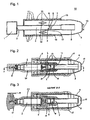
- FIG. 1 of the accompanying drawings schematically illustrates the silencing concept of the present invention.
- the needleless syringe components comprising the reservoir (1), the bleed-hole (2), the driver chamber (3), the closure (4) and the nozzle (8) can be constructed and arranged substantially as is disclosed in WO 01/05455.
- an energy source is represented by a reservoir (1) initially filled with pressurized gas, such as helium.
- the reservoir is connected to a driver chamber (3) by a bleed-hole (2) and a valve (not shown).
- gas flows from the reservoir (1) to the driver chamber (3) via the bleed-hole (2) because the gas pressure in the reservoir (1) is initially higher than the gas pressure in the driver chamber (3).
- the driver chamber may initially contain air because this is the most convenient gas, although it can be made initially to contain other gases, e.g. helium.
- a closure (4) defines the downstream end of the driver chamber (3) and serves initially to create a build-up of gas behind it.
- the closure is represented as a particle cassette of the type disclosed in WO 94/24263 in which particles (5) are sandwiched between two rupturable membranes (6, 7).
- the cassette may however take other forms, for example it may be a membraneless cassette.
- Figure 1 also shows a silencer shroud (9) encapsulating the syringe and having an exit opening (10) for the passage therethrough, to a target (not shown), of particles and also having a plurality of openings (11) for the venting of gas to atmosphere.
- a silencer shroud (9) encapsulating the syringe and having an exit opening (10) for the passage therethrough, to a target (not shown), of particles and also having a plurality of openings (11) for the venting of gas to atmosphere.
- gas flows-from the reservoir (1) into the driver chamber (3) where it is contained by the closure (4).
- Gas continues to flow from the reservoir (1) to the driver chamber (3) until a certain predetermined pressure is established in the driver chamber (3), this pressure being the pressure required to open the closure (4).
- this pressure corresponds to the pressure at which the diaphragms (6,7) rupture.
- a pressure discontinuity is created in the device such that a shockwave travels downstream towards a nozzle (8).
- the shockwave is a front delimiting gas at a high pressure from the gas at atmospheric pressure initially in the nozzle.
- the shockwave travels down the nozzle and impacts the target plane adjacent the exit opening (10), at which point it is reflected so that a portion of it travels in the annular space internally of the silencing shroud (9) and externally of the nozzle (8).
- the gas which flows from the driver chamber behind the shockwave entrains the particles (5) such that they pass along the nozzle and through the exit opening (10) to impact the target plane at a velocity sufficient to penetrate it.
- the silencer shroud (9) is configured to encapsulate a predetermined volume of gas V s .
- This volume is defined as all of the volume inside the silencer shroud, including that of the driver chamber and the nozzle.
- V D V S + P S 0 P S is the pressure in the silencer shroud after pressure equalisation
- P D is the pressure in the driver chamber just prior to opening of the closure (4)
- P so is the pressure in the silencer initially
- V D is the volume of the driver chamber (ie that volume between the bleed-hole (2) and the closure (4))
- V S is the volume of the shroud (which incorporates the volume of the driver chamber and the nozzle). If the mass flow rate through the venting area is larger than that through the bleed hole, this pressure then decays with time as gas is vented from the silencer.
- the above equation assumes an isothermal expansion in which the temperature of the gas before expanding is the same as after expanding.
- the pressure P S in the silencer shroud would settle down to around 232 kPa once the shockwave has passed. It is this pressure which determines the initial lift-off force that a user experiences upon activating the device.
- the lift-off force is equal to the pressure ( P S - P 0 ) multiplied by the area of the exit opening (10) (i.e. the area over which the differential pressure acts, P 0 being the pressure in the surroundings, typically 100 kPa).
- a typical exit opening area is 100 mm 2 which results inra lift-off force of approximately 13.2 N.
- Figure 4 illustrates the experimentally obtained effect of varying the size of the bleed-hole in relation to the venting area of the silencer, other parameters such as exit plane area, shroud volume etc. remaining constant.
- the venting area was kept constant and the size of the bleed hole was varied.
- the graph shows the pressure inside the shroud plotted against time.
- the line numbered "1" is the case where the effective venting area/ bleed hole ratio is too low. This results in an absohite peak shroud pressure of about 340 kPa after 7.5 ms which is large enough to cause an unacceptable lift-off force. A peak sound level of 102-108 dB at 300mm from the device was measured.
- the line numbered "2" is the case where the effective venting area/ bleed hole ratio has been increased. This results in a peak shroud pressure of about 270 kPa after 4.25 ms. The measured peak sound level was increased to 106-110 dB at 300mm from the device.
- the line numbered "3" is the case where the effective venting area/ bleed hole ratio is increased further. This results in a shroud pressure which has its peak as soon as the shock wave has passed and decays. A peak sound level of 115-118 dB at 300mm from the device was measured.
- one preferable way of reducing the lift-off force is to ensure that the volume of the silencer shroud ( V S ) is as large as possible so as to reduce the value of P S (see equation above).
- Another preferable way to reduce the lift-off force is to make the area of the exit opening (10) as small as possible so that the pressure P S acts over a smaller area, creating a lower force.
- the noise that is experienced upon actuation of the device is mainly due to the shockwave initiated from the sudden opening of closure (4) which is reflected from the target and exits the device through the venting area. It has been found that passing such a shockwave through a restriction, thereby breaking it down into compression waves, creates a lower level of audible sound.
- the effective silencer restriction presented to the shockwave (and subsequent flow) is an important device parameter.
- the effective silencer restriction is defined as the smallest area through which the shockwave travels on its way from the target plane to the surroundings. In Figure 1, three main restrictions are shown, either one of which, two of which, or even all of which (if all are of equal size), may represent the effective silencer restriction.
- the first restriction encountered by the reflected shockwave on its passage from the opening (10) to the surroundings (18) is that due to the member (14) which is provided in the annular space of the shroud (9).
- This member (14) comprises an annular ring of generally diamond-shaped cross-section which is suspended in the device by attachment to one or more of the wall of the shroud (9) and the wall of the driver chamber (3) via one or more radial arms (not shown).
- the presence of the member (14) causes a restriction in the path of the shockwave so that the shockwave is forced to pass through two concentric generally annular passages labelled (16) and (17) in Figure 1. The sum of the area of these two passages is equal to the area through which the shockwave is confined to travel. This is the first restriction.
- the second restriction is presented by the plurality of holes (11) formed in the outer wall of the shroud (9), the sum of the areas of each of the holes is equal to the area that the shockwave must pass through.
- the third restriction is created by the cover member (15) placed around the shroud (9) and the series of baffles (12, 13) on the outer surface of the shroud (they may equally be provided on the inner surface of the cover member (15)).
- the annular passage created between the cover member and the shroud has an area through which the shockwave must pass.
- the third restriction is the part of this annular passage presenting the smallest area to the shockwave.
- the smallest of the first, second and third areas described above will be equal to the effective venting area of the silencer and will determine the maximum mass flow rate that can pass through the silencer and into the surroundings.
- the smaller this area the smaller the mass flow rate of gas that can pass into the surroundings but also the more noise attenuation occurs through the breakdown of the primary shock.
- In the limit of a restriction have an area of zero mm 2 (i.e. the shroud is completely closed), no gas can pass into the surroundings and the device should in theory be silent at a result.
- the effective venting area affects the mass flow rate that can pass into the surroundings, there is a relationship between this area and the pressure that builds up in the shroud (9) during use.
- the maximum mass flow rate that can pass out of the silencer (comprising the shroud (9), the holes (11), the baffles (12, 13) and the member (14)) is less than the mass flow rate being supplied by the reservoir (1) through the bleed-hole (2) then it will be seen that pressure builds up in the device once the shockwave has passed, serving to increase the lift-off force, which is undesirable.
- the effective venting area of the silencer should be such that the mass flow rate out of the silencer is equal to or greater than the mass flow rate of gas through the bleed-hole (2) once the closure has opened and the shockwave has passed out of the device.
- venting area bleed ⁇ hole area > ( ( ⁇ 1 R 1 ) ( 1 ⁇ ⁇ 1 ⁇ 1 2 ) ⁇ 1 ⁇ 1 2 ( ⁇ 2 R 2 ) ( 1 ⁇ ⁇ 2 ⁇ 1 2 ) ⁇ 2 ⁇ 1 2 ) P 0 P S
- ⁇ 1 is the ratio of specific heats for the gas in the reservoir (1)
- R 1 is the gas constant for the gas in the reservoir (1)
- ⁇ 2 is the ratio of specific heats for the gas in the surroundings (18)
- R 2 is the gas constant for the gas in the surroundings (18)
- P 0 is the pressure in the energy source (1) after gas has been received by said silencer (9)
- P S is the pressure in the silencer (9) after gas has been received by said silencer (9).
- a sufficient driver chamber filling rate is required to ensure a repeatable rupture of the membrane, or more generally, a repeatable opening of the closure. If the filling rate is very low, it has been found that the variation in rupture pressure for the same specification membranes is wider than if a higher filling rate is used.
- the provision of a bleed-hole along with a silencer having a predetermined effective venting area ensures a useful silencing effect without unduly increasing the pressure inside the device during the operation, thereby avoiding an increased lift-off force which is deleterious to device performance and ease of use.
- the subsidiary features of the invention (such as the large silencer volume and small particle exit opening) further reduce the problem of lift-off force without affecting the silencing that can be achieved or the device performance.
- the silencing achieved can be such that the use of porous media as was envisaged in WO 94/24263 is not required, thereby reducing the device cost. Nevertheless it may be employed as an alternative or additional restriction method to reduce the noise further.
- FIGS 2 and 3 show cross-sections of a practical embodiment of the present invention.
- the same components as are shown in Figure 1 are given the same reference numerals.
- the particles (5) are not shown for clarity, but would (as in Figure 1) be present in the closure between the rupturable membranes (6, 7)
- the gas reservoir (1) has a frangible tip (21) which can be cracked off by application of the button (19). Upon pressing the button gas flows out of the reservoir (1) and into the annular space (20) surrounding the reservoir (1) (see Figures 2 and 3). The gas is then directed into the driver chamber (3) which terminates in the closure (4) (see Figure 2 especially).
- the plurality of holes (11) in Figure 1 are replaced by a single hole in this embodiment and the generally diamond-shaped member (14) of Figure 1 is replaced by a series of area restrictions in the silencer shroud (9) which are not necessarily diamond shaped.
- the bleed hole is formed by the smallest area that the gas flows through on its way from the reservoir (1) to the driver chamber (3). In this embodiment, this is formed by the annular space (20) surrounding the gas reservoir (1).
- the invention is applicable to the case where "transfer ducts" as disclosed in Figures 12a to 12c and 13a to 13c of WO 01/05455 are used to pre-mix (or fluidize) the particles in the particle retention chamber (particle cassette). In this case, there is a further requirement on the size of bleed hole used.
- FIG. 5 shows a schematic representation of part of the needleless syringe device as far as the downstream membrane 7.
- the pressure in the reservoir 1 at any time is referred to as P 1
- the pressure in the driver chamber is referred to as P 3
- the pressure in the particle cassette (between the membranes) is referred to as P 4 .
- a gas jet should enter the cassette before either membrane ruptures to thereby mix the particles so they span the entire volume of the cassette. Then, the membranes should burst in sequence with the upstream membrane (6) bursting before the downstream membrane (7). If the downstream membrane (7) bursts first then there is a chance the upstream membrane (6) may never burst, with the gas flow being driven by flow from the reservoir to the driver chamber and through the transfer duct (80).
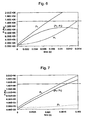
- FIG. 6 is a plot of P 3 , P 4 and ( P 3 - P 4 ) with time.
- This situation typically results when the bleed hole is too small compared to the area of the transfer duct so that gas pressure in the cassette increases too quickly resulting in the downstream membrane (7) bursting first.
- the rupture pressure of each membrane is 1.45 MPa and the initial reservoir pressure P 1 is 6 MPa.
- the pressure P 4 reaches the bursting pressure of 1.45 MPa before the pressure ( P 3 - P 4 ) which is the pressure across the upstream membrane.
- Figure 7 shows another situation which occurs when the bleed hole is too large in comparison with the transfer duct area.
- the pressure P 3 increases rapidly and the pressure P 4 increases relatively slowly. This results in a rapid successive opening of both membranes in the correct sequence, but with very little particle mixing time (only about 1.65 ms in Figure 7). This results in limited particle pre-mixing.
- Figure 8 shows an example where the bleed hole and transfer ports are chosen to have a suitable size. Both membranes rupture in sequence with a mixing time of about 5.5 ms which is adequate to achieve good pre-mixing.
- bleed hole and transfer duct sizes depend on the reservoir, driver and cassette volumes, but, once these parameters are selected, the skilled person is able to determine by appropriate simple experiment the correct bleed hole and transfer duct sizes to achieve the results described herein.
- the embodiments described have used particle cassettes in which the particles are initially located between two rupturable membranes.
- other mechanisms for locating the particles may be used, not necessarily requiring membranes, for example fast-opening valves.
- particle cassette particle retention assembly
- FIG 9 schematically illustrates a particle retention assembly (60) according to the present invention.
- the particles (70) are located inside a chamber (71) designed to receive, contain and confine the particles.
- the inside walls (72) of the chamber (71) are generally cylindrical and in this example there are provided two openings (43) leading to an annular space (67) around the particle retention chamber (71).
- the particle retention chamber (71) is bounded longitudinally (i.e. at its upstream and downstream ends) by a membrane.
- the upstream membrane (62) and downstream membrane (63) are designed to rupture when a differential pressure of a certain magnitude is applied across them.
- the particle retention assembly (60) is sealed at its upstream end by a further rupturable membrane (61).
- the annular space (67) is fluidly connected to the region upstream of the upstream rupturable membrane (62) by circumferential ports (54).
- the region (73) upstream of the membrane (62) is also generally cylindrical in configuration and has a diameter substantially equal to the diameter of the particle retention chamber (71).
- FIGs 10a to 10b illustrate the working of the particle retention assembly.
- the particle retention assembly (60) is used as a particle cassette (4) for the needleless syringe shown in Figure 1.
- the membrane (61) is presented with the gas pressure from the driver chamber 3 and the downstream membrane (63) prevents the particles (70) (referenced (5) in Figure 1) from falling out of the nozzle, through the exit plane (10) and out of the device.
- the openings (43) are shaped and directed such that the gas forms jets, preferably sonic or supersonic jets which create gas swirls (Vortices) inside the particle retention chamber (71). These gas flows entrain the particles (70) and cause them to become fluidized in the gas such that the particles no longer are clumped together but span the whole volume of the particle retention chamber (71).
- the pressure in the driver chamber continues to increase until the upstream membrane (62) ruptures. The result of this is shown in Figure 10c. As can be seen, the particles are well fluidized in the cassette due to the pre-mixing provided by the gas jets shown in Figure 10b.
- the volume of particle retention chamber (71) is generally fairly small, it does not take long before the pressure upstream of membrane (63) is such as to cause bursting of that membrane, as shown in Figure 10d. From thenceforth, the flow previously described in which the particles are accelerated out of the particle retention assembly (60) and through the nozzle (8) into the target is established. Since the particles are not lumped together (as shown in Figure 9) when the upstream membrane (62) ruptures, it has been found that a more even spread of particles and therefore a more homogonous particle distribution is obtained. Similarly, a more homogonous velocity distribution is also obtained. This results in the particles being evenly distributed across the target and penetrating to depths that are within the defined tolerances.
- the particle retention assembly (60) One preferred physical construction of the particle retention assembly (60) will now be described. It should be appreciated that this is a preferred construction only and that it may be modified in various ways to achieve the desired result For example, it is not necessary that there are two transfer ducts (46) leading to two openings (43) and satisfactory operation has been obtained when there is only one opening (43). Furthermore, the openings (43) are not limited to being adjacent the membrane (62) or (63) and can in general be located anywhere along the inside wall (72) of the particle retention chamber (71). Moreover, the cylindrical inside walls and circumferential ports are merely preferred and any shape that achieves the function may be used.
- Figures 11 and 12 show in cross-sectional view second and first cassette parts respectively.
- the second cassette part (30) of Figure 11 is generally cylindrical in configuration having substantially vertical inside walls (33) and (34).
- the inside wall (33) has a slightly smaller diameter than inside wall (34) for reasons that will become apparent later.
- a shoulder portion (31) is provided adjacent a seating face (32).
- the shoulder portion (31) is designed to interact with the external surface of the first cassette part (40), described hereafter.
- a recess (35) is provided at the top end of the second cassette part (30) and this recess (35) aids in assembling the cassette.
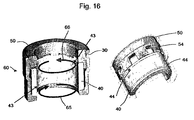
- Figure 12 shows a first cassette part (40) according to the present invention.
- the first cassette part (40) comprises a substantially annular member defining within its confines a receptacle (or chamber) for receiving particles.
- the first cassette part (40) has generally cylindrical outer walls (42) and a slightly tapered seating face (41) at its bottom end.
- the seating face (41) is intended to rest against the seating face (32) of the second cassette part (30) during use.
- the shoulder (31) of the second cassette part (30) is intended to abut the outer surface (42) of the first cassette part to provide an interference fit. This configuration is shown in Figure 15.
- These openings are connected by transfer ducts (46) such that gas surrounding the first cassette part (40) may enter the receptacle for receiving particles.
- the transfer ducts (46) are substantially conical in shape converging inwardly. They are angled in three dimensions such that when gas flows therethrough a preferably sonic or supersonic jet is formed which tends to create a swirling gas movement inside the chamber confining the particles.
- the transfer ducts (46) are angled such that the gas tends to impinge against the membranes (62,63) located at either side of the first cassette part (40).
- the openings (43) are provided at different longitudinal ends of the first cassette part (40) and are directed in different directions such that a clockwise gas flow is established at one end of the particle confinement chamber and an anti-clockwise gas flow is established at the other end of the particle confinement chamber.
- This is illustrated in Figure 16 wherein the gas flows are referenced (65) and (66).
- the transfer ducts (46) are provided on the same lateral side of the first cassette part (i.e. above the centre line shown in Figure 13), and this has been found to provide for good fluidization of the particles when gas pressure is introduced to the openings (44) and a flow of gas is established through the transfer ducts (46).
- other configurations of transfer duct in the side walls of the first particle cassette part (40) can provide good results and it is not generally essential for the present invention that the transfer ducts (46) have the specific form shown in Figures 12 and 13.
- Figures 12 and 13 show an advantageous configuration of transfer ducts (46) wherein the ducts are offset from one another both in the direction of gas flow and also circumferentially.
- the longitudinal (i.e. in the direction of gas flow) offset is shown in Figure 12 as being substantially equal to the longitudinal length of the particle retention chamber although this is not essential and a lesser degree of off-set may be used.
- the transfer ducts are also angled to direct gas outwardly against the membranes (62,63). The interaction of the jets emitted by the openings (43) with the membranes and the resulting swirls of gas have been found to cause effective particle mixing.
- the transfer ducts (46) are angled so as to create swirls of gas which rotate in opposite directions.
- the right-hand transfer duct (46) of Figure 13 is adapted to create a substantially clockwise swirl of gas in the particle retention chamber and the left-hand transfer duct (46) of Figure 13 is adapted to create a substantially anti-clockwise swirl of gas in the particle retention chamber (71).
- the openings (43) are circumferentially offset by an angle of about 120° and it is preferable that any circumferential offset falls in the range of from 90° to 180° inclusive. Other circumferential off-sets may be used, however.
- Figure 14 shows a third particle cassette part in accordance with the present invention.
- the third cassette part (50) in common with the first and second cassette parts, has generally cylindrical inner and outer walls forming an annular-shaped member.
- One or more protrusions (51) may be formed on the outer walls and these are intended to provide an interference fit against the inner wall (34) of the second cassette part (30), when the particle cassette is assembled.
- the lower end of the third cassette part (50) has a number of formations (52) around the circumference.
- the formations (52) are stepped and are designed such that the top part (53) of the formations (52) abuts the top surface of the first cassette part (40) when assembled, as shown in Figure 15.
- the formations are spaced apart by vent holes (54) that are formed such that gas may pass through the vent holes (54) when the first and third cassette parts are attached together.
- the formations (52) are shaped so as to grip, by means of friction, or interference, the top part of the first cassette part (40).
- the particle cassette takes the form shown in Figure 15 when assembled.
- the membrane (61) is relatively thin with a fairly low bursting pressure and is designed to keep the unit sterile in use. If it were not for this there is a chance that particles could travel through the openings (43), into the annular space (67), through the vents (54) and out through the upstream end of the particle retention assembly.
- a first membrane (62) is heat sealed or bonded to the upper edge of the first cassette part (40).
- the second membrane (63) is heat sealed or bonded to the seating face (32) of the second cassette part (30).
- the third membrane (61) is heat sealed or bonded to the upper face of the third cassette part (50).
- the first membrane and first cassette part thus define a receptacle in which the particles may be contained.
- the openings (43) are very small such that it is very difficult for the particles to pass out of the chamber once inside.
- the first cassette part (40) is pushed in until the seating face (41) of the first cassette part abuts the seating face (32) of the second cassette part (with the second membrane (63) between the two seating faces). In this configuration, the particles are trapped between the first and second membranes.
- the third cassette part (50) having the third membrane (61) thereon is then pushed in so that the formations (52) slide into the annular gap created between the first and second cassette parts. Interference and/or friction ensure that this movement firmly secures the first and second parts together and effectively "locks" the cassette. It will be appreciated that it is quite difficult to remove the third cassette part once it is installed, especially if the top face (55) of the third cassette part is dimensioned so as to be flush with the top face of the second cassette part when assembled (this is not shown in Figure 15 however).
- the membrane (61) ensures that the particles inside the cassette may not come into contact with any external particles or gases and thus the membrane (61) ensures the sterility of the cassette.
- the cassette is inserted into a needleless syringe such as that shown in Figures 2 and 3 and gas pressure is supplied to the third membrane (61).
- the membrane (61) bursts quite easily and gas enters the internal space (73) defined by the third cassette part. Gas is able to flow through the vents (54) and into the annular space (67) between the first cassette part and the second cassette part. From there, gas may pass through the transfer ducts (46) and out through the openings (43) into the particle containment chamber. The jets of gas so formed cause the particles to be fluidized and mixed.
- Figure 16 shows the swirls (65,66) of gas that are set up within the particle retention chamber (71) in use (the membranes are not shown in Figure 16 for clarity).
- the upstream membrane (62) bursts and the particles are entrained in the bulk of the gas flow followed by the bursting of the downstream membrane (63) shortly thereafter.
- Heat sealing or adhesive is not necessary to seal the membranes and the first and second membranes may be sealed against the first and second cassette parts respectively due to the tight fit between the various cassette parts.
- the first membrane (62) may be sealed by virtue of being trapped between the first and third cassette parts.
- the second membrane (63) may be trapped between the first and second cassette parts, with no special heat sealing or adhesive step being required.
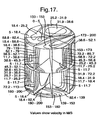
- Figures 17 and 18 show the result of a computational fluid dynamic analysis of the flow inside the particle retention assembly.
- Figure 17 shows a model of the particle retention chamber (71) with the membranes at the top and bottom.
- the jet emitted by the openings (43) has a velocity in the region of 200 m/s. Since the jet is directed into the wall of the particle retention chamber (71), and the wall is substantially cylindrical, the flow is directed around the wall, creating a swirling motion. Some of the flow is also directed in a longitudinal direction towards the centre of the chamber. It can be seen that the two jets cause swirls to form in opposite directions and that the main downward flow from the top jet impinges downwardly on the bottom jet. Likewise, due to symmetry, the main upward flow arising from the bottom jet impinges centrally into the top jet Thus, particles entrained by one jet are fed into the other, creating a circulating motion of particles in the chamber. This causes good fluidisation of particles.
- Figure 18 shows the jet in more detail.
- the flow slows down as it hits the wall of the chamber and is deflected in three dimensions around the circumference and downwardly into the plane of the page.
- the velocity of the jet is approximately 150 m/s.
- the materials used to manufacture the cassette parts and the membranes may be conventional, for example, the membranes may be mylar as disclosed in WO 94/24263 and the first and second cassette parts are preferably manufactured from a plastics material, using injection moulding for example. Both the membranes and cassette parts may be made from polycarbonate such as Evaxone 260 (EVA) polymer. If heat sealing is used, a temperature of 110°C and pressure of 760 kPa (110 psi) for 1.5 seconds has been found to be acceptable.
- EVA Evaxone 260
- the cassette is suitable for any type of particle, including powdered drugs and carrier particles coated in genetic material.
Landscapes
- Health & Medical Sciences (AREA)
- Engineering & Computer Science (AREA)
- Bioinformatics & Cheminformatics (AREA)
- Pharmacology & Pharmacy (AREA)
- Vascular Medicine (AREA)
- Anesthesiology (AREA)
- Biomedical Technology (AREA)
- Heart & Thoracic Surgery (AREA)
- Hematology (AREA)
- Life Sciences & Earth Sciences (AREA)
- Animal Behavior & Ethology (AREA)
- General Health & Medical Sciences (AREA)
- Public Health (AREA)
- Veterinary Medicine (AREA)
- Infusion, Injection, And Reservoir Apparatuses (AREA)
- Exhaust Silencers (AREA)
- Manufacturing Of Micro-Capsules (AREA)
- Measurement Of The Respiration, Hearing Ability, Form, And Blood Characteristics Of Living Organisms (AREA)
- Details Of Valves (AREA)
- Reciprocating Pumps (AREA)
- Solid-Sorbent Or Filter-Aiding Compositions (AREA)
Priority Applications (2)
| Application Number | Priority Date | Filing Date | Title |
|---|---|---|---|
| EP05028151A EP1637174B1 (en) | 2001-07-26 | 2002-07-25 | Particle Retention Assembly and Method of Fluidising Particles |
| EP07015671A EP1847286A3 (en) | 2001-07-26 | 2002-07-25 | Silencing device and method of operating a needleless syringe |
Applications Claiming Priority (3)
| Application Number | Priority Date | Filing Date | Title |
|---|---|---|---|
| GBGB0118266.6A GB0118266D0 (en) | 2001-07-26 | 2001-07-26 | Silencing device and method for needleless syringe |
| GB0118266 | 2001-07-26 | ||
| PCT/GB2002/003412 WO2003011380A2 (en) | 2001-07-26 | 2002-07-25 | Silencing device and method for needleless syringe |
Related Child Applications (1)
| Application Number | Title | Priority Date | Filing Date |
|---|---|---|---|
| EP05028151A Division EP1637174B1 (en) | 2001-07-26 | 2002-07-25 | Particle Retention Assembly and Method of Fluidising Particles |
Publications (2)
| Publication Number | Publication Date |
|---|---|
| EP1418965A2 EP1418965A2 (en) | 2004-05-19 |
| EP1418965B1 true EP1418965B1 (en) | 2006-03-08 |
Family
ID=9919259
Family Applications (3)
| Application Number | Title | Priority Date | Filing Date |
|---|---|---|---|
| EP02755103A Expired - Lifetime EP1418965B1 (en) | 2001-07-26 | 2002-07-25 | Silencing device and method for needleless syringe |
| EP05028151A Expired - Lifetime EP1637174B1 (en) | 2001-07-26 | 2002-07-25 | Particle Retention Assembly and Method of Fluidising Particles |
| EP07015671A Withdrawn EP1847286A3 (en) | 2001-07-26 | 2002-07-25 | Silencing device and method of operating a needleless syringe |
Family Applications After (2)
| Application Number | Title | Priority Date | Filing Date |
|---|---|---|---|
| EP05028151A Expired - Lifetime EP1637174B1 (en) | 2001-07-26 | 2002-07-25 | Particle Retention Assembly and Method of Fluidising Particles |
| EP07015671A Withdrawn EP1847286A3 (en) | 2001-07-26 | 2002-07-25 | Silencing device and method of operating a needleless syringe |
Country Status (14)
| Country | Link |
|---|---|
| US (1) | US7909793B2 (https=) |
| EP (3) | EP1418965B1 (https=) |
| JP (1) | JP4299663B2 (https=) |
| AT (2) | ATE319493T1 (https=) |
| AU (1) | AU2002321403B2 (https=) |
| CA (1) | CA2455164C (https=) |
| CY (1) | CY1107088T1 (https=) |
| DE (2) | DE60222709T2 (https=) |
| DK (2) | DK1418965T3 (https=) |
| ES (2) | ES2260467T3 (https=) |
| GB (1) | GB0118266D0 (https=) |
| NZ (3) | NZ551520A (https=) |
| PT (2) | PT1637174E (https=) |
| WO (1) | WO2003011380A2 (https=) |
Families Citing this family (36)
| Publication number | Priority date | Publication date | Assignee | Title |
|---|---|---|---|---|
| GB0100756D0 (en) | 2001-01-11 | 2001-02-21 | Powderject Res Ltd | Needleless syringe |
| US8061006B2 (en) * | 2001-07-26 | 2011-11-22 | Powderject Research Limited | Particle cassette, method and kit therefor |
| USD519633S1 (en) | 2003-11-12 | 2006-04-25 | Powderject Research Limited | Syringe |
| BRPI0515759B8 (pt) | 2004-12-01 | 2021-06-22 | Acushot Inc | dispositivo de injeção sem agulha e kit para utilização do mesmo |
| US7833189B2 (en) | 2005-02-11 | 2010-11-16 | Massachusetts Institute Of Technology | Controlled needle-free transport |
| US8221363B2 (en) * | 2006-10-18 | 2012-07-17 | Baxter Healthcare S.A. | Luer activated device with valve element under tension |
| US20080097407A1 (en) * | 2006-10-18 | 2008-04-24 | Michael Plishka | Luer activated device with compressible valve element |
| US7981090B2 (en) * | 2006-10-18 | 2011-07-19 | Baxter International Inc. | Luer activated device |
| US7753338B2 (en) | 2006-10-23 | 2010-07-13 | Baxter International Inc. | Luer activated device with minimal fluid displacement |
| GB0708758D0 (en) | 2007-05-04 | 2007-06-13 | Powderject Res Ltd | Particle cassettes and process thereof |
| US8398583B2 (en) * | 2008-07-09 | 2013-03-19 | Massachusetts Institute Of Technology | Method and apparatus for extraction of a sample from a sample source |
| EP2434970B1 (en) | 2009-05-26 | 2016-11-30 | Zimmer, Inc. | Handheld tool for driving a bone pin into a fractured bone |
| WO2011028719A2 (en) | 2009-09-01 | 2011-03-10 | Massachusetts Institute Of Technology | Nonlinear system identification techniques and devices for discovering dynamic and static tissue properties |
| JP5575593B2 (ja) | 2010-09-17 | 2014-08-20 | 株式会社ダイセル | 注射器 |
| JP5559647B2 (ja) | 2010-09-24 | 2014-07-23 | 株式会社ダイセル | 注射器 |
| USD699342S1 (en) * | 2011-03-09 | 2014-02-11 | Suzuken Company Limited | Injector |
| US9987067B2 (en) | 2012-07-11 | 2018-06-05 | Zimmer, Inc. | Bone fixation tool |
| WO2014183216A1 (en) * | 2013-05-17 | 2014-11-20 | Socpra Sciences Et Génie S.E.C. | Needleless syringe and method for delivering therapeutic particles |
| TWI689323B (zh) * | 2014-02-26 | 2020-04-01 | 普樂藥業有限公司 | 顆粒輸送裝置及方法 |
| EP3125797B1 (en) | 2014-04-03 | 2019-05-22 | Zimmer, Inc. | Orthopedic tool for bone fixation |
| KR102397233B1 (ko) | 2014-09-25 | 2022-05-12 | 프로제너티, 인크. | 위치추정 능력을 갖는 전기기계 알약 장치 |
| WO2016054015A1 (en) * | 2014-09-30 | 2016-04-07 | The Regents Of The University Of California | Active agent delivery devices and methods of using the same |
| WO2016137665A1 (en) * | 2015-02-27 | 2016-09-01 | Zogenix, Inc. | Needle-free injectors comprising sound suppression |
| JP2017000667A (ja) | 2015-06-16 | 2017-01-05 | 国立大学法人三重大学 | 無針注射器及びそれを用いた注射対象領域へのdna導入方法 |
| JP2019526423A (ja) | 2016-09-09 | 2019-09-19 | ミッチェル・ローレンス・ジョーンズMitchell Lawrence JONES | 分注可能物質の送達のための電気機械的摂取可能装置 |
| WO2018068956A1 (en) * | 2016-10-11 | 2018-04-19 | H. Lundbeck A/S | Auto injector with automated reconstitution |
| US10966704B2 (en) | 2016-11-09 | 2021-04-06 | Biomet Sports Medicine, Llc | Methods and systems for stitching soft tissue to bone |
| WO2018106945A1 (en) | 2016-12-07 | 2018-06-14 | Progenity Inc. | Gastrointestinal tract detection methods, devices and systems |
| KR102329597B1 (ko) | 2017-03-31 | 2021-11-23 | 프로제너티, 인크. | 섭취가능한 디바이스용 측위 시스템 및 방법 |
| CN111699010A (zh) | 2018-02-09 | 2020-09-22 | 株式会社大赛璐 | 注入器、以及使用该注入器向注入对象的细胞核内注入包含生物分子的溶液的注入方法 |
| EP3750579B1 (en) | 2018-02-09 | 2025-12-31 | Daicel Corporation | INJECTOR |
| WO2019156238A1 (ja) | 2018-02-09 | 2019-08-15 | 株式会社ダイセル | 注入器及びそれを用いた注入対象への生体分子を含む溶液の注入方法 |
| CN112534274B (zh) | 2018-07-25 | 2023-10-13 | 株式会社大赛璐 | 测定系统、测定方法、注入器、以及使用该注入器向注入对象的细胞内注入包含生物分子的溶液的注入方法 |
| EP3883635A1 (en) | 2018-11-19 | 2021-09-29 | Progenity, Inc. | Methods and devices for treating a disease with biotherapeutics |
| EP4275717A4 (en) | 2021-01-05 | 2024-06-26 | Daicel Corporation | Injector |
| JPWO2025023025A1 (https=) | 2023-07-25 | 2025-01-30 |
Family Cites Families (19)
| Publication number | Priority date | Publication date | Assignee | Title |
|---|---|---|---|---|
| FR873453A (fr) | 1941-02-19 | 1942-07-09 | Tubophane | Réservoir tubulaire pour l'emmagasinement et la distribution par projection, diffusée ou non, de matières liquides ou pulvérulentes |
| US3308818A (en) * | 1964-07-24 | 1967-03-14 | Eugene V Rutkowski | Injection cartridge |
| US5312335A (en) * | 1989-11-09 | 1994-05-17 | Bioject Inc. | Needleless hypodermic injection device |
| US5238003A (en) * | 1992-02-07 | 1993-08-24 | Baidwan Balinderjeet S | Plunger tip for blood gas syringe |
| TW360548B (en) * | 1993-04-08 | 1999-06-11 | Powderject Res Ltd | Products for therapeutic use |
| GB9416663D0 (en) * | 1994-08-17 | 1994-10-12 | Oxford Bioscience Limited | Particle delivery |
| EP0788386B1 (en) * | 1994-10-24 | 1999-01-13 | PowderJect Research Limited | Needleless syringe |
| GB9426379D0 (en) * | 1994-12-23 | 1995-03-01 | Oxford Biosciences Ltd | Particle delivery |
| GB9502879D0 (en) * | 1995-02-14 | 1995-04-05 | Oxford Biosciences Ltd | Particle delivery |
| GB9605690D0 (en) | 1996-03-19 | 1996-05-22 | Oxford Biosciences Ltd | Particle delivery |
| US5865803A (en) * | 1997-05-19 | 1999-02-02 | Major; Miklos | Syringe device having a vented piston |
| EP0888791A1 (en) | 1997-07-04 | 1999-01-07 | PowderJect Research Limited | Syringe and drug capsule therefor |
| EP0888790A1 (en) | 1997-07-04 | 1999-01-07 | PowderJect Research Limited | Drug particle delivery device |
| US6004287A (en) | 1997-09-23 | 1999-12-21 | Loomis; Dale J | Biolistic apparatus for delivering substances into cells and tissues |
| US7060048B1 (en) * | 1999-04-16 | 2006-06-13 | Powerject Research Limited | Needleless syringe |
| ATE251922T1 (de) * | 1999-04-16 | 2003-11-15 | Powderject Res Ltd | Nadellose spritze |
| GB9916800D0 (en) | 1999-07-16 | 1999-09-22 | Powderject Res Ltd | Needleless syringe |
| FR2799374B1 (fr) | 1999-10-08 | 2001-12-07 | Cross Site Technologies | Seringue sans aiguille munie d'un systeme de declenchement par friction |
| CA2324045A1 (fr) * | 2000-10-20 | 2002-04-20 | Universite De Sherbrooke | Seringue sans aiguille pour l'injection sous-cutanee de poudres medicamenteuses |
-
2001
- 2001-07-26 GB GBGB0118266.6A patent/GB0118266D0/en not_active Ceased
-
2002
- 2002-07-25 AT AT02755103T patent/ATE319493T1/de active
- 2002-07-25 WO PCT/GB2002/003412 patent/WO2003011380A2/en not_active Ceased
- 2002-07-25 DE DE60222709T patent/DE60222709T2/de not_active Expired - Fee Related
- 2002-07-25 US US10/484,742 patent/US7909793B2/en active Active
- 2002-07-25 NZ NZ551520A patent/NZ551520A/en not_active IP Right Cessation
- 2002-07-25 DK DK02755103T patent/DK1418965T3/da active
- 2002-07-25 NZ NZ540411A patent/NZ540411A/en not_active IP Right Cessation
- 2002-07-25 EP EP02755103A patent/EP1418965B1/en not_active Expired - Lifetime
- 2002-07-25 CA CA002455164A patent/CA2455164C/en not_active Expired - Fee Related
- 2002-07-25 NZ NZ531227A patent/NZ531227A/en not_active IP Right Cessation
- 2002-07-25 DE DE60209744T patent/DE60209744T2/de not_active Expired - Lifetime
- 2002-07-25 ES ES02755103T patent/ES2260467T3/es not_active Expired - Lifetime
- 2002-07-25 AU AU2002321403A patent/AU2002321403B2/en not_active Ceased
- 2002-07-25 PT PT05028151T patent/PT1637174E/pt unknown
- 2002-07-25 JP JP2003516610A patent/JP4299663B2/ja not_active Expired - Fee Related
- 2002-07-25 EP EP05028151A patent/EP1637174B1/en not_active Expired - Lifetime
- 2002-07-25 EP EP07015671A patent/EP1847286A3/en not_active Withdrawn
- 2002-07-25 DK DK05028151T patent/DK1637174T3/da active
- 2002-07-25 PT PT02755103T patent/PT1418965E/pt unknown
- 2002-07-25 AT AT05028151T patent/ATE374053T1/de not_active IP Right Cessation
- 2002-07-25 ES ES05028151T patent/ES2294625T3/es not_active Expired - Lifetime
-
2007
- 2007-12-14 CY CY20071101585T patent/CY1107088T1/el unknown
Also Published As
| Publication number | Publication date |
|---|---|
| EP1637174A2 (en) | 2006-03-22 |
| DK1418965T3 (da) | 2006-07-10 |
| PT1418965E (pt) | 2006-06-30 |
| WO2003011380A2 (en) | 2003-02-13 |
| DE60209744T2 (de) | 2006-12-07 |
| EP1847286A2 (en) | 2007-10-24 |
| ES2260467T3 (es) | 2006-11-01 |
| NZ531227A (en) | 2005-08-26 |
| NZ551520A (en) | 2008-09-26 |
| JP2004536675A (ja) | 2004-12-09 |
| CA2455164A1 (en) | 2003-02-13 |
| US7909793B2 (en) | 2011-03-22 |
| DE60209744D1 (de) | 2006-05-04 |
| EP1637174A3 (en) | 2006-05-03 |
| DK1637174T3 (da) | 2008-01-28 |
| CY1107088T1 (el) | 2012-10-24 |
| CA2455164C (en) | 2009-10-27 |
| AU2002321403B2 (en) | 2007-10-04 |
| US20050010168A1 (en) | 2005-01-13 |
| EP1637174B1 (en) | 2007-09-26 |
| ATE319493T1 (de) | 2006-03-15 |
| PT1637174E (pt) | 2007-11-09 |
| GB0118266D0 (en) | 2001-09-19 |
| DE60222709T2 (de) | 2008-06-19 |
| ATE374053T1 (de) | 2007-10-15 |
| ES2294625T3 (es) | 2008-04-01 |
| EP1847286A3 (en) | 2008-01-09 |
| DE60222709D1 (de) | 2007-11-08 |
| NZ540411A (en) | 2007-01-26 |
| EP1418965A2 (en) | 2004-05-19 |
| JP4299663B2 (ja) | 2009-07-22 |
| WO2003011380A3 (en) | 2003-05-30 |
Similar Documents
| Publication | Publication Date | Title |
|---|---|---|
| EP1418965B1 (en) | Silencing device and method for needleless syringe | |
| AU2002321403A1 (en) | Silencing device and method for needleless syringe | |
| JP2004536675A5 (https=) | ||
| EP0892649B1 (en) | Needleless syringe with therapeutic agent particles entrained in supersonic gas flow | |
| US20080262417A1 (en) | Needleless syringe | |
| JPH01227764A (ja) | 生きた細胞及び組織内へ物質を分配する分配装置 | |
| OA10494A (en) | Particle delivery | |
| US7803129B2 (en) | Needleless syringe for the subcutaneous injection of droplets of liquid substances | |
| US6004287A (en) | Biolistic apparatus for delivering substances into cells and tissues | |
| CA2370276C (en) | Needleless syringe | |
| US6835187B2 (en) | Needleless syringe provided with an inner seal containing the active principle | |
| US7455655B2 (en) | Needleless injection device comprising means for regulating the gas pressure level in the combustion chamber | |
| AU2007219295A1 (en) | Silencing Device and Method for Needleless Syringe | |
| Truong et al. | Gas and particle dynamics of a contoured shock tube for pre-clinical microparticle drug delivery | |
| CA2247142C (en) | Needleless syringe |
Legal Events
| Date | Code | Title | Description |
|---|---|---|---|
| PUAI | Public reference made under article 153(3) epc to a published international application that has entered the european phase |
Free format text: ORIGINAL CODE: 0009012 |
|
| 17P | Request for examination filed |
Effective date: 20040210 |
|
| AK | Designated contracting states |
Kind code of ref document: A2 Designated state(s): AT BE BG CH CY CZ DE DK EE ES FI FR GB GR IE IT LI LU MC NL PT SE SK TR |
|
| AX | Request for extension of the european patent |
Extension state: AL LT LV MK RO SI |
|
| 17Q | First examination report despatched |
Effective date: 20040615 |
|
| GRAP | Despatch of communication of intention to grant a patent |
Free format text: ORIGINAL CODE: EPIDOSNIGR1 |
|
| GRAC | Information related to communication of intention to grant a patent modified |
Free format text: ORIGINAL CODE: EPIDOSCIGR1 |
|
| GRAS | Grant fee paid |
Free format text: ORIGINAL CODE: EPIDOSNIGR3 |
|
| GRAA | (expected) grant |
Free format text: ORIGINAL CODE: 0009210 |
|
| AK | Designated contracting states |
Kind code of ref document: B1 Designated state(s): AT BE BG CH CY CZ DE DK EE ES FI FR GB GR IE IT LI LU MC NL PT SE SK TR |
|
| REG | Reference to a national code |
Ref country code: GB Ref legal event code: FG4D |
|
| REG | Reference to a national code |
Ref country code: CH Ref legal event code: EP |
|
| REG | Reference to a national code |
Ref country code: IE Ref legal event code: FG4D |
|
| REF | Corresponds to: |
Ref document number: 60209744 Country of ref document: DE Date of ref document: 20060504 Kind code of ref document: P |
|
| REG | Reference to a national code |
Ref country code: SE Ref legal event code: TRGR |
|
| REG | Reference to a national code |
Ref country code: EE Ref legal event code: FG4A Ref document number: E000320 Country of ref document: EE Effective date: 20060320 Ref country code: CH Ref legal event code: NV Representative=s name: PATENTANWAELTE SCHAAD, BALASS, MENZL & PARTNER AG |
|
| REG | Reference to a national code |
Ref country code: GR Ref legal event code: EP Ref document number: 20060401356 Country of ref document: GR Ref country code: PT Ref legal event code: SC4A Effective date: 20060417 |
|
| REG | Reference to a national code |
Ref country code: DK Ref legal event code: T3 |
|
| ET | Fr: translation filed | ||
| REG | Reference to a national code |
Ref country code: ES Ref legal event code: FG2A Ref document number: 2260467 Country of ref document: ES Kind code of ref document: T3 |
|
| PLBE | No opposition filed within time limit |
Free format text: ORIGINAL CODE: 0009261 |
|
| STAA | Information on the status of an ep patent application or granted ep patent |
Free format text: STATUS: NO OPPOSITION FILED WITHIN TIME LIMIT |
|
| 26N | No opposition filed |
Effective date: 20061211 |
|
| PGFP | Annual fee paid to national office [announced via postgrant information from national office to epo] |
Ref country code: CZ Payment date: 20080626 Year of fee payment: 7 |
|
| PG25 | Lapsed in a contracting state [announced via postgrant information from national office to epo] |
Ref country code: CZ Free format text: LAPSE BECAUSE OF NON-PAYMENT OF DUE FEES Effective date: 20090725 |
|
| PGFP | Annual fee paid to national office [announced via postgrant information from national office to epo] |
Ref country code: TR Payment date: 20140623 Year of fee payment: 13 |
|
| PGFP | Annual fee paid to national office [announced via postgrant information from national office to epo] |
Ref country code: SK Payment date: 20150629 Year of fee payment: 14 Ref country code: MC Payment date: 20150629 Year of fee payment: 14 Ref country code: BG Payment date: 20150618 Year of fee payment: 14 |
|
| PGFP | Annual fee paid to national office [announced via postgrant information from national office to epo] |
Ref country code: GR Payment date: 20150629 Year of fee payment: 14 Ref country code: IE Payment date: 20150626 Year of fee payment: 14 |
|
| PGFP | Annual fee paid to national office [announced via postgrant information from national office to epo] |
Ref country code: NL Payment date: 20150708 Year of fee payment: 14 Ref country code: LU Payment date: 20150813 Year of fee payment: 14 |
|
| PGFP | Annual fee paid to national office [announced via postgrant information from national office to epo] |
Ref country code: CY Payment date: 20150619 Year of fee payment: 14 Ref country code: PT Payment date: 20150701 Year of fee payment: 14 Ref country code: EE Payment date: 20150703 Year of fee payment: 14 Ref country code: ES Payment date: 20150703 Year of fee payment: 14 Ref country code: FI Payment date: 20150708 Year of fee payment: 14 |
|
| PGFP | Annual fee paid to national office [announced via postgrant information from national office to epo] |
Ref country code: AT Payment date: 20150624 Year of fee payment: 14 Ref country code: BE Payment date: 20150708 Year of fee payment: 14 |
|
| REG | Reference to a national code |
Ref country code: FR Ref legal event code: PLFP Year of fee payment: 15 |
|
| PGFP | Annual fee paid to national office [announced via postgrant information from national office to epo] |
Ref country code: GB Payment date: 20160727 Year of fee payment: 15 Ref country code: CH Payment date: 20160727 Year of fee payment: 15 Ref country code: DE Payment date: 20160726 Year of fee payment: 15 Ref country code: DK Payment date: 20160725 Year of fee payment: 15 Ref country code: IT Payment date: 20160824 Year of fee payment: 15 |
|
| PGFP | Annual fee paid to national office [announced via postgrant information from national office to epo] |
Ref country code: SE Payment date: 20160727 Year of fee payment: 15 Ref country code: FR Payment date: 20160726 Year of fee payment: 15 |
|
| PG25 | Lapsed in a contracting state [announced via postgrant information from national office to epo] |
Ref country code: BE Free format text: LAPSE BECAUSE OF NON-PAYMENT OF DUE FEES Effective date: 20160731 |
|
| REG | Reference to a national code |
Ref country code: DE Ref legal event code: R082 Ref document number: 60209744 Country of ref document: DE Representative=s name: KRAUS & WEISERT PATENTANWAELTE PARTGMBB, DE Ref country code: DE Ref legal event code: R081 Ref document number: 60209744 Country of ref document: DE Owner name: POWDER PHARMACEUTICALS INC., HK Free format text: FORMER OWNER: POWDERJECT RESEARCH LTD., OXFORD, GB Ref country code: DE Ref legal event code: R081 Ref document number: 60209744 Country of ref document: DE Owner name: POWDER PHARMACEUTICALS INCORPORATED, HK Free format text: FORMER OWNER: POWDERJECT RESEARCH LTD., OXFORD, GB |
|
| REG | Reference to a national code |
Ref country code: DE Ref legal event code: R081 Ref document number: 60209744 Country of ref document: DE Owner name: POWDER PHARMACEUTICALS INCORPORATED, HK Free format text: FORMER OWNER: POWDER PHARMACEUTICALS INC., HONG KONG, HK Ref country code: DE Ref legal event code: R082 Ref document number: 60209744 Country of ref document: DE Representative=s name: KRAUS & WEISERT PATENTANWAELTE PARTGMBB, DE |
|
| REG | Reference to a national code |
Ref country code: EE Ref legal event code: MM4A Ref document number: E000320 Country of ref document: EE Effective date: 20160731 |
|
| REG | Reference to a national code |
Ref country code: GB Ref legal event code: 732E Free format text: REGISTERED BETWEEN 20170202 AND 20170208 Ref country code: NL Ref legal event code: MM Effective date: 20160801 |
|
| REG | Reference to a national code |
Ref country code: AT Ref legal event code: MM01 Ref document number: 319493 Country of ref document: AT Kind code of ref document: T Effective date: 20160725 |
|
| PG25 | Lapsed in a contracting state [announced via postgrant information from national office to epo] |
Ref country code: MC Free format text: LAPSE BECAUSE OF NON-PAYMENT OF DUE FEES Effective date: 20160801 |
|
| REG | Reference to a national code |
Ref country code: CH Ref legal event code: PUE Owner name: POWDER PHARMACEUTICALS INCORPORATED, CN Free format text: FORMER OWNER: POWDERJECT RESEARCH LIMITED, GB |
|
| REG | Reference to a national code |
Ref country code: SK Ref legal event code: MM4A Ref document number: E 577 Country of ref document: SK Effective date: 20160725 |
|
| REG | Reference to a national code |
Ref country code: GR Ref legal event code: ML Ref document number: 20060401356 Country of ref document: GR Effective date: 20170207 |
|
| PG25 | Lapsed in a contracting state [announced via postgrant information from national office to epo] |
Ref country code: GR Free format text: LAPSE BECAUSE OF NON-PAYMENT OF DUE FEES Effective date: 20170207 Ref country code: NL Free format text: LAPSE BECAUSE OF NON-PAYMENT OF DUE FEES Effective date: 20160801 Ref country code: FI Free format text: LAPSE BECAUSE OF NON-PAYMENT OF DUE FEES Effective date: 20160725 Ref country code: EE Free format text: LAPSE BECAUSE OF NON-PAYMENT OF DUE FEES Effective date: 20160731 |
|
| REG | Reference to a national code |
Ref country code: IE Ref legal event code: MM4A |
|
| PG25 | Lapsed in a contracting state [announced via postgrant information from national office to epo] |
Ref country code: AT Free format text: LAPSE BECAUSE OF NON-PAYMENT OF DUE FEES Effective date: 20160725 Ref country code: SK Free format text: LAPSE BECAUSE OF NON-PAYMENT OF DUE FEES Effective date: 20160725 Ref country code: CY Free format text: LAPSE BECAUSE OF NON-PAYMENT OF DUE FEES Effective date: 20160725 Ref country code: PT Free format text: LAPSE BECAUSE OF NON-PAYMENT OF DUE FEES Effective date: 20170125 Ref country code: BG Free format text: LAPSE BECAUSE OF NON-PAYMENT OF DUE FEES Effective date: 20170228 |
|
| REG | Reference to a national code |
Ref country code: FR Ref legal event code: TP Owner name: POWDER PHARMACEUTICALS INCORPORATED, CN Effective date: 20170627 |
|
| PG25 | Lapsed in a contracting state [announced via postgrant information from national office to epo] |
Ref country code: IE Free format text: LAPSE BECAUSE OF NON-PAYMENT OF DUE FEES Effective date: 20160725 |
|
| PG25 | Lapsed in a contracting state [announced via postgrant information from national office to epo] |
Ref country code: LU Free format text: LAPSE BECAUSE OF NON-PAYMENT OF DUE FEES Effective date: 20160725 |
|
| REG | Reference to a national code |
Ref country code: DE Ref legal event code: R119 Ref document number: 60209744 Country of ref document: DE |
|
| REG | Reference to a national code |
Ref country code: DK Ref legal event code: EBP Effective date: 20170731 |
|
| REG | Reference to a national code |
Ref country code: CH Ref legal event code: PL |
|
| REG | Reference to a national code |
Ref country code: SE Ref legal event code: EUG |
|
| GBPC | Gb: european patent ceased through non-payment of renewal fee |
Effective date: 20170725 |
|
| REG | Reference to a national code |
Ref country code: FR Ref legal event code: ST Effective date: 20180330 |
|
| PG25 | Lapsed in a contracting state [announced via postgrant information from national office to epo] |
Ref country code: CH Free format text: LAPSE BECAUSE OF NON-PAYMENT OF DUE FEES Effective date: 20170731 Ref country code: SE Free format text: LAPSE BECAUSE OF NON-PAYMENT OF DUE FEES Effective date: 20170726 Ref country code: LI Free format text: LAPSE BECAUSE OF NON-PAYMENT OF DUE FEES Effective date: 20170731 Ref country code: GB Free format text: LAPSE BECAUSE OF NON-PAYMENT OF DUE FEES Effective date: 20170725 Ref country code: DE Free format text: LAPSE BECAUSE OF NON-PAYMENT OF DUE FEES Effective date: 20180201 |
|
| PG25 | Lapsed in a contracting state [announced via postgrant information from national office to epo] |
Ref country code: FR Free format text: LAPSE BECAUSE OF NON-PAYMENT OF DUE FEES Effective date: 20170731 Ref country code: ES Free format text: LAPSE BECAUSE OF NON-PAYMENT OF DUE FEES Effective date: 20160726 |
|
| PG25 | Lapsed in a contracting state [announced via postgrant information from national office to epo] |
Ref country code: DK Free format text: LAPSE BECAUSE OF NON-PAYMENT OF DUE FEES Effective date: 20170731 |
|
| PG25 | Lapsed in a contracting state [announced via postgrant information from national office to epo] |
Ref country code: IT Free format text: LAPSE BECAUSE OF NON-PAYMENT OF DUE FEES Effective date: 20170725 |
|
| REG | Reference to a national code |
Ref country code: ES Ref legal event code: FD2A Effective date: 20181128 |
|
| PG25 | Lapsed in a contracting state [announced via postgrant information from national office to epo] |
Ref country code: TR Free format text: LAPSE BECAUSE OF NON-PAYMENT OF DUE FEES Effective date: 20160725 |