EP1413452A1 - Thermal recording material - Google Patents
Thermal recording material Download PDFInfo
- Publication number
- EP1413452A1 EP1413452A1 EP02730827A EP02730827A EP1413452A1 EP 1413452 A1 EP1413452 A1 EP 1413452A1 EP 02730827 A EP02730827 A EP 02730827A EP 02730827 A EP02730827 A EP 02730827A EP 1413452 A1 EP1413452 A1 EP 1413452A1
- Authority
- EP
- European Patent Office
- Prior art keywords
- thermal recording
- recording material
- electron
- methyl
- heat
- Prior art date
- Legal status (The legal status is an assumption and is not a legal conclusion. Google has not performed a legal analysis and makes no representation as to the accuracy of the status listed.)
- Granted
Links
- 239000000463 material Substances 0.000 title claims abstract description 204
- VTYYLEPIZMXCLO-UHFFFAOYSA-L Calcium carbonate Chemical compound [Ca+2].[O-]C([O-])=O VTYYLEPIZMXCLO-UHFFFAOYSA-L 0.000 claims abstract description 94
- 239000006185 dispersion Substances 0.000 claims abstract description 89
- 239000000049 pigment Substances 0.000 claims abstract description 63
- 150000001875 compounds Chemical class 0.000 claims abstract description 56
- 229910000019 calcium carbonate Inorganic materials 0.000 claims abstract description 45
- VYPSYNLAJGMNEJ-UHFFFAOYSA-N Silicium dioxide Chemical compound O=[Si]=O VYPSYNLAJGMNEJ-UHFFFAOYSA-N 0.000 claims abstract description 35
- 239000001023 inorganic pigment Substances 0.000 claims abstract description 25
- 229910021532 Calcite Inorganic materials 0.000 claims abstract description 23
- WNROFYMDJYEPJX-UHFFFAOYSA-K aluminium hydroxide Chemical compound [OH-].[OH-].[OH-].[Al+3] WNROFYMDJYEPJX-UHFFFAOYSA-K 0.000 claims abstract description 23
- 229920001131 Pulp (paper) Polymers 0.000 claims abstract description 16
- 238000000576 coating method Methods 0.000 claims description 61
- 239000011248 coating agent Substances 0.000 claims description 59
- 239000002245 particle Substances 0.000 claims description 47
- 150000003931 anilides Chemical class 0.000 claims description 24
- 239000005995 Aluminium silicate Substances 0.000 claims description 18
- 235000012211 aluminium silicate Nutrition 0.000 claims description 18
- NLYAJNPCOHFWQQ-UHFFFAOYSA-N kaolin Chemical compound O.O.O=[Al]O[Si](=O)O[Si](=O)O[Al]=O NLYAJNPCOHFWQQ-UHFFFAOYSA-N 0.000 claims description 18
- 239000010893 paper waste Substances 0.000 claims description 17
- ZLNQQNXFFQJAID-UHFFFAOYSA-L magnesium carbonate Chemical compound [Mg+2].[O-]C([O-])=O ZLNQQNXFFQJAID-UHFFFAOYSA-L 0.000 claims description 7
- 239000001095 magnesium carbonate Substances 0.000 claims description 7
- 229910000021 magnesium carbonate Inorganic materials 0.000 claims description 7
- 239000000395 magnesium oxide Substances 0.000 claims description 7
- CPLXHLVBOLITMK-UHFFFAOYSA-N magnesium oxide Inorganic materials [Mg]=O CPLXHLVBOLITMK-UHFFFAOYSA-N 0.000 claims description 7
- AXZKOIWUVFPNLO-UHFFFAOYSA-N magnesium;oxygen(2-) Chemical compound [O-2].[Mg+2] AXZKOIWUVFPNLO-UHFFFAOYSA-N 0.000 claims description 7
- 238000004040 coloring Methods 0.000 abstract 1
- 239000007788 liquid Substances 0.000 abstract 1
- 239000010410 layer Substances 0.000 description 93
- 239000000243 solution Substances 0.000 description 83
- 230000000052 comparative effect Effects 0.000 description 52
- 239000000975 dye Substances 0.000 description 45
- 239000000203 mixture Substances 0.000 description 43
- 230000035945 sensitivity Effects 0.000 description 31
- 238000002360 preparation method Methods 0.000 description 30
- IISBACLAFKSPIT-UHFFFAOYSA-N bisphenol A Chemical compound C=1C=C(O)C=CC=1C(C)(C)C1=CC=C(O)C=C1 IISBACLAFKSPIT-UHFFFAOYSA-N 0.000 description 26
- 238000007639 printing Methods 0.000 description 26
- 239000000126 substance Substances 0.000 description 25
- 238000005299 abrasion Methods 0.000 description 22
- 239000004372 Polyvinyl alcohol Substances 0.000 description 18
- 239000000976 ink Substances 0.000 description 18
- 229920002451 polyvinyl alcohol Polymers 0.000 description 18
- 241000519995 Stachys sylvatica Species 0.000 description 15
- -1 N-substituted sulfamoylphenol Chemical class 0.000 description 14
- 229910000040 hydrogen fluoride Inorganic materials 0.000 description 14
- 229920000126 latex Polymers 0.000 description 14
- 229920003048 styrene butadiene rubber Polymers 0.000 description 13
- 238000003490 calendering Methods 0.000 description 12
- 238000001035 drying Methods 0.000 description 12
- 239000004816 latex Substances 0.000 description 12
- 238000012545 processing Methods 0.000 description 12
- XLYOFNOQVPJJNP-UHFFFAOYSA-N water Substances O XLYOFNOQVPJJNP-UHFFFAOYSA-N 0.000 description 12
- 230000014759 maintenance of location Effects 0.000 description 11
- 239000011241 protective layer Substances 0.000 description 11
- KRHYYFGTRYWZRS-UHFFFAOYSA-N Fluorane Chemical compound F KRHYYFGTRYWZRS-UHFFFAOYSA-N 0.000 description 10
- 239000011230 binding agent Substances 0.000 description 10
- 238000007641 inkjet printing Methods 0.000 description 9
- 239000004576 sand Substances 0.000 description 9
- 230000000694 effects Effects 0.000 description 8
- 239000003381 stabilizer Substances 0.000 description 8
- 238000000034 method Methods 0.000 description 7
- 239000001993 wax Substances 0.000 description 7
- TZCXTZWJZNENPQ-UHFFFAOYSA-L barium sulfate Chemical compound [Ba+2].[O-]S([O-])(=O)=O TZCXTZWJZNENPQ-UHFFFAOYSA-L 0.000 description 6
- 238000011156 evaluation Methods 0.000 description 6
- ZFIFUZYGTBRPMC-UHFFFAOYSA-N n-benzyl-4-hydroxybenzenesulfonamide Chemical compound C1=CC(O)=CC=C1S(=O)(=O)NCC1=CC=CC=C1 ZFIFUZYGTBRPMC-UHFFFAOYSA-N 0.000 description 6
- GCLGEJMYGQKIIW-UHFFFAOYSA-H sodium hexametaphosphate Chemical compound [Na]OP1(=O)OP(=O)(O[Na])OP(=O)(O[Na])OP(=O)(O[Na])OP(=O)(O[Na])OP(=O)(O[Na])O1 GCLGEJMYGQKIIW-UHFFFAOYSA-H 0.000 description 6
- 235000019982 sodium hexametaphosphate Nutrition 0.000 description 6
- 239000001577 tetrasodium phosphonato phosphate Substances 0.000 description 6
- XOOUIPVCVHRTMJ-UHFFFAOYSA-L zinc stearate Chemical compound [Zn+2].CCCCCCCCCCCCCCCCCC([O-])=O.CCCCCCCCCCCCCCCCCC([O-])=O XOOUIPVCVHRTMJ-UHFFFAOYSA-L 0.000 description 6
- WLTCCDHHWYAMCG-UHFFFAOYSA-N 2-phenylmethoxynaphthalene Chemical compound C=1C=C2C=CC=CC2=CC=1OCC1=CC=CC=C1 WLTCCDHHWYAMCG-UHFFFAOYSA-N 0.000 description 5
- 229920002472 Starch Polymers 0.000 description 5
- 239000002174 Styrene-butadiene Substances 0.000 description 5
- 239000001254 oxidized starch Substances 0.000 description 5
- 235000013808 oxidized starch Nutrition 0.000 description 5
- 239000012188 paraffin wax Substances 0.000 description 5
- 239000000843 powder Substances 0.000 description 5
- 235000019698 starch Nutrition 0.000 description 5
- 229940124530 sulfonamide Drugs 0.000 description 5
- 239000004094 surface-active agent Substances 0.000 description 5
- OYPRJOBELJOOCE-UHFFFAOYSA-N Calcium Chemical class [Ca] OYPRJOBELJOOCE-UHFFFAOYSA-N 0.000 description 4
- MXRIRQGCELJRSN-UHFFFAOYSA-N O.O.O.[Al] Chemical compound O.O.O.[Al] MXRIRQGCELJRSN-UHFFFAOYSA-N 0.000 description 4
- 239000006096 absorbing agent Substances 0.000 description 4
- 239000011575 calcium Chemical class 0.000 description 4
- 229910052791 calcium Inorganic materials 0.000 description 4
- 239000003086 colorant Substances 0.000 description 4
- 229920001577 copolymer Polymers 0.000 description 4
- 230000007547 defect Effects 0.000 description 4
- 239000012153 distilled water Substances 0.000 description 4
- GVGUFUZHNYFZLC-UHFFFAOYSA-N dodecyl benzenesulfonate;sodium Chemical compound [Na].CCCCCCCCCCCCOS(=O)(=O)C1=CC=CC=C1 GVGUFUZHNYFZLC-UHFFFAOYSA-N 0.000 description 4
- 238000004519 manufacturing process Methods 0.000 description 4
- 238000002156 mixing Methods 0.000 description 4
- 150000002989 phenols Chemical class 0.000 description 4
- 229920001495 poly(sodium acrylate) polymer Polymers 0.000 description 4
- 239000011347 resin Substances 0.000 description 4
- 229920005989 resin Polymers 0.000 description 4
- 229940080264 sodium dodecylbenzenesulfonate Drugs 0.000 description 4
- NNMHYFLPFNGQFZ-UHFFFAOYSA-M sodium polyacrylate Chemical compound [Na+].[O-]C(=O)C=C NNMHYFLPFNGQFZ-UHFFFAOYSA-M 0.000 description 4
- 238000012360 testing method Methods 0.000 description 4
- 229920002134 Carboxymethyl cellulose Polymers 0.000 description 3
- 241000283070 Equus zebra Species 0.000 description 3
- ISWSIDIOOBJBQZ-UHFFFAOYSA-N Phenol Chemical compound OC1=CC=CC=C1 ISWSIDIOOBJBQZ-UHFFFAOYSA-N 0.000 description 3
- 239000007864 aqueous solution Substances 0.000 description 3
- 239000001768 carboxy methyl cellulose Substances 0.000 description 3
- 235000010948 carboxy methyl cellulose Nutrition 0.000 description 3
- 239000008112 carboxymethyl-cellulose Substances 0.000 description 3
- 239000005018 casein Substances 0.000 description 3
- BECPQYXYKAMYBN-UHFFFAOYSA-N casein, tech. Chemical compound NCCCCC(C(O)=O)N=C(O)C(CC(O)=O)N=C(O)C(CCC(O)=N)N=C(O)C(CC(C)C)N=C(O)C(CCC(O)=O)N=C(O)C(CC(O)=O)N=C(O)C(CCC(O)=O)N=C(O)C(C(C)O)N=C(O)C(CCC(O)=N)N=C(O)C(CCC(O)=N)N=C(O)C(CCC(O)=N)N=C(O)C(CCC(O)=O)N=C(O)C(CCC(O)=O)N=C(O)C(COP(O)(O)=O)N=C(O)C(CCC(O)=N)N=C(O)C(N)CC1=CC=CC=C1 BECPQYXYKAMYBN-UHFFFAOYSA-N 0.000 description 3
- 235000021240 caseins Nutrition 0.000 description 3
- 229920006317 cationic polymer Polymers 0.000 description 3
- 230000008859 change Effects 0.000 description 3
- 239000003795 chemical substances by application Substances 0.000 description 3
- 239000000839 emulsion Substances 0.000 description 3
- 239000003317 industrial substance Substances 0.000 description 3
- 229920000609 methyl cellulose Polymers 0.000 description 3
- 239000001923 methylcellulose Substances 0.000 description 3
- 235000010981 methylcellulose Nutrition 0.000 description 3
- 239000007793 ph indicator Substances 0.000 description 3
- 150000003839 salts Chemical class 0.000 description 3
- 239000000377 silicon dioxide Substances 0.000 description 3
- 238000003860 storage Methods 0.000 description 3
- 238000004441 surface measurement Methods 0.000 description 3
- 239000003232 water-soluble binding agent Substances 0.000 description 3
- JTWBMEAENZGSOQ-UHFFFAOYSA-N 1,2-bis(phenoxymethyl)benzene Chemical compound C=1C=CC=C(COC=2C=CC=CC=2)C=1COC1=CC=CC=C1 JTWBMEAENZGSOQ-UHFFFAOYSA-N 0.000 description 2
- YJTKZCDBKVTVBY-UHFFFAOYSA-N 1,3-Diphenylbenzene Chemical group C1=CC=CC=C1C1=CC=CC(C=2C=CC=CC=2)=C1 YJTKZCDBKVTVBY-UHFFFAOYSA-N 0.000 description 2
- AGPLQTQFIZBOLI-UHFFFAOYSA-N 1-benzyl-4-phenylbenzene Chemical group C=1C=C(C=2C=CC=CC=2)C=CC=1CC1=CC=CC=C1 AGPLQTQFIZBOLI-UHFFFAOYSA-N 0.000 description 2
- KGRVJHAUYBGFFP-UHFFFAOYSA-N 2,2'-Methylenebis(4-methyl-6-tert-butylphenol) Chemical compound CC(C)(C)C1=CC(C)=CC(CC=2C(=C(C=C(C)C=2)C(C)(C)C)O)=C1O KGRVJHAUYBGFFP-UHFFFAOYSA-N 0.000 description 2
- HXIQYSLFEXIOAV-UHFFFAOYSA-N 2-tert-butyl-4-(5-tert-butyl-4-hydroxy-2-methylphenyl)sulfanyl-5-methylphenol Chemical compound CC1=CC(O)=C(C(C)(C)C)C=C1SC1=CC(C(C)(C)C)=C(O)C=C1C HXIQYSLFEXIOAV-UHFFFAOYSA-N 0.000 description 2
- 244000215068 Acacia senegal Species 0.000 description 2
- RTZKZFJDLAIYFH-UHFFFAOYSA-N Diethyl ether Chemical compound CCOCC RTZKZFJDLAIYFH-UHFFFAOYSA-N 0.000 description 2
- BRLQWZUYTZBJKN-UHFFFAOYSA-N Epichlorohydrin Chemical compound ClCC1CO1 BRLQWZUYTZBJKN-UHFFFAOYSA-N 0.000 description 2
- 108010010803 Gelatin Proteins 0.000 description 2
- 229920000084 Gum arabic Polymers 0.000 description 2
- 229920000881 Modified starch Polymers 0.000 description 2
- 229920000459 Nitrile rubber Polymers 0.000 description 2
- 239000004952 Polyamide Substances 0.000 description 2
- 239000005062 Polybutadiene Substances 0.000 description 2
- 239000004793 Polystyrene Substances 0.000 description 2
- ATUOYWHBWRKTHZ-UHFFFAOYSA-N Propane Chemical compound CCC ATUOYWHBWRKTHZ-UHFFFAOYSA-N 0.000 description 2
- PPBRXRYQALVLMV-UHFFFAOYSA-N Styrene Chemical compound C=CC1=CC=CC=C1 PPBRXRYQALVLMV-UHFFFAOYSA-N 0.000 description 2
- XSQUKJJJFZCRTK-UHFFFAOYSA-N Urea Chemical compound NC(N)=O XSQUKJJJFZCRTK-UHFFFAOYSA-N 0.000 description 2
- XTXRWKRVRITETP-UHFFFAOYSA-N Vinyl acetate Chemical compound CC(=O)OC=C XTXRWKRVRITETP-UHFFFAOYSA-N 0.000 description 2
- XLOMVQKBTHCTTD-UHFFFAOYSA-N Zinc monoxide Chemical compound [Zn]=O XLOMVQKBTHCTTD-UHFFFAOYSA-N 0.000 description 2
- 238000010521 absorption reaction Methods 0.000 description 2
- 239000000205 acacia gum Substances 0.000 description 2
- 235000010489 acacia gum Nutrition 0.000 description 2
- 229910052783 alkali metal Inorganic materials 0.000 description 2
- LEQAOMBKQFMDFZ-UHFFFAOYSA-N alpha-ketodiacetal Natural products O=CC=O LEQAOMBKQFMDFZ-UHFFFAOYSA-N 0.000 description 2
- 239000012298 atmosphere Substances 0.000 description 2
- 230000015572 biosynthetic process Effects 0.000 description 2
- YXVFYQXJAXKLAK-UHFFFAOYSA-N biphenyl-4-ol Chemical compound C1=CC(O)=CC=C1C1=CC=CC=C1 YXVFYQXJAXKLAK-UHFFFAOYSA-N 0.000 description 2
- 230000000740 bleeding effect Effects 0.000 description 2
- LRTQWXGNPCHTFW-UHFFFAOYSA-N buta-1,3-diene;methyl prop-2-enoate Chemical compound C=CC=C.COC(=O)C=C LRTQWXGNPCHTFW-UHFFFAOYSA-N 0.000 description 2
- 239000002761 deinking Substances 0.000 description 2
- 235000014113 dietary fatty acids Nutrition 0.000 description 2
- 238000005562 fading Methods 0.000 description 2
- 239000000194 fatty acid Substances 0.000 description 2
- 229930195729 fatty acid Natural products 0.000 description 2
- 150000004665 fatty acids Chemical class 0.000 description 2
- 239000000835 fiber Substances 0.000 description 2
- 229920000159 gelatin Polymers 0.000 description 2
- 235000019322 gelatine Nutrition 0.000 description 2
- 235000011852 gelatine desserts Nutrition 0.000 description 2
- 230000007062 hydrolysis Effects 0.000 description 2
- 238000006460 hydrolysis reaction Methods 0.000 description 2
- 238000003384 imaging method Methods 0.000 description 2
- 229910052751 metal Inorganic materials 0.000 description 2
- 239000002184 metal Substances 0.000 description 2
- 235000019426 modified starch Nutrition 0.000 description 2
- 229920003023 plastic Polymers 0.000 description 2
- 239000004033 plastic Substances 0.000 description 2
- 229920002401 polyacrylamide Polymers 0.000 description 2
- 229920002647 polyamide Polymers 0.000 description 2
- 229920000768 polyamine Polymers 0.000 description 2
- 229920002857 polybutadiene Polymers 0.000 description 2
- 238000006116 polymerization reaction Methods 0.000 description 2
- 229920002223 polystyrene Polymers 0.000 description 2
- 235000019422 polyvinyl alcohol Nutrition 0.000 description 2
- YGSDEFSMJLZEOE-UHFFFAOYSA-M salicylate Chemical compound OC1=CC=CC=C1C([O-])=O YGSDEFSMJLZEOE-UHFFFAOYSA-M 0.000 description 2
- 229960001860 salicylate Drugs 0.000 description 2
- 229940058287 salicylic acid derivative anticestodals Drugs 0.000 description 2
- 150000003872 salicylic acid derivatives Chemical class 0.000 description 2
- 239000000344 soap Substances 0.000 description 2
- 239000008107 starch Substances 0.000 description 2
- 238000003756 stirring Methods 0.000 description 2
- 229920003169 water-soluble polymer Polymers 0.000 description 2
- 238000004078 waterproofing Methods 0.000 description 2
- DFWOWATXCYIHTD-UHFFFAOYSA-N 1,4-bis(phenoxymethyl)benzene Chemical compound C=1C=C(COC=2C=CC=CC=2)C=CC=1COC1=CC=CC=C1 DFWOWATXCYIHTD-UHFFFAOYSA-N 0.000 description 1
- NCXUNZWLEYGQAH-UHFFFAOYSA-N 1-(dimethylamino)propan-2-ol Chemical class CC(O)CN(C)C NCXUNZWLEYGQAH-UHFFFAOYSA-N 0.000 description 1
- VGZQXMKOOXTPND-UHFFFAOYSA-N 1-[[naphthalen-1-yl(phenyl)methoxy]-phenylmethyl]naphthalene Chemical compound C=1C=CC=CC=1C(C=1C2=CC=CC=C2C=CC=1)OC(C=1C2=CC=CC=C2C=CC=1)C1=CC=CC=C1 VGZQXMKOOXTPND-UHFFFAOYSA-N 0.000 description 1
- OJRKKJZDTZSQJN-UHFFFAOYSA-N 1-chloro-2-(2-phenoxyethoxy)benzene Chemical compound ClC1=CC=CC=C1OCCOC1=CC=CC=C1 OJRKKJZDTZSQJN-UHFFFAOYSA-N 0.000 description 1
- MSRYLVQFYIMSHJ-UHFFFAOYSA-N 1-ethyl-4-(2-phenoxyethoxy)benzene Chemical compound C1=CC(CC)=CC=C1OCCOC1=CC=CC=C1 MSRYLVQFYIMSHJ-UHFFFAOYSA-N 0.000 description 1
- CYHYFMOTSSYEKB-UHFFFAOYSA-N 1-methoxy-2-[1-(2-methoxyphenoxy)ethoxy]benzene Chemical compound COC1=CC=CC=C1OC(C)OC1=CC=CC=C1OC CYHYFMOTSSYEKB-UHFFFAOYSA-N 0.000 description 1
- AJXHXSKQHBJNPB-UHFFFAOYSA-N 1-methoxy-4-[2-[2-(4-methoxyphenoxy)ethoxy]ethoxy]benzene Chemical compound C1=CC(OC)=CC=C1OCCOCCOC1=CC=C(OC)C=C1 AJXHXSKQHBJNPB-UHFFFAOYSA-N 0.000 description 1
- RJUKNDXTUXMLHA-UHFFFAOYSA-N 1-methyl-2-[1-(2-methylphenoxy)ethoxy]benzene Chemical compound C=1C=CC=C(C)C=1OC(C)OC1=CC=CC=C1C RJUKNDXTUXMLHA-UHFFFAOYSA-N 0.000 description 1
- OAGNKYSIOSDNIG-UHFFFAOYSA-N 1-methyl-3-[2-(3-methylphenoxy)ethoxy]benzene Chemical compound CC1=CC=CC(OCCOC=2C=C(C)C=CC=2)=C1 OAGNKYSIOSDNIG-UHFFFAOYSA-N 0.000 description 1
- SHHQYIMTQGDRHS-UHFFFAOYSA-N 2'-anilino-6'-(dipentylamino)-3'-methylspiro[2-benzofuran-3,9'-xanthene]-1-one Chemical compound C=1C(N(CCCCC)CCCCC)=CC=C(C2(C3=CC=CC=C3C(=O)O2)C2=C3)C=1OC2=CC(C)=C3NC1=CC=CC=C1 SHHQYIMTQGDRHS-UHFFFAOYSA-N 0.000 description 1
- LCJQCYQTWIAJBE-UHFFFAOYSA-N 2,4-bis(benzenesulfonyl)phenol Chemical compound OC1=CC=C(S(=O)(=O)C=2C=CC=CC=2)C=C1S(=O)(=O)C1=CC=CC=C1 LCJQCYQTWIAJBE-UHFFFAOYSA-N 0.000 description 1
- KWYCFJCICXFNEK-UHFFFAOYSA-N 2-(2-methylphenoxy)ethanol Chemical compound CC1=CC=CC=C1OCCO KWYCFJCICXFNEK-UHFFFAOYSA-N 0.000 description 1
- XKZQKPRCPNGNFR-UHFFFAOYSA-N 2-(3-hydroxyphenyl)phenol Chemical compound OC1=CC=CC(C=2C(=CC=CC=2)O)=C1 XKZQKPRCPNGNFR-UHFFFAOYSA-N 0.000 description 1
- LROZSPADHSXFJA-UHFFFAOYSA-N 2-(4-hydroxyphenyl)sulfonylphenol Chemical compound C1=CC(O)=CC=C1S(=O)(=O)C1=CC=CC=C1O LROZSPADHSXFJA-UHFFFAOYSA-N 0.000 description 1
- YQMNHMHKAZXDGD-UHFFFAOYSA-N 2-[(4-methylphenyl)methoxy]naphthalene Chemical compound C1=CC(C)=CC=C1COC1=CC=C(C=CC=C2)C2=C1 YQMNHMHKAZXDGD-UHFFFAOYSA-N 0.000 description 1
- YJHSJERLYWNLQL-UHFFFAOYSA-N 2-hydroxyethyl(dimethyl)azanium;chloride Chemical compound Cl.CN(C)CCO YJHSJERLYWNLQL-UHFFFAOYSA-N 0.000 description 1
- MGXVDCNMTMBLHP-UHFFFAOYSA-N 2-oxo-2-(2-phenylpropan-2-yloxy)acetic acid Chemical compound OC(=O)C(=O)OC(C)(C)C1=CC=CC=C1 MGXVDCNMTMBLHP-UHFFFAOYSA-N 0.000 description 1
- PFANXOISJYKQRP-UHFFFAOYSA-N 2-tert-butyl-4-[1-(5-tert-butyl-4-hydroxy-2-methylphenyl)butyl]-5-methylphenol Chemical compound C=1C(C(C)(C)C)=C(O)C=C(C)C=1C(CCC)C1=CC(C(C)(C)C)=C(O)C=C1C PFANXOISJYKQRP-UHFFFAOYSA-N 0.000 description 1
- GPNYZBKIGXGYNU-UHFFFAOYSA-N 2-tert-butyl-6-[(3-tert-butyl-5-ethyl-2-hydroxyphenyl)methyl]-4-ethylphenol Chemical compound CC(C)(C)C1=CC(CC)=CC(CC=2C(=C(C=C(CC)C=2)C(C)(C)C)O)=C1O GPNYZBKIGXGYNU-UHFFFAOYSA-N 0.000 description 1
- PYSRRFNXTXNWCD-UHFFFAOYSA-N 3-(2-phenylethenyl)furan-2,5-dione Chemical compound O=C1OC(=O)C(C=CC=2C=CC=CC=2)=C1 PYSRRFNXTXNWCD-UHFFFAOYSA-N 0.000 description 1
- VPWNQTHUCYMVMZ-UHFFFAOYSA-N 4,4'-sulfonyldiphenol Chemical compound C1=CC(O)=CC=C1S(=O)(=O)C1=CC=C(O)C=C1 VPWNQTHUCYMVMZ-UHFFFAOYSA-N 0.000 description 1
- LDPGRBQOENRROR-UHFFFAOYSA-N 4-(4-methylphenoxy)butan-1-ol Chemical compound CC1=CC=C(OCCCCO)C=C1 LDPGRBQOENRROR-UHFFFAOYSA-N 0.000 description 1
- DDZACMDGXVXOOH-UHFFFAOYSA-N 4-(4-methylphenyl)phenol Chemical compound C1=CC(C)=CC=C1C1=CC=C(O)C=C1 DDZACMDGXVXOOH-UHFFFAOYSA-N 0.000 description 1
- DSLXGNCGVKTLAJ-UHFFFAOYSA-N 4-(4-propan-2-ylphenoxy)butan-1-ol Chemical compound CC(C)C1=CC=C(OCCCCO)C=C1 DSLXGNCGVKTLAJ-UHFFFAOYSA-N 0.000 description 1
- VYSQPHJOSCELNF-UHFFFAOYSA-N 4-[3,3-bis(5-tert-butyl-4-hydroxy-2-methylphenyl)propyl]-2-tert-butyl-5-methylphenol Chemical compound CC1=CC(O)=C(C(C)(C)C)C=C1CCC(C=1C(=CC(O)=C(C=1)C(C)(C)C)C)C1=CC(C(C)(C)C)=C(O)C=C1C VYSQPHJOSCELNF-UHFFFAOYSA-N 0.000 description 1
- ZAEXGHUJUFAQKY-UHFFFAOYSA-N 4-[4,4-bis(3,5-ditert-butyl-4-hydroxyphenyl)butan-2-yl]-2,6-ditert-butylphenol Chemical compound C=1C(C(C)(C)C)=C(O)C(C(C)(C)C)=CC=1C(C)CC(C=1C=C(C(O)=C(C=1)C(C)(C)C)C(C)(C)C)C1=CC(C(C)(C)C)=C(O)C(C(C)(C)C)=C1 ZAEXGHUJUFAQKY-UHFFFAOYSA-N 0.000 description 1
- FDNGINJKHUPYAC-UHFFFAOYSA-N 4-[4,4-bis(5-cyclohexyl-2-ethyl-4-hydroxyphenyl)butan-2-yl]-2-cyclohexyl-5-ethylphenol Chemical compound CCC1=CC(O)=C(C2CCCCC2)C=C1C(C)CC(C=1C(=CC(O)=C(C2CCCCC2)C=1)CC)C(C(=CC=1O)CC)=CC=1C1CCCCC1 FDNGINJKHUPYAC-UHFFFAOYSA-N 0.000 description 1
- PRWJPWSKLXYEPD-UHFFFAOYSA-N 4-[4,4-bis(5-tert-butyl-4-hydroxy-2-methylphenyl)butan-2-yl]-2-tert-butyl-5-methylphenol Chemical compound C=1C(C(C)(C)C)=C(O)C=C(C)C=1C(C)CC(C=1C(=CC(O)=C(C=1)C(C)(C)C)C)C1=CC(C(C)(C)C)=C(O)C=C1C PRWJPWSKLXYEPD-UHFFFAOYSA-N 0.000 description 1
- UGFYLYJDGQTZSR-UHFFFAOYSA-N 4-[4-(2,4,4-trimethylpentan-2-yl)phenoxy]butan-1-ol Chemical compound CC(C)(C)CC(C)(C)C1=CC=C(OCCCCO)C=C1 UGFYLYJDGQTZSR-UHFFFAOYSA-N 0.000 description 1
- FJKROLUGYXJWQN-UHFFFAOYSA-N 4-hydroxybenzoic acid Chemical compound OC(=O)C1=CC=C(O)C=C1 FJKROLUGYXJWQN-UHFFFAOYSA-N 0.000 description 1
- ISAVYTVYFVQUDY-UHFFFAOYSA-N 4-tert-Octylphenol Chemical compound CC(C)(C)CC(C)(C)C1=CC=C(O)C=C1 ISAVYTVYFVQUDY-UHFFFAOYSA-N 0.000 description 1
- QHPQWRBYOIRBIT-UHFFFAOYSA-N 4-tert-butylphenol Chemical compound CC(C)(C)C1=CC=C(O)C=C1 QHPQWRBYOIRBIT-UHFFFAOYSA-N 0.000 description 1
- MOZDKDIOPSPTBH-UHFFFAOYSA-N Benzyl parahydroxybenzoate Chemical compound C1=CC(O)=CC=C1C(=O)OCC1=CC=CC=C1 MOZDKDIOPSPTBH-UHFFFAOYSA-N 0.000 description 1
- 229930185605 Bisphenol Natural products 0.000 description 1
- SDDLEVPIDBLVHC-UHFFFAOYSA-N Bisphenol Z Chemical compound C1=CC(O)=CC=C1C1(C=2C=CC(O)=CC=2)CCCCC1 SDDLEVPIDBLVHC-UHFFFAOYSA-N 0.000 description 1
- RYGMFSIKBFXOCR-UHFFFAOYSA-N Copper Chemical class [Cu] RYGMFSIKBFXOCR-UHFFFAOYSA-N 0.000 description 1
- XDTMQSROBMDMFD-UHFFFAOYSA-N Cyclohexane Chemical compound C1CCCCC1 XDTMQSROBMDMFD-UHFFFAOYSA-N 0.000 description 1
- ZNZYKNKBJPZETN-WELNAUFTSA-N Dialdehyde 11678 Chemical class N1C2=CC=CC=C2C2=C1[C@H](C[C@H](/C(=C/O)C(=O)OC)[C@@H](C=C)C=O)NCC2 ZNZYKNKBJPZETN-WELNAUFTSA-N 0.000 description 1
- GYCKQBWUSACYIF-UHFFFAOYSA-N Ethyl salicylate Chemical compound CCOC(=O)C1=CC=CC=C1O GYCKQBWUSACYIF-UHFFFAOYSA-N 0.000 description 1
- YCKRFDGAMUMZLT-UHFFFAOYSA-N Fluorine atom Chemical compound [F] YCKRFDGAMUMZLT-UHFFFAOYSA-N 0.000 description 1
- SXRSQZLOMIGNAQ-UHFFFAOYSA-N Glutaraldehyde Chemical compound O=CCCCC=O SXRSQZLOMIGNAQ-UHFFFAOYSA-N 0.000 description 1
- QIGBRXMKCJKVMJ-UHFFFAOYSA-N Hydroquinone Chemical compound OC1=CC=C(O)C=C1 QIGBRXMKCJKVMJ-UHFFFAOYSA-N 0.000 description 1
- OKKJLVBELUTLKV-UHFFFAOYSA-N Methanol Chemical group OC OKKJLVBELUTLKV-UHFFFAOYSA-N 0.000 description 1
- LOMVENUNSWAXEN-UHFFFAOYSA-N Methyl oxalate Chemical compound COC(=O)C(=O)OC LOMVENUNSWAXEN-UHFFFAOYSA-N 0.000 description 1
- FCSHMCFRCYZTRQ-UHFFFAOYSA-N N,N'-diphenylthiourea Chemical compound C=1C=CC=CC=1NC(=S)NC1=CC=CC=C1 FCSHMCFRCYZTRQ-UHFFFAOYSA-N 0.000 description 1
- VGGLHLAESQEWCR-UHFFFAOYSA-N N-(hydroxymethyl)urea Chemical compound NC(=O)NCO VGGLHLAESQEWCR-UHFFFAOYSA-N 0.000 description 1
- 229920002518 Polyallylamine hydrochloride Polymers 0.000 description 1
- 239000004698 Polyethylene Substances 0.000 description 1
- 229920002873 Polyethylenimine Polymers 0.000 description 1
- 229920001328 Polyvinylidene chloride Polymers 0.000 description 1
- 229920000147 Styrene maleic anhydride Polymers 0.000 description 1
- ULUAUXLGCMPNKK-UHFFFAOYSA-N Sulfobutanedioic acid Chemical compound OC(=O)CC(C(O)=O)S(O)(=O)=O ULUAUXLGCMPNKK-UHFFFAOYSA-N 0.000 description 1
- GWEVSGVZZGPLCZ-UHFFFAOYSA-N Titan oxide Chemical compound O=[Ti]=O GWEVSGVZZGPLCZ-UHFFFAOYSA-N 0.000 description 1
- HCHKCACWOHOZIP-UHFFFAOYSA-N Zinc Chemical class [Zn] HCHKCACWOHOZIP-UHFFFAOYSA-N 0.000 description 1
- MBHRHUJRKGNOKX-UHFFFAOYSA-N [(4,6-diamino-1,3,5-triazin-2-yl)amino]methanol Chemical compound NC1=NC(N)=NC(NCO)=N1 MBHRHUJRKGNOKX-UHFFFAOYSA-N 0.000 description 1
- 239000002253 acid Substances 0.000 description 1
- 150000007513 acids Chemical class 0.000 description 1
- 229920006322 acrylamide copolymer Polymers 0.000 description 1
- 125000001931 aliphatic group Chemical group 0.000 description 1
- 229910052782 aluminium Inorganic materials 0.000 description 1
- XAGFODPZIPBFFR-UHFFFAOYSA-N aluminium Chemical class [Al] XAGFODPZIPBFFR-UHFFFAOYSA-N 0.000 description 1
- CEGOLXSVJUTHNZ-UHFFFAOYSA-K aluminium tristearate Chemical compound [Al+3].CCCCCCCCCCCCCCCCCC([O-])=O.CCCCCCCCCCCCCCCCCC([O-])=O.CCCCCCCCCCCCCCCCCC([O-])=O CEGOLXSVJUTHNZ-UHFFFAOYSA-K 0.000 description 1
- 229940063655 aluminum stearate Drugs 0.000 description 1
- 150000003863 ammonium salts Chemical class 0.000 description 1
- 239000002518 antifoaming agent Substances 0.000 description 1
- 238000004061 bleaching Methods 0.000 description 1
- 229910021538 borax Inorganic materials 0.000 description 1
- KGBXLFKZBHKPEV-UHFFFAOYSA-N boric acid Chemical compound OB(O)O KGBXLFKZBHKPEV-UHFFFAOYSA-N 0.000 description 1
- 239000004327 boric acid Substances 0.000 description 1
- 239000004202 carbamide Substances 0.000 description 1
- 239000004203 carnauba wax Substances 0.000 description 1
- 235000013869 carnauba wax Nutrition 0.000 description 1
- 125000002091 cationic group Chemical group 0.000 description 1
- JBTHDAVBDKKSRW-UHFFFAOYSA-N chembl1552233 Chemical compound CC1=CC(C)=CC=C1N=NC1=C(O)C=CC2=CC=CC=C12 JBTHDAVBDKKSRW-UHFFFAOYSA-N 0.000 description 1
- 239000004927 clay Substances 0.000 description 1
- 229910052570 clay Inorganic materials 0.000 description 1
- 238000004140 cleaning Methods 0.000 description 1
- 239000008119 colloidal silica Substances 0.000 description 1
- 229910052802 copper Inorganic materials 0.000 description 1
- 239000010949 copper Chemical class 0.000 description 1
- 239000003431 cross linking reagent Substances 0.000 description 1
- 239000013078 crystal Substances 0.000 description 1
- SMIXKBVICZLZHO-UHFFFAOYSA-N cyclohexyl 2-hydroxybenzenecarboperoxoate Chemical compound OC1=CC=CC=C1C(=O)OOC1CCCCC1 SMIXKBVICZLZHO-UHFFFAOYSA-N 0.000 description 1
- FNQWJGRYZWKWJA-UHFFFAOYSA-N decan-4-yl 2-hydroxybenzenecarboperoxoate Chemical compound CCCCCCC(CCC)OOC(=O)C1=CC=CC=C1O FNQWJGRYZWKWJA-UHFFFAOYSA-N 0.000 description 1
- 238000011161 development Methods 0.000 description 1
- MHDVGSVTJDSBDK-UHFFFAOYSA-N dibenzyl ether Chemical compound C=1C=CC=CC=1COCC1=CC=CC=C1 MHDVGSVTJDSBDK-UHFFFAOYSA-N 0.000 description 1
- 238000009826 distribution Methods 0.000 description 1
- UWEWAYRUONBJSV-UHFFFAOYSA-N dodecan-4-yl 2-hydroxybenzenecarboperoxoate Chemical compound CCCCCCCCC(CCC)OOC(=O)C1=CC=CC=C1O UWEWAYRUONBJSV-UHFFFAOYSA-N 0.000 description 1
- 239000000428 dust Substances 0.000 description 1
- 230000002708 enhancing effect Effects 0.000 description 1
- DUZXVLRTMFAOLX-UHFFFAOYSA-N ethenyl acetate;prop-2-enamide Chemical compound NC(=O)C=C.CC(=O)OC=C DUZXVLRTMFAOLX-UHFFFAOYSA-N 0.000 description 1
- 238000006266 etherification reaction Methods 0.000 description 1
- 229940005667 ethyl salicylate Drugs 0.000 description 1
- 238000005188 flotation Methods 0.000 description 1
- 239000007850 fluorescent dye Substances 0.000 description 1
- 229910052731 fluorine Inorganic materials 0.000 description 1
- 239000011737 fluorine Substances 0.000 description 1
- 239000008273 gelatin Substances 0.000 description 1
- 229940015043 glyoxal Drugs 0.000 description 1
- QYPYSTBRMQQZFP-UHFFFAOYSA-N hexan-3-yl 2-hydroxybenzenecarboperoxoate Chemical compound CCCC(CC)OOC(=O)C1=CC=CC=C1O QYPYSTBRMQQZFP-UHFFFAOYSA-N 0.000 description 1
- 229920003063 hydroxymethyl cellulose Polymers 0.000 description 1
- 229940031574 hydroxymethyl cellulose Drugs 0.000 description 1
- 230000005764 inhibitory process Effects 0.000 description 1
- 239000011133 lead Chemical class 0.000 description 1
- 238000012423 maintenance Methods 0.000 description 1
- 238000005259 measurement Methods 0.000 description 1
- 229920003145 methacrylic acid copolymer Polymers 0.000 description 1
- 239000004200 microcrystalline wax Substances 0.000 description 1
- 235000019808 microcrystalline wax Nutrition 0.000 description 1
- GMOBYFRCKHKXDW-UHFFFAOYSA-N n-(4-hydroxyphenyl)-4-methylbenzenesulfonamide Chemical compound C1=CC(C)=CC=C1S(=O)(=O)NC1=CC=C(O)C=C1 GMOBYFRCKHKXDW-UHFFFAOYSA-N 0.000 description 1
- JHOKTNSTUVKGJC-UHFFFAOYSA-N n-(hydroxymethyl)octadecanamide Chemical compound CCCCCCCCCCCCCCCCCC(=O)NCO JHOKTNSTUVKGJC-UHFFFAOYSA-N 0.000 description 1
- JEANZUPNDMKVBI-UHFFFAOYSA-N octadecan-4-yl 2-hydroxybenzenecarboperoxoate Chemical compound CCCCCCCCCCCCCCC(CCC)OOC(=O)C1=CC=CC=C1O JEANZUPNDMKVBI-UHFFFAOYSA-N 0.000 description 1
- HUAJOGIMVPAFRG-UHFFFAOYSA-N octadecan-5-yl 2-hydroxybenzoate Chemical compound CCCCCCCCCCCCCC(CCCC)OC(=O)C1=CC=CC=C1O HUAJOGIMVPAFRG-UHFFFAOYSA-N 0.000 description 1
- GJNDMSSZEBNLPU-UHFFFAOYSA-N octadecylurea Chemical compound CCCCCCCCCCCCCCCCCCNC(N)=O GJNDMSSZEBNLPU-UHFFFAOYSA-N 0.000 description 1
- 229960003921 octisalate Drugs 0.000 description 1
- 239000012860 organic pigment Substances 0.000 description 1
- 235000019809 paraffin wax Nutrition 0.000 description 1
- GKBLOOKUZKCFPG-UHFFFAOYSA-N pentadecan-4-yl 2-hydroxybenzenecarboperoxoate Chemical compound CCCCCCCCCCCC(CCC)OOC(=O)C1=CC=CC=C1O GKBLOOKUZKCFPG-UHFFFAOYSA-N 0.000 description 1
- JNNXPOQLZQNTRT-UHFFFAOYSA-N pentadecan-4-yl 2-hydroxybenzoate Chemical compound CCCCCCCCCCCC(CCC)OC(=O)C1=CC=CC=C1O JNNXPOQLZQNTRT-UHFFFAOYSA-N 0.000 description 1
- 235000019271 petrolatum Nutrition 0.000 description 1
- 239000002985 plastic film Substances 0.000 description 1
- 229920006255 plastic film Polymers 0.000 description 1
- 229920000083 poly(allylamine) Polymers 0.000 description 1
- 229920000371 poly(diallyldimethylammonium chloride) polymer Polymers 0.000 description 1
- 229920000573 polyethylene Polymers 0.000 description 1
- 229920000642 polymer Polymers 0.000 description 1
- 239000005033 polyvinylidene chloride Substances 0.000 description 1
- 229920000036 polyvinylpyrrolidone Polymers 0.000 description 1
- 239000001267 polyvinylpyrrolidone Substances 0.000 description 1
- 235000013855 polyvinylpyrrolidone Nutrition 0.000 description 1
- 229940114930 potassium stearate Drugs 0.000 description 1
- ANBFRLKBEIFNQU-UHFFFAOYSA-M potassium;octadecanoate Chemical compound [K+].CCCCCCCCCCCCCCCCCC([O-])=O ANBFRLKBEIFNQU-UHFFFAOYSA-M 0.000 description 1
- 238000004321 preservation Methods 0.000 description 1
- 239000001294 propane Substances 0.000 description 1
- 230000009467 reduction Effects 0.000 description 1
- 230000000630 rising effect Effects 0.000 description 1
- 238000007127 saponification reaction Methods 0.000 description 1
- 239000004328 sodium tetraborate Substances 0.000 description 1
- 235000010339 sodium tetraborate Nutrition 0.000 description 1
- ZNOZEKFDBJRBMI-UHFFFAOYSA-M sodium;4-(2-ethylhexoxy)-4-oxo-3-sulfobutanoate Chemical compound [Na+].CCCCC(CC)COC(=O)C(S(O)(=O)=O)CC([O-])=O ZNOZEKFDBJRBMI-UHFFFAOYSA-M 0.000 description 1
- 150000003457 sulfones Chemical class 0.000 description 1
- 229920003051 synthetic elastomer Polymers 0.000 description 1
- 229920001059 synthetic polymer Polymers 0.000 description 1
- 229920003002 synthetic resin Polymers 0.000 description 1
- 239000000057 synthetic resin Substances 0.000 description 1
- 239000005061 synthetic rubber Substances 0.000 description 1
- 239000000454 talc Substances 0.000 description 1
- 229910052623 talc Inorganic materials 0.000 description 1
- HKODXQOQZDYEQR-UHFFFAOYSA-N tetradecan-5-yl 2-hydroxybenzoate Chemical compound CCCCCCCCCC(CCCC)OC(=O)C1=CC=CC=C1O HKODXQOQZDYEQR-UHFFFAOYSA-N 0.000 description 1
- 229920001169 thermoplastic Polymers 0.000 description 1
- 239000004416 thermosoftening plastic Substances 0.000 description 1
- OGIDPMRJRNCKJF-UHFFFAOYSA-N titanium oxide Inorganic materials [Ti]=O OGIDPMRJRNCKJF-UHFFFAOYSA-N 0.000 description 1
- XQQWBPOEMYKKBY-UHFFFAOYSA-H trimagnesium;dicarbonate;dihydroxide Chemical compound [OH-].[OH-].[Mg+2].[Mg+2].[Mg+2].[O-]C([O-])=O.[O-]C([O-])=O XQQWBPOEMYKKBY-UHFFFAOYSA-H 0.000 description 1
- 229910052725 zinc Inorganic materials 0.000 description 1
- 239000011701 zinc Substances 0.000 description 1
- UGZADUVQMDAIAO-UHFFFAOYSA-L zinc hydroxide Chemical compound [OH-].[OH-].[Zn+2] UGZADUVQMDAIAO-UHFFFAOYSA-L 0.000 description 1
- 229940007718 zinc hydroxide Drugs 0.000 description 1
- 229910021511 zinc hydroxide Inorganic materials 0.000 description 1
- 239000011787 zinc oxide Substances 0.000 description 1
- 229940057977 zinc stearate Drugs 0.000 description 1
Classifications
-
- B—PERFORMING OPERATIONS; TRANSPORTING
- B41—PRINTING; LINING MACHINES; TYPEWRITERS; STAMPS
- B41M—PRINTING, DUPLICATING, MARKING, OR COPYING PROCESSES; COLOUR PRINTING
- B41M5/00—Duplicating or marking methods; Sheet materials for use therein
- B41M5/26—Thermography ; Marking by high energetic means, e.g. laser otherwise than by burning, and characterised by the material used
- B41M5/30—Thermography ; Marking by high energetic means, e.g. laser otherwise than by burning, and characterised by the material used using chemical colour formers
-
- B—PERFORMING OPERATIONS; TRANSPORTING
- B41—PRINTING; LINING MACHINES; TYPEWRITERS; STAMPS
- B41M—PRINTING, DUPLICATING, MARKING, OR COPYING PROCESSES; COLOUR PRINTING
- B41M5/00—Duplicating or marking methods; Sheet materials for use therein
- B41M5/26—Thermography ; Marking by high energetic means, e.g. laser otherwise than by burning, and characterised by the material used
- B41M5/30—Thermography ; Marking by high energetic means, e.g. laser otherwise than by burning, and characterised by the material used using chemical colour formers
- B41M5/333—Colour developing components therefor, e.g. acidic compounds
- B41M5/3333—Non-macromolecular compounds
- B41M5/3335—Compounds containing phenolic or carboxylic acid groups or metal salts thereof
- B41M5/3336—Sulfur compounds, e.g. sulfones, sulfides, sulfonamides
-
- B—PERFORMING OPERATIONS; TRANSPORTING
- B41—PRINTING; LINING MACHINES; TYPEWRITERS; STAMPS
- B41M—PRINTING, DUPLICATING, MARKING, OR COPYING PROCESSES; COLOUR PRINTING
- B41M5/00—Duplicating or marking methods; Sheet materials for use therein
- B41M5/26—Thermography ; Marking by high energetic means, e.g. laser otherwise than by burning, and characterised by the material used
- B41M5/40—Thermography ; Marking by high energetic means, e.g. laser otherwise than by burning, and characterised by the material used characterised by the base backcoat, intermediate, or covering layers, e.g. for thermal transfer dye-donor or dye-receiver sheets; Heat, radiation filtering or absorbing means or layers; combined with other image registration layers or compositions; Special originals for reproduction by thermography
- B41M5/41—Base layers supports or substrates
-
- B—PERFORMING OPERATIONS; TRANSPORTING
- B41—PRINTING; LINING MACHINES; TYPEWRITERS; STAMPS
- B41M—PRINTING, DUPLICATING, MARKING, OR COPYING PROCESSES; COLOUR PRINTING
- B41M5/00—Duplicating or marking methods; Sheet materials for use therein
- B41M5/26—Thermography ; Marking by high energetic means, e.g. laser otherwise than by burning, and characterised by the material used
- B41M5/30—Thermography ; Marking by high energetic means, e.g. laser otherwise than by burning, and characterised by the material used using chemical colour formers
- B41M5/333—Colour developing components therefor, e.g. acidic compounds
- B41M5/3338—Inorganic compounds
Definitions
- the present invention relates to a thermal recording material, and particularly to a thermal recording material that places a small burden on the environment, high in sensitivity and superior in background fogging, image preservability, resistance to inkjet inks, chemical resistance and adaptability to inkjet printing. Further, the invention relates to a thermal recording material, and particularly to a thermal recording material that is high in sensitivity and superior in background fogging, image preservability, chemical resistance, thermal head matching characteristics (such as adhesion of scum to thermal head and abrasion properties of thermal head) and resistance to inkjet inks. Moreover, the invention relates to a thermal recording material, and particularly to a thermal recording material that is high in color density and superior in background fogging, image preservability and chemical resistance and is provided with adaptability to inkjet recording and adaptability to head scum.
- thermal recording materials are relatively inexpensive, and recording instruments thereof are compact and free from maintenance, the thermal recording materials are broadly used. And, in order to enhance the color density and image preservability of thermal recording materials, not only development of electron-donating colorless dyes and electron-accepting compounds but also study about the layer structure of thermal recording materials are being extensively carried out.
- thermal recording materials are required to have higher functions that can be differentiated from the conventional functions. Accordingly, the thermal recording materials are extensively studied with respect to color density, image preservability, and the like.
- 2,2-bis(4-hydroxyphenyl)propane bisphenol A or BPA
- bisphenol A or BPA bisphenol A
- satisfactory properties have not been obtained from the viewpoint of sensitivity, background fogging, image preservability, and so on.
- JP-B No. 4-20792 discloses that recording materials using an N-substituted sulfamoylphenol or N-substituted sulfamoylnaphthol as the electron-accepting compound improve image density, image stability, cost, etc. of the (pressure-sensitive or heat-sensitive) recording materials. However, there is room for further improvements in the image density and image preservability.
- JP-A No. 3-140287 describes a thermal recording material using a phenol-based color developer (including bisphenol-based color developers), a sulfone-based color developer, or a hydroxybenzoic acid-based color developer, in which recycled paper having a measured value of 8 % or more by a regular reflection type smoothness sensor under a pressure condition of 20 kg/cm 2 in terms of original paper surface is used, thereby improving the recording sensitivity without generation of background stains, resulting in enabling to make it correspond to super high-speed machines.
- a thermal recording material is not satisfactory in image preservability.
- JP-A No. 4-21486 describes a thermal recording material having a good color re-developing performance (color-developing properties after preservation) even when recycled paper is used as the support, in which bis(4-hydroxyphenyl)acetate-n-butyl, 4-hydroxy-4-isopropoxy-diphenylsulfone, 4,4'-thiobis(3-methyl-6-tert-butylphenol), or N,N'-diphenyl thiourea is used as a color developer.
- the thermal recording material described in this patent document is not satisfactory in background fogging and image preservability.
- a first object of the invention is to provide a thermal recording material using, as a support, so-called recycled paper composed mainly of waste paper pulp, which is high in sensitivity, less in background fogging and superior in preservability of image portions, with resistance against inkjet inks and chemicals and adaptability to inkjet printing.
- a second object of the invention is to provide a thermal recording material that is high in sensitivity, less in background fogging and superior in preservability of image portions, with resistance against inkjet inks and chemicals and with good thermal head matching characteristics (such as adhesion of scum to thermal head and abrasion properties of thermal head).
- a third object of the invention is to provide a thermal recording material that is high in color density, less in background fogging and superior in preservability of image portions with chemical resistance of image portions and background portions, and is provided with adaptability to inkjet recording and adaptability to head scum.
- a first embodiment of the invention provides a thermal recording material comprising a support and a heat-sensitive color-developing layer disposed on the support, the heat-sensitive color-developing layer containing an electron-donating colorless dye and an electron-accepting compound, wherein the heat-sensitive color-developing layer contains 4-hydroxybenzenesulfone anilide as the electron-accepting compound, and the support contains waste paper pulp as a primary component thereof.
- a second embodiment of the invention provides the thermal recording material of the first embodiment, wherein the heat-sensitive color-developing layer further contains a basic pigment.
- a third embodiment of the invention provides the thermal recording material of the first or second embodiment, wherein the basic pigment is at least one selected from the group consisting of bur-shaped calcium carbonate, aluminum hydroxide, basic magnesium carbonate, and magnesium oxide.
- a fourth embodiment of the invention provides the thermal recording material of the first embodiment, wherein the heat-sensitive color-developing layer contains at least one selected from 2-anilino-3-methyl-6-di-n-butylaminofluorane, 2-anilino-3-methyl-6-di-n-amylaminofluorane, and 2-anilino-3-methyl-6-(N-ethyl-N-p-benzyl)aminofluorane as the electron-donating colorless dye.
- a fifth embodiment of the invention provides the thermal recording material of the fourth embodiment, wherein the support has a paper surface pH of 6 to 9.
- a sixth embodiment of the invention provides a thermal recording material comprising a support and a heat-sensitive color-developing layer disposed on the support, the heat-sensitive color-developing layer containing an electron-donating colorless dye and an electron-accepting compound, wherein the heat-sensitive color-developing layer contains 4-hydroxybenzenesulfone anilide as the electron-accepting compound and further contains at least one of calcium carbonate of calcite type, amorphous silica, and aluminum hydroxide as an inorganic pigment.
- a seventh embodiment of the invention provides the thermal recording material of the sixth embodiment, wherein a content of the inorganic pigment is from 50 to 250 parts by weight based on 100 parts by weight of the electron-accepting compound.
- An eighth embodiment of the invention provides the thermal recording material of the sixth or seventh embodiment, wherein the inorganic pigment has a volume average particle size of 0.6 to 3.0 ⁇ m.
- a ninth embodiment of the invention provides the thermal recording material of any one of the sixth to eighth embodiments, wherein the support has an undercoat layer containing calcined kaolin having an oil absorbency, as defined in JIS-K5101, of 70 to 80 mL/100 g, and the undercoat layer is provided by blade coating.
- a tenth embodiment of the invention provides a thermal recording material comprising a support and a heat-sensitive color-developing layer disposed on the support, the heat-sensitive color-developing layer containing an electron-donating colorless dye and an electron-accepting compound, wherein the heat-sensitive color-developing layer contains 4-hydroxybenzenesulfone anilide as the electron-accepting compound and contains at least one selected from 2-anilino-3-methyl-6-di-n-butylaminofluorane, 2-anilino-3-methyl-6-di-n-amylaminofluorane, and 2-anilino-3-methyl-6-(N-ethyl-N-p-benzyl)aminofluorane as the electron-donating colorless dye; and the heat-sensitive color-developing layer is formed by using a pigment dispersion having a pH of 7 to 10.
- An eleventh embodiment of the invention provides the thermal recording material of the tenth embodiment, wherein the pigment is one selected from calcium carbonate and aluminum hydroxide.
- thermal recording material of the present invention will be hereunder described with respect to support and heat-sensitive color-developing layer in this order.
- the support that is used in the thermal recording materials of the first to fifth embodiments of the invention contains waste paper pulp as a primary component. That is, the support is characterized in that the waste paper pulp accounts for 50 % by weight or more of the support.
- the waste paper pulp is generally prepared from a combination of the following three steps.
- Waste paper is treated by a mechanical force and with chemicals by a pulper and loosened into a fibrous form, and printing ink is removed from the fibers.
- the printing inks peeled apart from the fibers are removed off the system by flotation or cleaning.
- Bleaching may be performed simultaneously with the deinking step or in a separate step, when necessary.
- a support for thermal recording material is formed in the ordinary method.
- a support having a smoothness, as defined in JIS-P8119, of 100 seconds or more, and preferably of 150 seconds or more is preferred from a viewpoint of dot reproducibility.
- the support surface has a paper surface pH of 6 to 9.
- a conventionally known support can be used.
- a paper support such as fine quality paper, coat paper such as paper having a resin or pigment coated thereon, resin-laminated paper, undercoated original paper provided with an undercoat layer, synthetic paper, and plastic films.
- undercoated original paper having an undercoat layer is preferred, and undercoated original paper having an undercoat layer containing an oil-absorbing pigment using a blade coater is particularly preferred.
- a support having a smoothness, as defined in JIS-P8119, of 300 seconds or more is preferred from the viewpoint of dot reproducibility.
- the support to be used in the thermal recording materials of the sixth to ninth embodiments of the invention has an undercoat layer.
- the undercoat layer is provided on a support having a Stoeckigt size of 5 seconds or more and is made of a pigment and a binder as major components.
- a support having a smoothness, as defined in JIS-P8119, falling within the range of 300 seconds to 500 seconds is preferred from a viewpoint of dot reproducibility.
- the support that is used in the invention may be provided with an undercoat layer.
- an undercoat layer made of a pigment as a major component is provided on the support.
- the pigment all of general inorganic or organic pigments can be used, but pigments having an oil absorbency, as defined in JIS-K5101, of 40 mL/100 g (cc/ 100 g) or more are particularly preferred. Specific examples include calcium carbonate, barium sulfate, aluminum hydroxide, kaolin, calcined kaolin, amorphous silica, and urea-formalin resin powders.
- calcined kaolin having an oil absorbency as defined above, of 70 mL/100 g to 80 mL/100 g.
- calcined kaolin having an oil absorbency, as defined above, of 70 mL/100 g or more is especially preferred.
- the content of the pigment is 2 g/m 2 or more, preferably 4 g/m 2 or more, and particularly preferably from 7 g/m 2 to 12 g/m 2 .
- binder that is used in the undercoat layer are enumerated water-soluble polymers and aqueous binders. These materials may be used singly or in mixture of two or more thereof.
- water-soluble polymers examples include starch, polyvinyl alcohol, polyacrylamide, carboxymethyl alcohol, methyl cellulose, and casein.
- the aqueous binders are generally synthetic rubber latices or synthetic resin emulsions, and the examples thereof include a styrene-butadiene rubber latex, an acrylonitrile-butadiene rubber latex, a methyl acrylate-butadiene rubber latex, and a vinyl acetate emulsion.
- the amount of the binder to be used is from 3 to 100 % by weight, preferably from 5 to 50 % by weight, and particularly preferably from 8 to 15 % by weight on a basis of the pigment to be added to the undercoat layer. Further, to the undercoat layer, may be added waxes, discoloration-preventing agents, surfactants, etc.
- the undercoat layer For the application of the undercoat layer, known application methods may be used. Concrete methods to be used are an air knife coater, a roll coater, a blade coater, a gravure coater, a curtain coater, or the like. Among them the method using a blade coater is preferred. Further, the undercoat layer may be subjected to smoothening processing such as calendering, if necessary.
- the method using a blade coater is not limited to coating methods using a bevel type or vent type blade, but includes rod blade coating and bill blade coating. Further, the coating method is not limited to an off-machine coater, but an on-machine coater installed in a paper-making machine.
- carboxymethyl cellulose having a degree of etherification of 0.6 to 0.8 and a weight average molecular weight of 20,000 to 200,000 may be added in an amount of 1 to 5 % by weight, and preferably from 1 to 3 % by weight on a basis of the pigment to the coating solution for undercoat layer.
- the coating amount of the undercoat layer is not particularly limited, but is usually 2 g/m 2 or more, preferably 4 g/m 2 or more, and particularly preferably from 7 g/m 2 to 12 g/m 2 according to the characteristics of the thermal recording material.
- the heat-sensitive color-developing layer to be formed on the support contains at least an electron-donating colorless dye and an electron-accepting compound and may further contain a sensitizer, a pigment and an image stabilizer.
- the electron-donating colorless dyes in the thermal recording materials of the first to third embodiments of the invention are numerated the following compounds, but it should not be construed that the invention is limited thereto.
- Examples of the electron-donating colorless dyes that develop into black include 3-di(n-butylamino)-6-methyl-7-anilinofluorane, 2-anilino-3-methyl-6-N-ethyl-N-sec-butylaminofluorane, 3-di(n-pentylamino)-6-methyl-7-anilinofluorane, 3-(N-isoamyl-N-ethylamino)-6-methyl-7-anilinofluorane, 3-(N-n-hexyl-N-ethylamino)-6-methyl-7-anilinofluorane, 3-[N-(3-ethoxypropyl)-N-ethylamino]-6-methyl-7-anilinofluorane, 3-di(n-butylamino)-7-(2-chloroanilino)fluorane, 3-diethylamino-7-(2-chloroanilino)fluor
- 3-di(n-butylamino)-6-methyl-7-anilinofluorane, 2-anilino-3-methyl-6-N-ethyl-N-sec-butylaminofluorane, and 3-diethylamino-6-methyl-7-anilinofluorane are preferred from the viewpoint of background fogging of non-image portions.
- the coating amount of the electron-donating colorless dye is preferably from 0.1 to 1.0 g/m 2 , and more preferably from 0.2 to 0.5 g/m 2 from the viewpoints of color density and background fogging density.
- thermal recording materials of the fourth and fifth embodiments of the invention when at least one selected from 2-anilino-3-methyl-6-di-n-butylaminofluorane, 2-anilino-3-methyl-6-di-n-amylaminofluorane, and 2-anilino-3-methyl-6-(N-ethyl-N-p-benzyl)aminofluorane is contained as the electron-donating colorless dye, even a thermal recording material in which the support is composed mainly of waste paper pulp exhibits effects such that it is high in sensitivity, less in background fogging and superior in preservability of image portions, chemical resistance and adaptability to inkjet printing.
- the content of at least one selected from 2-anilino-3-methyl-6-di-n-butylaminofluorane, 2-anilino-3-methyl-6-di-n-amylaminofluorane, and 2-anilino-3-methyl-6-(N-ethyl-N-p-benzyl)aminofluorane according to the invention is preferably 50 % by weight or more, and particularly preferably 70 % by weight or more in the whole of the electron-donating colorless dyes.
- the heat-sensitive color-developing layer to be formed on the support contains at least an electron-donating colorless dye, an electron-accepting compound and inorganic pigment and may further contain a sensitizer and an image stabilizer.
- the electron-donating colorless dye is at least one selected from 2-anilino-3-methyl-6-diethylaminofluorane, 2-anilino-3-methyl-6-(N-ethyl-N-isoamylamino)fluorane, and 2-anilino-3-methyl-6-(N-ethyl-N-propylamino)fluorane. These compounds may be used singly or in mixture of two or more thereof.
- electron-donating colorless dye examples include, besides the foregoing compounds, 3-di(n-butylamino)-6-methyl-7-anilinofluorane, 2-anilino-3-methyl-6-N-ethyl-N-sec-butylaminofluorane, 3-di(n-pentylamino)-6-methyl-7-anilinofluorane, 3-(N-n-hexyl-N-ethylamino)-6-methyl-7-anilinofluorane, 3-[N-(3-ethoxypropyl)-N-ethylamino]-6-methyl-7-anilinofluorane, 3-di(n-butylamino)-7-(2-chloroanilino)fluorane, 3-diethylamino-7-(2-chloroanilino)fluorane, and 3-(N-cyclohexyl-N-methylamino)-6-methyl-7-anil
- the coating amount of the electron-donating colorless dye is preferably from 0.1 to 1.0 g/m 2 , and more preferably from 0.2 to 0.5 g/m 2 from the viewpoints of color density and background fogging density.
- the heat-sensitive color-developing layer to be formed on the support contains at least an electron-donating colorless dye and an electron-accepting compound and may further contain a sensitizer, an image stabilizer and a UV absorber.
- the thermal recording materials of the tenth and eleventh embodiments of the invention are characterized in that the electron-donating colorless dye is at least one selected from 2-anilino-3-methyl-6-di-n-butylaminofluorane, 2-anilino-3-methyl-6-di-n-amylaminofluorane, and 2-anilino-3-methyl-6-(N-ethyl-N-p-benzyl)aminofluorane. These compounds may be used singly or in mixture of two or more thereof.
- Examples of such other known electron-donating colorless dyes that can be used include 3-di(n-butylamino)-6-methyl-7-anilinofluorane, 2-anilino-3-methyl-6-N-ethyl-N-sec-butylaminofluorane, 3-di(n-pentylamino)-6-methyl-7-anilinofluorane, 3-(N-isoamyl-N-ethylamino)-6-methyl-7-anilinofluorane, 3-(N-n-hexyl-N-ethylamino)-6-methyl-7-anilinofluorane, 3-[N-(3-ethoxypropyl)-N-ethylamino]-6-methyl-7-anilino-fluorane, 3-di(n-butylamino)-7-(2-chloroanilino)fluorane, 3-diethylamino-7-(2-chloroanilino
- the content of any one selected from 2-anilino-3-methyl-6-di-n-butylaminofluorane, 2-anilino-3-methyl-6-di-n-amylaminofluorane, and 2-anilino-3-methyl-6-(N-ethyl-N-p-benzyl)aminofluorane is preferably 50 % by weight or more, and particularly preferably 90 % by weight or more in the whole of the electron-donating colorless dyes.
- the thermal recording material of the invention is characterized by containing 4-hydroxybenzenesulfone anilide as the electron-accepting compound.
- the amount of the electron-accepting compound is preferably from 50 to 400 % by weight, and particularly preferably from 10 to 300 % by weight on a basis of the electron-donating colorless dye.
- the known electron-accepting compounds can be suitably selected and used, but phenolic compounds or salicylic acid derivatives and polyvalent metal salts thereof are particularly preferred from the viewpoint of inhibition of the background fogging.
- phenolic compounds examples include 2,2'-bis(4-hydroxyphenol)propane (bisphenol A), 4-t-butylphenol, 4-phenylphenol, 4-hydroxydiphenoxide, 1,1'-bis(4-hydroxyphenyl)cyclohexane, 1,1'-bis(3-chloro-4-hydroxyphenyl)cyclohexane, 1,1'-bis(3-chloro-4-hydroxyphenyl)-2-ethylbutane, 4,4'-sec-isooctylidene diphenol, 4,4'-sec-butylene diphenol, 4-tert-octylphenol, 4-p-methylphenyl phenol, 4,4'-methylcyclohexylidene phenol, 4,4'-isopentylidene phenol, 4-hydroxy-4-isopropyloxydiphenylsulfone, benzyl p-hydroxybenzoate, 4,4'-dihydroxydiphenylsulfone, 2,4'-di
- salicylic acid derivatives examples include 4-pentadecyl salicylate, 3,5-di( ⁇ -methylbenzyl) salicylate, 3,5-di(tert-octyl) salicylate, 5-octadecyl salicylate, 5- ⁇ -(p- ⁇ -methylbenzylphenyl)ethyl salicylate, 3- ⁇ -methylbenzyl-5-tert-octyl salicylate, 5-tetradecyl salicylate, 4-hexyloxy salicylate, 4-cyclohexyloxy salicylate, 4-decyloxy salicylate, 4-dodecyloxy salicylate, 4-pentadecyloxy salicylate, 4-octadecyloxy salicylate, and their zinc, aluminum, calcium, copper, and lead salts.
- the content of the 4-hydroxybenzenesulfone anilide according to the invention is preferably 50 % by weight or more, and particularly preferably 70 % by weight or more in the whole of the electron-accepting compounds.
- the particle size of the electron-accepting compound is preferably 1.0 ⁇ m or less, and more preferably from 0.5 to 0.7 ⁇ m in terms of volume average particle size.
- the volume average particle size exceeds 1.0 ⁇ m, the color density may possibly lower.
- the volume average particle size can be easily measured by a laser diffraction type particle size distribution measurement device (for example, LA500 (trade name) manufactured by Horiba, Ltd.), etc.
- the thermal recording material of the invention preferably contains at least one selected from 2-benzyloxynaphthalene, dimethylbenzyl oxalate, m-terphenyl, ethylene glycol tolyl ether, p-benzylbiphenyl, and 1,2-diphenoxymethylbenzene as a sensitizer in the heat-sensitive color-developing layer.
- a sensitizer By containing such a sensitizer, it becomes possible to enhance the sensitivity more largely.
- the content of the sensitizer is preferably from 75 to 200 parts by weight, and more preferably from 100 to 150 parts by weight based on 100 parts by weight of 4-hydroxybenzenesulfone anilide as the electron-accepting compound.
- the content of the sensitizer falls within the range of 75 to 200 parts by weight, not only the effect of enhancement of the sensitivity is large, but also the image preservability is good.
- the content of the foregoing sensitizer is preferably 50 % by weight or more, and more preferably 70 % by weight or more of the whole of the sensitizers.
- sensitizers examples include aliphatic monoamides, stearylurea, p-benzylbiphenyl, di(2-methylphenoxy)ethane, di(2-methoxyphenoxy)ethane, ⁇ -naphthol-(p-methylbenzyl)ether, ⁇ -naphthylbenzyl ether, 1,4-butanediol-p-methylphenyl ether, 1,4-butanediol-p-iso-propylphenyl ether, 1,4-butanediol-p-tert-octylphenyl ether, 1-phenoxy-2-(4-ethylphenoxy)ethane, 1-phenoxy-2-(chlorophenoxy)ethane, 1,4-butanediolphenyl ether, diethylene glycol bis(4-methoxyphenyl) ether, m-terphenyl, methyl oxalate benzyl
- a pigment is contained in the thermal recording layer.
- the pigment can be used at least one of amorphous silica, cubic system calcium carbonate, bur-shaped (calcite type) calcium carbonate, aluminum hydroxide, kaolin, magnesium carbonate, and magnesium oxide.
- basic pigments such as calcium carbonate, aluminum hydroxide, basic magnesium carbonate, and magnesium oxide are preferably used from the viewpoint of obtaining thermal recording materials that are less in background fogging.
- pigments having a Mohs Hardness of 3 or less are preferred.
- Mohs Hardness means “Mohs Hardness” as described on page 616 of Eiwa Purasuchikku Kogyo Jiten (English-Japanese, Plastic Industry Dictionary), 5th Ed. (Noboru Ogawa, published by Kogyo Chosakai Publishing Co., Ltd.).
- Examples of the basic pigments having a Mohs Hardness of 3 or less include aluminum hydroxide and calcium carbonate and so on.
- calcium carbonate pigments calcium carbonate of calcite type (bur-shaped calcium carbonate) is preferred from the viewpoint of color density by recording by a thermal head.
- the bur-shaped (calcite type) calcium carbonate preferably has a particle size of 1 to 3 ⁇ m.
- kaolin preferably has a particle size of 1 to 3 ⁇ m.
- Other pigments such as aluminum hydroxide preferably have a mean particle size in the range of 0.3 to 1.5 ⁇ m, and more preferably from 0.5 to 0.9 ⁇ m.
- the content of basic magnesium carbonate or magnesium oxide is preferably from 3 to 50 % by weight, and particularly preferably from 5 to 30 % by weight in the whole of the pigments.
- the amount of the pigment to be used is preferably from 50 to 1000 % by weight, and more preferably from 100 to 500 % by weight on a basis of the electron-donating colorless dye.
- the heat-sensitive color-developing layer according to the thermal recording materials of the sixth to ninth embodiments of the invention is characterized by containing at least one of calcium carbonate of calcite type, amorphous silica, and aluminum hydroxide as an inorganic pigment.
- the content of the inorganic pigment is preferably from 50 to 250 parts by weight, more preferably from 70 to 170 parts by weight, and particularly preferably from 90 to 140 parts by weight based on 100 parts by weight of the electron-accepting compound from the viewpoints of color density and adhesion of scum to thermal head.
- the particle size of the inorganic pigment is preferably from 0.6 to 2.5 ⁇ m, more preferably from 0.8 to 2.0 ⁇ m, and particularly preferably from 1.0 to 1.6 ⁇ m in terms of volume average particle size from the viewpoints of color density and adhesion of scum to thermal head.
- light calcium carbonate includes crystal forms such as calcite, aragonite, and vaterite.
- the light calcium carbonate of calcite type preferably has a particle shape such as a spindle form and a scalendedral form.
- a ratio (v/w) (a ratio of the total weight (v) of the inorganic pigment of the invention to the total weight (w) of the foregoing other inorganic pigment) is preferably from 100/0 to 60/40, and more preferably from 100/0 to 80/20.
- the heat-sensitive color-developing layer according to the thermal recording materials of the tenth and eleventh embodiments of the invention is characterized by being formed by using a pigment dispersion having a pH of 7 to 10.
- a pigment dispersion having a pH of 7 to 10 By using the pigment whose dispersion has a pH of 7 to 10, background fogging of the thermal recording materials exhibits improved properties. When the pH is less than 7, the background fogging is large, whereas when it exceeds 10, the sensitivity lowers, and hence, such is not preferred.
- the pigment is preferably at least one selected from calcium carbonate, aluminum hydroxide, and kaolin. It is particularly preferred from the viewpoints of absorption and hardness to use light calcium carbonate of calcite type as the inorganic pigment according to the invention, and the light calcium carbonate of calcite type preferably has a particle shape such as a spindle form and a scalendedral form.
- the content of the inorganic pigment is preferably from 50 to 250 parts by weight, more preferably from 70 to 170 parts by weight, and particularly preferably from 90 to 140 parts by weight based on 100 parts by weight of the electron-accepting compound from the viewpoints of color density and adhesion of scum to thermal head.
- the particle size of the inorganic pigment is preferably from 0.6 to 2.5 ⁇ m, more preferably from 0.8 to 2.0 ⁇ m, and particularly preferably from 1.0 to 1.6 ⁇ m in terms of volume average particle size from the viewpoints of color density and adhesion of scum to thermal head.
- the amount of the image stabilizer to be used is preferably from 10 to 100 parts by weight, and more preferably from 30 to 60 parts by weight based on 100 parts by weight of the electron-donating colorless dye.
- the amount of the image stabilizer to be used is less than 10 parts by weight, the desired effects in background fogging and image preservability are not exhibited, whereas when it exceeds 100 parts by weight, an increase of the effects is small.
- phenol compounds especially hindered phenol compounds are effective.
- examples include 1,1,3-tris(2-methyl-4-hydroxy-5-tert-butylphenyl)butane, 1,1,3-tris(2-ethyl-4-hydroxy-5-cyclohexylphenyl)butane, 1,1,3-tris(3,5-di-tert-butyl-4-hydroxyphenyl)butane, 1,1,3-tris(2-methyl-4-hydroxy-5-tert-butylphenyl)propane, 2,2'-methylene-bis(6-tert-butyl-4-methylphenol), 2,2'-methylene-bis(6-tert-butyl-4-ethylphenol), 4,4'-butylidene-bis(6-tert-butyl-3-methylphenol), and 4,4'-thio-bis(3-methyl-6-tert-butylphenol).
- the heat-sensitive color-developing layer may further contain a UV absorber.
- UV absorber examples of the UV absorber are given below.
- dispersion of the electron-donating colorless dye, electron-accepting compound and sensitizer, etc. can be performed in a water-soluble binder.
- the water-soluble binder to be used in this case is preferably a compound that is dissolved in an amount of 5 % by weight or more in water at 25 °C.
- water-soluble binder examples include polyvinyl alcohol, methyl cellulose, carboxymethyl cellulose, starches (including modified starches), gelatin, gum arabic, casein, and saponification products of a styrene-maleic anhydride copolymer.
- the binder is used not only during the dispersion but also for the purpose of enhancing the coating film strength of the heat-sensitive color-developing layer.
- synthetic polymer latex-based binders such as styrene-butadiene copolymers, vinyl acetate copolymers, acrylonitrile-butadiene copolymers, methyl acrylate-butadiene copolymers, and polyvinylidene chloride can also be jointly used.
- the foregoing electron-donating colorless dye, electron-accepting compound and sensitizer, etc. are dispersed simultaneously or separately by a stirrer or pulverizer such as a ball mill, an attritor, and a sand mill and prepared as a coating solution.
- a stirrer or pulverizer such as a ball mill, an attritor, and a sand mill and prepared as a coating solution.
- the coating solution may be further added metallic soaps, waxes, surfactants, antistatics, UV absorbers, antifoaming agents, fluorescent dyes, etc., if necessary.
- metallic soaps examples include higher fatty acid metal salts such as zinc stearate, potassium stearate, and aluminum stearate.
- waxes examples include paraffin wax, microcrystalline wax, carnauba wax, methylol stearamide, polyethylene wax, polystyrene wax, and fatty acid amide-based waxes. These waxes may be used singly or in mixture.
- surfactants include alkali metal salts or ammonium salts of alkylbenzenesulfonic acids, sulfosuccinic acid-based alkali metal salts, and fluorine-containing surfactants.
- a cationic polymer in order to impart adaptability to inkjet recording, it is effective to use a cationic polymer.
- the cationic polymer may be added to any of the thermal recording layer and the protective layer.
- examples of the cationic polymer include polyethyleneimine, polydiallylamine, polyallylamine, polydiallyldimethylammonium chloride, polymethacryloyloxyethyl ⁇ -hydroxyethyldimethylammonium chloride, polyallylamine hydrochloride, polyamide-polyamine resins, cationic starches, dicyanediamide-formalin condensates, dimethyl 2-hydroxypropylammonium salt polymers, polyamidines, and polyvinylamines.
- the application method is not particularly limited, but the mixture is applied by using, for example, an air knife coater, a roll coater, a blade coater, or a curtain coater, dried, subjected to smoothening processing by calendering, and then put into use.
- the method using a curtain coater is particularly preferred in the invention.
- the coating amount of the heat-sensitive color-developing layer is not limited, but is usually preferably from about 2 to 7 g/m 2 by dry weight.
- the thermal recording material of the invention preferably has an image retention rate of 65 % or more.
- the image retention rate is expressed by a rate of the image density of an image after being stored in an atmosphere at 60 °C and at a relative humidity of 20 % for 24 hours to the image density measured immediately after printing by a Macbeth reflection densitometer (for example, RD-918).
- Image retention rate [(Image density after being stored under the above condition)/(Image density immediately after printing)] ⁇ 100
- a protective layer can be provided on the heat-sensitive color-developing layer, if necessary.
- the protective layer can contain organic or inorganic fine powders, binders, surfactants, thermoplastic substances, etc.
- the fine powders include inorganic fine powders such as calcium carbonate, silica, zinc oxide, titanium oxide, aluminum hydroxide, zinc hydroxide, barium sulfate, clay, talc, and surface-processed calcium or silica; and organic fine powders such as urea-formalin resins, styrene/methacrylic acid copolymers, and polystyrene.
- binders examples include polyvinyl alcohol, carboxy-modified polyvinyl alcohol, vinyl acetate-acrylamide copolymers, silicon-modified polyvinyl alcohol, starches, modified starches, methyl cellulose, carboxymethyl cellulose, hydroxymethyl cellulose, gelatins, gum arabic, casein, styrene-maleic acid copolymer hydrolyzates, polyacrylamide derivatives, polyvinylpyrrolidone, and latices such as a styrene-butadiene rubber latex, an acrylonitrile-butadiene rubber latex, a methyl acrylate-butadiene rubber latex, and a vinyl acetate emulsion.
- waterproofing agent that crosslinks the binder component in the protective layer to further enhance the preservability of the thermal recording layer.
- the waterproofing agent include water-soluble initial condensates such as N-methylolurea, N-methylolmelamine, and urea-formalin; dialdehyde compounds such as glyoxal and glutaraldehyde; inorganic crosslinking agents such as boric acid, borax, and colloidal silica; and polyamide epichlorohydrin.
- the mean particle size was measured by using LA500 (trade name, manufactured by Horiba, Ltd.)
- a pigment dispersion having a mean particle size of 2.0 ⁇ m was obtained by a sand mill.
- Amorphous silica (trade name: MIZUKASIL P-832, 20 parts manufactured by Mizusawa Industrial Chemicals, Ltd.)
- Sodium polyacrylate 1 part Water 80 parts
- a solution of thermal recording layer was obtained by mixing 60 parts of the solution A, 120 parts of the solution B, 120 parts of the solution C, 101 parts of the solution D, 15 parts of a 30 % dispersion of zinc stearate, 15 parts of a paraffin wax (30 %) solution, and 4 parts of sodium dodecylbenzenesulfonate (25 %).
- the resulting coating solution for undercoat layer was applied onto a sheet of recycled paper (basis weight: 50 g/m 2 ) composed of 70 % of waste paper pulp and 30 % and LBKP and having a smoothness, as defined in JIS-P8119, of 170 seconds at a coating amount (after drying) of 8 g/m 2 by a blade coater, to form an undercoat layer, which was then dried and subjected to calendering processing to prepare a sheet of undercoated original paper.
- a sheet of recycled paper (basis weight: 50 g/m 2 ) composed of 70 % of waste paper pulp and 30 % and LBKP and having a smoothness, as defined in JIS-P8119, of 170 seconds at a coating amount (after drying) of 8 g/m 2 by a blade coater, to form an undercoat layer, which was then dried and subjected to calendering processing to prepare a sheet of undercoated original paper.
- the foregoing coating solution for thermal recording material was applied onto the undercoat layer at a coating amount (after drying) of 4 g/m 2 by a curtain coater, dried and then subjected to calendering processing to obtain a thermal recording material of Example 1.
- Example 2 A thermal recording material of Example 2 was obtained in the same manner as in Example 1, except in that the amorphous silica used in the solution D of Example 1 was changed to 40 parts of cubic system calcium carbonate (trade name: BRILLIANT 15, manufactured by Shiraishi Kogyo Kaisha, Ltd., Mohs Hardness: 3).
- BRILLIANT 15 manufactured by Shiraishi Kogyo Kaisha, Ltd., Mohs Hardness: 3
- Example 3 A thermal recording material of Example 3 was obtained in the same manner as in Example 1, except in that the amorphous silica used in the solution D of Example 1 was changed to 40 parts of aluminum hydroxide (trade name: HIGILITE H42, manufactured by Showa Denko K.K., mean particle size: 1.0 ⁇ m, Mohs Hardness: 3).
- HIGILITE H42 manufactured by Showa Denko K.K., mean particle size: 1.0 ⁇ m, Mohs Hardness: 3
- Example 4 A thermal recording material of Example 4 was obtained in the same manner as in Example 1, except in that the amorphous silica used in the solution D of Example 1 was changed to 40 parts of aluminum hydroxide (trade name: C-3005, manufactured by Sumitomo Chemical Co., Ltd., mean particle size: 0.6 ⁇ m, Mohs Hardness: 3).
- aluminum hydroxide trade name: C-3005, manufactured by Sumitomo Chemical Co., Ltd., mean particle size: 0.6 ⁇ m, Mohs Hardness: 3
- a thermal recording material of Example 5 was obtained in the same manner as in Example 1, except in that the amorphous silica used in the solution D of Example 1 was changed to 40 parts of bur-shaped calcium carbonate (trade name: UNIBER 70, manufactured by Shiraishi Kogyo Kaisha, Ltd., mean particle size: 1.5 ⁇ m, Mohs Hardness: 3).
- bur-shaped calcium carbonate trade name: UNIBER 70, manufactured by Shiraishi Kogyo Kaisha, Ltd., mean particle size: 1.5 ⁇ m, Mohs Hardness: 3).
- Example 6 A thermal recording material of Example 6 was obtained in the same manner as in Example 1, except in that the amorphous silica of Example 1 was changed to 30 parts of aluminum hydroxide (trade name: C-3005, manufactured by Sumitomo Chemical Co., Ltd., mean particle size: 0.6 ⁇ m, Mohs Hardness: 3) and 10 parts of basic magnesium carbonate (trade name: KINSEI, manufactured by Konoshima Chemical Kogyo Co., Ltd., mean particle size: 0.6 ⁇ m).
- aluminum hydroxide trade name: C-3005, manufactured by Sumitomo Chemical Co., Ltd., mean particle size: 0.6 ⁇ m, Mohs Hardness: 3
- basic magnesium carbonate trade name: KINSEI, manufactured by Konoshima Chemical Kogyo Co., Ltd., mean particle size: 0.6 ⁇ m
- Example 7 A thermal recording material of Example 7 was obtained in the same manner as in Example 1, except in that the amorphous silica of Example 1 was changed to 30 parts of aluminum hydroxide (trade name: C-3005, manufactured by Sumitomo Chemical Co., Ltd., mean particle size: 0.6 ⁇ m, Mohs Hardness: 3) and 10 parts of magnesium oxide (trade name: STARMAG M, manufactured by Konoshima Chemical Kogyo Co., Ltd., mean particle size: 0.5 ⁇ m).
- aluminum hydroxide trade name: C-3005, manufactured by Sumitomo Chemical Co., Ltd., mean particle size: 0.6 ⁇ m, Mohs Hardness: 3
- magnesium oxide trade name: STARMAG M, manufactured by Konoshima Chemical Kogyo Co., Ltd., mean particle size: 0.5 ⁇ m
- a thermal recording material of Example 8 was obtained in the same manner as in Example 5, except in that the coating solution for thermal recording layer of Example 5 was applied by an air knife coater.
- a thermal recording material of Comparative Example 1 was obtained in the same manner as in Example 1, except in that the 4-hydroxybenzenesulfone anilide used in the solution B of Example 1 was changed to bisphenol A.
- a thermal recording material of Comparative Example 2 was obtained in the same manner as in Example 1, except in that the 4-hydroxybenzenesulfone anilide used in the solution B of Example 1 was changed to p-N-benzylsulfamoylphenol (i.e., N-benzyl-4-hydroxybenzenesulfonamide) as described Example 2 of in JP-B No. 4-20792.
- a thermal recording material of Referential Example 1 was obtained in the same manner as in Example 1, except in that fine quality paper composed of 50 % of NBK and 50 % of LBK and having a smoothness, as defined in JIS-P8119, of 170 seconds was used in place of the recycled paper of Comparative Example 1.
- Printing was performed using a heat-sensitive printing device having a thermal head (trade name: KJT-216-8MPD1, manufactured by Kyocera Corporation) and pressure rolls of 100 kg/cm 2 just before the head.
- the printing was carried out with a pulse width of 1.5 ms under the condition of a head voltage of 24 V and a pulse frequency of 10 ms, and its printing density was measured by a Macbeth reflection densitometer (RD-918).
- the background after being stored in an environment at 60 °C for 24 hours was measured by a Macbeth reflection densitometer (RD-918).
- RD-918 Macbeth reflection densitometer
- the image density after being stored in an environment at 60 °C for 24 hours was measured by a Macbeth reflection densitometer (RD-918), and a retention rate to the image density of a non-treated product was calculated.
- RD-918 Macbeth reflection densitometer
- a test chart with a printing rate of 20 % was printed on 1,000 A4-size sheets using a word processor (trade name: TOSHIBA RUPO JV, manufactured by Toshiba Corporation). Thereafter, the abrasion level of a serial thermal head was observed and evaluated according to the following criteria.
- An image obtained by high-image quality printing using an inkjet printer (trade name: MJ930C, manufactured by Seiko Epson Corporation) was brought into contact with the surface of each of the thermal recording materials as printed in the same manner as in the case of the sensitivity as described above, and after being stored at 25 °C for 48 hours, the image density was measured by a Macbeth reflection densitometer (RD-918). The image density of a non-treated product was also measured. A rate (retention rate) of the image density of the treated product to the former was calculated. A higher numerical value means better resistance against inkjet inks.
- the thermal recording materials obtained in the Examples of the invention were a thermal recording material that was superior in sensitivity, background fogging and storage stability of color-developed images, while using recycled paper composed mainly of waste paper pulp as the support. Further, the thermal recording materials of Examples 1 to 8 were low in abrasion of thermal head and superior in resistance to inkjet inks.
- dispersion having a mean particle size of 0.8 ⁇ m was obtained by a sand mill.
- 2-Benzyloxynaphthalene 20 parts 2.5 % solution of polyvinyl alcohol (trade name: PVA-105) 100 parts
- a pigment dispersion having a mean particle size of 2.0 ⁇ m was obtained by a ball mill.
- Calcium carbonate (trade name: UNIBER 70, 20 parts manufactured by Shiraishi Kogyo Kaisha, Ltd.)
- Sodium polyacrylate 1 part Water 80 parts
- a solution of thermal recording layer was obtained by mixing 60 parts of the solution E, 120 parts of the solution F, 120 parts of the solution G, 101 parts of the solution H, 15 parts of a 30 % dispersion of zinc stearate, 15 parts of a paraffin wax (30 %) solution, and 4 parts of sodium dodecylbenzenesulfonate (25 %).
- the resulting coating solution for undercoat layer was applied onto a sheet of recycled paper (basis weight: 50 g/m 2 ) composed of 70 % of waste paper pulp and 30 % of LBKP and having a paper surface pH, as measured using a pH indicator for paper surface measurement (manufactured by Kyoritsu Chemical-Check Lab., Corp.), of 6 and having a smoothness, as defined in JIS-P8119, of 170 seconds at a coating amount (after drying) of 8 g/m 2 by a blade coater, to form an undercoat layer, which was then dried and subjected to calendering processing to prepare a sheet of undercoated original paper.
- a sheet of recycled paper (basis weight: 50 g/m 2 ) composed of 70 % of waste paper pulp and 30 % of LBKP and having a paper surface pH, as measured using a pH indicator for paper surface measurement (manufactured by Kyoritsu Chemical-Check Lab., Corp.), of 6 and having a smoothness,
- the foregoing coating solution for thermal recording material was applied onto the undercoat layer at a coating amount (after drying) of 4 g/m 2 by a curtain coater, dried and then subjected to calendering processing to obtain a thermal recording material of Example 9.
- Example 10 A thermal recording material of Example 10 was obtained in the same manner as in Example 9, except in that the electron-donating dye (2-anilino-3-methyl-6-di-n-butylaminofluorane) used in the solution E of Example 9 was changed to 2-anilino-3-methyl-6-di-n-amylaminofluorane (BLACK 305).
- the electron-donating dye (2-anilino-3-methyl-6-di-n-butylaminofluorane) used in the solution E of Example 9 was changed to 2-anilino-3-methyl-6-di-n-amylaminofluorane (BLACK 305).
- a thermal recording material of Example 11 was obtained in the same manner as in Example 9, except in that the electron-donating dye (2-anilino-3-methyl-6-di-n-butylaminofluorane) used in the solution E of Example 9 was changed to 2-anilino-3-methyl-6-(N-ethyl-N-p-benzyl)aminofluorane.
- a thermal recording material of Example 12 was obtained in the same manner as in Example 9, except in that the recycled paper having a pH of 6 as used in Example 9 was changed to recycled paper having a pH of 9.
- a thermal recording material of Example 13 was obtained in the same manner as in Example 9, except in that the recycled paper having a pH of 6 as used in Example 9 was changed to recycled paper having a pH of 5.
- a thermal recording material of Example 14 was obtained in the same manner as in Example 9, except in that the recycled paper having a pH of 6 as used in Example 9 was changed to recycled paper having a pH of 10.
- a thermal recording material of Comparative Example 3 was obtained in the same manner as in Example 9, except in that the 4-hydroxybenzenesulfone anilide used as the electron-accepting compound in the solution F of Example 9 was changed to bisphenol A.
- a thermal recording material of Comparative Example 4 was obtained in the same manner as in Example 9, except in that the 4-hydroxybenzenesulfone anilide used as the electron-accepting compound in the solution F of Example 9 was changed to N-benzyl-4-hydroxybenzenesulfonamide.
- a thermal recording material of Comparative Example 5 was obtained in the same manner as in Example 9, except in that the 2-anilino-3-methyl-6-di-n-butylaminofluorane used as the electron-donating colorless dye in the solution E of Example 9 was changed to 2-anilino-3-methyl-6-(N-cyclohexyl-N-methyl)aminofluorane.
- a thermal recording material of Comparative Example 6 was obtained in the same manner as in Example 9, except in that the 2-anilino-3-methyl-6-di-n-butylaminofluorane used as the electron-donating colorless dye in the solution E of Example 9 was changed to 3-dimethylamino-6-methyl-7-(m-toluidino)-fluorane.
- a thermal recording material of Comparative Example 7 was obtained in the same manner as in Example 9, except in that fine quality paper composed of 50 % of NBKP and 50 % of LBKP and having a paper surface pH, as measured using a pH indicator for paper surface measurement (manufactured by Kyoritsu Chemical-Check Lab., Corp.), of 6 and having a smoothness, as defined in JIS-P8119, of 170 seconds was used in place of the recycled paper composed of 70 % of waste paper pulp and 30 % of LBKP and having a paper surface pH, as measured using a pH indicator for paper surface measurement (manufactured by Kyoritsu Chemical-Check Lab., Corp.), of 6 and having a smoothness, as defined in JIS-P8119, of 170 seconds as used in Comparative Example 3.
- fine quality paper composed of 50 % of NBKP and 50 % of LBKP and having a paper surface pH, as measured using a pH indicator for paper surface measurement (manufactured by Kyorits
- Printing was performed using a heat-sensitive printing device having a thermal head (trade name: KJT-216-8MPD1, manufactured by Kyocera Corporation) and pressure rolls of 100 kg/cm 2 just before the head.
- the printing was carried out with a pulse width of 1.5 ms under the condition of a head voltage of 24 V and a pulse frequency of 10 ms, and its printing density was measured by a Macbeth reflection densitometer (RD-918).
- the background after being stored in an environment at 60 °C for 24 hours was measured by a Macbeth reflection densitometer (RD-918).
- RD-918 Macbeth reflection densitometer
- the image density after being stored in an environment at 60 °C for 24 hours was measured by a Macbeth reflection densitometer (RD-918), and a retention rate to the image density of a non-treated product was calculated.
- RD-918 Macbeth reflection densitometer
- Each of the thermal recording materials was printed under the same condition as in the case of the sensitivity as described above, and writing was made on the surfaces of the background and printed portions thereof using a fluorescent pen (trade name: ZEBRA FLUORESCENT PEN 2-PINK, manufactured by Zebra Co., Ltd.).
- a fluorescent pen trade name: ZEBRA FLUORESCENT PEN 2-PINK, manufactured by Zebra Co., Ltd.
- Each of the thermal recording materials was printed with red letters in a superfine mode using an inkjet printer (trade name: MJ930, manufactured by Seiko Epson Corporation) and evaluated for the color (fogging) of the letters according to the following criteria.
- the thermal recording materials obtained in the Examples of the invention were a thermal recording material that is superior in sensitivity, background fogging and storage stability of color-developed images, while using recycled paper composed mainly of waste paper pulp. Further, the thermal recording materials of Examples 9 to 14 were superior in any of chemical resistance and adaptability to inkjet printing (inkjet fogging).
- thermo recording materials obtained in Comparative Examples 5 and 6 not using any of 2-anilino-3-methyl-6-di-n-butylaminofluorane, 2-anilino-3-methyl-6-di-n-amylaminofluorane, and 2-anilino-3-methyl-6-(N-ethyl-N-p-benzyl)aminofluorane as the electron-donating colorless dye were remarkably inferior in background fogging.
- thermal recording materials of the invention using recycled paper as the support stood comparison in any of the check items even with the thermal recording material of Referential Example 2 using fine quality paper as the support.
- dispersion I having a mean particle size of 0.6 ⁇ m.
- dispersion J having a mean particle size of 0.6 ⁇ m.
- dispersion K having a mean particle size of 0.6 ⁇ m.
- the compounds having the following composition were mixed to obtain a coating solution for heat-sensitive color-developing layer.
- Dispersion I 60 parts Dispersion J 125 parts Dispersion K 125 parts Pigment dispersion L 70 parts 30 % dispersion of zinc stearate 15 parts Paraffin wax (30 %) 15 parts Sodium dodecylbenzenesulfonate (25 %) 4 parts
- the thus obtained coating solution for undercoat layer of support was applied onto a sheet of fine quality original paper having a Stoeckigt size of 10 seconds and a basis weight of 50 g/m 2 at a coating amount (after drying) of 8 g/m 2 by a blade coater, dried and then subjected to calendering processing, to prepare an undercoat layer.
- the foregoing coating solution for thermal recording material was applied onto the undercoat layer at a coating amount (after drying) of 4 g/m 2 by a curtain coater, followed by drying.
- the surface of the thus formed heat-sensitive color-developing layer was subjected to calendering processing to obtain a thermal recording material of Example 1.
- a thermal recording material according to Example 16 was prepared in the same manner as in Example 15, except in that the light calcium carbonate of calcite type (UNIBER 70) of the pigment dispersion L in Example 15 was changed to calcium carbonate of calcite type (trade name: TAMA PEARL 121, manufactured by Okutama Kogyo Co., Ltd.).
- a thermal recording material according to Example 17 was prepared in the same manner as in Example 15, except in that the light calcium carbonate of calcite type (UNIBER 70) of the pigment dispersion L in Example 15 was changed to aluminum hydroxide (trade name: HIGILITE H42, manufactured by Showa Denko K.K.).
- a thermal recording material according to Example 18 was prepared in the same manner as in Example 15, except in that the amount of the pigment dispersion L in Example 15 was changed from 70 parts to 35 parts.
- a thermal recording material according to Example 19 was prepared in the same manner as in Example 15, except in that the amount of the pigment dispersion L in Example 15 was changed from 70 parts to 140 parts.
- a thermal recording material according to Example 20 was prepared in the same manner as in Example 15, except in that the amount of the pigment dispersion L in Example 15 was changed from 70 parts to 17.5 parts.
- a thermal recording material according to Example 21 was prepared in the same manner as in Example 15, except in that the amount of the pigment dispersion L in Example 15 was changed from 70 parts to 210 parts.
- a thermal recording material according to Example 22 was prepared in the same manner as in Example 15, except in that the mean particle size of the dispersion L in Example 15 was changed from 1.2 ⁇ m to 2.2 ⁇ m.
- a thermal recording material according to Example 23 was prepared in the same manner as in Example 15, except in that the mean particle size of the dispersion L in Example 15 was changed from 1.2 ⁇ m to 0.8 ⁇ m.
- a thermal recording material according to Example 24 was prepared in the same manner as in Example 15, except in that the mean particle size of the dispersion L in Example 15 was changed from 1.2 ⁇ m to 0.5 ⁇ m.
- a thermal recording material according to Example 25 was prepared in the same manner as in Example 15, except in that the mean particle size of the dispersion L in Example 15 was changed from 1.2 ⁇ m to 3.0 ⁇ m.
- a thermal recording material according to Example 26 was prepared in the same manner as in Example 15, except in that in Example 15, the following coating solution for undercoat layer of support was applied onto a sheet of fine quality original paper having a Stoeckigt size of 10 seconds and a basis weight of 50 g/m 2 at a coating amount (after drying) of 8 g/m 2 by an air knife coater in place of the blade coater, dried and then subjected to calendering processing, to prepare a sheet of undercoated original paper.
- a thermal recording material according to Example 27 was prepared in the same manner as in Example 15, except in that in Example 15, the coating solution for thermal recording material was applied onto the undercoat layer by an air knife coater in place of the curtain coater.
- a thermal recording material according to Example 28 was prepared in the same manner as in Example 15, except in that the light calcium carbonate of calcite type (UNIBER 70) of the pigment dispersion L in Example 15 was changed to kaolin (trade name: KAOGLOSS, manufactured by Shiraishi Calcium Kaisha, Ltd.).
- a thermal recording material according to Example 29 was prepared in the same manner as in Example 15, except in that in Example 15, before subjecting the formed heat-sensitive color-developing layer to calendering processing, the following coating solution for protective layer was further applied onto the heat-sensitive color-developing layer at a coating amount (after drying) of 2 g/m 2 by a curtain coater and then dried to form a protective layer, followed by subjecting the surface of the protective layer to calendering processing.
- the following composition was dispersed in a sand mill to obtain a pigment dispersion having a mean particle size of 2 ⁇ m. Subsequently, 60 parts of water was added to 200 parts of a 15 % aqueous solution of urea phosphated starch (trade name: MS4600, manufactured by Nihon Shokuhinkako Co., Ltd.) and 200 parts of a 15 % aqueous solution of polyvinyl alcohol (trade name: PVA-105, manufactured by Kuraray Co., Ltd.), with which was then mixed the foregoing pigment dispersion.
- urea phosphated starch trade name: MS4600, manufactured by Nihon Shokuhinkako Co., Ltd.
- PVA-105 polyvinyl alcohol
- the mixture was further mixed with 25 parts of an emulsified dispersion of zinc stearate having a mean particle size of 0.15 ⁇ m (trade name: HYDRIN F115, manufactured by Chukyo Yushi Co., Ltd.) and 125 parts of a 2 % aqueous solution of 2-ethylhexyl sulfosuccinate sodium salt, to obtain a coating solution for protective layer.
- an emulsified dispersion of zinc stearate having a mean particle size of 0.15 ⁇ m (trade name: HYDRIN F115, manufactured by Chukyo Yushi Co., Ltd.) and 125 parts of a 2 % aqueous solution of 2-ethylhexyl sulfosuccinate sodium salt, to obtain a coating solution for protective layer.
- Aluminum hydroxide (mean particle size: 1 ⁇ m) (trade 40 parts name: HIGILITE H42, manufactured by Showa Denko K.K.) Sodium polyacrylate 1 part Water 60 parts
- a thermal recording material according to Example 30 was prepared in the same manner as in Example 15, except in that the light calcium carbonate of calcite type (UNIBER 70) of the pigment dispersion L in Example 15 was changed to amorphous silica (trade name: MIZUKASIL P78A, manufactured by Mizusawa Industrial Chemicals, Ltd.).
- a thermal recording material according to Example 31 was prepared in the same manner as in Example 30, except in that in Example 30, 30 parts of polyamine polyamide epichlorohydrin (trade name: ARAFIX 2300, manufactured by Arakawa Chemical Industries, Ltd.) was added.
- polyamine polyamide epichlorohydrin trade name: ARAFIX 2300, manufactured by Arakawa Chemical Industries, Ltd.
- a thermal recording material according to Comparative Example 8 was prepared in the same manner as in Example 15, except in that the light calcium carbonate of calcite type (UNIBER 70) of the pigment dispersion L in Example 15 was changed to aragonite-based calcium carbonate (trade name: CALLITE SA, manufactured by Shiraishi Kogyo Kaisha, Ltd.).
- a thermal recording material according to Comparative Example 9 was prepared in the same manner as in Example 15, except in that the 4-hydroxybenzenesulfone anilide of the dispersion J in Example 15 was changed to 2,2-bis(4-hydroxyphenyl)propane [bisphenol A].
- a thermal recording material according to Comparative Example 10 was prepared in the same manner as in Example 15, except in that the 4-hydroxybenzenesulfone anilide of the dispersion J in Example 15 was changed to N-benzyl-4-hydroxybenzenesulfonamide (i.e., p-N-benzylsulfamoylphenol).
- thermosensitive printing device having a thermal head (trade name: KJT-216-8MPD1, manufactured by Kyocera Corporation) and pressure rolls of 100 kg/cm 2 just before the head.
- the printing was carried out with a pulse width of 1.5 ms under the condition of a head voltage of 24 V and a pulse frequency of 10 ms, and its printing density was measured by a Macbeth reflection densitometer (RD-918). The results are shown in Table 3.
- a sheet on which letters had been printed using a word processor (trade name: TOSHIBA RUPO JW-95JU, manufactured by Toshiba Corporation) was printed by an inkjet printer, and bleeding of the inkjet recording and fading of the letters recorded by the word processor were visually evaluated according to the following criteria.
- An image obtained by high-image quality printing using an inkjet printer (trade name: MJ930C, manufactured by Seiko Epson Corporation) was brought into contact with the surface of each of the thermal recording materials as printed in the same manner as in the case of the sensitivity as described above, and after being stored at 25 °C for 48 hours, the image density was measured by a Macbeth reflection densitometer (RD-918). The image density of a non-treated product was also measured. A rate (retention rate) of the image density of the treated product to the former was calculated. A higher numerical value means better resistance against inkjet inks.
- the thermal recording materials according to Examples 15 to 31 were good in each of sensitivity, background fogging, image preservability, chemical resistance, adhesion of scum to head, and head abrasion.
- the thermal recording materials in which the amount of the inorganic pigment to be used was from 50 to 250 % on a basis of the electron-accepting compound was more superior in the foregoing performances.
- the image stability was superior.
- the thermal recording materials according to Comparative Examples 8 to 10 were inferior in any one of the foregoing performances. Especially, when bisphenol A was used as the electron-accepting compound, the image preservability was extremely low.
- dispersion M having a mean particle size of 0.7 ⁇ m.
- dispersion N having a mean particle size of 0.7 ⁇ m.
- dispersion O having a mean particle size of 0.7 ⁇ m.
- a pigment dispersion P having a mean particle size of 2.0 ⁇ m and a pH of 9.5.
- the compounds having the following composition were mixed to obtain a coating solution for heat-sensitive color-developing layer.
- Dispersion M 60 parts Dispersion N 120 parts Dispersion O 120 parts Pigment dispersion P 101 parts 30 % dispersion of zinc stearate 15 parts Paraffin wax (30 %) 15 parts Sodium dodecylbenzenesulfonate (25 %) 4 parts
- the thus obtained coating solution for undercoat layer of support was applied onto a sheet of fine quality paper having a smoothness according to JIS-P8119 of 150 seconds at a coating amount (after drying) of 8 g/m 2 by a blade coater, to form an undercoat layer.
- the support had a smoothness according to JIS-P8119 of 350 seconds.
- the foregoing coating solution for thermal recording material was applied onto the undercoat layer at a coating amount (after drying) of 4 g/m 2 by a curtain coater, followed by drying.
- the surface of the thus formed heat-sensitive color-developing layer was subjected to calendering processing to obtain a thermal recording material of Example 32.
- a thermal recording material of Example 33 was prepared in the same manner as in Example 32, except in that the 2-anilino-3-methyl-6-di-n-butyalminofluorane of the composition of the dispersion M in Example 32 was changed to 2-anilino-3-methyl-6-di-n-amylaminofluorane.
- a thermal recording material of Example 34 was prepared in the same manner as in Example 32, except in that the 2-anilino-3-methyl-6-di-n-butyalminofluorane of the composition of the dispersion M in Example 32 was changed to 2-anilino-3-methyl-6-(N-ethyl-N-p-benzyl)aminofluorane.
- a thermal recording material of Example 35 was prepared in the same manner as in Example 32, except in that the light calcium carbonate of the composition of the pigment dispersion P in Example 32 was changed to aluminum hydroxide (trade name: HIGILITE H42, manufactured by Showa Denko K.K.) and that the pH of the dispersion was changed to 9.1.
- HIGILITE H42 trade name: HIGILITE H42, manufactured by Showa Denko K.K.
- a thermal recording material of Example 36 was prepared in the same manner as in Example 32, except in that the light calcium carbonate of the composition of the pigment dispersion P in Example 32 was changed to kaolin (trade name: KAOGLOSS, manufactured by Shiraishi Calcium Kaisha, Ltd.) and that the pH of the dispersion was changed to 7.
- kaolin trade name: KAOGLOSS, manufactured by Shiraishi Calcium Kaisha, Ltd.
- a thermal recording material of Example 37 was prepared in the same manner as in Example 32, except in that the light calcium carbonate of the composition of the pigment dispersion P in Example 32 was changed to silica (trade name: MIZUKASIL P526, manufactured by Mizusawa Industrial Chemicals, Ltd.) and that the pH of the dispersion was changed to 6.5.
- silica trade name: MIZUKASIL P526, manufactured by Mizusawa Industrial Chemicals, Ltd.
- a thermal recording material of Comparative Example 11 was prepared in the same manner as in Example 32, except in that the 4-hydroxybenzenesulfone anilide of the composition of the dispersion N in Example 32 was changed to bisphenol A.
- a thermal recording material of Comparative Example 12 was prepared in the same manner as in Example 32, except in that the 4-hydroxybenzenesulfone anilide of the composition of the dispersion N in Example 32 was changed to N-benzyl-4-hydroxybenzenesulfonamide.
- a thermal recording material of Comparative Example 13 was prepared in the same manner as in Example 32, except in that the 2-anilino-3-methyl-6-di-n-butylaminofluorane of the composition of the dispersion M in Example 32 was changed to 2-anilino-3-methyl-6-(N-cyclohexyl-N-methyl)aminofluorane.
- a thermal recording material of Comparative Example 14 was prepared in the same manner as in Example 32, except in that the 2-anilino-3-methyl-6-di-n-butylaminofluorane of the composition of the dispersion M in Example 32 was changed to 3-dimethylamino-6-methyl-7-(m-toluidino)-fluorane.
- a thermal recording material of Comparative Example 15 was prepared in the same manner as in Example 32, except in that the light calcium carbonate of the composition of the pigment dispersion P in Example 32 was not used.
- thermal recording materials prepared in Examples 32 to 37 and Comparative Examples 11 to 15 was evaluated in terms of the following items.
- thermosensitive printing device having a thermal head (trade name: KJT-216-8MPD1, manufactured by Kyocera Corporation).
- the printing was carried out with a pulse width of 1.5 ms under the condition of a head voltage of 24 V and a pulse frequency of 10 ms, and its printing density was measured by a Macbeth reflection densitometer (RD-918). The results are shown in Table 4.
- thermal recording materials were printed under the same condition as in (1) above, and writing was made on the surfaces of the background and printed portions thereof using a fluorescent pen (trade name: ZEBRA FLUORESCENT PEN 2-PINK, manufactured by Zebra Co., Ltd.).
- a fluorescent pen trade name: ZEBRA FLUORESCENT PEN 2-PINK, manufactured by Zebra Co., Ltd.
- One day after writing the state of generation of the background fogging and the stability of the image portions of the thermal recording material were visually observed and evaluated according to the following criteria. The results are shown in Table 4.
- Each of the thermal recording materials was printed with red letters in a superfine mode using an inkjet printer (trade name: MJ930, manufactured by Seiko Epson Corporation) and evaluated for the color (fogging) of the letters according to the following criteria.
- the thermal recording materials obtained in Examples 32 to 37 of the invention were superior in sensitivity, background fogging, storage stability of color-developing image and chemical resistance and had adaptability to inkjet recording and adaptability to head scum.
- the thermal recording material obtained in Comparative Example 11 using bisphenol A as the electron-accepting compound was inferior in sensitivity, image preservability, chemical resistance and adaptability to inkjet recording; and the thermal recording material obtained in Comparative Example 12 using a suflfonamide compound different from the sulfonamide compound of the invention was inferior in adaptability to inkjet recording in addition to the sensitivity and image preservability.
- thermosensitive material obtained in Comparative Example 13 using 2-anilino-3-methyl-6-(N-cyclohexyl-N-methyl)aminofluorane as the electron-donating colorless dye and the thermal recording material obtained in Comparative Example 14 using 3-dimethylamino-6-methyl-7-(m-toluidino)-fluorane as the electron-donating colorless dye were inferior in sensitive and background fogging; and the thermal recording material obtained in Comparative Example 15 not using the pigment was inferior in adaptability to head scum.
- thermo recording material that has a good balance of characteristics among sensitivity, background fogging and image preservability and is low in abrasion of thermal head and superior in resistance to inkjet inks.
- thermo recording material that has a good balance of characteristics among sensitivity, background fogging and image preservability and is superior in chemical resistance and adaptability to inkjet printing.
- thermo recording material that is superior in sensitivity, background fogging, preservability of image portions and chemical resistance and also superior in thermal head matching characteristics (such as adhesion of scum to thermal head and abrasion properties of thermal head), as compared with the conventional thermal recording materials.
- the invention is characterized in that the heat-sensitive color-developing layer contains 4-hydroxybenzenesulfone anilide as the electron-accepting compound and at least one selected from 2-anilino-3-methyl-6-di-n-butylaminofluorane, 2-anilino-3-methyl-6-di-n-amylaminofluorane, and 2-anilino-3-methyl-6-(N-ethyl-N-p-benzyl)aminofluorane as the electron-donating colorless dye and is formed by using a pigment dispersion having a pH of 7 to 10.
- thermal recording material that is high in color density, less in background fogging and superior in preservability of image portions and chemical resistance, and is provided with adaptability to head scum and adaptability to inkjet recording, as compared with the conventional thermal recording materials.
Landscapes
- Physics & Mathematics (AREA)
- Optics & Photonics (AREA)
- Chemical & Material Sciences (AREA)
- Chemical Kinetics & Catalysis (AREA)
- General Chemical & Material Sciences (AREA)
- Heat Sensitive Colour Forming Recording (AREA)
Abstract
Description
- The present invention relates to a thermal recording material, and particularly to a thermal recording material that places a small burden on the environment, high in sensitivity and superior in background fogging, image preservability, resistance to inkjet inks, chemical resistance and adaptability to inkjet printing. Further, the invention relates to a thermal recording material, and particularly to a thermal recording material that is high in sensitivity and superior in background fogging, image preservability, chemical resistance, thermal head matching characteristics (such as adhesion of scum to thermal head and abrasion properties of thermal head) and resistance to inkjet inks. Moreover, the invention relates to a thermal recording material, and particularly to a thermal recording material that is high in color density and superior in background fogging, image preservability and chemical resistance and is provided with adaptability to inkjet recording and adaptability to head scum.
- Since thermal recording materials are relatively inexpensive, and recording instruments thereof are compact and free from maintenance, the thermal recording materials are broadly used. And, in order to enhance the color density and image preservability of thermal recording materials, not only development of electron-donating colorless dyes and electron-accepting compounds but also study about the layer structure of thermal recording materials are being extensively carried out.
- In recent years, a sales competition of heat-sensitive paper intensifies, and thermal recording materials are required to have higher functions that can be differentiated from the conventional functions. Accordingly, the thermal recording materials are extensively studied with respect to color density, image preservability, and the like.
- In the conventional thermal recording materials, 2,2-bis(4-hydroxyphenyl)propane (bisphenol A or BPA) has been widely used as an electron-accepting compound against electron-donating colorless dyes to be used. However, satisfactory properties have not been obtained from the viewpoint of sensitivity, background fogging, image preservability, and so on.
- On the other hand, JP-B No. 4-20792 discloses that recording materials using an N-substituted sulfamoylphenol or N-substituted sulfamoylnaphthol as the electron-accepting compound improve image density, image stability, cost, etc. of the (pressure-sensitive or heat-sensitive) recording materials. However, there is room for further improvements in the image density and image preservability.
- In recent years, from an increase of consciousness to the environment, a demand of thermal recording materials using a support composed mainly of waste paper pulp (so-called "recycled paper") is rising. However, when recycled paper is used as a support, the background fogging and image preservability become worse, and satisfactory thermal recording materials have not always been obtained. In particular, when the above mentioned BPA is used as a color developer in the generated paper, the background fogging and image preservability become worse.
- As the thermal recording materials using recycled paper, JP-A No. 3-140287 describes a thermal recording material using a phenol-based color developer (including bisphenol-based color developers), a sulfone-based color developer, or a hydroxybenzoic acid-based color developer, in which recycled paper having a measured value of 8 % or more by a regular reflection type smoothness sensor under a pressure condition of 20 kg/cm2 in terms of original paper surface is used, thereby improving the recording sensitivity without generation of background stains, resulting in enabling to make it correspond to super high-speed machines. However, such a thermal recording material is not satisfactory in image preservability.
- JP-A No. 4-21486 describes a thermal recording material having a good color re-developing performance (color-developing properties after preservation) even when recycled paper is used as the support, in which bis(4-hydroxyphenyl)acetate-n-butyl, 4-hydroxy-4-isopropoxy-diphenylsulfone, 4,4'-thiobis(3-methyl-6-tert-butylphenol), or N,N'-diphenyl thiourea is used as a color developer. However, the thermal recording material described in this patent document is not satisfactory in background fogging and image preservability.
- Further, in recent years, inkjet prints become widespread as output applications from personal computers, and there is often seen in offices and so on the state where the recording surfaces of inkjet recording materials and those of thermal recording materials are placed overlaid each other. There occur problems of a fog of the background portion of the thermal recording material and a reduction in density of image portions in the conventional thermal recording materials, when the recording surface of the thermal recording material is brought into contact with the recording surface of the inkjet recording material, since the conventional thermal recording materials do not have enough resistance against inkjet inks.
- In addition, when full-color information is recorded on thermal recording materials, recording using inkjet inks is often employed. When inkjet printing is performed on usual thermal recording materials, there may be the case where colors of the inks are not precisely reproduced, and vivid colors do not appear, whereby the resulting colors become dull. And, when inkjet recording is performed on the thermal recording material described in JP-B No. 4-20792, there is a problem that the colors are dull and blackish.
- In view of the foregoing problems, the present invention has been made. A first object of the invention is to provide a thermal recording material using, as a support, so-called recycled paper composed mainly of waste paper pulp, which is high in sensitivity, less in background fogging and superior in preservability of image portions, with resistance against inkjet inks and chemicals and adaptability to inkjet printing.
- A second object of the invention is to provide a thermal recording material that is high in sensitivity, less in background fogging and superior in preservability of image portions, with resistance against inkjet inks and chemicals and with good thermal head matching characteristics (such as adhesion of scum to thermal head and abrasion properties of thermal head).
- A third object of the invention is to provide a thermal recording material that is high in color density, less in background fogging and superior in preservability of image portions with chemical resistance of image portions and background portions, and is provided with adaptability to inkjet recording and adaptability to head scum.
- These objects are achieved by providing the following thermal recording materials.
- A first embodiment of the invention provides a thermal recording material comprising a support and a heat-sensitive color-developing layer disposed on the support, the heat-sensitive color-developing layer containing an electron-donating colorless dye and an electron-accepting compound, wherein the heat-sensitive color-developing layer contains 4-hydroxybenzenesulfone anilide as the electron-accepting compound, and the support contains waste paper pulp as a primary component thereof.
- A second embodiment of the invention provides the thermal recording material of the first embodiment, wherein the heat-sensitive color-developing layer further contains a basic pigment.
- A third embodiment of the invention provides the thermal recording material of the first or second embodiment, wherein the basic pigment is at least one selected from the group consisting of bur-shaped calcium carbonate, aluminum hydroxide, basic magnesium carbonate, and magnesium oxide.
- A fourth embodiment of the invention provides the thermal recording material of the first embodiment, wherein the heat-sensitive color-developing layer contains at least one selected from 2-anilino-3-methyl-6-di-n-butylaminofluorane, 2-anilino-3-methyl-6-di-n-amylaminofluorane, and 2-anilino-3-methyl-6-(N-ethyl-N-p-benzyl)aminofluorane as the electron-donating colorless dye.
- A fifth embodiment of the invention provides the thermal recording material of the fourth embodiment, wherein the support has a paper surface pH of 6 to 9.
- A sixth embodiment of the invention provides a thermal recording material comprising a support and a heat-sensitive color-developing layer disposed on the support, the heat-sensitive color-developing layer containing an electron-donating colorless dye and an electron-accepting compound, wherein the heat-sensitive color-developing layer contains 4-hydroxybenzenesulfone anilide as the electron-accepting compound and further contains at least one of calcium carbonate of calcite type, amorphous silica, and aluminum hydroxide as an inorganic pigment.
- A seventh embodiment of the invention provides the thermal recording material of the sixth embodiment, wherein a content of the inorganic pigment is from 50 to 250 parts by weight based on 100 parts by weight of the electron-accepting compound.
- An eighth embodiment of the invention provides the thermal recording material of the sixth or seventh embodiment, wherein the inorganic pigment has a volume average particle size of 0.6 to 3.0 µm.
- A ninth embodiment of the invention provides the thermal recording material of any one of the sixth to eighth embodiments, wherein the support has an undercoat layer containing calcined kaolin having an oil absorbency, as defined in JIS-K5101, of 70 to 80 mL/100 g, and the undercoat layer is provided by blade coating.
- A tenth embodiment of the invention provides a thermal recording material comprising a support and a heat-sensitive color-developing layer disposed on the support, the heat-sensitive color-developing layer containing an electron-donating colorless dye and an electron-accepting compound, wherein the heat-sensitive color-developing layer contains 4-hydroxybenzenesulfone anilide as the electron-accepting compound and contains at least one selected from 2-anilino-3-methyl-6-di-n-butylaminofluorane, 2-anilino-3-methyl-6-di-n-amylaminofluorane, and 2-anilino-3-methyl-6-(N-ethyl-N-p-benzyl)aminofluorane as the electron-donating colorless dye; and the heat-sensitive color-developing layer is formed by using a pigment dispersion having a pH of 7 to 10.
- An eleventh embodiment of the invention provides the thermal recording material of the tenth embodiment, wherein the pigment is one selected from calcium carbonate and aluminum hydroxide.
- The thermal recording material of the present invention will be hereunder described with respect to support and heat-sensitive color-developing layer in this order.
- The support that is used in the thermal recording materials of the first to fifth embodiments of the invention contains waste paper pulp as a primary component. That is, the support is characterized in that the waste paper pulp accounts for 50 % by weight or more of the support.
- The waste paper pulp is generally prepared from a combination of the following three steps.
- Waste paper is treated by a mechanical force and with chemicals by a pulper and loosened into a fibrous form, and printing ink is removed from the fibers.
- Foreign matters (such as plastics) and dusts contained in the waste paper are removed.
- The printing inks peeled apart from the fibers are removed off the system by flotation or cleaning.
- Bleaching may be performed simultaneously with the deinking step or in a separate step, when necessary.
- Using 100 % by weight of the thus obtained waste paper pulp or a mixture of the waste paper pulp and less than 50 % by weight of virgin pulp, a support for thermal recording material is formed in the ordinary method.
- As the foregoing support, a support having a smoothness, as defined in JIS-P8119, of 100 seconds or more, and preferably of 150 seconds or more is preferred from a viewpoint of dot reproducibility.
- Further, in the thermal recording materials of the fourth and fifth embodiments, it is preferred from the viewpoints of sensitive, background fogging and image preservability that the support surface has a paper surface pH of 6 to 9.
- As the support used in the thermal recording materials of the sixth to eleventh embodiments of the invention, a conventionally known support can be used. Concrete examples thereof include a paper support such as fine quality paper, coat paper such as paper having a resin or pigment coated thereon, resin-laminated paper, undercoated original paper provided with an undercoat layer, synthetic paper, and plastic films. From a viewpoint of thermal head matching characteristics, undercoated original paper having an undercoat layer is preferred, and undercoated original paper having an undercoat layer containing an oil-absorbing pigment using a blade coater is particularly preferred.
- As the support in the thermal recording materials of the sixth to ninth embodiments of the invention, a support having a smoothness, as defined in JIS-P8119, of 300 seconds or more is preferred from the viewpoint of dot reproducibility.
- As described previously, it is preferred that the support to be used in the thermal recording materials of the sixth to ninth embodiments of the invention has an undercoat layer. Preferably, the undercoat layer is provided on a support having a Stoeckigt size of 5 seconds or more and is made of a pigment and a binder as major components.
- As the support in the thermal recording materials of the tenth and eleventh embodiments of the invention, a support having a smoothness, as defined in JIS-P8119, falling within the range of 300 seconds to 500 seconds is preferred from a viewpoint of dot reproducibility.
- In addition, the support that is used in the invention may be provided with an undercoat layer. When the undercoat layer is provided on the support, it is preferred that an undercoat layer made of a pigment as a major component is provided on the support. As the pigment, all of general inorganic or organic pigments can be used, but pigments having an oil absorbency, as defined in JIS-K5101, of 40 mL/100 g (cc/ 100 g) or more are particularly preferred. Specific examples include calcium carbonate, barium sulfate, aluminum hydroxide, kaolin, calcined kaolin, amorphous silica, and urea-formalin resin powders. Of these is especially preferable calcined kaolin having an oil absorbency, as defined above, of 70 mL/100 g to 80 mL/100 g. In the thermal recording materials of the fourth and fifth embodiments of the invention, calcined kaolin having an oil absorbency, as defined above, of 70 mL/100 g or more is especially preferred.
- When the pigment is applied onto the support, the content of the pigment is 2 g/m2 or more, preferably 4 g/m2 or more, and particularly preferably from 7 g/m2 to 12 g/m2.
- As the binder that is used in the undercoat layer, are enumerated water-soluble polymers and aqueous binders. These materials may be used singly or in mixture of two or more thereof.
- Examples of the water-soluble polymers include starch, polyvinyl alcohol, polyacrylamide, carboxymethyl alcohol, methyl cellulose, and casein.
- The aqueous binders are generally synthetic rubber latices or synthetic resin emulsions, and the examples thereof include a styrene-butadiene rubber latex, an acrylonitrile-butadiene rubber latex, a methyl acrylate-butadiene rubber latex, and a vinyl acetate emulsion.
- The amount of the binder to be used is from 3 to 100 % by weight, preferably from 5 to 50 % by weight, and particularly preferably from 8 to 15 % by weight on a basis of the pigment to be added to the undercoat layer. Further, to the undercoat layer, may be added waxes, discoloration-preventing agents, surfactants, etc.
- For the application of the undercoat layer, known application methods may be used. Concrete methods to be used are an air knife coater, a roll coater, a blade coater, a gravure coater, a curtain coater, or the like. Among them the method using a blade coater is preferred. Further, the undercoat layer may be subjected to smoothening processing such as calendering, if necessary.
- The method using a blade coater is not limited to coating methods using a bevel type or vent type blade, but includes rod blade coating and bill blade coating. Further, the coating method is not limited to an off-machine coater, but an on-machine coater installed in a paper-making machine. In order to obtain superior smoothness and surface properties by imparting fluidity during blade coating, carboxymethyl cellulose having a degree of etherification of 0.6 to 0.8 and a weight average molecular weight of 20,000 to 200,000 may be added in an amount of 1 to 5 % by weight, and preferably from 1 to 3 % by weight on a basis of the pigment to the coating solution for undercoat layer.
- The coating amount of the undercoat layer is not particularly limited, but is usually 2 g/m2 or more, preferably 4 g/m2 or more, and particularly preferably from 7 g/m2 to 12 g/m2 according to the characteristics of the thermal recording material.
- In the thermal recording materials of the first to fifth embodiments of the invention, it is preferred that the heat-sensitive color-developing layer to be formed on the support contains at least an electron-donating colorless dye and an electron-accepting compound and may further contain a sensitizer, a pigment and an image stabilizer.
- As the electron-donating colorless dyes in the thermal recording materials of the first to third embodiments of the invention, are numerated the following compounds, but it should not be construed that the invention is limited thereto.
- Examples of the electron-donating colorless dyes that develop into black include 3-di(n-butylamino)-6-methyl-7-anilinofluorane, 2-anilino-3-methyl-6-N-ethyl-N-sec-butylaminofluorane, 3-di(n-pentylamino)-6-methyl-7-anilinofluorane, 3-(N-isoamyl-N-ethylamino)-6-methyl-7-anilinofluorane, 3-(N-n-hexyl-N-ethylamino)-6-methyl-7-anilinofluorane, 3-[N-(3-ethoxypropyl)-N-ethylamino]-6-methyl-7-anilinofluorane, 3-di(n-butylamino)-7-(2-chloroanilino)fluorane, 3-diethylamino-7-(2-chloroanilino)fluorane, 3-diethylamino-6-methyl-7-anilinofluorane, and 3-(N-cyclohexyl-N-methylamino)-6-methyl-7-anilinofluorane.
- Of these, 3-di(n-butylamino)-6-methyl-7-anilinofluorane, 2-anilino-3-methyl-6-N-ethyl-N-sec-butylaminofluorane, and 3-diethylamino-6-methyl-7-anilinofluorane are preferred from the viewpoint of background fogging of non-image portions.
- The coating amount of the electron-donating colorless dye is preferably from 0.1 to 1.0 g/m2, and more preferably from 0.2 to 0.5 g/m2 from the viewpoints of color density and background fogging density.
- In the thermal recording materials of the fourth and fifth embodiments of the invention, when at least one selected from 2-anilino-3-methyl-6-di-n-butylaminofluorane, 2-anilino-3-methyl-6-di-n-amylaminofluorane, and 2-anilino-3-methyl-6-(N-ethyl-N-p-benzyl)aminofluorane is contained as the electron-donating colorless dye, even a thermal recording material in which the support is composed mainly of waste paper pulp exhibits effects such that it is high in sensitivity, less in background fogging and superior in preservability of image portions, chemical resistance and adaptability to inkjet printing.
- In the invention, when the foregoing known electron-donating colorless dyes are jointly used, the content of at least one selected from 2-anilino-3-methyl-6-di-n-butylaminofluorane, 2-anilino-3-methyl-6-di-n-amylaminofluorane, and 2-anilino-3-methyl-6-(N-ethyl-N-p-benzyl)aminofluorane according to the invention is preferably 50 % by weight or more, and particularly preferably 70 % by weight or more in the whole of the electron-donating colorless dyes.
- In the thermal recording materials of the sixth to ninth embodiments of the invention, the heat-sensitive color-developing layer to be formed on the support contains at least an electron-donating colorless dye, an electron-accepting compound and inorganic pigment and may further contain a sensitizer and an image stabilizer.
- In the thermal recording materials of the sixth to ninth embodiments of the invention, it is preferred that the electron-donating colorless dye is at least one selected from 2-anilino-3-methyl-6-diethylaminofluorane, 2-anilino-3-methyl-6-(N-ethyl-N-isoamylamino)fluorane, and 2-anilino-3-methyl-6-(N-ethyl-N-propylamino)fluorane. These compounds may be used singly or in mixture of two or more thereof.
- By using at least one selected from 2-anilino-3-methyl-6-diethylaminofluorane, 2-anilino-3-methyl-6-(N-ethyl-N-isoamylamino)fluorane, and 2-anilino-3-methyl-6-(N-ethyl-N-propylamino)fluorane as the electron-donating colorless dye, it becomes possible to enhance the preservability of image portions and chemical resistance.
- Other examples for the electron-donating colorless dye include, besides the foregoing compounds, 3-di(n-butylamino)-6-methyl-7-anilinofluorane, 2-anilino-3-methyl-6-N-ethyl-N-sec-butylaminofluorane, 3-di(n-pentylamino)-6-methyl-7-anilinofluorane, 3-(N-n-hexyl-N-ethylamino)-6-methyl-7-anilinofluorane, 3-[N-(3-ethoxypropyl)-N-ethylamino]-6-methyl-7-anilinofluorane, 3-di(n-butylamino)-7-(2-chloroanilino)fluorane, 3-diethylamino-7-(2-chloroanilino)fluorane, and 3-(N-cyclohexyl-N-methylamino)-6-methyl-7-anilinofluorane. Further, these compounds may be used singly or in mixture of two or more thereof.
- The coating amount of the electron-donating colorless dye is preferably from 0.1 to 1.0 g/m2, and more preferably from 0.2 to 0.5 g/m2 from the viewpoints of color density and background fogging density.
- In the thermal recording materials of the tenth and eleventh embodiments of the invention, the heat-sensitive color-developing layer to be formed on the support contains at least an electron-donating colorless dye and an electron-accepting compound and may further contain a sensitizer, an image stabilizer and a UV absorber.
- The thermal recording materials of the tenth and eleventh embodiments of the invention are characterized in that the electron-donating colorless dye is at least one selected from 2-anilino-3-methyl-6-di-n-butylaminofluorane, 2-anilino-3-methyl-6-di-n-amylaminofluorane, and 2-anilino-3-methyl-6-(N-ethyl-N-p-benzyl)aminofluorane. These compounds may be used singly or in mixture of two or more thereof.
- By using at least one selected from 2-anilino-3-methyl-6-di-n-butylaminofluorane, 2-anilino-3-methyl-6-di-n-amylaminofluorane, and 2-anilino-3-methyl-6-(N-ethyl-N-p-benzyl)aminofluorane as the electron-donating colorless dye, it becomes possible to further enhance the color density and preservability of image portions.
- Further, so far as the effects of the invention are not hindered, other known electron-donating colorless dyes than the foregoing 2-anilino-3-methyl-6-di-n-butylaminofluorane, 2-anilino-3-methyl-6-di-n-amylaminofluorane, and 2-anilino-3-methyl-6-(N-ethyl-N-p-benzyl)aminofluorane may be jointly used as the electron-donating colorless dye.
- Examples of such other known electron-donating colorless dyes that can be used include 3-di(n-butylamino)-6-methyl-7-anilinofluorane, 2-anilino-3-methyl-6-N-ethyl-N-sec-butylaminofluorane, 3-di(n-pentylamino)-6-methyl-7-anilinofluorane, 3-(N-isoamyl-N-ethylamino)-6-methyl-7-anilinofluorane, 3-(N-n-hexyl-N-ethylamino)-6-methyl-7-anilinofluorane, 3-[N-(3-ethoxypropyl)-N-ethylamino]-6-methyl-7-anilino-fluorane, 3-di(n-butylamino)-7-(2-chloroanilino)fluorane, 3-diethylamino-7-(2-chloroanilino)fluorane, 3-diethylamino-6-methyl-7-anilinofluorane, and 3-(N-cyclohexyl-N-methylamino)-6-methyl-7-anilinofluorane.
- In the invention, when the foregoing known electron-donating colorless dyes are jointly used, the content of any one selected from 2-anilino-3-methyl-6-di-n-butylaminofluorane, 2-anilino-3-methyl-6-di-n-amylaminofluorane, and 2-anilino-3-methyl-6-(N-ethyl-N-p-benzyl)aminofluorane is preferably 50 % by weight or more, and particularly preferably 90 % by weight or more in the whole of the electron-donating colorless dyes.
- The thermal recording material of the invention is characterized by containing 4-hydroxybenzenesulfone anilide as the electron-accepting compound.
- The amount of the electron-accepting compound is preferably from 50 to 400 % by weight, and particularly preferably from 10 to 300 % by weight on a basis of the electron-donating colorless dye.
- In the invention, so far as the effect of the invention is not hindered, other known electron-accepting compounds than 4-hydroxybenzenesulfone anilide may be jointly used as the electron-accepting compound.
- The known electron-accepting compounds can be suitably selected and used, but phenolic compounds or salicylic acid derivatives and polyvalent metal salts thereof are particularly preferred from the viewpoint of inhibition of the background fogging.
- Examples of the phenolic compounds include 2,2'-bis(4-hydroxyphenol)propane (bisphenol A), 4-t-butylphenol, 4-phenylphenol, 4-hydroxydiphenoxide, 1,1'-bis(4-hydroxyphenyl)cyclohexane, 1,1'-bis(3-chloro-4-hydroxyphenyl)cyclohexane, 1,1'-bis(3-chloro-4-hydroxyphenyl)-2-ethylbutane, 4,4'-sec-isooctylidene diphenol, 4,4'-sec-butylene diphenol, 4-tert-octylphenol, 4-p-methylphenyl phenol, 4,4'-methylcyclohexylidene phenol, 4,4'-isopentylidene phenol, 4-hydroxy-4-isopropyloxydiphenylsulfone, benzyl p-hydroxybenzoate, 4,4'-dihydroxydiphenylsulfone, 2,4'-dihydroxydiphenylsulfone, 2,4-bis(phenylsulfonyl)phenol, and N-(4-hydroxyphenyl)-p-toluene sulfonamide.
- Examples of the salicylic acid derivatives include 4-pentadecyl salicylate, 3,5-di(α-methylbenzyl) salicylate, 3,5-di(tert-octyl) salicylate, 5-octadecyl salicylate, 5-α-(p-α-methylbenzylphenyl)ethyl salicylate, 3-α-methylbenzyl-5-tert-octyl salicylate, 5-tetradecyl salicylate, 4-hexyloxy salicylate, 4-cyclohexyloxy salicylate, 4-decyloxy salicylate, 4-dodecyloxy salicylate, 4-pentadecyloxy salicylate, 4-octadecyloxy salicylate, and their zinc, aluminum, calcium, copper, and lead salts.
- In the invention, when the foregoing known electron-accepting compounds are jointly used, the content of the 4-hydroxybenzenesulfone anilide according to the invention is preferably 50 % by weight or more, and particularly preferably 70 % by weight or more in the whole of the electron-accepting compounds.
- In the invention, when a coating solution for the heat-sensitive color-developing layer is prepared, the particle size of the electron-accepting compound is preferably 1.0 µm or less, and more preferably from 0.5 to 0.7 µm in terms of volume average particle size. When the volume average particle size exceeds 1.0 µm, the color density may possibly lower. The volume average particle size can be easily measured by a laser diffraction type particle size distribution measurement device (for example, LA500 (trade name) manufactured by Horiba, Ltd.), etc.
- The thermal recording material of the invention preferably contains at least one selected from 2-benzyloxynaphthalene, dimethylbenzyl oxalate, m-terphenyl, ethylene glycol tolyl ether, p-benzylbiphenyl, and 1,2-diphenoxymethylbenzene as a sensitizer in the heat-sensitive color-developing layer. By containing such a sensitizer, it becomes possible to enhance the sensitivity more largely.
- The content of the sensitizer is preferably from 75 to 200 parts by weight, and more preferably from 100 to 150 parts by weight based on 100 parts by weight of 4-hydroxybenzenesulfone anilide as the electron-accepting compound. When the content of the sensitizer falls within the range of 75 to 200 parts by weight, not only the effect of enhancement of the sensitivity is large, but also the image preservability is good.
- So far as the effects of the invention are not hindered, other sensitizers than the foregoing sensitizers may be jointly used in the heat-sensitive color-developing layer according to the invention. When other sensitizers are contained, the content of the foregoing sensitizer is preferably 50 % by weight or more, and more preferably 70 % by weight or more of the whole of the sensitizers.
- Examples of such other sensitizers include aliphatic monoamides, stearylurea, p-benzylbiphenyl, di(2-methylphenoxy)ethane, di(2-methoxyphenoxy)ethane, β-naphthol-(p-methylbenzyl)ether, α-naphthylbenzyl ether, 1,4-butanediol-p-methylphenyl ether, 1,4-butanediol-p-iso-propylphenyl ether, 1,4-butanediol-p-tert-octylphenyl ether, 1-phenoxy-2-(4-ethylphenoxy)ethane, 1-phenoxy-2-(chlorophenoxy)ethane, 1,4-butanediolphenyl ether, diethylene glycol bis(4-methoxyphenyl) ether, m-terphenyl, methyl oxalate benzyl ether, 1,2-diphenoxymethylbenzene, 1,2-bis(3-methylphenoxy)ethane, and 1,4-bis(phenoxymethyl)benzene.
- In the thermal recording materials of the first to fifth embodiments of the invention, it is preferred that a pigment is contained in the thermal recording layer. As the pigment, can be used at least one of amorphous silica, cubic system calcium carbonate, bur-shaped (calcite type) calcium carbonate, aluminum hydroxide, kaolin, magnesium carbonate, and magnesium oxide. Of these, basic pigments such as calcium carbonate, aluminum hydroxide, basic magnesium carbonate, and magnesium oxide are preferably used from the viewpoint of obtaining thermal recording materials that are less in background fogging. Further, in order to control the abrasion properties of thermal head, pigments having a Mohs Hardness of 3 or less are preferred. The term "Mohs Hardness" as referred to herein means "Mohs Hardness" as described on page 616 of Eiwa Purasuchikku Kogyo Jiten (English-Japanese, Plastic Industry Dictionary), 5th Ed. (Noboru Ogawa, published by Kogyo Chosakai Publishing Co., Ltd.). Examples of the basic pigments having a Mohs Hardness of 3 or less include aluminum hydroxide and calcium carbonate and so on.
- Among the calcium carbonate pigments, calcium carbonate of calcite type (bur-shaped calcium carbonate) is preferred from the viewpoint of color density by recording by a thermal head.
- The bur-shaped (calcite type) calcium carbonate preferably has a particle size of 1 to 3 µm. Further, kaolin preferably has a particle size of 1 to 3 µm. Other pigments such as aluminum hydroxide preferably have a mean particle size in the range of 0.3 to 1.5 µm, and more preferably from 0.5 to 0.9 µm.
- When basic magnesium carbonate or magnesium oxide is used in mixture with other pigment, such is preferred from the viewpoint of background fogging. In that case, the content of basic magnesium carbonate or magnesium oxide is preferably from 3 to 50 % by weight, and particularly preferably from 5 to 30 % by weight in the whole of the pigments.
- In the invention, the amount of the pigment to be used is preferably from 50 to 1000 % by weight, and more preferably from 100 to 500 % by weight on a basis of the electron-donating colorless dye.
- The heat-sensitive color-developing layer according to the thermal recording materials of the sixth to ninth embodiments of the invention is characterized by containing at least one of calcium carbonate of calcite type, amorphous silica, and aluminum hydroxide as an inorganic pigment.
- The content of the inorganic pigment is preferably from 50 to 250 parts by weight, more preferably from 70 to 170 parts by weight, and particularly preferably from 90 to 140 parts by weight based on 100 parts by weight of the electron-accepting compound from the viewpoints of color density and adhesion of scum to thermal head.
- The particle size of the inorganic pigment is preferably from 0.6 to 2.5 µm, more preferably from 0.8 to 2.0 µm, and particularly preferably from 1.0 to 1.6 µm in terms of volume average particle size from the viewpoints of color density and adhesion of scum to thermal head.
- Generally, light calcium carbonate includes crystal forms such as calcite, aragonite, and vaterite. However, it is preferred from the viewpoints of absorption and hardness to use light calcium carbonate of calcite type as the inorganic pigment according to the invention, and the light calcium carbonate of calcite type preferably has a particle shape such as a spindle form and a scalendedral form.
- As the manufacturing process of the light calcium carbonate of calcite type, the known manufacturing processes can be employed.
- Further, so far as the effects of the invention are not hindered, other inorganic pigments than those as described above may be jointly used. Examples of other inorganic pigments than the light calcium carbonate of calcite type include calcium carbonate, barium sulfate, lithopone, agalmatolite, kaolin, calcined kaolin, and amorphous silica. When the inorganic pigment according to the invention is jointly used with the foregoing other inorganic pigments, a ratio (v/w) (a ratio of the total weight (v) of the inorganic pigment of the invention to the total weight (w) of the foregoing other inorganic pigment) is preferably from 100/0 to 60/40, and more preferably from 100/0 to 80/20.
- The heat-sensitive color-developing layer according to the thermal recording materials of the tenth and eleventh embodiments of the invention is characterized by being formed by using a pigment dispersion having a pH of 7 to 10. By using the pigment whose dispersion has a pH of 7 to 10, background fogging of the thermal recording materials exhibits improved properties. When the pH is less than 7, the background fogging is large, whereas when it exceeds 10, the sensitivity lowers, and hence, such is not preferred.
- The pigment is preferably at least one selected from calcium carbonate, aluminum hydroxide, and kaolin. It is particularly preferred from the viewpoints of absorption and hardness to use light calcium carbonate of calcite type as the inorganic pigment according to the invention, and the light calcium carbonate of calcite type preferably has a particle shape such as a spindle form and a scalendedral form.
- As the manufacturing process of the light calcium carbonate of calcite type, the known manufacturing processes can be employed.
- The content of the inorganic pigment is preferably from 50 to 250 parts by weight, more preferably from 70 to 170 parts by weight, and particularly preferably from 90 to 140 parts by weight based on 100 parts by weight of the electron-accepting compound from the viewpoints of color density and adhesion of scum to thermal head.
- The particle size of the inorganic pigment is preferably from 0.6 to 2.5 µm, more preferably from 0.8 to 2.0 µm, and particularly preferably from 1.0 to 1.6 µm in terms of volume average particle size from the viewpoints of color density and adhesion of scum to thermal head.
- In addition, it is possible to further enhance the preservability of image portions by containing an image stabilizer in the heat-sensitive color-developing layer.
- The amount of the image stabilizer to be used is preferably from 10 to 100 parts by weight, and more preferably from 30 to 60 parts by weight based on 100 parts by weight of the electron-donating colorless dye. When the amount of the image stabilizer to be used is less than 10 parts by weight, the desired effects in background fogging and image preservability are not exhibited, whereas when it exceeds 100 parts by weight, an increase of the effects is small.
- As the image stabilizer, phenol compounds, especially hindered phenol compounds are effective. Examples include 1,1,3-tris(2-methyl-4-hydroxy-5-tert-butylphenyl)butane, 1,1,3-tris(2-ethyl-4-hydroxy-5-cyclohexylphenyl)butane, 1,1,3-tris(3,5-di-tert-butyl-4-hydroxyphenyl)butane, 1,1,3-tris(2-methyl-4-hydroxy-5-tert-butylphenyl)propane, 2,2'-methylene-bis(6-tert-butyl-4-methylphenol), 2,2'-methylene-bis(6-tert-butyl-4-ethylphenol), 4,4'-butylidene-bis(6-tert-butyl-3-methylphenol), and 4,4'-thio-bis(3-methyl-6-tert-butylphenol).
- In the thermal recording materials of the tenth and eleventh embodiments of the invention, the heat-sensitive color-developing layer may further contain a UV absorber.
- Examples of the UV absorber are given below.


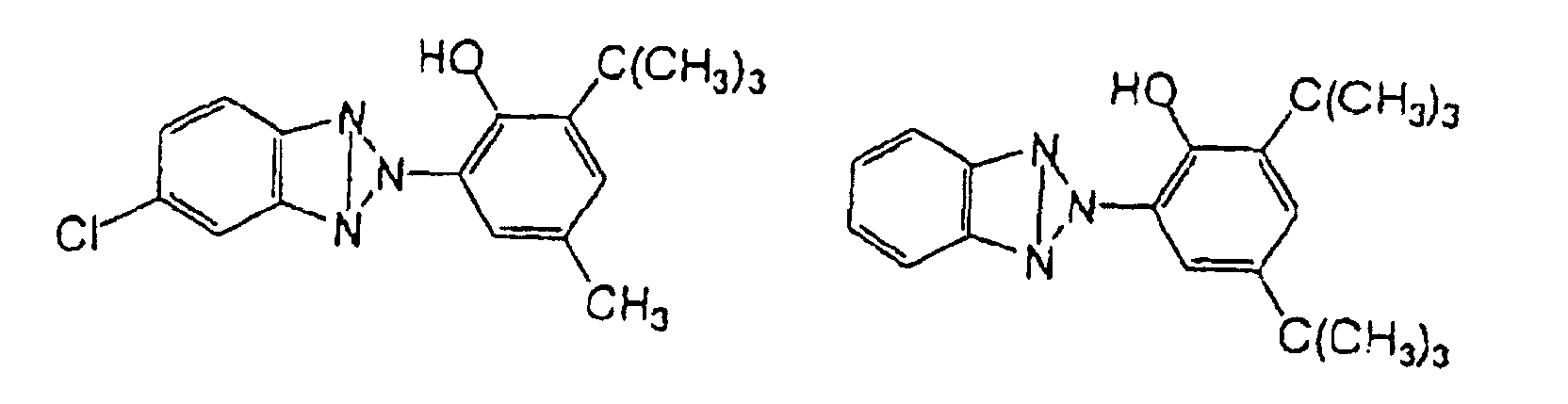


- In the invention, dispersion of the electron-donating colorless dye, electron-accepting compound and sensitizer, etc. can be performed in a water-soluble binder. The water-soluble binder to be used in this case is preferably a compound that is dissolved in an amount of 5 % by weight or more in water at 25 °C.
- Specific examples of the water-soluble binder include polyvinyl alcohol, methyl cellulose, carboxymethyl cellulose, starches (including modified starches), gelatin, gum arabic, casein, and saponification products of a styrene-maleic anhydride copolymer.
- The binder is used not only during the dispersion but also for the purpose of enhancing the coating film strength of the heat-sensitive color-developing layer. In order to achieve this purpose, synthetic polymer latex-based binders such as styrene-butadiene copolymers, vinyl acetate copolymers, acrylonitrile-butadiene copolymers, methyl acrylate-butadiene copolymers, and polyvinylidene chloride can also be jointly used.
- The foregoing electron-donating colorless dye, electron-accepting compound and sensitizer, etc. are dispersed simultaneously or separately by a stirrer or pulverizer such as a ball mill, an attritor, and a sand mill and prepared as a coating solution. In the coating solution, may be further added metallic soaps, waxes, surfactants, antistatics, UV absorbers, antifoaming agents, fluorescent dyes, etc., if necessary.
- Examples of the metallic soaps include higher fatty acid metal salts such as zinc stearate, potassium stearate, and aluminum stearate.
- Examples of the waxes include paraffin wax, microcrystalline wax, carnauba wax, methylol stearamide, polyethylene wax, polystyrene wax, and fatty acid amide-based waxes. These waxes may be used singly or in mixture. Examples of the surfactants include alkali metal salts or ammonium salts of alkylbenzenesulfonic acids, sulfosuccinic acid-based alkali metal salts, and fluorine-containing surfactants.
- In the thermal recording material of the invention, in order to impart adaptability to inkjet recording, it is effective to use a cationic polymer. The cationic polymer may be added to any of the thermal recording layer and the protective layer. Examples of the cationic polymer include polyethyleneimine, polydiallylamine, polyallylamine, polydiallyldimethylammonium chloride, polymethacryloyloxyethyl β-hydroxyethyldimethylammonium chloride, polyallylamine hydrochloride, polyamide-polyamine resins, cationic starches, dicyanediamide-formalin condensates, dimethyl 2-hydroxypropylammonium salt polymers, polyamidines, and polyvinylamines.
- These materials are mixed and then applied onto the support. The application method is not particularly limited, but the mixture is applied by using, for example, an air knife coater, a roll coater, a blade coater, or a curtain coater, dried, subjected to smoothening processing by calendering, and then put into use. The method using a curtain coater is particularly preferred in the invention.
- Further, the coating amount of the heat-sensitive color-developing layer is not limited, but is usually preferably from about 2 to 7 g/m2 by dry weight.
- In addition, the thermal recording material of the invention preferably has an image retention rate of 65 % or more. The image retention rate is expressed by a rate of the image density of an image after being stored in an atmosphere at 60 °C and at a relative humidity of 20 % for 24 hours to the image density measured immediately after printing by a Macbeth reflection densitometer (for example, RD-918).

- A protective layer can be provided on the heat-sensitive color-developing layer, if necessary. The protective layer can contain organic or inorganic fine powders, binders, surfactants, thermoplastic substances, etc. Examples of the fine powders include inorganic fine powders such as calcium carbonate, silica, zinc oxide, titanium oxide, aluminum hydroxide, zinc hydroxide, barium sulfate, clay, talc, and surface-processed calcium or silica; and organic fine powders such as urea-formalin resins, styrene/methacrylic acid copolymers, and polystyrene.
- Examples of the binders that can be used in the protective layer include polyvinyl alcohol, carboxy-modified polyvinyl alcohol, vinyl acetate-acrylamide copolymers, silicon-modified polyvinyl alcohol, starches, modified starches, methyl cellulose, carboxymethyl cellulose, hydroxymethyl cellulose, gelatins, gum arabic, casein, styrene-maleic acid copolymer hydrolyzates, polyacrylamide derivatives, polyvinylpyrrolidone, and latices such as a styrene-butadiene rubber latex, an acrylonitrile-butadiene rubber latex, a methyl acrylate-butadiene rubber latex, and a vinyl acetate emulsion.
- Further, it is possible to add a waterproofing agent that crosslinks the binder component in the protective layer to further enhance the preservability of the thermal recording layer. Examples of the waterproofing agent include water-soluble initial condensates such as N-methylolurea, N-methylolmelamine, and urea-formalin; dialdehyde compounds such as glyoxal and glutaraldehyde; inorganic crosslinking agents such as boric acid, borax, and colloidal silica; and polyamide epichlorohydrin.
- The present invention will be specifically described below with reference to the following Examples, but it should not be construed that the invention is limited thereto. Further, all parts and percentages are parts by weight and % by weight, unless otherwise indicated.
- The mean particle size was measured by using LA500 (trade name, manufactured by Horiba, Ltd.)
- Using the following composition, dispersion having a mean particle size of 0.8 µm was obtained by a ball mill.
3-Diethylamino-6-methyl-7-anilinofluorane 10 parts 2.5 % solution of polyvinyl alcohol (trade name: PVA-105 50 parts (degree of hydrolysis: 98.5 % by mole, degree of polymerization: 500), manufactured by Kuraray Co., Ltd.) - Using the following composition, dispersion having a mean particle size of 0.8 µm was obtained by a ball mill.
4-Hydroxybenzenesulfone anilide 20 parts 2.5 % solution of polyvinyl alcohol (trade name: PVA-105) 100 parts - Using the following composition, dispersion having a mean particle size of 0.8 µm was obtained by a ball mill.
2-Benzyloxynaphthalene 20 parts 2.5 % solution of polyvinyl alcohol (trade name: PVA-105) 100 parts - Using the following composition, a pigment dispersion having a mean particle size of 2.0 µm was obtained by a sand mill.
Amorphous silica (trade name: MIZUKASIL P-832, 20 parts manufactured by Mizusawa Industrial Chemicals, Ltd.) Sodium polyacrylate 1 part Water 80 parts - A solution of thermal recording layer was obtained by mixing 60 parts of the solution A, 120 parts of the solution B, 120 parts of the solution C, 101 parts of the solution D, 15 parts of a 30 % dispersion of zinc stearate, 15 parts of a paraffin wax (30 %) solution, and 4 parts of sodium dodecylbenzenesulfonate (25 %).
- Using the following component, stirring and mixing were performed by a dissolver to obtain dispersion.
Calcined kaolin (oil absorbency: 75 mL/100 g) 100 parts Sodium hexametaphosphate 1 part Distilled water 110 parts - To the resulting dispersion, were added 20 parts of SBR (styrene-butadiene rubber latex) and 25 parts of oxidized starch (25 %) to obtain a coating solution for undercoat layer.
- The resulting coating solution for undercoat layer was applied onto a sheet of recycled paper (basis weight: 50 g/m2) composed of 70 % of waste paper pulp and 30 % and LBKP and having a smoothness, as defined in JIS-P8119, of 170 seconds at a coating amount (after drying) of 8 g/m2 by a blade coater, to form an undercoat layer, which was then dried and subjected to calendering processing to prepare a sheet of undercoated original paper. Subsequently, the foregoing coating solution for thermal recording material was applied onto the undercoat layer at a coating amount (after drying) of 4 g/m2 by a curtain coater, dried and then subjected to calendering processing to obtain a thermal recording material of Example 1.
- A thermal recording material of Example 2 was obtained in the same manner as in Example 1, except in that the amorphous silica used in the solution D of Example 1 was changed to 40 parts of cubic system calcium carbonate (trade name: BRILLIANT 15, manufactured by Shiraishi Kogyo Kaisha, Ltd., Mohs Hardness: 3).
- A thermal recording material of Example 3 was obtained in the same manner as in Example 1, except in that the amorphous silica used in the solution D of Example 1 was changed to 40 parts of aluminum hydroxide (trade name: HIGILITE H42, manufactured by Showa Denko K.K., mean particle size: 1.0 µm, Mohs Hardness: 3).
- A thermal recording material of Example 4 was obtained in the same manner as in Example 1, except in that the amorphous silica used in the solution D of Example 1 was changed to 40 parts of aluminum hydroxide (trade name: C-3005, manufactured by Sumitomo Chemical Co., Ltd., mean particle size: 0.6 µm, Mohs Hardness: 3).
- A thermal recording material of Example 5 was obtained in the same manner as in Example 1, except in that the amorphous silica used in the solution D of Example 1 was changed to 40 parts of bur-shaped calcium carbonate (trade name: UNIBER 70, manufactured by Shiraishi Kogyo Kaisha, Ltd., mean particle size: 1.5 µm, Mohs Hardness: 3).
- A thermal recording material of Example 6 was obtained in the same manner as in Example 1, except in that the amorphous silica of Example 1 was changed to 30 parts of aluminum hydroxide (trade name: C-3005, manufactured by Sumitomo Chemical Co., Ltd., mean particle size: 0.6 µm, Mohs Hardness: 3) and 10 parts of basic magnesium carbonate (trade name: KINSEI, manufactured by Konoshima Chemical Kogyo Co., Ltd., mean particle size: 0.6 µm).
- A thermal recording material of Example 7 was obtained in the same manner as in Example 1, except in that the amorphous silica of Example 1 was changed to 30 parts of aluminum hydroxide (trade name: C-3005, manufactured by Sumitomo Chemical Co., Ltd., mean particle size: 0.6 µm, Mohs Hardness: 3) and 10 parts of magnesium oxide (trade name: STARMAG M, manufactured by Konoshima Chemical Kogyo Co., Ltd., mean particle size: 0.5 µm).
- A thermal recording material of Example 8 was obtained in the same manner as in Example 5, except in that the coating solution for thermal recording layer of Example 5 was applied by an air knife coater.
- A thermal recording material of Comparative Example 1 was obtained in the same manner as in Example 1, except in that the 4-hydroxybenzenesulfone anilide used in the solution B of Example 1 was changed to bisphenol A.
- A thermal recording material of Comparative Example 2 was obtained in the same manner as in Example 1, except in that the 4-hydroxybenzenesulfone anilide used in the solution B of Example 1 was changed to p-N-benzylsulfamoylphenol (i.e., N-benzyl-4-hydroxybenzenesulfonamide) as described Example 2 of in JP-B No. 4-20792.
- A thermal recording material of Referential Example 1 was obtained in the same manner as in Example 1, except in that fine quality paper composed of 50 % of NBK and 50 % of LBK and having a smoothness, as defined in JIS-P8119, of 170 seconds was used in place of the recycled paper of Comparative Example 1.
- With respect to the thermal recording materials obtained in Examples 1 to 8, Comparative Examples 1 and 2 and Referential Example 1, the evaluation results are shown in Table 1. In Table 1, the sensitivity, background fogging, image preservability, abrasion properties of thermal head, and resistance to inkjet inks were evaluated in the following manners.
- Printing was performed using a heat-sensitive printing device having a thermal head (trade name: KJT-216-8MPD1, manufactured by Kyocera Corporation) and pressure rolls of 100 kg/cm2 just before the head. The printing was carried out with a pulse width of 1.5 ms under the condition of a head voltage of 24 V and a pulse frequency of 10 ms, and its printing density was measured by a Macbeth reflection densitometer (RD-918).
- The background after being stored in an environment at 60 °C for 24 hours was measured by a Macbeth reflection densitometer (RD-918). A lower numerical value means a better result.
- The image density after being stored in an environment at 60 °C for 24 hours was measured by a Macbeth reflection densitometer (RD-918), and a retention rate to the image density of a non-treated product was calculated. A higher numerical value means better image preservability.
- A test chart with a printing rate of 20 % was printed on 1,000 A4-size sheets using a word processor (trade name: TOSHIBA RUPO JV, manufactured by Toshiba Corporation). Thereafter, the abrasion level of a serial thermal head was observed and evaluated according to the following criteria.
-
- A: Abrasion of the thermal head was not substantially observed, and white spots and the like were not found on the prints.
- B: Abrasion of the thermal head was slightly observed, but white spots and the like were not found on the prints.
- C: The degree of abrasion of the thermal head was large, and defects such as white spots were found on the prints.
- An image obtained by high-image quality printing using an inkjet printer (trade name: MJ930C, manufactured by Seiko Epson Corporation) was brought into contact with the surface of each of the thermal recording materials as printed in the same manner as in the case of the sensitivity as described above, and after being stored at 25 °C for 48 hours, the image density was measured by a Macbeth reflection densitometer (RD-918). The image density of a non-treated product was also measured. A rate (retention rate) of the image density of the treated product to the former was calculated. A higher numerical value means better resistance against inkjet inks.

- As clearly shown by the results in Table 1, the thermal recording materials obtained in the Examples of the invention were a thermal recording material that was superior in sensitivity, background fogging and storage stability of color-developed images, while using recycled paper composed mainly of waste paper pulp as the support. Further, the thermal recording materials of Examples 1 to 8 were low in abrasion of thermal head and superior in resistance to inkjet inks.
- On the other hand, when bisphenol A was used as the color developer and recycled paper was used as the support, the background fogging and image preservability were remarkably inferior, and abrasion of the thermal head was observed. Further, in Comparative Example 2 using a sulfonamide compound different from the sulfonamide compound of the invention, not only the sensitivity, background fogging and image preservability were inferior, but also abrasion of the thermal head was observed. Moreover, even when fine quality paper was used as the support, in a case bisphenol A was used as the color developer, the sensitivity and image preservability were inferior, and abrasion of the thermal head was observed. In addition, the thermal recording materials of Comparative Examples 1 and 2 and Referential Example 1 were inferior in resistance to inkjet inks.
- Using the following composition, dispersion having a mean particle size of 0.8 µm was obtained by a ball mill.
2-Anilino-3-methyl-6-di-n-butylaminofluorane 10 parts 2.5 % solution of polyvinyl alcohol (trade name: PVA-105 50 parts (degree of hydrolysis: 98.5 % by mole, degree of polymerization: 500), manufactured by Kuraray Co., Ltd.) - Using the following composition, dispersion having a mean particle size of 0.8 µm was obtained by a ball mill.
4-Hydroxybenzenesulfone anilide 20 parts 2.5 % solution of polyvinyl alcohol (trade name: PVA-105) 100 parts - Using the following composition, dispersion having a mean particle size of 0.8 µm was obtained by a sand mill.
2-Benzyloxynaphthalene 20 parts 2.5 % solution of polyvinyl alcohol (trade name: PVA-105) 100 parts - Using the following composition, a pigment dispersion having a mean particle size of 2.0 µm was obtained by a ball mill.
Calcium carbonate (trade name: UNIBER 70, 20 parts manufactured by Shiraishi Kogyo Kaisha, Ltd.) Sodium polyacrylate 1 part Water 80 parts - A solution of thermal recording layer was obtained by mixing 60 parts of the solution E, 120 parts of the solution F, 120 parts of the solution G, 101 parts of the solution H, 15 parts of a 30 % dispersion of zinc stearate, 15 parts of a paraffin wax (30 %) solution, and 4 parts of sodium dodecylbenzenesulfonate (25 %).
- Using the following component, stirring and mixing were performed by a dissolver to obtain dispersion.
Calcined kaolin (oil absorbency: 75 mL/100 g) 100 parts Sodium hexametaphosphate 1 part Water 110 parts - To the resulting dispersion, were added 20 parts of SBR (styrene-butadiene rubber latex) and 25 parts of oxidized starch (25 %) to obtain a coating solution for undercoat layer of support.
- The resulting coating solution for undercoat layer was applied onto a sheet of recycled paper (basis weight: 50 g/m2) composed of 70 % of waste paper pulp and 30 % of LBKP and having a paper surface pH, as measured using a pH indicator for paper surface measurement (manufactured by Kyoritsu Chemical-Check Lab., Corp.), of 6 and having a smoothness, as defined in JIS-P8119, of 170 seconds at a coating amount (after drying) of 8 g/m2 by a blade coater, to form an undercoat layer, which was then dried and subjected to calendering processing to prepare a sheet of undercoated original paper. Subsequently, the foregoing coating solution for thermal recording material was applied onto the undercoat layer at a coating amount (after drying) of 4 g/m2 by a curtain coater, dried and then subjected to calendering processing to obtain a thermal recording material of Example 9.
- A thermal recording material of Example 10 was obtained in the same manner as in Example 9, except in that the electron-donating dye (2-anilino-3-methyl-6-di-n-butylaminofluorane) used in the solution E of Example 9 was changed to 2-anilino-3-methyl-6-di-n-amylaminofluorane (BLACK 305).
- A thermal recording material of Example 11 was obtained in the same manner as in Example 9, except in that the electron-donating dye (2-anilino-3-methyl-6-di-n-butylaminofluorane) used in the solution E of Example 9 was changed to 2-anilino-3-methyl-6-(N-ethyl-N-p-benzyl)aminofluorane.
- A thermal recording material of Example 12 was obtained in the same manner as in Example 9, except in that the recycled paper having a pH of 6 as used in Example 9 was changed to recycled paper having a pH of 9.
- A thermal recording material of Example 13 was obtained in the same manner as in Example 9, except in that the recycled paper having a pH of 6 as used in Example 9 was changed to recycled paper having a pH of 5.
- A thermal recording material of Example 14 was obtained in the same manner as in Example 9, except in that the recycled paper having a pH of 6 as used in Example 9 was changed to recycled paper having a pH of 10.
- A thermal recording material of Comparative Example 3 was obtained in the same manner as in Example 9, except in that the 4-hydroxybenzenesulfone anilide used as the electron-accepting compound in the solution F of Example 9 was changed to bisphenol A.
- A thermal recording material of Comparative Example 4 was obtained in the same manner as in Example 9, except in that the 4-hydroxybenzenesulfone anilide used as the electron-accepting compound in the solution F of Example 9 was changed to N-benzyl-4-hydroxybenzenesulfonamide.
- A thermal recording material of Comparative Example 5 was obtained in the same manner as in Example 9, except in that the 2-anilino-3-methyl-6-di-n-butylaminofluorane used as the electron-donating colorless dye in the solution E of Example 9 was changed to 2-anilino-3-methyl-6-(N-cyclohexyl-N-methyl)aminofluorane.
- A thermal recording material of Comparative Example 6 was obtained in the same manner as in Example 9, except in that the 2-anilino-3-methyl-6-di-n-butylaminofluorane used as the electron-donating colorless dye in the solution E of Example 9 was changed to 3-dimethylamino-6-methyl-7-(m-toluidino)-fluorane.
- A thermal recording material of Comparative Example 7 was obtained in the same manner as in Example 9, except in that fine quality paper composed of 50 % of NBKP and 50 % of LBKP and having a paper surface pH, as measured using a pH indicator for paper surface measurement (manufactured by Kyoritsu Chemical-Check Lab., Corp.), of 6 and having a smoothness, as defined in JIS-P8119, of 170 seconds was used in place of the recycled paper composed of 70 % of waste paper pulp and 30 % of LBKP and having a paper surface pH, as measured using a pH indicator for paper surface measurement (manufactured by Kyoritsu Chemical-Check Lab., Corp.), of 6 and having a smoothness, as defined in JIS-P8119, of 170 seconds as used in Comparative Example 3.
- With respect to the thermal recording materials obtained in Examples 9 to 14 and Comparative Examples 3 to 7, the evaluation results are shown in Table 2. In Table 2, the sensitivity, background fogging, image preservability, chemical resistance, and adaptability to inkjet printing were evaluated in the following manners.
- Printing was performed using a heat-sensitive printing device having a thermal head (trade name: KJT-216-8MPD1, manufactured by Kyocera Corporation) and pressure rolls of 100 kg/cm2 just before the head. The printing was carried out with a pulse width of 1.5 ms under the condition of a head voltage of 24 V and a pulse frequency of 10 ms, and its printing density was measured by a Macbeth reflection densitometer (RD-918).
- The background after being stored in an environment at 60 °C for 24 hours was measured by a Macbeth reflection densitometer (RD-918). A lower numerical value means a better result.
- The image density after being stored in an environment at 60 °C for 24 hours was measured by a Macbeth reflection densitometer (RD-918), and a retention rate to the image density of a non-treated product was calculated. A higher numerical value means better image preservability.
- Each of the thermal recording materials was printed under the same condition as in the case of the sensitivity as described above, and writing was made on the surfaces of the background and printed portions thereof using a fluorescent pen (trade name: ZEBRA FLUORESCENT PEN 2-PINK, manufactured by Zebra Co., Ltd.). One day after writing, the state of generation of the background fogging and the stability of the image portions of the thermal recording material were visually observed and evaluated according to the following criteria.
-
- A: The generation of fogging was not observed, and the change of the image portions was not observed.
- B: The generation of fogging was slightly observed, and the image portions slightly faded.
- C: The generation of fogging was remarkably observed, and the image portions substantially faded.
- Each of the thermal recording materials was printed with red letters in a superfine mode using an inkjet printer (trade name: MJ930, manufactured by Seiko Epson Corporation) and evaluated for the color (fogging) of the letters according to the following criteria.
-
- A:
- Vivid red
- B:
- Dull red
- C:
- Black rather than red
- As clearly shown by the results in Table 2, the thermal recording materials obtained in the Examples of the invention were a thermal recording material that is superior in sensitivity, background fogging and storage stability of color-developed images, while using recycled paper composed mainly of waste paper pulp. Further, the thermal recording materials of Examples 9 to 14 were superior in any of chemical resistance and adaptability to inkjet printing (inkjet fogging).
- On the other hand, when bisphenol A was used as the color developer and recycled paper was used as the support, the background fogging and image preservability were remarkably inferior, and the chemical resistance and adaptability to inkjet printing were inferior. Further, in Comparative Example 4 using a sulfonamide compound different from the sulfonamide compound of the invention, not only the sensitivity, background fogging and image preservability were inferior, but also the inkjet fogging was observed. Moreover, the thermal recording materials obtained in Comparative Examples 5 and 6 not using any of 2-anilino-3-methyl-6-di-n-butylaminofluorane, 2-anilino-3-methyl-6-di-n-amylaminofluorane, and 2-anilino-3-methyl-6-(N-ethyl-N-p-benzyl)aminofluorane as the electron-donating colorless dye were remarkably inferior in background fogging.
- In addition, the thermal recording materials of the invention using recycled paper as the support stood comparison in any of the check items even with the thermal recording material of Referential Example 2 using fine quality paper as the support.
- The following respective components were mixed in a sand mill while dispersing to obtain dispersion I having a mean particle size of 0.6 µm.
-
2-Anilino-3-methyl-6-diethylaminofluorane (electron-donating 10 parts colorless dye) 2.5 % solution of polyvinyl alcohol (trade name: PVA-105, 50 parts manufactured by Kuraray Co., Ltd.) - The following respective components were mixed in a sand mill while dispersing to obtain dispersion J having a mean particle size of 0.6 µm.
-
4-Hydroxybenzenesulfone anilide (electron-accepting 25 parts compound) 2.5 % solution of polyvinyl alcohol (trade name: PVA-105, 100 parts manufactured by Kuraray Co., Ltd.) - The following respective components were mixed in a sand mill while dispersing to obtain dispersion K having a mean particle size of 0.6 µm.
-
2-Benzyloxynaphthalene (sensitizer) 25 parts 2.5 % solution of polyvinyl alcohol (trade name: PVA-105, 100 parts manufactured by Kuraray Co., Ltd.) - The following respective components were mixed in a sand mill while dispersing to obtain a pigment dispersion L having a mean particle size of 1.2 µm.
-
Light calcium carbonate of calcite type (trade name:UNIBER 70, 30 parts manufactured by Shiraishi Kogyo Kaisha, Ltd.) Sodium hexametaphosphate 0.3 parts Distilled water 40 parts - The compounds having the following composition were mixed to obtain a coating solution for heat-sensitive color-developing layer.
-
Dispersion I 60 parts Dispersion J 125 parts Dispersion K 125 parts Pigment dispersion L 70 parts 30 % dispersion of zinc stearate 15 parts Paraffin wax (30 %) 15 parts Sodium dodecylbenzenesulfonate (25 %) 4 parts - The following respective components were stirred and mixed by a dissolver, to which were then added 20 parts of SBR (styrene-butadiene rubber latex) and 25 parts of oxidized starch (25 %) to obtain a coating solution for undercoat layer of support.
-
Calcined kaolin (oil absorbency: 75 mL/100 g) 100 parts Sodium hexametaphosphate 1 part Distilled water 110 parts - The thus obtained coating solution for undercoat layer of support was applied onto a sheet of fine quality original paper having a Stoeckigt size of 10 seconds and a basis weight of 50 g/m2 at a coating amount (after drying) of 8 g/m2 by a blade coater, dried and then subjected to calendering processing, to prepare an undercoat layer. Subsequently, the foregoing coating solution for thermal recording material was applied onto the undercoat layer at a coating amount (after drying) of 4 g/m2 by a curtain coater, followed by drying. The surface of the thus formed heat-sensitive color-developing layer was subjected to calendering processing to obtain a thermal recording material of Example 1.
- A thermal recording material according to Example 16 was prepared in the same manner as in Example 15, except in that the light calcium carbonate of calcite type (UNIBER 70) of the pigment dispersion L in Example 15 was changed to calcium carbonate of calcite type (trade name: TAMA PEARL 121, manufactured by Okutama Kogyo Co., Ltd.).
- A thermal recording material according to Example 17 was prepared in the same manner as in Example 15, except in that the light calcium carbonate of calcite type (UNIBER 70) of the pigment dispersion L in Example 15 was changed to aluminum hydroxide (trade name: HIGILITE H42, manufactured by Showa Denko K.K.).
- A thermal recording material according to Example 18 was prepared in the same manner as in Example 15, except in that the amount of the pigment dispersion L in Example 15 was changed from 70 parts to 35 parts.
- A thermal recording material according to Example 19 was prepared in the same manner as in Example 15, except in that the amount of the pigment dispersion L in Example 15 was changed from 70 parts to 140 parts.
- A thermal recording material according to Example 20 was prepared in the same manner as in Example 15, except in that the amount of the pigment dispersion L in Example 15 was changed from 70 parts to 17.5 parts.
- A thermal recording material according to Example 21 was prepared in the same manner as in Example 15, except in that the amount of the pigment dispersion L in Example 15 was changed from 70 parts to 210 parts.
- A thermal recording material according to Example 22 was prepared in the same manner as in Example 15, except in that the mean particle size of the dispersion L in Example 15 was changed from 1.2 µm to 2.2 µm.
- A thermal recording material according to Example 23 was prepared in the same manner as in Example 15, except in that the mean particle size of the dispersion L in Example 15 was changed from 1.2 µm to 0.8 µm.
- A thermal recording material according to Example 24 was prepared in the same manner as in Example 15, except in that the mean particle size of the dispersion L in Example 15 was changed from 1.2 µm to 0.5 µm.
- A thermal recording material according to Example 25 was prepared in the same manner as in Example 15, except in that the mean particle size of the dispersion L in Example 15 was changed from 1.2 µm to 3.0 µm.
- A thermal recording material according to Example 26 was prepared in the same manner as in Example 15, except in that in Example 15, the following coating solution for undercoat layer of support was applied onto a sheet of fine quality original paper having a Stoeckigt size of 10 seconds and a basis weight of 50 g/m2 at a coating amount (after drying) of 8 g/m2 by an air knife coater in place of the blade coater, dried and then subjected to calendering processing, to prepare a sheet of undercoated original paper.
- The following respective components were stirred and mixed by a dissolver, to which were then added 20 parts of SBR (styrene-butadiene rubber latex) and 25 parts of oxidized starch (25 %) to obtain a coating solution for undercoat layer of support.
-
Calcined kaolin (oil absorbency: 75 mL/100 g) 100 parts Sodium hexametaphosphate 1 part Distilled water 314 parts - A thermal recording material according to Example 27 was prepared in the same manner as in Example 15, except in that in Example 15, the coating solution for thermal recording material was applied onto the undercoat layer by an air knife coater in place of the curtain coater.
- A thermal recording material according to Example 28 was prepared in the same manner as in Example 15, except in that the light calcium carbonate of calcite type (UNIBER 70) of the pigment dispersion L in Example 15 was changed to kaolin (trade name: KAOGLOSS, manufactured by Shiraishi Calcium Kaisha, Ltd.).
- A thermal recording material according to Example 29 was prepared in the same manner as in Example 15, except in that in Example 15, before subjecting the formed heat-sensitive color-developing layer to calendering processing, the following coating solution for protective layer was further applied onto the heat-sensitive color-developing layer at a coating amount (after drying) of 2 g/m2 by a curtain coater and then dried to form a protective layer, followed by subjecting the surface of the protective layer to calendering processing.
- First of all, the following composition was dispersed in a sand mill to obtain a pigment dispersion having a mean particle size of 2 µm. Subsequently, 60 parts of water was added to 200 parts of a 15 % aqueous solution of urea phosphated starch (trade name: MS4600, manufactured by Nihon Shokuhinkako Co., Ltd.) and 200 parts of a 15 % aqueous solution of polyvinyl alcohol (trade name: PVA-105, manufactured by Kuraray Co., Ltd.), with which was then mixed the foregoing pigment dispersion. The mixture was further mixed with 25 parts of an emulsified dispersion of zinc stearate having a mean particle size of 0.15 µm (trade name: HYDRIN F115, manufactured by Chukyo Yushi Co., Ltd.) and 125 parts of a 2 % aqueous solution of 2-ethylhexyl sulfosuccinate sodium salt, to obtain a coating solution for protective layer.
-
Aluminum hydroxide (mean particle size: 1 µm) (trade 40 parts name: HIGILITE H42, manufactured by Showa Denko K.K.) Sodium polyacrylate 1 part Water 60 parts - A thermal recording material according to Example 30 was prepared in the same manner as in Example 15, except in that the light calcium carbonate of calcite type (UNIBER 70) of the pigment dispersion L in Example 15 was changed to amorphous silica (trade name: MIZUKASIL P78A, manufactured by Mizusawa Industrial Chemicals, Ltd.).
- A thermal recording material according to Example 31 was prepared in the same manner as in Example 30, except in that in Example 30, 30 parts of polyamine polyamide epichlorohydrin (trade name: ARAFIX 2300, manufactured by Arakawa Chemical Industries, Ltd.) was added.
- A thermal recording material according to Comparative Example 8 was prepared in the same manner as in Example 15, except in that the light calcium carbonate of calcite type (UNIBER 70) of the pigment dispersion L in Example 15 was changed to aragonite-based calcium carbonate (trade name: CALLITE SA, manufactured by Shiraishi Kogyo Kaisha, Ltd.).
- A thermal recording material according to Comparative Example 9 was prepared in the same manner as in Example 15, except in that the 4-hydroxybenzenesulfone anilide of the dispersion J in Example 15 was changed to 2,2-bis(4-hydroxyphenyl)propane [bisphenol A].
- A thermal recording material according to Comparative Example 10 was prepared in the same manner as in Example 15, except in that the 4-hydroxybenzenesulfone anilide of the dispersion J in Example 15 was changed to N-benzyl-4-hydroxybenzenesulfonamide (i.e., p-N-benzylsulfamoylphenol).
- Each of the thermal recording materials obtained in the foregoing Examples 15 to 31 and Comparative Examples 8 to 10 was printed using a thermosensitive printing device having a thermal head (trade name: KJT-216-8MPD1, manufactured by Kyocera Corporation) and pressure rolls of 100 kg/cm2 just before the head. The printing was carried out with a pulse width of 1.5 ms under the condition of a head voltage of 24 V and a pulse frequency of 10 ms, and its printing density was measured by a Macbeth reflection densitometer (RD-918). The results are shown in Table 3.
- With respect to each of the thermal recording materials obtained in the foregoing Examples 15 to 31 and Comparative Examples 8 to 10, the background after being stored in an environment at 60 °C and at a relative humidity of 20 % for 24 hours was measured by a Macbeth reflection densitometer (RD-918). The results are shown in Table 3. A lower numerical value means a better result.
- Each of the thermal recording materials obtained in the foregoing Examples 15 to 31 and Comparative Examples 8 to 10 was recorded with an image using the same device and under the same condition as in (1) above, and then stored in an environment at 60 °C and at a relative humidity of 20 % for 24 hours. Thereafter, the image density was measured by a Macbeth reflection densitometer (RD-918), and a retention rate to the image density of a non-treated product on which an image had been recorded using the same device and under the same condition as in (1) above was calculated by the following equation. The results are shown in Table 3. A higher numerical value means better image preservability.

- On the surface of each of the thermal recording materials obtained in the foregoing Examples 15 to 31 and Comparative Examples 8 to 10, writing was made using a fluorescent pen (trade name: ZEBRA FLUORESCENT PEN 2-PINK, manufactured by Zebra Co., Ltd.). One day after writing, the state of generation of the background fogging and the stability of the image portions of each thermal recording material were visually observed and evaluated according to the following criteria.
-
- A: The generation of fogging was not observed, and the change of the image portions was not observed.
- B: The generation of fogging was slightly observed, and the image portions slightly faded.
- C: The generation of fogging was remarkably observed, and the image portions substantially faded.
- About 100 m of each of the thermal recording materials obtained in the foregoing Examples 15 to 31 and Comparative Examples 8 to 10 was printed using a facsimile machine (trade name: SFX 85, manufactured by Sanyo Electric co., Ltd.) and No. 3 Chart of The Imaging Society of Japan as a test chart. Thereafter, the state of adhesion of scum to thermal head was observed and evaluated according to the following criteria. The results are shown in Table 3.
-
- A: Adhesion of scum was not observed, and white spots and the like were not found on the prints.
- B: An adhesion amount of scum was slight, and white spots and the like were not found on the prints.
- C: An adhesion amount of scum was medium, and white spots and the like were not found on the prints.
- D: An adhesion amount of scum was large, and defects such as white spots were found on the prints.
- With respect to each of the thermal recording materials obtained in the foregoing Examples 15 to 31 and Comparative Examples 8 to 10, a test chart with a printing rate of 20 % was printed on 1,000 A4-size sheets using a word processor (trade name: TOSHIBA RUPO JV, manufactured by Toshiba Corporation). Thereafter, the abrasion level of a serial thermal head was observed and evaluated according to the following criteria. The results are shown in Table 3.
-
- A: Abrasion of the thermal head was not observed, and white spots and the like were not found on the prints.
- B: Abrasion of the thermal head was not substantially observed, and white spots and the like were not found on the prints.
- C: Abrasion of the thermal head was slightly observed, but white spots and the like were not found on the prints.
- D: The degree of abrasion of the thermal head was large, and defects such as white spots were found on the prints.
- A sheet on which letters had been printed using a word processor (trade name: TOSHIBA RUPO JW-95JU, manufactured by Toshiba Corporation) was printed by an inkjet printer, and bleeding of the inkjet recording and fading of the letters recorded by the word processor were visually evaluated according to the following criteria.
-
- A: Bleeding and fading were not observed, and there was no problem in reading.
- B: The letters became slightly pale, but there was no problem in reading.
- C: The letters became faint, but could be read.
- D: The letters completely faded and were illegible.
- An image obtained by high-image quality printing using an inkjet printer (trade name: MJ930C, manufactured by Seiko Epson Corporation) was brought into contact with the surface of each of the thermal recording materials as printed in the same manner as in the case of the sensitivity as described above, and after being stored at 25 °C for 48 hours, the image density was measured by a Macbeth reflection densitometer (RD-918). The image density of a non-treated product was also measured. A rate (retention rate) of the image density of the treated product to the former was calculated. A higher numerical value means better resistance against inkjet inks.

- As shown in Table 3, the thermal recording materials according to Examples 15 to 31 were good in each of sensitivity, background fogging, image preservability, chemical resistance, adhesion of scum to head, and head abrasion. In particular the thermal recording materials in which the amount of the inorganic pigment to be used was from 50 to 250 % on a basis of the electron-accepting compound was more superior in the foregoing performances. Further, in comparison between Example 15 and Example 26, when the undercoat layer was applied using the blade coater, the image stability was superior.
- On the other hand, the thermal recording materials according to Comparative Examples 8 to 10 were inferior in any one of the foregoing performances. Especially, when bisphenol A was used as the electron-accepting compound, the image preservability was extremely low.
- The following respective components were mixed in a ball mill while dispersing to obtain dispersion M having a mean particle size of 0.7 µm.
-
2-Anilino-3-methyl-6-di-n-butylaminofluorane 10 parts 2.5 % solution of polyvinyl alcohol (trade name: PVA-105, 50 parts manufactured by Kuraray Co., Ltd.) - The following respective components were mixed in a ball mill while dispersing to obtain dispersion N having a mean particle size of 0.7 µm.
-
4-Hydroxybenzenesulfone anilide 20 parts 2.5 % solution of polyvinyl alcohol (trade name: PVA-105, 100 parts manufactured by Kuraray Co., Ltd.) - The following respective components were mixed in a ball mill while dispersing to obtain dispersion O having a mean particle size of 0.7 µm.
-
2-Benzyloxynaphthalene (sensitizer) 20 parts 2.5 % solution of polyvinyl alcohol (trade name: PVA-105, 100 parts manufactured by Kuraray Co., Ltd.) - The following respective components were mixed in a sand mill while dispersing to obtain a pigment dispersion P having a mean particle size of 2.0 µm and a pH of 9.5.
-
Light calcium carbonate 40 parts Sodium polyacrylate 1 part Water 60 parts - The compounds having the following composition were mixed to obtain a coating solution for heat-sensitive color-developing layer.
-
Dispersion M 60 parts Dispersion N 120 parts Dispersion O 120 parts Pigment dispersion P 101 parts 30 % dispersion of zinc stearate 15 parts Paraffin wax (30 %) 15 parts Sodium dodecylbenzenesulfonate (25 %) 4 parts - The following respective components were stirred and mixed by a dissolver to obtain dispersion.
Calcined kaolin (oil absorbency: 75 mL/100 g) 100 parts Sodium hexametaphosphate 1 part Water 110 parts - To the resulting dispersion were added 20 parts of SBR (styrene-butadiene rubber latex) and 25 parts of oxidized starch (25 %) to obtain a coating solution for undercoat layer of support.
- The thus obtained coating solution for undercoat layer of support was applied onto a sheet of fine quality paper having a smoothness according to JIS-P8119 of 150 seconds at a coating amount (after drying) of 8 g/m2 by a blade coater, to form an undercoat layer. By providing the undercoat layer, the support had a smoothness according to JIS-P8119 of 350 seconds. Subsequently, the foregoing coating solution for thermal recording material was applied onto the undercoat layer at a coating amount (after drying) of 4 g/m2 by a curtain coater, followed by drying. The surface of the thus formed heat-sensitive color-developing layer was subjected to calendering processing to obtain a thermal recording material of Example 32.
- A thermal recording material of Example 33 was prepared in the same manner as in Example 32, except in that the 2-anilino-3-methyl-6-di-n-butyalminofluorane of the composition of the dispersion M in Example 32 was changed to 2-anilino-3-methyl-6-di-n-amylaminofluorane.
- A thermal recording material of Example 34 was prepared in the same manner as in Example 32, except in that the 2-anilino-3-methyl-6-di-n-butyalminofluorane of the composition of the dispersion M in Example 32 was changed to 2-anilino-3-methyl-6-(N-ethyl-N-p-benzyl)aminofluorane.
- A thermal recording material of Example 35 was prepared in the same manner as in Example 32, except in that the light calcium carbonate of the composition of the pigment dispersion P in Example 32 was changed to aluminum hydroxide (trade name: HIGILITE H42, manufactured by Showa Denko K.K.) and that the pH of the dispersion was changed to 9.1.
- A thermal recording material of Example 36 was prepared in the same manner as in Example 32, except in that the light calcium carbonate of the composition of the pigment dispersion P in Example 32 was changed to kaolin (trade name: KAOGLOSS, manufactured by Shiraishi Calcium Kaisha, Ltd.) and that the pH of the dispersion was changed to 7.
- A thermal recording material of Example 37 was prepared in the same manner as in Example 32, except in that the light calcium carbonate of the composition of the pigment dispersion P in Example 32 was changed to silica (trade name: MIZUKASIL P526, manufactured by Mizusawa Industrial Chemicals, Ltd.) and that the pH of the dispersion was changed to 6.5.
- A thermal recording material of Comparative Example 11 was prepared in the same manner as in Example 32, except in that the 4-hydroxybenzenesulfone anilide of the composition of the dispersion N in Example 32 was changed to bisphenol A.
- A thermal recording material of Comparative Example 12 was prepared in the same manner as in Example 32, except in that the 4-hydroxybenzenesulfone anilide of the composition of the dispersion N in Example 32 was changed to N-benzyl-4-hydroxybenzenesulfonamide.
- A thermal recording material of Comparative Example 13 was prepared in the same manner as in Example 32, except in that the 2-anilino-3-methyl-6-di-n-butylaminofluorane of the composition of the dispersion M in Example 32 was changed to 2-anilino-3-methyl-6-(N-cyclohexyl-N-methyl)aminofluorane.
- A thermal recording material of Comparative Example 14 was prepared in the same manner as in Example 32, except in that the 2-anilino-3-methyl-6-di-n-butylaminofluorane of the composition of the dispersion M in Example 32 was changed to 3-dimethylamino-6-methyl-7-(m-toluidino)-fluorane.
- A thermal recording material of Comparative Example 15 was prepared in the same manner as in Example 32, except in that the light calcium carbonate of the composition of the pigment dispersion P in Example 32 was not used.
- Each of the thermal recording materials prepared in Examples 32 to 37 and Comparative Examples 11 to 15 was evaluated in terms of the following items.
- Printing was performed using a thermosensitive printing device having a thermal head (trade name: KJT-216-8MPD1, manufactured by Kyocera Corporation). The printing was carried out with a pulse width of 1.5 ms under the condition of a head voltage of 24 V and a pulse frequency of 10 ms, and its printing density was measured by a Macbeth reflection densitometer (RD-918). The results are shown in Table 4.
- With respect to each of the thermal recording materials, its background after being stored in an environment at 60 °C and at a relative humidity of 20 % for 24 hours was measured by a Macbeth reflection densitometer (RD-918). The results are shown in Table 4. A lower numerical value means a better result.
- With respect to each of the thermal recording materials, an image was recorded using the same device and under the same condition as in (1) above, and then stored in an atmosphere at 60 °C and at a relative humidity of 20 % for 24 hours. Thereafter, the image density was measured by a Macbeth reflection densitometer (RD-918). A rate (image retention rate) of the image density to the image density immediately after printing under the same condition (1) above was calculated by the following equation. The results are shown in Table 4. A higher numerical value means better image preservability.

- Each of the thermal recording materials was printed under the same condition as in (1) above, and writing was made on the surfaces of the background and printed portions thereof using a fluorescent pen (trade name: ZEBRA FLUORESCENT PEN 2-PINK, manufactured by Zebra Co., Ltd.). One day after writing, the state of generation of the background fogging and the stability of the image portions of the thermal recording material were visually observed and evaluated according to the following criteria. The results are shown in Table 4.
-
- A: The generation of fogging was not observed, and the change of the image portions was not observed.
- B: The generation of fogging was slightly observed, and the image portions slightly faded.
- C: The generation of fogging was remarkably observed, and the image portions substantially faded.
- Each of the thermal recording materials was printed with red letters in a superfine mode using an inkjet printer (trade name: MJ930, manufactured by Seiko Epson Corporation) and evaluated for the color (fogging) of the letters according to the following criteria.
- A: Vivid red
- B: Dull red
- C: Black rather than red
- About 100 m of each of the thermal recording materials obtained in the foregoing Examples 32 to 37 and Comparative Examples 11 to 15 was printed using a facsimile machine (trade name: SFX 85, manufactured by Sanyo Electric co., Ltd.) and No. 3 Chart of The Imaging Society of Japan as a test chart. Thereafter, the state of adhesion of scum to thermal head was observed and evaluated according to the following criteria. The results are shown in Table 4.
-
- A: Adhesion of scum was not observed, and white spots and the like were not found on the prints.
- B: An adhesion amount of scum was slight, and white spots and the like were not found on the prints.
- C: An adhesion amount of scum was medium, and white spots and the like were not found on the prints.
- D: An adhesion amount of scum was large, and defects such as white spots were found on the prints.
- As shown in Table 4, the thermal recording materials obtained in Examples 32 to 37 of the invention were superior in sensitivity, background fogging, storage stability of color-developing image and chemical resistance and had adaptability to inkjet recording and adaptability to head scum. On the other hand, the thermal recording material obtained in Comparative Example 11 using bisphenol A as the electron-accepting compound was inferior in sensitivity, image preservability, chemical resistance and adaptability to inkjet recording; and the thermal recording material obtained in Comparative Example 12 using a suflfonamide compound different from the sulfonamide compound of the invention was inferior in adaptability to inkjet recording in addition to the sensitivity and image preservability. In addition, the thermosensitive material obtained in Comparative Example 13 using 2-anilino-3-methyl-6-(N-cyclohexyl-N-methyl)aminofluorane as the electron-donating colorless dye and the thermal recording material obtained in Comparative Example 14 using 3-dimethylamino-6-methyl-7-(m-toluidino)-fluorane as the electron-donating colorless dye were inferior in sensitive and background fogging; and the thermal recording material obtained in Comparative Example 15 not using the pigment was inferior in adaptability to head scum.
- According to the invention, even when recycled paper is used as the support, by using a specific color developer, it becomes possible to provide a thermal recording material that has a good balance of characteristics among sensitivity, background fogging and image preservability and is low in abrasion of thermal head and superior in resistance to inkjet inks.
- Further, according to the invention, even when recycled paper is used as the support, by using a specific color developer, it becomes possible to provide a thermal recording material that has a good balance of characteristics among sensitivity, background fogging and image preservability and is superior in chemical resistance and adaptability to inkjet printing.
- Moreover, according to the invention, by containing 4-hydroxybenzenesulfone anilide as the electron-accepting compound and at least one of light calcium carbonate of calcite type, amorphous silica and aluminum hydroxide as the inorganic pigment in the heat-sensitive color-developing layer, it becomes possible to provide a thermal recording material that is superior in sensitivity, background fogging, preservability of image portions and chemical resistance and also superior in thermal head matching characteristics (such as adhesion of scum to thermal head and abrasion properties of thermal head), as compared with the conventional thermal recording materials.
- In addition, the invention is characterized in that the heat-sensitive color-developing layer contains 4-hydroxybenzenesulfone anilide as the electron-accepting compound and at least one selected from 2-anilino-3-methyl-6-di-n-butylaminofluorane, 2-anilino-3-methyl-6-di-n-amylaminofluorane, and 2-anilino-3-methyl-6-(N-ethyl-N-p-benzyl)aminofluorane as the electron-donating colorless dye and is formed by using a pigment dispersion having a pH of 7 to 10. Thus, it is possible to provide a thermal recording material that is high in color density, less in background fogging and superior in preservability of image portions and chemical resistance, and is provided with adaptability to head scum and adaptability to inkjet recording, as compared with the conventional thermal recording materials.


Claims (11)
- A thermal recording material comprising a support and a heat-sensitive color-developing layer disposed on the support, the heat-sensitive color-developing layer containing an electron-donating colorless dye and an electron-accepting compound, wherein the heat-sensitive color-developing layer contains 4-hydroxybenzenesulfone anilide as the electron-accepting compound, and the support contains waste paper pulp as a primary component thereof.
- The thermal recording material of claim 1, wherein the heat-sensitive color-developing layer further contains a basic pigment.
- The thermal recording material of claim 1 or 2, wherein the basic pigment is at least one selected from the group consisting of bur-shaped calcium carbonate, aluminum hydroxide, basic magnesium carbonate, and magnesium oxide.
- The thermal recording material of claim 1, wherein the heat-sensitive color-developing layer contains at least one selected from 2-anilino-3-methyl-6-di-n-butylaminofluorane, 2-anilino-3-methyl-6-di-n-amylaminofluorane, and 2-anilino-3-methyl-6-(N-ethyl-N-p-benzyl)aminofluorane as the electron-donating colorless dye.
- The thermal recording material of claim 1, wherein a surface of the support has a paper surface pH of 6 to 9.
- A thermal recording material comprising a support and a heat-sensitive color-developing layer disposed on the support, the heat-sensitive color-developing layer containing an electron-donating colorless dye and an electron-accepting compound, wherein the heat-sensitive color-developing layer contains 4-hydroxybenzenesulfone anilide as the electron-accepting compound and further contains at least one of calcium carbonate of calcite type, amorphous silica, and aluminum hydroxide as an inorganic pigment.
- The thermal recording material of claim 6, wherein a content of the inorganic pigment is from 50 to 250 parts by weight based on 100 parts by weight of the electron-accepting compound.
- The thermal recording material of claim 6 or 7, wherein the inorganic pigment has a volume average particle size of 0.6 to 3.0 µm.
- The thermal recording material of any one of claims 6 to 8, wherein the support has an undercoat layer containing calcined kaolin having an oil absorbency, as defined in JIS-K5101, of 70 to 80 mL/100 g, and the undercoat layer is provided by blade coating.
- A thermal recording material comprising a support and a heat-sensitive color-developing layer disposed on the support, the heat-sensitive color-developing layer containing an electron-donating colorless dye and an electron-accepting compound, wherein:the heat-sensitive color-developing layer contains 4-hydroxybenzenesulfone anilide as the electron-accepting compound and contains at least one selected from 2-anilino-3-methyl-6-di-n-butylaminofluorane, 2-anilino-3-methyl-6-di-n-amylaminofluorane, and 2-anilino-3-methyl-6-(N-ethyl-N-p-benzyl)aminofluorane as the electron-donating colorless dye; andthe heat-sensitive color-developing layer is formed by using a pigment dispersion having a pH of 7 to 10.
- The thermal recording material of claim 10, wherein the pigment is one selected from calcium carbonate and aluminum hydroxide.
Applications Claiming Priority (9)
| Application Number | Priority Date | Filing Date | Title |
|---|---|---|---|
| JP2001197200A JP2003011519A (en) | 2001-06-28 | 2001-06-28 | Heat-sensitive recording material |
| JP2001197200 | 2001-06-28 | ||
| JP2001201202A JP2003011521A (en) | 2001-07-02 | 2001-07-02 | Heat-sensitive recording material |
| JP2001201202 | 2001-07-02 | ||
| JP2001254210 | 2001-08-24 | ||
| JP2001254209A JP2003063143A (en) | 2001-08-24 | 2001-08-24 | Heat sensitive recording material |
| JP2001254210A JP2003063138A (en) | 2001-08-24 | 2001-08-24 | Heat-sensitive recording material |
| JP2001254209 | 2001-08-24 | ||
| PCT/JP2002/005347 WO2003002354A1 (en) | 2001-06-28 | 2002-05-31 | Thermal recording material |
Publications (3)
| Publication Number | Publication Date |
|---|---|
| EP1413452A1 true EP1413452A1 (en) | 2004-04-28 |
| EP1413452A4 EP1413452A4 (en) | 2004-09-29 |
| EP1413452B1 EP1413452B1 (en) | 2006-12-06 |
Family
ID=27482386
Family Applications (1)
| Application Number | Title | Priority Date | Filing Date |
|---|---|---|---|
| EP02730827A Expired - Lifetime EP1413452B1 (en) | 2001-06-28 | 2002-05-31 | Thermal recording material |
Country Status (7)
| Country | Link |
|---|---|
| US (1) | US7160840B2 (en) |
| EP (1) | EP1413452B1 (en) |
| KR (1) | KR20040012662A (en) |
| CN (1) | CN100423952C (en) |
| DE (1) | DE60216598T2 (en) |
| ES (1) | ES2275867T3 (en) |
| WO (1) | WO2003002354A1 (en) |
Cited By (1)
| Publication number | Priority date | Publication date | Assignee | Title |
|---|---|---|---|---|
| WO2010112088A1 (en) * | 2009-04-03 | 2010-10-07 | Mitsubishi Hitec Paper Flensburg Gmbh | Heat-sensitive recording material |
Families Citing this family (11)
| Publication number | Priority date | Publication date | Assignee | Title |
|---|---|---|---|---|
| KR20030026328A (en) | 2001-06-01 | 2003-03-31 | 후지 샤신 필름 가부시기가이샤 | Thermosensitive recording meterial |
| US7160840B2 (en) | 2001-06-28 | 2007-01-09 | Fuji Photo Film Co., Ltd. | Thermal recording material |
| US20050170959A1 (en) * | 2001-12-20 | 2005-08-04 | Masayuki Iwasaki | Heat-sensitive recording material |
| ES2280594T3 (en) * | 2001-12-20 | 2007-09-16 | Fujifilm Corporation | A HEAT SENSITIVE MATERIAL. |
| KR20040065301A (en) * | 2001-12-20 | 2004-07-21 | 후지 샤신 필름 가부시기가이샤 | Heat-sensitive recording material |
| EP1466751A4 (en) * | 2001-12-20 | 2005-04-27 | Fuji Photo Film Co Ltd | Heat-sensitive recording material |
| CN100553998C (en) * | 2004-09-29 | 2009-10-28 | 日本制纸株式会社 | thermal recorder |
| JP4674770B2 (en) * | 2004-09-30 | 2011-04-20 | 日本製紙株式会社 | Thermal recording material |
| CN102433798A (en) * | 2011-09-29 | 2012-05-02 | 河南省江河纸业有限责任公司 | Method for manufacturing thermal paper capable of preventing fading of thermal paper containing organic pulp/chemical-organic pulp |
| CN103469692A (en) * | 2013-09-26 | 2013-12-25 | 东莞玖龙纸业有限公司 | A kind of production method of recycled environment-friendly thermosensitive base paper |
| CN105082815A (en) * | 2015-09-07 | 2015-11-25 | 广东冠豪高新技术股份有限公司 | Thermosensitive recording material and preparation method thereof |
Family Cites Families (100)
| Publication number | Priority date | Publication date | Assignee | Title |
|---|---|---|---|---|
| JPS4924133A (en) | 1972-06-23 | 1974-03-04 | ||
| JPS5474761A (en) | 1977-11-28 | 1979-06-15 | Fuji Photo Film Co Ltd | Production of heat-sensitive recording sheet |
| JPS55156086A (en) | 1979-05-23 | 1980-12-04 | Kanzaki Paper Mfg Co Ltd | Thermosensitive recording means |
| JPS5925672B2 (en) | 1979-07-20 | 1984-06-20 | 三菱製紙株式会社 | Thermal paper with less head wear |
| JPS5741995A (en) * | 1980-08-27 | 1982-03-09 | Kanzaki Paper Mfg Co Ltd | Heat-sensitive recording paper |
| JPS57212094A (en) | 1981-06-23 | 1982-12-27 | Fuji Photo Film Co Ltd | Manufacture of heat-sensitive recording sheet |
| JPS59214686A (en) * | 1983-05-20 | 1984-12-04 | Fuji Photo Film Co Ltd | Recording material |
| JPS6157387A (en) | 1984-08-29 | 1986-03-24 | Honshu Paper Co Ltd | Thermal recording material |
| JP2737779B2 (en) | 1987-07-30 | 1998-04-08 | 日立建機株式会社 | Hydraulic drive |
| JP2528905B2 (en) | 1987-10-27 | 1996-08-28 | 三菱製紙株式会社 | Method for manufacturing thermosensitive recording medium |
| GB8811965D0 (en) * | 1988-05-20 | 1988-06-22 | Wiggins Teape Group Ltd | Thermal record material |
| JP2528940B2 (en) * | 1988-06-03 | 1996-08-28 | 三菱製紙株式会社 | Thermal recording sheet |
| JPH0220385A (en) | 1988-07-08 | 1990-01-23 | Kanzaki Paper Mfg Co Ltd | heat sensitive recording material |
| JP2779940B2 (en) | 1988-12-23 | 1998-07-23 | 株式会社リコー | Thermal recording material |
| JP2775325B2 (en) | 1988-12-27 | 1998-07-16 | 山田化学工業株式会社 | Thermal recording paper |
| JPH02301484A (en) | 1989-05-16 | 1990-12-13 | Kanzaki Paper Mfg Co Ltd | Thermal recording material |
| JP2728738B2 (en) * | 1989-06-27 | 1998-03-18 | 王子製紙株式会社 | Thermal recording medium |
| JPH03128278A (en) * | 1989-10-13 | 1991-05-31 | Mitsubishi Paper Mills Ltd | heat sensitive recording sheet |
| JPH03140287A (en) | 1989-10-25 | 1991-06-14 | Kanzaki Paper Mfg Co Ltd | thermal recording paper |
| JP2691948B2 (en) | 1989-11-20 | 1997-12-17 | 富士写真フイルム株式会社 | Thermal recording material |
| JPH03193485A (en) * | 1989-12-25 | 1991-08-23 | Fuji Photo Film Co Ltd | Thermal recording material |
| JP3078297B2 (en) | 1990-04-05 | 2000-08-21 | 三菱製紙株式会社 | Thermal recording material |
| JPH0420792A (en) | 1990-05-11 | 1992-01-24 | Mitsubishi Electric Corp | Heat exchanger for air condition |
| JPH0785945B2 (en) | 1990-05-16 | 1995-09-20 | 本州製紙株式会社 | Thermal recording |
| ES2055960T3 (en) * | 1990-06-18 | 1994-09-01 | Fuji Photo Film Co Ltd | THERMOSENSITIVE RECORDING MATERIAL. |
| JP2904960B2 (en) | 1990-06-18 | 1999-06-14 | 富士写真フイルム株式会社 | Thermal recording material |
| JPH04105987A (en) * | 1990-08-24 | 1992-04-07 | Ricoh Co Ltd | Support for thermal recording paper |
| JPH04110188A (en) | 1990-08-29 | 1992-04-10 | Kanzaki Paper Mfg Co Ltd | Thermal recording material |
| JPH04221681A (en) | 1990-12-21 | 1992-08-12 | Ricoh Co Ltd | heat sensitive recording material |
| JPH04325285A (en) | 1991-04-24 | 1992-11-13 | Fuji Photo Film Co Ltd | Thermal recording material |
| JP2936550B2 (en) * | 1991-05-09 | 1999-08-23 | 王子製紙株式会社 | Thermal recording medium |
| JP3193075B2 (en) | 1991-07-05 | 2001-07-30 | 三菱製紙株式会社 | Manufacturing method of coated paper |
| JPH0532052A (en) | 1991-08-01 | 1993-02-09 | Oji Paper Co Ltd | Thermal recording material |
| JPH05330239A (en) | 1992-05-27 | 1993-12-14 | New Oji Paper Co Ltd | Thermal recording material |
| EP0542556B1 (en) * | 1991-11-15 | 1995-07-19 | New Oji Paper Co., Ltd. | Thermosensitive recording material |
| JPH0672051A (en) | 1992-02-24 | 1994-03-15 | Yamamoto Chem Inc | Thermal recording material |
| JPH06179290A (en) | 1992-10-14 | 1994-06-28 | Mitsubishi Paper Mills Ltd | Thermal recording material |
| JPH06183158A (en) | 1992-12-18 | 1994-07-05 | New Oji Paper Co Ltd | Thermal recording material |
| JPH06210952A (en) * | 1993-01-18 | 1994-08-02 | Mitsubishi Paper Mills Ltd | Thermal recording paper |
| JP2754447B2 (en) | 1993-06-08 | 1998-05-20 | 株式会社巴川製紙所 | Thermal recording medium |
| JP3321249B2 (en) | 1993-06-30 | 2002-09-03 | ローム株式会社 | Thermal print head |
| JPH0789237A (en) | 1993-09-22 | 1995-04-04 | New Oji Paper Co Ltd | Thermal recording sheet |
| JPH07172057A (en) | 1993-12-18 | 1995-07-11 | Ricoh Co Ltd | Thermal recording material |
| JPH07290835A (en) | 1994-04-28 | 1995-11-07 | New Oji Paper Co Ltd | Thermal recording |
| JP3324872B2 (en) | 1994-05-30 | 2002-09-17 | 富士写真フイルム株式会社 | Thermal recording material and method for producing the same |
| JP3397892B2 (en) | 1994-05-30 | 2003-04-21 | 富士写真フイルム株式会社 | Thermal recording material |
| JPH0839937A (en) | 1994-07-28 | 1996-02-13 | New Oji Paper Co Ltd | Thermal recording |
| JPH08118808A (en) | 1994-10-21 | 1996-05-14 | Ricoh Co Ltd | Thermal recording material |
| JP3087104B2 (en) * | 1995-02-07 | 2000-09-11 | ローム株式会社 | Thin-film thermal printhead |
| JP3539532B2 (en) | 1995-07-04 | 2004-07-07 | 株式会社リコー | Thermal recording material |
| JPH09131969A (en) | 1995-11-09 | 1997-05-20 | Nippon Kayaku Co Ltd | Heat-sensitive recording material |
| JPH09142018A (en) | 1995-11-17 | 1997-06-03 | Mitsubishi Paper Mills Ltd | Thermal recording material |
| JPH09150584A (en) * | 1995-11-29 | 1997-06-10 | Oji Paper Co Ltd | Manufacturing method of thermal recording medium |
| JPH10217614A (en) | 1997-02-07 | 1998-08-18 | Sanko Chem Co Ltd | Thermal recording medium |
| JPH1111024A (en) | 1997-06-23 | 1999-01-19 | Oji Paper Co Ltd | Recording method for multicolor thermal recording material |
| JPH1148610A (en) | 1997-07-30 | 1999-02-23 | Oji Paper Co Ltd | Thermal recording medium |
| JPH1170736A (en) | 1997-08-29 | 1999-03-16 | Fuji Photo Film Co Ltd | Thermal recording material |
| JPH11208122A (en) * | 1998-01-21 | 1999-08-03 | Oji Paper Co Ltd | Thermal recording medium |
| JP3336607B2 (en) | 1998-03-09 | 2002-10-21 | 日本製紙株式会社 | Thermal recording medium |
| JPH11291633A (en) | 1998-04-08 | 1999-10-26 | Oji Paper Co Ltd | Thermal recording medium |
| JP3455425B2 (en) | 1998-05-01 | 2003-10-14 | 日立建機株式会社 | Working device consisting of multiple swiveling construction machines |
| JPH11342676A (en) | 1998-06-01 | 1999-12-14 | Oji Paper Co Ltd | Thermal recording medium |
| JP4156724B2 (en) * | 1998-10-09 | 2008-09-24 | 富士フイルム株式会社 | Thermal recording material |
| JP3478198B2 (en) * | 1998-10-29 | 2003-12-15 | 日本製紙株式会社 | Thermal recording medium |
| JP2000168242A (en) | 1998-12-04 | 2000-06-20 | Oji Paper Co Ltd | Thermal recording medium |
| JP2000247037A (en) | 1999-03-03 | 2000-09-12 | Fuji Photo Film Co Ltd | Thermal recording material |
| JP2000247038A (en) * | 1999-03-03 | 2000-09-12 | Fuji Photo Film Co Ltd | Thermal recording material |
| JP2000318324A (en) | 1999-03-05 | 2000-11-21 | Nippon Paper Industries Co Ltd | Heat-sensitive recording body |
| JP3640829B2 (en) | 1999-03-17 | 2005-04-20 | 三菱製紙株式会社 | Thermal recording material |
| JP2000347341A (en) | 1999-03-30 | 2000-12-15 | Fuji Photo Film Co Ltd | Recording material with heat decolorable colored layer and heat developable photosensitive material |
| JP2000326632A (en) | 1999-05-21 | 2000-11-28 | Nippon Paper Industries Co Ltd | Heat-sensitive recording paper |
| JP2000345067A (en) * | 1999-06-03 | 2000-12-12 | Mitsui Chemicals Inc | Developer composition and thermal recording material |
| US6583086B1 (en) | 1999-06-14 | 2003-06-24 | Nippon Paper Industries Co. Ltd. | Thermally sensitive recording medium |
| US6497926B1 (en) | 1999-07-07 | 2002-12-24 | Mitsubishi Paper Mills Ltd. | Method of producing information recording material |
| JP2001063213A (en) * | 1999-08-27 | 2001-03-13 | Nippon Paper Industries Co Ltd | Heat-sensitive recording type release label |
| JP2001113837A (en) | 1999-10-18 | 2001-04-24 | Nippon Paper Industries Co Ltd | Heat-sensitive recording paper |
| JP2001150820A (en) | 1999-11-30 | 2001-06-05 | Mitsubishi Paper Mills Ltd | Thermal recording material |
| JP2001162935A (en) | 1999-12-06 | 2001-06-19 | Fuji Photo Film Co Ltd | Multi-color thermal recording material |
| JP2001246863A (en) | 1999-12-28 | 2001-09-11 | Sanko Chem Co Ltd | Developer composition for heat-sensitive recording material and heat-sensitive recording material |
| JP2001219651A (en) | 2000-02-10 | 2001-08-14 | General Kk | Heat-sensitive recording body |
| JP2001293956A (en) | 2000-04-11 | 2001-10-23 | Mitsubishi Paper Mills Ltd | Manufacturing method of information recording material |
| JP2002086910A (en) | 2000-09-12 | 2002-03-26 | Mitsubishi Paper Mills Ltd | Thermal recording material |
| EP1195260A3 (en) | 2000-10-03 | 2002-08-14 | Fuji Photo Film Co., Ltd. | Heat-sensitive recording material |
| JP2002127604A (en) * | 2000-10-24 | 2002-05-08 | Fuji Photo Film Co Ltd | Heat-sensitive recording material |
| JP3716736B2 (en) | 2000-10-20 | 2005-11-16 | 王子製紙株式会社 | Thermal recording material |
| JP2002264534A (en) | 2001-03-09 | 2002-09-18 | Mitsui Chemicals Inc | Developer composition and heat-sensitive recording material |
| JP2002301873A (en) | 2001-04-04 | 2002-10-15 | Nippon Soda Co Ltd | Recording material and recording sheet |
| JP2002326459A (en) | 2001-05-08 | 2002-11-12 | Nippon Totor Co Ltd | Heat-sensitive recording paper |
| KR20030026328A (en) * | 2001-06-01 | 2003-03-31 | 후지 샤신 필름 가부시기가이샤 | Thermosensitive recording meterial |
| US7160840B2 (en) | 2001-06-28 | 2007-01-09 | Fuji Photo Film Co., Ltd. | Thermal recording material |
| EP1273456B1 (en) * | 2001-07-03 | 2007-09-05 | FUJIFILM Corporation | Heat-sensitive recording material |
| US6972272B2 (en) * | 2001-07-05 | 2005-12-06 | Fuji Photo Film Co., Ltd. | Heat-sensitive recording material |
| JP2003025734A (en) | 2001-07-16 | 2003-01-29 | Fuji Photo Film Co Ltd | Heat sensitive recording material |
| JP2003063148A (en) * | 2001-08-24 | 2003-03-05 | Fuji Photo Film Co Ltd | Heat sensitive recording material |
| JP2003182245A (en) | 2001-12-20 | 2003-07-03 | Fuji Photo Film Co Ltd | Heat sensitive recording material |
| JP2003182235A (en) * | 2001-12-20 | 2003-07-03 | Fuji Photo Film Co Ltd | Thermal recording material |
| EP1466751A4 (en) * | 2001-12-20 | 2005-04-27 | Fuji Photo Film Co Ltd | Heat-sensitive recording material |
| ES2280594T3 (en) | 2001-12-20 | 2007-09-16 | Fujifilm Corporation | A HEAT SENSITIVE MATERIAL. |
| US20050170959A1 (en) | 2001-12-20 | 2005-08-04 | Masayuki Iwasaki | Heat-sensitive recording material |
| JP2003182248A (en) | 2001-12-20 | 2003-07-03 | Fuji Photo Film Co Ltd | Heat sensitive recording material |
-
2002
- 2002-05-31 US US10/481,958 patent/US7160840B2/en not_active Expired - Fee Related
- 2002-05-31 KR KR10-2003-7003063A patent/KR20040012662A/en not_active Withdrawn
- 2002-05-31 ES ES02730827T patent/ES2275867T3/en not_active Expired - Lifetime
- 2002-05-31 DE DE60216598T patent/DE60216598T2/en not_active Expired - Lifetime
- 2002-05-31 EP EP02730827A patent/EP1413452B1/en not_active Expired - Lifetime
- 2002-05-31 WO PCT/JP2002/005347 patent/WO2003002354A1/en not_active Ceased
- 2002-05-31 CN CNB028024362A patent/CN100423952C/en not_active Expired - Fee Related
Non-Patent Citations (2)
| Title |
|---|
| No further relevant documents disclosed * |
| See also references of WO03002354A1 * |
Cited By (2)
| Publication number | Priority date | Publication date | Assignee | Title |
|---|---|---|---|---|
| WO2010112088A1 (en) * | 2009-04-03 | 2010-10-07 | Mitsubishi Hitec Paper Flensburg Gmbh | Heat-sensitive recording material |
| DE102009016108A1 (en) | 2009-04-03 | 2010-10-07 | Mitsubishi Hitec Paper Flensburg Gmbh | Heat-sensitive recording material |
Also Published As
| Publication number | Publication date |
|---|---|
| US20040235660A1 (en) | 2004-11-25 |
| ES2275867T3 (en) | 2007-06-16 |
| CN1464842A (en) | 2003-12-31 |
| KR20040012662A (en) | 2004-02-11 |
| EP1413452B1 (en) | 2006-12-06 |
| DE60216598T2 (en) | 2007-10-25 |
| DE60216598D1 (en) | 2007-01-18 |
| CN100423952C (en) | 2008-10-08 |
| WO2003002354A1 (en) | 2003-01-09 |
| EP1413452A4 (en) | 2004-09-29 |
| US7160840B2 (en) | 2007-01-09 |
Similar Documents
| Publication | Publication Date | Title |
|---|---|---|
| EP1466753B1 (en) | Thermal recording material | |
| US7098168B2 (en) | Heat-sensitive recording material | |
| US6642175B2 (en) | Heat-sensitive recording material | |
| US7160840B2 (en) | Thermal recording material | |
| US7135431B2 (en) | Thermosensitive recording material | |
| US20050170959A1 (en) | Heat-sensitive recording material | |
| US20030148886A1 (en) | Heat-sensitive recording material | |
| EP1466750A1 (en) | Heat-sensitive recording material | |
| JP3579392B2 (en) | Thermal recording material | |
| JP2002127604A (en) | Heat-sensitive recording material | |
| US20060046933A1 (en) | Heat-sensitive recording material | |
| JP2003011521A (en) | Heat-sensitive recording material | |
| JP2003326851A (en) | Thermal recording material | |
| JP2003182248A5 (en) | ||
| JP2003182248A (en) | Heat sensitive recording material | |
| JP2003182247A (en) | Heat sensitive recording material | |
| JP2003182245A (en) | Heat sensitive recording material | |
| JP2004130815A (en) | Heat sensitive recording material | |
| JP2003182245A5 (en) | ||
| JP2003063143A (en) | Heat sensitive recording material | |
| JP2003011519A (en) | Heat-sensitive recording material | |
| JP2003011516A (en) | Heat-sensitive recording material | |
| JP2002362033A (en) | Heat-sensitive recording material | |
| JP2003063147A (en) | Heat sensitive recording material | |
| JP2003063138A (en) | Heat-sensitive recording material |
Legal Events
| Date | Code | Title | Description |
|---|---|---|---|
| PUAI | Public reference made under article 153(3) epc to a published international application that has entered the european phase |
Free format text: ORIGINAL CODE: 0009012 |
|
| 17P | Request for examination filed |
Effective date: 20040127 |
|
| AK | Designated contracting states |
Kind code of ref document: A1 Designated state(s): AT BE CH CY DE DK ES FI FR GB GR IE IT LI LU MC NL PT SE TR |
|
| A4 | Supplementary search report drawn up and despatched |
Effective date: 20040818 |
|
| 17Q | First examination report despatched |
Effective date: 20050217 |
|
| GRAP | Despatch of communication of intention to grant a patent |
Free format text: ORIGINAL CODE: EPIDOSNIGR1 |
|
| RBV | Designated contracting states (corrected) |
Designated state(s): DE ES FR GB |
|
| GRAS | Grant fee paid |
Free format text: ORIGINAL CODE: EPIDOSNIGR3 |
|
| GRAA | (expected) grant |
Free format text: ORIGINAL CODE: 0009210 |
|
| AK | Designated contracting states |
Kind code of ref document: B1 Designated state(s): DE ES FR GB |
|
| REG | Reference to a national code |
Ref country code: GB Ref legal event code: FG4D |
|
| REF | Corresponds to: |
Ref document number: 60216598 Country of ref document: DE Date of ref document: 20070118 Kind code of ref document: P |
|
| RAP2 | Party data changed (patent owner data changed or rights of a patent transferred) |
Owner name: FUJIFILM CORPORATION |
|
| REG | Reference to a national code |
Ref country code: GB Ref legal event code: 732E |
|
| REG | Reference to a national code |
Ref country code: ES Ref legal event code: FG2A Ref document number: 2275867 Country of ref document: ES Kind code of ref document: T3 |
|
| EN | Fr: translation not filed | ||
| PLBE | No opposition filed within time limit |
Free format text: ORIGINAL CODE: 0009261 |
|
| STAA | Information on the status of an ep patent application or granted ep patent |
Free format text: STATUS: NO OPPOSITION FILED WITHIN TIME LIMIT |
|
| 26N | No opposition filed |
Effective date: 20070907 |
|
| PG25 | Lapsed in a contracting state [announced via postgrant information from national office to epo] |
Ref country code: FR Free format text: LAPSE BECAUSE OF FAILURE TO SUBMIT A TRANSLATION OF THE DESCRIPTION OR TO PAY THE FEE WITHIN THE PRESCRIBED TIME-LIMIT Effective date: 20070727 |
|
| PG25 | Lapsed in a contracting state [announced via postgrant information from national office to epo] |
Ref country code: FR Free format text: LAPSE BECAUSE OF FAILURE TO SUBMIT A TRANSLATION OF THE DESCRIPTION OR TO PAY THE FEE WITHIN THE PRESCRIBED TIME-LIMIT Effective date: 20061206 |
|
| PGFP | Annual fee paid to national office [announced via postgrant information from national office to epo] |
Ref country code: GB Payment date: 20100329 Year of fee payment: 9 |
|
| PGFP | Annual fee paid to national office [announced via postgrant information from national office to epo] |
Ref country code: ES Payment date: 20100527 Year of fee payment: 9 |
|
| PGFP | Annual fee paid to national office [announced via postgrant information from national office to epo] |
Ref country code: DE Payment date: 20100506 Year of fee payment: 9 |
|
| GBPC | Gb: european patent ceased through non-payment of renewal fee |
Effective date: 20110531 |
|
| REG | Reference to a national code |
Ref country code: DE Ref legal event code: R119 Ref document number: 60216598 Country of ref document: DE Effective date: 20111201 |
|
| PG25 | Lapsed in a contracting state [announced via postgrant information from national office to epo] |
Ref country code: GB Free format text: LAPSE BECAUSE OF NON-PAYMENT OF DUE FEES Effective date: 20110531 |
|
| PG25 | Lapsed in a contracting state [announced via postgrant information from national office to epo] |
Ref country code: DE Free format text: LAPSE BECAUSE OF NON-PAYMENT OF DUE FEES Effective date: 20111201 |
|
| REG | Reference to a national code |
Ref country code: ES Ref legal event code: FD2A Effective date: 20131029 |
|
| PG25 | Lapsed in a contracting state [announced via postgrant information from national office to epo] |
Ref country code: ES Free format text: LAPSE BECAUSE OF NON-PAYMENT OF DUE FEES Effective date: 20110601 |