EP1410653B1 - Method and apparatus for determining whether to perform link adaptation in wcdma communications - Google Patents
Method and apparatus for determining whether to perform link adaptation in wcdma communications Download PDFInfo
- Publication number
- EP1410653B1 EP1410653B1 EP02751465A EP02751465A EP1410653B1 EP 1410653 B1 EP1410653 B1 EP 1410653B1 EP 02751465 A EP02751465 A EP 02751465A EP 02751465 A EP02751465 A EP 02751465A EP 1410653 B1 EP1410653 B1 EP 1410653B1
- Authority
- EP
- European Patent Office
- Prior art keywords
- signal
- quality
- interference ratio
- link adaptation
- indication
- Prior art date
- Legal status (The legal status is an assumption and is not a legal conclusion. Google has not performed a legal analysis and makes no representation as to the accuracy of the status listed.)
- Expired - Lifetime
Links
- 230000006978 adaptation Effects 0.000 title claims abstract description 65
- 238000004891 communication Methods 0.000 title claims abstract description 48
- 238000000034 method Methods 0.000 title claims abstract description 32
- 230000008859 change Effects 0.000 claims description 16
- 230000008569 process Effects 0.000 claims description 11
- 101000741965 Homo sapiens Inactive tyrosine-protein kinase PRAG1 Proteins 0.000 description 18
- 102100038659 Inactive tyrosine-protein kinase PRAG1 Human genes 0.000 description 18
- 238000005259 measurement Methods 0.000 description 16
- 238000003908 quality control method Methods 0.000 description 14
- 238000010586 diagram Methods 0.000 description 10
- 230000011664 signaling Effects 0.000 description 7
- 238000012544 monitoring process Methods 0.000 description 3
- 230000004044 response Effects 0.000 description 3
- 230000008901 benefit Effects 0.000 description 2
- 238000012986 modification Methods 0.000 description 2
- 230000004048 modification Effects 0.000 description 2
- 230000007704 transition Effects 0.000 description 2
- 230000005540 biological transmission Effects 0.000 description 1
- 230000010267 cellular communication Effects 0.000 description 1
- 239000000284 extract Substances 0.000 description 1
- 230000010363 phase shift Effects 0.000 description 1
Images



Classifications
-
- H—ELECTRICITY
- H04—ELECTRIC COMMUNICATION TECHNIQUE
- H04L—TRANSMISSION OF DIGITAL INFORMATION, e.g. TELEGRAPHIC COMMUNICATION
- H04L1/00—Arrangements for detecting or preventing errors in the information received
- H04L1/0001—Systems modifying transmission characteristics according to link quality, e.g. power backoff
- H04L1/0009—Systems modifying transmission characteristics according to link quality, e.g. power backoff by adapting the channel coding
-
- H—ELECTRICITY
- H04—ELECTRIC COMMUNICATION TECHNIQUE
- H04L—TRANSMISSION OF DIGITAL INFORMATION, e.g. TELEGRAPHIC COMMUNICATION
- H04L1/00—Arrangements for detecting or preventing errors in the information received
- H04L1/0001—Systems modifying transmission characteristics according to link quality, e.g. power backoff
- H04L1/0015—Systems modifying transmission characteristics according to link quality, e.g. power backoff characterised by the adaptation strategy
-
- H—ELECTRICITY
- H04—ELECTRIC COMMUNICATION TECHNIQUE
- H04L—TRANSMISSION OF DIGITAL INFORMATION, e.g. TELEGRAPHIC COMMUNICATION
- H04L1/00—Arrangements for detecting or preventing errors in the information received
- H04L1/0001—Systems modifying transmission characteristics according to link quality, e.g. power backoff
- H04L1/0033—Systems modifying transmission characteristics according to link quality, e.g. power backoff arrangements specific to the transmitter
- H04L1/0034—Systems modifying transmission characteristics according to link quality, e.g. power backoff arrangements specific to the transmitter where the transmitter decides based on inferences, e.g. use of implicit signalling
-
- H—ELECTRICITY
- H04—ELECTRIC COMMUNICATION TECHNIQUE
- H04L—TRANSMISSION OF DIGITAL INFORMATION, e.g. TELEGRAPHIC COMMUNICATION
- H04L1/00—Arrangements for detecting or preventing errors in the information received
- H04L1/20—Arrangements for detecting or preventing errors in the information received using signal quality detector
-
- H—ELECTRICITY
- H04—ELECTRIC COMMUNICATION TECHNIQUE
- H04W—WIRELESS COMMUNICATION NETWORKS
- H04W24/00—Supervisory, monitoring or testing arrangements
-
- H—ELECTRICITY
- H04—ELECTRIC COMMUNICATION TECHNIQUE
- H04W—WIRELESS COMMUNICATION NETWORKS
- H04W52/00—Power management, e.g. Transmission Power Control [TPC] or power classes
- H04W52/04—Transmission power control [TPC]
- H04W52/06—TPC algorithms
- H04W52/12—Outer and inner loops
- H04W52/125—Outer and inner loops cascaded outer loop power control
-
- H—ELECTRICITY
- H04—ELECTRIC COMMUNICATION TECHNIQUE
- H04W—WIRELESS COMMUNICATION NETWORKS
- H04W52/00—Power management, e.g. Transmission Power Control [TPC] or power classes
- H04W52/04—Transmission power control [TPC]
- H04W52/18—TPC being performed according to specific parameters
- H04W52/24—TPC being performed according to specific parameters using SIR [Signal to Interference Ratio] or other wireless path parameters
- H04W52/241—TPC being performed according to specific parameters using SIR [Signal to Interference Ratio] or other wireless path parameters taking into account channel quality metrics, e.g. SIR, SNR, CIR or Eb/lo
-
- H—ELECTRICITY
- H04—ELECTRIC COMMUNICATION TECHNIQUE
- H04L—TRANSMISSION OF DIGITAL INFORMATION, e.g. TELEGRAPHIC COMMUNICATION
- H04L1/00—Arrangements for detecting or preventing errors in the information received
- H04L1/12—Arrangements for detecting or preventing errors in the information received by using return channel
- H04L1/16—Arrangements for detecting or preventing errors in the information received by using return channel in which the return channel carries supervisory signals, e.g. repetition request signals
Definitions
- the present invention relates to wideband code division multiple access (WCDMA) communication. More particularly, the invention relates to the use of link adaptation in WCDMA mobile phone communications.
- WCDMA wideband code division multiple access
- HSPA High Speed Packet Access
- WCDMA wideband code division multiple access
- a number of different coding rates can be used.
- multi-level modulation can be used.
- Link adaptation is a method in which modulation and coding schemes by which a base station communicates with a user are adaptively selected based on the existing signal conditions being experienced by the user of the cellular communication system. By using link adaptation, an appropriate coding rate and modulation level (number of bits transmitted per signaling period) can be selected for each user. For example, in ordinary quaternary phase shift (QPSK) modulation, one can transmit two bits per phase transition, using four constellation points, with the amplitude remaining constant.
- QPSK quaternary phase shift
- the prior art teaches changing coding and modulation based on a pilot signal level indicating a S/N ratio (i.e. the coding and modulation being changed based on a S/N measurement of the pilot signal).
- the prior art teaches as one response changing to a lower modulation level or to stronger coding (more robust) and conversely in response to an indication of a good S/N ratio.
- the algorithm may select the wrong modulation and coding set (MCS) if there is error in the pilot S/N measurement (or other similar measurements, such as an Ec/I0 or Eb/I0 measurement, which are both measurements made on the common pilot channel, CPICH, Ec/I0 standing for energy per chip to interference ratio, and Eb/N0 standing for energy per bit to interference ratio), or in case of an error in the prior art measurement of the HS-DSCH channel quality instead of the common pilot channel (CPICH) quality.
- MCS modulation and coding set
- What is needed is a robust and fast link adaptation methodology for use by a mobile phone communicating via a wireless communication system allowing coding rate and modulation level to be changed.
- a fixed power level is used for HS-DSCH, but for other the power level varies.
- what is needed in general is a methodology that is not limited to use when the mobile phone is transmitting at either its maximum or minimum power level, but one that can be used when the mobile phone is transmitting also at any intermediate power level.
- the specification describes an apparatus and corresponding method for deciding whether to perform link adaptation for communication from a first communication device to a second communication device, i.e. for communication signals being transmitted from the first communication device to the second communication device, the second communication device examining a signal received from the first communication device and providing a first indication of the quality of the signal as received by the second communication device, an indication such as a signal to interference ratio (SIR) estimate, the method including the steps of: recording at least one first indication of the quality of the signal as received by the second communication device; providing a second indication of the quality of the signal (such as an SIR target value provided by what is often called an outer power control loop) based on the at least one first indication of the quality of the signal; and deciding to perform link adaptation based on the second indication of the quality of the signal (the decision based for example on a history of the SIR target values received from the outer power control loop).
- SIR signal to interference ratio
- the first indication of the quality of the signal as received by the second communication device is a SIR estimate, as mentioned above, or an acknowledgment/ negative acknowledgment (ACK/NACK) signal.
- the second indication of the quality of the signal as received by the second communication device is either an SIR target value, a changed SIR target value, an ACK/NACK signal, or a signal derived from a series of consecutive ACK/NACK signals.
- the decision to perform link adaptation is based on whether the SIR target is to be changed to a value that is within some predetermined margin of a predetermined maximum or minimum SIR target.
- a succession of SIR target change commands are recorded, and the decision to perform link adaptation is based on whether a predetermined number of consecutive SIR target change commands are all either to increase the SIR target or to decrease the SIR target.
- a succession of SIR target change commands are recorded, and the decision to perform link adaptation is based on whether a predetermined fraction of a predetermined number the SIR target change commands are either to increase the SIR target or to decrease the SIR target.
- the first communication device is selected from the group consisting of a mobile station and a base station and the second communication device is the other device in the group consisting of a mobile station and a base station.
- the first communication device or the second communication device perform one or more of the steps of recording at least one first indication of the quality of the signal, providing a second indication of the quality of the signal, and deciding to perform link adaptation.
- a radio network controller performs one or more of the steps of recording at least one first indication of the quality of the signal, providing a second indication of the quality of the signal, and deciding to perform link adaptation.
- the signal for which the indication of the quality of the signal as received by the second communication device is used as a basis for a link adaptation decision is different from, but associated with, the signal for which the link adaptation decision is made.
- the first indication of the quality of the signal as received by the second communication device is a frame error rate (FER) or block error rate (BLER) or corresponding statistic collected over a predetermined time period.
- FER frame error rate
- BLER block error rate
- the method has as one advantage that it is not susceptible to measurement errors since no measurements are made, the method relying on quality indicators, such as CRC checks, instead of SIR measurements.
- the invention as described here is concerned with link adaptation to improve the quality of a downlink (from a base station to a mobile), but it should be understood that the invention can also be used to improve the quality of an uplink (from a mobile to a base station).
- the roles of the mobile and the base station (or other network elements) are merely reversed.
- a base station performs link adaptation (changing baseband coding or the modulation level used) in communicating with a mobile station using wideband code division multiple access (WCDMA) based on the output of the well known (downlink) outer-loop power control process, one element of the downlink closed-loop power control process.
- WCDMA wideband code division multiple access
- the base station serving a set of mobiles, each on a different channel adjusts the transmit power for each channel to some target value.
- the quality measurements i.e. quality monitoring, via quality indicators
- the quality measurements used to determine how to adjust the transmit power for transmitting to the mobile are performed in the mobile.
- Outer loop power control can be made in the mobile or in the radio network controller (RNC) for the serving base station based on information passed to the RNC via the serving base station.
- RNC radio network controller
- Outer loop power control can also be made in the base station based on information passed to it by the mobile.
- a downlink (DL) signal arriving at the mobile station transceiver 11 is tapped by a module for performing signal to interference ratio (SIR) measurements (or some equivalent measurement).
- SIR signal to interference ratio
- the SIR measurement module compares the SIR of the DL signal to an SIR target, and based on the comparison, issues a power control command to the serving base station transceiver 12 to increase or decrease transmit power.
- the power control commands are multiplexed with the uplink signal and so transmitted to the base station transceiver 12.
- the demultiplexer of the base station transceiver extracts the power control commands and provides them to its power amplifier.
- the outer loop also known as the slow power control loop
- the downlink signal is examined by a decoding and quality measurement module, which determines whether or not to adjust the SIR target used by the SIR measurement module to determine which power control commands to issue.
- the decision whether to adjust the SIR target is based on a bit error rate or frame error rate or some other measure of frame reliability.
- a common way of determining whether to increase or decrease the SIR target is to simply check whether the received frame or TTI (transmission time interval) had errors. This can be done for example by using CRC checks.
- a fast power control loop (the so-called inner loop) is shown and described in Fig. 1 , the invention in no way makes use of a fast power control loop.
- the invention makes use only of either SIR target increase or decrease commands provided by the outer loop, also called the slow power control loop, or ACK/NACK signaling, as described below.
- link adaptation is performed by the mobile (i.e. the coding/modulation level is changed) in each of the following events.
- the mobile station In the specific application being described here, i.e. improving the quality of the downlink, it is the mobile station (or the RNC or the base station) that knows the SIR target and how it has changed. If the outer loop power control is made in the network (in the RNC or in the base station) the base station (or the RNC) can signal to the mobile either each new SIR target and the mobile can then decide what specific link adaptation to make (when any of the above events occur), or the base station (or the RNC) can determine what link adaptation the mobile should make and so signal the mobile. If the outer loop power control is made in the mobile station, no signaling is needed, but the mobile station already has the SIR information needed is already available.
- link adaptation decisions are signaled to the base station (unless the base station makes the decisions, in which case the decisions are known to the base station) so that the base station will change its MCS accordingly.
- the particular changes the base station is to make to the coding/modulation level when any one or more of the above events occur are not the subject of the invention.
- the outer loop power control is made for a shared packet channel (i.e. the downlink shared channel DSCH or the high speed downlink shared channel HS-DSCH) (i.e. the quality control is for a shared packet channel), based on quality indicators derived from signaling over the shared packet channel.
- the same decisions can also be made based on the associated dedicated channel DCH.
- the associated DCH is an ordinary dedicated transport channel; it is power-controlled using closed loop power control, both the fast closed loop and the slower outer loop and may be in soft handover with several base stations or sectors.)
- the commands issued by the outer loop power control for controlling the associated DCH are used for making link adaptation decisions for the shared channel.
- a link adaptation decision could be based on a function that generates some other increase (up) or decrease (down) signal quality indicators. If several up-indicators are generated successively, a more robust MCS would be selected. If several down-indicators are generated in succession, a higher bit rate could be used. For example, an up-indicator would be generated whenever an erroneous frame is received, and a down-indicator would be generated whenever a correctly received frame is received. Naturally, more intelligent logic could also be used as events 3 and 4 above.
- the coding/modulation level decided on in making a link adaptation can be based on acknowledgement/ negative acknowledgement (ACK/NACK) signals generated by the mobile station upon receiving the downlink signal transmitted by the base station.
- ACK/NACK acknowledgement/ negative acknowledgement
- the modules for determining what link adaptation the base station should make can be implemented in either the mobile, the base station, or the RNC.
- the BS or the RNC makes link adaptation decisions based on several most recent ACK/NACK messages. For example, if certain fraction of recent ACK/NACK commands were NACK commands, the mobile would use a more robust (lower bit rate) MCS. Conversely, if a certain fraction (not necessarily same as above) of recent ACK/NACK commands were ACK commands, an MCS providing a higher bit rate would be selected. Alternatively a more robust MCS would be selected if a certain number of successive NACK commands are issued, and a higher data rate MCS would be selected if a certain number of successive ACK commands are issued.
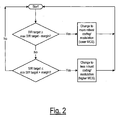
- Fig. 2 the decision process used to determine whether or not to perform link adaptation is shown where the decision is made based on the first two events described above, i.e. whether the SIR target provided by the outer-loop power control has reached a predetermined maximum or is close to a predetermined maximum (within some predetermined margin), so that more robust modulation and/or stronger coding is needed. If the SIR target reaches or is near a minimum predetermined SIR target, then link adaptation is performed in which less robust modulation and/or weaker coding is used, which would provide a higher data rate.
- Fig. 3 the decision process used to determine whether or not to perform link adaptation is shown where the decision is made based on the third event described above, i.e. whether there have been a number of consecutive SIR target changes (or up/down quality indicator commands) provided by the outer-loop power control, or a number of consecutive ACK/NACK signals (which can also be considered an up/down quality indicator command), in either the up direction (or NACK signals) or down direction (or ACK signals) in excess of some predetermined limit L1 (for up commands or NACK signals) or L2 (for down commands or ACK signals).
- Fig. 4 the decision process used to determine whether or not to perform link adaptation is shown where the decision is made based on the fourth event described above, i.e. whether there has been a high enough percentage of some previous number of SIR target changes in either the up or down direction (or a high enough percentage of either ACK or NACK signals).
- any of the above-described events are used to trigger a decision to do link adaptation, but the invention also comprehends basing such a decision on any one or any combination of the decision processes illustrated in Figs. 2 through 4 .
- a fast power control loop (the so-called inner loop) is shown and described (in Fig. 1 )
- the invention in no way makes use of a fast power control loop.
- the invention makes use only of either SIR target increase or decrease commands (provided by the outer loop, also called the slow power control loop), or ACK/NACK signaling.
- Figs. 5-8 illustrate different embodiments of the invention for quality control of a downlink signal in respect to where link adaptation decisions are made, and where the other modules can be located used in embodiments relying on an outer power loop.
- Fig. 5 signal quality control according to an embodiment in which SIR estimation, outer loop power control, and link adaptation decisions are all performed in the mobile station.
- Fig. 7 signal quality control according to an embodiment in which SIR estimation and outer loop power control are performed in the mobile station, and link adaptation decisions are made in the RNC;
- Fig. 8 signal quality control according to an embodiment in which SIR estimation or BLER or BER monitoring is performed in the mobile station, outer loop power control is made in the RNC or base station, and link adaptation decisions are made in the mobile station.
- the link adaptation module could just as well be located in the RNC or the base station, instead of in the mobile station as shown in Fig. 8 .
- the link adaptation algorithm could use a frame error rate (FER) or block error rate (BLER) or corresponding statistic collected over a predetermined time period (e.g. the statistics could be collected block-wise or could be collected using a sliding window).
- An appropriate MCS would then be selected based on the measured statistics.
- FER/BLER if the measured FER/BLER is above a predetermined target FER/BLER, then a more robust MCS would be selected, and conversely, if the measured FER/BLER is below a predetermined target, a less robust MCS would be selected.
- there is only a single target i.e. one target which is such that if the statistic is less than the target, a less robust MCS is used, and if the statistic is greater than the same target, a more robust MCS is used.
Landscapes
- Engineering & Computer Science (AREA)
- Computer Networks & Wireless Communication (AREA)
- Signal Processing (AREA)
- Quality & Reliability (AREA)
- Mobile Radio Communication Systems (AREA)
- Communication Control (AREA)
- Detection And Prevention Of Errors In Transmission (AREA)
- Testing, Inspecting, Measuring Of Stereoscopic Televisions And Televisions (AREA)
- Cable Transmission Systems, Equalization Of Radio And Reduction Of Echo (AREA)
- Monitoring And Testing Of Transmission In General (AREA)
Applications Claiming Priority (3)
| Application Number | Priority Date | Filing Date | Title |
|---|---|---|---|
| US912227 | 2001-07-24 | ||
| US09/912,227 US7027420B2 (en) | 2001-07-24 | 2001-07-24 | Method for determining whether to perform link adaptation in WCDMA communications |
| PCT/IB2002/002839 WO2003010979A2 (en) | 2001-07-24 | 2002-07-19 | Method for determining whether to perform link adaptation in wcdma communications |
Publications (3)
| Publication Number | Publication Date |
|---|---|
| EP1410653A2 EP1410653A2 (en) | 2004-04-21 |
| EP1410653A4 EP1410653A4 (en) | 2007-06-27 |
| EP1410653B1 true EP1410653B1 (en) | 2010-12-29 |
Family
ID=25431560
Family Applications (1)
| Application Number | Title | Priority Date | Filing Date |
|---|---|---|---|
| EP02751465A Expired - Lifetime EP1410653B1 (en) | 2001-07-24 | 2002-07-19 | Method and apparatus for determining whether to perform link adaptation in wcdma communications |
Country Status (12)
| Country | Link |
|---|---|
| US (2) | US7027420B2 (https=) |
| EP (1) | EP1410653B1 (https=) |
| JP (1) | JP4598391B2 (https=) |
| KR (1) | KR100750374B1 (https=) |
| CN (1) | CN1555657B (https=) |
| AT (1) | ATE493859T1 (https=) |
| AU (1) | AU2002355307A1 (https=) |
| BR (2) | BRPI0211394B1 (https=) |
| CA (1) | CA2454481C (https=) |
| DE (1) | DE60238770D1 (https=) |
| WO (1) | WO2003010979A2 (https=) |
| ZA (1) | ZA200400420B (https=) |
Families Citing this family (93)
| Publication number | Priority date | Publication date | Assignee | Title |
|---|---|---|---|---|
| US6081536A (en) | 1997-06-20 | 2000-06-27 | Tantivy Communications, Inc. | Dynamic bandwidth allocation to transmit a wireless protocol across a code division multiple access (CDMA) radio link |
| US6542481B2 (en) | 1998-06-01 | 2003-04-01 | Tantivy Communications, Inc. | Dynamic bandwidth allocation for multiple access communication using session queues |
| US7936728B2 (en) | 1997-12-17 | 2011-05-03 | Tantivy Communications, Inc. | System and method for maintaining timing of synchronization messages over a reverse link of a CDMA wireless communication system |
| US6222832B1 (en) | 1998-06-01 | 2001-04-24 | Tantivy Communications, Inc. | Fast Acquisition of traffic channels for a highly variable data rate reverse link of a CDMA wireless communication system |
| US8175120B2 (en) | 2000-02-07 | 2012-05-08 | Ipr Licensing, Inc. | Minimal maintenance link to support synchronization |
| US7394791B2 (en) * | 1997-12-17 | 2008-07-01 | Interdigital Technology Corporation | Multi-detection of heartbeat to reduce error probability |
| US9525923B2 (en) | 1997-12-17 | 2016-12-20 | Intel Corporation | Multi-detection of heartbeat to reduce error probability |
| US7773566B2 (en) | 1998-06-01 | 2010-08-10 | Tantivy Communications, Inc. | System and method for maintaining timing of synchronization messages over a reverse link of a CDMA wireless communication system |
| US8134980B2 (en) | 1998-06-01 | 2012-03-13 | Ipr Licensing, Inc. | Transmittal of heartbeat signal at a lower level than heartbeat request |
| US8155096B1 (en) | 2000-12-01 | 2012-04-10 | Ipr Licensing Inc. | Antenna control system and method |
| US7551663B1 (en) | 2001-02-01 | 2009-06-23 | Ipr Licensing, Inc. | Use of correlation combination to achieve channel detection |
| US6954448B2 (en) | 2001-02-01 | 2005-10-11 | Ipr Licensing, Inc. | Alternate channel for carrying selected message types |
| ES2624979T3 (es) | 2001-06-13 | 2017-07-18 | Intel Corporation | Aparatos para la transmisión de una señal de latido de corazón a un nivel inferior que la solicitud de latido de corazón |
| JP3660278B2 (ja) * | 2001-07-13 | 2005-06-15 | 松下電器産業株式会社 | 基地局装置、移動局装置、無線通信システム及び無線通信方法 |
| KR100571802B1 (ko) * | 2001-09-03 | 2006-04-17 | 삼성전자주식회사 | 통신 효율을 높이는 이동통신 시스템 및 그 방법 |
| US7756082B1 (en) * | 2001-09-07 | 2010-07-13 | Atheros Communications, Inc. | Wireless LAN using background scanning technique |
| WO2003034677A1 (en) * | 2001-10-17 | 2003-04-24 | Sony Corporation | Transmitter and transmission control method, and receiver and reception control method |
| US7106715B1 (en) * | 2001-11-16 | 2006-09-12 | Vixs Systems, Inc. | System for providing data to multiple devices and method thereof |
| US7177371B1 (en) * | 2001-12-21 | 2007-02-13 | Nortel Networks Ltd. | Methods and apparatus for transmitting and receiving data over a communications network in the presence of interference |
| US7787530B2 (en) * | 2001-12-28 | 2010-08-31 | Alcatel-Lucent Usa Inc. | Multi-channel adapative quality control loop for link rate adaptation in data packet communications |
| CN2731876Y (zh) * | 2002-02-19 | 2005-10-05 | 交互数字技术公司 | 为二元判定提供偏置准则的基站 |
| US7292552B2 (en) * | 2002-03-14 | 2007-11-06 | Qualcomm Incorporated | Method and apparatus for reducing interference in a wireless communication system |
| JP4423836B2 (ja) * | 2002-04-03 | 2010-03-03 | 日本電気株式会社 | セルラシステム、通信制御方法及び移動局 |
| US8619718B2 (en) | 2002-04-05 | 2013-12-31 | Interdigital Technology Corporation | Method and apparatus for coordinating a radio network controller and node B resource management for high speed downlink packet data service |
| US7433337B2 (en) * | 2002-04-05 | 2008-10-07 | Interdigital Technology Corporation | Node B and RNC actions during a serving HSDPA cell change |
| US7577227B2 (en) * | 2002-04-18 | 2009-08-18 | Alcatel-Lucent Usa Inc. | Link adaption in general packet radio service networks |
| US7369510B1 (en) | 2002-05-06 | 2008-05-06 | Atheros Communications, Inc. | Wireless LAN using RSSI and BER parameters for transmission rate adaptation |
| SE0202845D0 (sv) | 2002-05-13 | 2002-09-23 | Ericsson Telefon Ab L M | Measurements for radio resource management for high-speed downlink shared channel (HS-DSCH) |
| AU2002258112A1 (en) * | 2002-06-13 | 2003-12-31 | Nokia Corporation | Method, system, and network entity, for adaptive reservation of channelization codes and power |
| US7133689B2 (en) * | 2002-09-12 | 2006-11-07 | Interdigital Technology Corporation | Method and system for adjusting downlink outer loop power to control target SIR |
| US20040100911A1 (en) * | 2002-11-25 | 2004-05-27 | Raymond Kwan | Method for link adaptation |
| RU2302694C2 (ru) * | 2003-03-05 | 2007-07-10 | Самсунг Электроникс Ко., Лтд. | Способ и устройство для управления скоростью трафика обратной линии связи в системе мобильной связи |
| KR20040083617A (ko) * | 2003-03-24 | 2004-10-06 | 삼성전자주식회사 | 향상된 역방향 전용전송채널을 서비스하는 비동기 방식의부호분할다중접속 이동통신시스템에서 소프트 핸드오버영역에 위치하는 이동단말이 역방향 데이터를 재전송하는방법 및 시스템 |
| AU2007202889B2 (en) * | 2003-03-26 | 2009-03-19 | Interdigital Technology Corporation | Wireless multi-cell communication system and method for managing resource power to provide high speed downlink packet access services |
| CA2807352C (en) * | 2003-03-26 | 2016-08-16 | Interdigital Technology Corporation | Wireless communication method and apparatus for providing high speed downlink packet access services |
| US7433460B2 (en) * | 2003-04-30 | 2008-10-07 | Lucent Technologies Inc. | Methods of controlling link quality and transmit power in communication networks |
| JP4367044B2 (ja) * | 2003-07-23 | 2009-11-18 | 日本電気株式会社 | 通信システムおよび送信電力制御方法 |
| GB2405289B (en) * | 2003-08-20 | 2006-10-25 | Ipwireless Inc | Method,base station,remote station and system for HSDPA communication |
| US7688766B2 (en) * | 2003-09-17 | 2010-03-30 | Intel Corporation | Modulation scheme for orthogonal frequency division multiplexing systems or the like |
| US7197327B2 (en) * | 2004-03-10 | 2007-03-27 | Interdigital Technology Corporation | Adjustment of target signal-to-interference in outer loop power control for wireless communication systems |
| JP2005277549A (ja) * | 2004-03-23 | 2005-10-06 | Nec Corp | 移動端末、移動端末による受信判定方法 |
| FR2869496B1 (fr) * | 2004-04-26 | 2006-08-11 | Nortel Networks Ltd | Procede de controle de puissance d'emission sur des canaux de communication et station de base pour la mise en oeuvre du procede |
| CN101902434A (zh) * | 2004-04-30 | 2010-12-01 | 夏普株式会社 | 无线通信系统 |
| KR100856178B1 (ko) * | 2004-07-27 | 2008-09-03 | 메시네트웍스, 인코포레이티드 | 멀티-홉 무선 네트워크에서 비상주 링크를 검출하기 위한시스템 및 방법 |
| GB0506082D0 (en) * | 2005-03-24 | 2005-05-04 | Koninkl Philips Electronics Nv | Communication system, apparatus, and method of operating a communication system |
| US7979084B2 (en) * | 2005-04-22 | 2011-07-12 | Telefonaktiebolaget Lm Ericsson (Publ) | Method and apparatus relating to power control |
| US7480517B2 (en) * | 2005-04-27 | 2009-01-20 | Motorola, Inc. | Method of power control in a wireless communication system |
| US7636582B2 (en) * | 2005-09-30 | 2009-12-22 | Alcatel-Lucent Usa Inc. | Providing power control in a reverse link of a wireless spread-spectrum data network for bursty traffic |
| CN100415020C (zh) * | 2005-10-31 | 2008-08-27 | 上海华为技术有限公司 | 一种高速物理下行共享信道的码资源分配方法 |
| US7647050B2 (en) * | 2005-12-28 | 2010-01-12 | Alcatel-Lucent Usa Inc. | Method of adjusting a power level of communications over a channel in a wirelss communications network |
| JP4410282B2 (ja) * | 2006-01-18 | 2010-02-03 | パナソニック株式会社 | 無線送信装置および無線送信方法 |
| KR100736760B1 (ko) * | 2006-03-29 | 2007-07-09 | 주식회사알에프윈도우 | 순방향 및 역방향 링크 자동 전력 제어 중계기 시스템 및그 방법 |
| US20070237217A1 (en) * | 2006-04-06 | 2007-10-11 | Zukang Shen | User scheduling methods and apparatus for high-speed uplink packet access systems |
| JP4189410B2 (ja) * | 2006-06-12 | 2008-12-03 | 株式会社東芝 | 無線通信装置及び送信制御方法 |
| US8098643B2 (en) * | 2006-08-24 | 2012-01-17 | Alcatel Lucent | Method of increasing the capacity of the forward link MAC channel in a wireless communication system |
| US7835298B2 (en) * | 2006-09-15 | 2010-11-16 | Futurewei Technologies, Inc. | Method and system for optimal allocation of bandwidth and power resources to OFDMA VoIP channels |
| US9049017B2 (en) * | 2006-10-02 | 2015-06-02 | Sony Corporation | Efficient TCP ACK prioritization in wireless networks |
| US8396511B2 (en) * | 2007-02-28 | 2013-03-12 | Samsung Electronics Co., Ltd. | Apparatus and method for determining an uplink transmission format in a broadband wireless communication system |
| US8098601B2 (en) * | 2007-03-23 | 2012-01-17 | Research In Motion Limited | Slow adaptation of modulation and coding for packet transmission |
| AU2007354841B2 (en) | 2007-06-15 | 2011-11-24 | Blackberry Limited | System and method for semi-persistent and dynamic scheduling and discontinuous reception control |
| CA2690430A1 (en) * | 2007-06-15 | 2008-12-18 | Research In Motion Limited | System and method for link adaptation overhead reduction |
| US20090046639A1 (en) * | 2007-08-14 | 2009-02-19 | Zhijun Cai | System and Method for Handling Large IP Packets During VoIP Session |
| AU2007358152B2 (en) * | 2007-08-24 | 2013-01-31 | Alcatel Lucent | Method for scheduling resource, network element and user equipment |
| ES2558744T3 (es) | 2007-09-14 | 2016-02-08 | Blackberry Limited | Sistema y método para el tiempo de inicio de control de recepción discontinua |
| US8009604B2 (en) * | 2008-01-31 | 2011-08-30 | Telefonaktiebolaget Lm Ericsson (Publ) | Transmission-compensated radio channel quality |
| EP2114030B1 (en) * | 2008-04-30 | 2020-09-16 | Google Technology Holdings LLC | Methods and devices for preemptively transmitting a signal in accordance with an MCS other than a network commanded MCS |
| CN102119503B (zh) * | 2008-05-15 | 2014-04-02 | 爱立信电话股份有限公司 | 增大混合自动重复请求协议的可靠性 |
| US8340586B2 (en) | 2008-11-19 | 2012-12-25 | T-Mobile Usa, Inc. | System and method for link adaptation for variable link conditions |
| US8170599B2 (en) * | 2008-11-21 | 2012-05-01 | Telefonaktiebolaget Lm Ericsson (Publ) | Format based power control |
| US20100166103A1 (en) * | 2008-12-29 | 2010-07-01 | Tom Harel | Method and apparatus of transmiting encoded message |
| WO2011019924A1 (en) | 2009-08-12 | 2011-02-17 | Research In Motion Limited | System and method for modulation and coding scheme adaptation and power control in a relay network |
| WO2011019919A1 (en) | 2009-08-12 | 2011-02-17 | Research In Motion Limted | System and method for association and uplink adaptation in a relay network |
| CA2773808A1 (en) * | 2009-09-15 | 2011-03-24 | Rockstar Bidco, LP | Adaptive modulation and coding scheme adjustment in wireless networks |
| CN102742202B (zh) * | 2010-02-05 | 2015-12-02 | 瑞典爱立信有限公司 | 无线通信系统中的方法和装置 |
| US20120182893A1 (en) * | 2011-01-17 | 2012-07-19 | Solomon Trainin | Method, apparatus and system for controlling power of wireless communication device |
| CN102595585B (zh) * | 2011-01-17 | 2015-08-19 | 英特尔公司 | 用于控制无线通信装置的功率的方法、设备和系统 |
| US9769763B2 (en) * | 2011-04-26 | 2017-09-19 | Telefonaktiebolaget L M Ericsson | Nodes and method for power control |
| US9826430B2 (en) * | 2011-11-14 | 2017-11-21 | T-Mobile Usa, Inc. | Controlling uplink congestion in a wireless communication network |
| US10841037B2 (en) * | 2013-01-22 | 2020-11-17 | Qualcomm Incorporated | Managing interference in a network |
| EP3002886B1 (en) * | 2013-06-29 | 2018-06-06 | Huawei Technologies Co., Ltd. | Power control method, apparatus and system |
| CN103457630B (zh) * | 2013-08-15 | 2015-11-25 | 深圳清华大学研究院 | 一种复数域下的干扰信号幅度估计方法及装置 |
| US9203590B2 (en) | 2013-11-05 | 2015-12-01 | Telefonaktiebolaget L M Ericsson (Publ) | Generalized outer loop link adaptation |
| JP2016052001A (ja) * | 2014-08-29 | 2016-04-11 | 富士通株式会社 | 無線通信装置、切替方法、及び無線通信システム |
| DE102014113456B4 (de) * | 2014-09-18 | 2019-03-14 | Infineon Technologies Ag | Sensorvorrichtung und sensoranordnung |
| US9667362B2 (en) | 2014-09-19 | 2017-05-30 | Samsung Electronics Co., Ltd. | Apparatus and method for selecting channel quality indicator in communication system |
| WO2016086408A1 (en) * | 2014-12-05 | 2016-06-09 | Telefonaktiebolaget Lm Ericsson (Publ) | Method and communication device for performing link adaptation |
| US10440613B2 (en) * | 2015-07-30 | 2019-10-08 | Telefonaktiebolaget Lm Ericsson (Publ) | Methods of electronic communication device and network node, electronic communication device, network node, and computer programs |
| CN105119695A (zh) * | 2015-09-17 | 2015-12-02 | 清华大学 | 一种基于快速否定应答的空间文件传输方法 |
| KR200483771Y1 (ko) | 2016-07-27 | 2017-06-22 | 주식회사 공간디앤에프 | 매립형 가구용 손잡이 |
| EP3343985A1 (en) * | 2016-12-30 | 2018-07-04 | Kamstrup A/S | Utility network with link management |
| EP4229928A1 (en) * | 2020-10-14 | 2023-08-23 | Lenovo (Singapore) Pte. Ltd. | Adjusting transmission power based on interference measurement and/or acknowledgement feedback |
| US12160303B2 (en) * | 2021-12-21 | 2024-12-03 | Verizon Patent And Licensing Inc. | Systems and methods for providing messaging for unmanned aerial vehicles |
| US12301345B2 (en) * | 2023-07-19 | 2025-05-13 | Dell Products L.P. | Facilitating dynamic predictive modulation coding adjustment for intercell interference in advanced communication networks |
Family Cites Families (14)
| Publication number | Priority date | Publication date | Assignee | Title |
|---|---|---|---|---|
| US5828677A (en) * | 1996-03-20 | 1998-10-27 | Lucent Technologies Inc. | Adaptive hybrid ARQ coding schemes for slow fading channels in mobile radio systems |
| SE9601606D0 (sv) * | 1996-04-26 | 1996-04-26 | Ericsson Telefon Ab L M | Sätt vid radiotelekommunikationssystem |
| JP3818702B2 (ja) | 1996-08-07 | 2006-09-06 | 松下電器産業株式会社 | Cdma無線伝送システム並びに該システムにおいて用いられる送信電力制御装置および送信電力制御用測定装置 |
| US6085108A (en) | 1997-12-15 | 2000-07-04 | Telefonaktiebolaget Lm Ericsson | Modified downlink power control during macrodiversity |
| US6215827B1 (en) * | 1997-08-25 | 2001-04-10 | Lucent Technologies, Inc. | System and method for measuring channel quality information in a communication system |
| US6212399B1 (en) | 1998-03-06 | 2001-04-03 | Lucent Technologies, Inc. | Method and apparatus for controlling the power radiated by a wireless terminal in a telecommunications system based on a variable step size |
| JP2000049663A (ja) * | 1998-04-17 | 2000-02-18 | Matsushita Electric Ind Co Ltd | 無線通信装置及び伝送レ―ト制御方法 |
| US6373878B1 (en) * | 1998-11-02 | 2002-04-16 | Telefonaktiebolaget Lm Ericsson (Publ) | Using a fast AGC as part of SIR calculation |
| US6639934B1 (en) * | 1999-04-26 | 2003-10-28 | Telefonaktiebolaget Lm Ericsson (Publ) | Power control in a CDMA mobile communication system |
| WO2000077946A1 (en) * | 1999-06-11 | 2000-12-21 | Nokia Corporation | Method and apparatus for performing interference estimation |
| JP3545663B2 (ja) * | 2000-01-14 | 2004-07-21 | 松下電器産業株式会社 | Sir測定装置及びsir測定方法 |
| US6643322B1 (en) * | 2000-09-20 | 2003-11-04 | Aperto Networks, Inc. | Dynamic wireless link adaptation |
| US20020080719A1 (en) * | 2000-12-22 | 2002-06-27 | Stefan Parkvall | Scheduling transmission of data over a transmission channel based on signal quality of a receive channel |
| US7529548B2 (en) * | 2001-06-28 | 2009-05-05 | Intel Corporation | Method and system for adapting a wireless link to achieve a desired channel quality |
-
2001
- 2001-07-24 US US09/912,227 patent/US7027420B2/en not_active Expired - Lifetime
-
2002
- 2002-07-19 CN CN02818193XA patent/CN1555657B/zh not_active Expired - Lifetime
- 2002-07-19 EP EP02751465A patent/EP1410653B1/en not_active Expired - Lifetime
- 2002-07-19 AT AT02751465T patent/ATE493859T1/de not_active IP Right Cessation
- 2002-07-19 BR BRPI0211394-5A patent/BRPI0211394B1/pt unknown
- 2002-07-19 BR BR0211394-5A patent/BR0211394A/pt active IP Right Grant
- 2002-07-19 DE DE60238770T patent/DE60238770D1/de not_active Expired - Lifetime
- 2002-07-19 JP JP2003516231A patent/JP4598391B2/ja not_active Expired - Lifetime
- 2002-07-19 AU AU2002355307A patent/AU2002355307A1/en not_active Abandoned
- 2002-07-19 WO PCT/IB2002/002839 patent/WO2003010979A2/en not_active Ceased
- 2002-07-19 KR KR1020047000858A patent/KR100750374B1/ko not_active Expired - Lifetime
- 2002-07-19 CA CA2454481A patent/CA2454481C/en not_active Expired - Lifetime
-
2004
- 2004-01-20 ZA ZA200400420A patent/ZA200400420B/en unknown
-
2006
- 2006-04-05 US US11/399,291 patent/US7664047B2/en not_active Expired - Lifetime
Also Published As
| Publication number | Publication date |
|---|---|
| US20060256732A1 (en) | 2006-11-16 |
| KR20040017335A (ko) | 2004-02-26 |
| CN1555657A (zh) | 2004-12-15 |
| US20030021243A1 (en) | 2003-01-30 |
| ZA200400420B (en) | 2006-06-28 |
| BR0211394A (pt) | 2004-08-17 |
| DE60238770D1 (de) | 2011-02-10 |
| AU2002355307A1 (en) | 2003-02-17 |
| KR100750374B1 (ko) | 2007-08-17 |
| JP4598391B2 (ja) | 2010-12-15 |
| US7664047B2 (en) | 2010-02-16 |
| JP2004537228A (ja) | 2004-12-09 |
| EP1410653A4 (en) | 2007-06-27 |
| WO2003010979A3 (en) | 2003-06-05 |
| WO2003010979A2 (en) | 2003-02-06 |
| CN1555657B (zh) | 2012-04-04 |
| US7027420B2 (en) | 2006-04-11 |
| EP1410653A2 (en) | 2004-04-21 |
| ATE493859T1 (de) | 2011-01-15 |
| CA2454481C (en) | 2013-05-21 |
| BRPI0211394B1 (pt) | 2019-04-02 |
| CA2454481A1 (en) | 2003-02-06 |
Similar Documents
| Publication | Publication Date | Title |
|---|---|---|
| EP1410653B1 (en) | Method and apparatus for determining whether to perform link adaptation in wcdma communications | |
| US7688798B2 (en) | Data transmission method | |
| EP1313232B1 (en) | Method and apparatus for uplink transmission power control in a cdma communication system | |
| EP1810437B1 (en) | Wireless communication method and apparatus for adaptively biasing channel quality indicators to maintain a desired block error rate | |
| US8014812B2 (en) | Uplink control channel transit power control based on received transmission | |
| EP2628341B1 (en) | Uplink power control | |
| US20050208973A1 (en) | Base station apparatus and method for controlling transmission assignment | |
| CN1192530C (zh) | 高速数据包接入系统软切换中上行控制信道功率控制方法 | |
| US20050186983A1 (en) | Base station apparatus, and method for controlling transmission power for retransmitted packets | |
| EP2095529B1 (en) | Control channel symbol transmission method and apparatus | |
| EP1511192A1 (en) | Base station device and packet transmission power control method | |
| CN103997776A (zh) | 对无线通信系统中具有未知格式的传送信道的擦除检测及功率控制 | |
| US7817972B2 (en) | Method and arrangement for mutual information based power control | |
| CN101032095B (zh) | 用于控制移动网元和固定网元之间的传输的变量的方法和装置 | |
| JP4113417B2 (ja) | 基地局装置および送信方法 | |
| CN101282149B (zh) | 无线信道控制方法、发送装置及接收装置 | |
| Ghosh et al. | Control channel design for high speed downlink shared channel for 3GPP W-CDMA, Rel-5 |
Legal Events
| Date | Code | Title | Description |
|---|---|---|---|
| PUAI | Public reference made under article 153(3) epc to a published international application that has entered the european phase |
Free format text: ORIGINAL CODE: 0009012 |
|
| 17P | Request for examination filed |
Effective date: 20040123 |
|
| AK | Designated contracting states |
Kind code of ref document: A2 Designated state(s): AT BE BG CH CY CZ DE DK EE ES FI FR GB GR IE IT LI LU MC NL PT SE SK TR |
|
| AX | Request for extension of the european patent |
Extension state: AL LT LV MK RO SI |
|
| A4 | Supplementary search report drawn up and despatched |
Effective date: 20070529 |
|
| RIC1 | Information provided on ipc code assigned before grant |
Ipc: H04Q 7/00 20060101AFI20040202BHEP Ipc: H04Q 7/38 20060101ALI20070522BHEP |
|
| 17Q | First examination report despatched |
Effective date: 20070829 |
|
| GRAP | Despatch of communication of intention to grant a patent |
Free format text: ORIGINAL CODE: EPIDOSNIGR1 |
|
| RIC1 | Information provided on ipc code assigned before grant |
Ipc: H04L 1/00 20060101ALI20100706BHEP Ipc: H04W 52/24 20090101AFI20100706BHEP |
|
| RTI1 | Title (correction) |
Free format text: METHOD AND APPARATUS FOR DETERMINING WHETHER TO PERFORM LINK ADAPTATION IN WCDMA COMMUNICATIONS |
|
| GRAS | Grant fee paid |
Free format text: ORIGINAL CODE: EPIDOSNIGR3 |
|
| GRAA | (expected) grant |
Free format text: ORIGINAL CODE: 0009210 |
|
| AK | Designated contracting states |
Kind code of ref document: B1 Designated state(s): AT BE BG CH CY CZ DE DK EE ES FI FR GB GR IE IT LI LU MC NL PT SE SK TR |
|
| REG | Reference to a national code |
Ref country code: GB Ref legal event code: FG4D |
|
| REG | Reference to a national code |
Ref country code: CH Ref legal event code: EP |
|
| REG | Reference to a national code |
Ref country code: IE Ref legal event code: FG4D |
|
| REF | Corresponds to: |
Ref document number: 60238770 Country of ref document: DE Date of ref document: 20110210 Kind code of ref document: P |
|
| REG | Reference to a national code |
Ref country code: DE Ref legal event code: R096 Ref document number: 60238770 Country of ref document: DE Effective date: 20110210 |
|
| REG | Reference to a national code |
Ref country code: NL Ref legal event code: T3 |
|
| PG25 | Lapsed in a contracting state [announced via postgrant information from national office to epo] |
Ref country code: FI Free format text: LAPSE BECAUSE OF FAILURE TO SUBMIT A TRANSLATION OF THE DESCRIPTION OR TO PAY THE FEE WITHIN THE PRESCRIBED TIME-LIMIT Effective date: 20101229 Ref country code: CY Free format text: LAPSE BECAUSE OF FAILURE TO SUBMIT A TRANSLATION OF THE DESCRIPTION OR TO PAY THE FEE WITHIN THE PRESCRIBED TIME-LIMIT Effective date: 20101229 Ref country code: BG Free format text: LAPSE BECAUSE OF FAILURE TO SUBMIT A TRANSLATION OF THE DESCRIPTION OR TO PAY THE FEE WITHIN THE PRESCRIBED TIME-LIMIT Effective date: 20110329 Ref country code: SE Free format text: LAPSE BECAUSE OF FAILURE TO SUBMIT A TRANSLATION OF THE DESCRIPTION OR TO PAY THE FEE WITHIN THE PRESCRIBED TIME-LIMIT Effective date: 20101229 Ref country code: AT Free format text: LAPSE BECAUSE OF FAILURE TO SUBMIT A TRANSLATION OF THE DESCRIPTION OR TO PAY THE FEE WITHIN THE PRESCRIBED TIME-LIMIT Effective date: 20101229 |
|
| PG25 | Lapsed in a contracting state [announced via postgrant information from national office to epo] |
Ref country code: CZ Free format text: LAPSE BECAUSE OF FAILURE TO SUBMIT A TRANSLATION OF THE DESCRIPTION OR TO PAY THE FEE WITHIN THE PRESCRIBED TIME-LIMIT Effective date: 20101229 Ref country code: GR Free format text: LAPSE BECAUSE OF FAILURE TO SUBMIT A TRANSLATION OF THE DESCRIPTION OR TO PAY THE FEE WITHIN THE PRESCRIBED TIME-LIMIT Effective date: 20110330 Ref country code: BE Free format text: LAPSE BECAUSE OF FAILURE TO SUBMIT A TRANSLATION OF THE DESCRIPTION OR TO PAY THE FEE WITHIN THE PRESCRIBED TIME-LIMIT Effective date: 20101229 Ref country code: ES Free format text: LAPSE BECAUSE OF FAILURE TO SUBMIT A TRANSLATION OF THE DESCRIPTION OR TO PAY THE FEE WITHIN THE PRESCRIBED TIME-LIMIT Effective date: 20110409 Ref country code: PT Free format text: LAPSE BECAUSE OF FAILURE TO SUBMIT A TRANSLATION OF THE DESCRIPTION OR TO PAY THE FEE WITHIN THE PRESCRIBED TIME-LIMIT Effective date: 20110429 Ref country code: EE Free format text: LAPSE BECAUSE OF FAILURE TO SUBMIT A TRANSLATION OF THE DESCRIPTION OR TO PAY THE FEE WITHIN THE PRESCRIBED TIME-LIMIT Effective date: 20101229 |
|
| PG25 | Lapsed in a contracting state [announced via postgrant information from national office to epo] |
Ref country code: SK Free format text: LAPSE BECAUSE OF FAILURE TO SUBMIT A TRANSLATION OF THE DESCRIPTION OR TO PAY THE FEE WITHIN THE PRESCRIBED TIME-LIMIT Effective date: 20101229 |
|
| PG25 | Lapsed in a contracting state [announced via postgrant information from national office to epo] |
Ref country code: DK Free format text: LAPSE BECAUSE OF FAILURE TO SUBMIT A TRANSLATION OF THE DESCRIPTION OR TO PAY THE FEE WITHIN THE PRESCRIBED TIME-LIMIT Effective date: 20101229 |
|
| PLBE | No opposition filed within time limit |
Free format text: ORIGINAL CODE: 0009261 |
|
| STAA | Information on the status of an ep patent application or granted ep patent |
Free format text: STATUS: NO OPPOSITION FILED WITHIN TIME LIMIT |
|
| PGFP | Annual fee paid to national office [announced via postgrant information from national office to epo] |
Ref country code: GB Payment date: 20110713 Year of fee payment: 10 |
|
| 26N | No opposition filed |
Effective date: 20110930 |
|
| REG | Reference to a national code |
Ref country code: DE Ref legal event code: R097 Ref document number: 60238770 Country of ref document: DE Effective date: 20110930 |
|
| PG25 | Lapsed in a contracting state [announced via postgrant information from national office to epo] |
Ref country code: MC Free format text: LAPSE BECAUSE OF NON-PAYMENT OF DUE FEES Effective date: 20110731 |
|
| REG | Reference to a national code |
Ref country code: CH Ref legal event code: PL |
|
| REG | Reference to a national code |
Ref country code: FR Ref legal event code: ST Effective date: 20120330 |
|
| REG | Reference to a national code |
Ref country code: IE Ref legal event code: MM4A |
|
| PG25 | Lapsed in a contracting state [announced via postgrant information from national office to epo] |
Ref country code: CH Free format text: LAPSE BECAUSE OF NON-PAYMENT OF DUE FEES Effective date: 20110731 Ref country code: FR Free format text: LAPSE BECAUSE OF NON-PAYMENT OF DUE FEES Effective date: 20110801 Ref country code: LI Free format text: LAPSE BECAUSE OF NON-PAYMENT OF DUE FEES Effective date: 20110731 |
|
| PG25 | Lapsed in a contracting state [announced via postgrant information from national office to epo] |
Ref country code: IT Free format text: LAPSE BECAUSE OF FAILURE TO SUBMIT A TRANSLATION OF THE DESCRIPTION OR TO PAY THE FEE WITHIN THE PRESCRIBED TIME-LIMIT Effective date: 20101229 |
|
| PG25 | Lapsed in a contracting state [announced via postgrant information from national office to epo] |
Ref country code: IE Free format text: LAPSE BECAUSE OF NON-PAYMENT OF DUE FEES Effective date: 20110719 |
|
| GBPC | Gb: european patent ceased through non-payment of renewal fee |
Effective date: 20120719 |
|
| PG25 | Lapsed in a contracting state [announced via postgrant information from national office to epo] |
Ref country code: GB Free format text: LAPSE BECAUSE OF NON-PAYMENT OF DUE FEES Effective date: 20120719 |
|
| PG25 | Lapsed in a contracting state [announced via postgrant information from national office to epo] |
Ref country code: LU Free format text: LAPSE BECAUSE OF NON-PAYMENT OF DUE FEES Effective date: 20110719 |
|
| REG | Reference to a national code |
Ref country code: DE Ref legal event code: R081 Ref document number: 60238770 Country of ref document: DE Owner name: NOKIA TECHNOLOGIES OY, FI Free format text: FORMER OWNER: NOKIA CORP., 02610 ESPOO, FI |
|
| REG | Reference to a national code |
Ref country code: NL Ref legal event code: PD Owner name: NOKIA TECHNOLOGIES OY; FI Free format text: DETAILS ASSIGNMENT: VERANDERING VAN EIGENAAR(S), OVERDRACHT; FORMER OWNER NAME: NOKIA CORPORATION Effective date: 20151111 |
|
| PGFP | Annual fee paid to national office [announced via postgrant information from national office to epo] |
Ref country code: NL Payment date: 20210716 Year of fee payment: 20 |
|
| PGFP | Annual fee paid to national office [announced via postgrant information from national office to epo] |
Ref country code: DE Payment date: 20210622 Year of fee payment: 20 Ref country code: TR Payment date: 20210714 Year of fee payment: 20 |
|
| REG | Reference to a national code |
Ref country code: DE Ref legal event code: R071 Ref document number: 60238770 Country of ref document: DE |
|
| REG | Reference to a national code |
Ref country code: NL Ref legal event code: MK Effective date: 20220718 |