EP1409554B1 - Verbesserungen im zusammenhang mit polymerisationsreaktionen - Google Patents
Verbesserungen im zusammenhang mit polymerisationsreaktionen Download PDFInfo
- Publication number
- EP1409554B1 EP1409554B1 EP02755100A EP02755100A EP1409554B1 EP 1409554 B1 EP1409554 B1 EP 1409554B1 EP 02755100 A EP02755100 A EP 02755100A EP 02755100 A EP02755100 A EP 02755100A EP 1409554 B1 EP1409554 B1 EP 1409554B1
- Authority
- EP
- European Patent Office
- Prior art keywords
- use according
- polymerisation
- polymer
- thin film
- polymer chains
- Prior art date
- Legal status (The legal status is an assumption and is not a legal conclusion. Google has not performed a legal analysis and makes no representation as to the accuracy of the status listed.)
- Expired - Lifetime
Links
- 238000006116 polymerization reaction Methods 0.000 title claims abstract description 12
- 229920000642 polymer Polymers 0.000 claims abstract description 83
- 238000006243 chemical reaction Methods 0.000 claims abstract description 74
- 239000000178 monomer Substances 0.000 claims description 28
- 239000010409 thin film Substances 0.000 claims description 23
- 150000003254 radicals Chemical class 0.000 claims description 13
- 239000000126 substance Substances 0.000 claims description 11
- 238000009792 diffusion process Methods 0.000 claims description 7
- 239000000654 additive Substances 0.000 claims description 5
- 230000001133 acceleration Effects 0.000 claims description 4
- 238000009833 condensation Methods 0.000 claims description 3
- 230000005494 condensation Effects 0.000 claims description 3
- 238000001311 chemical methods and process Methods 0.000 claims 1
- 238000010297 mechanical methods and process Methods 0.000 claims 1
- 230000005226 mechanical processes and functions Effects 0.000 claims 1
- 238000000034 method Methods 0.000 abstract description 21
- 230000000694 effects Effects 0.000 abstract description 16
- 238000009987 spinning Methods 0.000 description 30
- PPBRXRYQALVLMV-UHFFFAOYSA-N Styrene Chemical group C=CC1=CC=CC=C1 PPBRXRYQALVLMV-UHFFFAOYSA-N 0.000 description 28
- 230000008569 process Effects 0.000 description 14
- 239000000203 mixture Substances 0.000 description 13
- 239000003999 initiator Substances 0.000 description 11
- 239000000376 reactant Substances 0.000 description 11
- 125000002091 cationic group Chemical group 0.000 description 10
- 238000002156 mixing Methods 0.000 description 9
- 238000010923 batch production Methods 0.000 description 8
- 239000010408 film Substances 0.000 description 7
- 239000000047 product Substances 0.000 description 7
- 239000003054 catalyst Substances 0.000 description 5
- 229920002521 macromolecule Polymers 0.000 description 5
- 238000012546 transfer Methods 0.000 description 5
- 229920001730 Moisture cure polyurethane Polymers 0.000 description 4
- 238000009826 distribution Methods 0.000 description 4
- 230000000977 initiatory effect Effects 0.000 description 4
- 230000007246 mechanism Effects 0.000 description 4
- 230000009467 reduction Effects 0.000 description 4
- 239000004342 Benzoyl peroxide Substances 0.000 description 3
- OMPJBNCRMGITSC-UHFFFAOYSA-N Benzoylperoxide Chemical compound C=1C=CC=CC=1C(=O)OOC(=O)C1=CC=CC=C1 OMPJBNCRMGITSC-UHFFFAOYSA-N 0.000 description 3
- YXFVVABEGXRONW-UHFFFAOYSA-N Toluene Chemical compound CC1=CC=CC=C1 YXFVVABEGXRONW-UHFFFAOYSA-N 0.000 description 3
- 230000008901 benefit Effects 0.000 description 3
- 235000019400 benzoyl peroxide Nutrition 0.000 description 3
- 230000015572 biosynthetic process Effects 0.000 description 3
- 238000010924 continuous production Methods 0.000 description 3
- 229920002959 polymer blend Polymers 0.000 description 3
- -1 sensitizers Substances 0.000 description 3
- 239000002904 solvent Substances 0.000 description 3
- WSLDOOZREJYCGB-UHFFFAOYSA-N 1,2-Dichloroethane Chemical compound ClCCCl WSLDOOZREJYCGB-UHFFFAOYSA-N 0.000 description 2
- 229910001369 Brass Inorganic materials 0.000 description 2
- VGGSQFUCUMXWEO-UHFFFAOYSA-N Ethene Chemical compound C=C VGGSQFUCUMXWEO-UHFFFAOYSA-N 0.000 description 2
- VYPSYNLAJGMNEJ-UHFFFAOYSA-N Silicium dioxide Chemical compound O=[Si]=O VYPSYNLAJGMNEJ-UHFFFAOYSA-N 0.000 description 2
- 238000004458 analytical method Methods 0.000 description 2
- 125000000129 anionic group Chemical group 0.000 description 2
- 239000010951 brass Substances 0.000 description 2
- 230000008859 change Effects 0.000 description 2
- 238000001816 cooling Methods 0.000 description 2
- 230000007423 decrease Effects 0.000 description 2
- 230000001419 dependent effect Effects 0.000 description 2
- 238000002474 experimental method Methods 0.000 description 2
- 239000012530 fluid Substances 0.000 description 2
- 238000005227 gel permeation chromatography Methods 0.000 description 2
- 238000009776 industrial production Methods 0.000 description 2
- 238000004519 manufacturing process Methods 0.000 description 2
- 230000002093 peripheral effect Effects 0.000 description 2
- 229920002223 polystyrene Polymers 0.000 description 2
- 230000001902 propagating effect Effects 0.000 description 2
- 230000035484 reaction time Effects 0.000 description 2
- 239000005977 Ethylene Substances 0.000 description 1
- 239000004793 Polystyrene Substances 0.000 description 1
- 230000000996 additive effect Effects 0.000 description 1
- 238000013459 approach Methods 0.000 description 1
- 238000010888 cage effect Methods 0.000 description 1
- 230000003047 cage effect Effects 0.000 description 1
- 239000007795 chemical reaction product Substances 0.000 description 1
- 239000003795 chemical substances by application Substances 0.000 description 1
- 239000011248 coating agent Substances 0.000 description 1
- 238000000576 coating method Methods 0.000 description 1
- 238000006482 condensation reaction Methods 0.000 description 1
- 238000007571 dilatometry Methods 0.000 description 1
- 230000003467 diminishing effect Effects 0.000 description 1
- 238000007323 disproportionation reaction Methods 0.000 description 1
- 238000005516 engineering process Methods 0.000 description 1
- 230000002708 enhancing effect Effects 0.000 description 1
- 230000007613 environmental effect Effects 0.000 description 1
- 238000001704 evaporation Methods 0.000 description 1
- 230000008020 evaporation Effects 0.000 description 1
- 238000004880 explosion Methods 0.000 description 1
- 239000012634 fragment Substances 0.000 description 1
- 239000013529 heat transfer fluid Substances 0.000 description 1
- 238000011090 industrial biotechnology method and process Methods 0.000 description 1
- 239000011261 inert gas Substances 0.000 description 1
- 230000003993 interaction Effects 0.000 description 1
- 239000011968 lewis acid catalyst Substances 0.000 description 1
- 239000012299 nitrogen atmosphere Substances 0.000 description 1
- ODUCDPQEXGNKDN-UHFFFAOYSA-N nitroxyl Chemical compound O=N ODUCDPQEXGNKDN-UHFFFAOYSA-N 0.000 description 1
- 239000011990 phillips catalyst Substances 0.000 description 1
- 238000002360 preparation method Methods 0.000 description 1
- 238000012545 processing Methods 0.000 description 1
- 238000007348 radical reaction Methods 0.000 description 1
- 239000011541 reaction mixture Substances 0.000 description 1
- 238000011160 research Methods 0.000 description 1
- 239000000377 silicon dioxide Substances 0.000 description 1
- 239000007787 solid Substances 0.000 description 1
- 239000000758 substrate Substances 0.000 description 1
- 230000002459 sustained effect Effects 0.000 description 1
- 238000003786 synthesis reaction Methods 0.000 description 1
- 238000006276 transfer reaction Methods 0.000 description 1
Images


Classifications
-
- B—PERFORMING OPERATIONS; TRANSPORTING
- B01—PHYSICAL OR CHEMICAL PROCESSES OR APPARATUS IN GENERAL
- B01J—CHEMICAL OR PHYSICAL PROCESSES, e.g. CATALYSIS OR COLLOID CHEMISTRY; THEIR RELEVANT APPARATUS
- B01J19/00—Chemical, physical or physico-chemical processes in general; Their relevant apparatus
- B01J19/18—Stationary reactors having moving elements inside
- B01J19/1887—Stationary reactors having moving elements inside forming a thin film
-
- B—PERFORMING OPERATIONS; TRANSPORTING
- B01—PHYSICAL OR CHEMICAL PROCESSES OR APPARATUS IN GENERAL
- B01J—CHEMICAL OR PHYSICAL PROCESSES, e.g. CATALYSIS OR COLLOID CHEMISTRY; THEIR RELEVANT APPARATUS
- B01J2219/00—Chemical, physical or physico-chemical processes in general; Their relevant apparatus
- B01J2219/00049—Controlling or regulating processes
- B01J2219/00051—Controlling the temperature
- B01J2219/00074—Controlling the temperature by indirect heating or cooling employing heat exchange fluids
- B01J2219/00087—Controlling the temperature by indirect heating or cooling employing heat exchange fluids with heat exchange elements outside the reactor
- B01J2219/0009—Coils
Definitions
- the present invention relates to methods for enhancing the kinetics of polymerisation reactions, and in particular to methods for achieving high rates of polymerisation and narrow molecular weight distribution, advantageously even at high molecular weights (for example up to 400,000 or above) and at high intrinsic viscosities (tending towards 1, for example) in reactants flowing across a spinning surface.
- Plug flow processes are particularly useful for polymerisation reactions, since polymer chain lengths can be controlled by keeping a close control over the reaction time and conditions within a given plug volume. This can result in a much tighter molecular weight distribution for polymers manufactured in this way rather than by way of batch processes.
- current reactors adapted for plug flow processes have a number of disadvantages, including low surface area to volume ratios, no draw, low shear and high pressure drops at higher conversions.
- a rotating surface reactor to control bimolecular termination rates in polymerisation reactions, wherein chemical components are polymerised by passing these in a thin film across a surface rotating about an axis of rotation, the thin film flowing from an inner region to an outer region of the surface and being thrown therefrom, and polymer chains being formed and grown within the thin film, characterised in that the surface is rotated so as to cause the polymer chains to uncoil and/or stretch across the surface in directions extending radially thereacross from the axis of rotation, so as to reduce translational and/or segmental diffusion of active polymer chains and thereby to reduce bimolecular termination reactions.
- a rotating surface reactor to control branching in polymerisation reactions, wherein chemical components are polymerised by passing these in a thin film across a surface rotating about an axis of rotation, the thin film flowing from an inner region to an outer region of the surface and being thrown therefrom, and polymer chains being formed and grown within the thin film, characterised in that the surface is rotated so as to cause the polymer chains to uncoil and/or stretch linearly and/or biaxially across the surface, a rotational speed of the surface being selected so as to encourage prepolymer and/or monomer components to attach themselves to a predetermined end of the polymer chains so as to result in controlled chain extension.
- the growing polymers tend to experience mainly or exclusively uncoiling effects, with stretching effects being additionally observed at higher rotational speeds, for example 250rpm on a disc of diameter 360mm.
- a preferred range of rotational speeds gives rise to centrifugal accelerations on the surface in the range of 2g to 1000g inclusive, although higher or lower rotational speeds may also be effective. It will be appreciated that it is a peripheral velocity of the surface that is important.
- the method of the present invention has been found to result in increases in rates of polymerisation of at least one, and in some cases several, orders of magnitude when compared with traditional batch processes.
- reactants are supplied to a central region of the rotating surface, which may be dish shaped, vase shaped, cone shaped or, most preferably, in the form of a generally flat disc with optional surface features, which may advantageously include a central trough which may be undercut.
- the reactants then flow across the rotating surface to an outer periphery thereof in the form of a thin film, and reaction products are then thrown off the periphery of the surface for collection or for feeding to a further rotating surface reactor.
- the reactants supplied to the central region of the rotating surface may include monomers, prepolymers, polymerisation initiators, polymer additives and solvents.
- the reactants may include, for example, catalyst, sensitizers, initiators and other additives that may enhance productivity or product quality, e.g. benzoyl peroxide, catalysts for ionic (including cationic and anionic) polymerisation.
- initial polymerisation may take place in a standard reaction vessel so as to form a prepolymer mixture from monomers and/or to achieve a predetermined degree of polymer conversion.
- the prepolymer/monomer/initiator/additive/solvent and optional polymer mixture is then transferred to the central region of the rotating surface, where continued and well-controlled polymerisation continues within the thin film so as to produce further polymer conversion, while the growing polymer chains are stretched and/or uncoiled across the rotating surface. Because the growing polymer chains are stretched and/or uncoiled, they provide easy access for unreacted monomer to join the chain even at higher conversions or in conditions of high viscosity. In some processes, the stretched and/or uncoiled chains may promote transfer to an initiator mechanism resulting in high radical concentrations that can initiate new chains with similar kinetic chain lengths. In these processes, a radical is required in addition to a monomer and/or prepolymer.
- Initial polymerisation in a standard reaction vessel may comprise a degree of polymer conversion from substantially zero to a predetermined value, for example up to 10% or even up to 25% or 50% or even higher, for example 90% or even 99%.
- initial polymerisation may comprise a degree of polymer conversion from a relatively low value (i.e. where some polymer conversion has already taken place) to a relatively high value (i.e. where a greater degree of polymer conversion takes place in the standard reaction vessel).
- prepolymers may be mixed in the standard reaction vessel and then supplied to the surface so as to form relatively long-chain polymers.
- a polymer mixture having already undergone, say, 50% or 75% or even 90% or 99% or more conversion may be supplied to the surface so as to undergo further conversion, for example up to 95% or 99% or even 99.9% or substantially 100%.
- a limiting factor in terms of polymer conversion on the surface is the viscosity of the prepolymer and/or polymer mix. Generally, the mix must be fluid enough to spread over the surface in the required manner, and it will be appreciated that shear thinning effects on the rotating surface will allow even relatively viscous mixes to be converted, thereby allowing very high conversion rates.
- a degree of prepolymerisation and/or polymerisation prior to supply to the rotating surface may be kept low or even substantially zero. In this case, conversion from 0% or 1% or the like up to 90% or even 99% may be achieved in a single passage across the surface, in multiple passages over a surface or in sequential passages over different surfaces.
- Embodiments of the present invention may allow processing of prepolymer mixes of 0% to 99.9% conversion, and/or may allow polymer conversions from substantially zero up to 80%, 85%, 90%, 99%, 99.9% or above on the spinning surface.
- the molecular weight and molecular weight distribution (polydispersity) of polymers produced by way of embodiments of the present invention at degrees of conversion up to around 80% or in some cases up to around 99% or higher are substantially the same as those of polymers produced in a stirred tank reactor at degrees of conversion of only 60%. This indicates that the increased rate of polymerisation achievable on a rotating surface reactor is not due to the well-known Trommsdorff-Norrish effect, which would be expected to lead to an increase in polydispersity.
- thin, highly sheared polymerising films may be formed on the surface of a rotating surface reactor used in the present invention. These films, which typically have an average thickness of 50 to 300 ⁇ m (although thicknesses as high as 1000 ⁇ m or more may be expected at particularly high feed rates), are associated with high mixing intensities, shear rates and plug flow characteristics. It will be appreciated that, in general, the film thickness will be greatest on the surface at a point where reactants are supplied thereto.
- the film thickness will be greatest at the centre and will taper towards a periphery of the surface due to centrifugal effects.
- the shear forces may lead to disentanglement of pre-formed inactive coiled chains, thus bringing about a reduction in the viscosity of the pre-polymer mix by shear thinning. This effect may be more pronounced at higher polymer concentrations and molecular weights.
- Terminated and entangled polymer chains present in the pre-polymer feed to the rotating surface reactor are believed to disentangle under the prevailing shear and extension forces, thereby reducing the viscosity of the pre-polymer mix, an effect known as shear thinning.
- Propagating polymer chains are believed to extend and grow radially outwards with the result that translational and segmental diffusion of active chains, and therefore bimolecular termination reactions, will be reduced.
- monomer molecules will find enhanced access to the active, propagating polymer chains rather in the manner of "living polymer" systems (in the sense that propagation is the only reaction taking place).
- a further advantage of embodiments of the present invention is their ability to exercise control over a degree of branching in polymerisation reactions, for example by manipulating chemical and/or mechanical parameters. Branching may be significantly reduced in some applications, or may alternatively be increased or otherwise controlled. In traditional batch processes, branching (the formation of polymer side chains) is a significant feature at conversions over about 70%. However, by controlling the degree of chain extension (linearly and/or biaxially depending on the rotational speed of the spinning surface), monomer and/or prepolymer components are encouraged to attach themselves to an appropriate end of the growing polymer chains so as to result in generally more controlled chain extension. For example, higher rotational speeds have been shown to produce a higher proportion of substantially linear polymer.
- the method of the present invention has been found to be particularly effective for polymerisations including but not limited to condensation, free radical and ionic polymerisations.
- polymerisation and optionally devolatilisation is assisted by the enhanced mass transfer rates due to the high degree of mixing attainable in a thin film of reactant formed on a rotating surface reactor.
- a further advantage provided by embodiments of the present invention is improved devolatilisation of the polymer mixture on the spinning surface.
- the present applicant has achieved exceptional degrees of devolatilisation with certain embodiments of the present invention when applied to particular polymerisations.
- Monomer residues in polymer product formed by embodiments of the present invention have been observed in some cases to be at most 150ppm, and in other cases at most 2ppm or at most 1ppm or even at most 0.5ppm or 0.1ppm.
- a spinning disc reactor (SDR) as shown in Figure 1 is set up to study the free radical polymerisation of styrene using a conventional thermal initiator, in this case, benzoyl peroxide.
- Styrene was polymerised at 90°C in a conventional stirred tank reactor using benzoyl peroxide as the free radical initiator. Toluene (10-15% v/v) was added to reduce viscosity. At 50-60% conversion the reaction mixture was pumped at the desired rate (18 to 54 kg/hr) on to a grooved brass disc held at 90°C and rotating at speeds between 400 and 1200rpm under a nitrogen atmosphere.
- a schematic of the reactor set-up is shown in Figure 1, the reactor comprising a grooved brass disc 1 mounted on a drive shaft 2 within a housing 3.
- the disc 1 is provided with a skirt 4 and is fed with prepolymer mix by way of a feed 5.
- a polymer collection trough 6 is provided about a periphery of the disc 1 on an internal surface of the housing 3, with cooling coils 7 being fitted to a corresponding external surface of the housing 3.
- the housing 3 also includes viewing windows 8 and a vent 9 connected to a condenser (not shown). SDR feed and product samples were collected, quenched and analysed for conversion, molecular weight and polydispersity using a gel permeation chromatography (GPC) technique.
- GPC gel permeation chromatography
- the prepolymer mix is observed to spread across the spinning disc 1 in the form of a thin film, and product is thrown from a periphery of the disc 1 and into the collection trough 6. Analysis of the product revealed this to contain a high concentration of polystyrene having a polymer molecular weight polydispersity substantially unchanged from that observed at the prepolymer stage and that found at >80% conversion on the spinning disc 1.
- Figure 3 shows an alternative spinning disc reactor including a hollow spinning disc 20 with an internal passage 21 for a heat transfer fluid and mounted on an axis of rotation 22.
- the disc 20 is enclosed within a housing 23 having a vent 24, the housing being provided with a cooling jacket 25.
- An inert gas may be supplied to an interior of the housing 23 by way of pipes 29.
- the spinning disc reactor (SDR) of Figure 3 was used for the cationic polymerisation of styrene using a silica supported Lewis acid catalyst.
- highly exothermic and typically uncontrollable reactions such as the cationic polymerisation of styrene can be performed under isothermal conditions even at high operating temperatures without significantly compromising on the rate of polymerisation.
- SDR product conversion in one single pass may be increased by using a larger diameter disc or using a multi-pass system. Conversion rates of up to 99% or more may be achieved in a single pass of the disc 20. Furthermore, it may be desirable to fix the supported catalyst onto the disc surface so as to provide a more environmentally desirable polymerisation route.
- Table 1 Cationic polymerisation in batch and SDR using 1.3 wt% BF 3 suspended in DCE Reactor type [styrene] % w / w Reaction Temp.
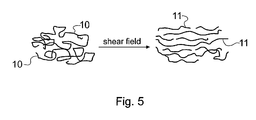
- Figure 5 shows the effect of shear on entangled polymer coils 10, which become disentangled, extended polymer chains 11 in a shear field.
- the instantaneous polydispersity depends on the mode of termination and usually lies between approximately 1.5 for combination and approximately 2 for disproportionation, but the ratio of number average molecular weight to weight average molecular weight (MN/MW) is temperature dependent and tends to become broadened at very high conversions.
- MN/MW number average molecular weight to weight average molecular weight
- a further problem lies in the serious decline of initiator efficiency which results in a considerable lowering of polymerisation rate at very high conversions (Russel, G T et al.; Macromolecules, 21, 214102148 (1988)).
- the present invention would appear to allow significant enhancement of rates of polymerisation in a simple manner, as opposed to standard continuous feed reactors (Lau, W et al.; Macromolecules, 20, 457 (1987)) or the more recent use of thermal polymerisation using nitroxyl mediation, a procedure that requires high temperatures (>125 C) and long reaction times (>20 hours) (Davenport, W et al.; Macromolecules, 30, 1929-34 (1997)).
Landscapes
- Chemical & Material Sciences (AREA)
- Organic Chemistry (AREA)
- Chemical Kinetics & Catalysis (AREA)
- Polymerisation Methods In General (AREA)
- Glass Compositions (AREA)
- Addition Polymer Or Copolymer, Post-Treatments, Or Chemical Modifications (AREA)
- Application Of Or Painting With Fluid Materials (AREA)
- Physical Or Chemical Processes And Apparatus (AREA)
- Glanulating (AREA)
- Other Resins Obtained By Reactions Not Involving Carbon-To-Carbon Unsaturated Bonds (AREA)
Claims (24)
- Verwendung eines drehenden Oberflächenreaktors zur Steuerung bimolekularer Abbruchreaktionen in Polymerisationsreaktionen, in dem chemische Bestandteile dadurch polymerisiert werden (unter Bezugnahme auf Fig. 1), dass diese in einem dünnen Film über eine Oberfläche (1) laufen, die um eine Drehachse (2) rotiert, wobei der dünne Film von einem inneren Bereich zu einem äußeren Bereich der Oberfläche (1) strömt und von dieser abgezogen wird, und wobei Polymerketten (10, 11) in dem dünnen Film ausgebildet werden und wachsen, dadurch gekennzeichnet, dass die Oberfläche (1) derart gedreht wird, dass die Polymerketten (10, 11) dazu veranlasst werden, sich über die Oberfläche (1) in Richtungen, die sich radial von der Drehachse weg erstrecken, zu entknäulen und/oder zu strecken, um somit eine translatorische und/oder segmentweise Diffision von aktiven Polymerketten (10, 11) zu reduzieren und dadurch bimolekulare Abbruchreaktionen zu reduzieren.
- Verwendung eines drehenden Oberflächenreaktors zur Steuerung von Verzweigungen in Polymerisationsreaktionen, wobei die chemischen Bestandteile dadurch polymerisiert werden (unter Bezugnahme auf Fig. 1), dass diese in einem dünnen Film über eine Oberfläche (1) laufen, die um eine Drehachse (2) rotiert, wobei der dünne Film von einem inneren Bereich zu einem äußeren Bereich der Oberfläche strömt und von dieser abgezogen wird, und wobei Polymerketten (10, 11) in dem dünnen Film ausgebildet werden und wachsen, dadurch gekennzeichnet, dass die Oberfläche (1) derart gedreht wird, dass die Polymerketten (10, 11) dazu veranlasst werden, sich zu entknäulen und/oder linear und/oder biaxial über die Oberfläche (1) zu strecken, wobei die Drehgeschwindigkeit der Oberfläche (1) so ausgewählt wird, dass präpolymere und/oder monomere Bestandteile dazu veranlasst werden, sich untereinander an einem vorbestimmten Ende der Polymerketten (10, 11) aneinander zu fügen, um dadurch zu einer gesteuerten Kettenverlängerung zu führen.
- Verwendung nach Anspruch 1 oder 2, bei der die Oberfläche (1) mit einer Geschwindigkeit gedreht wird, die ausreichend ist, um eine Zentrifugalbeschleunigung von 2g bis 1000g einschließlich zu erzeugen.
- Verwendung nach Anspruch 1, 2 oder 3, wobei die Polymerisation zumindest 80 % Umsetzung erreicht.
- Verwendung nach Anspruch 4, wobei die Polymerisation zumindest 85 % Umsetzung erreicht,
- Verwendung nach Anspruch 4, wobei die Polymerisation zumindest 90 % Umsetzung erreicht.
- Verwendung nach Anspruch 4, wobei die Polymerisation zumindest 99 % Umsetzung erreicht.
- Verwendung nach einem der vorhergehenden Ansprüche, bei der Bestandteile, die in dem dünnen Film enthaltenen sind und von dem äußeren Bereich der Oberfläche (1) abgezogen werden, dem inneren Bereich der Oberfläche (1) zurückgeführt werden oder einem inneren Bereich einer weiteren rotierenden Oberfläche (1) als zugeführtes Material überbracht werden.
- Verwendung nach einem der vorhergehenden Ansprüche, wobei der dünne Film eine durchschnittliche Dicke von 50 bis 300 µm aufweist.
- Verwendung nach einem der Ansprüche 1 bis 8, wobei der dünne Film eine durchschnittliche Dicke von 10 bis 300 µm aufweist.
- Verwendung nach einem der Ansprüche 1 bis 8, wobei der dünne Film eine durchschnittliche Dicke von 10 bis 100 µm aufweist.
- Verwendung nach einem der vorhergehenden Ansprüche, wobei ein durch die Verwendung erzeugtes Polymer einen Polydispersitätsindex im Bereich von 1,0 bis 2,5 einschließlich aufweist.
- Verwendung nach einem der Ansprüche 1 bis 11, wobei ein durch die Verwendung erzeugtes Polymer einen Polydispersitätsindex im Bereich von 1,5 bis 2,0 einschließlich aufweist.
- Verwendung nach einem der Ansprüche 1 bis 11, wobei das durch die Verwendung erzeugte Polymer einen Polydispersitätsindex im Bereich von 1,0 bis 3,0 einschließlich aufweist.
- Verwendung nach einem der vorhergehenden Ansprüche, wobei rückständige monomere Bestandteile von der Oberfläche (1) abgedampft werden.
- Verwendung nach Anspruch 15, wobei rückständige monomere Bestandteile in dem Polymerprodukt, das von dem Rand der Oberfläche (1) abgezogen wird, eine Konzentration von nicht größer als 150 ppm aufweisen.
- Verwendung nach Anspruch 16, wobei rückständige monomere Bestandteile in dem Polymerprodukt, das von dem Rand der Oberfläche (1) abgezogen wird, eine Konzentration von nicht größer als 2 ppm aufweisen.
- Verwendung nach Anspruch 16, wobei rückständige monomere Bestandteile in dem Polymerprodukt, das von dem Rand der Oberfläche (1) abgezogen wird, eine Konzentration von nicht größer als 1 ppm aufweisen.
- Verwendung nach Anspruch 1 oder jeglichem davon abhängigen Anspruch, wobei das Verzweigen der wachsenden Polymerketten (10, 11) durch Variation von chemischen oder mechanischen Prozessparametern gesteuert wird.
- Verwendung nach einem der vorhergehenden Ansprüche, wobei die bestimmten chemischen Bestandteile eine Präpolymermischung einschließen.
- Verwendung nach einem der Ansprüche 1 bis 19, wobei die bestimmten Bestandteile Monomere mit optionalen Zusätzen einschließen.
- Verwendung nach einem der vorhergehenden Ansprüche, wobei die Polymerisation eine Kondensationspolymerisation ist.
- Verwendung nach einem der Ansprüche 1 bis 21, wobei die Polymerisation eine radikalische Polymerisation ist.
- Verwendung nach einem der Ansprüche 1 bis 21, wobei die Polymerisation eine ionische Polymerisation ist.
Applications Claiming Priority (3)
| Application Number | Priority Date | Filing Date | Title |
|---|---|---|---|
| GB0117642A GB2378953B8 (en) | 2001-07-20 | 2001-07-20 | Improvements relating to polymerisation reactions |
| GB0117642 | 2001-07-20 | ||
| PCT/GB2002/003341 WO2003008460A1 (en) | 2001-07-20 | 2002-07-22 | Improvements relating to polymerisation reactions |
Publications (2)
| Publication Number | Publication Date |
|---|---|
| EP1409554A1 EP1409554A1 (de) | 2004-04-21 |
| EP1409554B1 true EP1409554B1 (de) | 2006-10-11 |
Family
ID=9918823
Family Applications (1)
| Application Number | Title | Priority Date | Filing Date |
|---|---|---|---|
| EP02755100A Expired - Lifetime EP1409554B1 (de) | 2001-07-20 | 2002-07-22 | Verbesserungen im zusammenhang mit polymerisationsreaktionen |
Country Status (8)
| Country | Link |
|---|---|
| US (2) | US7041751B2 (de) |
| EP (1) | EP1409554B1 (de) |
| JP (1) | JP2004536182A (de) |
| AT (1) | ATE342285T1 (de) |
| CA (1) | CA2492517A1 (de) |
| DE (1) | DE60215352T2 (de) |
| GB (1) | GB2378953B8 (de) |
| WO (1) | WO2003008460A1 (de) |
Families Citing this family (12)
| Publication number | Priority date | Publication date | Assignee | Title |
|---|---|---|---|---|
| GB9903474D0 (en) * | 1999-02-17 | 1999-04-07 | Univ Newcastle | Process for the conversion of a fluid phase substrate by dynamic heterogenous contact with an agent |
| GB2378953B8 (en) * | 2001-07-20 | 2005-07-18 | Protensive Ltd | Improvements relating to polymerisation reactions |
| US7125527B2 (en) * | 2003-09-05 | 2006-10-24 | Kinetichem, Inc. | Methods of operating surface reactors and reactors employing such methods |
| GB2417215B (en) * | 2004-08-18 | 2009-06-10 | Protensive Ltd | Spinning disc reactor with enhanced spreader plate features |
| US7273570B2 (en) | 2005-07-08 | 2007-09-25 | Eastman Kodak Company | Method of forming polymer particles |
| US7666950B2 (en) * | 2006-06-01 | 2010-02-23 | Lanxess Deutschland Gmbh | Process for preparing hydrogenated nitrile rubbers |
| KR20100075905A (ko) * | 2007-09-12 | 2010-07-05 | 컨스트럭션 리서치 앤 테크놀로지 게엠베하 | 폴리우레탄/폴리우레아의 연속 제조 |
| DE102007051274A1 (de) * | 2007-10-26 | 2009-04-30 | Construction Research & Technology Gmbh | Kontinuierliche Herstellung von Polyurethanen/Polyharnstoffen |
| ES2398341T3 (es) * | 2008-07-08 | 2013-03-15 | Construction Research & Technology Gmbh | Procedimiento para la eliminación de isocianato no transformado a partir de su producto de reacción |
| WO2010015452A1 (de) * | 2008-08-08 | 2010-02-11 | Construction Research & Technology Gmbh | Herstellung von silylierten polyurethanen und/oder polyharnstoffen |
| US9573297B2 (en) * | 2011-11-21 | 2017-02-21 | Reza Reza Youssefi | Method and system for enhancing polymerization and nanoparticle production |
| EP3201598A4 (de) | 2014-10-01 | 2018-02-28 | Advanced Polymer Monitoring Technologies Inc. | Systeme und verfahren zur steuerung von polymerreaktionen und -verarbeitung mithilfe automatischer kontinuierlicher online-überwachung |
Family Cites Families (4)
| Publication number | Priority date | Publication date | Assignee | Title |
|---|---|---|---|---|
| JPS54126676A (en) * | 1978-02-21 | 1979-10-02 | Ici Ltd | Chemical method on surface of rotating article |
| US5807937A (en) * | 1995-11-15 | 1998-09-15 | Carnegie Mellon University | Processes based on atom (or group) transfer radical polymerization and novel (co) polymers having useful structures and properties |
| GB9903474D0 (en) * | 1999-02-17 | 1999-04-07 | Univ Newcastle | Process for the conversion of a fluid phase substrate by dynamic heterogenous contact with an agent |
| GB2378953B8 (en) * | 2001-07-20 | 2005-07-18 | Protensive Ltd | Improvements relating to polymerisation reactions |
-
2001
- 2001-07-20 GB GB0117642A patent/GB2378953B8/en not_active Expired - Fee Related
-
2002
- 2002-07-22 AT AT02755100T patent/ATE342285T1/de not_active IP Right Cessation
- 2002-07-22 US US10/484,611 patent/US7041751B2/en not_active Expired - Fee Related
- 2002-07-22 WO PCT/GB2002/003341 patent/WO2003008460A1/en not_active Ceased
- 2002-07-22 DE DE60215352T patent/DE60215352T2/de not_active Expired - Fee Related
- 2002-07-22 CA CA002492517A patent/CA2492517A1/en not_active Abandoned
- 2002-07-22 EP EP02755100A patent/EP1409554B1/de not_active Expired - Lifetime
- 2002-07-22 JP JP2003514017A patent/JP2004536182A/ja active Pending
-
2006
- 2006-05-09 US US11/382,434 patent/US20060194934A1/en not_active Abandoned
Also Published As
| Publication number | Publication date |
|---|---|
| DE60215352T2 (de) | 2007-05-24 |
| JP2004536182A (ja) | 2004-12-02 |
| GB2378953A (en) | 2003-02-26 |
| US7041751B2 (en) | 2006-05-09 |
| GB2378953A8 (en) | 2005-07-18 |
| GB2378953B (en) | 2005-02-16 |
| WO2003008460A1 (en) | 2003-01-30 |
| EP1409554A1 (de) | 2004-04-21 |
| US20040236039A1 (en) | 2004-11-25 |
| CA2492517A1 (en) | 2003-01-30 |
| ATE342285T1 (de) | 2006-11-15 |
| GB0117642D0 (en) | 2001-09-12 |
| US20060194934A1 (en) | 2006-08-31 |
| DE60215352D1 (de) | 2006-11-23 |
| GB2378953B8 (en) | 2005-07-18 |
Similar Documents
| Publication | Publication Date | Title |
|---|---|---|
| US7041751B2 (en) | Method of polymerizing predetermined chemical components | |
| US9969819B2 (en) | Pressure sensitive adhesive including a 1,1-disubstituted alkene compound | |
| EP1263794A1 (de) | Kontinuierliches verfahren zur herstellung von materialien mit einer kontrollierten struktur | |
| JP2000516286A (ja) | アニオン重合 | |
| JPH08847B2 (ja) | エチレンと不飽和カルボン酸とのインターポリマーの製造法 | |
| WO2000075193A1 (en) | Method of continuous cationic living polymerization | |
| JP5365913B2 (ja) | リビングカチオン重合体の連続製造方法 | |
| KR20000071024A (ko) | 락티드를 중합시키는 방법 | |
| JPH06872B2 (ja) | エチレン共重合体水性分散液 | |
| JPS5980423A (ja) | 熱可塑性重合体の連続製造方法 | |
| Bensemra et al. | Thermal dehydrochlorination and stabilization of poly (vinyl chloride) in solution: part V. Influence of structural defects in the polymer | |
| WO1994018241A1 (en) | Free radical solution polymerization of vinylpyrrolidone | |
| US3759879A (en) | Continuous bulk polymerization process for vinyl chloride copolymers | |
| JP4377032B2 (ja) | リビング重合体の連続製造方法 | |
| EP0675146B1 (de) | Polydioxolanhochmolekulargewichte und herstellungsverfahren | |
| JPS5928211B2 (ja) | テトラフルオロエチレン − ヘキサフルオロプロピレンキヨウジユウゴウタイ セイゾウホウホウ | |
| EP0522641B1 (de) | Anionische Extruder-Polymerisation | |
| Ravi et al. | Ring‐Opening Polymerization of ε‐Caprolactone by Phosphorane Iminato and Cyclopentadienyl Complexes of Rare Earth Elements | |
| Suddaby et al. | Catalytic chain transfer in polymerization of methyl methacrylate. II. Continuous synthesis and purification of macromer | |
| KR100653502B1 (ko) | 스태틱믹서를 이용한 메타크릴레이트계 중합체의 제조방법 | |
| Gedde et al. | Polymer Synthesis | |
| JP2000516979A (ja) | ポリ―p―ジオキサノンポリマーを製造する方法 | |
| EP0130313A2 (de) | Oligomere und Homopolymere von Meta- oder Para-Isopropenyl-alpha,alpha-dimethylbenzylisocyanat | |
| JP3957603B2 (ja) | イソブチレン系熱可塑性エラストマーの製造方法 | |
| US20070299201A1 (en) | Process for manufacturing hydrogels |
Legal Events
| Date | Code | Title | Description |
|---|---|---|---|
| PUAI | Public reference made under article 153(3) epc to a published international application that has entered the european phase |
Free format text: ORIGINAL CODE: 0009012 |
|
| 17P | Request for examination filed |
Effective date: 20040202 |
|
| AK | Designated contracting states |
Kind code of ref document: A1 Designated state(s): AT BE BG CH CY CZ DE DK EE ES FI FR GB GR IE IT LI LU MC NL PT SE SK TR |
|
| AX | Request for extension of the european patent |
Extension state: AL LT LV MK RO SI |
|
| 17Q | First examination report despatched |
Effective date: 20040518 |
|
| RIN1 | Information on inventor provided before grant (corrected) |
Inventor name: HENDERSON, IAN Inventor name: JONES, MICHAEL Inventor name: JACHUCK, ROSHAN JEET JEE |
|
| GRAP | Despatch of communication of intention to grant a patent |
Free format text: ORIGINAL CODE: EPIDOSNIGR1 |
|
| GRAS | Grant fee paid |
Free format text: ORIGINAL CODE: EPIDOSNIGR3 |
|
| GRAA | (expected) grant |
Free format text: ORIGINAL CODE: 0009210 |
|
| AK | Designated contracting states |
Kind code of ref document: B1 Designated state(s): AT BE BG CH CY CZ DE DK EE ES FI FR GB GR IE IT LI LU MC NL PT SE SK TR |
|
| PG25 | Lapsed in a contracting state [announced via postgrant information from national office to epo] |
Ref country code: SK Free format text: LAPSE BECAUSE OF FAILURE TO SUBMIT A TRANSLATION OF THE DESCRIPTION OR TO PAY THE FEE WITHIN THE PRESCRIBED TIME-LIMIT Effective date: 20061011 Ref country code: LI Free format text: LAPSE BECAUSE OF FAILURE TO SUBMIT A TRANSLATION OF THE DESCRIPTION OR TO PAY THE FEE WITHIN THE PRESCRIBED TIME-LIMIT Effective date: 20061011 Ref country code: IT Free format text: LAPSE BECAUSE OF FAILURE TO SUBMIT A TRANSLATION OF THE DESCRIPTION OR TO PAY THE FEE WITHIN THE PRESCRIBED TIME-LIMIT;WARNING: LAPSES OF ITALIAN PATENTS WITH EFFECTIVE DATE BEFORE 2007 MAY HAVE OCCURRED AT ANY TIME BEFORE 2007. THE CORRECT EFFECTIVE DATE MAY BE DIFFERENT FROM THE ONE RECORDED. Effective date: 20061011 Ref country code: FI Free format text: LAPSE BECAUSE OF FAILURE TO SUBMIT A TRANSLATION OF THE DESCRIPTION OR TO PAY THE FEE WITHIN THE PRESCRIBED TIME-LIMIT Effective date: 20061011 Ref country code: CZ Free format text: LAPSE BECAUSE OF FAILURE TO SUBMIT A TRANSLATION OF THE DESCRIPTION OR TO PAY THE FEE WITHIN THE PRESCRIBED TIME-LIMIT Effective date: 20061011 Ref country code: CH Free format text: LAPSE BECAUSE OF FAILURE TO SUBMIT A TRANSLATION OF THE DESCRIPTION OR TO PAY THE FEE WITHIN THE PRESCRIBED TIME-LIMIT Effective date: 20061011 Ref country code: BE Free format text: LAPSE BECAUSE OF FAILURE TO SUBMIT A TRANSLATION OF THE DESCRIPTION OR TO PAY THE FEE WITHIN THE PRESCRIBED TIME-LIMIT Effective date: 20061011 Ref country code: AT Free format text: LAPSE BECAUSE OF FAILURE TO SUBMIT A TRANSLATION OF THE DESCRIPTION OR TO PAY THE FEE WITHIN THE PRESCRIBED TIME-LIMIT Effective date: 20061011 |
|
| REG | Reference to a national code |
Ref country code: GB Ref legal event code: FG4D |
|
| REG | Reference to a national code |
Ref country code: CH Ref legal event code: EP |
|
| REG | Reference to a national code |
Ref country code: IE Ref legal event code: FG4D |
|
| REF | Corresponds to: |
Ref document number: 60215352 Country of ref document: DE Date of ref document: 20061123 Kind code of ref document: P |
|
| PG25 | Lapsed in a contracting state [announced via postgrant information from national office to epo] |
Ref country code: SE Free format text: LAPSE BECAUSE OF FAILURE TO SUBMIT A TRANSLATION OF THE DESCRIPTION OR TO PAY THE FEE WITHIN THE PRESCRIBED TIME-LIMIT Effective date: 20070111 Ref country code: DK Free format text: LAPSE BECAUSE OF FAILURE TO SUBMIT A TRANSLATION OF THE DESCRIPTION OR TO PAY THE FEE WITHIN THE PRESCRIBED TIME-LIMIT Effective date: 20070111 Ref country code: BG Free format text: LAPSE BECAUSE OF FAILURE TO SUBMIT A TRANSLATION OF THE DESCRIPTION OR TO PAY THE FEE WITHIN THE PRESCRIBED TIME-LIMIT Effective date: 20070111 |
|
| PG25 | Lapsed in a contracting state [announced via postgrant information from national office to epo] |
Ref country code: ES Free format text: LAPSE BECAUSE OF FAILURE TO SUBMIT A TRANSLATION OF THE DESCRIPTION OR TO PAY THE FEE WITHIN THE PRESCRIBED TIME-LIMIT Effective date: 20070122 |
|
| PG25 | Lapsed in a contracting state [announced via postgrant information from national office to epo] |
Ref country code: PT Free format text: LAPSE BECAUSE OF FAILURE TO SUBMIT A TRANSLATION OF THE DESCRIPTION OR TO PAY THE FEE WITHIN THE PRESCRIBED TIME-LIMIT Effective date: 20070319 |
|
| REG | Reference to a national code |
Ref country code: CH Ref legal event code: PL |
|
| ET | Fr: translation filed | ||
| PGFP | Annual fee paid to national office [announced via postgrant information from national office to epo] |
Ref country code: DE Payment date: 20070719 Year of fee payment: 6 |
|
| PLBE | No opposition filed within time limit |
Free format text: ORIGINAL CODE: 0009261 |
|
| STAA | Information on the status of an ep patent application or granted ep patent |
Free format text: STATUS: NO OPPOSITION FILED WITHIN TIME LIMIT |
|
| 26N | No opposition filed |
Effective date: 20070712 |
|
| PGFP | Annual fee paid to national office [announced via postgrant information from national office to epo] |
Ref country code: GB Payment date: 20070704 Year of fee payment: 6 |
|
| PGFP | Annual fee paid to national office [announced via postgrant information from national office to epo] |
Ref country code: NL Payment date: 20070703 Year of fee payment: 6 |
|
| PG25 | Lapsed in a contracting state [announced via postgrant information from national office to epo] |
Ref country code: MC Free format text: LAPSE BECAUSE OF NON-PAYMENT OF DUE FEES Effective date: 20070731 Ref country code: GR Free format text: LAPSE BECAUSE OF FAILURE TO SUBMIT A TRANSLATION OF THE DESCRIPTION OR TO PAY THE FEE WITHIN THE PRESCRIBED TIME-LIMIT Effective date: 20070112 |
|
| PGFP | Annual fee paid to national office [announced via postgrant information from national office to epo] |
Ref country code: FR Payment date: 20070710 Year of fee payment: 6 |
|
| PG25 | Lapsed in a contracting state [announced via postgrant information from national office to epo] |
Ref country code: IE Free format text: LAPSE BECAUSE OF NON-PAYMENT OF DUE FEES Effective date: 20070723 Ref country code: EE Free format text: LAPSE BECAUSE OF FAILURE TO SUBMIT A TRANSLATION OF THE DESCRIPTION OR TO PAY THE FEE WITHIN THE PRESCRIBED TIME-LIMIT Effective date: 20061011 |
|
| GBPC | Gb: european patent ceased through non-payment of renewal fee |
Effective date: 20080722 |
|
| NLV4 | Nl: lapsed or anulled due to non-payment of the annual fee |
Effective date: 20090201 |
|
| PG25 | Lapsed in a contracting state [announced via postgrant information from national office to epo] |
Ref country code: DE Free format text: LAPSE BECAUSE OF NON-PAYMENT OF DUE FEES Effective date: 20090203 |
|
| REG | Reference to a national code |
Ref country code: FR Ref legal event code: ST Effective date: 20090331 |
|
| PG25 | Lapsed in a contracting state [announced via postgrant information from national office to epo] |
Ref country code: NL Free format text: LAPSE BECAUSE OF NON-PAYMENT OF DUE FEES Effective date: 20090201 |
|
| PG25 | Lapsed in a contracting state [announced via postgrant information from national office to epo] |
Ref country code: GB Free format text: LAPSE BECAUSE OF NON-PAYMENT OF DUE FEES Effective date: 20080722 |
|
| PG25 | Lapsed in a contracting state [announced via postgrant information from national office to epo] |
Ref country code: LU Free format text: LAPSE BECAUSE OF NON-PAYMENT OF DUE FEES Effective date: 20070722 Ref country code: FR Free format text: LAPSE BECAUSE OF NON-PAYMENT OF DUE FEES Effective date: 20080731 Ref country code: CY Free format text: LAPSE BECAUSE OF FAILURE TO SUBMIT A TRANSLATION OF THE DESCRIPTION OR TO PAY THE FEE WITHIN THE PRESCRIBED TIME-LIMIT Effective date: 20061011 |
|
| PG25 | Lapsed in a contracting state [announced via postgrant information from national office to epo] |
Ref country code: TR Free format text: LAPSE BECAUSE OF FAILURE TO SUBMIT A TRANSLATION OF THE DESCRIPTION OR TO PAY THE FEE WITHIN THE PRESCRIBED TIME-LIMIT Effective date: 20061011 |