EP1408331A2 - Verfahren zum Echtzeitabschätzung von Stickstoffoxiden - Google Patents
Verfahren zum Echtzeitabschätzung von Stickstoffoxiden Download PDFInfo
- Publication number
- EP1408331A2 EP1408331A2 EP03021373A EP03021373A EP1408331A2 EP 1408331 A2 EP1408331 A2 EP 1408331A2 EP 03021373 A EP03021373 A EP 03021373A EP 03021373 A EP03021373 A EP 03021373A EP 1408331 A2 EP1408331 A2 EP 1408331A2
- Authority
- EP
- European Patent Office
- Prior art keywords
- nox
- cylinder
- temperature
- value
- mass
- Prior art date
- Legal status (The legal status is an assumption and is not a legal conclusion. Google has not performed a legal analysis and makes no representation as to the accuracy of the status listed.)
- Withdrawn
Links
Images





Classifications
-
- F—MECHANICAL ENGINEERING; LIGHTING; HEATING; WEAPONS; BLASTING
- F02—COMBUSTION ENGINES; HOT-GAS OR COMBUSTION-PRODUCT ENGINE PLANTS
- F02D—CONTROLLING COMBUSTION ENGINES
- F02D41/00—Electrical control of supply of combustible mixture or its constituents
- F02D41/02—Circuit arrangements for generating control signals
- F02D41/14—Introducing closed-loop corrections
- F02D41/1438—Introducing closed-loop corrections using means for determining characteristics of the combustion gases; Sensors therefor
- F02D41/1444—Introducing closed-loop corrections using means for determining characteristics of the combustion gases; Sensors therefor characterised by the characteristics of the combustion gases
- F02D41/146—Introducing closed-loop corrections using means for determining characteristics of the combustion gases; Sensors therefor characterised by the characteristics of the combustion gases the characteristics being an NOx content or concentration
- F02D41/1461—Introducing closed-loop corrections using means for determining characteristics of the combustion gases; Sensors therefor characterised by the characteristics of the combustion gases the characteristics being an NOx content or concentration of the exhaust gases emitted by the engine
- F02D41/1462—Introducing closed-loop corrections using means for determining characteristics of the combustion gases; Sensors therefor characterised by the characteristics of the combustion gases the characteristics being an NOx content or concentration of the exhaust gases emitted by the engine with determination means using an estimation
-
- G—PHYSICS
- G01—MEASURING; TESTING
- G01N—INVESTIGATING OR ANALYSING MATERIALS BY DETERMINING THEIR CHEMICAL OR PHYSICAL PROPERTIES
- G01N33/00—Investigating or analysing materials by specific methods not covered by groups G01N1/00 - G01N31/00
- G01N33/0004—Gaseous mixtures, e.g. polluted air
- G01N33/0009—General constructional details of gas analysers, e.g. portable test equipment
- G01N33/0027—General constructional details of gas analysers, e.g. portable test equipment concerning the detector
- G01N33/0036—General constructional details of gas analysers, e.g. portable test equipment concerning the detector specially adapted to detect a particular component
- G01N33/0037—NOx
-
- Y—GENERAL TAGGING OF NEW TECHNOLOGICAL DEVELOPMENTS; GENERAL TAGGING OF CROSS-SECTIONAL TECHNOLOGIES SPANNING OVER SEVERAL SECTIONS OF THE IPC; TECHNICAL SUBJECTS COVERED BY FORMER USPC CROSS-REFERENCE ART COLLECTIONS [XRACs] AND DIGESTS
- Y02—TECHNOLOGIES OR APPLICATIONS FOR MITIGATION OR ADAPTATION AGAINST CLIMATE CHANGE
- Y02A—TECHNOLOGIES FOR ADAPTATION TO CLIMATE CHANGE
- Y02A50/00—TECHNOLOGIES FOR ADAPTATION TO CLIMATE CHANGE in human health protection, e.g. against extreme weather
- Y02A50/20—Air quality improvement or preservation, e.g. vehicle emission control or emission reduction by using catalytic converters
Definitions
- This disclosure relates generally to diesel engines and more particularly, to systems and methods for real-time estimation of NOx in exhaust gases generated by the diesel engine.
- the process comprises receiving a plurality of input values from a combustion chamber of a cylinder, wherein the input values consist essentially of a mass amount of trapped air in the combustion chamber, a mass amount of trapped fuel in the combustion chamber, a total mass of species generated within a combustion zone as a fraction of total in-cylinder mass, and a correlation value from a lookup table derived from an average NOx temperature of a combustion zone in the combustion chamber; and calculating an output signal from the plurality of input values, wherein the output signal produces a real-time estimate of the NOx production rate from the cylinder.
- a process for providing a real-time estimation of in-cylinder NOx production rates during a combustion process in an internal combustion engine comprises calculating an average temperature value in a combustion zone of a cylinder combustion chamber; correlating the average temperature value to a correlation value in a look-up table; and estimating the in-cylinder NOx production rate from a calculation including the correlation value, an amount of trapped air in the combustion chamber, an amount of trapped unburned fuel in the combustion chamber, and a total mass of species generated within a combustion zone as a fraction of total in-cylinder mass.
- Figure 1 is a graphical illustration showing steady state and equilibrium calculations for NOx mole fractions as a function of crank angle degrees;
- Figure 2 is a pictorial illustration of combustion zone and an excess air zone with unburned fuel in a combustion chamber cylinder at peak in-cylinder average temperature conditions;
- Figure 3 is a block diagram of a NOx estimation model in a Matlab/Simulink format
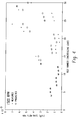
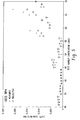
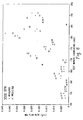
- Figure 4 is a graphical illustration of model predictions and measurement of NOx flow rate as a function of test number for a 1.3 liter engine running at 1,500 revolutions per minute (rpm);
- Figure 5 is a graphical illustration of model predictions and measurement of NOx flow rate as a function of test number for a 1.3 liter engine running at 1,800 rpm;
- Figure 6 is a graphical illustration of model predictions and measurement of NOx flow rate as a function of test number for a 1.3 liter engine running at 2,400 rpm;
- Figure 7 is a graphical illustration of model predictions and measurement of NOx flow rate as a function of test number for a 1.3 liter engine running at 2,800 rpm;
- Figure 8 is a graphical illustration of model predictions and measurement of NOx flow rate as a function of test number for a 1.3 liter engine running at 3,000 rpm;
- Figure 9 is graphical illustration showing error comparisons for the data illustrated in Figures 4-8.
- a process for providing real-time estimation of nitrogen oxide (NOx ) production rates during a combustion process for an internal combustion engine having a plurality of cylinders, each fed by a fuel injector As used herein the term "real-time” is defined as an instantaneous estimation of the amount of NOx currently being generated at that instance of time within each cylinder.
- the process for providing real-time NOx estimation employs a model that takes into account fundamental in-cylinder variables such as temperature, pressure, oxygen content, and other like variables.
- the in-cylinder model engine combustion and emissions data were analyzed to identify the in-cylinder parameters having the greatest effect on NOx emissions formations. Parameters were then identified on a combustion cycle level, which allows the process to predict the transient behavior and emissions cycle-to-cycle variations.
- the in-cylinder model can be easily integrated with combustion models.
- each cylinder has been divided into two zones: a combustion zone and an excess air zone.
- the excess air zone is defined as the region of the cylinder with unburned fuel and air.
- the combustion zone is defined by the presence of the chemical reactions and formation of NOx species as well as other emissions.
- the combustion zone can be characterized by having the burned fuel at peak temperature reacting with a stoichiometric amount of air, which also includes an excess amount of nitrogen due to the re-circulated exhaust (i.e., EGR). As such, the oxygen percentage in the exhaust is less than the oxygen in the fresh air. At peak temperature conditions, it is observed that there is an agreement between the equilibrium NOx formations with the steady state measurements.
- the chemical equilibrium calculations can be performed for the combustion zone at the time of peak in-cylinder average temperature conditions to provide an estimate of the amount of NOx produced.
- the calculations are done at the combustion zone average temperature, not the overall in-cylinder temperature.
- the chemical equilibrium calculations include minimizing the total Gibbs free energy for all of the species produced in the mixture so as to determine the mole fractions of each component.
- the term "species" refers to all gaseous components formed in the mixture (combustion zone) including, but not limited to, the nitrogen oxides. Based upon this observation, a look up table can be made based on the chemical equilibrium calculations that correlate to the average temperature condition for the nitrogen oxides produced during both expansion and combustion.
- the combustion zone is a non-uniform temperature distribution area, which can result in non-uniform emissions formation.
- the average temperature of the combustion zone is the average NOx producing temperature.
- this average NOx producing temperature is different from the actual average temperature due to the non-linear behavior of emissions production as a function of temperature.
- the final correlation of the average NOx producing temperature was determined in a simplified form that can be easily implemented, yet can be accurate enough to capture the various effects.
- the estimation model is dependant on the trapped air mass, the cylinder pressure at maximum temperature, and the cylinder pressure at top dead center. Using these input variables, the in-cylinder model output provides a real-time estimate of the NOx flow rate from the cylinder. This model runs only once per cycle after the maximum temperature has occurred, which provides a significant advantage over chemical reaction integration models in real-time implementation.
- the in-cylinder correlation model for providing real-time NOx estimation during combustion cycles can be determined from the following mathematical relationship as represented by formula (I).
- m air is the trapped air mass (expressed in kilograms)
- m stp is the trapped mass at standard temperature and pressure with a volumetric efficiency of 1 (expressed in kilograms)
- P Tmax is the cylinder pressure at maximum temperature (expressed in kilopascals)
- P TDC is cylinder pressure at top dead center (expressed in kilopascals)
- b, and c are constants.
- T burn represents the average NOx producing temperature in the combustion zone as previously described and shown in Figure 2 rather than a bulk temperature of the burning gas.
- the T burn value is then correlated to a look-up table that includes static values based on the chemical equilibrium calculations. Since the look-up table is based on chemical equilibrium calculations and as such, the values contained within the table are static. The values in the look-up table do not change and are independent of actuator changes, engine types, and does not require a steady state estimation of NOx. It is further noted that constants a, b, and c did not show a significant change when increasing the number of test points used for identification.
- the model provides exceptional accuracy with the added capability of capturing the different effects that can cause changes in NOx production rates.
- a two-dimensional look up table can also be employed to provide similar results.
- the two-dimensional look-up table could use the mass ratios and pressure ratios as the input values for providing the correlation.
- Validation of the model was conducted using a 1.3 liter diesel engine with the following inputs recorded as shown in Table 1.
- the NOx flow rate was estimated under a variety of conditions using the in-cylinder model and compared to actual measurements taken under the same conditions.
- Engine speed was varied to 1500, 1800, 2400, 2800 and 3000 revolutions per minute (RPM); loads (BMEP) were varied to 0, 200, 400, 600, and 800 kilopascals (kPa); EGR valve duty was varied to 0, 30 and 60 percent. Injection timing was varied at timed (calibrated), +5 degrees, and -5 degrees.
- Figure 3 shows implementation of the in-cylinder model in a Simulink function block format.
- the inputs for estimating NOx output include (1) trapped air, fuel and EGR masses for each cycle, (2) exhaust gas concentration, i.e., a total mass of species generated within a combustion zone as a fraction of total in-cylinder mass determined from a ratio of the combustion zone mass to the in-cylinder mass, (3) fuel fraction burned up to maximum temperature time, and (4) a chemical equilibrium calculation value based upon the T burn correlation, which is dependent upon the trapped air mass, the cylinder pressure at maximum temperature, and the cylinder pressure at top dead center.
- Figure 9 displays the full test matrix used and presents the overall correlation of the model with the actual measurements.
- Figure 9 also shows the residuals and the error percentage. The results clearly indicate the robustness of the estimation model.
- the predicted NOx values closely overlapped the actual measurements under most conditions. However, under some operating conditions it is apparent that the error percentages are relatively high compared to the results obtained under most conditions.
- a possible reason for these relatively high errors is either: a) a result of low measured values, wherein small absolute error values may possibly have resulted in high error percentages such as when observing the residuals for these points, or b) the combustion process resulted in significant smoke numbers, which suggests that the model might not be as accurate at high equivalence ratios compared to lean combustion conditions.
- the in-cylinder model for providing real-time estimates of NOx production during a combustion cycle offers at least the following advantages:
Landscapes
- Engineering & Computer Science (AREA)
- Chemical & Material Sciences (AREA)
- Combustion & Propulsion (AREA)
- Health & Medical Sciences (AREA)
- Life Sciences & Earth Sciences (AREA)
- Analytical Chemistry (AREA)
- Immunology (AREA)
- Physics & Mathematics (AREA)
- Food Science & Technology (AREA)
- Biochemistry (AREA)
- General Health & Medical Sciences (AREA)
- General Physics & Mathematics (AREA)
- Medicinal Chemistry (AREA)
- Pathology (AREA)
- Mechanical Engineering (AREA)
- General Engineering & Computer Science (AREA)
- Combined Controls Of Internal Combustion Engines (AREA)
- Exhaust-Gas Circulating Devices (AREA)
- Exhaust Gas After Treatment (AREA)
Applications Claiming Priority (2)
| Application Number | Priority Date | Filing Date | Title |
|---|---|---|---|
| US10/269,846 US6775623B2 (en) | 2002-10-11 | 2002-10-11 | Real-time nitrogen oxides (NOx) estimation process |
| US269846 | 2002-10-11 |
Publications (2)
| Publication Number | Publication Date |
|---|---|
| EP1408331A2 true EP1408331A2 (de) | 2004-04-14 |
| EP1408331A3 EP1408331A3 (de) | 2004-10-20 |
Family
ID=32030395
Family Applications (1)
| Application Number | Title | Priority Date | Filing Date |
|---|---|---|---|
| EP03021373A Withdrawn EP1408331A3 (de) | 2002-10-11 | 2003-09-22 | Verfahren zum Echtzeitabschätzung von Stickstoffoxiden |
Country Status (3)
| Country | Link |
|---|---|
| US (1) | US6775623B2 (de) |
| EP (1) | EP1408331A3 (de) |
| JP (1) | JP2004132379A (de) |
Cited By (7)
| Publication number | Priority date | Publication date | Assignee | Title |
|---|---|---|---|---|
| WO2005045219A1 (en) * | 2003-11-06 | 2005-05-19 | Toyota Jidosha Kabushiki Kaisha | Nox discharge quantity estimation method for internal combustion engine |
| FR2906842A1 (fr) * | 2006-10-09 | 2008-04-11 | Renault Sas | Systeme de determination du debit massique d'oxydes d'azote emis dans les gaz d'echappement d'un moteur a combustion interne |
| FR2906841A1 (fr) | 2006-10-09 | 2008-04-11 | Renault Sas | Systeme de determination du debit massique d'oxydes d'azote emis dans les gaz d'echappement d'un moteur a combustion interne |
| FR2933736A1 (fr) * | 2008-07-10 | 2010-01-15 | Peugeot Citroen Automobiles Sa | Procede de controle instantane des emissions d'oxydes d'azote |
| CN110348136A (zh) * | 2019-07-15 | 2019-10-18 | 吉林师范大学 | 一种基于参数标定优化的发动机扭矩及排放建模方法 |
| KR20200036477A (ko) * | 2018-09-28 | 2020-04-07 | 현대자동차주식회사 | 녹스 발생량 예측 및 제어 방법 |
| CN111434907A (zh) * | 2019-01-11 | 2020-07-21 | 珀金斯发动机有限公司 | 用于确定内燃机的排气中的物质的量的方法和系统 |
Families Citing this family (42)
| Publication number | Priority date | Publication date | Assignee | Title |
|---|---|---|---|---|
| US7114324B2 (en) * | 2004-03-19 | 2006-10-03 | Ford Global Technologies, Llc | Method for operating a lean burn engine with an aftertreatment system including nonthermal plasma discharge device |
| JP4830912B2 (ja) * | 2007-03-05 | 2011-12-07 | トヨタ自動車株式会社 | 内燃機関の制御装置 |
| DE102007048650B4 (de) * | 2007-10-10 | 2011-06-09 | Audi Ag | Verfahren und Vorrichtung zur Optimierung der Verbrennung von Dieselkraftstoffen mit unterschiedlichen Cetanzahlen in einer Diesel-Brennkraftmaschine |
| US7831378B2 (en) * | 2007-10-30 | 2010-11-09 | Cummins Inc. | System and method for estimating NOx produced by an internal combustion engine |
| US20090183551A1 (en) * | 2008-01-18 | 2009-07-23 | Gerald Thomas Fattic | NOx mass estimating unit and method |
| JP2009264176A (ja) * | 2008-04-23 | 2009-11-12 | Yanmar Co Ltd | ガスエンジン制御装置 |
| US8041498B2 (en) * | 2008-08-29 | 2011-10-18 | GM Global Technology Operations LLC | Lean nitrogen oxide emission control system and method |
| US8301356B2 (en) * | 2008-10-06 | 2012-10-30 | GM Global Technology Operations LLC | Engine out NOx virtual sensor using cylinder pressure sensor |
| DE102009000329A1 (de) * | 2008-10-13 | 2010-04-15 | Robert Bosch Gmbh | Verfahren und Vorrichtung zum Betreiben eines Verbrennungsmotors |
| US8055437B2 (en) * | 2009-03-17 | 2011-11-08 | Ford Global Technologies, Llc | CO2 information display and method |
| DE102009029257B3 (de) * | 2009-09-08 | 2010-10-28 | Ford Global Technologies, LLC, Dearborn | Identifikation einer Luft- und/oder Kraftstoffdosierungsabweichung |
| US8244505B2 (en) * | 2009-11-05 | 2012-08-14 | General Electric Company | Predicting NOx emissions |
| JP5644220B2 (ja) * | 2010-07-13 | 2014-12-24 | トヨタ自動車株式会社 | 内燃機関の制御装置 |
| US8720189B2 (en) | 2011-01-26 | 2014-05-13 | GM Global Technology Operations LLC | Apparatus and method for onboard performance monitoring of oxidation catalyst |
| US8919099B2 (en) | 2011-06-10 | 2014-12-30 | GM Global Technology Operations LLC | System and method for determining an ammonia generation rate in a three-way catalyst |
| US9714625B2 (en) | 2011-07-28 | 2017-07-25 | GM Global Technology Operations LLC | System and method for controlling ammonia levels in a selective catalytic reduction catalyst using a nitrogen oxide sensor |
| US9677493B2 (en) | 2011-09-19 | 2017-06-13 | Honeywell Spol, S.R.O. | Coordinated engine and emissions control system |
| US20130111905A1 (en) | 2011-11-04 | 2013-05-09 | Honeywell Spol. S.R.O. | Integrated optimization and control of an engine and aftertreatment system |
| US9650934B2 (en) | 2011-11-04 | 2017-05-16 | Honeywell spol.s.r.o. | Engine and aftertreatment optimization system |
| KR101317410B1 (ko) * | 2011-11-22 | 2013-10-10 | 서울대학교산학협력단 | 녹스 발생량 예측 방법 |
| US9188071B2 (en) | 2012-05-15 | 2015-11-17 | GM Global Technology Operations LLC | System and method for controlling an engine based on ammonia storage in multiple selective catalytic reduction catalysts |
| US8783019B2 (en) | 2012-09-05 | 2014-07-22 | GM Global Technology Operations LLC | Apparatus and method for onboard performance monitoring of oxidation catalyst |
| US9921131B2 (en) * | 2013-04-25 | 2018-03-20 | International Engine Intellectual Property Company, Llc. | NOx model |
| EP3051367B1 (de) | 2015-01-28 | 2020-11-25 | Honeywell spol s.r.o. | Ansatz und system zur handhabung von einschränkungen für gemessene störungen mit unsicherer vorschau |
| CN107250517B (zh) * | 2015-02-10 | 2021-08-17 | 康明斯有限公司 | 基于缸内内容确定发动机排出nox的系统和方法 |
| EP3056706A1 (de) | 2015-02-16 | 2016-08-17 | Honeywell International Inc. | Ansatz zur nachbehandlungssystemmodellierung und modellidentifizierung |
| US9709543B2 (en) * | 2015-05-06 | 2017-07-18 | GM Global Technology Operations LLC | Method and apparatus for determining NOx content in an exhaust gas feedstream of an internal combustion engine |
| EP3091212A1 (de) | 2015-05-06 | 2016-11-09 | Honeywell International Inc. | Identifikationsansatz für verbrennungsmotor-mittelwertmodelle |
| EP3125052B1 (de) | 2015-07-31 | 2020-09-02 | Garrett Transportation I Inc. | Quadratischer programmlöser für mpc mit variabler anordnung |
| US10272779B2 (en) | 2015-08-05 | 2019-04-30 | Garrett Transportation I Inc. | System and approach for dynamic vehicle speed optimization |
| KR101734240B1 (ko) | 2015-12-10 | 2017-05-11 | 현대자동차 주식회사 | 녹스 발생량 예측 장치 및 이를 이용한 녹스 발생량 예측 방법 |
| US10077727B2 (en) | 2016-01-13 | 2018-09-18 | GM Global Technology Operations LLC | Engine control systems and methods for nitrogen oxide reduction |
| US10415492B2 (en) | 2016-01-29 | 2019-09-17 | Garrett Transportation I Inc. | Engine system with inferential sensor |
| US9957911B2 (en) | 2016-02-18 | 2018-05-01 | GM Global Technology Operations LLC | Dedicated exhaust gas recirculation control systems and methods |
| US10124750B2 (en) | 2016-04-26 | 2018-11-13 | Honeywell International Inc. | Vehicle security module system |
| US10036338B2 (en) | 2016-04-26 | 2018-07-31 | Honeywell International Inc. | Condition-based powertrain control system |
| US10920687B2 (en) * | 2016-11-15 | 2021-02-16 | Cummins Inc. | Spark ignition engine control with exhaust manifold pressure sensor |
| EP3548729B1 (de) | 2016-11-29 | 2023-02-22 | Garrett Transportation I Inc. | Inferenzflusssensor |
| CN110382832B (zh) * | 2017-03-10 | 2022-03-04 | 康明斯有限公司 | 用于优化发动机后处理系统运行的系统和方法 |
| US11057213B2 (en) | 2017-10-13 | 2021-07-06 | Garrett Transportation I, Inc. | Authentication system for electronic control unit on a bus |
| US20200116093A1 (en) * | 2018-10-10 | 2020-04-16 | GM Global Technology Operations LLC | Nox formation prediction for improved catalytic converter control |
| CN111859822B (zh) * | 2020-07-15 | 2023-12-05 | 武汉理工大学 | 一种玻璃熔窑中氮氧化物生成量的预测方法 |
Family Cites Families (10)
| Publication number | Priority date | Publication date | Assignee | Title |
|---|---|---|---|---|
| DE3111135A1 (de) * | 1980-06-20 | 1982-03-11 | Robert Bosch Gmbh, 7000 Stuttgart | Verfahren zum regeln der verbrennung in den brennraeumen einer brennkraftmaschine |
| US5219227A (en) * | 1990-08-13 | 1993-06-15 | Barrack Technology Limited | Method and apparatus for determining burned gas temperature, trapped mass and NOx emissions in an internal combustion engine |
| US5431042A (en) * | 1994-03-10 | 1995-07-11 | General Motors Corporation | Engine emissions analyzer |
| US6499293B1 (en) * | 2000-03-17 | 2002-12-31 | Ford Global Technologies, Inc. | Method and system for reducing NOx tailpipe emissions of a lean-burn internal combustion engine |
| JP4517463B2 (ja) * | 2000-06-22 | 2010-08-04 | マツダ株式会社 | エンジンの排気浄化装置 |
| DE10043383C2 (de) * | 2000-09-02 | 2002-06-20 | Daimler Chrysler Ag | Verfahren zur Bestimmung des Stickoxidgehalts in sauerstoffhaltigen Abgasen von Brennkraftmaschinen |
| US6422219B1 (en) * | 2000-11-28 | 2002-07-23 | Detroit Diesel Corporation | Electronic controlled engine exhaust treatment system to reduce NOx emissions |
| US6557528B2 (en) * | 2001-08-30 | 2003-05-06 | Caterpillar Inc. | Method of controlling detonation in an internal combustion engine |
| DE10148663A1 (de) * | 2001-10-02 | 2003-04-10 | Daimler Chrysler Ag | Abgasreinigungsanlage einer Brennkraftmaschine |
| US6697729B2 (en) * | 2002-04-08 | 2004-02-24 | Cummins, Inc. | System for estimating NOx content of exhaust gas produced by an internal combustion engine |
-
2002
- 2002-10-11 US US10/269,846 patent/US6775623B2/en not_active Expired - Lifetime
-
2003
- 2003-09-22 EP EP03021373A patent/EP1408331A3/de not_active Withdrawn
- 2003-10-14 JP JP2003354013A patent/JP2004132379A/ja active Pending
Cited By (12)
| Publication number | Priority date | Publication date | Assignee | Title |
|---|---|---|---|---|
| WO2005045219A1 (en) * | 2003-11-06 | 2005-05-19 | Toyota Jidosha Kabushiki Kaisha | Nox discharge quantity estimation method for internal combustion engine |
| US7281368B2 (en) | 2003-11-06 | 2007-10-16 | Toyota Jidosha Kabushiki Kaisha | Nox discharge quantity estimation method for internal combustion engine |
| FR2906842A1 (fr) * | 2006-10-09 | 2008-04-11 | Renault Sas | Systeme de determination du debit massique d'oxydes d'azote emis dans les gaz d'echappement d'un moteur a combustion interne |
| FR2906841A1 (fr) | 2006-10-09 | 2008-04-11 | Renault Sas | Systeme de determination du debit massique d'oxydes d'azote emis dans les gaz d'echappement d'un moteur a combustion interne |
| WO2008043953A1 (fr) * | 2006-10-09 | 2008-04-17 | Renault S.A.S | Systeme de determination du debit massique d'oxydes d'azote emis dans les gaz d'echappement d'un moteur a combustion interne |
| WO2008043952A3 (fr) * | 2006-10-09 | 2008-06-19 | Renault Sa | Systeme de determination du debit massique d'oxydes d'azote emis dans les gaz d'echappement d'un moteur a combustion interne |
| FR2933736A1 (fr) * | 2008-07-10 | 2010-01-15 | Peugeot Citroen Automobiles Sa | Procede de controle instantane des emissions d'oxydes d'azote |
| KR20200036477A (ko) * | 2018-09-28 | 2020-04-07 | 현대자동차주식회사 | 녹스 발생량 예측 및 제어 방법 |
| CN111434907A (zh) * | 2019-01-11 | 2020-07-21 | 珀金斯发动机有限公司 | 用于确定内燃机的排气中的物质的量的方法和系统 |
| CN111434907B (zh) * | 2019-01-11 | 2024-03-19 | 珀金斯发动机有限公司 | 用于确定内燃机的排气中的物质的量的方法和系统 |
| CN110348136A (zh) * | 2019-07-15 | 2019-10-18 | 吉林师范大学 | 一种基于参数标定优化的发动机扭矩及排放建模方法 |
| CN110348136B (zh) * | 2019-07-15 | 2023-04-07 | 吉林师范大学 | 一种基于参数标定优化的发动机扭矩及排放建模方法 |
Also Published As
| Publication number | Publication date |
|---|---|
| JP2004132379A (ja) | 2004-04-30 |
| US20040073381A1 (en) | 2004-04-15 |
| EP1408331A3 (de) | 2004-10-20 |
| US6775623B2 (en) | 2004-08-10 |
Similar Documents
| Publication | Publication Date | Title |
|---|---|---|
| US6775623B2 (en) | Real-time nitrogen oxides (NOx) estimation process | |
| US8706385B2 (en) | Exhaust gas recirculation device of internal combustion engine, and control method for the device | |
| US7281368B2 (en) | Nox discharge quantity estimation method for internal combustion engine | |
| US8307814B2 (en) | Method of controlling in-cylinder trapped gas masses in a variable timing gasoline engine | |
| US6997172B2 (en) | Fuel properties estimation for internal combustion engine | |
| EP1607606B1 (de) | Verfahren und Einrichtung zur Bestimmung der Ansaugluftmenge einer Brennkraftmaschine basierend auf der Messung der Sauerstoff-Konzentration in einem der Brennkraftmaschine zugeführten Gasgemisch | |
| US7620490B2 (en) | Fuel injection control device for internal combustion engine | |
| JP4424242B2 (ja) | 内燃機関の混合気状態推定装置、及びエミッション発生量推定装置 | |
| EP1529941B1 (de) | Verfahren zur Schätzung der in einer Brennkraftmaschine erzeugten NOx-Menge | |
| US9932920B2 (en) | Control device for internal combustion engine | |
| EP1727975A1 (de) | Gasgemischzündzeitpunktschätzvorrichtung für verbrennungsmotor und steuervorrichtung für verbrennungsmotor | |
| US9926873B2 (en) | Internal combustion engine control apparatus | |
| US9599042B2 (en) | Start of injection timing | |
| EP1544443B1 (de) | Methode des Schätzens der im Brennraum befindlichen Temperatur nach der Verbrennung | |
| US6212467B1 (en) | Electronic engine control system | |
| US7527034B2 (en) | Method for operating a compression ignition internal combustion engine | |
| Asad et al. | Tightened intake oxygen control for improving diesel low-temperature combustion | |
| US7401504B2 (en) | Method of detecting start of combustion in diesel engines using in-cylinder pressure | |
| US20130338905A1 (en) | Method and device for controlling a spark ignition engine in the auto-ignition operating mode | |
| Carlucci et al. | Improvement of the control-oriented model for the engine-out NO x estimation based on in-cylinder pressure measurement | |
| JP2005180219A (ja) | 内燃機関のNOx発生量推定モデルの学習方法 | |
| JP2026030856A (ja) | 内燃機関の制御装置 | |
| JPH10103091A (ja) | エンジン制御装置 | |
| JPH10299559A (ja) | クランク角センサの診断装置 |
Legal Events
| Date | Code | Title | Description |
|---|---|---|---|
| PUAI | Public reference made under article 153(3) epc to a published international application that has entered the european phase |
Free format text: ORIGINAL CODE: 0009012 |
|
| AK | Designated contracting states |
Kind code of ref document: A2 Designated state(s): AT BE BG CH CY CZ DE DK EE ES FI FR GB GR HU IE IT LI LU MC NL PT RO SE SI SK TR |
|
| AX | Request for extension of the european patent |
Extension state: AL LT LV MK |
|
| PUAL | Search report despatched |
Free format text: ORIGINAL CODE: 0009013 |
|
| RIC1 | Information provided on ipc code assigned before grant |
Ipc: 7F 02D 41/14 B Ipc: 7G 01N 33/00 A |
|
| AK | Designated contracting states |
Kind code of ref document: A3 Designated state(s): AT BE BG CH CY CZ DE DK EE ES FI FR GB GR HU IE IT LI LU MC NL PT RO SE SI SK TR |
|
| AX | Request for extension of the european patent |
Extension state: AL LT LV MK |
|
| 17P | Request for examination filed |
Effective date: 20041201 |
|
| 17Q | First examination report despatched |
Effective date: 20050322 |
|
| AKX | Designation fees paid |
Designated state(s): DE FR GB IT |
|
| 17Q | First examination report despatched |
Effective date: 20050322 |
|
| STAA | Information on the status of an ep patent application or granted ep patent |
Free format text: STATUS: THE APPLICATION HAS BEEN WITHDRAWN |
|
| 18W | Application withdrawn |
Effective date: 20080313 |