EP1408148A1 - Procédé et installation de production d'un non-tissé ayant de bonnes propriétés de résistance à la traction - Google Patents
Procédé et installation de production d'un non-tissé ayant de bonnes propriétés de résistance à la traction Download PDFInfo
- Publication number
- EP1408148A1 EP1408148A1 EP20030292296 EP03292296A EP1408148A1 EP 1408148 A1 EP1408148 A1 EP 1408148A1 EP 20030292296 EP20030292296 EP 20030292296 EP 03292296 A EP03292296 A EP 03292296A EP 1408148 A1 EP1408148 A1 EP 1408148A1
- Authority
- EP
- European Patent Office
- Prior art keywords
- conveyor
- web
- tensile strength
- movable member
- filaments
- Prior art date
- Legal status (The legal status is an assumption and is not a legal conclusion. Google has not performed a legal analysis and makes no representation as to the accuracy of the status listed.)
- Granted
Links
- 238000009434 installation Methods 0.000 title claims description 10
- 238000000034 method Methods 0.000 title claims description 10
- 238000007596 consolidation process Methods 0.000 claims abstract description 8
- XLYOFNOQVPJJNP-UHFFFAOYSA-N water Substances O XLYOFNOQVPJJNP-UHFFFAOYSA-N 0.000 claims abstract description 7
- 230000035699 permeability Effects 0.000 claims description 8
- 239000004744 fabric Substances 0.000 claims description 3
- 238000000151 deposition Methods 0.000 claims description 2
- 239000002356 single layer Substances 0.000 claims description 2
- 238000004519 manufacturing process Methods 0.000 abstract description 4
- 239000004745 nonwoven fabric Substances 0.000 abstract description 3
- 230000004927 fusion Effects 0.000 description 2
- 238000005259 measurement Methods 0.000 description 2
- 229920000642 polymer Polymers 0.000 description 2
- 239000000126 substance Substances 0.000 description 2
- 210000001519 tissue Anatomy 0.000 description 2
- 239000004743 Polypropylene Substances 0.000 description 1
- 230000006835 compression Effects 0.000 description 1
- 238000007906 compression Methods 0.000 description 1
- 238000001816 cooling Methods 0.000 description 1
- 239000000835 fiber Substances 0.000 description 1
- 230000001771 impaired effect Effects 0.000 description 1
- 239000010410 layer Substances 0.000 description 1
- 239000000463 material Substances 0.000 description 1
- 239000004033 plastic Substances 0.000 description 1
- 229920000728 polyester Polymers 0.000 description 1
- -1 polypropylene Polymers 0.000 description 1
- 229920001155 polypropylene Polymers 0.000 description 1
- 229920002994 synthetic fiber Polymers 0.000 description 1
Images
Classifications
-
- D—TEXTILES; PAPER
- D04—BRAIDING; LACE-MAKING; KNITTING; TRIMMINGS; NON-WOVEN FABRICS
- D04H—MAKING TEXTILE FABRICS, e.g. FROM FIBRES OR FILAMENTARY MATERIAL; FABRICS MADE BY SUCH PROCESSES OR APPARATUS, e.g. FELTS, NON-WOVEN FABRICS; COTTON-WOOL; WADDING ; NON-WOVEN FABRICS FROM STAPLE FIBRES, FILAMENTS OR YARNS, BONDED WITH AT LEAST ONE WEB-LIKE MATERIAL DURING THEIR CONSOLIDATION
- D04H3/00—Non-woven fabrics formed wholly or mainly of yarns or like filamentary material of substantial length
- D04H3/08—Non-woven fabrics formed wholly or mainly of yarns or like filamentary material of substantial length characterised by the method of strengthening or consolidating
- D04H3/10—Non-woven fabrics formed wholly or mainly of yarns or like filamentary material of substantial length characterised by the method of strengthening or consolidating with bonds between yarns or filaments made mechanically
- D04H3/11—Non-woven fabrics formed wholly or mainly of yarns or like filamentary material of substantial length characterised by the method of strengthening or consolidating with bonds between yarns or filaments made mechanically by fluid jet
-
- D—TEXTILES; PAPER
- D04—BRAIDING; LACE-MAKING; KNITTING; TRIMMINGS; NON-WOVEN FABRICS
- D04H—MAKING TEXTILE FABRICS, e.g. FROM FIBRES OR FILAMENTARY MATERIAL; FABRICS MADE BY SUCH PROCESSES OR APPARATUS, e.g. FELTS, NON-WOVEN FABRICS; COTTON-WOOL; WADDING ; NON-WOVEN FABRICS FROM STAPLE FIBRES, FILAMENTS OR YARNS, BONDED WITH AT LEAST ONE WEB-LIKE MATERIAL DURING THEIR CONSOLIDATION
- D04H3/00—Non-woven fabrics formed wholly or mainly of yarns or like filamentary material of substantial length
- D04H3/005—Synthetic yarns or filaments
- D04H3/007—Addition polymers
-
- D—TEXTILES; PAPER
- D04—BRAIDING; LACE-MAKING; KNITTING; TRIMMINGS; NON-WOVEN FABRICS
- D04H—MAKING TEXTILE FABRICS, e.g. FROM FIBRES OR FILAMENTARY MATERIAL; FABRICS MADE BY SUCH PROCESSES OR APPARATUS, e.g. FELTS, NON-WOVEN FABRICS; COTTON-WOOL; WADDING ; NON-WOVEN FABRICS FROM STAPLE FIBRES, FILAMENTS OR YARNS, BONDED WITH AT LEAST ONE WEB-LIKE MATERIAL DURING THEIR CONSOLIDATION
- D04H3/00—Non-woven fabrics formed wholly or mainly of yarns or like filamentary material of substantial length
- D04H3/005—Synthetic yarns or filaments
- D04H3/009—Condensation or reaction polymers
- D04H3/011—Polyesters
-
- D—TEXTILES; PAPER
- D04—BRAIDING; LACE-MAKING; KNITTING; TRIMMINGS; NON-WOVEN FABRICS
- D04H—MAKING TEXTILE FABRICS, e.g. FROM FIBRES OR FILAMENTARY MATERIAL; FABRICS MADE BY SUCH PROCESSES OR APPARATUS, e.g. FELTS, NON-WOVEN FABRICS; COTTON-WOOL; WADDING ; NON-WOVEN FABRICS FROM STAPLE FIBRES, FILAMENTS OR YARNS, BONDED WITH AT LEAST ONE WEB-LIKE MATERIAL DURING THEIR CONSOLIDATION
- D04H3/00—Non-woven fabrics formed wholly or mainly of yarns or like filamentary material of substantial length
- D04H3/08—Non-woven fabrics formed wholly or mainly of yarns or like filamentary material of substantial length characterised by the method of strengthening or consolidating
- D04H3/16—Non-woven fabrics formed wholly or mainly of yarns or like filamentary material of substantial length characterised by the method of strengthening or consolidating with bonds between thermoplastic filaments produced in association with filament formation, e.g. immediately following extrusion
-
- Y—GENERAL TAGGING OF NEW TECHNOLOGICAL DEVELOPMENTS; GENERAL TAGGING OF CROSS-SECTIONAL TECHNOLOGIES SPANNING OVER SEVERAL SECTIONS OF THE IPC; TECHNICAL SUBJECTS COVERED BY FORMER USPC CROSS-REFERENCE ART COLLECTIONS [XRACs] AND DIGESTS
- Y10—TECHNICAL SUBJECTS COVERED BY FORMER USPC
- Y10T—TECHNICAL SUBJECTS COVERED BY FORMER US CLASSIFICATION
- Y10T442/00—Fabric [woven, knitted, or nonwoven textile or cloth, etc.]
- Y10T442/60—Nonwoven fabric [i.e., nonwoven strand or fiber material]
- Y10T442/681—Spun-bonded nonwoven fabric
-
- Y—GENERAL TAGGING OF NEW TECHNOLOGICAL DEVELOPMENTS; GENERAL TAGGING OF CROSS-SECTIONAL TECHNOLOGIES SPANNING OVER SEVERAL SECTIONS OF THE IPC; TECHNICAL SUBJECTS COVERED BY FORMER USPC CROSS-REFERENCE ART COLLECTIONS [XRACs] AND DIGESTS
- Y10—TECHNICAL SUBJECTS COVERED BY FORMER USPC
- Y10T—TECHNICAL SUBJECTS COVERED BY FORMER US CLASSIFICATION
- Y10T442/00—Fabric [woven, knitted, or nonwoven textile or cloth, etc.]
- Y10T442/60—Nonwoven fabric [i.e., nonwoven strand or fiber material]
- Y10T442/689—Hydroentangled nonwoven fabric
Definitions
- the present invention relates to methods and production facilities for nonwovens. More particularly, the invention is relates to the production of nonwovens using a spun-bond tower depositor a web of filaments on a first conveyor.
- the invention improves the method and the installation described in U.S. Patent No. 3,485,706 to obtain a nonwoven having better properties.
- the subject of the invention is therefore a method for conserving the ratio of the tensile strength in the long direction to the resistance to traction in the cross direction of a moving web of filaments, characterized in that the web is subjected to depression by applying it on a support during the passage of a conveyor to a movable element.
- the movable element may be a second conveyor or a cylinder or hollow drum.
- this can even be improved. ratio by giving the support which has the shape of a second movable element a linear speed less than that of the first conveyor.
- the invention also aims at a production facility of a nonwoven comprising a spun-bond tower depositing a sheet of filaments on a first conveyor, the web being sent to a first element mobile to means of consolidation by entanglement.
- means are provided for passing, without modifying the ratio of the tensile strength in the long direction to the resistance to traction in the cross direction, the filament web on the first element mobile.
- Said means comprise a second movable element having a vacuum device holding the web on the surface exterior of the second movable member.
- the second movable member may be a drum or a conveyor.
- the first conveyor is more permeable to air than the first movable member.
- the first conveyor has, for example, an air permeability of 500 to 1100 CFM (14.1 m 3 / min at 31 m 3 / min.) While the second movable element has a permeability in air from 50 to 500 (1.41 m 3 / min at 14.1 m 3 / min).
- the first conveyor (2) is generally a fabric synthetic double or triple layer with antistatic properties and a strong roughness.
- the second movable member (5) is a synthetic fabric or metallic single-layer frame canvas, twill or satin and low roughness
- the first conveyor is rougher than the second movable element.
- the first conveyor directly sends the sheet to the means intended to make pass the sheet of filaments on the first movable element.
- the invention finally relates to the use of a method or a according to the invention to maintain the ratio of the resistance to traction in the long direction to the tensile strength in the cross direction a moving web of filaments.
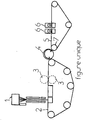
- the single figure is a schematic view of an installation producing a nonwoven. It includes a 1 spun-bond tower.
- a tower spun-bond comprises a device for extruding polymers, in particular polypropylene or polyester, which leads into a die giving polymer filaments which are then cooled in a cooling, then always in the downward direction, stretched in a drawing device and deposited in the form of a tablecloth on a first endless conveyor 2 having good air permeability and relatively rough so that the filaments are deposited without slipping on its area.
- the upper strand of the conveyor 2, on which is deposited the sheet of filaments passes in the nip between two rollers 3 pressers constituting a compacting device. These pressure rollers have been shown in dashes in the figure because they are optional.
- first conveyor 2 At the exit of first conveyor 2, the sheet passes over a hollow drum 4 (second element mobile) within which there is a depression, so that the tablecloth is applied to the lower part of the drum 4 and that the properties of the tablecloth do not change as would be the case if it passed directly from one conveyor to another with the ensuing tensile phenomena.
- the web is taken up by a conveyor 5 (first mobile element), and goes under consolidation devices 6 by projection of water jets with a diameter of between 50 and 250 microns and a pressure between 20 and 1000 bar and water is projected by these devices 6 on the web and entangling the fibers.
- the conveyor 5 is less breathable than the conveyor 2.
- the return roller 7 of the conveyor 5, which is the closest suction cylinder 4, can also be provided with a suction to facilitate the passage of the web of the drum 4 to the conveyor 5.
- the drum 4 rotates in the counterclockwise at a linear speed smaller than the speed of movement of the conveyor 2 from left to right at the Fig.
Landscapes
- Engineering & Computer Science (AREA)
- Textile Engineering (AREA)
- Mechanical Engineering (AREA)
- Chemical & Material Sciences (AREA)
- Chemical Kinetics & Catalysis (AREA)
- Nonwoven Fabrics (AREA)
Abstract
Description
- La mesure de perméabilité est réalisée sur un perméabilimètre PX 3 300 commercialisé par la Société TEXTEST.
- L'échantillon de tissu est placé sur la tête de mesure de l'appareil.
- La valeur de perméabilité à l'air est donnée directement par l'appareil en CFM pour un différentiel de pression de 100 pascals.
- La valeur retenue est la moyenne de 5 mesures.
Claims (12)
- Procédé pour conserver le rapport de la résistance à la traction dans le sens long à la résistance dans le sens travers d'une nappe de filaments en déplacement, passant d'un convoyeur à un autre, caractérisé en ce que l'on soumet la nappe à une dépression l'appliquant sur un support iors du passage du premier convoyeur à un élément mobile.
- Procédé suivant la revendication 1, caractérisé en ce que l'on ralentit la nappe pendant qu'elle passe du premier convoyeur à l'élément mobile.
- Procédé suivant la revendication 1 ou 2, caractérisé en ce que le premier convoyeur est celui sur lequel sont déposés les filaments pour la formation de la nappe.
- Installation de production d'un non-tissé comprenant une tour (1) spun-bond déposant une nappe de filaments sur un premier convoyeur (2), la nappe étant envoyée sur un premier élément mobile (5) à des moyens (6) de consolidation par enchevêtrement, et des moyens destinés à faire passer la nappe de filaments sur le premier élément mobile (5). caractérisée en ce que les moyens (4) destinés à faire passer la nappe de filaments sur le premier élément mobile (5) comprennent un second élément mobile (4) ayant un dispositif de mise en dépression maintenant la nappe sur la surface extérieure du second élément mobile (4).
- Installation suivant la revendication 4, caractérisée en ce que le second élément mobile est un tambour (4) ou un convoyeur.
- Installation suivant l'une des revendications 4 à 5, caractérisée en ce que le premier convoyeur (2) est plus perméable à l'air que le premier élément mobile (5).
- Installation suivant la revendication 6, caractérisée en ce que le premier convoyeur a une perméabilité à l'air comprise entre 500 et 1 100 CFM (14,1 et 31 m3/min).
- Installation suivant la revendication 5 ou 6, caractérisée en ce que le premier élément mobile (5) a une perméabilité à l'air comprise entre 50 et 500 CFM (1,41 et 14,1 m3/min.).
- Installation suivant l'une des revendications 4 à 8, caractérisée en ce que le premier convoyeur est un tissu multicouches tandis que le premier élément mobile (5) est un tissu monocouche.
- Installation suivant l'une des revendications 4 à 9, caractérisée en ce que le premier convoyeur (2) envoie directement la nappe aux moyens (4) destinés à faire passer la nappe de filaments.
- Installation suivant l'une des revendications 4 à 10, caractérisée en ce que le premier élément mobile (5) a un dispositif (7) d'aspiration qui coopère avec les moyens (4) pour faire passer la nappe afin de faciliter le passage de la nappe des moyens (4) au premier élément mobile (5).
- Utilisation d'une machine suivant l'une des revendications 4 à 11 précédentes pour conserver le rapport de la résistance à la traction dans le sens long à la résistance à la traction dans le sens travers d'une nappe de filaments en déplacement provenant d'une tour spun-bond et allant à un dispositif de consolidation par jets d'eau.
Applications Claiming Priority (2)
| Application Number | Priority Date | Filing Date | Title |
|---|---|---|---|
| FR0212653A FR2845698B1 (fr) | 2002-10-11 | 2002-10-11 | Procede et installation de production d'un non-tisse ayant de bonnes proprietes de resistance a la traction |
| FR0212653 | 2002-10-11 |
Publications (3)
| Publication Number | Publication Date |
|---|---|
| EP1408148A1 true EP1408148A1 (fr) | 2004-04-14 |
| EP1408148B1 EP1408148B1 (fr) | 2013-06-19 |
| EP1408148B2 EP1408148B2 (fr) | 2016-11-02 |
Family
ID=32011544
Family Applications (1)
| Application Number | Title | Priority Date | Filing Date |
|---|---|---|---|
| EP03292296.5A Expired - Lifetime EP1408148B2 (fr) | 2002-10-11 | 2003-09-18 | Procédé et installation de production d'un non-tissé ayant de bonnes propriétés de résistance à la traction |
Country Status (7)
| Country | Link |
|---|---|
| US (1) | US7690904B2 (fr) |
| EP (1) | EP1408148B2 (fr) |
| CN (1) | CN100554558C (fr) |
| AU (1) | AU2003300483A1 (fr) |
| FR (1) | FR2845698B1 (fr) |
| IL (1) | IL167873A (fr) |
| WO (1) | WO2004033782A1 (fr) |
Families Citing this family (3)
| Publication number | Priority date | Publication date | Assignee | Title |
|---|---|---|---|---|
| DE202007007732U1 (de) | 2007-03-09 | 2007-08-09 | Fleissner Gmbh | Vorrichtung zum Herstellen und Verfestigen eines reinen Spinnvlieses |
| DE102017129220A1 (de) * | 2017-12-08 | 2019-06-13 | TRüTZSCHLER GMBH & CO. KG | Vorrichtung zum hydrodynamischen Verfestigen von Vliesen, Geweben oder Gewirken |
| DE102017129300A1 (de) | 2017-12-08 | 2019-06-13 | Trützschler GmbH & Co Kommanditgesellschaft | Anlage und Verfahren zur Erzeugung eines Spinnvlieses |
Citations (6)
| Publication number | Priority date | Publication date | Assignee | Title |
|---|---|---|---|---|
| US3485706A (en) * | 1968-01-18 | 1969-12-23 | Du Pont | Textile-like patterned nonwoven fabrics and their production |
| GB1477809A (en) * | 1974-01-30 | 1977-06-29 | Tenagil Rhone Poulenc Textile | Process for the shrinking of webs of non-woven fabrics made in the wet way continuously with their production and webs obtained thereby |
| US5768756A (en) * | 1995-05-17 | 1998-06-23 | Icbt Perfojet | Process and device for manufacturing a non-woven unpatterned textile |
| US6050469A (en) * | 1995-03-22 | 2000-04-18 | Thibeau Et Cie | Suction cylinder which transfers fiber web from a conveyer belt to two calendering cylinders |
| WO2001051693A1 (fr) * | 2000-01-11 | 2001-07-19 | Rieter Perfojet | Procede pour la realisation d'un materiau non tisse complexe et nouveau type de materiau ainsi obtenu |
| WO2002050354A1 (fr) * | 2000-12-19 | 2002-06-27 | M & J Fibretech A/S | Procede et equipement de production sans bande de base d'une bande de fibres hydro-enchevetrees air-laid |
Family Cites Families (2)
| Publication number | Priority date | Publication date | Assignee | Title |
|---|---|---|---|---|
| BE793649A (fr) * | 1972-01-04 | 1973-07-03 | Rhone Poulenc Textile | Dispositif pour la fabrication de nappes non tissees en filaments continus |
| JP3658284B2 (ja) * | 2000-07-05 | 2005-06-08 | ユニ・チャーム株式会社 | 不織布製造装置 |
-
2002
- 2002-10-11 FR FR0212653A patent/FR2845698B1/fr not_active Expired - Fee Related
-
2003
- 2003-09-18 EP EP03292296.5A patent/EP1408148B2/fr not_active Expired - Lifetime
- 2003-10-10 US US10/529,842 patent/US7690904B2/en active Active
- 2003-10-10 WO PCT/FR2003/002989 patent/WO2004033782A1/fr not_active Ceased
- 2003-10-10 AU AU2003300483A patent/AU2003300483A1/en not_active Abandoned
- 2003-10-10 CN CNB2003801011681A patent/CN100554558C/zh not_active Expired - Lifetime
-
2005
- 2005-04-05 IL IL167873A patent/IL167873A/en active IP Right Grant
Patent Citations (6)
| Publication number | Priority date | Publication date | Assignee | Title |
|---|---|---|---|---|
| US3485706A (en) * | 1968-01-18 | 1969-12-23 | Du Pont | Textile-like patterned nonwoven fabrics and their production |
| GB1477809A (en) * | 1974-01-30 | 1977-06-29 | Tenagil Rhone Poulenc Textile | Process for the shrinking of webs of non-woven fabrics made in the wet way continuously with their production and webs obtained thereby |
| US6050469A (en) * | 1995-03-22 | 2000-04-18 | Thibeau Et Cie | Suction cylinder which transfers fiber web from a conveyer belt to two calendering cylinders |
| US5768756A (en) * | 1995-05-17 | 1998-06-23 | Icbt Perfojet | Process and device for manufacturing a non-woven unpatterned textile |
| WO2001051693A1 (fr) * | 2000-01-11 | 2001-07-19 | Rieter Perfojet | Procede pour la realisation d'un materiau non tisse complexe et nouveau type de materiau ainsi obtenu |
| WO2002050354A1 (fr) * | 2000-12-19 | 2002-06-27 | M & J Fibretech A/S | Procede et equipement de production sans bande de base d'une bande de fibres hydro-enchevetrees air-laid |
Also Published As
| Publication number | Publication date |
|---|---|
| IL167873A (en) | 2008-11-03 |
| AU2003300483A1 (en) | 2004-05-04 |
| US7690904B2 (en) | 2010-04-06 |
| WO2004033782A9 (fr) | 2007-12-21 |
| WO2004033782A1 (fr) | 2004-04-22 |
| AU2003300483A8 (en) | 2004-05-04 |
| EP1408148B2 (fr) | 2016-11-02 |
| EP1408148B1 (fr) | 2013-06-19 |
| CN100554558C (zh) | 2009-10-28 |
| FR2845698B1 (fr) | 2005-03-18 |
| FR2845698A1 (fr) | 2004-04-16 |
| US20060286887A1 (en) | 2006-12-21 |
| CN1703549A (zh) | 2005-11-30 |
Similar Documents
| Publication | Publication Date | Title |
|---|---|---|
| FR2794776A1 (fr) | Procede pour la realisation d'un materiau non tisse, installation pour sa mise en oeuvre et non tisse ainsi obtenu | |
| FR2803604A1 (fr) | Procede pour la realisation d'un materiau non tisse complexe et nouveau type de materiau ainsi obtenu | |
| TWI423876B (zh) | 紡黏-熔噴-紡黏(sms)產物上的圖案 | |
| US20030067091A1 (en) | Method and apparatus for the preparation of a web with good breathing properties | |
| EP1689924A1 (fr) | Mat de verre aiguillete | |
| FR2846013A1 (fr) | Tissu non-tisse de petite masse volumique et ses procede et installation de production et ses applications | |
| EP1554421B1 (fr) | Procede et machine de production d'un non-tisse a reduction de la vitesse de deplacement de la nappe compactee | |
| EP1408148B1 (fr) | Procédé et installation de production d'un non-tissé ayant de bonnes propriétés de résistance à la traction | |
| FR2729976A1 (fr) | Procede et dispositif pour appliquer un fil sur un support | |
| EP1747313B1 (fr) | Nontisse large et ses procede et machine de fabrication. | |
| US6592697B2 (en) | Method of producing post-crepe stabilized material | |
| FR3059344B1 (fr) | Dispositif d'etirage d'un voile dispose entre un dispositif de carde et un etaleur nappeur | |
| EP1682712B1 (fr) | Machine de production de nontisses de plusieurs qualites | |
| EP1682713B1 (fr) | Machine de production d'un non-tisse fini | |
| WO2006084987A1 (fr) | Carde et machine de production d'un non-tissé | |
| FR2468682A1 (fr) | Cuir artificiel | |
| FR2779746A1 (fr) | Utilisation de fibres a frisure tridimensionnelle pour la fabrication de tissu ou toile de renfort, et tissu de renfort obtenu | |
| FR3091713A1 (fr) | Dispositif d’étirage d’une nappe pour la fabrication d’un revêtement, notamment d’un revêtement textile pour véhicule automobile, ensemble d’étirage et procédé de fabrication d’un revêtement associé | |
| FR2582588A1 (fr) | Nappes de renfort avec corps de fibres non tissees; enveloppes de pneumatiques comportant ces nappes; procedes pour obtenir ces nappes | |
| BE556256A (fr) | ||
| SE515066C2 (sv) | Förfarande för åstadkommande av en vira för formning av en mönstrad fiberbana, en sådan vira och en sådan mönstrad fiberbana | |
| FR2465816A2 (fr) | Procede et appareil de pose d'un fil fibreux de maniere ordonnee | |
| BE661563A (fr) |
Legal Events
| Date | Code | Title | Description |
|---|---|---|---|
| PUAI | Public reference made under article 153(3) epc to a published international application that has entered the european phase |
Free format text: ORIGINAL CODE: 0009012 |
|
| AK | Designated contracting states |
Kind code of ref document: A1 Designated state(s): AT BE BG CH CY CZ DE DK EE ES FI FR GB GR HU IE IT LI LU MC NL PT RO SE SI SK TR |
|
| AX | Request for extension of the european patent |
Extension state: AL LT LV MK |
|
| 17P | Request for examination filed |
Effective date: 20041014 |
|
| AKX | Designation fees paid |
Designated state(s): AT BE BG CH CY CZ DE DK EE ES FI FR GB GR HU IE IT LI LU MC NL PT RO SE SI SK TR |
|
| 17Q | First examination report despatched |
Effective date: 20050401 |
|
| RAP1 | Party data changed (applicant data changed or rights of an application transferred) |
Owner name: ANDRITZ PERFOJET SAS |
|
| GRAP | Despatch of communication of intention to grant a patent |
Free format text: ORIGINAL CODE: EPIDOSNIGR1 |
|
| GRAP | Despatch of communication of intention to grant a patent |
Free format text: ORIGINAL CODE: EPIDOSNIGR1 |
|
| GRAS | Grant fee paid |
Free format text: ORIGINAL CODE: EPIDOSNIGR3 |
|
| INTG | Intention to grant announced |
Effective date: 20130419 |
|
| GRAA | (expected) grant |
Free format text: ORIGINAL CODE: 0009210 |
|
| AK | Designated contracting states |
Kind code of ref document: B1 Designated state(s): AT BE BG CH CY CZ DE DK EE ES FI FR GB GR HU IE IT LI LU MC NL PT RO SE SI SK TR |
|
| REG | Reference to a national code |
Ref country code: GB Ref legal event code: FG4D Free format text: NOT ENGLISH |
|
| REG | Reference to a national code |
Ref country code: CH Ref legal event code: EP |
|
| REG | Reference to a national code |
Ref country code: AT Ref legal event code: REF Ref document number: 617722 Country of ref document: AT Kind code of ref document: T Effective date: 20130715 |
|
| REG | Reference to a national code |
Ref country code: IE Ref legal event code: FG4D Free format text: LANGUAGE OF EP DOCUMENT: FRENCH |
|
| REG | Reference to a national code |
Ref country code: DE Ref legal event code: R096 Ref document number: 60344310 Country of ref document: DE Effective date: 20130814 |
|
| PG25 | Lapsed in a contracting state [announced via postgrant information from national office to epo] |
Ref country code: ES Free format text: LAPSE BECAUSE OF FAILURE TO SUBMIT A TRANSLATION OF THE DESCRIPTION OR TO PAY THE FEE WITHIN THE PRESCRIBED TIME-LIMIT Effective date: 20130930 Ref country code: FI Free format text: LAPSE BECAUSE OF FAILURE TO SUBMIT A TRANSLATION OF THE DESCRIPTION OR TO PAY THE FEE WITHIN THE PRESCRIBED TIME-LIMIT Effective date: 20130619 Ref country code: GR Free format text: LAPSE BECAUSE OF FAILURE TO SUBMIT A TRANSLATION OF THE DESCRIPTION OR TO PAY THE FEE WITHIN THE PRESCRIBED TIME-LIMIT Effective date: 20130920 Ref country code: SE Free format text: LAPSE BECAUSE OF FAILURE TO SUBMIT A TRANSLATION OF THE DESCRIPTION OR TO PAY THE FEE WITHIN THE PRESCRIBED TIME-LIMIT Effective date: 20130619 Ref country code: SI Free format text: LAPSE BECAUSE OF FAILURE TO SUBMIT A TRANSLATION OF THE DESCRIPTION OR TO PAY THE FEE WITHIN THE PRESCRIBED TIME-LIMIT Effective date: 20130619 |
|
| REG | Reference to a national code |
Ref country code: AT Ref legal event code: MK05 Ref document number: 617722 Country of ref document: AT Kind code of ref document: T Effective date: 20130619 |
|
| PG25 | Lapsed in a contracting state [announced via postgrant information from national office to epo] |
Ref country code: BG Free format text: LAPSE BECAUSE OF FAILURE TO SUBMIT A TRANSLATION OF THE DESCRIPTION OR TO PAY THE FEE WITHIN THE PRESCRIBED TIME-LIMIT Effective date: 20130919 |
|
| REG | Reference to a national code |
Ref country code: NL Ref legal event code: VDEP Effective date: 20130619 |
|
| PG25 | Lapsed in a contracting state [announced via postgrant information from national office to epo] |
Ref country code: CY Free format text: LAPSE BECAUSE OF FAILURE TO SUBMIT A TRANSLATION OF THE DESCRIPTION OR TO PAY THE FEE WITHIN THE PRESCRIBED TIME-LIMIT Effective date: 20130703 Ref country code: PT Free format text: LAPSE BECAUSE OF FAILURE TO SUBMIT A TRANSLATION OF THE DESCRIPTION OR TO PAY THE FEE WITHIN THE PRESCRIBED TIME-LIMIT Effective date: 20131021 Ref country code: EE Free format text: LAPSE BECAUSE OF FAILURE TO SUBMIT A TRANSLATION OF THE DESCRIPTION OR TO PAY THE FEE WITHIN THE PRESCRIBED TIME-LIMIT Effective date: 20130619 Ref country code: CZ Free format text: LAPSE BECAUSE OF FAILURE TO SUBMIT A TRANSLATION OF THE DESCRIPTION OR TO PAY THE FEE WITHIN THE PRESCRIBED TIME-LIMIT Effective date: 20130619 Ref country code: SK Free format text: LAPSE BECAUSE OF FAILURE TO SUBMIT A TRANSLATION OF THE DESCRIPTION OR TO PAY THE FEE WITHIN THE PRESCRIBED TIME-LIMIT Effective date: 20130619 Ref country code: AT Free format text: LAPSE BECAUSE OF FAILURE TO SUBMIT A TRANSLATION OF THE DESCRIPTION OR TO PAY THE FEE WITHIN THE PRESCRIBED TIME-LIMIT Effective date: 20130619 |
|
| PG25 | Lapsed in a contracting state [announced via postgrant information from national office to epo] |
Ref country code: RO Free format text: LAPSE BECAUSE OF FAILURE TO SUBMIT A TRANSLATION OF THE DESCRIPTION OR TO PAY THE FEE WITHIN THE PRESCRIBED TIME-LIMIT Effective date: 20130619 Ref country code: NL Free format text: LAPSE BECAUSE OF FAILURE TO SUBMIT A TRANSLATION OF THE DESCRIPTION OR TO PAY THE FEE WITHIN THE PRESCRIBED TIME-LIMIT Effective date: 20130619 |
|
| PLBI | Opposition filed |
Free format text: ORIGINAL CODE: 0009260 |
|
| BERE | Be: lapsed |
Owner name: ANDRITZ PERFOJET SAS Effective date: 20130930 |
|
| PG25 | Lapsed in a contracting state [announced via postgrant information from national office to epo] |
Ref country code: CY Free format text: LAPSE BECAUSE OF FAILURE TO SUBMIT A TRANSLATION OF THE DESCRIPTION OR TO PAY THE FEE WITHIN THE PRESCRIBED TIME-LIMIT Effective date: 20130619 |
|
| 26 | Opposition filed |
Opponent name: TRUETZSCHLER GMBH & CO. KG Effective date: 20140314 |
|
| PLAX | Notice of opposition and request to file observation + time limit sent |
Free format text: ORIGINAL CODE: EPIDOSNOBS2 |
|
| PG25 | Lapsed in a contracting state [announced via postgrant information from national office to epo] |
Ref country code: MC Free format text: LAPSE BECAUSE OF FAILURE TO SUBMIT A TRANSLATION OF THE DESCRIPTION OR TO PAY THE FEE WITHIN THE PRESCRIBED TIME-LIMIT Effective date: 20130619 Ref country code: DK Free format text: LAPSE BECAUSE OF FAILURE TO SUBMIT A TRANSLATION OF THE DESCRIPTION OR TO PAY THE FEE WITHIN THE PRESCRIBED TIME-LIMIT Effective date: 20130619 |
|
| REG | Reference to a national code |
Ref country code: CH Ref legal event code: PL |
|
| GBPC | Gb: european patent ceased through non-payment of renewal fee |
Effective date: 20130919 |
|
| REG | Reference to a national code |
Ref country code: DE Ref legal event code: R026 Ref document number: 60344310 Country of ref document: DE Effective date: 20140314 |
|
| REG | Reference to a national code |
Ref country code: IE Ref legal event code: MM4A |
|
| PLBB | Reply of patent proprietor to notice(s) of opposition received |
Free format text: ORIGINAL CODE: EPIDOSNOBS3 |
|
| PG25 | Lapsed in a contracting state [announced via postgrant information from national office to epo] |
Ref country code: GB Free format text: LAPSE BECAUSE OF NON-PAYMENT OF DUE FEES Effective date: 20130919 Ref country code: LI Free format text: LAPSE BECAUSE OF NON-PAYMENT OF DUE FEES Effective date: 20130930 Ref country code: CH Free format text: LAPSE BECAUSE OF NON-PAYMENT OF DUE FEES Effective date: 20130930 Ref country code: BE Free format text: LAPSE BECAUSE OF NON-PAYMENT OF DUE FEES Effective date: 20130930 Ref country code: IE Free format text: LAPSE BECAUSE OF NON-PAYMENT OF DUE FEES Effective date: 20130918 |
|
| PG25 | Lapsed in a contracting state [announced via postgrant information from national office to epo] |
Ref country code: TR Free format text: LAPSE BECAUSE OF FAILURE TO SUBMIT A TRANSLATION OF THE DESCRIPTION OR TO PAY THE FEE WITHIN THE PRESCRIBED TIME-LIMIT Effective date: 20130619 |
|
| PG25 | Lapsed in a contracting state [announced via postgrant information from national office to epo] |
Ref country code: HU Free format text: LAPSE BECAUSE OF FAILURE TO SUBMIT A TRANSLATION OF THE DESCRIPTION OR TO PAY THE FEE WITHIN THE PRESCRIBED TIME-LIMIT; INVALID AB INITIO Effective date: 20030918 Ref country code: LU Free format text: LAPSE BECAUSE OF NON-PAYMENT OF DUE FEES Effective date: 20130918 |
|
| REG | Reference to a national code |
Ref country code: FR Ref legal event code: PLFP Year of fee payment: 14 |
|
| PUAH | Patent maintained in amended form |
Free format text: ORIGINAL CODE: 0009272 |
|
| STAA | Information on the status of an ep patent application or granted ep patent |
Free format text: STATUS: PATENT MAINTAINED AS AMENDED |
|
| 27A | Patent maintained in amended form |
Effective date: 20161102 |
|
| AK | Designated contracting states |
Kind code of ref document: B2 Designated state(s): AT BE BG CH CY CZ DE DK EE ES FI FR GB GR HU IE IT LI LU MC NL PT RO SE SI SK TR |
|
| REG | Reference to a national code |
Ref country code: DE Ref legal event code: R102 Ref document number: 60344310 Country of ref document: DE |
|
| REG | Reference to a national code |
Ref country code: FR Ref legal event code: PLFP Year of fee payment: 15 |
|
| REG | Reference to a national code |
Ref country code: FR Ref legal event code: PLFP Year of fee payment: 16 |
|
| PGFP | Annual fee paid to national office [announced via postgrant information from national office to epo] |
Ref country code: DE Payment date: 20220920 Year of fee payment: 20 |
|
| PGFP | Annual fee paid to national office [announced via postgrant information from national office to epo] |
Ref country code: FR Payment date: 20220922 Year of fee payment: 20 |
|
| PGFP | Annual fee paid to national office [announced via postgrant information from national office to epo] |
Ref country code: IT Payment date: 20220926 Year of fee payment: 20 |
|
| REG | Reference to a national code |
Ref country code: DE Ref legal event code: R071 Ref document number: 60344310 Country of ref document: DE |