EP1405917A2 - Verfahren zur Herstellung von 3-Heteroaryl-3-hydroxy-propansäurederivaten durch enantionselektive mikrobielle Reduktion - Google Patents
Verfahren zur Herstellung von 3-Heteroaryl-3-hydroxy-propansäurederivaten durch enantionselektive mikrobielle Reduktion Download PDFInfo
- Publication number
- EP1405917A2 EP1405917A2 EP03020847A EP03020847A EP1405917A2 EP 1405917 A2 EP1405917 A2 EP 1405917A2 EP 03020847 A EP03020847 A EP 03020847A EP 03020847 A EP03020847 A EP 03020847A EP 1405917 A2 EP1405917 A2 EP 1405917A2
- Authority
- EP
- European Patent Office
- Prior art keywords
- formula
- heteroaryl
- propanoate
- hydroxy
- oxo
- Prior art date
- Legal status (The legal status is an assumption and is not a legal conclusion. Google has not performed a legal analysis and makes no representation as to the accuracy of the status listed.)
- Granted
Links
- 238000000034 method Methods 0.000 title claims description 37
- 230000009467 reduction Effects 0.000 title claims description 15
- 238000004519 manufacturing process Methods 0.000 title description 4
- 230000000813 microbial effect Effects 0.000 title 1
- 238000006243 chemical reaction Methods 0.000 claims abstract description 21
- 244000005700 microbiome Species 0.000 claims abstract description 17
- 238000002360 preparation method Methods 0.000 claims abstract description 17
- 125000000217 alkyl group Chemical group 0.000 claims abstract description 13
- 229910052801 chlorine Inorganic materials 0.000 claims abstract description 13
- 229910052731 fluorine Inorganic materials 0.000 claims abstract description 11
- 230000007062 hydrolysis Effects 0.000 claims abstract description 11
- 238000006460 hydrolysis reaction Methods 0.000 claims abstract description 11
- 125000003118 aryl group Chemical group 0.000 claims abstract description 10
- 229910052794 bromium Inorganic materials 0.000 claims abstract description 10
- XLYOFNOQVPJJNP-UHFFFAOYSA-N water Substances O XLYOFNOQVPJJNP-UHFFFAOYSA-N 0.000 claims abstract description 10
- 150000001412 amines Chemical class 0.000 claims abstract description 9
- 125000000896 monocarboxylic acid group Chemical group 0.000 claims abstract description 7
- 125000001997 phenyl group Chemical group [H]C1=C([H])C([H])=C(*)C([H])=C1[H] 0.000 claims abstract description 6
- 125000002950 monocyclic group Chemical group 0.000 claims abstract description 5
- 125000001624 naphthyl group Chemical group 0.000 claims abstract description 5
- 125000003710 aryl alkyl group Chemical group 0.000 claims abstract description 4
- 238000006136 alcoholysis reaction Methods 0.000 claims abstract description 3
- 125000003709 fluoroalkyl group Chemical group 0.000 claims abstract description 3
- 229910052740 iodine Inorganic materials 0.000 claims abstract 2
- 150000001875 compounds Chemical class 0.000 claims description 75
- -1 bicyclic aromatic radical Chemical class 0.000 claims description 71
- 125000001072 heteroaryl group Chemical group 0.000 claims description 30
- IJGRMHOSHXDMSA-UHFFFAOYSA-N Atomic nitrogen Chemical compound N#N IJGRMHOSHXDMSA-UHFFFAOYSA-N 0.000 claims description 22
- 125000001495 ethyl group Chemical group [H]C([H])([H])C([H])([H])* 0.000 claims description 21
- 125000002496 methyl group Chemical group [H]C([H])([H])* 0.000 claims description 19
- 229910052757 nitrogen Inorganic materials 0.000 claims description 14
- PXGOKWXKJXAPGV-UHFFFAOYSA-N Fluorine Chemical compound FF PXGOKWXKJXAPGV-UHFFFAOYSA-N 0.000 claims description 12
- 150000003254 radicals Chemical group 0.000 claims description 12
- 239000001257 hydrogen Substances 0.000 claims description 11
- 229910052739 hydrogen Inorganic materials 0.000 claims description 11
- YEJVVFOJMOHFRL-ZETCQYMHSA-N (1s)-3-(methylamino)-1-thiophen-2-ylpropan-1-ol Chemical compound CNCC[C@H](O)C1=CC=CS1 YEJVVFOJMOHFRL-ZETCQYMHSA-N 0.000 claims description 10
- ZAMOUSCENKQFHK-UHFFFAOYSA-N Chlorine atom Chemical compound [Cl] ZAMOUSCENKQFHK-UHFFFAOYSA-N 0.000 claims description 10
- 239000000460 chlorine Substances 0.000 claims description 10
- 125000004093 cyano group Chemical group *C#N 0.000 claims description 9
- 239000001301 oxygen Substances 0.000 claims description 9
- 229910052760 oxygen Inorganic materials 0.000 claims description 9
- 241000235070 Saccharomyces Species 0.000 claims description 8
- 240000004808 Saccharomyces cerevisiae Species 0.000 claims description 8
- 239000002585 base Substances 0.000 claims description 8
- 239000011737 fluorine Substances 0.000 claims description 8
- 125000006413 ring segment Chemical group 0.000 claims description 8
- WKBOTKDWSSQWDR-UHFFFAOYSA-N Bromine atom Chemical compound [Br] WKBOTKDWSSQWDR-UHFFFAOYSA-N 0.000 claims description 7
- QVGXLLKOCUKJST-UHFFFAOYSA-N atomic oxygen Chemical compound [O] QVGXLLKOCUKJST-UHFFFAOYSA-N 0.000 claims description 7
- GDTBXPJZTBHREO-UHFFFAOYSA-N bromine Substances BrBr GDTBXPJZTBHREO-UHFFFAOYSA-N 0.000 claims description 7
- NINIDFKCEFEMDL-UHFFFAOYSA-N Sulfur Chemical compound [S] NINIDFKCEFEMDL-UHFFFAOYSA-N 0.000 claims description 6
- 125000001449 isopropyl group Chemical group [H]C([H])([H])C([H])(*)C([H])([H])[H] 0.000 claims description 6
- 239000003960 organic solvent Substances 0.000 claims description 6
- QZAYGJVTTNCVMB-UHFFFAOYSA-N serotonin Chemical compound C1=C(O)C=C2C(CCN)=CNC2=C1 QZAYGJVTTNCVMB-UHFFFAOYSA-N 0.000 claims description 6
- 241000233866 Fungi Species 0.000 claims description 5
- 125000006297 carbonyl amino group Chemical group [H]N([*:2])C([*:1])=O 0.000 claims description 5
- 125000002887 hydroxy group Chemical group [H]O* 0.000 claims description 5
- 229910052717 sulfur Inorganic materials 0.000 claims description 5
- 239000011593 sulfur Substances 0.000 claims description 5
- VHHJGVSCWJUOKL-LURJTMIESA-N (3s)-3-hydroxy-n-methyl-3-thiophen-2-ylpropanamide Chemical compound CNC(=O)C[C@H](O)C1=CC=CS1 VHHJGVSCWJUOKL-LURJTMIESA-N 0.000 claims description 4
- FKTXDTWDCPTPHK-UHFFFAOYSA-N 1,1,1,2,3,3,3-heptafluoropropane Chemical group FC(F)(F)[C](F)C(F)(F)F FKTXDTWDCPTPHK-UHFFFAOYSA-N 0.000 claims description 4
- 229910004013 NO 2 Inorganic materials 0.000 claims description 4
- 241000235648 Pichia Species 0.000 claims description 4
- 239000006285 cell suspension Substances 0.000 claims description 4
- 125000004123 n-propyl group Chemical group [H]C([H])([H])C([H])([H])C([H])([H])* 0.000 claims description 4
- 125000006340 pentafluoro ethyl group Chemical group FC(F)(F)C(F)(F)* 0.000 claims description 4
- 125000001424 substituent group Chemical group 0.000 claims description 4
- 125000002023 trifluoromethyl group Chemical group FC(F)(F)* 0.000 claims description 4
- XWCNSHMHUZCRLN-MRVPVSSYSA-N (1r)-3-(dimethylamino)-1-thiophen-2-ylpropan-1-ol Chemical compound CN(C)CC[C@@H](O)C1=CC=CS1 XWCNSHMHUZCRLN-MRVPVSSYSA-N 0.000 claims description 3
- XWCNSHMHUZCRLN-QMMMGPOBSA-N (1s)-3-(dimethylamino)-1-thiophen-2-ylpropan-1-ol Chemical compound CN(C)CC[C@H](O)C1=CC=CS1 XWCNSHMHUZCRLN-QMMMGPOBSA-N 0.000 claims description 3
- 229910001413 alkali metal ion Inorganic materials 0.000 claims description 3
- 229910001420 alkaline earth metal ion Inorganic materials 0.000 claims description 3
- 239000000543 intermediate Substances 0.000 claims description 3
- MISKVKGEMKUCTJ-UHFFFAOYSA-N n-methyl-3-oxo-3-thiophen-2-ylpropanamide Chemical compound CNC(=O)CC(=O)C1=CC=CS1 MISKVKGEMKUCTJ-UHFFFAOYSA-N 0.000 claims description 3
- 239000002767 noradrenalin uptake inhibitor Substances 0.000 claims description 3
- 229940076279 serotonin Drugs 0.000 claims description 3
- 239000003772 serotonin uptake inhibitor Substances 0.000 claims description 3
- ZEUITGRIYCTCEM-QGZVFWFLSA-N (R)-duloxetine Chemical compound C1([C@H](OC=2C3=CC=CC=C3C=CC=2)CCNC)=CC=CS1 ZEUITGRIYCTCEM-QGZVFWFLSA-N 0.000 claims description 2
- ZEUITGRIYCTCEM-KRWDZBQOSA-N (S)-duloxetine Chemical compound C1([C@@H](OC=2C3=CC=CC=C3C=CC=2)CCNC)=CC=CS1 ZEUITGRIYCTCEM-KRWDZBQOSA-N 0.000 claims description 2
- IVXZDYYUCYENKQ-UHFFFAOYSA-N 1-ethoxy-1-N',1-N'-diethyl-2-[fluoro(methylamino)amino]-2-methoxy-1-N,1-N-dimethylethane-1,1-diamine Chemical compound CCOC(N(CC)CC)(N(C)C)C(OC)N(F)NC IVXZDYYUCYENKQ-UHFFFAOYSA-N 0.000 claims description 2
- 241000228212 Aspergillus Species 0.000 claims description 2
- 241000894006 Bacteria Species 0.000 claims description 2
- ZOXJGFHDIHLPTG-UHFFFAOYSA-N Boron Chemical compound [B] ZOXJGFHDIHLPTG-UHFFFAOYSA-N 0.000 claims description 2
- 241000222120 Candida <Saccharomycetales> Species 0.000 claims description 2
- 241000235555 Cunninghamella Species 0.000 claims description 2
- 241000223208 Curvularia Species 0.000 claims description 2
- 241000159512 Geotrichum Species 0.000 claims description 2
- 241000235575 Mortierella Species 0.000 claims description 2
- 241000235395 Mucor Species 0.000 claims description 2
- 241000228143 Penicillium Species 0.000 claims description 2
- XBDQKXXYIPTUBI-UHFFFAOYSA-N Propionic acid Chemical compound CCC(O)=O XBDQKXXYIPTUBI-UHFFFAOYSA-N 0.000 claims description 2
- 241000235527 Rhizopus Species 0.000 claims description 2
- 241000223252 Rhodotorula Species 0.000 claims description 2
- 241001085826 Sporotrichum Species 0.000 claims description 2
- 241000223259 Trichoderma Species 0.000 claims description 2
- 241000235013 Yarrowia Species 0.000 claims description 2
- 125000002947 alkylene group Chemical group 0.000 claims description 2
- AZDRQVAHHNSJOQ-UHFFFAOYSA-N alumane Chemical class [AlH3] AZDRQVAHHNSJOQ-UHFFFAOYSA-N 0.000 claims description 2
- 230000009435 amidation Effects 0.000 claims description 2
- 238000007112 amidation reaction Methods 0.000 claims description 2
- 238000007098 aminolysis reaction Methods 0.000 claims description 2
- 150000003863 ammonium salts Chemical class 0.000 claims description 2
- 125000001797 benzyl group Chemical group [H]C1=C([H])C([H])=C(C([H])=C1[H])C([H])([H])* 0.000 claims description 2
- 229910052796 boron Inorganic materials 0.000 claims description 2
- 239000003814 drug Substances 0.000 claims description 2
- JUQKVXRLRKKRPL-UHFFFAOYSA-N methyl 3-oxo-3-pyridin-3-ylpropanoate Chemical compound COC(=O)CC(=O)C1=CC=CN=C1 JUQKVXRLRKKRPL-UHFFFAOYSA-N 0.000 claims description 2
- QJGQUHMNIGDVPM-UHFFFAOYSA-N nitrogen group Chemical group [N] QJGQUHMNIGDVPM-UHFFFAOYSA-N 0.000 claims description 2
- 125000000999 tert-butyl group Chemical group [H]C([H])([H])C(*)(C([H])([H])[H])C([H])([H])[H] 0.000 claims description 2
- 125000004435 hydrogen atom Chemical class [H]* 0.000 claims 5
- PPBAZOANEQPCKG-UHFFFAOYSA-N 3-oxo-3-pyridin-4-ylpropanenitrile Chemical compound N#CCC(=O)C1=CC=NC=C1 PPBAZOANEQPCKG-UHFFFAOYSA-N 0.000 claims 1
- ZCYVEMRRCGMTRW-UHFFFAOYSA-N 7553-56-2 Chemical compound [I] ZCYVEMRRCGMTRW-UHFFFAOYSA-N 0.000 claims 1
- 239000004480 active ingredient Substances 0.000 claims 1
- 229940079593 drug Drugs 0.000 claims 1
- 239000011630 iodine Substances 0.000 claims 1
- JLNAUMLEVRGXAK-QMMMGPOBSA-N methyl (3s)-3-hydroxy-3-pyridin-2-ylpropanoate Chemical compound COC(=O)C[C@H](O)C1=CC=CC=N1 JLNAUMLEVRGXAK-QMMMGPOBSA-N 0.000 claims 1
- 150000001408 amides Chemical class 0.000 abstract description 4
- 125000005842 heteroatom Chemical group 0.000 abstract description 3
- 239000002253 acid Substances 0.000 abstract description 2
- 125000003917 carbamoyl group Chemical group [H]N([H])C(*)=O 0.000 abstract description 2
- 239000003513 alkali Substances 0.000 abstract 1
- 150000001502 aryl halides Chemical class 0.000 abstract 1
- 125000001589 carboacyl group Chemical group 0.000 abstract 1
- 150000002148 esters Chemical class 0.000 abstract 1
- 239000002184 metal Substances 0.000 abstract 1
- YXFVVABEGXRONW-UHFFFAOYSA-N Toluene Chemical compound CC1=CC=CC=C1 YXFVVABEGXRONW-UHFFFAOYSA-N 0.000 description 24
- XEKOWRVHYACXOJ-UHFFFAOYSA-N Ethyl acetate Chemical compound CCOC(C)=O XEKOWRVHYACXOJ-UHFFFAOYSA-N 0.000 description 15
- YMWUJEATGCHHMB-UHFFFAOYSA-N Dichloromethane Chemical compound ClCCl YMWUJEATGCHHMB-UHFFFAOYSA-N 0.000 description 12
- 239000000243 solution Substances 0.000 description 10
- HEMHJVSKTPXQMS-UHFFFAOYSA-M Sodium hydroxide Chemical compound [OH-].[Na+] HEMHJVSKTPXQMS-UHFFFAOYSA-M 0.000 description 9
- 239000012074 organic phase Substances 0.000 description 9
- BAVYZALUXZFZLV-UHFFFAOYSA-N Methylamine Chemical compound NC BAVYZALUXZFZLV-UHFFFAOYSA-N 0.000 description 8
- WYJOVVXUZNRJQY-UHFFFAOYSA-N 2-Acetylthiophene Chemical compound CC(=O)C1=CC=CS1 WYJOVVXUZNRJQY-UHFFFAOYSA-N 0.000 description 6
- RTZKZFJDLAIYFH-UHFFFAOYSA-N Diethyl ether Chemical compound CCOCC RTZKZFJDLAIYFH-UHFFFAOYSA-N 0.000 description 6
- OKKJLVBELUTLKV-UHFFFAOYSA-N Methanol Chemical compound OC OKKJLVBELUTLKV-UHFFFAOYSA-N 0.000 description 6
- WYURNTSHIVDZCO-UHFFFAOYSA-N Tetrahydrofuran Chemical compound C1CCOC1 WYURNTSHIVDZCO-UHFFFAOYSA-N 0.000 description 6
- 210000004027 cell Anatomy 0.000 description 6
- 239000002904 solvent Substances 0.000 description 6
- 125000004209 (C1-C8) alkyl group Chemical group 0.000 description 5
- PEDCQBHIVMGVHV-UHFFFAOYSA-N Glycerine Chemical compound OCC(O)CO PEDCQBHIVMGVHV-UHFFFAOYSA-N 0.000 description 5
- UFHFLCQGNIYNRP-UHFFFAOYSA-N Hydrogen Chemical compound [H][H] UFHFLCQGNIYNRP-UHFFFAOYSA-N 0.000 description 5
- 150000002431 hydrogen Chemical class 0.000 description 5
- VLKZOEOYAKHREP-UHFFFAOYSA-N n-Hexane Chemical compound CCCCCC VLKZOEOYAKHREP-UHFFFAOYSA-N 0.000 description 5
- 239000007218 ym medium Substances 0.000 description 5
- HBAQYPYDRFILMT-UHFFFAOYSA-N 8-[3-(1-cyclopropylpyrazol-4-yl)-1H-pyrazolo[4,3-d]pyrimidin-5-yl]-3-methyl-3,8-diazabicyclo[3.2.1]octan-2-one Chemical class C1(CC1)N1N=CC(=C1)C1=NNC2=C1N=C(N=C2)N1C2C(N(CC1CC2)C)=O HBAQYPYDRFILMT-UHFFFAOYSA-N 0.000 description 4
- 235000014680 Saccharomyces cerevisiae Nutrition 0.000 description 4
- 230000015572 biosynthetic process Effects 0.000 description 4
- 238000005119 centrifugation Methods 0.000 description 4
- 239000000203 mixture Substances 0.000 description 4
- 239000012071 phase Substances 0.000 description 4
- 239000000047 product Substances 0.000 description 4
- 239000011541 reaction mixture Substances 0.000 description 4
- 238000003786 synthesis reaction Methods 0.000 description 4
- 125000006549 C4-C10 aryl group Chemical group 0.000 description 3
- 244000168141 Geotrichum candidum Species 0.000 description 3
- 235000017388 Geotrichum candidum Nutrition 0.000 description 3
- WQZGKKKJIJFFOK-GASJEMHNSA-N Glucose Natural products OC[C@H]1OC(O)[C@H](O)[C@@H](O)[C@@H]1O WQZGKKKJIJFFOK-GASJEMHNSA-N 0.000 description 3
- ZMXDDKWLCZADIW-UHFFFAOYSA-N N,N-Dimethylformamide Chemical compound CN(C)C=O ZMXDDKWLCZADIW-UHFFFAOYSA-N 0.000 description 3
- KWYUFKZDYYNOTN-UHFFFAOYSA-M Potassium hydroxide Chemical compound [OH-].[K+] KWYUFKZDYYNOTN-UHFFFAOYSA-M 0.000 description 3
- CODNYICXDISAEA-UHFFFAOYSA-N bromine monochloride Chemical compound BrCl CODNYICXDISAEA-UHFFFAOYSA-N 0.000 description 3
- 239000000872 buffer Substances 0.000 description 3
- 150000003857 carboxamides Chemical class 0.000 description 3
- IEJIGPNLZYLLBP-UHFFFAOYSA-N dimethyl carbonate Chemical compound COC(=O)OC IEJIGPNLZYLLBP-UHFFFAOYSA-N 0.000 description 3
- 238000000605 extraction Methods 0.000 description 3
- 238000000855 fermentation Methods 0.000 description 3
- 230000004151 fermentation Effects 0.000 description 3
- 238000004817 gas chromatography Methods 0.000 description 3
- 239000012280 lithium aluminium hydride Substances 0.000 description 3
- 239000002609 medium Substances 0.000 description 3
- 230000003287 optical effect Effects 0.000 description 3
- 239000003208 petroleum Substances 0.000 description 3
- 238000000746 purification Methods 0.000 description 3
- 238000010992 reflux Methods 0.000 description 3
- 239000000126 substance Substances 0.000 description 3
- YLQBMQCUIZJEEH-UHFFFAOYSA-N tetrahydrofuran Natural products C=1C=COC=1 YLQBMQCUIZJEEH-UHFFFAOYSA-N 0.000 description 3
- YEJVVFOJMOHFRL-SSDOTTSWSA-N (1r)-3-(methylamino)-1-thiophen-2-ylpropan-1-ol Chemical compound CNCC[C@@H](O)C1=CC=CS1 YEJVVFOJMOHFRL-SSDOTTSWSA-N 0.000 description 2
- OKTJSMMVPCPJKN-UHFFFAOYSA-N Carbon Chemical compound [C] OKTJSMMVPCPJKN-UHFFFAOYSA-N 0.000 description 2
- XDTMQSROBMDMFD-UHFFFAOYSA-N Cyclohexane Chemical compound C1CCCCC1 XDTMQSROBMDMFD-UHFFFAOYSA-N 0.000 description 2
- IAZDPXIOMUYVGZ-UHFFFAOYSA-N Dimethylsulphoxide Chemical compound CS(C)=O IAZDPXIOMUYVGZ-UHFFFAOYSA-N 0.000 description 2
- MYMOFIZGZYHOMD-UHFFFAOYSA-N Dioxygen Chemical compound O=O MYMOFIZGZYHOMD-UHFFFAOYSA-N 0.000 description 2
- LFQSCWFLJHTTHZ-UHFFFAOYSA-N Ethanol Chemical compound CCO LFQSCWFLJHTTHZ-UHFFFAOYSA-N 0.000 description 2
- GKKZMYDNDDMXSE-UHFFFAOYSA-N Ethyl 3-oxo-3-phenylpropanoate Chemical compound CCOC(=O)CC(=O)C1=CC=CC=C1 GKKZMYDNDDMXSE-UHFFFAOYSA-N 0.000 description 2
- IMNFDUFMRHMDMM-UHFFFAOYSA-N N-Heptane Chemical compound CCCCCCC IMNFDUFMRHMDMM-UHFFFAOYSA-N 0.000 description 2
- WQDUMFSSJAZKTM-UHFFFAOYSA-N Sodium methoxide Chemical compound [Na+].[O-]C WQDUMFSSJAZKTM-UHFFFAOYSA-N 0.000 description 2
- QAOWNCQODCNURD-UHFFFAOYSA-N Sulfuric acid Chemical compound OS(O)(=O)=O QAOWNCQODCNURD-UHFFFAOYSA-N 0.000 description 2
- 230000001430 anti-depressive effect Effects 0.000 description 2
- 239000000935 antidepressant agent Substances 0.000 description 2
- 229940005513 antidepressants Drugs 0.000 description 2
- 238000009835 boiling Methods 0.000 description 2
- 229940041514 candida albicans extract Drugs 0.000 description 2
- 150000001735 carboxylic acids Chemical class 0.000 description 2
- MVPPADPHJFYWMZ-UHFFFAOYSA-N chlorobenzene Chemical compound ClC1=CC=CC=C1 MVPPADPHJFYWMZ-UHFFFAOYSA-N 0.000 description 2
- 239000013078 crystal Substances 0.000 description 2
- 125000004122 cyclic group Chemical group 0.000 description 2
- 239000008103 glucose Substances 0.000 description 2
- 235000011187 glycerol Nutrition 0.000 description 2
- PNDPGZBMCMUPRI-UHFFFAOYSA-N iodine Chemical compound II PNDPGZBMCMUPRI-UHFFFAOYSA-N 0.000 description 2
- 239000000644 isotonic solution Substances 0.000 description 2
- 239000007788 liquid Substances 0.000 description 2
- RPTODLZIHOXUKW-UHFFFAOYSA-N methyl 3-oxo-2-thiophen-2-ylpropanoate Chemical compound COC(=O)C(C=O)C1=CC=CS1 RPTODLZIHOXUKW-UHFFFAOYSA-N 0.000 description 2
- UAEPNZWRGJTJPN-UHFFFAOYSA-N methylcyclohexane Chemical compound CC1CCCCC1 UAEPNZWRGJTJPN-UHFFFAOYSA-N 0.000 description 2
- 239000011707 mineral Substances 0.000 description 2
- 235000010755 mineral Nutrition 0.000 description 2
- 239000008057 potassium phosphate buffer Substances 0.000 description 2
- 239000012138 yeast extract Substances 0.000 description 2
- AYOLELPCNDVZKZ-UHFFFAOYSA-N (-3-Hydroxy-3-phenylpropanoic acid Natural products OC(=O)CC(O)C1=CC=CC=C1 AYOLELPCNDVZKZ-UHFFFAOYSA-N 0.000 description 1
- SBYNMZAXYCFKLR-UHFFFAOYSA-N (2-cyano-2-methoxyethyl) hypofluorite Chemical compound COC(C#N)COF SBYNMZAXYCFKLR-UHFFFAOYSA-N 0.000 description 1
- RTHCYVBBDHJXIQ-MRXNPFEDSA-N (R)-fluoxetine Chemical compound O([C@H](CCNC)C=1C=CC=CC=1)C1=CC=C(C(F)(F)F)C=C1 RTHCYVBBDHJXIQ-MRXNPFEDSA-N 0.000 description 1
- RYHBNJHYFVUHQT-UHFFFAOYSA-N 1,4-Dioxane Chemical compound C1COCCO1 RYHBNJHYFVUHQT-UHFFFAOYSA-N 0.000 description 1
- 125000004206 2,2,2-trifluoroethyl group Chemical group [H]C([H])(*)C(F)(F)F 0.000 description 1
- PTTPXKJBFFKCEK-UHFFFAOYSA-N 2-Methyl-4-heptanone Chemical compound CC(C)CC(=O)CC(C)C PTTPXKJBFFKCEK-UHFFFAOYSA-N 0.000 description 1
- 125000002941 2-furyl group Chemical group O1C([*])=C([H])C([H])=C1[H] 0.000 description 1
- 125000004105 2-pyridyl group Chemical group N1=C([*])C([H])=C([H])C([H])=C1[H] 0.000 description 1
- 125000000389 2-pyrrolyl group Chemical group [H]N1C([*])=C([H])C([H])=C1[H] 0.000 description 1
- YISRPYKYTBBHBK-UHFFFAOYSA-N 3-chloro-1-thiophen-2-ylpropan-1-ol Chemical compound ClCCC(O)C1=CC=CS1 YISRPYKYTBBHBK-UHFFFAOYSA-N 0.000 description 1
- MSLOAFIOTOHDIE-UHFFFAOYSA-N 3-chloro-1-thiophen-2-ylpropan-1-one Chemical compound ClCCC(=O)C1=CC=CS1 MSLOAFIOTOHDIE-UHFFFAOYSA-N 0.000 description 1
- 125000003682 3-furyl group Chemical group O1C([H])=C([*])C([H])=C1[H] 0.000 description 1
- XWWUQBHVRILEPB-UHFFFAOYSA-N 3-oxo-3-thiophen-2-ylpropanenitrile Chemical compound N#CCC(=O)C1=CC=CS1 XWWUQBHVRILEPB-UHFFFAOYSA-N 0.000 description 1
- 125000003349 3-pyridyl group Chemical group N1=C([H])C([*])=C([H])C([H])=C1[H] 0.000 description 1
- 125000001397 3-pyrrolyl group Chemical group [H]N1C([H])=C([*])C([H])=C1[H] 0.000 description 1
- 125000000339 4-pyridyl group Chemical group N1=C([H])C([H])=C([*])C([H])=C1[H] 0.000 description 1
- KDDQRKBRJSGMQE-UHFFFAOYSA-N 4-thiazolyl Chemical group [C]1=CSC=N1 KDDQRKBRJSGMQE-UHFFFAOYSA-N 0.000 description 1
- 239000002028 Biomass Substances 0.000 description 1
- 229920000858 Cyclodextrin Polymers 0.000 description 1
- OIFBSDVPJOWBCH-UHFFFAOYSA-N Diethyl carbonate Chemical compound CCOC(=O)OCC OIFBSDVPJOWBCH-UHFFFAOYSA-N 0.000 description 1
- 244000286779 Hansenula anomala Species 0.000 description 1
- DGAQECJNVWCQMB-PUAWFVPOSA-M Ilexoside XXIX Chemical compound C[C@@H]1CC[C@@]2(CC[C@@]3(C(=CC[C@H]4[C@]3(CC[C@@H]5[C@@]4(CC[C@@H](C5(C)C)OS(=O)(=O)[O-])C)C)[C@@H]2[C@]1(C)O)C)C(=O)O[C@H]6[C@@H]([C@H]([C@@H]([C@H](O6)CO)O)O)O.[Na+] DGAQECJNVWCQMB-PUAWFVPOSA-M 0.000 description 1
- GIYXAJPCNFJEHY-UHFFFAOYSA-N N-methyl-3-phenyl-3-[4-(trifluoromethyl)phenoxy]-1-propanamine hydrochloride (1:1) Chemical compound Cl.C=1C=CC=CC=1C(CCNC)OC1=CC=C(C(F)(F)F)C=C1 GIYXAJPCNFJEHY-UHFFFAOYSA-N 0.000 description 1
- JCXJVPUVTGWSNB-UHFFFAOYSA-N Nitrogen dioxide Chemical compound O=[N]=O JCXJVPUVTGWSNB-UHFFFAOYSA-N 0.000 description 1
- 239000001888 Peptone Substances 0.000 description 1
- 108010080698 Peptones Proteins 0.000 description 1
- KEAYESYHFKHZAL-UHFFFAOYSA-N Sodium Chemical compound [Na] KEAYESYHFKHZAL-UHFFFAOYSA-N 0.000 description 1
- PMZURENOXWZQFD-UHFFFAOYSA-L Sodium Sulfate Chemical compound [Na+].[Na+].[O-]S([O-])(=O)=O PMZURENOXWZQFD-UHFFFAOYSA-L 0.000 description 1
- SZPWXAOBLNYOHY-UHFFFAOYSA-N [C]1=CC=NC2=CC=CC=C12 Chemical group [C]1=CC=NC2=CC=CC=C12 SZPWXAOBLNYOHY-UHFFFAOYSA-N 0.000 description 1
- 230000002378 acidificating effect Effects 0.000 description 1
- 239000013543 active substance Substances 0.000 description 1
- 238000005273 aeration Methods 0.000 description 1
- 125000003158 alcohol group Chemical group 0.000 description 1
- 125000001931 aliphatic group Chemical group 0.000 description 1
- 229910000102 alkali metal hydride Inorganic materials 0.000 description 1
- 150000008046 alkali metal hydrides Chemical class 0.000 description 1
- 229910000095 alkaline earth hydride Inorganic materials 0.000 description 1
- 238000011914 asymmetric synthesis Methods 0.000 description 1
- VHGCDTVCOLNTBX-QGZVFWFLSA-N atomoxetine Chemical compound O([C@H](CCNC)C=1C=CC=CC=1)C1=CC=CC=C1C VHGCDTVCOLNTBX-QGZVFWFLSA-N 0.000 description 1
- 238000010923 batch production Methods 0.000 description 1
- 230000036983 biotransformation Effects 0.000 description 1
- GTCAXTIRRLKXRU-UHFFFAOYSA-N carbamic acid methyl ester Natural products COC(N)=O GTCAXTIRRLKXRU-UHFFFAOYSA-N 0.000 description 1
- 229910052799 carbon Inorganic materials 0.000 description 1
- 125000004432 carbon atom Chemical group C* 0.000 description 1
- 150000004649 carbonic acid derivatives Chemical class 0.000 description 1
- 150000001733 carboxylic acid esters Chemical class 0.000 description 1
- 150000001768 cations Chemical class 0.000 description 1
- 239000003153 chemical reaction reagent Substances 0.000 description 1
- 239000000470 constituent Substances 0.000 description 1
- 238000001816 cooling Methods 0.000 description 1
- 230000008878 coupling Effects 0.000 description 1
- 238000010168 coupling process Methods 0.000 description 1
- 238000005859 coupling reaction Methods 0.000 description 1
- 239000012045 crude solution Substances 0.000 description 1
- 238000012136 culture method Methods 0.000 description 1
- 150000004292 cyclic ethers Chemical class 0.000 description 1
- 229940097362 cyclodextrins Drugs 0.000 description 1
- 125000000113 cyclohexyl group Chemical group [H]C1([H])C([H])([H])C([H])([H])C([H])(*)C([H])([H])C1([H])[H] 0.000 description 1
- 239000008121 dextrose Substances 0.000 description 1
- PIZLBWGMERQCOC-UHFFFAOYSA-N dibenzyl carbonate Chemical compound C=1C=CC=CC=1COC(=O)OCC1=CC=CC=C1 PIZLBWGMERQCOC-UHFFFAOYSA-N 0.000 description 1
- DWLVWMUCHSLGSU-UHFFFAOYSA-N dimethylcarbamic acid Chemical compound CN(C)C(O)=O DWLVWMUCHSLGSU-UHFFFAOYSA-N 0.000 description 1
- ROORDVPLFPIABK-UHFFFAOYSA-N diphenyl carbonate Chemical compound C=1C=CC=CC=1OC(=O)OC1=CC=CC=C1 ROORDVPLFPIABK-UHFFFAOYSA-N 0.000 description 1
- 238000004821 distillation Methods 0.000 description 1
- 230000000694 effects Effects 0.000 description 1
- 230000002255 enzymatic effect Effects 0.000 description 1
- 150000002170 ethers Chemical class 0.000 description 1
- 238000002474 experimental method Methods 0.000 description 1
- 239000000706 filtrate Substances 0.000 description 1
- 125000001153 fluoro group Chemical group F* 0.000 description 1
- 229960002464 fluoxetine Drugs 0.000 description 1
- 238000004508 fractional distillation Methods 0.000 description 1
- 239000011521 glass Substances 0.000 description 1
- 239000001963 growth medium Substances 0.000 description 1
- 150000004679 hydroxides Chemical class 0.000 description 1
- 125000003453 indazolyl group Chemical group N1N=C(C2=C1C=CC=C2)* 0.000 description 1
- 239000003112 inhibitor Substances 0.000 description 1
- 229910052500 inorganic mineral Inorganic materials 0.000 description 1
- 125000002183 isoquinolinyl group Chemical group C1(=NC=CC2=CC=CC=C12)* 0.000 description 1
- AHNJTQYTRPXLLG-UHFFFAOYSA-N lithium;diethylazanide Chemical compound [Li+].CC[N-]CC AHNJTQYTRPXLLG-UHFFFAOYSA-N 0.000 description 1
- 229940126601 medicinal product Drugs 0.000 description 1
- XBODDYRBEWWVIW-LURJTMIESA-N methyl (3s)-3-hydroxy-3-thiophen-2-ylpropanoate Chemical compound COC(=O)C[C@H](O)C1=CC=CS1 XBODDYRBEWWVIW-LURJTMIESA-N 0.000 description 1
- GBODEJMBAWYFSD-UHFFFAOYSA-N methyl 3-(furan-3-yl)-3-oxopropanoate Chemical compound COC(=O)CC(=O)C=1C=COC=1 GBODEJMBAWYFSD-UHFFFAOYSA-N 0.000 description 1
- DNCOUBWXEBETIP-UHFFFAOYSA-N methyl 3-oxo-3-thiophen-2-ylpropanoate Chemical compound COC(=O)CC(=O)C1=CC=CS1 DNCOUBWXEBETIP-UHFFFAOYSA-N 0.000 description 1
- GYNNXHKOJHMOHS-UHFFFAOYSA-N methyl-cycloheptane Natural products CC1CCCCCC1 GYNNXHKOJHMOHS-UHFFFAOYSA-N 0.000 description 1
- 125000000250 methylamino group Chemical group [H]N(*)C([H])([H])[H] 0.000 description 1
- ZGEGCLOFRBLKSE-UHFFFAOYSA-N methylene hexane Natural products CCCCCC=C ZGEGCLOFRBLKSE-UHFFFAOYSA-N 0.000 description 1
- 125000004108 n-butyl group Chemical group [H]C([H])([H])C([H])([H])C([H])([H])C([H])([H])* 0.000 description 1
- 125000003136 n-heptyl group Chemical group [H]C([H])([H])C([H])([H])C([H])([H])C([H])([H])C([H])([H])C([H])([H])C([H])([H])* 0.000 description 1
- 125000001280 n-hexyl group Chemical group C(CCCCC)* 0.000 description 1
- 125000005246 nonafluorobutyl group Chemical group FC(F)(F)C(F)(F)C(F)(F)C(F)(F)* 0.000 description 1
- 235000015097 nutrients Nutrition 0.000 description 1
- TVMXDCGIABBOFY-UHFFFAOYSA-N octane Chemical compound CCCCCCCC TVMXDCGIABBOFY-UHFFFAOYSA-N 0.000 description 1
- QULYNCCPRWKEMF-UHFFFAOYSA-N parachlorobenzotrifluoride Chemical compound FC(F)(F)C1=CC=C(Cl)C=C1 QULYNCCPRWKEMF-UHFFFAOYSA-N 0.000 description 1
- 239000008188 pellet Substances 0.000 description 1
- 235000019319 peptone Nutrition 0.000 description 1
- 238000005191 phase separation Methods 0.000 description 1
- LPNYRYFBWFDTMA-UHFFFAOYSA-N potassium tert-butoxide Chemical compound [K+].CC(C)(C)[O-] LPNYRYFBWFDTMA-UHFFFAOYSA-N 0.000 description 1
- 239000002243 precursor Substances 0.000 description 1
- 235000019260 propionic acid Nutrition 0.000 description 1
- 125000004307 pyrazin-2-yl group Chemical group [H]C1=C([H])N=C(*)C([H])=N1 0.000 description 1
- 125000004944 pyrazin-3-yl group Chemical group [H]C1=C([H])N=C(*)C([H])=N1 0.000 description 1
- 125000002206 pyridazin-3-yl group Chemical group [H]C1=C([H])C([H])=C(*)N=N1 0.000 description 1
- 125000004940 pyridazin-4-yl group Chemical group N1=NC=C(C=C1)* 0.000 description 1
- 125000004941 pyridazin-5-yl group Chemical group N1=NC=CC(=C1)* 0.000 description 1
- 125000004942 pyridazin-6-yl group Chemical group N1=NC=CC=C1* 0.000 description 1
- 239000012429 reaction media Substances 0.000 description 1
- 230000035484 reaction time Effects 0.000 description 1
- 238000001953 recrystallisation Methods 0.000 description 1
- 239000012266 salt solution Substances 0.000 description 1
- 150000003839 salts Chemical class 0.000 description 1
- 238000004062 sedimentation Methods 0.000 description 1
- 238000000926 separation method Methods 0.000 description 1
- 229920002545 silicone oil Polymers 0.000 description 1
- 229910052708 sodium Inorganic materials 0.000 description 1
- 239000011734 sodium Substances 0.000 description 1
- ODZPKZBBUMBTMG-UHFFFAOYSA-N sodium amide Chemical compound [NH2-].[Na+] ODZPKZBBUMBTMG-UHFFFAOYSA-N 0.000 description 1
- 229910000033 sodium borohydride Inorganic materials 0.000 description 1
- 239000012279 sodium borohydride Substances 0.000 description 1
- QDRKDTQENPPHOJ-UHFFFAOYSA-N sodium ethoxide Chemical compound [Na+].CC[O-] QDRKDTQENPPHOJ-UHFFFAOYSA-N 0.000 description 1
- 229910000104 sodium hydride Inorganic materials 0.000 description 1
- 239000012312 sodium hydride Substances 0.000 description 1
- 229910052938 sodium sulfate Inorganic materials 0.000 description 1
- 235000011152 sodium sulphate Nutrition 0.000 description 1
- 239000007787 solid Substances 0.000 description 1
- 238000003756 stirring Methods 0.000 description 1
- 239000000725 suspension Substances 0.000 description 1
- 238000005292 vacuum distillation Methods 0.000 description 1
- 239000008096 xylene Substances 0.000 description 1
- 150000003738 xylenes Chemical class 0.000 description 1
- 210000005253 yeast cell Anatomy 0.000 description 1
Classifications
-
- C—CHEMISTRY; METALLURGY
- C07—ORGANIC CHEMISTRY
- C07D—HETEROCYCLIC COMPOUNDS
- C07D213/00—Heterocyclic compounds containing six-membered rings, not condensed with other rings, with one nitrogen atom as the only ring hetero atom and three or more double bonds between ring members or between ring members and non-ring members
- C07D213/02—Heterocyclic compounds containing six-membered rings, not condensed with other rings, with one nitrogen atom as the only ring hetero atom and three or more double bonds between ring members or between ring members and non-ring members having three double bonds between ring members or between ring members and non-ring members
- C07D213/04—Heterocyclic compounds containing six-membered rings, not condensed with other rings, with one nitrogen atom as the only ring hetero atom and three or more double bonds between ring members or between ring members and non-ring members having three double bonds between ring members or between ring members and non-ring members having no bond between the ring nitrogen atom and a non-ring member or having only hydrogen or carbon atoms directly attached to the ring nitrogen atom
- C07D213/24—Heterocyclic compounds containing six-membered rings, not condensed with other rings, with one nitrogen atom as the only ring hetero atom and three or more double bonds between ring members or between ring members and non-ring members having three double bonds between ring members or between ring members and non-ring members having no bond between the ring nitrogen atom and a non-ring member or having only hydrogen or carbon atoms directly attached to the ring nitrogen atom with substituted hydrocarbon radicals attached to ring carbon atoms
- C07D213/54—Radicals substituted by carbon atoms having three bonds to hetero atoms with at the most one bond to halogen, e.g. ester or nitrile radicals
- C07D213/55—Acids; Esters
-
- C—CHEMISTRY; METALLURGY
- C07—ORGANIC CHEMISTRY
- C07D—HETEROCYCLIC COMPOUNDS
- C07D307/00—Heterocyclic compounds containing five-membered rings having one oxygen atom as the only ring hetero atom
- C07D307/02—Heterocyclic compounds containing five-membered rings having one oxygen atom as the only ring hetero atom not condensed with other rings
- C07D307/34—Heterocyclic compounds containing five-membered rings having one oxygen atom as the only ring hetero atom not condensed with other rings having two or three double bonds between ring members or between ring members and non-ring members
- C07D307/38—Heterocyclic compounds containing five-membered rings having one oxygen atom as the only ring hetero atom not condensed with other rings having two or three double bonds between ring members or between ring members and non-ring members with substituted hydrocarbon radicals attached to ring carbon atoms
- C07D307/54—Radicals substituted by carbon atoms having three bonds to hetero atoms with at the most one bond to halogen, e.g. ester or nitrile radicals
-
- C—CHEMISTRY; METALLURGY
- C07—ORGANIC CHEMISTRY
- C07D—HETEROCYCLIC COMPOUNDS
- C07D333/00—Heterocyclic compounds containing five-membered rings having one sulfur atom as the only ring hetero atom
- C07D333/02—Heterocyclic compounds containing five-membered rings having one sulfur atom as the only ring hetero atom not condensed with other rings
- C07D333/04—Heterocyclic compounds containing five-membered rings having one sulfur atom as the only ring hetero atom not condensed with other rings not substituted on the ring sulphur atom
- C07D333/06—Heterocyclic compounds containing five-membered rings having one sulfur atom as the only ring hetero atom not condensed with other rings not substituted on the ring sulphur atom with only hydrogen atoms, hydrocarbon or substituted hydrocarbon radicals, directly attached to the ring carbon atoms
- C07D333/24—Radicals substituted by carbon atoms having three bonds to hetero atoms with at the most one bond to halogen, e.g. ester or nitrile radicals
-
- C—CHEMISTRY; METALLURGY
- C12—BIOCHEMISTRY; BEER; SPIRITS; WINE; VINEGAR; MICROBIOLOGY; ENZYMOLOGY; MUTATION OR GENETIC ENGINEERING
- C12P—FERMENTATION OR ENZYME-USING PROCESSES TO SYNTHESISE A DESIRED CHEMICAL COMPOUND OR COMPOSITION OR TO SEPARATE OPTICAL ISOMERS FROM A RACEMIC MIXTURE
- C12P17/00—Preparation of heterocyclic carbon compounds with only O, N, S, Se or Te as ring hetero atoms
-
- C—CHEMISTRY; METALLURGY
- C12—BIOCHEMISTRY; BEER; SPIRITS; WINE; VINEGAR; MICROBIOLOGY; ENZYMOLOGY; MUTATION OR GENETIC ENGINEERING
- C12P—FERMENTATION OR ENZYME-USING PROCESSES TO SYNTHESISE A DESIRED CHEMICAL COMPOUND OR COMPOSITION OR TO SEPARATE OPTICAL ISOMERS FROM A RACEMIC MIXTURE
- C12P17/00—Preparation of heterocyclic carbon compounds with only O, N, S, Se or Te as ring hetero atoms
- C12P17/02—Oxygen as only ring hetero atoms
- C12P17/04—Oxygen as only ring hetero atoms containing a five-membered hetero ring, e.g. griseofulvin, vitamin C
-
- C—CHEMISTRY; METALLURGY
- C12—BIOCHEMISTRY; BEER; SPIRITS; WINE; VINEGAR; MICROBIOLOGY; ENZYMOLOGY; MUTATION OR GENETIC ENGINEERING
- C12P—FERMENTATION OR ENZYME-USING PROCESSES TO SYNTHESISE A DESIRED CHEMICAL COMPOUND OR COMPOSITION OR TO SEPARATE OPTICAL ISOMERS FROM A RACEMIC MIXTURE
- C12P17/00—Preparation of heterocyclic carbon compounds with only O, N, S, Se or Te as ring hetero atoms
- C12P17/10—Nitrogen as only ring hetero atom
- C12P17/12—Nitrogen as only ring hetero atom containing a six-membered hetero ring
Definitions
- the invention relates to a process for the preparation of enantiomerically enriched 3-heteroaryl-3-hydroxy-propanoic acid derivatives and 3-heteroaryl-1-aminopropan-3-ols as well as their use.
- 3-heteroaryl-3-hydroxy-propanoic acid derivatives and 3-heteroaryl-1-aminopropane-3-ols have in particular as intermediates for the manufacture of pharmaceuticals technical importance.
- Some 3-heteroaryl-3-hydroxy-propanoic acid derivatives are used and 3-heteroaryl-1-aminopropan-3-ols, for example as precursors for the production of serotonin or noradrenaline uptake inhibitors.
- Some of these inhibitors have been shown to Enantiomers are not only inactive or less active, but even undesirable May have side effects (US-A 5 104 899).
- EP-A 447 938 describes the enantioselective synthesis of 2-halogeno-3-hydroxy-3-phenyl-propanoic acid esters by reducing the 2-halogeno-3-oxo-3-phenyl-propanoic acid ester using different microorganisms.
- the term enantiomerically enriched includes in particular enantiomerically pure compounds or any mixtures of enantiomers, in which one enantiomer is present in a larger proportion than the other enantiomer, preferably in a relative proportion of 60% to 100 mol%, particularly preferably 80 to 100 mol% and very particularly preferably 90 to 100 mol% is present.
- alkyl in each case independently represents a straight-chain or cyclic, independently of it branched or unbranched alkyl radical, which can be further substituted by C 1 -C 4 alkoxy radicals.
- C 1 -C 4 alkoxy radicals The same applies to the non-aromatic part of an arylalkyl radical.
- C 1 -C 4 alkyl is methyl, ethyl, 2-ethoxyethyl, n-propyl, isopropyl, n-butyl and tert-butyl, C 1 -C 8 alkyl, for example also n- Pentyl, cyclohexyl, n-hexyl, n-heptyl, n-octyl or iso-octyl.
- Fluoroalkyl each independently means a straight-chain, cyclic, branched or unbranched alkyl radical which is substituted once, several times or completely by fluorine atoms.
- C 1 -C 4 fluoroalkyl represents trifluoromethyl, 2,2,2-trifluoroethyl, pentafluoroethyl, nonafluorobutyl and heptafluoroisopropyl.
- aryl is, for example and preferably, carbocyclic aromatic residues or heteroaromatic residues, which none, one or two in entire heteroaromatic radical, however, contain at least one heteroatom which selected from the group nitrogen, sulfur or oxygen.
- carbocyclic aromatic radicals or heteroaromatic radicals can be substituted with one or two substituents per cycle, which are each independently selected, for example and preferably, from the group hydroxyl, C 1 -C 4 alkyl, cyano, COOH, COOM, where M is is an alkali metal ion or half an equivalent of an alkaline earth metal ion, COO- (C 1 -C 4 alkyl), O- (C 1 -C 4 alkyl), N (C 1 -C 4 alkyl) 2 , NH- (C 1 -C 4 alkyl), fluorine, chlorine, bromine, C 1 -C 4 fluoroalkyl, CONH 2 or CONH- (C 1 -C 4 alkyl).
- substituents per cycle which are each independently selected, for example and preferably, from the group hydroxyl, C 1 -C 4 alkyl, cyano, COOH, COOM, where M is is an alkali metal ion or half an equivalent of an
- heteroaryl preferably represents a monocyclic aromatic radical having a total of 5 or 6 ring atoms, in which one or two ring atoms are selected from the group consisting of oxygen, sulfur and nitrogen and where the monocyclic aromatic Remainder none, one or two residues, which are each independently selected from the group methyl, ethyl, n-propyl, isopropyl, cyano, COOH, COONa, COOK, COO-methyl, COO-ethyl, COO-tert.
- Heteroaryl particularly preferably represents 2- or 3-thiophenyl, 2- or 3-furanyl, 2- or 3-pyrrolyl, 3- or 4-pyrazolyl, 1-, 2-, or 4-thiazolyl, 1-, 2-, or 4-oxazolyl, 2-, 4- or 5-imidazolyl, 2-, 3-, or 4-pyridyl, 2- or 3-pyrazinyl, 2-, 4-, or 5-pyrimidyl, 3-, 4-, 5- or 6-pyridazinyl, 2- or 3-indolyl, 3-indazolyl, indazolyl, 2-or 3-benzofuranyl, 2- or 3-benzothiophen-yl, 2-, 3- or 4-quinolinyl or Isoquinolinyl, each of the radicals mentioned being none, one or two and preferred does not carry any substituents which are each independently selected from the group methyl, ethyl, n-propyl, isopropyl, cyano, methoxy, ethoxy, fluorine,
- Heteroaryl very particularly preferably represents 2-thiophene-yl.
- R 1 is preferably CN or COOR 1 , where R 1 is hydrogen or methyl or ethyl.
- Preferred compounds of the formula (I) are methyl 3-oxo-3- (2-thiophenyl) propanoate, Ethyl 3-oxo-3- (2-thiophene-yl) propanoate, methyl 3-oxo-3- (3-thiophenyl) propanoate, Ethyl 3-oxo-3- (3-thiophene-yl) propanoate, methyl 3-oxo-3- (2-furanyl) propanoate, Ethyl 3-oxo-3- (2-furan-yl) propanoate, methyl 3-oxo-3- (3-furanyl) propanoate, Ethyl 3-oxo-3- (3-furan-yl) propanoate, methyl 3-oxo-3- (2-pyridinyl) propanoate, Ethyl 3-oxo-3- (2-pyridin-yl) propanoate, methyl 3-oxo-3- (3-pyridinyl) propanoate, Eth
- Bacteria, yeasts or fungi are preferably used as microorganisms, including both wild types and transformed strains.
- microorganisms are yeasts and fungi, very particularly preferably those of the genera Saccharomyces, Geotrichum, Candida, Pichia, Hansenula, Yarrowia, Rhizopus, Mortierella, Mucor, Sporotrichum, Rhodotorula, Trichoderma, Aspergillus, Penicillium, Pullaria, Cunninghamella and Curvularia. Even more preferred microorganisms are Saccharomyces cereviseae and Geotrichum candidum.
- Cell preparations are to be understood as: purified or unpurified lysed cells, which are either moist or dried, for example used as lyophilisates can.
- microorganisms are preferred.
- the microorganisms are used using culture methods which are conventional per se for the cultivation of the respective microorganisms, for example cultivation in a shake flask, batch fermentations, fed batch processes. Fermentations or continuous fermentations up to an optical density of 1 to 800, preferably from 5 to 300, measured at a wavelength of 600 nm (OD 600 ), grown and optionally concentrated after cultivation.
- Cultivation can take place, for example, at temperatures between 10 and 60 ° C. preferably between 20 and 40 ° C.
- the pH during cultivation can be, for example, between pH 3 and pH 9 are, preferably between pH 4 and pH 8, particularly preferably between pH 5 and pH 7.5.
- PH values are in each case within the entire scope of the invention 25 ° C related.
- Cultivation can take place under aerobic and anaerobic conditions, preferably it is carried out aerobically.
- the compound of Formula (I) added to the microorganisms either in the culture medium or optionally resuspended in an isotonic solution after prior sedimentation available.
- the isotonic solution can be a mineral salt solution or also a Be a nutrient medium for microorganisms.
- the mixture can, for example and preferably, be shaken or stirred and if necessary be ventilated.
- the inventive method can in a pH range between pH 3 to pH 11, preferably between pH 4 to pH 10 and particularly preferably between pH 6 to pH 8 can be carried out.
- the process according to the invention is also usually carried out at one temperature from 10 to 60 ° C, preferably from 18 to 45 ° C.
- the reaction time can be 10 minutes to 96 hours, preferably 60 minutes to 72 Hours and particularly preferably 2 to 48 hours.
- the process according to the invention can be carried out in such a way that the compounds of the formula (I) added once, several times or continuously become.
- the sum of the concentrations of the compounds of the formulas (I) and (II) in the Cell suspension can be between 1 and 900 mM, preferably between 2 and 500 mM lie, particularly preferably between 3 and 250 mM.
- auxiliaries such as polar water-miscible solvents such as glycerin, dimethylformamide or dimethyl sulfoxide or other auxiliary substances such as Cyclodextrins can be added.
- inventive method can in the presence of an organic Solvent z. B. in a multi-phase system such as in particular a two-phase system be performed.
- Suitable organic solvents for this are, for example, not with water or organic solvents that are miscible with a maximum of 10% by volume, such as aliphatic and aromatic optionally chlorinated solvents such as petroleum ether, Hexane, octane, heptane, toluene, the isomeric xylenes, chlorobenzene, dichloromethane as well as silicone oils. Often the educt can also be in bulk as an organic phase be used.
- the compounds of the formula (II) can be isolated in a manner known per se for example by extraction with an organic solvent, or if in a multi-phase system was used, by separating the organic Phase and optionally further extraction and subsequent removal of the organic solvent can be obtained.
- Solvents such as toluene, ethyl acetate, dichloromethane, Isobutyl ketone, cyclohexane and methylcyclohexane, preferably ethyl acetate.
- the extraction can by continuous or discontinuous supply of Extractant take place. In the simplest case, the purification is successful Shake out with the extractants mentioned above.
- the product can also be obtained directly by fractional distillation of the organic phase be isolated.
- the enantiomerically enriched compounds of the formula (II), where the stereogenic carbon atom which the heteroaryl and the hydroxy group usually has (S) configuration usually has (S) configuration.
- the process according to the invention is particularly suitable for the preparation of (S) -methyl-3-hydroxy-3- (2-thiophen-yl) propanoate, (S) -ethyl 3-hydroxy-3- (2-thiophenyl) propanoate, (S) -methyl-3-hydroxy-3- (3-thiophene-yl) propanoate, (S) -ethyl-3-hydroxy-3- (3-thiophene-yl) propanoate, (S) -methyl-3-hydroxy-3- (2-furan-yl) propanoate, (S) -ethyl-3-hydroxy-3- (2-furan-yl) propanoate, (S) -methyl-3-hydroxy-3- (3-furanyl) propanoate, (S) -ethyl-3-hydroxy-3- (3-furan-yl) propanoate, (S) -methyl-3-hydroxy-3- (2-pyridin-yl) propanoate, (S) -ethyl-3
- R 2 and R 3 preferably each independently represent hydrogen, methyl, ethyl, isopropyl, phenyl or benzyl.
- NR 1 R 2 as a whole is particularly preferably methylamino, ethylamino and isopropylamino.
- NR 1 R 2 as a whole very particularly preferably represents methylamino.
- Such an implementation is e.g. in Tetrahedron Lett. 1998, 39, 4995 and can be used, for example, analogously for the reaction of 2-acetylthiophene with N-methyl-methylcarbamate or N-methyl-ethyl carbamate to 3-oxo-3- (2-thiophenyl) propanoic acid-N-methylamide be applied.
- step b) of the process according to the invention the enantiomerically enriched Compounds of formula (II) according to i), ii) or iii) in known per se Converted into enantiomerically enriched compounds of formula (IV).
- liquid or gaseous amines of the formula (III) are used at room temperature, the use of solutions of the amines is preferred.
- solutions of methylamine in water, methanol or in ethanol can advantageously be used for the reaction of compounds of the formula (II) in which W is used for COOR 1 .
- reactions of amines of the formula (III) are suitable in the presence of coupling reagents such as 2-halopyridinium or 2-halo-1,3-thiazolium Salts or in the presence of acidic cation exchangers.
- step b) the enantiomerically enriched compounds of Formula (II) obtained enantiomerically enriched compounds of the formula (IV).
- the compounds of the formula (IV) can then be added to the compounds of the formula (VI) can be reduced.
- the reduction of carboxamides to corresponding amines are known in principle and in Houben Weyl "Methods of Organic Chemistry ", 4th edition, volume E 16 d, 987-1003 in summary shown.
- reaction of compounds of the formula (VI) with is particularly preferred Lithium aluminum hydride.
- the reductions are preferred at temperatures in the room temperature range up to 150 ° C, particularly preferably in the range of 50 to 110 ° C.
- the reductions are usually carried out in ethers as solvents, preferably in cyclic ethers such as tetrahydrofuran or dioxane, reactions with However, Red-Al® can also be carried out in toluene as a solvent.
- the enantiomerically enriched compounds are obtained in a manner according to the invention of the formula (VI).
- R 6 is preferably naphthyl.
- Preferred compounds of the formula (XI) are 1-fluomaphthalene and 4-chlorobenzotrifluoride used.
- alkaline earth or alkali metal hydrides such as sodium hydride, sodium amide, Lithium diethylamide, sodium methylate, sodium ethylate, potassium tert-butoxide, Sodium hydroxide and potassium hydroxide.
- the compounds that can be produced according to the invention are particularly suitable as Active substances in medicinal products, such as serotonin or noradrenaline uptake inhibitors in particular, or as intermediates thereof.
- the method according to the invention has the advantage that starting from simple available educts the synthesis of enantiomerically enriched 3-heteroaryl-3-hydroxy-propanoic acid derivatives and 3-heteroaryl-1-aminopropan-3-ols and their Subsequent products in high overall yields, high enantiomeric excesses and high purity is possible on an industrial scale.
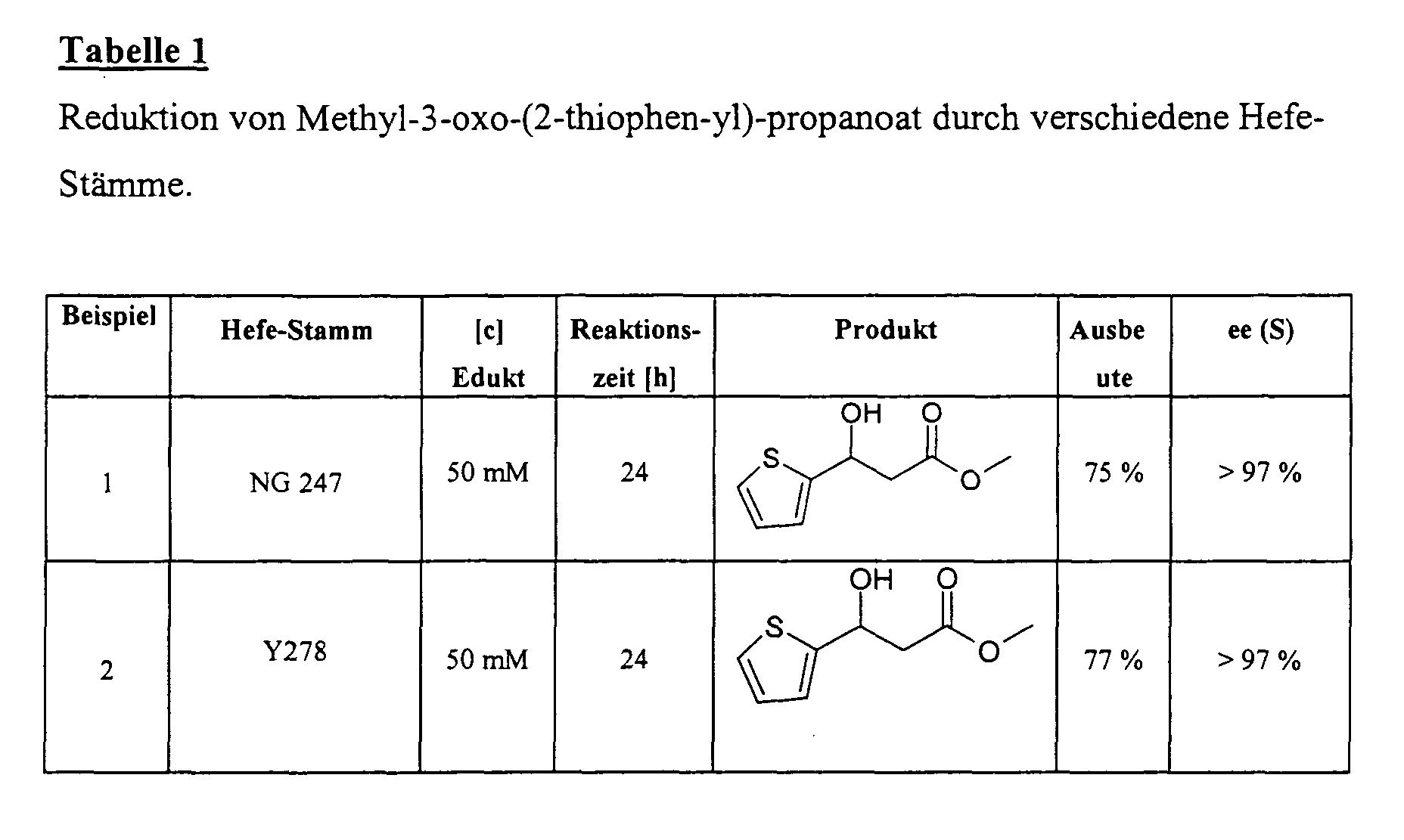
- yeast strains Saccharomyces cereviseae NG 247, Uniferm GmbH & Co KG, Monheim; Saccharomyces cereviseae Y278, Manual Hefe Werke GmbH & Co oHG, Hamburg
- YM medium yeast extract, 3.0 g / l; malt extract , 3.0 g / l; peptone 5.0 g / l; dextrose, 10.0 g / l
- Erlenmeyer flask overnight at 28 ° C with shaking (200 rpm).
- Each of the two yeast strains was incubated in three 1 liter Erlenmeyer flasks filled with 200 ml in YM medium at 28 ° C. with shaking (200 rpm), which had been inoculated with 12 ml of preculture beforehand.
- the growth was monitored by measuring the optical density at 600 nm (OD 600 ). After 6-7 hrs the cultures reached an OD 600 of 3 and were harvested by centrifugation (15 min, 8000 xg) and stored in the refrigerator overnight at 4 ° C.
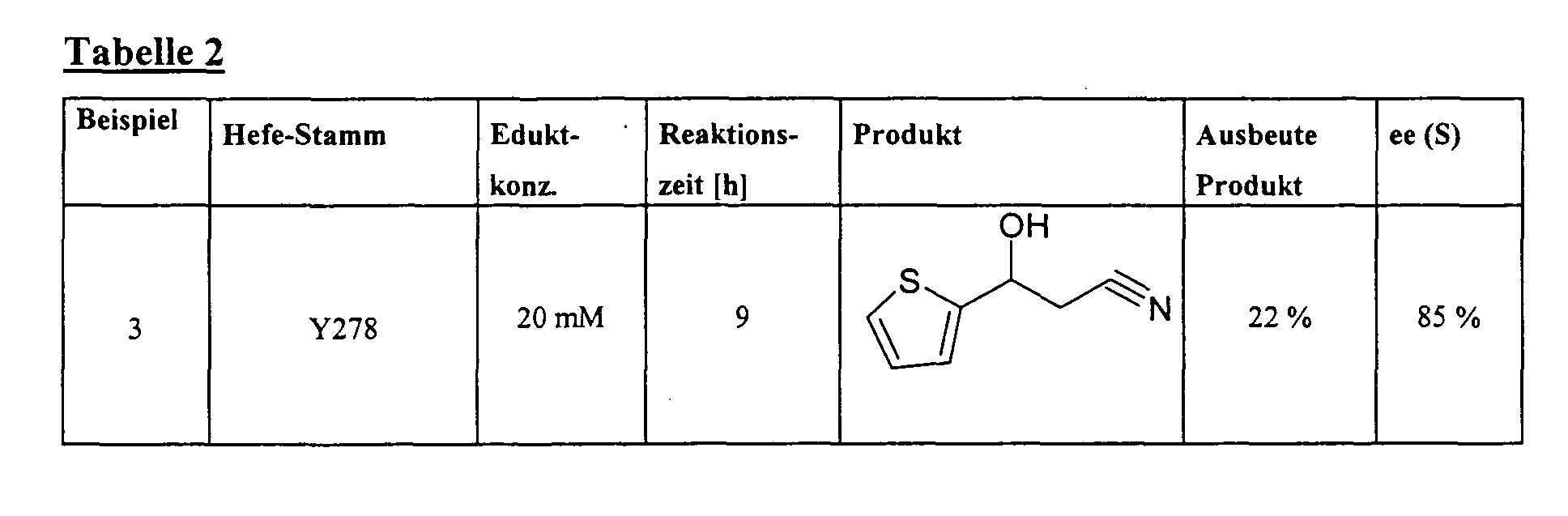
- the yeast cells were grown and the reaction was carried out as described in Examples 1 and 2. The result is shown in Table 2.
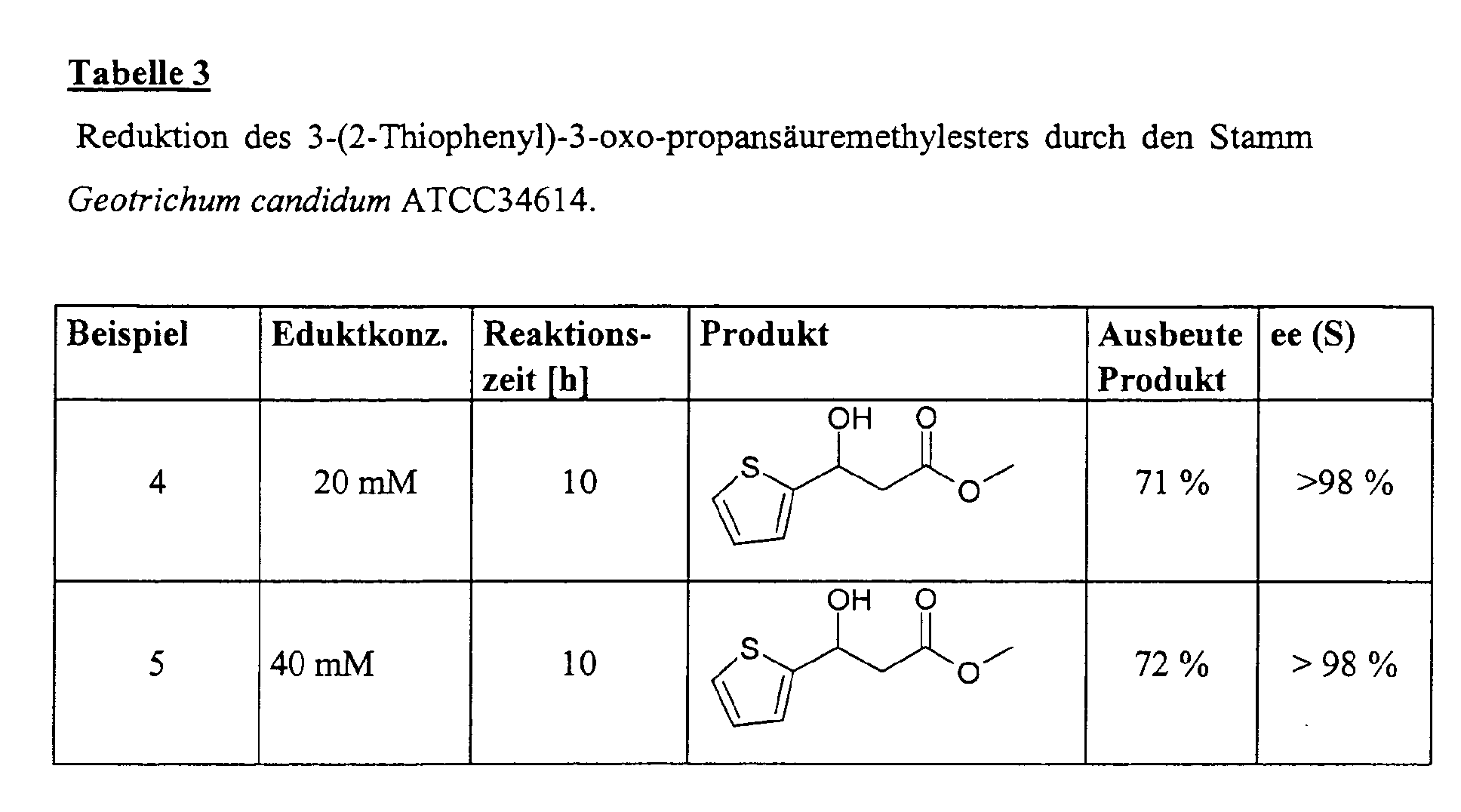
- 200 ml of YM medium were inoculated in a 1 liter Erlenmeyer flask as the first preculture with the strain Geotrichum candidum ATCC34614 and incubated at 28 ° C. with shaking for 18 h.
- a 10-liter fermenter was charged with 4.6 liters of GC medium as the main culture and inoculated with 400 ml of the second preculture. The cultivation took place at 28 ° C with a Aeration rate of 10 1 / min and a stirring speed of 800 rpm. To The fermenter was harvested for 10 hours. The cells were run through at 6000 xg for 15 min Centrifugation sedimented, were in 100 mM potassium phosphate buffer (KP buffer) pH 6.4 recorded and stored in the refrigerator at 4 ° C.
- KP buffer potassium phosphate buffer
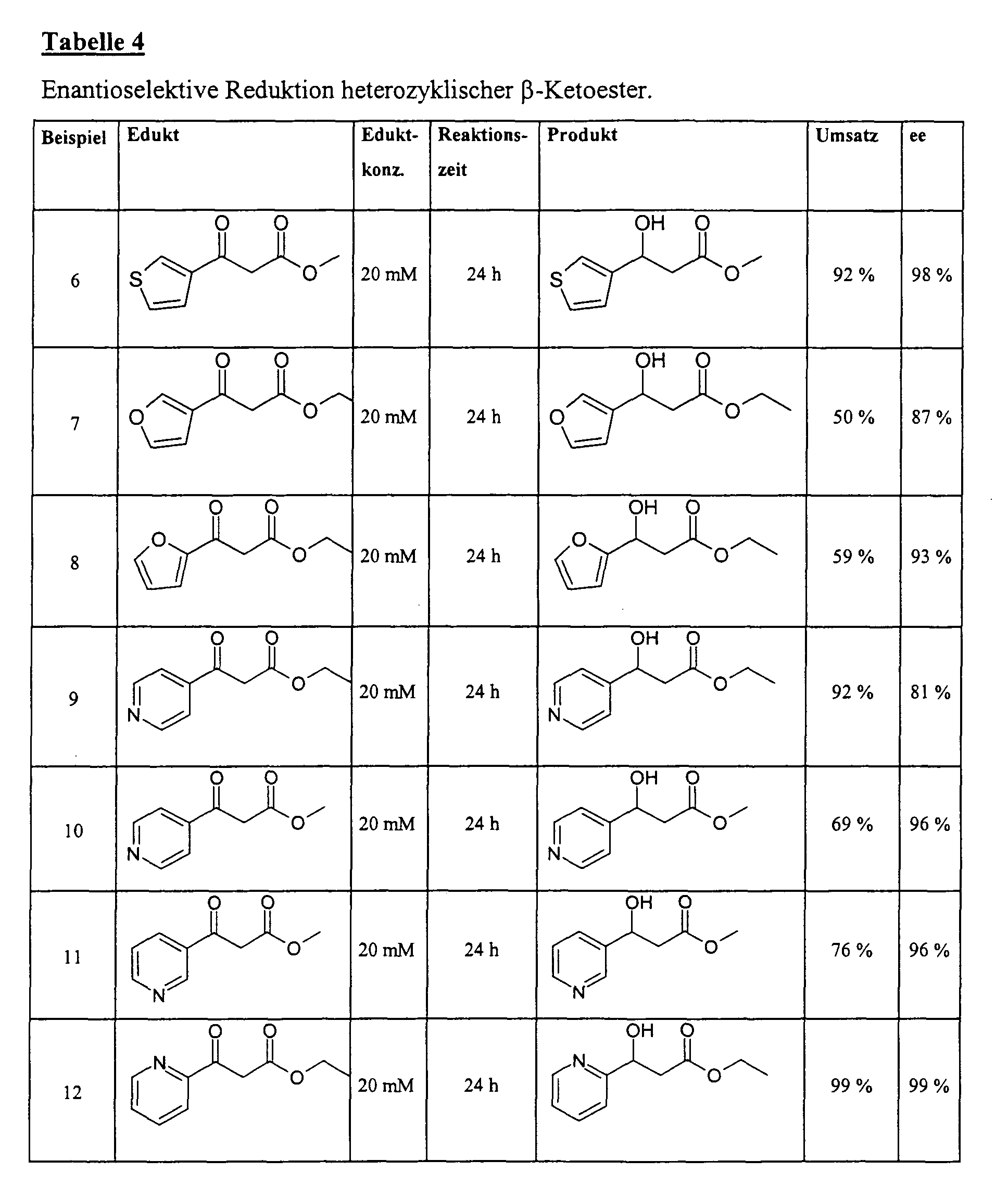
- a preculture of the Saccharomyces cereviseae NG247 strain was grown in 100 ml of YM medium at 28 ° C. overnight with shaking in a 1 liter Erlenmeyer flask.
- As the main culture three 1-liter Erlenmeyer flasks, each containing 200 ml of YM medium, were inoculated with 10 ml of the preculture and shaken at 28 ° C. After 6 hours, the cultures had an optical density, measured at 600 nm (OD 600 ), between 7 and 8.
- the cells were harvested by centrifugation (15 min, 6000 xg) and resuspended as a 10-fold concentrated cell suspension in 100 mM KP buffer (pH 7) + 3% (w / v) glucose. 1M ethanolic solutions were prepared from the test substances. In the reaction batches, the cell suspension was mixed with 20 mM test substance and incubated at 30 ° C. with shaking. 300 ⁇ l of the reaction mixture were removed at regular intervals, extracted with 300 ⁇ l of ethyl acetate or toluene, and the organic phase was analyzed by means of gas chromatography. The results are shown in Tab. 4.
- Example 14 350 ml of dry tetrahydrofuran are mixed with 10 g of lithium aluminum hydride submitted and heated to reflux. At the same time, 17 g of N-methyl- (3S) -3-hydroxy-3- (2-thienyl) propanamide are started from Example 14 dissolved in 150 g Add dropwise tetrahydrofuran. After everything has dripped, it is under overnight Reflux stirred. It is then cooled to room temperature and it 200 ml of water are carefully added dropwise. Then 135 ml of a 10% solution Sodium hydroxide solution added dropwise and the solution filtered. The solvent was removed in vacuo.
- Example 15 15 g from Example 15 were dissolved in 150 ml of water at the boiling point and with 5 g Activated carbon was added and the mixture was stirred under reflux for a further hour. The Suspension was filtered hot. The filtrate was three times with 100 ml Extracted dichloromethane. The combined organic phases were concentrated, the Residue at the boiling point dissolved in 50 ml of cyclohexane and while cooling crystallized with 600 ml of petroleum ether. The crystals were filtered with little Washed petroleum ether and dried. This gave 12 g of (1S) -3- (methylamino) -1- (2-thienyl) -1-propanol (98% purity, 93% yield).
Landscapes
- Organic Chemistry (AREA)
- Chemical & Material Sciences (AREA)
- Wood Science & Technology (AREA)
- Life Sciences & Earth Sciences (AREA)
- Engineering & Computer Science (AREA)
- Zoology (AREA)
- Health & Medical Sciences (AREA)
- General Engineering & Computer Science (AREA)
- General Chemical & Material Sciences (AREA)
- Chemical Kinetics & Catalysis (AREA)
- Biotechnology (AREA)
- Biochemistry (AREA)
- Bioinformatics & Cheminformatics (AREA)
- Microbiology (AREA)
- General Health & Medical Sciences (AREA)
- Genetics & Genomics (AREA)
- Pharmaceuticals Containing Other Organic And Inorganic Compounds (AREA)
- Preparation Of Compounds By Using Micro-Organisms (AREA)
- Organic Low-Molecular-Weight Compounds And Preparation Thereof (AREA)
- Pyridine Compounds (AREA)
Abstract
Description
- Verbindungen der Formel (I)
Heteroaryl für einen mono- oder bi-cyclischen aromatischen Rest mit insgesamt 5 bis 10 Ringatomen steht, wobei pro Cyclus keines, eines oder zwei und im gesamten aromatischen Rest ein oder zwei Ringatome ausgewählt aus der Gruppe Sauerstoff, Schwefel und Stickstoff vorhanden sein können, und wobei der mono-, oder bicyclische aromatische Rest gegebenenfalls einfach, zweifach oder dreifach substituiert ist mit Resten, die jeweils unabhängig voneinander ausgewählt sind aus der Gruppe Hydroxy, C1-C8-Alkyl, Cyano, COOH, COOM, wobei M für ein Alkalimetallion oder ein halbes Äquivalent eines Erdalkalimetallions steht, COO-(C1-C4-Alkyl), O-(C1-C4-Alkyl), N(C1-C4-Alkyl)2, NH-(C1-C4-Alkyl), Fluor, NO2, Chlor, Brom, C1-C4-Fluoralkyl, CONH2 oder CONH-(C1-C4-Alkyl) und- W
- für C(O)YR1 n, wobei Y = für Sauerstoff steht und n = 1 ist oder Y für Stickstoff steht und n = 2 ist, oder
- W
- für CN steht und
- R1
- jeweils unabhängig voneinander für Wasserstoff, C1-C8-Alkyl, C4-C10-Aryl oder C5-C11-Arylalkyl oder im Falle, dass Y für Stickstoff steht, die beiden Reste R1 zusammen für C3-C5 Alkylen stehen,
- in Gegenwart von Mikroorganismen und/oder Zellpräparaten davon und
- in Gegenwart von Wasser mit einem pH-Bereich von 3 bis 11 bezogen auf 25°C
- Heteroaryl
- die gleiche Bedeutung besitzt, die unter der Formel (I) angegeben ist und
- R2 und R3
- jeweils unabhängig voneinander für Wasserstoff, C1-C8-Alkyl, C4-C14-Aryl oder C5-C15-Arylalkyl stehen oder die beiden Reste R2 und R3 zusammen für C3-C12-Alkylen stehen, das dadurch gekennzeichnet ist, dass
- in einem Schritt a)
Verbindungen der Formel (I) wie vorstehend beschrieben in enantiomerenangereicherte Verbindungen der Formel (II) überführt werden
Heteroaryl und W die unter der Formel (I) genannten besitzen und - in einem Schritt b)
- i) für den Fall dass W für COOR1 steht und R1 für Wasserstoff, C1-C8-Alkyl,
C4-C10-Aryl oder C5-C11-Arylalkyl steht,
die enantiomerenangereicherten Verbindungen der Formel (II) mit Aminen der Formel (III) - ii) für den Fall dass W für CON(R1)2 steht und die Reste R1 jeweils
unabhängig voneinander für Wasserstoff, C1-C8-Alkyl, C4-C10-Aryl
oder C5-C11-Arylalkyl oder die beiden Reste R1 zusammen für C3-C5
Alkylen stehen,
die enantiomerenangereicherten Verbindungen der Formel (II) gegebenenfalls durch Umsetzung mit Aminen der Formel (III) zu enantiomerenangereicherten Verbindungen Formel (IV) umgesetzt werden und - iii) für den Fall dass W für CN steht, die Verbindungen der Formel (II)
durch Aminolyse/Hydrolyse direkt in Verbindung der Formel (IV)
überführt werden oder durch Hydrolyse, partielle Hydrolyse oder
gemischte Alkoholyse/Hydrolyse zunächst in Verbindungen der
Formel (V) überführt werden
und R4 für OR1 oder NH2 steht, wobei R1 die oben angegebene Bedeutung besitzt und
anschließend durch Amidierung analog zu i) oder gegebenenfalls analog zu ii) in enantiomerenangereicherte Verbindungen der Formel (IV) überführt werden - in einem Schritt c)
die enantiomerenangereicherten Verbindungen der Formel (IV) durch Reduktion in enantiomerenangereicherte Verbindungen der Formel (VI) mit der oben genannten Bedeutung überführt werden.
mit Verbindungen der Formel (VIII),
- R1 und W
- die gleiche Bedeutungen besitzen, die unter der Formel (I), angegeben wurden, wobei W nicht für CN steht in Gegenwart einer Base gewonnen.
- Heteroaryl, R2 und R3
- die unter der Formel (I) angegebenen Bedeutungen und Vorzugsbereiche besitzen und
- R6
- für Phenyl oder Naphthyl steht, das gar nicht, einfach oder mehrfach durch Substituenten substituiert sein kann, die jeweils unabhängig voneinander ausgewählt sind aus der Gruppe Cyano, CO-(C1-C12-Alkyl), O-(C1-C12-Alkyl), (C1-C12-Alkyl) Fluor, Chlor, Brom, C1-C12-Fluoralkyl.
- als Schritt d)
die Umsetzung von enantiomerenangereicherten Verbindungen der Formel (VI) mit Verbindungen der Formel (XI) zu enantiomerenangereicherten Verbindungen der Formel (X) in Gegenwart einer Base umfasst.
In Formel (XI)- R6
- die unter der Formel (X) genannte Bedeutung und
- Hal
- steht für Fluor, Chlor, Brom oder Iod, bevorzugt für Fluor.
Claims (17)
- Verfahren zur Herstellung von stereoisomerenangereicherten 3-Heteroaryl-3-hydroxypropansäurederivaten, dadurch gekennzeichnet, dassumgesetzt werden und auf diese Weise enantiomerenangereicherte Verbindungen der Formel (II) erhalten werden,Verbindungen der Formel (I)
Heteroaryl für einen mono- oder bi-cyclischen aromatischen Rest mit insgesamt 5 bis 10 Ringatomen steht, wobei pro Cyclus keines, eines oder zwei und im gesamten aromatischen Rest ein oder zwei Ringatome ausgewählt aus der Gruppe Sauerstoff, Schwefel und Stickstoff vorhanden sein können, und wobei der mono-, oder bicyclische aromatische Rest gegebenenfalls einfach, zweifach oder dreifach substituiert ist mit Resten, die jeweils unabhängig voneinander ausgewählt sind aus der Gruppe Hydroxy, C1-C8-Alkyl, Cyano, COOH, COOM, wobei M für ein Alkalimetallion oder ein halbes Äquivalent eines Erdalkalimetallions steht, COO-(C1-C4-Alkyl), O-(C1-C4-Alkyl), N(C1-C4-Alkyl)2, NH-(C1-C4-Alkyl), NO2, Fluor, Chlor, Brom, C1-C4-Fluoralkyl, CONH2 oder CONH-(C1-C4-Alkyl) und- W
- für C(O)YR1 n, wobei Y = für Sauerstoff steht und n = 1 ist oder Y für Stickstoff steht und n = 2 ist, oder
- W
- für CN steht und
- R1
- jeweils unabhängig voneinander für Wasserstoff, C1-C8-Alkyl, C4-C10-Aryl oder C5-C11-Arylalkyl oder im Falle, dass Y für Stickstoff steht, die beiden Reste R1 zusammen für C3-C5 Alkylen stehen,
in Gegenwart von Mikroorganismen und/oder Zellpräparaten davon undin Gegenwart von Wasser mit einem pH-Bereich von 3 bis 11 bezogen auf 25°C - Verfahren nach Anspruch 1, dadurch gekennzeichnet, dass in den Formeln (I) und (II) Heteroaryl für einen mono-cyclischen aromatischen Rest mit insgesamt 5 oder 6 Ringatomen steht, in dem ein oder zwei Ringatome ausgewählt sind aus der Gruppe Sauerstoff, Schwefel und Stickstoff und wobei der mono-cyclische aromatische Rest keinen, einen oder zwei Reste trägt, die jeweils unabhängig voneinander ausgewählt sind aus der Gruppe Methyl, Ethyl, n-Propyl, iso-Propyl, Cyano, COOH, COONa, COOK, COO-Methyl, COO-Ethyl, COO-tert.-Butyl, COO-Phenyl, Methoxy, Ethoxy, Dimethylamino, Diethylamino, Methylamino, Ethylamino, Fluor, Chlor, NO2, Trifluormethyl, Pentafluorethyl, Heptafluorisopropyl, CONH2 und CONH-Methyl.
- Verfahren nach mindestens einem der Ansprüche 1 und 2, dadurch gekennzeichnet, dass in den Formeln (I) und (II) Heteroaryl für 2-Thiophen-yl steht.
- Verfahren nach mindestens einem der Ansprüche 1 bis 3, dadurch gekennzeichnet, dass Methyl-3-oxo-3-(2-thiophen-yl)propanoat, Ethyl-3-oxo-3-(2-thiophen-yl)propanoat, Methyl-3-oxo-3-(3-thiophen-yl)propanoat, Ethyl-3-oxo-3-(3-thiophen-yl)propanoat, Methyl-3-oxo-3-(2-furan-yl)propanoat, Ethyl-3-oxo-3-(2-furan-yl)propanoat, Methyl-3-oxo-3-(3-furan-yl)propanoat, Ethyl-3-oxo-3-(3-furan-yl)propanoat, Methyl-3-oxo-3-(2-pyridin-yl)propanoat, Ethyl-3-oxo-3-(2-pyridin-yl)propanoat, Methyl-3-oxo-3-(3-pyridinyl)propanoat, Ethyl-3-oxo-3-(3-pyridin-yl)propanoat, Methyl-3-oxo-3-(4-pyridin-yl)propanoat, Ethyl-3-oxo-3-(4-pyridin-yl)propanoat, 3-Oxo-3-(2-thiophen-yl)propansäurenitril, 3-Oxo-3-(3-thiophen-yl)propansäurenitril, 3-Oxo-3-(2-furan-yl)propansäurenitril, 3-Oxo-3-(3-furan-yl)propansäurenitril, 3-Oxo-3-(2-pyridin-yl)propansäurenitril, 3-Oxo-3-(3-pyridin-yl)propansäurenitril, 3-Oxo-3-(4-pyridin-yl)propansäurenitril oder 3-Oxo-3-(2-thiophen-yl)propansäure-N-methylamid eingesetzt wird.
- Verfahren nach mindestens einem der Ansprüche 1 bis 4, dadurch gekennzeichnet, dass als Mikroorganismen Bakterien, Hefen oder Pilze eingesetzt werden.
- Verfahren nach mindestens einem der Ansprüche 1 bis 5, dadurch gekennzeichnet, dass als Mikroorganismen Hefen und Pilze der Gattungen Saccharomyces, Geotrichum, Candida, Pichia, Hansenula, Yarrowia, Rhizopus, Mortierella, Mucor, Sporotrichum, Rhodotorula, Trichoderma, Aspergillus, Penicillium, Pullaria, Cunninghamella und Curvularia eingesetzt werden.
- Verfahren nach mindestens einem der Ansprüche 1 bis 6, dadurch gekennzeichnet, dass die Summe der Konzentrationen der Verbindungen der Formeln (I) und (II) in der Zellsuspension zwischen 1 und 900 mM beträgt.
- Verfahren nach mindestens einem der Ansprüche 1 bis 7, dadurch gekennzeichnet, dass das Verfahren in Gegenwart eines organischen Lösungsmittels durchgeführt wird.
- Verfahren nach mindestens einem der Ansprüche 1 bis 8, dadurch gekennzeichnet, dass (S)-Methyl-3-hydroxy-3-(2-thiophen-yl)propanoat, (S)-Ethyl-3-hydroxy-3-(2-thiophen-yl)propanoat, (S)-Methyl-3-hydroxy-3-(3-thiophen-yl)propanoat, (S)-Ethyl-3-hydroxy-3-(3-thiophen-yl)propanoat, (S)-Methyl-3-hydroxy-3-(2-furan-yl)propanoat, (S)-Ethyl-3-hydroxy-3-(2-furanyl)propanoat, (S)-Methyl-3-hydroxy-3-(3-furan-yl)propanoat, (S)-Ethyl-3-hydroxy-3-(3-furan-yl)propanoat, (S)-Methyl-3-hydroxy-3-(2-pyridin-yl)-propanoat, (S)-Ethyl-3-hydroxy-3-(2-pyridin-yl)propanoat, (S)-Methyl-3-hydroxy-3-(3-pyridin-yl)propanoat, (S)-Ethyl-3-hydroxy-3-(3-pyridin-yl)propanoat, (S)-Methyl-3-hydroxy-3-(4-pyridin-yl)propanoat, (S)-Ethyl-3-hydroxy-3-(4-pyridin-yl)propanoat, (S)-3-Hydroxy-3-(2-thiophen-yl)propansäurenitril, (S)-3-Hydroxy-3-(3-thiophen-yl)propansäurenitril, (S)-3-Hydroxy-3-(2-furan-yl)propansäurenitril, (S)-3-Hydroxy-3-(3-furanyl)propansäurenitril, (S)-3-Hydroxy-3-(2-pyridin-yl)propansäurenitril, (S)-3-Hydroxy-3-(3-pyridin-yl)propansäurenitril, (S)-3-Hydroxy-3-(4-pyridinyl)propansäurenitril oder (S)-3-Hydroxy-3-(2-thiophen-yl)-propansäure-N-methylamid hergestellt wird.
- Verfahren zur Herstellung von enantiomerenangereicherten Verbindungen der Formel (VI),
- Heteroaryl
- die gleiche Bedeutung besitzt, die unter der Formel (I) angegeben ist und
- R2 und R3
- jeweils unabhängig voneinander für Wasserstoff, C1-C8-Alkyl, C4-C14-Aryl oder C5-C15-Arylalkyl stehen oder die beiden Reste R2 und R3 zusammen für C3-C12-Alkylen stehen, dadurch gekennzeichnet dass
in einem Schritt a)
Verbindungen der Formel (I) gemäß mindestens einem der Ansprüche 1 bis 9 in enantiomerenangereicherte Verbindungen der Formel (II) überführt werden
Heteroaryl und W die unter der Formel (I) genannten besitzen undin einem Schritt b)i) für den Fall dass W für COOR1 steht und R1 für Wasserstoff, C1-C8-Alkyl, C4-C10-Aryl oder C5-C11-Arylalkyl steht,
die enantiomerenangereicherten Verbindungen der Formel (II) mit Aminen der Formel (III)
zu enantiomerenangereicherten Verbindungen der Formel (IV) umgesetzt werdenii) für den Fall dass W für CON(R1)2 steht und die Reste R1 jeweils unabhängig voneinander für Wasserstoff, C1-C8-Alkyl, C4-C10-Aryl oder C5-C11-Arylalkyl oder die beiden Reste R1 zusammen für C3-C5 Alkylen stehen,
die enantiomerenangereicherten Verbindungen der Formel (II) gegebenenfalls durch Umsetzung mit Aminen der Formel (III) zu enantiomerenangereicherten Verbindungen Formel (IV) umgesetzt werden undiii) für den Fall dass W für CN steht, die Verbindungen der Formel (II) durch Aminolyse/Hydrolyse direkt in Verbindungen der Formel (IV) überführt werden oder durch Hydrolyse, partielle Hydrolyse oder gemischte Alkoholyse/Hydrolyse zunächst in Verbindungen der Formel (V) überführt werden
und R4 für OR1 oder NH2 steht, wobei R1 die oben angegebene Bedeutung besitzt und
anschließend durch Amidierung analog zu i) oder gegebenenfalls analog zu ii) in enantiomerenangereicherte Verbindungen der Formel (IV) überführt werdenin einem Schritt c)
die enantiomerenangereicherten Verbindungen der Formel (IV) durch Reduktion in enantiomerenangereicherte Verbindungen der Formel (VI) mit der oben genannten Bedeutung überführt werden. - Verfahren nach Anspruch 10, dadurch gekennzeichnet, dass in den Formeln (III), (IV) und (VI) R2 und R3 jeweils unabhängig für Wasserstoff, Methyl, Ethyl, Isopropyl, Phenyl oder Benzyl stehen.
- Verfahren nach mindestens einem der Ansprüche 10 und 11, dadurch gekennzeichnet, dass Verbindungen der Formel (I) in denen W nicht für CN steht durch Umsetzung von Verbindungen der Formel (VII)
mit Verbindungen der Formel (VIII)- R1 und W
- die gleiche Bedeutungen besitzen, die unter der Formel (I), angegeben wurden, wobei W nicht für CN steht, in Gegenwart einer Base gewonnen werden.
- Verfahren nach mindestens einem der Ansprüche 10 bis 12, dadurch gekennzeichnet, dass die Reduktion von Verbindungen der Formel (VI) mit komplexen Bor- oder Aluminiumhydriden erfolgt.
- Verfahren nach mindestens einem der Ansprüche 10 bis 13, dadurch gekennzeichnet, dass (1S)-3-(Methylamino)-1-(2-thiophen-yl)-1-propanol, (1R)-3-(Methylamine)-1-(2-thiophen-yl)-1-propanol, (1S)-3-(Dimethylamino)-1-(2-thiophen-yl}-1-propanol oder (1R)-3-(Dimethylamino)-1-(2-thiophen-yl)-1-propanol hergestellt wird.
- Verfahren nach mindestens einem der Ansprüche 10 bis 14, dadurch gekennzeichnet, dassin einem Schritt d)
die enantiomerenangereicherten Verbindungen der Formel (VI) in Gegenwart von Base mit Verbindungen der Formel (XI)- R6
- für Phenyl oder Naphthyl steht, das gar nicht, einfach oder mehrfach durch Substituenten substituiert sein kann, die jeweils unabhängig voneinander ausgewählt sind aus der Gruppe Cyano, CO-(C1-C12-Alkyl), O-(C1-C12-Alkyl), (C1-C12-Alkyl) Fluor, Chlor, Brom, C1-C12-Fluoralkyl und
- Hal
- für Fluor, Chlor, Brom oder Iod steht
- Verfahren nach Anspruch 15, dadurch gekennzeichnet, dass (S)-N-methyl-3-(1-naphthalenyloxy)-3-(2-thienyl)propylamin und (R)-N-methyl-3-(1-naphthalenyloxy)-3-(2-thienyl)propylamin oder deren Ammoniumsalze hergestellt werden.
- Verwendung von Verbindungen, die gemäß mindestens einem der Ansprüche 1 bis 9 oder gemäß mindestens einem der Ansprüche 10 bis 14 oder gemäß mindestens einem der Ansprüche 15 und 16 hergestellt wurden, als Wirkstoffe in Arzneimitteln, wie insbesondere Serotonin- oder Noradrenalin-Aufnahmeinhibitoren oder als Zwischenprodukte davon.
Applications Claiming Priority (2)
| Application Number | Priority Date | Filing Date | Title |
|---|---|---|---|
| DE10244811A DE10244811A1 (de) | 2002-09-26 | 2002-09-26 | Verfahren zur Herstellung von 3-Heteroaryl-3-hydroxy-propansäurederivaten |
| DE10244811 | 2002-09-26 |
Publications (3)
| Publication Number | Publication Date |
|---|---|
| EP1405917A2 true EP1405917A2 (de) | 2004-04-07 |
| EP1405917A3 EP1405917A3 (de) | 2005-01-12 |
| EP1405917B1 EP1405917B1 (de) | 2013-08-14 |
Family
ID=31984088
Family Applications (1)
| Application Number | Title | Priority Date | Filing Date |
|---|---|---|---|
| EP03020847.4A Expired - Lifetime EP1405917B1 (de) | 2002-09-26 | 2003-09-13 | Verfahren zur Herstellung von 3-Heteroaryl-3-hydroxy-propansäurederivaten durch enantioselektive mikrobielle Reduktion |
Country Status (5)
| Country | Link |
|---|---|
| US (2) | US7553970B2 (de) |
| EP (1) | EP1405917B1 (de) |
| JP (1) | JP5026658B2 (de) |
| CN (1) | CN100510093C (de) |
| DE (1) | DE10244811A1 (de) |
Cited By (1)
| Publication number | Priority date | Publication date | Assignee | Title |
|---|---|---|---|---|
| WO2005108590A3 (de) * | 2004-05-05 | 2006-04-06 | Basf Ag | Verfahren zur herstellung optisch aktiver alkohole aus alkanonen unter verwendung einer dehydrogenase aus azoarcus |
Families Citing this family (13)
| Publication number | Priority date | Publication date | Assignee | Title |
|---|---|---|---|---|
| US7659409B2 (en) * | 2002-03-19 | 2010-02-09 | Mitsubishi Chemical Corporation | 3-Hydroxy-3-(2-thienyl) propionamides and production method thereof, and production method of 3-amino-1-(2-thienyl)-1-propanols using the same |
| WO2006131933A1 (en) * | 2005-06-08 | 2006-12-14 | Biocon Limited | Enzymatic reduction of keto groups in 3-keto-propionic acid derivatives |
| CA2656126A1 (en) * | 2006-07-03 | 2008-01-10 | Ranbaxy Laboratories Limited | Polymorphic form of duloxetine hydrochloride |
| US20100280093A1 (en) * | 2006-07-03 | 2010-11-04 | Ranbaxy Laboratories Limited | Process for the preparation enantiomerically pure salts of n-methyl-3-(1-naphthaleneoxy)-3-(2-thienyl)propanamine |
| WO2010025287A2 (en) | 2008-08-27 | 2010-03-04 | Codexis, Inc. | Ketoreductase polypeptides for the production of 3-aryl-3-hydroxypropanamine from a 3-aryl-3-ketopropanamine |
| ES2560459T3 (es) | 2008-08-27 | 2016-02-19 | Codexis, Inc. | Polipéptidos cetorreductasa para la producción de una 3-aril-3-hidroxipropanamina a partir de una 3-aril-3-cetopropanamina |
| US8624063B2 (en) | 2009-06-30 | 2014-01-07 | Wisconsin Alumni Research Foundation | Non-lactone carbocyclic and heterocyclic antagonists and agonists of bacterial quorum sensing |
| CN102643879B (zh) * | 2011-02-21 | 2015-02-11 | 浙江九洲药业股份有限公司 | 一种微生物转化制备度洛西汀手性中间体的方法 |
| CN102199637A (zh) * | 2011-03-18 | 2011-09-28 | 浙江工业大学 | 一种微生物转化制备(s)-3-羟基-3-(2-噻吩基)-丙腈的方法 |
| CN102191293A (zh) * | 2011-03-18 | 2011-09-21 | 浙江工业大学 | 一种微生物转化制备(s)-3-羟基-3-(2-噻吩基)-丙酸乙酯的方法 |
| CN102703524B (zh) * | 2012-05-31 | 2014-06-11 | 浙江工业大学 | 一种微生物转化制备(s)-(+)-1,3-丁二醇的方法 |
| CN104130239B (zh) * | 2014-08-16 | 2016-05-04 | 瑞阳制药有限公司 | 度洛西汀手性中间体的制备方法 |
| US10526278B2 (en) | 2017-10-19 | 2020-01-07 | Wisconsin Alumni Research Foundation | Inhibitors of quorum sensing receptor LasR |
Citations (2)
| Publication number | Priority date | Publication date | Assignee | Title |
|---|---|---|---|---|
| EP0447938A1 (de) | 1990-03-22 | 1991-09-25 | Tanabe Seiyaku Co., Ltd. | Verfahren zur Herstellung von 2-Halogeno-3-Hydroxy-3-Phenyl-Propionsäureesterverbindungen |
| US5104899A (en) | 1990-08-13 | 1992-04-14 | Sepracor, Inc. | Methods and compositions for treating depression using optically pure fluoxetine |
Family Cites Families (5)
| Publication number | Priority date | Publication date | Assignee | Title |
|---|---|---|---|---|
| US5942644A (en) * | 1997-05-27 | 1999-08-24 | Biocatalytics, Inc. | Precursors for the production of chiral vicinal aminoalcohols |
| EP1153919A4 (de) * | 1999-02-16 | 2002-10-02 | Kaneka Corp | Substituierte acetylpyridin-derivate und ein verfahren zur herstellung von intermediaten für optisch aktive beta3 agonsitenmittels ihrer verwendung |
| US7659409B2 (en) * | 2002-03-19 | 2010-02-09 | Mitsubishi Chemical Corporation | 3-Hydroxy-3-(2-thienyl) propionamides and production method thereof, and production method of 3-amino-1-(2-thienyl)-1-propanols using the same |
| WO2003078418A1 (en) * | 2002-03-19 | 2003-09-25 | Mitsubishi Chemical Corporation | 3-hydroxy-3-(2-thienyl)propionamide compound, process for producing the same, and process for producing 3-amino-1-(2-thienyl)-1-propanol compound therefrom |
| GB0221438D0 (en) * | 2002-09-16 | 2002-10-23 | Avecia Ltd | Processes and compounds |
-
2002
- 2002-09-26 DE DE10244811A patent/DE10244811A1/de not_active Withdrawn
-
2003
- 2003-09-13 EP EP03020847.4A patent/EP1405917B1/de not_active Expired - Lifetime
- 2003-09-24 US US10/669,424 patent/US7553970B2/en not_active Expired - Fee Related
- 2003-09-26 JP JP2003335690A patent/JP5026658B2/ja not_active Expired - Fee Related
- 2003-09-26 CN CNB031603076A patent/CN100510093C/zh not_active Expired - Fee Related
-
2006
- 2006-05-18 US US11/436,347 patent/US20060264641A1/en not_active Abandoned
Patent Citations (2)
| Publication number | Priority date | Publication date | Assignee | Title |
|---|---|---|---|---|
| EP0447938A1 (de) | 1990-03-22 | 1991-09-25 | Tanabe Seiyaku Co., Ltd. | Verfahren zur Herstellung von 2-Halogeno-3-Hydroxy-3-Phenyl-Propionsäureesterverbindungen |
| US5104899A (en) | 1990-08-13 | 1992-04-14 | Sepracor, Inc. | Methods and compositions for treating depression using optically pure fluoxetine |
Non-Patent Citations (12)
| Title |
|---|
| CABON ET AL., TETRAHEDRON: ASYMMETRY, vol. 6, 1995, pages 2199 - 2210 |
| CHENEVERT ET AL., TETRAHEDRON, vol. 48, 1992, pages 6769 - 6776 |
| DAHL ET AL., TETRAHEDRON: ASYMMETRY, vol. 10, 1999, pages 551 - 559 |
| DEHLI ET AL., TETRAHEDRON: ASYMMETRY, vol. 11, 2000, pages 3693 - 3700 |
| FURUICHI ET AL., CHEMICAL AND PHARMACEUTICAL BULLETIN (TOKYO, vol. 32, no. 4, 1984, pages 1619 - 1623 |
| HAYAKAWA ET AL., TETRAHEDRON LETTERS, vol. 39, 1998, pages 67 - 70 |
| HOUBEN WEYL: "Methoden der Organischen Chemie, 4. Auflage,", vol. E 16, pages: 987 - 1003 |
| HOUBEN WEYL: "Methoden der Organischen Chemie, 4. Auflage,", vol. E 5, pages: 941 - 1010 |
| KUMAR A. ET AL., TETRAHEDRON LETTERS, vol. 32, 1991, pages 1901 - 1904 |
| SMALLRIDGE ET AL., TETRAHEDRON LETTERS, vol. 39, 1998, pages 5121 - 5124 |
| SYBESMA ET AL., BIOCATALYSIS AND BIOTRANSFORMATION, vol. 16, 1998, pages 95 - 134 |
| TETRAHEDRON LETT., vol. 39, 1998, pages 4995 |
Cited By (2)
| Publication number | Priority date | Publication date | Assignee | Title |
|---|---|---|---|---|
| WO2005108590A3 (de) * | 2004-05-05 | 2006-04-06 | Basf Ag | Verfahren zur herstellung optisch aktiver alkohole aus alkanonen unter verwendung einer dehydrogenase aus azoarcus |
| US7785847B2 (en) | 2004-05-05 | 2010-08-31 | Basf Se | Method for producing optically active alcohols from alkanones using a dehydrogenase of azoarcus |
Also Published As
| Publication number | Publication date |
|---|---|
| CN1497048A (zh) | 2004-05-19 |
| JP2004113245A (ja) | 2004-04-15 |
| CN100510093C (zh) | 2009-07-08 |
| JP5026658B2 (ja) | 2012-09-12 |
| DE10244811A1 (de) | 2004-04-08 |
| US7553970B2 (en) | 2009-06-30 |
| EP1405917B1 (de) | 2013-08-14 |
| EP1405917A3 (de) | 2005-01-12 |
| US20040181058A1 (en) | 2004-09-16 |
| US20060264641A1 (en) | 2006-11-23 |
Similar Documents
| Publication | Publication Date | Title |
|---|---|---|
| DE69937374T2 (de) | Verfahren zur Herstellung von 3,5-dihydroxy substituierten Estern als Zwischenprodukte zur Herstellung optisch aktiver 2-(6-(Hydroxymethyl)-1,3-dioxan-4-yl)-essigsäure-Derivate | |
| DE69619809T2 (de) | Verfahren zur herstellung von (s)-3-(aminoethyl)-5-metylhexansäure | |
| EP1405917B1 (de) | Verfahren zur Herstellung von 3-Heteroaryl-3-hydroxy-propansäurederivaten durch enantioselektive mikrobielle Reduktion | |
| EP0720655B1 (de) | Racematspaltung primärer und sekundärer amine durch enzym-katalysierte acylierung | |
| DE60311599T2 (de) | Verfahren zur herstellung von duloxetin und deren verwendeten zwischenprodukten | |
| DE69423179T2 (de) | Prozess zur Herstellung von optisch aktiven 2-Amino-1-phenylethanol Derivaten | |
| EP1745133B1 (de) | Verfahren zur herstellung optisch aktiver alkohole aus alkanonen unter verwendung einer dehydrogenase aus azoarcus | |
| EP2387556B1 (de) | Trennung eines enantiomerengemischs von (r)- und (s)-3-amino-1-butanol | |
| WO2010031776A2 (de) | Verfahren zur herstellung von optisch aktiven alkoholen | |
| JP2004113245A6 (ja) | 立体異性体濃縮3−ヘテロアリール−3−ヒドロキシプロパン酸誘導体およびエナンチオマー濃縮3−ヘテロアリール−1−アミノプロパン−1−アミノプロパン−3−オールの製造方法 | |
| DE102005044736A1 (de) | Neue Dehydrogenasen, deren Derivate und ein Verfahren zur Herstellung von optisch aktiven Alkanolen | |
| EP1346977A1 (de) | Verfahren zur Herstellung von Aryl-aminopropanolen | |
| EP1232279B1 (de) | Verfahren zur herstellung optisch aktiver amine | |
| DE69416424T2 (de) | Verfahren zur herstellung von tert-leucin und analoge in enantiemerer form und zwischenprodukte | |
| DE102005010804A1 (de) | Verfahren zur Herstellung optisch aktiver Alkohole | |
| DE69221685T2 (de) | Verfahren zur herstellung von optisch aktivem 3-chlor-1-phenyl-propan-1-ol und dessen derivat | |
| CN114891838B (zh) | 盐酸多佐胺中间体(s)-3-(2-噻吩硫基)-丁酸的合成方法 | |
| EP1252327A1 (de) | Verfahren zur enzymatischen racematspaltung von aminomethyl-aryl-cyclohexanol-derivaten | |
| EP1504002A1 (de) | Optisch aktive [beta]-aminoketone, optisch aktive 1.3-aminoalkohole und verfahren zu deren herstellung | |
| DE69905218T2 (de) | Verfahren zur Herstellung von L-Allysin Acetal | |
| WO2000040555A1 (de) | Verfahren zur herstellung von (2s,4r,9s)-octahydro-1h-indol-2-carbonsäure und zwischenprodukte dafür | |
| DE102005062662A1 (de) | Verfahren zur Herstellung optisch aktiver Alkohole | |
| EP1969129B1 (de) | Verfahren zur herstellung von (r)- und (s)-4-(1-aminomethyl)benzoesäuremethylester-sulfat aus racemischem 4-(1-amin0ethyl)benzoesäuremethylester | |
| DE112019006382T5 (de) | NEUES VERFAHREN ZUR HERSTELLUNG VONR-PHENYLACETYLCARBINOL UND β-AMINOALKOHOLEN |
Legal Events
| Date | Code | Title | Description |
|---|---|---|---|
| PUAI | Public reference made under article 153(3) epc to a published international application that has entered the european phase |
Free format text: ORIGINAL CODE: 0009012 |
|
| AK | Designated contracting states |
Kind code of ref document: A2 Designated state(s): AT BE BG CH CY CZ DE DK EE ES FI FR GB GR HU IE IT LI LU MC NL PT RO SE SI SK TR |
|
| AX | Request for extension of the european patent |
Extension state: AL LT LV MK |
|
| PUAL | Search report despatched |
Free format text: ORIGINAL CODE: 0009013 |
|
| AK | Designated contracting states |
Kind code of ref document: A3 Designated state(s): AT BE BG CH CY CZ DE DK EE ES FI FR GB GR HU IE IT LI LU MC NL PT RO SE SI SK TR |
|
| AX | Request for extension of the european patent |
Extension state: AL LT LV MK |
|
| RAP1 | Party data changed (applicant data changed or rights of an application transferred) |
Owner name: LANXESS DEUTSCHLAND GMBH |
|
| 17P | Request for examination filed |
Effective date: 20050712 |
|
| AKX | Designation fees paid |
Designated state(s): AT BE BG CH CY CZ DE DK EE ES FI FR GB GR HU IE IT LI LU MC NL PT RO SE SI SK TR |
|
| RAP1 | Party data changed (applicant data changed or rights of an application transferred) |
Owner name: SALTIGO GMBH |
|
| RAP1 | Party data changed (applicant data changed or rights of an application transferred) |
Owner name: SALTIGO GMBH |
|
| 17Q | First examination report despatched |
Effective date: 20080627 |
|
| GRAP | Despatch of communication of intention to grant a patent |
Free format text: ORIGINAL CODE: EPIDOSNIGR1 |
|
| INTG | Intention to grant announced |
Effective date: 20130515 |
|
| GRAS | Grant fee paid |
Free format text: ORIGINAL CODE: EPIDOSNIGR3 |
|
| GRAA | (expected) grant |
Free format text: ORIGINAL CODE: 0009210 |
|
| AK | Designated contracting states |
Kind code of ref document: B1 Designated state(s): AT BE BG CH CY CZ DE DK EE ES FI FR GB GR HU IE IT LI LU MC NL PT RO SE SI SK TR |
|
| REG | Reference to a national code |
Ref country code: GB Ref legal event code: FG4D Free format text: NOT ENGLISH |
|
| REG | Reference to a national code |
Ref country code: CH Ref legal event code: EP Ref country code: AT Ref legal event code: REF Ref document number: 626913 Country of ref document: AT Kind code of ref document: T Effective date: 20130815 |
|
| REG | Reference to a national code |
Ref country code: IE Ref legal event code: FG4D Free format text: LANGUAGE OF EP DOCUMENT: GERMAN |
|
| REG | Reference to a national code |
Ref country code: DE Ref legal event code: R096 Ref document number: 50314862 Country of ref document: DE Effective date: 20131010 |
|
| RAP2 | Party data changed (patent owner data changed or rights of a patent transferred) |
Owner name: SALTIGO GMBH |
|
| REG | Reference to a national code |
Ref country code: NL Ref legal event code: VDEP Effective date: 20130814 |
|
| PG25 | Lapsed in a contracting state [announced via postgrant information from national office to epo] |
Ref country code: PT Free format text: LAPSE BECAUSE OF FAILURE TO SUBMIT A TRANSLATION OF THE DESCRIPTION OR TO PAY THE FEE WITHIN THE PRESCRIBED TIME-LIMIT Effective date: 20131216 Ref country code: SE Free format text: LAPSE BECAUSE OF FAILURE TO SUBMIT A TRANSLATION OF THE DESCRIPTION OR TO PAY THE FEE WITHIN THE PRESCRIBED TIME-LIMIT Effective date: 20130814 Ref country code: CY Free format text: LAPSE BECAUSE OF FAILURE TO SUBMIT A TRANSLATION OF THE DESCRIPTION OR TO PAY THE FEE WITHIN THE PRESCRIBED TIME-LIMIT Effective date: 20130703 |
|
| PG25 | Lapsed in a contracting state [announced via postgrant information from national office to epo] |
Ref country code: GR Free format text: LAPSE BECAUSE OF FAILURE TO SUBMIT A TRANSLATION OF THE DESCRIPTION OR TO PAY THE FEE WITHIN THE PRESCRIBED TIME-LIMIT Effective date: 20131115 Ref country code: SI Free format text: LAPSE BECAUSE OF FAILURE TO SUBMIT A TRANSLATION OF THE DESCRIPTION OR TO PAY THE FEE WITHIN THE PRESCRIBED TIME-LIMIT Effective date: 20130814 Ref country code: FI Free format text: LAPSE BECAUSE OF FAILURE TO SUBMIT A TRANSLATION OF THE DESCRIPTION OR TO PAY THE FEE WITHIN THE PRESCRIBED TIME-LIMIT Effective date: 20130814 |
|
| BERE | Be: lapsed |
Owner name: SALTIGO G.M.B.H. Effective date: 20130930 |
|
| PG25 | Lapsed in a contracting state [announced via postgrant information from national office to epo] |
Ref country code: CY Free format text: LAPSE BECAUSE OF FAILURE TO SUBMIT A TRANSLATION OF THE DESCRIPTION OR TO PAY THE FEE WITHIN THE PRESCRIBED TIME-LIMIT Effective date: 20130814 |
|
| PG25 | Lapsed in a contracting state [announced via postgrant information from national office to epo] |
Ref country code: DK Free format text: LAPSE BECAUSE OF FAILURE TO SUBMIT A TRANSLATION OF THE DESCRIPTION OR TO PAY THE FEE WITHIN THE PRESCRIBED TIME-LIMIT Effective date: 20130814 Ref country code: NL Free format text: LAPSE BECAUSE OF FAILURE TO SUBMIT A TRANSLATION OF THE DESCRIPTION OR TO PAY THE FEE WITHIN THE PRESCRIBED TIME-LIMIT Effective date: 20130814 Ref country code: SK Free format text: LAPSE BECAUSE OF FAILURE TO SUBMIT A TRANSLATION OF THE DESCRIPTION OR TO PAY THE FEE WITHIN THE PRESCRIBED TIME-LIMIT Effective date: 20130814 Ref country code: RO Free format text: LAPSE BECAUSE OF FAILURE TO SUBMIT A TRANSLATION OF THE DESCRIPTION OR TO PAY THE FEE WITHIN THE PRESCRIBED TIME-LIMIT Effective date: 20130814 Ref country code: EE Free format text: LAPSE BECAUSE OF FAILURE TO SUBMIT A TRANSLATION OF THE DESCRIPTION OR TO PAY THE FEE WITHIN THE PRESCRIBED TIME-LIMIT Effective date: 20130814 Ref country code: CZ Free format text: LAPSE BECAUSE OF FAILURE TO SUBMIT A TRANSLATION OF THE DESCRIPTION OR TO PAY THE FEE WITHIN THE PRESCRIBED TIME-LIMIT Effective date: 20130814 |
|
| REG | Reference to a national code |
Ref country code: CH Ref legal event code: PL |
|
| PG25 | Lapsed in a contracting state [announced via postgrant information from national office to epo] |
Ref country code: IT Free format text: LAPSE BECAUSE OF FAILURE TO SUBMIT A TRANSLATION OF THE DESCRIPTION OR TO PAY THE FEE WITHIN THE PRESCRIBED TIME-LIMIT Effective date: 20130814 Ref country code: MC Free format text: LAPSE BECAUSE OF FAILURE TO SUBMIT A TRANSLATION OF THE DESCRIPTION OR TO PAY THE FEE WITHIN THE PRESCRIBED TIME-LIMIT Effective date: 20130814 Ref country code: ES Free format text: LAPSE BECAUSE OF FAILURE TO SUBMIT A TRANSLATION OF THE DESCRIPTION OR TO PAY THE FEE WITHIN THE PRESCRIBED TIME-LIMIT Effective date: 20130814 |
|
| PLBE | No opposition filed within time limit |
Free format text: ORIGINAL CODE: 0009261 |
|
| STAA | Information on the status of an ep patent application or granted ep patent |
Free format text: STATUS: NO OPPOSITION FILED WITHIN TIME LIMIT |
|
| REG | Reference to a national code |
Ref country code: FR Ref legal event code: ST Effective date: 20140530 |
|
| REG | Reference to a national code |
Ref country code: IE Ref legal event code: MM4A |
|
| REG | Reference to a national code |
Ref country code: DE Ref legal event code: R119 Ref document number: 50314862 Country of ref document: DE Effective date: 20140401 |
|
| 26N | No opposition filed |
Effective date: 20140515 |
|
| GBPC | Gb: european patent ceased through non-payment of renewal fee |
Effective date: 20131114 |
|
| PG25 | Lapsed in a contracting state [announced via postgrant information from national office to epo] |
Ref country code: IE Free format text: LAPSE BECAUSE OF NON-PAYMENT OF DUE FEES Effective date: 20130913 Ref country code: LI Free format text: LAPSE BECAUSE OF NON-PAYMENT OF DUE FEES Effective date: 20130930 Ref country code: CH Free format text: LAPSE BECAUSE OF NON-PAYMENT OF DUE FEES Effective date: 20130930 Ref country code: BE Free format text: LAPSE BECAUSE OF NON-PAYMENT OF DUE FEES Effective date: 20130930 |
|
| PG25 | Lapsed in a contracting state [announced via postgrant information from national office to epo] |
Ref country code: FR Free format text: LAPSE BECAUSE OF NON-PAYMENT OF DUE FEES Effective date: 20131014 Ref country code: DE Free format text: LAPSE BECAUSE OF NON-PAYMENT OF DUE FEES Effective date: 20140401 |
|
| REG | Reference to a national code |
Ref country code: AT Ref legal event code: MM01 Ref document number: 626913 Country of ref document: AT Kind code of ref document: T Effective date: 20130913 |
|
| PG25 | Lapsed in a contracting state [announced via postgrant information from national office to epo] |
Ref country code: GB Free format text: LAPSE BECAUSE OF NON-PAYMENT OF DUE FEES Effective date: 20131114 |
|
| PG25 | Lapsed in a contracting state [announced via postgrant information from national office to epo] |
Ref country code: AT Free format text: LAPSE BECAUSE OF NON-PAYMENT OF DUE FEES Effective date: 20130913 |
|
| PG25 | Lapsed in a contracting state [announced via postgrant information from national office to epo] |
Ref country code: TR Free format text: LAPSE BECAUSE OF FAILURE TO SUBMIT A TRANSLATION OF THE DESCRIPTION OR TO PAY THE FEE WITHIN THE PRESCRIBED TIME-LIMIT Effective date: 20130814 |
|
| PG25 | Lapsed in a contracting state [announced via postgrant information from national office to epo] |
Ref country code: LU Free format text: LAPSE BECAUSE OF NON-PAYMENT OF DUE FEES Effective date: 20130913 Ref country code: HU Free format text: LAPSE BECAUSE OF FAILURE TO SUBMIT A TRANSLATION OF THE DESCRIPTION OR TO PAY THE FEE WITHIN THE PRESCRIBED TIME-LIMIT; INVALID AB INITIO Effective date: 20030913 Ref country code: BG Free format text: LAPSE BECAUSE OF FAILURE TO SUBMIT A TRANSLATION OF THE DESCRIPTION OR TO PAY THE FEE WITHIN THE PRESCRIBED TIME-LIMIT Effective date: 20130814 |