EP1405887A1 - Ultraviolet absorber composition and resin composition stabilized with the composition - Google Patents
Ultraviolet absorber composition and resin composition stabilized with the composition Download PDFInfo
- Publication number
- EP1405887A1 EP1405887A1 EP02733344A EP02733344A EP1405887A1 EP 1405887 A1 EP1405887 A1 EP 1405887A1 EP 02733344 A EP02733344 A EP 02733344A EP 02733344 A EP02733344 A EP 02733344A EP 1405887 A1 EP1405887 A1 EP 1405887A1
- Authority
- EP
- European Patent Office
- Prior art keywords
- ultraviolet absorber
- composition
- tert
- resin
- compound
- Prior art date
- Legal status (The legal status is an assumption and is not a legal conclusion. Google has not performed a legal analysis and makes no representation as to the accuracy of the status listed.)
- Withdrawn
Links
Classifications
-
- C—CHEMISTRY; METALLURGY
- C08—ORGANIC MACROMOLECULAR COMPOUNDS; THEIR PREPARATION OR CHEMICAL WORKING-UP; COMPOSITIONS BASED THEREON
- C08K—Use of inorganic or non-macromolecular organic substances as compounding ingredients
- C08K5/00—Use of organic ingredients
- C08K5/16—Nitrogen-containing compounds
- C08K5/34—Heterocyclic compounds having nitrogen in the ring
- C08K5/3467—Heterocyclic compounds having nitrogen in the ring having more than two nitrogen atoms in the ring
- C08K5/3472—Five-membered rings
- C08K5/3475—Five-membered rings condensed with carbocyclic rings
-
- C—CHEMISTRY; METALLURGY
- C08—ORGANIC MACROMOLECULAR COMPOUNDS; THEIR PREPARATION OR CHEMICAL WORKING-UP; COMPOSITIONS BASED THEREON
- C08K—Use of inorganic or non-macromolecular organic substances as compounding ingredients
- C08K5/00—Use of organic ingredients
- C08K5/0008—Organic ingredients according to more than one of the "one dot" groups of C08K5/01 - C08K5/59
- C08K5/005—Stabilisers against oxidation, heat, light, ozone
-
- C—CHEMISTRY; METALLURGY
- C08—ORGANIC MACROMOLECULAR COMPOUNDS; THEIR PREPARATION OR CHEMICAL WORKING-UP; COMPOSITIONS BASED THEREON
- C08K—Use of inorganic or non-macromolecular organic substances as compounding ingredients
- C08K5/00—Use of organic ingredients
- C08K5/04—Oxygen-containing compounds
- C08K5/13—Phenols; Phenolates
-
- C—CHEMISTRY; METALLURGY
- C08—ORGANIC MACROMOLECULAR COMPOUNDS; THEIR PREPARATION OR CHEMICAL WORKING-UP; COMPOSITIONS BASED THEREON
- C08K—Use of inorganic or non-macromolecular organic substances as compounding ingredients
- C08K5/00—Use of organic ingredients
- C08K5/16—Nitrogen-containing compounds
- C08K5/34—Heterocyclic compounds having nitrogen in the ring
-
- Y—GENERAL TAGGING OF NEW TECHNOLOGICAL DEVELOPMENTS; GENERAL TAGGING OF CROSS-SECTIONAL TECHNOLOGIES SPANNING OVER SEVERAL SECTIONS OF THE IPC; TECHNICAL SUBJECTS COVERED BY FORMER USPC CROSS-REFERENCE ART COLLECTIONS [XRACs] AND DIGESTS
- Y10—TECHNICAL SUBJECTS COVERED BY FORMER USPC
- Y10S—TECHNICAL SUBJECTS COVERED BY FORMER USPC CROSS-REFERENCE ART COLLECTIONS [XRACs] AND DIGESTS
- Y10S430/00—Radiation imagery chemistry: process, composition, or product thereof
- Y10S430/132—Anti-ultraviolet fading
Definitions
- the present invention relates to an ultraviolet absorber composition which is produced by melt-mixing a benzotriazole compound having a specific structure and a resin stabilizer other than the benzotriazole compound and which has a low melting temperature and excellent compatibility with a resin.
- the invention also relates to a synthetic resin composition stabilized by the ultraviolet absorber composition.
- an antioxidant such as a phenolic antioxidant, a phosphorus antioxidant, or a sulfur antioxidant; an ultraviolet absorber; or a hindered amine stabilizer has been added to the synthetic resins.
- a plurality of additives have also been added to the resin depending on the purpose of stabilization.
- Combination of such additives has been widely known to produce synergistic effects.
- a combination of a phenolic antioxidant and a phosphorus antioxidant imparts heat resistance to the resin
- a combination of an ultraviolet absorber and a hindered amine stabilizer imparts weather resistance to the resin.
- 2,2'-methylenebis(4-tert-octyl-6-benzotriazolyl)phenol is known to serve as an excellent ultraviolet absorber, as disclosed in Japanese Patent Application Laid-Open ( kokai ) No. 61-118373.
- Japanese Patent Application Laid-Open ( kokai ) Nos. 61-113649, 61-113667, 61-163954, 62-225554, 62-146951, 62-172058, 63-10653, etc. disclose uses of the phenol compound in a variety of resins.
- 2,2'-methylenebis(4-tert-octyl-6-benzotriazolyl)phenol has poor compatibility with certain types of resin, such as polyolefin resin.
- resin such as polyolefin resin.
- the compound migrates to the surface of the resin products (i.e., exhibits blooming), thereby impairing the commercial value of the resin products. Therefore, limitations have been imposed on the type of resin to which the compound is added.
- the present inventors have carried out extensive studies in an attempt to meet the aforementioned demand, and have found that an ultraviolet absorber composition produced by melt-mixing 2,2'-methylenebis(4-tert-octyl-6-benzotriazolyl)phenol and a resin additive other than the phenol compound has excellent compatibility with a resin, and that a stabilized resin composition which provides products with less blooming can be produced from the ultraviolet absorber composition.
- the present invention has been accomplished on the basis of these findings.
- an ultraviolet absorber composition which is formed by melt-mixing a compound (A) represented by the following formula (I): and a resin stabilizer (B) selected from the group consisting of a phenolic antioxidant (b-1), a phosphorus-containing antioxidant (b-2), a hindered amine stabilizer (b-3), and an ultraviolet absorber (b-4) other than the compound (A), at a mass ratio (A)/(B) of 95/5 to 50/50.
- a second mode of the present invention is drawn to a specific ultraviolet absorber composition of the first mode, wherein the resin stabilizer (B) is the ultraviolet absorber (b-4) other than the compound (A).
- a third mode of the present invention is drawn to a specific ultraviolet absorber composition of the second mode, wherein the ultraviolet absorber (b-4) other than the compound (A) is a benzotriazole ultraviolet absorber.
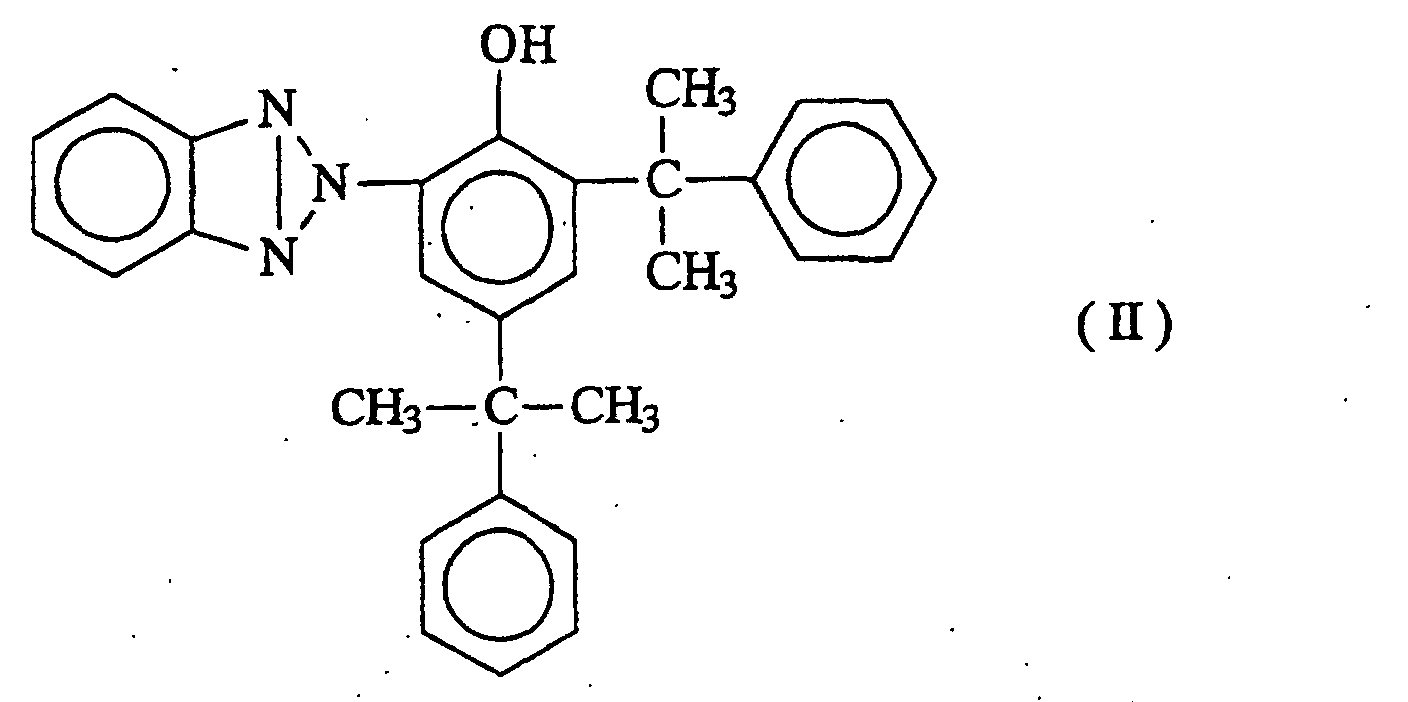
- a fourth mode of the present invention is drawn to a specific ultraviolet absorber composition of the third mode, wherein the benzotriazole ultraviolet absorber is a compound represented by the following formula (II).
- a synthetic resin composition comprising a synthetic resin and an ultraviolet absorber composition as recited in relation to any of the first to fourth modes.
- a sixth mode of the present invention is drawn to a specific synthetic resin composition of the fifth mode, wherein the synthetic resin is a polyolefin resin.
- phenolic antioxidant (b-1) used in the present invention examples include 2,6-di-tert-butyl-p-cresol, 2,6-diphenyl-4-octadecyloxyphenol, distearyl (3,5-di-tert-butyl-4-hydroxybenzyl) phosphonate, 1,6-hexamethylenebis[(3,5-di-tert-butyl-4-hydroxyphenyl)propionamide], 4,4'-thiobis(6-tert-butyl-m-cresol), 2,2'-methylenebis(4-methyl-6-tert-butylphenol), 2,2'-methylenebis(4-ethyl-6-tert-butylphenol), 4,4'-butylidenebis(6-tert-butyl-m-cresol), 2,2'-ethylidenebis(4,6-di-tert-butylphenol), 2,2'-ethylidenebis(4-sec-butyl-6
- Examples of the phosphorus antioxidant (b-2) used in the present invention include trisnonylphenyl phosphite, tris(2,4-di-tert-butylphenyl) phosphite, tris[2-tert-butyl-4-(3-tert-butyl-4-hydroxy-5-methylphenylthio)-5-methylphenyl] phosphite, tridecyl phosphite, octyl diphenyl phosphite, di(decyl) monophenyl phosphite, di(tridecyl)pentaerythritol diphosphite, di(nonylphenyl)pentaerythritol diphosphite, bis(2,4-di-tert-butylphenyl)pentaerythritol diphosphite, bis(2,6-di-tert-butyl-4-methylphenyl
- hindered amine stabilizer (b-3) used in the present invention examples include hindered amine compounds such as 2,2,6,6-tetramethyl-4-piperidyl stearate, 1,2,2,6,6-pentamethyl-4-piperidyl stearate, 2,2,6,6-tetramethyl-4-piperidyl benzoate, bis(2,2,6,6-tetramethyl-4-piperidyl) sebacate, bis(1,2,2,6,6-pentamethyl-4-piperidyl) sebacate, tetrakis(2,2,6,6-tetramethyl-4-piperidyl) butanetetracarboxylate, tetrakis(1,2,2,6,6-pentamethyl-4-piperidyl) butanetetracarboxylate, bis(2,2,6,6-tetramethyl-4-piperidyl) di(tridecyl) 1,2,3,4-butanetetracarboxylate, bis(1,2,2,6,6-pentamethyl-4-pipe
- Examples of the ultraviolet absorber (b-4) other than the compound (A) used in the present invention include 2-hydroxybenzophenone compounds such as 2,4-dihydroxybenzophenone, 2-hydroxy-4-methoxybenzophenone, 2-hydroxy-4-octoxybenzophenone, and 5,5'-methylenebis(2-hydroxy-4-methoxybenzophenone); 2-(2'-hydroxyphenyl)benzotriazole compoundssuch as 2-(2'-hydroxy-5'-methylphenyl)benzotriazole, 2-(2'-hydroxy-3',5'-di-tert-butylphenyl)-5-chlorobenzotriazole, 2-(2'-hydroxy-3'-tert-butyl-5'-methylphenyl)-5-chlorobenzotriazole, 2-(2'-hydroxy-5'-tert-octylphenyl)benzotriazole, 2-(2'-hydroxy-3',5'-dicumylphenyl)benzotriazole, and 2-(2
- the resin stabilizer (B) is added to a resin in a preferred amount, which varies in accordance with the type and use purpose of the resin and depending on the type of the resin stabilizer (i.e., antioxidant, hindered amine compound, or ultraviolet absorber).
- the ultraviolet absorber (b-4) other than the compound (A) is preferably used, since the amount of the absorber (b-4) incorporated into the ultraviolet absorber composition to be added to a resin can be selected from a wide range.
- a benzotriazole ultraviolet absorber having high compatibility with the compound (A) during melt-mixing, is more preferred, with a compound represented by the following formula (II) being particularly preferred, from the viewpoint of a remarkable blooming-prevention effect.
- Examples of synthetic resins to which the ultraviolet absorber composition of the present invention include homopolymers and copolymer of ⁇ -olein such as polypropylene, low-density polyethylene, linear-low-density polyethylene, high-density polyethylene, polybutene-1, poly(3-methylpentene), poly(4-methylpentene), and ethylene-polyethylene copolymer; copolymers of ⁇ -olefins with a polyunsaturated compound such as conjugated or non-conjugated diene, acrylic acid, methacrylic acid, or vinyl acetate; linear polyesters and acid-modified polyesters such as polyethylene terephthalate, polyethylene terephthalate isophthalate, polyethylene terephthalate p-oxybenzoate, and polybutylen terephthalate; polyamides such as polycaprolactam and polyhexamethyleneadipamide; polyimides; polystyrene; copolymers (e.g.,
- the ultraviolet absorber composition of the present invention is suitably added to polyolefin resin, which per se has poor compatibility with 2,2'-methylenebis(4-tert-octyl-6-benzotriazolyl)phenol.
- additives which are generally used in resins may be added in accordance with needs.
- the additives include thioether antioxidants; nucleating agents such as a phosphate ester metal salt, benzylidene sorbitol, and a benzoic acid derivative metal salt; heavy metal deactivators; fatty acid metal salts; hydrotalcite; fillers; pigments; dyes; fire-proofing agents; and processing aids.
- the composition can be produced by heat-melting the compound (A) and the resin stabilizer (B) in a vessel in an inert atmosphere; transferring the melt under stirring to an aluminum tray for cooling; and pulverizing the cooled mixture by means of a flaker.
- the composition can be produced by dissolving the compound (A) and the resin stabilizer (B) in a solvent to form a uniform solution; removing the solvent from the solution at a temperature equal to or exceeding the melting temperature of the mixture to be produced through removal of the solvent, to thereby form a melt mixture; and removing, cooling, and crushing the mixture.
- the latter method in which two components are dissolved in a solvent to form a solution, requires an additional solvent removal step and is not advantageous from an economical viewpoint.
- the process can be performed at a comparatively low temperature, whereby coloring and decomposition of the compound (A) and the resin stabilizer (B) by heat can be prevented.
- Example 2-1 The procedure of Example 2-1 was repeated, except that the sample compound or the ultraviolet absorber composition shown in Table 2 was used, to thereby prepare test pieces.
- test pieces containing 2,2'-methylenebis(4-tert-octyl-6-benzotriazolyl)phenol, 2-(2'-hydroxy-3',5'-dicumylphenyl)benzotriazole, or a simple mixture thereof exhibited a considerable level of blooming.
- sole use of 2,2'-methylenebis(4-tert-octyl-6-benzotriazolyl)phenol caused a higher level of blooming.
- blooming was prevented in the test pieces of Example 2-1 containing a composition prepared through melt-mixing.
- compositions prepared through melt-mixing show melting behavior different from that of similar compositions prepared through simple mixing, and such a different behavior may be attributable molecular interaction during melt-mixing, which is maintained after the compositions have undergone processing for forming test pieces.
- an ultraviolet absorber composition having excellent light resistance and generating less blooming, and a synthetic resin composition having light resistance that is remarkably improved by the ultraviolet absorber composition.
Landscapes
- Chemical & Material Sciences (AREA)
- Health & Medical Sciences (AREA)
- Chemical Kinetics & Catalysis (AREA)
- Medicinal Chemistry (AREA)
- Polymers & Plastics (AREA)
- Organic Chemistry (AREA)
- Compositions Of Macromolecular Compounds (AREA)
Abstract
Description
- The present invention relates to an ultraviolet absorber composition which is produced by melt-mixing a benzotriazole compound having a specific structure and a resin stabilizer other than the benzotriazole compound and which has a low melting temperature and excellent compatibility with a resin. The invention also relates to a synthetic resin composition stabilized by the ultraviolet absorber composition.
- Conventionally, a variety of synthetic resins have been applied, according to their chemical and physical characteristics, to uses such as building materials, agricultural materials, miscellaneous goods, automobile parts, housings of electric appliances, coatings, and packaging materials.
- Without resin stabilizers, most synthetic resins are deteriorated by heat or light. Therefore, an antioxidant such as a phenolic antioxidant, a phosphorus antioxidant, or a sulfur antioxidant; an ultraviolet absorber; or a hindered amine stabilizer has been added to the synthetic resins.
- Conventionally, in order to stabilize a resin, a plurality of additives have also been added to the resin depending on the purpose of stabilization. Combination of such additives has been widely known to produce synergistic effects. For example, a combination of a phenolic antioxidant and a phosphorus antioxidant imparts heat resistance to the resin, and a combination of an ultraviolet absorber and a hindered amine stabilizer imparts weather resistance to the resin.
- Among these additives, 2,2'-methylenebis(4-tert-octyl-6-benzotriazolyl)phenol is known to serve as an excellent ultraviolet absorber, as disclosed in Japanese Patent Application Laid-Open (kokai) No. 61-118373. Japanese Patent Application Laid-Open (kokai) Nos. 61-113649, 61-113667, 61-163954, 62-225554, 62-146951, 62-172058, 63-10653, etc. disclose uses of the phenol compound in a variety of resins.
- However, 2,2'-methylenebis(4-tert-octyl-6-benzotriazolyl)phenol has poor compatibility with certain types of resin, such as polyolefin resin. When the compound is added to such a resin, the compound migrates to the surface of the resin products (i.e., exhibits blooming), thereby impairing the commercial value of the resin products. Therefore, limitations have been imposed on the type of resin to which the compound is added.
- Thus, demand has arisen for improving the compatibility of 2,2'-methylenebis(4-tert-octyl-6-benzotriazolyl)phenol-an excellent ultraviolet absorber-to a resin, thereby enabling addition of the compound to a resin for which highly stabilizing effect is required.
- The present inventors have carried out extensive studies in an attempt to meet the aforementioned demand, and have found that an ultraviolet absorber composition produced by melt-mixing 2,2'-methylenebis(4-tert-octyl-6-benzotriazolyl)phenol and a resin additive other than the phenol compound has excellent compatibility with a resin, and that a stabilized resin composition which provides products with less blooming can be produced from the ultraviolet absorber composition. The present invention has been accomplished on the basis of these findings.
- Accordingly, in a first mode of the present invention, there is provided an ultraviolet absorber composition which is formed by melt-mixing a compound (A) represented by the following formula (I):and a resin stabilizer (B) selected from the group consisting of a phenolic antioxidant (b-1), a phosphorus-containing antioxidant (b-2), a hindered amine stabilizer (b-3), and an ultraviolet absorber (b-4) other than the compound (A), at a mass ratio (A)/(B) of 95/5 to 50/50.
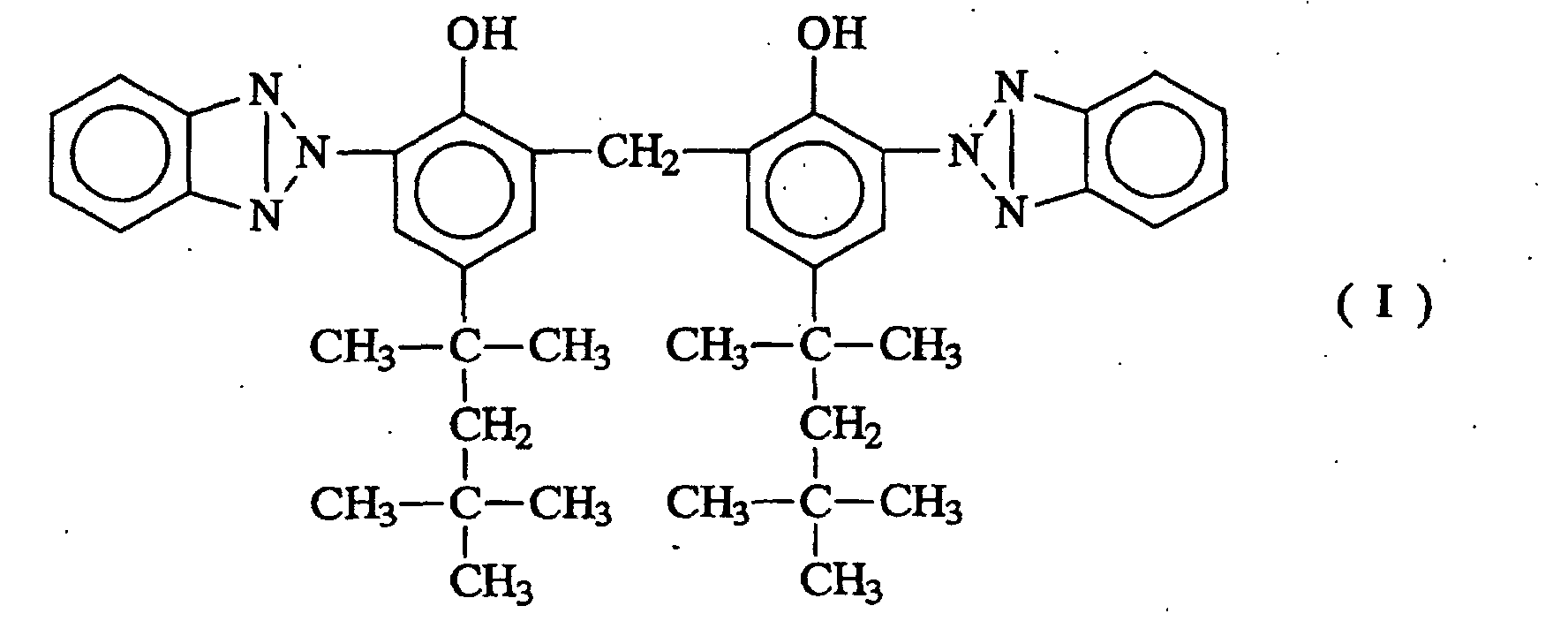
- A second mode of the present invention is drawn to a specific ultraviolet absorber composition of the first mode, wherein the resin stabilizer (B) is the ultraviolet absorber (b-4) other than the compound (A).
- A third mode of the present invention is drawn to a specific ultraviolet absorber composition of the second mode, wherein the ultraviolet absorber (b-4) other than the compound (A) is a benzotriazole ultraviolet absorber.
- A fourth mode of the present invention is drawn to a specific ultraviolet absorber composition of the third mode, wherein the benzotriazole ultraviolet absorber is a compound represented by the following formula (II).

- In a fifth mode of the present invention, there is provided a synthetic resin composition comprising a synthetic resin and an ultraviolet absorber composition as recited in relation to any of the first to fourth modes.
- A sixth mode of the present invention is drawn to a specific synthetic resin composition of the fifth mode, wherein the synthetic resin is a polyolefin resin.
- Modes for carrying out the present invention will next be described.
- Examples of the phenolic antioxidant (b-1) used in the present invention include 2,6-di-tert-butyl-p-cresol, 2,6-diphenyl-4-octadecyloxyphenol, distearyl (3,5-di-tert-butyl-4-hydroxybenzyl) phosphonate, 1,6-hexamethylenebis[(3,5-di-tert-butyl-4-hydroxyphenyl)propionamide], 4,4'-thiobis(6-tert-butyl-m-cresol), 2,2'-methylenebis(4-methyl-6-tert-butylphenol), 2,2'-methylenebis(4-ethyl-6-tert-butylphenol), 4,4'-butylidenebis(6-tert-butyl-m-cresol), 2,2'-ethylidenebis(4,6-di-tert-butylphenol), 2,2'-ethylidenebis(4-sec-butyl-6-tert-butylphenol), 1,1,3-tris(2-methyl-4-hydroxy-5-tert-butylphenyl)butane, 1,3,5-tris(2,6-dimethyl-3-hydroxy-4-tert-butylbenzyl) isocyanurate, 1,3,5-tris(3,5-di-tert-butyl-4-hydroxybenzyl) isocyanurate, 1,3,5-tris(3,5-di-tert-butyl-4-hydroxybenzyl)-2,4,6-trimethylbenzene, 2-tert-butyl-4-methyl-6-(2-acryloyloxy-3-tert-butyl-5-methylbenzyl)phenol, stearyl (3,5-di-tert-butyl-4-hydroxyphenyl)propionate, thiodietylene glycol bis[(3,5-di-tert-butyl-4-hydroxyphenyl)propionate], 1,6-hexamethylene bis[(3,5-di-tert-butyl-4-hydroxyphenyl)propionate], bis[3,3-bis(4-hydroxy-3-tert-butylphenyl)butyric acid] glycol ester, bis[2-tert-butyl-4-methyl-6-(2-hydroxy-3-tert-butyl-5-methylbenzyl)phenyl] terephthalate, 1,3,5-tris[(3,5-di-tert-butyl-4-hydroxyphenyl)propionyloxyethyl] isocyanurate, tetrakis[methylene-3-(3,5-di-tert-butyl-4-hydroxyphenyl)propionato]methane, 3,9-bis[1,1-dimethyl-2-{(3-tert-butyl-4-hydroxy-5-methylphenyl)propionyloxy}ethyl]-2,4,8,10-tetraoxaspiro[5.5]undecane, and triethylene glycol bis[(3-tert-butyl-4-hydroxy-5-methylphenyl)propionate].
- Examples of the phosphorus antioxidant (b-2) used in the present invention include trisnonylphenyl phosphite, tris(2,4-di-tert-butylphenyl) phosphite, tris[2-tert-butyl-4-(3-tert-butyl-4-hydroxy-5-methylphenylthio)-5-methylphenyl] phosphite, tridecyl phosphite, octyl diphenyl phosphite, di(decyl) monophenyl phosphite, di(tridecyl)pentaerythritol diphosphite, di(nonylphenyl)pentaerythritol diphosphite, bis(2,4-di-tert-butylphenyl)pentaerythritol diphosphite, bis(2,6-di-tert-butyl-4-methylphenyl)pentaerythritol diphosphite, bis(2,4,6-tri-tert-butylphenyl)pentaerythritol diphosphite, bis(2,4-dicumylphenyl)pentaerythritol diphosphite, tetra(tridecyl)isopropylidenediphenol diphosphite, tetra(tridecyl)-4,4'-n-butylidenebis(2-tert-butyl-5-metylphenol) diphosphite, hexa(tridecyl)-1,1,3-tris(2-methyl-4-hydroxy-5-tert-butylphenyl)butane triphosphite, tetrakis(2,4-di-tert-butylphenyl)biphenylene diphosphonite, 9,10-dihydro-9-oxa-10-phosphaphenanthrene-10-oxide, 2,2'-methylenebis(4,6-tert-butylphenyl)-2-ethylhexyl phosphite, 2,2'-methylenebis(4,6-tert-butylphenyl)-octadecyl phosphite, 2,2'-ethylidenebis(4,6-di-tert-butylphenyl) fluorophosphite, tris(2-[(2,4,8,10-tetrakis-tert-butyldibenzo[d,f][1,3,2]dioxaphosphepin-6-yl)oxy]ethyl)amine, and a phosphite of 2-ethyl-2-butylpropylene glycol and 2,4,6-tri-tert-butylphenol.
- Examples of the hindered amine stabilizer (b-3) used in the present invention include hindered amine compounds such as 2,2,6,6-tetramethyl-4-piperidyl stearate, 1,2,2,6,6-pentamethyl-4-piperidyl stearate, 2,2,6,6-tetramethyl-4-piperidyl benzoate, bis(2,2,6,6-tetramethyl-4-piperidyl) sebacate, bis(1,2,2,6,6-pentamethyl-4-piperidyl) sebacate, tetrakis(2,2,6,6-tetramethyl-4-piperidyl) butanetetracarboxylate, tetrakis(1,2,2,6,6-pentamethyl-4-piperidyl) butanetetracarboxylate, bis(2,2,6,6-tetramethyl-4-piperidyl) di(tridecyl) 1,2,3,4-butanetetracarboxylate, bis(1,2,2,6,6-pentamethyl-4-piperidyl) di(tridecyl) 1,2,3,4-butanetetracarboxylate, bis(1,2,2,6,6-pentamethyl-4-piperidyl)-2-butyl-2-(3,5-di-tert-butyl-4-hydroxybenzyl) malonate, 1-(2-hydroxyethyl)-2,2,6,6-tetramethyl-4-piperidinol/diethyl succinate condensate, 1,6-bis(2,2,6,6-tetramethyl-4-piperidylamino)hexane/dibromoethane condensate, 1,6-bis(2,2,6,6-tetramethyl-4-piperidylamino)hexane/2,4-dichloro-6-morpholino-s-triazine condensate, 1,6-bis(2,2,6,6-tetramethyl-4-piperidylamino)hexane/2,4-dichloro-6-tert-octylamino-s-triazine condensate, 1,5,8,12-tetrakis[2,4-bis(N-butyl-N-(2,2,6,6-tetramethyl-4-piperidyl)amino)-s-triazin-6-yl]-1,5,8,12-tetrazadodecane, 1,5,8,12-tetrakis[2,4-bis(N-butyl-N-(1,2,2,6,6-pentamethyl-4-piperidyl)amino)-s-triazin-6-yl]-1,5,8,12-tetrazadodecane, 1,6,11-tris[2,4-bis(N-butyl-N-(2,2,6,6-tetramethyl-4-piperidyl)amino)-s-triazin-6-yl]aminoundecane, and 1,6,11-tris[2,4-bis(N-butyl-N-(1,2,2,6,6-pentamethyl-4-piperidyl)amino)-s-triazin-6-yl]aminoundecane.
- Examples of the ultraviolet absorber (b-4) other than the compound (A) used in the present invention include 2-hydroxybenzophenone compounds such as 2,4-dihydroxybenzophenone, 2-hydroxy-4-methoxybenzophenone, 2-hydroxy-4-octoxybenzophenone, and 5,5'-methylenebis(2-hydroxy-4-methoxybenzophenone); 2-(2'-hydroxyphenyl)benzotriazole compoundssuch as 2-(2'-hydroxy-5'-methylphenyl)benzotriazole, 2-(2'-hydroxy-3',5'-di-tert-butylphenyl)-5-chlorobenzotriazole, 2-(2'-hydroxy-3'-tert-butyl-5'-methylphenyl)-5-chlorobenzotriazole, 2-(2'-hydroxy-5'-tert-octylphenyl)benzotriazole, 2-(2'-hydroxy-3',5'-dicumylphenyl)benzotriazole, and 2-(2'-hydroxy-3'-tert-butyl-5'-carboxyphenyl)benzotriazole; benzoates such as phenyl salicylate, resorcinol monobenzoate, 2,4-di-tert-butylphenyl-3,5-di-tert-butyl-4-hydroxybenzoate, 2,4-di-tert-amylphenyl-3,5-di-tert-butyl-4-hydroxybenzoate; and hexadecyl-3,5-di-tert-butyl-4-hydroxybenzoate; substituted oxanilide compounds such as 2-ethyl-2'-ethoxyoxanilide and 2-ethoxy-4'-dodecyloxanilide; cyanoacrylates such as ethyl-α-cyano-β,β-diphenylacrylate and methyl-2-cyano-3-methyl-3-(p-methoxyphenyl)acrylate; and triaryltriazines such as 2-(2-hydroxy-4-octoxyphenyl)-4,6-bis(2,4-di-tert-butylphenyl)-s-triazine, 2-(2-hydroxy-4-methoxyphenyl)-4,6-diphenyl-s-triazine, and 2-(2-hydroxy-4-propoxy-5-methylphenyl)-4,6-bis(2,4-di-tert-butylphenyl)-s-triazine.
- The resin stabilizer (B) is added to a resin in a preferred amount, which varies in accordance with the type and use purpose of the resin and depending on the type of the resin stabilizer (i.e., antioxidant, hindered amine compound, or ultraviolet absorber). Thus, among resin stabilizers (B), the ultraviolet absorber (b-4) other than the compound (A) is preferably used, since the amount of the absorber (b-4) incorporated into the ultraviolet absorber composition to be added to a resin can be selected from a wide range. Among ultraviolet absorbers (b-4), a benzotriazole ultraviolet absorber, having high compatibility with the compound (A) during melt-mixing, is more preferred, with a compound represented by the following formula (II) being particularly preferred, from the viewpoint of a remarkable blooming-prevention effect.

- In order to ensure both benefits of excellent ultraviolet absorbing performance of the compound (A) and the effects-provided through melt-mixing, of lowering the melting temperature of the ultraviolet absorber composition and preventing blooming-the ratio of compound (A) to resin stabilizer (B) ((A)/(B)) by mass is controlled so as to fall within a range of 95/5 to 50/50, preferably 90/10 to 70/30.
- Examples of synthetic resins to which the ultraviolet absorber composition of the present invention include homopolymers and copolymer of α-olein such as polypropylene, low-density polyethylene, linear-low-density polyethylene, high-density polyethylene, polybutene-1, poly(3-methylpentene), poly(4-methylpentene), and ethylene-polyethylene copolymer; copolymers of α-olefins with a polyunsaturated compound such as conjugated or non-conjugated diene, acrylic acid, methacrylic acid, or vinyl acetate; linear polyesters and acid-modified polyesters such as polyethylene terephthalate, polyethylene terephthalate isophthalate, polyethylene terephthalate p-oxybenzoate, and polybutylen terephthalate; polyamides such as polycaprolactam and polyhexamethyleneadipamide; polyimides; polystyrene; copolymers (e.g., AS resin, ABS resin, MBS resin, and heat-resistant ABS resin) of styrene and/or α-methylstyrene with a monomer (e.g., maleic anhydride, phenylmaleimide, methyl methacrylate, butadiene, or acrylonitrile); halogen-containing resins such as polyvinyl chloride, polyvinylidene chloride, chlorinated polyethylene, chlorinated polypropylene, polyvinylidene fluoride, chlorinated rubber, vinyl chloride-vinyl acetate copolymer, vinyl chloride-ethylene copolymer, vinyl chloride-vinylidene chloride copolymer, vinyl chloride-vinylidene chloride-vinyl acetate terpolymer, vinyl chloride-acrylic ester copolymer, vinyl chloride-maleic ester copolymer, and vinyl chloride-cyclohexylmaleimide copolymer; polymers of (meth)acrylic ester such as methyl (meth)acrylate, ethyl (meth)acrylate, or octyl (meth)acrylate; thermoplastic resins such as polyether ketone, polyvinyl acetate, polyvinyl formal, polyvinyl butyral, polyvinyl alcohol, linear or branched polycarbonate, petroleum resins, cumarone resins, polyphenylene oxide, polyphenylene sulfide, polyurethane, and cellulose resin; thermosetting resins such as epoxy resin, phenolic resin, urea resin, melamine resin, and unsaturated polyester resin; elastomers such as polyisoprene rubber, polybutadiene rubber, butadiene-styrene copolymer rubber, butadiene-acrylonitrile copolymer rubber, acrylonitrile-butadiene-styrene copolymer ethylene-α-olefin (e.g., propylene or butene-1) copolymer rubber, and ethylene-α-olefin-non-conjugated diene (e.g., ethylidenenorbornene or cyclopentadiene) terpolymer rubber; and silicone resins. Polymer alloys and blends of these resins and/or elastomers may also used. Particularly, the ultraviolet absorber composition of the present invention is suitably added to polyolefin resin, which per se has poor compatibility with 2,2'-methylenebis(4-tert-octyl-6-benzotriazolyl)phenol.
- To the synthetic resin composition of the present invention, other additives which are generally used in resins may be added in accordance with needs. Examples of the additives include thioether antioxidants; nucleating agents such as a phosphate ester metal salt, benzylidene sorbitol, and a benzoic acid derivative metal salt; heavy metal deactivators; fatty acid metal salts; hydrotalcite; fillers; pigments; dyes; fire-proofing agents; and processing aids.
- No particular limitation is imposed on the method for producing the ultraviolet absorber composition of the present invention. For example, the composition can be produced by heat-melting the compound (A) and the resin stabilizer (B) in a vessel in an inert atmosphere; transferring the melt under stirring to an aluminum tray for cooling; and pulverizing the cooled mixture by means of a flaker. Alternatively, the composition can be produced by dissolving the compound (A) and the resin stabilizer (B) in a solvent to form a uniform solution; removing the solvent from the solution at a temperature equal to or exceeding the melting temperature of the mixture to be produced through removal of the solvent, to thereby form a melt mixture; and removing, cooling, and crushing the mixture. The latter method, in which two components are dissolved in a solvent to form a solution, requires an additional solvent removal step and is not advantageous from an economical viewpoint. However, the process can be performed at a comparatively low temperature, whereby coloring and decomposition of the compound (A) and the resin stabilizer (B) by heat can be prevented.
- No particular limitation is imposed on the method for incorporating the thus-produced ultraviolet absorber composition into a synthetic resin, and a method known per se for incorporating a stabilizer to a resin; e.g., mixing by means of a ribbon blender, a Henschel mixer, etc., can be employed. An extruder or a Banbury mixer may also be used in accordance with needs. Although the amount of the ultraviolet absorber composition incorporated into a synthetic resin varies in accordance with the mass ratio (A)/(B) of the ultraviolet absorber composition, each component is used in an amount of 0.001 to 10 parts by mass based on 100 parts by mass of the synthetic resin, preferably 0.05 to 5 parts by mass.
- The present invention will next be described in more detail by way of examples, which should not be construed as limiting the invention thereto.
- Each sample compound (listed in Table 1) (5 g) and 2,2'-methylenebis(4-tert-octyl-6-benzotriazolyl)phenol (20 g) were mixed for 30 seconds by means of a mixer, and the mixture was dissolved at 180°C in an aromatic hydrocarbon solvent (trade name: Solvesso 150, product of Exxon Chemical) (25 g). The solvent of the solution was removed while the solution was maintained at 180°C, to thereby form a melt mixture. The thus-formed melt mixture was transferred to an aluminum tray and cooled, and pulverized to a particle size of 1 mm or less. The melting temperature of the pulverized product was determined through visual observation. The results are shown in Table 1.
- Each sample compound (listed in Table 1) (5 g) and 2,2'-methylenebis(4-tert-octyl-6-benzotriazolyl)phenol (20 g) were mixed for 30 seconds by means of a mixer, to thereby yield a "physically prepared mixture." The melting temperature of the mixture was determined through visual observation. The results are shown in Table 1. Notably, in Comparative Examples, temperatures shown in the column labeled "Melting temperature of melt mixture" of Table 1 represent the melting temperatures of the two components of the physically prepared mixture.
Sample compound Melting point of sample compound Melting temp. of melt mixture Examples 1-1 Phenol-1 50°C 55-65°C 1-2 Phenol-2 115°C 65-74°C 1-3 Phosphorus-1 183°C 62-70°C 1-4 Phosphorus-2 148°C 64-71°C 1-5 Phosphorus-3 237°C 72-78°C 1-6 HALS-1 84°C 60-71°C 1-7 HALS-2 >65°C 63-71°C 1-8 UVA-1 135-143°C 66-73°C 1-9 UVA-2 102-105°C 67-74°C Comp. Examples 1-1 Phenol-1 50°C 50°C, 193°C 1-2 Phosphorus-1 183°C 182°C, 195°C 1-3 HALS-1 84°C 83°C, 194°C 1-4 UVA-1 135-143°C 133-142°C, 194°C - As is clear from Table 1, the melting point of 2,2'-methylenebis(4-tert-octyl-6-benzotriazolyl)phenol and that of the added component were maintained when the two components were simply mixed. However, a composition exhibiting a low melting temperature was formed by melt-mixing the two components.
- Random polypropylene (melt flow index (230°C, 2.16 kg): 2.3 g/10 min) (100 parts by mass), tetrakis[methylene-3-(3,5-di-tert-butyl-4-hydroxyphenyl)propionato]methane (0.02 parts by mass), 2,6-di-tert-butyl-4-methylphenol (0.1 parts by mass), and an ultraviolet absorber composition prepared in Example 1-8 (0.8 parts by mass) were mixed, and the mixture was extruded at 250°C, to thereby produce pellets. The pellets were injection-molded at 250°C, to thereby prepare test pieces having a thickness of 1 mm.
- The procedure of Example 2-1 was repeated, except that the sample compound or the ultraviolet absorber composition shown in Table 2 was used, to thereby prepare test pieces.
- The thus-prepared test pieces were allowed to stand at room temperature for three months, and the surface of each test piece was analyzed (initially, and at month 1, month 2, and month 3) by means of a haze meter (HGM-2DP, SUGA TEST INSTRUMENTS), to thereby determine a haze value. Blooming of the test piece was evaluated by the haze value. The results are shown in Table 2.
Bloom test (haze value) Initial Month 1 Month 2 Month 3 Example 2-1 Ex. 1-8 43.1 43.9 44.1 44.7 Comp.
Exs.2-1 UVA-1*8 44.7 45.8 46.0 47.7 2-2 UVA-3 48.2 49.9 51.4 55.8 2-3 Comp. Ex.
1-446.6 47.6 48.1 51.3 - As is clear from Comp. Ex. 2-1 to 2-3 in Table 2, test pieces containing 2,2'-methylenebis(4-tert-octyl-6-benzotriazolyl)phenol, 2-(2'-hydroxy-3',5'-dicumylphenyl)benzotriazole, or a simple mixture thereof exhibited a considerable level of blooming. Particularly, sole use of 2,2'-methylenebis(4-tert-octyl-6-benzotriazolyl)phenol caused a higher level of blooming. However, blooming was prevented in the test pieces of Example 2-1 containing a composition prepared through melt-mixing.
- The precise mechanism explaining why blooming was prevented has remained unknown. However, one considerable mechanism derived from Examples 1-1 to 1-9 is that compositions prepared through melt-mixing show melting behavior different from that of similar compositions prepared through simple mixing, and such a different behavior may be attributable molecular interaction during melt-mixing, which is maintained after the compositions have undergone processing for forming test pieces.
- According to the present invention, there can be provided an ultraviolet absorber composition having excellent light resistance and generating less blooming, and a synthetic resin composition having light resistance that is remarkably improved by the ultraviolet absorber composition.
Claims (6)
- An ultraviolet absorber composition which is formed by melt-mixing a compound (A) represented by formula (I):and a resin stabilizer (B) selected from the group consisting of a phenolic antioxidant (b-1), a phosphorus-containing antioxidant (b-2), a hindered amine stabilizer (b-3), and an ultraviolet absorber (b-4) other than the compound (A), at a mass ratio (A)/(B) of 95/5 to 50/50.

- An ultraviolet absorber composition as described in claim 1, wherein the resin stabilizer (B) is the ultraviolet absorber (b-4) other than the compound (A).
- An ultraviolet absorber composition as described in claim 2, wherein the ultraviolet absorber (b-4) other than the compound (A) is a benzotriazole ultraviolet absorber.
- An ultraviolet absorber composition as described in claim 3, wherein the benzotriazole ultraviolet absorber is a compound represented by formula (II).
- A synthetic resin composition comprising a synthetic resin and an ultraviolet absorber composition as recited in any of claims 1 to 4.
- A synthetic resin composition as described in claim 5, wherein the synthetic resin is a polyolefin resin.
Applications Claiming Priority (3)
| Application Number | Priority Date | Filing Date | Title |
|---|---|---|---|
| JP2001172080A JP4993421B2 (en) | 2001-06-07 | 2001-06-07 | Synthetic resin composition |
| JP2001172080 | 2001-06-07 | ||
| PCT/JP2002/005597 WO2002100970A1 (en) | 2001-06-07 | 2002-06-06 | Ultraviolet absorber composition and resin composition stabilized with the composition |
Publications (2)
| Publication Number | Publication Date |
|---|---|
| EP1405887A1 true EP1405887A1 (en) | 2004-04-07 |
| EP1405887A4 EP1405887A4 (en) | 2004-12-15 |
Family
ID=19013760
Family Applications (1)
| Application Number | Title | Priority Date | Filing Date |
|---|---|---|---|
| EP02733344A Withdrawn EP1405887A4 (en) | 2001-06-07 | 2002-06-06 | UV ABSORBER COMPOSITION AND RESIN COMPOSITION STABILIZED USING THE COMPOSITION |
Country Status (4)
| Country | Link |
|---|---|
| US (1) | US7018570B2 (en) |
| EP (1) | EP1405887A4 (en) |
| JP (1) | JP4993421B2 (en) |
| WO (1) | WO2002100970A1 (en) |
Cited By (2)
| Publication number | Priority date | Publication date | Assignee | Title |
|---|---|---|---|---|
| EP3517533A3 (en) * | 2018-01-24 | 2019-08-28 | Samsung Display Co., Ltd. | Heterocyclic compound and electronic apparatus |
| KR20230107494A (en) * | 2018-01-24 | 2023-07-17 | 삼성디스플레이 주식회사 | Electronic apparatus and method manufacturing the same |
Families Citing this family (15)
| Publication number | Priority date | Publication date | Assignee | Title |
|---|---|---|---|---|
| KR101135833B1 (en) * | 2004-03-02 | 2012-04-16 | 가부시키가이샤 아데카 | Weakly basic hindered amines having carbonate skeletons, synthetic resin compositions, and coating compositions |
| JP5032759B2 (en) * | 2005-09-30 | 2012-09-26 | ダイセルポリマー株式会社 | Solvent resistant resin composition |
| US20080160299A1 (en) * | 2006-12-27 | 2008-07-03 | Achilles Corporation | Heat shielding sheet |
| US20100040806A1 (en) * | 2007-04-03 | 2010-02-18 | Konica Minolta Opto, Inc. | Cellulose ester optical film, polarizing plate and liquid crystal display using the cellulose ester optical film, and method for producing cellulose ester optical film |
| JPWO2008126700A1 (en) * | 2007-04-10 | 2010-07-22 | コニカミノルタオプト株式会社 | Optical film, polarizing plate, liquid crystal display device, and ultraviolet absorbing polymer |
| WO2008126699A1 (en) * | 2007-04-10 | 2008-10-23 | Konica Minolta Opto, Inc. | Ultraviolet absorbing polymer, cellulose ester optical film, method for producing cellulose ester optical film, polarizing plate and liquid crystal display |
| JP5478012B2 (en) * | 2007-11-15 | 2014-04-23 | 株式会社Adeka | Resin composition and resin molded product |
| JP5019325B2 (en) * | 2008-02-13 | 2012-09-05 | 日華化学株式会社 | Polymer material with UV absorbing ability |
| WO2009113389A1 (en) * | 2008-03-10 | 2009-09-17 | 株式会社Adeka | Synthetic resin composition, and automotive interior/exterior material comprising the same |
| JP5340677B2 (en) * | 2008-09-04 | 2013-11-13 | 東洋ゴム工業株式会社 | Rubber composition, method for producing the same, and pneumatic tire |
| JP2017082073A (en) * | 2015-10-27 | 2017-05-18 | 日本化薬株式会社 | Epoxy resin curing agent composition, epoxy resin composition comprising the same, and cured product thereof |
| KR102723455B1 (en) | 2016-03-17 | 2024-10-30 | 에스에이치피피 글로벌 테크놀러지스 비.브이. | Flexible UV-resistant poly(phenylene ether) composition and insulated conductor and jacketed cable comprising the same |
| KR102036100B1 (en) * | 2016-07-11 | 2019-10-25 | 현대모비스 주식회사 | Uv-curable composition for hard-coat paining |
| US10683416B1 (en) | 2017-09-12 | 2020-06-16 | Sabic Global Technologies B.V. | Flexible, UV-resistant poly(phenylene ether) composition and insulated conductor and jacketed cable comprising the composition |
| US11753566B2 (en) | 2019-01-31 | 2023-09-12 | Synthomer Adhesive Technologies Llc | Low volatile tackifier compositions |
Family Cites Families (20)
| Publication number | Priority date | Publication date | Assignee | Title |
|---|---|---|---|---|
| US4127586A (en) * | 1970-06-19 | 1978-11-28 | Ciba-Geigy Corporation | Light protection agents |
| JPS61113649A (en) * | 1984-11-07 | 1986-05-31 | Adeka Argus Chem Co Ltd | Polymeric material composition with improved light resistance |
| JPS61113667A (en) | 1984-11-07 | 1986-05-31 | Adeka Argus Chem Co Ltd | Thermosetting synthetic resin coating composition with improved light resistance |
| JPS61118373A (en) | 1984-11-15 | 1986-06-05 | Adeka Argus Chem Co Ltd | Bis(benzotriazolylphenol) compound |
| JPH0670163B2 (en) | 1985-01-14 | 1994-09-07 | 旭電化工業株式会社 | Polyacetal resin composition |
| JPH0651840B2 (en) | 1985-12-20 | 1994-07-06 | 旭電化工業株式会社 | Polycarbonate resin composition |
| JPH062878B2 (en) | 1986-01-23 | 1994-01-12 | 旭電化工業株式会社 | Polyphenylene sulfide resin composition |
| JPH0689225B2 (en) | 1986-03-27 | 1994-11-09 | 旭電化工業株式会社 | Polyester composition |
| DE3617978A1 (en) | 1986-05-28 | 1987-12-03 | Bayer Ag | BRANCHED THERMOPLASTIC POLYCARBONATE WITH IMPROVED PROTECTION AGAINST UV LIGHT |
| JPH01170631A (en) * | 1987-12-25 | 1989-07-05 | Mitsubishi Rayon Co Ltd | Thermoplastic resin composition |
| JP2731601B2 (en) * | 1989-09-06 | 1998-03-25 | 旭電化工業株式会社 | Polycarbonate resin composition |
| JP2831779B2 (en) * | 1990-02-01 | 1998-12-02 | 旭電化工業株式会社 | Polyolefin resin composition |
| US5229521A (en) * | 1990-12-11 | 1993-07-20 | Ciba-Geigy Corporation | Process for the preparation of symmetrical 2,2-methylenebisbenzotriazolyl phenols |
| US5574166A (en) * | 1995-04-19 | 1996-11-12 | Ciba-Geigy Corporation | Crystalline form of 2-(2-hydroxy-3-α-cumyl-5-tert-octylphenyl)-2H-benzotriazole |
| US6166218A (en) * | 1996-11-07 | 2000-12-26 | Ciba Specialty Chemicals Corporation | Benzotriazole UV absorbers having enhanced durability |
| AU7043298A (en) * | 1997-04-15 | 1998-11-11 | Ciba Specialty Chemicals Holding Inc. | Preparation of low-dust stabilisers |
| JP4135041B2 (en) * | 1998-12-25 | 2008-08-20 | Dic株式会社 | Resin composition and molded body thereof |
| MX231178B (en) * | 1999-06-18 | 2005-10-10 | Ciba Sc Holding Ag | Micropigment mixture. |
| JP4470277B2 (en) * | 1999-06-30 | 2010-06-02 | Jsr株式会社 | Weather resistant resin composition |
| JP2001115002A (en) * | 1999-10-14 | 2001-04-24 | Teijin Chem Ltd | Aromatic polycarbonate resin composition |
-
2001
- 2001-06-07 JP JP2001172080A patent/JP4993421B2/en not_active Expired - Fee Related
-
2002
- 2002-06-06 US US10/479,641 patent/US7018570B2/en not_active Expired - Lifetime
- 2002-06-06 WO PCT/JP2002/005597 patent/WO2002100970A1/en not_active Ceased
- 2002-06-06 EP EP02733344A patent/EP1405887A4/en not_active Withdrawn
Non-Patent Citations (2)
| Title |
|---|
| DATABASE WPI Section Ch, Week 198933 Derwent Publications Ltd., London, GB; Class A18, AN 1989-236995 XP002300468 & JP 01 170631 A (MITSUBISHI RAYON CO.), 5 July 1989 (1989-07-05) * |
| See also references of WO02100970A1 * |
Cited By (5)
| Publication number | Priority date | Publication date | Assignee | Title |
|---|---|---|---|---|
| EP3517533A3 (en) * | 2018-01-24 | 2019-08-28 | Samsung Display Co., Ltd. | Heterocyclic compound and electronic apparatus |
| US11417857B2 (en) | 2018-01-24 | 2022-08-16 | Samsung Display Co., Ltd. | Heterocyclic compound and electronic apparatus |
| KR20230107494A (en) * | 2018-01-24 | 2023-07-17 | 삼성디스플레이 주식회사 | Electronic apparatus and method manufacturing the same |
| US12127426B2 (en) | 2018-01-24 | 2024-10-22 | Samsung Display Co., Ltd. | Heterocyclic compound and electronic apparatus |
| KR102759252B1 (en) | 2018-01-24 | 2025-01-24 | 삼성디스플레이 주식회사 | Electronic apparatus and method manufacturing the same |
Also Published As
| Publication number | Publication date |
|---|---|
| EP1405887A4 (en) | 2004-12-15 |
| JP4993421B2 (en) | 2012-08-08 |
| JP2002363536A (en) | 2002-12-18 |
| US7018570B2 (en) | 2006-03-28 |
| US20040122137A1 (en) | 2004-06-24 |
| WO2002100970A1 (en) | 2002-12-19 |
Similar Documents
| Publication | Publication Date | Title |
|---|---|---|
| US7018570B2 (en) | Ultraviolet absorber composition and resin composition stabilized therewith | |
| EP2810976B1 (en) | Resin additive masterbatch | |
| CN111278950B (en) | Composition and flame-retardant resin composition | |
| US10100173B2 (en) | Resin additive masterbatch and polyolefin resin composition to which said resin additive masterbatch has been admixed | |
| JP5478013B2 (en) | Olefin-based elastic resin composition | |
| EP2716734A1 (en) | Flame-retardant agent and flame-retardant resin composition | |
| US20090088513A1 (en) | Resin additive composition and resin composition | |
| KR101777275B1 (en) | Synthetic resin composition and automotive interior/exterior material | |
| KR102076101B1 (en) | Mixed pellet | |
| KR102618010B1 (en) | Composition, thermoplastic resin composition using the same, and molded body thereof | |
| JPH10101944A (en) | Synthetic resin composition | |
| KR20220161346A (en) | Nucleating agent, resin composition, manufacturing method and molded article of resin composition | |
| JP5224497B2 (en) | Resin composition | |
| US20100022689A1 (en) | Resin composition containing aluminum pigment | |
| JP5307980B2 (en) | Polyolefin resin composition | |
| JP4076105B2 (en) | Automotive interior materials | |
| JP2004210987A (en) | Molded article with improved weather resistance and resin composition thereof | |
| JP4121183B2 (en) | Phosphite compound and synthetic resin composition | |
| JP4014180B2 (en) | Phosphite compound and synthetic resin composition | |
| JP2013173952A (en) | Olefinic elastic resin composition | |
| JP5019765B2 (en) | Resin additive masterbatch | |
| JP2019044063A (en) | Crystallization retarder, polyolefin resin composition containing the same and molded article thereof | |
| JP3369743B2 (en) | Synthetic resin composition | |
| JP2025061829A (en) | Resin composition, molded article, and method for producing resin composition | |
| KR20240021210A (en) | Nucleating agent composition, resin composition, molded article thereof, and method for producing the resin composition |
Legal Events
| Date | Code | Title | Description |
|---|---|---|---|
| PUAI | Public reference made under article 153(3) epc to a published international application that has entered the european phase |
Free format text: ORIGINAL CODE: 0009012 |
|
| 17P | Request for examination filed |
Effective date: 20040107 |
|
| AK | Designated contracting states |
Kind code of ref document: A1 Designated state(s): AT BE CH CY DE DK ES FI FR GB GR IE IT LI LU MC NL PT SE TR |
|
| A4 | Supplementary search report drawn up and despatched |
Effective date: 20041028 |
|
| RAP1 | Party data changed (applicant data changed or rights of an application transferred) |
Owner name: ADEKA CORPORATION |
|
| 17Q | First examination report despatched |
Effective date: 20070222 |
|
| STAA | Information on the status of an ep patent application or granted ep patent |
Free format text: STATUS: EXAMINATION IS IN PROGRESS |
|
| STAA | Information on the status of an ep patent application or granted ep patent |
Free format text: STATUS: THE APPLICATION IS DEEMED TO BE WITHDRAWN |
|
| 18D | Application deemed to be withdrawn |
Effective date: 20171019 |
|
| RIC1 | Information provided on ipc code assigned before grant |
Ipc: C08K 5/3475 20060101ALI20030106BHEP Ipc: C08L 101/00 20060101ALI20030106BHEP Ipc: C08L 23/00 20060101ALI20030106BHEP Ipc: C09K 3/00 20060101AFI20030106BHEP |