EP1400849A1 - Positive photosensitive resin compositions and semiconductor device - Google Patents
Positive photosensitive resin compositions and semiconductor device Download PDFInfo
- Publication number
- EP1400849A1 EP1400849A1 EP02720636A EP02720636A EP1400849A1 EP 1400849 A1 EP1400849 A1 EP 1400849A1 EP 02720636 A EP02720636 A EP 02720636A EP 02720636 A EP02720636 A EP 02720636A EP 1400849 A1 EP1400849 A1 EP 1400849A1
- Authority
- EP
- European Patent Office
- Prior art keywords
- group
- positive
- photosensitive resin
- resin composition
- general formula
- Prior art date
- Legal status (The legal status is an assumption and is not a legal conclusion. Google has not performed a legal analysis and makes no representation as to the accuracy of the status listed.)
- Granted
Links
- 239000011342 resin composition Substances 0.000 title claims abstract description 68
- 239000004065 semiconductor Substances 0.000 title claims abstract description 19
- 239000004952 Polyamide Substances 0.000 claims abstract description 33
- 229920002647 polyamide Polymers 0.000 claims abstract description 33
- -1 phenol compound Chemical class 0.000 claims abstract description 24
- 239000000463 material Substances 0.000 claims abstract description 23
- 125000004435 hydrogen atom Chemical group [H]* 0.000 claims description 31
- 239000011347 resin Substances 0.000 claims description 20
- 229920005989 resin Polymers 0.000 claims description 20
- 125000000217 alkyl group Chemical group 0.000 claims description 19
- 125000003545 alkoxy group Chemical group 0.000 claims description 15
- 239000000203 mixture Substances 0.000 claims description 15
- 125000005843 halogen group Chemical group 0.000 claims description 12
- 125000002887 hydroxy group Chemical group [H]O* 0.000 claims description 12
- 125000000962 organic group Chemical group 0.000 claims description 12
- 150000001923 cyclic compounds Chemical group 0.000 claims description 11
- 125000005907 alkyl ester group Chemical group 0.000 claims description 9
- 238000010438 heat treatment Methods 0.000 claims description 7
- 125000004432 carbon atom Chemical group C* 0.000 claims description 6
- 125000000753 cycloalkyl group Chemical group 0.000 claims description 6
- 125000001931 aliphatic group Chemical group 0.000 claims description 5
- 125000003342 alkenyl group Chemical group 0.000 claims description 5
- 125000000304 alkynyl group Chemical group 0.000 claims description 5
- 125000003118 aryl group Chemical group 0.000 claims description 4
- 125000003178 carboxy group Chemical group [H]OC(*)=O 0.000 claims description 3
- 230000018044 dehydration Effects 0.000 claims description 3
- 238000006297 dehydration reaction Methods 0.000 claims description 3
- 238000007363 ring formation reaction Methods 0.000 claims description 3
- CURLTUGMZLYLDI-UHFFFAOYSA-N Carbon dioxide Chemical group O=C=O CURLTUGMZLYLDI-UHFFFAOYSA-N 0.000 claims description 2
- 125000002947 alkylene group Chemical group 0.000 claims description 2
- 125000000751 azo group Chemical group [*]N=N[*] 0.000 claims description 2
- 125000002915 carbonyl group Chemical group [*:2]C([*:1])=O 0.000 claims description 2
- 125000001570 methylene group Chemical group [H]C([H])([*:1])[*:2] 0.000 claims description 2
- 125000004430 oxygen atom Chemical group O* 0.000 claims description 2
- 125000000472 sulfonyl group Chemical group *S(*)(=O)=O 0.000 claims description 2
- 229910052717 sulfur Inorganic materials 0.000 claims description 2
- 125000004434 sulfur atom Chemical group 0.000 claims description 2
- 230000035945 sensitivity Effects 0.000 abstract description 17
- 230000014759 maintenance of location Effects 0.000 abstract description 8
- 238000011161 development Methods 0.000 description 18
- SECXISVLQFMRJM-UHFFFAOYSA-N N-Methylpyrrolidone Chemical compound CN1CCCC1=O SECXISVLQFMRJM-UHFFFAOYSA-N 0.000 description 16
- 239000011248 coating agent Substances 0.000 description 16
- 238000000576 coating method Methods 0.000 description 16
- 229920006122 polyamide resin Polymers 0.000 description 10
- 239000007864 aqueous solution Substances 0.000 description 9
- YEJRWHAVMIAJKC-UHFFFAOYSA-N 4-Butyrolactone Chemical compound O=C1CCCO1 YEJRWHAVMIAJKC-UHFFFAOYSA-N 0.000 description 8
- XUIMIQQOPSSXEZ-UHFFFAOYSA-N Silicon Chemical compound [Si] XUIMIQQOPSSXEZ-UHFFFAOYSA-N 0.000 description 8
- 229910052710 silicon Inorganic materials 0.000 description 8
- 239000010703 silicon Substances 0.000 description 8
- WGTYBPLFGIVFAS-UHFFFAOYSA-M tetramethylammonium hydroxide Chemical compound [OH-].C[N+](C)(C)C WGTYBPLFGIVFAS-UHFFFAOYSA-M 0.000 description 8
- 230000000052 comparative effect Effects 0.000 description 7
- 239000000243 solution Substances 0.000 description 7
- OKKJLVBELUTLKV-UHFFFAOYSA-N Methanol Chemical compound OC OKKJLVBELUTLKV-UHFFFAOYSA-N 0.000 description 6
- 238000000034 method Methods 0.000 description 6
- XLYOFNOQVPJJNP-UHFFFAOYSA-N water Chemical compound O XLYOFNOQVPJJNP-UHFFFAOYSA-N 0.000 description 6
- ASOKPJOREAFHNY-UHFFFAOYSA-N 1-Hydroxybenzotriazole Chemical compound C1=CC=C2N(O)N=NC2=C1 ASOKPJOREAFHNY-UHFFFAOYSA-N 0.000 description 4
- OFOBLEOULBTSOW-UHFFFAOYSA-N Malonic acid Chemical compound OC(=O)CC(O)=O OFOBLEOULBTSOW-UHFFFAOYSA-N 0.000 description 4
- KKEYFWRCBNTPAC-UHFFFAOYSA-N Terephthalic acid Chemical compound OC(=O)C1=CC=C(C(O)=O)C=C1 KKEYFWRCBNTPAC-UHFFFAOYSA-N 0.000 description 4
- 150000001875 compounds Chemical class 0.000 description 4
- 150000001990 dicarboxylic acid derivatives Chemical class 0.000 description 4
- 238000007598 dipping method Methods 0.000 description 4
- 239000011229 interlayer Substances 0.000 description 4
- QQVIHTHCMHWDBS-UHFFFAOYSA-N isophthalic acid Chemical compound OC(=O)C1=CC=CC(C(O)=O)=C1 QQVIHTHCMHWDBS-UHFFFAOYSA-N 0.000 description 4
- 229920001721 polyimide Polymers 0.000 description 4
- 239000009719 polyimide resin Substances 0.000 description 4
- MSTZGVRUOMBULC-UHFFFAOYSA-N 2-amino-4-[2-(3-amino-4-hydroxyphenyl)-1,1,1,3,3,3-hexafluoropropan-2-yl]phenol Chemical compound C1=C(O)C(N)=CC(C(C=2C=C(N)C(O)=CC=2)(C(F)(F)F)C(F)(F)F)=C1 MSTZGVRUOMBULC-UHFFFAOYSA-N 0.000 description 3
- KWYUFKZDYYNOTN-UHFFFAOYSA-M Potassium hydroxide Chemical compound [OH-].[K+] KWYUFKZDYYNOTN-UHFFFAOYSA-M 0.000 description 3
- HEMHJVSKTPXQMS-UHFFFAOYSA-M Sodium hydroxide Chemical compound [OH-].[Na+] HEMHJVSKTPXQMS-UHFFFAOYSA-M 0.000 description 3
- ZMANZCXQSJIPKH-UHFFFAOYSA-N Triethylamine Chemical compound CCN(CC)CC ZMANZCXQSJIPKH-UHFFFAOYSA-N 0.000 description 3
- 239000003513 alkali Substances 0.000 description 3
- QVGXLLKOCUKJST-UHFFFAOYSA-N atomic oxygen Chemical compound [O] QVGXLLKOCUKJST-UHFFFAOYSA-N 0.000 description 3
- 238000011156 evaluation Methods 0.000 description 3
- NBVXSUQYWXRMNV-UHFFFAOYSA-N fluoromethane Chemical compound FC NBVXSUQYWXRMNV-UHFFFAOYSA-N 0.000 description 3
- 238000009413 insulation Methods 0.000 description 3
- 229910052760 oxygen Inorganic materials 0.000 description 3
- 239000001301 oxygen Substances 0.000 description 3
- 238000012545 processing Methods 0.000 description 3
- 229910000679 solder Inorganic materials 0.000 description 3
- 239000002904 solvent Substances 0.000 description 3
- 239000000126 substance Substances 0.000 description 3
- 239000000758 substrate Substances 0.000 description 3
- 238000012360 testing method Methods 0.000 description 3
- YNGDWRXWKFWCJY-UHFFFAOYSA-N 1,4-Dihydropyridine Chemical class C1C=CNC=C1 YNGDWRXWKFWCJY-UHFFFAOYSA-N 0.000 description 2
- HZAXFHJVJLSVMW-UHFFFAOYSA-N 2-Aminoethan-1-ol Chemical compound NCCO HZAXFHJVJLSVMW-UHFFFAOYSA-N 0.000 description 2
- XNWFRZJHXBZDAG-UHFFFAOYSA-N 2-METHOXYETHANOL Chemical compound COCCO XNWFRZJHXBZDAG-UHFFFAOYSA-N 0.000 description 2
- CDAWCLOXVUBKRW-UHFFFAOYSA-N 2-aminophenol Chemical compound NC1=CC=CC=C1O CDAWCLOXVUBKRW-UHFFFAOYSA-N 0.000 description 2
- XLLIQLLCWZCATF-UHFFFAOYSA-N 2-methoxyethyl acetate Chemical compound COCCOC(C)=O XLLIQLLCWZCATF-UHFFFAOYSA-N 0.000 description 2
- WVDRSXGPQWNUBN-UHFFFAOYSA-N 4-(4-carboxyphenoxy)benzoic acid Chemical compound C1=CC(C(=O)O)=CC=C1OC1=CC=C(C(O)=O)C=C1 WVDRSXGPQWNUBN-UHFFFAOYSA-N 0.000 description 2
- IJGRMHOSHXDMSA-UHFFFAOYSA-N Atomic nitrogen Chemical compound N#N IJGRMHOSHXDMSA-UHFFFAOYSA-N 0.000 description 2
- IAZDPXIOMUYVGZ-UHFFFAOYSA-N Dimethylsulphoxide Chemical compound CS(C)=O IAZDPXIOMUYVGZ-UHFFFAOYSA-N 0.000 description 2
- LFQSCWFLJHTTHZ-UHFFFAOYSA-N Ethanol Chemical compound CCO LFQSCWFLJHTTHZ-UHFFFAOYSA-N 0.000 description 2
- QUSNBJAOOMFDIB-UHFFFAOYSA-N Ethylamine Chemical compound CCN QUSNBJAOOMFDIB-UHFFFAOYSA-N 0.000 description 2
- ISWSIDIOOBJBQZ-UHFFFAOYSA-N Phenol Chemical compound OC1=CC=CC=C1 ISWSIDIOOBJBQZ-UHFFFAOYSA-N 0.000 description 2
- 206010034972 Photosensitivity reaction Diseases 0.000 description 2
- JUJWROOIHBZHMG-UHFFFAOYSA-N Pyridine Chemical compound C1=CC=NC=C1 JUJWROOIHBZHMG-UHFFFAOYSA-N 0.000 description 2
- CDBYLPFSWZWCQE-UHFFFAOYSA-L Sodium Carbonate Chemical compound [Na+].[Na+].[O-]C([O-])=O CDBYLPFSWZWCQE-UHFFFAOYSA-L 0.000 description 2
- 239000004115 Sodium Silicate Substances 0.000 description 2
- 239000002585 base Substances 0.000 description 2
- 229920005601 base polymer Polymers 0.000 description 2
- 230000015572 biosynthetic process Effects 0.000 description 2
- 239000003795 chemical substances by application Substances 0.000 description 2
- 230000003247 decreasing effect Effects 0.000 description 2
- 150000004985 diamines Chemical class 0.000 description 2
- 229910001873 dinitrogen Inorganic materials 0.000 description 2
- 230000000694 effects Effects 0.000 description 2
- LZCLXQDLBQLTDK-UHFFFAOYSA-N ethyl 2-hydroxypropanoate Chemical compound CCOC(=O)C(C)O LZCLXQDLBQLTDK-UHFFFAOYSA-N 0.000 description 2
- 238000001914 filtration Methods 0.000 description 2
- 239000010410 layer Substances 0.000 description 2
- 239000004973 liquid crystal related substance Substances 0.000 description 2
- 239000003921 oil Substances 0.000 description 2
- 230000036211 photosensitivity Effects 0.000 description 2
- 229920002577 polybenzoxazole Polymers 0.000 description 2
- WGYKZJWCGVVSQN-UHFFFAOYSA-N propylamine Chemical compound CCCN WGYKZJWCGVVSQN-UHFFFAOYSA-N 0.000 description 2
- NTHWMYGWWRZVTN-UHFFFAOYSA-N sodium silicate Chemical compound [Na+].[Na+].[O-][Si]([O-])=O NTHWMYGWWRZVTN-UHFFFAOYSA-N 0.000 description 2
- 229910052911 sodium silicate Inorganic materials 0.000 description 2
- 239000007921 spray Substances 0.000 description 2
- 238000005507 spraying Methods 0.000 description 2
- 238000003860 storage Methods 0.000 description 2
- 238000003786 synthesis reaction Methods 0.000 description 2
- AJUAJYUOPRGZPK-UHFFFAOYSA-N 1-[5-acetyl-2,6-dimethyl-4-(2-nitrophenyl)-1,4-dihydropyridin-3-yl]ethanone Chemical compound CC(=O)C1=C(C)NC(C)=C(C(C)=O)C1C1=CC=CC=C1[N+]([O-])=O AJUAJYUOPRGZPK-UHFFFAOYSA-N 0.000 description 1
- RRQYJINTUHWNHW-UHFFFAOYSA-N 1-ethoxy-2-(2-ethoxyethoxy)ethane Chemical compound CCOCCOCCOCC RRQYJINTUHWNHW-UHFFFAOYSA-N 0.000 description 1
- TUXAJHDLJHMOQB-UHFFFAOYSA-N 2-diazonio-4-sulfonaphthalen-1-olate Chemical compound C1=CC=C2C(S(=O)(=O)O)=CC([N+]#N)=C([O-])C2=C1 TUXAJHDLJHMOQB-UHFFFAOYSA-N 0.000 description 1
- VJKZIQFVKMUTID-UHFFFAOYSA-N 2-diazonio-5-sulfonaphthalen-1-olate Chemical compound N#[N+]C1=CC=C2C(S(=O)(=O)O)=CC=CC2=C1[O-] VJKZIQFVKMUTID-UHFFFAOYSA-N 0.000 description 1
- CRWNQZTZTZWPOF-UHFFFAOYSA-N 2-methyl-4-phenylpyridine Chemical compound C1=NC(C)=CC(C=2C=CC=CC=2)=C1 CRWNQZTZTZWPOF-UHFFFAOYSA-N 0.000 description 1
- JSGVZVOGOQILFM-UHFFFAOYSA-N 3-methoxy-1-butanol Chemical compound COC(C)CCO JSGVZVOGOQILFM-UHFFFAOYSA-N 0.000 description 1
- QMYGFTJCQFEDST-UHFFFAOYSA-N 3-methoxybutyl acetate Chemical compound COC(C)CCOC(C)=O QMYGFTJCQFEDST-UHFFFAOYSA-N 0.000 description 1
- QQGYZOYWNCKGEK-UHFFFAOYSA-N 5-[(1,3-dioxo-2-benzofuran-5-yl)oxy]-2-benzofuran-1,3-dione Chemical compound C1=C2C(=O)OC(=O)C2=CC(OC=2C=C3C(=O)OC(C3=CC=2)=O)=C1 QQGYZOYWNCKGEK-UHFFFAOYSA-N 0.000 description 1
- KNDQHSIWLOJIGP-UHFFFAOYSA-N 826-62-0 Chemical compound C1C2C3C(=O)OC(=O)C3C1C=C2 KNDQHSIWLOJIGP-UHFFFAOYSA-N 0.000 description 1
- LPEKGGXMPWTOCB-UHFFFAOYSA-N 8beta-(2,3-epoxy-2-methylbutyryloxy)-14-acetoxytithifolin Natural products COC(=O)C(C)O LPEKGGXMPWTOCB-UHFFFAOYSA-N 0.000 description 1
- VHUUQVKOLVNVRT-UHFFFAOYSA-N Ammonium hydroxide Chemical compound [NH4+].[OH-] VHUUQVKOLVNVRT-UHFFFAOYSA-N 0.000 description 1
- MRABAEUHTLLEML-UHFFFAOYSA-N Butyl lactate Chemical compound CCCCOC(=O)C(C)O MRABAEUHTLLEML-UHFFFAOYSA-N 0.000 description 1
- QOSSAOTZNIDXMA-UHFFFAOYSA-N Dicylcohexylcarbodiimide Chemical compound C1CCCCC1N=C=NC1CCCCC1 QOSSAOTZNIDXMA-UHFFFAOYSA-N 0.000 description 1
- XXRCUYVCPSWGCC-UHFFFAOYSA-N Ethyl pyruvate Chemical compound CCOC(=O)C(C)=O XXRCUYVCPSWGCC-UHFFFAOYSA-N 0.000 description 1
- FXHOOIRPVKKKFG-UHFFFAOYSA-N N,N-Dimethylacetamide Chemical compound CN(C)C(C)=O FXHOOIRPVKKKFG-UHFFFAOYSA-N 0.000 description 1
- GKXJWSZPLIKUPS-IUNAMMOKSA-N N-[(2Z,6Z)-2,6-bis(hydroxyimino)cyclohexylidene]hydroxylamine Chemical compound O\N=C1\CCC\C(=N\O)C1=NO GKXJWSZPLIKUPS-IUNAMMOKSA-N 0.000 description 1
- 239000006087 Silane Coupling Agent Substances 0.000 description 1
- DKGAVHZHDRPRBM-UHFFFAOYSA-N Tert-Butanol Chemical compound CC(C)(C)O DKGAVHZHDRPRBM-UHFFFAOYSA-N 0.000 description 1
- GSEJCLTVZPLZKY-UHFFFAOYSA-N Triethanolamine Chemical compound OCCN(CCO)CCO GSEJCLTVZPLZKY-UHFFFAOYSA-N 0.000 description 1
- 150000008065 acid anhydrides Chemical class 0.000 description 1
- 239000000654 additive Substances 0.000 description 1
- XAGFODPZIPBFFR-UHFFFAOYSA-N aluminium Chemical compound [Al] XAGFODPZIPBFFR-UHFFFAOYSA-N 0.000 description 1
- 229910052782 aluminium Inorganic materials 0.000 description 1
- 125000003277 amino group Chemical group 0.000 description 1
- QGZKDVFQNNGYKY-UHFFFAOYSA-N ammonia Natural products N QGZKDVFQNNGYKY-UHFFFAOYSA-N 0.000 description 1
- 150000008064 anhydrides Chemical class 0.000 description 1
- 239000001191 butyl (2R)-2-hydroxypropanoate Substances 0.000 description 1
- 239000000919 ceramic Substances 0.000 description 1
- 230000008859 change Effects 0.000 description 1
- 238000006243 chemical reaction Methods 0.000 description 1
- 229920001577 copolymer Polymers 0.000 description 1
- 230000008021 deposition Effects 0.000 description 1
- WFNGAIVVQLEDRI-UHFFFAOYSA-N diethyl 2,6-dimethyl-4-(2-nitrophenyl)-1,4-dihydropyridine-3,5-dicarboxylate Chemical compound CCOC(=O)C1=C(C)NC(C)=C(C(=O)OCC)C1C1=CC=CC=C1[N+]([O-])=O WFNGAIVVQLEDRI-UHFFFAOYSA-N 0.000 description 1
- HPNMFZURTQLUMO-UHFFFAOYSA-N diethylamine Chemical compound CCNCC HPNMFZURTQLUMO-UHFFFAOYSA-N 0.000 description 1
- 229940019778 diethylene glycol diethyl ether Drugs 0.000 description 1
- SBZXBUIDTXKZTM-UHFFFAOYSA-N diglyme Chemical compound COCCOCCOC SBZXBUIDTXKZTM-UHFFFAOYSA-N 0.000 description 1
- SRWCRWABYGKWMJ-UHFFFAOYSA-N dimethyl 4-(2,4-dinitrophenyl)-2,6-dimethyl-1,4-dihydropyridine-3,5-dicarboxylate Chemical compound COC(=O)C1=C(C)NC(C)=C(C(=O)OC)C1C1=CC=C([N+]([O-])=O)C=C1[N+]([O-])=O SRWCRWABYGKWMJ-UHFFFAOYSA-N 0.000 description 1
- WEHWNAOGRSTTBQ-UHFFFAOYSA-N dipropylamine Chemical compound CCCNCCC WEHWNAOGRSTTBQ-UHFFFAOYSA-N 0.000 description 1
- 239000012153 distilled water Substances 0.000 description 1
- ODQWQRRAPPTVAG-GZTJUZNOSA-N doxepin Chemical compound C1OC2=CC=CC=C2C(=C/CCN(C)C)/C2=CC=CC=C21 ODQWQRRAPPTVAG-GZTJUZNOSA-N 0.000 description 1
- 238000010894 electron beam technology Methods 0.000 description 1
- 238000005516 engineering process Methods 0.000 description 1
- 230000032050 esterification Effects 0.000 description 1
- 238000005886 esterification reaction Methods 0.000 description 1
- 150000002148 esters Chemical class 0.000 description 1
- 229940031098 ethanolamine Drugs 0.000 description 1
- 229940116333 ethyl lactate Drugs 0.000 description 1
- 229940117360 ethyl pyruvate Drugs 0.000 description 1
- 229920006015 heat resistant resin Polymers 0.000 description 1
- 125000005462 imide group Chemical group 0.000 description 1
- 230000006872 improvement Effects 0.000 description 1
- 230000010354 integration Effects 0.000 description 1
- 238000004519 manufacturing process Methods 0.000 description 1
- 230000007246 mechanism Effects 0.000 description 1
- BDJSOPWXYLFTNW-UHFFFAOYSA-N methyl 3-methoxypropanoate Chemical compound COCCC(=O)OC BDJSOPWXYLFTNW-UHFFFAOYSA-N 0.000 description 1
- 229940057867 methyl lactate Drugs 0.000 description 1
- CWKLZLBVOJRSOM-UHFFFAOYSA-N methyl pyruvate Chemical compound COC(=O)C(C)=O CWKLZLBVOJRSOM-UHFFFAOYSA-N 0.000 description 1
- GNVRJGIVDSQCOP-UHFFFAOYSA-N n-ethyl-n-methylethanamine Chemical compound CCN(C)CC GNVRJGIVDSQCOP-UHFFFAOYSA-N 0.000 description 1
- 239000003960 organic solvent Substances 0.000 description 1
- 125000002971 oxazolyl group Chemical group 0.000 description 1
- 238000000059 patterning Methods 0.000 description 1
- 229920000642 polymer Polymers 0.000 description 1
- 239000002243 precursor Substances 0.000 description 1
- 238000002360 preparation method Methods 0.000 description 1
- 150000003141 primary amines Chemical class 0.000 description 1
- 238000007639 printing Methods 0.000 description 1
- 230000008569 process Effects 0.000 description 1
- 230000002035 prolonged effect Effects 0.000 description 1
- UMJSCPRVCHMLSP-UHFFFAOYSA-N pyridine Natural products COC1=CC=CN=C1 UMJSCPRVCHMLSP-UHFFFAOYSA-N 0.000 description 1
- 150000003242 quaternary ammonium salts Chemical class 0.000 description 1
- 239000011541 reaction mixture Substances 0.000 description 1
- 150000003335 secondary amines Chemical class 0.000 description 1
- 230000035939 shock Effects 0.000 description 1
- 238000004513 sizing Methods 0.000 description 1
- 229910000029 sodium carbonate Inorganic materials 0.000 description 1
- 235000019795 sodium metasilicate Nutrition 0.000 description 1
- 238000003756 stirring Methods 0.000 description 1
- 239000004094 surface-active agent Substances 0.000 description 1
- 150000003512 tertiary amines Chemical class 0.000 description 1
- 229940073455 tetraethylammonium hydroxide Drugs 0.000 description 1
- LRGJRHZIDJQFCL-UHFFFAOYSA-M tetraethylazanium;hydroxide Chemical compound [OH-].CC[N+](CC)(CC)CC LRGJRHZIDJQFCL-UHFFFAOYSA-M 0.000 description 1
- 229960004418 trolamine Drugs 0.000 description 1
- 239000002966 varnish Substances 0.000 description 1
Classifications
-
- G—PHYSICS
- G03—PHOTOGRAPHY; CINEMATOGRAPHY; ANALOGOUS TECHNIQUES USING WAVES OTHER THAN OPTICAL WAVES; ELECTROGRAPHY; HOLOGRAPHY
- G03F—PHOTOMECHANICAL PRODUCTION OF TEXTURED OR PATTERNED SURFACES, e.g. FOR PRINTING, FOR PROCESSING OF SEMICONDUCTOR DEVICES; MATERIALS THEREFOR; ORIGINALS THEREFOR; APPARATUS SPECIALLY ADAPTED THEREFOR
- G03F7/00—Photomechanical, e.g. photolithographic, production of textured or patterned surfaces, e.g. printing surfaces; Materials therefor, e.g. comprising photoresists; Apparatus specially adapted therefor
- G03F7/004—Photosensitive materials
- G03F7/027—Non-macromolecular photopolymerisable compounds having carbon-to-carbon double bonds, e.g. ethylenic compounds
- G03F7/032—Non-macromolecular photopolymerisable compounds having carbon-to-carbon double bonds, e.g. ethylenic compounds with binders
- G03F7/037—Non-macromolecular photopolymerisable compounds having carbon-to-carbon double bonds, e.g. ethylenic compounds with binders the binders being polyamides or polyimides
-
- G—PHYSICS
- G03—PHOTOGRAPHY; CINEMATOGRAPHY; ANALOGOUS TECHNIQUES USING WAVES OTHER THAN OPTICAL WAVES; ELECTROGRAPHY; HOLOGRAPHY
- G03F—PHOTOMECHANICAL PRODUCTION OF TEXTURED OR PATTERNED SURFACES, e.g. FOR PRINTING, FOR PROCESSING OF SEMICONDUCTOR DEVICES; MATERIALS THEREFOR; ORIGINALS THEREFOR; APPARATUS SPECIALLY ADAPTED THEREFOR
- G03F7/00—Photomechanical, e.g. photolithographic, production of textured or patterned surfaces, e.g. printing surfaces; Materials therefor, e.g. comprising photoresists; Apparatus specially adapted therefor
- G03F7/004—Photosensitive materials
- G03F7/022—Quinonediazides
-
- G—PHYSICS
- G03—PHOTOGRAPHY; CINEMATOGRAPHY; ANALOGOUS TECHNIQUES USING WAVES OTHER THAN OPTICAL WAVES; ELECTROGRAPHY; HOLOGRAPHY
- G03F—PHOTOMECHANICAL PRODUCTION OF TEXTURED OR PATTERNED SURFACES, e.g. FOR PRINTING, FOR PROCESSING OF SEMICONDUCTOR DEVICES; MATERIALS THEREFOR; ORIGINALS THEREFOR; APPARATUS SPECIALLY ADAPTED THEREFOR
- G03F7/00—Photomechanical, e.g. photolithographic, production of textured or patterned surfaces, e.g. printing surfaces; Materials therefor, e.g. comprising photoresists; Apparatus specially adapted therefor
- G03F7/004—Photosensitive materials
- G03F7/022—Quinonediazides
- G03F7/023—Macromolecular quinonediazides; Macromolecular additives, e.g. binders
- G03F7/0233—Macromolecular quinonediazides; Macromolecular additives, e.g. binders characterised by the polymeric binders or the macromolecular additives other than the macromolecular quinonediazides
-
- G—PHYSICS
- G03—PHOTOGRAPHY; CINEMATOGRAPHY; ANALOGOUS TECHNIQUES USING WAVES OTHER THAN OPTICAL WAVES; ELECTROGRAPHY; HOLOGRAPHY
- G03F—PHOTOMECHANICAL PRODUCTION OF TEXTURED OR PATTERNED SURFACES, e.g. FOR PRINTING, FOR PROCESSING OF SEMICONDUCTOR DEVICES; MATERIALS THEREFOR; ORIGINALS THEREFOR; APPARATUS SPECIALLY ADAPTED THEREFOR
- G03F7/00—Photomechanical, e.g. photolithographic, production of textured or patterned surfaces, e.g. printing surfaces; Materials therefor, e.g. comprising photoresists; Apparatus specially adapted therefor
- G03F7/004—Photosensitive materials
- G03F7/075—Silicon-containing compounds
- G03F7/0757—Macromolecular compounds containing Si-O, Si-C or Si-N bonds
Definitions
- the present invention relates to a positive-working photosensitive resin composition to be used for a surface protection film of a semiconductor element, particularly a positive-working photosensitive resin composition with high sensitivity that gives a pattern of high resolution and a high film thickness retention rate [(film thickness after development)/(film thickness before development) x 100] even in an increased film thickness.
- the present invention relates to a semiconductor device manufactured by using said positive-working photosensitive resin composition.
- a polyimide resin having high heat resistance, excellent electrical and mechanical properties and the like was conventionally used for a surface protection film or an interlayer insulating film of a semiconductor element.
- a resin of further improved performance has been lately required to satisfy the requirement for marked improvement in resistance against repeated heat or thermal shock due to higher integration and larger scale of a semiconductor element, thinning and down-sizing of a package, shift to surface mounting by reflow of solder and the like.
- a positive-working photosensitive resin that can be developed by an aqueous solution of an alkali has been lately exploited.
- a positive-working photosensitive resin comprising a polybenzoxazole precursor as a base polymer and a diazoquinone compound as a photosensitive material has been disclosed in JP-B-1-46862.
- This resin has high heat resistance, superior electrical properties and fine processability, and a potential of resin not only for wafer coating but also for interlayer insulation.
- a diazoquinone compound in an exposed area is subjected to a chemical change to become soluble in an aqueous solution of an alkali, while the diazoquinone compound in an unexposed area remains insoluble in the aqueous solution of the alkali.
- a pattern of coating film only in the unexposed area can be obtained by dissolving and removing the resin in the exposed area.
- sensitivity of the photosensitive resins is especially of significance. Low sensitivity requires a longer exposure time resulting in a lower throughput.
- a base polymer with a lower molecular weight is used in an attempt to improve sensitivity of a photosensitive resin, problems such as failing to obtain a desired film thickness or collapse of a pattern shape arise due to increased loss of film thickness in an unexposed area during development.
- development of a photosensitive resin of high sensitivity having such properties as described above has been greatly desired.
- a thickness of resin film tends to increase from conventional about 5 to 7 ⁇ m to about 10 to 20 ⁇ m, a photosensitive resin with high sensitivity even in an increased thickness has been expected to be developed.
- An object of the present invention is to provide a positive-working photosensitive resin composition with high sensitivity that gives a pattern having a high resolution and a high film thickness retention rate [(film thickness after development)/(film thickness before development) x 100]. Further, the present invention provides a positive-working photosensitive resin composition with high sensitivity that is free from the above problems even with an increased film thickness.
- the present invention relates to a positive-working photosensitive resin composition
- X is a cyclic compound group of 2 to 4 valences that may have a hydroxyl group or a group wherein a hydrogen atom of a hydroxyl group is replaced with an organic group having 1 to 20 carbon atoms
- Y is a cyclic compound group of 2 to 4 valences that may have a hydroxyl group, a group wherein a hydrogen atom of a hydroxyl group is replaced with an organic group having 1 to 20 carbon atoms, a carboxyl group or a group wherein a hydrogen atom of a carboxyl group is replaced with an organic group having 1 to 20 carbon atoms
- Z is: (wherein, each of R 1 and R 2 is a bivalent organic group; each of R 3 and R 4 is a univalent organic group); a and b each shows a molar fraction; a +
- the present invention relates to a positive-working photosensitive resin composition further comprising 1 to 30 parts by weight of a phenol compound represented by the general formula (6) based on 100 parts by weight of the polyamide (A) represented by the general formula (1) in the above positive-working photosensitive resin composition:
- each of R 11 , R 12 , R 13 and R 14 is selected from a hydrogen atom, a halogen atom, an alkyl group, an alkoxy group and a cycloalkyl group, and may be the same or different from each other
- p is an integer of 0 to 3
- q is an integer of 0 to 3
- R 15 is selected from a single bond, a methylene group, an alkylene group, an oxygen atom, a carbonyl group a carbonyl ether group, a sulfur atom, a sulfonyl group and an azo group.
- a more preferable embodiment is the above positive-working photosensitive resin composition wherein X in the polyamide represented by the general formula (1) is selected from the groups shown below; Y in the polyamide represented by the general formula (1) is selected from the groups shown below; and a terminal group of the polyamide represented by the general formula (1) is selected from E below, that is; an aliphatic group or a cyclic compound group having at least one group of an alkenyl group or an alkynyl group.
- each of R 16 is selected from a hydrogen atom, an alkyl group, an alkoxy group, an alkyl ester group and a halogen atom, and may be the same or different from each other; r is an integer of 0 to 2.
- Y (wherein, each of R 16 is selected from a hydrogen atom, an alkyl group, an alkoxy group, an alkyl ester group and a halogen atom, and may be the same or different from each other; r is an integer of 0 to 2.)
- the present invention relates to a semiconductor device manufactured by using the above positive-working photosensitive resin composition, which is obtained by applying the above positive-working photosensitive resin composition on a semiconductor element so that a film thickness of the above positive-working photosensitive resin composition after dehydration and cyclization becomes 0.1 to 30 ⁇ m, followed by prebaking, exposing, developing and heating.
- the polyamide resin represented by the general formula (1) is obtained by reacting a diamine or a bis(aminophenol) or the like having a structure of X, a silicone-diamine having a structure of Z which is added if necessary, and a tetracalboxylic anhydride, a dicarboxylic acid, a dicarboxylic dichloride, a dicarboxylic acid derivative or the like having a structure of Y.
- a dicarboxylic acid an activated ester-type derivative of dicarboxylic acid reacted in advance with 1-hydroxy-1,2,3-benzotriazole or the like may be used so as to enhance a reaction yield and the like.
- This polyamide resin is dehydrated and cyclized by heating at about 300 to 400°C to obtain a heat-resistant resin in a form of a polyamide or a polybenzoxazole or a copolymer of both polymers.
- X of the polyamide resin represented by the general formula (1) of the present invention is, for instance: (wherein, A is -CH 2 -, -C(CH 3 ) 2 -, -O-, -S-, -SO 2 -, -CO-, -NHCO-, -C(CF 3 ) 2 - or a single bond; each of R 16 is selected from a hydrogen atom, an alkyl group, an alkoxy group, an alkyl ester group and a halogen atom, and may be the same or different from each other; r is an integer of 0 to 2), but is not limited to these groups.
- Particularly preferable X among these is selected from: (Each of R 16 is selected from a hydrogen atom, an alkyl group, an alkoxy group, an alkyl ester group and a halogen atom, and may be the same or different from each other; r is an integer of 0 to 2) and two or more kinds of these may be used.
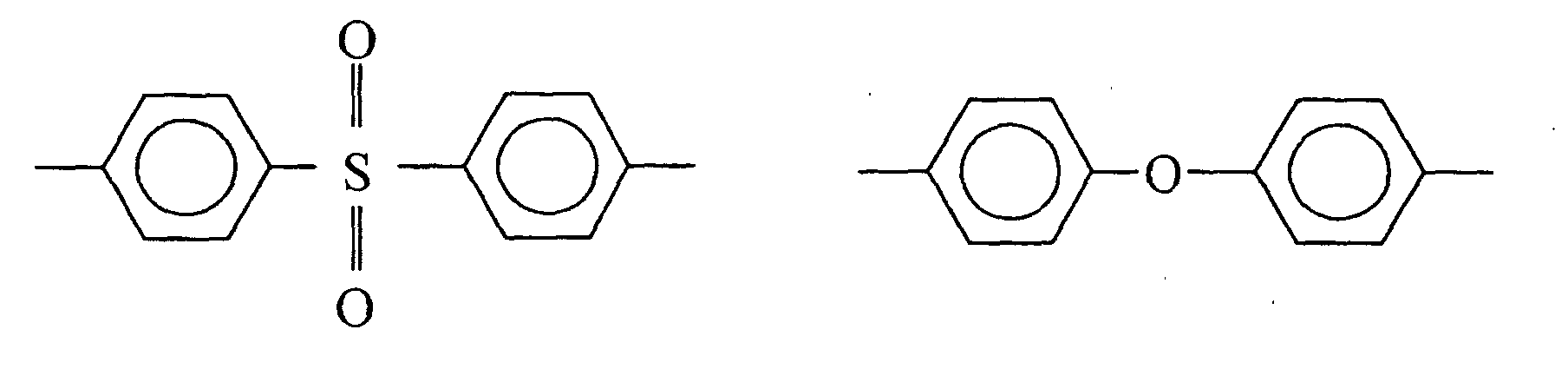
- Y of the polyamide resin represented by the general formula (1) is, for instance: (wherein, A is -CH 2 -, -C(CH 3 ) 2 -, -O-, -S-, -SO 2 -, -CO-, -NHCO-, -C(CF 3 ) 2 - or a single bond; R 16 is selected from a hydrogen atom, an alkyl group, an alkoxy group, an alkyl ester group and a halogen atom, and may be the same or different from each other; r is an integer of 0 to 2), but is not limited to these groups.
- Y among these is selected from: (wherein each of R 16 is selected from a hydrogen atom, an alkyl group, an alkoxy group, an alkyl ester group and a halogen atom, and may be the same or different from each other; r is an integer of 0 to 2), and two or more kinds of these may be used.
- the polyamide resin is synthesized by reacting a diamine or a bis(aminophenol) or the like having a structure of X, a silicone-diamine having a structure of Z which is added if necessary and a tetracarboxylic anhydride, a dicarboxylic acid, a dicarboxylic dichloride, a dicarboxylic acid derivative or the like having a structure of Y, an amino group located at a terminal thereof is preferably capped with an acid anhydride containing an aliphatic group or a cyclic compound group having at least one group of an alkenyl group and an alkynyl group.
- E that is, an aliphatic group or a cyclic compound group having at least one group of an alkenyl group or an alkynyl group includes, for instance: but is not limited to these groups.
- Particularly preferable E among these is selected from: and two or more kinds of these may be used.
- Z of the polyamide resin represented by the general formula (1) which is used if necessary includes, for instance: but is not limited to these groups, and two or more kinds of these groups may be used.
- the fraction b of Z of the general formula (1) to be used when particularly superior adhesion to a substrate such as a silicon wafer is required, is at most 40% by mole. It is not preferable to exceed 40% by mole, because solubility of the resin is badly decreased to generate a development residue (scum) making a pattern processing infeasible.
- each of X, Y and Z to be used may be of one kind or a mixture of two or more kinds thereof.
- the photosensitive material (B) to be used in the present invention is a 1,2-naphthoquinone-2-diazide-5-sulfonate ester compound or a 1,2-naphthoquinone-2-diazide-4-sulfonate ester compound of a phenol compound having a skeletal structure represented by the general formula (2) below.
- An example in which a similar substance as represented by the general formula (2) is used, has been disclosed in JP-A-2000-275833.
- each of R 5 and R 6 is a hydrogen atom or an alkyl group; each of R 7 and R 8 may be the same or different from each other and is one group selected from an alkyl group, an alkoxy group, an aryl group and a cycloalkyl group that have at least one hydroxyl group; n is an integer of 1 to 3)
- two or more moles of a 1,2-naphthoquinone-2-diazide-5-sulfonic acid or a 1,2-naphthoquinone-2-diazide-4-sulfonic acid are preferably esterified based on one mole of the phenol compound. Three or more moles are more preferably esterified.
- An amount of the photosensitive material (B) to be added to the polyamide (A) in the present invention is 1 to 50 parts by weight based on 100 parts by weight of the polyamide.
- An amount to be added less than the lower limit impairs patterning ability of a resin, while an amount to be added more than the upper limit is not preferable because of much decreased sensitivity.
- a dihydropyridine derivative can be added to the positive-working photosensitive resin composition of the present invention so as to improve photosensitivity characteristics if necessary.
- the dihydropyridine derivative includes, for instance, 2,6-dimethyl-3,5-diacetyl-4-(2'-nitrophenyl)-1,4-dihydropyridine, 4-(2'-nitrophenyl) -2,6-dimethyl-3,5-dicarboethoxy-1,4-dihydropyridine and 4-(2',4'-dinitrophenyl)-2,6-dimethyl-3,5-dicarbomethoxy-1,4-dihydropyridine.
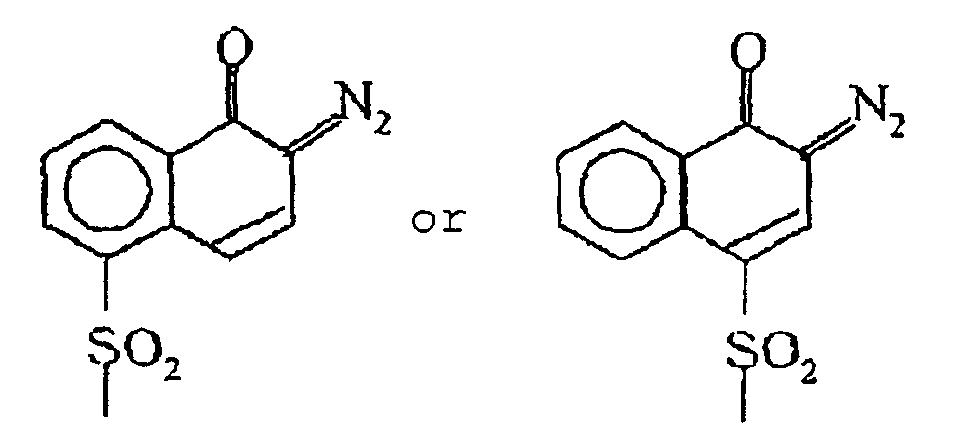
- a molecular size of a 1,2-naphthoquinone-2-diazide-5-sulfonate ester compound or a 1,2-naphthoquinone-2-diazide-4-sulfonate ester compound of a phenol compound having a skeletal structure represented by the general formula (2) of the present invention is larger than that of a naphthoquinone diazide sulfonate ester compound generally used such as those shown below.
- Q is a hydrogen atom or selected from: and at least one Q in each compound is the following groups:
- a photosensitive material of larger molecular size can exert an ability to prevent dissolving in a wide range
- a development residue (scum) is left at a pattern corner in some combination with the base resin, because solubility of the photosensitive material of larger molecular size chemically changed by exposure is somewhat lower than that of the photosensitive material of smaller molecular size.
- addition of a phenol compound of smaller molecular size can enhance overall solubility of the photosensitive material to a developing solution resulting in higher resolution and sensitivity.
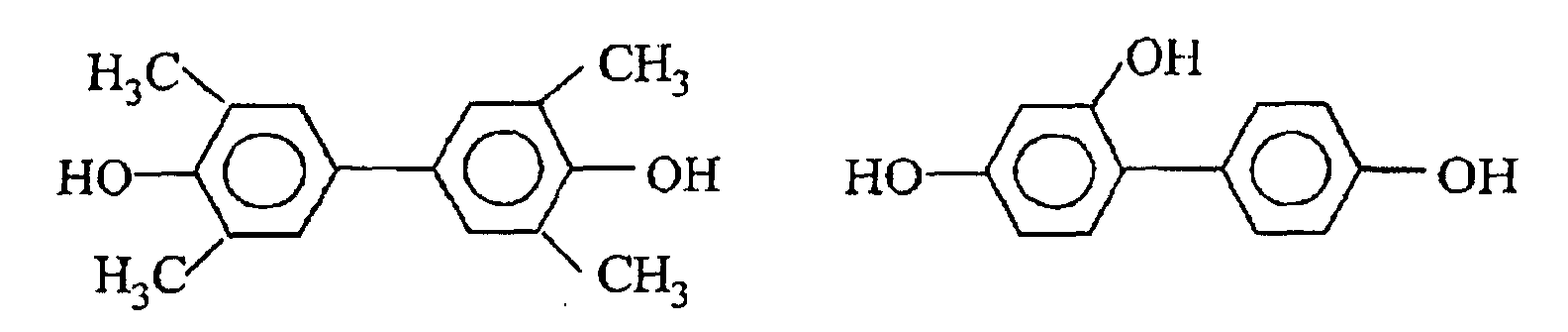
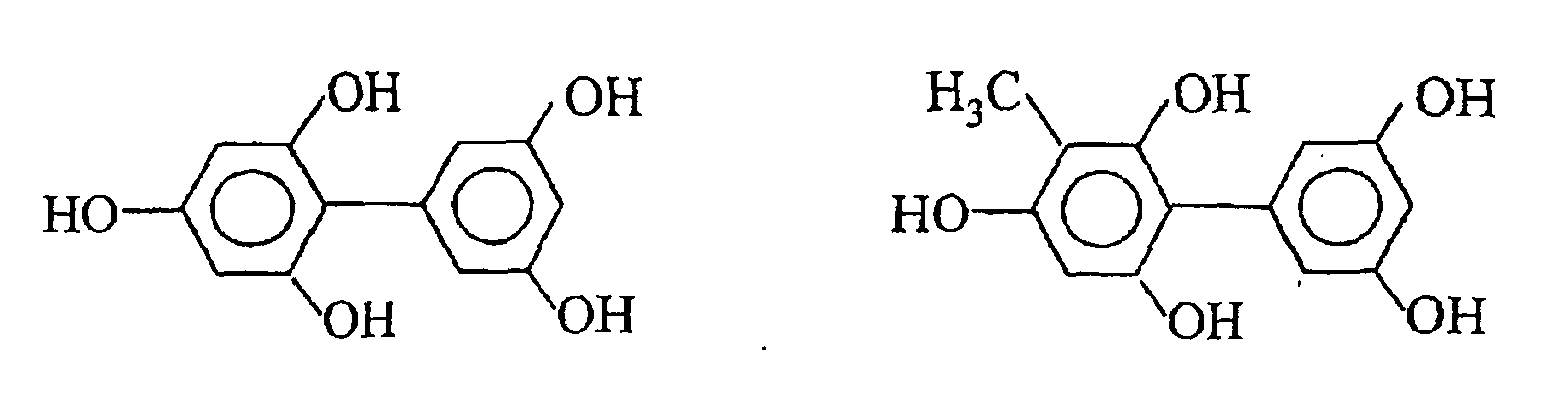
- the phenol compound (C) represented by the general formula (6) includes those shown below, but is not limited to them.
- An amount of the phenol compound (C) to be added is preferably 1 to 30 parts by weight based on 100 parts by weight of the polyamide represented by the general formula (1).
- an amount of the phenol compound to be added exceeds the upper limit, there is a possibility of a serious decrease of a film thickness retention rate as well as deposition during refrigerated storage.
- the amount to be added is less than the lower limit, there is a possibility of a decrease of sensitivity in development.
- Additives such as a leveling agent and a silane coupling agent can be added to the positive-working photosensitive resin composition of the present invention if necessary.
- the solvent includes N-methyl-2-pyrrolidone, ⁇ -butyrolactone, N,N-dimethylacetamide, dimethyl sulfoxide, diethylene glycol dimethyl ether, diethylene glycol diethyl ether, diethylene glycol dibutyl ether, propyrene glycol monomethyl ether, dipropyrene glycol monomethyl ether, propyrene glycol monomethyl ether acetate, methyl lactate, ethyl lactate, butyl lactate, methyl-1,3-butylene glycol acetate, 1,3-butylene glycol-3-monomethyl ether, methyl pyruvate, ethyl pyruvate, methyl-3-methoxy propionate and the like, and may be used solely or in a mixture.
- a method for using the positive-working photosensitive resin composition of the present invention first, said composition is applied to a suitable base material, for instance, a silicon wafer, a ceramic substrate and an aluminum substrate.
- An amount to be coated is determined so that a final thickness of coating film after curing becomes 0.1 to 30 ⁇ m in the case of a semiconductor device.
- Film thickness of 0.1 ⁇ m or less makes it difficult to fully exert a function as a surface protection film for a semiconductor element, and the thickness of 30 ⁇ m or more not only makes it difficult to obtain a finely processed pattern but to lower throughput due to a prolonged processing time.
- a method for applying includes rotary film using a spinner, spray film using a spray coater, dipping, printing and roll film and the like.
- the coating film is dried by prebaking at 60 to 130°C and then an actinic ray is irradiated in a desired pattern.
- An actinic ray to be used includes X-ray, electron beam, ultraviolet ray, visible ray and the like, and has preferably a wavelength of 200 to 500 nm.
- a developing solution to be suitably used includes inorganic alkalis such as sodium hydroxide, potassium hydroxide, sodium carbonate, sodium silicate, sodium metasilicate and aqueous ammonia, primary amines such as ethylamine and n-propylamine, secondary amines such as diethylamine and di-n-propylamine, tertiary amines such as triethylamine and methyldiethylamine, alcohol amines such as dimethy ethanol amine and triethanol amine, an aqueous solution of alkalis such as a quaternary ammonium salt such as tetramethylammonium hydroxide and tetraethylammonium hydroxide and an aqueous solution obtained by adding a suitable amount of a water-soluble organic solvent such as methanol and ethanol or a surfactant to the above aqueous solution of
- a relief pattern formed by development is rinsed. Distilled water is used for rinsing. An oxazole ring and/or an imide ring are then formed by a heat treatment to obtain a final pattern of stout heat resistance.
- a positive-working photosensitive resin composition of the present invention is useful not only for a semiconductor, but also for an interlayer insulation for a multilayered circuit, a cover coating for a flexible cupperclad plate, a solder resist film, a liquid crystal alignment layer and the like.
- Known processing steps can be used for other production steps of a semiconductor.
- a dicarboxylic acid derivative of 360.4 g (0.9 mol) obtained by reacting 0.9 mol of terephthalic acid, 0.1 mol of isophthalic acid and 2 mol of 1-hydroxy-1,2,3-benzotriazole, and 366.3 g (1 mol) of hexafluoro-2,2-bis(3-amino-4-hydroxy phenyl)propane were charged in a four-necked separable flask equipped with a thermometer, an agitator, a feed inlet and a dry nitrogen gas inlet tube, and added and dissolved with 3,000 g of N-methyl-2-pyrrolidone. The thus obtained mixture was then reacted at 75°C in an oil bath for 12 hours.
- the synthesized polyamide (PA-1) of 100 g and 15 g of a 1,2-naphthoquinone-2-diazide-4-sulfonate ester compound having a structure represented by the formula (Q-1) below were dissolved in 200 g of ⁇ -butyrolactone and then filtrated using a 0.2 ⁇ m filter made of a fluorocarbon resin to obtain a positive-working photosensitive resin composition.
- the obtained positive-working photosensitive resin composition was applied on a silicon wafer using a spincoater and then dried at 120°C for 4 minutes using a hotplate to obtain a coating film of about 16 ⁇ m thickness.
- the thus obtained coating film was exposed through a mask made by TOPPAN PRINTING CO., LTD. (Test Chart No. 1: patterns for remaining and patterns for removing of 0.88 to 50 ⁇ m width were depicted) using an i-line stepper NSR-4425i made by Nicon Corp., with various exposure amount.
- the silicon wafer was rinsed with pure water for 30 seconds after an exposed area of the composition was dissolved and removed by dipping in a 2.38% aqueous solution of tetramethylammonium hydroxide for 80 seconds.
- a film thickness retention rate [(film thickness after development)/(film thickness before development) x 100] was 88.1% and a resolution was 8 ⁇ m which were satisfactory values.
- the coating film was then cured in a clean oven at 150°C/30 minutes and 320°C/30 minutes under a condition of an oxygen concentration of 1,000 ppm or less.
- a film thickness after curing was 10.8 ⁇ m.
- a positive-working photosensitive resin composition was obtained similarly as in Example 1 except that an amount of the photosensitive material (Q-1) added in Example 1 was changed to 10 g, and evaluated similarly as in Example 1.
- a positive-working photosensitive resin composition was obtained similarly as in Example 1 except that an amount of the photosensitive material (Q-1) added in Example 1 was changed to 20 g, and evaluated similarly as in Example 1.
- a positive-working photosensitive resin composition was obtained similarly as in Example 1 except that the photosensitive material (Q-1) in Example 1 was replaced with (Q-2), and evaluated similarly as in Example 1.
- a positive-working photosensitive resin composition was obtained similarly as in Example 1 except that the photosensitive material (Q-1) in Example 1 was replaced with (Q-3), and evaluated similarly as in Example 1.
- a positive-working photosensitive resin composition was obtained similarly as in Example 1 except the above, and evaluated similarly as in Example 1.
- a positive-working photosensitive resin composition was obtained similarly as in Example 1 except the above, and evaluated similarly as in Example 1.
- Example 2 the above mixture was reacted similarly as in Example 1 except that the mixture was reacted at 75°C for 12 hours using an oil bath to synthesize a polyamide resin (PA-4) represented by the general formula (1), wherein X was represented by the formula X-1 below; Y was represented by the formulae Y-3 and Y-4 below.
- PA-4 polyamide resin represented by the general formula (1), wherein X was represented by the formula X-1 below; Y was represented by the formulae Y-3 and Y-4 below.
- a positive-working photosensitive resin composition was obtained similarly as in Example 1 except the above, and evaluated similarly as in Example 1.
- a positive-working photosensitive resin composition was obtained similarly as in Example 1 except that the photosensitive material (Q-1) in Example 1 was replaced with (Q-4), and evaluated similarly as in Example 1.
- a positive-working photosensitive resin composition was obtained similarly as in Example 1 except that the 1,2-naphthoquinone-2-diazide-4-sulfonate ester compound (Q-1) in Example 1 was replaced with (Q-5), and evaluated similarly as in Example 1.
- a positive-working photosensitive resin composition was obtained similarly as in Example 6 except that the 1,2-naphthoquinone-2-diazide-4-sulfonate ester compound (Q-1) in Example 6 was replaced with (Q-5), and evaluated similarly as in Example 1.
- a positive-working photosensitive resin composition was obtained similarly as in Example 1 except that the photosensitive material (Q-1) in Example 1 was replaced with (Q-6), and evaluated similarly as in Example 1.
- a positive-working photosensitive resin composition was obtained similarly as in Example 1 except that the photosensitive material (Q-1) in Example 1 was replaced with (Q-7), and evaluated similarly as in Example 1.
- a positive-working photosensitive resin composition was obtained similarly as in Example 1 except that the photosensitive material (Q-1) in Example 1 was replaced with (Q-8), and evaluated similarly as in Example 1.
- the composition was evaluated similarly as in Example 1.
- the composition was evaluated similarly as in Example 1.
- a positive-working photosensitive resin composition was obtained similarly as in Example 13 except that the phenol compound (P-1) in Example 13 was replaced with (P-2), and evaluated similarly as in Example 1.
- a positive-working photosensitive resin composition was obtained similarly as in Example 13 except that the 1,2-naphthoquinone-2-diazide-4-sulfonate ester compound (Q-1) in Example 13 was replaced with (Q-5), and evaluated similarly as in Example 1.
- a positive-working photosensitive resin composition was obtained similarly as in Example 14 except that the 1,2-naphthoquinone-2-diazide-4-sulfonate ester compound (Q-1) in Example 14 was replaced with (Q-5), and evaluated similarly as in Example 1.
- a positive-working photosensitive resin composition was obtained similarly as in Example 15 except that the 1,2-naphthoquinone-2-diazide-4-sulfonate ester compound (Q-1) in Example 15 was replaced with (Q-5), and evaluated similarly as in Example 1.
- a positive-working photosensitive resin composition was obtained similarly as in Example 13 except that the 1,2-naphthoquinone-2-diazide-4-sulfonate ester compound (Q-1) in Example 13 was replaced with (Q-7), and evaluated similarly as in Example 1.
- a positive-working photosensitive resin composition was obtained similarly as in Example 13 except that the 1,2-naphthoquinone-2-diazide-4-sulfonate ester compound (Q-1) in Example 13 was replaced with (Q-8), and evaluated similarly as in Example 1.
- the positive-working photosensitive resin composition used in Example 1 was applied on a silicon wafer using a spincoater, and then dried at 90°C for 30 minutes in a box-type oven to obtain a coating film of about 50 ⁇ m thickness.
- the thus obtained coating film was exposed with an exposure amount of 3,000 mJ through a mask made by TOPPAN PRINTING CO., LTD. (Test Chart No. 1: patterns for remaining and patterns for removing of 0.88 to 50 ⁇ m width were depicted) using Maskaligner PLA-600F made by CANON Inc.
- a film thickness retention rate [(film thickness after development)/(film thickness before development) x 100] was 80.4%.
- the coating film was then cured in a clean oven at 150°C/30 minutes and 320°C/30 minutes under a condition of an oxygen concentration of 1,000 ppm or less. Film thickness after curing was 28.8 ⁇ m.
- the positive-working photosensitive resin composition used in Example 1 was applied on a silicon wafer using a spincoater, and then dried at 90°C for 30 minutes in a box-type oven to obtain a film of about 50 ⁇ m thickness.
- the thus obtained film was exposed with an exposure amount of 3,000 mJ through a mask made by TOPPAN PRINTING CO., LTD. (Test Chart No. 1: patterns for remaining and patterns for removing of 0.88 to 50 ⁇ m width were depicted) using Maskaligner PLA-600F made by CANON Inc. It took as long as 170 seconds to remove the coating film of a pattern using a 2.38% aqueous solution of tetramethylammonium hydroxide.
- the silicon wafer was rinsed with pure water for 30 seconds. As a result, it was confirmed that a pattern of 60 ⁇ m had been formed.
- a film thickness retention rate [(film thickness after development)/(film thickness before development) x 100] was 72.1%.
- the coating film was then cured in a clean oven at 150°C/30 minutes and 320°C/30 minutes under a condition of an oxygen concentration of 1,000 ppm or less. Film thickness after curing was 25.2 ⁇ m, which was a little thinner than that in Example 19.
- a positive-working photosensitive resin composition with high sensitivity that can form a pattern of a high resolution and a high film thickness retention rate even in an increased film thickness while keeping conventional characteristics, can be obtained.
- a positive-working photosensitive resin composition of the present invention is useful not only for a semiconductor, but also for an interlayer insulation for a multilayered circuit, a cover coating for a flexible cupperclad plate, a solder resist film, a liquid crystal alignment layer and the like.
Landscapes
- Physics & Mathematics (AREA)
- Spectroscopy & Molecular Physics (AREA)
- General Physics & Mathematics (AREA)
- Materials For Photolithography (AREA)
- Exposure And Positioning Against Photoresist Photosensitive Materials (AREA)
Abstract
Description
- The present invention relates to a positive-working photosensitive resin composition to be used for a surface protection film of a semiconductor element, particularly a positive-working photosensitive resin composition with high sensitivity that gives a pattern of high resolution and a high film thickness retention rate [(film thickness after development)/(film thickness before development) x 100] even in an increased film thickness. In addition, the present invention relates to a semiconductor device manufactured by using said positive-working photosensitive resin composition.
- A polyimide resin having high heat resistance, excellent electrical and mechanical properties and the like was conventionally used for a surface protection film or an interlayer insulating film of a semiconductor element. However, a resin of further improved performance has been lately required to satisfy the requirement for marked improvement in resistance against repeated heat or thermal shock due to higher integration and larger scale of a semiconductor element, thinning and down-sizing of a package, shift to surface mounting by reflow of solder and the like.
- On the other hand, a technology to give photosensitivity to a polyimide resin itself has lately drawn attention, bringing about, for instance, a photosensitive polyimide resin represented by the formula (7) below.

- Using the above polyimide resin poses a problem in safety and handling due to necessity of spraying a solvent such as N-methyl-2-pyrrolidone in development, while a part of procedures to make a pattern can be simplified resulting in shorter process and improved yield. Therefore, a positive-working photosensitive resin that can be developed by an aqueous solution of an alkali has been lately exploited. For instance, a positive-working photosensitive resin comprising a polybenzoxazole precursor as a base polymer and a diazoquinone compound as a photosensitive material has been disclosed in JP-B-1-46862. This resin has high heat resistance, superior electrical properties and fine processability, and a potential of resin not only for wafer coating but also for interlayer insulation. With regard to a development mechanism of this positive-working photosensitive resin, a diazoquinone compound in an exposed area is subjected to a chemical change to become soluble in an aqueous solution of an alkali, while the diazoquinone compound in an unexposed area remains insoluble in the aqueous solution of the alkali. Utilizing the difference of solubility between the exposed area and the unexposed area, a pattern of coating film only in the unexposed area can be obtained by dissolving and removing the resin in the exposed area.
- In an actual use of these photosensitive resins, sensitivity of the photosensitive resins is especially of significance. Low sensitivity requires a longer exposure time resulting in a lower throughput. On the other hand, if, for instance, a base polymer with a lower molecular weight is used in an attempt to improve sensitivity of a photosensitive resin, problems such as failing to obtain a desired film thickness or collapse of a pattern shape arise due to increased loss of film thickness in an unexposed area during development. Thus, development of a photosensitive resin of high sensitivity having such properties as described above has been greatly desired. In addition, since a thickness of resin film tends to increase from conventional about 5 to 7 µm to about 10 to 20 µm, a photosensitive resin with high sensitivity even in an increased thickness has been expected to be developed.
- An object of the present invention is to provide a positive-working photosensitive resin composition with high sensitivity that gives a pattern having a high resolution and a high film thickness retention rate [(film thickness after development)/(film thickness before development) x 100]. Further, the present invention provides a positive-working photosensitive resin composition with high sensitivity that is free from the above problems even with an increased film thickness.
- The present invention relates to a positive-working photosensitive resin composition comprising 100 parts by weight of a polyamide (A) represented by the general formula (1):[wherein, X is a cyclic compound group of 2 to 4 valences that may have a hydroxyl group or a group wherein a hydrogen atom of a hydroxyl group is replaced with an organic group having 1 to 20 carbon atoms; Y is a cyclic compound group of 2 to 4 valences that may have a hydroxyl group, a group wherein a hydrogen atom of a hydroxyl group is replaced with an organic group having 1 to 20 carbon atoms, a carboxyl group or a group wherein a hydrogen atom of a carboxyl group is replaced with an organic group having 1 to 20 carbon atoms;

Z is:(wherein, each of R1 and R2 is a bivalent organic group; each of R3 and R4 is a univalent organic group); a and b each shows a molar fraction; a + b = 100% by mole; a = 60 to 100% by mole; and b = 0 to 40% by mole)];
and 1 to 50 parts by weight of a photosensitive material (B), that is a 1,2-naphthoquinone-2-diazide-5-sulfonate ester compound or a 1,2-naphthoquinone-2-diazide-4-sulfonate ester compound of a phenol compound having a skeletal structure represented by the general formula (2):(wherein, each of R5 and R6 is a hydrogen atom or an alkyl group; each of R7 and R8 may be the same or different from each other and is one group selected from an alkyl group, an alkoxy group, an aryl group and a cycloalkyl group that has at least one hydroxyl group; n is an integer of 1 to 3).
- Further, the present invention relates to a positive-working photosensitive resin composition further comprising 1 to 30 parts by weight of a phenol compound represented by the general formula (6) based on 100 parts by weight of the polyamide (A) represented by the general formula (1) in the above positive-working photosensitive resin composition:(wherein, each of R11, R12, R13 and R14 is selected from a hydrogen atom, a halogen atom, an alkyl group, an alkoxy group and a cycloalkyl group, and may be the same or different from each other; p is an integer of 0 to 3; q is an integer of 0 to 3; p + q ≧ 2; R15 is selected from a single bond, a methylene group, an alkylene group, an oxygen atom, a carbonyl group a carbonyl ether group, a sulfur atom, a sulfonyl group and an azo group.)

- A more preferable embodiment is the above positive-working photosensitive resin composition wherein X in the polyamide represented by the general formula (1) is selected from the groups shown below; Y in the polyamide represented by the general formula (1) is selected from the groups shown below; and a terminal group of the polyamide represented by the general formula (1) is selected from E below, that is; an aliphatic group or a cyclic compound group having at least one group of an alkenyl group or an alkynyl group.
X: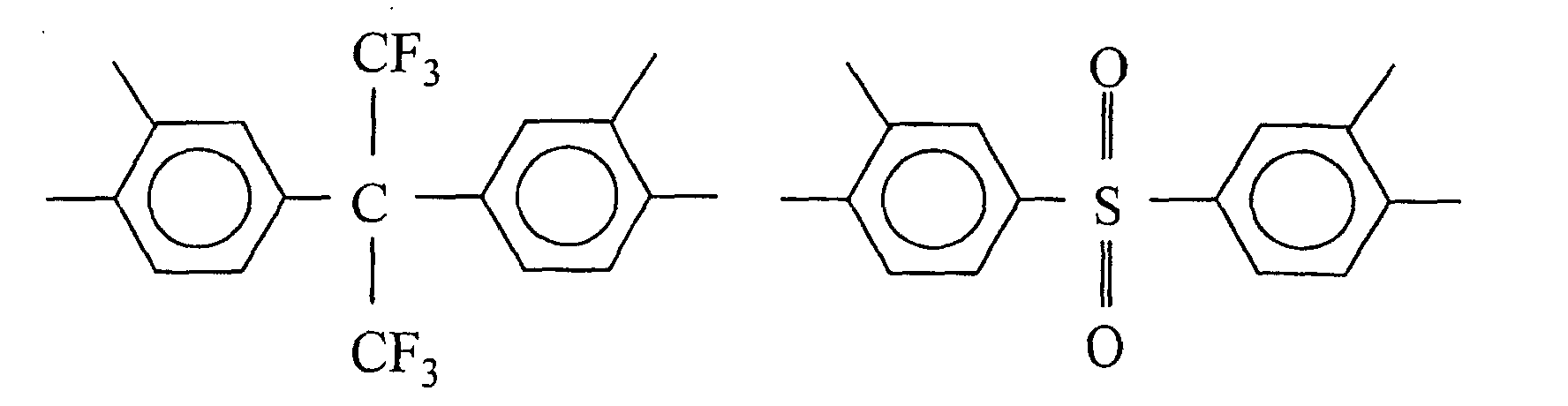

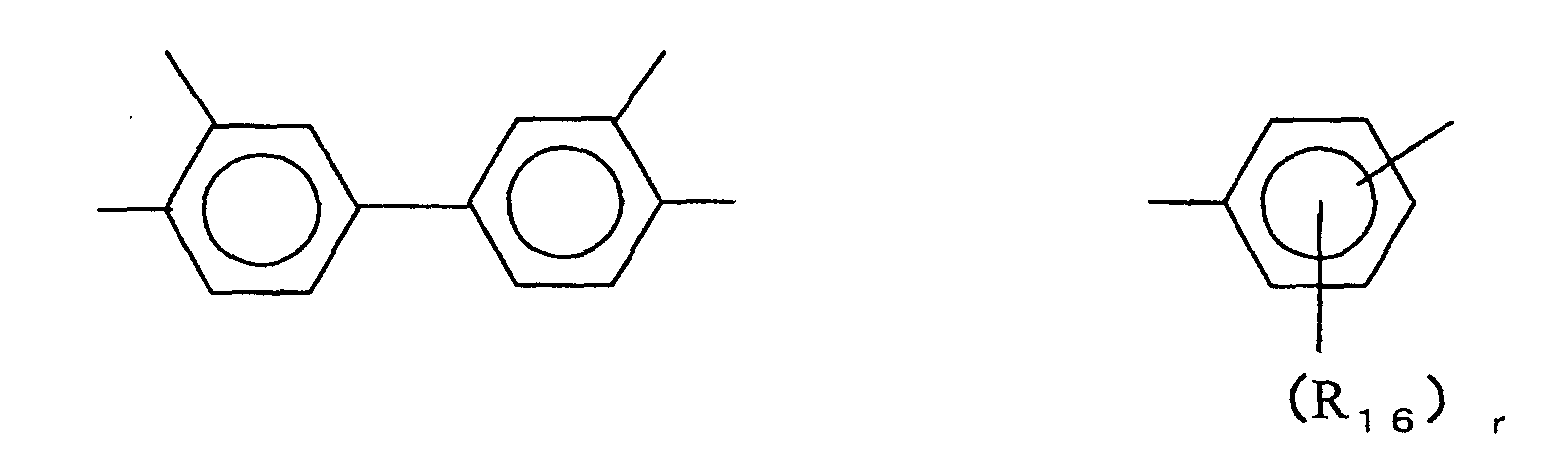
 (wherein, each of R16 is selected from a hydrogen atom, an alkyl group, an alkoxy group, an alkyl ester group and a halogen atom, and may be the same or different from each other; r is an integer of 0 to 2.)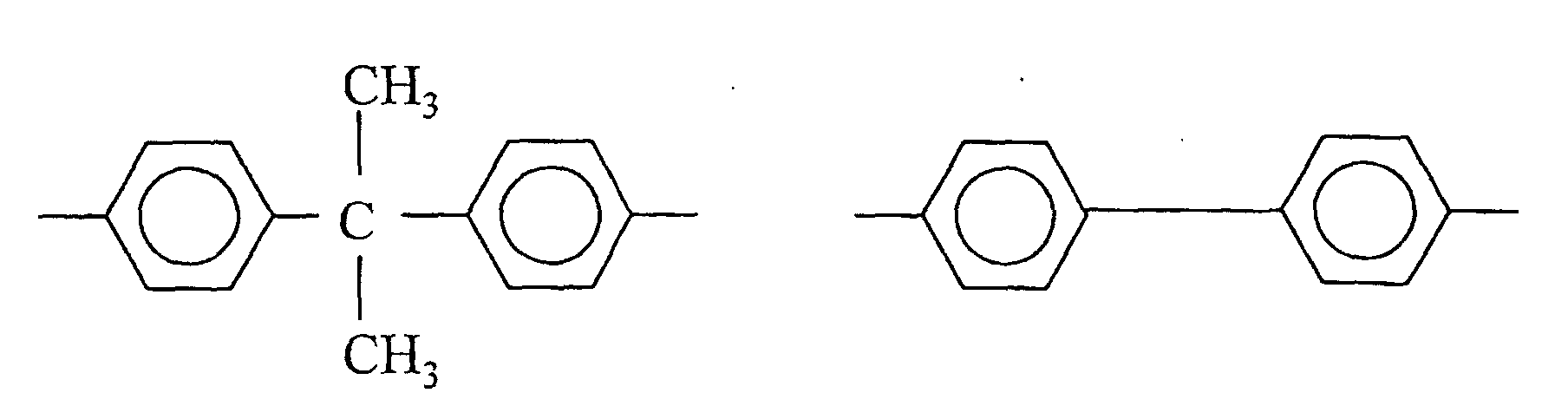
Y:

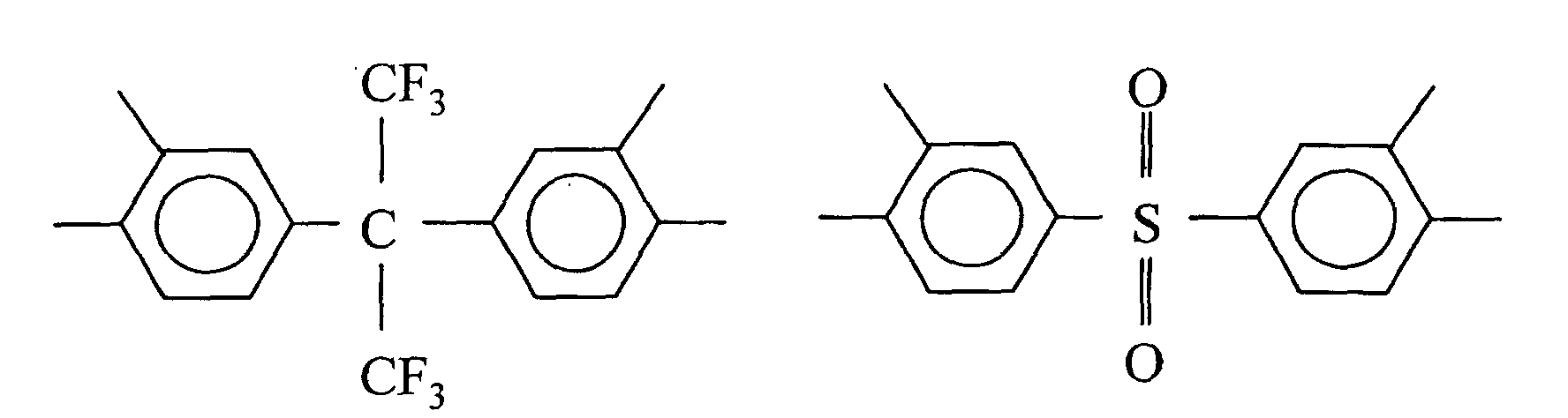
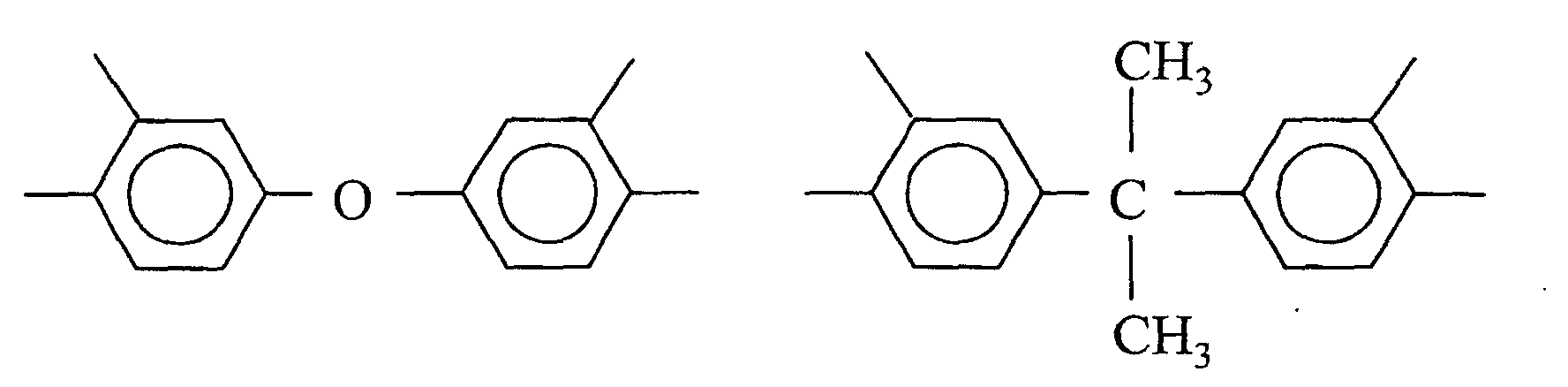
 (wherein, each of R16 is selected from a hydrogen atom, an alkyl group, an alkoxy group, an alkyl ester group and a halogen atom, and may be the same or different from each other; r is an integer of 0 to 2.)
E: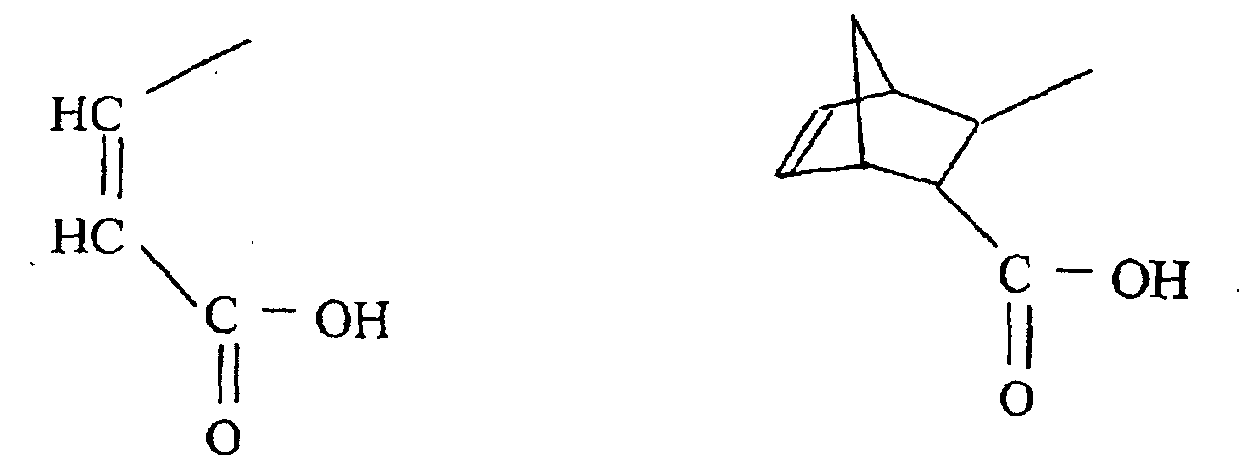
- In addition, the present invention relates to a semiconductor device manufactured by using the above positive-working photosensitive resin composition, which is obtained by applying the above positive-working photosensitive resin composition on a semiconductor element so that a film thickness of the above positive-working photosensitive resin composition after dehydration and cyclization becomes 0.1 to 30 µm, followed by prebaking, exposing, developing and heating.
- The polyamide resin represented by the general formula (1) is obtained by reacting a diamine or a bis(aminophenol) or the like having a structure of X, a silicone-diamine having a structure of Z which is added if necessary, and a tetracalboxylic anhydride, a dicarboxylic acid, a dicarboxylic dichloride, a dicarboxylic acid derivative or the like having a structure of Y. Incidentally, in the case of a dicarboxylic acid, an activated ester-type derivative of dicarboxylic acid reacted in advance with 1-hydroxy-1,2,3-benzotriazole or the like may be used so as to enhance a reaction yield and the like. This polyamide resin is dehydrated and cyclized by heating at about 300 to 400°C to obtain a heat-resistant resin in a form of a polyamide or a polybenzoxazole or a copolymer of both polymers.
- X of the polyamide resin represented by the general formula (1) of the present invention is, for instance:


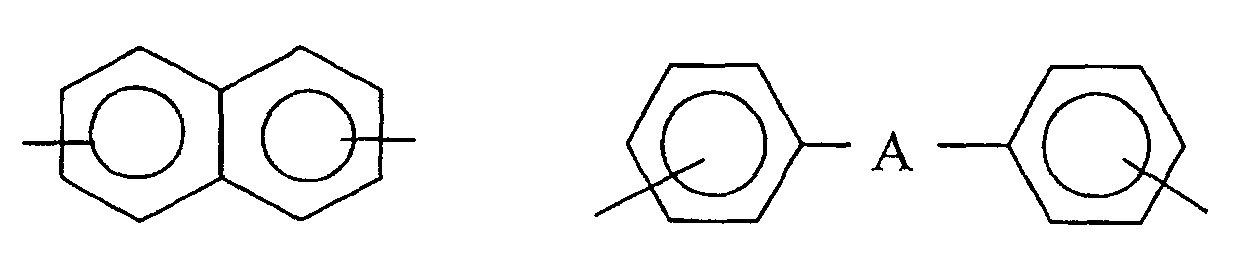 (wherein, A is -CH2-, -C(CH3)2-, -O-, -S-, -SO2-, -CO-, -NHCO-, -C(CF3)2- or a single bond; each of R16 is selected from a hydrogen atom, an alkyl group, an alkoxy group, an alkyl ester group and a halogen atom, and may be the same or different from each other; r is an integer of 0 to 2), but is not limited to these groups.
- Particularly preferable X among these is selected from:


 (Each of R16 is selected from a hydrogen atom, an alkyl group, an alkoxy group, an alkyl ester group and a halogen atom, and may be the same or different from each other; r is an integer of 0 to 2) and two or more kinds of these may be used.
- Y of the polyamide resin represented by the general formula (1) is, for instance:


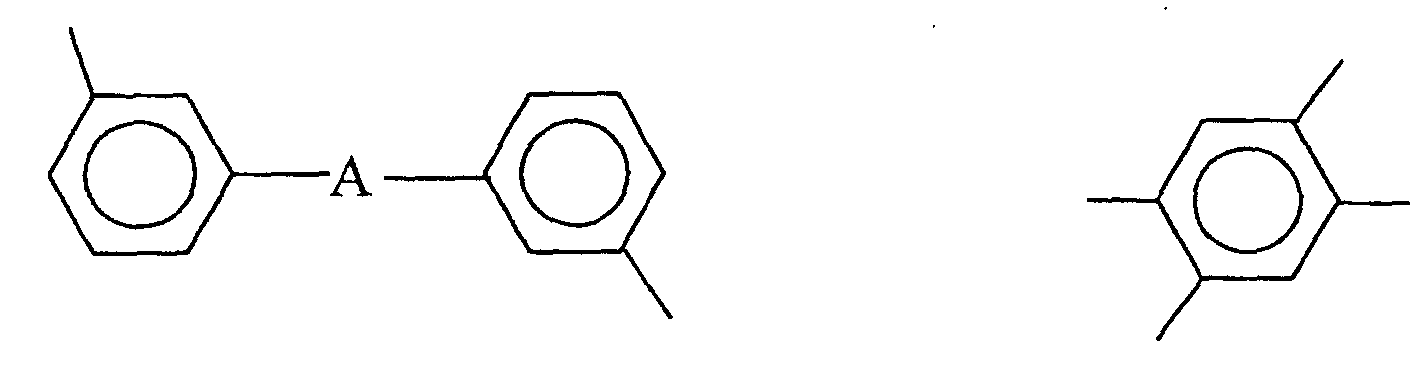 (wherein, A is -CH2-, -C(CH3)2-, -O-, -S-, -SO2-, -CO-, -NHCO-, -C(CF3)2- or a single bond; R16 is selected from a hydrogen atom, an alkyl group, an alkoxy group, an alkyl ester group and a halogen atom, and may be the same or different from each other; r is an integer of 0 to 2), but is not limited to these groups.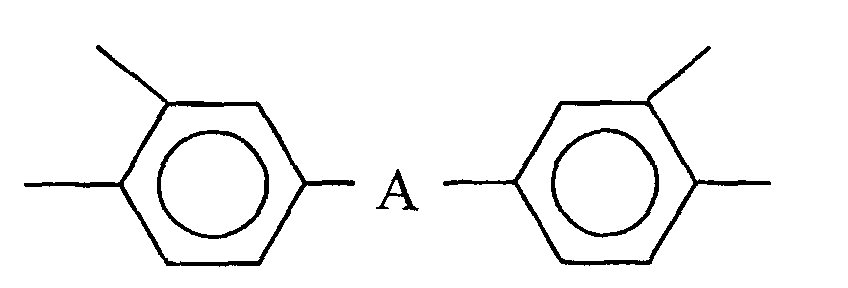
- Particularly preferable Y among these is selected from:


 (wherein each of R16 is selected from a hydrogen atom, an alkyl group, an alkoxy group, an alkyl ester group and a halogen atom, and may be the same or different from each other; r is an integer of 0 to 2), and two or more kinds of these may be used.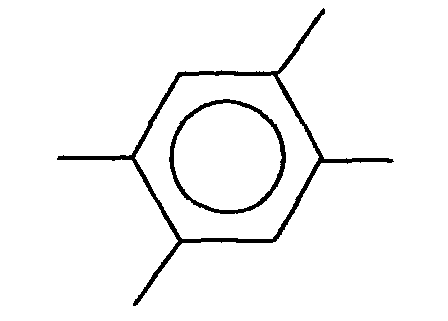
- From the viewpoint of storage stability of the positive-working photosensitive resin composition of the present invention, after the polyamide resin is synthesized by reacting a diamine or a bis(aminophenol) or the like having a structure of X, a silicone-diamine having a structure of Z which is added if necessary and a tetracarboxylic anhydride, a dicarboxylic acid, a dicarboxylic dichloride, a dicarboxylic acid derivative or the like having a structure of Y, an amino group located at a terminal thereof is preferably capped with an acid anhydride containing an aliphatic group or a cyclic compound group having at least one group of an alkenyl group and an alkynyl group.
- E, that is, an aliphatic group or a cyclic compound group having at least one group of an alkenyl group or an alkynyl group includes, for instance:
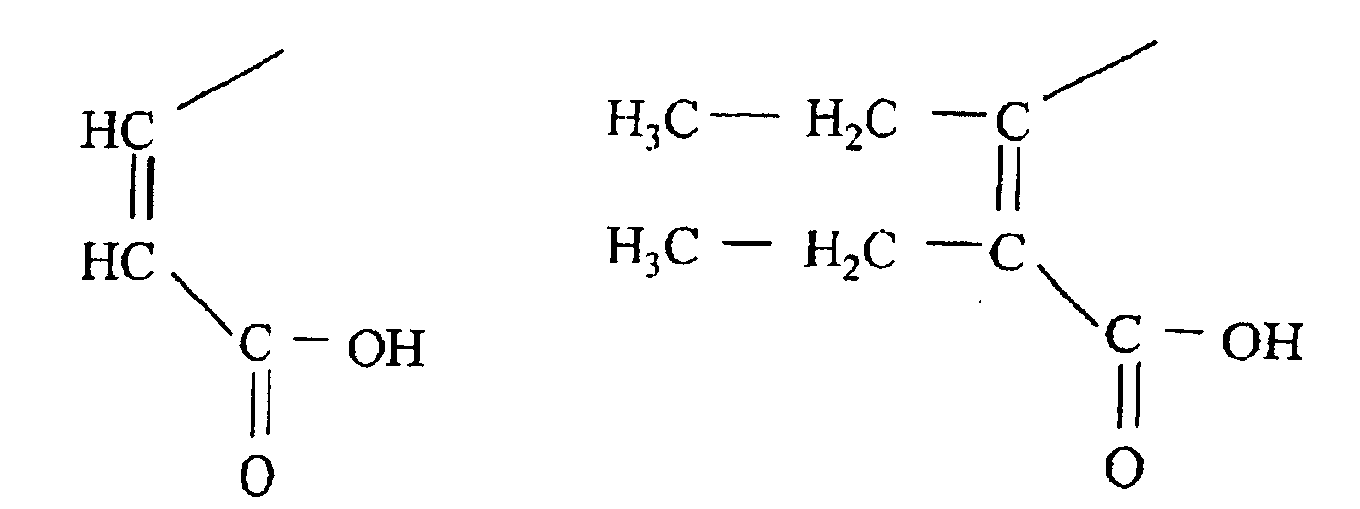

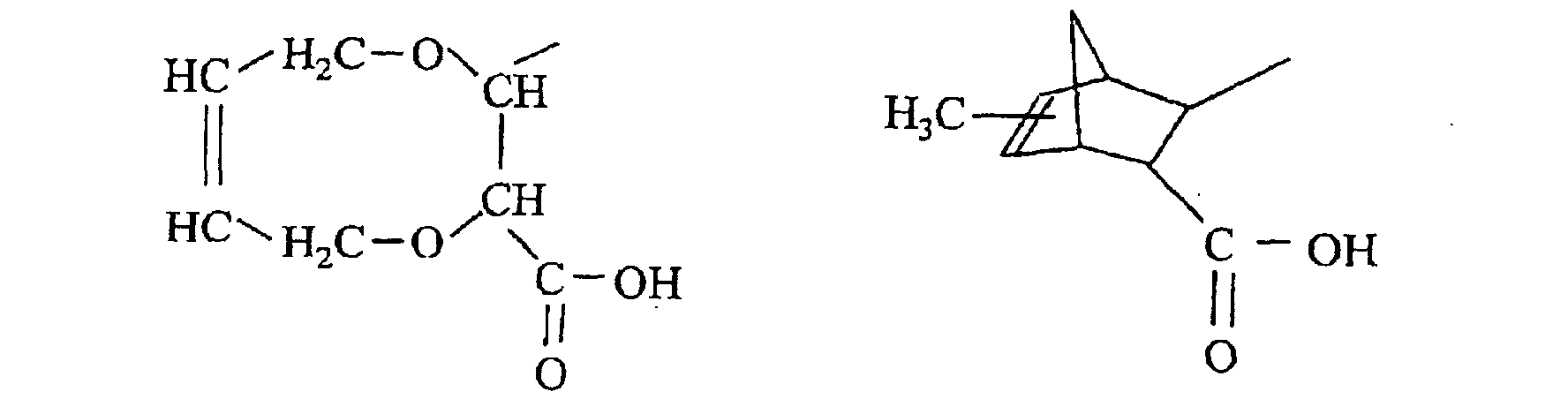
 but is not limited to these groups.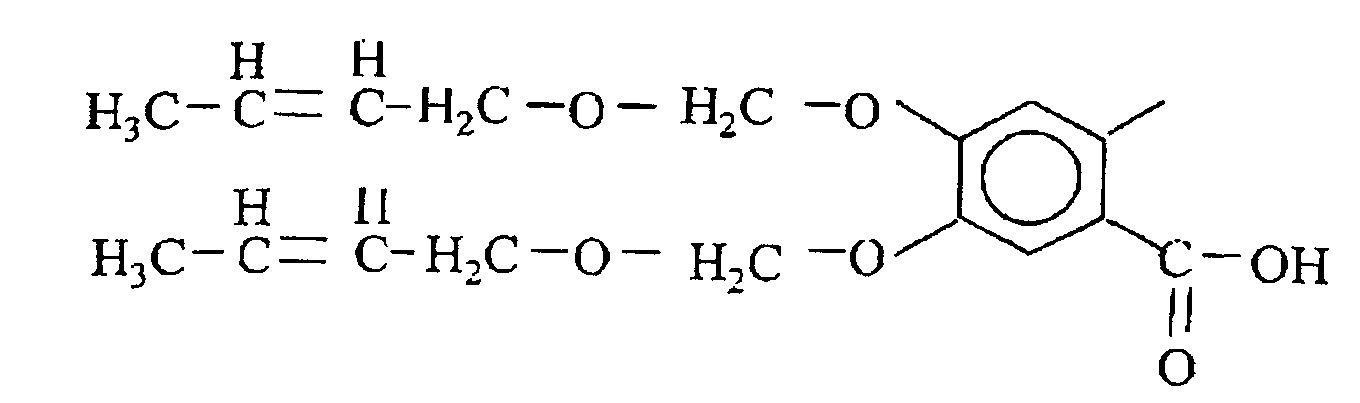
- Particularly preferable E among these is selected from:and two or more kinds of these may be used.

- Further, Z of the polyamide resin represented by the general formula (1) which is used if necessary includes, for instance:

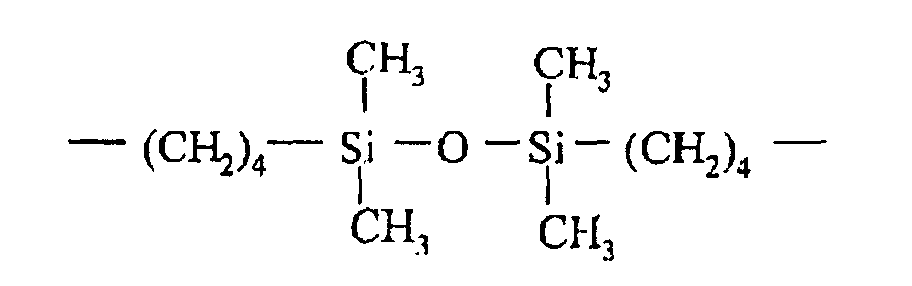
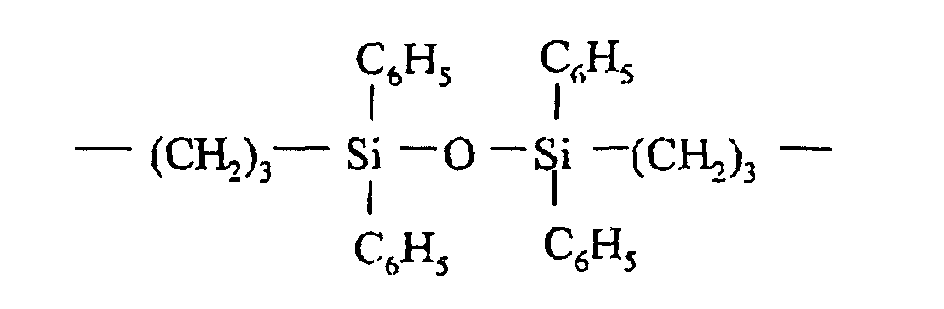
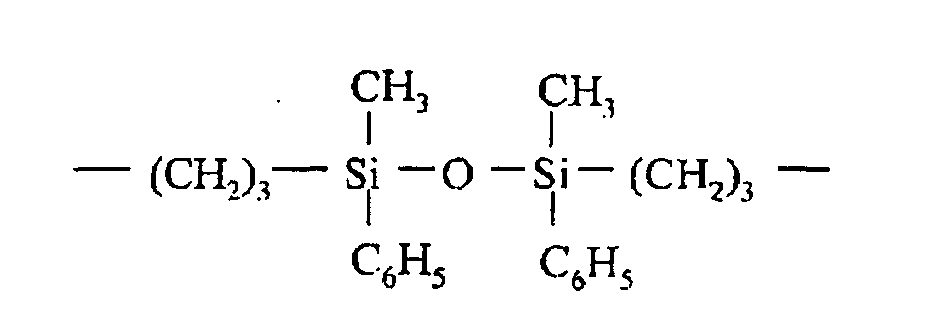

 but is not limited to these groups, and two or more kinds of these groups may be used.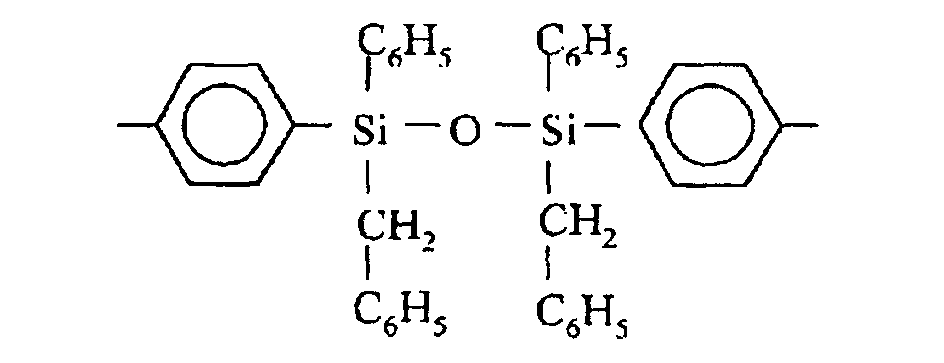
- The fraction b of Z of the general formula (1) to be used when particularly superior adhesion to a substrate such as a silicon wafer is required, is at most 40% by mole. It is not preferable to exceed 40% by mole, because solubility of the resin is badly decreased to generate a development residue (scum) making a pattern processing infeasible. Incidentally, each of X, Y and Z to be used may be of one kind or a mixture of two or more kinds thereof.
- The photosensitive material (B) to be used in the present invention is a 1,2-naphthoquinone-2-diazide-5-sulfonate ester compound or a 1,2-naphthoquinone-2-diazide-4-sulfonate ester compound of a phenol compound having a skeletal structure represented by the general formula (2) below. An example in which a similar substance as represented by the general formula (2) is used, has been disclosed in JP-A-2000-275833.(wherein, each of R5 and R6 is a hydrogen atom or an alkyl group; each of R7 and R8 may be the same or different from each other and is one group selected from an alkyl group, an alkoxy group, an aryl group and a cycloalkyl group that have at least one hydroxyl group; n is an integer of 1 to 3)

- In spite of some effect to increase sensitivity obtained by using the above substance, further higher sensitivity has been required in a recent shift of a coating film toward a thicker film. As a result of studying various photosensitive materials considering these situations, it has been found that a 1,2-naphthoquinone-2-diazide-5-sulfonate ester compound or a 1,2-naphthoquinone-2-diazide-4-sulfonate ester compound of a phenol compound having a skeletal structure represented by the general formula (2) of the present invention brings about high sensitivity.
- With regard to a degree of esterification of a 1,2-naphthoquinone-2-diazide-5-sulfonate ester compound or a 1,2-naphthoquinone-2-diazide-4-sulfonate ester compound of a phenol compound having a skeletal structure represented by the general formula (2) to be used in the present invention, two or more moles of a 1,2-naphthoquinone-2-diazide-5-sulfonic acid or a 1,2-naphthoquinone-2-diazide-4-sulfonic acid are preferably esterified based on one mole of the phenol compound. Three or more moles are more preferably esterified.
- An amount of the photosensitive material (B) to be added to the polyamide (A) in the present invention is 1 to 50 parts by weight based on 100 parts by weight of the polyamide. An amount to be added less than the lower limit impairs patterning ability of a resin, while an amount to be added more than the upper limit is not preferable because of much decreased sensitivity.
- A dihydropyridine derivative can be added to the positive-working photosensitive resin composition of the present invention so as to improve photosensitivity characteristics if necessary. The dihydropyridine derivative includes, for instance, 2,6-dimethyl-3,5-diacetyl-4-(2'-nitrophenyl)-1,4-dihydropyridine, 4-(2'-nitrophenyl) -2,6-dimethyl-3,5-dicarboethoxy-1,4-dihydropyridine and 4-(2',4'-dinitrophenyl)-2,6-dimethyl-3,5-dicarbomethoxy-1,4-dihydropyridine.
- It has been also found that a new effect is brought about by the phenol compound represented by the general formula (6) that can be used in combination with the positive-working photosensitive resin composition of the present invention. A molecular size of a 1,2-naphthoquinone-2-diazide-5-sulfonate ester compound or a 1,2-naphthoquinone-2-diazide-4-sulfonate ester compound of a phenol compound having a skeletal structure represented by the general formula (2) of the present invention is larger than that of a naphthoquinone diazide sulfonate ester compound generally used such as those shown below.
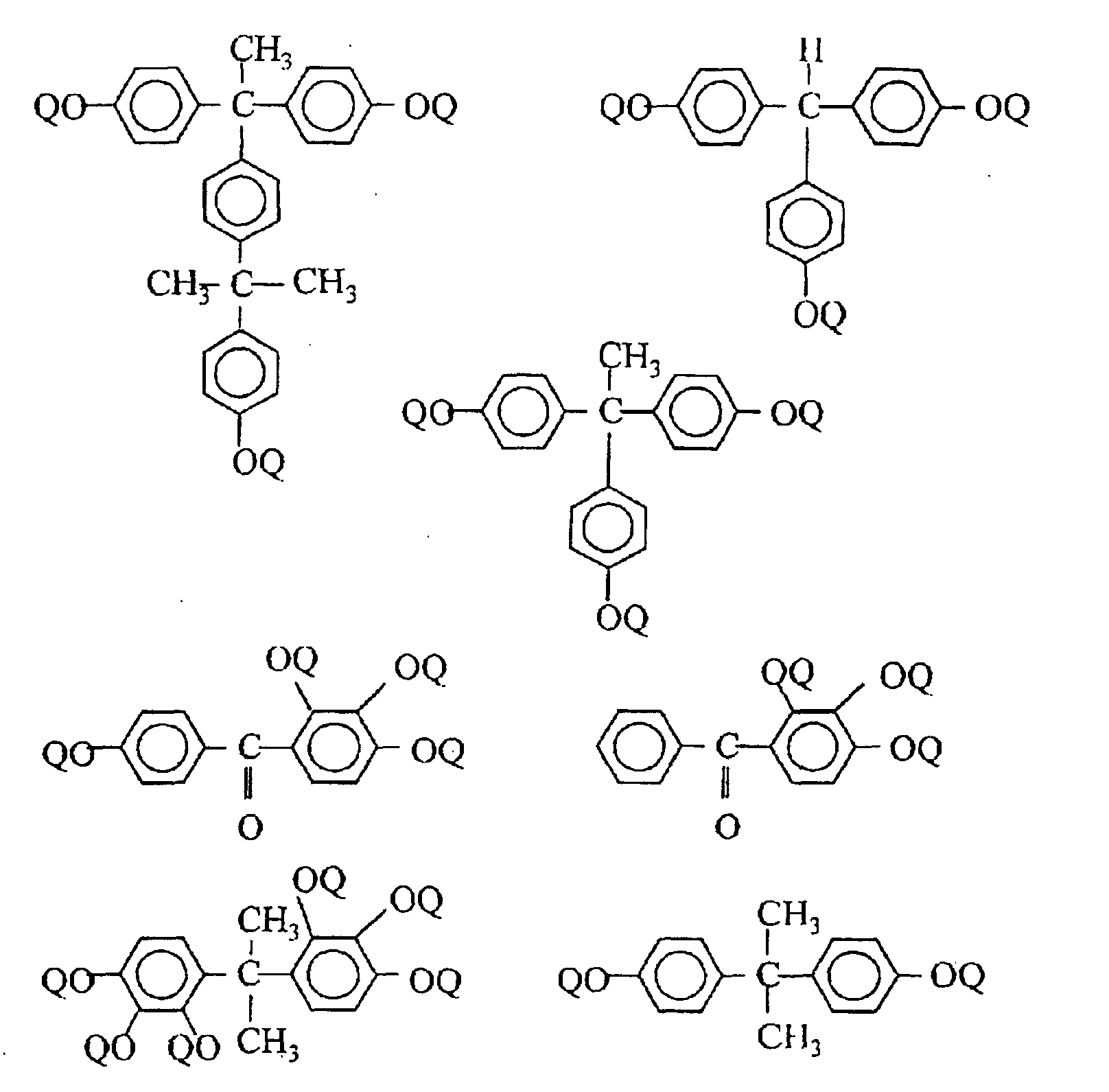
 (wherein, Q is a hydrogen atom or selected from:
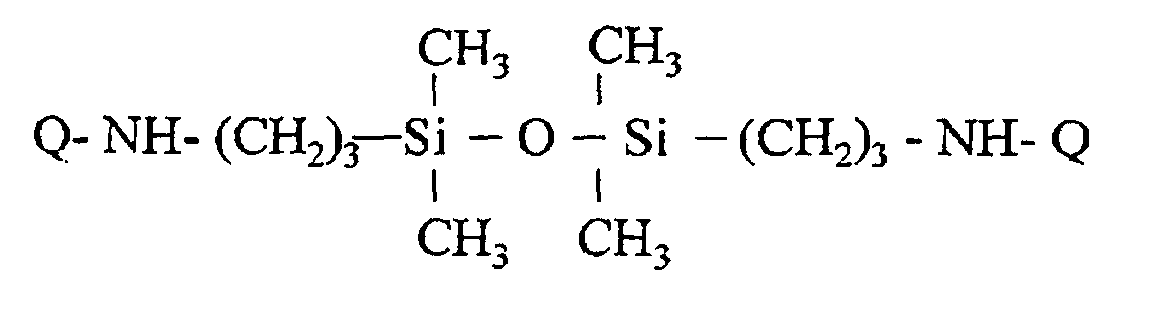 and at least one Q in each compound is the following groups:)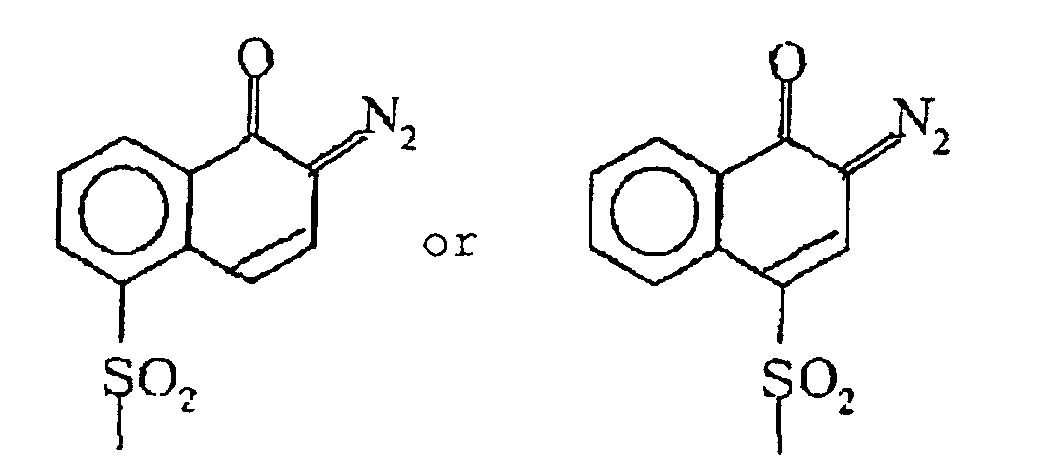
- While a photosensitive material of larger molecular size can exert an ability to prevent dissolving in a wide range, there may be a case where a development residue (scum) is left at a pattern corner in some combination with the base resin, because solubility of the photosensitive material of larger molecular size chemically changed by exposure is somewhat lower than that of the photosensitive material of smaller molecular size. In such a case, addition of a phenol compound of smaller molecular size can enhance overall solubility of the photosensitive material to a developing solution resulting in higher resolution and sensitivity.
- The phenol compound (C) represented by the general formula (6) includes those shown below, but is not limited to them.




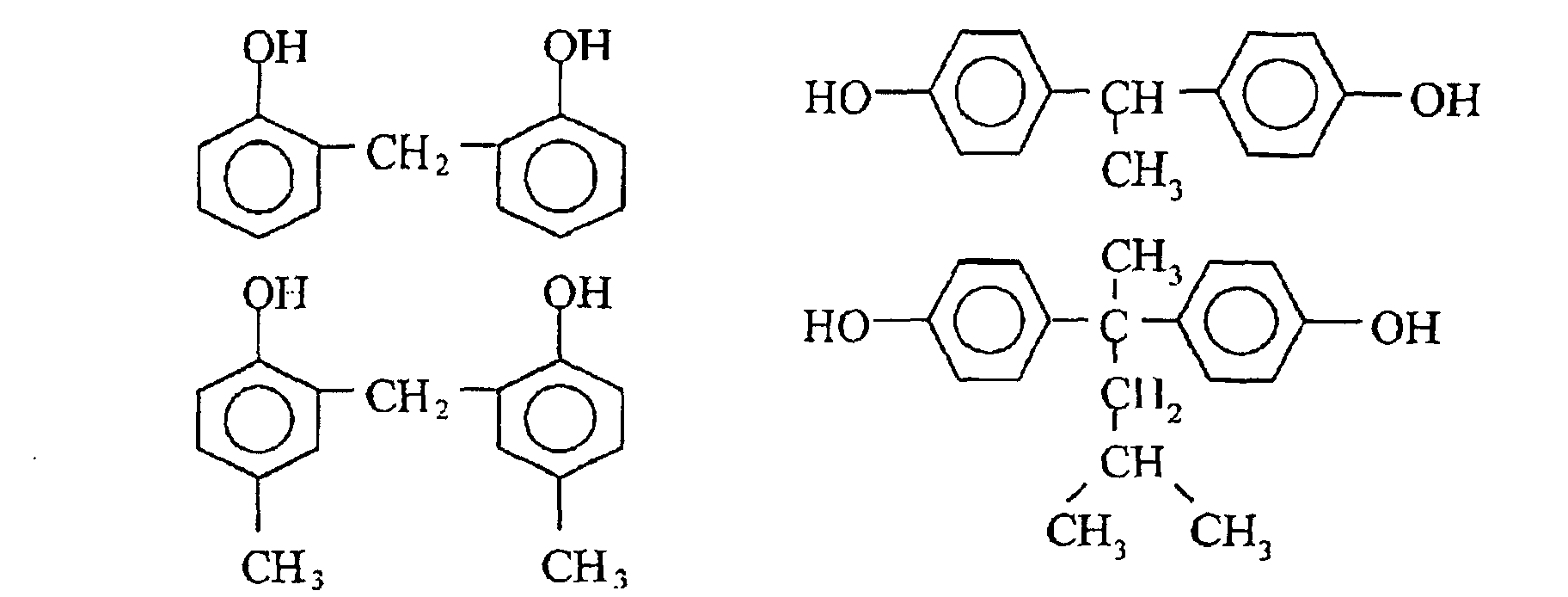
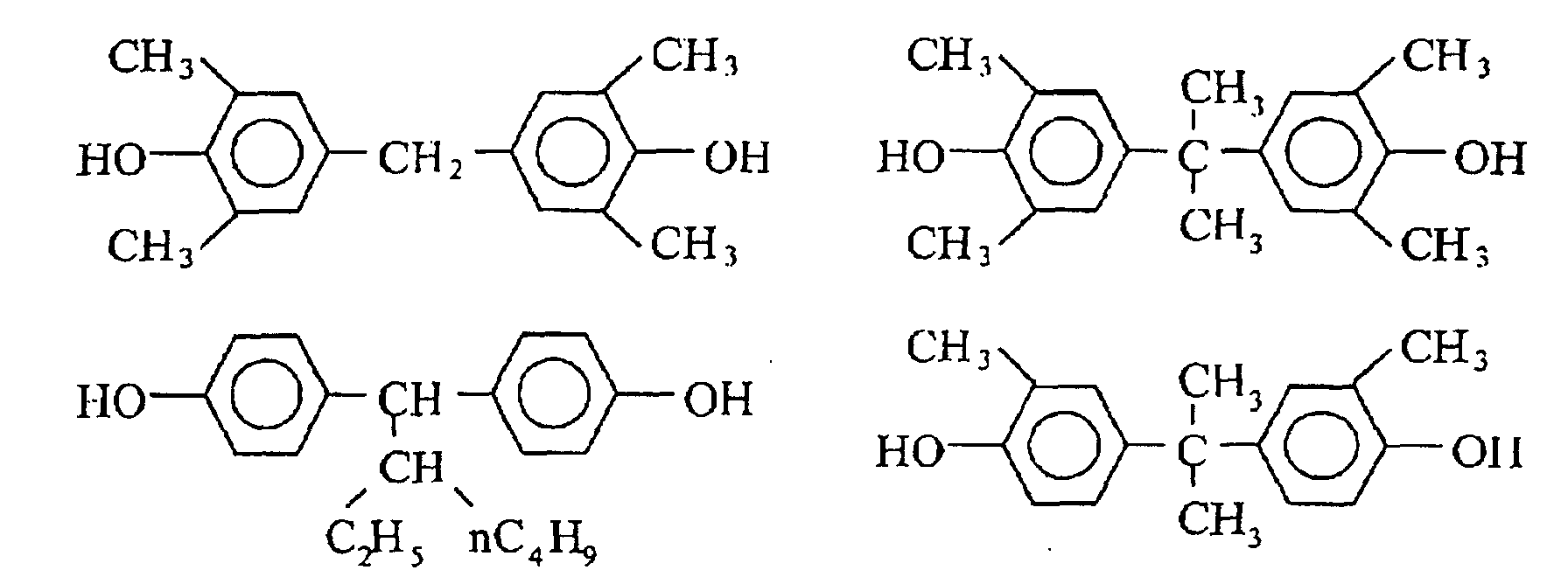
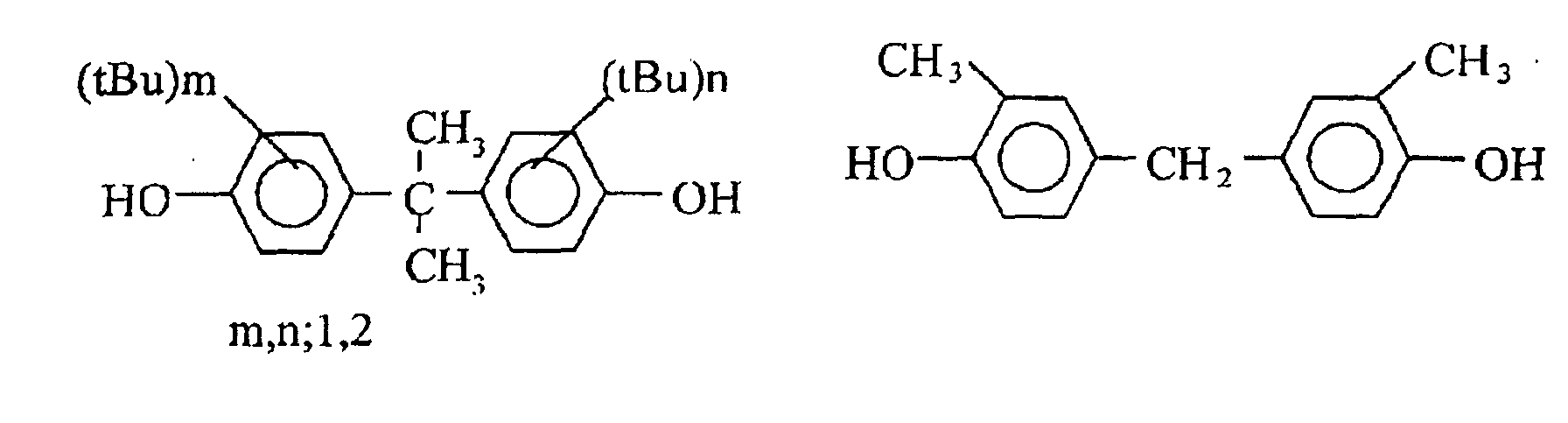

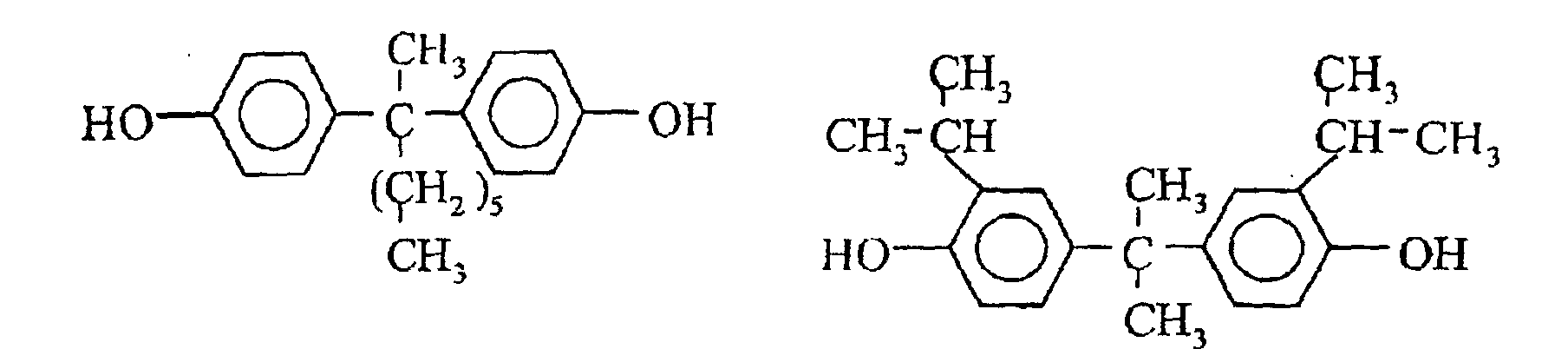


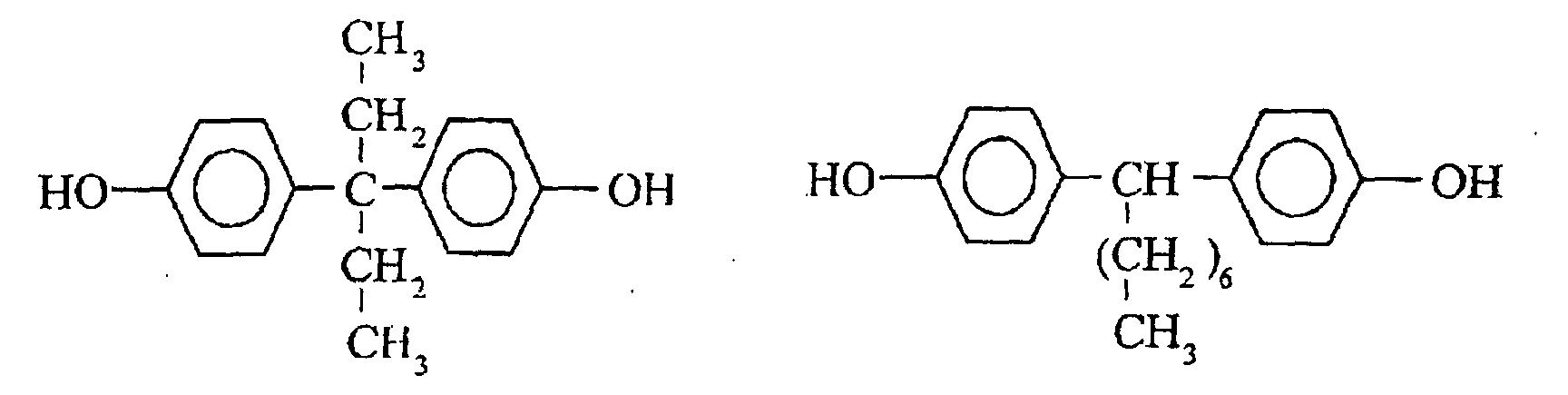
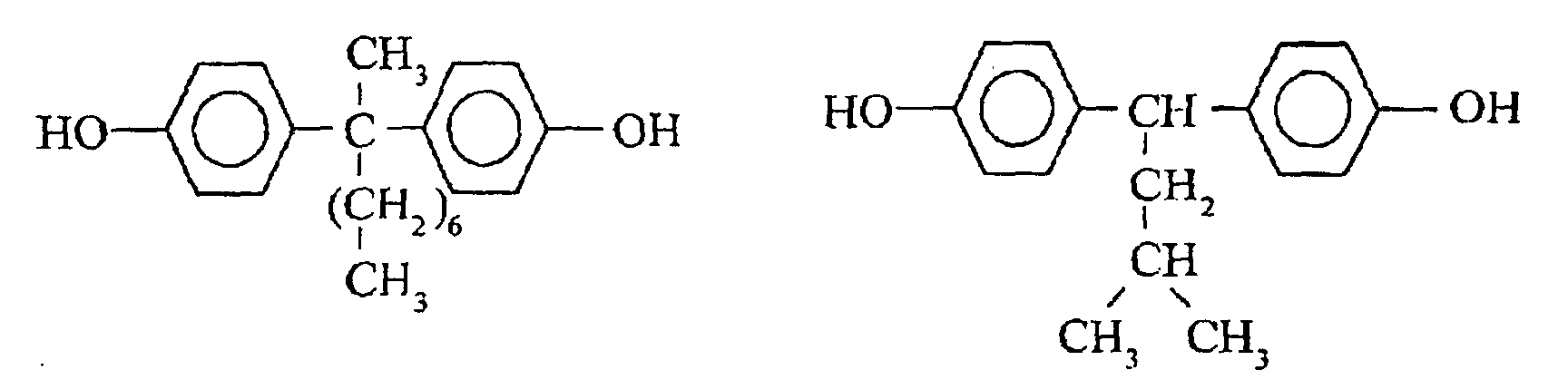
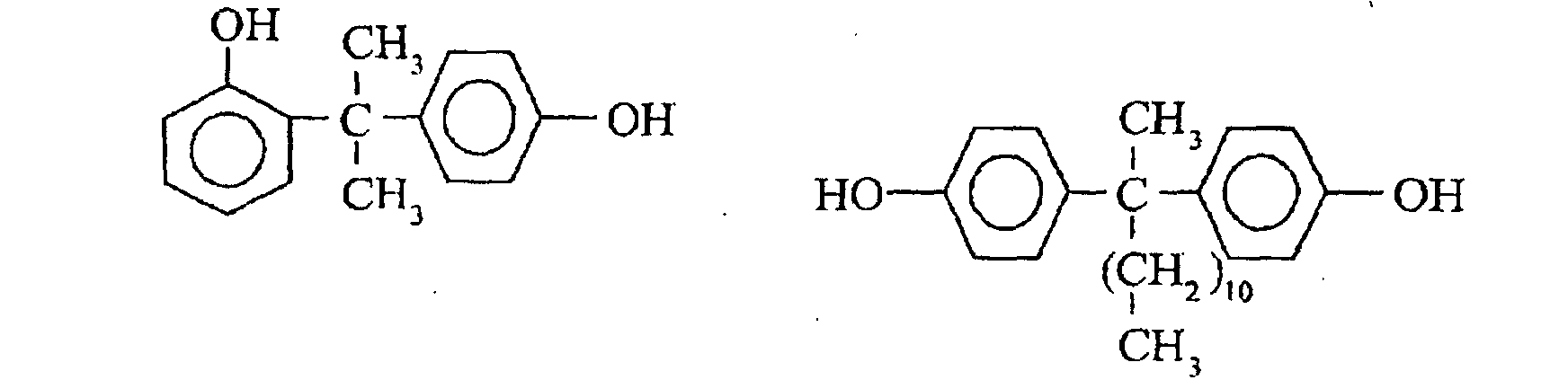


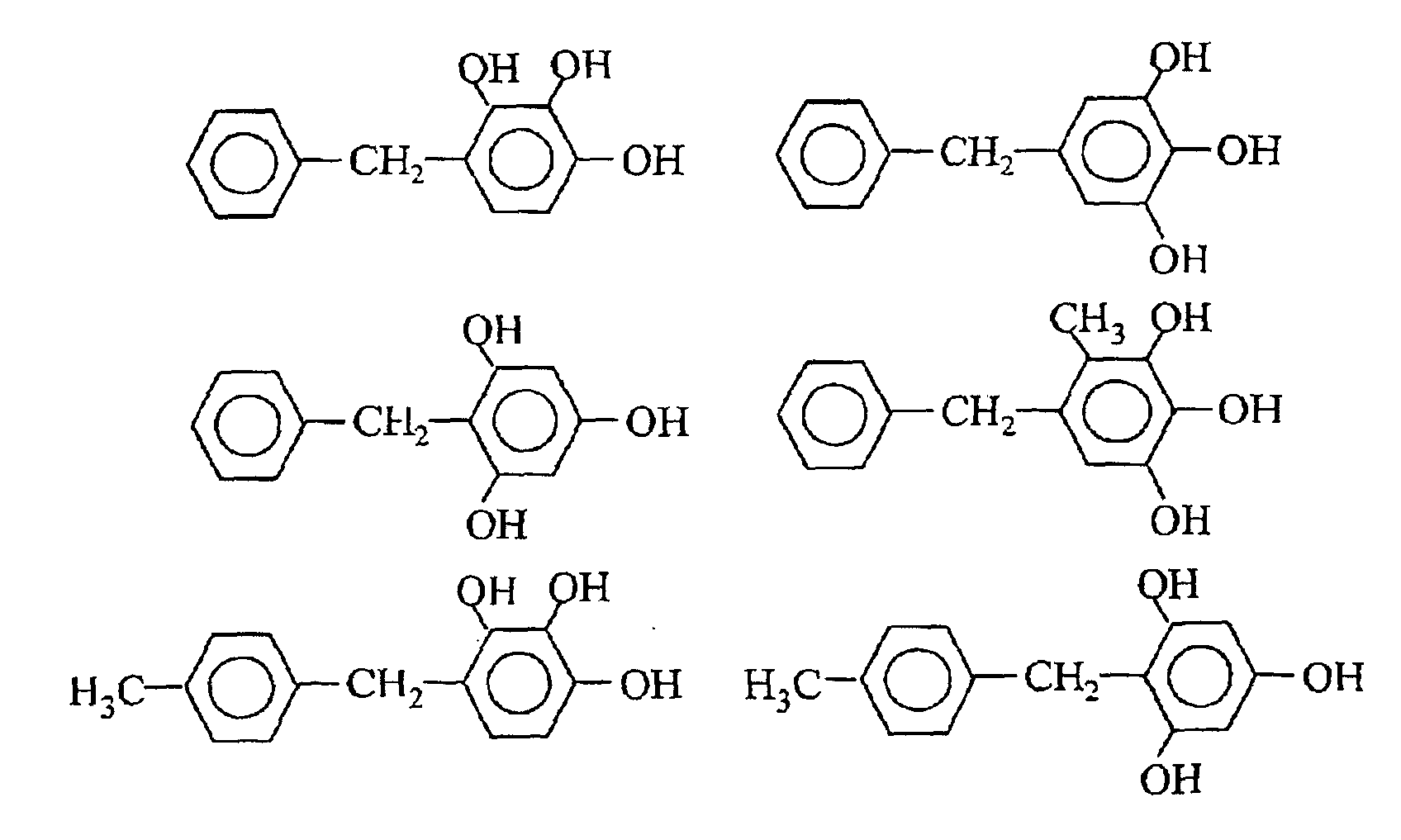




- An amount of the phenol compound (C) to be added is preferably 1 to 30 parts by weight based on 100 parts by weight of the polyamide represented by the general formula (1). When an amount of the phenol compound to be added exceeds the upper limit, there is a possibility of a serious decrease of a film thickness retention rate as well as deposition during refrigerated storage. When the amount to be added is less than the lower limit, there is a possibility of a decrease of sensitivity in development.
- Additives such as a leveling agent and a silane coupling agent can be added to the positive-working photosensitive resin composition of the present invention if necessary.
- These agents are dissolved in a solvent and used in a state of varnish in the present invention. The solvent includes N-methyl-2-pyrrolidone, γ-butyrolactone, N,N-dimethylacetamide, dimethyl sulfoxide, diethylene glycol dimethyl ether, diethylene glycol diethyl ether, diethylene glycol dibutyl ether, propyrene glycol monomethyl ether, dipropyrene glycol monomethyl ether, propyrene glycol monomethyl ether acetate, methyl lactate, ethyl lactate, butyl lactate, methyl-1,3-butylene glycol acetate, 1,3-butylene glycol-3-monomethyl ether, methyl pyruvate, ethyl pyruvate, methyl-3-methoxy propionate and the like, and may be used solely or in a mixture.
- With regard to a method for using the positive-working photosensitive resin composition of the present invention, first, said composition is applied to a suitable base material, for instance, a silicon wafer, a ceramic substrate and an aluminum substrate. An amount to be coated is determined so that a final thickness of coating film after curing becomes 0.1 to 30 µm in the case of a semiconductor device. Film thickness of 0.1 µm or less makes it difficult to fully exert a function as a surface protection film for a semiconductor element, and the thickness of 30 µm or more not only makes it difficult to obtain a finely processed pattern but to lower throughput due to a prolonged processing time. A method for applying includes rotary film using a spinner, spray film using a spray coater, dipping, printing and roll film and the like.
- Secondly, the coating film is dried by prebaking at 60 to 130°C and then an actinic ray is irradiated in a desired pattern. An actinic ray to be used includes X-ray, electron beam, ultraviolet ray, visible ray and the like, and has preferably a wavelength of 200 to 500 nm.
- Thirdly, an exposed area is removed by dissolving with a developing solution to obtain a relief pattern. A developing solution to be suitably used includes inorganic alkalis such as sodium hydroxide, potassium hydroxide, sodium carbonate, sodium silicate, sodium metasilicate and aqueous ammonia, primary amines such as ethylamine and n-propylamine, secondary amines such as diethylamine and di-n-propylamine, tertiary amines such as triethylamine and methyldiethylamine, alcohol amines such as dimethy ethanol amine and triethanol amine, an aqueous solution of alkalis such as a quaternary ammonium salt such as tetramethylammonium hydroxide and tetraethylammonium hydroxide and an aqueous solution obtained by adding a suitable amount of a water-soluble organic solvent such as methanol and ethanol or a surfactant to the above aqueous solution of alkalis. As a method for developing, those such as spraying, paddling, dipping and supersonic methods can be used.
- Finally, a relief pattern formed by development is rinsed. Distilled water is used for rinsing. An oxazole ring and/or an imide ring are then formed by a heat treatment to obtain a final pattern of stout heat resistance.
- A positive-working photosensitive resin composition of the present invention is useful not only for a semiconductor, but also for an interlayer insulation for a multilayered circuit, a cover coating for a flexible cupperclad plate, a solder resist film, a liquid crystal alignment layer and the like. Known processing steps can be used for other production steps of a semiconductor.
- The present invention will be specifically described by Examples hereinbelow.
- A dicarboxylic acid derivative of 360.4 g (0.9 mol) obtained by reacting 0.9 mol of terephthalic acid, 0.1 mol of isophthalic acid and 2 mol of 1-hydroxy-1,2,3-benzotriazole, and 366.3 g (1 mol) of hexafluoro-2,2-bis(3-amino-4-hydroxy phenyl)propane were charged in a four-necked separable flask equipped with a thermometer, an agitator, a feed inlet and a dry nitrogen gas inlet tube, and added and dissolved with 3,000 g of N-methyl-2-pyrrolidone. The thus obtained mixture was then reacted at 75°C in an oil bath for 12 hours.
- The above mixture was then added with 32.8 g (0.2 mol) of 5-norbornene-2,3-dicarboxylic anhydride dissolved in 500 g of N-methyl-2-pyrrolidone and reacted for another 12 hours while stirring. After filtration, the reaction mixture was added to a solution of water/methanol of 3/1. A cake obtained by filtering a deposit was rinsed sufficiently with water and then dried under vacuum to obtain a desired polyamide (PA-1) represented by the general formula (1), wherein, X was represented by the formula X-1 below, Y was a mixture of the formulae Y-1 and Y-2 below, a = 100, and b = 0.
- The synthesized polyamide (PA-1) of 100 g and 15 g of a 1,2-naphthoquinone-2-diazide-4-sulfonate ester compound having a structure represented by the formula (Q-1) below were dissolved in 200 g of γ-butyrolactone and then filtrated using a 0.2 µm filter made of a fluorocarbon resin to obtain a positive-working photosensitive resin composition.
- The obtained positive-working photosensitive resin composition was applied on a silicon wafer using a spincoater and then dried at 120°C for 4 minutes using a hotplate to obtain a coating film of about 16 µm thickness. The thus obtained coating film was exposed through a mask made by TOPPAN PRINTING CO., LTD. (Test Chart No. 1: patterns for remaining and patterns for removing of 0.88 to 50 µm width were depicted) using an i-line stepper NSR-4425i made by Nicon Corp., with various exposure amount. The silicon wafer was rinsed with pure water for 30 seconds after an exposed area of the composition was dissolved and removed by dipping in a 2.38% aqueous solution of tetramethylammonium hydroxide for 80 seconds. As a result, it was confirmed that a pattern had been formed in an exposed area at the exposure amount of 620 mJ/cm2 (sensitivity was 620 mJ/cm2). A film thickness retention rate [(film thickness after development)/(film thickness before development) x 100] was 88.1% and a resolution was 8 µm which were satisfactory values. The coating film was then cured in a clean oven at 150°C/30 minutes and 320°C/30 minutes under a condition of an oxygen concentration of 1,000 ppm or less. A film thickness after curing was 10.8 µm.
- A positive-working photosensitive resin composition was obtained similarly as in Example 1 except that an amount of the photosensitive material (Q-1) added in Example 1 was changed to 10 g, and evaluated similarly as in Example 1.
- A positive-working photosensitive resin composition was obtained similarly as in Example 1 except that an amount of the photosensitive material (Q-1) added in Example 1 was changed to 20 g, and evaluated similarly as in Example 1.
- A positive-working photosensitive resin composition was obtained similarly as in Example 1 except that the photosensitive material (Q-1) in Example 1 was replaced with (Q-2), and evaluated similarly as in Example 1.
- A positive-working photosensitive resin composition was obtained similarly as in Example 1 except that the photosensitive material (Q-1) in Example 1 was replaced with (Q-3), and evaluated similarly as in Example 1.
- A polyamide (PA-2) represented by the general formula (1) wherein X was represented by the formula X-1 below; Y was represented by the formula Y-3 below; a = 100, and b = 0, was synthesized by using 1 mol of diphenylether-4,4'-dicarboxylic acid instead of 0.9 mol of terephthalic acid and 0.1 mol of isophthalic acid in the polyamide synthesis in Example 1. A positive-working photosensitive resin composition was obtained similarly as in Example 1 except the above, and evaluated similarly as in Example 1.
- A polyamide (PA-3) represented by the general formula (1), wherein X was represented by the formula X-2 below; Y was represented by the formula Y-3 below; a = 100, and b = 0, was synthesized by using 1 mol of 3,3'-diamino-4,4'-dihydroxyphenylsulfone instead of hexafluoro-2,2-bis (3-amino-4-hydroxyphenyl)propane. A positive-working photosensitive resin composition was obtained similarly as in Example 1 except the above, and evaluated similarly as in Example 1.
- A mixture of 17.1 g (0.055 mol) of 4,4'-oxydiphthalic anhydride, 13.0 g (0.110 mol) of 2-methyl-2-propanol and 10.9 g (0.138 mol) of pyridine were charged in a four-necked separable flask equipped with a thermometer, an agitator, a feed inlet and a dry nitrogen gas inlet tube, and added and dissolved with 150 g of N-methyl-2-pyrrolidone. After 14.9 g (0.110 mol) of 1-hydroxy-1,2,3-benzotriazole and 30 g of N-methyl-2-pyrrolidone were dropped in the reacted solution, 22.7 g (0.110 mol) of dicyclohexylcarbodiimide and 50 g of N-methyl-2-pyrrolidone were dropped in the above solution and reacted at a room temperature overnight.
- Subsequently, 27.1 g (0.055 mol) of a dicarboxylic acid derivative (activated ester) obtained by reacting 1 mol of diphenylether-4,4'-dicarboxylic acid and 2 mol of 1-hydroxy-1,2,3-benzotriazole, 44.8 g (0.122 mol) of hexafluoro-2,2-bis(3-amino-4-hydroxyphenyl)propane and 70 g of N-methyl-2-pyrrolidone were added to the above reacted solution and stirred at a room temperature for 2 hours. Subsequently, the above mixture was reacted similarly as in Example 1 except that the mixture was reacted at 75°C for 12 hours using an oil bath to synthesize a polyamide resin (PA-4) represented by the general formula (1), wherein X was represented by the formula X-1 below; Y was represented by the formulae Y-3 and Y-4 below. A positive-working photosensitive resin composition was obtained similarly as in Example 1 except the above, and evaluated similarly as in Example 1.
- A positive-working photosensitive resin composition was obtained similarly as in Example 1 except that the photosensitive material (Q-1) in Example 1 was replaced with (Q-4), and evaluated similarly as in Example 1.
- A positive-working photosensitive resin composition was obtained similarly as in Example 1 except that the 1,2-naphthoquinone-2-diazide-4-sulfonate ester compound (Q-1) in Example 1 was replaced with (Q-5), and evaluated similarly as in Example 1.
- A positive-working photosensitive resin composition was obtained similarly as in Example 6 except that the 1,2-naphthoquinone-2-diazide-4-sulfonate ester compound (Q-1) in Example 6 was replaced with (Q-5), and evaluated similarly as in Example 1.
- A positive-working photosensitive resin composition was obtained similarly as in Example 1 except that the photosensitive material (Q-1) in Example 1 was replaced with (Q-6), and evaluated similarly as in Example 1.
- A positive-working photosensitive resin composition was obtained similarly as in Example 1 except that the photosensitive material (Q-1) in Example 1 was replaced with (Q-7), and evaluated similarly as in Example 1.
- A positive-working photosensitive resin composition was obtained similarly as in Example 1 except that the photosensitive material (Q-1) in Example 1 was replaced with (Q-8), and evaluated similarly as in Example 1.
- A mixture of 100 g of the polyamide resin (PA-1) used in Example 1, 15 g of a 1,2-naphthoquinone-2-diazide-4-sulfonate ester compound having a structure represented by the formula (Q-1) below and further 15 g of a phenol (P-1) having the structure below was dissolved in 200 g of γ-butyrolactone, and then filtrated with a 0.2 µm filter made of a fluorocarbon resin to obtain a positive-working photosensitive resin composition. The composition was evaluated similarly as in Example 1.
- A mixture of 100 g of the polyamide resin (PA-2) used in Example 6, 15 g of a 1,2-naphthoquinone-2-diazide-4-sulfonate ester compound having a structure represented by the formula (Q-1) below and further 15 g of a phenol (P-1) having the structure below was dissolved in 200 g of γ-butyrolactone, and then filtrated with a 0.2 µm filter made of a fluorocarbon resin to obtain a positive-working photosensitive resin composition. The composition was evaluated similarly as in Example 1.
- A positive-working photosensitive resin composition was obtained similarly as in Example 13 except that the phenol compound (P-1) in Example 13 was replaced with (P-2), and evaluated similarly as in Example 1.
- A positive-working photosensitive resin composition was obtained similarly as in Example 13 except that the 1,2-naphthoquinone-2-diazide-4-sulfonate ester compound (Q-1) in Example 13 was replaced with (Q-5), and evaluated similarly as in Example 1.
- A positive-working photosensitive resin composition was obtained similarly as in Example 14 except that the 1,2-naphthoquinone-2-diazide-4-sulfonate ester compound (Q-1) in Example 14 was replaced with (Q-5), and evaluated similarly as in Example 1.
- A positive-working photosensitive resin composition was obtained similarly as in Example 15 except that the 1,2-naphthoquinone-2-diazide-4-sulfonate ester compound (Q-1) in Example 15 was replaced with (Q-5), and evaluated similarly as in Example 1.
- A positive-working photosensitive resin composition was obtained similarly as in Example 13 except that the 1,2-naphthoquinone-2-diazide-4-sulfonate ester compound (Q-1) in Example 13 was replaced with (Q-7), and evaluated similarly as in Example 1.
- A positive-working photosensitive resin composition was obtained similarly as in Example 13 except that the 1,2-naphthoquinone-2-diazide-4-sulfonate ester compound (Q-1) in Example 13 was replaced with (Q-8), and evaluated similarly as in Example 1.


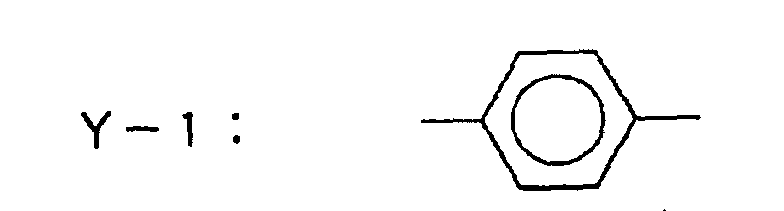


 (wherein, Q is a hydrogen atom or:
 and 90% of total Q is:)
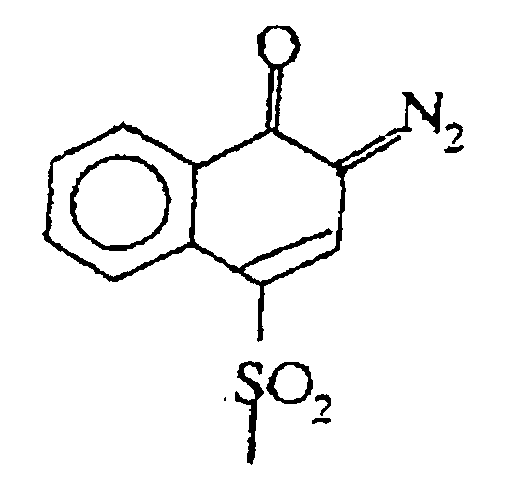 (wherein, Q is a hydrogen atom or:
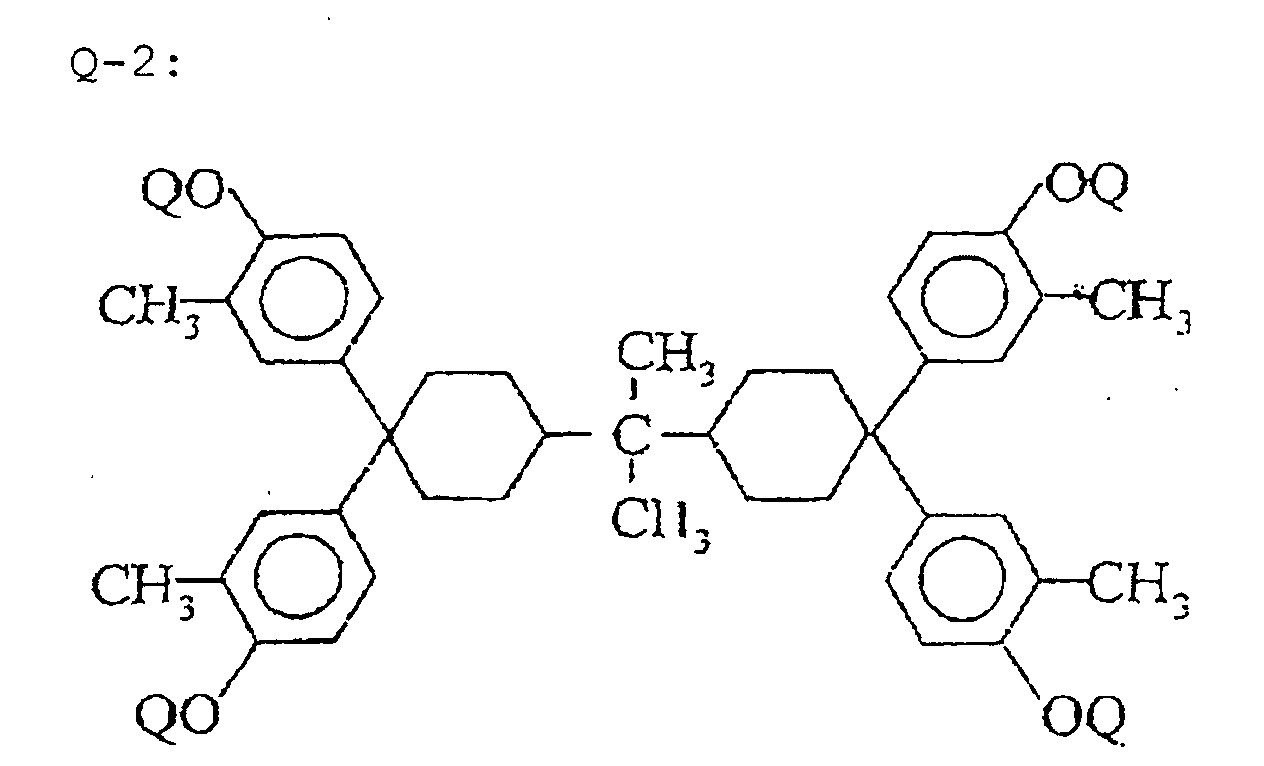 and 100% of total Q is:)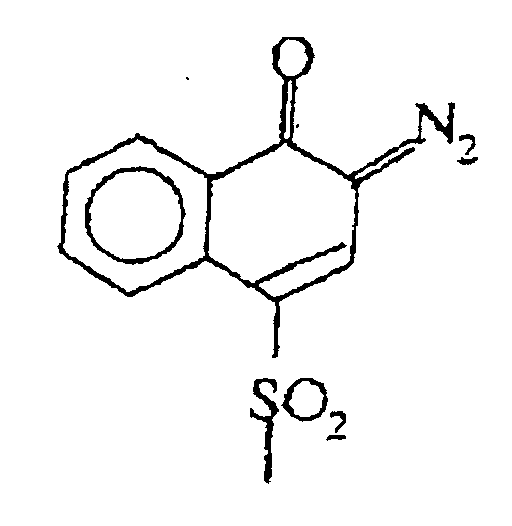
 (wherein, Q is a hydrogen atom or:
 and 75% of total Q is:)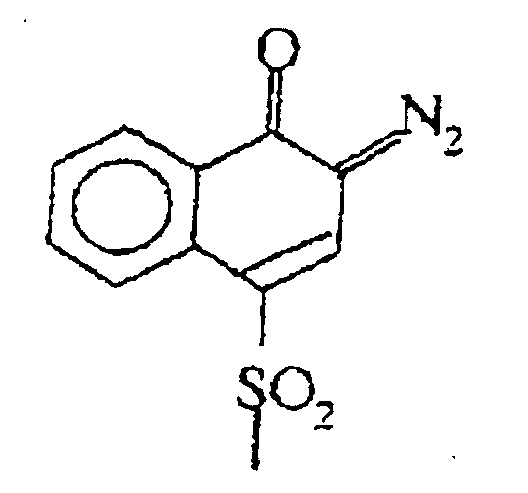
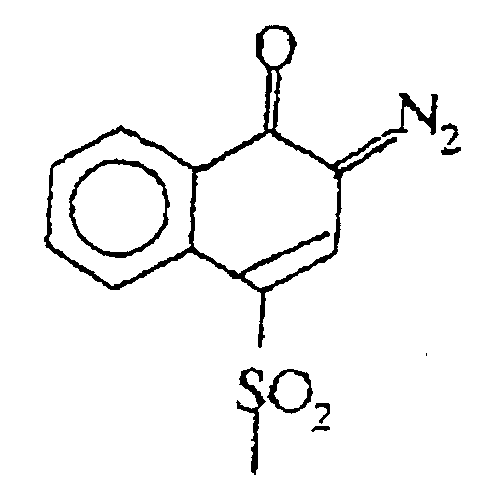 (wherein, Q is a hydrogen atom or:
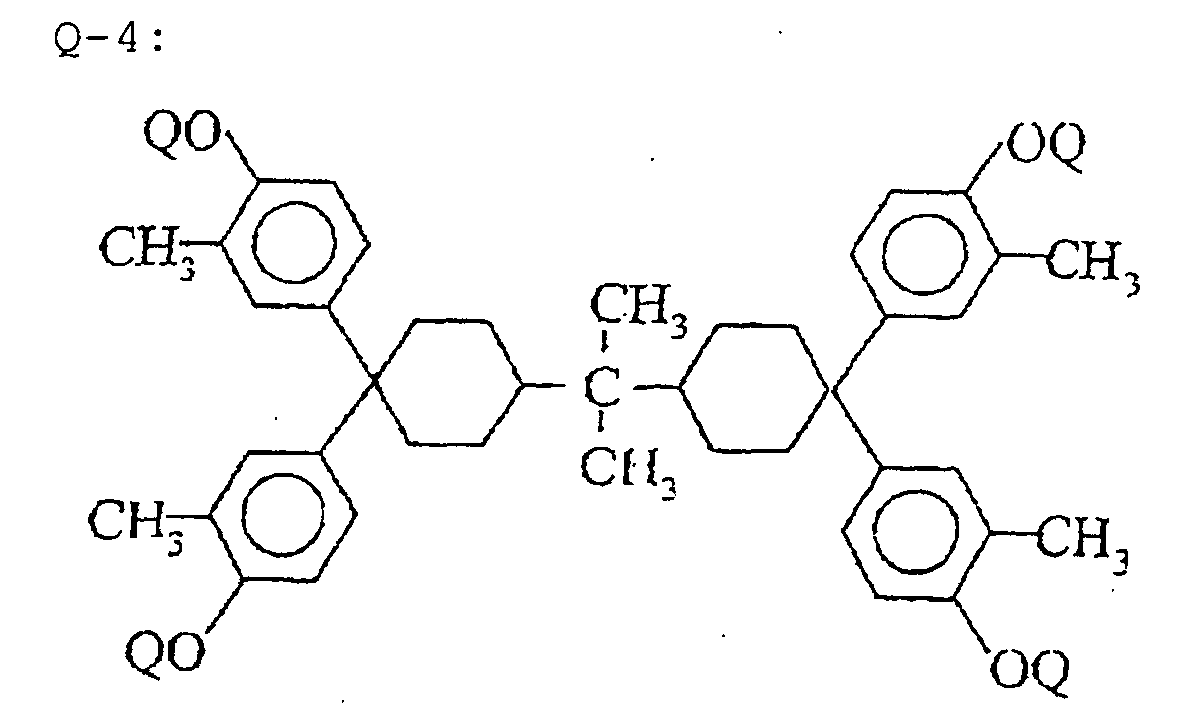 and 90% of total Q is:)
 (wherein, Q is a hydrogen atom or:
 and 90% of total Q is:)
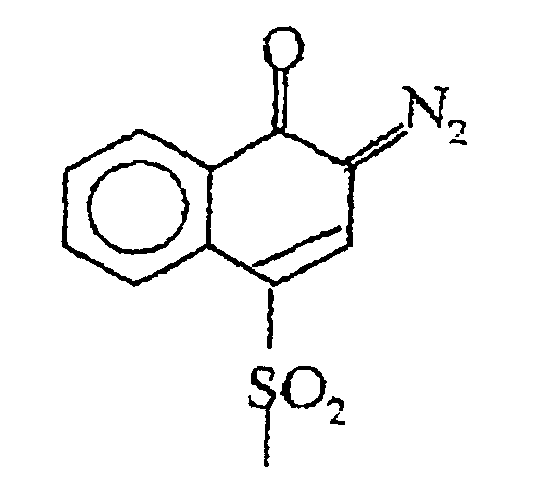 (wherein, Q is a hydrogen atom or:
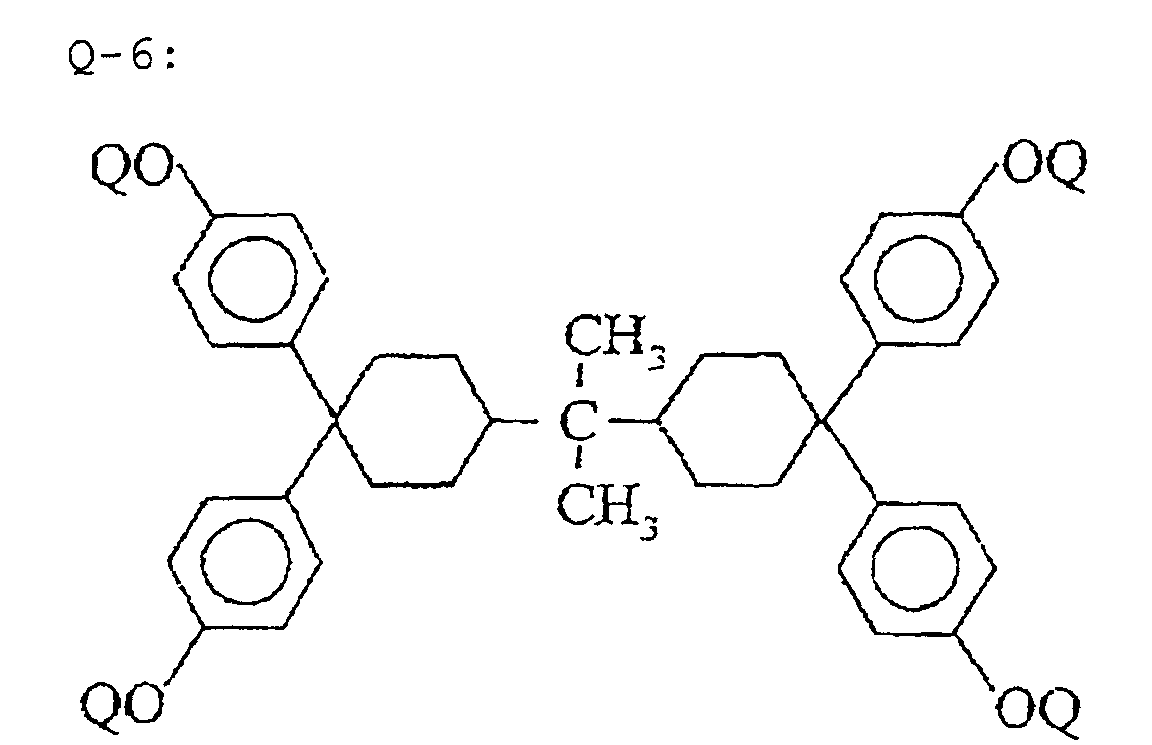 and 90% of total Q is:)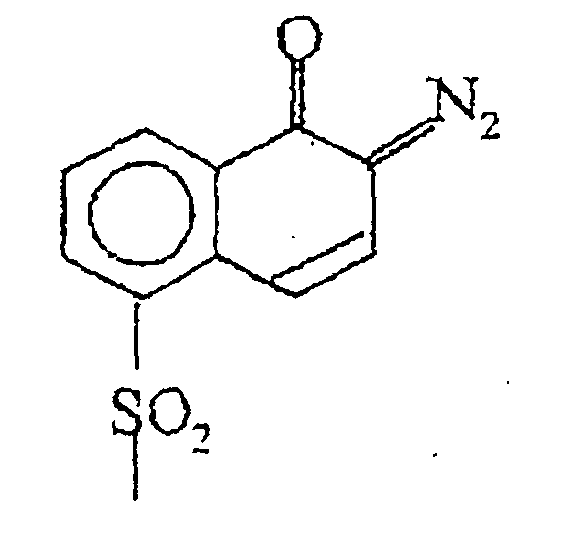
 (wherein, Q is a hydrogen atom or:
 and 67% of total Q is:)
 (wherein, Q is a hydrogen atom or:
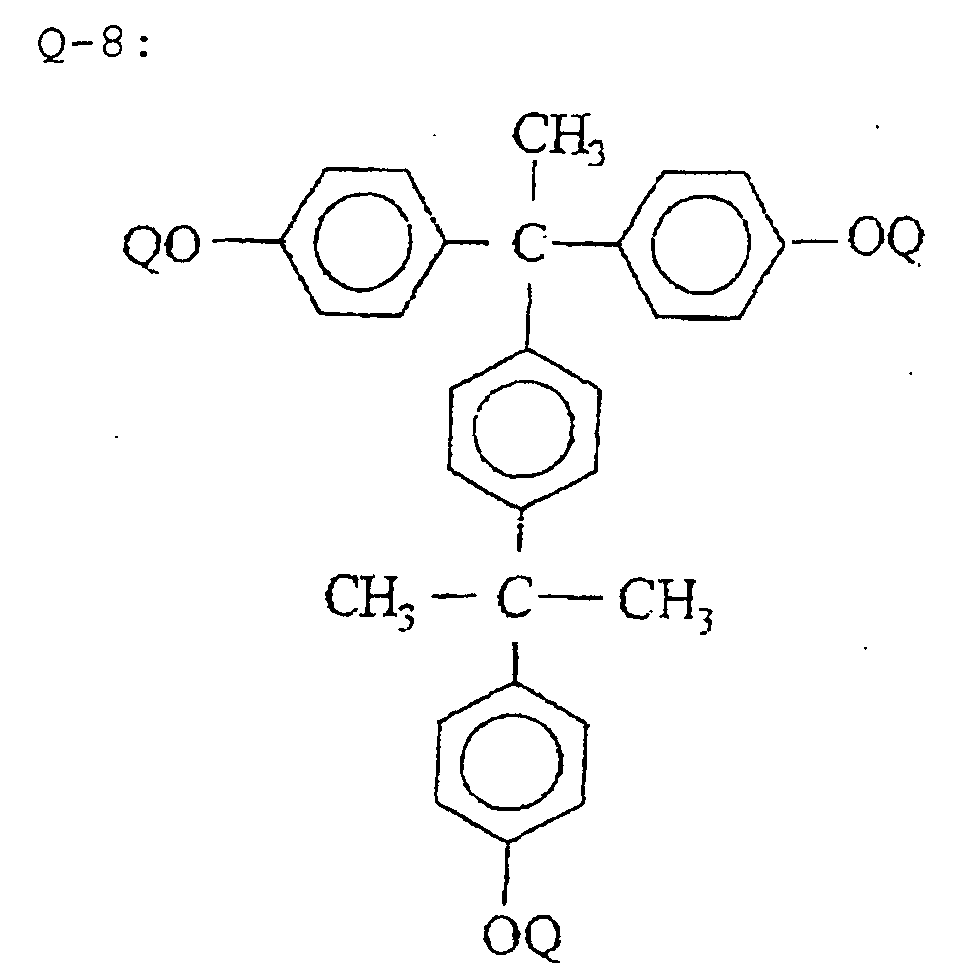 and 70% of total Q is:)
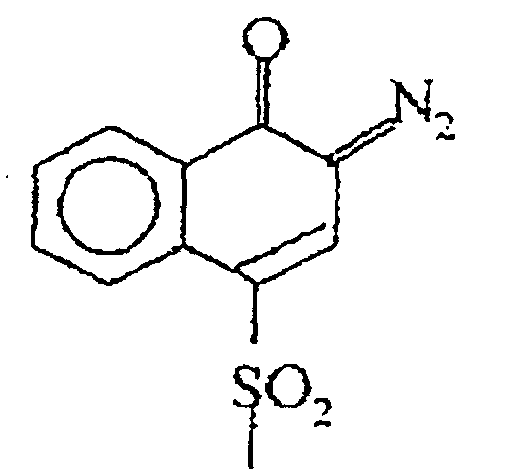


- Results of the evaluation in Examples 1 to 12 and Comparative Examples 1 to 2 are shown in Table 1, and results of the evaluation in Examples 13 to 18 and Comparative Examples 3 to 4 are shown in Table 2.

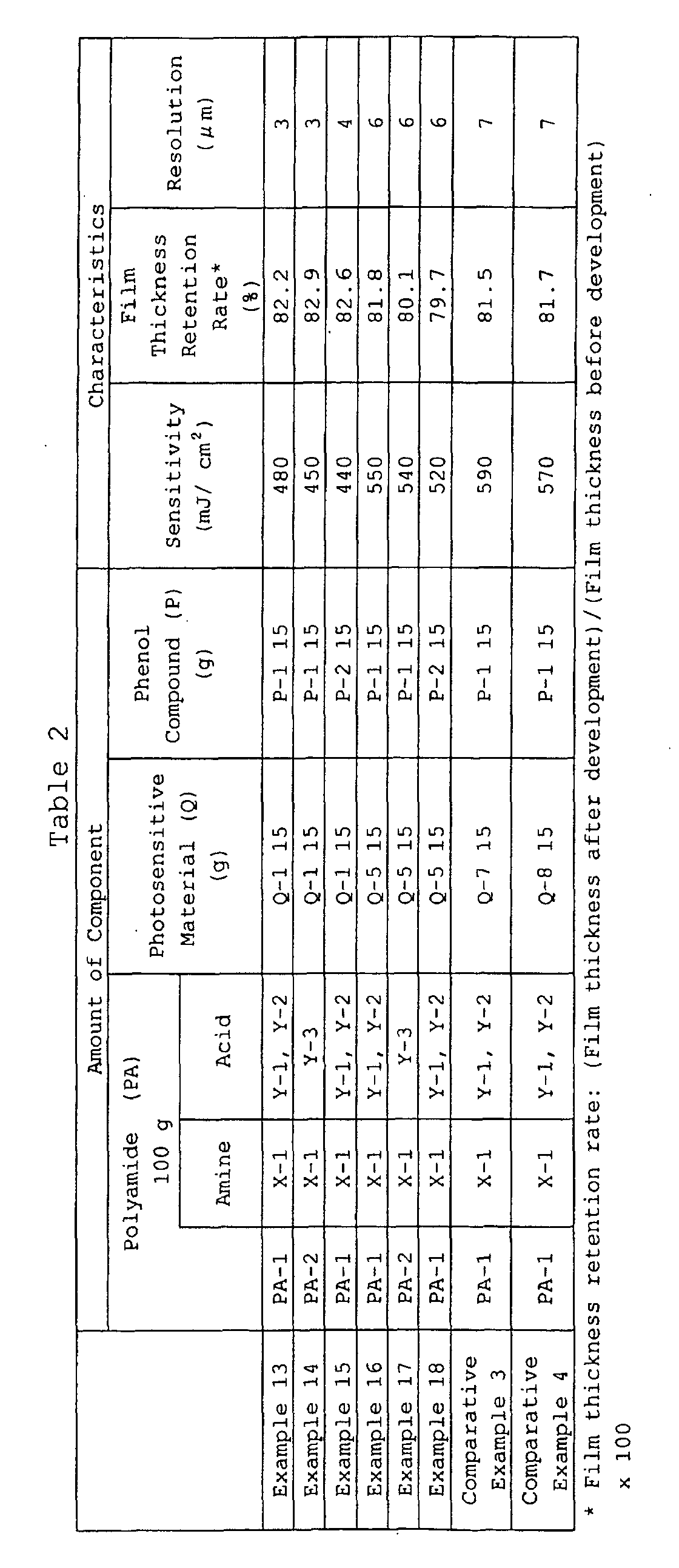
- The positive-working photosensitive resin composition used in Example 1 was applied on a silicon wafer using a spincoater, and then dried at 90°C for 30 minutes in a box-type oven to obtain a coating film of about 50 µm thickness. The thus obtained coating film was exposed with an exposure amount of 3,000 mJ through a mask made by TOPPAN PRINTING CO., LTD. (Test Chart No. 1: patterns for remaining and patterns for removing of 0.88 to 50 µm width were depicted) using Maskaligner PLA-600F made by CANON Inc. After the coating film in the exposed area was dissolved and removed by dipping in a 2.38% aqueous solution of tetramethylammonium hydroxide for 150 seconds, the silicon wafer was then rinsed with pure water for 30 seconds. As a result, it was confirmed that a pattern of 40 µm had been formed. A film thickness retention rate [(film thickness after development)/(film thickness before development) x 100] was 80.4%. The coating film was then cured in a clean oven at 150°C/30 minutes and 320°C/30 minutes under a condition of an oxygen concentration of 1,000 ppm or less. Film thickness after curing was 28.8 µm.
- The positive-working photosensitive resin composition used in Example 1 was applied on a silicon wafer using a spincoater, and then dried at 90°C for 30 minutes in a box-type oven to obtain a film of about 50 µm thickness. The thus obtained film was exposed with an exposure amount of 3,000 mJ through a mask made by TOPPAN PRINTING CO., LTD. (Test Chart No. 1: patterns for remaining and patterns for removing of 0.88 to 50 µm width were depicted) using Maskaligner PLA-600F made by CANON Inc. It took as long as 170 seconds to remove the coating film of a pattern using a 2.38% aqueous solution of tetramethylammonium hydroxide. Similarly, the silicon wafer was rinsed with pure water for 30 seconds. As a result, it was confirmed that a pattern of 60 µm had been formed. A film thickness retention rate [(film thickness after development)/(film thickness before development) x 100] was 72.1%. The coating film was then cured in a clean oven at 150°C/30 minutes and 320°C/30 minutes under a condition of an oxygen concentration of 1,000 ppm or less. Film thickness after curing was 25.2 µm, which was a little thinner than that in Example 19.
- As apparent from the Examples above, according to the present invention, a positive-working photosensitive resin composition with high sensitivity that can form a pattern of a high resolution and a high film thickness retention rate even in an increased film thickness while keeping conventional characteristics, can be obtained.
- A positive-working photosensitive resin composition of the present invention is useful not only for a semiconductor, but also for an interlayer insulation for a multilayered circuit, a cover coating for a flexible cupperclad plate, a solder resist film, a liquid crystal alignment layer and the like.
Claims (16)
- A positive-working photosensitive resin composition characterized by comprising 100 parts by weight of a polyamide (A) represented by the general formula (1):[wherein, X is a cyclic compound group of 2 to 4 valences that may have a hydroxyl group or a group wherein a hydrogen atom of a hydroxyl group is replaced with an organic group having 1 to 20 carbon atoms; Y is a cyclic compound group of 2 to 4 valences that may have a hydroxyl group, a group wherein a hydrogen atom of a hydroxyl group is replaced with an organic group having 1 to 20 carbon atoms, a carboxyl group or a group wherein a hydrogen atom of a hydroxyl group is replaced with an organic group having 1 to 20 carbon atoms; and Z is:
 (wherein, each of R1 and R2 is a bivalent organic group; each of R3 and R4 is a univalent organic group); a and b each shows a molar fraction; a + b = 100% by mole; a = 60 to 100% by mole; b = 0 to 40% by mole)]; and 1 to 50 parts by weight of a photosensitive material (B), that is, a 1,2-naphthoquinone-2-diazide-5-sulfonate ester compound or a 1,2-naphthoquinone-2-diazide-4-sulfonate ester compound of a phenol compound having a skeletal structure represented by the general formula (2):
 (wherein, each of R5 and R6 is a hydrogen atom or an alkyl group; each of R7 and R8 may be the same or different from each other and is one group selected from an alkyl group, an alkoxy group, an aryl group and a cycloalkyl group that has at least one hydroxyl group; n is an integer of 1 to 3).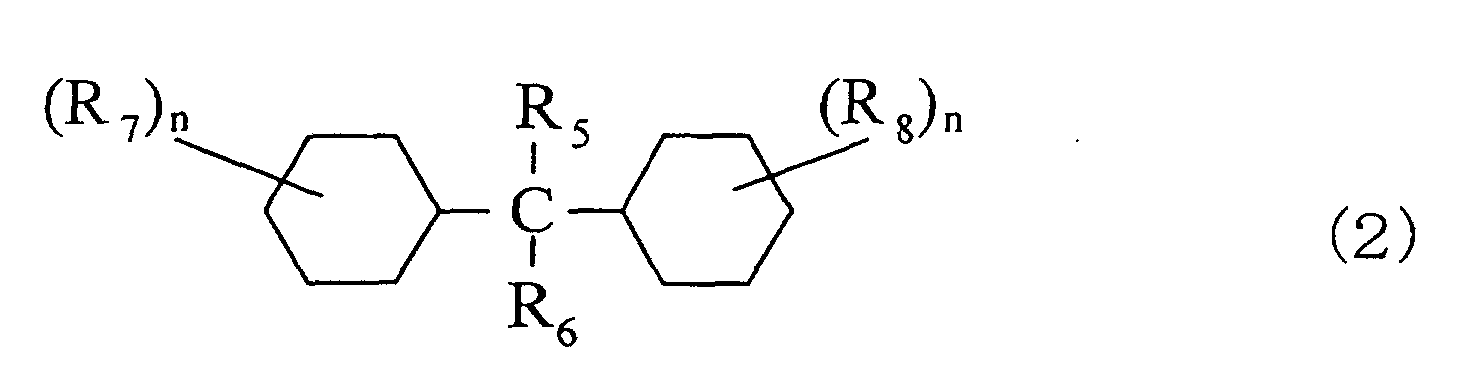
- The positive-working photosensitive resin composition according to claim 1, wherein a polyamide (A) is represented by the general formula (3):[wherein, X is a tetravalent cyclic compound group; Y is a divalent cyclic compound group; Z is:
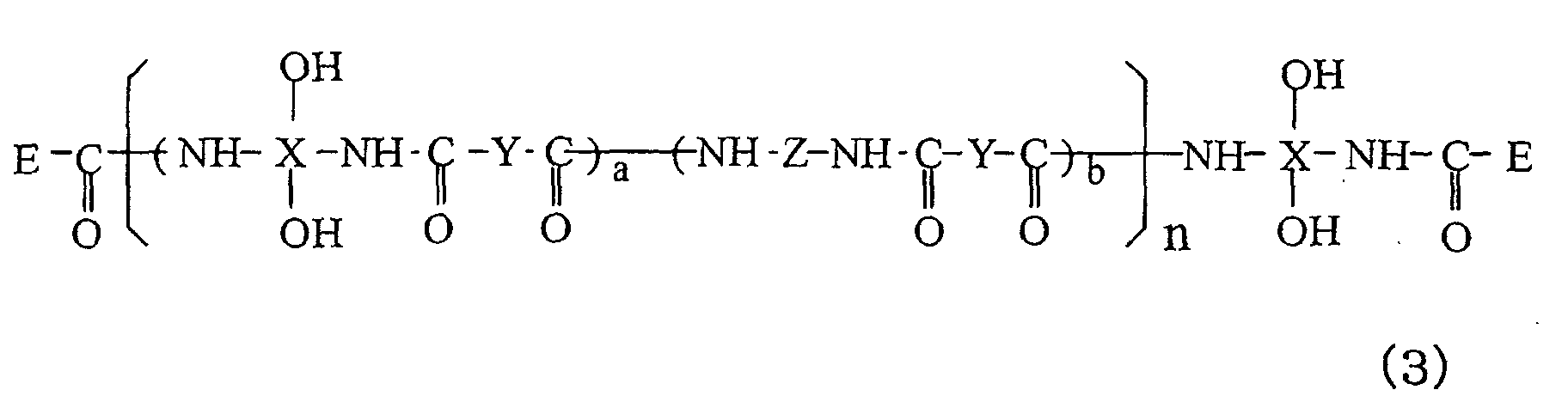 (wherein, each of R1 and R2 is a bivalent organic group; each of R3 and R4 is a univalent organic group); E is an aliphatic group or a cyclic compound group having at least one group of an alkenyl group or an alkynyl group; a and b each shows a molar fraction; a + b = 100% by mole; a = 60 to 100% by mole; b = 0 to 40% by mole; n = 2 to 500)].
- The positive-working photosensitive resin composition according to claim 1 or 2, wherein a photosensitive material (B) is a 1,2-naphthoquinone-2-diazide-5-sulfonate ester compound or a 1,2-naphthoquinone-2-diazide-4-sulfonate ester compound of a phenol compound having a skeletal structure represented by the general formula (4):(wherein, each of R5 and R6 is a hydrogen atom or an alkyl group; each of R9 and R10 may be the same or different from each other and is selected from a hydrogen atom, a halogen atom, an alkyl group, an alkoxy group, an aryl group and a cycloalkyl group; m is an integer of 1 to 3; and n is an integer of 1 to 3).

- The positive-working photosensitive resin composition according to claim 1 or 2, wherein a photosensitive material (B) is a 1,2-naphthoquinone-2-diazide-5-sulfonate ester compound or a 1,2-naphthoquinone-2-diazide-4-sulfonate ester compound of a phenol compound having a skeletal structure represented by the general formula (5).

- The positive-working photosensitive resin composition according to claim 1 or 2 further comprising 1 to 30 parts by weight of a phenol compound (C) represented by the general formula (6):(wherein, each of R11, R12, R13 and R14 is selected from a hydrogen atom, a halogen atom, an alkyl group, an alkoxy group and a cycloalkyl group, and may be the same or different from each other; p is an integer of 0 to 3; q is an integer of 0 to 3; p + q ≧ 2; R15 is selected from a single bond, a methylene group, an alkylene group, an oxygen atom, a carbonyl group a carbonyl ether group, a sulfur atom, a sulfonyl group and an azo group); based on 100 parts by weight of a polyamide (A) represented by the general formula (1) or the general formula (3).
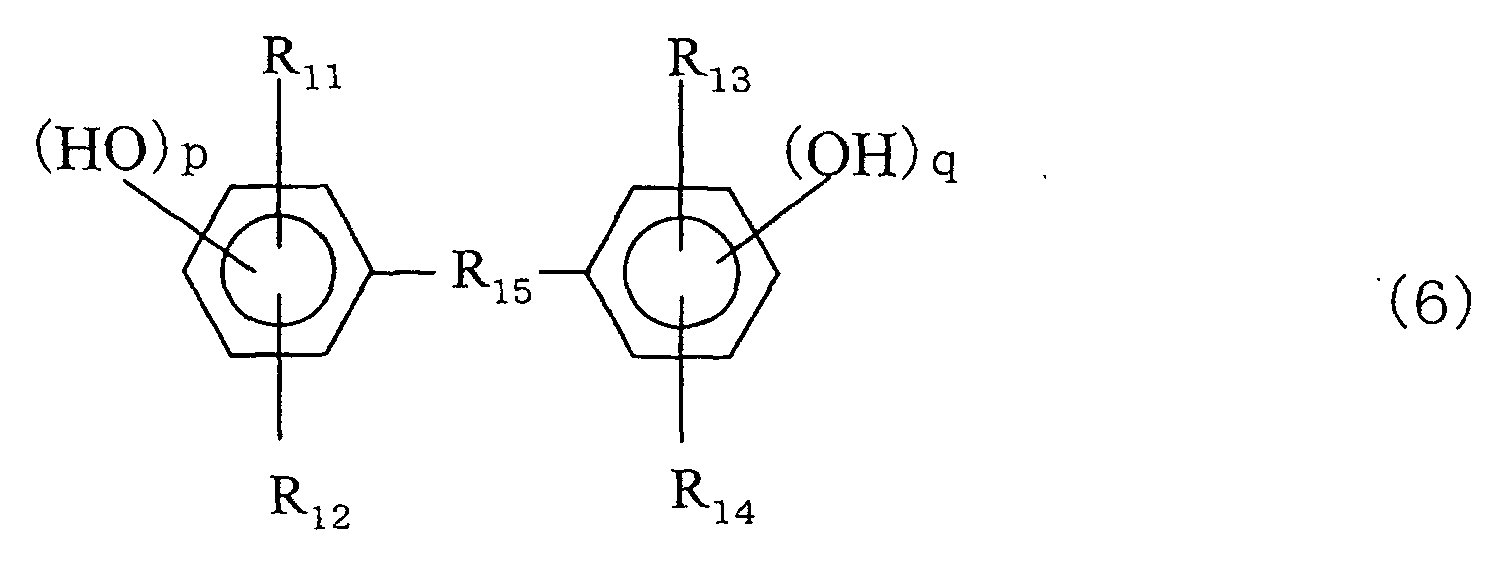
- The positive-working photosensitive resin composition according to claim 1, wherein X in a polyamide represented by the general formula (1) is selected from the groups below:

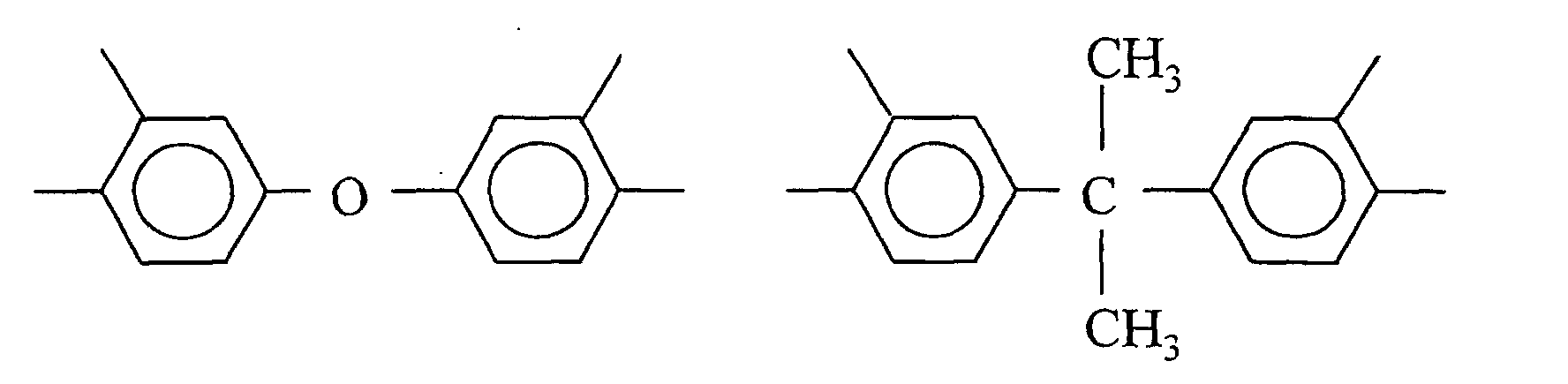

 (wherein, each of R16 is selected from a hydrogen atom, an alkyl group, an alkoxy group, an alkyl ester group and a halogen atom, and may be the same or different from each other; r is an integer of 0 to 2).
- The positive-working photosensitive resin composition according to claim 2, wherein X in a polyamide represented by the general formula (3) is selected from the groups below.
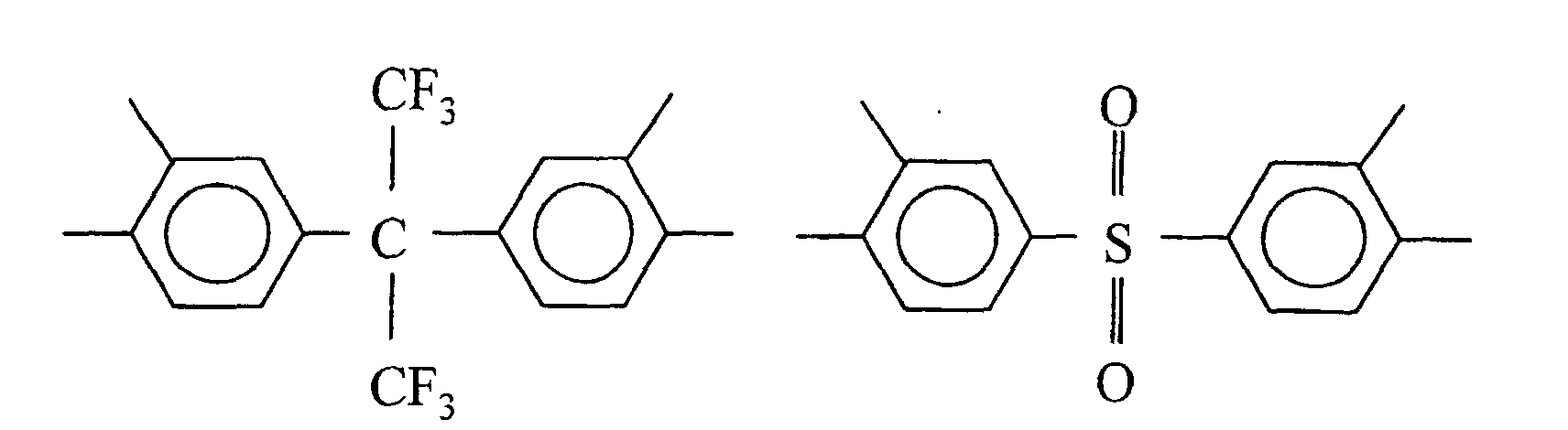
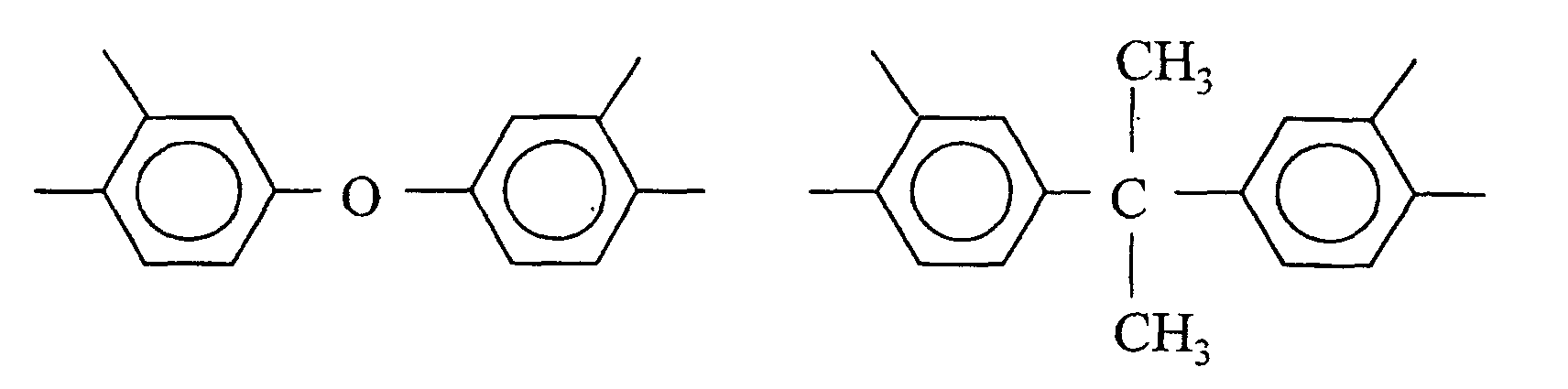
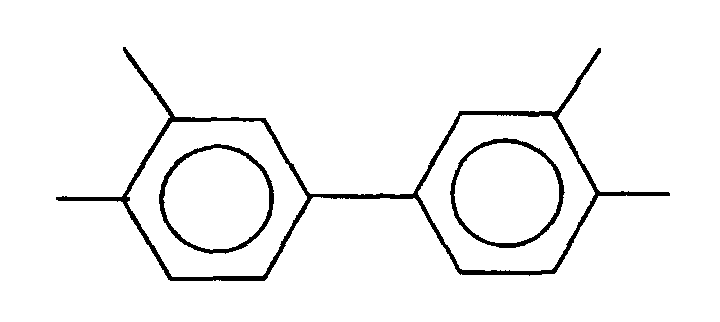
- The positive-working photosensitive resin composition according to claim 1, wherein Y in a polyamide represented by the general formula (1) is selected from the groups below:
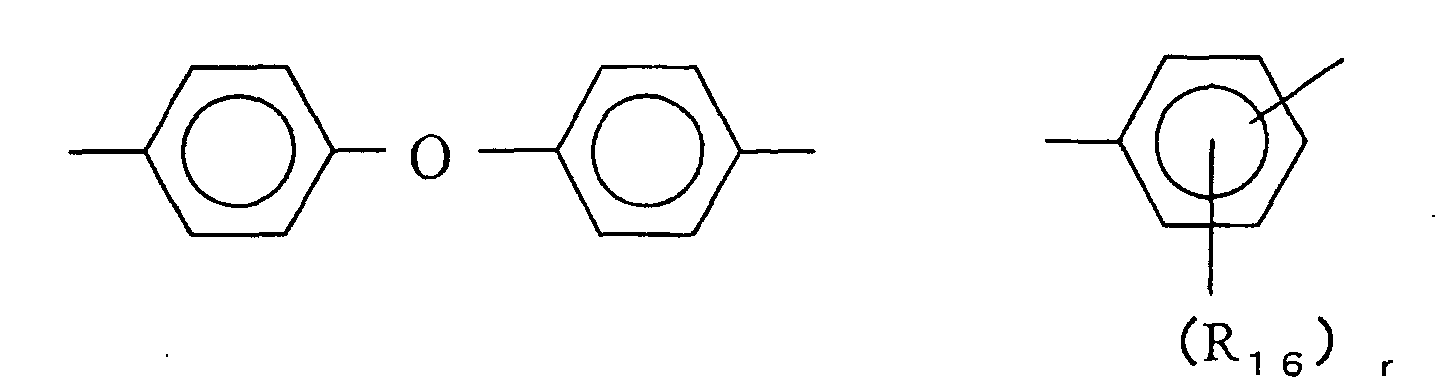


 (wherein, each of R16 is selected from a hydrogen atom, an alkyl group, an alkoxy group, an alkyl ester group and a halogen atom, and may be the same or different from each other; r is an integer of 0 to 2).
- The positive-working photosensitive resin composition according to claim 2, wherein Y in a polyamide represented by the general formula (3) is selected from the groups below:
 (wherein, each of R16 is selected from a hydrogen atom, an alkyl group, an alkoxy group, an alkyl ester group and a halogen atom, and may be the same or different from each other; r is an integer of 0 to 2).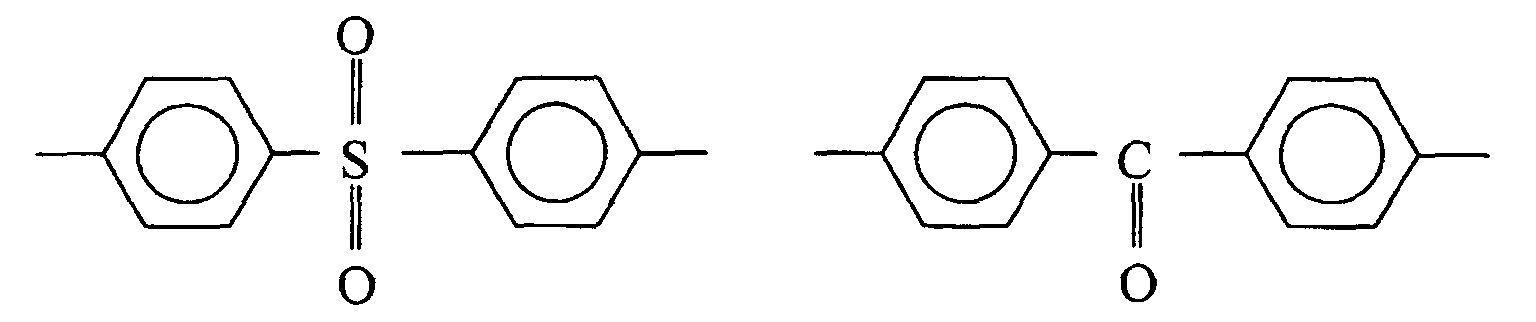
- The positive-working photosensitive resin composition according to claim 1, wherein a terminal group of a polyamide represented by the general formula (1) is bonded with an aliphatic group or a cyclic compound group having at least one group of an alkenyl. group or an alkynyl group.
- The positive-working photosensitive resin composition according to claim 1 or 2, wherein a terminal group of a polyamide represented by the general formula (1) or the general formula (3) is selected from the groups below.
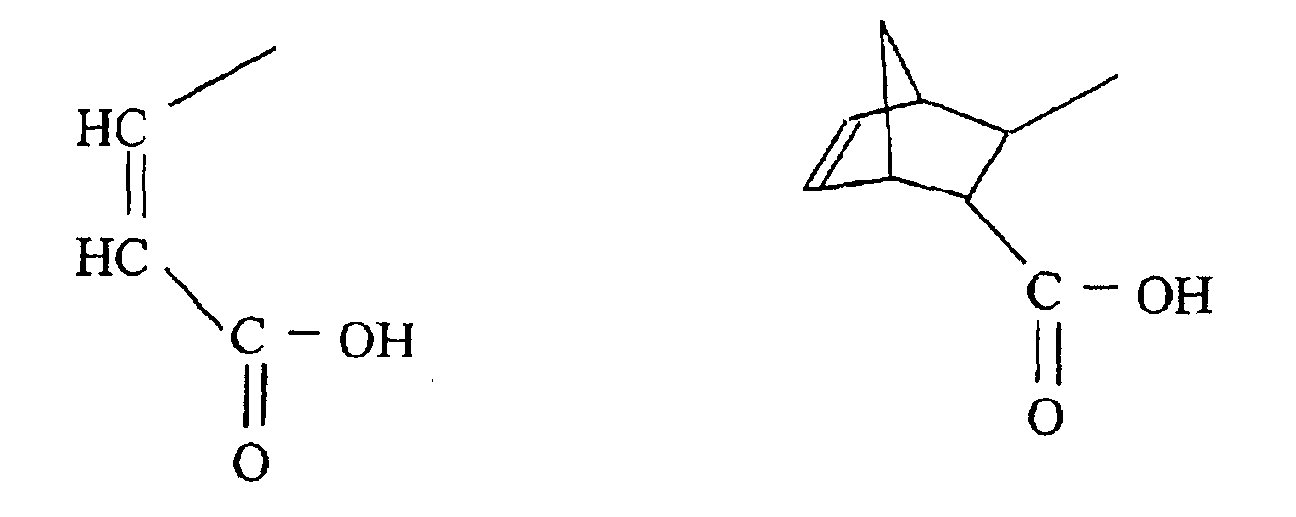
- The positive-working photosensitive resin composition according to claim 5, wherein a terminal group of a polyamide represented by the general formula (1) or the general formula (3) is selected from the groups below.

- A semiconductor device manufactured by using the positive-working photosensitive resin composition according to claim 1 or 2.
- A semiconductor device manufactured by using the positive-working photosensitive resin composition according to claim 5.
- A semiconductor device obtained by applying the positive-working photosensitive resin composition according to claim 1 or 2 on a semiconductor element so that a film thickness of said positive-working photosensitive resin composition becomes 0.1 to 30 µm after heating, dehydration and cyclization, followed by prebaking, exposing, developing and heating.
- A semiconductor device obtained by applying the positive-working photosensitive resin'composition according to claim 5 on a semiconductor element so that a film thickness of said positive-working photosensitive resin composition becomes 0.1 to 30 µm after heating, dehydration and cyclization, followed by prebaking, exposing, developing and heating.
Applications Claiming Priority (9)
| Application Number | Priority Date | Filing Date | Title |
|---|---|---|---|
| JP2001135675 | 2001-05-07 | ||
| JP2001135675 | 2001-05-07 | ||
| JP2001262718A JP2003029407A (en) | 2001-05-07 | 2001-08-31 | Positive photosensitive resin composition and semiconductor device |
| JP2001262718 | 2001-08-31 | ||
| JP2001286437 | 2001-09-20 | ||
| JP2001286437 | 2001-09-20 | ||
| JP2002098982 | 2002-04-01 | ||
| JP2002098982 | 2002-04-01 | ||
| PCT/JP2002/004325 WO2002091082A1 (en) | 2001-05-07 | 2002-04-30 | Positive photosensitive resin compositions and semiconductor device |
Publications (3)
| Publication Number | Publication Date |
|---|---|
| EP1400849A1 true EP1400849A1 (en) | 2004-03-24 |
| EP1400849A4 EP1400849A4 (en) | 2007-09-12 |
| EP1400849B1 EP1400849B1 (en) | 2012-04-04 |
Family
ID=27482251
Family Applications (1)
| Application Number | Title | Priority Date | Filing Date |
|---|---|---|---|
| EP02720636A Expired - Lifetime EP1400849B1 (en) | 2001-05-07 | 2002-04-30 | Positive photosensitive resin compositions and semiconductor device |
Country Status (5)
| Country | Link |
|---|---|
| US (1) | US6927013B2 (en) |
| EP (1) | EP1400849B1 (en) |
| KR (1) | KR100830773B1 (en) |
| TW (1) | TWI303016B (en) |
| WO (1) | WO2002091082A1 (en) |
Families Citing this family (8)
| Publication number | Priority date | Publication date | Assignee | Title |
|---|---|---|---|---|
| JP2004045491A (en) * | 2002-07-09 | 2004-02-12 | Sumitomo Bakelite Co Ltd | Method for forming film of positive type photosensitive resin |
| JP2009108074A (en) * | 2002-07-31 | 2009-05-21 | Sumitomo Bakelite Co Ltd | Naphthoquinone diazide sulfonic acid ester, positive photosensitive resin composition using it, and semiconductor unit |
| EP1775316A4 (en) * | 2004-07-16 | 2011-11-02 | Asahi Kasei Emd Corp | Polyamide |
| EP1662322B1 (en) * | 2004-11-26 | 2017-01-11 | Toray Industries, Inc. | Positive type photo-sensitive siloxane composition, curing film formed by the composition and device with the curing film |
| KR101333698B1 (en) * | 2009-11-10 | 2013-11-27 | 제일모직주식회사 | Positive photosensitive resin composition |
| KR20120066923A (en) | 2010-12-15 | 2012-06-25 | 제일모직주식회사 | Novel phenol compounds and positive photosensitive resin composition including the same |
| KR101423539B1 (en) | 2010-12-20 | 2014-07-25 | 삼성전자 주식회사 | Positive type photosensitive resin composition |
| KR20240143450A (en) | 2023-03-24 | 2024-10-02 | 주식회사 케미웍스 | Novel diamine compuond and polybenzoxazole polymer formed from the same |
Family Cites Families (6)
| Publication number | Priority date | Publication date | Assignee | Title |
|---|---|---|---|---|
| DE2931297A1 (en) | 1979-08-01 | 1981-02-19 | Siemens Ag | HEAT-RESISTANT POSITIVE RESISTS AND METHOD FOR PRODUCING HEAT-RESISTANT RELIEF STRUCTURES |
| JPH05297582A (en) * | 1992-04-23 | 1993-11-12 | Fuji Photo Film Co Ltd | Positive photoresist composition |
| TW502135B (en) * | 1996-05-13 | 2002-09-11 | Sumitomo Bakelite Co | Positive type photosensitive resin composition and process for preparing polybenzoxazole resin film by using the same |
| JP3449925B2 (en) * | 1997-08-08 | 2003-09-22 | 住友ベークライト株式会社 | Positive photosensitive resin composition |
| JP3449926B2 (en) * | 1997-09-02 | 2003-09-22 | 住友ベークライト株式会社 | Positive photosensitive resin composition |
| JP3801379B2 (en) * | 1999-03-29 | 2006-07-26 | 住友ベークライト株式会社 | Positive photosensitive resin composition |
-
2002
- 2002-04-30 EP EP02720636A patent/EP1400849B1/en not_active Expired - Lifetime
- 2002-04-30 KR KR1020037014469A patent/KR100830773B1/en not_active Expired - Lifetime
- 2002-04-30 US US10/474,831 patent/US6927013B2/en not_active Expired - Lifetime
- 2002-04-30 WO PCT/JP2002/004325 patent/WO2002091082A1/en not_active Ceased
- 2002-05-03 TW TW091109264A patent/TWI303016B/en active
Non-Patent Citations (2)
| Title |
|---|
| No further relevant documents disclosed * |
| See also references of WO02091082A1 * |
Also Published As
| Publication number | Publication date |
|---|---|
| US6927013B2 (en) | 2005-08-09 |
| WO2002091082A1 (en) | 2002-11-14 |
| US20040146801A1 (en) | 2004-07-29 |
| EP1400849B1 (en) | 2012-04-04 |
| TWI303016B (en) | 2008-11-11 |
| KR100830773B1 (en) | 2008-05-20 |
| KR20040029969A (en) | 2004-04-08 |
| EP1400849A4 (en) | 2007-09-12 |
Similar Documents
| Publication | Publication Date | Title |
|---|---|---|
| EP0807852B1 (en) | Positive type photosensitive resin composition and semiconductor device using the same | |
| KR101067090B1 (en) | Positive photosensitive resin composition, cured film, protective film, insulating film, semiconductor device, display device using the same | |
| EP1400849B1 (en) | Positive photosensitive resin compositions and semiconductor device | |
| JP4661245B2 (en) | Positive photosensitive resin composition, semiconductor device and display element using the positive photosensitive resin composition, and manufacturing method of semiconductor device and display element | |
| JP4254177B2 (en) | Positive photosensitive resin composition and semiconductor device | |
| JPH11109620A (en) | Positive photosensitive resin composition | |
| US6607865B2 (en) | Positive photosensitive resin composition | |
| JP4206709B2 (en) | Positive photosensitive resin composition and semiconductor device | |
| JP5050450B2 (en) | Interlayer insulating film, positive photosensitive resin composition for forming protective film, protective film, interlayer insulating film, and semiconductor device and display element using the same | |
| JP4379153B2 (en) | Positive photosensitive resin composition and semiconductor device or display element using the same | |
| JP4325159B2 (en) | Naphthoquinone diazide sulfonic acid ester, positive photosensitive resin composition and semiconductor device using the same | |
| JP4250935B2 (en) | Positive photosensitive resin composition and semiconductor device | |
| JP4517723B2 (en) | Naphthoquinonediazide sulfonic acid ester, positive photosensitive resin composition using the same, semiconductor device and display element | |
| JP3839262B2 (en) | Positive photosensitive resin composition and semiconductor device | |
| JP4159838B2 (en) | Positive photosensitive resin composition and semiconductor device | |
| JP3801379B2 (en) | Positive photosensitive resin composition | |
| JP4345441B2 (en) | Positive photosensitive resin composition and semiconductor device | |
| JP2003029407A (en) | Positive photosensitive resin composition and semiconductor device | |
| JP2005010764A (en) | Negative photosensitive resin composition, semiconductor device and display element, as well as method for manufacturing semiconductor device and display element | |
| JP4166058B2 (en) | Positive photosensitive resin composition and semiconductor device | |
| JP2004125815A (en) | Positive photosensitive resin composition and method for manufacturing semiconductor device | |
| JP2009108074A (en) | Naphthoquinone diazide sulfonic acid ester, positive photosensitive resin composition using it, and semiconductor unit | |
| JP2003005367A (en) | Positive type photosensitive resin composition and semiconductor device | |
| KR100801785B1 (en) | Positive photosensitive resin composition | |
| JP4517792B2 (en) | Naphthoquinonediazide sulfonic acid ester, positive photosensitive resin composition, semiconductor device and display element using the positive photosensitive resin composition, and manufacturing method of semiconductor device and display element |
Legal Events
| Date | Code | Title | Description |
|---|---|---|---|
| PUAI | Public reference made under article 153(3) epc to a published international application that has entered the european phase |
Free format text: ORIGINAL CODE: 0009012 |
|
| 17P | Request for examination filed |
Effective date: 20031104 |
|
| AK | Designated contracting states |
Kind code of ref document: A1 Designated state(s): AT BE CH CY DE DK ES FI FR GB GR IE IT LI LU MC NL PT SE TR |
|
| A4 | Supplementary search report drawn up and despatched |
Effective date: 20070813 |
|
| 17Q | First examination report despatched |
Effective date: 20100702 |
|
| GRAP | Despatch of communication of intention to grant a patent |
Free format text: ORIGINAL CODE: EPIDOSNIGR1 |
|
| RIC1 | Information provided on ipc code assigned before grant |
Ipc: G03F 7/075 20060101ALN20110915BHEP Ipc: G03F 7/037 20060101ALI20110915BHEP Ipc: G03F 7/023 20060101ALI20110915BHEP Ipc: G03F 7/022 20060101AFI20110915BHEP |
|
| GRAS | Grant fee paid |
Free format text: ORIGINAL CODE: EPIDOSNIGR3 |
|
| GRAA | (expected) grant |
Free format text: ORIGINAL CODE: 0009210 |
|
| AK | Designated contracting states |
Kind code of ref document: B1 Designated state(s): DE FR GB IT NL |
|
| REG | Reference to a national code |
Ref country code: GB Ref legal event code: FG4D |
|
| REG | Reference to a national code |
Ref country code: DE Ref legal event code: R096 Ref document number: 60242550 Country of ref document: DE Effective date: 20120531 |
|
| REG | Reference to a national code |
Ref country code: NL Ref legal event code: T3 |
|
| PLBE | No opposition filed within time limit |
Free format text: ORIGINAL CODE: 0009261 |
|
| STAA | Information on the status of an ep patent application or granted ep patent |
Free format text: STATUS: NO OPPOSITION FILED WITHIN TIME LIMIT |
|
| 26N | No opposition filed |
Effective date: 20130107 |
|
| REG | Reference to a national code |
Ref country code: DE Ref legal event code: R097 Ref document number: 60242550 Country of ref document: DE Effective date: 20130107 |
|
| PGFP | Annual fee paid to national office [announced via postgrant information from national office to epo] |
Ref country code: GB Payment date: 20140430 Year of fee payment: 13 |
|
| PGFP | Annual fee paid to national office [announced via postgrant information from national office to epo] |
Ref country code: FR Payment date: 20140409 Year of fee payment: 13 Ref country code: DE Payment date: 20140430 Year of fee payment: 13 Ref country code: IT Payment date: 20140415 Year of fee payment: 13 Ref country code: NL Payment date: 20140308 Year of fee payment: 13 |
|
| REG | Reference to a national code |
Ref country code: DE Ref legal event code: R119 Ref document number: 60242550 Country of ref document: DE |
|
| GBPC | Gb: european patent ceased through non-payment of renewal fee |
Effective date: 20150430 |
|
| REG | Reference to a national code |
Ref country code: NL Ref legal event code: MM Effective date: 20150501 |
|
| PG25 | Lapsed in a contracting state [announced via postgrant information from national office to epo] |
Ref country code: GB Free format text: LAPSE BECAUSE OF NON-PAYMENT OF DUE FEES Effective date: 20150430 Ref country code: DE Free format text: LAPSE BECAUSE OF NON-PAYMENT OF DUE FEES Effective date: 20151103 Ref country code: IT Free format text: LAPSE BECAUSE OF NON-PAYMENT OF DUE FEES Effective date: 20150430 |
|
| REG | Reference to a national code |
Ref country code: FR Ref legal event code: ST Effective date: 20151231 |
|
| PG25 | Lapsed in a contracting state [announced via postgrant information from national office to epo] |
Ref country code: FR Free format text: LAPSE BECAUSE OF NON-PAYMENT OF DUE FEES Effective date: 20150430 |
|
| PG25 | Lapsed in a contracting state [announced via postgrant information from national office to epo] |
Ref country code: NL Free format text: LAPSE BECAUSE OF NON-PAYMENT OF DUE FEES Effective date: 20150501 |