EP1397243B1 - Superparamagnetic nanostructured materials - Google Patents
Superparamagnetic nanostructured materials Download PDFInfo
- Publication number
- EP1397243B1 EP1397243B1 EP02802541A EP02802541A EP1397243B1 EP 1397243 B1 EP1397243 B1 EP 1397243B1 EP 02802541 A EP02802541 A EP 02802541A EP 02802541 A EP02802541 A EP 02802541A EP 1397243 B1 EP1397243 B1 EP 1397243B1
- Authority
- EP
- European Patent Office
- Prior art keywords
- block copolymer
- nanostructured material
- superparamagnetic
- sol
- nanostructured
- Prior art date
- Legal status (The legal status is an assumption and is not a legal conclusion. Google has not performed a legal analysis and makes no representation as to the accuracy of the status listed.)
- Expired - Lifetime
Links
- 239000002086 nanomaterial Substances 0.000 title claims abstract description 63
- 229920001400 block copolymer Polymers 0.000 claims abstract description 55
- 239000012703 sol-gel precursor Substances 0.000 claims abstract description 38
- 229920000469 amphiphilic block copolymer Polymers 0.000 claims abstract description 22
- BPQQTUXANYXVAA-UHFFFAOYSA-N Orthosilicate Chemical compound [O-][Si]([O-])([O-])[O-] BPQQTUXANYXVAA-UHFFFAOYSA-N 0.000 claims abstract description 21
- 239000002904 solvent Substances 0.000 claims abstract description 14
- 239000012692 Fe precursor Substances 0.000 claims abstract description 11
- 238000004519 manufacturing process Methods 0.000 claims abstract description 5
- 239000000243 solution Substances 0.000 claims description 35
- XEEYBQQBJWHFJM-UHFFFAOYSA-N iron Substances [Fe] XEEYBQQBJWHFJM-UHFFFAOYSA-N 0.000 claims description 33
- 238000000034 method Methods 0.000 claims description 30
- 229920003171 Poly (ethylene oxide) Polymers 0.000 claims description 26
- -1 iron alkoxide Chemical class 0.000 claims description 24
- 229910052742 iron Inorganic materials 0.000 claims description 21
- 229910052782 aluminium Inorganic materials 0.000 claims description 11
- 239000011159 matrix material Substances 0.000 claims description 10
- XAGFODPZIPBFFR-UHFFFAOYSA-N aluminium Chemical compound [Al] XAGFODPZIPBFFR-UHFFFAOYSA-N 0.000 claims description 8
- 238000001354 calcination Methods 0.000 claims description 8
- 150000003839 salts Chemical class 0.000 claims description 8
- 239000002210 silicon-based material Substances 0.000 claims description 8
- BPSIOYPQMFLKFR-UHFFFAOYSA-N trimethoxy-[3-(oxiran-2-ylmethoxy)propyl]silane Chemical group CO[Si](OC)(OC)CCCOCC1CO1 BPSIOYPQMFLKFR-UHFFFAOYSA-N 0.000 claims description 8
- 150000001875 compounds Chemical class 0.000 claims description 7
- 239000013335 mesoporous material Substances 0.000 claims description 7
- 239000005977 Ethylene Substances 0.000 claims description 6
- HNPSIPDUKPIQMN-UHFFFAOYSA-N dioxosilane;oxo(oxoalumanyloxy)alumane Chemical group O=[Si]=O.O=[Al]O[Al]=O HNPSIPDUKPIQMN-UHFFFAOYSA-N 0.000 claims description 6
- 229920001477 hydrophilic polymer Polymers 0.000 claims description 6
- 229910006297 γ-Fe2O3 Inorganic materials 0.000 claims description 6
- 229910000323 aluminium silicate Inorganic materials 0.000 claims description 5
- 229910052710 silicon Inorganic materials 0.000 claims description 5
- 239000010703 silicon Substances 0.000 claims description 5
- 239000007864 aqueous solution Substances 0.000 claims description 4
- BOTDANWDWHJENH-UHFFFAOYSA-N Tetraethyl orthosilicate Chemical compound CCO[Si](OCC)(OCC)OCC BOTDANWDWHJENH-UHFFFAOYSA-N 0.000 claims description 3
- 239000003125 aqueous solvent Substances 0.000 claims description 3
- 229920001577 copolymer Polymers 0.000 claims description 3
- 229910052751 metal Inorganic materials 0.000 claims description 3
- 239000002184 metal Substances 0.000 claims description 3
- 238000002156 mixing Methods 0.000 claims description 3
- LFQCEHFDDXELDD-UHFFFAOYSA-N tetramethyl orthosilicate Chemical compound CO[Si](OC)(OC)OC LFQCEHFDDXELDD-UHFFFAOYSA-N 0.000 claims description 3
- VGGSQFUCUMXWEO-UHFFFAOYSA-N Ethene Chemical compound C=C VGGSQFUCUMXWEO-UHFFFAOYSA-N 0.000 claims description 2
- 239000003513 alkali Substances 0.000 claims description 2
- 238000005266 casting Methods 0.000 claims description 2
- 238000001704 evaporation Methods 0.000 claims description 2
- 229920000977 poly(butadiene-b-ethylene oxide) Polymers 0.000 claims description 2
- 239000002243 precursor Substances 0.000 abstract description 15
- 230000015572 biosynthetic process Effects 0.000 abstract description 10
- 239000003795 chemical substances by application Substances 0.000 abstract description 5
- 230000003301 hydrolyzing effect Effects 0.000 abstract 1
- 230000005291 magnetic effect Effects 0.000 description 16
- UQSXHKLRYXJYBZ-UHFFFAOYSA-N Iron oxide Chemical compound [Fe]=O UQSXHKLRYXJYBZ-UHFFFAOYSA-N 0.000 description 8
- 239000000463 material Substances 0.000 description 8
- 239000002245 particle Substances 0.000 description 8
- YXFVVABEGXRONW-UHFFFAOYSA-N Toluene Chemical compound CC1=CC=CC=C1 YXFVVABEGXRONW-UHFFFAOYSA-N 0.000 description 6
- 230000007062 hydrolysis Effects 0.000 description 6
- 238000006460 hydrolysis reaction Methods 0.000 description 6
- 239000000203 mixture Substances 0.000 description 6
- VYPSYNLAJGMNEJ-UHFFFAOYSA-N Silicium dioxide Chemical compound O=[Si]=O VYPSYNLAJGMNEJ-UHFFFAOYSA-N 0.000 description 5
- 239000006249 magnetic particle Substances 0.000 description 5
- WOZZOSDBXABUFO-UHFFFAOYSA-N tri(butan-2-yloxy)alumane Chemical compound [Al+3].CCC(C)[O-].CCC(C)[O-].CCC(C)[O-] WOZZOSDBXABUFO-UHFFFAOYSA-N 0.000 description 5
- 206010029412 Nightmare Diseases 0.000 description 4
- WCUXLLCKKVVCTQ-UHFFFAOYSA-M Potassium chloride Chemical compound [Cl-].[K+] WCUXLLCKKVVCTQ-UHFFFAOYSA-M 0.000 description 4
- WYURNTSHIVDZCO-UHFFFAOYSA-N Tetrahydrofuran Chemical compound C1CCOC1 WYURNTSHIVDZCO-UHFFFAOYSA-N 0.000 description 4
- 238000009833 condensation Methods 0.000 description 4
- 230000005494 condensation Effects 0.000 description 4
- 230000001747 exhibiting effect Effects 0.000 description 4
- 239000002077 nanosphere Substances 0.000 description 4
- 230000008569 process Effects 0.000 description 4
- 238000003786 synthesis reaction Methods 0.000 description 4
- HEMHJVSKTPXQMS-UHFFFAOYSA-M Sodium hydroxide Chemical compound [OH-].[Na+] HEMHJVSKTPXQMS-UHFFFAOYSA-M 0.000 description 3
- 238000013459 approach Methods 0.000 description 3
- 238000001514 detection method Methods 0.000 description 3
- 238000001914 filtration Methods 0.000 description 3
- 238000010438 heat treatment Methods 0.000 description 3
- JEIPFZHSYJVQDO-UHFFFAOYSA-N iron(III) oxide Inorganic materials O=[Fe]O[Fe]=O JEIPFZHSYJVQDO-UHFFFAOYSA-N 0.000 description 3
- 230000005415 magnetization Effects 0.000 description 3
- 239000002105 nanoparticle Substances 0.000 description 3
- 238000000926 separation method Methods 0.000 description 3
- 229920002994 synthetic fiber Polymers 0.000 description 3
- HEDRZPFGACZZDS-UHFFFAOYSA-N Chloroform Chemical compound ClC(Cl)Cl HEDRZPFGACZZDS-UHFFFAOYSA-N 0.000 description 2
- XUIMIQQOPSSXEZ-UHFFFAOYSA-N Silicon Chemical compound [Si] XUIMIQQOPSSXEZ-UHFFFAOYSA-N 0.000 description 2
- 239000013590 bulk material Substances 0.000 description 2
- 230000003197 catalytic effect Effects 0.000 description 2
- 238000007796 conventional method Methods 0.000 description 2
- 230000000694 effects Effects 0.000 description 2
- 238000005516 engineering process Methods 0.000 description 2
- 230000005294 ferromagnetic effect Effects 0.000 description 2
- 230000005307 ferromagnetism Effects 0.000 description 2
- 238000001879 gelation Methods 0.000 description 2
- 150000002505 iron Chemical class 0.000 description 2
- 159000000014 iron salts Chemical class 0.000 description 2
- 239000002808 molecular sieve Substances 0.000 description 2
- 239000002073 nanorod Substances 0.000 description 2
- 239000011368 organic material Substances 0.000 description 2
- 229920000642 polymer Polymers 0.000 description 2
- 239000001103 potassium chloride Substances 0.000 description 2
- 235000011164 potassium chloride Nutrition 0.000 description 2
- 239000002244 precipitate Substances 0.000 description 2
- 239000000377 silicon dioxide Substances 0.000 description 2
- URGAHOPLAPQHLN-UHFFFAOYSA-N sodium aluminosilicate Chemical compound [Na+].[Al+3].[O-][Si]([O-])=O.[O-][Si]([O-])=O URGAHOPLAPQHLN-UHFFFAOYSA-N 0.000 description 2
- 239000012798 spherical particle Substances 0.000 description 2
- 230000008685 targeting Effects 0.000 description 2
- YLQBMQCUIZJEEH-UHFFFAOYSA-N tetrahydrofuran Natural products C=1C=COC=1 YLQBMQCUIZJEEH-UHFFFAOYSA-N 0.000 description 2
- 230000007704 transition Effects 0.000 description 2
- 238000011282 treatment Methods 0.000 description 2
- 229910021580 Cobalt(II) chloride Inorganic materials 0.000 description 1
- 239000004593 Epoxy Substances 0.000 description 1
- VTLYFUHAOXGGBS-UHFFFAOYSA-N Fe3+ Chemical compound [Fe+3] VTLYFUHAOXGGBS-UHFFFAOYSA-N 0.000 description 1
- 229910021578 Iron(III) chloride Inorganic materials 0.000 description 1
- 239000002841 Lewis acid Substances 0.000 description 1
- 206010028980 Neoplasm Diseases 0.000 description 1
- 239000003377 acid catalyst Substances 0.000 description 1
- 238000005054 agglomeration Methods 0.000 description 1
- 230000002776 aggregation Effects 0.000 description 1
- 150000004703 alkoxides Chemical class 0.000 description 1
- 229910021486 amorphous silicon dioxide Inorganic materials 0.000 description 1
- 238000010539 anionic addition polymerization reaction Methods 0.000 description 1
- QVGXLLKOCUKJST-UHFFFAOYSA-N atomic oxygen Chemical compound [O] QVGXLLKOCUKJST-UHFFFAOYSA-N 0.000 description 1
- 239000011324 bead Substances 0.000 description 1
- 239000013060 biological fluid Substances 0.000 description 1
- 230000007321 biological mechanism Effects 0.000 description 1
- 230000031018 biological processes and functions Effects 0.000 description 1
- AIYUHDOJVYHVIT-UHFFFAOYSA-M caesium chloride Chemical compound [Cl-].[Cs+] AIYUHDOJVYHVIT-UHFFFAOYSA-M 0.000 description 1
- 239000003054 catalyst Substances 0.000 description 1
- 239000000919 ceramic Substances 0.000 description 1
- 230000008859 change Effects 0.000 description 1
- 238000012512 characterization method Methods 0.000 description 1
- UBEWDCMIDFGDOO-UHFFFAOYSA-N cobalt(II,III) oxide Inorganic materials [O-2].[O-2].[O-2].[O-2].[Co+2].[Co+3].[Co+3] UBEWDCMIDFGDOO-UHFFFAOYSA-N 0.000 description 1
- 239000002131 composite material Substances 0.000 description 1
- 238000006482 condensation reaction Methods 0.000 description 1
- 239000000470 constituent Substances 0.000 description 1
- 238000010276 construction Methods 0.000 description 1
- 229940124447 delivery agent Drugs 0.000 description 1
- 238000010586 diagram Methods 0.000 description 1
- 230000005292 diamagnetic effect Effects 0.000 description 1
- 238000009826 distribution Methods 0.000 description 1
- DDXLVDQZPFLQMZ-UHFFFAOYSA-M dodecyl(trimethyl)azanium;chloride Chemical compound [Cl-].CCCCCCCCCCCC[N+](C)(C)C DDXLVDQZPFLQMZ-UHFFFAOYSA-M 0.000 description 1
- 238000012377 drug delivery Methods 0.000 description 1
- 230000009977 dual effect Effects 0.000 description 1
- VZLNSPSVSKXECI-UHFFFAOYSA-N ethanol;iron Chemical compound [Fe].CCO.CCO VZLNSPSVSKXECI-UHFFFAOYSA-N 0.000 description 1
- JTPUGUWXHGEEHW-UHFFFAOYSA-N ethanolate;iron(3+) Chemical compound [Fe+3].CC[O-].CC[O-].CC[O-] JTPUGUWXHGEEHW-UHFFFAOYSA-N 0.000 description 1
- 230000008020 evaporation Effects 0.000 description 1
- 150000004820 halides Chemical class 0.000 description 1
- 230000002209 hydrophobic effect Effects 0.000 description 1
- 238000010348 incorporation Methods 0.000 description 1
- 229910010272 inorganic material Inorganic materials 0.000 description 1
- 239000011147 inorganic material Substances 0.000 description 1
- RBTARNINKXHZNM-UHFFFAOYSA-K iron trichloride Chemical compound Cl[Fe](Cl)Cl RBTARNINKXHZNM-UHFFFAOYSA-K 0.000 description 1
- MVFCKEFYUDZOCX-UHFFFAOYSA-N iron(2+);dinitrate Chemical compound [Fe+2].[O-][N+]([O-])=O.[O-][N+]([O-])=O MVFCKEFYUDZOCX-UHFFFAOYSA-N 0.000 description 1
- MVQMKWMKHHXUHG-UHFFFAOYSA-N iron(3+);propan-1-olate Chemical compound [Fe+3].CCC[O-].CCC[O-].CCC[O-] MVQMKWMKHHXUHG-UHFFFAOYSA-N 0.000 description 1
- 150000007517 lewis acids Chemical class 0.000 description 1
- 238000011068 loading method Methods 0.000 description 1
- 230000005389 magnetism Effects 0.000 description 1
- 238000005259 measurement Methods 0.000 description 1
- 238000012986 modification Methods 0.000 description 1
- 230000004048 modification Effects 0.000 description 1
- 239000002159 nanocrystal Substances 0.000 description 1
- 230000006911 nucleation Effects 0.000 description 1
- 238000010899 nucleation Methods 0.000 description 1
- 239000003960 organic solvent Substances 0.000 description 1
- 229910052760 oxygen Inorganic materials 0.000 description 1
- 239000001301 oxygen Substances 0.000 description 1
- 238000010587 phase diagram Methods 0.000 description 1
- 238000005191 phase separation Methods 0.000 description 1
- 239000004848 polyfunctional curative Substances 0.000 description 1
- 239000011148 porous material Substances 0.000 description 1
- 238000001556 precipitation Methods 0.000 description 1
- 102000004169 proteins and genes Human genes 0.000 description 1
- 108090000623 proteins and genes Proteins 0.000 description 1
- 238000009877 rendering Methods 0.000 description 1
- 238000011160 research Methods 0.000 description 1
- 238000001338 self-assembly Methods 0.000 description 1
- 150000004760 silicates Chemical class 0.000 description 1
- 239000012686 silicon precursor Substances 0.000 description 1
- 238000003980 solgel method Methods 0.000 description 1
- 230000008961 swelling Effects 0.000 description 1
- 230000002194 synthesizing effect Effects 0.000 description 1
- 238000007669 thermal treatment Methods 0.000 description 1
- XLYOFNOQVPJJNP-UHFFFAOYSA-N water Substances O XLYOFNOQVPJJNP-UHFFFAOYSA-N 0.000 description 1
Images
Classifications
-
- H—ELECTRICITY
- H01—ELECTRIC ELEMENTS
- H01F—MAGNETS; INDUCTANCES; TRANSFORMERS; SELECTION OF MATERIALS FOR THEIR MAGNETIC PROPERTIES
- H01F1/00—Magnets or magnetic bodies characterised by the magnetic materials therefor; Selection of materials for their magnetic properties
- H01F1/0036—Magnets or magnetic bodies characterised by the magnetic materials therefor; Selection of materials for their magnetic properties showing low dimensional magnetism, i.e. spin rearrangements due to a restriction of dimensions, e.g. showing giant magnetoresistivity
- H01F1/0072—Magnets or magnetic bodies characterised by the magnetic materials therefor; Selection of materials for their magnetic properties showing low dimensional magnetism, i.e. spin rearrangements due to a restriction of dimensions, e.g. showing giant magnetoresistivity one dimensional, i.e. linear or dendritic nanostructures
- H01F1/0081—Magnets or magnetic bodies characterised by the magnetic materials therefor; Selection of materials for their magnetic properties showing low dimensional magnetism, i.e. spin rearrangements due to a restriction of dimensions, e.g. showing giant magnetoresistivity one dimensional, i.e. linear or dendritic nanostructures in a non-magnetic matrix, e.g. Fe-nanowires in a nanoporous membrane
-
- B—PERFORMING OPERATIONS; TRANSPORTING
- B82—NANOTECHNOLOGY
- B82Y—SPECIFIC USES OR APPLICATIONS OF NANOSTRUCTURES; MEASUREMENT OR ANALYSIS OF NANOSTRUCTURES; MANUFACTURE OR TREATMENT OF NANOSTRUCTURES
- B82Y25/00—Nanomagnetism, e.g. magnetoimpedance, anisotropic magnetoresistance, giant magnetoresistance or tunneling magnetoresistance
-
- H—ELECTRICITY
- H01—ELECTRIC ELEMENTS
- H01F—MAGNETS; INDUCTANCES; TRANSFORMERS; SELECTION OF MATERIALS FOR THEIR MAGNETIC PROPERTIES
- H01F1/00—Magnets or magnetic bodies characterised by the magnetic materials therefor; Selection of materials for their magnetic properties
- H01F1/0036—Magnets or magnetic bodies characterised by the magnetic materials therefor; Selection of materials for their magnetic properties showing low dimensional magnetism, i.e. spin rearrangements due to a restriction of dimensions, e.g. showing giant magnetoresistivity
- H01F1/0045—Zero dimensional, e.g. nanoparticles, soft nanoparticles for medical/biological use
- H01F1/0063—Zero dimensional, e.g. nanoparticles, soft nanoparticles for medical/biological use in a non-magnetic matrix, e.g. granular solids
-
- Y—GENERAL TAGGING OF NEW TECHNOLOGICAL DEVELOPMENTS; GENERAL TAGGING OF CROSS-SECTIONAL TECHNOLOGIES SPANNING OVER SEVERAL SECTIONS OF THE IPC; TECHNICAL SUBJECTS COVERED BY FORMER USPC CROSS-REFERENCE ART COLLECTIONS [XRACs] AND DIGESTS
- Y10—TECHNICAL SUBJECTS COVERED BY FORMER USPC
- Y10S—TECHNICAL SUBJECTS COVERED BY FORMER USPC CROSS-REFERENCE ART COLLECTIONS [XRACs] AND DIGESTS
- Y10S977/00—Nanotechnology
- Y10S977/70—Nanostructure
- Y10S977/701—Integrated with dissimilar structures on a common substrate
- Y10S977/72—On an electrically conducting, semi-conducting, or semi-insulating substrate
-
- Y—GENERAL TAGGING OF NEW TECHNOLOGICAL DEVELOPMENTS; GENERAL TAGGING OF CROSS-SECTIONAL TECHNOLOGIES SPANNING OVER SEVERAL SECTIONS OF THE IPC; TECHNICAL SUBJECTS COVERED BY FORMER USPC CROSS-REFERENCE ART COLLECTIONS [XRACs] AND DIGESTS
- Y10—TECHNICAL SUBJECTS COVERED BY FORMER USPC
- Y10S—TECHNICAL SUBJECTS COVERED BY FORMER USPC CROSS-REFERENCE ART COLLECTIONS [XRACs] AND DIGESTS
- Y10S977/00—Nanotechnology
- Y10S977/70—Nanostructure
- Y10S977/788—Of specified organic or carbon-based composition
-
- Y—GENERAL TAGGING OF NEW TECHNOLOGICAL DEVELOPMENTS; GENERAL TAGGING OF CROSS-SECTIONAL TECHNOLOGIES SPANNING OVER SEVERAL SECTIONS OF THE IPC; TECHNICAL SUBJECTS COVERED BY FORMER USPC CROSS-REFERENCE ART COLLECTIONS [XRACs] AND DIGESTS
- Y10—TECHNICAL SUBJECTS COVERED BY FORMER USPC
- Y10S—TECHNICAL SUBJECTS COVERED BY FORMER USPC CROSS-REFERENCE ART COLLECTIONS [XRACs] AND DIGESTS
- Y10S977/00—Nanotechnology
- Y10S977/70—Nanostructure
- Y10S977/832—Nanostructure having specified property, e.g. lattice-constant, thermal expansion coefficient
- Y10S977/838—Magnetic property of nanomaterial
-
- Y—GENERAL TAGGING OF NEW TECHNOLOGICAL DEVELOPMENTS; GENERAL TAGGING OF CROSS-SECTIONAL TECHNOLOGIES SPANNING OVER SEVERAL SECTIONS OF THE IPC; TECHNICAL SUBJECTS COVERED BY FORMER USPC CROSS-REFERENCE ART COLLECTIONS [XRACs] AND DIGESTS
- Y10—TECHNICAL SUBJECTS COVERED BY FORMER USPC
- Y10S—TECHNICAL SUBJECTS COVERED BY FORMER USPC CROSS-REFERENCE ART COLLECTIONS [XRACs] AND DIGESTS
- Y10S977/00—Nanotechnology
- Y10S977/84—Manufacture, treatment, or detection of nanostructure
-
- Y—GENERAL TAGGING OF NEW TECHNOLOGICAL DEVELOPMENTS; GENERAL TAGGING OF CROSS-SECTIONAL TECHNOLOGIES SPANNING OVER SEVERAL SECTIONS OF THE IPC; TECHNICAL SUBJECTS COVERED BY FORMER USPC CROSS-REFERENCE ART COLLECTIONS [XRACs] AND DIGESTS
- Y10—TECHNICAL SUBJECTS COVERED BY FORMER USPC
- Y10T—TECHNICAL SUBJECTS COVERED BY FORMER US CLASSIFICATION
- Y10T428/00—Stock material or miscellaneous articles
- Y10T428/29—Coated or structually defined flake, particle, cell, strand, strand portion, rod, filament, macroscopic fiber or mass thereof
- Y10T428/2982—Particulate matter [e.g., sphere, flake, etc.]
-
- Y—GENERAL TAGGING OF NEW TECHNOLOGICAL DEVELOPMENTS; GENERAL TAGGING OF CROSS-SECTIONAL TECHNOLOGIES SPANNING OVER SEVERAL SECTIONS OF THE IPC; TECHNICAL SUBJECTS COVERED BY FORMER USPC CROSS-REFERENCE ART COLLECTIONS [XRACs] AND DIGESTS
- Y10—TECHNICAL SUBJECTS COVERED BY FORMER USPC
- Y10T—TECHNICAL SUBJECTS COVERED BY FORMER US CLASSIFICATION
- Y10T428/00—Stock material or miscellaneous articles
- Y10T428/29—Coated or structually defined flake, particle, cell, strand, strand portion, rod, filament, macroscopic fiber or mass thereof
- Y10T428/2982—Particulate matter [e.g., sphere, flake, etc.]
- Y10T428/2991—Coated
-
- Y—GENERAL TAGGING OF NEW TECHNOLOGICAL DEVELOPMENTS; GENERAL TAGGING OF CROSS-SECTIONAL TECHNOLOGIES SPANNING OVER SEVERAL SECTIONS OF THE IPC; TECHNICAL SUBJECTS COVERED BY FORMER USPC CROSS-REFERENCE ART COLLECTIONS [XRACs] AND DIGESTS
- Y10—TECHNICAL SUBJECTS COVERED BY FORMER USPC
- Y10T—TECHNICAL SUBJECTS COVERED BY FORMER US CLASSIFICATION
- Y10T428/00—Stock material or miscellaneous articles
- Y10T428/29—Coated or structually defined flake, particle, cell, strand, strand portion, rod, filament, macroscopic fiber or mass thereof
- Y10T428/2982—Particulate matter [e.g., sphere, flake, etc.]
- Y10T428/2991—Coated
- Y10T428/2993—Silicic or refractory material containing [e.g., tungsten oxide, glass, cement, etc.]
-
- Y—GENERAL TAGGING OF NEW TECHNOLOGICAL DEVELOPMENTS; GENERAL TAGGING OF CROSS-SECTIONAL TECHNOLOGIES SPANNING OVER SEVERAL SECTIONS OF THE IPC; TECHNICAL SUBJECTS COVERED BY FORMER USPC CROSS-REFERENCE ART COLLECTIONS [XRACs] AND DIGESTS
- Y10—TECHNICAL SUBJECTS COVERED BY FORMER USPC
- Y10T—TECHNICAL SUBJECTS COVERED BY FORMER US CLASSIFICATION
- Y10T428/00—Stock material or miscellaneous articles
- Y10T428/29—Coated or structually defined flake, particle, cell, strand, strand portion, rod, filament, macroscopic fiber or mass thereof
- Y10T428/2982—Particulate matter [e.g., sphere, flake, etc.]
- Y10T428/2991—Coated
- Y10T428/2993—Silicic or refractory material containing [e.g., tungsten oxide, glass, cement, etc.]
- Y10T428/2995—Silane, siloxane or silicone coating
-
- Y—GENERAL TAGGING OF NEW TECHNOLOGICAL DEVELOPMENTS; GENERAL TAGGING OF CROSS-SECTIONAL TECHNOLOGIES SPANNING OVER SEVERAL SECTIONS OF THE IPC; TECHNICAL SUBJECTS COVERED BY FORMER USPC CROSS-REFERENCE ART COLLECTIONS [XRACs] AND DIGESTS
- Y10—TECHNICAL SUBJECTS COVERED BY FORMER USPC
- Y10T—TECHNICAL SUBJECTS COVERED BY FORMER US CLASSIFICATION
- Y10T428/00—Stock material or miscellaneous articles
- Y10T428/29—Coated or structually defined flake, particle, cell, strand, strand portion, rod, filament, macroscopic fiber or mass thereof
- Y10T428/2982—Particulate matter [e.g., sphere, flake, etc.]
- Y10T428/2991—Coated
- Y10T428/2998—Coated including synthetic resin or polymer
Definitions
- the invention relates generally to superparamagnetic nanostructured materials and a method for making the same.
- Magnetic particles can be used as markers for the detection of biological molecules or in a drug delivery system to target infected biological tissues. The detection and targeting may be monitored or controlled using the magnetic properties of the particles. In terms of medical needs, magnetic particles are used as directed delivery agents for radionuclides as a method of tumor treatment. Also, magnetic particles can be utilized in sensor and separation technology. For example, the surface of the magnetic particles could be functionalized with specific biomolecular recognition sites, cells or proteins to detect antibodies through separation of a fluidic medium using magnetic fields.
- superparamagnetic particles only exhibit magnetization in the presence of a magnetic field.
- a superparamagnetic nanostructure having a well-controlled shape, size, and composition would be useful in the biological field, as well as many other fields.
- Superparamagnetic nanostructures can be easily introduced into a biological fluid without the concerns of agglomeration due to ferromagnetic attraction that would be present in other non-superparamagnetic particles and nanostructures. Additionally, the presence and location of the superparamagnetic nanostructures can be detected using a magnetic field.
- the characterization of iron silicates provided useful early information concerning iron species at different calcinations temperatures and a limited study of magnetic properties.
- iron halides FeCl 3
- ⁇ -Fe 2 O 3 maghemite
- the ⁇ -Fe 2 O 3 particles found in the silicates were below the critical size for ferromagnetism resulting, however, in superparamagnetic behavior of the composites.
- Superparamagnetic iron (III) nanoparticles were produced having a narrow size distribution, 4-6 nm, with varying degrees of iron salt content. It was determined that a transition to ferromagnetism occurs at lower temperatures and increased particle size. The transition was clarified to indicate that at low concentrations of Fe 2 O 3 the change occurs at a particle size of 5 nm.
- Sato et al J Appl. Phys. 88(5), 2771-2774 (2000 ); XP012051496) discloses superparamagnetic Co 3 O 4 nanocrystals dispersed in an amorphous silicate by calcination of a molecular sieve soaked in 0.01 mol/l CoCl 2 aqueous solution.
- the molecular sieve was synthesized by thermally dehydrating and then calcinating in flowing oxygen a mixture of amorphous SiO 2 , dodecyltrimethylammonium chloride (C 12 H 25 N(CH 3 ) 3 Cl), NaOH and water in the molar ratio 1.00:0.70:0.24:53.7.
- Diamagnetic aluminosilicate mesostructures have been synthesized from block copolymer phases.
- Ulrich et al (Adv. Mat. 11(2), 141-146 (1999 ): XP000877978) discloses nano-objects of controlled shape, size and composition prepared by a sol-gel process of a mixture of 3-glycidyloxy-propyltrimethoxysilane and aluminum- sec -butoxide with poly(isoprene-block-polyethylene oxide).
- amphiphilic block copolymers as structure-directing agents to generate nanostructured material is also known.
- prior attempts at generating nanostructured material do not appear to focus on the magnetisms of the nanostructured material produced.
- amphiphilic block copolymers to produce superparamagnetic nanostructured material has not been explored.
- Superparamagnetic nanostructured materials are produced using an amphiphilic block copolymer having the form AB, ABA, or ABC as a structure directing agent.
- the method is unique in attaining unprecedented structural control over the formation and composition of superparamagnetic nanostructured materials. Whereas conventional techniques are limited to spherical particles, the present approach can be conveniently extended to cylindrical and lamellar shapes. Most importantly, the present approach may be used to produce mesoporous nanostructures exhibiting superparamagnetism. These mesoporous nanostructures are useful as filtration devices and catalytic material.
- Superparamagnetic nanostructured materials are formed by preparing a block copolymer solution containing an amphiphilic block copolymer.
- the block copolymer should have the form AB, ABA, or ABC, such that one of the constituents is a hydrophilic polymer.
- the amphiphilic block copolymer solution is formed by dissolving poly(isoprene-block-polyethylene oxide), which may be denoted PI-b-PEO, in a non-aqueous solvent.
- a silicate precursor solution is then formed, preferably in an aqueous solution.
- the silicate precursor solution undergoes hydrolysis and condensation to form a sol-gel precursor.
- an aluminum-containing compound is mixed with the silicate precursor solution.
- An iron precursor is added to either the block copolymer solution or the sol-gel precursor.
- iron alkoxide is added to the block copolymer solution.
- the sol-gel precursor is mixed with the block copolymer solution whereby a hybrid inorganic nanostructured material is produced.
- Solvent is removed from the hybrid inorganic nanostructured material to produce individual nanostructured material which is calcinated to form a superparamagnetic nanostructured material.
- the superparamagnetic nanostructured material is superparamagnetic aluminosilicate nanostructured material.
- the resulting superparamagnetic nanostructured material is preferably in the shape of a sphere, cylinder or lamellae, the most preferred shape is a mesoporous material.
- An amphiphilic block copolymer having the form AB, ABA, or ABC, is used as a structure-directing agent to produce superparamagnetic nanostructured material.
- a block copolymer solution containing the amphiphilic block copolymer and a separate silicate sol-gel precursor are formed.
- An iron precursor is added to either the block copolymer solution or the sol-gel precursor.
- the block copolymer solution and the sol-gel precursor are mixed forming nanostructured material.
- the nanostructured material is then calcinated to produce superparamagnetic nanostructured material.
- the structure-directing agent may be selected from a variety of AB, ABA, or ABC amphiphilic block copolymers.
- amphiphilic block copolymers include, but are not limited to, poly(isoprene-block-ethylene oxide) block copolymers (PI-b-PEO), poly(ethylene propylene-b-ethylene oxide) block copolymers (PEP-b-PEO), poly(butadiene-b-ethylene oxide) block copolymers (PB-b-PEO), poly(isoprene-b-ethylene oxide-b-isoprene block copolymers (PI-b-PEO-PI), and poly(isoprene-b-ethylene oxide-b-methylmethacrylate) block copolymers (PI-b-PEO-b-PMMA).
- preferred amphiphilic block copolymers would include the above-identified block copolymers wherein the PEO is replaced by any suitable hydrophilic polymer.
- the superparamagnetic nanostructured material is produced by selectively swelling the hydrophilic phase of the block copolymer, such as the PEO phase of the preferred embodiment, with a sol-gel precursor, which is molecularly compatible with only the hydrophilic polymer.
- the amphiphilic block copolymer is preferably dissolved in a non-aqueous solvent to form a block copolymer solution.
- a sol-gel precursor is formed by first forming a silicate precursor solution containing a silicon-containing compound.
- the silicon-containing compound is a silicon alkoxide, such as 3-glycidoxy-propyltrimethoxysilane (GLYMO), tetramethoxysilane (TMOS), or tetraethoxysilane (TEOS).
- GLYMO 3-glycidoxy-propyltrimethoxysilane
- TMOS tetramethoxysilane
- TEOS tetraethoxysilane
- the silicon-containing compound may be mixed with or without an aluminum-containing compound, such as an aluminum alkoxide, most preferably aluminum-tri-sec-butoxide. If an aluminum-containing compound is added to the silicate precursor solution, a preferred ratio of silicon-containing compound and aluminum-containing compound of 90:10 provides for the incorporation of the iron phase later in the process. The preferred ratio results in a higher loading of iron and still maintains a cross-linked ceramic gel after the process is complete.
- the silicate precursor solution is an aqueous solution.
- the silicate precursor solution undergoes hydrolysis and condensation whereby the sol-gel precursor is formed.
- the silicate precursor solution undergoes hydrolysis and condensation for approximately 50 minutes.
- the sol-gel precursor contains a silicate matrix which hosts the magnetic iron phase. This iron phase is primarily composed of ⁇ -Fe 2 O 3 , a magnetically active form of iron oxide.
- a salt may be added to the sol-gel precursor to help shield surface charges for better gelation of the sol within the hydrophilic polymer. The salt may also act as nucleation sites for the iron oxide precipitates that are formed later.
- salts examples include, but are not limited to, alkali halides or alkaline metals salts, such as potassium chloride and cesium chloride.
- a salt such as potassium chloride
- a sol-gel precursor containing GLYMO and aluminum-tri-sec-butoxide is added to improve the gelation.
- An iron precursor is added to either the block copolymer solution or the sol-gel precursor.
- the iron precursor is an iron alkoxide
- the iron precursor is added to the block copolymer solution.
- the block copolymer solution and the sol-gel precursor are combined whereby the iron undergoes hydrolysis leading to the formation of a hybrid inorganic nanostructured material.
- the concentration of the iron is low enough to prevent precipitation of a condensed iron oxide phase.
- the resulting material has the iron phase molecularly mixed within the nanostructured material.
- Solvent in the hybrid inorganic nanostructured material is then removed.
- the solvent is removed by dissolving the material in a solvent, such as toluene, selective for non-hydrophilic polymer, poly(isoprene) in the preferred PI-b-PEO block copolymer embodiment, to disperse the bulk material into individual nanostructured material or by casting films to evaporate the solvents.
- Calcination of the nanostructured material to 550°C nucleates ⁇ -Fe 2 O 3 precipitates within the silicate matrix generating a superparamagnetic nanostructured material. Heat treatments to 750°C yield successful results with stronger magnetic moments.
- the dimensions of the superparamagnetic nanostructured material can be tailored with a characteristic length scale between 5-100 nm depending on the molecular weight of the amphiphilic block copolymer used and the amount of inorganic sol-gel precursor added within a single morphology.
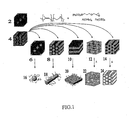
- FIG. 1 shows a synthesis diagram of the formation of the superparamagnetic nanostructured material using an example block copolymer of PI-b-PEO containing an iron precursor.
- a pure block copolymer in a body-centered cubic (BCC) mesophase 2 or a pure block copolymer in a hexagonal cylinder mesophase 4 may be used in the present invention.
- FIG. 1 shows the morphology of one preferred block copolymer PI-b-PEO.
- the pure block copolymers 2, 4 as depicted in FIG. 1 show the PI phase in black and the PEO phase in dark gray.
- the hexagonal cylinder mesophase 4 is achieved by increasing the polymer block fraction of PEO with respect to PI, generally 17-46 wt% PEO. Both morphologies can be used to generate the different structures described below. As increasing amount of inorganic sol-gel precursor material is added to the parent pure block copolymer similar mesophases seen in a pure block copolymer system can be achieved. However, the "plumber's nightmare" (PN) morphology, a bicontinuous morphology, is only observed when using the hexagonal cylinder mesophase 4. Hence, the following morphologies will be produced using the hexagonal cylinder mesophase 4 block copolymer.
- PN plumber's nightmare
- a BCC phase 6 is produced by adding an inorganic sol-gel precursor to obtain a volume of PEO + inorganic sol-gel precursor approximately equal to 23 vol%.
- a hexagonal cylinder phase 8 is produced by adding inorganic sol-gel precursor to obtain 26-35 vol% PEO + inorganic sol-gel precursor.
- a lamellae phase 10 is produced by adding inorganic sol-gel precursor to obtain 40-55 vol% PEO + inorganic sol-gel precursor.
- the "plumber's nightmare" phase 12 occurs when 60-62 vol% of PEO + inorganic sol-gel precursor is achieved.
- An inverse hexagonal cylinder phase 14 is produced when the PEO + inorganic sol-gel precursor achieves a vol% between 65-75%.
- blocks 6, 8, 10, 12 and 14 show the PI phase in black and a PEO + inorganic phase in light gray.
- a solvent e.g. toluene
- individual spheres 16, cylinders 18 and lamellae 20, respectively are produced.
- PI chains remain attached to the inorganic nanostructured material because of the PEO block embedded inside.
- the "plumber's nightmare" phase 12 is calcined to higher temperatures to pyrolyze the organic components leading to empty channels in the PN inorganic matrix that was once occupied by PI thereby producing a PN mesoporous material 22.
- the organic material in the inverse cylinder phase 14 is pyrolyzed at a heat treatment to 550°C leaving empty channels in the inorganic mesoporous matrix 24.
- the morphologies where the minority phase is inorganic give rise to individual nanoparticles while the inorganic rich morphologies give rise to mesoporous materials.
- Calcination of the inverse cylinder or "plumber's nightmare" morphologies give rise to superparamagnetic mesoporous materials exhibiting dual functionality as a superparamagnetic high surface area material (see FIG. 1 ).
- the regular pore structure in combination with the iron oxide centers dispersed within the walls of the material make the superparamagnetic mesoporous material key to filtration technologies, separation of biological molecules with chemically attached magnetic beads, or high surface area catalysts.
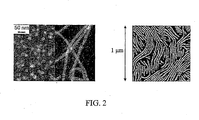
- FIG. 2 shows TEM (left) and AFM (right) images of the resulting nanospheres and cylinders. These images demonstrate that dissolving the bulk copolymer with a solvent is successful in dispersing individual object in a solution. This is necessary for the utility of nanoparticles in the application as described.
- Poly(isoprene-block-ethylene oxide) block copolymer (PI-b-PEO) is synthesized using conventional anionic polymerization techniques.
- a block copolymer solution of 5 wt% is prepared in a 50-50 solution of dry tetrahydrofuran (THF) and chloroform. Iron ethoxide is dissolved in the block copolymer solution to obtain a final mole fraction of 25% with respect to the silicon and aluminum alkoxide compounds added later in the process.
- a separate silicate precursor solution is formed by mixing 3-glycidoxypropyltrimethoxysilane (GLYMO) and aluminum tri-sec-butoxide, whereby the silicate precursor solution undergo a two step hydrolysis and condensation reaction using an acid catalyst.
- GLYMO 3-glycidoxypropyltrimethoxysilane
- sol-gel precursor having an organically modified aluminosilicate phase.
- the aluminum acts as a network hardener of the organic-inorganic matrix and as a Lewis acid in opening up the epoxy ring on the silicon hybrid precursor, which also aids in maintaining network integrity.
- the sol-gel precursor solution is added to the iron-block copolymer solution and subsequent films are cast by evaporation of the solvents.
- the amphiphilic block copolymer structures the inorganic materials into well-defined morphologies depending on the volume fraction between the poly(isoprene) polymer phase and the poly(ethylene oxide)-inorganic phase.
- the PEO is completely intermixed with the inorganic at a molecular level to generate a single homogenous phase of inorganic-organic material; thus, only a two-phase system is observed. Unprecedented structural control is exhibited and a large number of microstructures across the phase diagrams of block copolymers can be formed.
Landscapes
- Chemical & Material Sciences (AREA)
- Engineering & Computer Science (AREA)
- Nanotechnology (AREA)
- Inorganic Chemistry (AREA)
- Crystallography & Structural Chemistry (AREA)
- Power Engineering (AREA)
- Biomedical Technology (AREA)
- Life Sciences & Earth Sciences (AREA)
- Health & Medical Sciences (AREA)
- General Health & Medical Sciences (AREA)
- Molecular Biology (AREA)
- Silicates, Zeolites, And Molecular Sieves (AREA)
- Silicon Polymers (AREA)
- Physical Or Chemical Processes And Apparatus (AREA)
- Compositions Of Macromolecular Compounds (AREA)
- Compounds Of Alkaline-Earth Elements, Aluminum Or Rare-Earth Metals (AREA)
- Medicinal Preparation (AREA)
Applications Claiming Priority (3)
| Application Number | Priority Date | Filing Date | Title |
|---|---|---|---|
| US28335401P | 2001-04-13 | 2001-04-13 | |
| US283354P | 2001-04-13 | ||
| PCT/US2002/008259 WO2003049936A1 (en) | 2001-04-13 | 2002-04-12 | Superparamagnetic nanostructured materials |
Publications (3)
| Publication Number | Publication Date |
|---|---|
| EP1397243A1 EP1397243A1 (en) | 2004-03-17 |
| EP1397243A4 EP1397243A4 (en) | 2008-07-30 |
| EP1397243B1 true EP1397243B1 (en) | 2011-08-31 |
Family
ID=23085642
Family Applications (1)
| Application Number | Title | Priority Date | Filing Date |
|---|---|---|---|
| EP02802541A Expired - Lifetime EP1397243B1 (en) | 2001-04-13 | 2002-04-12 | Superparamagnetic nanostructured materials |
Country Status (6)
| Country | Link |
|---|---|
| US (1) | US6645626B2 (enExample) |
| EP (1) | EP1397243B1 (enExample) |
| JP (1) | JP5101791B2 (enExample) |
| AT (1) | ATE522347T1 (enExample) |
| AU (1) | AU2002364925A1 (enExample) |
| WO (1) | WO2003049936A1 (enExample) |
Families Citing this family (22)
| Publication number | Priority date | Publication date | Assignee | Title |
|---|---|---|---|---|
| US6893705B2 (en) * | 2001-05-25 | 2005-05-17 | Massachusetts Institute Of Technology | Large area orientation of block copolymer microdomains in thin films |
| US8449601B2 (en) * | 2002-11-19 | 2013-05-28 | Boston Scientific Scimed, Inc. | Medical devices |
| US7087656B2 (en) * | 2003-08-12 | 2006-08-08 | Cornell Research Foundation, Inc. | High temperature SiCN and SiC-type nanostructured ceramic material from block copolymer mesophases |
| DE102004009287A1 (de) * | 2004-02-26 | 2005-09-15 | Institut Für Neue Materialien Gem. Gmbh | Amphiphile Nanopartikel |
| CN100429142C (zh) * | 2004-03-24 | 2008-10-29 | 哈尔滨工业大学 | 面向纳米微加工嵌段共聚物模板自组装形态调控方法 |
| US20060019096A1 (en) * | 2004-06-01 | 2006-01-26 | Hatton T A | Field-responsive superparamagnetic composite nanofibers and methods of use thereof |
| WO2007020703A1 (ja) * | 2005-08-12 | 2007-02-22 | Toyo University Educational Foundation | 回転磁場によるマニピュレーション方法 |
| US20070281036A1 (en) * | 2005-12-19 | 2007-12-06 | University Of Vermont And State Agricultural College | System and method of delivering a desired material to a cell |
| JP2009138014A (ja) * | 2007-12-03 | 2009-06-25 | Toyota Central R&D Labs Inc | ナノ構造材料の製造方法 |
| WO2009151490A2 (en) * | 2008-02-25 | 2009-12-17 | The Regents Of The University Of California | Use of magnetic nanoparticles to remove environmental contaminants |
| RU2369466C1 (ru) * | 2008-02-26 | 2009-10-10 | Государственное образовательное учреждение высшего профессионального образования "Курский государственный университет" | Способ получения наночастиц металлов или гибридов наночастиц металлов |
| US20100030313A1 (en) * | 2008-07-31 | 2010-02-04 | Boston Scientific Scimed, Inc. | Medical articles comprising biodegradable block copolymers |
| US8507287B2 (en) * | 2008-09-26 | 2013-08-13 | Wisconsin Alumni Research Foundation | Mesoporous metal oxide materials for phosphoproteomics |
| EP2393472B1 (en) | 2008-12-05 | 2019-06-05 | NanoMed Holdings Pty Ltd | Amphiphile prodrugs |
| WO2011054787A1 (en) * | 2009-11-09 | 2011-05-12 | Basf Se | Process for preparing mesoporous materials |
| JP5472446B2 (ja) * | 2010-03-18 | 2014-04-16 | 株式会社豊田中央研究所 | ナノヘテロ構造体およびその製造方法 |
| US9754709B2 (en) | 2011-09-16 | 2017-09-05 | Kabushiki Kaisha Toyota Chuo Kenkyusho | Nanoheterostructured permanent magnet and method for producing the same |
| JP5871118B2 (ja) * | 2011-09-16 | 2016-03-01 | 株式会社豊田中央研究所 | ナノヘテロ構造磁気記録材料およびその製造方法 |
| JP5850308B2 (ja) * | 2011-09-16 | 2016-02-03 | 株式会社豊田中央研究所 | ナノヘテロ構造軟磁性材料およびその製造方法 |
| KR101363934B1 (ko) | 2012-02-23 | 2014-02-20 | 한서대학교 산학협력단 | 다이렉트 발포방식을 이용한 기능성 다공체 세라믹 재료의 제조방법 |
| DE102015118816A1 (de) * | 2015-11-03 | 2017-05-04 | Fraunhofer-Gesellschaft zur Förderung der angewandten Forschung e.V. | Superparamagnetische Plättchen, aufgebaut aus Nanomagnetit-Silica-Komposit-Nadeln, mit optischen Farbeffekten in Dispersion |
| DE102016009514A1 (de) * | 2016-08-04 | 2018-02-08 | Giesecke+Devrient Currency Technology Gmbh | Verfahren und Vorrichtung zum Erzeugen von Kompositpartikeln |
Family Cites Families (11)
| Publication number | Priority date | Publication date | Assignee | Title |
|---|---|---|---|---|
| JPS5864222A (ja) * | 1981-10-12 | 1983-04-16 | Ishihara Sangyo Kaisha Ltd | コバルト含有磁性酸化鉄粉末の製造方法 |
| DE3709851A1 (de) * | 1987-03-24 | 1988-10-06 | Silica Gel Gmbh Adsorptions Te | Nmr-diagnostische fluessigkeitszusammensetzungen |
| EP0343934B1 (en) * | 1988-05-24 | 1995-01-25 | Anagen (U.K.) Limited | Magnetically attractable particles and method of preparation |
| CA2137145A1 (en) * | 1992-06-08 | 1993-12-23 | Mark S. Chagnon | Preparation of controlled size inorganic particles for use in separations, as magnetic molecular switches, and as inorganic liposomes for medical applications |
| JP2931182B2 (ja) * | 1992-07-17 | 1999-08-09 | 石原産業株式会社 | 針状γ−FeOOHの製造方法 |
| WO1994021240A2 (de) * | 1993-03-17 | 1994-09-29 | Silica Gel Ges.M.B.H | Superparamagnetische teilchen, verfahren zu ihrer herstellung und verwendung derselben |
| US5952040A (en) * | 1996-10-11 | 1999-09-14 | Nanomaterials Research Corporation | Passive electronic components from nano-precision engineered materials |
| US6451220B1 (en) * | 1997-01-21 | 2002-09-17 | Xerox Corporation | High density magnetic recording compositions and processes thereof |
| DE19738913B4 (de) * | 1997-09-05 | 2004-03-18 | MAX-PLANCK-Gesellschaft zur Förderung der Wissenschaften e.V. | Blockcopolymerphasen als Template für strukturierte organisch-anorganische Hybridmaterialien |
| US6262129B1 (en) * | 1998-07-31 | 2001-07-17 | International Business Machines Corporation | Method for producing nanoparticles of transition metals |
| US6548264B1 (en) * | 2000-05-17 | 2003-04-15 | University Of Florida | Coated nanoparticles |
-
2002
- 2002-04-12 EP EP02802541A patent/EP1397243B1/en not_active Expired - Lifetime
- 2002-04-12 WO PCT/US2002/008259 patent/WO2003049936A1/en not_active Ceased
- 2002-04-12 AT AT02802541T patent/ATE522347T1/de not_active IP Right Cessation
- 2002-04-12 JP JP2003550975A patent/JP5101791B2/ja not_active Expired - Fee Related
- 2002-04-12 AU AU2002364925A patent/AU2002364925A1/en not_active Abandoned
- 2002-04-12 US US10/120,779 patent/US6645626B2/en not_active Expired - Fee Related
Also Published As
| Publication number | Publication date |
|---|---|
| JP2005511335A (ja) | 2005-04-28 |
| JP5101791B2 (ja) | 2012-12-19 |
| EP1397243A4 (en) | 2008-07-30 |
| US6645626B2 (en) | 2003-11-11 |
| EP1397243A1 (en) | 2004-03-17 |
| AU2002364925A1 (en) | 2003-06-23 |
| US20020164481A1 (en) | 2002-11-07 |
| WO2003049936A1 (en) | 2003-06-19 |
| ATE522347T1 (de) | 2011-09-15 |
Similar Documents
| Publication | Publication Date | Title |
|---|---|---|
| EP1397243B1 (en) | Superparamagnetic nanostructured materials | |
| Kalia et al. | Magnetic polymer nanocomposites for environmental and biomedical applications | |
| Gharibshahian et al. | Evaluation of superparamagnetic and biocompatible properties of mesoporous silica coated cobalt ferrite nanoparticles synthesized via microwave modified Pechini method | |
| Qian et al. | Fabrication of magnetic phase change n-eicosane@ Fe3O4/SiO2 microcapsules on wood surface via sol-gel method | |
| Pan et al. | Interface coassembly and polymerization on magnetic colloids: Toward core–shell functional mesoporous polymer microspheres and their carbon derivatives | |
| Deng et al. | Magnetically responsive ordered mesoporous materials: A burgeoning family of functional composite nanomaterials | |
| Tong et al. | In situ generated gas bubble-assisted modulation of the morphologies, photocatalytic, and magnetic properties of ferric oxide nanostructures synthesized by thermal decomposition of iron nitrate | |
| Liu et al. | Hierarchical magnetic core–shell nanoarchitectures: non-linker reagent synthetic route and applications in a biomolecule separation system | |
| Bristy et al. | Preparation and characterization of magnetic γ-Al2O3 ceramic nanocomposite particles with variable Fe3O4 content and modification with epoxide functional polymer | |
| CN103143305A (zh) | 一种酸性条件合成核壳结构磁性介孔二氧化硅纳米微球的方法 | |
| Gong et al. | The fabrication and magnetic properties of Ni fibers synthesized under external magnetic fields | |
| CN100457617C (zh) | 一种中空硅凝胶纳米球粉体材料及其制备方法 | |
| Singh et al. | Hydrothermal synthesis of inorganic–organic hybrid gadolinium hydroxide nanoclusters with controlled size and morphology | |
| Wang et al. | Preparation and characterization of magnetic hollow PMMA nanospheres via in situ emulsion polymerization | |
| Cheng et al. | Liquid–liquid interface-assisted solvothermal synthesis of durian-like α-Fe 2 O 3 hollow spheres constructed by nano-polyhedrons | |
| Song et al. | Engineering the internal structure of magnetic silica nanoparticles by thermal control | |
| Liu et al. | Solvothermal synthesis of CoFe2O4 hollow spheres | |
| Liu et al. | A general method for the synthesis of various rattle-type microspheres and their diverse applications | |
| Li et al. | A mesoporous SiO2/dense SiO2/Fe3O4 multiply coated hollow microsphere: Synthesis and application on papain immobilization | |
| Wang et al. | Solvothermal synthesis of magnetite hollow submicrospheres and mesoporous nanoparticles | |
| Yang et al. | Novel Fe3O4 hollow microspheres: Nontemplate hydrothermal synthesis, superparamagnetism and biocompatibility | |
| Li et al. | Epsilon‐Fe2O3 Nanocrystals inside Mesoporous Silicas with Tailored Morphologies of Rod, Platelet and Donut | |
| Chang et al. | Synthesis and characterization of mesoporous Gd2O3 nanotube and its use as a drug-carrying vehicle | |
| Amara et al. | Synthesis and characterization of ferromagnetic Fe3C/C composite nanoparticles as a catalyst for carbon nanotube growth | |
| Song et al. | Synthesis of magnetic core–shell structure Fe3O4@ MCM-41 nanoparticle by vesicles in aqueous solutions |
Legal Events
| Date | Code | Title | Description |
|---|---|---|---|
| PUAI | Public reference made under article 153(3) epc to a published international application that has entered the european phase |
Free format text: ORIGINAL CODE: 0009012 |
|
| 17P | Request for examination filed |
Effective date: 20031112 |
|
| AK | Designated contracting states |
Kind code of ref document: A1 Designated state(s): AT BE CH CY DE DK ES FI FR GB GR IE IT LI LU MC NL PT SE TR |
|
| AX | Request for extension of the european patent |
Extension state: AL LT LV MK RO SI |
|
| RAP3 | Party data changed (applicant data changed or rights of an application transferred) |
Owner name: CORNELL RESEARCH FOUNDATION, INC. |
|
| A4 | Supplementary search report drawn up and despatched |
Effective date: 20080627 |
|
| 17Q | First examination report despatched |
Effective date: 20100118 |
|
| RIC1 | Information provided on ipc code assigned before grant |
Ipc: B32B 17/02 20060101ALI20101213BHEP Ipc: B32B 5/16 20060101AFI20101213BHEP Ipc: B32B 27/02 20060101ALI20101213BHEP Ipc: B32B 9/00 20060101ALI20101213BHEP Ipc: B32B 15/02 20060101ALI20101213BHEP Ipc: B32B 19/00 20060101ALI20101213BHEP Ipc: B32B 21/02 20060101ALI20101213BHEP Ipc: B32B 23/02 20060101ALI20101213BHEP Ipc: B03C 1/00 20060101ALI20101213BHEP Ipc: H01F 1/00 20060101ALI20101213BHEP |
|
| GRAP | Despatch of communication of intention to grant a patent |
Free format text: ORIGINAL CODE: EPIDOSNIGR1 |
|
| GRAS | Grant fee paid |
Free format text: ORIGINAL CODE: EPIDOSNIGR3 |
|
| GRAA | (expected) grant |
Free format text: ORIGINAL CODE: 0009210 |
|
| AK | Designated contracting states |
Kind code of ref document: B1 Designated state(s): AT BE CH CY DE DK ES FI FR GB GR IE IT LI LU MC NL PT SE TR |
|
| REG | Reference to a national code |
Ref country code: CH Ref legal event code: EP Ref country code: GB Ref legal event code: FG4D |
|
| REG | Reference to a national code |
Ref country code: IE Ref legal event code: FG4D |
|
| REG | Reference to a national code |
Ref country code: DE Ref legal event code: R096 Ref document number: 60240982 Country of ref document: DE Effective date: 20111103 |
|
| REG | Reference to a national code |
Ref country code: NL Ref legal event code: VDEP Effective date: 20110831 |
|
| PG25 | Lapsed in a contracting state [announced via postgrant information from national office to epo] |
Ref country code: SE Free format text: LAPSE BECAUSE OF FAILURE TO SUBMIT A TRANSLATION OF THE DESCRIPTION OR TO PAY THE FEE WITHIN THE PRESCRIBED TIME-LIMIT Effective date: 20110831 Ref country code: FI Free format text: LAPSE BECAUSE OF FAILURE TO SUBMIT A TRANSLATION OF THE DESCRIPTION OR TO PAY THE FEE WITHIN THE PRESCRIBED TIME-LIMIT Effective date: 20110831 Ref country code: NL Free format text: LAPSE BECAUSE OF FAILURE TO SUBMIT A TRANSLATION OF THE DESCRIPTION OR TO PAY THE FEE WITHIN THE PRESCRIBED TIME-LIMIT Effective date: 20110831 |
|
| REG | Reference to a national code |
Ref country code: AT Ref legal event code: MK05 Ref document number: 522347 Country of ref document: AT Kind code of ref document: T Effective date: 20110831 |
|
| PG25 | Lapsed in a contracting state [announced via postgrant information from national office to epo] |
Ref country code: CY Free format text: LAPSE BECAUSE OF FAILURE TO SUBMIT A TRANSLATION OF THE DESCRIPTION OR TO PAY THE FEE WITHIN THE PRESCRIBED TIME-LIMIT Effective date: 20110831 Ref country code: GR Free format text: LAPSE BECAUSE OF FAILURE TO SUBMIT A TRANSLATION OF THE DESCRIPTION OR TO PAY THE FEE WITHIN THE PRESCRIBED TIME-LIMIT Effective date: 20111201 Ref country code: AT Free format text: LAPSE BECAUSE OF FAILURE TO SUBMIT A TRANSLATION OF THE DESCRIPTION OR TO PAY THE FEE WITHIN THE PRESCRIBED TIME-LIMIT Effective date: 20110831 |
|
| PG25 | Lapsed in a contracting state [announced via postgrant information from national office to epo] |
Ref country code: BE Free format text: LAPSE BECAUSE OF FAILURE TO SUBMIT A TRANSLATION OF THE DESCRIPTION OR TO PAY THE FEE WITHIN THE PRESCRIBED TIME-LIMIT Effective date: 20110831 |
|
| PG25 | Lapsed in a contracting state [announced via postgrant information from national office to epo] |
Ref country code: PT Free format text: LAPSE BECAUSE OF FAILURE TO SUBMIT A TRANSLATION OF THE DESCRIPTION OR TO PAY THE FEE WITHIN THE PRESCRIBED TIME-LIMIT Effective date: 20120102 Ref country code: IT Free format text: LAPSE BECAUSE OF FAILURE TO SUBMIT A TRANSLATION OF THE DESCRIPTION OR TO PAY THE FEE WITHIN THE PRESCRIBED TIME-LIMIT Effective date: 20110831 |
|
| PG25 | Lapsed in a contracting state [announced via postgrant information from national office to epo] |
Ref country code: DK Free format text: LAPSE BECAUSE OF FAILURE TO SUBMIT A TRANSLATION OF THE DESCRIPTION OR TO PAY THE FEE WITHIN THE PRESCRIBED TIME-LIMIT Effective date: 20110831 |
|
| PLBE | No opposition filed within time limit |
Free format text: ORIGINAL CODE: 0009261 |
|
| STAA | Information on the status of an ep patent application or granted ep patent |
Free format text: STATUS: NO OPPOSITION FILED WITHIN TIME LIMIT |
|
| 26N | No opposition filed |
Effective date: 20120601 |
|
| REG | Reference to a national code |
Ref country code: DE Ref legal event code: R097 Ref document number: 60240982 Country of ref document: DE Effective date: 20120601 |
|
| PG25 | Lapsed in a contracting state [announced via postgrant information from national office to epo] |
Ref country code: MC Free format text: LAPSE BECAUSE OF NON-PAYMENT OF DUE FEES Effective date: 20120430 |
|
| REG | Reference to a national code |
Ref country code: CH Ref legal event code: PL |
|
| REG | Reference to a national code |
Ref country code: IE Ref legal event code: MM4A |
|
| PG25 | Lapsed in a contracting state [announced via postgrant information from national office to epo] |
Ref country code: CH Free format text: LAPSE BECAUSE OF NON-PAYMENT OF DUE FEES Effective date: 20120430 Ref country code: LI Free format text: LAPSE BECAUSE OF NON-PAYMENT OF DUE FEES Effective date: 20120430 Ref country code: IE Free format text: LAPSE BECAUSE OF NON-PAYMENT OF DUE FEES Effective date: 20120412 |
|
| PG25 | Lapsed in a contracting state [announced via postgrant information from national office to epo] |
Ref country code: ES Free format text: LAPSE BECAUSE OF FAILURE TO SUBMIT A TRANSLATION OF THE DESCRIPTION OR TO PAY THE FEE WITHIN THE PRESCRIBED TIME-LIMIT Effective date: 20111211 |
|
| PG25 | Lapsed in a contracting state [announced via postgrant information from national office to epo] |
Ref country code: TR Free format text: LAPSE BECAUSE OF FAILURE TO SUBMIT A TRANSLATION OF THE DESCRIPTION OR TO PAY THE FEE WITHIN THE PRESCRIBED TIME-LIMIT Effective date: 20110831 |
|
| PG25 | Lapsed in a contracting state [announced via postgrant information from national office to epo] |
Ref country code: LU Free format text: LAPSE BECAUSE OF NON-PAYMENT OF DUE FEES Effective date: 20120412 |
|
| PGFP | Annual fee paid to national office [announced via postgrant information from national office to epo] |
Ref country code: GB Payment date: 20140428 Year of fee payment: 13 |
|
| PGFP | Annual fee paid to national office [announced via postgrant information from national office to epo] |
Ref country code: DE Payment date: 20140429 Year of fee payment: 13 Ref country code: FR Payment date: 20140417 Year of fee payment: 13 |
|
| REG | Reference to a national code |
Ref country code: DE Ref legal event code: R119 Ref document number: 60240982 Country of ref document: DE |
|
| GBPC | Gb: european patent ceased through non-payment of renewal fee |
Effective date: 20150412 |
|
| PG25 | Lapsed in a contracting state [announced via postgrant information from national office to epo] |
Ref country code: GB Free format text: LAPSE BECAUSE OF NON-PAYMENT OF DUE FEES Effective date: 20150412 Ref country code: DE Free format text: LAPSE BECAUSE OF NON-PAYMENT OF DUE FEES Effective date: 20151103 |
|
| REG | Reference to a national code |
Ref country code: FR Ref legal event code: ST Effective date: 20151231 |
|
| PG25 | Lapsed in a contracting state [announced via postgrant information from national office to epo] |
Ref country code: FR Free format text: LAPSE BECAUSE OF NON-PAYMENT OF DUE FEES Effective date: 20150430 |