EP1386977A1 - Ferritic stainless steel strip excellent in freeze of shape formed by working - Google Patents
Ferritic stainless steel strip excellent in freeze of shape formed by working Download PDFInfo
- Publication number
- EP1386977A1 EP1386977A1 EP02769555A EP02769555A EP1386977A1 EP 1386977 A1 EP1386977 A1 EP 1386977A1 EP 02769555 A EP02769555 A EP 02769555A EP 02769555 A EP02769555 A EP 02769555A EP 1386977 A1 EP1386977 A1 EP 1386977A1
- Authority
- EP
- European Patent Office
- Prior art keywords
- mass
- stainless steel
- steel sheet
- max
- ferritic stainless
- Prior art date
- Legal status (The legal status is an assumption and is not a legal conclusion. Google has not performed a legal analysis and makes no representation as to the accuracy of the status listed.)
- Granted
Links
Images

Classifications
-
- C—CHEMISTRY; METALLURGY
- C21—METALLURGY OF IRON
- C21D—MODIFYING THE PHYSICAL STRUCTURE OF FERROUS METALS; GENERAL DEVICES FOR HEAT TREATMENT OF FERROUS OR NON-FERROUS METALS OR ALLOYS; MAKING METAL MALLEABLE, e.g. BY DECARBURISATION OR TEMPERING
- C21D8/00—Modifying the physical properties of ferrous metals or ferrous alloys by deformation combined with, or followed by, heat treatment
- C21D8/02—Modifying the physical properties of ferrous metals or ferrous alloys by deformation combined with, or followed by, heat treatment during manufacturing of plates or strips
-
- C—CHEMISTRY; METALLURGY
- C22—METALLURGY; FERROUS OR NON-FERROUS ALLOYS; TREATMENT OF ALLOYS OR NON-FERROUS METALS
- C22C—ALLOYS
- C22C38/00—Ferrous alloys, e.g. steel alloys
- C22C38/001—Ferrous alloys, e.g. steel alloys containing N
-
- C—CHEMISTRY; METALLURGY
- C22—METALLURGY; FERROUS OR NON-FERROUS ALLOYS; TREATMENT OF ALLOYS OR NON-FERROUS METALS
- C22C—ALLOYS
- C22C38/00—Ferrous alloys, e.g. steel alloys
- C22C38/004—Very low carbon steels, i.e. having a carbon content of less than 0,01%
-
- C—CHEMISTRY; METALLURGY
- C22—METALLURGY; FERROUS OR NON-FERROUS ALLOYS; TREATMENT OF ALLOYS OR NON-FERROUS METALS
- C22C—ALLOYS
- C22C38/00—Ferrous alloys, e.g. steel alloys
- C22C38/18—Ferrous alloys, e.g. steel alloys containing chromium
-
- C—CHEMISTRY; METALLURGY
- C22—METALLURGY; FERROUS OR NON-FERROUS ALLOYS; TREATMENT OF ALLOYS OR NON-FERROUS METALS
- C22C—ALLOYS
- C22C38/00—Ferrous alloys, e.g. steel alloys
- C22C38/18—Ferrous alloys, e.g. steel alloys containing chromium
- C22C38/40—Ferrous alloys, e.g. steel alloys containing chromium with nickel
-
- C—CHEMISTRY; METALLURGY
- C21—METALLURGY OF IRON
- C21D—MODIFYING THE PHYSICAL STRUCTURE OF FERROUS METALS; GENERAL DEVICES FOR HEAT TREATMENT OF FERROUS OR NON-FERROUS METALS OR ALLOYS; MAKING METAL MALLEABLE, e.g. BY DECARBURISATION OR TEMPERING
- C21D8/00—Modifying the physical properties of ferrous metals or ferrous alloys by deformation combined with, or followed by, heat treatment
- C21D8/02—Modifying the physical properties of ferrous metals or ferrous alloys by deformation combined with, or followed by, heat treatment during manufacturing of plates or strips
- C21D8/0221—Modifying the physical properties of ferrous metals or ferrous alloys by deformation combined with, or followed by, heat treatment during manufacturing of plates or strips characterised by the working steps
- C21D8/0226—Hot rolling
-
- C—CHEMISTRY; METALLURGY
- C21—METALLURGY OF IRON
- C21D—MODIFYING THE PHYSICAL STRUCTURE OF FERROUS METALS; GENERAL DEVICES FOR HEAT TREATMENT OF FERROUS OR NON-FERROUS METALS OR ALLOYS; MAKING METAL MALLEABLE, e.g. BY DECARBURISATION OR TEMPERING
- C21D8/00—Modifying the physical properties of ferrous metals or ferrous alloys by deformation combined with, or followed by, heat treatment
- C21D8/02—Modifying the physical properties of ferrous metals or ferrous alloys by deformation combined with, or followed by, heat treatment during manufacturing of plates or strips
- C21D8/0247—Modifying the physical properties of ferrous metals or ferrous alloys by deformation combined with, or followed by, heat treatment during manufacturing of plates or strips characterised by the heat treatment
- C21D8/0263—Modifying the physical properties of ferrous metals or ferrous alloys by deformation combined with, or followed by, heat treatment during manufacturing of plates or strips characterised by the heat treatment following hot rolling
-
- C—CHEMISTRY; METALLURGY
- C21—METALLURGY OF IRON
- C21D—MODIFYING THE PHYSICAL STRUCTURE OF FERROUS METALS; GENERAL DEVICES FOR HEAT TREATMENT OF FERROUS OR NON-FERROUS METALS OR ALLOYS; MAKING METAL MALLEABLE, e.g. BY DECARBURISATION OR TEMPERING
- C21D8/00—Modifying the physical properties of ferrous metals or ferrous alloys by deformation combined with, or followed by, heat treatment
- C21D8/02—Modifying the physical properties of ferrous metals or ferrous alloys by deformation combined with, or followed by, heat treatment during manufacturing of plates or strips
- C21D8/04—Modifying the physical properties of ferrous metals or ferrous alloys by deformation combined with, or followed by, heat treatment during manufacturing of plates or strips to produce plates or strips for drawing, e.g. for deep-drawing
Definitions
- the present invention relates to a ferritic stainless steel sheet, which can be formed to a product shape by press-forming, bending, roll-forming or the like due to good shape-freezability with less dimensional defects such as spring-back and torsion after forming, and also relates to a method of manufacturing thereof.
- a stainless steel sheet has been used in various fields, e.g. interior or exterior members of buildings, frame members of electric home appliances and kitchen goods, due to its excellent external appearance and corrosion-resistance.
- the wording of "a steel sheet” involves a steel strip in this specification.
- a product formed from a stainless steel sheet often involves dimensional defects originated in elastic recovery, since elastic strain of the stainless steel sheet is bigger than a common steel sheet. For instance, when a steel sheet, which is simply bent to a product shape, is detached from a shaping die, an angle of bent becomes broader than a designed angle due to release of elastic strain. The reformation is so-called as "spring-back". Especially in the case where a product is manufactured from a steel sheet by shallow drawing, elastic stain is not completely released but remains at a flange or a punched bottom even after the product is detached from a shaping die. The residual strain causes defects such as torsion and significantly reduces commercial value of the product.
- a relatively soft austenitic stainless steel sheet such as SUS304 has been used among various kinds of stainless steels, in order to inhibit occurrence of defects during fabrication.
- austenitic stainless steel is expensive material due to high Ni content.
- the present invention aims at provision of a ferritic stainless steel sheet, which is cheaper material due to remarkable decrease of Ni content but is improved in shape-freezability so as to inhibit dimensional defects such as spring-back and torsion after forming.
- the present invention proposes a new ferritic stainless steel sheet, which has the alloying composition consisting of C up to 0.10 mass %, Si up to 1.0 mass %, Mn up to 1.0 mass %, P up to 0.050 mass %, S up to 0.020 mass %, Ni up to 2.0 mass %, 8.0-22.0 mass % of Cr, N up to 0.05 mass %, optionally one or more of 0.01-0.50 mass % of Ti, 0.01-0.50 mass % of Nb, 0.01-0.30 mass % of V, 0.01-0.30 mass % of Zr and 0.0010-0.0100 mass % of B, and the balance being essentially Fe, with the provision that a value FM defined by the formula (1) is adjusted to 0 or less.
- the ferritic stainless steel sheet has an in-plane anisotropic degree (r max -r min ) of Lankford value (r) ⁇ 0.80 and an anisotropic degree ( ⁇ max - ⁇ min ) of 0.2%-yield strength ⁇ 20 N/mm 2 .
- FM 420C-11.5Si+7Mn+23Ni-3.5Cr-12Mo+9Cu -49Ti-50Nb-23V-52Al+470N+20
- the stainless steel sheet preferably has 0.2%-yield strength ⁇ 350 N/mm 2 along any of a rolling direction (Direction-L), directions (Direction-D) crossing Direction-L with an angle of 45 degrees and a traverse direction (Direction-T) crossing Direction-L with a right angle.
- the stainless steel sheet is manufactured by hot-rolling a ferritic stainless steel having the specified composition and then batch-annealing the hot-rolled steel sheet 1-24 hours at 700-880 °C.
- properties of ferritic stainless steels substantially depend on chemical composition and manufacturing conditions.
- the inventors have researched and examined effects of the chemical composition and manufacturing conditions on the properties, and discovered that shape-freezability (in other words, suppression of deformation derived from spring-back after forming) is improved by combination of a specified alloying composition with manufacturing conditions.
- the shape-freezability is influenced not only by uniaxial deformation but also multi-axial deformation during plastically forming a stainless steel sheet to a product shape
- materialistic properties and anisotropy along various directions put big effects on the shape-freezability.
- deviations of Lankford values (r) and 0.2%-yield strength among Directions-L, -D and -T are main factors.
- the stainless steel sheet has less plane anisotropy.
- Deviation of thickness reduction causes irregular distribution of residual strains in the stainless steel sheet formed to a product shape, resulting in poor shape-freezability.
- Deviation of 0.2%-yield strength from each other along Directions-L, -D and -T means that various strains different from each other are given to the stainless steel sheet during plastically forming the stainless steel sheet with a certain stress. In this case, the shape-freezability is also poor.
- a plane anisotropic degree (r max -r min ) and an anisotropic degree ( ⁇ max - ⁇ min ) of 0.2%-yield strength are necessarily decreased, wherein r max and ⁇ max are maximum of Lankford value (r) and 0.2%-yield strength among Directions-L, -D and -T, while r min and ⁇ min are minimum of Lankford value (r) and 0.2%-yield strength among Directions-L, -D and -T.
- the plane anisotropic degree (r max -r min ) of Lankford value (r) and the anisotropic degree ( ⁇ max - ⁇ min ) of 0.2%-yield strength are decreased by conditioning re-crystallized ferrite grains of the stainless steel sheet to an isotropic state with equation of planar orientation.
- Isotropic re-crystallization of ferrite grains is attained by precipitating dissolved C and N as fine carbonitride particles uniformly dispersed in a steel matrix.
- Isotropic re-crystallization of ferrite grains effectively reduces the anisotropic degrees (r max -r min , ⁇ max - ⁇ min ). Effects of uniform dispersion of fine carbonitride particles on random growth of re-crystallized ferrite grains are explained as follows:
- Carbonitride particles present in a steel matrix act as seeds for re-crystallization of ferrite grains during final annealing, e.g. batch-annealing or finish-annealing, of a stainless steel sheet.
- grain boundaries and deformed zones such as slip bands in a cold-rolled ferritic structure have been heretofore regarded as seeds for re-crystallization of ferrite grains
- the grain boundaries and the deformed zones are elongated by cold-rolling.
- the grain boundaries and the deformed zones have specified orientation, and re-crystallized ferrite grains grow while succeeding to the orientation.
- carbonitride particles are granular and very hard (Vickers hardness above 1000), so that they are not elongated during cold-rolling but act as seeds for isotropic re-crystallization of ferrite grains at boundaries in contact with ferrite grains.
- Uniform dispersion of fine carbonitride particles is assured by properly controlling annealing conditions, so as to reform a rolling texture generated in a former hot-rolling step to an isotropic ferrite structure.
- the isotropic structure is maintained even in a cold-rolled state. That is, each ferrite grain is orientated due to application of stress in a following cold-rolling step, but a whole of the ferrite grains is still homogeneous and isotropic.
- the uniformly dispersed fine carbonitride particles act as seeds for re-crystallization of ferrite grains from a cold-rolling step to an annealing step, so as to further uniform planar orientation of ferrite grains. Consequently, an in-plane anisotropic degree (r max -r min ) is reduced, and a stainless steel sheet is press-formed with good shape-freezability.
- a ferritic stainless steel according to the present invention contains the following elements as essential components.
- C is converted to carbides by batch-annealing, and the carbides act as seeds for random growth of ferrite grains during re-crystallization at a final-annealing step.
- C is an element which unfavorably raises strength of a cold-rolled stainless steel sheet after annealing. Excess C content is also disadvantage for toughness. Therefore, C content is controlled to 0.10 mass % or less.
- Si is an element, which is added as a deoxidizing agent during steel-making, but solution-hardens a steel matrix too much. Since excess Si causes hardening and decrease of ductility, an upper limit of Si content is determined to 1.0 mass %.
- Mn is an austenite former, which does not put harmful effects on steel material due to its small solution-hardening power, useful for controlling the value-FM defined by the formula (1). However, excess Mn causes generation of fumes during steel-making and worsens productivity. In this sense, Mn content is controlled to 1.0 mass % or less.
- P is an element harmful on hot-workability.
- the effect of P is suppressed by controlling P content less than 0.050 mass %.
- S is an element, which segregates at grain boundaries and worsens hot-workability Such effects are suppressed by controlling S content less than 0.020 mass %.
- Ni is the same austenite former as Mn and useful for controlling the value-FM. However, excess addition of Ni above 2.0 mass % raises a steel cost and also hardens a steel sheet.
- Cr is an essential element for corrosion resistance. At least 8 mass % of Cr is necessary for corrosion resistance as stainless steel. However, excess addition of Cr above 22.0 mass % worsens toughness and formability of a stainless steel sheet.
- N is converted to nitrides by batch-annealing.
- the nitrides act as seeds for random growth of ferrite grains during re-crystallization in a final-annealing step.
- excess N causes decrease of toughness, since N raises strength of an annealed cold-rolled steel sheet. Therefore, N content is controlled to 0.05 mass % or less.
- the ferritic stainless steel may further contain one or more of the following elements in addition to the above-mentioned elements.
- Al is an element, which is added as a deoxidizing agent during steel-making. Excess Al content above 0.10 mass % causes increase of non-metallic inclusions, decrease of toughness and occurrence of surface defects. Therefore, Al content is properly determined so as to control a value-FM to 0 or less.
- Mo is an element for improvement of corrosion resistance, but excess addition of Mo above 1.0 mass % promotes solution-hardening and retards dynamic re-crystallization in a high-temperature zone, resulting in decrease of hot-workability.
- Cu is an element included in steel from scraps during steel-making. Since excess Cu is unfavorable for hot-workability and corrosion-resistance, its upper limit is determined to 1.0 mass %.
- Ti, Nb and V are reacted with C dissolved in a steel matrix and precipitated as carbides effective for formability.
- Zr captures dissolved O as oxide and improves formability and toughness of a stainless steel sheet. Effects of these elements are noted at every 0.01 mass % or more, but excess addition is disadvantageous for productivity. In this sense, upper limits of these elements are determined to Ti: 0.50 mass %, Nb: 0.50 mass %, V: 0.30 mass % and Zr: 0.30 mass %.
- B is an element, which uniformly disperses transformed phase in a hot-rolled steel sheet and promotes random growth of ferrite grains in a final structure without generation of aggregate structure. Uniform distribution of the transformed phase is typically noted by addition of B at a ratio of 0.0010 mass % or more. However, excess addition of B above 0.0100 mass % causes degradation of hot-workability and weldability.
- the stainless steel is designed so as to adjust a value-FM defined by the formula (1) to 0 or less in addition to the specified ratios of the alloying elements, for improvement of shape-freezability without generation of an austenite phase during batch-annealing.
- FM 420C-11.5Si+7Mn+23Ni-3.5Cr-12Mo+9Cu -49Ti-50Nb-23V-52Al+470N+20
- an austenite phase in a high-temperature zone during batch-annealing is inhibited by controlling the value-FM to 0 or less.
- an alloying design at FM>0 allows generation of an austenite phase, which can dissolve C and N at relatively high ratios, in a ferrite matrix. Since solubility of C and N is different between the austenite phase and the ferrite matrix, the anisotropic degrees (r max -r min and ⁇ max - ⁇ min ) are raised due to the uneven solubility.
- a complete ferrite structure free from martensite with 0.2%-yield strength of 350N/mm 2 or less is preferable in order to impart excellent shape-freezability to a ferritic stainless steel.
- Strength above 350N/mm 2 naturally requires application of a big stress for plastic deformation of the stainless steel sheet, resulting in increase of spring-back and degradation of shape-freezability.
- a ferritic stainless steel sheet is annealed under the conditions that dissolved C and N are precipitated as fine carbonitride particles uniformly dispersed in a single ferrite matrix, in order to reduce the anisotropic degrees (r max -r min and ⁇ max - ⁇ min ). Sufficient precipitation of carbonitride particles is realized by batch-annealing at a temperature of 700 °C or higher. However, when the stainless steel sheet is batch-annealed at a temperature higher than 880 °C, the stainless steel sheet is rendered to an anisotropic structure on the contrary due to predominant growth of re-crystallized ferrite grains (so-called as "secondary re-crystallization").
- Lankford value (r) was measured along each of Directions-L, -D and -T. A difference between measured maximum and minimum values was calculated and evaluated as an in-plane anisotropic degree (r max -r min ) of Lankford value (r).
- Two test pieces each of which had a developed box-shape (shown in Fig. 1) comprising a 40 mm-square area E 1 , E 2 with four oblong areas A 1 -D 1 , A 2 -D 2 of 10 mm ⁇ 36 mm in size, were prepared from each annealed steel sheet.
- One test piece was cut along Direction-L (a rolling direction), and the other was cut along Direction-D. All sides of the square areas E 1 , E 2 were bent at a working speed of 200 mm/minute under a hold-down pressure of 20 ton, and the oblong areas A 1 -D 1 , A 2 -D 2 were raised upright, by a 200-ton press equipped with a rectangular punch having a tip diameter of 4mm.
- a spring-back angle ⁇ was measured at every measurement point P 1 -P 4 corresponding to four corners of a bottom of a formed box. Shape-freezability was evaluated by a maximum angle ⁇ max among the measurement values.
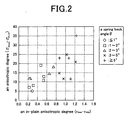
- Table 2 shows results of each annealed steel sheet, and Fig. 2 shows distribution of maximum spring-back angles ⁇ max in relation with anisotropic degrees (r max -r min and ⁇ max - ⁇ min ).
- a ferritic stainless steel sheet is improved in shape-freezability by conditioning re-crystallized ferrite grains to a structure with equalized planar orientation so as to reduce a plane anisotropic degree (r max -r min ) of Lankford value (r) and an anisotropic degree ( ⁇ max - ⁇ min ) of 0.2%-yield strength to possible lowest values. Since the stainless steel sheet is plastically formed to a product shape with less spring-back, it is useful in various industrial fields, e.g. parts of electric or electronic devices such as a sealing member of an organic EL device, precise pressed parts, and building members.
Landscapes
- Chemical & Material Sciences (AREA)
- Engineering & Computer Science (AREA)
- Mechanical Engineering (AREA)
- Materials Engineering (AREA)
- Metallurgy (AREA)
- Organic Chemistry (AREA)
- Physics & Mathematics (AREA)
- Thermal Sciences (AREA)
- Crystallography & Structural Chemistry (AREA)
- Heat Treatment Of Sheet Steel (AREA)
Abstract
Description
- The present invention relates to a ferritic stainless steel sheet, which can be formed to a product shape by press-forming, bending, roll-forming or the like due to good shape-freezability with less dimensional defects such as spring-back and torsion after forming, and also relates to a method of manufacturing thereof.
- A stainless steel sheet has been used in various fields, e.g. interior or exterior members of buildings, frame members of electric home appliances and kitchen goods, due to its excellent external appearance and corrosion-resistance. The wording of "a steel sheet" involves a steel strip in this specification.
- A product formed from a stainless steel sheet often involves dimensional defects originated in elastic recovery, since elastic strain of the stainless steel sheet is bigger than a common steel sheet. For instance, when a steel sheet, which is simply bent to a product shape, is detached from a shaping die, an angle of bent becomes broader than a designed angle due to release of elastic strain. The reformation is so-called as "spring-back". Especially in the case where a product is manufactured from a steel sheet by shallow drawing, elastic stain is not completely released but remains at a flange or a punched bottom even after the product is detached from a shaping die. The residual strain causes defects such as torsion and significantly reduces commercial value of the product.
- A relatively soft austenitic stainless steel sheet such as SUS304 has been used among various kinds of stainless steels, in order to inhibit occurrence of defects during fabrication. However, austenitic stainless steel is expensive material due to high Ni content.
- The present invention aims at provision of a ferritic stainless steel sheet, which is cheaper material due to remarkable decrease of Ni content but is improved in shape-freezability so as to inhibit dimensional defects such as spring-back and torsion after forming.
- The present invention proposes a new ferritic stainless steel sheet, which has the alloying composition consisting of C up to 0.10 mass %, Si up to 1.0 mass %, Mn up to 1.0 mass %, P up to 0.050 mass %, S up to 0.020 mass %, Ni up to 2.0 mass %, 8.0-22.0 mass % of Cr, N up to 0.05 mass %, optionally one or more of 0.01-0.50 mass % of Ti, 0.01-0.50 mass % of Nb, 0.01-0.30 mass % of V, 0.01-0.30 mass % of Zr and 0.0010-0.0100 mass % of B, and the balance being essentially Fe, with the provision that a value FM defined by the formula (1) is adjusted to 0 or less. The ferritic stainless steel sheet has an in-plane anisotropic degree (rmax-rmin) of Lankford value (r) ≤0.80 and an anisotropic degree (σmax-σmin) of 0.2%-yield strength ≤20 N/mm2.
- The stainless steel sheet preferably has 0.2%-yield strength ≤350 N/mm2 along any of a rolling direction (Direction-L), directions (Direction-D) crossing Direction-L with an angle of 45 degrees and a traverse direction (Direction-T) crossing Direction-L with a right angle.
- The stainless steel sheet is manufactured by hot-rolling a ferritic stainless steel having the specified composition and then batch-annealing the hot-rolled steel sheet 1-24 hours at 700-880 °C.
-
- Fig. 1 is a schematic view for explaining a bending test, whereby a steel sheet is bent to a box shape, and corners of the box are measured for evaluation of spring-back.
- Fig. 2 is a graph for explaining a spring-back angle in relation with a plane anisotropic degree (rmax-rmin) of Lankford value (r) and an anisotropic degree (σmax-σmin) of 0.2%-yield strength.
-
- Properties of ferritic stainless steels substantially depend on chemical composition and manufacturing conditions. The inventors have researched and examined effects of the chemical composition and manufacturing conditions on the properties, and discovered that shape-freezability (in other words, suppression of deformation derived from spring-back after forming) is improved by combination of a specified alloying composition with manufacturing conditions.
- Since the shape-freezability is influenced not only by uniaxial deformation but also multi-axial deformation during plastically forming a stainless steel sheet to a product shape, materialistic properties and anisotropy along various directions put big effects on the shape-freezability. Especially, deviations of Lankford values (r) and 0.2%-yield strength among Directions-L, -D and -T are main factors. As the deviations of Lankford values (r) along directions-L, -D and -T are smaller, the stainless steel sheet has less plane anisotropy.
- If Lankford value (r) is different from each other along Directions-L, - D and -T, thickness reduction of a stainless steel sheet is deviated at every part to which the same stress is applied. Deviation of thickness reduction causes irregular distribution of residual strains in the stainless steel sheet formed to a product shape, resulting in poor shape-freezability. Deviation of 0.2%-yield strength from each other along Directions-L, -D and -T means that various strains different from each other are given to the stainless steel sheet during plastically forming the stainless steel sheet with a certain stress. In this case, the shape-freezability is also poor.
- In order to improve shape-freezability, a plane anisotropic degree (rmax-rmin) and an anisotropic degree (σmax-σmin) of 0.2%-yield strength are necessarily decreased, wherein rmax and σmax are maximum of Lankford value (r) and 0.2%-yield strength among Directions-L, -D and -T, while rmin and σmin are minimum of Lankford value (r) and 0.2%-yield strength among Directions-L, -D and -T.
- The plane anisotropic degree (rmax-rmin) of Lankford value (r) and the anisotropic degree (σmax-σmin) of 0.2%-yield strength are decreased by conditioning re-crystallized ferrite grains of the stainless steel sheet to an isotropic state with equation of planar orientation. Isotropic re-crystallization of ferrite grains is attained by precipitating dissolved C and N as fine carbonitride particles uniformly dispersed in a steel matrix. Isotropic re-crystallization of ferrite grains effectively reduces the anisotropic degrees (rmax-rmin, σmax-σmin). Effects of uniform dispersion of fine carbonitride particles on random growth of re-crystallized ferrite grains are explained as follows:
- Carbonitride particles present in a steel matrix act as seeds for re-crystallization of ferrite grains during final annealing, e.g. batch-annealing or finish-annealing, of a stainless steel sheet. Although grain boundaries and deformed zones such as slip bands in a cold-rolled ferritic structure have been heretofore regarded as seeds for re-crystallization of ferrite grains, the grain boundaries and the deformed zones are elongated by cold-rolling. As a result, the grain boundaries and the deformed zones have specified orientation, and re-crystallized ferrite grains grow while succeeding to the orientation. On the other hand, carbonitride particles are granular and very hard (Vickers hardness above 1000), so that they are not elongated during cold-rolling but act as seeds for isotropic re-crystallization of ferrite grains at boundaries in contact with ferrite grains.
- Uniform dispersion of fine carbonitride particles is assured by properly controlling annealing conditions, so as to reform a rolling texture generated in a former hot-rolling step to an isotropic ferrite structure. The isotropic structure is maintained even in a cold-rolled state. That is, each ferrite grain is orientated due to application of stress in a following cold-rolling step, but a whole of the ferrite grains is still homogeneous and isotropic. The uniformly dispersed fine carbonitride particles act as seeds for re-crystallization of ferrite grains from a cold-rolling step to an annealing step, so as to further uniform planar orientation of ferrite grains. Consequently, an in-plane anisotropic degree (rmax-rmin) is reduced, and a stainless steel sheet is press-formed with good shape-freezability.
- The other features of the present invention will be apparent from the following explanation on an alloying composition and manufacturing conditions.
- A ferritic stainless steel according to the present invention contains the following elements as essential components.
- C is converted to carbides by batch-annealing, and the carbides act as seeds for random growth of ferrite grains during re-crystallization at a final-annealing step. However, C is an element which unfavorably raises strength of a cold-rolled stainless steel sheet after annealing. Excess C content is also disadvantage for toughness. Therefore, C content is controlled to 0.10 mass % or less.
- Si is an element, which is added as a deoxidizing agent during steel-making, but solution-hardens a steel matrix too much. Since excess Si causes hardening and decrease of ductility, an upper limit of Si content is determined to 1.0 mass %.
- Mn is an austenite former, which does not put harmful effects on steel material due to its small solution-hardening power, useful for controlling the value-FM defined by the formula (1). However, excess Mn causes generation of fumes during steel-making and worsens productivity. In this sense, Mn content is controlled to 1.0 mass % or less.
- P is an element harmful on hot-workability. The effect of P is suppressed by controlling P content less than 0.050 mass %.
- S is an element, which segregates at grain boundaries and worsens hot-workability Such effects are suppressed by controlling S content less than 0.020 mass %.
- Ni is the same austenite former as Mn and useful for controlling the value-FM. However, excess addition of Ni above 2.0 mass % raises a steel cost and also hardens a steel sheet.
- Cr is an essential element for corrosion resistance. At least 8 mass % of Cr is necessary for corrosion resistance as stainless steel. However, excess addition of Cr above 22.0 mass % worsens toughness and formability of a stainless steel sheet.
- N is converted to nitrides by batch-annealing. The nitrides act as seeds for random growth of ferrite grains during re-crystallization in a final-annealing step. However, excess N causes decrease of toughness, since N raises strength of an annealed cold-rolled steel sheet. Therefore, N content is controlled to 0.05 mass % or less.
- The ferritic stainless steel may further contain one or more of the following elements in addition to the above-mentioned elements.
- Al is an element, which is added as a deoxidizing agent during steel-making. Excess Al content above 0.10 mass % causes increase of non-metallic inclusions, decrease of toughness and occurrence of surface defects. Therefore, Al content is properly determined so as to control a value-FM to 0 or less.
- Mo is an element for improvement of corrosion resistance, but excess addition of Mo above 1.0 mass % promotes solution-hardening and retards dynamic re-crystallization in a high-temperature zone, resulting in decrease of hot-workability.
- Cu is an element included in steel from scraps during steel-making. Since excess Cu is unfavorable for hot-workability and corrosion-resistance, its upper limit is determined to 1.0 mass %.
- 0.01-0.50 mass % of Ti, 0.01-0.50 mass % of Nb,
- 0.01-0.30 mass % of V and 0.01-0.30 mass % of Zr
-
- Ti, Nb and V are reacted with C dissolved in a steel matrix and precipitated as carbides effective for formability. Zr captures dissolved O as oxide and improves formability and toughness of a stainless steel sheet. Effects of these elements are noted at every 0.01 mass % or more, but excess addition is disadvantageous for productivity. In this sense, upper limits of these elements are determined to Ti: 0.50 mass %, Nb: 0.50 mass %, V: 0.30 mass % and Zr: 0.30 mass %.
- B is an element, which uniformly disperses transformed phase in a hot-rolled steel sheet and promotes random growth of ferrite grains in a final structure without generation of aggregate structure. Uniform distribution of the transformed phase is typically noted by addition of B at a ratio of 0.0010 mass % or more. However, excess addition of B above 0.0100 mass % causes degradation of hot-workability and weldability.
- The stainless steel is designed so as to adjust a value-FM defined by the formula (1) to 0 or less in addition to the specified ratios of the alloying elements, for improvement of shape-freezability without generation of an austenite phase during batch-annealing.
- Generation of an austenite phase in a high-temperature zone during batch-annealing is inhibited by controlling the value-FM to 0 or less. On the other hand, an alloying design at FM>0 allows generation of an austenite phase, which can dissolve C and N at relatively high ratios, in a ferrite matrix. Since solubility of C and N is different between the austenite phase and the ferrite matrix, the anisotropic degrees (rmax-rmin andσmax-σmin) are raised due to the uneven solubility.
An in-plane anisotropic degree (rmax-rmin) of Lankford value (r) ≤0.80
An anisotropic degree (σmax-σmin) of 0.2%-yield strength ≤20N/mm2 - As the anisotropic degrees (rmax-rmin and σmax-σmin) are smaller, a ferritic stainless steel is press-formed to a product shape with better shape-freezability. Experimental results prove that the shape-freezability is excellent at (rmax-rmin) ≤0.80 and (σmax-σmin) ≤ 20N/mm2.
0.2%-yield strength ≤ 350N/mm2 - A complete ferrite structure free from martensite with 0.2%-yield strength of 350N/mm2 or less is preferable in order to impart excellent shape-freezability to a ferritic stainless steel. Strength above 350N/mm2 naturally requires application of a big stress for plastic deformation of the stainless steel sheet, resulting in increase of spring-back and degradation of shape-freezability.
- A ferritic stainless steel sheet is annealed under the conditions that dissolved C and N are precipitated as fine carbonitride particles uniformly dispersed in a single ferrite matrix, in order to reduce the anisotropic degrees (rmax-rmin and σmax-σmin). Sufficient precipitation of carbonitride particles is realized by batch-annealing at a temperature of 700 °C or higher. However, when the stainless steel sheet is batch-annealed at a temperature higher than 880 °C, the stainless steel sheet is rendered to an anisotropic structure on the contrary due to predominant growth of re-crystallized ferrite grains (so-called as "secondary re-crystallization").
- The present invention will be more clearly understood by the following examples.
- Several stainless steels shown in Table 1 were melted in a vacuum furnace, cast, forged and then hot-rolled to thickness of 3.0 mm. Each hot-rolled steel sheet was batch-annealed or intermediate-annealed under conditions shown in Table 2, pickled and then cold-rolled to thickness of 0.5 mm. The cold-rolled steel sheet was finish-annealed 1 minute at 880 °C, cooled in the open air and then pickled again.

- Each annealed steel sheet was sampled for measurement of Lankford value (r) and 0.2%-yield strength as follows:
- After tensile strain of 15% was applied to a test piece JIS 13B, Lankford value (r) was measured along each of Directions-L, -D and -T. A difference between measured maximum and minimum values was calculated and evaluated as an in-plane anisotropic degree (rmax-rmin) of Lankford value (r).
- After tensile strain was applied to a test piece JIS 13B at a rate of 3.3×10⁻⁴, 0.2%-yield strength was measured along each of Directions-L, -D and -T. A difference between measured maximum and minimum values was calculated and evaluated as an anisotropic degree (σmax-σmin) of 0.2%-yield strength.
- Two test pieces, each of which had a developed box-shape (shown in Fig. 1) comprising a 40 mm-square area E1, E2 with four oblong areas A1-D1, A2-D2 of 10 mm×36 mm in size, were prepared from each annealed steel sheet. One test piece was cut along Direction-L (a rolling direction), and the other was cut along Direction-D. All sides of the square areas E1, E2 were bent at a working speed of 200 mm/minute under a hold-down pressure of 20 ton, and the oblong areas A1-D1, A2-D2 were raised upright, by a 200-ton press equipped with a rectangular punch having a tip diameter of 4mm. A spring-back angle was measured at every measurement point P1-P4 corresponding to four corners of a bottom of a formed box. Shape-freezability was evaluated by a maximum angle max among the measurement values.
- Table 2 shows results of each annealed steel sheet, and Fig. 2 shows distribution of maximum spring-back angles max in relation with anisotropic degrees (rmax-rmin and σmax-σmin).
- It is understood from Fig. 2 that the inventive steel sheets with rmax-rmin ≤0.8 and σmax-σmin ≤20N/mm2 were good of shape freezability (i.e. maximum spring-back angles max ≤3 degrees). On the other hand, comparative steel sheets, which did not satisfy either one of rmax-rmin ≤0.8 and σmax-σmin ≤20N/mm2, were poor of shape-freezability, as noted by maximum spring-back angles max >3 degrees

- According to the present invention as above-mentioned, a ferritic stainless steel sheet is improved in shape-freezability by conditioning re-crystallized ferrite grains to a structure with equalized planar orientation so as to reduce a plane anisotropic degree (rmax-rmin) of Lankford value (r) and an anisotropic degree (σmax-σmin) of 0.2%-yield strength to possible lowest values. Since the stainless steel sheet is plastically formed to a product shape with less spring-back, it is useful in various industrial fields, e.g. parts of electric or electronic devices such as a sealing member of an organic EL device, precise pressed parts, and building members.
Claims (4)
- A ferritic stainless steel sheet, which has:alloying composition consisting of C up to 0.10 mass %, Si up to 1.0 mass %, Mn up to 1.0 mass %, P up to 0.050 mass %, S up to 0.020 mass %, Ni up to 2.0 mass %, 8.0-22.0 mass % of Cr, N up to 0.05 mass % and the balance being essentially Fe, with the provision that a value-FM defined by the formula (1) is adjusted to 0 or less, andthe mechanical properties that a plane anisotropic degree (rmax-rmin) of Lankford value (r) and an anisotropic degree (σmax-σmin) of 0.2%-yield strength are controlled not more than 0.80 and 20N/mm2, respectively.
- The ferritic stainless steel sheet defined by Claim1, wherein the alloying composition further contains one or more of Al up to 0.10 mass %, Mo up to 1.0 mass %, Cu up to 1.0 mass %, 0.01-0.50 mass % of Ti, 0.01-0.50 mass % of Nb, 0.01-0.30 mass % of V, 0.01-0.30 mass % of Zr and 0.0010-0.0100 mass % of B.
- The ferritic stainless steel sheet defined by Claim 1, wherein 0.2%-yield strength is not more than 350N/mm2 along any of a rolling direction, directions crossing said rolling direction with an angle of 45 degrees and a direction crossing said rolling direction with a right angle.
- A method of manufacturing a ferritic stainless steel sheet good of shape-freezability during plastic reformation, which comprises the steps of:hot-rolling a ferritic stainless steel having the alloying composition defined by Claim 1 or 2, and thenbatch-annealing the hot-rolled steel sheet 1-24 hours at 700-800 °C.
Applications Claiming Priority (3)
| Application Number | Priority Date | Filing Date | Title |
|---|---|---|---|
| JP2001139576 | 2001-05-10 | ||
| JP2001139576A JP2002332549A (en) | 2001-05-10 | 2001-05-10 | Ferritic stainless steel strip excellent in shape freezing property during forming and method for producing the same |
| PCT/JP2002/004524 WO2002092867A1 (en) | 2001-05-10 | 2002-05-09 | Ferritic stainless steel strip excellent in freeze of shape formed by working |
Publications (3)
| Publication Number | Publication Date |
|---|---|
| EP1386977A1 true EP1386977A1 (en) | 2004-02-04 |
| EP1386977A4 EP1386977A4 (en) | 2004-12-15 |
| EP1386977B1 EP1386977B1 (en) | 2006-08-09 |
Family
ID=18986327
Family Applications (1)
| Application Number | Title | Priority Date | Filing Date |
|---|---|---|---|
| EP02769555A Expired - Lifetime EP1386977B1 (en) | 2001-05-10 | 2002-05-09 | Ferritic stainless steel strip excellent in freeze of shape formed by working |
Country Status (7)
| Country | Link |
|---|---|
| US (1) | US20040140023A1 (en) |
| EP (1) | EP1386977B1 (en) |
| JP (1) | JP2002332549A (en) |
| KR (1) | KR20030094325A (en) |
| CN (1) | CN1249262C (en) |
| DE (1) | DE60213784T2 (en) |
| WO (1) | WO2002092867A1 (en) |
Cited By (3)
| Publication number | Priority date | Publication date | Assignee | Title |
|---|---|---|---|---|
| EP1514949A4 (en) * | 2002-06-17 | 2006-05-31 | Jfe Steel Corp | FERRITIC STAINLESS STEEL PLATE WITH Ti AND METHOD FOR PRODUCTION THEREOF |
| RU2321672C1 (en) * | 2006-05-31 | 2008-04-10 | Юлия Алексеевна Щепочкина | Steel |
| US20110061777A1 (en) * | 2007-08-20 | 2011-03-17 | Jfe Steel Corporation | Ferritic stainless steel sheet having superior punching workability and method for manufacturing the same |
Families Citing this family (17)
| Publication number | Priority date | Publication date | Assignee | Title |
|---|---|---|---|---|
| JP2007283378A (en) * | 2006-04-19 | 2007-11-01 | Fujifilm Corp | Press die, drawing method and press product |
| JP4740021B2 (en) * | 2006-04-20 | 2011-08-03 | 新日鐵住金ステンレス株式会社 | Cr-containing thin steel sheet having excellent shape freezing property and method for producing the same |
| SE530155C2 (en) * | 2006-07-26 | 2008-03-11 | Sandvik Intellectual Property | Ferritic chromium stainless steel for fuel cells, contains preset amount of carbon, silicon, manganese, chromium, nickel, molybdenum, niobium, titanium, zirconium, rare earth metals, aluminum and nitrogen |
| CN100532579C (en) * | 2007-04-30 | 2009-08-26 | 郑州永通特钢有限公司 | Method for smelting base material of low phosphorous stainless steel by using low-grade limonite containing nickel-chromium |
| KR100963109B1 (en) | 2007-11-22 | 2010-06-14 | 주식회사 포스코 | High Cr Ferritic Stainless Steel |
| CN101768702B (en) * | 2008-12-31 | 2012-05-30 | 宝山钢铁股份有限公司 | Medium-chromium ferrite stainless steel for automobile with high formability and acidic corrosion resistance as well as manufacturing method thereof |
| CN101649418B (en) * | 2009-09-10 | 2011-06-01 | 山西太钢不锈钢股份有限公司 | Ferrite stainless steel cold-rolled steel band and manufacturing method thereof |
| CN102140574B (en) * | 2011-05-11 | 2012-09-05 | 北京冶金正源科技有限公司 | Annealing process for improving deep drawability of 430 ferrite stainless steel |
| UA111115C2 (en) * | 2012-04-02 | 2016-03-25 | Ейкей Стіл Пропертіс, Інк. | cost effective ferritic stainless steel |
| KR101423823B1 (en) * | 2012-06-28 | 2014-07-25 | 주식회사 포스코 | Low chrome ferritic stainless steel with improved corrosion resistance and ridging property |
| CN103789677B (en) * | 2014-02-11 | 2016-04-20 | 江苏省沙钢钢铁研究院有限公司 | A high-strength steel bar with high corrosion resistance and its preparation method |
| CN105220074A (en) * | 2015-10-22 | 2016-01-06 | 山西太钢不锈钢股份有限公司 | Chrome ferritic high temperature steel making method in a kind of boiler swing pipe tray use |
| KR20170056046A (en) * | 2015-11-12 | 2017-05-23 | 주식회사 포스코 | Ferritic stainless steel and method of manufacturing the same |
| CN106435129B (en) * | 2016-06-30 | 2021-04-02 | 宝钢德盛不锈钢有限公司 | Ferritic stainless steel with good toughness and corrosion resistance and manufacturing method thereof |
| JP6878060B2 (en) * | 2017-03-15 | 2021-05-26 | 日鉄ステンレス株式会社 | Ferritic stainless steel hot-rolled steel strip |
| JP7178791B2 (en) * | 2018-03-30 | 2022-11-28 | 日鉄ステンレス株式会社 | Steel plates for ferritic stainless steel pipes |
| KR102279909B1 (en) * | 2019-11-19 | 2021-07-22 | 주식회사 포스코 | Ferritic stainless steel having high magnetic permeability |
Family Cites Families (9)
| Publication number | Priority date | Publication date | Assignee | Title |
|---|---|---|---|---|
| JPS59153831A (en) * | 1983-02-23 | 1984-09-01 | Sumitomo Metal Ind Ltd | Manufacture of heat resistant ferritic stainless steel plate |
| JP2772237B2 (en) * | 1994-03-29 | 1998-07-02 | 川崎製鉄株式会社 | Method for producing ferritic stainless steel strip with small in-plane anisotropy |
| JP4065579B2 (en) * | 1995-09-26 | 2008-03-26 | Jfeスチール株式会社 | Ferritic stainless steel sheet with small in-plane anisotropy and excellent ridging resistance and method for producing the same |
| JP4221107B2 (en) * | 1999-03-19 | 2009-02-12 | 新日本製鐵株式会社 | Method for producing ferritic stainless steel sheet with excellent surface properties |
| JP4285843B2 (en) * | 1999-07-21 | 2009-06-24 | 新日鐵住金ステンレス株式会社 | Ferritic stainless steel with excellent shape freezing property during bending and its manufacturing method |
| JP2001032023A (en) * | 1999-07-23 | 2001-02-06 | Nippon Steel Corp | Manufacturing method of ferritic stainless steel with good surface properties and workability |
| US6413332B1 (en) * | 1999-09-09 | 2002-07-02 | Kawasaki Steel Corporation | Method of producing ferritic Cr-containing steel sheet having excellent ductility, formability, and anti-ridging properties |
| JP2001107149A (en) * | 1999-09-30 | 2001-04-17 | Kawasaki Steel Corp | Method for producing ferritic stainless steel sheet with excellent ductility, workability and ridging resistance |
| JP3769479B2 (en) * | 2000-08-07 | 2006-04-26 | 新日鐵住金ステンレス株式会社 | Ferritic stainless steel sheet for fuel tanks with excellent press formability |
-
2001
- 2001-05-10 JP JP2001139576A patent/JP2002332549A/en active Pending
-
2002
- 2002-05-09 DE DE60213784T patent/DE60213784T2/en not_active Expired - Lifetime
- 2002-05-09 US US10/477,015 patent/US20040140023A1/en not_active Abandoned
- 2002-05-09 WO PCT/JP2002/004524 patent/WO2002092867A1/en not_active Ceased
- 2002-05-09 CN CNB028094530A patent/CN1249262C/en not_active Expired - Fee Related
- 2002-05-09 KR KR10-2003-7013121A patent/KR20030094325A/en not_active Ceased
- 2002-05-09 EP EP02769555A patent/EP1386977B1/en not_active Expired - Lifetime
Non-Patent Citations (2)
| Title |
|---|
| No further relevant documents disclosed * |
| See also references of WO02092867A1 * |
Cited By (4)
| Publication number | Priority date | Publication date | Assignee | Title |
|---|---|---|---|---|
| EP1514949A4 (en) * | 2002-06-17 | 2006-05-31 | Jfe Steel Corp | FERRITIC STAINLESS STEEL PLATE WITH Ti AND METHOD FOR PRODUCTION THEREOF |
| US7494551B2 (en) | 2002-06-17 | 2009-02-24 | Jfe Steel Corporation | Ferritic stainless steel plate with Ti and method for production thereof |
| RU2321672C1 (en) * | 2006-05-31 | 2008-04-10 | Юлия Алексеевна Щепочкина | Steel |
| US20110061777A1 (en) * | 2007-08-20 | 2011-03-17 | Jfe Steel Corporation | Ferritic stainless steel sheet having superior punching workability and method for manufacturing the same |
Also Published As
| Publication number | Publication date |
|---|---|
| WO2002092867A1 (en) | 2002-11-21 |
| EP1386977A4 (en) | 2004-12-15 |
| KR20030094325A (en) | 2003-12-11 |
| EP1386977B1 (en) | 2006-08-09 |
| US20040140023A1 (en) | 2004-07-22 |
| DE60213784T2 (en) | 2006-11-30 |
| CN1507500A (en) | 2004-06-23 |
| JP2002332549A (en) | 2002-11-22 |
| CN1249262C (en) | 2006-04-05 |
| DE60213784D1 (en) | 2006-09-21 |
Similar Documents
| Publication | Publication Date | Title |
|---|---|---|
| EP1386977B1 (en) | Ferritic stainless steel strip excellent in freeze of shape formed by working | |
| US6723181B2 (en) | Soft stainless steel sheet excellent in workability | |
| EP1396552B1 (en) | Double phase stainless steel strip for steel belt | |
| EP1215298A2 (en) | A high-strength austenitic stainless steel strip excellent in flatness of shape and its manufacturing method | |
| JP2004360003A (en) | Ferritic stainless steel sheet excellent in press formability and secondary workability and method for producing the same | |
| WO2008013305A1 (en) | Stainless steel sheet for parts and process for manufacturing the same | |
| JP3877590B2 (en) | Highly elastic metastable austenitic stainless steel sheet and its manufacturing method | |
| JP3691341B2 (en) | Austenitic stainless steel sheet with excellent precision punchability | |
| KR101606946B1 (en) | High-strength stainless steel material and process for production of the same | |
| JP2010215953A (en) | Austenitic stainless steel and method for producing austenitic stainless steel sheet | |
| JP3839108B2 (en) | Austenitic stainless steel with excellent workability after punching | |
| CN102712982B (en) | Steel plate having excellent moldability and shape retention, and method for producing same | |
| US20240336989A1 (en) | Austenitic stainless steel and method for manufacturing same | |
| JP2002332548A (en) | Ferritic stainless steel strip having excellent shape fixability on forming and production method therefor | |
| JP6573459B2 (en) | Ferritic stainless steel plate excellent in hole expansibility and manufacturing method thereof | |
| JP4561136B2 (en) | Steel sheet for nitriding treatment | |
| JP5098403B2 (en) | Ferritic stainless steel sheet that hardly causes rough surface during bending, and method for producing the same | |
| JPH0625379B2 (en) | Manufacturing method of high carbon cold rolled steel sheet with excellent toughness after heat treatment | |
| JP2004083972A (en) | Ferritic stainless steel cold rolled, annealed material having excellent secondary workability, and production method therefor | |
| US20250003039A1 (en) | Ferritic stainless-steel sheet | |
| WO2021039499A1 (en) | Low-strength steel sheet for hot stamping, hot-stamped component, and method for manufacturing hot-stamped component | |
| JP3836358B2 (en) | Ferritic stainless steel strip with excellent shape freezing property and manufacturing method thereof | |
| EP4541923A1 (en) | Highly formable and easily phosphated high-manganese cold-rolled steel plate having tensile strength of 1000-1600 mpa, and manufacturing method therefor | |
| JP2012201924A (en) | Stainless steel sheet and method for producing the same | |
| JP3310064B2 (en) | Good burring high strength steel sheet with excellent fatigue resistance |
Legal Events
| Date | Code | Title | Description |
|---|---|---|---|
| PUAI | Public reference made under article 153(3) epc to a published international application that has entered the european phase |
Free format text: ORIGINAL CODE: 0009012 |
|
| 17P | Request for examination filed |
Effective date: 20030807 |
|
| AK | Designated contracting states |
Kind code of ref document: A1 Designated state(s): AT BE CH CY DE DK ES FI FR GB GR IE IT LI LU MC NL PT SE TR |
|
| A4 | Supplementary search report drawn up and despatched |
Effective date: 20041104 |
|
| RIC1 | Information provided on ipc code assigned before grant |
Ipc: 7C 22C 38/00 A Ipc: 7C 22C 38/54 B Ipc: 7C 22C 38/40 B Ipc: 7C 22C 38/24 B Ipc: 7C 22C 38/28 B Ipc: 7C 21D 9/46 B Ipc: 7C 22C 38/18 B Ipc: 7C 22C 38/32 B Ipc: 7C 22C 38/26 B |
|
| 17Q | First examination report despatched |
Effective date: 20050125 |
|
| GRAP | Despatch of communication of intention to grant a patent |
Free format text: ORIGINAL CODE: EPIDOSNIGR1 |
|
| RBV | Designated contracting states (corrected) |
Designated state(s): DE FR GB |
|
| GRAS | Grant fee paid |
Free format text: ORIGINAL CODE: EPIDOSNIGR3 |
|
| GRAA | (expected) grant |
Free format text: ORIGINAL CODE: 0009210 |
|
| AK | Designated contracting states |
Kind code of ref document: B1 Designated state(s): DE FR GB |
|
| REG | Reference to a national code |
Ref country code: GB Ref legal event code: FG4D |
|
| REF | Corresponds to: |
Ref document number: 60213784 Country of ref document: DE Date of ref document: 20060921 Kind code of ref document: P |
|
| ET | Fr: translation filed | ||
| PLBE | No opposition filed within time limit |
Free format text: ORIGINAL CODE: 0009261 |
|
| STAA | Information on the status of an ep patent application or granted ep patent |
Free format text: STATUS: NO OPPOSITION FILED WITHIN TIME LIMIT |
|
| 26N | No opposition filed |
Effective date: 20070510 |
|
| PGFP | Annual fee paid to national office [announced via postgrant information from national office to epo] |
Ref country code: GB Payment date: 20100329 Year of fee payment: 9 |
|
| PGFP | Annual fee paid to national office [announced via postgrant information from national office to epo] |
Ref country code: FR Payment date: 20100525 Year of fee payment: 9 |
|
| PGFP | Annual fee paid to national office [announced via postgrant information from national office to epo] |
Ref country code: DE Payment date: 20100512 Year of fee payment: 9 |
|
| GBPC | Gb: european patent ceased through non-payment of renewal fee |
Effective date: 20110509 |
|
| REG | Reference to a national code |
Ref country code: FR Ref legal event code: ST Effective date: 20120131 |
|
| REG | Reference to a national code |
Ref country code: DE Ref legal event code: R119 Ref document number: 60213784 Country of ref document: DE Effective date: 20111201 |
|
| PG25 | Lapsed in a contracting state [announced via postgrant information from national office to epo] |
Ref country code: FR Free format text: LAPSE BECAUSE OF NON-PAYMENT OF DUE FEES Effective date: 20110531 |
|
| PG25 | Lapsed in a contracting state [announced via postgrant information from national office to epo] |
Ref country code: GB Free format text: LAPSE BECAUSE OF NON-PAYMENT OF DUE FEES Effective date: 20110509 |
|
| PG25 | Lapsed in a contracting state [announced via postgrant information from national office to epo] |
Ref country code: DE Free format text: LAPSE BECAUSE OF NON-PAYMENT OF DUE FEES Effective date: 20111201 |