EP1386904A1 - Acenaphthylene derivative, polymer, and antireflection film-forming composition - Google Patents
Acenaphthylene derivative, polymer, and antireflection film-forming composition Download PDFInfo
- Publication number
- EP1386904A1 EP1386904A1 EP03017282A EP03017282A EP1386904A1 EP 1386904 A1 EP1386904 A1 EP 1386904A1 EP 03017282 A EP03017282 A EP 03017282A EP 03017282 A EP03017282 A EP 03017282A EP 1386904 A1 EP1386904 A1 EP 1386904A1
- Authority
- EP
- European Patent Office
- Prior art keywords
- polymer
- antireflection film
- group
- structural unit
- forming composition
- Prior art date
- Legal status (The legal status is an assumption and is not a legal conclusion. Google has not performed a legal analysis and makes no representation as to the accuracy of the status listed.)
- Granted
Links
- 229920000642 polymer Polymers 0.000 title claims abstract description 134
- 239000000203 mixture Substances 0.000 title claims abstract description 91
- 125000004054 acenaphthylenyl group Chemical group C1(=CC2=CC=CC3=CC=CC1=C23)* 0.000 title description 29
- 125000004435 hydrogen atom Chemical group [H]* 0.000 claims abstract description 25
- 125000000962 organic group Chemical group 0.000 claims abstract description 18
- 125000004429 atom Chemical group 0.000 claims abstract description 13
- 239000002904 solvent Substances 0.000 claims description 30
- 239000002253 acid Substances 0.000 claims description 19
- MOASFWJQSIPNPT-UHFFFAOYSA-N acenaphthylen-1-ylmethyl acetate Chemical group C1=CC(C(COC(=O)C)=C2)=C3C2=CC=CC3=C1 MOASFWJQSIPNPT-UHFFFAOYSA-N 0.000 claims description 16
- GWJBEJFEFFWFBI-UHFFFAOYSA-N acenaphthylen-1-ylmethanol Chemical group C1=CC(C(CO)=C2)=C3C2=CC=CC3=C1 GWJBEJFEFFWFBI-UHFFFAOYSA-N 0.000 claims description 13
- 238000005227 gel permeation chromatography Methods 0.000 claims description 7
- 239000004793 Polystyrene Substances 0.000 claims description 4
- 229920002223 polystyrene Polymers 0.000 claims description 4
- 150000001875 compounds Chemical class 0.000 abstract description 41
- 230000000694 effects Effects 0.000 abstract description 11
- 230000001747 exhibiting effect Effects 0.000 abstract description 4
- -1 acetoxymethyl group Chemical group 0.000 description 57
- 239000000243 solution Substances 0.000 description 24
- HXGDTGSAIMULJN-UHFFFAOYSA-N acetnaphthylene Natural products C1=CC(C=C2)=C3C2=CC=CC3=C1 HXGDTGSAIMULJN-UHFFFAOYSA-N 0.000 description 23
- 238000000034 method Methods 0.000 description 22
- OKKJLVBELUTLKV-UHFFFAOYSA-N Methanol Chemical compound OC OKKJLVBELUTLKV-UHFFFAOYSA-N 0.000 description 21
- 229920005989 resin Polymers 0.000 description 19
- 239000011347 resin Substances 0.000 description 19
- NIXOWILDQLNWCW-UHFFFAOYSA-M Acrylate Chemical compound [O-]C(=O)C=C NIXOWILDQLNWCW-UHFFFAOYSA-M 0.000 description 13
- DKPFZGUDAPQIHT-UHFFFAOYSA-N butyl acetate Chemical compound CCCCOC(C)=O DKPFZGUDAPQIHT-UHFFFAOYSA-N 0.000 description 12
- 125000002887 hydroxy group Chemical group [H]O* 0.000 description 12
- 238000004519 manufacturing process Methods 0.000 description 12
- 230000005855 radiation Effects 0.000 description 12
- 239000007787 solid Substances 0.000 description 12
- 230000015572 biosynthetic process Effects 0.000 description 11
- 239000003795 chemical substances by application Substances 0.000 description 11
- 239000011248 coating agent Substances 0.000 description 11
- 238000000576 coating method Methods 0.000 description 11
- 238000007796 conventional method Methods 0.000 description 11
- 238000011156 evaluation Methods 0.000 description 11
- XLYOFNOQVPJJNP-UHFFFAOYSA-N water Substances O XLYOFNOQVPJJNP-UHFFFAOYSA-N 0.000 description 11
- 125000002777 acetyl group Chemical group [H]C([H])([H])C(*)=O 0.000 description 10
- 125000003118 aryl group Chemical group 0.000 description 10
- 239000000975 dye Substances 0.000 description 10
- 239000002994 raw material Substances 0.000 description 10
- 125000000391 vinyl group Chemical group [H]C([*])=C([H])[H] 0.000 description 10
- ZWEHNKRNPOVVGH-UHFFFAOYSA-N 2-Butanone Chemical compound CCC(C)=O ZWEHNKRNPOVVGH-UHFFFAOYSA-N 0.000 description 9
- DNIAPMSPPWPWGF-UHFFFAOYSA-N Propylene glycol Chemical compound CC(O)CO DNIAPMSPPWPWGF-UHFFFAOYSA-N 0.000 description 9
- 229920001577 copolymer Polymers 0.000 description 9
- 125000002496 methyl group Chemical group [H]C([H])([H])* 0.000 description 9
- 239000000758 substrate Substances 0.000 description 9
- WYURNTSHIVDZCO-UHFFFAOYSA-N Tetrahydrofuran Chemical compound C1CCOC1 WYURNTSHIVDZCO-UHFFFAOYSA-N 0.000 description 8
- YXFVVABEGXRONW-UHFFFAOYSA-N Toluene Chemical compound CC1=CC=CC=C1 YXFVVABEGXRONW-UHFFFAOYSA-N 0.000 description 8
- LZCLXQDLBQLTDK-UHFFFAOYSA-N ethyl 2-hydroxypropanoate Chemical compound CCOC(=O)C(C)O LZCLXQDLBQLTDK-UHFFFAOYSA-N 0.000 description 8
- CATSNJVOTSVZJV-UHFFFAOYSA-N heptan-2-one Chemical compound CCCCCC(C)=O CATSNJVOTSVZJV-UHFFFAOYSA-N 0.000 description 8
- OZAIFHULBGXAKX-UHFFFAOYSA-N 2-(2-cyanopropan-2-yldiazenyl)-2-methylpropanenitrile Chemical compound N#CC(C)(C)N=NC(C)(C)C#N OZAIFHULBGXAKX-UHFFFAOYSA-N 0.000 description 7
- LYCAIKOWRPUZTN-UHFFFAOYSA-N Ethylene glycol Chemical compound OCCO LYCAIKOWRPUZTN-UHFFFAOYSA-N 0.000 description 7
- 150000001240 acenaphthylenes Chemical class 0.000 description 7
- 239000003431 cross linking reagent Substances 0.000 description 7
- 239000000543 intermediate Substances 0.000 description 7
- 150000002989 phenols Chemical class 0.000 description 7
- 239000011541 reaction mixture Substances 0.000 description 7
- 238000003786 synthesis reaction Methods 0.000 description 7
- ITMCEJHCFYSIIV-UHFFFAOYSA-M triflate Chemical compound [O-]S(=O)(=O)C(F)(F)F ITMCEJHCFYSIIV-UHFFFAOYSA-M 0.000 description 7
- 229920002554 vinyl polymer Polymers 0.000 description 7
- LFQSCWFLJHTTHZ-UHFFFAOYSA-N Ethanol Chemical compound CCO LFQSCWFLJHTTHZ-UHFFFAOYSA-N 0.000 description 6
- XEKOWRVHYACXOJ-UHFFFAOYSA-N Ethyl acetate Chemical compound CCOC(C)=O XEKOWRVHYACXOJ-UHFFFAOYSA-N 0.000 description 6
- HEMHJVSKTPXQMS-UHFFFAOYSA-M Sodium hydroxide Chemical compound [OH-].[Na+] HEMHJVSKTPXQMS-UHFFFAOYSA-M 0.000 description 6
- PPBRXRYQALVLMV-UHFFFAOYSA-N Styrene Chemical compound C=CC1=CC=CC=C1 PPBRXRYQALVLMV-UHFFFAOYSA-N 0.000 description 6
- ZMANZCXQSJIPKH-UHFFFAOYSA-N Triethylamine Chemical compound CCN(CC)CC ZMANZCXQSJIPKH-UHFFFAOYSA-N 0.000 description 6
- CWRYPZZKDGJXCA-UHFFFAOYSA-N acenaphthene Chemical compound C1=CC(CC2)=C3C2=CC=CC3=C1 CWRYPZZKDGJXCA-UHFFFAOYSA-N 0.000 description 6
- 239000007864 aqueous solution Substances 0.000 description 6
- 230000000379 polymerizing effect Effects 0.000 description 6
- 239000004094 surface-active agent Substances 0.000 description 6
- WGTYBPLFGIVFAS-UHFFFAOYSA-M tetramethylammonium hydroxide Chemical compound [OH-].C[N+](C)(C)C WGTYBPLFGIVFAS-UHFFFAOYSA-M 0.000 description 6
- IEZUKSDZYSDLBL-UHFFFAOYSA-N (6-ethenylnaphthalen-2-yl)methanol Chemical compound C1=C(C=C)C=CC2=CC(CO)=CC=C21 IEZUKSDZYSDLBL-UHFFFAOYSA-N 0.000 description 5
- 125000000217 alkyl group Chemical group 0.000 description 5
- 239000011230 binding agent Substances 0.000 description 5
- 238000006243 chemical reaction Methods 0.000 description 5
- 125000000959 isobutyl group Chemical group [H]C([H])([H])C([H])(C([H])([H])[H])C([H])([H])* 0.000 description 5
- 125000001449 isopropyl group Chemical group [H]C([H])([H])C([H])(*)C([H])([H])[H] 0.000 description 5
- 239000000463 material Substances 0.000 description 5
- 239000012046 mixed solvent Substances 0.000 description 5
- 239000000178 monomer Substances 0.000 description 5
- 238000000425 proton nuclear magnetic resonance spectrum Methods 0.000 description 5
- 229910052710 silicon Inorganic materials 0.000 description 5
- 239000010703 silicon Substances 0.000 description 5
- 238000003756 stirring Methods 0.000 description 5
- 239000000126 substance Substances 0.000 description 5
- CLECMSNCZUMKLM-UHFFFAOYSA-N (4-ethenylphenyl)methanol Chemical compound OCC1=CC=C(C=C)C=C1 CLECMSNCZUMKLM-UHFFFAOYSA-N 0.000 description 4
- SPRDAJDGCYLENH-UHFFFAOYSA-N 1,2-dihydroacenaphthylen-1-ylmethanol Chemical compound C1=CC(C(CO)C2)=C3C2=CC=CC3=C1 SPRDAJDGCYLENH-UHFFFAOYSA-N 0.000 description 4
- VLRINZHUIVIGGM-UHFFFAOYSA-N 1,2-dihydroacenaphthylen-1-ylmethyl acetate Chemical compound C1=CC(C(COC(=O)C)C2)=C3C2=CC=CC3=C1 VLRINZHUIVIGGM-UHFFFAOYSA-N 0.000 description 4
- WXYSZTISEJBRHW-UHFFFAOYSA-N 4-[2-[4-[1,1-bis(4-hydroxyphenyl)ethyl]phenyl]propan-2-yl]phenol Chemical compound C=1C=C(C(C)(C=2C=CC(O)=CC=2)C=2C=CC(O)=CC=2)C=CC=1C(C)(C)C1=CC=C(O)C=C1 WXYSZTISEJBRHW-UHFFFAOYSA-N 0.000 description 4
- HRPVXLWXLXDGHG-UHFFFAOYSA-N Acrylamide Chemical compound NC(=O)C=C HRPVXLWXLXDGHG-UHFFFAOYSA-N 0.000 description 4
- XUIMIQQOPSSXEZ-UHFFFAOYSA-N Silicon Chemical compound [Si] XUIMIQQOPSSXEZ-UHFFFAOYSA-N 0.000 description 4
- KBSNYVVAXWORRO-UHFFFAOYSA-N acenaphthylen-5-ylmethanol Chemical group C1=CC2=CC=CC3=C2C1=CC=C3CO KBSNYVVAXWORRO-UHFFFAOYSA-N 0.000 description 4
- 229940117913 acrylamide Drugs 0.000 description 4
- 125000002252 acyl group Chemical group 0.000 description 4
- 239000000654 additive Substances 0.000 description 4
- 125000003342 alkenyl group Chemical group 0.000 description 4
- 125000004432 carbon atom Chemical group C* 0.000 description 4
- JHIVVAPYMSGYDF-UHFFFAOYSA-N cyclohexanone Chemical compound O=C1CCCCC1 JHIVVAPYMSGYDF-UHFFFAOYSA-N 0.000 description 4
- 238000011161 development Methods 0.000 description 4
- 229940116333 ethyl lactate Drugs 0.000 description 4
- 238000002329 infrared spectrum Methods 0.000 description 4
- 238000005259 measurement Methods 0.000 description 4
- 239000012299 nitrogen atmosphere Substances 0.000 description 4
- 239000012044 organic layer Substances 0.000 description 4
- 125000001997 phenyl group Chemical group [H]C1=C([H])C([H])=C(*)C([H])=C1[H] 0.000 description 4
- 230000002265 prevention Effects 0.000 description 4
- 230000002194 synthesizing effect Effects 0.000 description 4
- YLQBMQCUIZJEEH-UHFFFAOYSA-N tetrahydrofuran Natural products C=1C=COC=1 YLQBMQCUIZJEEH-UHFFFAOYSA-N 0.000 description 4
- VJMHQCJVHWWMHZ-UHFFFAOYSA-N 1,2-dihydroacenaphthylene-1-carbaldehyde Chemical compound C1=CC(C(C=O)C2)=C3C2=CC=CC3=C1 VJMHQCJVHWWMHZ-UHFFFAOYSA-N 0.000 description 3
- XVXKXOPCFWAOLN-UHFFFAOYSA-N 1-ethenyl-4-(methoxymethyl)benzene Chemical compound COCC1=CC=C(C=C)C=C1 XVXKXOPCFWAOLN-UHFFFAOYSA-N 0.000 description 3
- QACHKHNOXGITDA-UHFFFAOYSA-N 3-(methoxymethyl)acenaphthylene Chemical group C1=CC=C2C=CC3=C2C1=CC=C3COC QACHKHNOXGITDA-UHFFFAOYSA-N 0.000 description 3
- VSTHHURIPGNOMC-UHFFFAOYSA-N 4-(methoxymethyl)acenaphthylene Chemical group C1=CC2=CC(COC)=CC(C=C3)=C2C3=C1 VSTHHURIPGNOMC-UHFFFAOYSA-N 0.000 description 3
- OKXAGANALYGERX-UHFFFAOYSA-N 5-(methoxymethyl)acenaphthylene Chemical group C1=CC2=CC=CC3=C2C1=CC=C3COC OKXAGANALYGERX-UHFFFAOYSA-N 0.000 description 3
- NLHHRLWOUZZQLW-UHFFFAOYSA-N Acrylonitrile Chemical compound C=CC#N NLHHRLWOUZZQLW-UHFFFAOYSA-N 0.000 description 3
- 229920003270 Cymel® Polymers 0.000 description 3
- WSFSSNUMVMOOMR-UHFFFAOYSA-N Formaldehyde Chemical compound O=C WSFSSNUMVMOOMR-UHFFFAOYSA-N 0.000 description 3
- CERQOIWHTDAKMF-UHFFFAOYSA-N Methacrylic acid Chemical compound CC(=C)C(O)=O CERQOIWHTDAKMF-UHFFFAOYSA-N 0.000 description 3
- ZMXDDKWLCZADIW-UHFFFAOYSA-N N,N-Dimethylformamide Chemical compound CN(C)C=O ZMXDDKWLCZADIW-UHFFFAOYSA-N 0.000 description 3
- 239000004952 Polyamide Substances 0.000 description 3
- KWYUFKZDYYNOTN-UHFFFAOYSA-M Potassium hydroxide Chemical compound [OH-].[K+] KWYUFKZDYYNOTN-UHFFFAOYSA-M 0.000 description 3
- LCGDCBVLETZTPI-UHFFFAOYSA-N acenaphthylen-3-ylmethanol Chemical group C1=CC=C2C=CC3=C2C1=CC=C3CO LCGDCBVLETZTPI-UHFFFAOYSA-N 0.000 description 3
- LZQPTSRHLOQKSZ-UHFFFAOYSA-N acenaphthylen-4-ylmethanol Chemical group C1=CC2=CC(CO)=CC(C=C3)=C2C3=C1 LZQPTSRHLOQKSZ-UHFFFAOYSA-N 0.000 description 3
- 230000000397 acetylating effect Effects 0.000 description 3
- 125000003668 acetyloxy group Chemical group [H]C([H])([H])C(=O)O[*] 0.000 description 3
- 238000010539 anionic addition polymerization reaction Methods 0.000 description 3
- MDUKBVGQQFOMPC-UHFFFAOYSA-M bis(4-tert-butylphenyl)iodanium;(7,7-dimethyl-3-oxo-4-bicyclo[2.2.1]heptanyl)methanesulfonate Chemical compound C1CC2(CS([O-])(=O)=O)C(=O)CC1C2(C)C.C1=CC(C(C)(C)C)=CC=C1[I+]C1=CC=C(C(C)(C)C)C=C1 MDUKBVGQQFOMPC-UHFFFAOYSA-M 0.000 description 3
- DJBAOXYQCAKLPH-UHFFFAOYSA-M bis(4-tert-butylphenyl)iodanium;1,1,2,2,3,3,4,4,4-nonafluorobutane-1-sulfonate Chemical compound [O-]S(=O)(=O)C(F)(F)C(F)(F)C(F)(F)C(F)(F)F.C1=CC(C(C)(C)C)=CC=C1[I+]C1=CC=C(C(C)(C)C)C=C1 DJBAOXYQCAKLPH-UHFFFAOYSA-M 0.000 description 3
- 238000012662 bulk polymerization Methods 0.000 description 3
- 238000010538 cationic polymerization reaction Methods 0.000 description 3
- XLLIQLLCWZCATF-UHFFFAOYSA-N ethylene glycol monomethyl ether acetate Natural products COCCOC(C)=O XLLIQLLCWZCATF-UHFFFAOYSA-N 0.000 description 3
- 238000001914 filtration Methods 0.000 description 3
- 238000010528 free radical solution polymerization reaction Methods 0.000 description 3
- 229910052736 halogen Inorganic materials 0.000 description 3
- 150000002367 halogens Chemical class 0.000 description 3
- 238000010438 heat treatment Methods 0.000 description 3
- 230000003301 hydrolyzing effect Effects 0.000 description 3
- 150000002576 ketones Chemical class 0.000 description 3
- 238000001459 lithography Methods 0.000 description 3
- FPYJFEHAWHCUMM-UHFFFAOYSA-N maleic anhydride Chemical compound O=C1OC(=O)C=C1 FPYJFEHAWHCUMM-UHFFFAOYSA-N 0.000 description 3
- JDSHMPZPIAZGSV-UHFFFAOYSA-N melamine Chemical compound NC1=NC(N)=NC(N)=N1 JDSHMPZPIAZGSV-UHFFFAOYSA-N 0.000 description 3
- 230000007935 neutral effect Effects 0.000 description 3
- 239000012071 phase Substances 0.000 description 3
- 229920002492 poly(sulfone) Polymers 0.000 description 3
- 229920002647 polyamide Polymers 0.000 description 3
- 229920000728 polyester Polymers 0.000 description 3
- 239000011148 porous material Substances 0.000 description 3
- 238000002360 preparation method Methods 0.000 description 3
- 239000006100 radiation absorber Substances 0.000 description 3
- 238000010526 radical polymerization reaction Methods 0.000 description 3
- DLDWUFCUUXXYTB-UHFFFAOYSA-N (2-oxo-1,2-diphenylethyl) 4-methylbenzenesulfonate Chemical compound C1=CC(C)=CC=C1S(=O)(=O)OC(C=1C=CC=CC=1)C(=O)C1=CC=CC=C1 DLDWUFCUUXXYTB-UHFFFAOYSA-N 0.000 description 2
- HLKIBFVKBWLGNE-UHFFFAOYSA-M (4-cyanonaphthalen-1-yl)-dimethylsulfanium;trifluoromethanesulfonate Chemical compound [O-]S(=O)(=O)C(F)(F)F.C1=CC=C2C([S+](C)C)=CC=C(C#N)C2=C1 HLKIBFVKBWLGNE-UHFFFAOYSA-M 0.000 description 2
- UFYMQMZEQSASHS-UHFFFAOYSA-N (4-ethenylnaphthalen-1-yl)methanol Chemical compound C1=CC=C2C(CO)=CC=C(C=C)C2=C1 UFYMQMZEQSASHS-UHFFFAOYSA-N 0.000 description 2
- HHYVKZVPYXHHCG-UHFFFAOYSA-M (7,7-dimethyl-3-oxo-4-bicyclo[2.2.1]heptanyl)methanesulfonate;diphenyliodanium Chemical compound C=1C=CC=CC=1[I+]C1=CC=CC=C1.C1CC2(CS([O-])(=O)=O)C(=O)CC1C2(C)C HHYVKZVPYXHHCG-UHFFFAOYSA-M 0.000 description 2
- INTMPRUKYRJPKT-UHFFFAOYSA-N (8-ethenylnaphthalen-1-yl)methanol Chemical compound C1=CC(C=C)=C2C(CO)=CC=CC2=C1 INTMPRUKYRJPKT-UHFFFAOYSA-N 0.000 description 2
- SCYULBFZEHDVBN-UHFFFAOYSA-N 1,1-Dichloroethane Chemical compound CC(Cl)Cl SCYULBFZEHDVBN-UHFFFAOYSA-N 0.000 description 2
- RYHBNJHYFVUHQT-UHFFFAOYSA-N 1,4-Dioxane Chemical compound C1COCCO1 RYHBNJHYFVUHQT-UHFFFAOYSA-N 0.000 description 2
- AZQWKYJCGOJGHM-UHFFFAOYSA-N 1,4-benzoquinone Chemical compound O=C1C=CC(=O)C=C1 AZQWKYJCGOJGHM-UHFFFAOYSA-N 0.000 description 2
- IGGDKDTUCAWDAN-UHFFFAOYSA-N 1-vinylnaphthalene Chemical compound C1=CC=C2C(C=C)=CC=CC2=C1 IGGDKDTUCAWDAN-UHFFFAOYSA-N 0.000 description 2
- HZNVUJQVZSTENZ-UHFFFAOYSA-N 2,3-dichloro-5,6-dicyano-1,4-benzoquinone Chemical compound ClC1=C(Cl)C(=O)C(C#N)=C(C#N)C1=O HZNVUJQVZSTENZ-UHFFFAOYSA-N 0.000 description 2
- QQZOPKMRPOGIEB-UHFFFAOYSA-N 2-Oxohexane Chemical compound CCCCC(C)=O QQZOPKMRPOGIEB-UHFFFAOYSA-N 0.000 description 2
- OYUNTGBISCIYPW-UHFFFAOYSA-N 2-chloroprop-2-enenitrile Chemical compound ClC(=C)C#N OYUNTGBISCIYPW-UHFFFAOYSA-N 0.000 description 2
- SVONRAPFKPVNKG-UHFFFAOYSA-N 2-ethoxyethyl acetate Chemical compound CCOCCOC(C)=O SVONRAPFKPVNKG-UHFFFAOYSA-N 0.000 description 2
- YEYKMVJDLWJFOA-UHFFFAOYSA-N 2-propoxyethanol Chemical compound CCCOCCO YEYKMVJDLWJFOA-UHFFFAOYSA-N 0.000 description 2
- YEJRWHAVMIAJKC-UHFFFAOYSA-N 4-Butyrolactone Chemical compound O=C1CCCO1 YEJRWHAVMIAJKC-UHFFFAOYSA-N 0.000 description 2
- HCFAJYNVAYBARA-UHFFFAOYSA-N 4-heptanone Chemical compound CCCC(=O)CCC HCFAJYNVAYBARA-UHFFFAOYSA-N 0.000 description 2
- 125000004203 4-hydroxyphenyl group Chemical group [H]OC1=C([H])C([H])=C(*)C([H])=C1[H] 0.000 description 2
- IJGRMHOSHXDMSA-UHFFFAOYSA-N Atomic nitrogen Chemical compound N#N IJGRMHOSHXDMSA-UHFFFAOYSA-N 0.000 description 2
- IISBACLAFKSPIT-UHFFFAOYSA-N Bisphenol A Natural products C=1C=C(O)C=CC=1C(C)(C)C1=CC=C(O)C=C1 IISBACLAFKSPIT-UHFFFAOYSA-N 0.000 description 2
- HEDRZPFGACZZDS-UHFFFAOYSA-N Chloroform Chemical compound ClC(Cl)Cl HEDRZPFGACZZDS-UHFFFAOYSA-N 0.000 description 2
- QUSNBJAOOMFDIB-UHFFFAOYSA-N Ethylamine Chemical compound CCN QUSNBJAOOMFDIB-UHFFFAOYSA-N 0.000 description 2
- KFZMGEQAYNKOFK-UHFFFAOYSA-N Isopropanol Chemical compound CC(C)O KFZMGEQAYNKOFK-UHFFFAOYSA-N 0.000 description 2
- 229920000877 Melamine resin Polymers 0.000 description 2
- ATHHXGZTWNVVOU-UHFFFAOYSA-N N-methylformamide Chemical compound CNC=O ATHHXGZTWNVVOU-UHFFFAOYSA-N 0.000 description 2
- NQRYJNQNLNOLGT-UHFFFAOYSA-N Piperidine Chemical compound C1CCNCC1 NQRYJNQNLNOLGT-UHFFFAOYSA-N 0.000 description 2
- 239000002202 Polyethylene glycol Substances 0.000 description 2
- XBDQKXXYIPTUBI-UHFFFAOYSA-M Propionate Chemical compound CCC([O-])=O XBDQKXXYIPTUBI-UHFFFAOYSA-M 0.000 description 2
- KAESVJOAVNADME-UHFFFAOYSA-N Pyrrole Chemical compound C=1C=CNC=1 KAESVJOAVNADME-UHFFFAOYSA-N 0.000 description 2
- CDBYLPFSWZWCQE-UHFFFAOYSA-L Sodium Carbonate Chemical compound [Na+].[Na+].[O-]C([O-])=O CDBYLPFSWZWCQE-UHFFFAOYSA-L 0.000 description 2
- 239000004115 Sodium Silicate Substances 0.000 description 2
- GWEVSGVZZGPLCZ-UHFFFAOYSA-N Titan oxide Chemical compound O=[Ti]=O GWEVSGVZZGPLCZ-UHFFFAOYSA-N 0.000 description 2
- 229920001807 Urea-formaldehyde Polymers 0.000 description 2
- NVJPBZCLWGTJKD-UHFFFAOYSA-N [bis(4-tert-butylphenyl)-lambda3-iodanyl] trifluoromethanesulfonate Chemical compound CC(C)(C)c1ccc(cc1)[I](OS(=O)(=O)C(F)(F)F)c1ccc(cc1)C(C)(C)C NVJPBZCLWGTJKD-UHFFFAOYSA-N 0.000 description 2
- 238000002835 absorbance Methods 0.000 description 2
- DGLWWNBDEQAEPZ-UHFFFAOYSA-N acenaphthylen-3-ylmethyl acetate Chemical group C1=CC=C2C=CC3=C2C1=CC=C3COC(=O)C DGLWWNBDEQAEPZ-UHFFFAOYSA-N 0.000 description 2
- ZXQWLDFQZVIYFO-UHFFFAOYSA-N acenaphthylen-4-ylmethyl acetate Chemical group C1=CC2=CC(COC(=O)C)=CC(C=C3)=C2C3=C1 ZXQWLDFQZVIYFO-UHFFFAOYSA-N 0.000 description 2
- XJMNPJDGLQWHMP-UHFFFAOYSA-N acenaphthylen-5-ylmethyl acetate Chemical group C1=CC2=CC=CC3=C2C1=CC=C3COC(=O)C XJMNPJDGLQWHMP-UHFFFAOYSA-N 0.000 description 2
- XXROGKLTLUQVRX-UHFFFAOYSA-N allyl alcohol Chemical compound OCC=C XXROGKLTLUQVRX-UHFFFAOYSA-N 0.000 description 2
- XAGFODPZIPBFFR-UHFFFAOYSA-N aluminium Chemical compound [Al] XAGFODPZIPBFFR-UHFFFAOYSA-N 0.000 description 2
- 229910052782 aluminium Inorganic materials 0.000 description 2
- MTHSVFCYNBDYFN-UHFFFAOYSA-N anhydrous diethylene glycol Natural products OCCOCCO MTHSVFCYNBDYFN-UHFFFAOYSA-N 0.000 description 2
- 229920006272 aromatic hydrocarbon resin Polymers 0.000 description 2
- SIPUZPBQZHNSDW-UHFFFAOYSA-N bis(2-methylpropyl)aluminum Chemical compound CC(C)C[Al]CC(C)C SIPUZPBQZHNSDW-UHFFFAOYSA-N 0.000 description 2
- UCMYAOIWHWZZFL-UHFFFAOYSA-N bis(4-tert-butylphenyl)iodanium dodecyl benzenesulfonate Chemical compound C1=CC(C(C)(C)C)=CC=C1[I+]C1=CC=C(C(C)(C)C)C=C1.CCCCCCCCCCCCOS(=O)(=O)C1=CC=CC=C1 UCMYAOIWHWZZFL-UHFFFAOYSA-N 0.000 description 2
- VZMRBDFTANFJCG-UHFFFAOYSA-M bis(4-tert-butylphenyl)iodanium;naphthalene-1-sulfonate Chemical compound C1=CC=C2C(S(=O)(=O)[O-])=CC=CC2=C1.C1=CC(C(C)(C)C)=CC=C1[I+]C1=CC=C(C(C)(C)C)C=C1 VZMRBDFTANFJCG-UHFFFAOYSA-M 0.000 description 2
- PXKLMJQFEQBVLD-UHFFFAOYSA-N bisphenol F Chemical compound C1=CC(O)=CC=C1CC1=CC=C(O)C=C1 PXKLMJQFEQBVLD-UHFFFAOYSA-N 0.000 description 2
- XUPYJHCZDLZNFP-UHFFFAOYSA-N butyl butanoate Chemical compound CCCCOC(=O)CCC XUPYJHCZDLZNFP-UHFFFAOYSA-N 0.000 description 2
- NMJJFJNHVMGPGM-UHFFFAOYSA-N butyl formate Chemical compound CCCCOC=O NMJJFJNHVMGPGM-UHFFFAOYSA-N 0.000 description 2
- 125000003178 carboxy group Chemical group [H]OC(*)=O 0.000 description 2
- 150000001733 carboxylic acid esters Chemical class 0.000 description 2
- 230000000052 comparative effect Effects 0.000 description 2
- ORPDKMPYOLFUBA-UHFFFAOYSA-M diphenyliodanium;1,1,2,2,3,3,4,4,4-nonafluorobutane-1-sulfonate Chemical compound C=1C=CC=CC=1[I+]C1=CC=CC=C1.[O-]S(=O)(=O)C(F)(F)C(F)(F)C(F)(F)C(F)(F)F ORPDKMPYOLFUBA-UHFFFAOYSA-M 0.000 description 2
- UUMAFLKWOXKEID-UHFFFAOYSA-N diphenyliodanium;dodecyl benzenesulfonate Chemical compound C=1C=CC=CC=1[I+]C1=CC=CC=C1.CCCCCCCCCCCCOS(=O)(=O)C1=CC=CC=C1 UUMAFLKWOXKEID-UHFFFAOYSA-N 0.000 description 2
- UYCKKJWMEXKVCE-UHFFFAOYSA-M diphenyliodanium;naphthalene-1-sulfonate Chemical compound C=1C=CC=CC=1[I+]C1=CC=CC=C1.C1=CC=C2C(S(=O)(=O)[O-])=CC=CC2=C1 UYCKKJWMEXKVCE-UHFFFAOYSA-M 0.000 description 2
- OVAZMTZNAIEREQ-UHFFFAOYSA-M diphenyliodanium;pyrene-1-sulfonate Chemical compound C=1C=CC=CC=1[I+]C1=CC=CC=C1.C1=C2C(S(=O)(=O)[O-])=CC=C(C=C3)C2=C2C3=CC=CC2=C1 OVAZMTZNAIEREQ-UHFFFAOYSA-M 0.000 description 2
- SBQIJPBUMNWUKN-UHFFFAOYSA-M diphenyliodanium;trifluoromethanesulfonate Chemical compound [O-]S(=O)(=O)C(F)(F)F.C=1C=CC=CC=1[I+]C1=CC=CC=C1 SBQIJPBUMNWUKN-UHFFFAOYSA-M 0.000 description 2
- 238000007598 dipping method Methods 0.000 description 2
- 238000010894 electron beam technology Methods 0.000 description 2
- 238000005516 engineering process Methods 0.000 description 2
- BHXIWUJLHYHGSJ-UHFFFAOYSA-N ethyl 3-ethoxypropanoate Chemical compound CCOCCC(=O)OCC BHXIWUJLHYHGSJ-UHFFFAOYSA-N 0.000 description 2
- 125000001495 ethyl group Chemical group [H]C([H])([H])C([H])([H])* 0.000 description 2
- FKRCODPIKNYEAC-UHFFFAOYSA-N ethyl propionate Chemical compound CCOC(=O)CC FKRCODPIKNYEAC-UHFFFAOYSA-N 0.000 description 2
- 239000000706 filtrate Substances 0.000 description 2
- 125000002485 formyl group Chemical group [H]C(*)=O 0.000 description 2
- 125000005843 halogen group Chemical group 0.000 description 2
- NGAZZOYFWWSOGK-UHFFFAOYSA-N heptan-3-one Chemical compound CCCCC(=O)CC NGAZZOYFWWSOGK-UHFFFAOYSA-N 0.000 description 2
- AOGQPLXWSUTHQB-UHFFFAOYSA-N hexyl acetate Chemical compound CCCCCCOC(C)=O AOGQPLXWSUTHQB-UHFFFAOYSA-N 0.000 description 2
- 230000001771 impaired effect Effects 0.000 description 2
- 238000010884 ion-beam technique Methods 0.000 description 2
- MLFHJEHSLIIPHL-UHFFFAOYSA-N isoamyl acetate Chemical compound CC(C)CCOC(C)=O MLFHJEHSLIIPHL-UHFFFAOYSA-N 0.000 description 2
- GJRQTCIYDGXPES-UHFFFAOYSA-N isobutyl acetate Chemical compound CC(C)COC(C)=O GJRQTCIYDGXPES-UHFFFAOYSA-N 0.000 description 2
- JMMWKPVZQRWMSS-UHFFFAOYSA-N isopropyl acetate Chemical compound CC(C)OC(C)=O JMMWKPVZQRWMSS-UHFFFAOYSA-N 0.000 description 2
- 239000012528 membrane Substances 0.000 description 2
- BDJSOPWXYLFTNW-UHFFFAOYSA-N methyl 3-methoxypropanoate Chemical compound COCCC(=O)OC BDJSOPWXYLFTNW-UHFFFAOYSA-N 0.000 description 2
- GFSWPRIKMMIRMS-UHFFFAOYSA-N methyl 6-ethenylnaphthalene-2-carboxylate Chemical compound C1=C(C=C)C=CC2=CC(C(=O)OC)=CC=C21 GFSWPRIKMMIRMS-UHFFFAOYSA-N 0.000 description 2
- TZIHFWKZFHZASV-UHFFFAOYSA-N methyl formate Chemical compound COC=O TZIHFWKZFHZASV-UHFFFAOYSA-N 0.000 description 2
- LSDPWZHWYPCBBB-UHFFFAOYSA-O methylsulfide anion Chemical compound [SH2+]C LSDPWZHWYPCBBB-UHFFFAOYSA-O 0.000 description 2
- VLKZOEOYAKHREP-UHFFFAOYSA-N n-Hexane Chemical compound CCCCCC VLKZOEOYAKHREP-UHFFFAOYSA-N 0.000 description 2
- 125000004108 n-butyl group Chemical group [H]C([H])([H])C([H])([H])C([H])([H])C([H])([H])* 0.000 description 2
- 125000004123 n-propyl group Chemical group [H]C([H])([H])C([H])([H])C([H])([H])* 0.000 description 2
- 229920003986 novolac Polymers 0.000 description 2
- 230000003287 optical effect Effects 0.000 description 2
- 239000012074 organic phase Substances 0.000 description 2
- NFHFRUOZVGFOOS-UHFFFAOYSA-N palladium;triphenylphosphane Chemical compound [Pd].C1=CC=CC=C1P(C=1C=CC=CC=1)C1=CC=CC=C1.C1=CC=CC=C1P(C=1C=CC=CC=1)C1=CC=CC=C1.C1=CC=CC=C1P(C=1C=CC=CC=1)C1=CC=CC=C1.C1=CC=CC=C1P(C=1C=CC=CC=1)C1=CC=CC=C1 NFHFRUOZVGFOOS-UHFFFAOYSA-N 0.000 description 2
- UCUUFSAXZMGPGH-UHFFFAOYSA-N penta-1,4-dien-3-one Chemical compound C=CC(=O)C=C UCUUFSAXZMGPGH-UHFFFAOYSA-N 0.000 description 2
- XNLICIUVMPYHGG-UHFFFAOYSA-N pentan-2-one Chemical compound CCCC(C)=O XNLICIUVMPYHGG-UHFFFAOYSA-N 0.000 description 2
- PGMYKACGEOXYJE-UHFFFAOYSA-N pentyl acetate Chemical compound CCCCCOC(C)=O PGMYKACGEOXYJE-UHFFFAOYSA-N 0.000 description 2
- 229920000647 polyepoxide Polymers 0.000 description 2
- 229920001223 polyethylene glycol Polymers 0.000 description 2
- 238000006116 polymerization reaction Methods 0.000 description 2
- BWHMMNNQKKPAPP-UHFFFAOYSA-L potassium carbonate Chemical compound [K+].[K+].[O-]C([O-])=O BWHMMNNQKKPAPP-UHFFFAOYSA-L 0.000 description 2
- 239000000047 product Substances 0.000 description 2
- PTDFYTRMUCOFBP-UHFFFAOYSA-M propyl [4-(thiolan-1-ium-1-yl)naphthalen-1-yl] carbonate;trifluoromethanesulfonate Chemical compound [O-]S(=O)(=O)C(F)(F)F.C12=CC=CC=C2C(OC(=O)OCCC)=CC=C1[S+]1CCCC1 PTDFYTRMUCOFBP-UHFFFAOYSA-M 0.000 description 2
- YKYONYBAUNKHLG-UHFFFAOYSA-N propyl acetate Chemical compound CCCOC(C)=O YKYONYBAUNKHLG-UHFFFAOYSA-N 0.000 description 2
- WGYKZJWCGVVSQN-UHFFFAOYSA-N propylamine Chemical compound CCCN WGYKZJWCGVVSQN-UHFFFAOYSA-N 0.000 description 2
- LLHKCFNBLRBOGN-UHFFFAOYSA-N propylene glycol methyl ether acetate Chemical compound COCC(C)OC(C)=O LLHKCFNBLRBOGN-UHFFFAOYSA-N 0.000 description 2
- WQGWDDDVZFFDIG-UHFFFAOYSA-N pyrogallol Chemical compound OC1=CC=CC(O)=C1O WQGWDDDVZFFDIG-UHFFFAOYSA-N 0.000 description 2
- 238000010992 reflux Methods 0.000 description 2
- NTHWMYGWWRZVTN-UHFFFAOYSA-N sodium silicate Chemical compound [Na+].[Na+].[O-][Si]([O-])=O NTHWMYGWWRZVTN-UHFFFAOYSA-N 0.000 description 2
- 229910052911 sodium silicate Inorganic materials 0.000 description 2
- 238000004544 sputter deposition Methods 0.000 description 2
- 238000003860 storage Methods 0.000 description 2
- 125000001424 substituent group Chemical group 0.000 description 2
- 125000000999 tert-butyl group Chemical group [H]C([H])([H])C(*)(C([H])([H])[H])C([H])([H])[H] 0.000 description 2
- 229920005992 thermoplastic resin Polymers 0.000 description 2
- RAOIDOHSFRTOEL-UHFFFAOYSA-O thiolan-1-ium Chemical compound C1CC[SH+]C1 RAOIDOHSFRTOEL-UHFFFAOYSA-O 0.000 description 2
- JOXIMZWYDAKGHI-UHFFFAOYSA-N toluene-4-sulfonic acid Chemical compound CC1=CC=C(S(O)(=O)=O)C=C1 JOXIMZWYDAKGHI-UHFFFAOYSA-N 0.000 description 2
- 238000001771 vacuum deposition Methods 0.000 description 2
- 150000007934 α,β-unsaturated carboxylic acids Chemical class 0.000 description 2
- HZIACRHXDBGRKF-UHFFFAOYSA-N (1,2-dimethylacenaphthylen-3-yl)methanol Chemical group C1=CC(C(C)=C2C)=C3C2=C(CO)C=CC3=C1 HZIACRHXDBGRKF-UHFFFAOYSA-N 0.000 description 1
- DHNGMTUBIKUZFL-UHFFFAOYSA-N (1,2-dimethylacenaphthylen-3-yl)methyl acetate Chemical group C1=CC=C2C(C)=C(C)C3=C2C1=CC=C3COC(=O)C DHNGMTUBIKUZFL-UHFFFAOYSA-N 0.000 description 1
- MZSIRPJOYGCXOE-UHFFFAOYSA-N (1,2-dimethylacenaphthylen-4-yl)methanol Chemical group C1=CC(C(C)=C2C)=C3C2=CC(CO)=CC3=C1 MZSIRPJOYGCXOE-UHFFFAOYSA-N 0.000 description 1
- FRPNGSZHNWRGQN-UHFFFAOYSA-N (1,2-dimethylacenaphthylen-4-yl)methyl acetate Chemical group C1=CC2=CC(COC(=O)C)=CC(C(C)=C3C)=C2C3=C1 FRPNGSZHNWRGQN-UHFFFAOYSA-N 0.000 description 1
- PASUTNIXAXHAEE-UHFFFAOYSA-N (1,2-dimethylacenaphthylen-5-yl)methanol Chemical group C1=CC(C(C)=C2C)=C3C2=CC=C(CO)C3=C1 PASUTNIXAXHAEE-UHFFFAOYSA-N 0.000 description 1
- OULLHEJUGVLQOP-UHFFFAOYSA-N (1,2-dimethylacenaphthylen-5-yl)methyl acetate Chemical group CC1=C(C)C2=CC=CC3=C2C1=CC=C3COC(=O)C OULLHEJUGVLQOP-UHFFFAOYSA-N 0.000 description 1
- MUVLUVQGQGQVRS-UHFFFAOYSA-N (1,2-diphenylacenaphthylen-3-yl)methanol Chemical group C12=C3C(CO)=CC=C2C=CC=C1C(C=1C=CC=CC=1)=C3C1=CC=CC=C1 MUVLUVQGQGQVRS-UHFFFAOYSA-N 0.000 description 1
- UHXQWSYMZTUPJD-UHFFFAOYSA-N (1,2-diphenylacenaphthylen-3-yl)methyl acetate Chemical group C12=C3C(COC(=O)C)=CC=C2C=CC=C1C(C=1C=CC=CC=1)=C3C1=CC=CC=C1 UHXQWSYMZTUPJD-UHFFFAOYSA-N 0.000 description 1
- AADVTVBALBYKMP-UHFFFAOYSA-N (1,2-diphenylacenaphthylen-4-yl)methanol Chemical group C1=2C3=CC=CC1=CC(CO)=CC=2C(C=1C=CC=CC=1)=C3C1=CC=CC=C1 AADVTVBALBYKMP-UHFFFAOYSA-N 0.000 description 1
- APWCGRZMCKVZQY-UHFFFAOYSA-N (1,2-diphenylacenaphthylen-4-yl)methyl acetate Chemical group C1=2C3=CC=CC1=CC(COC(=O)C)=CC=2C(C=1C=CC=CC=1)=C3C1=CC=CC=C1 APWCGRZMCKVZQY-UHFFFAOYSA-N 0.000 description 1
- UXEBABWIXOHMCM-UHFFFAOYSA-N (1,2-diphenylacenaphthylen-5-yl)methanol Chemical group C=12C3=CC=CC=1C(CO)=CC=C2C(C=1C=CC=CC=1)=C3C1=CC=CC=C1 UXEBABWIXOHMCM-UHFFFAOYSA-N 0.000 description 1
- HTGWGAMHQHIRQF-UHFFFAOYSA-N (1,2-diphenylacenaphthylen-5-yl)methyl acetate Chemical group C=12C3=CC=CC=1C(COC(=O)C)=CC=C2C(C=1C=CC=CC=1)=C3C1=CC=CC=C1 HTGWGAMHQHIRQF-UHFFFAOYSA-N 0.000 description 1
- XXHKAQVMPXGXQI-UHFFFAOYSA-N (1-ethenylnaphthalen-2-yl)methanol Chemical class C1=CC=CC2=C(C=C)C(CO)=CC=C21 XXHKAQVMPXGXQI-UHFFFAOYSA-N 0.000 description 1
- KVGNYWOEEPDRET-UHFFFAOYSA-N (1-methylacenaphthylen-3-yl)methanol Chemical group C1=CC(C(C)=C2)=C3C2=C(CO)C=CC3=C1 KVGNYWOEEPDRET-UHFFFAOYSA-N 0.000 description 1
- KBGLZMSLZPPIFD-UHFFFAOYSA-N (1-methylacenaphthylen-3-yl)methyl acetate Chemical group C1=CC=C2C(C)=CC3=C2C1=CC=C3COC(=O)C KBGLZMSLZPPIFD-UHFFFAOYSA-N 0.000 description 1
- PPPSMXXFJKHDPC-UHFFFAOYSA-N (1-methylacenaphthylen-4-yl)methanol Chemical group C1=CC(C(C)=C2)=C3C2=CC(CO)=CC3=C1 PPPSMXXFJKHDPC-UHFFFAOYSA-N 0.000 description 1
- NXTZNOQJTYJQJJ-UHFFFAOYSA-N (1-methylacenaphthylen-4-yl)methyl acetate Chemical group C1=CC2=CC(COC(=O)C)=CC(C=C3C)=C2C3=C1 NXTZNOQJTYJQJJ-UHFFFAOYSA-N 0.000 description 1
- KWPCAGMBLSWCGQ-UHFFFAOYSA-N (1-methylacenaphthylen-5-yl)methanol Chemical group C1=CC(C(C)=C2)=C3C2=CC=C(CO)C3=C1 KWPCAGMBLSWCGQ-UHFFFAOYSA-N 0.000 description 1
- UQTPUUJZNUFHSM-UHFFFAOYSA-N (1-methylacenaphthylen-5-yl)methyl acetate Chemical group C1=C(C)C2=CC=CC3=C2C1=CC=C3COC(=O)C UQTPUUJZNUFHSM-UHFFFAOYSA-N 0.000 description 1
- YVVDDFXVMZYRER-UHFFFAOYSA-N (1-phenylacenaphthylen-3-yl)methanol Chemical group C=1C(=C23)C(CO)=CC=C2C=CC=C3C=1C1=CC=CC=C1 YVVDDFXVMZYRER-UHFFFAOYSA-N 0.000 description 1
- SNXTXHQUHXKWKY-UHFFFAOYSA-N (1-phenylacenaphthylen-3-yl)methyl acetate Chemical group C=1C(=C23)C(COC(=O)C)=CC=C2C=CC=C3C=1C1=CC=CC=C1 SNXTXHQUHXKWKY-UHFFFAOYSA-N 0.000 description 1
- QMBQZUNYBROTHP-UHFFFAOYSA-N (1-phenylacenaphthylen-4-yl)methanol Chemical group C1=2C3=CC=CC1=CC(CO)=CC=2C=C3C1=CC=CC=C1 QMBQZUNYBROTHP-UHFFFAOYSA-N 0.000 description 1
- WSBKJYCBXQKCCR-UHFFFAOYSA-N (1-phenylacenaphthylen-4-yl)methyl acetate Chemical group C1=2C3=CC=CC1=CC(COC(=O)C)=CC=2C=C3C1=CC=CC=C1 WSBKJYCBXQKCCR-UHFFFAOYSA-N 0.000 description 1
- MEFBZUZZZBDBRZ-UHFFFAOYSA-N (1-phenylacenaphthylen-5-yl)methanol Chemical group C=12C3=CC=CC=1C(CO)=CC=C2C=C3C1=CC=CC=C1 MEFBZUZZZBDBRZ-UHFFFAOYSA-N 0.000 description 1
- FLPFXOIIYPZBRL-UHFFFAOYSA-N (1-phenylacenaphthylen-5-yl)methyl acetate Chemical group C=12C3=CC=CC=1C(COC(=O)C)=CC=C2C=C3C1=CC=CC=C1 FLPFXOIIYPZBRL-UHFFFAOYSA-N 0.000 description 1
- VBODKNIRHBYKGV-UHFFFAOYSA-N (2,5-dimethyl-5-prop-2-enoyloxyhexan-2-yl) prop-2-enoate Chemical compound C=CC(=O)OC(C)(C)CCC(C)(C)OC(=O)C=C VBODKNIRHBYKGV-UHFFFAOYSA-N 0.000 description 1
- CGXGDJBFSGUUAV-UHFFFAOYSA-N (2-ethenylnaphthalen-1-yl)methanol Chemical compound C1=CC=C2C(CO)=C(C=C)C=CC2=C1 CGXGDJBFSGUUAV-UHFFFAOYSA-N 0.000 description 1
- UXOFRFPVWFJROK-UHFFFAOYSA-N (2-ethenylphenyl)methanol Chemical compound OCC1=CC=CC=C1C=C UXOFRFPVWFJROK-UHFFFAOYSA-N 0.000 description 1
- SKFHADNDUQXKBD-UHFFFAOYSA-N (2-methylacenaphthylen-3-yl)methanol Chemical group C1=C(CO)C(C(C)=C2)=C3C2=CC=CC3=C1 SKFHADNDUQXKBD-UHFFFAOYSA-N 0.000 description 1
- VCHSXJMKHFVERW-UHFFFAOYSA-N (2-methylacenaphthylen-3-yl)methyl acetate Chemical group C1=CC=C2C=C(C)C3=C2C1=CC=C3COC(=O)C VCHSXJMKHFVERW-UHFFFAOYSA-N 0.000 description 1
- XOLFTTLRMDLAAK-UHFFFAOYSA-N (2-methylacenaphthylen-4-yl)methanol Chemical group OCC1=CC(C(C)=C2)=C3C2=CC=CC3=C1 XOLFTTLRMDLAAK-UHFFFAOYSA-N 0.000 description 1
- RQFDTGZFOASMFV-UHFFFAOYSA-N (2-methylacenaphthylen-4-yl)methyl acetate Chemical group C1=CC2=CC(COC(=O)C)=CC(C(C)=C3)=C2C3=C1 RQFDTGZFOASMFV-UHFFFAOYSA-N 0.000 description 1
- WNYFEPZXIUACAO-UHFFFAOYSA-N (2-methylacenaphthylen-5-yl)methanol Chemical group C1=CC(C(C)=C2)=C3C2=CC=CC3=C1CO WNYFEPZXIUACAO-UHFFFAOYSA-N 0.000 description 1
- CTPBYVVILCEVLJ-UHFFFAOYSA-N (2-methylacenaphthylen-5-yl)methyl acetate Chemical group CC1=CC2=CC=CC3=C2C1=CC=C3COC(=O)C CTPBYVVILCEVLJ-UHFFFAOYSA-N 0.000 description 1
- MCVVDMSWCQUKEV-UHFFFAOYSA-N (2-nitrophenyl)methyl 4-methylbenzenesulfonate Chemical compound C1=CC(C)=CC=C1S(=O)(=O)OCC1=CC=CC=C1[N+]([O-])=O MCVVDMSWCQUKEV-UHFFFAOYSA-N 0.000 description 1
- PJKPYFJPPIRYBJ-UHFFFAOYSA-N (2-phenylacenaphthylen-3-yl)methanol Chemical group C12=C3C(CO)=CC=C2C=CC=C1C=C3C1=CC=CC=C1 PJKPYFJPPIRYBJ-UHFFFAOYSA-N 0.000 description 1
- OJYUVYSBOCRVIX-UHFFFAOYSA-N (2-phenylacenaphthylen-3-yl)methyl acetate Chemical group C12=C3C(COC(=O)C)=CC=C2C=CC=C1C=C3C1=CC=CC=C1 OJYUVYSBOCRVIX-UHFFFAOYSA-N 0.000 description 1
- DLUDMUYLLXLLST-UHFFFAOYSA-N (2-phenylacenaphthylen-4-yl)methanol Chemical group C=1C(C=23)=CC=CC3=CC(CO)=CC=2C=1C1=CC=CC=C1 DLUDMUYLLXLLST-UHFFFAOYSA-N 0.000 description 1
- JSAZVLDHJPZNRY-UHFFFAOYSA-N (2-phenylacenaphthylen-4-yl)methyl acetate Chemical group C=1C(C=23)=CC=CC3=CC(COC(=O)C)=CC=2C=1C1=CC=CC=C1 JSAZVLDHJPZNRY-UHFFFAOYSA-N 0.000 description 1
- ZISLFIHQSUWKQM-UHFFFAOYSA-N (2-phenylacenaphthylen-5-yl)methanol Chemical group C=1C(C2=3)=CC=CC=3C(CO)=CC=C2C=1C1=CC=CC=C1 ZISLFIHQSUWKQM-UHFFFAOYSA-N 0.000 description 1
- KMEBGGDYNPWZOX-UHFFFAOYSA-N (2-phenylacenaphthylen-5-yl)methyl acetate Chemical group C=1C(C2=3)=CC=CC=3C(COC(=O)C)=CC=C2C=1C1=CC=CC=C1 KMEBGGDYNPWZOX-UHFFFAOYSA-N 0.000 description 1
- JTKILVMMBUMPQG-UHFFFAOYSA-N (2-prop-1-en-2-ylphenyl)methanol Chemical compound CC(=C)C1=CC=CC=C1CO JTKILVMMBUMPQG-UHFFFAOYSA-N 0.000 description 1
- TXXHDPDFNKHHGW-UHFFFAOYSA-N (2E,4E)-2,4-hexadienedioic acid Natural products OC(=O)C=CC=CC(O)=O TXXHDPDFNKHHGW-UHFFFAOYSA-N 0.000 description 1
- FNJWBYIMEUVNBK-UHFFFAOYSA-N (3-ethenylnaphthalen-1-yl)methanol Chemical compound C1=CC=C2C(CO)=CC(C=C)=CC2=C1 FNJWBYIMEUVNBK-UHFFFAOYSA-N 0.000 description 1
- RVQUEHHADGIGFB-UHFFFAOYSA-N (3-ethenylnaphthalen-2-yl)methanol Chemical compound C1=CC=C2C=C(C=C)C(CO)=CC2=C1 RVQUEHHADGIGFB-UHFFFAOYSA-N 0.000 description 1
- FPDDOFWJHHYHOU-UHFFFAOYSA-N (3-ethenylphenyl)methanol Chemical compound OCC1=CC=CC(C=C)=C1 FPDDOFWJHHYHOU-UHFFFAOYSA-N 0.000 description 1
- RYNQKSJRFHJZTK-UHFFFAOYSA-N (3-methoxy-3-methylbutyl) acetate Chemical compound COC(C)(C)CCOC(C)=O RYNQKSJRFHJZTK-UHFFFAOYSA-N 0.000 description 1
- VKOQDQSVHAOFJL-UHFFFAOYSA-N (3-methoxy-3-methylbutyl) butanoate Chemical compound CCCC(=O)OCCC(C)(C)OC VKOQDQSVHAOFJL-UHFFFAOYSA-N 0.000 description 1
- OWSKJORLRSWYGK-UHFFFAOYSA-N (3-methoxy-3-methylbutyl) propanoate Chemical compound CCC(=O)OCCC(C)(C)OC OWSKJORLRSWYGK-UHFFFAOYSA-N 0.000 description 1
- GZKNQGBYDJNXHC-UHFFFAOYSA-N (3-prop-1-en-2-ylphenyl)methanol Chemical compound CC(=C)C1=CC=CC(CO)=C1 GZKNQGBYDJNXHC-UHFFFAOYSA-N 0.000 description 1
- OPQALECZDJIISI-UHFFFAOYSA-N (4-ethenylnaphthalen-1-yl)methyl acetate Chemical compound C1=CC=C2C(COC(=O)C)=CC=C(C=C)C2=C1 OPQALECZDJIISI-UHFFFAOYSA-N 0.000 description 1
- CWMHQHZPRFDZLV-UHFFFAOYSA-N (4-ethenylnaphthalen-2-yl)methanol Chemical compound C1=CC=CC2=CC(CO)=CC(C=C)=C21 CWMHQHZPRFDZLV-UHFFFAOYSA-N 0.000 description 1
- LEIKPUSDAWATBV-UHFFFAOYSA-N (4-ethenylphenyl)methyl acetate Chemical compound CC(=O)OCC1=CC=C(C=C)C=C1 LEIKPUSDAWATBV-UHFFFAOYSA-N 0.000 description 1
- KQTKIMROWOIVHW-UHFFFAOYSA-N (4-hydroxynaphthalen-1-yl)-dimethylsulfanium;trifluoromethanesulfonate Chemical compound [O-]S(=O)(=O)C(F)(F)F.C1=CC=C2C([S+](C)C)=CC=C(O)C2=C1 KQTKIMROWOIVHW-UHFFFAOYSA-N 0.000 description 1
- ZRDYULMDEGRWRC-UHFFFAOYSA-N (4-hydroxyphenyl)-(2,3,4-trihydroxyphenyl)methanone Chemical compound C1=CC(O)=CC=C1C(=O)C1=CC=C(O)C(O)=C1O ZRDYULMDEGRWRC-UHFFFAOYSA-N 0.000 description 1
- NSDBPBVTCKNYGV-UHFFFAOYSA-N (4-prop-1-en-2-ylnaphthalen-1-yl)methanol Chemical compound C1=CC=C2C(C(=C)C)=CC=C(CO)C2=C1 NSDBPBVTCKNYGV-UHFFFAOYSA-N 0.000 description 1
- HNEISEGZRXTIHN-UHFFFAOYSA-N (4-prop-1-en-2-ylnaphthalen-1-yl)methyl acetate Chemical compound C1=CC=C2C(COC(=O)C)=CC=C(C(C)=C)C2=C1 HNEISEGZRXTIHN-UHFFFAOYSA-N 0.000 description 1
- ZQZJRTREIRRSHH-UHFFFAOYSA-N (4-prop-1-en-2-ylphenyl)methanol Chemical compound CC(=C)C1=CC=C(CO)C=C1 ZQZJRTREIRRSHH-UHFFFAOYSA-N 0.000 description 1
- KUMHDDZMFOUFFP-UHFFFAOYSA-N (4-prop-1-en-2-ylphenyl)methyl acetate Chemical compound CC(=O)OCC1=CC=C(C(C)=C)C=C1 KUMHDDZMFOUFFP-UHFFFAOYSA-N 0.000 description 1
- PDMAGCIAMSSVGD-UHFFFAOYSA-N (5-ethenylnaphthalen-1-yl)methanol Chemical compound C1=CC=C2C(CO)=CC=CC2=C1C=C PDMAGCIAMSSVGD-UHFFFAOYSA-N 0.000 description 1
- OMJPQEUJGYOHPJ-UHFFFAOYSA-N (5-ethenylnaphthalen-2-yl)methanol Chemical compound C=CC1=CC=CC2=CC(CO)=CC=C21 OMJPQEUJGYOHPJ-UHFFFAOYSA-N 0.000 description 1
- TWNTWRNQHSOPEW-UHFFFAOYSA-N (6-ethenylnaphthalen-1-yl)methanol Chemical compound C=CC1=CC=C2C(CO)=CC=CC2=C1 TWNTWRNQHSOPEW-UHFFFAOYSA-N 0.000 description 1
- FJALTVCJBKZXKY-UHFFFAOYSA-M (7,7-dimethyl-3-oxo-4-bicyclo[2.2.1]heptanyl)methanesulfonate;triphenylsulfanium Chemical compound C1CC2(CS([O-])(=O)=O)C(=O)CC1C2(C)C.C1=CC=CC=C1[S+](C=1C=CC=CC=1)C1=CC=CC=C1 FJALTVCJBKZXKY-UHFFFAOYSA-M 0.000 description 1
- WKLSIVIUAAUKTO-UHFFFAOYSA-N (7-ethenylnaphthalen-1-yl)methanol Chemical compound C1=C(C=C)C=C2C(CO)=CC=CC2=C1 WKLSIVIUAAUKTO-UHFFFAOYSA-N 0.000 description 1
- ASBFNEHMEDAYOA-UHFFFAOYSA-N (7-ethenylnaphthalen-2-yl)methanol Chemical compound C1=CC(C=C)=CC2=CC(CO)=CC=C21 ASBFNEHMEDAYOA-UHFFFAOYSA-N 0.000 description 1
- WYKKRAPHGUAVIP-UHFFFAOYSA-N (8-ethenylnaphthalen-2-yl)methanol Chemical compound C1=CC=C(C=C)C2=CC(CO)=CC=C21 WYKKRAPHGUAVIP-UHFFFAOYSA-N 0.000 description 1
- PVQHNFFWEGZANC-UHFFFAOYSA-N (8-prop-1-en-2-ylnaphthalen-1-yl)methanol Chemical compound C1=CC(CO)=C2C(C(=C)C)=CC=CC2=C1 PVQHNFFWEGZANC-UHFFFAOYSA-N 0.000 description 1
- VHJGWLLTTROWNA-UHFFFAOYSA-N (8-prop-1-en-2-ylnaphthalen-2-yl)methanol Chemical compound C1=C(CO)C=C2C(C(=C)C)=CC=CC2=C1 VHJGWLLTTROWNA-UHFFFAOYSA-N 0.000 description 1
- NQQRXZOPZBKCNF-NSCUHMNNSA-N (e)-but-2-enamide Chemical compound C\C=C\C(N)=O NQQRXZOPZBKCNF-NSCUHMNNSA-N 0.000 description 1
- FFJCNSLCJOQHKM-CLFAGFIQSA-N (z)-1-[(z)-octadec-9-enoxy]octadec-9-ene Chemical compound CCCCCCCC\C=C/CCCCCCCCOCCCCCCCC\C=C/CCCCCCCC FFJCNSLCJOQHKM-CLFAGFIQSA-N 0.000 description 1
- VLLPVDKADBYKLM-UHFFFAOYSA-M 1,1,2,2,3,3,4,4,4-nonafluorobutane-1-sulfonate;triphenylsulfanium Chemical compound [O-]S(=O)(=O)C(F)(F)C(F)(F)C(F)(F)C(F)(F)F.C1=CC=CC=C1[S+](C=1C=CC=CC=1)C1=CC=CC=C1 VLLPVDKADBYKLM-UHFFFAOYSA-M 0.000 description 1
- HCNHNBLSNVSJTJ-UHFFFAOYSA-N 1,1-Bis(4-hydroxyphenyl)ethane Chemical compound C=1C=C(O)C=CC=1C(C)C1=CC=C(O)C=C1 HCNHNBLSNVSJTJ-UHFFFAOYSA-N 0.000 description 1
- LZDKZFUFMNSQCJ-UHFFFAOYSA-N 1,2-diethoxyethane Chemical compound CCOCCOCC LZDKZFUFMNSQCJ-UHFFFAOYSA-N 0.000 description 1
- VPBZZPOGZPKYKX-UHFFFAOYSA-N 1,2-diethoxypropane Chemical compound CCOCC(C)OCC VPBZZPOGZPKYKX-UHFFFAOYSA-N 0.000 description 1
- VMDKCOKSZGQUME-UHFFFAOYSA-N 1,2-diisocyanato-3-methylbenzene Chemical compound CC1=CC=CC(N=C=O)=C1N=C=O VMDKCOKSZGQUME-UHFFFAOYSA-N 0.000 description 1
- RMLOYAZEIZIABM-UHFFFAOYSA-N 1,2-diisocyanato-4-methylbenzene Chemical compound CC1=CC=C(N=C=O)C(N=C=O)=C1 RMLOYAZEIZIABM-UHFFFAOYSA-N 0.000 description 1
- LEEANUDEDHYDTG-UHFFFAOYSA-N 1,2-dimethoxypropane Chemical compound COCC(C)OC LEEANUDEDHYDTG-UHFFFAOYSA-N 0.000 description 1
- JGSMASRYITYKSR-UHFFFAOYSA-N 1,2-dimethylacenaphthylene Chemical group C1=CC(C(C)=C2C)=C3C2=CC=CC3=C1 JGSMASRYITYKSR-UHFFFAOYSA-N 0.000 description 1
- CDJLKGGJWJYPQU-UHFFFAOYSA-N 1,2-diphenylacenaphthylene Chemical group C1=CC=CC=C1C1=C(C=2C=CC=CC=2)C2=CC=CC3=CC=CC1=C23 CDJLKGGJWJYPQU-UHFFFAOYSA-N 0.000 description 1
- PVMMVWNXKOSPRB-UHFFFAOYSA-N 1,2-dipropoxypropane Chemical compound CCCOCC(C)OCCC PVMMVWNXKOSPRB-UHFFFAOYSA-N 0.000 description 1
- BQHPNDYUVBBCQF-UHFFFAOYSA-N 1,3-diisocyanato-5-methylbenzene Chemical compound CC1=CC(N=C=O)=CC(N=C=O)=C1 BQHPNDYUVBBCQF-UHFFFAOYSA-N 0.000 description 1
- CDMDQYCEEKCBGR-UHFFFAOYSA-N 1,4-diisocyanatocyclohexane Chemical compound O=C=NC1CCC(N=C=O)CC1 CDMDQYCEEKCBGR-UHFFFAOYSA-N 0.000 description 1
- SGUVLZREKBPKCE-UHFFFAOYSA-N 1,5-diazabicyclo[4.3.0]-non-5-ene Chemical compound C1CCN=C2CCCN21 SGUVLZREKBPKCE-UHFFFAOYSA-N 0.000 description 1
- QMGJMGFZLXYHCR-UHFFFAOYSA-N 1-(2-butoxypropoxy)butane Chemical compound CCCCOCC(C)OCCCC QMGJMGFZLXYHCR-UHFFFAOYSA-N 0.000 description 1
- JBTKENVGSBMDGU-UHFFFAOYSA-M 1-(4-ethoxynaphthalen-1-yl)thiolan-1-ium;trifluoromethanesulfonate Chemical compound [O-]S(=O)(=O)C(F)(F)F.C12=CC=CC=C2C(OCC)=CC=C1[S+]1CCCC1 JBTKENVGSBMDGU-UHFFFAOYSA-M 0.000 description 1
- CNFHMKXHQKBGRH-UHFFFAOYSA-M 1-(4-methoxynaphthalen-1-yl)thiolan-1-ium;1,1,2,2,3,3,4,4,4-nonafluorobutane-1-sulfonate Chemical compound C12=CC=CC=C2C(OC)=CC=C1[S+]1CCCC1.[O-]S(=O)(=O)C(F)(F)C(F)(F)C(F)(F)C(F)(F)F CNFHMKXHQKBGRH-UHFFFAOYSA-M 0.000 description 1
- MAFLFBKPNBVUBH-UHFFFAOYSA-M 1-(4-methoxynaphthalen-1-yl)thiolan-1-ium;trifluoromethanesulfonate Chemical compound [O-]S(=O)(=O)C(F)(F)F.C12=CC=CC=C2C(OC)=CC=C1[S+]1CCCC1 MAFLFBKPNBVUBH-UHFFFAOYSA-M 0.000 description 1
- JCFCKYRAACCPIQ-UHFFFAOYSA-N 1-(ethenoxymethyl)-4-ethenylbenzene Chemical compound C=COCC1=CC=C(C=C)C=C1 JCFCKYRAACCPIQ-UHFFFAOYSA-N 0.000 description 1
- SLWFJAJQHSPFFH-UHFFFAOYSA-N 1-(ethenoxymethyl)-4-ethenylnaphthalene Chemical compound C1=CC=C2C(COC=C)=CC=C(C=C)C2=C1 SLWFJAJQHSPFFH-UHFFFAOYSA-N 0.000 description 1
- YQHBNYZMDPJXNB-UHFFFAOYSA-N 1-(ethenoxymethyl)-4-prop-1-en-2-ylbenzene Chemical compound CC(=C)C1=CC=C(COC=C)C=C1 YQHBNYZMDPJXNB-UHFFFAOYSA-N 0.000 description 1
- BZLDMHLLWZVXAE-UHFFFAOYSA-N 1-(ethenoxymethyl)-4-prop-1-en-2-ylnaphthalene Chemical compound C1=CC=C2C(C(=C)C)=CC=C(COC=C)C2=C1 BZLDMHLLWZVXAE-UHFFFAOYSA-N 0.000 description 1
- ZVUICKAMZNTFOI-UHFFFAOYSA-N 1-(methoxymethyl)-2-prop-1-en-2-ylbenzene Chemical compound COCC1=CC=CC=C1C(C)=C ZVUICKAMZNTFOI-UHFFFAOYSA-N 0.000 description 1
- KKOXCSHKCJTSSX-UHFFFAOYSA-N 1-(methoxymethyl)-3-prop-1-en-2-ylbenzene Chemical compound COCC1=CC=CC(C(C)=C)=C1 KKOXCSHKCJTSSX-UHFFFAOYSA-N 0.000 description 1
- PNMMNJHRMYSYAE-UHFFFAOYSA-N 1-(methoxymethyl)-4-prop-1-en-2-ylbenzene Chemical compound COCC1=CC=C(C(C)=C)C=C1 PNMMNJHRMYSYAE-UHFFFAOYSA-N 0.000 description 1
- XYNBBSDQYSORQD-UHFFFAOYSA-N 1-(methoxymethyl)-4-prop-1-en-2-ylnaphthalene Chemical compound C1=CC=C2C(COC)=CC=C(C(C)=C)C2=C1 XYNBBSDQYSORQD-UHFFFAOYSA-N 0.000 description 1
- BKJDOBGGFDSTAR-UHFFFAOYSA-N 1-(methoxymethyl)-8-prop-1-en-2-ylnaphthalene Chemical compound C1=CC(C(C)=C)=C2C(COC)=CC=CC2=C1 BKJDOBGGFDSTAR-UHFFFAOYSA-N 0.000 description 1
- HNALCILDZDQZGG-UHFFFAOYSA-N 1-(methoxymethyl)acenaphthylene Chemical class C1=CC(C(COC)=C2)=C3C2=CC=CC3=C1 HNALCILDZDQZGG-UHFFFAOYSA-N 0.000 description 1
- KYGLWNPVBKAXTG-UHFFFAOYSA-N 1-(phenoxymethyl)-4-prop-1-en-2-ylbenzene Chemical compound C1=CC(C(=C)C)=CC=C1COC1=CC=CC=C1 KYGLWNPVBKAXTG-UHFFFAOYSA-N 0.000 description 1
- BJQVGDYPPSLOCZ-UHFFFAOYSA-N 1-(phenoxymethyl)-4-prop-1-en-2-ylnaphthalene Chemical compound C12=CC=CC=C2C(C(=C)C)=CC=C1COC1=CC=CC=C1 BJQVGDYPPSLOCZ-UHFFFAOYSA-N 0.000 description 1
- VXNZUUAINFGPBY-UHFFFAOYSA-N 1-Butene Chemical compound CCC=C VXNZUUAINFGPBY-UHFFFAOYSA-N 0.000 description 1
- ZGEGCLOFRBLKSE-UHFFFAOYSA-N 1-Heptene Chemical compound CCCCCC=C ZGEGCLOFRBLKSE-UHFFFAOYSA-N 0.000 description 1
- KZVBBTZJMSWGTK-UHFFFAOYSA-N 1-[2-(2-butoxyethoxy)ethoxy]butane Chemical compound CCCCOCCOCCOCCCC KZVBBTZJMSWGTK-UHFFFAOYSA-N 0.000 description 1
- BOGFHOWTVGAYFK-UHFFFAOYSA-N 1-[2-(2-propoxyethoxy)ethoxy]propane Chemical compound CCCOCCOCCOCCC BOGFHOWTVGAYFK-UHFFFAOYSA-N 0.000 description 1
- QTEDMWLIVQRHNV-UHFFFAOYSA-M 1-[4-(1-methoxyethoxy)naphthalen-1-yl]thiolan-1-ium;trifluoromethanesulfonate Chemical compound [O-]S(=O)(=O)C(F)(F)F.C12=CC=CC=C2C(OC(C)OC)=CC=C1[S+]1CCCC1 QTEDMWLIVQRHNV-UHFFFAOYSA-M 0.000 description 1
- DGNWZQUTQWWYLJ-UHFFFAOYSA-M 1-[4-(2-methoxyethoxy)naphthalen-1-yl]thiolan-1-ium;trifluoromethanesulfonate Chemical compound [O-]S(=O)(=O)C(F)(F)F.C12=CC=CC=C2C(OCCOC)=CC=C1[S+]1CCCC1 DGNWZQUTQWWYLJ-UHFFFAOYSA-M 0.000 description 1
- NOWKHDSDYKNYDY-UHFFFAOYSA-M 1-[4-(ethoxymethoxy)naphthalen-1-yl]thiolan-1-ium;trifluoromethanesulfonate Chemical compound [O-]S(=O)(=O)C(F)(F)F.C12=CC=CC=C2C(OCOCC)=CC=C1[S+]1CCCC1 NOWKHDSDYKNYDY-UHFFFAOYSA-M 0.000 description 1
- IEWUTYMDBXCAGH-UHFFFAOYSA-M 1-[4-(methoxymethoxy)naphthalen-1-yl]thiolan-1-ium;trifluoromethanesulfonate Chemical compound [O-]S(=O)(=O)C(F)(F)F.C12=CC=CC=C2C(OCOC)=CC=C1[S+]1CCCC1 IEWUTYMDBXCAGH-UHFFFAOYSA-M 0.000 description 1
- GEKIOKHXXBFTEU-UHFFFAOYSA-N 1-benzyl-9,10-diethoxy-3-nitroanthracene-2-sulfonic acid Chemical compound OS(=O)(=O)C1=C([N+]([O-])=O)C=C2C(OCC)=C3C=CC=CC3=C(OCC)C2=C1CC1=CC=CC=C1 GEKIOKHXXBFTEU-UHFFFAOYSA-N 0.000 description 1
- HNAGHMKIPMKKBB-UHFFFAOYSA-N 1-benzylpyrrolidine-3-carboxamide Chemical compound C1C(C(=O)N)CCN1CC1=CC=CC=C1 HNAGHMKIPMKKBB-UHFFFAOYSA-N 0.000 description 1
- 125000004973 1-butenyl group Chemical group C(=CCC)* 0.000 description 1
- FUWDFGKRNIDKAE-UHFFFAOYSA-N 1-butoxypropan-2-yl acetate Chemical compound CCCCOCC(C)OC(C)=O FUWDFGKRNIDKAE-UHFFFAOYSA-N 0.000 description 1
- AFFLGGQVNFXPEV-UHFFFAOYSA-N 1-decene Chemical compound CCCCCCCCC=C AFFLGGQVNFXPEV-UHFFFAOYSA-N 0.000 description 1
- CRSBERNSMYQZNG-UHFFFAOYSA-N 1-dodecene Chemical compound CCCCCCCCCCC=C CRSBERNSMYQZNG-UHFFFAOYSA-N 0.000 description 1
- VTRZMLZNHGCYLK-UHFFFAOYSA-N 1-ethenyl-2-(methoxymethyl)benzene Chemical compound COCC1=CC=CC=C1C=C VTRZMLZNHGCYLK-UHFFFAOYSA-N 0.000 description 1
- KGEUYVVJSKAFQW-UHFFFAOYSA-N 1-ethenyl-2-(methoxymethyl)naphthalene Chemical class C1=CC=CC2=C(C=C)C(COC)=CC=C21 KGEUYVVJSKAFQW-UHFFFAOYSA-N 0.000 description 1
- NVZWEEGUWXZOKI-UHFFFAOYSA-N 1-ethenyl-2-methylbenzene Chemical compound CC1=CC=CC=C1C=C NVZWEEGUWXZOKI-UHFFFAOYSA-N 0.000 description 1
- HDEWQSUXJCDXIX-UHFFFAOYSA-N 1-ethenyl-3-(methoxymethyl)benzene Chemical compound COCC1=CC=CC(C=C)=C1 HDEWQSUXJCDXIX-UHFFFAOYSA-N 0.000 description 1
- JZHGRUMIRATHIU-UHFFFAOYSA-N 1-ethenyl-3-methylbenzene Chemical compound CC1=CC=CC(C=C)=C1 JZHGRUMIRATHIU-UHFFFAOYSA-N 0.000 description 1
- CNYNPPZTRONWIK-UHFFFAOYSA-N 1-ethenyl-4-(methoxymethyl)naphthalene Chemical compound C1=CC=C2C(COC)=CC=C(C=C)C2=C1 CNYNPPZTRONWIK-UHFFFAOYSA-N 0.000 description 1
- VSQPDYIOOCZDLZ-UHFFFAOYSA-N 1-ethenyl-4-(phenoxymethyl)benzene Chemical compound C1=CC(C=C)=CC=C1COC1=CC=CC=C1 VSQPDYIOOCZDLZ-UHFFFAOYSA-N 0.000 description 1
- PZHOKPCBVGVKKU-UHFFFAOYSA-N 1-ethenyl-4-(phenoxymethyl)naphthalene Chemical compound C12=CC=CC=C2C(C=C)=CC=C1COC1=CC=CC=C1 PZHOKPCBVGVKKU-UHFFFAOYSA-N 0.000 description 1
- TVESRRUHAFPUEQ-UHFFFAOYSA-N 1-ethenyl-7-(methoxymethyl)naphthalene Chemical compound C1=CC=C(C=C)C2=CC(COC)=CC=C21 TVESRRUHAFPUEQ-UHFFFAOYSA-N 0.000 description 1
- UOFPZEKLDLKCHG-UHFFFAOYSA-N 1-ethenyl-8-(methoxymethyl)naphthalene Chemical compound C1=CC(C=C)=C2C(COC)=CC=CC2=C1 UOFPZEKLDLKCHG-UHFFFAOYSA-N 0.000 description 1
- RRQYJINTUHWNHW-UHFFFAOYSA-N 1-ethoxy-2-(2-ethoxyethoxy)ethane Chemical compound CCOCCOCCOCC RRQYJINTUHWNHW-UHFFFAOYSA-N 0.000 description 1
- KIAMPLQEZAMORJ-UHFFFAOYSA-N 1-ethoxy-2-[2-(2-ethoxyethoxy)ethoxy]ethane Chemical compound CCOCCOCCOCCOCC KIAMPLQEZAMORJ-UHFFFAOYSA-N 0.000 description 1
- JOLQKTGDSGKSKJ-UHFFFAOYSA-N 1-ethoxypropan-2-ol Chemical compound CCOCC(C)O JOLQKTGDSGKSKJ-UHFFFAOYSA-N 0.000 description 1
- LIPRQQHINVWJCH-UHFFFAOYSA-N 1-ethoxypropan-2-yl acetate Chemical compound CCOCC(C)OC(C)=O LIPRQQHINVWJCH-UHFFFAOYSA-N 0.000 description 1
- GQEZCXVZFLOKMC-UHFFFAOYSA-N 1-hexadecene Chemical compound CCCCCCCCCCCCCCC=C GQEZCXVZFLOKMC-UHFFFAOYSA-N 0.000 description 1
- LIKMAJRDDDTEIG-UHFFFAOYSA-N 1-hexene Chemical compound CCCCC=C LIKMAJRDDDTEIG-UHFFFAOYSA-N 0.000 description 1
- ARXJGSRGQADJSQ-UHFFFAOYSA-N 1-methoxypropan-2-ol Chemical compound COCC(C)O ARXJGSRGQADJSQ-UHFFFAOYSA-N 0.000 description 1
- VKODPXPHWDQKDX-UHFFFAOYSA-N 1-methyl-2-phenylacenaphthylene Chemical group C=12C3=CC=CC2=CC=CC=1C(C)=C3C1=CC=CC=C1 VKODPXPHWDQKDX-UHFFFAOYSA-N 0.000 description 1
- QALUZRZBRMSBPM-UHFFFAOYSA-N 1-methylacenaphthylene Chemical group C1=CC(C(C)=C2)=C3C2=CC=CC3=C1 QALUZRZBRMSBPM-UHFFFAOYSA-N 0.000 description 1
- KWKAKUADMBZCLK-UHFFFAOYSA-N 1-octene Chemical compound CCCCCCC=C KWKAKUADMBZCLK-UHFFFAOYSA-N 0.000 description 1
- ILMDJKLKHFJJMZ-UHFFFAOYSA-N 1-phenyl-2-(2,4,6-trimethylphenyl)sulfonylethanone Chemical compound CC1=CC(C)=CC(C)=C1S(=O)(=O)CC(=O)C1=CC=CC=C1 ILMDJKLKHFJJMZ-UHFFFAOYSA-N 0.000 description 1
- RGYRCSKRQNNKOE-UHFFFAOYSA-N 1-phenylacenaphthylene Chemical group C=12C3=CC=CC2=CC=CC=1C=C3C1=CC=CC=C1 RGYRCSKRQNNKOE-UHFFFAOYSA-N 0.000 description 1
- FENFUOGYJVOCRY-UHFFFAOYSA-N 1-propoxypropan-2-ol Chemical compound CCCOCC(C)O FENFUOGYJVOCRY-UHFFFAOYSA-N 0.000 description 1
- DMFAHCVITRDZQB-UHFFFAOYSA-N 1-propoxypropan-2-yl acetate Chemical compound CCCOCC(C)OC(C)=O DMFAHCVITRDZQB-UHFFFAOYSA-N 0.000 description 1
- HFDVRLIODXPAHB-UHFFFAOYSA-N 1-tetradecene Chemical compound CCCCCCCCCCCCC=C HFDVRLIODXPAHB-UHFFFAOYSA-N 0.000 description 1
- YAJYJWXEWKRTPO-UHFFFAOYSA-N 2,3,3,4,4,5-hexamethylhexane-2-thiol Chemical compound CC(C)C(C)(C)C(C)(C)C(C)(C)S YAJYJWXEWKRTPO-UHFFFAOYSA-N 0.000 description 1
- GQHTUMJGOHRCHB-UHFFFAOYSA-N 2,3,4,6,7,8,9,10-octahydropyrimido[1,2-a]azepine Chemical compound C1CCCCN2CCCN=C21 GQHTUMJGOHRCHB-UHFFFAOYSA-N 0.000 description 1
- NJQJGRGGIUNVAB-UHFFFAOYSA-N 2,4,4,6-tetrabromocyclohexa-2,5-dien-1-one Chemical compound BrC1=CC(Br)(Br)C=C(Br)C1=O NJQJGRGGIUNVAB-UHFFFAOYSA-N 0.000 description 1
- QRHHZFRCJDAUNA-UHFFFAOYSA-N 2-(4-methoxyphenyl)-4,6-bis(trichloromethyl)-1,3,5-triazine Chemical compound C1=CC(OC)=CC=C1C1=NC(C(Cl)(Cl)Cl)=NC(C(Cl)(Cl)Cl)=N1 QRHHZFRCJDAUNA-UHFFFAOYSA-N 0.000 description 1
- OLFNXLXEGXRUOI-UHFFFAOYSA-N 2-(benzotriazol-2-yl)-4,6-bis(2-phenylpropan-2-yl)phenol Chemical compound C=1C(N2N=C3C=CC=CC3=N2)=C(O)C(C(C)(C)C=2C=CC=CC=2)=CC=1C(C)(C)C1=CC=CC=C1 OLFNXLXEGXRUOI-UHFFFAOYSA-N 0.000 description 1
- KUBDPQJOLOUJRM-UHFFFAOYSA-N 2-(chloromethyl)oxirane;4-[2-(4-hydroxyphenyl)propan-2-yl]phenol Chemical compound ClCC1CO1.C=1C=C(O)C=CC=1C(C)(C)C1=CC=C(O)C=C1 KUBDPQJOLOUJRM-UHFFFAOYSA-N 0.000 description 1
- XNWFRZJHXBZDAG-UHFFFAOYSA-N 2-METHOXYETHANOL Chemical compound COCCO XNWFRZJHXBZDAG-UHFFFAOYSA-N 0.000 description 1
- IJPCTIRMDTVCSZ-UHFFFAOYSA-M 2-[4-(thiolan-1-ium-1-yl)naphthalen-1-yl]oxyoxane;trifluoromethanesulfonate Chemical compound [O-]S(=O)(=O)C(F)(F)F.C1CCC[S+]1C(C1=CC=CC=C11)=CC=C1OC1OCCCC1 IJPCTIRMDTVCSZ-UHFFFAOYSA-M 0.000 description 1
- FTCSJQPCZNNGQV-UHFFFAOYSA-M 2-[4-(thiolan-1-ium-1-yl)naphthalen-1-yl]oxyoxolane;trifluoromethanesulfonate Chemical compound [O-]S(=O)(=O)C(F)(F)F.C1CCC[S+]1C(C1=CC=CC=C11)=CC=C1OC1OCCC1 FTCSJQPCZNNGQV-UHFFFAOYSA-M 0.000 description 1
- 125000004974 2-butenyl group Chemical group C(C=CC)* 0.000 description 1
- POAOYUHQDCAZBD-UHFFFAOYSA-N 2-butoxyethanol Chemical compound CCCCOCCO POAOYUHQDCAZBD-UHFFFAOYSA-N 0.000 description 1
- NQBXSWAWVZHKBZ-UHFFFAOYSA-N 2-butoxyethyl acetate Chemical compound CCCCOCCOC(C)=O NQBXSWAWVZHKBZ-UHFFFAOYSA-N 0.000 description 1
- SZTBMYHIYNGYIA-UHFFFAOYSA-N 2-chloroacrylic acid Chemical compound OC(=O)C(Cl)=C SZTBMYHIYNGYIA-UHFFFAOYSA-N 0.000 description 1
- ZVUNTIMPQCQCAQ-UHFFFAOYSA-N 2-dodecanoyloxyethyl dodecanoate Chemical compound CCCCCCCCCCCC(=O)OCCOC(=O)CCCCCCCCCCC ZVUNTIMPQCQCAQ-UHFFFAOYSA-N 0.000 description 1
- ZNQVEEAIQZEUHB-UHFFFAOYSA-N 2-ethoxyethanol Chemical compound CCOCCO ZNQVEEAIQZEUHB-UHFFFAOYSA-N 0.000 description 1
- 125000000954 2-hydroxyethyl group Chemical group [H]C([*])([H])C([H])([H])O[H] 0.000 description 1
- ZTEVZRQIBGJEHG-UHFFFAOYSA-N 2-naphthalen-1-yl-4,6-bis(trichloromethyl)-1,3,5-triazine Chemical compound ClC(Cl)(Cl)C1=NC(C(Cl)(Cl)Cl)=NC(C=2C3=CC=CC=C3C=CC=2)=N1 ZTEVZRQIBGJEHG-UHFFFAOYSA-N 0.000 description 1
- HAZQZUFYRLFOLC-UHFFFAOYSA-N 2-phenyl-4,6-bis(trichloromethyl)-1,3,5-triazine Chemical compound ClC(Cl)(Cl)C1=NC(C(Cl)(Cl)Cl)=NC(C=2C=CC=CC=2)=N1 HAZQZUFYRLFOLC-UHFFFAOYSA-N 0.000 description 1
- 125000003903 2-propenyl group Chemical group [H]C([*])([H])C([H])=C([H])[H] 0.000 description 1
- QMAQLCVJIYANPZ-UHFFFAOYSA-N 2-propoxyethyl acetate Chemical compound CCCOCCOC(C)=O QMAQLCVJIYANPZ-UHFFFAOYSA-N 0.000 description 1
- KXYAVSFOJVUIHT-UHFFFAOYSA-N 2-vinylnaphthalene Chemical compound C1=CC=CC2=CC(C=C)=CC=C21 KXYAVSFOJVUIHT-UHFFFAOYSA-N 0.000 description 1
- HAVVXPOEZZQYQP-UHFFFAOYSA-N 3-(ethenoxymethyl)acenaphthylene Chemical group C1=CC=C2C=CC3=C2C1=CC=C3COC=C HAVVXPOEZZQYQP-UHFFFAOYSA-N 0.000 description 1
- HITDYHDDUNQNSB-UHFFFAOYSA-N 3-(methoxymethyl)-1,2-dimethylacenaphthylene Chemical group C1=CC=C2C(C)=C(C)C3=C2C1=CC=C3COC HITDYHDDUNQNSB-UHFFFAOYSA-N 0.000 description 1
- NENKJTRJJDTCBT-UHFFFAOYSA-N 3-(methoxymethyl)-1,2-diphenylacenaphthylene Chemical group C12=C3C(COC)=CC=C2C=CC=C1C(C=1C=CC=CC=1)=C3C1=CC=CC=C1 NENKJTRJJDTCBT-UHFFFAOYSA-N 0.000 description 1
- SXRSALNLUKSYIO-UHFFFAOYSA-N 3-(methoxymethyl)-1-methylacenaphthylene Chemical group C1=CC=C2C(C)=CC3=C2C1=CC=C3COC SXRSALNLUKSYIO-UHFFFAOYSA-N 0.000 description 1
- XVJIFNQKSUBXGP-UHFFFAOYSA-N 3-(phenoxymethyl)acenaphthylene Chemical group C=1C=C(C=23)C=CC=C3C=CC=2C=1COC1=CC=CC=C1 XVJIFNQKSUBXGP-UHFFFAOYSA-N 0.000 description 1
- REEBWSYYNPPSKV-UHFFFAOYSA-N 3-[(4-formylphenoxy)methyl]thiophene-2-carbonitrile Chemical compound C1=CC(C=O)=CC=C1OCC1=C(C#N)SC=C1 REEBWSYYNPPSKV-UHFFFAOYSA-N 0.000 description 1
- NTKBNCABAMQDIG-UHFFFAOYSA-N 3-butoxypropan-1-ol Chemical compound CCCCOCCCO NTKBNCABAMQDIG-UHFFFAOYSA-N 0.000 description 1
- QMYGFTJCQFEDST-UHFFFAOYSA-N 3-methoxybutyl acetate Chemical compound COC(C)CCOC(C)=O QMYGFTJCQFEDST-UHFFFAOYSA-N 0.000 description 1
- XOURNDFHPYLQDJ-UHFFFAOYSA-N 3-methoxyprop-1-enylbenzene Chemical compound COCC=CC1=CC=CC=C1 XOURNDFHPYLQDJ-UHFFFAOYSA-N 0.000 description 1
- CCTFMNIEFHGTDU-UHFFFAOYSA-N 3-methoxypropyl acetate Chemical compound COCCCOC(C)=O CCTFMNIEFHGTDU-UHFFFAOYSA-N 0.000 description 1
- UPMLOUAZCHDJJD-UHFFFAOYSA-N 4,4'-Diphenylmethane Diisocyanate Chemical compound C1=CC(N=C=O)=CC=C1CC1=CC=C(N=C=O)C=C1 UPMLOUAZCHDJJD-UHFFFAOYSA-N 0.000 description 1
- WGMDIXJAUMRFEF-UHFFFAOYSA-N 4-(ethenoxymethyl)acenaphthylene Chemical group C1=CC2=CC(COC=C)=CC(C=C3)=C2C3=C1 WGMDIXJAUMRFEF-UHFFFAOYSA-N 0.000 description 1
- RFFJSBXRNZOTRQ-UHFFFAOYSA-N 4-(methoxymethyl)-1,2-dimethylacenaphthylene Chemical group C1=CC2=CC(COC)=CC(C(C)=C3C)=C2C3=C1 RFFJSBXRNZOTRQ-UHFFFAOYSA-N 0.000 description 1
- BFKFQTXTFQJLRW-UHFFFAOYSA-N 4-(methoxymethyl)-1,2-diphenylacenaphthylene Chemical group C1=2C3=CC=CC1=CC(COC)=CC=2C(C=1C=CC=CC=1)=C3C1=CC=CC=C1 BFKFQTXTFQJLRW-UHFFFAOYSA-N 0.000 description 1
- HTRIJNFDCQAJBD-UHFFFAOYSA-N 4-(methoxymethyl)-1-methylacenaphthylene Chemical group C1=CC2=CC(COC)=CC(C=C3C)=C2C3=C1 HTRIJNFDCQAJBD-UHFFFAOYSA-N 0.000 description 1
- QFUQULHNIIEAGT-UHFFFAOYSA-N 4-(methoxymethyl)-1-phenylacenaphthylene Chemical group C1=2C3=CC=CC1=CC(COC)=CC=2C=C3C1=CC=CC=C1 QFUQULHNIIEAGT-UHFFFAOYSA-N 0.000 description 1
- SUEDOKPMWSIARM-UHFFFAOYSA-N 4-(phenoxymethyl)acenaphthylene Chemical group C=1C(=C23)C=CC3=CC=CC2=CC=1COC1=CC=CC=C1 SUEDOKPMWSIARM-UHFFFAOYSA-N 0.000 description 1
- JNAUABNHSLFOCQ-UHFFFAOYSA-N 4-(thiolan-1-ium-1-yl)naphthalen-1-ol;trifluoromethanesulfonate Chemical compound [O-]S(=O)(=O)C(F)(F)F.C12=CC=CC=C2C(O)=CC=C1[S+]1CCCC1 JNAUABNHSLFOCQ-UHFFFAOYSA-N 0.000 description 1
- JLBJTVDPSNHSKJ-UHFFFAOYSA-N 4-Methylstyrene Chemical compound CC1=CC=C(C=C)C=C1 JLBJTVDPSNHSKJ-UHFFFAOYSA-N 0.000 description 1
- KOGDFDWINXIWHI-OWOJBTEDSA-N 4-[(e)-2-(4-aminophenyl)ethenyl]aniline Chemical class C1=CC(N)=CC=C1\C=C\C1=CC=C(N)C=C1 KOGDFDWINXIWHI-OWOJBTEDSA-N 0.000 description 1
- CBHBYLNHHRARSO-UHFFFAOYSA-N 4-methyltetracyclo[6.2.1.13,6.02,7]dodec-9-en-4-ol Chemical compound C1C(C23)C=CC1C3C1CC2CC1(O)C CBHBYLNHHRARSO-UHFFFAOYSA-N 0.000 description 1
- LGASDSPLOHTSRZ-UHFFFAOYSA-N 5-(ethenoxymethyl)acenaphthylene Chemical group C1=CC2=CC=CC3=C2C1=CC=C3COC=C LGASDSPLOHTSRZ-UHFFFAOYSA-N 0.000 description 1
- WGQFFLVAMJBNCA-UHFFFAOYSA-N 5-(methoxymethyl)-1,2-dimethylacenaphthylene Chemical group CC1=C(C)C2=CC=CC3=C2C1=CC=C3COC WGQFFLVAMJBNCA-UHFFFAOYSA-N 0.000 description 1
- WWQALBDZZYPLOQ-UHFFFAOYSA-N 5-(methoxymethyl)-1,2-diphenylacenaphthylene Chemical group C=12C3=CC=CC=1C(COC)=CC=C2C(C=1C=CC=CC=1)=C3C1=CC=CC=C1 WWQALBDZZYPLOQ-UHFFFAOYSA-N 0.000 description 1
- LMRSYVYNSNFZBE-UHFFFAOYSA-N 5-(methoxymethyl)-1-methylacenaphthylene Chemical group C1=C(C)C2=CC=CC3=C2C1=CC=C3COC LMRSYVYNSNFZBE-UHFFFAOYSA-N 0.000 description 1
- XUCCUTDRBYJDEY-UHFFFAOYSA-N 5-(methoxymethyl)-1-phenylacenaphthylene Chemical group C=12C3=CC=CC=1C(COC)=CC=C2C=C3C1=CC=CC=C1 XUCCUTDRBYJDEY-UHFFFAOYSA-N 0.000 description 1
- IJXQWCUBPUXMOR-UHFFFAOYSA-N 5-(phenoxymethyl)acenaphthylene Chemical group C=1C=C(C=23)C=CC3=CC=CC=2C=1COC1=CC=CC=C1 IJXQWCUBPUXMOR-UHFFFAOYSA-N 0.000 description 1
- QTKLQNZMESBJPD-UHFFFAOYSA-N 6-(methoxymethyl)-1-methylacenaphthylene Chemical group CC1=CC2=CC=CC3=C2C1=CC=C3COC QTKLQNZMESBJPD-UHFFFAOYSA-N 0.000 description 1
- CZKVVFKCFSTJRQ-UHFFFAOYSA-N 6-(methoxymethyl)-1-phenylacenaphthylene Chemical group C=1C(C2=3)=CC=CC=3C(COC)=CC=C2C=1C1=CC=CC=C1 CZKVVFKCFSTJRQ-UHFFFAOYSA-N 0.000 description 1
- YXBZXASABWQKGU-UHFFFAOYSA-N 7-(methoxymethyl)-1-methylacenaphthylene Chemical group C1=CC2=CC(COC)=CC(C(C)=C3)=C2C3=C1 YXBZXASABWQKGU-UHFFFAOYSA-N 0.000 description 1
- VUJLEVBOEKKYRN-UHFFFAOYSA-N 7-(methoxymethyl)-1-phenylacenaphthylene Chemical group C=1C(C=23)=CC=CC3=CC(COC)=CC=2C=1C1=CC=CC=C1 VUJLEVBOEKKYRN-UHFFFAOYSA-N 0.000 description 1
- USSIBAWIAVUDGC-UHFFFAOYSA-N 7-(methoxymethyl)-1-prop-1-en-2-ylnaphthalene Chemical compound C1=CC=C(C(C)=C)C2=CC(COC)=CC=C21 USSIBAWIAVUDGC-UHFFFAOYSA-N 0.000 description 1
- OHHSORNAHVDEQS-UHFFFAOYSA-N 8-(methoxymethyl)-1-methylacenaphthylene Chemical group C1=CC=C2C=C(C)C3=C2C1=CC=C3COC OHHSORNAHVDEQS-UHFFFAOYSA-N 0.000 description 1
- USSVJFXTNGFENA-UHFFFAOYSA-N 8-(methoxymethyl)-1-phenylacenaphthylene Chemical group C12=C3C(COC)=CC=C2C=CC=C1C=C3C1=CC=CC=C1 USSVJFXTNGFENA-UHFFFAOYSA-N 0.000 description 1
- LPEKGGXMPWTOCB-UHFFFAOYSA-N 8beta-(2,3-epoxy-2-methylbutyryloxy)-14-acetoxytithifolin Natural products COC(=O)C(C)O LPEKGGXMPWTOCB-UHFFFAOYSA-N 0.000 description 1
- OGOYZCQQQFAGRI-UHFFFAOYSA-N 9-ethenylanthracene Chemical compound C1=CC=C2C(C=C)=C(C=CC=C3)C3=CC2=C1 OGOYZCQQQFAGRI-UHFFFAOYSA-N 0.000 description 1
- 239000004925 Acrylic resin Substances 0.000 description 1
- 229920000178 Acrylic resin Polymers 0.000 description 1
- VHUUQVKOLVNVRT-UHFFFAOYSA-N Ammonium hydroxide Chemical compound [NH4+].[OH-] VHUUQVKOLVNVRT-UHFFFAOYSA-N 0.000 description 1
- 229920003319 Araldite® Polymers 0.000 description 1
- WKBOTKDWSSQWDR-UHFFFAOYSA-N Bromine atom Chemical group [Br] WKBOTKDWSSQWDR-UHFFFAOYSA-N 0.000 description 1
- MRABAEUHTLLEML-UHFFFAOYSA-N Butyl lactate Chemical compound CCCCOC(=O)C(C)O MRABAEUHTLLEML-UHFFFAOYSA-N 0.000 description 1
- FERIUCNNQQJTOY-UHFFFAOYSA-N Butyric acid Natural products CCCC(O)=O FERIUCNNQQJTOY-UHFFFAOYSA-N 0.000 description 1
- UXVMQQNJUSDDNG-UHFFFAOYSA-L Calcium chloride Chemical compound [Cl-].[Cl-].[Ca+2] UXVMQQNJUSDDNG-UHFFFAOYSA-L 0.000 description 1
- OKTJSMMVPCPJKN-UHFFFAOYSA-N Carbon Chemical compound [C] OKTJSMMVPCPJKN-UHFFFAOYSA-N 0.000 description 1
- 229910000881 Cu alloy Inorganic materials 0.000 description 1
- XZMCDFZZKTWFGF-UHFFFAOYSA-N Cyanamide Chemical compound NC#N XZMCDFZZKTWFGF-UHFFFAOYSA-N 0.000 description 1
- YZCKVEUIGOORGS-OUBTZVSYSA-N Deuterium Chemical compound [2H] YZCKVEUIGOORGS-OUBTZVSYSA-N 0.000 description 1
- XTHFKEDIFFGKHM-UHFFFAOYSA-N Dimethoxyethane Chemical compound COCCOC XTHFKEDIFFGKHM-UHFFFAOYSA-N 0.000 description 1
- 239000004593 Epoxy Substances 0.000 description 1
- XXRCUYVCPSWGCC-UHFFFAOYSA-N Ethyl pyruvate Chemical compound CCOC(=O)C(C)=O XXRCUYVCPSWGCC-UHFFFAOYSA-N 0.000 description 1
- FPVVYTCTZKCSOJ-UHFFFAOYSA-N Ethylene glycol distearate Chemical compound CCCCCCCCCCCCCCCCCC(=O)OCCOC(=O)CCCCCCCCCCCCCCCCC FPVVYTCTZKCSOJ-UHFFFAOYSA-N 0.000 description 1
- 239000005057 Hexamethylene diisocyanate Substances 0.000 description 1
- JGFBQFKZKSSODQ-UHFFFAOYSA-N Isothiocyanatocyclopropane Chemical compound S=C=NC1CC1 JGFBQFKZKSSODQ-UHFFFAOYSA-N 0.000 description 1
- RJUFJBKOKNCXHH-UHFFFAOYSA-N Methyl propionate Chemical compound CCC(=O)OC RJUFJBKOKNCXHH-UHFFFAOYSA-N 0.000 description 1
- WRQNANDWMGAFTP-UHFFFAOYSA-N Methylacetoacetic acid Chemical compound COC(=O)CC(C)=O WRQNANDWMGAFTP-UHFFFAOYSA-N 0.000 description 1
- TXXHDPDFNKHHGW-CCAGOZQPSA-N Muconic acid Natural products OC(=O)\C=C/C=C\C(O)=O TXXHDPDFNKHHGW-CCAGOZQPSA-N 0.000 description 1
- FXHOOIRPVKKKFG-UHFFFAOYSA-N N,N-Dimethylacetamide Chemical compound CN(C)C(C)=O FXHOOIRPVKKKFG-UHFFFAOYSA-N 0.000 description 1
- SECXISVLQFMRJM-UHFFFAOYSA-N N-Methylpyrrolidone Chemical compound CN1CCCC1=O SECXISVLQFMRJM-UHFFFAOYSA-N 0.000 description 1
- UEEJHVSXFDXPFK-UHFFFAOYSA-N N-dimethylaminoethanol Chemical compound CN(C)CCO UEEJHVSXFDXPFK-UHFFFAOYSA-N 0.000 description 1
- OHLUUHNLEMFGTQ-UHFFFAOYSA-N N-methylacetamide Chemical compound CNC(C)=O OHLUUHNLEMFGTQ-UHFFFAOYSA-N 0.000 description 1
- ZVKOASAVGLETCT-UOGKPENDSA-N Norbixin Chemical compound OC(=O)/C=C/C(/C)=C/C=C/C(/C)=C/C=C/C=C(\C)/C=C/C=C(\C)/C=C/C(O)=O ZVKOASAVGLETCT-UOGKPENDSA-N 0.000 description 1
- JERYLJRGLVHIEW-UENHKZIGSA-N Norbixin Natural products CC(=C/C=C/C=C(C)/C=C/C=C(C)/C=C/C(=O)O)C=CC=CC=CC(=O)O JERYLJRGLVHIEW-UENHKZIGSA-N 0.000 description 1
- 229920002302 Nylon 6,6 Polymers 0.000 description 1
- CTQNGGLPUBDAKN-UHFFFAOYSA-N O-Xylene Chemical compound CC1=CC=CC=C1C CTQNGGLPUBDAKN-UHFFFAOYSA-N 0.000 description 1
- DIQMPQMYFZXDAX-UHFFFAOYSA-N Pentyl formate Chemical compound CCCCCOC=O DIQMPQMYFZXDAX-UHFFFAOYSA-N 0.000 description 1
- 229920003171 Poly (ethylene oxide) Polymers 0.000 description 1
- 229920002845 Poly(methacrylic acid) Polymers 0.000 description 1
- 239000004698 Polyethylene Substances 0.000 description 1
- 239000004642 Polyimide Substances 0.000 description 1
- 239000004721 Polyphenylene oxide Substances 0.000 description 1
- 239000004743 Polypropylene Substances 0.000 description 1
- 229920000292 Polyquinoline Polymers 0.000 description 1
- 229920002396 Polyurea Polymers 0.000 description 1
- KFNNIILCVOLYIR-UHFFFAOYSA-N Propyl formate Chemical compound CCCOC=O KFNNIILCVOLYIR-UHFFFAOYSA-N 0.000 description 1
- 229910000676 Si alloy Inorganic materials 0.000 description 1
- PMZURENOXWZQFD-UHFFFAOYSA-L Sodium Sulfate Chemical compound [Na+].[Na+].[O-]S([O-])(=O)=O PMZURENOXWZQFD-UHFFFAOYSA-L 0.000 description 1
- PJANXHGTPQOBST-VAWYXSNFSA-N Stilbene Natural products C=1C=CC=CC=1/C=C/C1=CC=CC=C1 PJANXHGTPQOBST-VAWYXSNFSA-N 0.000 description 1
- RTAQQCXQSZGOHL-UHFFFAOYSA-N Titanium Chemical compound [Ti] RTAQQCXQSZGOHL-UHFFFAOYSA-N 0.000 description 1
- NRTOMJZYCJJWKI-UHFFFAOYSA-N Titanium nitride Chemical compound [Ti]#N NRTOMJZYCJJWKI-UHFFFAOYSA-N 0.000 description 1
- GSEJCLTVZPLZKY-UHFFFAOYSA-N Triethanolamine Chemical compound OCCN(CCO)CCO GSEJCLTVZPLZKY-UHFFFAOYSA-N 0.000 description 1
- WGLPBDUCMAPZCE-UHFFFAOYSA-N Trioxochromium Chemical compound O=[Cr](=O)=O WGLPBDUCMAPZCE-UHFFFAOYSA-N 0.000 description 1
- 239000007983 Tris buffer Substances 0.000 description 1
- XTXRWKRVRITETP-UHFFFAOYSA-N Vinyl acetate Chemical compound CC(=O)OC=C XTXRWKRVRITETP-UHFFFAOYSA-N 0.000 description 1
- XWHDHLNIGJAUAF-UHFFFAOYSA-N [2-[(2-methylpropan-2-yl)oxy]-2-oxoethyl] 4-methyltetracyclo[6.2.1.13,6.02,7]dodec-9-ene-4-carboxylate Chemical compound C1C(C23)C=CC1C3C1CC2CC1(C)C(=O)OCC(=O)OC(C)(C)C XWHDHLNIGJAUAF-UHFFFAOYSA-N 0.000 description 1
- 239000002250 absorbent Substances 0.000 description 1
- 230000002745 absorbent Effects 0.000 description 1
- 239000006096 absorbing agent Substances 0.000 description 1
- 150000001239 acenaphthenes Chemical class 0.000 description 1
- KXKVLQRXCPHEJC-UHFFFAOYSA-N acetic acid trimethyl ester Natural products COC(C)=O KXKVLQRXCPHEJC-UHFFFAOYSA-N 0.000 description 1
- WETWJCDKMRHUPV-UHFFFAOYSA-N acetyl chloride Chemical compound CC(Cl)=O WETWJCDKMRHUPV-UHFFFAOYSA-N 0.000 description 1
- 239000012346 acetyl chloride Substances 0.000 description 1
- 239000000853 adhesive Substances 0.000 description 1
- 230000001070 adhesive effect Effects 0.000 description 1
- 239000002671 adjuvant Substances 0.000 description 1
- 150000001298 alcohols Chemical class 0.000 description 1
- 150000001299 aldehydes Chemical class 0.000 description 1
- 125000002723 alicyclic group Chemical group 0.000 description 1
- 150000007933 aliphatic carboxylic acids Chemical class 0.000 description 1
- 125000001931 aliphatic group Chemical group 0.000 description 1
- 229920003232 aliphatic polyester Polymers 0.000 description 1
- 229920000180 alkyd Polymers 0.000 description 1
- 229940045714 alkyl sulfonate alkylating agent Drugs 0.000 description 1
- 150000008052 alkyl sulfonates Chemical class 0.000 description 1
- ZVKOASAVGLETCT-UOAMSCJGSA-N all-trans norbixin Natural products CC(=C/C=C/C=C(C)/C=C/C=C(C)/C=C/C(=O)O)C=CC=C(/C)C=CC(=O)O ZVKOASAVGLETCT-UOAMSCJGSA-N 0.000 description 1
- XYLMUPLGERFSHI-UHFFFAOYSA-N alpha-Methylstyrene Chemical compound CC(=C)C1=CC=CC=C1 XYLMUPLGERFSHI-UHFFFAOYSA-N 0.000 description 1
- CSDREXVUYHZDNP-UHFFFAOYSA-N alumanylidynesilicon Chemical compound [Al].[Si] CSDREXVUYHZDNP-UHFFFAOYSA-N 0.000 description 1
- PNEYBMLMFCGWSK-UHFFFAOYSA-N aluminium oxide Inorganic materials [O-2].[O-2].[O-2].[Al+3].[Al+3] PNEYBMLMFCGWSK-UHFFFAOYSA-N 0.000 description 1
- 125000003368 amide group Chemical group 0.000 description 1
- 150000001408 amides Chemical class 0.000 description 1
- QGZKDVFQNNGYKY-UHFFFAOYSA-N ammonia Natural products N QGZKDVFQNNGYKY-UHFFFAOYSA-N 0.000 description 1
- 239000001670 anatto Substances 0.000 description 1
- 235000012665 annatto Nutrition 0.000 description 1
- 150000001454 anthracenes Chemical class 0.000 description 1
- PYKYMHQGRFAEBM-UHFFFAOYSA-N anthraquinone Natural products CCC(=O)c1c(O)c2C(=O)C3C(C=CC=C3O)C(=O)c2cc1CC(=O)OC PYKYMHQGRFAEBM-UHFFFAOYSA-N 0.000 description 1
- 150000004056 anthraquinones Chemical class 0.000 description 1
- 239000002518 antifoaming agent Substances 0.000 description 1
- 150000001491 aromatic compounds Chemical class 0.000 description 1
- 150000004945 aromatic hydrocarbons Chemical class 0.000 description 1
- 239000012298 atmosphere Substances 0.000 description 1
- QVGXLLKOCUKJST-UHFFFAOYSA-N atomic oxygen Chemical compound [O] QVGXLLKOCUKJST-UHFFFAOYSA-N 0.000 description 1
- 239000000981 basic dye Substances 0.000 description 1
- QCHNSJNRFSOCLJ-UHFFFAOYSA-N benzenesulfonylmethylsulfonylbenzene Chemical compound C=1C=CC=CC=1S(=O)(=O)CS(=O)(=O)C1=CC=CC=C1 QCHNSJNRFSOCLJ-UHFFFAOYSA-N 0.000 description 1
- XJHABGPPCLHLLV-UHFFFAOYSA-N benzo[de]isoquinoline-1,3-dione Chemical compound C1=CC(C(=O)NC2=O)=C3C2=CC=CC3=C1 XJHABGPPCLHLLV-UHFFFAOYSA-N 0.000 description 1
- 125000003236 benzoyl group Chemical group [H]C1=C([H])C([H])=C(C([H])=C1[H])C(*)=O 0.000 description 1
- 125000001797 benzyl group Chemical group [H]C1=C([H])C([H])=C(C([H])=C1[H])C([H])([H])* 0.000 description 1
- VCCBEIPGXKNHFW-UHFFFAOYSA-N biphenyl-4,4'-diol Chemical compound C1=CC(O)=CC=C1C1=CC=C(O)C=C1 VCCBEIPGXKNHFW-UHFFFAOYSA-N 0.000 description 1
- RAFGELQLHMBRHD-SLEZCNMESA-N bixin Chemical class COC(=O)\C=C\C(\C)=C/C=C/C(/C)=C/C=C/C=C(\C)/C=C/C=C(\C)/C=C/C(O)=O RAFGELQLHMBRHD-SLEZCNMESA-N 0.000 description 1
- 238000005282 brightening Methods 0.000 description 1
- 239000012267 brine Substances 0.000 description 1
- OBNCKNCVKJNDBV-UHFFFAOYSA-N butanoic acid ethyl ester Natural products CCCC(=O)OCC OBNCKNCVKJNDBV-UHFFFAOYSA-N 0.000 description 1
- 239000001191 butyl (2R)-2-hydroxypropanoate Substances 0.000 description 1
- SGGONNJJYBSMKN-UHFFFAOYSA-M butyl [4-(thiolan-1-ium-1-yl)naphthalen-1-yl] carbonate;trifluoromethanesulfonate Chemical compound [O-]S(=O)(=O)C(F)(F)F.C12=CC=CC=C2C(OC(=O)OCCCC)=CC=C1[S+]1CCCC1 SGGONNJJYBSMKN-UHFFFAOYSA-M 0.000 description 1
- BTMVHUNTONAYDX-UHFFFAOYSA-N butyl propionate Chemical compound CCCCOC(=O)CC BTMVHUNTONAYDX-UHFFFAOYSA-N 0.000 description 1
- FFOPEPMHKILNIT-UHFFFAOYSA-N butyric acid isopropyl ester Natural products CCCC(=O)OC(C)C FFOPEPMHKILNIT-UHFFFAOYSA-N 0.000 description 1
- PWLNAUNEAKQYLH-UHFFFAOYSA-N butyric acid octyl ester Natural products CCCCCCCCOC(=O)CCC PWLNAUNEAKQYLH-UHFFFAOYSA-N 0.000 description 1
- 125000004063 butyryl group Chemical group O=C([*])C([H])([H])C([H])([H])C([H])([H])[H] 0.000 description 1
- 239000001110 calcium chloride Substances 0.000 description 1
- 229910001628 calcium chloride Inorganic materials 0.000 description 1
- 229910052799 carbon Inorganic materials 0.000 description 1
- 150000007942 carboxylates Chemical class 0.000 description 1
- 229910052801 chlorine Inorganic materials 0.000 description 1
- 125000001309 chloro group Chemical group Cl* 0.000 description 1
- OEYIOHPDSNJKLS-UHFFFAOYSA-N choline Chemical compound C[N+](C)(C)CCO OEYIOHPDSNJKLS-UHFFFAOYSA-N 0.000 description 1
- 229960001231 choline Drugs 0.000 description 1
- 229910000423 chromium oxide Inorganic materials 0.000 description 1
- OOCCDEMITAIZTP-UHFFFAOYSA-N cinnamyl alcohol Chemical class OCC=CC1=CC=CC=C1 OOCCDEMITAIZTP-UHFFFAOYSA-N 0.000 description 1
- 150000001893 coumarin derivatives Chemical class 0.000 description 1
- 238000004132 cross linking Methods 0.000 description 1
- 125000004122 cyclic group Chemical group 0.000 description 1
- 125000000113 cyclohexyl group Chemical group [H]C1([H])C([H])([H])C([H])([H])C([H])(*)C([H])([H])C1([H])[H] 0.000 description 1
- 229960002887 deanol Drugs 0.000 description 1
- 229910052805 deuterium Inorganic materials 0.000 description 1
- GRTGGSXWHGKRSB-UHFFFAOYSA-N dichloromethyl methyl ether Chemical compound COC(Cl)Cl GRTGGSXWHGKRSB-UHFFFAOYSA-N 0.000 description 1
- SMFPOMMGLGQVLD-UHFFFAOYSA-M dicyclohexyl-(2-oxocyclohexyl)sulfanium;trifluoromethanesulfonate Chemical compound [O-]S(=O)(=O)C(F)(F)F.O=C1CCCCC1[S+](C1CCCCC1)C1CCCCC1 SMFPOMMGLGQVLD-UHFFFAOYSA-M 0.000 description 1
- 150000001993 dienes Chemical class 0.000 description 1
- BXBZQZFVFWIWKE-UHFFFAOYSA-M diethyl(naphthalen-1-yl)sulfanium;trifluoromethanesulfonate Chemical compound [O-]S(=O)(=O)C(F)(F)F.C1=CC=C2C([S+](CC)CC)=CC=CC2=C1 BXBZQZFVFWIWKE-UHFFFAOYSA-M 0.000 description 1
- UPUDGMOUELFPAC-UHFFFAOYSA-N diethyl-(4-hydroxynaphthalen-1-yl)sulfanium;trifluoromethanesulfonate Chemical compound [O-]S(=O)(=O)C(F)(F)F.C1=CC=C2C([S+](CC)CC)=CC=C(O)C2=C1 UPUDGMOUELFPAC-UHFFFAOYSA-N 0.000 description 1
- QLSKPBSBKMPJFH-UHFFFAOYSA-M diethyl-(4-methylnaphthalen-1-yl)sulfanium;trifluoromethanesulfonate Chemical compound [O-]S(=O)(=O)C(F)(F)F.C1=CC=C2C([S+](CC)CC)=CC=C(C)C2=C1 QLSKPBSBKMPJFH-UHFFFAOYSA-M 0.000 description 1
- BXUFABBTFMKHTJ-UHFFFAOYSA-M diethyl-(4-nitronaphthalen-1-yl)sulfanium;trifluoromethanesulfonate Chemical compound [O-]S(=O)(=O)C(F)(F)F.C1=CC=C2C([S+](CC)CC)=CC=C([N+]([O-])=O)C2=C1 BXUFABBTFMKHTJ-UHFFFAOYSA-M 0.000 description 1
- HPNMFZURTQLUMO-UHFFFAOYSA-N diethylamine Chemical compound CCNCC HPNMFZURTQLUMO-UHFFFAOYSA-N 0.000 description 1
- 229940019778 diethylene glycol diethyl ether Drugs 0.000 description 1
- SBZXBUIDTXKZTM-UHFFFAOYSA-N diglyme Chemical compound COCCOCCOC SBZXBUIDTXKZTM-UHFFFAOYSA-N 0.000 description 1
- 125000005442 diisocyanate group Chemical group 0.000 description 1
- 125000000118 dimethyl group Chemical group [H]C([H])([H])* 0.000 description 1
- YANSZSFMGHMKQD-UHFFFAOYSA-M dimethyl(naphthalen-1-yl)sulfanium;trifluoromethanesulfonate Chemical compound [O-]S(=O)(=O)C(F)(F)F.C1=CC=C2C([S+](C)C)=CC=CC2=C1 YANSZSFMGHMKQD-UHFFFAOYSA-M 0.000 description 1
- LNKRVKQAWQEHPY-UHFFFAOYSA-M dimethyl-(2-oxocyclohexyl)sulfanium;trifluoromethanesulfonate Chemical compound [O-]S(=O)(=O)C(F)(F)F.C[S+](C)C1CCCCC1=O LNKRVKQAWQEHPY-UHFFFAOYSA-M 0.000 description 1
- GJMJYFYGZHXAJI-UHFFFAOYSA-M dimethyl-(4-methylnaphthalen-1-yl)sulfanium;trifluoromethanesulfonate Chemical compound [O-]S(=O)(=O)C(F)(F)F.C1=CC=C2C([S+](C)C)=CC=C(C)C2=C1 GJMJYFYGZHXAJI-UHFFFAOYSA-M 0.000 description 1
- YVRBEBITANJQTN-UHFFFAOYSA-M dimethyl-(4-nitronaphthalen-1-yl)sulfanium;trifluoromethanesulfonate Chemical compound [O-]S(=O)(=O)C(F)(F)F.C1=CC=C2C([S+](C)C)=CC=C([N+]([O-])=O)C2=C1 YVRBEBITANJQTN-UHFFFAOYSA-M 0.000 description 1
- 239000012972 dimethylethanolamine Substances 0.000 description 1
- WEHWNAOGRSTTBQ-UHFFFAOYSA-N dipropylamine Chemical compound CCCNCCC WEHWNAOGRSTTBQ-UHFFFAOYSA-N 0.000 description 1
- 239000000986 disperse dye Substances 0.000 description 1
- 229940069096 dodecene Drugs 0.000 description 1
- ABAQRSKVXZGOKY-UHFFFAOYSA-N dodecyl benzenesulfonate triphenylsulfanium Chemical compound C1=CC=CC=C1[S+](C=1C=CC=CC=1)C1=CC=CC=C1.CCCCCCCCCCCCOS(=O)(=O)C1=CC=CC=C1 ABAQRSKVXZGOKY-UHFFFAOYSA-N 0.000 description 1
- ODQWQRRAPPTVAG-GZTJUZNOSA-N doxepin Chemical compound C1OC2=CC=CC=C2C(=C/CCN(C)C)/C2=CC=CC=C21 ODQWQRRAPPTVAG-GZTJUZNOSA-N 0.000 description 1
- 238000001312 dry etching Methods 0.000 description 1
- 238000004043 dyeing Methods 0.000 description 1
- 229920001971 elastomer Polymers 0.000 description 1
- 239000003822 epoxy resin Substances 0.000 description 1
- 150000002148 esters Chemical class 0.000 description 1
- 238000005530 etching Methods 0.000 description 1
- XJELOQYISYPGDX-UHFFFAOYSA-N ethenyl 2-chloroacetate Chemical compound ClCC(=O)OC=C XJELOQYISYPGDX-UHFFFAOYSA-N 0.000 description 1
- CMDXMIHZUJPRHG-UHFFFAOYSA-N ethenyl decanoate Chemical compound CCCCCCCCCC(=O)OC=C CMDXMIHZUJPRHG-UHFFFAOYSA-N 0.000 description 1
- UIWXSTHGICQLQT-UHFFFAOYSA-N ethenyl propanoate Chemical compound CCC(=O)OC=C UIWXSTHGICQLQT-UHFFFAOYSA-N 0.000 description 1
- 125000002573 ethenylidene group Chemical group [*]=C=C([H])[H] 0.000 description 1
- CKSRFHWWBKRUKA-UHFFFAOYSA-N ethyl 2-ethoxyacetate Chemical compound CCOCC(=O)OCC CKSRFHWWBKRUKA-UHFFFAOYSA-N 0.000 description 1
- GFUIDHWFLMPAGY-UHFFFAOYSA-N ethyl 2-hydroxy-2-methylpropanoate Chemical compound CCOC(=O)C(C)(C)O GFUIDHWFLMPAGY-UHFFFAOYSA-N 0.000 description 1
- ZANNOFHADGWOLI-UHFFFAOYSA-N ethyl 2-hydroxyacetate Chemical compound CCOC(=O)CO ZANNOFHADGWOLI-UHFFFAOYSA-N 0.000 description 1
- JLEKJZUYWFJPMB-UHFFFAOYSA-N ethyl 2-methoxyacetate Chemical compound CCOC(=O)COC JLEKJZUYWFJPMB-UHFFFAOYSA-N 0.000 description 1
- IJUHLFUALMUWOM-UHFFFAOYSA-N ethyl 3-methoxypropanoate Chemical compound CCOC(=O)CCOC IJUHLFUALMUWOM-UHFFFAOYSA-N 0.000 description 1
- SSXKOJOYOWVNRL-UHFFFAOYSA-M ethyl [4-(thiolan-1-ium-1-yl)naphthalen-1-yl] carbonate;trifluoromethanesulfonate Chemical compound [O-]S(=O)(=O)C(F)(F)F.C12=CC=CC=C2C(OC(=O)OCC)=CC=C1[S+]1CCCC1 SSXKOJOYOWVNRL-UHFFFAOYSA-M 0.000 description 1
- 229940117360 ethyl pyruvate Drugs 0.000 description 1
- 229910052731 fluorine Inorganic materials 0.000 description 1
- 125000001153 fluoro group Chemical group F* 0.000 description 1
- WBJINCZRORDGAQ-UHFFFAOYSA-N formic acid ethyl ester Natural products CCOC=O WBJINCZRORDGAQ-UHFFFAOYSA-N 0.000 description 1
- 125000000524 functional group Chemical group 0.000 description 1
- 239000007789 gas Substances 0.000 description 1
- 125000003055 glycidyl group Chemical group C(C1CO1)* 0.000 description 1
- 229940100608 glycol distearate Drugs 0.000 description 1
- 125000004970 halomethyl group Chemical group 0.000 description 1
- LNEPOXFFQSENCJ-UHFFFAOYSA-N haloperidol Chemical compound C1CC(O)(C=2C=CC(Cl)=CC=2)CCN1CCCC(=O)C1=CC=C(F)C=C1 LNEPOXFFQSENCJ-UHFFFAOYSA-N 0.000 description 1
- RRAMGCGOFNQTLD-UHFFFAOYSA-N hexamethylene diisocyanate Chemical compound O=C=NCCCCCCN=C=O RRAMGCGOFNQTLD-UHFFFAOYSA-N 0.000 description 1
- 125000004029 hydroxymethyl group Chemical group [H]OC([H])([H])* 0.000 description 1
- 239000011810 insulating material Substances 0.000 description 1
- 230000010354 integration Effects 0.000 description 1
- 150000003903 lactic acid esters Chemical class 0.000 description 1
- 150000002596 lactones Chemical class 0.000 description 1
- VZCYOOQTPOCHFL-UPHRSURJSA-N maleic acid Chemical compound OC(=O)\C=C/C(O)=O VZCYOOQTPOCHFL-UPHRSURJSA-N 0.000 description 1
- 125000005394 methallyl group Chemical group 0.000 description 1
- YSGBMDFJWFIEDF-UHFFFAOYSA-N methyl 2-hydroxy-3-methylbutanoate Chemical compound COC(=O)C(O)C(C)C YSGBMDFJWFIEDF-UHFFFAOYSA-N 0.000 description 1
- UJRDRFZCRQNLJM-UHFFFAOYSA-N methyl 3-[3-(benzotriazol-2-yl)-5-tert-butyl-4-hydroxyphenyl]propanoate Chemical compound CC(C)(C)C1=CC(CCC(=O)OC)=CC(N2N=C3C=CC=CC3=N2)=C1O UJRDRFZCRQNLJM-UHFFFAOYSA-N 0.000 description 1
- LYLUAHKXJUQFDG-UHFFFAOYSA-N methyl 3-methoxy-2-methylpropanoate Chemical compound COCC(C)C(=O)OC LYLUAHKXJUQFDG-UHFFFAOYSA-N 0.000 description 1
- JEUBRLPXJZOGPX-UHFFFAOYSA-N methyl 6-bromonaphthalene-2-carboxylate Chemical compound C1=C(Br)C=CC2=CC(C(=O)OC)=CC=C21 JEUBRLPXJZOGPX-UHFFFAOYSA-N 0.000 description 1
- 229940057867 methyl lactate Drugs 0.000 description 1
- 229940017219 methyl propionate Drugs 0.000 description 1
- CWKLZLBVOJRSOM-UHFFFAOYSA-N methyl pyruvate Chemical compound COC(=O)C(C)=O CWKLZLBVOJRSOM-UHFFFAOYSA-N 0.000 description 1
- LVHBHZANLOWSRM-UHFFFAOYSA-N methylenebutanedioic acid Natural products OC(=O)CC(=C)C(O)=O LVHBHZANLOWSRM-UHFFFAOYSA-N 0.000 description 1
- XTAZYLNFDRKIHJ-UHFFFAOYSA-N n,n-dioctyloctan-1-amine Chemical compound CCCCCCCCN(CCCCCCCC)CCCCCCCC XTAZYLNFDRKIHJ-UHFFFAOYSA-N 0.000 description 1
- 229940017144 n-butyl lactate Drugs 0.000 description 1
- UUIQMZJEGPQKFD-UHFFFAOYSA-N n-butyric acid methyl ester Natural products CCCC(=O)OC UUIQMZJEGPQKFD-UHFFFAOYSA-N 0.000 description 1
- GNVRJGIVDSQCOP-UHFFFAOYSA-N n-ethyl-n-methylethanamine Chemical compound CCN(C)CC GNVRJGIVDSQCOP-UHFFFAOYSA-N 0.000 description 1
- 125000001280 n-hexyl group Chemical group C(CCCCC)* 0.000 description 1
- KKFHAJHLJHVUDM-UHFFFAOYSA-N n-vinylcarbazole Chemical compound C1=CC=C2N(C=C)C3=CC=CC=C3C2=C1 KKFHAJHLJHVUDM-UHFFFAOYSA-N 0.000 description 1
- LABYRQOOPPZWDG-UHFFFAOYSA-M naphthalene-1-sulfonate;triphenylsulfanium Chemical compound C1=CC=C2C(S(=O)(=O)[O-])=CC=CC2=C1.C1=CC=CC=C1[S+](C=1C=CC=CC=1)C1=CC=CC=C1 LABYRQOOPPZWDG-UHFFFAOYSA-M 0.000 description 1
- 125000000449 nitro group Chemical group [O-][N+](*)=O 0.000 description 1
- 229910052757 nitrogen Inorganic materials 0.000 description 1
- 239000002736 nonionic surfactant Substances 0.000 description 1
- 229920001778 nylon Polymers 0.000 description 1
- CCCMONHAUSKTEQ-UHFFFAOYSA-N octadec-1-ene Chemical compound CCCCCCCCCCCCCCCCC=C CCCMONHAUSKTEQ-UHFFFAOYSA-N 0.000 description 1
- 239000003921 oil Substances 0.000 description 1
- 239000003960 organic solvent Substances 0.000 description 1
- 239000001301 oxygen Substances 0.000 description 1
- 229910052760 oxygen Inorganic materials 0.000 description 1
- 239000003973 paint Substances 0.000 description 1
- YWAKXRMUMFPDSH-UHFFFAOYSA-N pentene Chemical compound CCCC=C YWAKXRMUMFPDSH-UHFFFAOYSA-N 0.000 description 1
- 239000005011 phenolic resin Substances 0.000 description 1
- XNGIFLGASWRNHJ-UHFFFAOYSA-L phthalate(2-) Chemical compound [O-]C(=O)C1=CC=CC=C1C([O-])=O XNGIFLGASWRNHJ-UHFFFAOYSA-L 0.000 description 1
- 229920003196 poly(1,3-dioxolane) Polymers 0.000 description 1
- 229920005735 poly(methyl vinyl ketone) Polymers 0.000 description 1
- 229920000768 polyamine Polymers 0.000 description 1
- 229920002577 polybenzoxazole Polymers 0.000 description 1
- 239000004417 polycarbonate Substances 0.000 description 1
- 229920000515 polycarbonate Polymers 0.000 description 1
- 229910021420 polycrystalline silicon Inorganic materials 0.000 description 1
- 229920000570 polyether Polymers 0.000 description 1
- 229920000573 polyethylene Polymers 0.000 description 1
- 229920001721 polyimide Polymers 0.000 description 1
- 229920000098 polyolefin Polymers 0.000 description 1
- 229920000259 polyoxyethylene lauryl ether Polymers 0.000 description 1
- 229920001184 polypeptide Polymers 0.000 description 1
- 150000008442 polyphenolic compounds Chemical class 0.000 description 1
- 235000013824 polyphenols Nutrition 0.000 description 1
- 229920006380 polyphenylene oxide Polymers 0.000 description 1
- 229920001155 polypropylene Polymers 0.000 description 1
- 229920005591 polysilicon Polymers 0.000 description 1
- 239000005077 polysulfide Substances 0.000 description 1
- 229920001021 polysulfide Polymers 0.000 description 1
- 150000008117 polysulfides Polymers 0.000 description 1
- 229920000909 polytetrahydrofuran Polymers 0.000 description 1
- 229910000027 potassium carbonate Inorganic materials 0.000 description 1
- 102000004196 processed proteins & peptides Human genes 0.000 description 1
- 108090000765 processed proteins & peptides Proteins 0.000 description 1
- 238000012545 processing Methods 0.000 description 1
- VMBJJCDVORDOCF-UHFFFAOYSA-N prop-2-enyl 2-chloroacetate Chemical compound ClCC(=O)OCC=C VMBJJCDVORDOCF-UHFFFAOYSA-N 0.000 description 1
- 125000001501 propionyl group Chemical group O=C([*])C([H])([H])C([H])([H])[H] 0.000 description 1
- ILVGAIQLOCKNQA-UHFFFAOYSA-N propyl 2-hydroxypropanoate Chemical compound CCCOC(=O)C(C)O ILVGAIQLOCKNQA-UHFFFAOYSA-N 0.000 description 1
- HUAZGNHGCJGYNP-UHFFFAOYSA-N propyl butyrate Chemical compound CCCOC(=O)CCC HUAZGNHGCJGYNP-UHFFFAOYSA-N 0.000 description 1
- MCSINKKTEDDPNK-UHFFFAOYSA-N propyl propionate Chemical compound CCCOC(=O)CC MCSINKKTEDDPNK-UHFFFAOYSA-N 0.000 description 1
- 150000003219 pyrazolines Chemical class 0.000 description 1
- YLHJACXHRQQNQR-UHFFFAOYSA-N pyridine;2,4,6-tris(ethenyl)-1,3,5,2,4,6-trioxatriborinane Chemical compound C1=CC=NC=C1.C=CB1OB(C=C)OB(C=C)O1 YLHJACXHRQQNQR-UHFFFAOYSA-N 0.000 description 1
- 229940079877 pyrogallol Drugs 0.000 description 1
- 239000012070 reactive reagent Substances 0.000 description 1
- 238000001953 recrystallisation Methods 0.000 description 1
- 239000012925 reference material Substances 0.000 description 1
- 239000005060 rubber Substances 0.000 description 1
- 150000003839 salts Chemical class 0.000 description 1
- 125000002914 sec-butyl group Chemical group [H]C([H])([H])C([H])([H])C([H])(*)C([H])([H])[H] 0.000 description 1
- 230000035945 sensitivity Effects 0.000 description 1
- 238000010898 silica gel chromatography Methods 0.000 description 1
- 229910000033 sodium borohydride Inorganic materials 0.000 description 1
- 239000012279 sodium borohydride Substances 0.000 description 1
- 229910000029 sodium carbonate Inorganic materials 0.000 description 1
- 235000019795 sodium metasilicate Nutrition 0.000 description 1
- HPALAKNZSZLMCH-UHFFFAOYSA-M sodium;chloride;hydrate Chemical compound O.[Na+].[Cl-] HPALAKNZSZLMCH-UHFFFAOYSA-M 0.000 description 1
- 239000004334 sorbic acid Substances 0.000 description 1
- 235000010199 sorbic acid Nutrition 0.000 description 1
- 229940075582 sorbic acid Drugs 0.000 description 1
- 239000003381 stabilizer Substances 0.000 description 1
- PJANXHGTPQOBST-UHFFFAOYSA-N stilbene Chemical compound C=1C=CC=CC=1C=CC1=CC=CC=C1 PJANXHGTPQOBST-UHFFFAOYSA-N 0.000 description 1
- 235000021286 stilbenes Nutrition 0.000 description 1
- 150000003440 styrenes Chemical class 0.000 description 1
- 125000005504 styryl group Chemical group 0.000 description 1
- KDYFGRWQOYBRFD-UHFFFAOYSA-L succinate(2-) Chemical compound [O-]C(=O)CCC([O-])=O KDYFGRWQOYBRFD-UHFFFAOYSA-L 0.000 description 1
- 125000000542 sulfonic acid group Chemical group 0.000 description 1
- UACVJSDAGHJPNP-UHFFFAOYSA-M tert-butyl [4-(thiolan-1-ium-1-yl)naphthalen-1-yl] carbonate;trifluoromethanesulfonate Chemical compound [O-]S(=O)(=O)C(F)(F)F.C12=CC=CC=C2C(OC(=O)OC(C)(C)C)=CC=C1[S+]1CCCC1 UACVJSDAGHJPNP-UHFFFAOYSA-M 0.000 description 1
- 229940073455 tetraethylammonium hydroxide Drugs 0.000 description 1
- LRGJRHZIDJQFCL-UHFFFAOYSA-M tetraethylazanium;hydroxide Chemical compound [OH-].CC[N+](CC)(CC)CC LRGJRHZIDJQFCL-UHFFFAOYSA-M 0.000 description 1
- 229920001187 thermosetting polymer Polymers 0.000 description 1
- 238000004809 thin layer chromatography Methods 0.000 description 1
- 125000003396 thiol group Chemical group [H]S* 0.000 description 1
- HPGGPRDJHPYFRM-UHFFFAOYSA-J tin(iv) chloride Chemical compound Cl[Sn](Cl)(Cl)Cl HPGGPRDJHPYFRM-UHFFFAOYSA-J 0.000 description 1
- 239000010936 titanium Substances 0.000 description 1
- 229910052719 titanium Inorganic materials 0.000 description 1
- DVKJHBMWWAPEIU-UHFFFAOYSA-N toluene 2,4-diisocyanate Chemical compound CC1=CC=C(N=C=O)C=C1N=C=O DVKJHBMWWAPEIU-UHFFFAOYSA-N 0.000 description 1
- 125000003944 tolyl group Chemical group 0.000 description 1
- VZCYOOQTPOCHFL-UHFFFAOYSA-N trans-butenedioic acid Natural products OC(=O)C=CC(O)=O VZCYOOQTPOCHFL-UHFFFAOYSA-N 0.000 description 1
- YFNKIDBQEZZDLK-UHFFFAOYSA-N triglyme Chemical compound COCCOCCOCCOC YFNKIDBQEZZDLK-UHFFFAOYSA-N 0.000 description 1
- FAYMLNNRGCYLSR-UHFFFAOYSA-M triphenylsulfonium triflate Chemical compound [O-]S(=O)(=O)C(F)(F)F.C1=CC=CC=C1[S+](C=1C=CC=CC=1)C1=CC=CC=C1 FAYMLNNRGCYLSR-UHFFFAOYSA-M 0.000 description 1
- WQJQOUPTWCFRMM-UHFFFAOYSA-N tungsten disilicide Chemical compound [Si]#[W]#[Si] WQJQOUPTWCFRMM-UHFFFAOYSA-N 0.000 description 1
- 229910021342 tungsten silicide Inorganic materials 0.000 description 1
- 229920001567 vinyl ester resin Polymers 0.000 description 1
- 239000008096 xylene Substances 0.000 description 1
- 239000004711 α-olefin Substances 0.000 description 1
Classifications
-
- C—CHEMISTRY; METALLURGY
- C07—ORGANIC CHEMISTRY
- C07C—ACYCLIC OR CARBOCYCLIC COMPOUNDS
- C07C69/00—Esters of carboxylic acids; Esters of carbonic or haloformic acids
- C07C69/608—Esters of carboxylic acids having a carboxyl group bound to an acyclic carbon atom and having a ring other than a six-membered aromatic ring in the acid moiety
-
- C—CHEMISTRY; METALLURGY
- C07—ORGANIC CHEMISTRY
- C07C—ACYCLIC OR CARBOCYCLIC COMPOUNDS
- C07C69/00—Esters of carboxylic acids; Esters of carbonic or haloformic acids
- C07C69/02—Esters of acyclic saturated monocarboxylic acids having the carboxyl group bound to an acyclic carbon atom or to hydrogen
- C07C69/12—Acetic acid esters
- C07C69/14—Acetic acid esters of monohydroxylic compounds
-
- C—CHEMISTRY; METALLURGY
- C07—ORGANIC CHEMISTRY
- C07C—ACYCLIC OR CARBOCYCLIC COMPOUNDS
- C07C33/00—Unsaturated compounds having hydroxy or O-metal groups bound to acyclic carbon atoms
- C07C33/38—Alcohols containing six-membered aromatic rings and other rings and having unsaturation outside the aromatic rings
-
- G—PHYSICS
- G03—PHOTOGRAPHY; CINEMATOGRAPHY; ANALOGOUS TECHNIQUES USING WAVES OTHER THAN OPTICAL WAVES; ELECTROGRAPHY; HOLOGRAPHY
- G03F—PHOTOMECHANICAL PRODUCTION OF TEXTURED OR PATTERNED SURFACES, e.g. FOR PRINTING, FOR PROCESSING OF SEMICONDUCTOR DEVICES; MATERIALS THEREFOR; ORIGINALS THEREFOR; APPARATUS SPECIALLY ADAPTED THEREFOR
- G03F7/00—Photomechanical, e.g. photolithographic, production of textured or patterned surfaces, e.g. printing surfaces; Materials therefor, e.g. comprising photoresists; Apparatus specially adapted therefor
- G03F7/004—Photosensitive materials
- G03F7/09—Photosensitive materials characterised by structural details, e.g. supports, auxiliary layers
- G03F7/091—Photosensitive materials characterised by structural details, e.g. supports, auxiliary layers characterised by antireflection means or light filtering or absorbing means, e.g. anti-halation, contrast enhancement
-
- C—CHEMISTRY; METALLURGY
- C07—ORGANIC CHEMISTRY
- C07C—ACYCLIC OR CARBOCYCLIC COMPOUNDS
- C07C2603/00—Systems containing at least three condensed rings
- C07C2603/02—Ortho- or ortho- and peri-condensed systems
- C07C2603/04—Ortho- or ortho- and peri-condensed systems containing three rings
- C07C2603/06—Ortho- or ortho- and peri-condensed systems containing three rings containing at least one ring with less than six ring members
- C07C2603/10—Ortho- or ortho- and peri-condensed systems containing three rings containing at least one ring with less than six ring members containing five-membered rings
- C07C2603/12—Ortho- or ortho- and peri-condensed systems containing three rings containing at least one ring with less than six ring members containing five-membered rings only one five-membered ring
- C07C2603/20—Acenaphthenes; Hydrogenated acenaphthenes
Definitions
- the present invention relates to acetoxymethylacenaphthylene, hydroxymethylacenaphthylene, a polymer prepared from the acetoxymethylacenaphthylene or hydroxymethylacenaphthylene, and an antireflection film-forming composition comprising the polymer suitable for use in microfabrication using a lithography process which utilizes various radiations, particularly for manufacturing highly integrated circuit elements.
- Such acenaphthylene polymers and copolymers are highly reactive due to their unique structure. Chemical reactions of such (co)polymers with various reactive reagents have been investigated and details of their properties such as luminous actions have been reported. Various materials possessing properties such as low hygroscopicity, low birefringence, and low dielectric constant, as well as utilization of such materials have been developed.
- acenaphthylene derivatives possessing various functional groups useful as raw materials for manufacturing acenaphthylene (co) polymers is very important from academic and industrial viewpoints in developing the acenaphthylene (co)polymers that are highly reactive and expected to have various characteristics.
- Various acenaphthylene derivatives having an aromatic ring substituted with a hydroxyl group, alkyl group, halomethyl group, halogen, or the like have already been synthesized.
- a resist composition solution is applied to a substrate, a mask pattern is transcribed on the resist by a stepper (reducing projection aligner), and the resist is developed using a suitable developer to obtain a desired pattern.
- the substrate having a high reflectance such as aluminum, aluminum-silicon alloy, aluminum-silicon-copper alloy, polysilicon, or tungsten silicide used in this process reflects radiation on the surface and produces halation on a resist pattern, making it impossible to precisely reproduce a fine resist pattern.
- an antireflection film that can absorb radiation reflected on the surface of the substrate under the resist film to be formed on the substrate.
- Inorganic films such as a titanium film, titania film, titanium nitride film, chromium oxide film, carbon film, and ⁇ -silicon film formed by vacuum deposition, CVD, sputtering, or the like are known as such an antireflection film.
- These inorganic antireflection films have drawbacks such as conductivity which precludes these films from being used for production of integrated circuits and requirement of a special apparatus for forming such as a vacuum deposition apparatus, CVD apparatus, and sputtering apparatus.
- an organic antireflection film made from a polyamide acid (co)polymer or polysulfone (co)polymer and a dye has been proposed (see Japanese Patent Application Laid-open No. 59-93448, for example).
- This organic antireflection film has no conductivity.
- the composition from which the film is formed is dissolvable in common solvents, the composition can be applied to a substrate as easily as a resist composition solution without requiring a special apparatus.
- the organic antireflection film made from a polyamide acid (co)polymer or polysulfone (co)polymer and a dye limits the amount of the dye that can be added, the film cannot sufficiently prevent halation and standing waves.
- a resist pattern may have an impaired sectional configuration (an impaired pattern profile) such as inadequate dyeing and a skirt shape.
- the subject of the present invention is to overcome the above-described problems in conventional technologies and provide an antireflection film-forming composition exhibiting high antireflection effect and capable of forming resist patterns excelling in resolution, pattern configuration, and the like, without intermixing, to provide a polymer useful particularly as a component for the antireflection film-forming composition, and to provide acenaphthylene derivatives useful particularly as a raw material or an intermediate for the polymer.
- the inventors have further found that a novel polymer having an aromatic ring with a specific substituent that can be produced from the acenaphthylene derivative exhibits a high absorbance of an excimer laser or other radiations and a high refractive index in comparison with conventional antireflection films, and that excellent antireflection films can be produced by using the polymer as an antireflection film-forming composition.
- the findings have led to the completion of the present invention.
- An object of the present invention is to provide acetoxymethylacenaphthylene of the following formula (1).
- Another object of the present invention is to provide hydroxymethylacenaphthylene of the following formula (2).
- a still another object of the present invention is to provide a polymer (hereinafter referred to as "polymer (I)”) having a structural unit of the following formula (3) (hereinafter referred to as “structural unit (3)”) and having a polystyrene-reduced weight average molecular weight determined by gel permeation chromatography (GPC) in the range of 500-10,000, wherein R 1 represents a hydrogen atom or a monovalent organic group and R 2 and R 3 individually represent a monovalent atom or a monovalent organic group.
- GPC gel permeation chromatography
- Yet another object of the present invention is to provide an antireflection film-forming composition comprising the polymer (I) and a solvent.
- a further object of the present invention is to provide an antireflection film-forming composition
- a polymer hereinafter referred to as "polymer (II)" having a structural unit of the following formula (4) (hereinafter referred to as “structural unit (4)") and a solvent, wherein R 4 is a hydrogen atom or a monovalent organic group, R 5 is a monovalent atom or a monovalent organic group, and n is 0 or 1.
- a still further object of the present invention is to provide an antireflection film-forming composition
- an antireflection film-forming composition comprising at least one polymer selected from the group consisting of a polymer (hereinafter referred to as "polymer (III)") having the structural unit (3) and the structural unit (4), a polymer (hereinafter referred to as “polymer (IV)”) having the structural unit (3) and a structural unit of the following formula (5) (hereinafter referred to as "structural unit (5)”), and a polymer (hereinafter referred to as "polymer (V)”) having the structural unit (4) and the structural unit (5) and a solvent, wherein R 6 and R 7 individually represent a monovalent atom or a monovalent organic group.
- acetoxymethylacenaphthylene (1) The acetoxymethylacenaphthylene of the formula (1) (hereinafter referred to as “acetoxymethylacenaphthylene (1)”) can be synthesized by a process comprising the following steps 1-4.
- the hydroxymethylacenaphthylene of the formula (2) (hereinafter referred to as “hydroxymethylacenaphthylene (2)”) can be synthesized by the following step 5.
- Step 1 Acenaphthene is formylated by a conventional method as shown in the following formula (i).
- Step 2 The formyl group in the formyl acenaphthene obtained in Step 1 is reduced by a conventional method to obtain hydroxymethylacenaphthene as shown in the following formula (ii).
- Step 3 The hydroxyl group in the hydroxymethylacenaphthene obtained in Step 2 is acetylated by a conventional method to obtain acetoxymethylacenaphthene as shown in the following formula (iii).
- Step 4 The acetoxymethylacenaphthene obtained in Step 3 is dehydrogenated by a conventional method to obtain acetoxymethylacenaphthylene (1) as shown in the following formula (iv).
- Step 5 The acetoxy group in the acetoxymethylacenaphthylene obtained in Step 4 is hydrolyzed by a conventional method to obtain hydroxymethylacenaphthylene (2) as shown in the following formula (v).
- Acetoxymethylacenaphthylene (1) can be suitably used not only as a raw material or an intermediate material for manufacturing the polymer (I), polymer (III), and polymer (IV), but also as a raw material for synthesizing hydroxymethylacenaphthylene (2).
- Acetoxymethylacenaphthylene (1) is also used as a raw material or an intermediate for synthesizing other related acenaphthylene derivatives.
- Hydroxymethylacenaphthylene (2) can be suitably used not only as a raw material or an intermediate material for manufacturing the polymer (I), polymer (III), and polymer (IV), but also as a raw material for synthesizing acetoxymethylacenaphthylene (1). Hydroxymethylacenaphthylene (2) is also used as a raw material or an intermediate for synthesizing other related acenaphthylene derivatives.
- the monovalent organic group represented by R 1 in the structural unit (3) groups having 1-10 carbon atoms are preferable.
- the preferable organic group are a phenyl group, alkyl group, alkenyl group, acyl group, and groups in which one or more hydrogen atoms on the phenyl group, alkyl group, or alkenyl group are replaced by one or more, the same or different, substituents such as a halogen atom, hydroxyl group, mercapto group, carboxyl group, nitro group, and sulfonic acid group.
- alkyl group linear or branched alkyl groups having 1-6 carbon atoms are preferable.
- alkenyl group linear or branched alkenyl groups having 2-6 carbon atoms are preferable. Particularly preferable examples are a vinyl group, allyl group, methallyl group, 1-butenyl group, and 2-butenyl group.
- acyl group aliphatic or aromatic acyl groups having 2-6 carbon atoms are preferable. Particularly preferable examples are an acetyl group, propionyl group, butyryl group, and benzoyl group.
- a hydrogen atom and a halogen atom such as a fluorine atom, chlorine atom, or bromine atom can be given.
- Particularly preferable groups for R 1 in the structural unit (3) are a hydrogen atom, methyl group, acetyl group, and the like.
- Preferable groups for R 2 or R 3 are a hydrogen atom, methyl group, phenyl group, and the like.
- the polymer (I) can be prepared by polymerizing an acenaphthylene corresponding to the structural unit (3), optionally together with a copolymerizable unsaturated monomer by radical polymerization, anionic polymerization, cationic polymerization, or the like using an appropriate process such as a mass polymerization process or solution polymerization process.
- the polymer (I) having the structural unit (3) in which the R 1 group is a hydrogen atom can be produced by hydrolyzing the acetoxy group of the polymer (I) having the structural unit (3) in which the R 1 group is an acetyl group by a conventional method.
- the polymer (I) having the structural unit (3) in which the R 1 group is an acetyl group can be produced by acetylating the hydroxyl group of the polymer (I) having the structural unit (3) in which the R 1 group is a hydrogen atom by a conventional method.
- acenaphthylenes 3-hydroxymethylacenaphthylene, 4-hydroxymethylacenaphthylene, 5-hydroxymethylacenaphthylene, 3-acetoxymethylacenaphthylene, 4-acetoxymethylacenaphthylene, 5-acetoxymethylacenaphthylene, 3-methoxymethylacenaphthylene, 4-methoxymethylacenaphthylene, and 5-methoxymethylacenaphthylene are particularly preferable.
- acenaphthylenes may be used either individually or in combinations of two or more.
- aromatic vinyl compounds corresponding to the later described structural unit (4) and acenaphthenes corresponding to the later described structural unit (5) are preferable.
- aromatic vinyl compounds such as styrene, ⁇ -methylstyrene, 2-methylstyrene, 3-methylstyrene, 4-methylstyrene, 1-vinylnaphthalene, 2-vinylnaphthalene, 9-vinylanthracene, and 9-vinylcarbazole
- vinyl esters such as vinyl acetate, vinyl propionate, and vinyl caprate
- cyanated vinyl compounds such as (meth)acrylonitrile, ⁇ -chloroacrylonitrile, and cyanated vinylidene
- unsaturated carboxylic acid esters such as methyl (meth)acrylate, ethyl (meth)acrylate, n-propyl (meth)acrylate, isopropyl (meth)acrylate, n-butyl (meth)acrylate, t-butyl (meth)acrylate, n-hexyl
- These other copolymerizable unsaturated compounds may be used either individually or in combination of two or more.
- the amount of the structural unit derived from such other copolymerizable unsaturated compounds in the polymer (I) is preferably 80 mol% or less, more preferably 60 mol% or less, and particularly preferably 40 mol% or less of the total amount of the structural units.
- the polystyrene-reduced weight average molecular weight of the polymer (I) measured by gel permeation chromatography (hereinafter abbreviated as "Mw") is preferably 500-10,000, and preferably 1,000-5,000.
- the molecular chains of the polymer (I) are crosslinkable by heating or exposure to light and, therefore, the polymer (I) is useful particularly for the antireflection film-forming composition described later.
- the polymer (I) can be used in paints, adhesives, insulating materials, formed articles, and the like either individually or in combination with other curable resins and curable rubbers.
- the antireflection film-forming composition of the present invention comprises (a) the polymer (I) and a solvent, (b) polymer (II) and a solvent, or (c) at least one polymer selected from the group consisting of the polymer (III), polymer (IV), and the polymer (V) and a solvent.
- the same groups as those previously given for the group R 1 in the structural unit (3) can be given.
- the monovalent atom or monovalent organic group represented by R 5 the same monovalent atoms or monovalent groups as those previously given for the group R 2 and R 3 in the structural unit (3) can be given.
- a hydrogen atom, methyl group, and the like are particularly preferable for R 4 in the structural unit (4).
- R 5 group A hydrogen atom, methyl group, and the like are preferable as R 5 group.
- the polymer (II) can be prepared by polymerizing an aromatic vinyl compound corresponding to the structural unit (4), optionally together with a copolymerizable unsaturated monomer by radical polymerization, anionic polymerization, cationic polymerization, or the like using an appropriate process such as a mass polymerization process or solution polymerization process.
- the polymer (II) having the structural unit (4) in which the R 4 group is a hydrogen atom can be produced by hydrolyzing the acetoxy group of the polymer (II) having the structural unit (4) in which the R 4 group is an acetyl group by a conventional method.
- the polymer (II) having the structural unit (4) in which the R 4 group is an acetyl group can be produced by acetylating the hydroxyl group of the polymer (II) having the structural unit (4) in which the R 4 group is a hydrogen atom by a conventional method.
- aromatic vinyl compound corresponding to the structural unit (4) include:
- aromatic vinyl compounds 4-hydroxymethylstyrene, 4-methoxymethylstyrene, 2-hydroxymethyl-6-vinylnaphthalene, and the like are particularly preferable.
- aromatic vinyl compounds may be used either individually or in combination of two or more.
- styrene is particularly preferable.
- These other copolymerizable unsaturated compounds may be used either individually or in combination of two or more.
- the amount of the structural unit derived from these other copolymerizable unsaturated compounds in the polymer (II) is preferably 80 mol% or less, more preferably 60 mol% or less, and particularly preferably 40 mol% or less of the total amount of the structural units.
- Mw of the polymer (II) is suitably selected according to desired characteristics of the antireflection film, usually in the range of 500-10,000, and preferably 1,000-5,000.
- the structural unit (3) of the polymer (I) is used as the structural unit (3) in the polymer (III) and polymer (IV).
- the structural unit (4) of the polymer (II) is used as the structural unit (4) in the polymer (IV) and polymer (V).
- the same monovalent atoms or monovalent groups as those previously given for the groups R 2 and R 3 in the structural unit (3) can be given.
- a hydrogen atom, methyl group, and the like are particularly preferable for R 6 and R 7 in the structural unit (5).
- the polymer (III) can be prepared by polymerizing an acenaphthylene corresponding to the structural unit (3) and an aromatic vinyl compound corresponding to the structural unit (4), optionally together with another copolymerizable unsaturated monomer.
- the polymer (IV) can be prepared by polymerizing an acenaphthylene corresponding to the structural unit (3) and an acenaphthylene compound corresponding to the structural unit (5), optionally together with another copolymerizable unsaturated monomer.
- the polymer (V) can be prepared by polymerizing an aromatic vinyl compound corresponding to the structural unit (4) and an acenaphthylene corresponding to the structural unit (5), optionally together with another copolymerizable unsaturated monomer.
- Radical polymerization, anionic polymerization, cationic polymerization, or the like using an appropriate process such as mass polymerization process, solution polymerization process, or the like can be used for manufacturing the polymers (III) to (V).
- the polymer (III) having the structural unit (3) in which the R 1 group is a hydrogen atom or the structural unit (4) in which the R 4 group is a hydrogen atom, the polymer (IV) having the structural unit (3) in which the R 1 group is a hydrogen atom, and the polymer (V) having the structural unit (4) in which the R 4 group is a hydrogen atom can be respectively produced by hydrolyzing the acetoxymethyl group of the polymers (III), (IV), and (V) having the acetoxymethyl group by a conventional method.
- the polymer (III) having the structural unit (3) in which the R 1 group is an acetyl group or the structural unit (4) in which the R 4 group is an acetyl group, the polymer (IV) having the structural unit (3) in which the R 1 group is an acetyl group, and the polymer (V) having the structural unit (4) in which the R 4 group is an acetyl group can be respectively produced by acetylating the hydroxyl group of the polymers (III), (IV), and (V) having the hydroxyl group by a conventional method.
- the compounds previously given in the description relating to the acenaphthylene corresponding to the structural unit (3) in the polymer (I) can be given as examples of the acenaphthylenes corresponding to the structural unit (3) in the polymers (III) and (IV) used here.
- these acenaphthylenes 3-hydroxymethylacenaphthylene, 4-hydroxymethylacenaphthylene, 5-hydroxymethylacenaphthylene, 3-methoxymethylacenaphthylene, 4-methoxymethylacenaphthylene, and 5-methoxymethylacenaphthylene are particularly preferable.
- acenaphthylenes may be used either individually or in combinations of two or more.
- aromatic vinyl compounds 4-hydroxymethylstyrene, 4-methoxymethylstyrene, and the like are particularly preferable.
- aromatic vinyl compounds may be used either individually or in combination of two or more.
- acenaphthylene As examples of the preferable acenaphthylene corresponding to the structural unit (5) in the polymers (IV) and (V), acenaphthylene, 1-methylacenaphthylene, 1,2-dimethylacenaphthylene, 1-phenylacenaphthylene, 1,2-diphenylacenaphthylene, and 1-methyl-2-phenylacenaphthylene can be given.
- acenaphthylene is particularly preferable.
- acenaphthylenes may be used either individually or in combinations of two or more.
- These other copolymerizable unsaturated compounds may be used either individually or in combination of two or more.
- the content of the structural unit (3) is preferably 5-80 mol%, more preferably 10-60 mol%, and particularly preferably 10-40 mol% of the total amount of the structural units
- the content of the structural unit (4) is preferably 5-80 mol%, more preferably 5-60 mol%, and particularly preferably 5-40 mol%
- the content of the structural unit derived from other copolymerizable unsaturated compounds is 50 mol% or less, and more preferably 30 mol% or less.
- the content of the structural unit (3) is preferably 5-80 mol%, more preferably 10-60 mol%, and particularly preferably 10-40 mol% of the total amount of the structural units
- the content of the structural unit (5) is preferably 5-95 mol%, more preferably 10-90 mol%, and particularly preferably 20-90 mol%
- the content of the structural unit derived from other copolymerizable unsaturated compounds is 50 mol% or less, and more preferably 30 mol% or less.
- the content of the structural unit (4) is preferably 5-80 mol%, more preferably 10-60 mol%, and particularly preferably 15-60 mol% of the total amount of the structural units
- the content of the structural unit (5) is preferably 5-95 mol%, more preferably 10-90 mol%, and particularly preferably 20-80 mol%
- the content of the structural unit derived from other copolymerizable unsaturated compounds is 50 mol% or less, and more preferably 30 mol% or less.
- Mw of the polymers (III), (IV), and (V) is suitably selected according to desired characteristics of the antireflection film, usually in the range of 500-10,000, and preferably 500-5,000.
- any solvent capable of dissolving the above-described polymers and later-described additives can be used for preparing the antireflection film-forming composition of the present invention without any specific limitation.
- the solvent that can be suitably selected include: ethylene glycol monoalkyl ethers such as ethylene glycol monomethyl ether, ethylene glycol monoethyl ether, ethylene glycol mono-n-propyl ether, and ethylene glycol mono-n-butyl ether; ethylene glycol monoalkyl ether acetates such as ethylene glycol monomethyl ether acetate, ethylene glycol monoethyl ether acetate, ethylene glycol mono-n-propyl ether acetate, and ethylene glycol mono-n-butyl ether acetate; diethylene glycol dialkyl ethers such as diethylene glycol dimethyl ether, diethylene glycol diethyl ether, diethylene glycol di-n-propyl ether, diethylene glycol di-n-buty
- solvents ethylene glycol monoethyl ether acetate, ethyl lactate, n-butyl acetate, ethyl 3-ethoxypropionate, methyl 3-methoxypropionate, 2-heptanone, cyclohexanone, and the like are preferable. These solvents may be used either individually or in combination of two or more.
- the solvent is used in an amount to make the solid content in the resulting composition usually 0.01-70 wt%, preferably 0.05-60 wt%, and more preferably 0.1-50 wt%.
- Additives such as an acid generator, crosslinking agent, binder resin, radiation absorbent, and surfactant may be optionally added to the antireflection film-forming composition of the present invention to the extent not impairing the effect of the present invention.
- the addition of an acid generator and/or crosslinking agent is particularly preferable.
- the acid generator is a component that generates an acid upon exposure to light or when heated.
- onium salt photoacid generators such as diphenyliodonium trifluoromethanesulfonate, diphenyliodonium nonafluoro-n-butanesulfonate, diphenyliodonium pyrenesulfonate, diphenyliodonium n-dodecylbenzenesulfonate, diphenyliodonium 10-camphorsulfonate, diphenyliodonium naphthalenesulfonate, diphenyliodonium hexafluoroantimonate, bis(4-t-butylphenyl)iodonium trifluoromethanesulfonate, bis(4-t-butylphenyl)iodonium nonafluoro-n-butanesulfonate, bis(
- diphenyliodonium trifluoromethanesulfonate diphenyliodonium nonafluoro-n-butanesulfonate, diphenyliodonium pyrenesulfonate, diphenyliodonium n-dodecylbenzenesulfonate, diphenyliodonium 10-camphorsulfonate, diphenyliodonium naphthalenesulfonate, bis(4-t-butylphenyl)iodonium trifluoromethanesulfonate, bis(4-t-butylphenyl)iodonium nonafluoro-n-butanesulfonate, bis(4-t-butylphenyl)iodonium n-dodecylbenzenesulfonate, bis(4-t-butylphenyl)iodonium 10-camphorsulfonate
- the photoacid generators may be used either individually or in combination of two or more.
- acid generators generating an acid when heated (hereinafter referred to as "heat acid generator")
- heat acid generator 2,4,4,6-tetrabromocyclohexadienone
- benzointosylate 2-nitrobenzyltosylate
- alkyl sulfonates alkyl sulfonates
- These heat acid generators may be used either individually or in combination of two or more.
- the photoacid generator and heat acid generator may be used in combination.
- the amount of acid generators to be added is usually 5,000 parts by weight or less, preferably 0.1-1,000 parts by weight, and particularly preferably 0.1-100 parts by weight for 100 parts by weight of the solid content of the antireflection film-forming composition.
- the addition of a photoacid generator and/or a heat acid generator to the antireflection film-forming composition of the present invention ensures the molecular chains in the polymers to effectively crosslink at a relatively low temperature, including a room temperature.
- the crosslinking agent is a component effective for preventing intermixing between the resulting antireflection film and a resist coating produced thereon and also preventing cracks in the antireflection film.
- Polynuclear phenolic compounds and various commercially available curing agents can be used as such a crosslinking agent.
- binuclear phenols such as 4,4'-biphenyldiol, 4,4'-methylenebisphenol, 4,4'-ethylidenebisphenol, and bisphenol A
- trinuclear phenols such as 4,4',4"-methylidenetrisphenol, and 4,4'-[1- ⁇ 4-(1-[4-hydroxyphenyl]-1-methylethyl)phenyl ⁇ -ethylidene]bisphenol
- polyphenols such as novolaks
- polynuclear phenolic compounds may be used either individually or in combination of two or more.
- diisocyanates such as 2,3-tolylene diisocyanate, 2,4-tolylene diisocyanate, 3,4-tolylene diisocyanate, 3,5-tolylene diisocyanate, 4,4'-diphenylmethane diisocyanate, hexamethylene diisocyanate, and 1,4-cyclohexane diisocyanate
- commercially available products such as epoxy compounds, such as Epikoto 812, 815, 826, 828, 834, 836, 871, 1001, 1004, 1007, 1009, 1031 (manufactured by Japan Epoxy Resins Co., Ltd.); Araldite 6600, 6700, 6800, 502, 6071, 6084, 6097, 6099 (manufactured by Ciba Specialty Chemicals Inc.); DER331, 332, 333, 661, 644, 667 (manufactured by Dow Chemical Company); melamine-type curing agents such as Cymel 300, 301
- melamine-type curing agents melamine-type curing agents, glycoluril-type curing agents, and the like are preferable.
- These curing agents may be used either individually or in combination of two or more.
- polynuclear phenolic compound and curing agent can be used in combination as crosslinking agent.
- the amount of crosslinking agents to be added is usually 5,000 parts by weight or less, and preferably 1, 000 parts by weight or less, for 100 parts by weight of the solid content of the antireflection film-forming composition.
- thermoplastic resins various thermoplastic resins and thermoset (or heat curable) resins can be used.
- thermoplastic resins are: ⁇ -olefin polymers such as polyethylene, polypropylene, poly-1-butene, poly-1-pentene, poly-1-hexene, poly-1-heptene, poly-1-octene, poly-1-decene, poly-1-dodecene, poly-1-tetradecene, poly-1-hexadecene, poly-1-octadecene, and polyvinylcycloalkane; non-conjugated diene polymers such as poly(1,4-pentadiene), poly(1,4-hexadiene), and poly(1,5-hexadiene); ⁇ , ⁇ -unsaturated aldehyde polymers; ⁇ , ⁇ -unsaturated ketone polymers such as poly(methyl vinyl ketone), poly(aromatic vinyl ketone) and poly(cyclic vinyl ketone) ; polymers of ⁇ , ⁇ -unsaturated carboxylic
- the heat curable resins are components becoming insoluble in solvents by curing with heat and preventing intermixing between the resulting antireflection film and a resist coating formed thereon.
- the resins can be preferably used as the binder resins.
- heat-curable resins examples include heat-curable acrylic resins, phenol resins, urea resins, melamine resins, amino-type resins, aromatic hydrocarbon resins, epoxy resins, and alkyd resins.
- thermoplastic resins Of these heat curable resins, urea resins, melamine resins, aromatic hydrocarbon resins, and the like are preferable.
- the above binder resins may be used either individually or in combination of two or more.
- the amount of binder resin to be added is usually 20 parts by weight or less, and preferably 10 parts by weight or less, for 100 parts by weight of the polymers in the antireflection film-forming composition.
- dyes such as oil soluble dyes, disperse dyes, basic dyes, methine-type dyes, pyrazole-type dyes, imidazole-type dyes, and hydroxyazo-type dyes; fluorescent brightening agents such as bixin derivatives, norbixin, stilbene, 4,4'-diaminostilbene derivatives, coumarin derivatives, and pyrazoline derivatives; UV absorbers such as hydroxyazo-type dyes, Tinuvin 234 (manufactured by Ciba Specialty Chemicals, Inc.), and Tinuvin 1130 (manufactured by Ciba Specialty Chemicals, Inc.); aromatic compounds such as anthracene derivatives and anthraquinone derivatives; and the like can be given.
- fluorescent brightening agents such as bixin derivatives, norbixin, stilbene, 4,4'-diaminostilbene derivatives, coumarin derivatives, and pyrazoline derivatives
- UV absorbers such as hydroxyazo-
- These radiation absorbers may be used either individually or in combination of two or more.
- the amount of radiation absorber to be added is usually 100 parts by weight or less, and preferably 50 parts by weight or less, for 100 parts by weight of the solid content of the antireflection film-forming composition.
- the surfactants are components exhibiting the effects of improving applicability, striation, wettability, and developability.
- nonionic surfactants such as polyoxyethylene lauryl ether, polyoxyethylene stearyl ether, polyoxyethylene oleyl ether, polyoxyethylene n-octyl phenyl ether, polyoxyethylene n-nonyl phenyl ether, polyethylene glycol dilaurate, and polyethylene glycol distearate; commercially available products such as KP341 (manufactured by Shin-Etsu Chemical Co., Ltd.), Polyflow No. 75, No.
- the surfactants may be used either individually or in combination of two or more.
- the amount of surfactant to be added is usually 15 parts by weight or less, and preferably 10 parts by weight or less, for 100 parts by weight of the solid content of the antireflection film-forming composition.
- storage stabilizers As other additives, storage stabilizers, anti-foaming agents, adhesion adjuvants, and the like can be given.
- a silicon wafer or a wafer coated with aluminum, for example, can be used as the substrate in step 1).
- the composition is coated by an appropriate method such as rotation application, cast coating, and roll application.
- the coating film is cured by radiation and/or heat.
- the type of radiation used for exposure is appropriately selected according to the type of photoacid generator from among visible radiation, ultraviolet radiation, deep ultraviolet rays, X-rays, electron beams, ⁇ -rays, molecular beams, ion beams, and the like.
- the coating film can be effectively cured at a room temperature.
- the heating temperature is about 90-350°C, and preferably about 200-300°C.
- the coating film can be effectively cured at about 90-150°C, for example.
- the thickness of the antireflection film formed in step 1) is usually 0.1-5 ⁇ m.
- step 2) the resist film having a specific thickness is formed by applying the resist composition solution on the antireflection film so that the resulting resist film may have a prescribed thickness and by prebaking the resulting coating to volatilize the solvent.
- the prebaking temperature is appropriately adjusted according to the type of resist composition in the range usually of 30-200°C, and preferably of 50-150°C.
- a chemically amplified positive tone or negative tone resist composition containing a photoacid generator, a positive tone resist composition comprising an alkali-soluble resin and a quinone diazido sensitizer, a negative tone resist composition comprising an alkali-soluble resin and a crosslinking agent, and the like can be given.
- the resist composition solution used for forming a resist film on the antireflection film has a solid component content usually of about 5-50 wt% and is used for resist film formation after filtering through a filter with a pore diameter of about 0.2 ⁇ m.
- a commercially available resist composition solution can be used as is in this step.
- Radiation used for exposure in step 3) is appropriately selected according to the type of photoacid generator used in the resist composition from among visible rays, ultraviolet rays, deep ultraviolet rays, X-rays, electron beams, ⁇ -rays, molecular beams, ion beams, and the like.
- deep ultraviolet rays particularly a KrF excimer laser (wavelength: 248 nm), ArF excimer laser (wavelength: 193 nm), F 2 excimer laser (wavelength: 157 nm), Kr 2 excimer laser (wavelength: 147 nm), ArKr excimer laser (wavelength: 134 nm), and extreme ultraviolet rays (wavelength: 13 nm) are preferable.
- step 4 the resist film after exposure is developed, washed, and dried to form a target resist pattern.
- postbaking may be carried out after exposure and before development to improve resolution, pattern profile, developability, and the like.
- the developer used in this step is appropriately selected from the type of resist composition used.
- alkaline aqueous solutions prepared by dissolving alkaline compounds such as sodium hydroxide, potassium hydroxide, sodium carbonate, sodium silicate, sodium metasilicate, aqueous ammonia, ethylamine, n-propylamine, diethylamine, di-n-propylamine, triethylamine, methyldiethylamine, dimethylethanolamine, triethanolamine, tetramethylammonium hydroxide, tetraethylammonium hydroxide, pyrrole, piperidine, choline, 1,8-diazabicyclo-[5.4.0]-7-undecene, and 1,5-diazabicyclo-[4.3.0]-5-nonene can given.
- An appropriate amount of a water-soluble organic solvent such as sodium hydroxide, potassium hydroxide, sodium carbonate, sodium silicate, sodium metasilicate, aqueous am
- step 5 the antireflection film is etched by dry etching using the obtained resist pattern as a mask and a gas plasma such as oxygen plasma to obtain a desired resist pattern for substrate processing.
- part(s) and % refer to part(s) by weight and wt% unless otherwise indicated.
- Formyl acenaphthene (73 g) obtained in Step 1 was dissolved in a mixed solvent of tetrahydrofuran and ethanol (tetrahydrofuran: 550 g, ethanol: 110 g).
- Sodium borohydride (7.6 g) was added to the solution and the mixture was stirred for two hours at room temperature.
- the reaction solution was concentrated and water was added to the residue to collect a deposited compound by filtration.
- the filtrate was dried under reduced pressure to obtain 71 g of white solid.
- Acetoxymethylacenaphthylene 44 g was dissolved in methanol (300 g). After the addition of 10% NaOH aqueous solution (110 g) dropwise, the mixture was stirred for two hours at 60°C. Methanol was evaporated from the reaction solution to replace the solvent with methyl ethyl ketone (350 g). The methyl ethyl ketone solution was washed until the water phase becomes neutral. The solvent was evaporated to obtain a yellow solid compound. The yellow solid compound was purified by recrystallization to obtain 10 g of a compound.
- Methyl 6-bromo-2-naphthalene carboxylate (98 g) was dissolved in dimethoxyethane (21) and tetrakis(triphenylphosphine)palladium (44 g) was added in nitrogen atmosphere. The mixture was stirred for 30 minutes at room temperature. Potassium carbonate (52 g), water (11), and 2,4,6-trivinylcyclotriboroxane-pyridine complex (91 g) were added and the mixture was stirred for 24 hours while refluxing with heating. The reaction mixture was cooled to room temperature and treated with activated alumina to obtain methyl 2-vinyl-6-naphthalene carboxylate (77 g).
- the methyl 2-vinyl-6-naphthalene carboxylate (30 g) was dissolved in tetrahydrofuran and 1 M diisobutylaluminum hydride (DIBAL-H) solution (400 ml) was added at -78°C. After confirming completion of the reaction with thin layer chromatography, the reaction mixture was treated with methanol and water, and extracted with ethyl acetate.
- DIBAL-H diisobutylaluminum hydride
- Mw of the obtained polymers was measured by gel permeation chromatography (detector: differential refractometer) using GPC columns (manufactured by Tosoh Corp., G2000H XL x 2, G3000H XL x 1) under the following conditions. Flow rate: 1.0 ml/minute, eluate: tetrahydrofuran, column temperature: 40°C, reference material: monodispersed polystyrene.
- the antireflection film-forming composition was spincoated on a silicon wafer with a diameter of eight inches and heated for 120 seconds on a hot plate at 345°C to obtain an antireflection film with a thickness of 1 ⁇ m.
- Refractive index (n value) and absorbance (k value) of the antireflection film were measured at a wavelength of 248 nm using a spectroscopic Ellipsometer UV-1280E (manufactured by KLA-TENCOR Corp.) .
- the n value and k value were also measured at a wavelength of 193 nm using a spectroscopic Ellipsometer MOSS-ESVG DEEP UV (manufactured by SOPRA Inc.).
- the antireflection film-forming composition was spin coated on a silicon wafer with a diameter of 8 inch and heated for 120 seconds on a hot plate at 345°C to obtain an antireflection film with a thickness of 0.6 ⁇ m.
- a resist composition solution for KrF (KRFM 20G, manufactured by JSR Corporation) was spin coated onto the antireflection film and prebaked for 60 seconds on a hot plate at 140°C to obtain a resist film with a thickness of 0.61 ⁇ m.
- the resist film was exposed to a KrF excimer laser using a stepper NSR2205 EX12B (wavelength: 248 nm, manufactured by Nikon corp.) through a mask at an optimal dose for producing a 1:1 line-and-space pattern with a line width of 0.22 ⁇ m.
- the resist film was developed using a 2.38 wt% tetramethylammonium hydroxide aqueous solution at 23°C for 30 minute, washed with water, and dried to form a positive-tone resist pattern.
- the antireflection film-forming composition was spin coated on a silicon wafer with a diameter of eight inches and baked for 120 seconds on a hot plate at 345°C to obtain an antireflection film with a thickness of 0.6 ⁇ m.
- a resist composition solution for ArF obtained in Reference Example 1 described later was spin coated onto the antireflection film and prebaked for 90 seconds on a hot plate at 130°C to obtain a resist film with a thickness of 0.5 ⁇ m.
- the film was exposed to ArF excimer laser through a mask pattern using an ArF excimer laser exposure apparatus (manufactured by Integrated Solutions Inc., lens numerical aperture: 0.60, wavelength: 193 nm) at an optimum dose.
- the resist film was developed using a 2.38 wt% tetramethylammonium hydroxide aqueous solution at 25°C for one second, washed with water, and dried to form a positive-tone resist pattern.
- Antireflection film formation, resist film formation, exposure, and development were carried out in the above-described manner to observe and evaluate an effect of standing wave on a resist film using a scanning type electron microscope.
- the antireflection film formed according to the above-described procedure was dipped in propyl glycol monomethyl ether acetate for one minute at room temperature.
- the film thickness was measured before and after dipping using a spectroscopic ellipsometer UV-1280E (manufactured by KLA-Tencor Corp.).
- the film of which the thickness did not change after dipping was rated as "O” and the film with a thickness change was rated as "X".
- a separable flask equipped with a reflux condenser was charged with 8-methyl-8-t-butoxycarbonylmethoxycarbonyl-tetracyclo[4.4.0.1 2,5 .1 7,10 ]dodec-3-ene (29 parts), 8-methyl-8-hydroxytetracyclo[4.4.0.1 2,5 .1 7,10 ]dodec-3-ene (10 parts), maleic anhydride (18 parts), 2,5-dimethyl-2,5-hexanedioldiacrylate (4 parts), t-dodecylmercaptan (1 part), azobisisobutylonitrile (4 parts), and 1,2-diethoxyethane (6 parts) in a nitrogen stream.
- a polymerization reaction was carried out at 70°C for 6 hours. After the polymerization, the reaction mixture was poured into a large amount of a 1:1 (by weight) mixed solvent of n-hexane/i-propyl alcohol to cause the resin to coagulate. The coagulated resin was washed with the solvent several times and dried under vacuum to obtain a resin containing the structural units of the following formula (a), (b), or (c) respectively in the amount of 64 mol%, 18 mol%, and 18 mol%, and having Mw of 27,000 at a yield of 60 wt%.
- a resist composition solution for ArF was prepared by dissolving the resulting resin (80 parts), 1-(4-methoxy naphthalen-1-yl)tetrahydrothiophenium nonafluoro-n-butanesulfonate (1.5 parts), tri-n-octylamine (0.04 part) in propylene glycol monomethyl ether acetate (533 parts).
- a separable flask equipped with a thermometer was charged with acenaphthylene (8 parts), 5-hydroxymethylacenaphthylene (4 parts), n-butyl acetate (50 parts), and azobisisobutyronitrile (4 parts) in a nitrogen atmosphere.
- the mixture polymerized at 80°C for seven hours while stirring.
- the reaction mixture was diluted with n-butyl acetate (100 parts) and the organic layer was washed with a large amount of a mixed solvent of water and methanol (weight ratio 1:2). The solvent was evaporated to obtain a Polymer (III) with an Mw of 1,000.
- a separable flask equipped with a thermometer was charged with acenaphthylene (6 parts), 4-hydroxymethyl styrene (5 parts), n-butyl acetate (44 parts), and azobisisobutyronitrile (48 parts) in a nitrogen atmosphere.
- the mixture polymerized at 75°C for seven hours while stirring.
- the reaction mixture was diluted with n-butyl acetate (100 parts) and the organic layer was washed with a large amount of a mixed solvent of water and methanol (weight ratio 1:2). The solvent was evaporated to obtain a Polymer (IV) with an Mw of 1,200.
- a separable flask equipped with a thermometer was charged with acenaphthylene (6 parts), 2-hydroxymethyl-6-vinylnaphthalene (5 parts), 2-heptanone (48 parts), and azobisisobutyronitrile (4 parts) in a nitrogen atmosphere.
- the mixture was polymerized at 75°C for seven hours while stirring.
- the reaction mixture was diluted with 2-heptanone (100 parts) and the organic layer was washed with a large amount of a mixed solvent of water and methanol (weight ratio 1:2). The solvent was evaporated to obtain Polymer (V) with an Mw of 1,200.
- An antireflection film-forming composition was obtained in the same manner as in Example 5, except for using 10 parts of Polymer (IV) obtained in Example 3 instead of 10 parts of Polymer (III) obtained in Example 2. Properties of the composition were evaluated. The evaluation results are shown in Table 1.
- An antireflection film-forming composition was obtained in the same manner as in Example 6, except for using 10 parts of Polymer (IV) obtained in Example 3 instead of 10 parts of Polymer (III) obtained in Example 2. Properties of the composition were evaluated. The evaluation results are shown in Table 1.
- An antireflection film-forming composition was obtained in the same manner as in Example 6, except for using 10 parts of Polymer (V) obtained in Example 4 instead of 10 parts of Polymer (III) obtained in Example 2. Properties of the composition were evaluated. The evaluation results are shown in Table 1.
- a positive tone resist pattern for KrF and a positive tone resist pattern for ArF were formed without using an antireflection film-forming composition to evaluate the performance.
- the evaluation results are shown in Table 1.
- Optical characteristics Standing wave prevention effect Intermixing prevention effect Wavelength (nm) 248 193 n-Value k-Value n-Value k-Value
- Example 5 2.2 0.4 1.4 0.4 Yes O
- Example 6 2.2 0.4 1.4 0.4 Yes O
- Example 7 2.0 0.3 1.5 0.6 Yes O
- Example 8 2.0 0.3 1.5 0.6 Yes O
- Example 9 2.2 0.4 1.4 0.4 Yes O Comparative Example 1 - - - - None X
- Acetoxymethylacenaphthylene (1) and hydroxymethylacenaphthylene (2) of the present invention are particularly suitable for use as raw materials or intermediates for manufacturing Polymer (I).
- the Polymer (I) of the present invention is particularly suitable for use as a polymer component for the antireflection film-forming composition of the present invention.
- the antireflection film formed from the antireflection film-forming composition of the present invention exhibits a high antireflection effect and does not cause intermixing with a resist film. Therefore, the antireflection film can form an excellent resist pattern with superior sensitivity, pattern profile, and the like in cooperation with various positive-tone or negative-tone resist compositions. Therefore, the antireflection film-forming composition of the present invention can greatly contribute particularly to the manufacture of high integrated circuits.
- a polymer prepared from these novel compounds containing a structural unit of the formula (3), wherein R 1 is a hydrogen atom and R 2 and R 3 individually represent a monovalent atom or a monovalent organic group is also disclosed.
- the polymer is suitable as a component for an antireflection film-forming composition exhibiting a high antireflection effect and not causing intermixing with a resist film.
Landscapes
- Chemical & Material Sciences (AREA)
- Organic Chemistry (AREA)
- Engineering & Computer Science (AREA)
- Architecture (AREA)
- Structural Engineering (AREA)
- Physics & Mathematics (AREA)
- General Physics & Mathematics (AREA)
- Materials For Photolithography (AREA)
Abstract

Description
- The present invention relates to acetoxymethylacenaphthylene, hydroxymethylacenaphthylene, a polymer prepared from the acetoxymethylacenaphthylene or hydroxymethylacenaphthylene, and an antireflection film-forming composition comprising the polymer suitable for use in microfabrication using a lithography process which utilizes various radiations, particularly for manufacturing highly integrated circuit elements.
- Production of polyacenaphthylene by polymerizing acenaphthylene and production of copolymers by copolymerizing acenaphthylene with styrene, maleic anhydride, or the like are well known in the art.
- Such acenaphthylene polymers and copolymers (hereinafter collectively referred to as (co)polymers) are highly reactive due to their unique structure. Chemical reactions of such (co)polymers with various reactive reagents have been investigated and details of their properties such as luminous actions have been reported. Various materials possessing properties such as low hygroscopicity, low birefringence, and low dielectric constant, as well as utilization of such materials have been developed.
- Providing acenaphthylene derivatives possessing various functional groups useful as raw materials for manufacturing acenaphthylene (co) polymers is very important from academic and industrial viewpoints in developing the acenaphthylene (co)polymers that are highly reactive and expected to have various characteristics. Various acenaphthylene derivatives having an aromatic ring substituted with a hydroxyl group, alkyl group, halomethyl group, halogen, or the like have already been synthesized.
- However, no acenaphthylene derivatives having an aromatic ring substituted with an acetoxymethyl group or hydroxymethyl group have been reported heretofore.
- The fabrication size in a lithography process for manufacturing integrated circuit elements is becoming smaller to achieve a higher degree of integration. In the lithography process, a resist composition solution is applied to a substrate, a mask pattern is transcribed on the resist by a stepper (reducing projection aligner), and the resist is developed using a suitable developer to obtain a desired pattern. However, the substrate having a high reflectance such as aluminum, aluminum-silicon alloy, aluminum-silicon-copper alloy, polysilicon, or tungsten silicide used in this process reflects radiation on the surface and produces halation on a resist pattern, making it impossible to precisely reproduce a fine resist pattern.
- To overcome this problem, a method of providing an antireflection film that can absorb radiation reflected on the surface of the substrate under the resist film to be formed on the substrate has been proposed. Inorganic films such as a titanium film, titania film, titanium nitride film, chromium oxide film, carbon film, and α-silicon film formed by vacuum deposition, CVD, sputtering, or the like are known as such an antireflection film. These inorganic antireflection films, however, have drawbacks such as conductivity which precludes these films from being used for production of integrated circuits and requirement of a special apparatus for forming such as a vacuum deposition apparatus, CVD apparatus, and sputtering apparatus.
- As a material overcoming these drawbacks of inorganic antireflection films, an organic antireflection film made from a polyamide acid (co)polymer or polysulfone (co)polymer and a dye has been proposed (see Japanese Patent Application Laid-open No. 59-93448, for example). This organic antireflection film has no conductivity. In addition, since the composition from which the film is formed is dissolvable in common solvents, the composition can be applied to a substrate as easily as a resist composition solution without requiring a special apparatus.
- However, since the organic antireflection film made from a polyamide acid (co)polymer or polysulfone (co)polymer and a dye limits the amount of the dye that can be added, the film cannot sufficiently prevent halation and standing waves. In addition, because such an organic film migrates with a resist film in a slight amount (a phenomenon known as intermixing), a resist pattern may have an impaired sectional configuration (an impaired pattern profile) such as inadequate dyeing and a skirt shape.
- On the other hand, a polymer having an acenaphthylene skeleton is known to overcome the above-described problems to a considerable extent, if applied to an antireflection film (see Japanese Patent Applications Laid-open No. 2000-143937 and No. 2001-402933, for example). The antireflection film, however, cannot necessarily overcome the problem of intermixing.
- As a means for overcoming this problem, a method of crosslinking the polymer having an acenaphthylene skeleton with formaldehyde or the like is thought to be effective. This method, however, may impair storage stability of the antireflection film-forming composition stored in the form of a solution.
- Development of an improved antireflection film that can overcome the problems in conventional technologies and development of a polymer useful as a polymer component for such an antireflection film have therefore been desired.
- The subject of the present invention is to overcome the above-described problems in conventional technologies and provide an antireflection film-forming composition exhibiting high antireflection effect and capable of forming resist patterns excelling in resolution, pattern configuration, and the like, without intermixing, to provide a polymer useful particularly as a component for the antireflection film-forming composition, and to provide acenaphthylene derivatives useful particularly as a raw material or an intermediate for the polymer.
- As a result of extensive studies to solve the above problems, the inventors of the present invention have found that a novel acenaphthylene derivative easily synthesized from a readily available acenaphthene by a process involving well-known organic synthesis reactions is very useful as a raw material or an intermediate for a polymer that can effectively solve the above problems relating to antireflection films. The inventors have further found that a novel polymer having an aromatic ring with a specific substituent that can be produced from the acenaphthylene derivative exhibits a high absorbance of an excimer laser or other radiations and a high refractive index in comparison with conventional antireflection films, and that excellent antireflection films can be produced by using the polymer as an antireflection film-forming composition. The findings have led to the completion of the present invention.
- An object of the present invention is to provide acetoxymethylacenaphthylene of the following formula (1).

- Another object of the present invention is to provide hydroxymethylacenaphthylene of the following formula (2).
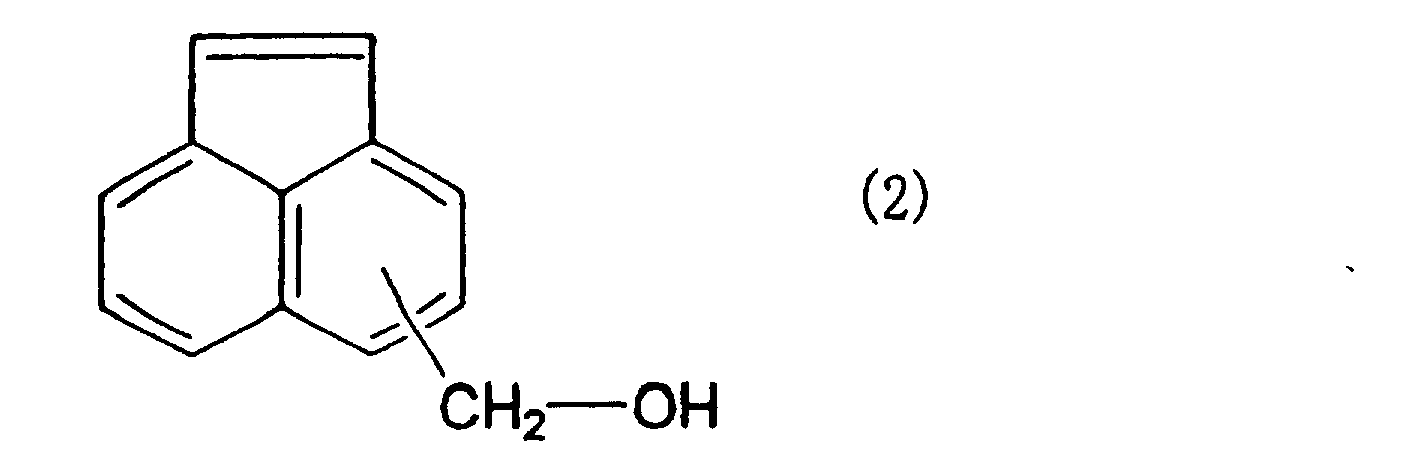
- A still another object of the present invention is to provide a polymer (hereinafter referred to as "polymer (I)") having a structural unit of the following formula (3) (hereinafter referred to as "structural unit (3)") and having a polystyrene-reduced weight average molecular weight determined by gel permeation chromatography (GPC) in the range of 500-10,000,wherein R1 represents a hydrogen atom or a monovalent organic group and R2 and R3 individually represent a monovalent atom or a monovalent organic group.

- Yet another object of the present invention is to provide an antireflection film-forming composition comprising the polymer (I) and a solvent.
- A further object of the present invention is to provide an antireflection film-forming composition comprising a polymer (hereinafter referred to as "polymer (II)") having a structural unit of the following formula (4) (hereinafter referred to as "structural unit (4)") and a solvent,wherein R4 is a hydrogen atom or a monovalent organic group, R5 is a monovalent atom or a monovalent organic group, and n is 0 or 1.
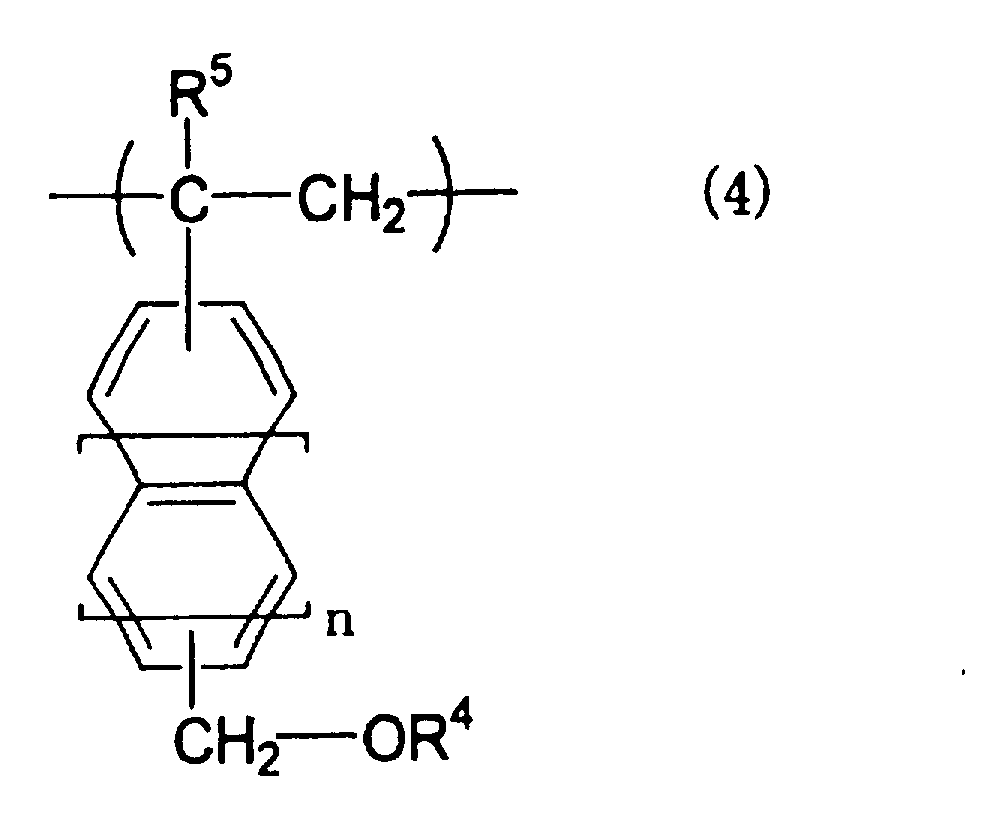
- A still further object of the present invention is to provide an antireflection film-forming composition comprising at least one polymer selected from the group consisting of a polymer (hereinafter referred to as "polymer (III)") having the structural unit (3) and the structural unit (4), a polymer (hereinafter referred to as "polymer (IV)") having the structural unit (3) and a structural unit of the following formula (5) (hereinafter referred to as "structural unit (5)"), and a polymer (hereinafter referred to as "polymer (V)") having the structural unit (4) and the structural unit (5) and a solvent,wherein R6 and R7 individually represent a monovalent atom or a monovalent organic group.
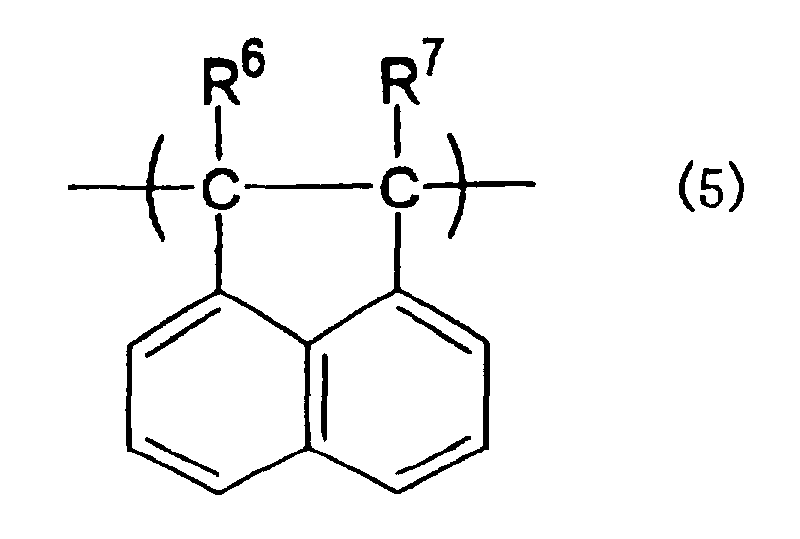
- The present invention is described below in detail.
- The acetoxymethyl group in the formula (1) or hydroxylmethyl group in the formula (2) bonds to either one of the 3 to 5 positions of the acenaphthylene.
- The acetoxymethylacenaphthylene of the formula (1) (hereinafter referred to as "acetoxymethylacenaphthylene (1)") can be synthesized by a process comprising the following steps 1-4. The hydroxymethylacenaphthylene of the formula (2) (hereinafter referred to as "hydroxymethylacenaphthylene (2)") can be synthesized by the following step 5.
- Step 1: Acenaphthene is formylated by a conventional method as shown in the following formula (i).

- Step 2: The formyl group in the formyl acenaphthene obtained in Step 1 is reduced by a conventional method to obtain hydroxymethylacenaphthene as shown in the following formula (ii).
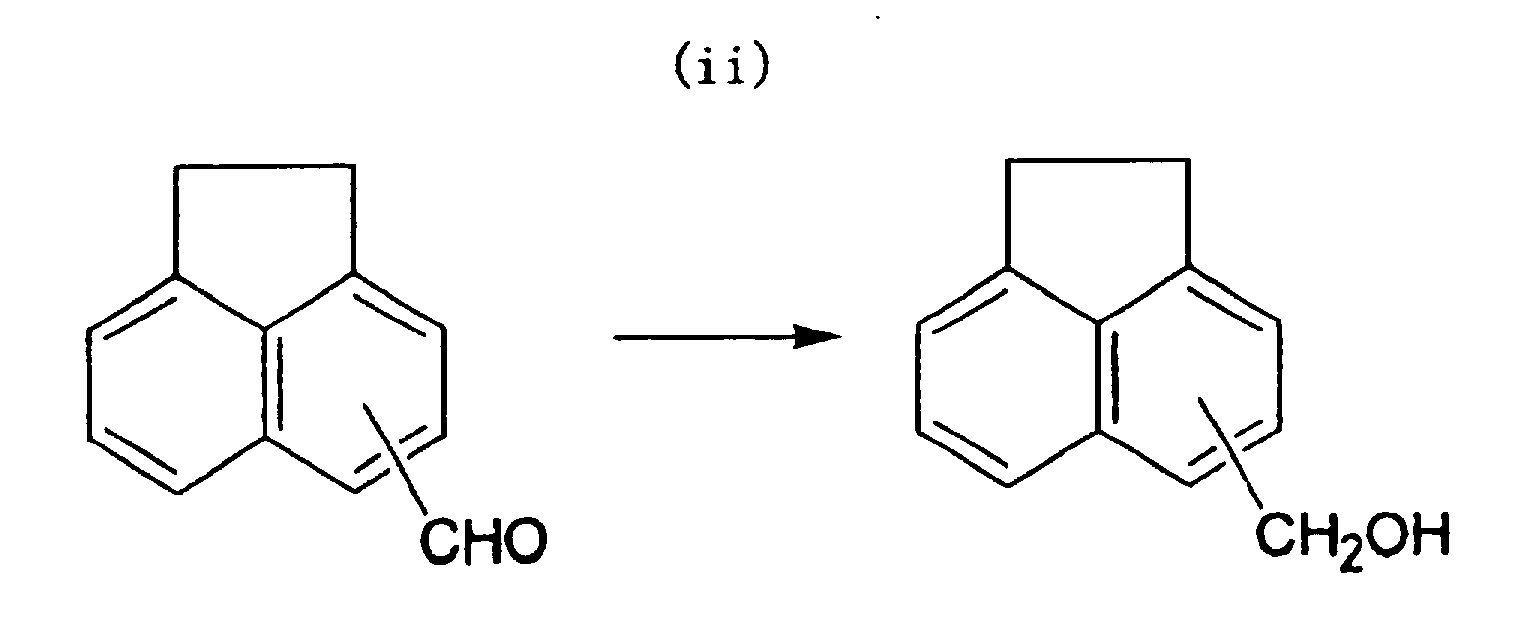
- Step 3: The hydroxyl group in the hydroxymethylacenaphthene obtained in Step 2 is acetylated by a conventional method to obtain acetoxymethylacenaphthene as shown in the following formula (iii).

- Step 4: The acetoxymethylacenaphthene obtained in Step 3 is dehydrogenated by a conventional method to obtain acetoxymethylacenaphthylene (1) as shown in the following formula (iv).

- Step 5: The acetoxy group in the acetoxymethylacenaphthylene obtained in Step 4 is hydrolyzed by a conventional method to obtain hydroxymethylacenaphthylene (2) as shown in the following formula (v).
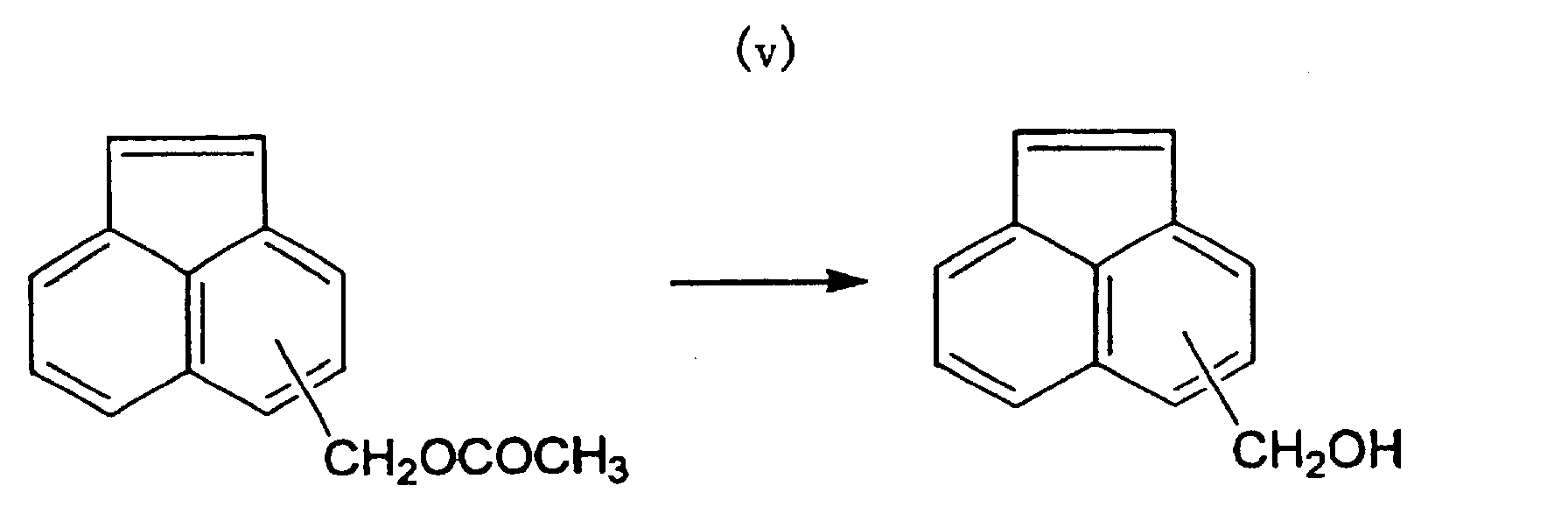
- Acetoxymethylacenaphthylene (1) can be suitably used not only as a raw material or an intermediate material for manufacturing the polymer (I), polymer (III), and polymer (IV), but also as a raw material for synthesizing hydroxymethylacenaphthylene (2). Acetoxymethylacenaphthylene (1) is also used as a raw material or an intermediate for synthesizing other related acenaphthylene derivatives.
- Hydroxymethylacenaphthylene (2) can be suitably used not only as a raw material or an intermediate material for manufacturing the polymer (I), polymer (III), and polymer (IV), but also as a raw material for synthesizing acetoxymethylacenaphthylene (1). Hydroxymethylacenaphthylene (2) is also used as a raw material or an intermediate for synthesizing other related acenaphthylene derivatives.
- As the monovalent organic group represented by R1 in the structural unit (3), groups having 1-10 carbon atoms are preferable. Examples of the preferable organic group are a phenyl group, alkyl group, alkenyl group, acyl group, and groups in which one or more hydrogen atoms on the phenyl group, alkyl group, or alkenyl group are replaced by one or more, the same or different, substituents such as a halogen atom, hydroxyl group, mercapto group, carboxyl group, nitro group, and sulfonic acid group.
- As the alkyl group, linear or branched alkyl groups having 1-6 carbon atoms are preferable. A methyl group, ethyl group, n-propyl group, i-propyl group, n-butyl group, i-butyl group, sec-butyl group, and t-butyl group, for example, are particularly preferable.
- As the alkenyl group, linear or branched alkenyl groups having 2-6 carbon atoms are preferable. Particularly preferable examples are a vinyl group, allyl group, methallyl group, 1-butenyl group, and 2-butenyl group.
- As the acyl group, aliphatic or aromatic acyl groups having 2-6 carbon atoms are preferable. Particularly preferable examples are an acetyl group, propionyl group, butyryl group, and benzoyl group.
- As examples of the monovalent atom represented by R2 or R3 in the structural unit (3), a hydrogen atom and a halogen atom such as a fluorine atom, chlorine atom, or bromine atom can be given.
- As examples of the monovalent organic group represented by R2 or R3, the same groups as those previously given for the monovalent organic group represented by R1 can be given.
- Particularly preferable groups for R1 in the structural unit (3) are a hydrogen atom, methyl group, acetyl group, and the like.
- Preferable groups for R2 or R3 are a hydrogen atom, methyl group, phenyl group, and the like.
- The polymer (I) can be prepared by polymerizing an acenaphthylene corresponding to the structural unit (3), optionally together with a copolymerizable unsaturated monomer by radical polymerization, anionic polymerization, cationic polymerization, or the like using an appropriate process such as a mass polymerization process or solution polymerization process.
- The polymer (I) having the structural unit (3) in which the R1 group is a hydrogen atom can be produced by hydrolyzing the acetoxy group of the polymer (I) having the structural unit (3) in which the R1 group is an acetyl group by a conventional method. The polymer (I) having the structural unit (3) in which the R1 group is an acetyl group can be produced by acetylating the hydroxyl group of the polymer (I) having the structural unit (3) in which the R1 group is a hydrogen atom by a conventional method.
- The following compounds can be given as examples of the acenaphthylene corresponding to the structural unit (3):
- hydroxymethylacenaphthylenes such as
- 3-hydroxymethylacenaphthylene,
- 4-hydroxymethylacenaphthylene,
- 5-hydroxymethylacenaphthylene,
- 1-methyl-3-hydroxymethylacenaphthylene,
- 1-methyl-4-hydroxymethylacenaphthylene,
- 1-methyl-5-hydroxymethylacenaphthylene,
- 1-methyl-6-hydroxymethylacenaphthylene,
- 1-methyl-7-hydroxymethylacenaphthylene,
- 1-methyl-8-hydroxymethylacenaphthylene,
- 1,2-dimethyl-3-hydroxymethylacenaphthylene,
- 1,2-dimethyl-4-hydroxymethylacenaphthylene,
- 1,2-dimethyl-5-hydroxymethylacenaphthylene,
- 1-phenyl-3-hydroxymethylacenaphthylene,
- 1-phenyl-4-hydroxymethylacenaphthylene,
- 1-phenyl-5-hydroxymethylacenaphthylene,
- 1-phenyl-6-hydroxymethylacenaphthylene,
- 1-phenyl-7-hydroxymethylacenaphthylene,
- 1-phenyl-8-hydroxymethylacenaphthylene,
- 1,2-diphenyl-3-hydroxymethylacenaphthylene,
- 1,2-diphenyl-4-hydroxymethylacenaphthylene, and
- 1,2-diphenyl-5-hydroxymethylacenaphthylene;
acetoxymethylacenaphthylenes such as - 3-acetoxymethylacenaphthylene,
- 4-acetoxymethylacenaphthylene,
- 5-acetoxymethylacenaphthylene,
- 1-methyl-3-acetoxymethylacenaphthylene,
- 1-methyl-4-acetoxymethylacenaphthylene,
- 1-methyl-5-acetoxymethylacenaphthylene,
- 1-methyl-6-acetoxymethylacenaphthylene,
- 1-methyl-7-acetoxymethylacenaphthylene,
- 1-methyl-8-acetoxymethylacenaphthylene,
- 1,2-dimethyl-3-acetoxymethylacenaphthylene,
- 1,2-dimethyl-4-acetoxymethylacenaphthylene,
- 1,2-dimethyl-5-acetoxymethylacenaphthylene,
- 1-phenyl-3-acetoxymethylacenaphthylene,
- 1-phenyl-4-acetoxymethylacenaphthylene,
- 1-phenyl-5-acetoxymethylacenaphthylene,
- 1-phenyl-6-acetoxymethylacenaphthylene,
- 1-phenyl-7-acetoxymethylacenaphthylene,
- 1-phenyl-8-acetoxymethylacenaphthylene,
- 1,2-diphenyl-3-acetoxymethylacenaphthylene,
- 1,2-diphenyl-4-acetoxymethylacenaphthylene, and
- 1,2-diphenyl-5-acetoxymethylacenaphthylene;
methoxymethylacenaphthylenes such as - 3-methoxymethylacenaphthylene,
- 4-methoxymethylacenaphthylene,
- 5-methoxymethylacenaphthylene,
- 1-methyl-3-methoxymethylacenaphthylene,
- 1-methyl-4-methoxymethylacenaphthylene,
- 1-methyl-5-methoxymethylacenaphthylene,
- 1-methyl-6-methoxymethylacenaphthylene,
- 1-methyl-7-methoxymethylacenaphthylene,
- 1-methyl-8-methoxymethylacenaphthylene,
- 1,2-dimethyl-3-methoxymethylacenaphthylene,
- 1,2-dimethyl-4-methoxymethylacenaphthylene,
- 1,2-dimethyl-5-methoxymethylacenaphthylene,
- l-phenyl-3-methoxymethylacenaphthylene,
- 1-phenyl-4-methoxymethylacenaphthylene,
- 1-phenyl-5-methoxymethylacenaphthylene,
- 1-phenyl-6-methoxymethylacenaphthylene,
- 1-phenyl-7-methoxymethylacenaphthylene,
- 1-phenyl-8-methoxymethylacenaphthylene,
- 1,2-diphenyl-3-methoxymethylacenaphthylene,
- 1,2-diphenyl-4-methoxymethylacenaphthylene, and
- 1,2-diphenyl-5-methoxymethylacenaphthylene;
- 3-phenoxymethylacenaphthylene,
- 4-phenoxymethylacenaphthylene,
- 5-phenoxymethylacenaphthylene,
- 3-vinyloxymethylacenaphthylene,
- 4-vinyloxymethylacenaphthylene, and
- 5-vinyloxymethylacenaphthylene.
-
- Of these acenaphthylenes,
3-hydroxymethylacenaphthylene,
4-hydroxymethylacenaphthylene,
5-hydroxymethylacenaphthylene,
3-acetoxymethylacenaphthylene,
4-acetoxymethylacenaphthylene,
5-acetoxymethylacenaphthylene,
3-methoxymethylacenaphthylene,
4-methoxymethylacenaphthylene, and
5-methoxymethylacenaphthylene are particularly preferable. - These acenaphthylenes may be used either individually or in combinations of two or more.
- As other copolymerizable unsaturated compounds used for the polymer (I), aromatic vinyl compounds corresponding to the later described structural unit (4) and acenaphthenes corresponding to the later described structural unit (5) are preferable.
- The following compounds can be given as examples of the other copolymerizable unsaturated compounds: aromatic vinyl compounds such as styrene, α-methylstyrene, 2-methylstyrene, 3-methylstyrene, 4-methylstyrene, 1-vinylnaphthalene, 2-vinylnaphthalene, 9-vinylanthracene, and 9-vinylcarbazole; vinyl esters such as vinyl acetate, vinyl propionate, and vinyl caprate; cyanated vinyl compounds such as (meth)acrylonitrile, α-chloroacrylonitrile, and cyanated vinylidene; unsaturated carboxylic acid esters such as methyl (meth)acrylate, ethyl (meth)acrylate, n-propyl (meth)acrylate, isopropyl (meth)acrylate, n-butyl (meth)acrylate, t-butyl (meth)acrylate, n-hexyl (meth)acrylate, and glycidyl (meth)acrylate; unsaturated group-containing unsaturated carboxylates such as ethylene glycol di(meth)acrylate, propylene glycol di(meth)acrylate, vinyl (meth)acrylate, and dimethyl·vinyl ·(meth)acryloyloxymethylsilane;
halogen-containing vinyl compounds such as 2-chloroethyl vinyl ether, vinyl chloroacetate, and allyl chloroacetate;
hydroxyl group-containing vinyl compounds such as 2-hydroxyethyl (meth)acrylate, 2-hydroxypropyl (meth)acrylate, and (meth)allyl alcohol; amide group-containing vinyl compounds such as (meth) acryl amide and crotonic acid amide; and carboxyl group-containing vinyl compounds such as mono-[2-(meth)acryloyloxyethyl] succinate, mono-[2-(meth)acryloyloxyethyl] maleate, and mono-[2-(meth)acryloyloxyethyl] phthalate. - These other copolymerizable unsaturated compounds may be used either individually or in combination of two or more.
- The amount of the structural unit derived from such other copolymerizable unsaturated compounds in the polymer (I) is preferably 80 mol% or less, more preferably 60 mol% or less, and particularly preferably 40 mol% or less of the total amount of the structural units.
- The polystyrene-reduced weight average molecular weight of the polymer (I) measured by gel permeation chromatography (hereinafter abbreviated as "Mw") is preferably 500-10,000, and preferably 1,000-5,000.
- The molecular chains of the polymer (I) are crosslinkable by heating or exposure to light and, therefore, the polymer (I) is useful particularly for the antireflection film-forming composition described later. In addition, the polymer (I) can be used in paints, adhesives, insulating materials, formed articles, and the like either individually or in combination with other curable resins and curable rubbers.
- The antireflection film-forming composition of the present invention comprises (a) the polymer (I) and a solvent, (b) polymer (II) and a solvent, or (c) at least one polymer selected from the group consisting of the polymer (III), polymer (IV), and the polymer (V) and a solvent.
- The polymers (II) to (V) and the solvent that make up the antireflection film-forming composition of the present invention will now be described.
- As examples of the monovalent organic group represented by R4 in the structural unit (4), the same groups as those previously given for the group R1 in the structural unit (3) can be given. As examples of the monovalent atom or monovalent organic group represented by R5, the same monovalent atoms or monovalent groups as those previously given for the group R2 and R3 in the structural unit (3) can be given.
- A hydrogen atom, methyl group, and the like are particularly preferable for R4 in the structural unit (4).
- A hydrogen atom, methyl group, and the like are preferable as R5 group.
- The polymer (II) can be prepared by polymerizing an aromatic vinyl compound corresponding to the structural unit (4), optionally together with a copolymerizable unsaturated monomer by radical polymerization, anionic polymerization, cationic polymerization, or the like using an appropriate process such as a mass polymerization process or solution polymerization process.
- The polymer (II) having the structural unit (4) in which the R4 group is a hydrogen atom can be produced by hydrolyzing the acetoxy group of the polymer (II) having the structural unit (4) in which the R4 group is an acetyl group by a conventional method. The polymer (II) having the structural unit (4) in which the R4 group is an acetyl group can be produced by acetylating the hydroxyl group of the polymer (II) having the structural unit (4) in which the R4 group is a hydrogen atom by a conventional method.
- Preferable examples of the aromatic vinyl compound corresponding to the structural unit (4) include:
- hydroxymethylstyrene compounds such as 2-hydroxymethylstyrene,
- 3-hydroxymethylstyrene, 4-hydroxymethylstyrene,
- 2-hydroxymethyl-α-methylstyrene,
- 3-hydroxymethyl-α-methylstyrene, and
- 4-hydroxymethyl-α-methylstyrene; methoxymethylstyrene
- compounds such as 2-methoxymethylstyrene,
- 3-methoxymethylstyrene, 4-methoxymethylstyrene,
- 2-methoxymethyl-α-methylstyrene,
- 3-methoxymethyl-α-methylstyrene, and
- 4-methoxymethyl-α-methylstyrene; styrene compounds such as 4-phenoxymethylstyrene, 4-phenoxymethyl-α-methylstyrene,
- 4-vinyloxymethylstyrene, 4-vinyloxymethyl-α-methylstyrene,
- 4-acetoxymethylstyrene, and 4-acetoxymethyl-α-methylstyrene;
hydroxymethyl vinylnaphthalene compounds such as - 4-hydroxymethyl-1-vinylnaphthalene,
- 7-hydroxymethyl-1-vinylnaphthalene,
- 8-hydroxymethyl-1-vinylnaphthalene,
- 1-hydroxymethyl-2-vinylnaphthalene,
- 1-hydroxymethyl-3-vinylnaphthalene,
- 1-hydroxymethyl-4-vinylnaphthalene,
- 1-hydroxymethyl-5-vinylnaphthalene,
- 1-hydroxymethyl-6-vinylnaphthalene,
- 1-hydroxymethyl-7-vinylnaphthalene,
- 1-hydroxymethyl-8-vinylnaphthalene,
- 2-hydroxymethyl-3-vinylnaphthalene,
- 2-hydroxymethyl-4-vinylnaphthalene,
- 2-hydroxymethyl-5-vinylnaphthalene,
- 2-hydroxymethyl-6-vinylnaphthalene,
- 2-hydroxymethyl-7-vinylnaphthalene,
- 4-hydroxymethyl-1-isopropenylnaphthalene,
- 7-hydroxymethyl-1-isopropenylnaphthalene-, and
- 8-hydroxymethyl-1-isopropenylnaphthalene;
methoxymethyl-1-vinylnaphthalene compounds such as - 4-methoxymethyl-1-vinylnaphthalene,
- 7-methoxymethyl-1-vinylnaphthalene,
- 8-methoxymethyl-1-vinylnaphthalene,
- 4-methoxymethyl-1-isopropenylnaphthalene,
- 7-methoxymethyl-1-isopropenylnaphthalene, and
- 8-methoxymethyl-1-isopropenylnaphthalene; and other
vinylnaphthalene compounds such as - 4-phenoxymethyl-1-vinylnaphthalene,
- 4-vinyloxymethyl-1-vinylnaphthalene,
- 4-acetoxymethyl-1-vinylnaphthalene,
- 4-phenoxymethyl-1-isopropenylnaphthalene,
- 4-vinyloxymethyl-1-isopropenylnaphthalene,
- 4-acetoxymethyl-1-isopropenylnaphthalene.
-
- Of these aromatic vinyl compounds, 4-hydroxymethylstyrene, 4-methoxymethylstyrene, 2-hydroxymethyl-6-vinylnaphthalene, and the like are particularly preferable.
- These aromatic vinyl compounds may be used either individually or in combination of two or more.
- The compounds previously given in the description relating to other copolymerizable unsaturated compounds in the polymer (I) can be given as examples of other copolymerizable unsaturated compounds in the polymer (II) used here.
- Of such other copolymerizable unsaturated compounds, styrene is particularly preferable.
- These other copolymerizable unsaturated compounds may be used either individually or in combination of two or more.
- The amount of the structural unit derived from these other copolymerizable unsaturated compounds in the polymer (II) is preferably 80 mol% or less, more preferably 60 mol% or less, and particularly preferably 40 mol% or less of the total amount of the structural units.
- Mw of the polymer (II) is suitably selected according to desired characteristics of the antireflection film, usually in the range of 500-10,000, and preferably 1,000-5,000.
- The structural unit (3) of the polymer (I) is used as the structural unit (3) in the polymer (III) and polymer (IV). The structural unit (4) of the polymer (II) is used as the structural unit (4) in the polymer (IV) and polymer (V).
- As examples of the monovalent atom or monovalent organic group represented by R6 or R7 in the structural unit (5), the same monovalent atoms or monovalent groups as those previously given for the groups R2 and R3 in the structural unit (3) can be given.
- A hydrogen atom, methyl group, and the like are particularly preferable for R6 and R7 in the structural unit (5).
- The polymer (III) can be prepared by polymerizing an acenaphthylene corresponding to the structural unit (3) and an aromatic vinyl compound corresponding to the structural unit (4), optionally together with another copolymerizable unsaturated monomer. The polymer (IV) can be prepared by polymerizing an acenaphthylene corresponding to the structural unit (3) and an acenaphthylene compound corresponding to the structural unit (5), optionally together with another copolymerizable unsaturated monomer. The polymer (V) can be prepared by polymerizing an aromatic vinyl compound corresponding to the structural unit (4) and an acenaphthylene corresponding to the structural unit (5), optionally together with another copolymerizable unsaturated monomer.
- Radical polymerization, anionic polymerization, cationic polymerization, or the like using an appropriate process such as mass polymerization process, solution polymerization process, or the like can be used for manufacturing the polymers (III) to (V).
- The polymer (III) having the structural unit (3) in which the R1 group is a hydrogen atom or the structural unit (4) in which the R4 group is a hydrogen atom, the polymer (IV) having the structural unit (3) in which the R1 group is a hydrogen atom, and the polymer (V) having the structural unit (4) in which the R4 group is a hydrogen atom can be respectively produced by hydrolyzing the acetoxymethyl group of the polymers (III), (IV), and (V) having the acetoxymethyl group by a conventional method. The polymer (III) having the structural unit (3) in which the R1 group is an acetyl group or the structural unit (4) in which the R4 group is an acetyl group, the polymer (IV) having the structural unit (3) in which the R1 group is an acetyl group, and the polymer (V) having the structural unit (4) in which the R4 group is an acetyl group can be respectively produced by acetylating the hydroxyl group of the polymers (III), (IV), and (V) having the hydroxyl group by a conventional method.
- The compounds previously given in the description relating to the acenaphthylene corresponding to the structural unit (3) in the polymer (I) can be given as examples of the acenaphthylenes corresponding to the structural unit (3) in the polymers (III) and (IV) used here. Of these acenaphthylenes, 3-hydroxymethylacenaphthylene,
4-hydroxymethylacenaphthylene, 5-hydroxymethylacenaphthylene, 3-methoxymethylacenaphthylene,
4-methoxymethylacenaphthylene, and
5-methoxymethylacenaphthylene are particularly preferable. - These acenaphthylenes may be used either individually or in combinations of two or more.
- The compounds previously given in the description relating to the aromatic vinyl compounds corresponding to the structural unit (4) in the polymer (II) can be given as examples of the aromatic vinyl compound corresponding to the structural unit (4) in the polymers (III) and (V) used here.
- Of these aromatic vinyl compounds, 4-hydroxymethylstyrene, 4-methoxymethylstyrene, and the like are particularly preferable.
- These aromatic vinyl compounds may be used either individually or in combination of two or more.
- As examples of the preferable acenaphthylene corresponding to the structural unit (5) in the polymers (IV) and (V), acenaphthylene, 1-methylacenaphthylene, 1,2-dimethylacenaphthylene, 1-phenylacenaphthylene, 1,2-diphenylacenaphthylene, and 1-methyl-2-phenylacenaphthylene can be given.
- Of these acenaphthylenes, acenaphthylene is particularly preferable.
- These acenaphthylenes may be used either individually or in combinations of two or more.
- The compounds previously given in the description relating to other copolymerizable unsaturated compounds in the polymer (I) can be given as other copolymerizable unsaturated compounds in the polymers (III), (IV), and (V) used here, for example.
- These other copolymerizable unsaturated compounds may be used either individually or in combination of two or more.
- In the polymer (III), the content of the structural unit (3) is preferably 5-80 mol%, more preferably 10-60 mol%, and particularly preferably 10-40 mol% of the total amount of the structural units, the content of the structural unit (4) is preferably 5-80 mol%, more preferably 5-60 mol%, and particularly preferably 5-40 mol%, and the content of the structural unit derived from other copolymerizable unsaturated compounds is 50 mol% or less, and more preferably 30 mol% or less.
- In the polymer (IV), the content of the structural unit (3) is preferably 5-80 mol%, more preferably 10-60 mol%, and particularly preferably 10-40 mol% of the total amount of the structural units, the content of the structural unit (5) is preferably 5-95 mol%, more preferably 10-90 mol%, and particularly preferably 20-90 mol%, and the content of the structural unit derived from other copolymerizable unsaturated compounds is 50 mol% or less, and more preferably 30 mol% or less.
- In the polymer (V), the content of the structural unit (4) is preferably 5-80 mol%, more preferably 10-60 mol%, and particularly preferably 15-60 mol% of the total amount of the structural units, the content of the structural unit (5) is preferably 5-95 mol%, more preferably 10-90 mol%, and particularly preferably 20-80 mol%, and the content of the structural unit derived from other copolymerizable unsaturated compounds is 50 mol% or less, and more preferably 30 mol% or less.
- Mw of the polymers (III), (IV), and (V) is suitably selected according to desired characteristics of the antireflection film, usually in the range of 500-10,000, and preferably 500-5,000.
- Any solvent capable of dissolving the above-described polymers and later-described additives can be used for preparing the antireflection film-forming composition of the present invention without any specific limitation. Examples of the solvent that can be suitably selected include: ethylene glycol monoalkyl ethers such as ethylene glycol monomethyl ether, ethylene glycol monoethyl ether, ethylene glycol mono-n-propyl ether, and ethylene glycol mono-n-butyl ether; ethylene glycol monoalkyl ether acetates such as ethylene glycol monomethyl ether acetate, ethylene glycol monoethyl ether acetate, ethylene glycol mono-n-propyl ether acetate, and ethylene glycol mono-n-butyl ether acetate;
diethylene glycol dialkyl ethers such as diethylene glycol dimethyl ether, diethylene glycol diethyl ether, diethylene glycol di-n-propyl ether, diethylene glycol di-n-butyl ether; triethylene glycol dialkyl ethers such as triethylene glycol dimethyl ether and triethylene glycol diethyl ether;
propylene glycol monoalkyl ethers such as propylene glycol monomethyl ether, propylene glycol monoethyl ether, propylene glycol mono-n-propyl ether, and propylene glycol mono-n-butyl ether; propylene glycol dialkyl ethers such as propylene glycol dimethyl ether, propylene glycol diethyl ether, propylene glycol di-n-propyl ether, and propylene glycol di-n-butyl ether; propylene glycol monoalkyl ether acetates such as propylene glycol monomethyl ether acetate, propylene glycol monoethyl ether acetate, propylene glycol mono-n-propyl ether acetate, and propylene glycol mono-n-butyl ether acetate; lactic acid esters such as methyl lactate, ethyl lactate, n-propyl lactate, i-propyl lactate, n-butyl lactate, and i-butyl lactate; aliphatic carboxylic acid esters such as methyl formate, ethyl formate, n-propyl formate, i-propyl formate, n-butyl formate, i-butyl formate, n-amyl formate, i-amyl formate, methyl acetate, ethyl acetate, n-propyl acetate, i-propyl acetate, n-butyl acetate, i-butyl acetate, n-amyl acetate, i-amyl acetate, n-hexyl acetate, methyl propionate, ethyl propionate, n-propyl propionate, i-propyl propionate, n-butyl propionate, i-butyl propionate, methyl butyrate, ethyl butyrate, n-propyl butyrate, i-propyl butyrate, n-butyl butyrate, and i-butyl butyrate; other esters such as ethyl hydroxyacetate, ethyl 2-hydroxy-2-methylpropionate, methyl 3-methoxy-2-methylpropionate, methyl 2-hydroxy-3-methylbutyrate, ethyl methoxyacetate, ethyl ethoxyacetate, methyl 3-methoxypropionate, ethyl 3-ethoxypropionate, ethyl 3-methoxypropionate, 3-methoxypropyl acetate, 3-methoxybutyl acetate, 3-methyl-3-methoxybutyl acetate, 3-methyl-3-methoxybutyl propionate, 3-methyl-3-methoxybutyl butyrate, methyl acetoacetate, methyl pyruvate, and ethyl pyruvate; aromatic hydrocarbons such as toluene and xylene; ketones such as methyl ethyl ketone, methyl n-propyl ketone, methyl n-butyl ketone, 2-heptanone, 3-heptanone, 4-heptanone, and cyclohexanone; amides such as N-methylformamide, N,N-dimethylformamide, N-methylacetamide, N,N-dimethyl acetamide, and N-methylpyrrolidone; and lactones such as γ-butyrolactone. - Of these solvents, ethylene glycol monoethyl ether acetate, ethyl lactate, n-butyl acetate, ethyl 3-ethoxypropionate, methyl 3-methoxypropionate, 2-heptanone, cyclohexanone, and the like are preferable. These solvents may be used either individually or in combination of two or more. The solvent is used in an amount to make the solid content in the resulting composition usually 0.01-70 wt%, preferably 0.05-60 wt%, and more preferably 0.1-50 wt%.
- Additives such as an acid generator, crosslinking agent, binder resin, radiation absorbent, and surfactant may be optionally added to the antireflection film-forming composition of the present invention to the extent not impairing the effect of the present invention. The addition of an acid generator and/or crosslinking agent is particularly preferable.
- The acid generator is a component that generates an acid upon exposure to light or when heated.
- The following compounds can be given as examples of the acid generator that generates an acid upon exposure to light (hereinafter referred to as "photoacid generator") : onium salt photoacid generators such as diphenyliodonium trifluoromethanesulfonate, diphenyliodonium nonafluoro-n-butanesulfonate, diphenyliodonium pyrenesulfonate, diphenyliodonium n-dodecylbenzenesulfonate, diphenyliodonium 10-camphorsulfonate, diphenyliodonium naphthalenesulfonate, diphenyliodonium hexafluoroantimonate, bis(4-t-butylphenyl)iodonium trifluoromethanesulfonate, bis(4-t-butylphenyl)iodonium nonafluoro-n-butanesulfonate, bis(4-t-butylphenyl)iodonium n-dodecylbenzenesulfonate, bis(4-t-butylphenyl)iodonium 10-camphorsulfonate, bis(4-t-butylphenyl)iodonium naphthalenesulfonate, bis(4-t-butylphenyl)iodonium hexafluoroantimonate, triphenylsulfonium trifluoromethanesulfonate, triphenylsulfonium nonafluoro-n-butanesulfonate, triphenylsulfonium n-dodecylbenzenesulfonate, triphenylsulfonium naphthalenesulfonate, triphenylsulfonium 10-camphorsulfonate, triphenylsulfonium hexafluoroantimonate,
4-hydroxyphenyl·phenyl·methylsulfonium p-toluenesulfonate, 4-hydroxyphenyl·benzyl·methylsulfonium p-toluenesulfonate, cyclohexyl·methyl·2-oxocyclohexylsulfonium trifluoromethanesulfonate, 2-oxocyclohexyldicyclohexylsulfonium
trifluoromethanesulfonate, 2-oxocyclohexyldimethylsulfonium trifluoromethanesulfonate,
1-naphthyldimethylsulfonium trifluoromethanesulfonate,
1-naphthyldiethylsulfonium trifluoromethanesulfonate,
4-cyano-1-naphthyldimethylsulfonium trifluoromethanesulfonate,
4-cyano-1-naphthyldimethylsulfonium trifluoromethanesulfonate,
4-nitro-1-naphthyldimethylsulfonium trifluoromethanesulfonate,
4-nitro-1-naphthyldiethylsulfonium trifluoromethanesulfonate,
4-methyl-1-naphthyldimethylsulfonium trifluoromethanesulfonate,
4-methyl-1-naphthyldiethylsulfonium trifluoromethanesulfonate,
4-hydroxy-1-naphthyldimethylsulfonium trifluoromethanesulfonate,
4-hydroxy-1-naphthyldiethylsulfonium trifluoromethanesulfonate,
1-(4-hydroxynaphthalen-1-yl)tetrahydrothiophenium trifluoromethanesulfonate,
1- (4-methoxynaphthalen-1-yl)tetrahydrothiophenium trifluoromethanesulfonate,
1-(4-ethoxynaphthalen-1-yl)tetrahydrothiophenium trifluoromethanesulfonate,
1-(4-methoxymethoxynaphthalen-1-yl)tetrahydrothiophenium trifluoromethanesulfonate,
1-(4-ethoxymethoxynaphthalen-1-yl)tetrahydrothiophenium trifluoromethanesulfonate,
1-[4-(1-methoxyethoxy)naphthalen-1-yl]tetrahydrothiophenium trifluoromethanesulfonate,
1-[4-(2-methoxyethoxy)naphthalen-1-yl]tetrahydrothiophenium trifluoromethanesulfonate,
1-(4-methoxycarbonyloxynaphthalen-1-yl)tetrahydrothiopheniu m trifluoromethanesulfonate,
1-(4-ethoxycarbonyloxynaphthalen-1-yl)tetrahydrothiophenium trifluoromethanesulfonate,
1- (4-n-propoxycarbonyloxynaphthalen-1-yl)-tetrahydrothiophenium trifluoromethanesulfonate,
1-(4-i-propoxycarbonyloxynaphthalen-1-yl)-tetrahydrothiophenium trifluoromethanesulfonate,
1- (4-n-butoxycarbonyloxynaphthalen-1-yl)-tetrahydrothiophenium trifluoromethanesulfonate,
1-(4-t-butoxycarbonyloxynaphthalen-1-yl)-tetrahydrothiophenium trifluoromethanesulfonate,
1-[4-(2-tetrahydrofuranyloxy)naphthalen-1-yl]-tetrahydrothiophenium trifluoromethanesulfonate,
1-[4-(2-tetrahydropyranyloxy)naphthalen-1-yl]-tetrahydrothiophenium trifluoromethanesulfonate,
1-(4-benzyloxy)tetrahydrothiophenium trifluoromethanesulfonate,
and 1-(naphthylacetomethyl)tetrahydrothiophenium trifluoromethanesulfonate;
halogen-containing photoacid generators such as phenylbis(trichloromethyl)-s-triazine,
4-methoxyphenylbis(trichloromethyl)-s-triazine, and
1-naphthylbis(trichloromethyl)-s-triazine;
diazoketone compound photoacid generators such as
1,2-naphthoquinonediazido-4-sulfonyl chloride,
1,2-naphthoquinonediazido-5-sulfonyl chloride,
1,2-naphthoquinonediazido-4-sulfonate or
1,2-naphthoquinonediazido-5-sulfonate of
2,3,4,4'-tetrahydroxybenzophenone;
sulfone compound photoacid generators such as 4-trisphenacylsulfone, mesitylphenacylsulfone, and bis(phenylsulfonyl)methane; and
sulfonate compound photoacid generators such as benzointosylate, pyrogallol tris(trifluoromethanesulfonate), nitrobenzyl-9,10-diethoxyanthracene-2-sulfonate, trifluoromethanesulfonylbicyclo [2,2,1]hept-5-ene-2,3-dicarb odiimide, N-hydroxysuccinimido trifluoromethanesulfonate, and 1,8-naphthalenedicarboxylic acid imide trifluoromethanesulfonate. - Of these photoacid generators, diphenyliodonium trifluoromethanesulfonate, diphenyliodonium nonafluoro-n-butanesulfonate, diphenyliodonium pyrenesulfonate, diphenyliodonium n-dodecylbenzenesulfonate, diphenyliodonium 10-camphorsulfonate, diphenyliodonium naphthalenesulfonate, bis(4-t-butylphenyl)iodonium trifluoromethanesulfonate, bis(4-t-butylphenyl)iodonium nonafluoro-n-butanesulfonate, bis(4-t-butylphenyl)iodonium n-dodecylbenzenesulfonate, bis(4-t-butylphenyl)iodonium 10-camphorsulfonate, bis(4-t-butylphenyl)iodonium naphthalenesulfonate, and the like are preferable.
- The photoacid generators may be used either individually or in combination of two or more.
- As the acid generators generating an acid when heated (hereinafter referred to as "heat acid generator"), 2,4,4,6-tetrabromocyclohexadienone, benzointosylate, 2-nitrobenzyltosylate, alkyl sulfonates, and the like can be given.
- These heat acid generators may be used either individually or in combination of two or more.
- The photoacid generator and heat acid generator may be used in combination. The amount of acid generators to be added is usually 5,000 parts by weight or less, preferably 0.1-1,000 parts by weight, and particularly preferably 0.1-100 parts by weight for 100 parts by weight of the solid content of the antireflection film-forming composition. The addition of a photoacid generator and/or a heat acid generator to the antireflection film-forming composition of the present invention ensures the molecular chains in the polymers to effectively crosslink at a relatively low temperature, including a room temperature.
- The crosslinking agent is a component effective for preventing intermixing between the resulting antireflection film and a resist coating produced thereon and also preventing cracks in the antireflection film.
- Polynuclear phenolic compounds and various commercially available curing agents can be used as such a crosslinking agent.
- As examples of the polynuclear phenolic compound, binuclear phenols such as 4,4'-biphenyldiol, 4,4'-methylenebisphenol, 4,4'-ethylidenebisphenol, and bisphenol A; trinuclear phenols such as 4,4',4"-methylidenetrisphenol, and 4,4'-[1-{4-(1-[4-hydroxyphenyl]-1-methylethyl)phenyl}-ethylidene]bisphenol; and polyphenols such as novolaks can be given.
- Of these polynuclear phenolic compounds, 4,4'-[1-{4-(1-[4-hydroxyphenyl]-1-methylethyl)phenyl}-ethylidene]bisphenol, novolaks, and the like are preferable.
- These polynuclear phenolic compounds may be used either individually or in combination of two or more.
- As curing agents, diisocyanates such as 2,3-tolylene diisocyanate, 2,4-tolylene diisocyanate, 3,4-tolylene diisocyanate, 3,5-tolylene diisocyanate, 4,4'-diphenylmethane diisocyanate, hexamethylene diisocyanate, and 1,4-cyclohexane diisocyanate; commercially available products such as epoxy compounds, such as Epikoto 812, 815, 826, 828, 834, 836, 871, 1001, 1004, 1007, 1009, 1031 (manufactured by Japan Epoxy Resins Co., Ltd.); Araldite 6600, 6700, 6800, 502, 6071, 6084, 6097, 6099 (manufactured by Ciba Specialty Chemicals Inc.); DER331, 332, 333, 661, 644, 667 (manufactured by Dow Chemical Company); melamine-type curing agents such as Cymel 300, 301, 303, 350, 370, 771, 325, 327, 703, 712, 701, 272, 202, Mycoat 506, 508 (manufactured by Mitsui Cyanamid); benzoquanamine-type curing agents such as Cymel 1123, 1123-10, 1128, Mycoat 102, 105, 106, 130 (manufactured by Mitsui Cytec, Ltd.); and glycoluril-type curing agents such as Cymel 1170, 1172 (manufactured by Mitsui Cytec, Ltd.) and NIKALAC N-2702 (manufactured by Sanwa Chemical Co., Ltd.); and the like can be given.
- Of these curing agents, melamine-type curing agents, glycoluril-type curing agents, and the like are preferable.
- These curing agents may be used either individually or in combination of two or more.
- In addition, the polynuclear phenolic compound and curing agent can be used in combination as crosslinking agent. The amount of crosslinking agents to be added is usually 5,000 parts by weight or less, and preferably 1, 000 parts by weight or less, for 100 parts by weight of the solid content of the antireflection film-forming composition.
- As the above binder resins, various thermoplastic resins and thermoset (or heat curable) resins can be used.
- Given as examples of the thermoplastic resins are: α-olefin polymers such as polyethylene, polypropylene, poly-1-butene, poly-1-pentene, poly-1-hexene, poly-1-heptene, poly-1-octene, poly-1-decene, poly-1-dodecene, poly-1-tetradecene, poly-1-hexadecene, poly-1-octadecene, and polyvinylcycloalkane; non-conjugated diene polymers such as poly(1,4-pentadiene), poly(1,4-hexadiene), and poly(1,5-hexadiene); α,β-unsaturated aldehyde polymers; α,β-unsaturated ketone polymers such as poly(methyl vinyl ketone), poly(aromatic vinyl ketone) and poly(cyclic vinyl ketone) ; polymers of α,β-unsaturated carboxylic acids or their derivatives such as (meth)acrylic acid, α-chloroacrylic acid, (meth)acrylic acid salts, (meth)acrylic acid esters, (meth)acrylic acid halides, and the like; polymers of α, β-unsaturated carboxylic acid anhydrides such as poly(meth) acrylic acid anhydride and copolymers of maleic acid anhydride; polymers of unsaturated polybasic carboxylic acid esters such as methylene malonic acid diester and itaconic acid diester; polymers of diolefin carboxylic acid esters such as sorbic acid ester and muconic acid ester; polymers of α,β-unsaturated carboxylic acid thioesters such as (meth)acrylic acid thioester and α-chloroacrylic acid thioester; polymers of (meth)acrylonitrile or its derivatives such as (meth)acrylonitrile and α-chloroacrylonitrile; polymers of (meth)acrylamide or its derivatives such as (meth)acrylamide and N,N-dimethyl(meth)acrylamide; polymers of styryl metallic compounds; polymers of vinyloxy metallic compounds; polyimines; polyethers such as polyphenylene oxide, poly(1,3-dioxolane), polyoxirane, polytetrahydrofuran, and polytetrahydropyrane; polysulfides; polysulfonamides; polypeptides; polyamides such as Nylon 66 and Nylons 1 to 12; polyesters such as aliphatic polyester, aromatic polyester, alicyclic polyester, and polycarbonate; polyureas; polysulfones; polyazines; polyamines; polyaromatic ketones; polyimides; polybenzoimidazoles; polybenzoxazoles; polybenzothiazoles; polyaminotriazoles; polyoxadiazoles; polypyrazoles; polytetrazoles; polyquinoxalines; polytriazines; polybenzoxazinones; polyquinolines; and anthrazolines.
- The heat curable resins are components becoming insoluble in solvents by curing with heat and preventing intermixing between the resulting antireflection film and a resist coating formed thereon. The resins can be preferably used as the binder resins.
- As examples of such a heat-curable resin, heat-curable acrylic resins, phenol resins, urea resins, melamine resins, amino-type resins, aromatic hydrocarbon resins, epoxy resins, and alkyd resins can be given.
- Of these heat curable resins, urea resins, melamine resins, aromatic hydrocarbon resins, and the like are preferable.
- The above binder resins may be used either individually or in combination of two or more.
- The amount of binder resin to be added is usually 20 parts by weight or less, and preferably 10 parts by weight or less, for 100 parts by weight of the polymers in the antireflection film-forming composition.
- As the radiation absorbers, dyes such as oil soluble dyes, disperse dyes, basic dyes, methine-type dyes, pyrazole-type dyes, imidazole-type dyes, and hydroxyazo-type dyes; fluorescent brightening agents such as bixin derivatives, norbixin, stilbene, 4,4'-diaminostilbene derivatives, coumarin derivatives, and pyrazoline derivatives; UV absorbers such as hydroxyazo-type dyes, Tinuvin 234 (manufactured by Ciba Specialty Chemicals, Inc.), and Tinuvin 1130 (manufactured by Ciba Specialty Chemicals, Inc.); aromatic compounds such as anthracene derivatives and anthraquinone derivatives; and the like can be given.
- These radiation absorbers may be used either individually or in combination of two or more.
- The amount of radiation absorber to be added is usually 100 parts by weight or less, and preferably 50 parts by weight or less, for 100 parts by weight of the solid content of the antireflection film-forming composition.
- The surfactants are components exhibiting the effects of improving applicability, striation, wettability, and developability.
- As the surfactants, nonionic surfactants such as polyoxyethylene lauryl ether, polyoxyethylene stearyl ether, polyoxyethylene oleyl ether, polyoxyethylene n-octyl phenyl ether, polyoxyethylene n-nonyl phenyl ether, polyethylene glycol dilaurate, and polyethylene glycol distearate; commercially available products such as KP341 (manufactured by Shin-Etsu Chemical Co., Ltd.), Polyflow No. 75, No. 95 (manufactured by Kyoeisha Chemical Co., Ltd.), FFTOP EF101, EF204, EF303, EF352 (manufactured by JEMCO, Inc.), MEGAFACE F171, F172, F173 (manufactured by Dainippon Ink and Chemicals, Inc.), Fluorad FC430, FC431, FC135, FC93 (manufactured by Sumitomo 3M Ltd.), Asahi Guard AG710, Surflon S382, SC101, SC102, SC103, SC104, SC105, SC106 (manufactured by Asahi Glass Co., Ltd.), and the like can be given.
- The surfactants may be used either individually or in combination of two or more.
- The amount of surfactant to be added is usually 15 parts by weight or less, and preferably 10 parts by weight or less, for 100 parts by weight of the solid content of the antireflection film-forming composition.
- As other additives, storage stabilizers, anti-foaming agents, adhesion adjuvants, and the like can be given.
- The process for forming an antireflection film from the antireflection film-forming composition (hereinafter referred to as "composition") of the present invention comprises, for example, 1) a step of forming an antireflection film on a substrate by applying the composition onto a substrate and curing the coating, 2) a step of forming a resist film by applying a resist composition solution onto the antireflection film and prebaking the applied coating, 3) a step of exposing selected areas of the resist coating to radiation through a photomask, 4) a step of developing the exposed resist coating, and 5) a step of etching the antireflection film.
- A silicon wafer or a wafer coated with aluminum, for example, can be used as the substrate in step 1). The composition is coated by an appropriate method such as rotation application, cast coating, and roll application.
- The coating film is cured by radiation and/or heat. The type of radiation used for exposure is appropriately selected according to the type of photoacid generator from among visible radiation, ultraviolet radiation, deep ultraviolet rays, X-rays, electron beams, γ-rays, molecular beams, ion beams, and the like. When the composition containing a photoacid generator is exposed to light, the coating film can be effectively cured at a room temperature. Usually, the heating temperature is about 90-350°C, and preferably about 200-300°C. However, when the composition contains a photoacid generator, the coating film can be effectively cured at about 90-150°C, for example.
- The thickness of the antireflection film formed in step 1) is usually 0.1-5 µm.
- Next, in step 2), the resist film having a specific thickness is formed by applying the resist composition solution on the antireflection film so that the resulting resist film may have a prescribed thickness and by prebaking the resulting coating to volatilize the solvent. In this instance, the prebaking temperature is appropriately adjusted according to the type of resist composition in the range usually of 30-200°C, and preferably of 50-150°C.
- As the resist composition, a chemically amplified positive tone or negative tone resist composition containing a photoacid generator, a positive tone resist composition comprising an alkali-soluble resin and a quinone diazido sensitizer, a negative tone resist composition comprising an alkali-soluble resin and a crosslinking agent, and the like can be given.
- The resist composition solution used for forming a resist film on the antireflection film has a solid component content usually of about 5-50 wt% and is used for resist film formation after filtering through a filter with a pore diameter of about 0.2 µm. A commercially available resist composition solution can be used as is in this step.
- Radiation used for exposure in step 3) is appropriately selected according to the type of photoacid generator used in the resist composition from among visible rays, ultraviolet rays, deep ultraviolet rays, X-rays, electron beams, γ-rays, molecular beams, ion beams, and the like. Of these radiations, deep ultraviolet rays, particularly a KrF excimer laser (wavelength: 248 nm), ArF excimer laser (wavelength: 193 nm), F2 excimer laser (wavelength: 157 nm), Kr2 excimer laser (wavelength: 147 nm), ArKr excimer laser (wavelength: 134 nm), and extreme ultraviolet rays (wavelength: 13 nm) are preferable.
- Next, in step 4), the resist film after exposure is developed, washed, and dried to form a target resist pattern. In this step, postbaking may be carried out after exposure and before development to improve resolution, pattern profile, developability, and the like.
- The developer used in this step is appropriately selected from the type of resist composition used. As examples of the developer used for a chemically amplified positive tone resist composition or a positive tone resist composition containing an alkali-soluble resin, alkaline aqueous solutions prepared by dissolving alkaline compounds such as sodium hydroxide, potassium hydroxide, sodium carbonate, sodium silicate, sodium metasilicate, aqueous ammonia, ethylamine, n-propylamine, diethylamine, di-n-propylamine, triethylamine, methyldiethylamine, dimethylethanolamine, triethanolamine, tetramethylammonium hydroxide, tetraethylammonium hydroxide, pyrrole, piperidine, choline, 1,8-diazabicyclo-[5.4.0]-7-undecene, and 1,5-diazabicyclo-[4.3.0]-5-nonene can given. An appropriate amount of a water-soluble organic solvent such as alcohols including methanol and ethanol or a surfactant can be added to these alkaline aqueous solutions.
- Next, in step 5), the antireflection film is etched by dry etching using the obtained resist pattern as a mask and a gas plasma such as oxygen plasma to obtain a desired resist pattern for substrate processing.
- The present invention is described below in more detail by examples. However, these examples should not be construed as limiting the present invention. In the examples, part(s) and % refer to part(s) by weight and wt% unless otherwise indicated.
- 150 g of tin chloride was added dropwise to a solution of dichloromethyl methyl ether (70 g) in dichloroethane (300 g) while stirring at -5°C under a dry atmosphere. Then, a solution of acenaphthene (77 g) in dichloroethane (300 g) was added. After stirring for two hours at room temperature, an aqueous solution of 5% calcium chloride was slowly added to the reaction solution. The organic phase was washed until the water phase becomes neutral and then removed. The solvent was evaporated to obtain 90.5 g of a pale yellow solid compound.
- 1H-NMR spectrum (solvent: deuterium chloroform, hereinafter the same) and IR spectrum were measured to identify the compound to be formyl acenaphthene. The measurement results were as follows.
- σ (unit ppm) :
- 3.4 (CH2 group)
7.3-8.8, 10.5 (CHO group) - IR (unit cm-1) :
- 1677 (C=O group)
- Formyl acenaphthene (73 g) obtained in Step 1 was dissolved in a mixed solvent of tetrahydrofuran and ethanol (tetrahydrofuran: 550 g, ethanol: 110 g). Sodium borohydride (7.6 g) was added to the solution and the mixture was stirred for two hours at room temperature. The reaction solution was concentrated and water was added to the residue to collect a deposited compound by filtration. The filtrate was dried under reduced pressure to obtain 71 g of white solid.
- 1H-NMR spectrum (δ) and IR spectrum were measured to identify the compound to be hydroxymethylacenaphthene. The measurement results were as follows.
- σ (unit ppm) :
- 3.3 (CH2 group)
4.8-4.9 (CH2-O group)
5.2-5.3 (OH group)
7.2-7.8 (hydrogen atom of aromatic ring) - IR (unit cm-1) :
- 3372, 3297 (OH groups)
- Hydroxymethylacenaphthene (55 g) obtained in Step 2 was dissolved in dioxane (1,200 g). Acetyl chloride (26 g) and triethylamine (36 g) were added to the solution in this order while maintaining the temperature to 50°C or less. The mixture was stirred for three hours at 90°C. Insoluble components were separated by filtration. The organic phase was concentrated and the solvent was replaced with toluene. The toluene solution was washed until the water phase becomes neutral. The solvent was evaporated to obtain 65 g of a yellow solid compound.
- 1H-NMR spectrum (δ) and IR spectrum were measured to identify the compound to be acetoxymethylacenaphthene. The measurement results were as follows.
- σ (unit ppm):
- 2.1 (CH3 group)
3.3-3.4 4 (CH2 group)
5.5 (CH2-O group)
7.2-7.5 (hydrogen atom of aromatic ring) - IR (unit cm-1) :
- 1725 (C=O group)
- The acetoxymethylacenaphthene (45 g) obtained in Step 3 was dissolved in dioxane (450 g). After the addition of dichlorodicyanobenzoquinone (60 g), the mixture was stirred for seven hours at 95°C. The reaction mixture was filtered and the solvent was evaporated from the filtrate to obtain 54 g of acetoxymethylacenaphthylene as a brown solid.
- Acetoxymethylacenaphthylene (44 g) was dissolved in methanol (300 g). After the addition of 10% NaOH aqueous solution (110 g) dropwise, the mixture was stirred for two hours at 60°C. Methanol was evaporated from the reaction solution to replace the solvent with methyl ethyl ketone (350 g). The methyl ethyl ketone solution was washed until the water phase becomes neutral. The solvent was evaporated to obtain a yellow solid compound. The yellow solid compound was purified by recrystallization to obtain 10 g of a compound.
- 1H-NMR spectrum (δ) and IR spectrum were measured to identify the compound to be hydroxymethylacenaphthylene. The measurement results were as follows.
- σ (unit ppm) :
- 5.1 (CH2-O group)
5.4 (OH group)
7.2 (HC=CH group)
7.6-8.2 (hydrogen atom of aromatic ring) - IR (unit cm-1) :
- 3423 (OH group)
- Methyl 6-bromo-2-naphthalene carboxylate (98 g) was dissolved in dimethoxyethane (21) and tetrakis(triphenylphosphine)palladium (44 g) was added in nitrogen atmosphere. The mixture was stirred for 30 minutes at room temperature. Potassium carbonate (52 g), water (11), and 2,4,6-trivinylcyclotriboroxane-pyridine complex (91 g) were added and the mixture was stirred for 24 hours while refluxing with heating. The reaction mixture was cooled to room temperature and treated with activated alumina to obtain methyl 2-vinyl-6-naphthalene carboxylate (77 g).
- The methyl 2-vinyl-6-naphthalene carboxylate (30 g) was dissolved in tetrahydrofuran and 1 M diisobutylaluminum hydride (DIBAL-H) solution (400 ml) was added at -78°C. After confirming completion of the reaction with thin layer chromatography, the reaction mixture was treated with methanol and water, and extracted with ethyl acetate.
- The organic layer was washed with brine, dried over anhydrous sodium sulfate, filtered, and concentrated.
- The residue was purified by silica gel column chromatography to obtain a compound (18.5 g).
- 1H-NMR spectrum (δ) shown below identified that the compound was 2-hydroxymethyl-6-vinylnaphthalene.
- σ (unit ppm) :
- 4.9 (CH2-O group)
5.3, 5.9, 6.9 (vinyl group),
7.6-7.8 (hydrogen atom on aromatic ring) - In the following Preparation Example 1 and Examples 2-3, Mw of the obtained polymers was measured by gel permeation chromatography (detector: differential refractometer) using GPC columns (manufactured by Tosoh Corp., G2000HXL x 2, G3000HXL x 1) under the following conditions. Flow rate: 1.0 ml/minute, eluate: tetrahydrofuran, column temperature: 40°C, reference material: monodispersed polystyrene.
- Performance of antireflection film-forming compositions was evaluated as follows.
- The antireflection film-forming composition was spincoated on a silicon wafer with a diameter of eight inches and heated for 120 seconds on a hot plate at 345°C to obtain an antireflection film with a thickness of 1 µm. Refractive index (n value) and absorbance (k value) of the antireflection film were measured at a wavelength of 248 nm using a spectroscopic Ellipsometer UV-1280E (manufactured by KLA-TENCOR Corp.) . The n value and k value were also measured at a wavelength of 193 nm using a spectroscopic Ellipsometer MOSS-ESVG DEEP UV (manufactured by SOPRA Inc.).
- The antireflection film-forming composition was spin coated on a silicon wafer with a diameter of 8 inch and heated for 120 seconds on a hot plate at 345°C to obtain an antireflection film with a thickness of 0.6 µm. A resist composition solution for KrF (KRFM 20G, manufactured by JSR Corporation) was spin coated onto the antireflection film and prebaked for 60 seconds on a hot plate at 140°C to obtain a resist film with a thickness of 0.61 µm. The resist film was exposed to a KrF excimer laser using a stepper NSR2205 EX12B (wavelength: 248 nm, manufactured by Nikon corp.) through a mask at an optimal dose for producing a 1:1 line-and-space pattern with a line width of 0.22 µm. After postbaking on a hot plate at 140°C for 90 seconds, the resist film was developed using a 2.38 wt% tetramethylammonium hydroxide aqueous solution at 23°C for 30 minute, washed with water, and dried to form a positive-tone resist pattern.
- The antireflection film-forming composition was spin coated on a silicon wafer with a diameter of eight inches and baked for 120 seconds on a hot plate at 345°C to obtain an antireflection film with a thickness of 0.6 µm. A resist composition solution for ArF obtained in Reference Example 1 described later was spin coated onto the antireflection film and prebaked for 90 seconds on a hot plate at 130°C to obtain a resist film with a thickness of 0.5 µm. The film was exposed to ArF excimer laser through a mask pattern using an ArF excimer laser exposure apparatus (manufactured by Integrated Solutions Inc., lens numerical aperture: 0.60, wavelength: 193 nm) at an optimum dose. After postbaking on a hot plate at 130°C for 90 seconds, the resist film was developed using a 2.38 wt% tetramethylammonium hydroxide aqueous solution at 25°C for one second, washed with water, and dried to form a positive-tone resist pattern.
- Antireflection film formation, resist film formation, exposure, and development were carried out in the above-described manner to observe and evaluate an effect of standing wave on a resist film using a scanning type electron microscope.
- The antireflection film formed according to the above-described procedure was dipped in propyl glycol monomethyl ether acetate for one minute at room temperature. The film thickness was measured before and after dipping using a spectroscopic ellipsometer UV-1280E (manufactured by KLA-Tencor Corp.). The film of which the thickness did not change after dipping was rated as "O" and the film with a thickness change was rated as "X".
- A separable flask equipped with a reflux condenser was charged with 8-methyl-8-t-butoxycarbonylmethoxycarbonyl-tetracyclo[4.4.0.12,5.17,10]dodec-3-ene (29 parts), 8-methyl-8-hydroxytetracyclo[4.4.0.12,5.17,10]dodec-3-ene (10 parts), maleic anhydride (18 parts), 2,5-dimethyl-2,5-hexanedioldiacrylate (4 parts), t-dodecylmercaptan (1 part), azobisisobutylonitrile (4 parts), and 1,2-diethoxyethane (6 parts) in a nitrogen stream. A polymerization reaction was carried out at 70°C for 6 hours. After the polymerization, the reaction mixture was poured into a large amount of a 1:1 (by weight) mixed solvent of n-hexane/i-propyl alcohol to cause the resin to coagulate. The coagulated resin was washed with the solvent several times and dried under vacuum to obtain a resin containing the structural units of the following formula (a), (b), or (c) respectively in the amount of 64 mol%, 18 mol%, and 18 mol%, and having Mw of 27,000 at a yield of 60 wt%.
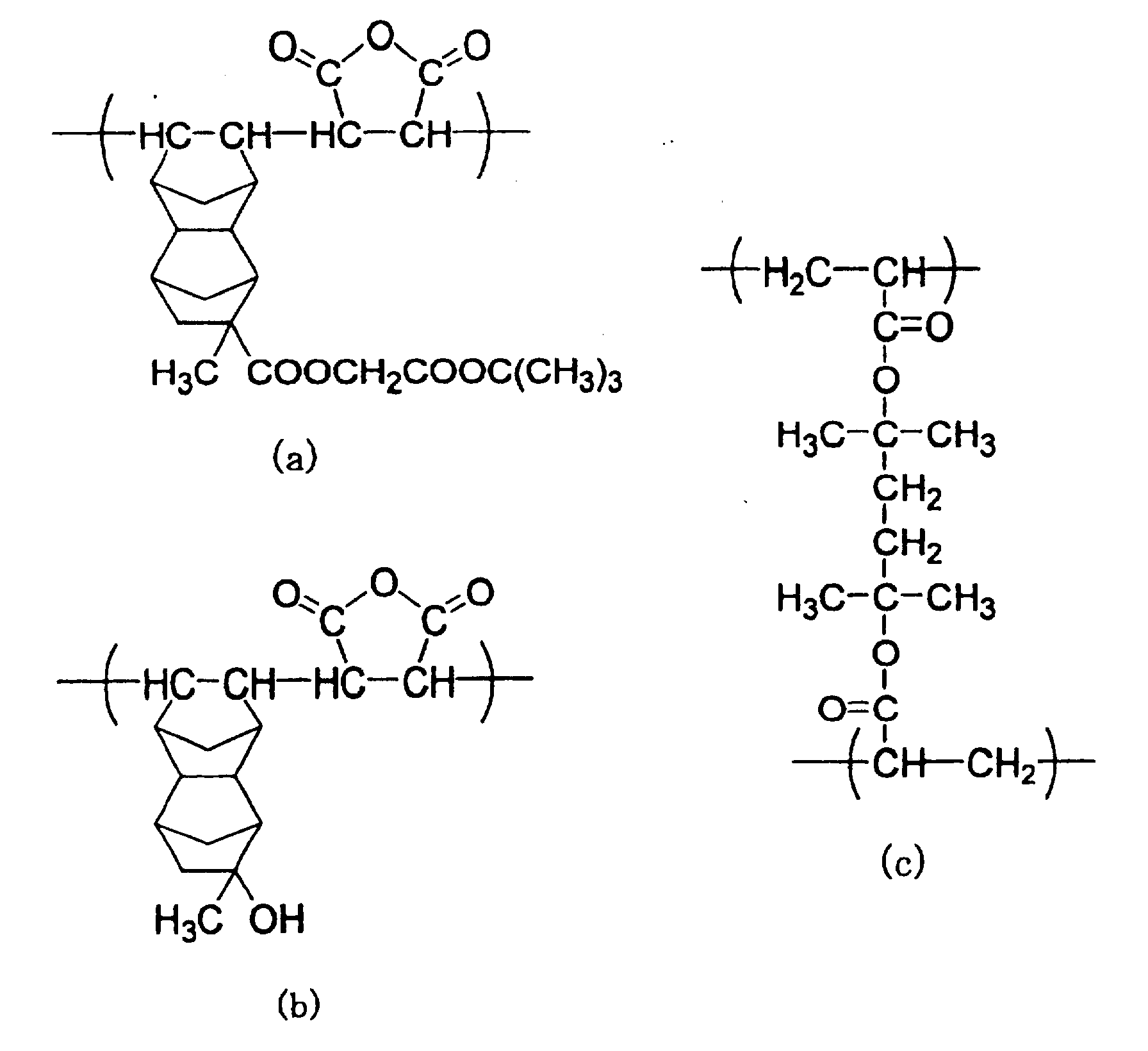
- A resist composition solution for ArF was prepared by dissolving the resulting resin (80 parts), 1-(4-methoxy naphthalen-1-yl)tetrahydrothiophenium nonafluoro-n-butanesulfonate (1.5 parts), tri-n-octylamine (0.04 part) in propylene glycol monomethyl ether acetate (533 parts).
- A separable flask equipped with a thermometer was charged with acenaphthylene (8 parts), 5-hydroxymethylacenaphthylene (4 parts), n-butyl acetate (50 parts), and azobisisobutyronitrile (4 parts) in a nitrogen atmosphere. The mixture polymerized at 80°C for seven hours while stirring. The reaction mixture was diluted with n-butyl acetate (100 parts) and the organic layer was washed with a large amount of a mixed solvent of water and methanol (weight ratio 1:2). The solvent was evaporated to obtain a Polymer (III) with an Mw of 1,000.
- A separable flask equipped with a thermometer was charged with acenaphthylene (6 parts), 4-hydroxymethyl styrene (5 parts), n-butyl acetate (44 parts), and azobisisobutyronitrile (48 parts) in a nitrogen atmosphere. The mixture polymerized at 75°C for seven hours while stirring. The reaction mixture was diluted with n-butyl acetate (100 parts) and the organic layer was washed with a large amount of a mixed solvent of water and methanol (weight ratio 1:2). The solvent was evaporated to obtain a Polymer (IV) with an Mw of 1,200.
- A separable flask equipped with a thermometer was charged with acenaphthylene (6 parts), 2-hydroxymethyl-6-vinylnaphthalene (5 parts), 2-heptanone (48 parts), and azobisisobutyronitrile (4 parts) in a nitrogen atmosphere. The mixture was polymerized at 75°C for seven hours while stirring. The reaction mixture was diluted with 2-heptanone (100 parts) and the organic layer was washed with a large amount of a mixed solvent of water and methanol (weight ratio 1:2). The solvent was evaporated to obtain Polymer (V) with an Mw of 1,200.
- The Polymer (III) obtained in Example 2 (10 parts), bis(4-t-butylphenyl)iodonium 10-camphorsulfonate (0.5 part), and 4,4'-[1-{4-(1-[4-hydroxyphenyl]-1-methylethyl)phenyl}-ethylidene]bisphenol (0.5 part) were dissolved in ethyl lactate (89 parts) . The solution was filtered using a membrane filter with a pore diameter of 0.1 µm to prepare an antireflection film-forming composition. Properties of the composition were evaluated. The evaluation results are shown in Table 1.
- The Polymer (III) obtained in Example 2 (10 parts), bis(4-t-butylphenyl)iodonium nonafluoro-n-butanesulfonate (0.5 part), and 4,4'-[1-{4-(1-[4-hydroxyphenyl]-1-methylethyl)phenyl}ethylidene]bisphenol (0.5 part) were dissolved in ethyl lactate (89 parts). The solution was filtered using a membrane filter with a pore diameter of 0.1 µm to prepare an antireflection film-forming composition. Properties of the composition were evaluated. The evaluation results are shown in Table 1.
- An antireflection film-forming composition was obtained in the same manner as in Example 5, except for using 10 parts of Polymer (IV) obtained in Example 3 instead of 10 parts of Polymer (III) obtained in Example 2. Properties of the composition were evaluated. The evaluation results are shown in Table 1.
- An antireflection film-forming composition was obtained in the same manner as in Example 6, except for using 10 parts of Polymer (IV) obtained in Example 3 instead of 10 parts of Polymer (III) obtained in Example 2. Properties of the composition were evaluated. The evaluation results are shown in Table 1.
- An antireflection film-forming composition was obtained in the same manner as in Example 6, except for using 10 parts of Polymer (V) obtained in Example 4 instead of 10 parts of Polymer (III) obtained in Example 2. Properties of the composition were evaluated. The evaluation results are shown in Table 1.
- A positive tone resist pattern for KrF and a positive tone resist pattern for ArF were formed without using an antireflection film-forming composition to evaluate the performance. The evaluation results are shown in Table 1.
Optical characteristics Standing wave prevention effect Intermixing prevention effect Wavelength (nm) 248 193 n-Value k-Value n-Value k-Value Example 5 2.2 0.4 1.4 0.4 Yes O Example 6 2.2 0.4 1.4 0.4 Yes O Example 7 2.0 0.3 1.5 0.6 Yes O Example 8 2.0 0.3 1.5 0.6 Yes O Example 9 2.2 0.4 1.4 0.4 Yes O Comparative Example 1 - - - - None X - Acetoxymethylacenaphthylene (1) and hydroxymethylacenaphthylene (2) of the present invention are particularly suitable for use as raw materials or intermediates for manufacturing Polymer (I).
- The Polymer (I) of the present invention is particularly suitable for use as a polymer component for the antireflection film-forming composition of the present invention.
- The antireflection film formed from the antireflection film-forming composition of the present invention exhibits a high antireflection effect and does not cause intermixing with a resist film. Therefore, the antireflection film can form an excellent resist pattern with superior sensitivity, pattern profile, and the like in cooperation with various positive-tone or negative-tone resist compositions. Therefore, the antireflection film-forming composition of the present invention can greatly contribute particularly to the manufacture of high integrated circuits.
- Novel compounds acetoxymethylacenaphthylene and hydroxymethylacenaphthyleneare disclosed. A polymer prepared from these novel compounds containing a structural unit of the formula (3),wherein R1 is a hydrogen atom and R2 and R3 individually represent a monovalent atom or a monovalent organic group is also disclosed. The polymer is suitable as a component for an antireflection film-forming composition exhibiting a high antireflection effect and not causing intermixing with a resist film.

Claims (10)
- Acetoxymethylacenaphthylene of the following formula (1).
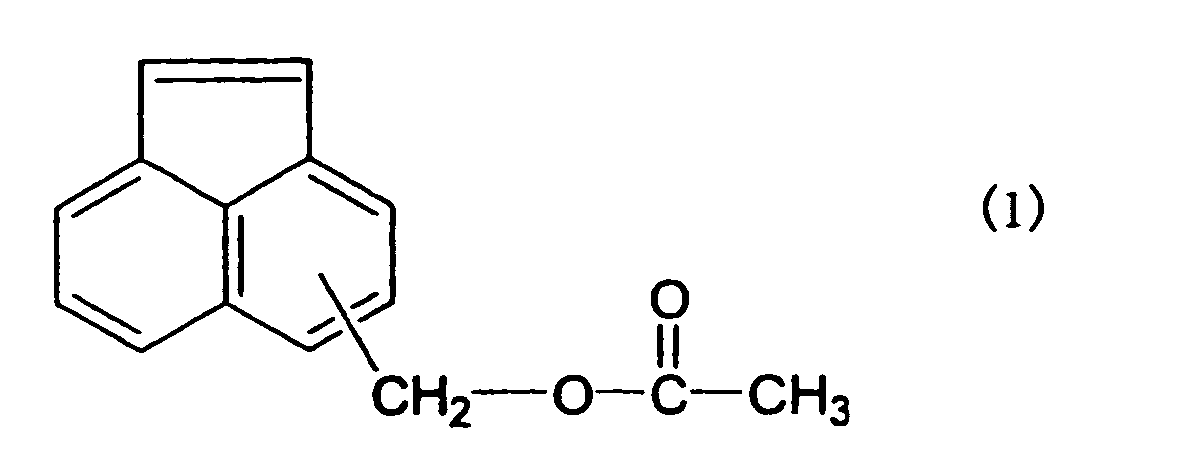
- Hydroxymethylacenaphthylene of the following formula (2).
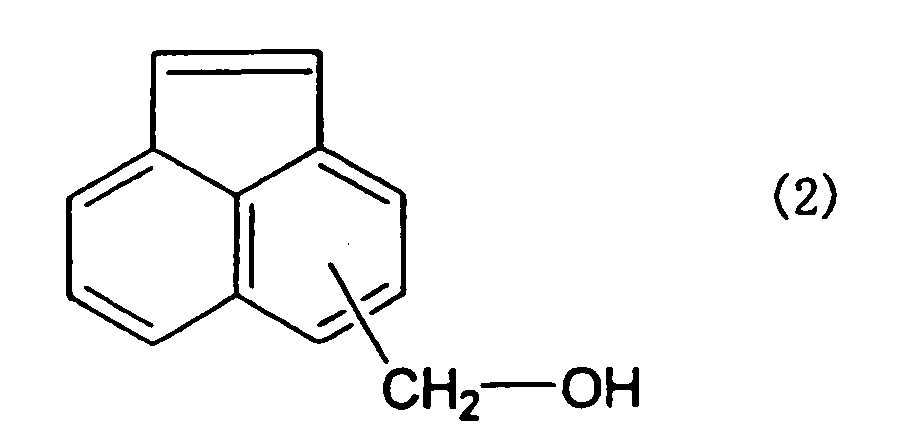
- Apolymer containing a structural unit of the following formula (3),wherein R1 is a hydrogen atom and R2 and R3 individually represent a monovalent atom or a monovalent organic group, the polymer having a polystyrene-reduced weight average molecular weight determined by gel permeation chromatography (GPC) in the range of 500 to 10,000.
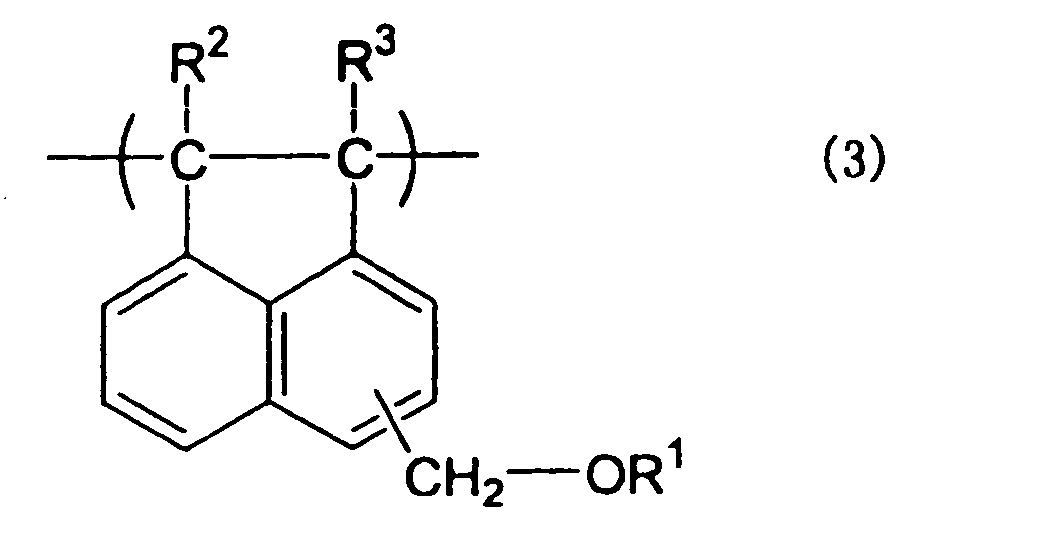
- An antireflection film-forming composition comprising the polymer of claim 3 and a solvent.
- The antireflection film-forming composition comprising,
a polymer having a structural unit of the following formula (4)wherein R4 is a hydrogen atom or a monovalent organic group, R5 is a monovalent atom or a monovalent organic group, and n is 0 or 1, and
a solvent. - An antireflection film-forming composition comprising,
at least one polymer selected from the group consisting of a polymer having the structural unit of the formula (3) of claim 3 and the structural unit of the formula (4) of claim 5, a polymer having the structural unit of the formula (3) of claim 3 and a structural unit of the following formula (5), and a polymer having the structural unit of the formula (4) of claim 5 and a structural unit of the formula (5),wherein R6 and R7 individually represent a monovalent atom or a monovalent organic group, and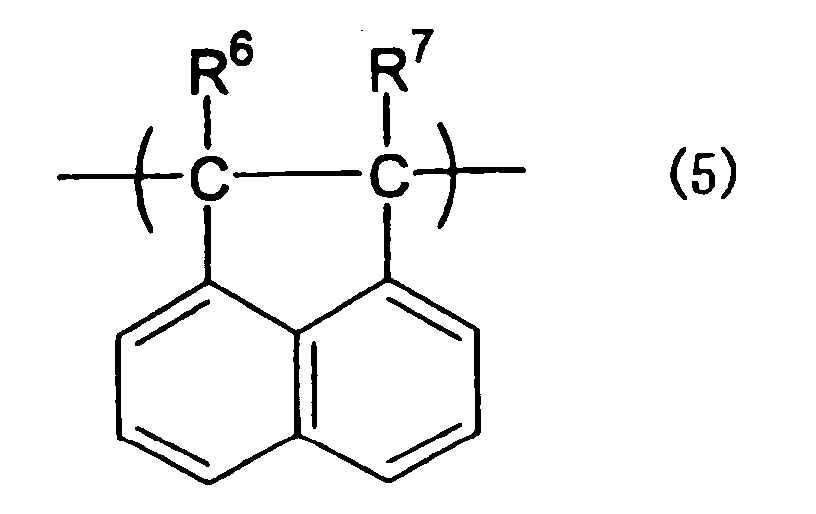
a solvent. - The antireflection film-forming composition according to claim 4, further comprising an acid generator.
- The antireflection film-forming composition according to claim 5, further comprising an acid generator.
- The antireflection film-forming composition according to claim 6, further comprising an acid generator.
- The antireflection film-forming composition according to claim 4, further comprising an acid generator.
Applications Claiming Priority (4)
| Application Number | Priority Date | Filing Date | Title |
|---|---|---|---|
| JP2002224138 | 2002-07-31 | ||
| JP2002224138 | 2002-07-31 | ||
| JP2002324709 | 2002-11-08 | ||
| JP2002324709 | 2002-11-08 |
Publications (2)
| Publication Number | Publication Date |
|---|---|
| EP1386904A1 true EP1386904A1 (en) | 2004-02-04 |
| EP1386904B1 EP1386904B1 (en) | 2008-09-17 |
Family
ID=30117506
Family Applications (1)
| Application Number | Title | Priority Date | Filing Date |
|---|---|---|---|
| EP03017282A Expired - Lifetime EP1386904B1 (en) | 2002-07-31 | 2003-07-30 | Acenaphthylene derivative, polymer, and antireflection film-forming composition |
Country Status (5)
| Country | Link |
|---|---|
| US (1) | US7037994B2 (en) |
| EP (1) | EP1386904B1 (en) |
| KR (1) | KR100961373B1 (en) |
| DE (1) | DE60323577D1 (en) |
| TW (1) | TWI317365B (en) |
Cited By (4)
| Publication number | Priority date | Publication date | Assignee | Title |
|---|---|---|---|---|
| JP2005255547A (en) * | 2004-03-09 | 2005-09-22 | Japan Science & Technology Agency | Acenaphthylene derivative and method for producing the same |
| EP1691238A3 (en) * | 2005-02-05 | 2009-01-21 | Rohm and Haas Electronic Materials, L.L.C. | Coating compositions for use with an overcoated photoresist |
| EP2085822A4 (en) * | 2006-10-12 | 2011-03-16 | Nissan Chemical Ind Ltd | METHOD OF MANUFACTURING A SEMICONDUCTOR DEVICE USING A PHOTORETICULATED CURVED SUB-RESIST FILM |
| EP2937391A4 (en) * | 2012-12-18 | 2016-08-31 | Nissan Chemical Ind Ltd | Bottom layer film-formation composition of self-organizing film containing polycyclic organic vinyl compound |
Families Citing this family (30)
| Publication number | Priority date | Publication date | Assignee | Title |
|---|---|---|---|---|
| KR100833212B1 (en) | 2006-12-01 | 2008-05-28 | 제일모직주식회사 | Antireflective Hardmask Composition |
| WO2007139268A1 (en) * | 2006-05-30 | 2007-12-06 | Cheil Industries Inc. | Antireflective hardmask composition |
| US7727705B2 (en) * | 2007-02-23 | 2010-06-01 | Fujifilm Electronic Materials, U.S.A., Inc. | High etch resistant underlayer compositions for multilayer lithographic processes |
| WO2008143302A1 (en) * | 2007-05-23 | 2008-11-27 | Jsr Corporation | Composition for forming resist lower layer film |
| JP5228995B2 (en) * | 2008-03-05 | 2013-07-03 | 信越化学工業株式会社 | Polymerizable monomer compound, pattern forming method and resist material used therefor |
| JP5218227B2 (en) * | 2008-12-12 | 2013-06-26 | 信越化学工業株式会社 | Pattern formation method |
| KR101344794B1 (en) * | 2009-12-31 | 2014-01-16 | 제일모직주식회사 | Aromatic ring-containing polymer for resist underlayer and resist underlayer composition including same |
| JP5768410B2 (en) * | 2010-04-22 | 2015-08-26 | 信越化学工業株式会社 | Near infrared light absorbing film forming material and laminated film |
| US8658050B2 (en) | 2011-07-27 | 2014-02-25 | International Business Machines Corporation | Method to transfer lithographic patterns into inorganic substrates |
| JP6146305B2 (en) * | 2011-10-12 | 2017-06-14 | Jsr株式会社 | Pattern formation method |
| US8580624B2 (en) | 2011-11-01 | 2013-11-12 | International Business Machines Corporation | Nanowire FET and finFET hybrid technology |
| US8828785B2 (en) | 2012-09-12 | 2014-09-09 | International Business Machines Corporation | Single-crystal phase change material on insulator for reduced cell variability |
| US9786597B2 (en) | 2013-03-11 | 2017-10-10 | International Business Machines Corporation | Self-aligned pitch split for unidirectional metal wiring |
| US9093379B2 (en) | 2013-05-29 | 2015-07-28 | International Business Machines Corporation | Silicidation blocking process using optically sensitive HSQ resist and organic planarizing layer |
| US9741684B2 (en) | 2015-08-17 | 2017-08-22 | International Business Machines Corporation | Wafer bonding edge protection using double patterning with edge exposure |
| US9993750B2 (en) | 2016-03-16 | 2018-06-12 | International Business Machines Corporation | Clog-resistant serpentine pillar filters and bladed loading structures for microfluidics |
| US20190202975A1 (en) * | 2016-06-28 | 2019-07-04 | Dow Global Technologies Llc | Process for making an organic charge transporting film |
| US10069015B2 (en) | 2016-09-26 | 2018-09-04 | International Business Machines Corporation | Width adjustment of stacked nanowires |
| US11474430B2 (en) * | 2017-08-26 | 2022-10-18 | Irresistible Materials Ltd | Multiple trigger monomer containing photoresist compositions and method |
| US10388766B2 (en) | 2017-10-23 | 2019-08-20 | International Business Machines Corporation | Vertical transport FET (VFET) with dual top spacer |
| US10340364B2 (en) | 2017-11-14 | 2019-07-02 | International Business Machines Corporation | H-shaped VFET with increased current drivability |
| US10622257B2 (en) | 2017-12-15 | 2020-04-14 | International Business Machines Corporation | VFET device design for top contact resistance measurement |
| US10374060B2 (en) | 2018-01-09 | 2019-08-06 | International Business Machines Corporation | VFET bottom epitaxy formed with anchors |
| US11195753B2 (en) | 2018-09-18 | 2021-12-07 | International Business Machines Corporation | Tiered-profile contact for semiconductor |
| KR102664157B1 (en) * | 2018-12-03 | 2024-05-07 | 엘지디스플레이 주식회사 | Transparent Display Device |
| US11681213B2 (en) | 2019-02-21 | 2023-06-20 | International Business Machines Corporation | EUV pattern transfer using graded hardmask |
| US10748812B1 (en) | 2019-02-26 | 2020-08-18 | International Business Machines Corporation | Air-gap containing metal interconnects |
| CN118459309A (en) * | 2020-12-03 | 2024-08-09 | 鞍山小巨人生物科技有限公司 | High-quality acenaphthylene |
| JP7792357B2 (en) * | 2023-01-10 | 2025-12-25 | 信越化学工業株式会社 | Composition for forming resist underlayer film, pattern forming method, and method for forming resist underlayer film |
| JP7899781B2 (en) * | 2023-07-26 | 2026-08-04 | 信越化学工業株式会社 | Monomers, polymers, chemically amplified negative resist compositions, and methods for forming resist patterns |
Citations (3)
| Publication number | Priority date | Publication date | Assignee | Title |
|---|---|---|---|---|
| JPH06161111A (en) * | 1992-11-26 | 1994-06-07 | Japan Synthetic Rubber Co Ltd | Radiation sensitive resin composition |
| EP1205805A1 (en) * | 2000-11-14 | 2002-05-15 | JSR Corporation | Anti-reflection coating forming composition |
| US20030073040A1 (en) * | 2001-08-24 | 2003-04-17 | Haruo Iwasawa | Pattern forming method and bilayer film |
Family Cites Families (19)
| Publication number | Priority date | Publication date | Assignee | Title |
|---|---|---|---|---|
| US4093678A (en) * | 1976-04-26 | 1978-06-06 | Union Carbide Corporation | Crystalline co-and terpolymers of ethylene and acenaphthylene |
| JPS6025063B2 (en) * | 1980-03-03 | 1985-06-15 | 日本原子力研究所 | Radiation-resistant and flame-retardant treatment method for polymeric materials |
| JPS5915330B2 (en) * | 1981-02-13 | 1984-04-09 | 工業技術院長 | Method for producing radiation-resistant polyethylene |
| JPS6017446B2 (en) * | 1981-09-01 | 1985-05-02 | 日本原子力研究所 | Radiation resistant resin composition |
| JPH0612452B2 (en) | 1982-09-30 | 1994-02-16 | ブリュ−ワ−・サイエンス・インコ−ポレイテッド | Method of manufacturing integrated circuit device |
| JPS6013869A (en) * | 1983-07-05 | 1985-01-24 | Nippon Zeon Co Ltd | Rubber and fiber adhesive composition |
| JPS61285233A (en) * | 1985-06-11 | 1986-12-16 | Nippon Zeon Co Ltd | High strength, high rigidity rubber composition |
| US4604438A (en) * | 1985-08-12 | 1986-08-05 | Uop Inc. | High temperature thermoset terpolymers |
| US5629393A (en) * | 1989-06-05 | 1997-05-13 | Elf Atochem S.A. | Initiating process and system for the anionic polymerization of acrylic monomers |
| JPH03100005A (en) * | 1989-09-14 | 1991-04-25 | Idemitsu Kosan Co Ltd | Preparation of condensed ring compound polymer |
| DE4414896A1 (en) * | 1994-04-28 | 1995-11-02 | Hoechst Ag | Positive working radiation sensitive mixture |
| US5543484A (en) * | 1994-11-18 | 1996-08-06 | The Penn State Research Foundation | α-olefin/para-alkylstyrene copolymers |
| JPH08184966A (en) * | 1994-12-28 | 1996-07-16 | Japan Synthetic Rubber Co Ltd | Radiation-sensitive resin composition |
| JP3424225B2 (en) * | 1996-02-23 | 2003-07-07 | ジェイエスアール株式会社 | Radiation-sensitive resin composition and coating formed therefrom |
| JPH1090885A (en) * | 1996-09-13 | 1998-04-10 | Konica Corp | Photosensitive composition and photosensitive planographic printing plate material using the same |
| JP3928278B2 (en) | 1998-11-16 | 2007-06-13 | Jsr株式会社 | Anti-reflective film forming composition |
| JP4288776B2 (en) | 1999-08-03 | 2009-07-01 | Jsr株式会社 | Anti-reflective film forming composition |
| US6399273B1 (en) * | 1999-08-13 | 2002-06-04 | Board Of Regents, University Of Texas System | Water-processable photoresist compositions |
| JP2002003543A (en) * | 2000-06-26 | 2002-01-09 | Hitachi Chem Co Ltd | Copolymer containing acenaphthylene derivative, and molding material, sheet or film and optical part obtained from the same |
-
2003
- 2003-07-21 TW TW092119850A patent/TWI317365B/en not_active IP Right Cessation
- 2003-07-23 US US10/624,678 patent/US7037994B2/en not_active Expired - Lifetime
- 2003-07-30 EP EP03017282A patent/EP1386904B1/en not_active Expired - Lifetime
- 2003-07-30 DE DE60323577T patent/DE60323577D1/en not_active Expired - Lifetime
- 2003-07-30 KR KR1020030052567A patent/KR100961373B1/en not_active Expired - Lifetime
Patent Citations (3)
| Publication number | Priority date | Publication date | Assignee | Title |
|---|---|---|---|---|
| JPH06161111A (en) * | 1992-11-26 | 1994-06-07 | Japan Synthetic Rubber Co Ltd | Radiation sensitive resin composition |
| EP1205805A1 (en) * | 2000-11-14 | 2002-05-15 | JSR Corporation | Anti-reflection coating forming composition |
| US20030073040A1 (en) * | 2001-08-24 | 2003-04-17 | Haruo Iwasawa | Pattern forming method and bilayer film |
Non-Patent Citations (1)
| Title |
|---|
| DATABASE CA [online] CHEMICAL ABSTRACTS SERVICE, COLUMBUS, OHIO, US; MURATA, MAKOTO ET AL: "Radiation-sensitive composition for photoresist", XP002256060, retrieved from STN Database accession no. 121:312027 * |
Cited By (6)
| Publication number | Priority date | Publication date | Assignee | Title |
|---|---|---|---|---|
| JP2005255547A (en) * | 2004-03-09 | 2005-09-22 | Japan Science & Technology Agency | Acenaphthylene derivative and method for producing the same |
| EP1691238A3 (en) * | 2005-02-05 | 2009-01-21 | Rohm and Haas Electronic Materials, L.L.C. | Coating compositions for use with an overcoated photoresist |
| EP2085822A4 (en) * | 2006-10-12 | 2011-03-16 | Nissan Chemical Ind Ltd | METHOD OF MANUFACTURING A SEMICONDUCTOR DEVICE USING A PHOTORETICULATED CURVED SUB-RESIST FILM |
| US8227172B2 (en) | 2006-10-12 | 2012-07-24 | Nissan Chemical Industries, Ltd. | Method of producing semiconductor device using resist underlayer film by photo-crosslinking curing |
| CN104765252A (en) * | 2006-10-12 | 2015-07-08 | 日产化学工业株式会社 | Method of producing semiconductor device using resist underlayer film by photo-crosslinking curing |
| EP2937391A4 (en) * | 2012-12-18 | 2016-08-31 | Nissan Chemical Ind Ltd | Bottom layer film-formation composition of self-organizing film containing polycyclic organic vinyl compound |
Also Published As
| Publication number | Publication date |
|---|---|
| DE60323577D1 (en) | 2008-10-30 |
| TWI317365B (en) | 2009-11-21 |
| US20040034155A1 (en) | 2004-02-19 |
| KR100961373B1 (en) | 2010-06-07 |
| TW200403272A (en) | 2004-03-01 |
| EP1386904B1 (en) | 2008-09-17 |
| US7037994B2 (en) | 2006-05-02 |
| KR20040012537A (en) | 2004-02-11 |
Similar Documents
| Publication | Publication Date | Title |
|---|---|---|
| EP1386904B1 (en) | Acenaphthylene derivative, polymer, and antireflection film-forming composition | |
| JP4134760B2 (en) | Antireflection film forming composition and antireflection film | |
| US7749681B2 (en) | Composition for forming lower layer film and pattern forming method | |
| JP4292910B2 (en) | Acenaphthylene derivative, polymer and antireflection film-forming composition | |
| US8691496B2 (en) | Method for forming resist under layer film, pattern forming method and composition for resist under layer film | |
| JP4288776B2 (en) | Anti-reflective film forming composition | |
| JP3852107B2 (en) | Anti-reflective film forming composition | |
| EP1205805B1 (en) | Anti-reflection coating forming composition | |
| JP5195478B2 (en) | Resist underlayer film forming composition, resist underlayer film, resist underlayer film forming method, and pattern forming method | |
| JP5229044B2 (en) | Resist underlayer film forming composition, resist underlayer film, resist underlayer film forming method, and pattern forming method | |
| JP4729803B2 (en) | Underlayer film forming composition for multilayer resist process | |
| JP2005015532A (en) | Polymer and antireflection film-forming composition | |
| JP2001027810A (en) | Acrylic copolymer, antireflection film-forming composition containing the same, and method of forming resist film | |
| JP4639915B2 (en) | Composition for resist underlayer film | |
| US6242161B1 (en) | Acrylic copolymer and reflection-preventing film-forming composition containing the same | |
| US9134611B2 (en) | Composition for forming resist underlayer film and pattern-forming method | |
| WO2006040921A1 (en) | Sulfur-atom-containing composition for forming of lithographic antireflection film | |
| JP4120599B2 (en) | Antireflection film forming composition and antireflection film | |
| JP4419554B2 (en) | Antireflection film forming composition and antireflection film | |
| JPH10319601A (en) | Composition for forming antireflection film and method for forming resist pattern | |
| JP4134759B2 (en) | Antireflection film forming composition and antireflection film | |
| JPWO2007046453A1 (en) | Polymer of vinyl naphthalene derivative, composition for forming antireflection film, and antireflection film | |
| TWI432906B (en) | Method for forming composition and pattern of photoresist underlayer film formation |
Legal Events
| Date | Code | Title | Description |
|---|---|---|---|
| PUAI | Public reference made under article 153(3) epc to a published international application that has entered the european phase |
Free format text: ORIGINAL CODE: 0009012 |
|
| AK | Designated contracting states |
Kind code of ref document: A1 Designated state(s): AT BE BG CH CY CZ DE DK EE ES FI FR GB GR HU IE IT LI LU MC NL PT RO SE SI SK TR |
|
| AX | Request for extension of the european patent |
Extension state: AL LT LV MK |
|
| RAP1 | Party data changed (applicant data changed or rights of an application transferred) |
Owner name: JSR CORPORATION |
|
| 17P | Request for examination filed |
Effective date: 20040716 |
|
| AKX | Designation fees paid |
Designated state(s): DE FR GB IT |
|
| 17Q | First examination report despatched |
Effective date: 20060112 |
|
| GRAP | Despatch of communication of intention to grant a patent |
Free format text: ORIGINAL CODE: EPIDOSNIGR1 |
|
| GRAS | Grant fee paid |
Free format text: ORIGINAL CODE: EPIDOSNIGR3 |
|
| GRAA | (expected) grant |
Free format text: ORIGINAL CODE: 0009210 |
|
| AK | Designated contracting states |
Kind code of ref document: B1 Designated state(s): DE FR GB IT |
|
| REG | Reference to a national code |
Ref country code: GB Ref legal event code: FG4D |
|
| REF | Corresponds to: |
Ref document number: 60323577 Country of ref document: DE Date of ref document: 20081030 Kind code of ref document: P |
|
| PLBE | No opposition filed within time limit |
Free format text: ORIGINAL CODE: 0009261 |
|
| STAA | Information on the status of an ep patent application or granted ep patent |
Free format text: STATUS: NO OPPOSITION FILED WITHIN TIME LIMIT |
|
| 26N | No opposition filed |
Effective date: 20090618 |
|
| REG | Reference to a national code |
Ref country code: FR Ref legal event code: PLFP Year of fee payment: 13 |
|
| PGFP | Annual fee paid to national office [announced via postgrant information from national office to epo] |
Ref country code: FR Payment date: 20150626 Year of fee payment: 13 |
|
| PGFP | Annual fee paid to national office [announced via postgrant information from national office to epo] |
Ref country code: DE Payment date: 20150721 Year of fee payment: 13 Ref country code: GB Payment date: 20150721 Year of fee payment: 13 |
|
| PGFP | Annual fee paid to national office [announced via postgrant information from national office to epo] |
Ref country code: IT Payment date: 20150727 Year of fee payment: 13 |
|
| REG | Reference to a national code |
Ref country code: DE Ref legal event code: R119 Ref document number: 60323577 Country of ref document: DE |
|
| GBPC | Gb: european patent ceased through non-payment of renewal fee |
Effective date: 20160730 |
|
| PG25 | Lapsed in a contracting state [announced via postgrant information from national office to epo] |
Ref country code: FR Free format text: LAPSE BECAUSE OF NON-PAYMENT OF DUE FEES Effective date: 20160801 Ref country code: DE Free format text: LAPSE BECAUSE OF NON-PAYMENT OF DUE FEES Effective date: 20170201 |
|
| REG | Reference to a national code |
Ref country code: FR Ref legal event code: ST Effective date: 20170331 |
|
| PG25 | Lapsed in a contracting state [announced via postgrant information from national office to epo] |
Ref country code: GB Free format text: LAPSE BECAUSE OF NON-PAYMENT OF DUE FEES Effective date: 20160730 |
|
| PG25 | Lapsed in a contracting state [announced via postgrant information from national office to epo] |
Ref country code: IT Free format text: LAPSE BECAUSE OF NON-PAYMENT OF DUE FEES Effective date: 20160730 |