EP1383751B1 - Neue insektizid wirkende azole - Google Patents
Neue insektizid wirkende azole Download PDFInfo
- Publication number
- EP1383751B1 EP1383751B1 EP02764014A EP02764014A EP1383751B1 EP 1383751 B1 EP1383751 B1 EP 1383751B1 EP 02764014 A EP02764014 A EP 02764014A EP 02764014 A EP02764014 A EP 02764014A EP 1383751 B1 EP1383751 B1 EP 1383751B1
- Authority
- EP
- European Patent Office
- Prior art keywords
- spp
- methyl
- compounds
- formula
- represents hydrogen
- Prior art date
- Legal status (The legal status is an assumption and is not a legal conclusion. Google has not performed a legal analysis and makes no representation as to the accuracy of the status listed.)
- Expired - Lifetime
Links
- 230000000749 insecticidal effect Effects 0.000 title description 3
- 150000003851 azoles Chemical class 0.000 title description 2
- 241000607479 Yersinia pestis Species 0.000 claims abstract description 15
- 241001465754 Metazoa Species 0.000 claims abstract description 13
- 238000004519 manufacturing process Methods 0.000 claims abstract 2
- 150000001875 compounds Chemical class 0.000 claims description 102
- -1 cyano- Chemical class 0.000 claims description 80
- 125000002496 methyl group Chemical group [H]C([H])([H])* 0.000 claims description 58
- 229910052739 hydrogen Inorganic materials 0.000 claims description 54
- 239000001257 hydrogen Substances 0.000 claims description 38
- 239000000203 mixture Substances 0.000 claims description 32
- 125000001495 ethyl group Chemical group [H]C([H])([H])C([H])([H])* 0.000 claims description 25
- 239000003085 diluting agent Substances 0.000 claims description 21
- ZAMOUSCENKQFHK-UHFFFAOYSA-N Chlorine atom Chemical group [Cl] ZAMOUSCENKQFHK-UHFFFAOYSA-N 0.000 claims description 20
- 229910052717 sulfur Inorganic materials 0.000 claims description 19
- 239000000460 chlorine Chemical group 0.000 claims description 17
- 125000001449 isopropyl group Chemical group [H]C([H])([H])C([H])(*)C([H])([H])[H] 0.000 claims description 16
- 125000004123 n-propyl group Chemical group [H]C([H])([H])C([H])([H])C([H])([H])* 0.000 claims description 15
- 229910052760 oxygen Inorganic materials 0.000 claims description 15
- 125000006273 (C1-C3) alkyl group Chemical group 0.000 claims description 14
- 229910052801 chlorine Inorganic materials 0.000 claims description 14
- 125000001570 methylene group Chemical group [H]C([H])([*:1])[*:2] 0.000 claims description 14
- 238000002360 preparation method Methods 0.000 claims description 13
- 239000003795 chemical substances by application Substances 0.000 claims description 12
- 229910052731 fluorine Inorganic materials 0.000 claims description 11
- 239000011737 fluorine Substances 0.000 claims description 10
- 125000001153 fluoro group Chemical group F* 0.000 claims description 10
- 229910052736 halogen Inorganic materials 0.000 claims description 9
- 150000002367 halogens Chemical group 0.000 claims description 9
- 125000004093 cyano group Chemical group *C#N 0.000 claims description 6
- 125000000623 heterocyclic group Chemical group 0.000 claims description 6
- 125000004076 pyridyl group Chemical group 0.000 claims description 6
- 125000000335 thiazolyl group Chemical group 0.000 claims description 6
- 125000000449 nitro group Chemical group [O-][N+](*)=O 0.000 claims description 4
- 125000001376 1,2,4-triazolyl group Chemical group N1N=C(N=C1)* 0.000 claims description 3
- 125000004517 1,2,5-thiadiazolyl group Chemical group 0.000 claims description 3
- 125000001072 heteroaryl group Chemical group 0.000 claims description 3
- 125000001786 isothiazolyl group Chemical group 0.000 claims description 3
- 125000000842 isoxazolyl group Chemical group 0.000 claims description 3
- 230000000802 nitrating effect Effects 0.000 claims description 3
- 125000002971 oxazolyl group Chemical group 0.000 claims description 3
- 125000001997 phenyl group Chemical class [H]C1=C([H])C([H])=C(*)C([H])=C1[H] 0.000 claims description 3
- 125000003373 pyrazinyl group Chemical group 0.000 claims description 3
- 125000003226 pyrazolyl group Chemical group 0.000 claims description 3
- 125000000714 pyrimidinyl group Chemical group 0.000 claims description 3
- 125000004178 (C1-C4) alkyl group Chemical group 0.000 claims description 2
- 125000004765 (C1-C4) haloalkyl group Chemical group 0.000 claims description 2
- WKBOTKDWSSQWDR-UHFFFAOYSA-N Bromine atom Chemical group [Br] WKBOTKDWSSQWDR-UHFFFAOYSA-N 0.000 claims description 2
- GDTBXPJZTBHREO-UHFFFAOYSA-N bromine Chemical group BrBr GDTBXPJZTBHREO-UHFFFAOYSA-N 0.000 claims description 2
- 229910052794 bromium Inorganic materials 0.000 claims description 2
- 125000003107 substituted aryl group Chemical group 0.000 claims description 2
- 239000004094 surface-active agent Substances 0.000 claims description 2
- 125000004435 hydrogen atom Chemical group [H]* 0.000 claims 19
- 125000005843 halogen group Chemical group 0.000 claims 1
- 229920006395 saturated elastomer Polymers 0.000 claims 1
- 238000000034 method Methods 0.000 abstract description 20
- 150000002391 heterocyclic compounds Chemical class 0.000 abstract description 3
- 239000000575 pesticide Substances 0.000 abstract 1
- OKKJLVBELUTLKV-UHFFFAOYSA-N Methanol Chemical compound OC OKKJLVBELUTLKV-UHFFFAOYSA-N 0.000 description 81
- WEVYAHXRMPXWCK-UHFFFAOYSA-N Acetonitrile Chemical compound CC#N WEVYAHXRMPXWCK-UHFFFAOYSA-N 0.000 description 44
- CSCPPACGZOOCGX-UHFFFAOYSA-N Acetone Chemical compound CC(C)=O CSCPPACGZOOCGX-UHFFFAOYSA-N 0.000 description 38
- 239000002904 solvent Substances 0.000 description 33
- UFHFLCQGNIYNRP-UHFFFAOYSA-N Hydrogen Chemical compound [H][H] UFHFLCQGNIYNRP-UHFFFAOYSA-N 0.000 description 32
- LFQSCWFLJHTTHZ-UHFFFAOYSA-N Ethanol Chemical compound CCO LFQSCWFLJHTTHZ-UHFFFAOYSA-N 0.000 description 30
- RTZKZFJDLAIYFH-UHFFFAOYSA-N Diethyl ether Chemical compound CCOCC RTZKZFJDLAIYFH-UHFFFAOYSA-N 0.000 description 24
- 241000196324 Embryophyta Species 0.000 description 20
- YXFVVABEGXRONW-UHFFFAOYSA-N Toluene Chemical compound CC1=CC=CC=C1 YXFVVABEGXRONW-UHFFFAOYSA-N 0.000 description 20
- 239000004480 active ingredient Substances 0.000 description 20
- XLYOFNOQVPJJNP-UHFFFAOYSA-N water Substances O XLYOFNOQVPJJNP-UHFFFAOYSA-N 0.000 description 20
- 239000000126 substance Substances 0.000 description 19
- YMWUJEATGCHHMB-UHFFFAOYSA-N Dichloromethane Chemical compound ClCCl YMWUJEATGCHHMB-UHFFFAOYSA-N 0.000 description 17
- UHOVQNZJYSORNB-UHFFFAOYSA-N Benzene Chemical compound C1=CC=CC=C1 UHOVQNZJYSORNB-UHFFFAOYSA-N 0.000 description 16
- 238000009472 formulation Methods 0.000 description 16
- 238000006243 chemical reaction Methods 0.000 description 14
- 239000003153 chemical reaction reagent Substances 0.000 description 14
- 239000000047 product Substances 0.000 description 14
- IAZDPXIOMUYVGZ-UHFFFAOYSA-N Dimethylsulphoxide Chemical compound CS(C)=O IAZDPXIOMUYVGZ-UHFFFAOYSA-N 0.000 description 12
- XEKOWRVHYACXOJ-UHFFFAOYSA-N Ethyl acetate Chemical compound CCOC(C)=O XEKOWRVHYACXOJ-UHFFFAOYSA-N 0.000 description 12
- 235000019441 ethanol Nutrition 0.000 description 12
- 239000002917 insecticide Substances 0.000 description 12
- CYQAYERJWZKYML-UHFFFAOYSA-N phosphorus pentasulfide Chemical compound S1P(S2)(=S)SP3(=S)SP1(=S)SP2(=S)S3 CYQAYERJWZKYML-UHFFFAOYSA-N 0.000 description 12
- 239000011541 reaction mixture Substances 0.000 description 12
- ZMXDDKWLCZADIW-UHFFFAOYSA-N N,N-Dimethylformamide Chemical compound CN(C)C=O ZMXDDKWLCZADIW-UHFFFAOYSA-N 0.000 description 11
- 239000011230 binding agent Substances 0.000 description 11
- WYURNTSHIVDZCO-UHFFFAOYSA-N Tetrahydrofuran Chemical compound C1CCOC1 WYURNTSHIVDZCO-UHFFFAOYSA-N 0.000 description 10
- 238000009835 boiling Methods 0.000 description 10
- 239000008187 granular material Substances 0.000 description 10
- 239000000463 material Substances 0.000 description 10
- VYPSYNLAJGMNEJ-UHFFFAOYSA-N silicon dioxide Inorganic materials O=[Si]=O VYPSYNLAJGMNEJ-UHFFFAOYSA-N 0.000 description 10
- 241000238876 Acari Species 0.000 description 9
- ZMANZCXQSJIPKH-UHFFFAOYSA-N Triethylamine Chemical compound CCN(CC)CC ZMANZCXQSJIPKH-UHFFFAOYSA-N 0.000 description 9
- QARVLSVVCXYDNA-UHFFFAOYSA-N bromobenzene Chemical compound BrC1=CC=CC=C1 QARVLSVVCXYDNA-UHFFFAOYSA-N 0.000 description 9
- MVPPADPHJFYWMZ-UHFFFAOYSA-N chlorobenzene Chemical compound ClC1=CC=CC=C1 MVPPADPHJFYWMZ-UHFFFAOYSA-N 0.000 description 9
- 239000000417 fungicide Substances 0.000 description 9
- CFHGBZLNZZVTAY-UHFFFAOYSA-N lawesson's reagent Chemical compound C1=CC(OC)=CC=C1P1(=S)SP(=S)(C=2C=CC(OC)=CC=2)S1 CFHGBZLNZZVTAY-UHFFFAOYSA-N 0.000 description 9
- LQNUZADURLCDLV-UHFFFAOYSA-N nitrobenzene Chemical compound [O-][N+](=O)C1=CC=CC=C1 LQNUZADURLCDLV-UHFFFAOYSA-N 0.000 description 9
- 239000007787 solid Substances 0.000 description 9
- 239000011877 solvent mixture Substances 0.000 description 9
- 239000002023 wood Substances 0.000 description 9
- BDAGIHXWWSANSR-UHFFFAOYSA-N Formic acid Chemical compound OC=O BDAGIHXWWSANSR-UHFFFAOYSA-N 0.000 description 8
- 241000238631 Hexapoda Species 0.000 description 8
- 241000257303 Hymenoptera Species 0.000 description 8
- 241001481703 Rhipicephalus <genus> Species 0.000 description 8
- 241000258242 Siphonaptera Species 0.000 description 8
- 239000003995 emulsifying agent Substances 0.000 description 8
- 235000019253 formic acid Nutrition 0.000 description 8
- 238000004895 liquid chromatography mass spectrometry Methods 0.000 description 8
- 239000003921 oil Substances 0.000 description 8
- 235000019198 oils Nutrition 0.000 description 8
- 239000000243 solution Substances 0.000 description 8
- BFIWQSSAMKDRRZ-UHFFFAOYSA-N 2,4-bis(4-phenoxyphenyl)-2,4-bis(sulfanylidene)-1,3,2$l^{5},4$l^{5}-dithiadiphosphetane Chemical compound S1P(=S)(C=2C=CC(OC=3C=CC=CC=3)=CC=2)SP1(=S)C(C=C1)=CC=C1OC1=CC=CC=C1 BFIWQSSAMKDRRZ-UHFFFAOYSA-N 0.000 description 7
- 241000255925 Diptera Species 0.000 description 7
- 230000003373 anti-fouling effect Effects 0.000 description 7
- 230000000694 effects Effects 0.000 description 7
- VNWKTOKETHGBQD-UHFFFAOYSA-N methane Natural products C VNWKTOKETHGBQD-UHFFFAOYSA-N 0.000 description 7
- 239000011734 sodium Substances 0.000 description 7
- ZWEHNKRNPOVVGH-UHFFFAOYSA-N 2-Butanone Chemical compound CCC(C)=O ZWEHNKRNPOVVGH-UHFFFAOYSA-N 0.000 description 6
- QTBSBXVTEAMEQO-UHFFFAOYSA-N Acetic acid Chemical compound CC(O)=O QTBSBXVTEAMEQO-UHFFFAOYSA-N 0.000 description 6
- 241000256186 Anopheles <genus> Species 0.000 description 6
- IJGRMHOSHXDMSA-UHFFFAOYSA-N Atomic nitrogen Chemical compound N#N IJGRMHOSHXDMSA-UHFFFAOYSA-N 0.000 description 6
- 238000005481 NMR spectroscopy Methods 0.000 description 6
- JCXJVPUVTGWSNB-UHFFFAOYSA-N Nitrogen dioxide Chemical compound O=[N]=O JCXJVPUVTGWSNB-UHFFFAOYSA-N 0.000 description 6
- CTQNGGLPUBDAKN-UHFFFAOYSA-N O-Xylene Chemical compound CC1=CC=CC=C1C CTQNGGLPUBDAKN-UHFFFAOYSA-N 0.000 description 6
- 241000238887 Ornithodoros Species 0.000 description 6
- 241000238675 Periplaneta americana Species 0.000 description 6
- JUJWROOIHBZHMG-UHFFFAOYSA-N Pyridine Chemical compound C1=CC=NC=C1 JUJWROOIHBZHMG-UHFFFAOYSA-N 0.000 description 6
- 150000001412 amines Chemical class 0.000 description 6
- 239000002585 base Substances 0.000 description 6
- 239000012141 concentrate Substances 0.000 description 6
- 238000001035 drying Methods 0.000 description 6
- 239000000975 dye Substances 0.000 description 6
- 150000002148 esters Chemical class 0.000 description 6
- 150000002431 hydrogen Chemical class 0.000 description 6
- 239000000543 intermediate Substances 0.000 description 6
- 229910052757 nitrogen Inorganic materials 0.000 description 6
- 239000003973 paint Substances 0.000 description 6
- NLKNQRATVPKPDG-UHFFFAOYSA-M potassium iodide Chemical compound [K+].[I-] NLKNQRATVPKPDG-UHFFFAOYSA-M 0.000 description 6
- 150000003839 salts Chemical class 0.000 description 6
- 238000012360 testing method Methods 0.000 description 6
- 0 *C(*)N(*)C(C(*)(*)*1)=*C1=N* Chemical compound *C(*)N(*)C(C(*)(*)*1)=*C1=N* 0.000 description 5
- QGZKDVFQNNGYKY-UHFFFAOYSA-N Ammonia Chemical compound N QGZKDVFQNNGYKY-UHFFFAOYSA-N 0.000 description 5
- 241000239223 Arachnida Species 0.000 description 5
- 241000258924 Ctenocephalides felis Species 0.000 description 5
- 241000256602 Isoptera Species 0.000 description 5
- 241000500881 Lepisma Species 0.000 description 5
- CDBYLPFSWZWCQE-UHFFFAOYSA-L Sodium Carbonate Chemical compound [Na+].[Na+].[O-]C([O-])=O CDBYLPFSWZWCQE-UHFFFAOYSA-L 0.000 description 5
- 239000013543 active substance Substances 0.000 description 5
- 229920000180 alkyd Polymers 0.000 description 5
- 125000000217 alkyl group Chemical group 0.000 description 5
- 238000004587 chromatography analysis Methods 0.000 description 5
- 239000000839 emulsion Substances 0.000 description 5
- 238000001704 evaporation Methods 0.000 description 5
- INQOMBQAUSQDDS-UHFFFAOYSA-N iodomethane Chemical compound IC INQOMBQAUSQDDS-UHFFFAOYSA-N 0.000 description 5
- 239000002480 mineral oil Substances 0.000 description 5
- JTFZLMQVYYNTRB-UHFFFAOYSA-M potassium;cyanoiminomethylsulfanylmethanethiolate Chemical compound [K+].[S-]CSC=NC#N JTFZLMQVYYNTRB-UHFFFAOYSA-M 0.000 description 5
- 239000000843 powder Substances 0.000 description 5
- 229920005989 resin Polymers 0.000 description 5
- 239000011347 resin Substances 0.000 description 5
- 239000000741 silica gel Substances 0.000 description 5
- 229910002027 silica gel Inorganic materials 0.000 description 5
- 238000003756 stirring Methods 0.000 description 5
- 239000008096 xylene Substances 0.000 description 5
- 241001143309 Acanthoscelides obtectus Species 0.000 description 4
- 241000238818 Acheta domesticus Species 0.000 description 4
- 241000256111 Aedes <genus> Species 0.000 description 4
- 241000238679 Amblyomma Species 0.000 description 4
- 241001640910 Anthrenus Species 0.000 description 4
- 241001480748 Argas Species 0.000 description 4
- 241000131286 Attagenus Species 0.000 description 4
- 241001573716 Blaniulus guttulatus Species 0.000 description 4
- 241000238657 Blattella germanica Species 0.000 description 4
- 241001674044 Blattodea Species 0.000 description 4
- 241000257163 Calliphora vicina Species 0.000 description 4
- 241001098608 Ceratophyllus Species 0.000 description 4
- 241000258920 Chilopoda Species 0.000 description 4
- RENMDAKOXSCIGH-UHFFFAOYSA-N Chloroacetonitrile Chemical compound ClCC#N RENMDAKOXSCIGH-UHFFFAOYSA-N 0.000 description 4
- 241000359266 Chorioptes Species 0.000 description 4
- 241001327638 Cimex lectularius Species 0.000 description 4
- RYGMFSIKBFXOCR-UHFFFAOYSA-N Copper Chemical compound [Cu] RYGMFSIKBFXOCR-UHFFFAOYSA-N 0.000 description 4
- 241000256054 Culex <genus> Species 0.000 description 4
- 241001481695 Dermanyssus gallinae Species 0.000 description 4
- 241001124144 Dermaptera Species 0.000 description 4
- 241000238710 Dermatophagoides Species 0.000 description 4
- 241001641895 Dermestes Species 0.000 description 4
- 241000258963 Diplopoda Species 0.000 description 4
- LYCAIKOWRPUZTN-UHFFFAOYSA-N Ethylene glycol Chemical compound OCCO LYCAIKOWRPUZTN-UHFFFAOYSA-N 0.000 description 4
- 241000371383 Fannia Species 0.000 description 4
- 241000255896 Galleria mellonella Species 0.000 description 4
- 241001660203 Gasterophilus Species 0.000 description 4
- 241000790933 Haematopinus Species 0.000 description 4
- 241000258937 Hemiptera Species 0.000 description 4
- 241001466007 Heteroptera Species 0.000 description 4
- 241001480803 Hyalomma Species 0.000 description 4
- VEXZGXHMUGYJMC-UHFFFAOYSA-N Hydrochloric acid Chemical compound Cl VEXZGXHMUGYJMC-UHFFFAOYSA-N 0.000 description 4
- MHAJPDPJQMAIIY-UHFFFAOYSA-N Hydrogen peroxide Chemical compound OO MHAJPDPJQMAIIY-UHFFFAOYSA-N 0.000 description 4
- 241000257176 Hypoderma <fly> Species 0.000 description 4
- DGAQECJNVWCQMB-PUAWFVPOSA-M Ilexoside XXIX Chemical compound C[C@@H]1CC[C@@]2(CC[C@@]3(C(=CC[C@H]4[C@]3(CC[C@@H]5[C@@]4(CC[C@@H](C5(C)C)OS(=O)(=O)[O-])C)C)[C@@H]2[C@]1(C)O)C)C(=O)O[C@H]6[C@@H]([C@H]([C@@H]([C@H](O6)CO)O)O)O.[Na+] DGAQECJNVWCQMB-PUAWFVPOSA-M 0.000 description 4
- 241001149911 Isopoda Species 0.000 description 4
- 241000238681 Ixodes Species 0.000 description 4
- 241000255777 Lepidoptera Species 0.000 description 4
- 241001113970 Linognathus Species 0.000 description 4
- 241000257162 Lucilia <blowfly> Species 0.000 description 4
- 241001177134 Lyctus Species 0.000 description 4
- 241001143352 Meloidogyne Species 0.000 description 4
- BZLVMXJERCGZMT-UHFFFAOYSA-N Methyl tert-butyl ether Chemical compound COC(C)(C)C BZLVMXJERCGZMT-UHFFFAOYSA-N 0.000 description 4
- 241000952627 Monomorium pharaonis Species 0.000 description 4
- 241000257229 Musca <genus> Species 0.000 description 4
- LRHPLDYGYMQRHN-UHFFFAOYSA-N N-Butanol Chemical compound CCCCO LRHPLDYGYMQRHN-UHFFFAOYSA-N 0.000 description 4
- 241000384103 Oniscus asellus Species 0.000 description 4
- 241000238814 Orthoptera Species 0.000 description 4
- 241000517306 Pediculus humanus corporis Species 0.000 description 4
- KFSLWBXXFJQRDL-UHFFFAOYSA-N Peracetic acid Chemical compound CC(=O)OO KFSLWBXXFJQRDL-UHFFFAOYSA-N 0.000 description 4
- 241000722350 Phlebotomus <genus> Species 0.000 description 4
- 241000908127 Porcellio scaber Species 0.000 description 4
- 241001649229 Psoroptes Species 0.000 description 4
- 241001105129 Ptinus Species 0.000 description 4
- 241001509970 Reticulitermes <genus> Species 0.000 description 4
- 241001510236 Rhyparobia maderae Species 0.000 description 4
- 241000318997 Rhyzopertha dominica Species 0.000 description 4
- 241000509416 Sarcoptes Species 0.000 description 4
- 241000256108 Simulium <genus> Species 0.000 description 4
- UIIMBOGNXHQVGW-UHFFFAOYSA-M Sodium bicarbonate Chemical compound [Na+].OC([O-])=O UIIMBOGNXHQVGW-UHFFFAOYSA-M 0.000 description 4
- 241001494139 Stomoxys Species 0.000 description 4
- NINIDFKCEFEMDL-UHFFFAOYSA-N Sulfur Chemical compound [S] NINIDFKCEFEMDL-UHFFFAOYSA-N 0.000 description 4
- QAOWNCQODCNURD-UHFFFAOYSA-N Sulfuric acid Chemical compound OS(O)(=O)=O QAOWNCQODCNURD-UHFFFAOYSA-N 0.000 description 4
- 241000255626 Tabanus <genus> Species 0.000 description 4
- 241000130771 Tinea pellionella Species 0.000 description 4
- 241000333690 Tineola bisselliella Species 0.000 description 4
- 241000511627 Tipula paludosa Species 0.000 description 4
- 241001414833 Triatoma Species 0.000 description 4
- HEDRZPFGACZZDS-MICDWDOJSA-N Trichloro(2H)methane Chemical compound [2H]C(Cl)(Cl)Cl HEDRZPFGACZZDS-MICDWDOJSA-N 0.000 description 4
- 241001259047 Trichodectes Species 0.000 description 4
- 241000353223 Xenopsylla cheopis Species 0.000 description 4
- 241001414985 Zygentoma Species 0.000 description 4
- 150000001338 aliphatic hydrocarbons Chemical class 0.000 description 4
- RDOXTESZEPMUJZ-UHFFFAOYSA-N anisole Chemical compound COC1=CC=CC=C1 RDOXTESZEPMUJZ-UHFFFAOYSA-N 0.000 description 4
- 150000004945 aromatic hydrocarbons Chemical class 0.000 description 4
- 230000015572 biosynthetic process Effects 0.000 description 4
- 239000010949 copper Substances 0.000 description 4
- 229910052802 copper Inorganic materials 0.000 description 4
- 229940079593 drug Drugs 0.000 description 4
- 239000003814 drug Substances 0.000 description 4
- 230000012173 estrus Effects 0.000 description 4
- 150000002170 ethers Chemical class 0.000 description 4
- 230000008020 evaporation Effects 0.000 description 4
- 239000004009 herbicide Substances 0.000 description 4
- IXCSERBJSXMMFS-UHFFFAOYSA-N hydrogen chloride Substances Cl.Cl IXCSERBJSXMMFS-UHFFFAOYSA-N 0.000 description 4
- 229910000041 hydrogen chloride Inorganic materials 0.000 description 4
- 229910052500 inorganic mineral Inorganic materials 0.000 description 4
- 239000007788 liquid Substances 0.000 description 4
- 235000010755 mineral Nutrition 0.000 description 4
- VLKZOEOYAKHREP-UHFFFAOYSA-N n-Hexane Chemical group CCCCCC VLKZOEOYAKHREP-UHFFFAOYSA-N 0.000 description 4
- 150000002978 peroxides Chemical class 0.000 description 4
- 150000003254 radicals Chemical class 0.000 description 4
- 229910052708 sodium Inorganic materials 0.000 description 4
- 239000011593 sulfur Substances 0.000 description 4
- 239000000725 suspension Substances 0.000 description 4
- CIHOLLKRGTVIJN-UHFFFAOYSA-N tert‐butyl hydroperoxide Chemical compound CC(C)(C)OO CIHOLLKRGTVIJN-UHFFFAOYSA-N 0.000 description 4
- KAATUXNTWXVJKI-NSHGMRRFSA-N (1R)-cis-(alphaS)-cypermethrin Chemical compound CC1(C)[C@@H](C=C(Cl)Cl)[C@H]1C(=O)O[C@H](C#N)C1=CC=CC(OC=2C=CC=CC=2)=C1 KAATUXNTWXVJKI-NSHGMRRFSA-N 0.000 description 3
- AQZMGEOVQFOCOA-UHFFFAOYSA-N 1-amino-3h-pyrrol-2-one Chemical compound NN1C=CCC1=O AQZMGEOVQFOCOA-UHFFFAOYSA-N 0.000 description 3
- 238000005160 1H NMR spectroscopy Methods 0.000 description 3
- WYVVKGNFXHOCQV-UHFFFAOYSA-N 3-iodoprop-2-yn-1-yl butylcarbamate Chemical compound CCCCNC(=O)OCC#CI WYVVKGNFXHOCQV-UHFFFAOYSA-N 0.000 description 3
- 239000005877 Alpha-Cypermethrin Substances 0.000 description 3
- 241000411449 Anobium punctatum Species 0.000 description 3
- 241001028523 Bentholebouria blatta Species 0.000 description 3
- QGJOPFRUJISHPQ-UHFFFAOYSA-N Carbon disulfide Chemical compound S=C=S QGJOPFRUJISHPQ-UHFFFAOYSA-N 0.000 description 3
- 241000238586 Cirripedia Species 0.000 description 3
- 241000254173 Coleoptera Species 0.000 description 3
- MDNWOSOZYLHTCG-UHFFFAOYSA-N Dichlorophen Chemical compound OC1=CC=C(Cl)C=C1CC1=CC(Cl)=CC=C1O MDNWOSOZYLHTCG-UHFFFAOYSA-N 0.000 description 3
- 241000832180 Hylotrupes bajulus Species 0.000 description 3
- XEEYBQQBJWHFJM-UHFFFAOYSA-N Iron Chemical class [Fe] XEEYBQQBJWHFJM-UHFFFAOYSA-N 0.000 description 3
- 241000721623 Myzus Species 0.000 description 3
- MZRVEZGGRBJDDB-UHFFFAOYSA-N N-Butyllithium Chemical compound [Li]CCCC MZRVEZGGRBJDDB-UHFFFAOYSA-N 0.000 description 3
- SJRJJKPEHAURKC-UHFFFAOYSA-N N-Methylmorpholine Chemical compound CN1CCOCC1 SJRJJKPEHAURKC-UHFFFAOYSA-N 0.000 description 3
- 241000244206 Nematoda Species 0.000 description 3
- 241001674048 Phthiraptera Species 0.000 description 3
- KWYUFKZDYYNOTN-UHFFFAOYSA-M Potassium hydroxide Chemical compound [OH-].[K+] KWYUFKZDYYNOTN-UHFFFAOYSA-M 0.000 description 3
- WQDUMFSSJAZKTM-UHFFFAOYSA-N Sodium methoxide Chemical compound [Na+].[O-]C WQDUMFSSJAZKTM-UHFFFAOYSA-N 0.000 description 3
- 125000001931 aliphatic group Chemical group 0.000 description 3
- 230000000844 anti-bacterial effect Effects 0.000 description 3
- 239000002519 antifouling agent Substances 0.000 description 3
- 239000003899 bactericide agent Substances 0.000 description 3
- JFDZBHWFFUWGJE-UHFFFAOYSA-N benzonitrile Chemical compound N#CC1=CC=CC=C1 JFDZBHWFFUWGJE-UHFFFAOYSA-N 0.000 description 3
- 210000000941 bile Anatomy 0.000 description 3
- 239000000969 carrier Substances 0.000 description 3
- 244000038559 crop plants Species 0.000 description 3
- 239000012043 crude product Substances 0.000 description 3
- ATDGTVJJHBUTRL-UHFFFAOYSA-N cyanogen bromide Chemical compound BrC#N ATDGTVJJHBUTRL-UHFFFAOYSA-N 0.000 description 3
- 229960003887 dichlorophen Drugs 0.000 description 3
- IJKVHSBPTUYDLN-UHFFFAOYSA-N dihydroxy(oxo)silane Chemical compound O[Si](O)=O IJKVHSBPTUYDLN-UHFFFAOYSA-N 0.000 description 3
- 238000007598 dipping method Methods 0.000 description 3
- 239000002270 dispersing agent Substances 0.000 description 3
- 229920001971 elastomer Polymers 0.000 description 3
- 239000003480 eluent Substances 0.000 description 3
- WDQNIWFZKXZFAY-UHFFFAOYSA-M fentin acetate Chemical compound CC([O-])=O.C1=CC=CC=C1[Sn+](C=1C=CC=CC=1)C1=CC=CC=C1 WDQNIWFZKXZFAY-UHFFFAOYSA-M 0.000 description 3
- NYPJDWWKZLNGGM-UHFFFAOYSA-N fenvalerate Aalpha Natural products C=1C=C(Cl)C=CC=1C(C(C)C)C(=O)OC(C#N)C(C=1)=CC=CC=1OC1=CC=CC=C1 NYPJDWWKZLNGGM-UHFFFAOYSA-N 0.000 description 3
- 239000000706 filtrate Substances 0.000 description 3
- 239000000499 gel Substances 0.000 description 3
- 238000003919 heteronuclear multiple bond coherence Methods 0.000 description 3
- 238000003929 heteronuclear multiple quantum coherence Methods 0.000 description 3
- 238000004128 high performance liquid chromatography Methods 0.000 description 3
- WGCNASOHLSPBMP-UHFFFAOYSA-N hydroxyacetaldehyde Natural products OCC=O WGCNASOHLSPBMP-UHFFFAOYSA-N 0.000 description 3
- XLTUPERVRFLGLJ-UHFFFAOYSA-N isothiocyanato(trimethyl)silane Chemical compound C[Si](C)(C)N=C=S XLTUPERVRFLGLJ-UHFFFAOYSA-N 0.000 description 3
- 150000002576 ketones Chemical class 0.000 description 3
- 238000002156 mixing Methods 0.000 description 3
- 230000002013 molluscicidal effect Effects 0.000 description 3
- 239000003960 organic solvent Substances 0.000 description 3
- 239000002245 particle Substances 0.000 description 3
- 239000006072 paste Substances 0.000 description 3
- 239000003208 petroleum Substances 0.000 description 3
- 239000012071 phase Substances 0.000 description 3
- ZUOUZKKEUPVFJK-UHFFFAOYSA-N phenylbenzene Natural products C1=CC=CC=C1C1=CC=CC=C1 ZUOUZKKEUPVFJK-UHFFFAOYSA-N 0.000 description 3
- 239000004014 plasticizer Substances 0.000 description 3
- 239000011591 potassium Substances 0.000 description 3
- 229910052700 potassium Inorganic materials 0.000 description 3
- 239000011814 protection agent Substances 0.000 description 3
- UMJSCPRVCHMLSP-UHFFFAOYSA-N pyridine Natural products COC1=CC=CN=C1 UMJSCPRVCHMLSP-UHFFFAOYSA-N 0.000 description 3
- 238000010992 reflux Methods 0.000 description 3
- 239000005060 rubber Substances 0.000 description 3
- 238000003860 storage Methods 0.000 description 3
- 238000003786 synthesis reaction Methods 0.000 description 3
- 229920003002 synthetic resin Polymers 0.000 description 3
- 239000000057 synthetic resin Substances 0.000 description 3
- YLQBMQCUIZJEEH-UHFFFAOYSA-N tetrahydrofuran Natural products C=1C=COC=1 YLQBMQCUIZJEEH-UHFFFAOYSA-N 0.000 description 3
- HYVWIQDYBVKITD-UHFFFAOYSA-N tolylfluanid Chemical compound CN(C)S(=O)(=O)N(SC(F)(Cl)Cl)C1=CC=C(C)C=C1 HYVWIQDYBVKITD-UHFFFAOYSA-N 0.000 description 3
- 235000015112 vegetable and seed oil Nutrition 0.000 description 3
- 239000008158 vegetable oil Substances 0.000 description 3
- 229920002554 vinyl polymer Polymers 0.000 description 3
- ZMYFCFLJBGAQRS-IAGOWNOFSA-N (2S,3R)-epoxiconazole Chemical compound C1=CC(F)=CC=C1[C@]1(CN2N=CN=C2)[C@@H](C=2C(=CC=CC=2)Cl)O1 ZMYFCFLJBGAQRS-IAGOWNOFSA-N 0.000 description 2
- QPFMBZIOSGYJDE-UHFFFAOYSA-N 1,1,2,2-tetrachloroethane Chemical compound ClC(Cl)C(Cl)Cl QPFMBZIOSGYJDE-UHFFFAOYSA-N 0.000 description 2
- RYHBNJHYFVUHQT-UHFFFAOYSA-N 1,4-Dioxane Chemical compound C1COCCO1 RYHBNJHYFVUHQT-UHFFFAOYSA-N 0.000 description 2
- PXMNMQRDXWABCY-UHFFFAOYSA-N 1-(4-chlorophenyl)-4,4-dimethyl-3-(1H-1,2,4-triazol-1-ylmethyl)pentan-3-ol Chemical compound C1=NC=NN1CC(O)(C(C)(C)C)CCC1=CC=C(Cl)C=C1 PXMNMQRDXWABCY-UHFFFAOYSA-N 0.000 description 2
- FEWLNYSYJNLUOO-UHFFFAOYSA-N 1-Piperidinecarboxaldehyde Chemical compound O=CN1CCCCC1 FEWLNYSYJNLUOO-UHFFFAOYSA-N 0.000 description 2
- PZBPKYOVPCNPJY-UHFFFAOYSA-N 1-[2-(allyloxy)-2-(2,4-dichlorophenyl)ethyl]imidazole Chemical compound ClC1=CC(Cl)=CC=C1C(OCC=C)CN1C=NC=C1 PZBPKYOVPCNPJY-UHFFFAOYSA-N 0.000 description 2
- SGUUPIFZLIDIDV-UHFFFAOYSA-N 1-amino-3h-pyrrole-2-thione Chemical compound NN1C=CCC1=S SGUUPIFZLIDIDV-UHFFFAOYSA-N 0.000 description 2
- DURPTKYDGMDSBL-UHFFFAOYSA-N 1-butoxybutane Chemical compound CCCCOCCCC DURPTKYDGMDSBL-UHFFFAOYSA-N 0.000 description 2
- NVJUHMXYKCUMQA-UHFFFAOYSA-N 1-ethoxypropane Chemical compound CCCOCC NVJUHMXYKCUMQA-UHFFFAOYSA-N 0.000 description 2
- JEOMMIXUUVMNHJ-UHFFFAOYSA-N 2,4-bis(4-phenylsulfanylphenyl)-2,4-bis(sulfanylidene)-1,3,2$l^{5},4$l^{5}-dithiadiphosphetane Chemical compound S1P(=S)(C=2C=CC(SC=3C=CC=CC=3)=CC=2)SP1(=S)C(C=C1)=CC=C1SC1=CC=CC=C1 JEOMMIXUUVMNHJ-UHFFFAOYSA-N 0.000 description 2
- OIEQWZXDRGOGHA-UHFFFAOYSA-N 2,4-bis(methylsulfanyl)-2,4-bis(sulfanylidene)-1,3,2$l^{5},4$l^{5}-dithiadiphosphetane Chemical compound CSP1(=S)SP(=S)(SC)S1 OIEQWZXDRGOGHA-UHFFFAOYSA-N 0.000 description 2
- WMYQGZHFMUDZIS-UHFFFAOYSA-N 2,4-bis[(4-methylphenyl)sulfanyl]-2,4-bis(sulfanylidene)-1,3,2$l^{5},4$l^{5}-dithiadiphosphetane Chemical compound C1=CC(C)=CC=C1SP1(=S)SP(=S)(SC=2C=CC(C)=CC=2)S1 WMYQGZHFMUDZIS-UHFFFAOYSA-N 0.000 description 2
- 125000004201 2,4-dichlorophenyl group Chemical group [H]C1=C([H])C(*)=C(Cl)C([H])=C1Cl 0.000 description 2
- OZSVBRVFXIOJSU-UHFFFAOYSA-N 2,6-dichloro-n-[[4-(trifluoromethyl)phenyl]methyl]benzamide Chemical compound C1=CC(C(F)(F)F)=CC=C1CNC(=O)C1=C(Cl)C=CC=C1Cl OZSVBRVFXIOJSU-UHFFFAOYSA-N 0.000 description 2
- STMIIPIFODONDC-UHFFFAOYSA-N 2-(2,4-dichlorophenyl)-1-(1H-1,2,4-triazol-1-yl)hexan-2-ol Chemical compound C=1C=C(Cl)C=C(Cl)C=1C(O)(CCCC)CN1C=NC=N1 STMIIPIFODONDC-UHFFFAOYSA-N 0.000 description 2
- UFNOUKDBUJZYDE-UHFFFAOYSA-N 2-(4-chlorophenyl)-3-cyclopropyl-1-(1H-1,2,4-triazol-1-yl)butan-2-ol Chemical compound C1=NC=NN1CC(O)(C=1C=CC(Cl)=CC=1)C(C)C1CC1 UFNOUKDBUJZYDE-UHFFFAOYSA-N 0.000 description 2
- SZNYYWIUQFZLLT-UHFFFAOYSA-N 2-methyl-1-(2-methylpropoxy)propane Chemical compound CC(C)COCC(C)C SZNYYWIUQFZLLT-UHFFFAOYSA-N 0.000 description 2
- AVGVFDSUDIUXEU-UHFFFAOYSA-N 2-octyl-1,2-thiazolidin-3-one Chemical compound CCCCCCCCN1SCCC1=O AVGVFDSUDIUXEU-UHFFFAOYSA-N 0.000 description 2
- AUQAUAIUNJIIEP-UHFFFAOYSA-N 3,4,5-trimethylphenyl methylcarbamate Chemical compound CNC(=O)OC1=CC(C)=C(C)C(C)=C1 AUQAUAIUNJIIEP-UHFFFAOYSA-N 0.000 description 2
- 229940099451 3-iodo-2-propynylbutylcarbamate Drugs 0.000 description 2
- BQMRHYBXRAYYQS-UHFFFAOYSA-N 4-dihydroxyphosphinothioyloxy-n,n-diethyl-6-methylpyrimidin-2-amine Chemical compound CCN(CC)C1=NC(C)=CC(OP(O)(O)=S)=N1 BQMRHYBXRAYYQS-UHFFFAOYSA-N 0.000 description 2
- 239000005660 Abamectin Substances 0.000 description 2
- RSWGJHLUYNHPMX-UHFFFAOYSA-N Abietic-Saeure Natural products C12CCC(C(C)C)=CC2=CCC2C1(C)CCCC2(C)C(O)=O RSWGJHLUYNHPMX-UHFFFAOYSA-N 0.000 description 2
- 241001580860 Acarapis Species 0.000 description 2
- 241000934067 Acarus Species 0.000 description 2
- 241000934064 Acarus siro Species 0.000 description 2
- KWOLFJPFCHCOCG-UHFFFAOYSA-N Acetophenone Chemical compound CC(=O)C1=CC=CC=C1 KWOLFJPFCHCOCG-UHFFFAOYSA-N 0.000 description 2
- 241001351288 Achroia grisella Species 0.000 description 2
- 239000004925 Acrylic resin Substances 0.000 description 2
- 241000256118 Aedes aegypti Species 0.000 description 2
- 241000256173 Aedes albopictus Species 0.000 description 2
- 241000902874 Agelastica alni Species 0.000 description 2
- 241001136265 Agriotes Species 0.000 description 2
- 241000218473 Agrotis Species 0.000 description 2
- PNEYBMLMFCGWSK-UHFFFAOYSA-N Alumina Chemical compound [O-2].[O-2].[O-2].[Al+3].[Al+3] PNEYBMLMFCGWSK-UHFFFAOYSA-N 0.000 description 2
- NLXLAEXVIDQMFP-UHFFFAOYSA-N Ammonia chloride Chemical compound [NH4+].[Cl-] NLXLAEXVIDQMFP-UHFFFAOYSA-N 0.000 description 2
- 241001398046 Amphimallon solstitiale Species 0.000 description 2
- 241001427556 Anoplura Species 0.000 description 2
- 241000272517 Anseriformes Species 0.000 description 2
- 241000254177 Anthonomus Species 0.000 description 2
- 241001414828 Aonidiella aurantii Species 0.000 description 2
- 241000294569 Aphelenchoides Species 0.000 description 2
- 241001425390 Aphis fabae Species 0.000 description 2
- 241001600408 Aphis gossypii Species 0.000 description 2
- 241001095118 Aphis pomi Species 0.000 description 2
- 241000239290 Araneae Species 0.000 description 2
- 241000238901 Araneidae Species 0.000 description 2
- 241001162025 Archips podana Species 0.000 description 2
- 241001480752 Argas persicus Species 0.000 description 2
- 241001480754 Argas reflexus Species 0.000 description 2
- XKRFYHLGVUSROY-UHFFFAOYSA-N Argon Chemical compound [Ar] XKRFYHLGVUSROY-UHFFFAOYSA-N 0.000 description 2
- 241000722809 Armadillidium vulgare Species 0.000 description 2
- 241000238421 Arthropoda Species 0.000 description 2
- 241000387321 Aspidiotus nerii Species 0.000 description 2
- 241000238708 Astigmata Species 0.000 description 2
- 241001174347 Atomaria Species 0.000 description 2
- 241000982146 Atylotus Species 0.000 description 2
- 241000221377 Auricularia Species 0.000 description 2
- 241000193388 Bacillus thuringiensis Species 0.000 description 2
- 241001490249 Bactrocera oleae Species 0.000 description 2
- 241000751139 Beauveria bassiana Species 0.000 description 2
- 241000254127 Bemisia tabaci Species 0.000 description 2
- 241001142392 Bibio Species 0.000 description 2
- 241001631693 Blattella asahinai Species 0.000 description 2
- ZOXJGFHDIHLPTG-UHFFFAOYSA-N Boron Chemical compound [B] ZOXJGFHDIHLPTG-UHFFFAOYSA-N 0.000 description 2
- 241000283690 Bos taurus Species 0.000 description 2
- 241000322475 Bovicola Species 0.000 description 2
- 241000913391 Brachionus forficula Species 0.000 description 2
- 241001444260 Brassicogethes aeneus Species 0.000 description 2
- 241000941072 Braula Species 0.000 description 2
- 241000982105 Brevicoryne brassicae Species 0.000 description 2
- 241001643374 Brevipalpus Species 0.000 description 2
- 241000488564 Bryobia Species 0.000 description 2
- 241000398201 Bryobia praetiosa Species 0.000 description 2
- 241001517925 Bucculatrix Species 0.000 description 2
- 241001491790 Bupalus piniaria Species 0.000 description 2
- 241000243770 Bursaphelenchus Species 0.000 description 2
- KAKZBPTYRLMSJV-UHFFFAOYSA-N Butadiene Chemical compound C=CC=C KAKZBPTYRLMSJV-UHFFFAOYSA-N 0.000 description 2
- 241000239324 Buthus occitanus Species 0.000 description 2
- IRIAEXORFWYRCZ-UHFFFAOYSA-N Butylbenzyl phthalate Chemical compound CCCCOC(=O)C1=CC=CC=C1C(=O)OCC1=CC=CC=C1 IRIAEXORFWYRCZ-UHFFFAOYSA-N 0.000 description 2
- FERIUCNNQQJTOY-UHFFFAOYSA-N Butyric acid Chemical compound CCCC(O)=O FERIUCNNQQJTOY-UHFFFAOYSA-N 0.000 description 2
- 241000257160 Calliphora Species 0.000 description 2
- 241000333978 Caloglyphus Species 0.000 description 2
- 241001489688 Camponotus herculeanus Species 0.000 description 2
- 241001350371 Capua Species 0.000 description 2
- 241001221118 Cecidophyopsis ribis Species 0.000 description 2
- 241000255579 Ceratitis capitata Species 0.000 description 2
- 241001436125 Cheiridium Species 0.000 description 2
- 241001436044 Chelifer Species 0.000 description 2
- 241000426499 Chilo Species 0.000 description 2
- HEDRZPFGACZZDS-UHFFFAOYSA-N Chloroform Chemical compound ClC(Cl)Cl HEDRZPFGACZZDS-UHFFFAOYSA-N 0.000 description 2
- 241000255942 Choristoneura fumiferana Species 0.000 description 2
- 241001124179 Chrysops Species 0.000 description 2
- 241001414836 Cimex Species 0.000 description 2
- 241001635683 Cimex hemipterus Species 0.000 description 2
- 241000098277 Cnaphalocrocis Species 0.000 description 2
- 241001427559 Collembola Species 0.000 description 2
- 241000683561 Conoderus Species 0.000 description 2
- 241001212534 Cosmopolites sordidus Species 0.000 description 2
- 241000500845 Costelytra zealandica Species 0.000 description 2
- 241001094916 Cryptomyzus ribis Species 0.000 description 2
- 241000258922 Ctenocephalides Species 0.000 description 2
- 241000490513 Ctenocephalides canis Species 0.000 description 2
- 241001124552 Ctenolepisma Species 0.000 description 2
- 241000256059 Culex pipiens Species 0.000 description 2
- 241000256057 Culex quinquefasciatus Species 0.000 description 2
- 241000256061 Culex tarsalis Species 0.000 description 2
- 241000134316 Culicoides <genus> Species 0.000 description 2
- 241000692095 Cuterebra Species 0.000 description 2
- XZMCDFZZKTWFGF-UHFFFAOYSA-N Cyanamide Chemical compound NC#N XZMCDFZZKTWFGF-UHFFFAOYSA-N 0.000 description 2
- XDTMQSROBMDMFD-UHFFFAOYSA-N Cyclohexane Chemical compound C1CCCCC1 XDTMQSROBMDMFD-UHFFFAOYSA-N 0.000 description 2
- 241001635274 Cydia pomonella Species 0.000 description 2
- 239000005946 Cypermethrin Substances 0.000 description 2
- 239000005757 Cyproconazole Substances 0.000 description 2
- 241000268912 Damalinia Species 0.000 description 2
- 239000005892 Deltamethrin Substances 0.000 description 2
- 241001128004 Demodex Species 0.000 description 2
- 241001480824 Dermacentor Species 0.000 description 2
- 241001481694 Dermanyssus Species 0.000 description 2
- 241000489975 Diabrotica Species 0.000 description 2
- RWSOTUBLDIXVET-UHFFFAOYSA-N Dihydrogen sulfide Chemical compound S RWSOTUBLDIXVET-UHFFFAOYSA-N 0.000 description 2
- XTHFKEDIFFGKHM-UHFFFAOYSA-N Dimethoxyethane Chemical compound COCCOC XTHFKEDIFFGKHM-UHFFFAOYSA-N 0.000 description 2
- LCGLNKUTAGEVQW-UHFFFAOYSA-N Dimethyl ether Chemical compound COC LCGLNKUTAGEVQW-UHFFFAOYSA-N 0.000 description 2
- 241000511318 Diprion Species 0.000 description 2
- 241000399949 Ditylenchus dipsaci Species 0.000 description 2
- 241000255581 Drosophila <fruit fly, genus> Species 0.000 description 2
- 241000255601 Drosophila melanogaster Species 0.000 description 2
- 241001425477 Dysdercus Species 0.000 description 2
- 241000353522 Earias insulana Species 0.000 description 2
- 241000995023 Empoasca Species 0.000 description 2
- 241000122098 Ephestia kuehniella Species 0.000 description 2
- 241000462639 Epilachna varivestis Species 0.000 description 2
- 241000917107 Eriosoma lanigerum Species 0.000 description 2
- 241000060469 Eupoecilia ambiguella Species 0.000 description 2
- 241000483001 Euproctis chrysorrhoea Species 0.000 description 2
- 241000515838 Eurygaster Species 0.000 description 2
- 241000239245 Euscelis Species 0.000 description 2
- 241000216093 Eusimulium Species 0.000 description 2
- 241001585293 Euxoa Species 0.000 description 2
- 241000953886 Fannia canicularis Species 0.000 description 2
- 241000322646 Felicola Species 0.000 description 2
- 241000233488 Feltia Species 0.000 description 2
- 239000004606 Fillers/Extenders Substances 0.000 description 2
- 239000005780 Fluazinam Substances 0.000 description 2
- 241000720914 Forficula auricularia Species 0.000 description 2
- ZHNUHDYFZUAESO-UHFFFAOYSA-N Formamide Chemical compound NC=O ZHNUHDYFZUAESO-UHFFFAOYSA-N 0.000 description 2
- 241000189565 Frankliniella Species 0.000 description 2
- 241000248126 Geophilus Species 0.000 description 2
- 241000723283 Geophilus carpophagus Species 0.000 description 2
- 241001043186 Gibbium Species 0.000 description 2
- 241001442498 Globodera Species 0.000 description 2
- 241000257324 Glossina <genus> Species 0.000 description 2
- PEDCQBHIVMGVHV-UHFFFAOYSA-N Glycerol Natural products OCC(O)CO PEDCQBHIVMGVHV-UHFFFAOYSA-N 0.000 description 2
- 241001243091 Gryllotalpa Species 0.000 description 2
- 241000257224 Haematobia Species 0.000 description 2
- 241000562576 Haematopota Species 0.000 description 2
- 241000775881 Haematopota pluvialis Species 0.000 description 2
- 241000256257 Heliothis Species 0.000 description 2
- 241001659688 Hercinothrips femoralis Species 0.000 description 2
- 241001480224 Heterodera Species 0.000 description 2
- 241000771999 Hippobosca Species 0.000 description 2
- 241001201623 Hofmannophila pseudospretella Species 0.000 description 2
- 241000957299 Homona magnanima Species 0.000 description 2
- 241001417351 Hoplocampa Species 0.000 description 2
- 241001251909 Hyalopterus pruni Species 0.000 description 2
- 241000561960 Hybomitra Species 0.000 description 2
- 241000238729 Hydrotaea Species 0.000 description 2
- 241001508566 Hypera postica Species 0.000 description 2
- 241001590577 Hypodectes Species 0.000 description 2
- 239000005795 Imazalil Substances 0.000 description 2
- 239000005906 Imidacloprid Substances 0.000 description 2
- UQSXHKLRYXJYBZ-UHFFFAOYSA-N Iron oxide Chemical compound [Fe]=O UQSXHKLRYXJYBZ-UHFFFAOYSA-N 0.000 description 2
- KFZMGEQAYNKOFK-UHFFFAOYSA-N Isopropanol Chemical compound CC(C)O KFZMGEQAYNKOFK-UHFFFAOYSA-N 0.000 description 2
- 241001506109 Kalotermes Species 0.000 description 2
- 241001467800 Knemidokoptes Species 0.000 description 2
- 240000008415 Lactuca sativa Species 0.000 description 2
- 235000003228 Lactuca sativa Nutrition 0.000 description 2
- 241001470017 Laodelphax striatella Species 0.000 description 2
- 241000256686 Lasius <genus> Species 0.000 description 2
- 241000599116 Lasius fuliginosus Species 0.000 description 2
- 241000948337 Lasius niger Species 0.000 description 2
- 241000051764 Lasius umbratus Species 0.000 description 2
- 241001163604 Latheticus oryzae Species 0.000 description 2
- 241000238866 Latrodectus mactans Species 0.000 description 2
- 241000258916 Leptinotarsa decemlineata Species 0.000 description 2
- 238000005684 Liebig rearrangement reaction Methods 0.000 description 2
- 241000692237 Lipoptena Species 0.000 description 2
- 241000322707 Liposcelis Species 0.000 description 2
- 241000594036 Liriomyza Species 0.000 description 2
- 241000966204 Lissorhoptrus oryzophilus Species 0.000 description 2
- 241001535742 Listrophorus Species 0.000 description 2
- 241000254025 Locusta migratoria migratorioides Species 0.000 description 2
- 241001220360 Longidorus Species 0.000 description 2
- 241000255134 Lutzomyia <genus> Species 0.000 description 2
- 241000721696 Lymantria Species 0.000 description 2
- 241000255685 Malacosoma neustria Species 0.000 description 2
- 241000555303 Mamestra brassicae Species 0.000 description 2
- 241001415013 Melanoplus Species 0.000 description 2
- 241000254099 Melolontha melolontha Species 0.000 description 2
- 241000771995 Melophagus Species 0.000 description 2
- 241000035436 Menopon Species 0.000 description 2
- 241001481698 Mesostigmata Species 0.000 description 2
- 239000005956 Metaldehyde Substances 0.000 description 2
- 239000005868 Metconazole Substances 0.000 description 2
- 239000005951 Methiocarb Substances 0.000 description 2
- 241001351098 Morellia Species 0.000 description 2
- 241000257159 Musca domestica Species 0.000 description 2
- 241001373727 Myobia Species 0.000 description 2
- IMNFDUFMRHMDMM-UHFFFAOYSA-N N-Heptane Chemical compound CCCCCCC IMNFDUFMRHMDMM-UHFFFAOYSA-N 0.000 description 2
- ATHHXGZTWNVVOU-UHFFFAOYSA-N N-methylformamide Chemical compound CNC=O ATHHXGZTWNVVOU-UHFFFAOYSA-N 0.000 description 2
- 241000041821 Necrobia Species 0.000 description 2
- 241000358422 Nephotettix cincticeps Species 0.000 description 2
- 241001556089 Nilaparvata lugens Species 0.000 description 2
- 241001385056 Niptus hololeucus Species 0.000 description 2
- GRYLNZFGIOXLOG-UHFFFAOYSA-N Nitric acid Chemical compound O[N+]([O-])=O GRYLNZFGIOXLOG-UHFFFAOYSA-N 0.000 description 2
- 241000562097 Notoedres Species 0.000 description 2
- 241000036147 Ochlerotatus taeniorhynchus Species 0.000 description 2
- 241000963703 Onychiurus armatus Species 0.000 description 2
- 241001491877 Operophtera brumata Species 0.000 description 2
- 241000168255 Opiliones Species 0.000 description 2
- 241000131101 Oryzaephilus surinamensis Species 0.000 description 2
- 241000975417 Oscinella frit Species 0.000 description 2
- 241001147398 Ostrinia nubilalis Species 0.000 description 2
- 241001480755 Otobius Species 0.000 description 2
- 241000790250 Otodectes Species 0.000 description 2
- 241001570894 Oulema oryzae Species 0.000 description 2
- 241001510250 Panchlora Species 0.000 description 2
- 241000486438 Panolis flammea Species 0.000 description 2
- 241000488585 Panonychus Species 0.000 description 2
- 241000919536 Panstrongylus Species 0.000 description 2
- 241001523676 Parcoblatta Species 0.000 description 2
- 241001450657 Parthenolecanium corni Species 0.000 description 2
- 241000721451 Pectinophora gossypiella Species 0.000 description 2
- 241000517325 Pediculus Species 0.000 description 2
- 241000517307 Pediculus humanus Species 0.000 description 2
- 241000721454 Pemphigus Species 0.000 description 2
- OFBQJSOFQDEBGM-UHFFFAOYSA-N Pentane Chemical compound CCCCC OFBQJSOFQDEBGM-UHFFFAOYSA-N 0.000 description 2
- 241001510004 Periplaneta australasiae Species 0.000 description 2
- 241001510001 Periplaneta brunnea Species 0.000 description 2
- 241001510010 Periplaneta fuliginosa Species 0.000 description 2
- 241001608567 Phaedon cochleariae Species 0.000 description 2
- 241000250508 Phalangium Species 0.000 description 2
- 241001432757 Philipomyia Species 0.000 description 2
- 241001401861 Phorodon humuli Species 0.000 description 2
- 241001525654 Phyllocnistis citrella Species 0.000 description 2
- 241000497192 Phyllocoptruta oleivora Species 0.000 description 2
- 241001517955 Phyllonorycter blancardella Species 0.000 description 2
- 241000255972 Pieris <butterfly> Species 0.000 description 2
- 241000690748 Piesma Species 0.000 description 2
- 241000595629 Plodia interpunctella Species 0.000 description 2
- 241000500437 Plutella xylostella Species 0.000 description 2
- 229920003171 Poly (ethylene oxide) Polymers 0.000 description 2
- 241000883286 Polydesmus Species 0.000 description 2
- ZLMJMSJWJFRBEC-UHFFFAOYSA-N Potassium Chemical compound [K] ZLMJMSJWJFRBEC-UHFFFAOYSA-N 0.000 description 2
- 241000193943 Pratylenchus Species 0.000 description 2
- 239000005822 Propiconazole Substances 0.000 description 2
- 241000238705 Prostigmata Species 0.000 description 2
- 235000005805 Prunus cerasus Nutrition 0.000 description 2
- 241000722234 Pseudococcus Species 0.000 description 2
- 241001415024 Psocoptera Species 0.000 description 2
- 241001016411 Psorergates Species 0.000 description 2
- 241000526145 Psylla Species 0.000 description 2
- 241001180370 Psylliodes chrysocephalus Species 0.000 description 2
- 241001534486 Pterolichus Species 0.000 description 2
- 241000517309 Pthirus Species 0.000 description 2
- 241000517304 Pthirus pubis Species 0.000 description 2
- 241001675082 Pulex Species 0.000 description 2
- 241000718000 Pulex irritans Species 0.000 description 2
- 241000201375 Radopholus similis Species 0.000 description 2
- 241001408411 Raillietia Species 0.000 description 2
- 241001481696 Rhipicephalus sanguineus Species 0.000 description 2
- 241000722251 Rhodnius Species 0.000 description 2
- 241000722249 Rhodnius prolixus Species 0.000 description 2
- 241000125167 Rhopalosiphum padi Species 0.000 description 2
- KHPCPRHQVVSZAH-HUOMCSJISA-N Rosin Natural products O(C/C=C/c1ccccc1)[C@H]1[C@H](O)[C@@H](O)[C@@H](O)[C@@H](CO)O1 KHPCPRHQVVSZAH-HUOMCSJISA-N 0.000 description 2
- 241000316887 Saissetia oleae Species 0.000 description 2
- 241000257190 Sarcophaga <genus> Species 0.000 description 2
- 241000304160 Sarcophaga carnaria Species 0.000 description 2
- 241000253973 Schistocerca gregaria Species 0.000 description 2
- 241000522594 Scorpio maurus Species 0.000 description 2
- 241001157779 Scutigera Species 0.000 description 2
- 241001313237 Scutigerella immaculata Species 0.000 description 2
- 241000180219 Sitobion avenae Species 0.000 description 2
- 241000254181 Sitophilus Species 0.000 description 2
- 241000254179 Sitophilus granarius Species 0.000 description 2
- 241000254152 Sitophilus oryzae Species 0.000 description 2
- 241000254154 Sitophilus zeamais Species 0.000 description 2
- PXIPVTKHYLBLMZ-UHFFFAOYSA-N Sodium azide Chemical compound [Na+].[N-]=[N+]=[N-] PXIPVTKHYLBLMZ-UHFFFAOYSA-N 0.000 description 2
- 241000044136 Solenopotes Species 0.000 description 2
- 241000256248 Spodoptera Species 0.000 description 2
- 241001177161 Stegobium paniceum Species 0.000 description 2
- 241001494115 Stomoxys calcitrans Species 0.000 description 2
- PPBRXRYQALVLMV-UHFFFAOYSA-N Styrene Chemical compound C=CC1=CC=CC=C1 PPBRXRYQALVLMV-UHFFFAOYSA-N 0.000 description 2
- 241001649251 Supella Species 0.000 description 2
- 241001649248 Supella longipalpa Species 0.000 description 2
- 241000883295 Symphyla Species 0.000 description 2
- 239000005839 Tebuconazole Substances 0.000 description 2
- 241000254109 Tenebrio molitor Species 0.000 description 2
- 241001374808 Tetramorium caespitum Species 0.000 description 2
- 241001454294 Tetranychus Species 0.000 description 2
- 241000239292 Theraphosidae Species 0.000 description 2
- 241000028626 Thermobia domestica Species 0.000 description 2
- 241000339373 Thrips palmi Species 0.000 description 2
- 241000339374 Thrips tabaci Species 0.000 description 2
- 241001414989 Thysanoptera Species 0.000 description 2
- 241000130764 Tinea Species 0.000 description 2
- 208000002474 Tinea Diseases 0.000 description 2
- 241001238451 Tortrix viridana Species 0.000 description 2
- 241000018137 Trialeurodes vaporariorum Species 0.000 description 2
- 241001414831 Triatoma infestans Species 0.000 description 2
- 241000254086 Tribolium <beetle> Species 0.000 description 2
- 241001220308 Trichodorus Species 0.000 description 2
- 241000255993 Trichoplusia ni Species 0.000 description 2
- 239000005942 Triflumuron Substances 0.000 description 2
- OKJPEAGHQZHRQV-UHFFFAOYSA-N Triiodomethane Natural products IC(I)I OKJPEAGHQZHRQV-UHFFFAOYSA-N 0.000 description 2
- 241000790999 Trinoton Species 0.000 description 2
- 241000267823 Trogoderma Species 0.000 description 2
- 241001584775 Tunga penetrans Species 0.000 description 2
- 241001267621 Tylenchulus semipenetrans Species 0.000 description 2
- 241000132125 Tyrophagus Species 0.000 description 2
- 241000254198 Urocerus gigas Species 0.000 description 2
- 241000895647 Varroa Species 0.000 description 2
- BZHJMEDXRYGGRV-UHFFFAOYSA-N Vinyl chloride Chemical class ClC=C BZHJMEDXRYGGRV-UHFFFAOYSA-N 0.000 description 2
- 241001274788 Viteus vitifoliae Species 0.000 description 2
- 241000061203 Werneckiella Species 0.000 description 2
- 241000609108 Wohlfahrtia Species 0.000 description 2
- 235000013447 Xanthosoma atrovirens Nutrition 0.000 description 2
- 240000001781 Xanthosoma sagittifolium Species 0.000 description 2
- 241000353224 Xenopsylla Species 0.000 description 2
- 241000201423 Xiphinema Species 0.000 description 2
- 241001466337 Yponomeuta Species 0.000 description 2
- HCHKCACWOHOZIP-UHFFFAOYSA-N Zinc Chemical compound [Zn] HCHKCACWOHOZIP-UHFFFAOYSA-N 0.000 description 2
- XLOMVQKBTHCTTD-UHFFFAOYSA-N Zinc monoxide Chemical compound [Zn]=O XLOMVQKBTHCTTD-UHFFFAOYSA-N 0.000 description 2
- 230000000895 acaricidal effect Effects 0.000 description 2
- 239000000642 acaricide Substances 0.000 description 2
- 239000000654 additive Substances 0.000 description 2
- 239000000853 adhesive Substances 0.000 description 2
- 230000001070 adhesive effect Effects 0.000 description 2
- 150000001298 alcohols Chemical class 0.000 description 2
- 239000003619 algicide Substances 0.000 description 2
- 125000002877 alkyl aryl group Chemical group 0.000 description 2
- 150000001351 alkyl iodides Chemical class 0.000 description 2
- 150000008051 alkyl sulfates Chemical class 0.000 description 2
- 150000008052 alkyl sulfonates Chemical class 0.000 description 2
- FPIPGXGPPPQFEQ-OVSJKPMPSA-N all-trans-retinol Chemical compound OC\C=C(/C)\C=C\C=C(/C)\C=C\C1=C(C)CCCC1(C)C FPIPGXGPPPQFEQ-OVSJKPMPSA-N 0.000 description 2
- 150000001408 amides Chemical class 0.000 description 2
- 125000003277 amino group Chemical group 0.000 description 2
- 229910021529 ammonia Inorganic materials 0.000 description 2
- AVKUERGKIZMTKX-NJBDSQKTSA-N ampicillin Chemical compound C1([C@@H](N)C(=O)N[C@H]2[C@H]3SC([C@@H](N3C2=O)C(O)=O)(C)C)=CC=CC=C1 AVKUERGKIZMTKX-NJBDSQKTSA-N 0.000 description 2
- 125000003118 aryl group Chemical group 0.000 description 2
- 239000010426 asphalt Substances 0.000 description 2
- AKNQMEBLVAMSNZ-UHFFFAOYSA-N azaconazole Chemical compound ClC1=CC(Cl)=CC=C1C1(CN2N=CN=C2)OCCO1 AKNQMEBLVAMSNZ-UHFFFAOYSA-N 0.000 description 2
- 229950000294 azaconazole Drugs 0.000 description 2
- CJJOSEISRRTUQB-UHFFFAOYSA-N azinphos-methyl Chemical compound C1=CC=C2C(=O)N(CSP(=S)(OC)OC)N=NC2=C1 CJJOSEISRRTUQB-UHFFFAOYSA-N 0.000 description 2
- 229940097012 bacillus thuringiensis Drugs 0.000 description 2
- 235000010290 biphenyl Nutrition 0.000 description 2
- 239000004305 biphenyl Substances 0.000 description 2
- LLEMOWNGBBNAJR-UHFFFAOYSA-N biphenyl-2-ol Chemical compound OC1=CC=CC=C1C1=CC=CC=C1 LLEMOWNGBBNAJR-UHFFFAOYSA-N 0.000 description 2
- 239000008280 blood Substances 0.000 description 2
- 210000004369 blood Anatomy 0.000 description 2
- 229910052796 boron Inorganic materials 0.000 description 2
- KXRPCFINVWWFHQ-UHFFFAOYSA-N cadusafos Chemical compound CCC(C)SP(=O)(OCC)SC(C)CC KXRPCFINVWWFHQ-UHFFFAOYSA-N 0.000 description 2
- 150000004657 carbamic acid derivatives Chemical class 0.000 description 2
- ULDHMXUKGWMISQ-UHFFFAOYSA-N carvone Chemical compound CC(=C)C1CC=C(C)C(=O)C1 ULDHMXUKGWMISQ-UHFFFAOYSA-N 0.000 description 2
- 239000003054 catalyst Substances 0.000 description 2
- 150000008280 chlorinated hydrocarbons Chemical class 0.000 description 2
- CRQQGFGUEAVUIL-UHFFFAOYSA-N chlorothalonil Chemical compound ClC1=C(Cl)C(C#N)=C(Cl)C(C#N)=C1Cl CRQQGFGUEAVUIL-UHFFFAOYSA-N 0.000 description 2
- SBPBAQFWLVIOKP-UHFFFAOYSA-N chlorpyrifos Chemical compound CCOP(=S)(OCC)OC1=NC(Cl)=C(Cl)C=C1Cl SBPBAQFWLVIOKP-UHFFFAOYSA-N 0.000 description 2
- 238000000576 coating method Methods 0.000 description 2
- 238000004440 column chromatography Methods 0.000 description 2
- 238000007796 conventional method Methods 0.000 description 2
- 229940120693 copper naphthenate Drugs 0.000 description 2
- 229910000365 copper sulfate Inorganic materials 0.000 description 2
- ARUVKPQLZAKDPS-UHFFFAOYSA-L copper(II) sulfate Chemical compound [Cu+2].[O-][S+2]([O-])([O-])[O-] ARUVKPQLZAKDPS-UHFFFAOYSA-L 0.000 description 2
- BERDEBHAJNAUOM-UHFFFAOYSA-N copper(i) oxide Chemical compound [Cu]O[Cu] BERDEBHAJNAUOM-UHFFFAOYSA-N 0.000 description 2
- SEVNKWFHTNVOLD-UHFFFAOYSA-L copper;3-(4-ethylcyclohexyl)propanoate;3-(3-ethylcyclopentyl)propanoate Chemical compound [Cu+2].CCC1CCC(CCC([O-])=O)C1.CCC1CCC(CCC([O-])=O)CC1 SEVNKWFHTNVOLD-UHFFFAOYSA-L 0.000 description 2
- JHIVVAPYMSGYDF-UHFFFAOYSA-N cyclohexanone Chemical compound O=C1CCCCC1 JHIVVAPYMSGYDF-UHFFFAOYSA-N 0.000 description 2
- 229960001591 cyfluthrin Drugs 0.000 description 2
- QQODLKZGRKWIFG-QSFXBCCZSA-N cyfluthrin Chemical compound CC1(C)[C@@H](C=C(Cl)Cl)[C@H]1C(=O)O[C@@H](C#N)C1=CC=C(F)C(OC=2C=CC=CC=2)=C1 QQODLKZGRKWIFG-QSFXBCCZSA-N 0.000 description 2
- KAATUXNTWXVJKI-UHFFFAOYSA-N cypermethrin Chemical compound CC1(C)C(C=C(Cl)Cl)C1C(=O)OC(C#N)C1=CC=CC(OC=2C=CC=CC=2)=C1 KAATUXNTWXVJKI-UHFFFAOYSA-N 0.000 description 2
- 229960005424 cypermethrin Drugs 0.000 description 2
- 229960002483 decamethrin Drugs 0.000 description 2
- OWZREIFADZCYQD-NSHGMRRFSA-N deltamethrin Chemical compound CC1(C)[C@@H](C=C(Br)Br)[C@H]1C(=O)O[C@H](C#N)C1=CC=CC(OC=2C=CC=CC=2)=C1 OWZREIFADZCYQD-NSHGMRRFSA-N 0.000 description 2
- 238000011161 development Methods 0.000 description 2
- 125000000118 dimethyl group Chemical group [H]C([H])([H])* 0.000 description 2
- FBOUIAKEJMZPQG-BLXFFLACSA-N diniconazole-M Chemical compound C1=NC=NN1/C([C@H](O)C(C)(C)C)=C/C1=CC=C(Cl)C=C1Cl FBOUIAKEJMZPQG-BLXFFLACSA-N 0.000 description 2
- DMBHHRLKUKUOEG-UHFFFAOYSA-N diphenylamine Chemical compound C=1C=CC=CC=1NC1=CC=CC=C1 DMBHHRLKUKUOEG-UHFFFAOYSA-N 0.000 description 2
- 239000006185 dispersion Substances 0.000 description 2
- 235000013601 eggs Nutrition 0.000 description 2
- 229960002125 enilconazole Drugs 0.000 description 2
- 230000002349 favourable effect Effects 0.000 description 2
- GOWLARCWZRESHU-AQTBWJFISA-N ferimzone Chemical compound C=1C=CC=C(C)C=1C(/C)=N\NC1=NC(C)=CC(C)=N1 GOWLARCWZRESHU-AQTBWJFISA-N 0.000 description 2
- UZCGKGPEKUCDTF-UHFFFAOYSA-N fluazinam Chemical compound [O-][N+](=O)C1=CC(C(F)(F)F)=C(Cl)C([N+]([O-])=O)=C1NC1=NC=C(C(F)(F)F)C=C1Cl UZCGKGPEKUCDTF-UHFFFAOYSA-N 0.000 description 2
- RYLHNOVXKPXDIP-UHFFFAOYSA-N flufenoxuron Chemical compound C=1C=C(NC(=O)NC(=O)C=2C(=CC=CC=2F)F)C(F)=CC=1OC1=CC=C(C(F)(F)F)C=C1Cl RYLHNOVXKPXDIP-UHFFFAOYSA-N 0.000 description 2
- 239000006260 foam Substances 0.000 description 2
- 239000003630 growth substance Substances 0.000 description 2
- RGNPBRKPHBKNKX-UHFFFAOYSA-N hexaflumuron Chemical compound C1=C(Cl)C(OC(F)(F)C(F)F)=C(Cl)C=C1NC(=O)NC(=O)C1=C(F)C=CC=C1F RGNPBRKPHBKNKX-UHFFFAOYSA-N 0.000 description 2
- 229930195733 hydrocarbon Natural products 0.000 description 2
- 229940056881 imidacloprid Drugs 0.000 description 2
- YWTYJOPNNQFBPC-UHFFFAOYSA-N imidacloprid Chemical compound [O-][N+](=O)\N=C1/NCCN1CC1=CC=C(Cl)N=C1 YWTYJOPNNQFBPC-UHFFFAOYSA-N 0.000 description 2
- RONFGUROBZGJKP-UHFFFAOYSA-N iminoctadine Chemical compound NC(N)=NCCCCCCCCNCCCCCCCCN=C(N)N RONFGUROBZGJKP-UHFFFAOYSA-N 0.000 description 2
- 239000003112 inhibitor Substances 0.000 description 2
- 239000001023 inorganic pigment Substances 0.000 description 2
- PVTHJAPFENJVNC-MHRBZPPQSA-N kasugamycin Chemical compound N[C@H]1C[C@H](NC(=N)C(O)=O)[C@@H](C)O[C@@H]1O[C@H]1[C@H](O)[C@@H](O)[C@@H](O)[C@H](O)[C@@H]1O PVTHJAPFENJVNC-MHRBZPPQSA-N 0.000 description 2
- 239000010985 leather Substances 0.000 description 2
- 244000144972 livestock Species 0.000 description 2
- 239000012528 membrane Substances 0.000 description 2
- 229910052751 metal Inorganic materials 0.000 description 2
- 239000002184 metal Substances 0.000 description 2
- GKKDCARASOJPNG-UHFFFAOYSA-N metaldehyde Chemical compound CC1OC(C)OC(C)OC(C)O1 GKKDCARASOJPNG-UHFFFAOYSA-N 0.000 description 2
- XWPZUHJBOLQNMN-UHFFFAOYSA-N metconazole Chemical compound C1=NC=NN1CC1(O)C(C)(C)CCC1CC1=CC=C(Cl)C=C1 XWPZUHJBOLQNMN-UHFFFAOYSA-N 0.000 description 2
- YFBPRJGDJKVWAH-UHFFFAOYSA-N methiocarb Chemical compound CNC(=O)OC1=CC(C)=C(SC)C(C)=C1 YFBPRJGDJKVWAH-UHFFFAOYSA-N 0.000 description 2
- UZKWTJUDCOPSNM-UHFFFAOYSA-N methoxybenzene Substances CCCCOC=C UZKWTJUDCOPSNM-UHFFFAOYSA-N 0.000 description 2
- GHDIHPNJQVDFBL-UHFFFAOYSA-N methoxycyclohexane Chemical compound COC1CCCCC1 GHDIHPNJQVDFBL-UHFFFAOYSA-N 0.000 description 2
- 229920000609 methyl cellulose Polymers 0.000 description 2
- 239000001923 methylcellulose Substances 0.000 description 2
- UAEPNZWRGJTJPN-UHFFFAOYSA-N methylcyclohexane Chemical compound CC1CCCCC1 UAEPNZWRGJTJPN-UHFFFAOYSA-N 0.000 description 2
- 239000011707 mineral Substances 0.000 description 2
- 239000002808 molecular sieve Substances 0.000 description 2
- 239000003750 molluscacide Substances 0.000 description 2
- BLCKKNLGFULNRC-UHFFFAOYSA-L n,n-dimethylcarbamodithioate;nickel(2+) Chemical compound [Ni+2].CN(C)C([S-])=S.CN(C)C([S-])=S BLCKKNLGFULNRC-UHFFFAOYSA-L 0.000 description 2
- DCZXFGOXFDCELI-UHFFFAOYSA-N n-[(6-chloropyridin-3-yl)methyl]-n,2-dimethylpropanethioamide Chemical compound CC(C)C(=S)N(C)CC1=CC=C(Cl)N=C1 DCZXFGOXFDCELI-UHFFFAOYSA-N 0.000 description 2
- 239000005645 nematicide Substances 0.000 description 2
- 238000006396 nitration reaction Methods 0.000 description 2
- 239000012299 nitrogen atmosphere Substances 0.000 description 2
- TVMXDCGIABBOFY-UHFFFAOYSA-N octane Chemical compound CCCCCCCC TVMXDCGIABBOFY-UHFFFAOYSA-N 0.000 description 2
- 239000007800 oxidant agent Substances 0.000 description 2
- 230000003647 oxidation Effects 0.000 description 2
- 238000007254 oxidation reaction Methods 0.000 description 2
- 239000000123 paper Substances 0.000 description 2
- 230000003071 parasitic effect Effects 0.000 description 2
- LCCNCVORNKJIRZ-UHFFFAOYSA-N parathion Chemical compound CCOP(=S)(OCC)OC1=CC=C([N+]([O-])=O)C=C1 LCCNCVORNKJIRZ-UHFFFAOYSA-N 0.000 description 2
- LKPLKUMXSAEKID-UHFFFAOYSA-N pentachloronitrobenzene Chemical compound [O-][N+](=O)C1=C(Cl)C(Cl)=C(Cl)C(Cl)=C1Cl LKPLKUMXSAEKID-UHFFFAOYSA-N 0.000 description 2
- RLLPVAHGXHCWKJ-UHFFFAOYSA-N permethrin Chemical compound CC1(C)C(C=C(Cl)Cl)C1C(=O)OCC1=CC=CC(OC=2C=CC=CC=2)=C1 RLLPVAHGXHCWKJ-UHFFFAOYSA-N 0.000 description 2
- 229960000490 permethrin Drugs 0.000 description 2
- DLRJIFUOBPOJNS-UHFFFAOYSA-N phenetole Chemical compound CCOC1=CC=CC=C1 DLRJIFUOBPOJNS-UHFFFAOYSA-N 0.000 description 2
- 150000003014 phosphoric acid esters Chemical class 0.000 description 2
- ATROHALUCMTWTB-OWBHPGMISA-N phoxim Chemical compound CCOP(=S)(OCC)O\N=C(\C#N)C1=CC=CC=C1 ATROHALUCMTWTB-OWBHPGMISA-N 0.000 description 2
- 229950001664 phoxim Drugs 0.000 description 2
- 239000000049 pigment Substances 0.000 description 2
- 229920003023 plastic Polymers 0.000 description 2
- 239000004033 plastic Substances 0.000 description 2
- 229920000151 polyglycol Polymers 0.000 description 2
- 239000010695 polyglycol Substances 0.000 description 2
- 229920002689 polyvinyl acetate Polymers 0.000 description 2
- 239000011118 polyvinyl acetate Substances 0.000 description 2
- 125000002924 primary amino group Chemical group [H]N([H])* 0.000 description 2
- WHHIPMZEDGBUCC-UHFFFAOYSA-N probenazole Chemical compound C1=CC=C2C(OCC=C)=NS(=O)(=O)C2=C1 WHHIPMZEDGBUCC-UHFFFAOYSA-N 0.000 description 2
- STJLVHWMYQXCPB-UHFFFAOYSA-N propiconazole Chemical compound O1C(CCC)COC1(C=1C(=CC(Cl)=CC=1)Cl)CN1N=CN=C1 STJLVHWMYQXCPB-UHFFFAOYSA-N 0.000 description 2
- KIDHWZJUCRJVML-UHFFFAOYSA-N putrescine Chemical compound NCCCCN KIDHWZJUCRJVML-UHFFFAOYSA-N 0.000 description 2
- YBBJKCMMCRQZMA-UHFFFAOYSA-N pyrithione Chemical class ON1C=CC=CC1=S YBBJKCMMCRQZMA-UHFFFAOYSA-N 0.000 description 2
- FBQQHUGEACOBDN-UHFFFAOYSA-N quinomethionate Chemical compound N1=C2SC(=O)SC2=NC2=CC(C)=CC=C21 FBQQHUGEACOBDN-UHFFFAOYSA-N 0.000 description 2
- 239000005871 repellent Substances 0.000 description 2
- 230000002940 repellent Effects 0.000 description 2
- 239000013535 sea water Substances 0.000 description 2
- URGAHOPLAPQHLN-UHFFFAOYSA-N sodium aluminosilicate Chemical compound [Na+].[Al+3].[O-][Si]([O-])=O.[O-][Si]([O-])=O URGAHOPLAPQHLN-UHFFFAOYSA-N 0.000 description 2
- 229910000030 sodium bicarbonate Inorganic materials 0.000 description 2
- 235000017557 sodium bicarbonate Nutrition 0.000 description 2
- 229910000029 sodium carbonate Inorganic materials 0.000 description 2
- APSBXTVYXVQYAB-UHFFFAOYSA-M sodium docusate Chemical compound [Na+].CCCCC(CC)COC(=O)CC(S([O-])(=O)=O)C(=O)OCC(CC)CCCC APSBXTVYXVQYAB-UHFFFAOYSA-M 0.000 description 2
- 241000894007 species Species 0.000 description 2
- 239000007921 spray Substances 0.000 description 2
- 238000005507 spraying Methods 0.000 description 2
- 239000007858 starting material Substances 0.000 description 2
- UCSJYZPVAKXKNQ-HZYVHMACSA-N streptomycin Chemical compound CN[C@H]1[C@H](O)[C@@H](O)[C@H](CO)O[C@H]1O[C@@H]1[C@](C=O)(O)[C@H](C)O[C@H]1O[C@@H]1[C@@H](NC(N)=N)[C@H](O)[C@@H](NC(N)=N)[C@H](O)[C@H]1O UCSJYZPVAKXKNQ-HZYVHMACSA-N 0.000 description 2
- ROZUQUDEWZIBHV-UHFFFAOYSA-N tecloftalam Chemical compound OC(=O)C1=C(Cl)C(Cl)=C(Cl)C(Cl)=C1C(=O)NC1=CC=CC(Cl)=C1Cl ROZUQUDEWZIBHV-UHFFFAOYSA-N 0.000 description 2
- XLNZEKHULJKQBA-UHFFFAOYSA-N terbufos Chemical compound CCOP(=S)(OCC)SCSC(C)(C)C XLNZEKHULJKQBA-UHFFFAOYSA-N 0.000 description 2
- VZGDMQKNWNREIO-UHFFFAOYSA-N tetrachloromethane Chemical compound ClC(Cl)(Cl)Cl VZGDMQKNWNREIO-UHFFFAOYSA-N 0.000 description 2
- BAKXBZPQTXCKRR-UHFFFAOYSA-N thiodicarb Chemical compound CSC(C)=NOC(=O)NSNC(=O)ON=C(C)SC BAKXBZPQTXCKRR-UHFFFAOYSA-N 0.000 description 2
- 238000007280 thionation reaction Methods 0.000 description 2
- KUAZQDVKQLNFPE-UHFFFAOYSA-N thiram Chemical compound CN(C)C(=S)SSC(=S)N(C)C KUAZQDVKQLNFPE-UHFFFAOYSA-N 0.000 description 2
- 229960002447 thiram Drugs 0.000 description 2
- JOXIMZWYDAKGHI-UHFFFAOYSA-N toluene-4-sulfonic acid Chemical compound CC1=CC=C(S(O)(=O)=O)C=C1 JOXIMZWYDAKGHI-UHFFFAOYSA-N 0.000 description 2
- KHPCPRHQVVSZAH-UHFFFAOYSA-N trans-cinnamyl beta-D-glucopyranoside Natural products OC1C(O)C(O)C(CO)OC1OCC=CC1=CC=CC=C1 KHPCPRHQVVSZAH-UHFFFAOYSA-N 0.000 description 2
- NKNFWVNSBIXGLL-UHFFFAOYSA-N triazamate Chemical compound CCOC(=O)CSC1=NC(C(C)(C)C)=NN1C(=O)N(C)C NKNFWVNSBIXGLL-UHFFFAOYSA-N 0.000 description 2
- XAIPTRIXGHTTNT-UHFFFAOYSA-N triflumuron Chemical compound C1=CC(OC(F)(F)F)=CC=C1NC(=O)NC(=O)C1=CC=CC=C1Cl XAIPTRIXGHTTNT-UHFFFAOYSA-N 0.000 description 2
- 239000003981 vehicle Substances 0.000 description 2
- 125000000391 vinyl group Chemical group [H]C([*])=C([H])[H] 0.000 description 2
- 238000010626 work up procedure Methods 0.000 description 2
- 229910052725 zinc Inorganic materials 0.000 description 2
- 239000011701 zinc Substances 0.000 description 2
- DUBNHZYBDBBJHD-UHFFFAOYSA-L ziram Chemical compound [Zn+2].CN(C)C([S-])=S.CN(C)C([S-])=S DUBNHZYBDBBJHD-UHFFFAOYSA-L 0.000 description 2
- YNWVFADWVLCOPU-MDWZMJQESA-N (1E)-1-(4-chlorophenyl)-4,4-dimethyl-2-(1H-1,2,4-triazol-1-yl)pent-1-en-3-ol Chemical compound C1=NC=NN1/C(C(O)C(C)(C)C)=C/C1=CC=C(Cl)C=C1 YNWVFADWVLCOPU-MDWZMJQESA-N 0.000 description 1
- KAATUXNTWXVJKI-GGPKGHCWSA-N (1R)-trans-(alphaS)-cypermethrin Chemical compound CC1(C)[C@H](C=C(Cl)Cl)[C@H]1C(=O)O[C@H](C#N)C1=CC=CC(OC=2C=CC=CC=2)=C1 KAATUXNTWXVJKI-GGPKGHCWSA-N 0.000 description 1
- ZXQYGBMAQZUVMI-RDDWSQKMSA-N (1S)-cis-(alphaR)-cyhalothrin Chemical compound CC1(C)[C@H](\C=C(/Cl)C(F)(F)F)[C@@H]1C(=O)O[C@@H](C#N)C1=CC=CC(OC=2C=CC=CC=2)=C1 ZXQYGBMAQZUVMI-RDDWSQKMSA-N 0.000 description 1
- XERJKGMBORTKEO-VZUCSPMQSA-N (1e)-2-(ethylcarbamoylamino)-n-methoxy-2-oxoethanimidoyl cyanide Chemical compound CCNC(=O)NC(=O)C(\C#N)=N\OC XERJKGMBORTKEO-VZUCSPMQSA-N 0.000 description 1
- GXEKYRXVRROBEV-FBXFSONDSA-N (1r,2s,3r,4s)-7-oxabicyclo[2.2.1]heptane-2,3-dicarboxylic acid Chemical compound C1C[C@@H]2[C@@H](C(O)=O)[C@@H](C(=O)O)[C@H]1O2 GXEKYRXVRROBEV-FBXFSONDSA-N 0.000 description 1
- HDCFCYPPMAIGMN-UHFFFAOYSA-N (2,6-dichloro-5-methylsulfanylpyrimidin-4-yl) thiocyanate Chemical compound CSC1=C(Cl)N=C(Cl)N=C1SC#N HDCFCYPPMAIGMN-UHFFFAOYSA-N 0.000 description 1
- NHOWDZOIZKMVAI-UHFFFAOYSA-N (2-chlorophenyl)(4-chlorophenyl)pyrimidin-5-ylmethanol Chemical compound C=1N=CN=CC=1C(C=1C(=CC=CC=1)Cl)(O)C1=CC=C(Cl)C=C1 NHOWDZOIZKMVAI-UHFFFAOYSA-N 0.000 description 1
- SAPGTCDSBGMXCD-UHFFFAOYSA-N (2-chlorophenyl)-(4-fluorophenyl)-pyrimidin-5-ylmethanol Chemical compound C=1N=CN=CC=1C(C=1C(=CC=CC=1)Cl)(O)C1=CC=C(F)C=C1 SAPGTCDSBGMXCD-UHFFFAOYSA-N 0.000 description 1
- YMTQHWMPGDSBOD-UHFFFAOYSA-N (2-tert-butylpyrimidin-5-yl)oxy-diethoxy-sulfanylidene-$l^{5}-phosphane Chemical compound CCOP(=S)(OCC)OC1=CN=C(C(C)(C)C)N=C1 YMTQHWMPGDSBOD-UHFFFAOYSA-N 0.000 description 1
- OTLLEIBWKHEHGU-TUNUFRSWSA-N (2R,3S,4S,5S)-2-[(2R,3R,4R,5S,6R)-5-[[(2R,3S,4R,5R)-5-(6-aminopurin-9-yl)-3,4-dihydroxyoxolan-2-yl]methoxy]-3,4-dihydroxy-6-(hydroxymethyl)oxan-2-yl]oxy-3,5-dihydroxy-4-phosphonooxyhexanedioic acid Chemical compound C([C@H]1O[C@H]([C@@H]([C@@H]1O)O)N1C=2N=CN=C(C=2N=C1)N)O[C@@H]1[C@@H](CO)O[C@H](O[C@H]([C@H](O)[C@H](OP(O)(O)=O)[C@H](O)C(O)=O)C(O)=O)[C@H](O)[C@H]1O OTLLEIBWKHEHGU-TUNUFRSWSA-N 0.000 description 1
- RYAUSSKQMZRMAI-ALOPSCKCSA-N (2S,6R)-4-[3-(4-tert-butylphenyl)-2-methylpropyl]-2,6-dimethylmorpholine Chemical compound C=1C=C(C(C)(C)C)C=CC=1CC(C)CN1C[C@H](C)O[C@H](C)C1 RYAUSSKQMZRMAI-ALOPSCKCSA-N 0.000 description 1
- LZTIMERBDGGAJD-SNAWJCMRSA-N (2e)-2-(nitromethylidene)-1,3-thiazinane Chemical compound [O-][N+](=O)\C=C1/NCCCS1 LZTIMERBDGGAJD-SNAWJCMRSA-N 0.000 description 1
- CXNPLSGKWMLZPZ-GIFSMMMISA-N (2r,3r,6s)-3-[[(3s)-3-amino-5-[carbamimidoyl(methyl)amino]pentanoyl]amino]-6-(4-amino-2-oxopyrimidin-1-yl)-3,6-dihydro-2h-pyran-2-carboxylic acid Chemical compound O1[C@@H](C(O)=O)[C@H](NC(=O)C[C@@H](N)CCN(C)C(N)=N)C=C[C@H]1N1C(=O)N=C(N)C=C1 CXNPLSGKWMLZPZ-GIFSMMMISA-N 0.000 description 1
- HVODZVWRXBKYKB-UHFFFAOYSA-N (3-phenoxyphenyl) 1,2,2,3,3-pentamethylcyclopropane-1-carboxylate Chemical compound O(C1=CC=CC=C1)C=1C=C(C=CC1)OC(=O)C1(C(C1(C)C)(C)C)C HVODZVWRXBKYKB-UHFFFAOYSA-N 0.000 description 1
- RLLPVAHGXHCWKJ-HKUYNNGSSA-N (3-phenoxyphenyl)methyl (1r,3r)-3-(2,2-dichloroethenyl)-2,2-dimethylcyclopropane-1-carboxylate Chemical compound CC1(C)[C@@H](C=C(Cl)Cl)[C@H]1C(=O)OCC1=CC=CC(OC=2C=CC=CC=2)=C1 RLLPVAHGXHCWKJ-HKUYNNGSSA-N 0.000 description 1
- RLLPVAHGXHCWKJ-MJGOQNOKSA-N (3-phenoxyphenyl)methyl (1r,3s)-3-(2,2-dichloroethenyl)-2,2-dimethylcyclopropane-1-carboxylate Chemical compound CC1(C)[C@H](C=C(Cl)Cl)[C@H]1C(=O)OCC1=CC=CC(OC=2C=CC=CC=2)=C1 RLLPVAHGXHCWKJ-MJGOQNOKSA-N 0.000 description 1
- LDVVMCZRFWMZSG-OLQVQODUSA-N (3ar,7as)-2-(trichloromethylsulfanyl)-3a,4,7,7a-tetrahydroisoindole-1,3-dione Chemical compound C1C=CC[C@H]2C(=O)N(SC(Cl)(Cl)Cl)C(=O)[C@H]21 LDVVMCZRFWMZSG-OLQVQODUSA-N 0.000 description 1
- XUNYDVLIZWUPAW-UHFFFAOYSA-N (4-chlorophenyl) n-(4-methylphenyl)sulfonylcarbamate Chemical compound C1=CC(C)=CC=C1S(=O)(=O)NC(=O)OC1=CC=C(Cl)C=C1 XUNYDVLIZWUPAW-UHFFFAOYSA-N 0.000 description 1
- MGRRXBWTLBJEMS-YADHBBJMSA-N (5-benzylfuran-3-yl)methyl (1r,3r)-3-(cyclopentylidenemethyl)-2,2-dimethylcyclopropane-1-carboxylate Chemical compound C([C@H]1C([C@@H]1C(=O)OCC=1C=C(CC=2C=CC=CC=2)OC=1)(C)C)=C1CCCC1 MGRRXBWTLBJEMS-YADHBBJMSA-N 0.000 description 1
- YSEUOPNOQRVVDY-OGEJUEGTSA-N (5-benzylfuran-3-yl)methyl (1r,3r)-3-[(e)-3-methoxy-2-methyl-3-oxoprop-1-enyl]-2,2-dimethylcyclopropane-1-carboxylate Chemical compound CC1(C)[C@H](/C=C(\C)C(=O)OC)[C@H]1C(=O)OCC1=COC(CC=2C=CC=CC=2)=C1 YSEUOPNOQRVVDY-OGEJUEGTSA-N 0.000 description 1
- AAOXDQIAOKXDQD-PMACEKPBSA-N (5-benzylfuran-3-yl)methyl (1r,3s)-2,2-dimethyl-3-[(2-oxooxolan-3-ylidene)methyl]cyclopropane-1-carboxylate Chemical compound C([C@@H]1C([C@@H]1C(=O)OCC=1C=C(CC=2C=CC=CC=2)OC=1)(C)C)=C1CCOC1=O AAOXDQIAOKXDQD-PMACEKPBSA-N 0.000 description 1
- VEMKTZHHVJILDY-WOJBJXKFSA-N (5-benzylfuran-3-yl)methyl (1s,3r)-2,2-dimethyl-3-(2-methylprop-1-enyl)cyclopropane-1-carboxylate Chemical compound CC1(C)[C@H](C=C(C)C)[C@@H]1C(=O)OCC1=COC(CC=2C=CC=CC=2)=C1 VEMKTZHHVJILDY-WOJBJXKFSA-N 0.000 description 1
- PPDBOQMNKNNODG-NTEUORMPSA-N (5E)-5-(4-chlorobenzylidene)-2,2-dimethyl-1-(1,2,4-triazol-1-ylmethyl)cyclopentanol Chemical compound C1=NC=NN1CC1(O)C(C)(C)CC\C1=C/C1=CC=C(Cl)C=C1 PPDBOQMNKNNODG-NTEUORMPSA-N 0.000 description 1
- 125000004767 (C1-C4) haloalkoxy group Chemical group 0.000 description 1
- 125000000229 (C1-C4)alkoxy group Chemical group 0.000 description 1
- WCXDHFDTOYPNIE-RIYZIHGNSA-N (E)-acetamiprid Chemical compound N#C/N=C(\C)N(C)CC1=CC=C(Cl)N=C1 WCXDHFDTOYPNIE-RIYZIHGNSA-N 0.000 description 1
- CFRPSFYHXJZSBI-DHZHZOJOSA-N (E)-nitenpyram Chemical compound [O-][N+](=O)/C=C(\NC)N(CC)CC1=CC=C(Cl)N=C1 CFRPSFYHXJZSBI-DHZHZOJOSA-N 0.000 description 1
- XGWIJUOSCAQSSV-XHDPSFHLSA-N (S,S)-hexythiazox Chemical compound S([C@H]([C@@H]1C)C=2C=CC(Cl)=CC=2)C(=O)N1C(=O)NC1CCCCC1 XGWIJUOSCAQSSV-XHDPSFHLSA-N 0.000 description 1
- ZFHGXWPMULPQSE-SZGBIDFHSA-N (Z)-(1S)-cis-tefluthrin Chemical compound FC1=C(F)C(C)=C(F)C(F)=C1COC(=O)[C@@H]1C(C)(C)[C@@H]1\C=C(/Cl)C(F)(F)F ZFHGXWPMULPQSE-SZGBIDFHSA-N 0.000 description 1
- QNBTYORWCCMPQP-JXAWBTAJSA-N (Z)-dimethomorph Chemical compound C1=C(OC)C(OC)=CC=C1C(\C=1C=CC(Cl)=CC=1)=C/C(=O)N1CCOCC1 QNBTYORWCCMPQP-JXAWBTAJSA-N 0.000 description 1
- PCKNFPQPGUWFHO-SXBRIOAWSA-N (Z)-flucycloxuron Chemical compound FC1=CC=CC(F)=C1C(=O)NC(=O)NC(C=C1)=CC=C1CO\N=C(C=1C=CC(Cl)=CC=1)\C1CC1 PCKNFPQPGUWFHO-SXBRIOAWSA-N 0.000 description 1
- HOKKPVIRMVDYPB-UVTDQMKNSA-N (Z)-thiacloprid Chemical compound C1=NC(Cl)=CC=C1CN1C(=N/C#N)/SCC1 HOKKPVIRMVDYPB-UVTDQMKNSA-N 0.000 description 1
- CKPCAYZTYMHQEX-NBVRZTHBSA-N (e)-1-(2,4-dichlorophenyl)-n-methoxy-2-pyridin-3-ylethanimine Chemical compound C=1C=C(Cl)C=C(Cl)C=1C(=N/OC)/CC1=CC=CN=C1 CKPCAYZTYMHQEX-NBVRZTHBSA-N 0.000 description 1
- UOCLXMDMGBRAIB-UHFFFAOYSA-N 1,1,1-trichloroethane Chemical compound CC(Cl)(Cl)Cl UOCLXMDMGBRAIB-UHFFFAOYSA-N 0.000 description 1
- SEQRDAAUNCRFIT-UHFFFAOYSA-N 1,1-dichlorobutane Chemical compound CCCC(Cl)Cl SEQRDAAUNCRFIT-UHFFFAOYSA-N 0.000 description 1
- RELMFMZEBKVZJC-UHFFFAOYSA-N 1,2,3-trichlorobenzene Chemical compound ClC1=CC=CC(Cl)=C1Cl RELMFMZEBKVZJC-UHFFFAOYSA-N 0.000 description 1
- QMMJWQMCMRUYTG-UHFFFAOYSA-N 1,2,4,5-tetrachloro-3-(trifluoromethyl)benzene Chemical compound FC(F)(F)C1=C(Cl)C(Cl)=CC(Cl)=C1Cl QMMJWQMCMRUYTG-UHFFFAOYSA-N 0.000 description 1
- WSLDOOZREJYCGB-UHFFFAOYSA-N 1,2-Dichloroethane Chemical compound ClCCCl WSLDOOZREJYCGB-UHFFFAOYSA-N 0.000 description 1
- KNKRKFALVUDBJE-UHFFFAOYSA-N 1,2-dichloropropane Chemical compound CC(Cl)CCl KNKRKFALVUDBJE-UHFFFAOYSA-N 0.000 description 1
- GOYDNIKZWGIXJT-UHFFFAOYSA-N 1,2-difluorobenzene Chemical compound FC1=CC=CC=C1F GOYDNIKZWGIXJT-UHFFFAOYSA-N 0.000 description 1
- WCFAPJDPAPDDAQ-UHFFFAOYSA-N 1,2-dihydropyrimidine Chemical compound C1NC=CC=N1 WCFAPJDPAPDDAQ-UHFFFAOYSA-N 0.000 description 1
- OCJBOOLMMGQPQU-UHFFFAOYSA-N 1,4-dichlorobenzene Chemical compound ClC1=CC=C(Cl)C=C1 OCJBOOLMMGQPQU-UHFFFAOYSA-N 0.000 description 1
- PFSFZMGHUUOHON-UHFFFAOYSA-N 1-(2,4-dichlorophenyl)-n-phenylmethoxy-2-(1,2,4-triazol-1-yl)ethanimine Chemical compound ClC1=CC(Cl)=CC=C1C(CN1N=CN=C1)=NOCC1=CC=CC=C1 PFSFZMGHUUOHON-UHFFFAOYSA-N 0.000 description 1
- JWUCHKBSVLQQCO-UHFFFAOYSA-N 1-(2-fluorophenyl)-1-(4-fluorophenyl)-2-(1H-1,2,4-triazol-1-yl)ethanol Chemical compound C=1C=C(F)C=CC=1C(C=1C(=CC=CC=1)F)(O)CN1C=NC=N1 JWUCHKBSVLQQCO-UHFFFAOYSA-N 0.000 description 1
- WWXYVYUCPQOVAM-UHFFFAOYSA-N 1-(2-methylbutan-2-yl)-3-oxoindene-2-carbonitrile Chemical compound C1=CC=C2C(C(C)(C)CC)=C(C#N)C(=O)C2=C1 WWXYVYUCPQOVAM-UHFFFAOYSA-N 0.000 description 1
- MEZJQXVOMGUAMP-UHFFFAOYSA-N 1-(2-methylnaphthalen-1-yl)pyrrole-2,5-dione Chemical compound CC1=CC=C2C=CC=CC2=C1N1C(=O)C=CC1=O MEZJQXVOMGUAMP-UHFFFAOYSA-N 0.000 description 1
- SHVOZNXDOLKFIM-UHFFFAOYSA-N 1-(3,5-dichlorophenyl)-3-prop-2-enylpyrrolidine-2,5-dione Chemical compound ClC1=CC(Cl)=CC(N2C(C(CC=C)CC2=O)=O)=C1 SHVOZNXDOLKFIM-UHFFFAOYSA-N 0.000 description 1
- WURBVZBTWMNKQT-UHFFFAOYSA-N 1-(4-chlorophenoxy)-3,3-dimethyl-1-(1,2,4-triazol-1-yl)butan-2-one Chemical compound C1=NC=NN1C(C(=O)C(C)(C)C)OC1=CC=C(Cl)C=C1 WURBVZBTWMNKQT-UHFFFAOYSA-N 0.000 description 1
- RMOGWMIKYWRTKW-UHFFFAOYSA-N 1-(4-chlorophenyl)-4,4-dimethyl-2-(1H-1,2,4-triazol-1-yl)pentan-3-ol Chemical compound C1=NC=NN1C(C(O)C(C)(C)C)CC1=CC=C(Cl)C=C1 RMOGWMIKYWRTKW-UHFFFAOYSA-N 0.000 description 1
- SBLFAGXVSMRMRX-UHFFFAOYSA-N 1-(5-methyl-1,3-dioxan-5-yl)-2-(1,2,4-triazol-1-yl)-3-[4-(trifluoromethyl)phenyl]prop-2-en-1-ol Chemical compound C=1C=C(C(F)(F)F)C=CC=1C=C(N1N=CN=C1)C(O)C1(C)COCOC1 SBLFAGXVSMRMRX-UHFFFAOYSA-N 0.000 description 1
- QMHVBKRUQBQSCZ-UHFFFAOYSA-N 1-(6-chloropyridin-3-yl)-n-methylmethanamine;hydrochloride Chemical compound Cl.CNCC1=CC=C(Cl)N=C1 QMHVBKRUQBQSCZ-UHFFFAOYSA-N 0.000 description 1
- VGPIBGGRCVEHQZ-UHFFFAOYSA-N 1-(biphenyl-4-yloxy)-3,3-dimethyl-1-(1,2,4-triazol-1-yl)butan-2-ol Chemical compound C1=NC=NN1C(C(O)C(C)(C)C)OC(C=C1)=CC=C1C1=CC=CC=C1 VGPIBGGRCVEHQZ-UHFFFAOYSA-N 0.000 description 1
- XOILGBPDXMVFIP-UHFFFAOYSA-N 1-(diiodomethylsulfonyl)-4-methylbenzene Chemical compound CC1=CC=C(S(=O)(=O)C(I)I)C=C1 XOILGBPDXMVFIP-UHFFFAOYSA-N 0.000 description 1
- WSJCEFBEHAVGML-UHFFFAOYSA-N 1-[1-[2-[(2,4-dichlorophenyl)methoxy]phenyl]ethenyl]imidazole Chemical compound ClC1=CC(Cl)=CC=C1COC1=CC=CC=C1C(=C)N1C=NC=C1 WSJCEFBEHAVGML-UHFFFAOYSA-N 0.000 description 1
- LWWDYSLFWMWORA-BEJOPBHTSA-N 1-[2,6-dichloro-4-(trifluoromethyl)phenyl]-5-[(E)-(4-hydroxy-3-methoxyphenyl)methylideneamino]-4-(trifluoromethylsulfanyl)pyrazole-3-carbonitrile Chemical compound c1cc(O)c(OC)cc1\C=N\c1c(SC(F)(F)F)c(C#N)nn1-c1c(Cl)cc(C(F)(F)F)cc1Cl LWWDYSLFWMWORA-BEJOPBHTSA-N 0.000 description 1
- LQDARGUHUSPFNL-UHFFFAOYSA-N 1-[2-(2,4-dichlorophenyl)-3-(1,1,2,2-tetrafluoroethoxy)propyl]1,2,4-triazole Chemical compound C=1C=C(Cl)C=C(Cl)C=1C(COC(F)(F)C(F)F)CN1C=NC=N1 LQDARGUHUSPFNL-UHFFFAOYSA-N 0.000 description 1
- WKBPZYKAUNRMKP-UHFFFAOYSA-N 1-[2-(2,4-dichlorophenyl)pentyl]1,2,4-triazole Chemical compound C=1C=C(Cl)C=C(Cl)C=1C(CCC)CN1C=NC=N1 WKBPZYKAUNRMKP-UHFFFAOYSA-N 0.000 description 1
- MGNFYQILYYYUBS-UHFFFAOYSA-N 1-[3-(4-tert-butylphenyl)-2-methylpropyl]piperidine Chemical compound C=1C=C(C(C)(C)C)C=CC=1CC(C)CN1CCCCC1 MGNFYQILYYYUBS-UHFFFAOYSA-N 0.000 description 1
- SCOQOQUFLLXKJY-UHFFFAOYSA-N 1-[[2-(2,4-dichlorophenyl)-1,3-dioxolan-2-yl]methyl]imidazole Chemical compound ClC1=CC(Cl)=CC=C1C1(CN2C=NC=C2)OCCO1 SCOQOQUFLLXKJY-UHFFFAOYSA-N 0.000 description 1
- ULCWZQJLFZEXCS-UHFFFAOYSA-N 1-[[2-(2,4-dichlorophenyl)-5-(2,2,2-trifluoroethoxy)oxolan-2-yl]methyl]-1,2,4-triazole Chemical compound O1C(OCC(F)(F)F)CCC1(C=1C(=CC(Cl)=CC=1)Cl)CN1N=CN=C1 ULCWZQJLFZEXCS-UHFFFAOYSA-N 0.000 description 1
- YGLGKNIVFJHGIW-UHFFFAOYSA-N 1-[[2-(4-chlorophenyl)-3-phenyloxiran-2-yl]methyl]-1,2,4-triazole Chemical compound C1=CC(Cl)=CC=C1C1(CN2N=CN=C2)C(C=2C=CC=CC=2)O1 YGLGKNIVFJHGIW-UHFFFAOYSA-N 0.000 description 1
- DELJNDWGTWHHFA-UHFFFAOYSA-N 1-azaniumylpropyl(hydroxy)phosphinate Chemical compound CCC(N)P(O)(O)=O DELJNDWGTWHHFA-UHFFFAOYSA-N 0.000 description 1
- KPAPHODVWOVUJL-UHFFFAOYSA-N 1-benzofuran;1h-indene Chemical compound C1=CC=C2CC=CC2=C1.C1=CC=C2OC=CC2=C1 KPAPHODVWOVUJL-UHFFFAOYSA-N 0.000 description 1
- ZQVOVOCBUFPXJK-UHFFFAOYSA-N 1-but-3-en-2-yl-3-(methylcarbamothioylamino)thiourea 2-[diethoxyphosphinothioyl(ethyl)amino]-N,N-dipropylacetamide 1-methyl-3-(prop-2-enylcarbamothioylamino)thiourea Chemical compound C(CC)N(C(CN(P(OCC)(OCC)=S)CC)=O)CCC.CNC(=S)NNC(NCC=C)=S.CNC(=S)NNC(NC(C=C)C)=S ZQVOVOCBUFPXJK-UHFFFAOYSA-N 0.000 description 1
- LOWMYOWHQMKBTM-UHFFFAOYSA-N 1-butylsulfinylbutane Chemical compound CCCCS(=O)CCCC LOWMYOWHQMKBTM-UHFFFAOYSA-N 0.000 description 1
- BFCFYVKQTRLZHA-UHFFFAOYSA-N 1-chloro-2-nitrobenzene Chemical compound [O-][N+](=O)C1=CC=CC=C1Cl BFCFYVKQTRLZHA-UHFFFAOYSA-N 0.000 description 1
- JTPNRXUCIXHOKM-UHFFFAOYSA-N 1-chloronaphthalene Chemical compound C1=CC=C2C(Cl)=CC=CC2=C1 JTPNRXUCIXHOKM-UHFFFAOYSA-N 0.000 description 1
- KPNPDRFFWQBXGT-UHFFFAOYSA-N 1-dimethoxyphosphorylsulfanyl-2-ethylsulfanylethane;2-ethylsulfanylethoxy-dimethoxy-sulfanylidene-$l^{5}-phosphane Chemical compound CCSCCOP(=S)(OC)OC.CCSCCSP(=O)(OC)OC KPNPDRFFWQBXGT-UHFFFAOYSA-N 0.000 description 1
- YIKWKLYQRFRGPM-UHFFFAOYSA-N 1-dodecylguanidine acetate Chemical compound CC(O)=O.CCCCCCCCCCCCN=C(N)N YIKWKLYQRFRGPM-UHFFFAOYSA-N 0.000 description 1
- AVFZOVWCLRSYKC-UHFFFAOYSA-N 1-methylpyrrolidine Chemical compound CN1CCCC1 AVFZOVWCLRSYKC-UHFFFAOYSA-N 0.000 description 1
- JSZOAYXJRCEYSX-UHFFFAOYSA-N 1-nitropropane Chemical compound CCC[N+]([O-])=O JSZOAYXJRCEYSX-UHFFFAOYSA-N 0.000 description 1
- HERDEDRJALXJRQ-UHFFFAOYSA-N 1-phenyl-3-(9h-xanthene-9-carbonylamino)urea Chemical compound C12=CC=CC=C2OC2=CC=CC=C2C1C(=O)NNC(=O)NC1=CC=CC=C1 HERDEDRJALXJRQ-UHFFFAOYSA-N 0.000 description 1
- BQCCJWMQESHLIT-UHFFFAOYSA-N 1-propylsulfinylpropane Chemical compound CCCS(=O)CCC BQCCJWMQESHLIT-UHFFFAOYSA-N 0.000 description 1
- KECDDIBOVKGAEU-UHFFFAOYSA-N 2,2-dimethyl-6-phenoxy-4-(1,2,4-triazol-1-yl)hexan-3-ol Chemical compound C1=NC=NN1C(C(O)C(C)(C)C)CCOC1=CC=CC=C1 KECDDIBOVKGAEU-UHFFFAOYSA-N 0.000 description 1
- NPLSMQWSKZXZPD-UHFFFAOYSA-N 2,3-dihydropyrrol-1-amine Chemical compound NN1CCC=C1 NPLSMQWSKZXZPD-UHFFFAOYSA-N 0.000 description 1
- MWOVCTRVAHZEQB-UHFFFAOYSA-N 2,4-bis(ethylsulfanyl)-2,4-bis(sulfanylidene)-1,3,2$l^{5},4$l^{5}-dithiadiphosphetane Chemical group CCSP1(=S)SP(=S)(SCC)S1 MWOVCTRVAHZEQB-UHFFFAOYSA-N 0.000 description 1
- YTOPFCCWCSOHFV-UHFFFAOYSA-N 2,6-dimethyl-4-tridecylmorpholine Chemical compound CCCCCCCCCCCCCN1CC(C)OC(C)C1 YTOPFCCWCSOHFV-UHFFFAOYSA-N 0.000 description 1
- VVMCWIWSUYPHAI-UHFFFAOYSA-N 2-(2,3,3-triiodoprop-2-enyl)tetrazole Chemical compound IC(I)=C(I)CN1N=CN=N1 VVMCWIWSUYPHAI-UHFFFAOYSA-N 0.000 description 1
- OILIYWFQRJOPAI-UHFFFAOYSA-N 2-(2-chlorophenyl)-1h-benzimidazole Chemical compound ClC1=CC=CC=C1C1=NC2=CC=CC=C2N1 OILIYWFQRJOPAI-UHFFFAOYSA-N 0.000 description 1
- DNBMPXLFKQCOBV-UHFFFAOYSA-N 2-(2-ethoxyethoxy)ethyl n-(1h-benzimidazol-2-yl)carbamate Chemical compound C1=CC=C2NC(NC(=O)OCCOCCOCC)=NC2=C1 DNBMPXLFKQCOBV-UHFFFAOYSA-N 0.000 description 1
- HZJKXKUJVSEEFU-UHFFFAOYSA-N 2-(4-chlorophenyl)-2-(1H-1,2,4-triazol-1-ylmethyl)hexanenitrile Chemical compound C=1C=C(Cl)C=CC=1C(CCCC)(C#N)CN1C=NC=N1 HZJKXKUJVSEEFU-UHFFFAOYSA-N 0.000 description 1
- BXNVBIQGOQRZMN-UHFFFAOYSA-N 2-(4-chlorophenyl)-5-ethoxy-3-pyridin-3-yl-1,2-oxazolidine Chemical compound O1C(OCC)CC(C=2C=NC=CC=2)N1C1=CC=C(Cl)C=C1 BXNVBIQGOQRZMN-UHFFFAOYSA-N 0.000 description 1
- QQZOPKMRPOGIEB-UHFFFAOYSA-N 2-Oxohexane Chemical compound CCCCC(C)=O QQZOPKMRPOGIEB-UHFFFAOYSA-N 0.000 description 1
- QKJJCZYFXJCKRX-HZHKWBLPSA-N 2-[(2s,3s,6r)-6-[4-amino-5-(hydroxymethyl)-2-oxopyrimidin-1-yl]-3-[[(2s)-2-amino-3-hydroxypropanoyl]amino]-3,6-dihydro-2h-pyran-2-yl]-5-(diaminomethylideneamino)-2,4-dihydroxypentanoic acid Chemical compound O1[C@H](C(O)(CC(O)CN=C(N)N)C(O)=O)[C@@H](NC(=O)[C@H](CO)N)C=C[C@@H]1N1C(=O)N=C(N)C(CO)=C1 QKJJCZYFXJCKRX-HZHKWBLPSA-N 0.000 description 1
- BOTNFCTYKJBUMU-UHFFFAOYSA-N 2-[4-(2-methylpropyl)piperazin-4-ium-1-yl]-2-oxoacetate Chemical compound CC(C)C[NH+]1CCN(C(=O)C([O-])=O)CC1 BOTNFCTYKJBUMU-UHFFFAOYSA-N 0.000 description 1
- NCDBYAPSWOPDRN-UHFFFAOYSA-N 2-[dichloro(fluoro)methyl]sulfanylisoindole-1,3-dione Chemical compound C1=CC=C2C(=O)N(SC(Cl)(Cl)F)C(=O)C2=C1 NCDBYAPSWOPDRN-UHFFFAOYSA-N 0.000 description 1
- GBCXKHLKJHRTAB-UHFFFAOYSA-N 2-benzyl-1-methyl-5-nonylpyrrolidin-3-ol Chemical compound CN1C(CCCCCCCCC)CC(O)C1CC1=CC=CC=C1 GBCXKHLKJHRTAB-UHFFFAOYSA-N 0.000 description 1
- DHVLDKHFGIVEIP-UHFFFAOYSA-N 2-bromo-2-(bromomethyl)pentanedinitrile Chemical compound BrCC(Br)(C#N)CCC#N DHVLDKHFGIVEIP-UHFFFAOYSA-N 0.000 description 1
- OGBSAJWRIPNIER-UHFFFAOYSA-N 2-chloro-6-(furan-2-ylmethoxy)-4-(trichloromethyl)pyridine Chemical compound ClC1=CC(C(Cl)(Cl)Cl)=CC(OCC=2OC=CC=2)=N1 OGBSAJWRIPNIER-UHFFFAOYSA-N 0.000 description 1
- OWDLFBLNMPCXSD-UHFFFAOYSA-N 2-chloro-N-(2,6-dimethylphenyl)-N-(2-oxotetrahydrofuran-3-yl)acetamide Chemical compound CC1=CC=CC(C)=C1N(C(=O)CCl)C1C(=O)OCC1 OWDLFBLNMPCXSD-UHFFFAOYSA-N 0.000 description 1
- KDJVKWYVUGSJQR-UHFFFAOYSA-N 2-chloro-n-(1,1,3-trimethyl-2,3-dihydroinden-4-yl)pyridine-3-carboxamide Chemical compound C=12C(C)CC(C)(C)C2=CC=CC=1NC(=O)C1=CC=CN=C1Cl KDJVKWYVUGSJQR-UHFFFAOYSA-N 0.000 description 1
- RWGMPYYDFFHGOB-UHFFFAOYSA-N 2-chloro-n-(2,6-dimethylphenyl)-n-(isothiocyanatomethyl)acetamide Chemical compound CC1=CC=CC(C)=C1N(CN=C=S)C(=O)CCl RWGMPYYDFFHGOB-UHFFFAOYSA-N 0.000 description 1
- SMNDYUVBFMFKNZ-UHFFFAOYSA-N 2-furoic acid Chemical compound OC(=O)C1=CC=CO1 SMNDYUVBFMFKNZ-UHFFFAOYSA-N 0.000 description 1
- ZDDYEEAGRWEWJX-UHFFFAOYSA-N 2-imino-5h-1,3-thiazol-4-amine Chemical compound NC1=NC(=N)SC1 ZDDYEEAGRWEWJX-UHFFFAOYSA-N 0.000 description 1
- KXGFMDJXCMQABM-UHFFFAOYSA-N 2-methoxy-6-methylphenol Chemical compound [CH]OC1=CC=CC([CH])=C1O KXGFMDJXCMQABM-UHFFFAOYSA-N 0.000 description 1
- MCDJZKPTBCWNSJ-UHFFFAOYSA-N 2-methyl-1-(2-methylpropylsulfinyl)propane Chemical compound CC(C)CS(=O)CC(C)C MCDJZKPTBCWNSJ-UHFFFAOYSA-N 0.000 description 1
- 229940044120 2-n-octyl-4-isothiazolin-3-one Drugs 0.000 description 1
- PLAZTCDQAHEYBI-UHFFFAOYSA-N 2-nitrotoluene Chemical compound CC1=CC=CC=C1[N+]([O-])=O PLAZTCDQAHEYBI-UHFFFAOYSA-N 0.000 description 1
- 229940061334 2-phenylphenol Drugs 0.000 description 1
- AMNUTXSMHSSYQQ-UHFFFAOYSA-N 2-propan-2-ylsulfonyl-5-(trichloromethyl)-1,3,4-thiadiazole Chemical compound CC(C)S(=O)(=O)C1=NN=C(C(Cl)(Cl)Cl)S1 AMNUTXSMHSSYQQ-UHFFFAOYSA-N 0.000 description 1
- ZRDUSMYWDRPZRM-UHFFFAOYSA-N 2-sec-butyl-4,6-dinitrophenyl 3-methylbut-2-enoate Chemical compound CCC(C)C1=CC([N+]([O-])=O)=CC([N+]([O-])=O)=C1OC(=O)C=C(C)C ZRDUSMYWDRPZRM-UHFFFAOYSA-N 0.000 description 1
- YEEUANZQQRIWMN-UHFFFAOYSA-N 2-tert-butyl-4-chloro-5-[2-(2,6-dimethyl-4-phenoxyphenoxy)ethylsulfanyl]pyridazin-3-one;4-[4-(4-ethoxyphenyl)-4-methylpentyl]-1-fluoro-2-phenoxybenzene Chemical compound C1=CC(OCC)=CC=C1C(C)(C)CCCC1=CC=C(F)C(OC=2C=CC=CC=2)=C1.C=1C(C)=C(OCCSC2=C(C(=O)N(N=C2)C(C)(C)C)Cl)C(C)=CC=1OC1=CC=CC=C1 YEEUANZQQRIWMN-UHFFFAOYSA-N 0.000 description 1
- AZSNMRSAGSSBNP-UHFFFAOYSA-N 22,23-dihydroavermectin B1a Natural products C1CC(C)C(C(C)CC)OC21OC(CC=C(C)C(OC1OC(C)C(OC3OC(C)C(O)C(OC)C3)C(OC)C1)C(C)C=CC=C1C3(C(C(=O)O4)C=C(C)C(O)C3OC1)O)CC4C2 AZSNMRSAGSSBNP-UHFFFAOYSA-N 0.000 description 1
- BTNZYAWHKUOGBS-UHFFFAOYSA-N 3,4-dichloro-1-[4-(difluoromethoxy)phenyl]pyrrole-2,5-dione Chemical compound C1=CC(OC(F)F)=CC=C1N1C(=O)C(Cl)=C(Cl)C1=O BTNZYAWHKUOGBS-UHFFFAOYSA-N 0.000 description 1
- UZIRFBMYVLTOHJ-UHFFFAOYSA-N 3-(2,4,6-trichlorophenyl)pyrrole-2,5-dione Chemical class ClC1=CC(Cl)=CC(Cl)=C1C1=CC(=O)NC1=O UZIRFBMYVLTOHJ-UHFFFAOYSA-N 0.000 description 1
- OVFHHJZHXHZIHT-UHFFFAOYSA-N 3-(2,4-dichlorophenyl)-2-(1,2,4-triazol-1-yl)quinazolin-4-one Chemical compound ClC1=CC(Cl)=CC=C1N1C(=O)C2=CC=CC=C2N=C1N1N=CN=C1 OVFHHJZHXHZIHT-UHFFFAOYSA-N 0.000 description 1
- XMTQQYYKAHVGBJ-UHFFFAOYSA-N 3-(3,4-DICHLOROPHENYL)-1,1-DIMETHYLUREA Chemical compound CN(C)C(=O)NC1=CC=C(Cl)C(Cl)=C1 XMTQQYYKAHVGBJ-UHFFFAOYSA-N 0.000 description 1
- GPUHJQHXIFJPGN-UHFFFAOYSA-N 3-(3,5-dichlorophenyl)-1-(3-methylbutanoyl)imidazolidine-2,4-dione Chemical compound O=C1N(C(=O)CC(C)C)CC(=O)N1C1=CC(Cl)=CC(Cl)=C1 GPUHJQHXIFJPGN-UHFFFAOYSA-N 0.000 description 1
- FSCWZHGZWWDELK-UHFFFAOYSA-N 3-(3,5-dichlorophenyl)-5-ethenyl-5-methyl-2,4-oxazolidinedione Chemical compound O=C1C(C)(C=C)OC(=O)N1C1=CC(Cl)=CC(Cl)=C1 FSCWZHGZWWDELK-UHFFFAOYSA-N 0.000 description 1
- LJGHYPLBDBRCRZ-UHFFFAOYSA-N 3-(3-aminophenyl)sulfonylaniline Chemical compound NC1=CC=CC(S(=O)(=O)C=2C=C(N)C=CC=2)=C1 LJGHYPLBDBRCRZ-UHFFFAOYSA-N 0.000 description 1
- LCOWUMNPNWEMAZ-UHFFFAOYSA-N 3-[benzyl(methyl)amino]-2-cyanoprop-2-enoic acid Chemical compound N#CC(C(O)=O)=CN(C)CC1=CC=CC=C1 LCOWUMNPNWEMAZ-UHFFFAOYSA-N 0.000 description 1
- WBUOVKBZJOIOAE-UHFFFAOYSA-N 3-chlorobenzonitrile Chemical compound ClC1=CC=CC(C#N)=C1 WBUOVKBZJOIOAE-UHFFFAOYSA-N 0.000 description 1
- NHQDETIJWKXCTC-UHFFFAOYSA-N 3-chloroperbenzoic acid Chemical compound OOC(=O)C1=CC=CC(Cl)=C1 NHQDETIJWKXCTC-UHFFFAOYSA-N 0.000 description 1
- WXYDKGMJJFFORR-UHFFFAOYSA-N 3-methyl-1-(3-methylbutylsulfinyl)butane Chemical compound CC(C)CCS(=O)CCC(C)C WXYDKGMJJFFORR-UHFFFAOYSA-N 0.000 description 1
- NMWKWBPNKPGATC-UHFFFAOYSA-N 4,5,6,7-tetrachloro-2-benzofuran-1(3H)-one Chemical compound ClC1=C(Cl)C(Cl)=C2COC(=O)C2=C1Cl NMWKWBPNKPGATC-UHFFFAOYSA-N 0.000 description 1
- PORQOHRXAJJKGK-UHFFFAOYSA-N 4,5-dichloro-2-n-octyl-3(2H)-isothiazolone Chemical compound CCCCCCCCN1SC(Cl)=C(Cl)C1=O PORQOHRXAJJKGK-UHFFFAOYSA-N 0.000 description 1
- RQDJADAKIFFEKQ-UHFFFAOYSA-N 4-(4-chlorophenyl)-2-phenyl-2-(1,2,4-triazol-1-ylmethyl)butanenitrile Chemical compound C1=CC(Cl)=CC=C1CCC(C=1C=CC=CC=1)(C#N)CN1N=CN=C1 RQDJADAKIFFEKQ-UHFFFAOYSA-N 0.000 description 1
- BZRSDKWKRYHGSU-UHFFFAOYSA-N 4-(4-tert-butylphenyl)-2-(2-chloro-6-fluorophenyl)-4,5-dihydro-1,3-oxazole Chemical compound C1=CC(C(C)(C)C)=CC=C1C1N=C(C=2C(=CC=CC=2F)Cl)OC1 BZRSDKWKRYHGSU-UHFFFAOYSA-N 0.000 description 1
- ZRGHYHHYHYAJBT-UHFFFAOYSA-N 4-[(2-chlorophenyl)diazenyl]-3-methyl-2H-1,2-oxazol-5-one Chemical compound ClC1=C(C=CC=C1)N=NC1=C(NOC1=O)C ZRGHYHHYHYAJBT-UHFFFAOYSA-N 0.000 description 1
- TUJCWQYKOKRJIR-UHFFFAOYSA-N 4-[(6-chloropyridin-3-yl)methyl-methylamino]-5,5-dimethyl-1h-imidazole-2-thione Chemical compound N=1C(=S)NC(C)(C)C=1N(C)CC1=CC=C(Cl)N=C1 TUJCWQYKOKRJIR-UHFFFAOYSA-N 0.000 description 1
- BRTITXXPVUTJTK-UHFFFAOYSA-N 4-amino-2H-thiophen-5-one Chemical compound NC=1C(SCC=1)=O BRTITXXPVUTJTK-UHFFFAOYSA-N 0.000 description 1
- DHJMFUSKJGVVSV-UHFFFAOYSA-N 4-chloro-2-(2-chloro-2-methylpropyl)-5-[(6-iodopyridin-3-yl)methoxy]pyridazin-3-one;4-chloro-5-[(6-chloropyridin-3-yl)methoxy]-2-(3,4-dichlorophenyl)pyridazin-3-one Chemical compound O=C1N(CC(C)(Cl)C)N=CC(OCC=2C=NC(I)=CC=2)=C1Cl.C1=NC(Cl)=CC=C1COC1=C(Cl)C(=O)N(C=2C=C(Cl)C(Cl)=CC=2)N=C1 DHJMFUSKJGVVSV-UHFFFAOYSA-N 0.000 description 1
- ALVJRTBBSXWWQE-UHFFFAOYSA-N 4-chloro-3-[(2-methylpropan-2-yl)oxycarbonylamino]benzoic acid Chemical compound CC(C)(C)OC(=O)NC1=CC(C(O)=O)=CC=C1Cl ALVJRTBBSXWWQE-UHFFFAOYSA-N 0.000 description 1
- QCPASDYEQAVIJF-UHFFFAOYSA-N 4-chloro-3-methyl-1,3-benzothiazol-2-one Chemical compound C1=CC=C2SC(=O)N(C)C2=C1Cl QCPASDYEQAVIJF-UHFFFAOYSA-N 0.000 description 1
- NNPRCLUGHFXSOU-UHFFFAOYSA-N 4-chloro-n-[cyano(ethoxy)methyl]benzamide Chemical compound CCOC(C#N)NC(=O)C1=CC=C(Cl)C=C1 NNPRCLUGHFXSOU-UHFFFAOYSA-N 0.000 description 1
- SBUKOHLFHYSZNG-UHFFFAOYSA-N 4-dodecyl-2,6-dimethylmorpholine Chemical compound CCCCCCCCCCCCN1CC(C)OC(C)C1 SBUKOHLFHYSZNG-UHFFFAOYSA-N 0.000 description 1
- AWJCXTLIEBRODA-UHFFFAOYSA-N 4-methyltetrazolo[1,5-a]quinazolin-5-one Chemical compound C1=CC=C2C(=O)N(C)C3=NN=NN3C2=C1 AWJCXTLIEBRODA-UHFFFAOYSA-N 0.000 description 1
- PKZFIMKHVGYZID-UHFFFAOYSA-N 4-n-butyl-2-n-cyclopropyl-6-methylsulfanyl-1,3,5-triazine-2,4-diamine Chemical compound CSC1=NC(NCCCC)=NC(NC2CC2)=N1 PKZFIMKHVGYZID-UHFFFAOYSA-N 0.000 description 1
- UIQAVIOOENLZRU-UHFFFAOYSA-N 5-[[ethoxy(propylsulfanyl)phosphoryl]sulfanylmethyl]-3-methyl-1,2-oxazole Chemical compound CCCSP(=O)(OCC)SCC1=CC(C)=NO1 UIQAVIOOENLZRU-UHFFFAOYSA-N 0.000 description 1
- NHUNFKZUEHLVER-UHFFFAOYSA-N 5-[ethoxy(propan-2-yloxy)phosphinothioyl]oxy-4-methoxy-2-methylpyridazin-3-one Chemical compound CCOP(=S)(OC(C)C)OC=1C=NN(C)C(=O)C=1OC NHUNFKZUEHLVER-UHFFFAOYSA-N 0.000 description 1
- ZOCSXAVNDGMNBV-UHFFFAOYSA-N 5-amino-1-[2,6-dichloro-4-(trifluoromethyl)phenyl]-4-[(trifluoromethyl)sulfinyl]-1H-pyrazole-3-carbonitrile Chemical compound NC1=C(S(=O)C(F)(F)F)C(C#N)=NN1C1=C(Cl)C=C(C(F)(F)F)C=C1Cl ZOCSXAVNDGMNBV-UHFFFAOYSA-N 0.000 description 1
- NRTLIYOWLVMQBO-UHFFFAOYSA-N 5-chloro-1,3-dimethyl-N-(1,1,3-trimethyl-1,3-dihydro-2-benzofuran-4-yl)pyrazole-4-carboxamide Chemical compound C=12C(C)OC(C)(C)C2=CC=CC=1NC(=O)C=1C(C)=NN(C)C=1Cl NRTLIYOWLVMQBO-UHFFFAOYSA-N 0.000 description 1
- AQTGUCPZVMVPKA-UHFFFAOYSA-N 5-ethoxy-1,3-dihydropyrrol-2-one Chemical compound CCOC1=CCC(=O)N1 AQTGUCPZVMVPKA-UHFFFAOYSA-N 0.000 description 1
- PCCSBWNGDMYFCW-UHFFFAOYSA-N 5-methyl-5-(4-phenoxyphenyl)-3-(phenylamino)-1,3-oxazolidine-2,4-dione Chemical compound O=C1C(C)(C=2C=CC(OC=3C=CC=CC=3)=CC=2)OC(=O)N1NC1=CC=CC=C1 PCCSBWNGDMYFCW-UHFFFAOYSA-N 0.000 description 1
- IBSREHMXUMOFBB-JFUDTMANSA-N 5u8924t11h Chemical compound O1[C@@H](C)[C@H](O)[C@@H](OC)C[C@@H]1O[C@@H]1[C@@H](OC)C[C@H](O[C@@H]2C(=C/C[C@@H]3C[C@@H](C[C@@]4(O3)C=C[C@H](C)[C@@H](C(C)C)O4)OC(=O)[C@@H]3C=C(C)[C@@H](O)[C@H]4OC\C([C@@]34O)=C/C=C/[C@@H]2C)/C)O[C@H]1C.C1=C[C@H](C)[C@@H]([C@@H](C)CC)O[C@]11O[C@H](C\C=C(C)\[C@@H](O[C@@H]2O[C@@H](C)[C@H](O[C@@H]3O[C@@H](C)[C@H](O)[C@@H](OC)C3)[C@@H](OC)C2)[C@@H](C)\C=C\C=C/2[C@]3([C@H](C(=O)O4)C=C(C)[C@@H](O)[C@H]3OC\2)O)C[C@H]4C1 IBSREHMXUMOFBB-JFUDTMANSA-N 0.000 description 1
- QYOXAEWIVYMSGJ-UHFFFAOYSA-N 6-hydroxy-2,2,7,7-tetramethyl-5-(1,2,4-triazol-1-yl)octan-3-one Chemical compound CC(C)(C)C(=O)CC(C(O)C(C)(C)C)N1C=NC=N1 QYOXAEWIVYMSGJ-UHFFFAOYSA-N 0.000 description 1
- SPBDXSGPUHCETR-JFUDTMANSA-N 8883yp2r6d Chemical compound O1[C@@H](C)[C@H](O)[C@@H](OC)C[C@@H]1O[C@@H]1[C@@H](OC)C[C@H](O[C@@H]2C(=C/C[C@@H]3C[C@@H](C[C@@]4(O[C@@H]([C@@H](C)CC4)C(C)C)O3)OC(=O)[C@@H]3C=C(C)[C@@H](O)[C@H]4OC\C([C@@]34O)=C/C=C/[C@@H]2C)/C)O[C@H]1C.C1C[C@H](C)[C@@H]([C@@H](C)CC)O[C@@]21O[C@H](C\C=C(C)\[C@@H](O[C@@H]1O[C@@H](C)[C@H](O[C@@H]3O[C@@H](C)[C@H](O)[C@@H](OC)C3)[C@@H](OC)C1)[C@@H](C)\C=C\C=C/1[C@]3([C@H](C(=O)O4)C=C(C)[C@@H](O)[C@H]3OC\1)O)C[C@H]4C2 SPBDXSGPUHCETR-JFUDTMANSA-N 0.000 description 1
- AMKGKYQBASDDJB-UHFFFAOYSA-N 9$l^{2}-borabicyclo[3.3.1]nonane Chemical compound C1CCC2CCCC1[B]2 AMKGKYQBASDDJB-UHFFFAOYSA-N 0.000 description 1
- FEJUGLKDZJDVFY-UHFFFAOYSA-N 9-borabicyclo[3.3.1]nonane Substances C1CCC2CCCC1B2 FEJUGLKDZJDVFY-UHFFFAOYSA-N 0.000 description 1
- 244000215068 Acacia senegal Species 0.000 description 1
- 239000005875 Acetamiprid Substances 0.000 description 1
- 239000005652 Acrinathrin Substances 0.000 description 1
- 229920000178 Acrylic resin Polymers 0.000 description 1
- NLHHRLWOUZZQLW-UHFFFAOYSA-N Acrylonitrile Chemical compound C=CC#N NLHHRLWOUZZQLW-UHFFFAOYSA-N 0.000 description 1
- 241000251468 Actinopterygii Species 0.000 description 1
- YRRKLBAKDXSTNC-UHFFFAOYSA-N Aldicarb sulfonyl Natural products CNC(=O)ON=CC(C)(C)S(C)(=O)=O YRRKLBAKDXSTNC-UHFFFAOYSA-N 0.000 description 1
- YRRKLBAKDXSTNC-WEVVVXLNSA-N Aldoxycarb Chemical compound CNC(=O)O\N=C\C(C)(C)S(C)(=O)=O YRRKLBAKDXSTNC-WEVVVXLNSA-N 0.000 description 1
- RGCKGOZRHPZPFP-UHFFFAOYSA-N Alizarin Natural products C1=CC=C2C(=O)C3=C(O)C(O)=CC=C3C(=O)C2=C1 RGCKGOZRHPZPFP-UHFFFAOYSA-N 0.000 description 1
- VHUUQVKOLVNVRT-UHFFFAOYSA-N Ammonium hydroxide Chemical compound [NH4+].[OH-] VHUUQVKOLVNVRT-UHFFFAOYSA-N 0.000 description 1
- 241001600407 Aphis <genus> Species 0.000 description 1
- 241001149932 Archaeognatha Species 0.000 description 1
- 241000238017 Astacoidea Species 0.000 description 1
- 241000271566 Aves Species 0.000 description 1
- 239000005878 Azadirachtin Substances 0.000 description 1
- 239000005730 Azoxystrobin Substances 0.000 description 1
- RIVXBGBFTVRUKA-UHFFFAOYSA-N BSB Chemical compound BSB RIVXBGBFTVRUKA-UHFFFAOYSA-N 0.000 description 1
- 244000063299 Bacillus subtilis Species 0.000 description 1
- 235000014469 Bacillus subtilis Nutrition 0.000 description 1
- 241000238588 Balanus Species 0.000 description 1
- 239000005734 Benalaxyl Substances 0.000 description 1
- 239000005711 Benzoic acid Substances 0.000 description 1
- WPYMKLBDIGXBTP-UHFFFAOYSA-N Benzoic acid Natural products OC(=O)C1=CC=CC=C1 WPYMKLBDIGXBTP-UHFFFAOYSA-N 0.000 description 1
- OMPJBNCRMGITSC-UHFFFAOYSA-N Benzoylperoxide Chemical compound C=1C=CC=CC=1C(=O)OOC(=O)C1=CC=CC=C1 OMPJBNCRMGITSC-UHFFFAOYSA-N 0.000 description 1
- 239000005884 Beta-Cyfluthrin Substances 0.000 description 1
- 239000005653 Bifenazate Substances 0.000 description 1
- 239000005874 Bifenthrin Substances 0.000 description 1
- ZNSMNVMLTJELDZ-UHFFFAOYSA-N Bis(2-chloroethyl)ether Chemical compound ClCCOCCCl ZNSMNVMLTJELDZ-UHFFFAOYSA-N 0.000 description 1
- 241000238659 Blatta Species 0.000 description 1
- 241000238662 Blatta orientalis Species 0.000 description 1
- 239000005739 Bordeaux mixture Substances 0.000 description 1
- 241001669698 Bostrychus Species 0.000 description 1
- NYQDCVLCJXRDSK-UHFFFAOYSA-N Bromofos Chemical compound COP(=S)(OC)OC1=CC(Cl)=C(Br)C=C1Cl NYQDCVLCJXRDSK-UHFFFAOYSA-N 0.000 description 1
- 239000005741 Bromuconazole Substances 0.000 description 1
- LVDKZNITIUWNER-UHFFFAOYSA-N Bronopol Chemical compound OCC(Br)(CO)[N+]([O-])=O LVDKZNITIUWNER-UHFFFAOYSA-N 0.000 description 1
- MYTVVMGUDBRCDJ-UHFFFAOYSA-N Bufencarb Chemical compound CCCC(C)C1=CC=CC(OC(=O)NC)=C1.CCC(CC)C1=CC=CC(OC(=O)NC)=C1 MYTVVMGUDBRCDJ-UHFFFAOYSA-N 0.000 description 1
- 239000005742 Bupirimate Substances 0.000 description 1
- 239000005885 Buprofezin Substances 0.000 description 1
- ZZVVDIVWGXTDRQ-BSYVCWPDSA-N Buthiobate Chemical compound C=1C=CN=CC=1\N=C(/SCCCC)SCC1=CC=C(C(C)(C)C)C=C1 ZZVVDIVWGXTDRQ-BSYVCWPDSA-N 0.000 description 1
- KITXZSWUUDKJRA-UHFFFAOYSA-N CC1(C)OC(=N)C=C1NCCO Chemical compound CC1(C)OC(=N)C=C1NCCO KITXZSWUUDKJRA-UHFFFAOYSA-N 0.000 description 1
- FVCRAPYQMCEGOZ-UHFFFAOYSA-N CC=1C=C(C=CC1)N(C(O)=O)CCC.ClC1=C(C(=O)NC(=O)NC2=CC=C(C=C2)OC(C(Cl)Cl)(F)F)C=CC=C1.ClC1=C(C(=O)NC(=O)NC2=CC=C(C=C2)OC(C)C2=CC=CC=C2)C=CC=C1 Chemical compound CC=1C=C(C=CC1)N(C(O)=O)CCC.ClC1=C(C(=O)NC(=O)NC2=CC=C(C=C2)OC(C(Cl)Cl)(F)F)C=CC=C1.ClC1=C(C(=O)NC(=O)NC2=CC=C(C=C2)OC(C)C2=CC=CC=C2)C=CC=C1 FVCRAPYQMCEGOZ-UHFFFAOYSA-N 0.000 description 1
- JFLRKDZMHNBDQS-UCQUSYKYSA-N CC[C@H]1CCC[C@@H]([C@H](C(=O)C2=C[C@H]3[C@@H]4C[C@@H](C[C@H]4C(=C[C@H]3[C@@H]2CC(=O)O1)C)O[C@H]5[C@@H]([C@@H]([C@H]([C@@H](O5)C)OC)OC)OC)C)O[C@H]6CC[C@@H]([C@H](O6)C)N(C)C.CC[C@H]1CCC[C@@H]([C@H](C(=O)C2=C[C@H]3[C@@H]4C[C@@H](C[C@H]4C=C[C@H]3C2CC(=O)O1)O[C@H]5[C@@H]([C@@H]([C@H]([C@@H](O5)C)OC)OC)OC)C)O[C@H]6CC[C@@H]([C@H](O6)C)N(C)C Chemical compound CC[C@H]1CCC[C@@H]([C@H](C(=O)C2=C[C@H]3[C@@H]4C[C@@H](C[C@H]4C(=C[C@H]3[C@@H]2CC(=O)O1)C)O[C@H]5[C@@H]([C@@H]([C@H]([C@@H](O5)C)OC)OC)OC)C)O[C@H]6CC[C@@H]([C@H](O6)C)N(C)C.CC[C@H]1CCC[C@@H]([C@H](C(=O)C2=C[C@H]3[C@@H]4C[C@@H](C[C@H]4C=C[C@H]3C2CC(=O)O1)O[C@H]5[C@@H]([C@@H]([C@H]([C@@H](O5)C)OC)OC)OC)C)O[C@H]6CC[C@@H]([C@H](O6)C)N(C)C JFLRKDZMHNBDQS-UCQUSYKYSA-N 0.000 description 1
- 229910021532 Calcite Inorganic materials 0.000 description 1
- OYPRJOBELJOOCE-UHFFFAOYSA-N Calcium Chemical compound [Ca] OYPRJOBELJOOCE-UHFFFAOYSA-N 0.000 description 1
- 241000282832 Camelidae Species 0.000 description 1
- 241000282472 Canis lupus familiaris Species 0.000 description 1
- 241000283707 Capra Species 0.000 description 1
- 239000005745 Captan Substances 0.000 description 1
- TWFZGCMQGLPBSX-UHFFFAOYSA-N Carbendazim Natural products C1=CC=C2NC(NC(=O)OC)=NC2=C1 TWFZGCMQGLPBSX-UHFFFAOYSA-N 0.000 description 1
- 239000004215 Carbon black (E152) Substances 0.000 description 1
- CURLTUGMZLYLDI-UHFFFAOYSA-N Carbon dioxide Chemical compound O=C=O CURLTUGMZLYLDI-UHFFFAOYSA-N 0.000 description 1
- 239000005746 Carboxin Substances 0.000 description 1
- 229920002134 Carboxymethyl cellulose Polymers 0.000 description 1
- 239000005973 Carvone Substances 0.000 description 1
- 241000700198 Cavia Species 0.000 description 1
- VXLYOURCUVQYLN-UHFFFAOYSA-N Cc(cc1)cnc1Cl Chemical compound Cc(cc1)cnc1Cl VXLYOURCUVQYLN-UHFFFAOYSA-N 0.000 description 1
- 241001170437 Ceramium sp. Species 0.000 description 1
- 241000027435 Chlorophorus Species 0.000 description 1
- 239000005747 Chlorothalonil Substances 0.000 description 1
- 239000005944 Chlorpyrifos Substances 0.000 description 1
- PITWUHDDNUVBPT-UHFFFAOYSA-N Cloethocarb Chemical compound CNC(=O)OC1=CC=CC=C1OC(CCl)OC PITWUHDDNUVBPT-UHFFFAOYSA-N 0.000 description 1
- 239000005654 Clofentezine Substances 0.000 description 1
- 244000060011 Cocos nucifera Species 0.000 description 1
- 235000013162 Cocos nucifera Nutrition 0.000 description 1
- JJLJMEJHUUYSSY-UHFFFAOYSA-L Copper hydroxide Chemical compound [OH-].[OH-].[Cu+2] JJLJMEJHUUYSSY-UHFFFAOYSA-L 0.000 description 1
- 239000005750 Copper hydroxide Substances 0.000 description 1
- QPLDLSVMHZLSFG-UHFFFAOYSA-N Copper oxide Chemical compound [Cu]=O QPLDLSVMHZLSFG-UHFFFAOYSA-N 0.000 description 1
- 239000005751 Copper oxide Substances 0.000 description 1
- 239000005752 Copper oxychloride Substances 0.000 description 1
- 241001509962 Coptotermes formosanus Species 0.000 description 1
- 241001266001 Cordyceps confragosa Species 0.000 description 1
- 241000699800 Cricetinae Species 0.000 description 1
- WHPAGCJNPTUGGD-UHFFFAOYSA-N Croconazole Chemical compound ClC1=CC=CC(COC=2C(=CC=CC=2)C(=C)N2C=NC=C2)=C1 WHPAGCJNPTUGGD-UHFFFAOYSA-N 0.000 description 1
- 241000195493 Cryptophyta Species 0.000 description 1
- 241001506147 Cryptotermes brevis Species 0.000 description 1
- 239000005756 Cymoxanil Substances 0.000 description 1
- 239000005758 Cyprodinil Substances 0.000 description 1
- KRZUZYJEQBXUIN-UHFFFAOYSA-N Cyprofuram Chemical compound ClC1=CC=CC(N(C2C(OCC2)=O)C(=O)C2CC2)=C1 KRZUZYJEQBXUIN-UHFFFAOYSA-N 0.000 description 1
- 239000005891 Cyromazine Substances 0.000 description 1
- 241000537219 Deltabaculovirus Species 0.000 description 1
- 241001523681 Dendrobium Species 0.000 description 1
- MQIUGAXCHLFZKX-UHFFFAOYSA-N Di-n-octyl phthalate Natural products CCCCCCCCOC(=O)C1=CC=CC=C1C(=O)OCCCCCCCC MQIUGAXCHLFZKX-UHFFFAOYSA-N 0.000 description 1
- URDNHJIVMYZFRT-UHFFFAOYSA-N Diclobutrazol Chemical compound C1=NC=NN1C(C(O)C(C)(C)C)CC1=CC=C(Cl)C=C1Cl URDNHJIVMYZFRT-UHFFFAOYSA-N 0.000 description 1
- 239000005759 Diethofencarb Substances 0.000 description 1
- 239000005760 Difenoconazole Substances 0.000 description 1
- 239000005893 Diflubenzuron Substances 0.000 description 1
- BWGNESOTFCXPMA-UHFFFAOYSA-N Dihydrogen disulfide Chemical compound SS BWGNESOTFCXPMA-UHFFFAOYSA-N 0.000 description 1
- AQZGPSLYZOOYQP-UHFFFAOYSA-N Diisoamyl ether Chemical compound CC(C)CCOCCC(C)C AQZGPSLYZOOYQP-UHFFFAOYSA-N 0.000 description 1
- ZAFNJMIOTHYJRJ-UHFFFAOYSA-N Diisopropyl ether Chemical compound CC(C)OC(C)C ZAFNJMIOTHYJRJ-UHFFFAOYSA-N 0.000 description 1
- 239000005947 Dimethoate Substances 0.000 description 1
- 239000005761 Dimethomorph Substances 0.000 description 1
- 241001399709 Dinoderus minutus Species 0.000 description 1
- MTBZIGHNGSTDJV-UHFFFAOYSA-N Ditalimfos Chemical compound C1=CC=C2C(=O)N(P(=S)(OCC)OCC)C(=O)C2=C1 MTBZIGHNGSTDJV-UHFFFAOYSA-N 0.000 description 1
- 239000005510 Diuron Substances 0.000 description 1
- 239000005765 Dodemorph Substances 0.000 description 1
- 239000005766 Dodine Substances 0.000 description 1
- 241001261524 Ectocarpus sp. Species 0.000 description 1
- 239000005894 Emamectin Substances 0.000 description 1
- YUGWDVYLFSETPE-JLHYYAGUSA-N Empenthrin Chemical compound CC\C=C(/C)C(C#C)OC(=O)C1C(C=C(C)C)C1(C)C YUGWDVYLFSETPE-JLHYYAGUSA-N 0.000 description 1
- 239000005767 Epoxiconazole Substances 0.000 description 1
- 239000004593 Epoxy Substances 0.000 description 1
- 241000283086 Equidae Species 0.000 description 1
- 241000283074 Equus asinus Species 0.000 description 1
- 241000415266 Ernobius mollis Species 0.000 description 1
- 239000005895 Esfenvalerate Substances 0.000 description 1
- 239000005961 Ethoprophos Substances 0.000 description 1
- KMTRUDSVKNLOMY-UHFFFAOYSA-N Ethylene carbonate Chemical compound O=C1OCCO1 KMTRUDSVKNLOMY-UHFFFAOYSA-N 0.000 description 1
- IAYPIBMASNFSPL-UHFFFAOYSA-N Ethylene oxide Chemical compound C1CO1 IAYPIBMASNFSPL-UHFFFAOYSA-N 0.000 description 1
- 239000005896 Etofenprox Substances 0.000 description 1
- 239000005897 Etoxazole Substances 0.000 description 1
- 239000005769 Etridiazole Substances 0.000 description 1
- FGIWFCGDPUIBEZ-UHFFFAOYSA-N Etrimfos Chemical compound CCOC1=CC(OP(=S)(OC)OC)=NC(CC)=N1 FGIWFCGDPUIBEZ-UHFFFAOYSA-N 0.000 description 1
- 239000001293 FEMA 3089 Substances 0.000 description 1
- 239000005772 Famoxadone Substances 0.000 description 1
- 241000282326 Felis catus Species 0.000 description 1
- 239000005958 Fenamiphos (aka phenamiphos) Substances 0.000 description 1
- OQOULEWDDRNBSG-UHFFFAOYSA-N Fenapanil Chemical compound C=1C=CC=CC=1C(CCCC)(C#N)CN1C=CN=C1 OQOULEWDDRNBSG-UHFFFAOYSA-N 0.000 description 1
- 239000005656 Fenazaquin Substances 0.000 description 1
- 239000005775 Fenbuconazole Substances 0.000 description 1
- AYBALPYBYZFKDS-OLZOCXBDSA-N Fenitropan Chemical compound CC(=O)OC[C@@H]([N+]([O-])=O)[C@@H](OC(C)=O)C1=CC=CC=C1 AYBALPYBYZFKDS-OLZOCXBDSA-N 0.000 description 1
- HMIBKHHNXANVHR-UHFFFAOYSA-N Fenothiocarb Chemical compound CN(C)C(=O)SCCCCOC1=CC=CC=C1 HMIBKHHNXANVHR-UHFFFAOYSA-N 0.000 description 1
- 239000005898 Fenoxycarb Substances 0.000 description 1
- 239000005777 Fenpropidin Substances 0.000 description 1
- 239000005778 Fenpropimorph Substances 0.000 description 1
- 239000005657 Fenpyroximate Substances 0.000 description 1
- 239000005899 Fipronil Substances 0.000 description 1
- PXGOKWXKJXAPGV-UHFFFAOYSA-N Fluorine Chemical compound FF PXGOKWXKJXAPGV-UHFFFAOYSA-N 0.000 description 1
- 239000005785 Fluquinconazole Substances 0.000 description 1
- VEVZCONIUDBCDC-UHFFFAOYSA-N Flurprimidol Chemical compound C=1N=CN=CC=1C(O)(C(C)C)C1=CC=C(OC(F)(F)F)C=C1 VEVZCONIUDBCDC-UHFFFAOYSA-N 0.000 description 1
- 239000005786 Flutolanil Substances 0.000 description 1
- 239000005787 Flutriafol Substances 0.000 description 1
- 239000005789 Folpet Substances 0.000 description 1
- 239000005959 Fosthiazate Substances 0.000 description 1
- 239000005791 Fuberidazole Substances 0.000 description 1
- ULCWZQJLFZEXCS-KGLIPLIRSA-N Furconazole-cis Chemical compound O1[C@@H](OCC(F)(F)F)CC[C@@]1(C=1C(=CC(Cl)=CC=1)Cl)CN1N=CN=C1 ULCWZQJLFZEXCS-KGLIPLIRSA-N 0.000 description 1
- QTDRLOKFLJJHTG-UHFFFAOYSA-N Furmecyclox Chemical compound C1=C(C)OC(C)=C1C(=O)N(OC)C1CCCCC1 QTDRLOKFLJJHTG-UHFFFAOYSA-N 0.000 description 1
- 241000287828 Gallus gallus Species 0.000 description 1
- 239000004471 Glycine Substances 0.000 description 1
- 229920000084 Gum arabic Polymers 0.000 description 1
- 241000239389 Heterobostrychus brunneus Species 0.000 description 1
- 241001124200 Heterotermes indicola Species 0.000 description 1
- 239000005661 Hexythiazox Substances 0.000 description 1
- 239000013032 Hydrocarbon resin Substances 0.000 description 1
- FKWDSATZSMJRLC-UHFFFAOYSA-N Iminoctadine acetate Chemical compound CC([O-])=O.CC([O-])=O.CC([O-])=O.NC([NH3+])=NCCCCCCCC[NH2+]CCCCCCCCN=C(N)[NH3+] FKWDSATZSMJRLC-UHFFFAOYSA-N 0.000 description 1
- 239000005796 Ipconazole Substances 0.000 description 1
- 239000005867 Iprodione Substances 0.000 description 1
- VROYMKJUVCKXBU-UHFFFAOYSA-N Irumamycin Natural products CCC(=O)C1(C)OC1C(C)CC(C)C1C(C)C(O)C(C)C=CC(OC2OC(C)C(O)C(OC(N)=O)C2)CCCC=C(C)C(O2)C(C)=CCC2(O)CC(=O)O1 VROYMKJUVCKXBU-UHFFFAOYSA-N 0.000 description 1
- 241000188153 Isaria fumosorosea Species 0.000 description 1
- 239000005908 Isaria fumosorosea Apopka strain 97 (formely Paecilomyces fumosoroseus) Substances 0.000 description 1
- XRHGWAGWAHHFLF-UHFFFAOYSA-N Isazofos Chemical compound CCOP(=S)(OCC)OC=1N=C(Cl)N(C(C)C)N=1 XRHGWAGWAHHFLF-UHFFFAOYSA-N 0.000 description 1
- 241001387516 Kalotermes flavicollis Species 0.000 description 1
- 239000005909 Kieselgur Substances 0.000 description 1
- 239000005800 Kresoxim-methyl Substances 0.000 description 1
- 241001524123 Lepas Species 0.000 description 1
- 239000005912 Lufenuron Substances 0.000 description 1
- 241001518485 Lyctus africanus Species 0.000 description 1
- 241001043195 Lyctus brunneus Species 0.000 description 1
- 241000656865 Lyctus linearis Species 0.000 description 1
- 241000193386 Lysinibacillus sphaericus Species 0.000 description 1
- 239000005949 Malathion Substances 0.000 description 1
- 239000005802 Mancozeb Substances 0.000 description 1
- 241000721708 Mastotermes darwiniensis Species 0.000 description 1
- 241000243786 Meloidogyne incognita Species 0.000 description 1
- 239000005805 Mepanipyrim Substances 0.000 description 1
- 239000005807 Metalaxyl Substances 0.000 description 1
- 239000005916 Methomyl Substances 0.000 description 1
- 239000005917 Methoxyfenozide Substances 0.000 description 1
- LISVNGUOWUKZQY-UHFFFAOYSA-N Methyl benzyl sulfoxide Chemical compound CS(=O)CC1=CC=CC=C1 LISVNGUOWUKZQY-UHFFFAOYSA-N 0.000 description 1
- NTIZESTWPVYFNL-UHFFFAOYSA-N Methyl isobutyl ketone Chemical compound CC(C)CC(C)=O NTIZESTWPVYFNL-UHFFFAOYSA-N 0.000 description 1
- UIHCLUNTQKBZGK-UHFFFAOYSA-N Methyl isobutyl ketone Natural products CCC(C)C(C)=O UIHCLUNTQKBZGK-UHFFFAOYSA-N 0.000 description 1
- 239000005809 Metiram Substances 0.000 description 1
- LTMQQEMGRMBUSL-UHFFFAOYSA-N Metoxadiazone Chemical compound O=C1OC(OC)=NN1C1=CC=CC=C1OC LTMQQEMGRMBUSL-UHFFFAOYSA-N 0.000 description 1
- UDSJPFPDKCMYBD-UHFFFAOYSA-N Metsulfovax Chemical compound S1C(C)=NC(C)=C1C(=O)NC1=CC=CC=C1 UDSJPFPDKCMYBD-UHFFFAOYSA-N 0.000 description 1
- 239000005918 Milbemectin Substances 0.000 description 1
- ZOKXTWBITQBERF-UHFFFAOYSA-N Molybdenum Chemical compound [Mo] ZOKXTWBITQBERF-UHFFFAOYSA-N 0.000 description 1
- 241001147402 Monachus Species 0.000 description 1
- 241000699670 Mus sp. Species 0.000 description 1
- 239000005811 Myclobutanil Substances 0.000 description 1
- FTCOKXNKPOUEFH-UHFFFAOYSA-N Myclozolin Chemical compound O=C1C(COC)(C)OC(=O)N1C1=CC(Cl)=CC(Cl)=C1 FTCOKXNKPOUEFH-UHFFFAOYSA-N 0.000 description 1
- XFTIKWYXFSNCQF-UHFFFAOYSA-N N,N-dipropylformamide Chemical compound CCCN(C=O)CCC XFTIKWYXFSNCQF-UHFFFAOYSA-N 0.000 description 1
- IQLICPIUDZPQQQ-UHFFFAOYSA-N N-(4-chlorophenyl)-5-[4-(difluoromethoxy)phenyl]-4-phenyl-3,4-dihydropyrazole-2-carboxamide 1-[(2-chloro-1,3-thiazol-5-yl)methyl]-3-methyl-2-nitroguanidine Chemical compound ClC=1SC(=CN1)CNC(=N[N+](=O)[O-])NC.ClC1=CC=C(C=C1)NC(=O)N1N=C(C(C1)C1=CC=CC=C1)C1=CC=C(C=C1)OC(F)F IQLICPIUDZPQQQ-UHFFFAOYSA-N 0.000 description 1
- XFOXDUJCOHBXRC-UHFFFAOYSA-N N-Ethyl-N-methyl-4-(trifluoromethyl)-2-(3,4-dimethoxyphenyl)benzamide Chemical compound CCN(C)C(=O)C1=CC=C(C(F)(F)F)C=C1C1=CC=C(OC)C(OC)=C1 XFOXDUJCOHBXRC-UHFFFAOYSA-N 0.000 description 1
- AHVYPIQETPWLSZ-UHFFFAOYSA-N N-methyl-pyrrolidine Natural products CN1CC=CC1 AHVYPIQETPWLSZ-UHFFFAOYSA-N 0.000 description 1
- ZWXPDGCFMMFNRW-UHFFFAOYSA-N N-methylcaprolactam Chemical compound CN1CCCCCC1=O ZWXPDGCFMMFNRW-UHFFFAOYSA-N 0.000 description 1
- 244000061176 Nicotiana tabacum Species 0.000 description 1
- 235000002637 Nicotiana tabacum Nutrition 0.000 description 1
- VJAWBEFMCIINFU-UHFFFAOYSA-N Nitrothal-isopropyl Chemical group CC(C)OC(=O)C1=CC(C(=O)OC(C)C)=CC([N+]([O-])=O)=C1 VJAWBEFMCIINFU-UHFFFAOYSA-N 0.000 description 1
- 239000006057 Non-nutritive feed additive Substances 0.000 description 1
- 238000010934 O-alkylation reaction Methods 0.000 description 1
- DOQJUNNMZNNQAD-UHFFFAOYSA-N O=C(C1)CNC1=O Chemical compound O=C(C1)CNC1=O DOQJUNNMZNNQAD-UHFFFAOYSA-N 0.000 description 1
- 102000015636 Oligopeptides Human genes 0.000 description 1
- 108010038807 Oligopeptides Proteins 0.000 description 1
- 241000283973 Oryctolagus cuniculus Species 0.000 description 1
- 239000005950 Oxamyl Substances 0.000 description 1
- YXLXNENXOJSQEI-UHFFFAOYSA-L Oxine-copper Chemical compound [Cu+2].C1=CN=C2C([O-])=CC=CC2=C1.C1=CN=C2C([O-])=CC=CC2=C1 YXLXNENXOJSQEI-UHFFFAOYSA-L 0.000 description 1
- KYGZCKSPAKDVKC-UHFFFAOYSA-N Oxolinic acid Chemical compound C1=C2N(CC)C=C(C(O)=O)C(=O)C2=CC2=C1OCO2 KYGZCKSPAKDVKC-UHFFFAOYSA-N 0.000 description 1
- 239000005590 Oxyfluorfen Substances 0.000 description 1
- OQMBBFQZGJFLBU-UHFFFAOYSA-N Oxyfluorfen Chemical compound C1=C([N+]([O-])=O)C(OCC)=CC(OC=2C(=CC(=CC=2)C(F)(F)F)Cl)=C1 OQMBBFQZGJFLBU-UHFFFAOYSA-N 0.000 description 1
- 239000004100 Oxytetracycline Substances 0.000 description 1
- 241001310339 Paenibacillus popilliae Species 0.000 description 1
- 208000002193 Pain Diseases 0.000 description 1
- 241001494479 Pecora Species 0.000 description 1
- 239000005813 Penconazole Substances 0.000 description 1
- 239000005814 Pencycuron Substances 0.000 description 1
- CYTYCFOTNPOANT-UHFFFAOYSA-N Perchloroethylene Chemical group ClC(Cl)=C(Cl)Cl CYTYCFOTNPOANT-UHFFFAOYSA-N 0.000 description 1
- 241000286209 Phasianidae Species 0.000 description 1
- YGYAWVDWMABLBF-UHFFFAOYSA-N Phosgene Chemical compound ClC(Cl)=O YGYAWVDWMABLBF-UHFFFAOYSA-N 0.000 description 1
- 239000005921 Phosmet Substances 0.000 description 1
- OAICVXFJPJFONN-UHFFFAOYSA-N Phosphorus Chemical compound [P] OAICVXFJPJFONN-UHFFFAOYSA-N 0.000 description 1
- NCXMLFZGDNKEPB-UHFFFAOYSA-N Pimaricin Natural products OC1C(N)C(O)C(C)OC1OC1C=CC=CC=CC=CCC(C)OC(=O)C=CC2OC2CC(O)CC(O)(CC(O)C2C(O)=O)OC2C1 NCXMLFZGDNKEPB-UHFFFAOYSA-N 0.000 description 1
- 239000005923 Pirimicarb Substances 0.000 description 1
- 241001489656 Pollicipes Species 0.000 description 1
- 229930182764 Polyoxin Natural products 0.000 description 1
- 239000004743 Polypropylene Substances 0.000 description 1
- 239000004372 Polyvinyl alcohol Substances 0.000 description 1
- 241001384632 Priobium carpini Species 0.000 description 1
- 239000005820 Prochloraz Substances 0.000 description 1
- DTAPQAJKAFRNJB-UHFFFAOYSA-N Promecarb Chemical compound CNC(=O)OC1=CC(C)=CC(C(C)C)=C1 DTAPQAJKAFRNJB-UHFFFAOYSA-N 0.000 description 1
- 239000005821 Propamocarb Substances 0.000 description 1
- 239000005823 Propineb Substances 0.000 description 1
- GOOHAUXETOMSMM-UHFFFAOYSA-N Propylene oxide Chemical compound CC1CO1 GOOHAUXETOMSMM-UHFFFAOYSA-N 0.000 description 1
- 108010009736 Protein Hydrolysates Proteins 0.000 description 1
- QTXHFDHVLBDJIO-UHFFFAOYSA-N Prothoate Chemical compound CCOP(=S)(OCC)SCC(=O)NC(C)C QTXHFDHVLBDJIO-UHFFFAOYSA-N 0.000 description 1
- 241000396244 Ptilinus Species 0.000 description 1
- 239000005925 Pymetrozine Substances 0.000 description 1
- 239000005663 Pyridaben Substances 0.000 description 1
- 239000005828 Pyrimethanil Substances 0.000 description 1
- 239000005927 Pyriproxyfen Substances 0.000 description 1
- OBLNWSCLAYSJJR-UHFFFAOYSA-N Quinoclamin Chemical compound C1=CC=C2C(=O)C(N)=C(Cl)C(=O)C2=C1 OBLNWSCLAYSJJR-UHFFFAOYSA-N 0.000 description 1
- 239000002167 Quinoclamine Substances 0.000 description 1
- 241000700159 Rattus Species 0.000 description 1
- 241001509967 Reticulitermes flavipes Species 0.000 description 1
- 241000590363 Reticulitermes lucifugus Species 0.000 description 1
- 241000590379 Reticulitermes santonensis Species 0.000 description 1
- ISRUGXGCCGIOQO-UHFFFAOYSA-N Rhoden Chemical compound CNC(=O)OC1=CC=CC=C1OC(C)C ISRUGXGCCGIOQO-UHFFFAOYSA-N 0.000 description 1
- IWUCXVSUMQZMFG-AFCXAGJDSA-N Ribavirin Chemical compound N1=C(C(=O)N)N=CN1[C@H]1[C@H](O)[C@H](O)[C@@H](CO)O1 IWUCXVSUMQZMFG-AFCXAGJDSA-N 0.000 description 1
- OUNSASXJZHBGAI-UHFFFAOYSA-N Salithion Chemical compound C1=CC=C2OP(OC)(=S)OCC2=C1 OUNSASXJZHBGAI-UHFFFAOYSA-N 0.000 description 1
- 241001597385 Scalpellum Species 0.000 description 1
- 239000004113 Sepiolite Substances 0.000 description 1
- 229910020346 SiS 2 Inorganic materials 0.000 description 1
- 241001177138 Sinoxylon Species 0.000 description 1
- 241001365173 Sirex juvencus Species 0.000 description 1
- PMZURENOXWZQFD-UHFFFAOYSA-L Sodium Sulfate Chemical compound [Na+].[Na+].[O-]S([O-])(=O)=O PMZURENOXWZQFD-UHFFFAOYSA-L 0.000 description 1
- 239000005930 Spinosad Substances 0.000 description 1
- 241000282887 Suidae Species 0.000 description 1
- UCKMPCXJQFINFW-UHFFFAOYSA-N Sulphide Chemical compound [S-2] UCKMPCXJQFINFW-UHFFFAOYSA-N 0.000 description 1
- 240000004460 Tanacetum coccineum Species 0.000 description 1
- 239000005937 Tebufenozide Substances 0.000 description 1
- 239000005658 Tebufenpyrad Substances 0.000 description 1
- 239000005938 Teflubenzuron Substances 0.000 description 1
- 239000005939 Tefluthrin Substances 0.000 description 1
- 239000005840 Tetraconazole Substances 0.000 description 1
- 239000005940 Thiacloprid Substances 0.000 description 1
- 239000005941 Thiamethoxam Substances 0.000 description 1
- GNOOAFGERMHQJE-UHFFFAOYSA-N Thicyofen Chemical compound CCS(=O)C=1SC(C#N)=C(Cl)C=1C#N GNOOAFGERMHQJE-UHFFFAOYSA-N 0.000 description 1
- 241001061127 Thione Species 0.000 description 1
- 239000005842 Thiophanate-methyl Substances 0.000 description 1
- 239000005843 Thiram Substances 0.000 description 1
- OTLLEIBWKHEHGU-UHFFFAOYSA-N Thuringiensin Natural products C1=NC=2C(N)=NC=NC=2N1C(C(C1O)O)OC1COC1C(CO)OC(OC(C(O)C(OP(O)(O)=O)C(O)C(O)=O)C(O)=O)C(O)C1O OTLLEIBWKHEHGU-UHFFFAOYSA-N 0.000 description 1
- GWEVSGVZZGPLCZ-UHFFFAOYSA-N Titan oxide Chemical compound O=[Ti]=O GWEVSGVZZGPLCZ-UHFFFAOYSA-N 0.000 description 1
- 239000005845 Tolclofos-methyl Substances 0.000 description 1
- 239000005846 Triadimenol Substances 0.000 description 1
- 239000005847 Triazoxide Substances 0.000 description 1
- GCTFWCDSFPMHHS-UHFFFAOYSA-M Tributyltin chloride Chemical compound CCCC[Sn](Cl)(CCCC)CCCC GCTFWCDSFPMHHS-UHFFFAOYSA-M 0.000 description 1
- APQHKWPGGHMYKJ-UHFFFAOYSA-N Tributyltin oxide Chemical compound CCCC[Sn](CCCC)(CCCC)O[Sn](CCCC)(CCCC)CCCC APQHKWPGGHMYKJ-UHFFFAOYSA-N 0.000 description 1
- NHTFLYKPEGXOAN-UHFFFAOYSA-N Trichlamide Chemical compound CCCCOC(C(Cl)(Cl)Cl)NC(=O)C1=CC=CC=C1O NHTFLYKPEGXOAN-UHFFFAOYSA-N 0.000 description 1
- XSTXAVWGXDQKEL-UHFFFAOYSA-N Trichloroethylene Chemical group ClC=C(Cl)Cl XSTXAVWGXDQKEL-UHFFFAOYSA-N 0.000 description 1
- 239000005858 Triflumizole Substances 0.000 description 1
- 239000005859 Triticonazole Substances 0.000 description 1
- 241000215579 Trogoxylon Species 0.000 description 1
- 239000012963 UV stabilizer Substances 0.000 description 1
- 241000122724 Urocerus augur Species 0.000 description 1
- JARYYMUOCXVXNK-UHFFFAOYSA-N Validamycin A Natural products OC1C(O)C(OC2C(C(O)C(O)C(CO)O2)O)C(CO)CC1NC1C=C(CO)C(O)C(O)C1O JARYYMUOCXVXNK-UHFFFAOYSA-N 0.000 description 1
- 241000429635 Xestobium rufovillosum Species 0.000 description 1
- 241001510583 Xyleborus Species 0.000 description 1
- 240000008042 Zea mays Species 0.000 description 1
- 235000005824 Zea mays ssp. parviglumis Nutrition 0.000 description 1
- 235000002017 Zea mays subsp mays Nutrition 0.000 description 1
- 239000005870 Ziram Substances 0.000 description 1
- 241000964233 Zootermopsis nevadensis Species 0.000 description 1
- GBAWQJNHVWMTLU-RQJHMYQMSA-N [(1R,5S)-7-chloro-6-bicyclo[3.2.0]hepta-2,6-dienyl] dimethyl phosphate Chemical compound C1=CC[C@@H]2C(OP(=O)(OC)OC)=C(Cl)[C@@H]21 GBAWQJNHVWMTLU-RQJHMYQMSA-N 0.000 description 1
- QQODLKZGRKWIFG-RUTXASTPSA-N [(R)-cyano-(4-fluoro-3-phenoxyphenyl)methyl] (1S)-3-(2,2-dichloroethenyl)-2,2-dimethylcyclopropane-1-carboxylate Chemical compound CC1(C)C(C=C(Cl)Cl)[C@@H]1C(=O)O[C@@H](C#N)C1=CC=C(F)C(OC=2C=CC=CC=2)=C1 QQODLKZGRKWIFG-RUTXASTPSA-N 0.000 description 1
- FZSVSABTBYGOQH-XFFZJAGNSA-N [(e)-(3,3-dimethyl-1-methylsulfanylbutan-2-ylidene)amino] n-methylcarbamate Chemical compound CNC(=O)O\N=C(C(C)(C)C)\CSC FZSVSABTBYGOQH-XFFZJAGNSA-N 0.000 description 1
- BZMIHNKNQJJVRO-LVZFUZTISA-N [(e)-c-(3-chloro-2,6-dimethoxyphenyl)-n-ethoxycarbonimidoyl] benzoate Chemical compound COC=1C=CC(Cl)=C(OC)C=1C(=N/OCC)\OC(=O)C1=CC=CC=C1 BZMIHNKNQJJVRO-LVZFUZTISA-N 0.000 description 1
- KAATUXNTWXVJKI-QPIRBTGLSA-N [(s)-cyano-(3-phenoxyphenyl)methyl] 3-(2,2-dichloroethenyl)-2,2-dimethylcyclopropane-1-carboxylate Chemical compound CC1(C)C(C=C(Cl)Cl)C1C(=O)O[C@H](C#N)C1=CC=CC(OC=2C=CC=CC=2)=C1 KAATUXNTWXVJKI-QPIRBTGLSA-N 0.000 description 1
- FSAVDKDHPDSCTO-WQLSENKSSA-N [(z)-2-chloro-1-(2,4-dichlorophenyl)ethenyl] diethyl phosphate Chemical compound CCOP(=O)(OCC)O\C(=C/Cl)C1=CC=C(Cl)C=C1Cl FSAVDKDHPDSCTO-WQLSENKSSA-N 0.000 description 1
- QSGNQELHULIMSJ-POHAHGRESA-N [(z)-2-chloro-1-(2,4-dichlorophenyl)ethenyl] dimethyl phosphate Chemical compound COP(=O)(OC)O\C(=C/Cl)C1=CC=C(Cl)C=C1Cl QSGNQELHULIMSJ-POHAHGRESA-N 0.000 description 1
- JEEJELVGBADFIT-UHFFFAOYSA-N [2-chloro-1-(2,4-dichlorophenyl)ethenyl] ethyl methyl phosphate Chemical compound CCOP(=O)(OC)OC(=CCl)C1=CC=C(Cl)C=C1Cl JEEJELVGBADFIT-UHFFFAOYSA-N 0.000 description 1
- ROVGZAWFACYCSP-MQBLHHJJSA-N [2-methyl-4-oxo-3-[(2z)-penta-2,4-dienyl]cyclopent-2-en-1-yl] (1r,3r)-2,2-dimethyl-3-(2-methylprop-1-enyl)cyclopropane-1-carboxylate Chemical compound CC1(C)[C@H](C=C(C)C)[C@H]1C(=O)OC1C(C)=C(C\C=C/C=C)C(=O)C1 ROVGZAWFACYCSP-MQBLHHJJSA-N 0.000 description 1
- JWOPTGAHHQQZLN-UHFFFAOYSA-N [3-[(6-chloropyridin-3-yl)methyl]-1,3-thiazolidin-2-ylidene]cyanamide 2-(nitromethylidene)-1,3-thiazinane-3-carbaldehyde Chemical compound [O-][N+](=O)C=C1SCCCN1C=O.C1=NC(Cl)=CC=C1CN1C(=NC#N)SCC1 JWOPTGAHHQQZLN-UHFFFAOYSA-N 0.000 description 1
- INISTDXBRIBGOC-CGAIIQECSA-N [cyano-(3-phenoxyphenyl)methyl] (2s)-2-[2-chloro-4-(trifluoromethyl)anilino]-3-methylbutanoate Chemical compound N([C@@H](C(C)C)C(=O)OC(C#N)C=1C=C(OC=2C=CC=CC=2)C=CC=1)C1=CC=C(C(F)(F)F)C=C1Cl INISTDXBRIBGOC-CGAIIQECSA-N 0.000 description 1
- VQHJWDTTWVEXFE-UHFFFAOYSA-N [cyano-(3-phenoxyphenyl)methyl] 3-(1,2-dibromo-2,2-dichloroethyl)-2,2-dimethylcyclopropane-1-carboxylate Chemical compound CC1(C)C(C(Br)C(Cl)(Cl)Br)C1C(=O)OC(C#N)C1=CC=CC(OC=2C=CC=CC=2)=C1 VQHJWDTTWVEXFE-UHFFFAOYSA-N 0.000 description 1
- IHVPAVRHNZFQKC-UHFFFAOYSA-N [cyano-(6-phenoxypyridin-2-yl)methyl] 3-(2,2-dichloroethenyl)-2,2-dimethylcyclopropane-1-carboxylate Chemical compound CC1(C)C(C=C(Cl)Cl)C1C(=O)OC(C#N)C1=CC=CC(OC=2C=CC=CC=2)=N1 IHVPAVRHNZFQKC-UHFFFAOYSA-N 0.000 description 1
- 229950008167 abamectin Drugs 0.000 description 1
- 239000000205 acacia gum Substances 0.000 description 1
- 235000010489 acacia gum Nutrition 0.000 description 1
- YASYVMFAVPKPKE-UHFFFAOYSA-N acephate Chemical compound COP(=O)(SC)NC(C)=O YASYVMFAVPKPKE-UHFFFAOYSA-N 0.000 description 1
- WCXDHFDTOYPNIE-UHFFFAOYSA-N acetamiprid Chemical compound N#CN=C(C)N(C)CC1=CC=C(Cl)N=C1 WCXDHFDTOYPNIE-UHFFFAOYSA-N 0.000 description 1
- 125000003668 acetyloxy group Chemical group [H]C([H])([H])C(=O)O[*] 0.000 description 1
- UELITFHSCLAHKR-UHFFFAOYSA-N acibenzolar-S-methyl Chemical compound CSC(=O)C1=CC=CC2=C1SN=N2 UELITFHSCLAHKR-UHFFFAOYSA-N 0.000 description 1
- 239000002253 acid Substances 0.000 description 1
- 230000002378 acidificating effect Effects 0.000 description 1
- YLFSVIMMRPNPFK-WEQBUNFVSA-N acrinathrin Chemical compound CC1(C)[C@@H](\C=C/C(=O)OC(C(F)(F)F)C(F)(F)F)[C@H]1C(=O)O[C@H](C#N)C1=CC=CC(OC=2C=CC=CC=2)=C1 YLFSVIMMRPNPFK-WEQBUNFVSA-N 0.000 description 1
- 150000001278 adipic acid derivatives Chemical class 0.000 description 1
- 239000002671 adjuvant Substances 0.000 description 1
- 239000000443 aerosol Substances 0.000 description 1
- GMAUQNJOSOMMHI-JXAWBTAJSA-N alanycarb Chemical compound CSC(\C)=N/OC(=O)N(C)SN(CCC(=O)OCC)CC1=CC=CC=C1 GMAUQNJOSOMMHI-JXAWBTAJSA-N 0.000 description 1
- QGLZXHRNAYXIBU-WEVVVXLNSA-N aldicarb Chemical compound CNC(=O)O\N=C\C(C)(C)SC QGLZXHRNAYXIBU-WEVVVXLNSA-N 0.000 description 1
- 230000002353 algacidal effect Effects 0.000 description 1
- HFVAFDPGUJEFBQ-UHFFFAOYSA-M alizarin red S Chemical compound [Na+].O=C1C2=CC=CC=C2C(=O)C2=C1C=C(S([O-])(=O)=O)C(O)=C2O HFVAFDPGUJEFBQ-UHFFFAOYSA-M 0.000 description 1
- 239000003513 alkali Substances 0.000 description 1
- 125000003545 alkoxy group Chemical group 0.000 description 1
- 150000008055 alkyl aryl sulfonates Chemical class 0.000 description 1
- 150000004996 alkyl benzenes Chemical class 0.000 description 1
- 150000005215 alkyl ethers Chemical class 0.000 description 1
- 150000001350 alkyl halides Chemical class 0.000 description 1
- 229940045714 alkyl sulfonate alkylating agent Drugs 0.000 description 1
- 125000004390 alkyl sulfonyl group Chemical group 0.000 description 1
- 125000004414 alkyl thio group Chemical group 0.000 description 1
- 239000011717 all-trans-retinol Substances 0.000 description 1
- 235000019169 all-trans-retinol Nutrition 0.000 description 1
- 235000012211 aluminium silicate Nutrition 0.000 description 1
- 238000007098 aminolysis reaction Methods 0.000 description 1
- 229960002587 amitraz Drugs 0.000 description 1
- QXAITBQSYVNQDR-ZIOPAAQOSA-N amitraz Chemical compound C=1C=C(C)C=C(C)C=1/N=C/N(C)\C=N\C1=CC=C(C)C=C1C QXAITBQSYVNQDR-ZIOPAAQOSA-N 0.000 description 1
- 235000019270 ammonium chloride Nutrition 0.000 description 1
- 150000003863 ammonium salts Chemical class 0.000 description 1
- 150000008064 anhydrides Chemical class 0.000 description 1
- IMHBYKMAHXWHRP-UHFFFAOYSA-N anilazine Chemical compound ClC1=CC=CC=C1NC1=NC(Cl)=NC(Cl)=N1 IMHBYKMAHXWHRP-UHFFFAOYSA-N 0.000 description 1
- 238000010171 animal model Methods 0.000 description 1
- 244000000054 animal parasite Species 0.000 description 1
- 125000000129 anionic group Chemical group 0.000 description 1
- 230000001760 anti-analgesic effect Effects 0.000 description 1
- 230000003110 anti-inflammatory effect Effects 0.000 description 1
- 230000001857 anti-mycotic effect Effects 0.000 description 1
- 229910000410 antimony oxide Inorganic materials 0.000 description 1
- 239000002543 antimycotic Substances 0.000 description 1
- 229910052786 argon Inorganic materials 0.000 description 1
- 239000012300 argon atmosphere Substances 0.000 description 1
- 125000005228 aryl sulfonate group Chemical group 0.000 description 1
- 229960000892 attapulgite Drugs 0.000 description 1
- 239000005667 attractant Substances 0.000 description 1
- RRZXIRBKKLTSOM-XPNPUAGNSA-N avermectin B1a Chemical compound C1=C[C@H](C)[C@@H]([C@@H](C)CC)O[C@]11O[C@H](C\C=C(C)\[C@@H](O[C@@H]2O[C@@H](C)[C@H](O[C@@H]3O[C@@H](C)[C@H](O)[C@@H](OC)C3)[C@@H](OC)C2)[C@@H](C)\C=C\C=C/2[C@]3([C@H](C(=O)O4)C=C(C)[C@@H](O)[C@H]3OC\2)O)C[C@H]4C1 RRZXIRBKKLTSOM-XPNPUAGNSA-N 0.000 description 1
- VEHPJKVTJQSSKL-UHFFFAOYSA-N azadirachtin Natural products O1C2(C)C(C3(C=COC3O3)O)CC3C21C1(C)C(O)C(OCC2(OC(C)=O)C(CC3OC(=O)C(C)=CC)OC(C)=O)C2C32COC(C(=O)OC)(O)C12 VEHPJKVTJQSSKL-UHFFFAOYSA-N 0.000 description 1
- FTNJWQUOZFUQQJ-NDAWSKJSSA-N azadirachtin A Chemical compound C([C@@H]([C@]1(C=CO[C@H]1O1)O)[C@]2(C)O3)[C@H]1[C@]23[C@]1(C)[C@H](O)[C@H](OC[C@@]2([C@@H](C[C@@H]3OC(=O)C(\C)=C\C)OC(C)=O)C(=O)OC)[C@@H]2[C@]32CO[C@@](C(=O)OC)(O)[C@@H]12 FTNJWQUOZFUQQJ-NDAWSKJSSA-N 0.000 description 1
- FTNJWQUOZFUQQJ-IRYYUVNJSA-N azadirachtin A Natural products C([C@@H]([C@]1(C=CO[C@H]1O1)O)[C@]2(C)O3)[C@H]1[C@]23[C@]1(C)[C@H](O)[C@H](OC[C@@]2([C@@H](C[C@@H]3OC(=O)C(\C)=C/C)OC(C)=O)C(=O)OC)[C@@H]2[C@]32CO[C@@](C(=O)OC)(O)[C@@H]12 FTNJWQUOZFUQQJ-IRYYUVNJSA-N 0.000 description 1
- VNKBTWQZTQIWDV-UHFFFAOYSA-N azamethiphos Chemical compound C1=C(Cl)C=C2OC(=O)N(CSP(=O)(OC)OC)C2=N1 VNKBTWQZTQIWDV-UHFFFAOYSA-N 0.000 description 1
- JPNZKPRONVOMLL-UHFFFAOYSA-N azane;octadecanoic acid Chemical class [NH4+].CCCCCCCCCCCCCCCCCC([O-])=O JPNZKPRONVOMLL-UHFFFAOYSA-N 0.000 description 1
- ONHBDDJJTDTLIR-UHFFFAOYSA-N azocyclotin Chemical compound C1CCCCC1[Sn](N1N=CN=C1)(C1CCCCC1)C1CCCCC1 ONHBDDJJTDTLIR-UHFFFAOYSA-N 0.000 description 1
- WFDXOXNFNRHQEC-GHRIWEEISA-N azoxystrobin Chemical compound CO\C=C(\C(=O)OC)C1=CC=CC=C1OC1=CC(OC=2C(=CC=CC=2)C#N)=NC=N1 WFDXOXNFNRHQEC-GHRIWEEISA-N 0.000 description 1
- 238000003287 bathing Methods 0.000 description 1
- XEGGRYVFLWGFHI-UHFFFAOYSA-N bendiocarb Chemical compound CNC(=O)OC1=CC=CC2=C1OC(C)(C)O2 XEGGRYVFLWGFHI-UHFFFAOYSA-N 0.000 description 1
- FYZBOYWSHKHDMT-UHFFFAOYSA-N benfuracarb Chemical compound CCOC(=O)CCN(C(C)C)SN(C)C(=O)OC1=CC=CC2=C1OC(C)(C)C2 FYZBOYWSHKHDMT-UHFFFAOYSA-N 0.000 description 1
- LJOZMWRYMKECFF-UHFFFAOYSA-N benodanil Chemical compound IC1=CC=CC=C1C(=O)NC1=CC=CC=C1 LJOZMWRYMKECFF-UHFFFAOYSA-N 0.000 description 1
- RIOXQFHNBCKOKP-UHFFFAOYSA-N benomyl Chemical compound C1=CC=C2N(C(=O)NCCCC)C(NC(=O)OC)=NC2=C1 RIOXQFHNBCKOKP-UHFFFAOYSA-N 0.000 description 1
- YFXPPSKYMBTNAV-UHFFFAOYSA-N bensultap Chemical compound C=1C=CC=CC=1S(=O)(=O)SCC(N(C)C)CSS(=O)(=O)C1=CC=CC=C1 YFXPPSKYMBTNAV-UHFFFAOYSA-N 0.000 description 1
- 235000010233 benzoic acid Nutrition 0.000 description 1
- WXBLLCUINBKULX-UHFFFAOYSA-N benzoic acid Chemical compound OC(=O)C1=CC=CC=C1.OC(=O)C1=CC=CC=C1 WXBLLCUINBKULX-UHFFFAOYSA-N 0.000 description 1
- RWCCWEUUXYIKHB-UHFFFAOYSA-N benzophenone Chemical compound C=1C=CC=CC=1C(=O)C1=CC=CC=C1 RWCCWEUUXYIKHB-UHFFFAOYSA-N 0.000 description 1
- 239000012965 benzophenone Substances 0.000 description 1
- MITFXPHMIHQXPI-UHFFFAOYSA-N benzoxaprofen Natural products N=1C2=CC(C(C(O)=O)C)=CC=C2OC=1C1=CC=C(Cl)C=C1 MITFXPHMIHQXPI-UHFFFAOYSA-N 0.000 description 1
- 235000019400 benzoyl peroxide Nutrition 0.000 description 1
- KCXMKQUNVWSEMD-UHFFFAOYSA-N benzyl chloride Chemical compound ClCC1=CC=CC=C1 KCXMKQUNVWSEMD-UHFFFAOYSA-N 0.000 description 1
- VHLKTXFWDRXILV-UHFFFAOYSA-N bifenazate Chemical compound C1=C(NNC(=O)OC(C)C)C(OC)=CC=C1C1=CC=CC=C1 VHLKTXFWDRXILV-UHFFFAOYSA-N 0.000 description 1
- OMFRMAHOUUJSGP-IRHGGOMRSA-N bifenthrin Chemical compound C1=CC=C(C=2C=CC=CC=2)C(C)=C1COC(=O)[C@@H]1[C@H](\C=C(/Cl)C(F)(F)F)C1(C)C OMFRMAHOUUJSGP-IRHGGOMRSA-N 0.000 description 1
- GINJFDRNADDBIN-FXQIFTODSA-N bilanafos Chemical compound OC(=O)[C@H](C)NC(=O)[C@H](C)NC(=O)[C@@H](N)CCP(C)(O)=O GINJFDRNADDBIN-FXQIFTODSA-N 0.000 description 1
- 230000004071 biological effect Effects 0.000 description 1
- VEMKTZHHVJILDY-UXHICEINSA-N bioresmethrin Chemical compound CC1(C)[C@H](C=C(C)C)[C@H]1C(=O)OCC1=COC(CC=2C=CC=CC=2)=C1 VEMKTZHHVJILDY-UXHICEINSA-N 0.000 description 1
- 238000010352 biotechnological method Methods 0.000 description 1
- 125000006267 biphenyl group Chemical group 0.000 description 1
- SAOKZLXYCUGLFA-UHFFFAOYSA-N bis(2-ethylhexyl) adipate Chemical compound CCCCC(CC)COC(=O)CCCCC(=O)OCC(CC)CCCC SAOKZLXYCUGLFA-UHFFFAOYSA-N 0.000 description 1
- RLECCBFNWDXKPK-UHFFFAOYSA-N bis(trimethylsilyl)sulfide Chemical compound C[Si](C)(C)S[Si](C)(C)C RLECCBFNWDXKPK-UHFFFAOYSA-N 0.000 description 1
- CXNPLSGKWMLZPZ-UHFFFAOYSA-N blasticidin-S Natural products O1C(C(O)=O)C(NC(=O)CC(N)CCN(C)C(N)=N)C=CC1N1C(=O)N=C(N)C=C1 CXNPLSGKWMLZPZ-UHFFFAOYSA-N 0.000 description 1
- 238000009395 breeding Methods 0.000 description 1
- 230000001488 breeding effect Effects 0.000 description 1
- CODNYICXDISAEA-UHFFFAOYSA-N bromine monochloride Chemical compound BrCl CODNYICXDISAEA-UHFFFAOYSA-N 0.000 description 1
- HJJVPARKXDDIQD-UHFFFAOYSA-N bromuconazole Chemical compound ClC1=CC(Cl)=CC=C1C1(CN2N=CN=C2)OCC(Br)C1 HJJVPARKXDDIQD-UHFFFAOYSA-N 0.000 description 1
- 229960003168 bronopol Drugs 0.000 description 1
- 230000001680 brushing effect Effects 0.000 description 1
- 244000309464 bull Species 0.000 description 1
- DSKJPMWIHSOYEA-UHFFFAOYSA-N bupirimate Chemical compound CCCCC1=C(C)N=C(NCC)N=C1OS(=O)(=O)N(C)C DSKJPMWIHSOYEA-UHFFFAOYSA-N 0.000 description 1
- PRLVTUNWOQKEAI-VKAVYKQESA-N buprofezin Chemical compound O=C1N(C(C)C)\C(=N\C(C)(C)C)SCN1C1=CC=CC=C1 PRLVTUNWOQKEAI-VKAVYKQESA-N 0.000 description 1
- FPCJKVGGYOAWIZ-UHFFFAOYSA-N butan-1-ol;titanium Chemical compound [Ti].CCCCO.CCCCO.CCCCO.CCCCO FPCJKVGGYOAWIZ-UHFFFAOYSA-N 0.000 description 1
- 125000004369 butenyl group Chemical group C(=CCC)* 0.000 description 1
- SFNPDDSJBGRXLW-UITAMQMPSA-N butocarboxim Chemical compound CNC(=O)O\N=C(\C)C(C)SC SFNPDDSJBGRXLW-UITAMQMPSA-N 0.000 description 1
- 125000000484 butyl group Chemical group [H]C([*])([H])C([H])([H])C([H])([H])C([H])([H])[H] 0.000 description 1
- KVNRLNFWIYMESJ-UHFFFAOYSA-N butyronitrile Chemical compound CCCC#N KVNRLNFWIYMESJ-UHFFFAOYSA-N 0.000 description 1
- 239000011575 calcium Substances 0.000 description 1
- 229910052791 calcium Inorganic materials 0.000 description 1
- 239000002775 capsule Substances 0.000 description 1
- JHRWWRDRBPCWTF-OLQVQODUSA-N captafol Chemical compound C1C=CC[C@H]2C(=O)N(SC(Cl)(Cl)C(Cl)Cl)C(=O)[C@H]21 JHRWWRDRBPCWTF-OLQVQODUSA-N 0.000 description 1
- 229940117949 captan Drugs 0.000 description 1
- TXSULMYZLWFIAT-UHFFFAOYSA-N carbamodithioic acid;ethene Chemical compound C=C.NC(S)=S TXSULMYZLWFIAT-UHFFFAOYSA-N 0.000 description 1
- 229960005286 carbaryl Drugs 0.000 description 1
- CVXBEEMKQHEXEN-UHFFFAOYSA-N carbaryl Chemical compound C1=CC=C2C(OC(=O)NC)=CC=CC2=C1 CVXBEEMKQHEXEN-UHFFFAOYSA-N 0.000 description 1
- 239000006013 carbendazim Substances 0.000 description 1
- JNPZQRQPIHJYNM-UHFFFAOYSA-N carbendazim Chemical compound C1=C[CH]C2=NC(NC(=O)OC)=NC2=C1 JNPZQRQPIHJYNM-UHFFFAOYSA-N 0.000 description 1
- DUEPRVBVGDRKAG-UHFFFAOYSA-N carbofuran Chemical compound CNC(=O)OC1=CC=CC2=C1OC(C)(C)C2 DUEPRVBVGDRKAG-UHFFFAOYSA-N 0.000 description 1
- 229910052799 carbon Inorganic materials 0.000 description 1
- 235000011089 carbon dioxide Nutrition 0.000 description 1
- JLQUFIHWVLZVTJ-UHFFFAOYSA-N carbosulfan Chemical compound CCCCN(CCCC)SN(C)C(=O)OC1=CC=CC2=C1OC(C)(C)C2 JLQUFIHWVLZVTJ-UHFFFAOYSA-N 0.000 description 1
- GYSSRZJIHXQEHQ-UHFFFAOYSA-N carboxin Chemical compound S1CCOC(C)=C1C(=O)NC1=CC=CC=C1 GYSSRZJIHXQEHQ-UHFFFAOYSA-N 0.000 description 1
- 239000001768 carboxy methyl cellulose Substances 0.000 description 1
- 235000010948 carboxy methyl cellulose Nutrition 0.000 description 1
- 150000001733 carboxylic acid esters Chemical class 0.000 description 1
- 239000008112 carboxymethyl-cellulose Substances 0.000 description 1
- 239000011111 cardboard Substances 0.000 description 1
- RXDMAYSSBPYBFW-UHFFFAOYSA-N carpropamid Chemical compound C=1C=C(Cl)C=CC=1C(C)NC(=O)C1(CC)C(C)C1(Cl)Cl RXDMAYSSBPYBFW-UHFFFAOYSA-N 0.000 description 1
- IRUJZVNXZWPBMU-UHFFFAOYSA-N cartap Chemical compound NC(=O)SCC(N(C)C)CSC(N)=O IRUJZVNXZWPBMU-UHFFFAOYSA-N 0.000 description 1
- 239000001913 cellulose Substances 0.000 description 1
- 229920002678 cellulose Polymers 0.000 description 1
- 239000007795 chemical reaction product Substances 0.000 description 1
- 235000013330 chicken meat Nutrition 0.000 description 1
- 239000011093 chipboard Substances 0.000 description 1
- XFDJMIHUAHSGKG-UHFFFAOYSA-N chlorethoxyfos Chemical compound CCOP(=S)(OCC)OC(Cl)C(Cl)(Cl)Cl XFDJMIHUAHSGKG-UHFFFAOYSA-N 0.000 description 1
- CWFOCCVIPCEQCK-UHFFFAOYSA-N chlorfenapyr Chemical compound BrC1=C(C(F)(F)F)N(COCC)C(C=2C=CC(Cl)=CC=2)=C1C#N CWFOCCVIPCEQCK-UHFFFAOYSA-N 0.000 description 1
- QGTYWWGEWOBMAK-UHFFFAOYSA-N chlormephos Chemical compound CCOP(=S)(OCC)SCCl QGTYWWGEWOBMAK-UHFFFAOYSA-N 0.000 description 1
- HKMOPYJWSFRURD-UHFFFAOYSA-N chloro hypochlorite;copper Chemical compound [Cu].ClOCl HKMOPYJWSFRURD-UHFFFAOYSA-N 0.000 description 1
- 150000008422 chlorobenzenes Chemical class 0.000 description 1
- RCTYPNKXASFOBE-UHFFFAOYSA-M chloromercury Chemical compound [Hg]Cl RCTYPNKXASFOBE-UHFFFAOYSA-M 0.000 description 1
- PFIADAMVCJPXSF-UHFFFAOYSA-N chloroneb Chemical compound COC1=CC(Cl)=C(OC)C=C1Cl PFIADAMVCJPXSF-UHFFFAOYSA-N 0.000 description 1
- LFHISGNCFUNFFM-UHFFFAOYSA-N chloropicrin Chemical compound [O-][N+](=O)C(Cl)(Cl)Cl LFHISGNCFUNFFM-UHFFFAOYSA-N 0.000 description 1
- HRBKVYFZANMGRE-UHFFFAOYSA-N chlorpyrifos-methyl Chemical compound COP(=S)(OC)OC1=NC(Cl)=C(Cl)C=C1Cl HRBKVYFZANMGRE-UHFFFAOYSA-N 0.000 description 1
- 238000005253 cladding Methods 0.000 description 1
- 239000004927 clay Substances 0.000 description 1
- UXADOQPNKNTIHB-UHFFFAOYSA-N clofentezine Chemical compound ClC1=CC=CC=C1C1=NN=C(C=2C(=CC=CC=2)Cl)N=N1 UXADOQPNKNTIHB-UHFFFAOYSA-N 0.000 description 1
- 239000011248 coating agent Substances 0.000 description 1
- 239000010941 cobalt Substances 0.000 description 1
- 229910017052 cobalt Inorganic materials 0.000 description 1
- GUTLYIVDDKVIGB-UHFFFAOYSA-N cobalt atom Chemical compound [Co] GUTLYIVDDKVIGB-UHFFFAOYSA-N 0.000 description 1
- 239000000470 constituent Substances 0.000 description 1
- 238000013270 controlled release Methods 0.000 description 1
- 238000001816 cooling Methods 0.000 description 1
- 229920001577 copolymer Polymers 0.000 description 1
- 150000001879 copper Chemical class 0.000 description 1
- 229910001956 copper hydroxide Inorganic materials 0.000 description 1
- 229910000431 copper oxide Inorganic materials 0.000 description 1
- YTBLTBIKPGMVHH-UHFFFAOYSA-L copper(1+);n-[2-(sulfidocarbothioylamino)ethyl]carbamodithioate Chemical compound [Cu+].[Cu+].[S-]C(=S)NCCNC([S-])=S YTBLTBIKPGMVHH-UHFFFAOYSA-L 0.000 description 1
- BQVVSSAWECGTRN-UHFFFAOYSA-L copper;dithiocyanate Chemical compound [Cu+2].[S-]C#N.[S-]C#N BQVVSSAWECGTRN-UHFFFAOYSA-L 0.000 description 1
- JOXAXMBQVHFGQT-UHFFFAOYSA-J copper;manganese(2+);n-[2-(sulfidocarbothioylamino)ethyl]carbamodithioate Chemical compound [Mn+2].[Cu+2].[S-]C(=S)NCCNC([S-])=S.[S-]C(=S)NCCNC([S-])=S JOXAXMBQVHFGQT-UHFFFAOYSA-J 0.000 description 1
- 235000005822 corn Nutrition 0.000 description 1
- 230000007797 corrosion Effects 0.000 description 1
- 238000005260 corrosion Methods 0.000 description 1
- 229960002042 croconazole Drugs 0.000 description 1
- 239000013078 crystal Substances 0.000 description 1
- 238000002425 crystallisation Methods 0.000 description 1
- 230000008025 crystallization Effects 0.000 description 1
- 238000005520 cutting process Methods 0.000 description 1
- 238000007333 cyanation reaction Methods 0.000 description 1
- SCKHCCSZFPSHGR-UHFFFAOYSA-N cyanophos Chemical compound COP(=S)(OC)OC1=CC=C(C#N)C=C1 SCKHCCSZFPSHGR-UHFFFAOYSA-N 0.000 description 1
- YXKMMRDKEKCERS-UHFFFAOYSA-N cyazofamid Chemical compound CN(C)S(=O)(=O)N1C(C#N)=NC(Cl)=C1C1=CC=C(C)C=C1 YXKMMRDKEKCERS-UHFFFAOYSA-N 0.000 description 1
- LSFUGNKKPMBOMG-UHFFFAOYSA-N cycloprothrin Chemical compound ClC1(Cl)CC1(C=1C=CC=CC=1)C(=O)OC(C#N)C1=CC=CC(OC=2C=CC=CC=2)=C1 LSFUGNKKPMBOMG-UHFFFAOYSA-N 0.000 description 1
- ZXQYGBMAQZUVMI-UNOMPAQXSA-N cyhalothrin Chemical compound CC1(C)C(\C=C(/Cl)C(F)(F)F)C1C(=O)OC(C#N)C1=CC=CC(OC=2C=CC=CC=2)=C1 ZXQYGBMAQZUVMI-UNOMPAQXSA-N 0.000 description 1
- WCMMILVIRZAPLE-UHFFFAOYSA-M cyhexatin Chemical compound C1CCCCC1[Sn](C1CCCCC1)(O)C1CCCCC1 WCMMILVIRZAPLE-UHFFFAOYSA-M 0.000 description 1
- 229930007927 cymene Natural products 0.000 description 1
- HAORKNGNJCEJBX-UHFFFAOYSA-N cyprodinil Chemical compound N=1C(C)=CC(C2CC2)=NC=1NC1=CC=CC=C1 HAORKNGNJCEJBX-UHFFFAOYSA-N 0.000 description 1
- LVQDKIWDGQRHTE-UHFFFAOYSA-N cyromazine Chemical compound NC1=NC(N)=NC(NC2CC2)=N1 LVQDKIWDGQRHTE-UHFFFAOYSA-N 0.000 description 1
- 229950000775 cyromazine Drugs 0.000 description 1
- NMCCNOZOBBWFMN-UHFFFAOYSA-N davicil Chemical class CS(=O)(=O)C1=C(Cl)C(Cl)=NC(Cl)=C1Cl NMCCNOZOBBWFMN-UHFFFAOYSA-N 0.000 description 1
- 230000034994 death Effects 0.000 description 1
- 231100000517 death Toxicity 0.000 description 1
- WEBQKRLKWNIYKK-UHFFFAOYSA-N demeton-S-methyl Chemical compound CCSCCSP(=O)(OC)OC WEBQKRLKWNIYKK-UHFFFAOYSA-N 0.000 description 1
- 230000036576 dermal application Effects 0.000 description 1
- LSXWFXONGKSEMY-UHFFFAOYSA-N di-tert-butyl peroxide Chemical compound CC(C)(C)OOC(C)(C)C LSXWFXONGKSEMY-UHFFFAOYSA-N 0.000 description 1
- WOWBFOBYOAGEEA-UHFFFAOYSA-N diafenthiuron Chemical compound CC(C)C1=C(NC(=S)NC(C)(C)C)C(C(C)C)=CC(OC=2C=CC=CC=2)=C1 WOWBFOBYOAGEEA-UHFFFAOYSA-N 0.000 description 1
- QSDQMOYYLXMEPS-UHFFFAOYSA-N dialuminium Chemical compound [Al]#[Al] QSDQMOYYLXMEPS-UHFFFAOYSA-N 0.000 description 1
- GUJOJGAPFQRJSV-UHFFFAOYSA-N dialuminum;dioxosilane;oxygen(2-);hydrate Chemical compound O.[O-2].[O-2].[O-2].[Al+3].[Al+3].O=[Si]=O.O=[Si]=O.O=[Si]=O.O=[Si]=O GUJOJGAPFQRJSV-UHFFFAOYSA-N 0.000 description 1
- 239000012973 diazabicyclooctane Substances 0.000 description 1
- FHIVAFMUCKRCQO-UHFFFAOYSA-N diazinon Chemical compound CCOP(=S)(OCC)OC1=CC(C)=NC(C(C)C)=N1 FHIVAFMUCKRCQO-UHFFFAOYSA-N 0.000 description 1
- ZOCHARZZJNPSEU-UHFFFAOYSA-N diboron Chemical compound B#B ZOCHARZZJNPSEU-UHFFFAOYSA-N 0.000 description 1
- DOIRQSBPFJWKBE-UHFFFAOYSA-N dibutyl phthalate Chemical group CCCCOC(=O)C1=CC=CC=C1C(=O)OCCCC DOIRQSBPFJWKBE-UHFFFAOYSA-N 0.000 description 1
- BIXZHMJUSMUDOQ-UHFFFAOYSA-N dichloran Chemical compound NC1=C(Cl)C=C([N+]([O-])=O)C=C1Cl BIXZHMJUSMUDOQ-UHFFFAOYSA-N 0.000 description 1
- 229940117389 dichlorobenzene Drugs 0.000 description 1
- OEBRKCOSUFCWJD-UHFFFAOYSA-N dichlorvos Chemical compound COP(=O)(OC)OC=C(Cl)Cl OEBRKCOSUFCWJD-UHFFFAOYSA-N 0.000 description 1
- 229950001327 dichlorvos Drugs 0.000 description 1
- UWQMKVBQKFHLCE-UHFFFAOYSA-N diclomezine Chemical compound C1=C(Cl)C(C)=C(Cl)C=C1C1=NNC(=O)C=C1 UWQMKVBQKFHLCE-UHFFFAOYSA-N 0.000 description 1
- 229940004812 dicloran Drugs 0.000 description 1
- 235000014113 dietary fatty acids Nutrition 0.000 description 1
- FAXIJTUDSBIMHY-UHFFFAOYSA-N diethoxy-(2-ethylsulfanylethoxy)-sulfanylidene-$l^{5}-phosphane;1-diethoxyphosphorylsulfanyl-2-ethylsulfanylethane Chemical compound CCOP(=O)(OCC)SCCSCC.CCOP(=S)(OCC)OCCSCC FAXIJTUDSBIMHY-UHFFFAOYSA-N 0.000 description 1
- JXSJBGJIGXNWCI-UHFFFAOYSA-N diethyl 2-[(dimethoxyphosphorothioyl)thio]succinate Chemical compound CCOC(=O)CC(SP(=S)(OC)OC)C(=O)OCC JXSJBGJIGXNWCI-UHFFFAOYSA-N 0.000 description 1
- 125000004177 diethyl group Chemical group [H]C([H])([H])C([H])([H])* 0.000 description 1
- KDBUOQDTMXODAI-UHFFFAOYSA-N diethylalumanylium;sulfide Chemical compound [S-2].CC[Al+]CC.CC[Al+]CC KDBUOQDTMXODAI-UHFFFAOYSA-N 0.000 description 1
- BQYJATMQXGBDHF-UHFFFAOYSA-N difenoconazole Chemical compound O1C(C)COC1(C=1C(=CC(OC=2C=CC(Cl)=CC=2)=CC=1)Cl)CN1N=CN=C1 BQYJATMQXGBDHF-UHFFFAOYSA-N 0.000 description 1
- 229940019503 diflubenzuron Drugs 0.000 description 1
- 238000010790 dilution Methods 0.000 description 1
- 239000012895 dilution Substances 0.000 description 1
- CJHXCRMKMMBYJQ-UHFFFAOYSA-N dimethirimol Chemical compound CCCCC1=C(C)NC(N(C)C)=NC1=O CJHXCRMKMMBYJQ-UHFFFAOYSA-N 0.000 description 1
- MCWXGJITAZMZEV-UHFFFAOYSA-N dimethoate Chemical compound CNC(=O)CSP(=S)(OC)OC MCWXGJITAZMZEV-UHFFFAOYSA-N 0.000 description 1
- ZWWCURLKEXEFQT-UHFFFAOYSA-N dinitrogen pentoxide Inorganic materials [O-][N+](=O)O[N+]([O-])=O ZWWCURLKEXEFQT-UHFFFAOYSA-N 0.000 description 1
- 235000019329 dioctyl sodium sulphosuccinate Nutrition 0.000 description 1
- LBLSDWGRWPNYHR-UHFFFAOYSA-N diphenylmethanone;ethene Chemical compound C=C.C=1C=CC=CC=1C(=O)C1=CC=CC=C1 LBLSDWGRWPNYHR-UHFFFAOYSA-N 0.000 description 1
- HCUYBXPSSCRKRF-UHFFFAOYSA-N diphosgene Chemical compound ClC(=O)OC(Cl)(Cl)Cl HCUYBXPSSCRKRF-UHFFFAOYSA-N 0.000 description 1
- KCIDZIIHRGYJAE-YGFYJFDDSA-L dipotassium;[(2r,3r,4s,5r,6r)-3,4,5-trihydroxy-6-(hydroxymethyl)oxan-2-yl] phosphate Chemical class [K+].[K+].OC[C@H]1O[C@H](OP([O-])([O-])=O)[C@H](O)[C@@H](O)[C@H]1O KCIDZIIHRGYJAE-YGFYJFDDSA-L 0.000 description 1
- JZBWUTVDIDNCMW-UHFFFAOYSA-L dipotassium;oxido sulfate Chemical compound [K+].[K+].[O-]OS([O-])(=O)=O JZBWUTVDIDNCMW-UHFFFAOYSA-L 0.000 description 1
- POLCUAVZOMRGSN-UHFFFAOYSA-N dipropyl ether Chemical compound CCCOCCC POLCUAVZOMRGSN-UHFFFAOYSA-N 0.000 description 1
- PYZSVQVRHDXQSL-UHFFFAOYSA-N dithianon Chemical compound S1C(C#N)=C(C#N)SC2=C1C(=O)C1=CC=CC=C1C2=O PYZSVQVRHDXQSL-UHFFFAOYSA-N 0.000 description 1
- 229960000878 docusate sodium Drugs 0.000 description 1
- SNRUBQQJIBEYMU-UHFFFAOYSA-N dodecane Chemical group CCCCCCCCCCCC SNRUBQQJIBEYMU-UHFFFAOYSA-N 0.000 description 1
- JMXKCYUTURMERF-UHFFFAOYSA-N dodemorph Chemical compound C1C(C)OC(C)CN1C1CCCCCCCCCCC1 JMXKCYUTURMERF-UHFFFAOYSA-N 0.000 description 1
- 239000010459 dolomite Substances 0.000 description 1
- 229910000514 dolomite Inorganic materials 0.000 description 1
- 239000013583 drug formulation Substances 0.000 description 1
- GCKZANITAMOIAR-XWVCPFKXSA-N dsstox_cid_14566 Chemical compound [O-]C(=O)C1=CC=CC=C1.C1=C[C@H](C)[C@@H]([C@@H](C)CC)O[C@]11O[C@H](C\C=C(C)\[C@@H](O[C@@H]2O[C@@H](C)[C@H](O[C@@H]3O[C@@H](C)[C@H]([NH2+]C)[C@@H](OC)C3)[C@@H](OC)C2)[C@@H](C)\C=C\C=C/2[C@]3([C@H](C(=O)O4)C=C(C)[C@@H](O)[C@H]3OC\2)O)C[C@H]4C1 GCKZANITAMOIAR-XWVCPFKXSA-N 0.000 description 1
- 244000078703 ectoparasite Species 0.000 description 1
- 235000013399 edible fruits Nutrition 0.000 description 1
- AWZOLILCOUMRDG-UHFFFAOYSA-N edifenphos Chemical compound C=1C=CC=CC=1SP(=O)(OCC)SC1=CC=CC=C1 AWZOLILCOUMRDG-UHFFFAOYSA-N 0.000 description 1
- 238000005538 encapsulation Methods 0.000 description 1
- RDYMFSUJUZBWLH-SVWSLYAFSA-N endosulfan Chemical compound C([C@@H]12)OS(=O)OC[C@@H]1[C@]1(Cl)C(Cl)=C(Cl)[C@@]2(Cl)C1(Cl)Cl RDYMFSUJUZBWLH-SVWSLYAFSA-N 0.000 description 1
- 238000005265 energy consumption Methods 0.000 description 1
- 150000002085 enols Chemical group 0.000 description 1
- WPNHOHPRXXCPRA-TVXIRPTOSA-N eprinomectin Chemical compound O1[C@@H](C)[C@@H](NC(C)=O)[C@H](OC)C[C@@H]1O[C@H]1[C@@H](OC)C[C@H](O[C@@H]2C(=C/C[C@@H]3C[C@@H](C[C@@]4(O3)C=C[C@H](C)[C@@H](C(C)C)O4)OC(=O)[C@@H]3C=C(C)[C@@H](O)[C@H]4OC\C([C@@]34O)=C\C=C/[C@@H]2C)\C)O[C@H]1C WPNHOHPRXXCPRA-TVXIRPTOSA-N 0.000 description 1
- 229960002346 eprinomectin Drugs 0.000 description 1
- NYPJDWWKZLNGGM-RPWUZVMVSA-N esfenvalerate Chemical compound C=1C([C@@H](C#N)OC(=O)[C@@H](C(C)C)C=2C=CC(Cl)=CC=2)=CC=CC=1OC1=CC=CC=C1 NYPJDWWKZLNGGM-RPWUZVMVSA-N 0.000 description 1
- DWRKFAJEBUWTQM-UHFFFAOYSA-N etaconazole Chemical compound O1C(CC)COC1(C=1C(=CC(Cl)=CC=1)Cl)CN1N=CN=C1 DWRKFAJEBUWTQM-UHFFFAOYSA-N 0.000 description 1
- 125000001033 ether group Chemical group 0.000 description 1
- HEZNVIYQEUHLNI-UHFFFAOYSA-N ethiofencarb Chemical compound CCSCC1=CC=CC=C1OC(=O)NC HEZNVIYQEUHLNI-UHFFFAOYSA-N 0.000 description 1
- RIZMRRKBZQXFOY-UHFFFAOYSA-N ethion Chemical compound CCOP(=S)(OCC)SCSP(=S)(OCC)OCC RIZMRRKBZQXFOY-UHFFFAOYSA-N 0.000 description 1
- BBXXLROWFHWFQY-UHFFFAOYSA-N ethirimol Chemical compound CCCCC1=C(C)NC(NCC)=NC1=O BBXXLROWFHWFQY-UHFFFAOYSA-N 0.000 description 1
- VJYFKVYYMZPMAB-UHFFFAOYSA-N ethoprophos Chemical compound CCCSP(=O)(OCC)SCCC VJYFKVYYMZPMAB-UHFFFAOYSA-N 0.000 description 1
- ZIUSEGSNTOUIPT-UHFFFAOYSA-N ethyl 2-cyanoacetate Chemical compound CCOC(=O)CC#N ZIUSEGSNTOUIPT-UHFFFAOYSA-N 0.000 description 1
- IGUYEXXAGBDLLX-UHFFFAOYSA-N ethyl 3-(3,5-dichlorophenyl)-5-methyl-2,4-dioxo-1,3-oxazolidine-5-carboxylate Chemical compound O=C1C(C(=O)OCC)(C)OC(=O)N1C1=CC(Cl)=CC(Cl)=C1 IGUYEXXAGBDLLX-UHFFFAOYSA-N 0.000 description 1
- USKIBRHJGDPQOS-UHFFFAOYSA-N ethylaluminum(2+) sulfide Chemical compound [S--].CC[Al++] USKIBRHJGDPQOS-UHFFFAOYSA-N 0.000 description 1
- YREQHYQNNWYQCJ-UHFFFAOYSA-N etofenprox Chemical compound C1=CC(OCC)=CC=C1C(C)(C)COCC1=CC=CC(OC=2C=CC=CC=2)=C1 YREQHYQNNWYQCJ-UHFFFAOYSA-N 0.000 description 1
- 229950005085 etofenprox Drugs 0.000 description 1
- IXSZQYVWNJNRAL-UHFFFAOYSA-N etoxazole Chemical compound CCOC1=CC(C(C)(C)C)=CC=C1C1N=C(C=2C(=CC=CC=2F)F)OC1 IXSZQYVWNJNRAL-UHFFFAOYSA-N 0.000 description 1
- KQTVWCSONPJJPE-UHFFFAOYSA-N etridiazole Chemical compound CCOC1=NC(C(Cl)(Cl)Cl)=NS1 KQTVWCSONPJJPE-UHFFFAOYSA-N 0.000 description 1
- 230000007717 exclusion Effects 0.000 description 1
- 210000003414 extremity Anatomy 0.000 description 1
- 239000000194 fatty acid Substances 0.000 description 1
- 229930195729 fatty acid Natural products 0.000 description 1
- ZCJPOPBZHLUFHF-UHFFFAOYSA-N fenamiphos Chemical compound CCOP(=O)(NC(C)C)OC1=CC=C(SC)C(C)=C1 ZCJPOPBZHLUFHF-UHFFFAOYSA-N 0.000 description 1
- DMYHGDXADUDKCQ-UHFFFAOYSA-N fenazaquin Chemical compound C1=CC(C(C)(C)C)=CC=C1CCOC1=NC=NC2=CC=CC=C12 DMYHGDXADUDKCQ-UHFFFAOYSA-N 0.000 description 1
- JFSPBVWPKOEZCB-UHFFFAOYSA-N fenfuram Chemical compound O1C=CC(C(=O)NC=2C=CC=CC=2)=C1C JFSPBVWPKOEZCB-UHFFFAOYSA-N 0.000 description 1
- VDLGAVXLJYLFDH-UHFFFAOYSA-N fenhexamid Chemical compound C=1C=C(O)C(Cl)=C(Cl)C=1NC(=O)C1(C)CCCCC1 VDLGAVXLJYLFDH-UHFFFAOYSA-N 0.000 description 1
- ZNOLGFHPUIJIMJ-UHFFFAOYSA-N fenitrothion Chemical compound COP(=S)(OC)OC1=CC=C([N+]([O-])=O)C(C)=C1 ZNOLGFHPUIJIMJ-UHFFFAOYSA-N 0.000 description 1
- DIRFUJHNVNOBMY-UHFFFAOYSA-N fenobucarb Chemical compound CCC(C)C1=CC=CC=C1OC(=O)NC DIRFUJHNVNOBMY-UHFFFAOYSA-N 0.000 description 1
- HJUFTIJOISQSKQ-UHFFFAOYSA-N fenoxycarb Chemical compound C1=CC(OCCNC(=O)OCC)=CC=C1OC1=CC=CC=C1 HJUFTIJOISQSKQ-UHFFFAOYSA-N 0.000 description 1
- FKLFBQCQQYDUAM-UHFFFAOYSA-N fenpiclonil Chemical compound ClC1=CC=CC(C=2C(=CNC=2)C#N)=C1Cl FKLFBQCQQYDUAM-UHFFFAOYSA-N 0.000 description 1
- XQUXKZZNEFRCAW-UHFFFAOYSA-N fenpropathrin Chemical compound CC1(C)C(C)(C)C1C(=O)OC(C#N)C1=CC=CC(OC=2C=CC=CC=2)=C1 XQUXKZZNEFRCAW-UHFFFAOYSA-N 0.000 description 1
- YYJNOYZRYGDPNH-MFKUBSTISA-N fenpyroximate Chemical compound C=1C=C(C(=O)OC(C)(C)C)C=CC=1CO/N=C/C=1C(C)=NN(C)C=1OC1=CC=CC=C1 YYJNOYZRYGDPNH-MFKUBSTISA-N 0.000 description 1
- BFWMWWXRWVJXSE-UHFFFAOYSA-M fentin hydroxide Chemical compound C=1C=CC=CC=1[Sn](C=1C=CC=CC=1)(O)C1=CC=CC=C1 BFWMWWXRWVJXSE-UHFFFAOYSA-M 0.000 description 1
- WHDGWKAJBYRJJL-UHFFFAOYSA-K ferbam Chemical compound [Fe+3].CN(C)C([S-])=S.CN(C)C([S-])=S.CN(C)C([S-])=S WHDGWKAJBYRJJL-UHFFFAOYSA-K 0.000 description 1
- 239000003337 fertilizer Substances 0.000 description 1
- 238000001914 filtration Methods 0.000 description 1
- 239000012467 final product Substances 0.000 description 1
- 229940013764 fipronil Drugs 0.000 description 1
- 235000013312 flour Nutrition 0.000 description 1
- 230000009969 flowable effect Effects 0.000 description 1
- YOWNVPAUWYHLQX-UHFFFAOYSA-N fluazuron Chemical compound FC1=CC=CC(F)=C1C(=O)NC(=O)NC1=CC=C(Cl)C(OC=2C(=CC(=CN=2)C(F)(F)F)Cl)=C1 YOWNVPAUWYHLQX-UHFFFAOYSA-N 0.000 description 1
- 229950006719 fluazuron Drugs 0.000 description 1
- GBIHOLCMZGAKNG-CGAIIQECSA-N flucythrinate Chemical compound O=C([C@@H](C(C)C)C=1C=CC(OC(F)F)=CC=1)OC(C#N)C(C=1)=CC=CC=1OC1=CC=CC=C1 GBIHOLCMZGAKNG-CGAIIQECSA-N 0.000 description 1
- IPENDKRRWFURRE-UHFFFAOYSA-N fluoroimide Chemical compound C1=CC(F)=CC=C1N1C(=O)C(Cl)=C(Cl)C1=O IPENDKRRWFURRE-UHFFFAOYSA-N 0.000 description 1
- IJJVMEJXYNJXOJ-UHFFFAOYSA-N fluquinconazole Chemical compound C=1C=C(Cl)C=C(Cl)C=1N1C(=O)C2=CC(F)=CC=C2N=C1N1C=NC=N1 IJJVMEJXYNJXOJ-UHFFFAOYSA-N 0.000 description 1
- FQKUGOMFVDPBIZ-UHFFFAOYSA-N flusilazole Chemical compound C=1C=C(F)C=CC=1[Si](C=1C=CC(F)=CC=1)(C)CN1C=NC=N1 FQKUGOMFVDPBIZ-UHFFFAOYSA-N 0.000 description 1
- GNVDAZSPJWCIQZ-UHFFFAOYSA-N flusulfamide Chemical compound ClC1=CC([N+](=O)[O-])=CC=C1NS(=O)(=O)C1=CC=C(Cl)C(C(F)(F)F)=C1 GNVDAZSPJWCIQZ-UHFFFAOYSA-N 0.000 description 1
- PTCGDEVVHUXTMP-UHFFFAOYSA-N flutolanil Chemical compound CC(C)OC1=CC=CC(NC(=O)C=2C(=CC=CC=2)C(F)(F)F)=C1 PTCGDEVVHUXTMP-UHFFFAOYSA-N 0.000 description 1
- HKIOYBQGHSTUDB-UHFFFAOYSA-N folpet Chemical compound C1=CC=C2C(=O)N(SC(Cl)(Cl)Cl)C(=O)C2=C1 HKIOYBQGHSTUDB-UHFFFAOYSA-N 0.000 description 1
- KVGLBTYUCJYMND-UHFFFAOYSA-N fonofos Chemical compound CCOP(=S)(CC)SC1=CC=CC=C1 KVGLBTYUCJYMND-UHFFFAOYSA-N 0.000 description 1
- DUFVKSUJRWYZQP-UHFFFAOYSA-N fosthiazate Chemical compound CCC(C)SP(=O)(OCC)N1CCSC1=O DUFVKSUJRWYZQP-UHFFFAOYSA-N 0.000 description 1
- 239000012458 free base Substances 0.000 description 1
- ZEYJIQLVKGBLEM-UHFFFAOYSA-N fuberidazole Chemical compound C1=COC(C=2N=C3[CH]C=CC=C3N=2)=C1 ZEYJIQLVKGBLEM-UHFFFAOYSA-N 0.000 description 1
- 230000000855 fungicidal effect Effects 0.000 description 1
- HAWJXYBZNNRMNO-UHFFFAOYSA-N furathiocarb Chemical compound CCCCOC(=O)N(C)SN(C)C(=O)OC1=CC=CC2=C1OC(C)(C)C2 HAWJXYBZNNRMNO-UHFFFAOYSA-N 0.000 description 1
- 238000010353 genetic engineering Methods 0.000 description 1
- 239000003292 glue Substances 0.000 description 1
- 150000002314 glycerols Chemical class 0.000 description 1
- LHGVFZTZFXWLCP-UHFFFAOYSA-N guaiacol Chemical compound COC1=CC=CC=C1O LHGVFZTZFXWLCP-UHFFFAOYSA-N 0.000 description 1
- 210000004209 hair Anatomy 0.000 description 1
- WIFXJBMOTMKRMM-UHFFFAOYSA-N halfenprox Chemical compound C=1C=C(OC(F)(F)Br)C=CC=1C(C)(C)COCC(C=1)=CC=CC=1OC1=CC=CC=C1 WIFXJBMOTMKRMM-UHFFFAOYSA-N 0.000 description 1
- 150000008282 halocarbons Chemical class 0.000 description 1
- CNKHSLKYRMDDNQ-UHFFFAOYSA-N halofenozide Chemical compound C=1C=CC=CC=1C(=O)N(C(C)(C)C)NC(=O)C1=CC=C(Cl)C=C1 CNKHSLKYRMDDNQ-UHFFFAOYSA-N 0.000 description 1
- 238000010438 heat treatment Methods 0.000 description 1
- 229910001385 heavy metal Inorganic materials 0.000 description 1
- 125000005842 heteroatom Chemical group 0.000 description 1
- CKAPSXZOOQJIBF-UHFFFAOYSA-N hexachlorobenzene Chemical compound ClC1=C(Cl)C(Cl)=C(Cl)C(Cl)=C1Cl CKAPSXZOOQJIBF-UHFFFAOYSA-N 0.000 description 1
- 235000012907 honey Nutrition 0.000 description 1
- 229920006270 hydrocarbon resin Polymers 0.000 description 1
- 150000002430 hydrocarbons Chemical class 0.000 description 1
- 229910000037 hydrogen sulfide Inorganic materials 0.000 description 1
- 230000007062 hydrolysis Effects 0.000 description 1
- 238000006460 hydrolysis reaction Methods 0.000 description 1
- FYQGBXGJFWXIPP-UHFFFAOYSA-N hydroprene Chemical compound CCOC(=O)C=C(C)C=CCC(C)CCCC(C)C FYQGBXGJFWXIPP-UHFFFAOYSA-N 0.000 description 1
- 229930000073 hydroprene Natural products 0.000 description 1
- 125000002887 hydroxy group Chemical group [H]O* 0.000 description 1
- KGVPNLBXJKTABS-UHFFFAOYSA-N hymexazol Chemical compound CC1=CC(O)=NO1 KGVPNLBXJKTABS-UHFFFAOYSA-N 0.000 description 1
- AGKSTYPVMZODRV-UHFFFAOYSA-N imibenconazole Chemical compound C1=CC(Cl)=CC=C1CSC(CN1N=CN=C1)=NC1=CC=C(Cl)C=C1Cl AGKSTYPVMZODRV-UHFFFAOYSA-N 0.000 description 1
- 150000002466 imines Chemical class 0.000 description 1
- 239000007943 implant Substances 0.000 description 1
- 238000005470 impregnation Methods 0.000 description 1
- 238000010952 in-situ formation Methods 0.000 description 1
- 238000011065 in-situ storage Methods 0.000 description 1
- 239000012770 industrial material Substances 0.000 description 1
- 239000011261 inert gas Substances 0.000 description 1
- 238000001802 infusion Methods 0.000 description 1
- 239000004615 ingredient Substances 0.000 description 1
- 239000007924 injection Substances 0.000 description 1
- 238000002347 injection Methods 0.000 description 1
- 238000007918 intramuscular administration Methods 0.000 description 1
- 238000007912 intraperitoneal administration Methods 0.000 description 1
- 238000001990 intravenous administration Methods 0.000 description 1
- QTYCMDBMOLSEAM-UHFFFAOYSA-N ipconazole Chemical compound C1=NC=NN1CC1(O)C(C(C)C)CCC1CC1=CC=C(Cl)C=C1 QTYCMDBMOLSEAM-UHFFFAOYSA-N 0.000 description 1
- ONUFESLQCSAYKA-UHFFFAOYSA-N iprodione Chemical compound O=C1N(C(=O)NC(C)C)CC(=O)N1C1=CC(Cl)=CC(Cl)=C1 ONUFESLQCSAYKA-UHFFFAOYSA-N 0.000 description 1
- 229910052742 iron Inorganic materials 0.000 description 1
- VROYMKJUVCKXBU-YACXGCCLSA-N irumamycin Chemical compound CCC(=O)[C@@]1(C)OC1[C@H](C)C[C@@H](C)[C@@H]1[C@H](C)C(O)[C@@H](C)/C=C/[C@H](OC2O[C@H](C)[C@@H](O)[C@H](OC(N)=O)C2)CCC/C=C(C)/[C@@H](O2)C(C)=CC[C@]2(O)CC(=O)O1 VROYMKJUVCKXBU-YACXGCCLSA-N 0.000 description 1
- GJRQTCIYDGXPES-UHFFFAOYSA-N iso-butyl acetate Natural products CC(C)COC(C)=O GJRQTCIYDGXPES-UHFFFAOYSA-N 0.000 description 1
- LRDFRRGEGBBSRN-UHFFFAOYSA-N isobutyronitrile Chemical compound CC(C)C#N LRDFRRGEGBBSRN-UHFFFAOYSA-N 0.000 description 1
- FGKJLKRYENPLQH-UHFFFAOYSA-M isocaproate Chemical compound CC(C)CCC([O-])=O FGKJLKRYENPLQH-UHFFFAOYSA-M 0.000 description 1
- HOQADATXFBOEGG-UHFFFAOYSA-N isofenphos Chemical compound CCOP(=S)(NC(C)C)OC1=CC=CC=C1C(=O)OC(C)C HOQADATXFBOEGG-UHFFFAOYSA-N 0.000 description 1
- NWUWYYSKZYIQAE-UHFFFAOYSA-N isopropyl (3-methyl-1-{[1-(4-methylphenyl)ethyl]amino}-1-oxobutan-2-yl)carbamate Chemical compound CC(C)OC(=O)NC(C(C)C)C(=O)NC(C)C1=CC=C(C)C=C1 NWUWYYSKZYIQAE-UHFFFAOYSA-N 0.000 description 1
- UFHLMYOGRXOCSL-UHFFFAOYSA-N isoprothiolane Chemical compound CC(C)OC(=O)C(C(=O)OC(C)C)=C1SCCS1 UFHLMYOGRXOCSL-UHFFFAOYSA-N 0.000 description 1
- PUIYMUZLKQOUOZ-UHFFFAOYSA-N isoproturon Chemical compound CC(C)C1=CC=C(NC(=O)N(C)C)C=C1 PUIYMUZLKQOUOZ-UHFFFAOYSA-N 0.000 description 1
- OQAGVSWESNCJJT-UHFFFAOYSA-N isovaleric acid methyl ester Natural products COC(=O)CC(C)C OQAGVSWESNCJJT-UHFFFAOYSA-N 0.000 description 1
- 229960002418 ivermectin Drugs 0.000 description 1
- 239000003350 kerosene Substances 0.000 description 1
- 210000003127 knee Anatomy 0.000 description 1
- ZOTBXTZVPHCKPN-HTXNQAPBSA-N kresoxim-methyl Chemical compound CO\N=C(\C(=O)OC)C1=CC=CC=C1COC1=CC=CC=C1C ZOTBXTZVPHCKPN-HTXNQAPBSA-N 0.000 description 1
- 239000005910 lambda-Cyhalothrin Substances 0.000 description 1
- 230000001418 larval effect Effects 0.000 description 1
- 239000004816 latex Substances 0.000 description 1
- 229920000126 latex Polymers 0.000 description 1
- 239000000787 lecithin Substances 0.000 description 1
- 235000010445 lecithin Nutrition 0.000 description 1
- 235000021388 linseed oil Nutrition 0.000 description 1
- 239000000944 linseed oil Substances 0.000 description 1
- DLEDOFVPSDKWEF-UHFFFAOYSA-N lithium butane Chemical compound [Li+].CCC[CH2-] DLEDOFVPSDKWEF-UHFFFAOYSA-N 0.000 description 1
- 229960000521 lufenuron Drugs 0.000 description 1
- PWPJGUXAGUPAHP-UHFFFAOYSA-N lufenuron Chemical compound C1=C(Cl)C(OC(F)(F)C(C(F)(F)F)F)=CC(Cl)=C1NC(=O)NC(=O)C1=C(F)C=CC=C1F PWPJGUXAGUPAHP-UHFFFAOYSA-N 0.000 description 1
- 229960000453 malathion Drugs 0.000 description 1
- YKSNLCVSTHTHJA-UHFFFAOYSA-L maneb Chemical compound [Mn+2].[S-]C(=S)NCCNC([S-])=S YKSNLCVSTHTHJA-UHFFFAOYSA-L 0.000 description 1
- 229920000940 maneb Polymers 0.000 description 1
- WPBNNNQJVZRUHP-UHFFFAOYSA-L manganese(2+);methyl n-[[2-(methoxycarbonylcarbamothioylamino)phenyl]carbamothioyl]carbamate;n-[2-(sulfidocarbothioylamino)ethyl]carbamodithioate Chemical class [Mn+2].[S-]C(=S)NCCNC([S-])=S.COC(=O)NC(=S)NC1=CC=CC=C1NC(=S)NC(=O)OC WPBNNNQJVZRUHP-UHFFFAOYSA-L 0.000 description 1
- 239000004579 marble Substances 0.000 description 1
- 239000011159 matrix material Substances 0.000 description 1
- 235000013372 meat Nutrition 0.000 description 1
- KLGMSAOQDHLCOS-UHFFFAOYSA-N mecarbam Chemical compound CCOC(=O)N(C)C(=O)CSP(=S)(OCC)OCC KLGMSAOQDHLCOS-UHFFFAOYSA-N 0.000 description 1
- CIFWZNRJIBNXRE-UHFFFAOYSA-N mepanipyrim Chemical compound CC#CC1=CC(C)=NC(NC=2C=CC=CC=2)=N1 CIFWZNRJIBNXRE-UHFFFAOYSA-N 0.000 description 1
- BCTQJXQXJVLSIG-UHFFFAOYSA-N mepronil Chemical compound CC(C)OC1=CC=CC(NC(=O)C=2C(=CC=CC=2)C)=C1 BCTQJXQXJVLSIG-UHFFFAOYSA-N 0.000 description 1
- 150000002730 mercury Chemical class 0.000 description 1
- LWJROJCJINYWOX-UHFFFAOYSA-L mercury dichloride Chemical compound Cl[Hg]Cl LWJROJCJINYWOX-UHFFFAOYSA-L 0.000 description 1
- NNKVPIKMPCQWCG-UHFFFAOYSA-N methamidophos Chemical compound COP(N)(=O)SC NNKVPIKMPCQWCG-UHFFFAOYSA-N 0.000 description 1
- IXJOSTZEBSTPAG-UHFFFAOYSA-N methasulfocarb Chemical compound CNC(=O)SC1=CC=C(OS(C)(=O)=O)C=C1 IXJOSTZEBSTPAG-UHFFFAOYSA-N 0.000 description 1
- ZWJNEYVWPYIKMB-UHFFFAOYSA-N methfuroxam Chemical compound CC1=C(C)OC(C)=C1C(=O)NC1=CC=CC=C1 ZWJNEYVWPYIKMB-UHFFFAOYSA-N 0.000 description 1
- MEBQXILRKZHVCX-UHFFFAOYSA-N methidathion Chemical compound COC1=NN(CSP(=S)(OC)OC)C(=O)S1 MEBQXILRKZHVCX-UHFFFAOYSA-N 0.000 description 1
- UHXUZOCRWCRNSJ-QPJJXVBHSA-N methomyl Chemical compound CNC(=O)O\N=C(/C)SC UHXUZOCRWCRNSJ-QPJJXVBHSA-N 0.000 description 1
- QCAWEPFNJXQPAN-UHFFFAOYSA-N methoxyfenozide Chemical compound COC1=CC=CC(C(=O)NN(C(=O)C=2C=C(C)C=C(C)C=2)C(C)(C)C)=C1C QCAWEPFNJXQPAN-UHFFFAOYSA-N 0.000 description 1
- GEPDYQSQVLXLEU-AATRIKPKSA-N methyl (e)-3-dimethoxyphosphoryloxybut-2-enoate Chemical compound COC(=O)\C=C(/C)OP(=O)(OC)OC GEPDYQSQVLXLEU-AATRIKPKSA-N 0.000 description 1
- HNCCKHGOWJUHJZ-UHFFFAOYSA-N methyl 2-(n-(2-chloroacetyl)-2,6-dimethylanilino)propanoate Chemical compound COC(=O)C(C)N(C(=O)CCl)C1=C(C)C=CC=C1C HNCCKHGOWJUHJZ-UHFFFAOYSA-N 0.000 description 1
- BUOPJVSYGFUGFS-UHFFFAOYSA-N methyl 2-[2,6-dimethyl-n-(1,2-oxazole-5-carbonyl)anilino]propanoate Chemical compound CC=1C=CC=C(C)C=1N(C(C)C(=O)OC)C(=O)C1=CC=NO1 BUOPJVSYGFUGFS-UHFFFAOYSA-N 0.000 description 1
- LDWLDRDKNBEKMZ-UHFFFAOYSA-N methyl 3-(2,2-dimethyl-1,3-dihydroinden-1-yl)imidazole-4-carboxylate Chemical compound COC(=O)C1=CN=CN1C1C(C)(C)CC2=CC=CC=C21 LDWLDRDKNBEKMZ-UHFFFAOYSA-N 0.000 description 1
- ZQEIXNIJLIKNTD-UHFFFAOYSA-N methyl N-(2,6-dimethylphenyl)-N-(methoxyacetyl)alaninate Chemical compound COCC(=O)N(C(C)C(=O)OC)C1=C(C)C=CC=C1C ZQEIXNIJLIKNTD-UHFFFAOYSA-N 0.000 description 1
- CJPQIRJHIZUAQP-UHFFFAOYSA-N methyl N-(2,6-dimethylphenyl)-N-(phenylacetyl)alaninate Chemical compound CC=1C=CC=C(C)C=1N(C(C)C(=O)OC)C(=O)CC1=CC=CC=C1 CJPQIRJHIZUAQP-UHFFFAOYSA-N 0.000 description 1
- CIEXPHRYOLIQQD-UHFFFAOYSA-N methyl N-(2,6-dimethylphenyl)-N-2-furoylalaninate Chemical compound CC=1C=CC=C(C)C=1N(C(C)C(=O)OC)C(=O)C1=CC=CO1 CIEXPHRYOLIQQD-UHFFFAOYSA-N 0.000 description 1
- GYNNXHKOJHMOHS-UHFFFAOYSA-N methyl-cycloheptane Natural products CC1CCCCCC1 GYNNXHKOJHMOHS-UHFFFAOYSA-N 0.000 description 1
- 229920000257 metiram Polymers 0.000 description 1
- VOEYXMAFNDNNED-UHFFFAOYSA-N metolcarb Chemical compound CNC(=O)OC1=CC=CC(C)=C1 VOEYXMAFNDNNED-UHFFFAOYSA-N 0.000 description 1
- 230000003641 microbiacidal effect Effects 0.000 description 1
- 229940124561 microbicide Drugs 0.000 description 1
- ZLBGSRMUSVULIE-GSMJGMFJSA-N milbemycin A3 Chemical compound O1[C@H](C)[C@@H](C)CC[C@@]11O[C@H](C\C=C(C)\C[C@@H](C)\C=C\C=C/2[C@]3([C@H](C(=O)O4)C=C(C)[C@@H](O)[C@H]3OC\2)O)C[C@H]4C1 ZLBGSRMUSVULIE-GSMJGMFJSA-N 0.000 description 1
- KCIRYJNISRMYFI-UHFFFAOYSA-N mildiomycin Natural products NC(CO)C(=O)NC1C=CC(OC1C(O)(CC(O)CNC(=N)N)C(=O)O)N2CN=C(N)C(=C2)CO KCIRYJNISRMYFI-UHFFFAOYSA-N 0.000 description 1
- 235000013336 milk Nutrition 0.000 description 1
- 239000008267 milk Substances 0.000 description 1
- 210000004080 milk Anatomy 0.000 description 1
- 235000010446 mineral oil Nutrition 0.000 description 1
- 201000002266 mite infestation Diseases 0.000 description 1
- 238000003032 molecular docking Methods 0.000 description 1
- 229910052750 molybdenum Inorganic materials 0.000 description 1
- 239000011733 molybdenum Substances 0.000 description 1
- CWQXQMHSOZUFJS-UHFFFAOYSA-N molybdenum disulfide Chemical compound S=[Mo]=S CWQXQMHSOZUFJS-UHFFFAOYSA-N 0.000 description 1
- 229910052982 molybdenum disulfide Inorganic materials 0.000 description 1
- KRTSDMXIXPKRQR-AATRIKPKSA-N monocrotophos Chemical compound CNC(=O)\C=C(/C)OP(=O)(OC)OC KRTSDMXIXPKRQR-AATRIKPKSA-N 0.000 description 1
- 229910052901 montmorillonite Inorganic materials 0.000 description 1
- 238000000465 moulding Methods 0.000 description 1
- WWHFPJVBJUJTEA-UHFFFAOYSA-N n'-[3-chloro-4,5-bis(prop-2-ynoxy)phenyl]-n-methoxymethanimidamide Chemical compound CONC=NC1=CC(Cl)=C(OCC#C)C(OCC#C)=C1 WWHFPJVBJUJTEA-UHFFFAOYSA-N 0.000 description 1
- NZMAJUHVSZBJHL-UHFFFAOYSA-N n,n-dibutylformamide Chemical compound CCCCN(C=O)CCCC NZMAJUHVSZBJHL-UHFFFAOYSA-N 0.000 description 1
- HUUSTUALCPTCGJ-UHFFFAOYSA-N n,n-diethylcarbamothioyl chloride Chemical compound CCN(CC)C(Cl)=S HUUSTUALCPTCGJ-UHFFFAOYSA-N 0.000 description 1
- IPQNZYVMLHLAOK-UHFFFAOYSA-N n-(2,6-dimethylphenyl)-2-methoxy-n-(2-oxooxolan-3-yl)acetamide Chemical compound CC=1C=CC=C(C)C=1N(C(=O)COC)C1CCOC1=O IPQNZYVMLHLAOK-UHFFFAOYSA-N 0.000 description 1
- QGODZIXKOXHTSB-UHFFFAOYSA-N n-(2,6-dimethylphenyl)-2-methoxy-n-(2-oxothiolan-3-yl)acetamide Chemical compound CC=1C=CC=C(C)C=1N(C(=O)COC)C1CCSC1=O QGODZIXKOXHTSB-UHFFFAOYSA-N 0.000 description 1
- BAHGPVCYQCDDOO-UHFFFAOYSA-N n-(2-chloro-4-nitrophenyl)-4-methyl-3-nitrobenzenesulfonamide Chemical compound C1=C([N+]([O-])=O)C(C)=CC=C1S(=O)(=O)NC1=CC=C([N+]([O-])=O)C=C1Cl BAHGPVCYQCDDOO-UHFFFAOYSA-N 0.000 description 1
- COHTVILOUURPNC-UHFFFAOYSA-N n-(3,4-dichlorophenyl)-4-hydroxy-1,3-dimethyl-2,6-dioxopyrimidine-5-carboxamide Chemical compound O=C1N(C)C(=O)N(C)C(O)=C1C(=O)NC1=CC=C(Cl)C(Cl)=C1 COHTVILOUURPNC-UHFFFAOYSA-N 0.000 description 1
- OKOVDKPGUFVBLG-UHFFFAOYSA-N n-(4-cyclohexylphenyl)-1,4,5,6-tetrahydropyrimidin-2-amine Chemical compound C1CCCCC1C1=CC=C(N=C2NCCCN2)C=C1 OKOVDKPGUFVBLG-UHFFFAOYSA-N 0.000 description 1
- RAPKGLIUATVNTP-UHFFFAOYSA-N n-(4-hexylphenyl)-1,4,5,6-tetrahydropyrimidin-2-amine Chemical compound C1=CC(CCCCCC)=CC=C1N=C1NCCCN1 RAPKGLIUATVNTP-UHFFFAOYSA-N 0.000 description 1
- BLTYDNMJPPGTPY-UHFFFAOYSA-N n-(5-chloro-2-methylphenyl)-2-methoxy-n-(2-oxo-1,3-oxazolidin-3-yl)acetamide Chemical compound C=1C(Cl)=CC=C(C)C=1N(C(=O)COC)N1CCOC1=O BLTYDNMJPPGTPY-UHFFFAOYSA-N 0.000 description 1
- TVNOXNDAJKVQCT-UHFFFAOYSA-N n-[(6-chloropyridin-3-yl)methyl]-n,5,5-trimethyl-2-methylsulfanylimidazol-4-amine Chemical compound CSC1=NC(C)(C)C(N(C)CC=2C=NC(Cl)=CC=2)=N1 TVNOXNDAJKVQCT-UHFFFAOYSA-N 0.000 description 1
- PASPALRRQKHVRO-UHFFFAOYSA-N n-[2,2,2-trichloro-1-[(2-chloroacetyl)amino]ethyl]benzamide Chemical compound ClCC(=O)NC(C(Cl)(Cl)Cl)NC(=O)C1=CC=CC=C1 PASPALRRQKHVRO-UHFFFAOYSA-N 0.000 description 1
- XIRKDOCTRQICSM-UHFFFAOYSA-N n-[but-3-yn-2-yloxy(cyano)methyl]-3,5-dichlorobenzamide Chemical compound C#CC(C)OC(C#N)NC(=O)C1=CC(Cl)=CC(Cl)=C1 XIRKDOCTRQICSM-UHFFFAOYSA-N 0.000 description 1
- WIBFFTLQMKKBLZ-SEYXRHQNSA-N n-butyl oleate Chemical compound CCCCCCCC\C=C/CCCCCCCC(=O)OCCCC WIBFFTLQMKKBLZ-SEYXRHQNSA-N 0.000 description 1
- QMBDXMNOEDJOFZ-UHFFFAOYSA-N n-cyclohexyl-1-benzothiophene-2-carboxamide Chemical compound C=1C2=CC=CC=C2SC=1C(=O)NC1CCCCC1 QMBDXMNOEDJOFZ-UHFFFAOYSA-N 0.000 description 1
- BUYMVQAILCEWRR-UHFFFAOYSA-N naled Chemical compound COP(=O)(OC)OC(Br)C(Cl)(Cl)Br BUYMVQAILCEWRR-UHFFFAOYSA-N 0.000 description 1
- NCXMLFZGDNKEPB-FFPOYIOWSA-N natamycin Chemical compound O[C@H]1[C@@H](N)[C@H](O)[C@@H](C)O[C@H]1O[C@H]1/C=C/C=C/C=C/C=C/C[C@@H](C)OC(=O)/C=C/[C@H]2O[C@@H]2C[C@H](O)C[C@](O)(C[C@H](O)[C@H]2C(O)=O)O[C@H]2C1 NCXMLFZGDNKEPB-FFPOYIOWSA-N 0.000 description 1
- 229960003255 natamycin Drugs 0.000 description 1
- 229940042880 natural phospholipid Drugs 0.000 description 1
- 239000000025 natural resin Substances 0.000 description 1
- 230000001069 nematicidal effect Effects 0.000 description 1
- RJMUSRYZPJIFPJ-UHFFFAOYSA-N niclosamide Chemical compound OC1=CC=C(Cl)C=C1C(=O)NC1=CC=C([N+]([O-])=O)C=C1Cl RJMUSRYZPJIFPJ-UHFFFAOYSA-N 0.000 description 1
- 229960001920 niclosamide Drugs 0.000 description 1
- 229940079888 nitenpyram Drugs 0.000 description 1
- DCUJJWWUNKIJPH-UHFFFAOYSA-N nitrapyrin Chemical compound ClC1=CC=CC(C(Cl)(Cl)Cl)=N1 DCUJJWWUNKIJPH-UHFFFAOYSA-N 0.000 description 1
- 229910017604 nitric acid Inorganic materials 0.000 description 1
- 150000002825 nitriles Chemical class 0.000 description 1
- JCZMXVGQBBATMY-UHFFFAOYSA-N nitro acetate Chemical compound CC(=O)O[N+]([O-])=O JCZMXVGQBBATMY-UHFFFAOYSA-N 0.000 description 1
- MCSAJNNLRCFZED-UHFFFAOYSA-N nitroethane Chemical compound CC[N+]([O-])=O MCSAJNNLRCFZED-UHFFFAOYSA-N 0.000 description 1
- ZCYXXKJEDCHMGH-UHFFFAOYSA-N nonane Chemical compound CCCC[CH]CCCC ZCYXXKJEDCHMGH-UHFFFAOYSA-N 0.000 description 1
- BKIMMITUMNQMOS-UHFFFAOYSA-N normal nonane Natural products CCCCCCCCC BKIMMITUMNQMOS-UHFFFAOYSA-N 0.000 description 1
- NJPPVKZQTLUDBO-UHFFFAOYSA-N novaluron Chemical compound C1=C(Cl)C(OC(F)(F)C(OC(F)(F)F)F)=CC=C1NC(=O)NC(=O)C1=C(F)C=CC=C1F NJPPVKZQTLUDBO-UHFFFAOYSA-N 0.000 description 1
- 235000015097 nutrients Nutrition 0.000 description 1
- PZXOQEXFMJCDPG-UHFFFAOYSA-N omethoate Chemical compound CNC(=O)CSP(=O)(OC)OC PZXOQEXFMJCDPG-UHFFFAOYSA-N 0.000 description 1
- 238000005457 optimization Methods 0.000 description 1
- 210000000056 organ Anatomy 0.000 description 1
- 239000011368 organic material Substances 0.000 description 1
- 239000012074 organic phase Substances 0.000 description 1
- 239000012860 organic pigment Substances 0.000 description 1
- 235000010292 orthophenyl phenol Nutrition 0.000 description 1
- UWVQIROCRJWDKL-UHFFFAOYSA-N oxadixyl Chemical compound CC=1C=CC=C(C)C=1N(C(=O)COC)N1CCOC1=O UWVQIROCRJWDKL-UHFFFAOYSA-N 0.000 description 1
- KZAUOCCYDRDERY-UHFFFAOYSA-N oxamyl Chemical compound CNC(=O)ON=C(SC)C(=O)N(C)C KZAUOCCYDRDERY-UHFFFAOYSA-N 0.000 description 1
- VTRUBDSFZJNXHI-UHFFFAOYSA-N oxoantimony Chemical compound [Sb]=O VTRUBDSFZJNXHI-UHFFFAOYSA-N 0.000 description 1
- 229960000321 oxolinic acid Drugs 0.000 description 1
- IWVCMVBTMGNXQD-PXOLEDIWSA-N oxytetracycline Chemical compound C1=CC=C2[C@](O)(C)[C@H]3[C@H](O)[C@H]4[C@H](N(C)C)C(O)=C(C(N)=O)C(=O)[C@@]4(O)C(O)=C3C(=O)C2=C1O IWVCMVBTMGNXQD-PXOLEDIWSA-N 0.000 description 1
- 229960000625 oxytetracycline Drugs 0.000 description 1
- 235000019366 oxytetracycline Nutrition 0.000 description 1
- 125000003854 p-chlorophenyl group Chemical group [H]C1=C([H])C(*)=C([H])C([H])=C1Cl 0.000 description 1
- HFPZCAJZSCWRBC-UHFFFAOYSA-N p-cymene Chemical compound CC(C)C1=CC=C(C)C=C1 HFPZCAJZSCWRBC-UHFFFAOYSA-N 0.000 description 1
- 229910052625 palygorskite Inorganic materials 0.000 description 1
- 244000045947 parasite Species 0.000 description 1
- 238000007911 parenteral administration Methods 0.000 description 1
- OGYFATSSENRIKG-UHFFFAOYSA-N pencycuron Chemical compound C1=CC(Cl)=CC=C1CN(C(=O)NC=1C=CC=CC=1)C1CCCC1 OGYFATSSENRIKG-UHFFFAOYSA-N 0.000 description 1
- WBTYBAGIHOISOQ-UHFFFAOYSA-N pent-4-en-1-yl 2-[(2-furylmethyl)(imidazol-1-ylcarbonyl)amino]butanoate Chemical compound C1=CN=CN1C(=O)N(C(CC)C(=O)OCCCC=C)CC1=CC=CO1 WBTYBAGIHOISOQ-UHFFFAOYSA-N 0.000 description 1
- BNIXVQGCZULYKV-UHFFFAOYSA-N pentachloroethane Chemical compound ClC(Cl)C(Cl)(Cl)Cl BNIXVQGCZULYKV-UHFFFAOYSA-N 0.000 description 1
- MOQRZWSWPNIGMP-UHFFFAOYSA-N pentyl octadecanoate Chemical compound CCCCCCCCCCCCCCCCCC(=O)OCCCCC MOQRZWSWPNIGMP-UHFFFAOYSA-N 0.000 description 1
- 229920001568 phenolic resin Polymers 0.000 description 1
- 239000005011 phenolic resin Substances 0.000 description 1
- XAMUDJHXFNRLCY-UHFFFAOYSA-N phenthoate Chemical compound CCOC(=O)C(SP(=S)(OC)OC)C1=CC=CC=C1 XAMUDJHXFNRLCY-UHFFFAOYSA-N 0.000 description 1
- BULVZWIRKLYCBC-UHFFFAOYSA-N phorate Chemical compound CCOP(=S)(OCC)SCSCC BULVZWIRKLYCBC-UHFFFAOYSA-N 0.000 description 1
- IOUNQDKNJZEDEP-UHFFFAOYSA-N phosalone Chemical compound C1=C(Cl)C=C2OC(=O)N(CSP(=S)(OCC)OCC)C2=C1 IOUNQDKNJZEDEP-UHFFFAOYSA-N 0.000 description 1
- LMNZTLDVJIUSHT-UHFFFAOYSA-N phosmet Chemical compound C1=CC=C2C(=O)N(CSP(=S)(OC)OC)C(=O)C2=C1 LMNZTLDVJIUSHT-UHFFFAOYSA-N 0.000 description 1
- RGCLLPNLLBQHPF-HJWRWDBZSA-N phosphamidon Chemical compound CCN(CC)C(=O)C(\Cl)=C(/C)OP(=O)(OC)OC RGCLLPNLLBQHPF-HJWRWDBZSA-N 0.000 description 1
- 150000003904 phospholipids Chemical class 0.000 description 1
- UHZYTMXLRWXGPK-UHFFFAOYSA-N phosphorus pentachloride Chemical compound ClP(Cl)(Cl)(Cl)Cl UHZYTMXLRWXGPK-UHFFFAOYSA-N 0.000 description 1
- 150000003021 phthalic acid derivatives Chemical class 0.000 description 1
- 239000001007 phthalocyanine dye Substances 0.000 description 1
- YFGYUFNIOHWBOB-UHFFFAOYSA-N pirimicarb Chemical compound CN(C)C(=O)OC1=NC(N(C)C)=NC(C)=C1C YFGYUFNIOHWBOB-UHFFFAOYSA-N 0.000 description 1
- 239000004476 plant protection product Substances 0.000 description 1
- 239000011120 plywood Substances 0.000 description 1
- 239000002798 polar solvent Substances 0.000 description 1
- 238000005498 polishing Methods 0.000 description 1
- 229920002432 poly(vinyl methyl ether) polymer Polymers 0.000 description 1
- 238000006068 polycondensation reaction Methods 0.000 description 1
- 229920001225 polyester resin Polymers 0.000 description 1
- 239000004645 polyester resin Substances 0.000 description 1
- 229920000570 polyether Polymers 0.000 description 1
- 229920000642 polymer Polymers 0.000 description 1
- YEBIHIICWDDQOL-YBHNRIQQSA-N polyoxin Polymers O[C@@H]1[C@H](O)[C@@H](C(C=O)N)O[C@H]1N1C(=O)NC(=O)C(C(O)=O)=C1 YEBIHIICWDDQOL-YBHNRIQQSA-N 0.000 description 1
- JPFWJDMDPLEUBD-ITJAGOAWSA-N polyoxorim Polymers O[C@@H]1[C@H](O)[C@@H]([C@H](NC(=O)[C@H]([C@H](O)[C@@H](O)COC(N)=O)N)C(O)=O)O[C@H]1N1C(=O)NC(=O)C(C(O)=O)=C1 JPFWJDMDPLEUBD-ITJAGOAWSA-N 0.000 description 1
- 229920001155 polypropylene Polymers 0.000 description 1
- 239000005077 polysulfide Substances 0.000 description 1
- 229920001021 polysulfide Polymers 0.000 description 1
- 150000008117 polysulfides Polymers 0.000 description 1
- 229920005749 polyurethane resin Polymers 0.000 description 1
- 229920002451 polyvinyl alcohol Polymers 0.000 description 1
- 239000004800 polyvinyl chloride Substances 0.000 description 1
- 229920000915 polyvinyl chloride Polymers 0.000 description 1
- 229920006215 polyvinyl ketone Polymers 0.000 description 1
- 229910000028 potassium bicarbonate Inorganic materials 0.000 description 1
- 235000015497 potassium bicarbonate Nutrition 0.000 description 1
- 239000011736 potassium bicarbonate Substances 0.000 description 1
- TYJJADVDDVDEDZ-UHFFFAOYSA-M potassium hydrogencarbonate Chemical compound [K+].OC([O-])=O TYJJADVDDVDEDZ-UHFFFAOYSA-M 0.000 description 1
- 244000144977 poultry Species 0.000 description 1
- 235000013594 poultry meat Nutrition 0.000 description 1
- 239000002244 precipitate Substances 0.000 description 1
- 238000001556 precipitation Methods 0.000 description 1
- 239000002243 precursor Substances 0.000 description 1
- 238000002953 preparative HPLC Methods 0.000 description 1
- 238000007639 printing Methods 0.000 description 1
- 238000012545 processing Methods 0.000 description 1
- TVLSRXXIMLFWEO-UHFFFAOYSA-N prochloraz Chemical compound C1=CN=CN1C(=O)N(CCC)CCOC1=C(Cl)C=C(Cl)C=C1Cl TVLSRXXIMLFWEO-UHFFFAOYSA-N 0.000 description 1
- QXJKBPAVAHBARF-BETUJISGSA-N procymidone Chemical compound O=C([C@]1(C)C[C@@]1(C1=O)C)N1C1=CC(Cl)=CC(Cl)=C1 QXJKBPAVAHBARF-BETUJISGSA-N 0.000 description 1
- QYMMJNLHFKGANY-UHFFFAOYSA-N profenofos Chemical compound CCCSP(=O)(OCC)OC1=CC=C(Br)C=C1Cl QYMMJNLHFKGANY-UHFFFAOYSA-N 0.000 description 1
- 230000001902 propagating effect Effects 0.000 description 1
- WZZLDXDUQPOXNW-UHFFFAOYSA-N propamocarb Chemical compound CCCOC(=O)NCCCN(C)C WZZLDXDUQPOXNW-UHFFFAOYSA-N 0.000 description 1
- WHMZYGMQWIBNOC-UHFFFAOYSA-N propan-2-yl n-(3,4-dimethoxyphenyl)carbamate Chemical compound COC1=CC=C(NC(=O)OC(C)C)C=C1OC WHMZYGMQWIBNOC-UHFFFAOYSA-N 0.000 description 1
- KKMLIVYBGSAJPM-UHFFFAOYSA-L propineb Chemical compound [Zn+2].[S-]C(=S)NC(C)CNC([S-])=S KKMLIVYBGSAJPM-UHFFFAOYSA-L 0.000 description 1
- FVSKHRXBFJPNKK-UHFFFAOYSA-N propionitrile Chemical compound CCC#N FVSKHRXBFJPNKK-UHFFFAOYSA-N 0.000 description 1
- 239000003531 protein hydrolysate Substances 0.000 description 1
- FITIWKDOCAUBQD-UHFFFAOYSA-N prothiofos Chemical compound CCCSP(=S)(OCC)OC1=CC=C(Cl)C=C1Cl FITIWKDOCAUBQD-UHFFFAOYSA-N 0.000 description 1
- 239000008262 pumice Substances 0.000 description 1
- QHMTXANCGGJZRX-WUXMJOGZSA-N pymetrozine Chemical compound C1C(C)=NNC(=O)N1\N=C\C1=CC=CN=C1 QHMTXANCGGJZRX-WUXMJOGZSA-N 0.000 description 1
- QHGVXILFMXYDRS-UHFFFAOYSA-N pyraclofos Chemical compound C1=C(OP(=O)(OCC)SCCC)C=NN1C1=CC=C(Cl)C=C1 QHGVXILFMXYDRS-UHFFFAOYSA-N 0.000 description 1
- JOOMJVFZQRQWKR-UHFFFAOYSA-N pyrazophos Chemical compound N1=C(C)C(C(=O)OCC)=CN2N=C(OP(=S)(OCC)OCC)C=C21 JOOMJVFZQRQWKR-UHFFFAOYSA-N 0.000 description 1
- 229940015367 pyrethrum Drugs 0.000 description 1
- DWFZBUWUXWZWKD-UHFFFAOYSA-N pyridaben Chemical compound C1=CC(C(C)(C)C)=CC=C1CSC1=C(Cl)C(=O)N(C(C)(C)C)N=C1 DWFZBUWUXWZWKD-UHFFFAOYSA-N 0.000 description 1
- WJSXSXUHWBSPEP-UHFFFAOYSA-N pyridine;triphenylborane Chemical class C1=CC=NC=C1.C1=CC=CC=C1B(C=1C=CC=CC=1)C1=CC=CC=C1 WJSXSXUHWBSPEP-UHFFFAOYSA-N 0.000 description 1
- ZLIBICFPKPWGIZ-UHFFFAOYSA-N pyrimethanil Chemical compound CC1=CC(C)=NC(NC=2C=CC=CC=2)=N1 ZLIBICFPKPWGIZ-UHFFFAOYSA-N 0.000 description 1
- ITKAIUGKVKDENI-UHFFFAOYSA-N pyrimidifen Chemical compound CC1=C(C)C(CCOCC)=CC=C1OCCNC1=NC=NC(CC)=C1Cl ITKAIUGKVKDENI-UHFFFAOYSA-N 0.000 description 1
- NHDHVHZZCFYRSB-UHFFFAOYSA-N pyriproxyfen Chemical compound C=1C=CC=NC=1OC(C)COC(C=C1)=CC=C1OC1=CC=CC=C1 NHDHVHZZCFYRSB-UHFFFAOYSA-N 0.000 description 1
- XRJLAOUDSILTFT-UHFFFAOYSA-N pyroquilon Chemical compound O=C1CCC2=CC=CC3=C2N1CC3 XRJLAOUDSILTFT-UHFFFAOYSA-N 0.000 description 1
- 239000010453 quartz Substances 0.000 description 1
- JYQUHIFYBATCCY-UHFFFAOYSA-N quinalphos Chemical compound C1=CC=CC2=NC(OP(=S)(OCC)OCC)=CN=C21 JYQUHIFYBATCCY-UHFFFAOYSA-N 0.000 description 1
- MRUMAIRJPMUAPZ-UHFFFAOYSA-N quinolin-8-ol;sulfuric acid Chemical compound OS(O)(=O)=O.C1=CN=C2C(O)=CC=CC2=C1 MRUMAIRJPMUAPZ-UHFFFAOYSA-N 0.000 description 1
- 230000009467 reduction Effects 0.000 description 1
- 238000012552 review Methods 0.000 description 1
- 239000006254 rheological additive Substances 0.000 description 1
- 229960000329 ribavirin Drugs 0.000 description 1
- HZCAHMRRMINHDJ-DBRKOABJSA-N ribavirin Natural products O[C@@H]1[C@H](O)[C@@H](CO)O[C@H]1N1N=CN=C1 HZCAHMRRMINHDJ-DBRKOABJSA-N 0.000 description 1
- 238000007363 ring formation reaction Methods 0.000 description 1
- 239000011435 rock Substances 0.000 description 1
- 239000004576 sand Substances 0.000 description 1
- BHRZNVHARXXAHW-UHFFFAOYSA-N sec-butylamine Chemical compound CCC(C)N BHRZNVHARXXAHW-UHFFFAOYSA-N 0.000 description 1
- AFJYYKSVHJGXSN-KAJWKRCWSA-N selamectin Chemical compound O1[C@@H](C)[C@H](O)[C@@H](OC)C[C@@H]1O[C@@H]1C(/C)=C/C[C@@H](O[C@]2(O[C@@H]([C@@H](C)CC2)C2CCCCC2)C2)C[C@@H]2OC(=O)[C@@H]([C@]23O)C=C(C)C(=N\O)/[C@H]3OC\C2=C/C=C/[C@@H]1C AFJYYKSVHJGXSN-KAJWKRCWSA-N 0.000 description 1
- 229960002245 selamectin Drugs 0.000 description 1
- 238000000926 separation method Methods 0.000 description 1
- 229910052624 sepiolite Inorganic materials 0.000 description 1
- 235000019355 sepiolite Nutrition 0.000 description 1
- HPYNBECUCCGGPA-UHFFFAOYSA-N silafluofen Chemical compound C1=CC(OCC)=CC=C1[Si](C)(C)CCCC1=CC=C(F)C(OC=2C=CC=CC=2)=C1 HPYNBECUCCGGPA-UHFFFAOYSA-N 0.000 description 1
- 150000004760 silicates Chemical class 0.000 description 1
- 239000000377 silicon dioxide Substances 0.000 description 1
- KHDSWONFYIAAPE-UHFFFAOYSA-N silicon sulfide Chemical compound S=[Si]=S KHDSWONFYIAAPE-UHFFFAOYSA-N 0.000 description 1
- 229920002050 silicone resin Polymers 0.000 description 1
- IHTAIAZIELSSOO-MKWAYWHRSA-N sodium (Z)-hydroxyimino-(1-hydroxypropan-2-yl)-oxidoazanium Chemical compound [Na+].CC(CO)[N+](\[O-])=N\O IHTAIAZIELSSOO-MKWAYWHRSA-N 0.000 description 1
- 159000000000 sodium salts Chemical class 0.000 description 1
- 229910052938 sodium sulfate Inorganic materials 0.000 description 1
- 229910052979 sodium sulfide Inorganic materials 0.000 description 1
- GRVFOGOEDUUMBP-UHFFFAOYSA-N sodium sulfide (anhydrous) Chemical compound [Na+].[Na+].[S-2] GRVFOGOEDUUMBP-UHFFFAOYSA-N 0.000 description 1
- 235000011152 sodium sulphate Nutrition 0.000 description 1
- SRCCECZAEZWOJX-UHFFFAOYSA-M sodium;2-[formyl(hydroxy)amino]propanoate Chemical compound [Na+].[O-]C(=O)C(C)N(O)C=O SRCCECZAEZWOJX-UHFFFAOYSA-M 0.000 description 1
- IYYIUOWKEMQYNV-UHFFFAOYSA-N sodium;ethoxy-oxido-oxophosphanium Chemical compound [Na+].CCO[P+]([O-])=O IYYIUOWKEMQYNV-UHFFFAOYSA-N 0.000 description 1
- 229940014213 spinosad Drugs 0.000 description 1
- 235000015096 spirit Nutrition 0.000 description 1
- 125000003003 spiro group Chemical group 0.000 description 1
- PUYXTUJWRLOUCW-UHFFFAOYSA-N spiroxamine Chemical compound O1C(CN(CC)CCC)COC11CCC(C(C)(C)C)CC1 PUYXTUJWRLOUCW-UHFFFAOYSA-N 0.000 description 1
- 239000004544 spot-on Substances 0.000 description 1
- 238000003892 spreading Methods 0.000 description 1
- 230000007480 spreading Effects 0.000 description 1
- 239000010902 straw Substances 0.000 description 1
- 229960005322 streptomycin Drugs 0.000 description 1
- 238000007920 subcutaneous administration Methods 0.000 description 1
- 125000001424 substituent group Chemical group 0.000 description 1
- 239000000758 substrate Substances 0.000 description 1
- HXJUTPCZVOIRIF-UHFFFAOYSA-N sulfolane Chemical compound O=S1(=O)CCCC1 HXJUTPCZVOIRIF-UHFFFAOYSA-N 0.000 description 1
- 150000003457 sulfones Chemical class 0.000 description 1
- XIUROWKZWPIAIB-UHFFFAOYSA-N sulfotep Chemical compound CCOP(=S)(OCC)OP(=S)(OCC)OCC XIUROWKZWPIAIB-UHFFFAOYSA-N 0.000 description 1
- JXHJNEJVUNHLKO-UHFFFAOYSA-N sulprofos Chemical compound CCCSP(=S)(OCC)OC1=CC=C(SC)C=C1 JXHJNEJVUNHLKO-UHFFFAOYSA-N 0.000 description 1
- 239000000829 suppository Substances 0.000 description 1
- 239000003826 tablet Substances 0.000 description 1
- 239000000454 talc Substances 0.000 description 1
- 229910052623 talc Inorganic materials 0.000 description 1
- 239000005936 tau-Fluvalinate Substances 0.000 description 1
- INISTDXBRIBGOC-XMMISQBUSA-N tau-fluvalinate Chemical compound N([C@H](C(C)C)C(=O)OC(C#N)C=1C=C(OC=2C=CC=CC=2)C=CC=1)C1=CC=C(C(F)(F)F)C=C1Cl INISTDXBRIBGOC-XMMISQBUSA-N 0.000 description 1
- QYPNKSZPJQQLRK-UHFFFAOYSA-N tebufenozide Chemical compound C1=CC(CC)=CC=C1C(=O)NN(C(C)(C)C)C(=O)C1=CC(C)=CC(C)=C1 QYPNKSZPJQQLRK-UHFFFAOYSA-N 0.000 description 1
- ZZYSLNWGKKDOML-UHFFFAOYSA-N tebufenpyrad Chemical compound CCC1=NN(C)C(C(=O)NCC=2C=CC(=CC=2)C(C)(C)C)=C1Cl ZZYSLNWGKKDOML-UHFFFAOYSA-N 0.000 description 1
- XQTLDIFVVHJORV-UHFFFAOYSA-N tecnazene Chemical compound [O-][N+](=O)C1=C(Cl)C(Cl)=CC(Cl)=C1Cl XQTLDIFVVHJORV-UHFFFAOYSA-N 0.000 description 1
- CJDWRQLODFKPEL-UHFFFAOYSA-N teflubenzuron Chemical compound FC1=CC=CC(F)=C1C(=O)NC(=O)NC1=CC(Cl)=C(F)C(Cl)=C1F CJDWRQLODFKPEL-UHFFFAOYSA-N 0.000 description 1
- WWJZWCUNLNYYAU-UHFFFAOYSA-N temephos Chemical compound C1=CC(OP(=S)(OC)OC)=CC=C1SC1=CC=C(OP(=S)(OC)OC)C=C1 WWJZWCUNLNYYAU-UHFFFAOYSA-N 0.000 description 1
- IROINLKCQGIITA-UHFFFAOYSA-N terbutryn Chemical compound CCNC1=NC(NC(C)(C)C)=NC(SC)=N1 IROINLKCQGIITA-UHFFFAOYSA-N 0.000 description 1
- IWVCMVBTMGNXQD-UHFFFAOYSA-N terramycin dehydrate Natural products C1=CC=C2C(O)(C)C3C(O)C4C(N(C)C)C(O)=C(C(N)=O)C(=O)C4(O)C(O)=C3C(=O)C2=C1O IWVCMVBTMGNXQD-UHFFFAOYSA-N 0.000 description 1
- 125000000999 tert-butyl group Chemical group [H]C([H])([H])C(*)(C([H])([H])[H])C([H])([H])[H] 0.000 description 1
- DPOWHSMECVNHAT-YERPJTIDSA-N tetcyclacis Chemical compound C1=CC(Cl)=CC=C1N1[C@H]2[C@H]([C@@H]3[C@H]4N=N3)C[C@H]4[C@H]2N=N1 DPOWHSMECVNHAT-YERPJTIDSA-N 0.000 description 1
- 229950011008 tetrachloroethylene Drugs 0.000 description 1
- UBCKGWBNUIFUST-YHYXMXQVSA-N tetrachlorvinphos Chemical compound COP(=O)(OC)O\C(=C/Cl)C1=CC(Cl)=C(Cl)C=C1Cl UBCKGWBNUIFUST-YHYXMXQVSA-N 0.000 description 1
- ISXOBTBCNRIIQO-UHFFFAOYSA-N tetrahydrothiophene 1-oxide Chemical compound O=S1CCCC1 ISXOBTBCNRIIQO-UHFFFAOYSA-N 0.000 description 1
- 239000004308 thiabendazole Substances 0.000 description 1
- WJCNZQLZVWNLKY-UHFFFAOYSA-N thiabendazole Chemical compound S1C=NC(C=2NC3=CC=CC=C3N=2)=C1 WJCNZQLZVWNLKY-UHFFFAOYSA-N 0.000 description 1
- 235000010296 thiabendazole Nutrition 0.000 description 1
- 229960004546 thiabendazole Drugs 0.000 description 1
- NWWZPOKUUAIXIW-FLIBITNWSA-N thiamethoxam Chemical compound [O-][N+](=O)\N=C/1N(C)COCN\1CC1=CN=C(Cl)S1 NWWZPOKUUAIXIW-FLIBITNWSA-N 0.000 description 1
- BUGOPWGPQGYYGR-UHFFFAOYSA-N thiane 1,1-dioxide Chemical compound O=S1(=O)CCCCC1 BUGOPWGPQGYYGR-UHFFFAOYSA-N 0.000 description 1
- WOSNCVAPUOFXEH-UHFFFAOYSA-N thifluzamide Chemical compound S1C(C)=NC(C(F)(F)F)=C1C(=O)NC1=C(Br)C=C(OC(F)(F)F)C=C1Br WOSNCVAPUOFXEH-UHFFFAOYSA-N 0.000 description 1
- 150000003568 thioethers Chemical class 0.000 description 1
- KJLXVAPBVMFHOL-UHFFFAOYSA-N thiolane-2,4-dione Chemical compound O=C1CSC(=O)C1 KJLXVAPBVMFHOL-UHFFFAOYSA-N 0.000 description 1
- QGHREAKMXXNCOA-UHFFFAOYSA-N thiophanate-methyl Chemical compound COC(=O)NC(=S)NC1=CC=CC=C1NC(=S)NC(=O)OC QGHREAKMXXNCOA-UHFFFAOYSA-N 0.000 description 1
- 229940074152 thuringiensin Drugs 0.000 description 1
- OGIDPMRJRNCKJF-UHFFFAOYSA-N titanium oxide Inorganic materials [Ti]=O OGIDPMRJRNCKJF-UHFFFAOYSA-N 0.000 description 1
- OBZIQQJJIKNWNO-UHFFFAOYSA-N tolclofos-methyl Chemical compound COP(=S)(OC)OC1=C(Cl)C=C(C)C=C1Cl OBZIQQJJIKNWNO-UHFFFAOYSA-N 0.000 description 1
- 231100000419 toxicity Toxicity 0.000 description 1
- 230000001988 toxicity Effects 0.000 description 1
- YWSCPYYRJXKUDB-KAKFPZCNSA-N tralomethrin Chemical compound CC1(C)[C@@H](C(Br)C(Br)(Br)Br)[C@H]1C(=O)O[C@H](C#N)C1=CC=CC(OC=2C=CC=CC=2)=C1 YWSCPYYRJXKUDB-KAKFPZCNSA-N 0.000 description 1
- DDVNRFNDOPPVQJ-HQJQHLMTSA-N transfluthrin Chemical compound CC1(C)[C@H](C=C(Cl)Cl)[C@H]1C(=O)OCC1=C(F)C(F)=CC(F)=C1F DDVNRFNDOPPVQJ-HQJQHLMTSA-N 0.000 description 1
- 230000009261 transgenic effect Effects 0.000 description 1
- BAZVSMNPJJMILC-UHFFFAOYSA-N triadimenol Chemical compound C1=NC=NN1C(C(O)C(C)(C)C)OC1=CC=C(Cl)C=C1 BAZVSMNPJJMILC-UHFFFAOYSA-N 0.000 description 1
- JWXZLCFGVKMEEK-UHFFFAOYSA-N triarathene Chemical compound C1=CC(Cl)=CC=C1C1=CC(C=2C=CC=CC=2)=C(C=2C=CC=CC=2)S1 JWXZLCFGVKMEEK-UHFFFAOYSA-N 0.000 description 1
- AMFGTOFWMRQMEM-UHFFFAOYSA-N triazophos Chemical compound N1=C(OP(=S)(OCC)OCC)N=CN1C1=CC=CC=C1 AMFGTOFWMRQMEM-UHFFFAOYSA-N 0.000 description 1
- IQGKIPDJXCAMSM-UHFFFAOYSA-N triazoxide Chemical compound N=1C2=CC=C(Cl)C=C2[N+]([O-])=NC=1N1C=CN=C1 IQGKIPDJXCAMSM-UHFFFAOYSA-N 0.000 description 1
- STCOOQWBFONSKY-UHFFFAOYSA-N tributyl phosphate Chemical compound CCCCOP(=O)(OCCCC)OCCCC STCOOQWBFONSKY-UHFFFAOYSA-N 0.000 description 1
- WVZPYZMQQDNINJ-UHFFFAOYSA-N tributyl(butylstannyloxy)stannane Chemical class CCCC[SnH](CCCC)O[SnH](CCCC)CCCC WVZPYZMQQDNINJ-UHFFFAOYSA-N 0.000 description 1
- DFNPRTKVCGZMMC-UHFFFAOYSA-M tributyl(fluoro)stannane Chemical compound CCCC[Sn](F)(CCCC)CCCC DFNPRTKVCGZMMC-UHFFFAOYSA-M 0.000 description 1
- YDUBPEZBWPRJJL-UHFFFAOYSA-M tributyl-(4-chloro-2-phenylphenoxy)stannane Chemical compound CCCC[Sn](CCCC)(CCCC)OC1=CC=C(Cl)C=C1C1=CC=CC=C1 YDUBPEZBWPRJJL-UHFFFAOYSA-M 0.000 description 1
- IMFACGCPASFAPR-UHFFFAOYSA-N tributylamine Chemical compound CCCCN(CCCC)CCCC IMFACGCPASFAPR-UHFFFAOYSA-N 0.000 description 1
- NFACJZMKEDPNKN-UHFFFAOYSA-N trichlorfon Chemical compound COP(=O)(OC)C(O)C(Cl)(Cl)Cl NFACJZMKEDPNKN-UHFFFAOYSA-N 0.000 description 1
- DQJCHOQLCLEDLL-UHFFFAOYSA-N tricyclazole Chemical compound CC1=CC=CC2=C1N1C=NN=C1S2 DQJCHOQLCLEDLL-UHFFFAOYSA-N 0.000 description 1
- NBTHYJWPOYZDHL-UHFFFAOYSA-N tricyclohexyl(tricyclohexylstannylsulfanyl)stannane Chemical compound C1CCCCC1[Sn](C1CCCCC1)(C1CCCCC1)S[Sn](C1CCCCC1)(C1CCCCC1)C1CCCCC1 NBTHYJWPOYZDHL-UHFFFAOYSA-N 0.000 description 1
- IMNIMPAHZVJRPE-UHFFFAOYSA-N triethylenediamine Chemical compound C1CN2CCN1CC2 IMNIMPAHZVJRPE-UHFFFAOYSA-N 0.000 description 1
- CPRPKIMXLHBUGA-UHFFFAOYSA-N triethyltin Chemical compound CC[Sn](CC)CC CPRPKIMXLHBUGA-UHFFFAOYSA-N 0.000 description 1
- HSMVPDGQOIQYSR-KGENOOAVSA-N triflumizole Chemical compound C1=CN=CN1C(/COCCC)=N/C1=CC=C(Cl)C=C1C(F)(F)F HSMVPDGQOIQYSR-KGENOOAVSA-N 0.000 description 1
- RROQIUMZODEXOR-UHFFFAOYSA-N triforine Chemical compound O=CNC(C(Cl)(Cl)Cl)N1CCN(C(NC=O)C(Cl)(Cl)Cl)CC1 RROQIUMZODEXOR-UHFFFAOYSA-N 0.000 description 1
- 125000000026 trimethylsilyl group Chemical group [H]C([H])([H])[Si]([*])(C([H])([H])[H])C([H])([H])[H] 0.000 description 1
- 241000701447 unidentified baculovirus Species 0.000 description 1
- JARYYMUOCXVXNK-CSLFJTBJSA-N validamycin A Chemical compound N([C@H]1C[C@@H]([C@H]([C@H](O)[C@H]1O)O[C@H]1[C@@H]([C@@H](O)[C@H](O)[C@@H](CO)O1)O)CO)[C@H]1C=C(CO)[C@@H](O)[C@H](O)[C@H]1O JARYYMUOCXVXNK-CSLFJTBJSA-N 0.000 description 1
- LESVOLZBIFDZGS-UHFFFAOYSA-N vamidothion Chemical compound CNC(=O)C(C)SCCSP(=O)(OC)OC LESVOLZBIFDZGS-UHFFFAOYSA-N 0.000 description 1
- 235000013311 vegetables Nutrition 0.000 description 1
- 238000005406 washing Methods 0.000 description 1
- 239000000080 wetting agent Substances 0.000 description 1
- 210000002268 wool Anatomy 0.000 description 1
- 239000005943 zeta-Cypermethrin Substances 0.000 description 1
- 150000003751 zinc Chemical class 0.000 description 1
- 239000011787 zinc oxide Substances 0.000 description 1
- JLYXXMFPNIAWKQ-UHFFFAOYSA-N γ Benzene hexachloride Chemical compound ClC1C(Cl)C(Cl)C(Cl)C(Cl)C1Cl JLYXXMFPNIAWKQ-UHFFFAOYSA-N 0.000 description 1
Classifications
-
- A—HUMAN NECESSITIES
- A01—AGRICULTURE; FORESTRY; ANIMAL HUSBANDRY; HUNTING; TRAPPING; FISHING
- A01N—PRESERVATION OF BODIES OF HUMANS OR ANIMALS OR PLANTS OR PARTS THEREOF; BIOCIDES, e.g. AS DISINFECTANTS, AS PESTICIDES OR AS HERBICIDES; PEST REPELLANTS OR ATTRACTANTS; PLANT GROWTH REGULATORS
- A01N43/00—Biocides, pest repellants or attractants, or plant growth regulators containing heterocyclic compounds
- A01N43/72—Biocides, pest repellants or attractants, or plant growth regulators containing heterocyclic compounds having rings with nitrogen atoms and oxygen or sulfur atoms as ring hetero atoms
- A01N43/74—Biocides, pest repellants or attractants, or plant growth regulators containing heterocyclic compounds having rings with nitrogen atoms and oxygen or sulfur atoms as ring hetero atoms five-membered rings with one nitrogen atom and either one oxygen atom or one sulfur atom in positions 1,3
- A01N43/78—1,3-Thiazoles; Hydrogenated 1,3-thiazoles
-
- C—CHEMISTRY; METALLURGY
- C07—ORGANIC CHEMISTRY
- C07D—HETEROCYCLIC COMPOUNDS
- C07D277/00—Heterocyclic compounds containing 1,3-thiazole or hydrogenated 1,3-thiazole rings
- C07D277/02—Heterocyclic compounds containing 1,3-thiazole or hydrogenated 1,3-thiazole rings not condensed with other rings
- C07D277/20—Heterocyclic compounds containing 1,3-thiazole or hydrogenated 1,3-thiazole rings not condensed with other rings having two or three double bonds between ring members or between ring members and non-ring members
-
- A—HUMAN NECESSITIES
- A01—AGRICULTURE; FORESTRY; ANIMAL HUSBANDRY; HUNTING; TRAPPING; FISHING
- A01N—PRESERVATION OF BODIES OF HUMANS OR ANIMALS OR PLANTS OR PARTS THEREOF; BIOCIDES, e.g. AS DISINFECTANTS, AS PESTICIDES OR AS HERBICIDES; PEST REPELLANTS OR ATTRACTANTS; PLANT GROWTH REGULATORS
- A01N47/00—Biocides, pest repellants or attractants, or plant growth regulators containing organic compounds containing a carbon atom not being member of a ring and having no bond to a carbon or hydrogen atom, e.g. derivatives of carbonic acid
- A01N47/40—Biocides, pest repellants or attractants, or plant growth regulators containing organic compounds containing a carbon atom not being member of a ring and having no bond to a carbon or hydrogen atom, e.g. derivatives of carbonic acid the carbon atom having a double or triple bond to nitrogen, e.g. cyanates, cyanamides
-
- A—HUMAN NECESSITIES
- A01—AGRICULTURE; FORESTRY; ANIMAL HUSBANDRY; HUNTING; TRAPPING; FISHING
- A01N—PRESERVATION OF BODIES OF HUMANS OR ANIMALS OR PLANTS OR PARTS THEREOF; BIOCIDES, e.g. AS DISINFECTANTS, AS PESTICIDES OR AS HERBICIDES; PEST REPELLANTS OR ATTRACTANTS; PLANT GROWTH REGULATORS
- A01N51/00—Biocides, pest repellants or attractants, or plant growth regulators containing organic compounds having the sequences of atoms O—N—S, X—O—S, N—N—S, O—N—N or O-halogen, regardless of the number of bonds each atom has and with no atom of these sequences forming part of a heterocyclic ring
-
- A—HUMAN NECESSITIES
- A61—MEDICAL OR VETERINARY SCIENCE; HYGIENE
- A61P—SPECIFIC THERAPEUTIC ACTIVITY OF CHEMICAL COMPOUNDS OR MEDICINAL PREPARATIONS
- A61P33/00—Antiparasitic agents
-
- C—CHEMISTRY; METALLURGY
- C07—ORGANIC CHEMISTRY
- C07D—HETEROCYCLIC COMPOUNDS
- C07D277/00—Heterocyclic compounds containing 1,3-thiazole or hydrogenated 1,3-thiazole rings
- C07D277/02—Heterocyclic compounds containing 1,3-thiazole or hydrogenated 1,3-thiazole rings not condensed with other rings
- C07D277/20—Heterocyclic compounds containing 1,3-thiazole or hydrogenated 1,3-thiazole rings not condensed with other rings having two or three double bonds between ring members or between ring members and non-ring members
- C07D277/32—Heterocyclic compounds containing 1,3-thiazole or hydrogenated 1,3-thiazole rings not condensed with other rings having two or three double bonds between ring members or between ring members and non-ring members with hetero atoms or with carbon atoms having three bonds to hetero atoms with at the most one bond to halogen, e.g. ester or nitrile radicals, directly attached to ring carbon atoms
- C07D277/38—Nitrogen atoms
-
- C—CHEMISTRY; METALLURGY
- C07—ORGANIC CHEMISTRY
- C07D—HETEROCYCLIC COMPOUNDS
- C07D417/00—Heterocyclic compounds containing two or more hetero rings, at least one ring having nitrogen and sulfur atoms as the only ring hetero atoms, not provided for by group C07D415/00
- C07D417/02—Heterocyclic compounds containing two or more hetero rings, at least one ring having nitrogen and sulfur atoms as the only ring hetero atoms, not provided for by group C07D415/00 containing two hetero rings
- C07D417/12—Heterocyclic compounds containing two or more hetero rings, at least one ring having nitrogen and sulfur atoms as the only ring hetero atoms, not provided for by group C07D415/00 containing two hetero rings linked by a chain containing hetero atoms as chain links
Definitions
- the present invention relates to novel heterocyclic compounds, processes for their preparation and their use as crop protection agents, in particular for controlling animal pests.
- novel compounds of the formula (I) have pronounced biological properties and, above all, for controlling animal pests, in particular insects, arachnids and nematodes, which are used in agriculture, in forestry, in the protection of stored products and materials, and on the hygiene sector are suitable.
- the compounds of the invention are generally defined by the formula (I).
- Y is CN
- Y is NO 2 .
- hydrocarbon radicals such as alkyl
- alkyl are in each case straight-chain or branched as far as possible, including in combination with heteroatoms, such as in alkoxy.
- the compounds of the formula (V) can be converted by reaction with sulfurizing reagents into the compounds of the formula (IV).
- reaction sequences such as, for example, an O-alkylation with R 3 O + BF 4 - (R: -methyl, ethyl) (H. Meerwein et al., Justus Liebigs Ann. Chem. 641, (1961) p. 1) and subsequent reaction of the intermediates with anhydrous NaSH (RE Eibeck, Anorg. Syn. 7, (1963) p. 128), the in situ formation of chloroiminium salts and subsequent reaction with Tetrathiomolyblves, in particular Benzyltriethylammoniumtetramolybdat [(Ph-CH 2 -NEt 3 36 (45), 1995, p.
- TMS 2 S hexamethyldisilathiane
- Phosphor reagents such as diphosphorus pentasulfide (P 2 S 5 ), diphosphorus pentasulfide / pyridine (P 2 S 5 / Py), diphosphorus pentasulfide / triethylamine (P 2 S 5 / NEt 3 ), diphosphorus pentasulfide / sodium bicarbonate (P 2 S 5 / NaHCO 3 "Scheeren's reagent") or particularly preferably the racemization-free 2,4-bis (4-methoxyphenyl) -2,4-dithioxo-1,3,2,4-dithiadiphosphetane (LR: Lawesson's reagent) (K. Clausen , M.
- diluents are advantageously used in such an amount that the reaction mixture remains easy to stir throughout the process.
- Suitable diluents for carrying out the process according to the invention are all inert organic solvents.
- halogenated hydrocarbons especially chlorinated hydrocarbons, such as tetrachlorethylene, tetrachloroethane, dichloropropane, methylene chloride, dichlorobutane, chloroform, carbon tetrachloride, trichloroethane, trichlorethylene, pentachloroethane, difluorobenzene, 1,2-dichloroethane, chlorobenzene, bromobenzene, dichlorobenzene, chlorotoluene, trichlorobenzene; Alcohols such as methanol, ethanol, isopropanol, butanol; Ethers such as ethyl propyl ether, methyl tert-butyl ether, n-butyl ether, anisole, phenetole, cyclohexylmethyl ether, dimethyl ether, diethyl ether, dipropyl ether, diisoprop
- the diluents to be used depend on the particular sulfurizing agent used.
- preferred thionation diluents are aromatic hydrocarbons such as benzene, toluene, chlorobenzene, bromobenzene, nitrobenzene or xylene, ethers such as ethyl propyl ether, methyl tert-butyl ether, anisole, phenetole, cyclohexyl methyl ether, tetrahydrofuran or dioxane.
- aromatic hydrocarbons such as benzene, toluene, chlorobenzene, bromobenzene, nitrobenzene or xylene
- ethers such as ethyl propyl ether, methyl tert-butyl ether, anisole, phenetole, cyclohexyl methyl ether, tetrahydrofuran or dioxane.
- the compounds of the formula (IV) can be converted by reaction with HgCl 2 / (C 2 H 5 ) 3 N / H 2 NCN directly into the compounds of the formula (I) in which Y is CN (cf. Chem., 1985, 63, 3089 and also J. Med. Chem. 1988, 31, 264).
- the compounds of the formula (IV) can furthermore be obtained by aminolysis with ammonia in the presence of mercury salts, by heating in a reaction vessel with aqueous ammonia in the presence of suitable oxidizing agents, such as, for example, tert-butyl hydroperoxide (TBHP), in compounds of the formula (II)
- suitable oxidizing agents such as, for example, tert-butyl hydroperoxide (TBHP)
- TBHP tert-butyl hydroperoxide
- the compounds of the formula (II) can be converted with cyanating reagents or nitrating reagents into compounds of the formula (I).
- cyanogen bromide (BrCN) comes into question.
- the reaction is carried out in a generally known manner (see also US 4 098 791 and DE 29 16 140).
- Nitrations are by conventional methods, as described for example in Houben-Weyl, Methods of Organic Chemistry, Volume XI / 2 (Georg Thieme Verlag - Stuttgart 1958), pp 99-116, feasible.
- Suitable nitration reagents are fuming or 100% nitric acid (preparation of anhydrous nitric acid (see FD Chattaway, Soc, 97, 2100 (1910), optionally in the presence of sulfuric acid (WJ Middleton et al., J. Heterocycl. 1049 (1970); LW Deady et al., Aust. J. Chem. 35 (10), 2025-2034 (1982); EP 0192060) or the use of nitric acid esters, acetyl nitrate or nitronium tetrafluoroborate generally known manner performed.
- Preferred diluents are aromatic hydrocarbons such as benzene, toluene or xylene.
- the reaction is carried out at temperatures between -10 ° C and + 200 ° C, preferably between 0 ° C and + 150 ° C, more preferably at temperatures between + 10 ° C and + 130 ° C or at the boiling point of a suitable diluent. It can be worked under normal pressure in principle. Preference is given to working under normal pressure and with removal of water, for example by means of a water separator or in the presence of molecular sieve.
- the compounds of formula (VIII) may also be in the enol form.
- the compounds of formula (VIII) cf. e.g. Arch. Pharm. (Weinheim, Ger.), 321 (7), 439, 1988; Aust. J. Chem. 38 (12), 1847, 1985; Soc. Soc. Chim. Fr., 133 (6), 625, 1996; Synthesis (2), 176, 1991; Tetrahedron Lett., 30 (29), 3865, 1989; Can. J. Chem., 67 (2), 213, 1989.
- the compounds of the formula (III) can also be converted directly into those compounds of the formula (I) in which Y is CN. Suitable methods are e.g. in JP 7126483 and Arch. Pharm., 303 (8), 625-633 (1970), the content of which is expressly intended to be part of this application.
- the compounds of the formula (I) in which Z is SO or SO 2 can be prepared from the compounds of the formula (I) in which Z is S by oxidation by conventional methods, for example using suitable oxidizing agents, such as peroxides, for example Hydrogen peroxide, tert-butyl peroxide, organic and inorganic peroxides or their salts, such as 3-chloroperbenzoic acid, peracetic acid, performic acid, dibenzoyl peroxide, permanganate, or with a mixture of potassium peroxomonosulfate, 2 KHSO 5 , KHSO 4 and a solvent or solvent mixture (eg, water, acetic acid, methanol, methylene chloride).
- suitable oxidizing agents such as peroxides, for example Hydrogen peroxide, tert-butyl peroxide, organic and inorganic peroxides or their salts, such as 3-chloroperbenzoic acid, peracetic acid, performic acid, dibenzoyl
- the peroxide can also be prepared in situ from another peroxide, for example peracetic acid over acetic acid and hydrogen peroxide (see also AR Katritzky, CW Rees in Comprehensive Heterocyclic Chemistry, Pergamon Press, Oxford, New York, 1984, Vol. 96, DJ Brown et al., Chem. Soc. (C), 1971, p. 256).
- the oxidation can also be started or accelerated by means of suitable catalysts.
- the compounds of the formula (I) according to the invention are distinguished, in particular, by action against sucking insects.
- the compounds according to the invention can also be used in certain concentrations or application rates as herbicides and microbicides, for example as fungicides, antimycotics and bactericides. If appropriate, they can also be used as intermediates or precursors for the synthesis of further active ingredients.
- plants and parts of plants can be treated.
- plants are understood as meaning all plants and plant populations, such as desired and undesired wild plants or crop plants (including naturally occurring crop plants).
- Crop plants can be plants which can be obtained by conventional breeding and optimization methods or by biotechnological and genetic engineering methods or combinations of these methods, including the transgenic plants and including the plant varieties which can or can not be protected by plant breeders' rights.
- Plant parts are to be understood as meaning all aboveground and subterranean parts and organs of the plants, such as shoot, leaf, flower and root, examples of which include leaves, needles, stems, stems, flowers, fruiting bodies, fruits and seeds, and roots, tubers and rhizomes.
- the plant parts also include emmentals as well as vegetative and generative propagation material, for example cuttings, tubers, rhizomes, offshoots and seeds.
- the treatment according to the invention of the plants and plant parts with the active ingredients is carried out directly or by acting on their environment, habitat or storage space according to the usual treatment methods, for example by dipping, spraying, evaporating, atomizing, spreading, brushing and propagating material, in particular in the case of seeds single or multi-layer coating.
- the active compounds can be converted into the customary formulations, such as solutions, emulsions, wettable powders, suspensions, powders, dusts, pastes, soluble powders, granules, suspension-emulsion concentrates, active substance-impregnated natural and synthetic substances and very fine encapsulations in polymeric substances.
- formulations are prepared in a known manner, e.g. by mixing the active compounds with extenders, ie liquid solvents and / or solid carriers, if appropriate using surface-active agents, ie emulsifiers and / or dispersants and / or foam-forming agents.
- Suitable liquid solvents are essentially: aromatics, such as xylene, toluene, or alkylnaphthalenes, chlorinated aromatics and chlorinated aliphatic hydrocarbons, such as chlorobenzenes, chloroethylenes or methylene chloride, aliphatic hydrocarbons, such as cyclohexane or paraffins, e.g.
- Petroleum fractions mineral and vegetable oils, alcohols such as butanol or glycol and their ethers and esters, ketones such as acetone, methyl ethyl ketone, methyl isobutyl ketone or cyclohexanone, strongly polar solvents such as dimethylformamide and dimethyl sulfoxide, and water.
- alcohols such as butanol or glycol and their ethers and esters
- ketones such as acetone, methyl ethyl ketone, methyl isobutyl ketone or cyclohexanone
- strongly polar solvents such as dimethylformamide and dimethyl sulfoxide, and water.
- Adhesives such as carboxymethyl cellulose, natural and synthetic powdery, granular or latex polymers such as gum arabic, polyvinyl alcohol, polyvinyl acetate, as well as natural phospholipids such as cephalins and lecithins, and synthetic phospholipids may be used in the formulations.
- Other additives may be mineral and vegetable oils.
- Dyes such as inorganic pigments, e.g. Iron oxide, titanium oxide, ferrocyan blue and organic dyes such as alizarin, azo and metal phthalocyanine dyes and trace nutrients such as salts of iron, manganese, boron, copper, cobalt, molybdenum and zinc.
- inorganic pigments e.g. Iron oxide, titanium oxide, ferrocyan blue and organic dyes such as alizarin, azo and metal phthalocyanine dyes and trace nutrients such as salts of iron, manganese, boron, copper, cobalt, molybdenum and zinc.
- the formulations generally contain between 0.1 and 95% by weight of active compound, preferably between 0.5 and 90%.
- the active ingredient according to the invention can be present in its commercial formulations and in the formulations prepared from these formulations in admixture with other active ingredients, such as insecticides, attractants, sterilants, bactericides, acaricides, nematicides, fungicides, growth-regulating substances or herbicides.
- active ingredients such as insecticides, attractants, sterilants, bactericides, acaricides, nematicides, fungicides, growth-regulating substances or herbicides.
- the insecticides include, for example, phosphoric acid esters, carbamates, carboxylic esters, chlorinated hydrocarbons, phenylureas, microorganism-produced substances and the like.
- Particularly favorable mixing partners are e.g. the following:
- the active compounds according to the invention can furthermore be present in the form of insecticides in their commercial formulations and in the formulations prepared from these formulations in admixture with synergists.
- Synergists are compounds that increase the effect of the active ingredients without the added synergist itself having to be active.
- the active substance content of the application forms prepared from the commercial formulations can vary within wide ranges.
- the active ingredient concentration of the use forms may be from 0.0000001 to 95% by weight of active ingredient, preferably between 0.0001 and 1% by weight.
- the application is done in a custom forms adapted to the application forms.
- the active ingredient When used against hygiene and storage pests, the active ingredient is characterized by an excellent residual effect on wood and clay and by a good alkali stability on limed substrates.
- the active compounds of the formula (I) according to the invention are also suitable for controlling arthropods, the livestock, such as cattle, sheep, goats, horses, pigs, donkeys, camels, buffalos, rabbits, chickens, turkeys, ducks, geese, bees, other pets such as dogs, cats, caged birds, aquarium fish and so-called experimental animals, such as hamsters, guinea pigs, rats and mice infested.
- livestock such as cattle, sheep, goats, horses, pigs, donkeys, camels, buffalos, rabbits, chickens, turkeys, ducks, geese, bees, other pets such as dogs, cats, caged birds, aquarium fish and so-called experimental animals, such as hamsters, guinea pigs, rats and mice infested.
- the active compounds of the formula (I) can be used as formulations (for example powders, emulsions, flowable agents) which contain the active ingredients in an amount of from 1 to 80% by weight, directly or apply after 100 to 10,000 times dilution or use as a chemical bath.
- formulations for example powders, emulsions, flowable agents
- the compounds according to the invention have a high insecticidal activity against insects which destroy industrial materials.
- insects By way of example and preferably without limiting however, the following insects are mentioned:
- Kalotermes flavicollis Cryptotermes brevis, Heterotermes indicola, Reticulitermes flavipes, Reticulitermes santonensis, Reticulitermes lucifugus, Mastotermes darwiniensis, Zootermopsis nevadensis, Coptotermes formosanus.
- Non-living materials such as preferably plastics, adhesives, glues, papers and cardboard, leather, wood, wood processing products and paints.
- the material to be protected from insect attack is wood and woodworking products.
- the active compounds can be used as such, in the form of concentrates or generally customary formulations such as powders, granules, solutions, suspensions, emulsions or pastes.
- the formulations mentioned can be prepared in a manner known per se, e.g. by mixing the active compounds with at least one solvent or diluent, emulsifier, dispersing and / or binding or fixing agent, water repellent, optionally siccatives and UV stabilizers and optionally dyes and pigments, and further processing aids.
- the insecticidal agents or concentrates used for the protection of wood and wood-based materials contain the active ingredient according to the invention in a concentration of 0.0001 to 95 wt .-%, in particular 0.001 to 60 wt .-%.
- the amount of agents or concentrates used depends on the nature and occurrence of the insects and on the medium.
- the optimal amount used can be determined in each case by test series. In general, however, it is sufficient to use 0.0001 to 20% by weight, preferably 0.001 to 10% by weight, of the active ingredient, based on the material to be protected.
- the solvent and / or diluent used is an organic-chemical solvent or solvent mixture and / or an oily or oily high-volatile organic-chemical solvent or solvent mixture and / or a polar organic-chemical solvent or solvent mixture and / or water and optionally an emulsifier and / or wetting agent.
- organic-chemical solvents are preferably oily or oily solvents having an evaporation number above 35 and a flash point above 30 ° C, preferably above 45 ° C used.
- water-insoluble, oily and oily solvents corresponding mineral oils or their aromatic fractions or mineral oil-containing solvent mixtures, preferably white spirit, petroleum and / or alkylbenzene are used.
- mineral oils with a boiling range of 170 to 220 ° C, white spirit with a boiling range of 170 to 220 ° C, spindle oil with a boiling range from 250 to 350 ° C, kerosene or aromatics boiling range of 160 to 280 ° C, turpentine oil and the like are used.
- liquid aliphatic hydrocarbons having a boiling range of from 180 to 210 ° C. or high-boiling mixtures of aromatic and aliphatic hydrocarbons having a boiling range from 180 to 220 ° C. and / or spindle oil and / or monochloromonaphthalene, preferably ⁇ -monochloronaphthalene, are used.
- the organic low volatile oily or oily solvents having an evaporation number above 35 and a flash point above 30 ° C, preferably above 45 ° C, can be partially replaced by light or medium volatile organic chemical solvents, with the proviso that the solvent mixture also has an evaporation number over 35 and a flash point above 30 ° C, preferably above 45 ° C, and that the insecticide-fungicide mixture in this solvent mixture is soluble or emulsifiable.
- a portion of the organic chemical solvent or solvent mixture or an aliphatic polar organic chemical solvent or solvent mixture is replaced.
- aliphatic organic chemical solvents containing hydroxyl and / or ester and / or ether groups are used, for example glycol ethers, esters or the like.
- the organic-chemical binders used are the water-dilutable and / or soluble or dispersible or emulsifiable synthetic resins and / or binding drying oils used in the organic-chemical solvents used, in particular binders consisting of or containing an acrylate resin a vinyl resin, eg polyvinyl acetate, polyester resin, polycondensation or polyaddition resin, polyurethane resin, alkyd resin or modified alkyd resin, phenolic resin, hydrocarbon resin such as indene-coumarone resin, Silicone resin, drying vegetable and / or drying oils and / or physically drying binders based on a natural and / or synthetic resin used.
- binders consisting of or containing an acrylate resin a vinyl resin, eg polyvinyl acetate, polyester resin, polycondensation or polyaddition resin, polyurethane resin, alkyd resin or modified alkyd resin, phenolic resin, hydrocarbon resin such as indene-coumarone resin
- the synthetic resin used as the binder may be used in the form of an emulsion, dispersion or solution. Bitumen or bituminous substances up to 10% by weight can also be used as binders. In addition, known dyes, pigments, water repellents, odor correctors and inhibitors or corrosion inhibitors and the like can be used.
- At least one alkyd resin or modified alkyd resin and / or a drying vegetable oil is preferably present as the organic-chemical binder in the middle or in the concentrate.
- Alkyd resins with an oil content of more than 45% by weight, preferably 50 to 68% by weight, are preferably used according to the invention.
- the mentioned binder can be completely or partially replaced by a fixing agent (mixture) or a plasticizer (mixture). These additives are intended to prevent volatilization of the active ingredients and crystallization or precipitation. Preferably, they replace 0.01 to 30% of the binder (based on 100% of the binder used).
- the plasticizers are derived from the chemical classes of phthalic acid esters such as dibutyl, dioctyl or benzyl butyl phthalate, phosphoric esters such as tributyl phosphate, adipic acid esters such as di (2-ethylhexyl) adipate, stearates such as butyl stearate or amyl stearate, oleates such as butyl oleate, glycerol ethers or higher molecular weight glycol ethers, glycerol esters and p-toluenesulfonic acid ester.
- phthalic acid esters such as dibutyl, dioctyl or benzyl butyl phthalate
- phosphoric esters such as tributyl phosphate
- adipic acid esters such as di (2-ethylhexyl) adipate
- stearates such as butyl
- Fixing agents are chemically based on polyvinyl alkyl ethers such as polyvinyl methyl ether or ketones such as benzophenone, ethylene benzophenone.
- Particularly suitable solvents or diluents are also water, optionally in admixture with one or more of the abovementioned organochemical solvents or diluents, emulsifiers and dispersants.
- wood protection is provided by large scale impregnation methods, e.g. Vacuum, double vacuum or printing process achieved.
- the ready-to-use agents may optionally contain further insecticides and optionally one or more fungicides.
- Very particularly preferred admixing partners may include insecticides such as chlorpyriphos, phoxim, silafluofin, alphamethrin, cyfluthrin, cypermethrin, deltamethrin, permethrin, imidacloprid, NI-25, flufenoxuron, hexaflumuron, transfluthrin, thiacloprid, methoxyphenoxide and triflumuron, and fungicides such as epoxyconazole, hexaconazole, azaconazole, propiconazole, tebuconazole, cyproconazole, metconazole, imazalil, dichlorofluid, tolylfluanid, 3-iodo-2-propynyl-butylcarbamate, N-octyl-isothiazolin-3-one and 4,5-dichloro-N octylisothiazolin-3-one.
- the compounds according to the invention can be used to protect against fouling of objects, in particular hulls, sieves, nets, structures, quay systems and signal systems, which come into contact with seawater or brackish water.
- the ready-to-use antifouling paints may optionally contain other active substances, preferably algicides, fungicides, herbicides, molluscicides or other antifouling active ingredients.
- Suitable combination partners for the novel andfouling agents are preferably:
- conventional antifouling agents such as 4,5-dichloro-2
- the antifouling agents used contain the active ingredient of the compounds of the invention in a concentration of 0.001 to 50 wt .-%, in particular from 0.01 to 20 wt .-%.
- the antifouling agents according to the invention also contain the customary constituents as described, for example, in Ungerer, Chem. Ind. 1985, 37, 730-732 and Williams, Antifouling Marine Coatings, Noyes, Park Ridge, 1973 .
- Antifouling paints contain, in addition to the algicidal, fungicidal, molluscicidal and insecticidal active compounds according to the invention, in particular binders.
- approved binders are polyvinyl chloride in a solvent system, chlorinated rubber in a solvent system, acrylic resins in a solvent system, especially in an aqueous system, vinyl chloride / vinyl acetate copolymer systems in the form of aqueous dispersions or in the form of organic solvent systems, butadiene / styrene / acrylonitrile rubbers.
- drying oils such as linseed oil, rosin esters or modified hard resins in combination with tar or bitumens, asphalt and epoxy compounds, small amounts of chlorinated rubber, chlorinated polypropylene and vinyl resins.
- paints also contain inorganic pigments, organic pigments or dyes which are preferably insoluble in seawater.
- paints may contain materials such as rosin to allow for controlled release of the active ingredients.
- the paints may further contain plasticizers, rheology modifiers, and other conventional ingredients. Also in self-polishing antifouling systems, the compounds of the invention or the above-mentioned mixtures can be incorporated.
- the ring closure reaction is carried out analogously to the reaction procedure of Example I-1 using: 5.30 g (30 mmol) N-ethyl-N- (2-chloro-thiazol-5- ylmethyl ) amine (cf EP 302389 A2, 1989) 2.26 g (30 mmol) chloroacetonitrile 5.11 g (30 mmol) Potassium-N-cyaniminomethylsulfanylmethanthiolat 0.10 g sodium 240.9 ml methanol 120.5 ml acetone
- the residual crude product is treated with the eluent water (A) / methanol (B) (program start: 50:50 / step 1: 90% A, 10 min / step 2: 90% to 10% A, 90 min / step 3 : 10% A, 10 min, pump stroke about 40%) were pre-fractionated by reverse phase (RP) chromatography.
- RP reverse phase
- a second separation of the previously obtained product (1.3 g) and the subsequent preparative HPLC leads to the pure 4- ( N - (2-chloro-thiazol-5-yl) -N-ethyl) amino-2-eyanimino- 2,5-dihydro- [1,3] -thiazoline as E / Z isomer mixture (see NMR).
- the remaining residue is mixed with water (A) / methanol (B) (program start: 50:50 / step 1: 90% A, 10 min / step 2: 90% to 10% A, 90 min / step 3 10% A, 10 min, pump stroke about 40%) by means of reverse-phase (RP) chromatography.
- RP reverse-phase
- fractions two to four were re-flowed with water (A) / methanol (B) (program start: 50:50 / step 1: 90% A, 10 min / step 2: 90% to 10 % A, 90 min / step 3: 10% A, 10 min, pump stroke approx. 40%) by means of RP-chromatography.
- the organic phase is concentrated in vacuo and the remaining residue with the eluent water (A) / methanol (B) (program - start: 50:50 / step 1: 90% A, 10 min / step 2: 90% to 10% A, 90 min / step 3: 10% A, 10 min, pump stroke about 40%) by means of reverse-phase (RP) chromatography.
- RP reverse-phase
- fractions two to four were re-flowed with water (A) / methanol (B) (program start: 50:50 / step 1: 90% A, 10 min / step 2: 90% to 10 % A, 90 min / step 3: 10% A, 10 min, pump stroke approx. 40%) by means of RP-chromatography.
- Example IV-1 Analogously to Example IV-1, the compounds of general formula (IV) listed in Table II below can be prepared. ⁇ b> ⁇ u> Table II ⁇ / u> ⁇ /b> Examples of compounds of the formula (IV) Example no.
- Solvent 7 parts by weight of dimethylformamide emulsifier: 2 parts by weight of alkylaryl polyglycol ether
- active compound 1 part by weight of active compound is mixed with the indicated amounts of solvent and emulsifier, and the concentrate is diluted with water to the desired concentration.
- Vessels are filled with sand, drug solution, Meloidogyne incognita egg larvae suspension and lettuce seed.
- the lettuce seeds germinate and the plantlets develop.
- the galls develop at the roots.
- the nematicidal activity is determined by means of bile formation in%. 100% means that no bile was found; 0% means that the number of bile on the treated plants corresponds to that of the untreated control.
- Table A ⁇ / b> Plant Harmful Nematode Meloidogyne Test drugs Active substance concentration in ppm Degree of kill in% after 14 days 20 98
- Test animals Adult of Ctenocephalides felis Solvent: Dimethyl sulfoxide (DMSO)
- a suitable drug solution is prepared from 20 mg of active ingredient with 1 ml of DMSO. 20 ⁇ l of this formulation are added to 4 ml of citrated bovine blood and stirred.
Landscapes
- Organic Chemistry (AREA)
- Chemical & Material Sciences (AREA)
- Life Sciences & Earth Sciences (AREA)
- Health & Medical Sciences (AREA)
- General Health & Medical Sciences (AREA)
- Dentistry (AREA)
- Plant Pathology (AREA)
- Wood Science & Technology (AREA)
- Zoology (AREA)
- Environmental Sciences (AREA)
- Pest Control & Pesticides (AREA)
- Agronomy & Crop Science (AREA)
- Engineering & Computer Science (AREA)
- Veterinary Medicine (AREA)
- General Chemical & Material Sciences (AREA)
- Chemical Kinetics & Catalysis (AREA)
- Tropical Medicine & Parasitology (AREA)
- Medicinal Chemistry (AREA)
- Nuclear Medicine, Radiotherapy & Molecular Imaging (AREA)
- Pharmacology & Pharmacy (AREA)
- Animal Behavior & Ethology (AREA)
- Public Health (AREA)
- Agricultural Chemicals And Associated Chemicals (AREA)
- Plural Heterocyclic Compounds (AREA)
- Thiazole And Isothizaole Compounds (AREA)
- Pharmaceuticals Containing Other Organic And Inorganic Compounds (AREA)
- Nitrogen And Oxygen Or Sulfur-Condensed Heterocyclic Ring Systems (AREA)
Abstract
Description
- Die vorliegende Erfindung betrifft neue heterocyclische Verbindungen, Verfahren zu ihrer Herstellung und ihre Verwendung als Pflanzenschutzmittel, insbesondere zur Bekämpfung von tierischen Schädlingen.
- Verschiedene aminosubstituierte Imino-Heterocyclen, wie beispielsweise das 2-Imino-4-amino-thiazolin, sind bereits als Zwischenprodukte für Farb- und Wirkstoffe oder auch als Substanzen mit einem strahlenschützenden Effekt bekannt geworden. Über eine Verwendung als Pflanzenschutzmittel und insbesondere zur Bekämpfung von tierischen Schädlingen ist jedoch nichts bekannt (vgl. DE-OS 2 921 683; S.M. Abdelall et al. J. Heterocyclic Chem. 25, 1849-1956, 1988; E.N. Goncharenko et al. Radiobiologiya 22(2), 252-255, 1982).
- Weitere aminosubstituierte Imino-Heterocyclen, wie beispielsweise die 3-Amino- und 3-Alkylamino-5-imino-2,5-dihydrofurane sind bekannt (vgl. S.R Landor J. Chem. Eoc. Perkin Trans. 1201-1204, 1991; M. Yu. Skvortsov et al. Zh. Org. Khim. 27(3), 526-530, 1991; M. Yu. Skvortsov et al. Zh. Org. Khim. 22(2), 255-259, 1986; M. Yu. Skvortsov et al., Zh. Org. Khim. 21(1), 221-222, 1985). Bestimmte Imino-Heterocyclen dieses Strukturtyps, beispielsweise das 2-Imino-4-(2-hydroxyethyl-amino)-5,5-dimethyl-2,5-dihydrofuran, zeigen entzündungshemmende und analgetische Aktivität (vgl. B.A. Trofimov et al. SU 1392872, 1998). Über die Verwendung als Pflanzenschutzmittel, insbesondere zur Bekämpfung von tierischen Schädlingen, ist jedoch nichts bekannt geworden.
- EP 0 192 060 beschreibt hererocyclische Verbindungen und ihre Verwendung als insektizides Mittel. Es wurden nun neue heterocyclische Verbindungen der Formel (I) gefunden,

- A
- für jeweils gegebenenfalls substituiertes Aryl oder Hetaryl der Heterocyclyl steht,
- R1
- für Wasserstoff oder C1-C3-Alkyl steht,
- R2
- für Wasserstoff oder C1-C3-Alkyl steht,
- R3
- für Wasserstoff oder C1-C3-Alkyl steht,
- R4
- für Wasserstoff oder C1-C3-Alkyl steht,
- X
- für N oder CH steht,
- Y
- für CN oder NO2 steht,
- Z
- für CH2, O, S, SO, SO2 oder NR5 steht und
- R5
- für Wasserstoff oder C1-C3-Alkyl steht.
- Weiterhin wurde gefunden, dass man die Verbindungen der Formel (I) erhält, wenn man Verbindungen der Formel (II)

- Schließlich wurde gefunden, dass die neuen Verbindungen der Formel (I) stark ausgeprägte biologische Eigenschaften besitzen und vor allem zur Bekämpfung von tierischen Schädlingen, insbesondere von Insekten, Spinnentieren und Nematoden, die in der Landwirtschaft, in den Forsten, im Vorrats- und Materialschutz sowie auf dem Hygienesektor vorkommen, geeignet sind.
- Die erfindungsgemäßen Verbindungen sind durch die Formel (I) allgemein definiert.
- Bevorzugte Substituenten bzw. Bereiche der in den oben und nachstehend erwähnten Formeln aufgeführten Reste werden im folgenden erläutert.
- A
- steht bevorzugt für gegebenenfalls durch Halogen, Cyano, Nitro, C1-C4-Alkyl, C1-C4-Halogenalkyl, C1-C4-Alkoxy oder C1-C4-Halogenalkoxy substituiertes Phenyl.
- A
- steht bevorzugt weiterhin für Pyrazolyl, 1,2,4-Triazolyl, Oxazolyl, Isoxazolyl, Thiazolyl, Isothiazolyl, 1,2,5-Thiadiazolyl, Pyridyl, Pyrazinyl oder Pyrimidinyl, welche gegebenenfalls durch Fluor, Chlor, Brom, Cyano, Nitro, C1-C2-Alkyl (welches gegebenenfalls durch Fluor und/oder Chlor substituiert ist), C1-C2-Alkoxy (welches gegebenenfalls durch Fluor und/oder Chlor substituiert ist), C1-C2-Alkylthio (welches gegebenenfalls durch Fluor und/oder Chlor substituiert ist) oder C1-C2-Alkylsulfonyl (welches gegebenenfalls durch Fluor und/oder Chlor substituiert ist) substituiert sind.
- A
- steht weiterhin für einen gegebenenfalls durch Halogen oder C1-C3-Alkyl substituierten gesättigten C5-C6-Cycloalkylrest, in welchem eine Methylengruppe durch O oder S ersetzt ist.
- R1
- steht bevorzugt für Wasserstoff, Methyl, Ethyl, n-Propyl oder i-Propyl.
- R2
- steht bevorzugt für Wasserstoff, Methyl, Ethyl, n-Propyl oder i-Propyl.
- R3
- steht bevorzugt für Wasserstoff, Methyl, Ethyl, n-Propyl oder i-Propyl.
- R4
- steht bevorzugt für Wasserstoff, Methyl, Ethyl, n-Propyl oder i-Propyl.
- X
- steht bevorzugt für N oder CH.
- Y
- steht bevorzugt für CN oder NO2.
- Z
- steht bevorzugt für CH2, O, S oder NR5.
- R5
- steht bevorzugt für Wasserstoff, Methyl, Ethyl, n-Propyl oder i-Propyl.
- A
- steht besonders bevorzugt für Thiazolyl oder Pyridyl, welche jeweils gegebenenfalls substituiert sind durch Halogen (insbesondere Chlor) oder C1-C3-Alkyl (insbesondere Methyl).
- A
- steht weiterhin besonders bevorzugt für einen gegebenenfalls durch Halogen (insbesondere Chlor) oder C1-C3-Alkyl (insbesondere Methyl) substituierten Tetrahydrofurylrest.
- R1
- steht besonders bevorzugt für Wasserstoff oder Methyl.
- R2
- steht besonders bevorzugt für oder Methyl oder Ethyl.
- R3
- steht besonders bevorzugt für Wasserstoff oder Methyl.
- R4
- steht besonders bevorzugt für Wasserstoff oder Methyl.
- X
- steht besonders bevorzugt für N oder CH.
- Y
- steht besonders bevorzugt für CN oder NO2.
- Z
- steht besonders bevorzugt für CH2, O, S oder NR5.
- R5
- steht besonders bevorzugt für Wasserstoff oder Methyl.
- A
- steht ganz besonders bevorzugt für einen der Reste
- R1
- steht ganz besonders bevorzugt für Wasserstoff oder Methyl.
- R2
- steht ganz besonders bevorzugt für Methyl oder Ethyl.
- R3
- steht ganz besonders bevorzugt für Wasserstoff oder Methyl.
- R4
- steht ganz besonders bevorzugt für Wasserstoff oder Methyl.
- X
- steht ganz besonders bevorzugt für N oder CH.
- Y
- steht ganz besonders bevorzugt für CN oder NO2.
- Z
- steht ganz besonders bevorzugt für CH2, O, S oder NR5.
- R5
- steht ganz besonders bevorzugt für Wasserstoff oder Methyl.
- In einer hervorgehobenen Gruppe von Verbindungen der Formel (I) steht X für N.
- In einer weiteren hervorgehobenen Gruppe von Verbindungen der Formel (I) steht X für CH.
- In einer weiteren hervorgehobenen Gruppe von Verbindungen der Formel (I) steht Y für CN.
- In einer weiteren hervorgehobenen Gruppe von Verbindungen der Formel (I) steht Y für NO2.
- In einer weiteren hervorgehobenen Gruppe von Verbindungen der Formel (I) steht A für

- In einer weiteren hervorgehobenen Gruppe von Verbindungen der Formel (I) steht A für

- In einer weiteren hervorgehobenen Gruppe von Verbindungen der Formel (I) steht A für

- Die oben aufgeführten allgemeinen oder in Vorzugsbereichen aufgeführten Restedefinitionen bzw. Erläuterungen gelten für die Endprodukte und für die Ausgangs-und Zwischenprodukte entsprechend. Diese Restedefinitionen können untereinander, also auch zwischen den jeweiligen Vorzugsbereichen, beliebig kombiniert werden.
- Erfindungsgemäß bevorzugt werden die Verbindungen der Formel (I), in welchen eine Kombination der vorstehend als bevorzugt aufgeführten Bedeutungen vorliegt.
- Erfindungsgemäß besonders bevorzugt werden die Verbindungen der Formel (I), in welchen eine Kombination der vorstehend als besonders bevorzugt aufgeführten Bedeutungen vorliegt.
- Erfindungsgemäß ganz besonders bevorzugt werden die Verbindungen der Formel (I), in welchen eine Kombination der vorstehend als ganz besonders bevorzugt aufgeführten Bedeutungen vorliegt.
- In den oben und nachstehend aufgeführten Restedefinitionen sind Kohlenwasserstoffreste, wie Alkyl - auch in Verbindung mit Heteroatomen wie in Alkoxy - soweit möglich jeweils geradkettig oder verzweigt.
- Verwendet man beispielsweise 4-(N-(6-Chlor-3-pyridylmethyl)-N-methyl)amino-2-imino-2,5-dihydro-[1,3]-thiazolin und Bromcyan als Ausgangsstoffe, so kann der Verlauf des erfindungsgemäßen Verfahrens durch das folgende Reaktionsschema wiedergegeben werden:

- Die Verbindungen der Formel (II) sind neu und auch Gegenstand der vorliegenden Erfindung.
- In Abhängigkeit insbesondere von der Bedeutung der Variablen X und Z kommen für die Herstellung der Verbindungen der Formel (II) verschiedene Methoden in Betracht. Auch einige Verbindungen der Formel (I) lassen sich nach weiteren Methoden herstellen.
- Zur Erläuterung soll zunächst das folgende Formelschema 1 dienen.

- Die im Formelschema 1 beschriebenen Reaktionen lassen sich in allgemein bekannter Weise durchführen.
- Die Verbindungen der Formel (V) lassen sich durch Umsetzung mit Schwefelungsreagenzien in die Verbindungen der Formel (IV) überführen.
- Eine Vielzahl unterschiedlicher Schweflungsreagenzien ist in der Literatur beschrieben, wie beispielsweise Schwefelwasserstoff (H2S), Schwefelwasserstoff/Chlorwasserstoff (H2S/HCl), Wasserstoffpersulfid/Chlorwasserstoff (H2S2/HCl), Di-(diethylaluminium)-sulfid [(Et2Al)2S], polymeres Ethylaluminiumsulfid [(EtAlS)n], Siliziumdisulfid (SiS2), Dibortrisulfid (B2S3), Phosphorpentachlorid/Dialuminiumtrisulfid/Natriumsulfat (PCl5/Al2S3/Na2SO4), Natriumsulfid/Schwefelsäure (Na2S/H2SO4), Diphosphorpentasulfid (P2S5), Diphosphorpentasulfid/Pyridin (P2S5/Py), Diethylthiocarbamoylchlorid, Diphosphorpentasulfid/Triethylamin (P2S5/NEt3), Diphosphorpentasulfid/n-Butyllithium (P2S5/n-BuLi), Diphosphorpentasulfid/Natriumhydrogencarbonat (P2S5/NaHCO3; "Scheeren's Reagens", Bildung von Na2+ [P4S10O]2-), Diphosphorpentasulfid/Methanol (P2S5/MeOH), SCN-CO-OEt, PSClx (NMe2)3-x (X = 0-3), Bis(tricyclohexylzinn)sulfidlBortrihalogenid [(C6H11)3Sn]S2+BX3 (X=Cl, F), EP 0280867 (1988), Bis(1,5-cyclo-oktandiylboryl)sulfid [(9-BBN)2S] als Schwefelungsreagens oder als Phosphorpentasulfid-Ersatz 2,4-Bis-(methylthio)-1,3,2,4-dithiadiphosphetan-2,4-disulfid "Davy-Reagens Methyl" (DR-Me), 2,4-Bis-(ethylthio)-1,3,2,4-dithiadiphosphetan-2,4-disulfid "Davy-Reagens Ethyl" (DR-Et), 2,4-Bis-(p-tolylthio)-1,3,2,4-dithiadiphosphetan-2,4-disulfid "Davy-Reagens p-Tolyl oder Heimgartner Reagens" (DR-T), 2,4-Bis-(4-phenoxyphenyl)-2,4-dithioxo-1,3,2,4-dithiadiphosphetan "Belleau's Reagens (BR)", 2,4-Bis-(4-phenylthiophenyl)-2,4-dithioxo-1,3,2,4-dithiadiphosphetan, 2,4-Bis-(4-methoxyphenyl)-2,4-dithioxo-1,3,2,4-dithiadiphosphetan "Lawesson's Reagens (LR)" (vgl. Davy-Reagens: H. Heimgartner et al., Helv. Chim. Acta 70, 1987, S. 1001; Belleau's Reagens: Tetrahedron 40, 1984, S. 2047; Tetrahedron 40, 1984, S. 2663; Tetrahedron Letters 24, 1983, S. 3815; I. Thomson et al., Org. Synth. 62, 1984, S. 158 sowie dort zitierte Literatur; D. Brillon Synthetic Commun. 20 (19), 1990, S. 3085 und dort zitierte Literatur; selektive Thionierung von Oligopeptiden: K. Clausen et al., J. Chem. Soc., Perkin Trans I 1984, 785; O. E. Jensen et al., Tetrahedron 41, 1985, S. 5595; Reviews über "Lawesson's Reagenz, (LR)": R. A. Cherkasov et al., Tetrahedron 41, 1985, S. 2567; M. P. Cava et al., Tetrahedron 41, 1985, S. 5061; Diborylsulfid: Liebigs Ann. Chem. 1992, S. 1081 und dort zitierte Literatur; Metzner et al. in Sulfur Reagents in Organic Synthesis, B. Harcourt: London 1994, Academic Press, S. 44-45).
- Alternativ sind auch Reaktionsfolgen, wie beispielsweise eine O-Alkylierung mit R3O+BF4 - (R: -Methyl, Ethyl) (H. Meerwein et al., Justus Liebigs Ann. Chem. 641, (1961) S. 1) und anschließende Umsetzung der Intermediate mit wasserfreiem NaSH (R. E. Eibeck, Anorg. Syn. 7, (1963) S. 128), die in-situ Bildung von Chloriminiumsalzen und nachfolgende Reaktion mit Tetrathiomolybdaten, insbesondere Benzyltriethylammoniumtetramolybdat [(Ph-CH2-NEt3)2MoS4] (Tetrahedron Lett. 36 (45), 1995, S. 8311) oder Hexamethyldisilathian (TMS2S) (TMS: Trimethylsilyl; P. L. Fuchs et al., J. Org. Chem. 59, 1994, S. 348) möglich.
- Zur Durchführung werden als Sulfidierungsreagenzien bevorzugt Phosphorreagenzien wie beispielsweise Diphosphorpentasulfid (P2S5), Diphosphorpentasulfid/Pyridin (P2S5/Py), Diphosphorpentasulfid/Triethylamin (P2S5/NEt3), Diphosphorpentasulfid/Natriumhydrogencarbonat (P2S5/ NaHCO3 "Scheeren's Reagens") oder besonders bevorzugt das racemisierungsfreie 2,4-Bis-(4-methoxyphenyl)-2,4-dithioxo-1,3,2,4-dithiadiphosphetan (LR: Lawesson's Reagens) (K. Clausen, M. Thorsen, S.-O. Lawesson Tetrahedron 37, 1981, S. 3635) 2,4-Bis-(4-phenoxyphenyl)-2,4-dithioxo-1,3,2,4-dithiadiphosphetan "Belleau's Reagens (BR)" bzw. 2,4-Bis-(4-phenylthiophenyl)-2,4-dithioxo-1,3,2,4-dithiadiphosphetan, eingesetzt.
- Im allgemeinen ist es vorteilhaft, dieses Verfahren in Gegenwart von Verdünnungsmitteln durchzuführen. Verdünnungsmittel werden vorteilhaft in einer solchen Menge eingesetzt, dass das Reaktionsgemisch während des ganzen Verfahrens gut rührbar bleibt. Als Verdünnungsmittel zur Durchführung des erfindungsgemäßen Verfahrens kommen alle inerten organischen Lösungsmittel in Frage.
- Als Beispiele sind zu nennen: Halogenkohlenwasserstoffe, insbesondere Chlorkohlenwasserstoffe, wie Tetrachlorethylen, Tetrachlorethan, Dichlorpropan, Methylenchlorid, Dichlorbutan, Chloroform, Tetrachlorkohlenstoff, Trichlorethan, Trichlorethylen, Pentachlorethan, Difluorbenzol, 1,2-Dichlorethan, Chlorbenzol, Brombenzol, Dichlorbenzol, Chlortoluol, Trichlorbenzol; Alkohole wie Methanol, Ethanol, Isopropanol, Butanol; Ether wie Ethylpropylether, Methyl-tert-butylether, n-Butylether, Anisol, Phenetol, Cyclohexylmethylether, Dimethylether, Diethylether, Dipropylether, Diisopropylether, Di-n-butylether, Diisobutylether, Diisoamylether, Ethylenglycoldimethylether, Tetrahydrofuran, Dioxan, Dichlordiethylether und Polyether des Ethy-lenoxids und/oder Propylenoxids: Amine wie Trimethyl-, Triethyl-, Tripropyl-, Tributylamin, N-Methyl-morpholin, Pyridin und Tetramethylendiamin, Nitrokohlenwasserstoffe wie Niromethan, Nitroethan, Nitropropan, Nitrobenzol, Chlornitrobenzol, o-Nitrotoluol; Nitrile wie Acetonitril, Propionitril, Butyronitril, Isobutyronitril, Benzonitril, m-Chlorbenzonitril sowie Verbindungen wie Tetrahydrothiophendioxid und Dimethylsulfoxid, Tetramethylensulfoxid, Dipropylsulfoxid, Benzylmethylsulfoxid, Diisobutylsulfoxid, Dibutylsulfoxid, Diisoamylsulfoxid; Sulfone wie Dimethyl-, Diethyl-, Dipropyl-, Dibutyl-, Diphenyl-, Dihexyl-, Methylethyl-, Ethylpropyl-, Ethylisobutyl- und Pentamethylensulfon; aliphatische, cycloaliphatische oder aromatische Kohlenwasserstoffe wie Pentan, Hexan, Heptan, Oktan, Nonan und technische Kohlenwasserstoffe, beispielsweise sogenannte White Spirits mit Komponenten mit Siedepunkten im Bereich beispielsweise von 40°C bis 250°C, Cymol, Benzinfraktionen innerhalb eines Siedepunktintervalles von 70°C bis 190°C, Cyclohexan, Methylcyclohexan, Petrolether, Ligroin, Octan, Benzol, Toluol, Chlorbenzol, Brombenzol, Nitrobenzol, Xylol; Ester wie Methyl-, Ethyl-, Butyl-, Isobutylacetat, sowie Dimethyl-, Dibutyl-, Ethylencarbonat; Amide wie Hexamethylenphosphortriamid, Formamid, N-Methyl-formamid, N,N-Dimethylformamid, N,N-Dipropylformamid, N,N-Dibutylformamid, N-Methyl-pyrrolidin, N-Methyl-caprolactam, 1,3-Dimethyl-3,4,5,6-tetrahydro-2(1H)-pyrimidin, Octylpyrrolidon, Octylcaprolactam, 1,3-Dimethyl-2-imidazolindion, N-Formyl-piperidin, N,N'-1,4-Diformylpiperazin; Ketone wie Aceton, Acetophenon, Methylethylketon, Methylbutylketon.
- Selbstverständlich kann man das erfindungsgemäße Verfahren auch in Gemischen der genannten Lösungs- und Verdünnungsmittel durchführen.
- Die zu verwendenden Verdünnungsmittel sind vom jeweils eingesetzten Schwefelungsreagens abhängig.
- Bevorzugte Verdünnungsmittel zur Thionierung sind jedoch aromatische Kohlenwasserstoffe wie Benzol, Toluol, Chlorbenzol, Brombenzol, Nitrobenzol oder Xylol, Ether wie Ethylpropylether, Methyl-tert-butylether, Anisol, Phenetol, Cyclohexylmethylether, Tetrahydrofuran oder Dioxan.
- Die Verbindungen der Formel (IV) lassen sich durch Umsetzung mit HgCl2/(C2H5)3N/H2NCN direkt in die Verbindungen der Formel (I) überführen, in denen Y für CN steht (Vgl. Can. J. Chem. 1985, 63, 3089 und auch J. Med. Chem. 1988, 31, 264).
- Die Verbindungen der Formel (IV) lassen sich ferner durch Aminolyse mit Ammoniak in Gegenwart von Quecksilbersalzen, durch Erhitzen in einem Reaktionsgefäß mit wässrigem Ammoniak in Gegenwart von geeigneten Oxidationsmitteln, wie beispielsweise tert.-Butylhydroperoxid (TBHP), in Verbindungen der Formel (II) überführen (vgl. M.G. Bock et al., J. Med. Chem. 1988, 31, 264-268; N.W. Jacobsen et al., Aust. J. Chem. 1987, 40, 491-499; T. Lindel et al., Tetrahedron Lett. 1997. 38, (52), 8935-8938).
- Die Umsetzung der Verbindungen der Formel (IV) (Z = NH) mit Alkyliodiden in Gegenwart von Basen führt zu Verbindungen der Formel (III) (Z = N) (siehe dazu T. Lindel et al., Tetrahedron Lett. 1997. 38, (52), 8935-8938; M.G. Bock et al., J. Med. Chem. 1988, 31, 264-268). In den Verbindungen der Formel (III) steht R beispielsweise für Alkyl, bevorzugt für Methyl. Die Verbindungen der Formel (III) wiederum lassen sich in grundsätzlich bekannter Weise durch Umsetzung mit einem Gemisch aus Ammoniak/Ammoniumchlorid in Verbindungen der Formel (II) überführen (vgl. T. Lindel et al., Tetrahedron Lett. 1997. 38, (52), 8935-8938).
- Die Verbindungen der Formel (II) lassen sich mit Cyanierungsreagenzien bzw. Nitrierungsreagenzien in Verbindungen der Formel (I) überführen.
- Als Cyanierungsreagenz kommt beispielsweise Bromcyan (BrCN) in Frage. Die Umsetzung wird in allgemein bekannter Weise durchgeführt (vgl. auch US 4 098 791 und DE 29 16 140).
- Nitrierungen sind nach üblichen Verfahren, wie sie beispielsweise in Houben-Weyl, Methoden der Organischen Chemie, Band XI/2 (Georg Thieme Verlag - Stuttgart 1958), S. 99-116, beschrieben sind, durchführbar. Als Nitrierungsreagenzien seien rauchende oder 100 %ige Salpetersäure (Darstellung wasserfreier Salpetersäure (vgl. F.D. Chattaway, Soc. 97, 2100 (1910), gegebenenfalls in Gegenwart von Schwefelsäure (W. J. Middleton et al., J. Heterocycl. Chem. 7, 1045-1049 (1970); L. W. Deady et al., Aust. J. Chem. 35 (10), 2025-2034 (1982); EP 0192060) oder die Verwendung von Salpetersäureestem, Acetylnitrat oder Nitroniumtetrafluoroborat genannt. Bevorzugt wird die Umsetzung mit Acylnitrat in allgemein bekannter Weise durchgeführt.
-

- A, R1, R2, R3 und R4
- die oben angegebenen Bedeutungen haben und
- Z
- für O oder CH2 steht
- A, R1 und R2
- die oben angegebenen Bedeutungen haben
- R3, R4 und Z
- die oben angegbenen Bedeutungen haben und
- R
- für Wasserstoff, Methyl oder Ethyl steht,
- Verbindungen der Formel (VII) und Verfahren zu ihrer Herstellung sind beispielsweise bekannt aus Org. Synth. (1980), 59, 132 (für Z = CH2).
-

- A, R1, R2, R3 und R4
- die oben angegebenen Bedeutungen haben und
- Z
- für CH2, S oder NR5 steht und
- R5
- die oben angegebene Bedeutung hat,
- A, R1 und R2
- die oben angegebenen Bedeutungen haben
- Z
- für CH2, S oder NR5 steht und
- R5
- die oben angegebene Bedeutung hat
- Bevorzugte Verdünnungsmittel sind aromatische Kohlenwasserstoffe wie Benzol, Toluol oder Xylol.
- Die Umsetzung erfolgt bei Temperaturen zwischen -10°C und +200°C, bevorzugt zwischen 0°C und +150°C, besonders bevorzugt bei Temperaturen zwischen +10°C und +130°C oder bei Siedetemperatur eines geeigneten Verdünnungsmittels. Es kann grundsätzlich unter Normaldruck gearbeitet werden. Vorzugsweise arbeitet man unter Normaldruck und unter Entfernung von Wasser, beispielsweise mittels Wasserabscheider oder in Gegenwart von Molsieb.
- Die Verbindungen der Formel (VIII) können auch in der Enol-Form vorliegen. Zu den Verbindungen der Formel (VIII) vgl. z.B. Arch. Pharm. (Weinheim, Ger.), 321(7), 439, 1988; Aust. J. Chem. 38(12), 1847, 1985; Bull. Soc. Chim. Fr., 133(6), 625, 1996; Synthesis (2), 176, 1991; Tetrahedron Lett., 30(29), 3865, 1989; Can. J. Chem., 67(2), 213, 1989.
- Man erhält Verbindungen der Formel (IIIa)

- A, R1, R2, R3 und R4
- die oben angegebenen Bedeutungen haben und
- R'
- für Alkyl, bevorzugt Methyl steht
- A, R1, R2, R3 und R4
- die oben angegebenen Bedeutungen haben,
- A, R1, R2, R3 und R4
- die oben angegebene Bedeutung haben,
- Die Verbindungen der Formel (IX) sind neu und auch Gegenstand der vorliegenden Erfindung.
- Man erhält die Verbindungen der Formel (IX) beispielsweise nach folgenden Schema (vgl. Herstellungsbeispiele)

- Man erhält ferner Verbindungen der Formel (IIb)

- A, R1, R2, R3 und R4
- die oben angegebenen Bedeutungen haben,
- A, R1 und R2
- die oben angegebenen Bedeutungen haben
- R3 und R4
- die oben angegebenen Bedeutungen haben,
- Die Verbindungen der Formel (III) lassen sich auch direkt in solche Verbindungen der Formel (I) überführen, in welchen Y für CN steht. Geeignete Methoden sind z.B. angegeben in JP 7126483 und Arch. Pharm., 303 (8), 625-633 (1970), deren Inhalt ausdrücklich Bestandteil dieser Anmeldung sein soll.
- Weiterhin erhält man Verbindungen der Formel (Ia)

- A, R1, R2, R3, R4 und Y
- die oben angegebenen Bedeutungen haben und
- Z
- für S steht,
- A, R1 und R2
- die oben angegebenen Bedeutungen haben,
- Y
- die oben angegebene Bedeutung hat
- Verbindungen der Formel (I), in welchen Z für S steht lassen sich auch nach J. Heterocyclic Chem. 25, 1849-1856 (1988) gemäß folgender Reaktionsgleichung herstellen:

- Man erhält die Verbindungen der Formel (X) beispielsweise, indem man Verbindungen der Formel (VI)

- A, R1 und R2
- die oben angegebenen Bedeutungen haben,
- Die Verbindungen der Formel (I), in welchen Z für SO oder SO2 steht, lassen sich aus den Verbindungen der Formel (I), in welchen Z für S steht, durch Oxidation nach üblichen Verfahren, beispielsweise mit geeigneten Oxidationsmitteln, wie Peroxiden z.B. Wasserstoffperoxid, tert.-Butylperoxid, organische und anorganische Peroxide oder deren Salze, wie 3-Chlorperbenzoesäure, Peressigsäure, Perameisensäure, Dibenzoylperoxid, Permanganat, oder mit einem Gemisch aus Kaliumperoxomonosulfat, 2 KHSO5, KHSO4 und einem Lösungsmittel oder Lösungsmittelgemisch (z.B. Wasser, Essigsäure, Methanol, Methylenchlorid) erhalten.
- Man kann das Peroxid auch in-situ aus einem anderen Peroxid, beispielsweise Peressigsäure an Essigsäure und Wasserstoffperoxid herstellen (vgl. auch A.R. Katritzky, C.W. Rees in Comprehensive Heterocyclic Chemistry, Pergamon Press, Oxford, New York, 1984, Vol. 3, S. 96; D.J. Brown et al. Chem. Soc. (c), 1971, S. 256).
- Die Oxidation kann auch mittels geeigneter Katalysatoren gestartet oder beschleunigt werden.
- Die Wirkstoffe eignen sich bei guter Pflanzenverträglichkeit und günstiger Warmblütertoxizität zur Bekämpfung von tierischen Schädlingen, insbesondere Insekten, Spinnentieren und Nematoden, die in der Landwirtschaft, in Forsten, im Vorrats- und Materialschutz sowie auf dem Hygienesektor vorkommen. Sie können vorzugsweise als Pflanzenschutzmittel eingesetzt werden. Sie sind gegen normal sensible und resistente Arten sowie gegen alle oder einzelne Entwicklungsstadien wirksam. Zu den oben erwähnten Schädlingen gehören:
- Aus der Ordnung der Isopoda z.B. Oniscus asellus, Armadillidium vulgare, Porcellio scaber.
- Aus der Ordnung der Diplopoda z.B. Blaniulus guttulatus.
- Aus der Ordnung der Chilopoda z.B. Geophilus carpophagus, Scutigera spp..
- Aus der Ordnung der Symphyla z.B. Scutigerella immaculata.
- Aus der Ordnung der Thysanura z.B. Lepisma saccharina.
- Aus der Ordnung der Collembola z.B. Onychiurus armatus.
- Aus der Ordnung der Orthoptera z.B. Acheta domesticus, Gryllotalpa spp., Locusta migratoria migratorioides, Melanoplus spp., Schistocerca gregaria.
- Aus der Ordnung der Blattaria z.B. Blatta orientalis, Periplaneta americana, Leucophaea maderae, Blattella germanica.
- Aus der Ordnung der Dermaptera z.B. Forficula auricularia.
- Aus der Ordnung der Isoptera z.B. Reticulitermes spp..
- Aus der Ordnung der Phthiraptera z.B. Pediculus humanus corporis, Haematopinus spp., Linognathus spp., Trichodectes spp., Damalinia spp..
- Aus der Ordnung der Thysanoptera z.B. Hercinothrips femoralis, Thrips tabaci, Thrips palmi, Frankliniella accidentalis.
- Aus der Ordnung der Heteroptera z.B. Eurygaster spp., Dysdercus intermedius, Piesma quadrata, Cimex lectularius, Rhodnius prolixus, Triatoma spp.
- Aus der Ordnung der Homoptera z.B. Aleurodes brassicae, Bemisia tabaci, Trialeurodes vaporariorum, Aphis gossypii, Brevicoryne brassicae, Cryptomyzus ribis, Aphis fabae, Aphis pomi, Eriosoma lanigerum, Hyalopterus arundinis, Phylloxera vastatrix, Pemphigus spp., Macrosiphum avenae, Myzus spp., Phorodon humuli, Rhopalosiphum padi, Empoasca spp., Euscelis bilobatus, Nephotettix cincticeps, Lecanium corni, Saissetia oleae, Laodelphax striatellus, Nilaparvata lugens, Aonidiella aurantii, Aspidiotus hederae, Pseudococcus spp., Psylla spp.
- Aus der Ordnung der Lepidoptera z.B. Pectinophora gossypiella, Bupalus piniarius, Cheimatobia brumata, Lithocolletis blancardella, Hyponomeuta padella, Plutella xylostella, Malacosoma neustria, Euproctis chrysorrhoea, Lymantria spp., Bucculatrix thurberiella, Phyllocnistis citrella, Agrotis spp., Euxoa spp., Feltia spp., Earias insulana, Heliothis spp., Mamestra brassicae, Panolis flammea, Spodoptera spp., Trichoplusia ni, Carpocapsa pomonella, Pieris spp., Chilo spp., Pyrausta nubilalis, Ephestia kuehniella, Galleria mellonella, Tineola bisselliella, Tinea pellionella, Hofmannophila pseudospretella, Cacoecia podana, Capua reticulana, Choristoneura fumiferana, Clysia ambiguella, Homona magnanima, Tortrix viridana, Cnaphalocerus spp., Oulema oryzae.
- Aus der Ordnung der Coleoptera z.B. Anobium punctatum, Rhizopertha dominica, Bruchidius obtectus, Acanthoscelides obtectus, Hylotrupes bajulus, Agelastica alni, Leptinotarsa decemlineata, Phaedon cochleariae, Diabrotica spp., Psylliodes chrysocephala, Epilachna varivestis, Atomaria spp., Oryzaephilus surinamensis, Anthonomus spp., Sitophilus spp., Otiorrhynchus sulcatus, Cosmopolites sordidus, Ceuthorrhynchus assimilis, Hypera postica, Dermestes spp., Trogoderma spp., Anthrenus spp., Attagenus spp., Lyctus spp., Meligethes aeneus, Ptinus spp., Niptus hololeucus, Gibbium psylloides, Tribolium spp., Tenebrio molitor, Agriotes spp., Conoderus spp., Melolontha melolontha, Amphimallon solstitialis, Costelytra zealandica, Lissorhoptrus oryzophilus.
- Aus der Ordnung der Hymenoptera z.B. Diprion spp., Hoplocampa spp., Lasius spp., Monomorium pharaonis, Vespa spp.
- Aus der Ordnung der Diptera z.B. Aedes spp., Anopheles spp., Culex spp., Drosophila melanogaster, Musca spp., Fannia spp., Calliphora erythrocephala, Lucilia spp., Chrysomyia spp., Cuterebra spp., Gastrophilus spp., Hyppobosca spp., Stomoxys spp., Oestrus spp., Hypoderma spp., Tabanus spp., Tannia spp., Bibio hortulanus, Oscinella frit, Phorbia spp., Pegomyia hyoscyami, Ceratitis capitata, Dacus oleae, Tipula paludosa, Hylemyia spp., Liriomyza spp..
- Aus der Ordnung der Siphonaptera z.B. Xenopsylla cheopis, Ceratophyllus spp..
- Aus der Klasse der Arachnida z.B. Scorpio maurus, Latrodectus mactans, Acarus siro, Argas spp., Ornithodoros spp., Dermanyssus gallinae, Eriophyes ribis, Phyllocoptruta oleivora, Boophilus spp., Rhipicephalus spp., Amblyomma spp., Hyalomma spp., Ixodes spp., Psoroptes spp., Chorioptes spp., Sarcoptes spp., Tarsonemus spp., Bryobia praetiosa, Panonychus spp., Tetranychus spp., Hemitarsonemus spp., Brevipalpus spp..
- Zu den pflanzenparasitären Nematoden gehören z.B. Pratylenchus spp., Radopholus similis, Ditylenchus dipsaci, Tylenchulus semipenetrans, Heterodera spp., Globodera spp., Meloidogyne spp., Aphelenchoides spp., Longidorus spp., Xiphinema spp., Trichodorus spp., Bursaphelenchus spp..
- Die erfindungsgemäßen Verbindungen der Formel (I) zeichnen sich insbesondere durch Wirkung gegen saugende Insekten aus.
- Die erfindungsgemäßen Verbindungen können gegebenenfalls in bestimmten Konzentrationen bzw. Aufwandmengen auch als Herbizide und Mikrobizide, beispielsweise als Fungizide, Antimykotika und Bakterizide verwendet werden. Sie lassen sich gegebenenfalls auch als Zwischen- oder Vorprodukte für die Synthese weiterer Wirkstoffe einsetzen.
- Erfindungsgemäß können alle Pflanzen und Pflanzenteile behandelt werden. Unter Pflanzen werden hierbei alle Pflanzen und Pflanzenpopulationen verstanden, wie erwünschte und unerwünschte Wildpflanzen oder Kulturpflanzen (einschließlich natürlich vorkommender Kulturpflanzen). Kulturpflanzen können Pflanzen sein, die durch konventionelle Züchtungs- und Optimierungsmethoden oder durch biotechnologische und gentechnologische Methoden oder Kombinationen dieser Methoden erhalten werden können, einschließlich der transgenen Pflanzen und einschließlich der durch Sortenschutzrechte schützbaren oder nicht schützbaren Pflanzensorten. Unter Pflanzenteilen sollen alle oberirdischen und unterirdischen Teile und Organe der Pflanzen, wie Spross, Blatt, Blüte und Wurzel verstanden werden, wobei beispielhaft Blätter, Nadeln, Stängel, Stämme, Blüten, Fruchtkörper, Früchte und Samen sowie Wurzeln, Knollen und Rhizome aufgeführt werden. Zu den Pflanzenteilen gehört auch Emtegut sowie vegetatives und generatives Vermehrungsmaterial, beispielsweise Stecklinge, Knollen, Rhizome, Ableger und Samen.
- Die erfindungsgemäße Behandlung der Pflanzen und Pflanzenteile mit den Wirkstoffen erfolgt direkt oder durch Einwirkung auf deren Umgebung, Lebensraum oder Lagerraum nach den üblichen Behandlungsmethoden, z.B. durch Tauchen, Sprühen, Verdampfen, Vernebeln, Streuen, Aufstreichen und bei Vermehrungsmaterial, insbesondere bei Samen, weiterhin durch ein- oder mehrschichtiges Umhüllen.
- Die Wirkstoffe können in die üblichen Formulierungen überführt werden, wie Lösungen, Emulsionen, Spritzpulver, Suspensionen, Pulver, Stäubemittel, Pasten, lösliche Pulver, Granulate, Suspensions-Emulsions-Konzentrate, Wirkstoff-imprägnierte Natur- und synthetische Stoffe sowie Feinstverkapselungen in polymeren Stoffen.
- Diese Formulierungen werden in bekannter Weise hergestellt, z.B. durch Vermischen der Wirkstoffe mit Streckmitteln, also flüssigen Lösungsmitteln und/oder festen Trägerstoffen, gegebenenfalls unter Verwendung von oberflächenaktiven Mitteln, also Emulgiermitteln und/oder Dispergiermitteln und/oder schaumerzeugenden Mitteln.
- Im Falle der Benutzung von Wasser als Streckmittel können z.B. auch organische Lösungsmittel als Hilfslösungsmittel verwendet werden. Als flüssige Lösungsmittel kommen im wesentlichen in Frage: Aromaten, wie Xylol, Toluol, oder Alkylnaphthaline, chlorierte Aromaten und chlorierte aliphatische Kohlenwasserstoffe, wie Chlorbenzole, Chlorethylene oder Methylenchlorid, aliphatische Kohlenwasserstoffe, wie Cyclohexan oder Paraffine, z.B. Erdölfraktionen, mineralische und pflanzliche Öle, Alkohole, wie Butanol oder Glykol sowie deren Ether und Ester, Ketone wie Aceton, Methylethylketon, Methylisobutylketon oder Cyclohexanon, stark polare Lösungsmittel, wie Dimethylformamid und Dimethylsulfoxid, sowie Wasser.
- Als feste Trägerstoffe kommen in Frage:
- z.B. Ammoniumsalze und natürliche Gesteinsmehle, wie Kaoline, Tonerden, Talkum, Kreide, Quarz, Attapulgit, Montmorillonit oder Diatomeenerde und synthetische Gesteinsmehle, wie hochdisperse Kieselsäure, Aluminiumoxid und Silikate, als feste Trägerstoffe für Granulate kommen in Frage: z.B. gebrochene und fraktionierte natürliche Gesteine wie Calcit, Marmor, Bims, Sepiolith, Dolomit sowie synthetische Granulate aus anorganischen und organischen Mehlen sowie Granulate aus organischem Material wie Sägemehl, Kokosnussschalen, Maiskolben und Tabakstengeln; als Emulgier- und/oder schaumerzeugende Mittel kommen in Frage: z.B. nichtionogene und anionische Emulgatoren, wie Polyoxyethylen-Fettsäure-Ester, Polyoxyethylen-Fettalkohol-Ether, z.B. Alkylaryl-polyglykolether, Alkylsulfonate, Alkylsulfate, Arylsulfonate sowie Einweißhydrolysate; als Dispergiermittel kommen in Frage: z.B. Lignin-Sulfitablaugen und Methylcellulose.
- Es können in den Formulierungen Haftmittel wie Carboxymethylcellulose, natürliche und synthetische pulvrige, körnige oder latexförmige Polymere verwendet werden, wie Gummiarabicum, Polyvinylalkohol, Polyvinylacetat, sowie natürliche Phospholipide, wie Kephaline und Lecithine und synthetische Phospholipide. Weitere Additive können mineralische und vegetabile Öle sein.
- Es können Farbstoffe wie anorganische Pigmente, z.B. Eisenoxid, Titanoxid, Ferrocyanblau und organische Farbstoffe, wie Alizarin-, Azo- und Metallphthalocyaninfarbstoffe und Spurennährstoffe wie Salze von Eisen, Mangan, Bor, Kupfer, Kobalt, Molybdän und Zink verwendet werden.
- Die Formulierungen enthalten im allgemeinen zwischen 0,1 und 95 Gew.% Wirkstoff, vorzugsweise zwischen 0,5 und 90 %.
- Der erfindungsgemäße Wirkstoff kann in seinen handelsüblichen Formulierungen sowie in den aus diesen Formulierungen bereiteten Anwendungsformen in Mischung mit anderen Wirkstoffen, wie Insektiziden, Lockstoffen, Sterilantien, Bakteriziden, Akariziden, Nematiziden, Fungiziden, wachstumsregulierenden Stoffen oder Herbiziden vorliegen. Zu den Insektiziden zählen beispielsweise Phosphorsäureester, Carbamate, Carbonsäureester, chlorierte Kohlenwasserstoffe, Phenylharnstoffe, durch Mikroorganismen hergestellte Stoffe u.a.
- Besonders günstige Mischpartner sind z.B. die folgenden:
-
- Aldimorph, Ampropylfos, Ampropylfos-Kalium, Andoprim, Anilazin, Azaconazol, Azoxystrobin,
- Benalaxyl, Benodanil, Benomyl, Benzamacril, Benzamacryl-isobutyl, Bialaphos, Binapacryl, Biphenyl, Bitertanol, Blasticidin-S, Bromuconazol, Bupirimat, Buthiobat,
- Calciumpolysulfid, Capsimycin, Captafol, Captan, Carbendazim, Carboxin, Carvon, Chinomethionat (Quinomethionat), Chlobenthiazon, Chlorfenazol, Chloroneb, Chloropicrin, Chlorothalonil, Chlozolinat, Clozylacon, Cufraneb, Cymoxanil, Cyproconazol, Cyprodinil, Cyprofuram,
- Debacarb, Dichlorophen, Diclobutrazol, Diclofluanid, Diclomezin, Dicloran,
- Diethofencarb, Difenoconazol, Dimethirimol, Dimethomorph, Diniconazol, Diniconazol-M, Dinocap, Diphenylamin, Dipyrithione, Ditalimfos, Dithianon, Dodemorph, Dodine, Drazoxolon,
- Ediphenphos, Epoxiconazol, Etaconazol, Ethirimol, Etridiazol,
- Famoxadon, Fenapanil, Fenarimol, Fenbuconazol, Fenfuram, Fenitropan, Fenpiclonil, Fenpropidin, Fenpropimorph, Fentinacetat, Fentinhydroxyd, Ferbam, Ferimzon, Fluazinam, Flumetover, Fluoromid, Fluquinconazol, Flurprimidol, Flusilazol, Flusulfamid, Flutolanil, Flutriafol, Folpet, Fosetyl-Alminium, Fosetyl-Natrium, Fthalid, Fuberidazol, Furalaxyl, Furametpyr, Furcarbonil, Furconazol, Furconazol-cis, Furmecyclox,
- Guazatin,
- Hexachlorobenzol, Hexaconazol, Hymexazol,
- Imazalil, Imibenconazol, Iminoctadin, Iminoctadinealbesilat, Iminoctadinetriacetat, Iodocarb, Ipconazol, Iprobenfos (IBP), Iprodione, Irumamycin, Isoprothiolan, Isovaledione,
- Kasugamycin, Kresoxim-methyl, Kupfer-Zubereitungen, wie: Kupferhydroxid, Kupfernaphthenat, Kupferoxychlorid, Kupfersulfat, Kupferoxid, Oxin-Kupfer und Bordeaux-Mischung,
- Mancopper, Mancozeb, Maneb, Meferimzone, Mepanipyrim, Mepronil, Metalaxyl, Metconazol, Methasulfocarb, Methfuroxam, Metiram, Metomeclam, Metsulfovax, Mildiomycin, Myclobutanil, Myclozolin,
- Nickel-dimethyldithiocarbamat, Nitrothal-isopropyl, Nuarimol,
- Ofurace, Oxadixyl, Oxamocarb, Oxolinicacid, Oxycarboxim, Oxyfenthiin,
- Paclobutrazol, Pefurazoat, Penconazol, Pencycuron, Phosdiphen, Pimaricin, Piperalin, Polyoxin, Polyoxorim, Probenazol, Prochloraz, Procymidon, Propamocarb, Propanosine-Natrium, Propiconazol, Propineb, Pyrazophos, Pyrifenox, Pyrimethanil,
- Pyroquilon, Pyroxyfur,
- Quinconazol, Quintozen (PCNB),
- Schwefel und Schwefel-Zubereitungen,
- Tebuconazol, Tecloftalam, Tecnazen, Tetcyclacis, Tetraconazol, Thiabendazol, Thicyofen, Thifluzamide, Thiophanate-methyl, Thiram, Tioxymid, Tolclofos-methyl, Tolylfluanid, Triadimefon, Triadimenol, Triazbutil, Triazoxid, Trichlamid, Tricyclazol,
- Tridemorph, Triflumizol, Triforin, Triticonazol,
- Uniconazol,
- Validamycin A, Vinclozolin, Viniconazol,
- Zarilamid, Zineb, Ziram sowie
- Dagger G,
- OK-8705,
- OK-8801,
- α-(1,1-Dimethylethyl)-β-(2-phenoxyethyl)-1H-1,2,4-triazol-1-ethanol,
- α-(2,4-Dichlorphenyl)-β-fluor-b-propyl-1H-1,2,4-triazol-1-ethanol,
- α-(2,4-Dichlorphenyl)-β-methoxy-a-methyl-1H-1,2,4-triazol-1-ethanol,
- α-(5-Methyl-1,3-dioxan-5-yl)-β-[[4-(trifluormethyl)-phenyl]-methylen]-1H-1,2,4-triazol-1-ethanol,
- (5RS,6RS)-6-Hydroxy-2,2,7,7-tetramethyl-5-(1H-1,2,4-triazol-1-yl)-3-octanon,
- (E)-a-(Methoxyimino)-N-methyl-2-phenoxy-phenylacetamid,
- {2-Methyl-1-[[[1-(4-methylphenyl)-ethyl]-amino]-carbonyl]-propyl}-carbaminsäure-1-isopropylester
- 1-(2,4-Dichlorphenyl)-2-(1H-1,2,4-triazol-1-yl)-ethanon-O-(phenylmethyl)-oxim,
- 1-(2-Methyl-1-naphthalenyl)-1H-pyrrol-2,5-dion,
- 1-(3,5-Dichlorphenyl)-3-(2-propenyl)-2,5-pyrrolidindion,
- 1-[(Diiodmethyl)-sulfonyl]-4-methyl-benzol,
- 1-[[2-(2,4-Dichlorphenyl)-1,3-dioxolan-2-yl]-methyl]-1H-imidazol,
- 1-[[2-(4-Chlorphenyl)-3-phenyloxiranyl]-methyl]-1H-1,2,4-triazol,
- 1-[1-[2-[(2,4-Dichlorphenyl)-methoxy]-phenyl]-ethenyl]-1H-imidazol,
- 1-Methyl-5-nonyl-2-(phenylmethyl)-3-pyrrolidinol,
- 2',6'-Dibrom-2-methyl-4'-trifluormethoxy-4'-trifluor-methyl-1,3-thiazol-5-carboxanilid,
- 2,2-Dichlor-N-[1-(4-chlorphenyl)-ethyl]-1-ethyl-3-methyl-cyclopropancarboxamid,
- 2,6-Dichlor-5-(methylthio)-4-pyrimidinyl-thiocyanat,
- 2,6-Dichlor-N-(4-trifluormethylbenzyl)-benzamid,
- 2,6-Dichlor-N-[[4-(trifluormethyl)-phenyl]-methyl]-benzamid,
- 2-(2,3,3-Triiod-2-propenyl)-2H-tetrazol,
- 2-[(1-Methylethyl)-sulfonyl]-5-(trichlormethyl)-1,3,4-thiadiazol,
- 2-[[6-Deoxy-4-O-(4-O-methyl-β-D-glycopyranosyl)-a-D-glucopyranosyl]-amino]-4-methoxy-1H-pyrrolo[2,3-d]pyrimidin-5-carbonitril,
- 2-Aminobutan,
- 2-Brom-2-(brommethyl)-pentandinitril,
- 2-Chlor-N-(2,3-dihydro-1,1,3-trimethyl-1H-inden-4-yl)-3-pyridincarboxamid,
- 2-Chlor-N-(2,6-dimethylphenyl)-N-(isothiocyanatomethyl)-acetamid,
- 2-Phenylphenol(OPP),
- 3,4-Dichlor-1-[4-(difluormethoxy)-phenyl]-1H-pyrrol-2,5-dion,
- 3,5-Dichlor-N-[cyan[(1-methyl-2-propynyl)-oxy]-methyl]-benzamid,
- 3-(1,1-Dimethylpropyl-1-oxo-1H-inden-2-carbonitril,
- 3-[2-(4-Chlorphenyl)-5-ethoxy-3-isoxazolidinyl]-pyridin,
- 4-Chlor-2-cyan-N,N-dimethyl-5-(4-methylphenyl)-1H-imidazol-1-sulfonamid,
- 4-Methyl-tetrazolo[1,5-a]quinazolin-5(4H)-on,
- 8-(1,1-Dimethylethyl)-N-ethyl-N-propyl-1,4-dioxaspiro[4.5]decan-2-methanamin,
- 8-Hydroxychinolinsulfat,
- 9H-Xanthen-9-carbonsäure-2-[(phenylamino)-carbonyl]-hydrazid,
- bis-(1-Methylethyl)-3-methyl-4-[(3-methylbenzoyl)-oxy]-2,5-thiophendicarboxylat,
- cis-1-(4-Chlorphenyl)-2-(1H-1,2,4-triazol-1-yl)-cycloheptanol,
- cis-4-[3-[4-(1,1-Dimethylpropyl)-phenyl-2-methylpropyl]-2,6-dimethyl-morpholin-hydrochlorid,
- Ethyl-[(4-chlorphenyl)-azo]-cyanoacetat,
- Kaliumhydrogencarbonat,
- Methantetrathiol-Natriumsalz,
- Methyl-1-(2,3-dihydro-2,2-dimethyl-1H-inden-1-yl)-1H-imidazol-5-carboxylat,
- Methyl-N-(2,6-dimethylphenyl)-N-(5-isoxazolylcarbonyl)-DL-alaninat,
- Methyl-N-(chloracetyl)-N-(2,6-dimethylphenyl)-DL-alaninat,
- N-(2,3-Dichlor-4-hydroxyphenyl)-1-methyl-cyclohexancarboxamid.
- N-(2,6-Dimethylphenyl)-2-methoxy-N-(tetrahydro-2-oxo-3-furanyl)-acetamid,
- N-(2,6-Dimethylphenyl)-2-methoxy-N-(tetrahydro-2-oxo-3-thienyl)-acetamid,
- N-(2-Chlor-4-nitrophenyl)-4-methyl-3-nitro-benzolsulfonamid,
- N-(4-Cyclohexylphenyl)-1,4,5,6-tetrahydro-2-pyrimidinamin,
- N-(4-Hexylphenyl)-1,4,5,6-tetrahydro-2-pyrimidinamin,
- N-(5-Chlor-2-methylphenyl)-2-methoxy-N-(2-oxo-3-oxazolidinyl)-acetamid,
- N-(6-Methoxy)-3-pyridinyl)-cyclopropancarboxamid,
- N-[2,2,2-Trichlor-1-[(chloracetyl)-amino]-ethyl]-benzamid,
- N-[3-Chlor-4,5-bis-(2-propinyloxy)-phenyl]-N'-methoxy-methanimidamid,
- N-Formyl-N-hydroxy-DL-alanin -Natriumsalz,
- O,O-Diethyl-[2-(dipropylamino)-2-oxoethyl]-ethylphosphoramidothioat,
- O-Methyl-S-phenyl-phenylpropylphosphoramidothioate,
- S-Methyl-1,2,3-benzothiadiazol-7-carbothioat,
- spiro[2H]-1-Benzopyran-2,1'(3'H)-isobenzofuran]-3'-on,
- Bronopol, Dichlorophen, Nitrapyrin, Nickel-Dimethyldithiocarbamat, Kasugamycin, Octhilinon, Furancarbonsäure, Oxytetracyclin, Probenazol, Streptomycin, Tecloftalam, Kupfersulfat und andere Kupfer-Zubereitungen.
- Abamectin, Acephate, Acetamiprid, Acrinathrin, Alanycarb, Aldicarb, Aldoxycarb, Alpha-cypermethrin, Alphamethrin, Amitraz, Avermectin, AZ 60541, Azadirachtin, Azamethiphos, Azinphos A, Azinphos M, Azocyclotin, Bacillus popilliae, Bacillus sphaericus, Bacillus subtilis, Bacillus thuringiensis, Baculoviren, Beauveria bassiana, Beauveria tenella, Bendiocarb, Benfuracarb, Bensultap, Benzoximate, Betacyfluthrin, Bifenazate, Bifenthrin, Bioethanomethrin, Biopermethrin, BPMC, Bromophos A, Bufencarb, Buprofezin, Butathiofos, Butocarboxim, Butylpyridaben,
Cadusafos, Carbaryl, Carbofuran, Carbophenothion, Carbosulfan, Cartap, Chloethocarb, Chlorethoxyfos, Chlorfenapyr, Chlorfenvinphos, Chlorfluazuron, Chlormephos, Chlorpyrifos, Chlorpyrifos M, Chlovaporthrin, Cis-Resmethrin, Cispermethrin, Clocythrin, Cloethocarb, Clofentezine, Cyanophos, Cycloprene, Cycloprothrin, Cyfluthrin, Cyhalothrin, Cyhexatin, Cypermethrin, Cyromazine,
Deltamethrin, Demeton M, Demeton S, Demeton-S-methyl, Diafenthiuron, Diazinon, Dichlorvos, Diflubenzuron, Dimethoat, Dimethylvinphos, Diofenolan, Disulfoton, Docusat-sodium, Dofenapyn,
Eflusilanate, Emamectin, Empenthrin, Endosulfan, Entomopfthora spp., Eprinomectin, Esfenvalerate, Ethiofencarb, Ethion, Ethoprophos, Etofenprox, Etoxazole, Etrimfos,
Fenamiphos, Fenazaquin, Fenbutatin oxide, Fenitrothion, Fenothiocarb, Fenoxacrim, Fenoxycarb, Fenpropathrin, Fenpyrad, Fenpyrithrin, Fenpyroximate, Fenvalerate, Fipronil, Fluazinam, Fluazuron, Flubrocythrinate, Flucycloxuron, Flucythrinate, Flufenoxuron, Flutenzine, Fluvalinate, Fonophos, Fosmethilan, Fosthiazate, Fubfenprox, Furathiocarb,
Granuloseviren
Halofenozide, HCH, Heptenophos, Hexaflumuron, Hexythiazox, Hydroprene,
Imidacloprid, Isazofos, Isofenphos, Isoxathion, Ivermectin,
Kernpolyederviren
Lambda-cyhalothrin, Lufenuron
Malathion, Mecarbam, Metaldehyd, Methamidophos, Metharhizium anisopliae, Metharhizium flavoviride, Methidathion, Methiocarb, Methomyl, Methoxyfenozide, Metolcarb, Metoxadiazone, Mevinphos, Milbemectin, Monocrotophos,
Naled, Nitenpyram, Nithiazine, Novaluron
Omethoat, Oxamyl, Oxydemethon M
Paecilomyces fumosoroseus, Parathion A, Parathion M, Permethrin, Phenthoat, Phorat, Phosalone, Phosmet, Phosphamidon, Phoxim, Pirimicarb, Pirimiphos A, Pirimiphos M, Profenofos, Promecarb, Propoxur, Prothiofos, Prothoat, Pymetrozine, Pyraclofos, Pyresmethrin, Pyrethrum, Pyridaben, Pyridathion, Pyrimidifen, Pyriproxyfen,
Quinalphos,
Ribavirin
Salithion, Sebufos, Selamectin, Silafluofen, Spinosad, Sulfotep, Sulprofos,
Tau-fluvalinate, Tebufenozide, Tebufenpyrad, Tebupirimiphos, Teflubenzuron, Tefluthrin, Temephos, Temivinphos, Terbufos, Tetrachlorvinphos, Thetacypermethrin, Thiamethoxam, Thiapronil, Thiatriphos, Thiocyclam hydrogen oxalate, Thiodicarb, Thiofanox, Thuringiensin, Tralocythrin, Tralomethrin, Triarathene, Triazamate, Triazophos, Triazuron, Trichlophenidine, Trichlorfon, Triflumuron, Trimethacarb,
Vamidothion, Vaniliprole, Verticillium lecanii
YI 5302
Zeta-cypermethrin, Zolaprofos
(1R-cis)-[5-(Phenylmethyl)-3-furanyl]-methyl-3-[(dihydro-2-oxo-3(2H)-furanyliden)-methyl]-2,2-dimethylcyclopropancarboxylat
(3-Phenoxyphenyl)-methyl-2,2,3,3-tetramethylcyclopropanecarboxylat
1-[(2-Chlor-5-thiazolyl)methyl]tetrahydro-3,5-dimethyl-N-nitro-1,3,5-triazin-2(1H)-imin
2-(2-Chlor-6-fluorphenyl)-4-[4-(1,1-dimethylethyl)phenyl]-4,5-dihydro-oxazol 2-(Acetyloxy)-3-dodecyl-1,4-naphthalindion
2-Chlor-N-[[[4-(1-phenylethoxy)-phenyl]-amino]-carbonyl]-benzamid
2-Chlor-N-[[[4-(2,2-dichlor-1,1-difluorethoxy)-phenyl]-amino]-carbonyl]-benzamid 3-Methylphenyl-propylcarbamat
4-[4-(4-Ethoxyphenyl)-4-methylpentyl]-1-fluor-2-phenoxy-benzol
4-Chlor-2-(1,1-dimethylethyl)-5-[[2-(2,6-dimethyl-4-phenoxyphenoxy)ethyl]thio]-3(2H)-pyridazinon
4-Chlor-2-(2-chlor-2-methylpropyl)-5-[(6-iod-3-pyridinyl)methoxy]-3(2H)-pyridazinon
4-Chlor-5-[(6-chlor-3-pyridinyl)methoxy]-2-(3,4-dichlorphenyl)-3(2H)-pyridazinon
Bacillus thuringiensis strain EG-2348
Benzoesäure [2-benzoyl-1-(1,1-dimethylethyl)-hydrazid
Butansäure 2,2-dimethyl-3-(2,4-dichlorphenyl)-2-oxo-1-oxaspiro[4.5]dec-3-en-4-yl-ester
[3-[(6-Chlor-3-pyridinyl)methyl]-2-thiazolidinyliden]-cyanamid
Dihydro-2-(nitromethylen)-2H-1,3-thiazine-3(4H)-carboxaldehyd
Ethyl-[2-[[1,6-dihydro-6-oxo-1-(phenylmethyl)-4-pyridninyl]oxy]ethyl]-carbamat N-(3,4,4-Trifluor-1-oxo-3-butenyl)-glycin
N-(4-Chlorphenyl)-3-[4-(difluormethoxy)phenyl]-4,5-dihydro-4-phenyl-1H-pyrazol-1-carboxamid
N-[(2-Chlor-5-thiazolyl)methyl]-N'-methyl-N"-nitro-guanidin
N-Methyl-N'-(1-methyl-2-propenyl)-1,2-hydrazindicarbothioamid
N-Methyl-N'-2-propenyl-1,2-hydrazindicarbothioamid
O,O-Diethyl-[2-(dipropylamino)-2-oxoethyl]-ethylphosphoramidothioat - Auch eine Mischung mit anderen bekannten Wirkstoffen, wie Herbiziden oder mit Düngemitteln und Wachstumsregulatoren ist möglich.
- Die erfindungsgemäßen Wirkstoffe können ferner beim Einsatz als Insektizide in ihren handelsüblichen Formulierungen sowie in den aus diesen Formulierungen bereiteten Anwendungsformen in Mischung mit Synergisten vorliegen. Synergisten sind Verbindungen, durch die die Wirkung der Wirkstoffe gesteigert wird, ohne dass der zugesetzte Synergist selbst aktiv wirksam sein muss.
- Der Wirkstoffgehalt der aus den handelsüblichen Formulierungen bereiteten Anwendungsformen kann in weiten Bereichen variieren. Die Wirkstoffkonzentration der Anwendungsformen kann von 0,0000001 bis zu 95 Gew.-% Wirkstoff, vorzugsweise zwischen 0,0001 und 1 Gew.-% liegen.
- Die Anwendung geschieht in einer den Anwendungsformen angepassten üblichen Weise.
- Bei der Anwendung gegen Hygiene- und Vorratsschädlinge zeichnet sich der Wirkstoff durch eine hervorragende Residualwirkung auf Holz und Ton sowie durch eine gute Alkalistabilität auf gekälkten Unterlagen aus.
- Die erfindungsgemäßen Wirkstoffe wirken nicht nur gegen Pflanzen-, Hygiene- und Vorratsschädlinge, sondern auch auf dem veterinärmedizinischen Sektor gegen tierische Parasiten (Ektoparasiten) wie Schildzecken, Lederzecken, Räudemilben, Laufmilben, Fliegen (stechend und leckend), parasitierende Fliegenlarven, Läuse, Haarlinge, Federlinge und Flöhe. Zu diesen Parasiten gehören:
- Aus der Ordnung der Anoplurida z.B. Haematopinus spp., Linognathus spp., Pediculus spp., Phtirus spp., Solenopotes spp..
- Aus der Ordnung der Mallophagida und den Unterordnungen Amblycerina sowie Ischnocerina z.B. Trimenopon spp., Menopon spp., Trinoton spp., Bovicola spp., Werneckiella spp., Lepikentron spp., Damalina spp., Trichodectes spp., Felicola spp..
- Aus der Ordnung Diptera und den Unterordnungen Nematocerina sowie Brachycerina z.B. Aedes spp., Anopheles spp., Culex spp., Simulium spp., Eusimulium spp., Phlebotomus spp., Lutzomyia spp., Culicoides spp., Chrysops spp., Hybomitra spp., Atylotus spp., Tabanus spp., Haematopota spp., Philipomyia spp., Braula spp., Musca spp., Hydrotaea spp., Stomoxys spp., Haematobia spp., Morellia spp., Fannia spp., Glossina spp., Calliphora spp., Lucilia spp., Chrysomyia spp., Wohlfahrtia spp., Sarcophaga spp., Oestrus spp., Hypoderma spp., Gasterophilus spp., Hippobosca spp., Lipoptena spp., Melophagus spp..
- Aus der Ordnung der Siphonapterida z.B. Pulex spp., Ctenocephalides spp., Xenopsylla spp., Ceratophyllus spp..
- Aus der Ordnung der Heteropterida z.B. Cimex spp., Triatoma spp., Rhodnius spp., Panstrongylus spp..
- Aus der Ordnung der Blattarida z.B. Blatta orientalis, Periplaneta americana, Blattela germanica, Supella spp..
- Aus der Unterklasse der Acaria (Acarida) und den Ordnungen der Meta- sowie Mesostigmata z.B. Argas spp., Ornithodorus spp., Otobius spp., Ixodes spp., Amblyomma spp., Boophilus spp., Dermacentor spp., Haemophysalis spp., Hyalomma spp., Rhipicephalus spp., Dermanyssus spp., Raillietia spp., Pneumonyssus spp., Stemostoma spp., Varroa spp..
- Aus der Ordnung der Actinedida (Prostigmata) und Acaridida (Astigmata) z.B. Acarapis spp., Cheyletiella spp., Ornithocheyletia spp., Myobia spp., Psorergates spp., Demodex spp., Trombicula spp., Listrophorus spp., Acarus spp., Tyrophagus spp., Caloglyphus spp., Hypodectes spp., Pterolichus spp., Psoroptes spp., Chorioptes spp., Otodectes spp., Sarcoptes spp., Notoedres spp., Knemidocoptes spp., Cytodites spp., Laminosioptes spp..
- Beispielsweise zeigen sie eine hervorragende Wirksamkeit gegen Aphis spp. und Myzus spp.
- Die erfindungsgemäßen Wirkstoffe der Formel (I) eignen sich auch zur Bekämpfung von Arthropoden, die landwirtschaftliche Nutztiere, wie z.B. Rinder, Schafe, Ziegen, Pferde, Schweine, Esel, Kamele, Büffel, Kaninchen, Hühner, Puten, Enten, Gänse, Bienen, sonstige Haustiere wie z.B. Hunde, Katzen, Stubenvögel, Aquarienfische sowie sogenannte Versuchstiere, wie z.B. Hamster, Meerschweinchen, Ratten und Mäuse befallen. Durch die Bekämpfung dieser Arthropoden sollen Todesfälle und Leistungsminderungen (bei Fleisch, Milch, Wolle, Häuten, Eiern, Honig usw.) vermindert werden, so dass durch den Einsatz der erfindungsgemäßen Wirkstoffe eine wirtschaftlichere und einfachere Tierhaltung möglich ist.
- Die Anwendung der erfindungsgemäßen Wirkstoffe geschieht im Veterinärsektor in bekannter Weise durch enterale Verabreichung in Form von beispielsweise Tabletten, Kapseln, Tränken, Drenchen, Granulaten, Pasten, Boli, des feed-through-Verfahrens, von Zäpfchen, durch parenterale Verabreichung, wie zum Beispiel durch Injektionen (intramuskulär, subcutan, intravenös, intraperitonal u.a.), Implantate, durch nasale Applikation, durch dermale Anwendung in Form beispielsweise des Tauchens oder Badens (Dippen), Sprühens (Spray), Aufgießens (Pour-on und Spot-on), des Waschens, des Einpudems sowie mit Hilfe von wirkstoffhaltigen Formkörpern, wie Halsbändern, Ohrmarken, Schwanzmarken, Gliedmaßenbändern, Halftern, Markierungsvorrichtungen usw.
- Bei der Anwendung für Vieh, Geflügel, Haustiere etc. kann man die Wirkstoffe der Formel (I) als Formulierungen (beispielsweise Pulver, Emulsionen, fließfähige Mittel), die die Wirkstoffe in einer Menge von 1 bis 80 Gew.-% enthalten, direkt oder nach 100 bis 10 000-facher Verdünnung anwenden oder sie als chemisches Bad verwenden.
- Außerdem wurde gefunden, dass die erfindungsgemäßen Verbindungen eine hohe insektizide Wirkung gegen Insekten zeigen, die technische Materialien zerstören.
- Beispielhaft und vorzugsweise - ohne jedoch zu limitieren - seien die folgenden Insekten genannt:
- Hylotrupes bajulus, Chlorophorus pilosis, Anobium punctatum, Xestobium rufovillosum, Ptilinus pecticornis, Dendrobium pertinex, Ernobius mollis, Priobium carpini, Lyctus brunneus, Lyctus africanus, Lyctus planicollis, Lyctus linearis, Lyctus pubescens, Trogoxylon aequale, Minthes rugicollis, Xyleborus spec. Tryptodendron spec. Apate monachus, Bostrychus capucins, Heterobostrychus brunneus, Sinoxylon spec. Dinoderus minutus.
- Sirex juvencus, Urocerus gigas, Urocerus gigas taignus, Urocerus augur.
- Kalotermes flavicollis, Cryptotermes brevis, Heterotermes indicola, Reticulitermes flavipes, Reticulitermes santonensis, Reticulitermes lucifugus, Mastotermes darwiniensis, Zootermopsis nevadensis, Coptotermes formosanus.
- Unter technischen Materialien sind im vorliegenden Zusammenhang nicht-lebende Materialien zu verstehen, wie vorzugsweise Kunststoffe, Klebstoffe, Leime, Papiere und Kartone, Leder, Holz, Holzverarbeitungsprodukte und Anstrichmittel.
- Ganz besonders bevorzugt handelt es sich bei dem vor Insektenbefall zu schützenden Material um Holz und Holzverarbeitungsprodukte.
- Unter Holz und Holzverarbeitungsprodukten, welche durch das erfindungsgemäße Mittel bzw. dieses enthaltende Mischungen geschützt werden kann, ist beispielhaft zu verstehen:
- Bauholz, Holzbalken, Eisenbahnschwellen, Brückenteile, Bootsstege, Holzfahrzeuge, Kisten, Paletten, Container, Telefonmasten, Holzverkleidungen, Holzfenster und -türen, Sperrholz, Spanplatten, Tischlerarbeiten oder Holzprodukte, die ganz allgemein beim Hausbau oder in der Bautischlerei Verwendung finden.
- Die Wirkstoffe können als solche, in Form von Konzentraten oder allgemein üblichen Formulierungen wie Pulver, Granulate, Lösungen, Suspensionen, Emulsionen oder Pasten angewendet werden.
- Die genannten Formulierungen können in an sich bekannter Weise hergestellt werden, z.B. durch Vermischen der Wirkstoffe mit mindestens einem Lösungs- bzw. Verdünnungsmittel, Emulgator, Dispergier- und/oder Binde- oder Fixiermittels, Wasser-Repellent, gegebenenfalls Sikkative und UV-Stabilisatoren und gegebenenfalls Farbstoffen und Pigmenten sowie weiteren Verarbeitungshilfsmitteln.
- Die zum Schutz von Holz und Holzwerkstoffen verwendeten insektiziden Mittel oder Konzentrate enthalten den erfindungsgemäßen Wirkstoff in einer Konzentration von 0,0001 bis 95 Gew.-%, insbesondere 0,001 bis 60 Gew.-%.
- Die Menge der eingesetzten Mittel bzw. Konzentrate ist von der Art und dem Vorkommen der Insekten und von dem Medium abhängig. Die optimale Einsatzmenge kann bei der Anwendung jeweils durch Testreihen ermittelt werden. Im allgemeinen ist es jedoch ausreichend 0,0001 bis 20 Gew.-%, vorzugsweise 0,001 bis 10 Gew.-%, des Wirkstoffs, bezogen auf das zu schützende Material, einzusetzen.
- Als Lösungs- und/oder Verdünnungsmittel dient ein organisch-chemisches Lösungsmittel oder Lösungsmittelgemisch und/oder ein öliges oder ölartiges schwer flüchtiges organisch-chemisches Lösungsmittel oder Lösungsmittelgemisch und/oder ein polares organisch-chemisches Lösungsmittel oder Lösungsmittelgemisch und/oder Wasser und gegebenenfalls einen Emulgator und/oder Netzmittel.
- Als organisch-chemische Lösungsmittel werden vorzugsweise ölige oder ölartige Lösungsmittel mit einer Verdunstungszahl über 35 und einem Flammpunkt oberhalb 30°C, vorzugsweise oberhalb 45°C, eingesetzt. Als derartige schwerflüchtige, wasserunlösliche, ölige und ölartige Lösungsmittel werden entsprechende Mineralöle oder deren Aromatenfraktionen oder mineralölhaltige Lösungsmittelgemische, vorzugsweise Testbenzin, Petroleum und/oder Alkylbenzol verwendet.
- Vorteilhaft gelangen Mineralöle mit einem Siedebereich von 170 bis 220°C, Testbenzin mit einem Siedebereich von 170 bis 220°C, Spindelöl mit einem Siedebereich von 250 bis 350°C, Petroleum bzw. Aromaten vom Siedebereich von 160 bis 280°C, Terpentinöl und dgl. zum Einsatz.
- In einer bevorzugten Ausführungsform werden flüssige aliphatische Kohlenwasserstoffe mit einem Siedebereich von 180 bis 210°C oder hochsiedende Gemische von aromatischen und aliphatischen Kohlenwasserstoffen mit einem Siedebereich von 180 bis 220°C und/oder Spindelöl und/oder Monochlomaphthalin, vorzugsweise α-Monochlornaphthalin, verwendet.
- Die organischen schwerflüchtigen öligen oder ölartigen Lösungsmittel mit einer Verdunstungszahl über 35 und einem Flammpunkt oberhalb 30°C, vorzugsweise oberhalb 45°C, können teilweise durch leicht oder mittelflüchtige organisch-chemische Lösungsmittel ersetzt werden, mit der Maßgabe, dass das Lösungsmittelgemisch ebenfalls eine Verdunstungszahl über 35 und einen Flammpunkt oberhalb 30°C, vorzugsweise oberhalb 45°C, aufweist und dass das Insektizid-Fungizid-Gemisch in diesem Lösungsmittelgemisch löslich oder emulgierbar ist.
- Nach einer bevorzugten Ausführungsform wird ein Teil des organisch-chemischen Lösungsmittel oder Lösungsmittelgemisches oder ein aliphatisches polares organisch-chemisches Lösungsmittel oder Lösungsmittelgemisch ersetzt. Vorzugsweise gelangen Hydroxyl- und/oder Ester- und/oder Ethergruppen enthaltende aliphatische organisch-chemische Lösungsmittel wie beispielsweise Glycolether, Ester oder dgl. zur Anwendung.
- Als organisch-chemische Bindemittel werden im Rahmen der- vorliegenden Erfindung die an sich bekannten wasserverdünnbaren und/oder in den eingesetzten organisch-chemischen Lösungsmitteln löslichen oder dispergier- bzw. emulgierbaren Kunstharze und/oder bindende trocknende Öle, insbesondere Bindemittel bestehend aus oder enthaltend ein Acrylatharz, ein Vinylharz, z.B. Polyvinylacetat, Polyesterharz, Polykondensations- oder Polyadditionsharz, Polyurethanharz, Alkydharz bzw. modifiziertes Alkydharz, Phenolharz, Kohlenwasserstoffharz wie Inden-Cumaronharz, Siliconharz, trocknende pflanzliche und/oder trocknende Öle und/oder physikalisch trocknende Bindemittel auf der Basis eines Natur- und/oder Kunstharzes verwendet.
- Das als Bindemittel verwendete Kunstharz kann in Form einer Emulsion, Dispersion oder Lösung, eingesetzt werden. Als Bindemittel können auch Bitumen oder bituminöse Substanzen bis zu 10 Gew.-%, verwendet werden. Zusätzlich können an sich bekannte Farbstoffe, Pigmente, wasserabweisende Mittel, Geruchskorrigentien und Inhibitoren bzw. Korrosionsschutzmittel und dgl. eingesetzt werden.
- Bevorzugt ist gemäß der Erfindung als organisch-chemische Bindemittel mindestens ein Alkydharz bzw. modifiziertes Alkydharz und/oder ein trocknendes pflanzliches Öl im Mittel oder im Konzentrat enthalten. Bevorzugt werden gemäß der Erfindung Alkydharze mit einem Ölgehalt von mehr als 45 Gew.-%, vorzugsweise 50 bis 68 Gew.-%, verwendet.
- Das erwähnte Bindemittel kann ganz oder teilweise durch ein Fixierungsmittel(gemisch) oder ein Weichmacher(gemisch) ersetzt werden. Diese Zusätze sollen einer Verflüchtigung der Wirkstoffe sowie einer Kristallisation bzw. Ausfällen vorbeugen. Vorzugsweise ersetzen sie 0,01 bis 30 % des Bindemittels (bezogen auf 100 % des eingesetzten Bindemittels).
- Die Weichmacher stammen aus den chemischen Klassen der Phthalsäureester wie Dibutyl-, Dioctyl- oder Benzylbutylphthalat, Phosphorsäureester wie Tributylphosphat, Adipinsäureester wie Di-(2-ethylhexyl)-adipat, Stearate wie Butylstearat oder Amylstearat, Oleate wie Butyloleat, Glycerinether oder höhermolekulare Glykolether, Glycerinester sowie p-Toluolsulfonsäureester.
- Fixierungsmittel basieren chemisch auf Polyvinylalkylethem wie z.B. Polyvinylmethylether oder Ketonen wie Benzophenon, Ethylenbenzophenon.
- Als Lösungs- bzw. Verdünnungsmittel kommt insbesondere auch Wasser in Frage, gegebenenfalls in Mischung mit einem oder mehreren der oben genannten organisch-chemischen Lösungs- bzw. Verdünnungsmittel, Emulgatoren und Dispergatoren.
- Ein besonders effektiver Holzschutz wird durch großtechnische Imprägnierverfahren, z.B. Vakuum, Doppelvakuum oder Druckverfahren, erzielt.
- Die anwendungsfertigen Mittel können gegebenenfalls noch weitere Insektizide und gegebenenfalls noch ein oder mehrere Fungizide enthalten.
- Als zusätzliche Zumischpartner kommen vorzugsweise die in der WO 94/29 268 genannten Insektizide und Fungizide in Frage. Die in diesem Dokument genannten Verbindungen sind ausdrücklicher Bestandteil der vorliegenden Anmeldung.
- Als ganz besonders bevorzugte Zumischpartner können Insektizide, wie Chlorpyriphos, Phoxim, Silafluofin, Alphamethrin, Cyfluthrin, Cypermethrin, Deltamethrin, Permethrin, Imidacloprid, NI-25, Flufenoxuron, Hexaflumuron, Transfluthrin, Thiacloprid, Methoxyphenoxid und Triflumuron,
sowie Fungizide wie Epoxyconazole, Hexaconazole, Azaconazole, Propiconazole, Tebuconazole, Cyproconazole, Metconazole, Imazalil, Dichlorfluanid, Tolylfluanid, 3-Iod-2-propinyl-butylcarbamat, N-Octyl-isothiazolin-3-on und 4,5-Dichlor-N-octylisothiazolin-3-on, sein. - Zugleich können die erfindungsgemäßen Verbindungen zum Schutz vor Bewuchs von Gegenständen, insbesondere von Schiffskörpern, Sieben, Netzen, Bauwerken, Kaianlagen und Signalanlagen, welche mit See- oder Brackwasser in Verbindung kommen, eingesetzt werden.
- Bewuchs durch sessile Oligochaeten, wie Kalkröhrenwürmer sowie durch Muscheln und Arten der Gruppe Ledamorpha (Entenmuscheln), wie verschiedene Lepas- und Scalpellum-Arten, oder durch Arten der Gruppe Balanomorpha (Seepocken), wie Balanus- oder Pollicipes-Species, erhöht den Reibungswiderstand von Schiffen und führt in der Folge durch erhöhten Energieverbrauch und darüber hinaus durch häufige Trockendockaufenthalte zu einer deutlichen Steigerung der Betriebskosten.
- Neben dem Bewuchs durch Algen, beispielsweise Ectocarpus sp. und Ceramium sp., kommt insbesondere dem Bewuchs durch sessile Entomostraken-Gruppen, welche unter dem Namen Cirripedia (Rankenflusskrebse) zusammengefasst werden, besondere Bedeutung zu.
- Es wurde nun überraschenderweise gefunden, dass die erfindungsgemäßen Verbindungen allein oder in Kombination mit anderen Wirkstoffen, eine hervorragende Antifouling (Antibewuchs)-Wirkung aufweisen.
- Durch Einsatz von erfindungsgemäßen Verbindungen allein oder in Kombination mit anderen Wirkstoffen, kann auf den Einsatz von Schwermetallen wie z.B. in Bis-(trialkylzinn)-sulfiden, Tri-n-butylzinnlaurat, Tri-n-butylzinnchlorid, Kupfer(I)-oxid, Triethylzinnchlorid, Tri-n-butyl(2-phenyl-4-chlorphenoxy)-zinn, Tributylzinnoxid, Molybdändisulfid, Antimonoxid, polymerem Butyltitanat, Phenyl-(bispyridin)-wismutchlorid, Tri-n-butylzinnfluorid, Manganethylenbisthiocarbamat, Zinkdimethyldithiocarbamat, Zinkethylenbisthiocarbamat, Zink- und Kupfersalze von 2-Pyridinthiol-1-oxid, Bisdimethyldithiocarbamoylzinkethylenbisthiocarbamat, Zink oxid, Kupfer(I)-ethylen-bisdithiocarbamat, Kupferthiocyanat, Kupfemaphthenat und Tributylzinnhalogeniden verzichtet werden oder die Konzentration dieser Verbindungen entscheidend reduziert werden.
- Die anwendungsfertigen Antifoulingfarben können gegebenenfalls noch andere Wirkstoffe, vorzugsweise Algizide, Fungizide, Herbizide, Molluskizide bzw. andere Antifouling-Wirkstoffe enthalten.
- Als Kombinationspartner für die erfindungsgemäßen Andfouling-Mittel eignen sich vorzugsweise:
- 2-tert.-Butylamino-4-cyclopropylamino-6-methylthio-1,3,5-triazin, Dichlorophen, Diuron, Endothal, Fentinacetat, Isoproturon, Methabenzthiazuron, Oxyfluorfen, Quinoclamine und Terbutryn;
- Benzo[b]thiophencarbonsäurecyclohexylamid-S,S-dioxid, Dichlofluanid, Fluorfolpet, 3-Iod-2-propinyl-butylcarbamat, Tolylfluanid und Azole wie Azaconazole, Cyproconazole, Epoxyconazole, Hexaconazole, Metconazole, Propiconazole und Tebuconazole;
- Fentinacetat, Metaldehyd, Methiocarb, Niclosamid, Thiodicarb und Trimethacarb; oder herkömmliche Antifouling-Wirkstoffe wie 4,5-Dichlor-2-octyl-4-isothiazolin-3-on, Diiodmethylparatrylsulfon, 2-(N,N-Di-methylthiocarbamoylthio)-5-nitrothiazyl, Kalium-, Kupfer-, Natrium- und Zinksalze von 2-Pyridinthiol-1-oxid, Pyridin-triphenylboran, Tetrabutyldistannoxan, 2,3,5,6-Tetrachlor-4-(methylsulfonyl)-pyridin, 2,4,5,6-Tetrachloroisophthalonitril, Tetramethylthiuramdisulfid und 2,4,6-Trichlorphenylmaleinimid.
- Die verwendeten Antifouling-Mittel enthalten die erfindungsgemäßen Wirkstoff der erfindungsgemäßen Verbindungen in einer Konzentration von 0,001 bis 50 Gew.-%, insbesondere von 0,01 bis 20 Gew.-%.
- Die erfindungsgemäßen Antifouling-Mittel enthalten des weiteren die üblichen Bestandteile wie z.B. in Ungerer, Chem. Ind. 1985, 37, 730-732 und Williams, Antifouling Marine Coatings, Noyes, Park Ridge, 1973 beschrieben.
- Antifouling-Anstrichmittel enthalten neben den algiziden, fungiziden, molluskiziden und erfindungsgemäßen insektiziden Wirkstoffen insbesondere Bindemittel.
- Beispiele für anerkannte Bindemittel sind Polyvinylchlorid in einem Lösungsmittelsystem, chlorierter Kautschuk in einem Lösungsmittelsystem, Acrylharze in einem Lösungsmittelsystem insbesondere in einem wässrigen System, Vinylchlorid/Vinylacetat-Copolymersysteme in Form wässriger Dispersionen oder in Form von organischen Lösungsmittelsystemen, Butadien/Styrol/Acrylnitril-Kautschuke, trocknende Öle, wie Leinsamenöl, Harzester oder modifizierte Hartharze in Kombination mit Teer oder Bitumina, Asphalt sowie Epoxyverbindungen, geringe Mengen Chlorkautschuk, chloriertes Polypropylen und Vinylharze.
- Gegebenenfalls enthalten Anstrichmittel auch anorganische Pigmente, organische Pigmente oder Farbstoffe, welche vorzugsweise in Seewasser unlöslich sind. Ferner können Anstrichmittel Materialien, wie Kolophonium enthalten, um eine gesteuerte Freisetzung der Wirkstoffe zu ermöglichen. Die Anstriche können ferner Weichmacher, die rheologischen Eigenschaften beeinflussende Modifizierungsmittel sowie andere herkömmliche Bestandteile enthalten. Auch in Self-Polishing-Antifouling-Systemen können die erfindungsgemäßen Verbindungen oder die oben genannten Mischungen eingearbeitet werden.
- Die Wirkstoffe eignen sich auch zur Bekämpfung von tierischen Schädlingen, insbesondere von Insekten, Spinnentieren und Milben, die in geschlossenen Räumen, wie beispielsweise Wohnungen, Fabrikhallen, Büros, Fahrzeugkabinen u.ä. vorkommen. Sie können zur Bekämpfung dieser Schädlinge allein oder in Kombination mit anderen Wirk- und Hilfsstoffen in Haushaltsinsektizid-Produkten verwendet werden. Sie sind gegen sensible und resistente Arten sowie gegen alle Entwicklungsstadien wirksam. Zu diesen Schädlingen gehören:
- Aus der Ordnung der Scorpionidea z.B. Buthus occitanus.
- Aus der Ordnung der Acarina z.B. Argas persicus, Argas reflexus, Bryobia ssp., Dermanyssus gallinae, Glyciphagus domesticus, Ornithodorus moubat, Rhipicephalus sanguineus, Trombicula alfreddugesi, Neutrombicula autumnalis, Dermatophagoides pteronissimus, Dermatophagoides forinae.
- Aus der Ordnung der Araneae z.B. Aviculariidae, Araneidae.
- Aus der Ordnung der Opiliones z.B. Pseudoscorpiones chelifer, Pseudoscorpiones cheiridium, Opiliones phalangium.
- Aus der Ordnung der Isopoda z.B. Oniscus asellus, Porcellio scaber.
- Aus der Ordnung der Diplopoda z.B. Blaniulus guttulatus, Polydesmus spp..
- Aus der Ordnung der Chilopoda z.B. Geophilus spp..
- Aus der Ordnung der Zygentoma z.B. Ctenolepisma spp., Lepisma saccharina, Lepismodes inquilinus.
- Aus der Ordnung der Blattaria z.B. Blatta orientalies, Blattella germanica, Blattella asahinai, Leucophaea maderae, Panchlora spp., Parcoblatta spp., Periplaneta australasiae, Periplaneta americana, Periplaneta brunnea, Periplaneta fuliginosa, Supella longipalpa.
- Aus der Ordnung der Saltatoria z.B. Acheta domesticus.
- Aus der Ordnung der Dermaptera z.B. Forficula auricularia.
- Aus der Ordnung der Isoptera z.B. Kalotermes spp., Reticulitermes spp.
- Aus der Ordnung der Psocoptera z.B. Lepinatus spp., Liposcelis spp.
- Aus der Ordnung der Coleptera z.B. Anthrenus spp., Attagenus spp., Dermestes spp., Latheticus oryzae, Necrobia spp., Ptinus spp., Rhizopertha dominica, Sitophilus granarius, Sitophilus oryzae, Sitophilus zeamais, Stegobium paniceum.
- Aus der Ordnung der Diptera z.B. Aedes aegypti, Aedes albopictus, Aedes taeniorhynchus, Anopheles spp., Calliphora erythrocephala, Chrysozona pluvialis, Culex quinquefasciatus, Culex pipiens, Culex tarsalis, Drosophila spp., Fannia canicularis, Musca domestica, Phlebotomus spp., Sarcophaga carnaria, Simulium spp., Stomoxys calcitrans, Tipula paludosa.
- Aus der Ordnung der Lepidoptera z.B. Achroia grisella, Galleria mellonella, Plodia interpunctella, Tinea cloacella, Tinea pellionella, Tineola bisselliella.
- Aus der Ordnung der Siphonaptera z.B. Ctenocephalides canis, Ctenocephalides felis, Pulex irritans, Tunga penetrans, Xenopsylla cheopis.
- Aus der Ordnung der Hymenoptera z.B. Camponotus herculeanus, Lasius fuliginosus, Lasius niger, Lasius umbratus, Monomorium pharaonis, Paravespula spp., Tetramorium caespitum.
- Aus der Ordnung der Anoplura z.B. Pediculus humanus capitis, Pediculus humanus corporis, Phthirus pubis.
- Aus der Ordnung der Heteroptera z.B. Cimex hemipterus, Cimex lectularius, Rhodinus prolixus, Triatoma infestans.
- Die Anwendung im Bereich der Haushaltsinsektizide erfolgt allein oder in Kombination mit anderen geeigneten Wirkstoffen wie Phosphorsäureestern, Carbamaten, Pyrethroiden, Wachstumsregulatoren oder Wirkstoffen aus anderen bekannten Insektizidklassen.
- Die Anwendung erfolgt in Aerosolen, drucklosen Sprühmitteln, z.B. Pump- und Zerstäubersprays, Nebelautomaten, Foggern, Schäumen, Gelen, Verdampferprodukten mit Verdampferplättchen aus Cellulose oder Kunststoff, Flüssigverdampfern, Gel- und Membranverdampfem, propellergetriebenen Verdampfern, energielosen bzw. passiven Verdampfungssystemen, Mottenpapieren, Mottensäckchen und Mottengelen, als Granulate oder Stäube, in Streuködern oder Köderstationen.
-

- 0.75 g (10.0 mmol) Chloracetonitril werden in eine auf 5°C gekühlte Lösung von 0.03 g (1.3 mmol) Natrium in 20 ml abs. Methanol getropft. Nach beendeter Zugabe wird eine Stunde bei dieser Temperatur unter Feuchtigkeitsausschluss gerührt. Zu dieser Lösung werden 1.93 g (10.0 mmol) N,N-methyl-(6-Chlor-3-pyridylmethyl)-amin-hydrochlorid in 60 ml abs. Methanol innerhalb von einer Stunde getropft, das Reaktionsgemisch auf Raumtemperatur gebracht und 20 Stunden gerührt. Unter vermindertem Druck wird das Lösungsmittel bei Raumtemperatur am Rotationsverdampfer vollständig entfernt. Der ölige Rückstand wird ohne weitere Aufarbeitung in 40 ml Aceton gelöst, mit 1.70 g (10.0 mmol) Kalium-N-cyaniminomethylsulfanylmethanthiolat versetzt und fünf Stunden bei Raumtemperatur gerührt. Das Reaktionsgemisch wird am Rotationsverdampfer eingeengt, wobei das Produkt auskristallisiert. Der Rückstand wird filtriert und aus Ethanol umkristallisiert.
Ausbeute : 0.42 g (15 % d. Th.) C11H10CN5S (M = 279.75 g / mol)
m / z (%) = 283 (5), 282 (31), 281 (15), 280 (80) [M + 1]+, 279 (7).
IR (fest in KBr)
ν̃/ cm-1 = 2971 (C-H alkyl), 2180 (C≡N), 1625 (C=N), 1588 u. 1566 u. 1458 (Ringschw.), 1500 (C=N), 1407, 1381, 1300, 1264, 1221, 1097 (Caryl-Cl), 879, 835. -

- Die Ringschlussreaktion erfolgt analog der Reaktionsvorschrift des Beispiels I-1 unter Verwendung von:
5,30 g (30 mMol) N-Ethyl-N-(2-chlor-thiazol-5-yl-methyl)amin (vgl. EP 302389 A2, 1989) 2,26 g (30 mMol) Chloracetonitril 5,11 g (30 mMol) Kalium-N-cyaniminomethylsulfanylmethanthiolat 0,10 g Natrium 240,9 ml Methanol 120,5 ml Aceton - Das zurückbleibende Rohprodukt wird mit dem Fließmittel Wasser (A) / Methanol (B) (Programm - Start: 50:50 / Schritt 1: 90 % A, 10 min / Schritt 2: 90 % bis 10 % A, 90 min / Schritt 3 : 10 % A, 10 min; Pumpenhub ca. 40 %) mittels Reverse-Phase (RP)-Chromatographie vorfraktioniert. Eine zweite Auftrennung des zuvor erhaltenen Produktes (1,3 g) und die sich anschließende präparative HPLC führt zum reinen 4-(N-(2-Chlor-thiazol-5-yl-)-N-ethyl)amino-2-eyanimino-2,5-dihydro-[1,3]-thiazolin als E/Z-Isomerengemisch (vgl. NMR).
C10H10ClN5S2 (M = 299,8 g/mol)
LC-MS (ESI-Positiv) (m/z, %) = 300 (MH+, 100)
Rt= 3,54 min (0,1 % HCOOH / Acetonitril)
1H-NMR (600 MHz, CD3CN, TMS) δ = 1,25 (3H, -CH3); 3,50 (2H, -CH2-); 4,48
(2H, -S-CH2-); 4,90 (2H, -N-CH2-Ct); 7,61 (1H, Ct-H) ppm.
13C- mit 1H-Entkopplung und 1H-/13C-Korrelation (HMBC, HMQC, CD3CN, TMS) δ = 13,0 (-CH3); 40,1 (-S-CH2-); 40,8 (-S-CH2-); 46,5 (-CH2-); 46,6 (-CH2-); 47,5 (-N-CH2-); 117,9 (-CN); 135,6 (Ct-C); 142,5 (Ct-C); 153,5 (Ct-C-Cl); 178,7 (-N-C=N-); 181,4 (-N-C=N-); 191,0 (-C=N-); 191,9 (-C=N-) ppm. (E/Z-Isomerengemisch)
HPLC (Wasser / Acetonitril) = 3,17 min; λmax = 287,5 nm -

- Man verrührt 0,011 g (0,039 mMol) 2-(N-(2-Chlor-thiazol-5-yl-)-N-ethyl)amino-pyrrolin-5-thion (IV-1), 0,002 g (0,039 mMol) Cyanamid und 0,01 ml (0,039 mMol) Triethylamin in 5,0 ml Methanol und versetzt das Reaktionsgemisch unter Schutzgasatmosphäre (Argon) mit 0,011 g (0,039 mMol) Quecksilber(II)-chlorid. Nach 15 Minuten wird die entstandene Suspension über Kieselgel 60 - Merck (Korngröße: 0,04 bis 0,063 mm) filtriert und das Filtrat im Vakuum eingeengt. Der verbleibende Rückstand wird mit dem Fließmittel Wasser (A) / Methanol (B) (Programm - Start: 50:50 / Schritt 1: 90 % A, 10 min / Schritt 2: 90 % bis 10 % A, 90 min / Schritt 3: 10 % A, 10 min; Pumpenhub ca. 40 %) mittels Reverse-Phase (RP)-Chromatographie aufgetrennt. Von den vier erhaltenen Fraktionen wurden die Fraktionen zwei bis vier nochmals mit dem Fließmittel Wasser (A) / Methanol (B) (Programm - Start: 50:50 / Schritt 1: 90 % A, 10 min / Schritt 2: 90 % bis 10 % A, 90 min / Schritt 3: 10 % A, 10 min; Pumpenhub ca. 40 %) mittels RP-Chromatographie gereinigt.
Ausbeute: 1,4 mg (0,05 % d. Th.) C11H12ClN5S (M = 281,7 g/mol)
LC-MS (ESI-Positiv) (m/z, %) = 282 (MH+, 100)
Rt = 2,93 min (0,1 % HCOOH / Acetonitril) - Analog den Beispielen I-1 bis I-3 können die in der nachstehenden Tabelle I aufgeführten Verbindungen der allgemeinen Formel (I) hergestellt werden.
Tabelle I Beispiele für Verbindungen der Formel (I) 
Bsp. Nr. A R1 R2 R3 R4 X Y Z Physikalische Datena) I-4 
-H -Et -H -H -N= -CN -S- 294 (MH+, 100); 3,73 min a) LC-MS (ESI-Positiv) (m/z, %); Rt (in min) (0,1 % HCOOH / Acetonitril) -

- In 80 ml abs. Aceton werden 2.26 g (8.0 mmol) 4-(N-(6-Chlor-3-pyridylmethyl)-N-methyl)amino)-5,5-dimethyl-2,5-dihydro-1H-imidazol-2-thion gelöst, mit 3.40 g (24.0 mmol) Iodmethan in 10 ml abs. Aceton versetzt und vier Stunden bei Raumtemperatur gerührt - bis das Thion abreagiert ist (DC-Kontrolle). Das überschüssige Iodmethan und das Lösungsmittel werden am Rotationsverdampfer unter vermindertem Druck entfernt. Zur Freisetzung der Base wird das verbliebene Öl in 60 ml Aceton aufgenommen und über festem Natriumcarbonat 14 Stunden bei Raumtemperatur gerührt. Zur Isolierung des Produktes wird filtriert, das Lösungsmittel unter vermindertem Druck entfernt und mit Ethylacetat / Methanol 2 / 1 (Rf = 0.2) über Kieselgel eluiert. Die freie Base fällt als sehr viskoses Öl an.
Ausbeute : 1.93 g (81 % d. Th.) C13H17ClN4S (M = 296.82 g / mol)
m / z (%) = 298 (13), 297 (7), 296 (35), 283 (5), 281 (13), 226 (3), 224 (8),170 (24), 128 (11), 126 (33), 115 (24), 100 (100), 99 (10), 89 (16), 82 (15), 74 (14), 58 (30), 56 (11), 43 (96).
1H - NMR300 (DMSO-d6 / TMS) bei 343 K
δ / ppm = 1.41 (s, 6 H, H-12 u. -13), 2.36 (s, 3 H, H-18), 3.12 (s, 3 H, H-9), 4.73 (s, 2 H, H-7), 7.48 (d, 1 H, H-5, J = 8.2 Hz), 7.72 (dd, 1 H, H-4, J = 8.2 Hz, J = 2.5 Hz), 8.32 (d, 1 H, H-2, J= 2.5 Hz). -

- 0,5 g (1,94 mMol) 2-(N-(2-Chlor-thiazol-5-yl-)-N-ethyl)amino-pyrrolin-5-on (V-7) werden in 50 ml Tetrahydrofuran mit 0,81 g (2,00 mMol) 4-Methoxyphenyl-dithiophosphonsäureanhydrid (Lawesson's Reagenz) ca. 18 Stunden bei Raumtemperatur gerührt. Anschließend wird der gesamte Reaktionsansatz über eine Kieselgelsäule (Kieselgel 60 - Merck, Korngröße: 0,04 bis 0,063 mm) filtriert und der Rückstand mit einem Gemisch aus Essigester/ Methanol nachgewaschen. Die organische Phase wird im Vakuum eingeengt und der verbleibende Rückstand mit dem Fließmittel Wasser (A) / Methanol (B) (Programm - Start: 50:50 / Schritt 1: 90 % A, 10 min /Schritt 2: 90 % bis 10 % A, 90 min / Schritt 3: 10 % A, 10 min; Pumpenhub ca. 40 %) mittels Reverse-Phase (RP)-Chromatographie aufgetrennt. Von den vier erhaltenen Fraktionen wurden die Fraktionen zwei bis vier nochmals mit dem Fließmittel Wasser (A) / Methanol (B) (Programm - Start: 50:50 / Schritt 1: 90 % A, 10 min / Schritt 2: 90 % bis 10 % A, 90 min / Schritt 3: 10 % A, 10 min; Pumpenhub ca. 40 %) mittels RP-Chromatographie gereinigt.
Ausbeute: 0,01 g (1,8 % d. Th.) C10H12ClN3S2 (M = 273,8 g/mol)
LC-MS (ESI-Positiv) (m/z, %) = 274 (MH+, 100)
Rt= 3,12 min (0,1 % HCOOH / Acetonitril)
1H-NMR (400 MHz, CDCl3, TMS) δ = 1,33 (3H, -CH3); 2,88 (2H, -CH2-); 3.23 (2H, -CH2-); 3.48 (2H, -N-CH2-); 5,00 (2H, N-CH2-Ct); 7,52 (1H, Ct-H) ppm.
13C- mit 1H-Entkopplung und 1H-/13C-Korrelation (HMBC, HMQC, CDCl3, TMS) δ = 13,4 (-CH3); 30,6 (-CH2-); 44,9 (-CH2-); 45,1 (-N-CH2-); 45,5 (-N-CH2-Ct); 134,0, (Ct-C); 140,9 (Ct-C); 154,2 (Ct-C-Cl); 185,1 (-N-C=N-); 230,8 (C=S) ppm. - Analog dem Beispiel IV-1 können die in der nachstehenden Tabelle II aufgeführten Verbindungen der allgemeinen Formel (IV) hergestellt werden.
Tabelle II Beispiele für Verbindungen der Formel (IV) 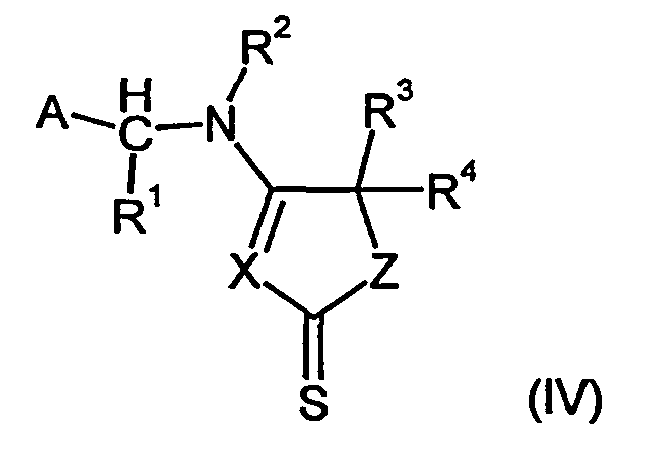
Bsp. Nr. A R1 R2 R3 R4 X Z Physikalische Datena) IV-2 
-H -Me -H -H -N= -CH2- 254 (MH+, 100); 2,49 min IV-3 
-H -Et -H -H -N= -CH2- 268 (MH+, 100); 2,73 min IV-4 
-H -Me -H -H -CH= -S- 271 (MH+, 100); 3,80 min IV-5 
-H -Et -H -H -CH= -S- 285 (MH+, 100); 4,19 min a) LC-MS (ESI-Positiv) (m/z, %); Rt (in min) (0,1 % HCOOH / Acetonitril) -

- In 30 ml abs. Diethylether werden bei Raumtemperatur 2.24 g (10.0 mmol) 6-Chlor-3-(N-(2,2-dimethyl-2H-azirin-3-yl)-N-methyl)-aminomethylpyridin in einer Stickstoffatmosphäre mit 1.31 g (10.0 mmol) Trimethylsilylisothiocyanat in 10 ml abs. Diethylether tropfenweise versetzt. Nach beendeter Zugabe wird das Reaktionsgemisch 20 Minuten gerührt und zur Hydrolyse mit 4 ml abs. Methanol in 8 ml abs. Diethylether versetzt. Der erhaltene Feststoff wird filtriert, zwei Stunden in Methanol gerührt und wieder filtriert.
Ausbeute : 2.69 g (95 % d. Th.) C12H15ClN4S (M = 282.80 g / mol)
m / z (%) = 284 (34), 283 (18), 282 (93), 281 (12), 269 (8), 267 (20), 247 (14), 156 (18), 128 (23), 127 (14), 126 (55), 101 (9), 100 (29), 99 (100), 83 (10), 72 (11), 58 (17), 42 (74), 41 (25).
1H - NMR300 (DMSO-d6 / TMS)
δ / ppm = 1.59 (s, 6 H, H-12 u. H-13), 1.65 (s, 4.8 H, H-12 u. H-13)*, 3.18 (s, 2.4 H, H-9)*, 3.23 (s, 3 H, H-9), 4.85 (s, 2 H, H-7), 5.01 (s, 1.6 H, H-7)*, 7.58 (t, 3.8 H, H-5, J = 8.8 Hz), 7.84 (dd, 1 H, H-4, J = 7.8 Hz, J < 1 Hz), 7.93 (dd, 0.8 H, H-4, J = 8.1 Hz, J < 1 Hz)*, 8,42 (d, 1 H, H-2, J < 1 Hz), 8.47 (d, 0.8 H, H-2, J < 1 Hz)*, 10.09 (br, 1 H, H-14), 10.70 (br, 0.8 H, H-14)*. -

- 3,70 g (29,0 mMol) 2-Ethoxy-pyrrolin-5-on (vgl. K. Matoba et al., Chem. Pharm. Bull. 1974, 22(12), 2999-3001; G. Crockett et al., Org. Synth. 1980, 59, 132-40) werden in 60 ml Methanol gelöst, mit 4,4 g (29,0 mMol) N-Methyl-N-(2-chlor-pyrid-5-yl-methyl)amin (vgl. EP 302389 A2, 1989) versetzt und 5 Tage bei Raumtemperatur gerührt. Anschließend wird das gesamte Reaktionsgemisch im Vakuum eingeengt. Die zurückbleibenden Kristalle werden mit 25 ml Ethanol verrührt und abgetrennt.
Ausbeute: 4,6 g (66,7 % d. Th.) C11H12ClN3O (M = 237,7 g/mol)
LC-MS (ESI-Positiv) (m/z, %) = 238 (MH+, 100)
Rt= 1,08 min (0,1 % HCOOH / Acetonitril)
1H-NMR (600 MHz, CDCl3, TMS) δ = 2,66 (2H, -CH2-); 2,84 (2H, -CH2-); 3,08 (3H, -N-CH3); 4,88 (2H, -CH2-Cl-Py); 7,31 (1H, Cl-Py-H); 7,78 (1H, Cl-Py-H); 8,34 (1H, Cl-Py-H) ppm.
13C- mit 1H-Entkopplung und 1H-/13C-Korrelation (600 MHz, HMBC, HMQC, CDCl3, TMS) δ = 28,4 (-CH2-); 31,9 (-CH2-); 35,5 (-N-CH3); 51,4 (-N-CH2-Cl-Py); 124,5 (Cl-Py-C), 139,3 (Cl-Py-C); 149,2 (Cl-Py-C); 151,2 (Cl-Py-C-Cl); 185,5 (-C=); 192,7 (C=O) ppm.
HPLC (0.05M NH4HCO3 / Acetonitril) = 1,41 min; λmax = 238 nm -

- 1,32 g (11,4 mMol) 4-Hydroxy-2(5H)-thiophenon (EP 189096 A1, 1986) und 1,85 g (11,4 mMol) N-Methyl-N-(2-chlor-thiazol-5-yl-methyl)amin (vgl. EP 302389 A2, 1989) werden in 57 ml Toluol in Gegenwart von 17,1 g Molekularsieb 4A unter Schutzgas (Argon) 12 Stunden bei Rückflusstemperatur am Wasserabscheider gerührt. Anschließend wird der gesamte Reaktionsansatz im Vakuum eingeengt und der verbleibende Rückstand über eine Kieselgelsäule (Kieselgel 60 - Merck, Korngröße: 0,04 bis 0,063 mm) mit dem Fließmittel Essigester aufgetrennt.
Ausbeute: 0,20 g (6,4 % d. Th.) C9H9ClN2OS2 (M = 260,7 g/mol)
LC-MS (ESI-Positiv) (m/z, %) = 261 (MH+, 100)
Rt= 3,33 min (0,1 % HCOOH / Acetonitril)
1H-NMR (400 MHz, CD3CN, TMS) δ = 2,99 (3H, -CH3); 4,06 (2H, -CH2-); 4,61 (2H, -N-CH2-Ct); 5,15 (1H, -CH=); 7,50 (1H, Ct-H) ppm.
HPLC (0, 1 % H3PO4 / Acetonitril) = 2,71 min; λmax = 242, 298 nm - Analog den Beispielen V-1 und V-2 können die in der nachstehenden Tabelle III aufgeführten Verbindungen der allgemeinen Formel (V) hergestellt werden.
Tabelle III Beispiele für Verbindungen der Formel (V) 
Bsp. -Nr. A R1 R2 R3 R4 X Z Physikalische Datena) V-3 
-H -Me -H -H -CH= -S- 255 (MH+, 100); 3,10 min V-4 
-H -Et -H -H -CH= -S- 269 (MH+, 100); 3,61 min V-5 
-H -Et -H -H -N= -CH2- 252 (MH+, 100); 1,65 min V-6 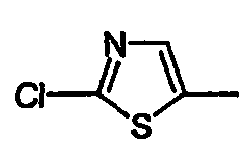
-H -Me -H -H -N= -CH2- 244 (MH+, 100); 1,39 min V-7 
-H -Et -H -H -N= -CH2- 258 (MH+, 100); 2,16 min a) LC-MS (ESI-Positiv) (m/z, %); Rt (in min) (0,1 % HCOOH / Acetonitril) -

- In einem sekurierten 250 ml Vierhalskolben mit Tropftrichter, Innenthermometer und Trockeneiskühler werden auf dem Eisbad 1.78 g (9.0 mmol) Diphosgen in 20 ml abs. CH2Cl2 vorgelegt. Bei 0-5 °C tropft man unter Stickstoff eine Lösung aus 3.63 g (15.0 mmol) N-(6-Chlor-3-pyridylmethyl)-N-methyl-2-methylpropanthioamid in 10 ml abs. CH2Cl2. Anschließend werden vier Tropfen abs. DMF zugegeben, das Reaktionsgemisch langsam auf Raumtemperatur gebracht und vier Stunden gerührt. Hiernach wird das überschüssige Phosgen und das Lösungsmittel im Wasserstrahlvakuum über eine Kühlfalle vollständig entfernt. Der zurückbleibende Feststoff wird unter Stickstoff in 60 ml abs. THF gelöst, auf 0-5 °C gebracht und unter kräftigem Rühren mit 1.68 g (15.0 mmol) DABCO versetzt. Das Reaktionsgemisch wird auf Raumtemperatur gebracht und 45 Minuten gerührt. Der entstandene voluminöse Niederschlag wird über ein Knie inert filtriert und zweimal mit abs. THF gewaschen. Die so erhaltene klare Lösung wird unter Stickstoff ohne weitere Aufarbeitung mit 1.95 g (30 mmol) festem Natriumazid versetzt und 48 Stunden gerührt. Zur Isolierung des Produktes werden die anorganischen Salze filtriert, das Lösungsmittel unter vermindertem Druck entfernt und der erhaltene Rückstand säulenchromatographisch mit Ethylacetat / Methanol =10 / 2 (Rf= 0.2) über Kieselgel eluiert.
Ausbeute : 1.92 g (57 % d. Th.) C11H14ClN3 (M = 223.71 g / mol)
m / z (%) = 224 (6), 222 (13), 178 (17), 128 (3), 126 (10), 99 (5), 97 (100), 70 (11), 68 (14), 57 (10), 56 (17), 44 (10), 43 (16), 42 (15), 41 (19), 40 (19), 39 (7).
1H - NMR300 (DMSO-d6 / TMS) bei 373K
δ / ppm =1.22 (s, 6 H, H-13 u. H-14), 2.90 (s, 3 H, H-9), 4.44 (s, 2 H, H-7), 7.47 (dd, 1 H, H-5, J = 8.2 Hz, J < 1 Hz), 7.73 (ddt, 1 H, H-4, J = 8.2 Hz, J = 2.5 Hz, J < 1 Hz), 8.33 (dd, 1 H, H-2, J= 2.5 Hz, J < 1 Hz). -

- In einem 250 ml Zweihalskolben werden (30.0 mmol) N-(6-Chlor-3-pyridylmethyl)-N-methyl- 2-methylpropanamid (6.80 g) in 120 ml Benzol gelöst, mit 1.47 g (3.3 mmol) Phosphorpentasulfid versetzt und 1.5 Stunden zum Rückfluss erhitzt. Nach dieser Zeit wird auf Raumtemperatur abgekühlt, filtriert und das Filtrat unter vermindertem Druck am Rotationsverdampfer eingeengt. Zur Steigerung der Ausbeute sollte das Produkt noch am selben Tag säulenchromatographisch mit Dichlormethan / Diethylether 10 / 3 über Kieselgel eluiert werden; Rf= 0.8.
Smp. : 56 °C Ausbeute : 5.16 g (71 % d. Th.) C11H15ClN2S (M = 242.77 g / mol)
m / z (%) = 245 (5), 244 (38), 243 (16), 242 (100) [M+], 211 (15), 210 (6), 209 (51), 170 (7), 169 (4), 168 (10), 167 (8), 129 (6), 128 (23), 127 (18), 126 (67), 116 (32), 103 (8), 101 (5), 99 (13), 98 (28), 90 (13), 88 (16), 87 (56), 84 (22), 83 (39), 82 (13), 75 (12), 74 (16), 73 (13), 70 (22), 45 (14), 43 (14), 42 (44), 41 (13).1H - NMR300 (CDCl3 / TMS) * = doppelter Signalsatz aufgrund Amidresonaz - In einem 500 ml Vierhalskolben mit KPG-Rührer, Tropftrichter, Thermometer und Rückflusskühler werden unter Stickstoffatmosphäre 21,0 g (0,50 mol) Cyanamid in 40 ml Ethanol auf 0°C gebracht. Bei dieser Temperatur werden nacheinander 41,9 g (0,55 mol) Schwefelkohlenstoff und dann 56,1 g (1,00 mol) Kaliumhydroxid in 180 ml Ethanol so zugetropft, dass die Innentemperatur nicht 5°C übersteigt (ca. vier Stunden). Nach beendeter Zugabe wird das Kühlbad entfernt und über Nacht bei Raumtemperatur gerührt. Der entstandene Feststoff wird filtriert, mit Ethanol gewaschen und im Vakuum getrocknet. Das entstandene Salz ist hygroskopisch und sollte nur kurze Zeit beim filtrieren mit Luft/Luftfeuchtigkeit in Berührung kommen. Das Salz wird im nächsten Schritt als Rohprodukt eingesetzt. Die Ausbeute liegt bei 75-80 % der Theorie.
- 77,7 g (0,40 mol) des Rohproduktes werden in einem Gemisch aus 270 ml Aceton und 300 ml Wasser gelöst und auf 0°C gebracht. Bei dieser Temperatur werden unter starkem Rühren 56,8 g (0,40 mol) Methyliodid in 150 ml Aceton langsam über drei Stunden zugetropft. Nach beendeter Zugabe wird das Reaktionsgemisch eine Stunde bei 0°C und drei Stunden bei Raumtemperatur weitergerührt. Am Rotationsverdampfer wird bis zur Trockne alle Lösemittel entfernt. Der Rückstand wird in 250 ml abs. Aceton aufgenommen und bis auf die Hälfte am Rotationsverdampfer eingeengt. Zur Kristallisation des entstandenen Kaliumiodids wird das Reaktionsgemisch über Nacht im Kühlschrank belassen. Der entstandene Feststoff wird filtriert und das Filtrat weiter fast bis zur Trockne eingeengt. In der Kälte fällt das gewünschte Produkt. Der letzte Vorgang zur vollständigen Entfernung des Kaliumiodids kann nun wiederholt werden. Die Ausbeute liegt bei 75-80 % der Theorie. Die analytischen Daten stimmen mit der Literatur überein.
-
Lösungsmittel: 7 Gewichtsteile Dimethylformamid Emulgator: 2 Gewichtsteile Alkylarylpolyglykolether - Zur Herstellung einer zweckmäßigen Wirkstoffzubereitung vermischt man 1 Gewichtsteil Wirkstoff mit den angegebenen Mengen Lösungsmittel und Emulgator und verdünnt das Konzentrat mit Wasser auf die gewünschte Konzentration.
- Gefäße werden mit Sand, Wirkstofflösung, Meloidogyne incognita-Ei-Larvensuspension und Salatsamen gefüllt. Die Salatsamen keimen und die Pflänzchen entwickeln sich. An den Wurzeln entwickeln sich die Gallen.
- Nach der gewünschten Zeit wird die nematizide Wirkung an Hand der Gallenbildung in % bestimmt. Dabei bedeutet 100 %, dass keine Gallen gefunden wurden; 0 % bedeutet, dass die Zahl der Gallen an den behandelten Pflanzen der der unbehandelten Kontrolle entspricht.
Tabelle A pflanzenschädigende Nematoden Meloidogyne-Test Wirkstoffe Wirkstoffkonzentration in ppm Abtötungsgrad in % nach 14 Tagen 
20 98 -
Testtiere: Adulte von Ctenocephalides felis Lösungsmittel: Dimethylsulfoxid (DMSO) - Zwecks Herstellung einer geeigneten Formulierung wird aus 20 mg Wirkstoff mit 1 ml DMSO eine geeignete Wirkstofflösung hergestellt. 20 µl dieser Formulierung werden zu 4 ml citriertem Rinderblut gegeben und verrührt.
- 20 nüchterne adulte Flöhe (Ctenocephalides felis, Stamm "Georgi") werden in eine Kammer(Ø 5 cm) eingesetzt, die oben und unten mit Gaze verschlossen ist. Auf die Kammer wird ein Metallzylinder gestellt, dessen Unterseite mit Parafilm verschlossen ist. Der Zylinder enthält die 4 ml Blut-Wirkstofformulierung, die von den Flöhen durch die Parafilmmembran aufgenommen werden kann. Während das Blut auf 37°C erwärmt wird, wird im Bereich der Flohkammern eine Temperatur von 25°C eingestellt. Kontrollen werden mit dem gleichen Volumen DMSO ohne Zusatz einer Verbindung vermischt. Es werden Dreifach-Bestimmungen durchgeführt.
- Nach 24h wird die Mortalität in % bestimmt.
- Verbindung die innerhalb von 24h eine mindestens 25 %ige Abtötung der Flöhe erzielen werden als wirksam beurteilt.
- Bei diesem Test zeigen z.B. die folgenden Verbindungen der Herstellungsbeispiele eine Wirkung:
% Wirkung (Larvenmortalität) Verbindung 100 ppm I-1 30

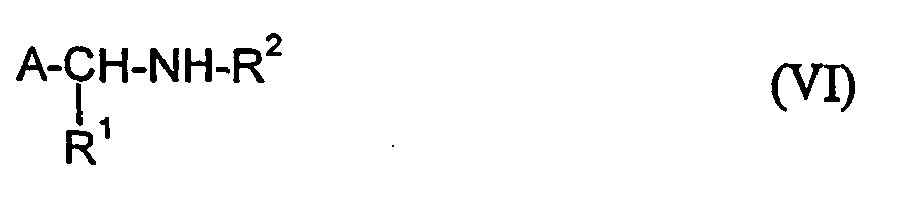


Claims (8)
- Verbindungen der Formel (I)
 A für jeweils gegebenenfalls substituiertes Aryl oder Hetaryl oder Heterocyclyl steht,R1 für Wasserstoff oder C1-C3-Alkyl steht,R2 für Wasserstoff oder C1-C3-Alkyl steht,R3 für Wasserstoff oder C1-C3-Alkyl steht,R4 für Wasserstoff oder C1-C3-Alltyl steht,X für N oder CH steht,Y für CN oder NO2 steht,Z für CH2, O, S, SO, SO2 oder NR5 steht undR5 für Wasserstoff oder C1-C3-Alkyl steht.
- Verbindungen der Formel (I) gemäß Anspruch 1, worinA für gegebenenfalls durch Halogen, Cyano, Nitro, C1-C4-Alkyl, C1-C4-Halogenalkyl, C1-C4-Alkoxy oder C1-C4-Halogenalkoxy substituiertes Phenyl steht oderA für Pyrazolyl, 1,2,4-Triazolyl, Oxazolyl, Isoxazolyl, Thiazolyl, Isothiazolyl, 1,2,5-Thiadiazolyl, Pyridyl, Pyrazinyl oder Pyrimidinyl steht, welche gegebenenfalls durch Fluor, Chlor, Brom, Cyano, Nitro, C1-C2-Alkyl (welches gegebenenfalls durch Fluor und/oder Chlor substituiert ist), C1-C2-Alkoxy (welches gegebenenfalls durch Fluor und/oder Chlor substituiert ist), C1-C2-Alkylthio (welches gegebenenfalls durch Fluor und/oder Chlor substituiert ist) oder C1-C2-Alkylsulfonyl (welches gegebenenfalls durch Fluor und/oder Chlor substituiert ist) substituiert sind, oderA für einen gegebenenfalls durch Halogen oder C1-C3-Alkyl substituierten gesättigten C5-C6-Cycloalkylrest steht, in welchem eine Methylengruppe durch O oder S ersetzt ist,R1 für Wasserstoff, Methyl, Ethyl, n-Propyl oder i-Propyl steht,R2 für Wasserstoff, Methyl, Ethyl, n-Propyl oder i-Propyl steht,R3 für Wasserstoff, Methyl, Ethyl, n-Propyl oder i-Propyl steht,R4 für Wasserstoff, Methyl, Ethyl, n-Propyl oder i-Propyl steht,X für N oder CH steht,Y für CN oder NO2 steht,Z für CH2, O, S oder NR5 steht undR5 für Wasserstoff, Methyl, Ethyl, n-Propyl oder i-Propyl steht.
- Verbindungen der Formel (I) gemäß Anspruch 1, worinA für Thiazolyl oder Pyridyl steht, welche jeweils gegebenenfalls substituiert sind durch Halogen (insbesondere Chlor) oder C1-C3-Alkyl (insbesondere Methyl) oderA für einen gegebenenfalls durch Halogen (insbesondere Chlor) oder C1-C3-Alkyl (insbesondere Methyl) substituierten Tetrahydrofurylrest steht,R1 für Wasserstoff oder Methyl steht,R2 für oder Methyl oder Ethyl steht,R3 für Wasserstoff oder Methyl steht,R4 für Wasserstoff oder Methyl steht,X für N oder CH steht,Y für CN oder NO2 steht,Z für CH2, O, S oder NR5 steht, undR5 für Wasserstoff oder Methyl steht.
- Verbindungen der Formel (I) gemäß Anspruch 1, worinA für einen der Reste
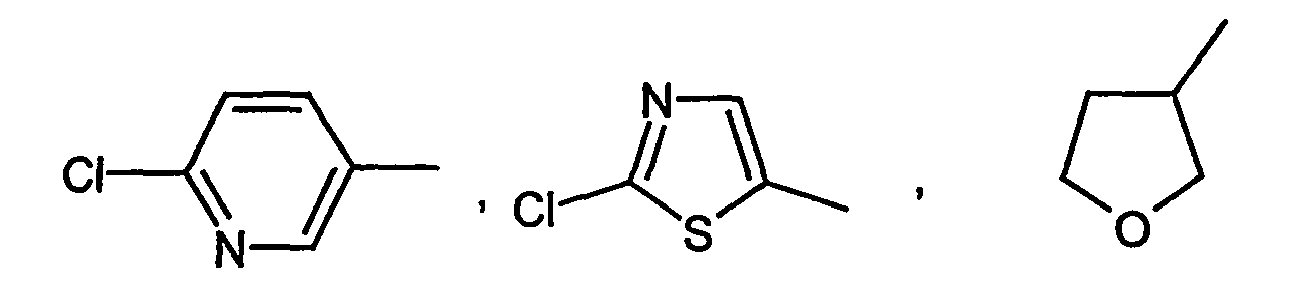 R1 für Wasserstoff oder Methyl steht,R2 für Methyl oder Ethyl steht,R3 für Wasserstoff oder Methyl steht,R4 für Wasserstoff oder Methyl steht,X für N oder CH steht,Y für CN oder NO2 steht,Z für CH2, O, S oder NR5 steht undR5 für Wasserstoff oder Methyl steht.
- Verfahren zur Herstellung von Verbindungen der Formel (I), dadurch gekennzeichnet, dass man Verbindungen der Formel (II)

- Mittel zur Bekämpfung tierischer Schädlinge, dadurch gekennzeichnet, dass sie mindestens eine Verbindung der Formel (I) gemäß Anspruch 1 enthalten.
- Verwendung von Verbindungen der Formel (I) gemäß Anspruch 1 zur Bekämpfung tierischer Schädlinge.
- Herstellung von Mitteln zur Bekämpfung tierischer Schädlinge, dadurch gekennzeichnet, dass man Verbindungen der Formel (I) gemäß Anspruch 1 mit Verdünnungsmitteln und/oder oberflächenaktiven Stoffen vermischt.
Applications Claiming Priority (3)
| Application Number | Priority Date | Filing Date | Title |
|---|---|---|---|
| DE10119423 | 2001-04-20 | ||
| DE10119423A DE10119423A1 (de) | 2001-04-20 | 2001-04-20 | Neue insektizid wirkende Azole |
| PCT/EP2002/003976 WO2002085870A1 (de) | 2001-04-20 | 2002-04-10 | Neue insektizid wirkende azole |
Publications (2)
| Publication Number | Publication Date |
|---|---|
| EP1383751A1 EP1383751A1 (de) | 2004-01-28 |
| EP1383751B1 true EP1383751B1 (de) | 2007-01-17 |
Family
ID=7682115
Family Applications (1)
| Application Number | Title | Priority Date | Filing Date |
|---|---|---|---|
| EP02764014A Expired - Lifetime EP1383751B1 (de) | 2001-04-20 | 2002-04-10 | Neue insektizid wirkende azole |
Country Status (15)
| Country | Link |
|---|---|
| US (1) | US7417150B2 (de) |
| EP (1) | EP1383751B1 (de) |
| JP (3) | JP4516274B2 (de) |
| KR (2) | KR100879717B1 (de) |
| CN (2) | CN1312138C (de) |
| AU (2) | AU2002308133B2 (de) |
| BR (1) | BR0209430B1 (de) |
| CA (1) | CA2444592A1 (de) |
| DE (2) | DE10119423A1 (de) |
| ES (1) | ES2280565T3 (de) |
| MX (1) | MXPA03009481A (de) |
| NO (1) | NO20034664L (de) |
| NZ (1) | NZ528960A (de) |
| WO (1) | WO2002085870A1 (de) |
| ZA (1) | ZA200308086B (de) |
Families Citing this family (13)
| Publication number | Priority date | Publication date | Assignee | Title |
|---|---|---|---|---|
| DE10119423A1 (de) * | 2001-04-20 | 2002-10-24 | Bayer Ag | Neue insektizid wirkende Azole |
| DE102006015470A1 (de) | 2006-03-31 | 2007-10-04 | Bayer Cropscience Ag | Substituierte Enaminocarbonylverbindungen |
| DE102006015467A1 (de) | 2006-03-31 | 2007-10-04 | Bayer Cropscience Ag | Substituierte Enaminocarbonylverbindungen |
| DE102006015468A1 (de) | 2006-03-31 | 2007-10-04 | Bayer Cropscience Ag | Substituierte Enaminocarbonylverbindungen |
| DE102006015456A1 (de) * | 2006-03-31 | 2007-10-04 | Bayer Cropscience Ag | Bicyclische Enamino(thio)carbonylverbindungen |
| DE102006046161A1 (de) | 2006-09-29 | 2008-04-03 | Bayer Cropscience Ag | Neue kristalline Modifikation |
| EP2107058A1 (de) * | 2008-03-31 | 2009-10-07 | Bayer CropScience AG | Substituierte Enaminothiocarbonylverbindungen |
| US8663182B2 (en) * | 2009-06-02 | 2014-03-04 | The Procter & Gamble Company | Disposable absorbent article with absorbent waistcap or waistband and method for making the same |
| CN102741244A (zh) | 2009-10-26 | 2012-10-17 | 拜耳作物科学公司 | 4-[[(6-氯吡啶-3-基)甲基](2,2-二氟乙基)氨基]呋喃-2(5h)-酮的新固体形式 |
| BR112013028895A2 (pt) | 2011-05-10 | 2016-08-09 | Bayer Ip Gmbh | (tio)carbonilamidinas bicíclicas |
| WO2013150115A1 (en) | 2012-04-05 | 2013-10-10 | Basf Se | N- substituted hetero - bicyclic compounds and derivatives for combating animal pests |
| TWI603962B (zh) | 2016-09-10 | 2017-11-01 | 國立清華大學 | 含硫噁嗪化合物及其合成方法 |
| CN108440519B (zh) * | 2018-04-03 | 2020-10-23 | 青岛科技大学 | 一种噁二唑邻苯乙氧基类化合物与用途 |
Family Cites Families (16)
| Publication number | Priority date | Publication date | Assignee | Title |
|---|---|---|---|---|
| US4098791A (en) * | 1977-07-29 | 1978-07-04 | The Upjohn Company | Process for preparing 3-(cyanimino)-3-amino-propionitriles |
| HU180240B (en) * | 1978-04-21 | 1983-02-28 | Gyogyszerkutato Intezet | Process for producing new,substituted 1,3-diaryl-2-iminoimidasolidines and 2-imino-hexahydro-pyrimidines |
| DE2921683A1 (de) * | 1979-05-29 | 1980-12-11 | Basf Ag | Verfahren zur herstellung von 2,4-diiminothiazolidin |
| JPS60233054A (ja) * | 1984-05-02 | 1985-11-19 | Dainippon Pharmaceut Co Ltd | アジリン誘導体およびその製造法 |
| CH663206A5 (de) | 1985-01-16 | 1987-11-30 | Lonza Ag | Verfahren zur herstellung von thiotetronsaeure. |
| ATE67493T1 (de) * | 1985-02-04 | 1991-10-15 | Bayer Agrochem Kk | Heterocyclische verbindungen. |
| JPH066585B2 (ja) * | 1985-02-04 | 1994-01-26 | 日本バイエルアグロケム株式会社 | ニトロメチレン誘導体、その製法及び殺虫剤 |
| SU1392872A1 (ru) | 1986-01-28 | 1998-04-10 | Иркутский институт органической химии СО АН СССР | 2-имино-4-гидроксиэтиламино-5,5-диметил-2,5-дигидрофуран, обладающий противовоспалительной и анальгетической активностью |
| DE3886467T2 (de) * | 1987-08-01 | 1994-06-01 | Takeda Chemical Industries Ltd | Alpha-ungesättigte Amine, ihre Herstellung und Verwendung. |
| IL99576A0 (en) * | 1990-10-05 | 1992-08-18 | Ciba Geigy Ag | Triazacyclohexane derivatives |
| EP0547557B1 (de) * | 1991-12-16 | 1994-07-27 | MITSUI TOATSU CHEMICALS, Inc. | N-Vinylimidazolderivate, Verfahren zu ihrer Herstellung, diese enthaltende Insektizide und ihre Zwischenprodukte |
| JP3258402B2 (ja) * | 1991-12-16 | 2002-02-18 | 三井化学株式会社 | N−ビニルイミダゾリジン誘導体、その製造法、それを有効成分として含有する殺虫剤および中間体 |
| EP0702670A1 (de) | 1993-06-07 | 1996-03-27 | Bayer Ag | Iodpropargylcarbamate und ihre verwendung als biozide im pflanzen- und materialschutz |
| JP3871354B2 (ja) * | 1994-07-29 | 2007-01-24 | 株式会社フジモト・コーポレーション | 新規な2−(n−シアノイミノ)チアゾリジン−4−オン誘導体 |
| DE10119423A1 (de) * | 2001-04-20 | 2002-10-24 | Bayer Ag | Neue insektizid wirkende Azole |
| US8046806B2 (en) * | 2002-10-04 | 2011-10-25 | Wall William E | Multiroom point of deployment module |
-
2001
- 2001-04-20 DE DE10119423A patent/DE10119423A1/de not_active Withdrawn
-
2002
- 2002-04-10 NZ NZ528960A patent/NZ528960A/en unknown
- 2002-04-10 CA CA002444592A patent/CA2444592A1/en not_active Abandoned
- 2002-04-10 DE DE50209287T patent/DE50209287D1/de not_active Expired - Lifetime
- 2002-04-10 CN CNB2005100740986A patent/CN1312138C/zh not_active Expired - Fee Related
- 2002-04-10 CN CNB028084772A patent/CN1250533C/zh not_active Expired - Fee Related
- 2002-04-10 AU AU2002308133A patent/AU2002308133B2/en not_active Ceased
- 2002-04-10 MX MXPA03009481A patent/MXPA03009481A/es active IP Right Grant
- 2002-04-10 US US10/474,947 patent/US7417150B2/en not_active Expired - Fee Related
- 2002-04-10 BR BRPI0209430-4B1A patent/BR0209430B1/pt not_active IP Right Cessation
- 2002-04-10 KR KR1020087007920A patent/KR100879717B1/ko not_active Expired - Fee Related
- 2002-04-10 WO PCT/EP2002/003976 patent/WO2002085870A1/de not_active Ceased
- 2002-04-10 JP JP2002583397A patent/JP4516274B2/ja not_active Expired - Fee Related
- 2002-04-10 KR KR1020037012820A patent/KR100845191B1/ko not_active Expired - Fee Related
- 2002-04-10 EP EP02764014A patent/EP1383751B1/de not_active Expired - Lifetime
- 2002-04-10 ES ES02764014T patent/ES2280565T3/es not_active Expired - Lifetime
-
2003
- 2003-10-17 NO NO20034664A patent/NO20034664L/no not_active Application Discontinuation
- 2003-10-17 ZA ZA200308086A patent/ZA200308086B/en unknown
-
2005
- 2005-04-08 JP JP2005111638A patent/JP4403096B2/ja not_active Expired - Fee Related
-
2008
- 2008-07-04 AU AU2008202990A patent/AU2008202990B2/en not_active Ceased
-
2009
- 2009-06-02 JP JP2009132770A patent/JP2009227688A/ja active Pending
Also Published As
| Publication number | Publication date |
|---|---|
| EP1383751A1 (de) | 2004-01-28 |
| BR0209430B1 (pt) | 2013-07-23 |
| DE10119423A1 (de) | 2002-10-24 |
| KR100879717B1 (ko) | 2009-01-22 |
| WO2002085870A1 (de) | 2002-10-31 |
| US7417150B2 (en) | 2008-08-26 |
| NZ528960A (en) | 2005-03-24 |
| US20050009839A1 (en) | 2005-01-13 |
| MXPA03009481A (es) | 2004-02-12 |
| DE50209287D1 (de) | 2007-03-08 |
| AU2008202990A1 (en) | 2008-07-31 |
| CN1503788A (zh) | 2004-06-09 |
| JP4403096B2 (ja) | 2010-01-20 |
| NO20034664D0 (no) | 2003-10-17 |
| AU2008202990B2 (en) | 2012-02-02 |
| KR20080032263A (ko) | 2008-04-14 |
| JP2004532226A (ja) | 2004-10-21 |
| CN1312138C (zh) | 2007-04-25 |
| ZA200308086B (en) | 2004-10-18 |
| JP2009227688A (ja) | 2009-10-08 |
| NO20034664L (no) | 2003-12-10 |
| CN1690051A (zh) | 2005-11-02 |
| KR100845191B1 (ko) | 2008-07-10 |
| AU2002308133B2 (en) | 2008-07-31 |
| JP4516274B2 (ja) | 2010-08-04 |
| CA2444592A1 (en) | 2002-10-31 |
| KR20030090699A (ko) | 2003-11-28 |
| BR0209430A (pt) | 2004-08-03 |
| CN1250533C (zh) | 2006-04-12 |
| ES2280565T3 (es) | 2007-09-16 |
| JP2005272472A (ja) | 2005-10-06 |
Similar Documents
| Publication | Publication Date | Title |
|---|---|---|
| AU2008202990B2 (en) | Novel azoles having an insecticidal action | |
| EP1429607B1 (de) | Delta 1-pyrroline als schädlingsbekämpfungsmittel | |
| DE10108481A1 (de) | Pyridylpyrimidine | |
| EP1360190B1 (de) | Phthalsäurediamide, ein verfahren zu ihrer herstellung und ihre verwendung als schädlingsbekämpfungsmittel | |
| DE10034130A1 (de) | Heterocyclische Fluoralkenylthioether (lV) | |
| EP1359803B1 (de) | Synergistische pestizide mischungen gegen tierische schädlinge | |
| EP1383773B1 (de) | Neue insektizid wirkende azole | |
| DE10204115A1 (de) | DELTA·1·-Pyrroline | |
| DE10023430A1 (de) | Substituierte N-Benzoyl-N'-(tetrazolylphenyl)-harnstoffe | |
| DE10204116A1 (de) | DELTA·1·-Pyrroline | |
| DE10034131A1 (de) | Heterocyclische Fluoralkenylthioether (II) | |
| DE10034132A1 (de) | Heterocyclische Fluoralkenylthioether (lll) | |
| DE10034133A1 (de) | Heterocyclische Fluoralkenylthioether (l) | |
| DE10136066A1 (de) | Tetrahydropyridazin-Derivate | |
| DE10132896A1 (de) | Heterocyclische Amidderivate | |
| DE10135551A1 (de) | Pyrazolin-Derivate | |
| EP1448549B1 (de) | Delta1 -pyrroline | |
| EP1444221A1 (de) | Halogen-nitro-butadiene zur bekämpfung von tierischen schädlingen | |
| DE10106455A1 (de) | DELTA·1·-Pyrroline | |
| EP1474418A1 (de) | Substituierte 4-hetaryl-pyrazoline als schädlingsbekämpfungsmittel | |
| DE10201544A1 (de) | Substituierte Pyrazoline | |
| DE10047116A1 (de) | DELTA·1·-Pyrroline | |
| EP1399421A1 (de) | Substituierte imidate als schädlingsbekämpfungsmittel | |
| DE10115406A1 (de) | Phthalsäurediamide | |
| DE10139721A1 (de) | Oxadiazolyl- u. Thiadiazolyl-benzoylharnstoffe |
Legal Events
| Date | Code | Title | Description |
|---|---|---|---|
| PUAI | Public reference made under article 153(3) epc to a published international application that has entered the european phase |
Free format text: ORIGINAL CODE: 0009012 |
|
| 17P | Request for examination filed |
Effective date: 20031120 |
|
| AK | Designated contracting states |
Kind code of ref document: A1 Designated state(s): AT BE CH CY DE DK ES FI FR GB GR IE IT LI LU MC NL PT SE TR |
|
| AX | Request for extension of the european patent |
Extension state: AL LT LV MK RO SI |
|
| RIN1 | Information on inventor provided before grant (corrected) |
Inventor name: ERDELEN, CHRISTOPH Inventor name: WOLLWEBER, DETLEF Inventor name: BECK, MICHAEL Inventor name: KRAEMER, WOLFGANG Inventor name: TURBERG, ANDREAS Inventor name: MARTIN, HANS-DIETER Inventor name: JESCHKE, PETER Inventor name: HANSEN, OLAF Inventor name: SAUER, PIET |
|
| GRAP | Despatch of communication of intention to grant a patent |
Free format text: ORIGINAL CODE: EPIDOSNIGR1 |
|
| GRAS | Grant fee paid |
Free format text: ORIGINAL CODE: EPIDOSNIGR3 |
|
| GRAA | (expected) grant |
Free format text: ORIGINAL CODE: 0009210 |
|
| AK | Designated contracting states |
Kind code of ref document: B1 Designated state(s): AT BE CH CY DE DK ES FI FR GB GR IE IT LI LU MC NL PT SE TR |
|
| PG25 | Lapsed in a contracting state [announced via postgrant information from national office to epo] |
Ref country code: FI Free format text: LAPSE BECAUSE OF FAILURE TO SUBMIT A TRANSLATION OF THE DESCRIPTION OR TO PAY THE FEE WITHIN THE PRESCRIBED TIME-LIMIT Effective date: 20070117 Ref country code: DK Free format text: LAPSE BECAUSE OF FAILURE TO SUBMIT A TRANSLATION OF THE DESCRIPTION OR TO PAY THE FEE WITHIN THE PRESCRIBED TIME-LIMIT Effective date: 20070117 Ref country code: IE Free format text: LAPSE BECAUSE OF FAILURE TO SUBMIT A TRANSLATION OF THE DESCRIPTION OR TO PAY THE FEE WITHIN THE PRESCRIBED TIME-LIMIT Effective date: 20070117 |
|
| REG | Reference to a national code |
Ref country code: GB Ref legal event code: FG4D Free format text: NOT ENGLISH |
|
| REG | Reference to a national code |
Ref country code: CH Ref legal event code: EP |
|
| REG | Reference to a national code |
Ref country code: CH Ref legal event code: NV Representative=s name: E. BLUM & CO. AG PATENT- UND MARKENANWAELTE VSP |
|
| REG | Reference to a national code |
Ref country code: IE Ref legal event code: FG4D Free format text: LANGUAGE OF EP DOCUMENT: GERMAN |
|
| REF | Corresponds to: |
Ref document number: 50209287 Country of ref document: DE Date of ref document: 20070308 Kind code of ref document: P |
|
| GBT | Gb: translation of ep patent filed (gb section 77(6)(a)/1977) |
Effective date: 20070313 |
|
| PG25 | Lapsed in a contracting state [announced via postgrant information from national office to epo] |
Ref country code: SE Free format text: LAPSE BECAUSE OF FAILURE TO SUBMIT A TRANSLATION OF THE DESCRIPTION OR TO PAY THE FEE WITHIN THE PRESCRIBED TIME-LIMIT Effective date: 20070417 |
|
| REG | Reference to a national code |
Ref country code: GR Ref legal event code: EP Ref document number: 20070401117 Country of ref document: GR |
|
| PG25 | Lapsed in a contracting state [announced via postgrant information from national office to epo] |
Ref country code: PT Free format text: LAPSE BECAUSE OF FAILURE TO SUBMIT A TRANSLATION OF THE DESCRIPTION OR TO PAY THE FEE WITHIN THE PRESCRIBED TIME-LIMIT Effective date: 20070618 |
|
| ET | Fr: translation filed | ||
| REG | Reference to a national code |
Ref country code: IE Ref legal event code: FD4D |
|
| REG | Reference to a national code |
Ref country code: ES Ref legal event code: FG2A Ref document number: 2280565 Country of ref document: ES Kind code of ref document: T3 |
|
| PLBE | No opposition filed within time limit |
Free format text: ORIGINAL CODE: 0009261 |
|
| STAA | Information on the status of an ep patent application or granted ep patent |
Free format text: STATUS: NO OPPOSITION FILED WITHIN TIME LIMIT |
|
| 26N | No opposition filed |
Effective date: 20071018 |
|
| PG25 | Lapsed in a contracting state [announced via postgrant information from national office to epo] |
Ref country code: AT Free format text: LAPSE BECAUSE OF NON-PAYMENT OF DUE FEES Effective date: 20070410 |
|
| PG25 | Lapsed in a contracting state [announced via postgrant information from national office to epo] |
Ref country code: MC Free format text: LAPSE BECAUSE OF NON-PAYMENT OF DUE FEES Effective date: 20070430 |
|
| PG25 | Lapsed in a contracting state [announced via postgrant information from national office to epo] |
Ref country code: CY Free format text: LAPSE BECAUSE OF FAILURE TO SUBMIT A TRANSLATION OF THE DESCRIPTION OR TO PAY THE FEE WITHIN THE PRESCRIBED TIME-LIMIT Effective date: 20070117 |
|
| PG25 | Lapsed in a contracting state [announced via postgrant information from national office to epo] |
Ref country code: LU Free format text: LAPSE BECAUSE OF NON-PAYMENT OF DUE FEES Effective date: 20070410 |
|
| PGFP | Annual fee paid to national office [announced via postgrant information from national office to epo] |
Ref country code: TR Payment date: 20110323 Year of fee payment: 10 |
|
| PGFP | Annual fee paid to national office [announced via postgrant information from national office to epo] |
Ref country code: CH Payment date: 20130412 Year of fee payment: 12 Ref country code: GB Payment date: 20130410 Year of fee payment: 12 Ref country code: BE Payment date: 20130415 Year of fee payment: 12 |
|
| PGFP | Annual fee paid to national office [announced via postgrant information from national office to epo] |
Ref country code: NL Payment date: 20130416 Year of fee payment: 12 |
|
| REG | Reference to a national code |
Ref country code: NL Ref legal event code: V1 Effective date: 20141101 |
|
| REG | Reference to a national code |
Ref country code: CH Ref legal event code: PL |
|
| GBPC | Gb: european patent ceased through non-payment of renewal fee |
Effective date: 20140410 |
|
| PG25 | Lapsed in a contracting state [announced via postgrant information from national office to epo] |
Ref country code: GB Free format text: LAPSE BECAUSE OF NON-PAYMENT OF DUE FEES Effective date: 20140410 Ref country code: CH Free format text: LAPSE BECAUSE OF NON-PAYMENT OF DUE FEES Effective date: 20140430 Ref country code: LI Free format text: LAPSE BECAUSE OF NON-PAYMENT OF DUE FEES Effective date: 20140430 |
|
| PG25 | Lapsed in a contracting state [announced via postgrant information from national office to epo] |
Ref country code: NL Free format text: LAPSE BECAUSE OF NON-PAYMENT OF DUE FEES Effective date: 20141101 |
|
| REG | Reference to a national code |
Ref country code: FR Ref legal event code: PLFP Year of fee payment: 15 |
|
| REG | Reference to a national code |
Ref country code: FR Ref legal event code: PLFP Year of fee payment: 16 |
|
| PG25 | Lapsed in a contracting state [announced via postgrant information from national office to epo] |
Ref country code: BE Free format text: LAPSE BECAUSE OF NON-PAYMENT OF DUE FEES Effective date: 20140430 |
|
| PG25 | Lapsed in a contracting state [announced via postgrant information from national office to epo] |
Ref country code: TR Free format text: LAPSE BECAUSE OF NON-PAYMENT OF DUE FEES Effective date: 20140410 |
|
| REG | Reference to a national code |
Ref country code: FR Ref legal event code: PLFP Year of fee payment: 17 |
|
| PGFP | Annual fee paid to national office [announced via postgrant information from national office to epo] |
Ref country code: FR Payment date: 20190327 Year of fee payment: 18 |
|
| PGFP | Annual fee paid to national office [announced via postgrant information from national office to epo] |
Ref country code: GR Payment date: 20190329 Year of fee payment: 18 |
|
| PGFP | Annual fee paid to national office [announced via postgrant information from national office to epo] |
Ref country code: IT Payment date: 20190419 Year of fee payment: 18 Ref country code: DE Payment date: 20190326 Year of fee payment: 18 Ref country code: ES Payment date: 20190503 Year of fee payment: 18 |
|
| REG | Reference to a national code |
Ref country code: DE Ref legal event code: R119 Ref document number: 50209287 Country of ref document: DE |
|
| PG25 | Lapsed in a contracting state [announced via postgrant information from national office to epo] |
Ref country code: DE Free format text: LAPSE BECAUSE OF NON-PAYMENT OF DUE FEES Effective date: 20201103 Ref country code: GR Free format text: LAPSE BECAUSE OF NON-PAYMENT OF DUE FEES Effective date: 20201109 Ref country code: FR Free format text: LAPSE BECAUSE OF NON-PAYMENT OF DUE FEES Effective date: 20200430 |
|
| REG | Reference to a national code |
Ref country code: ES Ref legal event code: FD2A Effective date: 20210831 |
|
| PG25 | Lapsed in a contracting state [announced via postgrant information from national office to epo] |
Ref country code: IT Free format text: LAPSE BECAUSE OF NON-PAYMENT OF DUE FEES Effective date: 20200410 |
|
| PG25 | Lapsed in a contracting state [announced via postgrant information from national office to epo] |
Ref country code: ES Free format text: LAPSE BECAUSE OF NON-PAYMENT OF DUE FEES Effective date: 20200411 |