EP1382676B1 - Methode zur Trennung und Aufreinigung von Nukleinsäuren - Google Patents
Methode zur Trennung und Aufreinigung von Nukleinsäuren Download PDFInfo
- Publication number
- EP1382676B1 EP1382676B1 EP03015675A EP03015675A EP1382676B1 EP 1382676 B1 EP1382676 B1 EP 1382676B1 EP 03015675 A EP03015675 A EP 03015675A EP 03015675 A EP03015675 A EP 03015675A EP 1382676 B1 EP1382676 B1 EP 1382676B1
- Authority
- EP
- European Patent Office
- Prior art keywords
- nucleic acid
- solid phase
- purification
- opening
- container
- Prior art date
- Legal status (The legal status is an assumption and is not a legal conclusion. Google has not performed a legal analysis and makes no representation as to the accuracy of the status listed.)
- Expired - Lifetime
Links
- 108020004707 nucleic acids Proteins 0.000 title claims abstract description 282
- 102000039446 nucleic acids Human genes 0.000 title claims abstract description 282
- 150000007523 nucleic acids Chemical class 0.000 title claims abstract description 282
- 238000000034 method Methods 0.000 title claims abstract description 48
- 239000007790 solid phase Substances 0.000 claims abstract description 149
- 239000000203 mixture Substances 0.000 claims abstract description 34
- 238000005406 washing Methods 0.000 claims abstract description 10
- 238000000746 purification Methods 0.000 claims description 83
- 238000000926 separation method Methods 0.000 claims description 68
- 239000012488 sample solution Substances 0.000 claims description 66
- 239000000243 solution Substances 0.000 claims description 52
- 238000007127 saponification reaction Methods 0.000 claims description 47
- 239000011534 wash buffer Substances 0.000 claims description 36
- 239000007788 liquid Substances 0.000 claims description 34
- LFQSCWFLJHTTHZ-UHFFFAOYSA-N Ethanol Chemical compound CCO LFQSCWFLJHTTHZ-UHFFFAOYSA-N 0.000 claims description 31
- SMEGJBVQLJJKKX-HOTMZDKISA-N [(2R,3S,4S,5R,6R)-5-acetyloxy-3,4,6-trihydroxyoxan-2-yl]methyl acetate Chemical compound CC(=O)OC[C@@H]1[C@H]([C@@H]([C@H]([C@@H](O1)O)OC(=O)C)O)O SMEGJBVQLJJKKX-HOTMZDKISA-N 0.000 claims description 28
- 229940081735 acetylcellulose Drugs 0.000 claims description 28
- 229920002301 cellulose acetate Polymers 0.000 claims description 28
- 238000007599 discharging Methods 0.000 claims description 24
- 239000011148 porous material Substances 0.000 claims description 24
- 229920002284 Cellulose triacetate Polymers 0.000 claims description 17
- NNLVGZFZQQXQNW-ADJNRHBOSA-N [(2r,3r,4s,5r,6s)-4,5-diacetyloxy-3-[(2s,3r,4s,5r,6r)-3,4,5-triacetyloxy-6-(acetyloxymethyl)oxan-2-yl]oxy-6-[(2r,3r,4s,5r,6s)-4,5,6-triacetyloxy-2-(acetyloxymethyl)oxan-3-yl]oxyoxan-2-yl]methyl acetate Chemical compound O([C@@H]1O[C@@H]([C@H]([C@H](OC(C)=O)[C@H]1OC(C)=O)O[C@H]1[C@@H]([C@@H](OC(C)=O)[C@H](OC(C)=O)[C@@H](COC(C)=O)O1)OC(C)=O)COC(=O)C)[C@@H]1[C@@H](COC(C)=O)O[C@@H](OC(C)=O)[C@H](OC(C)=O)[C@H]1OC(C)=O NNLVGZFZQQXQNW-ADJNRHBOSA-N 0.000 claims description 17
- 239000000523 sample Substances 0.000 claims description 14
- 238000001179 sorption measurement Methods 0.000 claims description 14
- OKKJLVBELUTLKV-UHFFFAOYSA-N Methanol Chemical compound OC OKKJLVBELUTLKV-UHFFFAOYSA-N 0.000 claims description 12
- 239000004094 surface-active agent Substances 0.000 claims description 11
- 150000003839 salts Chemical class 0.000 claims description 9
- KFZMGEQAYNKOFK-UHFFFAOYSA-N Isopropanol Chemical compound CC(C)O KFZMGEQAYNKOFK-UHFFFAOYSA-N 0.000 claims description 8
- 239000003960 organic solvent Substances 0.000 claims description 8
- 108091005804 Peptidases Proteins 0.000 claims description 7
- BDERNNFJNOPAEC-UHFFFAOYSA-N propan-1-ol Chemical compound CCCO BDERNNFJNOPAEC-UHFFFAOYSA-N 0.000 claims description 7
- 239000003153 chemical reaction reagent Substances 0.000 claims description 6
- 238000003795 desorption Methods 0.000 claims description 6
- 102000035195 Peptidases Human genes 0.000 claims description 3
- 241000700605 Viruses Species 0.000 claims description 3
- ZRALSGWEFCBTJO-UHFFFAOYSA-N guanidine group Chemical group NC(=N)N ZRALSGWEFCBTJO-UHFFFAOYSA-N 0.000 claims description 2
- 125000002887 hydroxy group Chemical group [H]O* 0.000 abstract description 12
- 229920002521 macromolecule Polymers 0.000 abstract description 7
- 239000012528 membrane Substances 0.000 description 31
- 108020004414 DNA Proteins 0.000 description 23
- HEMHJVSKTPXQMS-UHFFFAOYSA-M Sodium hydroxide Chemical compound [OH-].[Na+] HEMHJVSKTPXQMS-UHFFFAOYSA-M 0.000 description 15
- 239000007864 aqueous solution Substances 0.000 description 14
- 239000003795 chemical substances by application Substances 0.000 description 11
- 238000011084 recovery Methods 0.000 description 11
- 235000019441 ethanol Nutrition 0.000 description 10
- 235000002639 sodium chloride Nutrition 0.000 description 9
- 229920004890 Triton X-100 Polymers 0.000 description 8
- 239000000872 buffer Substances 0.000 description 8
- 230000002934 lysing effect Effects 0.000 description 8
- CSCPPACGZOOCGX-UHFFFAOYSA-N Acetone Chemical compound CC(C)=O CSCPPACGZOOCGX-UHFFFAOYSA-N 0.000 description 5
- 239000004365 Protease Substances 0.000 description 5
- 239000007983 Tris buffer Substances 0.000 description 5
- 239000011324 bead Substances 0.000 description 5
- 210000000170 cell membrane Anatomy 0.000 description 5
- 239000012535 impurity Substances 0.000 description 5
- 210000000633 nuclear envelope Anatomy 0.000 description 5
- -1 polyethylene Polymers 0.000 description 5
- 238000003825 pressing Methods 0.000 description 5
- LENZDBCJOHFCAS-UHFFFAOYSA-N tris Chemical compound OCC(N)(CO)CO LENZDBCJOHFCAS-UHFFFAOYSA-N 0.000 description 5
- LRHPLDYGYMQRHN-UHFFFAOYSA-N N-Butanol Chemical compound CCCCO LRHPLDYGYMQRHN-UHFFFAOYSA-N 0.000 description 4
- 102100037486 Reverse transcriptase/ribonuclease H Human genes 0.000 description 4
- VYPSYNLAJGMNEJ-UHFFFAOYSA-N Silicium dioxide Chemical compound O=[Si]=O VYPSYNLAJGMNEJ-UHFFFAOYSA-N 0.000 description 4
- 229920002678 cellulose Polymers 0.000 description 4
- 239000001913 cellulose Substances 0.000 description 4
- 150000002357 guanidines Chemical class 0.000 description 4
- 238000004519 manufacturing process Methods 0.000 description 4
- 239000000463 material Substances 0.000 description 4
- 238000003752 polymerase chain reaction Methods 0.000 description 4
- 238000002360 preparation method Methods 0.000 description 4
- 230000003381 solubilizing effect Effects 0.000 description 4
- XLYOFNOQVPJJNP-UHFFFAOYSA-N water Substances O XLYOFNOQVPJJNP-UHFFFAOYSA-N 0.000 description 4
- 239000007853 buffer solution Substances 0.000 description 3
- 238000011109 contamination Methods 0.000 description 3
- 238000001514 detection method Methods 0.000 description 3
- 238000010586 diagram Methods 0.000 description 3
- 238000007598 dipping method Methods 0.000 description 3
- 239000012153 distilled water Substances 0.000 description 3
- 230000000694 effects Effects 0.000 description 3
- 238000005516 engineering process Methods 0.000 description 3
- 229960000789 guanidine hydrochloride Drugs 0.000 description 3
- PJJJBBJSCAKJQF-UHFFFAOYSA-N guanidinium chloride Chemical compound [Cl-].NC(N)=[NH2+] PJJJBBJSCAKJQF-UHFFFAOYSA-N 0.000 description 3
- 210000000265 leukocyte Anatomy 0.000 description 3
- 108090000623 proteins and genes Proteins 0.000 description 3
- FVAUCKIRQBBSSJ-UHFFFAOYSA-M sodium iodide Chemical compound [Na+].[I-] FVAUCKIRQBBSSJ-UHFFFAOYSA-M 0.000 description 3
- NLXLAEXVIDQMFP-UHFFFAOYSA-N Ammonia chloride Chemical compound [NH4+].[Cl-] NLXLAEXVIDQMFP-UHFFFAOYSA-N 0.000 description 2
- 108010067770 Endopeptidase K Proteins 0.000 description 2
- 239000004698 Polyethylene Substances 0.000 description 2
- 239000004793 Polystyrene Substances 0.000 description 2
- WCUXLLCKKVVCTQ-UHFFFAOYSA-M Potassium chloride Chemical compound [Cl-].[K+] WCUXLLCKKVVCTQ-UHFFFAOYSA-M 0.000 description 2
- FAPWRFPIFSIZLT-UHFFFAOYSA-M Sodium chloride Chemical compound [Na+].[Cl-] FAPWRFPIFSIZLT-UHFFFAOYSA-M 0.000 description 2
- 235000010724 Wisteria floribunda Nutrition 0.000 description 2
- 230000003321 amplification Effects 0.000 description 2
- 210000004369 blood Anatomy 0.000 description 2
- 239000008280 blood Substances 0.000 description 2
- 238000009792 diffusion process Methods 0.000 description 2
- 210000003743 erythrocyte Anatomy 0.000 description 2
- ZZUFCTLCJUWOSV-UHFFFAOYSA-N furosemide Chemical compound C1=C(Cl)C(S(=O)(=O)N)=CC(C(O)=O)=C1NCC1=CC=CO1 ZZUFCTLCJUWOSV-UHFFFAOYSA-N 0.000 description 2
- 238000010438 heat treatment Methods 0.000 description 2
- 238000002955 isolation Methods 0.000 description 2
- 239000002736 nonionic surfactant Substances 0.000 description 2
- 238000003199 nucleic acid amplification method Methods 0.000 description 2
- 229920000573 polyethylene Polymers 0.000 description 2
- 229920002223 polystyrene Polymers 0.000 description 2
- IOLCXVTUBQKXJR-UHFFFAOYSA-M potassium bromide Chemical compound [K+].[Br-] IOLCXVTUBQKXJR-UHFFFAOYSA-M 0.000 description 2
- 102000004169 proteins and genes Human genes 0.000 description 2
- 238000011002 quantification Methods 0.000 description 2
- 210000002966 serum Anatomy 0.000 description 2
- 239000000377 silicon dioxide Substances 0.000 description 2
- JHJLBTNAGRQEKS-UHFFFAOYSA-M sodium bromide Chemical compound [Na+].[Br-] JHJLBTNAGRQEKS-UHFFFAOYSA-M 0.000 description 2
- 239000000126 substance Substances 0.000 description 2
- 210000002700 urine Anatomy 0.000 description 2
- QKNYBSVHEMOAJP-UHFFFAOYSA-N 2-amino-2-(hydroxymethyl)propane-1,3-diol;hydron;chloride Chemical compound Cl.OCC(N)(CO)CO QKNYBSVHEMOAJP-UHFFFAOYSA-N 0.000 description 1
- 229920000936 Agarose Polymers 0.000 description 1
- 102000004190 Enzymes Human genes 0.000 description 1
- 108090000790 Enzymes Proteins 0.000 description 1
- 208000026350 Inborn Genetic disease Diseases 0.000 description 1
- 108020004711 Nucleic Acid Probes Proteins 0.000 description 1
- 239000004677 Nylon Substances 0.000 description 1
- 239000004743 Polypropylene Substances 0.000 description 1
- 229920001213 Polysorbate 20 Polymers 0.000 description 1
- 108010077895 Sarcosine Proteins 0.000 description 1
- DBMJMQXJHONAFJ-UHFFFAOYSA-M Sodium laurylsulphate Chemical compound [Na+].CCCCCCCCCCCCOS([O-])(=O)=O DBMJMQXJHONAFJ-UHFFFAOYSA-M 0.000 description 1
- 239000007984 Tris EDTA buffer Substances 0.000 description 1
- 238000010521 absorption reaction Methods 0.000 description 1
- 125000002777 acetyl group Chemical group [H]C([H])([H])C(*)=O 0.000 description 1
- 239000000853 adhesive Substances 0.000 description 1
- 230000001070 adhesive effect Effects 0.000 description 1
- SWLVFNYSXGMGBS-UHFFFAOYSA-N ammonium bromide Chemical compound [NH4+].[Br-] SWLVFNYSXGMGBS-UHFFFAOYSA-N 0.000 description 1
- 235000019270 ammonium chloride Nutrition 0.000 description 1
- 239000002280 amphoteric surfactant Substances 0.000 description 1
- 239000003945 anionic surfactant Substances 0.000 description 1
- 230000001580 bacterial effect Effects 0.000 description 1
- 239000012620 biological material Substances 0.000 description 1
- 210000001124 body fluid Anatomy 0.000 description 1
- 239000010839 body fluid Substances 0.000 description 1
- 229910001622 calcium bromide Inorganic materials 0.000 description 1
- WGEFECGEFUFIQW-UHFFFAOYSA-L calcium dibromide Chemical compound [Ca+2].[Br-].[Br-] WGEFECGEFUFIQW-UHFFFAOYSA-L 0.000 description 1
- 230000003196 chaotropic effect Effects 0.000 description 1
- 238000010367 cloning Methods 0.000 description 1
- 239000000701 coagulant Substances 0.000 description 1
- 238000005520 cutting process Methods 0.000 description 1
- 230000009089 cytolysis Effects 0.000 description 1
- 229920005994 diacetyl cellulose Polymers 0.000 description 1
- 238000003745 diagnosis Methods 0.000 description 1
- 238000001962 electrophoresis Methods 0.000 description 1
- 150000002148 esters Chemical class 0.000 description 1
- 238000000605 extraction Methods 0.000 description 1
- 235000013305 food Nutrition 0.000 description 1
- 208000016361 genetic disease Diseases 0.000 description 1
- YQOKLYTXVFAUCW-UHFFFAOYSA-N guanidine;isothiocyanic acid Chemical compound N=C=S.NC(N)=N YQOKLYTXVFAUCW-UHFFFAOYSA-N 0.000 description 1
- ZJYYHGLJYGJLLN-UHFFFAOYSA-N guanidinium thiocyanate Chemical compound SC#N.NC(N)=N ZJYYHGLJYGJLLN-UHFFFAOYSA-N 0.000 description 1
- 229920005669 high impact polystyrene Polymers 0.000 description 1
- 239000004797 high-impact polystyrene Substances 0.000 description 1
- 244000052637 human pathogen Species 0.000 description 1
- 230000000887 hydrating effect Effects 0.000 description 1
- 238000011534 incubation Methods 0.000 description 1
- 239000000391 magnesium silicate Substances 0.000 description 1
- 229910052919 magnesium silicate Inorganic materials 0.000 description 1
- 235000019792 magnesium silicate Nutrition 0.000 description 1
- ZADYMNAVLSWLEQ-UHFFFAOYSA-N magnesium;oxygen(2-);silicon(4+) Chemical compound [O-2].[O-2].[O-2].[Mg+2].[Si+4] ZADYMNAVLSWLEQ-UHFFFAOYSA-N 0.000 description 1
- 238000002156 mixing Methods 0.000 description 1
- 239000002853 nucleic acid probe Substances 0.000 description 1
- 238000001821 nucleic acid purification Methods 0.000 description 1
- 229920001778 nylon Polymers 0.000 description 1
- 229920002114 octoxynol-9 Polymers 0.000 description 1
- 230000003287 optical effect Effects 0.000 description 1
- 230000002572 peristaltic effect Effects 0.000 description 1
- 210000002381 plasma Anatomy 0.000 description 1
- 239000013612 plasmid Substances 0.000 description 1
- 229920003023 plastic Polymers 0.000 description 1
- 239000004033 plastic Substances 0.000 description 1
- 229920000515 polycarbonate Polymers 0.000 description 1
- 239000004417 polycarbonate Substances 0.000 description 1
- 229920000728 polyester Polymers 0.000 description 1
- 229920000642 polymer Polymers 0.000 description 1
- 229920000193 polymethacrylate Polymers 0.000 description 1
- 239000000256 polyoxyethylene sorbitan monolaurate Substances 0.000 description 1
- 235000010486 polyoxyethylene sorbitan monolaurate Nutrition 0.000 description 1
- 229920001155 polypropylene Polymers 0.000 description 1
- 239000001103 potassium chloride Substances 0.000 description 1
- 235000011164 potassium chloride Nutrition 0.000 description 1
- 239000002994 raw material Substances 0.000 description 1
- 229920005989 resin Polymers 0.000 description 1
- 239000011347 resin Substances 0.000 description 1
- 210000003296 saliva Anatomy 0.000 description 1
- 235000012239 silicon dioxide Nutrition 0.000 description 1
- 239000011780 sodium chloride Substances 0.000 description 1
- NRHMKIHPTBHXPF-TUJRSCDTSA-M sodium cholate Chemical compound [Na+].C([C@H]1C[C@H]2O)[C@H](O)CC[C@]1(C)[C@@H]1[C@@H]2[C@@H]2CC[C@H]([C@@H](CCC([O-])=O)C)[C@@]2(C)[C@@H](O)C1 NRHMKIHPTBHXPF-TUJRSCDTSA-M 0.000 description 1
- 235000009518 sodium iodide Nutrition 0.000 description 1
- BAZAXWOYCMUHIX-UHFFFAOYSA-M sodium perchlorate Chemical compound [Na+].[O-]Cl(=O)(=O)=O BAZAXWOYCMUHIX-UHFFFAOYSA-M 0.000 description 1
- 229910001488 sodium perchlorate Inorganic materials 0.000 description 1
- 229940048098 sodium sarcosinate Drugs 0.000 description 1
- ZUFONQSOSYEWCN-UHFFFAOYSA-M sodium;2-(methylamino)acetate Chemical compound [Na+].CNCC([O-])=O ZUFONQSOSYEWCN-UHFFFAOYSA-M 0.000 description 1
- 239000007787 solid Substances 0.000 description 1
- 238000005063 solubilization Methods 0.000 description 1
- 230000007928 solubilization Effects 0.000 description 1
- 241000894007 species Species 0.000 description 1
- 238000003756 stirring Methods 0.000 description 1
Images


Classifications
-
- C—CHEMISTRY; METALLURGY
- C12—BIOCHEMISTRY; BEER; SPIRITS; WINE; VINEGAR; MICROBIOLOGY; ENZYMOLOGY; MUTATION OR GENETIC ENGINEERING
- C12N—MICROORGANISMS OR ENZYMES; COMPOSITIONS THEREOF; PROPAGATING, PRESERVING, OR MAINTAINING MICROORGANISMS; MUTATION OR GENETIC ENGINEERING; CULTURE MEDIA
- C12N15/00—Mutation or genetic engineering; DNA or RNA concerning genetic engineering, vectors, e.g. plasmids, or their isolation, preparation or purification; Use of hosts therefor
- C12N15/09—Recombinant DNA-technology
- C12N15/10—Processes for the isolation, preparation or purification of DNA or RNA
- C12N15/1003—Extracting or separating nucleic acids from biological samples, e.g. pure separation or isolation methods; Conditions, buffers or apparatuses therefor
- C12N15/1017—Extracting or separating nucleic acids from biological samples, e.g. pure separation or isolation methods; Conditions, buffers or apparatuses therefor by filtration, e.g. using filters, frits, membranes
-
- C—CHEMISTRY; METALLURGY
- C12—BIOCHEMISTRY; BEER; SPIRITS; WINE; VINEGAR; MICROBIOLOGY; ENZYMOLOGY; MUTATION OR GENETIC ENGINEERING
- C12N—MICROORGANISMS OR ENZYMES; COMPOSITIONS THEREOF; PROPAGATING, PRESERVING, OR MAINTAINING MICROORGANISMS; MUTATION OR GENETIC ENGINEERING; CULTURE MEDIA
- C12N15/00—Mutation or genetic engineering; DNA or RNA concerning genetic engineering, vectors, e.g. plasmids, or their isolation, preparation or purification; Use of hosts therefor
- C12N15/09—Recombinant DNA-technology
- C12N15/10—Processes for the isolation, preparation or purification of DNA or RNA
- C12N15/1003—Extracting or separating nucleic acids from biological samples, e.g. pure separation or isolation methods; Conditions, buffers or apparatuses therefor
- C12N15/1006—Extracting or separating nucleic acids from biological samples, e.g. pure separation or isolation methods; Conditions, buffers or apparatuses therefor by means of a solid support carrier, e.g. particles, polymers
-
- C—CHEMISTRY; METALLURGY
- C12—BIOCHEMISTRY; BEER; SPIRITS; WINE; VINEGAR; MICROBIOLOGY; ENZYMOLOGY; MUTATION OR GENETIC ENGINEERING
- C12Q—MEASURING OR TESTING PROCESSES INVOLVING ENZYMES, NUCLEIC ACIDS OR MICROORGANISMS; COMPOSITIONS OR TEST PAPERS THEREFOR; PROCESSES OF PREPARING SUCH COMPOSITIONS; CONDITION-RESPONSIVE CONTROL IN MICROBIOLOGICAL OR ENZYMOLOGICAL PROCESSES
- C12Q1/00—Measuring or testing processes involving enzymes, nucleic acids or microorganisms; Compositions therefor; Processes of preparing such compositions
- C12Q1/68—Measuring or testing processes involving enzymes, nucleic acids or microorganisms; Compositions therefor; Processes of preparing such compositions involving nucleic acids
- C12Q1/6806—Preparing nucleic acids for analysis, e.g. for polymerase chain reaction [PCR] assay
Definitions
- the present invention relates to a method of separating and purifying a nucleic acid. More specifically, the present invention relates to a method of separating and purifying a nucleic acid having a predetermined length from a nucleic acid mixture containing nucleic acids having different lengths.
- the nucleic acid is used in various fields in various forms.
- the nucleic acid is required to be used in the form of a probe, a genomic nucleic acid, and a plasmid nucleic acid.
- the nucleic acid is also used in various methods.
- a nucleic acid probe is normally used in detection and diagnosis of a human pathogen.
- the nucleic acid is used in detection of genetic disorders.
- the nucleic acid is also used in detection of a food contamination substance.
- the nucleic acid is normally used in positioning, identification and isolation of an interesting nucleic acid by various reasons such as preparation of a gene map, cloning and expression of recombinant,
- the nucleic acid can be obtained in a very small amount, and a complicated and time-consuming operation is required for isolation and purification. This frequently time-consuming and complicated operation is easy to cause a loss of the nucleic acid.
- purification of the nucleic acid obtained from serum, urine and bacterial culture risks such as occurrence of contamination and pseudopositive result are added.
- a further object of the present invention is to provide a method for separating and purifying a nucleic acid having a predetermined length from a nucleic acid mixture containing nucleic acids having different lengths.
- the present inventors intensively studied to solve the above described objects. As a result, they have found that, in a method for separating and purifying a nucleic acid comprising steps of adsorbing and desorbing the nucleic acid to and from a solid phase, the nucleic acid having a predetermined length can be separated from the nucleic acid mixture containing nucleic acids having different lengths by using a porous film of a surface-saponified acetylcellulose as the solid phase and also using an unit for separation and purification of nucleic acid which contains the solid phase in a container having two openings.
- the invention has been completed on the basis of these findings.
- a method for separating and purifying a nucleic acid having a predetermined length from a nucleic acid mixture comprising a step of:
- a porous film of surface-saponified acetylcellulose is used as the solid phase.
- surface-saponified triacetylcellulose is used.
- the surface-saponification rate of acetylcellulose is 5% or higher, more preferably 10% or higher.
- the surface-saponification rate of acetylcellulose is 10 to 100% and the pore size of the porous film is 0.1 ⁇ m to 10 ⁇ m.
- the nucleic acid in a sample solution containing nucleic acids having different lengths is adsorbed to and desorbed from the solid phase.
- the sample solution is a solution prepared by adding a water-soluble organic solvent to a solution obtained by treating a cell- or virus-containing test sample with a nucleic acid-solubilizing reagent.
- the nucleic acid-solubilizing reagent is a guanidine salt, a surfactant and a proteolytic enzyme.
- the method according to the present invention comprises steps of:
- the nucleic acid-washing buffer is a solution containing 20 to 100 % by weight of methanol, ethanol, isopropanol or n-propanol.
- the liquid capable of desorbing the nucleic acid adsorbed to the solid phase is a solution having a salt concentration of 0.5 M or lower.
- adsorption and desorption of the nucleic acid is carried out by using an unit for separation and purification of nucleic acid in which a container having at least two openings contains the solid phase.
- adsorption and desorption of the nucleic acid is carried out by using an unit for separation and purification of nucleic acid which comprises (a) a solid phase, (b) a container having at least two openings and containing the solid phase, and (c) a pressure difference-generating apparatus connected to one opening of the container.
- the method according to the present invention may be carried out by steps of:
- the method according to the present invention may be carried out by steps of:
- the method for separating and purifying a nucleic acid relates to a method of separating and purifying a nucleic acid having a predetermined length from a nucleic acid mixture containing nucleic acids having different lengths, which is characterized in that the method comprises steps of adsorbing and desorbing the nucleic acid in the nucleic acid mixture which contains nucleic acids having different lengths to and from a solid phase wherein a porous film of surface-saponified acetylcellulose is used as the solid phase.
- nucleic acid in the invention may be a single strand or double strand, and has no limitation of a molecular weight.
- nucleic acid mixture means a mixture containing a plurality of nucleic acid species having different lengths.
- the type of length of the nucleic acid in the nucleic acid mixture may not be limited, and may be two or more.
- the upper limit of the length is not particularly limited.
- the lengths of individual nucleic acids are also not particularly limited, and nucleic acids having any length ranging from several bp's to several Mbp' s can be used. In view of handling, the length of nucleic acids is generally from several bp's to several hundred kbp's.
- Acetyl cellulose may be any one of monoacetyl cellulose, diacetyl cellulose and triacetyl cellulose. Particularly, triacetyl cellulose is preferable.
- surface-saponified acetyl cellulose is used as the solid phase.
- the surface saponification means that only surface to which a saponifying agent (e. g., NaOH) contacts, is saponified.
- a structural body of the solid phase is kept as acetyl cellulose and only the surface of the solid phase is saponified. In this way, an amount of hydroxyl groups (density) on the surface of the solid phase can be controlled according to degree of surface saponification treatment (surface saponification degree).
- the acetyl cellulose may be a porous membrane or a non-porous membrane.
- the porous membrane is more preferable.
- the solid phase is a porous membrane, and it is preferable that the structural body of the membrane remains as acetyl cellulose and only the surface of the structural body is saponified. In this way, on the basis of the degree of surface saponification treatment (surface saponification degree) x the pore size, spatial amount of hydroxyl groups (density) can be controlled. Meanwhile, the structural body of the membrane is composed of acetyl cellulose and thus, a rigid solid phase can be obtained.
- acetyl cellulose is saponified and hydroxyl groups are introduced to the surface only, means that the structural body is kept as acetyl cellulose and the surface is converted to cellulose.
- cellulose is used as a raw material, since cellulose cannot be used in liquid, the porous membrane and a flat membrane can not be manufactured industrially.
- the membrane of triacetyl cellulose is marketed as a commercial name TAC base from Fuji Photo Film K.K.
- TAC base Fuji Photo Film K.K.
- Microfilter FM500 Fluji Photo Film K.K.
- a triacetyl cellulose membrane can be formed on the surface of polyethylene-made beads followed by surface-saponification to give hydroxyl groups to the surface.
- triacetyl cellulose is coated on the beads.
- Material of the beads may be any material which does not contaminate nucleic acids, and is not limited to polyethylene.
- acetyl cellulose such as triacetyl cellulose
- about 5% or higher of the rate of surface saponification is preferable, and 10% or higher is more preferable.
- an object to be surface-saponified is dipped in an aqueous solution of sodium hydroxide.
- concentration of sodium hydroxide can be changed.
- the surface saponification rate is determined by quantifying a remaining acetyl group by NMR.
- a porous membrane of the surface-saponified product of acetyl cellulose is used as the solid phase, and the surface saponification rate of acetyl cellulose and the pore size of the porous membrane are selected to separate and purify the nucleic acid having a predetermined length.
- the surface saponification rate of acetyl cellulose is preferably 10 to 100%, more preferably 20 to 100%, further preferably 30 to 100%, and particularly preferably 40 to 100%.
- the pore size of the porous membrane is preferably 0.1 ⁇ m to 10 ⁇ m, more preferably 0.1 ⁇ m to 5 ⁇ m, further preferably 0.2 ⁇ m to 5 ⁇ m, and particularly preferably from 0.2 ⁇ m to 3 ⁇ m.
- both the low molecular weight DNA (79% recovery rate) and the high molecular weight DNA (99% recovery rate) were recovered in high rates by using a triacetyl cellulose porous membrane having 100% of surface-saponification rate and 0.2 ⁇ m of pore size.
- the triacetyl cellulose porous membrane having 50% of surface-saponification rate and 0.2 ⁇ m of pore size was used, the recovery rate of the low molecular weight DNA was very low (recovery rate 6%), and the recovery rate of the high molecular weight DNA was relatively (recovery rate 54%).
- a high molecular weight DNA can be purified.
- a low molecular weight DNA can be purified by collecting the liquid containing DNA that was not adsorbed to the solid phase by using the triacetyl cellulose porous membrane having 100% of surface-saponification rate and 2.5 ⁇ m of pore size, followed by contacting the collected liquid to the triacetyl cellulose porous membrane having 100% of surface-saponification rate and 0.2 ⁇ m of pore size.
- the examples described above are based on an experimental system using a low molecular weight DNA of 1.3 kb and a high molecular weight DNA of 48 kb.
- the nucleic acid having a desired size can be purified from the mixture by measuring the recovery rate of each nucleic acid using the acetyl cellulose porous membrane having various surface-saponification rates and various pore sizes and selecting the surface-saponification rate and the pore size optimal to purification of the nucleic acid of the desired size.
- the invention provides a method of separating and purifying a relatively long nucleic acid (e. g., 10 kb, or more preferably 30 kb or longer) from the nucleic acid mixture containing nucleic acids having different lengths by using a membrane of a low surface-saponification rate (e.g., 50% or lower of surface-saponification rate).
- a relatively long nucleic acid e. g., 10 kb, or more preferably 30 kb or longer
- a membrane of a low surface-saponification rate e.g. 50% or lower of surface-saponification rate
- a porous membrane having a low surface-saponification rate e.g., 50% or lower of surface-saponification rate
- a porous membrane having a high surface-saponification rate e.g., higher than 50% of surface-saponification rate, e.g.,100% of surface-saponification rate
- adsorption and desorption of the nucleic acid can be preferably conducted by using an unit for separation and purification of nucleic acid in which a container having at least two openings contains the solid phase.
- adsorption and desorption of the nucleic acid can be conducted by using an unit for separation and purification of nucleic acid comprising (a) a solid phase, (b) a container having at least two openings and containing the solid phase, and (c) a pressure difference-generating apparatus connected to one opening of the container.
- a first embodiment of the method for separating and purifying a nucleic acid according to the invention can comprise the following steps of:
- the nucleic acid in the sample solution is adsorbed to the solid phase by contacting the sample solution containing the nucleic acid to the solid phase, and then the nucleic acid adsorbed to the solid phase is desorbed from the solid phase by using a suitable solution described below.
- the sample solution containing the nucleic acid is a solution which is obtained by adding a water-soluble organic solvent to a solution obtained by treating a cell- or virus-containing test sample with a solution capable of solubilizing a cell membrane and a nuclear membrane to disperse the nucleic acid into the solution.
- sample solution which can be used in the present invention is not limited, but for example, in diagnostic fields, the subject solutions are the body fluid such as whole blood, serum, plasma, urine, stool, sperm and saliva which were collected as a test sample, or solutions prepared from biological materials such as plant (or a portion thereof) and animal (or a portion thereof), or their dissolved matters and homogenates.
- body fluid such as whole blood, serum, plasma, urine, stool, sperm and saliva which were collected as a test sample
- solutions prepared from biological materials such as plant (or a portion thereof) and animal (or a portion thereof), or their dissolved matters and homogenates.
- test samples are treated with an aqueous solution containing a reagent capably of lysing the cell membrane and solubilizing the nucleic acid.
- a reagent capably of lysing the cell membrane and solubilizing the nucleic acid.
- lysing the cell membrane and solubilizing the nucleic acid for example, when the subject sample is whole blood, necessary steps are (1) removing erythrocytes, (2) removing various proteins, and (3) lysing leukocytes and lysing the nuclear membrane.
- (1) Removing erythrocytes and (2) removing various proteins are required to prevent non-specific adsorption to the solid phase and clogging of the porous membrane, and (3) lysing leukocytes and lysing the nuclear membrane is required to solubilize the nucleic acid which is an object of extraction, Particularly, (3) lysing leukocytes and lysing the nuclear membrane is an important step.
- the nucleic acid in this step, it is necessary to solubilize the nucleic acid in this step. For example, by incubating the sample for 10 minutes at 60°C under the condition in which guanidine hydrochloride, Triton X100, and protease K (Sigma made) are added, the above-mentioned (1), (2) and (3) can be achieved simultaneously.
- the reagent for solubilizing the nucleic acid which is used in the present invention is exemplified by the solution containing the guanidine salt, a surfactant and a protease.
- the guanidine salt is preferably guanidine hydrochloride, but other guanidine salts (guanidine isothiocyanate and guanidine thiocyanate) can also be used.
- the concentration of guanidine salts in the solution is 0.5 M to 6 M, preferably 1 M to 5 M.
- Triton X100 can be used as the surfactant.
- an anionic surfactant such as SDS, sodium cholate and sodium sarcosinate, a nonionic surfactant such as Tween 20 and Megafac, and other various types of amphoteric surfactants, can also be used.
- the nonionic surfactant such as polyoxyethylene octylphenyl ether (Triton X100) is preferably used.
- the concentration of the surfactant in the solution is normally 0.05% by weight to 10% by weight, particularly preferably 0.1% by weight to 5% by weight.
- protease K can be used, but other proteases can also give same effect.
- the protease is an enzyme and thus, incubation is preferable.
- the protease is preferably used at 37°C to 70°C, particularly preferably at 50°C to 65°C.
- An aqueous organic solvent is added to the aqueous solution in which the nucleic acid is dispersed, to contact the nucleic acid to the organic macromolecule having a hydroxyl group on the surface.
- the nucleic acid in the sample solution is adsorbed to the organic macromolecule having a hydroxyl group on the surface.
- an aqueous organic solvent is mixed with the solubilized nucleic acid mixture solution, and a salt is present in the obtained nucleic acid mixture solution.
- the nucleic acid By breaking a hydrating structure of a water molecule present around the nucleic acid, the nucleic acid is solubilized in an unstable state. It is presumed that when the nucleic acid in such state is contacted to the solid phase, a polar group on the surface of the nucleic acid interacts to the polar group on the surface of the solid phase and the nucleic acid is adsorbed to the surface of the solid phase.
- the state of the nucleic acid can become unstable by mixing the aqueous organic solvent with the solubilized nucleic acid mixture solution and by the presence of the salt in the obtained mixture solution of the nucleic acid.
- the aqueous organic solvent used herein is exemplified by ethanol, isopropanol or propanol. Among them, ethanol is preferable.
- the concentration of the aqueous organic solvent is preferably 5% by weight to 90% by weight, and more preferably 20% by weight to 60% by weight. It is particularly preferable to make the concentration of ethanol to be added as high as possible in a degree in which no coagulant occurs.
- guanidium salt As the salt present in the obtained mixture solution of the nucleic acid, various chaotropic substances (guanidium salt, sodium iodide, and sodium perchlorate), sodium chloride, potassium chloride, ammonium chloride, sodium bromide, potassium bromide, calcium bromide, ammonium bromide and the like are preferable.
- guanidium salt has both effects of lysis of cell membrane and solubilization of the nucleic acid, and therefore is particularly preferable.
- the nucleic acid-washing buffer solution is an aqueous solution comprising a main agent, a buffer agent and when required, a surfactant.
- the main agent is exemplified by an about 10 to 100% by weight (preferably about 20 to 100% by weight and more preferably about 40 to 80% by weight) aqueous solution of methanol, ethanol, isopropanol, n-propanol, butanol, acetone and the like.
- the buffer agent and the surfactant are exemplified by the previously described buffer agents and surfactants. Among them, a solution containing ethanol, Tris and Triton X100 is preferable. The preferable concentrations of Tris and Triton X100 are 10 to 100 mM and 0.1 to 10% by weight, respectively.
- the solution capable of desorbing the nucleic acid adsorbed to the solid phase is contacted the washed solid phase as described above.
- This solution contains the target nucleic acid and hence, is collected and subjected to amplification of the nucleic acid by following operation, e.g., PCR (polymerase chain reaction).
- PCR polymerase chain reaction
- the solution capable of desorbing the nucleic acid has a low salt concentration and particularly preferably, the solution of 0.5 M or lower salt concentration is used.
- purified distilled water, TE buffer and the like can be used.
- the unit for separation and purification of nucleic acid which is used in the invention is an unit for separation and purification of nucleic acid wherein the solid phase is contained in the container having at least two openings.
- the material of the container is not particularly limited, so long as the solid phase is contained therein and at least two openings can be provided.
- a plastic is preferable.
- clear or opaque resins such as polystyrene, polymethacrylate ester, polyethylene, polypropylene, polyester, nylon, or polycarbonate are preferably used.
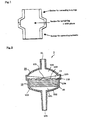
- Fig. 1 shows a conceptual diagram of the container.
- the container has a section for containing the solid phase, and the solid phase is contained said containing section.
- the solid phase does not move out of the containing section at the time of sucking and discharging the sample solution and the like.
- a pressure difference-generating apparatus e. g., a syringe, is connected to the opening.
- the container is initially divided into two sections, and after the solid phase is contained, these portions are integrated.
- a mesh made of the material which does not contaminate DNA can be placed on the top and the bottom of the solid phase.
- the shape of the organic macromolecule having a hydroxyl group on the surface which is contained in the container as described above may be any shape such as discoid, squared, rectangular or ellipsoid; and in the membrane, cylindrical, roll, or beads coated with the organic macromolecule having a hydroxyl group on the surface.
- the shape having symmetric property such as discoid, squared, cylindrical and roll, and beads are preferable.
- the one opening of the container described above is inserted into the sample solution containing the nucleic acid, and the sample solution is contacted to the solid phase by sucking from the other opening.
- the sample solution is discharged, and then the nucleic acid-washing buffer solution is sucked and discharged. Then, the solution capable of desorbing the nucleic acid adsorbed to the solid phase is sucked and discharged. This discharged solution is collected to obtain the target nucleic acid.
- the target nucleic acid can be obtained.
- the unit for separation and purification of nucleic acid used in the invention preferably comprises (a) a solid phase, (b) a container containing the solid phase and having at least two openings, and (c) a pressure difference-generating apparatus connected to one opening of the container.
- the unit for separation and purification of nucleic acid will be described below.
- the container is normally made in a divided form of a main body which contains the solid phase, and a lid, wherein each has at least one opening.
- the one is used as an inlet and an outlet of the sample solution containing the nucleic acid, the nucleic acid-washing buffer solution, a liquid capable of desorbing the nucleic acid adsorbed to the solid phase (hereinafter referred to as "sample solution and the like"); and the other is connected to the pressure difference-generating apparatus capable of making the inside of the container in a reduced pressure or pressurized state.
- sample solution and the like a liquid capable of desorbing the nucleic acid adsorbed to the solid phase
- the lid It is necessary to connect the lid to the main body so as to make the inside of the container in the reduced pressure state or the pressurized state by using the pressure difference-generating apparatus. If this state is accomplished, the method of connection can be selected freely. For example, use of an adhesive, screwing, fitting, securing, and fusing by ultrasonic heating, are exemplified.
- An internal volume of the container is determined only by an amount of the sample solution to be treated. Normally, it is expressed by the volume of the solid phase to be contained. It is preferable to use a size suitable for containing 1 to 6 sheets of the solid phase having about 1 mm or smaller (e. g., around 50 to 500 ⁇ m) thickness and about 2 mm to 20 mm diameter.
- the bottom surface of the solid phase that is located oppositely to the opening used as the inlet of the sample solution and the like, is not closely contacted to the inner wall of the container, and a space is provided. Thereby, a structure suitable for achieving diffusion of the sample solution and the like evenly as possible on the entire surface of the solid phase, can be formed.
- This member pushes the solid phase, and has an efficient effect of discharging the sample solution and the like.
- This member has preferably a shape having a slope such as a funnel or a cup in such a way that the liquid is collected in the center hole.
- the size of this hole, an angle of the slope, and the thickness of the member can be properly determined by those skilled in the art in consideration of the amount of the sample solution and the like to be treated and the size of the container for containing the solid phase.
- a space is preferably provided to store the overflowed sample solution and the like and prevent the sample solution from being sucked into the pressure difference-generating apparatus.
- the volume of this hole can be properly chosen by those skilled in the art. In order to collect efficiently the nucleic acid, it is preferable to suck the sample solution in an amount which is sufficient for dipping a whole of the solid phase.
- a space is preferably provided between the solid phase and this member.
- the size and number of the projection can be properly chosen by those skilled in the art. It is preferable to make an opening area of the solid phase as large as possible while keeping the space.
- the pressure difference-generating apparatus reduces at first the pressure of the inside of the container which contains the solid phase, so as to suck the sample solution containing the nucleic acid.
- the pressure difference-generating apparatus is exemplified by the syringe, pipetter, or a pump capable of sucking and pressurizing such as a peristaltic pump.
- the syringe is suitable for manual operation and the pump is suitable for automatic operation.
- the pipetter has an advantage of one hand operation.
- the pressure difference-generating apparatus is releasably connected to the one opening of the container.
- the purification method of the nucleic acid using the unit for separation and purification of nucleic acid as described above will be described.
- the sample solution is inserted one opening of the unit for separation and purification of nucleic acid as described above.
- the pressure difference-generating apparatus connected to the other opening, the pressure of the inside of the purifying unit is reduced to suck the sample solution into the container.
- the sample solution is contacted to the solid phase so as to adsorb the nucleic acid present in the sample solution to the solid phase.
- sucking of the solution in the pressure difference-generating apparatus causes contamination of the apparatus and hence, the amount is appropriately adjusted.
- the inside of the container of the unit is pressurized by using the pressure difference-generating apparatus, and the sucked liquid is discharged. No interval is required for this operation, and discharge may be carried out immediately after sucking.
- the nucleic acid-washing buffer solution is an aqueous solution containing a main agent, a buffer agent and when required, a surfactant.
- the main agent is exemplified by about 10 to 90% (preferably about 50 to 90%) aqueous solution of methyl alcohol, ethyl alcohol, butyl alcohol, acetone and the like; and the buffer agent and the surfactant are exemplified by the previously described buffer agents and surfactants.
- a solution containing ethyl alcohol, Tris and Triton X100 is preferable.
- the preferable concentrations of Tris and Triton X100 are 10 to 100 mM and 0.1 to 10%, respectively.
- a solution capable of desorbing the nucleic acid adsorbed to the solid phase is introduced into the inside of the container and discharged from the container by pressure-reducing and pressurizing operations as described above.
- This discharged solution contains the target nucleic acid and hence, the target nucleic acid can be collected to be subjected to amplification of the nucleic acid by a following operation, e.g., PCR (polymerase chain reaction).
- FIG. 2 is a sectional view of an example of the unit for separation and purification of nucleic acid according to the present invention, provided that no pressure difference-generating apparatus is illustrated.
- a container 1 containing the solid phase comprises a main body 10 and a lid 20 and is made of clear polystyrene.
- the main body 10 contains saponified triacetyl cellulose membrane as a solid phase 30.
- it has an opening 101 for sucking the sample solution and the like.
- a bottom face 102 extending from the opening is formed in a funnel shape, and a space 121 is formed between this and the solid phase 30.
- a frame 103 which is formed with the bottom face 102, is provided.
- the main body has an inner diameter of 20.1 mm, a depth of 5.9 mm, and a length from the bottom face 102 to the opening 101 of about 70 mm.
- the solid phase 30 which is contained has a diameter of 20.0 mm.
- the thickness of one sheet of the solid phase is about 50 to 500 ⁇ m, and an example of the thickness is 100 ⁇ m.
- a funnel-shaped pressing member 13 is provided on the top of the solid phase.
- a hole 131 is made in a center of the pressing member 13, and a group of projections 132 are provided downward, and a space 122 is formed between this and the solid phase 30.
- the inner diameter of the upper portion of the wall 104 is larger than the diameter of the solid phase.
- the periphery of the pressing member 13 is mounted on a step 105.
- a lid 20 is connected to the main body 10 by ultrasonic heating. In almost central part of the lid 20 is provided an opening 21 for connecting the pressure difference-generating apparatus. Between the lid 20 and the pressing member 13 is provided a space 123 for holding the sample solution and the like which flow out from the hole 131. A volume of the space 123 is about 0.1 mL.
- a cartridge for purification of nucleic acid having a portion which has 7 mm inner diameter and 2 mm thickness for containing a solid phase for adsorption of a nucleic acid was prepared by high impact polystyrene.
- Fig. 3 shows a structure of the prepared cartridge for purification of nucleic acid.
- This cartridge for purification of nucleic acid has an opening for sucking a sample, a portion for containing a nucleic acid-adsorbing solid phase, and an opening for discharging the sample.
- a suction pump is connected to the opening for discharging the sample to suck the sample.
- Solid phases for purification of nucleic acid as shown in Table 1 were prepared. For saponification, treatment was conducted by dipping triacetyl cellulose porous membranes (Fuj i Photo Film K.K.) having various pore sizes in 0.1 N sodium hydroxide aqueous solution for 30 minutes in the case of 50% surface saponification, and in 2 N sodium hydroxide aqueous solution for 1 hour in the case of 100% surface saponification. Each of the thus treated solid phases was contained in the portion for containing a nucleic acid-adsorbing solid phase, of the cartridge for purification of nucleic acid which was prepared in the above (1).
- adsorption buffer solution and a washing buffer solution for purification of nucleic acid, the compositions of which are shown in Table 2, were prepared.
- Table 2 [adsorption buffer] Guanidine hydrochloride (Life Technology made) 382 g Tris (Life Technology made) 12.1 g Triton X100 (ICN made) 10 g Distilled water 1000 mL [washing buffer] 10 mM Tris-HCl 65% ethanol
- aqueous solution containing 1.3 kbp DNA (50 ng/ ⁇ L) and an aqueous solution containing 48 kbp DNA (50 ng/ ⁇ L) were prepared.
- To 200 ⁇ L of each of the aqueous DNA solutions were added 200 ⁇ L of the adsorption buffer and 200 ⁇ L of ethanol, and the mixture was stirred. After stirring, each liquid was sucked and discharged by using cartridges for purification of the nucleic acid having the solid phase for purification of nucleic acid which were prepared in the above (1) and (2).
- Table 3 Amount of addition 1.3kbp DNA (10 ⁇ g) pore size ( ⁇ m) collection amount ( ⁇ g) collection rate surface- 0.2 0.6 6% saponification 0.4 0.4 4% 50% 1 0.8 8% 2.5 0.3 3% surface- 0.2 8.0 79% saponification 0.4 4.2 42% 100% 1 1.8 18% 2.5 1.8 18%
- Table 4 Amount of addition 48kbp DNA (10 ⁇ g) pore size ( ⁇ m) collection amount ( ⁇ g) collection rate surface- 0.2 5.4 54% saponification 0.4 5.6 56% 50% 1 2.6 26% 2.5 3.0 30% surface- 0.2 9.9 99% saponification 0.4 7.7 77% 100% 1 7.6 76% 2.5 7.8 78%
- aqueous solution containing 1.3 kbp DNA and the aqueous solution containing 48 kbp DNA which were used in the above (5) were mixed together to prepare a mixture solution of a low molecular weight nucleic acid and a high molecular weight nucleic acid.
- a nucleic acid was purified by the operation which is same as that of the above (4) according to any one method of the following (a) to (c).
- Fig. 5 shows the result.
- a nucleic acid having a desired size can be purified by selecting the saponification rate and pore size of the solid phase carrier.
- a nucleic acid having a predetermined length can be separated and purified from the nucleic acid mixture containing nucleic acids having different lengths.
- operations become easy by using the unit for separation and purification of nucleic acid which was described in the present specification.
Landscapes
- Chemical & Material Sciences (AREA)
- Health & Medical Sciences (AREA)
- Engineering & Computer Science (AREA)
- Life Sciences & Earth Sciences (AREA)
- Genetics & Genomics (AREA)
- Organic Chemistry (AREA)
- Wood Science & Technology (AREA)
- Zoology (AREA)
- Biomedical Technology (AREA)
- Biotechnology (AREA)
- General Engineering & Computer Science (AREA)
- Bioinformatics & Cheminformatics (AREA)
- Analytical Chemistry (AREA)
- Molecular Biology (AREA)
- General Health & Medical Sciences (AREA)
- Physics & Mathematics (AREA)
- Biochemistry (AREA)
- Biophysics (AREA)
- Microbiology (AREA)
- Plant Pathology (AREA)
- Proteomics, Peptides & Aminoacids (AREA)
- Crystallography & Structural Chemistry (AREA)
- Immunology (AREA)
- Chemical Kinetics & Catalysis (AREA)
- Apparatus Associated With Microorganisms And Enzymes (AREA)
- Measuring Or Testing Involving Enzymes Or Micro-Organisms (AREA)
- Saccharide Compounds (AREA)
- Solid-Sorbent Or Filter-Aiding Compositions (AREA)
Claims (14)
- Verfahren zur Abtrennung und Aufreinigung einer Nucleinsäure mit einer vorbestimmten Länge aus einem Nucleinsäuregemisch, umfassend einen Schritt des:Adsorbierens und Desorbierens einer Nucleinsäure in dem Nucleinsäuregemisch, das Nucleinsäuren mit verschiedenen Längen enthält, an und von einer festen Phase, wobei ein poröser Film aus einer an der Oberfläche verseiften Acetylcellulose als die feste Phase verwendet wird und eine Nucleinsäure mit einer vorbestimmten Länge abgetrennt und aufgereinigt wird, indem eine Oberflächenverseifungsrate von Acetylcellulose und eine Porengröße des porösen Films ausgewählt werden.
- Verfahren gemäß Anspruch 1, wobei die an der Oberfläche verseifte Acetylcellulose an der Oberfläche verseifte Triacetylcellulose ist.
- Verfahren gemäß Anspruch 1, wobei die Oberflächenverseifungsrate von Acetylcellulose 5% oder höher ist.
- Verfahren gemäß Anspruch 1, wobei die Oberflächenverseifungsrate von Acetylcellulose 10% oder höher ist.
- Verfahren gemäß Anspruch 1, wobei die Oberflächenverseifungsrate von Acetylcellulose 10 bis 100% ist und die Porengröße des porösen Films 0,1 µm bis 10 µm beträgt.
- Verfahren gemäß Anspruch 1, wobei das Nucleinsäuregemisch eine Lösung ist, die durch Zugeben eines wasserlöslichen organischen Lösungsmittels zu einer Lösung, erhalten durch Behandeln einer Zell- oder Virus-enthaltenden Testprobe mit einem Nucleinsäure solubilisierenden Reagens, hergestellt wird.
- Verfahren gemäß Anspruch 6, wobei das Nucleinsäure solubilisierende Reagens ein Guanidinsalz, ein Surfactant und ein proteolytisches Enzym ist.
- Verfahren gemäß Anspruch 1, umfassend die Schritte des:Adsorbierens der Nucleinsäure an der festen Phase;Waschens der festen Phase unter Verwendung eines Nucleinsäure-Waschpuffers undDesorbieren der Nucleinsäure, die an der festen Phase adsorbiert ist, durch Verwendung einer Flüssigkeit, die fähig ist, die an der festen Phase adsorbierte Nucleinsäure zu desorbieren.
- Verfahren gemäß Anspruch 8, wobei der Nukleinsäure-Waschpuffer eine Lösung ist, die 20 bis 100 Gew.-% Methanol, Ethanol, Isopropanol oder n-Propanol enthält.
- Verfahren gemäß Anspruch 8, wobei die Flüssigkeit, die fähig ist, die an der festen Phase adsorbierte Nucleinsäure zu desorbieren, eine Lösung ist, die eine Salzkonzentration von 0.5 M oder niedriger hat.
- Verfahren gemäß Anspruch 1, wobei Adsorption und Desorption der Nucleinsäure unter Verwendung einer Einheit zur Abtrennung und Aufreinigung von Nucleinsäure, in welcher ein Behälter, der wenigstens zwei Öffnungen hat, die feste Phase enthält, durchgeführt werden.
- Verfahren gemäß Anspruch 1, wobei Adsorption und Desorption der Nucleinsäure unter Verwendung einer Einheit zur Abtrennung und Aufreinigung von Nucleinsäure, welche (a) die feste Phase, (b) einen Behälter, der wenigstens zwei Öffnungen hat und die feste Phase enthält, und (c) eine Druckdifferenz erzeugende Apparatur, angeschlossen an eine Öffnung des Behälters, umfasst, durchgeführt werden.
- Verfahren gemäß Anspruch 12, umfassend die Schritte des:(a) Herstellens einer Probenlösung, die eine Nucleinsäure enthält, und Einsetzen einer Öffnung einer Einheit zur Abtrennung und Aufreinigung von Nucleinsäure in die Probenlösung, die die Nucleinsäure enthält;(b) Ansaugens der Probenlösung, die die Nucleinsäure enthält, indem im Inneren des Behälters ein reduzierter Druckzustand erzeugt wird, indem die Druckdifferenz erzeugende Apparatur, die mit der anderen Öffnung der Einheit zur Abtrennung und Aufreinigung von Nucleinsäure verbunden ist, verwendet wird, und des Inkontaktbringens der Probenlösung mit der festen Phase;(c) Erzeugens eines Druckzustands im Inneren des Behälters durch Verwendung der Druckdifferenz erzeugenden Apparatur, die mit der anderen Öffnung der Einheit zur Abtrennung und Aufreinigung von Nucleinsäure verbunden ist, und des Ausbringens der Probenlösung aus dem Behälter;(d) Einsetzens einer Öffnung der Einheit zur Abtrennung und Aufreinigung von Nucleinsäure in den Nucleinsäure-Waschpuffer;(e) Ansaugens des Nucleinsäure-Waschpuffers durch Erzeugen eines reduzierten Druckzustandes im Inneren des Behälters unter Verwendung der Druckdifferenz erzeugenden Apparatur, die mit der anderen Öffnung der Einheit zur Abtrennung und Aufreinigung von Nucleinsäure verbunden ist, und des Inkontaktbringens des Nucleinsäure-Waschpuffers mit der festen Phase;(f) Erzeugens eines Druckzustandes im Inneren des Behälters durch Verwendung der Druckdifferenz erzeugenden Apparatur, die mit der anderen Öffnung der Einheit zur Abtrennung und Aufreinigung von Nukleinsäure verbunden ist, und des Ausbringens des angesaugten Nucleinsäure-Waschpuffers aus dem Behälter;(g) Einsetzens einer Öffnung der Einheit zur Abtrennung und Aufreinigung von Nucleinsäure in die Flüssigkeit, die fähig ist, die an der festen Phase adsorbierte Nucleinsäure zu desorbieren;(h) Erzeugens eines reduzierten Druckzustandes im Inneren des Behälters durch Verwendung der Druckdifferenz erzeugenden Apparatur, die mit der anderen Öffnung der Einheit zur Abtrennung und Aufreinigung von Nucleinsäure verbunden ist, und Ansaugens der Flüssigkeit, die fähig ist, die an der festen Phase adsorbierte Nucleinsäure zu desorbieren, unter Inkontaktbringen der Flüssigkeit mit der festen Phase; und(i) Erzeugens eines Druckzustandes im Inneren des Behälters durch Verwendung der Druckdifferenz erzeugenden Apparatur, die mit der anderen Öffnung der Einheit zur Abtrennung und Aufreinigung von Nucleinsäure verbunden ist, und Ausbringen der Flüssigkeit, die fähig ist, die an der festen Phase adsorbierte Nucleinsäure zu desorbieren, aus dem Behälter.
- Verfahren gemäß Anspruch 12, umfassend die Schritte des:(a) Herstellens einer Probenlösung, die die Nucleinsäure enthält, und Injizierens der Probenlösung, die die Nukleinsäure enthält, in eine Öffnung der Einheit zur Abtrennung und Aufreinigung von Nucleinsäure;(b) Erzeugens eines Druckzustands im Inneren des Behälters durch Verwendung der Druckdifferenz erzeugenden Apparatur, die an die eine Öffnung der Einheit zur Abtrennung und Aufreinigung von Nucleinsäure angeschlossen ist, und Ausbringens der injizierten Probenlösung, die die Nucleinsäure enthält, aus der anderen Öffnung unter Inkontaktbringen der Probenlösung mit der festen Phase;(c) Injizierens des Nucleinsäure-Waschpuffers in die eine Öffnung der Einheit zur Abtrennung und Aufreinigung von Nucleinsäure;(d) Herstellens eines Druckzustands im Inneren des Behälters durch Verwendung der Druckdifferenz erzeugenden Apparatur, die mit der einen Öffnung der Einheit zur Abtrennung und Aufreinigung von Nucleinsäure verbunden ist, und Ausbringens des injizierten Nucleinsäure-Waschpuffers aus der anderen Öffnung unter Inkontaktbringen des Nucleinsäure-Waschpuffers mit der festen Phase;(e) Injizierens der Flüssigkeit, die zum Desorbieren der an der festen Phase adsorbierten Nucleinsäure fähig ist, in die eine Öffnung der Einheit zur Abtrennung und Aufreinigung von Nucleinsäure und(f) Erzeugens eines Druckzustands im Inneren des Behälters durch Verwendung der Druckdifferenz erzeugenden Apparatur, die mit der einen Öffnung der Einheit zur Abtrennung und Aufreinigung von Nucleinsäure verbunden ist, und Ausbringens der Flüssigkeit, die fähig ist, die injizierte Nucleinsäure zu desorbieren, aus der anderen Öffnung, sodass die an der festen Phase adsorbierte Nucleinsäure desorbiert wird, und Ausbringens der Nucleinsäure aus dem Behälter.
Applications Claiming Priority (2)
| Application Number | Priority Date | Filing Date | Title |
|---|---|---|---|
| JP2002210832A JP3890360B2 (ja) | 2002-07-19 | 2002-07-19 | 核酸の分離精製方法 |
| JP2002210832 | 2002-07-19 |
Publications (2)
| Publication Number | Publication Date |
|---|---|
| EP1382676A1 EP1382676A1 (de) | 2004-01-21 |
| EP1382676B1 true EP1382676B1 (de) | 2009-05-13 |
Family
ID=29774668
Family Applications (1)
| Application Number | Title | Priority Date | Filing Date |
|---|---|---|---|
| EP03015675A Expired - Lifetime EP1382676B1 (de) | 2002-07-19 | 2003-07-18 | Methode zur Trennung und Aufreinigung von Nukleinsäuren |
Country Status (5)
| Country | Link |
|---|---|
| US (1) | US7432054B2 (de) |
| EP (1) | EP1382676B1 (de) |
| JP (1) | JP3890360B2 (de) |
| AT (1) | ATE431408T1 (de) |
| DE (1) | DE60327583D1 (de) |
Cited By (4)
| Publication number | Priority date | Publication date | Assignee | Title |
|---|---|---|---|---|
| US9415392B2 (en) | 2009-03-24 | 2016-08-16 | The University Of Chicago | Slip chip device and methods |
| US9447461B2 (en) | 2009-03-24 | 2016-09-20 | California Institute Of Technology | Analysis devices, kits, and related methods for digital quantification of nucleic acids and other analytes |
| US9464319B2 (en) | 2009-03-24 | 2016-10-11 | California Institute Of Technology | Multivolume devices, kits and related methods for quantification of nucleic acids and other analytes |
| US10196700B2 (en) | 2009-03-24 | 2019-02-05 | University Of Chicago | Multivolume devices, kits and related methods for quantification and detection of nucleic acids and other analytes |
Families Citing this family (7)
| Publication number | Priority date | Publication date | Assignee | Title |
|---|---|---|---|---|
| JP2005095003A (ja) * | 2003-09-03 | 2005-04-14 | Fuji Photo Film Co Ltd | 核酸の分離精製方法 |
| JP2006238854A (ja) * | 2004-03-26 | 2006-09-14 | Fuji Photo Film Co Ltd | 核酸の分離精製方法 |
| EP1727900A4 (de) * | 2004-03-26 | 2008-05-28 | Fujifilm Corp | Verfahren zur selektiven trennung und reinigungvon rna sowie verfahren zur trennung und reinigung von nukleinsäure |
| JP4810164B2 (ja) * | 2004-09-03 | 2011-11-09 | 富士フイルム株式会社 | 核酸分離精製方法 |
| US20080187979A1 (en) * | 2005-01-31 | 2008-08-07 | Toshihiro Mori | Method for Preparing Sample Solution and Sample Solution Preparing Apparatus |
| US20070116613A1 (en) * | 2005-11-23 | 2007-05-24 | Donat Elsener | Sample tube and system for storing and providing nucleic acid samples |
| EP2128169A1 (de) * | 2008-05-30 | 2009-12-02 | Qiagen GmbH | Verfahren zur Isolierung von kurzkettigen Nukleinsäuren |
Family Cites Families (10)
| Publication number | Priority date | Publication date | Assignee | Title |
|---|---|---|---|---|
| US4118336A (en) * | 1974-03-25 | 1978-10-03 | Toyo Jozo Company, Ltd. | Novel cellulose microcapsules and preparation thereof |
| US4063017A (en) * | 1976-04-22 | 1977-12-13 | Purdue Research Foundation | Porous cellulose beads and the immobilization of enzymes therewith |
| US5187083A (en) * | 1990-11-13 | 1993-02-16 | Specialty Laboratories, Inc. | Rapid purification of DNA |
| US5491068A (en) * | 1991-02-14 | 1996-02-13 | Vicam, L.P. | Assay method for detecting the presence of bacteria |
| CA2067711C (en) * | 1991-05-03 | 2000-08-08 | Daniel Lee Woodard | Solid phase extraction purification of dna |
| EP0580305B1 (de) | 1992-07-02 | 1999-09-22 | Edge Biosystems, Inc. | Verfahren und Material für Reinigung von Nukleinsäuren |
| US5804684A (en) | 1995-08-24 | 1998-09-08 | The Theobald Smith Research Institute, Inc. | Method for isolating nucleic acids |
| US6056877A (en) * | 1997-12-05 | 2000-05-02 | Transgenomic, Inc. | Non-polar media for polynucleotide separations |
| JP2001516731A (ja) * | 1997-09-17 | 2001-10-02 | ジエントラ・システムズ・インコーポレーテツド | 核酸を単離するための装置および方法 |
| JP3890556B2 (ja) * | 2001-11-28 | 2007-03-07 | 富士フイルム株式会社 | 核酸の分離精製方法及び核酸分離精製ユニット |
-
2002
- 2002-07-19 JP JP2002210832A patent/JP3890360B2/ja not_active Expired - Fee Related
-
2003
- 2003-07-18 DE DE60327583T patent/DE60327583D1/de not_active Expired - Fee Related
- 2003-07-18 US US10/621,715 patent/US7432054B2/en not_active Expired - Fee Related
- 2003-07-18 EP EP03015675A patent/EP1382676B1/de not_active Expired - Lifetime
- 2003-07-18 AT AT03015675T patent/ATE431408T1/de not_active IP Right Cessation
Cited By (5)
| Publication number | Priority date | Publication date | Assignee | Title |
|---|---|---|---|---|
| US9415392B2 (en) | 2009-03-24 | 2016-08-16 | The University Of Chicago | Slip chip device and methods |
| US9447461B2 (en) | 2009-03-24 | 2016-09-20 | California Institute Of Technology | Analysis devices, kits, and related methods for digital quantification of nucleic acids and other analytes |
| US9464319B2 (en) | 2009-03-24 | 2016-10-11 | California Institute Of Technology | Multivolume devices, kits and related methods for quantification of nucleic acids and other analytes |
| US9493826B2 (en) | 2009-03-24 | 2016-11-15 | California Institute Of Technology | Multivolume devices, kits and related methods for quantification and detection of nucleic acids and other analytes |
| US10196700B2 (en) | 2009-03-24 | 2019-02-05 | University Of Chicago | Multivolume devices, kits and related methods for quantification and detection of nucleic acids and other analytes |
Also Published As
| Publication number | Publication date |
|---|---|
| JP3890360B2 (ja) | 2007-03-07 |
| US20040063122A1 (en) | 2004-04-01 |
| EP1382676A1 (de) | 2004-01-21 |
| DE60327583D1 (de) | 2009-06-25 |
| ATE431408T1 (de) | 2009-05-15 |
| JP2004049106A (ja) | 2004-02-19 |
| US7432054B2 (en) | 2008-10-07 |
Similar Documents
| Publication | Publication Date | Title |
|---|---|---|
| JP4810164B2 (ja) | 核酸分離精製方法 | |
| JP2008245649A (ja) | 表面における核酸の単離及び精製のための方法並びに手段 | |
| EP1382677B1 (de) | Ein Verfahren zur Trennung und Reinigung von RNA | |
| EP1382675A1 (de) | Verfahren zum Abtrennen und Reinigen einer Nukleinsäure | |
| EP1382676B1 (de) | Methode zur Trennung und Aufreinigung von Nukleinsäuren | |
| JP2008220377A6 (ja) | 表面における核酸の単離及び精製のための方法並びに手段 | |
| JP2008220377A (ja) | 表面における核酸の単離及び精製のための方法並びに手段 | |
| JP3727025B2 (ja) | 核酸の分離精製方法 | |
| JP4284250B2 (ja) | 核酸分離精製方法 | |
| JP2005118007A (ja) | 核酸の分離精製方法 | |
| JP2002345462A (ja) | 吸着バッファ及び核酸精製方法 | |
| JP3890361B2 (ja) | 核酸の分離精製装置及びそれを用いた核酸の分離精製方法 | |
| JP2004242622A (ja) | 核酸の分離精製用洗浄液 | |
| JP2005154299A (ja) | 核酸の分離精製方法 | |
| JP2006230237A (ja) | 核酸の分離精製方法および装置 | |
| JP2005137298A (ja) | 核酸の分離精製方法 | |
| JP2005176716A (ja) | 核酸の分離精製方法 | |
| JP2006217839A (ja) | 核酸の分離精製方法 | |
| JP2005176678A (ja) | 核酸の分離精製方法 | |
| JP2006136285A (ja) | 核酸の分離精製方法 | |
| JP2005118018A (ja) | 核酸の分離精製方法 | |
| JP2005168450A (ja) | 核酸の分離精製方法 | |
| JP2005137297A (ja) | 核酸の分離精製方法 | |
| JP2005143339A (ja) | 核酸の分離精製方法 | |
| JP2005137323A (ja) | 核酸の分離精製方法 |
Legal Events
| Date | Code | Title | Description |
|---|---|---|---|
| PUAI | Public reference made under article 153(3) epc to a published international application that has entered the european phase |
Free format text: ORIGINAL CODE: 0009012 |
|
| AK | Designated contracting states |
Kind code of ref document: A1 Designated state(s): AT BE BG CH CY CZ DE DK EE ES FI FR GB GR HU IE IT LI LU MC NL PT RO SE SI SK TR |
|
| AX | Request for extension of the european patent |
Extension state: AL LT LV MK |
|
| 17P | Request for examination filed |
Effective date: 20040521 |
|
| AKX | Designation fees paid |
Designated state(s): AT BE BG CH CY CZ DE DK EE ES FI FR GB GR HU IE IT LI LU MC NL PT RO SE SI SK TR |
|
| 17Q | First examination report despatched |
Effective date: 20061018 |
|
| RAP1 | Party data changed (applicant data changed or rights of an application transferred) |
Owner name: FUJIFILM CORPORATION |
|
| GRAP | Despatch of communication of intention to grant a patent |
Free format text: ORIGINAL CODE: EPIDOSNIGR1 |
|
| GRAS | Grant fee paid |
Free format text: ORIGINAL CODE: EPIDOSNIGR3 |
|
| GRAA | (expected) grant |
Free format text: ORIGINAL CODE: 0009210 |
|
| AK | Designated contracting states |
Kind code of ref document: B1 Designated state(s): AT BE BG CH CY CZ DE DK EE ES FI FR GB GR HU IE IT LI LU MC NL PT RO SE SI SK TR |
|
| REG | Reference to a national code |
Ref country code: GB Ref legal event code: FG4D |
|
| REG | Reference to a national code |
Ref country code: CH Ref legal event code: EP |
|
| REG | Reference to a national code |
Ref country code: IE Ref legal event code: FG4D |
|
| REF | Corresponds to: |
Ref document number: 60327583 Country of ref document: DE Date of ref document: 20090625 Kind code of ref document: P |
|
| REG | Reference to a national code |
Ref country code: SE Ref legal event code: TRGR |
|
| PGFP | Annual fee paid to national office [announced via postgrant information from national office to epo] |
Ref country code: FR Payment date: 20090529 Year of fee payment: 7 |
|
| PG25 | Lapsed in a contracting state [announced via postgrant information from national office to epo] |
Ref country code: FI Free format text: LAPSE BECAUSE OF FAILURE TO SUBMIT A TRANSLATION OF THE DESCRIPTION OR TO PAY THE FEE WITHIN THE PRESCRIBED TIME-LIMIT Effective date: 20090513 Ref country code: AT Free format text: LAPSE BECAUSE OF FAILURE TO SUBMIT A TRANSLATION OF THE DESCRIPTION OR TO PAY THE FEE WITHIN THE PRESCRIBED TIME-LIMIT Effective date: 20090513 Ref country code: PT Free format text: LAPSE BECAUSE OF FAILURE TO SUBMIT A TRANSLATION OF THE DESCRIPTION OR TO PAY THE FEE WITHIN THE PRESCRIBED TIME-LIMIT Effective date: 20090913 Ref country code: ES Free format text: LAPSE BECAUSE OF FAILURE TO SUBMIT A TRANSLATION OF THE DESCRIPTION OR TO PAY THE FEE WITHIN THE PRESCRIBED TIME-LIMIT Effective date: 20090824 |
|
| NLV1 | Nl: lapsed or annulled due to failure to fulfill the requirements of art. 29p and 29m of the patents act | ||
| PG25 | Lapsed in a contracting state [announced via postgrant information from national office to epo] |
Ref country code: SI Free format text: LAPSE BECAUSE OF FAILURE TO SUBMIT A TRANSLATION OF THE DESCRIPTION OR TO PAY THE FEE WITHIN THE PRESCRIBED TIME-LIMIT Effective date: 20090513 Ref country code: NL Free format text: LAPSE BECAUSE OF FAILURE TO SUBMIT A TRANSLATION OF THE DESCRIPTION OR TO PAY THE FEE WITHIN THE PRESCRIBED TIME-LIMIT Effective date: 20090513 |
|
| PGFP | Annual fee paid to national office [announced via postgrant information from national office to epo] |
Ref country code: DE Payment date: 20090716 Year of fee payment: 7 Ref country code: GB Payment date: 20090703 Year of fee payment: 7 Ref country code: SE Payment date: 20090730 Year of fee payment: 7 |
|
| PG25 | Lapsed in a contracting state [announced via postgrant information from national office to epo] |
Ref country code: DK Free format text: LAPSE BECAUSE OF FAILURE TO SUBMIT A TRANSLATION OF THE DESCRIPTION OR TO PAY THE FEE WITHIN THE PRESCRIBED TIME-LIMIT Effective date: 20090513 Ref country code: RO Free format text: LAPSE BECAUSE OF FAILURE TO SUBMIT A TRANSLATION OF THE DESCRIPTION OR TO PAY THE FEE WITHIN THE PRESCRIBED TIME-LIMIT Effective date: 20090513 Ref country code: EE Free format text: LAPSE BECAUSE OF FAILURE TO SUBMIT A TRANSLATION OF THE DESCRIPTION OR TO PAY THE FEE WITHIN THE PRESCRIBED TIME-LIMIT Effective date: 20090513 Ref country code: CZ Free format text: LAPSE BECAUSE OF FAILURE TO SUBMIT A TRANSLATION OF THE DESCRIPTION OR TO PAY THE FEE WITHIN THE PRESCRIBED TIME-LIMIT Effective date: 20090513 |
|
| PG25 | Lapsed in a contracting state [announced via postgrant information from national office to epo] |
Ref country code: SK Free format text: LAPSE BECAUSE OF FAILURE TO SUBMIT A TRANSLATION OF THE DESCRIPTION OR TO PAY THE FEE WITHIN THE PRESCRIBED TIME-LIMIT Effective date: 20090513 Ref country code: MC Free format text: LAPSE BECAUSE OF NON-PAYMENT OF DUE FEES Effective date: 20090731 Ref country code: BE Free format text: LAPSE BECAUSE OF FAILURE TO SUBMIT A TRANSLATION OF THE DESCRIPTION OR TO PAY THE FEE WITHIN THE PRESCRIBED TIME-LIMIT Effective date: 20090513 |
|
| REG | Reference to a national code |
Ref country code: CH Ref legal event code: PL |
|
| PLBE | No opposition filed within time limit |
Free format text: ORIGINAL CODE: 0009261 |
|
| STAA | Information on the status of an ep patent application or granted ep patent |
Free format text: STATUS: NO OPPOSITION FILED WITHIN TIME LIMIT |
|
| PG25 | Lapsed in a contracting state [announced via postgrant information from national office to epo] |
Ref country code: BG Free format text: LAPSE BECAUSE OF FAILURE TO SUBMIT A TRANSLATION OF THE DESCRIPTION OR TO PAY THE FEE WITHIN THE PRESCRIBED TIME-LIMIT Effective date: 20090813 |
|
| 26N | No opposition filed |
Effective date: 20100216 |
|
| PG25 | Lapsed in a contracting state [announced via postgrant information from national office to epo] |
Ref country code: LI Free format text: LAPSE BECAUSE OF NON-PAYMENT OF DUE FEES Effective date: 20090731 Ref country code: CH Free format text: LAPSE BECAUSE OF NON-PAYMENT OF DUE FEES Effective date: 20090731 |
|
| PG25 | Lapsed in a contracting state [announced via postgrant information from national office to epo] |
Ref country code: IE Free format text: LAPSE BECAUSE OF NON-PAYMENT OF DUE FEES Effective date: 20090718 |
|
| PG25 | Lapsed in a contracting state [announced via postgrant information from national office to epo] |
Ref country code: GR Free format text: LAPSE BECAUSE OF FAILURE TO SUBMIT A TRANSLATION OF THE DESCRIPTION OR TO PAY THE FEE WITHIN THE PRESCRIBED TIME-LIMIT Effective date: 20090814 |
|
| GBPC | Gb: european patent ceased through non-payment of renewal fee |
Effective date: 20100718 |
|
| PG25 | Lapsed in a contracting state [announced via postgrant information from national office to epo] |
Ref country code: IT Free format text: LAPSE BECAUSE OF FAILURE TO SUBMIT A TRANSLATION OF THE DESCRIPTION OR TO PAY THE FEE WITHIN THE PRESCRIBED TIME-LIMIT Effective date: 20090513 |
|
| REG | Reference to a national code |
Ref country code: FR Ref legal event code: ST Effective date: 20110331 |
|
| PG25 | Lapsed in a contracting state [announced via postgrant information from national office to epo] |
Ref country code: LU Free format text: LAPSE BECAUSE OF NON-PAYMENT OF DUE FEES Effective date: 20090718 Ref country code: DE Free format text: LAPSE BECAUSE OF NON-PAYMENT OF DUE FEES Effective date: 20110201 |
|
| REG | Reference to a national code |
Ref country code: DE Ref legal event code: R119 Ref document number: 60327583 Country of ref document: DE Effective date: 20110201 |
|
| PG25 | Lapsed in a contracting state [announced via postgrant information from national office to epo] |
Ref country code: FR Free format text: LAPSE BECAUSE OF NON-PAYMENT OF DUE FEES Effective date: 20100802 |
|
| PG25 | Lapsed in a contracting state [announced via postgrant information from national office to epo] |
Ref country code: HU Free format text: LAPSE BECAUSE OF FAILURE TO SUBMIT A TRANSLATION OF THE DESCRIPTION OR TO PAY THE FEE WITHIN THE PRESCRIBED TIME-LIMIT Effective date: 20091114 |
|
| PG25 | Lapsed in a contracting state [announced via postgrant information from national office to epo] |
Ref country code: GB Free format text: LAPSE BECAUSE OF NON-PAYMENT OF DUE FEES Effective date: 20100718 |
|
| PG25 | Lapsed in a contracting state [announced via postgrant information from national office to epo] |
Ref country code: TR Free format text: LAPSE BECAUSE OF FAILURE TO SUBMIT A TRANSLATION OF THE DESCRIPTION OR TO PAY THE FEE WITHIN THE PRESCRIBED TIME-LIMIT Effective date: 20090513 |
|
| PG25 | Lapsed in a contracting state [announced via postgrant information from national office to epo] |
Ref country code: CY Free format text: LAPSE BECAUSE OF FAILURE TO SUBMIT A TRANSLATION OF THE DESCRIPTION OR TO PAY THE FEE WITHIN THE PRESCRIBED TIME-LIMIT Effective date: 20090513 |
|
| PG25 | Lapsed in a contracting state [announced via postgrant information from national office to epo] |
Ref country code: SE Free format text: LAPSE BECAUSE OF NON-PAYMENT OF DUE FEES Effective date: 20100719 |