EP1380341A1 - Catalyst for reforming hydrocarbon and method for preparation thereof, and process for reforming hydrocarbon using said catalyst - Google Patents
Catalyst for reforming hydrocarbon and method for preparation thereof, and process for reforming hydrocarbon using said catalyst Download PDFInfo
- Publication number
- EP1380341A1 EP1380341A1 EP02713196A EP02713196A EP1380341A1 EP 1380341 A1 EP1380341 A1 EP 1380341A1 EP 02713196 A EP02713196 A EP 02713196A EP 02713196 A EP02713196 A EP 02713196A EP 1380341 A1 EP1380341 A1 EP 1380341A1
- Authority
- EP
- European Patent Office
- Prior art keywords
- catalyst
- component
- reforming
- hydrocarbon
- carrier
- Prior art date
- Legal status (The legal status is an assumption and is not a legal conclusion. Google has not performed a legal analysis and makes no representation as to the accuracy of the status listed.)
- Granted
Links
Images

Classifications
-
- B—PERFORMING OPERATIONS; TRANSPORTING
- B01—PHYSICAL OR CHEMICAL PROCESSES OR APPARATUS IN GENERAL
- B01J—CHEMICAL OR PHYSICAL PROCESSES, e.g. CATALYSIS OR COLLOID CHEMISTRY; THEIR RELEVANT APPARATUS
- B01J23/00—Catalysts comprising metals or metal oxides or hydroxides, not provided for in group B01J21/00
- B01J23/70—Catalysts comprising metals or metal oxides or hydroxides, not provided for in group B01J21/00 of the iron group metals or copper
- B01J23/89—Catalysts comprising metals or metal oxides or hydroxides, not provided for in group B01J21/00 of the iron group metals or copper combined with noble metals
-
- B—PERFORMING OPERATIONS; TRANSPORTING
- B01—PHYSICAL OR CHEMICAL PROCESSES OR APPARATUS IN GENERAL
- B01J—CHEMICAL OR PHYSICAL PROCESSES, e.g. CATALYSIS OR COLLOID CHEMISTRY; THEIR RELEVANT APPARATUS
- B01J37/00—Processes, in general, for preparing catalysts; Processes, in general, for activation of catalysts
- B01J37/02—Impregnation, coating or precipitation
- B01J37/0201—Impregnation
- B01J37/0207—Pretreatment of the support
-
- B—PERFORMING OPERATIONS; TRANSPORTING
- B01—PHYSICAL OR CHEMICAL PROCESSES OR APPARATUS IN GENERAL
- B01J—CHEMICAL OR PHYSICAL PROCESSES, e.g. CATALYSIS OR COLLOID CHEMISTRY; THEIR RELEVANT APPARATUS
- B01J21/00—Catalysts comprising the elements, oxides, or hydroxides of magnesium, boron, aluminium, carbon, silicon, titanium, zirconium, or hafnium
- B01J21/02—Boron or aluminium; Oxides or hydroxides thereof
- B01J21/04—Alumina
-
- B—PERFORMING OPERATIONS; TRANSPORTING
- B01—PHYSICAL OR CHEMICAL PROCESSES OR APPARATUS IN GENERAL
- B01J—CHEMICAL OR PHYSICAL PROCESSES, e.g. CATALYSIS OR COLLOID CHEMISTRY; THEIR RELEVANT APPARATUS
- B01J23/00—Catalysts comprising metals or metal oxides or hydroxides, not provided for in group B01J21/00
- B01J23/38—Catalysts comprising metals or metal oxides or hydroxides, not provided for in group B01J21/00 of noble metals
- B01J23/54—Catalysts comprising metals or metal oxides or hydroxides, not provided for in group B01J21/00 of noble metals combined with metals, oxides or hydroxides provided for in groups B01J23/02 - B01J23/36
- B01J23/56—Platinum group metals
- B01J23/64—Platinum group metals with arsenic, antimony, bismuth, vanadium, niobium, tantalum, polonium, chromium, molybdenum, tungsten, manganese, technetium or rhenium
- B01J23/656—Manganese, technetium or rhenium
- B01J23/6562—Manganese
-
- B—PERFORMING OPERATIONS; TRANSPORTING
- B01—PHYSICAL OR CHEMICAL PROCESSES OR APPARATUS IN GENERAL
- B01J—CHEMICAL OR PHYSICAL PROCESSES, e.g. CATALYSIS OR COLLOID CHEMISTRY; THEIR RELEVANT APPARATUS
- B01J23/00—Catalysts comprising metals or metal oxides or hydroxides, not provided for in group B01J21/00
- B01J23/70—Catalysts comprising metals or metal oxides or hydroxides, not provided for in group B01J21/00 of the iron group metals or copper
- B01J23/76—Catalysts comprising metals or metal oxides or hydroxides, not provided for in group B01J21/00 of the iron group metals or copper combined with metals, oxides or hydroxides provided for in groups B01J23/02 - B01J23/36
- B01J23/84—Catalysts comprising metals or metal oxides or hydroxides, not provided for in group B01J21/00 of the iron group metals or copper combined with metals, oxides or hydroxides provided for in groups B01J23/02 - B01J23/36 with arsenic, antimony, bismuth, vanadium, niobium, tantalum, polonium, chromium, molybdenum, tungsten, manganese, technetium or rhenium
- B01J23/889—Manganese, technetium or rhenium
- B01J23/8892—Manganese
-
- B—PERFORMING OPERATIONS; TRANSPORTING
- B01—PHYSICAL OR CHEMICAL PROCESSES OR APPARATUS IN GENERAL
- B01J—CHEMICAL OR PHYSICAL PROCESSES, e.g. CATALYSIS OR COLLOID CHEMISTRY; THEIR RELEVANT APPARATUS
- B01J23/00—Catalysts comprising metals or metal oxides or hydroxides, not provided for in group B01J21/00
- B01J23/70—Catalysts comprising metals or metal oxides or hydroxides, not provided for in group B01J21/00 of the iron group metals or copper
- B01J23/89—Catalysts comprising metals or metal oxides or hydroxides, not provided for in group B01J21/00 of the iron group metals or copper combined with noble metals
- B01J23/8913—Cobalt and noble metals
-
- B—PERFORMING OPERATIONS; TRANSPORTING
- B01—PHYSICAL OR CHEMICAL PROCESSES OR APPARATUS IN GENERAL
- B01J—CHEMICAL OR PHYSICAL PROCESSES, e.g. CATALYSIS OR COLLOID CHEMISTRY; THEIR RELEVANT APPARATUS
- B01J23/00—Catalysts comprising metals or metal oxides or hydroxides, not provided for in group B01J21/00
- B01J23/70—Catalysts comprising metals or metal oxides or hydroxides, not provided for in group B01J21/00 of the iron group metals or copper
- B01J23/89—Catalysts comprising metals or metal oxides or hydroxides, not provided for in group B01J21/00 of the iron group metals or copper combined with noble metals
- B01J23/892—Nickel and noble metals
-
- B—PERFORMING OPERATIONS; TRANSPORTING
- B01—PHYSICAL OR CHEMICAL PROCESSES OR APPARATUS IN GENERAL
- B01J—CHEMICAL OR PHYSICAL PROCESSES, e.g. CATALYSIS OR COLLOID CHEMISTRY; THEIR RELEVANT APPARATUS
- B01J23/00—Catalysts comprising metals or metal oxides or hydroxides, not provided for in group B01J21/00
- B01J23/70—Catalysts comprising metals or metal oxides or hydroxides, not provided for in group B01J21/00 of the iron group metals or copper
- B01J23/89—Catalysts comprising metals or metal oxides or hydroxides, not provided for in group B01J21/00 of the iron group metals or copper combined with noble metals
- B01J23/8933—Catalysts comprising metals or metal oxides or hydroxides, not provided for in group B01J21/00 of the iron group metals or copper combined with noble metals also combined with metals, or metal oxides or hydroxides provided for in groups B01J23/02 - B01J23/36
- B01J23/894—Catalysts comprising metals or metal oxides or hydroxides, not provided for in group B01J21/00 of the iron group metals or copper combined with noble metals also combined with metals, or metal oxides or hydroxides provided for in groups B01J23/02 - B01J23/36 with rare earths or actinides
-
- B—PERFORMING OPERATIONS; TRANSPORTING
- B01—PHYSICAL OR CHEMICAL PROCESSES OR APPARATUS IN GENERAL
- B01J—CHEMICAL OR PHYSICAL PROCESSES, e.g. CATALYSIS OR COLLOID CHEMISTRY; THEIR RELEVANT APPARATUS
- B01J23/00—Catalysts comprising metals or metal oxides or hydroxides, not provided for in group B01J21/00
- B01J23/70—Catalysts comprising metals or metal oxides or hydroxides, not provided for in group B01J21/00 of the iron group metals or copper
- B01J23/89—Catalysts comprising metals or metal oxides or hydroxides, not provided for in group B01J21/00 of the iron group metals or copper combined with noble metals
- B01J23/8933—Catalysts comprising metals or metal oxides or hydroxides, not provided for in group B01J21/00 of the iron group metals or copper combined with noble metals also combined with metals, or metal oxides or hydroxides provided for in groups B01J23/02 - B01J23/36
- B01J23/8946—Catalysts comprising metals or metal oxides or hydroxides, not provided for in group B01J21/00 of the iron group metals or copper combined with noble metals also combined with metals, or metal oxides or hydroxides provided for in groups B01J23/02 - B01J23/36 with alkali or alkaline earth metals
-
- B—PERFORMING OPERATIONS; TRANSPORTING
- B01—PHYSICAL OR CHEMICAL PROCESSES OR APPARATUS IN GENERAL
- B01J—CHEMICAL OR PHYSICAL PROCESSES, e.g. CATALYSIS OR COLLOID CHEMISTRY; THEIR RELEVANT APPARATUS
- B01J23/00—Catalysts comprising metals or metal oxides or hydroxides, not provided for in group B01J21/00
- B01J23/70—Catalysts comprising metals or metal oxides or hydroxides, not provided for in group B01J21/00 of the iron group metals or copper
- B01J23/89—Catalysts comprising metals or metal oxides or hydroxides, not provided for in group B01J21/00 of the iron group metals or copper combined with noble metals
- B01J23/8933—Catalysts comprising metals or metal oxides or hydroxides, not provided for in group B01J21/00 of the iron group metals or copper combined with noble metals also combined with metals, or metal oxides or hydroxides provided for in groups B01J23/02 - B01J23/36
- B01J23/8986—Catalysts comprising metals or metal oxides or hydroxides, not provided for in group B01J21/00 of the iron group metals or copper combined with noble metals also combined with metals, or metal oxides or hydroxides provided for in groups B01J23/02 - B01J23/36 with manganese, technetium or rhenium
-
- B—PERFORMING OPERATIONS; TRANSPORTING
- B01—PHYSICAL OR CHEMICAL PROCESSES OR APPARATUS IN GENERAL
- B01J—CHEMICAL OR PHYSICAL PROCESSES, e.g. CATALYSIS OR COLLOID CHEMISTRY; THEIR RELEVANT APPARATUS
- B01J37/00—Processes, in general, for preparing catalysts; Processes, in general, for activation of catalysts
- B01J37/02—Impregnation, coating or precipitation
- B01J37/0201—Impregnation
- B01J37/0205—Impregnation in several steps
-
- B—PERFORMING OPERATIONS; TRANSPORTING
- B01—PHYSICAL OR CHEMICAL PROCESSES OR APPARATUS IN GENERAL
- B01J—CHEMICAL OR PHYSICAL PROCESSES, e.g. CATALYSIS OR COLLOID CHEMISTRY; THEIR RELEVANT APPARATUS
- B01J37/00—Processes, in general, for preparing catalysts; Processes, in general, for activation of catalysts
- B01J37/02—Impregnation, coating or precipitation
- B01J37/0236—Drying, e.g. preparing a suspension, adding a soluble salt and drying
-
- C—CHEMISTRY; METALLURGY
- C01—INORGANIC CHEMISTRY
- C01B—NON-METALLIC ELEMENTS; COMPOUNDS THEREOF; METALLOIDS OR COMPOUNDS THEREOF NOT COVERED BY SUBCLASS C01C
- C01B3/00—Hydrogen; Gaseous mixtures containing hydrogen; Separation of hydrogen from mixtures containing it; Purification of hydrogen; Reversible storage of hydrogen
- C01B3/02—Production of hydrogen; Production of gaseous mixtures containing hydrogen
- C01B3/32—Production of hydrogen; Production of gaseous mixtures containing hydrogen by reaction of gaseous or liquid organic compounds with gasifying agents, e.g. water, carbon dioxide or air
- C01B3/34—Production of hydrogen; Production of gaseous mixtures containing hydrogen by reaction of gaseous or liquid organic compounds with gasifying agents, e.g. water, carbon dioxide or air by reaction of hydrocarbons with gasifying agents
- C01B3/38—Production of hydrogen; Production of gaseous mixtures containing hydrogen by reaction of gaseous or liquid organic compounds with gasifying agents, e.g. water, carbon dioxide or air by reaction of hydrocarbons with gasifying agents using catalysts
- C01B3/40—Production of hydrogen; Production of gaseous mixtures containing hydrogen by reaction of gaseous or liquid organic compounds with gasifying agents, e.g. water, carbon dioxide or air by reaction of hydrocarbons with gasifying agents using catalysts characterised by the catalyst
-
- B—PERFORMING OPERATIONS; TRANSPORTING
- B01—PHYSICAL OR CHEMICAL PROCESSES OR APPARATUS IN GENERAL
- B01J—CHEMICAL OR PHYSICAL PROCESSES, e.g. CATALYSIS OR COLLOID CHEMISTRY; THEIR RELEVANT APPARATUS
- B01J37/00—Processes, in general, for preparing catalysts; Processes, in general, for activation of catalysts
- B01J37/08—Heat treatment
-
- C—CHEMISTRY; METALLURGY
- C01—INORGANIC CHEMISTRY
- C01B—NON-METALLIC ELEMENTS; COMPOUNDS THEREOF; METALLOIDS OR COMPOUNDS THEREOF NOT COVERED BY SUBCLASS C01C
- C01B2203/00—Integrated processes for the production of hydrogen or synthesis gas
- C01B2203/02—Processes for making hydrogen or synthesis gas
- C01B2203/0205—Processes for making hydrogen or synthesis gas containing a reforming step
- C01B2203/0227—Processes for making hydrogen or synthesis gas containing a reforming step containing a catalytic reforming step
- C01B2203/0233—Processes for making hydrogen or synthesis gas containing a reforming step containing a catalytic reforming step the reforming step being a steam reforming step
-
- C—CHEMISTRY; METALLURGY
- C01—INORGANIC CHEMISTRY
- C01B—NON-METALLIC ELEMENTS; COMPOUNDS THEREOF; METALLOIDS OR COMPOUNDS THEREOF NOT COVERED BY SUBCLASS C01C
- C01B2203/00—Integrated processes for the production of hydrogen or synthesis gas
- C01B2203/02—Processes for making hydrogen or synthesis gas
- C01B2203/0205—Processes for making hydrogen or synthesis gas containing a reforming step
- C01B2203/0227—Processes for making hydrogen or synthesis gas containing a reforming step containing a catalytic reforming step
- C01B2203/0238—Processes for making hydrogen or synthesis gas containing a reforming step containing a catalytic reforming step the reforming step being a carbon dioxide reforming step
-
- C—CHEMISTRY; METALLURGY
- C01—INORGANIC CHEMISTRY
- C01B—NON-METALLIC ELEMENTS; COMPOUNDS THEREOF; METALLOIDS OR COMPOUNDS THEREOF NOT COVERED BY SUBCLASS C01C
- C01B2203/00—Integrated processes for the production of hydrogen or synthesis gas
- C01B2203/10—Catalysts for performing the hydrogen forming reactions
- C01B2203/1041—Composition of the catalyst
- C01B2203/1047—Group VIII metal catalysts
- C01B2203/1052—Nickel or cobalt catalysts
-
- C—CHEMISTRY; METALLURGY
- C01—INORGANIC CHEMISTRY
- C01B—NON-METALLIC ELEMENTS; COMPOUNDS THEREOF; METALLOIDS OR COMPOUNDS THEREOF NOT COVERED BY SUBCLASS C01C
- C01B2203/00—Integrated processes for the production of hydrogen or synthesis gas
- C01B2203/10—Catalysts for performing the hydrogen forming reactions
- C01B2203/1041—Composition of the catalyst
- C01B2203/1047—Group VIII metal catalysts
- C01B2203/1064—Platinum group metal catalysts
-
- C—CHEMISTRY; METALLURGY
- C01—INORGANIC CHEMISTRY
- C01B—NON-METALLIC ELEMENTS; COMPOUNDS THEREOF; METALLOIDS OR COMPOUNDS THEREOF NOT COVERED BY SUBCLASS C01C
- C01B2203/00—Integrated processes for the production of hydrogen or synthesis gas
- C01B2203/10—Catalysts for performing the hydrogen forming reactions
- C01B2203/1041—Composition of the catalyst
- C01B2203/1082—Composition of support materials
-
- Y—GENERAL TAGGING OF NEW TECHNOLOGICAL DEVELOPMENTS; GENERAL TAGGING OF CROSS-SECTIONAL TECHNOLOGIES SPANNING OVER SEVERAL SECTIONS OF THE IPC; TECHNICAL SUBJECTS COVERED BY FORMER USPC CROSS-REFERENCE ART COLLECTIONS [XRACs] AND DIGESTS
- Y02—TECHNOLOGIES OR APPLICATIONS FOR MITIGATION OR ADAPTATION AGAINST CLIMATE CHANGE
- Y02P—CLIMATE CHANGE MITIGATION TECHNOLOGIES IN THE PRODUCTION OR PROCESSING OF GOODS
- Y02P20/00—Technologies relating to chemical industry
- Y02P20/50—Improvements relating to the production of bulk chemicals
- Y02P20/52—Improvements relating to the production of bulk chemicals using catalysts, e.g. selective catalysts
Definitions
- the present invention relates to a catalyst for reforming a hydrocarbon, a production process for the same and a process for reforming a hydrocarbon using the above catalyst, more specifically to a catalyst for reforming a hydrocarbon in which manganese oxide is used for a part of a carrier, a production process for the same and a process for steam reforming, self thermal reforming, partial oxidation reforming and carbon dioxide reforming for a hydrocarbon using the above catalyst.
- methanol used as a hydrogen source are methanol, a liquefied natural gas comprising mainly methane, a city gas comprising this natural gas as a principal component, a synthetic liquid fuel comprising a natural gas as a raw material and petroleum base hydrocarbons such as naphtha and kerosene.
- a catalyst carried thereon with ruthenium as an active ingredient has so far been researched as a catalyst for steam reforming treatment of petroleum base hydrocarbons. It has the advantages that it has a relatively high activity and that carbon is inhibited from being deposited even under an operating condition of a low steam/carbon ratio, and in recent years, it is expected to be applied to a fuel cell requiring a catalyst having a long life.
- cerium oxide and zirconium oxide have a promoter effect for a ruthenium catalyst
- catalysts which are based on cerium oxide, zirconium oxide and ruthenium are researched, and several patents have been applied.
- cerium oxide includes Japanese Patent Publication No. 29633/1984, Japanese Patent Application Laid-Open No. 147242/1985, Japanese Patent Application Laid-Open No. 281845/1992, Japanese Patent Application Laid-Open No. 10586/1997, Japanese Patent Application Laid-Open No. 173842/1997, Japanese Patent Application Laid-Open No. 262486/1997, Japanese Patent Application Laid-Open No.
- zirconium oxide includes Japanese Patent Application Laid-Open No. 168924/1993, Japanese Patent Application Laid-Open No. 208133/1993, Japanese Patent Application Laid-Open No. 220397/1993, Japanese Patent Application Laid-Open No. 261286/1993, Japanese Patent Application Laid-Open No. 88376/1995, Japanese Patent Application Laid-Open No. 48502/1996, Japanese Patent Application Laid-Open No. 196907/1996, Japanese Patent Application Laid-Open No. 29097/1997 and Japanese Patent Application Laid-Open No. 29098/1997.
- catalysts based on platinum, rhodium, palladium, iridium and nickel in addition to ruthenium have been researched as well. However, they do not necessarily have a satisfactory activity as a steam reforming catalyst for hydrocarbons, and the problem that a large amount of carbon is deposited still remains.
- the present invention has been made under the situation described above, and the following items are objects thereof.
- the present invention comprises the following essentials.
- Fig. 1 shows X ray diffraction diagrams of Catalysts 52, 53 and 54. That of the catalyst 53 is shown in a scale of one third of the original intensity.
- the catalyst for reforming a hydrocarbon of the present invention comprises a carrier containing manganese oxide and carried thereon (a) at least one component selected from a ruthenium component, a platinum component, a rhodium component, a palladium component, an iridium component and a nickel component, and it further comprises carried on the carrier, (b) a cobalt component and/or (c) at least one component selected from an alkaline metal component, an alkaline earth metal component and a rare earth metal component.
- MnO, Mn 3 O 4 , Mn 2 O 3 , MnO 2 , MnO 3 and Mn 2 O 7 can be used as manganese oxide for the carrier, and tetravalent manganese dioxide (MnO 2 ) is preferred from the viewpoints of availability and stability.
- MnO 2 tetravalent manganese dioxide
- Commercially available manganese oxide can be used as this MnO 2 , and capable of being used as well are those obtained by calcining manganese acetate [Mn(CH 3 COO) 2 ⁇ 4H 2 O], manganese sulfate [MnSO 4 ⁇ 5H 2 O], manganese nitrate [Mn(NO 3 ) 2 ⁇ 6H 2 O] and manganese chloride [MnCl 2 ⁇ 4H 2 O].
- Manganese oxide 100 % also can be used as the carrier, but a carrier such as alumina, silica-alumina and titania is preferably used in combination therewith
- an amount of manganese oxide contained in the carried is preferably 5 to 95 mass %. If it is less than 5 mass %, the effect of manganese oxide is not displayed in a certain case. On the other hand, it exceeds 95 mass %, a reduction in a surface area of the catalyst and a reduction in the catalyst strength is brought about in a certain case. Accordingly, both are not preferred.
- Alumina out of the carriers used in combination is particularly preferred.
- Commercially available alumina having any crystal form of ⁇ , ⁇ , y, ⁇ , ⁇ , ⁇ and ⁇ can be used as such alumina, and ⁇ -alumina or alumina containing an ⁇ -alumina phase is preferred in terms of an activity of the catalyst.
- alumina other than ⁇ -alumina is used as the raw material, it may be turned, as described later, into ⁇ -alumina in a stage of preparing the catalyst to obtain alumina containing an ⁇ -alumina phase.
- alumina hydrate such as boehmite, vialite and gibcite
- a compound prepared by a sol-gel method in which alkoxide such as aluminum isopropoxide is dissolved in alcohol such as 2-propanol and in which inorganic acid such as hydrochloric acid is added thereto as a catalyst for hydrolysis to prepare an alumina gel and it is dried and calcined.
- manganese oxide and alumina may be used in a mixture, and it can be prepared as well by impregnating alumina with an aqueous solution of a manganese compound such as manganese acetate [Mn(CH 3 COO) 2 ⁇ 4H 2 O], manganese sulfate [MnSO 4 ⁇ 5H 2 O], manganese nitrate [Mn(NO 3 ) 2 ⁇ 6H 2 O] and manganese chloride [MnCl 2 ⁇ 4H 2 O] and then calcining.
- a manganese compound such as manganese acetate [Mn(CH 3 COO) 2 ⁇ 4H 2 O], manganese sulfate [MnSO 4 ⁇ 5H 2 O], manganese nitrate [Mn(NO 3 ) 2 ⁇ 6H 2 O] and manganese chloride [MnCl 2 ⁇ 4H 2 O]
- an amount of water dissolving the manganese compound is preferably controlled so that a dissolving water amount ratio falls in a range of 0.7 to 1.3.
- dissolving water amount ratio [water amount (ml) used]/[dissolving water amount (ml)]
- the water amount used includes water coming from crystal water of the manganese compound.
- the pore volume of the alumina carrier is determined by a mercury penetration method.
- the alumina carrier used in the present invention had a pore volume of KHO-24; 0.42 ml/g, NA-3; 1.25 ml/g.
- the dissolving water amount ratio falls preferably in a range of 0.7 to 1.3 every time.
- Alumina as the carrier has been described above, and the same shall apply as well to the case of a carrier other than alumina, for example, silica, silica-alumina and titania.
- alumina or alumina carried thereon with the manganese compound is calcined preferably at a temperature falling in a range of 850 to 1,200°C in terms of a catalyst activity.
- the calcining atmosphere is oxygen or air, and in addition thereto, it may be inert gas such as nitrogen and argon according to the kind of the manganese compound.
- the temperature falls preferably in a range of 900 to 1,000°C.
- either of alumina which is a raw material for the carrier and alumina carried thereon with the manganese compound may be treated at a high temperature of 850 to 1,200°C, or both may be treated at a high temperature. From an economical point of view, alumina carried thereon with the manganese compound is better treated at a high temperature. If the temperature is lower than 850°C, the effect of raising the catalyst activity is not exhibited in a certain case. On the other hand, if it exceeds 1,200°C, the carrier is sintered too much, and the surface area is decreased, so that the catalyst activity is reduced in a certain case.
- ⁇ -alumina When ⁇ -alumina is not used as the raw material alumina, a part or the whole thereof is turned into ⁇ -alumina by the high temperature treatment described above. This can be confirmed by the presence of a diffraction peak of an ⁇ -alumina phase by carrying out powder X ray diffraction measurement of the catalyst on the following conditions.
- Preparation of sample the catalyst is crushed in an agate mortar and put on a glass-made holder.
- Apparatus RAD-B system manufactured by Rigaku Co., Ltd.
- Condition: 2 ⁇ 4 to 84 deg Tube current and voltage: 40 kV and 40 mA (CuK ⁇ ray) step scanning system Step width: 0.02 deg
- Sampling time 1 sec Removing of background: none
- the carrier containing manganese oxide carried on the carrier containing manganese oxide is (a) at least one component selected from the ruthenium component, the platinum component, the rhodium component, the palladium component, the iridium component and the nickel component, and further carried thereon, if necessary, are (b) the cobalt component and/or (c) at least one component selected from an alkaline metal component, an alkaline earth metal component and a rare earth metal component.
- the components may be carried sequentially and separately, and they are carried preferably at the same time from an economical point of view.
- impregnating methods such as a hot impregnating method, a cold impregnating method, a vacuum impregnating method, an atmospheric pressure impregnating method, an impregnation drying method and a pore filing method and various methods such as a dipping method, a minor wetting method, a wet adsorbing method, a spraying method and a coating method, and the impregnating method is preferred.
- carrying can suitably be carried out under atmospheric pressure or reduced pressure as has so far been carried out.
- the operating temperature shall not specifically be restricted, and the operation can be carried out at room temperature or in the vicinity of room temperature, or carrying can suitably be carried out at, for example, room temperature to 150°C, if necessary, under heating.
- the contact time is one minute to 10 hours.
- the ruthenium compound which is a source for the component (a) includes, for example, ruthenium salts such as RuCl 3 ⁇ nH 2 O, Ru(NO 3 ) 3 , Ru 2 (OH) 2 Cl 4 ⁇ 7NH 3 ⁇ 3H 2 O, K 2 (RuCl 5 (H 2 O)), (NH 4 ) 2 (RuCl 5 (H 2 O)), K 2 (RuCl 5 (NO)), RuBr 3 ⁇ nH 2 O, Na 2 RuO 4 , Ru(NO)(NO 3 ) 3 , (Ru 3 O(OAc) 6 (H 2 O) 3 )OAc ⁇ nH 2 O, K 4 (Ru(CN) 6 ) ⁇ nH 2 O, K 2 (Ru(NO 2 ) 4 (OH)(NO)), (Ru(NH 3 ) 6 )Cl 3 , (Ru(NH 3 ) 6 )Br 3 , (Ru(NH 3 ) 6 )Cl 2 , (Ru(NH 3 ) 6 )
- the platinum compound which is a source for the component (a) includes PtCl 4 , H 2 PtCl 6 , Pt(NH 3 ) 4 Cl 2 , (NH 4 ) 2 PtCl 2 , H 2 PtBr 6 , NH 4 [Pt(C 2 H 4 )Cl 3 ], Pt(NH 3 ) 4 (OH) 2 and Pt(NH 3 ) 2 (NO 2 ) 2 .
- the rhodium compound which is a source for the component (a) includes Na 3 RhCl 6 , (NH 4 ) 2 RhCl 6 , Rh(NH 3 ) 5 Cl 3 and RhCl 3 .
- the palladium compound which is a source for the component (a) includes (NH 4 ) 2 PdCl 6 , (NH 4 ) 2 PdCl 4 , Pd(NH 3 ) 4 Cl 2 , PdCl 2 and Pd(NO 3 ) 2 .
- the iridium compound which is a source for the component (a) includes (NH 4 ) 2 IrdCl 6 , IrCl 3 and H 2 IrCl 6 .
- the nickel compound which is a source for the component (a) includes Ni(NO 3 ) 2 , NiSO 4 , NiCl 2 , Ni(OH) 2 and Ni(CH 3 COO) 2 .
- the ruthenium components are preferred in terms of the catalyst activity.
- the cobalt compound which is a source for the component (b) includes Co(NO 3 ) 2 , Co(OH) 2 , CoiCl 2 , CoSO 4 , CO 2 (SO 4 ) 3 and CoF 3 .
- K salts such as K 2 B 10 O 16 , KBr, KBrO 3 , KCN, K 2 CO 3 , KCl, KClO 3 , KClO 4 , KF, KHCO 3 , KHF 2 , KH 2 PO 4 , KH 5 (PO 4 ) 2 , KHSO 4 , KI, KIO 3 , KIO 4 , K 4 I 2 O 9 , KN 3 , KNO 2 , KNO 3 , KOH, KPF 6 , K 3 PO 4 , KSCN, K 2 SO 3 , K 2 SO 4 , K 2 S 2 O 3 , K 2 S 2 O 5 , K 2 S 2 O 6 , K 2 S 2 O 8 and K(CH 3 COO); Cs salts such as CsCl, CsClO 3 , CsClO 4 , CsHCO 3 , CsI, CsNO 3 , Cs
- Barium, calcium, magnesium and strontium are suitably used as the alkaline earth metal component out of the components (c).
- Compounds for the alkaline earth metal component source include Ba salts such as BaBr 2 , Ba(BrO 3 ) 2 , BaCl 2 , Ba(ClO 2 ) 2 , Ba(ClO 3 ) 2 , Ba(ClO 4 ) 2 , BaI 2 , Ba(N 3 ) 2 , Ba(NO 2 ) 2 , Ba(NO 3 ) 2 , Ba(OH) 2 , BaS, BaS 2 O 6 , BaS 4 O 6 and Ba(SO 3 NH 2 ) 2 ; Ca salts such as CaBr 2 , CaI 2 , CaCl 2 , Ca(ClO 3 ) 2 , Ca(IO 3 ) 2 , Ca(NO 2 ) 2 , Ca(NO 3 ) 2 , CaSO 4 , CaS 2 O 3 , CaS 2 O 6 , Ca(SO 3 NH 2 ) 2 , Ca(CH 3 COO) 2 and Ca(H 2 PO 4 ) 2 ; Mg
- Yttrium, lanthanum and cerium are suitably used as the rare earth metal component out of the components (c).
- Compounds for the rare earth metal component source include Y 2 (SO 4 ) 3 , YCl 3 , Y(OH) 3 , Y 2 (CO 3 ) 3 , Y(NO 3 ) 3 , La 2 (SO 4 ) 3 , La(CO 3 ) 3 , LaCl 3 , La(OH) 3 , La 2 (CO 3 ) 3 , La (CH 3 COO 3 ) 3 , Ce(OH) 3 , Cel 3 , Ce 2 (SO 4 ) 3 , Ce 2 (CO 3 ) 3 and Ce(NO 3 ) 3 .
- a carrying amount of at least one component selected from the ruthenium component, the platinum component, the rhodium component, the palladium component and the iridium component out of the components (a) described above is preferably 0.1 to 8 mass parts, more preferably 0.5 to 5 mass parts in terms of metal per 100 mass parts of the carrier.
- a carrying amount of the nickel component out of the components (a) is preferably 5 to 70 mass parts, more preferably 10 to 50 mass parts in terms of metal per 100 mass parts of the carrier.
- a carrying amount of the component (b) is preferably 0.1 to 20 mass parts, more preferably 0.5 to 10 mass parts in terms of metal per 100 mass parts of the carrier.
- a carrying amount of the component (c) is preferably 1 to 20 mass parts, more preferably 2 to 10 mass parts in terms of metal per 100 mass parts of the carrier.
- the drying method includes, for example, natural drying and drying by means of a rotary evaporator or a blowing dryer.
- calcining of the component (a) which is the catalyst active component at a high temperature brings about scattering, oxidation and coagulation thereof to become a factor which reduces the catalyst activity in a certain case, and therefore calcining is preferably not carried out after the component (a) is carried.
- a new step for decomposing the respective component salts carried is preferably combined. This is to prevent the components carried in the forms of chloride and nitrate from being decomposed in a reactor and flowing out.
- the decomposition step includes a method in which the carrier is heated under a non-oxygen atmosphere (nitrogen, hydrogen and the like) and a method in which the carried components are converted to hydroxides by reacting in an alkaline aqueous solution. Among them, the method using an alkaline aqueous solution is easier.
- the alkaline aqueous solution shall not specifically be restricted as long as it shows alkalinity, and it includes, for example, an ammonia aqueous solution and aqueous solutions of alkaline metals and alkaline earth metals.
- hydroxides of alkaline metals such as potassium hydroxide and sodium hydroxide are preferably used.
- the alkaline aqueous solution having a high concentration is preferably used in the decomposition step in this alkaline aqueous solution.
- calcining is carried out at 400 to 800°C, preferably 450 to 800°C for 2 to 6 hours, preferably 2 to 4 hours in the air or an inert gas (nitrogen, argon or the like).
- the form and the size of the catalyst prepared in the manner described above shall not specifically be restricted, and capable of being used are those having various forms and structures which are usually used, such as a powder, a sphere, a particle, a honeycomb, a foamed matter, a fiber, a cloth, a plate and a ring.
- the catalyst prepared above can be used without subjecting to reduction, but it is subjected preferably to reducing treatment in terms of the catalyst activity.
- Used for this reducing treatment are a gas phase reducing method in which treatment is carried out in gas flow containing hydrogen and a wet reducing method in which treatment is carried out with a reducing agent.
- the former gas phase reducing method is carried out usually at a temperature of 500 to 800°C, preferably 600 to 700°C for 1 to 24 hours, preferably 3 to 12 hours in gas flow containing hydrogen.
- the latter wet reducing method includes Birch reduction using liquid ammonia/alcohol/Na and liquid ammonia/alcohol/Li, Benkeser reduction using methylamine/Li and a method treating with a reducing agent such as Zn/HCl, Al/NaOH/H 2 O, NaH, LiAlH 4 and substitution products thereof, hydrosilanes, sodium boron hydride and substitution products thereof, diborane, formic acid, formalin and hydrazine.
- a reducing agent such as Zn/HCl, Al/NaOH/H 2 O, NaH, LiAlH 4 and substitution products thereof, hydrosilanes, sodium boron hydride and substitution products thereof, diborane, formic acid, formalin and hydrazine.
- these methods are carried out usually at a room temperature to 100°C for 10 minutes to 24 hours, preferably 30 minutes to 10 hours.
- the raw material hydrocarbon used for this reaction includes, for example, various hydrocarbons including linear or branched saturated hydrocarbons having 1 to 16 carbon atoms such as methane, ethane, propane, butane, pentane, hexane, heptane, octane, nonane and decane, alicyclic saturated hydrocarbons such as cyclohexane, methylcyclohexane and cyclooctane, monocyclic and polycyclic aromatic hydrocarbons, city gas, LPG, naphtha and kerosene.
- various hydrocarbons including linear or branched saturated hydrocarbons having 1 to 16 carbon atoms such as methane, ethane, propane, butane, pentane, hexane, heptane, octane, nonane and decane, alicyclic saturated hydrocarbons such as cyclohexane, methylcyclohexane and cycloo
- these raw material hydrocarbons when they are preferably passed through a desulfurizing step to carry out desulfurization until the sulfur content becomes 0.1 ppm or less. If the sulfur content in the raw material hydrocarbons is more than 0.1 ppm, it causes deactivation of the steam reforming catalyst in a certain case.
- the desulfurizing method shall not specifically be restricted, and hydrogenating desulfurization and adsorbing desulfurization can suitably be adopted. Steam used for the steam reforming reaction shall not specifically be restricted.
- the hydrocarbon amount and the steam amount may be determined so that steam/carbon (mole ratio) is 1.5 to 10, preferably 1.5 to 5 and more preferably 2 to 4.
- steam/carbon (mole ratio) is 1.5 to 10, preferably 1.5 to 5 and more preferably 2 to 4.
- the reaction temperature is usually 200 to 900°C, preferably 250 to 900°C and more preferably 300 to 800°C.
- the reaction pressure is usually 0 to 3 MPa ⁇ G, preferably 0 to 1 MPa ⁇ G.
- steam reforming is advisably carried out while maintaining an inlet temperature of a steam reforming catalyst layer at 630°C or lower, preferably 600°C or lower. If the inlet temperature exceeds 630°C, heat decomposition of the hydrocarbon is promoted, and carbon is deposited on the catalyst or a reactor wall through a resulting radical to make operation difficult in a certain case.
- An outlet temperature of the catalyst layer shall not specifically be restricted and falls preferably in a range of 650 to 800°C. If it is lower than 650°C, a producing amount of hydrogen is likely to be unsatisfactory, and if it exceeds 800°C, the reactor requires a heat resistant material in a certain case, and therefore it is not preferred from an economical point of view.
- Production of hydrogen is a little different in reaction conditions from production of a synthetic gas.
- steam is used in a little excess; the reaction temperature is a little low; and the reaction pressure is a little low.
- steam is used in a little low amount; the reaction temperature is a little high; and the reaction pressure is a little high.
- reaction temperature is 200 to 1,300°C, preferably 400 to 1,200°C and more preferably 500 to 900°C
- steam/carbon (mole ratio) is usually 0.1 to 10, preferably 0.4 to 4
- oxygen/carbon (mole ratio) is usually 0.1 to 1, preferably 0.2 to 0.8
- reaction pressure is usually 0 to 10 MPa ⁇ G, preferably 0 to 5 MPa ⁇ G and more preferably 0 to 3 MPa ⁇ G.
- the same hydrocarbon as in the steam reforming reaction is used.
- partial oxidation reaction of a hydrocarbon takes place.
- Production of hydrogen is a little different in reaction conditions from production of a synthetic gas; usually, the reaction temperature is 350 to 1,200°C, preferably 450 to 900°C; oxygen/carbon (mole ratio) is usually 0.4 to 0.8, preferably 0.45 to 0.65; and the reaction pressure is usually 0 to 30 MPa ⁇ G, preferably 0 to 5 MPa ⁇ G and more preferably 0 to 3 MPa ⁇ G.
- the same hydrocarbon as in the steam reforming reaction is used.
- reaction of a hydrocarbon with carbon dioxide takes place.
- Production of hydrogen is a little different in reaction conditions from production of a synthetic gas; usually, the reaction temperature is 200 to 1,300°C, preferably 400 to 1,200°C and more preferably 500 to 900°C; and carbon dioxide/carbon (mole ratio) is usually 0.1 to 5, preferably 0.1 to 3.
- steam/carbon (mole ratio) is usually 0.1 to 10, preferably 0.4 to 4.
- oxygen/carbon (mole ratio) is usually 0.1 to 1, preferably 0.2 to 0.8.
- the reaction pressure is usually 0 to 10 MPa ⁇ G, preferably 0 to 5 MPa ⁇ G and more preferably 0 to 3 MPa ⁇ G.
- Methane is usually used as the hydrocarbon, and the same hydrocarbon as in the steam reforming reaction is used.
- a reaction system in the reforming reactions described above may be either of a continuous flow system and a batch system, and the continuous flow system is preferred.
- a liquid space velocity (LHSV) of the hydrocarbon is usually 0.1 to 10 hr -1 , 0.25 to 5 hr -1 .
- gas space velocity (GHSV) is usually 200 to 100,000 hr -1 .
- the reaction system shall not specifically be restricted, and any of a fixed bed system, a moving bed system and a fluidized bed system can be used.
- the fixed bed system is preferred.
- the form of the reactor shall not specifically be restricted, and a tubular type reactor can be used.
- the steam reforming reaction, the self thermal reforming reaction, the partial oxidation reforming reaction and the carbon dioxide reforming reaction for a hydrocarbon are carried out on the conditions described above using the reforming catalyst of the present invention, whereby a mixture containing hydrogen can be obtained and suitably used for a production process of hydrogen for a fuel cell. Further, a synthetic gas for methanol synthesis, oxo synthesis, dimethyl ether synthesis and Fischer-Tropsch synthesis can efficiently be obtained as well.
- Dissolved in 10 ml of demineralized water was 9.49 g of manganese acetate [Mn(CH 3 COO) 2 ⁇ 4H 2 O, manufactured by "Wako Pure Chemicals Industries, Ltd.”], and 30 g of an alumina carrier (KHO-24, manufactured by "Sumitomo Chemical Co., Ltd.") was impregnated with this solution. In this case, the dissolving water amount ratio was 1.0. Then, the carrier was dried at 120°C for a night in a dryer, and thereafter it was calcined at 800°C for 3 hours in a muffle furnace to prepare the alumina carrier containing 10 mass % of manganese oxide.
- the catalyst described above was dipped in one liter of a 5N sodium hydroxide solution and slowly stirred for one hour to decompose the compound impregnated thereinto. Then, the catalyst was washed well with distilled water and dried again at 80°C for 3 hours by means of the rotary evaporator to obtain the catalyst.
- the composition of this catalyst is shown in Table 1.
- Dissolved in 10 ml of demineralized water was 9.49 g of manganese acetate [Mn(CH 3 COO) 2 ⁇ 4H 2 O, manufactured by "Wako Pure Chemicals Industries, Ltd.”], and 30 g of the alumina carrier (KHO-24, manufactured by "Sumitomo Chemical Co., Ltd.") was impregnated with this solution. In this case, the dissolving water amount ratio was 1.0. Then, the carrier was dried at 120°C for a night in a dryer, and thereafter it was calcined at 800°C for 3 hours in the muffle furnace to prepare the alumina carrier containing 10 mass % of manganese oxide.
- the catalyst described above was dipped in one liter of a 5N sodium hydroxide solution and slowly stirred for one hour to decompose the compounds impregnated thereinto. Then, the catalyst was washed well with distilled water and dried again at 80°C for 3 hours by means of the rotary evaporator to obtain the catalyst.
- the composition of this catalyst is shown in Table 1.
- Dissolved in 10 ml of demineralized water was 9.49 g of manganese acetate [Mn(CH 3 COO) 2 ⁇ 4H 2 O, manufactured by "Wako Pure Chemicals Industries, Ltd.”], and 30 g of the alumina carrier (KHO-24, manufactured by "Sumitomo Chemical Co. ,Ltd.") was impregnated with this solution. In this case, the dissolving water amount ratio was 1.0. Then, the carrier was dried at 120°C for a night in a dryer, and thereafter it was calcined at 800°C for 3 hours in the muffle furnace to prepare the alumina carrier containing 10 mass % of manganese oxide.
- the catalyst described above was dipped in one liter of a 5N sodium hydroxide solution and slowly stirred for one hour to decompose the compounds impregnated thereinto. Then, the catalyst was washed well with distilled water and dried again at 80°C for 3 hours by means of the rotary evaporator to obtain the catalyst.
- the composition of this catalyst is shown in Table 1.
- Dissolved in 10 ml of demineralized water was 9.49 g of manganese acetate [Mn(CH 3 COO) 2 ⁇ 4H 2 O, manufactured by "Wako Pure Chemicals Industries, Ltd.”], and 30 g of the alumina carrier (KHO-24, manufactured by "Sumitomo Chemical Co., Ltd.") was impregnated with this solution. In this case, the dissolving water amount ratio was 1.0. Then, the carrier was dried at 120°C for a night in a dryer, and thereafter it was calcined at 800°C for 3 hours in the muffle furnace to prepare the alumina carrier containing 10 mass % of manganese oxide.
- the catalyst described above was dipped in one liter of a 5N sodium hydroxide solution and slowly stirred for one hour to decompose the compounds impregnated thereinto. Then, the catalyst was washed well with distilled water and dried again at 80°C for 3 hours by means of the rotary evaporator to obtain the catalyst.
- the composition of this catalyst is shown in Table 1.
- Dissolved in 10 ml of demineralized water was 8.58 g of cerium nitrate [Ce(NO 3 ) 3 ⁇ 6H 2 O, manufactured by "Wako Pure Chemicals Industries, Ltd.”], and 30 g of the alumina carrier (KHO-24, manufactured by "Sumitomo Chemical Co., Ltd.") was impregnated with this solution. Then, the carrier was dried at 120°C for a night in a dryer, and thereafter it was calcined at 800°C for 3 hours in the muffle furnace to prepare the alumina carrier containing 10 mass % of cerium oxide.
- the catalyst described above was dipped in one liter of a 5N sodium hydroxide solution and slowly stirred for one hour to decompose the compound impregnated thereinto. Then, the catalyst was washed well with distilled water and dried again at 80°C for 3 hours by means of the rotary evaporator to obtain the catalyst.
- the composition of this catalyst is shown in Table 1.
- Dissolved in 10 ml of demineralized water was 7.17 g of zirconyl nitrate dihydrate [ZrO(NO 3 ) 2 ⁇ 2H 2 O, manufactured by "Wako Pure Chemicals Industries, Ltd.”], and 30 g of the alumina carrier (KHO-24, manufactured by "Sumitomo Chemical Co., Ltd.") was impregnated with this solution. Then, the carrier was dried at 120°C for a night in a dryer, and thereafter it was calcined at 800°C for 3 hours in the muffle furnace to prepare the alumina carrier containing 10 mass % of zirconium oxide.
- the catalyst described above was dipped in one liter of a 5N sodium hydroxide solution and slowly stirred for one hour to decompose the compound impregnated thereinto. Then, the catalyst was washed well with distilled water and dried again at 80°C for 3 hours by means of the rotary evaporator to obtain the catalyst.
- the composition of this catalyst is shown in Table 1.
- the catalyst described above was dipped in one liter of a 5N sodium hydroxide solution and slowly stirred for one hour to decompose the compound impregnated thereinto. Then, the catalyst was washed well with distilled water and dried again at 80°C for 3 hours by means of the rotary evaporator to obtain the catalyst.
- the composition of this catalyst is shown in Table 1.
- a catalyst was prepared in the same manner as in the preparation of Catalyst 1, except that an amount of ruthenium chloride was changed to 0.425 g.
- the composition of this catalyst is shown in Table 1.
- a catalyst was prepared in the same manner as in the preparation of Catalyst 1, except that an amount of ruthenium chloride was changed to 2.55 g.
- the composition of this catalyst is shown in Table 1.
- a catalyst was prepared in the same manner as in the preparation of Catalyst 1, except that an amount of ruthenium chloride was changed to 6.8 g.
- the composition of this catalyst is shown in Table 1.
- a catalyst was prepared in the same manner as in Catalyst 1, except that an amount of ruthenium chloride was changed to 8.5 g.
- the composition of this catalyst is shown in Table 1.
- Dissolved in 10 ml of demineralized water was 9.49 g of manganese acetate [Mn(CH 3 COO) 2 ⁇ 4H 2 O, manufactured by "Wako Pure Chemicals Industries, Ltd.”], and 30 g of the alumina carrier (KHO-24, manufactured by "Sumitomo Chemical Co., Ltd.") was impregnated with this solution. In this case, the dissolving water amount ratio was 1.0. Then, the carrier was dried at 120°C for a night in a dryer, and thereafter it was calcined at 800°C for 3 hours in the muffle furnace to prepare the alumina carrier containing 10 mass % of manganese oxide.
- the catalyst described above was dipped in one liter of a 5N sodium hydroxide solution and slowly stirred for one hour to decompose the compound impregnated thereinto. Then, the catalyst was washed well with distilled water and dried again at 80°C for 3 hours by means of the rotary evaporator to obtain the catalyst.
- the composition of this catalyst is shown in Table 1.
- Dissolved in 10 ml of demineralized water was 9.49 g of manganese acetate [Mn(CH 3 COO) 2 ⁇ 4H 2 O, manufactured by "Wako Pure Chemicals Industries, Ltd.”], and 30 g of the alumina carrier (KHO-24, manufactured by "Sumitomo Chemical Co., Ltd.") was impregnated with this solution. In this case, the dissolving water amount ratio was 1.0. Then, the carrier was dried at 120°C for a night in a dryer, and thereafter it was calcined at 800°C for 3 hours in the muffle furnace to prepare the alumina carrier containing 10 mass % of manganese oxide.
- the catalyst described above was dipped in one liter of a 5N sodium hydroxide solution and slowly stirred for one hour to decompose the compound impregnated thereinto. Then, the catalyst was washed well with distilled water and dried again at 80°C for 3 hours by means of the rotary evaporator to obtain the catalyst.
- the composition of this catalyst is shown in Table 1.
- Dissolved in 10 ml of demineralized water was 9.49 g of manganese acetate [Mn(CH 3 COO) 2 ⁇ 4H 2 O, manufactured by "Wako Pure Chemicals Industries, Ltd.”], and 30 g of the alumina carrier (KHO-24, manufactured by "Sumitomo Chemical Co., Ltd.") was impregnated with this solution. In this case, the dissolving water amount ratio was 1.0. Then, the carrier was dried at 120°C for a night in a dryer, and thereafter it was calcined at 800°C for 3 hours in the muffle furnace to prepare the alumina carrier containing 10 mass % of manganese oxide.
- the catalyst described above was dipped in one liter of a 5N sodium hydroxide solution and slowly stirred for one hour to decompose the compound impregnated thereinto. Then, the catalyst was washed well with distilled water and dried again at 80°C for 3 hours by means of the rotary evaporator to obtain the catalyst.
- the composition of this catalyst is shown in Table 1.
- Dissolved in 10 ml of demineralized water was 9.49 g of manganese acetate [Mn(CH 3 COO) 2 ⁇ 4H 2 O, manufactured by "Wako Pure Chemicals Industries, Ltd.”], and 30 g of the alumina carrier (KHO-24, manufactured by "Sumitomo Chemical Co., Ltd.") was impregnated with this solution. In this case, the dissolving water amount ratio was 1.0. Then, the carrier was dried at 120°C for a night in a dryer, and thereafter it was calcined at 800°C for 3 hours in the muffle furnace to prepare the alumina carrier containing 10 mass % of manganese oxide.
- the catalyst described above was dipped in one liter of a 5N sodium hydroxide solution and slowly stirred for one hour to decompose the compound impregnated thereinto. Then, the catalyst was washed well with distilled water and dried again at 80°C for 3 hours by means of the rotary evaporator to obtain the catalyst.
- the composition of this catalyst is shown in Table 1.
- Dissolved in 10 ml of demineralized water was 9.49 g of manganese acetate [Mn(CH 3 COO) 2 ⁇ 4H 2 O, manufactured by "Wako Pure Chemicals Industries, Ltd.”], and 30 g of the alumina carrier (KHO-24, manufactured by "Sumitomo Chemical Co., Ltd.") was impregnated with this solution. In this case, the dissolving water amount ratio was 1.0. Then, the carrier was dried at 120°C for a night in a dryer, and thereafter it was calcined at 800°C for 3 hours in the muffle furnace to prepare the alumina carrier containing 10 mass % of manganese oxide.
- the catalyst described above was dipped in one liter of a 5N sodium hydroxide solution and slowly stirred for one hour to decompose the compound impregnated thereinto. Then, the catalyst was washed well with distilled water and dried again at 80°C for 3 hours by means of the rotary evaporator to obtain the catalyst.
- the composition of this catalyst is shown in Table 1.
- the catalyst described above was dipped in one liter of a 5N sodium hydroxide solution and slowly stirred for one hour to decompose the compound impregnated thereinto. Then, the catalyst was washed well with distilled water and dried again at 80°C for 3 hours by means of the rotary evaporator to obtain the catalyst.
- the composition of this catalyst is shown in Table 1.
- the catalyst described above was dipped in one liter of a 5N sodium hydroxide solution and slowly stirred for one hour to decompose the compound impregnated thereinto. Then, the catalyst was washed well with distilled water and dried again at 80°C for 3 hours by means of the rotary evaporator to obtain the catalyst.
- the composition of this catalyst is shown in Table 1.
- the catalyst described above was dipped in one liter of a 5N sodium hydroxide solution and slowly stirred for one hour to decompose the compound impregnated thereinto. Then, the catalyst was washed well with distilled water and dried again at 80°C for 3 hours by means of the rotary evaporator to obtain the catalyst.
- the composition of this catalyst is shown in Table 1.
- the alumina carrier (KHO-24, manufactured by "Sumitomo Chemical Co., Ltd.") 30 g was impregnated with an aqueous solution prepared by adding 10 ml of the hydrochloric acid solution solving the chloroiridic acid [H 2 IrCl 6 , Ir content: 100 g/liter, manufactured by "Kojima Kagaku Yakuhin Co., Ltd.”] to 3 ml of demineralized water. Then, it was dried at 80°C for 3 hours by means of the rotary evaporator.
- the catalyst described above was dipped in one liter of a 5N sodium hydroxide solution and slowly stirred for one hour to decompose the compound impregnated thereinto. Then, the catalyst was washed well with distilled water and dried again at 80°C for 3 hours by means of the rotary evaporator to obtain the catalyst.
- the composition of this catalyst is shown in Table 1.
- the catalyst described above was dipped in one liter of a 5N sodium hydroxide solution and slowly stirred for one hour to decompose the compound impregnated thereinto. Then, the catalyst was washed well with distilled water and dried again at 80°C for 3 hours by means of the rotary evaporator to obtain the catalyst.
- the composition of this catalyst is shown in Table 1.
- Dissolved in 10 ml of demineralized water was 4.75 g of manganese acetate [Mn(CH 3 COO) 2 ⁇ 4H 2 O, manufactured by "Wako Pure Chemicals Industries, Ltd.”], and 30 g of the alumina carrier (KHO-24, manufactured by "Sumitomo Chemical Co., Ltd.") was impregnated with this solution. In this case, the dissolving water amount ratio was 0.9. Then, the carrier was dried at 120°C for a night in a dryer, and thereafter it was calcined at 800°C for 3 hours in the muffle furnace.
- This catalyst carrier was impregnated again with the solution prepared by dissolving 4.75 g of manganese acetate in 10 ml of demineralized water (in this case, the dissolving water amount ratio was 1.0). Then, the carrier was dried at 120°C in the dryer for a night, and thereafter it was calcined at 800°C for 3 hours in the muffle furnace to prepare the alumina carrier containing 10 mass % of manganese oxide.
- the catalyst described above was dipped in one liter of a 5N sodium hydroxide solution and slowly stirred for one hour to decompose the compound impregnated thereinto. Then, the catalyst was washed well with distilled water and dried again at 80°C for 3 hours by means of the rotary evaporator to obtain the catalyst.
- the composition of this catalyst is shown in Table 1.
- Dissolved in 9.5 ml of demineralized water was 5.34 g of manganese acetate [Mn(CH 3 COO) 2 ⁇ 4H 2 O, manufactured by "Wako Pure Chemicals Industries, Ltd.”], and 30 g of the alumina carrier (KHO-24, manufactured by "Sumitomo Chemical Co., Ltd.") was impregnated with this solution. In this case, the dissolving water amount ratio was 0.9. Then, the carrier was dried at 120°C for a night in a dryer, and thereafter it was calcined at 800°C for 3 hours in the muffle furnace.
- the catalyst described above was dipped in one liter of a 5N sodium hydroxide solution and slowly stirred for one hour to decompose the compound impregnated thereinto. Then, the catalyst was washed well with distilled water and dried again at 80°C for 3 hours by means of the rotary evaporator to obtain the catalyst.
- the composition of this catalyst is shown in Table 1.
- Dissolved in 9.5 ml of demineralized water was 6.10 g of manganese acetate [Mn(CH 3 COO) 2 ⁇ 4H 2 O, manufactured by "Wako Pure Chemicals Industries, Ltd.”], and 30 g of the alumina carrier (KHO-24, manufactured by "Sumitomo Chemical Co., Ltd.") was impregnated with this solution. In this case, the dissolving water amount ratio was 0.9. Then, the carrier was dried at 120°C for a night in a dryer, and thereafter it was calcined at 800°C for 3 hours in the muffle furnace.
- the catalyst described above was dipped in one liter of a 5N sodium hydroxide solution and slowly stirred for one hour to decompose the compound impregnated thereinto. Then, the catalyst was washed well with distilled water and dried again at 80°C for 3 hours by means of the rotary evaporator to obtain the catalyst.
- the composition of this catalyst is shown in Table 1.
- Dissolved in 9.5 ml of demineralized water was 6.10 g of manganese acetate [Mn(CH 3 COO) 2 ⁇ 4H 2 O, manufactured by "Wako Pure Chemicals Industries, Ltd.”], and 30 g of the alumina carrier (KHO-24, manufactured by "Sumitomo Chemical Co., Ltd.") was impregnated with this solution. In this case, the dissolving water amount ratio was 0.9. Then, the carrier was dried at 120°C for a night in a dryer, and thereafter it was calcined at 800°C for 3 hours in the muffle furnace.
- the catalyst described above was dipped in one liter of a 5N sodium hydroxide solution and slowly stirred for one hour to decompose the compound impregnated thereinto. Then, the catalyst was washed well with distilled water and dried again at 80°C for 3 hours by means of the rotary evaporator to obtain the catalyst.
- the composition of this catalyst is shown in Table 1.
- Dissolved in 6.6 ml of demineralized water was 5.45 g of manganese acetate [Mn(CH 3 COO) 2 ⁇ 4H 2 O, manufactured by "Wako Pure Chemicals Industries, Ltd.”], and 30 g of the alumina carrier (KHO-24, manufactured by "Sumitomo Chemical Co., Ltd.") was impregnated with this solution. In this case, the dissolving water amount ratio was 0.6. Then, the carrier was dried at 120°C for a night in a dryer, and thereafter it was calcined at 800°C for 3 hours in the muffle furnace to prepare the alumina carrier containing 6 mass % of manganese oxide.
- the catalyst described above was dipped in one liter of a 5N sodium hydroxide solution and slowly stirred for one hour to decompose the compound impregnated thereinto. Then, the catalyst was washed well with distilled water and dried again at 80°C for 3 hours by means of the rotary evaporator to obtain the catalyst.
- the composition of this catalyst is shown in Table 1.
- Dissolved in 21.5 ml of demineralized water was 5.45 g of manganese acetate [Mn(CH 3 COO) 2 ⁇ 4H 2 O, manufactured by "Wako Pure Chemicals Industries, Ltd.”], and 30 g of an alumina carrier (NA-3, manufactured by "Nikki Universal Co., Ltd.") was impregnated with this solution. In this case, the dissolving water amount ratio was 0.6. Then, the carrier was dried at 120°C for a night in a dryer, and thereafter it was calcined at 800°C for 3 hours in the muffle furnace to prepare the alumina carrier containing 6 mass % of manganese oxide.
- the carrier obtained above was impregnated with an aqueous solution prepared by dissolving 3.18 g of ruthenium chloride (RuCl 3 ⁇ nH 2 O, Ru content: 39.16 mass %, manufactured by "TANAKA PRECIOUS METALS") in 27 ml of demineralized water, and then it was dried at 80°C for 3 hours by means of the rotary evaporator.
- ruthenium chloride RuCl 3 ⁇ nH 2 O, Ru content: 39.16 mass %, manufactured by "TANAKA PRECIOUS METALS
- the catalyst described above was dipped in one liter of a 5N sodium hydroxide solution and slowly stirred for one hour to decompose the compound impregnated thereinto. Then, 400 ml of water containing 7.5 mass % of hydrazine was dropwise added in 30 minutes and stirred at a room temperature for 4 hours. Subsequently, the catalyst was washed well with distilled water and dried again at 80°C for 3 hours by means of the rotary evaporator to obtain the catalyst.
- Table 1 The composition of this catalyst is shown in Table 1.
- the carrier obtained above was impregnated with an aqueous solution prepared by dissolving 2.55 g of ruthenium chloride (RuCl 3 ⁇ nH 2 O, Ru content: 39.16 mass %, manufactured by "TANAKA PRECIOUS METALS") in 13 ml of demineralized water, and then it was dried at 80°C for 3 hours by means of the rotary evaporator.
- ruthenium chloride RuCl 3 ⁇ nH 2 O, Ru content: 39.16 mass %, manufactured by "TANAKA PRECIOUS METALS
- the catalyst described above was dipped in one liter of a 5N sodium hydroxide solution and slowly stirred for one hour to decompose the compound impregnated thereinto. Then, the catalyst was washed well with distilled water and dried again at 80°C for 3 hours by means of the rotary evaporator to obtain the catalyst.
- the composition of this catalyst is shown in Table 1.
- the carrier obtained above was impregnated with an aqueous solution prepared by dissolving 2.55 g of ruthenium chloride (RuCl 3 ⁇ nH 2 O, Ru content: 39.16 mass %, manufactured by "TANAKA PRECIOUS METALS") in 13 ml of demineralized water, and then it was dried at 80°C for 3 hours by means of the rotary evaporator.
- ruthenium chloride RuCl 3 ⁇ nH 2 O, Ru content: 39.16 mass %, manufactured by "TANAKA PRECIOUS METALS
- the catalyst described above was dipped in one liter of a 5N sodium hydroxide solution and slowly stirred for one hour to decompose the compound impregnated thereinto. Then, the catalyst was washed well with distilled water and dried again at 80°C for 3 hours by means of the rotary evaporator to obtain the catalyst.
- the composition of this catalyst is shown in Table 1.
- the carrier obtained above was impregnated with an aqueous solution prepared by dissolving 2.55 g of ruthenium chloride (RuCl 3 ⁇ nH 2 O, Ru content: 39.16 mass %, manufactured by "TANAKA PRECIOUS METALS") in 13 ml of demineralized water, and then it was dried at 80°C for 3 hours by means of the rotary evaporator.
- ruthenium chloride RuCl 3 ⁇ nH 2 O, Ru content: 39.16 mass %, manufactured by "TANAKA PRECIOUS METALS
- the catalyst described above was dipped in one liter of a 5N sodium hydroxide solution and slowly stirred for one hour to decompose the compound impregnated thereinto. Then, the catalyst was washed well with distilled water and dried again at 80°C for 3 hours by means of the rotary evaporator to obtain the catalyst.
- the composition of this catalyst is shown in Table 1.
- the carrier obtained above was impregnated with an aqueous solution prepared by dissolving 2.55 g of ruthenium chloride (RuCl 3 ⁇ nH 2 O, Ru content: 39.16 mass %, manufactured by "TANAKA PRECIOUS METALS") in 13 ml of demineralized water, and then it was dried at 80°C for 3 hours by means of the rotary evaporator.
- ruthenium chloride RuCl 3 ⁇ nH 2 O, Ru content: 39.16 mass %, manufactured by "TANAKA PRECIOUS METALS
- the catalyst described above was dipped in one liter of a 5N sodium hydroxide solution and slowly stirred for one hour to decompose the compound impregnated thereinto. Then, the catalyst was washed well with distilled water and dried again at 80°C for 3 hours by means of the rotary evaporator to obtain the catalyst.
- the composition of this catalyst is shown in Table 1.
- the carrier obtained above was impregnated with an aqueous solution prepared by dissolving 0.87 g of ruthenium chloride (RuCl 3 ⁇ nH 2 O, Ru content: 39.16 mass %, manufactured by "TANAKA PRECIOUS METALS"), 1.72 g of cobalt nitrate [Co(NO 3 ) 2 ⁇ 6H 2 O, manufactured by "Wako Pure Chemicals Industries, Ltd.”] and 4.46 g of magnesium nitrate [Mg(NO 3 ) 2 ⁇ 6H 2 O, manufactured by "Wako Pure Chemicals Industries, Ltd.”] in 11 ml of demineralized water, and then it was dried at 80°C for 3 hours by means of the rotary evaporator.
- RuCl 3 ⁇ nH 2 O Ru content: 39.16 mass %, manufactured by "TANAKA PRECIOUS METALS”
- cobalt nitrate Co(NO 3 ) 2 ⁇ 6H 2 O, manufactured by "Wako Pure Chemicals Industries,
- the catalyst described above was dipped in one liter of a 5N sodium hydroxide solution and slowly stirred for one hour to decompose the compounds impregnated thereinto. Then, the catalyst was washed well with distilled water and dried again at 80°C for 3 hours by means of the rotary evaporator to obtain the catalyst.
- the composition of this catalyst is shown in Table 1.
- the amount of the active metal shows mass parts per 100 mass parts of the carrier in terms of metal.
- Catalyst composition Catalyst 1 2 3 4 5 6 7 Ru (mass part) 1 1 1 1 1 1 1 1 Co (mass part) - 1 - 1 - - - Mg (mass part) - - 2 2 - - - CeO 2 (mass %) - - - - 10 - - ZrO 2 (mass %) - - - - - 10 - MnO 2 (mass %) 10 10 10 - - - Al 2 O 3 (mass %) 90 90 90 90 90 90 90 90 90 90 90 90 90 100
- Catalyst composition Catalyst 8 9 10 11 12 13 14 Ru (mass part) 0.5 3 8 10 - - - Ni (mass part) - - - - 10 - - Pd (mass part) - - - - - 3 - Rh (
- SiC 3.5 ml was added to 1.5 ml of the respective catalysts (Catalysts 1 to 7) which were crushed to a diameter of 0.5 to 1 mm, and a quartz reaction tube having an inner diameter of 20 mm was charged with the mixture thereof.
- the catalyst was subjected to hydrogen reduction treatment at 600°C for one hour in hydrogen flow in the reaction tube, and then commercial JIS No. 1 kerosene which was desulfurized to a sulfur content of 0.1 ppm or less was used as a raw material hydrocarbon to introduce the JIS No.
- C1 conversion rate (%) (A/B) ⁇ 100 wherein A is CO mole flow amount + CO 2 mole flow amount + CH 4 mole flow amount (flow amounts at the outlet of the reactor in all cases), and B is a carbon mole flow amount of kerosene at the inlet of the reactor.
- SiC 3.5 ml was added to 1.5 ml of the respective catalysts (Catalysts 8 to 19) which were crushed to a diameter of 0.5 to 1 mm, and a quartz reaction tube having an inner diameter of 20 mm was charged with the mixture thereof.
- the catalyst was subjected to hydrogen reduction treatment at 600°C for one hour in hydrogen flow in the reaction tube, and then the commercial JIS No. 1 kerosene which was desulfurized to a sulfur content of 0.1 ppm or less was used as a raw material hydrocarbon to introduce the JIS No.
- Example 5 Steam reforming Catalyst C1 conversion rate (%) Example 5 8 37.1 Example 6 9 76.6 Example 7 10 80.2 Example 8 11 80.0 Example 9 12 44.7 Example 10 13 34.5 Example 11 14 41.9 Example 12 15 38.9 Example 13 16 41.8 Comparative Example 4 17 15.4 Comparative Example 5 18 10.4 Comparative Example 6 19 13.3 Comparative Example 7 20 12.5 Comparative Example 8 21 13.0 Example 14 22 77.3 Example 15 23 98.1 Example 16 24 98.9 Example 17 25 99.7
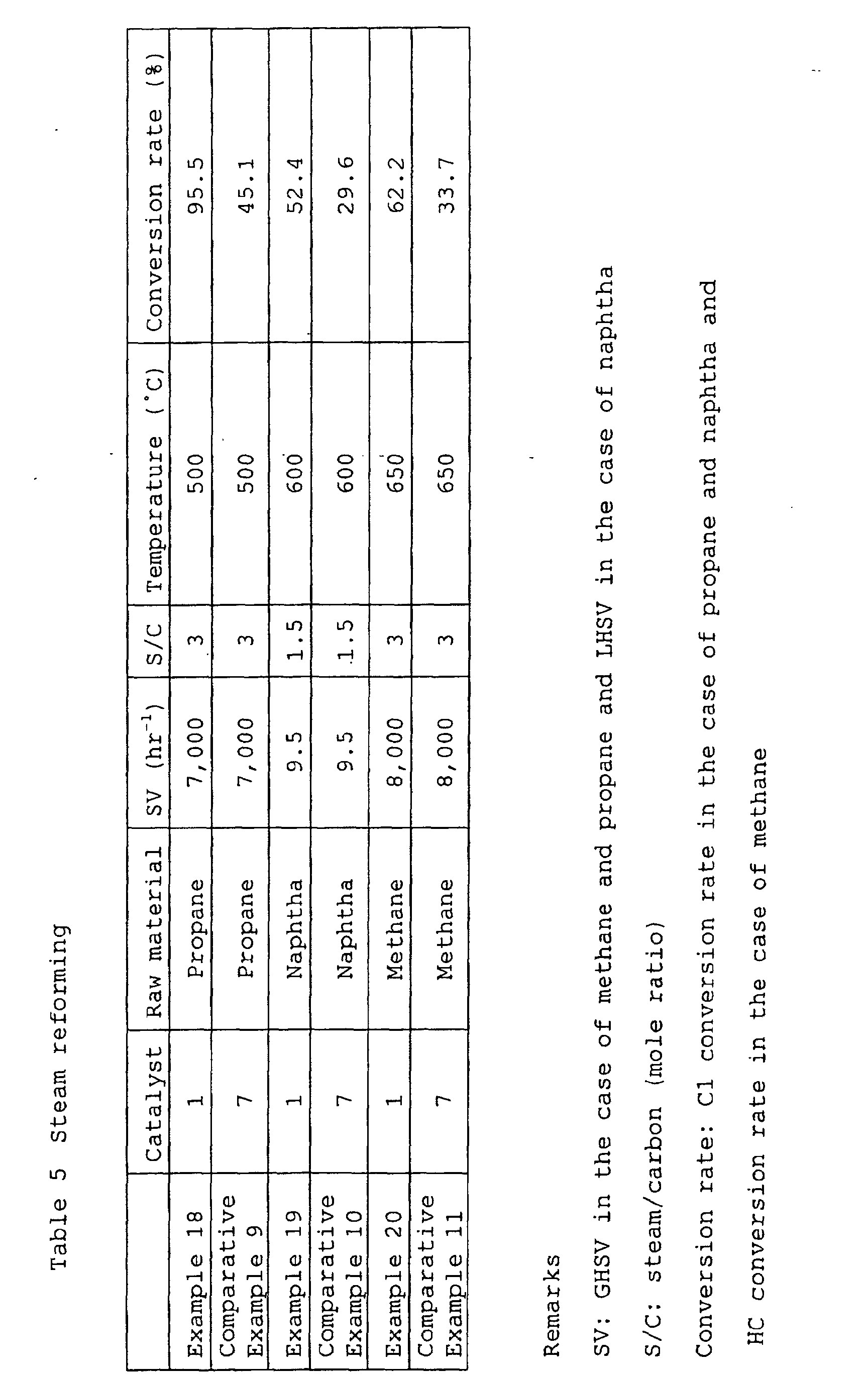
- composition of naphtha used is shown in Table 4.
- Composition of desulfurized naphtha (mass %) Carbon number in molecule Paraffin Naphthene Aromatic Total 5 0.4 0.1 - 0.5 6 12.0 4.3 0.7 17.0 7 34.6 9.6 4.8 49.0 8 13.8 5.2 4.4 23.4 9 7.2 1.8 0.7 9.7 10 or more 0.2 0.1 0.1 0.4 Total 68.2 21.1 10.7 100.0 Sulfur content 20 ppb or less
- SiC 3.5 ml was added to 1.5 ml of the respective catalysts (Catalysts 1 and 7) which were crushed to a diameter of 0.5 to 1 mm, and a quartz reaction tube having an inner diameter of 20 mm was charged with the mixture thereof.
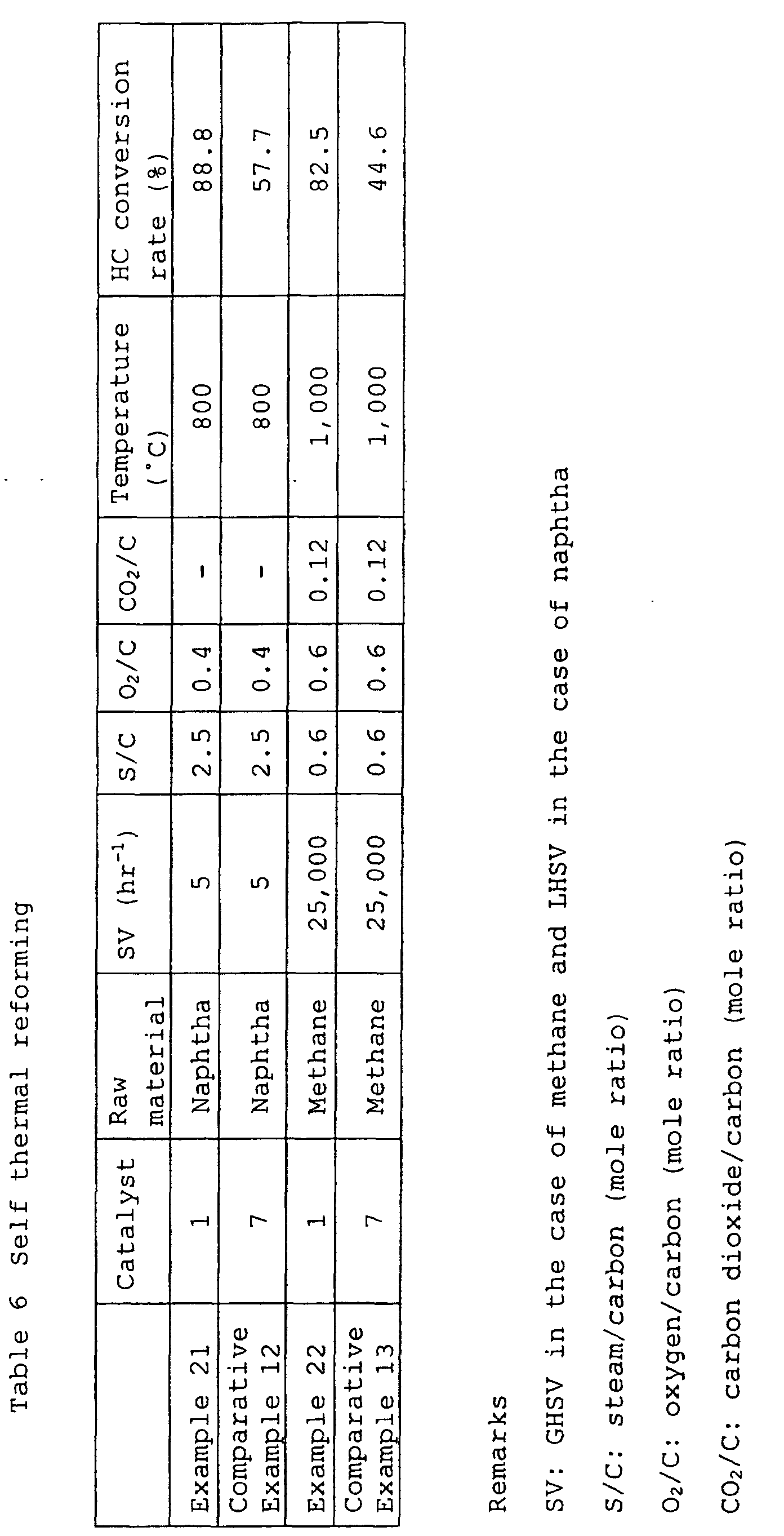
- the catalyst was subjected to hydrogen reduction treatment at 600°C for one hour in hydrogen flow in the reaction tube, and then hydrocarbons shown in Table 6 were used as the raw materials to carry out self thermal reforming reaction at an atmospheric pressure on the conditions shown in Table 6. Gas obtained one hour later was sampled to determine an HC conversion rate in the manner as described above. The results thereof are shown in Table 6.
- SiC 3.5 ml was added to 1.5 ml of the respective catalysts (Catalysts 1 and 7) which were crushed to a diameter of 0.5 to 1 mm, and a quartz reaction tube having an inner diameter of 20 mm was charged with the mixture thereof.
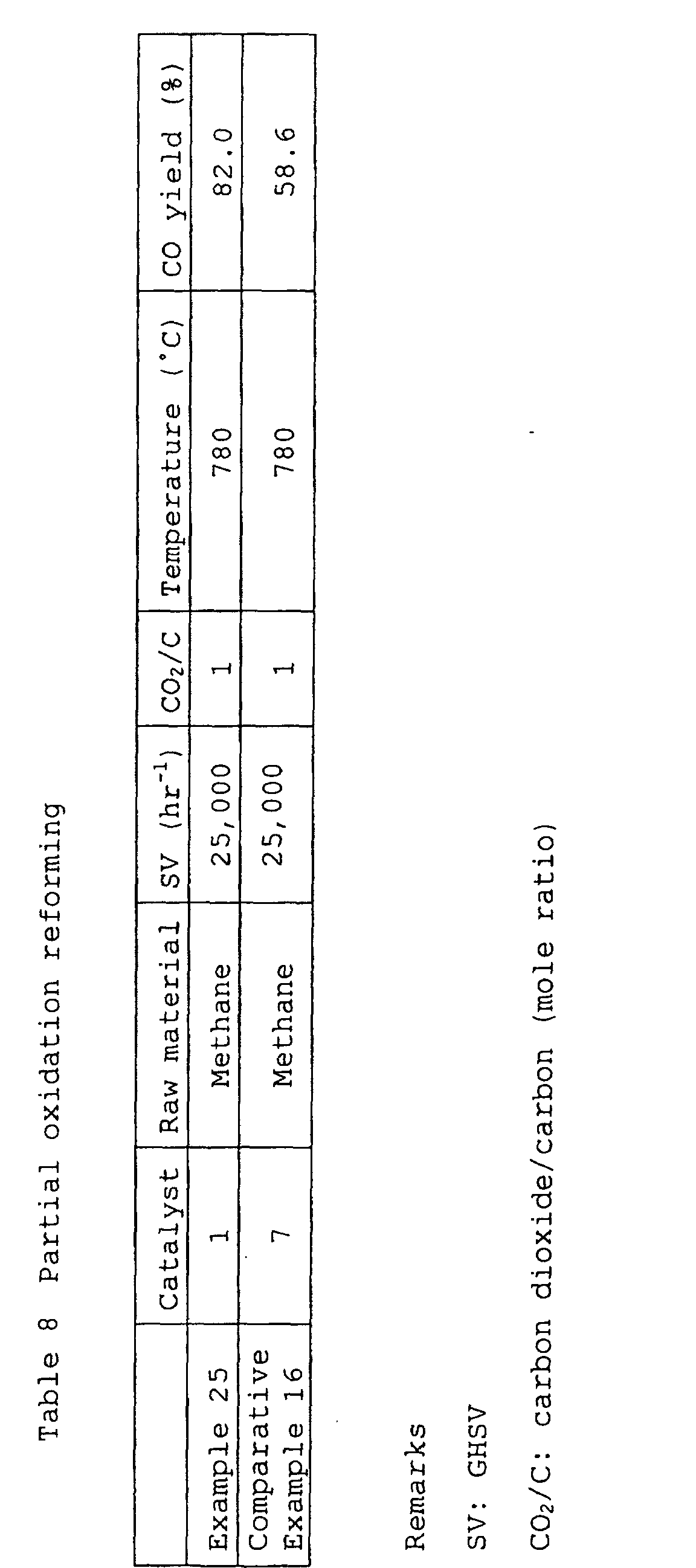
- the catalyst was subjected to hydrogen reduction treatment at 600°C for one hour in hydrogen flow in the reaction tube, and then hydrocarbons shown in Table 7 were used as the raw materials to carry out partial oxidation reforming reaction at an atmospheric pressure on the conditions shown in Table 7. Gas obtained one hour later was sampled to determine a naphtha conversion rate or an HC conversion rate.
- the HC conversion rate was determined in the manner as described above, and the naphtha conversion rate was determined from the following equation. The results thereof are shown in Table 7.
- Naphtha conversion rate (%) ⁇ 1 - (mass of naphtha in the product/mass of raw material naphtha) ⁇ ⁇ 100
- SiC 3.5 ml was added to 1.5 ml of the respective catalysts (Catalysts 26 to 34) which were crushed to a diameter of 0.5 to 1 mm, and a quartz reaction tube having an inner diameter of 20 mm was charged with the mixture thereof.
- the catalyst was subjected to hydrogen reduction treatment at 600°C for one hour in hydrogen flow in the reaction tube, and then the commercial JIS No. 1 kerosene which was desulfurized to a sulfur content of 0.1 ppm or less was used as a raw material hydrocarbon to introduce the JIS No.
- SiC 3.5 ml was added to 1.5 ml of the respective catalysts (Catalysts 35 to 43) which were crushed to a diameter of 0.5 to 1 mm, and a quartz reaction tube having an inner diameter of 20 mm was charged with the mixture thereof.
- the catalyst was not subjected to hydrogen reduction treatment, and the commercial JIS No. 1 kerosene (desulfurized to a sulfur content of 0.1 ppm or less) was used as a raw material hydrocarbon to introduce the JIS No.
- a quartz reaction tube having an inner diameter of 20 mm was charged with 1.5 ml of the respective catalysts (Catalysts 44 to 54, 57 and 58) which remained spherical.
- the catalyst was subjected to hydrogen reduction treatment at 600°C for one hour in hydrogen flow in the reaction tube, and then the commercial JIS No. 1 kerosene which was desulfurized to a sulfur content of 0.1 ppm or less was used as a raw material hydrocarbon to introduce the JIS No.
- SiC 3.5 ml was added to 1.5 ml of the respective catalysts (Catalysts 55 and 56) which were crushed to a diameter of 0.5 to 1 mm, and a quartz reaction tube having an inner diameter of 20 mm was charged with the mixture thereof.
- the catalyst was subjected to hydrogen reduction treatment at 600°C for one hour in hydrogen flow in the reaction tube, and then the commercial JIS No. 1 kerosene which was desulfurized to a sulfur content of 0.1 ppm or less was used as a raw material hydrocarbon to introduce the JIS No.
- the reforming catalyst of the present invention is used to carry out reforming reaction (steam reforming, self thermal reforming, partial oxidation reforming and carbon dioxide reforming) for a hydrocarbon, whereby gas rich in hydrogen and synthetic gas can efficiently be obtained.
- reforming reaction steam reforming, self thermal reforming, partial oxidation reforming and carbon dioxide reforming
Landscapes
- Chemical & Material Sciences (AREA)
- Chemical Kinetics & Catalysis (AREA)
- Organic Chemistry (AREA)
- Engineering & Computer Science (AREA)
- Materials Engineering (AREA)
- General Health & Medical Sciences (AREA)
- Health & Medical Sciences (AREA)
- Combustion & Propulsion (AREA)
- Inorganic Chemistry (AREA)
- Catalysts (AREA)
- Hydrogen, Water And Hydrids (AREA)
- Production Of Liquid Hydrocarbon Mixture For Refining Petroleum (AREA)
- Organic Low-Molecular-Weight Compounds And Preparation Thereof (AREA)
Abstract
Description
Condition: 2 = 4 to 84 deg
Tube current and voltage: 40 kV and 40 mA (CuK α ray) step scanning system
Step width: 0.02 deg
Sampling time: 1 sec
Removing of background: none
| Catalyst composition | Catalyst | ||||||
| 1 | 2 | 3 | 4 | 5 | 6 | 7 | |
| Ru (mass part) | 1 | 1 | 1 | 1 | 1 | 1 | 1 |
| Co (mass part) | - | 1 | - | 1 | - | - | - |
| Mg (mass part) | - | - | 2 | 2 | - | - | - |
| CeO2 (mass %) | - | - | - | - | 10 | - | - |
| ZrO2 (mass %) | - | - | - | - | - | 10 | - |
| MnO2 (mass %) | 10 | 10 | 10 | 10 | - | - | - |
| Al2O3 (mass %) | 90 | 90 | 90 | 90 | 90 | 90 | 100 |
| Catalyst composition | Catalyst | ||||||
| 8 | 9 | 10 | 11 | 12 | 13 | 14 | |
| Ru (mass part) | 0.5 | 3 | 8 | 10 | - | - | - |
| Ni (mass part) | - | - | - | - | 10 | - | - |
| Pd (mass part) | - | - | - | - | - | 3 | - |
| Rh (mass part) | - | - | - | - | - | - | 3 |
| Ir (mass part) | - | - | - | - | - | - | - |
| Pt (mass part) | - | - | - | - | - | - | - |
| MnO2 (mass %) | 10 | 10 | 10 | 10 | 10 | 10 | 10 |
| Al2O3 (mass %) | 90 | 90 | 90 | 90 | 90 | 90 | 90 |
| Catalyst composition | Catalyst | ||||||
| 15 | 16 | 17 | 18 | 19 | 20 | 21 | |
| Ru (mass part) | - | - | - | - | - | - | - |
| Ni (mass part) | - | - | 10 | - | - | - | - |
| Pd (mass part) | - | - | - | 3 | - | - | - |
| Rh (mass part) | - | - | - | - | 3 | - | - |
| Ir (mass part) | 3 | - | - | - | - | 3 | - |
| Pt (mass part) | - | 3 | - | - | - | - | 3 |
| MnO2 (mass %) | 10 | 10 | - | - | - | - | - |
| Al2O3 (mass %) | 90 | 90 | 100 | 100 | 100 | 100 | 100 |
| Catalyst composition | Catalyst | |||||
| 22 | 23 | 24 | 25 | 26 to 34 | 35 to 43 | |
| Ru (mass part) | 3 | 3 | 3 | 3 | 3 | 4 |
| Ni (mass part) | - | - | - | - | - | - |
| Pd (mass part) | - | - | - | - | - | - |
| Rh (mass part) | - | - | - | - | - | - |
| Ir (mass part) | - | - | - | - | - | - |
| Pt (mass part) | - | - | - | - | - | - |
| MnO2 (mass %) | 10 | 20 | 30 | 50 | 6 | 6 |
| Al2O3 (mass %) | 90 | 80 | 70 | 50 | 94 | 94 |
| Catalyst composition | Catalyst | |||
| 44 to 50 | 51 to 54 | 55 to 56 | 57 to 58 | |
| Ru (mass part) | 3 | 3 | 3 | 1 |
| Co (mass part) | - | - | - | 1 |
| Mg (mass part) | - | - | - | 2 |
| MnO2 (mass %) | 6 | 10 | 6 | 10 |
| Al2O3 (mass %) | 94 | 90 | 94 | 90 |
| Steam reforming | |||
| Catalyst | C1 conversion rate (%) | Deposited carbon amount (mass %) | |
| Example 1-1 | 1 | 51.6 | 0.2 |
| Example 1-2 | 1 | 48.1 | 0.2 |
| Example 2 | 2 | 54.8 | 0.2 |
| Example 3 | 3 | 49.6 | 0.1 |
| Example 4 | 4 | 53.4 | 0.1 |
| Comparative Example 1-1 | 5 | 38.1 | 0.4 |
| Comparative Example 1-2 | 5 | 35.4 | 0.4 |
| Comparative Example 2-1 | 6 | 32.1 | 0.5 |
| Comparative Example 2-2 | 6 | 30.8 | 0.5 |
| Comparative Example 3-1 | 7 | 27.6 | 0.9 |
| Comparative Example 3-2 | 7 | 25.9 | 1.0 |
| Steam reforming | ||
| Catalyst | C1 conversion rate (%) | |
| Example 5 | 8 | 37.1 |
| Example 6 | 9 | 76.6 |
| Example 7 | 10 | 80.2 |
| Example 8 | 11 | 80.0 |
| Example 9 | 12 | 44.7 |
| Example 10 | 13 | 34.5 |
| Example 11 | 14 | 41.9 |
| Example 12 | 15 | 38.9 |
| Example 13 | 16 | 41.8 |
| Comparative Example 4 | 17 | 15.4 |
| Comparative Example 5 | 18 | 10.4 |
| Comparative Example 6 | 19 | 13.3 |
| Comparative Example 7 | 20 | 12.5 |
| Comparative Example 8 | 21 | 13.0 |
| Example 14 | 22 | 77.3 |
| Example 15 | 23 | 98.1 |
| Example 16 | 24 | 98.9 |
| Example 17 | 25 | 99.7 |
| Composition of desulfurized naphtha (mass %) | ||||
| Carbon number in molecule | Paraffin | Naphthene | Aromatic | Total |
| 5 | 0.4 | 0.1 | - | 0.5 |
| 6 | 12.0 | 4.3 | 0.7 | 17.0 |
| 7 | 34.6 | 9.6 | 4.8 | 49.0 |
| 8 | 13.8 | 5.2 | 4.4 | 23.4 |
| 9 | 7.2 | 1.8 | 0.7 | 9.7 |
| 10 or more | 0.2 | 0.1 | 0.1 | 0.4 |
| Total | 68.2 | 21.1 | 10.7 | 100.0 |
| | 20 ppb or less |

| Steam reforming | ||
| Catalyst | C1 conversion rate (%) | |
| Example 26 | 26 | 63.0 |
| Example 27 | 27 | 66.5 |
| Example 28 | 28 | 70.0 |
| Example 29 | 29 | 71.4 |
| Example 30 | 30 | 73.0 |
| Example 31 | 31 | 72.2 |
| Example 32 | 32 | 75.9 |
| Example 33 | 33 | 74.0 |
| Example 34 | 34 | 73.5 |
| Steam reforming | ||
| Catalyst | C1 conversion rate (%) | |
| Example 35 | 35 | 66.5 |
| Example 36 | 36 | 67.0 |
| Example 37 | 37 | 73.8 |
| Example 38 | 38 | 74.7 |
| Example 39 | 39 | 74.8 |
| Example 40 | 40 | 76.8 |
| Example 41 | 41 | 78.4 |
| Example 42 | 42 | 77.4 |
| Example 43 | 43 | 74.0 |
| Steam reforming | ||
| Catalyst | C1 conversion rate (%) | |
| Example 44 | 44 | 77.7 |
| Example 45 | 45 | 80.2 |
| Example 46 | 46 | 86.2 |
| Example 47 | 47 | 81.9 |
| Example 48 | 48 | 72.0 |
| Example 49 | 49 | 70.5 |
| Example 50 | 50 | 89.3 |
| Example 51 | 51 | 76.9 |
| Example 52 | 52 | 81.6 |
| Example 53 | 53 | 86.7 |
| Example 54 | 54 | 67.5 |
| Example 55 | 55 | 67.2 |
| Example 56 | 56 | 62.6 |
| Example 57 | 57 | 72.2 |
| Example 58 | 58 | 66.8 |
Claims (20)
- A catalyst for reforming a hydrocarbon comprising a carrier containing manganese oxide and carried thereon (a) at least one component selected from a ruthenium component, a platinum component, a rhodium component, a palladium component, an iridium component and a nickel component.
- The catalyst for reforming a hydrocarbon as described in claim 1, further comprising carried on the carrier, (b) a cobalt component and/or (c) at least one component selected from an alkaline metal component, an alkaline earth metal component and a rare earth metal component.
- The catalyst for reforming a hydrocarbon as described in claim 1 or 2, wherein manganese oxide contained in the carrier has a content of 5 to 95 mass %.
- The catalyst for reforming a hydrocarbon as described in any of claims 1 to 3, wherein the carrier comprises manganese oxide and alumina.
- The catalyst for reforming a hydrocarbon as described in claim 4, wherein a diffraction peak of an α-alumina phase is present in the alumina in X ray diffraction.
- The catalyst for reforming a hydrocarbon as described in any of claims 1 to 5, wherein a carrying amount of at least one component selected from the ruthenium component, the platinum component, the rhodium component, the palladium component and the iridium component is 0.1 to 8 mass parts in terms of metal per 100 mass parts of the carrier.
- The catalyst for reforming hydrocarbon as described in any of claims 1 to 5, wherein a carrying amount of the nickel component is 5 to 70 mass parts in terms of metal per 100 mass parts of the carrier.
- A process for producing a catalyst for reforming a hydrocarbon characterized by adding a manganese compound to alumina calcined at a temperature falling in a range of 850 to 1,200°C to prepare a carrier comprising manganese oxide and alumina and carrying(a) at least one component selected from a ruthenium component, a platinum component, a rhodium component, a palladium component, an iridium component and a nickel component on the carrier.
- A process for producing a catalyst for reforming a hydrocarbon characterized by calcining alumina carried thereon with manganese oxide at a temperature falling in a range of 850 to 1,200°C to prepare an alumina carrier containing manganese oxide and carrying (a) at least one component selected from a ruthenium component, a platinum component, a rhodium component, a palladium component, an iridium component and a nickel component on the carrier.
- A process for producing a catalyst for reforming a hydrocarbon by carrying (a) at least one component selected from a ruthenium component, a platinum component, a rhodium component, a palladium component, an iridium component and a nickel component on a carrier containing manganese oxide, wherein the carrier containing manganese oxide is prepared by dissolving a manganese compound in water in which a dissolving water amount ratio is controlled to a range of 0.7 to 1.3 to prepare an aqueous solution, impregnating the carrier with the aqueous solution and then calcining it.
- The process for producing a catalyst for reforming as described in claim 10, wherein the carrier comprises manganese oxide and alumina.
- A steam reforming process for a hydrocarbon using the catalyst for reforming a hydrocarbon as described in any of claims 1 to 7.
- A self thermal reforming process for a hydrocarbon using the catalyst for reforming a hydrocarbon as described in any of claims 1 to 7.
- A partial oxidation reforming process for a hydrocarbon using the catalyst for reforming a hydrocarbon as described in any of claims 1 to 7.
- A carbon dioxide reforming process for a hydrocarbon using the catalyst for reforming a hydrocarbon as described in any of claims 1 to 7.
- A steam reforming catalyst for a hydrocarbon comprising a carrier containing manganese oxide and carried thereon (a) a ruthenium component.
- The steam reforming catalyst for a hydrocarbon as described in claim 16, further comprising (b) at least one component selected form a cobalt component and a nickel component and/or (c) at least one component selected from an alkaline metal component, an alkaline earth metal component and a rare earth metal component.
- The steam reforming catalyst for a hydrocarbon as described in claim 16 or 17, wherein the carrier comprises manganese oxide and alumina.
- The steam reforming catalyst for a hydrocarbon as described in any of claims 16 to 18, wherein a carrying amount of the ruthenium component is 0.1 to 8 mass parts in terms of metallic ruthenium per 100 mass parts of the carrier.
- A steam reforming process for a hydrocarbon using the steam reforming catalyst for a hydrocarbon as described in any of claims 16 to 19.
Priority Applications (1)
| Application Number | Priority Date | Filing Date | Title |
|---|---|---|---|
| EP07122379A EP1894622B1 (en) | 2001-03-29 | 2002-03-26 | Process for reforming a hydrocarbon |
Applications Claiming Priority (11)
| Application Number | Priority Date | Filing Date | Title |
|---|---|---|---|
| JP2001094813 | 2001-03-29 | ||
| JP2001094813 | 2001-03-29 | ||
| JP2001234349 | 2001-08-02 | ||
| JP2001234349 | 2001-08-02 | ||
| JP2001253995 | 2001-08-24 | ||
| JP2001253995 | 2001-08-24 | ||
| JP2002009876 | 2002-01-18 | ||
| JP2002009876 | 2002-01-18 | ||
| JP2002065076 | 2002-03-11 | ||
| JP2002065076 | 2002-03-11 | ||
| PCT/JP2002/002922 WO2002078840A1 (en) | 2001-03-29 | 2002-03-26 | Catalyst for reforming hydrocarbon and method for preparation thereof, and process for reforming hydrocarbon using said catalyst |
Related Child Applications (1)
| Application Number | Title | Priority Date | Filing Date |
|---|---|---|---|
| EP07122379A Division EP1894622B1 (en) | 2001-03-29 | 2002-03-26 | Process for reforming a hydrocarbon |
Publications (3)
| Publication Number | Publication Date |
|---|---|
| EP1380341A1 true EP1380341A1 (en) | 2004-01-14 |
| EP1380341A4 EP1380341A4 (en) | 2005-10-05 |
| EP1380341B1 EP1380341B1 (en) | 2008-02-06 |
Family
ID=27531857
Family Applications (2)
| Application Number | Title | Priority Date | Filing Date |
|---|---|---|---|
| EP02713196A Expired - Lifetime EP1380341B1 (en) | 2001-03-29 | 2002-03-26 | Catalytic process for reforming hydrocarbon using said catalyst |
| EP07122379A Expired - Lifetime EP1894622B1 (en) | 2001-03-29 | 2002-03-26 | Process for reforming a hydrocarbon |
Family Applications After (1)
| Application Number | Title | Priority Date | Filing Date |
|---|---|---|---|
| EP07122379A Expired - Lifetime EP1894622B1 (en) | 2001-03-29 | 2002-03-26 | Process for reforming a hydrocarbon |
Country Status (9)
| Country | Link |
|---|---|
| US (2) | US7378368B2 (en) |
| EP (2) | EP1380341B1 (en) |
| JP (2) | JP4409833B2 (en) |
| KR (1) | KR100928608B1 (en) |
| CN (1) | CN100496717C (en) |
| AT (2) | ATE385441T1 (en) |
| CA (1) | CA2441761C (en) |
| DE (1) | DE60224925T2 (en) |
| WO (1) | WO2002078840A1 (en) |
Cited By (6)
| Publication number | Priority date | Publication date | Assignee | Title |
|---|---|---|---|---|
| WO2007015620A1 (en) * | 2005-08-04 | 2007-02-08 | Sk Energy Co., Ltd. | Steam reforming ni-based catalyst without pre-reduction treatment |
| EP2206552A3 (en) * | 2002-12-20 | 2011-03-09 | Honda Giken Kogyo Kabushiki Kaisha | Method for the preparation of catalysts for hydrogen generation |
| WO2011018219A3 (en) * | 2009-08-13 | 2011-05-12 | Schott Ag | Thermocatalytically active moulded body, method for the production thereof and use thereof |
| EP2559482A1 (en) * | 2004-02-24 | 2013-02-20 | Japan Oil, Gas and Metals National Corporation | Catalyst and process for producing hydrocarbons |
| WO2014001423A1 (en) | 2012-06-29 | 2014-01-03 | Basf Se | High-pressure process for carbon dioxide reforming of hydrocarbons in the presence of iridium-containing active masses |
| EP2965811A4 (en) * | 2013-03-07 | 2017-01-04 | Osaka Gas Co., Ltd. | Reforming catalyst for hydrocarbon compounds, and production method therefor |
Families Citing this family (36)
| Publication number | Priority date | Publication date | Assignee | Title |
|---|---|---|---|---|
| US7491250B2 (en) * | 2002-06-25 | 2009-02-17 | Exxonmobil Research And Engineering Company | Pressure swing reforming |
| CA2555427C (en) * | 2004-02-19 | 2014-07-29 | Idemitsu Kosan Co., Ltd. | Reforming catalyst for hydrocarbon, method for producing hydrogen using such reforming catalyst, and fuel cell system |
| JP4970719B2 (en) * | 2004-11-22 | 2012-07-11 | 出光興産株式会社 | CO removal catalyst and method for producing the same |
| JP2006286552A (en) * | 2005-04-05 | 2006-10-19 | Idemitsu Kosan Co Ltd | Manufacturing method of fuel gas for medium and low temperature operation type solid oxide fuel cell |
| JP4500943B2 (en) * | 2005-08-24 | 2010-07-14 | 独立行政法人産業技術総合研究所 | Reforming catalyst for hydrogen production and method for producing hydrogen using the same |
| US20070078053A1 (en) * | 2005-09-30 | 2007-04-05 | U.S.A. As Represented By The Administrator Of The National Aeronautics And Space Administration | Catalyst for decomposition of nitrogen oxides |
| KR100898855B1 (en) * | 2006-07-21 | 2009-05-21 | 주식회사 엘지화학 | Micro Channel Reforming Reactor With Heat Exchanger |
| AU2007332615B2 (en) * | 2006-12-12 | 2010-11-11 | Shell Internationale Research Maatschappij B.V. | Process for preparing a catalyst |
| KR100818262B1 (en) * | 2006-12-18 | 2008-04-01 | 삼성에스디아이 주식회사 | Fuel reforming catalyst and hydrogen production method using the same |
| KR101008025B1 (en) * | 2008-12-22 | 2011-01-14 | 삼성에스디아이 주식회사 | Hydrocarbon Reforming Catalyst, Manufacturing Method thereof and Fuel Cell Comprising the Same |
| US8486301B2 (en) * | 2009-04-13 | 2013-07-16 | U.S. Department Of Energy | Method of preparing and utilizing a catalyst system for an oxidation process on a gaseous hydrocarbon stream |
| JP5378148B2 (en) * | 2009-10-22 | 2013-12-25 | Jx日鉱日石エネルギー株式会社 | Reforming catalyst, reformer, and hydrogen production device |
| US9295975B2 (en) * | 2010-06-28 | 2016-03-29 | Kyoto University | Catalysts reforming methane gases into hydrogen and methods for synthesizing the same, and methods for reforming methane gases using said catalysts |
| JP5717993B2 (en) * | 2010-07-12 | 2015-05-13 | 本田技研工業株式会社 | Reforming apparatus and manufacturing method thereof |
| CN101985103B (en) * | 2010-07-26 | 2013-03-27 | 北京大学 | Catalyst for synthesizing methyl formate by selective oxidation of methanol and preparation method thereof |
| US20130071764A1 (en) | 2011-09-15 | 2013-03-21 | John R. Budge | Systems and methods for steam reforming |
| JP5822349B2 (en) * | 2011-12-02 | 2015-11-24 | 公立大学法人首都大学東京 | Oxidation catalyst for organic sulfur compounds |
| KR101511363B1 (en) * | 2012-11-21 | 2015-04-10 | 한국과학기술연구원 | A high-durability metal foam supported catalyst for compositive reforming steam - carbon dioxide and manufacture method thereof |
| TWI451905B (en) | 2013-01-25 | 2014-09-11 | Univ Nat Chiao Tung | Ethanol recombiner catalyst composition and preparation method of ethanol recombiner catalyst |
| CN103638945A (en) * | 2013-11-27 | 2014-03-19 | 上海大学 | La2O3-ZrO2 supported catalyst for dry reforming of coke oven gas and preparation method thereof |
| JP6187282B2 (en) * | 2014-01-23 | 2017-08-30 | 株式会社村田製作所 | Hydrocarbon reforming catalyst |
| US10596551B2 (en) | 2014-08-29 | 2020-03-24 | Reliance Industries Limited | Reforming catalyst and a method of preparation thereof |
| CN104399485B (en) * | 2014-11-03 | 2016-08-24 | 新奥科技发展有限公司 | A kind of methane vapor low-temperature reformate catalyst and preparation method thereof |
| JP6541339B2 (en) * | 2014-12-01 | 2019-07-10 | クラリアント・プロドゥクテ・(ドイチュラント)・ゲゼルシャフト・ミト・ベシュレンクテル・ハフツング | Steam reforming catalyst for hydrocarbon-containing gas, hydrogen production apparatus, and hydrogen production method |
| RU2635111C1 (en) * | 2016-09-16 | 2017-11-09 | Публичное акционерное общество "Нефтяная компания "Роснефть" | Catalyst of oxidating combustible gases, method of its production and method of synthesis of iridium-containing connection-predecessor |
| BR102017021428B1 (en) * | 2017-10-05 | 2022-04-19 | Petróleo Brasileiro S.A. - Petrobras | Process for preparing a pre-reform catalyst |
| EP3831477B1 (en) * | 2018-08-03 | 2023-03-01 | Renaissance Energy Research Corporation | Steam reforming catalyst |
| CN112237917B (en) * | 2019-07-18 | 2023-04-07 | 中国石油化工股份有限公司 | Low-carbon alkane dry reforming catalyst carrier and catalyst thereof |
| WO2021059777A1 (en) * | 2019-09-26 | 2021-04-01 | 株式会社村田製作所 | Organic matter decomposition catalyst, and organic matter decomposition device |
| US11396006B2 (en) * | 2020-01-28 | 2022-07-26 | Saudi Arabian Oil Company | Nickel-containing catalyst composition having enhanced acidity for bi-reforming processes |
| US11498053B2 (en) | 2020-01-28 | 2022-11-15 | Saudi Arabian Oil Company | Nickel-containing catalyst composition having enhanced acidity for dry reforming processes |
| US11478777B2 (en) | 2020-01-28 | 2022-10-25 | Saudi Arabian Oil Company | Catalyst compositions having enhanced acidity for dry reforming processes |
| US11286160B2 (en) | 2020-01-28 | 2022-03-29 | Saudi Arabian Oil Company | Nickel-containing catalyst composition having enhanced acidity for autothermal reforming processes |
| US11338270B2 (en) | 2020-01-28 | 2022-05-24 | Saudi Arabian Oil Company | Catalyst compositions having enhanced acidity for autothermal reforming processes |
| US11365120B2 (en) | 2020-01-28 | 2022-06-21 | Saudi Arabian Oil Company | Nickel-containing catalyst composition having enhanced acidity for steam reforming processes |
| KR102700317B1 (en) * | 2021-11-18 | 2024-08-28 | 희성촉매 주식회사 | A method for preparing a catalyst for steam refomring methane gas containing sulfur and a method for producing hydrogen using a catalyst prepared thereby |
Family Cites Families (61)
| Publication number | Priority date | Publication date | Assignee | Title |
|---|---|---|---|---|
| US3207704A (en) * | 1962-05-01 | 1965-09-21 | Ethyl Corp | Catalyst compositions comprising manganese oxide promoted by titanium, tin or lead on alumina |
| US3494972A (en) * | 1968-05-21 | 1970-02-10 | Dow Chemical Co | Production of 1,5-hexadienes by catalytic oxidative dehydrodimerization of c3-c4 alkenes |
| US3645915A (en) * | 1970-04-20 | 1972-02-29 | Du Pont | Stabilized nickel oxide-nickel chromite reforming catalyst |
| US3701822A (en) * | 1970-06-11 | 1972-10-31 | Chemical Construction Corp | Process and catalyst for treating combustion exhaust gas |
| US3804902A (en) * | 1970-11-21 | 1974-04-16 | Daicel Ltd | Process for producing acetone |
| FR2186290B1 (en) * | 1972-02-23 | 1974-08-02 | Azote & Prod Chim | |
| CA979180A (en) * | 1972-04-12 | 1975-12-09 | Janice L. Stiles | Process for depositing noble metal catalysts |
| DE2303695C3 (en) * | 1973-01-26 | 1980-03-13 | Kali-Chemie Ag, 3000 Hannover | Process for the preparation of a catalyst containing palladium and manganese |
| JPS51104488A (en) * | 1975-03-13 | 1976-09-16 | Toyota Motor Co Ltd | Shokubaitantai oyobi shokubai |
| JPS5252193A (en) * | 1975-10-23 | 1977-04-26 | Toyota Motor Corp | Catalyst for purifying exhaust gas from cars |
| US4207211A (en) * | 1975-12-08 | 1980-06-10 | United Catalysts Inc. | Catalyst for steam reforming of hydrocarbons and process of preparing the catalyst |
| US4200552A (en) * | 1976-10-06 | 1980-04-29 | Toyota Jidosha Kogyo Kabushiki Kaisha | Catalyst carrier, catalyst and their manufacturing process |
| US4402869A (en) * | 1979-03-12 | 1983-09-06 | Exxon Research And Engineering Co. | Group VIII metals on manganese-containing oxide supports which exhibit strong metal support interactions |
| US4206134A (en) * | 1979-03-12 | 1980-06-03 | Exxon Research & Engineering Co. | Ruthenium supported on manganese oxide as hydrocarbon synthesis catalysts in CO/H2 reactions |
| US4238366A (en) * | 1979-06-08 | 1980-12-09 | Uop Inc. | Attenuated superactive multimetallic catalytic composite |
| US4389335A (en) * | 1981-04-14 | 1983-06-21 | United Catalysts Inc. | Catalyst for carbon monoxide conversion in sour gas |
| US4452854A (en) * | 1981-04-14 | 1984-06-05 | United Catalysts, Inc. | Catalyst and process for carbon monoxide conversion in sour gas |
| FR2530489B1 (en) * | 1982-07-26 | 1987-02-27 | Pro Catalyse | PROCESS FOR THE MANUFACTURE OF CATALYSTS FOR THE TREATMENT OF EXHAUST GASES FROM INTERNAL COMBUSTION ENGINES |
| JPS5929633A (en) | 1982-08-12 | 1984-02-16 | Kuraray Co Ltd | Method for recovering acetic acid from aqueous solution of acetate |
| JPH069657B2 (en) | 1984-01-11 | 1994-02-09 | 東京瓦斯株式会社 | Hydrocarbon steam reforming catalyst |
| JPS6161637A (en) * | 1984-09-04 | 1986-03-29 | Mitsubishi Heavy Ind Ltd | Methanol reforming catalyst |
| AU4695985A (en) * | 1984-09-04 | 1986-03-13 | Mitsubishi Jukogyo Kabushiki Kaisha | Process for reforming methanol |
| US4728672A (en) * | 1984-10-08 | 1988-03-01 | Research Association For Petroleum Alternatives Development | Process for producing hydrocarbons |
| US5196390A (en) * | 1987-11-03 | 1993-03-23 | Engelhard Corporation | Hydrogen sulfide-suppressing catalyst system |
| NL8800252A (en) * | 1988-02-02 | 1989-09-01 | Veg Gasinstituut Nv | Carrier catalyst for non-selective oxidation of organic compounds, process for non-selective oxidation of, in particular, organic compounds. |
| US5141912A (en) * | 1989-06-28 | 1992-08-25 | W. R. Grace & Co.-Conn. | Chrome/platinum/palladium catalyst for hydrocarbon emission control |
| US5134109A (en) | 1989-07-07 | 1992-07-28 | Idemitsu Kosan Company Limited | Catalyst for reforming hydrocarbon with steam |
| JPH0640963B2 (en) * | 1989-07-07 | 1994-06-01 | 財団法人石油産業活性化センター | Hydrocarbon steam reforming catalyst |
| JP3226558B2 (en) | 1991-03-12 | 2001-11-05 | 日石三菱株式会社 | Catalyst for high temperature steam reforming of hydrocarbons |
| JPH0691957B2 (en) * | 1991-07-19 | 1994-11-16 | ニチアス株式会社 | Ozone filter and its manufacturing method |
| JPH06509273A (en) * | 1991-07-29 | 1994-10-20 | ビーティージー・インターナショナル・リミテッド | Catalysts and catalytic reduction |
| JPH05168924A (en) | 1991-08-30 | 1993-07-02 | Tonen Corp | Steam reforming catalyst |
| JPH05208133A (en) | 1991-11-28 | 1993-08-20 | Tonen Corp | Steam reforming catalyst |
| TW226970B (en) * | 1991-12-05 | 1994-07-21 | Catalyst co ltd | |
| JPH05221602A (en) * | 1991-12-20 | 1993-08-31 | Idemitsu Kosan Co Ltd | Production of synthesis gas |
| JP3307976B2 (en) | 1992-02-07 | 2002-07-29 | ズードケミー触媒株式会社 | Hydrocarbon steam reforming catalyst |
| JP3260411B2 (en) | 1992-03-17 | 2002-02-25 | ズードケミー触媒株式会社 | Hydrocarbon steam reforming catalyst and method for producing the same |
| JPH0615172A (en) * | 1992-06-30 | 1994-01-25 | Tonen Corp | Steam reforming catalyst and method for producing the same |
| JP3365657B2 (en) | 1993-09-20 | 2003-01-14 | 出光興産株式会社 | Catalyst for steam reforming of hydrocarbons |
| JP3590654B2 (en) | 1994-08-05 | 2004-11-17 | 出光興産株式会社 | Hydrocarbon steam reforming method |
| JP3667801B2 (en) | 1995-01-27 | 2005-07-06 | 出光興産株式会社 | Method for producing ruthenium catalyst and method for steam reforming hydrocarbon using the catalyst |
| JP3813646B2 (en) | 1995-06-29 | 2006-08-23 | 株式会社コスモ総合研究所 | Method for producing steam reforming catalyst and method for producing hydrogen |
| JP3784859B2 (en) | 1995-07-21 | 2006-06-14 | 出光興産株式会社 | Hydrocarbon steam reforming catalyst |
| JPH0929097A (en) | 1995-07-21 | 1997-02-04 | Idemitsu Kosan Co Ltd | Catalyst for steam reforming of hydrocarbons |
| US5906958A (en) * | 1995-10-14 | 1999-05-25 | Samsung Electro-Mechanics Co., Ltd. | Catalyst for purifying automobile exhausts and method of manufacturing the catalyst |
| JP3717219B2 (en) | 1995-12-21 | 2005-11-16 | 株式会社コスモ総合研究所 | Method for producing highly dispersed steam reforming catalyst and method for producing hydrogen |
| JPH09262486A (en) | 1996-03-28 | 1997-10-07 | Japan Organo Co Ltd | Regenerating method of ion exchange resin in desalting device for condensate |
| JP3377676B2 (en) * | 1996-04-05 | 2003-02-17 | ダイハツ工業株式会社 | Exhaust gas purification catalyst |
| JPH1024235A (en) | 1996-07-10 | 1998-01-27 | Cosmo Sogo Kenkyusho:Kk | Catalyst for producing high calorie gas and its production |
| US5888924A (en) * | 1996-08-07 | 1999-03-30 | Goal Line Enviromental Technologies Llc | Pollutant removal from air in closed spaces |
| US5780384A (en) * | 1997-01-03 | 1998-07-14 | Megtec Systems, Inc. | Hydrated manganese dioxide oxidation catalysts and process of producing same |
| US6025403A (en) * | 1997-07-07 | 2000-02-15 | Mobil Oil Corporation | Process for heat integration of an autothermal reformer and cogeneration power plant |
| US6156283A (en) * | 1998-03-23 | 2000-12-05 | Engelhard Corporation | Hydrophobic catalytic materials and method of forming the same |
| DE69927032T2 (en) * | 1998-06-09 | 2006-03-02 | Idemitsu Kosan Co. Ltd. | METHOD FOR AUTOTHERMIC REFORMATION OF A HYDROCARBON INGREDIENT |
| JP2000001303A (en) * | 1998-06-09 | 2000-01-07 | Idemitsu Kosan Co Ltd | Catalyst for reforming hydrocarbons with carbon dioxide and method for reforming hydrocarbons |
| JP2000061307A (en) | 1998-08-17 | 2000-02-29 | Cosmo Sogo Kenkyusho:Kk | Highly dispersed steam reforming catalyst and hydrogen production method |
| AU746882B2 (en) * | 1998-08-20 | 2002-05-02 | Conoco Inc. | Fischer-tropsch processes using xerogel and aerogel catalysts by destabilizing aqueous colloids |
| US20020082164A1 (en) * | 2000-01-14 | 2002-06-27 | Danan Dou | Methods to reduce alkali material migration from NOx adsorber washcoat to cordierite |
| DE10013894A1 (en) * | 2000-03-21 | 2001-10-04 | Dmc2 Degussa Metals Catalysts | Process for the catalytic conversion of carbon monoxide in a hydrogen-containing gas mixture with improved cold start behavior and catalyst therefor |
| JP2002126528A (en) * | 2000-10-18 | 2002-05-08 | Japan National Oil Corp | Method for producing reforming catalyst |
| WO2002038268A1 (en) | 2000-11-08 | 2002-05-16 | Idemitsu Kosan Co., Ltd. | Catalyst for hydrocarbon reforming and method of reforming hydrocarbon with the same |
-
2002
- 2002-03-26 AT AT02713196T patent/ATE385441T1/en not_active IP Right Cessation
- 2002-03-26 DE DE60224925T patent/DE60224925T2/en not_active Expired - Lifetime
- 2002-03-26 US US10/472,899 patent/US7378368B2/en not_active Expired - Fee Related
- 2002-03-26 JP JP2002577095A patent/JP4409833B2/en not_active Expired - Fee Related
- 2002-03-26 CN CNB028076907A patent/CN100496717C/en not_active Expired - Fee Related
- 2002-03-26 WO PCT/JP2002/002922 patent/WO2002078840A1/en not_active Ceased
- 2002-03-26 EP EP02713196A patent/EP1380341B1/en not_active Expired - Lifetime
- 2002-03-26 EP EP07122379A patent/EP1894622B1/en not_active Expired - Lifetime
- 2002-03-26 CA CA2441761A patent/CA2441761C/en not_active Expired - Fee Related
- 2002-03-26 KR KR1020037012569A patent/KR100928608B1/en not_active Expired - Fee Related
- 2002-03-26 AT AT07122379T patent/ATE549082T1/en active
-
2008
- 2008-03-10 JP JP2008060199A patent/JP5080319B2/en not_active Expired - Fee Related
- 2008-04-17 US US12/104,802 patent/US7892417B2/en not_active Expired - Fee Related
Cited By (6)
| Publication number | Priority date | Publication date | Assignee | Title |
|---|---|---|---|---|
| EP2206552A3 (en) * | 2002-12-20 | 2011-03-09 | Honda Giken Kogyo Kabushiki Kaisha | Method for the preparation of catalysts for hydrogen generation |
| EP2559482A1 (en) * | 2004-02-24 | 2013-02-20 | Japan Oil, Gas and Metals National Corporation | Catalyst and process for producing hydrocarbons |
| WO2007015620A1 (en) * | 2005-08-04 | 2007-02-08 | Sk Energy Co., Ltd. | Steam reforming ni-based catalyst without pre-reduction treatment |
| WO2011018219A3 (en) * | 2009-08-13 | 2011-05-12 | Schott Ag | Thermocatalytically active moulded body, method for the production thereof and use thereof |
| WO2014001423A1 (en) | 2012-06-29 | 2014-01-03 | Basf Se | High-pressure process for carbon dioxide reforming of hydrocarbons in the presence of iridium-containing active masses |
| EP2965811A4 (en) * | 2013-03-07 | 2017-01-04 | Osaka Gas Co., Ltd. | Reforming catalyst for hydrocarbon compounds, and production method therefor |
Also Published As
| Publication number | Publication date |
|---|---|
| ATE549082T1 (en) | 2012-03-15 |
| EP1894622A1 (en) | 2008-03-05 |
| WO2002078840A1 (en) | 2002-10-10 |
| US7892417B2 (en) | 2011-02-22 |
| US7378368B2 (en) | 2008-05-27 |
| ATE385441T1 (en) | 2008-02-15 |
| CA2441761C (en) | 2012-07-17 |
| KR20030085062A (en) | 2003-11-01 |
| JP5080319B2 (en) | 2012-11-21 |
| JP2008161873A (en) | 2008-07-17 |
| CA2441761A1 (en) | 2002-10-10 |
| CN1500005A (en) | 2004-05-26 |
| DE60224925D1 (en) | 2008-03-20 |
| JPWO2002078840A1 (en) | 2004-07-22 |
| EP1380341B1 (en) | 2008-02-06 |
| EP1894622B1 (en) | 2012-03-14 |
| EP1380341A4 (en) | 2005-10-05 |
| CN100496717C (en) | 2009-06-10 |
| DE60224925T2 (en) | 2009-01-29 |
| KR100928608B1 (en) | 2009-11-26 |
| JP4409833B2 (en) | 2010-02-03 |
| US20080287727A1 (en) | 2008-11-20 |
| US20050221977A1 (en) | 2005-10-06 |
Similar Documents
| Publication | Publication Date | Title |
|---|---|---|
| US7892417B2 (en) | Catalyst for reforming hydrocarbon and method for preparation thereof, and process for reforming hydrocarbon using said catalyst | |
| US7166268B2 (en) | Catalyst for hydrocarbon reforming and method of reforming hydrocarbon with the same | |
| US8343456B2 (en) | Reforming catalyst for hydrocarbon, method for producing hydrogen using such reforming catalyst, and fuel cell system | |
| US20110105630A1 (en) | Catalytic Support for use in Carbon Dioxide Hydrogenation Reactions | |
| JP2004230312A (en) | Catalyst for hydrocarbon reforming | |
| JP2004344721A (en) | Oxygen-containing hydrocarbon reforming catalyst, method for producing hydrogen or synthesis gas using the same, and fuel cell system | |
| CA2359940A1 (en) | Catalyst carrier carrying nickel ruthenium and lanthanum | |
| JP2009255026A (en) | Method of preparing hydrocarbon reformation catalyst, and method of reforming hydrocarbon | |
| JP4316181B2 (en) | Hydrocarbon reforming catalyst and method for producing the same, and hydrocarbon reforming method using the catalyst | |
| JP4252783B2 (en) | Hydrocarbon reforming catalyst and hydrocarbon reforming method using the same | |
| EP1852181A1 (en) | Reforming catalyst for hydrocarbon, method for producing hydrogen using such reforming catalyst, and fuel cell system | |
| JP2001342004A (en) | Method for steam reforming of hydrocarbons | |
| JP2006043587A (en) | Oxygen-containing hydrocarbon reforming catalyst, oxygen-containing hydrocarbon reforming method using the same, and fuel cell system | |
| JP2006286552A (en) | Manufacturing method of fuel gas for medium and low temperature operation type solid oxide fuel cell |
Legal Events
| Date | Code | Title | Description |
|---|---|---|---|
| PUAI | Public reference made under article 153(3) epc to a published international application that has entered the european phase |
Free format text: ORIGINAL CODE: 0009012 |
|
| 17P | Request for examination filed |
Effective date: 20030829 |
|
| AK | Designated contracting states |
Kind code of ref document: A1 Designated state(s): AT BE CH CY DE DK ES FI FR GB GR IE IT LI LU MC NL PT SE TR |
|
| AX | Request for extension of the european patent |
Extension state: AL LT LV MK RO SI |
|
| A4 | Supplementary search report drawn up and despatched |
Effective date: 20050824 |
|
| RIC1 | Information provided on ipc code assigned before grant |
Ipc: 7B 01J 23/46 B Ipc: 7C 01B 3/40 B Ipc: 7B 01J 23/78 B Ipc: 7B 01J 23/63 B Ipc: 7B 01J 23/40 B Ipc: 7B 01J 23/89 B Ipc: 7B 01J 23/34 A Ipc: 7B 01J 23/58 B Ipc: 7H 01M 8/06 B Ipc: 7B 01J 23/755 B |
|
| GRAP | Despatch of communication of intention to grant a patent |
Free format text: ORIGINAL CODE: EPIDOSNIGR1 |
|
| RTI1 | Title (correction) |
Free format text: CATALYTIC PROCESS FOR REFORMING HYDROCARBON USING SAID CATALYST |
|
| GRAS | Grant fee paid |
Free format text: ORIGINAL CODE: EPIDOSNIGR3 |
|
| GRAA | (expected) grant |
Free format text: ORIGINAL CODE: 0009210 |
|
| AK | Designated contracting states |
Kind code of ref document: B1 Designated state(s): AT BE CH CY DE DK ES FI FR GB GR IE IT LI LU MC NL PT SE TR |
|
| REG | Reference to a national code |
Ref country code: GB Ref legal event code: FG4D |
|
| REG | Reference to a national code |
Ref country code: CH Ref legal event code: EP |
|
| REG | Reference to a national code |
Ref country code: IE Ref legal event code: FG4D |
|
| REF | Corresponds to: |
Ref document number: 60224925 Country of ref document: DE Date of ref document: 20080320 Kind code of ref document: P |
|
| PG25 | Lapsed in a contracting state [announced via postgrant information from national office to epo] |
Ref country code: FI Free format text: LAPSE BECAUSE OF FAILURE TO SUBMIT A TRANSLATION OF THE DESCRIPTION OR TO PAY THE FEE WITHIN THE PRESCRIBED TIME-LIMIT Effective date: 20080206 Ref country code: ES Free format text: LAPSE BECAUSE OF FAILURE TO SUBMIT A TRANSLATION OF THE DESCRIPTION OR TO PAY THE FEE WITHIN THE PRESCRIBED TIME-LIMIT Effective date: 20080517 |
|
| NLV1 | Nl: lapsed or annulled due to failure to fulfill the requirements of art. 29p and 29m of the patents act | ||
| PG25 | Lapsed in a contracting state [announced via postgrant information from national office to epo] |
Ref country code: AT Free format text: LAPSE BECAUSE OF FAILURE TO SUBMIT A TRANSLATION OF THE DESCRIPTION OR TO PAY THE FEE WITHIN THE PRESCRIBED TIME-LIMIT Effective date: 20080206 |
|
| ET | Fr: translation filed | ||
| PG25 | Lapsed in a contracting state [announced via postgrant information from national office to epo] |
Ref country code: BE Free format text: LAPSE BECAUSE OF FAILURE TO SUBMIT A TRANSLATION OF THE DESCRIPTION OR TO PAY THE FEE WITHIN THE PRESCRIBED TIME-LIMIT Effective date: 20080206 |
|
| PG25 | Lapsed in a contracting state [announced via postgrant information from national office to epo] |
Ref country code: DK Free format text: LAPSE BECAUSE OF FAILURE TO SUBMIT A TRANSLATION OF THE DESCRIPTION OR TO PAY THE FEE WITHIN THE PRESCRIBED TIME-LIMIT Effective date: 20080206 Ref country code: MC Free format text: LAPSE BECAUSE OF NON-PAYMENT OF DUE FEES Effective date: 20080331 Ref country code: NL Free format text: LAPSE BECAUSE OF FAILURE TO SUBMIT A TRANSLATION OF THE DESCRIPTION OR TO PAY THE FEE WITHIN THE PRESCRIBED TIME-LIMIT Effective date: 20080206 Ref country code: PT Free format text: LAPSE BECAUSE OF FAILURE TO SUBMIT A TRANSLATION OF THE DESCRIPTION OR TO PAY THE FEE WITHIN THE PRESCRIBED TIME-LIMIT Effective date: 20080707 Ref country code: SE Free format text: LAPSE BECAUSE OF FAILURE TO SUBMIT A TRANSLATION OF THE DESCRIPTION OR TO PAY THE FEE WITHIN THE PRESCRIBED TIME-LIMIT Effective date: 20080506 |
|
| REG | Reference to a national code |
Ref country code: CH Ref legal event code: PL |
|
| PLBE | No opposition filed within time limit |
Free format text: ORIGINAL CODE: 0009261 |
|
| STAA | Information on the status of an ep patent application or granted ep patent |
Free format text: STATUS: NO OPPOSITION FILED WITHIN TIME LIMIT |
|
| 26N | No opposition filed |
Effective date: 20081107 |
|
| PG25 | Lapsed in a contracting state [announced via postgrant information from national office to epo] |
Ref country code: LI Free format text: LAPSE BECAUSE OF NON-PAYMENT OF DUE FEES Effective date: 20080331 Ref country code: IE Free format text: LAPSE BECAUSE OF NON-PAYMENT OF DUE FEES Effective date: 20080326 Ref country code: CH Free format text: LAPSE BECAUSE OF NON-PAYMENT OF DUE FEES Effective date: 20080331 |
|
| PG25 | Lapsed in a contracting state [announced via postgrant information from national office to epo] |
Ref country code: CY Free format text: LAPSE BECAUSE OF FAILURE TO SUBMIT A TRANSLATION OF THE DESCRIPTION OR TO PAY THE FEE WITHIN THE PRESCRIBED TIME-LIMIT Effective date: 20080206 |
|
| PG25 | Lapsed in a contracting state [announced via postgrant information from national office to epo] |
Ref country code: IT Free format text: LAPSE BECAUSE OF FAILURE TO SUBMIT A TRANSLATION OF THE DESCRIPTION OR TO PAY THE FEE WITHIN THE PRESCRIBED TIME-LIMIT Effective date: 20080206 |
|
| PG25 | Lapsed in a contracting state [announced via postgrant information from national office to epo] |
Ref country code: LU Free format text: LAPSE BECAUSE OF NON-PAYMENT OF DUE FEES Effective date: 20080326 |
|
| PG25 | Lapsed in a contracting state [announced via postgrant information from national office to epo] |
Ref country code: TR Free format text: LAPSE BECAUSE OF FAILURE TO SUBMIT A TRANSLATION OF THE DESCRIPTION OR TO PAY THE FEE WITHIN THE PRESCRIBED TIME-LIMIT Effective date: 20080206 |
|
| PG25 | Lapsed in a contracting state [announced via postgrant information from national office to epo] |
Ref country code: GR Free format text: LAPSE BECAUSE OF FAILURE TO SUBMIT A TRANSLATION OF THE DESCRIPTION OR TO PAY THE FEE WITHIN THE PRESCRIBED TIME-LIMIT Effective date: 20080507 |
|
| REG | Reference to a national code |
Ref country code: FR Ref legal event code: PLFP Year of fee payment: 15 |
|
| REG | Reference to a national code |
Ref country code: FR Ref legal event code: PLFP Year of fee payment: 16 |
|
| PGFP | Annual fee paid to national office [announced via postgrant information from national office to epo] |
Ref country code: FR Payment date: 20170213 Year of fee payment: 16 Ref country code: DE Payment date: 20170321 Year of fee payment: 16 |
|
| PGFP | Annual fee paid to national office [announced via postgrant information from national office to epo] |
Ref country code: GB Payment date: 20170322 Year of fee payment: 16 |
|
| REG | Reference to a national code |
Ref country code: DE Ref legal event code: R119 Ref document number: 60224925 Country of ref document: DE |
|
| GBPC | Gb: european patent ceased through non-payment of renewal fee |
Effective date: 20180326 |
|
| PG25 | Lapsed in a contracting state [announced via postgrant information from national office to epo] |
Ref country code: DE Free format text: LAPSE BECAUSE OF NON-PAYMENT OF DUE FEES Effective date: 20181002 |
|
| PG25 | Lapsed in a contracting state [announced via postgrant information from national office to epo] |
Ref country code: GB Free format text: LAPSE BECAUSE OF NON-PAYMENT OF DUE FEES Effective date: 20180326 |
|
| PG25 | Lapsed in a contracting state [announced via postgrant information from national office to epo] |
Ref country code: FR Free format text: LAPSE BECAUSE OF NON-PAYMENT OF DUE FEES Effective date: 20180331 |