EP1371696A1 - Particle composition, recording method, and recording apparatus using the particle composition - Google Patents
Particle composition, recording method, and recording apparatus using the particle composition Download PDFInfo
- Publication number
- EP1371696A1 EP1371696A1 EP03012944A EP03012944A EP1371696A1 EP 1371696 A1 EP1371696 A1 EP 1371696A1 EP 03012944 A EP03012944 A EP 03012944A EP 03012944 A EP03012944 A EP 03012944A EP 1371696 A1 EP1371696 A1 EP 1371696A1
- Authority
- EP
- European Patent Office
- Prior art keywords
- composition
- particles
- aqueous solvent
- amphipathic
- reverse micelle
- Prior art date
- Legal status (The legal status is an assumption and is not a legal conclusion. Google has not performed a legal analysis and makes no representation as to the accuracy of the status listed.)
- Granted
Links
- 239000002245 particle Substances 0.000 title claims abstract description 159
- 239000000203 mixture Substances 0.000 title claims abstract description 101
- 238000000034 method Methods 0.000 title claims abstract description 25
- 229920000642 polymer Polymers 0.000 claims abstract description 107
- 239000006185 dispersion Substances 0.000 claims abstract description 59
- 239000000693 micelle Substances 0.000 claims abstract description 38
- 239000003125 aqueous solvent Substances 0.000 claims abstract description 33
- 239000000049 pigment Substances 0.000 claims description 64
- 239000000463 material Substances 0.000 claims description 30
- OKTJSMMVPCPJKN-UHFFFAOYSA-N Carbon Chemical compound [C] OKTJSMMVPCPJKN-UHFFFAOYSA-N 0.000 claims description 25
- 229910052799 carbon Inorganic materials 0.000 claims description 25
- 239000008204 material by function Substances 0.000 claims description 18
- 238000001962 electrophoresis Methods 0.000 claims description 17
- 239000003960 organic solvent Substances 0.000 claims description 15
- 150000001875 compounds Chemical class 0.000 claims description 14
- 229920001289 polyvinyl ether Polymers 0.000 claims description 13
- 125000000217 alkyl group Chemical group 0.000 claims description 9
- 125000003118 aryl group Chemical group 0.000 claims description 9
- 150000001721 carbon Chemical group 0.000 claims description 9
- 125000004435 hydrogen atom Chemical group [H]* 0.000 claims description 9
- 125000006165 cyclic alkyl group Chemical group 0.000 claims description 6
- 229910052757 nitrogen Inorganic materials 0.000 claims description 6
- 125000004433 nitrogen atom Chemical group N* 0.000 claims description 6
- 125000001997 phenyl group Chemical group [H]C1=C([H])C([H])=C(*)C([H])=C1[H] 0.000 claims description 5
- 125000004076 pyridyl group Chemical group 0.000 claims description 4
- 239000000243 solution Substances 0.000 description 23
- XLYOFNOQVPJJNP-UHFFFAOYSA-N water Substances O XLYOFNOQVPJJNP-UHFFFAOYSA-N 0.000 description 16
- YXFVVABEGXRONW-UHFFFAOYSA-N Toluene Chemical compound CC1=CC=CC=C1 YXFVVABEGXRONW-UHFFFAOYSA-N 0.000 description 15
- 241000557626 Corvus corax Species 0.000 description 14
- 230000015572 biosynthetic process Effects 0.000 description 14
- 238000002296 dynamic light scattering Methods 0.000 description 11
- 239000000975 dye Substances 0.000 description 10
- 238000006116 polymerization reaction Methods 0.000 description 10
- RYGMFSIKBFXOCR-UHFFFAOYSA-N Copper Chemical compound [Cu] RYGMFSIKBFXOCR-UHFFFAOYSA-N 0.000 description 9
- YMWUJEATGCHHMB-UHFFFAOYSA-N Dichloromethane Chemical compound ClCCl YMWUJEATGCHHMB-UHFFFAOYSA-N 0.000 description 9
- OKKJLVBELUTLKV-UHFFFAOYSA-N Methanol Chemical compound OC OKKJLVBELUTLKV-UHFFFAOYSA-N 0.000 description 9
- 229910052802 copper Inorganic materials 0.000 description 9
- 239000010949 copper Substances 0.000 description 9
- 230000005684 electric field Effects 0.000 description 9
- 239000011521 glass Substances 0.000 description 9
- 238000005259 measurement Methods 0.000 description 9
- 239000000126 substance Substances 0.000 description 9
- 239000000758 substrate Substances 0.000 description 8
- 125000001033 ether group Chemical group 0.000 description 7
- 238000003786 synthesis reaction Methods 0.000 description 7
- KYARBIJYVGJZLB-UHFFFAOYSA-N 7-amino-4-hydroxy-2-naphthalenesulfonic acid Chemical compound OC1=CC(S(O)(=O)=O)=CC2=CC(N)=CC=C21 KYARBIJYVGJZLB-UHFFFAOYSA-N 0.000 description 6
- 239000004215 Carbon black (E152) Substances 0.000 description 6
- XEKOWRVHYACXOJ-UHFFFAOYSA-N Ethyl acetate Chemical compound CCOC(C)=O XEKOWRVHYACXOJ-UHFFFAOYSA-N 0.000 description 6
- 238000004458 analytical method Methods 0.000 description 6
- 229930195733 hydrocarbon Natural products 0.000 description 6
- 150000002430 hydrocarbons Chemical class 0.000 description 6
- 239000000178 monomer Substances 0.000 description 6
- 239000002904 solvent Substances 0.000 description 6
- 241000721047 Danaus plexippus Species 0.000 description 5
- VEXZGXHMUGYJMC-UHFFFAOYSA-N Hydrochloric acid Chemical compound Cl VEXZGXHMUGYJMC-UHFFFAOYSA-N 0.000 description 5
- 239000012153 distilled water Substances 0.000 description 5
- QGZKDVFQNNGYKY-UHFFFAOYSA-N Ammonia Chemical compound N QGZKDVFQNNGYKY-UHFFFAOYSA-N 0.000 description 4
- IJGRMHOSHXDMSA-UHFFFAOYSA-N Atomic nitrogen Chemical compound N#N IJGRMHOSHXDMSA-UHFFFAOYSA-N 0.000 description 4
- 239000012298 atmosphere Substances 0.000 description 4
- XCJYREBRNVKWGJ-UHFFFAOYSA-N copper(II) phthalocyanine Chemical compound [Cu+2].C12=CC=CC=C2C(N=C2[N-]C(C3=CC=CC=C32)=N2)=NC1=NC([C]1C=CC=CC1=1)=NC=1N=C1[C]3C=CC=CC3=C2[N-]1 XCJYREBRNVKWGJ-UHFFFAOYSA-N 0.000 description 4
- 229910001873 dinitrogen Inorganic materials 0.000 description 4
- 239000002612 dispersion medium Substances 0.000 description 4
- 230000009975 flexible effect Effects 0.000 description 4
- 230000006870 function Effects 0.000 description 4
- 239000002609 medium Substances 0.000 description 4
- 239000003921 oil Substances 0.000 description 4
- 235000019198 oils Nutrition 0.000 description 4
- 239000012074 organic phase Substances 0.000 description 4
- YUCSAOPCFKZLIW-UHFFFAOYSA-L 2,2-bis(6-methylheptyl)-3-sulfobutanedioate cobalt(2+) Chemical group C(CCCCC(C)C)C(C(C(=O)[O-])S(=O)(=O)O)(C(=O)[O-])CCCCCC(C)C.[Co+2] YUCSAOPCFKZLIW-UHFFFAOYSA-L 0.000 description 3
- ZWEHNKRNPOVVGH-UHFFFAOYSA-N 2-Butanone Chemical compound CCC(C)=O ZWEHNKRNPOVVGH-UHFFFAOYSA-N 0.000 description 3
- CSCPPACGZOOCGX-UHFFFAOYSA-N Acetone Chemical compound CC(C)=O CSCPPACGZOOCGX-UHFFFAOYSA-N 0.000 description 3
- ZMXDDKWLCZADIW-UHFFFAOYSA-N N,N-Dimethylformamide Chemical compound CN(C)C=O ZMXDDKWLCZADIW-UHFFFAOYSA-N 0.000 description 3
- HEMHJVSKTPXQMS-UHFFFAOYSA-M Sodium hydroxide Chemical compound [OH-].[Na+] HEMHJVSKTPXQMS-UHFFFAOYSA-M 0.000 description 3
- QYKIQEUNHZKYBP-UHFFFAOYSA-N Vinyl ether Chemical compound C=COC=C QYKIQEUNHZKYBP-UHFFFAOYSA-N 0.000 description 3
- 235000019241 carbon black Nutrition 0.000 description 3
- 238000007334 copolymerization reaction Methods 0.000 description 3
- 238000011161 development Methods 0.000 description 3
- 238000001914 filtration Methods 0.000 description 3
- 229920000578 graft copolymer Polymers 0.000 description 3
- 230000002209 hydrophobic effect Effects 0.000 description 3
- VLKZOEOYAKHREP-UHFFFAOYSA-N n-Hexane Chemical compound CCCCCC VLKZOEOYAKHREP-UHFFFAOYSA-N 0.000 description 3
- 239000011148 porous material Substances 0.000 description 3
- BQHRKYUXVHKLLZ-UHFFFAOYSA-M sodium 7-amino-2-[[4-[(4-aminophenyl)diazenyl]-2-methoxy-5-methylphenyl]diazenyl]-3-sulfonaphthalen-1-olate Chemical compound [Na+].COc1cc(N=Nc2ccc(N)cc2)c(C)cc1N=Nc1c(O)c2cc(N)ccc2cc1S([O-])(=O)=O BQHRKYUXVHKLLZ-UHFFFAOYSA-M 0.000 description 3
- 229960000834 vinyl ether Drugs 0.000 description 3
- YYQXLHNYOMWHEL-UHFFFAOYSA-N 1-(2-methylpropoxy)ethyl acetate Chemical compound CC(C)COC(C)OC(C)=O YYQXLHNYOMWHEL-UHFFFAOYSA-N 0.000 description 2
- OZCMOJQQLBXBKI-UHFFFAOYSA-N 1-ethenoxy-2-methylpropane Chemical compound CC(C)COC=C OZCMOJQQLBXBKI-UHFFFAOYSA-N 0.000 description 2
- FZCHCVLSDQYAMN-UHFFFAOYSA-N COCCOC=COC=COCCOC Chemical compound COCCOC=COC=COCCOC FZCHCVLSDQYAMN-UHFFFAOYSA-N 0.000 description 2
- HEDRZPFGACZZDS-UHFFFAOYSA-N Chloroform Chemical compound ClC(Cl)Cl HEDRZPFGACZZDS-UHFFFAOYSA-N 0.000 description 2
- IMNFDUFMRHMDMM-UHFFFAOYSA-N N-Heptane Chemical compound CCCCCCC IMNFDUFMRHMDMM-UHFFFAOYSA-N 0.000 description 2
- SJEYSFABYSGQBG-UHFFFAOYSA-M Patent blue Chemical compound [Na+].C1=CC(N(CC)CC)=CC=C1C(C=1C(=CC(=CC=1)S([O-])(=O)=O)S([O-])(=O)=O)=C1C=CC(=[N+](CC)CC)C=C1 SJEYSFABYSGQBG-UHFFFAOYSA-M 0.000 description 2
- 229920002845 Poly(methacrylic acid) Polymers 0.000 description 2
- WQDUMFSSJAZKTM-UHFFFAOYSA-N Sodium methoxide Chemical compound [Na+].[O-]C WQDUMFSSJAZKTM-UHFFFAOYSA-N 0.000 description 2
- 239000004809 Teflon Substances 0.000 description 2
- 229920006362 Teflon® Polymers 0.000 description 2
- 238000002441 X-ray diffraction Methods 0.000 description 2
- 239000000980 acid dye Substances 0.000 description 2
- 229910021529 ammonia Inorganic materials 0.000 description 2
- 239000012736 aqueous medium Substances 0.000 description 2
- 125000006267 biphenyl group Chemical group 0.000 description 2
- 239000006229 carbon black Substances 0.000 description 2
- 239000003054 catalyst Substances 0.000 description 2
- 150000001768 cations Chemical class 0.000 description 2
- 238000006243 chemical reaction Methods 0.000 description 2
- 238000004440 column chromatography Methods 0.000 description 2
- 230000000052 comparative effect Effects 0.000 description 2
- 229920001577 copolymer Polymers 0.000 description 2
- JHIVVAPYMSGYDF-UHFFFAOYSA-N cyclohexanone Chemical compound O=C1CCCCC1 JHIVVAPYMSGYDF-UHFFFAOYSA-N 0.000 description 2
- DIOQZVSQGTUSAI-UHFFFAOYSA-N decane Chemical compound CCCCCCCCCC DIOQZVSQGTUSAI-UHFFFAOYSA-N 0.000 description 2
- 238000010586 diagram Methods 0.000 description 2
- 239000000982 direct dye Substances 0.000 description 2
- 230000000694 effects Effects 0.000 description 2
- 229940093499 ethyl acetate Drugs 0.000 description 2
- MGDOJPNDRJNJBK-UHFFFAOYSA-N ethylaluminum Chemical compound [Al].C[CH2] MGDOJPNDRJNJBK-UHFFFAOYSA-N 0.000 description 2
- 230000009477 glass transition Effects 0.000 description 2
- 230000005484 gravity Effects 0.000 description 2
- 125000001165 hydrophobic group Chemical group 0.000 description 2
- 238000010550 living polymerization reaction Methods 0.000 description 2
- 239000012528 membrane Substances 0.000 description 2
- 238000012986 modification Methods 0.000 description 2
- 230000004048 modification Effects 0.000 description 2
- 230000003287 optical effect Effects 0.000 description 2
- 239000012071 phase Substances 0.000 description 2
- 229940099800 pigment red 48 Drugs 0.000 description 2
- -1 polyoxyethylene Polymers 0.000 description 2
- 238000001556 precipitation Methods 0.000 description 2
- 239000000985 reactive dye Substances 0.000 description 2
- 239000011347 resin Substances 0.000 description 2
- 229920005989 resin Polymers 0.000 description 2
- 238000007873 sieving Methods 0.000 description 2
- 239000011734 sodium Substances 0.000 description 2
- 229910052708 sodium Inorganic materials 0.000 description 2
- 238000003756 stirring Methods 0.000 description 2
- 238000001291 vacuum drying Methods 0.000 description 2
- 229920002554 vinyl polymer Polymers 0.000 description 2
- 239000001052 yellow pigment Substances 0.000 description 2
- GXZPMXGRNUXGHN-UHFFFAOYSA-N 1-ethenoxy-2-methoxyethane Chemical compound COCCOC=C GXZPMXGRNUXGHN-UHFFFAOYSA-N 0.000 description 1
- BSNJMDOYCPYHST-UHFFFAOYSA-N 2-ethenoxyethyl 2-methylprop-2-enoate Chemical compound CC(=C)C(=O)OCCOC=C BSNJMDOYCPYHST-UHFFFAOYSA-N 0.000 description 1
- REEBWSYYNPPSKV-UHFFFAOYSA-N 3-[(4-formylphenoxy)methyl]thiophene-2-carbonitrile Chemical compound C1=CC(C=O)=CC=C1OCC1=C(C#N)SC=C1 REEBWSYYNPPSKV-UHFFFAOYSA-N 0.000 description 1
- NFWJEMDEIBDOHG-UHFFFAOYSA-N 4-ethoxy-1-(4-ethoxybut-1-enoxy)but-1-ene Chemical compound CCOCCC=COC=CCCOCC NFWJEMDEIBDOHG-UHFFFAOYSA-N 0.000 description 1
- AVERNFJXXRIVQN-XSDYUOFFSA-N 5-[(4-ethoxyphenyl)diazenyl]-2-[(e)-2-[4-[(4-ethoxyphenyl)diazenyl]-2-sulfophenyl]ethenyl]benzenesulfonic acid Chemical compound C1=CC(OCC)=CC=C1N=NC(C=C1S(O)(=O)=O)=CC=C1\C=C\C1=CC=C(N=NC=2C=CC(OCC)=CC=2)C=C1S(O)(=O)=O AVERNFJXXRIVQN-XSDYUOFFSA-N 0.000 description 1
- STOOUUMSJPLRNI-UHFFFAOYSA-N 5-amino-4-hydroxy-3-[[4-[4-[(4-hydroxyphenyl)diazenyl]phenyl]phenyl]diazenyl]-6-[(4-nitrophenyl)diazenyl]naphthalene-2,7-disulfonic acid Chemical compound OS(=O)(=O)C1=CC2=CC(S(O)(=O)=O)=C(N=NC=3C=CC(=CC=3)C=3C=CC(=CC=3)N=NC=3C=CC(O)=CC=3)C(O)=C2C(N)=C1N=NC1=CC=C([N+]([O-])=O)C=C1 STOOUUMSJPLRNI-UHFFFAOYSA-N 0.000 description 1
- YCKRFDGAMUMZLT-UHFFFAOYSA-N Fluorine atom Chemical compound [F] YCKRFDGAMUMZLT-UHFFFAOYSA-N 0.000 description 1
- DGAQECJNVWCQMB-PUAWFVPOSA-M Ilexoside XXIX Chemical compound C[C@@H]1CC[C@@]2(CC[C@@]3(C(=CC[C@H]4[C@]3(CC[C@@H]5[C@@]4(CC[C@@H](C5(C)C)OS(=O)(=O)[O-])C)C)[C@@H]2[C@]1(C)O)C)C(=O)O[C@H]6[C@@H]([C@H]([C@@H]([C@H](O6)CO)O)O)O.[Na+] DGAQECJNVWCQMB-PUAWFVPOSA-M 0.000 description 1
- 229920003171 Poly (ethylene oxide) Polymers 0.000 description 1
- 239000004793 Polystyrene Substances 0.000 description 1
- JQYMGXZJTCOARG-UHFFFAOYSA-N Reactive blue 2 Chemical compound C1=2C(=O)C3=CC=CC=C3C(=O)C=2C(N)=C(S(O)(=O)=O)C=C1NC(C=C1S(O)(=O)=O)=CC=C1NC(N=1)=NC(Cl)=NC=1NC1=CC=CC(S(O)(=O)=O)=C1 JQYMGXZJTCOARG-UHFFFAOYSA-N 0.000 description 1
- 229910021627 Tin(IV) chloride Inorganic materials 0.000 description 1
- 238000006959 Williamson synthesis reaction Methods 0.000 description 1
- 235000010724 Wisteria floribunda Nutrition 0.000 description 1
- GRPFBMKYXAYEJM-UHFFFAOYSA-M [4-[(2-chlorophenyl)-[4-(dimethylamino)phenyl]methylidene]cyclohexa-2,5-dien-1-ylidene]-dimethylazanium;chloride Chemical compound [Cl-].C1=CC(N(C)C)=CC=C1C(C=1C(=CC=CC=1)Cl)=C1C=CC(=[N+](C)C)C=C1 GRPFBMKYXAYEJM-UHFFFAOYSA-M 0.000 description 1
- NIXOWILDQLNWCW-UHFFFAOYSA-N acrylic acid group Chemical group C(C=C)(=O)O NIXOWILDQLNWCW-UHFFFAOYSA-N 0.000 description 1
- 238000005904 alkaline hydrolysis reaction Methods 0.000 description 1
- LFZDEAVRTJKYAF-UHFFFAOYSA-L barium(2+) 2-[(2-hydroxynaphthalen-1-yl)diazenyl]naphthalene-1-sulfonate Chemical compound [Ba+2].C1=CC=CC2=C(S([O-])(=O)=O)C(N=NC3=C4C=CC=CC4=CC=C3O)=CC=C21.C1=CC=CC2=C(S([O-])(=O)=O)C(N=NC3=C4C=CC=CC4=CC=C3O)=CC=C21 LFZDEAVRTJKYAF-UHFFFAOYSA-L 0.000 description 1
- VJDDAARZIFHSQY-UHFFFAOYSA-N basic black 2 Chemical compound [Cl-].C=1C2=[N+](C=3C=CC=CC=3)C3=CC(N(CC)CC)=CC=C3N=C2C=CC=1NN=C1C=CC(=O)C=C1 VJDDAARZIFHSQY-UHFFFAOYSA-N 0.000 description 1
- 239000000981 basic dye Substances 0.000 description 1
- 235000015278 beef Nutrition 0.000 description 1
- 239000011230 binding agent Substances 0.000 description 1
- 239000012620 biological material Substances 0.000 description 1
- 239000004305 biphenyl Substances 0.000 description 1
- 235000012709 brilliant black BN Nutrition 0.000 description 1
- 235000012745 brilliant blue FCF Nutrition 0.000 description 1
- 239000004161 brilliant blue FCF Substances 0.000 description 1
- 238000010538 cationic polymerization reaction Methods 0.000 description 1
- 229920002678 cellulose Polymers 0.000 description 1
- 239000001913 cellulose Substances 0.000 description 1
- 230000008859 change Effects 0.000 description 1
- IWWWBRIIGAXLCJ-BGABXYSRSA-N chembl1185241 Chemical compound C1=2C=C(C)C(NCC)=CC=2OC2=C\C(=N/CC)C(C)=CC2=C1C1=CC=CC=C1C(=O)OCC IWWWBRIIGAXLCJ-BGABXYSRSA-N 0.000 description 1
- PZTQVMXMKVTIRC-UHFFFAOYSA-L chembl2028348 Chemical compound [Ca+2].[O-]S(=O)(=O)C1=CC(C)=CC=C1N=NC1=C(O)C(C([O-])=O)=CC2=CC=CC=C12 PZTQVMXMKVTIRC-UHFFFAOYSA-L 0.000 description 1
- 239000003795 chemical substances by application Substances 0.000 description 1
- 239000011362 coarse particle Substances 0.000 description 1
- 239000011247 coating layer Substances 0.000 description 1
- 239000003086 colorant Substances 0.000 description 1
- 238000009833 condensation Methods 0.000 description 1
- 230000005494 condensation Effects 0.000 description 1
- 238000012790 confirmation Methods 0.000 description 1
- HZBTZQVWJPRVDN-UHFFFAOYSA-J copper;disodium;5-[[4-[4-[[2,6-dioxido-3-[(2-oxido-5-sulfonatophenyl)diazenyl]phenyl]diazenyl]phenyl]phenyl]diazenyl]-2-oxidobenzoate;hydron Chemical compound [H+].[H+].[Na+].[Na+].[Cu+2].C1=C([O-])C(C(=O)[O-])=CC(N=NC=2C=CC(=CC=2)C=2C=CC(=CC=2)N=NC=2C(=C(N=NC=3C(=CC=C(C=3)S([O-])(=O)=O)[O-])C=CC=2[O-])[O-])=C1 HZBTZQVWJPRVDN-UHFFFAOYSA-J 0.000 description 1
- 238000000354 decomposition reaction Methods 0.000 description 1
- 238000000502 dialysis Methods 0.000 description 1
- YNLAOSYQHBDIKW-UHFFFAOYSA-M diethylaluminium chloride Chemical compound CC[Al](Cl)CC YNLAOSYQHBDIKW-UHFFFAOYSA-M 0.000 description 1
- VPWFPZBFBFHIIL-UHFFFAOYSA-L disodium 4-[(4-methyl-2-sulfophenyl)diazenyl]-3-oxidonaphthalene-2-carboxylate Chemical compound [Na+].[Na+].[O-]S(=O)(=O)C1=CC(C)=CC=C1N=NC1=C(O)C(C([O-])=O)=CC2=CC=CC=C12 VPWFPZBFBFHIIL-UHFFFAOYSA-L 0.000 description 1
- YCMOBGSVZYLYBZ-UHFFFAOYSA-L disodium 5-[[4-[4-[(2-amino-8-hydroxy-6-sulfonatonaphthalen-1-yl)diazenyl]phenyl]phenyl]diazenyl]-2-hydroxybenzoate Chemical compound NC1=CC=C2C=C(C=C(O)C2=C1N=NC1=CC=C(C=C1)C1=CC=C(C=C1)N=NC1=CC=C(O)C(=C1)C(=O)O[Na])S(=O)(=O)O[Na] YCMOBGSVZYLYBZ-UHFFFAOYSA-L 0.000 description 1
- 239000003814 drug Substances 0.000 description 1
- RDYMFSUJUZBWLH-UHFFFAOYSA-N endosulfan Chemical compound C12COS(=O)OCC2C2(Cl)C(Cl)=C(Cl)C1(Cl)C2(Cl)Cl RDYMFSUJUZBWLH-UHFFFAOYSA-N 0.000 description 1
- UAIZDWNSWGTKFZ-UHFFFAOYSA-L ethylaluminum(2+);dichloride Chemical compound CC[Al](Cl)Cl UAIZDWNSWGTKFZ-UHFFFAOYSA-L 0.000 description 1
- 230000001747 exhibiting effect Effects 0.000 description 1
- 235000019233 fast yellow AB Nutrition 0.000 description 1
- 239000003925 fat Substances 0.000 description 1
- 239000012530 fluid Substances 0.000 description 1
- 239000011737 fluorine Substances 0.000 description 1
- 229910052731 fluorine Inorganic materials 0.000 description 1
- 239000000989 food dye Substances 0.000 description 1
- 125000000524 functional group Chemical group 0.000 description 1
- 239000004009 herbicide Substances 0.000 description 1
- FUZZWVXGSFPDMH-UHFFFAOYSA-N hexanoic acid Chemical compound CCCCCC(O)=O FUZZWVXGSFPDMH-UHFFFAOYSA-N 0.000 description 1
- NUKZAGXMHTUAFE-UHFFFAOYSA-N hexanoic acid methyl ester Natural products CCCCCC(=O)OC NUKZAGXMHTUAFE-UHFFFAOYSA-N 0.000 description 1
- 229920001519 homopolymer Polymers 0.000 description 1
- 235000019239 indanthrene blue RS Nutrition 0.000 description 1
- 239000001023 inorganic pigment Substances 0.000 description 1
- 239000002917 insecticide Substances 0.000 description 1
- 230000003993 interaction Effects 0.000 description 1
- 239000007788 liquid Substances 0.000 description 1
- 235000010187 litholrubine BK Nutrition 0.000 description 1
- 239000002932 luster Substances 0.000 description 1
- 230000007246 mechanism Effects 0.000 description 1
- 239000002184 metal Substances 0.000 description 1
- 229910052751 metal Inorganic materials 0.000 description 1
- 125000005395 methacrylic acid group Chemical group 0.000 description 1
- 239000011259 mixed solution Substances 0.000 description 1
- 238000012544 monitoring process Methods 0.000 description 1
- JQZWHMOVSQRYRN-UHFFFAOYSA-M n-(2-chloroethyl)-n-ethyl-3-methyl-4-[2-(1,3,3-trimethylindol-1-ium-2-yl)ethenyl]aniline;chloride Chemical compound [Cl-].CC1=CC(N(CCCl)CC)=CC=C1C=CC1=[N+](C)C2=CC=CC=C2C1(C)C JQZWHMOVSQRYRN-UHFFFAOYSA-M 0.000 description 1
- TVMXDCGIABBOFY-UHFFFAOYSA-N octane Chemical compound CCCCCCCC TVMXDCGIABBOFY-UHFFFAOYSA-N 0.000 description 1
- 239000004006 olive oil Substances 0.000 description 1
- 235000008390 olive oil Nutrition 0.000 description 1
- 239000012860 organic pigment Substances 0.000 description 1
- 239000003973 paint Substances 0.000 description 1
- IEQIEDJGQAUEQZ-UHFFFAOYSA-N phthalocyanine Chemical compound N1C(N=C2C3=CC=CC=C3C(N=C3C4=CC=CC=C4C(=N4)N3)=N2)=C(C=CC=C2)C2=C1N=C1C2=CC=CC=C2C4=N1 IEQIEDJGQAUEQZ-UHFFFAOYSA-N 0.000 description 1
- 229940110337 pigment blue 1 Drugs 0.000 description 1
- 229940104573 pigment red 5 Drugs 0.000 description 1
- 229920002285 poly(styrene-co-acrylonitrile) Polymers 0.000 description 1
- 229920000728 polyester Polymers 0.000 description 1
- 229920002223 polystyrene Polymers 0.000 description 1
- IZMJMCDDWKSTTK-UHFFFAOYSA-N quinoline yellow Chemical compound C1=CC=CC2=NC(C3C(C4=CC=CC=C4C3=O)=O)=CC=C21 IZMJMCDDWKSTTK-UHFFFAOYSA-N 0.000 description 1
- 239000011541 reaction mixture Substances 0.000 description 1
- 235000012739 red 2G Nutrition 0.000 description 1
- 238000010992 reflux Methods 0.000 description 1
- 238000011160 research Methods 0.000 description 1
- 238000004062 sedimentation Methods 0.000 description 1
- 229920002545 silicone oil Polymers 0.000 description 1
- 239000000344 soap Substances 0.000 description 1
- QDRKDTQENPPHOJ-UHFFFAOYSA-N sodium ethoxide Chemical compound [Na+].CC[O-] QDRKDTQENPPHOJ-UHFFFAOYSA-N 0.000 description 1
- 239000007787 solid Substances 0.000 description 1
- 239000003549 soybean oil Substances 0.000 description 1
- 235000012424 soybean oil Nutrition 0.000 description 1
- 230000003068 static effect Effects 0.000 description 1
- 238000001308 synthesis method Methods 0.000 description 1
- 239000003760 tallow Substances 0.000 description 1
- DPKBAXPHAYBPRL-UHFFFAOYSA-M tetrabutylazanium;iodide Chemical compound [I-].CCCC[N+](CCCC)(CCCC)CCCC DPKBAXPHAYBPRL-UHFFFAOYSA-M 0.000 description 1
- GMMAPXRGRVJYJY-UHFFFAOYSA-J tetrasodium 4-acetamido-5-hydroxy-6-[[7-sulfonato-4-[(4-sulfonatophenyl)diazenyl]naphthalen-1-yl]diazenyl]naphthalene-1,7-disulfonate Chemical compound [Na+].[Na+].[Na+].[Na+].OC1=C2C(NC(=O)C)=CC=C(S([O-])(=O)=O)C2=CC(S([O-])(=O)=O)=C1N=NC(C1=CC(=CC=C11)S([O-])(=O)=O)=CC=C1N=NC1=CC=C(S([O-])(=O)=O)C=C1 GMMAPXRGRVJYJY-UHFFFAOYSA-J 0.000 description 1
- MPCYPRXRVWZKGF-UHFFFAOYSA-J tetrasodium 5-amino-3-[[4-[4-[(8-amino-1-hydroxy-3,6-disulfonatonaphthalen-2-yl)diazenyl]phenyl]phenyl]diazenyl]-4-hydroxynaphthalene-2,7-disulfonate Chemical compound [Na+].[Na+].[Na+].[Na+].C1=C(S([O-])(=O)=O)C=C2C=C(S([O-])(=O)=O)C(N=NC3=CC=C(C=C3)C3=CC=C(C=C3)N=NC3=C(C=C4C=C(C=C(C4=C3O)N)S([O-])(=O)=O)S([O-])(=O)=O)=C(O)C2=C1N MPCYPRXRVWZKGF-UHFFFAOYSA-J 0.000 description 1
- JAHOBQDOBYFPTP-UHFFFAOYSA-J tetrasodium;5-[[4-[[4-[(4-amino-6-chloro-1,3,5-triazin-2-yl)amino]-7-sulfonatonaphthalen-1-yl]diazenyl]-2,5-dimethylphenyl]diazenyl]naphthalene-1,3,6-trisulfonate Chemical compound [Na+].[Na+].[Na+].[Na+].CC1=CC(N=NC=2C3=CC(=CC(=C3C=CC=2S([O-])(=O)=O)S([O-])(=O)=O)S([O-])(=O)=O)=C(C)C=C1N=NC(C1=CC(=CC=C11)S([O-])(=O)=O)=CC=C1NC1=NC(N)=NC(Cl)=N1 JAHOBQDOBYFPTP-UHFFFAOYSA-J 0.000 description 1
- HPGGPRDJHPYFRM-UHFFFAOYSA-J tin(iv) chloride Chemical compound Cl[Sn](Cl)(Cl)Cl HPGGPRDJHPYFRM-UHFFFAOYSA-J 0.000 description 1
- 238000012546 transfer Methods 0.000 description 1
- VRVDFJOCCWSFLI-UHFFFAOYSA-K trisodium 3-[[4-[(6-anilino-1-hydroxy-3-sulfonatonaphthalen-2-yl)diazenyl]-5-methoxy-2-methylphenyl]diazenyl]naphthalene-1,5-disulfonate Chemical compound [Na+].[Na+].[Na+].COc1cc(N=Nc2cc(c3cccc(c3c2)S([O-])(=O)=O)S([O-])(=O)=O)c(C)cc1N=Nc1c(O)c2ccc(Nc3ccccc3)cc2cc1S([O-])(=O)=O VRVDFJOCCWSFLI-UHFFFAOYSA-K 0.000 description 1
- WDWBPYFNRWQKNZ-UHFFFAOYSA-K trisodium 5-[(4-anilino-6-chloro-1,3,5-triazin-2-yl)amino]-4-hydroxy-3-[(2-sulfonatophenyl)diazenyl]naphthalene-2,7-disulfonate Chemical compound [Na+].[Na+].[Na+].[O-]S(=O)(=O)C1=CC2=CC(S([O-])(=O)=O)=CC(NC=3N=C(NC=4C=CC=CC=4)N=C(Cl)N=3)=C2C(O)=C1N=NC1=CC=CC=C1S([O-])(=O)=O WDWBPYFNRWQKNZ-UHFFFAOYSA-K 0.000 description 1
- MBAYVHBJJXOOIY-UHFFFAOYSA-K trisodium 7-[[4-chloro-6-(3-sulfonatoanilino)-1,3,5-triazin-2-yl]-methylamino]-4-hydroxy-3-[(2-sulfonatophenyl)diazenyl]naphthalene-2-sulfonate Chemical compound [Na+].[Na+].[Na+].CN(c1ccc2c(O)c(N=Nc3ccccc3S([O-])(=O)=O)c(cc2c1)S([O-])(=O)=O)c1nc(Cl)nc(Nc2cccc(c2)S([O-])(=O)=O)n1 MBAYVHBJJXOOIY-UHFFFAOYSA-K 0.000 description 1
Images
Classifications
-
- C—CHEMISTRY; METALLURGY
- C08—ORGANIC MACROMOLECULAR COMPOUNDS; THEIR PREPARATION OR CHEMICAL WORKING-UP; COMPOSITIONS BASED THEREON
- C08L—COMPOSITIONS OF MACROMOLECULAR COMPOUNDS
- C08L53/00—Compositions of block copolymers containing at least one sequence of a polymer obtained by reactions only involving carbon-to-carbon unsaturated bonds; Compositions of derivatives of such polymers
-
- C—CHEMISTRY; METALLURGY
- C08—ORGANIC MACROMOLECULAR COMPOUNDS; THEIR PREPARATION OR CHEMICAL WORKING-UP; COMPOSITIONS BASED THEREON
- C08F—MACROMOLECULAR COMPOUNDS OBTAINED BY REACTIONS ONLY INVOLVING CARBON-TO-CARBON UNSATURATED BONDS
- C08F293/00—Macromolecular compounds obtained by polymerisation on to a macromolecule having groups capable of inducing the formation of new polymer chains bound exclusively at one or both ends of the starting macromolecule
- C08F293/005—Macromolecular compounds obtained by polymerisation on to a macromolecule having groups capable of inducing the formation of new polymer chains bound exclusively at one or both ends of the starting macromolecule using free radical "living" or "controlled" polymerisation, e.g. using a complexing agent
-
- C—CHEMISTRY; METALLURGY
- C08—ORGANIC MACROMOLECULAR COMPOUNDS; THEIR PREPARATION OR CHEMICAL WORKING-UP; COMPOSITIONS BASED THEREON
- C08F—MACROMOLECULAR COMPOUNDS OBTAINED BY REACTIONS ONLY INVOLVING CARBON-TO-CARBON UNSATURATED BONDS
- C08F297/00—Macromolecular compounds obtained by successively polymerising different monomer systems using a catalyst of the ionic or coordination type without deactivating the intermediate polymer
-
- C—CHEMISTRY; METALLURGY
- C09—DYES; PAINTS; POLISHES; NATURAL RESINS; ADHESIVES; COMPOSITIONS NOT OTHERWISE PROVIDED FOR; APPLICATIONS OF MATERIALS NOT OTHERWISE PROVIDED FOR
- C09D—COATING COMPOSITIONS, e.g. PAINTS, VARNISHES OR LACQUERS; FILLING PASTES; CHEMICAL PAINT OR INK REMOVERS; INKS; CORRECTING FLUIDS; WOODSTAINS; PASTES OR SOLIDS FOR COLOURING OR PRINTING; USE OF MATERIALS THEREFOR
- C09D11/00—Inks
- C09D11/30—Inkjet printing inks
-
- C—CHEMISTRY; METALLURGY
- C09—DYES; PAINTS; POLISHES; NATURAL RESINS; ADHESIVES; COMPOSITIONS NOT OTHERWISE PROVIDED FOR; APPLICATIONS OF MATERIALS NOT OTHERWISE PROVIDED FOR
- C09D—COATING COMPOSITIONS, e.g. PAINTS, VARNISHES OR LACQUERS; FILLING PASTES; CHEMICAL PAINT OR INK REMOVERS; INKS; CORRECTING FLUIDS; WOODSTAINS; PASTES OR SOLIDS FOR COLOURING OR PRINTING; USE OF MATERIALS THEREFOR
- C09D153/00—Coating compositions based on block copolymers containing at least one sequence of a polymer obtained by reactions only involving carbon-to-carbon unsaturated bonds; Coating compositions based on derivatives of such polymers
Definitions
- the present invention relates to a particle composition, a recording method, and a recording apparatus employing the particle composition.
- the present invention relates to particles, which exhibit electrophoresis, employed in ink or toner used for a printer or the like, or a display element or the like.
- Electrophotographic devices, electrophoretic displays, and so forth, have been known as image formation devices employing electrophoretic particles. Most of these devices operate with a mechanism wherein charged color material particles exhibit electrophoresis under a static electric field, whereby a pixel is manifested. In recent years, development of high resolution and high-speed digital printing devices using the wet electrophotography is actively being undertaken. Also, in the field of displays, use of electrophoretic particles is being undertaken for on-demand reflection displays with low power consumption, which require no backlight and have the nature of memory for display. These particles readily exhibit excellent driving properties and developing properties generally using a non-aqueous medium, specifically, by dispersing the particles in a non-aqueous medium, typically, an organic solvent, rather than water or an aqueous solvent. In the present situation described above, development of the electrophoretic particles is undertaken for image formation devices with high resolution from various points of view (Japanese Patent Laid-Open No. 5-273792), and development of the electrophoretic particles having more excellent properties is expected.
- a composition comprises a non-aqueous solvent containing reverse micelle particles formed of block polymers having amphipathic properties.
- the amphipathic block polymer may be a block polymer having three or more block segments, and may be a high molecular compound having a repeated unit structure of polyvinyl ether.
- the composition may contain functional materials, and the materials may be contained in the reverse micelle particles.
- the block polymer may have a repeated unit structure represented by wherein R 1 is selected from the straight-chain, branched or cyclic alkyl group with a straight chain with a carbon number between one and eighteen, -Ph, -Pyr, -Ph-Ph, -Ph-Pyr, -(CH(R 5 )-CH(R 6 )-O) p -R 7 , and -(CH 2 ) m -(O) n -R 7 , and wherein the hydrogen atom of the aromatic ring may be substituted for a straight-chain or branched alkyl group with a carbon number between one and four, and wherein the carbon atom of the aromatic ring may be substituted for a nitrogen atom; and wherein p denotes an integer between 1 and 18, m denotes an integer between 1 and 36, and n is 0 or 1; and wherein R 5 and R 6 are independently selected from -H or -CH 3 ; and wherein
- the average particle diameter of the reverse micelle particles may be equal to or less than 200 nm, and the particle distribution (dispersion index ⁇ /G 2 ) thereof equal to or less than 0.2.
- the non-aqueous solvent may be an organic solvent, and the functional material may be a color material.
- a recording method recording on a medium is performed using a composition in which a non-aqueous solvent contains reverse micelle particles formed of block polymers having amphipathic properties.
- a recording apparatus performs recording using a composition in which a non-aqueous solvent contains reverse micelle particles formed of block polymers having amphipathic properties.
- an ink composition contains a composition wherein a non-aqueous solvent contains reverse micelle particles formed of block polymers having amphipathic properties.
- particles, which exhibit electrophoresis contain a composition wherein a non-aqueous solvent contains reverse micelle particles formed of block polymers having amphipathic properties.
- a wet toner employs particles, which exhibit electrophoresis, containing a composition wherein a non-aqueous solvent contains reverse micelle particles formed of block polymers having amphipathic properties.
- a display element employs particles, which exhibit electrophoresis, containing a composition wherein a non-aqueous solvent contains reverse micelle particles formed of block polymers having amphipathic properties.
- particles wherein a non-aqueous solvent contains compounds having amphipathic block polymers, and pigments are dispersed in a composition.
- a recording method uses a composition in which are dispersed particles wherein a non-aqueous solvent contains compounds having amphipathic block polymers and pigments.
- a recording apparatus uses a composition in which are dispersed particles wherein a non-aqueous solvent contains compounds having amphipathic block polymers and pigments.
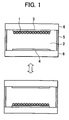
- Fig. 1 is a schematic diagram which illustrates an example of electrophoretic elements using electrophoretic particles according to the present invention.
- a first example of the present invention relates to a reverse-micelle-particle-containing composition wherein a non-aqueous solvent contains reverse micelle particles formed of block polymers having amphipathic properties.
- a second example of the present invention relates to a composition wherein reverse micelle particles formed of block polymers with the amphipathic properties are dispersed in a non-aqueous solvent, and an ink composition having the feature of containing the aforementioned composition with an average diameter of the reverse micelle particle of 200 nm or less, and particle diameter distribution (dispersion index ⁇ /G 2 ) of 0.2 or less.
- the composition of the present invention is a composition contained in a non-aqueous solvent.
- non-aqueous solvents include organic solvents, resin, and the like.
- organic solvent a hydrocarbon solvent such as hexane, heptane, octane, decane, toluene, ISOPER (phonetic spelling, the same hereafter), or the like, or a solvent such as cyclohexanone, acetone, methyl ethyl ketone, butyl acetate, or the like, can be used.
- natural fats and oils such as olive oil, soybean oil, beef tallow, lard, or the like, can be employed.
- silicone oil, fluorine oil can be used.
- binder resin include styrene-acrylonitrile copolymer, polyester, and the like.
- the content of non-aqueous solvent used for the composition of the present invention is in the range between 1% by mass and 99.8% by mass.
- the content is preferably in the range between 5% by mass and 99.5% by mass.
- the content is more preferably in the range between 10% by mass and 99% by mass. In the event that the content is less than 1% by mass, the dispersion of the particles could be insufficient, and in the event that the content is greater than 99.8% by mass, the effect of dispersion could be insufficient.
- block polymer with the amphipathic properties which is a further feature according to the present invention.
- block polymers which can be used for the present invention conventionally-known block polymers such as acrylic or methacrylic block polymers, block polymers formed of polystyrene and blocks of other addition-polymerized or polycondensed block polymers, block polymers having blocks of polyoxyethylene and polyoxyalkylene, or the like, can be used.
- a block polymer containing a structure of polyvinyl-ether is preferably employed.
- a block polymer may be a graft polymer containing a polyvinyl ether structure, and a certain segment of the block polymer may be a copolymerization segment, and the form of the copolymerization is not restricted, rather, random segments or graduation segments may be employed, for example.
- polymer synthesis is performed with the cation living polymerization, whereby a homopolymer or a copolymer formed of two or more kinds of monomers, and furthermore, various polymers such as a block polymer, graft polymer, graduation polymer, and the like, can be synthesized with the length (molecular weight) being precisely adjusted. Furthermore, with this polyvinyl ether, various functional groups can be introduced to the side chains thereof.
- the cation polymerization method can be performed in the HI/I 2 system, HCl/SnCl 4 system, as well.
- the structure of the block polymer containing the polyvinyl ether structure may be a copolymer formed of vinyl ether and another polymer.
- a graft polymer wherein a block polymer is grafted into the chain of another high molecule may be employed.
- a block polymer with a block form such as AB, ABA, ABD, ABDE, or the like, is preferably employed.
- A, B, D, and E each represent different block segments.
- Each block segment may be a segment formed of single repetitious units, or may be a copolymerization segment formed of multiple repetitious units.
- the block polymer containing a polyvinyl ether structure preferably has a repetitious unit structure of a polyvinyl ether structure.
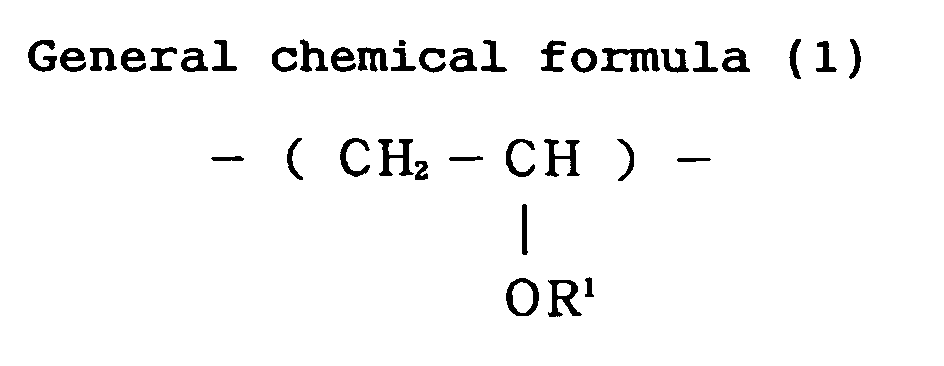
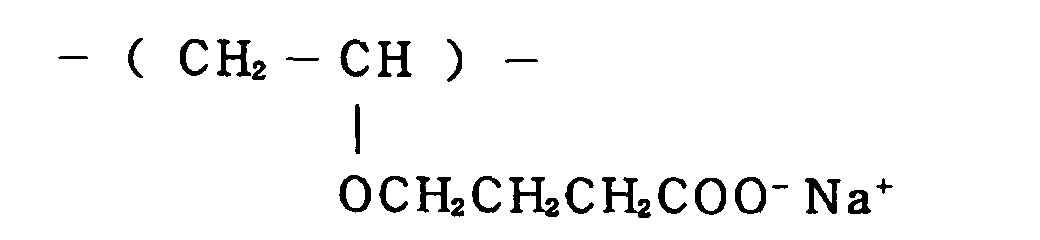
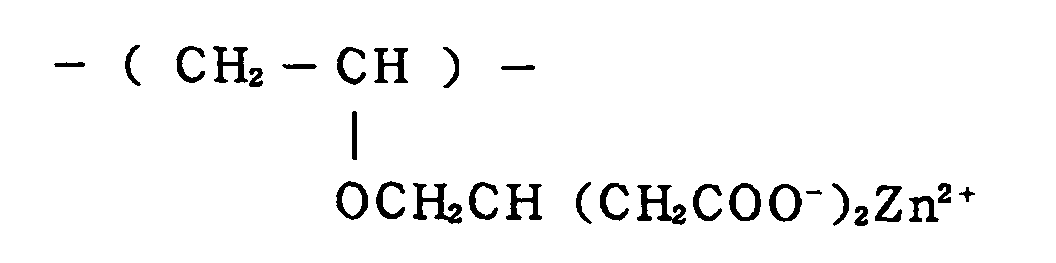
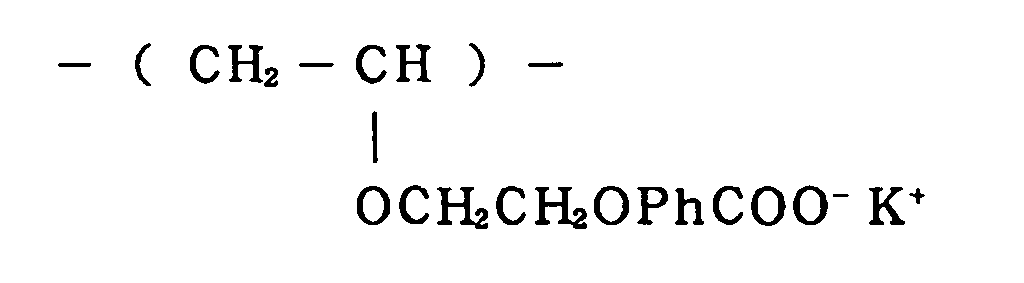
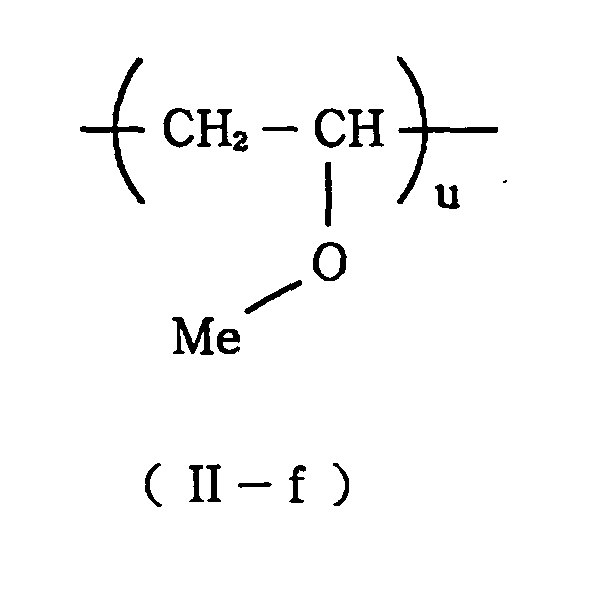
- a unit structure represented by the following general chemical formula (1) is preferably employed.
- R 1 is selected from the straight-chain, branched or cyclic alkyl group with a straight chain with a carbon number between one and eighteen, -Ph, -Pyr, -Ph-Ph, -Ph-Pyr, -(CH(R 5 )-CH(R 6 )-O) p -R 7 , and -(CH 2 ) m -(O) n -R 7 , wherein the hydrogen atom of the aromatic ring may be substituted for a straight-chain or branched alkyl group with a carbon number between one and four, and the carbon atom of the aromatic ring may be substituted for a nitrogen atom.
- p denotes an integer between 1 and 18
- m denotes an integer between 1 and 36
- n is 0 or 1.
- R 5 and R 5 are independently selected from -H or -CH 3 .
- R8 is -H or the alkyl group with a carbon number between one and five. Note that Ph represents the phenyl group, and Pyr represents the pyridyl group.
- -Ph represents the phenyl group
- -Pyr represents the pyridyl group
- -Ph-ph represents the biphenyl group
- -Ph-Pyr represents the pyridylphenyl group.
- a block polymer with amphipathic properties is employed.
- hydrophobic block segments and hydrophilic block segments are selected from the repeated unit structure represented by the above-described general chemical formula (1), and synthesis is performed, thereby obtaining the block polymer with amphipathic properties.
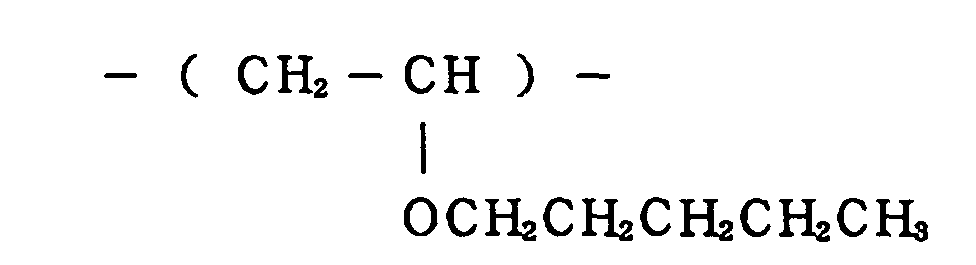
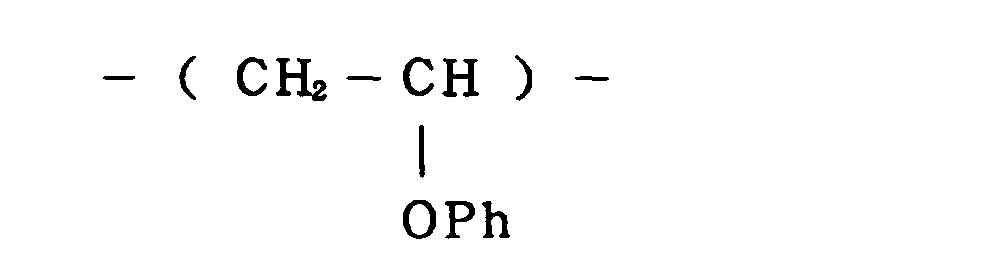
- structures of vinylether monomer are shown as examples of repeated unit structures of a polyvinyl ether structure of a block polymer. Note that the polyvinyl ether structure employed in the present invention is not restricted to these structures.
- the chemical formulas (3) and (4) represent hydrophobic unit structures
- the chemical formulas (1), (2), and (5) represents unit structures which changes to the hydrophilic properties or the hydrophobic properties depending upon other conditions.
- the numbers of the repeated units u, v, and w are preferably equal to or greater than 3 and equal to or less than 10,000, independently, and furthermore, the sum (u + v + w) is more preferably equal to or greater than 10 and equal to or less than 20,000.
- the number-average molecular weight (Mn) of the block polymer employed in the present invention is preferably in the range between 1000 and one million, and in the event that the number-average molecular weight is less than 1000, or greater than one million, materials which exhibit desired functions could not be dispersed well in a solvent.
- molecular movement of the block polymer is preferably more flexible for improving dispersion stability and improving properties of containing materials, due to the block polymer having properties of readily having affinity for functional materials in a physical manner. Furthermore, the molecular movement of the block polymer is preferably flexible for easily forming a coating layer on a recording medium, as well, as described later in detail. Moreover, the molecular movement of the block polymer is preferably flexible for easily forming particles with a uniform particle diameter, as well, as described later. Accordingly, the glass-transition temperature Tg of the principal chain of the block polymer is preferably equal or less than 20°C, and more preferably 0°C, and further preferably -20°C. From this point of view, the polymer having a polyvinyl ether structure is preferably employed due to the low glass-transition temperature thereof and the flexible properties thereof.
- the content of the above-described block polymer contained in the composition of the present invention is in the range between 0.1% by weight and 80% by weight, and is preferably in the range 0.5% by weight and 60% by weight.
- the amount of the block polymers is less than 0.1% by weight, the color materials contained in the ink composition of the present invention could not be sufficiently dispersed, or could not be contained in the block polymers.
- the amount of the block polymers is greater than 80% by weight, the viscosity of the ink composition could be too great.
- the composition formed of block polymers having a feature of having three or more block segments is preferably employed.
- triblock polymer is known.
- the block polymer has at least one amphiphilic segment with and one amphiphobic segment, and further at least one block segment other than these two segments.
- the block polymer has an amphiphilic segment and an amphiphobic segment, which are required for forming a reverse micelle particle, and furthermore, at least one segment having another function, thereby enabling a high functional dispersion composition to be provided.
- the composition of the present invention preferably contains a functional material.
- the functional material is preferably a fluid, or a solid, and may be a dissolvent substance.
- oils, pigments as color materials, paints, metal, herbicides, insecticides, biomaterials, dyes, pharmaceuticals, or molecular catalysts can be employed.
- the content of the functional material contained in the composition of the present invention is equal to or greater than 0.1% by weight and equal to or less than 80% by weight, and is preferably equal to or greater than 0.5% by weight and equal to or less than 60% by weight. In the event that the content is less than 0.1% by weight, the functional material could not sufficiently exhibit the function thereof. Conversely, in the event that the content is greater 80% by weight, dispersion could be insufficient. Description will be made below regarding specific examples of color materials preferably employed as functional materials.
- pigments either organic pigments or inorganic pigments may be employed, and as pigments employed for ink, a black pigment and pigments of the three primary color of cyan, magenta, and yellow, can be preferably employed.
- color pigments other than those described above, colorless or light-color pigments, or metallic-luster pigments, or the like may be employed.
- commercially-available pigments may be employed, or specially-synthesized pigments may be employed.
- the pigments and dyes may be employed together.
- black pigments include Raven 1060, Raven 1080, Raven 1170, Raven 1200, Raven 1250, Raven 1255, Raven 1500, Raven 2000, Raven 3500, Raven 5250, Raven 5750, Raven 7000, Raven 5000 ULTRA 11, Raven 1190 ULTRA 11 (which are manufactured by Colombian Carbon Co.), Black Pearls L, MOGUL-L, Regal 400R, Regal 660R, Regal 330R, Monarch 800, Monarch 880, Monarch 900, Monarch 1000, Monarch 1300, Monarch 1400 (which are manufactured by Cabot Co.), Color Black FW1, Color Black FW2, Color Black FW200, Color Black 18, Color Black S160, Color Black S170, Special Black 4, Special Black 4A, Printex 35, Printex U, Printex 140U, Printex V, Printex 140V (which are manufactured by Degussa Co.), No.
- black pigments employed in the present invention is not restricted to these examples.
- cyan pigments examples include C. I. Pigment Blue-1, C. I. Pigment Blue-2, C. I. Pigment Blue-3, C. I. Pigment Blue-15, C. I. Pigment Blue-15:2, C. I. Pigment Blue-15:3, C. I. Pigment Blue-15:4, C. I. Pigment Blue-16, C. I. Pigment Blue-22, C. I. Pigment Blue-60, and the like. Note that the cyan pigments employed in the present invention is not restricted to these examples.
- magenta pigments examples include C. I. Pigment Red-5, C. I. Pigment Red-7, C. I. Pigment Red-12, C. I. Pigment Red 48, C. I. Pigment Red-48:1, C. I. Pigment Red-57, C. I. Pigment Red-112, C. I. Pigment Red-122, C. I. Pigment Red-123, C. I. Pigment Red-146, C. I. Pigment Red-168, C. I. Pigment Red-184, C. I. Pigment Red-202, C. I. Pigment Red-207, and the like. Note that the magenta pigments employed in the present invention is not restricted to these examples.
- yellow pigments examples include C. I. Pigment Yellow-12, C. I. Pigment Yellow-13, C. I. Pigment Yellow-14, C. I. Pigment Yellow-16, C. I. Pigment Yellow-17, C. I. Pigment Yellow-74, C. I. Pigment Yellow-83, C. I. Pigment Yellow-93, C. I. Pigment Yellow-95, C. I. Pigment Yellow-97, C. I. Pigment Yellow-98, C. I. Pigment Yellow-114, C. I. Pigment Yellow-128, C. I. Pigment Yellow-129, C. I. Pigment Yellow-151, C. I. Pigment Yellow-154, and the like. Note that the yellow pigments employed in the present invention is not restricted to these examples.
- pigments which can spontaneously disperse in water may be employed in the ink composition of the present invention.
- pigments which can be dispersed in water pigments, using the effect of steric hindrance, of which surfaces have absorbed polymers, and pigments using the electrostatic repulsion are known.
- examples of commercially-available products include CAB-0-JET200 and CAB-0-JET300 (which are manufactured by Cabot Co.), and Microjet Black CW-1 (Oriental Chemical Co.), and the like.
- the content of the pigment employed in the composition of the present invention is preferably in the range between 0.1% by mass and 50% by mass as to the total mass. In the event that the content is less than 0.1% by mass, sufficient image contrast cannot be obtained. Conversely, in the event that the content is greater than 50% by mass, the condensation of the pigment is caused, and the pigment cannot be dispersed.
- the content of pigment is more preferably in the range between 0.5% by mass and 30% by mass.
- dyes may be employed.
- Direct dyes, acid dyes, basic dyes, reactive dyes, water-soluble dyes for food dyes, or insoluble dyes for dispersion dyes, as described below, may be employed.
- water-soluble dyes include direct dyes such as C. I. Direct Black -17, -19. -22. -32, -38, -51, -62, -71, -108, -146, -154; C. I. Direct Yellow -12, -24, -26, -44, -86, -87, -98, -100, -130, -142,; C. I. Direct Red -1, -4, -13, -17, -23, -28, -31, -62, -79, -81, -83, -89, -227, -240, -242, -243; C. I.
- the reactive dyes such as C. I Reactive Black -1, -5, -8, -13, -14, -23, -31, -34, -39; C. I Reactive Yellow -2, -3, -13, -15, -17, -18, -23, -24, -37, -42, -57, -58, -64, -75, -76, -77, -79, -81, -84, -85, -87, -88, -91, -92, -93, -95, -102, -111, -115, -116, -130, -131, -132, -133, -135, -137, -139, -140, -142, -143, -144, -145, -146, -147, -148, -151, -162, -163; C.
- the color materials employed in the composition of the present invention are not restricted to the above-described color materials.
- the content of the dye employed in the composition of the present invention is preferably in the range between 0.1% by weight and 50% by weight as to the weight of the ink.
- the functional materials are preferably contained in reverse micelle particles.
- the functional materials are contained in the polymers, thereby enabling decomposition of the functional materials to be prevented.
- the amphipathic block polymer indicates a block polymer which is both amphiphilic and amphiphobic. Furthermore, the amphipathic block polymer preferably has hydrophile and hydrophobe. While a normal micelle particle is a particle having hydrophilic groups on the perimeter thereof and having hydrophobic groups at the inner core thereof in an aqueous solvent, a reverse micelle particle is a particle having hydrophobic groups on the perimeter thereof and having hydrophilic groups or amphiphobic groups at the inner core thereof in an organic solvent.
- the particle containing the functional materials can be formed with a method wherein polymers and color materials are dissolved in water following which phase inversion into an organic solvent is carried out so as to form reverse micelle particles containing the materials.
- the particles containing the functional materials can be formed with a method wherein the functional materials dissolved in water are dispersed in reverse micelles in an organic solvent where block polymers are formed.
- the particles containing the functional materials can be formed with a method wherein polymers are dissolved in water, and the functional materials are dispersed following which phase inversion into an organic solvent is performed.
- the block polymer preferably forms reverse micelle state, and accordingly, the block polymer employed in the present invention is preferably has amphipathic properties.
- the content of the contained functional materials is preferably 90% or more, is more preferably 95% or more, and is furthermore preferably 98% or more.
- the content can be observed by analysis using various types of electron microscopes, analysis using X-ray diffraction, color density analysis for the color materials, as well.
- a second example of the present invention is a composition wherein reverse micelle particles are dispersed in a non-aqueous solvent with the average particle diameter being 200 nm or less, and particle diameter distribution (dispersion index ⁇ /G 2 ) being 0.2 or less.
- the average particle diameter is defined as the Stokes diameter.
- the Stokes diameter can be measured with the sedimentation velocity method, photon correlation, ultrasonic attenuation spectoscopy, or the like. In the present invention, measurement is made with the dynamic light scattering using photon correlation.
- the dispersion index ⁇ /G 2 ( ⁇ denotes the second coefficient of the cumulant expansion, G denotes the attenuation constant) is employed (The Journal of Chemical Physics, vol. 70, p3965, in 1979). This value can be obtained with the dynamic light scattering.
- Examples of particle diameter measurement apparatuses using the dynamic light scattering include DLS7000 manufactured by Otsuka Electronics Co., Ltd., and the like.
- the particle diameter d measured with the apparatus is the Stokes diameter.
- the average particle diameter is 200 nm or less, and the particle diameter distribution (dispersion index ⁇ /G 2 ) of is extremely narrow, i.e., 0.2 or less, such that interaction with visible light is hardly effected, and thus the composition can be made substantially transparent, although the composition is formed of a dispersion medium.
- the average particle diameter is more preferably 150 nm or less, and the particle diameter distribution (dispersion index ⁇ /G 2 ) is more preferably 0.1 or less.
- the average particle diameter is even more preferably 100 nm or less, with the particle diameter distribution (dispersion index ⁇ /G 2 ) of 0.1 or less.
- the composition described in the first example of the present invention is preferably employed for realize small particle diameter with uniform particle diameter distribution (dispersion index ⁇ /G 2 ).
- a third example of the present invention is an image formation method which employs the above-described composition. Furthermore, preferably examples includes recording apparatus such as printer or the like, and a display element (device), which employs the compositions.
- a fourth example of the present invention is an image formation apparatus using the aforementioned image formation method or the aforementioned device.
- an arrangement may be made wherein the composition of the present invention is employed as an electrophoretic particle composition.
- the electrophoretic particle composition a wet toner used in wet electrophotography is known.
- charge-imparting agents such as metallic soap, chemical materials for improving dispersion, or the like.
- the diameter of the electrophoretic particle employed in the present invention is preferably equal to or less than 100 ⁇ m and equal to or greater than 0.001 ⁇ m, and furthermore, is more preferably equal to or less than 10 ⁇ m and equal to or greater than 0.01 ⁇ m.
- the measurement of the particle diameter can be made with an optical microscope, laser diffraction, or dynamic light scattering. Of these methods, the dynamic light scattering method is preferably employed for measuring the diameter of the particle in the range around between 0.01 ⁇ m and 10 ⁇ m, which is a preferable range of the particle diameter. Using the dynamic light scattering, the particle distribution can be measured. With the electrophoretic particles of the present invention, the particle diameter distribution is preferably uniform.
- the dispersion index ⁇ /G 2 ( ⁇ denotes the second coefficient of the cumulant expansion, and G is the attenuation constant) proposed by Gulari et al. is employed (The Journal of Chemical Physics, vol. 70, p3965, in 1979). This value can be obtained with the dynamic light scattering.
- the particle distribution of the electrophoretic particles employed in the present invention is preferably uniform with the dispersion index ⁇ /G 2 being 0.2 or less, and more preferably with the dispersion index ⁇ /G 2 being 0.1 or less, and furthermore, even more preferably with the dispersion index ⁇ /G 2 being 0.05 or less.
- Fig. 1 is a schematic diagram which illustrates an example of electrophoresis using the electrophoretic particles, and a display element, according to the present invention.
- the basic configuration of the electrophoretic element serving as a display element should be a known configuration, and the configuration is not to be restricted to any particular one.
- the electrophoretic element should include display means comprising at least electrophoretic particles 1 according to the present invention, a dispersion medium 2 wherein the electrophoretic particles are dispersed, and a substrate 6 on which an electrode 3 or 4 is formed. The particles move in the direction of either the upper or lower electrode under application of an electric field, whereby display is performed according to the color tone of the particles and the dispersion medium.
- the image formation device of the present invention is employed in printing devices, or display devices, for example.
- Driving means for providing driving signals according to the image information are further provided to the electrophoretic elements shown in Fig. 1, whereby an electrophoretic display device as an image formation device can be configured.
- the electrophoretic particles can be loaded in the apparatus for wet electrophotography so as to be used as a toner.
- the electrophoretic particles can be used for an ink jet apparatus employing oil ink marketed by Fuji Xerox Co., Ltd. (brand name Phaser) or the like, as well.
- any of the known methods such as piezo ink jet method using a piezoelectric element or thermal ink jet method wherein recording is performed by applying thermal energy so as to cause bubbles, can be used for the ink jet method and ink jet apparatuses, the former is preferably employed.
- either of continuous-type or on-demand type systems can be employed.
- the ink composition of the present invention can be employed in a recording method wherein following the ink being printed onto an intermediate transfer medium, the ink is transferred to a final recording medium such as a paper sheet, or the like.
- Block polymers Synthesis of a tri-block polymer formed of isobutyl-vinylether (IBVE: block A), 2-methoxy-ethoxy-vinylether (MOVE: block B), and 4-(2-vinyloxy)-ethoxy-ethyl-benzoate (VEOEtPhCOOEt: block C)
- ethylaluminium sesquichloride equimolar mixture of diethylaluminium chloride and ethylaluminum dichloride
- the molecular weight was monitored in a time-sharing manner using molecular sieving column chromatography (GPC) so as to confirm completion of polymerization of the block A.
- the reaction mixture solution was diluted with dichloromethane, was washed with hydrochloric acid of 0.6 M three times, and subsequently was washed with distilled water 3 times.
- the obtained organic phase was condensed and coagulated with an evaporator, and was subjected to vacuum drying following which dialysis was repeatedly performed for the obtained organic phase in a methanol solvent using a cellulose semi-permeable membrane so as to remove monomer compounds, whereby a tri-block polymer, which is the object, was obtained.
- the weight ratio of A : B : C was 200 : 200 : 30.
- the obtained block polymer was hydrolyzed in a mixed solution of dimethyl-formamide and sodium hydroxide so that the component of the block C was hydrolyzed, whereby a tri-block polymer salified with sodium was obtained.
- Identification of the tri-block polymer compound was performed with NMR and GPC.
- the polymer was dispersed in chloroform, whereby a transparent dispersion solution was obtained.
- the average particle diameter d and the dispersion index ⁇ /G 2 of the dispersion particles were measured using a dynamic light scattering apparatus (DLS-7000 manufactured by Otsuka Electronics Co., Ltd.). With the measurement, the average particle diameter d was 155 nm, and the dispersion index ⁇ /G 2 was 0.18.
- Copper electrodes formed on two glass substrates were disposed with a space of 300 ⁇ m therebetween, and the above-described particle dispersion composition was placed between the copper electrodes and left standing still.
- the black particles exhibited electrophoresis according to the electric field.
- the dispersion composition being left standing for a month and then tested, but change such as precipitation or the like did not occur, indicating that the dispersion composition was dispersed in a stable manner.
- a transparent dispersion solution was obtained.
- the average diameter d and the dispersion index ⁇ /G 2 of the dispersion particles were measured using a dynamic light scattering apparatus (DLS-7000 manufactured by Otsuka Electronics Co., Ltd.). The measurements showed the average particle diameter d to be 140 nm, and the dispersion index ⁇ /G 2 to be 0.15.
- the same particle dispersion composition as with the example 2 was adjusted using Polymethacrylic acid (weight-average molecular weight of 30,000) instead of the block polymer used in the first example. After a month for storage following adjustment, precipitation occurred.
- Polymethacrylic acid weight-average molecular weight of 30,000
- the molecular weight was monitored in a time-sharing manner using molecular sieving column chromatography (GPC), and following completion of polymerization of the component A, 12 mmol of EOVE was added to the system, whereby synthesis of the component B was performed.
- the polymerization was stopped by adding an ammonia/methanol solution of 0.3% by weight into the system.
- the mixture solution following this reaction was diluted with dichloromethane, was washed with hydrochloric acid of 0.6 M three times, and subsequently was washed with distilled water 3 times.
- the obtained organic phase was condensed and coagulated with an evaporator following which vacuum drying was performed for the obtained organic phase, whereby a MOVE-EOVE-di-block polymer, which is the object, was obtained.
- the particle dispersion composition obtained in the fifth example which had been stored for three months at room temperature, was placed in the space of 300 ⁇ m between two copper electrodes formed on two glass substrates and left standing still. Upon applying an AC voltage of 300 V and 60 Hz to the structure, the black particles exhibited electrophoresis according to the electric field.
- the particle dispersion composition described in the fifth example which had been stored for three months at room temperature, was placed in the space of 300 ⁇ m between two copper electrodes formed on two glass substrates and left standing still, in the same way as with the fifth example.
- the black particles Upon applying an AC voltage of 300 V and 60 Hz to the structure, the black particles exhibited electrophoresis according to the electric field.
- the same particle dispersion composition as with the second example was adjusted using Polymethacrylic acid (weight-average molecular weight of 30,000) instead of the polymer used in the fifth example.
- the particle dispersion composition for comparison which had been stored for three months at room temperature, was placed in the space of 300 ⁇ m between two copper electrodes formed on two glass substrates and left standing still. Upon applying an AC voltage of 300 V and 60 Hz to the structure, the black particles did not exhibit electrophoresis according to the electric field.
- Block polymers were synthesized from monomers described below in the same way as with the fifth example.
- Monomer-al:4-(2-vinyloxy)ethoxy-biphenyl of 50% and monomer-a2:isobutyl-vinyl-ether of 50% were used for the block A.
- 2-methoxy-ethoxy-vinyl-ether was used for the block B.
- 4-(2-vinyloxy)ethoxy-ethyl-hexonoate was used for the block C.
- the weight ratio of A, B, and C was 100 : 200 : 80, and identification of compounds was performed using NMR and GPC (Mn was 3.4 ⁇ 10 4 , and Mw/Mn was 1.39).
- the particle dispersion solution was placed and left standing still between glass substrates on which ITO electrodes have been each formed with a space of 300 ⁇ m therebetween, and upon applying an AC voltage of 300 V and 10 Hz to the ITO electrodes, the black particles exhibited electrophoresis according to the electric field.
- one unit by weight of the polymer used in the seventh example and 1.4 units by weight of Carbon Black were mixed in 120 units by weight of ISOPER, and following dispersion of the mixture solution by a homogenizer, filtration was performed with a membrane filter with pores of 2 ⁇ m so as to remove coarse particles, so that a ISOPER dispersion solution of Carbon Black was adjusted. Measurement was made with the dynamic scattering light dispersion apparatus DLS7000 manufactured by Otsuka Electronics Co., Ltd., in the same way as with the seventh example, and as a result, it was confirmed that a dispersion solution having an extremely uniform particle distribution with an average particle diameter of 240 nm and a particle distribution of 0.05 was obtained.
- the particle dispersion solution was placed and left standing still between the glass substrates on which copper electrodes have been each formed with a space of 300 ⁇ m therebetween, and upon applying an AC voltage of 300 V and 10 Hz to the copper electrodes in the same way as with the seventh example, the black particles exhibited electrophoresis according to the electric field.
- the present invention provides a particle composition and a composition wherein particles are dispersed, which exhibits excellent dispersion properties and can form superbly uniform particles.
- the present invention provides a display element, recording method, and recording apparatus, which employs the aforementioned composition which has excellent dispersion properties and forms superbly uniform particles.
Landscapes
- Chemical & Material Sciences (AREA)
- Organic Chemistry (AREA)
- Chemical Kinetics & Catalysis (AREA)
- Health & Medical Sciences (AREA)
- Medicinal Chemistry (AREA)
- Polymers & Plastics (AREA)
- Life Sciences & Earth Sciences (AREA)
- Engineering & Computer Science (AREA)
- Materials Engineering (AREA)
- Wood Science & Technology (AREA)
- Inorganic Chemistry (AREA)
- Inks, Pencil-Leads, Or Crayons (AREA)
Abstract
Description













Claims (18)
- A composition wherein a non-aqueous solvent contains reverse micelle particles formed of block polymers having amphipathic properties.
- A composition according to Claim 1, wherein said amphipathic block polymer is a block polymer having three or more block segments.
- A composition according to Claim 1, wherein said amphipathic block polymer is a high molecular compound having a repeated unit structure of polyvinyl ether.
- A composition according to Claim 1, wherein said composition contains functional materials.
- A composition according to Claim 4, wherein said materials are contained in said reverse micelle particles.
- A composition according to Claim 1, wherein said block polymer has a repeated unit structure represented bywherein R1 is selected from the straight-chain, branched or cyclic alkyl group with a straight chain with a carbon number between one and eighteen, -Ph, -Pyr, -Ph-Ph, -Ph-Pyr, -(CH(R5)-CH(R6)-O)p-R7, and -(CH2)m-(O)n-R7, and wherein the hydrogen atom of the aromatic ring may be substituted for a straight-chain or branched alkyl group with a carbon number between one and four, and wherein the carbon atom of the aromatic ring may be substituted for a nitrogen atom;
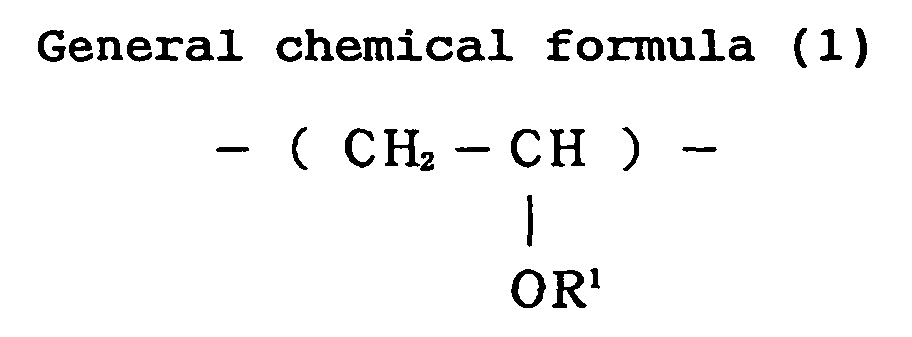
and wherein p denotes an integer between 1 and 18, m denotes an integer between 1 and 36, and n is 0 or 1;
and wherein R5 and R6 are independently selected from -H or -CH3;
and wherein R7 is formed of -H, a straight-chain, branched, or cyclic alkyl group with a carbon number between 1 and 18, -Ph, -Pyr, -Ph-Ph, -Ph-Pyr, -CHO, -CH2CHO, -CO-CH=CH2 -CO-C(CH3)=CH2, -CH2COOR8, wherein in the event that R7 is other than a hydrogen atom, the hydrogen atom combined with the carbon atom within R7 may be substituted for a straight-chain or branched alkyl group with a carbon number between one and four, -F, -Cl, or -Br, and the carbon atom of the aromatic ring may be substituted for a nitrogen atom;
and wherein R8 is -H or the alkyl group with a carbon number between one and five, wherein Ph represents the phenyl group, and Pyr represents the pyridyl group. - A composition according to Claim 1, wherein the average particle diameter of said reverse micelle particles is equal to or less than 200 nm, and the particle distribution (dispersion index µ/G2) thereof is equal to or less than 0.2.
- A composition according to Claim 1, wherein said non-aqueous solvent is an organic solvent.
- A composition according to Claim 4, wherein said functional material is a color material.
- A recording method wherein recording on a medium is performed using a composition in which a non-aqueous solvent contains reverse micelle particles formed of block polymers having amphipathic properties.
- A recording apparatus wherein recording is performed using a composition in which a non-aqueous solvent contains reverse micelle particles formed of block polymers having amphipathic properties.
- An ink composition containing a composition wherein a non-aqueous solvent contains reverse micelle particles formed of block polymers having amphipathic properties.
- Particles, which exhibit electrophoresis, containing a composition wherein a non-aqueous solvent contains reverse micelle particles formed of block polymers having amphipathic properties.
- A wet toner employing particles, which exhibit electrophoresis, containing a composition wherein a non-aqueous solvent contains reverse micelle particles formed of block polymers having amphipathic properties.
- A display element employing particles, which exhibit electrophoresis, containing a composition wherein a non-aqueous solvent contains reverse micelle particles formed of block polymers having amphipathic properties.
- A composition, in which are dispersed
particles wherein a non-aqueous solvent contains compounds having amphipathic block polymers, and
pigments. - A recording method using a composition in which are dispersed
particles wherein a non-aqueous solvent contains compounds having amphipathic block polymers, and
pigments. - A recording apparatus using a composition in which are dispersed
particles wherein a non-aqueous solvent contains compounds having amphipathic block polymers, and
pigments.
Applications Claiming Priority (6)
| Application Number | Priority Date | Filing Date | Title |
|---|---|---|---|
| JP2002174345 | 2002-06-14 | ||
| JP2002174345 | 2002-06-14 | ||
| JP2002195118 | 2002-07-03 | ||
| JP2002195118A JP2004035735A (en) | 2002-07-03 | 2002-07-03 | Reverse micelle particle-containing composition, reverse micelle particle dispersion composition, display element using the same, image forming method and image forming apparatus |
| JP2003155758 | 2003-05-30 | ||
| JP2003155758A JP4314070B2 (en) | 2002-06-14 | 2003-05-30 | Electrophoretic particle composition and electrophoretic display element |
Publications (2)
| Publication Number | Publication Date |
|---|---|
| EP1371696A1 true EP1371696A1 (en) | 2003-12-17 |
| EP1371696B1 EP1371696B1 (en) | 2006-08-09 |
Family
ID=29587478
Family Applications (1)
| Application Number | Title | Priority Date | Filing Date |
|---|---|---|---|
| EP03012944A Expired - Lifetime EP1371696B1 (en) | 2002-06-14 | 2003-06-06 | Particle composition, recording method, and recording apparatus using the particle composition |
Country Status (3)
| Country | Link |
|---|---|
| US (2) | US7300971B2 (en) |
| EP (1) | EP1371696B1 (en) |
| DE (1) | DE60307371T2 (en) |
Cited By (6)
| Publication number | Priority date | Publication date | Assignee | Title |
|---|---|---|---|---|
| WO2004113408A1 (en) * | 2003-06-25 | 2004-12-29 | Canon Kabushiki Kaisha | Block polymer, polymer-containing composition containing the same, ink composition and liquid applying method and liquid applying apparatus utilizing the polymer-containing composition |
| EP1676893A4 (en) * | 2003-10-20 | 2006-11-08 | Canon Finetech Inc | Ink for inkjet recording, method of inkjet recording, ink cartridge and inkjet recording apparatus |
| EP1357138B1 (en) * | 2002-04-26 | 2007-03-14 | Canon Kabushiki Kaisha | Polymerizable compound, polymer compound and block polymer compound, and composition, image-forming method and image-forming apparatus using the same |
| EP1802714A4 (en) * | 2004-10-18 | 2010-05-05 | Canon Finetech Inc | WATER-BASED INKS FOR INKJET PRINTERS |
| WO2010077238A1 (en) | 2008-12-30 | 2010-07-08 | Hewlett-Packard Development Company, L.P. | Electronic inks and displays and image displaying methods |
| WO2018069678A1 (en) * | 2016-10-10 | 2018-04-19 | Domino Uk Limited | Branched block copolymer |
Families Citing this family (12)
| Publication number | Priority date | Publication date | Assignee | Title |
|---|---|---|---|---|
| JP3890266B2 (en) * | 2002-07-03 | 2007-03-07 | キヤノン株式会社 | Block polymer compound, ink composition, dispersible composition, image forming method, and image forming apparatus |
| JP4455149B2 (en) * | 2003-09-19 | 2010-04-21 | キヤノン株式会社 | Toner production method |
| WO2005033160A1 (en) * | 2003-10-03 | 2005-04-14 | Canon Kabushiki Kaisha | Block polymer compound, polymer-containing composition that contains the same |
| JP2005139251A (en) * | 2003-11-05 | 2005-06-02 | Canon Inc | Block copolymer, polymer-containing composition, ink composition, ink application method and apparatus containing the same |
| JP2006241189A (en) * | 2005-02-28 | 2006-09-14 | Osaka Univ | Process for producing polyalkenyl ether |
| US8456733B2 (en) * | 2005-10-26 | 2013-06-04 | Basf Se | Coloured particles for electrophoretic displays |
| CA2635896A1 (en) * | 2005-12-30 | 2007-09-13 | Applera Corporation | Synthesis and use of cross-linked hydrophilic hollow spheres for encapsulating hydrophilic cargo |
| JP2007262326A (en) * | 2006-03-29 | 2007-10-11 | Fujifilm Corp | Aqueous pigment ink composition, inkjet ink and set thereof |
| EP2670810A4 (en) | 2011-01-31 | 2014-04-16 | Hewlett Packard Development Co | Emulsion-based thermal inkjet inks |
| US8514481B2 (en) * | 2011-07-12 | 2013-08-20 | Hewlett-Packard Development Company, L.P. | Dual color electronically addressable ink |
| WO2013109250A1 (en) * | 2012-01-17 | 2013-07-25 | Hewlett-Packard Development Company, L.P. | Inks including graft copolymer surface-modified pigments via azide chemistry |
| CN114913884B (en) * | 2022-04-18 | 2026-02-24 | 苏州大学 | Nanometer memory for ultra-high density data storage and preparation method thereof |
Citations (8)
| Publication number | Priority date | Publication date | Assignee | Title |
|---|---|---|---|---|
| EP0227141A1 (en) * | 1985-11-26 | 1987-07-01 | Agfa-Gevaert N.V. | A process for the production of a photothermographic material |
| EP0355585A2 (en) * | 1988-08-15 | 1990-02-28 | Idemitsu Kosan Company Limited | Processes for producing color display material and color filter |
| EP0497522A1 (en) * | 1991-01-28 | 1992-08-05 | Xerox Corporation | Ink compositions |
| EP0556649A1 (en) * | 1992-02-20 | 1993-08-25 | E.I. Du Pont De Nemours & Company Incorporated | Aqueous dispersions containing ABC triblock polymer dispersants |
| US5441841A (en) * | 1994-05-26 | 1995-08-15 | Xerox Corporation | Liquid developer compositions with block copolymers |
| US5459007A (en) * | 1994-05-26 | 1995-10-17 | Xerox Corporation | Liquid developer compositions with block copolymers |
| US5559588A (en) * | 1995-09-13 | 1996-09-24 | Xerox Corporation | Lid machine capable of producing clean-background stabilized liquid toner images |
| WO2001077198A1 (en) * | 2000-04-07 | 2001-10-18 | E.I. Dupont De Nemours And Company | Process of microgel synthesis and products produced therefrom |
Family Cites Families (17)
| Publication number | Priority date | Publication date | Assignee | Title |
|---|---|---|---|---|
| NL267743A (en) | 1960-08-01 | |||
| US5145518A (en) * | 1990-06-27 | 1992-09-08 | Xerox Corporation | Inks containing block copolymer micelles |
| DE4391162T1 (en) | 1992-03-26 | 1994-05-05 | Dainippon Printing Co Ltd | Liquid toner and its manufacture |
| JPH05273792A (en) | 1992-03-26 | 1993-10-22 | Dainippon Printing Co Ltd | Wet toner and method of manufacturing the same |
| JPH08187927A (en) * | 1994-11-09 | 1996-07-23 | Nippon Oil Co Ltd | Transfer method by printing |
| CA2258744A1 (en) * | 1996-06-27 | 1997-12-31 | G.D. Searle And Co. | Particles comprising amphiphilic copolymers, having a cross-linked shell domain and an interior core domain, useful for pharmaceutical and other applications |
| JPH1180221A (en) | 1997-09-08 | 1999-03-26 | Kuraray Co Ltd | Method for producing polymer |
| JP4086961B2 (en) | 1998-05-11 | 2008-05-14 | 株式会社クラレ | Graft polymer |
| JPH11322942A (en) | 1998-05-11 | 1999-11-26 | Kuraray Co Ltd | Method for producing polymer |
| JP3753289B2 (en) * | 1998-10-16 | 2006-03-08 | 富士写真フイルム株式会社 | Inkjet recording method |
| CA2389917A1 (en) * | 1999-11-04 | 2001-05-10 | Kazunori Kataoka | A polymer micelle as monolayer or layer-laminated surface |
| US6649138B2 (en) * | 2000-10-13 | 2003-11-18 | Quantum Dot Corporation | Surface-modified semiconductive and metallic nanoparticles having enhanced dispersibility in aqueous media |
| JP2003089752A (en) * | 2001-03-23 | 2003-03-28 | Canon Inc | Composition containing stimulus-responsive polymer, ink composition containing the same, and image forming method and apparatus using the ink composition |
| US7004579B2 (en) * | 2001-07-10 | 2006-02-28 | Canon Kabushiki Kaisha | Ink composition containing a polymer complex, and an image formation method and equipment using the ink composition |
| JP3595805B2 (en) * | 2001-08-07 | 2004-12-02 | キヤノン株式会社 | Stimulus responsive composition, and image forming method and apparatus using the composition |
| US7001934B2 (en) * | 2002-01-24 | 2006-02-21 | Cabot Coroporation | Inkjet ink systems comprising a gelling agent |
| US7196142B2 (en) * | 2002-04-04 | 2007-03-27 | The University Of Akron | Polyisobutylene-based block anionomers and cationomers and synthesis thereof |
-
2003
- 2003-06-06 DE DE60307371T patent/DE60307371T2/en not_active Expired - Lifetime
- 2003-06-06 EP EP03012944A patent/EP1371696B1/en not_active Expired - Lifetime
- 2003-06-10 US US10/457,419 patent/US7300971B2/en not_active Expired - Fee Related
-
2005
- 2005-11-25 US US11/286,435 patent/US20060079603A1/en not_active Abandoned
Patent Citations (8)
| Publication number | Priority date | Publication date | Assignee | Title |
|---|---|---|---|---|
| EP0227141A1 (en) * | 1985-11-26 | 1987-07-01 | Agfa-Gevaert N.V. | A process for the production of a photothermographic material |
| EP0355585A2 (en) * | 1988-08-15 | 1990-02-28 | Idemitsu Kosan Company Limited | Processes for producing color display material and color filter |
| EP0497522A1 (en) * | 1991-01-28 | 1992-08-05 | Xerox Corporation | Ink compositions |
| EP0556649A1 (en) * | 1992-02-20 | 1993-08-25 | E.I. Du Pont De Nemours & Company Incorporated | Aqueous dispersions containing ABC triblock polymer dispersants |
| US5441841A (en) * | 1994-05-26 | 1995-08-15 | Xerox Corporation | Liquid developer compositions with block copolymers |
| US5459007A (en) * | 1994-05-26 | 1995-10-17 | Xerox Corporation | Liquid developer compositions with block copolymers |
| US5559588A (en) * | 1995-09-13 | 1996-09-24 | Xerox Corporation | Lid machine capable of producing clean-background stabilized liquid toner images |
| WO2001077198A1 (en) * | 2000-04-07 | 2001-10-18 | E.I. Dupont De Nemours And Company | Process of microgel synthesis and products produced therefrom |
Cited By (9)
| Publication number | Priority date | Publication date | Assignee | Title |
|---|---|---|---|---|
| EP1357138B1 (en) * | 2002-04-26 | 2007-03-14 | Canon Kabushiki Kaisha | Polymerizable compound, polymer compound and block polymer compound, and composition, image-forming method and image-forming apparatus using the same |
| WO2004113408A1 (en) * | 2003-06-25 | 2004-12-29 | Canon Kabushiki Kaisha | Block polymer, polymer-containing composition containing the same, ink composition and liquid applying method and liquid applying apparatus utilizing the polymer-containing composition |
| US7528179B2 (en) | 2003-06-25 | 2009-05-05 | Canon Kabushiki Kaisha | Block polymer, polymer-containing composition containing the same, ink composition and liquid applying method and liquid applying apparatus utilizing the polymer-containing composition |
| EP1676893A4 (en) * | 2003-10-20 | 2006-11-08 | Canon Finetech Inc | Ink for inkjet recording, method of inkjet recording, ink cartridge and inkjet recording apparatus |
| US7481524B2 (en) | 2003-10-20 | 2009-01-27 | Canon Finetech Inc. | Ink for inkjet recording, method of inkjet recording, ink cartridge and inkjet recording apparatus |
| EP1802714A4 (en) * | 2004-10-18 | 2010-05-05 | Canon Finetech Inc | WATER-BASED INKS FOR INKJET PRINTERS |
| WO2010077238A1 (en) | 2008-12-30 | 2010-07-08 | Hewlett-Packard Development Company, L.P. | Electronic inks and displays and image displaying methods |
| EP2370529A4 (en) * | 2008-12-30 | 2015-08-26 | Hewlett Packard Development Co | Electronic inks and displays and image displaying methods |
| WO2018069678A1 (en) * | 2016-10-10 | 2018-04-19 | Domino Uk Limited | Branched block copolymer |
Also Published As
| Publication number | Publication date |
|---|---|
| EP1371696B1 (en) | 2006-08-09 |
| US20060079603A1 (en) | 2006-04-13 |
| US20030232904A1 (en) | 2003-12-18 |
| US7300971B2 (en) | 2007-11-27 |
| DE60307371T2 (en) | 2007-08-02 |
| DE60307371D1 (en) | 2006-09-21 |
Similar Documents
| Publication | Publication Date | Title |
|---|---|---|
| EP1371696B1 (en) | Particle composition, recording method, and recording apparatus using the particle composition | |
| US7629427B2 (en) | Block polymer compound, polymer composition containing the same, image forming method and image forming apparatus utilizing the same | |
| US7696263B2 (en) | Ink composition containing a polymer complex, and an image formation method and equipment using the ink composition | |
| US20060057485A1 (en) | Process for producing colorant dispersoid | |
| US20050239918A1 (en) | Novel polymer compound, composition containing the compound, ink composition, ink-applying method, and ink-applying apparatus | |
| EP1357138B1 (en) | Polymerizable compound, polymer compound and block polymer compound, and composition, image-forming method and image-forming apparatus using the same | |
| US7479512B2 (en) | Dispersion composition containing functional substance, method of forming image and image forming apparatus | |
| US7425588B2 (en) | Polymer composition including functional material, method for production of the same, inkjet ink, and image formation method and image formation apparatus using the same | |
| JP2004035735A (en) | Reverse micelle particle-containing composition, reverse micelle particle dispersion composition, display element using the same, image forming method and image forming apparatus | |
| US20050176846A1 (en) | Ink composition, process for producing the same, method of forming image therewith and image forming device | |
| JP4314070B2 (en) | Electrophoretic particle composition and electrophoretic display element | |
| US7378480B2 (en) | Polymerizable compound, polymer compound, composition using such compound, and image forming method and apparatus | |
| JP4018466B2 (en) | Ink composition containing polymer composite, and image forming method and apparatus using the ink composition | |
| JP2004331827A (en) | Polymer-containing composition, ink composition, liquid applying method and liquid applying apparatus using the ink composition | |
| JP2004018618A (en) | Ink for optical filter and optical filter | |
| JP2003020381A (en) | Method for producing dispersible composition | |
| JP2004018641A (en) | Sensors and actuators and devices using them | |
| JP2004359850A (en) | Composition, liquid applying method and liquid applying apparatus | |
| JP2004018438A (en) | Cosmetics and cleaning agents | |
| JP2004339430A (en) | Functional substance-containing composition, image forming method and image forming apparatus | |
| JP2004339429A (en) | Functional substance-containing composition, liquid applying method and liquid applying apparatus | |
| JP2004330628A (en) | Set of recording medium and composition, liquid applying method and liquid applying apparatus using the same |
Legal Events
| Date | Code | Title | Description |
|---|---|---|---|
| PUAI | Public reference made under article 153(3) epc to a published international application that has entered the european phase |
Free format text: ORIGINAL CODE: 0009012 |
|
| AK | Designated contracting states |
Kind code of ref document: A1 Designated state(s): AT BE BG CH CY CZ DE DK EE ES FI FR GB GR HU IE IT LI LU MC NL PT RO SE SI SK TR |
|
| AX | Request for extension of the european patent |
Extension state: AL LT LV MK |
|
| 17P | Request for examination filed |
Effective date: 20040617 |
|
| AKX | Designation fees paid |
Designated state(s): DE FR GB |
|
| 17Q | First examination report despatched |
Effective date: 20040907 |
|
| GRAP | Despatch of communication of intention to grant a patent |
Free format text: ORIGINAL CODE: EPIDOSNIGR1 |
|
| GRAS | Grant fee paid |
Free format text: ORIGINAL CODE: EPIDOSNIGR3 |
|
| GRAA | (expected) grant |
Free format text: ORIGINAL CODE: 0009210 |
|
| AK | Designated contracting states |
Kind code of ref document: B1 Designated state(s): DE FR GB |
|
| REG | Reference to a national code |
Ref country code: GB Ref legal event code: FG4D |
|
| REF | Corresponds to: |
Ref document number: 60307371 Country of ref document: DE Date of ref document: 20060921 Kind code of ref document: P |
|
| ET | Fr: translation filed | ||
| PLBE | No opposition filed within time limit |
Free format text: ORIGINAL CODE: 0009261 |
|
| STAA | Information on the status of an ep patent application or granted ep patent |
Free format text: STATUS: NO OPPOSITION FILED WITHIN TIME LIMIT |
|
| 26N | No opposition filed |
Effective date: 20070510 |
|
| PGFP | Annual fee paid to national office [announced via postgrant information from national office to epo] |
Ref country code: GB Payment date: 20140610 Year of fee payment: 12 |
|
| PGFP | Annual fee paid to national office [announced via postgrant information from national office to epo] |
Ref country code: FR Payment date: 20140625 Year of fee payment: 12 |
|
| GBPC | Gb: european patent ceased through non-payment of renewal fee |
Effective date: 20150606 |
|
| REG | Reference to a national code |
Ref country code: FR Ref legal event code: ST Effective date: 20160229 |
|
| PG25 | Lapsed in a contracting state [announced via postgrant information from national office to epo] |
Ref country code: GB Free format text: LAPSE BECAUSE OF NON-PAYMENT OF DUE FEES Effective date: 20150606 |
|
| PG25 | Lapsed in a contracting state [announced via postgrant information from national office to epo] |
Ref country code: FR Free format text: LAPSE BECAUSE OF NON-PAYMENT OF DUE FEES Effective date: 20150630 |
|
| PGFP | Annual fee paid to national office [announced via postgrant information from national office to epo] |
Ref country code: DE Payment date: 20160630 Year of fee payment: 14 |
|
| REG | Reference to a national code |
Ref country code: DE Ref legal event code: R119 Ref document number: 60307371 Country of ref document: DE |
|
| PG25 | Lapsed in a contracting state [announced via postgrant information from national office to epo] |
Ref country code: DE Free format text: LAPSE BECAUSE OF NON-PAYMENT OF DUE FEES Effective date: 20180103 |