EP1369410A1 - Verfahren zur stereoselektiven Reduktion von 4-Aryl-4-oxobutansäure-derivaten - Google Patents
Verfahren zur stereoselektiven Reduktion von 4-Aryl-4-oxobutansäure-derivaten Download PDFInfo
- Publication number
- EP1369410A1 EP1369410A1 EP03011881A EP03011881A EP1369410A1 EP 1369410 A1 EP1369410 A1 EP 1369410A1 EP 03011881 A EP03011881 A EP 03011881A EP 03011881 A EP03011881 A EP 03011881A EP 1369410 A1 EP1369410 A1 EP 1369410A1
- Authority
- EP
- European Patent Office
- Prior art keywords
- alkyl
- aryl
- formula
- und
- amino
- Prior art date
- Legal status (The legal status is an assumption and is not a legal conclusion. Google has not performed a legal analysis and makes no representation as to the accuracy of the status listed.)
- Withdrawn
Links
- 238000000034 method Methods 0.000 title claims abstract description 30
- 230000008569 process Effects 0.000 title claims description 13
- 238000011916 stereoselective reduction Methods 0.000 title 1
- 150000001875 compounds Chemical class 0.000 claims abstract description 41
- BDAGIHXWWSANSR-UHFFFAOYSA-N methanoic acid Natural products OC=O BDAGIHXWWSANSR-UHFFFAOYSA-N 0.000 claims abstract description 34
- 125000003118 aryl group Chemical group 0.000 claims abstract description 26
- 150000001412 amines Chemical class 0.000 claims abstract description 18
- 239000003054 catalyst Substances 0.000 claims abstract description 18
- 229910052717 sulfur Inorganic materials 0.000 claims abstract description 17
- OSWFIVFLDKOXQC-UHFFFAOYSA-N 4-(3-methoxyphenyl)aniline Chemical compound COC1=CC=CC(C=2C=CC(N)=CC=2)=C1 OSWFIVFLDKOXQC-UHFFFAOYSA-N 0.000 claims abstract description 16
- 235000019253 formic acid Nutrition 0.000 claims abstract description 16
- 239000001301 oxygen Substances 0.000 claims abstract description 12
- 229910052760 oxygen Inorganic materials 0.000 claims abstract description 12
- QVGXLLKOCUKJST-UHFFFAOYSA-N atomic oxygen Chemical compound [O] QVGXLLKOCUKJST-UHFFFAOYSA-N 0.000 claims abstract description 10
- KJTLSVCANCCWHF-UHFFFAOYSA-N Ruthenium Chemical compound [Ru] KJTLSVCANCCWHF-UHFFFAOYSA-N 0.000 claims abstract description 9
- 125000006413 ring segment Chemical group 0.000 claims abstract description 9
- 229910052707 ruthenium Inorganic materials 0.000 claims abstract description 9
- NINIDFKCEFEMDL-UHFFFAOYSA-N Sulfur Chemical compound [S] NINIDFKCEFEMDL-UHFFFAOYSA-N 0.000 claims abstract description 7
- 239000011593 sulfur Substances 0.000 claims abstract description 6
- 150000004675 formic acid derivatives Chemical class 0.000 claims abstract description 5
- 238000004519 manufacturing process Methods 0.000 claims abstract description 5
- 125000003710 aryl alkyl group Chemical group 0.000 claims abstract description 3
- 125000000217 alkyl group Chemical group 0.000 claims description 49
- IJGRMHOSHXDMSA-UHFFFAOYSA-N Atomic nitrogen Chemical compound N#N IJGRMHOSHXDMSA-UHFFFAOYSA-N 0.000 claims description 26
- 239000000203 mixture Substances 0.000 claims description 25
- ZMANZCXQSJIPKH-UHFFFAOYSA-N Triethylamine Chemical compound CCN(CC)CC ZMANZCXQSJIPKH-UHFFFAOYSA-N 0.000 claims description 21
- 125000001997 phenyl group Chemical group [H]C1=C([H])C([H])=C(*)C([H])=C1[H] 0.000 claims description 20
- 125000002496 methyl group Chemical group [H]C([H])([H])* 0.000 claims description 18
- 238000006243 chemical reaction Methods 0.000 claims description 15
- 229910052757 nitrogen Inorganic materials 0.000 claims description 14
- 125000001495 ethyl group Chemical group [H]C([H])([H])C([H])([H])* 0.000 claims description 13
- ZAMOUSCENKQFHK-UHFFFAOYSA-N Chlorine atom Chemical compound [Cl] ZAMOUSCENKQFHK-UHFFFAOYSA-N 0.000 claims description 10
- 125000001797 benzyl group Chemical group [H]C1=C([H])C([H])=C(C([H])=C1[H])C([H])([H])* 0.000 claims description 9
- 239000000460 chlorine Substances 0.000 claims description 8
- 229910052801 chlorine Inorganic materials 0.000 claims description 8
- 229910052731 fluorine Inorganic materials 0.000 claims description 8
- 239000011737 fluorine Substances 0.000 claims description 8
- 125000003709 fluoroalkyl group Chemical group 0.000 claims description 8
- 238000002360 preparation method Methods 0.000 claims description 8
- 150000003303 ruthenium Chemical class 0.000 claims description 8
- 239000003960 organic solvent Substances 0.000 claims description 7
- 239000000758 substrate Substances 0.000 claims description 7
- WKBOTKDWSSQWDR-UHFFFAOYSA-N Bromine atom Chemical compound [Br] WKBOTKDWSSQWDR-UHFFFAOYSA-N 0.000 claims description 6
- PXGOKWXKJXAPGV-UHFFFAOYSA-N Fluorine Chemical compound FF PXGOKWXKJXAPGV-UHFFFAOYSA-N 0.000 claims description 6
- UFHFLCQGNIYNRP-UHFFFAOYSA-N Hydrogen Chemical compound [H][H] UFHFLCQGNIYNRP-UHFFFAOYSA-N 0.000 claims description 6
- GDTBXPJZTBHREO-UHFFFAOYSA-N bromine Substances BrBr GDTBXPJZTBHREO-UHFFFAOYSA-N 0.000 claims description 6
- 229910052794 bromium Inorganic materials 0.000 claims description 6
- 229910052739 hydrogen Inorganic materials 0.000 claims description 6
- 239000001257 hydrogen Substances 0.000 claims description 6
- 239000003814 drug Substances 0.000 claims description 5
- 125000002947 alkylene group Chemical group 0.000 claims description 4
- HXFLHQSZXLTPSH-UHFFFAOYSA-L cumene;ruthenium(2+);dichloride Chemical class Cl[Ru]Cl.CC(C)C1=CC=CC=C1 HXFLHQSZXLTPSH-UHFFFAOYSA-L 0.000 claims description 4
- 125000004093 cyano group Chemical group *C#N 0.000 claims description 4
- 150000002431 hydrogen Chemical class 0.000 claims description 4
- 125000002887 hydroxy group Chemical group [H]O* 0.000 claims description 4
- PNDPGZBMCMUPRI-UHFFFAOYSA-N iodine Chemical compound II PNDPGZBMCMUPRI-UHFFFAOYSA-N 0.000 claims description 4
- 125000002950 monocyclic group Chemical group 0.000 claims description 4
- 239000003905 agrochemical Substances 0.000 claims description 3
- 229910001413 alkali metal ion Inorganic materials 0.000 claims description 3
- 229910001420 alkaline earth metal ion Inorganic materials 0.000 claims description 3
- 125000004432 carbon atom Chemical group C* 0.000 claims description 3
- 125000006297 carbonyl amino group Chemical group [H]N([*:2])C([*:1])=O 0.000 claims description 3
- 239000000543 intermediate Substances 0.000 claims description 3
- 239000007788 liquid Substances 0.000 claims description 3
- 125000000896 monocarboxylic acid group Chemical group 0.000 claims description 3
- 239000003772 serotonin uptake inhibitor Substances 0.000 claims description 3
- RTHCYVBBDHJXIQ-MRXNPFEDSA-N (R)-fluoxetine Chemical compound O([C@H](CCNC)C=1C=CC=CC=1)C1=CC=C(C(F)(F)F)C=C1 RTHCYVBBDHJXIQ-MRXNPFEDSA-N 0.000 claims description 2
- ZEUITGRIYCTCEM-KRWDZBQOSA-N (S)-duloxetine Chemical compound C1([C@@H](OC=2C3=CC=CC=C3C=CC=2)CCNC)=CC=CS1 ZEUITGRIYCTCEM-KRWDZBQOSA-N 0.000 claims description 2
- 229910004013 NO 2 Inorganic materials 0.000 claims description 2
- 150000001491 aromatic compounds Chemical class 0.000 claims description 2
- 229960002866 duloxetine Drugs 0.000 claims description 2
- 229960002464 fluoxetine Drugs 0.000 claims description 2
- QJGQUHMNIGDVPM-UHFFFAOYSA-N nitrogen group Chemical group [N] QJGQUHMNIGDVPM-UHFFFAOYSA-N 0.000 claims description 2
- ZCYVEMRRCGMTRW-UHFFFAOYSA-N 7553-56-2 Chemical compound [I] ZCYVEMRRCGMTRW-UHFFFAOYSA-N 0.000 claims 1
- 125000006367 bivalent amino carbonyl group Chemical group [H]N([*:1])C([*:2])=O 0.000 claims 1
- 239000011630 iodine Substances 0.000 claims 1
- 229910052740 iodine Inorganic materials 0.000 claims 1
- 230000009467 reduction Effects 0.000 abstract description 3
- 125000004433 nitrogen atom Chemical group N* 0.000 abstract 1
- 230000000707 stereoselective effect Effects 0.000 abstract 1
- -1 aromatic radical Chemical class 0.000 description 138
- 125000001309 chloro group Chemical group Cl* 0.000 description 50
- YMWUJEATGCHHMB-UHFFFAOYSA-N Dichloromethane Chemical compound ClCCl YMWUJEATGCHHMB-UHFFFAOYSA-N 0.000 description 24
- UHOVQNZJYSORNB-UHFFFAOYSA-N Benzene Chemical compound C1=CC=CC=C1 UHOVQNZJYSORNB-UHFFFAOYSA-N 0.000 description 12
- HEDRZPFGACZZDS-UHFFFAOYSA-N Chloroform Chemical compound ClC(Cl)Cl HEDRZPFGACZZDS-UHFFFAOYSA-N 0.000 description 12
- 125000001449 isopropyl group Chemical group [H]C([H])([H])C([H])(*)C([H])([H])[H] 0.000 description 10
- WEVYAHXRMPXWCK-UHFFFAOYSA-N Acetonitrile Chemical compound CC#N WEVYAHXRMPXWCK-UHFFFAOYSA-N 0.000 description 9
- FERIUCNNQQJTOY-UHFFFAOYSA-M Butyrate Chemical compound CCCC([O-])=O FERIUCNNQQJTOY-UHFFFAOYSA-M 0.000 description 7
- 125000001037 p-tolyl group Chemical group [H]C1=C([H])C(=C([H])C([H])=C1*)C([H])([H])[H] 0.000 description 7
- 150000003254 radicals Chemical class 0.000 description 7
- 239000011541 reaction mixture Substances 0.000 description 7
- XKRFYHLGVUSROY-UHFFFAOYSA-N Argon Chemical compound [Ar] XKRFYHLGVUSROY-UHFFFAOYSA-N 0.000 description 6
- 125000002183 isoquinolinyl group Chemical group C1(=NC=CC2=CC=CC=C12)* 0.000 description 6
- 150000002596 lactones Chemical class 0.000 description 6
- VLKZOEOYAKHREP-UHFFFAOYSA-N n-Hexane Chemical compound CCCCCC VLKZOEOYAKHREP-UHFFFAOYSA-N 0.000 description 6
- 125000001624 naphthyl group Chemical group 0.000 description 6
- YAYGSLOSTXKUBW-UHFFFAOYSA-N ruthenium(2+) Chemical compound [Ru+2] YAYGSLOSTXKUBW-UHFFFAOYSA-N 0.000 description 6
- 238000003756 stirring Methods 0.000 description 6
- SECXISVLQFMRJM-UHFFFAOYSA-N N-Methylpyrrolidone Chemical compound CN1CCCC1=O SECXISVLQFMRJM-UHFFFAOYSA-N 0.000 description 5
- 238000005356 chiral GC Methods 0.000 description 5
- 239000002904 solvent Substances 0.000 description 5
- CURLTUGMZLYLDI-UHFFFAOYSA-N Carbon dioxide Chemical compound O=C=O CURLTUGMZLYLDI-UHFFFAOYSA-N 0.000 description 4
- 229910052770 Uranium Inorganic materials 0.000 description 4
- SZPWXAOBLNYOHY-UHFFFAOYSA-N [C]1=CC=NC2=CC=CC=C12 Chemical group [C]1=CC=NC2=CC=CC=C12 SZPWXAOBLNYOHY-UHFFFAOYSA-N 0.000 description 4
- 229910052786 argon Inorganic materials 0.000 description 4
- MVPPADPHJFYWMZ-UHFFFAOYSA-N chlorobenzene Chemical compound ClC1=CC=CC=C1 MVPPADPHJFYWMZ-UHFFFAOYSA-N 0.000 description 4
- RWGFKTVRMDUZSP-UHFFFAOYSA-N cumene Chemical compound CC(C)C1=CC=CC=C1 RWGFKTVRMDUZSP-UHFFFAOYSA-N 0.000 description 4
- 238000009901 transfer hydrogenation reaction Methods 0.000 description 4
- 125000002023 trifluoromethyl group Chemical group FC(F)(F)* 0.000 description 4
- 125000003837 (C1-C20) alkyl group Chemical group 0.000 description 3
- ZWVYQZBCSXCUOO-UHFFFAOYSA-N 2,3,4,5,6-pentafluorobenzenesulfonamide Chemical compound NS(=O)(=O)C1=C(F)C(F)=C(F)C(F)=C1F ZWVYQZBCSXCUOO-UHFFFAOYSA-N 0.000 description 3
- KHBQMWCZKVMBLN-UHFFFAOYSA-N Benzenesulfonamide Chemical compound NS(=O)(=O)C1=CC=CC=C1 KHBQMWCZKVMBLN-UHFFFAOYSA-N 0.000 description 3
- ZMXDDKWLCZADIW-UHFFFAOYSA-N N,N-Dimethylformamide Chemical compound CN(C)C=O ZMXDDKWLCZADIW-UHFFFAOYSA-N 0.000 description 3
- HEMHJVSKTPXQMS-UHFFFAOYSA-M Sodium hydroxide Chemical compound [OH-].[Na+] HEMHJVSKTPXQMS-UHFFFAOYSA-M 0.000 description 3
- YXFVVABEGXRONW-UHFFFAOYSA-N Toluene Chemical compound CC1=CC=CC=C1 YXFVVABEGXRONW-UHFFFAOYSA-N 0.000 description 3
- JFDZBHWFFUWGJE-UHFFFAOYSA-N benzonitrile Chemical compound N#CC1=CC=CC=C1 JFDZBHWFFUWGJE-UHFFFAOYSA-N 0.000 description 3
- 150000002576 ketones Chemical class 0.000 description 3
- HNQIVZYLYMDVSB-UHFFFAOYSA-N methanesulfonimidic acid Chemical compound CS(N)(=O)=O HNQIVZYLYMDVSB-UHFFFAOYSA-N 0.000 description 3
- 125000004108 n-butyl group Chemical group [H]C([H])([H])C([H])([H])C([H])([H])C([H])([H])* 0.000 description 3
- 125000001280 n-hexyl group Chemical group C(CCCCC)* 0.000 description 3
- 125000004123 n-propyl group Chemical group [H]C([H])([H])C([H])([H])C([H])([H])* 0.000 description 3
- 239000000047 product Substances 0.000 description 3
- 125000000999 tert-butyl group Chemical group [H]C([H])([H])C(*)(C([H])([H])[H])C([H])([H])[H] 0.000 description 3
- KAKQVSNHTBLJCH-UHFFFAOYSA-N trifluoromethanesulfonimidic acid Chemical compound NS(=O)(=O)C(F)(F)F KAKQVSNHTBLJCH-UHFFFAOYSA-N 0.000 description 3
- 125000004178 (C1-C4) alkyl group Chemical group 0.000 description 2
- IQHSSYROJYPFDV-UHFFFAOYSA-N 2-bromo-1,3-dichloro-5-(trifluoromethyl)benzene Chemical group FC(F)(F)C1=CC(Cl)=C(Br)C(Cl)=C1 IQHSSYROJYPFDV-UHFFFAOYSA-N 0.000 description 2
- 125000001397 3-pyrrolyl group Chemical group [H]N1C([H])=C([*])C([H])=C1[H] 0.000 description 2
- QGZKDVFQNNGYKY-UHFFFAOYSA-N Ammonia Chemical compound N QGZKDVFQNNGYKY-UHFFFAOYSA-N 0.000 description 2
- MYMOFIZGZYHOMD-UHFFFAOYSA-N Dioxygen Chemical compound O=O MYMOFIZGZYHOMD-UHFFFAOYSA-N 0.000 description 2
- VEXZGXHMUGYJMC-UHFFFAOYSA-N Hydrochloric acid Chemical compound Cl VEXZGXHMUGYJMC-UHFFFAOYSA-N 0.000 description 2
- KFZMGEQAYNKOFK-UHFFFAOYSA-N Isopropanol Chemical compound CC(C)O KFZMGEQAYNKOFK-UHFFFAOYSA-N 0.000 description 2
- UFWIBTONFRDIAS-UHFFFAOYSA-N Naphthalene Chemical compound C1=CC=CC2=CC=CC=C21 UFWIBTONFRDIAS-UHFFFAOYSA-N 0.000 description 2
- URLKBWYHVLBVBO-UHFFFAOYSA-N Para-Xylene Chemical group CC1=CC=C(C)C=C1 URLKBWYHVLBVBO-UHFFFAOYSA-N 0.000 description 2
- FAPWRFPIFSIZLT-UHFFFAOYSA-M Sodium chloride Chemical compound [Na+].[Cl-] FAPWRFPIFSIZLT-UHFFFAOYSA-M 0.000 description 2
- VSCWAEJMTAWNJL-UHFFFAOYSA-K aluminium trichloride Chemical compound Cl[Al](Cl)Cl VSCWAEJMTAWNJL-UHFFFAOYSA-K 0.000 description 2
- 230000008901 benefit Effects 0.000 description 2
- 239000001569 carbon dioxide Substances 0.000 description 2
- 229910002092 carbon dioxide Inorganic materials 0.000 description 2
- 238000010531 catalytic reduction reaction Methods 0.000 description 2
- 125000000113 cyclohexyl group Chemical group [H]C1([H])C([H])([H])C([H])([H])C([H])(*)C([H])([H])C1([H])[H] 0.000 description 2
- 150000004816 dichlorobenzenes Chemical class 0.000 description 2
- JUIBZVQXJULPCN-UHFFFAOYSA-N ethyl 4-hydroxy-4-phenylbutanoate Chemical compound CCOC(=O)CCC(O)C1=CC=CC=C1 JUIBZVQXJULPCN-UHFFFAOYSA-N 0.000 description 2
- 125000001153 fluoro group Chemical group F* 0.000 description 2
- 239000007789 gas Substances 0.000 description 2
- 125000005842 heteroatom Chemical group 0.000 description 2
- 239000000852 hydrogen donor Substances 0.000 description 2
- WQYVRQLZKVEZGA-UHFFFAOYSA-N hypochlorite Chemical compound Cl[O-] WQYVRQLZKVEZGA-UHFFFAOYSA-N 0.000 description 2
- 125000003453 indazolyl group Chemical group N1N=C(C2=C1C=CC=C2)* 0.000 description 2
- PYLWMHQQBFSUBP-UHFFFAOYSA-N monofluorobenzene Chemical compound FC1=CC=CC=C1 PYLWMHQQBFSUBP-UHFFFAOYSA-N 0.000 description 2
- 239000012074 organic phase Substances 0.000 description 2
- 125000006340 pentafluoro ethyl group Chemical group FC(F)(F)C(F)(F)* 0.000 description 2
- 239000012071 phase Substances 0.000 description 2
- 238000005191 phase separation Methods 0.000 description 2
- 238000006722 reduction reaction Methods 0.000 description 2
- 230000004044 response Effects 0.000 description 2
- 238000007363 ring formation reaction Methods 0.000 description 2
- XLYOFNOQVPJJNP-UHFFFAOYSA-N water Substances O XLYOFNOQVPJJNP-UHFFFAOYSA-N 0.000 description 2
- 125000000229 (C1-C4)alkoxy group Chemical group 0.000 description 1
- 125000004209 (C1-C8) alkyl group Chemical group 0.000 description 1
- 125000001637 1-naphthyl group Chemical group [H]C1=C([H])C([H])=C2C(*)=C([H])C([H])=C([H])C2=C1[H] 0.000 description 1
- 125000004206 2,2,2-trifluoroethyl group Chemical group [H]C([H])(*)C(F)(F)F 0.000 description 1
- HIXDQWDOVZUNNA-UHFFFAOYSA-N 2-(3,4-dimethoxyphenyl)-5-hydroxy-7-methoxychromen-4-one Chemical compound C=1C(OC)=CC(O)=C(C(C=2)=O)C=1OC=2C1=CC=C(OC)C(OC)=C1 HIXDQWDOVZUNNA-UHFFFAOYSA-N 0.000 description 1
- FALRKNHUBBKYCC-UHFFFAOYSA-N 2-(chloromethyl)pyridine-3-carbonitrile Chemical compound ClCC1=NC=CC=C1C#N FALRKNHUBBKYCC-UHFFFAOYSA-N 0.000 description 1
- CPHXLFKIUVVIOQ-UHFFFAOYSA-N 2-(trifluoromethoxy)benzaldehyde Chemical group FC(F)(F)OC1=CC=CC=C1C=O CPHXLFKIUVVIOQ-UHFFFAOYSA-N 0.000 description 1
- 125000002941 2-furyl group Chemical group O1C([*])=C([H])C([H])=C1[H] 0.000 description 1
- 125000001622 2-naphthyl group Chemical group [H]C1=C([H])C([H])=C2C([H])=C(*)C([H])=C([H])C2=C1[H] 0.000 description 1
- 125000004105 2-pyridyl group Chemical group N1=C([*])C([H])=C([H])C([H])=C1[H] 0.000 description 1
- 125000000389 2-pyrrolyl group Chemical group [H]N1C([*])=C([H])C([H])=C1[H] 0.000 description 1
- 125000003682 3-furyl group Chemical group O1C([H])=C([*])C([H])=C1[H] 0.000 description 1
- 125000003349 3-pyridyl group Chemical group N1=C([H])C([*])=C([H])C([H])=C1[H] 0.000 description 1
- YEJRWHAVMIAJKC-UHFFFAOYSA-N 4-Butyrolactone Chemical class O=C1CCCO1 YEJRWHAVMIAJKC-UHFFFAOYSA-N 0.000 description 1
- 125000001255 4-fluorophenyl group Chemical group [H]C1=C([H])C(*)=C([H])C([H])=C1F 0.000 description 1
- SJZRECIVHVDYJC-UHFFFAOYSA-N 4-hydroxybutyric acid Chemical class OCCCC(O)=O SJZRECIVHVDYJC-UHFFFAOYSA-N 0.000 description 1
- 125000000339 4-pyridyl group Chemical group N1=C([H])C([H])=C([*])C([H])=C1[H] 0.000 description 1
- KDDQRKBRJSGMQE-UHFFFAOYSA-N 4-thiazolyl Chemical group [C]1=CSC=N1 KDDQRKBRJSGMQE-UHFFFAOYSA-N 0.000 description 1
- HBAQYPYDRFILMT-UHFFFAOYSA-N 8-[3-(1-cyclopropylpyrazol-4-yl)-1H-pyrazolo[4,3-d]pyrimidin-5-yl]-3-methyl-3,8-diazabicyclo[3.2.1]octan-2-one Chemical class C1(CC1)N1N=CC(=C1)C1=NNC2=C1N=C(N=C2)N1C2C(N(CC1CC2)C)=O HBAQYPYDRFILMT-UHFFFAOYSA-N 0.000 description 1
- 238000005863 Friedel-Crafts acylation reaction Methods 0.000 description 1
- 229930194542 Keto Natural products 0.000 description 1
- 239000002841 Lewis acid Substances 0.000 description 1
- 239000002253 acid Substances 0.000 description 1
- 125000001931 aliphatic group Chemical group 0.000 description 1
- 150000001408 amides Chemical class 0.000 description 1
- 238000005576 amination reaction Methods 0.000 description 1
- 229910021529 ammonia Inorganic materials 0.000 description 1
- VZTDIZULWFCMLS-UHFFFAOYSA-N ammonium formate Chemical class [NH4+].[O-]C=O VZTDIZULWFCMLS-UHFFFAOYSA-N 0.000 description 1
- 238000004458 analytical method Methods 0.000 description 1
- 239000008346 aqueous phase Substances 0.000 description 1
- 150000004945 aromatic hydrocarbons Chemical class 0.000 description 1
- 239000012298 atmosphere Substances 0.000 description 1
- 239000002585 base Substances 0.000 description 1
- NDWWOISDNSYBCH-UHFFFAOYSA-L benzene;dichlororuthenium Chemical class Cl[Ru]Cl.C1=CC=CC=C1 NDWWOISDNSYBCH-UHFFFAOYSA-L 0.000 description 1
- CODNYICXDISAEA-UHFFFAOYSA-N bromine monochloride Chemical compound BrCl CODNYICXDISAEA-UHFFFAOYSA-N 0.000 description 1
- 229930188620 butyrolactone Natural products 0.000 description 1
- 239000012159 carrier gas Substances 0.000 description 1
- 239000007795 chemical reaction product Substances 0.000 description 1
- 239000003638 chemical reducing agent Substances 0.000 description 1
- 125000004218 chloromethyl group Chemical group [H]C([H])(Cl)* 0.000 description 1
- 238000001816 cooling Methods 0.000 description 1
- 239000012043 crude product Substances 0.000 description 1
- 238000002425 crystallisation Methods 0.000 description 1
- 230000008025 crystallization Effects 0.000 description 1
- 125000004122 cyclic group Chemical group 0.000 description 1
- 230000006735 deficit Effects 0.000 description 1
- 238000004821 distillation Methods 0.000 description 1
- 150000002148 esters Chemical class 0.000 description 1
- RTZKZFJDLAIYFH-UHFFFAOYSA-N ether Substances CCOCC RTZKZFJDLAIYFH-UHFFFAOYSA-N 0.000 description 1
- 238000004817 gas chromatography Methods 0.000 description 1
- 239000001307 helium Substances 0.000 description 1
- 229910052734 helium Inorganic materials 0.000 description 1
- SWQJXJOGLNCZEY-UHFFFAOYSA-N helium atom Chemical compound [He] SWQJXJOGLNCZEY-UHFFFAOYSA-N 0.000 description 1
- 125000001072 heteroaryl group Chemical group 0.000 description 1
- 150000004678 hydrides Chemical class 0.000 description 1
- 238000005984 hydrogenation reaction Methods 0.000 description 1
- 239000011261 inert gas Substances 0.000 description 1
- 150000007517 lewis acids Chemical class 0.000 description 1
- 239000003446 ligand Substances 0.000 description 1
- 239000012280 lithium aluminium hydride Substances 0.000 description 1
- AUHZEENZYGFFBQ-UHFFFAOYSA-N mesitylene Substances CC1=CC(C)=CC(C)=C1 AUHZEENZYGFFBQ-UHFFFAOYSA-N 0.000 description 1
- 125000001827 mesitylenyl group Chemical group [H]C1=C(C(*)=C(C([H])=C1C([H])([H])[H])C([H])([H])[H])C([H])([H])[H] 0.000 description 1
- QKDFLDUYYNUVLG-UHFFFAOYSA-N methyl 4-hydroxy-4-(4-methoxyphenyl)butanoate Chemical compound COC(=O)CCC(O)C1=CC=C(OC)C=C1 QKDFLDUYYNUVLG-UHFFFAOYSA-N 0.000 description 1
- 238000002156 mixing Methods 0.000 description 1
- UOPFIWYXBIHPIP-BPGUCPLFSA-N n-[(1r)-2-amino-1,2-diphenylethyl]-4-methylbenzenesulfonamide Chemical compound C1=CC(C)=CC=C1S(=O)(=O)N[C@H](C=1C=CC=CC=1)C(N)C1=CC=CC=C1 UOPFIWYXBIHPIP-BPGUCPLFSA-N 0.000 description 1
- 125000003136 n-heptyl group Chemical group [H]C([H])([H])C([H])([H])C([H])([H])C([H])([H])C([H])([H])C([H])([H])C([H])([H])* 0.000 description 1
- 125000000740 n-pentyl group Chemical group [H]C([H])([H])C([H])([H])C([H])([H])C([H])([H])C([H])([H])* 0.000 description 1
- 150000002825 nitriles Chemical class 0.000 description 1
- 229910052756 noble gas Inorganic materials 0.000 description 1
- 150000002835 noble gases Chemical class 0.000 description 1
- 125000005246 nonafluorobutyl group Chemical group FC(F)(F)C(F)(F)C(F)(F)C(F)(F)* 0.000 description 1
- 230000003647 oxidation Effects 0.000 description 1
- 238000007254 oxidation reaction Methods 0.000 description 1
- 125000003854 p-chlorophenyl group Chemical group [H]C1=C([H])C(*)=C([H])C([H])=C1Cl 0.000 description 1
- 125000000636 p-nitrophenyl group Chemical group [H]C1=C([H])C(=C([H])C([H])=C1*)[N+]([O-])=O 0.000 description 1
- 125000000538 pentafluorophenyl group Chemical group FC1=C(F)C(F)=C(*)C(F)=C1F 0.000 description 1
- 239000003208 petroleum Substances 0.000 description 1
- 125000001792 phenanthrenyl group Chemical group C1(=CC=CC=2C3=CC=CC=C3C=CC12)* 0.000 description 1
- 125000004307 pyrazin-2-yl group Chemical group [H]C1=C([H])N=C(*)C([H])=N1 0.000 description 1
- 125000004944 pyrazin-3-yl group Chemical group [H]C1=C([H])N=C(*)C([H])=N1 0.000 description 1
- 125000002206 pyridazin-3-yl group Chemical group [H]C1=C([H])C([H])=C(*)N=N1 0.000 description 1
- 125000004940 pyridazin-4-yl group Chemical group N1=NC=C(C=C1)* 0.000 description 1
- 125000004941 pyridazin-5-yl group Chemical group N1=NC=CC(=C1)* 0.000 description 1
- 125000004942 pyridazin-6-yl group Chemical group N1=NC=CC=C1* 0.000 description 1
- 230000035484 reaction time Effects 0.000 description 1
- 238000010992 reflux Methods 0.000 description 1
- XFIVHDVJZQOZED-UHFFFAOYSA-L ruthenium(2+);1,3,5-trimethylbenzene;dichloride Chemical class Cl[Ru]Cl.CC1=CC(C)=CC(C)=C1 XFIVHDVJZQOZED-UHFFFAOYSA-L 0.000 description 1
- 150000003333 secondary alcohols Chemical class 0.000 description 1
- 239000011780 sodium chloride Substances 0.000 description 1
- 125000001424 substituent group Chemical group 0.000 description 1
- 229940014800 succinic anhydride Drugs 0.000 description 1
- HPGGPRDJHPYFRM-UHFFFAOYSA-J tin(iv) chloride Chemical compound Cl[Sn](Cl)(Cl)Cl HPGGPRDJHPYFRM-UHFFFAOYSA-J 0.000 description 1
- 230000007306 turnover Effects 0.000 description 1
- 238000005303 weighing Methods 0.000 description 1
- 238000010626 work up procedure Methods 0.000 description 1
Classifications
-
- C—CHEMISTRY; METALLURGY
- C07—ORGANIC CHEMISTRY
- C07D—HETEROCYCLIC COMPOUNDS
- C07D307/00—Heterocyclic compounds containing five-membered rings having one oxygen atom as the only ring hetero atom
- C07D307/02—Heterocyclic compounds containing five-membered rings having one oxygen atom as the only ring hetero atom not condensed with other rings
- C07D307/26—Heterocyclic compounds containing five-membered rings having one oxygen atom as the only ring hetero atom not condensed with other rings having one double bond between ring members or between a ring member and a non-ring member
- C07D307/30—Heterocyclic compounds containing five-membered rings having one oxygen atom as the only ring hetero atom not condensed with other rings having one double bond between ring members or between a ring member and a non-ring member with hetero atoms or with carbon atoms having three bonds to hetero atoms with at the most one bond to halogen, e.g. ester or nitrile radicals, directly attached to ring carbon atoms
- C07D307/32—Oxygen atoms
- C07D307/33—Oxygen atoms in position 2, the oxygen atom being in its keto or unsubstituted enol form
-
- C—CHEMISTRY; METALLURGY
- C07—ORGANIC CHEMISTRY
- C07C—ACYCLIC OR CARBOCYCLIC COMPOUNDS
- C07C51/00—Preparation of carboxylic acids or their salts, halides or anhydrides
- C07C51/347—Preparation of carboxylic acids or their salts, halides or anhydrides by reactions not involving formation of carboxyl groups
- C07C51/367—Preparation of carboxylic acids or their salts, halides or anhydrides by reactions not involving formation of carboxyl groups by introduction of functional groups containing oxygen only in singly bound form
-
- C—CHEMISTRY; METALLURGY
- C07—ORGANIC CHEMISTRY
- C07C—ACYCLIC OR CARBOCYCLIC COMPOUNDS
- C07C67/00—Preparation of carboxylic acid esters
- C07C67/30—Preparation of carboxylic acid esters by modifying the acid moiety of the ester, such modification not being an introduction of an ester group
- C07C67/31—Preparation of carboxylic acid esters by modifying the acid moiety of the ester, such modification not being an introduction of an ester group by introduction of functional groups containing oxygen only in singly bound form
-
- C—CHEMISTRY; METALLURGY
- C07—ORGANIC CHEMISTRY
- C07D—HETEROCYCLIC COMPOUNDS
- C07D333/00—Heterocyclic compounds containing five-membered rings having one sulfur atom as the only ring hetero atom
- C07D333/02—Heterocyclic compounds containing five-membered rings having one sulfur atom as the only ring hetero atom not condensed with other rings
- C07D333/04—Heterocyclic compounds containing five-membered rings having one sulfur atom as the only ring hetero atom not condensed with other rings not substituted on the ring sulphur atom
- C07D333/06—Heterocyclic compounds containing five-membered rings having one sulfur atom as the only ring hetero atom not condensed with other rings not substituted on the ring sulphur atom with only hydrogen atoms, hydrocarbon or substituted hydrocarbon radicals, directly attached to the ring carbon atoms
- C07D333/24—Radicals substituted by carbon atoms having three bonds to hetero atoms with at the most one bond to halogen, e.g. ester or nitrile radicals
-
- C—CHEMISTRY; METALLURGY
- C07—ORGANIC CHEMISTRY
- C07D—HETEROCYCLIC COMPOUNDS
- C07D333/00—Heterocyclic compounds containing five-membered rings having one sulfur atom as the only ring hetero atom
- C07D333/02—Heterocyclic compounds containing five-membered rings having one sulfur atom as the only ring hetero atom not condensed with other rings
- C07D333/04—Heterocyclic compounds containing five-membered rings having one sulfur atom as the only ring hetero atom not condensed with other rings not substituted on the ring sulphur atom
- C07D333/26—Heterocyclic compounds containing five-membered rings having one sulfur atom as the only ring hetero atom not condensed with other rings not substituted on the ring sulphur atom with hetero atoms or with carbon atoms having three bonds to hetero atoms with at the most one bond to halogen, e.g. ester or nitrile radicals, directly attached to ring carbon atoms
- C07D333/28—Halogen atoms
-
- C—CHEMISTRY; METALLURGY
- C07—ORGANIC CHEMISTRY
- C07D—HETEROCYCLIC COMPOUNDS
- C07D409/00—Heterocyclic compounds containing two or more hetero rings, at least one ring having sulfur atoms as the only ring hetero atoms
- C07D409/02—Heterocyclic compounds containing two or more hetero rings, at least one ring having sulfur atoms as the only ring hetero atoms containing two hetero rings
- C07D409/04—Heterocyclic compounds containing two or more hetero rings, at least one ring having sulfur atoms as the only ring hetero atoms containing two hetero rings directly linked by a ring-member-to-ring-member bond
-
- C—CHEMISTRY; METALLURGY
- C07—ORGANIC CHEMISTRY
- C07B—GENERAL METHODS OF ORGANIC CHEMISTRY; APPARATUS THEREFOR
- C07B2200/00—Indexing scheme relating to specific properties of organic compounds
- C07B2200/07—Optical isomers
Definitions
- the present invention relates to a process for the preparation of stereoisomerically enriched 4-aryl-4-hydroxybutanoic acid derivatives by reduction of 4-aryl-4-ketobutanoic acid derivatives in the presence of ruthenium-containing catalysts.
- Stereoisomerically enriched 4-hydroxybutanoic acid derivatives are valuable intermediates for example in the production of liquid crystalline compounds, Agrochemicals and pharmaceuticals.
- ketones to stereoisomerically enriched secondary Alcohols are known in principle. Usually come as reducing agents molecular hydrogen or in the case of so-called transfer hydrogenations organic hydrogen donors such as formic acid or isopropanol in Question.
- Noyori et al. describe the enantioselective hydrogenation in EP-A 744 401 of ⁇ -keto esters and subsequent cyclization to the corresponding ones Butyrolactones in the presence of chiral ruthenium complexes. Are disadvantageous here the extremely long response times of several days.
- Noyori et al. JACS 1996, 118, 2521-2522, Acc. Chem. Res. 1997, 30, 97-102 describe the use of ruthenium complexes as catalysts and Triethylamine / formic acid as a hydrogen donor mixture for enantioselective Reduction of simple ketones.
- alkyl in each case independently represents a straight-chain or cyclic, independently branched or unbranched alkyl radical which can be further substituted by C i -C 4 alkoxy radicals.
- alkylene part of an arylalkyl radical independently represents a straight-chain or cyclic, independently branched or unbranched alkyl radical which can be further substituted by C i -C 4 alkoxy radicals.
- C 1 -C 4 alkyl is methyl, ethyl, 2-ethoxyethyl, n-propyl, isopropyl, n-butyl and tert-butyl, C 1 -C g alkyl, for example also n- Pentyl, cyclohexyl, n-hexyl, n-heptyl, n-octyl or iso-octyl, C 1 -C 12 alkyl, furthermore, for. B. for norbomyl, n-decyl and n-dodecyl and C1-C 20 even further for n-hexadecyl and n-octadecyl.
- aryl stands for example and preferably for carbocyclic aromatic radicals or heteroaromatic radicals which contain none, one, two or three heteroatoms per cycle, but in the entire heteroaromatic radical at least one heteroatom which is selected from the group consisting of nitrogen, sulfur or oxygen ,
- carbocyclic aromatic radicals or heteroaromatic radicals can be substituted with up to five substituents per cycle, which are each independently selected, for example and preferably, from the group consisting of hydroxy, C 1 -C 12 alkyl, cyano, COOH, COOM, where M is is an alkali metal ion or half an equivalent of an alkaline earth metal ion, COO- (C 1 -C 12 alkyl), COO- (C 4 -C 10 aryl), CO- (C 1 -C 12 alkyl), CO- (C 4 -C 10 aryl), O- (C 1 -C 12 alkyl), O- (C 4 -C 10 aryl, N (C 1 -C 12 alkyl) 2 , NH- (C 1 -C 12 alkyl), fluorine, chlorine, bromine, C 1 -C 12 fluoroalkyl, where fluoroalkyl represents an alkyl radical which is monosubstituted or completely substituted
- Ar preferably represents a mono- or bicyclic aromatic radical with a total of 5 to 12 ring atoms, it being possible for none, one or two ring atoms selected from the group consisting of oxygen, sulfur and nitrogen to be present per cycle, and the mono- or bicyclic aromatic radical carries none, one, two or three radicals per cycle, which are each independently selected from the group hydroxy, C 1 -C 12 alkyl, cyano, COOH, COOM, COO- (C 1 -C 12 alkyl) ), COO- (C 4 -C 10 aryl), CO- (C 1 -C 12 alkyl), CO- (C 4 -C 10 aryl), O- (C 1 -C 12 alkyl), (C 1 -C 12 alkyl) -O- (C 1 -C 12 alkyl), (C 4 -C 10 aryl) -O- (C 1 -C 12 alkyl), O- (C 4 - C 10 aryl), O
- Ar preferably represents phenyl, 1- or 2-naphthyl, 1-, 2-, 3- or 4-fluorenyl and 1-, 2- or 5-anthracenyl, phenanthrenyl, heteroaryl, particularly preferably 2- or 3-thiophenyl, 2- or 3-furanyl, 2- or 3-pyrrolyl, 3- or 4-pyrazolyl, 1-, 2-, or 4-thiazolyl, 1-, 2-, or 4-oxazolyl, 2-, 4- or 5-imidazolyl, 2-, 3-, or 4-pyridyl, 2- or 3-pyrazinyl, 2-, 4-, or 5-pyrimidyl, 3-, 4-, 5- or 6-pyridazinyl, 2 - or 3-indolyl, 3-indazolyl, indazolyl, 2- or 3-benzo
- 2- or 3-benzothiophen-yl isoquinolinyl 2-, 4-, 6- or 7- Pteridinyl
- Ar very particularly preferably represents 2-thiophene-yl.
- W in formula (I) is preferably COOR 1 , where R 1 is hydrogen or C 1 -C 6 -alkyl.
- R 1 is preferably C 1 -C 12 -alkyl, phenyl, o-, m-, p-tolyl, p-nitrophenyl or benzyl.
- R 1 particularly preferably represents methyl, ethyl, 2-ethoxyethyl, n-propyl, isopropyl, n-butyl, tert-butyl, n-pentyl, cyclohexyl and n-hexyl and also trifluoromethyl, chloromethyl, benzyl and phenyl. as well as for 1,5-pentylene, 1,4-butylene and 1,3-propylene.
- Methyl 4-oxo-4- (phenyl) butanoate Methyl 4-oxo-4 - [(2-, 3- or 4-methyl-; 2-, 3- or 4-ethyl-, 2-, 3- or 4-isopropyl; 2-, 3- or 4-tert-butyl-; 2-, 3- or 4-methoxy; 2-, 3- or 4-trifluoromethyl; 2-, 3- or 4-trifluoromethoxy-; 2 -, 3- or 4-bromo-; 2-, 3- or 4-chloro-; 2-, 3- or 4-fluoro-; 2-, 3- or 4-cyano-; 2-, 3- or 4 -methoxycarbonyl-; 2-, 3- or 4-dimethylamino-; 2-, 3- or 4-diethylamino-; 2-, 3- or 4-dimethylamino-; 2-, 3- or 4-methylamino-) phenyl] -butanoate, ethyl 4-oxo-4- (phenyl) butanoate, ethyl 4-o
- Tert-butyl-4-oxo-4- (phenyl) butanoate tert-butyl-4-oxo-4 - [(2-, 3- or 4-methyl-; 2-, 3- or 4-ethyl-, 2-, 3- or 4-isopropyl; 2-, 3- or 4-tert.butyl-; 2-, 3- or 4-methoxy; 2-, 3- or 4-trifluoromethyl; 2-, 3- or 4-trifluoromethoxy-; 2-, 3- or 4-bromo; 2-, 3- or 4-chloro; 2-, 3- or 4-fluoro; 2-, 3- or 4-cyano-; 2-, 3- or 4-methoxycarbonyl-; 2-, 3- or 4-dimethylamino-; 2-, 3- or 4-diethylamino-; 2-, 3- or 4-dimethylamino-; 2-, 3- or 4-methylamino-) phenyl] butanoate,
- the process according to the invention is carried out in the presence of a ruthenium Catalyst carried out.
- the ruthenium complexes contain.
- Preferred ruthenium complexes are those which are characterized by Reaction of compounds of the formula (II) with compounds of the formula (III) are available, or complexes of the formula (IV).
- In a preferred embodiment is the molar ratio of compounds of the formula (III) and compounds of the formula (II) 2: 1 to 3: 1, particularly preferably 2.01: 1 to 2.4: 1.
- a base preferably an amine
- the reaction mixture can furthermore advantageously be added a base, preferably an amine, is added to the reaction mixture and for example, and preferably 10 to 30 minutes, the molar amount of the amine, for example and preferably 1: 1 to 3: 1, particularly preferably 1: 1 to 2: 1 based on compounds of formula (III).
- Arene preferably represents benzene or naphthalene, which is substituted by up to 6 radicals can be, which are each independently selected from the group Methyl, ethyl, n-propyl, isopropyl and tert-butyl.
- Aren is preferably mesitylene, cumene or benzene.
- Particularly preferred compounds of the formula (II) are Benzene dichlororuthenium dimer, mesitylene dichlororuthenium dimer and cumene dichlororuthenium dimer, cumene dichlororuthenium dimer even more preferred is.
- the compounds of the formula (III) preferably have a stereoisomeric purity 90% or more, particularly preferably 95% or more and very particularly preferably from 98.5% or more.
- particularly preferred catalysts are those which contain ruthenium complexes contain the by reaction of S, S or R, R-N-p-toluenesulfonyl 1,2-diphenylethylenediamine and cumene dichlororuthenium dimer available are.
- the process according to the invention is carried out in the presence of at least one amine, preferably carried out an amine, at least partially in protonated form is present.
- Particularly preferred amines are ammonia and those of the formula (V) in which R 6 , R 7 and R 8 each independently of one another are C 1 -C g -alkyl or benzyl.
- Particularly preferred amines are those of the formula (V) in which R 6 , R 7 and R 8 are each identical for ethyl, n-butyl or n-hexyl, the use of triethylamine being even more preferred.
- the molar ratio of formic acid to amine can be, for example, 1: 1 to 3: 1 , a ratio of 1.01: 1 to 1.5: 1 is preferred.
- the molar ratio of formic acid based on the substrate used can for example 1: 1 to 3: 1, preferably 1: 1 to 1.5: 1, particularly preferred 1.02: 1 to 1.1: 1.
- the process according to the invention can be preferred in the presence or absence be carried out in the presence of organic solvent.
- Suitable organic solvents are, for example:
- Amides such as Dimethylformamide, N-methylpyrrolidinone, optionally halogenated aliphatic or araliphatic solvents with up to 16 carbon atoms such as. Toluene, o-, m-, p-xylene, chloroform, dichloromethane, chlorobenzene, the isomeric dichlorobenzenes, fluorobenzene, nitriles such as acetonitrile, benzonitrile, o -Dimethyl sulfoxide or mixtures thereof.
- Preferred solvents are acetonitrile, N-methylpyrrolidinone, chloroform, Dichloromethane, chlorobenzene, the isomeric dichlorobenzenes, fluorobenzene or Mixtures thereof, particularly preferred are dichloromethane, acetonitrile, N-methylpyrrolidone or mixtures thereof.
- the reaction temperature can be, for example, -10 to 150 ° C, preferred 20 to 100 ° C, particularly preferably 20 to 80 ° C.
- reaction times are, for example, between 0.5 h to 48 h, preferably between 6 and 24 h.
- the molar amount of ruthenium can be, for example, 0.01 to 1.0 mol% amount to the substrate used, preferably 0.02 to 0.2 mol%, whole particularly preferably 0.02 to 0.1 mol%.
- oxygen-free means, for example, a content of 0 to 1% by volume, preferably 0 to 0.1 vol% oxygen.
- the reaction can be accelerated by removing carbon dioxide released during the reaction.
- Advantageous and therefore included in the invention is intensive stirring of the reaction mixture with an average stirrer speed of, for example, 100 to 3,000 min -1 , preferably 500 to 1,500 min -1 .
- the removal of carbon dioxide can be supported by passing or passing an inert gas stream through or over the reaction mixture. Suitable gases are, for example, nitrogen, noble gases such as argon or mixtures thereof.
- a 1: 1 mixture (molar) of formic acid and triethylamine is in a stirred kettle prepared by simple mixing and the 4-aryl-4-keto-butanoic acid derivative added equimolar or in a slight deficit to this two-phase mixture. Depending on the solubility of the substrate, a lot of an organic solvent added. This mixture is rendered inert by passing nitrogen through it and the mixture with vigorous stirring to the desired reaction temperature tempered.
- the catalyst is added to this mixture as a solution in dichloromethane in molar ratios given to the substrate from, for example, 1: 500 to 1: 5000 and the reaction mixture was stirred for the desired time.
- the turnover becomes chromatographic tracked.
- reaction mixture can then be prepared by methods known to those skilled in the art be worked up. It has proven advantageous to work up the Reaction mixture solvent and dilute aqueous hydrochloric acid or water add. After phase separation, the product from the organic phase can either by distillation or by a suitable crystallization process in itself be isolated in a known manner.
- the 4-aryl-4-hydroxy-butanoic acid derivatives which can be prepared according to the invention are suitable especially for use in a process for the production of liquid crystalline Compounds, agrochemicals and pharmaceuticals or intermediates from that.
- Preferred pharmaceuticals are serotonin uptake inhibitors such as Fluoxetine and duloxetine.
- Compounds of the formula (VII) can be prepared, for example, by base-catalyzed cyclization of compounds of the formula (VI) in which W represents COOR 1 with the meaning given there. If compounds of the formula (VI) are used in which W is COOR 1 with the meaning given there, the compounds of the formula (VII) can in some cases also be observed as a reaction product of the process according to the invention, their proportion up to 20%, however, usually can be up to 10 mol% based on the hydroxy ester available as the main product.
- the preparation of compounds of the formula (IX) can, for example, thereby take place that compounds of formula (VI) optionally by amination in Compounds of formula (VIII) are transferred and the compounds of formula (VIII) converted to compounds of formula (IX) by oxidation with hypochlorite become.
- the advantage of the present invention is that 4-aryl-4-hydroxybutanoic acid derivatives Enriched with stereoisomers in an efficient and technically simple manner can be obtained, high catalyst conversion numbers being achieved become.
- the catalyst solution is weighed into a Schlenk vessel by weighing 2.03 molar equivalents of 1S, 2S-N- (p-toluenesulfonyl) -1,2-diphenylethylene diamine (S, S-TsDPEN) and 1 molar equivalent of [(cumene) RuC1 2 ] 2, stirring this mixture in 5 ml of dichloromethane and adding 2 molar equivalents of triethylamine.
- reflux condenser and thermometer becomes a formic acid / triethylamine mixture (molar ratio 1: 1, molar ratio 1.05: 1 based on the substrate) by slow dropping within 5 min Dropping funnel from formic acid to triethylamine with stirring and ice cooling manufactured.
- the corresponding keto compound becomes this two-phase mixture given (100-5000 equivalents based on the catalyst), the homogeneous yellow solution with solvent if necessary and the total mixture degassed by passing argon through for 20 min. It gets to the target temperature tempered and with vigorous stirring the dark red catalyst solution give once to the reaction mixture by syringe. It is given under argon for the given Time stirred.
Landscapes
- Chemical & Material Sciences (AREA)
- Organic Chemistry (AREA)
- Chemical Kinetics & Catalysis (AREA)
- Engineering & Computer Science (AREA)
- Oil, Petroleum & Natural Gas (AREA)
- Organic Low-Molecular-Weight Compounds And Preparation Thereof (AREA)
- Heterocyclic Compounds Containing Sulfur Atoms (AREA)
- Low-Molecular Organic Synthesis Reactions Using Catalysts (AREA)
Abstract
Description
- Ar
- für einen mono-, bi- oder tricyclischen aromatischen Rest mit insgesamt 5 bis 18 Ringatomen steht, wobei pro Cyclus keines, eines zwei oder drei Ringatome ausgewählt aus der Gruppe Sauerstoff, Schwefel und Stickstoff vorhanden sein können, und wobei der mono-, bi- oder tricyclische aromatische Rest gegebenenfalls einfach oder mehrfach substituiert ist und
- W
- für C(O)YR1 n steht, wobei Y = für Sauerstoff steht und n = 1 ist oder Y für Stickstoff steht und n = 2 ist, oder
- W
- für CN steht und
- R1
- jeweils unabhängig voneinander für Wasserstoff, C1-C20-Alkyl, C4-C14-Aryl oder C5-C15-Arylalkyl oder im Falle, dass Y für Stickstoff steht, die beiden Reste R1 zusammen für C3-C12 Alkylen stehen,
Methyl-4-oxo-4-(phenyl)butanoat, Methyl-4-oxo-4-[(2-, 3- oder 4-methyl-; 2-, 3- oder 4-ethyl-, 2-, 3- oder 4-ísopropyl; 2-, 3- oder 4-tert.butyl-; 2-, 3- oder 4-methoxy; 2-, 3- oder 4- trifluormethyl; 2-, 3- oder 4-trifluormethoxy-; 2-, 3- oder 4-brom-; 2-, 3- oder 4-chlor-; 2-, 3- oder 4-fluor-; 2-, 3- oder 4-cyano-; 2-, 3- oder 4-methoxycarbonyl-; 2-, 3- oder 4-dimethylamino-; 2-, 3- oder 4-diethylamino-; 2-, 3- oder 4-dimethylamino-; 2-, 3- oder 4-methylamino-)phenyl]-butanoat, Ethyl-4-oxo-4-(phenyl)butanoat, Ethyl-4-oxo-4-[(2-, 3- oder 4-methyl-; 2-, 3- oder 4-ethyl-, 2-, 3- oder 4-ísopropyl; 2-, 3- oder 4-tert.butyl-; 2-, 3- oder 4-methoxy; 2-, 3- oder 4- trifluormethyl; 2-, 3- oder 4-trifluormethoxy-; 2-, 3- oder 4-brom-; 2-, 3- oder 4-chlor-; 2-, 3- oder 4-fluor-; 2-, 3- oder 4-cyano-; 2-, 3- oder 4-methoxycarbonyl-; 2-, 3- oder 4-dimethylamino-; 2-, 3- oder 4-diethylamino-; 2-, 3- oder 4-dimethylamino-; 2-, 3- oder 4-methylamino-)phenyl]-butanoat, Isopropyl-4-oxo-4-(phenyl)butanoat, Isopropyl-4-oxo-4-[(2-, 3- oder 4-methyl-; 2-, 3- oder 4-ethyl-, 2-, 3- oder 4-isopropyl; 2-, 3- oder 4-tert.butyl-; 2-, 3- oder 4-methoxy; 2-, 3- oder 4- trifluormethyl; 2-, 3- oder 4-trifluormethoxy-; 2-, 3- oder 4-brom-; 2-, 3- oder 4-chlor-; 2-, 3- oder 4-fluor-; 2-, 3- oder 4-cyano-; 2-, 3- oder 4-methoxycarbonyl-; 2-, 3- oder 4-dimethylamino-; 2-, 3- oder 4-diethylamino-; 2-, 3- oder 4-dimethylamino-; 2-, 3- oder 4-methylamino-)phenyl]-butanoat,
Tert.-butyl-4-oxo-4-(2- oder 3-thiophenyl-; 2- oder 3-furanyl-; 2- oder 3-pyrrolyl-; 3- oder 4-pyrazolyl-; 1-, 2- oder 4-thiazolyl-; 1-, 2- oder 4-oxazolyl-; 2-, 4- oder 5-imidazolyl-; 2-, 3- oder 4-pyridyl-; 2- oder 3-pyrazinyl-; 2-, 4- oder 5-pyrimidyl; 3-, 4-, 5- oder 6-pyridazinyl-; 2- oder 3-indolyl-; 3-indazolyl-; indazolyl-; 2- oder 3-benzofüranyl-; 2- oder 3-benzothiophenyl-; 2-, 3- oder 4-chinolinyl- oder isochinolinyl)-butanoat,
2-Ethylhexyl-4-oxo-4-(2- oder 3-thiophenyl-; 2- oder 3-füranyl-; 2- oder 3-pyrrolyl-; 3- oder 4-pyrazolyl-; 1-, 2- oder 4-thiazolyl-; 1-, 2- oder 4-oxazolyl-; 2-, 4- oder 5-imidazolyl-; 2-, 3- oder 4-pyridyl-; 2- oder 3-pyrazinyl-; 2-, 4- oder 5-pyrimidyl; 3-, 4-, 5- oder 6-pyridazinyl-; 2- oder 3-indolyl-; 3-indazolyl-; indazolyl-; 2- oder 3-benzofüranyl-; 2- oder 3-benzothiophenyl-; 2-, 3- oder 4-chinolinyl- oder isochinolinyl)-butanoat,
wobei Methyl-4-oxo-4-(2-thiophen-yl)-butanoat und Ethyl-4-oxo-4-(2-thiophen-yl)-butanoat noch weiter bevorzugt sind.
- Aren
- für eine koordinierte aromatische Verbindung mit 6 bis 12 Ringkohlenstoffatomen, die weiterhin mit bis zu 6 Resten substituiert sein kann, die jeweils unabhängig voneinander ausgewählt sind aus der Gruppe C1-C8-Alkyl, Benzyl und Phenyl und
- X
- beispielsweise und bevorzugt für Chlor, Brom oder Iod besonders bevorzugt für Chlor.
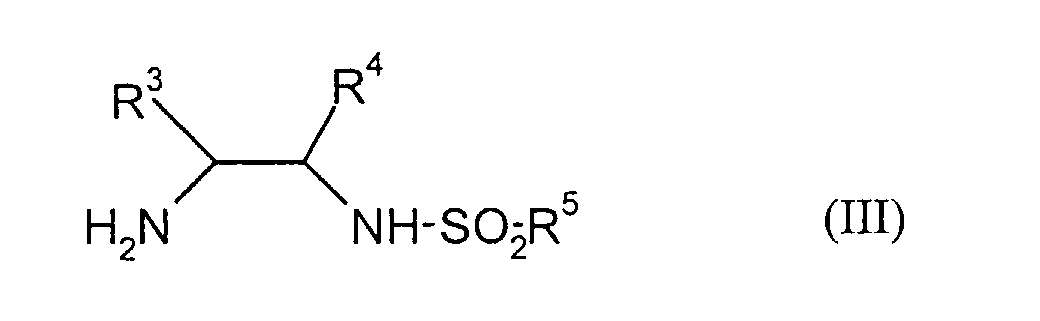
- R3 und R4
- jeweils unabhängig voneinander beispielsweise für C1-C20-Alkyl, C4-C15-Aryl oder C5-C16-Arylalkyl oder R3 und R4 zusammen für einen geradkettigen oder verzweigten C3-C12-Alkylen-Rest, und
- R5
- für C1-C20-Alkyl, C1-C20-Fluoralkyl oder C4-C15-Aryl.
- R5
- steht bevorzugt für C1-C4-Alkyl, C1-C4-Fluoralkyl, Phenyl oder Naphthyl, das mit keinem, einem, zwei, drei vier oder fünf Resten weiter substituiert sein kann, die ausgewählt sind aus der Gruppe C1-C4-Alkyl, C1-C4-Alkoxy, C1-C4-Fluoralkyl, Fluor und Chlor.
- R5
- steht besonders bevorzugt für Methyl, Trifluormethyl, Pentafluorethyl, Nonafluorbutyl, Phenyl, p-Tolyl, p-Ethylphenyl, p-Anisyl, p-Ethoxyphenyl, p-Chlorphenyl, 2,4,6-Trimethylphenyl, 2,4,6-Triisopropylphenyl, p-Fluorphenyl, Pentafluorphenyl, und Naphthyl.
- R5
- steht besonders bevorzugt für p-Tolyl, Phenyl, Naphtyl.
- R5
- steht ganz besonders bevorzugt für p-Tolyl.
- R6, R7 und R8
- jeweils unabhängig voneinander für Wasserstoff, C1-Cg-Alkyl oder Benzyl stehen.
Dabei sind je nach Wahl der Konfiguration der Liganden die an 4-Position S- oder R-konfigurierten Produkte erhältlich.
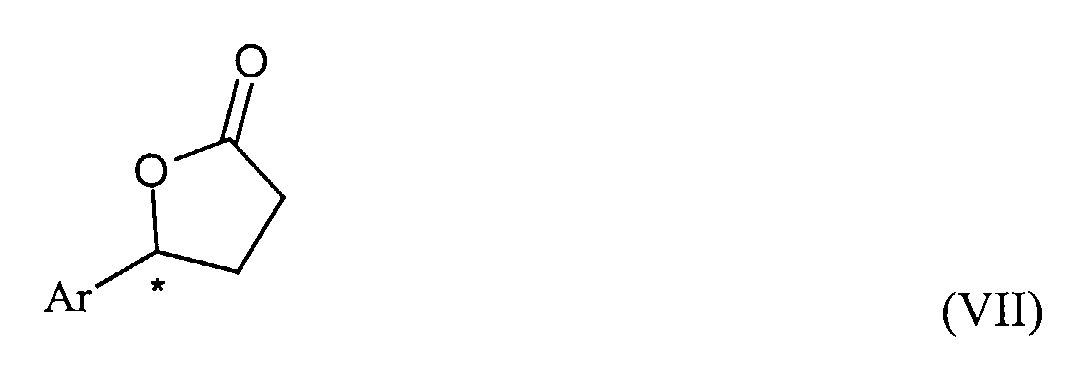
Ar die unter der Formel (I) genannte Bedeutung besitzt und
wobei in den Formeln (VIII), (IX) und (X) R1 die in der Formel (I) genannte Bedeutung besitzt und
n = zwei ist.
1H-NMR (d1-Chloroform, 400 MHz): δ = 7.3-7.1 (m, 5H, Ph), 5.45 (pt, 1H, CHOH), 4.07 (q, 2H, OCH2), 2.36 (t, 2H, CH2), 2.01 (m, 3H, CH2 und OH), 1.18 (t, 3H, CH3) ppm.
ee: 92,0 %, t = 66 h, U = 71,5 %. S/C = 400, T = 30°C.
Chiral-GC: 12,39, 12,92 min (Säule C, 20 m, 160°C isotherm).
t = 24 h, U = 62 %. S/C = 400. T = 30°C.
1H-NMR (d1-Chloroform, 400 MHz): δ = 7.45 (d, 2H, Ph), 7.14 (d, 2H, Ph), 5.40 (pt, 1H, CHOH), 3.42 (s, 3H, CH3), 2.37 (t, 2H, CH2), 2.20 (br, 1H, OH), 1.98 (pq, 2H, CH2) ppm.
ee: 89,9 %, t = 66 h, U = 96 %. S/C = 400, T = 30°C.
Chiral-GC: Ester: 18,98, 19,64 min, Lacton: 16,20, 17,24 min (Säule A, 12.5 m, 15 min 160°C, 2°C/min, 220°C).
t = 24 h, U = 95 %. S/C = 100, T = 30 °C.
ee: 91,8 %, S/C = 400, T = 30°C.
Chiral-GC: Lacton: 20,08, 20,41 min (Säule A, 12,5 m, 15 min 145°C, 5°C/min, 180°C).
1H-NMR (d1-Chloroform, 400 MHz): δ = 7.17 (d, 1H, Ar), 6.89 (m, 3H, Ar), 4.95 (pt, 1H, CHOH), 4.09 (q, 2H, OCH2), 2.40 (m, 3H, CH2 und OH), 2.01 (pq, 2H, CH2), 1.19 (t, 3H, CH3) ppm.
ee: 96,00 %, S/C = 500, U = 98 %, t = 60 h, T = 30°C.
Chiral-GC: Hydroxyester: 13,30, 13,63; Lacton: 6,77, 7,04 min. (Säule A, 12,5 m, 15 min 145°C, 5°C/min, 180°C).
ee: 94,8 %, S/C = 100, U = 91,7 %, t = 18 h, T = 30 °C.
1H-NMR (d1-Chloroform, 400 MHz): δ = 6.82 (s, 1H, Ar), 4.81 (dd, 1H, CHOH), 3.62 (s, 3H, CH3), 2.39 (t, 2H, CH2), 2.20 (br, 3H, OH und CH2) ppm.
ee: 70,00 %, S/C = 200, U = 36,5 %, t = 66 h, T = 30°C.
Chiral-GC: Hydroxyester: 21.62, 22.08; Lacton: 18.02, 18.44 min. (Säule A, 12.5 m, 15 min 145°C, 5°C/min, 180°C).
S/C = 100, U = 97 %, t = 24 h, T = 30°C.
Die Umsetzung erfolgt analog Beispiel 6, außer dass 0.004 eq. [N-[(1R,2R und 1S,2S)-2-(amino-κN)-1,2-diphenylethyl]-p-tolylsulfonamidato-κN]chloro[(rib)-1,3,5-trimethylbenzol]-ruthenium(II) als Katalysator eingesetzt wurden.
ee: 94,8 %, S/C = 250, U = 80 %, t = 26 h, T = 30°C.
Die Umsetzung erfolgt analog Beispiel 6, außer dass 0.002 eq. [N-[(1R,2R und 1S,2S)-2-(amino-κN)-1,2-diphenylethyl]-p-tolylsulfonamidato-κN]chloro[(η6)-1,3,5-trimethylbenzol]-ruthenium(II) als Katalysator eingesetzt wurden.
ee: 94,3 %, S/C = 500, U >98 %, t = 60 h, T = 30°C.
Claims (18)
- Verfahren zur Herstellung von stereoisomerenangereicherten 4-Aryl-4-hydroxybutansäurederivaten, dadurch gekennzeichnet, dassumgesetzt werden.a) Verbindungen der Formel (I)
- Aryl
- für einen mono-, bi- oder tricyclischen aromatischen Rest mit insgesamt 5 bis 18 Ringatomen steht, wobei pro Cyclus keines, eines zwei oder drei Ringatome ausgewählt aus der Gruppe Sauerstoff, Schwefel und Stickstoff vorhanden sein können, und wobei der mono-, bi- oder tricyclische aromatische Rest gegebenenfalls einfach oder mehrfach substituiert ist und
- W
- für C(O)YR1 n steht, wobei Y für Sauerstoff steht und n = 1 ist oder Y für Stickstoff steht und n = 2 ist, oder
- W
- für CN steht und,
- R1
- jeweils unabhängig voneinander für Wasserstoff, C1-C20-Alkyl, C4-C14-Aryl oder C5-C15-Arylalkyl oder im Falle, dass Y für Stickstoff steht, die beiden Reste R1 zusammen für C3-C12-Alkylen stehen,
b) in Gegenwart eines Ruthenium enthaltenden Katalysators undc) in Gegenwart von mindestens einem Amin, das zumindest teilweise in protonierter Form vorliegt,d) mit Ameisensäure, Formiaten oder Mischungen davon - Verfahren nach Anspruch l, dadurch gekennzeichnet, dass es in Gegenwart von organischem Lösungsmittel durchgeführt wird.
- Verfahren nach einem oder mehreren der Ansprüche 1 bis 2, dadurch gekennzeichnet, dass in Formel (I) Aryl steht für einen mono- oder bicyclischen aromatischen Rest mit insgesamt 5 bis 12 Ringatomen, wobei pro Cyclus keines, eines oder zwei Ringatome ausgewählt sind aus der Gruppe Sauerstoff, Schwefel und Stickstoff und wobei der mono- oder bicyclische aromatische Rest keinen, einen, zwei oder drei Reste pro Cyclus trägt, die jeweils unabhängig voneinander ausgewählt sind aus der Gruppe Hydroxy, C1-C12-Alkyl, Cyano, COOH, COOM, COO-(C1-C12-Alkyl), COO-(C4-C10-Aryl). CO-(C1-C12-Alkyl), CO-(C4-C10-Aryl), O-(C1-C12-Alkyl), (C1-C12-Alkyl)-O-(C1-C12-Alkyl), (C4-C10-Aryl)-O-(C1-C12-Alkyl), O-(C4-C10-Aryl), O-CO-(C4-C10-Aryl), O-CO-(C1-C12-Alkyl), OCOO-(C1-C12-Alkyl), N-(C1-C12-Alkyl)2, NH-(C1-C12-Alkyl), N(C4-C10-Aryl)2, NH-(C4-C10-Aryl), Fluor, Chlor, Brom, Iod, NO2, SO3H, SO3M, SO2(C1-C12-Alkyl), SO(C1-C12-Alkyl), C1-C12-Fluoralkyl, wobei Fluoralkyl für einen einfach, mehrfach oder vollständig durch Fluor substituierten Alkylrest gemäß obiger Definition steht, NHCO-(C1-C12-Alkyl), CONH2, CONH-(Ci-Ci2-Alkyl), NHCOO-(Ci-Ci2-Alkyl), PO(C4-Cio-Aryl)2, PO(C1-C12-Alkyl)2, PO3H2, PO3M2, POßHM, PO(0(Ci-Ci2-Alkyl)2, wobei M jeweils für ein Alkalimetallion oder ein halbes Äquivalent eines Erdalkalimetallions steht.
- Verfahren nach einem oder mehreren der Ansprüche 1 bis 3, dadurch gekennzeichnet, dass in Formel (I) W für COOR1 steht, wobei R1 für Wasserstoff oder C1-C8-Alkyl steht.
- Verfahren nach einem oder mehreren der Ansprüche 1 bis 4, dadurch gekennzeichnet, dass als Verbindung der Formel (I) Methyl-4-oxo-4-(2-thiophenyl)butanoat oder Ethyl-4-oxo-4-(2-thiophenyl)butanoat eingesetzt werden.
- Verfahren nach einem oder mehreren der Ansprüche 1 bis 5, dadurch gekennzeichnet, dass Katalysatoren verwendet werden, die Rutheniumkomplexe enthalten, die durch Umsetzung von Verbindungen der Formel (II) mit Verbindungen der Formel (III) erhältlich sind, oder Komplexe der Formel (IV), wobei
in den Verbindungen der Formel (II)- X
- für Chlor, Brom oder Iod steht und wobei

- R3 und R4
- jeweils unabhängig voneinander beispielsweise für C1 -C 20-Alkyl, C4-C15-Aryl oder C5-C16-Arylalkyl oder R3 und R4 zusammen für einen geradkettigen oder verzweigten C3-C12-Alkylen-Rest, und
- R5
- für C1-C20-Alkyl, C1-C20-Fluoralkyl oder C4-C15-Aryl stehen und wobei
- Verfahren nach einem oder mehreren der Ansprüche 1 bis 6, dadurch gekennzeichnet, dass als Katalysator solche verwendet werden, die Rutheniumkomplexe enthalten, die durch Umsetzung von S,S- oder R.R-N-p-Toluolsulfonyl- 1 ,2-diphenylethylendiamin und Cumoldichlororuthenium-Dimer erhältlich sind.
- Verfahren nach einem oder mehreren der Ansprüche 1 bis 7, dadurch gekennzeichnet, dass Mischungen von Ameisensäure mit Aminen eingesetzt werden.
- Verfahren nach einem oder mehreren der Ansprüche 1 bis 8, dadurch gekennzeichnet, dass als Amine solche der Formel (V) eingesetzt werden,
- R6, R7 und R8
- jeweils unabhängig voneinander für Wasserstoff, C1-C8-Alkyl oder Benzyl stehen.
- Verfahren nach einem oder mehreren der Ansprüche 1 bis 9, dadurch gekennzeichnet, dass als Amin Triethylamin eingesetzt wird.
- Verfahren nach einem oder mehreren der Ansprüche 1 bis 10, dadurch gekennzeichnet, dass das molare Verhältnis von Ameisensäure zu Amin 1:1 bis 3:1 beträgt.
- Verfahren nach einem oder mehreren der Ansprüche 1 bis 11, dadurch gekennzeichnet, dass das molare Verhältnis an Ameisensäure bezogen auf eingesetztes Substrat 1:1 bis 3:1 beträgt.
- Verfahren nach einem oder mehreren der Ansprüche 1 bis 12, dadurch gekennzeichnet, dass die Reaktionstemperatur -10 bis 150°C beträgt.
- Verfahren nach einem oder mehreren der Ansprüche 1 bis 13, dadurch gekennzeichnet, dass die molare Menge an Ruthenium 0,01 bis 1,0 Mol-%, bezogen auf das eingesetzte Substrat beträgt.
- Verwendung von stereoisomerenangereicherten 4-Aryl-4-hydroxy-butansäurederivaten, die nach einem oder mehreren der Ansprüche 1 bis 14 hergestellt wurden zur Herstellung von flüssigkristallinen Verbindungen, Agrarchemikalien, Pharmazeutika oder Zwischenprodukten davon.
- Verwendung nach Anspruch 15, dadurch gekennzeichnet, dass die Pharmazeutika Serotonin-Aufnahmeinhibitoren sind.
- Verwendung nach Anspruch 16, dadurch gekennzeichnet, dass die Serotonin-Aufnahmeinhibitoren Fluoxetin oder Duloxetin sind.
- Verwendung von stereoisomerenangereicherten 4-Aryl-4-hydroxy-butansäurederivaten, die nach einem oder mehreren der Ansprüche 1 bis 14 hergestellt wurden zur Herstellung von Verbindungen der Formeln (VII), (VIII), (IX) und (X),
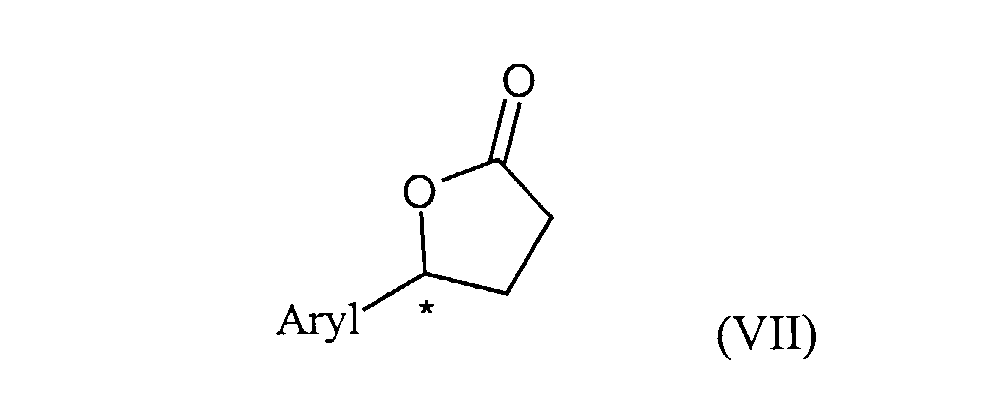
Aryl die unter der Formel (I) im Anspruch 1 genannte Bedeutung besitzt und wobei in den Formeln (VIII), (IX) und (X) R1 die in der Formel (I) im Anspruch 1 genannte Bedeutung besitzt und
n = zwei ist.
Applications Claiming Priority (2)
| Application Number | Priority Date | Filing Date | Title |
|---|---|---|---|
| DE10225352 | 2002-06-07 | ||
| DE10225352A DE10225352A1 (de) | 2002-06-07 | 2002-06-07 | Verfahren zur stereoselektiven Reduktion von 4-Aryl-4-oxobutansäure-derivaten |
Publications (1)
| Publication Number | Publication Date |
|---|---|
| EP1369410A1 true EP1369410A1 (de) | 2003-12-10 |
Family
ID=29432696
Family Applications (1)
| Application Number | Title | Priority Date | Filing Date |
|---|---|---|---|
| EP03011881A Withdrawn EP1369410A1 (de) | 2002-06-07 | 2003-05-27 | Verfahren zur stereoselektiven Reduktion von 4-Aryl-4-oxobutansäure-derivaten |
Country Status (4)
| Country | Link |
|---|---|
| US (3) | US6921822B2 (de) |
| EP (1) | EP1369410A1 (de) |
| JP (1) | JP4283043B2 (de) |
| DE (1) | DE10225352A1 (de) |
Cited By (1)
| Publication number | Priority date | Publication date | Assignee | Title |
|---|---|---|---|---|
| WO2011047643A1 (en) * | 2009-10-19 | 2011-04-28 | Zentiva, K.S. | Method for the preparation of (ls)-6,7-dimethoxy-l-[2-(4-trifluoromethylphenyl)ethyl]- 1,2,3,4-tetrahydroisoquinoline |
Families Citing this family (4)
| Publication number | Priority date | Publication date | Assignee | Title |
|---|---|---|---|---|
| DE10208828A1 (de) * | 2002-03-01 | 2003-09-11 | Bayer Ag | Verfahren zur Reduktion von 3-Heteroaryl-3-oxopropionsäurederivaten |
| US7659409B2 (en) * | 2002-03-19 | 2010-02-09 | Mitsubishi Chemical Corporation | 3-Hydroxy-3-(2-thienyl) propionamides and production method thereof, and production method of 3-amino-1-(2-thienyl)-1-propanols using the same |
| ES2331911T3 (es) * | 2002-06-17 | 2010-01-20 | Saltigo Gmbh | Procedimiento para la preparacion de diaminas mono-n-sulfoniladas. |
| CN113149858B (zh) * | 2021-01-22 | 2023-01-17 | 南开大学 | 一种分子间n-n成键的合成方法及对应合成的化合物 |
Citations (4)
| Publication number | Priority date | Publication date | Assignee | Title |
|---|---|---|---|---|
| EP0478147A1 (de) * | 1990-08-30 | 1992-04-01 | Takasago International Corporation | Verfahren zur Herstellung von optisch aktiven Gamma-butyrolactonderivaten |
| EP0718265A2 (de) * | 1994-12-07 | 1996-06-26 | Research Development Corporation Of Japan | Verfahren zur Herstellung eines Alkohols |
| EP0916637A1 (de) * | 1995-12-06 | 1999-05-19 | Japan Science and Technology Corporation | Verfahren zur herstellung optische aktive verbindungen |
| EP1258470A2 (de) * | 2001-05-18 | 2002-11-20 | Takasago International Corporation | Verfahren zur Herstellung von optisch-aktiven Alkoholen |
Family Cites Families (4)
| Publication number | Priority date | Publication date | Assignee | Title |
|---|---|---|---|---|
| ES2164187T3 (es) * | 1995-05-23 | 2002-02-16 | Lonza Ag | Procedimiento para la preparacion de derivados de acidos 2-piperazina-carboxilicos opticamente activos. |
| JP2962668B2 (ja) | 1995-12-06 | 1999-10-12 | 科学技術振興事業団 | 光学活性アルコール類の製造方法 |
| US5936124A (en) * | 1998-06-22 | 1999-08-10 | Sepacor Inc. | Fluoxetine process from benzoylpropionic acid |
| JP2000143589A (ja) | 1998-09-04 | 2000-05-23 | Takeda Chem Ind Ltd | 光学活性ヒドロキシ化合物の製造法 |
-
2002
- 2002-06-07 DE DE10225352A patent/DE10225352A1/de not_active Withdrawn
-
2003
- 2003-05-27 EP EP03011881A patent/EP1369410A1/de not_active Withdrawn
- 2003-06-09 JP JP2003164265A patent/JP4283043B2/ja not_active Expired - Fee Related
- 2003-06-09 US US10/457,685 patent/US6921822B2/en not_active Expired - Fee Related
-
2005
- 2005-06-15 US US11/153,053 patent/US7329766B2/en not_active Expired - Fee Related
-
2007
- 2007-12-17 US US12/002,407 patent/US8034961B2/en not_active Expired - Fee Related
Patent Citations (4)
| Publication number | Priority date | Publication date | Assignee | Title |
|---|---|---|---|---|
| EP0478147A1 (de) * | 1990-08-30 | 1992-04-01 | Takasago International Corporation | Verfahren zur Herstellung von optisch aktiven Gamma-butyrolactonderivaten |
| EP0718265A2 (de) * | 1994-12-07 | 1996-06-26 | Research Development Corporation Of Japan | Verfahren zur Herstellung eines Alkohols |
| EP0916637A1 (de) * | 1995-12-06 | 1999-05-19 | Japan Science and Technology Corporation | Verfahren zur herstellung optische aktive verbindungen |
| EP1258470A2 (de) * | 2001-05-18 | 2002-11-20 | Takasago International Corporation | Verfahren zur Herstellung von optisch-aktiven Alkoholen |
Non-Patent Citations (2)
| Title |
|---|
| NOYORI R ET AL: "Asymmetric Transfer Hydrogenation Catalyzed by Chiral Ruthenium Complexes", ACCOUNTS OF CHEMICAL RESEARCH, AMERICAN CHEMICAL SOCIETY. WASHINGTON, US, vol. 30, no. 2, 1997, pages 97 - 102, XP002229949, ISSN: 0001-4842 * |
| NOYORI R ET AL: "Ruthenium(II)-Catalyzed Asymmetric Transfer Hydrogenation of Ketones Using a Formic Acid-Triethylamine Mixture", JOURNAL OF THE AMERICAN CHEMICAL SOCIETY, AMERICAN CHEMICAL SOCIETY, WASHINGTON, DC, US, vol. 118, no. 10, 1996, pages 2521 - 2522, XP002240976, ISSN: 0002-7863 * |
Cited By (1)
| Publication number | Priority date | Publication date | Assignee | Title |
|---|---|---|---|---|
| WO2011047643A1 (en) * | 2009-10-19 | 2011-04-28 | Zentiva, K.S. | Method for the preparation of (ls)-6,7-dimethoxy-l-[2-(4-trifluoromethylphenyl)ethyl]- 1,2,3,4-tetrahydroisoquinoline |
Also Published As
| Publication number | Publication date |
|---|---|
| US7329766B2 (en) | 2008-02-12 |
| DE10225352A1 (de) | 2003-12-18 |
| JP2004083566A (ja) | 2004-03-18 |
| US20080103316A1 (en) | 2008-05-01 |
| US20050245760A1 (en) | 2005-11-03 |
| US6921822B2 (en) | 2005-07-26 |
| US8034961B2 (en) | 2011-10-11 |
| US20040030181A1 (en) | 2004-02-12 |
| JP4283043B2 (ja) | 2009-06-24 |
Similar Documents
| Publication | Publication Date | Title |
|---|---|---|
| DE3051060C2 (de) | ||
| Enholm et al. | Cyclization reactions of allylic O-stannyl ketyls | |
| DE10161978A1 (de) | Verfahren zur Herstellung von 2-Halogenacyl-3-amino-acrylsäure-derivate | |
| EP0256982B1 (de) | Verfahren zur Herstellung von optisch aktiven sekundären Arylaminen | |
| Labeeuw et al. | Total synthesis of sulfobacin A through dynamic kinetic resolution of a racemic β-keto-α-amino ester hydrochloride | |
| EP1346977B1 (de) | Verfahren zur Herstellung von Aryl-aminopropanolen | |
| CH621767A5 (en) | Process for the preparation of optically active alkyl chrysanthemates. | |
| US8034961B2 (en) | Process for stereoselectively reducing 4-aryl-4-oxobutanoic acid derivatives | |
| EP1340746B1 (de) | Verfahren zur Reduktion von 3-Heteroaryl-3-Oxopropionsäurederivaten | |
| Reddy et al. | Enantioselective Henry reaction catalyzed by a copper (II) glucoBOX complex | |
| DE4333491A1 (de) | Verfahren zur Herstellung von Methylencyclopropan | |
| EP3877372A1 (de) | Enantioselektives verfahren | |
| WO2002072524A2 (de) | Verfahren zur herstellung von vinyl-, aryl- und heteroarylessigsäuren und ihrer derivate | |
| Venkatesan et al. | A mild and efficient one-pot three-component synthesis of anti-β-amino-carbonyl compounds catalyzed by NH4OAc and their anticancer activities | |
| WO2022268525A1 (de) | Hydrierung von estern zu alkoholen in gegenwart eines mn-pnn-komplexes | |
| ES2322763T3 (es) | Procedimiento para producir un compuesto nitro opticamente activo. | |
| EP1469005A1 (de) | Verfahren zur asymmetrischen Hydrierung von Ketocarbonsäureestern | |
| DE2542377B2 (de) | 28.12.74 Japan 2065-75 30.06.75 Japan 80600-75 1,1,1 -Trihalogen^-methyl-S-penten-2-ole und Verfahren zu ihrer Herstellung | |
| DD284009A5 (de) | Verfahren zur herstellung von (as; 1'r)-3-[n-(acyl)-n-(3-chlorphenyl)]-amino-tetrahydro-2-furonen | |
| Oliveira et al. | Substrate-Directed Heck–Matsuda Arylations: From Curiosity to a Valuable Synthetic Tool | |
| EP1375477A2 (de) | Verfahren zur Herstellung von mono-N-sulfonylierten Diaminen | |
| EP1966125B1 (de) | Verfahren zur herstellung von o-alkylierten aminoalkoholen | |
| CH697663B1 (de) | Pyrazolylalkine. | |
| DE4440021A1 (de) | Verfahren zur Herstellung von 2-Fluorcyclopropylamin und neue Cyclopropylaminderivate | |
| WO2001056976A1 (de) | Epoxidierungskatalysatoren auf paracyclophanbasis |
Legal Events
| Date | Code | Title | Description |
|---|---|---|---|
| PUAI | Public reference made under article 153(3) epc to a published international application that has entered the european phase |
Free format text: ORIGINAL CODE: 0009012 |
|
| AK | Designated contracting states |
Kind code of ref document: A1 Designated state(s): AT BE BG CH CY CZ DE DK EE ES FI FR GB GR HU IE IT LI LU MC NL PT RO SE SI SK TR |
|
| AX | Request for extension of the european patent |
Extension state: AL LT LV MK |
|
| RAP1 | Party data changed (applicant data changed or rights of an application transferred) |
Owner name: BAYER CHEMICALS AG |
|
| 17P | Request for examination filed |
Effective date: 20040611 |
|
| AKX | Designation fees paid |
Designated state(s): AT BE BG CH CY CZ DE DK EE ES FI FR GB GR HU IE IT LI LU MC NL PT RO SE SI SK TR |
|
| RAP1 | Party data changed (applicant data changed or rights of an application transferred) |
Owner name: LANXESS DEUTSCHLAND GMBH |
|
| RAP1 | Party data changed (applicant data changed or rights of an application transferred) |
Owner name: SALTIGO GMBH |
|
| RAP1 | Party data changed (applicant data changed or rights of an application transferred) |
Owner name: SALTIGO GMBH |
|
| 17Q | First examination report despatched |
Effective date: 20071112 |
|
| RAP1 | Party data changed (applicant data changed or rights of an application transferred) |
Owner name: SALTIGO GMBH |
|
| STAA | Information on the status of an ep patent application or granted ep patent |
Free format text: STATUS: THE APPLICATION IS DEEMED TO BE WITHDRAWN |
|
| 18D | Application deemed to be withdrawn |
Effective date: 20140913 |