BACKGROUND OF THE INVENTION
1. Field of the Invention
The present invention relates to a modified glucose
dehydrogenase (GDH) with improved substrate specificity
and/or thermal stability, and more specifically to a
modified PQQ-dependent glucose dehydrogenase (PQQGDH)
having pyrroloquinoline guinone (PQQ) as the coenzyme, and
to a manufacturing method and a glucose sensor.
The modified PQQGDH of the present invention is
useful for measuring glucose in clinical assay, food
analysis and the like.
2. Description of the Related Art
PQQGDH is a glucose dehydrogenase having
pyrroloquinoline quinone (PQQ) as its coenzyme. Because
PQQGDH catalyzes a reaction in which glucose is oxidized
to produce gluconolactone, it can be used in measuring
blood sugar. Blood glucose concentration is extremely
important in clinical diagnosis as a marker of diabetes.
At present, the principal method of measuring blood
glucose employs a biosensor using glucose oxidase, but the
reaction is affected by dissolved oxygen concentration,
raising the possibility of errors in the measurements.
Attention has focused on PQQ-dependent glucose
dehydrogenase as a substitute for glucose oxidase. Our
group discovered that the NCIMB 11517 strain of
Acinetobacter baumannii produces PQQ-dependent glucose
dehydrogenase, conducted gene cloning and constructed a
high-expression system (Japanese Patent Application Laid-Open
No. H11-243949). Compared with glucose oxidase, PQQ-dependent
glucose dehydrogenase had problems in substrate
specificity and thermal stability.
An object of the present invention is to provide a
PQQGDH with improved substrate specificity and/or thermal
stability.
BRIEF DESCRIPTION OF THE DRAWINGS
Figure 1 shows measurement results for optimum pH;
Figure 2 shows the results of glucose assay;
Figure 3 shows results for activity of Q76K on
maltose;
Figure 4 shows results for activity of Q76E on
maltose;
Figure 5 shows results for activity of Q168V on
maltose;
Figure 6 shows results for activity of Q168A on
maltose; and
Figure 7 shows results for activity of the wild-type
enzyme on maltose.
SUMMARY OF THE INVENTION
The present invention provides a modified PQQGDH, a
manufacturing method therefor, and a glucose assay kit and
glucose sensor containing said PQQGDH.
In the specification, amino acid positions are
numbered beginning with 1 as aspartic acid with the signal
sequence removed.
The modified PQQGDH of the present invention
encompasses PQQGDH having less activity on disaccharides
and/or greater thermal stability than wild-type PQQGDH.
Examples of disaccharides include maltose, sucrose,
lactose, cellobiose and the like, and particularly maltose.
Activity on disaccharides signifies the action of
dehydrogenating the disaccharides.
As long as activity on disaccharides is reduced in
comparison with wild-type PQQGDH. the modified PQQGDH of
the present invention encompasses modified PQQGDH in which
the activity on glucose is either increased, unchanged or
reduced.
In the measurement of glucose concentration, the
activity on disaccharides of the modified PQQGDH of the
present invention, is less than that of the case when
wild-type glucose dehydrogenase is used. In the modified
PQQGDH of the present invention, the activity on maltose
is particularly reduced. Activity on maltose is no more
than 90%, preferably 75%, more preferably 60%,
particularly 40% of that of wild-type PQQGDH.
The modified PQQGDH of the present invention may
have a greater Km value for disaccharides than for glucose.
Modified PQQGDH having a higher Km value for maltose than
for glucose is particularly desirable. The Km value for
maltose should be at least 8 mM, preferably at least 12 mM,
particularly at least 20 mM.
The modified PQQGDH of the present invention may be
further indicated by a higher Km value for disaccharides
than for glucose. Modified PQQGDH having a higher Km
value for maltose than for glucose is particularly
desirable. The Km value for maltose should be at least
1.5 times or preferably at least 3 times that for glucose.
As used here, "activity on maltose" signifies the
ratio of the reaction rate using glucose as a substrate to
the reaction rate using disaccharides or specifically
maltose as a substrate, expressed as a percentage.
The degree of improvement of the invention in
thermal stability expressed as residual activity after
heat treatment at 58° C for 30 minutes is preferably higher
than that of wild type PQQGDH. The residual activity of
the modified PQQGDH of the invention is at least 48% or
preferably 55% or more preferably 70%.
Examples of the modified PQQGDH with improved
substrate specificity of the present invention include GDH
having amino acids substituted at one or more of positions
67, 68, 69, 76, 89, 167, 168, 169, 341, 342, 343, 351, 49,
174, 188, 189, 207, 215, 245, 300, 349, 129, 130 and 131
in the amino acid sequence of SEQ ID No. 1, and GDH having
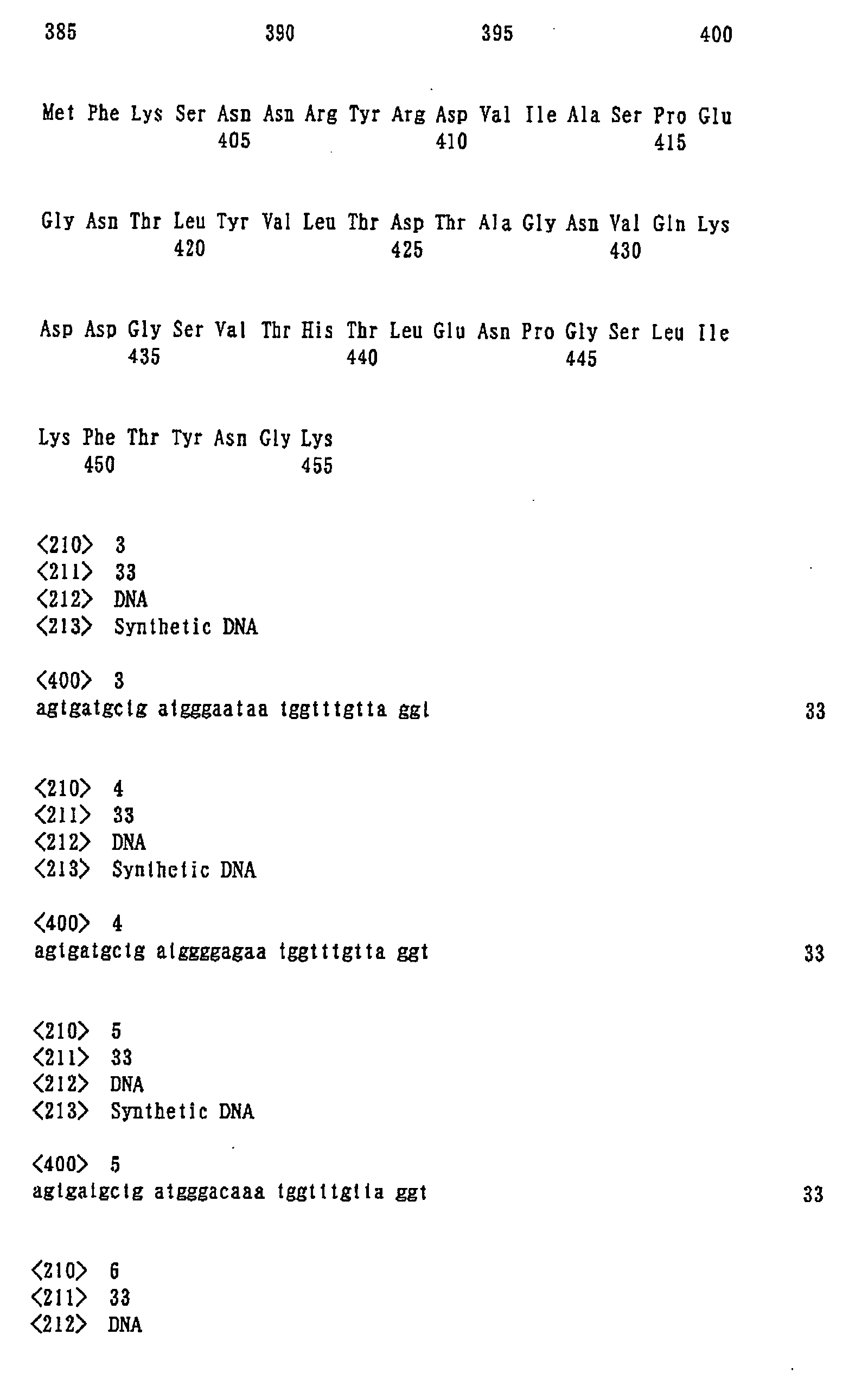
an amino acids inserted between positions 428 and 429.
Preferred are GDH having amino acid substitutions selected
from the group consisting of Q76N, Q76E, Q76T, Q76M, Q76G,
Q76K, N167E, N167L, N167G, N167T, N167S, N167A, N167M,
Q168I, Q168V, Q168A. Q168C, Q168D, Q168E, Q168F, Q168G,
Q168H, Q168K, Q168L, Q168M, Q168N, Q168R, Q168S, Q168W,
L169D, L169S, L169W, L169Y, L169A, L169N, L169M, L169V,
L169C, L169Q, L169H, L169F, L169R, L169K, L169I, L169T,
K89E, K300R, S207C, N188I, T349S, K300T, L174F. K49N,
S189G, F215Y, S189G, E245D, A351T, P67K, E68K, P67D, E68T,
I69C, P67R, E68R, E129R, K130G, P131G, E129N, P131T, E129Q,
K130T, P131R, E129A, K130R, P131K, E341L, M342P, A343R,
A343I, E341P, M342V, E341S, M342I. A343C, M342R, A343N,
L169P, L169G and L169E, and GDH having L, A or K inserted
between positions 428 and 429. Substitutions at positions
67, 68, 69, 76, 89, 167, 168, 169, 341, 342, 343, 351, 49,
174, 188, 189, 207, 215, 245, 300, 349, 129, 130 and 131
may be at one position or multiple positions.
As used here, "Q76N" signifies the substitution of N
(Asn) for Q (Gln) at position 76.
Substitutions of Q76N, Q76E, Q76T, Q76M, Q76G, Q76K,
Q168I, Q168V, Q168A, Q168C, Q168D, Q168E, Q168F, Q168G,
Q168H, Q168K, Q168L, Q168M, Q168N, Q168R, Q168S, Q168W,
L169A, L169V, L169H, L169K, L169D, L169S, L169N, L169G,
L169C, (K89E+K300R), (Q168A+L169D) , (Q168S+L169S),
(N167E+Q168G+L169T), (N167S+Q168M+L169R), (Q168G+L169T),
(N167G+Q1685+L169Y) (N167L+Q1685+L169G),
(N167G+Q168S+L169S+L174F+K49N), (Q168N+L168N+S189R),
(N167E+Q168G+L169A+S189G), (N167G+Q168R+L169A).
(N167S+Q168G+L169A), (N167G+Q168V+L169S),
(N167S+Q168V+L169S), (N167T+Q168I+L169G),
(N167G+Q168W+L169N), (N167G+Q168S+L169N),
(N167G+Q168S+L169V), (Q168R+L169C), (N167S+Q168L+L168G),
(Q168C+L169S), (N167T+Q168N+L169K),
(N167G+Q168T+L169A+S207C), (N167A+Q168A+L169P).
(N167G+Q168S+L169G), (N167G+Q168G), (N167G+Q168D+L169K),
(Q168P+L169G). (N167G+Q168N+L169S). (Q168S+L169G),
(M188I+T349S). (N167G+Q168G+L169A+F215Y),
(N167G+Q168T+L169G), (Q168G+L169V), (N167G+Q168V+L169T),
(N167E+Q168N+L169A), (Q168R+L169A), (N167G+Q168R),
(N167G+Q168T). (N167G+Q168T+L169Q), (Q168I+L169G+K300T).
(N167G+Q168A). (N167T+Q168L+L169K), (N167M+Q168Y+L169G),
(N167E+Q168S), (N167G+Q168T+L169V+S189G),
(N167G+Q168G+L169C), (N167G+Q168K+L169D), (Q168A+L169D),
(Q168S+E245D), (Q168S+L169S), (A351T), (N167S+Q168S+L169S),
(Q168I+L169Q), (N167A+Q168S+L169S), (Q168S+L169E),
(Q168A+L169G), (Q168S+L169P). (P67K+E68K),
(P67R+E68R+I69C), (P67D+E68T+I69C). (E129R+K130G+P131G),
(E129Q+K130T+P131R), (E129N+P131T), (E129A+K130R+P131K),
(E341L+M342P+A343R), (E341S+M342I), A343I,
(E341P+M342V+A343C), (E341P+M342V+A343R),
(E341L+M342R+A343N). (Q168A+L169A), (Q168A+L169C),
(Q168A+L169E), (Q168A+L169F), (Q168A+L169H), (Q168A+L169I),
(Q168A+L169K), (Q168A+L169M), (Q168A+L169N), (Q168A+L169P),
(Q168A+L169Q), (Q168A+L169R), (Q168A+L169S), (Q168A+L169T),
(Q168A+L169V), (Q168A+L169W) and (Q168A+L169Y), and also
insertion of L, A or K between positions 428 and 429
contribute to improving the substrate specificity of
PQQGDH. As used here, substrate specificity signifies the
ratio (%) of the reaction rate with glucose as the
substrate to the reaction rate with disaccharides
(particularly maltose) used as the substrate.
The PQQGDH of the present invention with improved
thermal stability has amino acid substitutions at one or
more of positions 20, 76, 89, 168, 169, 246 and 300 of the
amino acid sequence of SEQ ID No. 1, and preferably has
amino acid substitutions selected from the group
consisting of K20E, Q76M, Q76G, K89E, Q168A, Q168D, Q168E,
Q168F, Q168G, Q168H. Q168M, Q168P, Q168W, Q168Y, Q168S,
L169D, L169E, L169P, L169S, Q246H, K300R, Q76N, Q76T, Q76K,
L169A, L169C, L169E, L169F, L169H, L169K, L169N, L169Q,
L169R, L169T, L169Y and L169G. Substitutions at positions
20, 76, 89, 168, 169, 246 and 300 may be at one position
or multiple positions.
As used here "K20E" signifies that K (Lys) has been
replaced with E (Glu) at position 20.
The amino acid substitutions K20E, Q76M, Q76G, (K89E
+ K300R), Q168A, (Q168A + L169D), (Q168S + L169S), Q246H,
Q168D, Q168E, Q168F, Q168G, Q168H, Q168M, Q168P, Q168W,
Q168Y, Q168S, (Q168S + L169E), (Q168S + L169P),
(Q168A+L169A), (Q168A+L169C), (Q168A+L169E). (Q168A+L169F),
(Q168A+L169H), (Q168A+L169K), (Q168A+L169N), (Q168A+L169P),
(Q168A+L169Q), (Q168A+L169R), (Q168A+L169T), and
(Q168A+L169Y) and (Q168A + L169G) contribute particularly
to the thermal stability of the PQQGDH.
The wild-type PQQGDH protein for modification shown
in SEQ ID No. 1 and the nucleotide sequence shown in SEQ
ID No. 2 are both well known, and are disclosed in
Japanese Patent Application Laid-Open No. H11-243949.
There are no particular limits on the method of
manufacturing the modified protein of the present
invention, which may be manufactured according to the
procedures shown below. Commonly used methods of
modifying genetic information may be used in modifying the
amino acid sequence which constitutes the protein. That
is, DNA having the genetic information of the modified
protein is created by replacing a specific nucleotide or
nucleotides in DNA having the genetic information for the
protein, or by inserting or deleting a specific nucleotide
or nucleotides. Actual methods of replacing one or more
nucleotides in DNA include those employing commercial kits
(such as the Clonetech Transformer Mutagenesis Kit;
Stratagene EXOIII/Mung Bean Deletion Kit; or Stratagene
QuickChange Site Directed Mutagenesis Kit), or those
employing the polymerase chain reaction (PCR).
The resulting DNA having the genetic information of
the modified protein is linked to a plasmid and inserted
into a host cell or microorganism to create a transformant
which produces the modified protein. Plasmids which can
be used include pBluescript, puc18 or the like for example
if Escherichia coli is the host microorganism. Host
organisms which can be used include for example
Escherichia coli W3110, Escherichia coli C600, Escherichia
coli JM109, Escherichia coli DH5α and the like. Insertion
of the vector into the host organism may be accomplished
for example by introducing the recombinant DNA in the
presence of calcium ions when the host organism is of the
genus Escherichia, and the electroporation method may also
be used. Commercially available competent cells (such as
Toyobo Competent High JM109) can also be used.
The resulting transformant reliably produces large
quantities of the modified protein when cultured in a
nutrient medium. The culture conditions for the
transformant can be selected according to the
physiological requirements of the host; a liquid culture
is normally used, but for industrial purposes an aerated
agitation culture is advantageous. A wide range of
nutrients which are ordinarily used in culturing the
organism can be used in the medium. The carbon source may
be any convertible carbon compound, including for example
glucose, sucrose, lactose, maltose, fructose, molasses and
pyruvic acid. The nitrogen source may be any usable
nitrogen compound, including for example peptone, meat
extract, yeast extract, hydrolyzed casein and soybean meal
alkali extract. In addition, phosphates, carbonates,
sulfates, salts of magnesium, calcium, potassium, iron,
manganese, zinc and the like, specific amino acids and
specific vitamins are used as necessary. The culture
temperature can be adjusted within the range at which the
organism grows and produces the modified protein, but
should be about 20-42° C in the case of Escherichia coli.
The culture time will vary somewhat depending on
conditions: the culture can be terminated at a suitable
point according to when the maximum yield of the modified
protein is obtained, with the normal time range being 6-48
hours. The pH of the culture medium can be varied within
the range at which the organism grows and produces the
modified protein, with a pH of 6.0-9.0 being particularly
desirable.
Culture medium containing organisms which produce
the modified protein can be collected from the culture and
used as is, but ordinarily when the modified protein is
present in the culture medium a solution containing the
modified protein is isolated from the bacterial cells by
conventional means such as filtration or centrifugation
for purposes of use. When the modified protein is present
in the cells, they are harvested from the resulting
culture by methods such as filtration or centrifugation,
the cells are broken down by mechanical methods or
enzymatic methods such as lysozyme, and the modified
protein is solubilized as necessary by the addition of a
chelating agent such as EDTA and/or a surfactant and
isolated and harvested as an aqueous solution.
The resulting solution containing the modified
protein can then be subjected to vacuum concentration,
membrane concentration and salting out with ammonium
sulfate or sodium sulfate or else precipitation by
fractional precipitation using a hydrophilic organic
solvent such as methanol, ethanol or acetone. Heat
treatment and isoelectric treatment are also effective
means of purification.. The purified modified protein can
be obtained by gel filtration with an adsorbent or gel
filter, adsorption chromatography, ion exchange
chromatography or affinity chromatography.
In the present invention, we were able to obtain
modified PQQGDH with improved substrate specificity by
focusing on the 76, 167, 168 and 169 positions of the
PQQGDH shown in SEQ ID No. 1 and creating amino acid
substitutions for them. The substitutions Q76K, Q168A,
(Q168S + L169S), (Q168A + L169D), (Q168S + E245D), (Q168S
+ L169E), (Q168A + L169G), (Q168S + L169P), (Q168A +
L169A), (Q168A + L169C), (Q168A + L169E), (Q168A + L169K),
(Q168A + L169M), (Q168A + L169N), (Q168A + L169P), (Q168A
+ L169S) and (Q168A + L169T) are particularly desirable in
terms of substrate specificity.
In the present invention, we were able to obtain
modified PQQGDH with improved stability by focusing on the
20, 76, 89, 168, 169, 246 and 300 positions of the PQQGDH
shown in SEQ ID No. 1 and creating amino acid
substitutions for them. The substitutions K20E, (K89E +
K300R), Q168A, (Q168A + L169D), (Q168S + L169S), (Q168S +
L169E), (Q168S + L169P), (Q168A + L169G). Q168D, Q168E,
Q168F, Q168G, Q168H, Q168M, Q168P, Q168S, Q168W, Q168Y,
(Q168A + L169A), (Q168A + L169C), (Q168A + L169E), (Q168A
+ L169F), (Q168A + L169H), (Q168A + L169K), (Q168A +
L169N), (Q168A + L169P), (Q168A + L169Q), (Q168A + L169R),
(Q168A + L169T), (Q168A + L169Y) and Q246H are
particularly desirable in terms of thermal stability.
Glucose Assay Kit
The present invention also provides a glucose assay
kit containing modified PQQGDH according to the present
invention. The glucose assay kit of the present invention
contains enough modified PQQGDH according to the invention
for at least one assay. Typically the kit contains in
addition to the modified PQQGDH of the invention such
buffers, mediators, standard glucose solutions for making
calibration curves, and instructions for use as are needed
to perform the assay. The modified PQQGDH according to
the invention can be provided in a variety of forms such
as for example a freeze-dried reagent or a solution in a
suitable storage solution. The modified PQQGDH of the
present invention is preferably provided as a holoenzyme,
but may also be provided as an apoenzyme and converted at
the time of use.
Glucose Sensor
The present invention also provides a glucose sensor
which uses modified PQQGDH according to the invention. A
carbon, gold or platinum electrode or the like is used as
the electrode, with the enzyme of the present invention
being immobilized on the electrode. Possible immobilizing
methods include those employing crosslinking reagents,
enclosure in a polymer matrix, coating with a dialysis
membrane, employing photocrosslinked polymers, conductive
polymers, and oxidation-reduction polymers, as well as
adsorption fixing on the electrode or fixing in a polymer
together with an electron mediator typified by ferrocene
and its derivatives, and a combination of these may also
be used. Preferably the modified PQQGDH of the present
invention is immobilized on the electrode as a holoenzyme,
but it may also be immobilized as an apoenzyme. and PQQ
supplied in solution or as a separate layer. Typically
the modified PQQGDH of the invention is first immobilized
on a carbon electrode using glutaraldehyde, and the
glutaraldehyde is then blocked by treatment with a reagent
having an amine group.
Glucose concentration can be measured as follows.
Buffer is placed in a thermostatic cell and maintained at
a constant temperature after the addition of PQQ, CaCl2
and a mediator. Mediators that can be used include
potassium ferricyanide, phenazine methosulfate and the
like. An electrode on which the modified PQQGDH of the
present invention has been immobilized is used as the work
electrode, together with a counter electrode (such as a
platinum electrode) and a reference electrode (such as an
Ag/AgCl electrode). A fixed voltage is applied to the
carbon electrode, and once the current has stabilized a
sample containing glucose is added and the increase in
current measured. The glucose concentration in the sample
can then be calculated based on a calibration curve
prepared from glucose solutions with standard-concentration.
BEST MODE FOR CARRYING OUT THE INVENTION
Example 1: Construction of an expression plasmid with PQQ-dependent
glucose dehydrogenase gene
Expression plasmid pNPG5 for wild type PQQ-dependent
glucose dehydrogenase is the pBluescript SK(-) vector with
a structural gene encoding PQQ-dependent glucose
dehydrogenase derived from Acinetobacter baumannil NCIMB
11517 strain inserted in the multicloning site. Its
nucleotide sequence is shown in SEQ ID No. 2 in the
sequence listing, while the amino acid sequence of PQQ-dependent
glucose dehydrogenase as inferred from this
sequence is shown as SEQ ID No. 1.
Example 2: Manufacture of modified PQQ-dependent glucose
dehydrogenase
Based on recombinant plasmid pNPG5 containing the
wild-type PQQ-dependent glucose dehydrogenase gene,
together with the synthetic oligonucleotide shown in SEQ
ID No. 3 and its complementary synthetic oligonucleotide,
a mutation treatment was carried out using a QuickChange™
Site-Directed Mutagenesis Kit (Stratagene) according to
the kit's protocols, the nucleotide sequence was then
determined to obtain a recombinant plasmid (pNPGSM1)
carrying a gene encoding modified PQQ-dependent glucose
dehydrogenase in which glutamine at 76th position is
replaced by asparagine in the amino acid sequence shown in
SEQ ID No. 2.
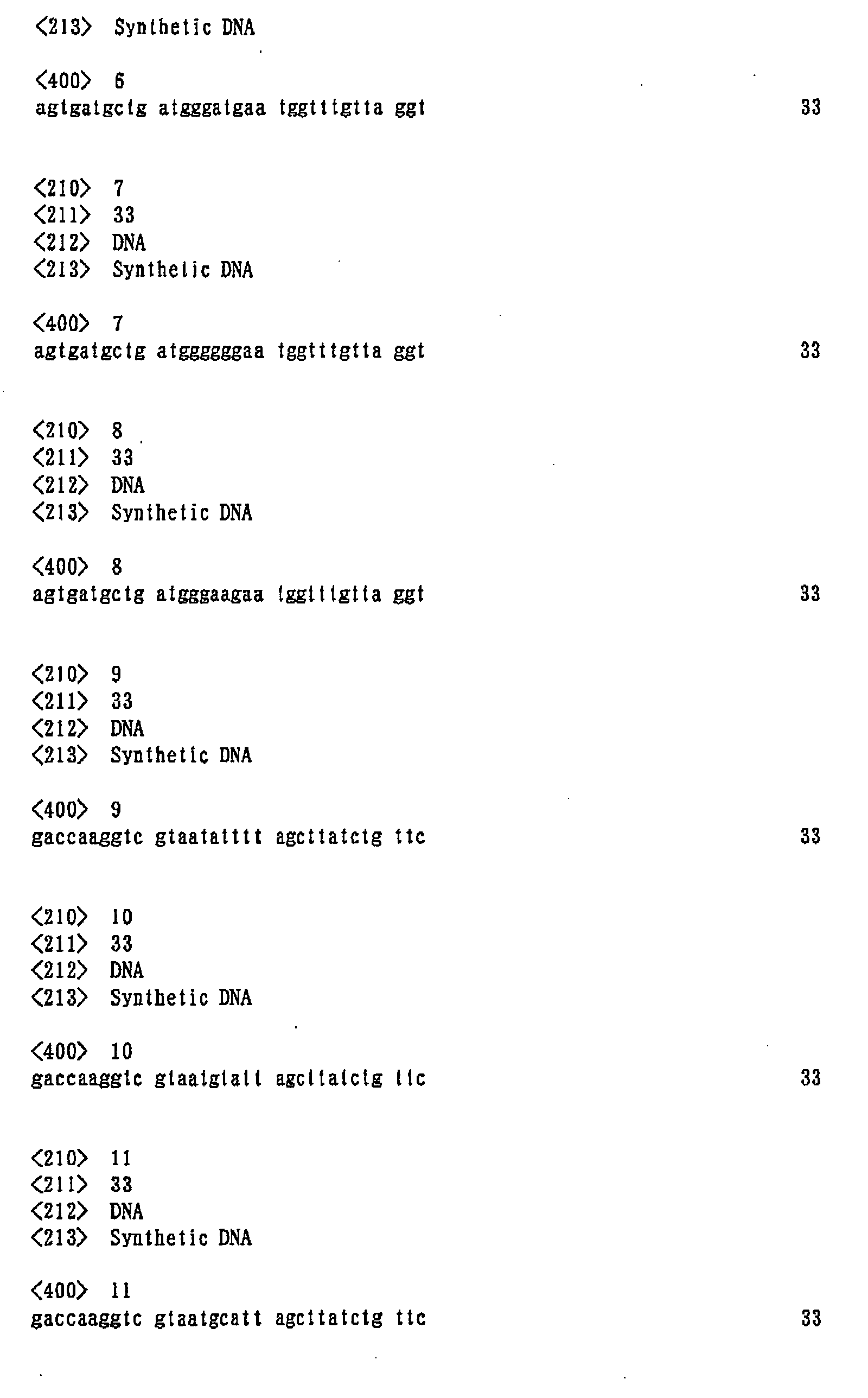
Based on pNPG5 and the synthetic oligonucleotide
shown in SEQ ID No. 4 and its complementary synthetic
oligonucleotide, a recombinant plasmid (pNPG5M2) carrying
a gene encoding modified PQQ-dependent glucose
dehydrogenase in which glutamine at 76th position is
replaced by glutamic acid in the amino acid sequence shown
in SEQ ID No. 2 was obtained by methods similar to those
described above.
Based on pNPG5 and the synthetic oligonucleotide
shown in SEQ ID No. 5 and its complementary synthetic
oligonucleotide, a recombinant plasmid (pNPG5M3) carrying
a gene encoding modified PQQ-dependent glucose
dehydrogenase in which glutamine at 76th position is
replaced by threonine in the amino acid sequence shown in
SEQ ID No. 2 was obtained by methods similar to those
described above.
Based on pNPG5 and the synthetic oligonucleotide
shown in SEQ ID No. 6 and its complementary synthetic
oligonucleotide, a recombinant plasmid (pNPG5M4) carrying
a gene encoding modified PQQ-dependent glucose
dehydrogenase in which glutamine at 76th position is
replaced by methionine in the amino acid sequence shown in
SEQ ID No. 2 was obtained by methods similar to those
described above.
Based on pNPG5 and the synthetic oligonucleotide
shown in SEQ ID No. 7 and its complementary synthetic
oligonucleotide, a recombinant plasmid (pNPG5M5) carrying
a gene encoding modified PQQ-dependent glucose
dehydrogenase in which glutamine at 76th position is
replaced by glycine in the amino acid sequence shown in
SEQ ID No. 2 was obtained by methods similar to those
described above.
Based on pNPG5 and the synthetic oligonucleotide
shown in SEQ ID No. 8 and its complementary synthetic
oligonucleotide, a recombinant plasmid (pNPG5M6) carrying
a gene encoding modified PQQ-dependent glucose
dehydrogenase in which glutamine at 76th position is
replaced by lysine in the amino acid sequence shown in SEQ
ID No. 2 was obtained by methods similar to those
described above.
Based on pNPG5 and the synthetic oligonucleotide
shown in SEQ ID No. 9 and its complementary synthetic
oligonucleotide, a recombinant plasmid (pNPG5M7) carrying
a gene encoding modified PQQ-dependent glucose
dehydrogenase in which glutamine at 168th position is
replaced by isoleucine in the amino acid sequence shown in
SEQ ID No. 2 was obtained by methods similar to those
described above.
Based on pNPG5 and the synthetic oligonucleotide
shown in SEQ ID No. 10 and its complementary synthetic
oligonucleotide, a recombinant plasmid (pNPG5M8) carrying
a gene encoding modified PQQ-dependent glucose
dehydrogenase in which glutamine at 168th position is
replaced by valine in the amino acid sequence shown in SEQ
ID No. 2 was obtained by methods similar to those
described above.
Based on pNPG5 and the synthetic oligonucleotide
shown in SEQ ID No. 11 and its complementary synthetic
oligonucleotide, a recombinant plasmid (pNPG5M9) carrying
a gene encoding modified PQQ-dependent glucose
dehydrogenase in which glutamine at 168th position is
replaced by alanine in the amino acid sequence shown in
SEQ ID No. 2 was obtained by methods similar to those
described above.
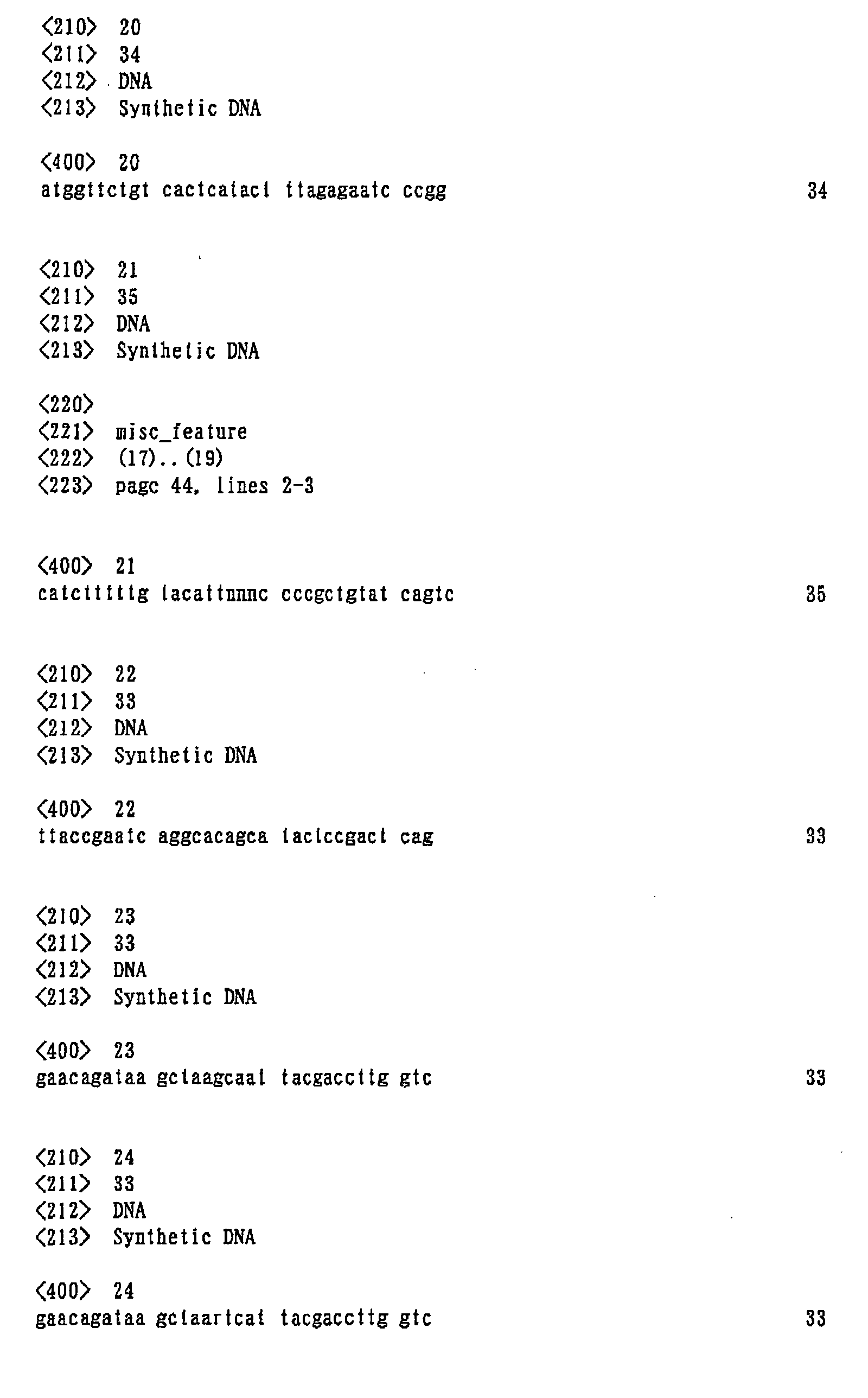
Based on pNPG5 and the synthetic oligonucleotide
shown in SEQ ID No. 22 and its complementary synthetic
oligonucleotide, a recombinant plasmid (pNPG5M10) carrying
a gene encoding modified PQQ-dependent glucose
dehydrogenase in which lysine at 20th position is replaced
by glutamic acid in the amino acid sequence shown in SEQ
ID No. 2 was obtained by methods similar to those
described above.
Based on pNPG5 and the synthetic oligonucleotide
shown in SEQ ID No. 23 and its complementary synthetic
oligonucleotide, a recombinant plasmid carrying a gene
encoding modified PQQ-dependent glucose dehydrogenase in
which lysine at 89th position is replaced by glutamic acid
in the amino acid sequence shown in SEQ ID No. 2 was
obtained by methods similar to those described above.
Subsequently, based on the plasmid and the synthetic
oligonucleotide shown in SEQ ID No. 24 and its
complementary synthetic oligonucleotide, a recombinant
plasmid (pNPG5M11) carrying a gene encoding modified PQQ-dependent
glucose dehydrogenase in which lysine at 89th
position is replaced by glutamic acid and also lysine at
300th position is replaced by arginine in the amino acid
sequence shown in SEQ ID No. 2 was obtained by methods
similar to those described above.
Based on pNPG5 and the synthetic oligonucleotide
shown in SEQ ID No. 25 and its complementary synthetic
oligonucleotide, a recombinant plasmid (pNPG5M12) carrying
a gene encoding modified PQQ-dependent glucose
dehydrogenase in which glutamine at 246th position is
replaced by histidine in the amino acid sequence shown in
SEQ ID No. 2 was obtained by methods similar to those
described above.
Based on pNPG5 and the synthetic oligonucleotide
shown in SEQ ID No. 26 and its complementary synthetic
oligonucleotide, a recombinant plasmid (pNPG5M13) carrying
a gene encoding modified PQQ-dependent glucose
dehydrogenase in which glutamine at 168th position is
replaced by serine and leucine at 169th position is
replaced by serine in the amino acid sequence shown in SEQ
ID No. 2 was obtained by methods similar to those
described above.
Based on pNPG5 and the synthetic oligonucleotide
shown in SEQ ID No. 27 and its complementary synthetic
oligonucleotide, a recombinant plasmid (pNPG5M14) carrying
a gene encoding modified PQQ-dependent glucose
dehydrogenase in which glutamine at 168th position is
replaced by alanine and leucine at 169th position is
replaced by aspartic acid in the amino acid sequence shown
in SEQ ID No. 2 was obtained by methods similar to those
described above.
Based on pNPG5 and the synthetic oligonucleotide
shown in SEQ ID No. 66 and its complementary synthetic
oligonucleotide, a recombinant plasmid (pNPG5M15) carrying
a gene encoding modified PQQ-dependent glucose
dehydrogenase in which glutamine at 168th position is
replaced by serine and leucine at 169th position is
replaced by glutamic acid in the amino acid sequence shown
in SEQ ID No. 2 was obtained by methods similar to those
described above.
Based on pNPG5 and the synthetic oligonucleotide
shown in SEQ ID No. 67 and its complementary synthetic
oligonucleotide, a recombinant plasmid (pNPG5M16) carrying
a gene encoding modified PQQ-dependent glucose
dehydrogenase in which glutamine at 168th position is
replaced by serine and leucine at 169th position is
replaced by proline in the amino acid sequence shown in
SEQ ID No. 2 was obtained by methods similar to those
described above.
Based on pNPG5 and the synthetic oligonucleotide
shown in SEQ ID No. 68 and its complementary synthetic
oligonucleotide, a recombinant plasmid (pNPG5M17) carrying
a gene encoding modified PQQ-dependent glucose
dehydrogenase in which glutamine at 168th position is
replaced by alanine and leucine at 169th position is
replaced by glycine in the amino acid sequence shown in
SEQ ID No. 2 was obtained by methods similar to those
described above.
E. coli competent cells (Escherichia coli JM109,
Toyobo) were transformed using the recombinant plasmids
pNPG5, pNPG5M1, pNPGSM2, pNPG5M3, pNPG5M4, pNPG5M5,
pNPG5M6, pNPG5M7, pNPG5M8, pMPG5M9, pNPG5M10, pNPG5M11,
pNPG5M12, pNPG5M13, pNPG5M14, pNPG5M15, pNPG5M16 and
pNPG5M17 to obtain the respective transformants.
Example 3: Construction of expression vectors which can
be replicated in Pseudomonas bacteria
5 µg of the DNA of the recombinant plasmid pNPG5M1
obtained in Example 2 was cleaved with restriction enzymes
BamHI and XhoI (Toyobo), and the structural gene area of
mutated PQQ-dependent glucose dehydrogenase was isolated.
The isolated DNA together with 1 µg of pTM33 cleaved with
BamHI and XhoI was reacted at 16° C for 16 hours with 1
unit of T4 DNA ligase to ligate the DNAs. The ligated DNA
was then transformed using competent cells of E. coli DH5α.
The resulting expression plasmid was named PNPG6M1.
Expression plasmids were obtained by the same
methods using the recombinant plasmids pNPGS, pNPG5M2,
pNPG5M3, pNPG5M4, pNPG5M5, pNPG5M6, pNPG5M7, pNPG5M8,
pNPG5M9, pNPG5M10, pNPG5M11, pNPG5M12, pNPG5M13, pNPG5M14
pNPG5M15, pNPG5M16 and pNPG5M17. The resulting expression
plasmids were named pNPG6, pNPG6M2, pNPG6M3, pNPG6M4.
pNPG6M5, pNPG6M6, pNPG6M7, pNPG6M8, pNPG6M9, pNPG6M10,
pNPG6M11, pNPG6M12, pNPG6M13, pNPG6M14, pNPG6M15, pNPG6M16
and pNPG6M17.
Example 4: Preparation of transformant of Pseudomonas
bacteria
Pseudomonas putida TE3493 (International Patent
Organism Depositary (IPOD) Accession No. 11298) was
cultured for 16 hours at 30° C in LBG medium (LB medium +
0.3% glycerol), the cells were collected by centrifugation
(12,000 rpm, 10 minutes), and 8 ml of a chilled 5 mM K-phosphate
buffer (pH 7.0) containing 300 mM sucrose was
added to the cells to suspend the cells. The cells were
collected again by centrifugation (12,000 rpm, 10 minutes),
and 0.4 ml of a chilled 5 mM K-phosphate buffer (pH 7.0)
containing 300 mM sucrose was added to the cells to
suspend the cells.
0.5 µg of the expression plasmid pNPG6M1 obtained in
Example 3 was added to this suspension, and transformation
was carried out by electroporation. The target
transformant was obtained from a colony grown in LB agar
medium containing 100 µg/ml of streptomycin.
Transformants were obtained respectively by the same
methods from the expression plasmids named pNPG6, pNPG6M2,
pNPG6M3, pNPG6M4, pNPG6M5, pNPG6M6, pNPG6M7, pNpG6M8,
pNPG6M9, pNPG6M10, pNPG6M11, pNPG6M12, pNPG6M13, pNPG6M14,
pNPG6M15, pNPG6M16 and pNPG6M17.
Test Example 1
Measurement of GDH Activity
(1) Measurement principles
D-glucose + PMS + PQQGDH
→ D-glucono-1,5-lactone + PMS (red)
2PMS (red) + NTB → 2PMS + Diformazan
The presence of diformazan formed by reduction of
nitrotetrazolium blue (NTB) with phenazine methosulfate
(PMS) (red) was measured by spectrophotometry at 570 nm.
(2) Definition of units
1 unit is defined as the amount of PQQGDH enzyme
needed to form 0.5 millimoles of diformazan per minute
under the conditions described below.
(3) Methods
Reagents
A. D-glucose solution: 0.5 M (0.9 g D-glucose
(molecular weight 180.16)/10 ml H2O)
B. PIPES-NaOH buffer, pH 6.5: 50 mM (1.51 g of
PIPES (molecular weight 302.36) suspended in 60 ml water
was dissolved in 5N NaOH, and 2.2 ml of 10% Triton X-100
was added. pH was adjusted to 6.5 ± 0.05 at 25° C using
5N NaOH, and water was added to a total of 100 ml.)
C. PMS solution: 3.0 mM (9.19 mg phenazine
methosulfate (molecular weight 817.65)/10 ml H20)
D. NTB solution: 6.6 mM (53.96 mg
nitrotetrazolium blue (molecular weight 817.65)/10 ml H2O)
E. Enzyme diluent: 50 mM PIPES-NaOH buffer (pH
6.5) containing 1 mM CaCl2, 0.1% Triton X-100 and 0.1% BSA
Procedures
1. The following reaction mixture was prepared in a
shaded bottle, and stored on ice (prepared when needed)
1.8 ml D-glucose solution (A) 24.6 ml PIPES-NaOH buffer (pH 6.5) (B) 2.0 ml PMS solution (C) 1.0 ml NTB solution (D)
| Concentration in the assay mixture |
| PIPES buffer | 42 mM |
| D-glucose | 30 mM |
| PMS | 0.20 mM |
| NTB | 0.22 mM |
2. A plastic test tube filled with 3.0 ml of the
reaction mixture was pre-heated for 5 minutes at 37°C.
3. 0.1 ml of enzyme solution was added and mixed by
gentle inversion.
4. The increase in absorbance over water was recorded
for 4-5 minutes on a spectrophotometer at 570 nm with the
temperature maintained at 37° C to calculate ΔOD per minute
from the initial straight-line segment of the curve (OD
test).
At the same time, the same methods were repeated
except that enzyme diluent (E) was added in place of the
enzyme solution, and the blank (ΔOD blank) was measured.
Immediately before the assay, enzyme powder was
dissolved in chilled enzyme diluent (E), and diluted to
0.1-0.8 U/ml in the same buffer (a plastic tube is
preferred because of the adhesiveness of the enzyme).
Calculations
Activity was calculated using the following
equation:
U/ml = (ΔOD/min(ΔOD test - ΔOD blank)xVtxdf}/(20.1×1.0×Vs)
U/mg = (U/ml) × 1/C
Preparation of Holo-expressive Purified Enzyme
500 ml of Terrific broth was taken in a 2L volume
Sakaguchi flask, autoclaved for 20 minutes at 121°C and
left to cool, after which streptomycin which had been
separately sterile-filtered was added to a final
concentration of 100 ug/ml. This medium was then
inoculated with 5 ml of a culture solution of Pseudomonas
putida TE3493(pNPG6M1) which had been first cultured for
24 hours at 30° C in a PY medium containing 100 µg/ml of
streptomycin, and aeration agitation cultured for 40 hours
at 30°C. PQQ-dependent glucose dehydrogenase activity upon
completion of the culture was about 120 U/ml per 1 ml of
culture solution as measured by the methods described
above.
The aforementioned cells were collected by
centrifugation, suspended in a 20 mM phosphate buffer (pH
7.0), broken up with ultrasonication and re-centrifuged.
and the supernatant was taken as crude enzyme solution.
This crude enzyme solution thus obtained was isolated and
purified by HiTrap-SP (Amersham Pharmacia) ion exchange
column chromatography. After dialysis with a 10 mM PIPES-NaOH
buffer (pH 6.5). calcium chloride was added to a
final concentration of 1 mM. Finally, isolation and
purification were performed by HiTrap-DEAE (Amersham
Pharmacia) ion exchange column chromatography to obtain
the purified enzyme sample. The sample obtained by these
methods exhibited a generally single SDS-PAGE band.
Purified enzyme products were also obtained by the
same methods for the Pseudomonas putida TE3493
transformants of pNPG6, pNPG6M2, pNPG6M3, pNPG6M4, pNPG6M5,
pNPG6M6, pNPG6M7, pNPG6M8, pNPG6M9, pNPG6M10, pNPG6M11,
pNPG6M12, pNPG6M13, pNFG6M14, pNPG6M15, pNPG6M16 and
pNPG6M17.
The resulting purified enzymes were used in
evaluating properties.
Measurement of Km value
PQQGDH activity was measured according to the
aforementioned activity measurement method. The Km value
for glucose was measured by altering the substrate
concentration in the aforementioned activity measurement
method. The Km value for maltose was measured by
substituting a maltose solution for the glucose solution
in the aforementioned activity measurement method, and
altering the substrate concentration as when measuring the
Km value for glucose. The results are shown in Tables 2A,
2B, 6, 9 and 14.
Substrate Specificity
PQQGDH activity was measured according to the
aforementioned activity measurement method. Using glucose
as the substrate solution and maltose as the substrate
solution, the respective dehydrogenase activity values
were measured, and the relative value was calculated with
100 given as the measurement value using glucose as the
substrate. In the case of dehydrogenase activity using
maltose as the substrate solution, a 0.5M maltose solution
was prepared and used for measuring activity. The results
are shown in Tables 2A, 2B, 4, 5, 6, 8, 9, 11, 13 and 14.
Measurement of Thermal stability
The various kinds of PQQGDH were stored in buffer
(10mM PIPES-NaOH (pH 6.5) containing 1mM CaCl2 and 1 µM
PQQ) with an enzyme concentration of 5 U/ml, and residual
activity was measured after heat treatment at 58°C. The
results are shown in Tables 2A, 2B, 6, 9 and 14. The heat
treatment was conducted for 20 minutes with respect to
Table 2B and for 30 minutes with respect to heat treatment
assays other than Table 2B.
Measurement of Optimum pH
Enzyme activity was measured in a 50 mM phosphate
buffer (pH 5.0-8.0) containing 0.22% Triton-X100, a 50 mM
acetate buffer (pH 3.0-6.0) containing 0.22% Triton-X100,
a 50 mM PIPES-NaOH buffer (pH 6.0-7.0) containing 0.22%
Triton-X100, and a 50 mM Tris-HCl buffer (pH 7.0-9.0)
containing 0.22% Triton-X100. The results are shown in
Figure 1. The pH values that produced the highest
activity are given in Table 2A.
| Mutation | Specific activity | Substrate specificity | Km (Mal) | Km (Glc) | Optimum pH | Thermal stability |
| Q76N | 49 | 66% | 13.6 | 3.1 | 6.4 | 49.1% |
| Q76E | 36 | 68% | 13.6 | 3.7 | 5.6 | 42.5% |
| Q76T | 32 | 84% | 10.3 | 2.5 | 6.4 | 49.0% |
| Q76M | 108 | 81% | 8.7 | 2.2 | 6.4 | 55.3% |
| Q76G | 32 | 84% | 10.6 | 2.2 | 6.4 | 58.5% |
| Q76K | 84 | 32% | 29.9 | 7.9 | 6.8 | 48.4% |
| Q168I | 231 | 69% | 11.9 | 5.3 | 6.8 | 27.3% |
| Q168V | 377 | 71% | 13.0 | 6.4 | 6.4 | 32.2% |
| Q168A | 333 | 37% | 35.3 | 10.4 | 6.4 | 59.2% |
| Wild type | 1469 | 103% | 4.1 | 6.5 | 6.4 | 46.7% |
Notes) Specific activity:
Enzyme activity(U/ml)/A280 nm absorbance (ABS)
Km (Mal): Km value (mM) for maltose
Km (Glc): Km value (mM) for glucose |
| Mutation | Specific activity | Substrate specificity | Thermal stability |
| K20E | 924 | 105% | 49.7% |
| K89E + K300R | 1038 | 81% | 58.8% |
| Q246H | 686 | 192% | 82.2% |
| Q168S+L169S | 288 | 33% | 73.0% |
| Q168A+L169D | 106 | 18% | 78.8% |
| Q168S+L169E | 270 | 19% | 47.0% |
| Q168S+L169P | 460 | 25% | 47.2% |
| Q168A+L169G | 170 | 18% | 78.3% |
| Wild type | 1469 | 103% | 43.4% |
Note)Specific activity:
Enzyme activity(U/ml)/A280 nm absorbance (ABS) |
The following reaction reagent was prepared
containing 0.45 U/ml of Q76K.
| 50 mM | PIPES-NaOH buffer (pH 6.5) |
| 1 mM | CaCl2 |
| 0.22% | Triton-X100 |
| 0.4 mM | PMS |
| 0.26 mM | WST-1 (water-soluble tetrazolium salt, Dojin Kagaku) |
According to the methods described below for
measuring glucose, purified water, 100 mg/dl standard
solution and 10-level dilution series of aqueous glucose
solution (600 mg/dl) were measured as sample, and
linearity was confirmed.
The results are shown in Figure 2.
Glucose Measurement Methods
300 µl of the reagent was added to 3µl of the sample,
changes in absorbance were calculated for 1 minute
beginning two minutes after addition of the reagent, and
glucose levels in the samples were calculated based on a
two-point calibration curve for purified water and 100
mg/dl glucose standard solution. A Hitachi 7150 automated
analyzer was used as the measurement equipment, at a
principle wavelength of 480 nm and a measurement
temperature of 37°C.
As shown in Figure 2, good linearity was confirmed
in the range of 0-600 mg/dl.
Confirmation of Q76K Activity on Maltose
The following reaction reagent was prepared
containing 0.45 U/ml of Q76K.
| 50 mM | PIPES-NaOH buffer (pH 6.5) |
| 1 mM | CaCl2 |
| 0.22% | Triton-X100 |
| 0.4 mM | PMS |
| 0.26 mM | WST-1 (Dojin Kagaku) |
Samples were prepared in which 0, 120, 240 and 360
mg/dl of maltose was added to a 100 mg/dl or 300 mg/dl
glucose solution. Measurements were performed according
to the aforementioned measurement methods for glucose.
The relative values for the samples containing 100
mg/dl of glucose and various concentration of maltose were
evaluated with reference to a value of 100 given for a 100
mg/dl glucose solution containing no maltose. In the same
way, the relative values for the samples containing 300
mg/dl of glucose and various concentration of maltose were
evaluated with reference to a value of 100 given for a 300
mg/dl glucose solution containing no maltose. The results
are shown in Figure 3.
Confirmation of Q76E Activity on Maltose
Activity was evaluated using Q76E in the same way as
confirmation of Q76K activity on maltose. The enzyme was
added at a concentration of 0.24 U/ml. The results are
shown in Figure 4.
Confirmation of Q168V Activity on Maltose
Activity was evaluated using Q168V in the same way
as confirmation of Q76K activity on maltose. The enzyme
was added at a concentration of 0.35 U/ml. The results
are shown in Figure 5.
Confirmation of Q168A Activity on Maltose
Activity was evaluated using Q168A in the same way
as confirmation of Q76K activity on maltose. The enzyme
was added at a concentration of 0.6 U/ml. The results are
shown in Figure 6.
Confirmation of Wild-type Enzyme Activity on Maltose
Activity was evaluated using the wild-type enzyme in
the same way as confirmation of Q76K activity on maltose.
The enzyme was added at a concentration of 0.1 U/ml. The
results are shown in Figure 7.
It can be seen from Figures 3, 4, 5, 6 and 7 that
Q76K, Q76E, Q168V and Q168A have less activity on maltose
than the wild-type enzyme.
Example 5: Construction and screening of a mutation
library
Using expression plasmid pNPG5 as the template,
random mutations were introduced into the 167-169 region
of the structural gene by PCR. The PCR reaction was
performed in a solution of the composition shown in Table
3 for 2 minutes at 98° C, followed by 30 cycles of 20
seconds at 98° C, 30 seconds at 60°C and 4 minutes at 72° C.
| Reagent | Liquid volume |
| KOD Dash DNA Polymerase (2.5 U/µl) | 1.0 µl |
| Template DNA | 1.0 µl |
| Forward primer (SEQ ID No. 12) | 2.5 µl |
| Reverse primer (SEQ ID No. 13) | 2.5 µl |
| 10× buffer | 5.0 µl |
| 2 mM dNTPs | 5.0 µl |
| H2O | 33.0 µl |
The resulting mutation library was transformed into
E. coli DH5α, and the formed colonies were transplanted to
microtitre plates filled with 180 µl/well of LB medium
(containing 100 µg/ml of ampicillin and 26 µM of PQQ) and
cultured for 24 hours at 37°C. 50 µl of each culture
liquid was transferred to a separate microtitre plate, and
the cultured cells were broken down by repeated freezing
and thawing and centrifuged (2,000 rpm, 10 minutes) to
collect the supernatant. Two microtitre plates were
filled with 10 µl each of the collected supernatant. One
microtitre plate was measured for activity using an
activity measuring reagent with glucose as the substrate,
and the other microtitre plate was measured for activity
using an activity measurement reagent having maltose as
the substrate, and the reactions were compared. Several
clones were obtained having altered reactivity with
respect to maltose.
Those clones having altered reactivity on maltose
were cultured in test tubes filled with 5 ml of LB medium
(containing 100 µg/ml of ampicillin and 26 µM of PQQ), and
confirmation tests showed several of the clones having
altered reactivity with respect to maltose.
The results are shown in Table 4.
| Mutation Site | Activity on Maltose | Mutation Site | Activity on Maltose |
| N167E+Q168G+L169T | 64% | N167S+Q168N+L169R | 80% |
| Q168G+L169T | 42% | N167G-Q168S+L169Y | 55% |
| N167L+Q168S+L169G | 45% | N167G+Q168S+L169S+ L174F+K49N | 39% |
| Q168N+L169N+S189R | 51% | N167E+Ql68G+L169A+ S189G | 58% |
| N167G+Q168R+L169A | 66% | N167S+Q168G+L169A | 48% |
| N167G+Q168V+L169S | 42% | N167S+Q168V+L169S | 71% |
| N167T+Q168I+L169G | 42% | N167G+Q168W+L169N | 72% |
| N167G+Q168S+L169N | 50% | N167G+Q168S+L169V | 36% |
| Q168R+L169C | 29% | N167S+Q168L+L169G | 41% |
| Q168C+L169S | 33% | N167T+Q168N+L169K | 68% |
| N167G+Q168T+L169A +S207C | 24% | N167A+Q168A+L169P | 63% |
| N167G+Q168S+L169G | 34% | N167G+Q168G | 46% |
| N167G+Q168D+L169K | 35% | Q168P+L169G | 23% |
| N167G+Q168N+L169S | 59% | Q168S+L169G | 22% |
| N188I+T349S | 64% | N167G+Q168G+L169A+ F215Y | 32% |
| N167G+Q168T+L169G | 28% | Q168G+L169V | 43% |
| N167G+Q168V+L169T | 43% | N167E+Q168N+L169A | 52% |
| Q168R+L169A | 72% | N167G+Q168R | 23% |
| N167G+Q168T | 69% | N167G+Q168T+L169Q | 72% |
| Q168I+L169G+K300T | 24% | N167G+Q168A | 33% |
| N167T+Q168L+L169K | 63% | N167M+Q168Y+L169G | 60% |
| N167E+Q168S | 32% | N167G+Q168T+L169V+ S189G | 42% |
| N167G+Q168G+L169C | 37% | N167G+Q168K+L169D | 41% |
| Q168A+L169D | 16% | Q168S+E245D | 29% |
| Q168S+L169S | 26% | A351T | 74% |
| N167S+Q168S+L169S | 51% | Q168I+L169Q | 51% |
| N167A+Q168S+L169S | 40% | Q168A | 35% |
| Q168S+L169P | 20% | Q168A+L169G | 16% |
| Q168S+L169E | 15% |
| + |
Mutations were also introduced in the same way in
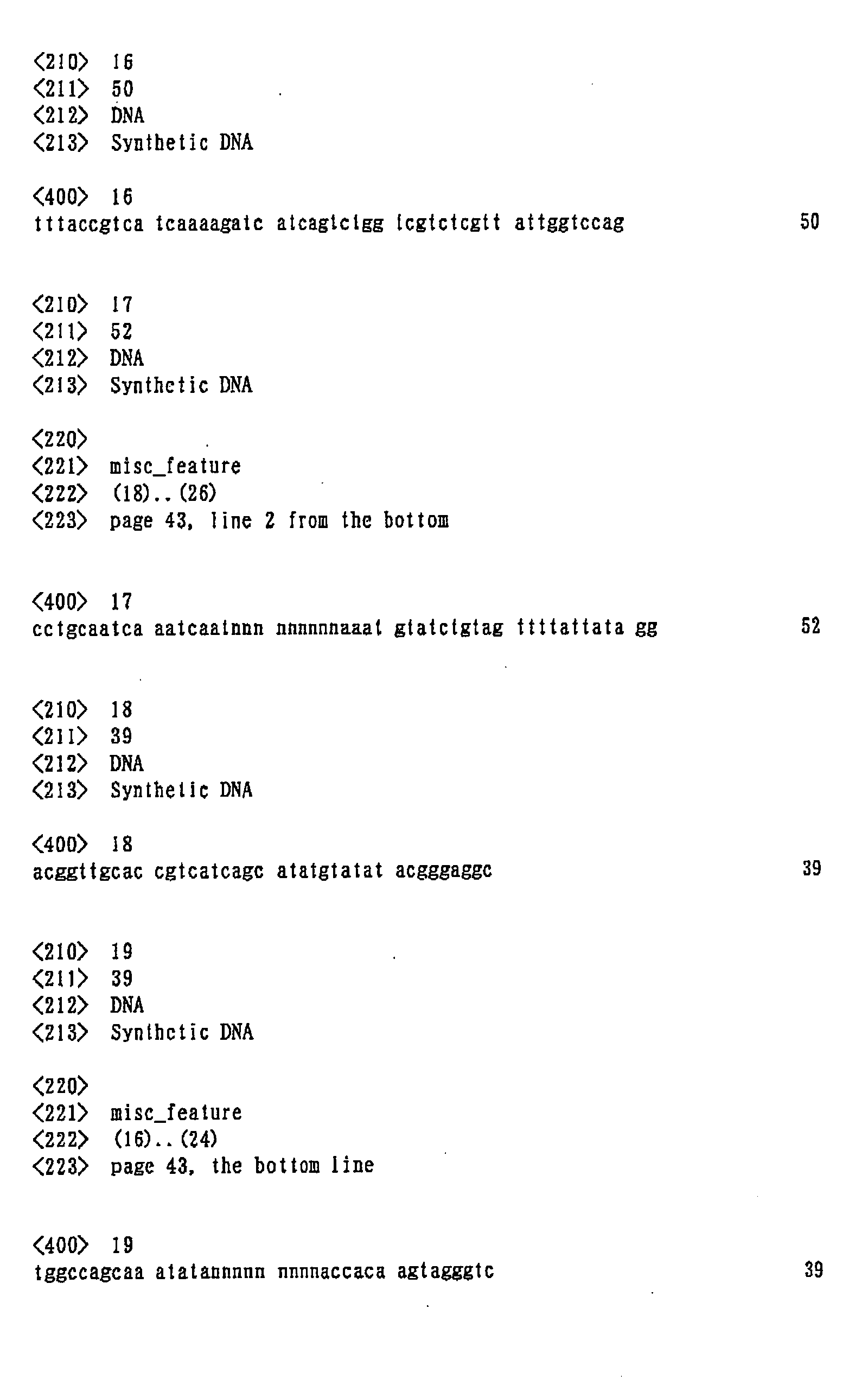
regions 67-69 (forward primer: SEQ ID No. 14. reverse
primer: SEQ ID No. 15), 129-131 (forward primer: SEQ ID No.
16, reverse primer: SEQ ID No. 17), 341-343 (forward
primer: SEQ ID No. 18, reverse primer: SEQ ID No. 19). An
insertion was also attempted between positions 428 and 429
(forward primer: SEQ ID No. 20, reverse primer: SEQ ID No.
21). The results are shown in Table 5.
| 67-69 Region |
| Mutation site | Activity on maltose | Mutation site | Activity on maltose |
| P67K+E68K | 79% | P67R+E68R+I6 9C | 80% |
| P67D+E68T+I6 9C | 60% |
| 129-131 Region |
| Mutation site | Activity on maltose | Mutation site | Activity on maltose |
| E129R+K130G+P1 31G | 73% | E129Q+K130T+P1 31R | 80% |
| E129N+P131T | 67% | E129A+K130R+P1 31K | 70% |
| 341-343 Region |
| Mutation site | Activity on maltose | Mutation site | Activity on maltose |
| E341L+M342P+A3 43R | 80% | E341S+M342I | 80% |
| A343I | 45% | E341P+M342V+A3 43C | 50% |
| E341P+M342V+A3 43R | 76% | E341L+M342R+A3 43N | 51% |
| Insertion between 428 and 429 |
| Inserted amino acid | Activity on maltose | Inserted amino acid | Activity on maltose |
| L | 73% | A | 71% |
| K | 79% |
Those mutants with greatly reduced activity on
maltose were selected (Q168S + E245D, Q168A + L169D, Q168S
+ L169S, Q168S + L169E, Q168A + L169G. Q168S + L169P)
,
plasmids were extracted from these mutants,
Pseudomonas
was transformed according to the methods described in
Examples 3 and 4 to express holoenzymes, and purified
enzymes were obtained and their properties were evaluated.
The results are shown in Table 6.
| Mutation | Specific activity | Substrate specificity | Km(Mal) | Km(Glc) | Thermal stability |
| Q168S+E245D | 714 | 29% | 24.3 | 14.4 | 55.5% |
| Q168A+L169D | 106 | 18% | 65.9 | 20.8 | 89-4% |
| Q168S+L169S | 288 | 33% | 55.1 | 14.4 | 83.9% |
| Q168S+L169P | 460 | 25% | 87.1 | 24.1 | 76.3% |
| Q168A+L169G | 170 | 18% | 60.4 | 18.6 | 89.5% |
| Q168S+L169E | 270 | 19% | 70.7 | 8.9 | 63.3% |
| Q168A | 313 | 43% | | | 64.4% |
| Wild type | 1469 | 110% | | | 59.8% |
Note) Specific activity:
Enzyme activity(U/ml)/A280 nm absorbance (ABS) |
Mutants such as Q168C, Q168D. Q168E. Q168F. Q168G.
Q168H, Q168K, Q168L, Q168M, Q168N, Q168P, Q168R, Q168S,
Q168T, Q168W and Q168Y were prepared according to the
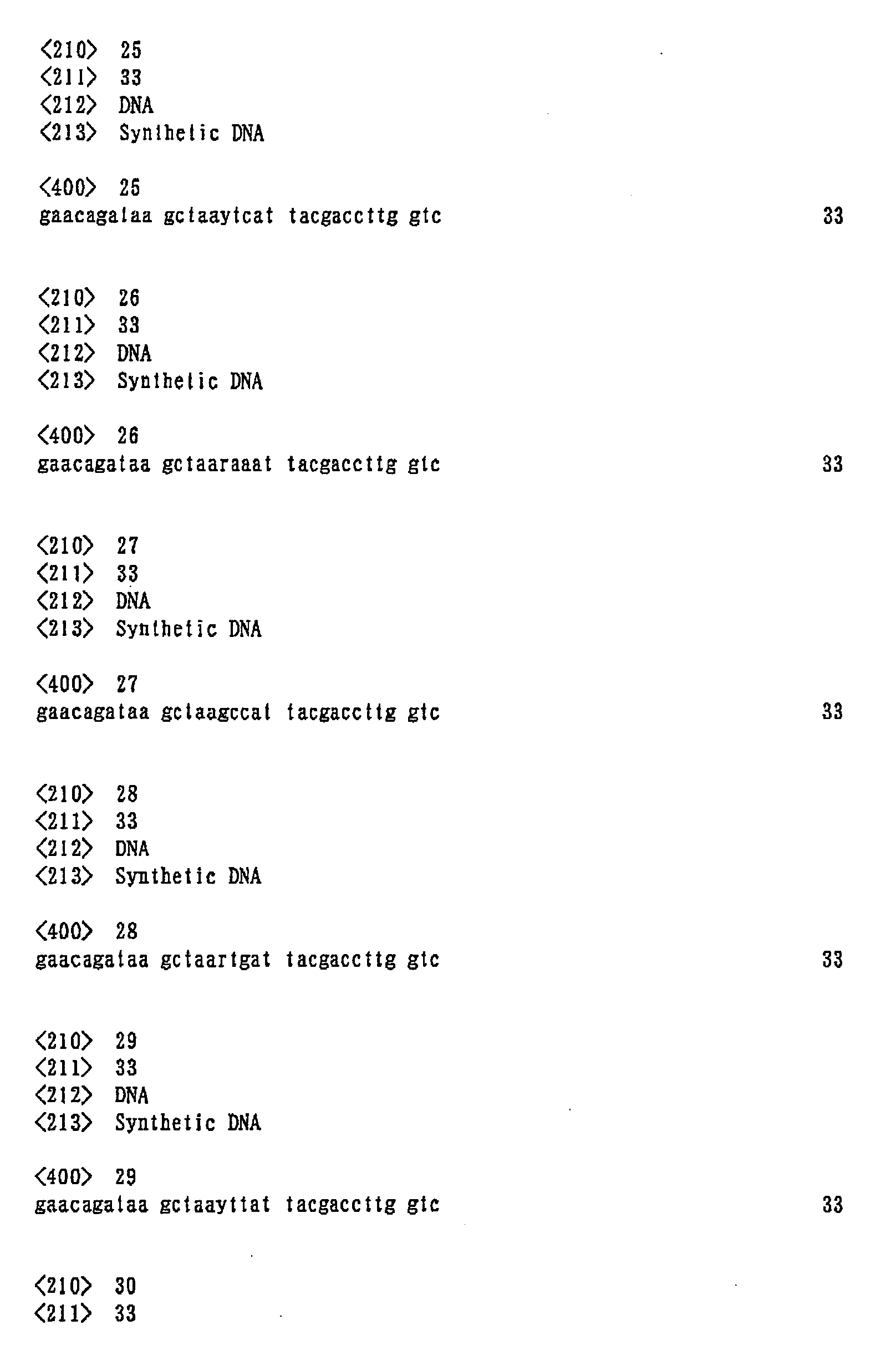
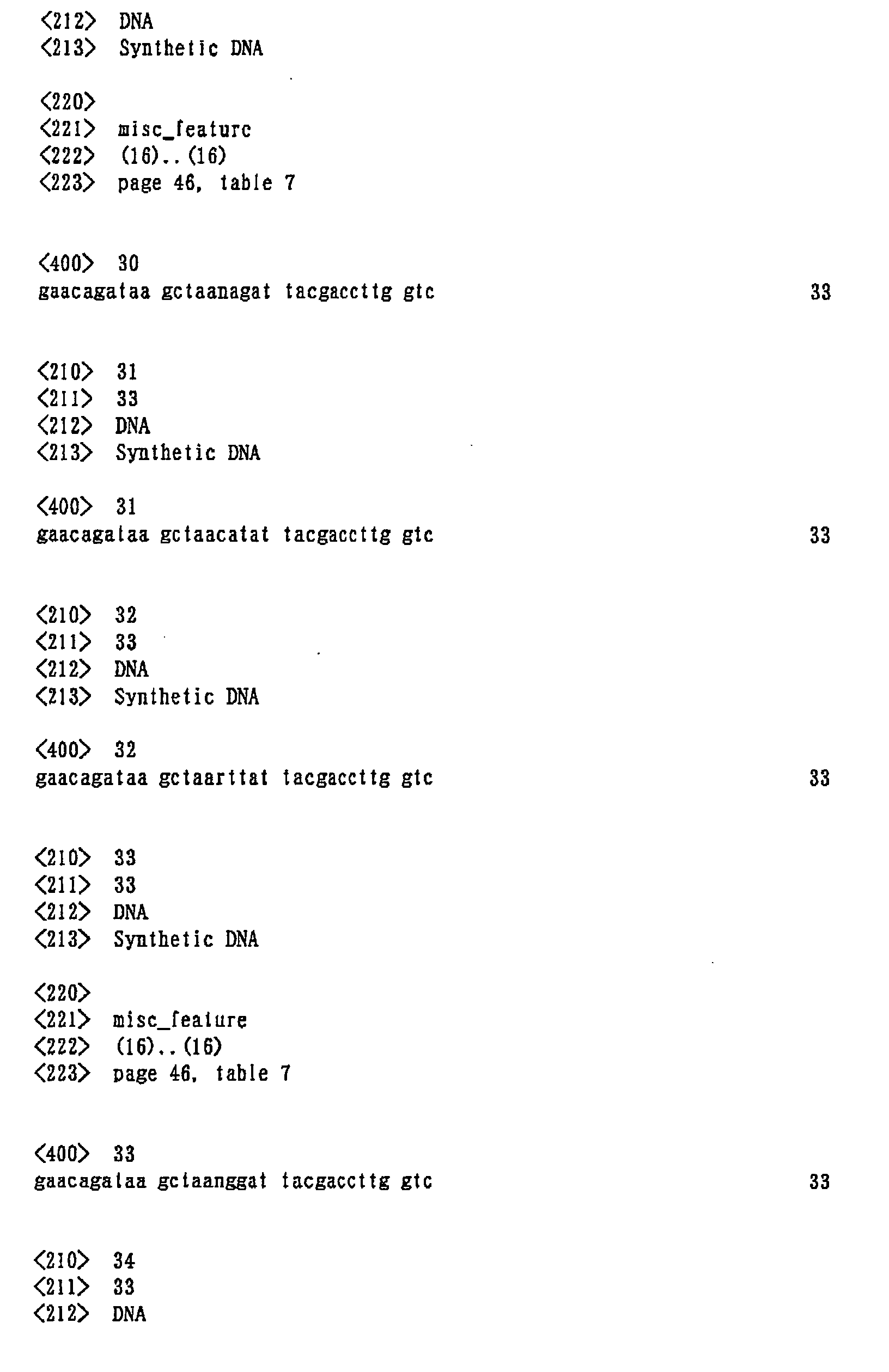
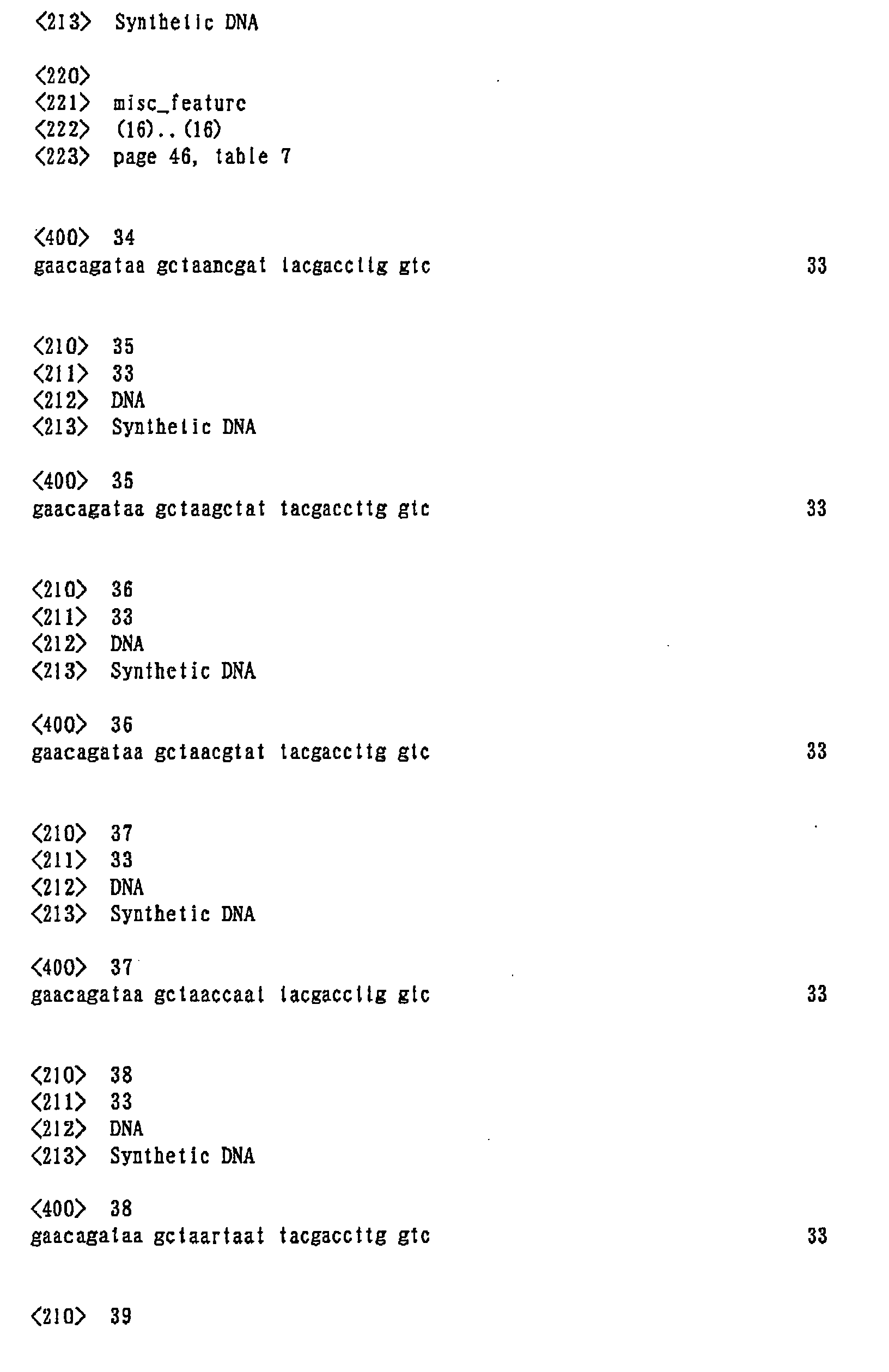
methods disclosed in example 5. Primers used for
preparing the mutants are shown in table 7. Further,
Table 8 shows the results comparing reactivity of the
mutants on maltose by using each mutant in the form of
broken cells which were prepared by test tube culture.
Mutant enzymes were obtained by extracting plasmids from
the mutants, followed by transforming
Pseudomonas
according to the methods described in Examples 3 and 4 to
express holoenzymes. The properties of purified enzymes
were evaluated. The results are shown in table 9.
| Mutation site | Forward primer | Reverse primer |
| Q168C | SEQ ID No.22 | SEQ ID No.23 |
| Q168D | SEQ ID No.22 | SEQ ID No.24 |
| Q168E | SEQ ID No.22 | SEQ ID No.25 |
| Q168F | SEQ ID No.22 | SEQ ID No.26 |
| Q168G | SEQ ID No.22 | SEQ ID No.27 |
| Q168H | SEQ ID No.22 | SEQ ID No.28 |
| Q168K | SEQ ID No.22 | SEQ ID No.29 |
| Q168L | SEQ ID No.22 | SEQ ID No.30 |
| Q169M | SEQ ID No.22 | SEQ ID No.31 |
| Q168N | SEQ ID No.22 | SEQ ID No.32 |
| Q168P | SEQ ID No.22 | SEQ ID No.33 |
| Q168R | SEQ ID No.22 | SEQ ID No.34 |
| Q168S | SEQ ID No.22 | SEQ ID No.35 |
| Q168T | SEQ ID No.22 | SEQ ID No.36 |
| Q168W | SEQ ID No.22 | SEQ ID No.37 |
| Q168Y | SEQ ID No.22 | SEQ ID No.38 |
| Mutation site | Activity on Maltose | Mutation site | Activity on Maltose |
| Q168C | 54% | Q169M | 64% |
| Q168D | 29% | Q168N | 82% |
| Q168E | 36% | Q168P | 103% |
| Q168F | 43% | Q168R | 36% |
| Q168G | 46% | Q168S | 60% |
| Q168H | 55% | Q168T | 94% |
| Q168K | 83% | Q168W | 87% |
| Q168L | 92% | Q168Y | 93% |
| Wild type | 104% |
| Mutation | Specific activity | Substrate specificity ) | Km(Mal | Km(Glc ) | Thermal stability |
| Q168C | 55 | 58% | 20.4 | 10.7 | 18.2% |
| Q168D | 102 | 46% | 27.4 | - | 61.4% |
| Q168E | 110 | 51% | 4.7 | 8.6 | 75.4% |
| Q168F | 137 | 52% | 36.4 | 10.3 | 55.5% |
| Q168G | 667 | 78% | 11.1 | - | 78.7% |
| Q168H | 486 | 58% | 10.2 | 5.4 | 76.0% |
| Q168K | 5 | 80% | 9.6 | 2.2 | - |
| Q168L | 110 | 96% | 8.6 | 4.3 | 37.1% |
| Q169M | 190 | 68% | 22.7 | 5.3 | 78.4% |
| Q168N | 68 | 93% | 3.6 | 4.1 | - |
| Q168P | 128 | 106% | 3.5 | 5.1 | 82.3% |
| Q168R | 57 | 60% | 18.4 | 3.8 | 32.9% |
| Q168S | 483 | 81% | 12.5 | 3.7 | 80.1% |
| Q168T | 11 | 103% | 15.0 | 6.9 | - |
| Q168W | 287 | 96% | 5.3 | 3.2 | 59.2% |
| Q168Y | 297 | 99% | 12.1 | 6.9 | 100.0% |
| Wild type | 1285 | 106% | 3.8 | 6.3 | 52.2% |
Note) Specific activity:
Enzyme activity(U/ml)/A280 nm absorbance (ABS) |
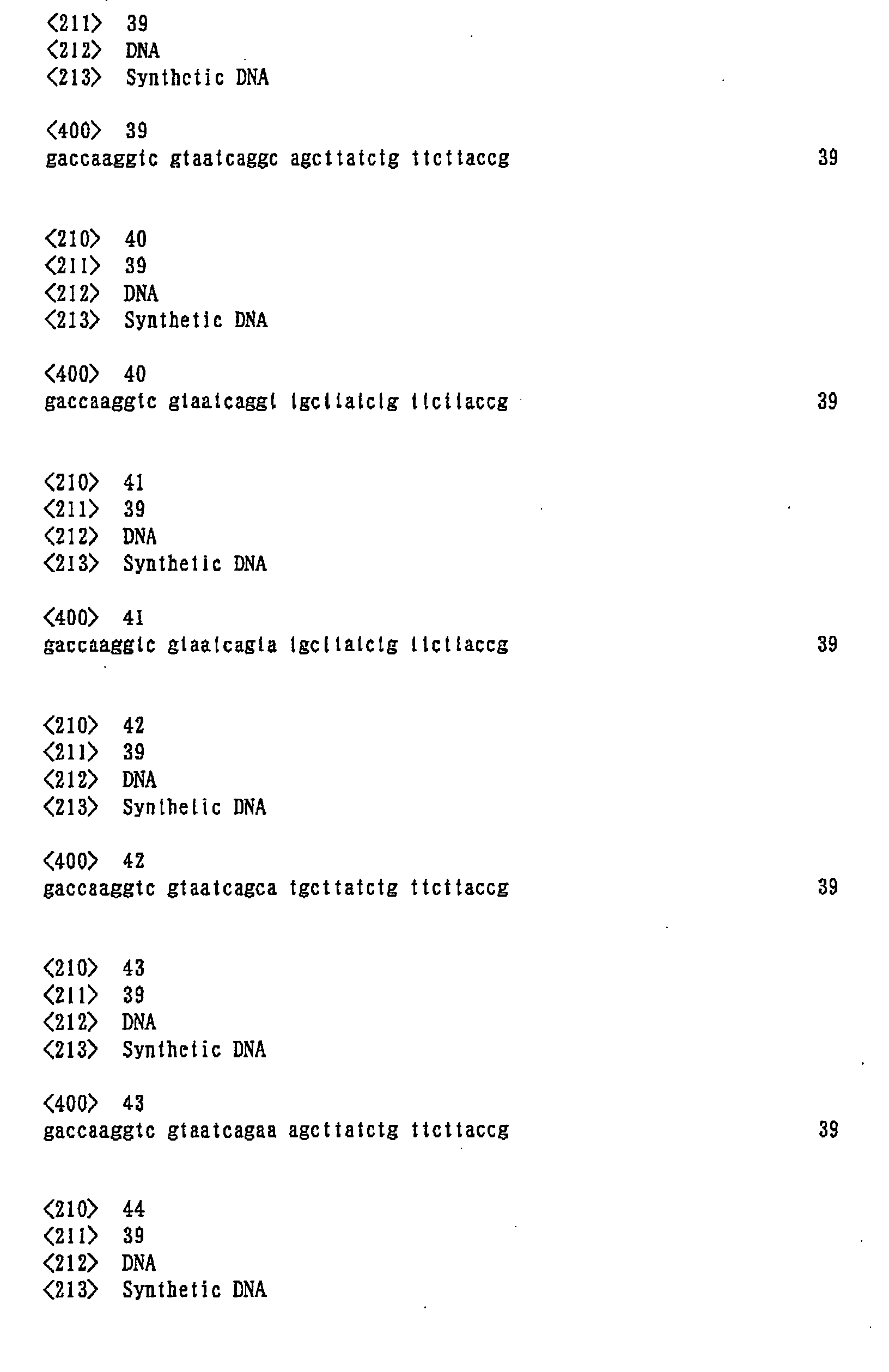
Mutants such as L169A. L169V, L169H, L169Y, L169K,
L169D, L169S, L169N, L169G and L169C were prepared
according to the methods disclosed in example 2. Primers
used for preparing the mutants are shown in table 10.
Further, table 11 shows the results comparing reactivity
of the mutants on maltose by using each mutant in the form
of broken cells which were prepared by test tube culture.
| Mutatio n site | Forward primer | Reverse primer |
| L169A | SEQ ID No.39 Synthetic | oligonucleotide complementary to SEQ ID No.39 |
| L169V | SEQ ID No.40 | Synthetic oligonucleotide complementary to SEQ ID No.40 |
| L169Y | SEQ ID No.41 | Synthetic oligonucleotide complementary to SEQ ID No.41 |
| L169H | SEQ ID No.42 | Synthetic oligonucleotide complementary to SEQ ID No.42 |
| L169K | SEQ ID No.43 | Synthetic oligonucleotide complementary to SEQ ID No.43 |
| L169D | SEQ ID No.44 | Synthetic oligonucleotide complementary to SEQ ID No.44 |
| L169S | SEQ ID No.45 | Synthetic oligonucleotide complementary to SEQ ID No.45 |
| L169N | SEQ ID No.46 | Synthetic oligonucleotide complementary to SEQ ID No.46 |
| L169G | SEQ ID No.47 | Synthetic oligonucleotide complementary to SEQ ID No.47 |
| L169C | SEQ ID No.48 | Synthetic oligonucleotide complementary to SEQ ID No.48 |
| Mutation site | Activity on Maltose | Mutation site | Activity on Maltose |
| L169A | 59% | L169D | 38% |
| L169V | 78% | L169S | 57% |
| L169Y | 107% | L169N | 74% |
| L169H | 85% | L169G | 48% |
| L169K | 60% | L169C | 57% |
| Wild type | 97% |
Mutants such as Q168A+L169A, Q168A+L169C,
Q168A+L169E, Q168A+L169F, Q168A+L169H. Q168A+L169I,
Q168A+L169K, Q168A+L169M, Q168A+L169N, Q168A+L169P,
Q168A+L169Q, Q168A+L169R, Q168A+L169S. Q168A+L169T,
Q168A+L169V, Q168A+L169W, Q168A+L169Y were prepared
according to the methods disclosed in example 5. Primers
used for preparing the mutants are shown in table 12.
Further, Table 13 shows the results comparing reactivity
of the mutants on maltose by using each mutant in the form
of broken cells which were prepared by test tube culture.
Mutant enzymes were obtained by extracting plasmids from
the mutants, followed by transforming
Pseudomonas
according to the methods described in Examples 3 and 4 to
express holoenzymes. The properties of purified enzymes
were evaluated. The results are shown in table 14.
| Mutation site | Forward primer | Reverse primer |
| Q168A+L169A | SEQ ID No. 12 | SEQ ID No.49 |
| Q168A+L169C | SEQ ID No.12 | SEQ ID No.50 |
| Q168A+L169E | SEQ ID No. 12 | SEQ ID No.51 |
| Q168A+L169F | SEQ ID No.12 | SEQ ID No.52 |
| Q168A+L169H | SEQ ID No.12 | SEQ ID No.53 |
| Q168A+L169I | SEQ ID No. 12 | SEQ ID No.54 |
| Q168A+L169K | SEQ ID No.12 | SEQ ID No.55 |
| Q16SA+L169M | SEQ ID No. 12 | SEQ ID No.56 |
| Q168A+L169N | SEQ ID No.12 | SEQ ID No.57 |
| Q168A+L169P | SEQ ID No.12 | SEQ ID No.58 |
| Q168A+L169Q | SEQ ID No.12 | SEQ ID No.59 |
| Q168A+L169R SEQ | ID No.12 | SEQ ID No.60 |
| Q168A+L169S | SEQ ID No.12 | SEQ ID No.61 |
| Q168A+L169T | SEQ ID No.12 | SEQ ID No.62 |
| Q168A+L169V | SEQ ID No.12 | SEQ ID No.63 |
| Q168A+L169W | SEQ ID No.12 | SEQ ID No.64 |
| Q168A+L169Y | SEQ ID No.12 | SEQ ID No.65 |
| Mutation site | Activity on maltose | Mutation site | Activity on maltose |
| Q168A+L169A | 19% | Q168A+L169P | 24% |
| Q168A+L169C | 7% | Q168A+L169Q | 42% |
| Q168A+L169E | 17% | Q168A+L169R | 42% |
| Q168A+L169F | 22% | Q168A+L169S | 14% |
| Q168A+L169H | 21% | Q168A+L169T | 24% |
| Q168A+L169I | 43% | Q168A+L169V | 34% |
| Q168A+L169K | 21% | Q168A+L169W | 33% |
| Q168A+L169M | 22% | Q168A+L169Y | 37% |
| Q168A+L169N | 19% | Wild type | 104% |
| Mutation | Specific activity | Substrate specificity | Km(Mal) | Km(Glc) | Thermal stability |
| Q168A+L169A | 154 | 19% | 126 | 33.0 | 86.2% |
| Q168A+L169C | 63 | 13% | 103 | 35.6 | 100.0% |
| Q168A+L169E | 90 | 19% | 8.6 | 20.4 | 100.0% |
| Q168A+L169F | 138 | 27% | 44.7 | 10.4 | 80.4% |
| Q168A+L169H | 70 | 27% | 99.2 | 15.5 | 100.0% |
| Q168A+L169I | 43 | 53% | 12.5 | 6.0 | 28.7% |
| Q168A+L169K | 129 | 20% | 20.4 | 26.7 | 100.0% |
| Q168A+L169M | 80 | 23% | 52.3 | 15.6 | - |
| Q168A+L169N | 167 | 22% | 59.1 | 34.5 | 83.5% |
| Q168A+L169P | 377 | 24% | 58.0 | 13.9 | 79.9% |
| Q168A+L169Q | 117 | 49% | 156.9 | 5.4 | 100.0% |
| Q168A+L169R | 32 | 45% | 59.0 | 9.6 | 100.0% |
| Q168A+L169S | 42 | 24% | 15.6 | 21.0 | - |
| Q168A+L169T | 98 | 23% | 33.5 | 15.2 | 83.7% |
| Q168A+L169V | 41 | 27% | 49.1 | 24.7 | 40.4% |
| Q168A+L169W | 91 | 38% | 63.3 | 10.8 | 49.4% |
| Q168A+L169Y | 31 | 52% | 13.6 | 11.6 | 74.3% |
| Wild type | 1285 | 106% | 3.8 | 6.3 | 52.2% |
| Note) Specific activity: Enzyme activity(U/ml)/A280 nm absorbance (ABS) |
With the present invention it is possible to obtain
PQQGDH having improved substrate specificity and thermal
stability.
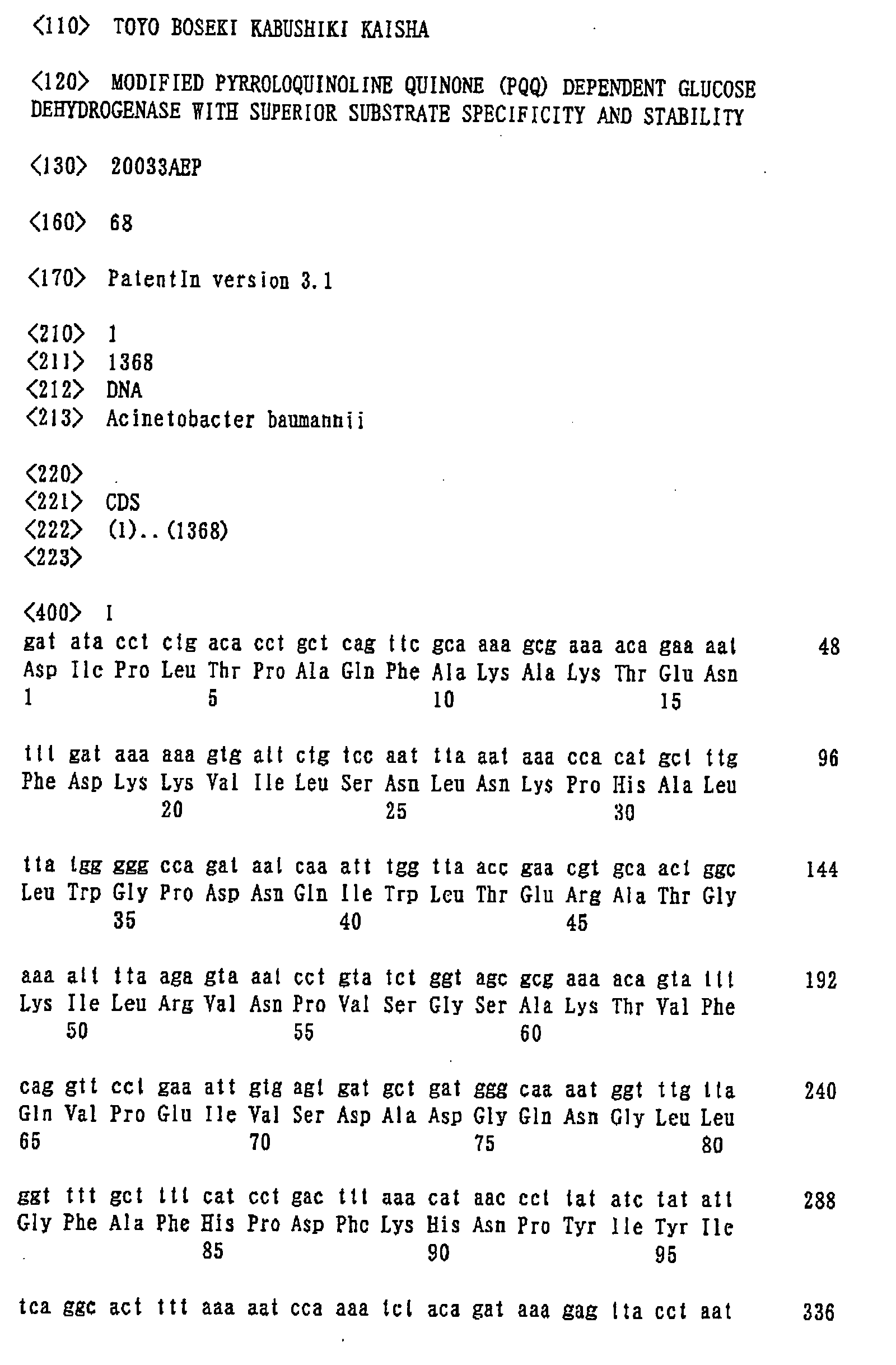
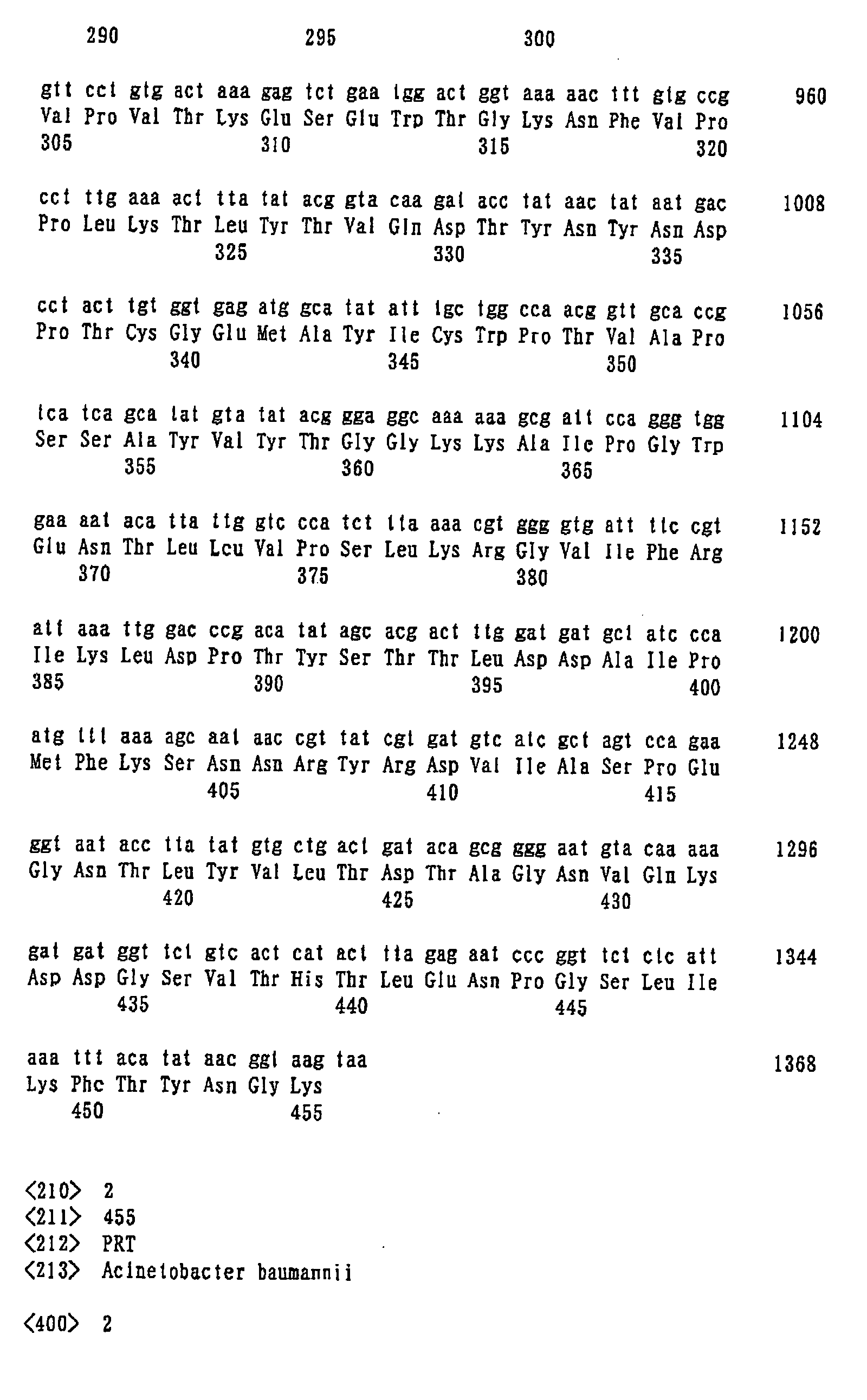
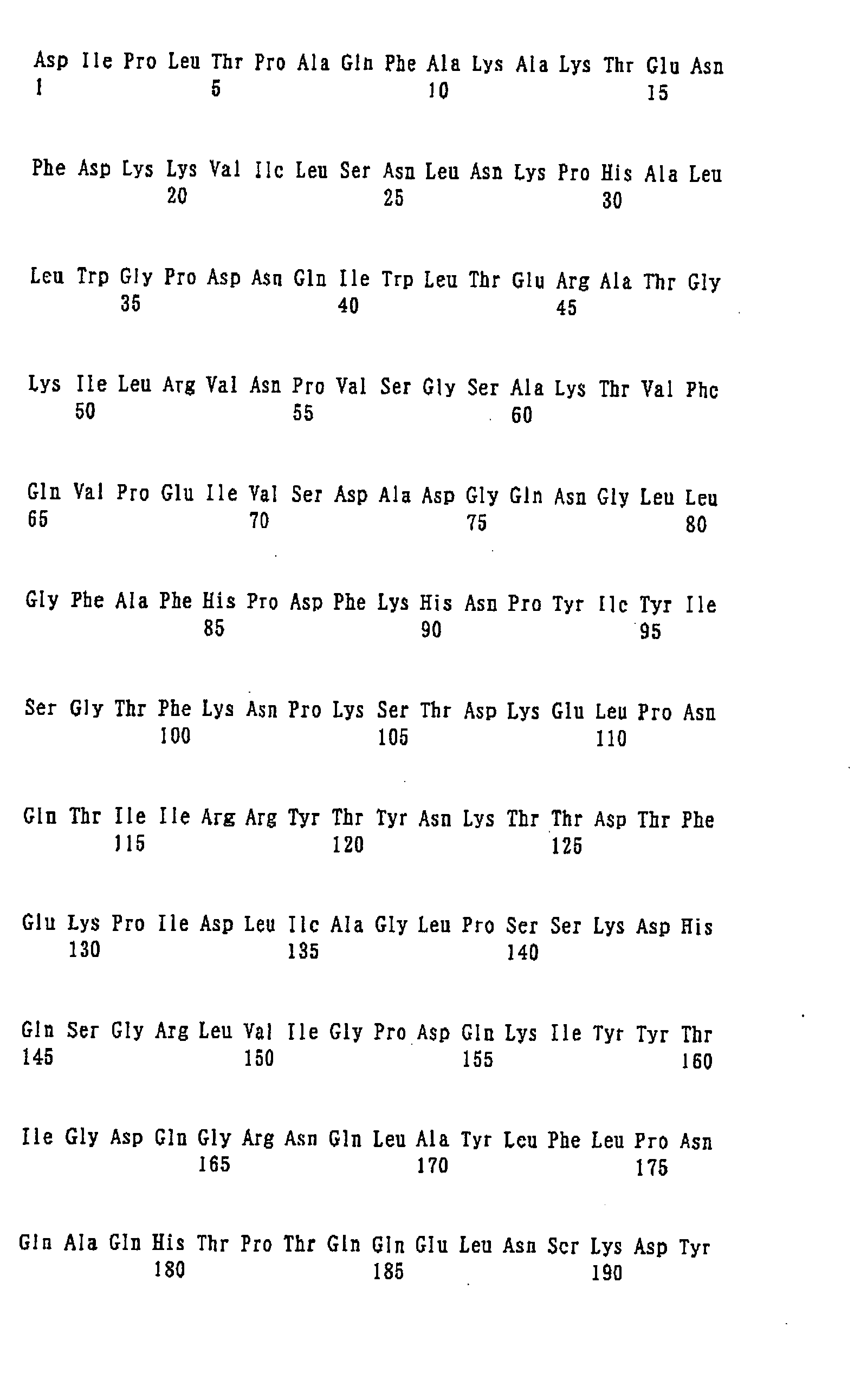
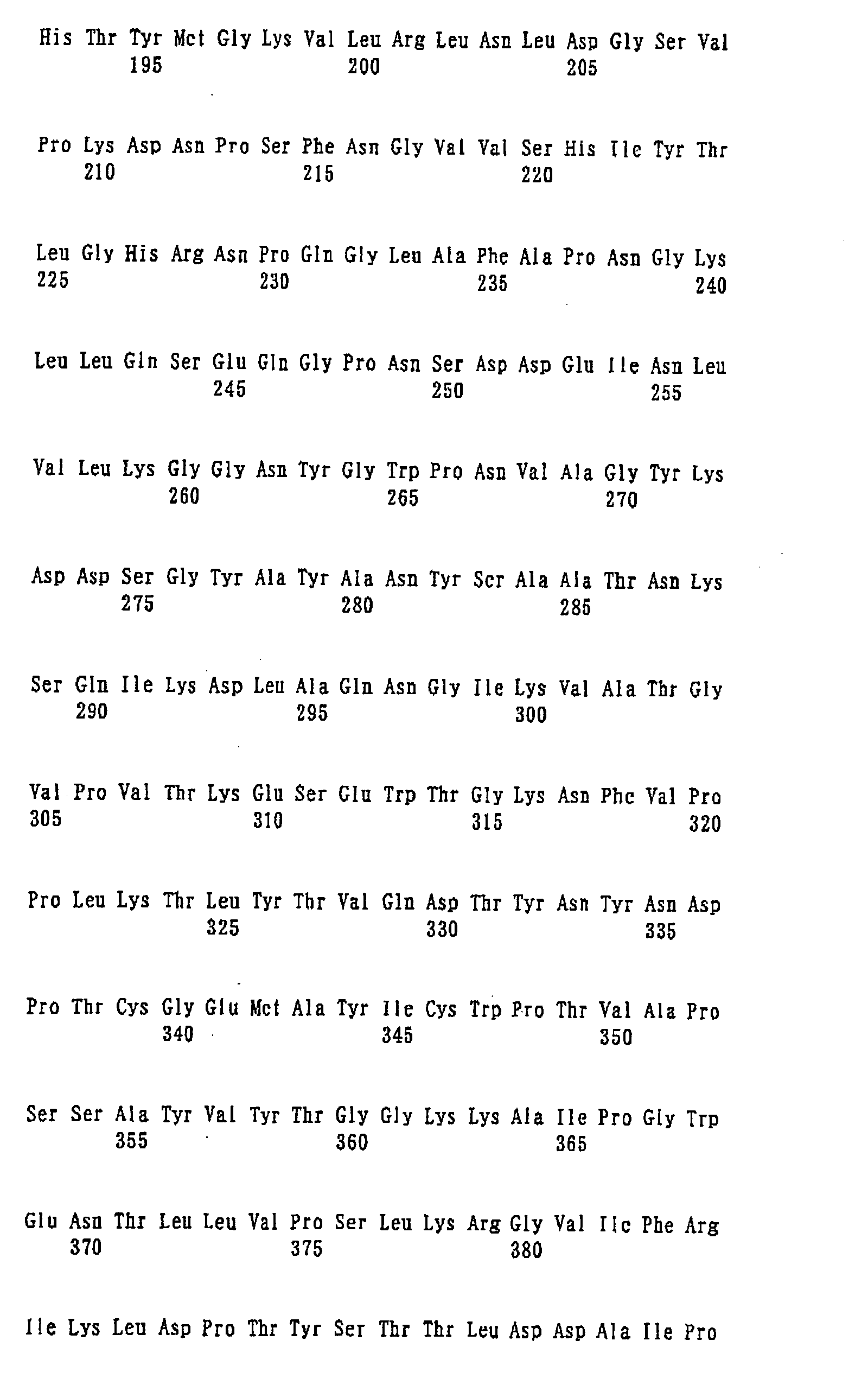
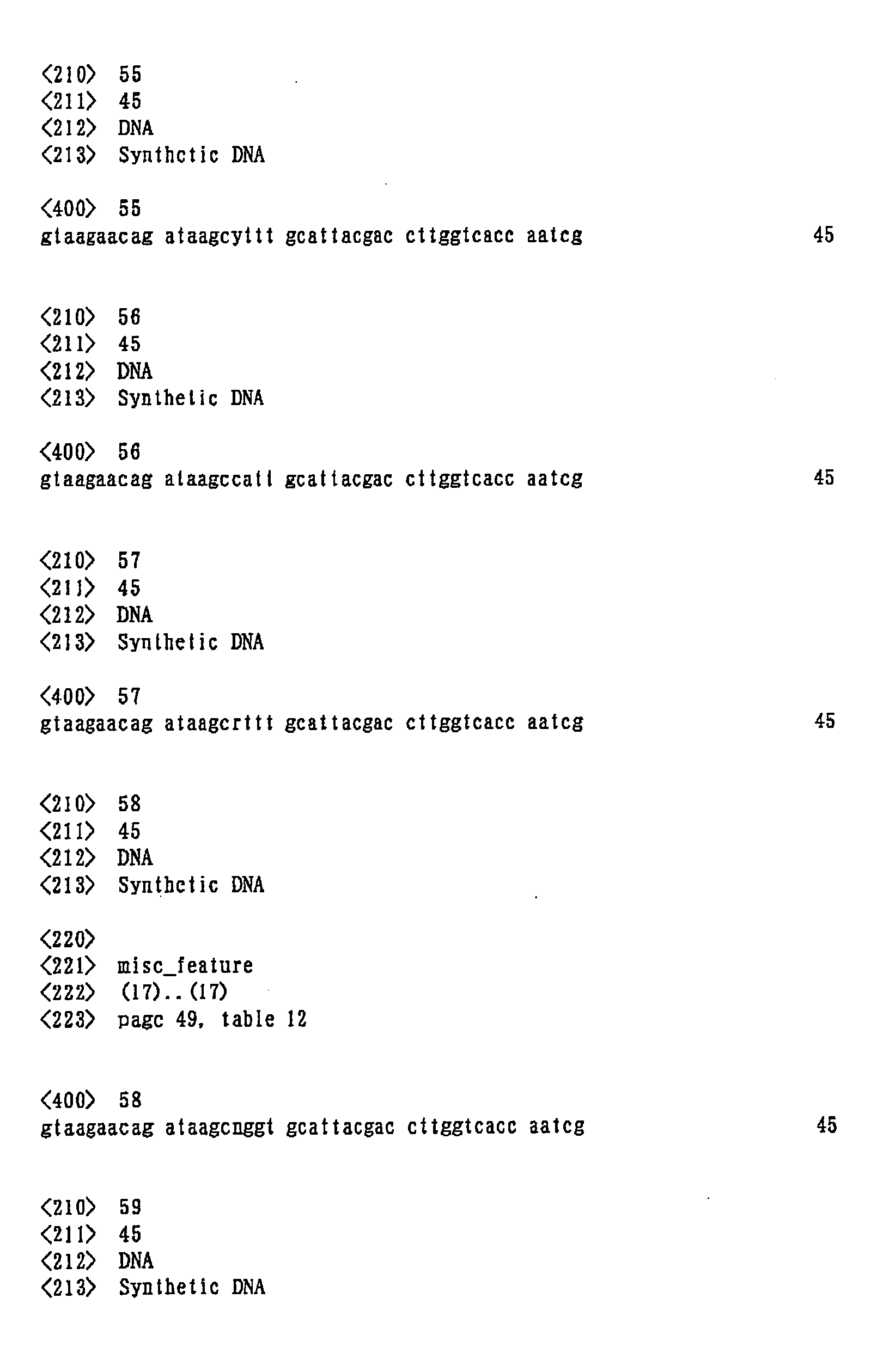
SEQUENCE LISTING