EP1364981A1 - Verfahren zur Herstellung von Polymergerüsten mit daran gebundenen Übergangsmetallen - Google Patents
Verfahren zur Herstellung von Polymergerüsten mit daran gebundenen Übergangsmetallen Download PDFInfo
- Publication number
- EP1364981A1 EP1364981A1 EP03011075A EP03011075A EP1364981A1 EP 1364981 A1 EP1364981 A1 EP 1364981A1 EP 03011075 A EP03011075 A EP 03011075A EP 03011075 A EP03011075 A EP 03011075A EP 1364981 A1 EP1364981 A1 EP 1364981A1
- Authority
- EP
- European Patent Office
- Prior art keywords
- polymer
- donor
- transition metals
- pva
- functions
- Prior art date
- Legal status (The legal status is an assumption and is not a legal conclusion. Google has not performed a legal analysis and makes no representation as to the accuracy of the status listed.)
- Granted
Links
Classifications
-
- C—CHEMISTRY; METALLURGY
- C08—ORGANIC MACROMOLECULAR COMPOUNDS; THEIR PREPARATION OR CHEMICAL WORKING-UP; COMPOSITIONS BASED THEREON
- C08F—MACROMOLECULAR COMPOUNDS OBTAINED BY REACTIONS ONLY INVOLVING CARBON-TO-CARBON UNSATURATED BONDS
- C08F8/00—Chemical modification by after-treatment
- C08F8/42—Introducing metal atoms or metal-containing groups
-
- B—PERFORMING OPERATIONS; TRANSPORTING
- B01—PHYSICAL OR CHEMICAL PROCESSES OR APPARATUS IN GENERAL
- B01J—CHEMICAL OR PHYSICAL PROCESSES, e.g. CATALYSIS OR COLLOID CHEMISTRY; THEIR RELEVANT APPARATUS
- B01J31/00—Catalysts comprising hydrides, coordination complexes or organic compounds
- B01J31/16—Catalysts comprising hydrides, coordination complexes or organic compounds containing coordination complexes
- B01J31/165—Polymer immobilised coordination complexes, e.g. organometallic complexes
- B01J31/1658—Polymer immobilised coordination complexes, e.g. organometallic complexes immobilised by covalent linkages, i.e. pendant complexes with optional linking groups, e.g. on Wang or Merrifield resins
-
- B—PERFORMING OPERATIONS; TRANSPORTING
- B01—PHYSICAL OR CHEMICAL PROCESSES OR APPARATUS IN GENERAL
- B01J—CHEMICAL OR PHYSICAL PROCESSES, e.g. CATALYSIS OR COLLOID CHEMISTRY; THEIR RELEVANT APPARATUS
- B01J31/00—Catalysts comprising hydrides, coordination complexes or organic compounds
- B01J31/16—Catalysts comprising hydrides, coordination complexes or organic compounds containing coordination complexes
- B01J31/22—Organic complexes
- B01J31/2282—Unsaturated compounds used as ligands
- B01J31/2295—Cyclic compounds, e.g. cyclopentadienyls
-
- B—PERFORMING OPERATIONS; TRANSPORTING
- B01—PHYSICAL OR CHEMICAL PROCESSES OR APPARATUS IN GENERAL
- B01J—CHEMICAL OR PHYSICAL PROCESSES, e.g. CATALYSIS OR COLLOID CHEMISTRY; THEIR RELEVANT APPARATUS
- B01J31/00—Catalysts comprising hydrides, coordination complexes or organic compounds
- B01J31/16—Catalysts comprising hydrides, coordination complexes or organic compounds containing coordination complexes
- B01J31/24—Phosphines, i.e. phosphorus bonded to only carbon atoms, or to both carbon and hydrogen atoms, including e.g. sp2-hybridised phosphorus compounds such as phosphabenzene, phosphole or anionic phospholide ligands
- B01J31/2404—Cyclic ligands, including e.g. non-condensed polycyclic ligands, the phosphine-P atom being a ring member or a substituent on the ring
-
- B—PERFORMING OPERATIONS; TRANSPORTING
- B01—PHYSICAL OR CHEMICAL PROCESSES OR APPARATUS IN GENERAL
- B01J—CHEMICAL OR PHYSICAL PROCESSES, e.g. CATALYSIS OR COLLOID CHEMISTRY; THEIR RELEVANT APPARATUS
- B01J2231/00—Catalytic reactions performed with catalysts classified in B01J31/00
- B01J2231/30—Addition reactions at carbon centres, i.e. to either C-C or C-X multiple bonds
- B01J2231/32—Addition reactions to C=C or C-C triple bonds
- B01J2231/321—Hydroformylation, metalformylation, carbonylation or hydroaminomethylation
-
- B—PERFORMING OPERATIONS; TRANSPORTING
- B01—PHYSICAL OR CHEMICAL PROCESSES OR APPARATUS IN GENERAL
- B01J—CHEMICAL OR PHYSICAL PROCESSES, e.g. CATALYSIS OR COLLOID CHEMISTRY; THEIR RELEVANT APPARATUS
- B01J2531/00—Additional information regarding catalytic systems classified in B01J31/00
- B01J2531/80—Complexes comprising metals of Group VIII as the central metal
- B01J2531/82—Metals of the platinum group
- B01J2531/822—Rhodium
-
- B—PERFORMING OPERATIONS; TRANSPORTING
- B01—PHYSICAL OR CHEMICAL PROCESSES OR APPARATUS IN GENERAL
- B01J—CHEMICAL OR PHYSICAL PROCESSES, e.g. CATALYSIS OR COLLOID CHEMISTRY; THEIR RELEVANT APPARATUS
- B01J31/00—Catalysts comprising hydrides, coordination complexes or organic compounds
- B01J31/16—Catalysts comprising hydrides, coordination complexes or organic compounds containing coordination complexes
- B01J31/18—Catalysts comprising hydrides, coordination complexes or organic compounds containing coordination complexes containing nitrogen, phosphorus, arsenic or antimony as complexing atoms, e.g. in pyridine ligands, or in resonance therewith, e.g. in isocyanide ligands C=N-R or as complexed central atoms
- B01J31/1805—Catalysts comprising hydrides, coordination complexes or organic compounds containing coordination complexes containing nitrogen, phosphorus, arsenic or antimony as complexing atoms, e.g. in pyridine ligands, or in resonance therewith, e.g. in isocyanide ligands C=N-R or as complexed central atoms the ligands containing nitrogen
-
- B—PERFORMING OPERATIONS; TRANSPORTING
- B01—PHYSICAL OR CHEMICAL PROCESSES OR APPARATUS IN GENERAL
- B01J—CHEMICAL OR PHYSICAL PROCESSES, e.g. CATALYSIS OR COLLOID CHEMISTRY; THEIR RELEVANT APPARATUS
- B01J31/00—Catalysts comprising hydrides, coordination complexes or organic compounds
- B01J31/16—Catalysts comprising hydrides, coordination complexes or organic compounds containing coordination complexes
- B01J31/24—Phosphines, i.e. phosphorus bonded to only carbon atoms, or to both carbon and hydrogen atoms, including e.g. sp2-hybridised phosphorus compounds such as phosphabenzene, phosphole or anionic phospholide ligands
Definitions
- the present invention relates to polymer scaffolds with it bound transition metals, a process for their production and their use.
- Transition metal complexes bound to polymers have been found in the of recent interest in the catalytic community.
- the motivation for performing this work is based on essentially on linking the benefits of homogeneous catalysis such as high selectivity and sales with those from heterogeneous catalysis such as easy catalyst separation and recyclability (Ph. Kalck in 'Aqueous phase organometallic catalysis', edited by B. Cornils and W. A. Herrmann, Wiley-VCH (1998), 111).
- a simple and good recyclability of homogeneous catalysts is also realized in multi-phase processes in which the catalyst in a phase immiscible with the educt and / or product located.
- the SHOP process P.C.J. Kamer, P.W.N.M. van Leeuwen in 'Aqueous phase organometallic catalysis', edited by B. Cornils and W.A. Herrmann, Wiley-VCH (1998), 565) and the Hydroformylation of propene according to the Rhône-Poulenc-Ruhrchemie Method (C.D. Frohning, C.W. Kohpaintner in 'Aqueous phase organometallic catalysis', edited by B. Cornils and W.A.
- catalyst systems represent that of polymeric materials either inorganic (Ph. Kalck in 'Aqueous phase organometallic catalysis', edited by B. Cornils and W. A. Herrmann, Wiley-VCH (1998), p.111) or more organic Basic structure (Ph. Kalck in 'Aqueous phase organometallic catalysis', edited by B. Cornils and W. A. Herrmann, Wiley-VCH (1998) p. 113 ff) fixed are or because of their chemical structure as surfactant molecules can function (G. Papadogianakis, R.A. Sheldon in 'Aqueous phase organometallic catalysis', edited by B. Cornils and W.A. Herrmann, Wiley-VCH (1998), 123 ff.).
- connection of a catalyst to an amphiphilic polymer material could serve as an example of a tensoid system; the non-polar part of the polymer builds up a hydrophobic environment in order to dock the non-polar substrate molecules via van der Waals forces, while the hydrophilic side groups allow the polymer to be fixed in an aqueous phase.
- a tensoid system based on polyethylene glycol side chains has been described in the literature and has already been investigated (EV Dehmlow in 'Aqueous phase organometallic catalysis', edited by B. Cornils and WA Herrmann, Wiley-VCH (1998), 218; T. Okano in' Aequous phase organometallic catalysis', edited by B.
- polyvinyl alcohol itself has only been in the form for connecting transition metals that its oxidized form has been used as endiolate structures can build up as a chelating ligand for transition metal fragments can function (W.A. Herrmann, C.-P. Reisinger in 'Aqueous phase organometallic catalysis', edited by B. Cornils and W. A. Herrmann, Wiley-VCH (1998), 145).
- the object of the present invention is to provide polymer frameworks with bound To provide transition metals that are suitable for manufacture of catalysts are suitable.
- catalysts be producible, which can be adapted to the desired conditions.
- the polymer structure contains hydroxyl groups Has polymers whose free hydroxyl groups at least are partially converted to cyclic acetals and / or ketals, which are donor functionalized, and that the transition metals via the donor function are bound to the polymer.
- OH functional ones are used to produce the polymer scaffolds according to the invention Polymers used.
- OH-functional polymers that can be used are polyvinyl alcohols (PVA), Polysaccharides or cellulose derivatives.
- Polyvinyl alcohols, copolymers are particularly preferred according to the invention vinyl alcohol, e.g. Copolymers with vinyl acetate or polysaccharides, in particular cellulose or mixtures of these substances.
- the OH-functional polymers mentioned are also used Aldehydes, or synthetic equivalents, which have at least one donor function have implemented.
- the elements of the V come as donors and VI. Main group of the Periodic Table of the Elements.
- the aldehydes or synthesis equivalents with phosphino- or amino functions. are particularly preferred Phosphino functionalization.
- aldehydes or synthetic equivalents are also suitable Consider which have at least one halogen function.
- aldehydes which can be used according to the invention are e.g. B. haloacetaldehydes, e.g. Chloroacetaldehyde and haloacetaldehyde dialkyl acetals, e.g. Chloroacetaldehyde.
- Other examples are halobenzaldehydes, e.g. Bromobenzaldehyde.
- halogens come along Chlorine also includes fluorine, bromine or iodine. There are also multiple functionalizations conceivable, the halogens mentioned here being optional can be combined.
- the fields of application of the framework polymers described are in their Use as a carrier material for transition metals by coordination bound to the donor functionalizations of the polymer.
- the wide range of variations in acetalization or ketalization The polymer allows the production of polymer scaffolds that are due to their different polarity for use in different reaction media are suitable.
- transition metals for the preparation of the catalysts bound. Electron-rich transition metal complexes are preferred for this into consideration. In particular, metals are preferred the eighth subgroup of the periodic table. Very particularly preferred are rhodium, palladium or ruthenium.
- the polymer structure according to the invention is based on a Functionalization of the free hydroxyl groups of a polymer, e.g. a polyvinyl alcohol, by conversion into cyclic acetals or Ketals, which carry donor functionalizations in side chains, to the transition metals can be coordinated.
- a polymer e.g. a polyvinyl alcohol
- PVA Polyvinyl alcohol
- these systems are also suitable for use in limit phase catalysis.
- the different ways of immobilizing the catalyst allow on the polymer an adjustment of the polarity of the polymer bound Catalyst in a wide range from hydrophilic to hydrophobic, so that the catalyst to the desired optimal conditions can be adjusted.
- Polyvinyl alcohol which carries phosphino functionalizations, which are bound to the PVA framework by acetals or ketals, is used to produce a polymer framework with transition metals bonded to it.
- the basic structure of phosphinofunctionalized PVA with phosphino groups bonded to the polymer by acetal groups is as follows, whereby spacers are to be understood in each case as organic residues originating from the aldehyde used, in particular alkyl or alkyl groups:
- the aim of the production was accordingly a phosphino-functionalized PVA with coordination of transition metal fragments (the term fragment refers to a suitable transition metal building block);
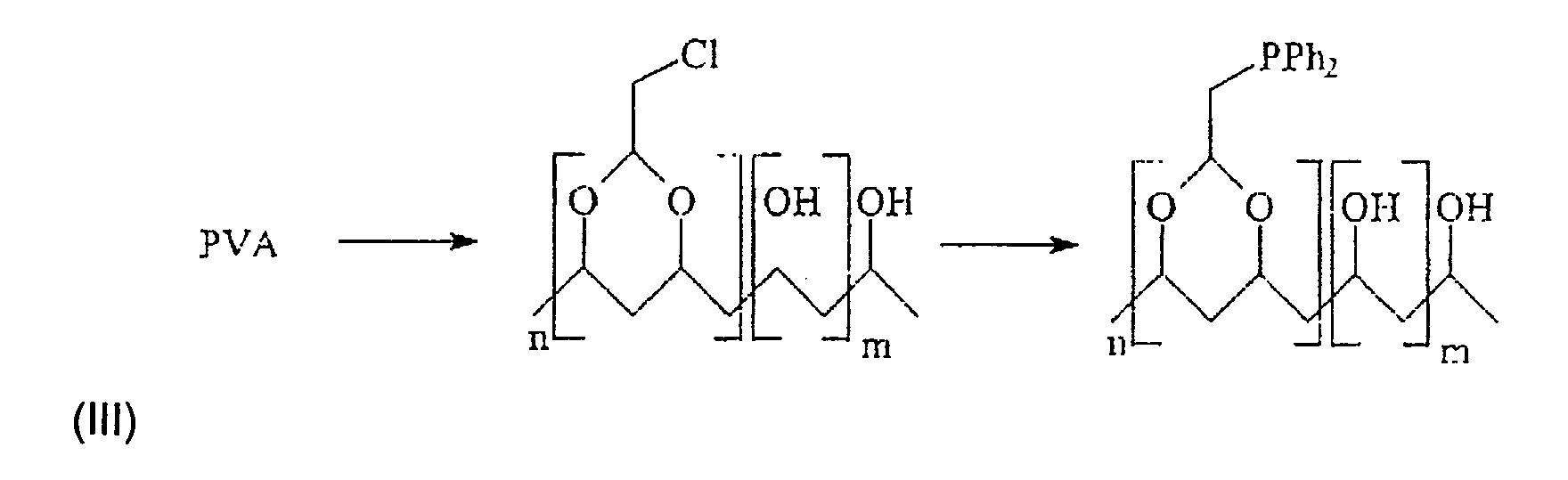
- Variant 1 acetalization of PVA with chloroacetaldehyde followed by nucleophilic substitution of the chloride by a phosphine:
- the acetalization of the PVA can be acid catalyzed with chloroacetaldehyde hydrate be carried out in various solvents (water, DMSO, THF).
- the subsequent nucleophilic substitution of the chloride for one Diphenylphosphino group in DMSO by reacting with Chloroacetaldehyde acetalized PVA with diphenylphosphine in the presence of potassium carbonate and KOH as base.
- the only phosphor product contains a PVA, which is attached to the acetal groups Phosphinomethyl groupings is substituted.
- polymers with a low degree of acetalization received between 10 and 30 percent (n ⁇ m).
- Variant 2 Acetalization of PVA with bromobenzaldehyde derivatives with subsequent conversion of the bromine functionalization into a phosphinofunctionalization.
- the acetalization of the PVA is carried out with bromobenzaldehyde derivatives (preferably with their corresponding dimethylacetals) in DMSO as solvent.
- the subsequent substitution of the bromide for a phosphino group is achieved after conversion of the free hydroxyl groups remaining on the polymer into dimethylphenylsillyl ether as protective groups by metalation on the aromatics and subsequent nucleophilic substitution on chlorophosphines in THF.
- polymers with a high degree of acetalization received from about 70 percent (n> m).
- Variant 3 Direct acetalization of PVA with phosphinobenzaldehyde derivatives
- PVA can be acetalized directly in N-methylpyrrolidone (NMP) as a solvent with phosphinobenzaldehyde derivatives.
- NMP N-methylpyrrolidone
- a polymer with a high degree of acetalization (about 70 percent, n> m) as described under variant 2) is obtained.
- the products containing phosphorus are PVA derivatives that are substituted on the acetal groups with phenylphosphino groups ( Figure (V)).
Landscapes
- Chemical & Material Sciences (AREA)
- Organic Chemistry (AREA)
- Inorganic Chemistry (AREA)
- Chemical Kinetics & Catalysis (AREA)
- Engineering & Computer Science (AREA)
- Materials Engineering (AREA)
- General Chemical & Material Sciences (AREA)
- Health & Medical Sciences (AREA)
- Medicinal Chemistry (AREA)
- Polymers & Plastics (AREA)
- Catalysts (AREA)
- Addition Polymer Or Copolymer, Post-Treatments, Or Chemical Modifications (AREA)
Abstract
Description




- Octan: ∼ 2%
- Nicht näher identifizierte Nebenprodukte: ∼ 2%
Man erhält 26.4 g eines gelben, polymeren Feststoffs mit einem Chlorgehalt von 7.9%.
δ (ppm) = 1.06-2.13 (m (br.), CH2, 4.26 (s (sh., br.)), OCHR), 5.67 (s (br.), CHO2), 5.97 (s (br.), CHO2), 7.55 (s (br.), Ar-H), 7.62 (s (br), Ar-H).
δ (ppm) = 0.88 (s, SiCH3), 0.97 (s, SiCH3), 1.27 - 2.04 (m (br.), CH2, CH), 4.14 (s. (br.), OCHR), 4.55 (s (br.), OCHR), 5.49 (s (br.), CHO2), 5.71 (s (br.), CHO2), 7.33 (s (br.), Ar-H), 7.47 (s (br), Ar-H).
δ (ppm) H -6.61 (s).
δ (ppm) = 0.88 (s, SiCH3), 1.13-2.04 (m (br.); CH2, CH), 4.08 (s (br.), OCHR), 4.43 (s (br.), OCHR), 5.48 (s (br.), CHO2), 5.78 (s (br.), CHO2), 7.26 ( s (br), Ar-H).
δ (ppm) = 31.6 (s (br.)).
δ (ppm) = 39.85 (d, 1 J (P, Rh) = 148 Hz).
Claims (10)
- Polymergerüste mit gebundenen Übergangsmetallen dadurch gekennzeichnet, daß die Polymergerüste hydroxygruppenhaltige Polymere aufweisen, deren freie Hydroxylgruppen zumindest teilweise zu cyclischen Acetalen oder Ketalen oder deren Syntheseäquivalenten, welche Donorfunktionalisiert sind, umgesetzt sind, und daß die Übergangsmetalle über die Donorfunktion an das Polymer gebunden sind.
- Polymergerüste nach Anspruch 1 dadurch gekennzeichnet, daß die hydroxylgruppenhaltigen Polymere Polyvinylalkohol sind.
- Polymergerüste nach einem der Ansprüche 1 oder 2 dadurch gekennzeichnet, daß die Donorfunktionenen Elemente der V. und VI. Hauptgruppe des Periodensystems enthalten.
- Polymergerüste nach einem der Ansprüche 1 bis 3 dadurch gekennzeichnet, daß die Donorfunktionen Phosphino- oder Amino-Gruppen sind.
- Verfahren zur Herstellung von Polymergerüsten mit daran gebundenen Übergangsmetallen dadurch gekennzeichnet, daß ein freie Hydroxylfunktionen enthaltendes Polymer wenigstens teilweise mit Aldehyden oder deren Syntheseäquivalenten, welche wenigstens eine Donorfunktion aufweisen, und danach mit Übergangsmetallen umgesetzt werden.
- Verfahren nach Anspruch 5 dadurch gekennzeichnet, daß als OH-Funktionen enthaltendes Polymer Polyvinylalkohol eingesetzt wird.
- Verfahren nach einem der Ansprüche 5 oder 6 dadurch gekennzeichnet, daß die Donorfunktionen Elemente der V. und VI. Hauptgruppe des Periodensystems enthalten.
- Verfahren nach einem der Ansprüche 5 bis 7 dadurch gekennzeichnet, daß als Donorfunktionen Phosphino- oder Amino-Gruppen eingesetzt werden.
- Verfahren nach einem der Ansprüche 1 bis 8 dadurch gekennzeichnet, daß das Gerüstpolymer mit einem Aldehyd oder einem Syntheseäquivalent, welches wenigstens eine Halogenfunktion aufweist, umgesetzt und anschließend eine nucleophile Substitution des Halogens durch die Donorfunktion tragende Komponente erfolgt.
- Verwendung der Polymergerüste nach einem der Ansprüche 1 bis 4 mit daran gebundenen Übergangsmetallen als Katalysatoren.
Applications Claiming Priority (2)
| Application Number | Priority Date | Filing Date | Title |
|---|---|---|---|
| DE10223345A DE10223345A1 (de) | 2002-05-25 | 2002-05-25 | Verfahren zur Herstellung von Polymergerüsten mit daran gebundenen Übergangsmetallen |
| DE10223345 | 2002-05-25 |
Publications (2)
| Publication Number | Publication Date |
|---|---|
| EP1364981A1 true EP1364981A1 (de) | 2003-11-26 |
| EP1364981B1 EP1364981B1 (de) | 2014-08-06 |
Family
ID=29285697
Family Applications (1)
| Application Number | Title | Priority Date | Filing Date |
|---|---|---|---|
| EP20030011075 Expired - Lifetime EP1364981B1 (de) | 2002-05-25 | 2003-05-20 | Verfahren zur Herstellung von Polymergerüsten mit daran gebundenen Übergangsmetallen |
Country Status (2)
| Country | Link |
|---|---|
| EP (1) | EP1364981B1 (de) |
| DE (1) | DE10223345A1 (de) |
Citations (5)
| Publication number | Priority date | Publication date | Assignee | Title |
|---|---|---|---|---|
| US3674768A (en) | 1969-01-30 | 1972-07-04 | Keith George Allum | Modified polyalcohol |
| GB1291237A (en) | 1969-01-30 | 1972-10-04 | British Petroleum Co | Catalyst support |
| JPH06170235A (ja) | 1992-12-01 | 1994-06-21 | Nissan Motor Co Ltd | 排気ガス浄化用触媒 |
| JPH06170236A (ja) * | 1992-12-01 | 1994-06-21 | Nichibi:Kk | 貴金属触媒添着アニオン交換繊維およびその製造方法 |
| US20020022144A1 (en) * | 2000-05-19 | 2002-02-21 | Hu Yang | Enhanced oxygen barrier performance from modification of ethylene vinyl alcohol copolymers (EVOH) |
Family Cites Families (6)
| Publication number | Priority date | Publication date | Assignee | Title |
|---|---|---|---|---|
| DE849006C (de) * | 1945-03-21 | 1952-09-11 | Hoechst Ag | Verfahren zur Herstellung von Polymerisationsverbindungen |
| NL136308C (de) * | 1966-11-22 | |||
| DE2548683A1 (de) * | 1975-10-30 | 1977-05-05 | Inst Khim Fiz An Sssr | Katalysator zur polymerisation, copolymerisation und oligomerisation von olefinen und diolefinen |
| US5030688A (en) * | 1988-11-07 | 1991-07-09 | Monsanto Company | Ionomeric polyvinyl butyral |
| DE19831073A1 (de) * | 1998-07-10 | 2000-01-13 | Wacker Chemie Gmbh | Die Anlagerung von Si-gebundenen Wasserstoff an aliphatische Kohlenstoff-Kohlenstoff-Mehrfachbindung fördernde Katalysatoren |
| KR100302326B1 (ko) * | 1999-06-09 | 2001-09-22 | 윤덕용 | 폴리비닐알콜-실란커플링제를 이용한 무-유기 공중합체 및 그의제조방법 |
-
2002
- 2002-05-25 DE DE10223345A patent/DE10223345A1/de not_active Ceased
-
2003
- 2003-05-20 EP EP20030011075 patent/EP1364981B1/de not_active Expired - Lifetime
Patent Citations (5)
| Publication number | Priority date | Publication date | Assignee | Title |
|---|---|---|---|---|
| US3674768A (en) | 1969-01-30 | 1972-07-04 | Keith George Allum | Modified polyalcohol |
| GB1291237A (en) | 1969-01-30 | 1972-10-04 | British Petroleum Co | Catalyst support |
| JPH06170235A (ja) | 1992-12-01 | 1994-06-21 | Nissan Motor Co Ltd | 排気ガス浄化用触媒 |
| JPH06170236A (ja) * | 1992-12-01 | 1994-06-21 | Nichibi:Kk | 貴金属触媒添着アニオン交換繊維およびその製造方法 |
| US20020022144A1 (en) * | 2000-05-19 | 2002-02-21 | Hu Yang | Enhanced oxygen barrier performance from modification of ethylene vinyl alcohol copolymers (EVOH) |
Non-Patent Citations (17)
| Title |
|---|
| A. KIRSCHNING; H. MONENSCHEIN; R. WITTENBERG, ANGEW. CHEM., vol. 113, 2001, pages 670 |
| ANGEW. CHEM. LNT. ED. ENGL., vol. 40, 2001, pages 650 |
| B. CHAPMAN; T.S. REGER; K.D. JANDA, TETRAHEDRON, vol. 57, 2001, pages 4637 |
| C.D. FROHNING; C.W. KOHPAINTNER: "Aequos phase organometallic catalysis", 1998, WILEY-VCH, pages: 297 |
| D.E. BERGBREITER; P.L. OSBORN; A. WILSON; E.M. SINK: "J.Am. Chem. Soc.", vol. 122, 2000, pages: 9058 |
| E.V. DEHMLOW: "Aequous phase organometallic catalysis", 1998, WILEY-VCH, pages: 218 |
| G. PAPADOGIANAKIS; R. A. SHELDON: "Aequous phase organometallic catalysis", 1998, WILEY-VCH, pages: 123 FF |
| H. BAHRMANN; S. BOGDANOVIC: "Aequous phase organometallic catalysis", 1998, WILEY-VCH, pages: 309 |
| J. A. LOCH; C. BORGMANN; R.H. CRABTREE, J. MOL. CAT.A: CHEM., vol. 170, 2001, pages 75 |
| P.C.J. KAMER; P.W.N.M. VAN LEEUWEN: "Aequous phase organometallic catalysis", 1998, WILEY-VCH, pages: 565 |
| PATENT ABSTRACTS OF JAPAN vol. 018, no. 506 (C - 1252) 22 September 1994 (1994-09-22) * |
| PH. KALCK: "Aequous phase organometallic catalysis", 1998, WILEY-VCH, pages: 111 |
| PH. KALCK: "Aequous phase organometallic catalysis", 1998, WILEY-VCH, pages: 113 FF |
| PH. KALCK: "Aquous phase organometallic catylysis", 1998, WILEY-VCH, pages: 111 |
| R.B. MERRIFIELD, J.AM. CHEM. SOC., vol. 85, 1963, pages 2149 |
| T OKANO: "Aequous phase organometallic catalysis", 1998, WILEY-VCH, pages: 221 |
| W.A. HERRMANN; C.-P. REISINGER: "Aequous phase organo metallic catalysis", 1998, WILEY-VCH, pages: 145 |
Also Published As
| Publication number | Publication date |
|---|---|
| DE10223345A1 (de) | 2003-12-11 |
| EP1364981B1 (de) | 2014-08-06 |
Similar Documents
| Publication | Publication Date | Title |
|---|---|---|
| EP1529768B1 (de) | Verfahren zur Herstellung von TCD-Alkohol DM | |
| DE69918828T2 (de) | Hydroformylierung von olefinen unter verwendung von bis(phosphor) trägerliganden | |
| DE10037961A1 (de) | Neue Phosphanliganden, deren Herstellung und ihre Verwendung in katalytischen Reaktionen | |
| DE2332167B2 (de) | Silylhydrocarbylphosphin-Übergangsmetallkomplexe, Verfahren zu ihrer Herstellung und ihre Verwendung | |
| EP0158875B1 (de) | Chirale Rhodium-diphosphinkomplexe für asymmetrische Hydrierungen | |
| EP1103537B1 (de) | Verfahren zur selektiven Oxidation von Alkoholen unter Verwendung leicht abtrennbarer Nitroxylradikale | |
| DE3141456C2 (de) | ||
| EP1177163B1 (de) | Verfahren zur herstellung von aldehyden | |
| DE68904558T2 (de) | Verfahren zu herstellung von bidentatliganden. | |
| EP0924218B1 (de) | Nichtwässrige ionogene Ligandflüssigkeiten, Verfahren zu ihrer Herstellung und ihre Verwendung als Katalysatorbestandteil | |
| DE19983354C2 (de) | Verfahren zur Hydroformylierung | |
| EP0885183A1 (de) | Verfahren zur herstellung von aldehyden durch hydroformylierung von olefinen | |
| DE10243446B4 (de) | Verfahren zur Herstellung von Aldehyden | |
| EP0946578B1 (de) | Phosphane, verfahren zu ihrer herstellung und ihre verwendung in metallkomplexen | |
| EP0646588A1 (de) | Cyclische Verbindungen des dreiwertigen Phosphors | |
| EP1364981B1 (de) | Verfahren zur Herstellung von Polymergerüsten mit daran gebundenen Übergangsmetallen | |
| DE60031509T2 (de) | Optisch aktive fluorierte binaphthol-derivate | |
| DE10210918B4 (de) | Verfahren zur Herstellung von Bisphosphiten | |
| DE10393950B4 (de) | Verfahren zur Herstellung von Carbonsäure | |
| EP3104970B1 (de) | Verfahren zur regenerierung gebrauchter hydroformylierungskatalysatoren | |
| EP1834695A1 (de) | Verfahren zur Rückgewinnung von phosphorhaltigen Liganden, aus Metallkomplexen mit Phosphinliganden | |
| WO2009153272A2 (de) | Verfahren zur iodierung von aromatischen und/oder heteroaromatischen verbindungen | |
| DE19701245C1 (de) | Guanidiniumphosphane, ein Verfahren zu ihrer Herstellung und ihre Verwendung | |
| EP1409493A1 (de) | Verfahren zur herstellung von nicht-chiralen und optisch aktiven hydroxygruppen enthaltenden organischen verbindungen | |
| DE102004028183B4 (de) | Verfahren zum Regenerieren der Katalysatorverbindungen Rh(PX3)3(Y) |
Legal Events
| Date | Code | Title | Description |
|---|---|---|---|
| PUAI | Public reference made under article 153(3) epc to a published international application that has entered the european phase |
Free format text: ORIGINAL CODE: 0009012 |
|
| AK | Designated contracting states |
Kind code of ref document: A1 Designated state(s): AT BE BG CH CY CZ DE DK EE ES FI FR GB GR HU IE IT LI LU MC NL PT RO SE SI SK TR |
|
| AX | Request for extension of the european patent |
Extension state: AL LT LV MK |
|
| 17P | Request for examination filed |
Effective date: 20040422 |
|
| AKX | Designation fees paid |
Designated state(s): AT BE BG CH CY CZ DE DK EE ES FI FR GB GR HU IE IT LI LU MC NL PT RO SE SI SK TR |
|
| 17Q | First examination report despatched |
Effective date: 20051020 |
|
| RAP1 | Party data changed (applicant data changed or rights of an application transferred) |
Owner name: KARLSRUHER INSTITUT FUER TECHNOLOGIE |
|
| REG | Reference to a national code |
Ref country code: DE Ref legal event code: R079 Ref document number: 50315097 Country of ref document: DE Free format text: PREVIOUS MAIN CLASS: C08J0003200000 Ipc: B01J0031240000 |
|
| GRAP | Despatch of communication of intention to grant a patent |
Free format text: ORIGINAL CODE: EPIDOSNIGR1 |
|
| RIC1 | Information provided on ipc code assigned before grant |
Ipc: B01J 31/18 20060101ALI20140206BHEP Ipc: B01J 31/16 20060101ALI20140206BHEP Ipc: C08F 8/42 20060101ALI20140206BHEP Ipc: B01J 31/24 20060101AFI20140206BHEP Ipc: B01J 31/22 20060101ALI20140206BHEP |
|
| INTG | Intention to grant announced |
Effective date: 20140227 |
|
| RIN1 | Information on inventor provided before grant (corrected) |
Inventor name: DIE ANDERE ERFINDER HABEN AUF IHRE NENNUNG VERZICH Inventor name: WALTER, OLAF Inventor name: AHLMANN, MARTIN Inventor name: DINJUS, ECKHARD |
|
| GRAS | Grant fee paid |
Free format text: ORIGINAL CODE: EPIDOSNIGR3 |
|
| GRAA | (expected) grant |
Free format text: ORIGINAL CODE: 0009210 |
|
| AK | Designated contracting states |
Kind code of ref document: B1 Designated state(s): AT BE BG CH CY CZ DE DK EE ES FI FR GB GR HU IE IT LI LU MC NL PT RO SE SI SK TR |
|
| REG | Reference to a national code |
Ref country code: GB Ref legal event code: FG4D Free format text: NOT ENGLISH |
|
| REG | Reference to a national code |
Ref country code: CH Ref legal event code: EP Ref country code: AT Ref legal event code: REF Ref document number: 680748 Country of ref document: AT Kind code of ref document: T Effective date: 20140815 |
|
| REG | Reference to a national code |
Ref country code: IE Ref legal event code: FG4D Free format text: LANGUAGE OF EP DOCUMENT: GERMAN |
|
| REG | Reference to a national code |
Ref country code: DE Ref legal event code: R096 Ref document number: 50315097 Country of ref document: DE Effective date: 20140911 |
|
| REG | Reference to a national code |
Ref country code: NL Ref legal event code: VDEP Effective date: 20140806 |
|
| PG25 | Lapsed in a contracting state [announced via postgrant information from national office to epo] |
Ref country code: PT Free format text: LAPSE BECAUSE OF FAILURE TO SUBMIT A TRANSLATION OF THE DESCRIPTION OR TO PAY THE FEE WITHIN THE PRESCRIBED TIME-LIMIT Effective date: 20141209 Ref country code: SE Free format text: LAPSE BECAUSE OF FAILURE TO SUBMIT A TRANSLATION OF THE DESCRIPTION OR TO PAY THE FEE WITHIN THE PRESCRIBED TIME-LIMIT Effective date: 20140806 Ref country code: ES Free format text: LAPSE BECAUSE OF FAILURE TO SUBMIT A TRANSLATION OF THE DESCRIPTION OR TO PAY THE FEE WITHIN THE PRESCRIBED TIME-LIMIT Effective date: 20140806 Ref country code: FI Free format text: LAPSE BECAUSE OF FAILURE TO SUBMIT A TRANSLATION OF THE DESCRIPTION OR TO PAY THE FEE WITHIN THE PRESCRIBED TIME-LIMIT Effective date: 20140806 Ref country code: BG Free format text: LAPSE BECAUSE OF FAILURE TO SUBMIT A TRANSLATION OF THE DESCRIPTION OR TO PAY THE FEE WITHIN THE PRESCRIBED TIME-LIMIT Effective date: 20141106 |
|
| PG25 | Lapsed in a contracting state [announced via postgrant information from national office to epo] |
Ref country code: NL Free format text: LAPSE BECAUSE OF FAILURE TO SUBMIT A TRANSLATION OF THE DESCRIPTION OR TO PAY THE FEE WITHIN THE PRESCRIBED TIME-LIMIT Effective date: 20140806 Ref country code: CY Free format text: LAPSE BECAUSE OF FAILURE TO SUBMIT A TRANSLATION OF THE DESCRIPTION OR TO PAY THE FEE WITHIN THE PRESCRIBED TIME-LIMIT Effective date: 20140806 |
|
| PG25 | Lapsed in a contracting state [announced via postgrant information from national office to epo] |
Ref country code: RO Free format text: LAPSE BECAUSE OF FAILURE TO SUBMIT A TRANSLATION OF THE DESCRIPTION OR TO PAY THE FEE WITHIN THE PRESCRIBED TIME-LIMIT Effective date: 20140806 Ref country code: IT Free format text: LAPSE BECAUSE OF FAILURE TO SUBMIT A TRANSLATION OF THE DESCRIPTION OR TO PAY THE FEE WITHIN THE PRESCRIBED TIME-LIMIT Effective date: 20140806 Ref country code: EE Free format text: LAPSE BECAUSE OF FAILURE TO SUBMIT A TRANSLATION OF THE DESCRIPTION OR TO PAY THE FEE WITHIN THE PRESCRIBED TIME-LIMIT Effective date: 20140806 Ref country code: DK Free format text: LAPSE BECAUSE OF FAILURE TO SUBMIT A TRANSLATION OF THE DESCRIPTION OR TO PAY THE FEE WITHIN THE PRESCRIBED TIME-LIMIT Effective date: 20140806 Ref country code: CZ Free format text: LAPSE BECAUSE OF FAILURE TO SUBMIT A TRANSLATION OF THE DESCRIPTION OR TO PAY THE FEE WITHIN THE PRESCRIBED TIME-LIMIT Effective date: 20140806 Ref country code: SK Free format text: LAPSE BECAUSE OF FAILURE TO SUBMIT A TRANSLATION OF THE DESCRIPTION OR TO PAY THE FEE WITHIN THE PRESCRIBED TIME-LIMIT Effective date: 20140806 |
|
| REG | Reference to a national code |
Ref country code: DE Ref legal event code: R097 Ref document number: 50315097 Country of ref document: DE |
|
| PLBE | No opposition filed within time limit |
Free format text: ORIGINAL CODE: 0009261 |
|
| STAA | Information on the status of an ep patent application or granted ep patent |
Free format text: STATUS: NO OPPOSITION FILED WITHIN TIME LIMIT |
|
| 26N | No opposition filed |
Effective date: 20150507 |
|
| PGFP | Annual fee paid to national office [announced via postgrant information from national office to epo] |
Ref country code: DE Payment date: 20150521 Year of fee payment: 13 |
|
| PG25 | Lapsed in a contracting state [announced via postgrant information from national office to epo] |
Ref country code: SI Free format text: LAPSE BECAUSE OF FAILURE TO SUBMIT A TRANSLATION OF THE DESCRIPTION OR TO PAY THE FEE WITHIN THE PRESCRIBED TIME-LIMIT Effective date: 20140806 |
|
| REG | Reference to a national code |
Ref country code: DE Ref legal event code: R082 Ref document number: 50315097 Country of ref document: DE |
|
| REG | Reference to a national code |
Ref country code: CH Ref legal event code: PL |
|
| GBPC | Gb: european patent ceased through non-payment of renewal fee |
Effective date: 20150520 |
|
| PG25 | Lapsed in a contracting state [announced via postgrant information from national office to epo] |
Ref country code: LU Free format text: LAPSE BECAUSE OF FAILURE TO SUBMIT A TRANSLATION OF THE DESCRIPTION OR TO PAY THE FEE WITHIN THE PRESCRIBED TIME-LIMIT Effective date: 20150520 Ref country code: MC Free format text: LAPSE BECAUSE OF FAILURE TO SUBMIT A TRANSLATION OF THE DESCRIPTION OR TO PAY THE FEE WITHIN THE PRESCRIBED TIME-LIMIT Effective date: 20140806 Ref country code: LI Free format text: LAPSE BECAUSE OF NON-PAYMENT OF DUE FEES Effective date: 20150531 Ref country code: CH Free format text: LAPSE BECAUSE OF NON-PAYMENT OF DUE FEES Effective date: 20150531 |
|
| REG | Reference to a national code |
Ref country code: IE Ref legal event code: MM4A |
|
| REG | Reference to a national code |
Ref country code: FR Ref legal event code: ST Effective date: 20160129 |
|
| PG25 | Lapsed in a contracting state [announced via postgrant information from national office to epo] |
Ref country code: IE Free format text: LAPSE BECAUSE OF NON-PAYMENT OF DUE FEES Effective date: 20150520 Ref country code: GB Free format text: LAPSE BECAUSE OF NON-PAYMENT OF DUE FEES Effective date: 20150520 |
|
| PG25 | Lapsed in a contracting state [announced via postgrant information from national office to epo] |
Ref country code: FR Free format text: LAPSE BECAUSE OF NON-PAYMENT OF DUE FEES Effective date: 20150601 |
|
| REG | Reference to a national code |
Ref country code: AT Ref legal event code: MM01 Ref document number: 680748 Country of ref document: AT Kind code of ref document: T Effective date: 20150520 |
|
| PG25 | Lapsed in a contracting state [announced via postgrant information from national office to epo] |
Ref country code: AT Free format text: LAPSE BECAUSE OF NON-PAYMENT OF DUE FEES Effective date: 20150520 |
|
| REG | Reference to a national code |
Ref country code: DE Ref legal event code: R119 Ref document number: 50315097 Country of ref document: DE |
|
| PG25 | Lapsed in a contracting state [announced via postgrant information from national office to epo] |
Ref country code: DE Free format text: LAPSE BECAUSE OF NON-PAYMENT OF DUE FEES Effective date: 20161201 |
|
| PG25 | Lapsed in a contracting state [announced via postgrant information from national office to epo] |
Ref country code: HU Free format text: LAPSE BECAUSE OF FAILURE TO SUBMIT A TRANSLATION OF THE DESCRIPTION OR TO PAY THE FEE WITHIN THE PRESCRIBED TIME-LIMIT; INVALID AB INITIO Effective date: 20030520 |
|
| PG25 | Lapsed in a contracting state [announced via postgrant information from national office to epo] |
Ref country code: GR Free format text: LAPSE BECAUSE OF FAILURE TO SUBMIT A TRANSLATION OF THE DESCRIPTION OR TO PAY THE FEE WITHIN THE PRESCRIBED TIME-LIMIT Effective date: 20140806 |
|
| PG25 | Lapsed in a contracting state [announced via postgrant information from national office to epo] |
Ref country code: BE Free format text: LAPSE BECAUSE OF NON-PAYMENT OF DUE FEES Effective date: 20150531 |
|
| PG25 | Lapsed in a contracting state [announced via postgrant information from national office to epo] |
Ref country code: TR Free format text: LAPSE BECAUSE OF FAILURE TO SUBMIT A TRANSLATION OF THE DESCRIPTION OR TO PAY THE FEE WITHIN THE PRESCRIBED TIME-LIMIT Effective date: 20140806 |