EP1364755A1 - Exosquelette pour bras humain, notamment pour des applications spatiales - Google Patents
Exosquelette pour bras humain, notamment pour des applications spatiales Download PDFInfo
- Publication number
- EP1364755A1 EP1364755A1 EP03291149A EP03291149A EP1364755A1 EP 1364755 A1 EP1364755 A1 EP 1364755A1 EP 03291149 A EP03291149 A EP 03291149A EP 03291149 A EP03291149 A EP 03291149A EP 1364755 A1 EP1364755 A1 EP 1364755A1
- Authority
- EP
- European Patent Office
- Prior art keywords
- exoskeleton
- articulation
- joint
- joints
- arm
- Prior art date
- Legal status (The legal status is an assumption and is not a legal conclusion. Google has not performed a legal analysis and makes no representation as to the accuracy of the status listed.)
- Granted
Links
Images








Classifications
-
- A—HUMAN NECESSITIES
- A61—MEDICAL OR VETERINARY SCIENCE; HYGIENE
- A61H—PHYSICAL THERAPY APPARATUS, e.g. DEVICES FOR LOCATING OR STIMULATING REFLEX POINTS IN THE BODY; ARTIFICIAL RESPIRATION; MASSAGE; BATHING DEVICES FOR SPECIAL THERAPEUTIC OR HYGIENIC PURPOSES OR SPECIFIC PARTS OF THE BODY
- A61H1/00—Apparatus for passive exercising; Vibrating apparatus; Chiropractic devices, e.g. body impacting devices, external devices for briefly extending or aligning unbroken bones
- A61H1/02—Stretching or bending or torsioning apparatus for exercising
- A61H1/0274—Stretching or bending or torsioning apparatus for exercising for the upper limbs
-
- A—HUMAN NECESSITIES
- A61—MEDICAL OR VETERINARY SCIENCE; HYGIENE
- A61H—PHYSICAL THERAPY APPARATUS, e.g. DEVICES FOR LOCATING OR STIMULATING REFLEX POINTS IN THE BODY; ARTIFICIAL RESPIRATION; MASSAGE; BATHING DEVICES FOR SPECIAL THERAPEUTIC OR HYGIENIC PURPOSES OR SPECIFIC PARTS OF THE BODY
- A61H1/00—Apparatus for passive exercising; Vibrating apparatus; Chiropractic devices, e.g. body impacting devices, external devices for briefly extending or aligning unbroken bones
- A61H1/02—Stretching or bending or torsioning apparatus for exercising
- A61H1/0274—Stretching or bending or torsioning apparatus for exercising for the upper limbs
- A61H1/0277—Elbow
-
- A—HUMAN NECESSITIES
- A61—MEDICAL OR VETERINARY SCIENCE; HYGIENE
- A61H—PHYSICAL THERAPY APPARATUS, e.g. DEVICES FOR LOCATING OR STIMULATING REFLEX POINTS IN THE BODY; ARTIFICIAL RESPIRATION; MASSAGE; BATHING DEVICES FOR SPECIAL THERAPEUTIC OR HYGIENIC PURPOSES OR SPECIFIC PARTS OF THE BODY
- A61H1/00—Apparatus for passive exercising; Vibrating apparatus; Chiropractic devices, e.g. body impacting devices, external devices for briefly extending or aligning unbroken bones
- A61H1/02—Stretching or bending or torsioning apparatus for exercising
- A61H1/0274—Stretching or bending or torsioning apparatus for exercising for the upper limbs
- A61H1/0281—Shoulder
-
- A—HUMAN NECESSITIES
- A63—SPORTS; GAMES; AMUSEMENTS
- A63B—APPARATUS FOR PHYSICAL TRAINING, GYMNASTICS, SWIMMING, CLIMBING, OR FENCING; BALL GAMES; TRAINING EQUIPMENT
- A63B21/00—Exercising apparatus for developing or strengthening the muscles or joints of the body by working against a counterforce, with or without measuring devices
- A63B21/00178—Exercising apparatus for developing or strengthening the muscles or joints of the body by working against a counterforce, with or without measuring devices for active exercising, the apparatus being also usable for passive exercising
-
- A—HUMAN NECESSITIES
- A63—SPORTS; GAMES; AMUSEMENTS
- A63B—APPARATUS FOR PHYSICAL TRAINING, GYMNASTICS, SWIMMING, CLIMBING, OR FENCING; BALL GAMES; TRAINING EQUIPMENT
- A63B21/00—Exercising apparatus for developing or strengthening the muscles or joints of the body by working against a counterforce, with or without measuring devices
- A63B21/00181—Exercising apparatus for developing or strengthening the muscles or joints of the body by working against a counterforce, with or without measuring devices comprising additional means assisting the user to overcome part of the resisting force, i.e. assisted-active exercising
-
- A—HUMAN NECESSITIES
- A63—SPORTS; GAMES; AMUSEMENTS
- A63B—APPARATUS FOR PHYSICAL TRAINING, GYMNASTICS, SWIMMING, CLIMBING, OR FENCING; BALL GAMES; TRAINING EQUIPMENT
- A63B21/00—Exercising apparatus for developing or strengthening the muscles or joints of the body by working against a counterforce, with or without measuring devices
- A63B21/40—Interfaces with the user related to strength training; Details thereof
- A63B21/4001—Arrangements for attaching the exercising apparatus to the user's body, e.g. belts, shoes or gloves specially adapted therefor
- A63B21/4017—Arrangements for attaching the exercising apparatus to the user's body, e.g. belts, shoes or gloves specially adapted therefor to the upper limbs
-
- A—HUMAN NECESSITIES
- A63—SPORTS; GAMES; AMUSEMENTS
- A63B—APPARATUS FOR PHYSICAL TRAINING, GYMNASTICS, SWIMMING, CLIMBING, OR FENCING; BALL GAMES; TRAINING EQUIPMENT
- A63B21/00—Exercising apparatus for developing or strengthening the muscles or joints of the body by working against a counterforce, with or without measuring devices
- A63B21/40—Interfaces with the user related to strength training; Details thereof
- A63B21/4001—Arrangements for attaching the exercising apparatus to the user's body, e.g. belts, shoes or gloves specially adapted therefor
- A63B21/4017—Arrangements for attaching the exercising apparatus to the user's body, e.g. belts, shoes or gloves specially adapted therefor to the upper limbs
- A63B21/4019—Arrangements for attaching the exercising apparatus to the user's body, e.g. belts, shoes or gloves specially adapted therefor to the upper limbs to the hand
-
- A—HUMAN NECESSITIES
- A63—SPORTS; GAMES; AMUSEMENTS
- A63B—APPARATUS FOR PHYSICAL TRAINING, GYMNASTICS, SWIMMING, CLIMBING, OR FENCING; BALL GAMES; TRAINING EQUIPMENT
- A63B21/00—Exercising apparatus for developing or strengthening the muscles or joints of the body by working against a counterforce, with or without measuring devices
- A63B21/40—Interfaces with the user related to strength training; Details thereof
- A63B21/4001—Arrangements for attaching the exercising apparatus to the user's body, e.g. belts, shoes or gloves specially adapted therefor
- A63B21/4017—Arrangements for attaching the exercising apparatus to the user's body, e.g. belts, shoes or gloves specially adapted therefor to the upper limbs
- A63B21/4021—Arrangements for attaching the exercising apparatus to the user's body, e.g. belts, shoes or gloves specially adapted therefor to the upper limbs to the wrist
-
- A—HUMAN NECESSITIES
- A63—SPORTS; GAMES; AMUSEMENTS
- A63B—APPARATUS FOR PHYSICAL TRAINING, GYMNASTICS, SWIMMING, CLIMBING, OR FENCING; BALL GAMES; TRAINING EQUIPMENT
- A63B21/00—Exercising apparatus for developing or strengthening the muscles or joints of the body by working against a counterforce, with or without measuring devices
- A63B21/40—Interfaces with the user related to strength training; Details thereof
- A63B21/4023—Interfaces with the user related to strength training; Details thereof the user operating the resistance directly, without additional interface
- A63B21/4025—Resistance devices worn on the user's body
-
- A—HUMAN NECESSITIES
- A63—SPORTS; GAMES; AMUSEMENTS
- A63B—APPARATUS FOR PHYSICAL TRAINING, GYMNASTICS, SWIMMING, CLIMBING, OR FENCING; BALL GAMES; TRAINING EQUIPMENT
- A63B21/00—Exercising apparatus for developing or strengthening the muscles or joints of the body by working against a counterforce, with or without measuring devices
- A63B21/40—Interfaces with the user related to strength training; Details thereof
- A63B21/4041—Interfaces with the user related to strength training; Details thereof characterised by the movements of the interface
- A63B21/4047—Pivoting movement
-
- A—HUMAN NECESSITIES
- A63—SPORTS; GAMES; AMUSEMENTS
- A63B—APPARATUS FOR PHYSICAL TRAINING, GYMNASTICS, SWIMMING, CLIMBING, OR FENCING; BALL GAMES; TRAINING EQUIPMENT
- A63B23/00—Exercising apparatus specially adapted for particular parts of the body
- A63B23/035—Exercising apparatus specially adapted for particular parts of the body for limbs, i.e. upper or lower limbs, e.g. simultaneously
- A63B23/03508—For a single arm or leg
-
- A—HUMAN NECESSITIES
- A63—SPORTS; GAMES; AMUSEMENTS
- A63B—APPARATUS FOR PHYSICAL TRAINING, GYMNASTICS, SWIMMING, CLIMBING, OR FENCING; BALL GAMES; TRAINING EQUIPMENT
- A63B23/00—Exercising apparatus specially adapted for particular parts of the body
- A63B23/035—Exercising apparatus specially adapted for particular parts of the body for limbs, i.e. upper or lower limbs, e.g. simultaneously
- A63B23/12—Exercising apparatus specially adapted for particular parts of the body for limbs, i.e. upper or lower limbs, e.g. simultaneously for upper limbs or related muscles, e.g. chest, upper back or shoulder muscles
-
- A—HUMAN NECESSITIES
- A63—SPORTS; GAMES; AMUSEMENTS
- A63B—APPARATUS FOR PHYSICAL TRAINING, GYMNASTICS, SWIMMING, CLIMBING, OR FENCING; BALL GAMES; TRAINING EQUIPMENT
- A63B23/00—Exercising apparatus specially adapted for particular parts of the body
- A63B23/035—Exercising apparatus specially adapted for particular parts of the body for limbs, i.e. upper or lower limbs, e.g. simultaneously
- A63B23/12—Exercising apparatus specially adapted for particular parts of the body for limbs, i.e. upper or lower limbs, e.g. simultaneously for upper limbs or related muscles, e.g. chest, upper back or shoulder muscles
- A63B23/1209—Involving a bending of elbow and shoulder joints simultaneously
-
- A—HUMAN NECESSITIES
- A63—SPORTS; GAMES; AMUSEMENTS
- A63B—APPARATUS FOR PHYSICAL TRAINING, GYMNASTICS, SWIMMING, CLIMBING, OR FENCING; BALL GAMES; TRAINING EQUIPMENT
- A63B23/00—Exercising apparatus specially adapted for particular parts of the body
- A63B23/035—Exercising apparatus specially adapted for particular parts of the body for limbs, i.e. upper or lower limbs, e.g. simultaneously
- A63B23/12—Exercising apparatus specially adapted for particular parts of the body for limbs, i.e. upper or lower limbs, e.g. simultaneously for upper limbs or related muscles, e.g. chest, upper back or shoulder muscles
- A63B23/1245—Primarily by articulating the shoulder joint
-
- A—HUMAN NECESSITIES
- A63—SPORTS; GAMES; AMUSEMENTS
- A63B—APPARATUS FOR PHYSICAL TRAINING, GYMNASTICS, SWIMMING, CLIMBING, OR FENCING; BALL GAMES; TRAINING EQUIPMENT
- A63B23/00—Exercising apparatus specially adapted for particular parts of the body
- A63B23/035—Exercising apparatus specially adapted for particular parts of the body for limbs, i.e. upper or lower limbs, e.g. simultaneously
- A63B23/12—Exercising apparatus specially adapted for particular parts of the body for limbs, i.e. upper or lower limbs, e.g. simultaneously for upper limbs or related muscles, e.g. chest, upper back or shoulder muscles
- A63B23/1245—Primarily by articulating the shoulder joint
- A63B23/1263—Rotation about an axis passing through both shoulders, e.g. cross-country skiing-type arm movements
-
- B—PERFORMING OPERATIONS; TRANSPORTING
- B25—HAND TOOLS; PORTABLE POWER-DRIVEN TOOLS; MANIPULATORS
- B25J—MANIPULATORS; CHAMBERS PROVIDED WITH MANIPULATION DEVICES
- B25J9/00—Program-controlled manipulators
- B25J9/0006—Exoskeletons, i.e. resembling a human figure
-
- A—HUMAN NECESSITIES
- A63—SPORTS; GAMES; AMUSEMENTS
- A63B—APPARATUS FOR PHYSICAL TRAINING, GYMNASTICS, SWIMMING, CLIMBING, OR FENCING; BALL GAMES; TRAINING EQUIPMENT
- A63B2208/00—Characteristics or parameters related to the user or player
- A63B2208/12—Characteristics or parameters related to the user or player specially adapted for children
Definitions
- the invention relates to an exoskeleton for a human arm.
- Exoskeleton is a term originally used in biology for designate the external support envelope of an animal.
- arthropods have an external chitin exoskeleton instead of a skeleton internal.
- the term has also been associated with devices structural intended to be tied around members of people.
- the human arm exoskeletons must overcoming a main problem, namely the imitation of the kinematics of complex human shoulder, elbow and wrist joints.
- the difficulty in imitation results from the fact that these joints are tightly enveloped, with their axes of rotation moving with the posture changing arm.
- the exoskeletons according to the state of the art have endeavored to approach the problem of the shoulder by the implementation of a mechanism that rests on the back top of the human shoulder. The imperfections of this approach can be found in the clutter and the mass of the mechanism. This one also weighs on the arm. In what concerning the wrist, equally massive solutions have been used.
- US Patent 4,575,297 A (Hans Richter) describes a robot comprising a chest plate, an upper arm member, a limb lower arm having finger and thumb units in which the human limbs are inserted.
- a human operator to whom these members of robot are attached, sits on a support structure such as a mobile chair.
- the robot members, their lengths, the joints between the members and the common axes correspond to those of the operator human.
- Each joint is associated with a motor sensor device hydraulic.
- the robotic shoulder part is limited to movements around two axes. Another axis allows flexion or elbow extension. An axe parallel to the axis of the forearm allows rotation of the forearm.
- an articulated connection which is parallel to the articulated articulation of the elbow, provides the means for human wrist movement.
- exoskeleton mechanism taught by the aforementioned patent copies the normal kinematics of a human arm.
- Each actuated joint is controlled by hydraulic cylinders, which are directly mounted alongside joints.
- the range of movements allowed is relatively limited. In particular, a movement without repercussions is not possible.
- American patent US 5 967580 A (Mark E. Rosheim) relates to a pair of connected joints and means of force generation for their use in slave robotic systems.
- the patent relates to an anthropomorphic mechanical manipulator, providing certain possibilities of a human thorax and possibilities of movement similar to the chest, shoulder, arm, wrist and hands of a human.
- the kinematic structure of the robot described in the The aforementioned patent resembles the kinematic structure of a human arm. It follows that we want to provide a mechanical manipulator resembling the thorax upper human and arm, and can be provided with possibilities of movements substantially equivalent to those of the human thorax and arm higher.
- a mechanical structure provides the means to engage the hands of a operator.
- a counterpart mechanism can be used as an exoskeleton to control the slave robot, but is not optimized for this use in as such.
- Both mechanisms are equivalent to the human upper limb structure in kinematics terms (limb and joint parameters).
- Each axis of rotation is directly controlled by linear current motors continued. Only a very limited range of normal human movements arm can be covered with the exoskeleton mechanism described. As indicated above, force feedback is only possible on hand human, this characteristic being the main object of this patent.
- the base of the kinematic chain is fixed on the operator's back and not on the chest. Exoskeleton movement can only be influenced by passive electric brakes, which can only be used for attenuate the normal movements of the human arm.
- Kinematics is limited to only five degrees of freedom.
- the shoulder belt movements such as wrist movements, do not are never discernible or controllable.
- Each axis is actuated directly by a DC motor device, which is mounted near an axis joint joint appropriate. Due to its very kinematic structure simplified, many of the components are to be considered to be rules.
- the base of the exoskeleton is attached to an upper part of the back of the operator.
- the invention aims, at the same time, to overcome the drawbacks of the devices of known art, some of which have just been recalled, and which respond to needs which are felt, and which have also been recalled.
- the invention sets for its object an exoskeleton for a human arm having, in particular, all the degrees of freedom thereof, which is light, portable, as it does not limit operator movements, adaptable to a large percentage of the population, without significant changes, which allows to feel all the movements of the human arm, does not limit the range of natural movements, and be comfortable.
- an exoskeleton according to the invention has the following essential characteristics:
- the arm exoskeleton resembles, as regards its support base, half of an armor top. It has two plates rigid chest (front and back) and an articulated sleeve. The plates of chest are fixed to the operator's chest by straps or any other means appropriate equivalents.
- the front plate serves as a structural base for a chain joints that articulate the sleeve. It provides a fixed reference for everything exoskeleton movement.
- the backplate supports motors which move the neck joints. Motors and joints are connected by a series of flexible tendons which activate them.
- the exoskeleton according to the invention has several characteristics advantageous techniques.
- each posture of human joints can be determined unequivocally by the corresponding posture of the kinematic chain exoskeleton.
- the base of the exoskeleton is a part of the human body.
- the exoskeleton can be designed as a portable system that provides more flexibility for general operator movements.
- a portable exoskeleton controller Through the use of a portable exoskeleton controller, remote controls weightlessness, or at least in micro-gravity, are very simplified because that no resulting force on the operator's body can cause a movement away from the command station. For example, if we uses joysticks, such as joysticks Anglo-Saxon terminology), these create forces against the body of the astronaut, who push him away from the controller. Therefore, it must be attached in a suitable place and its operational possibilities are thus limited.
- a second important characteristic is that all of the joints activated in the exoskeleton (i.e. not passive) are controlled by tendon cable transmissions.
- tendon cable transmissions usually uses electrical controls directly mounted on the exoskeleton. These provisions make the exoskeleton bulky, heavy and require a large number of control units precisely for be able to accommodate a heavy weight.
- the use of cable tendons according to the invention makes it possible to place the control units on a rear plate of the exoskeleton. The weight of the control elements is therefore borne by the thorax. The result is an extremely light arm which can be controlled by smaller controls.
- a third important characteristic relates to adaptation possible exoskeleton according to the invention to different human subjects.
- its specific structural characteristics which will be detailed below allow the possible adaptation of the master arm to practically any which human subject (range of percentages mentioned above).
- the required adjustments to fit the exoskeleton can be performed while carrying it and are typically limited to tightening two screws or equivalent members, as will be also shown below.
- the main object of the invention is therefore an arm exoskeleton intended to acquire data representative of movements of the joints of arm of a human operator using measurement sensors and to apply in feedback to said articulations of forces and / or couples using units activation associated with at least part of said joints, characterized in that it comprises a first device having the shape of a sleeve, intended to be threaded on at least one of said arms, so as to form a kinematic chain of joints arranged parallel to said joints arm, said device comprising a first subset called exoskeleton shoulder comprising a first determined number of associated joints at the shoulder joints of said operator, a second subset said elbow exoskeleton comprising a second determined number of joints associated with the elbow joints of said operator and a third subset called wrist exoskeleton including a third determined number of joints associated with wrist joints of said operator, in that said activation units are controlled by flexible tendons running along said subsets, said first to third subsets being mechanically dissociated so as to be capable of being individually controlled by said flexible
- the invention also relates to the application of an arm exoskeleton to the remote control of a humanoid robot working outside a space space station equipped with artificial arms and performing tasks under the command of a human operator, said arm exoskeleton being threaded on at least one of its arms, said robot receiving data forcing execution movements in one-to-one relation with movements of said arm and transmitting so-called feedback data forcing the execution of movements of all or part of said joints of said arm exoskeleton and causing corresponding movements of said arm.
- the "go” data consist of orders transmitted to the robot for activate it, according to particular movements that the operator prints to the exoskeleton.
- the robot reproduces the movements of the exoskeleton. In sense reverse, it sends data that will be called “feedback” allowing the operator “physically feeling” the forces and couples undergone by the robot, and not just “visually”, for example by following tasks executed by the robot on a display screen.
- This feedback on the operator is very important, because it allows, for example, to precisely dose the aforementioned forces and couples exerted by the remote-controlled robot.
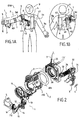
- FIGS. 1A and 1B schematically illustrate an example of an exoskeleton of an EXB arm according to a preferred embodiment of the invention and its main components.
- the exoskeleton EXB arm is shown carried by an operator U in front view (Figure 1A) and partial rear view ( Figure 1B), respectively.
- the EXB actual arm exoskeleton comprises three main subassemblies: a subset of one wrist, elbow subset 2 and subset shoulder 3, respectively. These three subsets, 1 to 3, are dedicated to the detection of relative movements of the wrist P , the elbow C and the shoulder E of an operator U and to the actuation of the associated joints. They form a sleeve threaded on one of its arms, for example the right arm Bd.
- FIGS. 1A and 1B the sub-assemblies, 1 to 3, of the exoskeleton of arm EXB are shown threaded on the right arm Bd of the operator U , because it is assumed that the latter is right-handed.
- the device according to the invention is in no way limited to this characteristic. It can just as easily be threaded onto the left arm Bg of the operator U or, on both arms, without departing from the scope of the invention.
- the aforementioned kinematic chain is fixed to a glove 5 slipped on one or both hands, M of the operator, in this case on his right hand.
- the aforementioned kinematic chain is fixed to the thorax TH of the operator U , using a support base 4 .
- the support base 4 resembles a half of armor. It has two rigid chest plates: front 40 (Figure 1A) and back 41 ( Figure 1B).
- the chest plates, 40 and 41 are fixed to the thorax TH of the operator U by straps 42, or any equivalent suitable means.
- the front plate 40 serves as a structural base for the chain of articulations of the subsets 1 to 3. It provides a fixed reference for any movement of the exoskeleton of the EXB arm .
- the various sub-assemblies, 1 to 3, of the aforementioned kinematic chain are interconnected.
- Bundles of flexible tendons 7 of the cable type actuate particular articulations associated with the sub-assemblies 1 to 3, so-called “active” articulations and are in turn actuated by Mt motors (FIG. 1B).
- flexible tendons are made up of two types separate elements; cables themselves and spiral-type sheaths guiding the cables over all or part of their lengths.
- the visible part of the bundles 7 consists essentially of the sheaths.
- a first beam leads from the back of the operator U to a pre-load unit in the shoulder sub-assembly 3 and, finally, from there along the structure to the load unit initial the elbow assembly and from there further to the wrist P.
- the second beam leads directly from the back to the joints before entering a preload unit at the base of the EXB exoskeleton.
- sensors referenced to Ca 16 , Ca 21 to Ca 23 , Ca 31 to Ca 36 , 218 and 226, have been represented in various figures annexed to the present description.
- the rear plate 41 supports the aforementioned motors Mt. As illustrated in FIG. 1B, it has been assumed that the motors Mt (not explicitly shown) were arranged inside a housing 6 fixed to the plate 41. Advantageously, DC motors are used.
- the case 6 is notably connected to the kinematic chain, and more particularly to the shoulder sub-assembly 3, by the tendon bundle 7.
- the housing 6 also includes transmission-reception circuits of data and instructions communicating directly with the robot to remote control or via an intermediate station (not shown).
- the motors Mt actuate one or more articulations of the subassemblies 1 to 3 by acting on corresponding flexible tendons of the bundle 7, in the manner which will be specified below.
- the master arm of the exoskeleton EXB has sixteen joints, and thus sixteen degrees of freedom or "DOF".
- Each axis is equipped with an angle sensor to obtain information on the angles (rotation movement around a particular axis) of articulation.
- Figure 2 illustrates an exploded set of these three mechanisms, 1 to 3, connected by a bundle of flexible tendons 7.
- the master arm is not designed to imitate the arrangement of human joints, but to connect them by an alternative kinematic chain of joints arranged above the human limb: arm Bd in the example described.
- arm Bd in the example described.
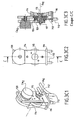
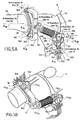
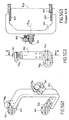
- FIGS. 5A and 5B illustrate the shoulder sub-assembly 3, in view of facing and three-quarters high, respectively.
- the head of the operator U is not shown and the bundle of flexible tendons 7 is chopped off.
- This sub-assembly 3 includes six axes of articulation, five of the so-called rotoid type and one of the so-called prismatic type.
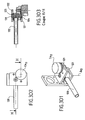
- FIG. 5C is an isometric view illustrating, in three dimensions, the relative positions of these six axes, referenced ⁇ 31 to ⁇ 36 , for a particular posture of the elbow C of the operator U , at a given instant.
- the corresponding joints are referenced “ joint 31 " to " joint 36 ".
- the sub-assembly 3 is designed to perform the same movements as those of the human shoulder E , although the five "DOF" of the human shoulder E are simulated by a mechanism with six "DOF".
- the movement of the shoulder exoskeleton 3 is not limited, neither in amplitude nor in dexterity.
- the base of the shoulder exoskeleton 3 provides a complete base link series of the exoskeleton EXB arm and is subject to the rigid breast plate 40 which is connected around the thorax of the U TH operator using strips 42.
- the securing is carried out via a fixing piece 33, which serves as a parent link for the first articulation of the EXB exoskeleton .
- the distal end of the mechanism 3 is located at the base of the upper part of the operator BS arm U , where it is fixed by means of an airbag 30, itself surrounded by a rigid annular part 31.
- the first articulation "articulation 31" around the axis ⁇ 31 which is a rotary articulation, is activated by a pair of two tendons 731, which belong to the aforementioned "bundle No. 2".
- This articulation combines the fixing piece 33 with the first member of a link " link 31".
- the link " link 31”, which is the son link of the articulation " articulation 31” comprises a pulley 312 which is fixed on a rotary shaft 313, which is connected above ball bearings to the fixing part 33.
- the shaft 313 is also rigidly connected to a circular plate 314, which is screwed under two side walls 315 and 316.
- the shaft 322 is centered in a median zone of these side walls by means of ball bearings allowing the rotation of the link “ link 32" in its entirety around the mechanical shaft 322 and thus around of the common axis ⁇ 32 .
- the pulley 323 is rigidly fixed to the side walls and thus induces the movement of the link “ link 32" around the link " link 31", when the tendons 732 ', in their sheaths 732, pull or push.
- the articulation "articulation 33”, of prismatic type and axis ⁇ 33 is provided with a telescopic tube F (FIG. 6D) extended by a pre-tension spring SP .
- the SP spring is of the so-called strand type.
- a fixed link of the telescopic articulation " articulation 33” is constituted by a first telescopic tube 332 and is combined with a flange 326.
- a mobile link, " link 33” comprises a system of telescopic tubes F and distal ends of a telescopic flange 333 which are subject to an intermediate piece 335.
- a compression spring 334 By means of a compression spring 334, the distal telescopic flange 333 is preloaded against the telescopic flange 326. If the tendon 733 'opposes the force of the SP spring , it causes a contraction movement of the telescopic tubes along the common axis ⁇ 33 .
- the joint " joint 34” which is a passive joint of the rotoid type, combines the link " link 33" with the link "link 34". By means of the articulation "articulation 34", the link " link 34" can rotate around the axis ⁇ 34 .
- the link " link 34” comprises a shaft 341 which is connected by means of radial ball bearings to an intermediate piece 335, allowing rotation around the axis ⁇ 34 .
- the ⁇ 34 axis. is screwed onto a part 342 in the shape of a "U", which carries at the two distal ends two additional plates, 343 and 345. These plates enclose ball bearings for rotation about the axis ⁇ 35 , as well as upper plates, 344 and 346 respectively.
- the fifth articulation, " articulation 35" which is also a passive rotation articulation, the link " link 34" with the link “ link 35” allowing rotation around the axis ⁇ 35 .
- the link comprises two parts collinear with the axes of the shafts 351 and 354, which are fixed to an external ring 353 by means of fixing flanges.
- the fixing flange 352 fixes the shaft 351 on the outer ring 353, and the fixing flange 355 fixes the shaft 354 to the bottom of the ring 353, respectively.
- the two shafts pass through the ball bearings, which are held between plate 343 and upper plate 344, and plate 345 and the top plate 346, respectively.
- the articulation " articulation 36", of axis ⁇ 36 is active and is used to force a rotation of the upper part of the arm BS.
- a pair of tendons 736 ' which comes from the back of the operator U , crosses the outer ring 353 without touching it and is attached to an inner ring 362, which has the function of a hollow pulley.
- This internal ring 362, which is a member of the link " link 36" is attached to another circular ring 31, which carries airbags 30.
- the circular ring 31 is connected to the external ring 353 by means of ball bearings of small section, allowing rotation around the axis ⁇ 36 .
- the flange ring 363 is screwed onto the ring 31 and another member of the link "link 36".
- the articulation " articulation 36" which can be engaged by the tendons 736 ', allows a radial movement of the link “link 36" inside the external ring 353 and, thus, inside the link “link 35", around the sixth axis of articulation ⁇ 36 .
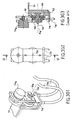
- FIG. 5D is an isometric view, in rear view, illustrating, in three dimensions, the pre-load system 8 with its pre-tensioning members 80 bundle tendons 7.
- the tendons which are guided inside sheaths, can be pre-tensioned by putting the outer sheath under compression.
- Figure 6C describes the general configuration in more detail of such a preload unit 8.
- Each preload unit in the EXB exoskeleton design has similar devices.
- a rigid reinforcement which establishes a fixed reference, hereinafter called CR, is used to fix screws C 1 for preloading the tendons.
- the screws C 1 are hollow and allow the tendons to pass through them, which are arbitrarily referenced 700 '.
- the sheath 700 which guides the tendons 700 ′, is intersected at the point where the preload unit is placed and the intersection ends 700a of the sheaths end on the external surface of the preload screws C 1 .
- the sheath 700 is compressed as soon as the preload screws C 1 are turned clockwise. This increased compression in the spiral sheaths 700 which surround the tendons 700 'tightens them. These tendons are threaded into the sheaths, which leads to a preload of the tendons.
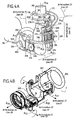
- FIG. 4A illustrates more precisely, in rear view, the sub-assembly elbow 2. This has four axes of articulation.
- FIG. 4B is an isometric view illustrating, in three dimensions, the relative positions of these four axes, ⁇ 21 to ⁇ 24 , for a particular posture of the elbow C of the operator U , at a given instant.
- the corresponding joints are referenced “ joint 21" to "joint 24".
- twin telescopic tubes, 200 and 202 respectively are shown, adjustable in length, which provide the means of adapting the length of the exoskeleton to the human upper arm BS .
- the length can be adjusted by blocking two screw members, 201 and 203 respectively, one for each tube, 200 and 202. No other adjustment is necessary.
- the first ends of the telescopic tubes, 200 and 202 are subject to an annular piece 204, surrounding the upper arm BS , that is to say above the elbow.
- this annular part is rigidly fixed to the ring 363 of the shoulder sub-assembly 3.
- the second ends are fixed to a part 205, in the shape of a horseshoe, also surrounding the upper arm BS.
- the lateral base plate 206 is rigidly mounted on the ring 205 and carries the shafts 207 which establish a part of the joint joint " joint 21".
- the median base plate 208 is also connected to the ring 205 on its proximal side, and carries another shaft 209, which, together with the shaft 207, constitute the mechanical means for rotation around the axis ⁇ 21 of l articulation " articulation 21".
- the joint adjustment unit builds the parent link for the joint " joint 21".
- the child link of this joint comprises another ring 210, having the shape of a horseshoe.
- the side plate 212 is fixed on its distal side to the proximal side of the ring 210.
- the side plate 212 is mounted on the shaft 207 by means of ball bearings which allow a radial movement.
- a pulley 213 is fixed to the side plate 212, for the actuation of the link "link 21" around the articulation " articulation 21" of axis ⁇ 21 .
- the tendons 721, which come from the bundle of cables 7 pass through the lateral base plate 206 and are fixed on the pulley 213.
- the middle plate 214 is also fixed on the proximal side of the ring 210.
- the proximal side of the middle plate 214 is mounted by means of ball bearings on the axis 209, which is collinear with the axis 207, allowing the link "link 21" to rotate around the axis ⁇ 21 .
- Two hollow tubes 215 and 216 are attached to the distal side of the ring 210. These tubes serve as a parent link to the common prismatic joint " joint 22".
- the forearm preload unit 217 is fixed to these hollow tubes 215 and 216 by means of screws.
- the tendons which cross the preload unit are not shown.
- the tendons of the cable bundle 7 entering the preload unit are shown, the outgoing tendons not being shown.
- the link "link 21" and the link “ link 22" form the joint "joint 22" which is a passive and prismatic joint.
- the link “link 22" comprises two massive rods 221 and 222, which are collinear and concentric with the hollow tubes, 215 and 216, so as to adapt exactly to the internal enclosure of the hollow tubes, and, thus, to form a telescopic tube system.
- the solid rods, 221 and 222 are movable inside the hollow tubes 215 and 216.
- the two tubes, 221 and 222 are attached to a piece 220, which is a ring section.
- This part 220 on its proximal side, connects the two massive rods and, on its distal side, is attached to a part 224, in the shape of a "T", which carries a small tree 225.
- the link "link 22" can move linearly along the axis ⁇ 22 , relative to the link "link 21".
- the preload unit carries a linear sensor 218, the movable part of which is fixed to a plate 223.
- This plate is fixed to the solid tubes, 221 and 222, by means of screws.
- link " link 22" which is a mobile link in the joint "joint 22" is at the same time the parent link for the joint "joint 23".
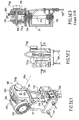
- FIGS. 4D1 and 4D3 describe the members of the joint " joint 23" in more detail, respectively in space, and in section “MM” in FIG. 4D2.
- the part 224 in the shape of a "T", carries a fixed shaft 225, on which are mounted two ball bearings, 226 and 227; on the lateral 226 and median 227 parts, respectively, of the part 224 in the shape of a "T".
- the mobile link on the joint "joint 23” is the link “link 23” which can perform a passive rotation around the axis ⁇ 23 of the joint " joint 23".
- This link has an external metal ring 230, which is connected to a flange piece 231 on its bottom.
- This flange piece 231 is screwed between two side plates, a median 232 and a lateral 233, respectively.
- These side plates, 233 and 232 are connected on the outside of the ball bearings, 227 and 226, respectively, thus allowing rotation around the shaft 225.
- the child link, " link 24, of the articulation” articulation 24 " which is a mobile part, comprises a rigid ring 240, which encloses an airbag 28, and a hollow pulley 241, which is attached to the proximal side of the "rigid ring 240.
- the tendons 724" which are guided along the sheaths 724, pass through the external ring 230 and are fixed to the hollow pulley 241 (as shown in FIGS. 3H1 to 3H3).
- the rigid ring 240 is centered inside the outer ring 230, by means of a ball bearing 242 of small section, which allows the rotation of the ring 240 about the axis ⁇ 24 inside the outer ring 230 This rotation is induced by the relative movement of the tendons 724 '.
- These tendons 724' are subject to the pulley 241 and to the sheaths 724 which are mechanically locked outside of the outer ring 230, by means of stop pieces 234.
- the link " link 24" can be moved around the axis ⁇ 24 of the joint " joint 24", causing pronation or supination of the forearm AB of the operator U.
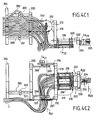
- joint 22 and " joint 23”, with respective axes ⁇ 22 and ⁇ 23 , equipped with angle sensors (for example the linear sensor 218 for the ⁇ axis 22 and the angle sensor 226 for the ⁇ axis 23 , in Figures 4C1 and 4C2).
- angle sensors for example the linear sensor 218 for the ⁇ axis 22 and the angle sensor 226 for the ⁇ axis 23 , in Figures 4C1 and 4C2).
- the combined mechanism then allows precise results for the bend of the elbow C , even if the system is subjected very inaccurately.
- the system establishes a reference kinematic structure above the human elbow C , starting from the upper part of the arm BS and from the end of the forearm AB.
- Human C- elbow movements (flexion / extension and pronation / supination) can be detected and influenced without limiting the natural range of motion.
- FIG. 3A illustrates, in front view, the wrist sub-assembly 1. This has six axes of articulation, all of the rotoid type.
- FIG. 3B is an isometric view illustrating, in three dimensions, the relative positions of these six axes, ⁇ 11 to ⁇ 16 , for a particular posture of the hand M and of the wrist P of the operator U , at a given instant.
- Figures 3A and 3B are used as a reference to explain the operation of the first articulation of the wrist sub-assembly 1.
- Figures 3C1 to 3G3 further illustrate views of the disassembled mechanism. The corresponding joints are referenced “ joint 11" to " joint 16".
- the proximal end of the subassembly 1 is threaded onto the forearm AB and fixed thereon by an airbag 28 surrounded by a rigid annular piece 240, threaded on the forearm, close to the hand.
- This rigid annular part 240 is connected on its outside to the inner part of an outer ring 110, by means of a ball bearing 111 of thin section, as shown more particularly in FIGS. 3H1 to 3H3.
- the outer ring 110 can rotate around the axis ⁇ 11 , which is the axis of rotation of the joint "joint 11".
- FIG. 3A only the outer ring 110 and the inflated cushion 28 can be seen.
- the link " link 11”, which is the child link in the joint "joint 11” comprises the outer ring 110 and stop pieces 112, which are screwed onto the ring 110 to constitute a means of locking the sheaths 711 at their distal end.
- An additional member of the link “ link 11” is a fixing flange 114 which is used to fix a mechanical shaft 115 orthogonal to the external ring 110.
- a stop plate 116 is fixed under the fixing flange 114 for stop the spiral sheaths 712 at their distal end.
- the articulation "articulation 12" causes the movement of the link “ link 12” around the link “ link 11", along the axis of rotation of articulation ⁇ 12 .
- the sectional view of the joint "joint 12" in Figure 3C3 can be used to describe the joint in more detail.
- the shaft 115 carries a ball bearing 117 at its distal end, on which is fixed a base plate 120 on the external bearing surface.
- This base plate 120 constitutes a reference for the link " link 12", to which all the other parts of this link are subject.
- the pulley 124 is screwed onto the base plate 120, subjecting the tendons 712 'to the link " link 12".
- the tendons 712 ' are threaded into the stop piece 116 of the previous link and create a rotation in the link “link 12 " as soon as a relative movement between the tendons 712' and the sheaths 712 is induced by the actuation of the tendons by motors.
- two horizontal plates, 121 and 122 respectively are fixed to the base plate 120, by means of screws, as illustrated more particularly by Figures 3D1 to 3D3. These plates both carry ball bearings, 124 and 123 respectively, between which is held the mechanical shaft 131 of the joint " joint 13".
- the articulation " articulation 13" links the link " link 12" as a parent link to the child link “link 13", which turns passively around the axis ⁇ 13 .
- the base of the link “link 13” is the shaft 131, to which a cylindrical part 130 is fixed.
- This cylindrical part 130 comprises a drill, orthogonal to the cylindrical surface, which provides the means for fixing a cylindrical bundle 132 at its proximal end. Due to the rotation of the axis 131, the entire link “link 13” rotates around the axis ⁇ 13 of the joint "joint 13".
- the distal side of the cylindrical bundle 132 is fixed to a flange plate 133, which carries two horizontal plates, an upper 134 and a lower 135, respectively, as shown more particularly in FIGS. 3E1 to 3E3.
- the lower plate 135 provides a means of stopping the sheaths 714 at their distal ends.
- the plates 134 and 135 carry ball bearings which hold and center the mechanical shaft 141 between the plates 134 and 135.
- the joint " joint 14" which is an active joint, causes the rotation of the link “ link 14" around the link “ link 13", along the axis ⁇ 14 .
- the link “ link 14" has another cylindrical part 140, which is fixed on the axis 141, and has a drill orthogonal to the cylindrical surface, which fixes the proximal side of a second cylindrical bundle 143.
- a pulley 142 is in further fixed on the cylindrical part 140, to secure the tendons 714 '.
- the distal end of the cylindrical bundle 143 is held in a another cylindrical part 144, which is attached to a shaft 145.
- This shaft 145 constitutes the mechanical axis of the passive articulation " articulation 15" which connects the link “ link 14" to the " link 15", in which the link “ link 15” rotates as a child link around the link “link 14 "along the axis ⁇ 15 , as shown more particularly in FIGS. 3F1 to 3F3, and 3B.
- the shaft 145 is held between two ball bearings, which are held by two horizontal plates, an upper 151 and a lower 152, respectively, these plates being screwed onto the base plate 150 of the link " link 15".
- the distal end is fixed on a hard plastic glove 5, put on the hand M of the operator U.
- the glove 5 consists of a main envelope 50 comprising a first orifice 51 (upper in FIG. 3A) allowing the thumb to exit and one or more orifices 52 (axial) allowing a free exit of the other fingers of the hand M.
- the subassembly 1 is fixed to the envelope 50 of the glove 5 by any appropriate means (screws, etc.), via a distal part 54 associated with the hinge axis " hinge 16", of axis ⁇ 16 .
- the articulation " articulation 16" combines the link " link 15" with the distal part 54, allowing active rotation, influenced by tendons, around the axis ⁇ 16 .
- the distal part 54 is fixed to the rear of the glove 5, in which the hand M of the operator U is inserted.
- the other side of this distal part 54 is connected to a base plate 160, as shown more particularly in FIGS. 3G1 to 3G3.
- This base plate 160 is held on a second plate 161 to fix a shaft 162 orthogonal to the surface of the parts.
- This shaft 162 carries a ball bearing on its distal side, to which the base plate 150 of the " link 15" is attached.
- a pulley 153 which is directly mounted on the base plate 150 fixes the tendons 716 ', which come from the sheaths 716.
- a stop plate 163 which is attached to the base plate of the link "link 16"
- any relative movement of the tendons 716 'against the sheaths 716 induces a rotation of the "link 16" around the axis ⁇ 16 , relative to the link "link 15".
- the mobility of the handle sub-assembly can be detailed as follows:
- the three joints " joint 13” to " joint 15”, with axes ⁇ 13 to ⁇ 15 are joints of a type known as the rotoid.
- the joints " joint 13” and “ joint 15”, with axes ⁇ 13 and ⁇ 15 are purely passive, the joint " joint 14", with axis ⁇ 14 , is active and controlled by one of the pairs of flexible tendons of the bundle 7, referenced 714 '.
- the passive joints have been integrated into the subassembly 1 to provide unimpeded movement of the human wrist P during the robot's remote control operations (not shown).
- this mechanism forms a pantograph.
- the wrist abduction or adduction P can be controlled by activating the joint "joint 14", of axis ⁇ 14 , and resulting movements in the passive joints. If the tendons 714 'actuate the articulation " articulation 14" towards small articulation angles, an abduction of the wrist articulation P is imposed. As soon as the tendons 714 ′ control the articulation " articulation 14" towards high articulation angles, an adduction of the wrist articulation P is imposed.
- joints 12 and “joint 16”, with axes ⁇ 12 and ⁇ 16 are both of the active type. They are used to detect and impose the flexion movement on the wrist P. If, for example, the two joints rotate clockwise, the exoskeleton joint links control a flexion of the human wrist P upward and, conversely, a control in the counterclockwise direction d 'a watch, imposes a downward bending. If both joints are blocked, no wrist flexion can occur.
- all the articulations of this subassembly 1 are associated with sensors, Ca 12 to Ca 16 (FIG. 3B) which measure the angles of rotation around the corresponding axes, ⁇ 11 to ⁇ 16 .
- the data, results of these measurements, are transmitted, by any appropriate means, to reception systems located for example in the space station, or even directly in the housing 6 (FIG. 1B). It can be wired or wireless transmission (radio transmission, etc.).
- the subassembly 1 allows free movements of the wrist P , without in any way limiting the degree of mobility of the operator U.
- the drive pairs for active joints are transmitted remotely using tendon cables 7 ′, guided along the exoskeleton structure EXB, originating from Mt motors arranged on a rear chest plate 42, and transmitted to each activated joint.
- the mounting of the motors on the backside of the user U makes it possible to minimize the size and the weight of the exoskeleton master arm EXB .
- multi-strand cables typically 7x19 and diameter 1 mm. This choice minimizes the curvature friction and allows loads up to 50 Nm. efficiently transfer couples using a transmission tendons to cables, the cables must be subjected to forces so as to be pre-tensioned at half of their operating load, i.e. 25 Nm in the example described.
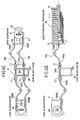
- Figures 6A, 6B and 6C schematically illustrate how a pair of tendons for cables, arbitrarily referenced 700 ', activates one of the active joints, of axis arbitrarily referenced ⁇ .
- a pulley, arbitrarily referenced R, coaxial with the axis ⁇ , is rotated about this axis by a loop formed by the pair of tendons 700 '.
- the axis of the pulley R is integral with a first part which is assumed to be fixed, arbitrarily referenced A 1 .
- a second part, assumed to be mobile, arbitrarily referenced A 2 is rotated about the axis ⁇ by the pulley R.
- FIG. 6A the two parts A 1 and A 2 are shown in the extension of one another: state referenced I. If a torque is printed on the pulley R (in the counterclockwise direction of a shown in the example: arrow f ), via the pair of tendons 700 ′, this will be rotated around the axis ⁇ and the part A 2 will follow this rotational movement: state referenced II (FIG. 6B ). The moving part, now referenced A ′ 2 , is in position orthogonal to the part A 1 .
- the tendons 700 ′ are guided on the exoskeleton EXB (FIG. 1A) by sheaths in which they slide, arbitrarily referenced 700.
- the guide length can be modified as a function of the tendon length 700 ′.
- Figure 6C describes in more detail the mechanical units included along the path of a tendon, starting from a motor and ending at an activated joint.
- Figure 6C describes the general case of activation of rotational joints.
- the tendons 700 ' which are attached to the pulleys R , as described above, are guided along the spiral sheaths 700 until they reach a preload unit, which is used to stretch the tendons 700 'through the sheaths and create a preload.
- This can be achieved by shortening the length of the tendons with respect to the sheaths by turning the preload screws C 1 counterclockwise.
- This pre-tensioning system has the advantage that the activation unit does not have to be fixed to the same reference structure as the pre-load unit, and can thus be moved in space relative to to the preload unit, without loss of tension or involuntary modification of the position of the axis having turned.
- the tendons 700 ′ Passing through the preload unit, the tendons 700 ′ are guided by a sheath 700 leading to a motorization unit (engine Mt ).
- the motorization unit Mt comprises a pulley ME which is fixed to the axis ⁇ m of the motor Mt , either directly or via a gearshift member.
- the Mt motor itself is fixed to a reference part D which is also used to stop the proximal end 700 b II of the sheaths.
- the motor Mt must drive the pulley ME in the same direction as the desired movement for the activated joint.
- FIG. 6D schematically describes the linear activation of the common prismatic joint " joint 33".
- the function of the initial preload unit is identical to the function described above with reference to FIG. 6C.
- the main difference lies in the activation unit.
- the linear articulation is actuated by a single tendon 700 ′, which is threaded in the center of the telescopic tubes F.
- These tubes F are fixed on the distal side to a stop plate H , where the distal end of the tendon 700 ′ is fixed.
- a stop plate G On the proximal side of the telescopic tubes F , another stop plate G is provided which prevents the distal end of the sheath 700 from passing inside the telescopic tubes F.
- the tendon 700 ′ can pass through the plate G and reach the interior of the sheath 700 just after having left the proximal end of the telescopic tubes F.
- a compression spring SP creates a repelling force.
- This motorization unit comprises a reference plate K on which the motor Mt is fixed and on which the proximal end 700 b II of the sheath 700 is in abutment.
- the tendon 700 'crosses the plate K and is fixed on a pulley J.
- This pulley J guides the tendon along a spiral profile, therefore with variation in radius.
- the plate H of the activation unit begins to recall the compression spring SP.
- the telescopic tubes F contract in their entirety. The release of the tendon 700 'in the opposite direction on the pulley J allows the elongation of the telescopic tubes F.
- the complete exoskeleton EXB is attached to the thorax TH of an operator U.
- Two rigid plates, 40 and 41 provide a rigid reference structure for the EXB exoskeleton .
- the two plates, 40 and 41 are attached together around the human thorax TH by means of belts 42, advantageously in self-adhesive tissue.
- the master exoskeleton arm is screwed onto the front plate with the aid of the fixing piece 33 (FIGS. 5A and 5B) and, consequently, uses the human thorax TH as a reference.
- annular air bags are used.
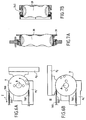
- FIGS. 7A and 7B illustrate, in sagittal section, the cushions inflatable ring finger for shoulder 3 (cushion 30) and elbow subsets 2 or wrist 1 (cushion 28), respectively, as also shown in the figure 2.
- the air bags, 30 and 28, are inserted into two external rigid rings, 31 and 240 respectively.
- these inflatable ring cushions can be made of silicone rubber and can be inflated using pumps which can be disconnected using quick couplers. Once inflated, the rings create a non-slip attachment between the human arm, BS or AB, and the rigid outer rings.
- the rigid external rings constitute the fixings for the elbow assembly.
- each axis is advantageously fitted with ball bearings, for example the ball bearings referenced 242 in FIG. 7B.
- ball bearings for example the ball bearings referenced 242 in FIG. 7B.
- exoskeleton arm EXB ( Figure 1A) according to the invention, it has been designed to be as light and as rigid as possible. To do this, the majority of the parts have been advantageously made from aluminum and, as far as possible, from plastics (polyvinyl chloride PVC for example).
- the large structural parts intended to enclose the arm Bd (or Bg ) of the operator U have been advantageously made from carbon fiber compounds to reduce the weight and at the same time to increase the rigidity of the rigid exoskeleton structure EXB.
- the last interface to the human arm Bd is the distal end of exoskeleton attachment to the palm of the operator U (see Figure 3A for example).
- the operator U wears a rigid palm glove 5 comprising openings 51 and 52 and fixed to the palm with self-adhesive fabric 53.
- an additional haptic interface can be used: for example a "cyber glove” or a "cyber handle”.
- the arm exoskeleton according to the invention provides, as has been recalled, many advantages, which it is useless to recall.
Landscapes
- Health & Medical Sciences (AREA)
- Orthopedic Medicine & Surgery (AREA)
- General Health & Medical Sciences (AREA)
- Physical Education & Sports Medicine (AREA)
- Life Sciences & Earth Sciences (AREA)
- Biophysics (AREA)
- Rehabilitation Therapy (AREA)
- Pain & Pain Management (AREA)
- Epidemiology (AREA)
- Animal Behavior & Ethology (AREA)
- Public Health (AREA)
- Veterinary Medicine (AREA)
- Engineering & Computer Science (AREA)
- Robotics (AREA)
- Mechanical Engineering (AREA)
- Manipulator (AREA)
Abstract
Description
- soit par des astronautes à l'intérieur de la station spatiale, ou
- soit directement par des opérateurs restés sur terre.
- Impossibilité de ressentir tous les mouvements du bras humain et d'obtenir des forces et des couples de rétroaction, ce sans limiter la gamme normale des mouvements humains de bras. Il est notamment nécessaire d'obtenir des informations sur la position de l'épaule, du coude et du poignet.
- Difficulté de réaliser un système réellement "portable", ce qui signifie que les mouvements de l'opérateur ne devraient pas être limités pendant l'utilisation (tourner autour d'un objet, se pencher, marcher, etc.).
- Adaptation limitée, ce qui, par exemple, ne permet pas d'utiliser le même exosquelette, sans modification importante, pour un pourcentage élevé de la population masculine, typiquement dans une gamme couvrant 5% à 95%.
- pour l'épaule commence à l'attache du bras (au sternum), s'étend au-dessus des articulations et des extrémités scapulo-claviculaire et gléno-humeral et se termine au milieu de l'humérus ;
- pour le coude commence au milieu de l'humérus et se termine au milieu de l'avant-bras ; et
- pour le poignet commence au milieu de l'avant-bras et se termine au milieu de la paume de main.
- Le poids du système n'est pas porté par le bras mais par le thorax.
- La gamme complète de mouvements d'épaule, de coude et de poignet est possible.
- Les articulations elles-mêmes sont plus simples et plus réduites
- II n'est pas nécessaire d'aligner les axes des articulations humaines avec celles de l'exosquelette : il s'ensuit qu'aucune procédure d'ajustement longue et complexe n'est nécessaire avant que l'exosquelette soit opérationnel.
- les figures 1A et 1B illustrent schématiquement un exemple de réalisation d'un exosquelette de bras selon l'invention porté par un opérateur, en vue de face et arrière, respectivement ;
- la figure 2 est une vue éclatée illustrant les trois sous-ensembles principaux d'un exosquelette selon un mode de réalisation préféré de l'invention : les sous-ensembles de poignet, de coude et d'épaule, respectivement ;
- la figure 3A illustre de façon plus détaillée le sous-ensemble de poignet de l'exosquelette de la figure 2, en vue de face, porté par la main d'un opérateur ;
- la figure 3B est une représentation schématique, en trois dimensions, illustrant les différentes articulations associées au sous-ensemble de poignet de l'exosquelette de la figure 3A et leurs axes de rotation ;
- les figures 3C1 à 3C3 illustrent un premier organe du sous-ensemble de poignet de l'exosquelette de la figure 3A, en trois dimensions, en vue de côté et une coupe de la figure 3C2, respectivement ;
- les figures 3D1 à 3D3 illustrent un premier organe du sous-ensemble de poignet de l'exosquelette de la figure 3A, en trois dimensions, en vue de dessus et une coupe de la figure 3D2, respectivement ;
- les figures 3E1 à 3E3 illustrent un troisième organe du sous-ensemble de poignet de l'exosquelette de la figure 3A, en trois dimensions, en vue de côté et une coupe de la figure 3E2, respectivement ;
- les figures 3F1 à 3F3 illustrent un quatrième organe du sous-ensemble de poignet de l'exosquelette de la figure 3A, en trois dimensions, en vue de dessus et une coupe de la figure 3F2, respectivement ;
- les figures 3G1 à 3G3 illustrent un cinquième organe du sous-ensemble de poignet de l'exosquelette de la figure 3A, en trois dimensions, en vue de côté et une coupe de la figure 3G2, respectivement ;
- les figures 3H1 à 3H3 illustrent un sixième organe du sous-ensemble de poignet de l'exosquelette de la figure 3A, en trois dimensions, en vue de face et une coupe de la figure 3H2, respectivement ;
- la figure 4A illustre de façon plus détaillée le sous-ensemble de coude de l'exosquelette de la figure 2, dans l'espace en vue de face, enfilé sur le bras d'un opérateur et attaché à son coude ;
- la figure 4B est une représentation schématique, en trois dimensions, illustrant les différentes articulations associées au sous-ensemble de coude de l'exosquelette de la figure 4A, et leurs axes de rotation ;
- les figures 4C1 et 4C2 illustrent de façon plus détaillée, en vues de côté et de dessus respectivement, le faisceau de tendons et l'unité de pré-charge du sous-ensemble de coude des figures 4A et 4B ;
- les figures 4D1 à 4D3 illustrent de façon plus détaillée, les organes d'une des articulations du sous-ensemble de coude de l'exosquelette des figures 4A et 4B, en vues de côté et de dessus respectivement, en trois dimensions, en vue de haut et une coupe de la figure 4D2, respectivement ;
- les figures 5A et 5B illustrent de façon plus détaillée le sous-ensemble d'épaule de l'exosquelette de la figure 2, enfilé sur le bras d'un opérateur et attaché à son épaule, en vue de trois-quarts dessus et vue de face, respectivement ;
- la figure 5C est une représentation schématique, en trois dimensions, illustrant les différentes articulations associées au sous-ensemble d'épaule de l'exosquelette des figures 5A et 5B, et leurs axes de rotation ;
- la figure 5D illustre, en vue arrière, le mécanisme de pré-tension de tendons associé au sous-ensemble d'épaule de l'exosquelette des figures 5A et 5B ;
- les figures 5E1 à 5E3 illustrent de façon plus détaillée un premier organe du sous-ensemble d'épaule de l'exosquelette des figures 5A à 5D, en trois dimensions, en vue de haut et une coupe de la figure 5E2, respectivement ;
- les figures 5F1 à 5F4 illustrent de façon plus détaillée un deuxième organe du sous-ensemble d'épaule de l'exosquelette des figures 5A à 5D, constitué par une articulation télescopique, à l'état allongé, en vues de côté et en coupe, et à l'état compressé, en vue de côté et en coupe, respectivement ;
- la figure 5F5 illustre un détail de l'articulation télescopique des figures 5F1 à 5F4 ;
- les figures 5G1 à 5G3 illustrent de façon plus détaillée un troisième organe du sous-ensemble d'épaule de l'exosquelette des figures 5A à 5D, en trois dimensions, en vue de haut et une coupe de la figure 5G2, respectivement ;
- les figures 5H1 et 5H2 illustrent de façon plus détaillée un troisième organe du sous-ensemble d'épaule de l'exosquelette des figures 5A à 5D, comprenant un coussin gonflable, en trois dimensions et en coupe, respectivement ;
- les figures 6A à 6C illustrent schématiquement le mécanisme d'activation d'articulations de l'exosquelette selon l'invention par l'intermédiaire de tendons à câble
- la figure 6D illustre schématiquement le mécanisme d'activation de l'articulation télescopique des figures 5F1 à 5F5 ; et
- les figures 7A et 7B illustrent, en coupe sagittale, des organes de fixations à coussin gonflable pour le bras et l'avant bras, respectivement.
- le sous-ensemble de poignet 1 (qui comporte six "DOF") ;
- le sous-ensemble de coude 2 (qui comporte quatre "DOF") ; et
- le sous-ensemble d'épaule 3 (qui comporte six "DOF")
- la gamme complète de mouvements de l'épaule humaine E peut être réalisée ; et
- toutes les articulations humaines (même les scapulo-claviculaires) peuvent être détectées et actionnées.
- télécommande très précise de robots réels ou virtuels pour des opérations nucléaires, pour des opérations de type dit "offshore", pour le déminage, pour des manipulations de matériaux dangereux, pour des travaux de décontamination biologique, etc. ;
- ré-éducation de personnes présentant des altérations temporaires du bras : l'exosquelette est utilisé pour de la gymnastique passive ;
- mise en action de prothèses passives pour des personnes handicapées, les commandes étant effectuées par la voix ou par transmission d'impulsions nerveuses ;
- entraínement divertissant de la forme physique : en complément de lunettes vidéo, l'exosquelette peut fournir au bras un jeu d'exercices de forme physique ;
- entraínement de la forme physique d'astronautes en orbite, en mission de longue durée : l'utilisation est semblable à celle rappelée ci-dessus, mais plus précisément avec comme but de combattre le dépérissement des os et des muscles ;
- augmentation de la force pour des personnes qui souffrent de déficience musculaire ;
- animation réaliste de personnages virtuels pour l'industrie de la télévision et/ou du cinéma : le mouvement du bras d'un personnage suit celui de l'animateur, fournissant un comportement sans heurt et très naturel ;
- jeux vidéo dits en immersion ;
- enseignement de la robotique industrielle, par exemple pour des tâches de haute précision et des tâches à échelle réduite, telles que des assemblages de robotique pour des systèmes micro-électro-mécaniques (dits "MEMS" selon la terminologie anglo-saxonne) ou des technologies micro-et-Nano (dites "MNT" selon la terminologie anglo-saxonne) ; et
- entraínement d'astronautes en environnement virtuel.
Claims (26)
- Exosquelette de bras destiné à acquérir des données représentatives de mouvements des articulations de bras d'un opérateur humain à l'aide de capteurs de mesure et à appliquer en rétroaction aux dites articulations des forces et/ou couples à l'aide d'unités d'activation associées à au moins une partie desdites articulations, caractérisé en ce qu'il comprend un premier dispositif ayant la conformation d'une manche, destinée à être enfilée sur au moins un desdits bras (Bd), de façon à former une chaíne cinématique d'articulations (1, 2, 3) disposé parallèlement aux dites articulations de bras, ledit dispositif comprenant un premier sous-ensemble dit exosquelette d'épaule (3) comprenant un premier nombre déterminé d'articulations associées aux articulations d'épaule dudit opérateur (U), un deuxième sous-ensemble dit exosquelette de coude (2) comprenant un deuxième nombre déterminé d'articulations associées aux articulations de coude dudit opérateur (U) et un troisième sous-ensemble dit exosquelette de poignet (1) comprenant un troisième nombre déterminé d'articulations associées aux articulations de poignet dudit opérateur (U), en ce que lesdites unités d'activation sont commandés par des tendons flexibles (7) courant le long desdits sous-ensembles, lesdits premier à troisième sous-ensembles étant mécaniquement dissociés de manière à pouvoir être commandés individuellement par lesdits tendons flexibles (7), et en ce qu'il comprend un deuxième dispositif, formant support (4), porté par le thorax (TH) dudit opérateur (U), comprenant une plaque rigide avant, dite de poitrine (40), et une plaque rigide arrière, dite de dos (41), en ce que ledit exosquelette d'épaule (3) est fixé en son extrémité proximale à ladite plaque avant (40), celle-ci fournissant une référence fixe pour tout mouvement dudit exosquelette (EXB).
- Exosquelette selon la revendication 1, caractérisé en ce que ledit exosquelette de poignet (1) est rendu solidaire en son extrémité distale à une main (M) dudit opérateur (U).
- Exosquelette selon la revendication 2, caractérisé en ce que lesdits tendons flexibles (7) comprennent des câbles (700') enfilés dans des gaines de guidage de type spiralé (700) et en ce qu'ils sont actionnés par des unités de commande motorisées (Mt) disposées sur ladite plaque rigide de dos.
- Exosquelette selon la revendication 3, caractérisé en ce que la somme des premier, deuxième et troisième nombres déterminés d'articulations est égal à seize, de manière à autoriser seize degrés de liberté.
- Exosquelette selon la revendication 4, caractérisé en ce que ledit exosquelette d'épaule (3) comprend six articulations ("articulation 31" - "articulation 36") associées chacune à un axe (Δ31 à Δ36), et en ce que lesdites première, deuxième, quatrième, cinquième et sixième articulations sont de type rotoïde et ladite troisième articulation est de type prismatique.
- Exosquelette selon la revendication 5, caractérisé en ce que ledit exosquelette d'épaule (3) comprend un premier organe (34) réalisant ladite fixation à ladite plaque rigide de poitrine (40) et associée à des première et deuxième articulations de type rotoïde ("articulation 31", "articulation 32").
- Exosquelette selon la revendication 6, caractérisé en ce que ledit exosquelette d'épaule (3) comprend un deuxième organe muni d'un coussin gonflable (30) enfilé sur la partie supérieure (BS) dudit bras (Bd), de manière à bloquer ledit exosquelette d'épaule (3) sur celle-ci, en ce que ledit coussin gonflable (30) est enserré dans une pièce annulaire (31) disposée entre les extrémités des branches d'une pièce en forme de "U" (32), et en ce que lesdites extrémités sont associées à des troisième et quatrième articulations de type rotoïde ("articulation 34", "articulation 35").
- Exosquelette selon la revendication 7, caractérisé en ce que ledit exosquelette d'épaule (3) comprend un troisième organe muni d'un tube télescopique (332) entouré par un ressort de pré-tension (SP), en ce que ledit troisième organe est fixé par une première extrémité, en rotation libre autour de l'axe (Δ32) de ladite deuxième articulation ("articulation 32"), au dit premier organe, et par une seconde extrémité, en un point de la base dudit "U" (32), ledit point de fixation formant la cinquième articulation de type rotoïde "articulation 35"), en ce que ledit troisième organe forme ladite articulation prismatique ("articulation 33"), et en ce que ledit ressort (SP) est actionné par un desdits tendons à câble (733') exerçant une force sur celui-ci, de manière à le compresser ou l'allonger, selon le sens de ladite force exercée.
- Exosquelette selon la revendication 5, caractérisé en ce que lesdites première, deuxième ("articulation 32") et sixième ("articulation 36") articulations, de type rotoïde, dites actives, sont actionnées par des tendons flexibles déterminés, et en ce que les lesdites quatrième ("articulation 34") et cinquième ("articulation 35") articulations, de type rotoïde, dites passives, ne sont actionnées par aucun desdits tendons flexibles.
- Exosquelette selon la revendication 4, caractérisé en ce que ledit exosquelette de coude (2) comprend quatre articulations ("articulation 21" - "articulation 24") associées chacune à un axe de rotation (Δ211 à Δ24), et en ce que lesdites première ("articulation 21"), troisième ("articulation 23") et quatrième ("articulation 24") articulations sont de type rotoïde et ladite deuxième articulation ("articulation 22") est de type prismatique.
- Exosquelette selon la revendication 10, caractérisé en ce que ledit exosquelette de coude (2) comprend un premier organe comportant une première pièce (204), de forme annulaire, et une seconde pièce (205), en forme de fer à cheval, assujetties l'une à l'autre par des tubes télescopiques (200, 202), réglables en longueur au moyen d'un dispositif à vis, lesdites première (204) et seconde (205) pièces étant enfilées au-dessus dudit coude (C), sur la partie supérieure(BS) dudit bras (Bd).
- Exosquelette selon la revendication 11, caractérisé en ce que ledit exosquelette de coude (2) comprend un deuxième organe comportant une troisième pièce (210), en forme de fer à cheval, assujettie à ladite deuxième pièce (205), en forme de fer à cheval, par une pièce intermédiaire, ladite troisième pièce étant enfilée en dessous dudit coude (C), sur l'avant-bras (AB) dudit bras (Bd).
- Exosquelette selon la revendication 5, caractérisé en ce que lesdites première ("articulation 21") et quatrième ("articulation 24") articulations, de type rotoïde, dites actives, sont actionnées par des tendons flexibles déterminés, et en ce que les lesdites deuxième ("articulation 22") et troisième ("articulation 23") articulations, dites passives, ne sont actionnées par aucun desdits tendons flexibles.
- Exosquelette selon la revendication 4, caractérisé en ce que ledit exosquelette de poignet (1) comprend six articulations ("articulation 11" - "articulation 16") associées chacune à un axe de rotation (Δ11 à Δ16), et en ce que lesdites première à sixième articulations ("articulation 11" - "articulation 16") sont de type rotoïde.
- Exosquelette selon la revendication 14, caractérisé en ce que exosquelette de poignet (1) comprend un premier organe muni d'un coussin gonflable (28) enfilé sur un avant-bras (AB) dudit opérateur (U), près de la main (M), de manière à bloquer ledit exosquelette de poignet (1) sur celui-ci, en ce que ledit coussin gonflable (28) est enserré dans une pièce annulaire (240), et en ce que ledit premier organe est associé à ladite première articulation ("articulation 11").
- Exosquelette selon la revendication 15, caractérisé en ce que, ladite main (M) étant insérée dans un gant rigide (5), ledit exosquelette de poignet (1) comprend un deuxième organe comprenant une pièce de fixation au dit gant rigide (5).
- Exosquelette selon la revendication 16, caractérisé en ce que ledit gant rigide (5) comporte des ouvertures (51, 52) laissant le libre passage aux doigts de ladite main (M) et est muni de moyens de fixation constitués par un tissu de type auto-accrochant.
- Exosquelette selon la revendication 16, caractérisé en ce que ledit exosquelette de poignet (1) comprend un troisième organe formant un dispositif de liaison mécanique articulée entre lesdits premier et deuxième organes, en ce que ledit dispositif comprend une pièce de fixation sur ladite pièce annulaire, ladite pièce de fixation étant associée à ladite deuxième articulation ("articulation 12"), et des première et seconde tiges (132, 143) de liaison articulées, en une première extrémité, autour d'une pièce intermédiaire, associée à ladite troisième articulation ("articulation 13"), en ce que ladite première tige (132) est assujettie, en une seconde extrémité, à ladite pièce de fixation sur ladite pièce annulaire, en rotation libre autour d'un axe (Δ13) associé à ladite troisième articulation ("articulation 13"), en ce que ladite seconde tige (143) est assujettie, en une seconde extrémité, à ladite pièce de fixation sur ledit gant rigide (5), en rotation libre autour d'un axe (Δ15) associé à ladite cinquième articulation ("articulation 15"), et en ce que ladite pièce de fixation au dit gant rigide (5) est associée en outre aux dites cinquième ("articulation 15") et sixième ("articulation 16") articulations.
- Exosquelette selon la revendication 14, caractérisé en ce que lesdites première ("articulation 11"), deuxième ("articulation 12"), quatrième ("articulation 14") et sixième ("articulation 16") articulations, dites actives, sont actionnées par des tendons flexibles déterminés, et en ce que les lesdites troisième ("articulation 13") et cinquième ("articulation 15") articulations, dites passives, ne sont actionnées par aucun desdits tendons flexibles.
- Exosquelette selon l'une quelconque des revendications 9, 13 ou 19, caractérisé en ce que lesdites articulations actives comprennent des poulies d'entraínement (R) d'axe de rotation (Δ) confondus avec les axes desdites articulations et en ce que lesdites poulies (R) sont entraínées dans le sens des aiguilles d'une montre ou dans le sens inverse des aiguilles d'une montre par une paire de tendons flexibles (700'), de manière à induire un mouvement de rotation correspondant de l'articulation associée à ladite poulie (R).
- Exosquelette selon la revendication 3, caractérisé en ce qu'il comprend des organes de pré-tension (8) soumettant lesdits tendons flexibles (700') à une force initiale d'amplitude prédéterminée, fraction d'une valeur maximale de charge à soutenir, et en ce que ces organes de pré-tension (8) sont disposés sur ledit exosquelette d'épaule (3).
- Exosquelette selon la revendication 21, caractérisé en ce que lesdits organes de pré-tension (8) comprennent des vis de serrage/desserrage (C 1) agissant sur des extrémités (700a) desdites gaines de guidage de câbles.
- Exosquelette selon la revendication 3, caractérisé en ce que lesdites unités de commande actionnant lesdits tendons flexibles sont des moteurs à courant continu (Mt) disposés sur ladite plaque rigide de dos (41).
- Exosquelette selon la revendication 4, caractérisé en ce que lesdites articulations sont munies de capteurs d'angle (Ca12 - Ca16, Ca21 - Ca23, Ca31 - Ca36, 218, 226) mesurant la rotation des axes associés à ces articulations.
- Exosquelette selon la revendication 2, caractérisé en ce que lesdites plaques de poitrine (40) et de dos (42) dudit support (4) sont attachées entre elles par des sangles en tissu de type auto-accrochant (42).
- Application d'un exosquelette de bras selon l'une quelconque des revendications précédentes à la télécommande d'un robot de type humanoïde travaillant à l'extérieur d'une station spatiale muni de bras artificiels et effectuant des tâches sous la commande d'un opérateur humain, ledit exosquelette de bras (EXB) étant enfilé sur au moins l'un de ses bras (Bd), ledit robot recevant des données forçant l'exécution de mouvements en relation biunivoque avec des mouvements de bras (Bd) et transmettant des données dites de rétroaction forçant l'exécution de mouvements de tout ou partie desdites articulations dudit exosquelette de bras (EXB) et entraínant des mouvements correspondants de bras (Bd).
Applications Claiming Priority (2)
| Application Number | Priority Date | Filing Date | Title |
|---|---|---|---|
| FR0206253A FR2839916B1 (fr) | 2002-05-22 | 2002-05-22 | Exosquelette pour bras humain, notamment pour des applications spatiales |
| FR0206253 | 2002-05-22 |
Publications (2)
| Publication Number | Publication Date |
|---|---|
| EP1364755A1 true EP1364755A1 (fr) | 2003-11-26 |
| EP1364755B1 EP1364755B1 (fr) | 2009-11-04 |
Family
ID=29286622
Family Applications (1)
| Application Number | Title | Priority Date | Filing Date |
|---|---|---|---|
| EP03291149A Expired - Lifetime EP1364755B1 (fr) | 2002-05-22 | 2003-05-16 | Exosquelette pour bras humain, notamment pour des applications spatiales |
Country Status (5)
| Country | Link |
|---|---|
| US (1) | US7410338B2 (fr) |
| EP (1) | EP1364755B1 (fr) |
| DE (1) | DE60329887D1 (fr) |
| ES (1) | ES2334780T3 (fr) |
| FR (1) | FR2839916B1 (fr) |
Cited By (24)
| Publication number | Priority date | Publication date | Assignee | Title |
|---|---|---|---|---|
| FR2917323A1 (fr) * | 2007-06-12 | 2008-12-19 | Commissariat Energie Atomique | Mecanisme de rotation d'avant-bras et orthese comportant un tel mecanisme |
| CN100559137C (zh) * | 2008-01-28 | 2009-11-11 | 哈尔滨工业大学 | 舱外航天服手套关节力学性能测试系统平台 |
| CN101125112B (zh) * | 2007-09-20 | 2010-06-30 | 华中科技大学 | 一种可穿戴式上肢康复训练机器人装置 |
| CN101181177B (zh) * | 2007-11-28 | 2010-08-25 | 华中科技大学 | 肩关节康复训练装置 |
| CN103786169A (zh) * | 2014-01-22 | 2014-05-14 | 北华大学 | 气动旋伸型四螺旋柔性关节 |
| WO2014134499A1 (fr) * | 2013-02-28 | 2014-09-04 | Novint Technologies, Inc. | Contrôleur à retour de force exosquelettique modulaire |
| CN104552316A (zh) * | 2013-10-21 | 2015-04-29 | 苏茂 | 人手前臂桡尺关节运动检测装置 |
| CN105726266A (zh) * | 2014-12-24 | 2016-07-06 | 株式会社捷太格特 | 摆动关节装置、步行能力辅助装置、及控制摆动关节刚性的方法 |
| CN106363655A (zh) * | 2016-11-28 | 2017-02-01 | 成都炬石科技有限公司 | 仿生机械手和仿生机器人 |
| CN107930032A (zh) * | 2017-12-06 | 2018-04-20 | 南京航空航天大学 | 一种基于套索柔顺驱动的肘关节软质外骨骼机器人 |
| CN108839006A (zh) * | 2018-09-28 | 2018-11-20 | 赤源动力(大连)科技有限责任公司 | 可穿戴肩部助力外骨骼 |
| IT201700083887A1 (it) * | 2017-07-24 | 2019-01-24 | Marco Ceccarelli | Dispositivo per assistenza motoria del gomito |
| CN110757498A (zh) * | 2019-11-29 | 2020-02-07 | 东莞理工学院 | 一种三自由度机器人关节 |
| CN110916976A (zh) * | 2019-12-06 | 2020-03-27 | 北京交通大学 | 一种个性化可穿戴康复机械臂装置 |
| CN111360790A (zh) * | 2020-03-26 | 2020-07-03 | 哈尔滨工业大学 | 一种气弹簧储能被动型上肢助力外骨骼 |
| US20200281796A1 (en) * | 2017-10-02 | 2020-09-10 | University Of Strathclyde | Apparatus for the rehabilitation, assistance and/or augmentation of arm strength in a user |
| CN112263433A (zh) * | 2020-10-12 | 2021-01-26 | 南方科技大学 | 一种柔性外骨骼装置 |
| CN113183119A (zh) * | 2021-02-26 | 2021-07-30 | 北京大学 | 基于绳驱动冗余柔性驱动器的可穿戴下肢外骨骼机器人 |
| CN113305828A (zh) * | 2021-07-29 | 2021-08-27 | 法罗适(上海)医疗技术有限公司 | 一种软体机器人的线驱控制器 |
| CN114335679A (zh) * | 2021-12-30 | 2022-04-12 | 苏州世纪福智能装备股份有限公司 | 适应不同形状不同厚度锂电池的机械手末端执行器 |
| US11311446B2 (en) | 2016-03-14 | 2022-04-26 | Exoiq Gmbh | Exoskeleton for a human being |
| US11357654B2 (en) | 2016-11-18 | 2022-06-14 | Exoiq Gmbh | System and method for reducing forces acting on a spinal column |
| US11369541B2 (en) | 2016-11-30 | 2022-06-28 | Exoiq Gmbh | Device and method for supplementing muscle strength |
| USD997108S1 (en) | 2021-08-13 | 2023-08-29 | Festool Gmbh | Operating element for a robotic exoskeleton |
Families Citing this family (205)
| Publication number | Priority date | Publication date | Assignee | Title |
|---|---|---|---|---|
| US7774177B2 (en) * | 2001-06-29 | 2010-08-10 | Honda Motor Co., Ltd. | Exoskeleton controller for a human-exoskeleton system |
| EP1531766B1 (fr) | 2002-08-22 | 2012-08-01 | Victhom Human Bionics Inc. | Prothese de la jambe a verin pour patients amputes au-dessus du genou |
| US7736394B2 (en) | 2002-08-22 | 2010-06-15 | Victhom Human Bionics Inc. | Actuated prosthesis for amputees |
| US20050107889A1 (en) | 2003-11-18 | 2005-05-19 | Stephane Bedard | Instrumented prosthetic foot |
| US7815689B2 (en) | 2003-11-18 | 2010-10-19 | Victhom Human Bionics Inc. | Instrumented prosthetic foot |
| CA2556041C (fr) | 2004-02-12 | 2015-04-21 | Ossur Hf | Systeme et procede pour unite de pied a mouvement commande |
| US7637959B2 (en) | 2004-02-12 | 2009-12-29 | össur hf | Systems and methods for adjusting the angle of a prosthetic ankle based on a measured surface angle |
| US8056889B2 (en) * | 2004-07-29 | 2011-11-15 | Elliott Company | Positioning device for the fabrication of compressor impellers |
| EP1827349A1 (fr) * | 2004-11-30 | 2007-09-05 | Eidgenössische Technische Hochschule Zürich | Systeme et procede pour une therapie du bras cooperative et module de rotation utilise a cette fin |
| US20060156851A1 (en) * | 2004-12-02 | 2006-07-20 | Jacobsen Stephen C | Mechanical serpentine device |
| CA2592042C (fr) | 2004-12-22 | 2014-12-16 | Oessur Hf | Systemes et procedes de traitement du mouvement de membre |
| EP1843823B1 (fr) | 2005-02-02 | 2016-10-26 | Össur hf | Systemes prothetiques et orthopediques destines a la reeducation |
| US8801802B2 (en) | 2005-02-16 | 2014-08-12 | össur hf | System and method for data communication with a mechatronic device |
| SE528516C2 (sv) | 2005-04-19 | 2006-12-05 | Lisa Gramnaes | Kombinerat aktivt och passivt benprotessystem samt en metod för att utföra en rörelsecykel med ett sådant system |
| JP3990409B2 (ja) * | 2005-05-17 | 2007-10-10 | 本田技研工業株式会社 | 歩行補助装置用大腿部装具 |
| JP2006334695A (ja) * | 2005-05-31 | 2006-12-14 | Kyoto Univ | 遠隔操縦装置 |
| US8082062B2 (en) * | 2005-06-10 | 2011-12-20 | Honda Motor Co., Ltd. | Regenerative actuation in motion control |
| EP1942843B1 (fr) | 2005-09-01 | 2017-03-01 | Össur hf | Systeme et methode pour determiner des transitions de terrain |
| US9101279B2 (en) | 2006-02-15 | 2015-08-11 | Virtual Video Reality By Ritchey, Llc | Mobile user borne brain activity data and surrounding environment data correlation system |
| WO2007095662A1 (fr) * | 2006-02-24 | 2007-08-30 | Ferrobotics Compliant Robot Technology Gmbh | Bras de robot |
| US7862524B2 (en) * | 2006-03-23 | 2011-01-04 | Carignan Craig R | Portable arm exoskeleton for shoulder rehabilitation |
| US9387895B1 (en) * | 2006-03-30 | 2016-07-12 | Veena Technologies, Inc | Apparatus with hydraulic power module |
| US7783384B2 (en) * | 2006-05-31 | 2010-08-24 | Kraft Brett W | Ambidextrous robotic master controller |
| US8849457B2 (en) | 2006-07-17 | 2014-09-30 | Raytheon Company | Contact displacement actuator system |
| JP4821516B2 (ja) * | 2006-08-31 | 2011-11-24 | 旭光電機株式会社 | 多関節構造体 |
| WO2008031023A2 (fr) * | 2006-09-07 | 2008-03-13 | Ohio University | Exosquelette haptique |
| US20080136254A1 (en) | 2006-11-13 | 2008-06-12 | Jacobsen Stephen C | Versatile endless track for lightweight mobile robots |
| ATE504486T1 (de) | 2006-11-13 | 2011-04-15 | Raytheon Co | Anpassbare spuranordnung für einen raupenroboter |
| CN101583530B (zh) | 2006-11-13 | 2012-07-04 | 雷神萨科斯公司 | 具有可动臂件的机器人履带车 |
| EP2082159B1 (fr) | 2006-11-13 | 2013-04-10 | Raytheon Company | Chenille robotique en serpentin |
| US7793890B2 (en) * | 2007-01-31 | 2010-09-14 | Patrick L. Scherer | Control system for an aircraft |
| US7628093B2 (en) * | 2007-03-07 | 2009-12-08 | Disney Enterprises, Inc. | Three-axis robotic joint with human-based form factors |
| EP2163226A1 (fr) * | 2007-04-23 | 2010-03-17 | Golden Crab, S.L. | Exosquelette de sécurité et de contrôle pour la pratique du ski |
| WO2008137953A1 (fr) * | 2007-05-07 | 2008-11-13 | Raytheon Sarcos, Llc | Procédé pour fabriquer une structure complexe |
| EP2170683A2 (fr) | 2007-07-10 | 2010-04-07 | Raytheon Sarcos, LLC | Robot modulaire en forme de reptile |
| DE102008015040B4 (de) * | 2008-03-14 | 2015-07-09 | Karl-Heinz Wurst | Vorrichtung zum Halten von zumindest einem Körperteil eines Anwenders |
| WO2009120637A1 (fr) | 2008-03-24 | 2009-10-01 | Ossur Hf | Systèmes de prothèses transfémorales et leur procédé de fonctionnement |
| US9358173B2 (en) * | 2008-05-09 | 2016-06-07 | National Taiwan University | Rehabilitation and training apparatus and method of controlling the same |
| KR101457147B1 (ko) * | 2008-05-14 | 2014-11-03 | 삼성전자 주식회사 | 인간형 로봇과 그 어깨관절 어셈블리 |
| US8392036B2 (en) | 2009-01-08 | 2013-03-05 | Raytheon Company | Point and go navigation system and method |
| US8052185B2 (en) * | 2009-04-09 | 2011-11-08 | Disney Enterprises, Inc. | Robot hand with humanoid fingers |
| WO2010144813A1 (fr) | 2009-06-11 | 2010-12-16 | Raytheon Sarcos, Llc | Procédé et système de déploiement d'un réseau de surveillance |
| EP2440448B1 (fr) | 2009-06-11 | 2015-09-30 | Sarcos LC | Engin à chenilles robotique amphibie |
| CH701524A1 (de) * | 2009-07-22 | 2011-01-31 | Kistler Holding Ag | Elektromechanisches Fügemodul mit Kraftaufnehmer. |
| US20110067157A1 (en) * | 2009-09-19 | 2011-03-24 | Quan Xiao | Method and apparatus for Variable G force experience and creating immersive VR sensations |
| KR101572852B1 (ko) * | 2010-01-06 | 2015-12-01 | 삼성전자 주식회사 | 팔 보조 장치 |
| US9844447B2 (en) * | 2010-04-09 | 2017-12-19 | Deka Products Limited Partnership | System and apparatus for robotic device and methods of using thereof |
| JP5528896B2 (ja) * | 2010-04-28 | 2014-06-25 | 本田技研工業株式会社 | リンク機構 |
| US20120041599A1 (en) * | 2010-08-11 | 2012-02-16 | Townsend William T | Teleoperator system with master controller device and multiple remote slave devices |
| US9314921B2 (en) * | 2011-03-17 | 2016-04-19 | Sarcos Lc | Robotic lift device with human interface operation |
| EP2686224A2 (fr) | 2011-03-17 | 2014-01-22 | Raytheon Company | Véhicule de transport à faible profil, mobile, robotique |
| US9789603B2 (en) | 2011-04-29 | 2017-10-17 | Sarcos Lc | Teleoperated robotic system |
| US8942846B2 (en) | 2011-04-29 | 2015-01-27 | Raytheon Company | System and method for controlling a teleoperated robotic agile lift system |
| US8977398B2 (en) | 2011-04-29 | 2015-03-10 | Sarcos Lc | Multi-degree of freedom torso support for a robotic agile lift system |
| US8977388B2 (en) | 2011-04-29 | 2015-03-10 | Sarcos Lc | Platform perturbation compensation |
| US9060884B2 (en) | 2011-05-03 | 2015-06-23 | Victhom Human Bionics Inc. | Impedance simulating motion controller for orthotic and prosthetic applications |
| ES2370895B2 (es) * | 2011-08-31 | 2012-05-08 | Universidad Politécnica de Madrid | Exoesqueleto robotizado vestible para brazo humano. |
| US20130145530A1 (en) * | 2011-12-09 | 2013-06-13 | Manu Mitra | Iron man suit |
| WO2013106532A1 (fr) * | 2012-01-11 | 2013-07-18 | Brown Garrett W | Exosquelette d'instrument de calibrage résistant aux charges et aux couples |
| US9616580B2 (en) | 2012-05-14 | 2017-04-11 | Sarcos Lc | End effector for a robotic arm |
| US8393422B1 (en) | 2012-05-25 | 2013-03-12 | Raytheon Company | Serpentine robotic crawler |
| FR2991224B1 (fr) * | 2012-06-04 | 2014-06-27 | Commissariat Energie Atomique | Bras d`exosquelette a actionneur |
| US9588582B2 (en) | 2013-09-17 | 2017-03-07 | Medibotics Llc | Motion recognition clothing (TM) with two different sets of tubes spanning a body joint |
| US10602965B2 (en) | 2013-09-17 | 2020-03-31 | Medibotics | Wearable deformable conductive sensors for human motion capture including trans-joint pitch, yaw, and roll |
| US10321873B2 (en) | 2013-09-17 | 2019-06-18 | Medibotics Llc | Smart clothing for ambulatory human motion capture |
| US10716510B2 (en) | 2013-09-17 | 2020-07-21 | Medibotics | Smart clothing with converging/diverging bend or stretch sensors for measuring body motion or configuration |
| US9582072B2 (en) | 2013-09-17 | 2017-02-28 | Medibotics Llc | Motion recognition clothing [TM] with flexible electromagnetic, light, or sonic energy pathways |
| KR20140002840A (ko) * | 2012-06-26 | 2014-01-09 | 한국과학기술연구원 | 물리적 다접촉 상호작용을 위한 링크 메커니즘 |
| WO2014021603A1 (fr) * | 2012-08-02 | 2014-02-06 | 한국기술교육대학교 산학협력단 | Dispositif de commande de mouvement basé sur un enroulement de fil |
| US10132336B1 (en) | 2013-04-22 | 2018-11-20 | Vecna Technologies, Inc. | Actuator for rotating members |
| DE102012110211A1 (de) | 2012-10-25 | 2014-04-30 | Hamburg Innovation Gmbh | Vorrichtung zum Durchführen eines Bewegungsablaufs |
| WO2014070672A1 (fr) * | 2012-10-29 | 2014-05-08 | The Arizona Board Of Regents For And On Behalf Of Arizona State University | Système de couplage |
| US9031698B2 (en) | 2012-10-31 | 2015-05-12 | Sarcos Lc | Serpentine robotic crawler |
| US9727076B2 (en) * | 2012-10-31 | 2017-08-08 | Sarcos Lc | Hand control device for controlling a peripheral system |
| CN103831832B (zh) * | 2012-11-26 | 2016-04-06 | 苏茂 | 双向力反馈从手手臂控制装置 |
| US9149933B2 (en) * | 2013-02-07 | 2015-10-06 | GM Global Technology Operations LLC | Grasp assist device with shared tendon actuator assembly |
| EP2961355B1 (fr) | 2013-02-26 | 2018-08-22 | Össur hf | Pied prothétique à stabilité et retour d'énergie élastique améliorés |
| US9409292B2 (en) | 2013-09-13 | 2016-08-09 | Sarcos Lc | Serpentine robotic crawler for performing dexterous operations |
| CN104552313A (zh) * | 2013-10-18 | 2015-04-29 | 苏茂 | 人手上臂旋转运动检测装置 |
| CN104552225A (zh) * | 2013-10-18 | 2015-04-29 | 苏茂 | 人手上臂运动检测平台 |
| CN104552310A (zh) * | 2013-10-21 | 2015-04-29 | 苏茂 | 附着于人手前臂的可拆装充气式平台 |
| DE102013223603A1 (de) | 2013-11-19 | 2015-05-21 | Ferrobotics Compliant Robot Technology Gmbh | Roboterarm |
| WO2015106278A2 (fr) * | 2014-01-13 | 2015-07-16 | Massachusetts Institute Of Technology | Robot d'aide à des tâches manuelles portable sur le corps |
| FR3016821B1 (fr) * | 2014-01-29 | 2019-08-02 | Robotiques 3 Dimensions | Exosquelette a port frontal et procede d'utilisation d'un tel exosquelette. |
| ES2544890B2 (es) * | 2014-03-04 | 2016-05-09 | Universidad Politécnica de Madrid | Exoesqueleto robotizado con soporte de codo deslizante autoajustable para brazo humano |
| US10766133B2 (en) | 2014-05-06 | 2020-09-08 | Sarcos Lc | Legged robotic device utilizing modifiable linkage mechanism |
| US10123929B2 (en) * | 2014-06-17 | 2018-11-13 | Colorado School Of Mines | Wrist and forearm exoskeleton |
| US10423227B2 (en) * | 2014-07-21 | 2019-09-24 | Dexta Robotics | Hand exoskeleton force feedback system |
| US10817056B2 (en) | 2014-07-21 | 2020-10-27 | Shenzhen Dexta Robotics Co. Ltd. | Hand exoskeleton force feedback system |
| CN104669249B (zh) * | 2015-02-01 | 2016-05-04 | 襄阳新火炬科技有限公司 | 一种液压驱动式机器人 |
| KR101677920B1 (ko) * | 2015-02-27 | 2016-11-21 | 한국기술교육대학교기술지주 주식회사 | 신체착용식 상지 운동장치 |
| KR101630570B1 (ko) * | 2015-02-27 | 2016-06-15 | 서울대학교산학협력단 | 근력 보조장치 |
| MX2015005567A (es) * | 2015-04-15 | 2016-10-31 | Inst Tecnologico Estudios Superiores Monterrey | Dispositivo mecatrónico no invasivo generador de motricidad en articulaciones usando señales eeg y emg. |
| KR101755788B1 (ko) * | 2015-05-06 | 2017-07-10 | 현대자동차주식회사 | 착용식 근력 보조 장치 |
| US10639785B2 (en) | 2015-05-18 | 2020-05-05 | The Regents Of The University Of California | Variable force generators for arm supporting exoskeletons |
| US10071303B2 (en) | 2015-08-26 | 2018-09-11 | Malibu Innovations, LLC | Mobilized cooler device with fork hanger assembly |
| US10807659B2 (en) | 2016-05-27 | 2020-10-20 | Joseph L. Pikulski | Motorized platforms |
| US9750290B2 (en) * | 2015-09-16 | 2017-09-05 | The Regents Of The University Of California | Passive mechanical exoskeleton to reduce hand fatigue |
| US12594069B2 (en) | 2015-10-02 | 2026-04-07 | Livsmed, Inc. | Handle assembly providing unlimited roll |
| JP2018531694A (ja) | 2015-10-05 | 2018-11-01 | フレックスデックス, インク.Flexdex, Inc. | 円滑に関節屈曲するマルチクラスタジョイントを有する医療デバイス |
| US11896255B2 (en) | 2015-10-05 | 2024-02-13 | Flexdex, Inc. | End-effector jaw closure transmission systems for remote access tools |
| DE102015016643A1 (de) | 2015-12-17 | 2017-06-22 | Helmut-Schmidt-Universität Universität der Bundeswehr Hamburg | Steuerbare Facettenelemente |
| US10058994B2 (en) | 2015-12-22 | 2018-08-28 | Ekso Bionics, Inc. | Exoskeleton and method of providing an assistive torque to an arm of a wearer |
| US10569413B2 (en) | 2015-12-22 | 2020-02-25 | Ekso Bionics, Inc. | Exoskeleton and method of providing an assistive torque to an arm of a wearer |
| CN106914922A (zh) * | 2015-12-25 | 2017-07-04 | 苏茂 | 可穿戴式数据臂固定装置 |
| CN106926235A (zh) * | 2015-12-30 | 2017-07-07 | 苏茂 | 机器人直角轴联动柔性伺服装置 |
| CN106926230A (zh) * | 2015-12-30 | 2017-07-07 | 苏茂 | 机器人单驱异侧双轴伺服装置 |
| WO2017147607A1 (fr) | 2016-02-25 | 2017-08-31 | Flexdex, Inc. | Appareils cinématiques parallèles |
| RU2629738C1 (ru) * | 2016-03-16 | 2017-08-31 | Александр Александрович Воробьёв | Экзоскелет верхних конечностей |
| EP3429427A4 (fr) * | 2016-03-18 | 2019-12-25 | Ekso Bionics, Inc. | Dispositif et procédé pour renforcer les bras d'exosquelettes humains |
| CN105640741B (zh) * | 2016-03-29 | 2018-04-13 | 深圳市第二人民医院 | 肩周炎术后功能锻炼器 |
| DE102016004695A1 (de) | 2016-04-20 | 2017-10-26 | Helmut-Schmidt-Universität Universität der Bundeswehr Hamburg | Elastisches und steuerbares Gelenk, insbesondere zur Verwendung in körpernahen Systemen |
| CN106038169B (zh) * | 2016-06-13 | 2018-09-14 | 北京理工大学 | 一种绳驱动外骨骼机械臂的臂长调节机构 |
| CN105919776B (zh) * | 2016-06-14 | 2017-10-13 | 合肥工业大学 | 一种多工况上肢康复训练机器人 |
| CN105919777B (zh) * | 2016-06-14 | 2017-10-13 | 合肥工业大学 | 一种可嫁接上肢康复训练机器人 |
| RU179188U1 (ru) * | 2016-07-06 | 2018-05-03 | Федеральное государственное бюджетное образовательное учреждение высшего образования "Воронежский государственный технический университет" | Экзоскелет локтевого сустава |
| WO2018034397A1 (fr) * | 2016-08-16 | 2018-02-22 | ㈜리얼감 | Dispositif d'interface |
| KR101871989B1 (ko) * | 2016-08-16 | 2018-06-28 | (주)리얼감 | 인터페이스 디바이스 |
| US20190201273A1 (en) * | 2016-09-09 | 2019-07-04 | Qatar Foundation For Education, Science, And Community Development | Robotic upper limb rehabilitation device |
| EP3509801A1 (fr) | 2016-09-09 | 2019-07-17 | Ecole Polytechnique Federale de Lausanne (EPFL) | Veste pour interaction intégrée avec un dispositif robotique virtuel ou distal |
| US11198213B2 (en) * | 2016-11-10 | 2021-12-14 | Shenzhen Milebot Robotics Co., Ltd. | Flexible driver, robot joint, robot and exoskeleton robot |
| US10765537B2 (en) | 2016-11-11 | 2020-09-08 | Sarcos Corp. | Tunable actuator joint modules having energy recovering quasi-passive elastic actuators for use within a robotic system |
| US10821614B2 (en) | 2016-11-11 | 2020-11-03 | Sarcos Corp. | Clutched joint modules having a quasi-passive elastic actuator for a robotic assembly |
| US10919161B2 (en) | 2016-11-11 | 2021-02-16 | Sarcos Corp. | Clutched joint modules for a robotic system |
| US10828767B2 (en) | 2016-11-11 | 2020-11-10 | Sarcos Corp. | Tunable actuator joint modules having energy recovering quasi-passive elastic actuators with internal valve arrangements |
| CN106691778B (zh) * | 2017-01-16 | 2019-01-08 | 河北工业大学 | 一种穿戴式外骨骼上肢康复机器人 |
| CN106628806A (zh) * | 2017-02-28 | 2017-05-10 | 深圳龙海特机器人科技有限公司 | 双开穿戴式辅助搬运装置 |
| US10888487B1 (en) | 2017-04-06 | 2021-01-12 | United States Of America As Represented By The Administrator Of The National Aeronautics And Space Administration | Grasp assist system |
| US11026859B1 (en) * | 2017-04-20 | 2021-06-08 | United States Of America As Represented By The Administrator Of The National Aeronautics And Space Administration | Wearable robotic upper body garment |
| US10918559B2 (en) | 2017-04-25 | 2021-02-16 | Ossur Iceland Ehf | Interface system in an exoskeleton |
| WO2018218129A1 (fr) * | 2017-05-25 | 2018-11-29 | Vanderbilt University | Dispositif d'assistance pour extrémités supérieures |
| SE542072C2 (en) * | 2017-06-19 | 2020-02-18 | Tendo Ab | A device for pivoting a body member around a joint |
| IT201700079086A1 (it) * | 2017-07-13 | 2019-01-13 | Scuola Superiore Di Studi Univ E Di Perfezionamento Santanna | Catena cinematica per l’assistenza al movimento di un giunto sferico |
| EP3687743B1 (fr) | 2017-09-28 | 2023-10-25 | Ossur Iceland EHF | Interface corporelle |
| US11400009B2 (en) | 2017-10-24 | 2022-08-02 | Indian Institute Of Technology Delhi | Exoskeleton device for upper limb rehabilitation |
| US10596012B2 (en) * | 2017-10-27 | 2020-03-24 | Toyota Research Institute, Inc. | Artificial limb for host assistance |
| CN107854813B (zh) * | 2017-11-30 | 2022-12-02 | 湖南妙手机器人有限公司 | 一种上肢康复机器人 |
| US10843330B2 (en) | 2017-12-07 | 2020-11-24 | Sarcos Corp. | Resistance-based joint constraint for a master robotic system |
| US11331809B2 (en) | 2017-12-18 | 2022-05-17 | Sarcos Corp. | Dynamically controlled robotic stiffening element |
| EP3620896A4 (fr) * | 2018-02-14 | 2020-06-03 | Realgam Co., Ltd. | Dispositif d'interface |
| USD876654S1 (en) | 2018-04-24 | 2020-02-25 | Ossur Iceland Ehf | Posterior strut |
| CN108498287B (zh) * | 2018-04-25 | 2024-07-12 | 京东方科技集团股份有限公司 | 康复训练装置和康复训练系统 |
| CN108652919B (zh) * | 2018-05-27 | 2020-05-22 | 北京工业大学 | 一种线驱动多自由度穿戴式上肢医疗外骨骼结构 |
| CN112313042B (zh) * | 2018-06-29 | 2024-05-10 | 国立研究开发法人科学技术振兴机构 | 远程操作系统 |
| RU194028U1 (ru) * | 2018-10-17 | 2019-11-25 | Андрей Владимирович Синегуб | Устройство для пассивной лечебной гимнастики с использованием нитинолового привода |
| RU186619U1 (ru) * | 2018-10-26 | 2019-01-24 | Общество с ограниченной ответственностью "Нейроботикс" | Модуль большого пальца экзоскелета кисти руки |
| CN109363888A (zh) * | 2018-11-14 | 2019-02-22 | 华南理工大学 | 一种沉浸式上肢康复训练系统 |
| CN109464263B (zh) * | 2018-11-22 | 2020-12-08 | 上海电气集团股份有限公司 | 康复机器人 |
| US11351675B2 (en) | 2018-12-31 | 2022-06-07 | Sarcos Corp. | Robotic end-effector having dynamic stiffening elements for conforming object interaction |
| US11241801B2 (en) | 2018-12-31 | 2022-02-08 | Sarcos Corp. | Robotic end effector with dorsally supported actuation mechanism |
| US10906191B2 (en) | 2018-12-31 | 2021-02-02 | Sarcos Corp. | Hybrid robotic end effector |
| CN109571445A (zh) * | 2019-01-23 | 2019-04-05 | 上海理工大学 | 一种可穿戴柔性上肢机器人 |
| CN109875845B (zh) * | 2019-04-01 | 2023-10-24 | 安徽理工大学 | 一种肩部中心可变上肢康复机械臂 |
| KR102663601B1 (ko) | 2019-04-04 | 2024-05-08 | 현대자동차주식회사 | 착용식 근력 보조 장치의 상완 모듈 및 이를 포함한 착용식 근력 보조 장치 |
| KR102142570B1 (ko) * | 2019-04-04 | 2020-08-10 | 현대자동차(주) | 착용식 근력 보조 장치의 상완 모듈 및 이를 포함한 착용식 근력 보조 장치 |
| WO2020217191A1 (fr) * | 2019-04-22 | 2020-10-29 | Iuvo S.R.L | Système permettant d'aider un opérateur à exercer des efforts |
| WO2020222938A1 (fr) * | 2019-05-02 | 2020-11-05 | Virginia Tech Intellectual Properties, Inc. | Mécanismes et procédés de compensation de la gravité |
| CN110236876A (zh) * | 2019-05-31 | 2019-09-17 | 西北工业大学 | 一种上肢外骨骼机械臂及康复训练的控制方法 |
| CN110179628B (zh) * | 2019-06-10 | 2021-01-29 | 上海理工大学 | 一种用于上肢康复的绳驱腕部三自由度训练机构 |
| EP3795306A1 (fr) * | 2019-09-23 | 2021-03-24 | Hilti Aktiengesellschaft | Dispositif de fourniture d'une force de support aux extrémités supérieures d'un utilisateur ainsi qu'exosquelette |
| CN110605706B (zh) * | 2019-10-16 | 2020-10-13 | 乐清市智格电子科技有限公司 | 一种外骨骼式辅助增力机械手臂 |
| CN115103659B (zh) * | 2019-11-04 | 2025-10-31 | 奥索冰岛有限公司 | 用于外骨骼的接口 |
| CN113018793A (zh) * | 2019-12-09 | 2021-06-25 | 北京智融康成科技有限公司 | 一种上肢康复锻炼助力系统 |
| WO2021157390A1 (fr) * | 2020-02-06 | 2021-08-12 | 株式会社メルティンMmi | Dispositif d'aide au mouvement |
| SE545226C2 (en) | 2020-02-17 | 2023-05-30 | Bae Systems Haegglunds Ab | A military vehicle comprising an aiming device and an aiming operation arrangement for a vehicle operator to operate the aiming device |
| IT202000004885A1 (it) * | 2020-03-09 | 2021-09-09 | Marco Ceccarelli | Esoscheletro portatile a cavi per assistenza motoria del gomito |
| DE102020108513B4 (de) * | 2020-03-27 | 2023-06-07 | J. Schmalz Gmbh | Mensch-Roboter-Kollaborations-Anlage |
| US12364640B2 (en) * | 2020-04-14 | 2025-07-22 | Board Of Regents, The University Of Texas System | Upper body human to machine interface |
| KR20230018456A (ko) | 2020-06-02 | 2023-02-07 | 플렉스덱스 인코포레이티드 | 수술 도구 및 조립체 |
| US11740699B2 (en) * | 2020-06-11 | 2023-08-29 | Angelina Dong | Tactile feedback glove |
| CN111956453B (zh) * | 2020-08-31 | 2022-05-20 | 重庆理工大学 | 多自由度上肢柔性助力外骨骼 |
| US11813219B2 (en) | 2020-09-02 | 2023-11-14 | Ford Global Technologies, Llc | Powered exoskeleton wrist component |
| CN112008681A (zh) * | 2020-09-10 | 2020-12-01 | 张益民 | 一种镜面立体显示装置及镜面立体显示远程操控机器人 |
| CN112545435B (zh) * | 2020-12-04 | 2023-04-14 | 哈尔滨工业大学 | 一种基于定滑轮的模块化多丝驱动连续体镜头臂 |
| CN112535614B (zh) * | 2020-12-04 | 2023-05-12 | 济南国科医工科技发展有限公司 | 一种多自由度并联式康复机器人关节 |
| US11833676B2 (en) | 2020-12-07 | 2023-12-05 | Sarcos Corp. | Combining sensor output data to prevent unsafe operation of an exoskeleton |
| CN112720440A (zh) * | 2020-12-24 | 2021-04-30 | 浙江工业大学 | 一种气动锁紧变刚度软体臂骨架结构及软体臂形机器人 |
| US11794345B2 (en) | 2020-12-31 | 2023-10-24 | Sarcos Corp. | Unified robotic vehicle systems and methods of control |
| US12311550B2 (en) | 2020-12-31 | 2025-05-27 | Sarcos Corp. | Smart control system for a robotic device |
| CN114905478B (zh) * | 2021-02-08 | 2024-09-17 | 腾讯科技(深圳)有限公司 | 双边遥操作系统及控制方法 |
| NL2027859B1 (en) * | 2021-03-29 | 2022-11-03 | Stil Group B V | Body wearable brace |
| CN113183122A (zh) * | 2021-04-15 | 2021-07-30 | 浙江工业大学 | 一种刚柔耦合灵巧手的可变刚度单指骨架 |
| IT202100013229A1 (it) * | 2021-05-20 | 2022-11-20 | Marco Ceccarelli | Dispositivo portatile per assistenza motoria del gomito |
| CN113457115B (zh) * | 2021-07-21 | 2022-01-04 | 浙江盛和网络科技有限公司 | 一种游戏引擎 |
| WO2023003217A1 (fr) | 2021-07-21 | 2023-01-26 | 삼성전자 주식회사 | Manipulateur et son procédé de commande |
| CN114081779B (zh) * | 2021-11-17 | 2023-01-06 | 安徽中医药大学第二附属医院(安徽省针灸医院) | 上肢多关节联动康复治疗仪 |
| CN114280997B (zh) * | 2021-12-29 | 2024-05-24 | 东北电力大学 | 一种微重力环境模拟作业训练系统及其控制方法 |
| TWI804190B (zh) * | 2022-02-11 | 2023-06-01 | 國立成功大學 | 前臂協同訓練裝置 |
| CN114767466B (zh) * | 2022-04-14 | 2025-08-29 | 浙江大学 | 一种偏瘫患者上肢的康复用具 |
| CN115111965B (zh) * | 2022-07-04 | 2023-08-18 | 南京理工大学 | 一种用于提高步枪射击稳定性的柔性可穿戴装置 |
| CN115342684B (zh) * | 2022-08-05 | 2024-01-05 | 南京理工大学 | 一种用于提高单手持枪射击稳定性的柔性可穿戴装置 |
| US11826907B1 (en) | 2022-08-17 | 2023-11-28 | Sarcos Corp. | Robotic joint system with length adapter |
| US11717956B1 (en) | 2022-08-29 | 2023-08-08 | Sarcos Corp. | Robotic joint system with integrated safety |
| WO2024098070A1 (fr) | 2022-11-04 | 2024-05-10 | Sarcos Corp. | Effecteur terminal robotique ayant des éléments de raidissement dynamiques avec des entretoises élastiques pour conformer une interaction d'objet |
| US11924023B1 (en) | 2022-11-17 | 2024-03-05 | Sarcos Corp. | Systems and methods for redundant network communication in a robot |
| US11897132B1 (en) | 2022-11-17 | 2024-02-13 | Sarcos Corp. | Systems and methods for redundant network communication in a robot |
| CN116473804B (zh) * | 2023-04-20 | 2025-09-16 | 哈尔滨工业大学 | 一种上肢康复外骨骼用的肘关节主动补偿结构 |
| CN116512228B (zh) * | 2023-04-21 | 2026-04-21 | 北京精密机电控制设备研究所 | 一种柔索驱动的可调式解耦冗余机械臂 |
| US20240402815A1 (en) * | 2023-05-31 | 2024-12-05 | Southeast University | Wearable haptic feedback device for human-robot formation control |
| CN116672222A (zh) * | 2023-08-03 | 2023-09-01 | 北京交通大学 | 一种轻量化运动训练姿势矫正外骨骼机器人系统 |
| CN116808529B (zh) * | 2023-08-31 | 2023-12-22 | 中国医学科学院北京协和医院 | 用于肌少症的上肢康复装置及使用方法 |
| CN118769275A (zh) * | 2024-07-22 | 2024-10-15 | 东南大学 | 一种三轴交于一点的绳驱动手腕力反馈装置 |
| CN119214896B (zh) * | 2024-10-24 | 2025-11-14 | 深圳先进技术研究院 | 一种针对腕关节运动辅助的穿戴式连续体机器人 |
| WO2025085045A2 (fr) * | 2025-02-14 | 2025-04-24 | Tb Teknoloji Sanayi Ve Ticaret Anonim Sirketi | Mécanisme de déplacement pour exosquelettes |
| WO2025085046A2 (fr) * | 2025-02-14 | 2025-04-24 | Tb Teknoloji Sanayi Ve Ticaret Anonim Sirketi | Mécanisme de déplacement de bras pour exosquelettes |
Citations (3)
| Publication number | Priority date | Publication date | Assignee | Title |
|---|---|---|---|---|
| US4575297A (en) * | 1981-12-24 | 1986-03-11 | Hans Richter | Assembly robot |
| WO1995032842A2 (fr) * | 1994-05-19 | 1995-12-07 | Exos, Inc. | Controleur exosquelettal de mouvement de bras a retroaction sensorielle |
| US6296635B1 (en) * | 1996-02-08 | 2001-10-02 | Symbiosis Corporation | Endoscopic robotic surgical tools and methods |
Family Cites Families (4)
| Publication number | Priority date | Publication date | Assignee | Title |
|---|---|---|---|---|
| DE2615209A1 (de) * | 1975-04-15 | 1976-10-28 | Teufel Wilh Jul Fa | Universal-orthese |
| US5631861A (en) * | 1990-02-02 | 1997-05-20 | Virtual Technologies, Inc. | Force feedback and texture simulating interface device |
| US6104379A (en) * | 1996-12-11 | 2000-08-15 | Virtual Technologies, Inc. | Forearm-supported exoskeleton hand-tracking device |
| JP2000246674A (ja) * | 1999-02-26 | 2000-09-12 | Sony Corp | 力覚提示装置 |
-
2002
- 2002-05-22 FR FR0206253A patent/FR2839916B1/fr not_active Expired - Fee Related
-
2003
- 2003-05-16 EP EP03291149A patent/EP1364755B1/fr not_active Expired - Lifetime
- 2003-05-16 ES ES03291149T patent/ES2334780T3/es not_active Expired - Lifetime
- 2003-05-16 DE DE60329887T patent/DE60329887D1/de not_active Expired - Lifetime
- 2003-05-22 US US10/443,111 patent/US7410338B2/en not_active Expired - Fee Related
Patent Citations (3)
| Publication number | Priority date | Publication date | Assignee | Title |
|---|---|---|---|---|
| US4575297A (en) * | 1981-12-24 | 1986-03-11 | Hans Richter | Assembly robot |
| WO1995032842A2 (fr) * | 1994-05-19 | 1995-12-07 | Exos, Inc. | Controleur exosquelettal de mouvement de bras a retroaction sensorielle |
| US6296635B1 (en) * | 1996-02-08 | 2001-10-02 | Symbiosis Corporation | Endoscopic robotic surgical tools and methods |
Non-Patent Citations (3)
| Title |
|---|
| BERGAMASCO M ET AL: "An arm exoskeleton system for teleoperation and virtual environments applications", ROBOTICS AND AUTOMATION, 1994. PROCEEDINGS., 1994 IEEE INTERNATIONAL CONFERENCE ON SAN DIEGO, CA, USA 8-13 MAY 1994, LOS ALAMITOS, CA, USA,IEEE COMPUT. SOC, 8 May 1994 (1994-05-08), pages 1449 - 1454, XP010097703, ISBN: 0-8186-5330-2 * |
| CALDWELL D G ET AL: "Dextrous exploration of a virtual world for improved prototyping", ROBOTICS AND AUTOMATION, 1998. PROCEEDINGS. 1998 IEEE INTERNATIONAL CONFERENCE ON LEUVEN, BELGIUM 16-20 MAY 1998, NEW YORK, NY, USA,IEEE, US, 16 May 1998 (1998-05-16), pages 298 - 303, XP010281018, ISBN: 0-7803-4300-X * |
| JAU B M: "A New Anthropomorphic Telerobot Servicer", PROCEEDINGS IEEE/RJS INTERNATIONAL WORKSHOP ON INTELLIGENT ROBOTS AND SYSTEMS, 4 September 1989 (1989-09-04) - 6 August 1989 (1989-08-06), Tsukuba, Japan, pages 579 - 582, XP010257842 * |
Cited By (39)
| Publication number | Priority date | Publication date | Assignee | Title |
|---|---|---|---|---|
| WO2008155286A1 (fr) * | 2007-06-12 | 2008-12-24 | Commissariat A L'energie Atomique | Mecanisme de rotation d'avant-bras et orthese comportant un tel mecanisme |
| US8460222B2 (en) | 2007-06-12 | 2013-06-11 | Commissariat A L'energie Atomique | Forearm rotation mechanism and orthesis which includes such a mechanism |
| FR2917323A1 (fr) * | 2007-06-12 | 2008-12-19 | Commissariat Energie Atomique | Mecanisme de rotation d'avant-bras et orthese comportant un tel mecanisme |
| CN101125112B (zh) * | 2007-09-20 | 2010-06-30 | 华中科技大学 | 一种可穿戴式上肢康复训练机器人装置 |
| CN101181177B (zh) * | 2007-11-28 | 2010-08-25 | 华中科技大学 | 肩关节康复训练装置 |
| CN100559137C (zh) * | 2008-01-28 | 2009-11-11 | 哈尔滨工业大学 | 舱外航天服手套关节力学性能测试系统平台 |
| US9984541B2 (en) | 2013-02-28 | 2018-05-29 | Facebook, Inc. | Modular exoskeletal force feedback controller |
| WO2014134499A1 (fr) * | 2013-02-28 | 2014-09-04 | Novint Technologies, Inc. | Contrôleur à retour de force exosquelettique modulaire |
| CN105189050A (zh) * | 2013-02-28 | 2015-12-23 | 脸谱公司 | 模块化外骨骼力反馈控制器 |
| US9299230B2 (en) | 2013-02-28 | 2016-03-29 | Facebook, Inc. | Modular exoskeletal force feedback controller |
| EP3375574A1 (fr) * | 2013-02-28 | 2018-09-19 | Facebook, Inc. | Commande de rétroaction de force exosquelettique modulaire |
| CN104552316A (zh) * | 2013-10-21 | 2015-04-29 | 苏茂 | 人手前臂桡尺关节运动检测装置 |
| CN103786169A (zh) * | 2014-01-22 | 2014-05-14 | 北华大学 | 气动旋伸型四螺旋柔性关节 |
| CN105726266A (zh) * | 2014-12-24 | 2016-07-06 | 株式会社捷太格特 | 摆动关节装置、步行能力辅助装置、及控制摆动关节刚性的方法 |
| US11311446B2 (en) | 2016-03-14 | 2022-04-26 | Exoiq Gmbh | Exoskeleton for a human being |
| US11357654B2 (en) | 2016-11-18 | 2022-06-14 | Exoiq Gmbh | System and method for reducing forces acting on a spinal column |
| CN106363655A (zh) * | 2016-11-28 | 2017-02-01 | 成都炬石科技有限公司 | 仿生机械手和仿生机器人 |
| US11369541B2 (en) | 2016-11-30 | 2022-06-28 | Exoiq Gmbh | Device and method for supplementing muscle strength |
| IT201700083887A1 (it) * | 2017-07-24 | 2019-01-24 | Marco Ceccarelli | Dispositivo per assistenza motoria del gomito |
| US11497671B2 (en) * | 2017-10-02 | 2022-11-15 | University Of Strathclyde | Apparatus for the rehabilitation, assistance and/or augmentation of arm strength in a user |
| US20200281796A1 (en) * | 2017-10-02 | 2020-09-10 | University Of Strathclyde | Apparatus for the rehabilitation, assistance and/or augmentation of arm strength in a user |
| CN107930032A (zh) * | 2017-12-06 | 2018-04-20 | 南京航空航天大学 | 一种基于套索柔顺驱动的肘关节软质外骨骼机器人 |
| CN107930032B (zh) * | 2017-12-06 | 2020-02-18 | 南京航空航天大学 | 一种基于套索柔顺驱动的肘关节软质外骨骼机器人 |
| CN108839006A (zh) * | 2018-09-28 | 2018-11-20 | 赤源动力(大连)科技有限责任公司 | 可穿戴肩部助力外骨骼 |
| CN108839006B (zh) * | 2018-09-28 | 2024-04-26 | 赤源动力(大连)科技有限责任公司 | 可穿戴肩部助力外骨骼 |
| CN110757498A (zh) * | 2019-11-29 | 2020-02-07 | 东莞理工学院 | 一种三自由度机器人关节 |
| CN110916976A (zh) * | 2019-12-06 | 2020-03-27 | 北京交通大学 | 一种个性化可穿戴康复机械臂装置 |
| CN110916976B (zh) * | 2019-12-06 | 2021-08-13 | 北京交通大学 | 一种个性化可穿戴康复机械臂装置 |
| CN111360790A (zh) * | 2020-03-26 | 2020-07-03 | 哈尔滨工业大学 | 一种气弹簧储能被动型上肢助力外骨骼 |
| CN112263433A (zh) * | 2020-10-12 | 2021-01-26 | 南方科技大学 | 一种柔性外骨骼装置 |
| CN113183119B (zh) * | 2021-02-26 | 2022-05-31 | 北京大学 | 基于绳驱动冗余柔性驱动器的可穿戴下肢外骨骼机器人 |
| CN113183119A (zh) * | 2021-02-26 | 2021-07-30 | 北京大学 | 基于绳驱动冗余柔性驱动器的可穿戴下肢外骨骼机器人 |
| CN113305828A (zh) * | 2021-07-29 | 2021-08-27 | 法罗适(上海)医疗技术有限公司 | 一种软体机器人的线驱控制器 |
| USD997108S1 (en) | 2021-08-13 | 2023-08-29 | Festool Gmbh | Operating element for a robotic exoskeleton |
| USD1005363S1 (en) | 2021-08-13 | 2023-11-21 | Festool Gmbh | Wearable robotic exoskeleton |
| USD1005362S1 (en) | 2021-08-13 | 2023-11-21 | Festool Gmbh | Wearable robotic exoskeleton with belts |
| USD1005361S1 (en) | 2021-08-13 | 2023-11-21 | Festool Gmbh | Wearable robotic exoskeleton with belts |
| USD1011398S1 (en) | 2021-08-13 | 2024-01-16 | Festool Gmbh | Wearable robotic exoskeleton |
| CN114335679A (zh) * | 2021-12-30 | 2022-04-12 | 苏州世纪福智能装备股份有限公司 | 适应不同形状不同厚度锂电池的机械手末端执行器 |
Also Published As
| Publication number | Publication date |
|---|---|
| DE60329887D1 (de) | 2009-12-17 |
| EP1364755B1 (fr) | 2009-11-04 |
| FR2839916B1 (fr) | 2004-10-15 |
| US7410338B2 (en) | 2008-08-12 |
| US20030223844A1 (en) | 2003-12-04 |
| ES2334780T3 (es) | 2010-03-16 |
| FR2839916A1 (fr) | 2003-11-28 |
Similar Documents
| Publication | Publication Date | Title |
|---|---|---|
| EP1364755B1 (fr) | Exosquelette pour bras humain, notamment pour des applications spatiales | |
| EP2483040B1 (fr) | Structure de robot ou d'interface haptique a bras en parallele | |
| EP2178680B1 (fr) | Dispositif mécatronique portable | |
| CN103717356B (zh) | 外骨骼 | |
| EP3326602B1 (fr) | Appareil d'assistance au mouvement | |
| EP4076864B1 (fr) | Main robotique sensible en efforts en milieu aquatique | |
| FR3040803A1 (fr) | Gant pour la manipulation virtuelle ou a distance et systeme de manipulation virtuelle ou a distance associe | |
| EP2049309B1 (fr) | Membre articule c0mportant des fibres, et structure articulee et robot ou interface haptique c0mp0rtant un tel membre articule | |
| EP3206841B1 (fr) | Doigt robotique modulaire pour la prehension et la manipulation dextre | |
| EP3393730A1 (fr) | Structure modulaire d'exosquelette pour l'assistance a l'effort d'un utilisateur | |
| WO2017109197A1 (fr) | Module d'epaule pour une structure d'exosquelette | |
| EP2403466A1 (fr) | Robot de revalidation | |
| EP2794198A1 (fr) | Membre articulé pour robot ou interface haptique et robot et interface haptique comportant au moins un tel membre articulé | |
| Rodriguez-Cianca et al. | A flexible shaft-driven remote and torsionally compliant actuator (rtca) for wearable robots | |
| EP2861387B1 (fr) | Méthode pour actionner un dispositif et dispostif pour interaction homme-dispositif multi-articulé | |
| Lenzo et al. | A new Constant Pushing Force Device for human walking analysis | |
| FR2950830A1 (fr) | Structure de robot ou d'interface haptique a bras en paralleles | |
| US20250009587A1 (en) | Exoskeleton | |
| EP4401926B1 (fr) | Nouvelle architecture de système robotisé mobile | |
| CN117921635A (zh) | 一种手臂外骨骼系统 | |
| Rizk | Wearable gravity balanced orthosis for lower limb with a special transmission mechanism | |
| FR3159508A1 (fr) | Actionneur articulaire physiologique | |
| FR3100148A1 (fr) | main robotique | |
| EP4608612A1 (fr) | Articulation à deux degrés de liberté | |
| ITPI20070102A1 (it) | Dispositivo meccatronico indossabile |
Legal Events
| Date | Code | Title | Description |
|---|---|---|---|
| PUAI | Public reference made under article 153(3) epc to a published international application that has entered the european phase |
Free format text: ORIGINAL CODE: 0009012 |
|
| AK | Designated contracting states |
Kind code of ref document: A1 Designated state(s): AT BE BG CH CY CZ DE DK EE ES FI FR GB GR HU IE IT LI LU MC NL PT RO SE SI SK TR |
|
| AX | Request for extension of the european patent |
Extension state: AL LT LV MK |
|
| 17P | Request for examination filed |
Effective date: 20040123 |
|
| AKX | Designation fees paid |
Designated state(s): DE ES GB IT |
|
| 17Q | First examination report despatched |
Effective date: 20050525 |
|
| GRAP | Despatch of communication of intention to grant a patent |
Free format text: ORIGINAL CODE: EPIDOSNIGR1 |
|
| GRAS | Grant fee paid |
Free format text: ORIGINAL CODE: EPIDOSNIGR3 |
|
| GRAA | (expected) grant |
Free format text: ORIGINAL CODE: 0009210 |
|
| AK | Designated contracting states |
Kind code of ref document: B1 Designated state(s): DE ES GB IT |
|
| REG | Reference to a national code |
Ref country code: GB Ref legal event code: FG4D Free format text: NOT ENGLISH |
|
| REF | Corresponds to: |
Ref document number: 60329887 Country of ref document: DE Date of ref document: 20091217 Kind code of ref document: P |
|
| REG | Reference to a national code |
Ref country code: ES Ref legal event code: FG2A Ref document number: 2334780 Country of ref document: ES Kind code of ref document: T3 |
|
| PLBE | No opposition filed within time limit |
Free format text: ORIGINAL CODE: 0009261 |
|
| STAA | Information on the status of an ep patent application or granted ep patent |
Free format text: STATUS: NO OPPOSITION FILED WITHIN TIME LIMIT |
|
| 26N | No opposition filed |
Effective date: 20100805 |
|
| PGFP | Annual fee paid to national office [announced via postgrant information from national office to epo] |
Ref country code: ES Payment date: 20120525 Year of fee payment: 10 |
|
| PGFP | Annual fee paid to national office [announced via postgrant information from national office to epo] |
Ref country code: GB Payment date: 20130522 Year of fee payment: 11 |
|
| PGFP | Annual fee paid to national office [announced via postgrant information from national office to epo] |
Ref country code: IT Payment date: 20130525 Year of fee payment: 11 |
|
| GBPC | Gb: european patent ceased through non-payment of renewal fee |
Effective date: 20140516 |
|
| PG25 | Lapsed in a contracting state [announced via postgrant information from national office to epo] |
Ref country code: IT Free format text: LAPSE BECAUSE OF NON-PAYMENT OF DUE FEES Effective date: 20140516 |
|
| PG25 | Lapsed in a contracting state [announced via postgrant information from national office to epo] |
Ref country code: GB Free format text: LAPSE BECAUSE OF NON-PAYMENT OF DUE FEES Effective date: 20140516 |
|
| REG | Reference to a national code |
Ref country code: ES Ref legal event code: FD2A Effective date: 20150626 |
|
| PG25 | Lapsed in a contracting state [announced via postgrant information from national office to epo] |
Ref country code: ES Free format text: LAPSE BECAUSE OF NON-PAYMENT OF DUE FEES Effective date: 20140517 |
|
| PGFP | Annual fee paid to national office [announced via postgrant information from national office to epo] |
Ref country code: DE Payment date: 20180522 Year of fee payment: 16 |
|
| REG | Reference to a national code |
Ref country code: DE Ref legal event code: R119 Ref document number: 60329887 Country of ref document: DE |
|
| PG25 | Lapsed in a contracting state [announced via postgrant information from national office to epo] |
Ref country code: DE Free format text: LAPSE BECAUSE OF NON-PAYMENT OF DUE FEES Effective date: 20191203 |