EP1364707A1 - Catalyseur d'hydroraffinage et/ou d'hydroconversion et son utilisation dans des procédés d'hydrotraitement de charges hydrocarbonées - Google Patents
Catalyseur d'hydroraffinage et/ou d'hydroconversion et son utilisation dans des procédés d'hydrotraitement de charges hydrocarbonées Download PDFInfo
- Publication number
- EP1364707A1 EP1364707A1 EP03291104A EP03291104A EP1364707A1 EP 1364707 A1 EP1364707 A1 EP 1364707A1 EP 03291104 A EP03291104 A EP 03291104A EP 03291104 A EP03291104 A EP 03291104A EP 1364707 A1 EP1364707 A1 EP 1364707A1
- Authority
- EP
- European Patent Office
- Prior art keywords
- catalyst
- weight
- catalyst according
- group viii
- hydroconversion
- Prior art date
- Legal status (The legal status is an assumption and is not a legal conclusion. Google has not performed a legal analysis and makes no representation as to the accuracy of the status listed.)
- Granted
Links
Classifications
-
- B—PERFORMING OPERATIONS; TRANSPORTING
- B01—PHYSICAL OR CHEMICAL PROCESSES OR APPARATUS IN GENERAL
- B01J—CHEMICAL OR PHYSICAL PROCESSES, e.g. CATALYSIS OR COLLOID CHEMISTRY; THEIR RELEVANT APPARATUS
- B01J35/00—Catalysts, in general, characterised by their form or physical properties
- B01J35/60—Catalysts, in general, characterised by their form or physical properties characterised by their surface properties or porosity
-
- B—PERFORMING OPERATIONS; TRANSPORTING
- B01—PHYSICAL OR CHEMICAL PROCESSES OR APPARATUS IN GENERAL
- B01J—CHEMICAL OR PHYSICAL PROCESSES, e.g. CATALYSIS OR COLLOID CHEMISTRY; THEIR RELEVANT APPARATUS
- B01J23/00—Catalysts comprising metals or metal oxides or hydroxides, not provided for in group B01J21/00
- B01J23/16—Catalysts comprising metals or metal oxides or hydroxides, not provided for in group B01J21/00 of arsenic, antimony, bismuth, vanadium, niobium, tantalum, polonium, chromium, molybdenum, tungsten, manganese, technetium or rhenium
- B01J23/24—Chromium, molybdenum or tungsten
-
- B—PERFORMING OPERATIONS; TRANSPORTING
- B01—PHYSICAL OR CHEMICAL PROCESSES OR APPARATUS IN GENERAL
- B01J—CHEMICAL OR PHYSICAL PROCESSES, e.g. CATALYSIS OR COLLOID CHEMISTRY; THEIR RELEVANT APPARATUS
- B01J23/00—Catalysts comprising metals or metal oxides or hydroxides, not provided for in group B01J21/00
- B01J23/70—Catalysts comprising metals or metal oxides or hydroxides, not provided for in group B01J21/00 of the iron group metals or copper
- B01J23/76—Catalysts comprising metals or metal oxides or hydroxides, not provided for in group B01J21/00 of the iron group metals or copper combined with metals, oxides or hydroxides provided for in groups B01J23/02 - B01J23/36
- B01J23/84—Catalysts comprising metals or metal oxides or hydroxides, not provided for in group B01J21/00 of the iron group metals or copper combined with metals, oxides or hydroxides provided for in groups B01J23/02 - B01J23/36 with arsenic, antimony, bismuth, vanadium, niobium, tantalum, polonium, chromium, molybdenum, tungsten, manganese, technetium or rhenium
- B01J23/85—Chromium, molybdenum or tungsten
-
- B—PERFORMING OPERATIONS; TRANSPORTING
- B01—PHYSICAL OR CHEMICAL PROCESSES OR APPARATUS IN GENERAL
- B01J—CHEMICAL OR PHYSICAL PROCESSES, e.g. CATALYSIS OR COLLOID CHEMISTRY; THEIR RELEVANT APPARATUS
- B01J23/00—Catalysts comprising metals or metal oxides or hydroxides, not provided for in group B01J21/00
- B01J23/70—Catalysts comprising metals or metal oxides or hydroxides, not provided for in group B01J21/00 of the iron group metals or copper
- B01J23/76—Catalysts comprising metals or metal oxides or hydroxides, not provided for in group B01J21/00 of the iron group metals or copper combined with metals, oxides or hydroxides provided for in groups B01J23/02 - B01J23/36
- B01J23/84—Catalysts comprising metals or metal oxides or hydroxides, not provided for in group B01J21/00 of the iron group metals or copper combined with metals, oxides or hydroxides provided for in groups B01J23/02 - B01J23/36 with arsenic, antimony, bismuth, vanadium, niobium, tantalum, polonium, chromium, molybdenum, tungsten, manganese, technetium or rhenium
- B01J23/85—Chromium, molybdenum or tungsten
- B01J23/88—Molybdenum
- B01J23/883—Molybdenum and nickel
-
- C—CHEMISTRY; METALLURGY
- C10—PETROLEUM, GAS OR COKE INDUSTRIES; TECHNICAL GASES CONTAINING CARBON MONOXIDE; FUELS; LUBRICANTS; PEAT
- C10G—CRACKING HYDROCARBON OILS; PRODUCTION OF LIQUID HYDROCARBON MIXTURES, e.g. BY DESTRUCTIVE HYDROGENATION, OLIGOMERISATION, POLYMERISATION; RECOVERY OF HYDROCARBON OILS FROM OIL-SHALE, OIL-SAND, OR GASES; REFINING MIXTURES MAINLY CONSISTING OF HYDROCARBONS; REFORMING OF NAPHTHA; MINERAL WAXES
- C10G45/00—Refining of hydrocarbon oils using hydrogen or hydrogen-generating compounds
- C10G45/02—Refining of hydrocarbon oils using hydrogen or hydrogen-generating compounds to eliminate hetero atoms without changing the skeleton of the hydrocarbon involved and without cracking into lower boiling hydrocarbons; Hydrofinishing
- C10G45/04—Refining of hydrocarbon oils using hydrogen or hydrogen-generating compounds to eliminate hetero atoms without changing the skeleton of the hydrocarbon involved and without cracking into lower boiling hydrocarbons; Hydrofinishing characterised by the catalyst used
- C10G45/06—Refining of hydrocarbon oils using hydrogen or hydrogen-generating compounds to eliminate hetero atoms without changing the skeleton of the hydrocarbon involved and without cracking into lower boiling hydrocarbons; Hydrofinishing characterised by the catalyst used containing nickel or cobalt metal, or compounds thereof
- C10G45/08—Refining of hydrocarbon oils using hydrogen or hydrogen-generating compounds to eliminate hetero atoms without changing the skeleton of the hydrocarbon involved and without cracking into lower boiling hydrocarbons; Hydrofinishing characterised by the catalyst used containing nickel or cobalt metal, or compounds thereof in combination with chromium, molybdenum, or tungsten metals, or compounds thereof
-
- C—CHEMISTRY; METALLURGY
- C10—PETROLEUM, GAS OR COKE INDUSTRIES; TECHNICAL GASES CONTAINING CARBON MONOXIDE; FUELS; LUBRICANTS; PEAT
- C10G—CRACKING HYDROCARBON OILS; PRODUCTION OF LIQUID HYDROCARBON MIXTURES, e.g. BY DESTRUCTIVE HYDROGENATION, OLIGOMERISATION, POLYMERISATION; RECOVERY OF HYDROCARBON OILS FROM OIL-SHALE, OIL-SAND, OR GASES; REFINING MIXTURES MAINLY CONSISTING OF HYDROCARBONS; REFORMING OF NAPHTHA; MINERAL WAXES
- C10G47/00—Cracking of hydrocarbon oils, in the presence of hydrogen or hydrogen- generating compounds, to obtain lower boiling fractions
- C10G47/02—Cracking of hydrocarbon oils, in the presence of hydrogen or hydrogen- generating compounds, to obtain lower boiling fractions characterised by the catalyst used
- C10G47/10—Cracking of hydrocarbon oils, in the presence of hydrogen or hydrogen- generating compounds, to obtain lower boiling fractions characterised by the catalyst used with catalysts deposited on a carrier
- C10G47/12—Inorganic carriers
-
- B—PERFORMING OPERATIONS; TRANSPORTING
- B01—PHYSICAL OR CHEMICAL PROCESSES OR APPARATUS IN GENERAL
- B01J—CHEMICAL OR PHYSICAL PROCESSES, e.g. CATALYSIS OR COLLOID CHEMISTRY; THEIR RELEVANT APPARATUS
- B01J21/00—Catalysts comprising the elements, oxides, or hydroxides of magnesium, boron, aluminium, carbon, silicon, titanium, zirconium, or hafnium
- B01J21/02—Boron or aluminium; Oxides or hydroxides thereof
- B01J21/04—Alumina
-
- B—PERFORMING OPERATIONS; TRANSPORTING
- B01—PHYSICAL OR CHEMICAL PROCESSES OR APPARATUS IN GENERAL
- B01J—CHEMICAL OR PHYSICAL PROCESSES, e.g. CATALYSIS OR COLLOID CHEMISTRY; THEIR RELEVANT APPARATUS
- B01J23/00—Catalysts comprising metals or metal oxides or hydroxides, not provided for in group B01J21/00
- B01J23/16—Catalysts comprising metals or metal oxides or hydroxides, not provided for in group B01J21/00 of arsenic, antimony, bismuth, vanadium, niobium, tantalum, polonium, chromium, molybdenum, tungsten, manganese, technetium or rhenium
- B01J23/24—Chromium, molybdenum or tungsten
- B01J23/28—Molybdenum
-
- B—PERFORMING OPERATIONS; TRANSPORTING
- B01—PHYSICAL OR CHEMICAL PROCESSES OR APPARATUS IN GENERAL
- B01J—CHEMICAL OR PHYSICAL PROCESSES, e.g. CATALYSIS OR COLLOID CHEMISTRY; THEIR RELEVANT APPARATUS
- B01J35/00—Catalysts, in general, characterised by their form or physical properties
- B01J35/60—Catalysts, in general, characterised by their form or physical properties characterised by their surface properties or porosity
- B01J35/61—Surface area
- B01J35/613—10-100 m2/g
-
- B—PERFORMING OPERATIONS; TRANSPORTING
- B01—PHYSICAL OR CHEMICAL PROCESSES OR APPARATUS IN GENERAL
- B01J—CHEMICAL OR PHYSICAL PROCESSES, e.g. CATALYSIS OR COLLOID CHEMISTRY; THEIR RELEVANT APPARATUS
- B01J35/00—Catalysts, in general, characterised by their form or physical properties
- B01J35/60—Catalysts, in general, characterised by their form or physical properties characterised by their surface properties or porosity
- B01J35/61—Surface area
- B01J35/615—100-500 m2/g
-
- B—PERFORMING OPERATIONS; TRANSPORTING
- B01—PHYSICAL OR CHEMICAL PROCESSES OR APPARATUS IN GENERAL
- B01J—CHEMICAL OR PHYSICAL PROCESSES, e.g. CATALYSIS OR COLLOID CHEMISTRY; THEIR RELEVANT APPARATUS
- B01J35/00—Catalysts, in general, characterised by their form or physical properties
- B01J35/60—Catalysts, in general, characterised by their form or physical properties characterised by their surface properties or porosity
- B01J35/63—Pore volume
- B01J35/635—0.5-1.0 ml/g
-
- B—PERFORMING OPERATIONS; TRANSPORTING
- B01—PHYSICAL OR CHEMICAL PROCESSES OR APPARATUS IN GENERAL
- B01J—CHEMICAL OR PHYSICAL PROCESSES, e.g. CATALYSIS OR COLLOID CHEMISTRY; THEIR RELEVANT APPARATUS
- B01J35/00—Catalysts, in general, characterised by their form or physical properties
- B01J35/60—Catalysts, in general, characterised by their form or physical properties characterised by their surface properties or porosity
- B01J35/63—Pore volume
- B01J35/638—Pore volume more than 1.0 ml/g
-
- B—PERFORMING OPERATIONS; TRANSPORTING
- B01—PHYSICAL OR CHEMICAL PROCESSES OR APPARATUS IN GENERAL
- B01J—CHEMICAL OR PHYSICAL PROCESSES, e.g. CATALYSIS OR COLLOID CHEMISTRY; THEIR RELEVANT APPARATUS
- B01J35/00—Catalysts, in general, characterised by their form or physical properties
- B01J35/60—Catalysts, in general, characterised by their form or physical properties characterised by their surface properties or porosity
- B01J35/64—Pore diameter
- B01J35/647—2-50 nm
-
- B—PERFORMING OPERATIONS; TRANSPORTING
- B01—PHYSICAL OR CHEMICAL PROCESSES OR APPARATUS IN GENERAL
- B01J—CHEMICAL OR PHYSICAL PROCESSES, e.g. CATALYSIS OR COLLOID CHEMISTRY; THEIR RELEVANT APPARATUS
- B01J35/00—Catalysts, in general, characterised by their form or physical properties
- B01J35/60—Catalysts, in general, characterised by their form or physical properties characterised by their surface properties or porosity
- B01J35/66—Pore distribution
-
- B—PERFORMING OPERATIONS; TRANSPORTING
- B01—PHYSICAL OR CHEMICAL PROCESSES OR APPARATUS IN GENERAL
- B01J—CHEMICAL OR PHYSICAL PROCESSES, e.g. CATALYSIS OR COLLOID CHEMISTRY; THEIR RELEVANT APPARATUS
- B01J37/00—Processes, in general, for preparing catalysts; Processes, in general, for activation of catalysts
- B01J37/20—Sulfiding
Definitions
- the present invention relates to a catalyst for hydrorefining and / or hydroconversion of hydrocarbon feedstocks containing compounds whose boiling point is greater than 520 ° C and containing sulfur and possibly metals and its use in processes for hydrorefining and / or hydroconversion of heavy loads.
- a residue atmospheric distillation (RA) or vacuum distillation (RSV) tanker or oil deasphalted (DAO) are charges representative of the charges processed in the context of of this invention.
- the most efficient catalysts for carrying out these reactions are composed of phases sulphides dispersed on a porous oxide support.
- Mixed sulphides composed at once of a Group VIB metal sulphide in the periodic table and a sulphide of a Group VIII metal of the periodic table are particularly suitable for hydroprocessing.
- porous texture of the support must be adapted to take into account the diffusion limitations encountered during hydrorefining / hydroconversion of these heavy fractions. It is now recognized that he It is preferable to carry out these reactions with a bimodal catalyst containing both mesopores and macropores.
- mesopores as pores of diameter less than 500 ⁇ and macropores as pore diameter greater than 500 ⁇ , the porosity being measured by the mercury intrusion method.
- Pore clogging goes hand in hand with a progressive reduction of their diameter, which leads to an increased limitation of the diffusion molecules, therefore an accentuation of the heterogeneity of the deposit from the periphery to inside the porous particles to the point that complete obstruction of the pores opening out of the catalyst grains occurs rapidly: the catalyst is then disabled.
- No. 4,880,525 describes, for example, the preparation of a bimodal catalyst typically used in this type of application. It consists of macropores (at least 20% of the pore volume in pore sizes greater than 350 ⁇ ) and mesopores of moderate size since at least 20% of the pore volume must be developed in mesopores smaller than 70 ⁇ .
- macropores at least 20% of the pore volume in pore sizes greater than 350 ⁇
- EP 1 060 794 the presence of at least 0.32 cm 3 / g of macropores (greater than 500 ⁇ ) as well as mesopores of average size of between 80 and 200 ⁇ makes it possible to obtain a catalyst exhibiting both a strong initial activity and a strong retention capacity in metals and thus a long life.
- the proportion of macropores is subject to debate since according to US Pat. No.
- Deposits are then more evenly distributed in the volume of the catalyst and the blockage of the porosity is delayed. So the atomic ratio group VIII / group VI is advantageously chosen less than 0.4 atoms / atoms.
- a report Atomic value is 0.3 atoms / atoms.
- the invention relates to a catalyst for hydrorefining and / or hydroconversion of hydrocarbon feedstocks containing compounds whose boiling point is greater than 520 ° C., sulfur and metals.
- the catalyst according to the invention contains a porous support, in general essentially based on alumina, and at least one catalytic metal chosen from group VIB elements and optionally at least one non-noble catalytic metal chosen from group VIII elements. periodic table.
- the Group VIB metal is molybdenum or tungsten, more preferably molybdenum.
- the Group VIII metal is nickel or cobalt, more preferably nickel.
- An advantageous catalyst is a catalyst combining nickel and molybdenum. Another advantageous catalyst is a molybdenum-based catalyst.
- the quantity of Group VIB metal, expressed in% by weight of oxide relative to the weight of the final catalyst, can be between 1 and 30%, preferably between 5 and 20%.
- the quantity of non-noble group VIII metal, expressed in% by weight of oxide relative to the weight of the finished catalyst, is less than 2.2% by weight, preferably less than 2%, and even more preferably less than 1.9%.
- the amount of non-noble group VIII metal, expressed as% by weight of oxide based on the weight of the finished catalyst is generally at least 0.1%, or even greater than 0.1%. In one embodiment, the catalyst does not contain any non-noble group VIII metal (0% oxide weight based on the weight of the finished catalyst).
- a very preferred catalyst comprises a quantity of non-noble group VIII metal, expressed as% by weight of oxide based on the weight of the finished catalyst, of between 0.1 and 1.9%.
- the atomic ratio between the element of the non-noble group VIII and the element of the group VIB is advantageously chosen to be less than 0.4 atoms / atoms, advantageously less than 0.35 atoms / atoms.
- a preferred atomic ratio is equal to or less than 0.3 atoms / atoms.
- the catalysts according to the invention can be prepared by any suitable method.
- the support for example a commercial alumina, is impregnated with an aqueous solution containing the metal salts.
- the impregnation of the matrix is preferably carried out by the "dry" impregnation method well known to those skilled in the art.
- the impregnation is very preferably carried out in a single step by a solution containing all the constituent elements of the final catalyst (co-impregnation).
- Other impregnation sequences can be used to obtain the catalyst of the present invention. It is also possible to introduce some or all of the metals during the preparation of the support, especially during the shaping step.
- the sources of Group VIB elements that can be used are well known to those skilled in the art.
- the oxides, the hydroxides, the molybdic and tungstic acids and their salts can advantageously be used, in particular ammonium salts such as ammonium molybdate, heptamolybdate and ammonium, ammonium tungstate, phosphomolybdic and phosphotungstic acids and their salts, acetylacetonates, xanthates, fluorides, chlorides, bromides, iodides, oxyfluorides, oxychlorides, oxybromides, oxyiodides, carbonyl complexes thiomolybdates, carboxylates.
- Oxides and ammonium salts such as ammonium molybdate, ammonium heptamolybdate and ammonium tungstate are preferably used.
- the sources of Group VIII elements that can be used are known and are, for example, nitrates, sulphates, phosphates, halides, carboxylates such as acetates and carbonates, hydroxides and oxides.
- the catalyst of the present invention also contains a porous mineral matrix that is usually amorphous or poorly crystallized. It is generally chosen from the group formed by alumina, silica, silica-alumina, magnesia, clay, titanium oxide, zirconium oxide, lanthanum oxide, cerium, aluminum phosphates, boron phosphates, or a mixture of at least two of the oxides mentioned above.
- alumina-boron oxide alumina-titanium oxide, alumina-zirconia and titanium-zirconia oxide
- aluminates magnesium, calcium, barium, manganese, iron, cobalt, nickel, copper and zinc
- mixed aluminates and titanates of zinc, nickel and cobalt
- matrices containing alumina in all these forms known to those skilled in the art, for example gamma-alumina.
- the catalysts described in the present invention are shaped in the form of grains of different shapes and sizes. They are used in general in the form cylindrical or multi-lobed extrusions such as bilobed, trilobed, straight-lined Twisted. They can also be used in the form of beads.
- pore volume measured by mercury porosimetry between 0.2 and 1.5 cm 3 / g, preferably between 0.5 and 1.5 cm 3 / g, more preferably between 0.5 and 1 cm 3 / g.
- the pore size distribution measured by mercury porosimetry may be monomodal, bimodal or polymodal, with porosities containing macropores being preferable.
- Mercury porosimetry is performed in a mercury intrusion pressure range of 1.8 to 60,000 PSI, with a mercury wetting angle of 140 ° and a surface tension of 480 dyne / cm 2 .
- the BET surface is greater than 50 m 2 / g and the pore volume corresponding to pore diameter greater than 500 ⁇ is at least 0.1 cm 3 / g.
- the distribution of the mesopores of the support used for the catalyst according to the invention is centered on a diameter of between 40 and 170 ⁇ .
- This catalyst can be implemented in any type of process for converting fillers containing compounds whose boiling point is greater than 520 ° C and also containing sulfur and possibly metals.
- Charges can be for example atmospheric residues or vacuum residues from distillation direct, deasphalted oils, residues resulting from conversion processes such as for example those from coking, hydroconversion to fixed bed, bubbling bed or in a moving bed.
- These charges can be used as is or diluted by a hydrocarbon fraction or a mixture of hydrocarbon fractions chosen from the group formed by a light cutting oil (LCO according to the initials of the denomination Anglo-Saxon Light Cycle Oil), a heavy cutting oil (HCO according to the initials of the Anglo-Saxon name of Heavy Cycle Oil), a decanted oil (OD according to the initials of the Anglo-Saxon denomination of Decanted Oil), a slurry and the fractions in particular those obtained by vacuum distillation, referred to Anglo-Saxon terminology VGO (Vacuum Gas Oil).
- LCO light cutting oil
- HCO heavy cutting oil
- OD decanted oil
- VGO Vauum Gas Oil
- Heavy loads present generally, initial boiling points above 300 ° C, more than 1% by weight of molecules with a boiling point greater than 520 ° C, an S content greater than 1% weight, a nitrogen content greater than 100 ppm by weight, a content of Ni + V metals greater than 1 ppm by weight, an asphaltenes content, precipitated in heptane, superior 0.2% wt. as well as significant viscosities, typically more than 10 Cst at 100 ° C.
- a portion of the converted effluents can be recycled to upstream of the unit operating the hydroconversion / hydrorefining process.
- This catalyst can be used in particular in a fixed bed process, whose objective essential is to eliminate metals, sulfur and lower the average boiling point of these hydrocarbons.
- the catalyst is generally used for a temperature of between 320 and 450 ° C, preferably 350 to 410 ° C, under a hydrogen partial pressure of about 3 MPa to about 30 MPa, preferably 10 to 20 MPa, at a space velocity of about 0.05 to 5 volumes of charge per volume of catalyst and per hour, preferably 0.2 to 0.5 volume of filler per volume of catalyst and per hour, and with a hydrogen gas ratio on hydrocarbon liquid charge included between 200 and 5000 normal cubic meters per cubic meter, preferably 500 to 1500 normal cubic meters per cubic meter.
- the catalyst of the present invention can also be used in a process in a bubbling bed on the same charges.
- the catalyst is generally employed at a temperature of between 320 and 470 ° C, preferably 400 to 450 ° C under a hydrogen partial pressure of about 3 MPa to about 30 MPa, preferably 5 to 20 MPa, at a space velocity of about 0.1 to 10 charge volumes per catalyst volume and hour, preferably 0.5 to 2 volumes charge per volume of catalyst per hour, and with a hydrogen gas ratio on hydrocarbon liquid charge between 100 and 3000 normal cubic meters per meter cube, preferably 200 to 1200 normal cubic meters per cubic meter.
- the catalysts of the present invention are preferably subjected to sulphurization to transform, at least in part, the metallic species into sulphide before they come into contact with the charge to be treated.
- This activation treatment by sulfuration is well known to those skilled in the art and can be carried out by any method already described in the literature.
- a conventional sulfurization method well known to those skilled in the art consists of heat the mixture of solids under a stream of a mixture of hydrogen and hydrogen sulphide or under a stream of a mixture of hydrogen and hydrocarbons containing molecules sulfur at a temperature between 150 and 800 ° C, preferably between 250 and 600 ° C, usually in a crossed-bed reaction zone.
- alumina support we have manufactured a large amount of alumina support so that the catalysts described in the following examples can be prepared from the same shaped support.
- a matrix composed of boehmite or alumina gel sold under the name of Versal 250 by La Roche. This gel was mixed with an aqueous solution containing 52.7% nitric acid (1% by weight of acid per gram of dry gel) and then kneaded for 20 minutes in a Z-arm kneader (Aoustin MX2). The paste was then mixed with an aqueous solution containing 20.3% ammonia (40 mol% ammonia per mole of acid) for 5 minutes in the same kneader.
- the paste obtained is passed through a die having cylindrical orifices of diameter equal to 1.0 mm on a piston extruder (Retma).
- the extrudates are then dried overnight at 120 ° C. and then calcined at 750 ° C. for two hours under a moist air flow rate containing 200 g of water / kg of dry air.
- cylindrical extrudates 0.9 mm in diameter, having a specific surface area of 190 m 2 / g, a total pore volume of 0.95 cm 3 / g, and a mesopore distribution centered on 140 ⁇ are obtained.
- This alumina also contains 0.28 cm 3 / g of porous volume in pores with a diameter greater than 500 ⁇ .
- the preparation of the support No. 2 is identical to that of the support No. 1 except that the final heat treatment of the extrudates has been pushed less so as to obtain a support of smaller size of mesopores.
- the heat treatment was carried out under dry air at 600 ° C for two hours.
- the extrudates 0.9 mm in diameter develop a surface area of 260 m 2 / g, a total pore volume of 0.93 cm 3 / g, a mesopore distribution centered on 100 ⁇ .
- This alumina also contains 0.27 cm 3 / g of porous volume in pores with a diameter greater than 500 ⁇ .
- Example 1 We impregnated the extruded support of Example 1 dry with an aqueous solution containing molybdenum and nickel salts.
- the molybdenum salt is ammonium heptamolybdate (NH 4 ) 6 Mo 7 O 24 .4H 2 O and that of nickel is nickel nitrate Ni (NO 3 ) 2 .6H 2 O.
- the impregnated extrudates After maturation at room temperature in an atmosphere saturated with water, the impregnated extrudates are dried overnight at 120 ° C. and then calcined at 500 ° C. for 2 hours under dry air.
- the final content of molybdenum trioxide is 12.5% by weight of the finished catalyst.
- the final nickel oxide NiO content is 3.1% by weight of the finished catalyst.
- Catalyst A1 B1 C2 D2 MoO 3 (% wt) 12.5 12.9 9.7 10.1 NiO (% wt) 3.1 1.7 3.2 0 Ni / Mo (at / at) 0.48 0.25 0.63 0 S BET (m 2 / g) 165 166 225 223 Vpt (cm 3 / g) 0.81 0.82 0.84 0.84 V Hg> 500 ⁇ (cm 3 / g) 0.26 0.26 0.27 0.28
- Example 1 We impregnated the extruded support of Example 1 dry with an aqueous solution containing molybdenum and nickel salts.
- the molybdenum salt is ammonium heptamolybdate (NH 4 ) 6 Mo 7 O 24 .4H 2 O and that of nickel is nickel nitrate Ni (NO 3 ) 2 .6H 2 O.
- the impregnated extrudates After maturation at room temperature in an atmosphere saturated with water, the impregnated extrudates are dried overnight at 120 ° C. and then calcined at 500 ° C. for 2 hours under dry air.
- the final content of molybdenum trioxide is 12.9% by weight of the finished catalyst.
- the final nickel oxide NiO content is 1.7% by weight of the finished catalyst.
- the textural characteristics of catalyst B1 are reported in Table 1. In particular, it can be seen that the drop in the Ni content (catalyst A1 to B1) does not significantly modify the textural properties of the catalyst.
- the extruded support of Example 2 was dry impregnated with an aqueous solution containing molybdenum and nickel salts.
- the molybdenum salt is ammonium heptamolybdate (NH 4 ) 6 Mo 7 O 24 .4H 2 O and that of nickel is nickel nitrate Ni (NO 3 ) 2 .6H 2 O.
- the impregnated extrudates are dried overnight at 120 ° C. and then calcined at 500 ° C. for 2 hours under dry air.
- the final content of molybdenum trioxide is 9.7% by weight of the finished catalyst.
- the final nickel oxide NiO content is 3.2% by weight of the finished catalyst.
- the textural characteristics of catalyst C2 are reported in Table 1.
- the extruded support of Example 2 was dry impregnated with an aqueous solution containing molybdenum salts.
- the molybdenum salt is ammonium heptamolybdate (NH 4 ) 6 Mo 7 O 24 .4H 2 O.
- the impregnated extrusions are dried overnight at 120 ° C. and then calcined at 500 ° C for 2 hours in dry air.
- the final content of molybdenum trioxide is 10.1% by weight of the finished catalyst.
- the catalyst does not contain a Group VIII element.
- Table 1 The textural characteristics of catalyst D2 are reported in Table 1.
- the performance of catalysts A1 to D2 was compared during a pilot test in a Robinson-Mahoney unit, consisting of two reactors in series each containing 158 cm 3 of catalyst. These reactors are stirred reactors modified and adapted to the implementation of a bubbling bed.
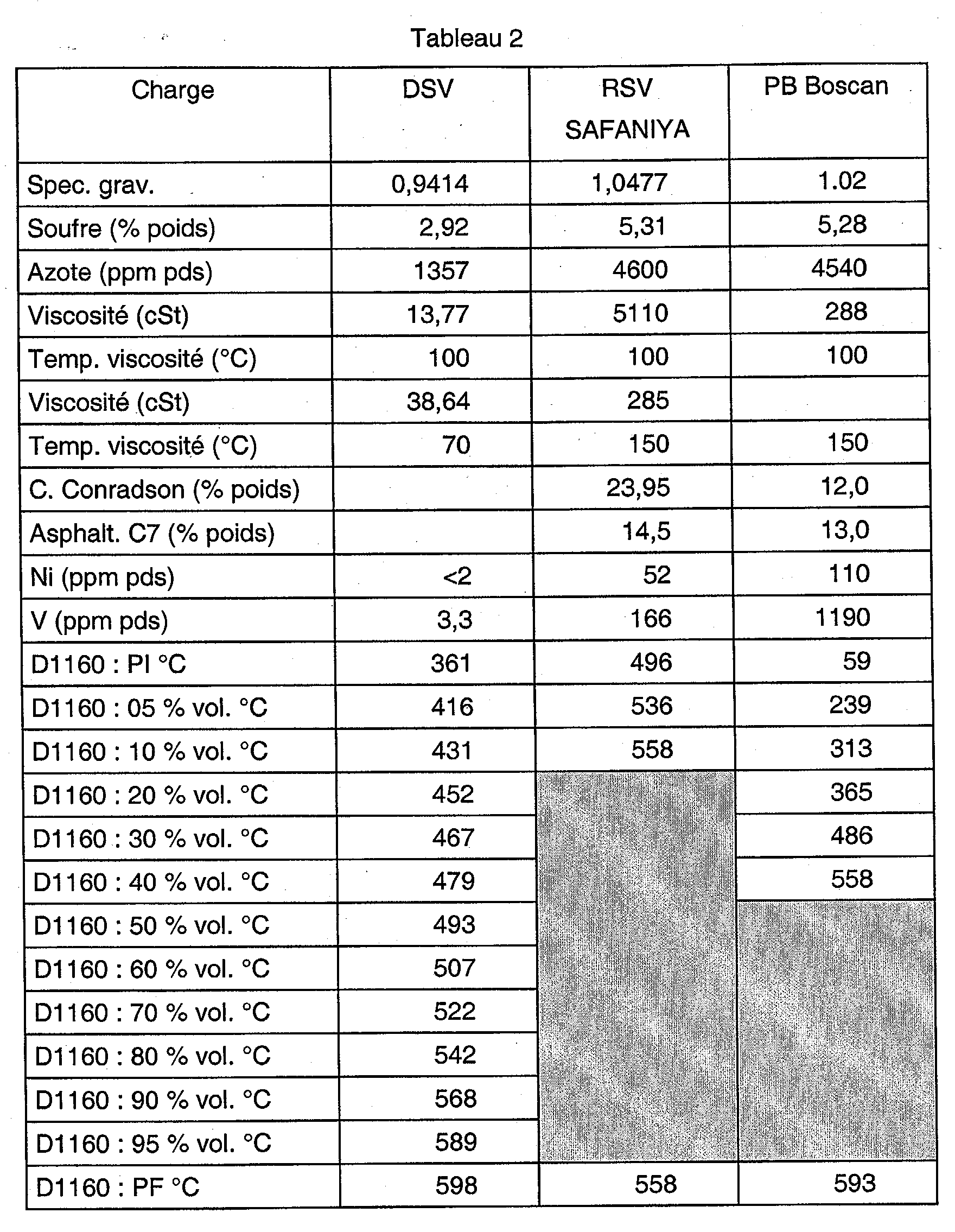
- the comparison of the catalysts is carried out on the Safanyia vacuum residue (RSV), the main characteristics of which are given in Table 2.
- the tests are carried out at 410 ° C., in isotherm, at 156 bars of total pressure using a VVH of 1, 2 l charge / catalyst / h.
- the flow of hydrogen is such that it respects the ratio of 800 l / l of load.
- the oiling of the unit is performed using a vacuum distillation gas oil, or DSV, whose characteristics are reported in Table 2.
- the temperature is increased to 343 ° C. and then the test charge, a vacuum distillation residue of the Safanyia (RSV) type, is injected.
- the reaction temperature is then raised to 410 ° C.
- the conditions of the test are fixed in isotherm, which makes it possible to measure the deactivation of the catalyst by the direct comparison of the performances at different ages.
- the ages are here expressed in filler barrels / pound of catalyst (bbl / lb) which represents the cumulative amount of filler spent on the catalyst based on the weight of catalyst charged.
- Table 3 compares the performance of the catalysts A1, B1, C2 and D2 at the beginning of the test (0.1 bbl / lb) and at the end of the test (1.4 bbl / lb).
- Catalyst B1 is therefore different from catalyst A1, not in accordance with the invention, by its lower Ni content. It can be seen that the reduction in the Ni content has no impact on the conversion of the heavy fraction. It is observed over time that the HDS and HDM performances of the catalyst B1 become greater than those of the catalyst A1, that is to say that the catalyst B1 containing less nickel deactivates slower than the catalyst A1. The decrease in the NiO content does not deteriorate the stability of the 350 ° C + fraction of the effluent recovered after the test since its P Value Shell remains largely greater than or equal to 1.4.
- the tests were conducted in a pilot unit for the hydrotreatment of petroleum residues comprising a tubular reactor in a fixed bed.
- the reactor is filled with a liter of catalyst.
- Fluid flow (residue + hydrogen) is upward in the reactor.
- the unit is operated with Boscan's crude oil, the characteristics of which are shown in Table 2.
- the tests are carried out in isotherm at 390 ° C, 150 bar total pressure using a VVH of 2 l charge / l cat / h.
- the flow of hydrogen is such that it respects the ratio 1000 l / l of charge.
- the conditions of the test are fixed in isotherm, which makes it possible to measure the deactivation of the catalyst by direct comparison of performance at different ages.
- the ages are expressed in hours of operation under crude oil, time zero being taken upon arrival at the test temperature (390 ° C).
- the performances in HDS and HDM are defined in the same way as in Example 7 and are reported in Table 4. It also reports the amount of metals deposited on the catalyst at the age mentioned. This amount is expressed by weight of Ni + V deposited relative to the weight of the new catalyst. The amount of Ni + V is calculated from the HDM ratio by considering that the metals removed from the petroleum fraction are deposited on the catalyst.
- the hydroconversion catalysts of hydrocarbon feeds containing compounds with a boiling point greater than 520 ° C and containing sulfur and metals, whose active phase has a moderate nickel content have a better behavior over time that the catalysts whose amount of active phase respects the usual proportions described in the prior art between the element of group VIII and the group VIB element.
Landscapes
- Chemical & Material Sciences (AREA)
- Engineering & Computer Science (AREA)
- Organic Chemistry (AREA)
- Chemical Kinetics & Catalysis (AREA)
- Materials Engineering (AREA)
- Oil, Petroleum & Natural Gas (AREA)
- General Chemical & Material Sciences (AREA)
- Inorganic Chemistry (AREA)
- Catalysts (AREA)
- Production Of Liquid Hydrocarbon Mixture For Refining Petroleum (AREA)
Abstract
Description
Le catalyseur selon l'invention contient un support poreux, en général essentiellement à base d'alumine, et au moins un métal catalytique choisi parmi les éléments du groupe VIB et éventuellement au moins un métal catalytique non noble choisi parmi les éléments du groupe VIII du tableau périodique.
De préférence, le métal du groupe VIB est le molybdène ou le tungstène, de manière encore plus préférée le molybdène. De préférence, le métal du groupe VIII est le nickel ou le cobalt, de manière encore plus préférée le nickel. Un catalyseur avantageux est un catalyseur associant nickel et molybdène. Un autre catalyseur avantageux est un catalyseur à base de molybdène.
La quantité de métal du groupe VIII non noble, exprimée en % poids d'oxyde par rapport au poids du catalyseur fini, est inférieure à 2,2 % poids, de manière préférée inférieure à 2 %, et de manière encore plus préférée inférieure à 1,9 %.
La quantité de métal du groupe VIII non noble, exprimée en % poids d'oxyde par rapport au poids du catalyseur fini, est généralement d'au moins 0,1 %, voire supérieure à 0,1 %.
Dans un mode de réalisation, le catalyseur ne contient pas de métal du groupe VIII non noble (0% poids d'oxyde par rapport au poids du catalyseur fini).
Un catalyseur très préféré comprend une quantité de métal du groupe VIII non noble, exprimée en % poids d'oxyde par rapport au poids du catalyseur fini, comprise entre 0,1 et 1,9 %.
Le rapport atomique entre l'élément du groupe VIII non noble et l'élément du groupe VIB est avantageusement choisi inférieur à 0,4 atomes/atomes, avantageusement inférieur à 0,35 atomes/atomes. Un rapport atomique préféré est égal ou inférieur à 0,3 atomes/atomes.
Il est également possible d'introduire une partie des métaux, voire la totalité, au cours de la préparation du support, notamment durant l'étape de mise en forme.
Les sources des éléments du groupe VIII pouvant être utilisées sont connues et sont par exemple les nitrates, les sulfates, les phosphates, les halogénures, les carboxylates comme les acétates et les carbonates, les hydroxydes et les oxydes.
On préfère utiliser des matrices contenant de l'alumine, sous toutes ces formes connues de l'Homme du métier, par exemple l'alumine gamma.
Dans un catalyseur préféré, la surface BET est supérieure à 50 m2/g et le volume poreux correspondant aux pores de diamètre supérieur à 500 Å est d'au moins 0,1 cm3/g.
La distribution des mésopores du support utilisé pour le catalyseur selon l'invention est centrée sur un diamètre compris entre 40 et 170 Å.
On obtient ainsi des extrudés cylindriques de 0,9 mm de diamètre, ayant une surface spécifique de 190 m2/g, un volume poreux total de 0,95 cm3/g, une distribution de mésopores centrée sur 140 Å. Cette alumine contient en outre 0,28 cm3/g de volume poreux dans des pores de diamètre supérieur à 500 Å.
Après maturation à température ambiante dans une atmosphère saturée en eau, les extrudés imprégnés sont séchés pendant une nuit à 120°C puis calcinés à 500°C pendant 2 heures sous air sec. La teneur finale en trioxyde de molybdène est de 12,5 % poids du catalyseur fini. La teneur finale en oxyde de nickel NiO est de 3,1 % poids du catalyseur fini.
Les caractéristiques texturales du catalyseur A1 sont reportées dans le tableau 1.
| Catalyseur | A1 | B1 | C2 | D2 |
| MoO3 (% pds) | 12,5 | 12,9 | 9,7 | 10,1 |
| NiO (% pds) | 3,1 | 1,7 | 3,2 | 0 |
| Ni/Mo (at/at) | 0,48 | 0,25 | 0,63 | 0 |
| SBET (m2/g) | 165 | 166 | 225 | 223 |
| Vpt (cm3/g) | 0,81 | 0,82 | 0,84 | 0,84 |
| V Hg > 500 Å (cm3/g) | 0,26 | 0,26 | 0,27 | 0,28 |
Après maturation à température ambiante dans une atmosphère saturée en eau, les extrudés imprégnés sont séchés pendant une nuit à 120°C puis calcinés à 500°C pendant 2 heures sous air sec. La teneur finale en trioxyde de molybdène est de 12,9 % poids du catalyseur fini. La teneur finale en oxyde de nickel NiO est de 1,7 % poids du catalyseur fini.
Les caractéristiques texturales du catalyseur B1 sont reportées dans le tableau 1. On constate notamment que la baisse de la teneur en Ni (catalyseur A1 à B1) ne modifie pas de façon significative les propriétés texturales du catalyseur.
Les caractéristiques texturales du catalyseur C2 sont reportées dans le tableau 1.
Les caractéristiques texturales du catalyseur D2 sont reportées dans le tableau 1.
La mise en huile de l'unité est réalisée en utilisant un Gasoil issu de distillation sous vide, ou DSV, dont les caractéristiques sont reportées dans le tableau 2.
Les conditions de l'essai sont fixées en isotherme, ce qui permet de mesurer la désactivation du catalyseur par la comparaison directe des performances à différents âges. Les âges sont exprimés ici en barils de charge / livre de catalyseur (bbl/lb) ce qui représente la quantité cumulée de charge passée sur le catalyseur rapportée au poids de catalyseur chargé.
| Catalyseur + Age | Conv (%pds) | HDM (% pds) | HDS (% pds) | P value Shell |
| A1 à 0,1 bbl/lb | 55 | 90 | 85 | 1,7 |
| B1 à 0,1 bbl/lb | 55 | 90 | 83 | 1,7 |
| A1 à 1,4 bbl/lb | 52 | 70 | 56 | 1,4 |
| B1 à 1,4 bbl/lb | 52 | 74 | 60 | 1,5 |
| C2 à 0,1 bbl/lb | 55 | 80 | 78 | 1,6 |
| D2 à 0,1 bbl/lb | 55 | 83 | 64 | 1,6 |
| C2 à 1,4 bbl/lb | 52 | 65 | 56 | 1,4 |
| D2 à 1,4 bbl/lb | 52 | 65 | 58 | 1,5 |
| Catalyseur + Age | HDM (% pds) | HDS (% pds) | Ni+V déposé (g/100 gcata neuf) |
| A1 à 50 heures | 78 | 60 | 8 |
| B1 à 50 heures | 77 | 55 | 6,5 |
| A2 à 400 heures | 40 | 25 | 50 |
| B2 à 400 heures | 48 | 30 | 60 |
Claims (17)
- Catalyseur comprenant :et dans lequel le rapport atomique entre l'élément du groupe VIII non noble et l'élément du groupe VIB est inférieur à 0,4, le volume poreux total mesuré par porosimétrie au mercure est compris entre 0,5 et 1,5 cm3/g et la distribution des mésopores du support est centrée sur un diamètre compris entre 40 et 170 Å.un support poreux,de 1 à 30 % poids d'au moins un métal catalytique choisi parmi les éléments du groupe VIB du tableau périodique en quantité exprimée en % poids d'oxyde par rapport au poids du catalyseur final etde 0 à moins de 2,2 % poids d'au moins un métal catalytique non noble choisi parmi les éléments du groupe VIII en quantité exprimée en % oxyde par rapport au poids du catalyseur final
- Catalyseur selon la revendication 1 dans lequel la quantité d'éléments du groupe VIII non noble exprimée en % poids d'oxyde par rapport au poids du catalyseur fini est d'au moins 0,1 %.
- Catalyseur selon l'une des revendications précédentes dans lequel la quantité d'éléments du groupe VIII non noble exprimée en % poids d'oxyde par rapport au poids du catalyseur fini est inférieure à 2 %.
- Catalyseur selon l'une des revendications précédentes dans lequel la quantité d'éléments du groupe VIII non noble exprimée en % poids d'oxyde par rapport au poids du catalyseur fini est inférieure à 1,9 %.
- Catalyseur selon l'une des revendications précédentes dans lequel la quantité de métal du groupe VIB exprimée en % poids d'oxyde par rapport au poids du catalyseur fini est comprise entre 5 et 20 %.
- Catalyseur selon l'une des revendications précédentes dans lequel le métal du groupe VIB est le molybdène ou le tungstène.
- Catalyseur selon l'une des revendications précédentes dans lequel le métal du groupe VIII non noble est le nickel ou le cobalt.
- Catalyseur selon l'une des revendications précédentes comprenant du nickel et du molybdène.
- Catalyseur selon l'une des revendications précédentes comprenant du molybdène.
- Catalyseur selon l'une des revendications précédentes dans lequel la surface BET est supérieure à 50 m2/g et le volume poreux dans les pores de diamètre supérieur à 500 Å est d'au moins 0,1 cm3/g.
- Catalyseur selon l'une des revendications précédentes contenant du soufre.
- Procédé d'hydroconversion et/ou hydroraffinage de charges hydrocarbonées contenant des composés dont le point d'ébullition est supérieur à 520°C et du soufre utilisant le catalyseur selon l'une des revendications précédentes.
- Procédé d'hydroconversion et/ou hydroraffinage de charges hydrocarbonées contenant des métaux utilisant le catalyseur selon la revendication 12.
- Procédé d'hydroraffinage et/ou hydroconversion de charges hydrocarbonées selon la revendication 12ou 13, opérant en lit fixe à une température comprise entre 320 et 450°C, sous une pression partielle d'hydrogène d'environ 3 MPa à environ 30 MPa, à une vitesse spatiale d'environ 0,05 à 5 volumes de charge par volume de catalyseur et par heure.
- Procédé d'hydroraffinage et/ou hydroconversion de charges hydrocarbonées selon la revendication 12ou 13, opérant en lit bouillonnant à une température comprise entre 320 et 470°C, sous une pression partielle d'hydrogène d'environ 3 MPa à environ 30 MPa, à une vitesse spatiale d'environ 0,1 à 10 volumes de charge par volume de catalyseur et par heure.
- Procédé selon l'une des revendications 12 à 15 tel que la charge employée dans le procédé est choisie dans le groupe formé par les résidus atmosphériques, les résidus sous vide issus de distillation directe, les huiles désasphaltées, les résidus issus de procédés de conversion, ladite charge étant utilisée telle quelle ou diluée par une fraction hydrocarbonée ou un mélange de fractions hydrocarbonées.
- Procédé selon l'une des revendications 12 à 16 dans lequel une partie des effluents convertis peut être recyclée en amont de l'unité opérant le procédé.
Applications Claiming Priority (2)
| Application Number | Priority Date | Filing Date | Title |
|---|---|---|---|
| FR0206402 | 2002-05-24 | ||
| FR0206402A FR2839902B1 (fr) | 2002-05-24 | 2002-05-24 | Catalyseur d'hydroraffinage et/ou d'hydroconversion et son utilisation dans des procedes d'hydrotraitement de charges hydrocarbonees |
Publications (2)
| Publication Number | Publication Date |
|---|---|
| EP1364707A1 true EP1364707A1 (fr) | 2003-11-26 |
| EP1364707B1 EP1364707B1 (fr) | 2019-03-13 |
Family
ID=29286649
Family Applications (1)
| Application Number | Title | Priority Date | Filing Date |
|---|---|---|---|
| EP03291104.2A Expired - Lifetime EP1364707B1 (fr) | 2002-05-24 | 2003-05-09 | Catalyseur d'hydroraffinage et/ou d'hydroconversion et procédé d'hydrotraitement de charges hydrocarbonées à l'aide dudit catalyseur |
Country Status (5)
| Country | Link |
|---|---|
| US (1) | US7119045B2 (fr) |
| EP (1) | EP1364707B1 (fr) |
| JP (1) | JP5140817B2 (fr) |
| DK (1) | DK1364707T3 (fr) |
| FR (1) | FR2839902B1 (fr) |
Cited By (1)
| Publication number | Priority date | Publication date | Assignee | Title |
|---|---|---|---|---|
| FR3013723A1 (fr) * | 2013-11-27 | 2015-05-29 | IFP Energies Nouvelles | Procede de production de combustibles marins a basse teneur en soufre a partir d'une coupe hydrocarbonee issue du craquage catalytique de type slurry, et faisant appel a une etape d'hydrotraitement specifique . |
Families Citing this family (67)
| Publication number | Priority date | Publication date | Assignee | Title |
|---|---|---|---|---|
| US7790018B2 (en) * | 2005-05-11 | 2010-09-07 | Saudia Arabian Oil Company | Methods for making higher value products from sulfur containing crude oil |
| WO2009022544A1 (fr) * | 2007-08-13 | 2009-02-19 | Asahi Kasei Chemicals Corporation | Catalyseur pour la production d'ester d'acide carboxylique, son procédé de fabrication et procédé de fabrication d'ester d'acide carboxylique |
| FR2933711B1 (fr) * | 2008-07-10 | 2010-08-27 | Inst Francais Du Petrole | Procede de conversion comprenant une viscoreduction de residu, puis un desasphaltage et une hydroconversion |
| FR2940143B1 (fr) | 2008-12-18 | 2015-12-11 | Inst Francais Du Petrole | Catalyseurs d'hydrodemetallation et d'hydrodesulfuration et mise en oeuvre dans un procede d'enchainement en formulation unique |
| US8080492B2 (en) * | 2009-04-29 | 2011-12-20 | Chevron U.S.A. Inc. | Hydroconversion multi-metallic catalyst and method for making thereof |
| US7931799B2 (en) * | 2009-04-29 | 2011-04-26 | Chevron U.S.A. Inc. | Hydroconversion multi-metallic catalyst and method for making thereof |
| US9315243B2 (en) * | 2009-09-30 | 2016-04-19 | The United States Of America As Represented By The Secretary Of The Army | Buoy for automated data collection and transmittal |
| EP2579982A4 (fr) * | 2010-06-10 | 2015-04-15 | Uop Llc | Composition de catalyseur au molybdène sur support et procédé pour une utilisation dans l'hydrocraquage en suspension concentrée |
| FR2969509B1 (fr) | 2010-12-22 | 2012-12-28 | IFP Energies Nouvelles | Materiau spherique a base d'heteropolyanions pieges dans une matrice oxyde mesostructuree et son utilisation comme catalyseur dans les procedes du raffinage |
| FR2981659B1 (fr) | 2011-10-20 | 2013-11-01 | Ifp Energies Now | Procede de conversion de charges petrolieres comprenant une etape d'hydroconversion en lit bouillonnant et une etape d'hydrotraitement en lit fixe pour la production de fiouls a basse teneur en soufre |
| FR2983866B1 (fr) | 2011-12-07 | 2015-01-16 | Ifp Energies Now | Procede d'hydroconversion de charges petrolieres en lits fixes pour la production de fiouls a basse teneur en soufre |
| US9108895B2 (en) | 2012-10-26 | 2015-08-18 | Eastman Chemical Company | Promoted ruthenium catalyst for the improved hydrogenation of carboxylic acids to the corresponding alcohols |
| FR2999600B1 (fr) | 2012-12-18 | 2015-11-13 | IFP Energies Nouvelles | Procede de raffinage d'une charge hydrocarbonee lourde mettant en oeuvre un desasphaltage selectif |
| FR2999453B1 (fr) | 2012-12-18 | 2015-02-06 | IFP Energies Nouvelles | Catalyseur d'hydrotraitement de residus comprenant du vanadium et son utilisation dans un procede d'hydroconversion de residus |
| FR3000097B1 (fr) | 2012-12-20 | 2014-12-26 | Ifp Energies Now | Procede integre de traitement de charges petrolieres pour la production de fiouls a basse teneur en soufre |
| FR3000098B1 (fr) | 2012-12-20 | 2014-12-26 | IFP Energies Nouvelles | Procede avec separation de traitement de charges petrolieres pour la production de fiouls a basse teneur en soufre |
| JP6104761B2 (ja) * | 2013-08-30 | 2017-03-29 | Jxエネルギー株式会社 | 炭化水素油の製造方法 |
| JP6104762B2 (ja) * | 2013-08-30 | 2017-03-29 | Jxエネルギー株式会社 | 炭化水素油の製造方法 |
| FR3022158B1 (fr) | 2014-06-13 | 2018-02-23 | IFP Energies Nouvelles | Catalyseur mesoporeux d'hydroconversion de residus et methode de preparation |
| FR3022159B1 (fr) | 2014-06-13 | 2018-04-27 | IFP Energies Nouvelles | Catalyseur mesoporeux et macroporeux d'hydroconversion de residus et methode de preparation |
| FR3027910B1 (fr) | 2014-11-04 | 2016-12-09 | Ifp Energies Now | Procede de conversion de charges petrolieres comprenant une etape d'hydrotraitement en lit fixe, une etape d'hydrocraquage en lit bouillonnant, une etape de maturation et une etape de separation des sediments pour la production de fiouls a basse teneur en sediments. |
| FR3027912B1 (fr) | 2014-11-04 | 2018-04-27 | IFP Energies Nouvelles | Procede de production de combustibles de type fuel lourd a partir d'une charge hydrocarbonee lourde utilisant une separation entre l'etape d'hydrotraitement et l'etape d'hydrocraquage |
| FR3027913A1 (fr) | 2014-11-04 | 2016-05-06 | Ifp Energies Now | Procede de conversion de charges petrolieres comprenant une etape de viscoreduction, une etape de maturation et une etape de separation des sediments pour la production de fiouls a basse teneur en sediments |
| FR3027911B1 (fr) | 2014-11-04 | 2018-04-27 | IFP Energies Nouvelles | Procede de conversion de charges petrolieres comprenant une etape d'hydrocraquage en lit bouillonnant, une etape de maturation et une etape de separation des sediments pour la production de fiouls a basse teneur en sediments |
| FR3036704B1 (fr) | 2015-06-01 | 2017-05-26 | Ifp Energies Now | Procede de conversion de charges comprenant une etape de viscoreduction, une etape de precipitation et une etape de separation des sediments pour la production de fiouls |
| FR3036705B1 (fr) | 2015-06-01 | 2017-06-02 | Ifp Energies Now | Procede de conversion de charges comprenant une etape d'hydrotraitement, une etape d'hydrocraquage, une etape de precipitation et une etape de separation des sediments pour la production de fiouls |
| WO2017083437A1 (fr) | 2015-11-09 | 2017-05-18 | Radiaction Ltd. | Appareils de blindage contre le rayonnement et applications connexes |
| FR3050735B1 (fr) | 2016-04-27 | 2020-11-06 | Ifp Energies Now | Procede de conversion comprenant des lits de garde permutables d'hydrodemetallation, une etape d'hydrotraitement en lit fixe et une etape d'hydrocraquage en reacteurs permutables |
| FR3052458B1 (fr) | 2016-06-09 | 2019-12-27 | IFP Energies Nouvelles | Procede de conversion comprenant au moins une etape d'hydrotraitement en lit fixe et une etape d'hydrocraquage en reacteurs by passables |
| FR3057876B1 (fr) | 2016-10-20 | 2020-06-26 | IFP Energies Nouvelles | Procede de conversion comprenant un hydrotraitement en lit fixe, une separation d'une fraction residu hydrotraitee, une etape de craquage catalytique pour la production de combustibles marins |
| US12281266B2 (en) | 2017-02-12 | 2025-04-22 | Magẽmã Technology LLC | Heavy marine fuel oil composition |
| US11788017B2 (en) | 2017-02-12 | 2023-10-17 | Magëmã Technology LLC | Multi-stage process and device for reducing environmental contaminants in heavy marine fuel oil |
| US10604709B2 (en) | 2017-02-12 | 2020-03-31 | Magēmā Technology LLC | Multi-stage device and process for production of a low sulfur heavy marine fuel oil from distressed heavy fuel oil materials |
| US12559689B2 (en) | 2017-02-12 | 2026-02-24 | Magēmā Technology LLC | Multi-stage process and device for treatment heavy marine fuel and resultant composition and the removal of detrimental solids |
| US12071592B2 (en) | 2017-02-12 | 2024-08-27 | Magēmā Technology LLC | Multi-stage process and device utilizing structured catalyst beds and reactive distillation for the production of a low sulfur heavy marine fuel oil |
| US12025435B2 (en) | 2017-02-12 | 2024-07-02 | Magēmã Technology LLC | Multi-stage device and process for production of a low sulfur heavy marine fuel oil |
| US20180230389A1 (en) | 2017-02-12 | 2018-08-16 | Magēmā Technology, LLC | Multi-Stage Process and Device for Reducing Environmental Contaminates in Heavy Marine Fuel Oil |
| FR3083992B1 (fr) | 2018-07-23 | 2020-07-24 | Ifp Energies Now | Catalyseur comalaxe issu de solutions a base d'heteropolyanions, son procede de preparation et son utilisation en hydroconversion de charges hydrocarbonees lourdes |
| JP7548588B2 (ja) | 2019-01-02 | 2024-09-10 | ラディアクション リミテッド | 放射線保護装置およびそのための材料 |
| US12011306B2 (en) | 2019-01-02 | 2024-06-18 | Radiaction Ltd | Patient head protection device |
| FR3094982A1 (fr) | 2019-04-12 | 2020-10-16 | IFP Energies Nouvelles | Procede d’hydrotraitement etage d’une charge lourde |
| FR3097229B1 (fr) | 2019-06-12 | 2021-06-11 | Ifp Energies Now | Procede de production d’olefines comprenant un hydrotraitement, un desasphaltage, un hydrocraquage et un vapocraquage |
| KR102978047B1 (ko) | 2019-07-02 | 2026-06-15 | 레디액션 엘티디. | 전개형 방사선 차폐부 커버 |
| FR3103822B1 (fr) | 2019-12-02 | 2022-07-01 | Ifp Energies Now | Procede de traitement d’huiles de pyrolyse de plastiques en vue de leur valorisation dans une unite de vapocraquage |
| FR3107530B1 (fr) | 2020-02-21 | 2022-02-11 | Ifp Energies Now | Procede optimise de traitement d’huiles de pyrolyse de plastiques en vue de leur valorisation |
| FR3113061B1 (fr) | 2020-07-30 | 2023-04-21 | Ifp Energies Now | Procede de traitement d’huiles de pyrolyse de plastiques incluant un hydrocraquage en une etape |
| FR3113060B1 (fr) | 2020-07-30 | 2023-04-28 | Ifp Energies Now | Procede de traitement d’huiles de pyrolyse de plastiques incluant un hydrocraquage en deux etapes |
| KR102915005B1 (ko) | 2020-09-04 | 2026-01-19 | 아사히 가세이 가부시키가이샤 | 카르복실산에스테르 제조용 촉매 및 카르복실산에스테르의 제조 방법 |
| FR3114598B1 (fr) | 2020-09-25 | 2023-09-29 | Ifp Energies Now | Procede de traitement d’huiles de pyrolyse de plastiques et/ou de combustibles solides de recuperation chargees en impuretes |
| FR3118629B1 (fr) | 2021-01-04 | 2023-12-15 | Ifp Energies Now | Procede de traitement d’huiles de pyrolyse de plastiques incluant une etape d’hydrogenation |
| FR3122662B1 (fr) | 2021-05-07 | 2024-04-26 | Ifp Energies Now | Procede de traitement simultane d’huiles de pyrolyse de plastiques et d’une charge issue de sources renouvelables |
| FR3122663B1 (fr) | 2021-05-07 | 2024-04-26 | Ifp Energies Now | Procede integre de traitement d’huiles de pyrolyse de plastiques et/ou de combustibles solides de recuperation chargees en impuretes |
| FR3128225B1 (fr) | 2021-10-19 | 2025-01-17 | Ifp Energies Now | Procede de traitement d’huiles de pyrolyse de plastiques et/ou de combustibles solides de recuperation chargees en impuretes |
| FR3129945B1 (fr) | 2021-12-03 | 2025-06-20 | Ifp Energies Now | Procede de traitement d’huiles de pyrolyse de plastiques incluant une etape d’hydrogenation et une separation a chaud |
| FR3133618B1 (fr) | 2022-03-17 | 2025-03-21 | Ifp Energies Now | Hydroconversion en lit bouillonnant ou hybride bouillonnant-entraîné d’une charge comportant une fraction d’huile de pyrolyse de plastiques et/ou de combustibles solides de recuperation |
| FR3135090B1 (fr) | 2022-04-29 | 2025-11-28 | Ifp Energies Now | Procede de traitement d’huile de pyrolyse de plastiques incluant une etape de recyclage d’h2s |
| FR3141185A1 (fr) | 2022-10-25 | 2024-04-26 | Totalenergies Onetech | Procédé de traitement d’une composition comprenant une huile issue de déchets plastiques |
| FR3141470B1 (fr) | 2022-10-28 | 2025-07-25 | Ifp Energies Now | Procede de traitement en lit fixe d’une charge lourde d’origine fossile comportant une fraction d’huile de pyrolyse de plastiques |
| FR3144155B1 (fr) | 2022-12-21 | 2026-04-24 | Ifp Energies Now | Procede de traitement d’huiles de pyrolyse de plastiques et/ou de pneus incluant l’elimination des halogenures avant une etape d’hydrotraitement |
| FR3144153B1 (fr) | 2022-12-21 | 2026-04-24 | Ifp Energies Now | Procede de traitement d’huiles de pyrolyse de plastiques et/ou de pneus incluant l’elimination des halogenures par lavage avant une etape d’hydrotraitement |
| FR3152812A1 (fr) | 2023-09-13 | 2025-03-14 | IFP Energies Nouvelles | Procede de traitement d’huile de pyrolyse incluant un prefractionnement et un recycle |
| FR3152811A1 (fr) | 2023-09-13 | 2025-03-14 | IFP Energies Nouvelles | Procede de traitement d’une huile de pyrolyse de pneus |
| FR3152810A1 (fr) | 2023-09-13 | 2025-03-14 | IFP Energies Nouvelles | Procede de traitement d’huile de pyrolyse incluant un prefractionnement |
| FR3160184A1 (fr) | 2024-03-14 | 2025-09-19 | IFP Energies Nouvelles | Procédé de production de bases pour la pétrochimie comprenant un craquage catalytique fluide, un oligocraquage, un hydrocraquage en lit fixe, un reformage catalytique et un vapocraquage |
| FR3160183A1 (fr) | 2024-03-14 | 2025-09-19 | IFP Energies Nouvelles | Procédé de production de bases pour la pétrochimie comprenant un craquage catalytique fluide, une oligomérisation, un hydrocraquage en lit fixe, un reformage catalytique et un vapocraquage |
| FR3160185A1 (fr) | 2024-03-14 | 2025-09-19 | IFP Energies Nouvelles | Procédé de production de bases pour la pétrochimie comprenant un craquage catalytique fluide, un hydrocraquage en lit fixe, un reformage catalytique et un vapocraquage |
| FR3169477A1 (fr) | 2024-12-09 | 2026-06-12 | IFP Energies Nouvelles | Procede de traitement d’huile de pyrolyse incluant un enchainement hydrotraitement - hydrocraquage puis une separation a chaud |
Citations (5)
| Publication number | Priority date | Publication date | Assignee | Title |
|---|---|---|---|---|
| US4743574A (en) * | 1986-01-09 | 1988-05-10 | Intevep, S.A. | Catalyst for hydrotreatment of distillates of petroleum and method for the preparation of same |
| EP0704239A2 (fr) * | 1994-09-19 | 1996-04-03 | Nippon Ketjen Co., Ltd. | Catalyseur d'hydrotraitement et son utilisation |
| EP0714699A2 (fr) * | 1994-11-03 | 1996-06-05 | Shell Internationale Researchmaatschappij B.V. | Catalyseur et procédé d'hydrotraitement |
| FR2764213A1 (fr) * | 1997-06-10 | 1998-12-11 | Inst Francais Du Petrole | Catalyseur d'hydrotraitement de charges hydrocarbonees dans un reacteur a lit fixe |
| EP1060794A1 (fr) * | 1998-12-08 | 2000-12-20 | Japan Energy Corporation | Catalyseur d'hydrodesulfuration et son procede de preparation |
Family Cites Families (15)
| Publication number | Priority date | Publication date | Assignee | Title |
|---|---|---|---|---|
| BE893161A (fr) * | 1981-05-12 | 1982-08-30 | Chevron Res | Catalyseur se pretant a l'hydrodemetallation d'alimentations lourdes et procede d'hydrodemetallation d'alimentations lourdes |
| US4588709A (en) * | 1983-12-19 | 1986-05-13 | Intevep, S.A. | Catalyst for removing sulfur and metal contaminants from heavy crudes and residues |
| US4520128A (en) * | 1983-12-19 | 1985-05-28 | Intevep, S.A. | Catalyst having high metal retention capacity and good stability for use in the demetallization of heavy crudes and method of preparation of same |
| NL8403107A (nl) * | 1984-07-30 | 1986-02-17 | Gulf Research Development Co | Katalysator, alsmede werkwijze voor het behandelen van een asfalt bevattende koolwaterstof met deze katalysator. |
| JPH0813338B2 (ja) * | 1988-03-02 | 1996-02-14 | 日本石油株式会社 | 残油の水素化分解触媒 |
| US5089463A (en) * | 1988-10-04 | 1992-02-18 | Chevron Research And Technology Company | Hydrodemetalation and hydrodesulfurization catalyst of specified macroporosity |
| JPH03273092A (ja) * | 1990-03-22 | 1991-12-04 | Nippon Oil Co Ltd | 残油の水素化処理触媒 |
| JPH0593190A (ja) * | 1991-03-29 | 1993-04-16 | Nippon Oil Co Ltd | 残油の水素化処理方法 |
| US5221656A (en) * | 1992-03-25 | 1993-06-22 | Amoco Corporation | Hydroprocessing catalyst |
| CA2093412C (fr) * | 1992-04-20 | 2002-12-31 | Gerald Verdell Nelson | Procede d'hydroconversion mettant en oeuvre un catalyseur a porosimetrie determinee |
| US6015485A (en) * | 1994-05-13 | 2000-01-18 | Cytec Technology Corporation | High activity catalysts having a bimodal mesopore structure |
| FR2764298B1 (fr) * | 1997-06-10 | 1999-07-16 | Inst Francais Du Petrole | Hydrotraitement de charges hydrocarbonees dans un reacteur en lit bouillonnant |
| US6387248B2 (en) * | 1997-11-06 | 2002-05-14 | Texaco Inc. | Method of preparing a catalyst for use in the hydrotreating of high boiling hydrocarbon feedstocks |
| GC0000065A (en) * | 1998-09-01 | 2004-06-30 | Japan Energy Corp | Hydrocracking catalyst, producing method threof, and hydrocracking method. |
| FR2787041B1 (fr) * | 1998-12-10 | 2001-01-19 | Inst Francais Du Petrole | Catalyseur d'hydrotraitement de charges hydrocarbonees dans un reacteur a lit fixe |
-
2002
- 2002-05-24 FR FR0206402A patent/FR2839902B1/fr not_active Expired - Lifetime
-
2003
- 2003-05-09 EP EP03291104.2A patent/EP1364707B1/fr not_active Expired - Lifetime
- 2003-05-09 DK DK03291104.2T patent/DK1364707T3/da active
- 2003-05-23 JP JP2003146256A patent/JP5140817B2/ja not_active Expired - Lifetime
- 2003-05-27 US US10/445,314 patent/US7119045B2/en not_active Expired - Lifetime
Patent Citations (5)
| Publication number | Priority date | Publication date | Assignee | Title |
|---|---|---|---|---|
| US4743574A (en) * | 1986-01-09 | 1988-05-10 | Intevep, S.A. | Catalyst for hydrotreatment of distillates of petroleum and method for the preparation of same |
| EP0704239A2 (fr) * | 1994-09-19 | 1996-04-03 | Nippon Ketjen Co., Ltd. | Catalyseur d'hydrotraitement et son utilisation |
| EP0714699A2 (fr) * | 1994-11-03 | 1996-06-05 | Shell Internationale Researchmaatschappij B.V. | Catalyseur et procédé d'hydrotraitement |
| FR2764213A1 (fr) * | 1997-06-10 | 1998-12-11 | Inst Francais Du Petrole | Catalyseur d'hydrotraitement de charges hydrocarbonees dans un reacteur a lit fixe |
| EP1060794A1 (fr) * | 1998-12-08 | 2000-12-20 | Japan Energy Corporation | Catalyseur d'hydrodesulfuration et son procede de preparation |
Cited By (1)
| Publication number | Priority date | Publication date | Assignee | Title |
|---|---|---|---|---|
| FR3013723A1 (fr) * | 2013-11-27 | 2015-05-29 | IFP Energies Nouvelles | Procede de production de combustibles marins a basse teneur en soufre a partir d'une coupe hydrocarbonee issue du craquage catalytique de type slurry, et faisant appel a une etape d'hydrotraitement specifique . |
Also Published As
| Publication number | Publication date |
|---|---|
| JP2003340281A (ja) | 2003-12-02 |
| EP1364707B1 (fr) | 2019-03-13 |
| FR2839902B1 (fr) | 2007-06-29 |
| FR2839902A1 (fr) | 2003-11-28 |
| US20040020829A1 (en) | 2004-02-05 |
| JP5140817B2 (ja) | 2013-02-13 |
| US7119045B2 (en) | 2006-10-10 |
| DK1364707T3 (da) | 2019-06-03 |
Similar Documents
| Publication | Publication Date | Title |
|---|---|---|
| EP1364707B1 (fr) | Catalyseur d'hydroraffinage et/ou d'hydroconversion et procédé d'hydrotraitement de charges hydrocarbonées à l'aide dudit catalyseur | |
| EP2962753B1 (fr) | Catalyseur d'hydrotraitement à densité de molybdène élevée et méthode de préparation | |
| EP2255873B1 (fr) | Catalyseurs d'hydrodémétallation et d'hydrodésulfuration et mise en oeuvre dans un procédé d'enchaînement en formulation unique | |
| EP1380343B1 (fr) | Catalyseur d'hydrotraitement contenant un composé organique azoté et son utilisation | |
| EP1415712B1 (fr) | Catalyseur et procédé d'hydrocraquage de charges hydrocarbonées | |
| EP1634643B1 (fr) | Catalyseur dopé sur support silice-alumine et procédé de traitement de charges hydrocarbonées | |
| EP2878651B1 (fr) | Procédé d'hydrotraitement de distillat sous vide mettant en oeuvre un enchainement de catalyseurs | |
| KR100356431B1 (ko) | 수소처리촉매,그용도및제조방법 | |
| FR2787041A1 (fr) | Catalyseur d'hydrotraitement de charges hydrocarbonees dans un reacteur a lit fixe | |
| CN1735678A (zh) | 使用催化剂混合物的烃的加氢处理方法 | |
| FR2999453A1 (fr) | Catalyseur d'hydrotraitement de residus comprenant du vanadium et son utilisation dans un procede d'hydroconversion de residus | |
| EP2878370A1 (fr) | Procédé d'hydrotraitement de gazole mettant en oeuvre un enchainement de catalyseurs | |
| EP3155074B1 (fr) | Procede d'hydrotraitement de coupes gazoles utilisant un catalyseur a base d'une alumine mesoporeuse amorphe ayant une connectivite elevee | |
| WO2014083273A1 (fr) | Catalyseur d'hydrotraitement comprenant un support obtenu a partir d'un gel d'alumine et methode de preparation d'un tel catalyseur | |
| WO2022112077A1 (fr) | Procede d'hydrodesulfuration mettant en œuvre un catalyseur comprenant un support d'alumine flash | |
| WO2022223482A1 (fr) | Catalyseur contenant du phosphore et du sodium et son utilisation dans un procede d'hydrodesulfuration | |
| EP1130078B1 (fr) | Procédé de conversion d'hydrocarbures sur catalyseur à acidité controlée | |
| JPH0813328B2 (ja) | 炭化水素油の水素化処理用触媒組成物及びそれを使用する水素化脱硫方法 | |
| EP4122596A1 (fr) | Catalyseur d hydrodésulfuration avec répartition en croûte de la phase active | |
| CN112547079A (zh) | 一种重油加氢处理催化剂及其应用 | |
| JP2022156584A (ja) | 炭化水素油の水素化処理触媒の製造方法、及び炭化水素油の水素化処理方法 | |
| FR3066928A1 (fr) | Procede d'hydrotraitement de coupes distillats utilisant un catalyseur a base d'une alumine mesoporeuse amorphe preparee en continu et sans sechage pousse | |
| FR3066929A1 (fr) | Procede d'hydrotraitement de coupes distillats utilisant un catalyseur a base d'une alumine mesoporeuse amorphe preparee sans sechage pousse | |
| JPWO2001094012A1 (ja) | 水素化精製触媒及び水素化精製方法 |
Legal Events
| Date | Code | Title | Description |
|---|---|---|---|
| PUAI | Public reference made under article 153(3) epc to a published international application that has entered the european phase |
Free format text: ORIGINAL CODE: 0009012 |
|
| AK | Designated contracting states |
Kind code of ref document: A1 Designated state(s): AT BE BG CH CY CZ DE DK EE ES FI FR GB GR HU IE IT LI LU MC NL PT RO SE SI SK TR |
|
| AX | Request for extension of the european patent |
Extension state: AL LT LV MK |
|
| 17P | Request for examination filed |
Effective date: 20040526 |
|
| AKX | Designation fees paid |
Designated state(s): DE DK FR GB NL |
|
| 17Q | First examination report despatched |
Effective date: 20110405 |
|
| RAP1 | Party data changed (applicant data changed or rights of an application transferred) |
Owner name: IFP ENERGIES NOUVELLES |
|
| GRAP | Despatch of communication of intention to grant a patent |
Free format text: ORIGINAL CODE: EPIDOSNIGR1 |
|
| INTG | Intention to grant announced |
Effective date: 20180530 |
|
| GRAJ | Information related to disapproval of communication of intention to grant by the applicant or resumption of examination proceedings by the epo deleted |
Free format text: ORIGINAL CODE: EPIDOSDIGR1 |
|
| GRAP | Despatch of communication of intention to grant a patent |
Free format text: ORIGINAL CODE: EPIDOSNIGR1 |
|
| INTC | Intention to grant announced (deleted) | ||
| INTG | Intention to grant announced |
Effective date: 20181019 |
|
| RIN1 | Information on inventor provided before grant (corrected) |
Inventor name: GUILLAUME, DENIS Inventor name: HARLE, VIRGINIE Inventor name: KRESSMANN, STEPHANE Inventor name: ROULEAU, LOIC |
|
| GRAS | Grant fee paid |
Free format text: ORIGINAL CODE: EPIDOSNIGR3 |
|
| GRAA | (expected) grant |
Free format text: ORIGINAL CODE: 0009210 |
|
| RIC1 | Information provided on ipc code assigned before grant |
Ipc: B01J 23/883 20060101ALI20030903BHEP Ipc: B01J 23/888 20060101AFI20030903BHEP Ipc: B01J 23/882 20060101ALI20030903BHEP Ipc: B01J 35/10 20060101ALI20030903BHEP Ipc: B01J 27/051 20060101ALI20030903BHEP Ipc: B01J 27/047 20060101ALI20030903BHEP Ipc: B01J 27/043 20060101ALI20030903BHEP Ipc: C10G 45/00 20060101ALI20030903BHEP |
|
| AK | Designated contracting states |
Kind code of ref document: B1 Designated state(s): DE DK FR GB NL |
|
| REG | Reference to a national code |
Ref country code: GB Ref legal event code: FG4D Free format text: NOT ENGLISH |
|
| REG | Reference to a national code |
Ref country code: DE Ref legal event code: R096 Ref document number: 60351862 Country of ref document: DE |
|
| REG | Reference to a national code |
Ref country code: DK Ref legal event code: T3 Effective date: 20190528 |
|
| REG | Reference to a national code |
Ref country code: NL Ref legal event code: FP |
|
| REG | Reference to a national code |
Ref country code: DE Ref legal event code: R097 Ref document number: 60351862 Country of ref document: DE |
|
| PLBE | No opposition filed within time limit |
Free format text: ORIGINAL CODE: 0009261 |
|
| STAA | Information on the status of an ep patent application or granted ep patent |
Free format text: STATUS: NO OPPOSITION FILED WITHIN TIME LIMIT |
|
| 26N | No opposition filed |
Effective date: 20191216 |
|
| PGFP | Annual fee paid to national office [announced via postgrant information from national office to epo] |
Ref country code: NL Payment date: 20220526 Year of fee payment: 20 |
|
| PGFP | Annual fee paid to national office [announced via postgrant information from national office to epo] |
Ref country code: GB Payment date: 20220524 Year of fee payment: 20 Ref country code: FR Payment date: 20220526 Year of fee payment: 20 Ref country code: DK Payment date: 20220524 Year of fee payment: 20 Ref country code: DE Payment date: 20220527 Year of fee payment: 20 |
|
| REG | Reference to a national code |
Ref country code: DE Ref legal event code: R071 Ref document number: 60351862 Country of ref document: DE |
|
| REG | Reference to a national code |
Ref country code: NL Ref legal event code: MK Effective date: 20230508 |
|
| REG | Reference to a national code |
Ref country code: DK Ref legal event code: EUP Expiry date: 20230509 |
|
| REG | Reference to a national code |
Ref country code: GB Ref legal event code: PE20 Expiry date: 20230508 |
|
| PG25 | Lapsed in a contracting state [announced via postgrant information from national office to epo] |
Ref country code: GB Free format text: LAPSE BECAUSE OF EXPIRATION OF PROTECTION Effective date: 20230508 |