EP1362890B1 - Gewellter Mehrschicht-Polymer-Schlauch- oder Rohrleitung mit reduzierter Längenänderung - Google Patents
Gewellter Mehrschicht-Polymer-Schlauch- oder Rohrleitung mit reduzierter Längenänderung Download PDFInfo
- Publication number
- EP1362890B1 EP1362890B1 EP20020010352 EP02010352A EP1362890B1 EP 1362890 B1 EP1362890 B1 EP 1362890B1 EP 20020010352 EP20020010352 EP 20020010352 EP 02010352 A EP02010352 A EP 02010352A EP 1362890 B1 EP1362890 B1 EP 1362890B1
- Authority
- EP
- European Patent Office
- Prior art keywords
- thermoplastic
- elastomers
- polyamide
- tpe
- group
- Prior art date
- Legal status (The legal status is an assumption and is not a legal conclusion. Google has not performed a legal analysis and makes no representation as to the accuracy of the status listed.)
- Expired - Lifetime
Links
Images

Classifications
-
- F—MECHANICAL ENGINEERING; LIGHTING; HEATING; WEAPONS; BLASTING
- F16—ENGINEERING ELEMENTS AND UNITS; GENERAL MEASURES FOR PRODUCING AND MAINTAINING EFFECTIVE FUNCTIONING OF MACHINES OR INSTALLATIONS; THERMAL INSULATION IN GENERAL
- F16L—PIPES; JOINTS OR FITTINGS FOR PIPES; SUPPORTS FOR PIPES, CABLES OR PROTECTIVE TUBING; MEANS FOR THERMAL INSULATION IN GENERAL
- F16L11/00—Hoses, i.e. flexible pipes
- F16L11/14—Hoses, i.e. flexible pipes made of rigid material, e.g. metal or hard plastics
- F16L11/15—Hoses, i.e. flexible pipes made of rigid material, e.g. metal or hard plastics corrugated
-
- B—PERFORMING OPERATIONS; TRANSPORTING
- B32—LAYERED PRODUCTS
- B32B—LAYERED PRODUCTS, i.e. PRODUCTS BUILT-UP OF STRATA OF FLAT OR NON-FLAT, e.g. CELLULAR OR HONEYCOMB, FORM
- B32B1/00—Layered products having a non-planar shape
- B32B1/08—Tubular products
-
- B—PERFORMING OPERATIONS; TRANSPORTING
- B32—LAYERED PRODUCTS
- B32B—LAYERED PRODUCTS, i.e. PRODUCTS BUILT-UP OF STRATA OF FLAT OR NON-FLAT, e.g. CELLULAR OR HONEYCOMB, FORM
- B32B27/00—Layered products comprising a layer of synthetic resin
- B32B27/32—Layered products comprising a layer of synthetic resin comprising polyolefins
-
- B—PERFORMING OPERATIONS; TRANSPORTING
- B32—LAYERED PRODUCTS
- B32B—LAYERED PRODUCTS, i.e. PRODUCTS BUILT-UP OF STRATA OF FLAT OR NON-FLAT, e.g. CELLULAR OR HONEYCOMB, FORM
- B32B27/00—Layered products comprising a layer of synthetic resin
- B32B27/34—Layered products comprising a layer of synthetic resin comprising polyamides
-
- C—CHEMISTRY; METALLURGY
- C08—ORGANIC MACROMOLECULAR COMPOUNDS; THEIR PREPARATION OR CHEMICAL WORKING-UP; COMPOSITIONS BASED THEREON
- C08L—COMPOSITIONS OF MACROMOLECULAR COMPOUNDS
- C08L23/00—Compositions of homopolymers or copolymers of unsaturated aliphatic hydrocarbons having only one carbon-to-carbon double bond; Compositions of derivatives of such polymers
- C08L23/02—Compositions of homopolymers or copolymers of unsaturated aliphatic hydrocarbons having only one carbon-to-carbon double bond; Compositions of derivatives of such polymers not modified by chemical after-treatment
- C08L23/10—Homopolymers or copolymers of propene
-
- F—MECHANICAL ENGINEERING; LIGHTING; HEATING; WEAPONS; BLASTING
- F16—ENGINEERING ELEMENTS AND UNITS; GENERAL MEASURES FOR PRODUCING AND MAINTAINING EFFECTIVE FUNCTIONING OF MACHINES OR INSTALLATIONS; THERMAL INSULATION IN GENERAL
- F16L—PIPES; JOINTS OR FITTINGS FOR PIPES; SUPPORTS FOR PIPES, CABLES OR PROTECTIVE TUBING; MEANS FOR THERMAL INSULATION IN GENERAL
- F16L11/00—Hoses, i.e. flexible pipes
- F16L11/04—Hoses, i.e. flexible pipes made of rubber or flexible plastics
- F16L11/11—Hoses, i.e. flexible pipes made of rubber or flexible plastics with corrugated wall
- F16L11/118—Hoses, i.e. flexible pipes made of rubber or flexible plastics with corrugated wall having arrangements for particular purposes, e.g. electrically conducting
-
- B—PERFORMING OPERATIONS; TRANSPORTING
- B82—NANOTECHNOLOGY
- B82Y—SPECIFIC USES OR APPLICATIONS OF NANOSTRUCTURES; MEASUREMENT OR ANALYSIS OF NANOSTRUCTURES; MANUFACTURE OR TREATMENT OF NANOSTRUCTURES
- B82Y40/00—Manufacture or treatment of nanostructures
-
- C—CHEMISTRY; METALLURGY
- C08—ORGANIC MACROMOLECULAR COMPOUNDS; THEIR PREPARATION OR CHEMICAL WORKING-UP; COMPOSITIONS BASED THEREON
- C08L—COMPOSITIONS OF MACROMOLECULAR COMPOUNDS
- C08L2205/00—Polymer mixtures characterised by other features
- C08L2205/08—Polymer mixtures characterised by other features containing additives to improve the compatibility between two polymers
-
- C—CHEMISTRY; METALLURGY
- C08—ORGANIC MACROMOLECULAR COMPOUNDS; THEIR PREPARATION OR CHEMICAL WORKING-UP; COMPOSITIONS BASED THEREON
- C08L—COMPOSITIONS OF MACROMOLECULAR COMPOUNDS
- C08L2312/00—Crosslinking
-
- C—CHEMISTRY; METALLURGY
- C08—ORGANIC MACROMOLECULAR COMPOUNDS; THEIR PREPARATION OR CHEMICAL WORKING-UP; COMPOSITIONS BASED THEREON
- C08L—COMPOSITIONS OF MACROMOLECULAR COMPOUNDS
- C08L51/00—Compositions of graft polymers in which the grafted component is obtained by reactions only involving carbon-to-carbon unsaturated bonds; Compositions of derivatives of such polymers
- C08L51/06—Compositions of graft polymers in which the grafted component is obtained by reactions only involving carbon-to-carbon unsaturated bonds; Compositions of derivatives of such polymers grafted on to homopolymers or copolymers of aliphatic hydrocarbons containing only one carbon-to-carbon double bond
-
- C—CHEMISTRY; METALLURGY
- C08—ORGANIC MACROMOLECULAR COMPOUNDS; THEIR PREPARATION OR CHEMICAL WORKING-UP; COMPOSITIONS BASED THEREON
- C08L—COMPOSITIONS OF MACROMOLECULAR COMPOUNDS
- C08L53/00—Compositions of block copolymers containing at least one sequence of a polymer obtained by reactions only involving carbon-to-carbon unsaturated bonds; Compositions of derivatives of such polymers
- C08L53/02—Compositions of block copolymers containing at least one sequence of a polymer obtained by reactions only involving carbon-to-carbon unsaturated bonds; Compositions of derivatives of such polymers of vinyl-aromatic monomers and conjugated dienes
-
- C—CHEMISTRY; METALLURGY
- C08—ORGANIC MACROMOLECULAR COMPOUNDS; THEIR PREPARATION OR CHEMICAL WORKING-UP; COMPOSITIONS BASED THEREON
- C08L—COMPOSITIONS OF MACROMOLECULAR COMPOUNDS
- C08L77/00—Compositions of polyamides obtained by reactions forming a carboxylic amide link in the main chain; Compositions of derivatives of such polymers
-
- Y—GENERAL TAGGING OF NEW TECHNOLOGICAL DEVELOPMENTS; GENERAL TAGGING OF CROSS-SECTIONAL TECHNOLOGIES SPANNING OVER SEVERAL SECTIONS OF THE IPC; TECHNICAL SUBJECTS COVERED BY FORMER USPC CROSS-REFERENCE ART COLLECTIONS [XRACs] AND DIGESTS
- Y10—TECHNICAL SUBJECTS COVERED BY FORMER USPC
- Y10T—TECHNICAL SUBJECTS COVERED BY FORMER US CLASSIFICATION
- Y10T428/00—Stock material or miscellaneous articles
- Y10T428/13—Hollow or container type article [e.g., tube, vase, etc.]
- Y10T428/1352—Polymer or resin containing [i.e., natural or synthetic]
-
- Y—GENERAL TAGGING OF NEW TECHNOLOGICAL DEVELOPMENTS; GENERAL TAGGING OF CROSS-SECTIONAL TECHNOLOGIES SPANNING OVER SEVERAL SECTIONS OF THE IPC; TECHNICAL SUBJECTS COVERED BY FORMER USPC CROSS-REFERENCE ART COLLECTIONS [XRACs] AND DIGESTS
- Y10—TECHNICAL SUBJECTS COVERED BY FORMER USPC
- Y10T—TECHNICAL SUBJECTS COVERED BY FORMER US CLASSIFICATION
- Y10T428/00—Stock material or miscellaneous articles
- Y10T428/13—Hollow or container type article [e.g., tube, vase, etc.]
- Y10T428/1352—Polymer or resin containing [i.e., natural or synthetic]
- Y10T428/1379—Contains vapor or gas barrier, polymer derived from vinyl chloride or vinylidene chloride, or polymer containing a vinyl alcohol unit
-
- Y—GENERAL TAGGING OF NEW TECHNOLOGICAL DEVELOPMENTS; GENERAL TAGGING OF CROSS-SECTIONAL TECHNOLOGIES SPANNING OVER SEVERAL SECTIONS OF THE IPC; TECHNICAL SUBJECTS COVERED BY FORMER USPC CROSS-REFERENCE ART COLLECTIONS [XRACs] AND DIGESTS
- Y10—TECHNICAL SUBJECTS COVERED BY FORMER USPC
- Y10T—TECHNICAL SUBJECTS COVERED BY FORMER US CLASSIFICATION
- Y10T428/00—Stock material or miscellaneous articles
- Y10T428/13—Hollow or container type article [e.g., tube, vase, etc.]
- Y10T428/1352—Polymer or resin containing [i.e., natural or synthetic]
- Y10T428/1386—Natural or synthetic rubber or rubber-like compound containing
-
- Y—GENERAL TAGGING OF NEW TECHNOLOGICAL DEVELOPMENTS; GENERAL TAGGING OF CROSS-SECTIONAL TECHNOLOGIES SPANNING OVER SEVERAL SECTIONS OF THE IPC; TECHNICAL SUBJECTS COVERED BY FORMER USPC CROSS-REFERENCE ART COLLECTIONS [XRACs] AND DIGESTS
- Y10—TECHNICAL SUBJECTS COVERED BY FORMER USPC
- Y10T—TECHNICAL SUBJECTS COVERED BY FORMER US CLASSIFICATION
- Y10T428/00—Stock material or miscellaneous articles
- Y10T428/13—Hollow or container type article [e.g., tube, vase, etc.]
- Y10T428/1352—Polymer or resin containing [i.e., natural or synthetic]
- Y10T428/139—Open-ended, self-supporting conduit, cylinder, or tube-type article
- Y10T428/1393—Multilayer [continuous layer]
-
- Y—GENERAL TAGGING OF NEW TECHNOLOGICAL DEVELOPMENTS; GENERAL TAGGING OF CROSS-SECTIONAL TECHNOLOGIES SPANNING OVER SEVERAL SECTIONS OF THE IPC; TECHNICAL SUBJECTS COVERED BY FORMER USPC CROSS-REFERENCE ART COLLECTIONS [XRACs] AND DIGESTS
- Y10—TECHNICAL SUBJECTS COVERED BY FORMER USPC
- Y10T—TECHNICAL SUBJECTS COVERED BY FORMER US CLASSIFICATION
- Y10T428/00—Stock material or miscellaneous articles
- Y10T428/31504—Composite [nonstructural laminate]
- Y10T428/31725—Of polyamide
-
- Y—GENERAL TAGGING OF NEW TECHNOLOGICAL DEVELOPMENTS; GENERAL TAGGING OF CROSS-SECTIONAL TECHNOLOGIES SPANNING OVER SEVERAL SECTIONS OF THE IPC; TECHNICAL SUBJECTS COVERED BY FORMER USPC CROSS-REFERENCE ART COLLECTIONS [XRACs] AND DIGESTS
- Y10—TECHNICAL SUBJECTS COVERED BY FORMER USPC
- Y10T—TECHNICAL SUBJECTS COVERED BY FORMER US CLASSIFICATION
- Y10T428/00—Stock material or miscellaneous articles
- Y10T428/31504—Composite [nonstructural laminate]
- Y10T428/31725—Of polyamide
- Y10T428/3175—Next to addition polymer from unsaturated monomer[s]
Definitions
- the present invention relates to two- or three-layer polymer hose or pipes for use as pressurized fluid lines in motor vehicles.
- the fluid lines according to the invention can be smooth; Alternatively, they have continuous or at least partially corrugated walls, wherein according to the invention particularly preferably spirally corrugated walls are.
- the pipe according to the invention comprises an outer layer of a molding compound of a harder polymer or a polymer mixture and an inner layer of a rubber-elastic polymer or a polymer mixture. Additionally, the inner layer may be internally provided with a layer of a thermoplastic, adhesion modified elastomeric composition. According to the invention, a material is thus selected for the layers, which results in a so-called "hard-soft combination" in the finished composite.
- the elastomeric polymer composition or polymer mixture has a hardness in the range of about 30 Shore A to 60 Shore D, in particular from about 30 Shore A to 90 Shore A, the hose or pipe according to the invention are selected so that they by coextrusion or can be processed by the so-called Conex method and thereby positive or positive, ie without additional adhesion promoter, adhere directly to one another without delamination.
- Particularly preferred applications of the pipes according to the invention are in the automotive sector for the realization of liquid lines, air guide parts or fuel lines.
- thermoplastic materials offer a considerable cost and weight savings and also have an improved recycling potential.
- this material substitution of the thermoplastic pipes is required a comparable bending flexibility as in rubber tubes.
- thermoplastics can be compensated in particular by a corrugated structure of the tube jacket surface.
- a corrugated pipe Geometry is known in various embodiments.
- the bending flexibility achieved thereby deteriorates the tensile stiffness, ie at a tensile load a greater elongation of the tube must be accepted.
- DE 44 32 584 C1 discloses a corrugated tube in which the corrugations extend over all radial angular ranges in the longitudinal direction. Further known corrugated pipes are described in EP 0 671 582 A1, DE 43 21 575 C1 and in GB 12 09 569. These known embodiments have outer contours that provide a wavy line in all radial angular ranges on the tube surface.
- corrugated pipe which has corrugations which are formed without corrugations in opposite areas.
- EP 863 351 B1 (Ems-Inventa AG), in contrast, describes a pressurizable, single-walled corrugated pipe with high bending flexibility and high bursting strength, which does not require additional reinforcing agents and has a low elongation when pressurized.
- the outer contours of the corrugated tube described in EP 863 351 B1 are designed such that in two mutually approximately opposite regions on the tube lateral surface a corrugation of the tube is completely dispensed with.
- the areas without corrugation are continuous in the longitudinal direction and can in principle have the shape of any curve. Preferably, they are uninterrupted straight, helical or sections just arranged in changing angular positions.
- the production of the above-described polymer hose or piping is carried out by coextrusion of a polymer tube or by the so-called Conex method and subsequent formation of the corrugations by blowing or suction molding.
- these lines can be produced by coextrusion blow molding.
- the production is done in Prinizip as a continuous blow molding.
- the cylindrical part of the tube tool protrudes into the closed area of a circumferential mold chain. Due to the internal overpressure or by a vacuum, the plastic tube is pressed against the profiled circumferential mold jaws, so that the desired corrugated pipe profile is achieved. In the further run until the opening of the positive connection of the plastic tube must be cooled so far that it leaves the peripheral mold jaws dimensionally stable.
- a device for the production of Plastic pipes, whose corrugated portions are spiral, is described for example in EP 368 096 A1 (Lupke).
- EP 754 898 B1 (Ems-Inventa AG) describes a (smooth) three-layer, flexible coolant line with high hydrolysis and bursting compressive strength, which consists of an outer layer of polyamide 12, hereinafter also referred to as PA12, an inner layer of crosslinked HDPE and an intermediate layer consists of maleic anhydride-grafted HDPE.
- the mentioned intermediate layer serves exclusively for the purpose of adhesion promotion, so that no delamination of the layers occurs.
- US 5,191,916-A describes tubes with spiral geometry whose coils are reinforced with metal inserts. This reinforcement is necessary for uncovered underground pipes to provide them with a high external and internal pressure.
- WO 97/39270 (Valeo) describes a multilayer plastic conduit for fluids having a polyamide outer layer, an inner layer of polyethylene and an intermediate adhesion promoter layer to prevent delamination of the multi-layer composite.
- the line described in WO 97/39270 has a continuous corrugated wall, namely a spiral-corrugated wall. The spirals on the outside are wider than the inside. Furthermore, the helices are flattened on the outside.
- EP 486 962 A1 describes a corrugated tube with spiral geometry, which is provided at the ends on the outside with threads and is flared on the inside towards the ends.
- the subject of EP 486 962 is therefore a flexible sleeve for use in the cable protection area in order to better ensure that cables can be pushed through.
- EP 574 449 A1 describes a corrugated tube with corrugation in the longitudinal and transverse direction to the tube axis, the latter can also be spiral.
- a special feature of EP 574 449 A1 is that the thickness of the corrugated wall on the inside, i. is reduced at the inner bow. As a result, a narrower bending radius is achieved with gentle material stress, whereby rigidity and compressive strength are maintained.
- this design does not solve the problem of reducing the elongation in the hot state.
- EP 671 582 B1 (Ems-Inventa AG) describes cooling fluid conduits comprising a plurality of polymer layers with one another being compatible with one another at the contact surfaces of the layers Polymers, wherein individual adjacent corrugations of a corrugated section are connected by at least one web on the inner contour of the corrugations and the webs are formed by a bead-like deformation of the pipe wall and wherein successive webs in the longitudinal direction of the line are continuously offset by a defined angle and the webs aligned parallel to the longitudinal axis of the line.
- This design also does not solve the problem of reducing the elongation in the hot state.
- DE 44 28 236 C1 (Rasmussen) describes a three-layered corrugated pipe which is to be used as a coolant hose in motor vehicles.
- the inner layer of the multilayer pipeline according to DE 44 28 236 C1 consists of a plastic layer containing a modified thermoplastic elastomer with fully crosslinked rubber phase. This is followed by a layer of polyamide and another layer of a thermoplastic elastomer, which contains a copolymer of a functionalized polyolefin as the main constituent and a polyamide as a compatibilizer.
- EP 0 656 388 A1 (Elf Atochem) describes a composition containing a thermoplastic elastomer containing at least one functionalized elastomer and at least one copolymer of polyether or amorphous polyester blocks. Furthermore, the copolymer may contain polyamide, polyester or polyurethane blocks. The composition can be applied to a polyamide outer layer of a pipe.
- FR 28 02 274 (Nobel Plastician) describes a coolant line for the automotive sector, formed from a layer of thermoplastic elastomer material and a thermoplastic layer of a blend of polyamide and polypropylene.
- the protective layer consists of impact-modified polyamide.
- the present invention is therefore an object of the invention to provide a multilayer polymer hose or pipe, in particular with a special tube geometry, the is easy to produce, the advantage of lower length expansion and can be welded by the combination of the outer and inner layer materials used in a simple manner on adjacent moldings made of plastic or metal, so that it is tight and pressure-resistant at the joints. Furthermore, the outer layer materials (polyamides with additives) should be modified to increase the strength and to reduce the expansion of the hose or pipe in the processing direction.
- the invention therefore relates to a polymer hose or pipe comprising an outer layer of a molding compound of a harder polymer or a harder polymer mixture and an inner layer of a rubber-elastic polymer or a rubber-elastic polymer mixture.
- the inner layer may be internally provided with another "soft" layer of a thermoplastic, adhesion modified elastomer composition. According to the invention, therefore, a selection of materials for the layers is made, which results in a so-called "hard-soft combination" in the finished composite.
- the inner layer or inner layers set soft in comparison with the outer layer have a hardness of the starting polymer compositions or mixtures in the range from about 30 Shore A to 60 Shore D, in particular from 30 Shore A to 90 Shore A (in each case according to ISO 868). on.
- polyamides homopolymers or copolymers which are obtainable from the polycondensation of at least one diamine from the group of aliphatic diamines having 4 to 12 carbon atoms, the cycloaliphatic diamines having 7 to 22 carbon atoms and the aromatic diamines having 6 to 22 carbon atoms in combination with at least one dicarboxylic acid from the group consisting of aliphatic dicarboxylic acids having 4 to 12 carbon atoms, cycloaliphatic dicarboxylic acids having 8 to 24 carbon atoms and aromatic dicarboxylic acids having 8 to 20 carbon atoms, wherein also blends of the aforementioned polymers and / or polycondensates are suitable.
- the inner layer 4 or the inner layers 4, 5 of the hose or pipe according to the invention consist of a molding compound of thermoplastic, adhesion-modified Elastomers with a crosslinkable rubber phase.
- the thermoplastic elastomers are selected from the group of TPE materials consisting of polyolefin elastomers (1), ie the so-called Santoprene types, a thermoplastic polyolefin copolymer, in particular polypropylene, which with a block copolymer of styrene / conjugated diene / styrene and / or its halogenated derivatives, at least one functionalized, crosslinkable elastomeric rubber from the group of olefinic rubbers, which may be uncrosslinked, partially or fully crosslinked, the acrylates and the silicones, and a A polyamide compatibilizer containing TPE materials of the type of dynamically vulcanized rubbers in a polymer matrix (2), thermoplastic polystyrene elasto
- thermoplastic, adhesion-modified elastomer composition for the inner layer 4 in the case of TPE materials of the Santoprene type (1), in contrast to the molding material for the additional inner layer 5, an addition of a coupling agent from the group of (co) polyamides , And in particular have an addition of polyamide 6, if the outer layer consists of polyamide 12.
- the compatibilizer used for the TPE materials of the Santoprene type is therefore according to the invention a polyamide compatibilizer from the group of (co) polyamides or adhesion-modified (co) polyamides or mixtures thereof, wherein the (co) polyamides are polymers of aliphatic C 6 to C 12 -lactam or ⁇ -aminocarboxylic acids having 4 to 18 carbon atoms, polyamide 6 being particularly preferred, or homopolymers or copolymers obtainable from the polycondensation of at least one diamine from the group of aliphatic diamines having 4 to 12 C atoms, the cycloaliphatic diamines having 7 to 22 carbon atoms and the aromatic diamines having 6 to 22 carbon atoms in combination with at least one dicarboxylic acid from the group consisting of aliphatic dicarboxylic acids having 4 to 12 carbon atoms, cycloaliphatic dicarboxylic acids having 8 to 24 carbon atoms and aromatic dicarboxylic acids having
- the amount of compatibilizer is that amount sufficient for the particular elastomer to disperse in the form of particles in the matrix. It can be up to 30% by weight of the polyolefin.
- thermoplastic polyolefin is a polypropylene
- a compatibilizer is added which is advantageously a copolymer of ethylene with propylene containing a majority of units of propylene which is grafted with maleic anhydride and then condensed with mono-amino oligomers of caprolactam.
- the polyamide coupling agent in a particularly preferred embodiment, may consist of a functionalized polyamide, i. the polyamide may itself be provided with functionalized groups or reacted with a functionalized polyolefin, i. have been implemented either by melt mixing or in a dry blend. These modification measures are known to the person skilled in the art for example from EP 753 027 B1.
- thermoplastic adhesion-modified elastomer compositions used according to the invention belong to a particular class of thermoplastic elastomers which are obtained, in particular, by processes of the dynamic vulcanization of rubber-elastic components, such as crosslinkable polyolefins or silicones, which are present in the form of fine particles a thermoplastic base material (polyolefins) are dispersed.
- rubber-elastic components such as crosslinkable polyolefins or silicones
- polyolefins thermoplastic base material
- Such thermoplastic elastomers, also called TPEs are, for example, polymers and copolymers based on unsaturated olefins, for example butadiene, isoprene, etc., or else acrylates or silicones, or also copolymers or polymer blends.
- a copolymer of a C 2 to C 7 monomer or copolymer with (meth) acrylates and / or vinyl acetates is used as the polyolefin constituent of the TPE's.
- a preferred copolymer is a copolymer of ethylene with (meth) acrylates and / or vinyl acetates.
- polypropylene which comprises copolymers of polypropylene comprising 1 to 20% by weight of ethylene or an ⁇ -olefin comonomer having 4 to 16 carbon atoms and mixtures thereof.
- the polypropylene may be highly crystalline isotactic or syndiotactic polypropylene.
- the amount of polyolefin, i. in particular of polypropylene in the thermoplastic elastomer composition (TPE) may be 8 to 90 wt .-% and in particular 10 to 60 wt .-% amount.
- thermoplastic vulcanizates are preferred.
- thermoplastic vulcanizates are thermoplastic elastomer blends based on polyamides, polyesters, polystyrenes or polyuretanes.
- the rubber-elastic component are usually crosslinkable polyolefins or silicones.
- the rubbery elastic materials are those selected from the group consisting of EPDM, EPM, butyl rubber, halogenated butyl rubber, copolymers of isomonoolefin and para-alkylstyrene or its halogenated derivatives, natural and synthetic rubbers, polyisoprene, polybutadiene rubber, styrene-butadiene copolymer rubbers, nitrile rubbers, polychlorinated rubbers, and mixtures thereof.
- thermoplastic vulcanizates The crosslinking of the thermoplastic vulcanizates takes place during the mixing and compounding process.
- the thermoplastic vulcanizates are processable like thermoplastics, but have an intermediate position between TPE's and conventional vulcanizates.
- thermoplastic elastomer compositions (1) containing polyamide moieties, i. in amounts of from 3 to 30% by weight, especially 10% by weight, i. Contain polyamide 6 shares.
- TPE's thermoplastic elastomer compositions (1)
- such molding compounds are used only for the inner layer (4).
- the layer (5) arranged inside the layer (4) contains no polyamide components.
- Rubber-elastic polymer blends of the so-called Santoprene type are described, for example, in US Pat. No. 6,005,052, US Pat. No. 6,020,431 and EP 0 753 0 27 B1 (Advanced Elastomer Systems). Also commercially available Santoprene® types are available, for example, here Santoprene®-191-55PA or Santoprene 191®-85PA mentioned.
- dynamically vulcanized rubbers in polymer matrix include the commercial products Geolast® (Advanced Elastomer Systems), a polypropylene / NBR and also Adflex® (Montell), a thermoplastic polyolefin elastomer having the structure of atactic polypropylene / isotactic polypropylene.
- thermoplastic styrene copolymer elastomer compounds include the commercial products Thermolast® K (Kraiburg-Shell), a polypropylene / SEBS, Thermoflex® (PTS), a polypropylene / SEPS.
- Other material groups for the TPE materials include thermoplastic chlorine and fluoroelastomers.
- thermoplastic fluoroelastomers a PVDC / EVA (EVA is partially crosslinked) available.
- THV 3M / Hoechst
- a PTFE HFP PVDF compound is available on the market for the thermoplastic fluoroelastomers.
- polyester elastomers are the commercial products
- Hytrel® (DuPont) are a PBT + ethylene glycol polyester elastomer.
- polyamide elastomers are suitable according to the invention. These are polyetheresteramides derived, for example, from polyamide 12.
- the thermoplastic building blocks are polyamide sequences
- the elastomeric building blocks are polyether sequences.
- suitable elastomers according to the invention are thermoplastic polyuretane elastomers.
- thermoplastic polyuretane elastomers are, for example, as a commercial product Desmopan® (Bayer) in the trade.
- Thermoplastic polyurethane elastomers (TPE-U) having a hardness in the range from Shore A 65 to Shore D 75 can furthermore be used as TPE materials which can be used according to the invention.
- thermoplastic polystyrene elastomers in particular styrene-olefin block copolymers.
- These thermoplastic polystyrene elastomers may be modified styrene-olefin elastomer compounds based on the aforementioned thermoplastic styrene-olefin elastomers. In general, these compounds contain from 20 to 85% by weight of maleic anhydride functionalized or unfunctionalized high molecular weight triblock copolymers composed of rigid styrene endblocks and flexible olefin midblocks, and 15 to 70% by weight of non-olefinic thermoplastic material (such TPE). S are described in DE 198 45 235).
- elastomers which are suitable according to the invention are core-shell graft rubbers.
- These are graft rubbers made in emulsion, which consist of at least one hard and one soft component.
- a hard constituent is usually understood as meaning a polymer having a glass transition temperature of at least 25 ° C. and, under a soft constituent, a polymer having a glass transition temperature of at most 0 ° C.
- These products have a core and at least one shell structure, the structure resulting from the order of monomer addition.
- the soft components are derived, inter alia, from butadiene, isoprene, alkyl acrylates or alkyl methacrylates and optionally other comonomers.
- Suitable comonomers are, for example, styrene, acrylonitrile and crosslinking or graft-active monomers having more than one polymerizable double bond, such as diallyl phthalate, divinylbenzene, butanediol diacrylate or triallyl (iso) cyanurate.
- the hard constituents are derived inter alia from styrene, ⁇ -methylstyrene and other copolymers, in which case acrylonitrile, methacrylonitrile and methyl methacrylate are preferably to be listed as comonomers.
- TPE's based on polyesters and / or polycarbonate with crosslinkable silicones are described, for example, in WO 01/18116 (Dow).
- a two-layer or three-layer constructed tube in particular provided with spiral corrugation, which is a "hard-soft combination" in terms of material selection, wherein the outer layer 3 of (co) polyamides, in particular polyamide 12 or a polymer mixture with Polyamide 12 is made, and the inner layer consists of a rubber-elastic polymer or a polymer mixture.
- the inner layers 4, 5 have a Shore hardness in the range of 30 Shore A to 90 Shore A compared to the outer harder layer.
- Bursting resistant materials for the outer layer are known to be polyamides.
- (co) polyamides are selected which are obtainable from polymers of aliphatic C 6 to C 12 lactams or ⁇ -aminocarboxylic acids having 4 to 18 C atoms.
- polyamides are selected which are homopolymers or copolymers obtainable from the polycondensation of at least one diamine from the group of aliphatic diamines having 4 to 12 C atoms, the cycloaliphatic diamines having 7 to 22 C atoms and the aromatic Diamines having 6 to 22 carbon atoms in combination with at least one dicarboxylic acid from the group of aliphatic dicarboxylic acids having 4 to 12 carbon atoms, cycloaliphatic dicarboxylic acids having 8 to 24 carbon atoms and aromatic dicarboxylic acids having 8 to 20 carbon atoms, wherein also Blends of the aforementioned polymers and / or polycondensates are suitable.
- PA 12 is selected.
- polyamide 12 materials are particularly preferred according to the invention, which have an excess of amino end groups over Caboxylend weakness.
- the inventively used polyamide 12 materials with an excess of amino end groups i. having a carboxy to amino endgroup ratio of about 0.3, are more balanced than polyamide 12 balanced end group matrials, i. a carboxy to amino end group ratio of about 1.0 or an excess of acid end groups more stable to hydrolytic degradation in hot water or cooling water, such as used in automobiles.
- PA 12 materials with amino group excess have much better and more consistent adhesion to polyolefins having pendant functional groups. This liability is not solved even with constant attack by heat and water.
- polyamide materials used according to the invention can be modified with all customary processing and use-related additives. These include other polymers, plasticizers, stabilizers or lubricants.
- the molding composition for the outer polyamide layer contains nanoscale fillers in an amount of 0.5 to 50 wt .-%, in particular in an amount of 1 to 30 wt .-%, per 100 parts by weight of the polymer matrix.
- the nanoscale fillers used according to the invention are selected from the group of Oxides, oxide hydrates of metals or semi-metals.
- the nanoscale fillers are selected from the group of oxides and oxide hydrates of an element selected from the group consisting of boron, aluminum, gallium, indium, silicon, germanium, tin, titanium, zirconium, zinc, yttrium or iron.
- the nanoscale fillers are either silicon dioxide or silicon dioxide hydrates.
- the nanoscale fillers are present as a uniformly dispersed, layered material. Before incorporation into the matrix, they have a layer thickness of 0.7 to 1.2 mm and an interlayer spacing of the mineral layers of up to 5 nm.
- PA polyamide
- the thermal expansion coefficient is significantly reduced compared to the unfilled matrix polymers, especially in the processing direction, the finely divided particles reduce the permeation of gases and Liquids like water without reducing toughness as in classical filled systems (composites).
- the molecular reinforcement results in an improvement of the mechanical properties even at higher temperatures.
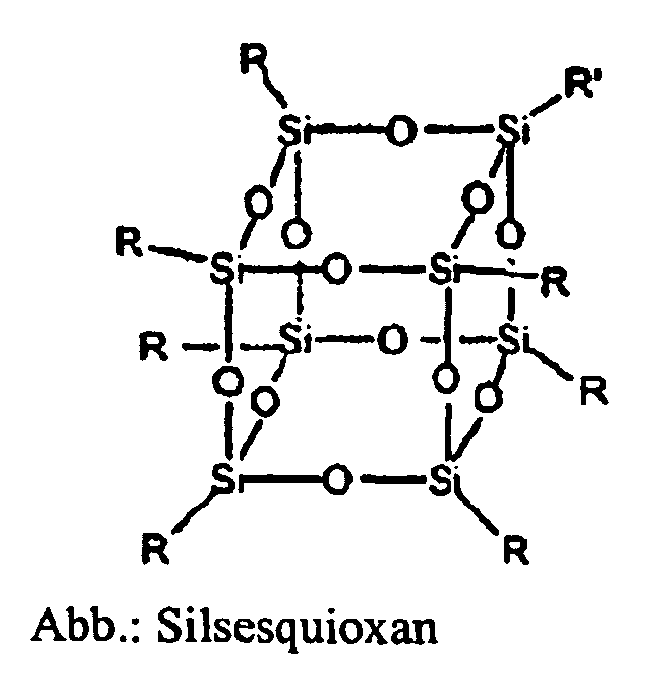
- Suitable fillers for the production of nanocomposites are those substances which can be added at any stage of the polymer production and can be finely distributed in the nanometer range. According to the invention, these are preferably minerals which already have a layer structure, such as sheet silicates, double hydroxides, such as hydrotalcite or also graphite. Also suitable are nanofillers based on silicones, silicas or silsesquioxanes (see Fig.).
- Phyllosilicates in the sense of the invention are 1: 1 and 2: 1 phyllosilicates Understood .
- layers of SiO 4 tetrahedra are regularly linked to those of M (O, OH) 6- octahedra.
- M stands for metal ions such as Al, Mg, Fe.
- 1: 1 layer silicates in each case one tetrahedral layer and one octahedral layer are connected to one another. Examples include kaolin and serpentine minerals.
- the swellable layered silicates are characterized by their ion-exchange capacity CEC (meq / g) and their layer spacing d L. Typical values for CEC are 0.7 to 0.8 meq / g.
- the layer spacing in the case of a dry untreated montmorillonite is 1 nm and increases to values of up to 5 nm by swelling with water or occupying with organic compounds.
- Examples of cations which can be used for exchange reactions are ammonium salts of primary amines having at least 6 carbon atoms, such as hexanamine, decanamine, dodecanamine, hydrogenated C 18 -talloolamines or quaternary ammonium compounds and ammonium salts of ⁇ , ⁇ -amino acids having at least 6 carbon atoms.
- Other nitrogen-containing activating reagents are triazine-based compounds. Such compounds are described, for example, in EP-A-1 074 581, reference is therefore particularly made to this document.
- Suitable anions are chlorides, sulfates or phosphates.
- sulfonium or phosphonium salts for example tetraphenyl or tetrabutylphosphonium halides.
- adhesion promoters for treating the minerals can be used according to the invention in addition to the cation exchange.
- titanates or silanes such as ⁇ -Aminoproplytriethoxysilan are.
- the hose or pipe according to the invention is two- or three-layered and can be easily produced on the conventional systems by means of coextrusion or by means of the so-called Conex process, which will be described below.
- the pipeline according to the invention may be smooth, i. without a corrugated wall.
- it has, at least in some areas, a corrugated wall, which in a particularly preferred embodiment is a spirally corrugated wall.
- the invention therefore relates in a specific embodiment, two- or three-layer polymer tubing or pipes, which have a spiral corrugated wall at least in some areas and from an outer layer 3 of a molding compound based on (co) polyamides from the group aliphatic C 6 to C 12 lactams or ⁇ -aminocarboxylic acids having 4 to 18 C atoms (a), wherein polyamide 12 is particularly preferred, and an inner layer (b), the force or form-fitting directly with the outer layer connected, ie with her liable without delamination.
- the outer layer 3 may consist of a composition based on copolyamides, which are homo- or copolymers obtainable from the polycondensation of at least one diamine from the group of aliphatic diamines having 4 to 12 carbon atoms, the cycloaliphatic diamines with 7 to 22 carbon atoms and the aromatic diamines having 6 to 22 carbon atoms in combination with at least one dicarboxylic acid from the group consisting of aliphatic dicarboxylic acids having 4 to 12 carbon atoms, cycloaliphatic dicarboxylic acids having 8 to 24 carbon atoms and aromatic dicarboxylic acids with 8 to 20 carbon atoms, which also blends of the aforementioned polymers and / or polycondensates are suitable.
- copolyamides which are homo- or copolymers obtainable from the polycondensation of at least one diamine from the group of aliphatic diamines having 4 to 12 carbon atoms, the cycloaliphatic diamines with
- the inner layer 4 is composed of a thermoplastic adhesive-modified elastomer composition (TPE) containing a thermoplastic polyolefin copolymer which may be compounded with a styrene / conjugated diene / styrene block copolymer and / or its halogenated derivatives crosslinkable rubber-elastic material from the group of olefins, acrylates or silicones and a compatibilizer from the group consisting of polyamides or adhesion-modified polyamides, obtainable from aliphatic C 6 to C 12 lactams or ⁇ -aminocarboxylic acids having 4 to 18 C atoms, polyamide 6 may be particularly preferred.
- TPE thermoplastic adhesive-modified elastomer composition
- the inner plastic layer (b) containing a modified rubber phase thermoplastic elastomer additionally contains inside a plastic layer (c) containing a modified thermoplastic rubber-phase elastomer, the molding material for this second inner layer being a thermoplastic elastomer composition such as a copolymer of a functionalized polyolefin as a main component together with a crosslinkable rubber-elastic material but without polyamide Compatibility Mediator exists.
- a thermoplastic elastomer composition such as a copolymer of a functionalized polyolefin as a main component together with a crosslinkable rubber-elastic material but without polyamide Compatibility Mediator exists.
- the above-mentioned layers 4, 5 of the hose or pipe according to the invention are resistant to cooling water, i. Resistant to hot water and ethylene glycol or derivatives of ethylene glycol and anticorrosion additives, up to at least 140 ° C.
- the rigidity and strength of the two- and three-layer pipes according to the invention can be adjusted by varying the layer thicknesses, i. the wall thickness ratio of the layers is different over the length of the conduit.
- the diameters of the lines according to the invention can vary.
- the conduits may have diameters in the range of 5 mm to 50 mm inner diameter.
- the layer thicknesses of the individual layers of the embodiments according to the invention can be adapted to the requirements, for example in terms of barrier effects, bursting pressure resistance or impact resistance, and vary between 0.5 mm and 3 mm.
- the wall thickness ratio of the layers may vary over the length of the conduit.
- the pipe according to the invention may have continuous or only partially corrugated areas and be interrupted by smooth areas 10.
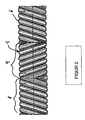
- An embodiment of the corrugated pipe according to the invention has a spirally corrugated wall, as can be seen from the attached Figures 1 and 2.
- the corrugated tube (1) according to the invention contains at least one corrugated section 2, which has at least one continuous rib or web 6, which extends along a substantially helical path S.
- the corrugated portion 2 contains in its undeformed state a number of identical waves 7, wherein the waves 7 each have the same winding angle ⁇ .
- the corrugated pipe according to the invention has a profile which is defined by a sequence of alternating mutually connected outer wave crests and troughs.
- the troughs run downwardly conically and are substantially U-shaped and have a substantially flat intermediate portion which extends along the axis A of the tube.
- the wave troughs continue to have two in the essentially flat lateral sections which converge and strike the intermediate section.
- the troughs may be V-shaped and have a rounded apex.
- areas with so-called "right-hand screws” 8 can follow one another flush with "left-hand screws” 9. Due to this special geometry, the length expansions in the hot state can be further reduced.
- the corrugated pipe according to the invention can be used as a coolant line in motor vehicles.
- corrugated pipes in particular corrugated pipes is that they can be easily welded to adjacent moldings made of plastic or metal due to the special combination of the outer and inner layer materials used, so that they are tight and pressure-resistant at the joints. Due to the spirally corrugated wall of the corrugated pipe according to the invention, the length expansion is significantly reduced as a result of temperature increase, such as in the engine compartment of a motor vehicle. With the two-layer or three-layer structure, the corrugated tubes according to the invention with the smaller length expansion can be simpler and more economical, i. be made cheaper. To further increase the strength or to reduce the expansion of the corrugated pipes according to the invention, the outer layer materials may be modified with nanoscale fillers.
- the hose or piping according to the invention can be produced in one or more stages by injection molding, coextrusion, extrusion blow molding, milling or sheathing processes. Furthermore, it is possible to produce the hose or pipes by means of the so-called Conex method. It is a coextrustion, whereby the individual layers are applied to one another as in a winding process. WO 97/28949 describes this process. The Conex process achieves alignment of the individual layers, comparable to a film stretching effect.
- corrugated pipes according to the invention are therefore, as mentioned, particularly suitable as coolant lines in motor vehicles.
- they are particularly suitable for use as a ventilation and vent line and as a gasoline line or parts of fuel lines in motor vehicles.
- the spirally corrugated two-layer polymer pipe 1 shown in FIG. 1 has a corrugated wall in the regions 2.
- the pipeline 1 is interrupted by smooth areas 10.
- the corrugated tube 1 according to the invention consists of an outer polyamide 12 layer 3 and an inner layer 4 of a thermoplastic elastomer, which is sold under the trade name "Santoprene 191-55 PA".
- the product Santoprene 191-85 PA is used.
- the latter product differs from Santoprene 191-55 PA only in that it has a Shore A hardness of 85 (see Table 2).
- the according to the invention two-layer corrugated pipe is dimensionally stable not only against high and low temperatures, diffusion-proof and pressure-resistant, but also resistant to aggressive chemicals inside and outside.
- a second inner layer 5 of modified thermoplastic elastomer with rubber phase may be present (see FIG.
- the pipe 1 has an axis A and has a central corrugated portion 2 and three smooth lateral portions 10.
- the corrugated portion 2 has at least five identical continuous ribs extending along a substantially helical path.
- the corrugated portion 2 has a number of identical waves, each with the same angle ⁇ .
- the produced corrugated tube shown in Figure 1 has, for example, an outer layer of a Polyamide 12 with the following properties listed in Table 1 (below).
- the polyamide 12 material had a carboxy to amino endgroup ratio of about 0.3.
- the polyamide 12 material is marketed by Ems-Grivory, Domat / Ems, Switzerland, under the name Grilamid L 25 AH.
- the corrugated pipe according to the invention has an inner layer of a thermoplastic rubber material with the trade name "Santoprene 191-55 PA" (manufacturer Advanced Elastomer Systems).
- As an alternative to the previously described polyamide 12 material it is possible to use a polyamide 12 material which has been modified with nanocomposites, ie, with phyllosilicates (see Table 1: "PA12 nanocomposites”).
- the phyllosilicates are sodium montmorillonite treated with 30 meq / 100 g of mineral methyl-talloil-bis-2-hydroxyethylammonium chloride.
- the nanocomposite molding compositions were prepared on a 30 mm twin-screw extruder ZSK 25 from Werner and Pfleiderer at temperatures between 240 and 280 ° C.
- the polymer was metered into the intake of the extruder and the mineral into the intake area of the extruder or the melt.
- the addition of modified phyllosilicate was 6% by weight.
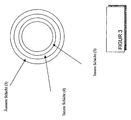
- FIG. 3 shows a cross section through a three-layered tube according to the invention.
- the tube comprises an outer layer 3 of amino terminal excess polyamide 12 and an inner layer of a thermoplastic elastomer sold under the trade name Santoprene® 191-55 PA. This is followed by a layer further inside, which also consists of Santoprene®, but without polyamide 6 adhesion promoter.
Landscapes
- Engineering & Computer Science (AREA)
- General Engineering & Computer Science (AREA)
- Mechanical Engineering (AREA)
- Chemical & Material Sciences (AREA)
- Health & Medical Sciences (AREA)
- Chemical Kinetics & Catalysis (AREA)
- Medicinal Chemistry (AREA)
- Polymers & Plastics (AREA)
- Organic Chemistry (AREA)
- Laminated Bodies (AREA)
- Rigid Pipes And Flexible Pipes (AREA)
- Compositions Of Macromolecular Compounds (AREA)
Description
- Die vorliegende Erfindung betrifft zwei- oder dreischichtige Polymer-Schlauch- oder Rohrleitungen für den Einsatz als druckbeaufschlagte Fluidleitungen in Kraftfahrzeugen. Die erfindungsgemäßen Fluidleitungen können glatt ausgebildet sein; alternativ weisen sie durchgehend oder zumindest teilweise gewellte Wandungen auf, wobei erfindungsgemäß besonders bevorzugt spiralförmig gewellte Wandungen sind. Die erfindungsgemäße Rohrleitung weist eine äußere Schicht aus einer Formmasse aus einem härteren Polymer oder einer Polymer-Mischung und eine innere Schicht aus einem kautschukelastischen Polymer oder einer Polymer-Mischung auf. Zusätzlich kann die innere Schicht innen mit einer Schicht aus einer thermoplastischen, haftungsmodifizierten Elastomer-Zusammensetzung versehen sein. Erfindungsgemäß wird somit ein Material für die Schichten ausgewählt, welches im fertigen Verbund eine sogenannte "Hart-Weich-Kombination" ergibt. Die kautschukelastische PolymerZusammensetzung oder Polymer-Mischung weist eine Härte im Bereich von etwa 30 Shore A bis 60 Shore D, insbesondere von etwa 30 Shore A bis 90 Shore A, die erfindungsgemäße Schlauch- oder Rohrleitung werden so ausgewählt, dass sie sich durch Coextrusion bzw. durch die sogenannten Conex-Verfahren verarbeiten lassen und dadurch kraft- oder formschlüssig, d.h. ohne zusätzliche Haftvermittler, direkt aufeinander haften, ohne zu delaminieren.
- Besonders bevorzugte Anwendungen der erfindungsgemäßen Rohre liegen im Automobilbereich zur Realisierung von Flüssigkeitsleitungen, Luftführungsteilen oder auch von Kraftstoffleitungen.
- Üblicherweise werden heutzutage Luftführungteile und Flüssigkeitsleitungen, wie zum Beispiel Kühlflüssigkeitsleitungen, immer noch aus textilarmierten Gummirohren und Gummischläuchen gefertigt. Rohre und Schläuche aus thermoplastischen Kunststoffen bieten demgegenüber eine erhebliche Kosten- und Gewichtseinsparung und besitzen darüber hinaus ein verbessertes Recycling-Potential. Bei dieser Materialsubstitution wird von den thermoplastischen Rohren eine vergleichbare Biegeflexibilität wie bei Gummirohren verlangt.
- Die höhere Materialsteifigkeit der relevanten Thermoplaste kann insbesondere durch eine gewellte Struktur der Rohrmantelfläche kompensiert werden. Diese als Wellrohr bekannte Geometrie ist in verschiedenen Ausführungsformen bekannt. Die damit erreichte Biegeflexibilität verschlechtert aber die Zugsteifigkeit, d.h. bei einer Zugbelastung muß eine größere Längendehnung des Rohres hingenommen werden.
- Aus DE 44 32 584 C1 (Ems-Inventa AG) ist ein Wellrohr bekannt, bei dem sich die Wellungen über alle radialen Winkelbereiche in Längsrichtung erstrecken. Weitere bekannte Wellrohre sind in EP 0 671 582 A1, DE 43 21 575 C1 sowie in GB 12 09 569 beschrieben. Diese bekannten Ausführungsformen weisen Außenkonturen auf, die für eine Wellenlinie in allen radialen Winkelbereichen auf der Rohrmantelfläche sorgen.
- Aus der GB 12 20 975 ist eine Wellrohr bekannt, das Wellungen aufweist, die in einander gegenüberliegenden Bereichen wellungsfrei ausgebildet sind.
- EP 863 351 B1 (Ems-Inventa AG) beschreibt demgegenüber ein druckbeaufschlagbares, einlumiges Wellrohr mit hoher Biegeflexibilität und hoher Berstdruckfestigkeit, welches keine zusätzlichen Verstärkungsmittel erfordert und bei Druckbeaufschlagung eine geringe Längendehnung aufweist. Die Außenkonturen des in EP 863 351 B1 beschriebenen Wellrohres sind so ausgebildet, dass in zwei einander ungefähr gegenüberliegenden Bereichen auf der Rohrmantelfläche auf eine Wellung des Rohres vollkommen verzichtet wird. Die Bereiche ohne Wellung sind in Längsrichtung fortlaufend und können im Prinzip die Form einer beliebigen Kurve haben. Bevorzugt sind sie ununterbrochen gerade, schraubenförmig oder abschnittsweise gerade in wechselnden Winkelpositionen angeordnet.
- Allerdings ist die in EP 863 351 B1 beschriebene Geometrie sehr aufwendig und daher werden heutzutage sehr viele Wellrohre mit einem konventionellen, symmetrischen, kreisrunden Wellrohrprofil hergestellt.
- Die Herstellung der zuvor beschriebenen Polymer-Schlauch- oder Rohrleitungen erfolgen durch Coextrusion eines Polymer-Rohres oder durch das sogenannte Conex-Verfahren und anschließender Ausbildung der Wellungen durch Blas- oder Saugformen. Alternativ sind diese Leitungen durch Coextrusions-Blasformen herstellbar. Die Herstellung geschieht in Prinizip als ein kontinuierliches Hohlkörperblasen. Der zylindrische Teil des Rohrwerkzeuges ragt bis in den geschlossenen Bereich einer umlaufenden Formkette. Durch den inneren Überdruck oder durch ein Vakuum wird der plastische Schlauch gegen die profilierten umlaufenden Formbacken gepreßt, so dass das gewünschte Wellrohrprofil erzielt wird. Bei dem weiteren Durchlauf bis zum Öffnen des Formschlusses muß der plastische Schlauch so weit abgekühlt sein, dass er formstabil die umlaufenden Formbacken verläßt. Eine Vorrichtung zur Herstellung von Kunststoffrohren, deren gewellte Abschnitte spiralförmig sind, ist zum Beispiel in EP 368 096 A1 (Lupke) beschrieben.
- EP 754 898 B1 (Ems-Inventa AG) beschreibt eine (glatte) dreischichtige, flexible Kühlflüssigkeitsleitung mit hoher Hydrolyse- und Berstdruckfestigkeit, die aus einer äußeren Schicht aus Polyamid 12, im folgenden auch als PA12 bezeichnet, einer Innenschicht aus vernetztem HDPE und einer Zwischenschicht aus maleinsäureanhydrid-gepfropftem HDPE besteht. Die angesprochene Zwischenschicht dient ausschließlich dem Zweck der Haftvermittlung, so dass keine Delaminierung der Schichten eintritt.
- US 5,191,916-A beschreibt Rohre mit Spiralgeometrie, deren Wendeln mit Metalleinlagen verstärkt sind. Diese Verstärkung ist für frei verlegte unterirdische Leitungen notwendig, um diese gegen eine hohen äußeren und inneren Druck auszustatten.
- WO 97/39270 (Valeo) beschreibt eine mehrschichtige Kunststoffleitung für Fluide mit einer Polyamid-Außenschicht, einer inneren Schicht aus Polyethylen und einer dazwischen liegenden Haftvermittlerschicht, um ein Delaminieren des Mehrschichtverbundes zu verhindern. Die in WO 97/39270 beschriebene Leitung weist eine durchgehend gewellte Wandung und zwar eine spiralförmig-gewellte Wandung auf. Die Wendeln an der Außenseite sind dabei breiter als die innen liegenden. Weiterhin sind die Wendeln an der Außenseite abgeflacht.
- EP 486 962 A1 beschreibt ein Wellrohr mit Spiralgeometrie, das an den Enden an der Außenseite mit Gewinden versehen ist und an der Innenseite zu den Enden hin konisch erweitert ist. Gegenstand der EP 486 962 ist daher eine flexible Hülse zum Einsatz im Kabelschutzbereich, um das Durchschieben von Kabeln besser gewährleisten zu können.
- EP 574 449 A1 beschreibt ein Wellrohr mit Wellung in Längs- und Querrichtung zur Rohrachse, wobei die letzteren auch spiralförmig sein können. Besonderes Merkmal der EP 574 449 A1 ist, dass die Dicke der gewellten Wandung an der Innenseite, d.h. am inneren Bogen reduziert ist. Dadurch wird eine engerer Biegeradius bei schonender Materialbeanspruchung erreicht, wobei Steifigkeit und Druckfestigkeit erhalten bleiben. Diese Konstruktion löst allerdings nicht das Problem, die Längenausdehnung im heißen Zustand zu reduzieren.
- EP 671 582 B1 (Ems-Inventa AG) beschreibt Kühlflüssigkeitsleitungen aus mehreren Polymerschichten mit an den Berührungsflächen der Schichten miteinander verträglichen Polymeren, wobei einzelne benachbarte Wellungen eines gewellten Teilstücks durch mindestens einen Steg an der Innenkontur der Wellungen miteinander verbunden sind und die Stege durch eine sickenartige Verformung der Rohrwand gebildet werden und wobei aufeinanderfolgende Stege in Längsrichtung der Leitung fortlaufend um einen definierten Winkel versetzt sind und die Stege parallel zur Längsachse der Leitung ausgerichtet sind. Diese Konstruktion löst ebenfalls nicht das Problem, die Längenausdehnung im heißen Zustand zu reduzieren.
- DE 43 21 575 C1 (Rasmussen) beschreibt ein Wellrohr aus thermoplastischem Kunststoff oder einem thermoplastischen Elastomer, bei dem die Wellungen derart exzentrisch ausgebildet sind, dass die Innenseite des Wandteils frei von Wellungen ist und es an jeder Stelle einen kreiszylindrischen Querschnitt aufweist. Auf diese Weise soll verhindert werden, dass sich Flüssigkeiten im Wellrohr in unteren Abschnitten der Wellentäler ansammeln. Diese Konstruktion ist in der Herstellung sehr teuer und löst ebenfalls nicht das Problem, die Längenausdehnung in heißem Zustand zu reduzieren.
- DE 44 28 236 C1 (Rasmussen) beschreibt ein dreischichtiges Wellrohr, das als Kühlwasserschlauch in Kraftfahrzeugen verwendet werden soll. Die innere Schicht der Mehrschicht-Rohrleitung gemäß DE 44 28 236 C1 besteht aus einer Kunststoffschicht, die ein modifiziertes thermoplastisches Elastomer mit voll vernetzter Kautschukphase enthält. Daran schließt sich eine Schicht aus Polyamid und eine weitere Schicht aus einem thermoplastischen Elastomer an, die ein Copolymer eines funktionalisierten Polyolefins als Hauptbestandteil und ein Polyamid als Verträglichkeitsvermittler enthält. Hinsichtlich der Auswahl des Polyamidmaterials werden jedoch keinerlei Angaben gemacht und der Fachmann weiß, dass je nach Auswahl des Polyamidmaterials keine stoffschlüssige Verbindung zwischen den Schichten vorliegt, da Unverträglichkeiten bei zum Beispiel Polyamid 6 mit Polyamid 12 auftreten. Die in DE 44 28 336 C1 beschriebenen Rohre lösen ebenfalls nicht das Problem, die Längenausdehnung im heißen Zustand zu reduzieren.
- EP 0 656 388 A1 (Elf Atochem) beschreibt eine Zusammensetzung, die ein thermoplastisches Elastomer enthält, das wenigstens ein funktionalisiertes Elastomer und wenigstens ein Copolymer aus Polyether- oder amorphen Polyesterblöcken enthält. Weiterhin kann das Copolymer Polyamid-, Polyester- oder Polyurethanblöcke enthalten. Die Zusammensetzung kann auf eine Polyamid-Außenschicht eines Rohrs aufgebracht werden.
- FR 28 02 274 (Nobel Plastiques) beschreibt eine Kühlflüssigkeitsleitung für den Automobilsektor, gebildet aus einer Schicht aus thermoplastischen Elastomermaterial und einer thermoplastischen Schicht aus einem Blend aus Polyamid und Polypropylen. Zusätzlich ist eine äußere Schutzschicht aus schlagzähmodifiziertem Polyamid vorgesehen, die die Schicht aus dem Polyamid-Polypropylen-Blend umgibt. Die Schutzschicht besteht aus schlagzähmodifiziertem Polyamid.
- Der vorliegenden Erfindung liegt daher die Aufgabe zugrunde, eine mehrschichtige Polymer-Schlauch- oder Rohrleitung, insbesondere mit einer speziellen Rohrgeometrie anzugeben, die einfach herstellbar ist, den Vorteil der geringeren Längenausdehnung und durch die verwendete Kombination der Außen- und Innenschichtmaterialen auf einfache Weise auf angrenzende Formkörper aus Kunststoff oder Metall angeschweißt werden kann, so dass sie an den Verbindungsstellen dicht und druckfest ist. Weiterhin sollen zur Erhöhung der Festigkeit sowie zur Verminderung der Ausdehnung der Schlauch- oder Rohrleitung in Verarbeitungsrichtung die Außenschichtmaterialien (Polyamide mit Additiven) modifiziert werden.
- Diese Aufgabe wird durch die Schlauch- oder Rohrleitung gemäß Anspruch 1 gelöst. In den Unteransprüchen sind vorteilhafte Ausführungsformen der Erfindung enthalten.
- Die Erfindung betrifft daher eine Polymer-Schlauch- oder Rohrleitung, welche eine äußere Schicht aus einer Formmasse aus einem härteren Polymer oder einer härteren Polymermischung und eine innere Schicht aus einem kautschukelastischen Polymer oder einer kautschukelastischen Polymermischung aufweist. Zusätzlich kann die innere Schicht innen mit einer weiteren "weichen" Schicht aus einer thermoplastischen, haftungsmodifizierten Elastomerzusammensetzung versehen sein. Erfindungsgemäß wird somit eine Materialauswahl für die Schichten getroffen, welche im fertigen Verbund eine sogenannte "Hart-Weich-Kombination" ergibt. Die im Vergleich zur Außenschicht weich eingestellte innere Schicht bzw. die inneren Schichten weisen eine Härte der Ausgangspolymer-Zusammensetzungen oder Mischungen im Bereich von etwa 30 Shore A bis 60 Shore D, insbesondere von 30 Shore A bis 90 Shore A (jeweils nach ISO 868) auf.
- Erfindungsgemäß besteht die äußere Schicht der Polymer-Schlauch- oder Rohrleitung aus einer Formmasse auf Basis von (Co)Polyamiden aus Polymerisaten aus aliphatischen C6 bis C12-Laktamen oder ω-Aminocarbonsäuren mit vier bis 18 Kohlenstoffatomen, wobei Polyamid 12 oder Blends, die überwiegend Polyamid 12 enthalten, besonderes bevorzugt ist. Alternativ können erfindungsgemäß als (Co)Polyamide Homo- oder Copolymere eingesetzt werden, die erhältlich sind aus der Polykondensation von mindestens einem Diamin aus der Gruppe der aliphathischen Diamine mit 4 bis 12 C-Atomen, der cycloaliphatischen Diamine mit 7 bis 22 C-Atomen und der aromatischen Diamine mit 6 bis 22 C-Atomen in Kombination mit mindestens einer Dicarbonsäure aus der Gruppe aus aliphatischen Dicarbonsäuren mit 4 bis 12 C-Atomen, cycloaliphatischen Dicarbonsäuren mit 8 bis 24 C-Atomen und aromatischen Dicarbonsäuren mit 8 bis 20 C-Atomen, wobei ebenfalls Blends der vorgenannten Polymerisate und/oder Polykondensate geeignet sind.
- Die innere Schicht 4 bzw. die inneren Schichten 4, 5 der erfindungsgemäßen Schlauch- oder Rohrleitung bestehen aus einer Formmasse aus thermoplastischen, haftungsmodifizierten Elastomeren mit einer vernetzbaren Kautschukphase. Die thermoplastischen Elastomere (TPE) werden ausgewählt aus der Gruppe der TPE-Materialien, die aus Polyolefin-Elastomeren (1), d.h. der sogenannten Santoprene-Typen, die ein thermoplastisches Polyolefin-Copolymer, insbesondere Polypropylen, welches mit einem Block-Copolymer aus Styrol/konjugiertem Dien/Styrol und/oder seinen halogenierten Derivaten hergestellt ist, kompoundiert sein kann, mindestens ein funktionalisiertes, vernetzbares kautschukelastisches Material aus der Gruppe der olefinischen Kautschuke, die unvernetzt, teil- oder vollvernetzt sein können, der Acrylate und der Silikone, und einen Polyamid-Verträglichkeitsvermittler, enthalten, der TPE-Materialien des Typs von dynamisch vulkanisierten Gummis in einer Polymermatrix (2), der thermoplastischen Polystyrol-Elastomeren (TPE-S) oder Styrol-Copolymer-Elastomer-Compounds (3), der thermoplastischen Chlor-Elastomeren (4), der Polyesterelastomere (5), der Polyamidelastomere (6), der thermoplastischen Elastomere auf Fluorbasis (7), der thermoplastischen Polyurethan-Elastomere (8) besteht (vergleiche Patentanspruch 1).
- Die thermoplastische, haftungsmodifizierte Elastomer-Zusammensetzung für die innere Schicht 4 kann im Falle von TPE-Materialien des Santoprene Typs (1), im Gegensatz zu der Formmasse für die zusätzliche innere Schicht 5, einen Zusatz eines Haftvermittlers aus der Gruppe der (Co)Polyamide, und insbesondere einen Zusatz von Polyamid 6 aufweisen, falls die Außenschicht aus Polyamid 12 besteht. Der für die TPE-Materialien des Santoprene-Typs eingesetzte Verträglichkeitsvermittler ist daher erfindungsgemäß ein Polyamid-Verträglichkeitsvermittler aus der Gruppe der (Co)Polyamide oder haftungsmodifizierten (Co)Polyamide oder Gemischen daraus, wobei die (Co)Polyamide Polymerisate sind aus aliphatischen C6 bis C12-Laktamen oder ω-Aminocarbonsäuren mit 4 bis 18 Kohlenstoffatomen, wobei Polyamid 6 besonders bevorzugt ist, oder Homo- oder Copolymere sind, erhältlich aus der Polykondensation von mindestens einem Diamin aus der Gruppe der aliphathischen Diamine mit 4 bis 12 C-Atomen, der cycloaliphatischen Diamine mit 7 bis 22 C-Atomen und der aromatischen Diamine mit 6 bis 22 C-Atomen in Kombination mit mindestens einer Dicarbonsäure aus der Gruppe aus aliphatischen Dicarbonsäuren mit 4 bis 12 C-Atomen, cycloaliphatischen Dicarbonsäuren mit 8 bis 24 C-Atomen und aromatischen Dicarbonsäuren mit 8 bis 20 C-Atomen, wobei ebenfalls Blends der vorgenannten Polymerisate und/oder Polykondensate geeignet sind.
- Die TPE-Materialien des Typs aus dynamisch vulkanisierten Kautschuken (2), des Typs aus thermoplastischen Polystyrolelastomeren (TPE-S) oder modifizierten Styrol-Olefin-Elastomeren oder Styrol-Olefinelastomer-Compounds (3), des Typs aus thermoplastischen Chlorelastomeren (4), des Typs aus thermoplastischen Polyesterelastomeren (5), des Typs aus thermoplastischen Polyamidelastomeren (6), des Typs aus thermoplastischen Fluorelastomeren (7) und des Typs aus thermoplastischem Polyurethanelastomeren (8) können entweder selbst derart modifiziert sein, d.h. beispielsweise durch Pfropfen mit Maleinsäureanhydrid oder durch Reaktion mit Epoxiden, dass sie haftungsmodifiziert sind und somit den Zusatz eines Verträglichkeitsvermittlers überflüssig machen. Die TPE-Materialien (2) bis (8) können aber auch gegebenenfalls, d.h. je nach Typ des Elastomers, einen Zusatz eines Polyamids oder haftungsmodifizierten Polyamids enthalten, wobei der Polyamid-Verträglichkeitsvermittler demjenigen entspricht, der für die Santoprene-Typ-Materialien (1) eingesetzt wird. Weiterhin können die Elastomerzusammensetzungen des Typs (2) bis (8) Nicht-Polyamid-Verträglichkeitsvermittler enthalten. Dies sind beispielsweise
- Polyethylen, Polypropylen, die Ethylen/Propylen-Copolymeren, die Ethylen/Buten-Copolymeren, wobei alle diese Produkte mit Maleinsäureanhydrid oder Glycidylmethacrylat gepfropft sind,
- die Copoplymeren von Ethylen/Alkyl(meth)acrylat/Maleinsäureanhydrid, wobei das Maleinsäureanhydrid gepfropft oder copolymerisiert sein kann,
- die Copolymeren von Ethylen/Vinylacetat/Maleinsäureanhydrid, wobei das Maleinsäureanhydrid gepfropft oder copolymerisiert sein kann,
- die beiden vorhergehenden Copolymeren, in denen Maleinsäureanhydrid durch Glycidylmethacrylat ersetzt ist,
- die Copolymeren von Ethylen/(Meth)acrylsäure und eventuell deren Salzen,
- Polyethylen, Polypropylen, die Ethylen/Propylen-Copolymeren, wobei diese Polymeren durch ein Produkt gepfropft sind, das eine reaktive Stelle für Amine bietet; diese gepfropften Copolymeren werden danach mit Polyamiden kondensiert oder die Oligomeren besitzen eine einzige Amino-Endgruppe.
- Diese Produkte sind in FR 22 91 225 und EP 342 066 A1 beschrieben.
- Die Menge an Verträglichkeitsvermittler ist diejenige Menge, die ausreicht, damit das jeweilige Elastomere sich in Form von Teilchen in der Matrix dispergieren kann. Sie kann bis zu 30 Gew.-% des Polyolefins betragen. Durch Verwendung der beschriebenen Verträglichkeitsvermittler kann somit die Haftung der erfindungsgemäßen TPE's zu anderen Polymeren, Copolymeren oder Blends, wie sie beispielsweise in der Außenschicht der hier beschriebenen Wellrohre vorhanden sind, verstärkt werden. Die Verträglichkeitsvermittler können, wie bereits oben beschrieben wurde, Anteile von anderen Polymeren, d.h. hier von Polyamid 6 oder 12, zu denen die Haftung angestrebt wird, sein. Ist das thermoplastische Polyolefin ein Polypropylen, so fügt man einen Verträglichmacher zu, der vorteilhaft ein Copolymer aus Ethylen mit Propylen mit einer überwiegenden Zahl an Einheiten des Propylens ist, das mit Maleinsäureanhydrid gepfropft und sodann mit Monoamino-Oligomeren des Caprolaktams kondensiert ist.
- Der Polyamid-Haftvermittler kann in einer besonders bevorzugten Ausführungsform aus einem funktionalisiertem Polyamid bestehen, d.h. das Polyamid kann selbst mit funktionalisierten Gruppen versehen sein oder mit einem funktionalisierten Polyolefin umgesetzt worden sein, d.h. entweder mittels Schmelzevermischung oder in einem Dryblend umgesetzt worden sein. Diese Modifizierungsmaßnahmen sind dem Fachmann zum Beispiel aus EP 753 027 B1 bekannt.
- Die oben erwähnten, erfindungsgemäß eingesetzten thermoplastischen, haftungsmodifizierten Elastomer-Zusammensetzungen (TPE) gehören einer besonderen Gattung von thermoplastischen Elastomeren an, die man insbesondere durch Verfahren der dynamischen Vulkanisation von kautschukelastischen Komponenten, wie vernetzbaren Polyolefinen oder Silikonen erhält, welche in Form von feinen Partikeln in einem thermoplastischen Grundmaterial (Polyolefine) dispergiert sind. Solche thermoplastischen Elastomere, auch TPE's genannt, sind zum Beispiel Polymere und Copolymere auf Basis von ungesättigten Olefinen wie zum Beispiel Butadien, Isopren etc. oder auch von Acrylaten oder Silikonen oder auch Copolymeren oder Polymermischungen.
- Erfindungsgemäß wird als Polyolefin-Bestandteil der TPE'S ein Copolymer eines C2 bis C7-Monomers oder Copolymers mit (Meth-)Acrylaten und/oder Vinylacetaten eingesetzt. Ein bevorzugtes Copolymer ist ein Copolymer aus Ethylen mit (Meth-)acrylaten und /oder Vinylacetaten.
- Besonders bevorzugt ist als Polyolefin Polypropylen, welches Copolymere von Polypropylen umfaßt, welches 1 bis 20 Gew.-% Ethylen oder eines α-Olefincomonomers mit 4 bis 16 C-Atomen und Gemischen davon umfaßt. Das Polypropylen kann hochkristallines isotaktisches oder syndiotaktisches Polypropylen sein. Die Menge an Polyolefin, d.h. insbesondere von Polypropylen in der thermoplastischen Elastomer-Zusammensetzung (TPE) kann 8 bis 90 Gew.-% und insbesondere 10 bis 60 Gew.-% betragen.
- Unter den oben genannten thermoplastischen Elastomeren, auch TPE's genannt, sind thermoplastische Vulkanisate bevorzugt. Solche thermoplastischen Vulkanisate sind thermoplastische Elastomerblends auf Basis von Polyamiden, Polyestern, Polystyrolen oder Polyuretanen. Die kautschukelastische Komponente sind in der Regel vernetzbare Polyolefine oder Silikone.
- Besonderes bevorzugt handelt es sich bei den kautschukelastischen Materialien um solche aus der Gruppe, ausgewählt aus EPDM, EPM, Butylkautschuk, halogenierter Butylkautschuk, Copolymere von Isomonoolefin und para-Alkylstyrol oder seiner halogenierten Derivate, natürliche und synthetische Kautschuke, Polyisopren-, Polybutadienkautschuk, Styrol-Butadien-Copolymer-Kautschuke, Nitrilkautschuke, Polychlorprenkautschuke und Gemischen davon.
- Die Vernetzung der thermoplastischen Vulkanisate erfolgt während des Misch-und Kompoundierprozesses. Die thermoplastischen Vulkanisate sind verarbeitbar wie Thermoplaste, nehmen aber eine Zwischenstellung zwischen TPE's und herkömmlichen Vulkanisaten ein.
- Besonders bevorzugt sind erfindungsgemäß thermoplastische Elastomer-Zusammensetzungen (1) (TPE's), die Polyamidanteile, d.h. in Mengen von 3 bis 30 Gew.-%, insbesondere 10 Gew.-%, d.h. Polyamid 6-Anteile enthalten. Solche Formmassen werden allerdings nur für die innere Schicht (4) eingesetzt. Die innen zu der Schicht (4) angeordnete Schicht (5) enthält dagegen keine Polyamidanteile.
- Kautschukelastische Polymerblends des sogenannten Santoprene-Typs sind zum Beispiel in US 6,005,052, US 6,020,431 und EP 0 753 0 27 B1 (Advanced Elastomer Systems) beschrieben. Im Handel sind auch entsprechende Santoprene®-Typen erhältlich, beispielsweise sei hier Santoprene®-191-55PA oder Santoprene 191®-85PA genannt.
- Weiterhin seien als Beispiel für dynamisch vulkanisierte Gummis in Polymermatrix die Handelsprodukte Geolast® (Advanced Elastomer Systems), ein Polypropylen/NBR sowie weiterhin Adflex® (Montell), ein thermoplastisches Polyolefinelastomer mit der Struktur ataktisches Polypropylen/isotaktisches Polypropylen, genannt. Als Beispiele für thermoplastische Styrol-Copolymer-Elastomer-Compounds seien die Handelsprodukte Thermolast® K (Kraiburg -Shell) ein Polypropylen/SEBS, Thermoflex® (PTS), ein Polypropylen/SEPS genannt. Als weitere Materialgruppen für die TPE-Materialien sind auch thermoplastische Chlor- und Fluor-Elastomere anzusehen. Hier sind die Handelsprodukte Alcryn® (DuPont), ein PVDC/EVA (EVA ist teilvernetzt) erhältlich. Bei den thermoplastischen Fluor-Elastomeren sind auf dem Markt zum Beispiel THV (3M/Hoechst), ein PTFE-HFP-PVDF-Compound, erhältlich. Als weitere Gruppe von geeigneten Elastomeren sind die Polyester-Elastomere zu nennen. Hier sind beispielsweise die Handelsprodukte Hytrel® (DuPont) ein PBT + Ethylenglycol-Polyesterelastomer zu nennen. Weiterhin sind erfindungsgemäß geeignet Polyamid-Elastomere. Hierbei handelt es sich um Polyetheresteramide, die sich beispielsweise von Polyamid 12 ableiten. Wie der Name sagt, sind die thermoplastischen Bausteine Polyamid-Sequenzen, die elastomeren Bausteine Polyethersequenzen. Diese Blöcke sind entweder über Ester- oder Amidgruppen miteinander verknüpft. Es handelt sich also um sogenannte segmentierte Blockcopolymere, die Eigenschaften von Elastomeren und Thermoplasten miteinander vereinen. Im Handel sind entsprechende Produkte erhältlich wie zum Beispiel Grilon® ELX (Ems), Grilamid® ELY (Ems), Pebax® (Atofina).
- Weiterhin sind erfindungsgemäß geeignete Elastomere thermoplastische Polyuretanelastomere. Hier sind zum Beispiel als Handelsprodukt Desmopan® (Bayer) im Handel.
- Als erfindungsgemäß einsetzbare TPE-Materialien sind weiterhin thermoplastische Polyurethan-Elastomere (TPE-U) mit einer Härte im Bereich von Shore A 65 bis Shore D 75 einsetzbar.
- Erwähnenswert sind weiterhin thermoplastische Polystyrol-Elastomere (TPE-S), insbesondere Styrol-Olefin-Blockcopolymere. Diese thermoplastische Polystyrol-Elastomere können modifizierte Styrol-Olefin-Elastomer-Compounds sein, auf der Grundlage der zuvor erwähnten thermoplastischen Styrol-Olefin-Elastomere. Im allgemeinen erhalten diese Compounds 20 bis 85 Gew.-% mit Maleinsäureanhydrid funktionalisierten oder nicht funktionalisierten hochmolekularen Triblockcopolymeren, die aus steifen Styrol-Endblöcken und flexiblen Olefin-Mittelblöcken aufgebaut sind, und 15 bis 70 Gew.-% nicht olefinisches Thermoplastmaterial (derartige TPE-S sind in DE 198 45 235 beschrieben).
- Als weitere Gruppe von erfindungsgemäß geeigneten Elastomeren sind Kern-Schale-Pfropfkautschuke zu nennen. Hierbei handelt es sich um in Emulsion hergestellte Pfropfkautschuke, die aus mindestens einem harten und einem weichen Bestandteil bestehen. Unter einem harten Bestandteil versteht man üblicherweise ein Polymerisat mit einer Glastemperatur von mindestens 25°C und unter einem weichen Bestandteil ein Polymerisat mit einer Glastemperatur von höchstens 0°C. Diese Produkte weisen eine Struktur aus einem Kern und mindestens einer Schale auf, wobei sich die Struktur durch die Reihenfolge der Monomerzugabe ergibt. Die weichen Bestandteile leiten sich unter anderem von Butadien, Isopren, Alkylacrylaten oder Alkylmethacrylaten und gegebenenfalls weiteren Comonomeren ab. Als geeignete Comonomere sind hier zum Beispiel Styrol, Acrylnitril und vernetzende oder pfropfaktive Monomere mit mehr als einer polymerisierbaren Doppelbindung wie Diallylphtalat, Divinylbenzol, Butandioldiacrylat oder Triallyl(iso)cyanurat zu nennen. Die harten Bestandteile leiten sich unter anderem von Styrol, a-Methylstyrol und anderen Copolymerisaten ab, wobei hier als Comonomere vorzugsweise Acrylnitril, Methacrylnitril und Methylmethacrylat aufzuführen sind.
- TPE's auf Basis von Polyestern und/oder Polycarbonat mit vernetzbaren Silikonen sind beispielsweise in WO 01/18116 (Dow) beschrieben.
- Erfindungsgemäß wird daher ein zweischichtiges bzw. dreischichtig aufgebautes Rohr, insbesondere mit spiralförmiger Wellung bereitgestellt, das hinsichtlich der Materialauswahl eine "Hart-Weich-Kombination" ist, wobei die äußere Schicht 3 aus (Co)Polyamiden, insbesondere aus Polyamid 12 oder einer Polymermischung mit Polyamid 12 besteht, und die innere Schicht aus einem kautschukelastischen Polymer oder einer Polymermischung besteht. Die inneren Schichten 4, 5 weisen im Vergleich zur äußeren härteren Schicht eine Shore-Härte im Bereich von 30 Shore A bis 90 Shore A auf.
- Berstdruckfeste Materialien für die Außenschicht sind bekanntermaßen Polyamide. Erfindungsgemäß werden aber (Co)Polyamide ausgewählt, die erhältlich sind aus Polymerisaten aus aliphatischen C6 bis C12-Laktamen oder ω-Aminocarbonsäuren mit 4 bis 18 C-Atomen. In einer alternativen Ausführungsform werden Polyamide ausgewählt, die Homo- oder Copolymere sind, erhältlich aus der Polykondensation von mindestens einem Diamin aus der Gruppe der aliphathischen Diamine mit 4 bis 12 C-Atomen, der cycloaliphatischen Diamine mit 7 bis 22 C-Atomen und der aromatischen Diamine mit 6 bis 22 C-Atomen in Kombination mit mindestens einer Dicarbonsäure aus der Gruppe aus aliphatischen Dicarbonsäuren mit 4 bis 12 C-Atomen, cycloaliphatischen Dicarbonsäuren mit 8 bis 24 C-Atomen und aromatischen Dicarbonsäuren mit 8 bis 20 C-Atomen, wobei ebenfalls Blends der vorgenannten Polymerisate und/oder Polykondensate geeignet sind.
- Ganz besonders bevorzugt wird PA 12 ausgewählt. Hierbei sind wiederum Polyamid 12-Materialien erfindungsgemäß besonders bevorzugt, die einen Überschuß an Aminoendgruppen gegenüber Caboxylendgruppen aufweisen. Die erfindungsgemäß eingesetzten Polyamid 12-Materialien mit einem Überschuß an Aminoendgruppen, d.h. mit einem Carboxy- zu Aminoendgruppenverhältnis von etwa 0,3, sind gegenüber Polyamid 12-Matrialien mit ausgeglichenem Endgruppenverhältnissen, d.h. einem Carboxy- zu Aminoendgruppenverhältnis von etwa 1,0 oder einem Überschuß an Säureendgruppen stabiler gegenüber hydrolytischem Abbau in heißem Wasser oder Kühlwasser, wie es in Kraftfahrzeugen verwendet wird. Weiterhin weisen PA 12-Materialien mit Amionoendgruppenüberschuß eine deutlich bessere und beständigere Haftung zu Polyolefinen mit funktionellen Seitengruppen auf. Diese Haftung wird auch bei dauerndem Angriff durch Hitze und Wasser nicht gelöst.
- Die erfindungsgemäß eingesetzten Polyamid-Materialien können mit allen üblichen verarbeitungs- und verwendungsbedingten Additiven modifiziert sein. Dazu gehören auch andere Polymere, Weichmacher, Stabilisatoren oder Gleitmittel.
- In einer besonders bevorzugten Ausführungsform der Erfindung enthält die Formmasse für die äußere Polyamidschicht nanoskalige Füllstoffe in einer Menge von 0,5 bis 50 Gew.-%, insbesondere in einer Menge von 1 bis 30 Gew.-%, pro 100 Gewichtsteilen der Polymermatrix.
- Die erfindungsgemäß eingesetzten nanoskaligen Füllstoffe sind ausgewählt aus der Gruppe der Oxide, Oxidhydrate von Metallen oder Halbmetallen. Insbesondere sind die nanoskaligen Füllstoffe ausgewählt aus der Gruppe der Oxide und Oxidhydrate eines Elements, ausgewählt aus der Gruppe aus Bor, Aluminium, Gallium, Indium, Silizium, Germanium, Zinn, Titan, Zirkonum, Zink, Ytrium oder Eisen.
- In einer besonderen Ausführungsform der Erfindung sind die nanoskaligen Füllstoffe entweder Siliziumdioxid oder Siliziumdioxid-Hydrate. In der Polyamidformmasse liegen die nanoskaligen Füllstoffe in einer Ausführungsform als ein gleichmäßig dispergiertes, schichtförmiges Material vor. Vor dem Einarbeiten in die Matrix besitzen sie eine Schichtdicke von 0,7 bis 1,2 mm und einen Zwischenschichtabstand der Mineralschichten von bis zu 5 nm.
- In Polyamid (PA)-Systemen, in denen die Füllstoff-Partikel Dimensionen im Nanometer-Bereich aufweisen, ergeben sich folgende Effekte: Der thermische Ausdehnungskoeffizient ist verglichen mit den ungefüllten Matrixpolymeren besonders in Verarbeitungsrichtung deutlich reduziert, die feinverteilten Partikeln reduzieren die Permeation von Gasen und Flüssigkeiten wie Wasser ohne dass wie in klassischen gefüllten Systemen (Composites) die Zähigkeit reduziert wird. Durch die molekulare Verstärkung ergibt sich auch bei höheren Temperaturen eine Verbesserung der mechanischen Eigenschaften.
- Als Füller zur Herstellung von Nanocomposites eignen sich solche Stoffe, welche in jeder beliebigen Stufe der Polymerherstellung zugegeben werden können und dabei im Nanometerbereich fein verteilt werden können. Dies sind erfindungsgemäß bevorzugt Mineralien, die bereits eine Schichtstruktur aufweisen, wie Schichtsilikate, Doppelhydroxide, wie Hydrotalcit oder auch Graphit. Ebenso eignen sich Nanofüllstoffe auf Basis von Silikonen, Silica oder Silsesquioxanen (s.Abb.).
- Unter Schichtsilikaten im erfindungsgemässen Sinne werden 1:1 sowie 2:1 Schichtsilikate verstanden . In diesen Systemen sind Schichten aus SiO4-Tetraedern mit solchen aus M(O,OH)6-Oktaedern in regelmässiger Weise miteinander verknüpft. M steht dabei für Metallionen wie A1, Mg, Fe. Bei den 1:1-Schichtsilikaten sind dabei jeweils eine Tetraeder- und eine Oktaederschicht miteinander verbunden. Beispiele hierfür sind Kaolin- und Serpentin-Minerale.
- Bei den 2:1 Schichtsilikaten sind jeweils zwei Tetraeder- mit einer Oktaederschicht kombiniert. Sind nicht alle Oktaederplätze mit Kationen der benötigten Ladung zur Kompensation der negativen Ladung der SiO4-Tetraeder sowie der Hydroxid-Ionen vorhanden, treten geladene Schichten auf. Diese negative Ladung wird durch den Einbau einwertiger Kationen wie Kalium, Natrium oder Lithium oder zweiwertiger wie Calcium in den Raum zwischen den Schichten ausgeglichen. Beispiele für 2:1-Schichtsilikate sind Talkum, Glimmer, Vermiculite, Illite sowie Smectite, wobei die Smectite zu denen auch der Montmorillonit gehört, sich wegen ihrer Schichtladung leicht mit Wasser quellen lassen. Weiterhin sind die Kationen leicht für Austauschprozesse zugänglich.
- Die quellfähigen Schichtsilikate sind durch ihre Ionenautauschkapazität CEC (meq/g) und ihren Schichtabstand dL charakterisiert. Typische Werte für CEC liegen bei 0,7 bis 0,8 meq/g. Der Schichtabstand bei einem trockenen unbehandeltem Montmorillonit liegt bei 1 nm und steigt durch Quellung mit Wasser oder Belegung mit organischen Verbindungen auf Werte bis zu 5 nm.
- Beispiele für Kationen, die für Austauschreaktionen eingesetzt werden können, sind Ammoniumsalze von primären Aminen mit mindestens 6 Kohlenstoffatomen wie Hexanamin, Decanamin, Dodecanamin, hydrierte C18-Tallölamine oder auch quarternäre Ammoniumverbindungen sowie Ammoniumsalze von α-,ω-Aminosäuren mit mindestens 6 Kohlenstoffatomen. Weitere Stickstoff enthaltende Aktivierungsreagentien sind auf Triazin basierende Verbindungen. Derartige Verbindungen sind beispielsweise in EP-A-1 074 581 beschrieben, auf dieses Dokument wird daher besonders Bezug genommen.
- Als Anionen eignen sich Chloride, Sulfate oder auch Phosphate. Neben Ammoniumsalzen können auch Sulfonium- oder Phosphoniumsalze wie beispielsweise Tetraphenyl- oder Tetrabutylphosphoniumhalogenide zur Verwendung kommen.
- Da üblicherweise Polymere und Mineralien sehr unterschiedliche Oberflächenspannungen besitzen, können erfindungsgemäß zusätzlich zum Kationenaustausch auch Haftvermittler zur Behandlung der Minerale verwandt werden. Hierbei eignen sich Titanate oder auch Silane wie γ-Aminoproplytriethoxysilan.
- Die erfindungsgemäße Schlauch- oder Rohrleitung ist zwei- oder dreischichtig und ist einfach auf den konventionellen Anlagen mittels Coextrusion oder mittels des sogenannten Conex-Verfahrens herstellbar, welches weiter unten beschrieben wird.
- Die erfindungsgemäße Rohrleitung kann glatt ausgebildet sein, d.h. ohne eine gewellte Wandung. In einer bevorzugten Ausführungsform weist sie wenigstens in Teilbereichen eine gewellte Wandung auf, die in einer besonders bevorzugten Ausführungsform eine spiralförmig gewellte Wandung ist.
- Die Erfindung betrifft daher in einer speziellen Ausführungsform zwei- oder dreischichtige Polymer-Schlauch- oder Rohrleitungen, die wenigstens in Teilbereichen eine spiralförmig gewellte Wandung aufweisen und die aus einer äußeren Schicht 3 aus einer Formmasse auf Basis von (Co-)Polyamiden aus der Gruppe aus aliphatischen C6 bis C12-Laktamen oder ω-Aminocarbonsäuren mit 4 bis 18 C-Atomen (a), wobei Polyamid 12 besonders bevorzugt ist, und einer inneren Schicht (b) bestehen, die kraft- bzw. formschlüssig direkt mit der äußeren Schicht verbunden ist, d.h. mit ihr haftet ohne zu delaminieren. In einer alternativen Ausführungsform kann die äußere Schicht 3 aus einer Formmasse auf Basis von Copolyamiden bestehen, die Homo- oder Copolymere sind, erhältlich aus der Polykondensation von mindestens einem Diamin aus der Gruppe der aliphathischen Diamine mit 4 bis 12 C-Atomen, der cycloaliphatischen Diamine mit 7 bis 22 C-Atomen und der aromatischen Diamine mit 6 bis 22 C-Atomen in Kombination mit mindestens einer Dicarbonsäure aus der Gruppe aus aliphatischen Dicarbonsäuren mit 4 bis 12 C-Atomen, cycloaliphatischen Dicarbonsäuren mit 8 bis 24 C-Atomen und aromatischen Dicarbonsäuren mit 8 bis 20 C-Atomen, wobei ebenfalls Blends der vorgenannten Polymerisate und/oder Polykondensate geeignet sind.
- Die innere Schicht 4 besteht aus einer Formmasse aus einer thermoplastischen, haftungsmodifizierten Elastomerzusammensetzung (TPE), enthaltend ein thermoplastisches Polyolefin-Copolymer, das mit einem Block-Copolymer aus Styrol/konjugiertem Dien/Styrol und/oder seinen halogenierten Derivaten kompoundiert sein kann, und ein vernetzbares kautschuk-elastisches Material aus der Gruppe aus Olefinen, Acrylaten oder Silikonen und einem Verträglichkeitsvermittler aus der Gruppe aus Polyamiden oder haftungsmodifizierten Polyamiden, erhältlich aus aliphatischen C6 bis C12-Laktamen oder ω-Aminocarbonsäuren mit 4 bis 18 C-Atomen, wobei Polyamid 6 besonders bevorzugt sein kann.
- In einer alternativen erfindungsgemäßen Ausführungsform enthält die innere Kunststoffschicht (b), die ein modifiziertes thermoplastisches Elastomer mit Kautschukphase enthält, zusätzlich innen eine Kunststoffschicht (c), die ein modifiziertes thermoplastisches Elastomer mit Kautschukphase enthält, wobei die Formmasse für diese zweite innere Schicht aus einer thermoplastischen Elastomer-Zusammensetzung wie einem Copolymer eines funktionalisierten Polyolefins als Hauptbestandteil zusammen mit einem vernetzbaren kautschuk-elastischen Material, jedoch ohne Polyamid-Verträglichkeitsvermittler besteht.
- Wesentlich ist für die oben genannten Schichten 4, 5 der erfindungsgemäßen Schlauch- oder Rohrleitung, dass sie kühlwasserbeständig sind, d.h. beständig gegenüber Heißwasser und Ethylenglycol bzw. Derivaten von Ethylenglycol sowie Korrosionsschutzzusätzen, bis mindestens 140 °C.
- Die Steifigkeit und die Festigkeit der zwei- bzw. dreischichtigen erfindungsgemäßen Rohre kann durch Variation der Schichtdicken eingestellt werden, d.h. das Wandstärkenverhältnis der Schichten ist über die Länge der Leitung unterschiedlich. Je nach Einsatzart und Aufgabe können die Durchmesser der erfindungsgemäßen Leitungen variieren. Beispielsweise können die Leitungen Durchmesser im Bereich von 5 mm bis 50 mm Innendurchmesser aufweisen. Die Schichtdicken der einzelnen Schichten der erfindungsgemäßen Ausführungsformen können an die Anforderungen etwa im Bezug auf Barrierewirkungen, Berstdruckbeständigkeit oder Schlagzähigkeit angepaßt werden und variieren zwischen 0,5 mm und 3 mm.
- In einer besonders Ausführungsform der Erfindung kann das Wandstärkenverhältnis der Schichten über die Länge der Leitung unterschiedlich sein.
- Das erfindungsgemäße Rohr kann durchgehend oder auch nur teilweise gewellte Bereiche aufweisen und durch glatte Bereiche 10 unterbrochen werden. Eine Ausführungsform des erfindungsgemäßen Wellrohres weist eine spiralförmig gewellte Wandung auf, wie aus den beiliegenden Figuren 1 und 2 ersichtlich ist. Das erfindungsgemäße Wellrohr (1) enthält wenigstens einen gewellten Abschnitt 2, der wenigstens eine durchgehende Rippe oder Steg 6 aufweist, der sich entlang einer im wesentlichen helikalen Strecke S erstreckt. Der gewellte Abschnitt 2 enthält in seinem undeformierten Zustand eine Anzahl von identischen Wellen 7, wobei die Wellen 7 jeweils den gleichen Windungswinkel α aufweist.
- In einer bevorzugten Ausführungsform weist das erfindungsgemäße Wellrohr ein Profil auf, welches durch eine Abfolge von alternierenden gegenseitig verbundenen äußeren Wellenbergen und Wellentälern definiert ist. Die Wellentäler laufen dabei nach unten konisch zu und sind im wesentlichen U-förmig und weisen einen im wesentlichen flachen Zwischenabschnitt auf, der sich längs der Achse A des Rohres erstreckt. Die Wellentäler weisen weiterhin zwei im wesentlichen flache laterale Abschnitte auf, die zusammenlaufen und auf den Zwischenabschnitt treffen. In einer alternativen Ausführungsform können die Wellentäler V-förmig sein und einen abgerundeten Scheitelpunkt aufweisen.
- In einer besonderen erfindungsgemäßen Ausführungsform können Bereiche mit sogenannten "Rechtsschrauben" 8 mit "Linksschrauben" 9 bündig aufeinander folgen. Durch diese spezielle Geometrie können zusätzlich noch die Längenausdehnungen im heißen Zustand weiter reduziert werden.
- In einer Ausführungsform kann die erfindungsgemäße Wellrohrleitung als Kühlflüssigkeitsleitung in Kraftfahrzeugen verwendet werden.
- Ein Vorteil der erfindungsgemäßen Rohre, insbesondere Wellrohre ist, dass sie aufgrund der verwendeten speziellen Kombination der Außen- und Innenschicht-Materialien einfach auf angrenzende Formkörper aus Kunststoff oder Metall angeschweißt werden können, so dass sie an den Verbindungsstellen dicht und druckfest sind. Durch die spiralförmig gewellte Wandung des erfindungsgemäßen Wellrohres wird die Längenausdehnung in Folge Temperaturerhöhung, wie zum Beispiel im Motorraum eines Kraftfahrzeuges deutlich reduziert. Mit dem zweischichtigen bzw. dreischichtigen Aufbau können die erfindungsgemäßen Wellrohre mit der geringeren Längenausdehnung einfacher und wirtschaftlicher, d.h. kostengünstiger hergestellt werden. Zur weiteren Erhöhung der Festigkeit bzw. zur Verminderung der Ausdehnung der erfindungsgemäßen Wellrohre können die Außenschicht-Materialien mit nanoskaligen Füllstoffen modifiziert sein.
- Die erfindungsgemäßen Schlauch- oder Rohrleitungen lassen sich in einer oder mehreren Stufen durch Spritzgießen, Coextrusion, Extrusions-Blasformen, Fräsen oder Ummantelungsverfahren herstellen. Weiterhin ist es möglich, die Schlauch- oder Rohrleitungen mit Hilfe des sogenannten Conex-Verfahrens herzustellen. Es handelt sich dabei um eine Coextrustion, wobei die einzelnen Schichten vergleichbar wie bei einem Wickelverfahren aufeinander aufgetragen werden. In WO 97/28949 wird dieses Verfahren beschrieben. Mit dem Conex-Verfahren erzielt man eine Ausrichtung der einzelnen Schichten, vergleichbar mit einem Folienreckeffekt.
- Die erfindungsgemäßen Wellrohre sind daher, wie erwähnt, insbesondere als Kühlflüssigkeitsleitungen in Kraftfahrzeugen geeignet. Darüber hinaus sind sie für die Verwendung als Be- und Entlüftungsleitung sowie als Benzinleitung oder Teilen von Benzinleitungen in Kraftfahrzeugen besonders geeignet.
- Die Erfindung wird nun nachstehend anhand der Zeichnungen von bevorzugten Ausführungsbeispielen der Erfindung näher beschrieben.
- Es zeigen:
- Figur 1
- ein erfindungsgemäßes zweischichtiges Wellrohr,
- Figur 2
- eine besondere erfindungsgemäße Ausführungsform eines zweischichtigen Wellohres, bei dem Bereiche von Rechtsschrauben mit Linksschrauben bündig aufeinander folgen.
- Figur 3
- einen Querschnitt durch ein dreischichtiges erfindungsgemäßes Rohr.
- Die in Figur 1 dargestellte spiralförmig gewellte zweischichtige Polymer-Rohrleitung 1 weist in den Bereichen 2 eine gewellte Wandung auf. Die Rohrleitung 1 ist durch glatte Bereiche 10 unterbrochen. Das erfindungsgemäße Wellrohr 1 besteht aus einer äußeren Polyamid 12-Schicht 3 und einer inneren Schicht 4 aus einem thermoplastischen Elastomer, welches unter dem Handelsnamen "Santoprene 191-55 PA" verkauft wird. Alternativ wird das Produkt Santoprene 191-85 PA eingesetzt. Das zuletzt genannte Produkt unterscheidet sich von Santoprene 191-55 PA nur dadurch, dass es eine Shore A Härte von 85 aufweist (vgl. Tabelle 2).
- Das erfindungsgemäß zweischichtige Wellrohr ist nicht nur gegenüber hohen und niedrigen Temperaturen formbeständig, diffusionssicher und druckfest, sondern auch innen und außen gegen aggressive Chemikalien beständig. Je nach Anwendungsgebiet kann eine zweite innere Schicht 5 aus modifiziertem thermoplastischen Elastomer mit Kautschukphase vorhanden sein (vgl. Figur 3).
- Die Rohrleitung 1 weist eine Achse A auf und hat einen zentralen gewellten Abschnitt 2 und drei glatte laterale Abschnitte 10. In Figur 1 weist der gewellte Abschnitt 2 mindestens fünf identische, kontinuierliche Rippen auf, die sich längs einer im wesentlichen helikalen Strecke erstrecken. Im nicht deformierten Zustand weist der gewellte Abschnitt 2 eine Zahl von identischen Wellen mit jeweils gleichem Winkel α auf.
- In Figur 2 folgen Bereiche von Rechtsschrauben 8 mit Linksschrauben 9 bündig aufeinander.
- Im nachfolgenden Beispiel wird die Herstellung des in Figur 1 gezeigten Wellrohres beschrieben. Das hergestellte erfindungsgemäße Wellrohr hat zum Beispiel eine Außenschicht aus einem Polyamid 12 mit folgenden, in Tabelle 1 (unten) aufgeführten Eigenschaften. Das Polyamid 12-Material hatte ein Carboxy- zu Aminoendgruppenverhältnis von etwa 0,3. Das Polyamid 12-Material wird von der Firma Ems-Grivory, Domat/Ems, Schweiz, unter der Bezeichnung Grilamid L 25 AH in den Handel gebracht. Das erfindungsgemäße Wellrohr besitzt eine Innenschicht aus einem thermoplastischen Kautschukmaterial mit der Handelsbezeichnung "Santoprene 191-55 PA" (Hersteller Advanced Elastomer Systems). Alternativ zu dem zuvor beschriebenen Polyamid 12-Material kann ein Polyamid 12-Material verwendet werden, das mit Nanocomposits, d.h. mit Schichtsilikaten modifiziert worden ist (vgl. Tabelle 1: "PA12-Nanocomposites").
- Bei den Schichtsilikaten handelt es sich um Natrium-Montmorillonit, behandelt mit 30 meq/100 g Mineral Methyl-tallöl-bis-2-hydroxyethylamoniumchlorid.
- Die Nanocomposit-Formmassen wurden auf einem 30 mm-Doppelschneckenextruder ZSK 25 der Firma Werner und Pfleiderer bei Temperaturen zwischen 240 und 280°C hergestellt. Dabei wurde das Polymer in den Einzug des Extruders und das Mineral in den Einzugsbereich des Extruders oder der Schmelze dosiert. Die Zugabe an modifiziertem Schichtsilikat betrug 6 Gew.-%.
TABELLE 1 Polyamid 12: Hochviskoses PA12 mit folgenden Eigenschaften Schmelzpunkt (°C) relative Viskosität (0,5% in m-Kresol) MVI, 275°C, 5kg (cm3/10min) Aschegehalt (%) Standard PA12* 178 2,25 20 0,1 PA12-Nanocomposite 178 2,18 13 4 * Grilamid L25AH TABELLE 2 Eigenschaften von Santoprene 191-55 PA Eigenschaft Testverfahren Einheit Wert Härte, 15 Sekunden ISO 868 Shore A 55 Spezifische Dichte ASTMD 792 0,95 Reißfestigkeit ASTMD 412 MPa 2,9 Bruchdehnung ASTMD 412 Prozent 290 Spannung bei 100% Dehnung ASTMD 412 MPa 1,6 Zerreißfestigkeit ISO 34, Verfahren B,b N/mm 23°C 13 - Zur Bestimmung der Längenänderung wurden Zweischichtwellrohre aus den oben beschriebenen Materialien auf einer Nokia-Rohrextrusionsanlage hergestellt. Die Schichtdicke beider Schichten war gleich. Die Dicke der Rohrwand war in den glatten Bereichen 1,5 mm, in den gewellten Bereichen ca. 1 mm.
Gamma - Profil Spiral - Profil (erfindungsgemäß) Ausgangslänge 112 mm 112 mm Gerade eingespannt (ein Ende fixiert) 155 mm 143 mm Gerade eingespannt (beide Enden fixiert) 155 mm 143 mm 90° Bogen (beide Enden fixiert) 150 mm 126 mm - Im folgenden wird in der untenstehenden Figur ein Beispiel für das Gamma-Profil, Schnitt in Rohrlängsrichtung, gegeben. Das Rippenprofil ist in diesem Fall kreisförmig.

- Figur 3 zeigt einen Querschnitt durch ein erfindungsgemäßes dreischichtiges Rohr. Das Rohr weist eine äußere Schicht 3 aus Polyamid 12 mit Aminoendgruppenüberschuss und eine innere Schicht aus einem thermoplastischen Elastomer auf, welches unter dem Handelsnamen Santoprene® 191-55 PA verkauft wird. Daran schließt sich weiter innen noch eine Schicht an, die ebenfalls aus Santoprene® besteht, jedoch ohne Polyamid 6-Haftvermittler.
Claims (10)
- Mehrschicht-Polymer-Schlauch- oder Rohrleitung (1) mit reduzierter Längenänderung aus thermoplastischen, durch Coextrusion verarbeitbaren Polymeren, für den Einsatz als druckbeaufschlagte Fluidleitung, bestehend aus(a) einer äußeren Schicht (3), aus einer Formmasse auf Basis von (Co)Polyamiden aus Polymerisaten aus aliphatischen C6 bis C12-Laktamen oder ω-Aminocarbonsäuren mit 4 bis 18 Kohlenstoffatomen, wobei Polyamid 12 besonders bevorzugt ist, oder aus der Gruppe aus Homo- oder Copolymeren, erhältlich durch Polykondensation von mindestens einem Diamin aus der Gruppe der aliphathischen Diamine mit 4 bis 12 C-Atomen, der cycloaliphatischen Diamine mit 7 bis 22 C-Atomen und der aromatischen Diamine mit 6 bis 22 C-Atomen in Kombination mit mindestens einer Dicarbonsäure aus der Gruppe aus aliphatischen Dicarbonsäuren mit 4 bis 12 C-Atomen, cycloaliphatischen Dicarbonsäuren mit 8 bis 24 C-Atomen und aromatischen Dicarbonsäuren mit 8 bis 20 C-Atomen, wobei ebenfalls Blends der vorgenannten Polymerisate und/oder Polykondensate geeignet sind und,(b) einer inneren Schicht (4) die kraft- bzw. stoffschlüssig mit der äußeren Schicht (3) verbunden ist, aus einer Formmasse, die aus thermoplastischen, haftungsmodifizierten Elastomer-Zusammensetzungen (TPE) besteht, aus der Gruppe aus (1) bis (8):(1) TPE-Materialien des Typs aus Polyolefin-Elastomeren, enthaltend- ein thermoplastisches Polyolefin-Copolymer, insbesondere Polypropylen welches mit einem Blockcopolymer aus Styrol/konjugiertem Dien/Styrol und/oder seinen halogenierten Derivaten hergestellt ist, kompoundiert sein kann,- mindestens ein funktionalisiertes, vernetzbares kautschukelastisches Material aus der Gruppe der olefinischen Kautschuke, die unvernetzt, teil-oder vollvernetzt sein können, Acrylate und Silikone, und- einen Polyamid-Verträglichkeitsvermittler aus der Gruppe der (Co)Polyamide oder haftungsmodifizierten (Co)Polyamide oder Gemischen daraus, wobei die (Co)Polyamide Polymerisate sind aus aliphatischen C6 bis C12-Laktamen oder ω-Aminocarbonsäuren mit 4 bis 18 Kohlenstoffatomen, wobei Polyamid 6 besonders bevorzugt ist, oder Polykondensate sind, erhältlich aus der Polykondensation von mindestens einem Diamin aus der Gruppe der aliphathischen Diamine mit 4 bis 12 C-Atomen, der cycloaliphatischen Diamine mit 7 bis 22 C-Atomen und der aromatischen Diamine mit 6 bis 22 C-Atomen in Kombination mit mindestens einer Dicarbonsäure aus der Gruppe aus aliphatischen Dicarbonsäuren mit 4 bis 12 C-Atomen, cycloaliphatischen Dicarbonsäuren mit 8 bis 24 C-Atomen und aromatischen Dicarbonsäuren mit 8 bis 20 C-Atomen, wobei ebenfalls Blends der vorgenannten Polymerisate und/oder Polykondensate geeignet sind und,(2) TPE-Materialien des Typs aus dynamisch vulkanisierten Kautschuken in einer Polymermatrix, enthaltend- ein thermoplastisches Polyolefin-Copolymer,- mindestens ein vulkanisierbares Elastomer ausgewählt aus der Gruppe, bestehend aus gepfropften carboxylierten Nitril-Elastomeren, Acrylelastomeren, carboxylierten Polybutadienen, Ethylen/Propylen/Dien-Terpolymeren oder Mischungen dieser Polymere mit den gleichen Elastomeren, die aber nicht gepfropft sind, wie Nitril-Kautschuken, Polybutadien, Ethylen/propylen/Dien-Terpolymeren, allein oder in Mischung(3) TPE-Materialien des Typs aus thermoplastischen Polystyrol-Elastomeren (TPE-S) oder modifizierten Styrol-Olefin-Elastomeren oder Styrol-Olefin-Elastomer-Compounds,(4) TPE-Materialien des Typs aus thermoplastischen Chlor-Elastomeren,(5) TPE-Materialien des Typs aus thermoplastischen Polyester-Elastomeren,(6) TPE-Materialien des Typs aus thermoplastischen Polyamid-Elastomeren,(7) TPE-Materialien des Typs aus thermoplastischen Fluor-Elastomeren,(8) TPE-Materialien des Typs aus thermoplastischen PolyurethanElastomeren,wobei den TPE-Materialien (2) bis (8) gegebenenfalls weiterhin Verträglichkeitsvermittler zugesetzt sein können,(c) wobei gegebenenfalls die innere Schicht (4) innen mit einer Kunststoffschicht (5) versehen sein kann, die aus einer Formmasse aus einer thermoplastischen, haftungsmodifizierten Elastomer-Zusammensetzung (TPE) besteht, aus der Gruppe auswobei das Polyolefin ausgewählt ist aus der Gruppe aus Copolymeren eines C2 bis C7-Copolymers mit (Meth-)Acrylaten und/oder Vinylacetaten und dass das Copolymer ein Copolymer aus Ethylen mit (Meth-) Acrylaten und/oder Vinylacetaten ist.(1) TPE-Materialien des Typs aus Polyolefin-Elastomeren, enthaltend- ein thermoplastisches Polyolefin-Copolymer, insbesondere Polypropylen welches mit einem Block-Copolymer aus Styrol/konjugiertem Dien/Styrol und/oder seinen halogenierten Derivaten hergestellt ist, kompoundiert sein kann,- mindestens ein funktionalisiertes, vernetzbares kautschukelastisches Material aus der Gruppe der olefinischen Kautschuke, die unvernetzt, teil- oder vollvernetzt sein können, Acrylate und Silikone,(2) TPE-Materialien des Typs aus dynamisch vulkanisierten Kautschuken in einer Polymermatrix, enthaltend- ein thermoplastisches Polyolefin-Copolymer,- mindestens ein vulkanisierbares Elastomer ausgewählt aus der Gruppe bestehend aus gepfropftem carboxylierten Nitril-Elastomeren, Acrylelastomeren, carboxylierten Polybutadienen, Ethylen/Propylen/ Dien-Terpolymeren oder Mischungen dieser Polymere mit den gleichen Elastomeren, die aber nicht gepfropft sind, wie Nitril-Kautschuken, Polybuthadien, Ethylen/propylen/Dien-Terpolymeren, allein oder in Mischung,(3) TPE-Materialien des Typs aus thermoplastischen Polystyrol-Elastomeren (TPE-S) oder modifizierten Styrol-Olefin-Elastomeren oder Styrol-Olefin-Elastomer-Compounds,(4) TPE-Materialien des Typs aus thermoplastischen Chlor-Elastomeren,(5) TPE-Materialien des Typs aus thermoplastischen Polyester-Elastomeren,(6) TPE-Materialien des Typs aus thermoplastischen Polyamid-Elastomeren,(7) TPE-Materialien des Typs aus thermoplastischen Fluor-Elastomeren,(8) TPE-Materialien des Typs aus thermoplastischen PolyurethanElastomeren,mit der Maßgabe, dass die TPE-Materialien (1) bis (8) für Elastomer-Zusammensetzungen (TPE) für die Formmassen der Kunststoffschicht (5) keinen Polyamid-Verträglichkeitsvermittler enthalten,
- Polymer-Schlauch- oder Rohrleitung gemäß Anspruch 1, dadurch gekennzeichnet, dass sie wenigstens in Teilbereichen eine gewellte Wandung (2), insbesondere eine spiralförmig gewellte Wandung (2), aufweist.
- Mehrschicht-Polymer-Schlauch- oder Rohrleitung gemäß einem der vorhergehenden Ansprüche 1 oder 2, dadurch gekennzeichnet, dass der Kautschuk ausgewählt ist aus der Gruppe, bestehend aus EPDM, EPM, Butylkautschuk, halogeniertem Butylkautschuk, Copolymeren von Isomonoolefin und para-Alkylstyrol oder seinen halogenierten Derivaten, natürlichem oder synthetischem Kautschuk, Polyisopren, PolybutadienKautschuk, Styrol-Butadien-Copolymer-Kautschuken, Nitril-Kautschuken, Polychlorpren-Kautschuken, oder Gemischen davon.
- Mehrschicht-Polymer-Schlauch- oder Rohrleitung gemäß einem der Ansprüche 1 bis 3, dadurch gekennzeichnet, dass die äußere Schicht (3) aus Polyamid 12 aufgebaut ist, welches mit verarbeitungs- und verwendungsbedingten Additiven modifiziert sein kann.
- Mehrschicht-Polymer-Schlauch- oder Rohrleitung gemäß einem oder mehreren der vorhergehenden Ansprüchen 1 bis 4, dadurch gekennzeichnet, dass die Polyamidformmasse für die äußere Schicht (3) nanoskalige Füllstoffe in einer Menge von 0,5 bis 50 Gew.-%, insbesondere in einer Menge von 1 bis 30 Gew.-%, pro 100 Gewichtsteilen der Polymermatrix, enthält.
- Mehrschicht-Polymer-Schlauch- oder Rohrleitung gemäß einem der vorhergehenden Ansprüche 1 bis 5, dadurch gekennzeichnet, dass die äußere Schicht aus Polyamid 12, insbesondere einem Polyamid 12 mit einem Überschuß an Amino-Endgruppen gegenüber Carboxyendgruppen besteht, die innere Schicht (4) aus einer Formmasse aus einer thermoplastischen, haftungsmodifizierten Elastomer-Zusammensetzung (TPE) besteht, enthaltend eine Mischung aus EPDM, Polypropylen und einem Polyamid, insbesondere Polyamid 6, das gegebenenfalls haftungsmodifiziert sein kann, als Verträglichkeitsvermittler.
- Mehrschicht-Polymer-Schlauch- oder Rohrleitung gemäß einem der vorhergehenden Ansprüche 1 bis 5, dadurch gekennzeichnet, dass die Kunststoffschicht (5) aus einer thermoplastischen, haftungsmodifizierten Elastomer-Zusammensetzung (TPE) besteht, enthaltend eine Mischung aus EPDM und Polypropylen-Copolymer, ohne Zusatz eines Polyamids als Verträglichkeitsvermittler.
- Mehrschicht-Polymer-Schlauch- oder Rohrleitung gemäß irgendeinem der vorhergehenden Ansprüche 1 bis 7, dadurch gekennzeichnet, dass die für die Schichten (4) und (5) eingesetzte thermoplastische, haftungsmodifizierte Elastomer-Zusammensetzung (TPE) eine Härte im Bereich von 30 Shore A bis 60 Shore D, insbesondere von 30 Shore A bis 90 Shore A, gemessen nach ISO 868, aufweist.
- Mehrschicht-Polymer-Schlauch- oder Rohrleitung gemäß einem der vorhergehenden Ansprüche 1 bis 8 dadurch gekennzeichnet, dass das Wandstärkenverhältnis der Schichten über die Länge der Leitung unterschiedlich ist.
- Verfahren zur Herstellung der Mehrschicht-Polymer-Schlauch oder Rohrleitung gemäß einem der Ansprüche 1 bis 9 in einer oder mehreren Stufen durch Spritzgießen, Coextrusion, Extrusions-Blasformen, Pressen oder Ummantelungsverfahren oder mittels des Conex-Verfahrens.
Priority Applications (5)
| Application Number | Priority Date | Filing Date | Title |
|---|---|---|---|
| EP02010352.9A EP1362890B2 (de) | 2002-05-07 | 2002-05-07 | Gewellter Mehrschicht-Polymer-Schlauch- oder Rohrleitung mit reduzierter Längenänderung |
| DE50207999T DE50207999D1 (de) | 2002-05-07 | 2002-05-07 | Gewellter Mehrschicht-Polymer-Schlauch- oder Rohrleitung mit reduzierter Längenänderung |
| JP2003128058A JP4322547B2 (ja) | 2002-05-07 | 2003-05-06 | 長さ変化を減少させた多層ポリマーホースラインまたはチューブ |
| KR1020030028967A KR100770507B1 (ko) | 2002-05-07 | 2003-05-07 | 길이 변화율 감소된 다중층 중합체 관 |
| US10/430,320 US7132141B2 (en) | 2002-05-07 | 2003-05-07 | Multilayer polymer hose line or tubing having reduced length variations |
Applications Claiming Priority (1)
| Application Number | Priority Date | Filing Date | Title |
|---|---|---|---|
| EP02010352.9A EP1362890B2 (de) | 2002-05-07 | 2002-05-07 | Gewellter Mehrschicht-Polymer-Schlauch- oder Rohrleitung mit reduzierter Längenänderung |
Publications (3)
| Publication Number | Publication Date |
|---|---|
| EP1362890A1 EP1362890A1 (de) | 2003-11-19 |
| EP1362890B1 true EP1362890B1 (de) | 2006-08-30 |
| EP1362890B2 EP1362890B2 (de) | 2016-09-28 |
Family
ID=29265916
Family Applications (1)
| Application Number | Title | Priority Date | Filing Date |
|---|---|---|---|
| EP02010352.9A Expired - Lifetime EP1362890B2 (de) | 2002-05-07 | 2002-05-07 | Gewellter Mehrschicht-Polymer-Schlauch- oder Rohrleitung mit reduzierter Längenänderung |
Country Status (5)
| Country | Link |
|---|---|
| US (1) | US7132141B2 (de) |
| EP (1) | EP1362890B2 (de) |
| JP (1) | JP4322547B2 (de) |
| KR (1) | KR100770507B1 (de) |
| DE (1) | DE50207999D1 (de) |
Families Citing this family (55)
| Publication number | Priority date | Publication date | Assignee | Title |
|---|---|---|---|---|
| US7048970B1 (en) * | 2000-06-30 | 2006-05-23 | Eastman Kodak Company | Method of curing a fuser member overcoat at low temperatures |
| US7740077B2 (en) * | 2002-05-16 | 2010-06-22 | Wagon Trail Ventures, Inc. | Downhole oilfield tubulars |
| AU2003270769A1 (en) * | 2002-09-18 | 2004-04-08 | Emembrane, Inc. | Functionalized materials and methods of using same |
| DE102004036179A1 (de) | 2004-07-26 | 2006-03-23 | Degussa Ag | Kühlmittelleitung |
| JP4626230B2 (ja) | 2004-09-02 | 2011-02-02 | 東海ゴム工業株式会社 | 燃料用ホース |
| GB2418717B (en) * | 2004-09-29 | 2009-08-12 | Miniflex Ltd | Linear member |
| US20090220223A1 (en) * | 2005-09-16 | 2009-09-03 | Dayco Fluid Technologies S.P.A. | Multi-layer piping for conveying and heating a fluid |
| ATE422022T1 (de) * | 2005-09-16 | 2009-02-15 | Dayco Fluid Technologies Spa | Vorrichtung zur reinigung von abgasen eines fahrzeugs durch gezielte katalytische reduktion mit einer beheizten rohrleitung |
| WO2007102826A1 (en) * | 2006-03-09 | 2007-09-13 | Ticona Llc | Compatibalized blends of polyphenylene sulfide and thermoplastic vulcanizate |
| DE102006011493A1 (de) * | 2006-03-14 | 2007-09-20 | Degussa Gmbh | Druckluftbremsleitung |
| JP5164364B2 (ja) * | 2006-05-12 | 2013-03-21 | 株式会社ブリヂストン | 流体輸送用チューブ |
| ITVI20060185A1 (it) * | 2006-06-16 | 2007-12-17 | Fitt Spa | Tubo flessibile in materiale termoplastico privo di agenti plastificanti liquidi |
| DE102006032751A1 (de) * | 2006-07-14 | 2008-01-31 | Veritas Ag | Flexibler Schlauch |
| US8557393B2 (en) * | 2006-10-31 | 2013-10-15 | Exxonmobil Chemical Patents Inc. | Adhesive thermoplastic vulcanizates |
| ES2533868T3 (es) | 2006-12-22 | 2015-04-15 | Ems-Chemie Ag | Conducto hidráulico, en particular conducto de embrague y procedimiento para su fabricación |
| US20090162591A1 (en) * | 2007-06-22 | 2009-06-25 | Shailesh Ratilal Doshi | Multilayer coolant pipes |
| JP6035594B2 (ja) * | 2007-11-21 | 2016-11-30 | ディーエスエム アイピー アセッツ ビー.ブイ. | 多層構造物 |
| DE102007058721B4 (de) * | 2007-12-06 | 2014-02-13 | Veritas Ag | Mehrschichtige Leitung |
| KR100927085B1 (ko) * | 2007-12-31 | 2009-11-13 | 주식회사 프라코 | 일체형 자동차 플라스틱 부품 |
| EP2242644A1 (de) * | 2008-01-30 | 2010-10-27 | DYTECH - Dynamic Fluid Technologies S.p.A. | Mehrschichtiger schlauch zur beförderung einer harnstoff enthaltenden wässrigen lösung |
| US7866348B2 (en) * | 2008-05-01 | 2011-01-11 | Saint-Gobain Performance Plastics Corporation | Multi-layered fuel tubing |
| FR2937396B1 (fr) | 2008-10-17 | 2011-05-20 | Hutchinson | Canalisation pour tuyauterie de transfert de fluides de vehicule aerien ou spatial, son procede de fabrication et structure aeronautique l'incorporant |
| US20100186846A1 (en) * | 2009-01-23 | 2010-07-29 | Carlay Ii Ronald L | Flexible HVAC duct and method of use |
| US20100243154A1 (en) * | 2009-03-24 | 2010-09-30 | Lubrizol Advanced Materials, Inc. | Cured In Place Pipe Liner With Styrene Barrier |
| BR112012003882A2 (pt) | 2009-08-21 | 2016-03-29 | Titeflex Corp | tubo dissipador de energia, métodos de fabricação de tubulação dissipadora de energia, método de instalação e dispositivos de vedação de um tubo dissipador de energia |
| FR2954451B1 (fr) * | 2009-12-21 | 2012-03-02 | Technip France | Conduite flexible sous-marine comprenant une couche comprenant une resine polyamide comprenant un silsesquioxane oligomerique polyedrique |
| EP2366539B1 (de) * | 2010-03-15 | 2013-05-08 | Ems-Patent Ag | Zweilagiges Kunststoff-Leitungsstück für druckbeaufschlagte Flüssigkeitsleitungen |
| JP5612999B2 (ja) * | 2010-10-08 | 2014-10-22 | 東海ゴム工業株式会社 | 冷媒輸送用ホース |
| DE102011006848A1 (de) * | 2011-04-06 | 2012-10-11 | Robert Bosch Gmbh | Kabel und Sensoranordnung bzw. Vorrichtung umfassend ein Kabel |
| US8997880B2 (en) | 2012-01-31 | 2015-04-07 | Wagon Trail Ventures, Inc. | Lined downhole oilfield tubulars |
| EP2948289A4 (de) | 2013-08-12 | 2016-10-12 | Prinsco Inc | Aufwickelbarer doppelwandiger wellschlauch und zugehöriges verfahren |
| CA2846921C (en) | 2014-03-18 | 2017-04-25 | G.B.D. Corp. | Expansion compensator with multiple layers with differing stiffness |
| CA2846801C (en) * | 2014-03-17 | 2017-04-25 | G.B.D. Corp. | Expansion compensator with connectors |
| DE102014110747A1 (de) * | 2014-07-29 | 2016-02-04 | Veritas Ag | Mehrschichtiges Blasformrohr mit säurebeständiger Innenschicht |
| CN104086993B (zh) * | 2014-07-30 | 2016-08-31 | 济南琪玙复合材料技术开发有限公司 | 一种接枝交联聚酰胺内衬管材制备方法及耐高温内衬抽油管 |
| US10131774B2 (en) * | 2016-11-16 | 2018-11-20 | Corning Optical Communications LLC | Fiber optic cable having low thermal strain and methods of manufacturing the same according to ASTM D4065 and D638 |
| US20180187802A1 (en) * | 2016-12-30 | 2018-07-05 | Polyflow Llc | Multi-layer pipes |
| CN108343790A (zh) * | 2017-01-24 | 2018-07-31 | 上海亚大汽车塑料制品有限公司 | 用于汽车电池系统的冷却管道及其制备方法 |
| IT201700071472A1 (it) * | 2017-06-27 | 2018-12-27 | Fitt Spa | Tubo flessibile rinforzato ultraleggero |
| CN111601995B (zh) * | 2018-01-16 | 2022-08-02 | Ube株式会社 | 层叠管 |
| EP3530454B1 (de) * | 2018-02-22 | 2020-06-10 | TI Automotive (Fuldabrück) GmbH | Mehrschichtige kraftfahrzeug-rohrleitung |
| JP2021519400A (ja) * | 2018-03-29 | 2021-08-10 | デュポン ポリマーズ インコーポレイテッド | 流体ダクト |
| CN109181046B (zh) * | 2018-06-12 | 2021-04-06 | 湖南联塑科技实业有限公司 | 一种pe波纹管专用的填充母料及其制备方法 |
| DE102018121562A1 (de) | 2018-09-04 | 2020-03-05 | Voss Automotive Gmbh | Verfahren zum Herstellen eines insbesondere flexiblen Verteilerrohres |
| JP7382149B2 (ja) * | 2019-03-19 | 2023-11-16 | 住友理工株式会社 | 多層チューブ |
| CN110081245A (zh) * | 2019-06-04 | 2019-08-02 | 福建亚通新材料科技股份有限公司 | 市政排污、排水用高模量聚丙烯双壁波纹管 |
| DE202019106835U1 (de) * | 2019-12-09 | 2021-03-12 | Rehau Ag + Co | Schlauchleitung |
| US20230095326A1 (en) * | 2020-02-27 | 2023-03-30 | Concept Group Llc | Articulated insulated components with angled corrugations |
| IT202000004156A1 (it) * | 2020-02-28 | 2021-08-28 | Fitt Spa | Tubo flessibile per il trasporto di fluidi avente uno strato in polimero polare e uno strato in polimero apolare, nonche’ metodo di realizzazione dello stesso |
| EP4026691A1 (de) * | 2021-01-11 | 2022-07-13 | ABB Schweiz AG | Mehrschichtige leitung mit stützkörper und verfahren zur herstellung einer solchen leitung |
| EP4327011B1 (de) * | 2021-04-21 | 2025-04-02 | Tesla, Inc. | Hydraulische kupplungsvorrichtung |
| US11933430B2 (en) * | 2021-05-18 | 2024-03-19 | Saint-Gobain Performance Plastics Corporation | Composite tube and method of making |
| US20230264459A1 (en) * | 2022-01-10 | 2023-08-24 | Cooper-Standard Automotive Inc. | High temperature multi-layer coolant tube |
| JP2023160186A (ja) * | 2022-04-21 | 2023-11-02 | マルヤス工業株式会社 | 自動車配管用エラストマーホース及び自動車配管用エラストマーホースの製造方法 |
| DE102024136117A1 (de) | 2024-12-04 | 2026-06-11 | Voss Automotive Gmbh | "Mehrschichtrohr und Verwendung eines Mehrschichtrohres" |
Family Cites Families (38)
| Publication number | Priority date | Publication date | Assignee | Title |
|---|---|---|---|---|
| FI42392B (de) | 1967-11-01 | 1970-03-31 | Jorma Taitto | |
| US3578777A (en) | 1969-06-11 | 1971-05-18 | Koppy Tool Corp | Corrugated tubing |
| US3651014A (en) † | 1969-07-18 | 1972-03-21 | Du Pont | Segmented thermoplastic copolyester elastomers |
| JPS51125466A (en) | 1974-11-13 | 1976-11-01 | Du Pont | Process for preparing graftcopolymer |
| US5342886A (en) * | 1988-03-24 | 1994-08-30 | Atochem | α-monoolefinic graft copolymers |
| FR2629090B1 (fr) | 1988-03-24 | 1990-11-23 | Atochem | Copolymere greffe a base d'alpha-mono-olefine, son procede de fabrication, son application a la fabrication d'alliages thermoplastiques, alliages thermoplastiques obtenus |
| US4957968A (en) † | 1988-08-09 | 1990-09-18 | Monsanto Company | Adhesive thermoplastic elastomer blends |
| EP0368096A3 (de) | 1988-11-07 | 1990-09-12 | Manfred Arno Alfred Lupke | Vorrichtung zum Herstellen von mit unterbrochenen spiralförmigen Rippen versehenen Rohren |
| JP2544194B2 (ja) | 1988-11-26 | 1996-10-16 | 史朗 金尾 | 耐圧螺旋波形管 |
| WO1990013113A1 (de) | 1989-04-27 | 1990-11-01 | Siemens Aktiengesellschaft | Positionierverfahren für einen magnetplattenspeicher und einrichtung zur durchführung des verfahrens |
| DE29511606U1 (de) | 1995-07-18 | 1995-09-21 | Ems-Inventa AG, Zürich | Kühlflüssigkeitsleitung |
| US5850855A (en) * | 1990-01-09 | 1998-12-22 | Ems-Inventa Ag | Flexible coolant conduit and method of making same |
| DE4107380A1 (de) | 1991-03-08 | 1992-09-10 | Lohmann Gmbh & Co Kg | Schlauchbeutelverpackung, insbesondere fuer bindenartige gueter |
| DE4215608A1 (de) † | 1992-05-12 | 1993-11-18 | Huels Chemische Werke Ag | Mehrschichtiges Kunststoffrohr |
| DE4240658A1 (de) † | 1992-12-03 | 1994-06-09 | Huels Chemische Werke Ag | Mehrschichtiges Kunststoffrohr |
| DE4321575C1 (de) | 1993-06-30 | 1994-11-17 | Rasmussen Gmbh | Wellrohr aus thermoplastischem Material |
| EP0656388B1 (de) * | 1993-11-26 | 2001-04-11 | Atofina | An Thermoplasten haftende Thermoplast-Kautschukpolymerlegierungen |
| DE9402180U1 (de) * | 1994-02-09 | 1994-04-07 | Ems-Inventa AG, Zürich | Kühlflüssigkeitsleitung |
| ES2107315T3 (es) | 1994-03-29 | 1997-11-16 | Advanced Elastomer Systems | Elastomeros termoplasticos que tienen propiedades superficiales mejoradas. |
| DE4414955C1 (de) † | 1994-04-28 | 1995-09-21 | Inventa Ag | Extrudierte Mehrschicht-Polymer-Schlauch- oder Rohrleitung |
| DE4428236C1 (de) * | 1994-08-10 | 1995-11-02 | Rasmussen Gmbh | Mehrschichtrohrleitung für Fluide |
| DE4432584C1 (de) | 1994-09-13 | 1996-02-29 | Inventa Ag | Polymerleitung |
| DE19519709A1 (de) | 1995-05-30 | 1996-12-05 | Agfa Gevaert Ag | Verfahren zur Herstellung eines chromogen entwickelten farbfotografischen Bildes unter Verwendung einer Verbindung, die mit primären aromatischen Aminen zu reagieren vermag |
| FI100022B (fi) | 1996-02-08 | 1997-08-29 | Nextrom Holding Sa | Suulakepuristin |
| IT239716Y1 (it) | 1996-04-16 | 2001-03-13 | Italiana Serrature Torino | Tubo flessibile per un circuito di circolazione di un fluido. |
| US6005052A (en) * | 1996-07-26 | 1999-12-21 | Advanced Elastomer Systems, L.P. | Staged condensation, dynamic vulcanization process for making a substantially unplasticized plastic/rubber blend |
| US6020431A (en) * | 1996-07-26 | 2000-02-01 | Advanced Elastomer Systems, L.P. | Dynamic vulcanizates of engineering thermoplastic and acrylate rubber blends with dissimilar cure sites using a common curative |
| FR2757444B1 (fr) * | 1996-12-20 | 1999-02-05 | Nyltech Italia | Structure multicouche a base de plastique et tube a structure multicouche |
| DE19707518C1 (de) | 1997-02-25 | 1998-06-10 | Inventa Ag | Wellrohr |
| IT1296968B1 (it) † | 1997-12-15 | 1999-08-03 | Ausimont Spa | Elastomeri termoplastici fluorurati |
| DE19845235C2 (de) | 1998-10-02 | 2002-05-16 | Ticona Gmbh | Verbundkörper aus Polyacetal und Styrol-Olefin-Elastomeren und Verfahren zu dessen Herstellung |
| JP2000274562A (ja) † | 1999-03-24 | 2000-10-03 | Tokai Rubber Ind Ltd | 積層コルゲートチューブ |
| US6240970B1 (en) * | 1999-04-01 | 2001-06-05 | Itt Manufacturing Enterprises, Inc. | Tubing for handling hydrocarbon materials and having an outer jacket layer adhered thereto |
| JP2001040207A (ja) | 1999-08-04 | 2001-02-13 | Emusu Showa Denko:Kk | 層状珪酸塩含有複合樹脂組成物及びバリヤー性複合樹脂成形体 |
| US6281286B1 (en) | 1999-09-09 | 2001-08-28 | Dow Corning Corporation | Toughened thermoplastic resins |
| FR2802274B1 (fr) * | 1999-12-09 | 2002-07-26 | Nobel Plastiques | Canalisation pour le transport de fluide de refroidissement dans un moteur a combustion interne |
| JP2001280555A (ja) † | 2000-03-31 | 2001-10-10 | Asahi Kasei Corp | 自動車冷却系用複層ホース |
| EP1290368A4 (de) † | 2000-10-13 | 2004-10-06 | Oem Miller Division Of Holm In | Co-extrudiertes doppelwand wellrohr |
-
2002
- 2002-05-07 DE DE50207999T patent/DE50207999D1/de not_active Expired - Lifetime
- 2002-05-07 EP EP02010352.9A patent/EP1362890B2/de not_active Expired - Lifetime
-
2003
- 2003-05-06 JP JP2003128058A patent/JP4322547B2/ja not_active Expired - Fee Related
- 2003-05-07 KR KR1020030028967A patent/KR100770507B1/ko not_active Expired - Lifetime
- 2003-05-07 US US10/430,320 patent/US7132141B2/en not_active Expired - Fee Related
Also Published As
| Publication number | Publication date |
|---|---|
| EP1362890A1 (de) | 2003-11-19 |
| US7132141B2 (en) | 2006-11-07 |
| EP1362890B2 (de) | 2016-09-28 |
| JP4322547B2 (ja) | 2009-09-02 |
| DE50207999D1 (de) | 2006-10-12 |
| US20030232207A1 (en) | 2003-12-18 |
| KR100770507B1 (ko) | 2007-10-25 |
| JP2003340989A (ja) | 2003-12-02 |
| KR20030087568A (ko) | 2003-11-14 |
Similar Documents
| Publication | Publication Date | Title |
|---|---|---|
| EP1362890B2 (de) | Gewellter Mehrschicht-Polymer-Schlauch- oder Rohrleitung mit reduzierter Längenänderung | |
| EP1771298B1 (de) | Kühlmittelleitung | |
| DE60028115T2 (de) | Mehrschichtige Brennstoffleitung | |
| EP0659535B1 (de) | Kühlflüssigkeitsleitung | |
| DE4432584C1 (de) | Polymerleitung | |
| DE60213962T2 (de) | Röhrenförmige polymere verbundwerkstoffe für rohr- und schlauchkonstruktionen | |
| DE69527198T2 (de) | Mehrschichtiges Rohr, geeignet zum Gebrauch in Kraftfahrzeugen | |
| EP1162061B1 (de) | Thermoplastische Mehrschichtverbunde | |
| DE60004907T2 (de) | Aus mehreren auf Polyamid basierenden Schichten zusammengesetzter Schlauch für den Kraftstofftransport | |
| EP0659534B1 (de) | Kühlflüssigkeitsleitung | |
| EP2103856B1 (de) | Schlauch mit einer elektrisch leitfähigen Innenschicht | |
| KR101138533B1 (ko) | 충격 보강된 폴리아미드 중공체 | |
| US6446673B1 (en) | Fuel hose of low fuel permeability | |
| DE4000434C2 (de) | Mehrlagige flexible Kühlflüssigkeitsleitung | |
| EP1884356B1 (de) | Mehrschichtverbund in form eines extrudierten hohlprofils | |
| KR100205273B1 (ko) | 폴리아미드 블럭을 함유하는 열가소성 에라스토머와 조합하여 사용된 가황에라스토머로 구성된 복합튜브 제품, 특히 석유파이프 및 그의 제조 방법 | |
| EP0730115A1 (de) | Mehrschichtrohr mit elektrisch leitfähiger Innenschicht | |
| DE102010037211A1 (de) | Schlauch mit niedriger Permeationsrate, insbesondere ein Hochtemperaturkälteschlauch, und Verfahren zu dessen Herstellung | |
| DE102007058721A1 (de) | Mehrschichtige Leitung | |
| DE3439312A1 (de) | Kunststoffschlauch | |
| DE102008037452B4 (de) | Pharma- und Lebensmittelschlauch | |
| DE10110964A1 (de) | Thermoplastische Mehrschichtverbunde |
Legal Events
| Date | Code | Title | Description |
|---|---|---|---|
| PUAI | Public reference made under article 153(3) epc to a published international application that has entered the european phase |
Free format text: ORIGINAL CODE: 0009012 |
|
| 17P | Request for examination filed |
Effective date: 20030325 |
|
| AK | Designated contracting states |
Kind code of ref document: A1 Designated state(s): AT BE CH CY DE DK ES FI FR GB GR IE IT LI LU MC NL PT SE TR |
|
| AX | Request for extension of the european patent |
Extension state: AL LT LV MK RO SI |
|
| AKX | Designation fees paid |
Designated state(s): DE FR GB IT |
|
| GRAP | Despatch of communication of intention to grant a patent |
Free format text: ORIGINAL CODE: EPIDOSNIGR1 |
|
| GRAS | Grant fee paid |
Free format text: ORIGINAL CODE: EPIDOSNIGR3 |
|
| GRAA | (expected) grant |
Free format text: ORIGINAL CODE: 0009210 |
|
| AK | Designated contracting states |
Kind code of ref document: B1 Designated state(s): DE FR GB IT |
|
| PG25 | Lapsed in a contracting state [announced via postgrant information from national office to epo] |
Ref country code: IT Free format text: LAPSE BECAUSE OF FAILURE TO SUBMIT A TRANSLATION OF THE DESCRIPTION OR TO PAY THE FEE WITHIN THE PRESCRIBED TIME-LIMIT;WARNING: LAPSES OF ITALIAN PATENTS WITH EFFECTIVE DATE BEFORE 2007 MAY HAVE OCCURRED AT ANY TIME BEFORE 2007. THE CORRECT EFFECTIVE DATE MAY BE DIFFERENT FROM THE ONE RECORDED. Effective date: 20060830 |
|
| REG | Reference to a national code |
Ref country code: GB Ref legal event code: FG4D Free format text: NOT ENGLISH |
|
| REF | Corresponds to: |
Ref document number: 50207999 Country of ref document: DE Date of ref document: 20061012 Kind code of ref document: P |
|
| GBT | Gb: translation of ep patent filed (gb section 77(6)(a)/1977) |
Effective date: 20061122 |
|
| ET | Fr: translation filed | ||
| PLBI | Opposition filed |
Free format text: ORIGINAL CODE: 0009260 |
|
| PLAX | Notice of opposition and request to file observation + time limit sent |
Free format text: ORIGINAL CODE: EPIDOSNOBS2 |
|
| 26 | Opposition filed |
Opponent name: DEGUSSA GMBH Effective date: 20070530 |
|
| PLBB | Reply of patent proprietor to notice(s) of opposition received |
Free format text: ORIGINAL CODE: EPIDOSNOBS3 |
|
| PLAB | Opposition data, opponent's data or that of the opponent's representative modified |
Free format text: ORIGINAL CODE: 0009299OPPO |
|
| R26 | Opposition filed (corrected) |
Opponent name: EVONIK DEGUSSA GMBH Effective date: 20070530 |
|
| PLAB | Opposition data, opponent's data or that of the opponent's representative modified |
Free format text: ORIGINAL CODE: 0009299OPPO |
|
| R26 | Opposition filed (corrected) |
Opponent name: EVONIK DEGUSSA GMBH Effective date: 20070530 |
|
| RAP2 | Party data changed (patent owner data changed or rights of a patent transferred) |
Owner name: EMS-CHEMIE AG |
|
| APBM | Appeal reference recorded |
Free format text: ORIGINAL CODE: EPIDOSNREFNO |
|
| APBP | Date of receipt of notice of appeal recorded |
Free format text: ORIGINAL CODE: EPIDOSNNOA2O |
|
| APAH | Appeal reference modified |
Free format text: ORIGINAL CODE: EPIDOSCREFNO |
|
| APBQ | Date of receipt of statement of grounds of appeal recorded |
Free format text: ORIGINAL CODE: EPIDOSNNOA3O |
|
| PLAB | Opposition data, opponent's data or that of the opponent's representative modified |
Free format text: ORIGINAL CODE: 0009299OPPO |
|
| R26 | Opposition filed (corrected) |
Opponent name: EVONIK DEGUSSA GMBH Effective date: 20070530 |
|
| APBU | Appeal procedure closed |
Free format text: ORIGINAL CODE: EPIDOSNNOA9O |
|
| PLAY | Examination report in opposition despatched + time limit |
Free format text: ORIGINAL CODE: EPIDOSNORE2 |
|
| PLBC | Reply to examination report in opposition received |
Free format text: ORIGINAL CODE: EPIDOSNORE3 |
|
| REG | Reference to a national code |
Ref country code: FR Ref legal event code: PLFP Year of fee payment: 15 |
|
| PGFP | Annual fee paid to national office [announced via postgrant information from national office to epo] |
Ref country code: GB Payment date: 20160520 Year of fee payment: 15 |
|
| PUAH | Patent maintained in amended form |
Free format text: ORIGINAL CODE: 0009272 |
|
| STAA | Information on the status of an ep patent application or granted ep patent |
Free format text: STATUS: PATENT MAINTAINED AS AMENDED |
|
| PGFP | Annual fee paid to national office [announced via postgrant information from national office to epo] |
Ref country code: FR Payment date: 20160520 Year of fee payment: 15 Ref country code: IT Payment date: 20160524 Year of fee payment: 15 |
|
| 27A | Patent maintained in amended form |
Effective date: 20160928 |
|
| AK | Designated contracting states |
Kind code of ref document: B2 Designated state(s): DE FR GB IT |
|
| REG | Reference to a national code |
Ref country code: DE Ref legal event code: R102 Ref document number: 50207999 Country of ref document: DE |
|
| GBPC | Gb: european patent ceased through non-payment of renewal fee |
Effective date: 20170507 |
|
| REG | Reference to a national code |
Ref country code: FR Ref legal event code: ST Effective date: 20180131 |
|
| PG25 | Lapsed in a contracting state [announced via postgrant information from national office to epo] |
Ref country code: GB Free format text: LAPSE BECAUSE OF NON-PAYMENT OF DUE FEES Effective date: 20170507 |
|
| PG25 | Lapsed in a contracting state [announced via postgrant information from national office to epo] |
Ref country code: IT Free format text: LAPSE BECAUSE OF NON-PAYMENT OF DUE FEES Effective date: 20170507 Ref country code: FR Free format text: LAPSE BECAUSE OF NON-PAYMENT OF DUE FEES Effective date: 20170531 |
|
| PGFP | Annual fee paid to national office [announced via postgrant information from national office to epo] |
Ref country code: DE Payment date: 20210520 Year of fee payment: 20 |
|
| REG | Reference to a national code |
Ref country code: DE Ref legal event code: R071 Ref document number: 50207999 Country of ref document: DE |