EP1361996B1 - Verfahren und vorrichtung zum prüfen von verpackungsmaterial in einer verpackungsmaschine - Google Patents
Verfahren und vorrichtung zum prüfen von verpackungsmaterial in einer verpackungsmaschine Download PDFInfo
- Publication number
- EP1361996B1 EP1361996B1 EP01982658A EP01982658A EP1361996B1 EP 1361996 B1 EP1361996 B1 EP 1361996B1 EP 01982658 A EP01982658 A EP 01982658A EP 01982658 A EP01982658 A EP 01982658A EP 1361996 B1 EP1361996 B1 EP 1361996B1
- Authority
- EP
- European Patent Office
- Prior art keywords
- wrapping material
- predetermined
- wrapping
- electrostatic charges
- feed path
- Prior art date
- Legal status (The legal status is an assumption and is not a legal conclusion. Google has not performed a legal analysis and makes no representation as to the accuracy of the status listed.)
- Expired - Lifetime
Links
- 239000000463 material Substances 0.000 title claims abstract description 96
- 238000004806 packaging method and process Methods 0.000 title claims abstract description 20
- 238000000034 method Methods 0.000 title claims description 32
- 238000005520 cutting process Methods 0.000 claims description 9
- 238000011144 upstream manufacturing Methods 0.000 claims description 9
- 239000000109 continuous material Substances 0.000 claims 1
- 239000004743 Polypropylene Substances 0.000 description 1
- 230000004888 barrier function Effects 0.000 description 1
- 238000001514 detection method Methods 0.000 description 1
- 239000000428 dust Substances 0.000 description 1
- 239000012777 electrically insulating material Substances 0.000 description 1
- 230000005611 electricity Effects 0.000 description 1
- 230000001747 exhibiting effect Effects 0.000 description 1
- 230000001939 inductive effect Effects 0.000 description 1
- 238000002329 infrared spectrum Methods 0.000 description 1
- 230000003287 optical effect Effects 0.000 description 1
- 239000004033 plastic Substances 0.000 description 1
- -1 polypropylene Polymers 0.000 description 1
- 229920001155 polypropylene Polymers 0.000 description 1
- 230000000717 retained effect Effects 0.000 description 1
- 230000003068 static effect Effects 0.000 description 1
- 239000012780 transparent material Substances 0.000 description 1
Images



Classifications
-
- B—PERFORMING OPERATIONS; TRANSPORTING
- B65—CONVEYING; PACKING; STORING; HANDLING THIN OR FILAMENTARY MATERIAL
- B65H—HANDLING THIN OR FILAMENTARY MATERIAL, e.g. SHEETS, WEBS, CABLES
- B65H26/00—Warning or safety devices, e.g. automatic fault detectors, stop-motions, for web-advancing mechanisms
- B65H26/02—Warning or safety devices, e.g. automatic fault detectors, stop-motions, for web-advancing mechanisms responsive to presence of irregularities in running webs
- B65H26/025—Warning or safety devices, e.g. automatic fault detectors, stop-motions, for web-advancing mechanisms responsive to presence of irregularities in running webs responsive to web breakage
Definitions
- the present invention relates to a method for checking wrapping material in a packaging machine. Such devices were disclosed in EP 0 666 509 and US 4,887,532.
- the present invention relates to wrapping material decoiled from a respective roll and directed toward a user station in the form of a continuous strip, or of discrete lengths separated from the strip previously at a cutting station, or partially or wholly enveloping respective products to be wrapped at the aforementioned user station.
- the present invention relates to wrapping material comprising at least two component materials, for example two continuous strips decoiled from respective rolls and then bonded together, or one continuous strip decoiled from a roll and a series of discrete lengths cut previously and then united with the continuous strip.
- the two part wrapping material likewise is directed toward the aforementioned user station.
- the two components can be jointed one to another at a jointing station.
- the feed rate of the strip is also monitored directly along the path followed by the strip upstream of the cutting station, or alternatively downstream of the cutting station, in order to control the positioning of the discrete lengths generated by the cutting operation, also their timing relative to a user station lying downstream of the cutting station, and relative to the cutting station itself.
- Such checking functions are generally entrusted, by way of example, to optical or capacitive or inductive devices. These devices are not always reliable inasmuch as their performance characteristics can be rendered false in the case of transparent material, or may vary with the colour of the wrapping material, and can also be disturbed by layers of residual matter and dust deposited on the strip and on the devices themselves as the strip advances. It is also possible to use barrier photocells operating in the visible or the infrared spectrum, or a thickness check can be employed. These further methods allow only tight calibration margins, with the result that the system can be affected by instability.
- the object of the present invention is to provide a method of checking wrapping material that will ensure reliability and precision, and be unaffected by the above noted drawbacks.
- the stated object is realized in a method according to the present invention for checking wrapping material in a packaging machine, wherein the wrapping material is supplied to the packaging machine, characterized in that it comprises at least the steps of electrostatically charging at least one predetermined portion of the wrapping material at a point coinciding with at least one first operative checking station, and of detecting the presence of electrostatic charges on the predetermined portion of the wrapping material at a point coinciding with at least one second operative checking station.
- the present invention relates also to a device for checking wrapping material in a packaging machine.
- a device for checking wrapping material in a packaging machine, wherein the wrapping material is supplied to the packaging machine, is characterized in that it comprises electrostatic charge emitter means able to charge at least one predetermined portion of the wrapping material electrostatically at a point coinciding with at least one first operative checking station, and sensing means able to detect the presence of electrostatic charges on the predetermined portion of the wrapping material at a point coinciding with at least one second operative checking station.
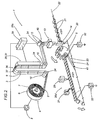
- 1 denotes a portion of an automatic packaging machine, in its entirety, in which a wrapping material 2 consisting in a single component C1, appearing as a continuous strip 9, is advanced along a feed path 3 extending from a decoiling roll 4 toward a user station 5.
- the roll 4 is mounted to a pivot 6 with a horizontally disposed axis 7, driven by a respective motor 8 such as will decoil the continuous strip 9 and cause it to advance through guiding and pulling devices 10, illustrated schematically and by way of example as an assembly of guides 11 and pinch rolls 12 arranged along the feed path 3, toward a cutter device 13 by which it is separated into discrete lengths, or sheets 14.
- guiding and pulling devices 10 illustrated schematically and by way of example as an assembly of guides 11 and pinch rolls 12 arranged along the feed path 3, toward a cutter device 13 by which it is separated into discrete lengths, or sheets 14.
- the sheets 14 are directed seriatim onto a take-up and feed unit 15 which in the example illustrated comprises a first roller 16 with a horizontally disposed axis 17 by which the sheets 14 are taken up and distanced one from another and from the strip 9, and a second roller 18, of which the axis 19 extends parallel to the first axis 17, operating in conjunction with the first roller 16 in such a way as to direct the sheets 14 along a vertical leg 20 of the feed path 3 toward the user station 5.
- a take-up and feed unit 15 which in the example illustrated comprises a first roller 16 with a horizontally disposed axis 17 by which the sheets 14 are taken up and distanced one from another and from the strip 9, and a second roller 18, of which the axis 19 extends parallel to the first axis 17, operating in conjunction with the first roller 16 in such a way as to direct the sheets 14 along a vertical leg 20 of the feed path 3 toward the user station 5.
- the single sheet 14 is intercepted at the user station 5 by a product 21 advancing along a second feed path 22 extending transversely to the vertical leg 20 of the first path 3.
- Each sheet 14 is united thus with a respective product 21, which it proceeds to envelop as the two are advanced along a wrapping line 23 that extends along the second feed path 22.
- the guiding and pulling devices 10 and the take-up and feed unit 15 together constitute means, denoted 24 in their entirety, by which to convey the wrapping material 2.
- a unit denoted 26a in its entirety for checking the wrapping material 2, of which a first embodiment is indicated in unbroken lines.
- the unit 26a comprises an electrostatic charge generator 28 of which the relative emitter device 29 is directed at the strip 9 in such a way that a predetermined portion 30 of the selfsame strip 9, advancing at a velocity denoted V1, is invested with a flow of electrostatic charges and thus charged electrostatically.
- the strip 9 is made of an electrically insulating material, or in any event the face of the strip offered to the emitter device 29 has electrically insulating properties.
- the unit 26a Located beyond the emitter device 29 in the downstream direction and in the area occupied by a second operative station 27b, at a given distance from the emitter device 29, the unit 26a comprises a sensor 31 capable of detecting electrostatic charges applied previously to the predetermined portions 30 of the strip 9.
- the checker unit 26a can also comprise discharger devices 32 which, in the embodiment of figure 1 illustrated with unbroken lines, comprise first and second sliding contacts 33 positioned respectively upstream of the emitter device 29 and downstream of the sensor 31.
- the two sliding contacts 33 are capable of movement between a position of no contact or disengagement relative to the strip 9, and a position of contact with the selfsame strip 9 (indicated in figure 1) in which they are able to rid the strip 9 of any leaked electrostatic charges and thus protect the strip 9, ensuring that such charges as may be attributable to leakage will not impact negatively on the checking function.
- the dischargers 32 in question can also be used to neutralize the strip 9 completely should it be expedient to suspend or terminate the checking function.
- the dischargers 32 in question might also be associated both with the guides 11 and with the rolls 12, in order to protect the strip 9 from electrostatic charges that may have leaked to the relative guiding and pulling device 10, and might consist in earth contacts 32a.
- a second embodiment illustrated with phantom lines in figure 1, includes a checker unit 26b positioned to coincide with the take-up and feed unit 15.
- the unit 26b comprises a respective electrostatic charge generator 28 of which the relative emitter device 29 is directed at the first roller 16 in such a way as to apply an electrostatic charge to a predetermined portion 34 of each successive sheet 14, also a respective sensor 31 positioned in alignment with the second roller 18 and capable of detecting electrostatic charges applied previously to the aforementioned predetermined portions 34.
- the two rollers 16 and 18 form part of conveying means 24 by which the wrapping material 2 is advanced along the feed path, and can be equipped similarly with respective discharger contacts 32a serving to connect the rollers 16 and 18 to earth.
- the continuous strip 9 is caused to advance at the predetermined velocity V1 and the emitter device 29 proceeds to charge the predetermined portions 30 electrostatically at a predetermined frequency, whilst the sensor 31 detects the charges thus applied to the strip 9.
- the operations of timing the delivery of charges from the emitter device 29 and measuring the signal received from the sensor 31 are governed by a master controller 35.
- the master controller 35 will relay a correction signal to the drive means 8 of the decoil roll 4 and/or to the pinch rolls 12 so that the feed rate will be re-established at the required value V1.
- the first roller 16 rotates on its axis 17 at a speed such as will cause the sheets 14 to be separated one from the next by a predetermined distance after being severed from the strip 9 by the cutter device 13, whilst the second roller 18 rotates at the same speed as the first roller 16.
- the relative master controller 35 will again govern the timing with which the sheets 14 are charged by the emitter 29 and measure the signal received from the sensor 31, which indicates both the presence of the sheets and their position relative to the moment at which the cut occurs.
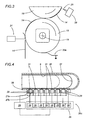
- the portion 1 of the packaging machine is structured in such a way that the continuous strip 9 decoiled from the respective roll 4 passes through a flow compensating chamber 36, illustrated in figure 4, internally of which the strip 9 forms a loop 37 expandable to a length that is variable within a predetermined range as indicated also in figure 2.
- the wrapping material 2 is checked by a unit 26c positioned along one longitudinal wall 38 of the chamber 36.
- the checker unit 26c comprises a plurality of emitter devices 29 arranged in succession along the longitudinal wall 38 of the flow compensating chamber 36, each positioned to charge a predetermined portion of the running strip 9 electrostatically, and a plurality of sensors 31 capable of detecting the electrostatic charges, arranged likewise in succession along the selfsame wall 38 of the chamber 36 and in alternation with the emitter devices 29.
- the emitter devices 29 arranged in succession along the longitudinal wall 38 of the flow compensating chamber 36 are positioned at respective first operative stations 27a, whilst the sensors 31 are positioned at respective second operative stations 27b.
- All of the emitters 29 are coupled to a common charge generator 28 connected to the output of the master controller 35.
- Each sensor 31 is wired to a respective control unit 39 forming part of the master controller 35. Also, each sensor 31 is associated with a respective emitter 29 in such a way that the presence of predetermined portions of the strip 9 within the flow compensating chamber 36 can be detected moment by moment, and any variation in the length of the loop 37 running through the selfsame chamber 36 thus monitored continuously.
- the master controller 35 will relay correction signals to the drive motor 8 of the roll 4 and/or to a set of pinch rolls 40 located at a point on the feed path 3 downstream of the flow compensating chamber 36.
- the strip 9 is guided along the feed path 3 by pinch rolls 40 and guide rollers 42 that perform the same functions as the pinch rolls 12 and the guides 11 illustrated in figure 1, combining thus to create means, denoted 24 in their entirety, by which the wrapping material 2 is conveyed toward the user station.
- dischargers 32 can be associated with the conveying means 24 to perform the same function as described in connection with the embodiments of figure 1.
- the checker units 26 are designed to operate upstream of the user station 5 and, accordingly, the steps of applying and detecting the electrostatic charges are effected along the feed path 3 followed by the wrapping material.
- a unit 26d comprising an emitter 29 and a sensor 31 located downstream of the user station 5 and on the second feed path 22, along which products 21 united with the wrapping material 2 at the user station 5 are caused to advance through the agency of a belt conveyor 41 constituting the aforementioned conveying means 24.
- dischargers 32 can be associated with the conveyor 41 for the purpose of eliminating any residual electrostatic charges from the conveying means 24.
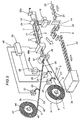
- the wrapping material 2 comprises a first component C1 provided by the continuous strip 9 decoiled from the roll 4, and a second component C2 appearing in this particular instance as a second strip 42 exhibiting a transverse dimension less than that of the first strip 9.
- the strip 42 is decoiled from a respective roll 43 mounted to a pivot 44 of which the axis 45 is disposed parallel to the axis 7 of the first roll 4, and driven by a respective motor (not illustrated) such as will cause the strip 42 to decoil at the same rate as the first strip 9.
- the strips 9 and 42 converge on a bonding station 46 at the start of the first feed path 3, which in this embodiment becomes a common path followed by the two components C1 and C2 bonded one to another.
- the station 46 comprises a pair of contrarotating rollers 47, disposed substantially tangential one to another with axes lying parallel to the axes 7 and 45 of the decoil rolls 4 and 43, and marking the start of the common feed path 3.
- the wrapping material 2 composed of the two strips 9 and 42 is directed and advanced toward the cutter device 13 through the agency of the guides 11 and the pinch rolls 12, respectively, and divided into sheets 14.
- the sheets 14 are conveyed one by one to the user station 5 where, as already described in referring to the embodiment of figure 1, they will be intercepted cyclically by the products 21 advancing along the second feed path 22 and conveyed together with the products along the wrapping line 23. Again, the pinch rolls 12 and the guides 11 can be furnished with earth contacts 32a.
- the legs 3a, 3b and 3 of the first feed path extending between the decoil rolls 4 and 43 and the pinch rolls 12 are occupied by a unit 48 for checking the wrapping material 2 that comprises, located on the leg 3a of the one strip 9, a discharger 32 with a relative sliding contact 33, and on the leg 3b of the other strip 42, proceeding from upstream downwards in the feed direction, a discharger 32 with a relative sliding contact 33 and, coinciding with a first operative station 49a, an electrostatic charge generator 28 with a respective emitter device 29 positioned to invest predetermined portions 30 of the strip 42 with electrostatic charges.
- the checker unit 48 Downstream of the bonding station 46, the checker unit 48 comprises a second operative station 49b equipped, as shown in figures 8 and 9, with one or more sensors 31 placed to detect the electrostatic charges applied at the first station 49a.
- the checker unit comprises a further sensor 31, positioned along the leg 3a of the wider strip 9 at a point between the discharger 32 and the bonding station 46, serving to detect any electrostatic charges present on this same strip 9.
- the checker unit 48 comprises a master controller 35 to which all of the various electrical and electronic components making up the unit are wired.
- the wrapping material 2 directed toward the cutter device 13 is no longer composed of two continuous strips bonded together, but rather of one continuous strip 9 as the first component C1 of the material and a succession of discrete lengths or slips 50 as the second component C2 of the material, with the strip 9 functioning as the support component.
- the slips 50 are cut and fixed to the strip 9 by a relative device of conventional type, indicated schematically by a block denoted 51, into which the first strip 9 is directed together with a second continuous strip 52, the latter passing through a respective cutter device 53.
- the strip 52 in the example of figure 6 is a continuous strip presenting the same transverse dimensions as the strip 42 of figure 5, and the slips 50 are applied to the strip 9 oriented parallel to the common feed path 3 followed by the wrapping material 2, maintaining a predetermined placement and a first longitudinal pitch denoted p1.
- the generator 28 and the corresponding emitter 29 can be positioned upstream of the cutter device 53 in such a way as to charge successive portions 30 of the continuous strip 52 destined to coincide substantially with the two ends of each slip 50 following the cutting operation.
- the generator 28 and the corresponding emitter 29 can be placed, as shown by the phantom lines, immediately downstream of the cutter device 53 and preceding the point at which the slips 50 are applied to the strip 9 at the bonding station 46, indicated schematically by a block, likewise in such a way as to charge the portions 30 coinciding with the ends of each slip 50.
- the strip 52 is a continuous strip of which the transverse dimension is broadly similar to that of the first strip 9, and the slips 50 are generated by a cutter device 53 set up so as divide the strip 52 into slivers, each constituting one slip 50.
- slips 50 are applied to the strip 9 at the bonding station 46, oriented transversely to the common feed path 3 followed by the wrapping material 3, maintaining a predetermined placement and a second longitudinal pitch denoted p2.
- the unit will need to incorporate two generators 28 with corresponding emitters 29 to enable the simultaneous application of electrostatic charges to the portions 30 coinciding with the ends of each slip 50.
- the two generators 28 can be placed upstream of the cutter device 53, aligned with the two opposite edges of the strip 52, or immediately downstream of the cutter device 53, as shown by the phantom lines, preceding the point at which the slips 50 are applied to the strip 9 and acting on the two ends of each sliver.
- the senor 31 placed at the second operative checking station 49b will be able, having successfully or unsuccessfully detected the charges applied previously at the first operative station 49a, to indicate the presence, the position, the timing and the orientation of the slips 50.
- the second operative checking station 49b is equipped with two sensors 31 which, having successfully or unsuccessfully detected the charges applied previously at the first operative station 49a, will be able to indicate the presence, the position, the timing and the orientation of the slips 50.
- the additional sensor 31 placed to detect the electrostatic charges can be set up to provide a differential type of control in combination with the second operative station 49b, to the end of avoiding any interference that may occur at this same station 49b due to the presence of residual charges on the strip 9; this method can also be adopted in the examples of figures 6 and 7.
- the master controller 35 is able to take account of any residual charges in the strip 9 that may be detected by the sensor 31 placed along the first leg 3a of the feed path.
- the generator 28 is able, through the agency of the corresponding emitter 29, to charge the predetermined portions 30 in pulsed mode at a selected frequency.
- the corresponding sensor 31 will be set up to detect and recognize the impulsive charges applied previously, thereby avoiding any interference that might otherwise be occasioned by residual charges on the strip 9.
- the sensors 31 can be installed in any convenient number, aligned transversely across or staggered along the common feed path 3. More exactly, these configurations will allow the checker unit to detect the presence and/or position of the strip 42 or the slips 50 within a band of predetermined width. Should it become evident from the detection step that the one strip 42 is advancing in an incorrect position relative to the other strip 9, the sensors will relay a control signal to a device of familiar type (not illustrated) capable of correcting the position of the decoiling strip 42, for example by shifting the roll 43 along its axis 45 of rotation.
- This type of marking is particularly advantageous for transparent wrapping materials, such as clear polypropylene, given that after the checking step has been effected, the mark can be removed simply by eliminating the charge from the wrapping material.
Landscapes
- Auxiliary Devices For And Details Of Packaging Control (AREA)
- Investigating Or Analyzing Materials By The Use Of Electric Means (AREA)
- Control Of Conveyors (AREA)
- Controlling Rewinding, Feeding, Winding, Or Abnormalities Of Webs (AREA)
- Containers And Plastic Fillers For Packaging (AREA)
- Basic Packing Technique (AREA)
- Replacement Of Web Rolls (AREA)
- Controlling Sheets Or Webs (AREA)
Claims (46)
- Verfahren zum Prüfen von Verpackungsmaterial in einer Verpackungsmaschine, bei welchem das Verpackungsmaterial (2) der Verpackungsmaschine (1) zugeführt wird, dadurch gekennzeichnet, dass es wenigstens die Phasen des elektrostatischen Aufladens von wenigstens einem bestimmten Abschnitt (30, 34) des Verpackungsmaterials (2) enthält, und zwar an einem Punkt, der mit wenigstens einer ersten betrieblichen Prüfstation (27a; 49a) übereinstimmt, und des Erfassens des Vorhandenseins von elektrostatischen Ladungen an dem bestimmten Abschnitt (30, 34) des Verpackungsmaterials (2) an einem Punkt, der mit wenigstens einer zweiten betrieblichen Prüfstation (27b; 49b) übereinstimmt.
- Verfahren nach Patentanspruch 1, enthaltend eine Phase zum Schutz des Verpackungsmaterials (2) vor möglicher Streuung der elektrostatischen Ladungen an dem bestimmten Abschnitt (30, 34) des Materials (2).
- Verfahren nach Patentanspruch 1 oder 2, bei welchem das Verpackungsmaterial (2) dazu bestimmt ist, bestimmte Produkte (21) an einer Verbraucherstation (5) einzuwickeln, und bei welchem die Phasen des Anbringens und Erfassens der elektrostatischen Ladungen entlang einer Zuführbahn (3) stromaufwärts der Verbraucherstation (5) ausgeführt werden.
- Verfahren nach Patentanspruch 3, bei welchem das Verpackungsmaterial wenigstens eine Verpackungskomponente (C1, C2) enthält, und wobei die Phasen des Anbringens und Erfassens der elektrostatischen Ladungen an einer kontinuierlichen Bahn (9) von Verpackungsmaterial (2) durchgeführt werden, welche die Verpackungskomponente (C1, C2) beschreibt und entlang einer jeweiligen vorgegebenen Zuführbahn (3a) vorläuft.
- Verfahren nach Patentanspruch 3, bei welchem das Verpackungsmaterial (2) wenigstens eine erste und eine zweite Verpackungskomponente (C1, C2) enthält und die Phasen des Anbringens und Erfassens der elektrostatischen Ladungen an wenigstens einer der beiden Verpackungskomponenten (C1, C2) durchgeführt werden.
- Verfahren nach Patentanspruch 5, bei welchem die beiden Verpackungskomponenten (C1, C2) aus zwei kontinuierlichen Bahnen (9, 42) aus Verpackungsmaterial bestehen, enthaltend eine Phase des Verbindens der beiden Streifen (9, 42) miteinander in vorgegebenen gegenseitigen Positionen.
- Verfahren nach Patentanspruch 5, bei welchem die erste Komponente (C1) aus einer kontinuierlichen Bahn (9) aus Verpackungsmaterial besteht und die zweite Komponente (C2) aus einer Folge von bestimmten Längen (50) aus Verpackungsmaterial besteht, verbunden mit der kontinuierlichen Bahn (9) mit einem vorgegebenen Abstand (p1; p2) voneinander und in einer vorgegebenen Position.
- Verfahren nach Patentanspruch 6 oder 7, bei welchem wenigstens die Phase des Erfassens im Anschluss an die Phase des Verbindens der beiden Verpackungskomponenten (C1, C2) miteinander erfolgt.
- Verfahren nach Patentanspruch 6, bei welchem die beiden Bahnen (9, 42) unterschiedliche Querabmessungen aufweisen.
- Verfahren nach Patentanspruch 7, bei welchem die bestimmten Längen (50) aus Verpackungsmaterial eine Querabmessung aufweisen, die geringer ist als die der kontinuierlichen Bahn (9).
- Verfahren nach Patentanspruch 10, bei welchem die bestimmten Längen (50) aus Verpackungsmaterial mit der kontinuierlichen Bahn (9) verbunden sind, ausgerichtet parallel zu der vorgegebenen Zuführbahn (3), welcher das Verpackungsmaterial (2) folgt.
- Verfahren nach Patentanspruch 10, bei welchem die bestimmten Längen (50) aus Verpackungsmaterial mit der kontinuierlichen Bahn (9) verbunden sind, ausgerichtet quer zu der vorgegebenen Zuführbahn (3), welcher das Verpackungsmaterial (2) folgt.
- Verfahren nach den Patentansprüchen 11 und 12, bei welchem die elektrostatischen Ladungen an wenigstens zwei unterschiedlichen Abschnitten (30) einer jeden bestimmten Länge (50) aus Verpackungsmaterial angebracht werden.
- Verfahren nach den Patentansprüchen von 5 bis 13, bei welchem die Phase des Erfassens dazu dient, das Vorhandensein der vorher geladenen Komponente (C1, C2) zu prüfen.
- Verfahren nach Patentanspruch 14, bei welchem die Phase des Erfassens dazu dient, die Position der vorher geladenen Komponente (C1, C2) zu prüfen.
- Verfahren nach Patentanspruch 8, bei welchem die Phase des Erfassens dazu dient, den Abstand (p1; p2) zu prüfen, mit welchem die bestimmten Längen (50) voneinander angeordnet sind.
- Verfahren nach Patentanspruch 13, bei welchem die Phase des Erfassens dazu dient, den Abstand (p1; p2) und die Ausrichtung der bestimmten Längen (50) zu prüfen.
- Verfahren nach Patentanspruch 6, bei welchem die Phase des Anbringens der elektrostatischen Ladungen impulsartig und mit einer bestimmten Frequenz durchgeführt wird.
- Verfahren nach Patentanspruch 3, bei welchem die Phasen des Anbringens und Erfassens der elektrostatischen Ladungen an bestimmten Längen (14) des Verpackungsmaterials (2) durchgeführt werden, die durch Schneiden eines kontinuierlichen Materials (2) hergestellt sind und entlang der vorgegebenen Zuführbahn (3) vorlaufen.
- Verfahren nach Patentanspruch 4, bei welchem die Zuführbahn (3a), gefolgt von dem Verpackungsmaterial (2), sich durch eine Flussausgleichskammer (36) erstreckt, die innerhalb eines bestimmten Bereiches eine Schlaufe (37) von veränderbarer Länge bildet, und die Phasen des Anbringens und Erfassens der elektrostatischen Ladungen entlang dem bestimmten Bereich durchgeführt werden, welcher die Länge der Schlaufe (37) verwaltet.
- Verfahren nach Patentanspruch 20, enthaltend eine Anzahl von Phasen des Anbringens von elektrostatischen Ladungen und eine Anzahl von Phasen des Erfassens von elektrostatischen Ladungen, durchgeführt wechselweise entlang dem bestimmten Bereich, innerhalb welchem die Länge der Schlaufe (37) veränderbar ist.
- Verfahren nach Patentanspruch 1 oder 2 oder 5, bei welchem das Verpackungsmaterial (2) dazu bestimmt ist, in einer Verbraucherstation (5) mit bestimmten Produkten (21) vereint zu werden, und die Phasen des Anbringens und Erfassens der elektrostatischen Ladungen stromabwärts der Verbraucherstation (5) durchgeführt werden.
- Verfahren nach Patentanspruch 22, bei welchem die Produkte (21) der Verpackungsmaschine (1) entlang einer zweiten vorgegebenen Zuführbahn (22) zugeführt und mit dem Verpackungsmaterial (2) vereint werden, und die Phasen des Anbringens und Erfassens der elektrostatischen Ladungen entlang der zweiten vorgegebenen Bahn (22) durchgeführt werden.
- Verfahren nach den Patentansprüchen von 1 bis 23, enthaltend wenigstens eine Phase des Beseitigens der elektrostatischen Ladungen von dem Verpackungsmaterial (2).
- Verfahren nach den Patentansprüchen von 1 bis 24, bei welchem das Verpackungsmaterial (2) durch jeweilige Fördermittel (24) zum Vorlaufen gebracht wird, enthaltend wenigstens eine Phase des Entfemens der elektrostatischen Ladungen von den Fördermitteln (24).
- Vorrichtung zum Prüfen von Verpackungsmaterial in einer Verpackungsmaschine, bei welcher das Verpackungsmaterial (2) der Verpackungsmaschine (1) zugeführt wird, dadurch gekennzeichnet, dass sie Emittermittel (28, 29) für elektrostatische Ladungen enthält, in der Lage, wenigstens einen bestimmten Abschnitt (30, 34) des Verpackungsmaterials (2) elektrostatisch aufzuladen, und zwar an einem Punkt, der mit wenigstens einer ersten betrieblichen Prüfstation (27a) übereinstimmt, und Fühlermittel (31), in der Lage, das Vorhandensein von elektrostatischen Ladungen an dem bestimmten Abschnitt (30, 34) des Verpackungsmaterials (2) an einem Punkt zu erfassen, der mit wenigstens einer zweiten betrieblichen Prüfstation (27b) übereinstimmt.
- Vorrichtung nach Patentanspruch 26 zum Prüfen eines Verpackungsmaterials (2), bestehend aus wenigstens einer Verpackungskomponente (C1; C2) in Form einer kontinuierlichen Bahn (9), die entlang einer jeweiligen Zuführbahn (3) vorläuft, bei welcher die Emittermittel (28, 29) entlang der Zuführbahn (3) positioniert sind, und die Fühlermittel (31) entlang derselben Zuführbahn (3) positioniert sind, und zwar stromabwärts der Emittermittel (28, 29) und mit einem vorgegebenen Abstand von diesen, und zwar auf solche Weise, dass die Geschwindigkeit der vorlaufenden Bahn (9) erfasst werden kann.
- Vorrichtung nach Patentanspruch 27 zum Prüfen eines Verpackungsmaterials (2), bestehend aus einer ersten und einer zweiten Verpackungskomponente (C1, C2), bei welcher die Emittermittel (28, 29) und die Fühlermittel (31) entlang der Zuführbahn (3; 3a; 3b) positioniert sind, welcher wenigstens eine der beiden Verpackungskomponenten (C1, C2) folgt.
- Vorrichtung nach Patentanspruch 28, bei welcher die beiden Verpackungskomponenten aus zwei kontinuierlichen Bahnen (9, 42) aus Verpackungsmaterial bestehen, enthaltend eine Station (46), an welcher die beiden Bahnen (9, 42) in bestimmten gegenseitigen Positionen miteinander verbunden werden.
- Vorrichtung nach Patentanspruch 28, bei welcher die erste Komponente (C1) aus einer kontinuierlichen Bahn (9) aus Verpackungsmaterial besteht und die zweite Komponente (C2) aus einer Folge von bestimmten Längen (50) aus Verpackungsmaterial besteht, letztere verbunden mit der kontinuierlichen Bahn (9) mit einem vorgegebenen Abstand (p1; p2) voneinander und in einer vorgegebenen Position.
- Vorrichtung nach Patentanspruch 29 oder 30, bei welcher wenigstens die Fühlermittel (31) stromabwärts der Station (46) positioniert sind, an der die beiden Verpackungskomponenten (C1, C2) miteinander verbunden sind.
- Vorrichtung nach Patentanspruch 29, bei welcher die beiden Bahnen (9, 42) unterschiedliche Querabmessungen aufweisen.
- Vorrichtung nach Patentanspruch 30, bei welcher die bestimmten Längen (50) aus Verpackungsmaterial eine Querabmessung aufweisen, die geringer ist als die der kontinuierlichen Bahn (9).
- Vorrichtung nach Patentanspruch 30, bei welcher die bestimmten Längen (50) aus Verpackungsmaterial mit der kontinuierlichen Bahn (9) verbunden sind, ausgerichtet parallel zu der vorgegebenen Zuführbahn (3), welcher das Verpackungsmaterial (2) folgt.
- Vorrichtung nach Patentanspruch 30, bei welcher die bestimmten Längen (50) aus Verpackungsmaterial mit der kontinuierlichen Bahn (9) verbunden sind, ausgerichtet quer zu der vorgegebenen Zuführbahn (3), welcher das Verpackungsmaterial (2) folgt.
- Vorrichtung nach den Patentansprüchen 34 und 35, bei welcher die Emittermittel (28, 29) auf solche Weise ausgeführt sind, dass sie wenigstens zwei verschiedene Abschnitte (30) einer jeden bestimmten Länge (50) aus Verpackungsmaterial laden.
- Vorrichtung nach den Patentansprüchen von 28 bis 36, bei welcher die Fühlermittel (31) Mittel (31) enthalten, die in der Lage sind, das Vorhandensein der vorher geladenen Komponente (C1, C2) zu prüfen.
- Vorrichtung nach Patentanspruch 37, bei welcher die Fühlermittel (31) Mittel (31) enthalten, die in der Lage sind, die Position der vorher geladenen Komponente (C1, C2) zu prüfen.
- Vorrichtung nach Patentanspruch 31, bei welcher die Fühlermittel (31) Mittel (31) enthalten, die in der Lage sind, den Abstand (p1; p2) zu prüfen, mit welchem die bestimmten Längen (50) voneinander angeordnet sind.
- Vorrichtung nach Patentanspruch 36, bei welcher die Fühlermittel (31) Mittel (31) enthalten, die in der Lage sind, den Abstand (p1; p2) und die Ausrichtung der bestimmten Längen (50) zu prüfen.
- Vorrichtung nach Patentanspruch 29, bei welcher die Emittermittel (28, 29) einen Emitter (29) enthalten, der impulsartige elektrostatische Ladungen mit einer bestimmten Frequenz liefert.
- Vorrichtung nach Patentanspruch 26 zum Prüfen eines Verpackungsmaterials (2), zugeführt in Form von bestimmten Längen (14), die durch Schneiden desselben Materials (2) hergestellt sind, bei welcher die Emittermittel (28, 29) entlang der vorgegebenen Bahn (3) positioniert sind und die Fühlermittel (31) entlang derselben Bahn (3) positioniert sind, und zwar stromabwärts und mit einem bestimmten Abstand von den Emittermitteln (28, 29) und auf solche Weise, dass das Vorhandensein und/oder der Takt der bestimmten Längen (14) aus Verpackungsmaterial (2) erfasst werden kann.
- Vorrichtung nach Patentanspruch 27 zum Prüfen eines Verpackungsmaterials (2), das entlang einer Zuführbahn (3) vorläuft, wobei es durch eine Flussausgleichskammer (36) geht und bewirkt, dass eine Schlaufe (37) von veränderbarer Länge innerhalb eines bestimmten Bereiches gebildet wird, bei welcher die Emittermittel (28, 29) eine Anzahl von Emittervorrichtungen (29) enthalten, angeordnet entlang der Flussausgleichskammer (36), und die Fühlermittel (31) eine Anzahl von Fühlern (31) enthalten, in der Lage, die elektrostatischen Ladungen zu erfassen, ebenfalls angeordnet entlang der Flussausgleichskammer (36) und abwechselnd mit den Emittervorrichtungen (29) auf solche Weise, dass die Veränderung in der Länge der Schlaufe (37) im Inneren der Kammer (36) überwacht wird.
- Vorrichtung nach Patentanspruch 26 zum Prüfen eines Verpackungsmaterials (2), dazu bestimmt, an einer Verbraucherstation (5) mit bestimmten Produkten (21) vereint zu werden, woraufhin die Produkte (21) und das Material (2) entlang einer zweiten vorgegebenen Zuführbahn (22) zum Vorlaufen gebracht werden, bei welcher die Emittermittel (28, 29) und die Fühlermittel (31) entlang der zweiten vorgegebenen Bahn (22) auf solche Weise positioniert sind, dass sie das Vorhandensein und/oder die Geschwindigkeit und/oder den Takt der Produkte (21) prüfen.
- Vorrichtung nach den Patentansprüchen von 26 bis 30, enthaltend Entladungsmittel (32, 32a), die stromaufwärts und/oder stromabwärts der Emittermittel (28, 29) und der Fühlermittel (31) positioniert sind und dazu dienen, die elektrostatischen Ladungen von dem Verpackungsmaterial (2) zu entfernen.
- Vorrichtung nach den Patentansprüchen von 26 bis 31, bei welcher das Verpackungsmaterial (2) durch jeweilige Fördermittel (24) zum Vorlaufen gebracht wird, letztere enthaltend Entladungsmittel (32, 32a), die dazu dienen, die an dem Fördermitteln (24) angestauten elektrostatischen Ladungen zu entfernen.
Applications Claiming Priority (3)
| Application Number | Priority Date | Filing Date | Title |
|---|---|---|---|
| ITBO20010079 | 2001-02-14 | ||
| IT2001BO000079A ITBO20010079A1 (it) | 2001-02-14 | 2001-02-14 | Metodo e dispositivo per il controllo di materiale di incarto in una macchina confezionatrice |
| PCT/IB2001/002178 WO2002064470A1 (en) | 2001-02-14 | 2001-11-19 | A method and a device for checking wrapping material in a packaging machine |
Publications (2)
| Publication Number | Publication Date |
|---|---|
| EP1361996A1 EP1361996A1 (de) | 2003-11-19 |
| EP1361996B1 true EP1361996B1 (de) | 2006-10-25 |
Family
ID=11439095
Family Applications (1)
| Application Number | Title | Priority Date | Filing Date |
|---|---|---|---|
| EP01982658A Expired - Lifetime EP1361996B1 (de) | 2001-02-14 | 2001-11-19 | Verfahren und vorrichtung zum prüfen von verpackungsmaterial in einer verpackungsmaschine |
Country Status (8)
| Country | Link |
|---|---|
| US (1) | US7406809B2 (de) |
| EP (1) | EP1361996B1 (de) |
| JP (1) | JP2004518594A (de) |
| CN (1) | CN1292969C (de) |
| AT (1) | ATE343538T1 (de) |
| DE (1) | DE60124145T2 (de) |
| IT (1) | ITBO20010079A1 (de) |
| WO (1) | WO2002064470A1 (de) |
Cited By (1)
| Publication number | Priority date | Publication date | Assignee | Title |
|---|---|---|---|---|
| WO2023169941A1 (de) | 2022-03-11 | 2023-09-14 | Focke & Co. (Gmbh & Co. Kg) | Vorrichtung und verfahren zum handhaben von zuschnitten für eine umhüllung von packungen für produkte der zigarettenindustrie |
Families Citing this family (5)
| Publication number | Priority date | Publication date | Assignee | Title |
|---|---|---|---|---|
| ITBO20020529A1 (it) | 2002-08-08 | 2004-02-09 | Gd Spa | Metodo per il controllo di materiale di incarto in |
| US8910689B2 (en) * | 2005-03-15 | 2014-12-16 | The Procter & Gamble Company | Apparatus for reducing downtime in web processes |
| US20070293382A1 (en) * | 2006-06-16 | 2007-12-20 | Cmd Corporation | Method and Apparatus for Making Bags |
| US20130091804A1 (en) * | 2011-08-08 | 2013-04-18 | Enfora, Inc. | Tape and reel orientation system |
| CN116507875A (zh) * | 2020-12-01 | 2023-07-28 | 利乐拉瓦尔集团及财务有限公司 | 一种检测和跟踪包装材料卷材特征的方法 |
Family Cites Families (14)
| Publication number | Priority date | Publication date | Assignee | Title |
|---|---|---|---|---|
| US3768227A (en) * | 1970-09-16 | 1973-10-30 | R Grisell | Method of dissipating static electricity in packaging |
| US3730753A (en) * | 1971-07-30 | 1973-05-01 | Eastman Kodak Co | Method for treating a web |
| CH553688A (de) * | 1972-07-03 | 1974-09-13 | Sig Schweiz Industrieges | Vorrichtung zum zufuehren von einschlagfolien an einer verpackungsmaschine. |
| US4590747A (en) * | 1984-05-11 | 1986-05-27 | Robert Alameda | Positive displacement filling machine |
| US5056646A (en) * | 1984-08-30 | 1991-10-15 | Polaroid Corporation | Electrostatic-type registration system |
| US4786353A (en) * | 1987-10-16 | 1988-11-22 | Adolph Coors Company | Laminating method and apparatus with extensible web width control |
| DE3822497A1 (de) | 1987-12-02 | 1989-10-19 | Kotterer Grafotec | Vorrichtung zum verhindern von maschinenschaeden |
| JPH02209284A (ja) * | 1989-02-10 | 1990-08-20 | Canon Inc | 記録装置の記録材検出装置 |
| US5444964A (en) * | 1993-06-22 | 1995-08-29 | Hanagata Corporation | Automatic package machine, and wrapping film fusing and sealing blade |
| JP3014576B2 (ja) | 1994-02-04 | 2000-02-28 | シャープ株式会社 | 記録媒体認識装置 |
| US5732529A (en) * | 1996-03-29 | 1998-03-31 | Ethicon, Inc. | Apparatus for feeding foil stock in a process for making sealed sterile packages |
| US6207925B1 (en) * | 1996-10-11 | 2001-03-27 | Brian Andrew Kendall | Apparatus for cutting and/or welding flexible packaging |
| US5873966A (en) * | 1997-10-14 | 1999-02-23 | Reliance Electric Industrial Company | Magnetic splice detection system |
| DE19825599A1 (de) * | 1998-06-09 | 1999-12-16 | Focke & Co | Verpackungsmaschine, insbesondere für Zigaretten |
-
2001
- 2001-02-14 IT IT2001BO000079A patent/ITBO20010079A1/it unknown
- 2001-11-19 AT AT01982658T patent/ATE343538T1/de not_active IP Right Cessation
- 2001-11-19 EP EP01982658A patent/EP1361996B1/de not_active Expired - Lifetime
- 2001-11-19 DE DE60124145T patent/DE60124145T2/de not_active Expired - Fee Related
- 2001-11-19 WO PCT/IB2001/002178 patent/WO2002064470A1/en not_active Ceased
- 2001-11-19 JP JP2002564410A patent/JP2004518594A/ja active Pending
- 2001-11-19 CN CNB01822587XA patent/CN1292969C/zh not_active Expired - Fee Related
- 2001-11-19 US US10/467,468 patent/US7406809B2/en not_active Expired - Fee Related
Cited By (1)
| Publication number | Priority date | Publication date | Assignee | Title |
|---|---|---|---|---|
| WO2023169941A1 (de) | 2022-03-11 | 2023-09-14 | Focke & Co. (Gmbh & Co. Kg) | Vorrichtung und verfahren zum handhaben von zuschnitten für eine umhüllung von packungen für produkte der zigarettenindustrie |
Also Published As
| Publication number | Publication date |
|---|---|
| US7406809B2 (en) | 2008-08-05 |
| CN1489546A (zh) | 2004-04-14 |
| EP1361996A1 (de) | 2003-11-19 |
| WO2002064470A1 (en) | 2002-08-22 |
| DE60124145T2 (de) | 2007-09-06 |
| JP2004518594A (ja) | 2004-06-24 |
| US20040072664A1 (en) | 2004-04-15 |
| ATE343538T1 (de) | 2006-11-15 |
| ITBO20010079A0 (it) | 2001-02-14 |
| DE60124145D1 (de) | 2006-12-07 |
| CN1292969C (zh) | 2007-01-03 |
| ITBO20010079A1 (it) | 2002-08-14 |
Similar Documents
| Publication | Publication Date | Title |
|---|---|---|
| JP3073001B2 (ja) | ラベル貼り機のためのオンラインエンボス装置 | |
| US4757930A (en) | Web indicia reference signal generating system | |
| EP0061788B1 (de) | Verfahren und Apparat zum Verbinden von Verpackungsmaterialbahnen | |
| US4682038A (en) | Arrangement for monitoring and controlling webs in packaging machines | |
| US6508173B1 (en) | Process and apparatus for printing blanks | |
| PL199487B1 (pl) | Sposób i urządzenie do doprowadzania perforowanej odcinkami wstęgi bibułki na osłonki do wentylowanych papierosów | |
| EP1361996B1 (de) | Verfahren und vorrichtung zum prüfen von verpackungsmaterial in einer verpackungsmaschine | |
| US6886310B1 (en) | Device and method for making packaging bags | |
| EP0084299A1 (de) | System um die Zufuhr von Gegenständen zu einer Verpackungsmaschine zu regeln | |
| US6603887B1 (en) | Process and apparatus for detecting printed marks | |
| ITBO980204A1 (it) | Apparato per la formatura di un involucro in carta termosaldabile per confezionamento di un prodotto. | |
| JP4249564B2 (ja) | ラッピング材をパッケージング機において検査する方法 | |
| JPS62228264A (ja) | 2本どり紙巻たばこ棒製造機械における帯状用紙供給装置 | |
| US20220219930A1 (en) | Feeding unit for feeding a plastic film | |
| EP0237299B1 (de) | Zuführeinrichtung | |
| US4086846A (en) | Apparatus and method to sense and adjust the relative position of hollow tubes within a continuous filter | |
| EP0787651A1 (de) | Verfahren zum Zuführen von Zuschnitten eines Wickelmaterials | |
| KR100548755B1 (ko) | 겉포장기 | |
| US5823528A (en) | Device for feeding blanks on a cigarette packing machine | |
| EP0761547B1 (de) | Vorrichtung und Verfahren zum Prüfen der Integrität von Verpackungen in einer Verpackungsmaschine | |
| JP2004010107A (ja) | 連続包装体の搬送位置検出方法および搬送位置検出装置 | |
| GB2247952A (en) | Apparatus for conveying a flat article | |
| US20040177912A1 (en) | Corrugating machine with multiple thermal position sensing | |
| EP4074491B1 (de) | Maschine zur herstellung von beuteln für kohäsionsloses material und verfahren dazu | |
| JPH07285715A (ja) | 製袋充填包装機における原反送出し方法及び装置 |
Legal Events
| Date | Code | Title | Description |
|---|---|---|---|
| PUAI | Public reference made under article 153(3) epc to a published international application that has entered the european phase |
Free format text: ORIGINAL CODE: 0009012 |
|
| 17P | Request for examination filed |
Effective date: 20030903 |
|
| AK | Designated contracting states |
Kind code of ref document: A1 Designated state(s): AT BE CH CY DE DK ES FI FR GB GR IE IT LI LU MC NL PT SE TR |
|
| AX | Request for extension of the european patent |
Extension state: AL LT LV MK RO SI |
|
| GRAP | Despatch of communication of intention to grant a patent |
Free format text: ORIGINAL CODE: EPIDOSNIGR1 |
|
| GRAS | Grant fee paid |
Free format text: ORIGINAL CODE: EPIDOSNIGR3 |
|
| GRAA | (expected) grant |
Free format text: ORIGINAL CODE: 0009210 |
|
| AK | Designated contracting states |
Kind code of ref document: B1 Designated state(s): AT BE CH CY DE DK ES FI FR GB GR IE IT LI LU MC NL PT SE TR |
|
| PG25 | Lapsed in a contracting state [announced via postgrant information from national office to epo] |
Ref country code: IT Free format text: LAPSE BECAUSE OF FAILURE TO SUBMIT A TRANSLATION OF THE DESCRIPTION OR TO PAY THE FEE WITHIN THE PRESCRIBED TIME-LIMIT;WARNING: LAPSES OF ITALIAN PATENTS WITH EFFECTIVE DATE BEFORE 2007 MAY HAVE OCCURRED AT ANY TIME BEFORE 2007. THE CORRECT EFFECTIVE DATE MAY BE DIFFERENT FROM THE ONE RECORDED. Effective date: 20061025 Ref country code: AT Free format text: LAPSE BECAUSE OF FAILURE TO SUBMIT A TRANSLATION OF THE DESCRIPTION OR TO PAY THE FEE WITHIN THE PRESCRIBED TIME-LIMIT Effective date: 20061025 Ref country code: BE Free format text: LAPSE BECAUSE OF FAILURE TO SUBMIT A TRANSLATION OF THE DESCRIPTION OR TO PAY THE FEE WITHIN THE PRESCRIBED TIME-LIMIT Effective date: 20061025 Ref country code: NL Free format text: LAPSE BECAUSE OF FAILURE TO SUBMIT A TRANSLATION OF THE DESCRIPTION OR TO PAY THE FEE WITHIN THE PRESCRIBED TIME-LIMIT Effective date: 20061025 Ref country code: FI Free format text: LAPSE BECAUSE OF FAILURE TO SUBMIT A TRANSLATION OF THE DESCRIPTION OR TO PAY THE FEE WITHIN THE PRESCRIBED TIME-LIMIT Effective date: 20061025 |
|
| REG | Reference to a national code |
Ref country code: GB Ref legal event code: FG4D |
|
| REG | Reference to a national code |
Ref country code: CH Ref legal event code: EP |
|
| PGFP | Annual fee paid to national office [announced via postgrant information from national office to epo] |
Ref country code: FR Payment date: 20061117 Year of fee payment: 6 |
|
| PG25 | Lapsed in a contracting state [announced via postgrant information from national office to epo] |
Ref country code: IE Free format text: LAPSE BECAUSE OF NON-PAYMENT OF DUE FEES Effective date: 20061120 |
|
| PGFP | Annual fee paid to national office [announced via postgrant information from national office to epo] |
Ref country code: GB Payment date: 20061122 Year of fee payment: 6 |
|
| PGFP | Annual fee paid to national office [announced via postgrant information from national office to epo] |
Ref country code: CH Payment date: 20061124 Year of fee payment: 6 |
|
| REG | Reference to a national code |
Ref country code: IE Ref legal event code: FG4D |
|
| PG25 | Lapsed in a contracting state [announced via postgrant information from national office to epo] |
Ref country code: MC Free format text: LAPSE BECAUSE OF NON-PAYMENT OF DUE FEES Effective date: 20061130 |
|
| REF | Corresponds to: |
Ref document number: 60124145 Country of ref document: DE Date of ref document: 20061207 Kind code of ref document: P |
|
| PGFP | Annual fee paid to national office [announced via postgrant information from national office to epo] |
Ref country code: DE Payment date: 20070102 Year of fee payment: 6 |
|
| PG25 | Lapsed in a contracting state [announced via postgrant information from national office to epo] |
Ref country code: SE Free format text: LAPSE BECAUSE OF FAILURE TO SUBMIT A TRANSLATION OF THE DESCRIPTION OR TO PAY THE FEE WITHIN THE PRESCRIBED TIME-LIMIT Effective date: 20070125 Ref country code: DK Free format text: LAPSE BECAUSE OF FAILURE TO SUBMIT A TRANSLATION OF THE DESCRIPTION OR TO PAY THE FEE WITHIN THE PRESCRIBED TIME-LIMIT Effective date: 20070125 |
|
| PG25 | Lapsed in a contracting state [announced via postgrant information from national office to epo] |
Ref country code: ES Free format text: LAPSE BECAUSE OF FAILURE TO SUBMIT A TRANSLATION OF THE DESCRIPTION OR TO PAY THE FEE WITHIN THE PRESCRIBED TIME-LIMIT Effective date: 20070205 |
|
| PG25 | Lapsed in a contracting state [announced via postgrant information from national office to epo] |
Ref country code: PT Free format text: LAPSE BECAUSE OF FAILURE TO SUBMIT A TRANSLATION OF THE DESCRIPTION OR TO PAY THE FEE WITHIN THE PRESCRIBED TIME-LIMIT Effective date: 20070326 |
|
| NLV1 | Nl: lapsed or annulled due to failure to fulfill the requirements of art. 29p and 29m of the patents act | ||
| ET | Fr: translation filed | ||
| PLBE | No opposition filed within time limit |
Free format text: ORIGINAL CODE: 0009261 |
|
| STAA | Information on the status of an ep patent application or granted ep patent |
Free format text: STATUS: NO OPPOSITION FILED WITHIN TIME LIMIT |
|
| 26N | No opposition filed |
Effective date: 20070726 |
|
| PG25 | Lapsed in a contracting state [announced via postgrant information from national office to epo] |
Ref country code: GR Free format text: LAPSE BECAUSE OF FAILURE TO SUBMIT A TRANSLATION OF THE DESCRIPTION OR TO PAY THE FEE WITHIN THE PRESCRIBED TIME-LIMIT Effective date: 20070126 |
|
| GBPC | Gb: european patent ceased through non-payment of renewal fee |
Effective date: 20071119 |
|
| PG25 | Lapsed in a contracting state [announced via postgrant information from national office to epo] |
Ref country code: TR Free format text: LAPSE BECAUSE OF FAILURE TO SUBMIT A TRANSLATION OF THE DESCRIPTION OR TO PAY THE FEE WITHIN THE PRESCRIBED TIME-LIMIT Effective date: 20061025 Ref country code: LU Free format text: LAPSE BECAUSE OF NON-PAYMENT OF DUE FEES Effective date: 20061119 Ref country code: LI Free format text: LAPSE BECAUSE OF NON-PAYMENT OF DUE FEES Effective date: 20071130 Ref country code: CH Free format text: LAPSE BECAUSE OF NON-PAYMENT OF DUE FEES Effective date: 20071130 |
|
| REG | Reference to a national code |
Ref country code: CH Ref legal event code: PL |
|
| PG25 | Lapsed in a contracting state [announced via postgrant information from national office to epo] |
Ref country code: DE Free format text: LAPSE BECAUSE OF NON-PAYMENT OF DUE FEES Effective date: 20080603 |
|
| REG | Reference to a national code |
Ref country code: FR Ref legal event code: ST Effective date: 20080930 |
|
| PG25 | Lapsed in a contracting state [announced via postgrant information from national office to epo] |
Ref country code: CY Free format text: LAPSE BECAUSE OF FAILURE TO SUBMIT A TRANSLATION OF THE DESCRIPTION OR TO PAY THE FEE WITHIN THE PRESCRIBED TIME-LIMIT Effective date: 20061025 |
|
| PG25 | Lapsed in a contracting state [announced via postgrant information from national office to epo] |
Ref country code: GB Free format text: LAPSE BECAUSE OF NON-PAYMENT OF DUE FEES Effective date: 20071119 |
|
| PG25 | Lapsed in a contracting state [announced via postgrant information from national office to epo] |
Ref country code: FR Free format text: LAPSE BECAUSE OF NON-PAYMENT OF DUE FEES Effective date: 20071130 |