EP1360500B1 - Methods for selective targeting - Google Patents
Methods for selective targeting Download PDFInfo
- Publication number
- EP1360500B1 EP1360500B1 EP01930480A EP01930480A EP1360500B1 EP 1360500 B1 EP1360500 B1 EP 1360500B1 EP 01930480 A EP01930480 A EP 01930480A EP 01930480 A EP01930480 A EP 01930480A EP 1360500 B1 EP1360500 B1 EP 1360500B1
- Authority
- EP
- European Patent Office
- Prior art keywords
- target
- ligands
- bound
- library
- peptide
- Prior art date
- Legal status (The legal status is an assumption and is not a legal conclusion. Google has not performed a legal analysis and makes no representation as to the accuracy of the status listed.)
- Expired - Lifetime
Links
- 238000000034 method Methods 0.000 title claims abstract description 103
- 230000008685 targeting Effects 0.000 title abstract description 27
- 239000003446 ligand Substances 0.000 claims abstract description 190
- 108090000765 processed proteins & peptides Proteins 0.000 claims description 115
- 102000004196 processed proteins & peptides Human genes 0.000 claims description 61
- 150000001413 amino acids Chemical class 0.000 claims description 31
- 238000012216 screening Methods 0.000 claims description 12
- 230000027455 binding Effects 0.000 abstract description 43
- 108010067902 Peptide Library Proteins 0.000 abstract description 19
- 238000003752 polymerase chain reaction Methods 0.000 description 46
- 108090000623 proteins and genes Proteins 0.000 description 22
- 235000001014 amino acid Nutrition 0.000 description 19
- 229940024606 amino acid Drugs 0.000 description 19
- 150000001875 compounds Chemical class 0.000 description 19
- 108020004414 DNA Proteins 0.000 description 18
- 102100040247 Tumor necrosis factor Human genes 0.000 description 17
- 235000018102 proteins Nutrition 0.000 description 17
- 102000004169 proteins and genes Human genes 0.000 description 17
- 108060008682 Tumor Necrosis Factor Proteins 0.000 description 16
- LOKCTEFSRHRXRJ-UHFFFAOYSA-I dipotassium trisodium dihydrogen phosphate hydrogen phosphate dichloride Chemical compound P(=O)(O)(O)[O-].[K+].P(=O)(O)([O-])[O-].[Na+].[Na+].[Cl-].[K+].[Cl-].[Na+] LOKCTEFSRHRXRJ-UHFFFAOYSA-I 0.000 description 16
- 239000002953 phosphate buffered saline Substances 0.000 description 16
- MZOFCQQQCNRIBI-VMXHOPILSA-N (3s)-4-[[(2s)-1-[[(2s)-1-[[(1s)-1-carboxy-2-hydroxyethyl]amino]-4-methyl-1-oxopentan-2-yl]amino]-5-(diaminomethylideneamino)-1-oxopentan-2-yl]amino]-3-[[2-[[(2s)-2,6-diaminohexanoyl]amino]acetyl]amino]-4-oxobutanoic acid Chemical compound OC[C@@H](C(O)=O)NC(=O)[C@H](CC(C)C)NC(=O)[C@H](CCCN=C(N)N)NC(=O)[C@H](CC(O)=O)NC(=O)CNC(=O)[C@@H](N)CCCCN MZOFCQQQCNRIBI-VMXHOPILSA-N 0.000 description 15
- 239000000047 product Substances 0.000 description 14
- 239000000872 buffer Substances 0.000 description 13
- 239000000243 solution Substances 0.000 description 13
- 239000002253 acid Substances 0.000 description 12
- 210000004027 cell Anatomy 0.000 description 12
- 238000005406 washing Methods 0.000 description 12
- 239000013598 vector Substances 0.000 description 11
- 238000010828 elution Methods 0.000 description 10
- 239000003599 detergent Substances 0.000 description 9
- 150000007523 nucleic acids Chemical class 0.000 description 9
- 239000000126 substance Substances 0.000 description 9
- 239000012634 fragment Substances 0.000 description 8
- 238000000926 separation method Methods 0.000 description 8
- 210000001519 tissue Anatomy 0.000 description 8
- 230000003321 amplification Effects 0.000 description 7
- 230000004927 fusion Effects 0.000 description 7
- 102000037865 fusion proteins Human genes 0.000 description 7
- 108020001507 fusion proteins Proteins 0.000 description 7
- 239000000203 mixture Substances 0.000 description 7
- 238000003199 nucleic acid amplification method Methods 0.000 description 7
- 102000039446 nucleic acids Human genes 0.000 description 7
- 108020004707 nucleic acids Proteins 0.000 description 7
- 238000012163 sequencing technique Methods 0.000 description 7
- YBJHBAHKTGYVGT-ZKWXMUAHSA-N (+)-Biotin Chemical compound N1C(=O)N[C@@H]2[C@H](CCCCC(=O)O)SC[C@@H]21 YBJHBAHKTGYVGT-ZKWXMUAHSA-N 0.000 description 6
- DHMQDGOQFOQNFH-UHFFFAOYSA-N Glycine Chemical compound NCC(O)=O DHMQDGOQFOQNFH-UHFFFAOYSA-N 0.000 description 6
- 239000011230 binding agent Substances 0.000 description 6
- 238000006243 chemical reaction Methods 0.000 description 6
- 238000010494 dissociation reaction Methods 0.000 description 6
- 230000005593 dissociations Effects 0.000 description 6
- 238000004949 mass spectrometry Methods 0.000 description 6
- 230000004048 modification Effects 0.000 description 6
- 238000012986 modification Methods 0.000 description 6
- 229920001184 polypeptide Polymers 0.000 description 6
- 230000008569 process Effects 0.000 description 6
- 238000010561 standard procedure Methods 0.000 description 6
- 239000000499 gel Substances 0.000 description 5
- 238000011534 incubation Methods 0.000 description 5
- 238000002360 preparation method Methods 0.000 description 5
- 239000003656 tris buffered saline Substances 0.000 description 5
- 108090001008 Avidin Proteins 0.000 description 4
- 238000002965 ELISA Methods 0.000 description 4
- 230000015572 biosynthetic process Effects 0.000 description 4
- 230000000903 blocking effect Effects 0.000 description 4
- 238000000338 in vitro Methods 0.000 description 4
- 239000002773 nucleotide Substances 0.000 description 4
- 125000003729 nucleotide group Chemical group 0.000 description 4
- 239000002245 particle Substances 0.000 description 4
- 239000000816 peptidomimetic Substances 0.000 description 4
- 238000002823 phage display Methods 0.000 description 4
- 241001515965 unidentified phage Species 0.000 description 4
- 108091035707 Consensus sequence Proteins 0.000 description 3
- IAZDPXIOMUYVGZ-UHFFFAOYSA-N Dimethylsulphoxide Chemical compound CS(C)=O IAZDPXIOMUYVGZ-UHFFFAOYSA-N 0.000 description 3
- PEDCQBHIVMGVHV-UHFFFAOYSA-N Glycerine Chemical compound OCC(O)CO PEDCQBHIVMGVHV-UHFFFAOYSA-N 0.000 description 3
- 239000004471 Glycine Substances 0.000 description 3
- 108091034117 Oligonucleotide Proteins 0.000 description 3
- 238000012408 PCR amplification Methods 0.000 description 3
- 108010090804 Streptavidin Proteins 0.000 description 3
- 150000007513 acids Chemical class 0.000 description 3
- 238000013019 agitation Methods 0.000 description 3
- 229960002685 biotin Drugs 0.000 description 3
- 235000020958 biotin Nutrition 0.000 description 3
- 239000011616 biotin Substances 0.000 description 3
- 125000004122 cyclic group Chemical group 0.000 description 3
- 230000002068 genetic effect Effects 0.000 description 3
- 238000004519 manufacturing process Methods 0.000 description 3
- 238000002703 mutagenesis Methods 0.000 description 3
- 231100000350 mutagenesis Toxicity 0.000 description 3
- 239000003960 organic solvent Substances 0.000 description 3
- 239000013612 plasmid Substances 0.000 description 3
- 108091008146 restriction endonucleases Proteins 0.000 description 3
- 239000007787 solid Substances 0.000 description 3
- 238000002798 spectrophotometry method Methods 0.000 description 3
- 238000003786 synthesis reaction Methods 0.000 description 3
- 238000012546 transfer Methods 0.000 description 3
- 210000002845 virion Anatomy 0.000 description 3
- 108091032973 (ribonucleotides)n+m Proteins 0.000 description 2
- JKMHFZQWWAIEOD-UHFFFAOYSA-N 2-[4-(2-hydroxyethyl)piperazin-1-yl]ethanesulfonic acid Chemical compound OCC[NH+]1CCN(CCS([O-])(=O)=O)CC1 JKMHFZQWWAIEOD-UHFFFAOYSA-N 0.000 description 2
- AJTVSSFTXWNIRG-UHFFFAOYSA-N 2-[bis(2-hydroxyethyl)amino]ethanesulfonic acid Chemical compound OCC[NH+](CCO)CCS([O-])(=O)=O AJTVSSFTXWNIRG-UHFFFAOYSA-N 0.000 description 2
- OPIFSICVWOWJMJ-AEOCFKNESA-N 5-bromo-4-chloro-3-indolyl beta-D-galactoside Chemical compound O[C@@H]1[C@@H](O)[C@@H](O)[C@@H](CO)O[C@H]1OC1=CNC2=CC=C(Br)C(Cl)=C12 OPIFSICVWOWJMJ-AEOCFKNESA-N 0.000 description 2
- UXVMQQNJUSDDNG-UHFFFAOYSA-L Calcium chloride Chemical compound [Cl-].[Cl-].[Ca+2] UXVMQQNJUSDDNG-UHFFFAOYSA-L 0.000 description 2
- HEDRZPFGACZZDS-UHFFFAOYSA-N Chloroform Chemical compound ClC(Cl)Cl HEDRZPFGACZZDS-UHFFFAOYSA-N 0.000 description 2
- 238000012286 ELISA Assay Methods 0.000 description 2
- 241000588724 Escherichia coli Species 0.000 description 2
- 241000724791 Filamentous phage Species 0.000 description 2
- 239000007995 HEPES buffer Substances 0.000 description 2
- QNAYBMKLOCPYGJ-REOHCLBHSA-N L-alanine Chemical compound C[C@H](N)C(O)=O QNAYBMKLOCPYGJ-REOHCLBHSA-N 0.000 description 2
- 108091028043 Nucleic acid sequence Proteins 0.000 description 2
- 108091005804 Peptidases Proteins 0.000 description 2
- ISWSIDIOOBJBQZ-UHFFFAOYSA-N Phenol Chemical compound OC1=CC=CC=C1 ISWSIDIOOBJBQZ-UHFFFAOYSA-N 0.000 description 2
- 229920001213 Polysorbate 20 Polymers 0.000 description 2
- 239000004365 Protease Substances 0.000 description 2
- 239000006180 TBST buffer Substances 0.000 description 2
- 108010006785 Taq Polymerase Proteins 0.000 description 2
- 239000007983 Tris buffer Substances 0.000 description 2
- 230000002378 acidificating effect Effects 0.000 description 2
- 239000012190 activator Substances 0.000 description 2
- 235000004279 alanine Nutrition 0.000 description 2
- 238000004458 analytical method Methods 0.000 description 2
- 239000000427 antigen Substances 0.000 description 2
- 102000036639 antigens Human genes 0.000 description 2
- 108091007433 antigens Proteins 0.000 description 2
- 239000011324 bead Substances 0.000 description 2
- 239000007975 buffered saline Substances 0.000 description 2
- 239000001110 calcium chloride Substances 0.000 description 2
- 229910001628 calcium chloride Inorganic materials 0.000 description 2
- 238000006555 catalytic reaction Methods 0.000 description 2
- 238000005119 centrifugation Methods 0.000 description 2
- 238000004587 chromatography analysis Methods 0.000 description 2
- 238000010367 cloning Methods 0.000 description 2
- 238000010276 construction Methods 0.000 description 2
- 230000003247 decreasing effect Effects 0.000 description 2
- 238000001514 detection method Methods 0.000 description 2
- 238000000605 extraction Methods 0.000 description 2
- 238000001914 filtration Methods 0.000 description 2
- 231100000640 hair analysis Toxicity 0.000 description 2
- 238000004128 high performance liquid chromatography Methods 0.000 description 2
- 230000000670 limiting effect Effects 0.000 description 2
- 239000011159 matrix material Substances 0.000 description 2
- 238000006386 neutralization reaction Methods 0.000 description 2
- 230000009871 nonspecific binding Effects 0.000 description 2
- 210000000056 organ Anatomy 0.000 description 2
- 229920002401 polyacrylamide Polymers 0.000 description 2
- 239000000256 polyoxyethylene sorbitan monolaurate Substances 0.000 description 2
- 235000010486 polyoxyethylene sorbitan monolaurate Nutrition 0.000 description 2
- 229920000136 polysorbate Polymers 0.000 description 2
- 125000001424 substituent group Chemical group 0.000 description 2
- 239000006228 supernatant Substances 0.000 description 2
- 238000004885 tandem mass spectrometry Methods 0.000 description 2
- 239000003104 tissue culture media Substances 0.000 description 2
- LENZDBCJOHFCAS-UHFFFAOYSA-N tris Chemical compound OCC(N)(CO)CO LENZDBCJOHFCAS-UHFFFAOYSA-N 0.000 description 2
- XLYOFNOQVPJJNP-UHFFFAOYSA-N water Chemical compound O XLYOFNOQVPJJNP-UHFFFAOYSA-N 0.000 description 2
- MTCFGRXMJLQNBG-REOHCLBHSA-N (2S)-2-Amino-3-hydroxypropansäure Chemical compound OC[C@H](N)C(O)=O MTCFGRXMJLQNBG-REOHCLBHSA-N 0.000 description 1
- QKNYBSVHEMOAJP-UHFFFAOYSA-N 2-amino-2-(hydroxymethyl)propane-1,3-diol;hydron;chloride Chemical compound Cl.OCC(N)(CO)CO QKNYBSVHEMOAJP-UHFFFAOYSA-N 0.000 description 1
- FWMNVWWHGCHHJJ-SKKKGAJSSA-N 4-amino-1-[(2r)-6-amino-2-[[(2r)-2-[[(2r)-2-[[(2r)-2-amino-3-phenylpropanoyl]amino]-3-phenylpropanoyl]amino]-4-methylpentanoyl]amino]hexanoyl]piperidine-4-carboxylic acid Chemical compound C([C@H](C(=O)N[C@H](CC(C)C)C(=O)N[C@H](CCCCN)C(=O)N1CCC(N)(CC1)C(O)=O)NC(=O)[C@H](N)CC=1C=CC=CC=1)C1=CC=CC=C1 FWMNVWWHGCHHJJ-SKKKGAJSSA-N 0.000 description 1
- 239000004475 Arginine Substances 0.000 description 1
- 108091003079 Bovine Serum Albumin Proteins 0.000 description 1
- 101710132601 Capsid protein Proteins 0.000 description 1
- 241001227713 Chiron Species 0.000 description 1
- 101710094648 Coat protein Proteins 0.000 description 1
- 108091026890 Coding region Proteins 0.000 description 1
- 102000012410 DNA Ligases Human genes 0.000 description 1
- 108010061982 DNA Ligases Proteins 0.000 description 1
- 238000012270 DNA recombination Methods 0.000 description 1
- 241000196324 Embryophyta Species 0.000 description 1
- 102000004190 Enzymes Human genes 0.000 description 1
- 108090000790 Enzymes Proteins 0.000 description 1
- 102100039556 Galectin-4 Human genes 0.000 description 1
- WHUUTDBJXJRKMK-UHFFFAOYSA-N Glutamic acid Natural products OC(=O)C(N)CCC(O)=O WHUUTDBJXJRKMK-UHFFFAOYSA-N 0.000 description 1
- 102100021181 Golgi phosphoprotein 3 Human genes 0.000 description 1
- 101000608765 Homo sapiens Galectin-4 Proteins 0.000 description 1
- 108090001005 Interleukin-6 Proteins 0.000 description 1
- 108090001007 Interleukin-8 Proteins 0.000 description 1
- 150000008575 L-amino acids Chemical class 0.000 description 1
- ODKSFYDXXFIFQN-BYPYZUCNSA-P L-argininium(2+) Chemical compound NC(=[NH2+])NCCC[C@H]([NH3+])C(O)=O ODKSFYDXXFIFQN-BYPYZUCNSA-P 0.000 description 1
- CKLJMWTZIZZHCS-REOHCLBHSA-N L-aspartic acid Chemical compound OC(=O)[C@@H](N)CC(O)=O CKLJMWTZIZZHCS-REOHCLBHSA-N 0.000 description 1
- WHUUTDBJXJRKMK-VKHMYHEASA-N L-glutamic acid Chemical compound OC(=O)[C@@H](N)CCC(O)=O WHUUTDBJXJRKMK-VKHMYHEASA-N 0.000 description 1
- HNDVDQJCIGZPNO-YFKPBYRVSA-N L-histidine Chemical compound OC(=O)[C@@H](N)CC1=CN=CN1 HNDVDQJCIGZPNO-YFKPBYRVSA-N 0.000 description 1
- AGPKZVBTJJNPAG-WHFBIAKZSA-N L-isoleucine Chemical compound CC[C@H](C)[C@H](N)C(O)=O AGPKZVBTJJNPAG-WHFBIAKZSA-N 0.000 description 1
- ROHFNLRQFUQHCH-YFKPBYRVSA-N L-leucine Chemical compound CC(C)C[C@H](N)C(O)=O ROHFNLRQFUQHCH-YFKPBYRVSA-N 0.000 description 1
- KDXKERNSBIXSRK-YFKPBYRVSA-N L-lysine Chemical compound NCCCC[C@H](N)C(O)=O KDXKERNSBIXSRK-YFKPBYRVSA-N 0.000 description 1
- AYFVYJQAPQTCCC-GBXIJSLDSA-N L-threonine Chemical compound C[C@@H](O)[C@H](N)C(O)=O AYFVYJQAPQTCCC-GBXIJSLDSA-N 0.000 description 1
- QIVBCDIJIAJPQS-VIFPVBQESA-N L-tryptophane Chemical compound C1=CC=C2C(C[C@H](N)C(O)=O)=CNC2=C1 QIVBCDIJIAJPQS-VIFPVBQESA-N 0.000 description 1
- OUYCCCASQSFEME-QMMMGPOBSA-N L-tyrosine Chemical compound OC(=O)[C@@H](N)CC1=CC=C(O)C=C1 OUYCCCASQSFEME-QMMMGPOBSA-N 0.000 description 1
- KZSNJWFQEVHDMF-BYPYZUCNSA-N L-valine Chemical compound CC(C)[C@H](N)C(O)=O KZSNJWFQEVHDMF-BYPYZUCNSA-N 0.000 description 1
- 108010054278 Lac Repressors Proteins 0.000 description 1
- ROHFNLRQFUQHCH-UHFFFAOYSA-N Leucine Natural products CC(C)CC(N)C(O)=O ROHFNLRQFUQHCH-UHFFFAOYSA-N 0.000 description 1
- KDXKERNSBIXSRK-UHFFFAOYSA-N Lysine Natural products NCCCCC(N)C(O)=O KDXKERNSBIXSRK-UHFFFAOYSA-N 0.000 description 1
- 239000004472 Lysine Substances 0.000 description 1
- 101710125418 Major capsid protein Proteins 0.000 description 1
- 102000018697 Membrane Proteins Human genes 0.000 description 1
- 108010052285 Membrane Proteins Proteins 0.000 description 1
- 241001465754 Metazoa Species 0.000 description 1
- BAVYZALUXZFZLV-UHFFFAOYSA-N Methylamine Chemical compound NC BAVYZALUXZFZLV-UHFFFAOYSA-N 0.000 description 1
- 238000005481 NMR spectroscopy Methods 0.000 description 1
- 101710141454 Nucleoprotein Proteins 0.000 description 1
- 239000012807 PCR reagent Substances 0.000 description 1
- 102000035195 Peptidases Human genes 0.000 description 1
- 108010043958 Peptoids Proteins 0.000 description 1
- 101710083689 Probable capsid protein Proteins 0.000 description 1
- 208000003251 Pruritus Diseases 0.000 description 1
- 102100037486 Reverse transcriptase/ribonuclease H Human genes 0.000 description 1
- MTCFGRXMJLQNBG-UHFFFAOYSA-N Serine Natural products OCC(N)C(O)=O MTCFGRXMJLQNBG-UHFFFAOYSA-N 0.000 description 1
- 108010057517 Strep-avidin conjugated horseradish peroxidase Proteins 0.000 description 1
- 244000269722 Thea sinensis Species 0.000 description 1
- 102000002933 Thioredoxin Human genes 0.000 description 1
- AYFVYJQAPQTCCC-UHFFFAOYSA-N Threonine Natural products CC(O)C(N)C(O)=O AYFVYJQAPQTCCC-UHFFFAOYSA-N 0.000 description 1
- 239000004473 Threonine Substances 0.000 description 1
- QIVBCDIJIAJPQS-UHFFFAOYSA-N Tryptophan Natural products C1=CC=C2C(CC(N)C(O)=O)=CNC2=C1 QIVBCDIJIAJPQS-UHFFFAOYSA-N 0.000 description 1
- KZSNJWFQEVHDMF-UHFFFAOYSA-N Valine Natural products CC(C)C(N)C(O)=O KZSNJWFQEVHDMF-UHFFFAOYSA-N 0.000 description 1
- JLCPHMBAVCMARE-UHFFFAOYSA-N [3-[[3-[[3-[[3-[[3-[[3-[[3-[[3-[[3-[[3-[[3-[[5-(2-amino-6-oxo-1H-purin-9-yl)-3-[[3-[[3-[[3-[[3-[[3-[[5-(2-amino-6-oxo-1H-purin-9-yl)-3-[[5-(2-amino-6-oxo-1H-purin-9-yl)-3-hydroxyoxolan-2-yl]methoxy-hydroxyphosphoryl]oxyoxolan-2-yl]methoxy-hydroxyphosphoryl]oxy-5-(5-methyl-2,4-dioxopyrimidin-1-yl)oxolan-2-yl]methoxy-hydroxyphosphoryl]oxy-5-(6-aminopurin-9-yl)oxolan-2-yl]methoxy-hydroxyphosphoryl]oxy-5-(6-aminopurin-9-yl)oxolan-2-yl]methoxy-hydroxyphosphoryl]oxy-5-(6-aminopurin-9-yl)oxolan-2-yl]methoxy-hydroxyphosphoryl]oxy-5-(6-aminopurin-9-yl)oxolan-2-yl]methoxy-hydroxyphosphoryl]oxyoxolan-2-yl]methoxy-hydroxyphosphoryl]oxy-5-(5-methyl-2,4-dioxopyrimidin-1-yl)oxolan-2-yl]methoxy-hydroxyphosphoryl]oxy-5-(4-amino-2-oxopyrimidin-1-yl)oxolan-2-yl]methoxy-hydroxyphosphoryl]oxy-5-(5-methyl-2,4-dioxopyrimidin-1-yl)oxolan-2-yl]methoxy-hydroxyphosphoryl]oxy-5-(5-methyl-2,4-dioxopyrimidin-1-yl)oxolan-2-yl]methoxy-hydroxyphosphoryl]oxy-5-(6-aminopurin-9-yl)oxolan-2-yl]methoxy-hydroxyphosphoryl]oxy-5-(6-aminopurin-9-yl)oxolan-2-yl]methoxy-hydroxyphosphoryl]oxy-5-(4-amino-2-oxopyrimidin-1-yl)oxolan-2-yl]methoxy-hydroxyphosphoryl]oxy-5-(4-amino-2-oxopyrimidin-1-yl)oxolan-2-yl]methoxy-hydroxyphosphoryl]oxy-5-(4-amino-2-oxopyrimidin-1-yl)oxolan-2-yl]methoxy-hydroxyphosphoryl]oxy-5-(6-aminopurin-9-yl)oxolan-2-yl]methoxy-hydroxyphosphoryl]oxy-5-(4-amino-2-oxopyrimidin-1-yl)oxolan-2-yl]methyl [5-(6-aminopurin-9-yl)-2-(hydroxymethyl)oxolan-3-yl] hydrogen phosphate Polymers Cc1cn(C2CC(OP(O)(=O)OCC3OC(CC3OP(O)(=O)OCC3OC(CC3O)n3cnc4c3nc(N)[nH]c4=O)n3cnc4c3nc(N)[nH]c4=O)C(COP(O)(=O)OC3CC(OC3COP(O)(=O)OC3CC(OC3COP(O)(=O)OC3CC(OC3COP(O)(=O)OC3CC(OC3COP(O)(=O)OC3CC(OC3COP(O)(=O)OC3CC(OC3COP(O)(=O)OC3CC(OC3COP(O)(=O)OC3CC(OC3COP(O)(=O)OC3CC(OC3COP(O)(=O)OC3CC(OC3COP(O)(=O)OC3CC(OC3COP(O)(=O)OC3CC(OC3COP(O)(=O)OC3CC(OC3COP(O)(=O)OC3CC(OC3COP(O)(=O)OC3CC(OC3COP(O)(=O)OC3CC(OC3COP(O)(=O)OC3CC(OC3CO)n3cnc4c(N)ncnc34)n3ccc(N)nc3=O)n3cnc4c(N)ncnc34)n3ccc(N)nc3=O)n3ccc(N)nc3=O)n3ccc(N)nc3=O)n3cnc4c(N)ncnc34)n3cnc4c(N)ncnc34)n3cc(C)c(=O)[nH]c3=O)n3cc(C)c(=O)[nH]c3=O)n3ccc(N)nc3=O)n3cc(C)c(=O)[nH]c3=O)n3cnc4c3nc(N)[nH]c4=O)n3cnc4c(N)ncnc34)n3cnc4c(N)ncnc34)n3cnc4c(N)ncnc34)n3cnc4c(N)ncnc34)O2)c(=O)[nH]c1=O JLCPHMBAVCMARE-UHFFFAOYSA-N 0.000 description 1
- 230000004913 activation Effects 0.000 description 1
- 238000001042 affinity chromatography Methods 0.000 description 1
- 238000003314 affinity selection Methods 0.000 description 1
- 239000000556 agonist Substances 0.000 description 1
- 239000012670 alkaline solution Substances 0.000 description 1
- 238000000137 annealing Methods 0.000 description 1
- 239000005557 antagonist Substances 0.000 description 1
- ODKSFYDXXFIFQN-UHFFFAOYSA-N arginine Natural products OC(=O)C(N)CCCNC(N)=N ODKSFYDXXFIFQN-UHFFFAOYSA-N 0.000 description 1
- 238000003491 array Methods 0.000 description 1
- 235000003704 aspartic acid Nutrition 0.000 description 1
- 238000003556 assay Methods 0.000 description 1
- 238000007846 asymmetric PCR Methods 0.000 description 1
- 230000008901 benefit Effects 0.000 description 1
- OQFSQFPPLPISGP-UHFFFAOYSA-N beta-carboxyaspartic acid Natural products OC(=O)C(N)C(C(O)=O)C(O)=O OQFSQFPPLPISGP-UHFFFAOYSA-N 0.000 description 1
- 125000004057 biotinyl group Chemical group [H]N1C(=O)N([H])[C@]2([H])[C@@]([H])(SC([H])([H])[C@]12[H])C([H])([H])C([H])([H])C([H])([H])C([H])([H])C(*)=O 0.000 description 1
- 229940098773 bovine serum albumin Drugs 0.000 description 1
- 244000309466 calf Species 0.000 description 1
- 235000014633 carbohydrates Nutrition 0.000 description 1
- 150000001720 carbohydrates Chemical class 0.000 description 1
- 238000012219 cassette mutagenesis Methods 0.000 description 1
- -1 cationic amines Chemical class 0.000 description 1
- 239000000919 ceramic Substances 0.000 description 1
- 238000012512 characterization method Methods 0.000 description 1
- 238000007385 chemical modification Methods 0.000 description 1
- 239000003795 chemical substances by application Substances 0.000 description 1
- 239000013599 cloning vector Substances 0.000 description 1
- 239000011248 coating agent Substances 0.000 description 1
- 238000000576 coating method Methods 0.000 description 1
- 239000012141 concentrate Substances 0.000 description 1
- 230000008878 coupling Effects 0.000 description 1
- 238000010168 coupling process Methods 0.000 description 1
- 238000005859 coupling reaction Methods 0.000 description 1
- 230000009089 cytolysis Effects 0.000 description 1
- 230000007812 deficiency Effects 0.000 description 1
- 238000004925 denaturation Methods 0.000 description 1
- 230000036425 denaturation Effects 0.000 description 1
- 230000006866 deterioration Effects 0.000 description 1
- 238000010586 diagram Methods 0.000 description 1
- 230000000694 effects Effects 0.000 description 1
- 238000005516 engineering process Methods 0.000 description 1
- 230000002349 favourable effect Effects 0.000 description 1
- 238000000684 flow cytometry Methods 0.000 description 1
- 239000007850 fluorescent dye Substances 0.000 description 1
- 238000002523 gelfiltration Methods 0.000 description 1
- 239000010437 gem Substances 0.000 description 1
- 238000007429 general method Methods 0.000 description 1
- 235000013922 glutamic acid Nutrition 0.000 description 1
- 239000004220 glutamic acid Substances 0.000 description 1
- ZDXPYRJPNDTMRX-UHFFFAOYSA-N glutamine Natural products OC(=O)C(N)CCC(N)=O ZDXPYRJPNDTMRX-UHFFFAOYSA-N 0.000 description 1
- 230000036541 health Effects 0.000 description 1
- HNDVDQJCIGZPNO-UHFFFAOYSA-N histidine Natural products OC(=O)C(N)CC1=CN=CN1 HNDVDQJCIGZPNO-UHFFFAOYSA-N 0.000 description 1
- 238000001114 immunoprecipitation Methods 0.000 description 1
- 238000001727 in vivo Methods 0.000 description 1
- 238000010348 incorporation Methods 0.000 description 1
- 208000015181 infectious disease Diseases 0.000 description 1
- 239000004615 ingredient Substances 0.000 description 1
- 230000002401 inhibitory effect Effects 0.000 description 1
- 230000005764 inhibitory process Effects 0.000 description 1
- 238000002347 injection Methods 0.000 description 1
- 239000007924 injection Substances 0.000 description 1
- 230000000968 intestinal effect Effects 0.000 description 1
- AGPKZVBTJJNPAG-UHFFFAOYSA-N isoleucine Natural products CCC(C)C(N)C(O)=O AGPKZVBTJJNPAG-UHFFFAOYSA-N 0.000 description 1
- 229960000310 isoleucine Drugs 0.000 description 1
- BPHPUYQFMNQIOC-NXRLNHOXSA-N isopropyl beta-D-thiogalactopyranoside Chemical compound CC(C)S[C@@H]1O[C@H](CO)[C@H](O)[C@H](O)[C@H]1O BPHPUYQFMNQIOC-NXRLNHOXSA-N 0.000 description 1
- 125000001449 isopropyl group Chemical group [H]C([H])([H])C([H])(*)C([H])([H])[H] 0.000 description 1
- 238000000111 isothermal titration calorimetry Methods 0.000 description 1
- 238000005304 joining Methods 0.000 description 1
- 238000002372 labelling Methods 0.000 description 1
- 239000007788 liquid Substances 0.000 description 1
- 238000004811 liquid chromatography Methods 0.000 description 1
- 125000003588 lysine group Chemical group [H]N([H])C([H])([H])C([H])([H])C([H])([H])C([H])([H])C([H])(N([H])[H])C(*)=O 0.000 description 1
- 239000012139 lysis buffer Substances 0.000 description 1
- 239000000463 material Substances 0.000 description 1
- 238000005259 measurement Methods 0.000 description 1
- 230000001404 mediated effect Effects 0.000 description 1
- 108020004999 messenger RNA Proteins 0.000 description 1
- 230000037353 metabolic pathway Effects 0.000 description 1
- 230000011987 methylation Effects 0.000 description 1
- 238000007069 methylation reaction Methods 0.000 description 1
- 238000001531 micro-dissection Methods 0.000 description 1
- 230000002906 microbiologic effect Effects 0.000 description 1
- 238000010369 molecular cloning Methods 0.000 description 1
- 231100000219 mutagenic Toxicity 0.000 description 1
- 230000003505 mutagenic effect Effects 0.000 description 1
- 230000035772 mutation Effects 0.000 description 1
- 230000010807 negative regulation of binding Effects 0.000 description 1
- 238000005457 optimization Methods 0.000 description 1
- 238000005192 partition Methods 0.000 description 1
- 239000012071 phase Substances 0.000 description 1
- 108091033319 polynucleotide Proteins 0.000 description 1
- 102000040430 polynucleotide Human genes 0.000 description 1
- 239000002157 polynucleotide Substances 0.000 description 1
- 210000002729 polyribosome Anatomy 0.000 description 1
- 239000013641 positive control Substances 0.000 description 1
- 235000013930 proline Nutrition 0.000 description 1
- 125000001500 prolyl group Chemical class [H]N1C([H])(C(=O)[*])C([H])([H])C([H])([H])C1([H])[H] 0.000 description 1
- 238000000159 protein binding assay Methods 0.000 description 1
- 238000002818 protein evolution Methods 0.000 description 1
- 230000012743 protein tagging Effects 0.000 description 1
- 238000000746 purification Methods 0.000 description 1
- 230000002285 radioactive effect Effects 0.000 description 1
- 238000003753 real-time PCR Methods 0.000 description 1
- 238000011084 recovery Methods 0.000 description 1
- 238000011160 research Methods 0.000 description 1
- 230000000717 retained effect Effects 0.000 description 1
- 238000012552 review Methods 0.000 description 1
- 210000003705 ribosome Anatomy 0.000 description 1
- 230000035945 sensitivity Effects 0.000 description 1
- 235000020183 skimmed milk Nutrition 0.000 description 1
- 238000010532 solid phase synthesis reaction Methods 0.000 description 1
- 238000000638 solvent extraction Methods 0.000 description 1
- 238000000527 sonication Methods 0.000 description 1
- 238000001179 sorption measurement Methods 0.000 description 1
- 241000894007 species Species 0.000 description 1
- 230000009870 specific binding Effects 0.000 description 1
- 238000004611 spectroscopical analysis Methods 0.000 description 1
- 239000007858 starting material Substances 0.000 description 1
- 239000011550 stock solution Substances 0.000 description 1
- 239000000758 substrate Substances 0.000 description 1
- 238000002198 surface plasmon resonance spectroscopy Methods 0.000 description 1
- 238000010189 synthetic method Methods 0.000 description 1
- 108060008226 thioredoxin Proteins 0.000 description 1
- 229940094937 thioredoxin Drugs 0.000 description 1
- 230000036964 tight binding Effects 0.000 description 1
- GPRLSGONYQIRFK-MNYXATJNSA-N triton Chemical compound [3H+] GPRLSGONYQIRFK-MNYXATJNSA-N 0.000 description 1
- 238000013024 troubleshooting Methods 0.000 description 1
- 210000004881 tumor cell Anatomy 0.000 description 1
- OUYCCCASQSFEME-UHFFFAOYSA-N tyrosine Natural products OC(=O)C(N)CC1=CC=C(O)C=C1 OUYCCCASQSFEME-UHFFFAOYSA-N 0.000 description 1
- 239000004474 valine Substances 0.000 description 1
Images


Classifications
-
- G—PHYSICS
- G01—MEASURING; TESTING
- G01N—INVESTIGATING OR ANALYSING MATERIALS BY DETERMINING THEIR CHEMICAL OR PHYSICAL PROPERTIES
- G01N33/00—Investigating or analysing materials by specific methods not covered by groups G01N1/00 - G01N31/00
- G01N33/48—Biological material, e.g. blood, urine; Haemocytometers
- G01N33/50—Chemical analysis of biological material, e.g. blood, urine; Testing involving biospecific ligand binding methods; Immunological testing
- G01N33/53—Immunoassay; Biospecific binding assay; Materials therefor
- G01N33/543—Immunoassay; Biospecific binding assay; Materials therefor with an insoluble carrier for immobilising immunochemicals
- G01N33/54393—Improving reaction conditions or stability, e.g. by coating or irradiation of surface, by reduction of non-specific binding, by promotion of specific binding
-
- A—HUMAN NECESSITIES
- A61—MEDICAL OR VETERINARY SCIENCE; HYGIENE
- A61P—SPECIFIC THERAPEUTIC ACTIVITY OF CHEMICAL COMPOUNDS OR MEDICINAL PREPARATIONS
- A61P19/00—Drugs for skeletal disorders
- A61P19/02—Drugs for skeletal disorders for joint disorders, e.g. arthritis, arthrosis
-
- A—HUMAN NECESSITIES
- A61—MEDICAL OR VETERINARY SCIENCE; HYGIENE
- A61P—SPECIFIC THERAPEUTIC ACTIVITY OF CHEMICAL COMPOUNDS OR MEDICINAL PREPARATIONS
- A61P29/00—Non-central analgesic, antipyretic or antiinflammatory agents, e.g. antirheumatic agents; Non-steroidal antiinflammatory drugs [NSAID]
-
- A—HUMAN NECESSITIES
- A61—MEDICAL OR VETERINARY SCIENCE; HYGIENE
- A61P—SPECIFIC THERAPEUTIC ACTIVITY OF CHEMICAL COMPOUNDS OR MEDICINAL PREPARATIONS
- A61P35/00—Antineoplastic agents
-
- C—CHEMISTRY; METALLURGY
- C07—ORGANIC CHEMISTRY
- C07K—PEPTIDES
- C07K7/00—Peptides having 5 to 20 amino acids in a fully defined sequence; Derivatives thereof
- C07K7/04—Linear peptides containing only normal peptide links
- C07K7/06—Linear peptides containing only normal peptide links having 5 to 11 amino acids
-
- C—CHEMISTRY; METALLURGY
- C07—ORGANIC CHEMISTRY
- C07K—PEPTIDES
- C07K7/00—Peptides having 5 to 20 amino acids in a fully defined sequence; Derivatives thereof
- C07K7/04—Linear peptides containing only normal peptide links
- C07K7/08—Linear peptides containing only normal peptide links having 12 to 20 amino acids
-
- C—CHEMISTRY; METALLURGY
- C12—BIOCHEMISTRY; BEER; SPIRITS; WINE; VINEGAR; MICROBIOLOGY; ENZYMOLOGY; MUTATION OR GENETIC ENGINEERING
- C12N—MICROORGANISMS OR ENZYMES; COMPOSITIONS THEREOF; PROPAGATING, PRESERVING, OR MAINTAINING MICROORGANISMS; MUTATION OR GENETIC ENGINEERING; CULTURE MEDIA
- C12N15/00—Mutation or genetic engineering; DNA or RNA concerning genetic engineering, vectors, e.g. plasmids, or their isolation, preparation or purification; Use of hosts therefor
- C12N15/09—Recombinant DNA-technology
- C12N15/10—Processes for the isolation, preparation or purification of DNA or RNA
- C12N15/1034—Isolating an individual clone by screening libraries
-
- C—CHEMISTRY; METALLURGY
- C12—BIOCHEMISTRY; BEER; SPIRITS; WINE; VINEGAR; MICROBIOLOGY; ENZYMOLOGY; MUTATION OR GENETIC ENGINEERING
- C12N—MICROORGANISMS OR ENZYMES; COMPOSITIONS THEREOF; PROPAGATING, PRESERVING, OR MAINTAINING MICROORGANISMS; MUTATION OR GENETIC ENGINEERING; CULTURE MEDIA
- C12N15/00—Mutation or genetic engineering; DNA or RNA concerning genetic engineering, vectors, e.g. plasmids, or their isolation, preparation or purification; Use of hosts therefor
- C12N15/09—Recombinant DNA-technology
- C12N15/10—Processes for the isolation, preparation or purification of DNA or RNA
- C12N15/1034—Isolating an individual clone by screening libraries
- C12N15/1037—Screening libraries presented on the surface of microorganisms, e.g. phage display, E. coli display
-
- C—CHEMISTRY; METALLURGY
- C12—BIOCHEMISTRY; BEER; SPIRITS; WINE; VINEGAR; MICROBIOLOGY; ENZYMOLOGY; MUTATION OR GENETIC ENGINEERING
- C12N—MICROORGANISMS OR ENZYMES; COMPOSITIONS THEREOF; PROPAGATING, PRESERVING, OR MAINTAINING MICROORGANISMS; MUTATION OR GENETIC ENGINEERING; CULTURE MEDIA
- C12N15/00—Mutation or genetic engineering; DNA or RNA concerning genetic engineering, vectors, e.g. plasmids, or their isolation, preparation or purification; Use of hosts therefor
- C12N15/09—Recombinant DNA-technology
- C12N15/10—Processes for the isolation, preparation or purification of DNA or RNA
- C12N15/1034—Isolating an individual clone by screening libraries
- C12N15/1072—Differential gene expression library synthesis, e.g. subtracted libraries, differential screening
-
- C—CHEMISTRY; METALLURGY
- C40—COMBINATORIAL TECHNOLOGY
- C40B—COMBINATORIAL CHEMISTRY; LIBRARIES, e.g. CHEMICAL LIBRARIES
- C40B40/00—Libraries per se, e.g. arrays, mixtures
- C40B40/02—Libraries contained in or displayed by microorganisms, e.g. bacteria or animal cells; Libraries contained in or displayed by vectors, e.g. plasmids; Libraries containing only microorganisms or vectors
-
- G—PHYSICS
- G01—MEASURING; TESTING
- G01N—INVESTIGATING OR ANALYSING MATERIALS BY DETERMINING THEIR CHEMICAL OR PHYSICAL PROPERTIES
- G01N33/00—Investigating or analysing materials by specific methods not covered by groups G01N1/00 - G01N31/00
- G01N33/48—Biological material, e.g. blood, urine; Haemocytometers
- G01N33/50—Chemical analysis of biological material, e.g. blood, urine; Testing involving biospecific ligand binding methods; Immunological testing
- G01N33/68—Chemical analysis of biological material, e.g. blood, urine; Testing involving biospecific ligand binding methods; Immunological testing involving proteins, peptides or amino acids
- G01N33/6803—General methods of protein analysis not limited to specific proteins or families of proteins
- G01N33/6845—Methods of identifying protein-protein interactions in protein mixtures
-
- G—PHYSICS
- G01—MEASURING; TESTING
- G01N—INVESTIGATING OR ANALYSING MATERIALS BY DETERMINING THEIR CHEMICAL OR PHYSICAL PROPERTIES
- G01N2500/00—Screening for compounds of potential therapeutic value
- G01N2500/02—Screening involving studying the effect of compounds C on the interaction between interacting molecules A and B (e.g. A = enzyme and B = substrate for A, or A = receptor and B = ligand for the receptor)
Definitions
- the present Invention Is directed to methods for the selection and identification of compounds capable of binding specifically to a target In the presence of undesired background targets (antl-targets) using libraries of similar compounds.
- the present invention is related to the selection of ligands from peptide libraries.
- Ligand peptides identified according to the method of the invention have a binding affinity and a selectivity to a target similar to the binding affinity and selectivity of antibodies.
- Biopanning in its simplest form is an in vitro selection process in which a library of phage-displayed peptides is incubated with a target. The target and phage are allowed to bind and unbound phage are washed away. The specifically bound phage are then acid eluted. The eluted pool of phage is amplified in vivo and the process is repeated. After a number of rounds individual clones are isolated and sequenced.
- WO 98/54312 discloses selection of antibodies under mild conditions with high affinities for antigens using antibody libraries displayed on ribosomes.
- SELEX This is a procedure in which an oligonucleotide from a library of randomized sequences is embedded In a pool of nucleic acids. Many cycles of affinity selection to a target of the oligonucleotide from the heterologous RNA or DNA population occurs. The target and annealed nucleic acids are partitioned and amplified. In order to proceed to the amplification step, selected nucleic acids must be released from the target after partitioning. ( U.S. Patent No. 5,475,096 )
- WO 99/06542A describes a method for producing a modified bacteriophage library suitable for use in combination with cells of a selected strain that have been transformed for expression of a heterologous (non-native) protein in a screening procedure in which specific binding between an individual bacteriophage of the library and a recognition site of the heterologous protein is detected.
- the selective targeting method according to the invention overcomes some of the above deficiencies of the prior art methods and in particular offers an advantage In rapidly identifying peptides, that bind with a high affinity and selectively to a target.
- the invention concerns a method for screening a peptide ligand library comprising contacting the ligand library with an anti-target to allow the ligands to bind with the anti-target; separating unbound ligands and contacting said unbound ligands with the selected target to allow said unbound ligands to bind with the target to form a target-bound ligand complex; separating said target-bound ligand complex from ligands which do not bind to said target; and Identifying the target-bound ligands on the target-bound ligand complex, wherein the anti-target is hair and the target is skin, or wherein the anti-target is skin and the target is hair.
- the selectivity of ligand binding to a target compared to ligand binding to an anti-target is about at least 10;1.
- the ligand Is a peptide but not an antibody and is bound to the target with a K D at least about 10 -7 M and preferably In the range of about 10 -7 M to 10 -10 M.
- the ligand library is a peptide library.
- the peptides Identified according to the method are less than 25 amino acids In length and more preferably between 4 to 15 amino acids in length.
- the k off is about 10 -4 sec -1 or less.
- ligand refers to a molecule or compound that Is recognized by a particular target or anti-target. The term is independent of molecular size or compositional feature.
- the ligand may serve as a substrate for an enzyme-catalyzed reaction, as an agonist, as an antagonist, act as a signal messenger, or stimulate or inhibit metabolic pathways.
- Ligands may be nucleic acids, peptides, peptide derivatives, peptidomimetics, polypeptides, small organic molecules, carbohydrates and other molecules that are Isolated from a candidate mixture that acts on a target In a desirable manner.
- the desirable manner is binding the target, but could include for example, catalytically changing the target or reacting with the target that modifies or alters the target.
- the ligand has a binding affinity for the target in the range of an antibody binding affinity for a selected receptor.
- a library refers to a collection of chemical or biological entities that can be created in a single reservoir and simultaneously screened for a desired property.
- a library can have a minimum size of at least two members and may contain as many as 10 15 members.
- the library has at least 10 2 members.
- the library has at least 10 3 members.
- the library has at least 10 6 members.
- the library has at least 10 9 members.
- the size of a library refers to the total number of entities comprising the library whether the members are the same or different.
- a "peptide library” refers to a set of peptides and to the peptides and any fusion proteins containing those peptides. Stochastic or random processes may be used to construct random peptides. The term “random” does not mean that the library composition is not known.
- peptide refers to an oligomer in which the monomeric units are amino acids (typically, but not limited to L-amino acids) linked by an amide bond.
- Peptides may be two or more amino acids in length.
- Peptides identified according to the invention are preferably less than 50 amino acids in length, more preferably less than 30 amino acids in length, also preferably less than 25 amino acids in length, and preferably less than 20 amino acids in length.
- the peptides identified according to the method of the invention are between 4 and 15 amino acids in length. However, in general peptides may be up to 100 amino acids in length. Peptides that are longer than 100 amino acids in length are generally referred to as polypeptides. Standard abbreviations for amino acids are used herein. (See Singleton et al., (1987) Dictionary of Microbiology and Molecular Biology, Second Ed., page 35 , incorporated herein by reference).
- the peptides or polypeptides may be provided as a fusion peptide or protein.
- Peptides include synthetic peptide analogs wherein the amino acid sequence is known.
- the term peptide does not include molecules structurally related to peptides, such as peptide derivatives or peptidomimetics whose structure cannot be determined by standard sequencing methodologies, but rather must be determined by more complex methodologies such as mass spectrometric methods.
- Peptidomimetics also known as peptide mimetics
- proteins are peptide analogs but are non-peptide compounds. Usually one or more peptide linkages are optionally replaced. ( Evans et al., (1987) J. Med. Chem. 30:1229 ).
- the term "protein” is well known and refers to a large polypeptide.
- nucleic acid means DNA, RNA, single-stranded or double-stranded and chemical modifications thereof. Modifications may include but are not limited to modified bases, backbone modifications, methylations, unusual base pairing modifications, and capping modifications.
- peptide ligands that have substantially the same ability to bind to a target as the peptide identified by the selective targeting method described herein. Substantially the same ability to bind a target means the affinity and selectivity is approximately the same as the affinity and selectivity of the ligands selected by the method herein claimed.
- substantially homologous to an identified ligand means the degree of primary sequence homology is in excess of 80%, preferably in excess of 85%, more preferably in excess of 90%, further preferably in excess of 95%, even more preferably in excess of 97%, and most preferably in excess of 99%. It will be appreciated by those skilled In the art that as a result of the degeneracy of the genetic code, a multitude of peptide encoding nucleotide sequences may be produced.
- a peptide or polypeptide is substantially homologous to a reference peptide or polypeptide if it has at least 85% sequence identity, preferably at least 90% to 95% sequence identity, more preferably at least 97%, and most preferably at least 99% identical or equivalent to the reference sequence when optimally aligned.
- Optimal alignment of the sequences may be conducted by various known methods and computerized implementation of known algorithims (e.g. TFASTA, BESTFIT, in the Wisconsin Genetics Software Package, Release 7.0, Genetics Computer Group, Madison, WI).
- a small organic molecule as defined herein is a molecule, preferably a nonpolymeric molecule, having a molecular weight of approximately 1000 daltons or less and more preferably 500 daltons or less.
- a "peptoid” is defined herein as an enzymatically resistant peptide analog.
- target or “anti-target” refers to skin or hair that have a binding affinity as defined herein, for a given ligand.
- the binding affinity of a ligand for its target or anti-target may be described by the dissociation constant ( K D ), concentration needed for 50% effective binding (EC 60 ), or concentration nesded for 50% inhibition of binding of another compound that binds to the target (IC 60 ).
- K D is defined by k off /k on .
- the k off value defines the rate at which the target-ligand complex breaks apart or separates. This term is sometimes referred to in the art as the kinetic stability of the target-ligand complex or the ratio of any other measurable quantity that reflects the ratio of binding affinities, such as an enzyme-linked immunosorbent assay (ELISA) signal or radio-active label signal.
- ELISA enzyme-linked immunosorbent assay
- Selectivity is defined by the ratio of binding affinities or k off for dissociation of the ligand-complex (target K D / anti-target K D ).
- the k on value describes the rate at which the target and ligand combine to form the target-ligand complex.
- contacting is broadly defined to mean placing a library of ligands and a target or anti-target in immediate proximity or association and includes in vitro contact.
- the term includes touching, associating, joining, combining, and the like.
- separating as used herein means to select, segregate, partition, isolate, collect, keep apart and disunite.
- amplification means a process or combination of process steps that Increases the amount or number of copies of a molecule or class of molecules.
- amplification refers to the production of additional copies of nucleic acid sequences that is carried out using polymerase chain reaction (PCR) technology well known In the art.
- PCR polymerase chain reaction
- amplification refers to production of phage virions by infection of a host.
- a protease may include a plurality of proteases.
- Described herein is a selective targeting method for screening a library of peptide ligands having a binding affinity and selectivity for a selected target.
- the selective targeting method may be defined as follows; Preparing or obtaining a library of ligands, preferably peptides of different sequences and more preferably a random peptide library.
- Deselecting ligands that bind with an anti-target by contacting the peptide ligand library with an anti-target under conditions favorable for binding between the ligands of the library and the anti-target; allowing the anti-target to bind with the ligands; and separating the anti-target non-binders (unbound ligands) from the anti-target ligand bound molecules and any free ligands. Contacting the anti-target non-binders with a selected target under suitable conditions and allowing them to bind. Ligands with an affinity for the target will bind to form a target-bound ligand complex. The removal of ligands bound to the anti-target and removal of weak target-bound ligands may generally be referred to as library depletion.
- the target-bound ligand complex is then separated from the remaining mixture including the unbound ligands, and the target-bound ligands are identified.
- the target-bound ligand complex or the target-bound ligands may then optionally be subjected to amplification, sequencing or further rounds of selection ( Figure 1 ).
- the application also discloses some ligands identified according to the selective targeting method of the invention.
- a peptide ligand library to be tested will generally be provided.
- a library of ligands may include, but is not limited to, random peptide libraries, synthetic peptide or peptidomimetic combinatorial libraries, peptide loop libraries, and combinatorial chemical libraries. These libraries are well known to those In the art as well as methods for making said libraries. Reference is made to Barbas, C.F. (1993) Current Opinion In Biotech., 4:526 ; Cwirla et al., (1990) supra ; Scott and Smith, (1990) Science, 249:386 ; Cull et al., (1992) supra; Pinlile et al., (1994) Biochem. J.
- libraries include random peptide libraries (also sometimes referred to in the art as epitope libraries). These libraries may include cell-surface display libraries, for example yeast display ( Boder and Wittrup (1997) Nat. Biotechnol., 15:553 ); peptide libraries inserted into proteins ( Lenstra et al., (1992) J. Immunol. Methods, 152:149 and U.S. Pat. No. 5,837,500 ); direct screening of peptides on polysomes ( Tuerk et al., (1990) Science 249:505 ) and phage display libraries ( Delvin et al., (1990) Science 249:404 ; WO91/18980 ; Dower et al.
- yeast display Boder and Wittrup (1997) Nat. Biotechnol., 15:553 )
- peptide libraries inserted into proteins Lenstra et al., (1992) J. Immunol. Methods, 152:149 and U.S. Pat. No. 5,837
- Phage display libraries are particularly preferred.
- a phage display library is a library In which numerous peptides are displayed on the surface of a bacteriophage, such as a filamentous phage. The peptide or protein is expressed as a fusion with a coat protein of the bacteriophage resulting in display of the fusion protein on the surface of the virion while the DNA encoding the fusion resides within the virion.
- Suitable non-limiting examples of vectors for construction of phage libraries include fAFF1; the fUSE series, such as fUSE5; lamba phage vectors; and T7select (non-filamentous) phage vectors.
- fAFF1 fAFF1
- fUSE series such as fUSE5
- lamba phage vectors lamba phage vectors
- T7select non-filamentous phage vectors.
- Phage-peptide library kits are available and reference is made to Chiron Corp. (Emeryville, CA), New England BioLabs Inc., Catalog No.8100 (Beverly, MA), and Novagen Catalog No. 70550-3 (Madison WI).
- the library of ligands used in the selective targeting method according to the invention will not include antibodies.
- Another type of peptide library encoded by nucleic acids includes a library wherein the peptide is expressed as a fusion with another protein, for example, either a cell-surface protein or an internal protein of a host.
- the nucleotides encoding the peptide are inserted into a gene encoding the internal protein.
- this type of library include the fusion of peptides to a lac repressor, GAL4, thioredoxin, and various antibodies ( U.S. Patent Nos. 5,283,173 ; 5,270,181 ; and 5,292,646 ). Cull et al. (1992) Proc. Natl. Acad. Sci.
- USA 89:1865 teach the construction of a fusion gene encoding a fusion protein of peptide library members and Lacl. Nucleic acids encoding a library of peptides are inserted into a gene encoding Lacl. The fusion protein and the fusion plasmid encoding the fusion protein are physically linked by binding of the peptides to the lac operator sequence in a plasmid. Host cells may be transformed with the library plasmids. The cells expressing the fusion protein are lysed releasing the fusion protein and associated DNA (see for example U.S. Pat. No. 5,733,731 ). The library can then be screened or selected.
- DNA shuffled libraries are also known which are constructed by homologous exchange of DNA fragments during DNA recombination methods or by synthetic methods (see for example U.S. Pat. No. 5,605,793 and Stemmer (1994), Proc. Natl. Aca. Sci. USA 91:10747 ).
- a combinatorial chemical library and particularly a peptide library may also be synthesized directly by methods known in the art Including, but not limited to synthesis by arrays ( Foder et al., (1991) Science 251:767 ); synthesis on solid supports ( WO97/35198 ); and other chemical methods such as those disclosed in Lam et al., (1993) Bioorg. Med. Chem. Lett., 3:419 , Tjoeng et al., (1990) Int. J. Pept. Protein Res. 35:141 , and WO96/33010 .
- Combinatorial libraries include chemical variants for peptides. ( Schultz et al., (1995) Science, 288:1738 ). A core structure will be varied by addIng substituents or by linking different molecular building blocks. Libraries may include molecules free In solution, linked to solid particles or beads, or arrayed on surfaces of modified organisms. Virtually any class of compounds may be modified by varying substituents around the core molecule.
- a non-limiting example of a classes of compounds for a combinatorial library is mercaptoacyl prolines. While methods for making combinatorial libraries are well documented in the literature, these methods may be very time consuming.
- ligand libraries may be obtained commercially, for example from Sigma (St. Louis Mo.) or from various public sources such as American Type Culture Collection (ATCC) and the National Institute of Health (NIH).
- ATCC American Type Culture Collection
- NASH National Institute of Health
- Suitable targets and antl-targets used in the selective targeting method according to the invention are skin and hair.
- Sources of skin and hair include human and animal.
- Targets and anti-targets may be used that are not well characterized.
- Non-limiting examples of potentially not well-characterized targets include , human skin and hair.
- the target and anti-target can be reversed depending upon the specific application of Interest. For example there may be multiple applications where it is desirable to target human akin and not hair. Therefore the anti-target would be hair. In a similar application it may be desirable to target human hair and not the corresponding anti-target, skin.
- Both the target and anti-target concentrations to be used In the selective targeting method will vary depending on the type of ligand library, anti-target and target used.
- concentration useful in the method may vary from about 1.0 M to 10 -15 M, preferably the concentration Is In the 10 -9 M range.
- an excess amount of anti-target relative to the amount of target is required. While not meant to limit the invention, this excess amount may be in the range of at least 10 fold greater to more than 1000 fold greater.
- An initial target concentration may be preferably provided in the range of 10 -3 M to 10- 15 M.
- the invention is directed to the screening and identification of ligands that bind to a selected target to form a non-covalent target-ligand complex with a binding affinity in the range of antibody affinities for antigens.
- the ligand binding affinity according to the present invention for K D , EC 50 or IC 50 is in the range of between about 10 -7 M to 10 -15 M, although higher or low binding affinities may be achieved.
- the affinity is in the range of at least about 10 -7 M, also at least about 10 -8 M, preferably at least about 10 -9 M and also preferably at least about 10 -12 M.
- the affinity Is less than about 10 -7 M.
- k off values for the ligand-target complex will be less than about 10 -3 sec -1 , less than about 10 -4 sec -1 , and also less than about 10 -6 sec -1 .
- the ligands identified according to the selective targeting method of the invention will not bind with any significance to the anti-target. While not meant to limit the invention, a preferred ligand identified according to the selective targeting method described herein may have a K D for the anti-target greater than about 10 -4 M, and preferably greater than about 10 -1 M.
- the selective targeting method according to the invention may be characterized not only by the binding affinity of a ligand to the target, but also may be characterized by the selectivity of the ligand-target complex.
- the selectivity of ligand binding for a target compared to ligand binding to an anti-target can be defined by a ratio of K D , EC 50 or IC 50 In the range of about 3:1 to 500:1, in one aspect, selectivity is at least about 5:1, preferably at least about 10:1, more preferably at least about 20:1, even more preferably at least about 30:1, even more preferably at least about 50:1, and yet more preferably at least about 100:1.
- the selective targeting method may be used to select ligands with a low affinity for the target but with a high selectivity for the target.
- the selectivity of ligand binding affinity for the target compared to said ligand binding to an anti-target would be at least about 5:1, preferably at least about 10:1, also preferably at least about 20:1, more preferably at least about 50:1, and even preferably at least about 100:1.
- the target binding affinity would be in the range of about 10 -3 M to 10 -7 M.
- Methods for measuring binding affinities and selectivity are well known In the art, and these methods include but are not limited to measurement by radio-labeied release and competition assay; by isothermal titration calorimetry; biosensor binding assays ( Morton & Myszka, (1998) Methods Enzymol. 295:268-294 ); by fluorescence and cheml-luminescance spectroscopy; and by mass spectrophotometry ( Gao et al., (1996), J. Med, Chem., 39:1949 ).
- the anti-target is combined with the library of ligands and allowed to Incubate prior to exposing the library of ligands to the target.
- the selective targeting method as described herein may be performed in vitro.
- the library of ligands and the anti-target are combined In or on a vessel.
- the vessel may be any suitable material or receptacle such as a plate, culture tube, microtiter plate, micro-fluidic chip, petri dish and the like.
- the anti-target and the target are available in an environment where non-specific binding events are minimized.
- This may be accomplished by various means including, but not limited to, 1) by coating a vessel containing the ligand library and the target/anti-target with BSA, skim-milk or other adsorbing protein to block non-specific binding, 2) by labeling the target molecule with a capture agent such as a biotinylated compound, for example biotin, avidin, or mutated form thereof which can be subsequently trapped by streptavidin or a streptavidin derivative, such as nitrostreptavidin.
- a capture agent such as a biotinylated compound, for example biotin, avidin, or mutated form thereof which can be subsequently trapped by streptavidin or a streptavidin derivative, such as nitrostreptavidin.
- a composition including a library of ligands and an anti-target may be combined together with additional compounds such as buffers and optionally detergents and organic solvents under suitable conditions to allow binding of the ligands with the anti-target.
- additional compounds such as buffers and optionally detergents and organic solvents under suitable conditions to allow binding of the ligands with the anti-target.
- Non-limiting examples include; tris(hydraxymethyl)aminomethane (Tris) buffers; N-2-hydroxyethylplperazine-N'-2-ethanesulfonic acid (HEPES) buffers; morphololino-ethanesulfonic acid (MES) buffers; buffered saline solutions, such as N,N-bis[2-hydroxyethyl]2-aminoethanesulfonic acid (BES), Tris, and phosphate-buffered saline (PBS), preferably buffered saline solutions (Sambrook et al., (1989) supra ).
- Commercial buffers are available for example SuperBiock TM (Pierce, Rockford, IL).
- Other ingredients such as detergents, for example Tween and Triton can be used In the solutions.
- the composition including the ligand library and anti-target is incubated for a period of about 1 minute to about 96 hours to allow the ligands to bind with the anti-target.
- longer time periods may be used depending on the stability of the target or anti-target.
- the component containing the unbound anti-target ligands Is separated from the anti-target bound ligands after incubation. While not essential, the separated component including the unbound anti-target ligands may optionally be transferred to a new vessel including the anti-target, Incubated and then the component containing the unbound anti-target ligands can again be separated from the bound anti-target ligands.
- This transfer process may be repeated numerous times, for example it may be repeated between 2 to 10 times or more.
- the repeated transfer step further reduces the number of ligands that bind to the anti-target.
- the contacting of the library of ligands with the anti-target and the separating of the anti-target bound ligands from the unbound ligands may be accomplished In one round.
- the contacting Including incubation, and the separation steps, whether completed In one round or in multiple rounds may generally be referred to as deselection.
- the temperature conditions during deselection may be between 2 and 30°C.
- the temperature Is limited by the stability of the components and Is well within the skill of one of ordinary skill In the art to determine.
- the unbound anti-target ligands may be separated from the anti-target bound ligands by methods well known in the art. Some of these methods include liquid transfer, washing, centrifugation, filtration, chromatography, micro-dissection and fluorescence activator cell sorting (FACS).
- FACS fluorescence activator cell sorting
- the ligand library depleted of anti-target binding ligands and containing unbound ligands is transferred to a vessel including the target under suitable conditions which will allow one or more members of the ligand library to bind with the target thereby forming a target-bound ligand complex.
- the ligands may be contacted with the same target.
- the ligands may be contacted with an array of targets at the same time.
- the ligands are incubated under conditions that allow binding to the target and generally for a period of time ranging from about 1 minute to about 98 hours. The incubation time depends on the stability of the target.
- the vessel may further include buffers as described herein above.
- the temperature range is generally between about 2 and 30°C, and preferably about 18 to 25°C.
- the target-bound ligand complex may be subject to one or more wash steps.
- the washing compounds may include buffers (such as TBS and PBS), detergents, acids (glycine), organic solvents, bases, enzymes, sonication, or combinations thereof, wherein unbound ligands are washed.
- buffers such as TBS and PBS
- acids glycine
- organic solvents such as water
- bases such as kaolin
- enzymes such as sodium glycine
- sonication such as sodium bicarbonate
- unbound ligands are washed.
- the pH of the acid elution may be in the range of about 1.5 to 4.5, preferably in the range of about 2.0 to 3.5.
- the acid elution may take place for between 2 to 20 minutes and generally no longer than about 10 minutes.
- the wash step may be repeated numerous times and In general can be repeated between 2-6 depending on the specific target and ligand library.
- washing step I washing will generally be followed by neutralization with various well-known compounds and buffers, such as TRIS-HCL.
- TRIS-HCL various well-known compounds and buffers
- the washing step results in a target-bound ligand complex comprising tight binding ligands having a K D , k off and selectivity values as herein defined.
- Separation of the target-bound ligands from the anti-target unbound ligands or free ligands in the mixture may also be accomplished by well-known means In the art and these methods include affinity chromatography; centrifugation: high-performance liquid chromatography (HPLC); filtration, such as gel filtration; enzyme-linked immunosorbent assays (ELISA); and fluorescence-activator cell sorting (FACS).
- affinity chromatography centrifugation: high-performance liquid chromatography (HPLC); filtration, such as gel filtration; enzyme-linked immunosorbent assays (ELISA); and fluorescence-activator cell sorting (FACS).
- HPLC high-performance liquid chromatography
- filtration such as gel filtration
- enzyme-linked immunosorbent assays ELISA
- FACS fluorescence-activator cell sorting
- the target-bound ligand on the target-bound ligand complex may be identified by various techniques including polymerase chain reaction (PCR), mass spectrophotometry (MS), surface plasmon resonance, Immunoprecipitation and nuclear magnetic resonance (NMR) spectroscopy ( U.S. Patent No. 4,683,202 ; Szabo et al., (1995) Curr. Opin. Struct. Bio.) 5:699 ; Harlow et al., (1999) Using Antibodies, A Laboratory Manual, Cold Spring Harbor Press ; and Hajduk et al., (1999) J. Med Chem., 42:2315 ).
- PCR polymerase chain reaction
- MS mass spectrophotometry
- NMR nuclear magnetic resonance
- Asymmetric PCR may also be used for identification of the target-bound ligand wherein a single primer species or primers In differential concentration may be used.
- DNA or mRNA can be amplified by PCR and the corresponding sequence subcloned into a vector for sequencing and identification.
- the target-bound ligand may separate from the target-bound ligand complex, but the identifying step does not require separation, and preferably the target-bound ligand is not separated from the target-bound ligand complex prior to identification of the ligand.
- MS mass spectrophotometry
- the target-bound ligand may be separated from the target complex.
- PCR may be directly carried out on the target-bound ligand complex.
- the selective targeting method according to the invention preferably includes PCR to identify target-bound peptides.
- use of PCR results in the recovery of peptides not recovered by conventional biopanning methods which utilize acid-elution.
- a ligand encoding a DNA Is amplified by PCR with appropriate primers are used.
- the presence of specific PCR products indicates that the target-bound ligand encoding DNA Is present.
- the amount of the target-bound ligand is determined by quantitative PCR.
- the degree of wash stringency can be monitored to a desired level and to very low detection levels for example to attomole levels.
- Nonspecific ligand binders may be competed out for example by adding wild type phage and designing primers that only amplify the ligand library.
- PCR Various inhibitory reactions of PCR may be alleviated by the addition of excipents including bovine serum albumin, cationic amines, and organic solvents and reference is made to Roux, (1995) "Optimization and Troubleshooting In PCR” in PCR Primer: A Laboratory Manual, Cold Spring Harbor Press .
- DMSO and glycerol may be used to improve amplification efficiency and specificity of PCR.
- the DNA of the target-bound ligand may also be extracted and purified using standard techniques.
- the polynucleotide products generated by PCR may be labeled for example with biotinyl or fluorescent label moleties by incorporation during polymerase mediated catalysis.
- desired PCR product is to be cloned into a vector for additional rounds of selective targeting according to the method of the invention, it may be desirable to Introduce diversity by mutagenic PCR methods, (See Stemmer, In Kay et a /., supra ). These include cassette mutagenesis, error prone PCR, DNA shuffling, ITCHY-SCRATCY and the like as is well known by those in the art.
- the PCR fragments may be cloned into various vectors for sequencing, they may be used in the formation of peptide protein fusions, or cloned Into additional display vectors.
- the target bound library members may also be identified preferably by mass spectrometric methods. This Is a rapid and accurate identification of the structure of a compound based on the mass of the compound and on fragments of the compound generated in the mass spectrometry. The use of mass spectrometry to Identify the structure of compounds has been reported In Cao et al., (1997) Techniques In Protein Chemistry Vill, Academic Press pages 177 - 184 ; and Youngquist et al., (1995) J. Am. Chem. Soc. 117:3900 . Also reference is made to Cheng et al., (1995) J. Am. Chem. Soc., 117:8859 and Walk et al., (1999) Angew. Che. Int.
- MS/MS tandem mass spectrometry
- MS/MS tandem mass spectrometry
- the amino acid sequence of the peptides may be determined according to standard techniques known by those in the art such as direct amino acid sequencing of the selected peptide by using peptide sequencers, MS/MS, or manually or by determining the nucleotide sequence that encodes the peptide. Also disclosed herein are target-bound peptides identified according to the selective targeting method.
- the amino acid sequences of the ligands when aligned do not necessarily exhibit a conserved region or a peptide motif, which is herein defined as an amino acid consensus sequence that represents preferred amino acid sequences in all of the selected peptides.
- the method concerns selecting peptides from a peptide library having a binding affinity for a target of between about 10 -7 M to about10 -10 M which comprises, contacting a peptide library with an anti-target to allow the peptides in the library to bind with the anti-target; separating unbound peptides from the anti-target bound peptides; contacting the separated unbound peptides with a target under conditions allowing binding of the unbound peptides with the target to form a target-bound peptide complex; separating the target-bound peptide complex from the peptides that do not bind to the target; and identifying the bound peptides on the target-bound peptide complex wherein the peptides are less than about 50 amino acids in length, are not antibodies, and have a selectivity in the range of about 10:1 to about 50:1.
- the peptides identified on the target-bound peptide complex are less than 25 amino acids in length with selectivity In the range of
- the ligands may be exposed to repeated rounds of the selective targeting method and reference is made to Figure 1 .
- the target-bound ligands may be subject to diversification. Diversification including chemical diversity may include a number of mutagenesis techniques. See Salki et al., (1988) Science 239:487 ; Zoller et al., (1982) Nucl. Acids. Res. 10:6487 : and Smith (1985) Ann Rev. Genetics. 19:423 .
- the target-bound ligands may be sequenced to determine the identity of the bound ligands and then oligonucleotides may be made based on the sequences but which include small variations.
- PCR may be used to make small changes in the nucleotide coding sequences for the ligands. This PCR mutagenesis can result in a mutation at any position in the coding sequence. Diversification may also take place by mutagenesis of a small subset of identified ligands. In general diversified ligands will have at least 80%, 85%, 90%, 95%, 97% or 99% sequence identity at the nucleotide level to the target-bound ligand. When the ligand is a peptide the diversified peptide will have at least 80%, 85%, 90%, 95%, 97% or 99% amino acid sequence identity to the identified target-bound peptide.
- the diversified ligands may be exposed to one or more rounds of the selective targeting method of the present invention.
- the diversified ligands may be screened with other identified target-bound ligands from which they were derived and assayed in appropriate applications for which the ligands were originally screened.
- the selective targeting method described herein may be used to identify ligands that bind to a target under harsh conditions.
- a harsh condition may include but Is not limited to acidic pH, high temperature, and exposure to detergents, such as those found In household laundry detergents.
- the selective targeting method according to the Invention may be used to identify peptides ligands useful in personal care applications for example skin care or hair care.
- Restriction endonucleases Eagl and Acc651, 10X NEBuffer 3, T4 DNA ligase, alkaline calf Intestinal phosphatese, E. coli ER2537 host strain, and M13KE gIII cloning vector were supplied by NEB and used according to the manufacturer's instructions unless stated otherwise.
- Taq polymerase, 10X PCR Buffer, and dNTP mix were supplied by Roche Molecular Biochemicals (Indianapolis, IN). PCR was carried out using a HYBAID Omn-E Thermocycler from E&K Scientific Products (Campbell, CA).
- QlAquick Gel Extraction Kit and QIAquick PCR Purification Kit were obtained from QIAGEN (Valencia, CA).
- AmpliWax TM PCR Gems were obtained from Perkin Elmer. Phenol/chloroform extractions were carried out using Phase Lock Gels TM I (light) from 5 Prime 3 Prime, Inc. (Boulder, CO). Nondenaturing Polyacrylamide Gels (8%) and D-15 DNA Markers were obtained from Novex (San Diego, CA).
- a thin-welled PCR tube was coated with the target human (h)TNF- ⁇ (BioSouce International; Camarillo, CA) by Incubating 100 ⁇ l of 0.5 mg/ml purified TNF- ⁇ In PBS overnight at 4°C In the PCR tube. Excess unbound TNF- ⁇ was removed, and the tube was coated overnight at 4°C with 100 ⁇ l of SuperBlock TM blocking buffer (Pierce: Rockford, IL) In Tris buffered saline (TBS). The anti-target (SuperBlock TM blocking buffer) was prepared In separate PCR tubes coated overnight at 4°C with 100 ⁇ l of SuperBiork TM .
- SuperBlock TM blocking buffer Tris buffered saline
- a phage-displayed 7-mer random peptide library (10 ⁇ l of 2x10 13 plaque forming units (pfu)/ml) was diluted in 50 ⁇ l of PBS and incubated at 4°C with shaking for 30 minutes in the anti-target PCR tube. The supernatant was transferred to another anti-target PCR tube and this procedure was repeated 3 times to greatly reduce the number of phage-displayed peptides that bind to the anti-target.
- the supernatant containing the phage-peptide library (depleted of anti-target binders) was transferred to the target PCR tube coated with TNF- ⁇ and incubated for 4 hours at 4°C with shaking to allow the phage-displayed peptides to bind to the target. Unbound phage were removed by washing the tube 5 times with 150 ⁇ l PBS containing 0.1% Tween-20 at room temperature. Low affinity binders were washed away by incubating with 60 ⁇ l of 0.2 M Glycine (pH 2.2) for 6 minutes followed by neutralization with 9 ⁇ l 1M Tris-Cl (pH 9.1). The acid washed population was retained for further analysis. The tube was then washed again 3 times with 150 ⁇ l of PBS.
- Lysis Buffer A (10 mM Tris-Cl, pH 8.4, 0.1% Trlton-X100) and an AmpliWax TM PCR gem (Perkin Elmer, Norwalk, USA.) was added. The tube was heated at 96°C for 15 min and then allowed to cool. The following PCR reagents were then added: 10 mM dNTPs 2.5 ⁇ l 50 ⁇ M CMM 13-01 primer 10 ⁇ l 50 ⁇ M CMM13-02 primer 10 ⁇ l 10X PCR Buffer 7.5 ⁇ l Taq Polymerase (5 U/ml) 1 ⁇ l
- PCR amplification was performed using 20 cycles of denaturation at 94°C for 15 sec, annealing at 55°C for 20 sec, and extension at 72°C for 30 sec.
- the sequences of the primers (synthesized by GIBCO BRL) were: CMM13-01 5' CCTCGAAAGCAAGCTGATAAC 3' SEQ ID NO: 1 CMM13-02 5' CATTCCACAGACAACCCTCATAG 3' SEQ ID NO: 2
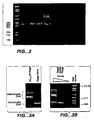
- the PCR product (267 base pairs (bp)) was analyzed on an 8% polyacrylamide gel along with the PCR product from a single phage peptide clone (positive control) and molecular weight markers ( Figure 2 ).
- a slower running product that appeared as a diffuse band was observed at around 500 - 700 bp. This was due to too much template (i.e. phage) In the PCR reaction, and can be alleviated by decreasing the phage concentration or by decreasing the number of PCR cycles ( Figure 3 ).
- the PCR product was diluted appropriately for subsequent PCR reactions from this starting material to generate more products for sub-cloning purposes.
- the desired product (267 bp) was amplified, It was digested with Eagl and Acc651 restriction endonucleases to produce a 45 bp fragment containing the DNA coding for the random peptide.
- the 45 bp fragment was then sub-cloned into the M13KE vector (New England Biolabs; Beverly, MA) at the Eag l and Acc 65I restriction sites using standard techniques (Sambrook, et al., (1988) supra ). After ligating the 45 bp fragment into the M13KE vector, the ligation reaction was transformed into chemically competent ER2537 E. coli cells.
- the cells were made competent with calcium chloride using a standard protocol (Sambrook, et a /., (1989) supra ).
- the M13 DNA was isolated from various transformants using a modified protocol from New England Biolab's protocol for M13 DNA preparation and then sequenced. The modification Includes the use of 96-well plates as opposed to tubes. The corresponding peptide sequences are shown In Table 1.
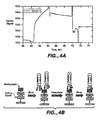
- the dissociation of the phage from the TNF- ⁇ is very slow with the dissociation constant estimated as k off ⁇ 10 -4 sec -1 (10 mM HEPES/0.05% Tween). Washing with a 10X buffer concentrate (at the 70 min time point) only removed a small portion of the phage. Additional washes with 10 mM HCI failed to completely remove the phage peptide from the target. Binding of phage-displayed peptide sequence RYWQDIP (SEQ ID NO: 3) Is specific since wild-type phage lacking the insert did not bind to Immobilized TNF.
- Pre-equilbrated skin tissues were placed Into a 6 well culture plate containing fresh 0.9 mL tissue culture media and 300 ⁇ l of a 2% Neutrogena® body wash containing, 10 ⁇ L of cyclic 7-mer or linear 12-mer peptide libraries (10 10 pfu/ ⁇ l), or wild type phage (10 9 pfu/ ⁇ l) were added to the skin surface. The samples were Incubated at room temperature for 15 min with gentle agitation. The unbound supernatent was transferred to a new well containing skin tissue and the procedure was repeated.
- the Incubation solution was transferred to nine 3 inch dark hair (International Hair Importers & Products, White Plains, NY) strands in 60 ml tubes containing 10 ml of 2% body wash for 30 minutes at room temperature with rotatory shaking (30 rpm).
- the hair samples were then washed with 1X 50 mls, 2 X 50 mls, or 4 X 50 mls of 2% body wash; Wash cycles In PBS followed (1 X 25 mls for 5 min, 1 X 25 mis for 2 min, 2 X 50 mls for 5 min each, 150 mis total). After the final PBS wash the hair samples containing bound phage peptides were frozen at -20°
- PCR amplification of target-bound phage was carried out as described in Reference Example 1 with minor modifications. PCR reactions contained 50 ⁇ g of BSA to prevent inhibition of the PCR reactions by hair or skin.
- Peptide sequences identified in Examples 4 and 5 along with a random control peptide were C-terminally labeled with the sequence GGGK(biotin).
- the sequence LESTPKMK (SEQ ID NO: 116) contains the consensus sequence LEST and was Isolated on hair.
- FTQSLPR SEQ ID NO: 116) contains the consensus sequence TQSL and was Isolated on skin.
- YGGFMTSE (SEQ ID NO: 117) Is a control peptide.
Landscapes
- Health & Medical Sciences (AREA)
- Life Sciences & Earth Sciences (AREA)
- Chemical & Material Sciences (AREA)
- Organic Chemistry (AREA)
- Engineering & Computer Science (AREA)
- Genetics & Genomics (AREA)
- Molecular Biology (AREA)
- Biomedical Technology (AREA)
- General Health & Medical Sciences (AREA)
- Biochemistry (AREA)
- Biotechnology (AREA)
- Bioinformatics & Cheminformatics (AREA)
- General Engineering & Computer Science (AREA)
- Zoology (AREA)
- Wood Science & Technology (AREA)
- Medicinal Chemistry (AREA)
- Biophysics (AREA)
- Microbiology (AREA)
- Physics & Mathematics (AREA)
- Immunology (AREA)
- Chemical Kinetics & Catalysis (AREA)
- Plant Pathology (AREA)
- Crystallography & Structural Chemistry (AREA)
- Proteomics, Peptides & Aminoacids (AREA)
- General Chemical & Material Sciences (AREA)
- Urology & Nephrology (AREA)
- Hematology (AREA)
- Bioinformatics & Computational Biology (AREA)
- Pharmacology & Pharmacy (AREA)
- Nuclear Medicine, Radiotherapy & Molecular Imaging (AREA)
- Veterinary Medicine (AREA)
- Public Health (AREA)
- Animal Behavior & Ethology (AREA)
- Food Science & Technology (AREA)
- General Physics & Mathematics (AREA)
- Pathology (AREA)
- Cell Biology (AREA)
- Analytical Chemistry (AREA)
- Rheumatology (AREA)
- Virology (AREA)
Priority Applications (1)
| Application Number | Priority Date | Filing Date | Title |
|---|---|---|---|
| CY20101100233T CY1109876T1 (el) | 2000-04-14 | 2010-03-10 | Μεθοδοι για εκλεκτικη στοχευση |
Applications Claiming Priority (3)
| Application Number | Priority Date | Filing Date | Title |
|---|---|---|---|
| US19725900P | 2000-04-14 | 2000-04-14 | |
| US197259P | 2000-04-14 | ||
| PCT/US2001/011811 WO2001079479A2 (en) | 2000-04-14 | 2001-04-11 | Methods for selective targeting |
Publications (2)
| Publication Number | Publication Date |
|---|---|
| EP1360500A2 EP1360500A2 (en) | 2003-11-12 |
| EP1360500B1 true EP1360500B1 (en) | 2010-01-13 |
Family
ID=22728668
Family Applications (1)
| Application Number | Title | Priority Date | Filing Date |
|---|---|---|---|
| EP01930480A Expired - Lifetime EP1360500B1 (en) | 2000-04-14 | 2001-04-11 | Methods for selective targeting |
Country Status (12)
| Country | Link |
|---|---|
| US (5) | US20020098524A1 (https=) |
| EP (1) | EP1360500B1 (https=) |
| JP (2) | JP4966470B2 (https=) |
| AT (1) | ATE455304T1 (https=) |
| AU (1) | AU2001257012A1 (https=) |
| CA (1) | CA2405715C (https=) |
| CY (1) | CY1109876T1 (https=) |
| DE (1) | DE60141088D1 (https=) |
| DK (1) | DK1360500T3 (https=) |
| ES (1) | ES2338097T3 (https=) |
| PT (1) | PT1360500E (https=) |
| WO (1) | WO2001079479A2 (https=) |
Cited By (1)
| Publication number | Priority date | Publication date | Assignee | Title |
|---|---|---|---|---|
| WO2012134416A3 (en) * | 2009-11-18 | 2012-12-27 | Arizona Board Of Regents Acting For And On Behalf Of Arizona State University | Peptide ligands |
Families Citing this family (59)
| Publication number | Priority date | Publication date | Assignee | Title |
|---|---|---|---|---|
| US20020098524A1 (en) | 2000-04-14 | 2002-07-25 | Murray Christopher J. | Methods for selective targeting |
| US7129326B2 (en) * | 2000-04-14 | 2006-10-31 | Genencor International, Inc. | Methods for selective targeting |
| AU2002230889A1 (en) * | 2000-12-14 | 2002-06-24 | Genencor International, Inc. | Target enzymes |
| US7794693B2 (en) | 2002-03-01 | 2010-09-14 | Bracco International B.V. | Targeting vector-phospholipid conjugates |
| US7261876B2 (en) | 2002-03-01 | 2007-08-28 | Bracco International Bv | Multivalent constructs for therapeutic and diagnostic applications |
| AU2003278807A1 (en) | 2002-03-01 | 2004-08-13 | Bracco International B.V. | Kdr and vegf/kdr binding peptides and their use in diagnosis and therapy |
| US8623822B2 (en) | 2002-03-01 | 2014-01-07 | Bracco Suisse Sa | KDR and VEGF/KDR binding peptides and their use in diagnosis and therapy |
| EP2431048B1 (en) | 2002-10-08 | 2015-03-11 | Danisco US Inc. | Phenolic binding peptides |
| EP2581383A1 (en) | 2002-11-25 | 2013-04-17 | Genencor International, Inc. | Skin or hair binding peptides |
| US20100311641A1 (en) * | 2003-09-08 | 2010-12-09 | E. I. Du Pont De Nemours And Company | Peptide-based body surface coloring reagents |
| US20050226839A1 (en) * | 2003-09-08 | 2005-10-13 | Xueying Huang | Pepetide-based body surface reagents for personal care |
| US7220405B2 (en) * | 2003-09-08 | 2007-05-22 | E. I. Du Pont De Nemours And Company | Peptide-based conditioners and colorants for hair, skin, and nails |
| US20050054752A1 (en) * | 2003-09-08 | 2005-03-10 | O'brien John P. | Peptide-based diblock and triblock dispersants and diblock polymers |
| US7807141B2 (en) | 2003-09-08 | 2010-10-05 | E.I. Du Pont De Nemours And Company | Peptide-based oral care surface reagents for personal care |
| US7585495B2 (en) | 2003-09-08 | 2009-09-08 | E. I. Du Pont De Nemours And Company | Method for identifying shampoo-resistant hair-binding peptides and hair benefit agents therefrom |
| US7285264B2 (en) | 2003-09-08 | 2007-10-23 | E.I. Du Pont De Nemours And Company | Peptide-based body surface coloring reagents |
| CA2503838C (en) * | 2003-09-08 | 2014-08-19 | E. I. Du Pont De Nemours And Company | Peptide-based conditioners and colorants for hair |
| ATE482972T1 (de) * | 2003-11-06 | 2010-10-15 | Danisco Us Inc | Tgf-beta1-bindende und geträgerte peptide |
| US9062392B2 (en) * | 2003-12-30 | 2015-06-23 | Intel Corporation | Methods for isolating a peptide methods for identifying a peptide |
| US20070196305A1 (en) * | 2005-03-01 | 2007-08-23 | Hong Wang | Method for identifying hair conditioner-resistant hair-binding peptides and hair benefit agents therefrom |
| US9084734B2 (en) | 2005-05-05 | 2015-07-21 | Danisco Us Inc. | Peptide personal care compositions and methods for their use |
| US20060286047A1 (en) * | 2005-06-21 | 2006-12-21 | Lowe David J | Methods for determining the sequence of a peptide motif having affinity for a substrate |
| US20070065387A1 (en) * | 2005-09-16 | 2007-03-22 | Beck William A | Method for enhancing the effect of particulate benefit agents |
| US7736633B2 (en) | 2005-09-28 | 2010-06-15 | E.I. Du Pont De Nemours And Company | Method for enhancing effects of colorants and conditioners |
| US8318659B2 (en) * | 2005-11-15 | 2012-11-27 | E I Du Pont De Nemours And Company | Peptide-based organic sunscreens |
| US7632919B2 (en) * | 2005-12-15 | 2009-12-15 | E.I. Du Pont De Nemours And Company | Polystyrene binding peptides and methods of use |
| US7709601B2 (en) | 2005-12-15 | 2010-05-04 | E. I. Du Pont De Nemours And Company | Nylon binding peptides and methods of use |
| US7858581B2 (en) * | 2005-12-15 | 2010-12-28 | E. I. Du Pont De Nemours And Company | PMMA binding peptides and methods of use |
| US7700716B2 (en) * | 2005-12-15 | 2010-04-20 | E. I. Du Pont De Nemours And Company | Polytetrafluoroethylene binding peptides and methods of use |
| US7928076B2 (en) | 2005-12-15 | 2011-04-19 | E. I. Du Pont De Nemours And Company | Polypropylene binding peptides and methods of use |
| US7906617B2 (en) | 2005-12-15 | 2011-03-15 | E. I. Du Pont De Nemours And Company | Polyethylene binding peptides and methods of use |
| WO2007109299A2 (en) * | 2006-03-21 | 2007-09-27 | Duke University | Peptide |
| US7749957B2 (en) | 2006-04-06 | 2010-07-06 | E.I. Du Pont De Nemours And Company | Clay-binding peptides and methods of use |
| DE102006030028A1 (de) * | 2006-06-29 | 2008-02-14 | Forschungszentrum Jülich GmbH | Verfahren zum Auffinden von spezifisch an einen Köder bindende Moleküle, sowie spezifisch an einen Köder bindende Moleküle und deren Verwendung |
| US20080280810A1 (en) * | 2006-10-30 | 2008-11-13 | O'brien John P | Peptides having affinity for body surfaces |
| US20080175798A1 (en) * | 2006-12-11 | 2008-07-24 | Beck William A | Peptide-based hair protectants |
| US7951559B2 (en) * | 2007-07-25 | 2011-05-31 | E.I. Du Pont De Nemours And Company | Recombinant peptide production using a cross-linkable solubility tag |
| US7829311B2 (en) | 2007-07-25 | 2010-11-09 | E.I. Du Pont De Nemours And Company | Ketosteroid isomerase inclusion body tag engineered to be acid-resistant by replacing aspartates with glutamate |
| US7678883B2 (en) | 2007-07-25 | 2010-03-16 | E.I. Du Pont De Nemours And Company | Solubility tags for the expression and purification of bioactive peptides |
| US7754680B2 (en) | 2007-07-26 | 2010-07-13 | E. I. Du Pont De Nemours And Company | Peptides for binding calcium carbonates and methods of use |
| US20090142283A1 (en) * | 2007-11-30 | 2009-06-04 | E. I. Du Pont De Nemours And Company | Peptide-based antidandruff reagents |
| US7998702B2 (en) * | 2008-09-17 | 2011-08-16 | E. I. Du Pont De Nemours And Company | Mutant arabinose promoter for inducible gene expression |
| US7803902B2 (en) | 2008-10-15 | 2010-09-28 | Danisco Us Inc. | Modified variant bowman birk protease inhibitors |
| BRPI0823193A2 (pt) | 2008-10-15 | 2019-09-24 | Danisco Us Inc | inibidores de protease de bowman birk variantes modificados |
| US7772181B2 (en) * | 2008-10-15 | 2010-08-10 | Danisco Us Inc. | Personal care compositions comprising modified variant Bowman Birk Protease Inhibitors |
| US20100158837A1 (en) | 2008-12-18 | 2010-06-24 | E. I. Du Pont De Nemours And Company | Iron oxide-binding peptides |
| US8697654B2 (en) | 2008-12-18 | 2014-04-15 | E I Du Pont De Nemours And Company | Peptide linkers for effective multivalent peptide binding |
| US7915011B2 (en) * | 2009-03-05 | 2011-03-29 | E.I. Du Pont De Nemours And Company | Host cell modifications that improve peptide production and downstream processing |
| JP2012522057A (ja) * | 2009-03-30 | 2012-09-20 | ジヨンソン・アンド・ジヨンソン・コンシユーマー・カンパニーズ・インコーポレーテツド | 化粧用剤の送達のためのペプチドに基づく系 |
| US8481678B2 (en) | 2009-03-30 | 2013-07-09 | E I Du Pont De Nemours And Company | Peptide-based tooth whitening reagents |
| US20100310495A1 (en) * | 2009-06-08 | 2010-12-09 | E. I. Du Pont De Nemours And Company | Peptides having affinity for poly (benzyl methacrylate-co-methacrylic acid) potassium salt copolymers and methods of use |
| US8609621B2 (en) | 2010-11-15 | 2013-12-17 | E I Du Pont De Nemours And Company | Acid-cleavable linkers exhibiting altered rates of acid hydrolysis |
| RU2660373C2 (ru) | 2010-12-20 | 2018-07-05 | Е.И.Дюпон Де Немур Энд Компани | Ферментативное образование перкислоты для применения в продуктах для ухода за полостью рта |
| EP2655646A4 (en) | 2010-12-20 | 2014-05-21 | Du Pont | TARGETED PERHYDROLASES |
| US9273336B2 (en) | 2011-02-21 | 2016-03-01 | E. I. Du Pont De Nemours And Company | Recombinant host cells having an increase in buoyant density |
| US9062312B2 (en) | 2011-06-21 | 2015-06-23 | Danisco Us Inc. | Fusion peptides comprising multi-functional peptidic solubility tags for efficient production, processing and surface applications |
| HK1221908A1 (zh) | 2013-04-29 | 2017-06-16 | Adimab, Llc | 多特异(polyspecificity)试剂,其制备方法和用途 |
| TW201726706A (zh) * | 2015-12-28 | 2017-08-01 | 出光興產股份有限公司 | 胜肽標記及含有其之附加標記的蛋白質 |
| CN110453292B (zh) * | 2019-06-28 | 2021-06-29 | 浙江大学 | 一种利用噬菌体抗体库高效筛选纤维蛋白原的方法 |
Family Cites Families (32)
| Publication number | Priority date | Publication date | Assignee | Title |
|---|---|---|---|---|
| DE2437090A1 (de) * | 1974-08-01 | 1976-02-19 | Hoechst Ag | Reinigungsmittel |
| US3929676A (en) * | 1974-08-02 | 1975-12-30 | Int Flavors & Fragrances Inc | Bicyclic fragrance materials and processes therefor |
| US4760025A (en) * | 1984-05-29 | 1988-07-26 | Genencor, Inc. | Modified enzymes and methods for making same |
| US4683202A (en) * | 1985-03-28 | 1987-07-28 | Cetus Corporation | Process for amplifying nucleic acid sequences |
| US4800197A (en) * | 1987-07-17 | 1989-01-24 | Richardson-Vicks Inc. | Anti-acne composition |
| US5223409A (en) * | 1988-09-02 | 1993-06-29 | Protein Engineering Corp. | Directed evolution of novel binding proteins |
| US5011681A (en) * | 1989-10-11 | 1991-04-30 | Richardson-Vicks, Inc. | Facial cleansing compositions |
| US5283173A (en) * | 1990-01-24 | 1994-02-01 | The Research Foundation Of State University Of New York | System to detect protein-protein interactions |
| US5061620A (en) * | 1990-03-30 | 1991-10-29 | Systemix, Inc. | Human hematopoietic stem cell |
| DK0600866T3 (da) | 1990-06-01 | 1998-03-09 | Chiron Corp | Præparater og fremgangsmåder til identifikation af biologisk aktive molekyler |
| ES2259800T3 (es) * | 1990-06-11 | 2006-10-16 | Gilead Sciences, Inc. | Procedimientos de uso de ligandos de acido nucleico. |
| US5723286A (en) | 1990-06-20 | 1998-03-03 | Affymax Technologies N.V. | Peptide library and screening systems |
| US5292646A (en) * | 1991-02-06 | 1994-03-08 | Genetics Institute, Inc. | Peptide and protein fusions to thioredoxin and thioredoxin-like molecules |
| US5270181A (en) * | 1991-02-06 | 1993-12-14 | Genetics Institute, Inc. | Peptide and protein fusions to thioredoxin and thioredoxin-like molecules |
| US5665539A (en) * | 1991-07-12 | 1997-09-09 | The Regents Of The University Of California | Immuno-polymerase chain reaction system for antigen detection |
| US5582981A (en) * | 1991-08-14 | 1996-12-10 | Gilead Sciences, Inc. | Method for identifying an oligonucleotide aptamer specific for a target |
| US5733731A (en) * | 1991-10-16 | 1998-03-31 | Affymax Technologies N.V. | Peptide library and screening method |
| US5270170A (en) * | 1991-10-16 | 1993-12-14 | Affymax Technologies N.V. | Peptide library and screening method |
| US5605793A (en) * | 1994-02-17 | 1997-02-25 | Affymax Technologies N.V. | Methods for in vitro recombination |
| US5677136A (en) * | 1994-11-14 | 1997-10-14 | Systemix, Inc. | Methods of obtaining compositions enriched for hematopoietic stem cells, compositions derived therefrom and methods of use thereof |
| US6341256B1 (en) * | 1995-03-31 | 2002-01-22 | Curagen Corporation | Consensus configurational bias Monte Carlo method and system for pharmacophore structure determination |
| US5609826A (en) | 1995-04-17 | 1997-03-11 | Ontogen Corporation | Methods and apparatus for the generation of chemical libraries |
| US6475806B1 (en) | 1995-06-07 | 2002-11-05 | Praecis Pharmaceuticals, Inc. | Anchor libraries and identification of peptide binding sequences |
| EP0868427B1 (en) | 1995-12-18 | 2003-05-14 | Praecis Pharmaceuticals Incorporated | Methods for identifying compounds that bind to a target |
| WO1997035198A1 (en) | 1996-03-22 | 1997-09-25 | Ontogen Corporation | Methods for spatially-dispersed positionally-encoded combinatorial library synthesis |
| WO1998054312A1 (en) | 1997-05-28 | 1998-12-03 | Babraham Institute | Ribosome complexes as selection particles for in vitro display and evolution of proteins |
| GB9716094D0 (en) * | 1997-07-30 | 1997-10-01 | Univ Glasgow | Mehods for screening bacteriophage libraries |
| US6639051B2 (en) * | 1997-10-20 | 2003-10-28 | Curis, Inc. | Regulation of epithelial tissue by hedgehog-like polypeptides, and formulations and uses related thereto |
| GB9805793D0 (en) * | 1998-03-18 | 1998-05-13 | Glaxo Group Ltd | Sodium ion channels |
| US6861227B2 (en) * | 1998-03-19 | 2005-03-01 | Human Genome Sciences, Inc. | Antibodies to cytokine receptor common gamma chain like |
| US6201104B1 (en) | 1998-12-04 | 2001-03-13 | Entremed, Inc. | Angiogenesis—inhibiting protein binding peptides and proteins and methods of use |
| US20020098524A1 (en) | 2000-04-14 | 2002-07-25 | Murray Christopher J. | Methods for selective targeting |
-
2001
- 2001-04-11 US US09/832,723 patent/US20020098524A1/en not_active Abandoned
- 2001-04-11 DK DK01930480.7T patent/DK1360500T3/da active
- 2001-04-11 WO PCT/US2001/011811 patent/WO2001079479A2/en not_active Ceased
- 2001-04-11 ES ES01930480T patent/ES2338097T3/es not_active Expired - Lifetime
- 2001-04-11 JP JP2001577462A patent/JP4966470B2/ja not_active Expired - Fee Related
- 2001-04-11 PT PT01930480T patent/PT1360500E/pt unknown
- 2001-04-11 EP EP01930480A patent/EP1360500B1/en not_active Expired - Lifetime
- 2001-04-11 CA CA2405715A patent/CA2405715C/en not_active Expired - Fee Related
- 2001-04-11 DE DE60141088T patent/DE60141088D1/de not_active Expired - Lifetime
- 2001-04-11 AU AU2001257012A patent/AU2001257012A1/en not_active Abandoned
- 2001-04-11 AT AT01930480T patent/ATE455304T1/de active
-
2004
- 2004-10-19 US US10/968,732 patent/US20050112692A1/en not_active Abandoned
-
2008
- 2008-04-08 US US12/099,632 patent/US8318640B2/en not_active Expired - Lifetime
-
2010
- 2010-03-10 CY CY20101100233T patent/CY1109876T1/el unknown
-
2011
- 2011-07-27 JP JP2011164796A patent/JP5689764B2/ja not_active Expired - Fee Related
-
2012
- 2012-10-23 US US13/658,713 patent/US8779091B2/en not_active Expired - Fee Related
-
2014
- 2014-05-29 US US14/289,799 patent/US20140342930A1/en not_active Abandoned
Cited By (1)
| Publication number | Priority date | Publication date | Assignee | Title |
|---|---|---|---|---|
| WO2012134416A3 (en) * | 2009-11-18 | 2012-12-27 | Arizona Board Of Regents Acting For And On Behalf Of Arizona State University | Peptide ligands |
Also Published As
| Publication number | Publication date |
|---|---|
| DK1360500T3 (da) | 2010-05-25 |
| JP5689764B2 (ja) | 2015-03-25 |
| PT1360500E (pt) | 2010-04-19 |
| AU2001257012A1 (en) | 2001-10-30 |
| ES2338097T3 (es) | 2010-05-04 |
| WO2001079479A2 (en) | 2001-10-25 |
| CY1109876T1 (el) | 2014-09-10 |
| US20130102757A1 (en) | 2013-04-25 |
| WO2001079479A3 (en) | 2003-08-21 |
| JP2012002818A (ja) | 2012-01-05 |
| CA2405715A1 (en) | 2001-10-25 |
| CA2405715C (en) | 2011-11-15 |
| US8318640B2 (en) | 2012-11-27 |
| US20140342930A1 (en) | 2014-11-20 |
| EP1360500A2 (en) | 2003-11-12 |
| US20050112692A1 (en) | 2005-05-26 |
| ATE455304T1 (de) | 2010-01-15 |
| JP4966470B2 (ja) | 2012-07-04 |
| US20090093393A1 (en) | 2009-04-09 |
| DE60141088D1 (de) | 2010-03-04 |
| JP2004518403A (ja) | 2004-06-24 |
| US8779091B2 (en) | 2014-07-15 |
| US20020098524A1 (en) | 2002-07-25 |
Similar Documents
| Publication | Publication Date | Title |
|---|---|---|
| EP1360500B1 (en) | Methods for selective targeting | |
| US9120840B2 (en) | Methods for selective targeting | |
| EP1572723B1 (en) | Skin binding peptides | |
| EP0833941A1 (en) | Polypeptides having a functional domain of interest and methods of identifying and using same | |
| TW201410709A (zh) | 肽庫及其利用 | |
| Gram | Phage display in proteolysis and signal transduction | |
| US20140200152A1 (en) | Method for screening anti-ligand libraries for identifying anti-ligands specific for differentially and infrequently expressed ligands | |
| Anni et al. | Selection of phage-display library peptides recognizing ethanol targets on proteins | |
| Messmer et al. | Sequential determination of ligands binding to discrete components in heterogeneous mixtures by iterative panning and blocking (IPAB) | |
| EP1604209B1 (en) | Screening assay | |
| CA2382541A1 (en) | Dna library and its use in methods of selecting and designing polypeptides | |
| Diaz et al. | Exploring biochemistry and cellular biology with protein libraries | |
| Hultschig et al. | Multiplexed sorting of libraries on libraries: A novel method for empirical protein design by affinity-driven phage enrichment on synthetic peptide arrays | |
| Messmer et al. | Specific blocking to improve biopanning in biological samples such as serum and hybridoma supernatants | |
| Lunder et al. | Affinity Ranking of Phage-Displayed Peptides: Enzyme-Linked Immunosorbent Assay versus Surface Plasmon Resonance. | |
| Christensen et al. | Agents for Genomic Targets | |
| Chen et al. | Selection of substrate recognition sequence of protein kinase with ferric chelation affinity chromatography | |
| Christensen et al. | Surrogate Ligand-Based Assay Systems for Discovery of Antibacterial Agents for Genomic Targets |
Legal Events
| Date | Code | Title | Description |
|---|---|---|---|
| PUAI | Public reference made under article 153(3) epc to a published international application that has entered the european phase |
Free format text: ORIGINAL CODE: 0009012 |
|
| AK | Designated contracting states |
Kind code of ref document: A2 Designated state(s): AT BE CH CY DE DK ES FI FR GB GR IE IT LI LU MC NL PT SE TR |
|
| AX | Request for extension of the european patent |
Extension state: AL LT LV MK RO SI |
|
| 17P | Request for examination filed |
Effective date: 20040419 |
|
| R17P | Request for examination filed (corrected) |
Effective date: 20021104 |
|
| 17Q | First examination report despatched |
Effective date: 20071221 |
|
| GRAP | Despatch of communication of intention to grant a patent |
Free format text: ORIGINAL CODE: EPIDOSNIGR1 |
|
| DAX | Request for extension of the european patent (deleted) | ||
| GRAS | Grant fee paid |
Free format text: ORIGINAL CODE: EPIDOSNIGR3 |
|
| GRAA | (expected) grant |
Free format text: ORIGINAL CODE: 0009210 |
|
| AK | Designated contracting states |
Kind code of ref document: B1 Designated state(s): AT BE CH CY DE DK ES FI FR GB GR IE IT LI LU MC NL PT SE TR |
|
| REG | Reference to a national code |
Ref country code: GB Ref legal event code: FG4D |
|
| REG | Reference to a national code |
Ref country code: CH Ref legal event code: EP |
|
| REG | Reference to a national code |
Ref country code: IE Ref legal event code: FG4D |
|
| REF | Corresponds to: |
Ref document number: 60141088 Country of ref document: DE Date of ref document: 20100304 Kind code of ref document: P |
|
| REG | Reference to a national code |
Ref country code: NL Ref legal event code: T3 |
|
| REG | Reference to a national code |
Ref country code: PT Ref legal event code: SC4A Free format text: AVAILABILITY OF NATIONAL TRANSLATION Effective date: 20100413 |
|
| REG | Reference to a national code |
Ref country code: SE Ref legal event code: TRGR |
|
| REG | Reference to a national code |
Ref country code: GR Ref legal event code: EP Ref document number: 20100400579 Country of ref document: GR |
|
| REG | Reference to a national code |
Ref country code: ES Ref legal event code: FG2A Ref document number: 2338097 Country of ref document: ES Kind code of ref document: T3 |
|
| REG | Reference to a national code |
Ref country code: DK Ref legal event code: T3 |
|
| PLBE | No opposition filed within time limit |
Free format text: ORIGINAL CODE: 0009261 |
|
| STAA | Information on the status of an ep patent application or granted ep patent |
Free format text: STATUS: NO OPPOSITION FILED WITHIN TIME LIMIT |
|
| 26N | No opposition filed |
Effective date: 20101014 |
|
| PGFP | Annual fee paid to national office [announced via postgrant information from national office to epo] |
Ref country code: IE Payment date: 20140410 Year of fee payment: 14 |
|
| PGFP | Annual fee paid to national office [announced via postgrant information from national office to epo] |
Ref country code: NL Payment date: 20140410 Year of fee payment: 14 Ref country code: CH Payment date: 20140414 Year of fee payment: 14 Ref country code: SE Payment date: 20140411 Year of fee payment: 14 Ref country code: FI Payment date: 20140410 Year of fee payment: 14 |
|
| PGFP | Annual fee paid to national office [announced via postgrant information from national office to epo] |
Ref country code: BE Payment date: 20140414 Year of fee payment: 14 |
|
| PGFP | Annual fee paid to national office [announced via postgrant information from national office to epo] |
Ref country code: ES Payment date: 20150310 Year of fee payment: 15 Ref country code: MC Payment date: 20150310 Year of fee payment: 15 |
|
| PGFP | Annual fee paid to national office [announced via postgrant information from national office to epo] |
Ref country code: LU Payment date: 20150413 Year of fee payment: 15 Ref country code: GR Payment date: 20150312 Year of fee payment: 15 |
|
| PGFP | Annual fee paid to national office [announced via postgrant information from national office to epo] |
Ref country code: PT Payment date: 20150407 Year of fee payment: 15 Ref country code: CY Payment date: 20150310 Year of fee payment: 15 Ref country code: TR Payment date: 20150409 Year of fee payment: 15 |
|
| PGFP | Annual fee paid to national office [announced via postgrant information from national office to epo] |
Ref country code: IT Payment date: 20150413 Year of fee payment: 15 Ref country code: AT Payment date: 20150325 Year of fee payment: 15 |
|
| REG | Reference to a national code |
Ref country code: CH Ref legal event code: PL |
|
| REG | Reference to a national code |
Ref country code: SE Ref legal event code: EUG |
|
| REG | Reference to a national code |
Ref country code: NL Ref legal event code: MM Effective date: 20150501 |
|
| REG | Reference to a national code |
Ref country code: IE Ref legal event code: MM4A |
|
| PG25 | Lapsed in a contracting state [announced via postgrant information from national office to epo] |
Ref country code: FI Free format text: LAPSE BECAUSE OF NON-PAYMENT OF DUE FEES Effective date: 20150411 Ref country code: LI Free format text: LAPSE BECAUSE OF NON-PAYMENT OF DUE FEES Effective date: 20150430 Ref country code: CH Free format text: LAPSE BECAUSE OF NON-PAYMENT OF DUE FEES Effective date: 20150430 |
|
| PG25 | Lapsed in a contracting state [announced via postgrant information from national office to epo] |
Ref country code: SE Free format text: LAPSE BECAUSE OF NON-PAYMENT OF DUE FEES Effective date: 20150412 |
|
| REG | Reference to a national code |
Ref country code: FR Ref legal event code: PLFP Year of fee payment: 16 |
|
| PG25 | Lapsed in a contracting state [announced via postgrant information from national office to epo] |
Ref country code: NL Free format text: LAPSE BECAUSE OF NON-PAYMENT OF DUE FEES Effective date: 20150501 |
|
| PG25 | Lapsed in a contracting state [announced via postgrant information from national office to epo] |
Ref country code: IE Free format text: LAPSE BECAUSE OF NON-PAYMENT OF DUE FEES Effective date: 20150411 |
|
| REG | Reference to a national code |
Ref country code: AT Ref legal event code: MM01 Ref document number: 455304 Country of ref document: AT Kind code of ref document: T Effective date: 20160411 |
|
| PG25 | Lapsed in a contracting state [announced via postgrant information from national office to epo] |
Ref country code: LU Free format text: LAPSE BECAUSE OF NON-PAYMENT OF DUE FEES Effective date: 20160411 |
|
| PG25 | Lapsed in a contracting state [announced via postgrant information from national office to epo] |
Ref country code: CY Free format text: LAPSE BECAUSE OF NON-PAYMENT OF DUE FEES Effective date: 20160411 |
|
| REG | Reference to a national code |
Ref country code: GR Ref legal event code: ML Ref document number: 20100400579 Country of ref document: GR Effective date: 20161104 |
|
| PG25 | Lapsed in a contracting state [announced via postgrant information from national office to epo] |
Ref country code: PT Free format text: LAPSE BECAUSE OF NON-PAYMENT OF DUE FEES Effective date: 20161011 Ref country code: IT Free format text: LAPSE BECAUSE OF NON-PAYMENT OF DUE FEES Effective date: 20160411 Ref country code: AT Free format text: LAPSE BECAUSE OF NON-PAYMENT OF DUE FEES Effective date: 20160411 Ref country code: GR Free format text: LAPSE BECAUSE OF NON-PAYMENT OF DUE FEES Effective date: 20161104 |
|
| REG | Reference to a national code |
Ref country code: FR Ref legal event code: PLFP Year of fee payment: 17 |
|
| PG25 | Lapsed in a contracting state [announced via postgrant information from national office to epo] |
Ref country code: BE Free format text: LAPSE BECAUSE OF NON-PAYMENT OF DUE FEES Effective date: 20150430 |
|
| REG | Reference to a national code |
Ref country code: FR Ref legal event code: PLFP Year of fee payment: 18 |
|
| PG25 | Lapsed in a contracting state [announced via postgrant information from national office to epo] |
Ref country code: ES Free format text: LAPSE BECAUSE OF NON-PAYMENT OF DUE FEES Effective date: 20160412 |
|
| PG25 | Lapsed in a contracting state [announced via postgrant information from national office to epo] |
Ref country code: MC Free format text: LAPSE BECAUSE OF NON-PAYMENT OF DUE FEES Effective date: 20160502 |
|
| REG | Reference to a national code |
Ref country code: ES Ref legal event code: FD2A Effective date: 20181204 |
|
| PGFP | Annual fee paid to national office [announced via postgrant information from national office to epo] |
Ref country code: FR Payment date: 20200312 Year of fee payment: 20 |
|
| PGFP | Annual fee paid to national office [announced via postgrant information from national office to epo] |
Ref country code: DE Payment date: 20200331 Year of fee payment: 20 Ref country code: DK Payment date: 20200414 Year of fee payment: 20 |
|
| PGFP | Annual fee paid to national office [announced via postgrant information from national office to epo] |
Ref country code: GB Payment date: 20200401 Year of fee payment: 20 |
|
| REG | Reference to a national code |
Ref country code: DE Ref legal event code: R071 Ref document number: 60141088 Country of ref document: DE |
|
| REG | Reference to a national code |
Ref country code: DK Ref legal event code: EUP Expiry date: 20210411 |
|
| REG | Reference to a national code |
Ref country code: GB Ref legal event code: PE20 Expiry date: 20210410 |
|
| PG25 | Lapsed in a contracting state [announced via postgrant information from national office to epo] |
Ref country code: GB Free format text: LAPSE BECAUSE OF EXPIRATION OF PROTECTION Effective date: 20210410 |
|
| PG25 | Lapsed in a contracting state [announced via postgrant information from national office to epo] |
Ref country code: TR Free format text: LAPSE BECAUSE OF NON-PAYMENT OF DUE FEES Effective date: 20160411 |