EP1359249A1 - Verfahren zur Heissdispergierung eines Papierfaserstoffes - Google Patents
Verfahren zur Heissdispergierung eines Papierfaserstoffes Download PDFInfo
- Publication number
- EP1359249A1 EP1359249A1 EP20030004766 EP03004766A EP1359249A1 EP 1359249 A1 EP1359249 A1 EP 1359249A1 EP 20030004766 EP20030004766 EP 20030004766 EP 03004766 A EP03004766 A EP 03004766A EP 1359249 A1 EP1359249 A1 EP 1359249A1
- Authority
- EP
- European Patent Office
- Prior art keywords
- paper pulp
- thickening device
- heating
- disperser
- consistency
- Prior art date
- Legal status (The legal status is an assumption and is not a legal conclusion. Google has not performed a legal analysis and makes no representation as to the accuracy of the status listed.)
- Granted
Links
- 239000006185 dispersion Substances 0.000 title claims abstract description 16
- 238000000034 method Methods 0.000 title claims description 36
- 229920001131 Pulp (paper) Polymers 0.000 title claims description 19
- 230000008719 thickening Effects 0.000 claims abstract description 25
- 238000010438 heat treatment Methods 0.000 claims abstract description 22
- 239000000835 fiber Substances 0.000 claims abstract description 20
- 230000000694 effects Effects 0.000 claims description 14
- XLYOFNOQVPJJNP-UHFFFAOYSA-N water Substances O XLYOFNOQVPJJNP-UHFFFAOYSA-N 0.000 claims description 10
- 230000003247 decreasing effect Effects 0.000 claims 1
- 230000007774 longterm Effects 0.000 claims 1
- 238000011144 upstream manufacturing Methods 0.000 claims 1
- 239000000725 suspension Substances 0.000 abstract description 7
- 238000003809 water extraction Methods 0.000 abstract 2
- 238000009529 body temperature measurement Methods 0.000 abstract 1
- 238000005265 energy consumption Methods 0.000 abstract 1
- 239000004744 fabric Substances 0.000 description 7
- 239000002657 fibrous material Substances 0.000 description 5
- 239000000463 material Substances 0.000 description 5
- 239000002994 raw material Substances 0.000 description 4
- 239000000126 substance Substances 0.000 description 4
- 241000237858 Gastropoda Species 0.000 description 3
- 239000010893 paper waste Substances 0.000 description 3
- 239000007787 solid Substances 0.000 description 3
- 230000033228 biological regulation Effects 0.000 description 2
- 238000011217 control strategy Methods 0.000 description 2
- 239000000203 mixture Substances 0.000 description 2
- 230000001105 regulatory effect Effects 0.000 description 2
- 230000005494 condensation Effects 0.000 description 1
- 238000009833 condensation Methods 0.000 description 1
- 239000000356 contaminant Substances 0.000 description 1
- 230000007423 decrease Effects 0.000 description 1
- 238000010790 dilution Methods 0.000 description 1
- 239000012895 dilution Substances 0.000 description 1
- 238000006073 displacement reaction Methods 0.000 description 1
- 238000004519 manufacturing process Methods 0.000 description 1
- 239000002562 thickening agent Substances 0.000 description 1
Images


Classifications
-
- D—TEXTILES; PAPER
- D21—PAPER-MAKING; PRODUCTION OF CELLULOSE
- D21G—CALENDERS; ACCESSORIES FOR PAPER-MAKING MACHINES
- D21G9/00—Other accessories for paper-making machines
- D21G9/0009—Paper-making control systems
- D21G9/0018—Paper-making control systems controlling the stock preparation
-
- D—TEXTILES; PAPER
- D21—PAPER-MAKING; PRODUCTION OF CELLULOSE
- D21B—FIBROUS RAW MATERIALS OR THEIR MECHANICAL TREATMENT
- D21B1/00—Fibrous raw materials or their mechanical treatment
- D21B1/04—Fibrous raw materials or their mechanical treatment by dividing raw materials into small particles, e.g. fibres
- D21B1/12—Fibrous raw materials or their mechanical treatment by dividing raw materials into small particles, e.g. fibres by wet methods, by the use of steam
- D21B1/30—Defibrating by other means
- D21B1/32—Defibrating by other means of waste paper
-
- D—TEXTILES; PAPER
- D21—PAPER-MAKING; PRODUCTION OF CELLULOSE
- D21D—TREATMENT OF THE MATERIALS BEFORE PASSING TO THE PAPER-MAKING MACHINE
- D21D1/00—Methods of beating or refining; Beaters of the Hollander type
- D21D1/002—Control devices
-
- Y—GENERAL TAGGING OF NEW TECHNOLOGICAL DEVELOPMENTS; GENERAL TAGGING OF CROSS-SECTIONAL TECHNOLOGIES SPANNING OVER SEVERAL SECTIONS OF THE IPC; TECHNICAL SUBJECTS COVERED BY FORMER USPC CROSS-REFERENCE ART COLLECTIONS [XRACs] AND DIGESTS
- Y02—TECHNOLOGIES OR APPLICATIONS FOR MITIGATION OR ADAPTATION AGAINST CLIMATE CHANGE
- Y02W—CLIMATE CHANGE MITIGATION TECHNOLOGIES RELATED TO WASTEWATER TREATMENT OR WASTE MANAGEMENT
- Y02W30/00—Technologies for solid waste management
- Y02W30/50—Reuse, recycling or recovery technologies
- Y02W30/64—Paper recycling
Definitions
- the invention relates to a process for the hot dispersion of paper pulp according to the preamble of claim 1.
- Procedure of the above Be e.g. used to improve the quality of fiber, which was obtained from waste paper. It is known that pulp by Dispersing can be homogenized and thereby significantly improved. This will a high-consistency fiber fabric that has a dry content between 15 and 35%. Dispergers that are used for such processes are usually very large compact and have an excellent dispersing effect at high energy density. she however, require an even material flow.
- a particularly economical machine for thickening is the screw press.
- the fiber suspension is between a screw conveyor and a perforated jacket surrounding it, wherein the water comes out through the holes in the jacket. The resulting highly consistent one Fibers are expressed from the snail.
- the hot dispersion is carried out at a temperature which is well above that Ambient temperature.
- the fibrous material is usually heated by adding water vapor directly, e.g. a heating screw is suitable: In In a horizontally lying housing, a screw conveyor rotates the fibrous material loosened up and brought into contact with injected steam. Heating through condensation the fabric on. For economic reasons, this heating is already on made of thickened fabric.
- Modern systems to carry out such a process should be automatic work. They therefore have one or more control loops in order to avoid permanent human intervention to enable a sufficiently constant operation.
- the raw material properties, especially the Composition of the fibers contained in the paper pulp and the amount of Change non-fiber components it is therefore desirable to regulate one Dispersion-serving system so that despite the fluctuations mentioned a paper fiber material processed as uniformly as possible for further use can be supplied.
- the specific required when heating the thickened substance depends very much on its water content. If the consistency of the fiber material decreases, more thermal energy has to be warmed up to be used at the same temperature difference: The increase in steam feed Steam consumption. Another possibility is to change that by heating reached temperature difference. This means that e.g. if the consistency drops the originally the final temperature is no longer reached. This unwanted Consequences can be eliminated by the method according to the invention, which with simple means for a constant consistency of the to be heated and then to be dispersed fiber.
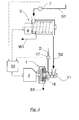
- FIG. 1 shows an embodiment with the most important equipment that one when performing the method according to the invention can use.
- the process is based on a raw material S, which e.g. from waste paper exists and together with water W in a pulp 5 using a driven rotor is resolved.
- the fiber suspension thus produced passes through a sieve in the bottom of the pulper 5 and through a pressure sorter 8 and Thick matter cleaner 9, whereby the coarse contaminants of the waste paper are removed.
- Material dissolvers of the type indicated here have a consistency, that is, one Solids content between 3 and 6%. Dissolving processes are also conceivable, however which have a solids content of over 12%.
- a screw press - is from the Suspension S1 is a highly consistent paper pulp S2 formed.
- the squeezed Water W1 can advantageously be used again for dissolving in the pulper 5.
- the pulp S2 next passes into a heater 12, e.g. one already mentioned heating screw.
- the required steam D is given by a number of Openings are blown into the interior of this heating screw. Due to the technical-physical conditions usually have a dwell time of several minutes until the substance is at the required temperature. Apart from the increased dead time that this causes, this procedure definitely has their advantages.
- the hot, highly consistent paper pulp S2 ' is fed via a feed screw 11 guided centrally between two disperger sets moved relative to each other, between which it is dispersed and then as a homogeneous fiber S3 from the The disperger housing falls out.
- the rotor of this Disperger 1 is by the Disperger drive 2 driven.
- the controller 10 also has a measured value for e.g. in the Thickening device 3 receives added amount of substance, for which purpose a sensor 7 is provided. Usually this is led through this part of the plant Material flow set constant. By measuring the volume flow and the consistency the amount of solids processed in disperger 1 can be determined. from that again there is the possibility to stop the specific work in the Disperger.
- the specific work is a central criterion for the dispersing effect. Dispersion is said to even out the fibrous material, but has also a fiber technology effect. This changes the paper fibers themselves meant; Changes that are often undesirable are at least a certain amount should not exceed. They are significantly influenced by the distances in which the disperger work items, e.g. the teeth of the disperger sets against each other move past. A change in these distances therefore affects both specific work, as well as on fiber technology.
- FIG. 3 A disperser that is particularly suitable for the method is shown in FIG. 3 shown in more detail without all structural details being visible.
- the hot one highly consistent paper pulp S2 'passes through a chute 16 into the Feed screw 11.
- Disperger 1 has two Dispergergarnituren 19 and 20 has, each several contactless interlocking annular concentric rows of teeth. Since the Disperger 20 belongs to a driven rotor, their teeth in Circumferential direction can be moved relative to the stator assembly, whereby the highly consistent paper pulp is dispersed.
- the disperger shown here contains an adjusting device 19 with which the axial The distance between the disperger sets can be changed. However, this is only indicated. Since the teeth of the disperser sets have a conical shape, the Axial displacement means that the distances between their flanks and those of the respective Change the counterpart with the aforementioned energetic and technological Effects. The new process can make this adjustment option unnecessary, which leads to savings. But it is also conceivable to have both possibilities of influence combine and thereby obtain a greater control potential.
- the possible adjustment path is limited so that the - mostly undesirable - fiber technology effects remain minimal. In other cases where one fiber technological effect is desired, e.g. to the firmness of later Influence paper produced results from the combination mentioned additional degree of freedom in the control strategy of the entire dispersion process.
- Figs. 1 and 3 plants were assumed in which the heating of the substance in separate heaters, e.g. Heating screws took place. In such cases, measure the temperatures before and after heating. The temperature difference is then a measure of the amount of heat consumed, less of its exact absolute value, rather than the change in time is needed. If the temperatures are controlled So kept constant, the steam consumption changes, and that in turn can change from Control loop are taken into account.
- the heating of the fabric is carried out so that the steam D directly into the disperser 1 through a number of steam lines 16 which are only hinted at here.
- This modern form of fabric heating is e.g. described in DE 197 12 653 A1.
- the amount of heat consumed can be e.g. by measuring the steam consumption on one Steam measuring point 17 or by measuring the material temperature between the Determine disperger sets.
- the exact details are less important Absolute values as based on the trends.
Landscapes
- Engineering & Computer Science (AREA)
- Life Sciences & Earth Sciences (AREA)
- Wood Science & Technology (AREA)
- Mechanical Engineering (AREA)
- Paper (AREA)
Abstract
Description
- Fig. 1
- schematisch: Anlage zur Durchführung des erfindungsgemäßen Verfahrens;
- Fig. 2
- eine Variante bei der Eindickvorrichtung;
- Fig. 3
- Schnitt durch einen für das Verfahren besonders geeigneten Disperger;
- Fig. 4
- eine Variante bei der Stofferwärmung.
Claims (16)
- Verfahren zur Heißdispergierung eines Papierfaserstoffes mit folgenden Schritten:
- 1.1
- Bereitstellung eines wasserhaltigen Papierfaserstoffes (S1);
- 1.2
- Auspressen eines Teils des Wassers (W) in einer Eindickvorrichtung (3) zur Bildung eines hochkonsistenten Papierfaserstoffes (S2);
- 1.3
- Erhitzen des hochkonsistenten Papierfaserstoffes (S2');
- 1.4
- Dispergierung des erhitzten hochkonsistenten Papierfaserstoffes (S2') mit einem Disperger (1),
dass der Entwässerungseffekt der Eindickvorrichtung (3) so gesteuert wird, dass er bei höherem Verbrauch von Wärmeenergie vergrößert und bei sinkendem Verbrauch gesenkt wird. - Verfahren nach Anspruch 1,
dadurch gekennzeichnet, dass die Temperaturen des hochkonsistenten Papierfaserstoffes vor und nach dem Erhitzen gemessen werden und dass diese Temperaturdifferenz mit einem vorgegebenen Sollwert verglichen wird und dass bei Abweichungen der Entwässerungseffekt der Eindickvorrichtung (3) geändert wird. - Verfahren nach Anspruch 1 oder 2,
dadurch gekennzeichnet, dass die Erhitzung des hochkonsistenten Papierfaserstoffes in einer dem Disperger (1) vorgeschalteten Heizvorrichtung (12) durchgeführt wird. - Verfahren nach Anspruch 2,
dadurch gekennzeichnet, dass die Heizvorrichtung (12) eine Heizschnecke mit direkter Dampfzugabe ist. - Verfahren nach einem der voranstehenden Ansprüche,
dadurch gekennzeichnet, dass der Disperger (1) mindestens zwei Dispergergarnituren (19, 20) aufweist, welche jeweils mehrere berührungslos ineinandergreifende ringförmige, konzentrische Zahnreihen enthalten, deren Zähne in Umfangsrichtung relativ zueinander bewegt werden, wodurch der hochkonsistente Papierfaserstoff dispergiert wird. - Verfahren nach Anspruch 5,
dadurch gekennzeichnet, dass der axiale Abstand der zwei Dispergergarnituren (19, 20) verstellt wird, wenn der Dispergiereffekt verändert werden soll und dass der dabei mögliche Verstellweg so eng begrenzt wird, dass sich das fasertechnologische Ergebnis der Dispergierung nicht oder nur in einem zulässigen Bereich ändert. - Verfahren nach Anspruch 6,
dadurch gekennzeichnet, dass die Veränderung an der Eindickvorrichtung (3) Vorrang hat vor der Veränderung des Axialabstandes der Dispergergarnituren. - Verfahren nach Anspruch 6,
dadurch gekennzeichnet, dass die Veränderungen an der Eindickvorrichtung (3) und die Änderung des Axialabstandes der Dispergergarnituren so aufeinander abgestimmt werden, dass Kurzzeitschwankungen durch Veränderung des Axialabstandes und Langzeitschwankungen durch Veränderung an der Eindickvorrichtung (3) ausgeregelt werden. - Verfahren nach einem der Ansprüche 6 bis 8,
dadurch gekennzeichnet, dass die Veränderungen an der Eindickvorrichtung (3) und die Änderung des Axialabstandes der Dispergergarnituren (19, 20) so aufeinander abgestimmt werden, dass ein optimales Betriebsergebnis der Dispergieranlage erreicht wird. - Verfahren nach einem der Ansprüche 5 bis 9,
dadurch gekennzeichnet, dass die Erhitzung des hochkonsistenten Papierfaserstoffes durch Zugabe von Dampf (D) zwischen die Dispergergarnituren (19, 20) erfolgt. - Verfahren nach Anspruch 10,
dadurch gekennzeichnet, dass der zum Erhitzen verbrauchte Dampf (D) gemessen wird und dass daraus ein Signal zur Steuerung des Entwässerungseffektes der Eindickvorrichtung (3) gebildet wird. - Verfahren nach Anspruch 10,
dadurch gekennzeichnet, dass die Temperatur des Papierfaserstoffes zwischen den beiden Dispergergarnituren (19, 20) unmittelbar danach gemessen wird und dass daraus ein Signal zur Steuerung des Entwässerungseffektes der Eindickvorrichtung (3) gebildet wird. - Verfahren nach einem der voranstehenden Ansprüche,
dadurch gekennzeichnet, dass als Eindickvorrichtung (3) eine Schneckenpresse verwendet wird mit einer Pressschnecke, deren Antriebsmoment zur Einstellung des Entwässerungseffektes verändert wird. - Verfahren nach einem der voranstehenden Ansprüche,
dadurch gekennzeichnet, dass als Eindickvorrichtung (3) eine Schneckenpresse verwendet wird, bei der der Gegendruck des Presskuchens zur Einstellung des Entwässerungseffektes verändert wird. - Verfahren nach einem der Ansprüche 1 bis 12,
dadurch gekennzeichnet, dass als Eindickvorrichtung (3) eine Siebbandpresse verwendet wird mit mindestens einer Presswalze, deren Anpressdruck zur Einstellung des Entwässerungseffektes verändert wird. - Verfahren nach einem der voranstehenden Ansprüche,
dadurch gekennzeichnet, dass die Antriebsleistung des Dispergers (1) auf einen Wert eingestellt wird, der zur Übertragung einer spezifischen Dispergierarbeit zwischen 30 kWh/to und 150 kWh/to führt.
Applications Claiming Priority (2)
| Application Number | Priority Date | Filing Date | Title |
|---|---|---|---|
| DE10219844 | 2002-05-03 | ||
| DE10219844A DE10219844C1 (de) | 2002-05-03 | 2002-05-03 | Verfahren zur Heissdispergierung eines Papierfaserstoffes |
Publications (2)
| Publication Number | Publication Date |
|---|---|
| EP1359249A1 true EP1359249A1 (de) | 2003-11-05 |
| EP1359249B1 EP1359249B1 (de) | 2006-06-07 |
Family
ID=27762992
Family Applications (1)
| Application Number | Title | Priority Date | Filing Date |
|---|---|---|---|
| EP20030004766 Expired - Lifetime EP1359249B1 (de) | 2002-05-03 | 2003-03-05 | Verfahren zur Heissdispergierung eines Papierfaserstoffes |
Country Status (5)
| Country | Link |
|---|---|
| US (1) | US7364638B2 (de) |
| EP (1) | EP1359249B1 (de) |
| AT (1) | ATE329076T1 (de) |
| CA (1) | CA2427781A1 (de) |
| DE (2) | DE10219844C1 (de) |
Cited By (1)
| Publication number | Priority date | Publication date | Assignee | Title |
|---|---|---|---|---|
| CN111472197A (zh) * | 2020-04-14 | 2020-07-31 | 联盛纸业(龙海)有限公司 | 一种occ高浓打浆的制浆生产及其造纸方法和再生纸 |
Families Citing this family (3)
| Publication number | Priority date | Publication date | Assignee | Title |
|---|---|---|---|---|
| WO2007128077A1 (en) * | 2006-05-09 | 2007-11-15 | Visy R & D Pty Ltd | Improved paper dyeing process |
| CN104404809B (zh) * | 2014-10-31 | 2016-03-16 | 玖龙纸业(太仓)有限公司 | 损纸浆处理装置 |
| FI125635B (fi) * | 2015-02-05 | 2015-12-31 | Valmet Technologies Oy | Laite dispergoitavan kiertokuitumassan esilämmittämiseksi |
Citations (1)
| Publication number | Priority date | Publication date | Assignee | Title |
|---|---|---|---|---|
| DE3728890C1 (de) * | 1987-08-29 | 1988-07-14 | Escher Wyss Gmbh | Verfahren zur Regelung der spezifischen Dispergierarbeit |
Family Cites Families (2)
| Publication number | Priority date | Publication date | Assignee | Title |
|---|---|---|---|---|
| DE19614947B4 (de) * | 1996-04-16 | 2004-04-08 | Voith Paper Fiber Systems Gmbh & Co. Kg | Verfahren zur Erhöhung des Weißgrades von Papierfaserstoff |
| DE19712653C2 (de) * | 1997-03-26 | 2002-10-24 | Voith Paper Fiber Systems Gmbh | Verfahren und Vorrichtung zur Dispergierung eines Altpapierfaserstoffes |
-
2002
- 2002-05-03 DE DE10219844A patent/DE10219844C1/de not_active Expired - Fee Related
-
2003
- 2003-03-05 AT AT03004766T patent/ATE329076T1/de not_active IP Right Cessation
- 2003-03-05 EP EP20030004766 patent/EP1359249B1/de not_active Expired - Lifetime
- 2003-03-05 DE DE50303641T patent/DE50303641D1/de not_active Expired - Fee Related
- 2003-05-02 US US10/427,972 patent/US7364638B2/en not_active Expired - Fee Related
- 2003-05-02 CA CA002427781A patent/CA2427781A1/en not_active Abandoned
Patent Citations (1)
| Publication number | Priority date | Publication date | Assignee | Title |
|---|---|---|---|---|
| DE3728890C1 (de) * | 1987-08-29 | 1988-07-14 | Escher Wyss Gmbh | Verfahren zur Regelung der spezifischen Dispergierarbeit |
Cited By (1)
| Publication number | Priority date | Publication date | Assignee | Title |
|---|---|---|---|---|
| CN111472197A (zh) * | 2020-04-14 | 2020-07-31 | 联盛纸业(龙海)有限公司 | 一种occ高浓打浆的制浆生产及其造纸方法和再生纸 |
Also Published As
| Publication number | Publication date |
|---|---|
| US7364638B2 (en) | 2008-04-29 |
| ATE329076T1 (de) | 2006-06-15 |
| US20060102301A1 (en) | 2006-05-18 |
| DE50303641D1 (de) | 2006-07-20 |
| EP1359249B1 (de) | 2006-06-07 |
| DE10219844C1 (de) | 2003-09-18 |
| CA2427781A1 (en) | 2003-11-03 |
Similar Documents
| Publication | Publication Date | Title |
|---|---|---|
| DE2845025C2 (de) | ||
| DE19712653C2 (de) | Verfahren und Vorrichtung zur Dispergierung eines Altpapierfaserstoffes | |
| DE68903662T2 (de) | Verfahren zur herstellung eines papierstoffes fuer treuhaenderische verwendung. | |
| DE2633041C2 (de) | Vorrichtung zum Zerfasern von pflanzlichen Rohstoffen | |
| DE2442627A1 (de) | Verfahren zum behandeln eines fasermaterials | |
| EP1889971A1 (de) | Verfahren zur Behandlung eines Papierfasergemisches | |
| EP1147805B1 (de) | Verfahren zur Dispergierung eines Papierfaserstoffes sowie Anlage zur Durchführung des Verfahrens | |
| EP3808896B1 (de) | Verfahren zum herstellen von altpapier- und grasfasern enthaltendem papier | |
| DE10219844C1 (de) | Verfahren zur Heissdispergierung eines Papierfaserstoffes | |
| EP1230272A1 (de) | Verfahren und vorrichtung zur kontinuierlichen herstellung einer extrusionslösung | |
| EP2761080B1 (de) | Betriebsverfahren für eine stoffaufbereitung | |
| DE10102449C1 (de) | Vorrichtung zur Heiß-Dispergierung eines Papierfaserstoffes | |
| DE2165433A1 (de) | Verfahren zur Herstellung von Weg werfwirtdeln | |
| DE2908773A1 (de) | Verfahren und vorrichtung zur herstellung eines fuelligen texturierten garns | |
| DE10219843C1 (de) | Verfahren zur Dispergierung eines Papierfaserstoffes | |
| EP0445321B1 (de) | Verfahren zur Herstellung von Zellstoff in einem kontinuierlichen Kocher | |
| DE2111380B2 (de) | Vorrichtung zum pilieren von seifen oder aehnlichen, pastenartigen massen | |
| DE2934880A1 (en) | Method of making pulp | |
| EP0305659B1 (de) | Verfahren zur Regelung der spezifischen Dispergierarbeit | |
| DE1267076B (de) | Verfahren zum kontinuierlichen Kochen von Zellulosematerial | |
| EP0590433B1 (de) | Steuerverfahren für die Herstellung von Zellstoff durch Druck- und Temperatursteuerung | |
| EP0867561B1 (de) | Verfahren und Vorrichtungen zur Herstellung eines heissen, überwiegend Papierfasern enthaltenden Krümelstoffes | |
| DE3127114A1 (de) | Einrichtung zum aufloesen von altpapier und aussortieren daraus zu gewinnender fasern fuer die herstellung von papier, karton oder pappe | |
| CH649330A5 (en) | Process for increasing the specific volume in the reprocessing of waste paper pulp | |
| EP4211305B1 (de) | Betreiben einer trockenpartie einer papiermaschine |
Legal Events
| Date | Code | Title | Description |
|---|---|---|---|
| PUAI | Public reference made under article 153(3) epc to a published international application that has entered the european phase |
Free format text: ORIGINAL CODE: 0009012 |
|
| AK | Designated contracting states |
Kind code of ref document: A1 Designated state(s): AT BE BG CH CY CZ DE DK EE ES FI FR GB GR HU IE IT LI LU MC NL PT SE SI SK TR |
|
| AX | Request for extension of the european patent |
Extension state: AL LT LV MK RO |
|
| 17P | Request for examination filed |
Effective date: 20040506 |
|
| AKX | Designation fees paid |
Designated state(s): AT DE FI SE |
|
| GRAP | Despatch of communication of intention to grant a patent |
Free format text: ORIGINAL CODE: EPIDOSNIGR1 |
|
| GRAS | Grant fee paid |
Free format text: ORIGINAL CODE: EPIDOSNIGR3 |
|
| GRAA | (expected) grant |
Free format text: ORIGINAL CODE: 0009210 |
|
| AK | Designated contracting states |
Kind code of ref document: B1 Designated state(s): AT DE FI SE |
|
| REF | Corresponds to: |
Ref document number: 50303641 Country of ref document: DE Date of ref document: 20060720 Kind code of ref document: P |
|
| RAP2 | Party data changed (patent owner data changed or rights of a patent transferred) |
Owner name: VOITH PATENT GMBH |
|
| REG | Reference to a national code |
Ref country code: SE Ref legal event code: TRGR |
|
| PLBE | No opposition filed within time limit |
Free format text: ORIGINAL CODE: 0009261 |
|
| STAA | Information on the status of an ep patent application or granted ep patent |
Free format text: STATUS: NO OPPOSITION FILED WITHIN TIME LIMIT |
|
| 26N | No opposition filed |
Effective date: 20070308 |
|
| PGFP | Annual fee paid to national office [announced via postgrant information from national office to epo] |
Ref country code: FI Payment date: 20080314 Year of fee payment: 6 Ref country code: SE Payment date: 20080313 Year of fee payment: 6 |
|
| PGFP | Annual fee paid to national office [announced via postgrant information from national office to epo] |
Ref country code: AT Payment date: 20080314 Year of fee payment: 6 |
|
| PGFP | Annual fee paid to national office [announced via postgrant information from national office to epo] |
Ref country code: DE Payment date: 20080321 Year of fee payment: 6 |
|
| PG25 | Lapsed in a contracting state [announced via postgrant information from national office to epo] |
Ref country code: AT Free format text: LAPSE BECAUSE OF NON-PAYMENT OF DUE FEES Effective date: 20090305 Ref country code: FI Free format text: LAPSE BECAUSE OF NON-PAYMENT OF DUE FEES Effective date: 20090305 |
|
| EUG | Se: european patent has lapsed | ||
| PG25 | Lapsed in a contracting state [announced via postgrant information from national office to epo] |
Ref country code: DE Free format text: LAPSE BECAUSE OF NON-PAYMENT OF DUE FEES Effective date: 20091001 |
|
| PG25 | Lapsed in a contracting state [announced via postgrant information from national office to epo] |
Ref country code: SE Free format text: LAPSE BECAUSE OF NON-PAYMENT OF DUE FEES Effective date: 20090306 |