EP1352732A2 - Substrate mit vorzugsweise transferierbaren Schichten und/oder Oberflächenstrukturen, Verfahren zu deren Herstellung und deren Verwendung - Google Patents
Substrate mit vorzugsweise transferierbaren Schichten und/oder Oberflächenstrukturen, Verfahren zu deren Herstellung und deren Verwendung Download PDFInfo
- Publication number
- EP1352732A2 EP1352732A2 EP03008151A EP03008151A EP1352732A2 EP 1352732 A2 EP1352732 A2 EP 1352732A2 EP 03008151 A EP03008151 A EP 03008151A EP 03008151 A EP03008151 A EP 03008151A EP 1352732 A2 EP1352732 A2 EP 1352732A2
- Authority
- EP
- European Patent Office
- Prior art keywords
- layers
- lacquer layer
- lacquer
- layer
- structured
- Prior art date
- Legal status (The legal status is an assumption and is not a legal conclusion. Google has not performed a legal analysis and makes no representation as to the accuracy of the status listed.)
- Withdrawn
Links
Images

Classifications
-
- B—PERFORMING OPERATIONS; TRANSPORTING
- B29—WORKING OF PLASTICS; WORKING OF SUBSTANCES IN A PLASTIC STATE IN GENERAL
- B29C—SHAPING OR JOINING OF PLASTICS; SHAPING OF MATERIAL IN A PLASTIC STATE, NOT OTHERWISE PROVIDED FOR; AFTER-TREATMENT OF THE SHAPED PRODUCTS, e.g. REPAIRING
- B29C59/00—Surface shaping of articles, e.g. embossing; Apparatus therefor
- B29C59/02—Surface shaping of articles, e.g. embossing; Apparatus therefor by mechanical means, e.g. pressing
- B29C59/04—Surface shaping of articles, e.g. embossing; Apparatus therefor by mechanical means, e.g. pressing using rollers or endless belts
- B29C59/046—Surface shaping of articles, e.g. embossing; Apparatus therefor by mechanical means, e.g. pressing using rollers or endless belts for layered or coated substantially flat surfaces
-
- B—PERFORMING OPERATIONS; TRANSPORTING
- B42—BOOKBINDING; ALBUMS; FILES; SPECIAL PRINTED MATTER
- B42D—BOOKS; BOOK COVERS; LOOSE LEAVES; PRINTED MATTER CHARACTERISED BY IDENTIFICATION OR SECURITY FEATURES; PRINTED MATTER OF SPECIAL FORMAT OR STYLE NOT OTHERWISE PROVIDED FOR; DEVICES FOR USE THEREWITH AND NOT OTHERWISE PROVIDED FOR; MOVABLE-STRIP WRITING OR READING APPARATUS
- B42D25/00—Information-bearing cards or sheet-like structures characterised by identification or security features; Manufacture thereof
- B42D25/20—Information-bearing cards or sheet-like structures characterised by identification or security features; Manufacture thereof characterised by a particular use or purpose
- B42D25/29—Securities; Bank notes
-
- B—PERFORMING OPERATIONS; TRANSPORTING
- B41—PRINTING; LINING MACHINES; TYPEWRITERS; STAMPS
- B41M—PRINTING, DUPLICATING, MARKING, OR COPYING PROCESSES; COLOUR PRINTING
- B41M3/00—Printing processes to produce particular kinds of printed work, e.g. patterns
- B41M3/14—Security printing
-
- B—PERFORMING OPERATIONS; TRANSPORTING
- B41—PRINTING; LINING MACHINES; TYPEWRITERS; STAMPS
- B41M—PRINTING, DUPLICATING, MARKING, OR COPYING PROCESSES; COLOUR PRINTING
- B41M7/00—After-treatment of prints, e.g. heating, irradiating, setting of the ink, protection of the printed stock
- B41M7/0081—After-treatment of prints, e.g. heating, irradiating, setting of the ink, protection of the printed stock using electromagnetic radiation or waves, e.g. ultraviolet radiation, electron beams
-
- B—PERFORMING OPERATIONS; TRANSPORTING
- B41—PRINTING; LINING MACHINES; TYPEWRITERS; STAMPS
- B41M—PRINTING, DUPLICATING, MARKING, OR COPYING PROCESSES; COLOUR PRINTING
- B41M7/00—After-treatment of prints, e.g. heating, irradiating, setting of the ink, protection of the printed stock
- B41M7/009—After-treatment of prints, e.g. heating, irradiating, setting of the ink, protection of the printed stock using thermal means, e.g. infrared radiation, heat
-
- G—PHYSICS
- G03—PHOTOGRAPHY; CINEMATOGRAPHY; ANALOGOUS TECHNIQUES USING WAVES OTHER THAN OPTICAL WAVES; ELECTROGRAPHY; HOLOGRAPHY
- G03H—HOLOGRAPHIC PROCESSES OR APPARATUS
- G03H1/00—Holographic processes or apparatus using light, infrared or ultraviolet waves for obtaining holograms or for obtaining an image from them; Details peculiar thereto
- G03H1/02—Details of features involved during the holographic process; Replication of holograms without interference recording
- G03H1/0276—Replicating a master hologram without interference recording
- G03H1/028—Replicating a master hologram without interference recording by embossing
Definitions
- the invention relates to substrates with stable or preferably transferable layers and / or surface structures, a method too their manufacture and their use.
- Substrates including sheet materials, foils, sheets and the same, with different structured and / or unstructured Layers and / or with surface structures, for example Diffraction structures that are provided are used in different fields of application used, for example in decoration, as components, in particular also optical components in the technical field and in architecture, as Security elements for documents of value and data carriers, as Packaging elements and the like.
- WO 94/18609 describes a method for simultaneous replication and direct application of a hologram or other diffraction grating a printing material, especially on paper or cardboard, by means of a Surface relief structure bearing die is known, in which this structure in a radiation-curable lacquer layer is molded, the hardening of the Paint layer from the die side through the radiation-permeable Die surface takes place. Essentially, the curing of the the relief-absorbing lacquer layer before removing the die from the paper or box. According to this procedure, both self-adhesive products and heat sealing films with diffraction structures can also be produced.
- diffraction structures can be replicated or applied to a substrate relatively inexpensively and conveniently by means of this method, such a method or the product thus produced is not suitable for a number of applications.
- the surface structures cannot be produced with sufficient precision using this method, since on the one hand the quartz glass embossing cylinder used, in particular the surface, cannot be produced precisely and homogeneously enough.
- the photopolymers used for the matrix are only poorly stable under the process conditions, which means that the life of the embossing tool is only short.
- Such films usually have preferably transferable films Surface structures on a release layer. That requires the application an additional layer on the film, an additional operation. Furthermore exist in the known compositions of the release layers (especially if they contain waxes) mostly problems with the application the subsequent layers, especially in the case of uniform adhesion of these layers. Furthermore, the presence of another layer means in usually additional environmental pollution not only from waste and By-products in the production process, but also in the subsequent one Intended use of the film.
- the object of the invention is therefore a substrate with structured or unstructured layers and / or a diffraction or diffraction structure or is provided with a surface relief without providing a release layer and a method for its production, in which, on the one hand, the image of the Diffraction structure regardless of the type of carrier substrate excellent precision takes place, on the other hand the carrier film or on it located structured or unstructured layers and / or Diffraction structures without interference in the packaging industry or in other technical areas, such as architecture in the production of components, usual parameters without restriction can be processed or transferred. It is said to be both an economic and environmentally friendly production as well as easy transferability and excellent durability of those present on the film structured and / or unstructured layers and / or Surface structures can be guaranteed.
- the invention therefore preferably relates to substrates transferable structured and / or unstructured layers and / or Surface structures, characterized in that the structured and / or unstructured layers on or in a thermoplastic for the time being Lacquer layer are applied and / or optionally a surface structure by molding a die into a thermoplastic lacquer layer is generated under pressure and temperature, and / or a structure by embossing is shaped and whereupon a stabilization of the initially thermoplastic Lacquer layer is done.
- Another object of the invention is a method for producing Substrates with preferably transferable structured and / or unstructured layers and / or surface structures, thereby characterized in that a carrier substrate is provided in a first step is, in a second step, this carrier substrate in one Coating method is coated with the lacquer according to the invention, in a further step structured and / or unstructured layers on or are introduced, if necessary an impression of the surface structure in the thermoplastic lacquer is carried out at this stage and / or the lacquer according to the invention is partially or fully printed and in one Another step is the stabilization of the paint.
- carrier foils are preferably flexible Plastic films, for example made of Pl, PP, MOPP, PE, PPS, PEEK, PEK, PEI, PSU, PAEK, LCP, PEN, PBT, PET, PA, PC, COC, POM, ABS, PVC in question.
- the carrier films preferably have a thickness of 5 to 700 ⁇ m, preferably 8 to 200 microns, particularly preferably 12 - 50 microns.
- metal foils for example Al, Cu, Sn, Ni, Fe or stainless steel foils with a thickness of 5 - 200 ⁇ m, serve preferably 10 to 80 microns, particularly preferably 20 - 50 microns.
- the Films can also be surface-treated, coated or laminated for example with plastics or painted.
- carrier substrates also paper or composites with paper, for example, composites with plastics with a grammage 20-500 g / m 2, preferably 40-200 g / m 2. be used.
- Fabrics and nonwovens such as continuous fiber nonwovens, staple fiber nonwovens and the like, which can optionally be needled or calendered, can also be used as carrier substrates.
- Such fabrics or nonwovens preferably consist of plastics, such as PP, PET, PA, PPS and the like, but nonwovens made of natural, optionally treated fibers, such as viscose nonwovens, can also be used.
- the nonwovens used have a basis weight of approximately 20 g / m 2 to 500 g / m 2 .
- the carrier substrate can be provided on one or both sides with a hot or cold seal adhesive or a self-adhesive coating or can be provided with it after the structured and / or unstructured layers and / or the surface structure and / or after further coating steps have been carried out. Furthermore, one or more partial and / or full-area structured and / or structured layers may already be present on the carrier substrate.
- the initially thermoplastic lacquer according to the invention consists of a base MMA or ethyl cellulose or Cycloolefin copolymer, the base polymer being used to adjust the required thermoplastic properties or to adjust the subsequent Stabilizability modifiers are added.
- modifiers come, for example Additives to set the desired glass temperature, the range in which the paint is in a thermoplastic state, or modifiers for Achieving permanent curing of the paint in question.
- the components are preferably in a solvent, for example in aqueous solvents, water, alcohols, ethyl acetate, methyl ethyl ketone and the like or mixtures thereof.
- nitrocellulose is particularly advantageously added to a lacquer based on MMA to increase the glass transition temperature.
- Polyethylene waxes for example, are particularly advantageously added to a coating based on cycloolefin copolymers.
- a crosslinker based on ethyl cellulose is added to adjust the hardenability.
- the concentration of the base polymer in the finished lacquer is dependent on of the base polymer, the desired properties of the lacquer and the type and concentration of the modifiers 4 - 50%.
- the lacquer according to the invention can be transferred but also adheres to or can be set without an adhesion promoter, so that depending on the used If necessary, substrate does not require the application of a release layer.
- the lacquer according to the invention can be colored and / or pigmented, all of which known and customary pigments, for example inorganic and / or organic pigments such as titanium dioxide, zinc sulfide, kaolin, Barium sulfate, aluminum, chromium and silicon oxides, metal pigments (e.g. copper, aluminum, silver, gold, iron, chrome and the like), metal alloys such as copper-zinc or copper-aluminum also colored, possibly organic pigments, such as phthalocyanine blue, i-indoline yellow, Dioxazine violet, or amorphous or crystalline ceramic pigments such as ITO, ATO, FTO and the like or liquid crystal pigments are suitable are.
- inorganic and / or organic pigments such as titanium dioxide, zinc sulfide, kaolin, Barium sulfate, aluminum, chromium and silicon oxides, metal pigments (e.g. copper, aluminum, silver, gold, iron, chrome and the like), metal alloy
- the carrier substrate is used in any known coating method for example by spreading, pouring, spraying, printing (screen printing, Rotogravure, flexographic, or digital printing) or Roll application process coated with a varnish according to the invention.
- the Coating can be carried out selectively or over the entire surface.
- the layer thickness of the applied varnish according to the invention can vary Requirements for the end product and thickness of the substrate vary and is generally between 0.5 and 50 ⁇ m, preferably between 2 and 10 ⁇ m, particularly preferably between 2 and 5 ⁇ m.
- the applied varnish according to the invention is then dried.
- the structuring can now be carried out using a conventional one thermal embossing process or functional and / or decorative unstructured and / or structured layers partially or completely be applied.
- surface structures are, for example, in particular Diffraction or diffraction and relief structures understood.
- a desired molding of a surface structure can take place without the lacquer layer drying beforehand.
- the surface structure ie the diffraction, diffraction or relief structure, is shaped, for example, at a controlled temperature and under pressure by means of a die or by using an embossing mold in the layer of thermoplastic lacquer at this time.
- the impression of the surface structure can, for example, be in register already existing coating of the carrier substrate take place, one Tolerance of +/- 0.1 mm can be maintained. This is done by a Register control reached.
- the surface structure incorporated in the initially thermoplastic lacquer is characterized by great precision.
- thermoplastic lacquers according to the invention depending on the Composition by crosslinking, for example by means of radiation curing or by thermal curing by increasing the temperature or by overprinting with a cross-linking lacquer layer, a so-called Support varnish layer, which is then cured.
- the initially thermoplastic lacquer layer according to the invention remains until final stabilization changeable. After this treatment is the Paint layer stable.
- the varnish can be stabilized by drying, curing or by Application of a further crosslinkable lacquer layer, the reactive Components can penetrate into the lacquer layer according to the invention and crosslink or remain on the surface and the mechanically support paint layer according to the invention, and on the surface network, take place.
- the final hardening has a structure or the layers excellent resistance, especially chemical, thermal and mechanical resistance.
- the product is therefore possibly after appropriate packaging as a security element in data media, especially value documents such as ID cards, cards, banknotes or labels, seals and the like suitable, but also as packaging material in pharmaceutical and Food industry, for example in the form of blister films, for example for Medicines, covers or packaging, for example in the Food industry as a food film, for example for dairy products particularly suitable. Products of this type are also particularly suitable for decorative applications or optical elements, for example in the Architecture and the like.
- the carrier substrate can then be coated with additional layers are provided or already have such layers, for example further paint, paint or metallic layers or insulators, each can have different similar or the same properties.
- the application of the further layers can either be selective, overlapping or congruent with the surface structure or the structured and / or unstructured layers or only in those Areas that were left out when the structure was applied selectively respectively. However, a full-area coating can also be carried out become.
- the application of the ink can follow the embossing process in a register-controlled manner or in another printing unit in an insetter-controlled manner by any method, for example by gravure printing, flexographic printing, screen printing, digital printing and the like.
- the color or the color lacquer used is soluble in a solvent, preferably in water, but a color soluble in any solvent, for example in alcohol, esters and the like, can also be used.
- the color or the colored lacquer can be conventional compositions based on natural or artificial macromolecules.
- the soluble color can be pigmented or unpigmented. All known pigments can be used as pigments. TiO 2 , ZnS, kaolin and the like are particularly suitable.
- the printed carrier substrate can then optionally be treated by means of an inline plasma (low pressure or atmospheric plasma), corona or flame process to improve the adhesion of the subsequently applied layer.
- High-energy plasma for example Ar or Ar / O 2 plasma, cleans the surface of toning residues in the printing inks. The necessary sharp delimitation of the contours of the cutouts, which is necessary for the necessary precision of the coding, is achieved.
- the surface is activated. Terminal polar groups are created on the surface. This improves the adhesion of metals and the like to the surface.
- a thin metal or metal oxide layer can be applied as an adhesion promoter, for example by sputtering or vapor deposition, simultaneously with the application of the plasma or corona or flame treatment, in particular also when metal layers are subsequently applied.
- Cr, Al, Ag, Ti, Cu, TiO 2 , Si oxides or chromium oxides are particularly suitable.
- This adhesion promoter layer generally has a thickness of 0.1 nm - 5 nm, preferably 0.2 nm - 2 nm, particularly preferably 0.2 to 1 nm.
- the thickness of this layer is about 0.01 - 5 ⁇ m.
- the paints of the invention are excellent Adhesion of metallic layers reached, so that such Pretreatment largely unnecessary and no relevant improvement in Brings liability.
- compositions are used.
- the composition of each Layers can vary in particular according to their task, i.e. whether the serve individual layers exclusively for decorative purposes or one functional layer or whether the layer is both a decorational should also be a functional layer.
- the layers to be printed can be pigmented or unpigmented. All known pigments, such as titanium dioxide, zinc sulfide, kaolin, ATO, FTO, aluminum, chromium and silicon oxides as well as colored pigments can be used as pigments. Solvent-based coating systems and systems without solvents can be used. Various natural or synthetic binders can be used as binders.
- the functional layers can have certain electrical, magnetic, chemical, physical and also optical properties exhibit.
- conductivity for example graphite, carbon black, conductive organic or inorganic Polymers.
- Metal pigments e.g. copper, aluminum, silver, gold, Iron, chromium and the like
- metal alloys such as copper-zinc or copper-aluminum or amorphous or crystalline ceramic pigments such as ITO and the like
- endowed or not doped semiconductors such as silicon, germanium or ion conductors such as amorphous or crystalline metal oxides or metal sulfides are used as additives become.
- paramagnetic, diamagnetic and also ferromagnetic materials such as iron, nickel and Cobalt or their compounds or salts (for example oxides or Sulfides) can be used.
- Magnetic pigment paints with pigments based on Fe oxides, iron, nickel cobalt and their alloys, barium or cobalt ferrites, hard and soft magnetic iron and steel types in aqueous or solvent-containing dispersions are particularly suitable.
- suitable solvents are i-propanol, ethyl acetate, methyl ethyl ketone, methoxypropanol and mixtures thereof.
- the pigments are preferably introduced in acrylate polymer dispersions with a molecular weight of 150,000 to 300,000, in nitrocellulose, acrylate urethane dispersions, acrylate styrene or PVC-containing dispersions or in solvent-containing dispersions of this type.
- the optical properties of the layer can be determined by visible dyes or pigments, luminescent dyes or pigments that are visible, fluoresce or phosphoresce in the UV or IR range, Effect pigments, such as liquid crystals, pearlescent, bronzes and / or multilayer color change pigments and heat-sensitive colors or pigments influence. These can be used in all possible combinations.
- phosphorescent pigments can also be used alone or in Combination with other dyes and / or pigments can be used.
- a brown magnetic paint can be made metallic, for example silvery, by adding metals.
- Insulator layers can also be applied, for example.
- Insulators are, for example, organic substances and their derivatives and Connections, e.g. paint and varnish systems, e.g. Epoxy, polyester, Rosin, acrylate, alkyd, melamine, PVA, PVC, isocyanate, Urethane systems that can be radiation-curing, for example through Heat or UV radiation, suitable.
- paint and varnish systems e.g. Epoxy, polyester, Rosin, acrylate, alkyd, melamine, PVA, PVC, isocyanate
- Urethane systems that can be radiation-curing, for example through Heat or UV radiation, suitable.
- These layers can by known methods, for example by Steaming, sputtering, printing (e.g. gravure, flexo, screen, digital printing) and the like), spraying, electroplating, roller coating and the like are applied.
- the thickness of such functional layers is 0.001 to 50 ⁇ m, preferably 0.1 to 20 ⁇ m.
- Process steps can be fabricated in multilayer structures different properties applied on top of each other exhibit. It is possible by combining different Properties of the individual layers, for example layers with different conductivity, magnetizability, optical properties, Absorption behavior and similar structures for example for Manufacture security elements with several precise authenticity features.
- the coated film produced in this way can also pass through a protective lacquer layer can be protected or, for example, by lamination or the like can be further refined.
- the product can be sealed with a sealable adhesive, for example a hot or cold seal adhesive on the corresponding one Carrier material are applied, or for example in papermaking for security papers embedded in the paper by conventional methods become.
- a sealable adhesive for example a hot or cold seal adhesive on the corresponding one Carrier material are applied, or for example in papermaking for security papers embedded in the paper by conventional methods become.
- sealing adhesives can be made with visible or visible in UV light, fluorescent, phosphorescent or laser and IR radiation absorbent features to increase security against counterfeiting be equipped. These features can also take the form of patterns or There are characters or color effects, but in principle any many colors, preferably 1 to 10 colors or color mixtures, possible are.
- the substrate can be coated on one side after application removed or remain on the product.
- the carrier film can if necessary specially equipped on the non-coated side become, for example, scratch-resistant, antistatic and the like. The same applies to a possible layer of lacquer on the carrier substrate.
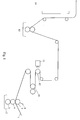
- 1 shows a possible embodiment of such a method for producing the substrates according to the invention.
- 1 means the carrier substrate, 2 the lacquer trough containing the lacquer according to the invention, 3 the immersion cylinder, 4 the transfer cylinder, 5 the gravure cylinder, 6 a doctor blade, 10 the embossing cylinder for the optional molding of a surface structure, 11 the device, for example a radiation source, to stabilize the initially thermoplastic lacquer or an application unit for applying and stabilizing the composition according to the invention that supports the layers, 12 a possibly required temperature-controlled cooling roller, 13 an exemplary gravure printing unit for applying additional layers and 14 a drying station.
- one or more devices 13 can also be located in front of the device for stabilizing the initially thermoplastic lacquer 11. If necessary, the stabilization of the initially thermoplastic lacquer layer can be done inline after application of further layers as well as offline, if necessary. after offline application of further functional and / or thermoplastic layers.
- 1 means a heat seal adhesive
- 2 a PET film
- 3 a primer
- 4 the surface-structured layer incorporated in the thermoplastic lacquer according to the invention
- 5 a partial metallic layer, for example an Al layer
- 6 a magnetic layer
- 7 an adhesive layer
- 8 a to 8d a fluorescent color layer with color gradient
- compositions of the lacquer according to the invention are Compositions of the lacquer according to the invention.
- a mixture of 1 part ethyl cellulose with a viscosity of 70 mPa.s and 5 Parts of ethyl cellulose with a viscosity of 200 mPa.s are used for production of the paint according to the invention mixed with Crosslinker CX 100 (Avecia).
- a 14% solution of equal parts of MMA with a T g 105 ° C and a T g 119 ° C and 1% hydroxyl-modified vinyl chloride copolymer in methyl ethyl ketone is mixed with a 14% nitrocellulose solution in ethyl acetate / ethanol (17.5: 1 ) mixed.
- the stabilizing varnish consists of 10% VMCH, 5% isocyanate, 85% Polyester acrylate and can be hardened by UV radiation.
Landscapes
- Engineering & Computer Science (AREA)
- Mechanical Engineering (AREA)
- Business, Economics & Management (AREA)
- Accounting & Taxation (AREA)
- Finance (AREA)
- Laminated Bodies (AREA)
Abstract
Die vorerst thermoplastische Lackschicht kann releasefähig eingestellt werden, sodass sich die Aufbringung einer Releaseschicht erübrigt.
Description
Nachteil der so hergestellten Oberflächenstrukturen ist deren geringe thermische, mechanische und chemische Beständigkeit durch das Prägen in rein thermoplastische Massen, die auch nach dem Prägen in einem gewissen Maße thermoplastisch veränderbar bleiben. Für Anwendungen als Heißsiegelfolien, beispielsweise in Verpackungen, Blister in der pharmazeutischen Industrie oder Lebensmittelverpackungen, ist die Beständigkeit der Oberflächenstrukturen, insbesondere gegen den Verarbeitungsdruck und die Verarbeitungstemperatur beim Heißsiegelvorgang und/oder bei der Sterilisation nicht ausreichend, sodass in diesem Fall der Verpackungsvorgang nicht mit den üblichen Maschinen erfolgen kann, sondern strenge Beschränkungen hinsichtlich Druck und Temperatur einzuhalten sind, oder aufwendige Zusatzeinrichtungen installiert werden müssen. Auch bei Siegelvorgängen gegen beispielsweise Stahl und auch andere Kunststoffe erweisen sich die im thermoplastischen Abformverfahren in einen rein thermoplastischen Lack hergestellten Strukturen als nicht ausreichend beständig. Ähnliche Probleme treten bei den Verfahren zur Einbettung als Sicherheitselemente in Wertdokumente, wie Banknoten, Karten und dergleichen auf, bei denen höhere Temperaturen und/oder erhöhter Druck angewendet werden muss.
Für Anwendungen als beispielsweise als Sicherheitselemente sind die Oberflächenstrukturen nach diesem Verfahren zu wenig präzise herstellbar, da einerseits der verwendete Quarzglas-Prägezylinder insbesondere die Oberfläche nicht präzise und homogen genug herstellbar ist. Die für die Matrize verwendeten Fotopolymere sind unter den Verfahrensbedingungen nur schlecht beständig, wodurch die Lebensdauer des Prägewerkzeugs nur gering ist. Die Übertragung der Oberflächenstruktur in eine Lackschicht, die noch während die Matrize auf dem Trägerpapier bzw. Karton aufliegt, vollständig ausgehärtet wird, ist außerdem zuwenig exakt, da bei Abnahme der Matrize nach der Aushärtung die Lackschicht und damit die Oberflächenstruktur gegebenenfalls mechanisch nicht zur Gänze unversehrt bleibt.
Die verwendbaren Lacke sind sehr beschränkt, da sich in der Praxis nur kationisch härtbare UV-Lacke als geeignet erwiesen haben.
Ferner können auf dem Trägersubstrat bereits eine oder mehrere partielle und/oder vollflächige strukturierte und/oder strukturierte Schichten vorhanden sein.
Einem Lack auf der Basis von Cycloolefincopolymeren werden beispielsweise besonders vorteilhaft Polyethylenwachse zugesetzt.
Einem Lack auf Basis von Ethylcellulose werden zur Einstellung der Härtbarkeit handelsübliche Crosslinker zugesetzt.
Die Abformung der Oberflächenstruktur, also der Diffraktions-, Beugungs- oder Reliefstruktur erfolgt beispielsweise bei kontrollierter Temperatur und unter Druck mittels einer Matrize oder unter Verwendung einer Prägeform in die zu diesem Zeitpunkt thermoplastische Lackschicht.
Als Bindemittel kommen verschiedene natürliche oder synthetische Bindemittel in Frage.
Vorzugsweise sind die Pigmente in Acrylat- Polymerdispersionen mit einem Molekulargewicht von 150.000 bis 300.000, in Nitrocellulose, Acrylat-Urethan-Dispersionen, Acrylat- Styrol oder PVC-haltigen Dispersionen oder in lösemittelhaltige derartige Dispersionen eingebracht.
Speziell zum Anfärben von Magnetpigmenten lassen sich alle bekannten löslichen und nicht löslichen Farbstoffe bzw. Pigmente verwenden. So kann beispielsweise eine braune Magnetfarbe durch Zugabe von Metallen in ihrem Farbton metallisch, z.B. silbrig eingestellt werden.
Es kann allerdings auch eine oder mehrere Einrichtungen 13 vor der Einrichtung zur Stabilisierung des vorerst thermoplastischen Lacks 11 situiert sein. Gegebenenfalls kann die Stabilisierung der vorerst thermoplastischen Lackschicht Inline nach Aufbringen weiterer Schichten als auch offline, ggf,. nach offline Aufbringung weiterer funktioneller und/oder thermoplastischer Schichten erfolgen.
Darin bedeuten 1 einen Heißsiegelkleber, 2 eine PET Folie, 3 einen Primer, 4 die in den erfindungsgemäßen thermoplastischen Lack eingebrachte oberflächenstrukturierte Schicht, 5 eine partielle metallische Schicht, beispielsweise eine Al-Schicht, 6 eine magnetische Schicht, 7 eine Kleberschicht, 8 a bis 8d eine fluoreszierende Farbschicht mit Farbverlauf und 1 a die Stabilisierungsschicht.
Claims (11)
- Substrate mit vorzugsweise transferierbaren strukturierten und/oder unstrukturierten Schichten und/oder Oberflächenstrukturen, dadurch gekennzeichnet, dass die strukturierten und/oder unstrukturierten Schichten auf oder in eine vorerst thermoplastische Lackschicht aufgebracht sind und/oder gegebenenfalls eine Oberflächenstruktur durch Abformen einer Matrize in eine vorerst thermoplastische Lackschicht unter Druck und Temperatur erzeugt ist, und/oder eine Struktur durch Prägen geformt ist und worauf ein Stabilisieren der vorerst thermoplastischen Lackschicht erfolgt.
- Substrate nach Anspruch 1, dadurch gekennzeichnet, dass das Stabilisieren der thermoplastischen Lackschicht nach Aufbringen von funktionellen Merkmalen durch Überdrucken und Stabilisieren mit einer Stützlackschicht erfolgt.
- Substrate nach Anspruch 1, dadurch gekennzeichnet, dass die Stabilisierung durch Aushärten oder Vernetzen mittels Wärme oder Strahlung erfolgt.
- Substrate nach einem der Ansprüche 1 bis 3, dadurch gekennzeichnet, dass die vorerst thermoplastische Lackschicht auf Basis von MMA oder Cycloolefincopolymeren oder Ethylcellulose aufgebaut ist und Modifikatoren enthält.
- Substrate nach Anspruch4, dadurch gekennzeichnet, dass die vorerst thermoplastische Lackschicht auf Basis von MMA mit Nitrocellulose aufgebaut ist.
- Substrate nach einem der Ansprüche 1 bis 5, dadurch gekennzeichnet, dass sie zwei oder mehrere vorerst thermoplastische Lackschichten aufweisen in oder auf die strukturierte und/oder unstrukturierte Schichten aufgebracht sind.
- Substrate nach einem der Ansprüche 1 bis 6, dadurch gekennzeichnet, dass sie weitere funktionelle und/oder dekorative Schichten aufweisen.
- Verfahren zur Herstellung von Substraten mit vorzugsweise transferierbaren strukturierten und/oder unstrukturierten Schichten und/oder Oberflächenstrukturen, dadurch gekennzeichnet, dass in einem ersten Schritt ein Trägersubstrat bereitgestellt wird, in einem zweiten Schritt dieses Trägersubstrat in einem Beschichtungsverfahren mit dem erfindungsgemäßen Lack beschichtet wird, in einem weiteren Schritt strukturierte und/oder unstrukturierte Schichten auf oder eingebracht werden, gegebenenfalls eine Abformung der Oberflächenstruktur in den in diesem Stadium thermoplastischen Lack durchgeführt wird und/oder der erfindungsgemäße Lack partiell oder vollflächig bedruckt wird und in einem weiteren Schritt die Stabilisierung des Lacks erfolgt.
- Verfahren nach Anspruch 8, dadurch gekennzeichnet, dass die Stabilisierung durch Überdrucken mit einer Stützlackschicht oder durch Aushärtung oder Vernetzung der vorerst thermoplastischen Lackschicht durch Wärme oder Strahlung erfolgt.
- Verfahren nach einem der Ansprüche 8 oder 9, dadurch gekennzeichnet, dass die Stabilisierung der vorerst thermoplastischen Lackschicht inline oder offline erfolgt.
- Verwendung der Substrate gemäß einem der Ansprüche 1 bis 6, in der Dekoration, als Bauelemente, als optische Bauelemente im technischen Bereich und in der Architektur, als Sicherheitselemente für Wertdokumente und Datenträger, als Verpackungselemente in der Lebensmittel und pharmazeutischen Industrie.
Applications Claiming Priority (2)
| Application Number | Priority Date | Filing Date | Title |
|---|---|---|---|
| AT5562002 | 2002-04-11 | ||
| AT5562002A AT502319B1 (de) | 2002-04-11 | 2002-04-11 | Substrate mit vorzugsweise transferierbaren schichten und/oder oberflächenstrukturen, verfahren zu deren herstellung und deren verwendung |
Publications (2)
| Publication Number | Publication Date |
|---|---|
| EP1352732A2 true EP1352732A2 (de) | 2003-10-15 |
| EP1352732A3 EP1352732A3 (de) | 2006-07-12 |
Family
ID=28047150
Family Applications (1)
| Application Number | Title | Priority Date | Filing Date |
|---|---|---|---|
| EP03008151A Withdrawn EP1352732A3 (de) | 2002-04-11 | 2003-04-08 | Substrate mit vorzugsweise transferierbaren Schichten und/oder Oberflächenstrukturen, Verfahren zu deren Herstellung und deren Verwendung |
Country Status (2)
| Country | Link |
|---|---|
| EP (1) | EP1352732A3 (de) |
| AT (1) | AT502319B1 (de) |
Cited By (15)
| Publication number | Priority date | Publication date | Assignee | Title |
|---|---|---|---|---|
| WO2005025837A1 (en) * | 2003-09-09 | 2005-03-24 | 3M Innovative Properties Company | Apparatus and method for producing two-sided patterned webs in registration |
| WO2005077668A1 (de) | 2004-02-16 | 2005-08-25 | Hueck Folien Ges.M.B.H. | Fälschungssicheres sicherheitsmerkmal mit farbkippeffekt |
| DE102004050984B3 (de) * | 2004-10-20 | 2006-07-06 | Hueck Folien Gmbh & Co. Kg | Verfahren zur Herstellung einer endlosen Nickelmatrize zum Prägen von strukturierten Oberflächen |
| EP1712366A1 (de) * | 2005-04-13 | 2006-10-18 | Hueck Folien Ges.m.b.H | Folienmaterialien mit präzisen passgenauen Elementen auf Vorder- und Rückseite |
| US7224529B2 (en) | 2003-09-09 | 2007-05-29 | 3M Innovative Properties Company | Microreplicated article |
| US7444932B2 (en) | 2005-03-09 | 2008-11-04 | 3M Innovative Properties Company | Apparatus and method for making microreplicated article |
| GB2456612A (en) * | 2008-01-16 | 2009-07-22 | Holographic Security Innovatio | Gravure printing to produce an optical microstructure |
| US7767273B2 (en) | 2005-03-09 | 2010-08-03 | 3M Innovative Properties Company | Apparatus and method for producing two-sided patterned web in registration |
| US7804649B2 (en) | 2003-09-09 | 2010-09-28 | 3M Innovative Properties Company | Microreplicated achromatic lens |
| US7931841B2 (en) | 2005-03-09 | 2011-04-26 | 3M Innovative Properties Company | Microreplicated article |
| WO2011147520A1 (de) | 2010-05-26 | 2011-12-01 | Hueck Folien Ges.M.B.H. | Sicherheitselement mit lichtleitstrukturen |
| EP2420391A2 (de) | 2010-07-19 | 2012-02-22 | Hueck Folien Ges.m.b.H. | Sicherheitselement mit einer optisch variablen Schicht |
| WO2012025216A1 (de) | 2010-08-27 | 2012-03-01 | Hueck Folien Ges.M.B.H. | Wertdokument mit zumindest teilweise eingebettetem sicherheitselement |
| WO2014184559A1 (en) * | 2013-05-17 | 2014-11-20 | De La Rue International Limited | Security documents and methods of manufacture thereof |
| CN110884251A (zh) * | 2019-11-27 | 2020-03-17 | 重庆富美包装印务有限公司 | 包装袋印刷用翻面装置 |
Family Cites Families (4)
| Publication number | Priority date | Publication date | Assignee | Title |
|---|---|---|---|---|
| US4758296A (en) * | 1983-06-20 | 1988-07-19 | Mcgrew Stephen P | Method of fabricating surface relief holograms |
| DE3650027T2 (de) * | 1985-05-07 | 1995-01-26 | Dainippon Printing Co Ltd | Artikel mit transparentem Hologramm. |
| US5318807A (en) * | 1991-10-28 | 1994-06-07 | Juan Grifoll Casanovas | Process for preparing printed sheets with optical effects |
| JP2837544B2 (ja) * | 1995-11-06 | 1998-12-16 | 株式会社アドバンテスト | 半導体デバイス姿勢変換装置 |
-
2002
- 2002-04-11 AT AT5562002A patent/AT502319B1/de not_active IP Right Cessation
-
2003
- 2003-04-08 EP EP03008151A patent/EP1352732A3/de not_active Withdrawn
Cited By (20)
| Publication number | Priority date | Publication date | Assignee | Title |
|---|---|---|---|---|
| US7804649B2 (en) | 2003-09-09 | 2010-09-28 | 3M Innovative Properties Company | Microreplicated achromatic lens |
| US7224529B2 (en) | 2003-09-09 | 2007-05-29 | 3M Innovative Properties Company | Microreplicated article |
| WO2005025837A1 (en) * | 2003-09-09 | 2005-03-24 | 3M Innovative Properties Company | Apparatus and method for producing two-sided patterned webs in registration |
| US7417798B2 (en) | 2003-09-09 | 2008-08-26 | 3M Innovative Properties Company | Microreplicated article |
| US7165959B2 (en) | 2003-09-09 | 2007-01-23 | 3M Innovative Properties Company | Apparatus and method for producing two-sided patterned webs in registration |
| WO2005077668A1 (de) | 2004-02-16 | 2005-08-25 | Hueck Folien Ges.M.B.H. | Fälschungssicheres sicherheitsmerkmal mit farbkippeffekt |
| DE102004050984B3 (de) * | 2004-10-20 | 2006-07-06 | Hueck Folien Gmbh & Co. Kg | Verfahren zur Herstellung einer endlosen Nickelmatrize zum Prägen von strukturierten Oberflächen |
| US7444932B2 (en) | 2005-03-09 | 2008-11-04 | 3M Innovative Properties Company | Apparatus and method for making microreplicated article |
| US7767273B2 (en) | 2005-03-09 | 2010-08-03 | 3M Innovative Properties Company | Apparatus and method for producing two-sided patterned web in registration |
| US8740599B2 (en) | 2005-03-09 | 2014-06-03 | 3M Innovative Properties Company | Apparatus and method for producing two-sided patterned web in registration |
| US7931841B2 (en) | 2005-03-09 | 2011-04-26 | 3M Innovative Properties Company | Microreplicated article |
| EP1712366A1 (de) * | 2005-04-13 | 2006-10-18 | Hueck Folien Ges.m.b.H | Folienmaterialien mit präzisen passgenauen Elementen auf Vorder- und Rückseite |
| GB2456612A (en) * | 2008-01-16 | 2009-07-22 | Holographic Security Innovatio | Gravure printing to produce an optical microstructure |
| GB2456612B (en) * | 2008-01-16 | 2013-02-13 | Holographic Security Innovations Ltd | Optical structure |
| WO2011147520A1 (de) | 2010-05-26 | 2011-12-01 | Hueck Folien Ges.M.B.H. | Sicherheitselement mit lichtleitstrukturen |
| EP2420391A2 (de) | 2010-07-19 | 2012-02-22 | Hueck Folien Ges.m.b.H. | Sicherheitselement mit einer optisch variablen Schicht |
| WO2012025216A1 (de) | 2010-08-27 | 2012-03-01 | Hueck Folien Ges.M.B.H. | Wertdokument mit zumindest teilweise eingebettetem sicherheitselement |
| WO2014184559A1 (en) * | 2013-05-17 | 2014-11-20 | De La Rue International Limited | Security documents and methods of manufacture thereof |
| CN110884251A (zh) * | 2019-11-27 | 2020-03-17 | 重庆富美包装印务有限公司 | 包装袋印刷用翻面装置 |
| CN110884251B (zh) * | 2019-11-27 | 2021-05-07 | 重庆富美包装印务有限公司 | 包装袋印刷用翻面装置 |
Also Published As
| Publication number | Publication date |
|---|---|
| AT502319B1 (de) | 2009-11-15 |
| AT502319A1 (de) | 2007-02-15 |
| EP1352732A3 (de) | 2006-07-12 |
Similar Documents
| Publication | Publication Date | Title |
|---|---|---|
| EP3331699B1 (de) | Verfahren und vorrichtung zum herstellen einer mehrschichtfolie | |
| AT502319B1 (de) | Substrate mit vorzugsweise transferierbaren schichten und/oder oberflächenstrukturen, verfahren zu deren herstellung und deren verwendung | |
| EP1310381B1 (de) | Verfahren zur Herstellung von Bahnförmigen Materialien mit Oberflächenstruktur, und Vorrichtung zur Durchführung des Verfahrens | |
| EP1087872B1 (de) | Wertdokument mit sicherheitselement | |
| EP4132797B1 (de) | Verfahren zur herstellung eines sicherheitselements mit einer farbigen mikrostruktur | |
| DE10204281A1 (de) | Bedruckte Materialbahnen, insbesondere mit fluoreszierendem Material bedruckte Materialbahnen | |
| EP1291463A1 (de) | Verfahren zur Herstellung einer selektiv metallisierten Folie, und dessen Produkte | |
| EP1558449A1 (de) | Verfahren zur herstellung von fälschungssicheren identifikationsmerkmalen | |
| EP1636047A2 (de) | Sicherheitselemente und sicherheitsmerkmale mit farbeffekten | |
| EP1567359B1 (de) | Folie fur verpackungszwecke, mit partiell aufgebrachten sicherheitsmerkmal | |
| EP1584647B1 (de) | Folienmaterial mit optischen merkmalen | |
| EP1871616B1 (de) | Sicherheitselement mit räumlich aufgelöster magnetischer codierung, verfahren und vorrichtung zu dessen herstellung und dessen verwendung | |
| EP3501840B1 (de) | Verfahren zum herstellen eines mehrschichtigen foliensicherheitselements | |
| EP1386754B1 (de) | Datenträger und Sicherheitselement mit visuell sichtbarem und/oder maschinenlesbarem Manipulationsnachweis | |
| EP1488935B1 (de) | Verfahren zur Herstellung eines Sicherheitselements | |
| AT502160B1 (de) | Sicherheitsfolie zur sicherung von dokumenten | |
| AT504631B1 (de) | Folienmaterial insbesondere für sicherheitselemente | |
| AT412267B (de) | Uv-kaschierter sicherheitsfaden | |
| AT503712A2 (de) | Codierte optisch aktive sicherheitselemente und sicherheitsmerkmale | |
| EP1647921A1 (de) | Datenträger mit individualisiertem optisch variablen Element |
Legal Events
| Date | Code | Title | Description |
|---|---|---|---|
| PUAI | Public reference made under article 153(3) epc to a published international application that has entered the european phase |
Free format text: ORIGINAL CODE: 0009012 |
|
| AK | Designated contracting states |
Kind code of ref document: A2 Designated state(s): AT BE BG CH CY CZ DE DK EE ES FI FR GB GR HU IE IT LI LU MC NL PT SE SI SK TR |
|
| AX | Request for extension of the european patent |
Extension state: AL LT LV MK RO |
|
| PUAL | Search report despatched |
Free format text: ORIGINAL CODE: 0009013 |
|
| AK | Designated contracting states |
Kind code of ref document: A3 Designated state(s): AT BE BG CH CY CZ DE DK EE ES FI FR GB GR HU IE IT LI LU MC NL PT SE SI SK TR |
|
| AX | Request for extension of the european patent |
Extension state: AL LT LV MK RO |
|
| 17P | Request for examination filed |
Effective date: 20061007 |
|
| AKX | Designation fees paid |
Designated state(s): AT BE BG CH CY CZ DE DK EE ES FI FR GB GR HU IE IT LI LU MC NL PT SE SI SK TR |
|
| 17Q | First examination report despatched |
Effective date: 20130103 |
|
| STAA | Information on the status of an ep patent application or granted ep patent |
Free format text: STATUS: THE APPLICATION IS DEEMED TO BE WITHDRAWN |
|
| 18D | Application deemed to be withdrawn |
Effective date: 20171103 |
|
| RIC1 | Information provided on ipc code assigned before grant |
Ipc: B41M 3/14 20060101ALI20030719BHEP Ipc: B29C 59/02 20060101AFI20030719BHEP Ipc: G03H 1/02 20060101ALI20030719BHEP Ipc: B41F 19/02 20060101ALI20030719BHEP Ipc: B29C 59/04 20060101ALI20030719BHEP Ipc: B41M 7/00 20060101ALI20030719BHEP |