EP1584647B1 - Folienmaterial mit optischen merkmalen - Google Patents
Folienmaterial mit optischen merkmalen Download PDFInfo
- Publication number
- EP1584647B1 EP1584647B1 EP05004988.1A EP05004988A EP1584647B1 EP 1584647 B1 EP1584647 B1 EP 1584647B1 EP 05004988 A EP05004988 A EP 05004988A EP 1584647 B1 EP1584647 B1 EP 1584647B1
- Authority
- EP
- European Patent Office
- Prior art keywords
- layer
- sheet material
- transfer
- lacquer
- pigments
- Prior art date
- Legal status (The legal status is an assumption and is not a legal conclusion. Google has not performed a legal analysis and makes no representation as to the accuracy of the status listed.)
- Not-in-force
Links
Images

Classifications
-
- C—CHEMISTRY; METALLURGY
- C09—DYES; PAINTS; POLISHES; NATURAL RESINS; ADHESIVES; COMPOSITIONS NOT OTHERWISE PROVIDED FOR; APPLICATIONS OF MATERIALS NOT OTHERWISE PROVIDED FOR
- C09C—TREATMENT OF INORGANIC MATERIALS, OTHER THAN FIBROUS FILLERS, TO ENHANCE THEIR PIGMENTING OR FILLING PROPERTIES ; PREPARATION OF CARBON BLACK ; PREPARATION OF INORGANIC MATERIALS WHICH ARE NO SINGLE CHEMICAL COMPOUNDS AND WHICH ARE MAINLY USED AS PIGMENTS OR FILLERS
- C09C1/00—Treatment of specific inorganic materials other than fibrous fillers; Preparation of carbon black
- C09C1/0015—Pigments exhibiting interference colours, e.g. transparent platelets of appropriate thinness or flaky substrates, e.g. mica, bearing appropriate thin transparent coatings
-
- C—CHEMISTRY; METALLURGY
- C08—ORGANIC MACROMOLECULAR COMPOUNDS; THEIR PREPARATION OR CHEMICAL WORKING-UP; COMPOSITIONS BASED THEREON
- C08K—Use of inorganic or non-macromolecular organic substances as compounding ingredients
- C08K5/00—Use of organic ingredients
- C08K5/0008—Organic ingredients according to more than one of the "one dot" groups of C08K5/01 - C08K5/59
- C08K5/0041—Optical brightening agents, organic pigments
Definitions
- the invention relates to a film material having optical features, for example optically variable features and / or positive or negative information and / or luminescent features, methods for their production and their use.
- the coating compositions contain pigments.
- the pigments are made from a layer created by physical vapor deposition of a corrosion resistant Al alloy.
- the coating compositions contain at least one film-forming additive.
- WO 2005/038136 A discloses a security element with a color shift effect (ie an optically variable effect) which is formed by a reflection layer, an absorber layer and a spacer layer arranged between these two layers.
- EP 1 239 307 A1 discloses a thin film magnetic interference element having, in addition to the known thin film structure of reflective layer, spacer layer and absorber layer, a magnetic layer which is separated from the spacer layer by a reflective layer.
- This layer structure can likewise be processed into optically variable pigments.
- EP 0 984 043 A1 and US 5,171,363 are also known optically variable pigments.
- the object of the invention was to provide a film material with optically variable effects, which has specific optically variable effects and optionally also has positive and / or negative information.
- the invention therefore provides a film material with optically variable effects suitable for the production of security elements, characterized in that the film material on a carrier substrate at least one absorbing or diffusing scattering partial layer 3, consisting of a black ink, a vapor deposited layer of unstoichiometric alumina or a colored layer, one in the recessed in the absorbing or diffused scattering layer 3 areas applied bright reflection layer 5 and on these layers 3 and 5 at least one fully or partially applied layer 4 having optically variable pigments.
- the film material on a carrier substrate at least one absorbing or diffusing scattering partial layer 3, consisting of a black ink, a vapor deposited layer of unstoichiometric alumina or a colored layer, one in the recessed in the absorbing or diffused scattering layer 3 areas applied bright reflection layer 5 and on these layers 3 and 5 at least one fully or partially applied layer 4 having optically variable pigments.
- carrier foils are preferably flexible plastic foils, for example, PI, PP, MOPP, PE, PPS, PEEK, PEK, PEI, PSU, PAEK, LCP, PEN, PBT, PET, PA, PC, COC, POM, ABS, PVC in question.
- the carrier films preferably have a thickness of 5 to 700 ⁇ m, preferably 5 to 200 ⁇ m, more preferably 5 to 50 ⁇ m.
- metal foils for example Al, Cu, Sn, Ni, Fe or stainless steel foils having a thickness of 5 to 200 ⁇ m, can also be used as the carrier substrate.
- se 10 to 80 microns, more preferably 20 - 50 microns serve.
- the films can also be surface-treated, coated or laminated, for example, with plastics or painted.
- carrier substrates also paper or composites with paper, for example, composites with plastics with a grammage 20-500 g / m 2, preferably 40-200 g / m 2. be used.
- carrier substrates it is possible to use fabrics and nonwovens, such as endless fiber webs, staple fiber webs and the like, which may optionally be needled or calendered.
- fabrics or webs of plastics such as PP, PET, PA, PPS and the like, but it can also nonwovens of natural, optionally treated fibers, such as viscose fiber webs are used.
- the nonwovens used have a basis weight of about 20 g / m 2 to 500 g / m 2 .
- thermoplastic varnish which is subsequently stabilized, consists of a base MMA or ethylcellulose or cycloolefin copolymer, modifiers being added to the base polymer to adjust the required thermoplastic properties or to adjust the subsequent stabilizability.
- modifiers include, for example, additives for adjusting the desired glass transition temperature, the range in which the paint is in the thermoplastic state, or modifiers for achieving permanent curing of the paint.
- the components are dissolved in a solvent, for example in aqueous solvents, water, alcohols, ethyl acetate, methyl ethyl ketone and the like or mixtures thereof.
- nitrocellulose for increasing the glass transition temperature is particularly advantageously added to a paint based on MMA.
- Commercially available crosslinkers are added to an ethylcellulose-based lacquer to adjust the hardenability.
- the concentration of the base polymer in the finished paint, depending on the base polymer, on the desired properties of the paint and on the type and concentration of the modifiers is 4-50% by weight.
- the stabilization of the thermoplastic lacquer can then either be effected immediately by crosslinking, for example by radiation curing or by thermal curing by increasing the temperature, or by overprinting with a crosslinking lacquer layer, a so-called support lacquer layer, which is then cured.
- crosslinking for example by radiation curing or by thermal curing by increasing the temperature, or by overprinting with a crosslinking lacquer layer, a so-called support lacquer layer, which is then cured.
- the time being to apply further functional or decorative layers to the surface structure or the lacquer and only then to cure the thermoplastic lacquer in the manner described above.
- a partial embossing of the original surface structure can take place.
- further structured and / or unstructured functional and / or decorative layers can also be applied or incorporated into or onto the further thermoplastic lacquer layer according to the invention for the time being.
- radiation-curable in particular UV-curable lacquer
- the paint system may also contain two different photoinitiators that can initiate curing of the paint system to varying degrees at different wavelengths.
- a photoinitiator at a wavelength of 200 to 400 nm can be activated, the second photoinitiator is then activated at a wavelength of 370 to 600 nm. Sufficient difference should be maintained between the activation wavelengths of the two photoinitiators to prevent over-excitation of the second photoinitiator while the first photoinitiator is activated.
- the region in which the second photoinitiator is excited should be in the transmission wavelength range of the carrier substrate used.
- electron radiation can be used.
- a radiation-curable varnish a water-thinnable varnish can also be used.
- Preference is given to polyester-based paint systems. The paint system is set transferable, so that depending on the substrate used, the application of a release layer is unnecessary.
- the coating systems may be colored and / or pigmented, all known and customary pigments, for example inorganic and / or organic pigments such as titanium dioxide, zinc sulfide, kaolin, barium sulfate, aluminum, chromium and silicon oxides, metal pigments (for example copper, aluminum, silver , Gold, iron, chromium and the like), metal alloys such as copper-zinc or copper-aluminum as well as colored optionally organic pigments such as phthalocyanine blue, i-indolizingelb, dioxazine violet, or also amorphous or crystalline ceramic pigments such as ITO, ATO, FTO and the like or liquid crystal pigments are suitable.
- inorganic and / or organic pigments such as titanium dioxide, zinc sulfide, kaolin, barium sulfate, aluminum, chromium and silicon oxides, metal pigments (for example copper, aluminum, silver , Gold, iron, chromium and the like), metal alloys
- the carrier substrate is coated with the paint in any known coating method, such as brushing, casting, spraying, printing (screen printing, gravure printing, flexographic printing, or digital printing) or roller coating.
- the coating can be selective or full-surface.
- the layer thickness of the applied lacquer according to the invention can vary depending on the requirements of the end product and the thickness of the substrate in general between 0.5 and 50 ⁇ m, preferably between 2 and 10 ⁇ m, particularly preferably between 2 and 5 ⁇ m.
- a full-surface or partial absorbing or diffusely scattering for example a black or a colored layer is applied.
- the partial layer can be applied in the form of positive or negative characters, letters, patterns, symbols, geometric shapes, lines and the like.
- black printing inks or a vapor-deposited layer of unstoichiometric aluminum oxide or a colored layer can be used as the absorbing or diffusely scattering layer.
- the layer can be applied all over or partially in the form of positive or negative characters, letters, patterns, symbols, geometric shapes, lines and the like.
- Suitable compositions are compositions containing optically variable pigments, color change pigments and the like.
- Suitable binders are various known natural or synthetic binders.
- a bright reflective layer is deposited in the areas recessed in the absorbing or diffusing layer.
- This layer may be, for example, an opaque or semi-transparent white coating or a metallic coating.
- the color-shift effect appears over the absorbing or diffusely scattering regions; in the regions provided with the bright reflection layer, the color-shift effect is reduced or extinguished.
- an absorbing or diffusely scattering layer with recesses in the form of characters, patterns and the like can be applied on one side of the carrier substrate.
- a full-area coating containing optically variable elements is applied, whereupon in turn a partial absorbing or diffusely scattering layer is applied precisely in register with the recesses of the first absorbing or diffusely scattering layer (positive pressure). It is observed on both sides of each of the recesses corresponding color shift effect.
- these layers can also be present on different carrier materials, which can then be laminated with register accuracy against each other.
- functional and / or decorative layers can be applied to the carrier substrate above or below the layer with optically variable features.
- the functional layers may, for example, have certain electrical, magnetic, chemical, physical and also optical properties.
- metal pigments for example, copper, aluminum, silver, gold, iron, chromium and the like
- metal alloys such as copper-zinc or copper-aluminum or amorphous or crystalline ceramic pigments such as ITO and the like
- doped or non-doped Semiconductors such as silicon, germanium or ion conductors such as amorphous or crystalline metal oxides or metal sulfides can be used as an additive.
- polar or partially polar compounds such as surfactants or nonpolar compounds such as silicone additives or hygroscopic or non-hygroscopic salts can be used or added to adjust the electrical properties of the layer.
- nonpolar compounds such as silicone additives or hygroscopic or non-hygroscopic salts
- layers of electrically conductive polymers can also be applied.
- paramagnetic, diamagnetic and also ferromagnetic substances such as iron, nickel and cobalt or their compounds or salts (for example oxides or sulfides) can be used.
- magnétique pigment inks with pigments based on Fe oxides, iron, nickel cobalt and their alloys, barium or cobalt ferrites, hard and soft magnetic iron and steel grades in aqueous or solvent-containing dispersions.
- suitable solvents are i-propanol, ethyl acetate, methyl ethyl ketone, methoxypropanol and mixtures thereof.
- the pigments are preferably incorporated in acrylate polymer dispersions having a molecular weight of from 150,000 to 300,000, in nitrocellulose, acrylate-urethane dispersions, acrylate-styrene or PVC-containing dispersions or in solvent-containing dispersions of this type.
- the optical properties of the layer can be influenced by visible dyes or pigments, luminescent dyes or pigments which fluoresce or phosphoresce in the visible, in the UV region or in the IR region, and heat-sensitive inks or pigments. These can be used in all possible combinations. In addition, phosphorescent pigments can also be used alone or in combination with other dyes and / or pigments.
- Various properties can also be combined by adding various additives mentioned above.
- colored and / or conductive magnetic pigments All mentioned conductive additives can be used.
- conductive additives can be used.
- dyeing of magnetic pigments it is possible to use all known soluble and non-soluble dyes or pigments.
- a brown magnetic ink can be adjusted to metallic, for example silvery, by adding metals in their color shade.
- the carrier substrate may also be provided with a hot or cold seal adhesive or a self-adhesive coating or a laminating adhesive for application to a substrate. In this case, the carrier substrate is detached during the application.
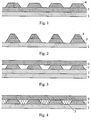
- Fig. 1-9 film materials according to the invention are shown.
- 1 is the carrier material
- 2 is a transfer lacquer layer
- 3 is the layer which diffuses or diffuses
- 4 is the layer with optically variable pigments
- 5 is the bright reflection layer
- 6 is a laminating adhesive layer
- 7 is a positive or negative print in the form of luminescent features.
- the film material according to the invention is therefore suitable as security features in data carriers, in particular value documents such as ID cards, bank notes or labels, seals and the like, but also as packaging material, for example in the pharmaceutical, electronics and / or food industry, for example in Form blister sheets, cartons, covers, foil packaging and the like.
- the substrates or film materials are preferably cut into strips or threads or patches, the width of the strips or threads preferably being 0.05-10 mm and the patches preferably have average widths or lengths of 2 - 20 mm.
- the film material is preferably cut into strips, tapes, threads or patches, wherein the width of the threads, strips or tapes is preferably 0.05-50 mm and the patches are preferably average widths and lengths of 0 , 5 to 200 mm.
- a corresponding security thread or strip can also be used as a border reinforcement of packaging, documents of value and the like in the region of the edges but also as, for example, longitudinal or transverse reinforcement in the packaging or in the document of value, whereby in each case several threads or strips are at a defined distance from one another can be provided.
Landscapes
- Chemical & Material Sciences (AREA)
- Organic Chemistry (AREA)
- Health & Medical Sciences (AREA)
- Chemical Kinetics & Catalysis (AREA)
- Medicinal Chemistry (AREA)
- Polymers & Plastics (AREA)
- Laminated Bodies (AREA)
Description
- Die Erfindung betrifft ein Folienmaterial mit optischen Merkmalen, beispielsweise optisch variablen Merkmalen und/oder Positiv- oder Negativinformationen und/oder lumineszierenden Merkmalen, Verfahren zu deren Herstellung und deren Verwendung.
- Aus der
EP 1 114 102 B1 sind optisch variable Pigmente und diese Pigmente enthaltende Beschichtungszusammensetzungen beschrieben. Die Beschichtungszusammensetzungen enthalten Pigmente. Die Pigmente werden hergestellt aus einer Schicht, die mittels physikalischer Dampfabscheidung einer korrosionsresistenten AI- Legierung erzeugt wird. Die Beschichtungszusammensetzungen enthalten zumindest einen filmbildenden Zusatz. -
WO 2005/038136 A offenbart ein Sicherheitselement mir einem Farbkippeffekt (also einem optisch variablen Effekt), das gebildet wird durch eine Reflexionsschicht, eine Absorberschicht und eine zwischen diesen beiden Schichten angeordnete Abstandsschicht. - Es handelt sich dabei in erster Linie um ein flächiges Sicherheitselement, das auf einem Trägersubstrat die genannte Schichtenfolge aufweist. Aus dieser Schichtenfolge können nach Entfernen des Trägersubstrats optisch variable Farbpigmente gebildet werden.
-
EP 1 239 307 A1 offenbart magnetische Dünnschichtinterferenzelement, die neben dem bekannten Dünnschichtaufbau aus Reflexionsschicht, Abstandsschicht und Absorberschicht eine magnetische Schicht aufweist, die von der Abstandsschicht durch eine Reflexionsschicht getrennt ist. - Dieser Schichtaufbau kann ebenfalls zu optisch variablen Pigmenten verarbeitet werden.
- Aus
EP 0 984 043 A1 undUS 5,171, 363 sind ebenfalls optisch variable Pigmente bekannt. - Aufgabe der Erfindung war es, ein Folienmaterial mit optisch variablen Effekten bereitzustellen, das spezifische optisch variable Effekte aufweist und gegebenenfalls auch eine Positiv- und/oder Negativinformation aufweist.
- Gegenstand der Erfindung ist daher ein Folienmaterial mit optisch variablen Effekten geeignet zur Herstellung von Sicherheitselementen, dadurch gekennzeichnet, dass das Folienmaterial auf einem Trägersubstrat mindestens eine absorbierende oder diffus streuende partielle Schicht 3, die aus einer schwarzen Druckfarbe, einer aufgedampften Schicht aus unstöchiometrischem Aluminiumoxid oder einer farbigen Schicht besteht, einer in den in der absorbierenden bzw. diffus streuenden Schicht 3 ausgesparten Bereichen aufgebrachten hellen Reflexionsschicht 5 und auf diesen Schichten 3 und 5 mindestens eine vollflächig oder partiell aufgebrachte Schicht 4 mit optisch variablen Pigmenten aufweist.
- Weiterbildungen der Erfindung sind in den Unteransprüchen definiert.
- Als Trägersubstrat kommen beispielsweise Trägerfolien vorzugsweise flexible Kunststofffolien, beispielsweise aus PI, PP, MOPP, PE, PPS, PEEK, PEK, PEI, PSU, PAEK, LCP, PEN, PBT, PET, PA, PC, COC, POM, ABS, PVC in Frage. Die Trägerfolien weisen vorzugsweise eine Dicke von 5 - 700 µm, bevorzugt 5-200 µm, besonders bevorzugt 5 - 50 µm auf.
- Ferner können als Trägersubstrat auch Metallfolien, beispielsweise Al-, Cu-, Sn-, Ni-, Fe- oder Edelstahlfolien mit einer Dicke von 5 - 200 µm, se 10 bis 80 µm, besonders bevorzugt 20 - 50 µm dienen. Die Folien können auch oberflächenbehandelt, beschichtet oder kaschiert beispielsweise mit Kunststoffen oder lackiert sein.
- Ferner können als Trägersubstrate auch Papier oder Verbunde mit Papier, beispielsweise Verbunde mit Kunststoffen mit einem Flächengewicht von 20 - 500 g/m2, vorzugsweise 40 - 200 g/m2. verwendet werden.
- Ferner können als Trägersubstrate Gewebe und Vliese, wie Endlosfaservliese, Stapelfaservliese und dergleichen, die gegebenenfalls vernadelt oder kalandriert sein können, verwendet werden. Vorzugsweise bestehen solche Gewebe oder Vliese aus Kunststoffen, wie PP, PET, PA, PPS und dergleichen, es können aber auch Vliese aus natürlichen, gegebenenfalls behandelten Fasern, wie Viskosefaservliese eingesetzt werden. Die eingesetzten Vliese weisen ein Flächengewicht von etwa 20 g/m2 bis 500 g/m2 auf.
- Auf das Trägersubstrat kann gegebenenfalls vorerst eine Transferlackschicht aufgebracht sein, die ausgezeichnet in jedem Druckverfahren bedruckbar ist. Dabei kommen sowohl herkömmliche beispielsweise thermoplastische Lacksysteme als auch strahlungs- oder reaktiv vernetzbare Lacksysteme in Frage.
Der thermoplastische Lack, der anschließend stabilisiert wird, besteht aus einer Basis MMA oder Ethylcellulose oder Cycloolefincopolymer, wobei dem Basispolymer zur Einstellung der geforderten thermoplastischen Eigenschaften bzw. zur Einstellung der anschließenden Stabilisierbarkeit Modifikatoren zugesetzt werden.
In Abhängigkeit vom Basispolymer kommen als Modifikatoren beispielsweise Additive zur Einstellung der gewünschten Glastemperatur, des Bereichs in dem sich der Lack in thermoplastischem Zustand befindet, oder Modifikatoren zur Erreichung einer dauerhaften Aushärtung des Lacks in Frage.
Vorzugsweise werden die Komponenten in einem Lösungsmittel, beispielsweise in wässrigen Lösungsmitteln, Wasser, Alkoholen, Ethylacetat, Methylethylketon und dergleichen oder deren Mischungen gelöst. - Einem Lack auf Basis von MMA wird beispielsweise besonders vorteilhaft Nitrocellulose zur Erhöhung der Glastemperatur zugesetzt.
Einem Lack auf der Basis von Cycloolefincopolymeren werden beispielsweise besonders vorteilhaft Polyethylenwachse zugesetzt.
Einem Lack auf Basis von Ethylcellulose werden zur Einstellung der Härtbarkeit handelsübliche Crosslinker zugesetzt.
Die Konzentration des Basispolymeren im fertigen Lack beträgt in Abhängigkeit vom Basispolymer, von den gewünschten Eigenschaften des Lacks und von der Art und Konzentration der Modifikatoren 4 - 50 Gew%.
In einem weiteren Schritt kann dann entweder sofort die Stabilisierung des thermoplastischen Lacks je nach dessen Zusammensetzung durch Vernetzung beispielsweise mittels Strahlungshärtung oder durch thermische Aushärtung durch Temperaturerhöhung erfolgen oder durch Überdrucken mit einer vernetzenden Lackschicht, einer sogenannten Stützlackschicht, die anschließend ausgehärtet wird.
Es ist aber auch möglich vorerst weitere funktionelle oder dekorative Schichten auf die Oberflächenstruktur oder den Lack aufzubringen und erst im Anschluss den thermoplastischen Lack auf oben beschriebene Weise auszuhärten. Ferner ist es auch möglich gegebenenfalls nach Aufbringen einer oder mehrerer weiterer funktioneller Schichten erneut eine Schicht des erfindungsgemäßen Lacks aufzutragen und eine etwaige weitere Oberflächenstruktur auf oben beschriebene Weise abzuformen. Dabei kann beispielsweise eine teilweise Entprägung der ursprünglichen Oberflächenstruktur erfolgen. Es können aber auch in oder auf die weitere erfindungsgemäße vorerst thermoplastische Lackschicht weitere strukturierte und/oder unstrukturierte funktionelle und/oder dekorative Schichten auf- oder eingebracht werden.
Als strahlungshärtbarer, insbesondere UV-härtbarer Lack kann beispielsweise ein strahlungshärtbares Lacksystem auf Basis eines Polyester-, eines Epoxy- oder Polyurethansystems, das dem Fachmann geläufige Photoinitiatoren enthält verwendet werden. Gegebenenfalls kann das Lacksystem auch zwei unterschiedliche Photoinitiatoren enthalten, die bei unterschiedlichen Wellenlängen eine Härtung des Lacksystems in unterschiedlichem Ausmaß initiieren können. - So kann beispielsweise ein Photoinitiator bei einer Wellenlänge von 200 bis 400 nm aktivierbar sein, der zweite Photoinitiator ist dann bei einer Wellenlänge von 370 bis 600 nm aktivierbar. Zwischen den Aktivierungswellenlängen der beiden Photoinitiatoren sollte genügend Differenz eingehalten werden, damit nicht eine zu starke Anregung des zweiten Photoinitiators erfolgt, während der erste Photoinitiator aktiviert wird. Der Bereich, in dem der zweite Photoinitiator angeregt wird, sollte im Transmissionswellenlängenbereich des verwendeten Trägersubstrats liegen. Für die Haupthärtung (Aktivierung des zweiten Photoinitiators) kann auch Elektronenstrahlung verwendet werden.
Als strahlungshärtbarer Lack kann auch ein wasserverdünnbarer Lack verwendet werden. Bevorzugt werden Lacksysteme auf Polyesterbasis.
Das Lacksystem wird transferierbar eingestellt, sodass sich je nach verwendetem Substrat die Aufbringung einer Trennschicht erübrigt. - Die Lacksysteme können gefärbt und/oder pigmentiert sein, wobei alle bekannten und üblichen Pigmente, beispielsweise anorganische und/oder organische Pigmente wie beispielsweise Titandioxid, Zinksulfid, Kaolin, Bariumsulfat, Aluminium-, Chrom- und Siliciumoxide, Metallpigmente (beispielsweise Kupfer, Aluminium, Silber, Gold, Eisen, Chrom und dergleichen), Metalllegierungen, wie Kupfer-Zink oder Kupfer- Aluminium als auch farbige ggf. organische Pigmente, wie Phthalocyaninblau, i-Indolidingelb, Dioxazinviolett, oder auch amorphe oder kristalline keramische Pigmente wie ITO, ATO, FTO und dergleichen oder auch Flüssigkristallpigmente geeignet sind.
- Das Trägersubstrat wird in jedem bekannten Beschichtungsverfahren wie beispielsweise durch Aufstreichen, Gießen, Sprühen, Drucken (Siebdruck-, Tiefdruck- Flexodruck, oder Digitaldruckverfahren) oder Walzenauftragsverfahren mit dem Lack beschichtet. Die Beschichtung kann selektiv oder vollflächig erfolgen.
Die Schichtdicke des aufgebrachten erfindungsgemäßen Lacks kann je nach Anforderung an das Endprodukt und Dicke des Substrats variieren und beträgt im allgemeinen zwischen 0,5 und 50 µm, vorzugsweise zwischen 2 und 10 µm, besonders bevorzugt zwischen 2 und 5 µm. - Auf das Trägersubstrat bzw. auf die beschriebene Lackschicht wird eine vollflächige oder partielle absorbierende oder diffus streuende, z.B. eine schwarze oder eine farbige Schicht aufgebracht.
Die partielle Schicht kann dabei in Form von positiven oder negativen Zeichen, Buchstaben, Mustern, Symbolen, geometrischen Formen, Linien und dergleichen aufgebracht werden.
Als absorbierende bzw. diffus streuende Schicht können beispielsweise schwarze Druckfarben oder eine aufgedampfte Schicht aus unstöchiometrischem Aluminiumoxid oder eine farbige Schicht verwendet werden. - Anschließend wird eine Schicht mit optisch variablen Pigmenten aufgebracht. Die Schicht kann dabei vollflächig oder partiell in Form von positiven oder negativen Zeichen, Buchstaben, Mustern, Symbolen, geometrischen Formen, Linien und dergleichen aufgebracht werden.
- Geeignete Zusammensetzungen sind dabei Zusammensetzungen, die optisch variable Pigmente, Farbumschlagpigmente und dergleichen enthalten.
Als Bindemittel kommen verschiedene bekannte natürliche oder synthetische Bindemittel in Frage. - Besonders geeignet sind dabei Beschichtungszusammensetzungen, wie sie beispielsweise in der
EP 1 114 102 B1 beschrieben sind. - In einer Ausführungsform wird in den in der absorbierenden bzw. diffus streuenden Schicht ausgesparten Bereichen eine helle Reflexionsschicht aufgebracht.
Diese Schicht kann beispielsweise eine opake oder semitransparente weiße Beschichtung oder eine metallische Beschichtung sein. - Wird anschließend eine vollflächige Schicht mit optisch variablen Pigmenten aufgebracht, so erscheint über den absorbierenden bzw. diffus streuenden Bereichen der Farbkippeffekt, in den mit der hellen Reflexionsschicht versehenen Bereichen wird der Farbkippeffekt gemindert oder gelöscht.
- In einer weiteren Ausführungsform kann beispielsweise auf einer Seite des Trägersubstrats eine absorbierende oder diffus streuende Schicht mit Aussparungen in Form von Zeichen, Mustern und dergleichen (Negativdruck) aufgebracht werden. Anschließend wird eine vollflächige Beschichtung, die optisch variable Elemente enthält, aufgebracht, worauf wiederum eine partielle absorbierende oder diffus streueunde Schicht passergenau gegengleich zu den Aussparungen der ersten absorbierenden bzw. diffus streuenden Schicht (Positivdruck) aufgebracht, wird. Es wird von beiden Seiten jeweils ein den Aussparungen entsprechender Farbkippeffekt beobachtet.
- Gegebenenfalls können diese Schichten auch auf unterschiedlichen Trägermaterialien vorhanden sein, die dann passergenau gegeneinander kaschiert werden können.
- Ferner können auf das Trägersubstrat weitere funktionelle und oder dekorative Schichten über oder unter der Schicht mit optisch variablen Merkmalen aufgebracht werden.
Die funktionellen Schichten können beispielsweise bestimmte elektrische, magnetische, chemische, physikalische und auch optische Eigenschaften aufweisen. - Zur Einstellung elektrischer Eigenschaften, beispielsweise Leitfähigkeit können beispielsweise Graphit, Ruß, leitfähige organische oder anorganische Polymere. Metallpigmente (beispielsweise Kupfer, Aluminium, Silber, Gold, Eisen, Chrom und dergleichen), Metalllegierungen wie Kupfer-Zink oder Kupfer- Aluminium oder auch amorphe oder kristalline keramische Pigmente wie ITO und dergleichen zugegeben werden. Weiters können auch dotierte oder nicht dotierte Halbleiter wie beispielsweise Silicium, Germanium oder Ionenleiter wie amorphe oder kristalline Metalloxide oder Metallsulfide als Zusatz verwendet werden. Ferner können zur Einstellung der elektrischen Eigenschaften der Schicht polare oder teilweise polare Verbindungen, wie Tenside oder unpolare Verbindungen wie Silikonadditive oder hygroskopische oder nicht hygroskopische Salze verwendet oder zugesetzt werden. Weiters können auch Schichten aus elektrisch leitfähigen Polymeren aufgebracht werden.
- Zur Einstellung der magnetischen Eigenschaften können paramagnetische, diamagnetische und auch ferromagnetische Stoffe, wie Eisen, Nickel und Cobalt oder deren Verbindungen oder Salze (beispielsweise Oxide oder Sulfide) verwendet werden.
- Besonders geeignet sind Magnetpigmentfarben mit Pigmenten auf Basis von Fe-oxiden, Eisen, Nickel Cobalt und deren Legierungen, Barium oder Cobaltferrite, hart- und weich magnetische Eisen- und Stahlsorten in wässrigen bzw. lösungsmittelhaltigen Dispersionen. Als Lösungsmittel kommen beispielsweise i-Propanol, Ethylacetat, Methylethylketon, Methoxypropanol und deren Mischungen in Frage.
Vorzugsweise sind die Pigmente in Acrylat- Polymerdispersionen mit einem Molekulargewicht von 150.000 bis 300.000, in Nitrocellulose, Acrylat-Urethan-Dispersionen, Acrylat- Styrol oder PVC-haltigen Dispersionen oder in lösemittelhaltige derartige Dispersionen eingebracht. - Die optischen Eigenschaften der Schicht lassen sich durch sichtbare Farbstoffe bzw. Pigmente, lumineszierende Farbstoffe bzw. Pigmente, die im sichtbaren, im UV-Bereich oder im IR-Bereich fluoreszieren bzw. phosphoreszieren, und wärmeempfindliche Farben bzw. Pigmente beeinflussen. Diese sind in allen möglichen Kombinationen einsetzbar. Zusätzlich können auch phosphoreszierende Pigmente allein oder in Kombination mit anderen Farbstoffen und/oder Pigmenten eingesetzt werden.
- Es können auch verschiedene Eigenschaften durch Zufügen verschiedener oben genannter Zusätze kombiniert werden. So ist es möglich angefärbte und/oder leitfähige Magnetpigmente zu verwenden. Dabei sind alle genannten leitfähigen Zusätze verwendbar.
Speziell zum Anfärben von Magnetpigmenten lassen sich alle bekannten löslichen und nicht löslichen Farbstoffe bzw. Pigmente verwenden. So kann beispielsweise eine braune Magnetfarbe durch Zugabe von Metallen in ihrem Farbton metallisch, z.B. silbrig eingestellt werden. - Das Trägersubstrat kann auch mit einem Heiß- oder Kaltsiegelkleber oder einer Selbstklebebeschichtung oder einem Kaschierkleber zur Aufbringung auf ein Substrat versehen. Dabei wird das Trägersubstrat bei der Aufbringung abgelöst.
- In den
Fig. 1 - 9 sind erfindungsgemäße Folienmaterialien dargestellt.
Darin bedeuten 1 das Trägermaterial, 2 eine Transferlackschicht, 3 die absorbierende bzw. diffus streueunde Schicht, 4 die Schicht mit optisch variablen Pigmenten, 5 die helle Reflexionsschicht, 6 eine Kaschierkleberschicht, 7 einen Positiv- oder Negativdruck in Form von lumineszierenden Merkmalen. - Das erfindungsgemäße Folienmaterial ist, gegebenenfalls nach entsprechender Konfektionierung daher als Sicherheitsmerkmale in Datenträgern, insbesondere Wertdokumenten wie Ausweisen, Karten, Banknoten oder Etiketten, Siegeln und dergleichen geeignet, aber auch als Verpackungsmaterial beispielsweise in der pharmazeutischen, der Elektronik- und/oder Lebensmittelindustrie, beispielsweise in Form Blisterfolien, Faltschachteln, Abdeckungen, Folienverpackungen und dergleichen geeignet.
- Für die Anwendung als Sicherheitsmerkmal werden die Substrate bzw. Folienmaterialien bevorzugt in Streifen oder Fäden oder Patches geschnitten, wobei die Breite der Streifen oder Fäden vorzugsweise 0,05 - 10 mm betragen kann und die Patches vorzugsweise mittlere Breiten bzw. Längen von 2 - 20 mm aufweisen.
- Für die Anwendung in oder auf Verpackungen wird das Folienmaterial bevorzugt in Streifen, Bänder, Fäden oder Patches geschnitten, wobei die Breite der der Fäden, Streifen bzw. Bänder vorzugsweise 0,05 - 50 mm beträgt und die Patches vorzugsweise mittlere Breiten und Längen von 0,5 - 200 mm aufweisen.
Ein entsprechender Sicherheitsfaden oder -streifen kann auch als Randverstärkung von Verpackungen, Wertdokumenten und dergleichen im Bereich der Kanten aber auch als beispielsweise Längs- oder Quer -Verstärkung in der Verpackung oder im Wertdokument verwendet werden, wobei auch jeweils mehrer Fäden oder Streifen in definiertem Abstand zueinander vorgesehen sein können.
Claims (9)
- Folienmaterial mit optisch variablen Effekten geeignet zur Herstellung von Sicherheitselementen dadurch gekennzeichnet, dass das Folienmaterial auf einem Trägersubstrat mindestens eine absorbierende oder diffus streuende partielle Schicht 3, die aus einer schwarzen Druckfarbe, einer aufgedampften Schicht aus unstöchiometrischem Aluminiumoxid oder einer farbigen Schicht besteht, einer in den in der absorbierenden bzw. diffus streuenden Schicht 3 ausgesparten Bereichen aufgebrachten hellen Reflexionsschicht 5 und auf diesen Schichten 3 und 5 mindestens eine vollflächig oder partiell aufgebrachte Schicht 4 mit optisch variablen Pigmenten aufweist.
- Folienmaterial nach Anspruch 1, dadurch gekennzeichnet, dass das Folienmaterial zusätzlich einen Aufdruck 7 über der Schicht 4 in Form von positiven oder negativen Zeichen mit lumineszierenden Merkmalen, aufweist.
- Folienmaterial nach einem der Ansprüche 1 oder 2, dadurch gekennzeichnet, dass das Folienmaterial zusätzliche funktionelle und/oder dekorative Schichten mit optischen und/oder elektrisch leitfähigen und/oder magnetischen Merkmalen aufweist.
- Folienmaterial nach einem der Ansprüche 1 bis 3, das eine Transferfolie bildet, dadurch gekennzeichnet, dass das Folienmaterial zusätzlich auf dem Trägersubstrat 1 eine Transferlackschicht 2 unter der diffus streuenden partiellen Schicht 3 aufweist.
- Folienmaterial nach Anspruch 4, dadurch gekennzeichnet, dass die Transferlackschicht 2 ein vorerst thermoplastischer oder ein strahlungshärtender Lack ist.
- Folienmaterial nach einem der Ansprüche 4 oder 5, dadurch gekennzeichnet, dass das Folienmaterial auf dem Schichtaufbau mit einer mit einer Klebebeschichtung zur Übertragung auf ein Substrat versehen ist.
- Sicherheitsmerkmale für Datenträger, Wertdokumente und dergleichen, hergestellt aus einem Folienmaterial oder einer Transferfolie nach einem der Ansprüche 1 bis 6.
- Verwendung der Folienmaterialen oder der Transferfolien nach einem der Ansprüche 1 bis 6 zur Herstellung von Sicherheitsmerkmalen.
- Wertdokumente und Verpackungen enthaltend ein Sicherheitsmerkmal nach Anspruch 7.
Priority Applications (2)
| Application Number | Priority Date | Filing Date | Title |
|---|---|---|---|
| SI200532113T SI1584647T2 (sl) | 2004-03-26 | 2005-03-08 | Folijski material z optičnimi lastnosti |
| PL05004988T PL1584647T5 (pl) | 2004-03-26 | 2005-03-08 | Materiał folii o cechach optycznych |
Applications Claiming Priority (2)
| Application Number | Priority Date | Filing Date | Title |
|---|---|---|---|
| AT0053904A AT504572A1 (de) | 2004-03-26 | 2004-03-26 | Folienmaterial mit optischen merkmalen |
| AT5392004 | 2004-03-26 |
Publications (4)
| Publication Number | Publication Date |
|---|---|
| EP1584647A1 EP1584647A1 (de) | 2005-10-12 |
| EP1584647B1 true EP1584647B1 (de) | 2016-09-07 |
| EP1584647B8 EP1584647B8 (de) | 2017-03-22 |
| EP1584647B2 EP1584647B2 (de) | 2019-06-26 |
Family
ID=34891570
Family Applications (1)
| Application Number | Title | Priority Date | Filing Date |
|---|---|---|---|
| EP05004988.1A Not-in-force EP1584647B2 (de) | 2004-03-26 | 2005-03-08 | Folienmaterial mit optischen Merkmalen |
Country Status (6)
| Country | Link |
|---|---|
| EP (1) | EP1584647B2 (de) |
| AT (1) | AT504572A1 (de) |
| ES (1) | ES2606334T5 (de) |
| HU (1) | HUE030757T2 (de) |
| PL (1) | PL1584647T5 (de) |
| SI (1) | SI1584647T2 (de) |
Families Citing this family (6)
| Publication number | Priority date | Publication date | Assignee | Title |
|---|---|---|---|---|
| US20070211238A1 (en) | 2004-04-30 | 2007-09-13 | Giesecke & Devrient Gmbh | Security Element and Methods for the Production Thereof |
| CA2686460C (en) | 2007-05-25 | 2012-05-01 | Toppan Printing Co., Ltd. | Display and information-printed matter |
| WO2009053391A2 (en) | 2007-10-26 | 2009-04-30 | Basf Se | Security element |
| FR2954361B1 (fr) | 2009-12-23 | 2012-06-15 | Arjo Wiggins Fine Papers Ltd | Feuille imprimable ultra lisse et recyclable et son procede de fabrication |
| EP2802711B1 (de) | 2012-01-13 | 2017-10-25 | Arjo Wiggins Fine Papers Limited | Verfahren zur herstellung einer folie |
| EP3178660B2 (de) | 2015-12-07 | 2022-12-28 | Hueck Folien Ges.m.b.H | Personalisierbares sicherheitselement |
Citations (5)
| Publication number | Priority date | Publication date | Assignee | Title |
|---|---|---|---|---|
| AU488652B2 (en) | 1973-09-26 | 1976-04-01 | Commonwealth Scientific And Industrial Research Organisation | Improvements in or relating to security tokens |
| DE19544130A1 (de) | 1995-11-27 | 1997-05-28 | Giesecke & Devrient Gmbh | Datenträger mit optisch variabler Farbe |
| WO2001016426A1 (de) | 1999-08-31 | 2001-03-08 | Giesecke & Devrient Gmbh | Sicherheitselement und wertgegenstand |
| WO2001062509A1 (de) | 2000-02-25 | 2001-08-30 | Giesecke & Devrient Gmbh | Verfahren zur herstellung laserbeschriftbarer datenträger und damit hergestellte datenträger |
| GB2386584A (en) | 2002-01-25 | 2003-09-24 | Rue De Int Ltd | Security substrate with polymeric liquid crystal material overlaying metallised and demetallised regions. |
Family Cites Families (9)
| Publication number | Priority date | Publication date | Assignee | Title |
|---|---|---|---|---|
| ATE178083T1 (de) * | 1993-12-23 | 1999-04-15 | Basf Corp | Optisch variables pigment und metallisches pigment enthaltende beschichtungzusammensetzung |
| US5783307A (en) * | 1996-11-04 | 1998-07-21 | Eastman Chemical Company | UV stabilized multi-layer structures with detectable UV protective layers and a method of detection |
| EP0984043A1 (de) | 1998-08-31 | 2000-03-08 | Sicpa Holding S.A. | Optisch variable Pigmente mit einem Farbwechsel zwischen zwei verschiedenen Farben, diese enthaltende Beschichtungszusammensetzung, Verfahren zu ihrer Herstellung und mit diesen beschichtetes Substrat |
| ES2250390T3 (es) * | 2000-02-16 | 2006-04-16 | Sicpa Holding S.A. | Pigmentos con variacion de color dependiente del angulo de observacion, metodo de preparacion, uso y composicion de recubrimiento de dichos pigmentos. |
| DE10063105A1 (de) * | 2000-12-18 | 2002-06-20 | Merck Patent Gmbh | Lasermarkierbare Kunststoffe sowie ihre Herstellung und Verwendung |
| DE10161200A1 (de) * | 2001-12-13 | 2003-06-26 | Clariant Gmbh | Kompositmaske zur Herstellung eines Diffusors |
| US6475589B1 (en) * | 2001-12-17 | 2002-11-05 | General Electric Company | Colored optical discs and methods for making the same |
| US6706109B2 (en) * | 2002-05-14 | 2004-03-16 | Engelhard Corporation | Optically variable interference pigments |
| DE10235018A1 (de) * | 2002-07-31 | 2004-02-12 | Merck Patent Gmbh | Lasermarkierbare flexible Trägereinheit |
-
2004
- 2004-03-26 AT AT0053904A patent/AT504572A1/de not_active Application Discontinuation
-
2005
- 2005-03-08 ES ES05004988T patent/ES2606334T5/es active Active
- 2005-03-08 EP EP05004988.1A patent/EP1584647B2/de not_active Not-in-force
- 2005-03-08 HU HUE05004988A patent/HUE030757T2/en unknown
- 2005-03-08 PL PL05004988T patent/PL1584647T5/pl unknown
- 2005-03-08 SI SI200532113T patent/SI1584647T2/sl unknown
Patent Citations (5)
| Publication number | Priority date | Publication date | Assignee | Title |
|---|---|---|---|---|
| AU488652B2 (en) | 1973-09-26 | 1976-04-01 | Commonwealth Scientific And Industrial Research Organisation | Improvements in or relating to security tokens |
| DE19544130A1 (de) | 1995-11-27 | 1997-05-28 | Giesecke & Devrient Gmbh | Datenträger mit optisch variabler Farbe |
| WO2001016426A1 (de) | 1999-08-31 | 2001-03-08 | Giesecke & Devrient Gmbh | Sicherheitselement und wertgegenstand |
| WO2001062509A1 (de) | 2000-02-25 | 2001-08-30 | Giesecke & Devrient Gmbh | Verfahren zur herstellung laserbeschriftbarer datenträger und damit hergestellte datenträger |
| GB2386584A (en) | 2002-01-25 | 2003-09-24 | Rue De Int Ltd | Security substrate with polymeric liquid crystal material overlaying metallised and demetallised regions. |
Also Published As
| Publication number | Publication date |
|---|---|
| PL1584647T5 (pl) | 2019-12-31 |
| AT504572A1 (de) | 2008-06-15 |
| SI1584647T2 (sl) | 2019-11-29 |
| EP1584647B8 (de) | 2017-03-22 |
| PL1584647T3 (pl) | 2017-03-31 |
| EP1584647A1 (de) | 2005-10-12 |
| SI1584647T1 (sl) | 2017-01-31 |
| HUE030757T2 (en) | 2017-06-28 |
| EP1584647B2 (de) | 2019-06-26 |
| ES2606334T5 (es) | 2020-03-11 |
| ES2606334T3 (es) | 2017-03-23 |
Similar Documents
| Publication | Publication Date | Title |
|---|---|---|
| EP2851194B1 (de) | Sicherheitselement, insbesondere Sicherheitsetikett | |
| EP4132797B1 (de) | Verfahren zur herstellung eines sicherheitselements mit einer farbigen mikrostruktur | |
| EP1291463A1 (de) | Verfahren zur Herstellung einer selektiv metallisierten Folie, und dessen Produkte | |
| AT502319B1 (de) | Substrate mit vorzugsweise transferierbaren schichten und/oder oberflächenstrukturen, verfahren zu deren herstellung und deren verwendung | |
| WO2004110771A2 (de) | Sicherheitselemente und sicherheitsmerkmale mit farbeffekten | |
| EP1584647B2 (de) | Folienmaterial mit optischen Merkmalen | |
| EP1318016B1 (de) | Verfahren zur Herstellung von registergenau gedruckten Multilayer-Aufbauten | |
| DE202012010037U1 (de) | Beschichtung für Wertpapiere, insbesondere zur Erhöhung der Umlauffähigkeit | |
| EP1871616B1 (de) | Sicherheitselement mit räumlich aufgelöster magnetischer codierung, verfahren und vorrichtung zu dessen herstellung und dessen verwendung | |
| EP1488935B1 (de) | Verfahren zur Herstellung eines Sicherheitselements | |
| AT504631B1 (de) | Folienmaterial insbesondere für sicherheitselemente | |
| AT500871A1 (de) | Sicherheitselemente mit visuell erkennbaren und maschinenlesbaren merkmalen | |
| AT501565B1 (de) | Sicherheitselement bzw. folienmaterial mit farbigem und/oder lumineszierendem und/oder opakem druck | |
| EP1657360B1 (de) | Wertdokument | |
| EP3302996B1 (de) | Sicherheitselement mit farbkippeffekt | |
| AT502021B1 (de) | Sicherheitselemente mit funktionsschichten und verfahren zu deren herstellung | |
| EP1550562A2 (de) | Sicherheitselement mit mehreren funktionellen Merkmalen | |
| AT503712A2 (de) | Codierte optisch aktive sicherheitselemente und sicherheitsmerkmale | |
| EP1559540A1 (de) | Transferierbares Folienmaterial | |
| EP1348576A2 (de) | UV-kaschierter Sicherheitsfaden |
Legal Events
| Date | Code | Title | Description |
|---|---|---|---|
| PUAI | Public reference made under article 153(3) epc to a published international application that has entered the european phase |
Free format text: ORIGINAL CODE: 0009012 |
|
| AK | Designated contracting states |
Kind code of ref document: A1 Designated state(s): AT BE BG CH CY CZ DE DK EE ES FI FR GB GR HU IE IS IT LI LT LU MC NL PL PT RO SE SI SK TR |
|
| AX | Request for extension of the european patent |
Extension state: AL BA HR LV MK YU |
|
| 17P | Request for examination filed |
Effective date: 20060322 |
|
| AKX | Designation fees paid |
Designated state(s): AT BE BG CH CY CZ DE DK EE ES FI FR GB GR HU IE IS IT LI LT LU MC NL PL PT RO SE SI SK TR |
|
| 17Q | First examination report despatched |
Effective date: 20061127 |
|
| GRAP | Despatch of communication of intention to grant a patent |
Free format text: ORIGINAL CODE: EPIDOSNIGR1 |
|
| INTG | Intention to grant announced |
Effective date: 20160519 |
|
| GRAS | Grant fee paid |
Free format text: ORIGINAL CODE: EPIDOSNIGR3 |
|
| GRAA | (expected) grant |
Free format text: ORIGINAL CODE: 0009210 |
|
| AK | Designated contracting states |
Kind code of ref document: B1 Designated state(s): AT BE BG CH CY CZ DE DK EE ES FI FR GB GR HU IE IS IT LI LT LU MC NL PL PT RO SE SI SK TR |
|
| REG | Reference to a national code |
Ref country code: GB Ref legal event code: FG4D Free format text: NOT ENGLISH |
|
| REG | Reference to a national code |
Ref country code: DE Ref legal event code: R081 Ref document number: 502005015352 Country of ref document: DE Owner name: HUECK FOLIEN GESELLSCHAFT M.B.H., AT Free format text: FORMER OWNER: HUECK FOLIEN GESELLSCHAFT M.B.H., BAUMGARTENBERG, AT |
|
| REG | Reference to a national code |
Ref country code: CH Ref legal event code: EP |
|
| REG | Reference to a national code |
Ref country code: IE Ref legal event code: FG4D Free format text: LANGUAGE OF EP DOCUMENT: GERMAN |
|
| REG | Reference to a national code |
Ref country code: AT Ref legal event code: REF Ref document number: 826817 Country of ref document: AT Kind code of ref document: T Effective date: 20161015 |
|
| REG | Reference to a national code |
Ref country code: DE Ref legal event code: R096 Ref document number: 502005015352 Country of ref document: DE |
|
| REG | Reference to a national code |
Ref country code: SE Ref legal event code: TRGR |
|
| REG | Reference to a national code |
Ref country code: NL Ref legal event code: FP |
|
| REG | Reference to a national code |
Ref country code: LT Ref legal event code: MG4D |
|
| RIN2 | Information on inventor provided after grant (corrected) |
Inventor name: MUELLER, MATTHIAS Inventor name: WAGNER, EVELINE, DIPL.-ING. (FH) Inventor name: KASTNER, FRIEDRICH, DR. |
|
| PG25 | Lapsed in a contracting state [announced via postgrant information from national office to epo] |
Ref country code: LT Free format text: LAPSE BECAUSE OF FAILURE TO SUBMIT A TRANSLATION OF THE DESCRIPTION OR TO PAY THE FEE WITHIN THE PRESCRIBED TIME-LIMIT Effective date: 20160907 Ref country code: FI Free format text: LAPSE BECAUSE OF FAILURE TO SUBMIT A TRANSLATION OF THE DESCRIPTION OR TO PAY THE FEE WITHIN THE PRESCRIBED TIME-LIMIT Effective date: 20160907 |
|
| PG25 | Lapsed in a contracting state [announced via postgrant information from national office to epo] |
Ref country code: GR Free format text: LAPSE BECAUSE OF FAILURE TO SUBMIT A TRANSLATION OF THE DESCRIPTION OR TO PAY THE FEE WITHIN THE PRESCRIBED TIME-LIMIT Effective date: 20161208 |
|
| REG | Reference to a national code |
Ref country code: FR Ref legal event code: PLFP Year of fee payment: 13 |
|
| PG25 | Lapsed in a contracting state [announced via postgrant information from national office to epo] |
Ref country code: EE Free format text: LAPSE BECAUSE OF FAILURE TO SUBMIT A TRANSLATION OF THE DESCRIPTION OR TO PAY THE FEE WITHIN THE PRESCRIBED TIME-LIMIT Effective date: 20160907 Ref country code: RO Free format text: LAPSE BECAUSE OF FAILURE TO SUBMIT A TRANSLATION OF THE DESCRIPTION OR TO PAY THE FEE WITHIN THE PRESCRIBED TIME-LIMIT Effective date: 20160907 |
|
| PG25 | Lapsed in a contracting state [announced via postgrant information from national office to epo] |
Ref country code: PT Free format text: LAPSE BECAUSE OF FAILURE TO SUBMIT A TRANSLATION OF THE DESCRIPTION OR TO PAY THE FEE WITHIN THE PRESCRIBED TIME-LIMIT Effective date: 20170109 Ref country code: IS Free format text: LAPSE BECAUSE OF FAILURE TO SUBMIT A TRANSLATION OF THE DESCRIPTION OR TO PAY THE FEE WITHIN THE PRESCRIBED TIME-LIMIT Effective date: 20170107 Ref country code: BG Free format text: LAPSE BECAUSE OF FAILURE TO SUBMIT A TRANSLATION OF THE DESCRIPTION OR TO PAY THE FEE WITHIN THE PRESCRIBED TIME-LIMIT Effective date: 20161207 Ref country code: SK Free format text: LAPSE BECAUSE OF FAILURE TO SUBMIT A TRANSLATION OF THE DESCRIPTION OR TO PAY THE FEE WITHIN THE PRESCRIBED TIME-LIMIT Effective date: 20160907 |
|
| REG | Reference to a national code |
Ref country code: DE Ref legal event code: R026 Ref document number: 502005015352 Country of ref document: DE |
|
| PLBI | Opposition filed |
Free format text: ORIGINAL CODE: 0009260 |
|
| REG | Reference to a national code |
Ref country code: HU Ref legal event code: AG4A Ref document number: E030757 Country of ref document: HU |
|
| PLAX | Notice of opposition and request to file observation + time limit sent |
Free format text: ORIGINAL CODE: EPIDOSNOBS2 |
|
| 26 | Opposition filed |
Opponent name: GIESECKE & DEVRIENT GMBH Effective date: 20170606 |
|
| PG25 | Lapsed in a contracting state [announced via postgrant information from national office to epo] |
Ref country code: DK Free format text: LAPSE BECAUSE OF FAILURE TO SUBMIT A TRANSLATION OF THE DESCRIPTION OR TO PAY THE FEE WITHIN THE PRESCRIBED TIME-LIMIT Effective date: 20160907 |
|
| PLAB | Opposition data, opponent's data or that of the opponent's representative modified |
Free format text: ORIGINAL CODE: 0009299OPPO |
|
| PLAB | Opposition data, opponent's data or that of the opponent's representative modified |
Free format text: ORIGINAL CODE: 0009299OPPO |
|
| R26 | Opposition filed (corrected) |
Opponent name: GIESECKE+DEVRIENT CURRENCY TECHNOLOGY GMBH Effective date: 20170606 |
|
| R26 | Opposition filed (corrected) |
Opponent name: GIESECKE & DEVRIENT GMBH Effective date: 20170606 |
|
| PLBB | Reply of patent proprietor to notice(s) of opposition received |
Free format text: ORIGINAL CODE: EPIDOSNOBS3 |
|
| PG25 | Lapsed in a contracting state [announced via postgrant information from national office to epo] |
Ref country code: MC Free format text: LAPSE BECAUSE OF FAILURE TO SUBMIT A TRANSLATION OF THE DESCRIPTION OR TO PAY THE FEE WITHIN THE PRESCRIBED TIME-LIMIT Effective date: 20160907 |
|
| PLAB | Opposition data, opponent's data or that of the opponent's representative modified |
Free format text: ORIGINAL CODE: 0009299OPPO |
|
| R26 | Opposition filed (corrected) |
Opponent name: GIESECKE+DEVRIENT CURRENCY TECHNOLOGY GMBH Effective date: 20170606 |
|
| PG25 | Lapsed in a contracting state [announced via postgrant information from national office to epo] |
Ref country code: LU Free format text: LAPSE BECAUSE OF NON-PAYMENT OF DUE FEES Effective date: 20170308 |
|
| REG | Reference to a national code |
Ref country code: BE Ref legal event code: MM Effective date: 20170331 |
|
| REG | Reference to a national code |
Ref country code: FR Ref legal event code: PLFP Year of fee payment: 14 |
|
| PLBP | Opposition withdrawn |
Free format text: ORIGINAL CODE: 0009264 |
|
| PG25 | Lapsed in a contracting state [announced via postgrant information from national office to epo] |
Ref country code: BE Free format text: LAPSE BECAUSE OF NON-PAYMENT OF DUE FEES Effective date: 20170331 |
|
| REG | Reference to a national code |
Ref country code: DE Ref legal event code: R082 Ref document number: 502005015352 Country of ref document: DE Representative=s name: REITSTOETTER KINZEBACH, DE Ref country code: DE Ref legal event code: R082 Ref document number: 502005015352 Country of ref document: DE Representative=s name: ABP BURGER RECHTSANWALTSGESELLSCHAFT MBH, DE Ref country code: DE Ref legal event code: R081 Ref document number: 502005015352 Country of ref document: DE Owner name: HUECK FOLIEN GESELLSCHAFT M.B.H., AT Free format text: FORMER OWNER: HUECK FOLIEN GES.M.B.H., 4342 BAUMGARTENBERG, AT |
|
| REG | Reference to a national code |
Ref country code: DE Ref legal event code: R082 Ref document number: 502005015352 Country of ref document: DE Representative=s name: ABP BURGER RECHTSANWALTSGESELLSCHAFT MBH, DE |
|
| REG | Reference to a national code |
Ref country code: CH Ref legal event code: NV Representative=s name: ABP PATENT NETWORK AG, CH Ref country code: CH Ref legal event code: PK Free format text: BERICHTIGUNG INHABER |
|
| PUAH | Patent maintained in amended form |
Free format text: ORIGINAL CODE: 0009272 |
|
| STAA | Information on the status of an ep patent application or granted ep patent |
Free format text: STATUS: PATENT MAINTAINED AS AMENDED |
|
| REG | Reference to a national code |
Ref country code: CH Ref legal event code: AELC Ref country code: CH Ref legal event code: PK Free format text: TITEL |
|
| 27A | Patent maintained in amended form |
Effective date: 20190626 |
|
| AK | Designated contracting states |
Kind code of ref document: B2 Designated state(s): AT BE BG CH CY CZ DE DK EE ES FI FR GB GR HU IE IS IT LI LT LU MC NL PL PT RO SE SI SK TR |
|
| REG | Reference to a national code |
Ref country code: DE Ref legal event code: R102 Ref document number: 502005015352 Country of ref document: DE |
|
| REG | Reference to a national code |
Ref country code: AT Ref legal event code: HC Ref document number: 826817 Country of ref document: AT Kind code of ref document: T Owner name: HUECK FOLIEN GESELLSCHAFT M.B.H., AT Effective date: 20190604 |
|
| REG | Reference to a national code |
Ref country code: SE Ref legal event code: RPEO |
|
| REG | Reference to a national code |
Ref country code: NL Ref legal event code: FP |
|
| PG25 | Lapsed in a contracting state [announced via postgrant information from national office to epo] |
Ref country code: CY Free format text: LAPSE BECAUSE OF NON-PAYMENT OF DUE FEES Effective date: 20160907 |
|
| REG | Reference to a national code |
Ref country code: ES Ref legal event code: DC2A Ref document number: 2606334 Country of ref document: ES Kind code of ref document: T5 Effective date: 20200311 |
|
| PGFP | Annual fee paid to national office [announced via postgrant information from national office to epo] |
Ref country code: HU Payment date: 20200214 Year of fee payment: 16 Ref country code: IE Payment date: 20200116 Year of fee payment: 16 Ref country code: NL Payment date: 20200214 Year of fee payment: 16 Ref country code: SE Payment date: 20200218 Year of fee payment: 16 |
|
| PGFP | Annual fee paid to national office [announced via postgrant information from national office to epo] |
Ref country code: CZ Payment date: 20200219 Year of fee payment: 16 Ref country code: SI Payment date: 20200217 Year of fee payment: 16 |
|
| PGFP | Annual fee paid to national office [announced via postgrant information from national office to epo] |
Ref country code: TR Payment date: 20200306 Year of fee payment: 16 |
|
| PGFP | Annual fee paid to national office [announced via postgrant information from national office to epo] |
Ref country code: ES Payment date: 20200402 Year of fee payment: 16 |
|
| PG25 | Lapsed in a contracting state [announced via postgrant information from national office to epo] |
Ref country code: CZ Free format text: LAPSE BECAUSE OF NON-PAYMENT OF DUE FEES Effective date: 20210308 |
|
| REG | Reference to a national code |
Ref country code: NL Ref legal event code: MM Effective date: 20210401 |
|
| PG25 | Lapsed in a contracting state [announced via postgrant information from national office to epo] |
Ref country code: NL Free format text: LAPSE BECAUSE OF NON-PAYMENT OF DUE FEES Effective date: 20210401 Ref country code: SE Free format text: LAPSE BECAUSE OF NON-PAYMENT OF DUE FEES Effective date: 20210309 Ref country code: IE Free format text: LAPSE BECAUSE OF NON-PAYMENT OF DUE FEES Effective date: 20210308 Ref country code: HU Free format text: LAPSE BECAUSE OF NON-PAYMENT OF DUE FEES Effective date: 20210309 |
|
| REG | Reference to a national code |
Ref country code: SI Ref legal event code: KO00 Effective date: 20211201 |
|
| PG25 | Lapsed in a contracting state [announced via postgrant information from national office to epo] |
Ref country code: SI Free format text: LAPSE BECAUSE OF NON-PAYMENT OF DUE FEES Effective date: 20210309 |
|
| PGFP | Annual fee paid to national office [announced via postgrant information from national office to epo] |
Ref country code: GB Payment date: 20220217 Year of fee payment: 18 Ref country code: DE Payment date: 20220217 Year of fee payment: 18 Ref country code: CH Payment date: 20220214 Year of fee payment: 18 Ref country code: AT Payment date: 20220218 Year of fee payment: 18 |
|
| REG | Reference to a national code |
Ref country code: ES Ref legal event code: FD2A Effective date: 20220523 |
|
| PGFP | Annual fee paid to national office [announced via postgrant information from national office to epo] |
Ref country code: PL Payment date: 20220203 Year of fee payment: 18 Ref country code: IT Payment date: 20220221 Year of fee payment: 18 Ref country code: FR Payment date: 20220211 Year of fee payment: 18 |
|
| PG25 | Lapsed in a contracting state [announced via postgrant information from national office to epo] |
Ref country code: ES Free format text: LAPSE BECAUSE OF NON-PAYMENT OF DUE FEES Effective date: 20210309 |
|
| REG | Reference to a national code |
Ref country code: DE Ref legal event code: R119 Ref document number: 502005015352 Country of ref document: DE |
|
| REG | Reference to a national code |
Ref country code: CH Ref legal event code: PL |
|
| REG | Reference to a national code |
Ref country code: AT Ref legal event code: MM01 Ref document number: 826817 Country of ref document: AT Kind code of ref document: T Effective date: 20230308 |
|
| GBPC | Gb: european patent ceased through non-payment of renewal fee |
Effective date: 20230308 |
|
| PG25 | Lapsed in a contracting state [announced via postgrant information from national office to epo] |
Ref country code: GB Free format text: LAPSE BECAUSE OF NON-PAYMENT OF DUE FEES Effective date: 20230308 |
|
| PG25 | Lapsed in a contracting state [announced via postgrant information from national office to epo] |
Ref country code: LI Free format text: LAPSE BECAUSE OF NON-PAYMENT OF DUE FEES Effective date: 20230331 Ref country code: GB Free format text: LAPSE BECAUSE OF NON-PAYMENT OF DUE FEES Effective date: 20230308 Ref country code: FR Free format text: LAPSE BECAUSE OF NON-PAYMENT OF DUE FEES Effective date: 20230331 Ref country code: DE Free format text: LAPSE BECAUSE OF NON-PAYMENT OF DUE FEES Effective date: 20231003 Ref country code: CH Free format text: LAPSE BECAUSE OF NON-PAYMENT OF DUE FEES Effective date: 20230331 Ref country code: AT Free format text: LAPSE BECAUSE OF NON-PAYMENT OF DUE FEES Effective date: 20230308 |
|
| PG25 | Lapsed in a contracting state [announced via postgrant information from national office to epo] |
Ref country code: IT Free format text: LAPSE BECAUSE OF NON-PAYMENT OF DUE FEES Effective date: 20230308 |
|
| PG25 | Lapsed in a contracting state [announced via postgrant information from national office to epo] |
Ref country code: PL Free format text: LAPSE BECAUSE OF NON-PAYMENT OF DUE FEES Effective date: 20230308 |
|
| PG25 | Lapsed in a contracting state [announced via postgrant information from national office to epo] |
Ref country code: PL Free format text: LAPSE BECAUSE OF NON-PAYMENT OF DUE FEES Effective date: 20230308 |
|
| PG25 | Lapsed in a contracting state [announced via postgrant information from national office to epo] |
Ref country code: TR Free format text: LAPSE BECAUSE OF NON-PAYMENT OF DUE FEES Effective date: 20210308 |