EP1350339B1 - Double-talk and path change detection using a matrix of correlation coefficients - Google Patents
Double-talk and path change detection using a matrix of correlation coefficients Download PDFInfo
- Publication number
- EP1350339B1 EP1350339B1 EP02710709A EP02710709A EP1350339B1 EP 1350339 B1 EP1350339 B1 EP 1350339B1 EP 02710709 A EP02710709 A EP 02710709A EP 02710709 A EP02710709 A EP 02710709A EP 1350339 B1 EP1350339 B1 EP 1350339B1
- Authority
- EP
- European Patent Office
- Prior art keywords
- matrix
- talk
- double
- echo
- correlation
- Prior art date
- Legal status (The legal status is an assumption and is not a legal conclusion. Google has not performed a legal analysis and makes no representation as to the accuracy of the status listed.)
- Expired - Lifetime
Links
- 239000011159 matrix material Substances 0.000 title claims abstract description 56
- 238000001514 detection method Methods 0.000 title description 10
- 238000000034 method Methods 0.000 claims abstract description 38
- 238000000354 decomposition reaction Methods 0.000 claims abstract description 6
- 230000003044 adaptive effect Effects 0.000 claims description 27
- 238000004422 calculation algorithm Methods 0.000 claims description 26
- 238000012545 processing Methods 0.000 claims description 12
- 238000013459 approach Methods 0.000 description 6
- 238000004458 analytical method Methods 0.000 description 4
- 238000001914 filtration Methods 0.000 description 4
- 239000013598 vector Substances 0.000 description 4
- 238000004088 simulation Methods 0.000 description 3
- 239000000203 mixture Substances 0.000 description 2
- 230000008054 signal transmission Effects 0.000 description 2
- 230000002459 sustained effect Effects 0.000 description 2
- 238000012360 testing method Methods 0.000 description 2
- 241000219498 Alnus glutinosa Species 0.000 description 1
- 230000006978 adaptation Effects 0.000 description 1
- 230000005540 biological transmission Effects 0.000 description 1
- 238000004364 calculation method Methods 0.000 description 1
- 230000002950 deficient Effects 0.000 description 1
- 238000010586 diagram Methods 0.000 description 1
- 230000000694 effects Effects 0.000 description 1
- 238000005516 engineering process Methods 0.000 description 1
- 238000009472 formulation Methods 0.000 description 1
- 238000005259 measurement Methods 0.000 description 1
- 238000005070 sampling Methods 0.000 description 1
- 238000001228 spectrum Methods 0.000 description 1
Images

Classifications
-
- H—ELECTRICITY
- H04—ELECTRIC COMMUNICATION TECHNIQUE
- H04B—TRANSMISSION
- H04B3/00—Line transmission systems
- H04B3/02—Details
- H04B3/20—Reducing echo effects or singing; Opening or closing transmitting path; Conditioning for transmission in one direction or the other
-
- H—ELECTRICITY
- H04—ELECTRIC COMMUNICATION TECHNIQUE
- H04B—TRANSMISSION
- H04B3/00—Line transmission systems
- H04B3/02—Details
- H04B3/20—Reducing echo effects or singing; Opening or closing transmitting path; Conditioning for transmission in one direction or the other
- H04B3/23—Reducing echo effects or singing; Opening or closing transmitting path; Conditioning for transmission in one direction or the other using a replica of transmitted signal in the time domain, e.g. echo cancellers
- H04B3/234—Reducing echo effects or singing; Opening or closing transmitting path; Conditioning for transmission in one direction or the other using a replica of transmitted signal in the time domain, e.g. echo cancellers using double talk detection
Definitions
- This invention relates to a method of detecting double-talk and path changes in echo cancellation systems. Echo cancellation is used extensively in telecommunications applications to recondition a wide variety of signals, such as speech, data transmission, and video.
- a traditional approach to echo cancellation uses an adaptive filter of length L, where L equals the number of samples necessary to extend to just beyond the duration of the echo.
- the adaptive filters typically contain either 512 or 1024 taps. At the standard telephone bit rate of 8000 samples per second, this provides the ability to adapt to echo paths as long as 64 ms and 128 ms, respectively.
- the simplest, and perhaps most common, method for detecting double-talk is to use signal levels.
- the echo path typically contains a minimum amount of loss, or reduction, in the return signal. This quantity is often referred to as the Echo Return Loss, or ERL. In most systems, this is assumed to be at least 6 dB. In other words, the return signal S IN will be at a level which is at least 6 dB lower than R OUT provided that there is no double-talk. In the presence of double-talk, the level at S IN often increases so that it is no longer 6 dB lower than R OUT . This condition provides a simple and convenient test for double-talk.
- the double-talk detector must have an accurate estimate of the echo path ERL in order to determine if the level at S IN is too high.
- precise knowledge of the ERL is generally not available. If the ERL estimate is too high, the double-talk detector may trigger unnecessarily. Conversely, it may not trigger at all if the ERL estimate is too low.
- Another problem with this technique is that it will only reliably detect high-level double-talk. If the double-talk signal is at a much lower level than the echo source signal, low-level double-talk occurs. Under this condition, the increase in the level of S IN is usually very small. The double-talk detector may fail to trigger, but noticeable divergence in the LMS filter can still occur.
- S OUT the level of the residual echo signal
- R OUT the level of the residual echo signal
- Correlation is a statistical function which is commonly used in signal processing. It can provide a measure of the similarity between two signals (cross-correlation), or a single signal and time-shifted versions of itself (autocorrelation).
- cross-correlation a measure of the similarity between two signals
- autocorrelation a single signal and time-shifted versions of itself
- autocorrelation a measure of the similarity between two signals
- autocorrelation a single signal and time-shifted versions of itself
- Hua Ye et al, A New Doubletalk Detection Algorithm Based on the Othogonality Theorem discloses a technique based on the cross-correlation vector between the input signal and the error signal e (n).
- US Patent No. 6,035,034 discloses a method wherein double talk is detected by computing the linear dependency between the echo estimate and the residual signal, and between the residual signal and the desired signal, and comparing the results.
- a process has been developed which generates matrix coefficients using zero-lag auto and cross-correlations from signals commonly found in echo cancellers. Double-talk and path changes are then detected using matrix operations such as determinants, eigendecompositions, or singular value decompositions (SVDs).
- matrix operations such as determinants, eigendecompositions, or singular value decompositions (SVDs).
- the correlations between various signals in an echo canceller will change depending on what state the echo canceller is in, i. e. if it is converged, unconverged, or in double-talk.
- key information about the state of the echo canceller can be extracted by performing various matrix operations.
- the preferred operation is to take the determinant, but eigendecompositions and singular value decompositions (SVDs) can also be used.
- a novel aspect of the invention is the formulation of a matrix using various correlation coefficients, and the subsequent analysis of this matrix to determine the state of the echo canceller.
- the invention provides a correlation-based matrix is generated using zero-lag auto and cross-correlations of signals commonly found in echo cancellers.
- Double-talk and path changes are detected by analysis of the correlation-based matrix.
- Possible analysis techniques include condition numbers, determinants, eigendecompositions, and singular value decompositions.
- determinants are used to detect double-talk and path changes.
- the invention can be implemented using either the time-domain or frequency-domain in a digital signal processor using conventional digital signal processing techniques.
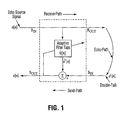
- FIG. 1 The layout of a typical LMS-based echo canceller is shown in Figure 1 . It contains two signals, travelling along a "send" path and a "receive” path.
- the echo source signal enters the echo canceller as R IN and leaves as R OUT .
- the send path input, S IN consists of a double-talk signal (if present) plus the echo source signal after it has travelled along the echo path. By estimating the echo path, a synthetic echo signal can be generated to cancel the echo in the send path.
- the echo cancelled signal leaves as S OUT .
- the LMS filter attempts to cancel the echo by adjusting itself to suppress the output signal at S OUT . Obviously, if S IN contains components other than echoed speech from the echo source, the LMS filter will not converge to the correct solution; hence the need for double-talk detection.
- N-LMS Normalized-LMS
- ⁇ the LMS step-size parameter ⁇ . This parameter controls both the speed and accuracy of convergence. The larger ⁇ is, the faster the algorithm will converge on the echo path, but the less accurate the steady-state solution will be. To guarantee convergence of the N-LMS algorithm, ⁇ must be less than 2.
- a common technique is to adjust the value of ⁇ based on the state of the echo canceller.
- ⁇ In an unconverged state (such as at start-up, or following a path change), it is desirable to use a large value for ⁇ to permit rapid initial convergence.
- ⁇ can be reduced. This not only allows for a slightly more accurate solution (and therefore more cancellation), but it will also slow potential divergence from double-talk.
- ⁇ can simply be set to zero. The double-talk and path change detectors can therefore control the operation of the LMS filter by varying the value of ⁇ .
- a double-talk detection algorithm in accordance with a preferred embodiment of the invention that is designed to work in conjunction with the echo canceller described illustrated in Figure 1 will be described. This is implemented in a digital signal processor.
- R E xx T
- E[...] is the statistical expectation operator.
- R may be expanded in two ways
- R E X 0 ⁇ X 0 T
- X 1 ⁇ X 1 T E HSS T ⁇ H T
- R is a symmetric, correlation-based matrix.
- H H 0 , 0 1 H ⁇ 1 , 0 0
- H 0,0 H 1,0 .
- X 0 contains components from both S 0 and S 1 , while X 1 is derived solely from So. In this case, X 1 and X 0 and are highly uncorrelated.
- R will have a low condition number, and this will be sustained for the duration of the double-talk. The higher the double-talk level, the lower the condition number becomes. This will raise the determinant of R , and we will find two significant eigenvalues and singular values.
- the matrix R is generated, a variety of operations are available to determine what state the echo canceller is in.
- the condition number, determinant, eigenvalues and singular values of can all be used to test for double-talk or path changes.
- the determinant is used in the preferred embodiment because it is the simplest matrix operation to perform.
- det [ R ] Under normal convergence ( Fig. 2a ), det [ R ] rapidly decays to near-zero values. When a path change occurs ( FIG. 2b ), det [ R ] spikes to a large value and then decays (to emphasize this trend, convergence was slowed by a factor of 10 following the path change). With double-talk (bottom plot), even larger, but sustained, spikes are present in det [ R ]. The differences in these three plots make it very easy to tell what state the echo canceller is in simply by checking the level of det [ R ]. The highest levels indicate double-talk, medium levels (along with decay) occurs with path changes, and very low levels are characteristic of full convergence. Based on these results, thresholds can be set as follows:
- the LMS filter operation can be adjusted accordingly.
- the advantage to this approach is that the algorithm no longer needs to have an accurate echo path estimate for R to have a high condition number during non-double-talk states.
- the double-talk detector becomes completely insensitive to path changes. Depending on the application, this may or may not be a desirable property. Low-level double-talk detection abilities improve, but a separate path change detection scheme must now be used.
- inventive process can be implemented in a digital signal processor or other suitable digital signal processing device.
- Adaptive Filter A filter whose coefficients can be adjusted during operation. Adaptive filters are used to estimate unknown parameters, for example an unknown echo path.
- Autocorrelation A statistical quantity which roughly measures the similarity of a signal to time shifted versions of itself.
- Condition Number A measure of how close a matrix is to being singular.
- Convergence The condition achieved when the LMS filter has accurately modelled the echo path and is no longer undergoing significant changes. At convergence, the LMS filter is cancelling the maximum amount of echo.
- Cross-Correlation A statistical quantity which roughly measures the similarity of two separate signals.
- Double-Talk The condition which occurs during simultaneous transmission of signals from both sides of the echo canceller.
- Echo Path A mathematical description of the process which imparts an echo to a signal.
- ERL Echo Return Loss. The loss a signal experiences as it travels along the echo path from R OUT to S IN .
- ERLE Echo Return Loss Enhancement. A common method of measuring the performance of an echo canceller. This measurement represents the amount that an echo signal has been reduced from S IN to S OUT .
- LMS Algorithm Least Mean Squares algorithm. Common adaptive filtering technique.
- N-LMS Algorithm Normalized Least Mean Squares algorithm. A variation on standard LMS in which the tap- weight update term is scaled by the inverse of the input signal power.
- Rank The number of non-zero eigenvalues or singular values a matrix has. Full-rank matrices have a non-zero determinant, and are thus non-singular and invertible.
- RLS Algorithm Recursive Least Squares algorithm. Common adaptive filtering technique.
Landscapes
- Engineering & Computer Science (AREA)
- Computer Networks & Wireless Communication (AREA)
- Signal Processing (AREA)
- Cable Transmission Systems, Equalization Of Radio And Reduction Of Echo (AREA)
- Filters That Use Time-Delay Elements (AREA)
- Interconnected Communication Systems, Intercoms, And Interphones (AREA)
- Eye Examination Apparatus (AREA)
- Ultra Sonic Daignosis Equipment (AREA)
- Mold Materials And Core Materials (AREA)
Applications Claiming Priority (3)
| Application Number | Priority Date | Filing Date | Title |
|---|---|---|---|
| GB0100674A GB2371191B (en) | 2001-01-11 | 2001-01-11 | Double-talk and path change detection using a matrix of correlation coefficients |
| GB0100674 | 2001-01-11 | ||
| PCT/CA2002/000038 WO2002056496A2 (en) | 2001-01-11 | 2002-01-10 | Double-talk and path change detection using a matrix of correlation coefficients |
Publications (2)
| Publication Number | Publication Date |
|---|---|
| EP1350339A2 EP1350339A2 (en) | 2003-10-08 |
| EP1350339B1 true EP1350339B1 (en) | 2009-07-29 |
Family
ID=9906609
Family Applications (1)
| Application Number | Title | Priority Date | Filing Date |
|---|---|---|---|
| EP02710709A Expired - Lifetime EP1350339B1 (en) | 2001-01-11 | 2002-01-10 | Double-talk and path change detection using a matrix of correlation coefficients |
Country Status (12)
| Country | Link |
|---|---|
| US (1) | US6944288B2 (enExample) |
| EP (1) | EP1350339B1 (enExample) |
| JP (1) | JP2004517579A (enExample) |
| KR (1) | KR20020086632A (enExample) |
| CN (1) | CN1230994C (enExample) |
| AT (1) | ATE438230T1 (enExample) |
| AU (1) | AU2002229429A1 (enExample) |
| CA (1) | CA2402511C (enExample) |
| DE (1) | DE60233108D1 (enExample) |
| GB (1) | GB2371191B (enExample) |
| TW (1) | TW548907B (enExample) |
| WO (1) | WO2002056496A2 (enExample) |
Families Citing this family (17)
| Publication number | Priority date | Publication date | Assignee | Title |
|---|---|---|---|---|
| EP1363408A1 (en) * | 2002-05-17 | 2003-11-19 | STMicroelectronics N.V. | Apparatus and method of echo-cancellation |
| DE10329055B4 (de) * | 2003-06-27 | 2005-10-13 | Infineon Technologies Ag | Verfahren und Vorrichtung zur Echokompensation |
| GB0324536D0 (en) * | 2003-10-21 | 2003-11-26 | Mitel Networks Corp | Detecting acoustic echoes using microphone arrays |
| GB0402102D0 (en) * | 2004-01-30 | 2004-03-03 | Mitel Networks Corp | Method for detecting echo path changes in echo cancellers |
| US8761385B2 (en) | 2004-11-08 | 2014-06-24 | Nec Corporation | Signal processing method, signal processing device, and signal processing program |
| US7602855B2 (en) * | 2005-04-01 | 2009-10-13 | Interdigital Technology Corporation | Method and apparatus for singular value decomposition of a channel matrix |
| US7555117B2 (en) * | 2005-07-12 | 2009-06-30 | Acoustic Technologies, Inc. | Path change detector for echo cancellation |
| US8041564B2 (en) | 2005-09-12 | 2011-10-18 | At&T Intellectual Property I, L.P. | Multi-pass echo residue detection with speech application intelligence |
| EP1783923B1 (en) | 2005-11-04 | 2011-05-04 | Texas Instruments Inc. | Double-talk detector for acoustic echo cancellation |
| EP1946454A1 (en) * | 2005-11-08 | 2008-07-23 | TELEFONAKTIEBOLAGET LM ERICSSON (publ) | Echo path change detection in a network echo canceller |
| CN101192849B (zh) * | 2006-11-20 | 2010-10-27 | 华为技术有限公司 | 一种信道矩阵的管理方法及其装置 |
| JP4821635B2 (ja) * | 2007-01-31 | 2011-11-24 | 沖電気工業株式会社 | 信号状態検出装置、エコーキャンセラ及び信号状態検出プログラム |
| JP2008219088A (ja) * | 2007-02-28 | 2008-09-18 | Oki Electric Ind Co Ltd | エコーキャンセラ及びエコーキャンセル方法 |
| US8855295B1 (en) * | 2012-06-25 | 2014-10-07 | Rawles Llc | Acoustic echo cancellation using blind source separation |
| KR20170032603A (ko) | 2015-09-15 | 2017-03-23 | 삼성전자주식회사 | 전자 장치, 그의 반향 신호 제거 방법 및 비일시적 컴퓨터 판독가능 기록매체 |
| US10827076B1 (en) | 2020-03-11 | 2020-11-03 | Cirrus Logic, Inc. | Echo path change monitoring in an acoustic echo canceler |
| CN112464811A (zh) * | 2020-11-26 | 2021-03-09 | 淮阴工学院 | 一种抽水蓄能机组振摆信号中高频随机噪声精准滤除方法 |
Family Cites Families (10)
| Publication number | Priority date | Publication date | Assignee | Title |
|---|---|---|---|---|
| AU614447B2 (en) * | 1988-12-01 | 1991-08-29 | Nec Corporation | Echo canceller with means for determining filter coefficients from autocorrelation and cross-correlation coefficients |
| JP2518433B2 (ja) * | 1990-01-24 | 1996-07-24 | 日本電気株式会社 | ダブルト―ク検出回路 |
| US5206854A (en) * | 1991-09-24 | 1993-04-27 | At&T Bell Laboratories | Detecting loss of echo cancellation |
| JPH09261135A (ja) * | 1996-03-25 | 1997-10-03 | Pioneer Electron Corp | 音響エコー消去装置 |
| US6035034A (en) * | 1996-12-20 | 2000-03-07 | Telefonaktiebolaget L M Ericsson (Publ) | Double talk and echo path change detection in a telephony system |
| US6137881A (en) * | 1997-02-28 | 2000-10-24 | Texas Instruments Incorporated | Adaptive filtering method and apparatus employing modified fast affine projection algorithm |
| US5909426A (en) * | 1997-03-31 | 1999-06-01 | Rockwell Science Center, Inc. | Orthogonal LMS algorithms for fast line echo canceler training |
| US6226380B1 (en) * | 1998-02-19 | 2001-05-01 | Nortel Networks Limited | Method of distinguishing between echo path change and double talk conditions in an echo canceller |
| TW403685B (en) | 1998-07-13 | 2000-09-01 | Siemens Ag | Device for laser processing of workpiece |
| JP2002533970A (ja) * | 1998-12-22 | 2002-10-08 | ノーテル・ネットワークス・リミテッド | 安定適応フィルタおよびその方法 |
-
2001
- 2001-01-11 GB GB0100674A patent/GB2371191B/en not_active Expired - Fee Related
-
2002
- 2002-01-10 WO PCT/CA2002/000038 patent/WO2002056496A2/en not_active Ceased
- 2002-01-10 CA CA2402511A patent/CA2402511C/en not_active Expired - Fee Related
- 2002-01-10 KR KR1020027011899A patent/KR20020086632A/ko not_active Abandoned
- 2002-01-10 JP JP2002557036A patent/JP2004517579A/ja not_active Ceased
- 2002-01-10 DE DE60233108T patent/DE60233108D1/de not_active Expired - Lifetime
- 2002-01-10 AT AT02710709T patent/ATE438230T1/de not_active IP Right Cessation
- 2002-01-10 AU AU2002229429A patent/AU2002229429A1/en not_active Abandoned
- 2002-01-10 CN CNB028000633A patent/CN1230994C/zh not_active Expired - Lifetime
- 2002-01-10 EP EP02710709A patent/EP1350339B1/en not_active Expired - Lifetime
- 2002-01-10 TW TW091100234A patent/TW548907B/zh active
- 2002-01-11 US US10/042,237 patent/US6944288B2/en not_active Expired - Lifetime
Also Published As
| Publication number | Publication date |
|---|---|
| TW548907B (en) | 2003-08-21 |
| GB0100674D0 (en) | 2001-02-21 |
| ATE438230T1 (de) | 2009-08-15 |
| GB2371191B (en) | 2005-06-15 |
| WO2002056496A3 (en) | 2002-09-26 |
| US6944288B2 (en) | 2005-09-13 |
| US20020126834A1 (en) | 2002-09-12 |
| JP2004517579A (ja) | 2004-06-10 |
| CN1230994C (zh) | 2005-12-07 |
| EP1350339A2 (en) | 2003-10-08 |
| WO2002056496A2 (en) | 2002-07-18 |
| AU2002229429A1 (en) | 2002-07-24 |
| KR20020086632A (ko) | 2002-11-18 |
| DE60233108D1 (de) | 2009-09-10 |
| CA2402511A1 (en) | 2002-07-18 |
| GB2371191A (en) | 2002-07-17 |
| CA2402511C (en) | 2010-06-22 |
| CN1455989A (zh) | 2003-11-12 |
Similar Documents
| Publication | Publication Date | Title |
|---|---|---|
| US6944288B2 (en) | Double-talk and path change detection using a matrix of correlation coefficients | |
| Paleologu et al. | Study of the general Kalman filter for echo cancellation | |
| Paleologu et al. | A variable step-size affine projection algorithm designed for acoustic echo cancellation | |
| US6035034A (en) | Double talk and echo path change detection in a telephony system | |
| US7003101B2 (en) | Subband echo location and double-talk detection in communication systems | |
| Gansler et al. | A robust proportionate affine projection algorithm for network echo cancellation | |
| Albu et al. | New variable step size affine projection algorithms | |
| US6766019B1 (en) | Method and apparatus for performing double-talk detection in acoustic echo cancellation | |
| Paleologu et al. | Variable step-size NLMS algorithms designed for echo cancellation | |
| Paleologu et al. | Regularization of the improved proportionate affine projection algorithm | |
| Paleologu et al. | Study of the optimal and simplified Kalman filters for echo cancellation | |
| Jenq et al. | Acoustic echo cancellation using iterative-maximal-length correlation and double-talk detection | |
| Benesty et al. | A recursive estimation of the condition number in the RLS algorithm [adaptive signal processing applications] | |
| Benesty et al. | A multidelay double-talk detector combined with the MDF adaptive filter | |
| Paleologu et al. | An efficient variable step-size proportionate affine projection algorithm | |
| Gänsler et al. | Double-talk detection schemes for acoustic echo cancellation | |
| Otopeleanu et al. | A Family of Robust Regularized Adaptive Filtering Algorithms | |
| Stanciu et al. | A proportionate affine projection algorithm using dichotomous coordinate descent iterations | |
| Dentino | Frequency domain adaptive correlator | |
| Verteletskaya et al. | Delay Estimator and Improved Proportionate Multi-Delay Adaptive Filtering Algorithm. | |
| Gänsler et al. | Double-Talk Detectors for Acoustic Echo Cancelers | |
| Paleologu et al. | A network echo canceler based on a SRF QRD-LSL adaptive algorithm implemented on Motorola StarCore SC140 DSP | |
| Ribas et al. | Low-complexity robust sparse channel identification using partial block wavelet transforms-analysis and implementation | |
| Paleologu et al. | Practical variable step-size adaptive algorithms for echo cancellation | |
| Benesty et al. | A family of robust PNLMS-like algorithms for network echo cancellation |
Legal Events
| Date | Code | Title | Description |
|---|---|---|---|
| PUAI | Public reference made under article 153(3) epc to a published international application that has entered the european phase |
Free format text: ORIGINAL CODE: 0009012 |
|
| 17P | Request for examination filed |
Effective date: 20021003 |
|
| AK | Designated contracting states |
Kind code of ref document: A2 Designated state(s): AT BE CH CY DE DK ES FI FR GB GR IE IT LI LU MC NL PT SE TR |
|
| AX | Request for extension of the european patent |
Extension state: AL LT LV MK RO SI |
|
| 17Q | First examination report despatched |
Effective date: 20070529 |
|
| GRAP | Despatch of communication of intention to grant a patent |
Free format text: ORIGINAL CODE: EPIDOSNIGR1 |
|
| GRAS | Grant fee paid |
Free format text: ORIGINAL CODE: EPIDOSNIGR3 |
|
| GRAA | (expected) grant |
Free format text: ORIGINAL CODE: 0009210 |
|
| AK | Designated contracting states |
Kind code of ref document: B1 Designated state(s): AT BE CH CY DE DK ES FI FR GB GR IE IT LI LU MC NL PT SE TR |
|
| REG | Reference to a national code |
Ref country code: GB Ref legal event code: FG4D |
|
| REG | Reference to a national code |
Ref country code: CH Ref legal event code: EP |
|
| REG | Reference to a national code |
Ref country code: IE Ref legal event code: FG4D |
|
| REF | Corresponds to: |
Ref document number: 60233108 Country of ref document: DE Date of ref document: 20090910 Kind code of ref document: P |
|
| NLV1 | Nl: lapsed or annulled due to failure to fulfill the requirements of art. 29p and 29m of the patents act | ||
| PG25 | Lapsed in a contracting state [announced via postgrant information from national office to epo] |
Ref country code: FI Free format text: LAPSE BECAUSE OF FAILURE TO SUBMIT A TRANSLATION OF THE DESCRIPTION OR TO PAY THE FEE WITHIN THE PRESCRIBED TIME-LIMIT Effective date: 20090729 Ref country code: ES Free format text: LAPSE BECAUSE OF FAILURE TO SUBMIT A TRANSLATION OF THE DESCRIPTION OR TO PAY THE FEE WITHIN THE PRESCRIBED TIME-LIMIT Effective date: 20091109 Ref country code: SE Free format text: LAPSE BECAUSE OF FAILURE TO SUBMIT A TRANSLATION OF THE DESCRIPTION OR TO PAY THE FEE WITHIN THE PRESCRIBED TIME-LIMIT Effective date: 20090729 Ref country code: AT Free format text: LAPSE BECAUSE OF FAILURE TO SUBMIT A TRANSLATION OF THE DESCRIPTION OR TO PAY THE FEE WITHIN THE PRESCRIBED TIME-LIMIT Effective date: 20090729 |
|
| PG25 | Lapsed in a contracting state [announced via postgrant information from national office to epo] |
Ref country code: NL Free format text: LAPSE BECAUSE OF FAILURE TO SUBMIT A TRANSLATION OF THE DESCRIPTION OR TO PAY THE FEE WITHIN THE PRESCRIBED TIME-LIMIT Effective date: 20090729 |
|
| PG25 | Lapsed in a contracting state [announced via postgrant information from national office to epo] |
Ref country code: PT Free format text: LAPSE BECAUSE OF FAILURE TO SUBMIT A TRANSLATION OF THE DESCRIPTION OR TO PAY THE FEE WITHIN THE PRESCRIBED TIME-LIMIT Effective date: 20091129 |
|
| PG25 | Lapsed in a contracting state [announced via postgrant information from national office to epo] |
Ref country code: DK Free format text: LAPSE BECAUSE OF FAILURE TO SUBMIT A TRANSLATION OF THE DESCRIPTION OR TO PAY THE FEE WITHIN THE PRESCRIBED TIME-LIMIT Effective date: 20090729 |
|
| PG25 | Lapsed in a contracting state [announced via postgrant information from national office to epo] |
Ref country code: BE Free format text: LAPSE BECAUSE OF FAILURE TO SUBMIT A TRANSLATION OF THE DESCRIPTION OR TO PAY THE FEE WITHIN THE PRESCRIBED TIME-LIMIT Effective date: 20090729 |
|
| PLBE | No opposition filed within time limit |
Free format text: ORIGINAL CODE: 0009261 |
|
| STAA | Information on the status of an ep patent application or granted ep patent |
Free format text: STATUS: NO OPPOSITION FILED WITHIN TIME LIMIT |
|
| 26N | No opposition filed |
Effective date: 20100503 |
|
| PG25 | Lapsed in a contracting state [announced via postgrant information from national office to epo] |
Ref country code: MC Free format text: LAPSE BECAUSE OF NON-PAYMENT OF DUE FEES Effective date: 20100131 |
|
| REG | Reference to a national code |
Ref country code: CH Ref legal event code: PL |
|
| PG25 | Lapsed in a contracting state [announced via postgrant information from national office to epo] |
Ref country code: GR Free format text: LAPSE BECAUSE OF FAILURE TO SUBMIT A TRANSLATION OF THE DESCRIPTION OR TO PAY THE FEE WITHIN THE PRESCRIBED TIME-LIMIT Effective date: 20091030 Ref country code: CH Free format text: LAPSE BECAUSE OF NON-PAYMENT OF DUE FEES Effective date: 20100131 Ref country code: LI Free format text: LAPSE BECAUSE OF NON-PAYMENT OF DUE FEES Effective date: 20100131 |
|
| PG25 | Lapsed in a contracting state [announced via postgrant information from national office to epo] |
Ref country code: IE Free format text: LAPSE BECAUSE OF NON-PAYMENT OF DUE FEES Effective date: 20100110 |
|
| PG25 | Lapsed in a contracting state [announced via postgrant information from national office to epo] |
Ref country code: IT Free format text: LAPSE BECAUSE OF FAILURE TO SUBMIT A TRANSLATION OF THE DESCRIPTION OR TO PAY THE FEE WITHIN THE PRESCRIBED TIME-LIMIT Effective date: 20090729 |
|
| PGFP | Annual fee paid to national office [announced via postgrant information from national office to epo] |
Ref country code: FR Payment date: 20120202 Year of fee payment: 11 |
|
| PGFP | Annual fee paid to national office [announced via postgrant information from national office to epo] |
Ref country code: DE Payment date: 20120104 Year of fee payment: 11 |
|
| PGFP | Annual fee paid to national office [announced via postgrant information from national office to epo] |
Ref country code: GB Payment date: 20120104 Year of fee payment: 11 |
|
| PG25 | Lapsed in a contracting state [announced via postgrant information from national office to epo] |
Ref country code: CY Free format text: LAPSE BECAUSE OF FAILURE TO SUBMIT A TRANSLATION OF THE DESCRIPTION OR TO PAY THE FEE WITHIN THE PRESCRIBED TIME-LIMIT Effective date: 20090729 |
|
| PG25 | Lapsed in a contracting state [announced via postgrant information from national office to epo] |
Ref country code: LU Free format text: LAPSE BECAUSE OF NON-PAYMENT OF DUE FEES Effective date: 20100110 |
|
| PG25 | Lapsed in a contracting state [announced via postgrant information from national office to epo] |
Ref country code: TR Free format text: LAPSE BECAUSE OF FAILURE TO SUBMIT A TRANSLATION OF THE DESCRIPTION OR TO PAY THE FEE WITHIN THE PRESCRIBED TIME-LIMIT Effective date: 20090729 |
|
| GBPC | Gb: european patent ceased through non-payment of renewal fee |
Effective date: 20130110 |
|
| REG | Reference to a national code |
Ref country code: FR Ref legal event code: ST Effective date: 20130930 |
|
| PG25 | Lapsed in a contracting state [announced via postgrant information from national office to epo] |
Ref country code: DE Free format text: LAPSE BECAUSE OF NON-PAYMENT OF DUE FEES Effective date: 20130801 |
|
| REG | Reference to a national code |
Ref country code: DE Ref legal event code: R119 Ref document number: 60233108 Country of ref document: DE Effective date: 20130801 |
|
| PG25 | Lapsed in a contracting state [announced via postgrant information from national office to epo] |
Ref country code: FR Free format text: LAPSE BECAUSE OF NON-PAYMENT OF DUE FEES Effective date: 20130131 Ref country code: GB Free format text: LAPSE BECAUSE OF NON-PAYMENT OF DUE FEES Effective date: 20130110 |