EP1348739A2 - Dye-containing curable composition, color filter prepared using the same, and process of preparing color filter - Google Patents
Dye-containing curable composition, color filter prepared using the same, and process of preparing color filter Download PDFInfo
- Publication number
- EP1348739A2 EP1348739A2 EP03006873A EP03006873A EP1348739A2 EP 1348739 A2 EP1348739 A2 EP 1348739A2 EP 03006873 A EP03006873 A EP 03006873A EP 03006873 A EP03006873 A EP 03006873A EP 1348739 A2 EP1348739 A2 EP 1348739A2
- Authority
- EP
- European Patent Office
- Prior art keywords
- dye
- curable composition
- acid
- amine compound
- containing curable
- Prior art date
- Legal status (The legal status is an assumption and is not a legal conclusion. Google has not performed a legal analysis and makes no representation as to the accuracy of the status listed.)
- Granted
Links
- 0 *C1=CC(N=N[C@@](C2)C=Cc3c2ccc(*)c3)=CCC1O Chemical compound *C1=CC(N=N[C@@](C2)C=Cc3c2ccc(*)c3)=CCC1O 0.000 description 2
- DLNKOYKMWOXYQA-UHFFFAOYSA-N CC(C(c1ccccc1)O)N Chemical compound CC(C(c1ccccc1)O)N DLNKOYKMWOXYQA-UHFFFAOYSA-N 0.000 description 1
- YFEAYNIMJBHJCM-UHFFFAOYSA-N CC(C)(C1)CC(C)(CN)CC1O Chemical compound CC(C)(C1)CC(C)(CN)CC1O YFEAYNIMJBHJCM-UHFFFAOYSA-N 0.000 description 1
- SLINHMUFWFWBMU-UHFFFAOYSA-N CC(CN(CC(C)O)CC(C)O)O Chemical compound CC(CN(CC(C)O)CC(C)O)O SLINHMUFWFWBMU-UHFFFAOYSA-N 0.000 description 1
- ZPDWHORJHVKVPL-UHFFFAOYSA-N CCC(Cc1ccc(C)c(O)c1)N Chemical compound CCC(Cc1ccc(C)c(O)c1)N ZPDWHORJHVKVPL-UHFFFAOYSA-N 0.000 description 1
- QCMHUGYTOGXZIW-UHFFFAOYSA-N CN(C)CC(CO)O Chemical compound CN(C)CC(CO)O QCMHUGYTOGXZIW-UHFFFAOYSA-N 0.000 description 1
- YSAANLSYLSUVHB-UHFFFAOYSA-N CN(C)CCOCCO Chemical compound CN(C)CCOCCO YSAANLSYLSUVHB-UHFFFAOYSA-N 0.000 description 1
- ASPPFKHFDFDLAM-UHFFFAOYSA-N CN(CC(CCO)O)Cc1ccccc1 Chemical compound CN(CC(CCO)O)Cc1ccccc1 ASPPFKHFDFDLAM-UHFFFAOYSA-N 0.000 description 1
- UKANCZCEGQDKGF-UHFFFAOYSA-N CN(CCC1)CC1O Chemical compound CN(CCC1)CC1O UKANCZCEGQDKGF-UHFFFAOYSA-N 0.000 description 1
- WOUANPHGFPAJCA-UHFFFAOYSA-N CN(CCO)Cc1ccccc1 Chemical compound CN(CCO)Cc1ccccc1 WOUANPHGFPAJCA-UHFFFAOYSA-N 0.000 description 1
- YRCWQPVGYLYSOX-UHFFFAOYSA-N CNCC(c(cc1)ccc1O)O Chemical compound CNCC(c(cc1)ccc1O)O YRCWQPVGYLYSOX-UHFFFAOYSA-N 0.000 description 1
- SNTCCWUWWYWRLN-UHFFFAOYSA-N COCC(C(c1ccccc1)O)N Chemical compound COCC(C(c1ccccc1)O)N SNTCCWUWWYWRLN-UHFFFAOYSA-N 0.000 description 1
- QHGUCRYDKWKLMG-UHFFFAOYSA-N NCC(c(cc1)ccc1O)O Chemical compound NCC(c(cc1)ccc1O)O QHGUCRYDKWKLMG-UHFFFAOYSA-N 0.000 description 1
- LRCXRAABFLIVAI-UHFFFAOYSA-N NCC(c1cc(O)ccc1)O Chemical compound NCC(c1cc(O)ccc1)O LRCXRAABFLIVAI-UHFFFAOYSA-N 0.000 description 1
- VYFYYTLLBUKUHU-UHFFFAOYSA-N NCCc(cc1)cc(O)c1O Chemical compound NCCc(cc1)cc(O)c1O VYFYYTLLBUKUHU-UHFFFAOYSA-N 0.000 description 1
- XUJFOSLZQITUOI-UHFFFAOYSA-N Nc(cc1)ccc1OC(F)(F)F Chemical compound Nc(cc1)ccc1OC(F)(F)F XUJFOSLZQITUOI-UHFFFAOYSA-N 0.000 description 1
Classifications
-
- A—HUMAN NECESSITIES
- A63—SPORTS; GAMES; AMUSEMENTS
- A63B—APPARATUS FOR PHYSICAL TRAINING, GYMNASTICS, SWIMMING, CLIMBING, OR FENCING; BALL GAMES; TRAINING EQUIPMENT
- A63B57/00—Golfing accessories
- A63B57/10—Golf tees
-
- C—CHEMISTRY; METALLURGY
- C09—DYES; PAINTS; POLISHES; NATURAL RESINS; ADHESIVES; COMPOSITIONS NOT OTHERWISE PROVIDED FOR; APPLICATIONS OF MATERIALS NOT OTHERWISE PROVIDED FOR
- C09B—ORGANIC DYES OR CLOSELY-RELATED COMPOUNDS FOR PRODUCING DYES, e.g. PIGMENTS; MORDANTS; LAKES
- C09B69/00—Dyes not provided for by a single group of this subclass
- C09B69/02—Dyestuff salts, e.g. salts of acid dyes with basic dyes
- C09B69/04—Dyestuff salts, e.g. salts of acid dyes with basic dyes of anionic dyes with nitrogen containing compounds
-
- G—PHYSICS
- G02—OPTICS
- G02B—OPTICAL ELEMENTS, SYSTEMS OR APPARATUS
- G02B5/00—Optical elements other than lenses
- G02B5/20—Filters
- G02B5/22—Absorbing filters
- G02B5/223—Absorbing filters containing organic substances, e.g. dyes, inks or pigments
-
- A—HUMAN NECESSITIES
- A63—SPORTS; GAMES; AMUSEMENTS
- A63B—APPARATUS FOR PHYSICAL TRAINING, GYMNASTICS, SWIMMING, CLIMBING, OR FENCING; BALL GAMES; TRAINING EQUIPMENT
- A63B2102/00—Application of clubs, bats, rackets or the like to the sporting activity ; particular sports involving the use of balls and clubs, bats, rackets, or the like
- A63B2102/32—Golf
Definitions
- the present invention relates to a dye-containing curable composition that is suitable for forming a colored image in a color filter used in liquid crystal displays or solid-state image elements, as well as to a color filter prepared using the composition, and to a process of preparing the color filter.
- a dyeing process As a method of preparing a color filter for use in liquid crystal displays or solid-state image elements, a dyeing process, a printing process, an electrodepositing process and a pigment dispersing process are known.
- the dyeing process comprises dyeing a substrate, that is made of a natural resin (e.g., gelatin, glue and casein) or a synthetic resin (e.g., amine-modified polyvinyl alcohol), with a dye such as an acid dye, to thereby prepare a color filter.
- a natural resin e.g., gelatin, glue and casein
- a synthetic resin e.g., amine-modified polyvinyl alcohol
- the dyeing process involves problems with respect to lightfastness, heat resistance and humidity resistance due to using the dye, a problem in that color unevenness occurs when producing large-size screens because it is difficult to uniformly control dyeing and fixing characteristics, and a problem in that a procedure is complicated since an anti-dyeing layer is needed when conducting the dyeing.
- the electrodepositing process comprises forming transparent electrodes in a prescribed pattern beforehand, ionizing a resin that contains a pigment dissolved or dispersed in a solvent, and applying a voltage to form a colored image in accordance with a pattern shape, to thereby prepare a color filter.
- This electrodepositing process requires a photolithographic step including film-forming and etching steps for producing transparent electrodes for forming a color filter in addition to transparent electrodes for display. During this process, if a short circuit occurs, line defects are generated leading to a reduction in yield. In principle, this process is difficult to apply to alignments other than a stripe alignment, such as a mosaic alignment. Moreover, this process has a problem in that control of the transparent electrodes is difficult.
- the printing process is a simple and easy process for preparing a color filter, in which an ink that contains a thermosetting resin or a ultraviolet-curing resin and a pigment dispersed therein is used for printing, such as offset printing.
- an ink that contains a thermosetting resin or a ultraviolet-curing resin and a pigment dispersed therein is used for printing, such as offset printing.
- filtering is difficult, and defects resulting from contaminants, foreign matter or gelling of an ink binder are easily generated.
- this process involves problems with respect to position precision, line width precision, and plane smoothness depending on printing precision.
- the pigment dispersing process is a process employed for preparing a color filter, through a photographic technique using a colored radioactive composition containing a pigment dispersed in various photosensitive compositions. Since this process uses pigments, it is stable against light and heat. Further, since patterning is carried out by the photolithographic technique, the pigment dispersing process is suitable for the preparation of a color filter that achieves a sufficient position precision and is suitable for use in large-size screens and high resolution color displays.
- a radioactive composition is applied on a glass substrate using a spin coater, a roll coater or the like, followed by drying to form a coated film, which is then subjected to pattern exposure and development to thereby form colored pixels. This procedure is carried out for respective colors to obtain the color filter.
- negative-type photosensitive compositions which comprise a photopolymerizable monomer, a photopolymerization initiator and an alkali-soluble resin (see, for example, Japanese Patent Application Laid-Open (JP-A) Nos. 1-102469, 1-152499, 2-181704, 2-199403, 4-76062, 5-273411, 6-184482 and 7-140654).
- JP-A Japanese Patent Application Laid-Open
- Dye-containing curable compositions involve the following newly raised problems (1) to (4):
- the composition is required to have a film thickness of 1 ⁇ m or less. Accordingly, in order to exhibit a desired absorption, a large amount of the dye must be added to the curable composition, which results in occurrence of the foregoing problems.
- dyes that contain salts with various amines having enhanced solubility with respect to acid dyes.
- examples thereof include amine salts of "Acid Yellow 42" having solubility in alkaline aqueous solutions or organic solvents (e.g., ditolylguanidine salts).
- these amine salts do not have an OH group in their imine moiety, interaction with other components present in a resist considerably lowers their alkaline developability.
- an azo-based acid dye represented by "Acid Yellow 42” can take various conformations, a molar absorptive coefficient thereof may occasionally be lowered.
- An object of the present invention is to provide a dye-containing curable composition that exhibits high sensitivity, high transmittance, high resolving power and wide development latitude, is free from dye elution, deterioration by heat and deterioration by light, and has high productivity, as well as a color filter prepared using the dye-containing curable composition, and a process of preparing the color filter.
- a dye-containing curable composition that has the following constitution and is suitably applied to preparation of color filters, and a process of preparing a color filter are provided.
- a first aspect of the invention is a dye-containing curable composition
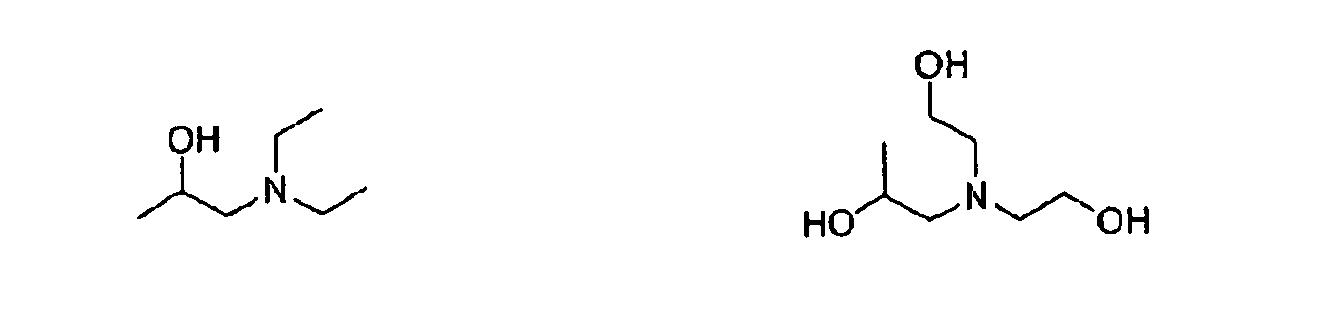
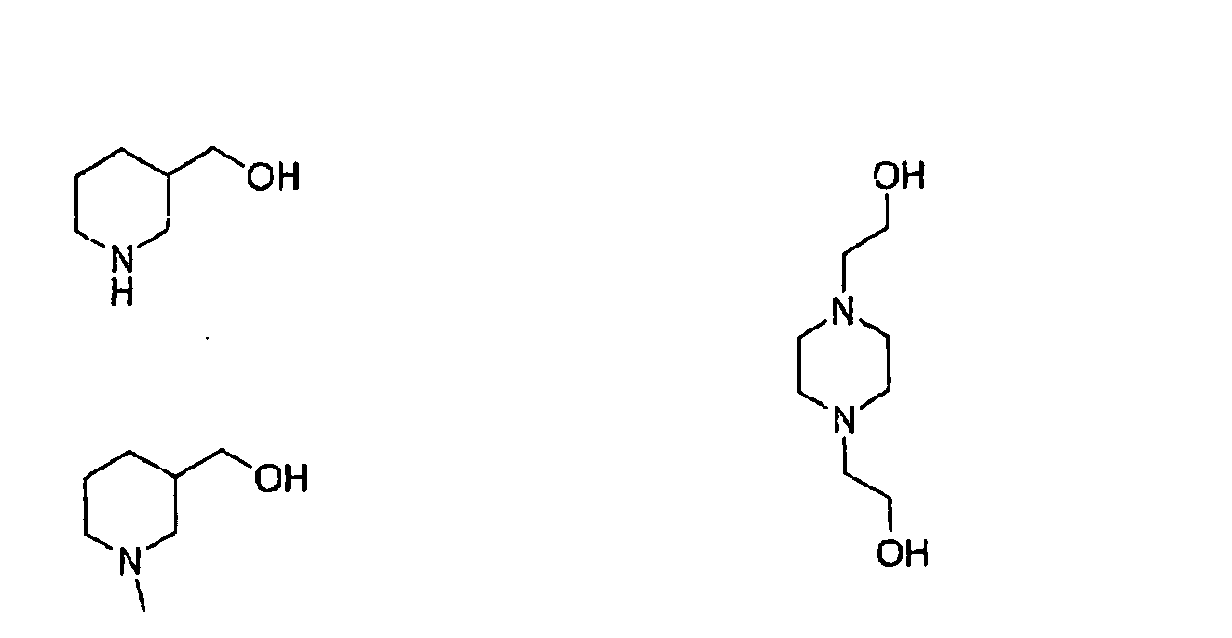
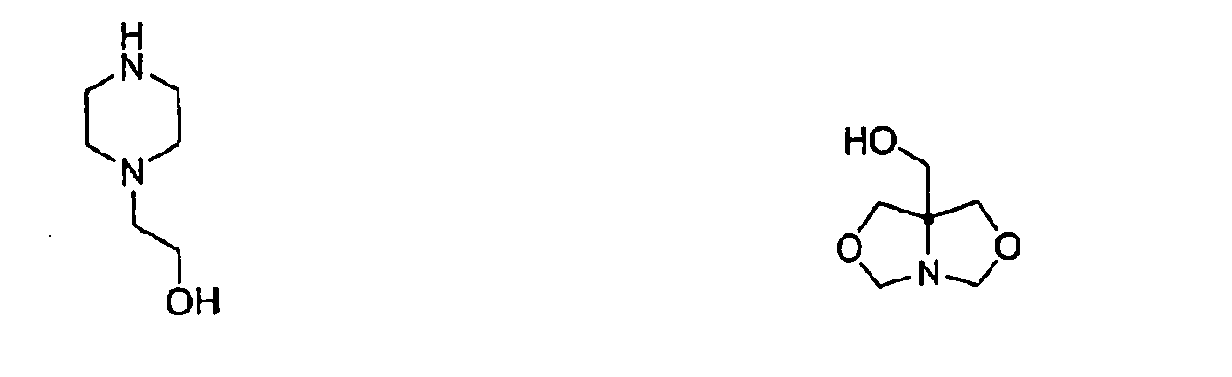
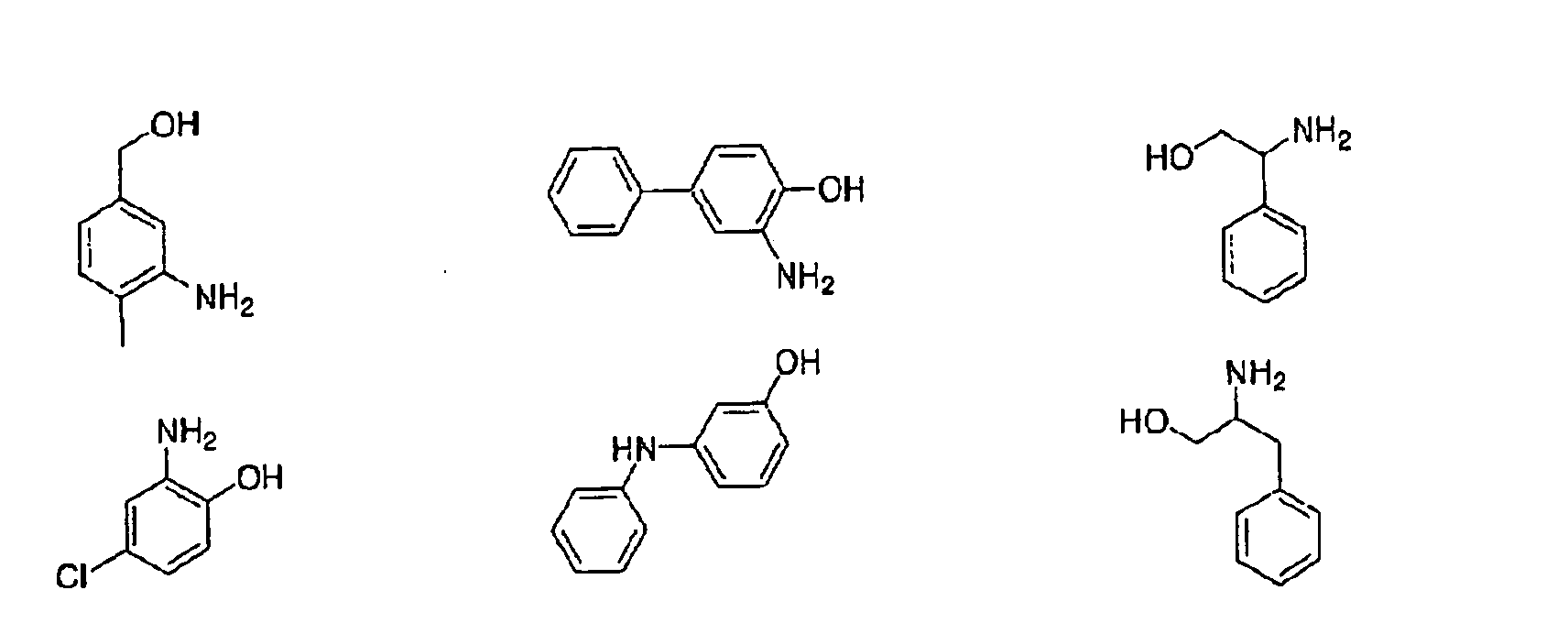
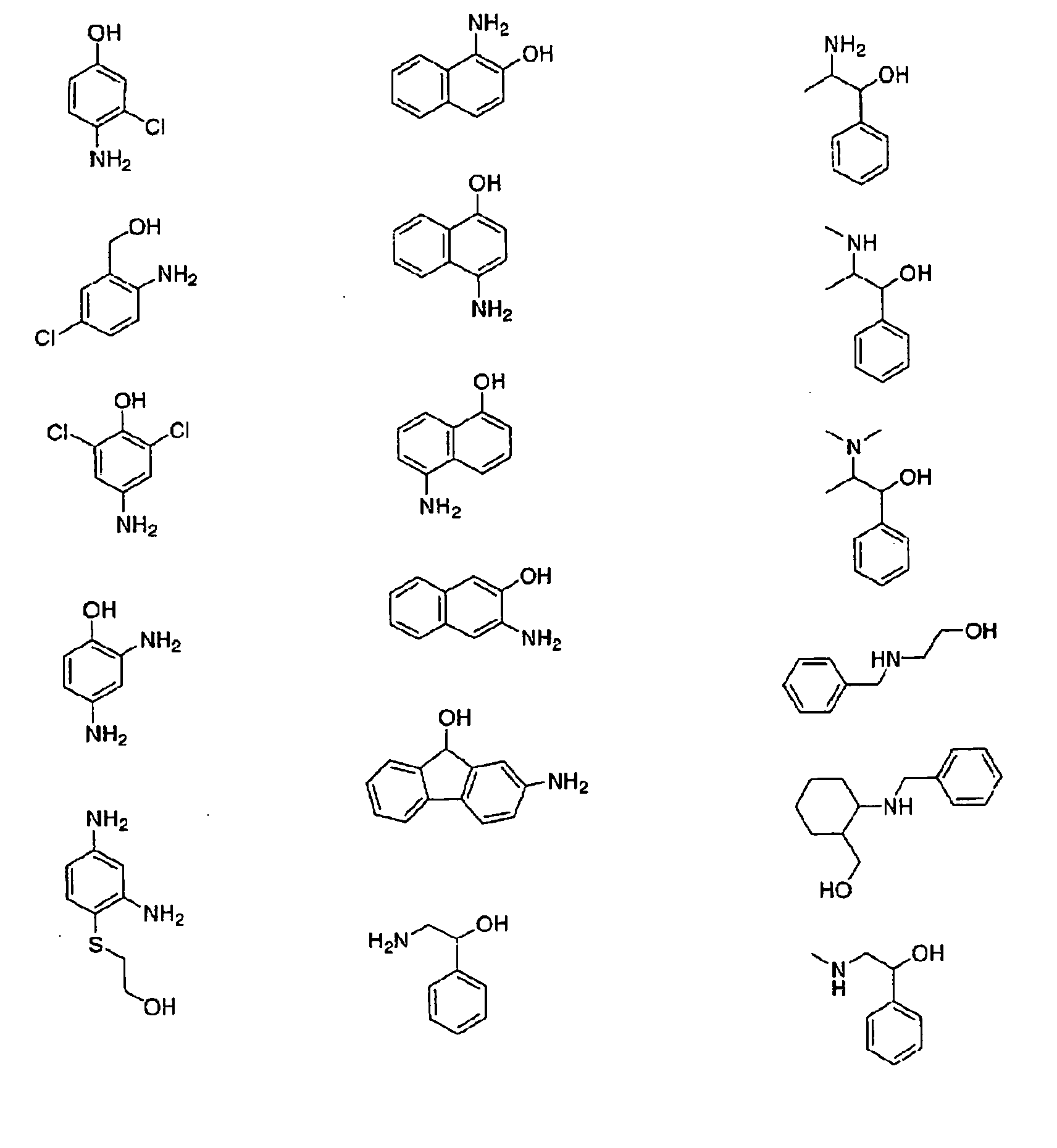
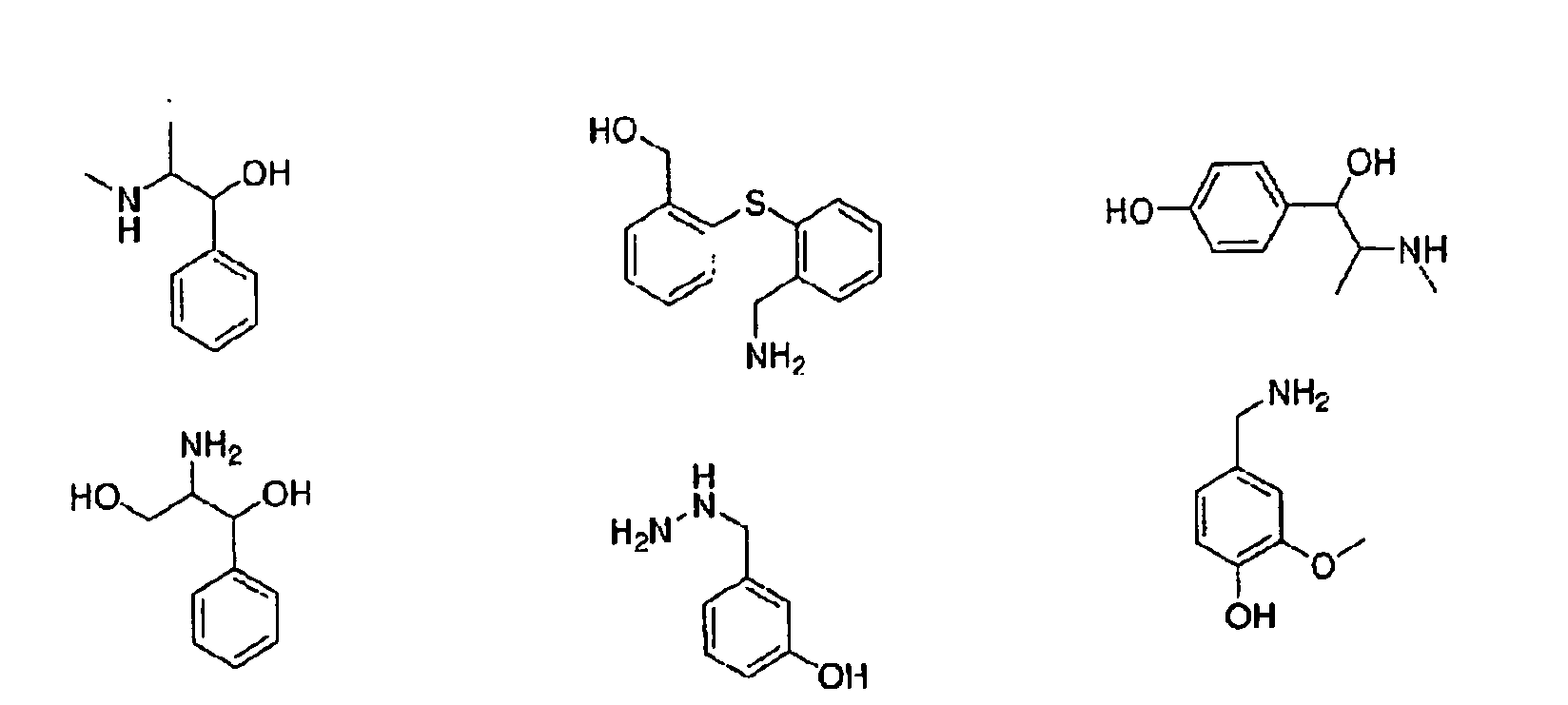
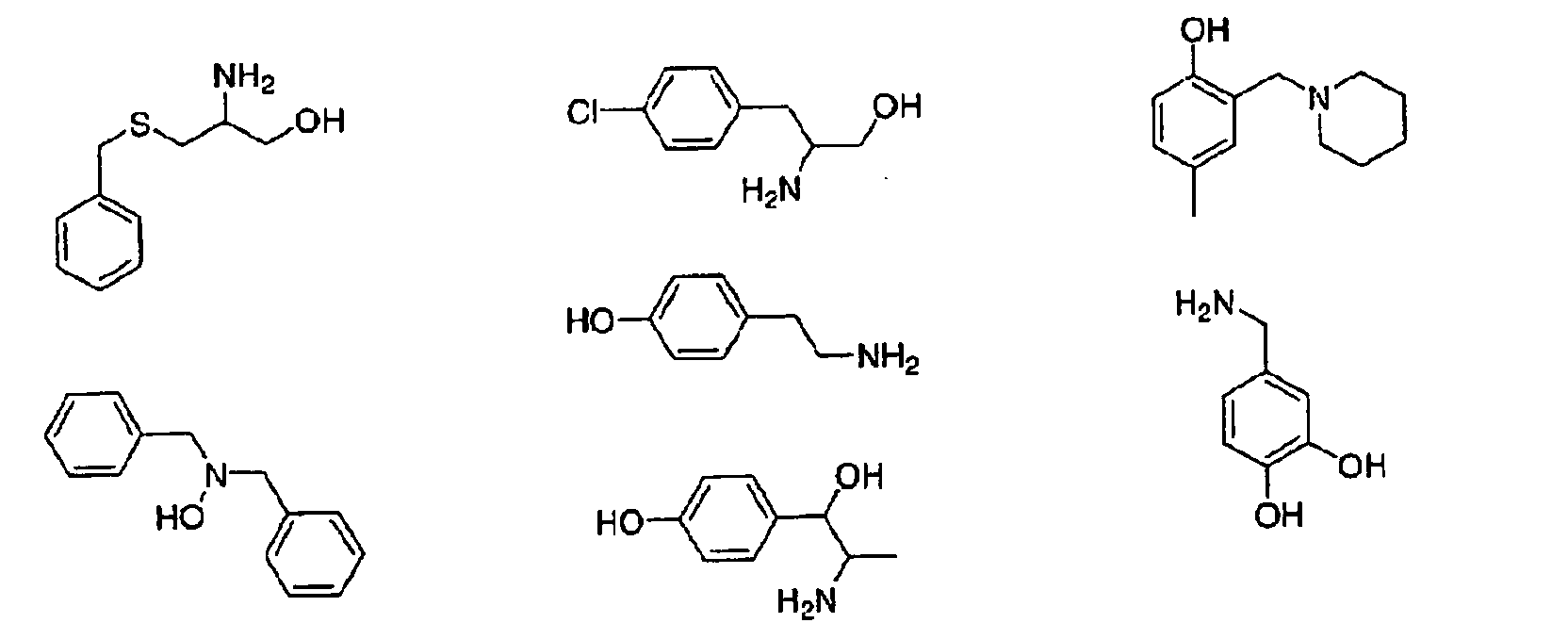
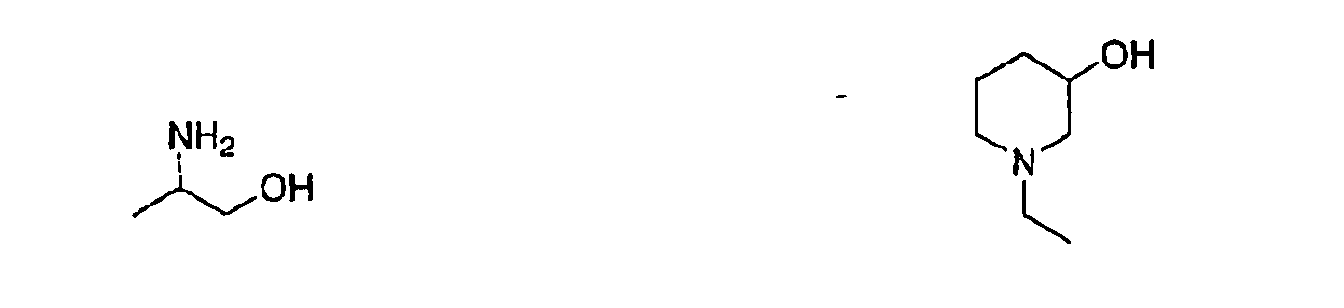
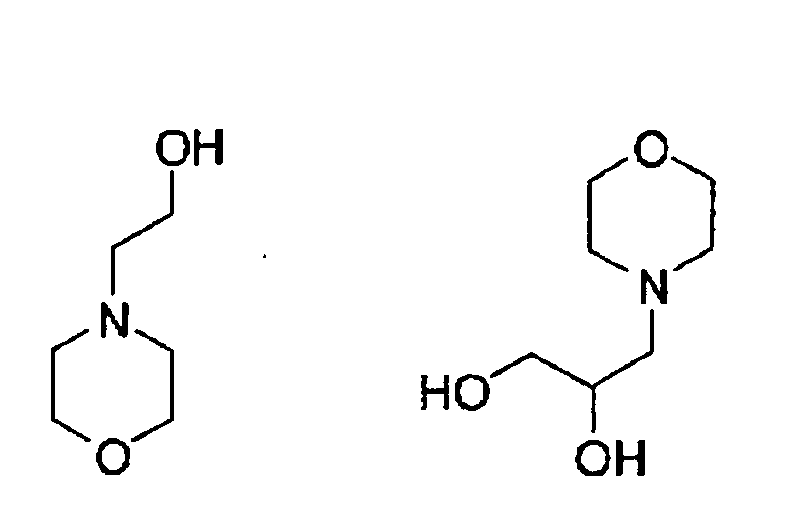
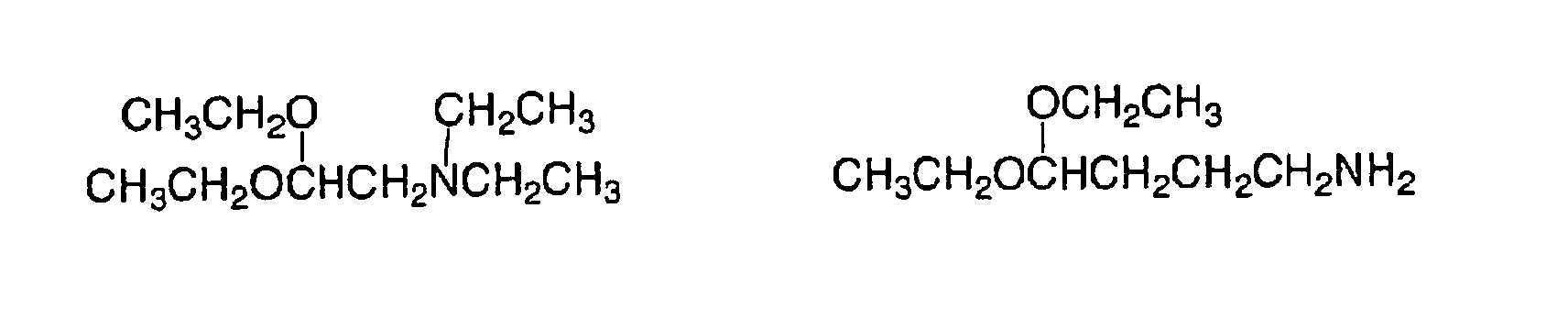
- a dye-containing curable composition comprising an alkali-soluble binder and an organic-solvent-soluble dye represented by the following formula (I): Dye ⁇ nX wherein Dye represents an acid dye; X represents an amine compound having an OH group and having a molecular weight of less than 230; and n satisfies 0 ⁇ n ⁇ 10.
- the amine compound represented by X in formula (I) has from 1 to 6 OH groups per molecular weight of 100.
- the amine compound has, per molecular weight thereof of 100, preferably from 1 to 5 OH groups, more preferably from 1 to 4 OH groups, and most preferably from 1 to 3 OH groups.
- the amine compound represented by X in formula (I) has up to 14 carbon atoms.
- the amine compound has preferably up to 12 carbon atoms, more preferably up to 10 carbon atoms, and most preferably up to 8 carbon atoms.
- the amine compound represented by X in formula (I) is a secondary or tertiary amine compound, with a tertiary amine compound being more preferable.
- the amine compound represented by X in formula (I) has linear aliphatic or cyclic aliphatic carbons, with the linear aliphatic carbons being more preferable.
- the amine compound represented by X in formula (I) has a surface energy of 10 to 80 dyn/cm, more preferably 15 to 70 dyn/cm, and most preferably 20 to 60 dyn/cm.
- a second aspect of the invention is a dye-containing curable composition
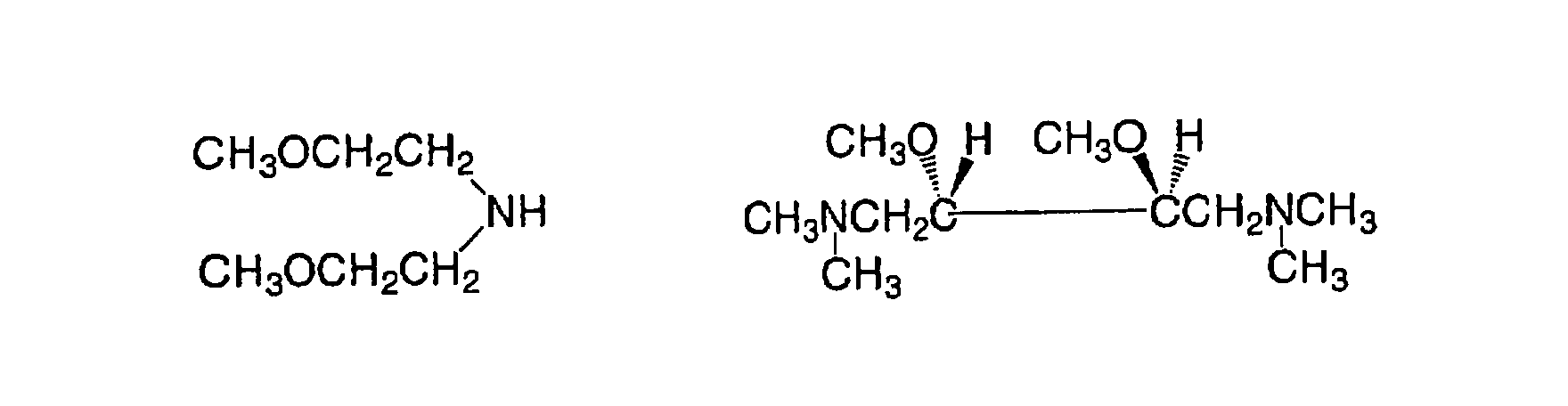
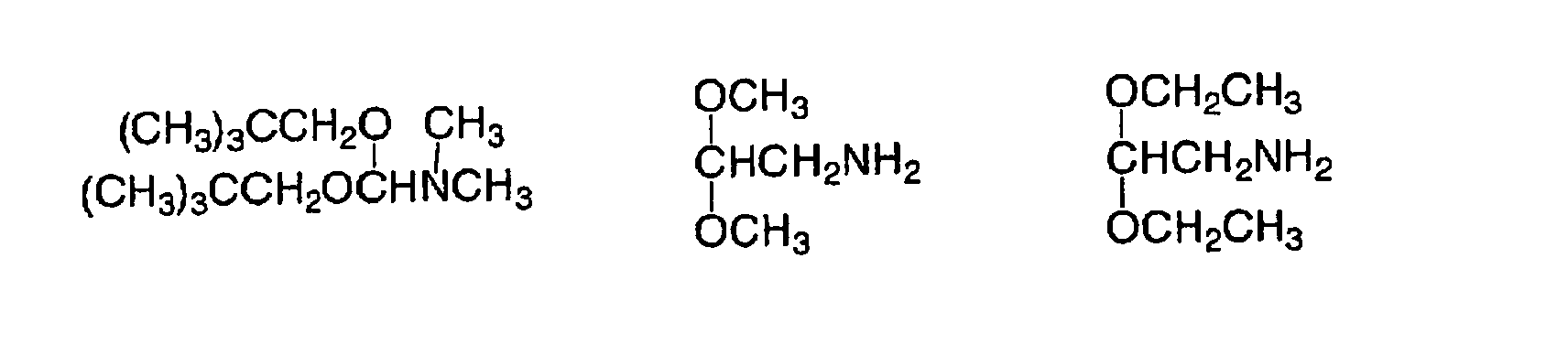
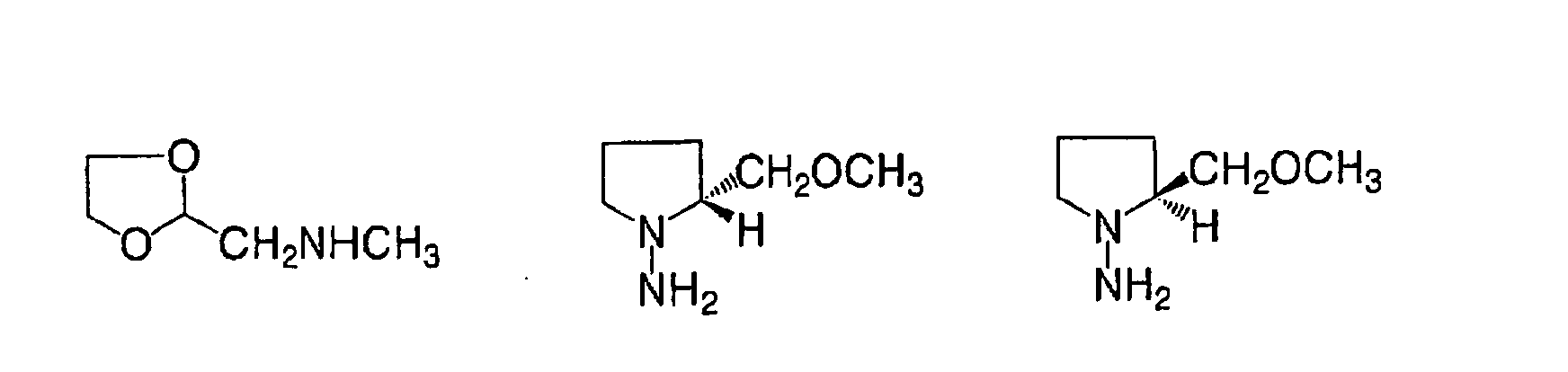
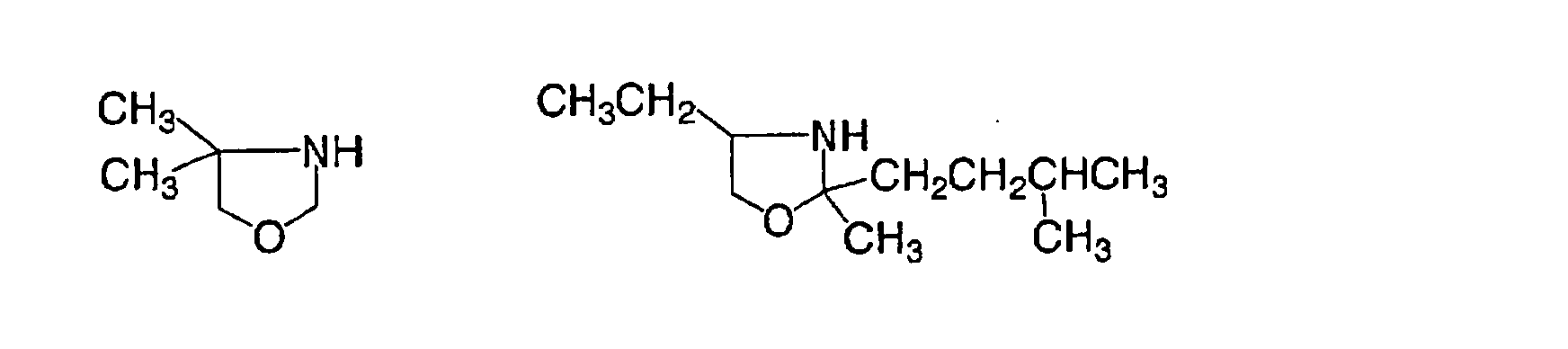
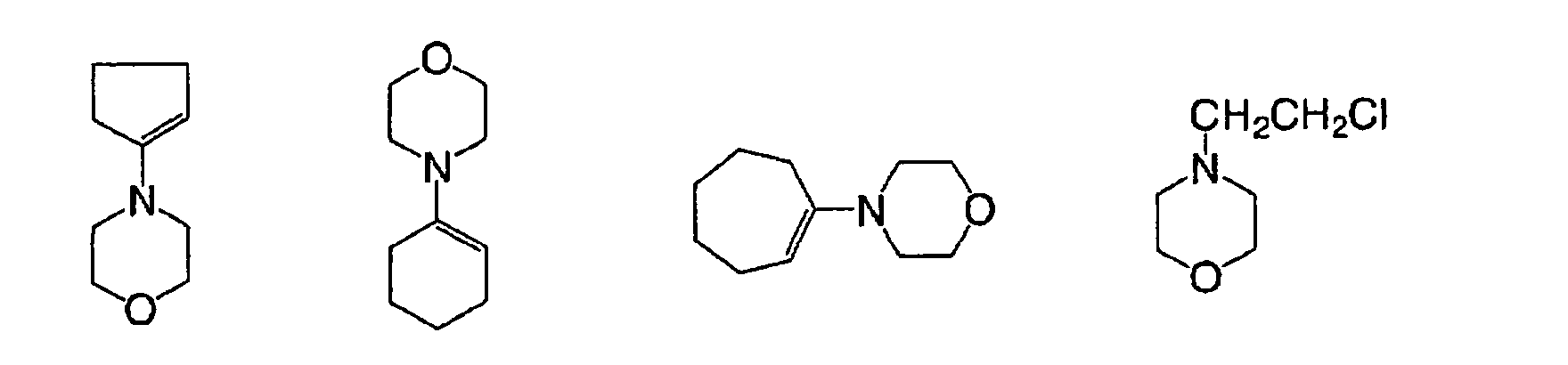
- a dye-containing curable composition comprising an alkali-soluble binder and an organic-solvent-soluble dye represented by the following formula (I): Dye ⁇ nX wherein Dye represents an acid dye; X represents an amine compound having an oxygen atom that forms an ether bond and having a molecular weight of 300 or less; and n satisfies 0 ⁇ n ⁇ 10.
- the amine compound represented by X in formula (I) has from 1 to 6 ether groups per molecular weight of 100.
- the amine compound has, per molecular weight thereof of 100, preferably from 1 to 5 ether groups, more preferably 1 to 4 ether groups, and most preferably 1 to 3 ether groups.
- the amine compound represented by X in formula (I) has up to 14 carbon atoms.
- the amine compound has preferably up to 12 carbon atoms, more preferably up to 10 carbon atoms, and most preferably up to 8 carbon atoms.
- the amine compound represented by X in formula (I) is a secondary or tertiary amine compound, with a tertiary amine compound being more preferable.
- the amine compound represented by X in formula (I) has linear aliphatic or cyclic aliphatic carbons, with the linear aliphatic carbons being more preferable.
- the amine compound represented by X in formula (I) has a surface energy of 10 to 80 dyn/cm, more preferably 15 to 70 dyn/cm, and most preferably 20 to 60 dyn/cm.
- a third aspect of the invention is a dye-containing curable composition
- a dye-containing curable composition comprising an alkali-soluble binder and an organic-solvent-soluble dye represented by the following formula (I): Dye ⁇ nX wherein Dye represents an acid dye; X represents an amine compound having a polymerizable group; and n satisfies 0 ⁇ n ⁇ 10.
- a fourth aspect of the invention is a color filter comprising a dye-containing curable composition according to any one of the first aspect, the second aspect and the third aspect.
- a fifth aspect of the invention is a process of preparing a color filter, which comprises the steps of applying on a substrate the dye-containing curable composition according to any one of the first aspect, the second aspect and the third aspect, exposing the composition to light through a mask, and conducting development to form a pattern.
- This preparation process may comprise an additional step of curing the pattern by heating and/or exposing to light, as necessary, and the above-described steps may be repeated plural times.
- a dye-containing curable composition, a color filter prepared using the composition, and a process of preparing the color filter according to the present invention will be described in detail below.
- composition of the invention is a dye-containing curable composition comprising an alkali-soluble binder and an organic-solvent-soluble dye, and the organic-solvent-soluble dye is a compound represented by the following formula (I).
- Dye represents an acid dye
- X represents an amine compound having an OH group and having a molecular weight of less than 230
- n satisfies 0 ⁇ n ⁇ 10.
- Dye represents an acid dye
- X represents an amine compound having an oxygen atom that forms an ether bond and having a molecular weight of 300 or less
- n satisfies 0 ⁇ n ⁇ 10.
- Dye represents an acid dye
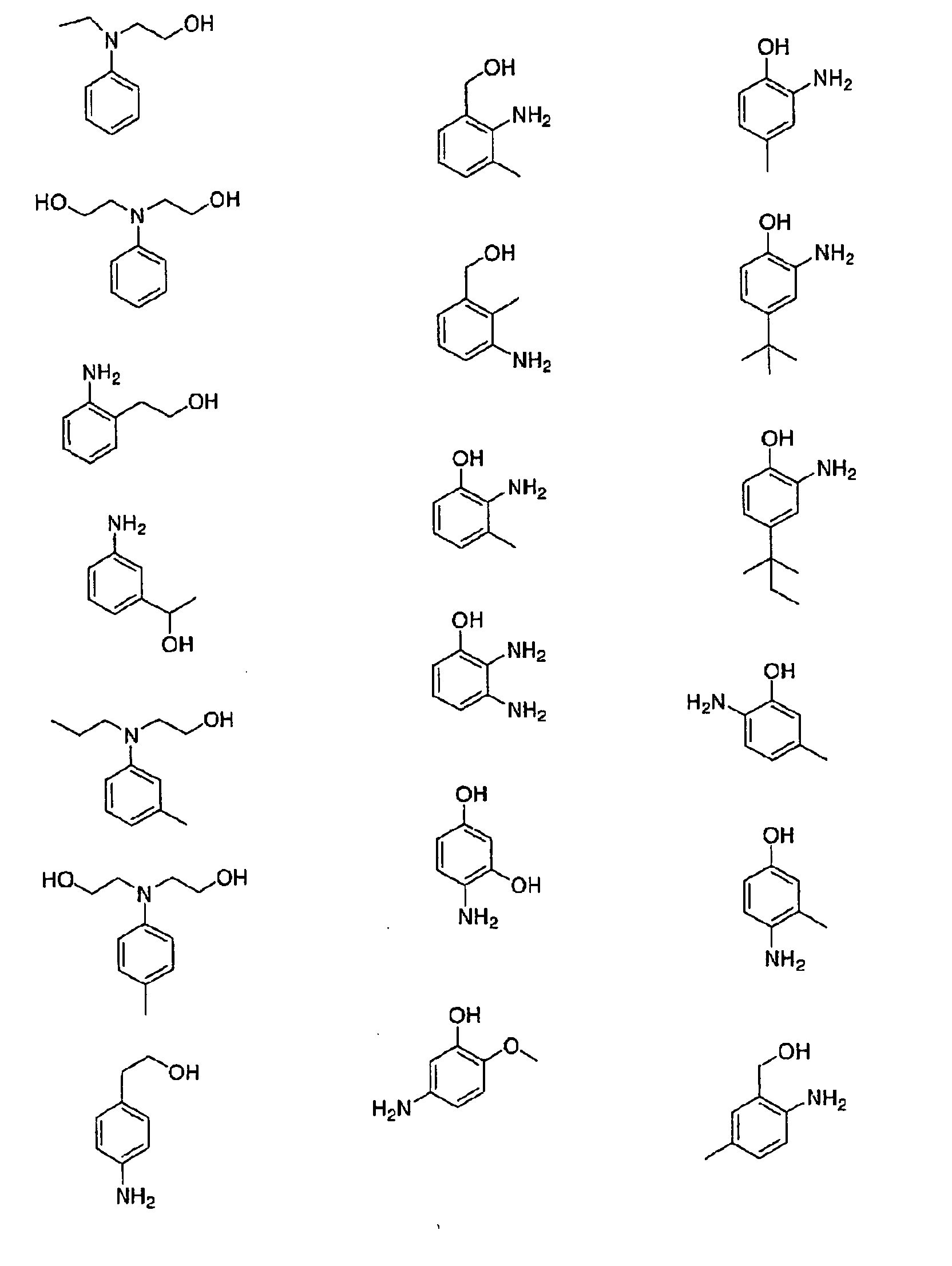
- X represents an amine compound having a polymerizable group
- n satisfies 0 ⁇ n ⁇ 10.
- the amine compound represented by X preferably has a molecular weight of 700 or less, more preferably 600 or less, further preferably 500 or less, and most preferably 400 or less.
- the polymerizable group in the amine compound represented by X is preferably at least one member selected from a (meth)acrylic ester group, a (meth)acrylamide group, an allyl group, an isopropenyl group, a vinyl ether group, an epoxy group, a stylyl group, and a vinyl ester group.
- a (meth)acrylic ester group, a (meth)acrylamide group, an allyl group, an isopropenyl group, a vinyl ether group, an epoxy group, and a stylyl group are more preferable;
- a (meth)acrylic ester group, a (meth)acrylamide group, an allyl group, an isopropenyl group, a vinyl ether group, and an epoxy group are more preferable;
- a (meth)acrylic ester group, a (meth)acrylamide group, an allyl group, an isopropenyl group, a vinyl ether group, and a glycidyl group are most preferable.
- the amine compound represented by X preferably contains 15 or less polymerizable groups, more preferably 12 or less polymerizable groups, still more preferably 8 or less polymerizable groups, and most preferably 6 or less polymerizable groups.
- the composition of the invention may contain a crosslinking agent.
- the composition of the invention may include a monomer and a photopolymerization initiator in addition to the aforementioned alkali-soluble binder and organic-solvent-soluble dye, and may further include a crosslinking agent.
- the organic-solvent-soluble dye for use in the invention is a compound comprising a salt of an acid dye and an amine compound, as represented by the above formula (I).
- the acid dye will be described below.
- the acid dye is not particularly limited insofar as it is a dye having an acid group such as a sulfonic acid group, a carboxylic acid group and a phenolic hydroxyl group.
- the dye is selected considering all of preferential orders of required performances, such as solubility in the organic solvent or developing solution, ability to form a salt with a basic compound, absorbance, interaction with other components in the curable composition, lightfastness, and heat resistance.
- Acid Alizarin Violet N Acid Black 1, 2, 24, 48; Acid Blue 1, 7, 9, 15, 18, 23, 25, 27, 29, 40, 42, 45, 51, 62, 70, 74, 80, 83, 86, 87, 90, 92, 96, 103, 112, 113, 120, 129, 138, 147, 150, 158, 171, 182, 192, 210, 242, 243, 256, 259, 267, 278, 280, 285, 290, 296, 315, 324:1, 335, 340; Acid Chrome Violet K; Acid Fuchsin; Acid Green 1, 3, 5, 9, 16, 25, 27, 50, 58, 63, 65, 80, 104, 105, 106, 109; Acid Orange 6, 7, 8, 10, 12, 26, 50, 51, 52, 56, 62, 63, 64, 74, 75, 94, 95, 107, 108, 169, 173;
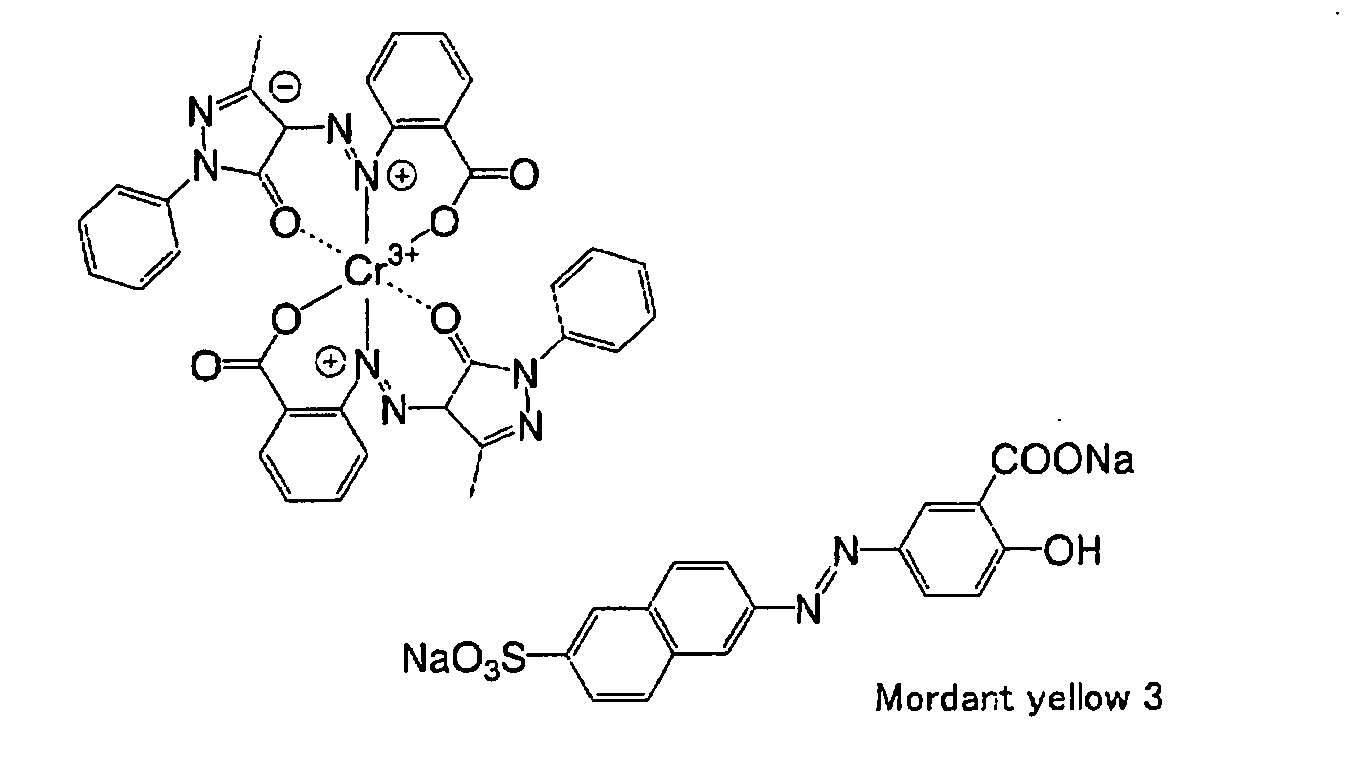
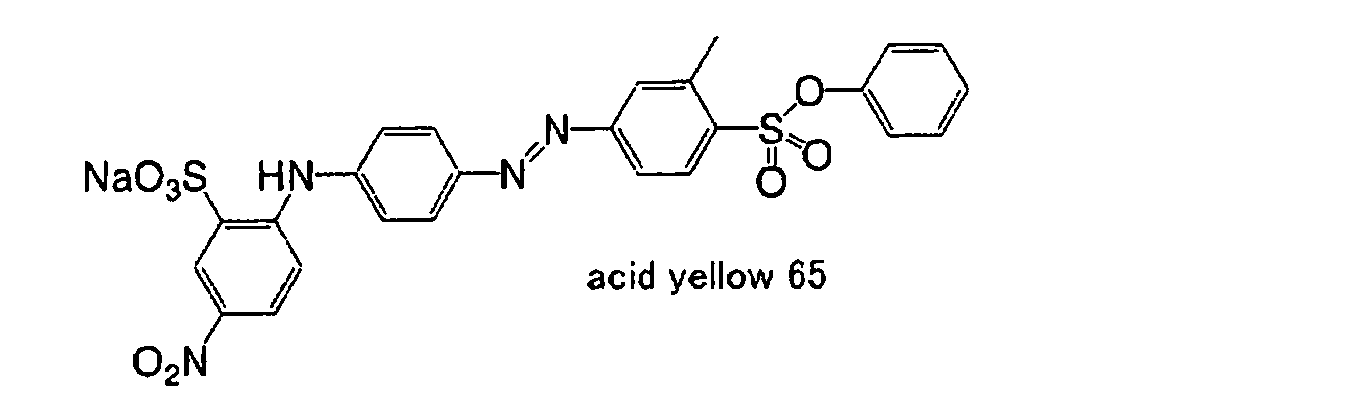
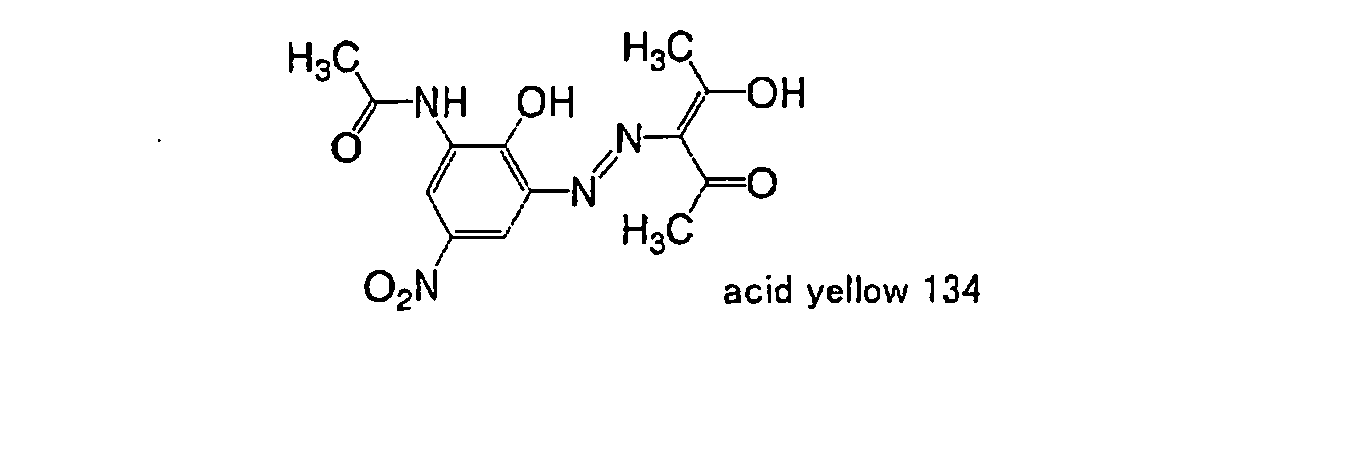
- Acid Black 24 Acid Blue 23, 25, 29, 62, 80, 86, 87, 92, 138, 158, 182, 243, 324; Acid Orange 8, 51, 56, 63, 74; Acid Red 1, 4, 8, 34, 37, 42, 52, 57, 80, 97, 114, 143, 145, 151, 183, 217; Acid Violet 7; Acid Yellow 17, 25, 29, 34, 38, 42, 65, 72, 76, 99, 111, 112, 114, 116, 134, 155, 169, 172, 184, 220, 228, 230, 232, 243; Acid Green 25; Mordant Yellow 3; and derivatives of these dyes.
- azo-based, xanthene-based and phthalocyanine-based acid dyes such as C.I. Solvent Blue 44, 38; C.I. Solvent Orange 45; Rhodamine B; Rhodamine 110; 2,7-naphthalenedisulfonic acid; 3-[(5-chloro-2-phenoxyphenyl)hydrazino]-3,4-dihydro-4-oxo-5-[(phenylsulfonyl]amino]; and derivatives of these dyes, are preferable.
- the acid dye derivative examples include inorganic salts of an acid dye having an acid group of a sulfonic acid, a carboxylic acid or the like, salts of an acid dye and a nitrogen-containing compound, and (sulfon)amide compounds of an acid dye.
- the acid dye derivatives are not particularly limited insofar as they may be dissolved as the curable composition solution, however, they are selected considering all of the required performances, such as solubility in the organic solvent or developing solution, absorbance, interaction with other components in the curable composition, lightfastness, and heat resistance.
- preferable acid dyes are azo-based, anthraquinone-based, anthrapyridone-based and phthalocyanine-based dyes.
- a compound represented by the following general formula (II) may be preferably used as the azo-based acid dye.
- A-N N-B
- a and B each independently represent an optionally substituted pyrazole ring, benzene ring, naphthalene ring or acetylacetone residue.
- Representative examples of the compound represented by the general structure (II) include the following compounds.
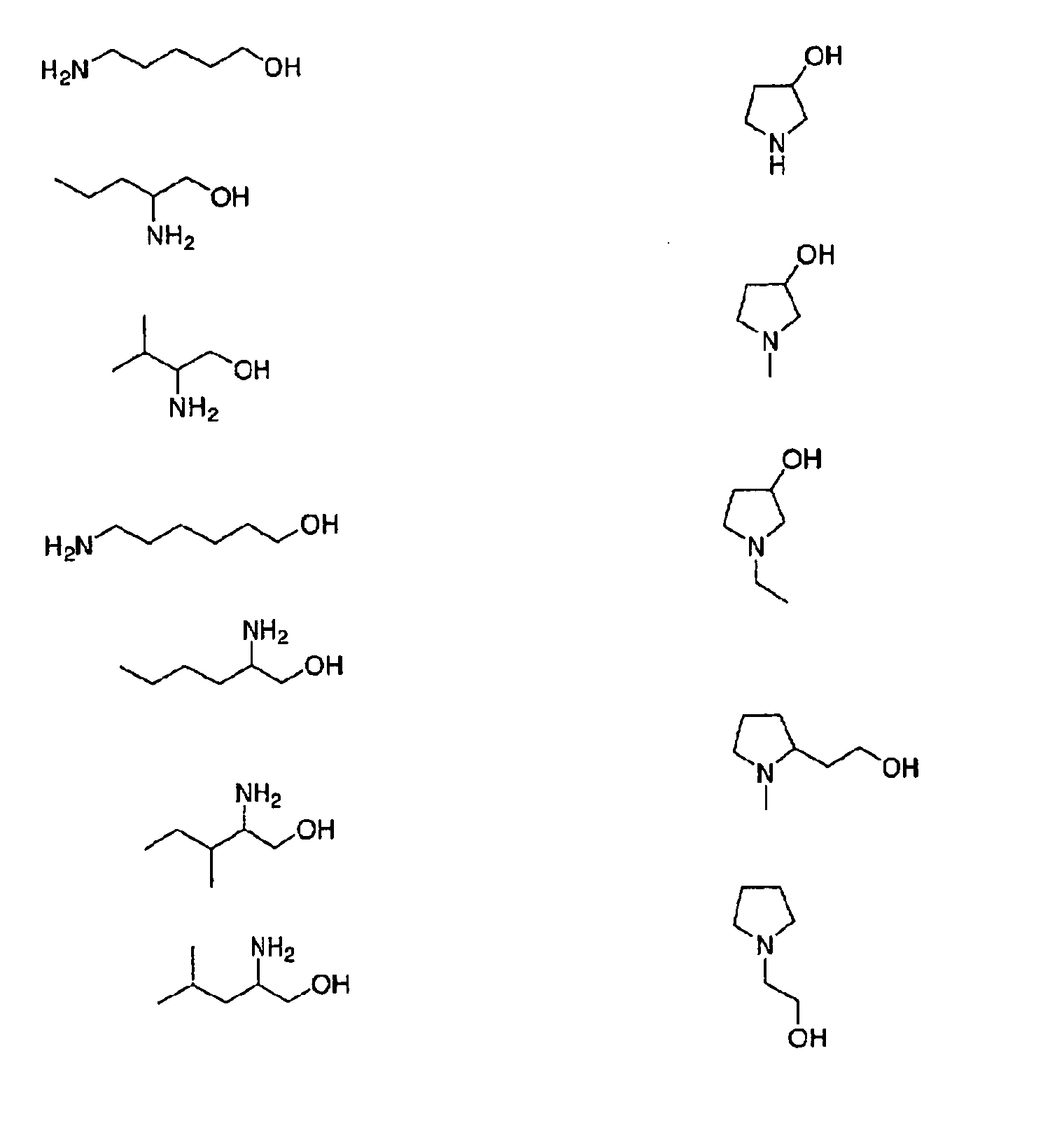
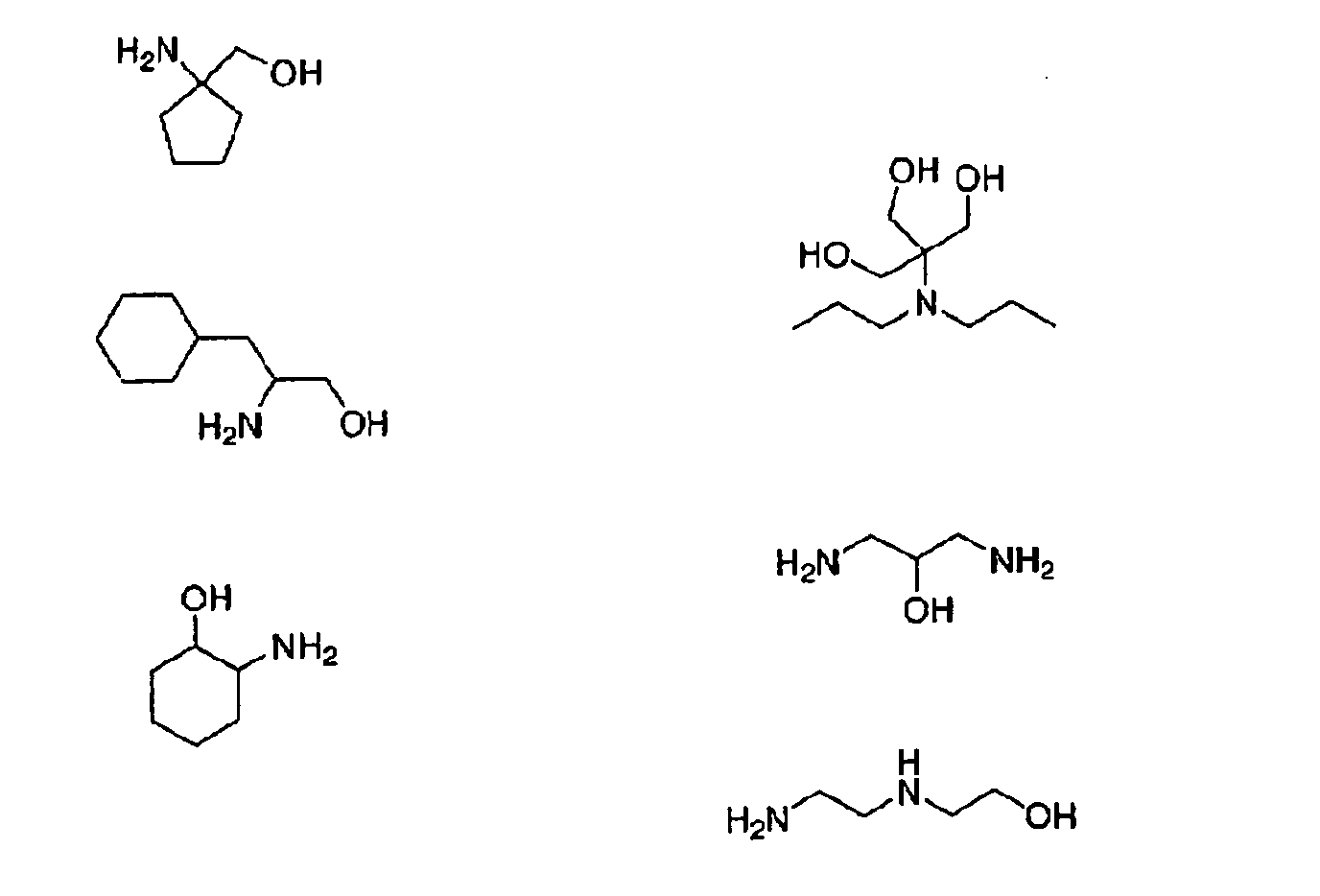
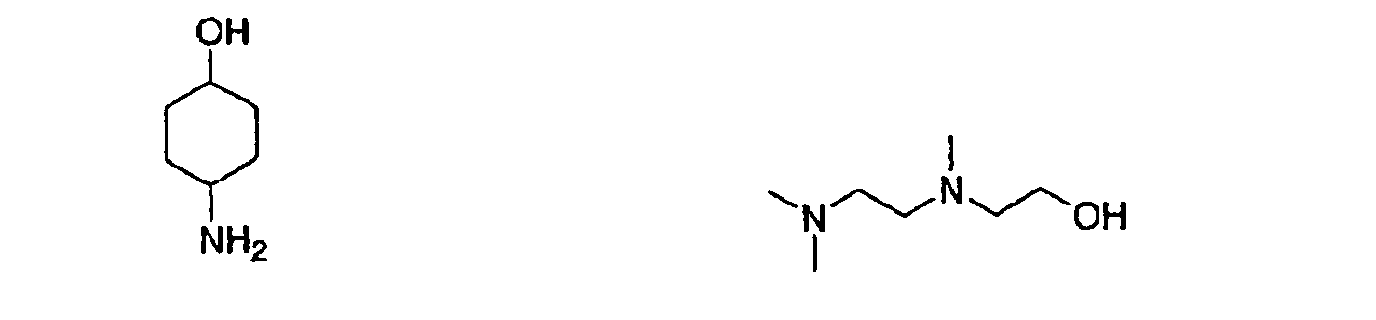
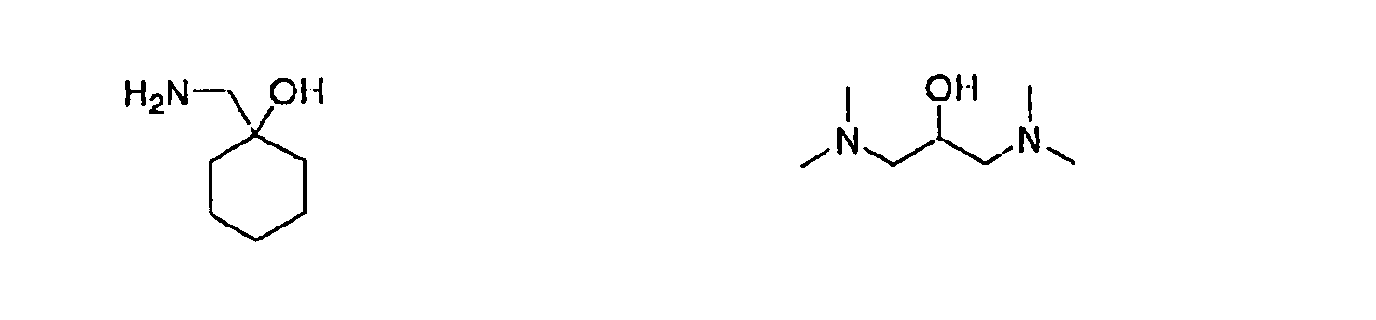
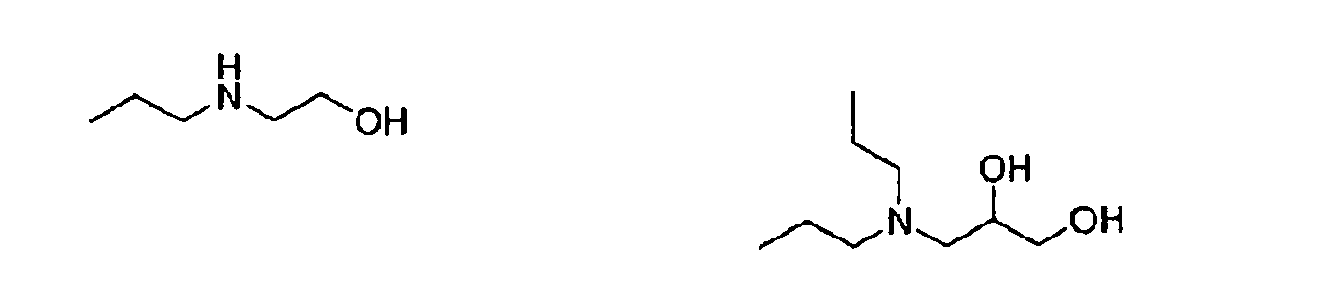
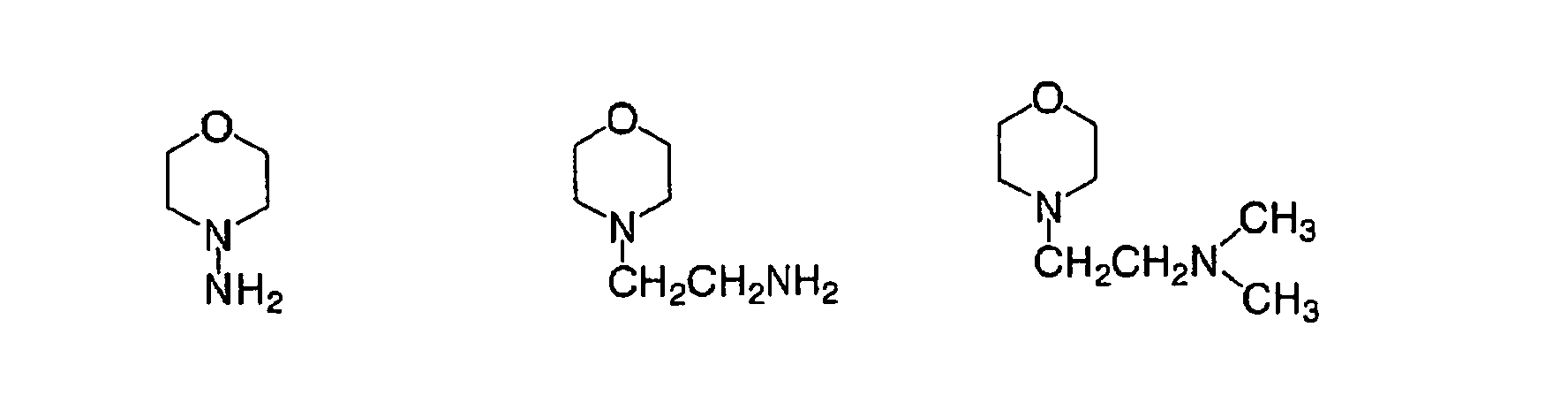
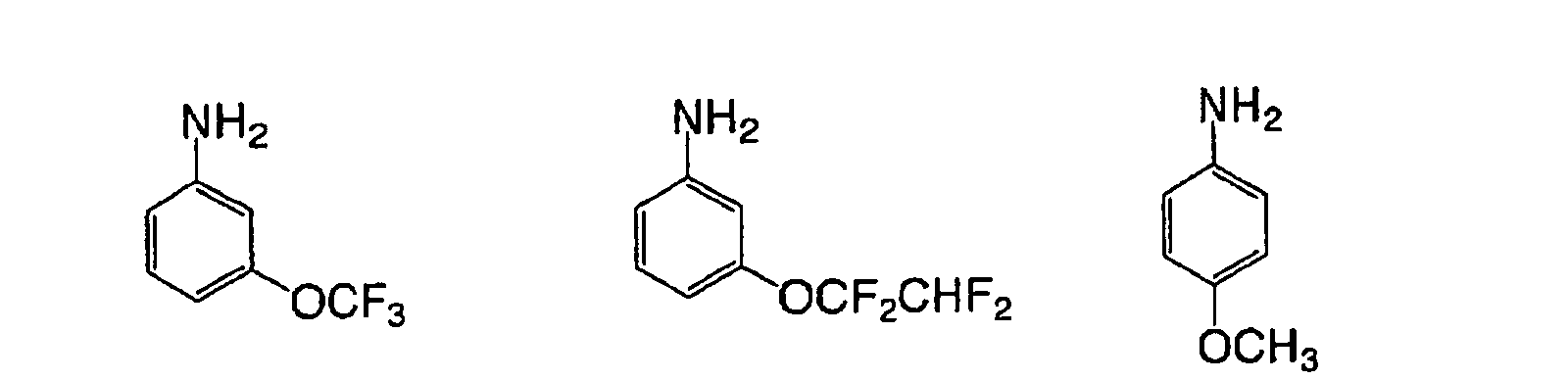
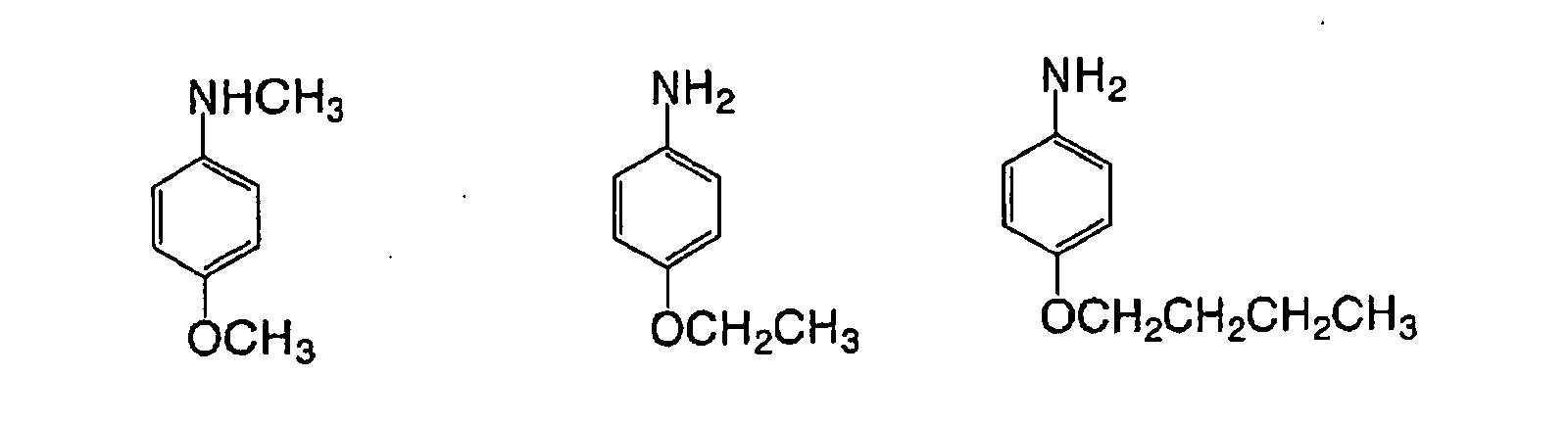
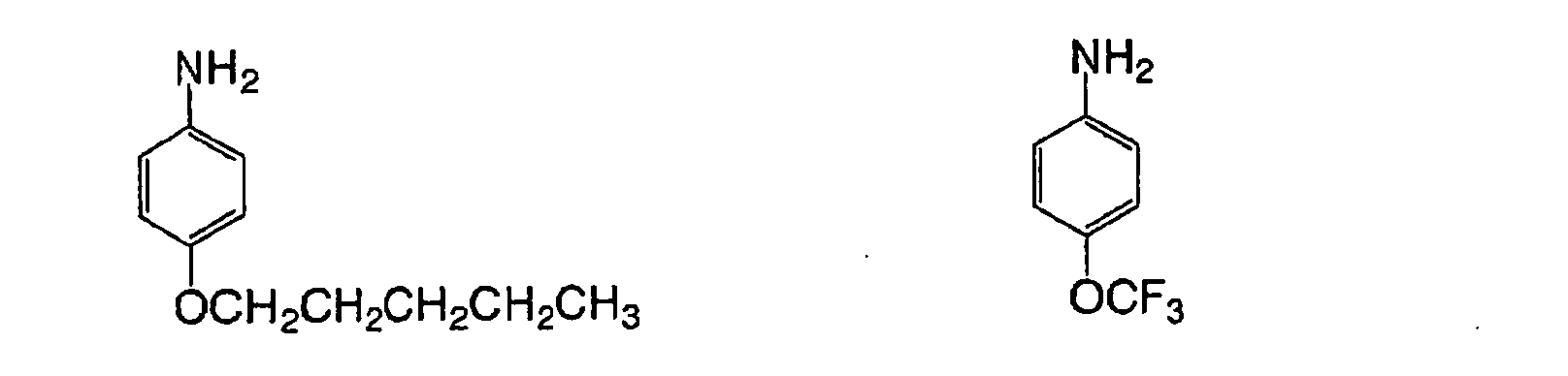
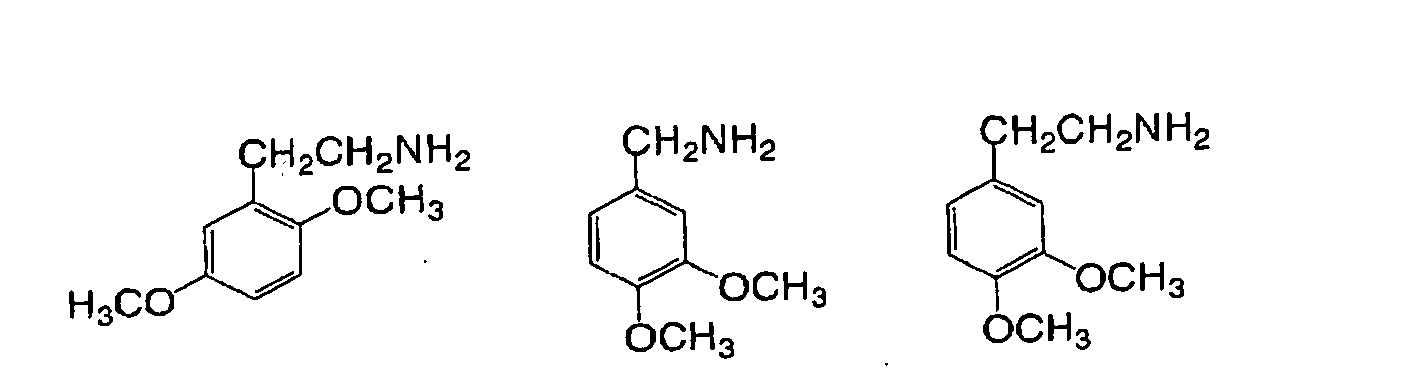
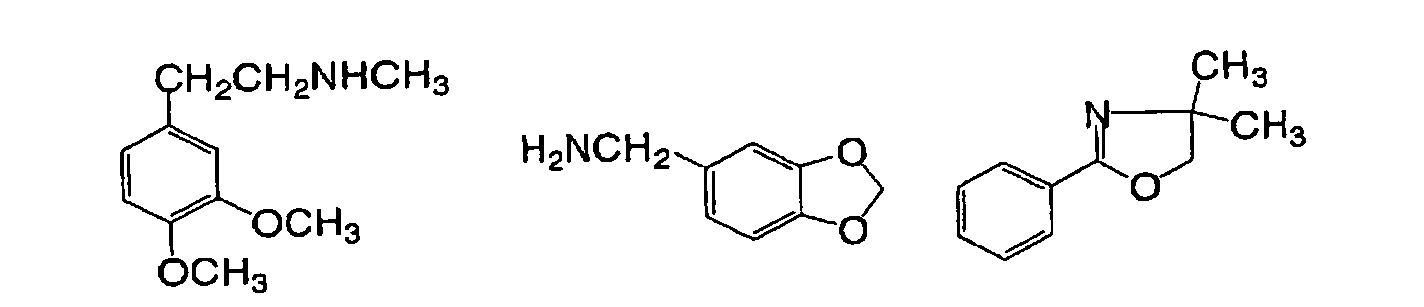
- Examples of the polymerizable group, which the above-described amine compound has, include a (meth)acrylic ester group, a (meth)acrylamide group, an allyl group, an isopropenyl group, a vinyl ether group, an epoxy group, a stylyl group, and a vinyl ester group.
- a (meth)acrylic ester group, a (meth)acrylamide group, an allyl group, an isopropenyl group, a vinyl ether group, an epoxy group, and a stylyl group are preferable;
- a (meth)acrylic ester group, a (meth)acrylamide group, an allyl group, an isopropenyl group, a vinyl ether group, and an epoxy group are more preferable;
- a (meth)acrylic ester group, a (meth)acrylamide group, an allyl group, an isopropenyl group, a vinyl ether group, and a glycidyl group are most preferable.
- amine compounds having, as the polymerizable group, an acryloyl group, a methacryloyl group, a glycidyl group, an allyl group, a 2-methylallyl group or a vinyl ether group are preferable.
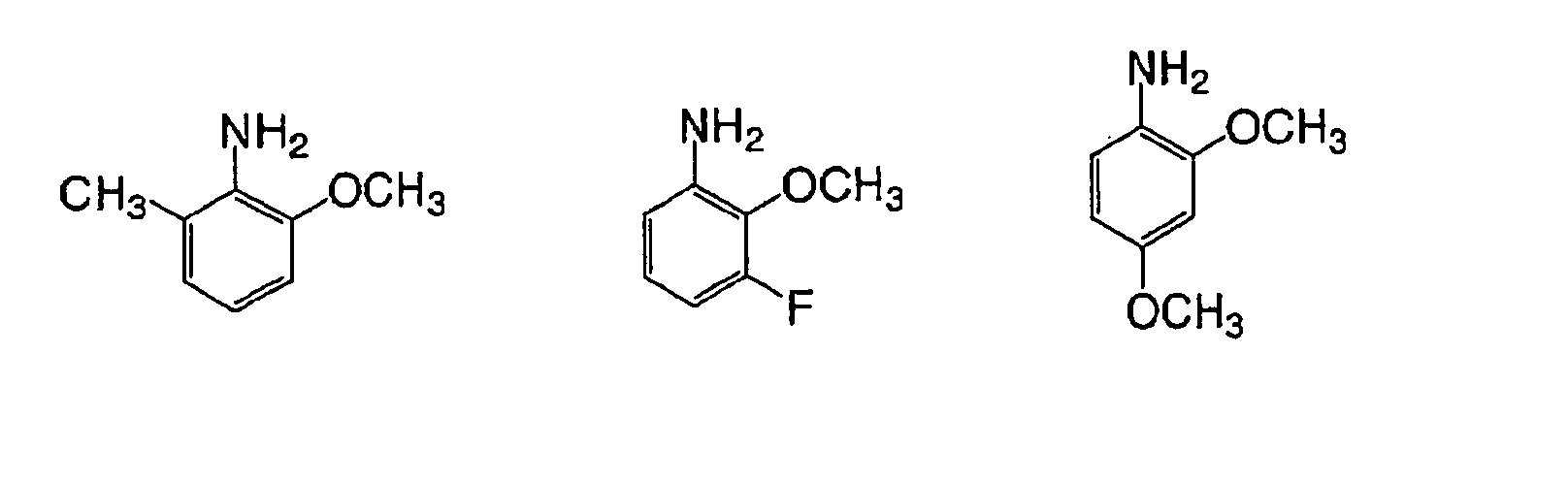
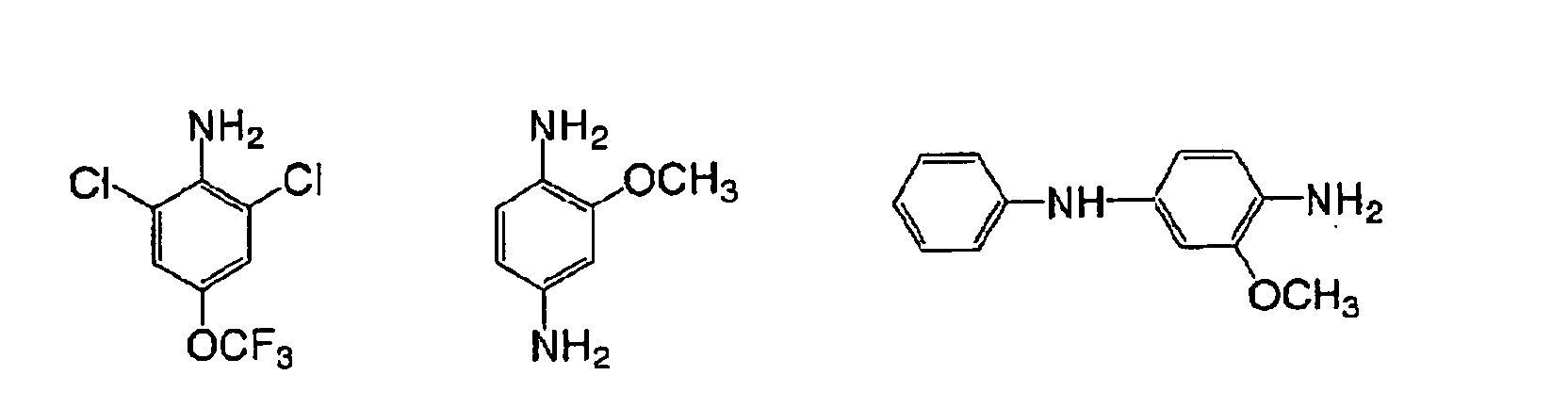
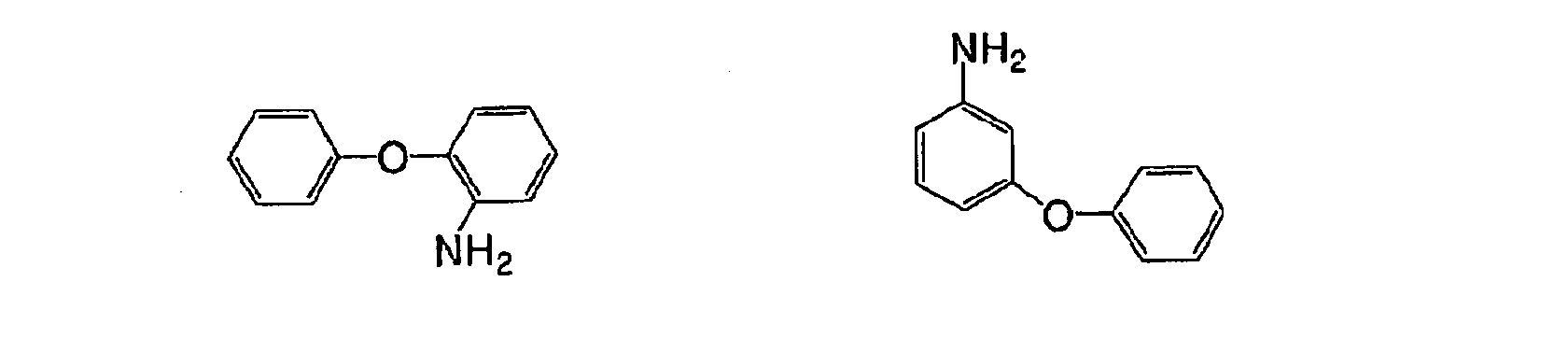
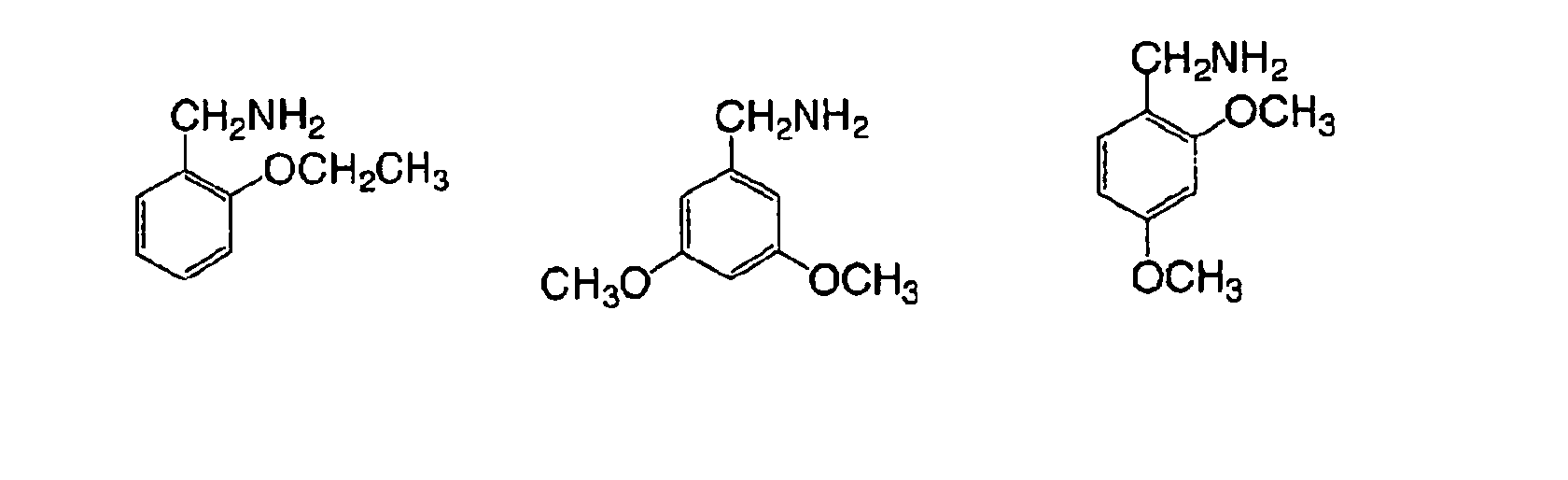
- amine compound having, as the polymerizable group, an acryloyl group, a methacryloyl group, a glycidyl group, an allyl group or a 2-methylallyl group include the following compounds, that are obtained by reacting an amine compound having a terminal hydroxyl group and/or a terminal amino group with a corresponding a (meth)acrylic acid halide, epichrolohydrin, an allyl halide, a 2-methyl-allyl halide or the like.
- the number of the polymerizable groups which the foregoing amine compound contains has preferably 15 or less, more preferably 12 or less, further preferably 8 or less, and most preferably 6 or less.
- n is a value to determine a molar ratio between the acid dye molecule and the amine compound that acts as a counter ion, and the value may freely be selected depending on the conditions to form the acid dye-amine compound salt.
- n represents a numeral value relative to the acid dye, which should satisfy the equivalent range of 0 ⁇ n ⁇ 10, and is selected considering all of preferential orders of the required performances, such as solubility in the organic solvent or developing solution, salt forming properties, absorbance, interaction with other components in the curable composition, lightfastness, and heat resistance.
- n is preferably a numeral value for the acid dye which satisfies 0 ⁇ n ⁇ 8, more preferably 0 ⁇ n ⁇ 6, and most preferably 0 ⁇ n ⁇ 4.
- the concentration of the organic-solvent-soluble dye to be used will be described.
- the organic-solvent-soluble dye is contained at varying concentrations relative to a total solid content of the dye-containing curable composition of the invention.
- the concentration varies depending on the kinds of the dye used, but preferably ranges from 0.5 to 80 % by mass, more preferably from 0.5 to 60 % by mass, and most preferably from 0.5 to 50 % by mass.
- the binder used in the invention is not particularly limited insofar as it is alkali-soluble. It is preferably selected from the viewpoints of heat resistance, developability and readily availability.
- linear-shaped organic high-molecular polymers that are soluble in an organic solvent and may be developed with a weak alkaline aqueous solution are preferable.
- the linear-shaped organic high-molecular polymer include polymers having a carboxylic acid in the side chain thereof, such as methacrylic acid copolymers, acrylic acid copolymers, itaconic acid copolymers, crotonic acid copolymers, maleic acid copolymers, and partially esterified maleic acid copolymers as described in Japanese Patent Application Laid-Open (JP-A) No. 59-44615, Japanese Patent Application Publication (JP-B) Nos.
- acidic cellulose derivatives having a carboxylic acid in the side chain thereof are useful.
- hydroxyl group-containing polymers having added thereto an acid anhydride, polyhydroxystyrene-based resins, polysiloxane-based resins, poly(2-hydroxyethyl (meth)acrylate), polyvinylpyrrolidone, polyethylene oxide and polyvinyl alcohol are useful.
- Copolymers produced from a hydrophilic group-containing monomer are also useful.
- a hydrophilic group-containing monomer examples include alkoxyalkyl (meth)acrylates, hydroxyalkyl (meth)acrylates, glycerol (meth)acrylate, (meth)acrylamide, N-methyloyl acrylamide, secondary or tertiary alkyl acrylamides, dialkylaminoalkyl (meth)acrylates, morpholine (meth)acrylates, N-vinylpyrrolidone, N-vinylcaprolatam, vinyl imidazole, vinyl triazole, methyl (meth)acrylate, ethyl (meth)acrylate, branched or linear propyl (meth)acrylate, branched or linear butyl (meth)acrylate, and phenoxyhydroxypropyl (meth)acrylate.
- hydrophilic group-containing monomer examples include monomers containing a tetrahydrofurfuryl group, phosphoric acid, phosphoric acid ester, a quaternary ammonium salt, an ethyleneoxy chain, a propyleneoxy group, sulfonic acid or a salt thereof, or a morpholinoethyl group.
- the polymer containing a polymerizable group in the side chain thereof polymers having an allyl group, a (meth)acryl group or an allyloxyalkyl group in the side chains thereof are useful.
- KS RESIST-106 (trade name, manufactured by OSAKA ORGANIC CHEMICAL INDUSTRY LTD.) and CYCLOMER-P SERIES (trade name, manufactured by DAICEL CHEMICAL INDUSTRIES, LTD.) is mentioned.
- alcohol-soluble nylons and a polyether between 2,2-bis(4-hydroxyphenyl)propane and epichlorohydrin are useful.
- polyhydroxystyrene-based resins, polysiloxane-based resins, acrylic resins, acrylamide-based resins and acrylic/acrylamide copolymer resins are preferable binders for use in the invention, from the viewpoint of heat resistance; and acrylic resins, acrylamide-based resins, and acrylic/acrylamide copolymer resins are preferable from the viewpoint of controlling the developability.
- acrylic resin copolymers produced from a monomer selected from benzyl (meth)acrylate, (meth)acrylic acid, hydroxyethyl (meth)acrylate, (meth)acrylamide, KS RESIST-106 (trade name, manufactured by OSAKA ORGANIC CHEMICAL INDUSTRY LTD.), and CYCLOMER-P SERIES are preferable.
- the binder to be used in the invention alkali-soluble phenol resins is preferable.
- the alkali-soluble phenol resin may suitably be used in the case where the composition of the invention is a positive-type composition. Examples of the alkali-soluble phenol resin include novolak resins and vinyl polymers.
- novolak resin products obtained by condensing phenols with aldehydes in the presence of an acid catalyst are preferably used.
- the phenols include phenol, cresol, ethylphenol, butylphenol, xylenol, phenylphenol, catechol, resorcinol, pyrogallol, naphthol, and bisphenol A. Phenols can be used singly or in combination of two or more thereof.
- the aldehyde include formaldehyde, p-formaldehyde, acetaldehyde, propionaldehyde and benzaldehyde.
- the novolak resin examples include condensates of m-cresol, p-cresol or a mixture thereof with formalin.
- the molecular weight distribution of the novolak resin may be controlled by means of, for example, fractionation.
- the novolak resin may include a low-molecular component having a phenolic hydroxyl group, such as bisphenol C and bisphenol A.
- polymers having a weight average molecular weight in terms of a polystyrene value measured by the GPC method are preferable; polymers having a weight average molecular weight of from 2,000 to 1 ⁇ 10 5 are more preferable; and polymers having a weight average molecular weight of from 5,000 to 5 ⁇ 10 4 are most preferable.
- An amount of the binder to be used in the composition of the invention is preferably from 10 to 90 % by mass, more preferably from 20 to 80 % by mass, and most preferably from 30 to 70 % by mass.
- the object of the invention is to provide a highly curable film by allowing a curing reaction in the film to more swiftly proceed than the conventional reaction, using the organic-solvent-soluble dye represented by the above formula (I). Further, it is possible to obtain a still further highly cured film using a crosslinking agent.
- the crosslinking agent used in the invention is not particularly limited insofar as the film may be cured by crosslinking reaction.
- crosslinking agent examples include (a) epoxy resins, (b) melamine compounds, guanamine compounds, glycoluryl compounds, or urea compounds, each of which is substituted with at least one substituent selected from a methylol group, an alkoxymethyl group, and an acyloxymethyl group, and (c) phenol compounds, naphthol compounds, or hydroxyanthracene compounds, each of which is substituted with at least one substituent selected from a methylol group, an alkoxymethyl group, and an acyloxymethyl group.
- polyfunctional epoxy resins are preferable as the crosslinking agent.
- any crosslinkable compounds having an epoxy group can be used.
- examples thereof include divalent glycidyl-containing low-molecular compounds such as bisphenol A diglycidyl ether, ethylene glycol diglycidyl ether, butanediol diglycidyl ether, hexanediol diglycidyl ether, dihydroxybiphenyl diglycidyl ether, diglycidyl phthalate and N,N-diglycidylaniline; trivalent glycidyl group-containing low-molecular compounds such as trimethylolpropane triglycidyl ether, trimethylolphenol triglycidyl ether, and TrisP-PA triglycidyl ether; tetravalent glycidyl group-containing low-molecular compounds such as pentaerythritol tetraglycidyl ether and tetramethylol bisphenol A
- the number of the substituents in the component (b), which are selected from a methylol group, an alkoxymethyl group and an acyloxymethyl group, is from 2 to 6 in the case of the melamine compounds, and from 2 to 4 in the case of the glycoluril compounds, guanamine compounds or urea compounds, respectively, and preferably from 5 to 6 in the case of the melamine compounds, and from 3 to 4 in the case of the glycoluril compounds, guanamine compounds or urea compounds, respectively.
- methylol group-containing compounds are obtained by heating the foregoing alkoxymethyl group-containing compound in an alcohol in the presence of an acid catalyst such as hydrochloric acid, sulfuric acid, nitric acid and methanesulfonic acid.
- the acyloxymethyl group-containing compound is obtained by mixing, with stirring, the methylol group-containing compound and an acyl chloride in the presence of a basic catalyst.
- Examples of the melamine compounds include hexamethylolmelamine, hexamethoxymethylmelamine, compounds in which one to five methylol groups in hexamethylolmelamine are methoxymethylated or the mixtures thereof, hexamethoxyethylmelamine, hexaacyloxymethylmelamine, and compounds in which one to five methylol groups in hexamethylolmelamine are acyloxymethylated or the mixtures thereof.
- guanamine compound examples include tetramethylolguanamine, tetramethoxymethylguanamine, compounds in which from one to three methylol groups in tetramethylolguanmine are methoxymethylated or the mixtures thereof, tetramethoxyethylguanamine, tetraacyloxymethylguanamine, and compounds in which from one or three methylol groups in tetramethylolguanamine are acyloxymethylated or the mixtures thereof.
- glycoluril compound examples include tetramethylolglycoluryl, tetramethoxymethylglycoluryl, compounds in which one to three methylol groups of tetramethyloylglycoluryl are methoxymethylated or mixtures thereof, and compounds in which one to three methylol groups in tetramethylolglycoluryl are acyloxymethylated or the mixtures thereof.
- urea compound examples include tetramethylolurea, tetramethoxymethylurea, compounds in which one to three methylol groups in tetramethylolurea are methoxymethylated or the mixtures thereof, and tetramethoxyethylurea. These compounds may be used singly or in combination thereof.
- the phenol compound, naphthol compound or hydroxyanthracene compound to be contained as the component (c), which is substituted with at least one group selected from a methylol group, an alkoxymethyl group and an acyloxymethyl group, contributes not only to suppress intermixing with a topcoat photoresist but also to increase the film strength by thermal crosslinking, similarly to the case of the component (b) described above.
- the number of the substituents in the component (c), which are selected from a methylol group, an alkoxymethyl group and an acyloxymethyl group, should be at least two per molecule. Phenolic compounds in which all of the 2- and 4-positions are substituted are preferable from the viewpoints of thermal crosslinking properties and storability.
- the phenol compound to serve as the skeleton may be unsubstituted or substituted at the 3- or 5-position thereof.
- the naphthol compound to serve as the skeleton may be unsubstituted or substituted at other positions than the ortho-position with respect to the OH group.
- the methylol group-containing compounds are obtained by reacting, as the starting material, a compound having a hydrogen atom at the ortho- or para-position (2- or 4-position) with respect to the phenolic OH group with formalin in the presence of a basic catalyst such as sodium hydroxide, potassium hydroxide, ammonia and a tetraalkylammonium hydroxide.
- a basic catalyst such as sodium hydroxide, potassium hydroxide, ammonia and a tetraalkylammonium hydroxide.
- the alkoxymethyl group-containing compounds are obtained by heating the foregoing methylol group-containing compound in an alcohol in the presence of an acid catalyst such as hydrochloric acid, sulfuric acid, nitric acid and methanesulfonic acid.
- an acid catalyst such as hydrochloric acid, sulfuric acid, nitric acid and methanesulfonic acid.
- the acyloxymethyl group-containing compounds are obtained by reacting the foregoing methylol group-containing compound with an acyl chloride in the presence of a basic catalyst.
- Examples of the skeleton compound include phenol compounds in which the ortho- or para-position with respect to the phenolic OH group is substituted, naphthol compounds, and hydroxyanthracene compounds, such as phenol, various isomers of cresol, 2,3-xylenol, 2,5-xylenol, 3,4-xylenol, 3,5-xylenol, bisphenols (e.g., bisphenol A), 4,4'-bishydroxybiphenyl, TrisP-PA (trade name, manufactured by HONSHU CHEMICAL INDUSTRY CO., LTD.), naphthol, dihydroxynaphthalene and 2,7-dihydroxyanthracene.
- phenol compounds in which the ortho- or para-position with respect to the phenolic OH group is substituted such as phenol, various isomers of cresol, 2,3-xylenol, 2,5-xylenol, 3,4-xylenol, 3,5-x
- component (c) examples include trimethylolphenol, tri(methoxymethyl)phenol, compounds in which one to two methylol groups in trimethylolphenol are methoxymethylated, trimethylol-3-cresol, tri(methoxymethyl)-3-cresol, compounds in which one to two methylol groups in trimethylol-3-cresol are methoxymethylated, dimethylolcresols such as 2,6-dimethylol-4-cresol, tetramethylol bisphenol A, tetramethoxymethyl bisphenol A, compounds in which one to three methylol groups of tetramethylol bisphenol A are methoxymethylated, tetramethylol-4,4'-bishydroxybiphenyl, tetramethoxymethyl-4,4'-bishydroxybiphenyl, a hexamethylol compound of TrisP-PA, a hexamethoxymethyl compound of TrisP-PA, compounds in which one to five methylo
- hydroxyanthracene compounds 1,6-dihydroxymethyl-2,7-dihydroxyanthracene is mentioned.
- acyloxymethyl group-containing compounds examples include compounds in which a part or all of the methylol groups in the foregoing methyl group-containing compounds are acyloxymethylated.
- trimethylolphenol bishydroxymethyl-p-cresol, tetramethylol bisphenol A, a hexamethylol compound of TrisP-PA (trade name, manufactured by HONSHU CHEMICAL INDUSTRY CO., LTD.), and phenol compounds in which the methylol groups in the foregoing compounds are substituted with an alkoxymethyl group or both a methylol group and an alkoxymethyl group.
- TrisP-PA trade name, manufactured by HONSHU CHEMICAL INDUSTRY CO., LTD.
- phenol compounds in which the methylol groups in the foregoing compounds are substituted with an alkoxymethyl group or both a methylol group and an alkoxymethyl group.
- the content of the components (a) to (c) in the dye-containing curable composition of the invention varies depending on the kinds thereof used.
- the component is contained in an amount of preferably from 1 to 70 % by mass, more preferably from 5 to 50 % by mass, and most preferably from 7 to 30 % by mass, relative to a total solid content of the composition.
- the monomer that is contained in the case where the composition of the invention is a negative-type composition will be described.
- the monomer compounds having an ethylenically unsaturated group, that have at least one addition polymerizable ethylene group and have a boiling point of 100°C or higher at atmospheric pressure, are preferable.
- Examples thereof include monofunctional acrylates or methacrylates such as polyethylene glycol mono(meth)acrylate, polypropylene glycol mono(meth)acrylate, and phenoxyethyl (meth)acrylate; polyfunctional acrylates or methacrylates such as polyethylene glycol di(meth)acrylate, trimethylolethane tri(meth)acrylate, neopentyl glycol di(meth)acrylate, pentaerythritol tri(meth)acrylate, pentaerythritol tetra(meth)acrylate, dipentaerythritol penta(meth)acrylate, dipentaerythritol hexa(meth)acrylate, hexanediol (meth)acrylate, trimethylolpropane tri(acryloyloxypropyl) ether, tri(acryloyloxyethyl) isocyanurate, compounds obtainable by adding ethylene oxide or propylene
- the monomer is contained in an amount of from 0.1 to 90 % by mass, more preferably from 1.0 to 80 % by mass, and most preferably from 2.0 to 70 % by mass, relative to a total solid content of the composition of the invention.
- the photo-polymerization initiator that is contained in the case where the composition of the invention is a negative-type composition will be described.
- the photo-polymerization initiator is not particularly limited insofar as it can polymerize the polymerizable monomer, but preferably, it is selected from the viewpoints of characteristics, polymerization initiating efficiency, absorption wavelength, readily availability, and costs.
- the photo-polymerization initiator examples include at least one active halogen compound selected from halomethyl oxadiazole compound and halomethyl-s-triazine compound, 3-aryl-substituted coumarin compound, lophine dimer, benzophenone compound, acetophenone compound and the derivatives thereof, a cyclopentadiene-benzene-iron complex and the salts thereof, and oxime-based compound.
- active halogen compound selected from halomethyl oxadiazole compound and halomethyl-s-triazine compound, 3-aryl-substituted coumarin compound, lophine dimer, benzophenone compound, acetophenone compound and the derivatives thereof, a cyclopentadiene-benzene-iron complex and the salts thereof, and oxime-based compound.
- Examples of the active halogen compound such as halomethyl oxadiazoles, include 2-halomethyl-5-vinyl-1,3,4-oxadiazole compound as described in JP-B No. 57-6096, 2-trichloromethyl-5-styryl-1,3,4-ozadiazole, 2-trichloromethyl-5-(p-cyanostyryl)-1,3,4-oxadiazole, and 2-trichloromethyl-5-(p-methoxystyryl)-1,3,4-oxadiazole.
- halomethyl-s-triazine compounds used as the photopolymerization initiator examples include vinyl-halomethyl-s-triazine compound as described in JP-B No. 59-1281, 2-(naphth-1-yl)-4,6-bis-halomethyl-s-triazine compound as described in JP-A No. 53-133428, and 4-(p-aminophenyl)-2,6-di-halomethyl-3-triazine compound as described in JP-A No. 53-133428.
- TAZ Series of MIDORI KAGAKU CO., LTD. e.g., TAZ-107, TAZ-110, TAZ-104, TAZ-109, TAZ-140, TAZ-204, TAZ-113, TAZ-123, TAZ-104
- T Series of PANCHIM CORP e.g., TAZ-107, TAZ-110, TAZ-104, TAZ-109, TAZ-140, TAZ-204, TAZ-113, TAZ-123, TAZ-104
- IRGACURETM Series of CIBA-GEIGY e.g., IRGACURETM 369, IRGACURETM 784, IRGACURETM 651, IRGACURETM 184, IRGACURETM 500, IRGACURETM 1000, IRGACURETM 149, IRGACURETM 819, IRGACURETM 261), DAROCURETM Series of CIBA-GEIGY (e.g., DAROCURETM 1173), 4,4'-bis(diethylamino)-benzophenone, 2-(O-benzoyloxime]-1-[4-(phenylthio)phenyl]-1,2-octanedione, 2-beznyl-2-dimethylamino-4-morpholinobutyrophenone, 2,2-dimethoxy-2-phenylacetophenone, 2-(o-chlorophenyl)-4,5-dipheny
- the photopolymerization initiator may be used in combination with a sensitizer and a photo-stabilizer.
- benzoin benzoin methyl ether
- benzoin 9-fluorenone, 2-chloro-9-fluorenone, 2-methyl-9-fluorenone, 9-anthrone, 2-bromo-9-anthrone, 2-ethyl-9-anthrone, 9,10-anthraquinone, 2-ethyl-9,10-anthraquinone, 2-t-butyl-9,10-anthraquinone, 2,6-dichloro-9,10-anthraquinone, xanthone, 2-methylxanthone, 2-methoxyxanthone, 2-ethoxyxanthone, thioxanthone, 2,4-diethylthioxanthone, acridone, 10-butyl-2-chloroacridone, benzil, dibenzalacetone, p-(dimethylamino)phenyl styryl ketone, p-(dimethylacridone
- composition of the invention other known photopolymerization initiators other than the foregoing photopolymerization initiators can be incorporated.
- vicinal polyketolaldonyl compounds as disclosed in US Patent No. 2,367,660, ⁇ -carbonyl compounds as disclosed in US Patent Nos. 2,367,661 and 2,367,670, acyloin ethers as disclosed in US Patent No. 2,448,828, aromatic ⁇ -hydrocarbon-substituted acyloin compounds as disclosed in US Patent No. 2,722,512, polynuclear quinone compounds as disclosed in US Patent Nos. 3,046,127 and 2,951,758, a combination of triallyl imidazole dimer and p-aminophenyl ketone as disclosed in US Patent No. 3,549,367, and benzothiazole-based compounds/trihalomethyl-s-triazine-based compounds as disclosed in JP-B No. 51-48516.
- the amount of the photopolymerization initiator to be used is preferably from 0.01 to 50 % by mass, more preferably from 1 to 30 % by mass, and most preferably from 1 to 20 % by mass based on the monomer solids content.
- the amount of the photopolymerization initiator used is less than 0.01 % by mass, the polymerization hardly proceeds.
- it exceeds 50 % by mass although the polymerization ratio increases, the molecular weight is lowered to thereby sometimes reduce the film strength.
- thermal polymerization preventing agent it is preferable to add a thermal polymerization preventing agent to the composition of the invention, besides the above components.
- thermal polymerization preventing agent include hydroquinone, p-methoxyphenol, di-t-butyl p-cresol, pyrogallol, t-butylcatechol, benzoquinone, 4,4'-thiobis (3-methyl-6-t-butylphenol), 2,2'-methylenebis(4-methyl-6-t-butylphenol) and 2-mercaptobenzoimidazole.
- the solvent to be used in the invention is not particularly limited insofar as it meets the solubility and coating properties of the composition, but preferably, it is selected considering solubility of the dye or the binder, coating properties, and safety.
- esters such as ethyl acetate, n-butyl acetate, isobutyl acetate, amyl formate, isoamyl acetate, isobutyl acetate, butyl propionate, isopropyl butyrate, ethyl butyrate, butyl butyrate, alkyl esters, methyl lactate, ethyl lactate, methyl oxyacetate, ethyl oxyacetate, butyl oxyacetate, methyl methoxyacetate, ethyl methoxyacetate, butyl methoxyacetate, methyl ethoxyacetate, ethyl ethoxyacetate; alkyl 3-oxypropionates (e.g., methyl 3-oxypropionate, ethyl 3-oxypropionate), methyl 3-methoxypropionate, ethyl 3-methoxypropionate,
- methyl 3-ethoxypropionate, ethyl 3-ethoxypropionate, ethyl cellosolve acetate, ethyl lactate, diethylene glycol dimethyl ether, butyl acetate, methyl 3-methoxypropionate, 2-heptanone, cyclohexanone, ethyl carbitol acetate, butyl carbitol acetate, propylene glycol methyl ether, and propylene glycol methyl ether acetate are more preferable.
- composition of the invention may include various additives such as fillers, high-molecular compounds other than those described above, surfactants, adhesion promoters, antioxidants, UV absorbents and anti-flocculants.
- additives include fillers such as glass and alumina; high-molecular compounds other than the binder resin, such as polyvinyl alcohol, polyacrylic acid, polyethylene glycol monoalkyl ethers, and polyfluoroalkyl acrylates; nonionic, cationic and anionic surfactants; adhesion promoters such as vinyl trimethoxysilane, vinyl triethoxysilane, vinyl tris(2-methoxyethoxy)silane, N-(2-aminoethyl)-3-aminopropylmethyl dimethoxysilane, N-(2-aminoethyl)-3-aminopropyl trimethoxysilane, 3-aminopropyl trimethoxysilane, 3-glycidoxypropyl trimethoxysilane, 3-glycidoxypropylmethyl dimethoxysilane, 2-(3,4-epoxycyclohexyl)ethyl trimethoxysilane,
- an organic carboxylic acid preferably a low-molecular organic carboxylic acid having a molecular weight of 1,000 or less may be added to the composition of the invention.
- organic carboxylic acid examples include aliphatic monocarboxylic acids such as formic acid, acetic acid, propionic acid, butyric acid, valeric acid, pivalic acid, caproic acid, diethylacetic acid, enanthic acid and caprylic acid; aliphatic dicarboxylic acids such as oxalic acid, malonic acid, succinic acid, glutaric acid, adipic acid, pimelic acid, suberic acid, azelaic acid, sebacic acid, brassylic acid, methylmalonic acid, ethylmalonic acid, dimethylmalonic acid, methylsuccinic acid, tetramethylsuccinic acid and citraconic acid; aliphatic tricarboxylic acids such as tricarballylic acid, aconitic acid and camphoronic acid; aromatic monocarboxylic acids such as benzoic acid, toluic acid, cuminic acid, hemellitic acid and mesitylenic acid;
- composition of the invention is a positive-type composition
- naphthoquinonediazide compound examples include o-naphthoquinonediazide-5-sulfonic acid ester, o-naphthoquinonediazide-5-sulfonic acid amide, o-naphthoquinonediazide-4-sulfonic acid ester, and o-naphthoquinonediazide-4-sulfonic acid amide.
- ester or amide compounds may be produced through the conventionally known method using phenol compounds represented by the formula (I) as described in JP-A Nos. 2-84650 and 3-49437.
- composition of the invention is a positive-type composition
- the color filter of the invention is produced using the composition of the invention.
- the color filter of the invention can be produced by applying the composition of the invention on a substrate employing conventionally coating methods such as rotary coating, cast coating and roll coating, to dispose a radiation-sensitive composition layer, which is then exposed to light through a prescribed mask pattern and developed with a developing solution to thereby form a colored pattern. Further, the production process of the color filter of the invention may optionally include the step of heating and/or light-exposing of the resist pattern for curing.
- UV rays such as g-line, h-line and i-line are particularly preferable.
- the substrate examples include soda glass, PILEXTM glass, quartz glass, glass having a transparent conductive film adhered thereto, and a substrate for photoelectric transfer devices used in image pickup elements or the like, such as a silicon substrate and a complementary metal oxide semiconductor (CMOS).
- CMOS complementary metal oxide semiconductor
- black stripes may be formed so as to isolate pixels from each other.
- a subbing layer may be optionally disposed on the substrate in order to improve the adhesiveness to the upper layer, to prevent the substance diffusion, or to flatten the substrate surface.
- any developing solution may be used insofar as it dissolves the composition of the invention but dose not dissolve a radiation-irradiated area.
- any developing solution may be used insofar as it dissolves the composition of the invention but dose not dissolve a radiation-irradiated area.
- a variety of combinations of organic solvents or alkaline aqueous solutions may be used.
- the foregoing solvents used during preparation of the composition of the invention are preferable.
- an alkaline aqueous solution is used in which an alkaline compound (e.g., sodium hydroxide, potassium hydroxide, sodium carbonate, sodium silicate, sodium metasilicate, ammonia water, ethylamine, diethylamine, dimethylethanolamine, tetramethylammonium hydroxide, tetraethylammonium hydroxide, choline, pyrrole, pyridine, and 1,8-diazabicyclo-[5.4.0]-7-undecene) is dissolved at a concentration from 0.001 to 10 % by mass, and preferably from 0.01 to 1 % by mass.
- washing with water is usually carried out after the development.
- the color filter of the invention can be used for liquid crystal displays or solid-state image elements such as CCD, and is particularly suitable for CCD elements or CMOS elements that have more than 1,000,000 pixels and display high resolution.
- the color filter of the invention may be used as a color filter by being arranged between a light-receiving portion of respective pixels that constitute CCD, and a light-condensing micro lens.
- a glass substrate (CORNINGTM 1737) was ultrasonically washed with a 1 % NaOH aqueous solution, then with water, and baked for dehydration at 200°C for 30 minutes.
- the resist solution prepared in 1) above was applied on the washed glass substrate using a spin coater to give a film thickness of 2 ⁇ m and dried with heating at 220°C for one hour to obtain a cured film.
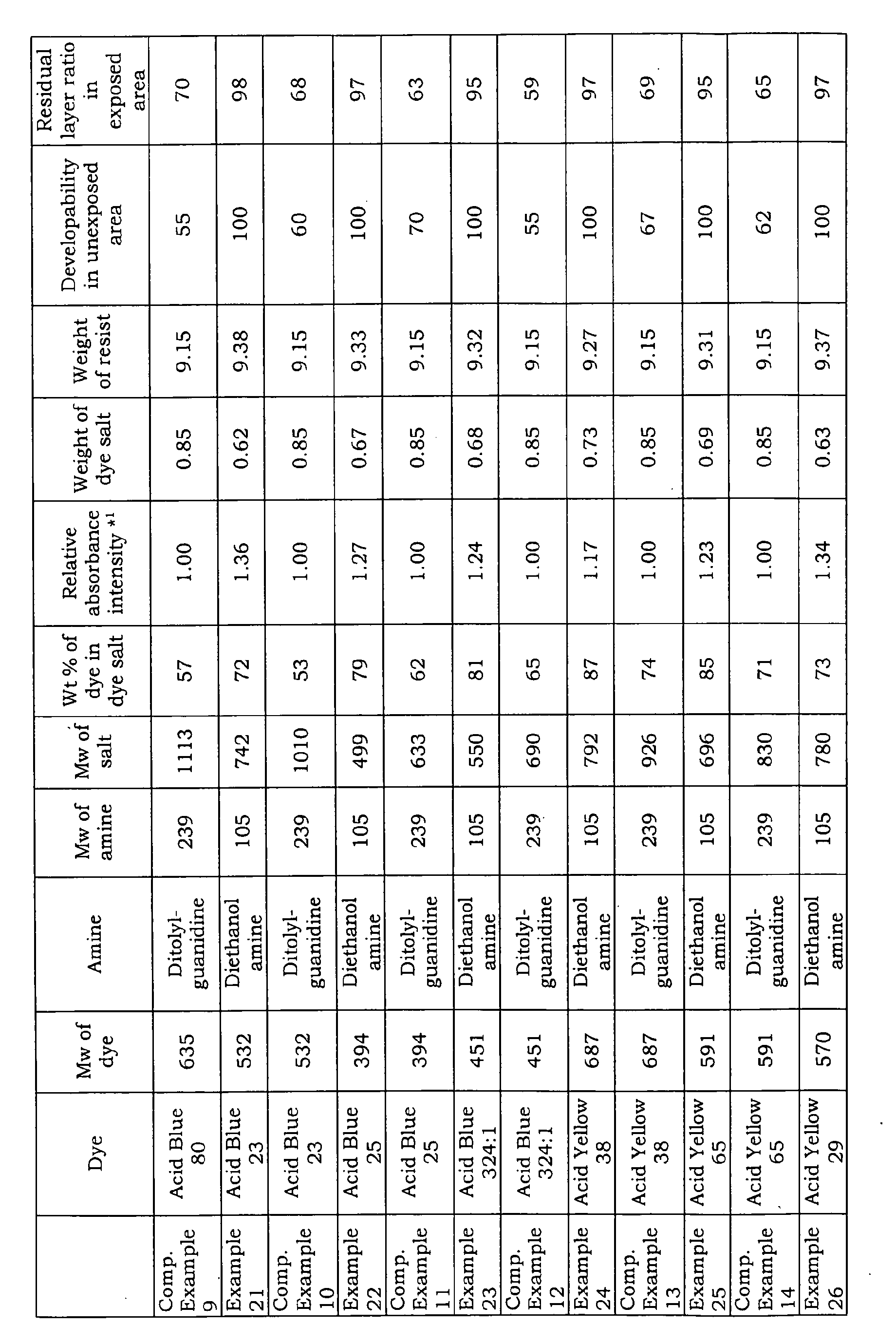
- the resist solution prepared in 1) above was mixed with each of dye salts and dissolved at respective proportions as shown in Table 1 so as to obtain films having the same absorbance with respect to the same kind of the dyes used.
- the dye resist solution prepared in 3) above was applied on the subbing layer of the glass substrate that had been provided with the subbing layer as prepared in 2) above using a spin coater to give a film thickness of 2 ⁇ m and pre-baked at 120°C for 120 seconds.
- the coating film was exposed to light having a wavelength of 365 nm at a dose of 800 mJ/cm 2 through a 20 ⁇ m-thick mask using an exposure apparatus. After the exposure, the resulting film was developed at 26°C for 60 seconds with a 60 % CD-2000 developing solution (manufactured by FUJIFILM ARCH CO., LTD.). Thereafter, the thus developed film was rinsed with running water for 20 seconds and then spray-dried.
- the relative absorbance intensity, developability in an unexposed area, and residual layer ratio in an exposed area were each measured by a chromoscope, MCPD-1000 (manufactured by OTSUKA ELECTRONICS CO., LTD.).
- the developability in an unexposed area means a rate of change in absorbance before and after the development
- the residual layer ratio in an exposed area means a sustained rate of the absorbance value.
- Example 2 The same procedures were repeated as in Example 1, except that respective dye resist solution compositions in Example 1-3) were changed as shown in the above Table 1. The results are shown in Table 2 including the results in Example 1.
- Examples 8 to 14 the silicon wafer was used as the substrate, which was different from the substrate used in Examples 1 to 7. However, in all of Examples 1 to 14, the dye resist solution was applied over the subbing layer, whereby the same various performances were obtained without producing any substantial difference.
- Example 2 The same procedures were conducted as in Example 1, except that respective dye resist solution compositions in Example 1-3) were changed as shown in the above Table 1. The obtained results are also shown in Table 2.
- Example 1 Acid Yellow 42 Diethanol amine 100 98
- Example 2 Acid Yellow 42 Triethanol amine 100 92
- Example 3 Acid Yellow 42 Phenyl diethanol amine 100 90
- Example 4 Acid Yellow 42 Piperidino ethanol 100 95
- Example 5 Acid Yellow 42 1-Me-2-pyrrolidineethanol 100 95
- Example 6 Acid Yellow 42 Pyrroridino propanediol 100 93 Comp.
- Example 1 Acid Yellow 42 Ditolylguanidine 60 70 Comp.
- Example 2 Acid Yellow 42 Dehydroabiethylamine 55 65
- Example 7 Acid Blue 120 Diethanol amine 100 99 Comp.
- Example 3 Acid Blue 120 Ditolylguanidine 65 67
- Example 2 The same procedures were carried out as in Example 1 to prepare a resist solution, from which a subbing layer was prepared on the glass substrate, to thereby produce a cured film.
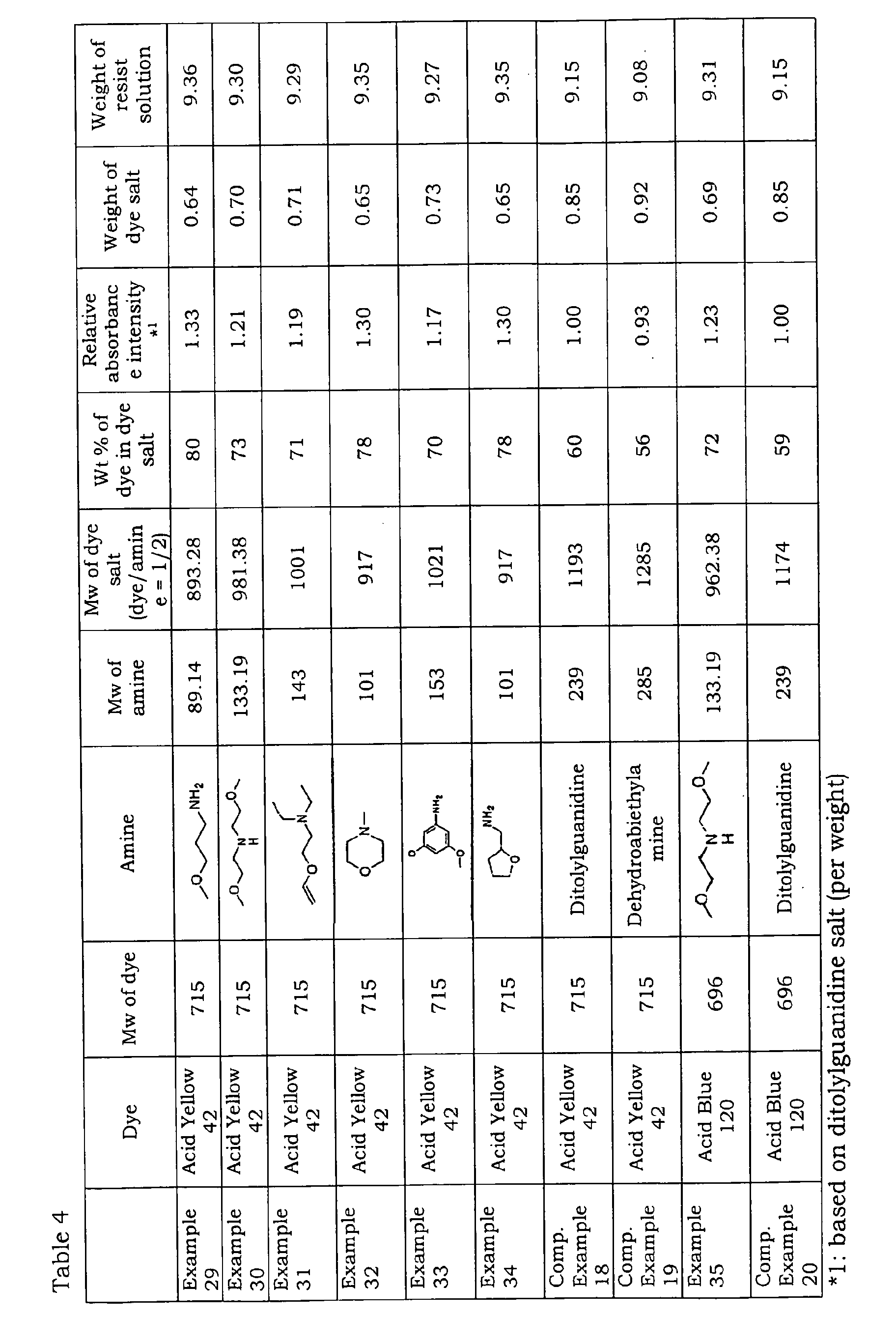
- the obtained resist solution was mixed with each of dye salts and dissolved at proportions as shown in Table 4 so as to produce the film having the same absorbance with respect to the same kind of the dyes used.
- the dye resist was subjected to exposure and development (image formation) in the same manner as in Example 1.
- image formation was confirmed by the conventional method through observation using an optical microscope and SEM photographs.
- the relative absorbance intensity, developability in an unexposed area, and residual layer ratio in an exposed area were each measured using a chromoscope, MCPD-1000 (manufactured by OTSUKA ELECTRONICS CO., LTD.).
- the developability in an unexposed area means a rate of change in absorbance before and after the development
- the residual layer ratio in an exposed area means a sustained rate of the absorbance value.
- Table 4 The results are shown in Table 4.
- Example 29 The same procedures were followed as in Example 29, except that the dye resist solution composition in Example 29 was changed as shown in the above Table 4. The results are shown in Table 5 including the results of Example 29.
- Examples 36 to 42 the silicon wafer is used as the substrate, which was different from that in Examples 29 to 35. However, in all of Examples 29 to 42, the dye resist solution was applied over the subbing layer, whereby the same various performances were achieved without producing any substantial difference.
- Example 29 The same procedures were repeated as in Example 29, except that the dye resist solution composition in Example 29 was changed as shown in the above Table 4. The results are shown in Table 5.
- Example 29 The same procedures were carried out as in Example 29, except that the dye resist solution composition in Example 29 was changed as shown in Table 6. The results are shown in Table 6.
- Example 2 The same procedures were carried out as in Example 1 to prepare a resist solution, from which a subbing layer was prepared on the glass substrate, to thereby produce a cured film.
- the obtained resist solution was mixed with each of dye salts and dissolved at proportions as shown in Table 7 so as to produce the film having the same absorbance with respect to the same kind of the dyes used.
- Example 57 the dye resist was subjected to exposure and development (image formation) in the same manner as in Example 1.
- image formation was confirmed by the conventional method through observation using an optical microscope and SEM photographs.
- the relative absorbance intensity, developability in an unexposed area, and residual layer ratio in an exposed area were each measured using a chromoscope, MCPD-1000 (manufactured by OTSUKA ELECTRONICS CO., LTD.).
- the developability in an unexposed area means a rate of change in absorbance before and after the development
- the residual layer ratio in an exposed area means a sustained rate of the absorbance value.
- Table 7 The results are shown in Table 7.
- Example 57 The same procedures were performed as in Example 57, except that the dye resist solution composition in Example 57 was changed as shown in the above Table 7. The results are shown in Table 8 including the results of Example 57.
- Examples 64 to 70 the silicon wafer was used as the substrate, which was different from the substrate used in Examples 57 to 63. However, in all of Examples 57 to 70, the dye resist solution was applied over the subbing layer, whereby the same various performances were obtained without producing any substantial difference.
- Example 57 The same procedures were conducted as in Example 57 were followed, except that the dye resist solution composition in Example 57 was changed as shown in the above Table 7. The results are also shown in Table 8.
- Example 57 Acid Yellow 42 Compound of Specific Example (1) 100 99
- Example 58 Acid Yellow 42 Compound of Specific Example (4) 100 100
- Example 59 Acid Yellow 42 Compound of Specific Example (5) 100 99
- Example 60 Acid Yellow 42 Compound of Specific Example (6) 100 98
- Example 61 Acid Yellow 42 Compound of Specific Example (11) 100 98
- Example 62 Acid Yellow 42 Compound of Specific Example (15) 100 97 Comp.
- Example 35 Acid Yellow 42 Ditolylguanidine 59 69 Comp.
- Example 36 Acid Yellow 42 Dehydroabiethylamine 56 64
- Example 63 Acid Blue 120 Compound of Specific Example (20) 100 97 Comp.
- Example 37 Acid Blue 120 Ditolylguanidine 66 68
- Example 84 the compound of Specific Example (1) was replaced with the compound of Specific Example (22), the solution composition was changed to satisfy the molecular weight to that of the compound of Specific Example (22), and after the exposure and development, heat treatment was carried out at 160°C for one minute. It was revealed that the developability in an unexposed area was 100, and the residual layer ratio in an exposed area was 98.
- Example 84 when the dye bonded with a low-molecular amine compound having a polymerizable group as a counter ion according to the invention was used, a dye-containing curable composition having excellent developability in an unexposed area and exhibiting high residual layer ratio in an exposed area was produced.
- the present invention provides a dye-containing curable composition that exhibits high sensitivity, high transmittance, high resolving power and wide development latitude, is free from dye elution, deterioration by heat and deterioration by light, and has high productivity, since excellent polymerization can be achieved.
- the invention also provides a color filter prepared using the dye-containing curable composition, and a process of preparing the color filter.
- the dye-containing curable composition of the present invention it is possible to provide a method of preparing a color filter in a simple manner and at high cost performances.
Landscapes
- Physics & Mathematics (AREA)
- Chemical & Material Sciences (AREA)
- Organic Chemistry (AREA)
- General Physics & Mathematics (AREA)
- Optics & Photonics (AREA)
- Health & Medical Sciences (AREA)
- General Health & Medical Sciences (AREA)
- Physical Education & Sports Medicine (AREA)
- Optical Filters (AREA)
- Materials For Photolithography (AREA)
Abstract
Description










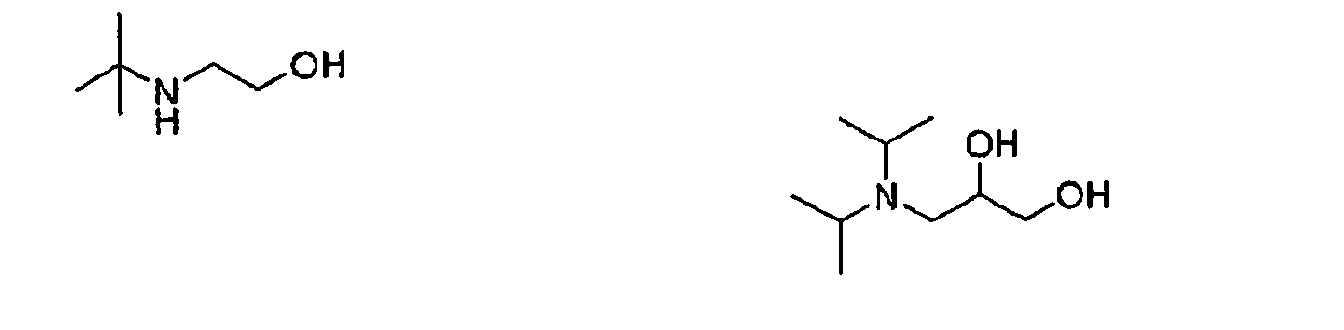

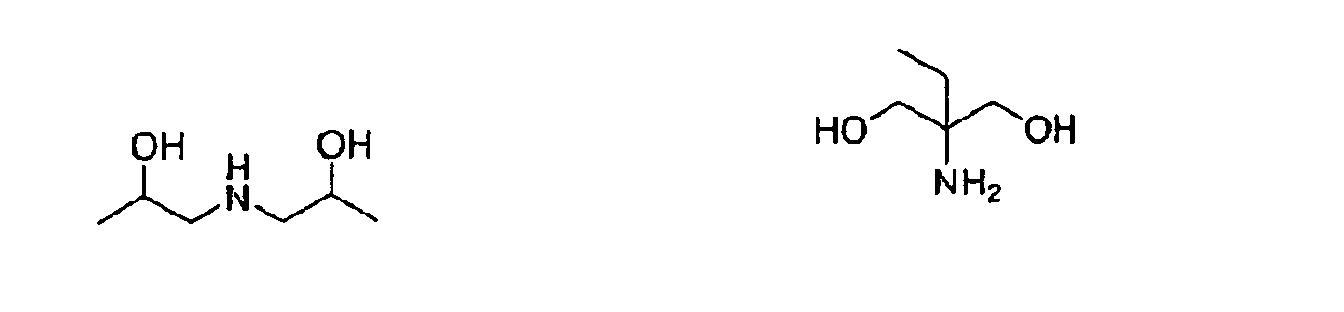
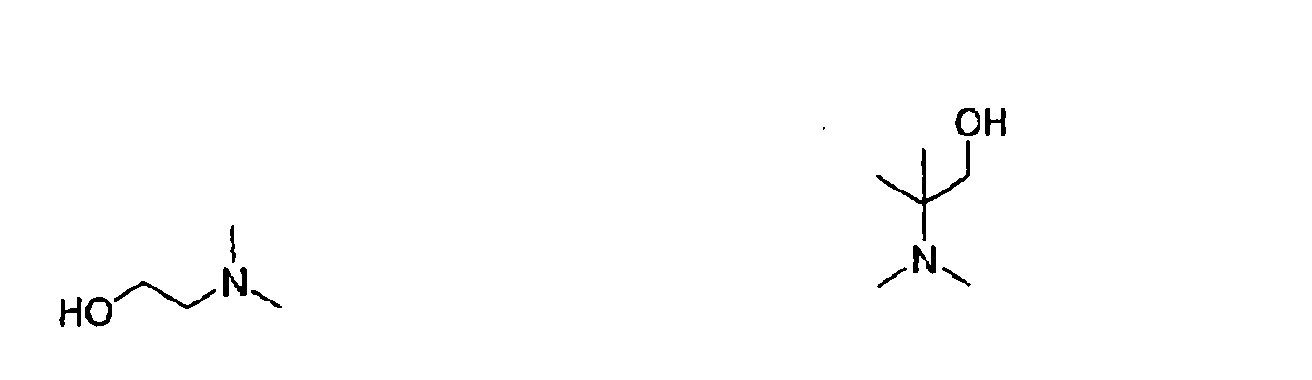

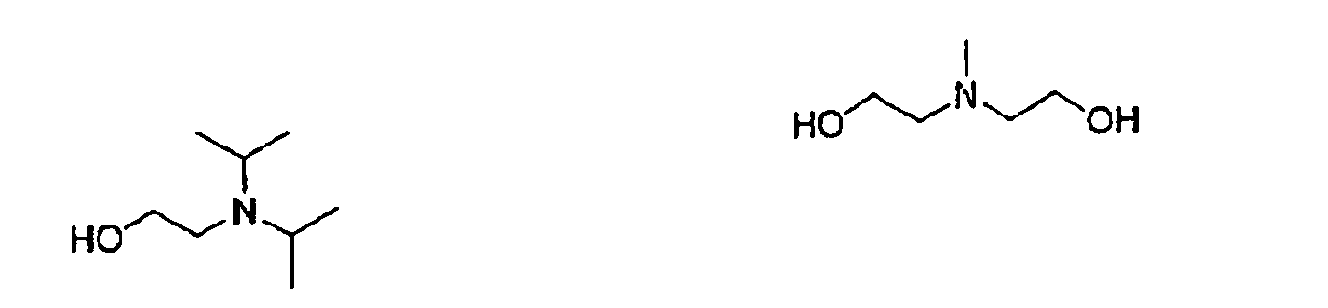






























- Propylene glycol monomethyl ether acetate (PGMEA): 19.20 parts
- Ethyl lactate: 36.67 parts
- Binder (41 % PGMEA solution containing a copolymer of benzyl methacrylate/methacrylic acid /2-hydroxyethyl methacrylate (molar ratio: 60/20/20)): 30.51 parts
- Dipentaerythritol hexaacrylate: 12.20 parts
- Polymerization inhibitor (p-methoxyphenol): 0.0061 parts
- Fluorine-based surfactant: 0.83 parts
- Photopolymerization initiator, TAZ-107 (trade name, manufactured by MIDORI KAGAKU CO., LTD.): 0.586 parts

| Dye | Amine | Developability of unexposed area | Residual layer ratio of exposed area | |
| Example 1 | Acid Yellow 42 | Diethanol amine | 100 | 98 |
| Example 2 | Acid Yellow 42 | Triethanol amine | 100 | 92 |
| Example 3 | Acid Yellow 42 | Phenyl diethanol amine | 100 | 90 |
| Example 4 | Acid Yellow 42 | Piperidino ethanol | 100 | 95 |
| Example 5 | Acid Yellow 42 | 1-Me-2-pyrrolidineethanol | 100 | 95 |
| Example 6 | Acid Yellow 42 | Pyrroridino propanediol | 100 | 93 |
| Comp. Example 1 | Acid Yellow 42 | Ditolylguanidine | 60 | 70 |
| Comp. Example 2 | Acid Yellow 42 | Dehydroabiethylamine | 55 | 65 |
| Example 7 | Acid Blue 120 | Diethanol amine | 100 | 99 |
| Comp. Example 3 | Acid Blue 120 | Ditolylguanidine | 65 | 67 |




| Dye | Amine | Developability in unexposed area | Residual layer ratio in exposed area | |
| Example 57 | Acid Yellow 42 | Compound of Specific Example (1) | 100 | 99 |
| Example 58 | Acid Yellow 42 | Compound of Specific Example (4) | 100 | 100 |
| Example 59 | Acid Yellow 42 | Compound of Specific Example (5) | 100 | 99 |
| Example 60 | Acid Yellow 42 | Compound of Specific Example (6) | 100 | 98 |
| Example 61 | Acid Yellow 42 | Compound of Specific Example (11) | 100 | 98 |
| Example 62 | Acid Yellow 42 | Compound of Specific Example (15) | 100 | 97 |
| Comp. Example 35 | Acid Yellow 42 | Ditolylguanidine | 59 | 69 |
| Comp. Example 36 | Acid Yellow 42 | Dehydroabiethylamine | 56 | 64 |
| Example 63 | Acid Blue 120 | Compound of Specific Example (20) | 100 | 97 |
| Comp. Example 37 | Acid Blue 120 | Ditolylguanidine | 66 | 68 |


Claims (20)
- A dye-containing curable composition comprising an alkali-soluble binder and an organic-solvent-soluble dye represented by the following formula (I):
- The dye-containing curable composition according to claim 1, wherein, in formula (I), X represents an amine compound having from 1 to 6 OH groups per molecular weight of the amine compound of 100.
- The dye-containing curable composition according to claim 1, wherein, in formula (I), X represents an amine compound having up to 14 carbon atoms.
- The dye-containing curable composition according to claim 1, wherein, in formula (I), X represents a secondary or tertiary amine compound.
- The dye-containing curable composition according to claim 1, wherein, in formula (I), X represents an amine compound having linear aliphatic or cyclic aliphatic carbons.
- The dye-containing curable composition according to claim 1, wherein, in formula (I), X represents an amine compound having a surface energy of 10 to 80 dyn/cm.
- A color filter comprising the dye-containing curable composition according to claim 1.
- A process of preparing a color filter, comprising the steps of applying the dye-containing curable composition according to claim 1 on a substrate, exposing the composition to light through a mask and conducting development to form a pattern.
- A dye-containing curable composition comprising an alkali-soluble binder and an organic-solvent-soluble dye represented by the following formula (I):
- The dye-containing curable composition according to claim 9, wherein, in formula (I), X represents an amine compound having from 1 to 6 ether groups per molecular weight of the amine compound of 100.
- The dye-containing curable composition according to claim 9, wherein, in formula (I), X represents an amine compound having up to 14 carbon atoms.
- The dye-containing curable composition according to claim 9, wherein, in formula (I), X represents a secondary or tertiary amine compound.
- The dye-containing curable composition according to claim 9, wherein, in formula (I), X represents an amine compound having linear aliphatic or cyclic aliphatic carbons.
- The dye-containing curable composition according to claim 9, wherein, in formula (I), X represents an amine compound having a surface energy of 10 to 80 dyn/cm.
- A color filter comprising the dye-containing curable composition according to claim 9.
- A process of preparing a color filter, comprising the steps of applying the dye-containing curable composition according to claim 9 on a substrate, exposing the composition to light through a mask and conducting development to form a pattern.
- A dye-containing curable composition comprising an alkali-soluble binder and an organic-solvent-soluble dye represented by the following formula (I):
- A color filter comprising the dye-containing curable composition according to claim 17.
- A process of preparing a color filter, comprising the steps of applying the dye-containing curable composition according to claim 17 on a substrate, exposing the composition to light through a mask, and conducting development to form a pattern.
- The dye-containing curable composition according to claim 17, wherein the amine compound has a molecular weight of 700 or less.
Applications Claiming Priority (12)
| Application Number | Priority Date | Filing Date | Title |
|---|---|---|---|
| JP2002091963 | 2002-03-28 | ||
| JP2002091962 | 2002-03-28 | ||
| JP2002091961 | 2002-03-28 | ||
| JP2002091963 | 2002-03-28 | ||
| JP2002091961 | 2002-03-28 | ||
| JP2002091962 | 2002-03-28 | ||
| JP2002284137 | 2002-09-27 | ||
| JP2002284159 | 2002-09-27 | ||
| JP2002284160 | 2002-09-27 | ||
| JP2002284160A JP2004002631A (en) | 2002-03-28 | 2002-09-27 | Dye-containing curable composition, color filter using the same and method for producing the color filter |
| JP2002284159 | 2002-09-27 | ||
| JP2002284137 | 2002-09-27 |
Publications (3)
| Publication Number | Publication Date |
|---|---|
| EP1348739A2 true EP1348739A2 (en) | 2003-10-01 |
| EP1348739A3 EP1348739A3 (en) | 2004-03-17 |
| EP1348739B1 EP1348739B1 (en) | 2006-07-05 |
Family
ID=27808928
Family Applications (1)
| Application Number | Title | Priority Date | Filing Date |
|---|---|---|---|
| EP03006873A Expired - Lifetime EP1348739B1 (en) | 2002-03-28 | 2003-03-28 | Dye-containing curable composition, color filter prepared using the same, and process of preparing color filter |
Country Status (5)
| Country | Link |
|---|---|
| US (2) | US20030229163A1 (en) |
| EP (1) | EP1348739B1 (en) |
| KR (1) | KR100629749B1 (en) |
| AT (1) | ATE332339T1 (en) |
| DE (1) | DE60306567T2 (en) |
Cited By (2)
| Publication number | Priority date | Publication date | Assignee | Title |
|---|---|---|---|---|
| EP1808463A3 (en) * | 2005-11-30 | 2009-02-18 | Xerox Corporation | Metal complex azo dyes |
| EP1865030A4 (en) * | 2005-03-31 | 2009-12-30 | Fujifilm Corp | Dye-containing hardenable composition, and color filter and process for producing the same |
Families Citing this family (11)
| Publication number | Priority date | Publication date | Assignee | Title |
|---|---|---|---|---|
| JP2005234177A (en) * | 2004-02-19 | 2005-09-02 | Matsushita Electric Ind Co Ltd | Color filter material, color filter, manufacturing method thereof, and image sensor |
| WO2006088721A1 (en) * | 2005-02-16 | 2006-08-24 | 3M Innovative Properties Company | Method of making topographically patterned coatings |
| EP1848544A1 (en) * | 2005-02-16 | 2007-10-31 | 3M Innovative Properties Company | Method of making morphologically patterned coatings |
| JP5425623B2 (en) * | 2006-07-11 | 2014-02-26 | チバ ホールディング インコーポレーテッド | Color filter composition |
| KR101363110B1 (en) * | 2007-03-14 | 2014-02-14 | 엘지디스플레이 주식회사 | Manufacturing method of color filter substrate and infrared heating apparatus for the same |
| TW201007353A (en) * | 2008-05-06 | 2010-02-16 | Nano Terra Inc | Molecular resist compositions, methods of patterning substrates using the compositions and process products prepared therefrom |
| US20100110242A1 (en) * | 2008-11-04 | 2010-05-06 | Shahrokh Motallebi | Anthraquinone dye containing material, composition including the same, camera including the same, and associated methods |
| US8999626B2 (en) | 2011-08-04 | 2015-04-07 | Lg Chem, Ltd. | Polymer compound comprising dye and curable resin composition comprising same |
| KR101598192B1 (en) * | 2014-03-24 | 2016-02-29 | 주식회사 씨앤에이인더스트리 | Dye for color filter comprising photo initiator functional group |
| RU2684387C2 (en) * | 2017-05-03 | 2019-04-08 | Федеральное государственное бюджетное учреждение науки Байкальский институт природопользования Сибирского отделения Российской академии наук (БИП СО РАН) | Photopolymer composition for the production of thermal-resistant objects by the method of laser stereolithography |
| RU2683752C1 (en) * | 2017-11-28 | 2019-04-01 | Федеральное государственное бюджетное образовательное учреждение высшего образования "Российский химико-технологический университет имени Д.И. Менделеева" | Enamel composition for making thermoregulating coating |
Family Cites Families (18)
| Publication number | Priority date | Publication date | Assignee | Title |
|---|---|---|---|---|
| GB884846A (en) * | 1960-02-26 | 1961-12-20 | Grace W R & Co | Dyestuff salts with quaternary ammonium compounds and their production |
| DE1260652B (en) * | 1960-08-09 | 1968-02-08 | Basf Ag | Process for the preparation of ammonium salts of metal complex dyes |
| FR2480770A1 (en) * | 1980-04-18 | 1981-10-23 | Oreal | PROCESS FOR PREPARATION OF SALTS OF ACID COLORANTS, AND OF COPOLYMERS CARRYING TERTIARY AMINE FUNCTIONS, SALTS OBTAINED AND MAKE-UP COSMETIC COMPOSITIONS CONTAINING THEM |
| JPS5930509A (en) | 1982-08-13 | 1984-02-18 | Fuji Photo Film Co Ltd | Color solid-state image pickup element |
| DE3329219C2 (en) * | 1982-08-13 | 1994-08-04 | Fuji Photo Film Co Ltd | Use of a colored filter element |
| JPH01168775A (en) * | 1987-12-25 | 1989-07-04 | Dainippon Ink & Chem Inc | Color filter ink, colored indicator panel, and liquid crystal display panel |
| JP2762511B2 (en) | 1989-01-30 | 1998-06-04 | 凸版印刷株式会社 | Color filter and manufacturing method thereof |
| JPH0476062A (en) | 1990-07-18 | 1992-03-10 | Sharp Corp | Resin composition for colored thin film |
| US5055376A (en) * | 1990-11-13 | 1991-10-08 | Eastman Kodak Company | Curable compositions containing onium salt photoinitiators which have a chromophore linked to the onium salt moiety through the 3-position and method of use |
| JP3094403B2 (en) * | 1992-03-27 | 2000-10-03 | ジェイエスアール株式会社 | Pigment-dispersed color filter composition |
| JPH05333207A (en) | 1992-05-29 | 1993-12-17 | Nippon Kayaku Co Ltd | Color filter |
| JPH0675375A (en) * | 1992-08-26 | 1994-03-18 | Sony Corp | Color resist material |
| JPH06194828A (en) | 1992-12-24 | 1994-07-15 | Sumitomo Chem Co Ltd | Resist composition for color filter |
| JP3442173B2 (en) | 1994-12-20 | 2003-09-02 | 日本化薬株式会社 | Color filter dye, color resist containing the same, and color filter |
| EP0926209B1 (en) * | 1997-12-10 | 2003-01-22 | Ciba SC Holding AG | Aqueous dye solutions and their use |
| JP3736221B2 (en) * | 1998-08-28 | 2006-01-18 | 凸版印刷株式会社 | Color filter and liquid crystal display device having the same |
| JP2000352610A (en) * | 1999-06-11 | 2000-12-19 | Toppan Printing Co Ltd | Color filter and manufacturing method thereof |
| JP2001201872A (en) * | 2000-01-17 | 2001-07-27 | Nippon Kayaku Co Ltd | Developing solution for photosetting resin composition |
-
2003
- 2003-03-27 US US10/400,079 patent/US20030229163A1/en not_active Abandoned
- 2003-03-28 KR KR1020030019465A patent/KR100629749B1/en not_active Expired - Fee Related
- 2003-03-28 AT AT03006873T patent/ATE332339T1/en not_active IP Right Cessation
- 2003-03-28 EP EP03006873A patent/EP1348739B1/en not_active Expired - Lifetime
- 2003-03-28 DE DE60306567T patent/DE60306567T2/en not_active Expired - Lifetime
-
2006
- 2006-02-09 US US11/350,012 patent/US7306884B2/en not_active Expired - Lifetime
Cited By (3)
| Publication number | Priority date | Publication date | Assignee | Title |
|---|---|---|---|---|
| EP1865030A4 (en) * | 2005-03-31 | 2009-12-30 | Fujifilm Corp | Dye-containing hardenable composition, and color filter and process for producing the same |
| US8124304B2 (en) | 2005-03-31 | 2012-02-28 | Fujifilm Corporation | Dye-containing curable composition, color filter and method for producing the same |
| EP1808463A3 (en) * | 2005-11-30 | 2009-02-18 | Xerox Corporation | Metal complex azo dyes |
Also Published As
| Publication number | Publication date |
|---|---|
| DE60306567T2 (en) | 2007-07-05 |
| US20030229163A1 (en) | 2003-12-11 |
| US7306884B2 (en) | 2007-12-11 |
| US20060194128A1 (en) | 2006-08-31 |
| KR100629749B1 (en) | 2006-09-28 |
| ATE332339T1 (en) | 2006-07-15 |
| EP1348739A3 (en) | 2004-03-17 |
| DE60306567D1 (en) | 2006-08-17 |
| EP1348739B1 (en) | 2006-07-05 |
| KR20030078752A (en) | 2003-10-08 |
Similar Documents
| Publication | Publication Date | Title |
|---|---|---|
| KR101166044B1 (en) | Dye-containing negative-type curable composition, color filter and method of producing the same | |
| EP1348739B1 (en) | Dye-containing curable composition, color filter prepared using the same, and process of preparing color filter | |
| KR100522502B1 (en) | Dye-containing curable composition, color filter and method of producing the same | |
| JP2003295432A (en) | Dye-containing negative curable composition, color filter and method for producing the same | |
| US7851123B2 (en) | Dye containing curable composition, color filter and method for producing the same | |
| EP2075632B1 (en) | Dye-containing negative curable composition, color filter, method of producing the same, and solid-state image sensor | |
| US8158308B2 (en) | Negative curable composition, color filter, and method of producing the same | |
| JP2006078602A (en) | Dye-containing negative-type curable composition, color filter and method for producing the same | |
| KR101186535B1 (en) | Negative dye-containing curable composition, color filter and method of producing the same | |
| JP2004002631A (en) | Dye-containing curable composition, color filter using the same and method for producing the color filter | |
| JP4408421B2 (en) | Dye-containing negative curable composition, color filter and method for producing the same | |
| US20050214679A1 (en) | Negative dye-containing curable composition, color filter and method of producing the same | |
| JP4322608B2 (en) | Color filter and manufacturing method thereof | |
| US20050208394A1 (en) | Dye-containing curable composition, color filter and method of producing the color filter | |
| JP3839725B2 (en) | Dye-containing negative curable composition, color filter using the same, and method for producing the same | |
| KR100933735B1 (en) | Dye-containing negative curable composition, and color filter using same and manufacturing method thereof | |
| JP2003207888A (en) | Dye-containing negative curable composition, and color filter including the same, and method for producing the same | |
| US8298731B2 (en) | Dye-containing negative curable composition, color filter and method of producing color filter | |
| US20050214660A1 (en) | Negative dye-containing curable composition, color filter and method of producing the same | |
| US20070072955A1 (en) | Negative dye-containing curable composition, color filter and method of producing the same | |
| JP2006235196A (en) | Curable composition with negative color, color filter and method for manufacturing the same | |
| JP2005274966A (en) | Dye containing negative type curable composition, color filter, and method of manufacturing color filter | |
| JP2004163861A (en) | Dye-containing hardening composition, color filter using the same, and its manufacturing method | |
| JP2006106099A (en) | Dye-containing negative curable composition, color filter and method for producing the same | |
| JP2003195516A (en) | Dye-containing negative curable composition, and color filter using the same and its manufacturing method |
Legal Events
| Date | Code | Title | Description |
|---|---|---|---|
| PUAI | Public reference made under article 153(3) epc to a published international application that has entered the european phase |
Free format text: ORIGINAL CODE: 0009012 |
|
| AK | Designated contracting states |
Kind code of ref document: A2 Designated state(s): AT BE BG CH CY CZ DE DK EE ES FI FR GB GR HU IE IT LI LU MC NL PT SE SI SK TR |
|
| AX | Request for extension of the european patent |
Extension state: AL LT LV MK RO |
|
| PUAL | Search report despatched |
Free format text: ORIGINAL CODE: 0009013 |
|
| RIC1 | Information provided on ipc code assigned before grant |
Ipc: 7C 09B 69/04 A Ipc: 7G 02F 1/13 B Ipc: 7G 03F 7/00 B Ipc: 7G 02F 1/1335 B |
|
| AK | Designated contracting states |
Kind code of ref document: A3 Designated state(s): AT BE BG CH CY CZ DE DK EE ES FI FR GB GR HU IE IT LI LU MC NL PT SE SI SK TR |
|
| AX | Request for extension of the european patent |
Extension state: AL LT LV MK RO |
|
| 17P | Request for examination filed |
Effective date: 20040601 |
|
| AKX | Designation fees paid |
Designated state(s): AT BE BG CH CY CZ DE DK EE ES FI FR GB GR HU IE IT LI LU MC NL PT RO SE SI SK TR |
|
| GRAP | Despatch of communication of intention to grant a patent |
Free format text: ORIGINAL CODE: EPIDOSNIGR1 |
|
| GRAS | Grant fee paid |
Free format text: ORIGINAL CODE: EPIDOSNIGR3 |
|
| RAP1 | Party data changed (applicant data changed or rights of an application transferred) |
Owner name: FUJI PHOTO FILM CO. LTD. |
|
| GRAA | (expected) grant |
Free format text: ORIGINAL CODE: 0009210 |
|
| AK | Designated contracting states |
Kind code of ref document: B1 Designated state(s): AT BE BG CH CY CZ DE DK EE ES FI FR GB GR HU IE IT LI LU MC NL PT RO SE SI SK TR |
|
| PG25 | Lapsed in a contracting state [announced via postgrant information from national office to epo] |
Ref country code: IT Free format text: LAPSE BECAUSE OF FAILURE TO SUBMIT A TRANSLATION OF THE DESCRIPTION OR TO PAY THE FEE WITHIN THE PRESCRIBED TIME-LIMIT;WARNING: LAPSES OF ITALIAN PATENTS WITH EFFECTIVE DATE BEFORE 2007 MAY HAVE OCCURRED AT ANY TIME BEFORE 2007. THE CORRECT EFFECTIVE DATE MAY BE DIFFERENT FROM THE ONE RECORDED. Effective date: 20060705 Ref country code: CH Free format text: LAPSE BECAUSE OF FAILURE TO SUBMIT A TRANSLATION OF THE DESCRIPTION OR TO PAY THE FEE WITHIN THE PRESCRIBED TIME-LIMIT Effective date: 20060705 Ref country code: FI Free format text: LAPSE BECAUSE OF FAILURE TO SUBMIT A TRANSLATION OF THE DESCRIPTION OR TO PAY THE FEE WITHIN THE PRESCRIBED TIME-LIMIT Effective date: 20060705 Ref country code: CZ Free format text: LAPSE BECAUSE OF FAILURE TO SUBMIT A TRANSLATION OF THE DESCRIPTION OR TO PAY THE FEE WITHIN THE PRESCRIBED TIME-LIMIT Effective date: 20060705 Ref country code: SK Free format text: LAPSE BECAUSE OF FAILURE TO SUBMIT A TRANSLATION OF THE DESCRIPTION OR TO PAY THE FEE WITHIN THE PRESCRIBED TIME-LIMIT Effective date: 20060705 Ref country code: AT Free format text: LAPSE BECAUSE OF FAILURE TO SUBMIT A TRANSLATION OF THE DESCRIPTION OR TO PAY THE FEE WITHIN THE PRESCRIBED TIME-LIMIT Effective date: 20060705 Ref country code: BE Free format text: LAPSE BECAUSE OF FAILURE TO SUBMIT A TRANSLATION OF THE DESCRIPTION OR TO PAY THE FEE WITHIN THE PRESCRIBED TIME-LIMIT Effective date: 20060705 Ref country code: SI Free format text: LAPSE BECAUSE OF FAILURE TO SUBMIT A TRANSLATION OF THE DESCRIPTION OR TO PAY THE FEE WITHIN THE PRESCRIBED TIME-LIMIT Effective date: 20060705 Ref country code: NL Free format text: LAPSE BECAUSE OF FAILURE TO SUBMIT A TRANSLATION OF THE DESCRIPTION OR TO PAY THE FEE WITHIN THE PRESCRIBED TIME-LIMIT Effective date: 20060705 Ref country code: RO Free format text: LAPSE BECAUSE OF FAILURE TO SUBMIT A TRANSLATION OF THE DESCRIPTION OR TO PAY THE FEE WITHIN THE PRESCRIBED TIME-LIMIT Effective date: 20060705 Ref country code: LI Free format text: LAPSE BECAUSE OF FAILURE TO SUBMIT A TRANSLATION OF THE DESCRIPTION OR TO PAY THE FEE WITHIN THE PRESCRIBED TIME-LIMIT Effective date: 20060705 |
|
| REG | Reference to a national code |
Ref country code: GB Ref legal event code: FG4D |
|
| REG | Reference to a national code |
Ref country code: CH Ref legal event code: EP |
|
| REG | Reference to a national code |
Ref country code: IE Ref legal event code: FG4D |
|
| REF | Corresponds to: |
Ref document number: 60306567 Country of ref document: DE Date of ref document: 20060817 Kind code of ref document: P |
|
| PG25 | Lapsed in a contracting state [announced via postgrant information from national office to epo] |
Ref country code: SE Free format text: LAPSE BECAUSE OF FAILURE TO SUBMIT A TRANSLATION OF THE DESCRIPTION OR TO PAY THE FEE WITHIN THE PRESCRIBED TIME-LIMIT Effective date: 20061005 Ref country code: DK Free format text: LAPSE BECAUSE OF FAILURE TO SUBMIT A TRANSLATION OF THE DESCRIPTION OR TO PAY THE FEE WITHIN THE PRESCRIBED TIME-LIMIT Effective date: 20061005 Ref country code: BG Free format text: LAPSE BECAUSE OF FAILURE TO SUBMIT A TRANSLATION OF THE DESCRIPTION OR TO PAY THE FEE WITHIN THE PRESCRIBED TIME-LIMIT Effective date: 20061005 |
|
| PG25 | Lapsed in a contracting state [announced via postgrant information from national office to epo] |
Ref country code: ES Free format text: LAPSE BECAUSE OF FAILURE TO SUBMIT A TRANSLATION OF THE DESCRIPTION OR TO PAY THE FEE WITHIN THE PRESCRIBED TIME-LIMIT Effective date: 20061016 |
|
| NLV1 | Nl: lapsed or annulled due to failure to fulfill the requirements of art. 29p and 29m of the patents act | ||
| PG25 | Lapsed in a contracting state [announced via postgrant information from national office to epo] |
Ref country code: PT Free format text: LAPSE BECAUSE OF FAILURE TO SUBMIT A TRANSLATION OF THE DESCRIPTION OR TO PAY THE FEE WITHIN THE PRESCRIBED TIME-LIMIT Effective date: 20061205 |
|
| RAP2 | Party data changed (patent owner data changed or rights of a patent transferred) |
Owner name: FUJIFILM CORPORATION |
|
| REG | Reference to a national code |
Ref country code: GB Ref legal event code: 732E |
|
| EN | Fr: translation not filed | ||
| PLBE | No opposition filed within time limit |
Free format text: ORIGINAL CODE: 0009261 |
|
| STAA | Information on the status of an ep patent application or granted ep patent |
Free format text: STATUS: NO OPPOSITION FILED WITHIN TIME LIMIT |
|
| 26N | No opposition filed |
Effective date: 20070410 |
|
| PG25 | Lapsed in a contracting state [announced via postgrant information from national office to epo] |
Ref country code: MC Free format text: LAPSE BECAUSE OF NON-PAYMENT OF DUE FEES Effective date: 20070331 Ref country code: IE Free format text: LAPSE BECAUSE OF NON-PAYMENT OF DUE FEES Effective date: 20070328 |
|
| PG25 | Lapsed in a contracting state [announced via postgrant information from national office to epo] |
Ref country code: FR Free format text: LAPSE BECAUSE OF FAILURE TO SUBMIT A TRANSLATION OF THE DESCRIPTION OR TO PAY THE FEE WITHIN THE PRESCRIBED TIME-LIMIT Effective date: 20070511 Ref country code: GR Free format text: LAPSE BECAUSE OF FAILURE TO SUBMIT A TRANSLATION OF THE DESCRIPTION OR TO PAY THE FEE WITHIN THE PRESCRIBED TIME-LIMIT Effective date: 20061006 |
|
| PG25 | Lapsed in a contracting state [announced via postgrant information from national office to epo] |
Ref country code: EE Free format text: LAPSE BECAUSE OF FAILURE TO SUBMIT A TRANSLATION OF THE DESCRIPTION OR TO PAY THE FEE WITHIN THE PRESCRIBED TIME-LIMIT Effective date: 20060705 |
|
| PG25 | Lapsed in a contracting state [announced via postgrant information from national office to epo] |
Ref country code: FR Free format text: LAPSE BECAUSE OF FAILURE TO SUBMIT A TRANSLATION OF THE DESCRIPTION OR TO PAY THE FEE WITHIN THE PRESCRIBED TIME-LIMIT Effective date: 20060705 |
|
| PG25 | Lapsed in a contracting state [announced via postgrant information from national office to epo] |
Ref country code: CY Free format text: LAPSE BECAUSE OF FAILURE TO SUBMIT A TRANSLATION OF THE DESCRIPTION OR TO PAY THE FEE WITHIN THE PRESCRIBED TIME-LIMIT Effective date: 20060705 Ref country code: LU Free format text: LAPSE BECAUSE OF NON-PAYMENT OF DUE FEES Effective date: 20070328 |
|
| PG25 | Lapsed in a contracting state [announced via postgrant information from national office to epo] |
Ref country code: TR Free format text: LAPSE BECAUSE OF FAILURE TO SUBMIT A TRANSLATION OF THE DESCRIPTION OR TO PAY THE FEE WITHIN THE PRESCRIBED TIME-LIMIT Effective date: 20060705 Ref country code: HU Free format text: LAPSE BECAUSE OF FAILURE TO SUBMIT A TRANSLATION OF THE DESCRIPTION OR TO PAY THE FEE WITHIN THE PRESCRIBED TIME-LIMIT Effective date: 20070106 |
|
| PGFP | Annual fee paid to national office [announced via postgrant information from national office to epo] |
Ref country code: GB Payment date: 20140326 Year of fee payment: 12 |
|
| PGFP | Annual fee paid to national office [announced via postgrant information from national office to epo] |
Ref country code: DE Payment date: 20140417 Year of fee payment: 12 |
|
| REG | Reference to a national code |
Ref country code: DE Ref legal event code: R119 Ref document number: 60306567 Country of ref document: DE |
|
| GBPC | Gb: european patent ceased through non-payment of renewal fee |
Effective date: 20150328 |
|
| PG25 | Lapsed in a contracting state [announced via postgrant information from national office to epo] |
Ref country code: DE Free format text: LAPSE BECAUSE OF NON-PAYMENT OF DUE FEES Effective date: 20151001 Ref country code: GB Free format text: LAPSE BECAUSE OF NON-PAYMENT OF DUE FEES Effective date: 20150328 |