EP1346977A1 - Verfahren zur Herstellung von Aryl-aminopropanolen - Google Patents
Verfahren zur Herstellung von Aryl-aminopropanolen Download PDFInfo
- Publication number
- EP1346977A1 EP1346977A1 EP03004920A EP03004920A EP1346977A1 EP 1346977 A1 EP1346977 A1 EP 1346977A1 EP 03004920 A EP03004920 A EP 03004920A EP 03004920 A EP03004920 A EP 03004920A EP 1346977 A1 EP1346977 A1 EP 1346977A1
- Authority
- EP
- European Patent Office
- Prior art keywords
- formula
- compounds
- ruthenium
- amino
- chloro
- Prior art date
- Legal status (The legal status is an assumption and is not a legal conclusion. Google has not performed a legal analysis and makes no representation as to the accuracy of the status listed.)
- Granted
Links
- 0 CC(C(*)NS(*)(=O)=O)N Chemical compound CC(C(*)NS(*)(=O)=O)N 0.000 description 1
Classifications
-
- C—CHEMISTRY; METALLURGY
- C07—ORGANIC CHEMISTRY
- C07D—HETEROCYCLIC COMPOUNDS
- C07D333/00—Heterocyclic compounds containing five-membered rings having one sulfur atom as the only ring hetero atom
- C07D333/02—Heterocyclic compounds containing five-membered rings having one sulfur atom as the only ring hetero atom not condensed with other rings
- C07D333/04—Heterocyclic compounds containing five-membered rings having one sulfur atom as the only ring hetero atom not condensed with other rings not substituted on the ring sulphur atom
- C07D333/06—Heterocyclic compounds containing five-membered rings having one sulfur atom as the only ring hetero atom not condensed with other rings not substituted on the ring sulphur atom with only hydrogen atoms, hydrocarbon or substituted hydrocarbon radicals, directly attached to the ring carbon atoms
- C07D333/24—Radicals substituted by carbon atoms having three bonds to hetero atoms with at the most one bond to halogen, e.g. ester or nitrile radicals
-
- A—HUMAN NECESSITIES
- A61—MEDICAL OR VETERINARY SCIENCE; HYGIENE
- A61P—SPECIFIC THERAPEUTIC ACTIVITY OF CHEMICAL COMPOUNDS OR MEDICINAL PREPARATIONS
- A61P43/00—Drugs for specific purposes, not provided for in groups A61P1/00-A61P41/00
-
- C—CHEMISTRY; METALLURGY
- C07—ORGANIC CHEMISTRY
- C07B—GENERAL METHODS OF ORGANIC CHEMISTRY; APPARATUS THEREFOR
- C07B2200/00—Indexing scheme relating to specific properties of organic compounds
- C07B2200/07—Optical isomers
Definitions
- the invention relates to a process for the preparation of enantiomerically enriched Aryl aminopropanols and their use and intermediates.
- 1-Aryl-3-aminopropan-1-oles have in particular as intermediates for the production technical importance of medicinal products. So some 1-aryl-3-aminopropan-1-ols are used for example as precursors for the production of Serotonin or norepinephrine uptake inhibitors. With some of these inhibitors could be shown that certain enantiomers are not only inactive or are less active, but may even have undesirable side effects (US-A 5,104,899).
- Enantiomerically enriched in the sense of the invention means enantiomerically pure compounds or mixtures of enantiomers of a compound in which a Enantiomer in an enantiomeric excess, hereinafter also ee (enantiomeric excess), compared to the other enantiomer. Is preferably this enantiomeric excess 10 to 100% ee, particularly preferably 60 to 100% ee and very particularly preferably 85 to 100% ee.
- Enantiomerically enriched in the sense of the invention relates in particular to the Configuration of the carbon atom adjacent to Ar.
- Ar preferably represents carbocyclic aromatic radicals with 6 to 24 carbon atoms or heteroaromatic residues with 4 to 24 Framework carbon atoms in which none, one, two or three framework carbon atoms per cycle, but at least one in the entire heteroaromatic radical Carbon atom, by heteroatoms, selected from the group nitrogen, Sulfur or oxygen can be substituted.
- Ar in the formulas (I) to (V) particularly preferably represents mono- or bicyclic carbocyclic aromatic radicals having a total of 6 to 14 structural carbon atoms or mono- or bicyclic heteroaromatic radicals having 4 to 12 structural carbon atoms in which none, one, two or three Framework carbon atoms per cycle, in the entire heteroaromatic radical at least one framework carbon atom may be substituted by heteroatoms selected from the group consisting of nitrogen, sulfur or oxygen, and the mono- or bicyclic aromatic radicals being substituted with none, one, two or three radicals per cycle can be, which are each independently selected from the group hydroxy, C 1 -C 12 alkyl, cyano, COOH, COOM, COO- (C 1 -C 12 alkyl), COO- (C 4 -C 10 aryl ), CO- (C 1 -C 12 alkyl), CO- (C 4 -C 10 aryl), O- (C 1 -C 12 alkyl), (C 1 -C 12 alky
- Aryl very particularly preferably represents phenyl, 2- or 3-thiophenyl, 2- or 3-furanyl, 2- or 3-pyrrolyl, 3- or 4-pyrazolyl, 1-, 2- or 4-thiazolyl, 1-, 2 - or 4-oxazolyl, 2-, 4- or 5-imidazolyl, 2-, 3- or 4-pyridyl, 2- or 3-pyrazinyl, 2-, 4- or 5-pyrimidyl, 3-, 4-, 5 - or 6-pyridazinyl, 2- or 3-indolyl, 3-indazolyl, indazolyl, 2- or 3-benzofuranyl, 2- or 3-benzothiophen-yl, 2-, 3- or 4-quinolinyl, isoquinolinyl 2-, 4 -, 6- or 7-pteridinyl or 2-, 3-, 4-, 5-, 6-, 8-, 9- or 10-phenanthrenyl, where each of the said groups carries no, one or two groups per cycle, the are each independently selected from the group C 1
- Ar is even more preferably 2-thiophene-yl.
- R 1 and R 2 preferably each independently represent hydrogen, methyl, ethyl, isopropyl, phenyl or benzyl.
- NR 1 R 2 is methylamino, ethylamino and isopropylamino, or in formula (VI) HNR 1 R 2 for methylamine, ethylamine and isopropylamine.
- NR 1 R 2 as a whole very particularly preferably represents methylamino or in formula (VI) HNR 1 R 2 stands for methylamine.
- R 3 preferably represents hydrogen, methyl, ethyl, isopropyl, n-propyl, tert-butyl, n-butyl, isobutyl, phenyl or benzyl, methyl and ethyl being particularly preferred are preferred and methyl is very particularly preferred.
- step a) Particularly preferred for the process according to the invention is the use of compounds of the formula (II) in step a) with the abovementioned meanings and preferred ranges for Ar and R 1 and in step b) the reaction with methylamine.
- the compounds of the formula (II) which can be used for the process according to the invention can, for example, by reacting compounds of the formula (IX) Ar-CO-CH 3 in which Ar has the meaning and preferred ranges mentioned under the formula (I), with compounds of formula (X) R 3 -O-CO-OR 3 be obtained in which the radicals R 3 each have, independently of one another, preferably identically, the same meaning and preferred ranges which have been given under the formula (II).
- the compounds of the formula (IV) which can be used for the process according to the invention can be analogous to the compounds of the formula (II), for example by base-catalyzed reaction of compounds of the formula (IX) with compounds of the formula (XI) R 3 O-CO-NR 1 R 2 be obtained in which the radicals R 1 , R 2 and R 3 each have, independently of one another, preferably identically, the same meaning and preferred ranges which have been given under the formulas (II) and (IV).
- Examples of compounds of the formula (XI) which may be mentioned are: N-methyl methyl carbamate, N-methyl ethyl carbamate, N-methyl methyl carbamate, N-methyl ethyl carbamate, N, N-dimethyl methyl carbamate and N, N-dimethyl ethyl carbamate.
- Such an implementation is e.g. in Tetrahedron Lett. 1998, 39, 4995 and can be used, for example, analogously for the reaction of 2-acetylthiophene with N-methyl-methylcarbamate or N-methyl ethyl carbamate can be used.
- the compounds of the formula (IV) which can be used for the process according to the invention can also via a base-catalyzed reaction of the compounds of the general Formula (IX) can be obtained with isocyanates, as in Synth. Commun. 1987 17, 13-18.
- isocyanates as in Synth. Commun. 1987 17, 13-18.
- aryl stands for example and preferably for carbocyclic aromatic radicals or heteroaromatic radicals which contain none, one, two or three heteroatoms per cycle, but in the entire heteroaromatic radical at least one heteroatom which is selected from the group consisting of nitrogen, sulfur or oxygen ,
- the carbocyclic aromatic radicals or heteroaromatic radicals can be substituted with up to five substituents per cycle, which are each independently selected, for example and preferably, from the group consisting of hydroxy, C 1 -C 12 alkyl, cyano, COOH, COOM, where M is is an alkali metal ion or half an equivalent of an alkaline earth metal ion, COO- (C 1 -C 12 alkyl), COO- (C 4 -C 10 aryl), CO- (C 1 -C 12 alkyl), CO- (C 4 -C 10 aryl), O- (C 1 -C 12 alkyl), O- (C 4 -C 10 ) ary
- alkyl or alkylene or alkoxy each independently denotes a straight-chain, cyclic, branched or unbranched alkyl or alkylene or alkoxy radical which can optionally be further substituted by C 1 -C 4 alkoxy radicals , The same applies to the alkylene part of an arylalkyl radical.
- C 1 -C 6 alkyl is preferably methyl, ethyl, n-propyl, isopropyl, n-butyl, tert-butyl, n-pentyl, cyclohexyl and n-hexyl, C 1 -C 8 alkyl in addition, for example, for n-heptyl, n-octyl or iso-octyl, C 1 -C 12 -alkyl, furthermore, for example for n-decyl and n-dodecyl and C 1 -C 20 -alkyl, and furthermore for n -Hexadecyl and n-octadecyl.
- C 1 -C 4 alkylene in all contexts is preferably methylene, 1,1-ethylene, 1,2-ethylene, 1,1-propylene, 1,2-propylene, 1,3-propylene, 1,1- Butylene, 1,2-butylene, 2,3-butylene and 1,4-butylene, C 1 -C 8 -alkylene furthermore for 1,5-pentylene, 1,6-hexylene, 1,1-cyclohexylene, 1, 4-cyclohexylene, 1,2-cyclohexylene and 1,8-octylene.
- C 1 -C 4 alkoxy in all contexts preferably represents methoxy, ethoxy, isopropoxy, n-propoxy, n-butoxy and tert-butoxy, C 1 -C 8 alkoxy furthermore cyclohexyloxy.
- aryl as a substituent encompasses carbocyclic radicals and heteroaromatic radicals in which none, one, two or three backbone atoms per cycle, but in the rest at least one backbone atom are heteroatoms selected from the group consisting of nitrogen, sulfur or oxygen.
- C 5 -C 10 aryl is, for example and preferably, phenyl, pyridyl, o-, m- or p-tolyl, and C 5 -C 14 aryl is also anthracenyl.
- C 6 -C 15 arylalkyl is, for example and preferably, benzyl.
- Haloalkyl or fluoroalkyl in the context of the invention each independently means a straight-chain, cyclic, branched or unbranched alkyl radical which can be substituted with one, more or completely selected from halogen fluorine, chlorine or bromine or fluorine independently of one another.
- C 1 -C 8 haloalkyl in all contexts preferably represents trifluoromethyl, trichloromethyl, 2,2,2-trifluoroethyl, pentafluoroethyl and nonafluorobutyl
- C 1 -C 8 fluoroalkyl represents trifluoromethyl, 2,2,2-trifluoroethyl, Pentafluoroethyl and nonafluorobutyl.
- Protected formyl means a formyl residue that is converted into a Aminal, acetal or a mixed aminal acetal is protected, the aminals, Acetals and mixed aminal acetals can be acyclic or cyclic.
- protected formyl represents a 1,1- (2,5-dioxy) cyclopentylene radical.
- step a) of the process according to the invention in the presence of a transition metal catalyst the compounds of formula (II) in enantiomerically enriched Compounds of formula (III) or compounds of formula (IV) in enantiomerically enriched Transfer compounds of formula (V), the reaction with hydrogen or a hydrogen-transferring compound or Mixture of these takes place.
- ketones to enantiomerically enriched secondary Alcohols
- transfer hydrogenations hydrogen transmitting compounds such as formic acid or isopropanol for Commitment.
- Step a) can for example and preferably be carried out in such a way that the compounds of formula (II) or the compounds of formula (IV) with hydrogen in Presence of transition metal catalysts and optionally reduced solvent chiral, stereoisomerically enriched ruthenium, rhodium, iridium or contain palladium complexes or by reacting ruthenium, Rhodium, iridium or palladium salts with stereoisomerically enriched Ligands are generated.
- Step a) as transfer hydrogenation
- the ruthenium complexes contain.
- Preferred ruthenium complexes are those which are characterized by Reaction of compounds of the formula (XII) with compounds of the formula (XIII) are available, or complexes of the formula (XIV).
- the embodiment is the molar ratio of compounds of the Formula (XIII) and compounds of formula (II) 2: 1 to 3: 1, particularly preferred 2.01: 1 to 2.4: 1.
- a base preferably a tertiary amine
- the reaction mixture can furthermore advantageously be added a base, preferably a tertiary amine, is added to the reaction mixture and for example, and preferably 10 to 30 minutes, the molar amount tertiary amine for example and preferably 1: 1 to 3: 1, particularly preferably 1: 1 to 2: 1 based on compounds of the formula (XIII).
- Arene preferably represents benzene or naphthalene, which is substituted by up to 6 radicals can be, which are each independently selected from the group Methyl, ethyl, n-propyl, isopropyl and tert-butyl.
- Aren is preferably mesitylene, cumene or benzene.
- the compounds of the formula (XIII) preferably have a stereoisomeric purity 90% or more, particularly preferably 95% or more and very particularly preferably from 98.5% or more.
- catalysts for step a) are those which contain ruthenium complexes contain the by reaction of S, S or R, R-N-p-toluenesulfonyl-1,2-diphenylethylenediamine and cumene dichlororuthenium dimer are available.
- Formic acid formates or mixtures thereof are also used for ii).
- Particularly suitable amines are those of the formula (XV) NR 10 R 11 R 12 in the R 10 , R 11 and R 12 each independently represent hydrogen, C 1 -C 8 alkyl or benzyl.
- Particularly preferred amines are ammonia and those of the formula (XV) in which R 10 , R 11 and R 12 each independently represent C 1 -C 8 -alkyl or benzyl.
- Particularly preferred amines are those of the formula (XV) in which R 10 , R 11 and R 12 are each identical for ethyl, n-butyl or n-hexyl, the use of triethylamine being even more preferred.
- the molar ratio of formic acid to tertiary amine can be, for example, 1: 1 to 3: 1, a ratio of 1.01: 1 to 1.5: 1 is preferred.
- the molar ratio of formic acid based on the substrate used can for example 1: 1 to 3: 1, preferred are 1: 1 to 1.5: 1, particularly preferred 1.02: 1 to 1.1: 1.
- Step a) can be carried out according to iii) in the presence or absence, preferably in the presence be carried out by organic solvent.
- Suitable organic solvents are, for example: Amides such as dimethylformamide, N-methylpyrrolidinone, optionally halogenated aliphatic or araliphatic solvents with up to 16 carbon atoms such as toluene, o-, m-, p-xylene, chloroform, dichloromethane, chlorobenzene, the isomeric dichlorobenzenes, fluorobenzene, nitriles such as, for example Acetonitrile, benzonitrile, dimethyl sulfoxide or mixtures thereof.
- Amides such as dimethylformamide, N-methylpyrrolidinone, optionally halogenated aliphatic or araliphatic solvents with up to 16 carbon atoms such as toluene, o-, m-, p-xylene, chloroform, dichloromethane, chlorobenzene, the isomeric dichlorobenzenes, fluorobenzene, nitrile
- Preferred solvents are acetonitrile, N-methylpyrrolidinone, chloroform, Dichloromethane, chlorobenzene, the isomeric dichlorobenzenes, fluorobenzene or Mixtures thereof, particularly preferred are dichloromethane, acetonitrile, N-methylpyrrolidinone or mixtures thereof.
- the reaction temperature can be, for example, -10 to 150 ° C, preferred 20 to 100 ° C, particularly preferably 20 to 80 ° C.
- reaction times are, for example, between 0.5 h and 48 h, preferably between 6 and 24 h.
- the molar amount of ruthenium can be, for example, 0.01 to 1.0 mol% amount to the substrate used, preferably 0.02 to 0.2 mol%, whole particularly preferably 0.02 to 0.1 mol%.
- oxygen-free means, for example, a content of 0 to 1% by volume, preferably 0 to 0.1 Vol% oxygen.
- the reaction can be accelerated by removing carbon dioxide released during the reaction.
- Advantageous and therefore included in the invention is intensive stirring of the reaction mixture with an average stirrer speed of, for example, 100 to 3,000 min -1 , preferably 500 to 1,500 min -1 .
- the removal of carbon dioxide can be supported by passing or passing an inert gas stream through or over the reaction mixture. Suitable gases are, for example, nitrogen, noble gases such as argon or mixtures thereof.
- step a) A particularly preferred embodiment of step a) is described below. but without being restrictive.
- a 1: 1 mixture (molar) of formic acid and triethylamine is in a stirred kettle prepared by simple mixing and compounds of formula (II) or the Compounds of formula (IV) equimolar or in a slight deficit to this given two-phase mixture.
- a Amount of an organic solvent added. This mix is made by Passing through nitrogen and the mixture with vigorous stirring on the desired reaction temperature tempered.
- the catalyst is added to this mixture as a solution in dichloromethane in molar ratios given to the substrate from, for example, 1: 500 to 1: 5,000 and the reaction mixture was stirred for the desired time.
- the turnover becomes chromatographic tracked.
- reaction mixture can then be prepared by methods known to those skilled in the art be worked up. It has proven advantageous to work up the Reaction mixture solvent and dilute aqueous hydrochloric acid or water add. After phase separation, the product from the organic phase can either by distillation or by a suitable crystallization process in itself be isolated in a known manner.
- step a) enantiomerically enriched compounds of the formulas are obtained (III) or (V) with the meanings and preferred ranges given above.
- the ligands are S or R configured Products available, whereby the configuration information refers to that of the rest Ar refers to the adjacent carbon atom.
- the compounds of the formulas (III) or (V) can be isolated or directly reacted further become.
- the reaction mixture can, for example between water and a water-immiscible organic solvent are separated and the desired product is converted into the organic phase become. After removing the organic solvent, one obtains Crude product that is purified, for example, by crystallization or distillation can be.
- Solutions are suitable for liquid and gaseous amines the amines.
- methylamine solutions can be made from methylamine in water, methanol or in ethanol advantageous for the reaction of carboxylic acid esters of formula (III) can be used.
- carboxylic acid esters of formula (III) for the transfer of free carboxylic acids of the formula (III) into the amides of the formula (V) are suitable, for example Reactions of amines of the general formula (VI) in the presence of coupling reagents such as 2-halogenopyridinium or -1,3-thiazolium salts or in Presence of acidic cation exchangers.
- step b) the enantiomerically enriched compounds of Formula (III) obtained enantiomerically enriched compounds of formula (V).
- the enantiomerically enriched compounds of the formula (V) can then be added to the enantiomerically enriched compounds of formula (I) can be reduced.
- the Reduction of carboxamides to the corresponding amines is in principle known and in Houben Weyl "Methods of Organic Chemistry", 4th edition, Volume E 16 d, 987-1003 summarized.
- Aluminum hydrides such as Lithium aluminum hydride, Red-Al® (sodium bis (2-methoxyethoxy) dihydroaluminate) or sodium borohydride.
- reaction of compounds of the formula (V) with is particularly preferred Lithium aluminum hydride.
- Step c) is preferably carried out at temperatures in the range from 0 to 150 ° C. particularly preferably in the range from 50 to 110 ° C.
- the reductions are carried out in ethers as solvents, preferably in cyclic ones Ethers such as tetrahydrofuran or dioxane, reductions with Red-Al ® can be however, also perform in toluene as the solvent.
- enantiomerically enriched compounds of the formula (I) which can be prepared according to the invention are particularly suitable for the preparation of enantiomerically enriched compounds of the formula (XVI)
- Aryl-CH (OR 10 ) -CH 2 -CH 2 NR 1 R 2 in the aryl, R 1 and R 2 have the meaning and preferred ranges given under the formula (I) and
- R 10 represents phenyl or naphthyl, which may not be substituted at all, once or more, by substituents which are each independently selected from the group cyano, CO- (C 1 -C 12 alkyl), O- (C 1 - C 12 alkyl), (C 1 -C 12 alkyl), fluorine, chlorine, bromine, C 1 -C 12 fluoroalkyl, where fluoroalkyl stands for a alkyl radical which is mono-, polysubstituted or completely substituted by fluorine.
- R 10 is preferably naphthyl.
- Preferred compounds of the formula (XVI) are: (S) -N-methyl-3- (1-naphthalenyloxy) -3- (2-thiophene-yl) propylamine and (R) -N-methyl-3- (1-naphthalenyloxy) -3- (2-thiophene- yl) propylamine and salts of both and (S) -N-methyl-3- (4-trifluoromethylphenyloxy) -3- (2-phenyl) propylamine and (R) -N-methyl-3- (4-trifluoromethylphenyloxy) -3 - (2-phenyl) propylamine and mixtures of both (e.g.
- the scope of the invention therefore also includes a method as a step d) the reaction of compounds of formula (I) with compounds of formula (XVII) in the presence of a base.
- R 10 -hal R 10 has the meaning and preferred ranges mentioned under the formula (XVI) and Hal represents fluorine, chlorine, bromine or iodine, preferably fluorine.
- Preferred compounds of the formula (XVII) are 1-fluomaphthalene and 4-chlorobenzotrifluoride used.
- Preferred bases are alkali metal hydroxides and hydrides such as e.g. sodium hydride optionally with the addition of potassium benzoate or potassium acetate, as in US 5,362,886, sodium hydroxide and potassium hydroxide.
- the compounds of the formulas (I), (V) and (XVI) are particularly suitable for the preparation of pharmaceuticals such as preferably serotonin or norepinephrine uptake inhibitors.
- the method according to the invention has the advantage that starting from easily available Educts the synthesis of enantiomerically enriched 1-aryl-3-aminopropanols of formula (I) and its secondary products in high overall yields, high enantiomeric excesses and high purities on an industrial scale is possible.
- the catalyst solution is weighed into a Schlenk vessel by weighing out 314 mg (2.03 equiv.) S, S-TsDPEN and 263 mg [(cumene) RuCl 2 ] 2 in 10 ml CH 2 Cl 2 and adding 0.3 ml (2 equiv. ) Et 3 N and stir this mixture for 15 min at room temperature.
- the conversion and enantiomer analysis was carried out by gas chromatography on a HP gas chromatograph using an IVADEX capillary acid (12.5 m, 0.3 ⁇ m layer thickness using individual temperature programs).
- 1,728 ml of dry tetrahydrofuran are mixed with 52 g of lithium aluminum hydride submitted and heated to reflux.
- 86.4 g of N-methyl- (3S) -3-hydroxy-3- (2-thiophen-yl) propanamide are started dissolved in 692 g of tetrahydrofuran zuzutropfen. After everything has dripped, it is refluxed overnight stirred. It is then cooled to room temperature and there are 1 037 ml of water carefully added dropwise. Then 173 ml of a 10% sodium hydroxide solution added dropwise and the solution filtered. The solvent was in Vacuum removed.
Landscapes
- Chemical & Material Sciences (AREA)
- Organic Chemistry (AREA)
- Health & Medical Sciences (AREA)
- Chemical Kinetics & Catalysis (AREA)
- Life Sciences & Earth Sciences (AREA)
- General Chemical & Material Sciences (AREA)
- Medicinal Chemistry (AREA)
- Nuclear Medicine, Radiotherapy & Molecular Imaging (AREA)
- Bioinformatics & Cheminformatics (AREA)
- Pharmacology & Pharmacy (AREA)
- Engineering & Computer Science (AREA)
- Animal Behavior & Ethology (AREA)
- General Health & Medical Sciences (AREA)
- Public Health (AREA)
- Veterinary Medicine (AREA)
- Organic Low-Molecular-Weight Compounds And Preparation Thereof (AREA)
- Low-Molecular Organic Synthesis Reactions Using Catalysts (AREA)
- Heterocyclic Compounds Containing Sulfur Atoms (AREA)
- Catalysts (AREA)
Abstract
Description
- Ar
- für einen substituierten oder unsubstituierten Arylrest und
- R1 und R2
- jeweils unabhängig voneinander für Wasserstoff, C1-C20-Alkyl, C4-C14-Aryl oder C5-C15-Arylalkyl stehen oder die beiden Reste R1 und R2 zusammen für C3-C12-Alkylen stehen,
- a) Verbindungen der Formel (II) in enantiomerenangereicherte Verbindungen
der Formel (III) oder Verbindungen der Formel (IV) in enantiomerenangereicherte
Verbindungen der Formel (V) überführt werden
- Ar
- die unter der Formel (I) genannte Bedeutung besitzt und
- R1 und R2
- die unter der Formel (I) genannte Bedeutung besitzen und
- R3
- für Wasserstoff, C1-C20-Alkyl, C4-C14-Aryl oder C5-C15-Arylalkyl steht,
- in Gegenwart eines Übergangsmetallkatalysators
- mit Wasserstoff oder einer Wasserstoff übertragenden Verbindung oder einer Mischung davon erfolgt, und
- b) für den Fall, dass für Schritt a) Verbindungen der Formel (II) eingesetzt
wurden, die enantiomerenangereicherten Verbindungen der Formel (III) mit
Aminen der Formel (VI)
zu enantiomerenangereicherten Verbindungen der Formel (V) mit der oben genannten Bedeutung umgesetzt werden und - c) die enantiomerenangereicherten Verbindungen der Formel (V) durch Reduktion in enantiomerenangereicherte Verbindungen der Formel (I) mit der oben genannten Bedeutung überführt werden.
- A
- fehlt oder für einen C1-C8-Alkylenrest steht und
- B
- fehlt oder für Sauerstoff, Schwefel oder NR4 steht,
- D
- für eine Carbonyl-Gruppe steht und
- E
- für R5, OR5, NHR6oder N(R6)2 steht
- R6
- jeweils unabhängig für C1-C8-Alkyl, C6-C15-Arylalkyl oder C6-C14- Aryl oder N(R6)2 zusammen für einen cyclischen Aminorest steht,
3-Oxo-3-(phenyl)propanamid, N-Methyl-3-oxo-3-(phenyl)propanamid, N-Benzyl-3-oxo-3-(phenyl)propanamid, N,N-Dimethyl-3-oxo-3-(phenyl)-propanamid, 3-Oxo-3-(4-tolyl)propanamid, N-Methyl-3-oxo-3-(4-tolyl)propanamid, N-Benzyl-3-oxo-3-(4-tolyl)propanamid, N,N-Dimethyl-3-oxo-3-(4-tolyl)-propanamid, 3-Oxo-3-(2-thiophen-yl)propanamid, N-Methyl-3-oxo-3-(2-thiophen-yl)-propanamid und N-Benzyl-3-oxo-3-(2-thiophen-yl)propanamid.
mit Verbindungen der Formel (X)
in denen die Reste R3 jeweils unabhängig voneinander, vorzugsweise identisch die gleiche Bedeutung und Vorzugsbereiche besitzen, die unter der Formel (II) angegeben wurden.
in denen die Reste R1, R2 und R3 jeweils unabhängig voneinander, vorzugsweise identisch die gleiche Bedeutung und Vorzugsbereiche besitzen, die unter den Formeln (II) und (IV) angegeben wurden.
N-Methyl-methylcarbamat, N-Methyl-ethylcarbamat, N-Methyl-methylcarbamat, N-Methyl-ethylcarbamat, N,N-Dimethyl-methylcarbamat und N,N-Dimethyl-ethylcarbamat.
- Aren
- für eine koordinierte aromatische Verbindung mit 6 bis 12 Ringkohlenstoffatomen, die weiterhin mit bis zu 6 Resten substituiert sein kann, die jeweils unabhängig voneinander ausgewählt sind aus der Gruppe C1-C8-Alkyl, Benzyl und Phenyl, und
- X
- beispielsweise und bevorzugt für Chlor, Brom oder Iod, besonders bevorzugt für Chlor.

- R7 und R8
- jeweils unabhängig voneinander beispielsweise für C1-C20-Alkyl, C4-C15- Aryl oder C5-C16-Arylalkyl oder R7 und R8 zusammen für einen geradkettigen oder verzweigten C3-C12-Alkylen-Rest und
- R9
- für C1-C20-Alkyl, C1-C20-Fluoralkyl oder C4-C15-Aryl.
- R9
- steht bevorzugt für C1-C4-Alkyl, C1-C4-Fluoralkyl, Phenyl oder Naphthyl, das mit keinem, einem, zwei, drei vier oder fünf Resten weiter substituiert sein kann, die ausgewählt sind aus der Gruppe C1-C4-Alkyl, C1-C4-Alkoxy, C1-C4- Fluoralkyl, Fluor und Chlor.
- R9
- steht besonders bevorzugt für Methyl, Trifluormethyl, Pentafluorethyl, Nonafluorbutyl, Phenyl, p-Tolyl, p-Ethylphenyl, p-Anisyl, p-Ethoxyphenyl, p-Chlorphenyl, 2,4,6-Trimethylphenyl, 2,4,6-Triisopropylphenyl, p-Fluorphenyl, Pentafluorphenyl und Naphthyl.
- R9
- steht ganz besonders bevorzugt für p-Tolyl, Phenyl, Naphtyl.
- R9
- steht noch weiter bevorzugt für p-Tolyl.
N-[(1R,2R) und (1S,2S)-2-amino-1,2-diphenylethyl]-p-tolylsulfonamid, N-[(1R,2R) und (1S,2S)-2-amino-1,2-diphenylethyl]-o-tolylsulfonamid, N-[(1R,2R) und (1S,2S)-2-amino-1,2-diphenylethyl]-m-tolylsulfonamid, N-[(1R,2R) und (1S,2S)-2-amino-1,2-diphenylethyl]-phenylsulfonamid, N-[(1R,2R) und (1S,2S)-2-amino-1,2-diphenylethyl]-4-ethylphenylsulfonamid, N-[(1R,2R) und (1S,2S)-2-amino-1,2-diphenylethyl]-3-ethylphenylsulfonamid, N-[(1R,2R) und (1S,2S)-2-amino-1,2-diphenylethyl]-2-ethylphenylsulfonamid, N-[(1R,2R) und (1S,2S)-2-amino-1,2-diphenylethyl]-2,4,6-trimethylphenylsulfonamid, N-[(1R,2R) und (1S,2S)-2-aminol,2-diphenylethyl]-2,4,6-triisopropylphenylsulfonamid, N-[(1R,2R) und (1S,2S)-2-amino-1,2-diphenylethyl]-4-chlorphenylsulfonamid, N-[(1R,2R) und (1S,2S)-2-amino-1,2-diphenylethyl]-3-chlorphenylsulfonamid, N-[(1R,2R) und (1S,2S)-2-amino-1,2-diphenylethyl]-2-chlorphenylsulfonamid, N-[(1R,2R) und (1S,2S)-2-amino-1,2-diphenylethyl]-4-fluorphenylsulfonamid, N-[(1R,2R) und (1S,2S)-2-amino-1,2-diphenylethyl]-3-fluorphenylsulfonamid, N-[(1R,2R) und (1S,2S)-2-amino-1,2-diphenylethyl]-2-fluorphenylsulfonamid, N-[(1R,2R) und (1S,2S)-2-amino-1,2-diphenylethyl]-4-methoxyphenylsulfonamid, N-[(1R,2R) und (1S,2S)-2-amino-1,2-diphenylethyl]-3-methoxyphenylsulfonamid, N-[(1R,2R) und (1S,2S)-2-amino-1,2-diphenylethyl]-2-methoxyphenylsulfonamid, N-[(1R,2R) und (1S,2S)-2-amino-1,2-diphenylethyl]-1-naphtylsulfonamid, N-[(1R,2R) und (1S,2S)-2-amino-1,2-diphenylethyl]-2-naphtylsulfonamid, N-[(1R,2R) und (1S,2S)-2-amino-1,2-diphenylethyl]-pentafluorphenylsulfonamid, N-[(1R,2R) und (1S,2S)-2-amino-1,2-diphenylethyl]-methansulfonamid, N-[(1R,2R) und (1S,2S)-2-amino-1,2-diphenylethyl]-trifluormethansulfonamid, N-[(1R,2R) und (1S,2S)-2-aminocyclohexyl]-ptolylsulfonamid, N-[(1R,2R) und (1S,2S)-2-aminocyclohexyl]-o-tolylsulfonamid, N-[(1R,2R) und (1S,2S)-2-aminocyclohexyl]-m-tolylsulfonamid, N-[(1R,2R) und (1S,2S)-2-aminocyclohexyl]-phenylsulfonamid, N-[(1R,2R) und (1S,2S)-2-aminocyclohexyl]-4-ethylphenylsulfonamid, N-[(1R,2R) und (1S,2S)-2-aminocyclohexyl]-3-ethylphenylsulfonamid, N-[(1R,2R) und (1S,2S)-2-aminocyclohexyl]-2-ethylphenylsulfonamid, N-[(1R,2R) und (1S,2S)-2-aminocyclohexyl]-2,4,6-trimethylphenylsulfonamid, N-[(1R,2R) und (1S,2S)-2-aminocyclohexyl]-2,4,6-triisopropylphenylsulfonamid, N-[(1R,2R) und (1S,2S)-2-aminocyclohexyl]-4-chlorphenylsulfonamid, N-[(1R,2R) und (1S,2S)-2-aminocyclohexyl]-3-chlorphenylsulfonamid, N-[(1R,2R) und (1S,2S)-2-aminocyclohexyl]-2-chlorphenylsulfonamid, N-[(1R,2R) und (1S,2S)-2-aminocyclohexyl]-4-fluorphenylsulfonamid, N-[(1R,2R) und (1S,2S)-2-aminocyclohexyl]-3-fluorphenylsulfonamid, N-[(1R,2R) und (1S,2S)-2-aminocyclohexyl]-2-fluorphenylsulfonamid, N-[(1R,2R) und (1S,2S)-2-aminocyclohexyl]-4-methoxyphenylsulfonamid, N-[(1R,2R) und (1S,2S)-2-aminocyclohexyl]-3-methoxyphenylsulfonamid, N-[(1R,2R) und (1S,2S)-2-aminocyclohexyl]-2-methoxyphenylsulfonamid, N-[(1R,2R) und (1S,2S)-2-aminocyclohexyl]-1-naphtylsulfonamid, N-[(1R,2R) und (1S,2S)-2-aminocyclohexyl]-2-naphtylsulfonamid, N-[(1R,2R) und (1S,2S)-2-aminocyclohexyl]-pentafluorphenylsulfonamid, N-[(1R,2R) und (1S,2S)-2-aminocyclohexyl]-methansulfonamid, N-[(1R,2R) und (1S,2S)-2-aminocyclohexyl]-trifluormethansulfonamid, N-[(1R,2R) und (1S,2S)-2-aminocyclopentyl]-p-tolylsulfonamid, N-[(1R,2R) und (1S,2S)-2-aminocyclopentyl]-o-tolylsulfonamid, N-[(1R,2R) und (1S,2S)-2-aminocyclopentyl]-m-tolylsulfonamid, N-[(1R,2R) und (1S,2S)-2-aminocyclopentyl]-phenylsulfonamid, N-[(1R,2R) und (1S,2S)-2-aminocyclopentyl]-4-ethylphenylsulfonamid, N-[(1R,2R) und (1S,2S)-2-aminocyclopentyl]-3-ethylphenylsulfonamid, N-[(1R,2R) und (1S,2S)-2-aminocyclopentyl]-2-ethylphenylsulfonamid, N-[(1R,2R) und (1S,2S)-2-aminocyclopentyl]-2,4,6-trimethylphenylsulfonamid, N-[(1R,2R) und (1S,2S)-2-aminocyclopentyl]-2,4,6-triisopropylphenylsulfonamid, N-[(1R,2R) und (1S,2S)-2-aminocyclopentyl]-4-chlorphenylsulfonamid, N-[(1R,2R) und (1S,2S)-2-aminocyclopentyl]-3-chlorphenylsulfonamid, N-[(1R,2R) und (1S,2S)-2-aminocyclopentyl]-2-chlorphenylsulfonamid, N-[(1R,2R) und (1S,2S)-2-aminocyclopentyl]-4-fluorphenylsulfonamid, N-[(1R,2R) und (1S,2S)-2-aminocyclopentyl]-3-fluorphenylsulfonamid, N-[(1R,2R) und (1S,2S)-2-aminocyclopentyl]-2-fluorphenylsulfonamid, N-[(1R,2R) und (1S,2S)-2-aminocyclopentyl]-4-methoxyphenylsulfonamid, N-[(1R,2R) und (1S,2S)-2-aminocyclopentyl]-3-methoxyphenylsulfonamid, N-[(1R,2R) und (1S,2S)-2-aminocyclopentyl]-2-methoxyphenylsulfonamid, N-[(1R,2R) und (1S,2S)-2-aminocyclopentyl]-1-naphtylsulfonamid, N-[(1R,2R) und (1S,2S)-2-aminocyclopentyl]-2-naphtylsulfonamid, N-[(1R,2R) und (1S,2S)-2-aminocyclopentyl]-pentafluorphenylsulfonamid, N-[(1R,2R) und (1S,2S)-2-aminocyclopentyl]-methansulfonamid, N-[(1R,2R) und (1S,2S)-2-aminocyclopentyl]-trifluormethansulfonamid.
R10, R11 und R12 jeweils unabhängig voneinander für Wasserstoff, C1-C8-Alkyl oder Benzyl stehen.
Amide wie z.B. Dimethylformamid, N-Methylpyrrolidinon, gegebenenfalls halogenierte aliphatische oder araliphatische Lösungsmittel mit bis zu 16 Kohlenstoffatomen wie z.B. Toluol, o-, m-, p-Xylol, Chloroform, Dichlormethan, Chlorbenzol, die isomeren Dichlorbenzole, Fluorbenzol, Nitrile wie zum Beispiel Acetonitril, Benzonitril, Dimethylsulfoxid oder Mischungen davon.
(S)-3-Hydroxy-3-(2-thiophen-yl)-N-methylpropionsäureamid, (R)-3-Hydroxy-3-(2-thiophen-yl)-N-methylpropionsäureamid und beliebige Mischungen dieser Verbindungen wie zum Beispiel das Racemat.
(1S)-3-(Methylamino)-1-(2-thiophen-yl)-1-propanol, (1R)-3-(Methylamino)-1-(2-thiophen-yl)-1-propanol, (1S)-3-(Dimethylamino)-1-(2-thiophen-yl)-1-propanol, (1R)-3-(Dimethylamino)-1-(2-thiophen-yl)-1-propanol, (1 S)-3-(Methylamino)-1-(phenyl)-1-propanol, (1R)-3-(Methylamino)-1-(phenyl)-1-propanol, (1S)-3-(Methylamino)-1-(4-tolyl)-1-propanol und (1R)-3-(Methylamino)-1-(4-tolyl)-1-propanol.
(S)-N-methyl-3-(1-naphthalenyloxy)-3-(2-thiophen-yl)propylamin und (R)-N-methyl-3-(1-naphthalenyloxy)-3-(2-thiophen-yl)propylamin und Salze von beiden sowie (S)-N-methyl-3-(4-trifluormethylphenyloxy)-3-(2-phenyl)propylamin und (R)-N-methyl-3-(4-trifluormethylphenyloxy)-3-(2-phenyl)propylamin sowie Mischungen aus beiden (z.B. das Racemat) und deren Salze, wie auch (S)-N-methyl-3-(2-tolyloxy)-3-(2-phenyl)propylamin und (R)-N-methyl-3-(2-tolyloxy)-3-(2-phenyl)-propylamin sowie Mischungen aus beiden (z.B. das Racemat) und deren Salze, wobei (S)-N-methyl-3-(1-naphthalenyloxy)-3-(2-thienyl)propylamin besonders bevorzugt ist.
d) die Umsetzung von Verbindungen der Formel (I) mit Verbindungen der Formel (XVII) in Gegenwart einer Base umfasst.

13C-NMR (d1-Chloroform, 100 MHz): δ = 185.3 (C=O), 146.8 (C, Ar), 127.1 (CH, Ar), 125.3 (CH, Ar), 124.1 (CH, Ar), 66.9 (CHOH), 52.4 (CH3), 43.5 (CH2) ppm. Chiral-GC: 14.05, 14.41 min. ee = 98,2 %.
Claims (18)
- Verfahren zur Herstellung von enantiomerenangereicherten Verbindungen der Formel (I),
- Ar
- für einen substituierten oder unsubstituierten Arylrest und
- R1 und R2
- jeweils unabhängig voneinander für Wasserstoff, C1-C20-Alkyl, C4-C14-Aryl oder C5-C15-Arylalkyl stehen oder die beiden Reste R1 und R2 zusammen für C3-C12-Alkylen stehen, dadurch gekennzeichnet, dass
a) Verbindungen der Formel (II) in enantiomerenangereicherte Verbindungen der Formel (III) oder Verbindungen der Formel (IV) in enantiomerenangereicherte Verbindungen der Formel (V) überführt werden- Ar
- die unter der Formel (I) genannte Bedeutung besitzt und
- R1 und R2
- die unter der Formel (I) genannte Bedeutung besitzen und
- R3
- für Wasserstoff, C1-C20-Alkyl, C4-C14-Aryl oder C5-C15- Arylalkyl steht,
in Gegenwart eines Übergangsmetallkatalysatorsmit Wasserstoff oder einer Wasserstoff übertragenden Verbindung oder einer Mischung davon erfolgt undb) für den Fall, dass für Schritt a) Verbindungen der Formel (II) eingesetzt wurden, die enantiomerenangereicherten Verbindungen der Formel (III) mit Aminen der Formel (VI)
zu enantiomerenangereicherten Verbindungen der Formel (V) mit der oben genannten Bedeutung umgesetzt werden undc) die enantiomerenangereicherten Verbindungen der Formel (V) durch Reduktion in enantiomerenangereicherte Verbindungen der Formel (I) mit der oben genannten Bedeutung überführt werden. - Verfahren nach Anspruch 1, dadurch gekennzeichnet, dassd) die enantiomerenangereicherten Verbindungen der Formel (I) in Gegenwart von Base mit Verbindungen der Formel (XVII)
- R10
- für Phenyl oder Naphthyl steht, das gar nicht, einfach oder mehrfach durch Substituenten substituiert sein kann, die jeweils unabhängig voneinander ausgewählt sind aus der Gruppe Cyano, CO-(C1-C12-Alkyl), O-(C1-C12-Alkyl), (C1-C12- Alkyl), Fluor, Chlor, Brom, C1-C12-Fluoralkyl, wobei Fluoralkyl für einen einfach, mehrfach oder vollständig durch Fluor substituierten Alkylrest steht und
- Hal
- für Fluor, Chlor, Brom oder Iod steht
in der Ar, R1,R2 und R10 die oben genannten Bedeutungen besitzen. - Verfahren nach einem oder mehreren der Ansprüche 1 bis 2, dadurch gekennzeichnet, dass im Schritt a) Verbindungen der Formel (II) mit der in Anspruch 1 genannten Bedeutung eingesetzt werden.
- Verfahren nach einem oder mehreren der Ansprüche 1 bis 3, dadurch gekennzeichnet, dass in den Formeln (I) bis (V) Ar steht für carbocyclische aromatische Reste mit 6 bis 24 Gerüstkohlenstoffatomen oder heteroaromatische Reste mit 4 bis 24 Gerüstkohlenstoffatomen, in denen keines, ein, zwei oder drei Gerüstkohlenstoffatome pro Cyclus, im gesamten heteroaromatischen Rest mindestens jedoch ein Gerüstkohlenstoffatom, durch Heteroatome, ausgewählt aus der Gruppe Stickstoff, Schwefel oder Sauerstoff, substituiert sind und wobei die carbocyclischen aromatischen Reste oder heteroaromatischen Reste mit bis zu fünf gleichen oder verschiedenen Substituenten pro Cyclus substituiert sind, ausgewählt aus der Gruppe Hydroxy, Fluor, Nitro, Cyano, freies oder geschütztes Formyl, C1-C12-Alkyl, C1-C12-Halogenalkyl, C5-C14-Aryl, C6-C15-Arylalkyl, -PO-[(C1-C8)-Alkyl]2, -PO-[(C5-C14)-Aryl]2, -PO-[(C1-C8)-Alkyl)(C5-C14)-Aryl)], Tri(C1-C8-alkyl)siloxyl oder Resten der allgemeinen Formel (VII),
- A
- fehlt oder für einen C1-C8-Alkylenrest steht und
- B
- fehlt oder für Sauerstoff, Schwefel oder NR4 steht,
- D
- für eine Carbonyl-Gruppe steht und
- E
- für R5, OR5, NHR6oder N(R6)2 steht,
R6 jeweils unabhängig für C1-C8-Alkyl, C6-C15-Arylalkyl oder C6-C14-Aryl oder N(R6)2 zusammen für einen cyclischen Aminorest steht,
oder Resten der allgemeinen Formeln (VIIIa-e) - Verfahren nach einem oder mehreren der Ansprüche 1 bis 4, dadurch gekennzeichnet, dass in den Formeln (I) bis (V) Ar für 2-Thiophen-yl steht.
- Verfahren nach einem oder mehreren der Ansprüche 3 bis 5, dadurch gekennzeichnet, dass als Verbindungen der Formel (II) Methyl-3-oxo-3-(2-thiophenyl)propanoat, Ethyl-3-oxo-3-(2-thiophen-yl)propanoat, Isopropyl-3-oxo-3-(2-thiophen-yl)propanoat, tert.-Butyl-3-oxo-3-(2-thiophen-yl)-propanoat, 2-Ethylhexyl-3-oxo-3-(2-thiophen-yl)propanoat, Methyl-3-oxo-3-(phenyl)-propanoat, Ethyl-3-oxo-3-(phenyl)propanoat, Isopropyl-3-oxo-3-(phenyl)-propanoat, tert.-Butyl-3-oxo-3-(phenyl)propanoat, 2-Ethylhexyl-3-oxo-3-(phenyl)propanoat, Methyl-3-oxo-3-(4-tolyl)propanoat, Ethyl-3-oxo-3-(4-tolyl)propanoat, Isopropyl-3-oxo-3-(4-tolyl)propanoat, tert.-Butyl-3-oxo-3-(4-tolyl)propanoat oder 2-Ethylhexyl-3-oxo-3-(4-tolyl)propanoat eingesetzt werden.
- Verfahren nach einem oder mehreren der Ansprüche 1 bis 6, dadurch gekennzeichnet, dass die Verbindungen der Formel (II) durch Umsetzung von Verbindungen der Formel (IX)
mit Verbindungen der Formel (X)
in denen die Reste R3 jeweils unabhängig voneinander die gleiche Bedeutung und Vorzugsbereiche besitzen, die unter der Formel (II) angegeben wurden. - Verfahren nach einem oder mehreren der Ansprüche 1 bis 7, dadurch gekennzeichnet, dass die Verbindungen der Formel (III) durch Umsetzung von Verbindungen der Formel (IX)
in denen die Reste R1, R2 und R3 jeweils unabhängig voneinander die gleiche Bedeutung und Vorzugsbereiche besitzen, die unter den Formeln (II) und (III) angegeben wurden. - Verfahren nach einem oder mehreren der Ansprüche 1 bis 8, dadurch gekennzeichnet, dass Schritt a) so durchgeführt wird, dass die Verbindungen der Formel (II) oder die Verbindungen der Formel (IV)umgesetzt werden.i) in Gegenwart eines Ruthenium, Rhodium oder Iridium enthaltenden Katalysators undii) in Gegenwart von mindestens einem Amin, das zumindest teilweise in protonierter Form vorliegt,iii) mit Ameisensäure, Formiaten oder Mischungen davon
- Verfahren nach Anspruch 9, dadurch gekennzeichnet, dass als Katalysatoren solche verwendet werden, die Rutheniumkomplexe enthalten.
- Verfahren nach Anspruch 10, dadurch gekennzeichnet, dass als Rutheniumkomplexe solche verwendet werden, die durch Umsetzung von Verbindungen der Formel (XII) mit Verbindungen der Formel (XIII) erhältlich sind, oder Komplexe der Formel (XIV), wobei in den Verbindungen der Formel (XII)
- X
- für Chlor, Brom oder Iod steht,
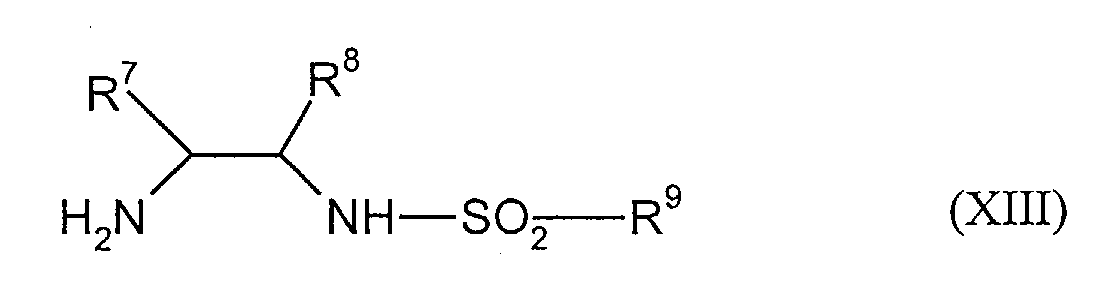
- R7 und R8
- jeweils unabhängig voneinander beispielsweise für C1-C20-Alkyl, C4-C15-Aryl oder C5-C16-Arylalkyl oder R7 und R8 zusammen für einen geradkettigen oder verzweigten C3-C12-Alkylen-Rest stehen und
- R9
- für C1-C20-Alkyl, C1-C20-Fluoralkyl oder C4-C15-Aryl steht,
- Verfahren nach einem oder mehreren der Ansprüche 10 und 11, dadurch gekennzeichnet, dass als Rutheniumkomplexe solche verwendet werden, die durch Umsetzung von S,S- oder R,R-N-p-Toluolsulfonyl-1,2-diphenylethylendiamin und Cumoldichlororuthenium-Dimer erhältlich sind.
- Verfahren nach einem oder mehreren der Ansprüche 10 bis 12, dadurch gekennzeichnet, dass Mischungen von Ameisensäure und Triethylamin verwendet werden.
- Verfahren nach einem oder mehreren der Ansprüche 10 bis 13, dadurch gekennzeichnet, dass die Reaktionstemperatur -10 bis 150°C beträgt.
- Verfahren nach einem oder mehreren der Ansprüche 10 bis 14, dadurch gekennzeichnet, dass die molare Menge an Ruthenium 0,01 bis 1,0 mol-% bezogen auf das eingesetzte Substrat beträgt.
- Verfahren nach einem oder mehreren der Ansprüche 10 bis 15, dadurch gekennzeichnet, dass die Reduktion im Schritt c) mit Lithiumaluminiumhydrid durchgeführt wird.
- (S)-3-Hydroxy-3-(2-thiophen-yl)-N-methylpropionsäureamid, (R)-3-Hydroxy-3-(2-thiophen-yl)-N-methylpropionsäureamid sowie die racemische und beliebige Mischungen dieser Verbindungen.
- Verwendung von enantiomerenangereicherten Verbindungen der Formeln (I), (V) und (XVI) mit der in den Ansprüchen 1 und 2 genannten Bedeutung zur Herstellung von Pharmazeutika.
Applications Claiming Priority (2)
| Application Number | Priority Date | Filing Date | Title |
|---|---|---|---|
| DE10212301 | 2002-03-20 | ||
| DE10212301A DE10212301A1 (de) | 2002-03-20 | 2002-03-20 | Verfahren zur Herstellung von Aryl-aminopropanolen |
Publications (2)
| Publication Number | Publication Date |
|---|---|
| EP1346977A1 true EP1346977A1 (de) | 2003-09-24 |
| EP1346977B1 EP1346977B1 (de) | 2009-07-22 |
Family
ID=27771441
Family Applications (1)
| Application Number | Title | Priority Date | Filing Date |
|---|---|---|---|
| EP03004920A Expired - Lifetime EP1346977B1 (de) | 2002-03-20 | 2003-03-07 | Verfahren zur Herstellung von Aryl-aminopropanolen |
Country Status (6)
| Country | Link |
|---|---|
| US (3) | US7169938B2 (de) |
| EP (1) | EP1346977B1 (de) |
| JP (1) | JP4194865B2 (de) |
| CN (2) | CN102321066B (de) |
| DE (2) | DE10212301A1 (de) |
| ES (1) | ES2328235T3 (de) |
Cited By (5)
| Publication number | Priority date | Publication date | Assignee | Title |
|---|---|---|---|---|
| WO2004024708A3 (en) * | 2002-09-16 | 2004-06-03 | Avecia Ltd | Processes for the preparation of heterocyclic hydroxyamines and intermediates and catalysts for use therein |
| EP1486493A4 (de) * | 2002-03-19 | 2007-04-04 | Mitsubishi Chem Corp | 3-hydroxy-3-(2-thienyl) propionsäureamid verbindung, verfahren zu deren herstellung und verfahren zur herstellung einer 3-amino-1-(2-thienyl)-1-propanolverbindung daraus |
| WO2009054887A1 (en) * | 2007-10-22 | 2009-04-30 | Merck & Co., Inc. | Process for preparing an anti-hypercholesterolemic compound |
| US7659409B2 (en) | 2002-03-19 | 2010-02-09 | Mitsubishi Chemical Corporation | 3-Hydroxy-3-(2-thienyl) propionamides and production method thereof, and production method of 3-amino-1-(2-thienyl)-1-propanols using the same |
| EP2426116A1 (de) * | 2010-08-30 | 2012-03-07 | Saltigo GmbH | Verfahren zur Herstellung von (S)-3-N-Methylamino-1-(2-thienyl)-1-propanol |
Families Citing this family (9)
| Publication number | Priority date | Publication date | Assignee | Title |
|---|---|---|---|---|
| JP2004155756A (ja) * | 2002-04-30 | 2004-06-03 | Mitsubishi Chemicals Corp | 光学活性アルコールの製造方法 |
| US20050197503A1 (en) * | 2004-03-05 | 2005-09-08 | Boehringer Ingelheim International Gmbh | Process for the preparation of N-alkyl-N-methyl-3-hydroxy-3-(2-thienyl)-propylamines |
| GB0425320D0 (en) * | 2004-11-17 | 2004-12-22 | Johnson Matthey Plc | Diamines |
| CZ299270B6 (cs) | 2006-01-04 | 2008-06-04 | Zentiva, A. S. | Zpusob výroby hydrochloridu (S)-N-methyl-3-(1-naftyloxy)-3-(2-thienyl)propylaminu |
| US20100280093A1 (en) | 2006-07-03 | 2010-11-04 | Ranbaxy Laboratories Limited | Process for the preparation enantiomerically pure salts of n-methyl-3-(1-naphthaleneoxy)-3-(2-thienyl)propanamine |
| WO2008077645A1 (en) * | 2006-12-22 | 2008-07-03 | Synthon B.V. | Process for making duloxetine and related compounds |
| CL2008002032A1 (es) * | 2007-07-13 | 2009-01-23 | Synthon Bv | Forma de dosis farmaceutica que posee una pluralidad de pellets, cada pellet comprende, un nucleo de pellet con un diametro de 600 a 1000 micrometros, capa de farmaco que comprende duloxetina o una sal y aglutinante de preferencia metil celulosa, una capa de separacion y una capa de recubrimiento enterico; proceso de preparacion |
| CZ304602B6 (cs) | 2009-09-02 | 2014-07-30 | Zentiva, K. S. | Způsob krystalizace hydrochloridu (S)-N-methyl-3-(1-naftyloxy)-3-(2-thienyl)propylaminu (hydrochloridu duloxetinu) |
| CN104130239B (zh) * | 2014-08-16 | 2016-05-04 | 瑞阳制药有限公司 | 度洛西汀手性中间体的制备方法 |
Citations (6)
| Publication number | Priority date | Publication date | Assignee | Title |
|---|---|---|---|---|
| US5104899A (en) | 1990-08-13 | 1992-04-14 | Sepracor, Inc. | Methods and compositions for treating depression using optically pure fluoxetine |
| EP0529444A2 (de) | 1991-08-30 | 1993-03-03 | Bayer Ag | 2-Arylpropensäuren und ihre Verwendung bei der Herstellung von S-Ketoprofen |
| US5362886A (en) | 1993-10-12 | 1994-11-08 | Eli Lilly And Company | Asymmetric synthesis |
| EP0643065A1 (de) | 1993-09-10 | 1995-03-15 | Bayer Ag | Neue Bisphosphine für asymmetrische Hydrierkatalysatoren |
| EP0749973A1 (de) | 1995-06-20 | 1996-12-27 | Bayer Ag | Neue Bisphosphine als Katalysatoren für asymmetrische Reaktionen |
| EP0764652A1 (de) | 1995-09-22 | 1997-03-26 | Bayer Ag | Neue Zwischenprodukte für die Synthese von Bisphosphinverbindungen |
Family Cites Families (4)
| Publication number | Priority date | Publication date | Assignee | Title |
|---|---|---|---|---|
| EP0528957A4 (en) * | 1990-05-01 | 1993-05-05 | Smith-Kline Beecham Corporation | Five-membered ring alkanoic acid leukotriene antagonists |
| DE4209616A1 (de) * | 1992-03-25 | 1993-09-30 | Basf Ag | Verfahren zur Herstellung von µ-Hydroxycarbonsäureestern |
| IL105716A0 (en) * | 1992-06-08 | 1993-09-22 | Richter Gedeon Vegyeszet | Aminopropanol derivatives,their preparation and pharmaceutical compositions containing them |
| US7659409B2 (en) | 2002-03-19 | 2010-02-09 | Mitsubishi Chemical Corporation | 3-Hydroxy-3-(2-thienyl) propionamides and production method thereof, and production method of 3-amino-1-(2-thienyl)-1-propanols using the same |
-
2002
- 2002-03-20 DE DE10212301A patent/DE10212301A1/de not_active Withdrawn
-
2003
- 2003-03-07 EP EP03004920A patent/EP1346977B1/de not_active Expired - Lifetime
- 2003-03-07 ES ES03004920T patent/ES2328235T3/es not_active Expired - Lifetime
- 2003-03-07 DE DE50311721T patent/DE50311721D1/de not_active Expired - Lifetime
- 2003-03-18 US US10/391,348 patent/US7169938B2/en not_active Expired - Fee Related
- 2003-03-20 JP JP2003078367A patent/JP4194865B2/ja not_active Expired - Fee Related
- 2003-03-20 CN CN201110199341.2A patent/CN102321066B/zh not_active Expired - Fee Related
- 2003-03-20 CN CN031073166A patent/CN1445224B/zh not_active Expired - Fee Related
-
2006
- 2006-05-18 US US11/436,874 patent/US7582776B2/en not_active Expired - Fee Related
-
2009
- 2009-07-28 US US12/510,376 patent/US7893281B2/en not_active Expired - Fee Related
Patent Citations (6)
| Publication number | Priority date | Publication date | Assignee | Title |
|---|---|---|---|---|
| US5104899A (en) | 1990-08-13 | 1992-04-14 | Sepracor, Inc. | Methods and compositions for treating depression using optically pure fluoxetine |
| EP0529444A2 (de) | 1991-08-30 | 1993-03-03 | Bayer Ag | 2-Arylpropensäuren und ihre Verwendung bei der Herstellung von S-Ketoprofen |
| EP0643065A1 (de) | 1993-09-10 | 1995-03-15 | Bayer Ag | Neue Bisphosphine für asymmetrische Hydrierkatalysatoren |
| US5362886A (en) | 1993-10-12 | 1994-11-08 | Eli Lilly And Company | Asymmetric synthesis |
| EP0749973A1 (de) | 1995-06-20 | 1996-12-27 | Bayer Ag | Neue Bisphosphine als Katalysatoren für asymmetrische Reaktionen |
| EP0764652A1 (de) | 1995-09-22 | 1997-03-26 | Bayer Ag | Neue Zwischenprodukte für die Synthese von Bisphosphinverbindungen |
Non-Patent Citations (18)
| Title |
|---|
| ASHOK KUMAR ET AL: "A new chemoenzymatic enantioselective synthesis of R-(-)-Tomoxetine, (R)- and (S)-Fluoxetine", TETRAHEDRON LETTERS, ELSEVIER SCIENCE PUBLISHERS, AMSTERDAM, NL, vol. 32, no. 16, 1991, pages 1901 - 1904, XP002121769, ISSN: 0040-4039 * |
| BOGER, D.L. ET AL: "Total Synthesis of Bleomycin A2 and Related Agents. 2. Synthesis of (-)-Pyrimidoblamic Acid, epi-(+)-Pyrimidoblamic Acid, (+)-Desacetamidopyrimidoblamic Acid, and (-)-Desacetamidopyrimidoblamic Acid", J.AM.CHEM.SOC., vol. 116, no. 13, 1994, pages 5619 - 5630, XP002240975 * |
| COREY; REICHARD, TETRAHEDRON LETTERS, vol. 39, 1989, pages 5207 |
| DEETER J ET AL: "ASYMMETRIC SYNTHESIS AND ABSOLUTE STEREOCHEMISTRY OF LY248686", TETRAHEDRON LETTERS, ELSEVIER SCIENCE PUBLISHERS, AMSTERDAM, NL, vol. 31, no. 49, 26 November 1990 (1990-11-26), pages 7101 - 7104, XP001119089, ISSN: 0040-4039 * |
| EVERAERE, K. ET AL: "Steric effects in the enentioselective transfer hydrogenation of 2-aroylacetates", TETRAHEDRON:ASYMMETRY, vol. 10, 1999, pages 4663 - 4666, XP002240974 * |
| HOUBEN WEYL: "Methoden der Organischen Chemie", vol. E 16, pages: 987 - 1003 |
| HOUBEN-WEYL: "Carbonsäuren, Carbonsäureestern, Carbonsäureanhydriden und anderen Carbonsäureamiden bietet", vol. E 5, pages: 941 - 1010 |
| HUANG, H.-L., ET AL: "The synthesis of a chiral fluoxetine intermediate by catalytic enantioselective hydrogenation of benzoylacetamide", TETRAHEDRON: ASYMMETRY, vol. 9, 1998, pages 1637 - 1640, XP002240972 * |
| LIU H ET AL: "CHEMO-ENZYMATIC SYNTHESIS OF THE ANTIDEPRESSANT DULOXETINE AND ITS ENANTIOMER", CHIRALITY, WILEY-LISS, NEW YORK, US, vol. 12, no. 1, 2000, pages 26 - 29, XP009000316, ISSN: 0899-0042 * |
| LIU, H.-L. ET AL: "Chemoenzymatic synthesis of the non-tricyclic antidepressants Fluoxetine, Tomoxetine and Nisoxetine", J.CHEM.SOC., PERKIN TRANS. 1, 2000, pages 1767 - 1769, XP002240973 * |
| NOYORI, R. ET AL, J.AM.CHEM.SOC. - SUPPORTING INFORMATION, vol. 118, 1996, pages 1 - 39, XP002240977 * |
| NOYORI, R. ET AL: "Ruthenium(II)-Catalyzed Asymmetric Transfer Hydrogenation of Ketones Using a Formic Acid-Triethylamine Mixture", J.AM.CHEM.SOC., vol. 118, no. 10, 1996, pages 2521 - 2522, XP002240976 * |
| ORG. AND ORGANOMET. SYNTH., vol. 2, 1999, pages 175 |
| SAKURABA S ET AL: "EFFICIENT ASYMMETRIC HYDROGENATION OF BETA- AND GAMMA-AMINO KETONE DERIVATIVES LEADING TO PRACTICAL SYNTHESIS OF FLUOXETINE AND EPROZINOL", CHEMICAL AND PHARMACEUTICAL BULLETIN, PHARMACEUTICAL SOCIETY OF JAPAN. TOKYO, JP, vol. 43, no. 5, 1995, pages 748 - 753, XP001071298, ISSN: 0009-2363 * |
| SYNTH. COMMUN., vol. 17, 1987, pages 13 - 18 |
| TETRAHEDRON ASYMMETRY, vol. 8, 1997, pages 3327 |
| TETRAHEDRON LETT., vol. 39, 1998, pages 4995 |
| TETRAHEDRON, vol. 27, 1995, pages 4801 |
Cited By (7)
| Publication number | Priority date | Publication date | Assignee | Title |
|---|---|---|---|---|
| EP1486493A4 (de) * | 2002-03-19 | 2007-04-04 | Mitsubishi Chem Corp | 3-hydroxy-3-(2-thienyl) propionsäureamid verbindung, verfahren zu deren herstellung und verfahren zur herstellung einer 3-amino-1-(2-thienyl)-1-propanolverbindung daraus |
| US7659409B2 (en) | 2002-03-19 | 2010-02-09 | Mitsubishi Chemical Corporation | 3-Hydroxy-3-(2-thienyl) propionamides and production method thereof, and production method of 3-amino-1-(2-thienyl)-1-propanols using the same |
| WO2004024708A3 (en) * | 2002-09-16 | 2004-06-03 | Avecia Ltd | Processes for the preparation of heterocyclic hydroxyamines and intermediates and catalysts for use therein |
| US7462731B2 (en) | 2002-09-16 | 2008-12-09 | Npil Pharmaceuticals (Uk) Limited | Processes for the preparation of heterocyclic hydroxyamines and intermediates and catalysts for use therein |
| WO2009054887A1 (en) * | 2007-10-22 | 2009-04-30 | Merck & Co., Inc. | Process for preparing an anti-hypercholesterolemic compound |
| EP2426116A1 (de) * | 2010-08-30 | 2012-03-07 | Saltigo GmbH | Verfahren zur Herstellung von (S)-3-N-Methylamino-1-(2-thienyl)-1-propanol |
| WO2012028545A1 (de) * | 2010-08-30 | 2012-03-08 | Saltigo Gmbh | Verfahren zur herstellung von (s)-3-n-methylamino-1-(2-thienyl)-1-propanol |
Also Published As
| Publication number | Publication date |
|---|---|
| ES2328235T3 (es) | 2009-11-11 |
| US7169938B2 (en) | 2007-01-30 |
| EP1346977B1 (de) | 2009-07-22 |
| US20080262247A1 (en) | 2008-10-23 |
| CN102321066A (zh) | 2012-01-18 |
| JP2003313184A (ja) | 2003-11-06 |
| CN102321066B (zh) | 2014-07-23 |
| US20030225153A1 (en) | 2003-12-04 |
| DE10212301A1 (de) | 2003-10-02 |
| US20090286997A1 (en) | 2009-11-19 |
| CN1445224B (zh) | 2012-07-11 |
| JP4194865B2 (ja) | 2008-12-10 |
| US7893281B2 (en) | 2011-02-22 |
| CN1445224A (zh) | 2003-10-01 |
| DE50311721D1 (de) | 2009-09-03 |
| US7582776B2 (en) | 2009-09-01 |
Similar Documents
| Publication | Publication Date | Title |
|---|---|---|
| US7893281B2 (en) | Process for preparing arylaminopropanols | |
| US6686505B2 (en) | Process for producing optically active amino alcohols and intermediates therefore | |
| CN111205279B (zh) | 一种多取代苯并二氢呋喃并杂环类化合物及其制备方法和应用 | |
| EP1405917B1 (de) | Verfahren zur Herstellung von 3-Heteroaryl-3-hydroxy-propansäurederivaten durch enantioselektive mikrobielle Reduktion | |
| EP3521274A1 (de) | Verfahren zur synthese von neuartigen chiralen liganden, metallchelat, eine vielfalt von nichtnatürlichen aminosäuren, maraviroc und hauptzwischenprodukt davon | |
| WO2000041997A1 (en) | Process for the preparation of optically active amino alcohols | |
| CN107235852B (zh) | 一种合成酰胺的方法 | |
| US20130190533A1 (en) | Process for the preparation of amino acid derivatives | |
| US20060252945A1 (en) | Process for the asymmetric hydrogenation of beta-amino ketones | |
| WO2020094528A1 (en) | Enantioselective process | |
| ES2322763T3 (es) | Procedimiento para producir un compuesto nitro opticamente activo. | |
| EP2426116B1 (de) | Verfahren zur Herstellung von (S)-3-N-Methylamino-1-(2-thienyl)-1-propanol | |
| Xu et al. | trans-(1S, 2S)-1-Substituted-2-(N, N-dialkylamino)-1-indanol derivatives as chiral ligands in the catalytic enantioselective addition of diethylzinc to aldehydes | |
| EP2060559A1 (de) | Herstellungsverfahren für enantiomerenreine 3-Hydroxy-3-Arylpropylamine und ihrer optischen Stereoisomere | |
| JP5943319B2 (ja) | ヘテロアレーンスルホニル化キナアルカロイドアミン化合物 | |
| EP1340746A1 (de) | Verfahren zur Reduktion von 3-Heteroaryl-3-Oxopropionsäurederivaten | |
| DE10225352A1 (de) | Verfahren zur stereoselektiven Reduktion von 4-Aryl-4-oxobutansäure-derivaten | |
| CN112441934B (zh) | 一种卤代氧杂烯丙基胺类化合物及其制备方法和应用 | |
| CN117024365B (zh) | 一种吡唑类离子液体及利用其催化Mannich反应的方法 | |
| CN111517930B (zh) | 一种稠合三环衍生物制备方法及中间体 | |
| CN112321451B (zh) | 一种用于制备盐酸西那卡塞药物中间体的方法 | |
| DE102004033313A1 (de) | Verfahren zur Herstellung von Enantiomeren 3-hydroxy-3-phenyl-propylaminen | |
| CN104292245A (zh) | 一种光学纯的手性铜配合物及合成方法 | |
| EP0726897A1 (de) | Verfahren zur herstellung von n-4-((substituiertes phenyl) alkylthienyl)-und n-4-((substituiertes phenyl)alkylfuryl)-but-3-yn-2-yl)-n-hydroxy harnstoff | |
| CN102417497A (zh) | 光学活性1-茚酮-3-乙酸类化合物的制备方法 |
Legal Events
| Date | Code | Title | Description |
|---|---|---|---|
| PUAI | Public reference made under article 153(3) epc to a published international application that has entered the european phase |
Free format text: ORIGINAL CODE: 0009012 |
|
| AK | Designated contracting states |
Kind code of ref document: A1 Designated state(s): AT BE BG CH CY CZ DE DK EE ES FI FR GB GR HU IE IT LI LU MC NL PT RO SE SI SK TR |
|
| AX | Request for extension of the european patent |
Extension state: AL LT LV MK |
|
| RAP1 | Party data changed (applicant data changed or rights of an application transferred) |
Owner name: BAYER CHEMICALS AG |
|
| 17P | Request for examination filed |
Effective date: 20040324 |
|
| AKX | Designation fees paid |
Designated state(s): AT BE BG CH CY CZ DE DK EE ES FI FR GB GR HU IE IT LI LU MC NL PT RO SE SI SK TR |
|
| RAP1 | Party data changed (applicant data changed or rights of an application transferred) |
Owner name: LANXESS DEUTSCHLAND GMBH |
|
| 17Q | First examination report despatched |
Effective date: 20050607 |
|
| RAP1 | Party data changed (applicant data changed or rights of an application transferred) |
Owner name: SALTIGO GMBH |
|
| RAP1 | Party data changed (applicant data changed or rights of an application transferred) |
Owner name: SALTIGO GMBH |
|
| GRAP | Despatch of communication of intention to grant a patent |
Free format text: ORIGINAL CODE: EPIDOSNIGR1 |
|
| GRAS | Grant fee paid |
Free format text: ORIGINAL CODE: EPIDOSNIGR3 |
|
| GRAA | (expected) grant |
Free format text: ORIGINAL CODE: 0009210 |
|
| AK | Designated contracting states |
Kind code of ref document: B1 Designated state(s): AT BE BG CH CY CZ DE DK EE ES FI FR GB GR HU IE IT LI LU MC NL PT RO SE SI SK TR |
|
| REG | Reference to a national code |
Ref country code: GB Ref legal event code: FG4D Free format text: NOT ENGLISH |
|
| REG | Reference to a national code |
Ref country code: CH Ref legal event code: EP |
|
| REG | Reference to a national code |
Ref country code: IE Ref legal event code: FG4D |
|
| REF | Corresponds to: |
Ref document number: 50311721 Country of ref document: DE Date of ref document: 20090903 Kind code of ref document: P |
|
| REG | Reference to a national code |
Ref country code: ES Ref legal event code: FG2A Ref document number: 2328235 Country of ref document: ES Kind code of ref document: T3 |
|
| PG25 | Lapsed in a contracting state [announced via postgrant information from national office to epo] |
Ref country code: FI Free format text: LAPSE BECAUSE OF FAILURE TO SUBMIT A TRANSLATION OF THE DESCRIPTION OR TO PAY THE FEE WITHIN THE PRESCRIBED TIME-LIMIT Effective date: 20090722 Ref country code: SE Free format text: LAPSE BECAUSE OF FAILURE TO SUBMIT A TRANSLATION OF THE DESCRIPTION OR TO PAY THE FEE WITHIN THE PRESCRIBED TIME-LIMIT Effective date: 20090722 |
|
| PG25 | Lapsed in a contracting state [announced via postgrant information from national office to epo] |
Ref country code: SI Free format text: LAPSE BECAUSE OF FAILURE TO SUBMIT A TRANSLATION OF THE DESCRIPTION OR TO PAY THE FEE WITHIN THE PRESCRIBED TIME-LIMIT Effective date: 20090722 |
|
| PG25 | Lapsed in a contracting state [announced via postgrant information from national office to epo] |
Ref country code: PT Free format text: LAPSE BECAUSE OF FAILURE TO SUBMIT A TRANSLATION OF THE DESCRIPTION OR TO PAY THE FEE WITHIN THE PRESCRIBED TIME-LIMIT Effective date: 20091122 Ref country code: BG Free format text: LAPSE BECAUSE OF FAILURE TO SUBMIT A TRANSLATION OF THE DESCRIPTION OR TO PAY THE FEE WITHIN THE PRESCRIBED TIME-LIMIT Effective date: 20091022 |
|
| PG25 | Lapsed in a contracting state [announced via postgrant information from national office to epo] |
Ref country code: EE Free format text: LAPSE BECAUSE OF FAILURE TO SUBMIT A TRANSLATION OF THE DESCRIPTION OR TO PAY THE FEE WITHIN THE PRESCRIBED TIME-LIMIT Effective date: 20090722 Ref country code: CZ Free format text: LAPSE BECAUSE OF FAILURE TO SUBMIT A TRANSLATION OF THE DESCRIPTION OR TO PAY THE FEE WITHIN THE PRESCRIBED TIME-LIMIT Effective date: 20090722 Ref country code: DK Free format text: LAPSE BECAUSE OF FAILURE TO SUBMIT A TRANSLATION OF THE DESCRIPTION OR TO PAY THE FEE WITHIN THE PRESCRIBED TIME-LIMIT Effective date: 20090722 Ref country code: RO Free format text: LAPSE BECAUSE OF FAILURE TO SUBMIT A TRANSLATION OF THE DESCRIPTION OR TO PAY THE FEE WITHIN THE PRESCRIBED TIME-LIMIT Effective date: 20090722 |
|
| PLBE | No opposition filed within time limit |
Free format text: ORIGINAL CODE: 0009261 |
|
| STAA | Information on the status of an ep patent application or granted ep patent |
Free format text: STATUS: NO OPPOSITION FILED WITHIN TIME LIMIT |
|
| PG25 | Lapsed in a contracting state [announced via postgrant information from national office to epo] |
Ref country code: SK Free format text: LAPSE BECAUSE OF FAILURE TO SUBMIT A TRANSLATION OF THE DESCRIPTION OR TO PAY THE FEE WITHIN THE PRESCRIBED TIME-LIMIT Effective date: 20090722 |
|
| 26N | No opposition filed |
Effective date: 20100423 |
|
| PG25 | Lapsed in a contracting state [announced via postgrant information from national office to epo] |
Ref country code: GR Free format text: LAPSE BECAUSE OF FAILURE TO SUBMIT A TRANSLATION OF THE DESCRIPTION OR TO PAY THE FEE WITHIN THE PRESCRIBED TIME-LIMIT Effective date: 20091023 Ref country code: MC Free format text: LAPSE BECAUSE OF NON-PAYMENT OF DUE FEES Effective date: 20100331 |
|
| PG25 | Lapsed in a contracting state [announced via postgrant information from national office to epo] |
Ref country code: AT Free format text: LAPSE BECAUSE OF NON-PAYMENT OF DUE FEES Effective date: 20100307 |
|
| PG25 | Lapsed in a contracting state [announced via postgrant information from national office to epo] |
Ref country code: CY Free format text: LAPSE BECAUSE OF FAILURE TO SUBMIT A TRANSLATION OF THE DESCRIPTION OR TO PAY THE FEE WITHIN THE PRESCRIBED TIME-LIMIT Effective date: 20090722 |
|
| PG25 | Lapsed in a contracting state [announced via postgrant information from national office to epo] |
Ref country code: HU Free format text: LAPSE BECAUSE OF FAILURE TO SUBMIT A TRANSLATION OF THE DESCRIPTION OR TO PAY THE FEE WITHIN THE PRESCRIBED TIME-LIMIT Effective date: 20100123 Ref country code: LU Free format text: LAPSE BECAUSE OF NON-PAYMENT OF DUE FEES Effective date: 20100307 |
|
| PG25 | Lapsed in a contracting state [announced via postgrant information from national office to epo] |
Ref country code: TR Free format text: LAPSE BECAUSE OF FAILURE TO SUBMIT A TRANSLATION OF THE DESCRIPTION OR TO PAY THE FEE WITHIN THE PRESCRIBED TIME-LIMIT Effective date: 20090722 |
|
| REG | Reference to a national code |
Ref country code: DE Ref legal event code: R082 Ref document number: 50311721 Country of ref document: DE Representative=s name: WICHMANN, BIRGID, DIPL.-CHEM. DR.RER.NAT., DE |
|
| REG | Reference to a national code |
Ref country code: DE Ref legal event code: R082 Ref document number: 50311721 Country of ref document: DE Representative=s name: WICHMANN, BIRGID, DIPL.-CHEM. DR.RER.NAT., DE Effective date: 20131213 Ref country code: DE Ref legal event code: R081 Ref document number: 50311721 Country of ref document: DE Owner name: SALTIGO GMBH, DE Free format text: FORMER OWNER: SALTIGO GMBH, 40764 LANGENFELD, DE Effective date: 20131213 |
|
| REG | Reference to a national code |
Ref country code: FR Ref legal event code: PLFP Year of fee payment: 13 |
|
| PGFP | Annual fee paid to national office [announced via postgrant information from national office to epo] |
Ref country code: DE Payment date: 20150305 Year of fee payment: 13 Ref country code: IT Payment date: 20150225 Year of fee payment: 13 Ref country code: ES Payment date: 20150212 Year of fee payment: 13 Ref country code: IE Payment date: 20150309 Year of fee payment: 13 Ref country code: NL Payment date: 20150309 Year of fee payment: 13 Ref country code: CH Payment date: 20150313 Year of fee payment: 13 |
|
| PGFP | Annual fee paid to national office [announced via postgrant information from national office to epo] |
Ref country code: FR Payment date: 20150309 Year of fee payment: 13 Ref country code: GB Payment date: 20150304 Year of fee payment: 13 |
|
| PGFP | Annual fee paid to national office [announced via postgrant information from national office to epo] |
Ref country code: BE Payment date: 20150311 Year of fee payment: 13 |
|
| PG25 | Lapsed in a contracting state [announced via postgrant information from national office to epo] |
Ref country code: BE Free format text: LAPSE BECAUSE OF NON-PAYMENT OF DUE FEES Effective date: 20160331 |
|
| REG | Reference to a national code |
Ref country code: DE Ref legal event code: R119 Ref document number: 50311721 Country of ref document: DE |
|
| REG | Reference to a national code |
Ref country code: CH Ref legal event code: PL |
|
| REG | Reference to a national code |
Ref country code: NL Ref legal event code: MM Effective date: 20160401 |
|
| GBPC | Gb: european patent ceased through non-payment of renewal fee |
Effective date: 20160307 |
|
| REG | Reference to a national code |
Ref country code: IE Ref legal event code: MM4A |
|
| REG | Reference to a national code |
Ref country code: FR Ref legal event code: ST Effective date: 20161130 |
|
| PG25 | Lapsed in a contracting state [announced via postgrant information from national office to epo] |
Ref country code: GB Free format text: LAPSE BECAUSE OF NON-PAYMENT OF DUE FEES Effective date: 20160307 Ref country code: DE Free format text: LAPSE BECAUSE OF NON-PAYMENT OF DUE FEES Effective date: 20161001 Ref country code: LI Free format text: LAPSE BECAUSE OF NON-PAYMENT OF DUE FEES Effective date: 20160331 Ref country code: IE Free format text: LAPSE BECAUSE OF NON-PAYMENT OF DUE FEES Effective date: 20160307 Ref country code: FR Free format text: LAPSE BECAUSE OF NON-PAYMENT OF DUE FEES Effective date: 20160331 Ref country code: CH Free format text: LAPSE BECAUSE OF NON-PAYMENT OF DUE FEES Effective date: 20160331 Ref country code: NL Free format text: LAPSE BECAUSE OF NON-PAYMENT OF DUE FEES Effective date: 20160401 |
|
| PG25 | Lapsed in a contracting state [announced via postgrant information from national office to epo] |
Ref country code: IT Free format text: LAPSE BECAUSE OF NON-PAYMENT OF DUE FEES Effective date: 20160307 |
|
| REG | Reference to a national code |
Ref country code: ES Ref legal event code: FD2A Effective date: 20170427 |
|
| PG25 | Lapsed in a contracting state [announced via postgrant information from national office to epo] |
Ref country code: ES Free format text: LAPSE BECAUSE OF NON-PAYMENT OF DUE FEES Effective date: 20160308 |