EP1345885B1 - Verfahren zur herstellung von zimtsäureester - Google Patents
Verfahren zur herstellung von zimtsäureester Download PDFInfo
- Publication number
- EP1345885B1 EP1345885B1 EP01270517A EP01270517A EP1345885B1 EP 1345885 B1 EP1345885 B1 EP 1345885B1 EP 01270517 A EP01270517 A EP 01270517A EP 01270517 A EP01270517 A EP 01270517A EP 1345885 B1 EP1345885 B1 EP 1345885B1
- Authority
- EP
- European Patent Office
- Prior art keywords
- iron
- cinnamic acid
- process according
- mol
- anhydride
- Prior art date
- Legal status (The legal status is an assumption and is not a legal conclusion. Google has not performed a legal analysis and makes no representation as to the accuracy of the status listed.)
- Expired - Lifetime
Links
- 0 CCCC=CC(C=CC(CC*)=[O+])=CC=N Chemical compound CCCC=CC(C=CC(CC*)=[O+])=CC=N 0.000 description 1
Classifications
-
- C—CHEMISTRY; METALLURGY
- C07—ORGANIC CHEMISTRY
- C07C—ACYCLIC OR CARBOCYCLIC COMPOUNDS
- C07C67/00—Preparation of carboxylic acid esters
-
- C—CHEMISTRY; METALLURGY
- C07—ORGANIC CHEMISTRY
- C07C—ACYCLIC OR CARBOCYCLIC COMPOUNDS
- C07C51/00—Preparation of carboxylic acids or their salts, halides or anhydrides
- C07C51/083—Preparation of carboxylic acids or their salts, halides or anhydrides from carboxylic acid anhydrides
- C07C51/087—Preparation of carboxylic acids or their salts, halides or anhydrides from carboxylic acid anhydrides by hydrolysis
-
- C—CHEMISTRY; METALLURGY
- C07—ORGANIC CHEMISTRY
- C07C—ACYCLIC OR CARBOCYCLIC COMPOUNDS
- C07C51/00—Preparation of carboxylic acids or their salts, halides or anhydrides
- C07C51/347—Preparation of carboxylic acids or their salts, halides or anhydrides by reactions not involving formation of carboxyl groups
- C07C51/353—Preparation of carboxylic acids or their salts, halides or anhydrides by reactions not involving formation of carboxyl groups by isomerisation; by change of size of the carbon skeleton
-
- C—CHEMISTRY; METALLURGY
- C07—ORGANIC CHEMISTRY
- C07C—ACYCLIC OR CARBOCYCLIC COMPOUNDS
- C07C67/00—Preparation of carboxylic acid esters
- C07C67/12—Preparation of carboxylic acid esters from asymmetrical anhydrides
Definitions
- the present invention relates to a process for the synthesis of cinnamic acid esters or substituted cinnamic esters by condensation of aldehyde (s) with Carboxylic anhydride (s) catalyzed by iron (III) salts.
- the catalyst is at least equimolar to benzaldehyde used and thus increases the cost of manufacturing the cinnamic acid ester significantly.
- the Handling the catalyst is associated with a high hazard potential.
- the Perkin reaction (Perkin, J. Chem. Soc., 31, 388 (1877)) also offers the possibility Cinnamic acid and cinnamic acid esters by producing an aromatic aldehyde such as benzaldehyde and acetic anhydride reacted under sodium acetate catalysis become.
- an aromatic aldehyde such as benzaldehyde and acetic anhydride reacted under sodium acetate catalysis become.
- Houben Weyl, Methods of Organic Chemistry, 4th ed., Vol. VIII / 3, P. 443, Georg Thieme Verlag Stuttgart, 1952 is the reaction of benzaldehyde with acetic anhydride and sodium acetate at a molar ratio of 1: 1.56: 065 under reflux / 16 h. After aqueous workup cinnamic acid is in 57% yield obtained.
- the yield can 70-75% increase.
- JP A 76 / 15,026; CA 1976, 85: 14285h is the reaction of benzaldehyde with Acetic anhydride and sodium acetate at a molar ratio of 1: 0.5: 05 and 160 ° C reaction temperature / 1h described.
- the yield of cinnamic acid is below these conditions 30%. Is sodium acetate by potassium phosphate or Sodium phosphate replaced, the yield increases to 46%.
- a disadvantage of the mentioned process variants is the large amount of catalyst used, which makes the product more expensive and makes it more difficult to react and work up.
- Object of the present invention is therefore to provide an inexpensive catalyst which, in small quantities, makes it possible, by condensation of aldehyde (s) with carboxylic anhydride (s) in the presence of a catalyst, cinnamic acid ester or To produce cinnamic acid.
- the iron (III) salts which can be used are in particular iron acetate, Iron subcarbonate. Iron oxide, iron oxide hydrate, iron oxalate, iron lactate or iron tartrate.
- benzene-diene or substituted benzene-diene are used.
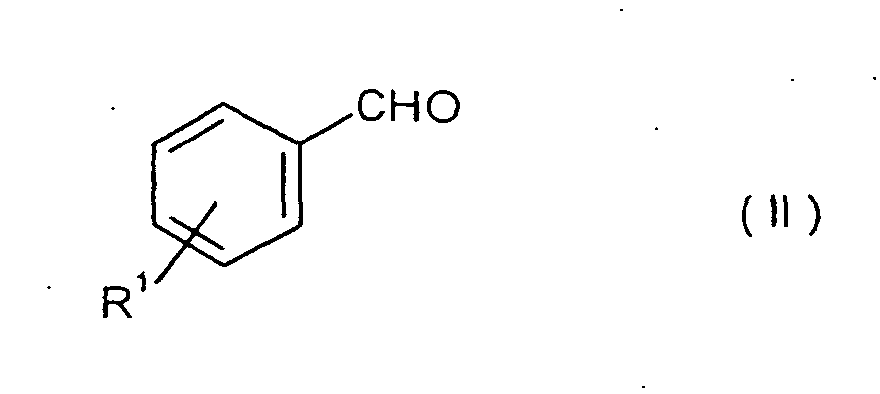
- examples are, for example, benzaldehyde and substituted benzaldehydes of the formula II, in which R 1 has the meaning given above.
- Suitable carboxylic anhydrides are C 2 -C 4 -carboxylic anhydrides.
- Examples of useful anhydrides are acetic anhydride, propionic anhydride and butyric anhydride.
- the reaction according to the invention is generally carried out by the components aromatic aldehyde, carboxylic anhydride and catalyst heated are distilled off and a carboxylic acid-carboxylic anhydride mixture simultaneously becomes.
- Carboxylic anhydride is used in an amount of 1-5 moles of the aromatic aldehyde, preferably used in an amount of 1.5-2.5 mol. Excess aromatic Aldehyde can be recovered after the reaction by distillation and for to use a new approach.
- the reaction is carried out at a temperature of 100 ° C to 200 ° C, preferably at 120 ° C up to 170 ° C performed.
- the process according to the invention can be carried out under normal pressure be executed.
- the reaction is carried out under an inert gas, For example, carried out under nitrogen to water (humidity), To exclude carbon dioxide and oxygen.
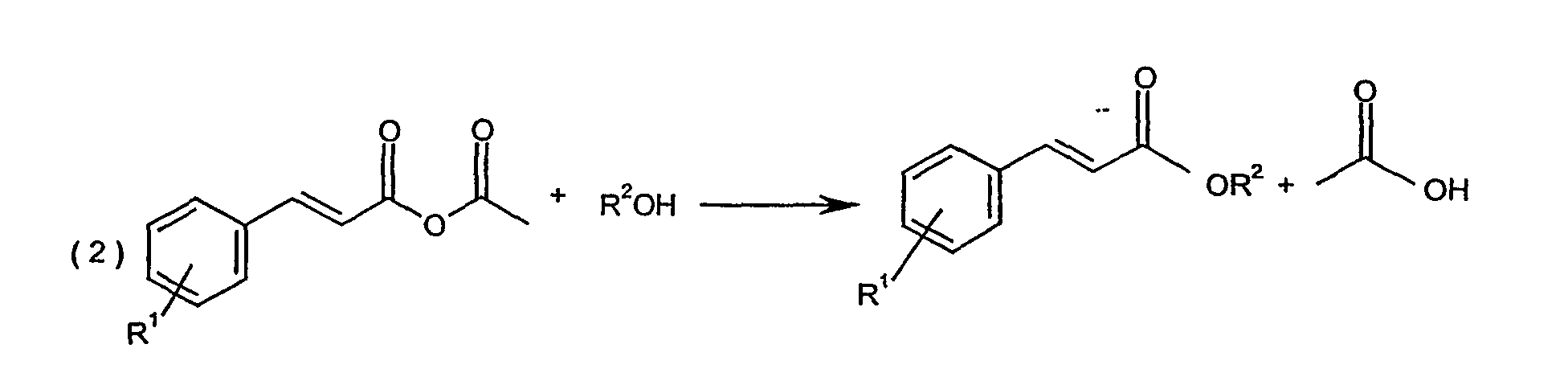
- the resulting anhydride can be converted to esters in the presence of alcohols.
- alcohols of the formula (II) are used: R 2 - OH where R 2 is hydrogen or C 1 -C 8 -alkyl.
- the alcohol may be preferred in an amount of 1-25 moles per mole of benzaldehyde 1.5-5 moles are used
- R 1 and R 2 here have the meaning already given above.
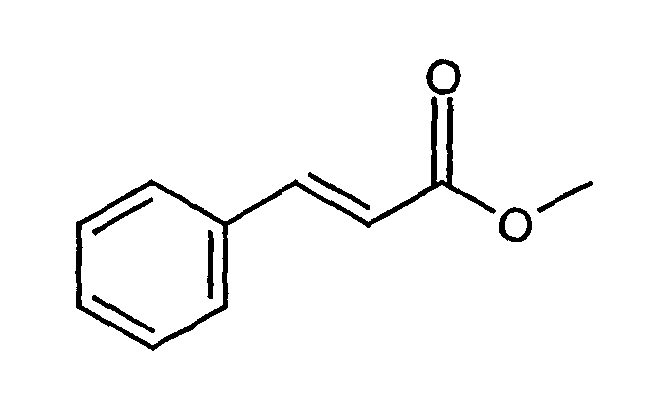
- Cinnamic acid alkyl esters are used in particular in the perfume and essences industry (Ullmanns Encyclopadie der ischen Chemie, 4th Edition, Volume 24, Page 592 (1983)).
- the formed anhydride can also be reacted in the presence of water and cinnamic acid getting produced.
- the saponification of the ester is carried out by customary methods (Houben-Weyl, Vol VIII, page 418) and is preferably carried out alkaline.
- bases for example aqueous sodium hydroxide solution or aqueous potassium hydroxide solution, preferably aqueous potassium hydroxide solution, be used.
- the base is preferred in an amount of 1-5 moles 1.5-25 moles per mole of ester present in the ester mixture.
- the saponification is at a temperature of 20-150 ° C, preferably 60-120 ° C, especially preferably carried out at 90-110 ° C. From the saponification approach is the free Cinnamic acid, for example, isolated by acidification.
- Cinnamic acid and substituted cinnamic acids find a variety of applications, for example for the production of esters for the perfume and essences industry.
- sodium cinnamate is also a corrosion inhibitor (Ullmann, Volume 24, page 592 (1983)). Cinnamic acid is also an intermediate for the production of phenylalanine (JP 81/26197), cited after Chem. Abstr. 95, 95470 b.
Landscapes
- Chemical & Material Sciences (AREA)
- Organic Chemistry (AREA)
- Engineering & Computer Science (AREA)
- Oil, Petroleum & Natural Gas (AREA)
- Chemical Kinetics & Catalysis (AREA)
- Organic Low-Molecular-Weight Compounds And Preparation Thereof (AREA)
- Low-Molecular Organic Synthesis Reactions Using Catalysts (AREA)
- Catalysts (AREA)
Description
- Kondensation von Benzaldehyd oder substituiertem Benzaldehyd mit einem Carbonsäurenanhydrid unter Bildung des entsprechenden Anhydrids, katalysiert durch ein Eisen(III)salz ausgewählt aus der Gruppe bestehend aus Eisenacetat, Eisensubcarbonat, Eisencarbonat, Eisenoxid, Eisenoxidhydrat, Eisenoxalat, Eisenlactat, Eisentartrat und Gemische dieser Eisen(III)salze,
- Umsetzung des gebildeten Anhydrids
- (a) in Gegenwart von Alkoholen zu Zimtsäureester
oder - (b) mit Wasser zu Zimtsäure.

- R1
- unabhängig voneinander für Wasserstoff, Alkyl, Cycloalkyl, Aryl, Aralkyl,
Dialkyamino, Diarylamino, Halogen, Alkoxy, Aryloxy, Cycloalkoxy, Aralkoxy,
Alkoxycarbonyl, Aryloxycarbonyl, Alkylcarbonyloxy, Alkylthio,
Arylthio, Cycloalkylthio oder Aralkylthio stehen,
Alkylreste, auch in den sauerstoffhaltigen bzw. schwefelhaltigen Substituenten, sind, mit 1-16, bevorzugt 1-10,besonders bevorzugt 1-4 C-Atomen wie Methyl, Ethyl, Propyl, Isopropyl, Butyl, Isobutyl,
Cycloalkylreste, auch in den sauerstoffhaltigen bzw. schwefelhaltigen Substituenten, sind solche mit 4-8, bevorzugt 5-6, im Ring angeordneten C-Atomen, die gegebenenfalls ein oder zwei Methyl- oder Ethylgruppen tragen können, wie Cyclobutyl, Cyclopentyl, Cyclohexyl, Cycloheptyl, Cyclooctyl, Methylcyclopentyl oder Methylcyclohexyl,
als Arylreste, auch in den sauerstoffhaltigen bzw. schwefelhaltigen Substituenten, seien Phenyl, Naphthyl, Anthryl oder Diphenyl, bevorzugt Phenyl, zu verstehen, in
der R1 für Wasserstoff, Methyl, Ethyl, Methoxy, Ethoxy oder Phenoxy steht
und - R2
- Wasserstoff oder C1 - C8 - Alkyl bedeuten.




Claims (10)
- Verfahren zur Herstellung von Zimtsäureestern und/oder Zimtsäure mit folgenden Schritten:Kondensation von Benzaldehyd oder substituiertem Benzaldehyd mit einem Carbonsäureanhydrid unter Bildung des entsprechenden Anhydrids, katalysiert durch ein Eisen(III)salz ausgewählt aus der Gruppe bestehend aus Eisenacetat, Eisensubcarbonat, Eisencarbonat, Eisenoxid, Eisenoxidhydrat, Eisenoxalat, Eisenlactat, Eisentartrat und Gemische dieser Eisen(III)salze,Umsetzung des gebildeten Anhydrids(a) in Gegenwart von Alkoholen zu Zimtsäureester
oder(b) mit Wasser zu Zimtsäure. - Verfahren nach Anspruch 1, dadurch gekennzeichnet, dass die Einsatzmenge an Eisen(III)salzen 0,0001-0,2 Moläquivalente bezogen auf die Einsatzmenge an Aldehyd beträgt.
- Verfahren nach einem der Ansprüche 1 oder 2, dadurch gekennzeichnet, dass als Carbonsäureanhydrid Essigsäureanhydrid eingesetzt wird.
- Verfahren nach einem der Ansprüche 1 bis 3, dadurch gekennzeichnet, dass das Carbonsäureanhydrid in Mengen von 1-5 Mol pro Mol Aldehyd eingesetzt wird.
- Verfahren nach einem der Ansprüche 1 bis 4, dadurch gekennzeichnet, dass die Reaktion bei Temperaturen von 100-200 °C durchgeführt wird.
- Verfahren nach einem der Ansprüche 1 bis 5, dadurch gekennzeichnet, dass die Reaktion unter Ausschluss von Sauerstoff, Wasser und Kohlendioxid durchgeführt wird.
- Verfahren nach einem der Ansprüche 1 bis 6, dadurch gekennzeichnet, dass die Reaktion in Gegenwart eines Schutzgases durchgeführt wird.
- Verfahren nach einem der Ansprüche 1 bis 7, dadurch gekennzeichnet, dass der gemäß Alternative (a) gebildete Ester durch saure oder alkalische Verseifung zu Zimtsäure umgesetzt wird.
- Verfahren nach Anspruch 8, dadurch gekennzeichnet, dass Natronlauge oder Kalilauge eingesetzt werden.
- Verfahren nach einem der Ansprüche 8 oder 9, dadurch gekennzeichnet, dass eine Lauge in einer Menge von 1-5 Mol pro Mol Ester eingesetzt wird.
Applications Claiming Priority (3)
| Application Number | Priority Date | Filing Date | Title |
|---|---|---|---|
| DE10061539A DE10061539C1 (de) | 2000-12-11 | 2000-12-11 | Verfahren zur Herstellung von Zimtsäureester |
| DE10061539 | 2000-12-11 | ||
| PCT/EP2001/014050 WO2002048086A1 (de) | 2000-12-11 | 2001-11-28 | Verfahren zur herstellung von zimtsäureester |
Publications (2)
| Publication Number | Publication Date |
|---|---|
| EP1345885A1 EP1345885A1 (de) | 2003-09-24 |
| EP1345885B1 true EP1345885B1 (de) | 2005-09-14 |
Family
ID=7666603
Family Applications (1)
| Application Number | Title | Priority Date | Filing Date |
|---|---|---|---|
| EP01270517A Expired - Lifetime EP1345885B1 (de) | 2000-12-11 | 2001-11-28 | Verfahren zur herstellung von zimtsäureester |
Country Status (8)
| Country | Link |
|---|---|
| US (1) | US6538154B2 (de) |
| EP (1) | EP1345885B1 (de) |
| AT (1) | ATE304521T1 (de) |
| AU (1) | AU2002221913A1 (de) |
| DE (2) | DE10061539C1 (de) |
| ES (1) | ES2248227T3 (de) |
| MX (1) | MXPA03005168A (de) |
| WO (1) | WO2002048086A1 (de) |
Families Citing this family (3)
| Publication number | Priority date | Publication date | Assignee | Title |
|---|---|---|---|---|
| US7741508B2 (en) * | 2006-03-30 | 2010-06-22 | Council Of Scientific & Industrial Research | Single step green process for the preparation of substituted cinnamic esters with trans-selectivity |
| CN104086414A (zh) * | 2014-07-17 | 2014-10-08 | 天宁香料(江苏)有限公司 | 一种肉桂酸正戊酯合成方法及其在香精中的应用 |
| CN106083561B (zh) * | 2016-06-07 | 2018-09-21 | 安徽圣诺贝化学科技有限公司 | 一种防晒剂中间体对甲氧基肉桂酸的制备方法 |
Family Cites Families (6)
| Publication number | Priority date | Publication date | Assignee | Title |
|---|---|---|---|---|
| JPS5115026A (ja) | 1974-07-24 | 1976-02-06 | Kanai Hiroyuki | Shinpuyokifu |
| JPS5626197A (en) | 1979-08-09 | 1981-03-13 | Tanabe Seiyaku Co Ltd | Preparation of l-phenylalanine |
| DE3144261A1 (de) * | 1981-11-07 | 1983-05-19 | Kern, Rudolf, Dr., 6730 Neustadt | Verfahren zur herstellung von zimtsaeure und cumarin |
| DE3422412A1 (de) * | 1984-06-16 | 1985-12-19 | Bayer Ag, 5090 Leverkusen | Verfahren zur herstellung eines gemisches aus einem gegebenenfalls substituierten zimtsaeureester und einem gegenbenenfalls substituierten ss-alkoxy-ss-phenyl-propionsaeureester sowie verfahren zur herstellung von gegebenenfalls substituierter zimtsaeure |
| DE3422915A1 (de) * | 1984-06-20 | 1985-12-19 | Bayer Ag, 5090 Leverkusen | Verfahren zur herstellung von gegebenenfalls kernsubstituierten zimtsaeuren |
| DE3437634A1 (de) * | 1984-10-13 | 1986-04-17 | Bayer Ag | Verfahren zur herstellung von gegebenenfalls substituierter zimtsaeure in gegenwart eines katalysators |
-
2000
- 2000-12-11 DE DE10061539A patent/DE10061539C1/de not_active Expired - Fee Related
-
2001
- 2001-11-28 ES ES01270517T patent/ES2248227T3/es not_active Expired - Lifetime
- 2001-11-28 AT AT01270517T patent/ATE304521T1/de not_active IP Right Cessation
- 2001-11-28 EP EP01270517A patent/EP1345885B1/de not_active Expired - Lifetime
- 2001-11-28 AU AU2002221913A patent/AU2002221913A1/en not_active Abandoned
- 2001-11-28 MX MXPA03005168A patent/MXPA03005168A/es active IP Right Grant
- 2001-11-28 DE DE50107453T patent/DE50107453D1/de not_active Expired - Lifetime
- 2001-11-28 WO PCT/EP2001/014050 patent/WO2002048086A1/de not_active Ceased
- 2001-12-07 US US10/013,204 patent/US6538154B2/en not_active Expired - Fee Related
Also Published As
| Publication number | Publication date |
|---|---|
| US20020082442A1 (en) | 2002-06-27 |
| DE10061539C1 (de) | 2002-07-11 |
| DE50107453D1 (de) | 2005-10-20 |
| AU2002221913A1 (en) | 2002-06-24 |
| US6538154B2 (en) | 2003-03-25 |
| ATE304521T1 (de) | 2005-09-15 |
| EP1345885A1 (de) | 2003-09-24 |
| WO2002048086A1 (de) | 2002-06-20 |
| MXPA03005168A (es) | 2004-10-14 |
| ES2248227T3 (es) | 2006-03-16 |
Similar Documents
| Publication | Publication Date | Title |
|---|---|---|
| EP1539666B1 (de) | Verfahren zur herstellung von dialdehyden und/oder ethylenisch ungesättigten monoaldehyden durch hydroformylierung ethylenisch ungesättigter verbindungen | |
| EP0352456B1 (de) | Verfahren zur Herstellung von alpha, beta -ungesättigten Ketonen | |
| EP0295553A1 (de) | Verfahren zur Herstelung von 1,1-disubstituierten Ethylenverbindungen | |
| DE10061539C1 (de) | Verfahren zur Herstellung von Zimtsäureester | |
| CH648282A5 (de) | Verfahren zur herstellung von oxocyclopentenen. | |
| DE2533387C2 (de) | Verfahren zur Herstellung von 2-Hydroxy-3-butensäureestern | |
| US3897467A (en) | Process for the preparation of {60 -ketocarboxylic acids | |
| DE3201300A1 (de) | Verfahren zur herstellung von phthalid | |
| CH646679A5 (de) | Verfahren zur herstellung von 1,5-dimethyl-bicyclo(3,2,1)octanol-8. | |
| CH628015A5 (de) | Verfahren zur decarbalkoxylierung von carbonsaeureestern. | |
| EP0866065B1 (de) | Verfahren zur Herstellung von 1,3-Dioxanverbindungen | |
| EP0421271B1 (de) | 3-substituierte 2-Hydroxy-3-formylpropionsäureester, Verfahren zu deren Herstellung sowie deren Verwendung zur Herstellung von 3-substituierten 3-Formyl-acrylsäurereestern | |
| EP1481959A1 (de) | Verfahren zur Herstellung von Lactonen und von aromatischen Hydroxycarbonsäuren | |
| EP0643036B1 (de) | Verfahren zur Herstellung von Pimelinsäureestern | |
| CH650488A5 (de) | Verfahren zur herstellung des m-phenoxy-benzyl-alkohols. | |
| DE3338547C2 (de) | Verfahren zur Herstellung von 2,2,4-Trimethyl-1,3-pentandioldiisobutyrat | |
| CH628868A5 (en) | Process for the preparation of acyclic monoterpene alcohols | |
| DE2938689A1 (de) | Aliphatische methoxy- und hydroxynitrile, deren herstellung und deren verwendung als riechstoff | |
| EP0606058A2 (de) | Halogenierte Zimtsäuren und deren Ester, sowie Verfahren zu ihrer Herstellung und halogenierte Aryldiazoniumsalze | |
| AT203474B (de) | Verfahren zur Herstellung von α,β-ungesättigten Aldehyden | |
| EP0144884B1 (de) | Verfahren zur Herstellung von alpha-substituierten Acrylsäureamiden | |
| DE2521610C2 (de) | Verfahren zur Herstellung von Arylessigsäuren und deren Estern | |
| DE4407494A1 (de) | Verfahren zur katalytischen Abspaltung von Carbonsäureester- und Acylgruppen aus organischen Verbindungen | |
| DE3343674A1 (de) | Verfahren zur herstellung von (alpha) -substituierten acrylsaeureamiden | |
| CH654577A5 (de) | Verfahren zur herstellung von 6-methylnikotinsaeureester. |
Legal Events
| Date | Code | Title | Description |
|---|---|---|---|
| PUAI | Public reference made under article 153(3) epc to a published international application that has entered the european phase |
Free format text: ORIGINAL CODE: 0009012 |
|
| 17P | Request for examination filed |
Effective date: 20030711 |
|
| AK | Designated contracting states |
Kind code of ref document: A1 Designated state(s): AT BE CH CY DE DK ES FI FR GB GR IE IT LI LU MC NL PT SE TR |
|
| AX | Request for extension of the european patent |
Extension state: AL LT LV MK RO SI |
|
| 17Q | First examination report despatched |
Effective date: 20041214 |
|
| GRAP | Despatch of communication of intention to grant a patent |
Free format text: ORIGINAL CODE: EPIDOSNIGR1 |
|
| GRAS | Grant fee paid |
Free format text: ORIGINAL CODE: EPIDOSNIGR3 |
|
| GRAA | (expected) grant |
Free format text: ORIGINAL CODE: 0009210 |
|
| AK | Designated contracting states |
Kind code of ref document: B1 Designated state(s): AT BE CH CY DE DK ES FI FR GB GR IE IT LI LU MC NL PT SE TR |
|
| PG25 | Lapsed in a contracting state [announced via postgrant information from national office to epo] |
Ref country code: IT Free format text: LAPSE BECAUSE OF FAILURE TO SUBMIT A TRANSLATION OF THE DESCRIPTION OR TO PAY THE FEE WITHIN THE PRESCRIBED TIME-LIMIT;WARNING: LAPSES OF ITALIAN PATENTS WITH EFFECTIVE DATE BEFORE 2007 MAY HAVE OCCURRED AT ANY TIME BEFORE 2007. THE CORRECT EFFECTIVE DATE MAY BE DIFFERENT FROM THE ONE RECORDED. Effective date: 20050914 Ref country code: TR Free format text: LAPSE BECAUSE OF FAILURE TO SUBMIT A TRANSLATION OF THE DESCRIPTION OR TO PAY THE FEE WITHIN THE PRESCRIBED TIME-LIMIT Effective date: 20050914 Ref country code: NL Free format text: LAPSE BECAUSE OF FAILURE TO SUBMIT A TRANSLATION OF THE DESCRIPTION OR TO PAY THE FEE WITHIN THE PRESCRIBED TIME-LIMIT Effective date: 20050914 Ref country code: FI Free format text: LAPSE BECAUSE OF FAILURE TO SUBMIT A TRANSLATION OF THE DESCRIPTION OR TO PAY THE FEE WITHIN THE PRESCRIBED TIME-LIMIT Effective date: 20050914 Ref country code: IE Free format text: LAPSE BECAUSE OF FAILURE TO SUBMIT A TRANSLATION OF THE DESCRIPTION OR TO PAY THE FEE WITHIN THE PRESCRIBED TIME-LIMIT Effective date: 20050914 |
|
| REG | Reference to a national code |
Ref country code: GB Ref legal event code: FG4D Free format text: NOT ENGLISH |
|
| REG | Reference to a national code |
Ref country code: CH Ref legal event code: EP Ref country code: CH Ref legal event code: NV Representative=s name: E. BLUM & CO. PATENTANWAELTE |
|
| REG | Reference to a national code |
Ref country code: IE Ref legal event code: FG4D Free format text: LANGUAGE OF EP DOCUMENT: GERMAN |
|
| REF | Corresponds to: |
Ref document number: 50107453 Country of ref document: DE Date of ref document: 20051020 Kind code of ref document: P |
|
| GBT | Gb: translation of ep patent filed (gb section 77(6)(a)/1977) |
Effective date: 20051020 |
|
| PG25 | Lapsed in a contracting state [announced via postgrant information from national office to epo] |
Ref country code: AT Free format text: LAPSE BECAUSE OF NON-PAYMENT OF DUE FEES Effective date: 20051128 Ref country code: CY Free format text: LAPSE BECAUSE OF FAILURE TO SUBMIT A TRANSLATION OF THE DESCRIPTION OR TO PAY THE FEE WITHIN THE PRESCRIBED TIME-LIMIT Effective date: 20051128 |
|
| PG25 | Lapsed in a contracting state [announced via postgrant information from national office to epo] |
Ref country code: LU Free format text: LAPSE BECAUSE OF NON-PAYMENT OF DUE FEES Effective date: 20051130 Ref country code: BE Free format text: LAPSE BECAUSE OF NON-PAYMENT OF DUE FEES Effective date: 20051130 Ref country code: MC Free format text: LAPSE BECAUSE OF NON-PAYMENT OF DUE FEES Effective date: 20051130 |
|
| PG25 | Lapsed in a contracting state [announced via postgrant information from national office to epo] |
Ref country code: SE Free format text: LAPSE BECAUSE OF FAILURE TO SUBMIT A TRANSLATION OF THE DESCRIPTION OR TO PAY THE FEE WITHIN THE PRESCRIBED TIME-LIMIT Effective date: 20051214 Ref country code: DK Free format text: LAPSE BECAUSE OF FAILURE TO SUBMIT A TRANSLATION OF THE DESCRIPTION OR TO PAY THE FEE WITHIN THE PRESCRIBED TIME-LIMIT Effective date: 20051214 Ref country code: GR Free format text: LAPSE BECAUSE OF FAILURE TO SUBMIT A TRANSLATION OF THE DESCRIPTION OR TO PAY THE FEE WITHIN THE PRESCRIBED TIME-LIMIT Effective date: 20051214 |
|
| PG25 | Lapsed in a contracting state [announced via postgrant information from national office to epo] |
Ref country code: PT Free format text: LAPSE BECAUSE OF FAILURE TO SUBMIT A TRANSLATION OF THE DESCRIPTION OR TO PAY THE FEE WITHIN THE PRESCRIBED TIME-LIMIT Effective date: 20060214 |
|
| NLV1 | Nl: lapsed or annulled due to failure to fulfill the requirements of art. 29p and 29m of the patents act | ||
| REG | Reference to a national code |
Ref country code: ES Ref legal event code: FG2A Ref document number: 2248227 Country of ref document: ES Kind code of ref document: T3 |
|
| REG | Reference to a national code |
Ref country code: IE Ref legal event code: FD4D |
|
| ET | Fr: translation filed | ||
| PLBE | No opposition filed within time limit |
Free format text: ORIGINAL CODE: 0009261 |
|
| STAA | Information on the status of an ep patent application or granted ep patent |
Free format text: STATUS: NO OPPOSITION FILED WITHIN TIME LIMIT |
|
| 26N | No opposition filed |
Effective date: 20060615 |
|
| REG | Reference to a national code |
Ref country code: CH Ref legal event code: PFA Owner name: SYMRISE GMBH & CO. KG Free format text: SYMRISE GMBH & CO. KG#MUEHLENFELDSTRASSE 1#37603 HOLZMINDEN (DE) -TRANSFER TO- SYMRISE GMBH & CO. KG#MUEHLENFELDSTRASSE 1#37603 HOLZMINDEN (DE) |
|
| BERE | Be: lapsed |
Owner name: SYMRISE G.M.B.H. & CO. KG Effective date: 20051130 |
|
| PGFP | Annual fee paid to national office [announced via postgrant information from national office to epo] |
Ref country code: GB Payment date: 20121122 Year of fee payment: 12 Ref country code: ES Payment date: 20121122 Year of fee payment: 12 |
|
| PGFP | Annual fee paid to national office [announced via postgrant information from national office to epo] |
Ref country code: FR Payment date: 20121217 Year of fee payment: 12 |
|
| REG | Reference to a national code |
Ref country code: FR Ref legal event code: TP Owner name: SYMRISE AG, DE Effective date: 20131022 |
|
| REG | Reference to a national code |
Ref country code: CH Ref legal event code: PFUS Owner name: SYMRISE AG, DE Free format text: FORMER OWNER: SYMRISE GMBH AND CO. KG, DE |
|
| GBPC | Gb: european patent ceased through non-payment of renewal fee |
Effective date: 20131128 |
|
| REG | Reference to a national code |
Ref country code: FR Ref legal event code: ST Effective date: 20140731 |
|
| PG25 | Lapsed in a contracting state [announced via postgrant information from national office to epo] |
Ref country code: FR Free format text: LAPSE BECAUSE OF NON-PAYMENT OF DUE FEES Effective date: 20131202 Ref country code: GB Free format text: LAPSE BECAUSE OF NON-PAYMENT OF DUE FEES Effective date: 20131128 |
|
| REG | Reference to a national code |
Ref country code: ES Ref legal event code: FD2A Effective date: 20150407 |
|
| PG25 | Lapsed in a contracting state [announced via postgrant information from national office to epo] |
Ref country code: ES Free format text: LAPSE BECAUSE OF NON-PAYMENT OF DUE FEES Effective date: 20131129 |
|
| PGFP | Annual fee paid to national office [announced via postgrant information from national office to epo] |
Ref country code: DE Payment date: 20201125 Year of fee payment: 20 Ref country code: CH Payment date: 20201124 Year of fee payment: 20 |
|
| REG | Reference to a national code |
Ref country code: DE Ref legal event code: R071 Ref document number: 50107453 Country of ref document: DE |