EP1341110A2 - Verfahren, System und Computerprogrammprodukt zur Darbietung von Multimedia-Inhalten in Aufzugsanlagen - Google Patents
Verfahren, System und Computerprogrammprodukt zur Darbietung von Multimedia-Inhalten in Aufzugsanlagen Download PDFInfo
- Publication number
- EP1341110A2 EP1341110A2 EP03003542A EP03003542A EP1341110A2 EP 1341110 A2 EP1341110 A2 EP 1341110A2 EP 03003542 A EP03003542 A EP 03003542A EP 03003542 A EP03003542 A EP 03003542A EP 1341110 A2 EP1341110 A2 EP 1341110A2
- Authority
- EP
- European Patent Office
- Prior art keywords
- multimedia content
- computer program
- program product
- user
- content
- Prior art date
- Legal status (The legal status is an assumption and is not a legal conclusion. Google has not performed a legal analysis and makes no representation as to the accuracy of the status listed.)
- Granted
Links
Images
Classifications
-
- G—PHYSICS
- G06—COMPUTING OR CALCULATING; COUNTING
- G06Q—INFORMATION AND COMMUNICATION TECHNOLOGY [ICT] SPECIALLY ADAPTED FOR ADMINISTRATIVE, COMMERCIAL, FINANCIAL, MANAGERIAL OR SUPERVISORY PURPOSES; SYSTEMS OR METHODS SPECIALLY ADAPTED FOR ADMINISTRATIVE, COMMERCIAL, FINANCIAL, MANAGERIAL OR SUPERVISORY PURPOSES, NOT OTHERWISE PROVIDED FOR
- G06Q30/00—Commerce
- G06Q30/02—Marketing; Price estimation or determination; Fundraising
-
- B—PERFORMING OPERATIONS; TRANSPORTING
- B66—HOISTING; LIFTING; HAULING
- B66B—ELEVATORS; ESCALATORS OR MOVING WALKWAYS
- B66B3/00—Applications of devices for indicating or signalling operating conditions of elevators
- B66B3/002—Indicators
- B66B3/008—Displaying information not related to the elevator, e.g. weather, publicity, internet or TV
Definitions
- the invention relates to a method, a system and a Computer program product for the presentation of multimedia content in elevator systems according to the definition of the claims.
- US 6,288,688 discloses a computerized system for distribution and Display of digital advertising (short messages) in elevator cars.
- Elevator cabs are assembled using screens that communicate with each other are connected to a control unit.
- the control unit has a data memory digital advertising.
- the digital advertising is individually addressed to the screens sent.
- Multimedia is the integration of different media in one device Roger that.
- Multimedia content consists of pieces of music, SMS (Short Message Service), EMS (Enhanced Messaging Service), MMS (Multimedia Messaging Service), Texts, images, videos, films, but also from scents, lighting effects, etc.
- Multimedia content can be computerized via input and output means such as screens, Perform speakers, keyboards, microphones, atomizers, lamps, etc.
- the object of the present invention is a method, a system and a Computer program product ready to deliver multimedia content in elevator systems darzubieten. In particular, they should be customized to the user of the elevator system tailored multimedia content is presented.
- At least one individual user profile is provided for a user Multimedia content.
- This user profile is personalized, i.e. it contains preferred multimedia content selected by the user.
- the user profile is rich, i.e. the user chooses preferred multimedia content from a large one Offer from.
- the user profile is extensive, i.e. the user receives multimedia content, wherever he is identified.
- the user is one before or after entering Elevator car identified. Identification is preferably carried out using an identification code. The validity of this recognized identification code is checked by a Test device checked. If the identification code is valid, the user is regarded as identified.
- the multimedia content contained in his user profile becomes an identified user presented.
- These multimedia contents are advantageously made up of at least loaded into a content database and via at least one output means in front of or in presented to the elevator car.
- Multimedia content is provided by at least one Provider provided and stored in the content database on demand.
- the multimedia contents are advantageously categorized according to demographic Funding preferences, psychographic funding preferences and situational Funding preferences presented.
- the communication of the content database or the outside world with the actual one The elevator system is built over a protective wall.
- the multimedia content is thus through the protective wall is provided separately from the elevator system. Any hackers and Internet viruses are thus accessed via the elevator system Communication means with the outside world hindered.
- the system works with known and proven means of communication technology and can be retrofitted in installed elevator systems.
- at least one Recognition device for recognizing an identification code
- at least one Test device for identifying a user on the basis of a recognized identification code
- at least one content database for maintaining at least one user profile with multimedia content
- at least one output means for presenting im User profile-guided multimedia content installed.
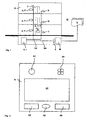
- FIG. 1 schematically shows an exemplary embodiment of a system for the presentation of multimedia content in elevator systems.
- the system comprises at least one recognition device E , at least one test device P , at least one identification database I , at least one elevator control B , at least one content database M and at least one output means A.
- the elevator installation is installed in a building G or building complex and transports users from one floor to another floor. 1 three floors are shown.
- the elevator installation is operated, for example, electrically or hydraulically.
- a recognition device E and an output means A are advantageously mounted next to a floor door to the elevator installation on each floor. Alternatively, it is of course possible to mount only a single detection device E , for example on the ground floor of building G.
- An output means A is advantageously installed in an elevator car of the elevator installation.
- the elevator car is located on the ground floor of building G , and through the open elevator doors an output means A of the elevator car can be seen.
- the test device P, the identification database I and the content database M are in a basement of the building G and the elevator control B is on an upper floor of the building G.
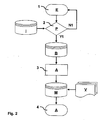
- the recognition device E forwards the recognized identification code for the test 2 to the test device P.
- At least one test device P is necessary; several test devices P can be used.
- the test device P is computer-aided.
- "Computer-aided” is understood to mean a commercially available computing unit such as a PC (personal computer) with the Windows, Apple, etc. operating system, or a workstation with the UNIX operating system, etc.
- the identification database I is preferably a relational database such as Access, Lotus Notes, Oracle, SAP, etc. or an XML (Extensible Markup Language) database, etc.
- the identification database I can be arranged in a computer-aided device. Detection device E , test device P and identification database I are provided with inputs and outputs for communication.
- recognition device E test device P and identification database I preferably takes place on a recognition bus EP according to a known standard protocol such as PCI (Peripheral Component Interconnect) bus, Ethernet, token ring, etc., preferably by radio and / or cable.
- the test device P can be designed to be mobile or stationary.
- Test device P and identification database I can - as shown in FIG. 1 - be integrated in a single housing, but they can also be placed separately at different locations.
- recognition device E test device P and identification database I in a single housing.
- test device P and output means A - as shown in FIG. 1 - in a single housing.
- a computer program product is advantageously installed in the test device P.
- the computer program product compares the identified identification code with identification addresses which are stored in the identification database I.
- the user can be clearly identified via an identification address.
- an identification address can be assigned to a recognized identification code if and only if the identification address and identification code are identical.
- the computer program product then delivers a positive assignment result Y1 if one of the stored identification addresses is identical to the identification code, otherwise the computer program product delivers a negative assignment result N1 .
- Such a negative assignment result is transmitted, for example, to the recognition device E , from which the identification code was transmitted, and the user is prompted via an output means A of this recognition device E to register again 1 .
- the user can be assigned a neutral, non-individualized guest address.
- the computer program product is written, for example, in a common and proven computer language.
- the computer program product is stored in a memory and is loaded into a processor in order to execute the computer program product.
- the user identified according to an identification code is provided with 3 multimedia content from the content database M in one call.
- the content database M is computer-aided. It has inputs and outputs for communication with the test device P , the output means A and the provider V.
- At least one computer program product is advantageously installed in the content database I , which assigns a user profile with multimedia content stored in the content database M to an identification address of the user.
- the multimedia content consists of pieces of music, SMS, EMS, MMS, texts, images, videos, films, scents, light effects, etc.
- the computer program product can be written in a common and proven computer language.
- the computer program product is stored in a memory and is loaded into a processor in order to execute the computer program product.
- the multimedia content corresponding to an identification address is presented in a presentation 5 on the output means A in front of or in the elevator car.
- the content database M and the output means A preferably communicate on a content bus MA according to a known standard protocol such as PCI bus, Ethernet, token ring, etc. by cable and / or by radio. It is of course also possible to transmit multimedia content by post - for example stored on a CD (compact disk).
- the output means A communicates with the output means A in the floors by cable to the content database M, while the output means A in the elevator car by radio via a transmitter F and wired with the content database M communicated.
- the output means A is a screen with a plurality of areas A1, A2, A3, A4, A5, A6 .
- the output means A is a computer-assisted screen with first, second, third and fourth areas A1, A2, A3, A4 for outputting multimedia content and with fifth and sixth areas A5, A6 for communication with the content database M.
- the communication is preferably bidirectional.
- the output means A receives from the content database M multimedia content and outputs them graphically in a first area A1 and in a second region A2 acoustically or in a third region A3 optically aromatic or in a fourth area A4.
- the first area A1 is a screen
- the second area A2 is a loudspeaker
- the third area A3 is a fragrance machine
- the fourth area A4 is an alternator.
- a fragrance machine is understood to mean an atomizer with one fragrance or with several, freely selectable and mixable fragrances, which atomizer atomizes these fragrance / fragrances.
- An alternator is understood to mean at least one controllable or regulatable lamp, which lamp emits light effects.
- the output means A advantageously transmits signals to the content database M or to the test device P.
- the fifth and sixth areas A5, A6 are touch-sensitive and allow the generation of such signals by the user.
- a user can, for example, confirm or deselect multimedia content.
- the user operates a fifth area A5
- to deselect one of a multimedia content the user operates a sixth area A6 .
- the multimedia content is considered desirable.
- other means of generating such signals - such as a microphone coupled with speech recognition - can also be used to detect voice commands.
- the person skilled in the art has numerous possibilities in this regard with knowledge of the present invention.
- At least one computer program product is advantageously installed in the content database I , which transmits multimedia content of a user profile to an output means A as at least one cookie.
- a cookie is understood to mean a file that has a sequence of multimedia content that is presented in a specific order.
- a cookie consists of a sequence of ten pages, which is presented in the order from page 1 to page 10.
- this is a continuation story that is presented to a user in the case of successive promotions in the elevator.
- the cookie notes the current status of the sequence, so that after pages 1 and 2 have been presented, for example, page 3 is displayed for successive transport.
- Such a cookie can advantageously be stored in a data memory of the output means A.
- the content database I advantageously transmits the cookie directly to the output means A , in the vicinity of which the user is located.
- an output means A receives a message from the elevator control B, for example, that a user identified with an identification code is in the vicinity.
- the output means A registers with the content database I.
- the output means A transmits the identification address of the identified user to the content database I.
- the computer program product assigns a user profile with multimedia content to this identification address and transmits multimedia content of this user profile to this output means A.
- the computer program product is written, for example, in a common and proven computer language.
- the computer program product is stored in a memory and is loaded into a processor in order to execute the computer program product.
- the multimedia content is advantageously presented in a structure by a system architect.
- the structure comprises a framework, for example a sequence of pages or columns in pages, in which framework the multimedia content is filled.
- the multimedia content is structured as a flash film using software called Flash from Macromedia.
- the Flash software allows simple and quick creation of attractive designs, unusual animations that are provided with music.
- Other software such as HTML (HyperText Markup Language) can of course also be used.
- the multimedia content is categorized.
- the system architect offers the user in offers a variety of categorized multimedia content to his user profile.
- Such Categories are advantageously divided into funding preferences such as demographic Funding preferences, psychographic funding preferences and situational Feed preferences.
- a computer program product is advantageously provided which contains multimedia content categorized for a user profile.
- the computer program product is for example, written in a common and proven computer language.
- the computer program product is stored in memory and is loaded into a processor to execute the computer program product.
- each Category has at least one specific multimedia content.
- the Category "information preference" specific multimedia content such as "weather forecast, Horoscope, stock market mirror, sports news, news, local news, etc. "on.
- the different categories are related to each other according to at least one logical gate like "AND”, “OR”, “NOT” can be linked.
- one modulate psychographic funding preference by a situational funding preference for example by adjusting the "information preference” with the "period preference”, such that the weather forecast in the morning, the stock market mirror at noon and the evening Actualities are presented.
- the multimedia content is thus scalable, i.e. in the three-dimensional space that is dimensioned by the degree of personalization, Richness and reach is tense, the user will have a structure with specific multimedia content is provided, which is valuable, present optimal content.
- the multimedia content is advantageously obtained from the provider V.
- the content database M advantageously communicates with the provider V on a means of communication such as the Internet and via established standard protocols such as TCP / IP (Transmission Control Protocol / Internet Protocol), FTP (File Transfer Protocol), etc.
- the content database M advantageously works with software based on the Open Services Gateway Initiative (OSGi) specification.
- OSGi has set a well-respected open standard, whereby the update and upgrade options of multimedia content by the provider V enable topicality and a high degree of customization.
- the multimedia content is preferably obtained from provider V using an order form.
- a computer program product is advantageously provided, which lists the multimedia content to be updated by the provider V for the entire content database M and per update interval.
- the computer program product is written, for example, in a common and proven computer language.
- the computer program product is stored in a memory and is loaded into a processor in order to execute the computer program product.
- the update intervals can vary depending on the category, for example the horoscope is updated every 24 hours, the weather report is updated every 12 hours, while the stock exchange index is updated every 2 minutes. Exemplary update intervals are every 24 or every 8 every 2 hours or every 60 or every 15 or every 2 minutes or every 60 or every 15 seconds.
- the content database M is arranged as a separate computing unit in the building G of the elevator system, while the provider V is in an outside world W , outside the building G.
- the content database M is provided with a protective wall S.
- the communication of the content database M with the actual elevator system in building G takes place via this protective wall S.
- a computer program product is advantageously provided which loads the multimedia content through the protective wall S into the elevator system: the computer program product is written, for example, in a common and proven computer language.
- the computer program product is stored in a memory and is loaded into a processor in order to execute the computer program product.
- the protective wall S monitors and regulates the access from the content database M to the recognition device E , to the test device P , to the identification database I , to the output means A and to the elevator control B via standard protocol.
- a protective wall S is software that is commercially available from companies such as McAfee, PGP (Pretty Good Privacy), Symantec, etc.
- a protective wall S works with security criteria such as identification number, encryption certificates, etc.
- a protective wall S is installed in a separate computing unit.
- the content database M arranged in the building G of the elevator installation is thus readable / writable for the outside world W via standard protocols, however any hackers and Internet viruses are protected by the protective wall S at access to access to the detection device E , to the test device P Identification database I , the output means A and the elevator control B prevented.
- the content database M can just as well be a central, national or global remote server, the elevator systems in several buildings, cities, countries with multimedia content operated centrally.
Landscapes
- Business, Economics & Management (AREA)
- Strategic Management (AREA)
- Engineering & Computer Science (AREA)
- Accounting & Taxation (AREA)
- Development Economics (AREA)
- Finance (AREA)
- Economics (AREA)
- Game Theory and Decision Science (AREA)
- Entrepreneurship & Innovation (AREA)
- Marketing (AREA)
- Physics & Mathematics (AREA)
- General Business, Economics & Management (AREA)
- General Physics & Mathematics (AREA)
- Theoretical Computer Science (AREA)
- Indicating And Signalling Devices For Elevators (AREA)
- Management, Administration, Business Operations System, And Electronic Commerce (AREA)
- Information Retrieval, Db Structures And Fs Structures Therefor (AREA)
- Elevator Control (AREA)
Abstract
Description
- Fig. 1
- eine schematische Darstellung einer beispielhaften Ausführungsform eines Systems zur Darbietung von Multimedia-Inhalte in Aufzugsanlagen,
- Fig. 2
- eine Prinzipdarstellung eines Systems zur Darbietung von Multimedia-Inhalte in Aufzugsanlagen, und
- Fig. 3
- eine schematische Darstellung eines Ausgabemittels für das System gemäss Fig. 1 oder 2.
- In einer ersten bevorzugten Ausführungsform der Anmeldung 1 wird der Identifikations-Code von einem Identifikationsgeber an die Erkennungsvorrichtung E übermittelt. Ein solches berührungsloses Erkennen eines Identifikations-Codes ist aus der Schrift EP 699,617 bekannt. Der Identifikationsgeber ist hier ein Transponder mit Transponderantenne und Geber-Elektronik. Die Geber-Elektronik des Identifikationsgebers weist eine Sende- und Empfangseinheit und einen Datenspeicher mit mindestens einem Identifikations-Code auf. Der Identifikationsgeber wird durch Induktion über ein elektromagnetisches Feld mit einer Betriebsspannung gespeist. Vorzugsweise strahlt die Erkennungsvorrrichtung E ein solches elektromagnetisches Feld ab. Sobald sich der Identifikationsgeber in der Nähe der Erkennungsvorrichtung E befindet, wird er mit Energie versorgt und sendet den Identifikations-Code an die Erkennungsvorrichtung E. Beispielsweise wird der Identifikationsgeber hierzu in einige Zentimeter bis mehrere Meter Entfernung vor die Erkennungsvorrichtung E gehalten. Die Erkennungsvorrichtung E empfängt den Identifikations-Code über eine entsprechend ausgebildete Sende- und Empfangsantenne. Beliebige les- bzw. beschreibbare Informationsgeber respektive Erkennungsvorrichtungen lassen sich realisieren. So sind Informationsgeber, die auf der Basis von Licht berührungslos mit einer Erkennungsvorrichtung wie ein Scanner kommunizieren, ebenfalls anwendbar. Auch sind Informationsgeber in Form von Magnetkarten, elektronischen Chips, usw., die über mindestens einen vermittelnden Kontakt mit einer Erkennungsvorrichtung kommunizieren, anwendbar.
- In weiteren Ausführungsformen der Anmeldung 1 wird der Identifikations-Code vom Benutzer mechanisch, beispielsweise über eine Tastatur der Erkennungsvorrichtung E und/oder akkustisch, beispielsweise über ein Mikrofon der Erkennungsvorrichtung E einzugeben. Natürlich kann der Fachmann bei Kenntnis der vorliegenden Erfindung andere Eingabemittel wie ein Ausgabemittel A mit berührungsempfindlicher Bildschirm-Oberfläche, eine Mobile-Telefon-Tastatur, usw. benutzen.
- Schliesslich ist es möglich, einen biometrischen Identifikations-Code des Benutzers wie einen Fingerabdruck, ein Irismuster, eine Gesichtskontur, usw. mit einer Erkennungsvorrichtung zu erkennen.
- die Darbietungssprache (beispielsweise DE, GB, FR, IT, usw.)
- das Geschlecht des Benutzers (männlich / weiblich)
- das Alter des Benutzers (beispielsweise unterteilt in Altersklassen von 0-13, 14-20, 21-30, 31-40, 41-50, 51-65, 66-80, 81-120 Jahren)
- Zivilstand (beispielsweise ledig, verheiratet, geschieden, verwitwet)
- Einkommen (beispielweise unterteilt in Einkommensklassen von 0-30,000, 30,001-60,000, 60,001-90,000, 90,001-120,000, 120,001-180,000, >180,000 CHF/Jahr)
- Informationspräferenzen (beispielsweise Wetterbericht, Horoskop, Börsenspiegel, Sportnachrichten, Aktualitäten, Lokalnachrichten, usw.)
- Kulturpräferenzen (beispielsweise italienisches Essen, chinesisches Essen, Wein, Zigarren, usw.)
- Musikpräferenzen (beispielsweise Popmusik, klassische Musik, Jazz-Musik, usw.)
- Duftpräferenzen (beispielsweise Lavendel, Pfefferminze, Eukalyptus, usw.)
- Lichtpräferenzen (beispielsweise heftige Blitze, mattes warmes Licht, usw.)
- Zonenpräferenzen (beispielsweise vorbestimmte Zonen, Stockwerke eines Gebäudes G)
- Periodenpräferenzen (beispielsweise vorbestimmte Perioden (Vormittags, Nachmittags, Nachts), Uhrzeiten (, Kaffeepausenzeit, Mittagszeit), usw.)
Claims (7)
- Verfahren zur Darbietung von Multimedia-Inhalten in Aufzugsanlagen,
dadurch gekennzeichnet, dass für einen Benutzer mindestens ein individuelles Benutzerprofil (BP, BP', BP") mit Multimedia-Inhalten geführt wird,
dass die Multimedia-Inhalte durch einen Schutzwall (S) von der Aufzugsanlage separiert bereitgestellt werden,
dass der Benutzer identifiziert wird, und
dass dem identifizierten Benutzer die in seinem Benutzerprofil (BP, BP', BP") geführten Multimedia-Inhalte dargeboten werden. - Verfahren gemäss Anspruch 1, dadurch gekennzeichnet, dass die Multimedia-Inhalte bei mindestens einem Provider (V) bezogen werden und/oder dass die Multimedia-Inhalte bei mindestens einem Provider (V) aktualisiert werden.
- Verfahren gemäss Anspruch 1 oder 2, dadurch gekennzeichnet, dass die Multimedia-Inhalte in einer Inhalte-Datenbank (M) separiert bereitgestellt werden und dass die Multimedia-Inhalte aus der Inhalte-Datenbank (M) über den Schutzwall (S) an mindestens ein Ausgabemittel (A) übermittelt und dem Benutzer dargeboten werden.
- System zur Darbietung von Multimedia-Inhalten in Aufzugsanlagen,
dadurch gekennzeichnet, dass mindestens eine Erkennungsvorrichtung (E) einen Identifikations-Code erkennt,
dass mindestens eine Prüfvorrichtung (P) den erkannten Identifikations-Code identifiziert,
dass mindestens eine Inhalte-Datenbank (M) für einen Benutzer mindestens ein individuelles Benutzerprofil (BP, BP', BP") mit Multimedia-Inhalten führt,
dass die Inhalte-Datenbank (M) Inhalte durch einen Schutzwall (S) von der Aufzugsanlage separiert ist und
dass mindestens ein Ausgabemittel (A) die Multimedia-Inhalte des Benutzerprofiles (BP, BP', BP") darbietet. - Computerprogrammprodukt zur Darbietung von Multimedia-Inhalten in Aufzugsanlagen,
dadurch gekennzeichnet, dass das Computerprogrammprodukt mindestens einen erkannten Identifikations-Code eines Benutzers mit Identifikations-Adressen vergleicht,
dass das Computerprogrammprodukt den Benutzer durch Zuordnung des erkannten Identifikations-Codes zu einer Identifikations-Adresse identifiziert,
dass das Computerprogrammprodukt der Identifikations-Adresse ein individuelles Benutzerprofil (BP, BP', BP") mit Multimedia-Inhalten zuordnet, und
dass das Computerprogrammprodukt die Multimedia-Inhalte über einen Schutzwall (S) in die Aufzugsanlage lädt. - Computerprogrammprodukt gemäss Anspruch 5, dadurch gekennzeichnet, dass das Computerprogrammprodukt Multimedia-Inhalte bei mindestens einem Provider (V) bezieht und/oder dass das Computerprogrammprodukt Multimedia-Inhalte bei mindestens einem Provider (V) aktualisiert.
- Computerprogrammprodukt gemäss Anspruch 5 oder 6, dadurch gekennzeichnet, dass das Computerprogrammprodukt Multimedia-Inhalte über den Schutzwall (S) an mindestens ein Ausgabemittel (A) übermittelt.
Priority Applications (1)
| Application Number | Priority Date | Filing Date | Title |
|---|---|---|---|
| EP03003542.2A EP1341110B1 (de) | 2002-03-01 | 2003-02-17 | Verfahren, System und Computerprogrammprodukt zur Darbietung von Multimedia-Inhalten in Aufzugsanlagen |
Applications Claiming Priority (3)
| Application Number | Priority Date | Filing Date | Title |
|---|---|---|---|
| EP02405158 | 2002-03-01 | ||
| EP02405158 | 2002-03-01 | ||
| EP03003542.2A EP1341110B1 (de) | 2002-03-01 | 2003-02-17 | Verfahren, System und Computerprogrammprodukt zur Darbietung von Multimedia-Inhalten in Aufzugsanlagen |
Publications (3)
| Publication Number | Publication Date |
|---|---|
| EP1341110A2 true EP1341110A2 (de) | 2003-09-03 |
| EP1341110A3 EP1341110A3 (de) | 2005-06-29 |
| EP1341110B1 EP1341110B1 (de) | 2014-06-25 |
Family
ID=27798953
Family Applications (1)
| Application Number | Title | Priority Date | Filing Date |
|---|---|---|---|
| EP03003542.2A Expired - Lifetime EP1341110B1 (de) | 2002-03-01 | 2003-02-17 | Verfahren, System und Computerprogrammprodukt zur Darbietung von Multimedia-Inhalten in Aufzugsanlagen |
Country Status (5)
| Country | Link |
|---|---|
| US (1) | US7000735B2 (de) |
| EP (1) | EP1341110B1 (de) |
| JP (1) | JP2003330963A (de) |
| CN (1) | CN1243323C (de) |
| CA (1) | CA2419874C (de) |
Families Citing this family (17)
| Publication number | Priority date | Publication date | Assignee | Title |
|---|---|---|---|---|
| JP2003323446A (ja) * | 2002-03-01 | 2003-11-14 | Inventio Ag | エレベータ設備におけるマルチメディアコンテンツ提示の手順、システムおよびコンピュータプログラム製品 |
| US7319967B2 (en) * | 2002-03-01 | 2008-01-15 | Inventio Ag | Procedures, system and computer program for the presentation of multimedia contents in elevator installations |
| KR100606198B1 (ko) * | 2005-03-21 | 2006-08-02 | 새한엘리베이터 주식회사 | 터치스크린 엘리베이터 제어장치 |
| TWI292667B (en) * | 2005-12-14 | 2008-01-11 | Univ Nat Chiao Tung | Multimedia short message template applying system and presentation system, multimedia short message template applying method and presnentation method |
| US20100071003A1 (en) | 2008-09-14 | 2010-03-18 | Modu Ltd. | Content personalization |
| EP2577484A4 (de) | 2010-05-27 | 2014-08-27 | Roqbot Inc | Verfahren und systeme zur analyse von benutzerpräferenzen zur dynamischen identifikation entfernter medien für lokalen zugang |
| FI122444B (fi) * | 2010-11-22 | 2012-01-31 | Kone Corp | Menetelmä informaation esittämiseksi hissillä ajon aikana sekä hissijärjestelmä |
| KR20140042896A (ko) * | 2011-07-15 | 2014-04-07 | 오티스 엘리베이터 컴파니 | 엘리베이터 시스템 고정부들 및 고정부들을 제어하는 서버 |
| FI124013B (fi) * | 2012-11-14 | 2014-01-31 | Kone Corp | Menetelmä, järjestely ja hissijärjestelmä |
| EP3057900A4 (de) * | 2013-10-15 | 2017-07-19 | Otis Elevator Company | Verwaltung von sicherheits- und nicht-sicherheitssoftware in einer aufzugsanlage |
| CN106315316A (zh) * | 2015-06-16 | 2017-01-11 | 奥的斯电梯公司 | 一种电梯系统及其控制方法 |
| US10968074B2 (en) | 2015-07-03 | 2021-04-06 | Otis Elevator Company | Elevator car wall imaging system and method |
| US10087046B2 (en) | 2016-10-12 | 2018-10-02 | Otis Elevator Company | Intelligent building system for altering elevator operation based upon passenger identification |
| EP3628623A1 (de) * | 2018-09-26 | 2020-04-01 | Inventio AG | Konfiguration einer grafischen benutzeroberfläche für aufzugsteuerungen |
| CN111039115A (zh) | 2018-10-15 | 2020-04-21 | 奥的斯电梯公司 | 用于监控电梯通信模块故障的方法、系统以及电梯 |
| CN109335904A (zh) * | 2018-11-13 | 2019-02-15 | 杭州优迈科技有限公司 | 一种便于个性配置的电梯系统 |
| JP7260501B2 (ja) * | 2020-03-23 | 2023-04-18 | 株式会社日立製作所 | 乗り場用コンテンツ選択システム及び乗り場用コンテンツ選択方法 |
Citations (2)
| Publication number | Priority date | Publication date | Assignee | Title |
|---|---|---|---|---|
| WO2001061612A1 (en) | 2000-02-19 | 2001-08-23 | Boyd John E | Electronic advertising device and method of using the same |
| US6288688B1 (en) | 1998-06-25 | 2001-09-11 | Elevating Communications, Inc. | System for distribution and display of advertisements within elevator cars |
Family Cites Families (22)
| Publication number | Priority date | Publication date | Assignee | Title |
|---|---|---|---|---|
| US5339391A (en) * | 1990-05-14 | 1994-08-16 | Microelectronics And Computer Technology Corporation | Computer display unit with attribute enhanced scroll bar |
| JPH05319715A (ja) | 1992-05-15 | 1993-12-03 | Hitachi Building Syst Eng & Service Co Ltd | エレベーターのかご装置 |
| DE4308193C2 (de) * | 1993-03-15 | 1998-05-14 | Siemens Ag | Benutzungskontrollanlage für Lifte und Seilbahnen |
| CH693065A5 (de) * | 1994-08-30 | 2003-02-14 | Inventio Ag | Aufzugsanlage. |
| US5606154A (en) * | 1995-01-13 | 1997-02-25 | Otis Elevator Company | Timed advertising in elevators and other shuttles |
| AUPN220795A0 (en) * | 1995-04-06 | 1995-05-04 | Marvel Corporation Pty Ltd | Audio/visual marketing device |
| CA2412347C (en) * | 1997-03-12 | 2008-08-05 | Verticore Communications Ltd. | Information display system |
| US5955710A (en) * | 1998-01-20 | 1999-09-21 | Captivate Network, Inc. | Information distribution system for use in an elevator |
| KR101145534B1 (ko) * | 1999-05-19 | 2012-06-01 | 디지맥 코포레이션 | 컴퓨터들을 제어하거나 물리적 및 전자적 객체들로부터 인터넷 리소스들에 링크하기 위한 방법들 및 시스템들 |
| US6615175B1 (en) * | 1999-06-10 | 2003-09-02 | Robert F. Gazdzinski | “Smart” elevator system and method |
| MXPA02001616A (es) * | 1999-08-13 | 2003-10-14 | Cinecast Llc | Sistema y metodo para proveer y exhibir digitalmente informacion de anuncios en cinemas y cines. |
| DE60033696T2 (de) | 1999-12-14 | 2007-11-08 | Otis Elevator Co., Farmington | Anzeigessystem für aufzug |
| US6349797B1 (en) * | 1999-12-21 | 2002-02-26 | Captivate Network, Inc. | Information distribution system for use in an elevator |
| JP2001273263A (ja) * | 2000-03-27 | 2001-10-05 | Ntt Data Corp | コンテンツ管理システム及びコンテンツ管理センタ |
| GB0012132D0 (en) * | 2000-05-20 | 2000-07-12 | Hewlett Packard Co | Targeted information display |
| US20040034794A1 (en) * | 2000-05-28 | 2004-02-19 | Yaron Mayer | System and method for comprehensive general generic protection for computers against malicious programs that may steal information and/or cause damages |
| KR100406279B1 (ko) * | 2000-06-16 | 2003-11-15 | (주)넷브리지 | 호텔 관광여행 및 비즈니스 정보 시스템 |
| JP2002037555A (ja) * | 2000-07-07 | 2002-02-06 | Otis Elevator Co | エレベータの映像音声配信システム |
| JP4172573B2 (ja) * | 2001-03-14 | 2008-10-29 | インベンテイオ・アクテイエンゲゼルシヤフト | エレベータ使用者用の情報の通信方法 |
| EP1476815B1 (de) * | 2002-02-11 | 2014-10-15 | Polycom, Inc. | System und verfahren für videokonferenzen über eine firewall hinweg |
| ES2446916T3 (es) * | 2003-03-26 | 2014-03-10 | Inventio Ag | Procedimiento para la gestión de una instalación de ascensor o de escalera mecánica |
| US7175755B2 (en) * | 2003-05-06 | 2007-02-13 | Petroleo Brasileiro S.A.-Petrobras | Process for the extractive oxidation of contaminants from raw hydrocarbon streams |
-
2003
- 2003-02-14 JP JP2003036132A patent/JP2003330963A/ja active Pending
- 2003-02-17 EP EP03003542.2A patent/EP1341110B1/de not_active Expired - Lifetime
- 2003-02-26 CA CA2419874A patent/CA2419874C/en not_active Expired - Lifetime
- 2003-02-27 CN CN03106662.3A patent/CN1243323C/zh not_active Expired - Lifetime
- 2003-02-27 US US10/375,637 patent/US7000735B2/en not_active Expired - Lifetime
Patent Citations (2)
| Publication number | Priority date | Publication date | Assignee | Title |
|---|---|---|---|---|
| US6288688B1 (en) | 1998-06-25 | 2001-09-11 | Elevating Communications, Inc. | System for distribution and display of advertisements within elevator cars |
| WO2001061612A1 (en) | 2000-02-19 | 2001-08-23 | Boyd John E | Electronic advertising device and method of using the same |
Also Published As
| Publication number | Publication date |
|---|---|
| CN1243323C (zh) | 2006-02-22 |
| HK1058568A1 (en) | 2004-05-21 |
| CA2419874A1 (en) | 2003-09-01 |
| US7000735B2 (en) | 2006-02-21 |
| EP1341110B1 (de) | 2014-06-25 |
| JP2003330963A (ja) | 2003-11-21 |
| EP1341110A3 (de) | 2005-06-29 |
| CN1442814A (zh) | 2003-09-17 |
| CA2419874C (en) | 2013-06-18 |
| US20030164268A1 (en) | 2003-09-04 |
Similar Documents
| Publication | Publication Date | Title |
|---|---|---|
| EP1341110B1 (de) | Verfahren, System und Computerprogrammprodukt zur Darbietung von Multimedia-Inhalten in Aufzugsanlagen | |
| US7319967B2 (en) | Procedures, system and computer program for the presentation of multimedia contents in elevator installations | |
| US7319968B2 (en) | Procedures, system and computer program product for the presentation of multimedia contents in elevator installations | |
| EP1056674B1 (de) | Im aufzug gebrauchtes meldungs-lieferungssystem | |
| DE202017107010U1 (de) | Vom Server gelieferte visuelle Ausgabe an einer Sprachschnittstellenvorrichtung | |
| US7266505B2 (en) | Procedures, system and computer program product for the presentation of multimedia contents in elevator installations | |
| Stroud et al. | Social media engagement with strategy-and issue-framed political news | |
| US20070271579A1 (en) | Place based media and advertising display | |
| Wang et al. | Heterogeneous residential distribution changes and spillover effects by railway projects: The case study of Nagoya, Japan | |
| WO2014075966A1 (de) | Verfahren und vorrichtung zum herstellen eines computerprogrammprodukts für eine mobilitätsvorrichtung und mobilitätsvorrichtung | |
| EP1355248A2 (de) | Verfahren, System und Computerprogrammprodukt zur Darbietung von Multimedia-Inhalten in Aufzugsanlagen | |
| EP1341109A2 (de) | Verfahren, System und Computerprogrammprodukt zur Darbietung von Multimedia-Inhalten in Aufzugsanlagen | |
| DE60128059T2 (de) | Verfahren und Erzeugnis zum Bereitstellen einer Service-to-role-zuweisung um Anwendungsdienste in einem auf Rollen basierten Rechnersystem aufzurufen | |
| EP1341111A2 (de) | Verfahren, System und Computerprogrammprodukt zur Darbietung von Multimedia-Inhalten in Aufzugsanlagen | |
| EP1172774A1 (de) | Datenträgerbasiertes elektronisches Waren/Dienstleistungsvermittlungs/Kaufsystem | |
| DE102004047815B4 (de) | Verfahren zum gezielten Steuern von Werbung und System dafür | |
| Driesen-Micklitz et al. | A Set of Design Principles for Personalized Information in Automated Driving User Interfaces Based on Theory and Empirical Evidence | |
| WO2002037351A2 (de) | Verfahren zur verknüpfung von unterschiedlichen zielgruppen sowie ein geeignetes system hierfür | |
| Hongladarom et al. | Global philosophy of religion and the perspectives from Southeast Asia | |
| EP2243001A2 (de) | Waage und verfahren zu deren konfigurierung | |
| US20020055927A1 (en) | Dynamic display system | |
| KR20000058289A (ko) | 인터넷 광고 방법 | |
| HK1059832A (en) | Method, system and computer program product for presentation of multimedia contents in elevator installations | |
| EP2581870A1 (de) | Verfahren und Vorrichtung zum Erstellen von empfängerspezifischen elektronischen Dokumenten | |
| HK1058568B (en) | Method, system and computer program product for displaying multimedia content in elevators |
Legal Events
| Date | Code | Title | Description |
|---|---|---|---|
| PUAI | Public reference made under article 153(3) epc to a published international application that has entered the european phase |
Free format text: ORIGINAL CODE: 0009012 |
|
| AK | Designated contracting states |
Kind code of ref document: A2 Designated state(s): AT BE BG CH CY CZ DE DK EE ES FI FR GB GR HU IE IT LI LU MC NL PT SE SI SK TR |
|
| AX | Request for extension of the european patent |
Extension state: AL LT LV MK RO |
|
| REG | Reference to a national code |
Ref country code: HK Ref legal event code: DE Ref document number: 1058568 Country of ref document: HK |
|
| PUAL | Search report despatched |
Free format text: ORIGINAL CODE: 0009013 |
|
| AK | Designated contracting states |
Kind code of ref document: A3 Designated state(s): AT BE BG CH CY CZ DE DK EE ES FI FR GB GR HU IE IT LI LU MC NL PT SE SI SK TR |
|
| AX | Request for extension of the european patent |
Extension state: AL LT LV MK RO |
|
| 17P | Request for examination filed |
Effective date: 20051217 |
|
| AKX | Designation fees paid |
Designated state(s): AT BE BG CH CY CZ DE DK EE ES FI FR GB GR HU IE IT LI LU MC NL PT SE SI SK TR |
|
| 17Q | First examination report despatched |
Effective date: 20100322 |
|
| REG | Reference to a national code |
Ref country code: DE Ref legal event code: R079 Ref document number: 50315075 Country of ref document: DE Free format text: PREVIOUS MAIN CLASS: G06F0017600000 Ipc: G06Q0030020000 |
|
| RIC1 | Information provided on ipc code assigned before grant |
Ipc: G06Q 30/02 20120101AFI20131202BHEP |
|
| GRAP | Despatch of communication of intention to grant a patent |
Free format text: ORIGINAL CODE: EPIDOSNIGR1 |
|
| INTG | Intention to grant announced |
Effective date: 20140121 |
|
| RIN1 | Information on inventor provided before grant (corrected) |
Inventor name: MEYER, THOMAS |
|
| GRAS | Grant fee paid |
Free format text: ORIGINAL CODE: EPIDOSNIGR3 |
|
| GRAA | (expected) grant |
Free format text: ORIGINAL CODE: 0009210 |
|
| AK | Designated contracting states |
Kind code of ref document: B1 Designated state(s): AT BE BG CH CY CZ DE DK EE ES FI FR GB GR HU IE IT LI LU MC NL PT SE SI SK TR |
|
| REG | Reference to a national code |
Ref country code: GB Ref legal event code: FG4D Free format text: NOT ENGLISH |
|
| REG | Reference to a national code |
Ref country code: CH Ref legal event code: EP |
|
| REG | Reference to a national code |
Ref country code: AT Ref legal event code: REF Ref document number: 675087 Country of ref document: AT Kind code of ref document: T Effective date: 20140715 |
|
| REG | Reference to a national code |
Ref country code: IE Ref legal event code: FG4D Free format text: LANGUAGE OF EP DOCUMENT: GERMAN |
|
| REG | Reference to a national code |
Ref country code: DE Ref legal event code: R096 Ref document number: 50315075 Country of ref document: DE Effective date: 20140731 |
|
| REG | Reference to a national code |
Ref country code: HK Ref legal event code: GR Ref document number: 1058568 Country of ref document: HK |
|
| PG25 | Lapsed in a contracting state [announced via postgrant information from national office to epo] |
Ref country code: FI Free format text: LAPSE BECAUSE OF FAILURE TO SUBMIT A TRANSLATION OF THE DESCRIPTION OR TO PAY THE FEE WITHIN THE PRESCRIBED TIME-LIMIT Effective date: 20140625 Ref country code: CY Free format text: LAPSE BECAUSE OF FAILURE TO SUBMIT A TRANSLATION OF THE DESCRIPTION OR TO PAY THE FEE WITHIN THE PRESCRIBED TIME-LIMIT Effective date: 20140625 Ref country code: GR Free format text: LAPSE BECAUSE OF FAILURE TO SUBMIT A TRANSLATION OF THE DESCRIPTION OR TO PAY THE FEE WITHIN THE PRESCRIBED TIME-LIMIT Effective date: 20140926 |
|
| REG | Reference to a national code |
Ref country code: NL Ref legal event code: VDEP Effective date: 20140625 |
|
| PG25 | Lapsed in a contracting state [announced via postgrant information from national office to epo] |
Ref country code: SE Free format text: LAPSE BECAUSE OF FAILURE TO SUBMIT A TRANSLATION OF THE DESCRIPTION OR TO PAY THE FEE WITHIN THE PRESCRIBED TIME-LIMIT Effective date: 20140625 |
|
| PG25 | Lapsed in a contracting state [announced via postgrant information from national office to epo] |
Ref country code: PT Free format text: LAPSE BECAUSE OF FAILURE TO SUBMIT A TRANSLATION OF THE DESCRIPTION OR TO PAY THE FEE WITHIN THE PRESCRIBED TIME-LIMIT Effective date: 20141027 Ref country code: CZ Free format text: LAPSE BECAUSE OF FAILURE TO SUBMIT A TRANSLATION OF THE DESCRIPTION OR TO PAY THE FEE WITHIN THE PRESCRIBED TIME-LIMIT Effective date: 20140625 Ref country code: ES Free format text: LAPSE BECAUSE OF FAILURE TO SUBMIT A TRANSLATION OF THE DESCRIPTION OR TO PAY THE FEE WITHIN THE PRESCRIBED TIME-LIMIT Effective date: 20140625 Ref country code: EE Free format text: LAPSE BECAUSE OF FAILURE TO SUBMIT A TRANSLATION OF THE DESCRIPTION OR TO PAY THE FEE WITHIN THE PRESCRIBED TIME-LIMIT Effective date: 20140625 Ref country code: SK Free format text: LAPSE BECAUSE OF FAILURE TO SUBMIT A TRANSLATION OF THE DESCRIPTION OR TO PAY THE FEE WITHIN THE PRESCRIBED TIME-LIMIT Effective date: 20140625 |
|
| PG25 | Lapsed in a contracting state [announced via postgrant information from national office to epo] |
Ref country code: NL Free format text: LAPSE BECAUSE OF FAILURE TO SUBMIT A TRANSLATION OF THE DESCRIPTION OR TO PAY THE FEE WITHIN THE PRESCRIBED TIME-LIMIT Effective date: 20140625 |
|
| REG | Reference to a national code |
Ref country code: DE Ref legal event code: R097 Ref document number: 50315075 Country of ref document: DE |
|
| PG25 | Lapsed in a contracting state [announced via postgrant information from national office to epo] |
Ref country code: DK Free format text: LAPSE BECAUSE OF FAILURE TO SUBMIT A TRANSLATION OF THE DESCRIPTION OR TO PAY THE FEE WITHIN THE PRESCRIBED TIME-LIMIT Effective date: 20140625 Ref country code: IT Free format text: LAPSE BECAUSE OF FAILURE TO SUBMIT A TRANSLATION OF THE DESCRIPTION OR TO PAY THE FEE WITHIN THE PRESCRIBED TIME-LIMIT Effective date: 20140625 |
|
| PLBE | No opposition filed within time limit |
Free format text: ORIGINAL CODE: 0009261 |
|
| STAA | Information on the status of an ep patent application or granted ep patent |
Free format text: STATUS: NO OPPOSITION FILED WITHIN TIME LIMIT |
|
| 26N | No opposition filed |
Effective date: 20150326 |
|
| PG25 | Lapsed in a contracting state [announced via postgrant information from national office to epo] |
Ref country code: BE Free format text: LAPSE BECAUSE OF NON-PAYMENT OF DUE FEES Effective date: 20150228 |
|
| PG25 | Lapsed in a contracting state [announced via postgrant information from national office to epo] |
Ref country code: LU Free format text: LAPSE BECAUSE OF FAILURE TO SUBMIT A TRANSLATION OF THE DESCRIPTION OR TO PAY THE FEE WITHIN THE PRESCRIBED TIME-LIMIT Effective date: 20150217 |
|
| PG25 | Lapsed in a contracting state [announced via postgrant information from national office to epo] |
Ref country code: MC Free format text: LAPSE BECAUSE OF FAILURE TO SUBMIT A TRANSLATION OF THE DESCRIPTION OR TO PAY THE FEE WITHIN THE PRESCRIBED TIME-LIMIT Effective date: 20140625 |
|
| REG | Reference to a national code |
Ref country code: IE Ref legal event code: MM4A |
|
| PG25 | Lapsed in a contracting state [announced via postgrant information from national office to epo] |
Ref country code: SI Free format text: LAPSE BECAUSE OF FAILURE TO SUBMIT A TRANSLATION OF THE DESCRIPTION OR TO PAY THE FEE WITHIN THE PRESCRIBED TIME-LIMIT Effective date: 20140625 |
|
| PG25 | Lapsed in a contracting state [announced via postgrant information from national office to epo] |
Ref country code: IE Free format text: LAPSE BECAUSE OF NON-PAYMENT OF DUE FEES Effective date: 20150217 |
|
| REG | Reference to a national code |
Ref country code: FR Ref legal event code: PLFP Year of fee payment: 14 |
|
| REG | Reference to a national code |
Ref country code: AT Ref legal event code: MM01 Ref document number: 675087 Country of ref document: AT Kind code of ref document: T Effective date: 20150217 |
|
| PG25 | Lapsed in a contracting state [announced via postgrant information from national office to epo] |
Ref country code: AT Free format text: LAPSE BECAUSE OF NON-PAYMENT OF DUE FEES Effective date: 20150217 |
|
| REG | Reference to a national code |
Ref country code: FR Ref legal event code: PLFP Year of fee payment: 15 |
|
| PG25 | Lapsed in a contracting state [announced via postgrant information from national office to epo] |
Ref country code: HU Free format text: LAPSE BECAUSE OF FAILURE TO SUBMIT A TRANSLATION OF THE DESCRIPTION OR TO PAY THE FEE WITHIN THE PRESCRIBED TIME-LIMIT; INVALID AB INITIO Effective date: 20030217 Ref country code: BG Free format text: LAPSE BECAUSE OF FAILURE TO SUBMIT A TRANSLATION OF THE DESCRIPTION OR TO PAY THE FEE WITHIN THE PRESCRIBED TIME-LIMIT Effective date: 20140625 |
|
| PG25 | Lapsed in a contracting state [announced via postgrant information from national office to epo] |
Ref country code: TR Free format text: LAPSE BECAUSE OF FAILURE TO SUBMIT A TRANSLATION OF THE DESCRIPTION OR TO PAY THE FEE WITHIN THE PRESCRIBED TIME-LIMIT Effective date: 20140625 |
|
| REG | Reference to a national code |
Ref country code: FR Ref legal event code: PLFP Year of fee payment: 16 |
|
| PGFP | Annual fee paid to national office [announced via postgrant information from national office to epo] |
Ref country code: GB Payment date: 20220222 Year of fee payment: 20 Ref country code: DE Payment date: 20220225 Year of fee payment: 20 Ref country code: CH Payment date: 20220218 Year of fee payment: 20 |
|
| PGFP | Annual fee paid to national office [announced via postgrant information from national office to epo] |
Ref country code: FR Payment date: 20220224 Year of fee payment: 20 |
|
| REG | Reference to a national code |
Ref country code: DE Ref legal event code: R071 Ref document number: 50315075 Country of ref document: DE |
|
| REG | Reference to a national code |
Ref country code: CH Ref legal event code: PL |
|
| REG | Reference to a national code |
Ref country code: GB Ref legal event code: PE20 Expiry date: 20230216 |
|
| PG25 | Lapsed in a contracting state [announced via postgrant information from national office to epo] |
Ref country code: GB Free format text: LAPSE BECAUSE OF EXPIRATION OF PROTECTION Effective date: 20230216 |