EP1338589A1 - Organic compound having cyano group and insecticides/miticides - Google Patents
Organic compound having cyano group and insecticides/miticides Download PDFInfo
- Publication number
- EP1338589A1 EP1338589A1 EP01980945A EP01980945A EP1338589A1 EP 1338589 A1 EP1338589 A1 EP 1338589A1 EP 01980945 A EP01980945 A EP 01980945A EP 01980945 A EP01980945 A EP 01980945A EP 1338589 A1 EP1338589 A1 EP 1338589A1
- Authority
- EP
- European Patent Office
- Prior art keywords
- alkyl
- optionally substituted
- phenyl
- alkylamino
- alkoxy
- Prior art date
- Legal status (The legal status is an assumption and is not a legal conclusion. Google has not performed a legal analysis and makes no representation as to the accuracy of the status listed.)
- Withdrawn
Links
- CLABEWWBVJBNBP-HNENSFHCSA-N CC(C)(C)c(cc1)ccc1N(C)/C(/C#N)=C(/c1c(C(F)(F)F)cccc1)\O Chemical compound CC(C)(C)c(cc1)ccc1N(C)/C(/C#N)=C(/c1c(C(F)(F)F)cccc1)\O CLABEWWBVJBNBP-HNENSFHCSA-N 0.000 description 1
- NWTCAAAVSLJZPS-UHFFFAOYSA-N CC(C)(C)c(cc1)ccc1N(C)CC#N Chemical compound CC(C)(C)c(cc1)ccc1N(C)CC#N NWTCAAAVSLJZPS-UHFFFAOYSA-N 0.000 description 1
- QPXJRHJZVRIXJI-UHFFFAOYSA-N CC(c(c(N)ccc1)c1N)=O Chemical compound CC(c(c(N)ccc1)c1N)=O QPXJRHJZVRIXJI-UHFFFAOYSA-N 0.000 description 1
- GPRYKVSEZCQIHD-UHFFFAOYSA-N CC(c(cc1)ccc1N)=O Chemical compound CC(c(cc1)ccc1N)=O GPRYKVSEZCQIHD-UHFFFAOYSA-N 0.000 description 1
Classifications
-
- C—CHEMISTRY; METALLURGY
- C07—ORGANIC CHEMISTRY
- C07D—HETEROCYCLIC COMPOUNDS
- C07D231/00—Heterocyclic compounds containing 1,2-diazole or hydrogenated 1,2-diazole rings
- C07D231/02—Heterocyclic compounds containing 1,2-diazole or hydrogenated 1,2-diazole rings not condensed with other rings
- C07D231/10—Heterocyclic compounds containing 1,2-diazole or hydrogenated 1,2-diazole rings not condensed with other rings having two or three double bonds between ring members or between ring members and non-ring members
- C07D231/12—Heterocyclic compounds containing 1,2-diazole or hydrogenated 1,2-diazole rings not condensed with other rings having two or three double bonds between ring members or between ring members and non-ring members with only hydrogen atoms, hydrocarbon or substituted hydrocarbon radicals, directly attached to ring carbon atoms
-
- A—HUMAN NECESSITIES
- A01—AGRICULTURE; FORESTRY; ANIMAL HUSBANDRY; HUNTING; TRAPPING; FISHING
- A01N—PRESERVATION OF BODIES OF HUMANS OR ANIMALS OR PLANTS OR PARTS THEREOF; BIOCIDES, e.g. AS DISINFECTANTS, AS PESTICIDES OR AS HERBICIDES; PEST REPELLANTS OR ATTRACTANTS; PLANT GROWTH REGULATORS
- A01N37/00—Biocides, pest repellants or attractants, or plant growth regulators containing organic compounds containing a carbon atom having three bonds to hetero atoms with at the most two bonds to halogen, e.g. carboxylic acids
- A01N37/36—Biocides, pest repellants or attractants, or plant growth regulators containing organic compounds containing a carbon atom having three bonds to hetero atoms with at the most two bonds to halogen, e.g. carboxylic acids containing at least one carboxylic group or a thio analogue, or a derivative thereof, and a singly bound oxygen or sulfur atom attached to the same carbon skeleton, this oxygen or sulfur atom not being a member of a carboxylic group or of a thio analogue, or of a derivative thereof, e.g. hydroxy-carboxylic acids
-
- A—HUMAN NECESSITIES
- A01—AGRICULTURE; FORESTRY; ANIMAL HUSBANDRY; HUNTING; TRAPPING; FISHING
- A01N—PRESERVATION OF BODIES OF HUMANS OR ANIMALS OR PLANTS OR PARTS THEREOF; BIOCIDES, e.g. AS DISINFECTANTS, AS PESTICIDES OR AS HERBICIDES; PEST REPELLANTS OR ATTRACTANTS; PLANT GROWTH REGULATORS
- A01N37/00—Biocides, pest repellants or attractants, or plant growth regulators containing organic compounds containing a carbon atom having three bonds to hetero atoms with at the most two bonds to halogen, e.g. carboxylic acids
- A01N37/36—Biocides, pest repellants or attractants, or plant growth regulators containing organic compounds containing a carbon atom having three bonds to hetero atoms with at the most two bonds to halogen, e.g. carboxylic acids containing at least one carboxylic group or a thio analogue, or a derivative thereof, and a singly bound oxygen or sulfur atom attached to the same carbon skeleton, this oxygen or sulfur atom not being a member of a carboxylic group or of a thio analogue, or of a derivative thereof, e.g. hydroxy-carboxylic acids
- A01N37/38—Biocides, pest repellants or attractants, or plant growth regulators containing organic compounds containing a carbon atom having three bonds to hetero atoms with at the most two bonds to halogen, e.g. carboxylic acids containing at least one carboxylic group or a thio analogue, or a derivative thereof, and a singly bound oxygen or sulfur atom attached to the same carbon skeleton, this oxygen or sulfur atom not being a member of a carboxylic group or of a thio analogue, or of a derivative thereof, e.g. hydroxy-carboxylic acids having at least one oxygen or sulfur atom attached to an aromatic ring system
-
- A—HUMAN NECESSITIES
- A01—AGRICULTURE; FORESTRY; ANIMAL HUSBANDRY; HUNTING; TRAPPING; FISHING
- A01N—PRESERVATION OF BODIES OF HUMANS OR ANIMALS OR PLANTS OR PARTS THEREOF; BIOCIDES, e.g. AS DISINFECTANTS, AS PESTICIDES OR AS HERBICIDES; PEST REPELLANTS OR ATTRACTANTS; PLANT GROWTH REGULATORS
- A01N37/00—Biocides, pest repellants or attractants, or plant growth regulators containing organic compounds containing a carbon atom having three bonds to hetero atoms with at the most two bonds to halogen, e.g. carboxylic acids
- A01N37/44—Biocides, pest repellants or attractants, or plant growth regulators containing organic compounds containing a carbon atom having three bonds to hetero atoms with at the most two bonds to halogen, e.g. carboxylic acids containing at least one carboxylic group or a thio analogue, or a derivative thereof, and a nitrogen atom attached to the same carbon skeleton by a single or double bond, this nitrogen atom not being a member of a derivative or of a thio analogue of a carboxylic group, e.g. amino-carboxylic acids
-
- A—HUMAN NECESSITIES
- A01—AGRICULTURE; FORESTRY; ANIMAL HUSBANDRY; HUNTING; TRAPPING; FISHING
- A01N—PRESERVATION OF BODIES OF HUMANS OR ANIMALS OR PLANTS OR PARTS THEREOF; BIOCIDES, e.g. AS DISINFECTANTS, AS PESTICIDES OR AS HERBICIDES; PEST REPELLANTS OR ATTRACTANTS; PLANT GROWTH REGULATORS
- A01N43/00—Biocides, pest repellants or attractants, or plant growth regulators containing heterocyclic compounds
- A01N43/48—Biocides, pest repellants or attractants, or plant growth regulators containing heterocyclic compounds having rings with two nitrogen atoms as the only ring hetero atoms
- A01N43/56—1,2-Diazoles; Hydrogenated 1,2-diazoles
-
- A—HUMAN NECESSITIES
- A01—AGRICULTURE; FORESTRY; ANIMAL HUSBANDRY; HUNTING; TRAPPING; FISHING
- A01N—PRESERVATION OF BODIES OF HUMANS OR ANIMALS OR PLANTS OR PARTS THEREOF; BIOCIDES, e.g. AS DISINFECTANTS, AS PESTICIDES OR AS HERBICIDES; PEST REPELLANTS OR ATTRACTANTS; PLANT GROWTH REGULATORS
- A01N43/00—Biocides, pest repellants or attractants, or plant growth regulators containing heterocyclic compounds
- A01N43/72—Biocides, pest repellants or attractants, or plant growth regulators containing heterocyclic compounds having rings with nitrogen atoms and oxygen or sulfur atoms as ring hetero atoms
- A01N43/74—Biocides, pest repellants or attractants, or plant growth regulators containing heterocyclic compounds having rings with nitrogen atoms and oxygen or sulfur atoms as ring hetero atoms five-membered rings with one nitrogen atom and either one oxygen atom or one sulfur atom in positions 1,3
- A01N43/78—1,3-Thiazoles; Hydrogenated 1,3-thiazoles
-
- A—HUMAN NECESSITIES
- A01—AGRICULTURE; FORESTRY; ANIMAL HUSBANDRY; HUNTING; TRAPPING; FISHING
- A01N—PRESERVATION OF BODIES OF HUMANS OR ANIMALS OR PLANTS OR PARTS THEREOF; BIOCIDES, e.g. AS DISINFECTANTS, AS PESTICIDES OR AS HERBICIDES; PEST REPELLANTS OR ATTRACTANTS; PLANT GROWTH REGULATORS
- A01N47/00—Biocides, pest repellants or attractants, or plant growth regulators containing organic compounds containing a carbon atom not being member of a ring and having no bond to a carbon or hydrogen atom, e.g. derivatives of carbonic acid
- A01N47/02—Biocides, pest repellants or attractants, or plant growth regulators containing organic compounds containing a carbon atom not being member of a ring and having no bond to a carbon or hydrogen atom, e.g. derivatives of carbonic acid the carbon atom having no bond to a nitrogen atom
- A01N47/06—Biocides, pest repellants or attractants, or plant growth regulators containing organic compounds containing a carbon atom not being member of a ring and having no bond to a carbon or hydrogen atom, e.g. derivatives of carbonic acid the carbon atom having no bond to a nitrogen atom containing —O—CO—O— groups; Thio analogues thereof
-
- C—CHEMISTRY; METALLURGY
- C07—ORGANIC CHEMISTRY
- C07C—ACYCLIC OR CARBOCYCLIC COMPOUNDS
- C07C211/00—Compounds containing amino groups bound to a carbon skeleton
-
- C—CHEMISTRY; METALLURGY
- C07—ORGANIC CHEMISTRY
- C07C—ACYCLIC OR CARBOCYCLIC COMPOUNDS
- C07C211/00—Compounds containing amino groups bound to a carbon skeleton
- C07C211/01—Compounds containing amino groups bound to a carbon skeleton having amino groups bound to acyclic carbon atoms
- C07C211/02—Compounds containing amino groups bound to a carbon skeleton having amino groups bound to acyclic carbon atoms of an acyclic saturated carbon skeleton
-
- C—CHEMISTRY; METALLURGY
- C07—ORGANIC CHEMISTRY
- C07C—ACYCLIC OR CARBOCYCLIC COMPOUNDS
- C07C255/00—Carboxylic acid nitriles
- C07C255/01—Carboxylic acid nitriles having cyano groups bound to acyclic carbon atoms
- C07C255/32—Carboxylic acid nitriles having cyano groups bound to acyclic carbon atoms having cyano groups bound to acyclic carbon atoms of a carbon skeleton containing at least one six-membered aromatic ring
- C07C255/37—Carboxylic acid nitriles having cyano groups bound to acyclic carbon atoms having cyano groups bound to acyclic carbon atoms of a carbon skeleton containing at least one six-membered aromatic ring the carbon skeleton being further substituted by etherified hydroxy groups
-
- C—CHEMISTRY; METALLURGY
- C07—ORGANIC CHEMISTRY
- C07C—ACYCLIC OR CARBOCYCLIC COMPOUNDS
- C07C255/00—Carboxylic acid nitriles
- C07C255/01—Carboxylic acid nitriles having cyano groups bound to acyclic carbon atoms
- C07C255/32—Carboxylic acid nitriles having cyano groups bound to acyclic carbon atoms having cyano groups bound to acyclic carbon atoms of a carbon skeleton containing at least one six-membered aromatic ring
- C07C255/42—Carboxylic acid nitriles having cyano groups bound to acyclic carbon atoms having cyano groups bound to acyclic carbon atoms of a carbon skeleton containing at least one six-membered aromatic ring the carbon skeleton being further substituted by singly-bound nitrogen atoms, not being further bound to other hetero atoms
- C07C255/43—Carboxylic acid nitriles having cyano groups bound to acyclic carbon atoms having cyano groups bound to acyclic carbon atoms of a carbon skeleton containing at least one six-membered aromatic ring the carbon skeleton being further substituted by singly-bound nitrogen atoms, not being further bound to other hetero atoms the carbon skeleton being further substituted by singly-bound oxygen atoms
-
- C—CHEMISTRY; METALLURGY
- C07—ORGANIC CHEMISTRY
- C07C—ACYCLIC OR CARBOCYCLIC COMPOUNDS
- C07C255/00—Carboxylic acid nitriles
- C07C255/63—Carboxylic acid nitriles containing cyano groups and nitrogen atoms further bound to other hetero atoms, other than oxygen atoms of nitro or nitroso groups, bound to the same carbon skeleton
-
- C—CHEMISTRY; METALLURGY
- C07—ORGANIC CHEMISTRY
- C07C—ACYCLIC OR CARBOCYCLIC COMPOUNDS
- C07C317/00—Sulfones; Sulfoxides
- C07C317/44—Sulfones; Sulfoxides having sulfone or sulfoxide groups and carboxyl groups bound to the same carbon skeleton
- C07C317/46—Sulfones; Sulfoxides having sulfone or sulfoxide groups and carboxyl groups bound to the same carbon skeleton the carbon skeleton being further substituted by singly-bound oxygen atoms
-
- C—CHEMISTRY; METALLURGY
- C07—ORGANIC CHEMISTRY
- C07C—ACYCLIC OR CARBOCYCLIC COMPOUNDS
- C07C323/00—Thiols, sulfides, hydropolysulfides or polysulfides substituted by halogen, oxygen or nitrogen atoms, or by sulfur atoms not being part of thio groups
- C07C323/50—Thiols, sulfides, hydropolysulfides or polysulfides substituted by halogen, oxygen or nitrogen atoms, or by sulfur atoms not being part of thio groups containing thio groups and carboxyl groups bound to the same carbon skeleton
- C07C323/51—Thiols, sulfides, hydropolysulfides or polysulfides substituted by halogen, oxygen or nitrogen atoms, or by sulfur atoms not being part of thio groups containing thio groups and carboxyl groups bound to the same carbon skeleton having the sulfur atoms of the thio groups bound to acyclic carbon atoms of the carbon skeleton
- C07C323/60—Thiols, sulfides, hydropolysulfides or polysulfides substituted by halogen, oxygen or nitrogen atoms, or by sulfur atoms not being part of thio groups containing thio groups and carboxyl groups bound to the same carbon skeleton having the sulfur atoms of the thio groups bound to acyclic carbon atoms of the carbon skeleton with the carbon atom of at least one of the carboxyl groups bound to nitrogen atoms
-
- C—CHEMISTRY; METALLURGY
- C07—ORGANIC CHEMISTRY
- C07D—HETEROCYCLIC COMPOUNDS
- C07D231/00—Heterocyclic compounds containing 1,2-diazole or hydrogenated 1,2-diazole rings
- C07D231/02—Heterocyclic compounds containing 1,2-diazole or hydrogenated 1,2-diazole rings not condensed with other rings
- C07D231/10—Heterocyclic compounds containing 1,2-diazole or hydrogenated 1,2-diazole rings not condensed with other rings having two or three double bonds between ring members or between ring members and non-ring members
- C07D231/14—Heterocyclic compounds containing 1,2-diazole or hydrogenated 1,2-diazole rings not condensed with other rings having two or three double bonds between ring members or between ring members and non-ring members with hetero atoms or with carbon atoms having three bonds to hetero atoms with at the most one bond to halogen, e.g. ester or nitrile radicals, directly attached to ring carbon atoms
- C07D231/16—Halogen atoms or nitro radicals
-
- C—CHEMISTRY; METALLURGY
- C07—ORGANIC CHEMISTRY
- C07D—HETEROCYCLIC COMPOUNDS
- C07D277/00—Heterocyclic compounds containing 1,3-thiazole or hydrogenated 1,3-thiazole rings
- C07D277/02—Heterocyclic compounds containing 1,3-thiazole or hydrogenated 1,3-thiazole rings not condensed with other rings
- C07D277/20—Heterocyclic compounds containing 1,3-thiazole or hydrogenated 1,3-thiazole rings not condensed with other rings having two or three double bonds between ring members or between ring members and non-ring members
- C07D277/22—Heterocyclic compounds containing 1,3-thiazole or hydrogenated 1,3-thiazole rings not condensed with other rings having two or three double bonds between ring members or between ring members and non-ring members with only hydrogen atoms, hydrocarbon or substituted hydrocarbon radicals, directly attached to ring carbon atoms
- C07D277/30—Radicals substituted by carbon atoms having three bonds to hetero atoms with at the most one bond to halogen, e.g. ester or nitrile radicals
Definitions
- the present invention relates to novel compounds and insecticidal/acaricidal compositions containing said compounds as active ingredients.
- WO98/35935 has disclosed compounds represented by the following chemical structure that is shown in the Table I-d thereof. However, there is no description in this reference on their insecticidal and/or acaricidal activities.
- the present invention is directed to compounds represented by Formula (1) and insecticidal/acaricidal compositions characterized by comprising one or more of the compounds represented by said Formula (1) as the active ingredient(s).
- A is phenyl substituted by W or a heterocyclic group substituted by W; wherein W is nitro, cyano, halogeno, C 1-6 alkyl, C 3-8 cycloalkyl, C 1-6 haloalkyl, C 1-6 alkoxy, C 1-6 haloalkoxy, C 1-6 alkylthio, C 1-6 alkylsulfinyl, C 1-6 alkylsulfonyl, C 1-6 alkylamino, di-C 1-6 alkylamino, C 1-6 alkylcarbonyl, C 1-6 alkoxycarbonyl, phenyl optionally substituted by G 1 , or phenoxy optionally substituted by G 1 ; wherein G 1 is nitro, cyano, halogeno, C 1-6 alkyl, C 1-6 haloalkyl, C 1-6 alkoxy, C 1-6 haloalkoxy, C 1-6 alkylthio, C 1-6 alkyl
- A is phenyl substituted by W, or a heterocyclic group substituted by W;
- W is nitro, cyano, halogeno, such as fluoro, chloro, bromo and iodo, C 1-6 alkyl, such as methyl, ethyl, n-propyl, isopropyl, n-butyl, sec-butyl, isobutyl, t-butyl, n-pentyl and isomers thereof, and n-hexyl and isomers thereof, C 3-6 cycloalkyl, such as cyclopropyl, cyclobutyl, cyclopentyl, and cyclohexyl, C 1-6 haloalkyl, such as chloromethyl, fluoromethyl, bromomethyl, dichloromethyl, difluoromethyl, dibromomethyl, trichloromethyl, trifluoromethyl, tribromomethyl, 2,2,2-trich
- di-C 1-6 alkylamino such as dimethylamino, diethylamino, dipropylamino, dibutylamino, ethylisopropylamino, methylpropylamino, and methylbutylamino
- C 1-6 alkylcarbonyl such as methylcarbonyl, ethylcarbonyl, propylcarbonyl and butylcarbonyl
- C 1-6 alkoxycarbonyl such as methoxycarbonyl, ethoxycarbonyl, n-propoxycarbonyl, isopropoxycarbonyl, n-butoxycarbonyl, and t-butoxycarbonyl.
- said heterocyclic group optionally substituted by W is a 5- or 6-membered heterocyclic group containing 1 to 4 atoms of nitrogen, oxygen or sulfur, which is, for example, triazolyl, thiazolyl, oxazolyl, isoxazolyl, isothiazolyl, pyrazolyl, imidazolyl, triazolyl, tetrazolyl, oxadiazolyl, thiadiazolyl, thienyl, furyl, pyrrolyl, pyridyl, pyridazinyl, pyrimidinyl, or the like.
- heterocyclic group optionally substituted by W examples include 2-furyl, 3-furyl, 2-thienyl, 3-thienyl, pyrrol-2-yl, pyrrol-3-yl, oxazol-2-yl, oxazol-4-yl, oxazol-5-yl, isoxazol-3-yl, isoxazol-4-yl, isoxazol-5-yl, thiazol-2-yl, thiazol-4-yl, thiazol-5-yl, isothiazol-3-yl, isothiazol-4-yl, isothiazol-5-yl, pyrazol-3-yl, pyrazol-4-yl, imidazol-2-yl, imidazol-4-yl, imidazol-5-yl, 1,2,4-triazol-3-yl, 1,2,3-triazol-4-yl, tetrazolyl, 1,2,4-o
- W when said phenyl or said heterocyclic group contains 2 or more substituents W, W may be the same or different from each other.
- R is hydrogen, C 1-6 alkyl, such as methyl, ethyl, n-propyl, isopropyl, n-butyl, sec-butyl, isobutyl, t-butyl, pentyl and isomers thereof, and hexyl and isomers thereof, C 1-6 alkoxy C 1-6 alkyl, such as methoxymethyl, methoxyethyl, ethoxymethyl, propoxymethyl, and butoxymethyl, C 1-6 alkylcarbonyloxy C 1-6 alkyl, such as acetoxymethyl, pivaloyloxymethyl, heptanoyloxymethyl, acetoxyethyl, and acetoxyhexyl, C 3-6 cycloalkylcarbonyloxy C 1-6 alkyl, such as cyclopropylcarbonyloxymethyl, cyclopentylcarbonyloxymethyl, cyclohexylcarbonyloxymethyl, cycloalkyl,
- the compounds of the present invention can be prerared, for example, according to the following process.
- A, X, Y and n are as defined above, and L 1 is halogeno, C 1-6 alkoxy, phenoxy, 1-imidazolyl, 1-pyrazolyl, p-toluenesulfonyloxy, methanesulfonyloxy, or an eliminating group, such as trifluoromethanesulfonyl.
- a compound represented by the above Formula (2) is obtainable by causing a compound represented by the above Formula (3) to react with a compound represented by the above Formula (4) in the presence of a base.
- the base to be used in this reaction include sodium hydroxide, potassium hydroxide, sodium carbonate, potassium carbonate, n-butyl lithium, lithium diisopropylamide (LDA), sodium hydride, potassium hydride, triethylamine, diisopropylamine, pyridine, etc.
- N,N-dimethylformamide (DMF), dimethylsulfoxide (DMSO), tetrahydrofuran (THF), acetonitrile, hexamethylphosphoric triamide (HMPT), benzene, toluene, dichloromethane, chloroform, carbon tetrachloride and the like may be used as the solvent to be used in the above reaction.
- the reaction temperature for the above reaction is preferably set at a temperature in a range of from -78°C to the boiling point of the solvent used.
- A, R 1 , X, Y and n are as defined above, R' is as defined above for R except hydrogen, and L 2 is halogeno, C 1-6 alkoxy, phenoxy, 1-imidazolyl, 1-pyrazolyl, p-toluenesulfonyloxy, methanesulfonyloxy, or an eliminating group such as trifluoromethanesulfonyloxy.
- a compound represented by the above Formula (1') is obtainable by causing a compound represented by the above Formula (2) to react with a compound represented by the above Formula (5) or (6) in the presence of a base.
- Examples of said base used for this reaction include alkali metal hydroxides, such as sodium hydroxide and potassium hydroxide, carbonates, such as sodium carbonate and potassium carbonate, organic metals, such as n-butyl lithium, LDA, metal hydrides, such as sodium hydride and potassium hydride, and organic bases, such as triethylamine, diisopropylamine and pyridine.
- alkali metal hydroxides such as sodium hydroxide and potassium hydroxide
- carbonates such as sodium carbonate and potassium carbonate
- organic metals such as n-butyl lithium, LDA
- metal hydrides such as sodium hydride and potassium hydride
- organic bases such as triethylamine, diisopropylamine and pyridine.
- solvents able to be used in the above reaction include DMF, DMSO, THF, acetonitrile, HMPT, benzene, toluene, dichloromethane, chloroform, carbon tetrachloride, and the like.
- Preferred reaction temperature are from -78°C to the boiling point of solvent used.
- a target compound is obtained with usual posttreatments after the completion of the reaction.
- the compounds of the present invention are useful as active ingredients for pest controlling agents, particularly as agricultural and horticultural insecticides, acaricides, sanitary pest controlling agents and anti-fouling agents for aqueous adhesive organisms. It is particularly preferable to apply compositions containing the compounds of the present invention as agricultural and horticultural insecticides and acaricides.
- the compounds of the present invention can be used in their pure form without adding other ingredients, when they are actually applied as agricultural and horticultural insecticides or acaricides.
- they When applied as agrochemicals, they may be used in forms that general agrochemicals can take, such as wettable powders, granules, dusts, emulsifiable concentrates, water soluble powders, flowable concentrates and flowables.
- vegetable powders such as soybean flour and wheat flour, fine mineral powders such as diatomaceous earth, apatite, gypsum, talc, bentonite, pyrophylite and clay: and organic and inorganic compounds such as sodium benzoate, urea and Glauber's salt can be used as additives and carriers.
- vegetable powders such as soybean flour and wheat flour, fine mineral powders such as diatomaceous earth, apatite, gypsum, talc, bentonite, pyrophylite and clay: and organic and inorganic compounds such as sodium benzoate, urea and Glauber's salt can be used as additives and carriers.
- petroleum fractions such as kerosene, xylene and solvent naphtha, cyclohexane, cyclohexanone, N,N-dimethylformamide, dimethylsulfoxide, alcohol, acetone, methyl isobutyl ketone, mineral oils, vegetable oils, water and the like
- surfactant it is possible to further add surfactant, if required, to make these formulations homogeneous and stable forms.
- surfactant can be used.
- Their examples include nonionic surfactant such as polyoxyethylene-added alkyl ethers, polyoxyethylene-added higher fatty acid esters, polyoxyethylene-added sorbitan higher fatty acid esters and polyoxyethylene-added tristylylphenyl ethers; polyoxyethylene-added alkylphenyl ether sulfates, alkylnaphthalene sulfonates, polycarboxylic acid salts, lignin sulfonates, condensation products of alkylnaphthalene sulfonates with formaldehyde, and copolymers of isobutylene and maleic anhydride.
- An amount of the active ingredient in a formulation is preferably 0.01 to 90% by weight, more preferably about 0.05 to 85% by weight.
- the obtained wettable powders, emulsifiable concentrates, flowable concentrates and flowables are diluted with water to specified concentrations to use as suspensions or emulsions.
- the dusts and granules are used as they are to directly spray on plants or soil.
- the compounds of the present invention are sufficiently effective by themselves. They can be used, however, by mixing with one or more of various fungicides, insecticides, acaricides or synergists.
- Triphenyltin hydroxide Diethofencarb, Metasulfocarb, Quinomethionate, Binapacryl, Lecithin, Sodium hydrogencarbonate, Dithianone, Dinocap, Fenaminosulf, Diclomezine, Guazatine, Dodine, IBP, Edifenphos, Mepanipyrim, Ferimzone, Trichlamide, Metasulfocarb, Fluazinam, Ethoquinolac, Dimetomorph, Pyroquilon, Tecloftalam, Fthalide, Fenazine oxide, Thiabedazole, Tricyclazole, Vinclozolin, Cymoxanil, Cyclobutanil, Guaztine, Propamocarb hydrochloride, Oxolinic acid:
- Diflubenzuron Chlorfluazuron, Hexaflumuron, Triflumuron, Tetrabenzuron, Fulfenoxuron, Flucycloxuron, Buprofezin, Pyriproxyfen, Methoprene, Benzoepin, Diafenthiuron, Imidacloprid, Fipronyl, Nicotin sulfate, Rotenone, Metaldehyde, Machine oil, Microbial insecticides such as BT and insect-pathogenic viruses, etc.
- Gibberellins e.g., Gibberellin A3, Gibberellin A4, Gibberellin A7, IAA, NAA, etc.
- the compound of the present invention can be used to control agricultural pests, sanitary insect pests, stored grain insect pests, cloth insect pests, house insect pests and the like, and have activities of killing adults, nymphs, larvae and eggs. Their representative examples are shown in the following.
- Lepidopterous pest insects include cotton leafworm, cabbage armyworm, black cutworm, common cabbageworm, cabbage looper, diamond-back moth, smaller tea tortrix, tea leaf roller, peach fruit moth, oriental fruit moth, citrus leaf miner, tea leaf roller, apple leaf miner, gypsy moth, tea tussock moth, rice stem borer, grass leaf roller, European corn borer, fall webworm, almond moth, Heliothis sp., Helicoverpa sp., Agrotis sp., casemaking clothes moth, codling moth and cotton bollworm.
- Hemipterous pest insects include green peach aphis, cotton aphid, turnip aphid, grain aphid, bean bug, common green stink bug, arrowhead scale, mulberry mealy scale, greenhouse whitefly, tobacco whitefly, pear psylla, Japanese pear lace bug, brown planthopper, small brown planthopper, white-backed planthopper and green rice leafhopper.
- Coleopterous pest insects include striped flea beetle, cucurbit leaf beetle, Colorado potato beetle, rice water weevil, rice weevil, adzuki bean weevil, Japanese beetle, soybean beetle, Diabrotica sp., cigarette beetle, powder post beetle, pine sawyer, white-spotted longicom beetle, Agriotis sp., 28-spotted lady beetle, rust-red flour beetle and cotton boll weevil.
- Dipterous pest insects include housefly, Calliphora late, Boettcherisca peregrina , cucurbit fruit fly, citrus fruit fly, seed maggot, rice leaf miner, yellow drosophila, Stomoxys calcitrans, Culex tritaeniarhynchus. Aedes aegypti and Anopheles hyrcanus.
- Thysanopterous pest insects examples include Thrips palmi and tea thrips.
- Hymenopterous pest insects include Monomorium pharaonis , yellow hamet and cabbage sawfly.
- Orhtopterous pest insects include grasshopper, German cockroach, American cockroach and Japanese cockroach.
- Isopterous pest insects include Formosan subterranean termite and Reticulitermes speratus Kolbe.
- Aphanipterous pest insects examples include human flea.
- Anoplurous pest insects examples include human louse.
- mites examples include two-spotted spider mite, Kanzawa spider mite, citrus red mite, European red mite, citrus rust mite, apple rust mite, Tarsonemus sp., Brevipalpus sp., Eotetranychus sp., Robin bulb mite, common grain mite, Desmatophagoides farinae, Boophilus microplus and Haemaphysallis bispinosa.
- plant-parasitic nematodes examples include southern root-knot nematode, root lesion nematode, soybean cyst nematode, rice white-tip nematode, and pine wood nematode.
- Lepidopterous pest insects As recited above, Lepidopterous pest insects, Hemipterous pest insects, Coleopterous pest insects, Thysanopterous pest insects, and mites are preferable targets for the compounds of the present invention, and particularly, Lepidopterous and Coleopterous pest insects and mites are the most preferable targets.
- the compounds of the present invention are chemicals having excellent insecticidal and acaricidal effects on pest insects resistant to organophosphorous pesticides, carbamate insecticides or pyrethroid pesticides and mites resistant to acaricides, as well as those of sensitive strains.
- the compounds of the present invention induce very slight phytotoxicity on plants, have low toxicity on fishes and warm-blood animals, and are highly safe.
- the compounds of the present invention can be used also as an anti-fouling agent that prevents aqueous adhesive organisms from adhering to structures situated in water such as the bottom of a vessel, fishing nets and the like.
- compositions of the present invention are described below. Additives and addition ratios are not limited to those in the examples, and can be changed in a wide range.
- the "parts" used in the formulation examples are parts by weight.
- Example 4 Wettable Powder A compound of the present invention 40 parts Diatomaceous earth 53 parts Higher alcohol sulfate 4 parts Alkylnaphthalene sulfonate 3 parts
- Emulsifiable concentrate A compound of the present invention 30 parts Xylene 33 parts N,N-dimethylformamide 30 parts Polyoxyethylene alkylallyl ether 7 parts
- Example 7 Granules A compound of the present invention 5 parts Clay 73 parts Bentonite 20 parts Sodium dioctylsulfosuccinate 1 part Sodium phosphate 1 part
- Example 8 Flowable concentrate A compound of the present invention 10 parts Sodium lignin sulfonate 4 parts Sodium dodecylbenzenesulfonate 1 part Xanthane gum 0.2 parts Water 84.8 parts
- the above compounds were mixed and wet pulverized until the granule size became smaller than 1 ⁇ m to give a flowable concentrate containing 10% of the active ingredient.
- formulations containing the compounds of the present invention which were prepared according to such ways as described above, were applied as an insecticidal/acaricidal agent for controlling pest insects and mites.
- chlordimeform used as a check product has showed a percentage mortality of 13%.
- chlordimeform used as a chek product has showed a percentage mortality of 13%.
Landscapes
- Chemical & Material Sciences (AREA)
- Organic Chemistry (AREA)
- Life Sciences & Earth Sciences (AREA)
- Agronomy & Crop Science (AREA)
- Pest Control & Pesticides (AREA)
- Plant Pathology (AREA)
- Health & Medical Sciences (AREA)
- Engineering & Computer Science (AREA)
- Dentistry (AREA)
- General Health & Medical Sciences (AREA)
- Wood Science & Technology (AREA)
- Zoology (AREA)
- Environmental Sciences (AREA)
- Agricultural Chemicals And Associated Chemicals (AREA)
- Plural Heterocyclic Compounds (AREA)
- Organic Low-Molecular-Weight Compounds And Preparation Thereof (AREA)
Abstract
Description

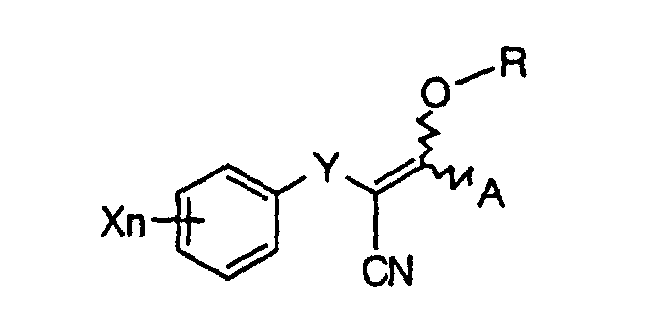
A is phenyl substituted by W or a heterocyclic group substituted by W;
wherein W is nitro, cyano, halogeno, C1-6 alkyl, C3-8 cycloalkyl, C1-6 haloalkyl, C1-6 alkoxy, C1-6 haloalkoxy, C1-6 alkylthio, C1-6 alkylsulfinyl, C1-6 alkylsulfonyl, C1-6 alkylamino, di-C1-6 alkylamino, C1-6 alkylcarbonyl, C1-6 alkoxycarbonyl, phenyl optionally substituted by G1, or phenoxy optionally substituted by G1;
wherein G1 is nitro, cyano, halogeno, C1-6 alkyl, C1-6 haloalkyl, C1-6 alkoxy, C1-6 haloalkoxy, C1-6 alkylthio, C1-6 alkylsulfinyl, C1-6 alkylsulfonyl, C1-6 alkylamino, di-C1-6 alkylamino, C1-6 alkylcarbonyl, or C1-6 alkoxycarbonyl;
said heterocyclic group is a 5- or 6-membered heterocyclic group that contains at least one heteroatom selected from a group consisting of oxygen, sulfur and nitrogen;
when either of said phenyl or said heterocyclic group contains 2 or more substituents W, W may be the same or different from each other;
R is hydrogen, C1-6 alkyl, C1-6 alkoxy C1-6 alkyl, C1-6 alkylcarbonyloxy C1-6 alkyl, C3-6 cycloalkylcarbonyloxy C1-6 alkyl, C1-6 alkoxycarbonyloxy C1-6 alkyl, optionally substituted phenylcarbonyloxy C1-6 alkyl, C1-6 alkylthio C1-6 alkyl, C1-6 alkylcarbonylthio C1-6 alkyl, C3-6 cycloalkylcarbonylthio C1-6 alkyl, C1-6 alkoxycarbonylthio C1-6 alkyl, optionally substituted phenylcarbonylthio C1-6 alkyl, optionally substituted phenyl C1-6 alkyl, a group represented by a formula of COR1, a group represented by a formula of CSR1, or a group represented by a formula of SO2R2;
wherein R1 is C1-12 alkyl, C3-6 cycloalkyl, C1-6 haloalkyl, C1-6 alkoxy, C1-6 alkylthio, C1-6 alkylamino, di-C1-6 alkylamino, optionally substituted phenyl C1-6 alkyl, optionally substituted phenyl C1-6 alkoxy, or optionally substituted phenyl, and
R2 is C1-12 alkyl or optionally substituted phenyl;
X is nitro, cyano, halogeno, C1-6 alkyl, C2-6 alkenyl, C2-6 alkynyl, C3-8 cycloalkyl, C1-6 haloalkyl, C2-6 haloalkenyl, C1-6 alkoxy, C1-6 haloalkoxy, C2-6 alkenyloxy, C2-6 haloalkenyloxy, C2-6 alkynyloxy, C1-6 alkylthio, C1-6 alkylsulfinyl, C1-6 alkylsulfonyl, C1-6 alkylamino, di-C1-6 alkylamino, tri-C1-6 alkylsilyl, C1-6 alkoxy C1-6 alkyl, C1-6 alkylthio C1-6 alkyl, C1-6 alkylsulfinyl C1-6 alkyl, C1-6 alkylsulfonyl C1-6 alkyl, C1-6 alkylcarbonyl, C1-6 alkoxycarbonyl, phenyl C1-6 alkyl optionally substituted by G2, phenyl C1-6 alkoxy optionally substituted by G2, thienyl optionally substituted by G3, pyridyl optionally substituted by G2, pyridyloxy optionally substituted by G2, phenyl optionally substituted by G4, or phenoxy optionally substituted by G4;
wherein G2 is C1-6 alkyl, halogeno, C1-6 haloalkyl, or C1-6 haloalkoxy,
G3 is C1-6 alkyl or halogeno, and
G4 is nitro, cyano, halogeno, C1-6 alkyl, C1-6 haloalkyl, C1-6 alkoxy, C1-6 haloalkoxy, C1-6 alkylthio, C1-6 alkylsulfinyl, C1-6 alkylsulfonyl, C1-6 alkylamino, di-C1-6 alkylamino, C1-6 alkylcarbonyl, or C1-6 alkoxycarbonyl;
n is 0, or an integer of 1 to 5, and when n is 2 or more, the above X may be same or different from each other; and
Y is oxygen, sulfur, or nitrogen substituted by either hydrogen or C1-6 alkyl.
A is phenyl substituted by W, or a heterocyclic group substituted by W;
W is nitro, cyano,
halogeno, such as fluoro, chloro, bromo and iodo,
C1-6 alkyl, such as methyl, ethyl, n-propyl, isopropyl, n-butyl, sec-butyl, isobutyl, t-butyl, n-pentyl and isomers thereof, and n-hexyl and isomers thereof,
C3-6 cycloalkyl, such as cyclopropyl, cyclobutyl, cyclopentyl, and cyclohexyl,
C1-6 haloalkyl, such as chloromethyl, fluoromethyl, bromomethyl, dichloromethyl, difluoromethyl, dibromomethyl, trichloromethyl, trifluoromethyl, tribromomethyl, 2,2,2-trichloroethyl, 2,2,2-trifluoromethyl, and pentafluoroethyl,
C1-6 alkoxy, such as methoxy, ethoxy, n-propoxy, isopropoxy, n-butoxy, sec-butoxy, isobutoxy, and t-butoxy,
C1-6 haloalkoxy, such as chloromethoxy, dichloromethoxy, trichloromethoxy, trifluoromethoxy, 1-fluoroethoxy, and 1,1-difluoroethoxy,
C1-6 alkylthio, such as methylthio, ethylthio, n-propylthio, isopropylthio, n-butylthio, isobutylthio, sec-butylthio, and t-butylthio,
C1-6 alkylsulfinyl, such as methylsulfinyl, ethylsulfinyl, propylsulfinyl, and butylsulfinyl,
C1-6 alkylsulfonyl, such as methylsulfonyl, ethylsulfonyl, n-propylsulfonyl, and n-butylsulfonyl,
C1-6 alkylamino, such as methylamino, ethylamino, n-propylamino, isopropylamino, n-butylamino, isobutylamino, sec-butylamino, t-butylamino, 1-methylbutylamino, and n-pentylamino,
di-C1-6 alkylamino, such as dimethylamino, diethylamino, dipropylamino, dibutylamino, ethylisopropylamino, and methylpropylamino,
C1-6 alkylcarbonyl, such as methylcarbonyl, ethylcarbonyl, n-propylcarbonyl, and n-butylcarbonyl,
C1-6 alkoxycarbonyl, such as methoxycarbonyl, ethoxycarbonyl, n-propoxycarbonyl, isopropoxycarbonyl, n-butoxycarbonyl, and t-butoxycarbonyl,
phenyl optionally substituted by G1, or phenoxy optionally substituted by G1;
wherein G1 is nitro, cyano,
halogeno, such as fluoro, chloro, bromo and iodo,
C1-6 alkyl, such as methyl, ethyl, n-propyl, isopropyl, n-butyl, sec-butyl, isobutyl, and t-butyl,
C1-6 haloalkyl, such as chloromethyl, fluoromethyl, bromomethyl, dichloromethyl, difluoromethyl, dibromomethyl, trichloromethyl, trifluoromethyl, tribromomethyl, trichloroethyl, trifluoroethyl, and pentafluoroethyl,
C1-6 alkoxy, such as methoxy, ethoxy, n-propoxy, isopropoxy, n-butoxy, sec-butoxy, isobutoxy, and t-butoxy,
C1-6 haloalkoxy, such as chloromethoxy, dichloromethoxy, trichloromethoxy, trifluoromethoxy, 1-fluoroethoxy, and 1,1-difluoroethoxy,
C1-6 alkylthio, such as methylthio, ethylthioethyl, n-propylthio, isopropylthio, n-butylthio, isobutylthio, sec-butylthio, and t-butylthio,
C1-6 alkylsulfinyl, such as methylsulfinyl, ethylsulfinyl, propylsulfinyl, and butylsulfinyl,
C1-6 alkylsulfonyl, such as methylsulfonyl, ethylsulfonyl, propylsulfonyl, and butylsulfonyl,
C1-6 alkylamino, such as methylamino, ethylamino, n-propylamino, isopropylamino, n-butylamino, isobutylamino, sec-butylamino, t-butylamino, 1-methylbutylamino, and n-pentylamino.
di-C1-6 alkylamino, such as dimethylamino, diethylamino, dipropylamino, dibutylamino, ethylisopropylamino, methylpropylamino, and methylbutylamino,
C1-6 alkylcarbonyl, such as methylcarbonyl, ethylcarbonyl, propylcarbonyl and butylcarbonyl, or
C1-6 alkoxycarbonyl, such as methoxycarbonyl, ethoxycarbonyl, n-propoxycarbonyl, isopropoxycarbonyl, n-butoxycarbonyl, and t-butoxycarbonyl.
R is hydrogen,
C1-6 alkyl, such as methyl, ethyl, n-propyl, isopropyl, n-butyl, sec-butyl, isobutyl, t-butyl, pentyl and isomers thereof, and hexyl and isomers thereof,
C1-6 alkoxy C1-6 alkyl, such as methoxymethyl, methoxyethyl, ethoxymethyl, propoxymethyl, and butoxymethyl,
C1-6 alkylcarbonyloxy C1-6 alkyl, such as acetoxymethyl, pivaloyloxymethyl, heptanoyloxymethyl, acetoxyethyl, and acetoxyhexyl,
C3-6 cycloalkylcarbonyloxy C1-6 alkyl, such as cyclopropylcarbonyloxymethyl, cyclopentylcarbonyloxymethyl, cyclohexylcarbonyloxymethyl, cyclopropylcarbonyloxyethyl, and cyclopropylcarbonyloxyhexane,
C1-6 alkoxycarbonyloxy C1-6 alkyl, such as methoxycarbonyloxymethyl, 1-(methoxycarbonyloxy)ethyl, ethoxycarbonyloxymethyl, propoxycarbonyloxymethyl, isopropoxycarbonyloxymethyl, butoxycarbonyloxymethyl, and t-butoxycarbonyloxymethyl,
phenylcarbonyloxy C1-6 alkyl, such as optionally substituted benzoyloxymethyl and 1-(benzoyloxy)ethyl,
C1-6 alkylthio C1-6 alkyl, such as methylthiomethyl, methylthioethyl, ethylthioethyl, ethylthiomethyl, propylthiomethyl, and butylthiomethyl,
C1-6 alkylcarbonylthio C1-6 alkyl, such as methylcarbonylthiomethyl, methylcarbonylthioethyl, 1-(methylcarbonylthio)ethyl, ethylcarbonylthiomethyl, propylcarbonylthiomethyl, and butylcarbonylthiomethyl,
C3-6 cycloalkylcarbonylthio C1-6 alkyl, such as cyclopropylcarbonylthiomethyl, cyclopropylcarbonylthioethyl, 1-(cyclopropylcarbonylthio)ethyl, cyclobutylcarbonylthiomethyl, cyclopentylcarbonylthiomethyl, and cyclohexylcarbonylthiomethyl,
C1-6 alkoxycarbonylthio C1-6 alkyl, such as methoxycarbonylthiomethyl, 1-methoxycarbonylthioethyl, ethoxycarbonylthiomethyl, propoxycarbonylthiomethyl, isopropoxycarbonylthiomethyl, butoxycarbonylthiomethyl, and t-butoxycarbonylthiomethyl,
phenylcarbonylthio C1-6 alkyl, such as optionally substituted benzoylthiomethyl, and benzoylthioethyl,
phenyl C1-6 alkyl, such as optionally substituted benzyl and phenetyl,
a group represented by a formula of COR1, a group represented by a formula of CSR1, or a group represented by a formula of SO2R2;
wherein R1 is C1-12 alkyl, such as methyl, ethyl, n-propyl, isopropyl, n-butyl, isobutyl, sec-butyl, t-butyl, n-pentyl and isomers thereof, n-hexyl and isomers thereof, n-heptyl and isomers thereof, n-nonyl and isomers thereof, and dodecyl,
C3-6 cycloalkyl, such as cyclopropyl, cyclobutyl, cyclopentyl, and cyclohexyl,
C1-6 haloalkyl, such as chloromethyl, fluoromethyl, bromomethyl, dichloromethyl, difluoromethyl, dibromomethyl, trichloromethyl, trifluoromethyl, tribromomethyl, trichloroethyl, trifluoroethyl, and pentafluoroethyl,
C1-6 alkoxy, such as methoxy, ethoxy, propoxy, isopropoxy, butoxy, sec-butoxy, isobutoxy, and t-butoxy,
C1-6 alkylthio, such as methylthio, ethylthio, n-propylthio, isopropylthio, n-butylthio, isobutylthio, sec-butylthio, and t-butylthio,
C1-6 alkylamino, such as methylamino, ethylamino, n-propylamino, isopropylamino, n-butylamino, isobutylamino, sec-butylamino, t-butylamino, 1-methylbutylamino, and n-pentylamino,
di-C1-6 alkylamino, such as dimethylamino, diethylamino, dipropylamino, dibutylamino, ethylisopropylamino, methylpropylamino, and methylbutylamino,
optionally substituted phenyl C1-6 alkyl,
optionally substituted phenyl C1-6 alkoxy, or
optionally substituted phenyl; and
R2 is C1-12 alkyl, such as methyl, ethyl, n-propyl, isopropyl, n-butyl, isobutyl, sec-butyl, t-butyl, n-pentyl and isomers thereof, n-hexyl and isomers thereof, n-heptyl and isomers thereof, n-nonyl and isomers thereof, and n-dodecyl, or optionally substituted phenyl,
said substituent for substituting said phenyl respectively contained in said R, R1 and R2 is, for example, halogeno, such as fluoro, chloro, bromo and iodo, C1-6 alkyl, such as methyl, ethyl, n-propyl, isopropyl, n-butyl, sec-butyl, isobutyl, and t-butyl, C1-6 haloalkyl, such as chloromethyl, fluoromethyl, bromomethyl, dichloromethyl, difluoromethyl, dibromomethyl, trichloromethyl, trifluoromethyl, tribromomethyl, and trichloroethyl, or C1-6 alkoxy, such as methoxy, ethoxy, n-propoxy, isopropoxy, n-butoxy, sec-butoxy, isobutoxy and t-butoxy;
said phenyl C1-6 alkyl of said optionally substituted phenyl C1-6 alkyl exampled for said R1 is, for example, benzyl, 1-phenylethyl, 2-phenylethyl, 1-phenyl-1-methylethyl, 1-phenylpropyl, 2-phenylpropyl, 3-phenylpropyl, and the like, and said phenyl C1-6 alkoxy of said optionally substituted phenyl C1-6 alkoxy exampled for said R1 is, for example, benzyloxy, 1-phenylethoxy, 2-phenylethoxy, 1-phenyl-1-methylethoxy, 1-phenylpropoxy, 2-phenylpropoxy, 3-phenylpropoxy and the like;
X is nitro, cyano,
halogeno, such as fluoro, chloro, bromo, and iodo,
C1-6 alkyl, such as methyl, ethyl, n-propyl, isopropyl, n-butyl, sec-butyl, isobutyl, t-butyl, n-pentyl and isomers thereof, and n-hexyl and isomers thereof,
C2-6 alkenyl, such as ethenyl, 1-propenyl, 2-propenyl, 1-butenyl, 2-butenyl, 3-butenyl, 1-methyl-2-propenyl, 2-methyl-2-propenyl, 1-pentenyl, 2-pentenyl, 3-pentenyl, 4-pentenyl, 1-methyl-2-butenyl, 2-methyl-2-butenyl, 1-hexenyl, 2-hexenyl, 3-hexenyl, 4-hexenyl, and 5-hexenyl,
C2-6 alkynyl, such as ethynyl, 1-propynyl, 2-propynyl, 1-butynyl, 2-butynyl, 3-butynyl, 1-methyl-2-propynyl, 2-methyl-3-butynyl, 1-pentynyl, 2-pentynyl, 3-pentynyl, 4-pentynyl, 1-methyl-2-butynyl, 2-methyl-3-pentynyl, 1-hexynyl, and 1,1-dimethyl-2-butynyl,
C3-8 cycloalkyl, such as cyclopropyl, cyclobutyl, cyclopentyl and cyclohexyl,
C1-6 haloalkyl, such as chloromethyl, fluoromethyl, bromomethyl, dichloromethyl, difluoromethyl, dibromomethyl, trichloromethyl, trifluoromethyl, tribromomethyl, trichloroethyl, trifluoroethyl, and pentafluoroethyl,
C2-6 haloalkenyl, such as 3-chloro-2-propenyl, 4-chloro-2-butenyl, 4,4-dichloro-3-butenyl, 4,4-difluoro-3-butenyl, and 3,3,-dichloro-2-propenyl,
C1-6 alkoxy, such as methoxy, ethoxy, n-propoxy, isopropoxy, n-butoxy, sec-butoxy, isobutoxy, and t-butoxy,
C1-6 haloalkoxy, such as chloromethoxy, dichloromethoxy, trichloromethoxy, trifluoromethoxy, 1-fluoroethoxy, 1,1-difluoroethoxy, 2,2,2-trifluoroethoxy, and pentafluoroethoxy,
C2-6 alkenyloxy, such as allyloxy, 2-propenyloxy, 2-butenyloxy, and 2-methyl-3-propenyloxy,
C2-6 haloalkenyloxy, such as 3-chloro-2-propenyloxy, 3,3-dichloro-2-propenyloxy, 4-chloro-2-butenyloxy, 4,4-dichloro-3-butenyloxy, and 4,4-difluoro-3-butenyloxy,
C2-6 alkynyloxy, such as 2-propynyloxy, 2-butynyloxy, and 1-methyl-2-propynyloxy,
C1-6 alkylthio, such as methylthio, ethylthio, n-propylthio, isopropylthio, n-butylthio, isobutylthio, sec-butylthio, and t-butylthio,
C1-6 alkylsulfinyl, such as methylsulfinyl, ethylsulfinyl, propylsulfinyl, and butylsulfinyl,
C1-6 alkylsulfonyl, such as methylsulfonyl, ethylsulfonyl, propylsulfonyl, and butylsulfonyl,
C1-6 alkylamino, such as methylamino, ethylamino, n-propylamino, isopropylamino, n-butylamino, isobutylamino, sec-butylamino, t-butylamino, 1-methylbutylamino, and n-pentylamino,
di-C1-6 alkylamino, such as dimethylamino, diethylamino, dipropylamino, dibutylamino, ethylisopropylamino, and methylpropylamino,
C1-6 alkylsilyl such as trimethylsilyl,
C1-6 alkoxy C1-6 alkyl, such as methoxymethyl, methoxyethyl, ethoxymethyl, propoxymethyl, and butoxymethyl,
C1-6 alkylthio C1-6 alkyl, such as methylthiomethyl, methylthioethyl, ethylthioethyl, ethylthiomethyl, propylthiomethyl, and butylthiomethyl,
C1-6 alkylsulfinyl C1-6 alkyl, such as methylsulfinylmethyl, methylsulfinylethyl, ethylsulfinylethyl, ethylsulfinylmethyl, propylsulfinylmethyl, and butylsulfinylmethyl,
C1-6 alkylsulfonyl C1-6 alkyl, such as methylsulfonylmethyl, methylsulfonylethyl, ethylsulfonylethyl, ethylsulfonylmethyl, propylsulfonylmethyl, and butylsulfonylmethyl,
C1-6 alkylcarbonyl, such as methylcarbonyl, ethylcarbonyl, propylcarbonyl, and butylcarbonyl,
C1-6 alkoxycarbonyl, such as methoxycarbonyl, ethoxycarbonyl, propoxycarbonyl, isopropoxycarbonyl, butoxycarbonyl, and t-butoxycarbonyl,
phenyl C1-6 alkyl optionally substituted by G2,
phenyl C1-6 alkoxy optionally substituted by G2,
optionally substituted thienyl by G3, optionally substituted pyridyl by G2,
pyridyloxy optionally substituted by G2, phenyl optionally substituted by G4, or phenoxy optionally substituted by G4;
wherein G2 is C1-6 alkyl, such as methyl, ethyl, n-propyl, isopropyl, n-butyl, sec-butyl, isobutyl, t-butyl, n-pentyl and isomers thereof, and n-hexyl and isomers thereof,
halogeno, such as fluoro, chloro, bromo, and iodo,
C1-6 haloalkyl, such as chloromethyl, fluoromethyl, bromomethyl, dichloromethyl, difluoromethyl, dibromomethyl, trichloromethyl, trifluoromethyl, tribromomethyl, trichloroethyl, trifluoroethyl, and pentafluoroethyl, or
C1-6 haloalkoxy, such as chloromethoxy, fluoromethoxy, bromomethoxy, dichloromethoxy, difluoromethoxy, dibromomethoxy, trichloromethoxy, trifluoromethoxy, tribromomethoxy, 2,2,2-trichloroethoxy, 2,2,2-trifluoroethoxy, pentafluoroethoxy, and perfluoropropoxy,
G3 is C1-6 alkyl, such as methyl, ethyl, n-propyl, isopropyl, n-butyl, sec-butyl, isobutyl, t-butyl, n-pentyl and isomers thereof, and n-hexyl and isomers thereof, or
halogeno, such as fluoro, chloro, bromo, and iodo,
G4 is nitro, cyano,
C1-6 alkyl, such as methyl, ethyl, n-propyl, isopropyl, n-butyl, sec-butyl, isobutyl, t-butyl, n-pentyl and isomers thereof, and n-hexyl and isomers thereof,
C1-6 haloalkyl, such as chloromethyl, fluoromethyl, bromomethyl, dichloromethyl, difluoromethyl, dibromomethyl, trichloromethyl, trifluoromethyl, tribromomethyl, 2,2,2-trichloroethyl, 2,2,2-trifluoroethyl, and pentafluoroethyl,
C1-6 alkoxy, such as methoxy, ethoxy, n-propoxy, isopropoxy, n-butoxy, sec-butoxy, isobutoxy, and t-butoxy,
C1-6 haloalkoxy, such as chloromethoxy, dichloromethoxy, trichloromethoxy, trifluoromethoxy, 1-fluoroethoxy, and 1,1-difluoroethoxy,
C1-6 alkylthio, such as methylthio, ethylthioethyl, n-propylthio, isopropylthio, n-butylthio, isobutylthio, sec-butylthio, and t-butylthio,
C1-6 alkylsulfinyl, such as methylsulfinyl, ethylsulfinyl, n-propylsulfinyl, and n-butylsulfinyl,
C1-6 alkylsulfonyl, such as methylsulfonyl, ethylsulfonyl, n-propylsulfonyl, and n-butylsulfonyl,
C1-6 alkylamino, such as methylamino, ethylamino, n-propylamino, isopropylamino, n-butylamino, isobutylamino, sec-butylamino, t-butylamino, 1-methylbutylamino, and n-pentylamino,
di-C1-6 alkylamino, such as dimethylamino, diethylamino, dipropylamino, dibutylamino, ethylisopropylamino, and methylpropylamino,
C1-6 alkylcarbonyl, such as methylcarbonyl, ethylcarbonyl, n-propylcarbonyl, and n-butylcarbonyl, or
C1-6 alkoxycarbonyl, such as methoxycarbonyl, ethoxycarbonyl, n-propoxycarbonyl, isopropoxycarbonyl, n-butoxycarbonyl, and t-butoxycarbonyl;
n is 0 or an integer of 1 to 5, and when n is 2 or more, X may be same or different from each other, and
Y is oxygen, sulfur, or nitrogen substituted by either hydrogen or C1-6 alkyl, such as methyl, ethyl, n-propyl, isopropyl, n-butyl, sec-butyl, isobutyl and t-butyl.


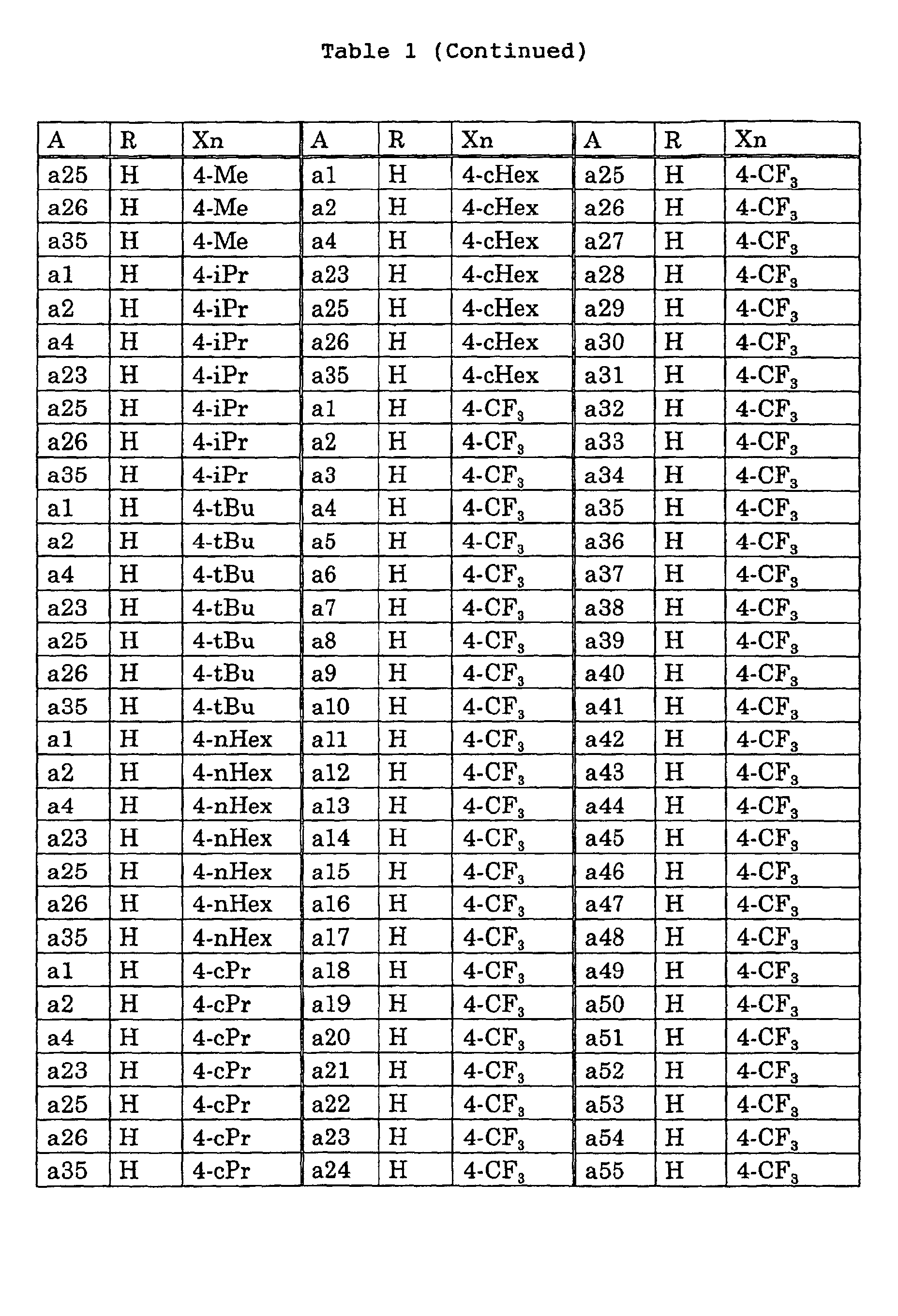
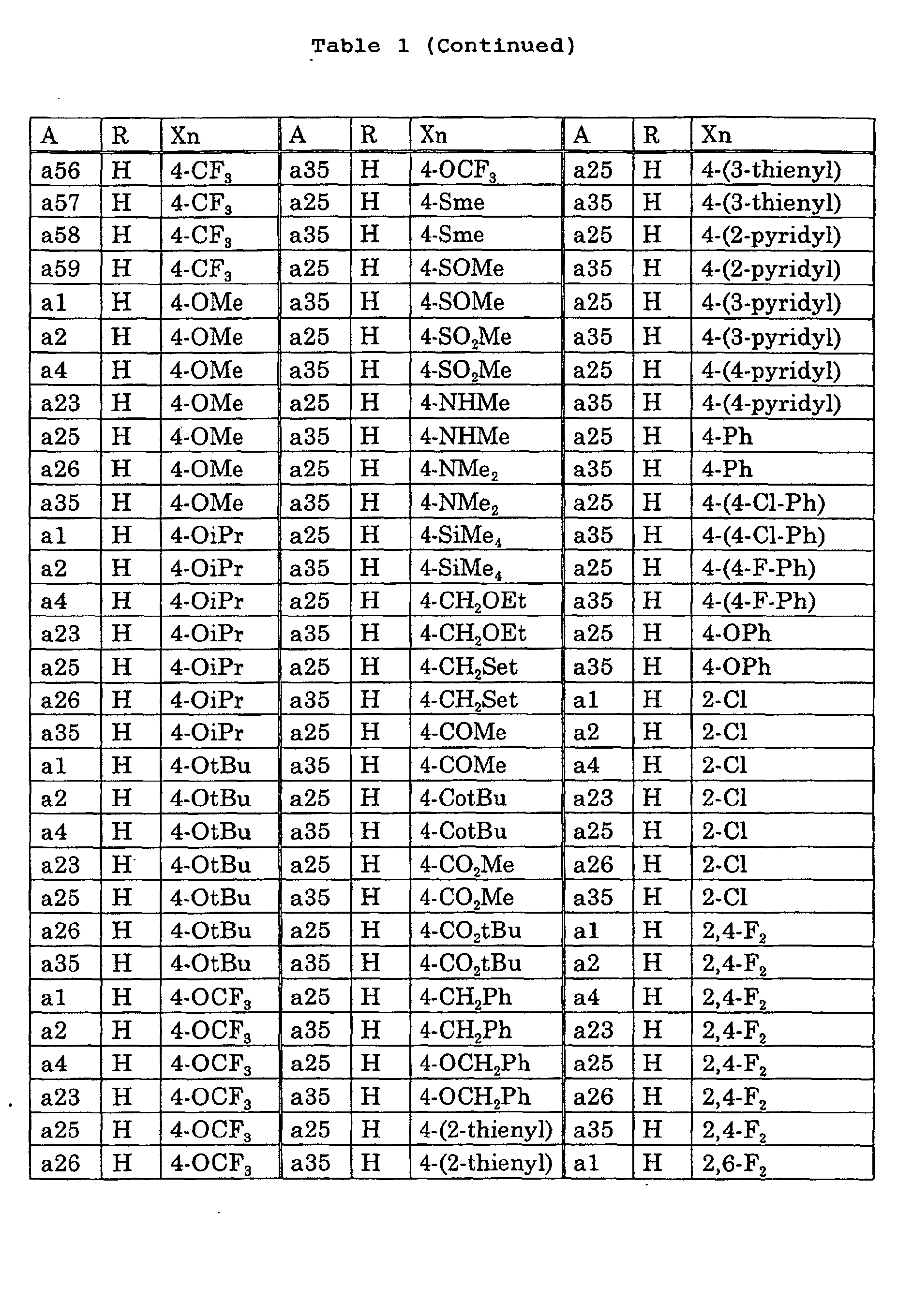
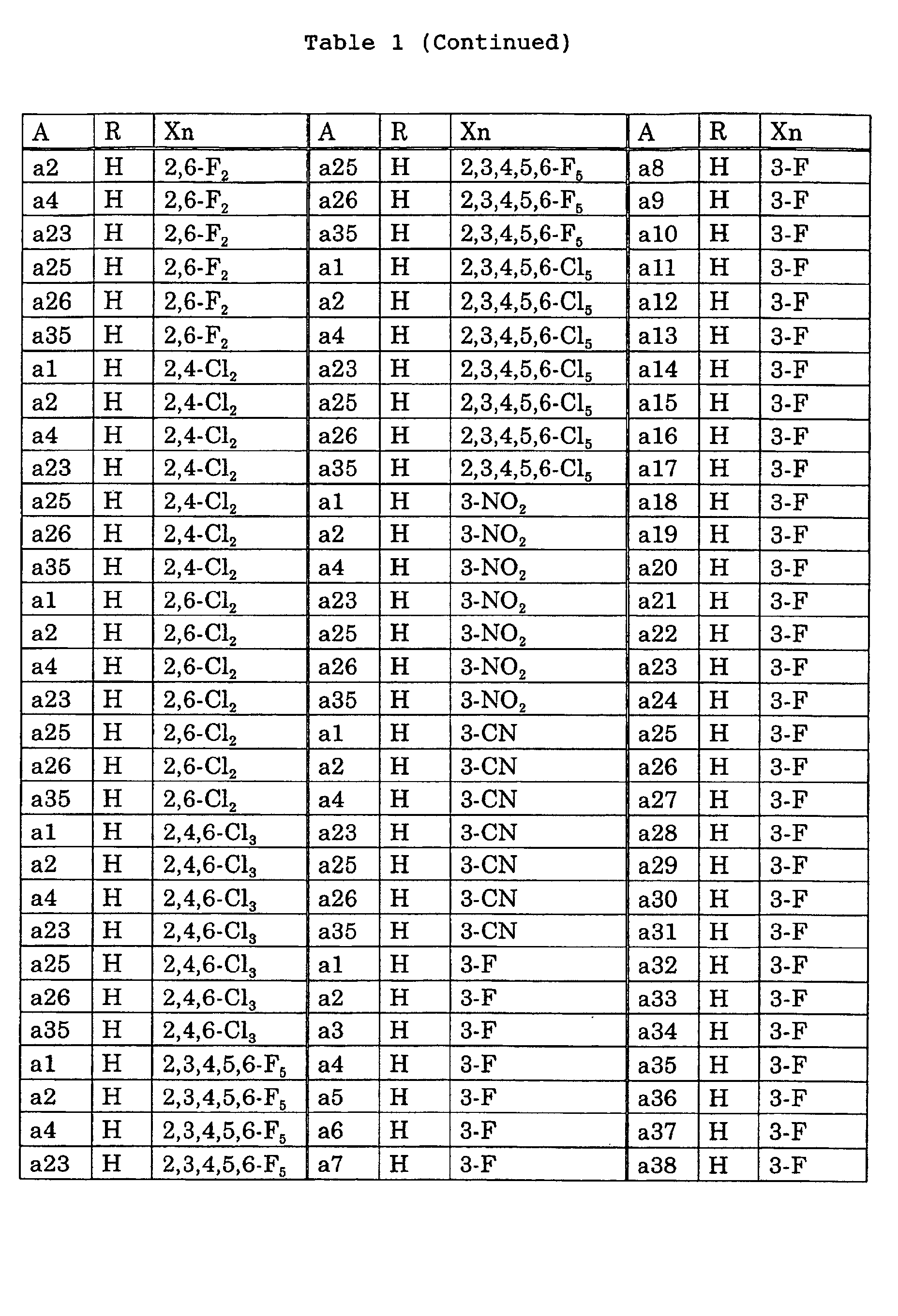
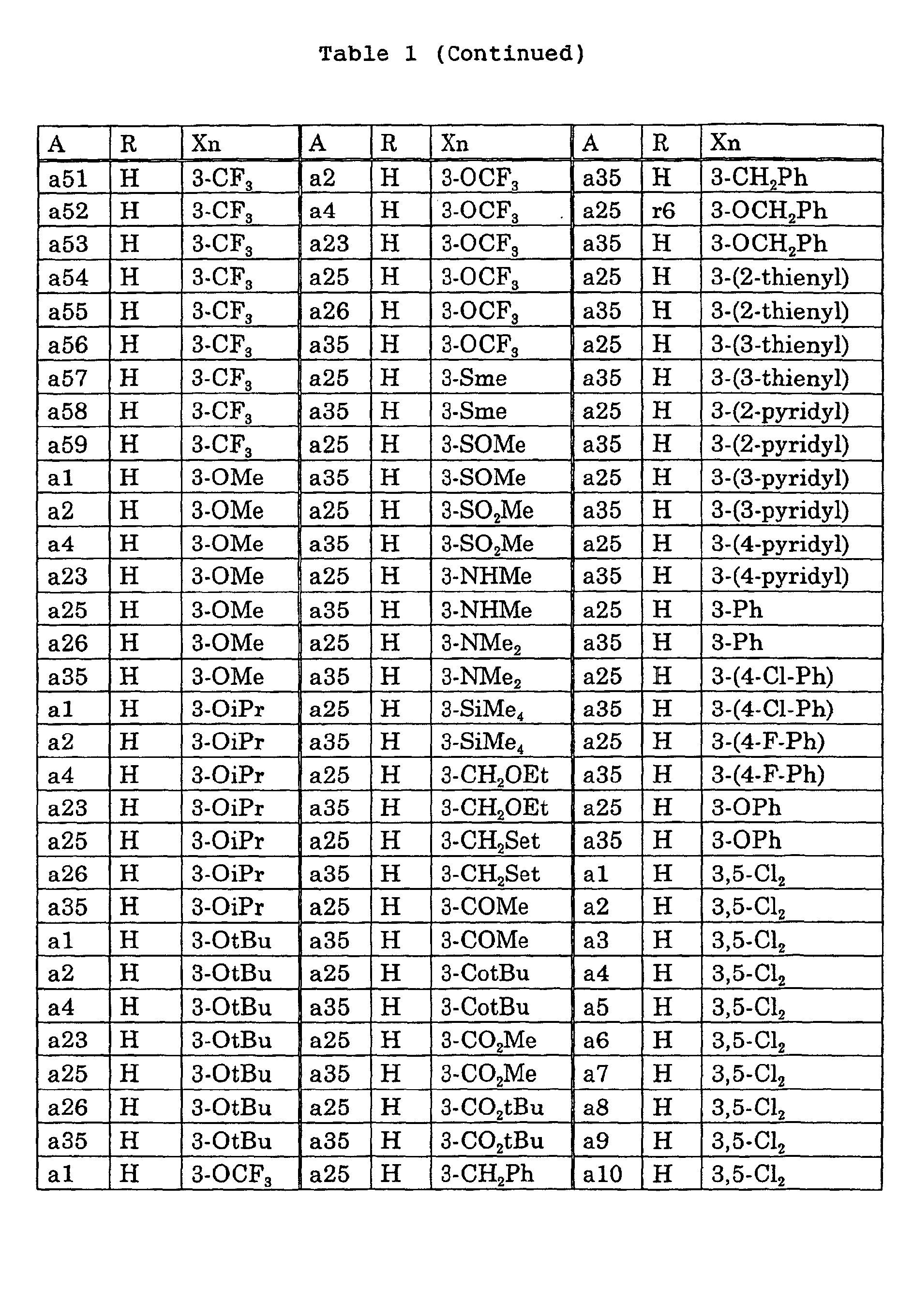
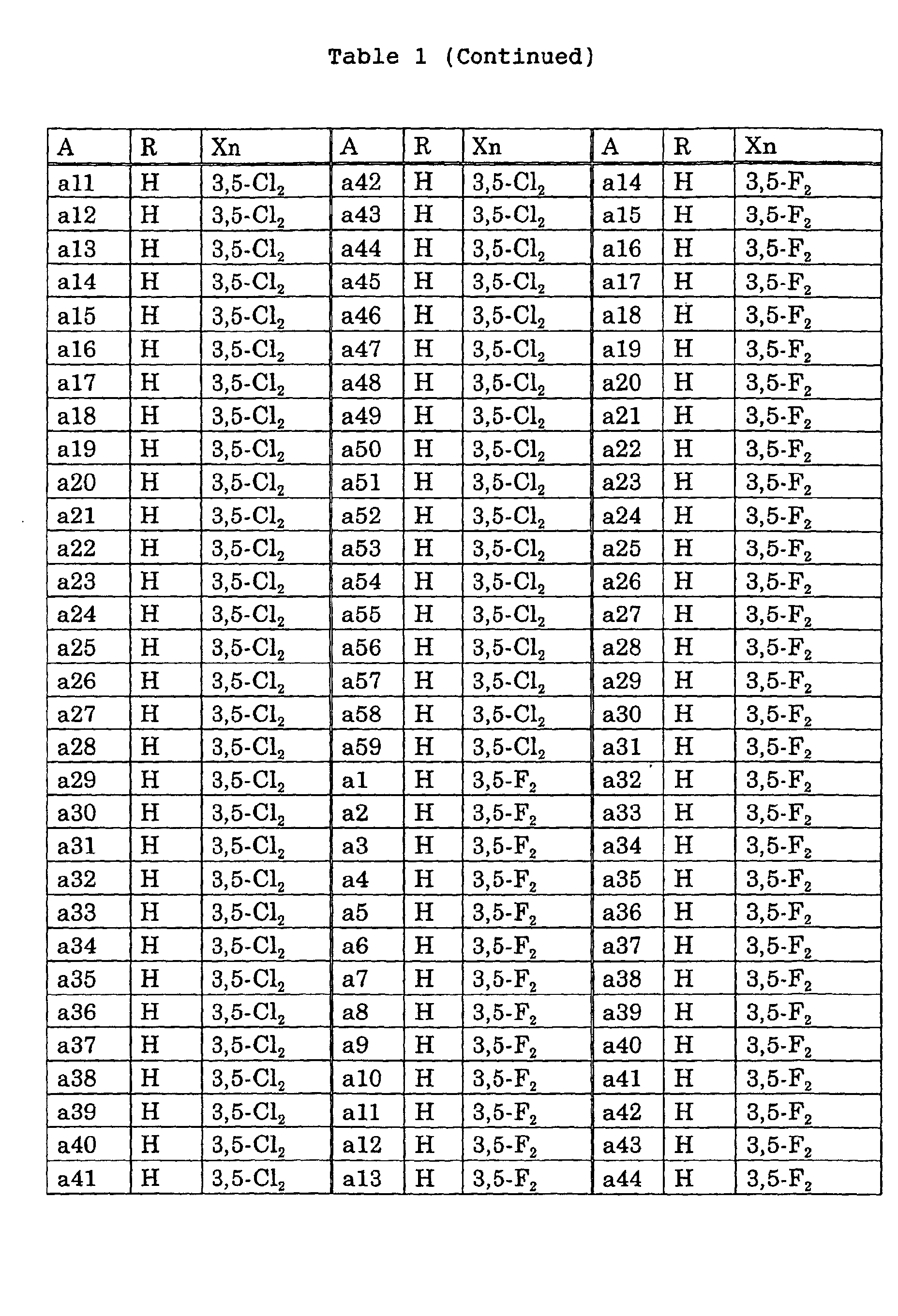
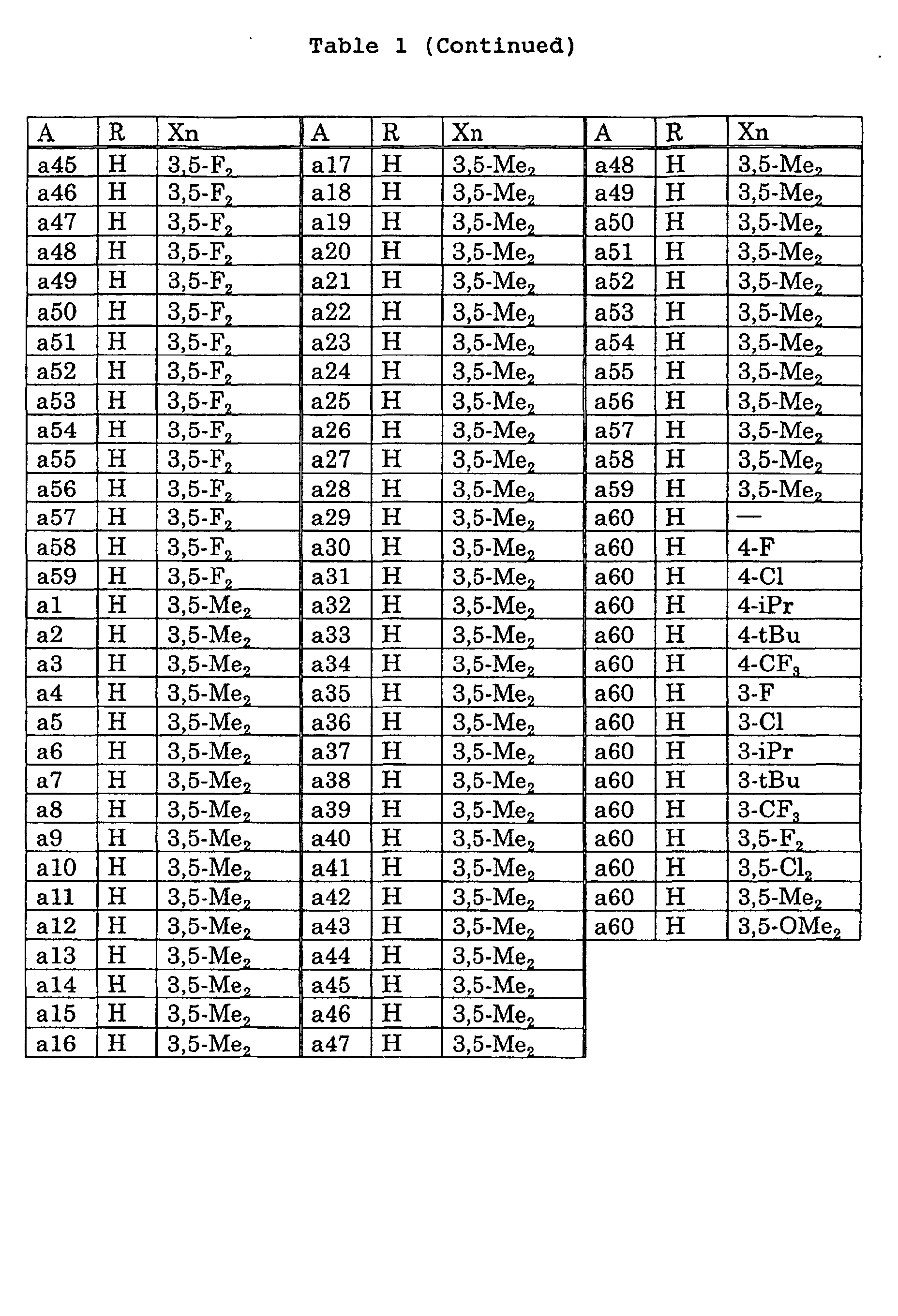
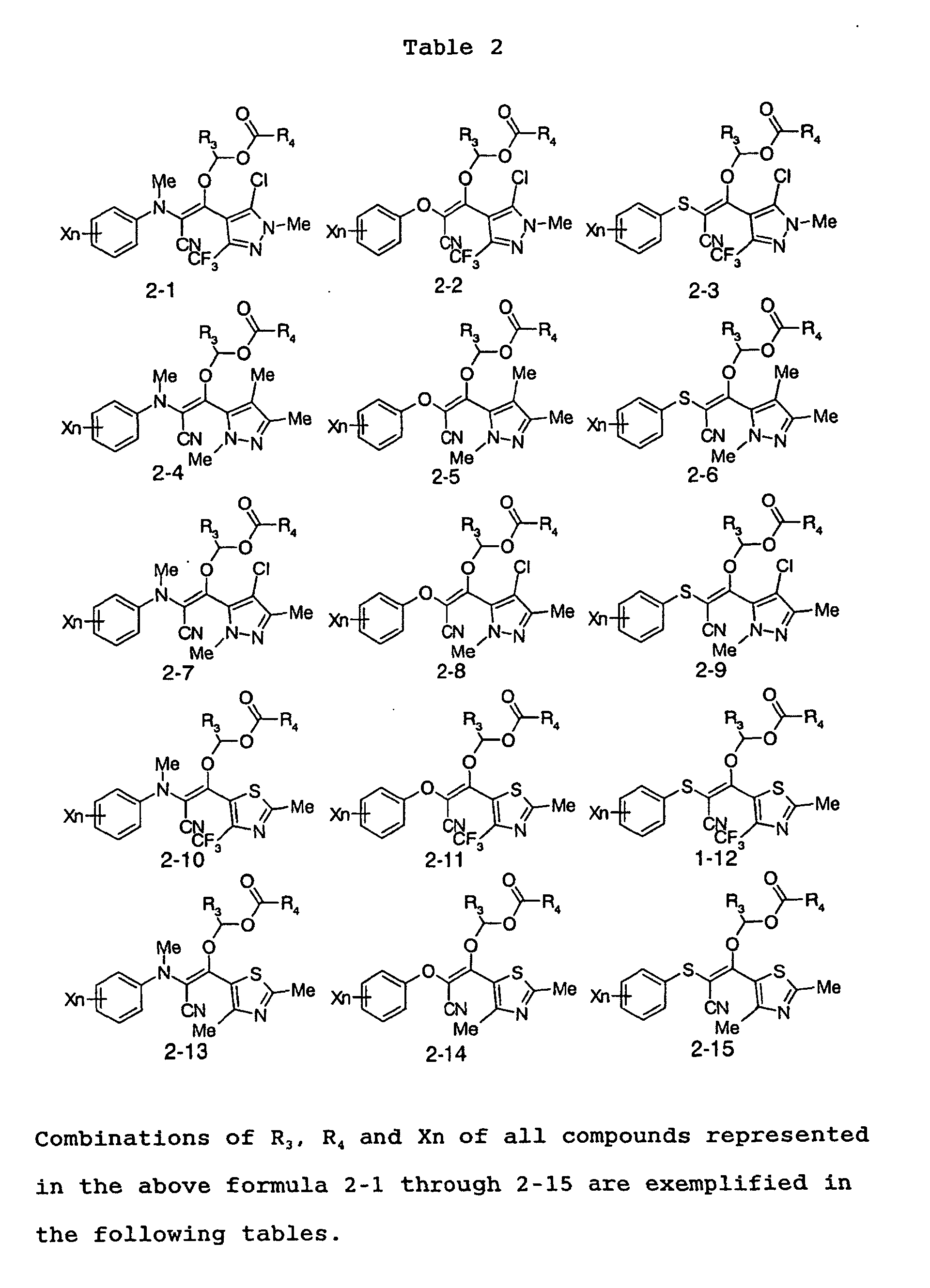
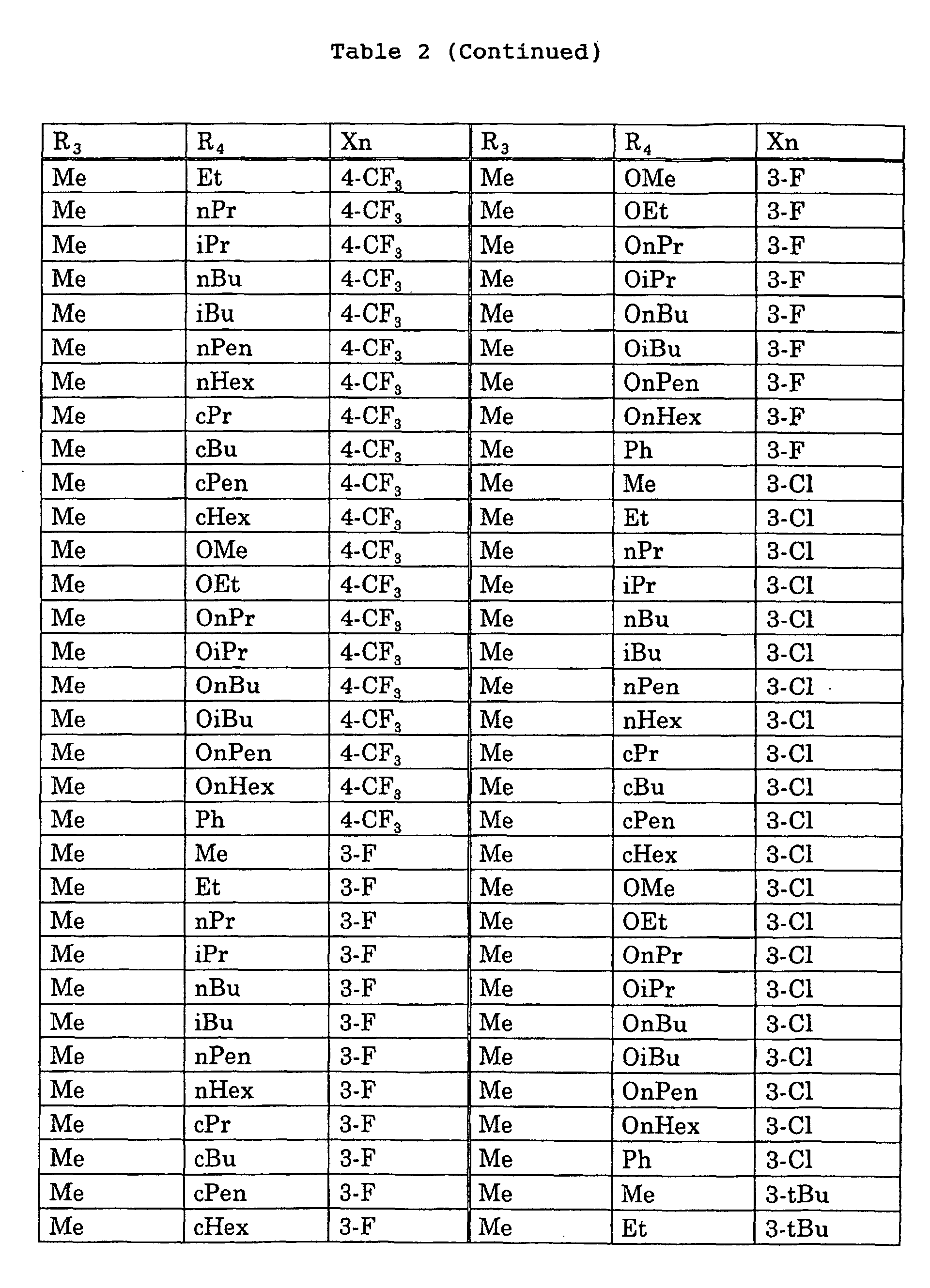
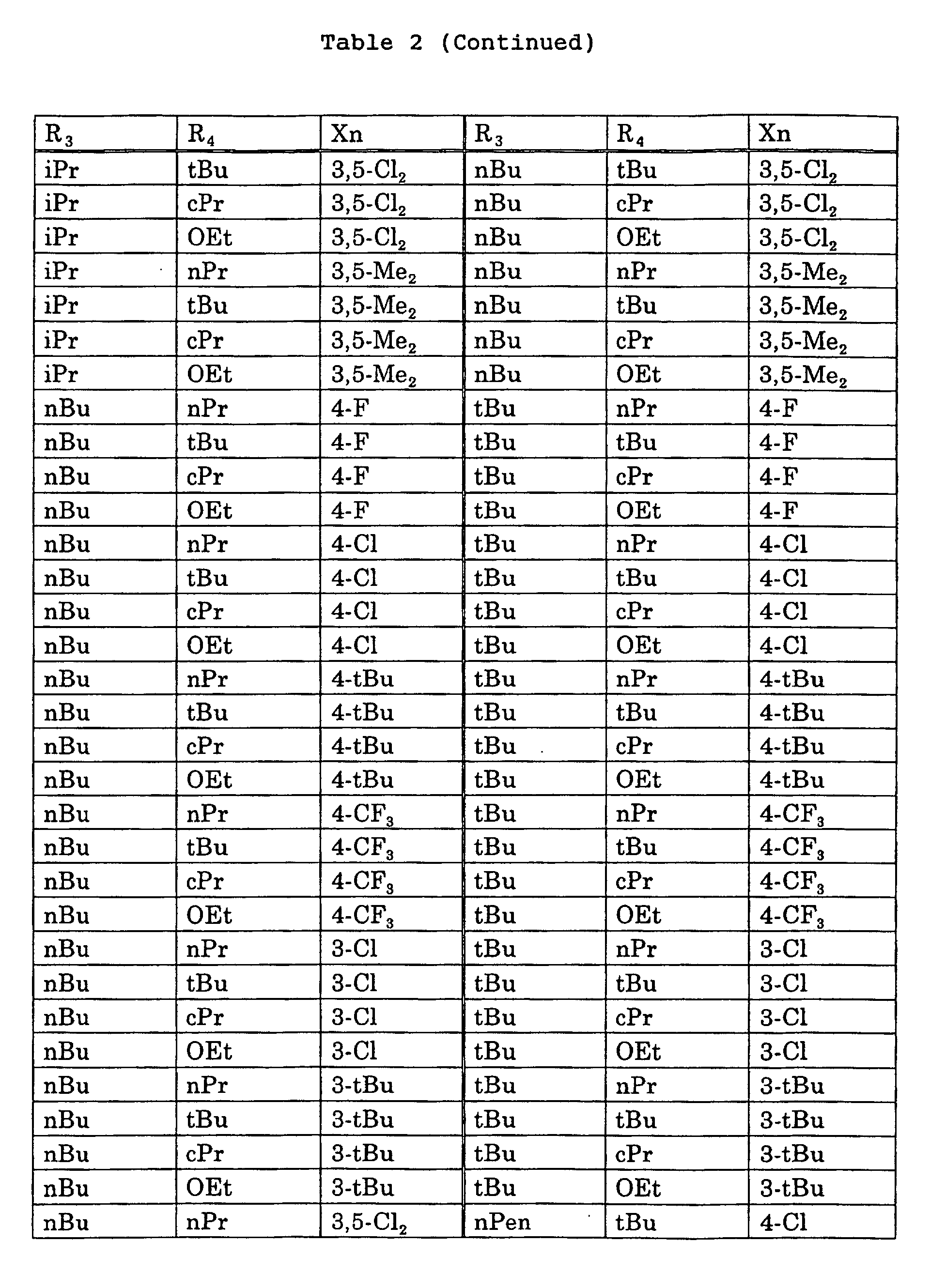
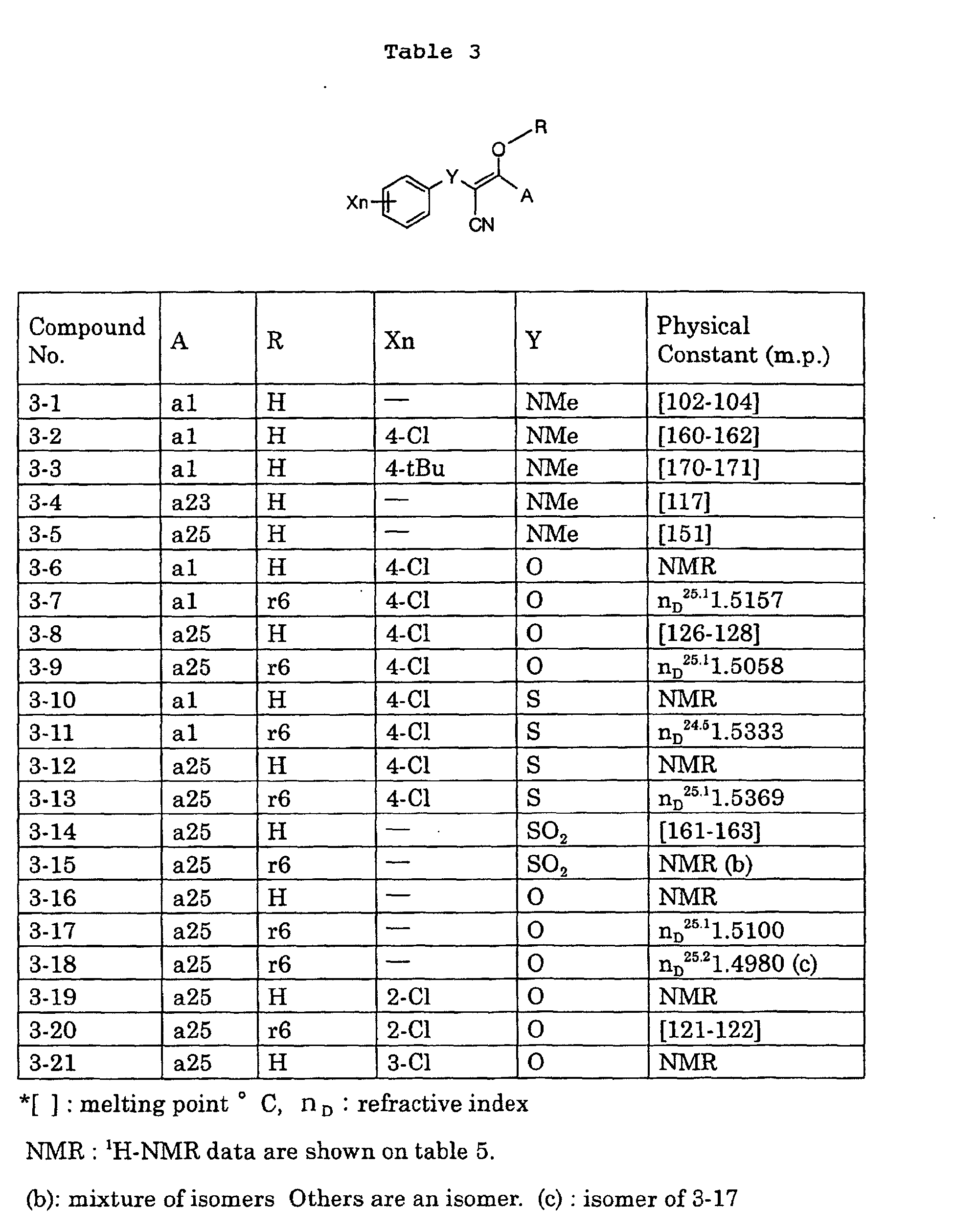
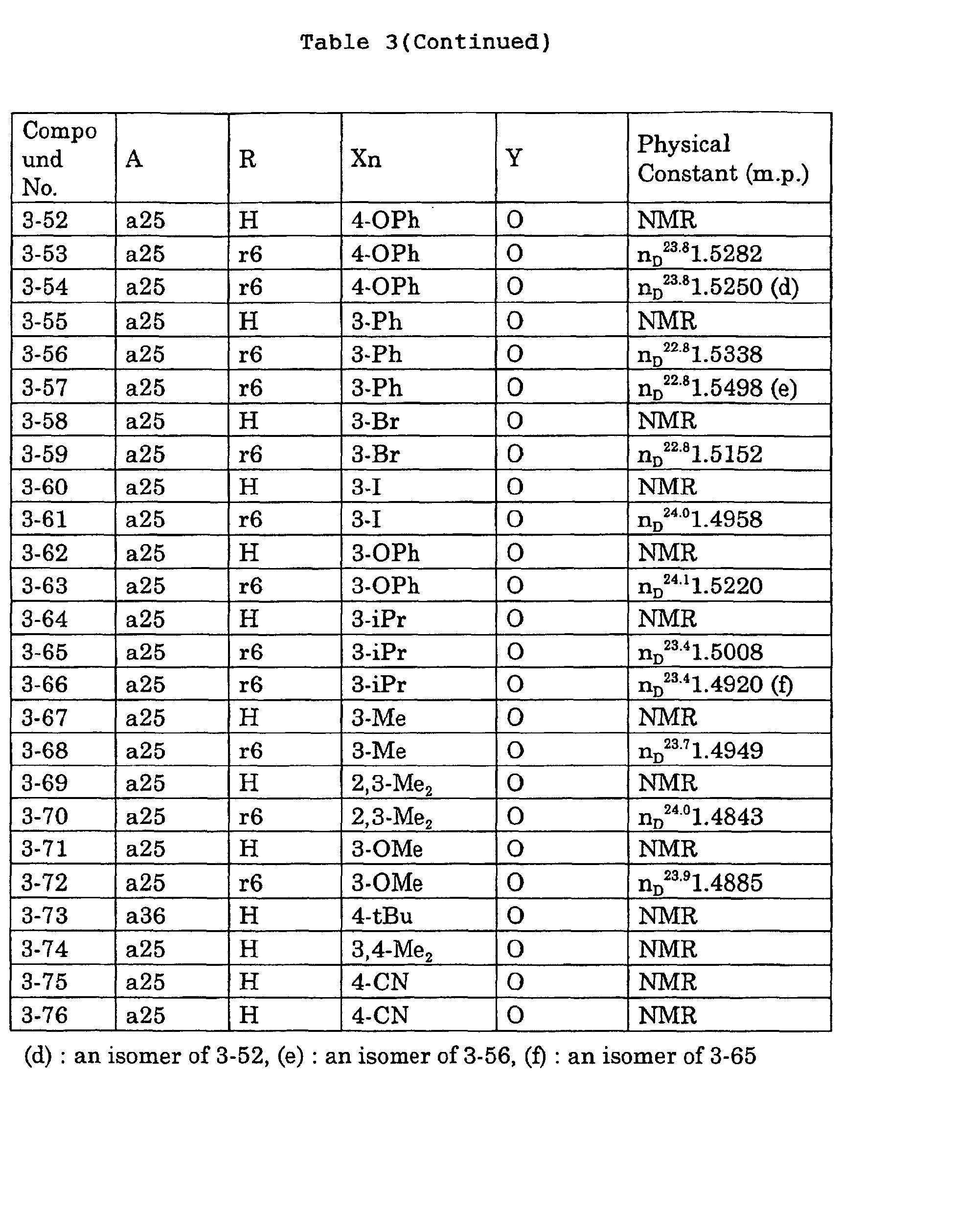
Me: methyl, Et: ethyl, Pr: propyl, Bu: butyl, Pen: pentyl, Hex: hexyl, Ph: phenyl, n: normal, i: iso, t: tertiary, c: cyclo




























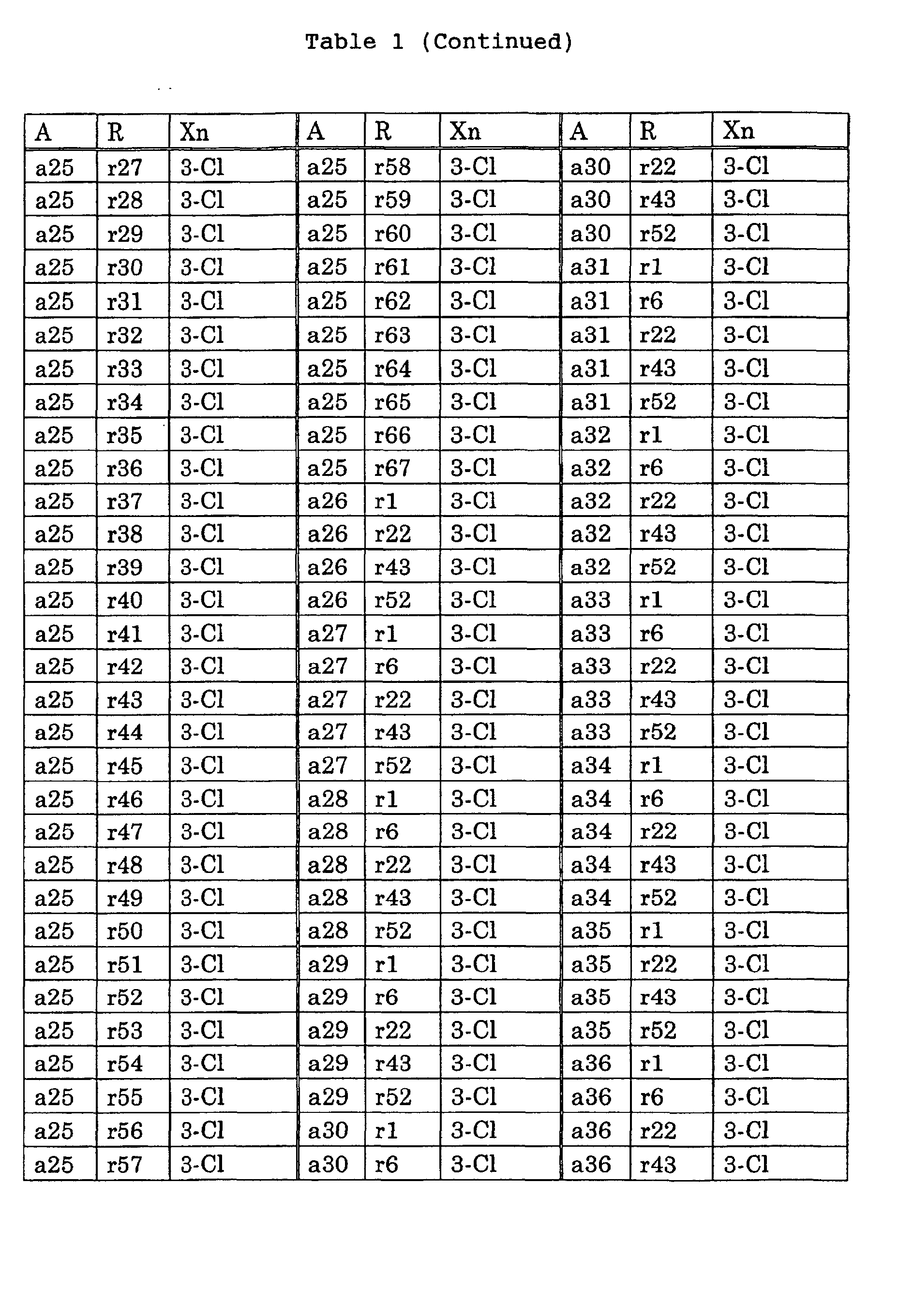


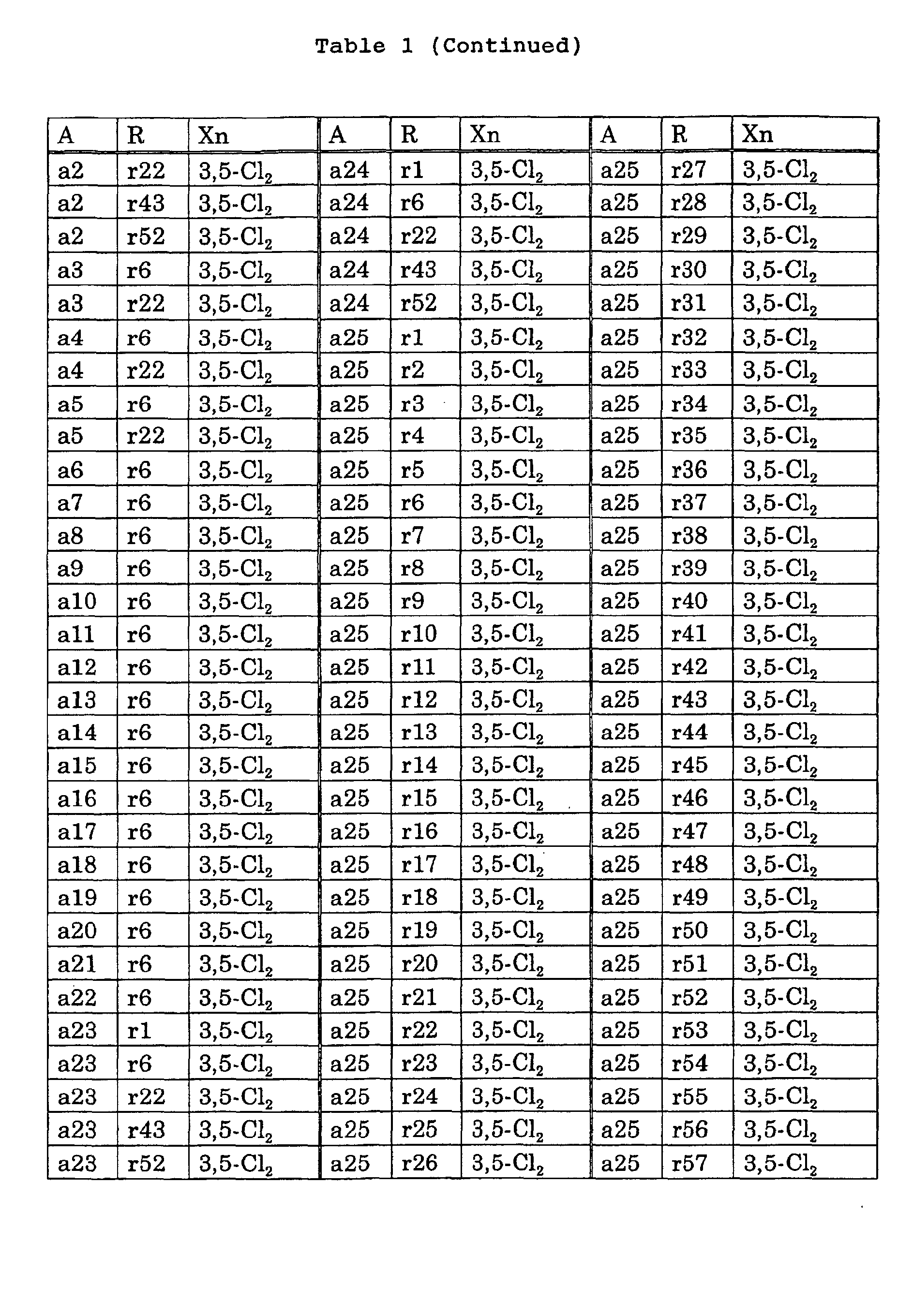


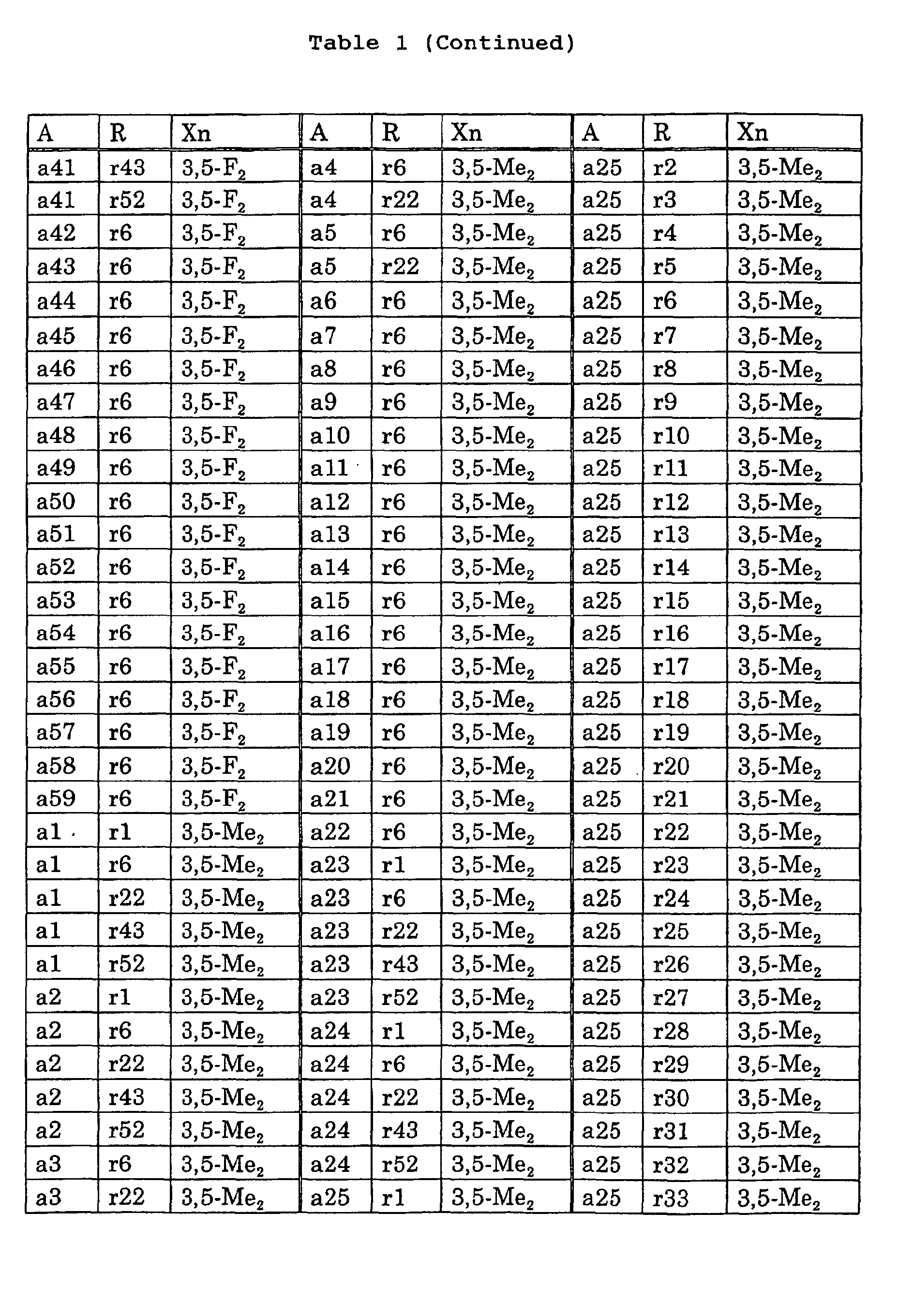

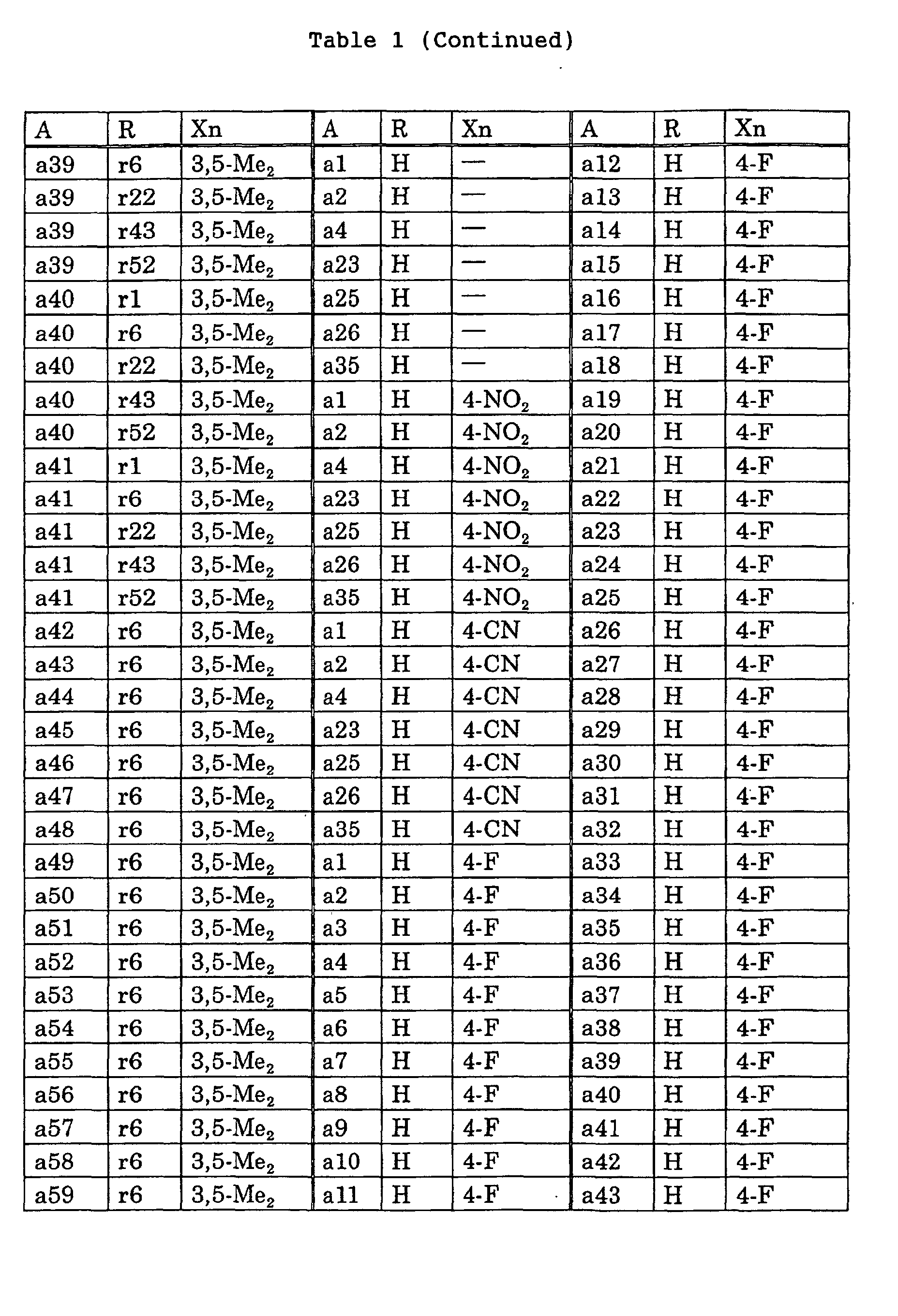










| Example 4 Wettable Powder | |
| A compound of the present invention | 40 parts |
| Diatomaceous earth | 53 parts |
| Higher alcohol sulfate | 4 parts |
| Alkylnaphthalene sulfonate | 3 parts |
| Examples 5 Emulsifiable concentrate | |
| A compound of the present invention | 30 parts |
| Xylene | 33 parts |
| N,N-dimethylformamide | 30 parts |
| Polyoxyethylene alkylallyl ether | 7 parts |
| Example 6 Dust | |
| A compound of the present invention | 10 parts |
| Talc | 89 parts |
| Polyoxyethylene alkylallyl ether | 1 part |
| Example 7 Granules | |
| A compound of the present invention | 5 parts |
| Clay | 73 parts |
| Bentonite | 20 parts |
| Sodium dioctylsulfosuccinate | 1 part |
| Sodium phosphate | 1 part |
| Example 8 Flowable concentrate | |
| A compound of the present invention | 10 parts |
| Sodium lignin sulfonate | 4 parts |
| Sodium dodecylbenzenesulfonate | 1 part |
| Xanthane gum | 0.2 parts |
| Water | 84.8 parts |
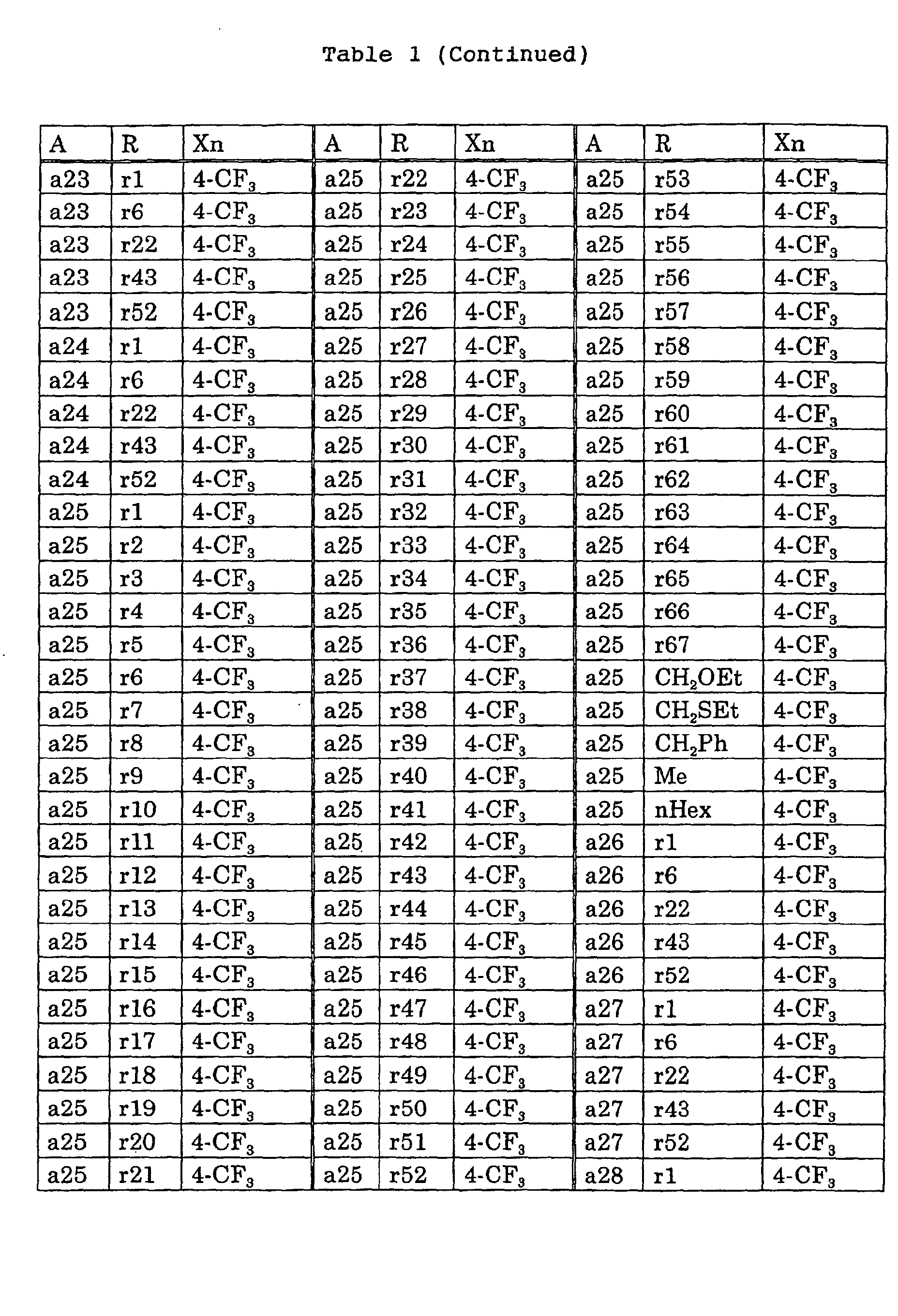
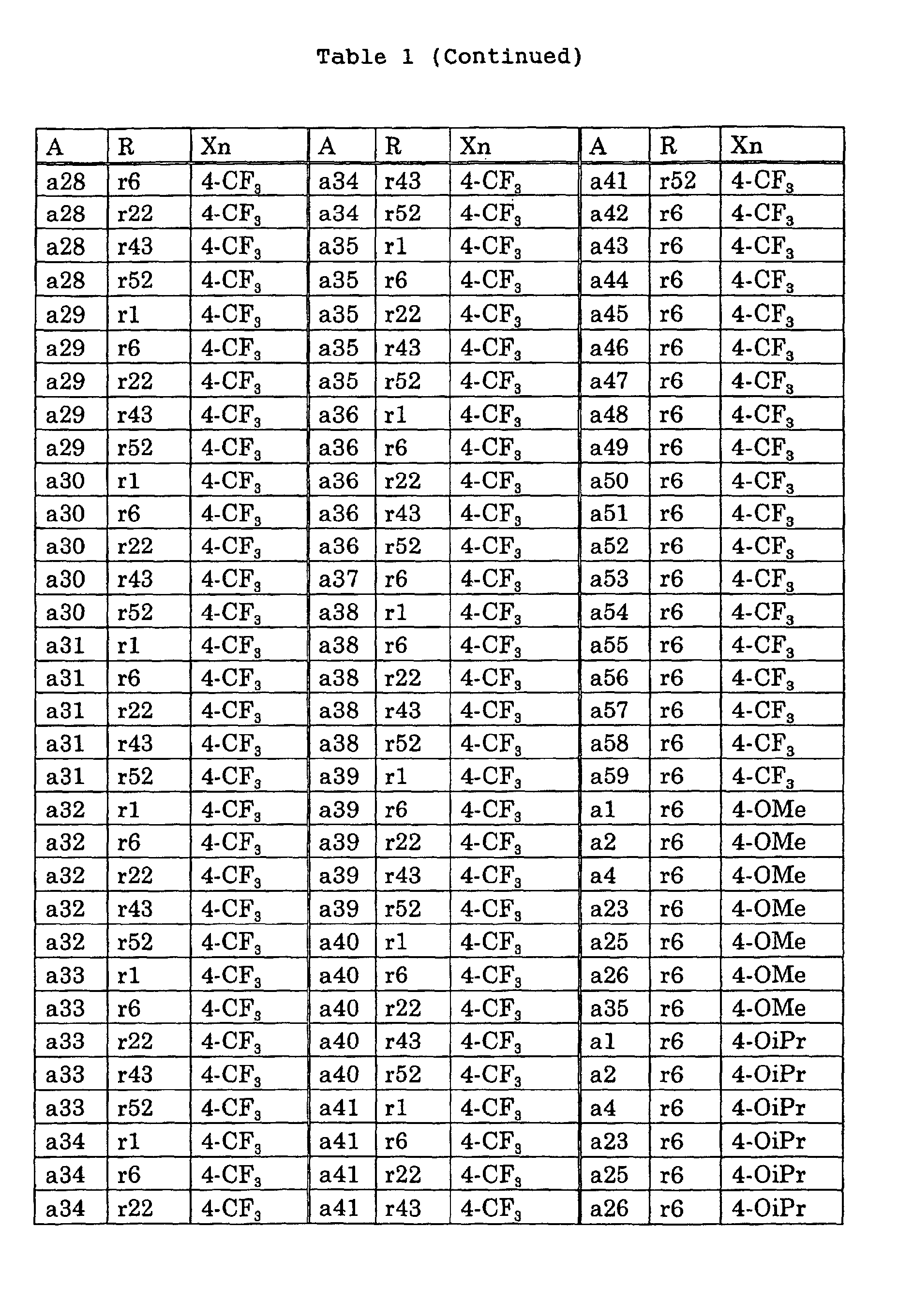
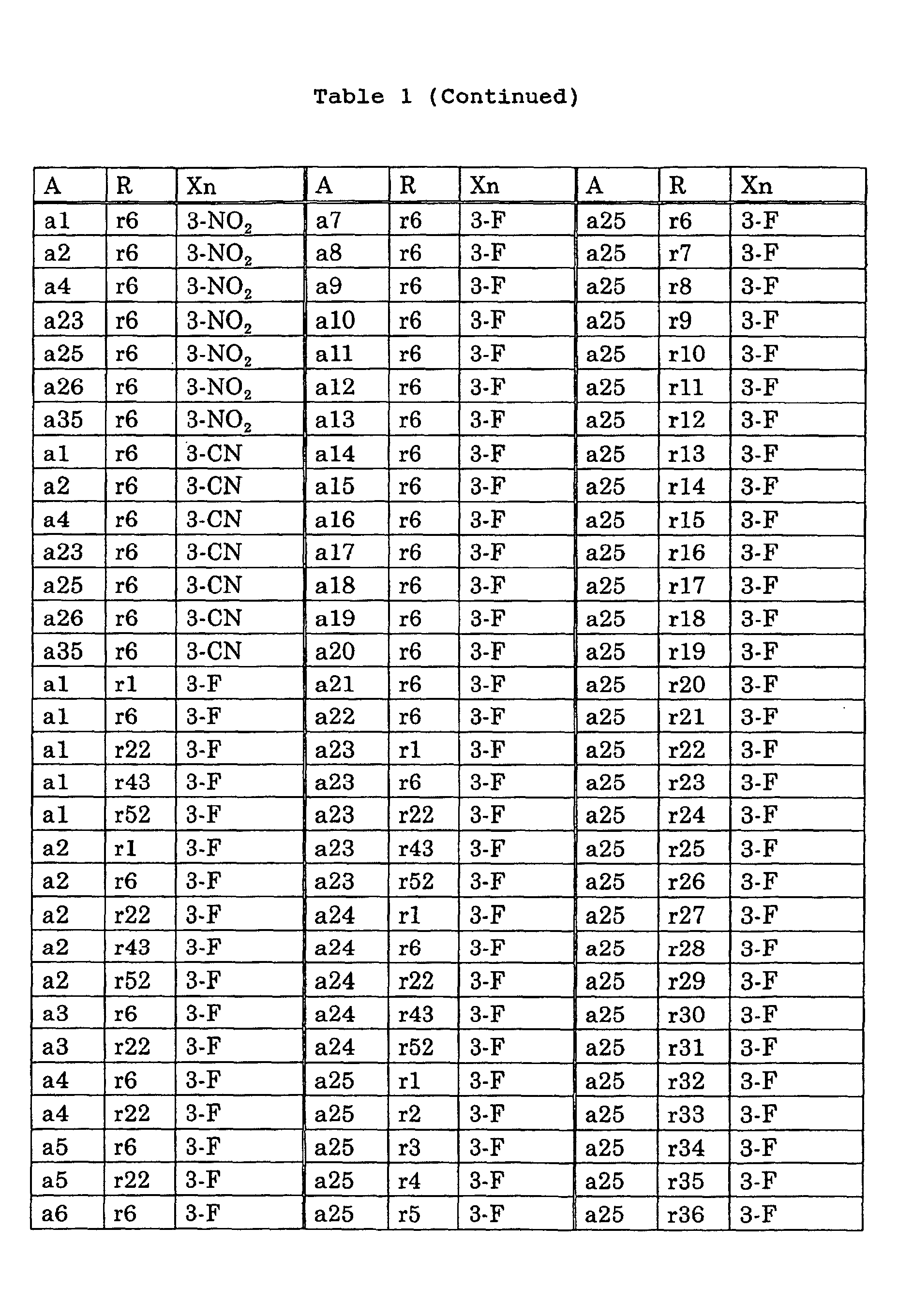
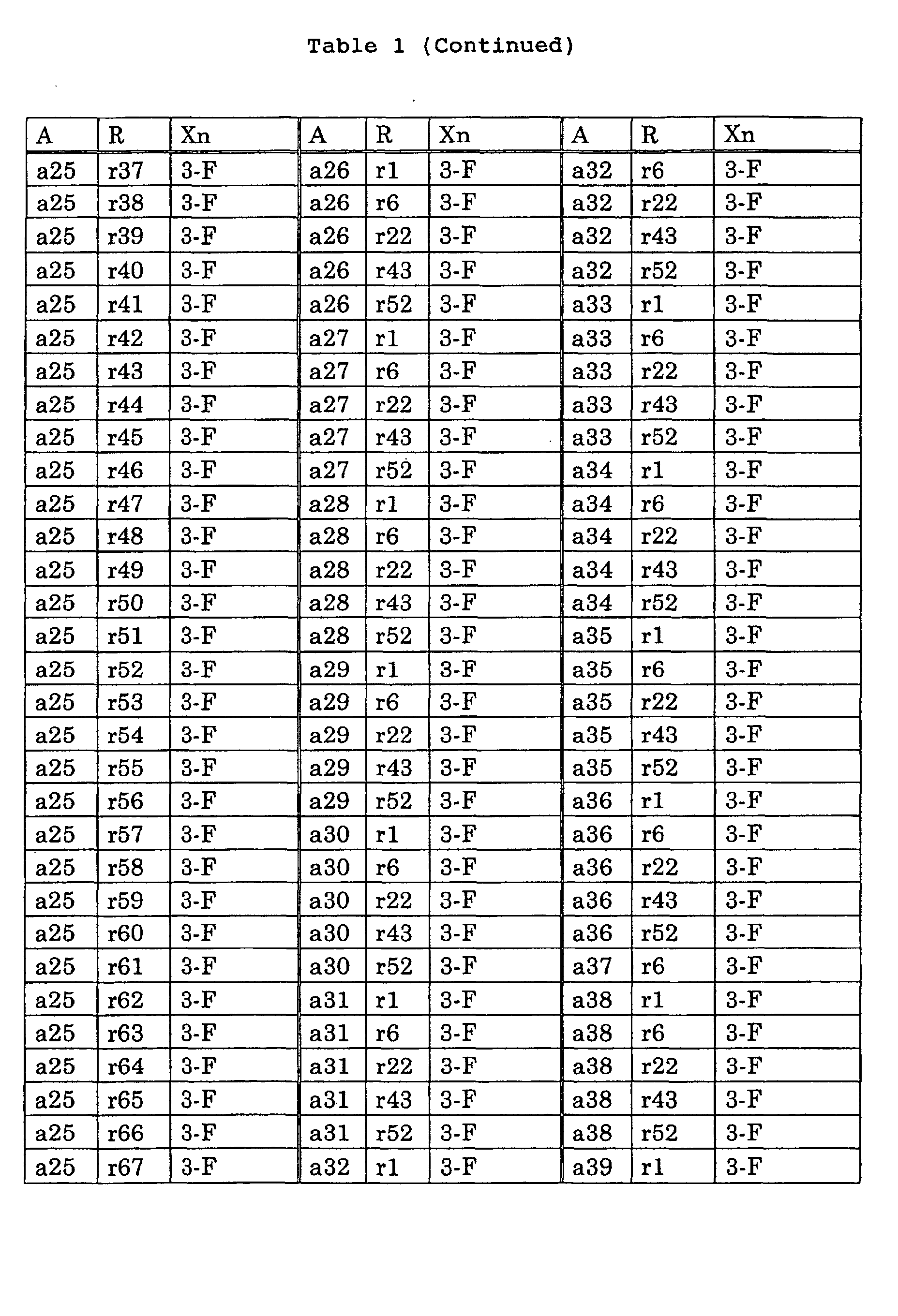
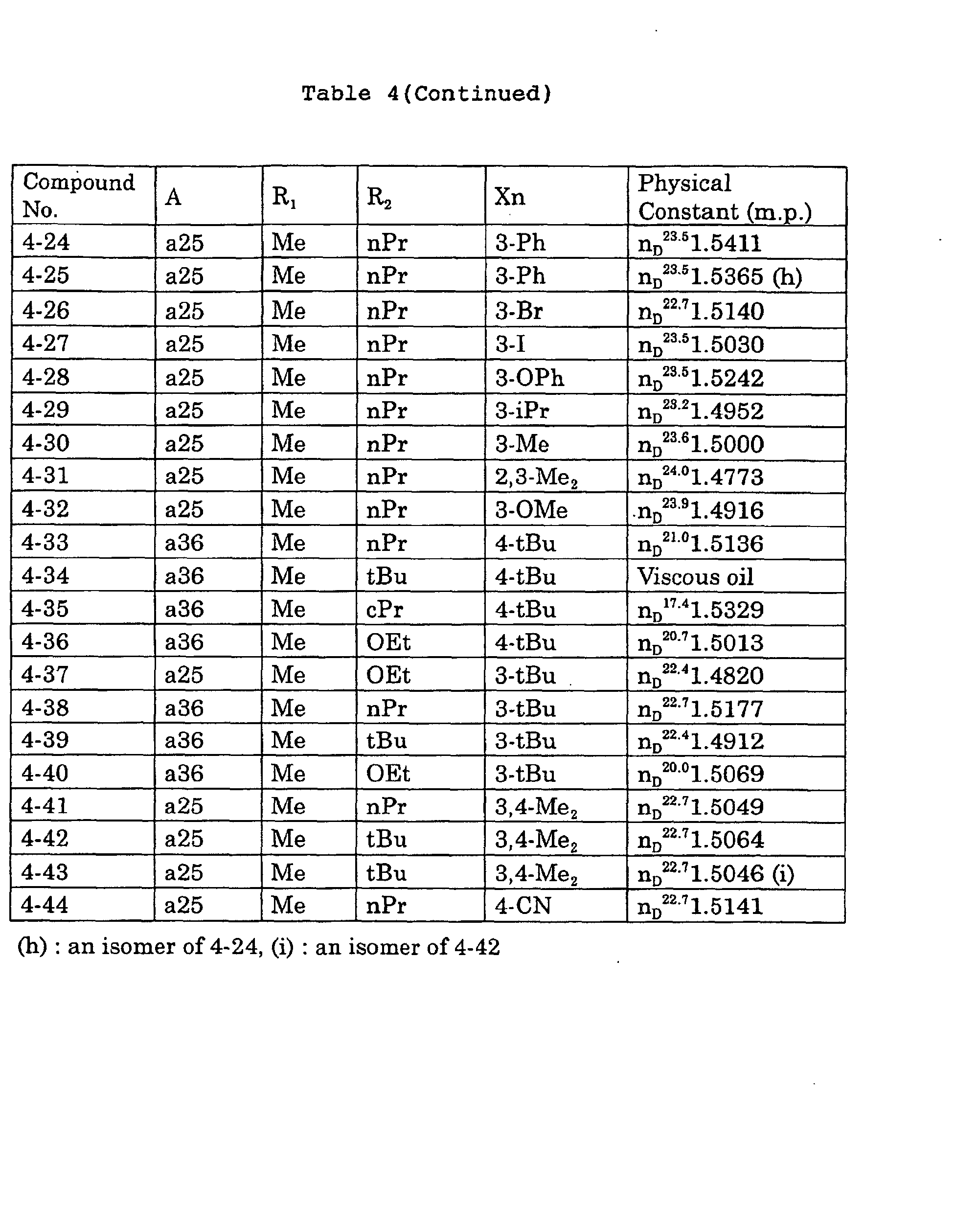
Compound Nos. 3-7, 3-9, 3-17, 3-20, 3-22, 3-23, 3-24, 3-28, 3-30, 3-31, 3-36, 3-41, 3-42, 3-44, 3-46, 3-48, 3-49, 3-56, 3-59, 3-61, 4-5, 4-6, 4-7, 4-8, 4-10, 4-11, 4-14, 4-21, 4-22, 4-24, 4-26
Compound Nos. 3-7, 3-8, 3-9, 3-13, 3-17, 3-18, 3-20, 3-22, 3-23, 3-24, 3-26, 3-28, 3-29, 3-30, 3-31, 3-33, 3-34, 3-36, 3-37, 3-38, 3-39, 3-40, 3-41, 3-42, 3-44, 3-46, 3-48, 3-49, 3-50, 3-54, 3-56, 3-57, 3-59, 3-61, 3-63, 3-65, 3-66, 3-68, 3-70, 3-72, 4-1, 4-2, 4-3, 4-4, 4-5, 4-6, 4-7, 4-8, 4-9, 4-10, 4-11, 4-12, 4-13, 4-14, 4-15, 4-16, 4-17, 4-18, 4-19, 4-20, 4-21, 4-22, 4-23, 4-24, 4-25, 4-26, 4-27, 4-28, 4-29, 4-30, 4-31, 4-32
As a result of the tests, it was noted that the compounds listed below revealed 100% percentage mortality on the third day after the spraying.
Note that chlordimeform used as a chek product has showed a percentage mortality of 13%.
Compound Nos.: 3-7, 3-9, 3-13, 3-17, 3-18, 3-20, 3-22, 3-23, 3-24, 3-26, 3-28, 3-29, 3-30, 3-31, 3-33, 3-34, 3-36, 3-37, 3-39, 3-40, 3-41, 3-42, 3-44, 3-46, 3-48, 3-49, 3-50, 3-54, 3-56, 3-57, 3-59, 3-61, 3-63, 3-65, 3-66, 3-68, 3-70, 3-72, 4-1, 4-2, 4-3, 4-4, 4-5, 4-6, 4-7, 4-8, 4-9, 4-10, 4-11, 4-12, 4-13, 4-14, 4-15, 4-16, 4-17, 4-18, 4-19, 4-20, 4-21, 4-22, 4-23, 4-24, 4-25, 4-26, 4-27, 4-28, 4-29, 4-30, 4-31, 4-32
Claims (2)
- Compounds represented by Formula (1);[wherein A is phenyl substituted by W or a heterocyclic group substituted by W;
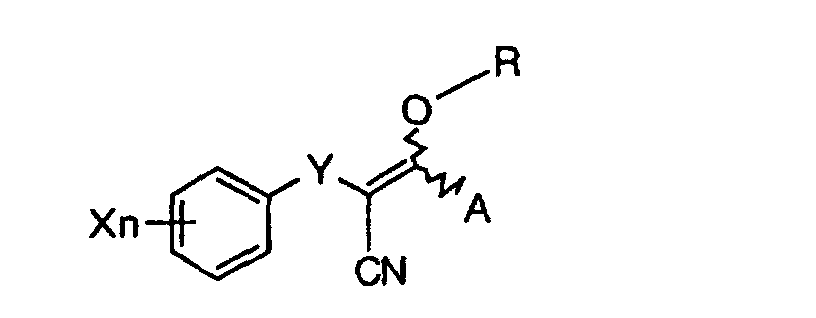
wherein W is nitro, cyano, halogeno, C1-6 alkyl, C3- 8 cycloalkyl, C1-6 haloalkyl, C1-6 alkoxy, C1-6 haloalkoxy, C1-6 alkylthio, C1-6 alkylsulfinyl, C1-6 alkylsulfonyl, C1-6 alkylamino, di-C1-6 alkylamino, C1-6 aikylcarbonyl, C1-6 alkoxycarbonyl, phenyl optionally substituted by G1, or phenoxy optionally substituted by G1;
wherein G1 is nitro, cyano, halogeno, C1-6 alkyl, C1-6 haloalkyl, C1-6 alkoxy, C1-6 haloalkoxy, C1-6 alkylthio, C1-6 alkylsulfinyl, C1-6 alkylsulfonyl, C1-6 alkylamino, di-C1-6 alkylamino, C1-6 alkylcarbonyl, or C1-6 alkoxycarbonyl;
said heterocyclic group is a 5- or 6-membered heterocyclic group that contains at least one heteroatom selected from a group consisting of oxygen, sulfur and nitrogen;
when either of said phenyl or said heterocyclic group contains 2 or more substituents W, said W may be same or different from each other;
R is hydrogen, C1-6 alkyl, C1-6 alkoxy C1-6 alkyl, C1-6 alkylcarbonyloxy C1-6 alkyl, C3-6 cycloalkylcarbonyloxy C1-6 alkyl, C1-6 alkoxycarbonyloxy C1-6 alkyl, optionally substituted phenylcarbonyloxy C1-6 alkyl, C1-6 alkylthio C1-6 alkyl, C1-6 alkylcarbonylthio C1-6 alkyl, C3-6 cycloalkylcarbonylthio C1-6 alkyl, C1-6 alkoxycarbonylthio C1-6 alkyl, optionally substituted phenylcarbonylthio C1-6 alkyl, optionally substituted phenyl C1-6 alkyl, a group represented by a formula of COR1, a group represented by a formula of CSR1, or a group represented by a formula of SO2R2;
wherein R1 is C1-12 alkyl, C3-6 cycloalkyl, C1-6 haloalkyl, C1-6 alkoxy, C1-6 alkylthio, C1-6 alkylamino, di-C1-6 alkylamino, optionally substituted phenyl C1-6 alkyl, optionally substituted phenyl C1-6 alkoxy, or optionally substituted phenyl, and
R2 is C1-12 alkyl or optionally substituted phenyl;
X is nitro, cyano, halogeno, C1-6 alkyl, C2-6 alkenyl, C2-6 alkynyl, C3-8 cycloalkyl, C1-6 haloalkyl, C2-6 haloalkenyl, C1-6 alkoxy, C1-6 haloalkoxy, C2-6 alkenyloxy, C2-6 haloalkenyloxy, C2-6 alkynyloxy, C1-6 alkylthio, C1-6 alkylsulfinyl, C1-6 alkylsulfonyl, C1-6 alkylamino, di-C1-6 alkylamino, tri-C1-6 alkylsilyl, C1-6 alkoxy C1-6 alkyl, C1-6 alkylthio C1-6 alkyl, C1-6 alkylsulfinyl C1-6 alkyl, C1-6 alkylsulfonyl C1-6 alkyl, C1-6 alkylcarbonyl, C1-6 alkoxycarbonyl, phenyl C1-6 alkyl optionally substituted by G2, phenyl C1-6 alkoxy optionally substituted by G2, thienyl optionally substituted by G3, pyridyl optionally substituted by G2, pyridyloxy optionally substituted by G2, phenyl optionally substituted by G4, or phenoxy optionally substituted by G4;
wherein G2 is C1-6 alkyl, halogeno, C1-6 haloalkyl, or C1-6 haloalkoxy,
G3 is C1-6 alkyl or halogeno, and
G4 is nitro, cyano, halogeno, C1-6 alkyl, C1-6 haloalkyl, C1-6 alkoxy, C1-6 haloalkoxy, C1-6 alkylthio, C1-6 alkylsulfinyl, C1-6 alkylsulfonyl, C1-6 alkylamino, di-C1-6 alkylamino, C1-6 alkylcarbonyl, or C1-6 alkoxycarbonyl;
n is 0, or an integer of 1 to 5, and when n is 2 or more, the above X may be same or different from each other; and
Y is oxygen, sulfur, or nitrogen substituted by either hydrogen or C1-6 alkyl], and the salts thereof. - An insecticide or acaricide composition characterized by comprising one or more of compounds represented by Formula (1);[wherein A, R, X, Y and n are as defined in claim 1] and the salts thereof as the active ingredients.

Applications Claiming Priority (3)
| Application Number | Priority Date | Filing Date | Title |
|---|---|---|---|
| JP2000335827 | 2000-11-02 | ||
| JP2000335827 | 2000-11-02 | ||
| PCT/JP2001/009581 WO2002036550A1 (en) | 2000-11-02 | 2001-11-01 | Organic compound having cyano group and insecticides/miticides |
Publications (2)
| Publication Number | Publication Date |
|---|---|
| EP1338589A1 true EP1338589A1 (en) | 2003-08-27 |
| EP1338589A4 EP1338589A4 (en) | 2004-03-17 |
Family
ID=18811507
Family Applications (1)
| Application Number | Title | Priority Date | Filing Date |
|---|---|---|---|
| EP01980945A Withdrawn EP1338589A4 (en) | 2000-11-02 | 2001-11-01 | Organic compound having cyano group and insecticides/miticides |
Country Status (8)
| Country | Link |
|---|---|
| US (1) | US6987112B2 (en) |
| EP (1) | EP1338589A4 (en) |
| JP (1) | JPWO2002036550A1 (en) |
| KR (1) | KR20030042026A (en) |
| CN (1) | CN1473147A (en) |
| AU (1) | AU2002212696A1 (en) |
| BR (1) | BR0115083A (en) |
| WO (1) | WO2002036550A1 (en) |
Families Citing this family (1)
| Publication number | Priority date | Publication date | Assignee | Title |
|---|---|---|---|---|
| CN101215269B (en) * | 2007-12-29 | 2010-06-09 | 浙江工业大学 | 2-thiazolyl acrylonitrile compound and synthetic method and application thereof |
Family Cites Families (8)
| Publication number | Priority date | Publication date | Assignee | Title |
|---|---|---|---|---|
| JPS6011401A (en) * | 1983-06-30 | 1985-01-21 | Showa Denko Kk | Agricultural and horticultural fungicide containing alpha- cyanoketone derivative as active component |
| US4626543A (en) | 1985-02-01 | 1986-12-02 | Shell Oil Company | Insecticidal 2,6-difluorobenzoyl derivatives of 4-substituted-1,3-thiazole-2-acetonitriles |
| JPH08295663A (en) * | 1995-04-27 | 1996-11-12 | Takeda Chem Ind Ltd | Aminoethylene derivative and its use |
| AU736854B2 (en) * | 1996-04-25 | 2001-08-02 | Nissan Chemical Industries Ltd. | Ethylene derivatives and pesticides containing said derivatives |
| TW513285B (en) * | 1997-02-14 | 2002-12-11 | Ishihara Sangyo Kaisha | Acrylonitrile compounds, process and intermediates for their production, method for controlling pests comprising using them and pesticides, fungicides and marine antifouling agents containing them |
| AU6420498A (en) | 1997-03-21 | 1998-10-20 | Nippon Soda Co., Ltd. | Triazole compounds, process for the preparation thereof, and insecticides and miticides |
| JP2002501038A (en) * | 1998-01-22 | 2002-01-15 | ノバルティス ファーマ アクチエンゲゼルシャフト | Organic nitrile derivatives and their use as pesticides |
| WO1999044993A1 (en) | 1998-03-06 | 1999-09-10 | Ishihara Sangyo Kaisha Ltd. | Acryronitrile-based compound, method for producing the same and pest controlling agent comprising the same |
-
2001
- 2001-11-01 BR BR0115083-9A patent/BR0115083A/en not_active Application Discontinuation
- 2001-11-01 AU AU2002212696A patent/AU2002212696A1/en not_active Abandoned
- 2001-11-01 KR KR10-2003-7005625A patent/KR20030042026A/en not_active Ceased
- 2001-11-01 US US10/415,797 patent/US6987112B2/en not_active Expired - Fee Related
- 2001-11-01 EP EP01980945A patent/EP1338589A4/en not_active Withdrawn
- 2001-11-01 JP JP2002539310A patent/JPWO2002036550A1/en not_active Withdrawn
- 2001-11-01 WO PCT/JP2001/009581 patent/WO2002036550A1/en not_active Ceased
- 2001-11-01 CN CNA018183328A patent/CN1473147A/en active Pending
Also Published As
| Publication number | Publication date |
|---|---|
| US20040072826A1 (en) | 2004-04-15 |
| KR20030042026A (en) | 2003-05-27 |
| EP1338589A4 (en) | 2004-03-17 |
| JPWO2002036550A1 (en) | 2004-03-11 |
| AU2002212696A1 (en) | 2002-05-15 |
| US6987112B2 (en) | 2006-01-17 |
| CN1473147A (en) | 2004-02-04 |
| BR0115083A (en) | 2004-02-25 |
| WO2002036550A1 (en) | 2002-05-10 |
Similar Documents
| Publication | Publication Date | Title |
|---|---|---|
| US6737382B1 (en) | Insecticidal aminothiazole derivatives | |
| JP5122640B2 (en) | Nitrogen-containing heterocyclic compounds and agricultural and horticultural fungicides | |
| JP5215321B2 (en) | Oxime ether derivatives and agricultural and horticultural fungicides | |
| KR100415960B1 (en) | Thiazolylcinnamonitriles and pest controlling agents | |
| JPWO2004037770A1 (en) | Hydrazine derivatives, production intermediates and agricultural and horticultural fungicides and insecticides | |
| EP1362850A1 (en) | Oxime ether compound and agricultural or horticultural bactericide | |
| US20050090506A1 (en) | Insecticidal perfluoroalkylthiazole derivatives | |
| EP0717039A1 (en) | Novel triazole compound, process for producing the same, and pest control agent | |
| KR20020059648A (en) | Novel compounds having cyano and insecticides and miticides | |
| US6987112B2 (en) | Organic compound having cyano group and insecticides/miticides | |
| AU769975B2 (en) | Thiazolylcinnamonitrile compounds and insecticides and miticides | |
| JP2002241358A (en) | Compound having oxim group and insecticide/miticide | |
| JPH07330742A (en) | Triazole derivative, its production and insect pest controlling agent | |
| JP2009062277A (en) | Benzisothiazoline compound and pest control agent | |
| JPWO2001032609A1 (en) | Novel compounds containing a cyano group and insecticides and acaricides | |
| JPWO2003064401A1 (en) | Acrylonitrile compounds and pest control agents | |
| JPH11269154A (en) | Pyrimidine compound, its preparation and pest-controlling agent | |
| JP2004010577A (en) | Organic compound having cyano group and vermin controlling agent | |
| JPWO2002088099A1 (en) | Thiazolyl cinnamate nitrile compounds and pesticides | |
| JPH10298179A (en) | Heterocycle-substituted pyrrole compound, its production, and agricultural and horticultural bactericide | |
| JPWO2003095450A1 (en) | Isoxazole compounds and insecticide / acaricide | |
| JPWO2002081429A1 (en) | Novel compound having oxime group and insecticide and acaricide | |
| JPWO2001047903A1 (en) | Thiazolylcinnamic acid nitrile compounds and insecticides and acaricides | |
| JPWO2001068589A1 (en) | Acrylonitrile compounds and pesticides | |
| JP2003073364A (en) | Oxazole derivative and germicidal agent for horticulture |
Legal Events
| Date | Code | Title | Description |
|---|---|---|---|
| PUAI | Public reference made under article 153(3) epc to a published international application that has entered the european phase |
Free format text: ORIGINAL CODE: 0009012 |
|
| 17P | Request for examination filed |
Effective date: 20030429 |
|
| AK | Designated contracting states |
Designated state(s): AT BE CH CY DE DK ES FI FR GB GR IE IT LI LU MC NL PT SE TR |
|
| AX | Request for extension of the european patent |
Extension state: AL LT LV MK RO SI |
|
| A4 | Supplementary search report drawn up and despatched |
Effective date: 20040130 |
|
| RIC1 | Information provided on ipc code assigned before grant |
Ipc: 7C 07D 277/20 B Ipc: 7C 07D 231/12 B Ipc: 7C 07D 231/16 B Ipc: 7C 07C 323/19 B Ipc: 7C 07C 255/37 B Ipc: 7C 07C 255/42 B Ipc: 7C 07C 255/43 B Ipc: 7A 01N 43/78 B Ipc: 7A 01N 43/56 B Ipc: 7A 01N 37/00 B Ipc: 7C 07C 255/63 A |
|
| REG | Reference to a national code |
Ref country code: DE Ref legal event code: 8566 |
|
| RBV | Designated contracting states (corrected) |
Designated state(s): AT BE CH ES FR IT LI |
|
| 17Q | First examination report despatched |
Effective date: 20050324 |
|
| STAA | Information on the status of an ep patent application or granted ep patent |
Free format text: STATUS: THE APPLICATION IS DEEMED TO BE WITHDRAWN |
|
| 18D | Application deemed to be withdrawn |
Effective date: 20051005 |