EP1329436A2 - Procede de fabrication de fibres de nitrure de bore a partir de borylborazines - Google Patents
Procede de fabrication de fibres de nitrure de bore a partir de borylborazines Download PDFInfo
- Publication number
- EP1329436A2 EP1329436A2 EP03290144A EP03290144A EP1329436A2 EP 1329436 A2 EP1329436 A2 EP 1329436A2 EP 03290144 A EP03290144 A EP 03290144A EP 03290144 A EP03290144 A EP 03290144A EP 1329436 A2 EP1329436 A2 EP 1329436A2
- Authority
- EP
- European Patent Office
- Prior art keywords
- polymer
- boron nitride
- formula
- spinning
- alkyl
- Prior art date
- Legal status (The legal status is an assumption and is not a legal conclusion. Google has not performed a legal analysis and makes no representation as to the accuracy of the status listed.)
- Withdrawn
Links
Classifications
-
- H—ELECTRICITY
- H01—ELECTRIC ELEMENTS
- H01Q—ANTENNAS, i.e. RADIO AERIALS
- H01Q1/00—Details of, or arrangements associated with, antennas
- H01Q1/42—Housings not intimately mechanically associated with radiating elements, e.g. radome
-
- C—CHEMISTRY; METALLURGY
- C04—CEMENTS; CONCRETE; ARTIFICIAL STONE; CERAMICS; REFRACTORIES
- C04B—LIME, MAGNESIA; SLAG; CEMENTS; COMPOSITIONS THEREOF, e.g. MORTARS, CONCRETE OR LIKE BUILDING MATERIALS; ARTIFICIAL STONE; CERAMICS; REFRACTORIES; TREATMENT OF NATURAL STONE
- C04B35/00—Shaped ceramic products characterised by their composition; Ceramics compositions; Processing powders of inorganic compounds preparatory to the manufacturing of ceramic products
- C04B35/515—Shaped ceramic products characterised by their composition; Ceramics compositions; Processing powders of inorganic compounds preparatory to the manufacturing of ceramic products based on non-oxide ceramics
- C04B35/58—Shaped ceramic products characterised by their composition; Ceramics compositions; Processing powders of inorganic compounds preparatory to the manufacturing of ceramic products based on non-oxide ceramics based on borides, nitrides, i.e. nitrides, oxynitrides, carbonitrides or oxycarbonitrides or silicides
- C04B35/583—Shaped ceramic products characterised by their composition; Ceramics compositions; Processing powders of inorganic compounds preparatory to the manufacturing of ceramic products based on non-oxide ceramics based on borides, nitrides, i.e. nitrides, oxynitrides, carbonitrides or oxycarbonitrides or silicides based on boron nitride
-
- C—CHEMISTRY; METALLURGY
- C04—CEMENTS; CONCRETE; ARTIFICIAL STONE; CERAMICS; REFRACTORIES
- C04B—LIME, MAGNESIA; SLAG; CEMENTS; COMPOSITIONS THEREOF, e.g. MORTARS, CONCRETE OR LIKE BUILDING MATERIALS; ARTIFICIAL STONE; CERAMICS; REFRACTORIES; TREATMENT OF NATURAL STONE
- C04B35/00—Shaped ceramic products characterised by their composition; Ceramics compositions; Processing powders of inorganic compounds preparatory to the manufacturing of ceramic products
- C04B35/622—Forming processes; Processing powders of inorganic compounds preparatory to the manufacturing of ceramic products
- C04B35/62227—Forming processes; Processing powders of inorganic compounds preparatory to the manufacturing of ceramic products obtaining fibres
- C04B35/62272—Forming processes; Processing powders of inorganic compounds preparatory to the manufacturing of ceramic products obtaining fibres based on non-oxide ceramics
-
- C—CHEMISTRY; METALLURGY
- C08—ORGANIC MACROMOLECULAR COMPOUNDS; THEIR PREPARATION OR CHEMICAL WORKING-UP; COMPOSITIONS BASED THEREON
- C08G—MACROMOLECULAR COMPOUNDS OBTAINED OTHERWISE THAN BY REACTIONS ONLY INVOLVING UNSATURATED CARBON-TO-CARBON BONDS
- C08G79/00—Macromolecular compounds obtained by reactions forming a linkage containing atoms other than silicon, sulfur, nitrogen, oxygen, and carbon with or without the latter elements in the main chain of the macromolecule
- C08G79/08—Macromolecular compounds obtained by reactions forming a linkage containing atoms other than silicon, sulfur, nitrogen, oxygen, and carbon with or without the latter elements in the main chain of the macromolecule a linkage containing boron
-
- C—CHEMISTRY; METALLURGY
- C08—ORGANIC MACROMOLECULAR COMPOUNDS; THEIR PREPARATION OR CHEMICAL WORKING-UP; COMPOSITIONS BASED THEREON
- C08L—COMPOSITIONS OF MACROMOLECULAR COMPOUNDS
- C08L85/00—Compositions of macromolecular compounds obtained by reactions forming a linkage in the main chain of the macromolecule containing atoms other than silicon, sulfur, nitrogen, oxygen and carbon; Compositions of derivatives of such polymers
- C08L85/04—Compositions of macromolecular compounds obtained by reactions forming a linkage in the main chain of the macromolecule containing atoms other than silicon, sulfur, nitrogen, oxygen and carbon; Compositions of derivatives of such polymers containing boron
-
- H—ELECTRICITY
- H10—SEMICONDUCTOR DEVICES; ELECTRIC SOLID-STATE DEVICES NOT OTHERWISE PROVIDED FOR
- H10W—GENERIC PACKAGES, INTERCONNECTIONS, CONNECTORS OR OTHER CONSTRUCTIONAL DETAILS OF DEVICES COVERED BY CLASS H10
- H10W40/00—Arrangements for thermal protection or thermal control
- H10W40/20—Arrangements for cooling
- H10W40/25—Arrangements for cooling characterised by their materials
- H10W40/251—Organics
Definitions
- the subject of the present invention is a method of manufacture of boron nitride fibers, in particular of continuous fibers of boron nitride having good mechanical properties, usable for the production of ceramic composite materials such as BN / BN composites, thermostructural parts or antenna radomes.
- boron nitride fibers from a precursor polymer which is shaped by spinning to form polymer fibers which are then subjected to a ceramization to transform them into nitride fibers boron.
- Boron nitride ceramic fibers from the present invention are of great interest to the manufacture of composite materials with good oxidation resistance, stability properties thermal, and electrical insulation.
- CK Narula et al [2] One way of obtaining such precursor polymers has been described by CK Narula et al [2] . It consists in reacting trichloroborazine or 2- (dimethylamino) -4,6-dichloroborazine with hexa-methyldisilazane in solution in dichloromethane at room temperature. In the case where 2- (dimethyl-amino) -4,6-dichloroborazine is used, the polymerization at two points is favored due to the presence of the NMe 2 group.
- Another way of obtaining precursor polymers described in EP-A-0 342 673 [3] consists in reacting a B-tris (lower alkyl amino) borazine with an alkylamine such as laurylamine, thermally in bulk or in solution .
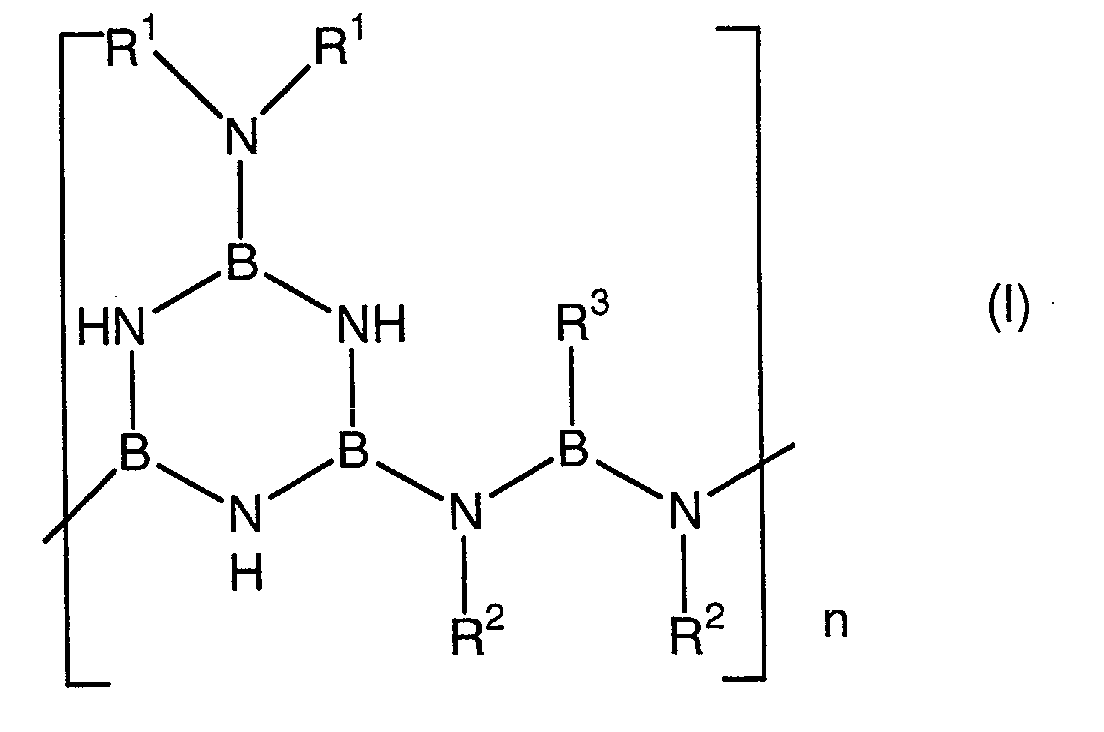
- precursor polymers can also be obtained by thermal polycondensation of trifunctional aminoborazines of formula [-B (NR 1 R 2 ) -NR 3 -] 3 in which R 1 , R 2 and R 3 which are identical or different represent l hydrogen, an alkyl radical or an aryl radical, as described in FR-A-2 695 645 [4].
- the polymers described above are well suited for obtaining powder or other forms of boron nitride but it is more difficult to prepare more complex shapes, especially fibers with from such polymers.
- the materials obtained in the prior art are matrices or solid BN, but not fibers good quality boron nitride essential for manufacturing materials ceramic composites with good performance mechanical.
- the object of the present invention is precisely to overcoming the aforementioned drawbacks of the prior art and to provide a fiber precursor polymer which has the aforementioned qualities required in particular for the manufacture of boron nitride fibers.
- n is an integer
- R 1 and R 2 which may be identical or different, independently represent an alkyl group
- R 3 represents an amino group, a hydrogen atom, an alkyl, a cycloalkyl or a boryl.
- the alkyl group R 1 represents the methyl group. It can however represent other alkyls, for example with two or three carbons.
- the alkyl group R 2 represents the methyl group. It may however represent independently of R 1 other alkyls, for example with two or three carbons, for example ethyl or propyl.
- the alkyl group R 3 represents an alkylamine, comprising for example from 1 to 3 carbon atoms, preferably R 3 is NHCH 3 .
- This structure brings great flexibility to the obtained polymer which can be shaped into a very wire easily. It allows by ceramization of these wires to obtain boron nitride fibers.
- the present invention relates also to a process for making fibers from boron nitride by spinning a precursor polymer and ceramization of the polymer fibers obtained by spinning, in which the precursor polymer is formula (I) defined above.
- R 4 is advantageously an alkyl group comprising from 1 to 3 carbon atoms, preferably an ethyl.
- the technique used in the invention is based on chemical polymerization of borazines.
- the process requires compliance, preferably as precisely as possible, with the stoichiometric amounts between the borazine of formula (II) and the alkylaminoborane R 3 B (NHR 2 ) 2 , that is to say 1/1 molar proportions of these two compounds.
- the introduction of the starting reagents is advantageously well controlled (strict mass) for obtain the desired polymer.
- the present invention therefore uses a polymer of slightly crosslinked borylborazine type obtained without heating, i.e. at room temperature, for example at temperature from 10 to 35 ° C, for the manufacture of fibers boron nitride.
- amine HN (R 1 ) 2 can be added at the start of the synthesis of compound (II) which implies a small proportion of disubstituted borazines of formula (NR 1 ) 2 ClB 3 N 3 H 3 which will serve as chain blockers to limit the rate of polycondensation.
- R 5 and R 6 being independently an alkyl, aryl or boryl.
- the proportion of chain blocking groups determines the repeat n of the basic unit of formula (I). This (n) being for example between 5 and 30, preferably between 10 and 20. Polymerization by the bridging boryl group cannot however be excluded, although very unlikely because of steric hindrance. This is why, in the case where R 3 is an alkylamino group, the polymer can be slightly crosslinked.
- the polymerization is preferably carried out under an inert atmosphere.
- the solvent-soluble polymer can be separated from the amine hydrochloride N (R 4 ) 3 .HCl for example by filtration and the solvent can be removed for example by evaporation under reduced pressure.
- the polymer can be recast after its synthesis to homogenize it and make it compact before spinning. This can be achieved for example by a brief rise in temperature, up to its softening temperature.
- the spinning step is carried out preferably under a controlled atmosphere and the inventors noticed that it was better to maintain the relative humidity of this atmosphere below 10% and preferably less than 2%.
- the polymer can be extruded by a sector of 50 to 500 ⁇ m and more particularly of 100 to 200 ⁇ m, which is surmounted by a filter and a shear element.
- Drawing of the polymeric wire can be done using a refractory coil of diameter between 50 and 200 mm, and more precisely from 50 to 100 mm. This coil can be by example in graphite.
- the present invention advantageously allows decrease the spinning temperature by 30 to 100 ° C by compared to polymers and processes of the prior art.
- the spinning is carried out at a spinning temperature Tf such than 30 ° C ⁇ Tf - Tg ⁇ 100 ° C, preferably such that 30 ° C ⁇ Tf - Tg ⁇ 70 ° C, with Tg, the temperature of glass transition of the polymer.
- the glass transition temperature of the polymer of the present invention is about 25 to 80 ° C, depending the value of n or the proportion of borazine (III).
- the precursor polymer of formula (I) of the present invention has the particularity of have a pseudo-linear or slightly cross-linked structure because one of the three sites of the trichloroborazine precursor (TCB) is made non-reactive.
- TAB trichloroborazine precursor
- the chemical polycondensation of the present invention allows the formation of a polymer whose borazine rings B 3 N 3 are linked only by intercyclic bonds with three atoms of the original NBN type.
- the polycondensation mechanism is therefore unique.
- room temperature that is to say at around 10 to 35 ° C, for example at around 25 ° C, the cyclic protons are not reactive enough to react on the chlorine atoms.
- the formation of 3-atom bridges between two cycles is therefore the only possible mechanism.
- the particular structure of the polymer of the present invention makes it possible to control the number of cycles by chains and thus to control the mass molecular of the polymer and therefore its temperature of glass transition.
- This structure of the present invention improves the rheological characteristics of the polymers obtained and brings great flexibility to the polymer which can be spun very easily.
- the ceramic yield is relatively high because the polymer contains alkyl groups methyl type. This yield can reach 50%.
- the process of the present invention further provided better control over the progress of the polymer. Indeed, the quantities of reagents at the start can be added in controlled quantities which allows obtaining a polymer whose mass molecular can be controlled.
- the treatment of ceramization can be done by methods classics generally used for the transformation of precursor polymer fibers to base of aminoborazines in boron nitride, in subject to heat treatment in the presence ammonia, then nitrogen and possibly a gas inert such as argon.
- the ceramization step is advantageously carried out in two stages, by carrying out a first pre-ceramic stage with ammonia up to a temperature lower or equal at 1000 ° C, then by performing a second step of ceramization in an atmosphere of nitrogen and / or rare gas at higher temperatures, especially from 1400 to 2200 ° C, in one or more successive operations.
- the high performance boron nitride fiber obtained from the polymer of the present invention is a continuous, woven fiber of hexagonal boron nitride, in the form of a monofilament or a wick of filaments, and the filament (s) have an average tensile stress ⁇ R of at least 800 MPa, preferably from 800 to 2000 MPa, an average Young's modulus E from 50 to 250 GPa, preferably from 50 to 190 GPa and a distribution of the elongations at the mean rupture ⁇ R from 0.2 to 2%, and preferably from 0.2 to 1%.
- the median breaking stress ⁇ R is determined on about fifty filaments with a length of test piece of 1 cm.
- the failure tests are analyzed by the Weibull model where the median failure stresses are determined for a probability of failure equal to 0.63.
- the diameter of the one or more filaments constituting the fiber is preferably 4 to 25 .mu.m.
- the boron nitride forming the fibers is hexagonal boron nitride.
- This structure corresponds to a stack of hexagonal BN planes. Such a structure is described for example in application FR-A-2 806,422.
- the fiber advantageously has an impurity level of less than 1%, in particular it contains less than 0.1% by weight in total of elements with an atomic number greater than 11, and has a density equal to or greater than 1.8 g / cm 3 .
- the fiber retains its performance high in natural aging. Indeed, in accelerated aging, at 65 ° C, in an atmosphere 75% relative humidity, there is no measurable decrease in mechanical properties at the end two months.
- the fibers of the present invention have excellent spinnability and therefore allow easy spinning, while with the polymers of the art this step is very delicate. Fibers obtained are continuous fibers of high performance.
- These fibers can be used for example alone, but also in a resin matrix, by example epoxy or in a ceramic matrix for the manufacturing of structural parts, for example in automotive, aviation, and machinery so general etc.
- the polymer of formula (I) described above can be advantageously used for the manufacture of protective coatings against oxidation, foams boron nitride, BN / C composite materials or BN / BN or heat sink for microelectronics.
- This first step consists in particular in preparing a borazine type monomer, one of the three functions of which is made non-reactive at the temperature of the synthesis, that is to say at room temperature.
- This monomer now only has two reactive "chlorine" functions.
- a chlorine atom of TCB is replaced by an N (CH 3 ) 2 group and there is release of an equivalent of HCl.
- This species is gaseous under these conditions and can be taken up by an equivalent of triethylamine (Et 3 N) by forming a solid compound which precipitates Et 3 N.HCl.
- the modified borazine (1 equivalent) was added 15 ml of triethylamine on 2.21 g of B (NHMe) 3 solubilized in 50 ml of toluene. After stirring, filtration and evaporation, 4.3 g of a light orange powdery solid were obtained which was soluble in most organic solvents. The polymer was then introduced into a reactor and then remelted up to 150 ° C. under argon.
- This second step concerns the preparation of the polymer.
- the reaction is similar to that described above, that is to say that the alkylaminoborane can react with a chlorine function via its NHCH 3 functions to form a non-isolable intermediate compound, which can in turn react on a identical molecule.
- the repetition of this process leads to the formation of the polymer (b).
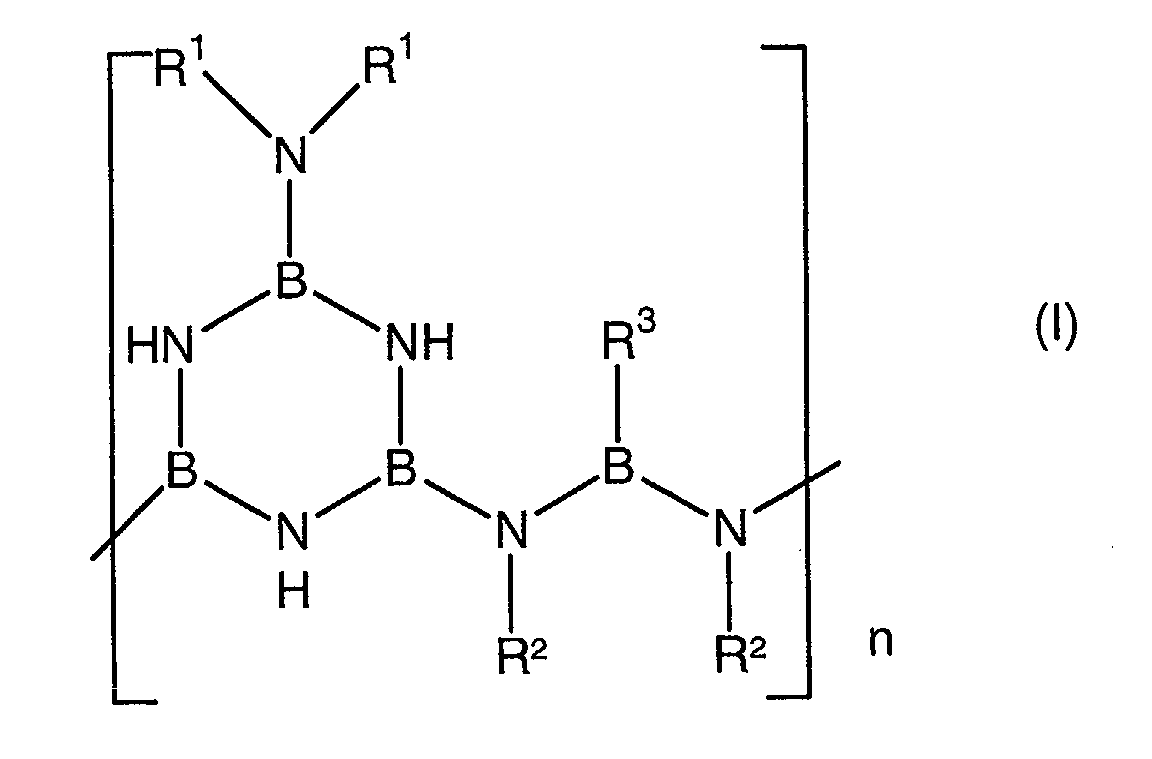
- polymer (b) shown in Figure 1 below in which n is an integer ranging for example from 5 to 30, preferably from 10 to 20.
- the measured softening temperature of this polymer was around 140 ° C.
- the fibers obtained have were characterized in Raman spectrometry and in analysis chemical by electron spectroscopy (ESCA) like being indeed hexagonal boron nitride fibers carbon-free. We then determined their diameter, their mechanical properties and their structures.
- ESA electron spectroscopy
- Diameters were assessed by the method laser interferometry using the approximation of Fraunhofer. It is the monofilaments that play the role of diffraction slit.
- the technique consists of measure the distance between two interference fringes knowing the wavelength of the laser and the distance from the monofilament to the measurement screen.
- the mechanical properties were determined using a microtraction machine.
- the cardboard frames are placed in the jaws so that the test corresponds to the traction of the monofilament.
- a tensile force is applied to the monofilament.
- the tests are carried out on about fifty monofilaments with a length of test tube of 1 cm.
- the rupture tests on these filaments are carried out by the Weibull model where the stresses at rupture are determined for a probability of rupture equal to 0.63.
- the structural condition of the filaments has been determined by X-ray diffraction and Raman scattering.
- the width at mid-height of the diffraction line X (002) which is at a value 2 ⁇ of 26.765 ° for the hexagonal boron nitride, provides information on the crystallinity of the filament along the axis c.
- the polymer was spun on FILAMAT2 (brand of commerce), from PRODEMAT, with a 200 ⁇ m, with the polymer manufactured as indicated in Example 1 above, at a temperature of 151 ° C, in extruding it at a speed of 0.4 to 0.6 mm / min under a force varying from 20 to 40 daN and wrapping it around a graphite spool 50 and 100mm in diameter at a drawing speed of 40 to 200 cm / s.
- FILAMAT2 brand of commerce
- the spinning temperature is about 100 ° C lower than that which should be used for polymers of the prior art.
- a pre-ceramization treatment under ammonia up to 600 ° C was then carried out in order to eliminate the methyl groups of the starting polymer, then under nitrogen up to 1800 ° C.
- the treatment is carried out under mechanical tension by removal of the polymer from the refractory coil during of the temperature rise.
- the advantage of continuing the treatment up to 1800 ° C is to crystallize the boron nitride and orient the BN crystals parallel to the axis of the fiber.
- the fibers are then cooled to the room temperature and we characterize them mechanically and structurally. They have an aspect white and are slightly relaxed around the spool but not broken.
- E1 and E2 represent different samples produced according to the method of this example, V represents: winding speed, ⁇ : fiber diameter, ⁇ R : the tensile stress, and E: the elastic modulus.
- the present invention makes it possible to obtain fibers boron nitride with high properties from a new type of polymer developed at temperature room.
- a chemical polymer was obtained by reaction of a trichloroborazine (TCB) on n B (NH i Pr) 3 , with 1 ⁇ n ⁇ 3 and i Pr: isopropyl.
- TCB trichloroborazine
- the aminoborane used was tris (isopropylamino) borane.
- These filaments had properties very weak mechanics and the polymer was crosslinked in all directions.
Landscapes
- Chemical & Material Sciences (AREA)
- Engineering & Computer Science (AREA)
- Organic Chemistry (AREA)
- Ceramic Engineering (AREA)
- Materials Engineering (AREA)
- Manufacturing & Machinery (AREA)
- Structural Engineering (AREA)
- Health & Medical Sciences (AREA)
- Chemical Kinetics & Catalysis (AREA)
- Medicinal Chemistry (AREA)
- Polymers & Plastics (AREA)
- Nanotechnology (AREA)
- Inorganic Chemistry (AREA)
- Inorganic Fibers (AREA)
- Polymers With Sulfur, Phosphorus Or Metals In The Main Chain (AREA)
Abstract

Description
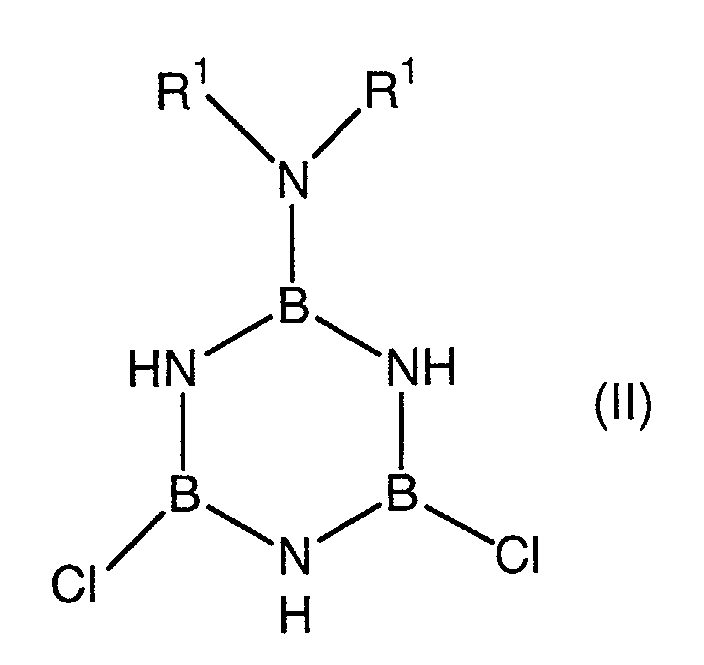
- réaction de HN(R1)2 sur la trichloroborazine en
proportion stoechiométrique 1/1 en moles pour donner le
borazine de formule (II) suivante :
- réaction sans chauffage du borazine de formule (II) avec un alkylaminoborane de formule R3B(NHR2)2 en proportions stoechiométriques 1/1 en moles, en présence d'une amine tertiaire -N(R4)3.

- Chauffage de 600 à 1100°C, à une vitesse de 100°C/h, sous N2.
- Maintien à 1100°C, sous N2, pendant 90 minutes.
- Refroidissement à la température ambiante.
- Chauffage jusqu'à 1400°C, à une vitesse de 600°C/h, sous N2.
- Maintien à 1400°C, sous N2, pendant 1 heure.
- Chauffage de 1400 à 1600°C, à une vitesse de 600°C/h, sous N2.
- Maintien à 1600°C, sous N2 pendant 1 heure.
- Chauffage de 1600 à 1800°C, à une vitesse de 600°C/h, sous N2.
- Maintien à 1800°C, sous N2, pendant 1 heure.
| E1 | E2 | |
| Bobine (mm) | 100 | 100 |
| Vbobinage (cm/sec) | 120 | 142 |
| Vpiston (mm/min) | 0.4 | 0.4-0.6 |
| th crues (µm) | 22,5 | 20,8 - 25,5 |
| céramisées (µm) | 10,0 | 9,3 |
| σR (MPa) | 855 | 1021 |
| E (GPa) | 151 | 187 |
Claims (22)
- Polymère de formule (I) suivante :dans laquelle n est un nombre entier, R1 et R2, identiques ou différents, représentent indépendamment un groupe alkyle, et R3 représente un groupe amino, un atome d'hydrogène, un alkyle, un cycloalkyle ou un boryle.

- Polymère selon la revendication 1, dans lequel R1 et R2 représentent indépendamment un alkyle ayant de 1 à 3 atomes de carbone, et R3 représente indépendamment une alkylamine.
- Polymère selon la revendication 1, dans lequel R1 représente le groupe méthyle.
- Polymère selon la revendication 1, dans lequel R1 et R2 représentent le groupe méthyle.
- Polymère selon la revendication 1, dans lequel R1 et R2 représentent le groupe méthyle et R3 représente NHCH3.
- Procédé de fabrication de fibres de nitrure de bore par filage d'un polymère précurseur et céramisation des fibres de polymère obtenues par filage, dans lequel le polymère précurseur est de formule (I) suivante :dans laquelle n est un nombre entier, R1 et R2, identiques ou différents, représentent indépendamment un groupe alkyle, et R3 représente un groupe amino, un atome d'hydrogène, un alkyle, un cycloalkyle ou un boryle.
- Procédé selon la revendication 6, dans lequel R1 et R2 représentent indépendamment un alkyle ayant de 1 à 3 atomes de carbone, et R3 représente indépendamment une alkylamine.
- Procédé selon la revendication 6, dans lequel R1 représente le groupe méthyle.
- Procédé selon la revendication 6, dans lequel R1 et R2 représentent le groupe méthyle.
- Procédé selon la revendication 6, dans lequel R1 et R2 représentent le groupe méthyle et R3 représente NHCH3.
- Procédé selon la revendication 6, dans lequel la polymérisation est effectuée à une température de 10 à 35°C sous atmosphère inerte.
- Procédé selon la revendication 6, dans lequel on effectue le filage à une température de filage Tf telle que 30°C ≤ Tf - Tg ≤ 100°C, avec Tf la température de filage et Tg la température de transition vitreuse du polymère.
- Procédé selon l'une quelconque des revendications 6 à 12, dans lequel on effectue le filage dans une atmosphère ayant un taux d'humidité inférieur à 10 %.
- Procédé selon la revendication 6, dans lequel l'étape de céramisation est réalisée en deux étapes, en réalisant une première étape de précéramisation avec de l'ammoniac jusqu'à une température inférieure ou égale à 1000°C, puis en réalisant une deuxième étape de céramisation en atmosphère d'azote et/ou de gaz rare à des températures supérieures, notamment de 1400 à 2200°C, en une ou plusieurs opérations successives.
- Procédé selon l'une quelconque des revendications 6 à 14 précédentes, dans lequel le polymère précurseur de formule (I) est obtenu par la mise en oeuvre des étapes suivantes :dans lequel R1, R2 et R3 étant tels que définis dans la revendication 6, et R4 est un groupe alkyle.Réaction de HN(R1)2 sur la trichloroborazine en proportion stoechiométrique 1/1 en moles pour donner le borazine de formule (II) suivante :
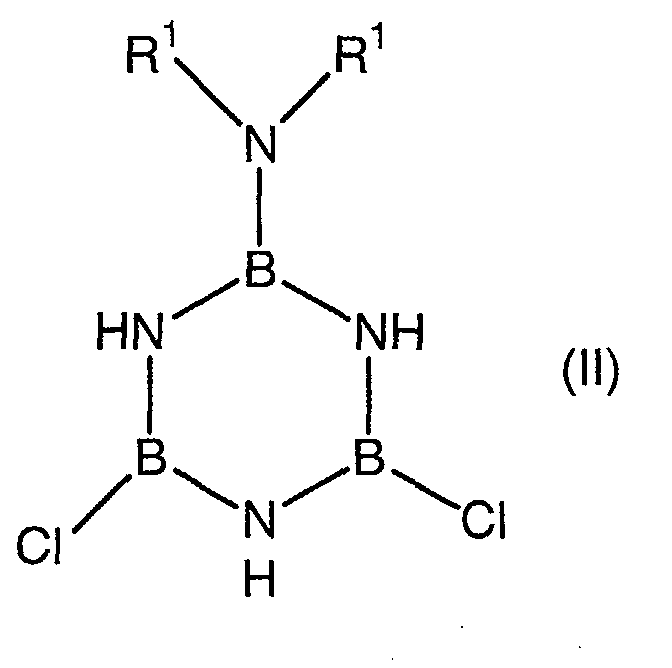 réaction sans chauffage du borazine de formule (II) avec un alkylaminoborane de formule R3B(NHR2)3 en proportions stoechiométriques 1/1 en moles, en présence d'une amine tertiaire -N(R4)3, de manière à obtenir ledit polymère précurseur de formule (I),
 - Procédé selon la revendication 15, dans lequel R4 est un groupe alkyle comprenant de 1 à 3 atomes de carbone.
- Procédé selon la revendication 15, dans lequel R4 est le groupe éthyle.
- Fibre de nitrure de bore obtenue par un procédé selon l'une quelconque des revendications 6 à 17 précédentes.
- Utilisation d'un polymère selon l'une quelconque des revendications 1 à 5 en tant que précurseur pour la fabrication de fibres de nitrure de bore.
- Utilisation de fibres de nitrure de bore selon la revendication 19, pour la fabrication de matériaux composites.
- Utilisation de fibres de nitrure de bore selon la revendication 19, pour la fabrication de composites BN/BN, de pièces structurales ou de radômes d'antennes hautes températures structuraux.
- Utilisation d'un polymère selon l'une quelconque des revendications 1 à 5 pour la fabrication de revêtement protecteurs contre l'oxydation, de mousses de nitrure de bore, de matériaux composites BN/C ou BN/BN ou de puits de chaleur pour la microélectronique.
Applications Claiming Priority (2)
| Application Number | Priority Date | Filing Date | Title |
|---|---|---|---|
| FR0200758 | 2002-01-22 | ||
| FR0200758A FR2834983B1 (fr) | 2002-01-22 | 2002-01-22 | Procede de fabrication de fibres de nitrure de bore a partir de borylborazines |
Publications (2)
| Publication Number | Publication Date |
|---|---|
| EP1329436A2 true EP1329436A2 (fr) | 2003-07-23 |
| EP1329436A3 EP1329436A3 (fr) | 2005-09-28 |
Family
ID=8871373
Family Applications (1)
| Application Number | Title | Priority Date | Filing Date |
|---|---|---|---|
| EP03290144A Withdrawn EP1329436A3 (fr) | 2002-01-22 | 2003-01-21 | Procede de fabrication de fibres de nitrure de bore a partir de borylborazines |
Country Status (4)
| Country | Link |
|---|---|
| US (1) | US6967179B2 (fr) |
| EP (1) | EP1329436A3 (fr) |
| JP (1) | JP2003226754A (fr) |
| FR (1) | FR2834983B1 (fr) |
Families Citing this family (14)
| Publication number | Priority date | Publication date | Assignee | Title |
|---|---|---|---|---|
| FR2806423B1 (fr) * | 2000-03-16 | 2002-06-14 | Aerospatiale Matra Lanceurs St | Procede de fabrication de fibres de nitrure de bore a partir d'aminoborazines |
| FR2834982B1 (fr) * | 2002-01-22 | 2004-12-17 | Eads Launch Vehicules | Procede de fabrication de fibres de nitrure de bore et fibres obtenues |
| JP4176793B2 (ja) * | 2006-09-07 | 2008-11-05 | 日本バルカー工業株式会社 | レドーム用フッ素樹脂組成物、レドームおよびレドームの製造方法 |
| JP4915929B2 (ja) * | 2007-03-27 | 2012-04-11 | 独立行政法人産業技術総合研究所 | ボラジン・ジアミン系重合体及びそのための重合性組成物、並びにその製造方法 |
| JP4915930B2 (ja) * | 2007-03-27 | 2012-04-11 | 独立行政法人産業技術総合研究所 | ボラジン・ジアミン系ポリマー薄膜形成用組成物及びボラジン・ジアミン系ポリマー薄膜の製造方法 |
| CN101367944B (zh) * | 2008-09-26 | 2010-09-08 | 东华大学 | 一种氮化硼陶瓷纤维先驱体的制备方法 |
| US8445822B2 (en) * | 2010-06-23 | 2013-05-21 | Raytheon Company | One-piece Nano/Nano class Nanocomposite Optical Ceramic (NNOC) extended dome having seamless non-complementary geometries for electro-optic sensors |
| US20110315808A1 (en) | 2010-06-23 | 2011-12-29 | Zelinski Brian J | Solid solution-based nanocomposite optical ceramic materials |
| US9012823B2 (en) | 2012-07-31 | 2015-04-21 | Raytheon Company | Vehicle having a nanocomposite optical ceramic dome |
| US10763103B2 (en) * | 2015-03-31 | 2020-09-01 | Versum Materials Us, Llc | Boron-containing compounds, compositions, and methods for the deposition of a boron containing films |
| JP7682000B2 (ja) * | 2021-03-29 | 2025-05-23 | デンカ株式会社 | 窒化ホウ素繊維、放熱グリース及び放熱シート |
| CN113336556B (zh) * | 2021-07-16 | 2023-02-28 | 中国人民解放军国防科技大学 | 一种近化学计量比的连续bn陶瓷纤维及其制备方法 |
| CN113716581B (zh) * | 2021-09-13 | 2023-03-14 | 中国人民解放军国防科技大学 | 一种高陶瓷产率的无碳氮化硼先驱体及其合成方法 |
| US12577106B1 (en) * | 2022-10-17 | 2026-03-17 | Georgia Tech Research Corporation | Boron nitride/boron nitride nanotube composite fibers and methods of making and use thereof |
Family Cites Families (8)
| Publication number | Priority date | Publication date | Assignee | Title |
|---|---|---|---|---|
| US3429722A (en) * | 1965-07-12 | 1969-02-25 | Carborundum Co | Boron nitride fiber manufacture |
| GB2014972B (en) * | 1977-12-29 | 1982-04-28 | Defence Secret Of State For | Boron nitride fibre |
| US4906763A (en) * | 1987-02-13 | 1990-03-06 | Paciorek Kazimiera J L | Boron nitride preceramic polymers |
| FR2620454B1 (fr) * | 1987-09-11 | 1989-12-22 | Rhone Poulenc Chimie | Polymeres a base de bore et d'azote utilisables notamment pour la fabrication de produits et articles ceramiques a base de nitrure de bore, ainsi que leur procede de preparation |
| JP2572813B2 (ja) | 1988-05-19 | 1997-01-16 | 三菱化学株式会社 | ボラジン縮合体焼成物およびその製造方法 |
| US5188757A (en) * | 1989-02-17 | 1993-02-23 | University Of New Mexico | Precursor compositions for conversion to boron nitride |
| FR2695645B1 (fr) | 1992-09-15 | 1994-12-16 | Rhone Poulenc Chimie | Procédé de préparation de polyaminoborazines. |
| FR2806423B1 (fr) * | 2000-03-16 | 2002-06-14 | Aerospatiale Matra Lanceurs St | Procede de fabrication de fibres de nitrure de bore a partir d'aminoborazines |
-
2002
- 2002-01-22 FR FR0200758A patent/FR2834983B1/fr not_active Expired - Fee Related
-
2003
- 2003-01-21 EP EP03290144A patent/EP1329436A3/fr not_active Withdrawn
- 2003-01-21 US US10/347,452 patent/US6967179B2/en not_active Expired - Fee Related
- 2003-01-22 JP JP2003014004A patent/JP2003226754A/ja not_active Withdrawn
Also Published As
| Publication number | Publication date |
|---|---|
| US20040044162A1 (en) | 2004-03-04 |
| US6967179B2 (en) | 2005-11-22 |
| JP2003226754A (ja) | 2003-08-12 |
| EP1329436A3 (fr) | 2005-09-28 |
| FR2834983A1 (fr) | 2003-07-25 |
| FR2834983B1 (fr) | 2004-12-17 |
Similar Documents
| Publication | Publication Date | Title |
|---|---|---|
| FR2834983A1 (fr) | Procede de fabrication de fibres de nitrure de bore a partir de borylborazines | |
| FR2599745A1 (fr) | Procede de fabrication de polymeres organiques silazanes et procede de fabrication de ceramiques a partir de ces polymeres | |
| US4906763A (en) | Boron nitride preceramic polymers | |
| FR2700781A1 (fr) | Fibres de carbure de silicium fortement polycristallines et procédé pour leur fabrication. | |
| CA1263963A (fr) | Procede de traitement thermique d'un polysilazane contenant des groupes = si et des groupes = si - n - | |
| FR2611208A1 (fr) | Procede pour la preparation de polyorganosilazanes et de materiaux ceramiques en derivant | |
| FR2584079A1 (fr) | Procede de traitement par catalyse cationique d'un polysilazane comportant en moyenne au moins deux groupes sih par molecule | |
| EP1329437A2 (fr) | Procédé de fabrication de fibres de nitrure de bore et fibres obtenues | |
| EP0749940A1 (fr) | Procédé de fabrication de trichites de nitrure d'aluminium | |
| US6774074B2 (en) | Method for making boron nitride fibers from aminoborazines | |
| EP0384857B1 (fr) | Procédé de préparation de nitrure de bore | |
| FR2640952A1 (fr) | ||
| FR2631334A1 (fr) | Procede de traitement de fibres ceramiques, a base de silicium, d'azote et/ou de carbone pour en ameliorer les caracteristiques de surface | |
| FR2650832A1 (fr) | Precurseur ceramique organometallique a base de bore, d'azote et de silicium | |
| FR2661181A1 (fr) | Procede de reticulation de polymeres a base de bore et d'azote, notamment pour l'obtention de fibres ceramiques. | |
| FR2806422A1 (fr) | Fibres de nitrure de bore a haute performance et leur procede de fabrication | |
| FR2640980A1 (fr) | ||
| US5028571A (en) | Conversion of polycarbosilanes into silicon nitride ceramics | |
| FR2645869A1 (fr) | Utilisation de polymeres a base de bore et d'azote comme precurseurs de ceramiques a base de nitrure de bore et produits ceramiques ainsi obtenus | |
| JPH0711001A (ja) | ホウ素含有オルガノシラザンポリマーとその製造方法 | |
| FR2639952A1 (fr) | Procede de traitement de polycarbosilanes, produits ainsi obtenus et utilisation dudit traitement dans la fabrication de produits ceramiques en carbure de silicium notamment sous forme de fibres | |
| FR2691150A1 (fr) | Triéthylnylborazines, leur préparation et leur utilisation notamment pour la préparation de céramique essentiellement à base de nitrure de bore. | |
| Berthet et al. | ROuSSeau et al. | |
| EP0412914A1 (fr) | Procédé de réticulation de polysilazanes notamment pour l'obtention de fibres céramiques | |
| CN1644584A (zh) | 一种三(4-异氰酸酯基苯基)硫代磷酸酯的生产方法 |
Legal Events
| Date | Code | Title | Description |
|---|---|---|---|
| PUAI | Public reference made under article 153(3) epc to a published international application that has entered the european phase |
Free format text: ORIGINAL CODE: 0009012 |
|
| AK | Designated contracting states |
Designated state(s): AT BE BG CH CY CZ DE DK EE ES FI FR GB GR HU IE IT LI LU MC NL PT SE SI SK TR |
|
| AX | Request for extension of the european patent |
Extension state: AL LT LV MK RO |
|
| RAP1 | Party data changed (applicant data changed or rights of an application transferred) |
Owner name: EADS SPACE TRANSPORTATION SA |
|
| PUAL | Search report despatched |
Free format text: ORIGINAL CODE: 0009013 |
|
| AK | Designated contracting states |
Kind code of ref document: A3 Designated state(s): AT BE BG CH CY CZ DE DK EE ES FI FR GB GR HU IE IT LI LU MC NL PT SE SI SK TR |
|
| AX | Request for extension of the european patent |
Extension state: AL LT LV MK RO |
|
| AKX | Designation fees paid | ||
| REG | Reference to a national code |
Ref country code: DE Ref legal event code: 8566 |
|
| STAA | Information on the status of an ep patent application or granted ep patent |
Free format text: STATUS: THE APPLICATION IS DEEMED TO BE WITHDRAWN |
|
| 18D | Application deemed to be withdrawn |
Effective date: 20060405 |