EP1324323A2 - Verfahren und Vorrichtung zur Aufzeichnung auf ein schreibares Compact-Disc - Google Patents
Verfahren und Vorrichtung zur Aufzeichnung auf ein schreibares Compact-Disc Download PDFInfo
- Publication number
- EP1324323A2 EP1324323A2 EP02256332A EP02256332A EP1324323A2 EP 1324323 A2 EP1324323 A2 EP 1324323A2 EP 02256332 A EP02256332 A EP 02256332A EP 02256332 A EP02256332 A EP 02256332A EP 1324323 A2 EP1324323 A2 EP 1324323A2
- Authority
- EP
- European Patent Office
- Prior art keywords
- data
- recording
- smaller
- compact disc
- channel bits
- Prior art date
- Legal status (The legal status is an assumption and is not a legal conclusion. Google has not performed a legal analysis and makes no representation as to the accuracy of the status listed.)
- Ceased
Links
Images


Classifications
-
- G—PHYSICS
- G11—INFORMATION STORAGE
- G11B—INFORMATION STORAGE BASED ON RELATIVE MOVEMENT BETWEEN RECORD CARRIER AND TRANSDUCER
- G11B20/00—Signal processing not specific to the method of recording or reproducing; Circuits therefor
- G11B20/10—Digital recording or reproducing
- G11B20/12—Formatting, e.g. arrangement of data block or words on the record carriers
-
- G—PHYSICS
- G11—INFORMATION STORAGE
- G11B—INFORMATION STORAGE BASED ON RELATIVE MOVEMENT BETWEEN RECORD CARRIER AND TRANSDUCER
- G11B7/00—Recording or reproducing by optical means, e.g. recording using a thermal beam of optical radiation by modifying optical properties or the physical structure, reproducing using an optical beam at lower power by sensing optical properties; Record carriers therefor
- G11B7/24—Record carriers characterised by shape, structure or physical properties, or by the selection of the material
- G11B7/2407—Tracks or pits; Shape, structure or physical properties thereof
- G11B7/24085—Pits
-
- G—PHYSICS
- G11—INFORMATION STORAGE
- G11B—INFORMATION STORAGE BASED ON RELATIVE MOVEMENT BETWEEN RECORD CARRIER AND TRANSDUCER
- G11B20/00—Signal processing not specific to the method of recording or reproducing; Circuits therefor
- G11B20/10—Digital recording or reproducing
- G11B20/10009—Improvement or modification of read or write signals
-
- G—PHYSICS
- G11—INFORMATION STORAGE
- G11B—INFORMATION STORAGE BASED ON RELATIVE MOVEMENT BETWEEN RECORD CARRIER AND TRANSDUCER
- G11B7/00—Recording or reproducing by optical means, e.g. recording using a thermal beam of optical radiation by modifying optical properties or the physical structure, reproducing using an optical beam at lower power by sensing optical properties; Record carriers therefor
- G11B7/004—Recording, reproducing or erasing methods; Read, write or erase circuits therefor
- G11B7/0045—Recording
-
- G—PHYSICS
- G11—INFORMATION STORAGE
- G11B—INFORMATION STORAGE BASED ON RELATIVE MOVEMENT BETWEEN RECORD CARRIER AND TRANSDUCER
- G11B7/00—Recording or reproducing by optical means, e.g. recording using a thermal beam of optical radiation by modifying optical properties or the physical structure, reproducing using an optical beam at lower power by sensing optical properties; Record carriers therefor
- G11B7/007—Arrangement of the information on the record carrier, e.g. form of tracks, actual track shape, e.g. wobbled, or cross-section, e.g. v-shaped; Sequential information structures, e.g. sectoring or header formats within a track
Definitions
- the present invention relates to a method and an apparatus for recording data on a recordable disc, and more particularly, to a method and an apparatus for recording data on an existing recordable compact disc at a high density.
- Recordable optical discs include CD-R/RWs of 650 MB, DVD-RAM/R/RWs of 4.7GB, DVD+RWs of 4.7GB, and the like. Also, researches on and the development of HD-DVDs having recording capacity of more than 20GB have been in progress.
- CD-R/RWs are widely used as recordable optical discs. While data can be recorded only one time on CD-Rs, data can be repeatedly rewritten on CD-RWs. However, user data of about 650MB can be recorded on CD-Rs and CD-RWs.
- DDCD double density compact discs
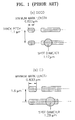
- Figure 1 is a reference view for explaining differences between a DDCD and an existing CD.
- the DDCD has the same size as the existing CD while having a track pitch of 1.1 ⁇ m, narrower than the track pitch of 1.6 ⁇ m of the existing CD, and the minimum mark length (MML) of 0.623 ⁇ m, shorter than the MML of 0.833 ⁇ m of the CD.
- the numerical aperture (NA) of an optical pickup for the DDCD is 0.55 (reproducing/recording), that is, about 10% greater than the NA of an optical pickup for the CD.
- the spot diameter of a laser beam for the DDCD is 1.17 ⁇ m, shorter than the spot diameter of 1.29 ⁇ m of a laser beam for the CD.
- a simple method of increasing the recording density when changing the specifications of a pickup is to reduce the spot diameter of a laser beam for recording. Since the spot diameter is proportional to a wavelength ⁇ of a light source and inversely proportional to the NA of an objective lens, the spot diameter can be reduced by (1) a method of shortening the wavelength ⁇ of the light source wavelength or (2) a method of increasing the NA of the objective lens.
- the spot diameter can be theoretically reduced only by the second method. This is because it is highly possible to change parts of the pickup and the structure of the DDCD if the wavelength ⁇ of the light source is changed.
- the spot diameter reduces by 10% compared to the spot diameter of the CD, the resolution of a signal obtained from a recording mark becomes insufficient.
- a DDCE recording/reproducing apparatus additionally includes an equalizer to supplement the insufficient resolution.
- DDCD-ROM/R/RW CD-ROM/R/RW Recording Capacity 1.3GB 650MB Specifications of Disc Diameter 120mm, Thickness 1.2mm Track Pitch 1.1 ⁇ m 1.6 ⁇ m Minimum Mark Length 0.623 ⁇ m 0.833 ⁇ m Error Correcting System CIRC7 CIRC Modulation algorithm EFM Wavelength of Light Source About 780nm NA of Object Lens 0.5 (reproducing), 0.45 (reproducing), 0.55 (recording/reproducing) 0.50 (recording/reproducing) Spot Diameter 1.17 ⁇ m 1.29 ⁇ m
- EFM denotes an Eight-to-Fourteen Modulation process
- CIRC denotes a Cross Interleave Reed-Solomon Code
- spot diameter is a diameter in which the intensity of a laser beam is equal to the central intensity 1/e 2 (e is a natural great number).
- the specifications of a DDCD are as follows. (1) The NA of the object lens increases. (2) The MML and the track pitch become short. (3) An equalizer is added to the recording/reproducing apparatus. (4) Efficiency of the error correcting system is strengthened.
- the spot diameter is shortened, specification (1), the MML is reduced, specification (2), and the resolution which is lowered through (1) is solved by increasing the efficiency of processing a signal through (4).
- tilt allowance tilt margin
- tilt allowance tilt margin
- the MML and the track pitch are reduced by 25% and 31%, respectively, through (2).
- the spot diameter is reduced by about 10% through (1), the reduction ratios of the MML and the track pitch are greater than the reduction ratio of the spot diameter.
- a method of recording data on a compact disc includes steps: (a) modulating data of 1 byte to p-channel bits; and (b) recording data when a minimum mark length is greater than 0.5 ⁇ m and smaller than 1.0 ⁇ m, p/q is greater than 4.5 and smaller than 8 when the minimum mark length corresponds to q-channel bits, and format efficiency is greater than 0.6 and smaller than 1.0.
- a wavelength of a recording beam is 780nm, a spot diameter is 1.56 ⁇ m, and a numerical aperture is 0.5.
- user data is recorded by using one of a first writing mode and a second writing mode having different recording density.
- the first writing mode is a writing mode of an existing compact disc and the user data is recorded in the second writing mode when a minimum mark length is greater than 0.5 ⁇ m and smaller than 1.0 ⁇ m, p/q is greater than 4.5 and smaller than 8 when the minimum mark length corresponds to q-channel bits, and format efficiency is greater than 0.6 and smaller than 1.0.
- step (a) includes (a3) modulating data of 1 byte to about 15.3 channel bits by a dual modulation algorithm, and before step (a3), further includes: (a1) creating an error correcting code block; and (a2) performing interleaving.
- a minimum mark length is 0.627 ⁇ m
- a wavelength of a recording beam is 780nm
- a spot diameter is 1.56 ⁇ m
- a numerical aperture is 0.5.
- another aspect of the invention provides a method of recording data on a compact disc having a plurality of physical sectors designated by addressing information that is recorded in a mastering process.
- the method includes (a) recording 62 frames, each having a sync code and data, in the physical sectors.
- a minimum mark length is greater than 0.5 ⁇ m and smaller than 1.0 ⁇ m
- p/q is greater than 4.5 and smaller than 8 when the minimum mark length corresponds to q-channel bits
- format efficiency is greater than 0.6 and smaller than 1.0.
- step (a) includes: (a1) allocating error detecting codes to main data and header information; (a2) performing error correcting code encoding; (a3) performing interleaving; (a4) creating a frame by adding a sync code of 2 bytes to data of 77 bytes; and (a5) recording 62 frames in the physical sectors.
- step (a3) includes: (a31) dividing two error correcting code blocks of N1 ⁇ N2 bytes into blocks of "d" bytes that represent the greatest common divisor along a column, respectively; (a32) dividing the object blocks of d ⁇ N1 bytes into d parts along a row and a column, respectively, to obtain partitions of d ⁇ d; and (a33) interleaving data in a predetermined partition by alternatively selecting the two error correcting code blocks to obtain a recording block having line-code words of 2 ⁇ N2.
- the error correcting code blocks has line-code words (N1, k1) and column-code words (N2, k2), respectively, and step (a3) further includes (a34) modulating the recording block having line-code words of 2 ⁇ N2 to generate a recording block having a main data area of 2 ⁇ (N2 - k2) and an outer parity area of 2 ⁇ k2.
- an apparatus for recording data on a compact disc includes a pickup unit, a modulator, and a controller.
- the pickup unit records a mark on the compact disc.
- the modulator modulates data of 1 byte to q-channel bits.
- the controller controls the pickup unit to record data modulated by the modulator when a minimum mark length is greater than 0.5 ⁇ m and smaller than 1.0 ⁇ m, p/q is greater than 4.5 and smaller than 8 when the minimum mark length corresponds to q-channel bits, and format efficiency is greater than 0.6 and smaller than 1.0.
- the controller controls the pickup unit so as to record data when a wavelength of a recording beam is 780nm, a spot diameter is 1.56 ⁇ m, and a numerical aperture is 0.5.
- an apparatus for recording data on a compact disc includes a pickup unit, a modulator, and a controller.
- the pickup unit records a mark on the compact disc.
- the modulator modulates data to predetermined channel bits.
- the controller controls the pickup unit so as to record data modulated by the modulator in one of a first writing mode and a second writing mode of the compact disc.
- the controller controls the pickup unit so that a minimum mark length is greater than 0.5 ⁇ m and smaller than 1.0 ⁇ m, p/q is greater than 4.5 and smaller than 8 when the minimum mark length corresponds to q-channel bits, and format efficiency is greater than 0.6 and smaller than 1.0.
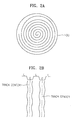
- FIGs 2A and 2B are schematic views of a compact disc.
- a spiral track is formed in a recordable compact disc 100.
- the track includes land tracks and groove tracks.
- reference characters G and L represent groove tracks and land tracks, respectively.
- the groove tracks are wobbled by about ⁇ 0.03 ⁇ m toward the radius direction of the recordable compact disc 100.
- Signals detected from the wobbled tracks through a push-pull channel are called "wobble signals".
- a wobble signal includes absolute time information on a disc, i.e., Absolute Time In Pregroove (ATIP) information, a frequency of which is modulated.
- the ATIP information is a kind of address information.
- one physical sector area is determined depending on the ATIP information.
- one physical sector area of the recordable compact disc 100 is called "one ATIP area”.
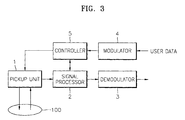
- FIG 3 is a block diagram of a recording apparatus according to a preferred embodiment of the present invention.
- the recording apparatus records user data on the recordable compact disc 100 in a recording format.
- the recording apparatus includes a pickup unit 1, a signal processor 2, a demodulator 3, a modulator 4, and a controller 5.
- the pickup unit 1 includes a laser diode which oscillates a laser beam so as to radiate the laser beam onto the recordable compact disc 100, record user data or receive the reflected laser beam, and detect a radio frequency (RF) signal.
- the signal processor 2 amplifies the detected RF signal and removes noise from the RF signal.
- the demodulator 3 demodulates and outputs user data (video/audio data) from the signal processed by the signal processor 2.
- the modulator 4 receives the user data and modulates the user data by a predetermined modulation algorithm.
- the controller 5 detects address information used for recording the user data from the signal process by the signal processor 2 and controls the pickup unit 1 based on the address information to record the user data modulated by the modulator 4 on the compact disc 100.
- Figure 4 is a block diagram of an implementation of a recording apparatus based on the design shown in Figure 3. Blocks which substantially perform the same functions as those of blocks of Figure 3 are denoted by the same reference numerals and their detailed descriptions will be omitted.
- the recording apparatus records user data on the recordable compact disc 100 by a compact disc recording method or a high-density recording method according to the present invention.
- the recording apparatus includes a pickup 1, a signal processor 2, a demodulator 3, a modulator 4, and a controller 5.
- the pickup 1 includes a laser 14 which oscillates laser beams, a laser diode (LD) driver 15 which controls the driving of the laser 14, an objective lens 11 which condenses the laser beams to radiate the laser beams onto the recordable compact disc 100, a beam splitter 12 which splits the laser beams into radiated beams and reflected beams, and a photo detector (PD) 13 which receives beams reflected from the recordable compact disc 100.
- the pickup 1 changes the minimum mark length (MML) depending on whether a first writing mode or a second writing mode is selected.
- the modulator 4 includes a first channel modulation block 41 and a second channel modulation block 42.
- the first channel modulation block 41 receives the user data and modulates channel bits according to a first recording format.
- the second channel modulation block 42 receives user data that is encoded by a predetermined method and modulates channel bits according to a second recording format.
- the first recording format represents an existing recording format and the second recording format represents a high-density recording format according to embodiments of the present invention. Since the recordable compact disc 100 uses Eight-to-Fourteen Modulation (EFM) method, the first channel modulation block 41 modulates data of 1 byte to 14 channel bits.
- the second channel modulation block 42 modulates data of 1 byte to 15.3 channel bits according to a Dual modulation algorithm.
- EFM Eight-to-Fourteen Modulation
- the Dual modulation algorithm is disclosed in Korean Patent Application No. 99-42032 entitled “Method of Arranging RLL Codes Having Improved DC Suppression Capabilities, Demodulation and Modulation algorithm, and Demodulating Apparatus", filed on September 30, 1999 by the applicant of the present invention and published on November 25, 2000.
- a pair of code groups is arranged such that DC suppression of a code sequence can be controlled; second, signs of a parameter CSV, representing a DC value in a code word of a code corresponding to the same source code in the pair of code groups, and codes (1, 8, 8, 12), arranged so that characteristics of a parameter INV for estimating a Digital Sum Value (DSV) transition direction of a next code word are opposite to one another, are used. More detailed contents are disclosed in the publication of Korea Patent Application No. 99-42032.
- the controller 5 provides a control command in the first writing mode according to the first recording format or in the second writing mode according to the second recording format to the LD driver 15. As a result, the user data is recorded on the recordable compact disc 100. Detailed descriptions of the second writing mode will be described later.
- the demodulator 3 includes a first channel demodulation block 31 and a second demodulation block 32.
- a demodulation algorithm depends on the modulation algorithm.
- the first channel demodulation block 31 extracts a channel bit sequence from a RF signal processed by the signal processor 2 and demodulates channel bits to data bits according to the first recording format.
- the second channel demodulation block 32 extracts a channel bit sequence from a signal processed by the signal processor 2 and demodulates channel bits to data bits according to the second recording format.
- a disc on which data is recorded by the high-density recording method is called herein "GD" for convenience, and stands for Giga Disc.
- a writing mode of the GD i.e., the second writing mode, meets the following requirements.
- the MML When modulating data of 1 byte to p-channel bits, the MML is greater than 0.5 ⁇ m and smaller than 1.0 ⁇ m. Also, when the MML corresponds to q-channel bits, p/q is greater than 4.5 and smaller than 8 and format efficiency is greater than 0.6 and smaller than 1.0.
- the format efficiency refers to a ratio of the amount of user data to the whole amount of recorded data. The total amount of recorded data for the same user data may vary depending on the formatting methods. The above-described requirements are shown in Table 2.
- Minimum Mark Length (MML) 0.5 ⁇ m ⁇ MML ⁇ 1.0 ⁇ m p/q 4.5 ⁇ p/q ⁇ 8 Format Efficiency e f 0.6 ⁇ e f ⁇ 1.0
- a GD-R is a GD on which data can be recorded only one time and a GD-RW is a GD on which data can be repeatedly recorded.
- Table 4 shows the comparison of a modulation algorithm and an encoding method used as an example for the GD recording method and those of the recordable compact disc.
- Figure 5 shows the configuration of one logic sector according to the modulation algorithm in Table 4.
- a logic sector has the size of 172 ⁇ 14 bytes according to this embodiment and is composed of user data of 2048 bytes, header information of 20 bytes, and an error detecting code (EDC) of 4 bytes.
- EDC error detecting code
- the error correcting system depends on BCIS-RSPC, which refers to an error correcting algorithm disclosed in Korean Patent No. 01-40897 entitled “Optical Information Storing Medium and Apparatus and Method for Recording Data", filed on July 1, 2001 by the applicant of the present invention.
- the error correcting algorithm according to BCIS-RSPC is as follows.
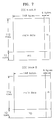
- FIGs 6 and 7 show the configurations of an ECC block according to one embodiment of the present invention.
- the ECC block is composed of 154 ⁇ 124 bytes by adding Parity Inner (PI) and Parity Out (PO) to 8 logic sectors. Code words of data of 148 bytes and PI of 6 bytes are arranged along a row and code words of 112 rows are arranged along a column with a PO of 12 rows. Interleaving, which is a process of the error correcting algorithm used according to one embodiment of the present invention is performed based on ECC blocks A and B. Data, except PI and PO, are called "main data".
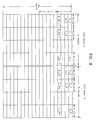
- FIGS 8 and 9 are reference views for explaining an interleaving algorithm according to the error correcting system used in the embodiment of the present invention.
- ECC blocks A and B are composed of data of N 1 bytes on a row and data of N 2 bytes on a column, respectively.
- ECC blocks A and B are divided into “d” blocks along a column.
- "d” is a common divisor of N 1 and N 2 .
- the divided several blocks are called “object blocks”.
- the interleaving according to this embodiment is performed in the respective object blocks "a” and "b” of ECC blocks A and B.
- object blocks "a” and “b” are divided along a column based on each line, respectively.
- object blocks "a” and “b” are divided into partitions of d ⁇ d, respectively.
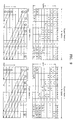
- partitions of 2 ⁇ d ⁇ d are created from object blocks "a" and "b". These partitions are 1_1, 1_2, .., 1_2, ⁇ d, 2_1, 2_2, .., 2_2 ⁇ d, .., d_1, d_2, .., d_2 ⁇ d, each having data of N 1 /d bytes.
- first data is extracted from partition 1_1
- second data is extracted from partition 1_2, .., 2 ⁇ d th data is extracted from partition 1_2 ⁇ d
- 2 ⁇ d + 1 th data is extracted from partition 1_1
- 2 ⁇ d + 2 th data is extracted from partition 1_2, .., 2 ⁇ d + 2 ⁇ d th data is extracted from partition 1_2 ⁇ d.
- data is extracted from all of 1_1, 1_2, .., 1_2 ⁇ d, and then data is alternatively extracted from 2_1, 2_2, .., 2_2 ⁇ d.
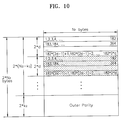
- the created block is composed of data of 2 ⁇ (N 2 - k2) and an outer parity of 2 ⁇ k2.
- Figures recorded along the rows of the block represent consecutive numbers that are allotted to byte data of each partition.
- the byte data is arranged in the order shown in Figure 10.
- Partition 1_1 When the remainder N 1 /d of 1, ..., 2 ⁇ N1 divided by 2 ⁇ d is 1.
- Partition 1_2 When the remainder N 1 /d of 1, ..., 2 ⁇ N1 divided by 2 ⁇ d is 2. ...
- Partition m_n When the remainder N 1 /d of 2 ⁇ N 1 (m-1) +1, ..., 2 ⁇ m ⁇ N 1 divided by 2 ⁇ d is n.
- partition 1_1 has data of N1/d bytes, first byte of which is given 1, second byte of which is given 1+2d, third byte of which is given 1+4d, ..., (N1/d)-1 th byte of which is given 1+2N1-4d, and N1/d th byte of which is given 1+2N1-2d.
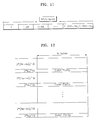
- Figure 12 schematically shows a recording block rearranged based on the block of Figure 10.
- the recording block is created by inserting PO of 2 ⁇ k2 in the block of Figure 10 at every 2 ⁇ k2/16 lines.
- Figure 13 is a view for explaining a process of creating a recording block by performing interleaving in ECC blocks A and B.
- object blocks "a” and “b” have eight partitions (1), (2), (3), (4), (5), (6), (7), and (8), respectively.
- Object block "a” belongs to ECC block A and object block "b” belongs to ECC block "b".
- Partition (1) has data 1, 5, 9, .., 305, partition (2) has data of 309, .., 613, partition (3) has data of 2, 6, 10, .., 306, partition (4) has data of 310, .., 614, partition (5) has data of 311, .., 615, partition (6) has data of 3, 7, 11, .., 307, partition (7) has data of 312, .., 616, and partition (8) has data of 4, 8, 12, .., 308.
- first data is extracted from partition (1)
- second data is extracted from partition (3)
- third data is extracted from partition (6)
- fourth data is extracted from partition (8).
- Fifth data is extracted from partition (1)
- sixth data is extracted from partition (3)
- seventh data is extracted from partition (6)
- eighth data is extracted from partition (8).
- data is alternatively extracted from partitions (2), (4), (5), and (7). This process is repeated at every two lines.
- POs of ECC blocks A and B are 24 lines, respectively, POs of 1.5 lines are equally distributed to each recording unit. As a result, the recording block is created.
- the recording block is composed of 16 recording units.
- Each of the recording units has a size of 154 ⁇ 15.5 bytes.
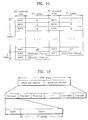
- Figure 14 shows the configuration of one physical sector according to the modulation algorithm in Table 4.
- one physical sector is composed of data corresponding to one recording unit of Figure 18 including 77 bytes and sync codes.
- each sync code is composed of 32 channel bits according to the previously described Dual coding method.
- a sync code of 32 channel bits and data of 77 bytes form one sync frame
- one sector data is composed of 31 sync frames.
- the number of channel bits being assigned to the sync codes and the sync codes may vary.
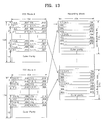
- Figure 15 shows the configuration of data recorded in one ATIP area (one physical sector area) of the recordable compact disc according to an embodiment of the present invention.
- two physical sectors are recorded in one ATIP area (physical sector area) of the recordable compact disc.
- Each of the physical sectors is composed of 31 sync frames.
- Each sync frame is composed of a sync code of 32 channel bits and user data of 77 bytes.
- data of about 1.3 GB is recorded on the recorable compact disc according to a writing strategy and Partial Response Maximum Likelihood (PRML) of 0.627 ⁇ m based on the specifications of Tables 3 and 4.
- PRML Partial Response Maximum Likelihood
- the writing strategy and PRML of a CD are 0.833 ⁇ m. It is possible to change writing strategy and PRML from 0.833 ⁇ m to 0.627 ⁇ m without replacing optical parts of an existing pickup.
- the writing strategy is used for recording a shorter mark and the PRML is used for securing reproduction characteristics.
- the recording capacity of a predetermined recording area is obtained from equation 1 based on the Dual modulation algorithm in Table 4.
- Recording Capacity ⁇ *[( r 2 ) 2 -( r 1 ) 2 ]/( tp*MML *15/3), wherein, r 1 is the maximum recordable radius, r 2 is the minimum recordable radius, tp is a track pitch, and MML is the minimum mark length.
- the recording capacity of the predetermined recording area by the EFM method of modulating data of 8 bits to 14 channel bits and a 1-7 modulation algorithm of modulating data of 8 bits to 12 channel bits is respectively obtained from equation 2.
- Recording Capacity ⁇ *[( r 2 ) 2 -( r 1 ) 2 ]/( tp * MML *12/2)
- Recording Capacity ⁇ *[( r 2 ) 2 -( r 1 ) 2 ]/( tp * MML *14/3)
- r 1 is the maximum recordable radius
- r 2 is the minimum recordable radius
- tp is a track pitch
- MML is the minimum mark length.
- the recording capacity of user data is finally calculated by multiplying the recording capacity obtained by equation 3 by format efficiency according to the error correcting system, as represented by equation 4.
- User Data Capacity [ ⁇ *[( r 2 ) 2 -( r 1 ) 2 ]/( tp * MML * p / q )]]* format efficiency
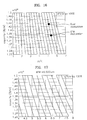
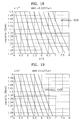
- Figure 16 shows the relationship between the format efficiency and capacity of user data according to different modulation algorithms.
- MML is 0.627 ⁇ m and EFM-based modulation algorithms are used
- format efficiency increases at 5%. It can be seen that the format efficiency in the Dual modulation algorithm is higher than that in the EFM method.
- the maximum recordable capacity of user data is 688MB on the existing recording compact disc, it appears from Figure 16, the following requirements have to be satisfied to record data of 1.3GB, double the data of 688MB on the recordable compact disc. 1 ⁇ p/q ⁇ 7 15% ⁇ format efficiency ⁇ 100%
- MML of a modulation algorithm supporting high density (HD) data is 0.527 ⁇ m.
- the recording capacity in this case cannot be 1.3GB either, although the ratio p/q achieves 100% format efficiency based on EFM-family 5 when the maximum MML is used.
- the maximum MML cannot exceed 1.0 ⁇ m.
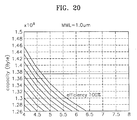
- Figures 17 through 20 show the relationship between the format efficiency and recording capacity when MML is 0.50 ⁇ m, 0.5257 ⁇ m, 0.627 ⁇ m, and 1.0 ⁇ m, respectively.
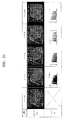
- Figure 21 shows eye-patterns and histograms thereof, detected when MML is 0.52 ⁇ m, 0.63 ⁇ m, 0.69 ⁇ m, 0.76 ⁇ m, and 0.833 ⁇ m, respectively.
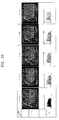
- Figure 22 shows eye-patterns and histograms thereof, detected when MML of CD-RW is 0.52 ⁇ m, 0.63 ⁇ m, 0.69 ⁇ m, 0.76 ⁇ m, and 0.833 ⁇ m, respectively.
- MML of CD-RW the number of data according to the lengths of record marks is shown. Referring to Figures 21 and 22, it can be seen that MML has to be more than 0.5 ⁇ m as shown in Table 2.
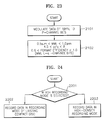
- Figure 23 is a flowchart for explaining a method of recording data according to an embodiment of the present invention.
- a recording apparatus modulates data of 1 byte that is encoded in a predetermined recording format to p-channel bits.
- MML is greater than 0.5 ⁇ m and smaller than 1.0 ⁇ m
- p/q is greater than 4.5 and smaller than 8 when MML corresponds to q-channel bits
- format efficiency is greater than 0.6 and smaller than 1.0.
- FIG. 24 is a flowchart for explaining a recording data according to another embodiment of the present invention.
- a recording apparatus records data by using any one of a first writing mode and a second writing mode having different recording density according to a user's selection.
- data is recorded in a writing mode according to the recording format of an existing compact disc.
- data is recorded in the high-density writing mode according to the recording format of the GD of embodiments of the present invention.
- MML is greater than 0.5 ⁇ m and smaller than 1.0 ⁇ m
- p/q is greater than 4.5 and smaller than 8 when MML corresponds to q-channel bits
- format efficiency is greater than 0.6 and smaller than 1.0.
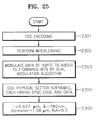
- FIG. 25 is a flowchart for explaining a method of recording data according to still another embodiment of the present invention.
- a recording apparatus creates an ECC block as previously described through an encoding block that is included in or prepared outside the recording apparatus.
- interleaving is performed.
- data of 1 byte is modulated to 15.3 channel bits by the Dual modulation algorithm.
- one ATIP area is given 62 frames, each having a sync code and modulated data.
- MML "L" is 0.627 ⁇ m
- laser wavelength ⁇ is 780nm
- spot diameter is 1.56 ⁇ m
- NA is 0.5.
- the modulation algorithm and the encoding method used in Table 4 can be changed into another modulation algorithm and another encoding method on the restriction that the recording conditions of Table 2 are satisfied.
- a method and an apparatus for recording data on an existing compact disc at a high density are provided.
- data can be recorded on existing compact discs at a high density using an existing pickup device.
- data can be recorded on existing compact discs by selectively using one of an existing recording method and a high-density recording method, a user can very conveniently use the proposed method and apparatus.
Landscapes
- Engineering & Computer Science (AREA)
- Signal Processing (AREA)
- Optical Recording Or Reproduction (AREA)
- Signal Processing For Digital Recording And Reproducing (AREA)
Applications Claiming Priority (2)
| Application Number | Priority Date | Filing Date | Title |
|---|---|---|---|
| KR1020010080905A KR100896681B1 (ko) | 2001-12-18 | 2001-12-18 | 컴팩트 디스크에 데이터를 기록하는 방법 및 그 장치 |
| KR2001080905 | 2001-12-18 |
Publications (2)
| Publication Number | Publication Date |
|---|---|
| EP1324323A2 true EP1324323A2 (de) | 2003-07-02 |
| EP1324323A3 EP1324323A3 (de) | 2007-05-09 |
Family
ID=19717205
Family Applications (1)
| Application Number | Title | Priority Date | Filing Date |
|---|---|---|---|
| EP02256332A Ceased EP1324323A3 (de) | 2001-12-18 | 2002-09-12 | Verfahren und Vorrichtung zur Aufzeichnung auf ein schreibares Compact-Disc |
Country Status (6)
| Country | Link |
|---|---|
| US (1) | US7327659B2 (de) |
| EP (1) | EP1324323A3 (de) |
| JP (2) | JP2003196925A (de) |
| KR (1) | KR100896681B1 (de) |
| CN (1) | CN1300781C (de) |
| TW (1) | TWI269283B (de) |
Cited By (1)
| Publication number | Priority date | Publication date | Assignee | Title |
|---|---|---|---|---|
| EP2136366A2 (de) * | 2008-06-20 | 2009-12-23 | Hitachi Ltd. | Vorrichtung zur Aufzeichnung optischer Informationen, Verfahren zur Aufzeichnung optischer Informationen, Vorrichtung zur Wiedergabe optischer Informationen und Verfahren zur Wiedergabe optischer Informationen |
Families Citing this family (4)
| Publication number | Priority date | Publication date | Assignee | Title |
|---|---|---|---|---|
| KR100833227B1 (ko) * | 2001-12-17 | 2008-05-28 | 삼성전자주식회사 | 광 기록매체에 데이터를 기록하는 방법 및 장치 |
| US7149164B2 (en) * | 2002-03-18 | 2006-12-12 | Sanyo Electric Co., Ltd. | Optical disc apparatus for processing data according to different optical disc standards to achieve higher recording density |
| JP5072540B2 (ja) * | 2007-11-01 | 2012-11-14 | 三洋電機株式会社 | 光記録媒体、光記録装置および光再生装置 |
| US8615698B1 (en) * | 2011-09-28 | 2013-12-24 | Google Inc. | Skewed orthogonal coding techniques |
Citations (1)
| Publication number | Priority date | Publication date | Assignee | Title |
|---|---|---|---|---|
| US20010040846A1 (en) | 2000-03-28 | 2001-11-15 | Tetsuji Kawashima | Optical disc, data-recording apparatus and data-recording method |
Family Cites Families (25)
| Publication number | Priority date | Publication date | Assignee | Title |
|---|---|---|---|---|
| EP0132432A1 (de) * | 1982-12-24 | 1985-02-06 | Flexifuel (Technology) Ltd. | Heizgerät |
| EP0814471B1 (de) * | 1991-05-10 | 2001-08-29 | Discovision Associates | System und Verfahren zur optischen Speicherung und Wiedergewinnung von Daten |
| US6091561A (en) * | 1993-05-31 | 2000-07-18 | Sanyo Electric Co., Ltd. | Magnetic recording/reproduction apparatus which simultaneously scans two continuous tracks in both standard and long play modes |
| JPH08221972A (ja) * | 1995-02-14 | 1996-08-30 | Toshiba Corp | アドレス発生装置、アドレス発生方法、データ形成装置、データ形成方法、データ再生装置及びデータ再生方法 |
| JPH09259513A (ja) | 1996-03-19 | 1997-10-03 | Sony Corp | 光ディスク装置における光ディスク検出方法 |
| JP3586041B2 (ja) * | 1996-04-26 | 2004-11-10 | 株式会社東芝 | 記録データ生成方法およびデータ再生装置 |
| JP2856390B2 (ja) * | 1996-07-26 | 1999-02-10 | 株式会社日立製作所 | 情報記録媒体及びそれを用いた記録再生方法 |
| JPH10241298A (ja) * | 1997-02-21 | 1998-09-11 | Sanyo Electric Co Ltd | 記憶媒体、情報記録装置および情報再生装置 |
| JPH10302320A (ja) * | 1997-04-25 | 1998-11-13 | Sanyo Electric Co Ltd | 記録媒体および光ピックアップ装置 |
| JP4088998B2 (ja) * | 1998-02-16 | 2008-05-21 | ソニー株式会社 | 光ディスクの記録/再生方法、光ディスク及び光ディスク装置 |
| JPH11297000A (ja) * | 1998-04-03 | 1999-10-29 | Toshiba Corp | データ生成方法及びデータ生成装置 |
| JP2000242929A (ja) * | 1998-12-07 | 2000-09-08 | Sony Corp | データ記録方法および装置、データ再生方法および装置、並びに記録媒体 |
| KR100565046B1 (ko) * | 1999-04-21 | 2006-03-30 | 삼성전자주식회사 | 개선된 dc 억압 능력을 갖는 rll 코드 배치 방법, 변복조 방법 및 복조 장치 |
| JP2001101806A (ja) * | 1999-09-27 | 2001-04-13 | Hitachi Ltd | ディジタル信号記録方法、及びその装置、記録媒体 |
| JP2001126404A (ja) * | 1999-10-22 | 2001-05-11 | Sony Corp | Cd−r/rwディスク、及びその記録/再生装置 |
| KR100363255B1 (ko) * | 2000-03-17 | 2002-11-30 | 삼성전자 주식회사 | 광기록 매체 |
| JP2001266508A (ja) * | 2000-03-24 | 2001-09-28 | Sony Corp | データ記録装置、データ再生装置並びに光ディスク |
| JP2001297523A (ja) * | 2000-04-14 | 2001-10-26 | Sony Corp | 光ディスク装置 |
| JP3496628B2 (ja) | 2000-05-31 | 2004-02-16 | ヤマハ株式会社 | 光ディスク記録方法および光ディスク記録装置 |
| JP2002025064A (ja) | 2000-07-12 | 2002-01-25 | Sony Corp | 記録装置、方法及び媒体 |
| JP2002093057A (ja) * | 2000-09-19 | 2002-03-29 | Sony Corp | 光ディスク、光ディスク再生装置、および光ディスク再生方法、光ディスク記録装置、および光ディスク記録方法、並びに記録媒体 |
| JPWO2002031821A1 (ja) * | 2000-10-10 | 2004-02-19 | 松下電器産業株式会社 | 光ディスク |
| US7159165B2 (en) | 2001-04-20 | 2007-01-02 | Samsung Electronics Co., Ltd. | Optical recording medium, data recording or reproducing apparatus and data recording or reproducing method used by the data recording or reproducing apparatus |
| KR100739669B1 (ko) | 2001-04-20 | 2007-07-13 | 삼성전자주식회사 | 광 정보저장 매체, 데이터 기록장치 및 데이터 기록방법 |
| KR100833227B1 (ko) * | 2001-12-17 | 2008-05-28 | 삼성전자주식회사 | 광 기록매체에 데이터를 기록하는 방법 및 장치 |
-
2001
- 2001-12-18 KR KR1020010080905A patent/KR100896681B1/ko not_active Expired - Fee Related
-
2002
- 2002-09-05 TW TW091120253A patent/TWI269283B/zh not_active IP Right Cessation
- 2002-09-12 EP EP02256332A patent/EP1324323A3/de not_active Ceased
- 2002-10-14 CN CNB021475288A patent/CN1300781C/zh not_active Expired - Fee Related
- 2002-12-05 JP JP2002354228A patent/JP2003196925A/ja active Pending
- 2002-12-06 US US10/310,996 patent/US7327659B2/en not_active Expired - Fee Related
-
2007
- 2007-01-15 JP JP2007006356A patent/JP4658075B2/ja not_active Expired - Fee Related
Patent Citations (1)
| Publication number | Priority date | Publication date | Assignee | Title |
|---|---|---|---|---|
| US20010040846A1 (en) | 2000-03-28 | 2001-11-15 | Tetsuji Kawashima | Optical disc, data-recording apparatus and data-recording method |
Cited By (4)
| Publication number | Priority date | Publication date | Assignee | Title |
|---|---|---|---|---|
| EP2136366A2 (de) * | 2008-06-20 | 2009-12-23 | Hitachi Ltd. | Vorrichtung zur Aufzeichnung optischer Informationen, Verfahren zur Aufzeichnung optischer Informationen, Vorrichtung zur Wiedergabe optischer Informationen und Verfahren zur Wiedergabe optischer Informationen |
| US8159923B2 (en) | 2008-06-20 | 2012-04-17 | Hitachi, Ltd. | Optical information recording apparatus, optical information recording method, optical information reproducing apparatus and optical information reproducing method |
| US8379500B2 (en) | 2008-06-20 | 2013-02-19 | Hitachi, Ltd. | Optical information recording apparatus, optical information recording method, optical information reproducing apparatus and optical information reproducing method |
| US8760988B2 (en) | 2008-06-20 | 2014-06-24 | Hitachi, Ltd. | Optical information recording apparatus, optical information recording method, optical information reproducing apparatus and optical information reproducing method |
Also Published As
| Publication number | Publication date |
|---|---|
| KR100896681B1 (ko) | 2009-05-14 |
| TWI269283B (en) | 2006-12-21 |
| US7327659B2 (en) | 2008-02-05 |
| KR20030050474A (ko) | 2003-06-25 |
| CN1300781C (zh) | 2007-02-14 |
| JP2003196925A (ja) | 2003-07-11 |
| JP2007128650A (ja) | 2007-05-24 |
| JP4658075B2 (ja) | 2011-03-23 |
| US20030133385A1 (en) | 2003-07-17 |
| EP1324323A3 (de) | 2007-05-09 |
| CN1427398A (zh) | 2003-07-02 |
Similar Documents
| Publication | Publication Date | Title |
|---|---|---|
| CA2384263C (en) | Optical disc having uniform structure | |
| US7616543B2 (en) | Disk recording medium, disk drive apparatus, reproducing method, and disk manufacturing method | |
| US8300517B2 (en) | Optical recording medium, apparatus and method of manufacturing optical recording medium, and apparatus and method of recording/reproducing data of optical recording medium | |
| EP1304698A2 (de) | Plattenaufzeichnungsmedium, Plattenantriebsgerät und Wiedergabeverfahren | |
| US7843798B2 (en) | Optical information storage medium having a transition area | |
| US20080144479A1 (en) | Optical disc and its information recording method and apparatus | |
| JP2005285153A (ja) | 情報記録媒体、情報再生装置、情報再生方法、および情報記録方法 | |
| JP4658075B2 (ja) | データ記録方法及び装置 | |
| CA2452982C (en) | Reproduction-only recording medium, reproducing apparatus, reproducing method, and disk manufacturing method | |
| KR100727919B1 (ko) | 광정보 저장매체 | |
| JP4170241B2 (ja) | 光ディスク、クロック信号生成方法及び光ディスク装置 | |
| US7062699B2 (en) | Method and apparatus for recording data on recording medium and recording medium including recorded data | |
| JP2006190483A (ja) | 光ディスクとその情報記録方法及び装置 | |
| JP2005243098A (ja) | 光ディスク、信号生成方法及び光ディスク装置 |
Legal Events
| Date | Code | Title | Description |
|---|---|---|---|
| PUAI | Public reference made under article 153(3) epc to a published international application that has entered the european phase |
Free format text: ORIGINAL CODE: 0009012 |
|
| 17P | Request for examination filed |
Effective date: 20020930 |
|
| AK | Designated contracting states |
Designated state(s): AT BE BG CH CY CZ DE DK EE ES FI FR GB GR IE IT LI LU MC NL PT SE SK TR |
|
| AX | Request for extension of the european patent |
Extension state: AL LT LV MK RO SI |
|
| PUAL | Search report despatched |
Free format text: ORIGINAL CODE: 0009013 |
|
| AK | Designated contracting states |
Kind code of ref document: A3 Designated state(s): AT BE BG CH CY CZ DE DK EE ES FI FR GB GR IE IT LI LU MC NL PT SE SK TR |
|
| AX | Request for extension of the european patent |
Extension state: AL LT LV MK RO SI |
|
| 17Q | First examination report despatched |
Effective date: 20070911 |
|
| AKX | Designation fees paid |
Designated state(s): DE FR GB NL |
|
| STAA | Information on the status of an ep patent application or granted ep patent |
Free format text: STATUS: THE APPLICATION HAS BEEN REFUSED |
|
| 18R | Application refused |
Effective date: 20110924 |