EP1323769B2 - Procédé pour appliquer un matériau fonctionnalisé sur un polyuréthane thermoplastique - Google Patents
Procédé pour appliquer un matériau fonctionnalisé sur un polyuréthane thermoplastique Download PDFInfo
- Publication number
- EP1323769B2 EP1323769B2 EP02025163A EP02025163A EP1323769B2 EP 1323769 B2 EP1323769 B2 EP 1323769B2 EP 02025163 A EP02025163 A EP 02025163A EP 02025163 A EP02025163 A EP 02025163A EP 1323769 B2 EP1323769 B2 EP 1323769B2
- Authority
- EP
- European Patent Office
- Prior art keywords
- functional materials
- tpu
- thermoplastic polyurethane
- mixture
- pigment
- Prior art date
- Legal status (The legal status is an assumption and is not a legal conclusion. Google has not performed a legal analysis and makes no representation as to the accuracy of the status listed.)
- Expired - Lifetime
Links
Images

Classifications
-
- C—CHEMISTRY; METALLURGY
- C08—ORGANIC MACROMOLECULAR COMPOUNDS; THEIR PREPARATION OR CHEMICAL WORKING-UP; COMPOSITIONS BASED THEREON
- C08J—WORKING-UP; GENERAL PROCESSES OF COMPOUNDING; AFTER-TREATMENT NOT COVERED BY SUBCLASSES C08B, C08C, C08F, C08G or C08H
- C08J3/00—Processes of treating or compounding macromolecular substances
- C08J3/20—Compounding polymers with additives, e.g. colouring
- C08J3/203—Solid polymers with solid and/or liquid additives
-
- B—PERFORMING OPERATIONS; TRANSPORTING
- B29—WORKING OF PLASTICS; WORKING OF SUBSTANCES IN A PLASTIC STATE IN GENERAL
- B29B—PREPARATION OR PRETREATMENT OF THE MATERIAL TO BE SHAPED; MAKING GRANULES OR PREFORMS; RECOVERY OF PLASTICS OR OTHER CONSTITUENTS OF WASTE MATERIAL CONTAINING PLASTICS
- B29B7/00—Mixing; Kneading
- B29B7/80—Component parts, details or accessories; Auxiliary operations
- B29B7/88—Adding charges, i.e. additives
- B29B7/94—Liquid charges
- B29B7/945—Liquid charges involving coating particles
-
- B—PERFORMING OPERATIONS; TRANSPORTING
- B29—WORKING OF PLASTICS; WORKING OF SUBSTANCES IN A PLASTIC STATE IN GENERAL
- B29C—SHAPING OR JOINING OF PLASTICS; SHAPING OF MATERIAL IN A PLASTIC STATE, NOT OTHERWISE PROVIDED FOR; AFTER-TREATMENT OF THE SHAPED PRODUCTS, e.g. REPAIRING
- B29C41/00—Shaping by coating a mould, core or other substrate, i.e. by depositing material and stripping-off the shaped article; Apparatus therefor
- B29C41/003—Shaping by coating a mould, core or other substrate, i.e. by depositing material and stripping-off the shaped article; Apparatus therefor characterised by the choice of material
-
- C—CHEMISTRY; METALLURGY
- C08—ORGANIC MACROMOLECULAR COMPOUNDS; THEIR PREPARATION OR CHEMICAL WORKING-UP; COMPOSITIONS BASED THEREON
- C08G—MACROMOLECULAR COMPOUNDS OBTAINED OTHERWISE THAN BY REACTIONS ONLY INVOLVING UNSATURATED CARBON-TO-CARBON BONDS
- C08G18/00—Polymeric products of isocyanates or isothiocyanates
- C08G18/06—Polymeric products of isocyanates or isothiocyanates with compounds having active hydrogen
- C08G18/28—Polymeric products of isocyanates or isothiocyanates with compounds having active hydrogen characterised by the compounds used containing active hydrogen
- C08G18/65—Low-molecular-weight compounds having active hydrogen with high-molecular-weight compounds having active hydrogen
- C08G18/66—Compounds of groups C08G18/42, C08G18/48, or C08G18/52
- C08G18/6633—Compounds of group C08G18/42
- C08G18/6637—Compounds of group C08G18/42 with compounds of group C08G18/32 or polyamines of C08G18/38
- C08G18/664—Compounds of group C08G18/42 with compounds of group C08G18/32 or polyamines of C08G18/38 with compounds of group C08G18/3203
-
- C—CHEMISTRY; METALLURGY
- C08—ORGANIC MACROMOLECULAR COMPOUNDS; THEIR PREPARATION OR CHEMICAL WORKING-UP; COMPOSITIONS BASED THEREON
- C08L—COMPOSITIONS OF MACROMOLECULAR COMPOUNDS
- C08L75/00—Compositions of polyureas or polyurethanes; Compositions of derivatives of such polymers
- C08L75/04—Polyurethanes
- C08L75/06—Polyurethanes from polyesters
-
- B—PERFORMING OPERATIONS; TRANSPORTING
- B29—WORKING OF PLASTICS; WORKING OF SUBSTANCES IN A PLASTIC STATE IN GENERAL
- B29C—SHAPING OR JOINING OF PLASTICS; SHAPING OF MATERIAL IN A PLASTIC STATE, NOT OTHERWISE PROVIDED FOR; AFTER-TREATMENT OF THE SHAPED PRODUCTS, e.g. REPAIRING
- B29C41/00—Shaping by coating a mould, core or other substrate, i.e. by depositing material and stripping-off the shaped article; Apparatus therefor
- B29C41/02—Shaping by coating a mould, core or other substrate, i.e. by depositing material and stripping-off the shaped article; Apparatus therefor for making articles of definite length, i.e. discrete articles
- B29C41/18—Slush casting, i.e. pouring moulding material into a hollow mould with excess material being poured off
-
- B—PERFORMING OPERATIONS; TRANSPORTING
- B29—WORKING OF PLASTICS; WORKING OF SUBSTANCES IN A PLASTIC STATE IN GENERAL
- B29C—SHAPING OR JOINING OF PLASTICS; SHAPING OF MATERIAL IN A PLASTIC STATE, NOT OTHERWISE PROVIDED FOR; AFTER-TREATMENT OF THE SHAPED PRODUCTS, e.g. REPAIRING
- B29C67/00—Shaping techniques not covered by groups B29C39/00 - B29C65/00, B29C70/00 or B29C73/00
- B29C67/02—Moulding by agglomerating
- B29C67/04—Sintering
-
- B—PERFORMING OPERATIONS; TRANSPORTING
- B29—WORKING OF PLASTICS; WORKING OF SUBSTANCES IN A PLASTIC STATE IN GENERAL
- B29K—INDEXING SCHEME ASSOCIATED WITH SUBCLASSES B29B, B29C OR B29D, RELATING TO MOULDING MATERIALS OR TO MATERIALS FOR MOULDS, REINFORCEMENTS, FILLERS OR PREFORMED PARTS, e.g. INSERTS
- B29K2105/00—Condition, form or state of moulded material or of the material to be shaped
- B29K2105/0005—Condition, form or state of moulded material or of the material to be shaped containing compounding ingredients
-
- C—CHEMISTRY; METALLURGY
- C08—ORGANIC MACROMOLECULAR COMPOUNDS; THEIR PREPARATION OR CHEMICAL WORKING-UP; COMPOSITIONS BASED THEREON
- C08G—MACROMOLECULAR COMPOUNDS OBTAINED OTHERWISE THAN BY REACTIONS ONLY INVOLVING UNSATURATED CARBON-TO-CARBON BONDS
- C08G2140/00—Compositions for moulding powders
-
- C—CHEMISTRY; METALLURGY
- C08—ORGANIC MACROMOLECULAR COMPOUNDS; THEIR PREPARATION OR CHEMICAL WORKING-UP; COMPOSITIONS BASED THEREON
- C08J—WORKING-UP; GENERAL PROCESSES OF COMPOUNDING; AFTER-TREATMENT NOT COVERED BY SUBCLASSES C08B, C08C, C08F, C08G or C08H
- C08J2375/00—Characterised by the use of polyureas or polyurethanes; Derivatives of such polymers
- C08J2375/04—Polyurethanes
Definitions
- the invention relates to a process for the production of moldings using the particle mixture according to the invention.
- Thermoplastic polyurethanes (hereinafter referred to as TPUs) are semi-crystalline materials and belong to the class of thermoplastic elastomers. They are characterized among other things by good strength, Abriebe, tear resistance and chemical resistance, and can be prepared in almost any hardness by suitable raw material composition.
- TPUs are typically dyed by masterbatches during thermoplastic processing (e.g., injection molding or extrusion).
- additive masterbatches containing, for example, stabilizers or processing aids, e.g. Lubricant, included, may be added.
- Masterbatch is generally understood to mean additives which contain additives such as, for example, colorants, pigments, stabilizers, lubricants and / or crystallization aids in high concentration, and which are finally cost-effective in masterbatch proportions of 0.1 to 10% of the thermoplastic itself to be processed Elastomers are added.
- masterbatches may lead to product degradation or processing degradation.
- specks formations, inhomogeneities, pressure fluctuations usually due to a poor mixing of masterbatch and base TPU called.
- thermoplastic processing of TPU besides injection molding and extrusion is the sintering process, in which TPU powder by entry of temperature in Tools are sintered into films.
- the Powder-Slush method is mentioned here. This process usually produces grained instrument panel surfaces with a thickness of 0.1 to 2 mm, which are subsequently processed by foam backfilling the finished instrument panels.
- Another variant of the sintering process consists in the coating of surfaces such as e.g. of metal, wood, plastics or textile and ceramic surfaces by TPU powder.
- the TPU powder is used for these applications, such as in EP-A-928 812 first dyed as a colorless TPU granules via an extrusion step with Farbmasterbatch and then cold-ground into powder.
- the actual thermoplastic processing in the sintering process can not be carried out directly with a color masterbatch granulate or color masterbatch powder, since the absence of shear and friction entry does not result in thorough mixing in the sintering process and thus uniform color distribution is guaranteed.
- the object of this invention was also to develop an improved inking process, which allows a faster, more flexible and with respect to the color accuracy more precise coloring, especially for the sintering process. Furthermore, the production of effect shades with high brightness (L *) and chroma (C *) should be possible.
- a further object of the invention is to provide a shaped body, in particular an instrument panel surface, which is advantageous as a cover for an airbag, ie should achieve a comparatively low elongation at break compared with conventional TPU in order to prevent the skin from tearing in the region of the invisible airbag in the event of the triggering of the airbag Airbags easier.
- the objects could be solved by the functional materials were applied or bonded to the surface of TPU, preferably of TPU granules and / or TPU powder, with or without binder.
- Particulate TPU is used in the process of the invention. This is generally understood to mean TPU granules, TPU powder or a mixture thereof.
- the particulate TPU has an average particle diameter of 10 .mu.m to 10 mm.
- TPU granules having an average particle diameter of 800 .mu.m to 5 mm, in particular of 1mm to 4mm used.
- the average particle diameter also referred to as the d 50 value of the integral mass distribution, is defined as the particle diameter at which 50% by weight of the particles have a smaller diameter than the diameter corresponding to the d 50 value. Likewise, then 50 wt .-% of the particles have a larger diameter than the d 50 value. The particle diameter was determined by fractional sieving.
- a mixing device for the process according to the invention is basically any device suitable in which the particulate TPU can be kept in motion and which allows the introduction of functional materials or a functional materials containing mixture in atomized form. Furthermore, it is preferred that the mixing device is heatable. Examples of such mixing devices are double-cone mixers or a mixer with stirrer. Preferably, a spray vortex reactor or a spray fluidized bed is used as the mixing device.
- TPU Under keep moving the particulate TPU is a moving, mixing or swirling of the TPU granules and / or TPU powder understood, so that always different particles or different locations on the surface of the respective particles with introduced functional materials or the functional materials containing mixture in Contact can come.
- the keep in motion can be done for example by shaking, by stirring with a stirrer or by blowing a gas stream into the mixing device.
- the blowing of a gas stream usually is the particulate TPU on a perforated soil through which the gas is blown.
- the gas injection is performed such that a fluidized bed is formed, i.
- the particulate TPU is in a constant swirling up and down movement and remains in a sense in the balance.
- the gas in principle any gas inert to the TPU and the functional materials is possible, preferably air or nitrogen.
- functional materials or a mixture containing functional materials are introduced into the reaction device in atomized form.
- the functional materials may be introduced in bulk or preferably together with a solvent or solvent mixture in the form of a solution or dispersion.
- the introduction of the functional material-containing dispersion or solution for example, under pressure through a single-fluid nozzle or pressureless by spraying the liquid in a multi-fluid nozzle by compressed gas in the mixing device, for example, in a spray vortex reactor, sprayed.
- the functional materials are deposited on the substrate surface, i. on the surface of the particulate TPU and stick here.
- the adhesive effect on the substrate surface is dependent on the starting materials and can be improved if necessary by adding binders.
- the binder is added to the solvent.
- the thickness of the layer of functional materials that is applied to the particulate TPU depends on the type of functional materials used and on the duration of implementation of the method according to the invention. A longer execution time leads to an increased thickness.
- the thickness of the layer containing functional materials is not limited, in general it is between 0.1 .mu.m and 500 .mu.m, more preferably between 0.1 .mu.m and 250 .mu.m.
- a binder is preferably used, but this is not absolutely necessary, i. it is also possible to dispense with binders.
- Suitable binders are e.g. dispersible and / or soluble oligomeric or polymeric acrylates, PUR and / or epoxies.
- PUR systems of any kind, e.g. aqueous PU dispersions.
- binders are used in an amount of 0 to 15 wt .-%, preferably 0 to 5 wt .-%, based on the weight of the thermoplastic polyurethane.
- the solvent generally evaporates in the mixing device and can be recovered again by condensation in the cooler.
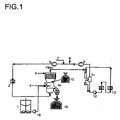
- FIG. 1 A preferred embodiment of the method according to the invention is in FIG. 1 illustrated.
- a spray vortex reactor is used as a mixing device.
- solvents which preferably do not react or swell with the TPU or the functional materials under the given circumstances and which can advantageously be removed from the mixing apparatus, for example by distillation.
- solvents water or organic solvents such as acetone, diethyl ether, tetrahydrofuran, dichloromethane, pentane, hexane, ethyl acetate and the like.
- the ratio of solvent to functional materials, if appropriate including binder is usually from 10: 1 to 1:10, based on parts by weight.
- the temperature in carrying out the process according to the invention in particular the temperature of the dispersion and the spray vortex reactor are not critical to the process. Temperatures can be selected within a wide range; in general, the method according to the invention for applying functional materials is carried out between 0 ° C. and 200 ° C., preferably between 20 ° C. and 80 ° C.
- the process temperature in the spray reactor usually depends on the solvent used and on the type of TPU used.
- Suitable functional materials are all substances which are generally possible as auxiliaries, additives and / or additives for thermoplastic polyurethanes.
- the term functional material encompasses substances listed below.
- the functional materials can be used both individually and in a mixture of two or more functional materials.
- the inventive method is particularly suitable for applying organic and inorganic pigments to TPU.
- the organic pigments may be organic color, white and black pigments (color pigments) and liquid crystal pigments.
- Inorganic pigments may also be color pigments and luster pigments and the inorganic pigments commonly used as fillers.
- Suitable organic color pigments - monoazo: CI Pigment Brown 25; CI Pigment Orange 5, 36 and 67; CI Pigment Red 3, 48: 2, 48: 3, 48: 4, 52: 2, 63, 112 and 170; CI Pigment Yellow 3, 74, 151 and 183; - disazo: CI Pigment Red 144, 166, 214 and 242; CI Pigment Yellow 83; - anthraquinone: CI Pigment Yellow 147 and 177; CI Pigment Violet 31; - benzimidazole: CI Pigment Orange 64; - quinacridone: CI Pigment Orange 48 and 49; CI Pigment Red 122, 202 and 206; CI Pigment Violet 19; - quinophthalone: CI Pigment Yellow 138; - diketopyrrolopyrrole: CI Pigment Orange 71 and 73; CI Pigment Red, 254, 255, 264 and 270; - dioxazine:
- Suitable inorganic color pigments are, for example: - White pigments: Titanium dioxide (CI Pigment White 6), Zinc-white, color zinc oxide; Zinc sulfide, lithopone; - Black pigments: Iron oxide black (CI Pigment Black 11), iron manganese black, spinel black (CI Pigment Black 27); Carbon black (CI Pigment Black 7); - Color pigments: Chromium oxide, chromium oxide hydrate green; Chrome green (CI Pigment Green 48); cobalt green (CI Pigment Green 50); Ultramarine green; Cobalt blue (CI Pigment Blue 28 and 36); Ultramarine blue; Manganese blue; Ultramarine violet; Cobalt and manganese violet; Iron oxide red (CI Pigment Red 101); Cadmium sulphoselenide (CI Pigment Red 108); Molybdate red (CI Pigment Red 104); ultramarine; Iron oxide brown, mixed brown, spinel and corundum phases (CI Pigment Brown 24, 29 and 31), chrome orange; Iron oxide yellow (CI Pigment Yellow
- inorganic pigments which are commonly used as fillers are transparent silica, quartz flour, alumina, aluminum hydroxide, natural mica, natural and precipitated chalk and barium sulfate.
- the usually difficult to disperse transparent color pigment in the low-viscosity solvent / binder dispersion is dispersed by the application of high shear forces, thereby giving colorations with high chroma C * values.
- Flake pigments can then be stirred into this dispersion, and then the dispersion is sprayed onto the surface of the plastic particles in a fluidized bed. After further processing of the plastic particles, optically very attractive effect shades are obtained.
- the luster pigments can be constructed both single-phase and multi-phase.
- platelet-shaped metal pigments such as the commercially available aluminum flakes, are of particular interest.
- the multiphase luster pigments can be based on platelet-shaped substrate particles which are mono- or multi-coated, or on likewise layered particles obtained by successively applying the desired layer materials to a carrier film, then removing the carrier film from the multilayer film and comminuting it to pigment particle size getting produced.
- the platelet-shaped metal pigments mentioned above in particular the aluminum platelets, and oxide platelets such as platelets of iron (III) oxide and mica platelets preferably doped with aluminum and manganese are preferred substrate materials.
- the coating materials used in both variants are usually metal oxides and metals.
- Mica and aluminum flakes coated with titanium dioxide, iron (III) oxide or lower titanium oxides and / or titanium oxynitrides may be mentioned as examples of simply coated pigment platelets.
- Goniochromatic luster pigments which show particularly pronounced angle-dependent color changes can be obtained by covering the substrate laminae (eg aluminum, iron oxide or already titanium dioxide coated mica flakes) with alternating layers of low-index materials such as Silica and magnesium fluoride and high refractive index materials such as iron (III) oxide, titanium dioxide and the other already mentioned titanium compounds can be obtained.
- Multiphase luster pigments are known and commercially available for example under the name Paliocrom® ® and Variocrom ® (BASF), Iriodin ®, Xirallic ® and ColorStream ® (Merck) and Chromaflair ® (Flex Products) available.
- the core (i) contains TPU and has an average particle diameter of 10 ⁇ m to 10 mm. Particular preference is given to using as the core a TPU granulate having an average particle diameter of 800 ⁇ m to 5 mm, in particular of 1 mm to 4 mm. Likewise, it is particularly preferred to use as the core a TPU powder having an average particle diameter of 10 .mu.m to 700 .mu.m, in particular from 50 .mu.m to 600 .mu.m.
- the particle mixture comprises particles having different particle diameters, i. the particle size is in the form of a distribution. However, it is also possible that all the particles contributing to the particle mixture have the same diameter of the core (i) or the same diameter of the particle (core and shell).
- the core (i) is covered by a shell (ii) which adheres to the core and contains a functional material or a mixture of at least two functional materials.
- the shell preferably has a thickness of 0.1 ⁇ m to 25 ⁇ m, more preferably of 0.5 ⁇ m to 10 ⁇ m and particularly preferably of 1 to 5 ⁇ m.
- the shell completely surrounds the core.
- the shell has holes or otherwise only partially surrounds the core.
- an average of at least 50%, preferably at least 75%, in particular at least 90%, of the surface of the core is covered by the sheath.
- the processing of the particles according to the invention can after usual methods, such as Injection molding or extrusion done.
- the particle mixture serves for coating surfaces by sintering.
- the particle mixture according to the invention can be used for thermoplastic processing in injection molding or in extrusion.
- the method described above thus comprises the slush and powder-slush methods known from the prior art.
- the particle mixture according to the invention sinters on the inner wall of the heated mold within a short time to a homogeneous molded body, which can be removed from the mold after cooling without distortion.
- the moldings according to the invention can preferably be used for the production of films, shoe soles, rolls, fibers, linings in automobiles, wiper blades, hoses, cable plugs, bellows, towing cables, cable sheathing, seals, belts or damping elements.
- instrument panel surfaces can be backfoamed in a further step with, for example, a polyurethane semi-rigid foam.
- TPUs may be prepared by reacting (a) isocyanates with (b) isocyanate-reactive compounds having a molecular weight of 500 to 10,000 and optionally (c) chain extenders having a molecular weight of 50 to 499, if appropriate in the presence of (d) catalysts and / or (e) customary auxiliaries and / or additives.
- chain regulators usually having a molecular weight of from 31 to 499.
- Such chain regulators are compounds which have only one isocyanate-reactive functional group, e.g. monofunctional alcohols, monofunctional amines and / or monofunctional polyols.
- a flow behavior in particular with TPUs, can be adjusted in a targeted manner.
- Chain regulators can generally be used in an amount of 0 to 5, preferably 0.1 to 1, parts by weight, based on 100 parts by weight of component b), and fall by definition under component c).
- the structural components (b) and (c) can be varied in relatively wide molar ratios.
- the reaction can be carried out at conventional isocyanate parameters, preferably at an isocyanate index of 700 to 1200, more preferably at a ratio of 800 to 1100, wherein an isocyanate index of 1000 of a stoichiometric reaction, based on the ratio of isocyanate groups to isocyanate-reactive groups means.
- the production of the TPU can be carried out continuously by the known processes, for example with reaction extras or the tape process according to one-shot or the prepolymer process, or batchwise by the known prepolymer process.
- the reacting components (a), (b) and optionally (c), (d) and / or (e) may be mixed together successively or simultaneously with the reaction starting immediately.
- the colored granules were cold ground by the disc milling method. Grain distribution of the powder: ⁇ 125 ⁇ m 22.0% ⁇ 200 ⁇ m 40.0% ⁇ 315 ⁇ m 63.5% ⁇ 400 ⁇ m 81.02% ⁇ 600 ⁇ m 100.0% Bulk density: 489 g / l
- the gas temperature was determined by the required heat of vaporization of the carrier liquid and by the maximum tolerated process temperature of the additives.
- the pigment dispersion was prepared as follows:
- This "master paste” was diluted to spray viscosity with another 2500 g of acetone.
- the total amount of this pigment dispersion was sprayed into the spray vortex reactor over a period of about 60 minutes.
- the temperature of the dispersion was at room temperature, the product temperature in the spray vortex reactor was 45 ° C.
- the yield was 10.0 kg.
- Example 1.1 From the powders of Examples 1.1 (Reference) and Example 1.2. Instrument panel skins were produced using the Powderslush process at a temperature of 220 ° C. The results of the mechanical test and the aging at 130 ° C are shown in Table 1.
- Table 1.1 Slush skin (0.8 mm) from example 1.1 (reference) Dyeing by compounding on the extruder Storage at ZF Diff. ZF regarding 0h RD Diff.
- Example 1.2 Surprisingly, it was found that the elongation at break was significantly lower in the case of Example 1.2, that is to say in the case of dyeing via the spray vortex method, in comparison to the same material which was dyed by the standard method, ie via extrusion.
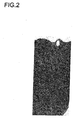
- Example 1.1 the slush skin is completely dyed, whereas in the case of example 1.2 ( FIG. 3 ) the individual powder particles are clearly visible and are colored only at the interfaces. Nevertheless, when looking at the grained surfaces, there are no visual differences between the two slush skins.
- the pigment dispersion was prepared as follows:
- This "stock paste” was diluted with another 1000 g of acetone for spraying.
- the total amount of this pigment dispersion was sprayed into the vortex reactor in 30 minutes.
- the temperature of the dispersion and the sputtering gas is at room temperature, the product temperature in the vortex reactor is 45 ° C.
- the granules were provided with a uniform pigment coating during coating.
- the granules can be processed excellently and without specks in injection molding or extrusion.
- a crosslinking agent was additionally added to the coloring dispersion of Example 1, which was converted to the amount used in Example 3.
- Table 2 Ex. Template Dispersion from Ex. 1 [G] Type of crosslinker Adding crosslinker [G] Test 1 on the slashed scar surface regarding scratch resistance [note] Test 2 on the slashed scar surface with respect to rubbing resistance [note] 2.0. 660 - - 3 3 2.1. 660 trimethylolpropane 2 2 2 2.2. 660 trimethylolpropane 4 1 1 2.3 660 Basonat HB100 2 1 1 2.4. 660 Basonat HI100 2 1 1 2.5. 660 hydroxyethyl methacrylate 2 1 1 Basonat HB100: Biuret-HDI: Functionality: approx. 3.7 Basonat HI100: isocyanurate HDI: functionality: about 3.7
- Test 1 Test description for evaluation of scratch resistance:
- Test Apparatus Zwick pendulum impact tester Type 5102.100 / 00 Beat fin 4 Joule
- a Normkleinstab (cross-sectional area 6 x 4 mm) made of Elastollan 1185A10 was attached to the impact fin in the way that the standard small bar with its cross-sectional area when triggering the Schlagfinne just over the entire area fixed with a double-sided adhesive grained TPU Slush skin.
- a single strip of the standard small bar over the surface more or less strong markings on the surface were left, which are judged on the basis of VW standard PV3906.
- the speed and momentum with which the standard small bar touches the surface was precisely determined by the 4 Joule whip and the given deflection height.
- Test 2 Test description for evaluating scratch resistance:
- the cotton scouring cloth was stretched under the support surface and the 10-stroke test was carried out under the conditions described above.
- the surface was assessed on the basis of VW standard PV3906.
- crosslinking agents were added directly during the production of the TPU or via a masterbatch, the crosslinking would already be induced by the temperature introduction during this incorporation, so that the property of thermoplastic processability would be lost and the material for the powder slush coating would be lost. Procedure is unusable.
- the pigment dispersion was prepared as follows:
- This "stock paste” was diluted with another 200 g of acetone for spraying.
- the total amount of this pigment dispersion was sprayed into the vortex reactor in 60 minutes.
- the temperature of the dispersion and the sputtering gas was at room temperature, the product temperature in the vortex reactor was 43 ° C.
- the granules were provided with a uniform pigment coating during coating.
- test specimen made with this starting material by the slush method showed a very bright, uniform silver color. This method opens up to now unrealizable coloristic possibilities.
Landscapes
- Chemical & Material Sciences (AREA)
- Polymers & Plastics (AREA)
- Health & Medical Sciences (AREA)
- Chemical Kinetics & Catalysis (AREA)
- Medicinal Chemistry (AREA)
- Organic Chemistry (AREA)
- Mechanical Engineering (AREA)
- Engineering & Computer Science (AREA)
- Polyurethanes Or Polyureas (AREA)
- Compositions Of Macromolecular Compounds (AREA)
- Processing And Handling Of Plastics And Other Materials For Molding In General (AREA)
- Application Of Or Painting With Fluid Materials (AREA)
- Processes Of Treating Macromolecular Substances (AREA)
Claims (11)
- Procédé d'application de matériaux fonctionnels sur du polyuréthanne thermoplastique, comprenant les étapes suivantes :a) une introduction de polyuréthanne thermoplastique particulaire dans un dispositif de mélange,b) un maintien en mouvement du polyuréthanne thermoplastique particulaire dans le dispositif de mélange et, pendant cela,c) un apport de matériaux fonctionnels ou d'un mélange contenant des matériaux fonctionnels, sous une forme pulvérisée, dans le dispositif de mélange.
- Procédé suivant la revendication 1, caractérisé en ce que, pour ce qui concerne le dispositif de mélange, il s'agit d'un réacteur tourbillonnaire à pulvérisation.
- Procédé suivant la revendication 1 ou 2, caractérisé en ce que le polyuréthanne thermoplastique particulaire est maintenu en mouvement par tourbillonnement au moyen d'un courant gazeux.
- Procédé suivant l'une des revendications 1 à 3, caractérisé en ce que les matériaux fonctionnels sont dissous ou dispersés dans un solvant ou un mélange de solvants et sont injectés dans le dispositif de mélange.
- Procédé suivant l'une des revendications 1 à 4, caractérisé en ce que les matériaux fonctionnels comportent des pigments, des charges, des colorants, des adjuvants de nucléation, des agents réticulants, des lubrifiants, des auxiliaires de traitement, des stabilisants, des agents ignifuges, des agents gonflants ou leurs mélanges.
- Utilisation d'un mélange de particules, comportant des particules constituéesi) d'un noyau présentant un diamètre moyen de 10 µm à 10 mm, contenant du polyuréthanne thermoplastique, etii) d'une enveloppe, de préférence d'une épaisseur moyenne de 0,1 µm à 500 µm, contenant des matériaux fonctionnels,pour le recouvrement de surfaces par frittage.
- Utilisation suivant la revendication 6, caractérisé en ce que le noyau présente un diamètre moyen de 10 µm à 700 µm.
- Procédé de préparation d'un corps façonné, en particulier d'une feuille grainée, comprenant les étapesa) d'introduction d'un mélange de particules, comportant des particules constituéesi) d'un noyau présentant un diamètre moyen de 10 µm à 10 mm, contenant du polyuréthanne thermoplastique, etii) d'une enveloppe, de préférence d'une épaisseur moyenne de 0,1 µm à 500 µm, contenant des matériaux fonctionnels, dans un moule,b) de frittage du mélange de particules dans le moule.
- Procédé suivant la revendication 8, caractérisé en ce que le noyau présente un diamètre moyen de 10 µm à 700 µm.
- Corps façonné, que l'on peut obtenir par un procédé suivant la revendication 8 ou 9.
- Utilisation du corps façonné suivant la revendication 10, pour la fabrication de surfaces de plaques d'instruments.
Applications Claiming Priority (2)
| Application Number | Priority Date | Filing Date | Title |
|---|---|---|---|
| DE10162348A DE10162348A1 (de) | 2001-12-18 | 2001-12-18 | Verfahren zur Aufbringung von Funktionsmaterialien auf thermoplastisches Polyurethan |
| DE10162348 | 2001-12-18 |
Publications (4)
| Publication Number | Publication Date |
|---|---|
| EP1323769A2 EP1323769A2 (fr) | 2003-07-02 |
| EP1323769A3 EP1323769A3 (fr) | 2004-03-03 |
| EP1323769B1 EP1323769B1 (fr) | 2006-05-31 |
| EP1323769B2 true EP1323769B2 (fr) | 2009-05-13 |
Family
ID=7709774
Family Applications (1)
| Application Number | Title | Priority Date | Filing Date |
|---|---|---|---|
| EP02025163A Expired - Lifetime EP1323769B2 (fr) | 2001-12-18 | 2002-11-11 | Procédé pour appliquer un matériau fonctionnalisé sur un polyuréthane thermoplastique |
Country Status (5)
| Country | Link |
|---|---|
| EP (1) | EP1323769B2 (fr) |
| AT (1) | ATE328030T1 (fr) |
| DE (2) | DE10162348A1 (fr) |
| ES (1) | ES2263725T5 (fr) |
| PT (1) | PT1323769E (fr) |
Families Citing this family (10)
| Publication number | Priority date | Publication date | Assignee | Title |
|---|---|---|---|---|
| US7105201B2 (en) * | 2002-07-26 | 2006-09-12 | H.B. Fuller Licensing & Financing, Inc. | Versatile processes for preparing and using novel composite particles in powder coating compositions |
| US20050123764A1 (en) * | 2003-12-05 | 2005-06-09 | Hoffmann Rene C. | Markable powder and interference pigment containing coatings |
| US7867555B2 (en) | 2004-02-13 | 2011-01-11 | Valspar Sourcing Inc. | Dispersion-coated powder coloring system |
| BRPI0616361B8 (pt) | 2005-10-21 | 2017-01-31 | Valspar Sourcing Inc | método para colorir pós |
| DE102006025848A1 (de) * | 2006-03-29 | 2007-10-04 | Byk-Chemie Gmbh | Herstellung von Nanopartikeln, insbesondere Nanopartikelkompositen, ausgehend von Pulveragglomeraten |
| DE102008038099A1 (de) | 2008-08-18 | 2010-02-25 | Teijin Monofilament Germany Gmbh | Gefärbte Fäden und deren Verwendung |
| CN103398954B (zh) * | 2013-07-19 | 2015-06-17 | 上海嘉麟杰纺织品股份有限公司 | 一种涤氨纶织物的打样颜色判定方法 |
| DE102014211186A1 (de) * | 2014-06-11 | 2015-12-17 | Tesa Se | Polyester-Polyurethan |
| CN107053517B (zh) * | 2017-03-14 | 2019-02-22 | 山东高兴新材料股份有限公司 | 一种复合型氨基模塑料颗粒造粒工艺及设备 |
| IT201700097253A1 (it) * | 2017-08-30 | 2019-03-02 | Givans Fondi Di Latini Michele & C Sas | Procedimento per la realizzazione di prodotti ecosostenibili. |
Citations (2)
| Publication number | Priority date | Publication date | Assignee | Title |
|---|---|---|---|---|
| US3591409A (en) † | 1969-07-28 | 1971-07-06 | Monsanto Co | Process for coating resin granules by high intensity mechanical blending and product obtained thereby |
| WO2000044821A1 (fr) † | 1999-01-26 | 2000-08-03 | Huntsman International Llc | Polyurethannes thermoplastiques expansees |
Family Cites Families (3)
| Publication number | Priority date | Publication date | Assignee | Title |
|---|---|---|---|---|
| US4003872A (en) * | 1973-07-19 | 1977-01-18 | Aluminum Company Of America | Metal-pigmented plastic powder and process |
| DE4441638A1 (de) * | 1993-12-08 | 1995-06-14 | Merck Patent Gmbh | Verfahren zur Herstellung von Pulverlacken |
| DE19800287A1 (de) * | 1998-01-07 | 1999-07-08 | Bayer Ag | Aliphatische sinterfähige thermoplastische Polyurethanformmassen mit reduzierter mechanischer Festigkeit |
-
2001
- 2001-12-18 DE DE10162348A patent/DE10162348A1/de not_active Withdrawn
-
2002
- 2002-11-11 ES ES02025163T patent/ES2263725T5/es not_active Expired - Lifetime
- 2002-11-11 EP EP02025163A patent/EP1323769B2/fr not_active Expired - Lifetime
- 2002-11-11 AT AT02025163T patent/ATE328030T1/de not_active IP Right Cessation
- 2002-11-11 DE DE50206985T patent/DE50206985D1/de not_active Expired - Lifetime
- 2002-11-11 PT PT02025163T patent/PT1323769E/pt unknown
Patent Citations (2)
| Publication number | Priority date | Publication date | Assignee | Title |
|---|---|---|---|---|
| US3591409A (en) † | 1969-07-28 | 1971-07-06 | Monsanto Co | Process for coating resin granules by high intensity mechanical blending and product obtained thereby |
| WO2000044821A1 (fr) † | 1999-01-26 | 2000-08-03 | Huntsman International Llc | Polyurethannes thermoplastiques expansees |
Also Published As
| Publication number | Publication date |
|---|---|
| ATE328030T1 (de) | 2006-06-15 |
| DE10162348A1 (de) | 2003-07-10 |
| PT1323769E (pt) | 2006-08-31 |
| EP1323769A3 (fr) | 2004-03-03 |
| EP1323769B1 (fr) | 2006-05-31 |
| EP1323769A2 (fr) | 2003-07-02 |
| DE50206985D1 (de) | 2006-07-06 |
| ES2263725T3 (es) | 2006-12-16 |
| ES2263725T5 (es) | 2009-08-10 |
Similar Documents
| Publication | Publication Date | Title |
|---|---|---|
| DE69516978T2 (de) | Lichtstabile aliphatische thermoplastische Urethanelastomere und Methode um selbige herzustellen | |
| EP1904566B1 (fr) | Polyurethanne thermoplastique contenant de l'isocyanate | |
| EP0928812B1 (fr) | Compositions à mouler thermoplastiques frittables à résistance mécanique réduite contenant un polyuréthane aliphatique | |
| EP3122795B1 (fr) | Tuyau flexible pneumatique en tpu | |
| EP1323769B2 (fr) | Procédé pour appliquer un matériau fonctionnalisé sur un polyuréthane thermoplastique | |
| EP1069143B1 (fr) | Films polyuréthane souples élastiques, leur procédé de préparation et leur utilisation | |
| EP3645597B1 (fr) | Polyuréthane thermoplastique | |
| DE19920367A1 (de) | Aliphatische, sinterfähige thermoplastische Polyurethanformmassen mit verbesserten Eigenschaften | |
| DE2530809A1 (de) | Verfahren zur faerbung von polyurethankunststoffen | |
| EP1458779B1 (fr) | Polyurethannes thermoplastiques a base d'isocyanates aliphatiques | |
| EP3582923B1 (fr) | Polyuréthane thermoplastique réactif à base d'isocyanate séquencé | |
| EP0539802A1 (fr) | Poudre de polyuréthane, éventuellement expansible, s'écoulant librement, thermoplastique façonnable et ainsi ultérieurement durcissable | |
| EP3274387B1 (fr) | Mousse à mémoire de forme à base de polyuréthane thermoplastique | |
| WO2011120895A1 (fr) | Encollage à la colle fusible au moyen de polyuréthane thermoplastique | |
| EP2569359B1 (fr) | Polyuréthanne thermoplastique contenant un ester de glycérine ayant au moins un motif d'acide carboxylique aliphatique | |
| EP2539384A1 (fr) | Thermorégulation catalysée de granulés pour polyuréthanne thermoplastique | |
| EP3487677B1 (fr) | Soudure par micro-ondes de poudre elastomere | |
| DE10343121A1 (de) | Thermoplastisches Polyurethan enthaltend Metallhydroxid | |
| EP3906270B1 (fr) | Polyuréthane thermoplastique modifié par phase dure | |
| EP3645596B1 (fr) | Polyuréthane ayant une bonne transparence pour le rayonnement électromagnétique | |
| DE10037622A1 (de) | Verfahren zur Herstellung von Folien auf der Basis von thermoplastischen Polyurethanen | |
| DE10230020A1 (de) | Thermoplastische Polyurethane | |
| DE102005000923A1 (de) | Thermoplastische Polyurethane | |
| DE10109301A1 (de) | Thermoplastische Polyurethane auf der Basis aliphatischer Isocyanate | |
| EP2918618A1 (fr) | Polyuréthanes thermoplastiques aliphatiques, leur fabrication et leur utilisation |
Legal Events
| Date | Code | Title | Description |
|---|---|---|---|
| PUAI | Public reference made under article 153(3) epc to a published international application that has entered the european phase |
Free format text: ORIGINAL CODE: 0009012 |
|
| AK | Designated contracting states |
Designated state(s): AT BE BG CH CY CZ DE DK EE ES FI FR GB GR IE IT LI LU MC NL PT SE SK TR |
|
| AX | Request for extension of the european patent |
Extension state: AL LT LV MK RO SI |
|
| PUAL | Search report despatched |
Free format text: ORIGINAL CODE: 0009013 |
|
| AK | Designated contracting states |
Kind code of ref document: A3 Designated state(s): AT BE BG CH CY CZ DE DK EE ES FI FR GB GR IE IT LI LU MC NL PT SE SK TR |
|
| AX | Request for extension of the european patent |
Extension state: AL LT LV MK RO SI |
|
| RIC1 | Information provided on ipc code assigned before grant |
Ipc: 7C 08J 3/20 B Ipc: 7C 09D 5/03 B Ipc: 7B 29C 67/04 B Ipc: 7C 08L 75/04 B Ipc: 7C 08J 3/205 A |
|
| 17P | Request for examination filed |
Effective date: 20040903 |
|
| AKX | Designation fees paid |
Designated state(s): AT BE BG CH CY CZ DE DK EE ES FI FR GB GR IE IT LI LU MC NL PT SE SK TR |
|
| GRAP | Despatch of communication of intention to grant a patent |
Free format text: ORIGINAL CODE: EPIDOSNIGR1 |
|
| GRAS | Grant fee paid |
Free format text: ORIGINAL CODE: EPIDOSNIGR3 |
|
| GRAA | (expected) grant |
Free format text: ORIGINAL CODE: 0009210 |
|
| AK | Designated contracting states |
Kind code of ref document: B1 Designated state(s): AT BE BG CH CY CZ DE DK EE ES FI FR GB GR IE IT LI LU MC NL PT SE SK TR |
|
| PG25 | Lapsed in a contracting state [announced via postgrant information from national office to epo] |
Ref country code: IT Free format text: LAPSE BECAUSE OF FAILURE TO SUBMIT A TRANSLATION OF THE DESCRIPTION OR TO PAY THE FEE WITHIN THE PRESCRIBED TIME-LIMIT;WARNING: LAPSES OF ITALIAN PATENTS WITH EFFECTIVE DATE BEFORE 2007 MAY HAVE OCCURRED AT ANY TIME BEFORE 2007. THE CORRECT EFFECTIVE DATE MAY BE DIFFERENT FROM THE ONE RECORDED. Effective date: 20060531 Ref country code: IE Free format text: LAPSE BECAUSE OF FAILURE TO SUBMIT A TRANSLATION OF THE DESCRIPTION OR TO PAY THE FEE WITHIN THE PRESCRIBED TIME-LIMIT Effective date: 20060531 Ref country code: FI Free format text: LAPSE BECAUSE OF FAILURE TO SUBMIT A TRANSLATION OF THE DESCRIPTION OR TO PAY THE FEE WITHIN THE PRESCRIBED TIME-LIMIT Effective date: 20060531 Ref country code: CZ Free format text: LAPSE BECAUSE OF FAILURE TO SUBMIT A TRANSLATION OF THE DESCRIPTION OR TO PAY THE FEE WITHIN THE PRESCRIBED TIME-LIMIT Effective date: 20060531 Ref country code: SK Free format text: LAPSE BECAUSE OF FAILURE TO SUBMIT A TRANSLATION OF THE DESCRIPTION OR TO PAY THE FEE WITHIN THE PRESCRIBED TIME-LIMIT Effective date: 20060531 |
|
| REG | Reference to a national code |
Ref country code: CH Ref legal event code: EP Ref country code: GB Ref legal event code: FG4D Free format text: NOT ENGLISH |
|
| REG | Reference to a national code |
Ref country code: IE Ref legal event code: FG4D Free format text: LANGUAGE OF EP DOCUMENT: GERMAN |
|
| REF | Corresponds to: |
Ref document number: 50206985 Country of ref document: DE Date of ref document: 20060706 Kind code of ref document: P |
|
| PG25 | Lapsed in a contracting state [announced via postgrant information from national office to epo] |
Ref country code: DK Free format text: LAPSE BECAUSE OF FAILURE TO SUBMIT A TRANSLATION OF THE DESCRIPTION OR TO PAY THE FEE WITHIN THE PRESCRIBED TIME-LIMIT Effective date: 20060831 |
|
| REG | Reference to a national code |
Ref country code: PT Ref legal event code: SC4A Effective date: 20060626 |
|
| REG | Reference to a national code |
Ref country code: SE Ref legal event code: TRGR |
|
| GBT | Gb: translation of ep patent filed (gb section 77(6)(a)/1977) |
Effective date: 20060918 |
|
| PGFP | Annual fee paid to national office [announced via postgrant information from national office to epo] |
Ref country code: NL Payment date: 20061105 Year of fee payment: 5 |
|
| PGFP | Annual fee paid to national office [announced via postgrant information from national office to epo] |
Ref country code: SE Payment date: 20061106 Year of fee payment: 5 |
|
| PGFP | Annual fee paid to national office [announced via postgrant information from national office to epo] |
Ref country code: FR Payment date: 20061108 Year of fee payment: 5 Ref country code: GB Payment date: 20061108 Year of fee payment: 5 |
|
| PGFP | Annual fee paid to national office [announced via postgrant information from national office to epo] |
Ref country code: PT Payment date: 20061110 Year of fee payment: 5 |
|
| PGFP | Annual fee paid to national office [announced via postgrant information from national office to epo] |
Ref country code: AT Payment date: 20061113 Year of fee payment: 5 |
|
| PG25 | Lapsed in a contracting state [announced via postgrant information from national office to epo] |
Ref country code: CH Free format text: LAPSE BECAUSE OF NON-PAYMENT OF DUE FEES Effective date: 20061130 Ref country code: MC Free format text: LAPSE BECAUSE OF NON-PAYMENT OF DUE FEES Effective date: 20061130 Ref country code: LI Free format text: LAPSE BECAUSE OF NON-PAYMENT OF DUE FEES Effective date: 20061130 |
|
| REG | Reference to a national code |
Ref country code: ES Ref legal event code: FG2A Ref document number: 2263725 Country of ref document: ES Kind code of ref document: T3 |
|
| REG | Reference to a national code |
Ref country code: IE Ref legal event code: FD4D |
|
| ET | Fr: translation filed | ||
| PLBI | Opposition filed |
Free format text: ORIGINAL CODE: 0009260 |
|
| 26 | Opposition filed |
Opponent name: HUNTSMAN INTERNATIONAL LLC Effective date: 20070202 |
|
| PLAX | Notice of opposition and request to file observation + time limit sent |
Free format text: ORIGINAL CODE: EPIDOSNOBS2 |
|
| NLR1 | Nl: opposition has been filed with the epo |
Opponent name: HUNTSMAN INTERNATIONAL LLC |
|
| REG | Reference to a national code |
Ref country code: CH Ref legal event code: PL |
|
| PLBB | Reply of patent proprietor to notice(s) of opposition received |
Free format text: ORIGINAL CODE: EPIDOSNOBS3 |
|
| PLAY | Examination report in opposition despatched + time limit |
Free format text: ORIGINAL CODE: EPIDOSNORE2 |
|
| RAP2 | Party data changed (patent owner data changed or rights of a patent transferred) |
Owner name: BASF SE |
|
| PG25 | Lapsed in a contracting state [announced via postgrant information from national office to epo] |
Ref country code: GR Free format text: LAPSE BECAUSE OF FAILURE TO SUBMIT A TRANSLATION OF THE DESCRIPTION OR TO PAY THE FEE WITHIN THE PRESCRIBED TIME-LIMIT Effective date: 20060901 |
|
| NLT2 | Nl: modifications (of names), taken from the european patent patent bulletin |
Owner name: BASF SE Effective date: 20080305 |
|
| REG | Reference to a national code |
Ref country code: PT Ref legal event code: MM4A Free format text: LAPSE DUE TO NON-PAYMENT OF FEES Effective date: 20080512 |
|
| PG25 | Lapsed in a contracting state [announced via postgrant information from national office to epo] |
Ref country code: BG Free format text: LAPSE BECAUSE OF FAILURE TO SUBMIT A TRANSLATION OF THE DESCRIPTION OR TO PAY THE FEE WITHIN THE PRESCRIBED TIME-LIMIT Effective date: 20060831 Ref country code: EE Free format text: LAPSE BECAUSE OF FAILURE TO SUBMIT A TRANSLATION OF THE DESCRIPTION OR TO PAY THE FEE WITHIN THE PRESCRIBED TIME-LIMIT Effective date: 20060531 |
|
| PLBC | Reply to examination report in opposition received |
Free format text: ORIGINAL CODE: EPIDOSNORE3 |
|
| EUG | Se: european patent has lapsed | ||
| GBPC | Gb: european patent ceased through non-payment of renewal fee |
Effective date: 20071111 |
|
| PLAY | Examination report in opposition despatched + time limit |
Free format text: ORIGINAL CODE: EPIDOSNORE2 |
|
| PG25 | Lapsed in a contracting state [announced via postgrant information from national office to epo] |
Ref country code: TR Free format text: LAPSE BECAUSE OF FAILURE TO SUBMIT A TRANSLATION OF THE DESCRIPTION OR TO PAY THE FEE WITHIN THE PRESCRIBED TIME-LIMIT Effective date: 20060531 Ref country code: LU Free format text: LAPSE BECAUSE OF NON-PAYMENT OF DUE FEES Effective date: 20061111 |
|
| NLV4 | Nl: lapsed or anulled due to non-payment of the annual fee |
Effective date: 20080601 |
|
| PLBC | Reply to examination report in opposition received |
Free format text: ORIGINAL CODE: EPIDOSNORE3 |
|
| PG25 | Lapsed in a contracting state [announced via postgrant information from national office to epo] |
Ref country code: AT Free format text: LAPSE BECAUSE OF NON-PAYMENT OF DUE FEES Effective date: 20071111 |
|
| PG25 | Lapsed in a contracting state [announced via postgrant information from national office to epo] |
Ref country code: PT Free format text: LAPSE BECAUSE OF NON-PAYMENT OF DUE FEES Effective date: 20080512 |
|
| PG25 | Lapsed in a contracting state [announced via postgrant information from national office to epo] |
Ref country code: SE Free format text: LAPSE BECAUSE OF NON-PAYMENT OF DUE FEES Effective date: 20071112 Ref country code: NL Free format text: LAPSE BECAUSE OF NON-PAYMENT OF DUE FEES Effective date: 20080601 |
|
| REG | Reference to a national code |
Ref country code: FR Ref legal event code: ST Effective date: 20080930 |
|
| PG25 | Lapsed in a contracting state [announced via postgrant information from national office to epo] |
Ref country code: CY Free format text: LAPSE BECAUSE OF FAILURE TO SUBMIT A TRANSLATION OF THE DESCRIPTION OR TO PAY THE FEE WITHIN THE PRESCRIBED TIME-LIMIT Effective date: 20060531 |
|
| PG25 | Lapsed in a contracting state [announced via postgrant information from national office to epo] |
Ref country code: GB Free format text: LAPSE BECAUSE OF NON-PAYMENT OF DUE FEES Effective date: 20071111 |
|
| PUAH | Patent maintained in amended form |
Free format text: ORIGINAL CODE: 0009272 |
|
| STAA | Information on the status of an ep patent application or granted ep patent |
Free format text: STATUS: PATENT MAINTAINED AS AMENDED |
|
| PG25 | Lapsed in a contracting state [announced via postgrant information from national office to epo] |
Ref country code: FR Free format text: LAPSE BECAUSE OF NON-PAYMENT OF DUE FEES Effective date: 20071130 |
|
| 27A | Patent maintained in amended form |
Effective date: 20090513 |
|
| AK | Designated contracting states |
Kind code of ref document: B2 Designated state(s): AT BE BG CH CY CZ DE DK EE ES FI FR GB GR IE IT LI LU MC NL PT SE SK TR |
|
| REG | Reference to a national code |
Ref country code: ES Ref legal event code: DC2A Date of ref document: 20090618 Kind code of ref document: T5 |
|
| PLAB | Opposition data, opponent's data or that of the opponent's representative modified |
Free format text: ORIGINAL CODE: 0009299OPPO |
|
| REG | Reference to a national code |
Ref country code: ES Ref legal event code: PC2A Owner name: BAYER MATERIALSCIENCE AG Effective date: 20130529 |
|
| REG | Reference to a national code |
Ref country code: DE Ref legal event code: R081 Ref document number: 50206985 Country of ref document: DE Owner name: COVESTRO DEUTSCHLAND AG, DE Free format text: FORMER OWNER: BASF SE, 67063 LUDWIGSHAFEN, DE Effective date: 20130429 Ref country code: DE Ref legal event code: R081 Ref document number: 50206985 Country of ref document: DE Owner name: BAYER MATERIALSCIENCE AG, DE Free format text: FORMER OWNER: BASF SE, 67063 LUDWIGSHAFEN, DE Effective date: 20130429 |
|
| BECH | Be: change of holder |
Owner name: BAYER MATERIALSCIENCE A.G. Effective date: 20130604 |
|
| PGFP | Annual fee paid to national office [announced via postgrant information from national office to epo] |
Ref country code: ES Payment date: 20141028 Year of fee payment: 13 Ref country code: DE Payment date: 20141105 Year of fee payment: 13 |
|
| PGFP | Annual fee paid to national office [announced via postgrant information from national office to epo] |
Ref country code: IT Payment date: 20141110 Year of fee payment: 13 |
|
| PGFP | Annual fee paid to national office [announced via postgrant information from national office to epo] |
Ref country code: BE Payment date: 20141111 Year of fee payment: 13 |
|
| REG | Reference to a national code |
Ref country code: DE Ref legal event code: R081 Ref document number: 50206985 Country of ref document: DE Owner name: COVESTRO DEUTSCHLAND AG, DE Free format text: FORMER OWNER: BAYER MATERIALSCIENCE AG, 51373 LEVERKUSEN, DE |
|
| REG | Reference to a national code |
Ref country code: DE Ref legal event code: R119 Ref document number: 50206985 Country of ref document: DE |
|
| PG25 | Lapsed in a contracting state [announced via postgrant information from national office to epo] |
Ref country code: IT Free format text: LAPSE BECAUSE OF NON-PAYMENT OF DUE FEES Effective date: 20151111 |
|
| PG25 | Lapsed in a contracting state [announced via postgrant information from national office to epo] |
Ref country code: DE Free format text: LAPSE BECAUSE OF NON-PAYMENT OF DUE FEES Effective date: 20160601 |
|
| REG | Reference to a national code |
Ref country code: ES Ref legal event code: FD2A Effective date: 20161227 |
|
| PG25 | Lapsed in a contracting state [announced via postgrant information from national office to epo] |
Ref country code: ES Free format text: LAPSE BECAUSE OF NON-PAYMENT OF DUE FEES Effective date: 20151112 |
|
| PG25 | Lapsed in a contracting state [announced via postgrant information from national office to epo] |
Ref country code: BE Free format text: LAPSE BECAUSE OF NON-PAYMENT OF DUE FEES Effective date: 20151130 |