EP1322672B1 - Washing and dewatering of suspensions - Google Patents
Washing and dewatering of suspensions Download PDFInfo
- Publication number
- EP1322672B1 EP1322672B1 EP01979105A EP01979105A EP1322672B1 EP 1322672 B1 EP1322672 B1 EP 1322672B1 EP 01979105 A EP01979105 A EP 01979105A EP 01979105 A EP01979105 A EP 01979105A EP 1322672 B1 EP1322672 B1 EP 1322672B1
- Authority
- EP
- European Patent Office
- Prior art keywords
- starch
- suspension
- washing
- filter
- mantle surface
- Prior art date
- Legal status (The legal status is an assumption and is not a legal conclusion. Google has not performed a legal analysis and makes no representation as to the accuracy of the status listed.)
- Expired - Lifetime
Links
- 239000000725 suspension Substances 0.000 title claims abstract description 79
- 238000005406 washing Methods 0.000 title claims abstract description 72
- 229920002472 Starch Polymers 0.000 claims abstract description 67
- 235000019698 starch Nutrition 0.000 claims abstract description 66
- 239000008107 starch Substances 0.000 claims abstract description 65
- 238000000034 method Methods 0.000 claims abstract description 57
- 230000008569 process Effects 0.000 claims abstract description 56
- 239000007788 liquid Substances 0.000 claims abstract description 31
- XLYOFNOQVPJJNP-UHFFFAOYSA-N water Substances O XLYOFNOQVPJJNP-UHFFFAOYSA-N 0.000 claims description 31
- 238000006243 chemical reaction Methods 0.000 claims description 23
- 239000012065 filter cake Substances 0.000 claims description 19
- 239000007787 solid Substances 0.000 claims description 18
- 238000007790 scraping Methods 0.000 claims description 12
- 239000000706 filtrate Substances 0.000 claims description 10
- 239000012465 retentate Substances 0.000 claims description 10
- 229920001592 potato starch Polymers 0.000 claims description 9
- 239000012535 impurity Substances 0.000 claims description 8
- 239000000463 material Substances 0.000 claims description 8
- 230000000717 retained effect Effects 0.000 claims description 7
- 229920000881 Modified starch Polymers 0.000 claims description 5
- 235000019426 modified starch Nutrition 0.000 claims description 5
- 238000005507 spraying Methods 0.000 claims description 4
- 239000004368 Modified starch Substances 0.000 claims description 2
- 239000000126 substance Substances 0.000 description 16
- 239000000047 product Substances 0.000 description 9
- 235000013305 food Nutrition 0.000 description 8
- 239000003153 chemical reaction reagent Substances 0.000 description 6
- 230000008901 benefit Effects 0.000 description 5
- 230000009471 action Effects 0.000 description 4
- 239000002002 slurry Substances 0.000 description 4
- 239000002253 acid Substances 0.000 description 3
- 238000010924 continuous production Methods 0.000 description 3
- 238000001914 filtration Methods 0.000 description 3
- 239000002609 medium Substances 0.000 description 3
- 238000012986 modification Methods 0.000 description 3
- 230000004048 modification Effects 0.000 description 3
- 239000002904 solvent Substances 0.000 description 3
- LFQSCWFLJHTTHZ-UHFFFAOYSA-N Ethanol Chemical compound CCO LFQSCWFLJHTTHZ-UHFFFAOYSA-N 0.000 description 2
- 150000007513 acids Chemical class 0.000 description 2
- 239000006227 byproduct Substances 0.000 description 2
- 239000003518 caustics Substances 0.000 description 2
- 238000007385 chemical modification Methods 0.000 description 2
- 238000006266 etherification reaction Methods 0.000 description 2
- 239000012530 fluid Substances 0.000 description 2
- 239000008187 granular material Substances 0.000 description 2
- 230000000813 microbial effect Effects 0.000 description 2
- 230000003647 oxidation Effects 0.000 description 2
- 238000007254 oxidation reaction Methods 0.000 description 2
- 239000001254 oxidized starch Substances 0.000 description 2
- 235000013808 oxidized starch Nutrition 0.000 description 2
- 239000002245 particle Substances 0.000 description 2
- 239000000546 pharmaceutical excipient Substances 0.000 description 2
- 230000009467 reduction Effects 0.000 description 2
- 230000008929 regeneration Effects 0.000 description 2
- 238000011069 regeneration method Methods 0.000 description 2
- 238000000926 separation method Methods 0.000 description 2
- 229920002261 Corn starch Polymers 0.000 description 1
- 240000005979 Hordeum vulgare Species 0.000 description 1
- 235000007340 Hordeum vulgare Nutrition 0.000 description 1
- 240000003183 Manihot esculenta Species 0.000 description 1
- 235000016735 Manihot esculenta subsp esculenta Nutrition 0.000 description 1
- 229910019142 PO4 Inorganic materials 0.000 description 1
- 230000001476 alcoholic effect Effects 0.000 description 1
- 239000012736 aqueous medium Substances 0.000 description 1
- 239000007864 aqueous solution Substances 0.000 description 1
- 239000007900 aqueous suspension Substances 0.000 description 1
- 230000015572 biosynthetic process Effects 0.000 description 1
- 239000003054 catalyst Substances 0.000 description 1
- 239000007795 chemical reaction product Substances 0.000 description 1
- 239000000356 contaminant Substances 0.000 description 1
- 238000011109 contamination Methods 0.000 description 1
- 239000008120 corn starch Substances 0.000 description 1
- 238000004132 cross linking Methods 0.000 description 1
- 230000001419 dependent effect Effects 0.000 description 1
- 238000001212 derivatisation Methods 0.000 description 1
- 238000010790 dilution Methods 0.000 description 1
- 239000012895 dilution Substances 0.000 description 1
- 238000009826 distribution Methods 0.000 description 1
- 238000001035 drying Methods 0.000 description 1
- 238000005265 energy consumption Methods 0.000 description 1
- 238000005516 engineering process Methods 0.000 description 1
- 239000011552 falling film Substances 0.000 description 1
- 230000002427 irreversible effect Effects 0.000 description 1
- 238000011031 large-scale manufacturing process Methods 0.000 description 1
- 238000012423 maintenance Methods 0.000 description 1
- 238000004519 manufacturing process Methods 0.000 description 1
- 244000005700 microbiome Species 0.000 description 1
- 239000000203 mixture Substances 0.000 description 1
- 238000006011 modification reaction Methods 0.000 description 1
- 238000010915 one-step procedure Methods 0.000 description 1
- 238000004806 packaging method and process Methods 0.000 description 1
- NBIIXXVUZAFLBC-UHFFFAOYSA-K phosphate Chemical compound [O-]P([O-])([O-])=O NBIIXXVUZAFLBC-UHFFFAOYSA-K 0.000 description 1
- 239000010452 phosphate Substances 0.000 description 1
- 230000000865 phosphorylative effect Effects 0.000 description 1
- 238000000746 purification Methods 0.000 description 1
- 150000003839 salts Chemical class 0.000 description 1
- 239000000243 solution Substances 0.000 description 1
- 230000008961 swelling Effects 0.000 description 1
- 230000008719 thickening Effects 0.000 description 1
- 238000003828 vacuum filtration Methods 0.000 description 1
- 239000002699 waste material Substances 0.000 description 1
- 229940100445 wheat starch Drugs 0.000 description 1
Images

Classifications
-
- C—CHEMISTRY; METALLURGY
- C08—ORGANIC MACROMOLECULAR COMPOUNDS; THEIR PREPARATION OR CHEMICAL WORKING-UP; COMPOSITIONS BASED THEREON
- C08B—POLYSACCHARIDES; DERIVATIVES THEREOF
- C08B31/00—Preparation of derivatives of starch
- C08B31/18—Oxidised starch
-
- B—PERFORMING OPERATIONS; TRANSPORTING
- B01—PHYSICAL OR CHEMICAL PROCESSES OR APPARATUS IN GENERAL
- B01D—SEPARATION
- B01D33/00—Filters with filtering elements which move during the filtering operation
- B01D33/06—Filters with filtering elements which move during the filtering operation with rotary cylindrical filtering surfaces, e.g. hollow drums
- B01D33/073—Filters with filtering elements which move during the filtering operation with rotary cylindrical filtering surfaces, e.g. hollow drums arranged for inward flow filtration
-
- B—PERFORMING OPERATIONS; TRANSPORTING
- B01—PHYSICAL OR CHEMICAL PROCESSES OR APPARATUS IN GENERAL
- B01D—SEPARATION
- B01D33/00—Filters with filtering elements which move during the filtering operation
- B01D33/44—Regenerating the filter material in the filter
- B01D33/46—Regenerating the filter material in the filter by scrapers, brushes nozzles or the like acting on the cake-side of the filtering element
- B01D33/466—Regenerating the filter material in the filter by scrapers, brushes nozzles or the like acting on the cake-side of the filtering element scrapers
-
- B—PERFORMING OPERATIONS; TRANSPORTING
- B01—PHYSICAL OR CHEMICAL PROCESSES OR APPARATUS IN GENERAL
- B01D—SEPARATION
- B01D33/00—Filters with filtering elements which move during the filtering operation
- B01D33/58—Handling the filter cake in the filter for purposes other than for regenerating the filter cake remaining on the filtering element
- B01D33/60—Handling the filter cake in the filter for purposes other than for regenerating the filter cake remaining on the filtering element for washing
-
- B—PERFORMING OPERATIONS; TRANSPORTING
- B01—PHYSICAL OR CHEMICAL PROCESSES OR APPARATUS IN GENERAL
- B01D—SEPARATION
- B01D37/00—Processes of filtration
- B01D37/02—Precoating the filter medium; Addition of filter aids to the liquid being filtered
-
- C—CHEMISTRY; METALLURGY
- C08—ORGANIC MACROMOLECULAR COMPOUNDS; THEIR PREPARATION OR CHEMICAL WORKING-UP; COMPOSITIONS BASED THEREON
- C08B—POLYSACCHARIDES; DERIVATIVES THEREOF
- C08B30/00—Preparation of starch, degraded or non-chemically modified starch, amylose, or amylopectin
- C08B30/08—Concentration of starch suspensions
-
- C—CHEMISTRY; METALLURGY
- C08—ORGANIC MACROMOLECULAR COMPOUNDS; THEIR PREPARATION OR CHEMICAL WORKING-UP; COMPOSITIONS BASED THEREON
- C08B—POLYSACCHARIDES; DERIVATIVES THEREOF
- C08B31/00—Preparation of derivatives of starch
- C08B31/003—Crosslinking of starch
-
- C—CHEMISTRY; METALLURGY
- C08—ORGANIC MACROMOLECULAR COMPOUNDS; THEIR PREPARATION OR CHEMICAL WORKING-UP; COMPOSITIONS BASED THEREON
- C08B—POLYSACCHARIDES; DERIVATIVES THEREOF
- C08B31/00—Preparation of derivatives of starch
- C08B31/08—Ethers
Definitions
- the present invention relates to the field of process technology. More in particular, the invention relates to separation and purification techniques.
- suspensions are considered convenient forms of mixtures. In as far as a homogeneous distribution of reagents within the suspension can be achieved, they may be employed as a medium for carrying out chemical conversions.
- Starch is a product which is particularly suitable to be processed and chemically modified in suspension form.
- Native starch is a granular product, which can be kept in its granular form by maintaining suitable process conditions. If irreversible swelling and gelatinization can be avoided, essentially no starch will be lost to the liquid medium, usually water, in which it is suspended.
- the chemically modified starch needs to be recovered from the suspension in which the conversion was performed. Excess of reagents, by-products such as salts, and other impurities have to be separated from the starch product. Conveniently, the aqueous medium of the suspension, in which most if not all impurities are dissolved, can be removed and the starch product is dried. The starch product is washed before drying.
- the washing and dewatering steps have been found to be not so easy, and particularly difficult to carry out in an economically attractive fashion.
- the washing and dewatering are carried out as two separate steps.
- hydrocyclones are often used, as is described in e.g. EP-A-0 517 965 .
- the use of this type of apparatus requires large amounts of water to achieve a thorough washing.
- the dewatering is generally performed using a segmented vacuum (drum) filter having multiple vacuum chambers or using a centrifuge.
- US patent 4,216,310 discloses a process for phosphorylating starch.
- the phosphate reagent used is introduced by spraying on a moist starch cake on a rotary vacuum filter.
- the reagent is introduced in the form of an aqueous solution which is intended to remain in the starch cake so that the desired reaction may take place.
- the vacuum filter is thus not used to carry out a washing step of the starch.
- filtration is performed using a Buchner funnel.
- US patent 4,774,009 relates to a method for dewatering slurries using an automatic pressure filter, which is clearly distinct from a rotary vacuum filter.
- the international patent application 97/31627 is concerned with a process for preparing a tabletting excipient.
- the starch product that is intended as a tabletting excipient is washed on a vacuum filter.
- the removal of fluids i.e. filtration
- significant amounts of fluid are used for the washing on the vacuum filter (up to two times the volume of the slurry to be washed), which is something the present invention aims to avoid.
- European patent application 0 738 531 discloses a rotary drum type device for separating solid particles from a liquid. It is not disclosed or suggested that a rotary vacuum filter may be used for both washing and dewatering a starch suspension.
- the present invention seeks to find an improved manner for carrying out the washing and dewatering of starch suspensions. It is an object of the invention that both actions can be carried out in one step with great efficiency. It is further an object of the invention that the amounts of water needed for an efficient washing are significantly reduced, preferably to such an extent that all water in the process setup for carrying out a chemical modification of the starch in a suspension reaction can be recycled.
- the invention relates to a process for washing and dewatering a starch suspension, using a vacuum filter having at least a retentate and a filtrate side, comprising the steps of
- the present process is a very efficient and elegant process. Significantly smaller investments in equipment are necessary for setting up the present process. Furthermore, the present process requires the use of only very small amounts of washing liquid in relation to the amount of processed starch, while the capacity of the process may be essentially equal to that of the prior art processes. Hence, the present invention provides a significant reduction of the amount of energy required for washing and dewatering processes of starch. The environment will of course benefit greatly from this, as well as from the reduced amount of water that is required for the washing.
- the starch suspension to be washed and dewatered in accordance with the invention may comprise any type of starch. Suitable examples include potato starch, corn starch, tapioca starch, wheat starch, barley starch and the like. It has been found that particularly the washing and dewatering of suspensions of starch of relatively large granule size benefit from the invention. Accordingly, it is preferred that the suspension is a suspension of potato starch. These starches have a mean particle diameter between 5 and 100, preferably between 10 and 35 ⁇ m.
- the present process is part of a continuous process for converting or modifying starch chemically in a suspension process.
- the starch will generally be a converted starch.
- the starch suspension will usually be an aqueous suspension. Most, if not all, modifications and conversions of starch are preferably performed in an aqueous environment.
- the present invention may, however, also be of use in the washing and removal of solvents from other suspensions. Particularly, alcoholic suspensions, such as suspensions in ethanol, may under circumstances by processed.
- the suspension comprises two or more solvents.
- the washing liquid will be the same as the solvent in the suspension.
- the suspension to be treated in accordance with the invention will usually originate from a chemical modification or conversion step, the suspension will comprise contaminants such as by-products, remnants of reagents, catalysts. These will generally dissolve in the liquid medium of the suspension and be removed during the present process.
- the term 'vacuum filter' is intended to refer to a substantially cylindrical, rotary drum filter having one or more vacuum chambers, each chamber being connected to a vacuum source that can provide a pressure at the inside of the drum that is lower than the pressure at the outside of the drum.
- the outer surface i.e. the mantle of the drum has filter characteristics which enable a liquid, fraction of a suspension, e.g. water with dissolved impurities, to migrate through the mantle, and a solid fraction of the suspension, e.g. starch to remain outside the mantle of the drum.
- the filter will further be equipped with means to turn the drum around an axial axis. The size and capacity of the vacuum filter will be chosen dependent on the scale on which the present process is to be carried out.
- Another important aspect of the invention is the thickness of the filter cake.
- the thicker the filter cake the more efficient the dewatering and, in particular, the washing will take place.
- the present process which also involves dewatering requires a filter cake thickness of at least 1.5 mm, and preferably at least 2 mm.
- even higher thicknesses may be employed, typically between 3 and 15 mm. This will be particularly be the case when the starch product in the suspension is intended for applications in the food or pharmaceutical industries.
- the pressure inside the drum is preferably kept as low as possible to facilitate an efficient dewatering and filtering process.
- Typical pressures to be maintained in the drum lie between 0.01 and 0.7, preferably between 0.1 and 0.3 bar.
- the drum is preferably rotated at a relatively slow speed. Suitable rotation speed may depend on the desired application of the starch. In cases where the starch is intended to be used in the food or pharmaceutical industries, the rotation speed may be chosen in the range of from 0.1 to 1 rpm. In other cases the rotation speed may be higher, e.g. in the range of 3 to 5 rpm. It is further desired that a process according to the invention is carried out at elevated temperature, although gelatinization of the starch is of course to be prevented. Typical suitable temperatures lie between 15 and 35°C, and are preferably between 25 and 35°C.
- a precoat is first applied to the drum filter.
- the term precoat refers to a cake present on the filter, which is not removed after the washing and dewatering have been completed. If, as will usually be the case, the present process is performed continuously, the precoat remains present during the entire continuously performed process. Nevertheless, occasionally it may be desired to refresh the precoat even though that would mean an interruption of the continuous process. This may for instance be the case when the precoat becomes impenetrable for the filtrate and washing liquid or when the precoat becomes contaminated. It has been found that the presence of the precoat ensures that substantially no starch is lost to the filtrate during the process.
- the thickness of the precoat preferably lies between 0.5 and 10 mm, more preferably between 3 and 6 mm.
- the washing liquid used for washing the starch suspension in process according to the invention will usually be chosen the same as the liquid in which the starch is suspended.
- the washing liquid will be water.
- the starch suspension may be washed and dewatered on the vacuum filter in a conventional setup of the vacuum filter, examples of which are well-known in the art.
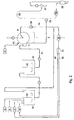
- a specially designed washing and dewatering apparatus is employed. An example of this is shown in Figure 1 .
- FIG. 1 schematically shows a side view of a washing and deliquifying apparatus, especially configured for carrying out the invention.
- the apparatus 1 comprises a substantially cylindrical drum 2 having a mantle surface 3 of filter material enclosing a singular vacuum chamber 4.
- the vacuum chamber 4 is connected to a vacuum source, e.g. a pump.
- a radially outward retentate side 5 of the filter material can retain a solid fraction 6 of a suspension 7 applied onto the mantle surface 3.
- a liquid fraction 8 of the suspension 7 can pass into the vacuum chamber 4.
- the liquid fraction 8 can be removed from the vacuum chamber 4 by means of a conduit 9 that is connected to e.g. a pump.
- the apparatus has a relatively low internal resistance with regard to the filtrate stream, thereby facilitating the formation of the filter cake on the mantle surface.
- the drum 2 comprises a singular vacuum chamber 4.
- the singular vacuum chamber 4 may however be built up of several interconnected segments, each having the same pressure.
- the apparatus 1 further comprises a drive (not shown) for rotating the drum 2 about its central longitudinal axis A in a fixed rotational direction, e.g. clockwise in the direction of arrow P.
- the central axis A of the drum 2 extends substantially horizontally.
- the apparatus 1 further comprises a feeder, in this example embodied as a trough, i.e. an open conduit, extending at a radial distance h1 along the mantle surface 3.
- the trough has a feeding opening 12 through which a suspension 7, e.g. having a solid fraction in the form of starch granules suspended in water, can be fed onto the mantle surface 3.
- the feeder 11 is disposed at a top half of an upwardly moving section of the drum, approximately between the 9 and 12 o'clock position when the rotating direction is clockwise and approximately between the 3 and 12 o'clock position when the rotational direction is counterclockwise. It is particularly advantageous of this configuration that the filter can process suspensions of high starch concentrations (up to 40 wt.%). This makes it possible that suspensions obtained from a starch modification reaction may be washed and dewatered without prior dilution.
- the apparatus 1 further comprises a sprayer 13 for spraying washing liquid onto a solid fraction 6 of the suspension 7 retained on the mantle surface 3.
- the sprayer 13 comprises two rows of interspaced nozzles, extending at a radial distance in axial direction along the mantle surface 3. It is to be understood that many configurations of the sprayer are possible and that the term 'sprayer' should not interpreted as to give any indication of the pressure behind the washing liquid that is provided by the sprayer to the solid fraction 6.
- the washing liquid may also be added to the solid fraction dropwise or in the form of a falling film of liquid.
- the apparatus 1 comprises a scraper 14 for scraping a top layer 6A of a retained solid fraction 6 from the mantle surface 3.
- the scraper 14 has a scraping surface formed by or integrated with a bottom portion of the trough, of which the edge extends at a radial distance h1 in axial direction along the mantle surface 3.
- the scraper 14 is integrated with the feeder 13, such that the feeding zone is, in rotational direction P, adjacent to the scraping zone.
- the feeder 11, sprayer 13 and scraper 14 are disposed along the circumference of the mantle 3 of the drum 2 such that the mantle surface 3 comprises a feeding zone F that is, in rotational direction P preceded by a scraping zone S and which is followed at a rotational distance by a washing zone W.
- the original liquid fraction 8 of the suspension 7 that is applied to the mantle surface 3 passes at least partially through the filter material of the mantle into the vacuum chamber 4. It will be clear that D may also be zero.
- a new liquid fraction is applied by means of the sprayer B, which under vacuum action passes through the filter material of the mantle surface 3, thereby fully displacing the original liquid fraction in a washing action.
- the sprayer 13 and the scraper 14 are during washing and deliquifying maintained at a radial distance from the mantle surface, a minimal thickness of solid fraction 6 is maintained on the mantle surface 3 of the drum 2. This allows for the use of a singular vacuum chamber 4. In the washing and deliquifying apparatus, a very large part of the circumference of the drum 2 is available for deliquifying.
- a precoat is brought onto the mantle surface 3 before the washing and deliquifying process is started. This may be achieved by temporarily moving the feeder 13 and the scraper 14 radially closer to the mantle surface, or by dosing suspension onto the mantle surface. Depending on the thickness of the precoat, this distance may be 0.5-2 mm. In fig. 1 , the precoat is shown as a portion 6C of the portion retained solid fraction 6B that remains on the mantle surface during washing and deliquifying.
- the washing and deliquifying apparatus is not limited to the embodiment shown.
- the drum may e.g. have a vertical axis, and the feeder may comprise tubes, nozzles, a feeding plate or a falling curtain. Such variations can also be envisaged for the sprayer.
- the scraper may comprise a number of scraping plates, a wedge of any other type of scraping tool.
- the obtained starch may be dried to a desired water content in any conventional manner.
- the invention further relates to a process for chemically converting of modifying starch in a suspension reaction, wherein the suspension comprising the reaction product of the conversion or modification is washed and dewatered as described above. It is one of the great advantages of the invention that the washing and dewatering can be performed in a one step procedure, making the currently used hydrocyclones obsolete. It is furthermore a great advantage of the invention that only small amounts of water are required for achieving a thorough and efficient washing of the starch. This leads thereto, that all water in the conversion or modification process, including the washing and dewatering step, can be recycled. Thus, the invention also provides a substantially closed reaction system wherein all water streams may be recycled.
- a reactor 19 is shown in which any derivatization reaction of starch may be carried out. It is equipped with a stirrer 32 and feeds for reagents 15, starch 16, caustics 17, and acids 18. The water that is used in the reactor, is recycled water from the dewatering step further on.
- the reaction suspension 21 that is obtained after the reaction may be lead to a reservoir 20 equipped with a stirrer 32 to hold the suspension for a certain desired period of time. From this reservoir, the suspension 21 is lead to a vacuum filter, preferably a vacuum filter as described above 1. Through the sprayers 13, washing water 22 is passed to the vacuum filter where washing and dewatering is carried out in accordance with the invention.
- the filtrate obtained after the washing and dewatering 24 is passed through a conduit 9 to an air/water separator 23, from which the filtrate 24 is recycled into the process as water for preparing the suspension in the reactor 19.
- Part of the filtrate 24 may be used to regenerate acids and caustics in a pre-regeneration unit 30 and an acid/base regeneration unit 31.
- the dewatered solid fraction obtained after the washing and dewatering according to the invention 6 is passed to a pneumatic drier 26 via a feeding wheel 25.
- the pneumatic drier is fed with dry air from a heater 29.
- the dried starch derivative is collected for packaging 27.
- the heat present in the dried product is preferably recycled as much as possible into the process by way of a heat exchange unit 28.
- Example I Oxidized and etherified potato starch (non food products)
- a neutralized starch derivative is washed in a countercurrent washing process (hydrocyclones).
- the demand of wash water is 3-4 kg per kg derivative based on dry substance.
- the washed slurry is dewatered on a (segmented) vacuum filter .
- the feed is bottomwise (position 6 o'clock)
- the density of the suspension is 25% w/w (25 g derivative based on dry substance per 100 g suspension).
- the rotation speed of the drum is 12 rpm.
- the specific conductance (specification limit ⁇ 600 mScm- 1 ) is 300-400 mScm- 1 .
- the capacity is 320 kg dry substance per m 2 .h
- the remaining moisture content of the filter cake is 38-40%.
- a neutralized starch derivative is washed in a countercurrent washing process (hydrocyclones).
- the demand of wash water is 3-4 kg per kg derivative based on dry substance.
- the washed slurry is dewatered on a (segmented) vacuum filter.
- the feed is bottomwise (position 6 o'clock)
- the density of the suspension is 27% w/w (27 g derivative based on dry substance per 100 g suspension).
- the rotation speed of the drum is 12 rpm.
- the emerging zone is managed in such a way that a topcoat of 1.0 mm is formed.
- the specific conductance (specification limit ⁇ 300 mScm- 1 ) is 50-100 mScm- 1 .
- the capacity is 470 kg dry substance per m 2 .h
- the remaining moisture content of the filter cake is 38.3-38.9%.
- the process resembles that of the crosslinked derivative.
- the remaining moisture content for the oxidized starch is 40.7-41.5%
- the capacity is 470 kg dry substance per m 2 .h.
- Example IV Oxidized and etherified potato starch (non food products)
- a neutralized reaction suspension is pumped to the feed of a vacuum filter.
- the concentration of the reaction suspension is 30% w/w (30 g derivative based on dry substance per 100 g suspension).
- the vacuum filter is equipped with nozzles mounted just above the filter cake and just after the emerging phase.
- the wash water is sprayed on the filter cake resulting in a very effective removal of the soluble impurities.
- the demand of wash water is 1 kg per kg derivative based on dry substance.
- the rotation speed of the drum is 4 rpm. With a precoat of 4 mm and a pressure difference of 0.4-0.5 bar, the emerging zone is managed in such a way that a topcoat of 1.5 mm is formed.
- the specific conductance (specification limit ⁇ 600 mScm -1 ) is 400-500 mScm -1 which indicates a removal of 90%.
- the capacity is 290 kg dry substance per m 2 .h.
- the remaining moisture content of the filter cake is equal to the process in which the dewatering and washing are carried out separate from each other.
- Example V Crosslinked potato starch (food products)
- a neutralized reaction suspension is pumped to the feed of the vacuum filter.
- the concentration of the reaction suspension is 30% w/w (30 g derivative based on dry substance per 100 g suspension).
- the vacuum filter is equipped with nozzles mounted just above the filter cake and just after the emerging phase.
- the wash water is sprayed on the filter cake resulting in a very effective removal of the soluble impurities.
- the demand of wash water is 1 kg per kg derivative based on dry substance.
- the rotation speed of the drum is 0.6 rpm. With a precoat of 4 mm and a pressure difference of 0.6-0.75 bar, the emerging zone is managed in such a way that a topcoat of 10 mm is formed.
- the specific conductance (specification limit ⁇ 300 mScm -1 ) is 50 mScm -1 which indicates a removal of 98%.
- the capacity is 225 kg dry substance per m 2 .h, a reduction of 50% with respect to the process with separated washing and dewatering devices.
- the remaining moisture content of the filter cake is 37.8-38.2%.
- Example VI Oxidized potato starch (food product)
- the process resembles that of the crosslinked derivative.
- the remaining moisture content for the oxidized starch is 40.0-41.1%
- the capacity is 210 kg dry substance per m 2 .h.
- Example VII Bottomwise feed versus side feed of the vacuum filter (present vs optimized feed)
- a suspension of starch in water is dewatered by means of vacuum filtration equipped with a bottomwise feed.
- a stable process is obtained with respect to the thickness of the topcoat for concentrations of the suspension lower than 32%.
- the side wise feed could handle concentrations up to 39%. Above these concentration the suspension become shear thickening.
Landscapes
- Chemical & Material Sciences (AREA)
- Chemical Kinetics & Catalysis (AREA)
- Biochemistry (AREA)
- Life Sciences & Earth Sciences (AREA)
- Materials Engineering (AREA)
- Health & Medical Sciences (AREA)
- Engineering & Computer Science (AREA)
- Medicinal Chemistry (AREA)
- Polymers & Plastics (AREA)
- Organic Chemistry (AREA)
- Polysaccharides And Polysaccharide Derivatives (AREA)
- Detergent Compositions (AREA)
- Extraction Or Liquid Replacement (AREA)
- Filtration Of Liquid (AREA)
Priority Applications (1)
| Application Number | Priority Date | Filing Date | Title |
|---|---|---|---|
| EP01979105A EP1322672B1 (en) | 2000-10-06 | 2001-10-08 | Washing and dewatering of suspensions |
Applications Claiming Priority (4)
| Application Number | Priority Date | Filing Date | Title |
|---|---|---|---|
| EP00203470 | 2000-10-06 | ||
| EP00203470 | 2000-10-06 | ||
| PCT/NL2001/000739 WO2002028907A1 (en) | 2000-10-06 | 2001-10-08 | Washing and dewatering of suspensions |
| EP01979105A EP1322672B1 (en) | 2000-10-06 | 2001-10-08 | Washing and dewatering of suspensions |
Publications (2)
| Publication Number | Publication Date |
|---|---|
| EP1322672A1 EP1322672A1 (en) | 2003-07-02 |
| EP1322672B1 true EP1322672B1 (en) | 2008-03-19 |
Family
ID=8172109
Family Applications (1)
| Application Number | Title | Priority Date | Filing Date |
|---|---|---|---|
| EP01979105A Expired - Lifetime EP1322672B1 (en) | 2000-10-06 | 2001-10-08 | Washing and dewatering of suspensions |
Country Status (12)
| Country | Link |
|---|---|
| US (1) | US20040099613A1 (da) |
| EP (1) | EP1322672B1 (da) |
| CN (1) | CN1468260A (da) |
| AT (1) | ATE389671T1 (da) |
| AU (1) | AU2002211094A1 (da) |
| BR (1) | BR0114454A (da) |
| CA (1) | CA2424776A1 (da) |
| DE (1) | DE60133298T2 (da) |
| DK (1) | DK1322672T3 (da) |
| PL (1) | PL360825A1 (da) |
| RU (1) | RU2003112972A (da) |
| WO (1) | WO2002028907A1 (da) |
Families Citing this family (4)
| Publication number | Priority date | Publication date | Assignee | Title |
|---|---|---|---|---|
| US8309711B2 (en) * | 2009-08-07 | 2012-11-13 | Corn Products Development Inc. | Filtration of corn starch followed by washing and collection of the resultant corn starch cake |
| US20140175025A1 (en) * | 2012-12-21 | 2014-06-26 | Eastman Chemical Company | Generation of low-solids second mother liquor from terephthalic acid production filter |
| RU2699608C1 (ru) * | 2018-09-20 | 2019-09-06 | Общество с ограниченной ответственностью "Научно-технический центр "Бакор" | Керамический дисковый вакуумный фильтр и способ фильтрования суспензий |
| EP4157933A1 (en) | 2020-05-28 | 2023-04-05 | Cargill, Incorporated | Preparing a blend of polysaccharide and ingredient |
Family Cites Families (38)
| Publication number | Priority date | Publication date | Assignee | Title |
|---|---|---|---|---|
| NL55858C (da) * | ||||
| US1591053A (en) * | 1923-02-28 | 1926-07-06 | Reavell James Arthur | Rotary drying machine |
| US2119749A (en) * | 1935-02-02 | 1938-06-07 | Union Oil Co | Method for continuous filtration of wax bearing oils |
| US2530823A (en) * | 1944-04-08 | 1950-11-21 | Trenton Chemical Company | Method and apparatus for separating starch from gluten |
| US2598606A (en) * | 1948-10-29 | 1952-05-27 | Oliver United Filters Inc | Continuous rotary drum thickener |
| US2555908A (en) * | 1949-04-28 | 1951-06-05 | Gen Mills Inc | Starch gluten separation |
| US2688771A (en) * | 1951-03-07 | 1954-09-14 | Universal Oil Prod Co | Liquid feeding and distributing device |
| US2715466A (en) * | 1951-11-27 | 1955-08-16 | American Cyanamid Co | Precoating of rotary vacuum drum filter |
| US3040893A (en) * | 1956-01-09 | 1962-06-26 | Starcosa Maschinen Und Appbau | Screening of thin starch paste |
| AT289145B (de) * | 1968-10-16 | 1971-04-13 | Vogelbusch Gmbh | Verfahren zum Betrieb eines Drehfilters und Drehfilter zur Durchführung des Verfahrens |
| US3608721A (en) * | 1969-03-11 | 1971-09-28 | Pullman Inc | Method for filtration of slurries |
| US3664855A (en) * | 1969-12-16 | 1972-05-23 | Owens Corning Fiberglass Corp | Size for fibers and glass fibers coated therewith |
| US3869389A (en) * | 1970-02-13 | 1975-03-04 | Vogelsbusch Ges M B H | Process and apparatus for filtering suspensions |
| DE2603610A1 (de) * | 1976-01-30 | 1977-08-04 | Krauss Maffei Ag | Zentrifugentrommel mit seitenfiltration |
| US3981738A (en) * | 1976-02-18 | 1976-09-21 | The United States Of America As Represented By The Secretary Of Agriculture | Gluten washing and dewatering device |
| CH613127A5 (da) * | 1976-10-05 | 1979-09-14 | Ciba Geigy Ag | |
| US4121968A (en) * | 1977-01-03 | 1978-10-24 | Weyerhaeuser Company | Secondary vacuum box for a rotary vacuum filter |
| US4216310A (en) * | 1979-04-19 | 1980-08-05 | National Starch And Chemical Corporation | Continuous process for phosphorylating starch |
| DE7921970U1 (de) * | 1979-08-01 | 1979-11-08 | Alb. Klein Gmbh & Co Kg, 5241 Niederfischbach | An einer achse drehbare siebtrommel |
| US4450080A (en) * | 1982-09-28 | 1984-05-22 | Dodd Joseph C | Apparatus for removing excess liquid and contaminants from belt filter cake |
| US4655937A (en) * | 1984-03-29 | 1987-04-07 | Basf Corporation | Rotary drum vacuum filter for easily eroded cakes |
| US4737277A (en) * | 1986-11-03 | 1988-04-12 | Dorr-Oliver Incorporated | Vacuum expression belt tracking and control apparatus for rotary drum vacuum filter |
| US4774009A (en) * | 1987-09-18 | 1988-09-27 | American Maize-Products Company | Method for dewatering corn wet milling products |
| US5300233A (en) * | 1993-02-09 | 1994-04-05 | Dorr-Oliver Incorporated | Process of displacement washing in a centrifuge filter |
| US6409929B2 (en) * | 1992-11-11 | 2002-06-25 | Bokela Ingenieurgesellschaft Fur Mechanische Verfahrenstechnik Mbh | Steam drying of rotary filter cakes without crack formation |
| US5290454A (en) * | 1992-11-12 | 1994-03-01 | Pump And Paper Research Institute Of Canada | Process for removal of suspended solids from pulp and paper mill effluents |
| JPH06327915A (ja) * | 1993-05-24 | 1994-11-29 | Mitsui Petrochem Ind Ltd | スラリーから結晶を回収する方法及び装置 |
| US5470473A (en) * | 1994-02-17 | 1995-11-28 | Baker Hughes Incorporated | Rotary vacuum filtration drum with valved hopper cake treatment means |
| US5470472A (en) * | 1994-05-16 | 1995-11-28 | Dorr-Oliver Incorporated | Rotary drum filter with reciprocating nozzle means |
| US5618424A (en) * | 1995-04-21 | 1997-04-08 | Nagaoka International Corp. | Rotary drum type device for separating solid particles from a liquid |
| US5565110A (en) * | 1995-05-19 | 1996-10-15 | International Paper | Drum filter shower roll |
| NL1003212C2 (nl) * | 1996-02-28 | 1997-08-29 | Cargill Bv | Inrichting voor het behandelen, in het bijzonder voor het wassen van gluten- of dergelijk materiaal. |
| NL1002493C2 (nl) * | 1996-02-29 | 1997-09-01 | Avebe Coop Verkoop Prod | Microkristallijne zetmeelproducten, werkwijze voor het bereiden daarvan alsmede de toepassing van die producten als tabletteerhulpstof. |
| DE19961521A1 (de) * | 1999-12-20 | 2001-06-21 | Bayer Ag | Bisphenol-Phenol-Addukte |
| US6267889B1 (en) * | 2000-01-26 | 2001-07-31 | Mdf, Llc | Rotary drum filter |
| EP1145646A1 (en) * | 2000-04-14 | 2001-10-17 | Coöperatieve Verkoop- en Productievereniging, van Aardappelmeel en Derivaten AVEBE B.A. | Reversible gel formation |
| US6655531B1 (en) * | 2000-05-23 | 2003-12-02 | Baker Hughes Incorporated | Pressure filtration device |
| JP4243912B2 (ja) * | 2000-07-05 | 2009-03-25 | 三菱瓦斯化学株式会社 | スラリーからの結晶回収方法 |
-
2001
- 2001-10-08 US US10/398,052 patent/US20040099613A1/en not_active Abandoned
- 2001-10-08 DE DE60133298T patent/DE60133298T2/de not_active Expired - Lifetime
- 2001-10-08 WO PCT/NL2001/000739 patent/WO2002028907A1/en not_active Ceased
- 2001-10-08 DK DK01979105T patent/DK1322672T3/da active
- 2001-10-08 RU RU2003112972/15A patent/RU2003112972A/ru not_active Application Discontinuation
- 2001-10-08 AU AU2002211094A patent/AU2002211094A1/en not_active Abandoned
- 2001-10-08 CN CNA018169457A patent/CN1468260A/zh active Pending
- 2001-10-08 EP EP01979105A patent/EP1322672B1/en not_active Expired - Lifetime
- 2001-10-08 AT AT01979105T patent/ATE389671T1/de active
- 2001-10-08 CA CA002424776A patent/CA2424776A1/en not_active Abandoned
- 2001-10-08 PL PL01360825A patent/PL360825A1/xx not_active Application Discontinuation
- 2001-10-08 BR BR0114454-5A patent/BR0114454A/pt not_active IP Right Cessation
Non-Patent Citations (1)
| Title |
|---|
| None * |
Also Published As
| Publication number | Publication date |
|---|---|
| CN1468260A (zh) | 2004-01-14 |
| WO2002028907A1 (en) | 2002-04-11 |
| BR0114454A (pt) | 2003-10-21 |
| US20040099613A1 (en) | 2004-05-27 |
| DE60133298T2 (de) | 2009-03-05 |
| CA2424776A1 (en) | 2002-04-11 |
| PL360825A1 (en) | 2004-09-20 |
| ATE389671T1 (de) | 2008-04-15 |
| EP1322672A1 (en) | 2003-07-02 |
| AU2002211094A1 (en) | 2002-04-15 |
| DK1322672T3 (da) | 2008-07-21 |
| DE60133298D1 (de) | 2008-04-30 |
| RU2003112972A (ru) | 2004-09-27 |
Similar Documents
| Publication | Publication Date | Title |
|---|---|---|
| US6639104B2 (en) | Process for the recovery of purified terephthalic acid (PTA) | |
| US5482634A (en) | Purification of aqueous reaction or washing medium containing cellulose ethers | |
| CN1424996A (zh) | 天然对苯二酸(“cta”)的回收方法 | |
| US4199459A (en) | Continuous filtering-settling centrifuge | |
| US6030820A (en) | Process for producing high-purity erythritol crystal | |
| EP1322672B1 (en) | Washing and dewatering of suspensions | |
| US20100099862A1 (en) | Process for washing polysaccharide derivatives | |
| US4774009A (en) | Method for dewatering corn wet milling products | |
| CN101318894B (zh) | 对苯二甲酸的分离提纯方法及其装置 | |
| US5000850A (en) | Apparatus for dewatering an aqueous clay suspension | |
| CN1204107C (zh) | 回收纯化的对苯二甲酸(pta)的方法 | |
| US4968789A (en) | Process and means for the purification of cellulose ethers | |
| CN101318895B (zh) | 一种分离提纯对苯二甲酸的新方法 | |
| EP1361230B1 (de) | Kontinuierliches Verfahren zur Herstellung und/oder Aufarbeitung von Polysaccharidderivaten | |
| JP4103172B2 (ja) | 高純度エリスリトール結晶の製造方法 | |
| CN219721960U (zh) | 长链二元酸的纯化设备 | |
| CN110551074A (zh) | 在由尿素制备三聚氰胺的方法中分离三聚氰胺晶体的方法和装置 | |
| KR102128370B1 (ko) | 향류 다단 추출 방식에 의한 쌀 전분의 연속 제조 방법 | |
| Smith | Applications of centrifugation equipment | |
| JPWO2007129724A1 (ja) | 結晶スラリーの処理方法 | |
| KR100931367B1 (ko) | 곡물 침지 폐액중의 전분회수 방법 | |
| JPH11349624A (ja) | ポリビニルブチラールの製造方法 | |
| WO2008071332A1 (de) | Verfahren und anlage zur herstellung von roh-terephthalsäure | |
| IL152888A (en) | Method for the separation of heavy metalsfrom a solution containing acids and sugars | |
| JPH11243978A (ja) | 高純度エリスリトール結晶の製造方法 |
Legal Events
| Date | Code | Title | Description |
|---|---|---|---|
| PUAI | Public reference made under article 153(3) epc to a published international application that has entered the european phase |
Free format text: ORIGINAL CODE: 0009012 |
|
| 17P | Request for examination filed |
Effective date: 20030401 |
|
| AK | Designated contracting states |
Designated state(s): AT BE CH CY DE DK ES FI FR GB GR IE IT LI LU MC NL PT SE TR |
|
| AX | Request for extension of the european patent |
Extension state: AL LT LV MK RO SI |
|
| 17Q | First examination report despatched |
Effective date: 20050401 |
|
| GRAP | Despatch of communication of intention to grant a patent |
Free format text: ORIGINAL CODE: EPIDOSNIGR1 |
|
| RAP1 | Party data changed (applicant data changed or rights of an application transferred) |
Owner name: COOEPERATIE AVEBE U.A. |
|
| GRAS | Grant fee paid |
Free format text: ORIGINAL CODE: EPIDOSNIGR3 |
|
| GRAA | (expected) grant |
Free format text: ORIGINAL CODE: 0009210 |
|
| AK | Designated contracting states |
Kind code of ref document: B1 Designated state(s): AT BE CH CY DE DK ES FI FR GB GR IE IT LI LU MC NL PT SE TR |
|
| AX | Request for extension of the european patent |
Extension state: AL LT LV MK RO SI |
|
| REG | Reference to a national code |
Ref country code: GB Ref legal event code: FG4D |
|
| REG | Reference to a national code |
Ref country code: CH Ref legal event code: EP |
|
| REF | Corresponds to: |
Ref document number: 60133298 Country of ref document: DE Date of ref document: 20080430 Kind code of ref document: P |
|
| REG | Reference to a national code |
Ref country code: IE Ref legal event code: FG4D |
|
| REG | Reference to a national code |
Ref country code: SE Ref legal event code: TRGR |
|
| REG | Reference to a national code |
Ref country code: DK Ref legal event code: T3 |
|
| PG25 | Lapsed in a contracting state [announced via postgrant information from national office to epo] |
Ref country code: FI Free format text: LAPSE BECAUSE OF FAILURE TO SUBMIT A TRANSLATION OF THE DESCRIPTION OR TO PAY THE FEE WITHIN THE PRESCRIBED TIME-LIMIT Effective date: 20080319 |
|
| LTIE | Lt: invalidation of european patent or patent extension |
Effective date: 20080319 |
|
| NLV1 | Nl: lapsed or annulled due to failure to fulfill the requirements of art. 29p and 29m of the patents act | ||
| PG25 | Lapsed in a contracting state [announced via postgrant information from national office to epo] |
Ref country code: BE Free format text: LAPSE BECAUSE OF FAILURE TO SUBMIT A TRANSLATION OF THE DESCRIPTION OR TO PAY THE FEE WITHIN THE PRESCRIBED TIME-LIMIT Effective date: 20080319 |
|
| PG25 | Lapsed in a contracting state [announced via postgrant information from national office to epo] |
Ref country code: PT Free format text: LAPSE BECAUSE OF FAILURE TO SUBMIT A TRANSLATION OF THE DESCRIPTION OR TO PAY THE FEE WITHIN THE PRESCRIBED TIME-LIMIT Effective date: 20080826 Ref country code: ES Free format text: LAPSE BECAUSE OF FAILURE TO SUBMIT A TRANSLATION OF THE DESCRIPTION OR TO PAY THE FEE WITHIN THE PRESCRIBED TIME-LIMIT Effective date: 20080630 |
|
| ET | Fr: translation filed | ||
| PG25 | Lapsed in a contracting state [announced via postgrant information from national office to epo] |
Ref country code: NL Free format text: LAPSE BECAUSE OF FAILURE TO SUBMIT A TRANSLATION OF THE DESCRIPTION OR TO PAY THE FEE WITHIN THE PRESCRIBED TIME-LIMIT Effective date: 20080319 |
|
| PLBE | No opposition filed within time limit |
Free format text: ORIGINAL CODE: 0009261 |
|
| STAA | Information on the status of an ep patent application or granted ep patent |
Free format text: STATUS: NO OPPOSITION FILED WITHIN TIME LIMIT |
|
| 26N | No opposition filed |
Effective date: 20081222 |
|
| PG25 | Lapsed in a contracting state [announced via postgrant information from national office to epo] |
Ref country code: MC Free format text: LAPSE BECAUSE OF NON-PAYMENT OF DUE FEES Effective date: 20081031 |
|
| REG | Reference to a national code |
Ref country code: CH Ref legal event code: PL |
|
| GBPC | Gb: european patent ceased through non-payment of renewal fee |
Effective date: 20081008 |
|
| PG25 | Lapsed in a contracting state [announced via postgrant information from national office to epo] |
Ref country code: IT Free format text: LAPSE BECAUSE OF FAILURE TO SUBMIT A TRANSLATION OF THE DESCRIPTION OR TO PAY THE FEE WITHIN THE PRESCRIBED TIME-LIMIT Effective date: 20080319 |
|
| PG25 | Lapsed in a contracting state [announced via postgrant information from national office to epo] |
Ref country code: CY Free format text: LAPSE BECAUSE OF FAILURE TO SUBMIT A TRANSLATION OF THE DESCRIPTION OR TO PAY THE FEE WITHIN THE PRESCRIBED TIME-LIMIT Effective date: 20080319 |
|
| PG25 | Lapsed in a contracting state [announced via postgrant information from national office to epo] |
Ref country code: CH Free format text: LAPSE BECAUSE OF NON-PAYMENT OF DUE FEES Effective date: 20081031 Ref country code: IE Free format text: LAPSE BECAUSE OF NON-PAYMENT OF DUE FEES Effective date: 20081008 Ref country code: LI Free format text: LAPSE BECAUSE OF NON-PAYMENT OF DUE FEES Effective date: 20081031 |
|
| PG25 | Lapsed in a contracting state [announced via postgrant information from national office to epo] |
Ref country code: GB Free format text: LAPSE BECAUSE OF NON-PAYMENT OF DUE FEES Effective date: 20081008 |
|
| PG25 | Lapsed in a contracting state [announced via postgrant information from national office to epo] |
Ref country code: LU Free format text: LAPSE BECAUSE OF NON-PAYMENT OF DUE FEES Effective date: 20081008 |
|
| PG25 | Lapsed in a contracting state [announced via postgrant information from national office to epo] |
Ref country code: TR Free format text: LAPSE BECAUSE OF FAILURE TO SUBMIT A TRANSLATION OF THE DESCRIPTION OR TO PAY THE FEE WITHIN THE PRESCRIBED TIME-LIMIT Effective date: 20080319 |
|
| PG25 | Lapsed in a contracting state [announced via postgrant information from national office to epo] |
Ref country code: GR Free format text: LAPSE BECAUSE OF FAILURE TO SUBMIT A TRANSLATION OF THE DESCRIPTION OR TO PAY THE FEE WITHIN THE PRESCRIBED TIME-LIMIT Effective date: 20080620 |
|
| REG | Reference to a national code |
Ref country code: FR Ref legal event code: PLFP Year of fee payment: 15 |
|
| REG | Reference to a national code |
Ref country code: FR Ref legal event code: PLFP Year of fee payment: 16 |
|
| REG | Reference to a national code |
Ref country code: FR Ref legal event code: PLFP Year of fee payment: 17 |
|
| REG | Reference to a national code |
Ref country code: FR Ref legal event code: PLFP Year of fee payment: 18 |
|
| PGFP | Annual fee paid to national office [announced via postgrant information from national office to epo] |
Ref country code: SE Payment date: 20191021 Year of fee payment: 19 Ref country code: DE Payment date: 20191021 Year of fee payment: 19 |
|
| PGFP | Annual fee paid to national office [announced via postgrant information from national office to epo] |
Ref country code: FR Payment date: 20191028 Year of fee payment: 19 Ref country code: DK Payment date: 20191023 Year of fee payment: 19 |
|
| PGFP | Annual fee paid to national office [announced via postgrant information from national office to epo] |
Ref country code: AT Payment date: 20191022 Year of fee payment: 19 |
|
| REG | Reference to a national code |
Ref country code: DE Ref legal event code: R119 Ref document number: 60133298 Country of ref document: DE |
|
| REG | Reference to a national code |
Ref country code: DK Ref legal event code: EBP Effective date: 20201031 |
|
| REG | Reference to a national code |
Ref country code: SE Ref legal event code: EUG |
|
| REG | Reference to a national code |
Ref country code: AT Ref legal event code: MM01 Ref document number: 389671 Country of ref document: AT Kind code of ref document: T Effective date: 20201008 |
|
| PG25 | Lapsed in a contracting state [announced via postgrant information from national office to epo] |
Ref country code: DE Free format text: LAPSE BECAUSE OF NON-PAYMENT OF DUE FEES Effective date: 20210501 Ref country code: FR Free format text: LAPSE BECAUSE OF NON-PAYMENT OF DUE FEES Effective date: 20201031 |
|
| PG25 | Lapsed in a contracting state [announced via postgrant information from national office to epo] |
Ref country code: AT Free format text: LAPSE BECAUSE OF NON-PAYMENT OF DUE FEES Effective date: 20201008 Ref country code: SE Free format text: LAPSE BECAUSE OF NON-PAYMENT OF DUE FEES Effective date: 20201009 |
|
| PG25 | Lapsed in a contracting state [announced via postgrant information from national office to epo] |
Ref country code: DK Free format text: LAPSE BECAUSE OF NON-PAYMENT OF DUE FEES Effective date: 20201031 |