EP1320141A2 - Verfahren zur Herstellung von Verteilerplatten - Google Patents
Verfahren zur Herstellung von Verteilerplatten Download PDFInfo
- Publication number
- EP1320141A2 EP1320141A2 EP02014911A EP02014911A EP1320141A2 EP 1320141 A2 EP1320141 A2 EP 1320141A2 EP 02014911 A EP02014911 A EP 02014911A EP 02014911 A EP02014911 A EP 02014911A EP 1320141 A2 EP1320141 A2 EP 1320141A2
- Authority
- EP
- European Patent Office
- Prior art keywords
- distributor
- walls
- channels
- base plate
- guide system
- Prior art date
- Legal status (The legal status is an assumption and is not a legal conclusion. Google has not performed a legal analysis and makes no representation as to the accuracy of the status listed.)
- Withdrawn
Links
- 238000000034 method Methods 0.000 title claims abstract description 18
- 238000004519 manufacturing process Methods 0.000 title claims description 19
- 239000012530 fluid Substances 0.000 claims abstract description 22
- 239000000463 material Substances 0.000 claims abstract description 22
- OKTJSMMVPCPJKN-UHFFFAOYSA-N Carbon Chemical compound [C] OKTJSMMVPCPJKN-UHFFFAOYSA-N 0.000 claims abstract description 11
- 229910002804 graphite Inorganic materials 0.000 claims abstract description 10
- 239000010439 graphite Substances 0.000 claims abstract description 10
- 229910052751 metal Inorganic materials 0.000 claims abstract description 10
- 239000002184 metal Substances 0.000 claims abstract description 10
- 239000002131 composite material Substances 0.000 claims abstract description 4
- 238000001816 cooling Methods 0.000 claims abstract description 3
- 239000011230 binding agent Substances 0.000 claims description 9
- 239000003566 sealing material Substances 0.000 claims description 9
- 239000000446 fuel Substances 0.000 claims description 6
- 239000007788 liquid Substances 0.000 claims description 5
- 239000002861 polymer material Substances 0.000 claims description 4
- 238000007650 screen-printing Methods 0.000 claims description 4
- 239000002985 plastic film Substances 0.000 claims description 3
- 229920006255 plastic film Polymers 0.000 claims description 3
- 239000011888 foil Substances 0.000 abstract 1
- 229920000642 polymer Polymers 0.000 description 4
- 239000002826 coolant Substances 0.000 description 2
- 239000003792 electrolyte Substances 0.000 description 2
- 238000011031 large-scale manufacturing process Methods 0.000 description 2
- 229920002943 EPDM rubber Polymers 0.000 description 1
- 229920002449 FKM Polymers 0.000 description 1
- 229920000459 Nitrile rubber Polymers 0.000 description 1
- IOVCWXUNBOPUCH-UHFFFAOYSA-M Nitrite anion Chemical compound [O-]N=O IOVCWXUNBOPUCH-UHFFFAOYSA-M 0.000 description 1
- 239000000853 adhesive Substances 0.000 description 1
- 229910052782 aluminium Inorganic materials 0.000 description 1
- XAGFODPZIPBFFR-UHFFFAOYSA-N aluminium Chemical compound [Al] XAGFODPZIPBFFR-UHFFFAOYSA-N 0.000 description 1
- 230000015572 biosynthetic process Effects 0.000 description 1
- 239000011248 coating agent Substances 0.000 description 1
- 238000000576 coating method Methods 0.000 description 1
- 239000004020 conductor Substances 0.000 description 1
- 230000006378 damage Effects 0.000 description 1
- 239000013536 elastomeric material Substances 0.000 description 1
- 239000003822 epoxy resin Substances 0.000 description 1
- 239000007770 graphite material Substances 0.000 description 1
- LNEPOXFFQSENCJ-UHFFFAOYSA-N haloperidol Chemical compound C1CC(O)(C=2C=CC(Cl)=CC=2)CCN1CCCC(=O)C1=CC=C(F)C=C1 LNEPOXFFQSENCJ-UHFFFAOYSA-N 0.000 description 1
- 239000012528 membrane Substances 0.000 description 1
- 229920000647 polyepoxide Polymers 0.000 description 1
- 229920001296 polysiloxane Polymers 0.000 description 1
- 239000012429 reaction media Substances 0.000 description 1
- 238000007789 sealing Methods 0.000 description 1
- 238000004078 waterproofing Methods 0.000 description 1
Images

Classifications
-
- H—ELECTRICITY
- H01—ELECTRIC ELEMENTS
- H01M—PROCESSES OR MEANS, e.g. BATTERIES, FOR THE DIRECT CONVERSION OF CHEMICAL ENERGY INTO ELECTRICAL ENERGY
- H01M8/00—Fuel cells; Manufacture thereof
- H01M8/02—Details
- H01M8/0202—Collectors; Separators, e.g. bipolar separators; Interconnectors
-
- H—ELECTRICITY
- H01—ELECTRIC ELEMENTS
- H01M—PROCESSES OR MEANS, e.g. BATTERIES, FOR THE DIRECT CONVERSION OF CHEMICAL ENERGY INTO ELECTRICAL ENERGY
- H01M8/00—Fuel cells; Manufacture thereof
- H01M8/02—Details
- H01M8/0271—Sealing or supporting means around electrodes, matrices or membranes
-
- H—ELECTRICITY
- H01—ELECTRIC ELEMENTS
- H01M—PROCESSES OR MEANS, e.g. BATTERIES, FOR THE DIRECT CONVERSION OF CHEMICAL ENERGY INTO ELECTRICAL ENERGY
- H01M8/00—Fuel cells; Manufacture thereof
- H01M8/02—Details
- H01M8/0271—Sealing or supporting means around electrodes, matrices or membranes
- H01M8/0273—Sealing or supporting means around electrodes, matrices or membranes with sealing or supporting means in the form of a frame
-
- Y—GENERAL TAGGING OF NEW TECHNOLOGICAL DEVELOPMENTS; GENERAL TAGGING OF CROSS-SECTIONAL TECHNOLOGIES SPANNING OVER SEVERAL SECTIONS OF THE IPC; TECHNICAL SUBJECTS COVERED BY FORMER USPC CROSS-REFERENCE ART COLLECTIONS [XRACs] AND DIGESTS
- Y02—TECHNOLOGIES OR APPLICATIONS FOR MITIGATION OR ADAPTATION AGAINST CLIMATE CHANGE
- Y02E—REDUCTION OF GREENHOUSE GAS [GHG] EMISSIONS, RELATED TO ENERGY GENERATION, TRANSMISSION OR DISTRIBUTION
- Y02E60/00—Enabling technologies; Technologies with a potential or indirect contribution to GHG emissions mitigation
- Y02E60/30—Hydrogen technology
- Y02E60/50—Fuel cells
-
- Y—GENERAL TAGGING OF NEW TECHNOLOGICAL DEVELOPMENTS; GENERAL TAGGING OF CROSS-SECTIONAL TECHNOLOGIES SPANNING OVER SEVERAL SECTIONS OF THE IPC; TECHNICAL SUBJECTS COVERED BY FORMER USPC CROSS-REFERENCE ART COLLECTIONS [XRACs] AND DIGESTS
- Y02—TECHNOLOGIES OR APPLICATIONS FOR MITIGATION OR ADAPTATION AGAINST CLIMATE CHANGE
- Y02P—CLIMATE CHANGE MITIGATION TECHNOLOGIES IN THE PRODUCTION OR PROCESSING OF GOODS
- Y02P70/00—Climate change mitigation technologies in the production process for final industrial or consumer products
- Y02P70/50—Manufacturing or production processes characterised by the final manufactured product
Definitions
- the invention is concerned with the production of distributor plates, especially with distributor plates for electrochemical fuel cells a fluid management system consisting of distribution rooms and / or channels for Reaction and / or cooling media and with elastic seals.
- the electrochemical fuel cells have grown considerably in recent years gained in importance and there is a demand for one if possible cost-effective production of the distributor plates required for the cells.
- the Distribution plates should be provided with a secure fluid management system, in which the liquid or gaseous media are carried. Moreover they should be equipped with a reliable seal, which prevents the media used from escaping to the outside.
- the first method is based on that in a flat base plate Electrographite channels for the fluid guidance are milled. This The disadvantage of this method is that it is very complex to mill the channels and is not economically feasible on an industrial scale.
- the second The channels are embossed in composite graphite plates.
- the invention has for its object a further improved method for Manufacture of manifold plates using the fluid guide system easy to manufacture and on both sides of the distributor plate can be executed independently.
- the channels for the Gas flow as well as the channels for liquid flow should be in any Shape can be applied to the distribution plate.
- the procedure is supposed to be as simple as possible so that it is suitable for the large-scale production of Distribution plates are useful.
- the task is solved with a method of the beginning mentioned type according to the invention in that the walls of the distribution rooms and / or channels of the fluid guide system by direct application of a suitable material on a substantially flat base plate Made of graphite or composite graphite or sheet metal or plastic film are made.
- the area covered by the walls and / or waterproofing the distributor plate is installed before the wall or Sealing material coated with a binder or the wall or Sealing material is self-adhesive or contains a binder. It was found, that achieved very good results with the given measures become.
- the use of relatively brittle graphite plates as base plates can remain and the formation of the distribution rooms and channels will in the simplest way by directly applying a suitable material reached the base plate.
- Suitable materials are primarily polymers that good adhesion to the base plate and resistant to the are used fluids. Suitable polymers are FKM, EPDM, silicones, NBR or epoxy resins. To connect the polymers to the base plate too reinforce, before the application of the wall or sealing material area covered by the wall or the sealing material with a binder coated. Suitable binders for this are conventional binders which are suitable for Rubber-metal connections are used.
- connection between the wall or sealing material is also possible and reinforce the base plate by adhesion.
- the wall or Sealing material should be provided with a suitable binding material, which supports the adhesion to the base plate.
- the polymer materials for the distribution spaces and / or channels of the fluid management system are in liquid form on the flat base plates applied and then cured.
- the hardening can be increased Temperatures take place.
- the polymer material used is an electrically conductive Material is.
- it can be a material that is electrical Conductive paste is present, which hardens after it is applied to the base plate becomes.
- the elastic seal is made of the same Material as made for the walls of the distribution rooms and channels. In this way, the manufacturing process can be considerably simplified.
- a Particularly economical option for applying suitable material is that the walls of the fluid guide system and / or the elastic sealing using the screen printing process on the flat base plates is applied. The manufacture of the distributor plates is thereby procedurally significantly simplified.
- the one described above Processed manifold plates are versatile, you however, a particular area of application is electrochemical Fuel cell.
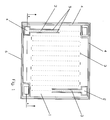
- the Distribution plate 1 shows a top view of a distributor plate 1.
- the Distribution plate 1 is provided for an electrochemical fuel cell, at a large number of such distribution plates with electrolyte membranes into one Package to be put together.
- Distribution spaces 2 are located on the distribution plate 1 provided which are connected to each other via the channels 3.
- the distributor plates 1 are usually with distributor spaces 2 and channels 3 provided on both sides and on one side a gas and on the on the other hand, a coolant is passed through the channels 3.
- the Distribution rooms and channels form the fluid guide system for the appropriate reaction and / or cooling medium.
- the entire fluid management system is of a frame-shaped elastic seal 4 surround.
- the walls 5 of the distribution rooms 2 and the channels 3 are through direct application of a suitable material to the flat base plate 6 manufactured.
- Sealing material coated with a binder In this way, one particularly secure connection between the materials achieved. at special material pairings, it is also possible to 5 or the walls Connect seals 4 to the base plate 6 by adhesion.
- the walls 5 or seals 4 can be made of a material that is equipped with the binder itself.
- the materials for the walls 5 of the Channels 3 and the distribution rooms 2 are in liquid form on the levels Base plates 6 applied and then cured. The curing usually takes place at elevated temperature.
- a polymer material is preferably used for the walls 5 that is electrically conductive.
- This can be, for example, an electrically conductive one Be paste that is applied to the base plate 6.
- a particularly cheap one Design results when the material for the elastic seals 4 and the material for the walls 5 of the channels 3 and the distribution rooms 2 is equal to.
- both the walls 5 for the fluid guide system as well as the seal 4 on the base plate 6 be applied.
- the base plate 6 is shown in section on a large scale.
- the base plate 6 is only on its upper side with the Distribution rooms 2 and the channels 3 provided.
- the distribution rooms 2 are with the openings 7 of the base plate 6 connected.
- They are Walls 5 of the distributor rooms 2 or channels 3 are slightly flatter than the walls the seal 4.
- the latter are made of an elastomeric material.
- the Base plate 6 consists of a graphite.
- the application of the walls 5 and Seals 4 on the base plate 6 are carried out in the screen printing process, that is extremely gentle. Destruction of graphite Base plate 6 due to unintentionally high forces when applying the walls 5 or the seal 4 is avoided.
- Such a distributor plate 1 can consequently be mass-produced on an industrial scale.
Landscapes
- Life Sciences & Earth Sciences (AREA)
- Engineering & Computer Science (AREA)
- Manufacturing & Machinery (AREA)
- Sustainable Development (AREA)
- Sustainable Energy (AREA)
- Chemical & Material Sciences (AREA)
- Chemical Kinetics & Catalysis (AREA)
- Electrochemistry (AREA)
- General Chemical & Material Sciences (AREA)
- Fuel Cell (AREA)
Abstract
Verfahren zur Herstellung von Verteilerplatten, insbesondere von Verteilerplatten für elektrochemische Brennstoffzellen mit einem Fluid-Führungssystem aus Verteilerräumen und/oder Kanälen für Reaktions- und/oder Kühlmedien und mit einer rahmenförmigen elastischen Abdichtung, wobei die Wände (5) der Verteilerräume (2) und/oder der Kanäle (3) des Fluid-Führungssystems durch direktes Auftragen eines geeigneten Materials auf eine eben ausgebildete Basisplatte (6) aus Graphit oder Composit-Graphit oder Blech hergestellt sind. <IMAGE>
Description
Die Erfindung befasst sich mit der Herstellung von Verteilerplatten,
insbesondere von Verteilerplatten für elektrochemische Brennstoffzellen mit
einem Fluid-Führungssystem aus Verteilerräumen und/oder Kanälen für
Reaktion- und/oder Kühlmedien und mit elastischen Abdichtungen.
Die elektrochemischen Brennstoffzellen haben in den letzten Jahren erheblich
an Bedeutung gewonnen und es besteht die Forderung, nach einer möglichst
kostengünstigen Herstellung der für die Zellen benötigten Verteilerplatten. Die
Verteilerplatten sollen mit einem sicheren Fluid-Führungssystem versehen sein,
in dem die flüssigen oder auch gasförmigen Medien geführt werden. Außerdem
sollen sie mit einer zuverlässigen Abdichtung ausgestattet sein, welche
verhindert, dass die eingesetzten Medien nach außen dringen können. Für die
Herstellung von Verteilerplatten sind zwei prinzipielle Verfahren bekannt. Das
erste Verfahren beruht darauf, dass in eine ebene Grundplatte aus
Elektrographit Kanäle für die Fluid-Führung eingefräst werden. Dieses
Verfahren hat den Nachteil, dass das Einfräsen der Kanäle sehr aufwendig ist
und großtechnisch wirtschaftlich nicht realisierbar ist. Bei dem zweiten
Verfahren werden die Kanäle in Composit-Graphitplatten eingeprägt. Beim
Einprägen der Kanäle besteht eine hohe Bruchgefahr für das spröde
Graphitmaterial, was einer großtechnischen Herstellung im Wege steht.
Angewendet werden auch an einer Grundplatte beide Verfahren gleichzeitig,
d.h. einzelne Kanäle werden geprägt, während andere eingefräst werden bzw.
geprägte Kanäle werden nachgefräst. Auch diese Möglichkeit ist mit hohen
Kosten verbunden.
Möglich ist auch die Verwendung von Blechplatten mit eingepresstem Fluid-Führungssystem.
Dabei entsteht jedoch das Problem, das bei der
Blechumformung eine gegenläufige Struktur entsteht, d.h. einer Vertiefung auf
der einen Seite des Blechs entspricht eine Erhebung auf der anderen Seite.
Dadurch ist es nicht möglich, die Fluid-Führungssysteme auf beiden Seiten der
Verteilerplatte unabhängig voneinander zu gestalten.
Die DE 195 42 475 A1 zeigt Verteilerplatten, die mit Fluid-Kanälen versehen
sind und die eine integrierte Dichtung haben. Die Dichtung bildet mit der
Verteilerplatte ein integriertes Bestandteil. Eine solche Lösung ist jedoch nur
möglich, wenn das für die Verteilerplatte verwendete Material in sehr hohem
Maße verpressbar ist. Die Herstellung solcher Verteilerplatten wird durch die
vorgegebenen Materialeigenschaften folglich stark eingeschränkt.
Eine interessante Lösung für die Herstellung von Verteilerplatten ist in der
EP 0 956 604 behandelt. Dort wird eine aus Aluminium bestehende Basis-Verteilerplatte
mit Vorsprüngen eines schmelzbaren Polymers versehen, wobei
die Vorsprünge und die von den Vorsprüngen nicht abgedeckten Teile der
Verteilerplatte mit einem Metall, einem Metallnitrit oder Metallcarbit überzogen
werden. Dadurch soll ein hoher Widerstand gegen die korrosiven Elektrolyte
erreicht werden. Gleichzeitig wird eine einfache Herstellung, eine einfache
Struktur und geringe Herstellungskosten angestrebt. Die vorgegebene
Zielsetzung ist jedoch nur bedingt erreichbar, da der Metallüberzug nur
schwierig in gleichmäßiger Form herstellbar ist.
Der Erfindung liegt die Aufgabe zugrunde ein weiter verbessertes Verfahren zur
Herstellung von Verteilerplatten zu schaffen, bei dem das Fluid-Führungssystem
einfach herstellbar und auf beiden Seiten der Verteilerplatte
unabhängig voneinander ausgeführt werden kann. Die Kanäle für die
Gasführung als auch die Kanäle für die Flüssigkeitsführung sollen in beliebiger
Form auf die Verteilerplatte aufgebracht werden können. Das Verfahren soll
möglichst einfach sein, so dass es für die großtechnische Produktion von
Verteilerplatten brauchbar ist.
Die Lösung der gestellten Aufgabe erfolgt bei einem Verfahren der eingangs
genannten Art erfindungsgemäß dadurch, dass die Wände der Verteilerräume
und/oder Kanäle des Fluid-Führungssystems durch direktes Auftragen eines
geeigneten Materials auf eine im Wesentlichen eben ausgebildete Basisplatte
aus Graphit oder Composit-Graphit oder Metallblech oder Kunststoff-Folie
hergestellt sind. Die von den Wänden und/oder Abdichtung bedeckte Fläche
der Verteilerplatte wird vor dem Aufbringen des Wand- bzw.
Abdichtungsmaterials mit einem Binder beschichtet oder das Wand- bzw.
Dichtungsmaterial ist selbsthaftend oder enthält einen Binder. Es zeigte sich,
dass mit den vorgegebenen Maßnahmen sehr gute Ergebnisse erreicht
werden. Die Verwendung von relativ spröden Graphitplatten als Basisplatten
kann bestehen bleiben und die Ausbildung der Verteilerräume und Kanäle wird
in einfachster Weise durch direktes Auftragen eines geeigneten Materials auf
die Basisplatte erreicht. Geeignete Materialien sind in erster Linie Polymere, die
eine gute Haftung zur Basisplatte ergeben und widerstandsfähig gegen die
eingesetzten Fluide sind. Geeignete Polymere sind FKM, EPDM, Silikone, NBR
oder Epoxyharze. Um die Verbindung der Polymere zur Basisplatte zu
verstärken, wird vor dem Aufbringen des Wand- bzw. Dichtungsmaterials die
von der Wand bzw. dem Dichtungsmaterial bedeckte Fläche mit einem Binder
beschichtet. Geeignete Binder hierfür sind herkömmliche Bindemittel, die für
Gummi-Metall-Verbindungen eingesetzt werden.
Möglich ist auch die Verbindung zwischen dem Wand- bzw. Dichtungsmaterial
und der Basisplatte durch Adhäsion zu verstärken. Hierfür kann das Wand bzw.
Dichtungsmaterial mit einem geeigneten Bindematerial versehen sein, welches
die Adhäsion zur Basisplatte unterstützt.
Die Polymermaterialien für die Verteilerräume und/oder Kanäle des Fluid-Führungssystems
werden in flüssiger Form auf die ebenen Basisplatten
aufgetragen und anschließend ausgehärtet. Die Aushärtung kann bei erhöhten
Temperaturen erfolgen. Für die Brennstoffzellen-Anwendungen ist es
wesentlich, dass das verwendete Polymermaterial ein elektrisch leitfähiges
Material ist. Es kann beispielsweise ein Material sein, dass als eine elektrisch
leitfähige Paste vorliegt, die nach ihrem Auftrag auf die Basisplatte ausgehärtet
wird.
Besonders vorteilhaft ist, wenn die elastische Abdichtung aus dem gleichen
Material wie für die Wände der Verteilerräume und Kanäle hergestellt ist.
Hierdurch kann das Herstellungsverfahren erheblich vereinfacht werden. Eine
besonders wirtschaftliche Möglichkeit für das Auftragen geeigneten Materials
besteht darin, dass die Wände des Fluid-Führungssystems und/oder der
elastischen Abdichtung im Siebdruckverfahren auf die ebenen Basisplatten
aufgebracht wird. Die Herstellung der Verteilerplatten wird dadurch
verfahrenstechnisch erheblich vereinfacht. Die nach dem oben beschriebenen
Verfahren hergestellten Verteilerplatten sind vielfältig einsetzbar, ihr
besonderes Anwendungsgebiet ist jedoch die elektrochemische
Brennstoffzelle.
Anhand eines in der Zeichnung dargestellten Ausführungsbeispiels wird die
Erfindung nachstehend näher erläutert.
Es zeigen:
- Fig. 1
- Eine Verteilerplatte in der Draufsicht und
- Fig. 2
- einen Schnitt durch die Verteilerplatte gemäß der Linie A-A aus der Fig. 1
In der Fig 1 ist eine Verteilerplatte 1 in der Draufsicht gezeigt. Die
Verteilerplatte 1 ist für eine elektrochemische Brennstoffzelle vorgesehen, bei
der eine Vielzahl solcher Verteilerplatten mit Elektrolytmembranen zu einem
Paket zusammengefügt werden. Auf der Verteilerplatte 1 sind Verteilerräume 2
vorgesehen, welche über die Kanäle 3 miteinander verbunden sind.
Üblicherweise sind die Verteilerplatten 1 mit Verteilerräumen 2 und Kanälen 3
auf beiden Seiten versehen und auf einer Seite wird ein Gas und auf der
anderen Seite eine Kühlflüssigkeit durch die Kanäle 3 geleitet. Die
Verteilerräume und Kanäle bilden das Fluid-Führungssystem für das
entsprechende Reaktions- und/oder Kühlmedium. Das gesamte Fluid-Führungssystem
ist von einer rahmenförmigen elastischen Abdichtung 4
umgeben. Die Wände 5 der Verteilerräume 2 und der Kanäle 3 sind durch
direktes Auftragen eines geeigneten Materials auf die ebene Basisplatte 6
hergestellt. Dabei wird die unterhalb der Wände 5 und/oder der Abdichtungen 4
liegende Fläche der Basisplatte 6 vor dem Aufbringen des Wand- bzw.
Dichtungsmaterials mit einem Binder beschichtet. Auf diese Weise wird eine
besonders sichere Verbindung zwischen den Materialien erreicht. Bei
besonderen Materialpaarungen ist es auch möglich, die Wände 5 oder die
Abdichtungen 4 mit der Basisplatte 6 durch Adhäsion zu verbinden. In diesem
Fall können die Wände 5 bzw. Abdichtungen 4 aus einem Material sein, dass
mit dem Binder selbst ausgestattet ist. Die Materialien für die Wände 5 der
Kanäle 3 und der Verteilerräume 2 werden in flüssiger Form auf die ebenen
Basisplatten 6 aufgetragen und anschließend ausgehärtet. Die Aushärtung
erfolgt in der Regel bei erhöhter Temperatur.
Für die Wände 5 wird bevorzugt ein Polymermaterial verwendet, dass
elektrisch leitfähig ist. Dieses kann beispielsweise eine elektrisch leitfähige
Paste sein, die auf die Basisplatte 6 aufgetragen wird. Eine besonders günstige
Ausgestaltung ergibt sich, wenn dass Material für die elastischen Abdichtungen
4 und das Material für die Wände 5 der Kanäle 3 und der Verteilerräume 2
gleich ist. Es können dann in einem Verfahrensschritt sowohl die Wände 5 für
das Fluid-Führungssystem als auch die Abdichtung 4 auf die Basisplatte 6
aufgetragen werden.
Für das Auftragen des Materials sowohl für die Wände 5 des Fluid-Führungssystems
als auch für die Abdichtung 4 auf die Basisplatte 6 eignet
sich in diesem Fall auch das Siebdruckverfahren. Bei Anwendung dieses
Verfahrens können eine hohe Genauigkeit der Geometrien der Kanäle 3 und
Verteilerräume 2 erzielt werden obwohl es sich hier häufig um geringste
Abmessungen handelt.
In der Fig. 2 ist im Schnitt die Basisplatte 6 in starker Vergrößerung dargestellt.
In diesem Fall ist die Basisplatte 6 lediglich auf ihrer Oberseite mit den
Verteilerräumen 2 und den Kanälen 3 versehen. Die Verteilerräume 2 sind mit
den Durchbrüchen 7 der Basisplatte 6 verbunden. Im vorliegenden Fall sind die
Wände 5 der Verteilerräume 2 bzw. Kanäle 3 geringfügig flacher als die Wände
der Abdichtung 4. Letztere sind aus einem elastomeren Material hergestellt. Die
Basisplatte 6 besteht aus einem Graphit. Die Aufbringung der Wände 5 und der
Abdichtungen 4 auf die Basisplatte 6 wird im Siebdruckverfahren durchgeführt,
dass äußerst schonend ist. Eine Zerstörung der aus Graphit bestehenden
Basisplatte 6 durch ungewollt hohe Kräfte beim Aufbringen der Wände 5 bzw
der Abdichtung 4 wird dabei vermieden. Eine solche Verteilerplatte 1 kann
folglich im industriellen Maßstab in Serie gefertigt werden.
Claims (9)
- Verfahren zur Herstellung von Verteilerplatten, insbesondere von Verteilerplatten für elektrochemische Brennstoffzellen mit einem Fluid-Führungssystem aus Verteilerräumen und/oder Kanälen für Reaktionsund/oder Kühlmedien und mit einer rahmenförmigen elastischen Abdichtung, dadurch gekennzeichnet, dass die Wände (5) der Verteilerräume (2) und/oder der Kanäle (3) des Fluid-Führungssystems durch direktes Auftragen eines geeigneten Materials auf eine eben ausgebildete Basisplatte (6) aus Graphit, Composit-Graphit, Blech oder Kunststoff-Folie hergestellt sind.
- Verfahren zur Herstellung von Verteilerplatten nach Anspruch 1, dadurch gekennzeichnet, dass die Wände (5) des Fluid-Führungssystems und/oder die Abdichtungen (4) mit der Basisplatte (6) durch Adhäsion verbunden sind.
- Verfahren zur Herstellung von Verteilerplatten nach Anspruch 1 oder 2, dadurch gekennzeichnet, dass die von den Wänden (5) des Fluid-Führungssystems und/oder von der Abdichtung (4) bedeckte Fläche der Basisplatte (6) vor dem Aufbringen des Wand- bzw. Dichtungsmaterials mit einem Binder beschichtet ist oder das Wand- bzw. Dichtungsmaterial einen Binder enthält.
- Verfahren zur Herstellung von Verteilerplatten nach Anspruch 1 bis 3, dadurch gekennzeichnet, dass die Materialien für die Wände (5) der Verteilerräume (2) und/oder der Kanäle (3) in flüssiger Form auf die ebene Basisplatte (6) aufgetragen und anschließend ausgehärtet werden.
- Verfahren zur Herstellung von Verteilerplatten nach einem der Ansprüche 1 bis 4, dadurch gekennzeichnet, dass das Polymermaterial vor dem Auftragen in Form einer elektrisch leitfähigen Paste vorliegt.
- Verfahren zur Herstellung von Verteilerplatten nach einem der Ansprüche 1 bis 5, dadurch gekennzeichnet, dass die elastische Abdichtung (4) aus dem gleichen Material wie das Material für die Wände (5) der Verteilerräume (2) und Kanäle (3) hergestellt ist.
- Verfahren zur Herstellung von Verteilerplatten nach einem der Ansprüche 1 bis 6, dadurch gekennzeichnet, dass die Wände (5) des Fluid-Führungssystems und/oder die elastische Abdichtung (4) im Siebdruckverfahren auf die ebene Basisplatte (6) aufgebracht sind.
- Verteilerplatten hergestellt nach dem Verfahren der Ansprüche 1 bis 6
- Verteilerplatte nach Anspruch 8, dadurch gekennzeichnet, dass die Kunststoff-Folie elektrisch leitend ist.
Applications Claiming Priority (2)
| Application Number | Priority Date | Filing Date | Title |
|---|---|---|---|
| DE10161245A DE10161245A1 (de) | 2001-12-13 | 2001-12-13 | Verfahren zur Herstellung von Verteilerplatten |
| DE10161245 | 2001-12-13 |
Publications (1)
| Publication Number | Publication Date |
|---|---|
| EP1320141A2 true EP1320141A2 (de) | 2003-06-18 |
Family
ID=7709077
Family Applications (1)
| Application Number | Title | Priority Date | Filing Date |
|---|---|---|---|
| EP02014911A Withdrawn EP1320141A2 (de) | 2001-12-13 | 2002-07-05 | Verfahren zur Herstellung von Verteilerplatten |
Country Status (2)
| Country | Link |
|---|---|
| EP (1) | EP1320141A2 (de) |
| DE (1) | DE10161245A1 (de) |
Families Citing this family (2)
| Publication number | Priority date | Publication date | Assignee | Title |
|---|---|---|---|---|
| DE102004048434A1 (de) * | 2004-10-05 | 2006-04-13 | Hella Kgaa Hueck & Co. | Elektronisches Bauteil zur Anbringung an einer Scheibe eines Kraftfahrzeugs |
| DE102006058296A1 (de) * | 2006-12-11 | 2008-06-12 | Staxera Gmbh | Bipolarplatte und Wiederholeinheit für einen Brennstoffzellenstapel |
-
2001
- 2001-12-13 DE DE10161245A patent/DE10161245A1/de not_active Withdrawn
-
2002
- 2002-07-05 EP EP02014911A patent/EP1320141A2/de not_active Withdrawn
Also Published As
| Publication number | Publication date |
|---|---|
| DE10161245A1 (de) | 2003-06-26 |
Similar Documents
| Publication | Publication Date | Title |
|---|---|---|
| EP0591800B1 (de) | Bennstoffzellenblock | |
| DE102013108413B4 (de) | Verfahren zum Herstellen eines Brennstoffzellenstapels sowie Brennstoffzellenstapel und Brennstoffzelle/Elektrolyseur | |
| DE60206831T2 (de) | Brennstoffzellenplatten mit durch Spritzguss hergestellten Dichtungen | |
| WO2009033648A1 (de) | Bipolarplatte für einen pem-elektrolyseur | |
| DE10248531A1 (de) | Brennstoffzellensystem | |
| DE102012209851A1 (de) | Durchlässiger Separator für eine Brennstoffzelle | |
| WO2003044886A2 (de) | Brennstoffzellensystem | |
| DE10207743A1 (de) | Elektrode für eine Polymerelektrolyt-Brennstoffzelle, Trennwand hierfür sowie Polymerelektrolyt-Brennstoffzelle und Elektrizitätserzeugungssystem unter Verwendung derselben | |
| DE10340215A1 (de) | Polymerelektrolytmembran-Brennstoffzelle und bipolare Platte | |
| DE10203612C1 (de) | Brennstoffzellenpaket sowie dafür geeignete bipolare Platte | |
| DE202014007977U1 (de) | Elektrochemisches System | |
| EP2417662A2 (de) | Bipolarplatte für brennstoff- oder elektrolysezellen | |
| DE10328039B4 (de) | Elektrochemische Anordnung mit elastischer Verteilungsstruktur | |
| EP2696418A1 (de) | Dichtungsanordnung insbesondere für Brennstoffzellen- und/oder Elektrolyseurstacks | |
| EP4388603A1 (de) | Bipolarplatte und verfahren zur herstellung einer bipolarplatte | |
| DE102012217874A1 (de) | Vorrichtung zur Führung eines Fluids | |
| DE19926026A1 (de) | Membran-Elektroden-Einheit für Brennstoffzellen u. dgl. | |
| DE102010049549A1 (de) | Verfahren zur Herstellung einer Membrananordnung für eine Brennstoffzelle | |
| DE102015224835A1 (de) | Verfahren zum Herstellen einer Brennstoffzelle, eine mit dem Verfahren herstellbare Brennstoffzelle sowie Brennstoffzellenstapel | |
| DE10161245A1 (de) | Verfahren zur Herstellung von Verteilerplatten | |
| DE10235598B4 (de) | Bipolarplatte sowie Verfahren zur Beschichtung derselben | |
| WO2022028998A1 (de) | Verfahren zur reduzierung des kontaktwiderstands zwischen einer separatorplatte und einer gasdiffusionslage einer brennstoffzelle, separatorplatte | |
| DE102014205551A1 (de) | Verfahren zur Herstellung einer Bipolarplatte mit Dichtung sowie Bipolarplatte | |
| DE10250991B4 (de) | Bipolarplatte und deren Verwendung in einem Brennstoffzellensystem | |
| DE3001218A1 (de) | Verfahren zum herstellen von gehaeusen fuer natrium/schwefel-zellen |
Legal Events
| Date | Code | Title | Description |
|---|---|---|---|
| PUAI | Public reference made under article 153(3) epc to a published international application that has entered the european phase |
Free format text: ORIGINAL CODE: 0009012 |
|
| 17P | Request for examination filed |
Effective date: 20020712 |
|
| AK | Designated contracting states |
Designated state(s): AT BE BG CH CY CZ DE DK EE ES FI FR GB GR IE IT LI LU MC NL PT SE SK TR |
|
| AX | Request for extension of the european patent |
Extension state: AL LT LV MK RO SI |
|
| STAA | Information on the status of an ep patent application or granted ep patent |
Free format text: STATUS: THE APPLICATION IS DEEMED TO BE WITHDRAWN |
|
| 18D | Application deemed to be withdrawn |
Effective date: 20050201 |