EP1316553B1 - Riechstoffe auf Basis cyclischer Acetale - Google Patents
Riechstoffe auf Basis cyclischer Acetale Download PDFInfo
- Publication number
- EP1316553B1 EP1316553B1 EP20020025951 EP02025951A EP1316553B1 EP 1316553 B1 EP1316553 B1 EP 1316553B1 EP 20020025951 EP20020025951 EP 20020025951 EP 02025951 A EP02025951 A EP 02025951A EP 1316553 B1 EP1316553 B1 EP 1316553B1
- Authority
- EP
- European Patent Office
- Prior art keywords
- methyl
- radical
- dioxane
- hydrogen
- methylethyl
- Prior art date
- Legal status (The legal status is an assumption and is not a legal conclusion. Google has not performed a legal analysis and makes no representation as to the accuracy of the status listed.)
- Expired - Lifetime
Links
Classifications
-
- C—CHEMISTRY; METALLURGY
- C07—ORGANIC CHEMISTRY
- C07D—HETEROCYCLIC COMPOUNDS
- C07D319/00—Heterocyclic compounds containing six-membered rings having two oxygen atoms as the only ring hetero atoms
- C07D319/04—1,3-Dioxanes; Hydrogenated 1,3-dioxanes
- C07D319/06—1,3-Dioxanes; Hydrogenated 1,3-dioxanes not condensed with other rings
-
- C—CHEMISTRY; METALLURGY
- C11—ANIMAL OR VEGETABLE OILS, FATS, FATTY SUBSTANCES OR WAXES; FATTY ACIDS THEREFROM; DETERGENTS; CANDLES
- C11B—PRODUCING, e.g. BY PRESSING RAW MATERIALS OR BY EXTRACTION FROM WASTE MATERIALS, REFINING OR PRESERVING FATS, FATTY SUBSTANCES, e.g. LANOLIN, FATTY OILS OR WAXES; ESSENTIAL OILS; PERFUMES
- C11B9/00—Essential oils; Perfumes
- C11B9/0069—Heterocyclic compounds
- C11B9/0073—Heterocyclic compounds containing only O or S as heteroatoms
- C11B9/008—Heterocyclic compounds containing only O or S as heteroatoms the hetero rings containing six atoms
Definitions
- the invention relates to new fragrances based on cyclic acetals, which of diols as alcohol and of substituted propionaldehydes as aldehyde component derived.
- JP 55 087 733 Patent Abstract of Japan, Vol. 135 (C-025) perfumes based on cyclic acetals derived from 1,3-dimethyl-3-cyclohexenylpropionaldehyde and a cyclic 1,3-diol.
- substituted 1,3-dioxanes can be used in the 2-position carry a 1-methylbutyl group, use in fragrance compositions.
- Cyclic acetals based on 4,4,6-trimethyl-1,3-dioxane with alkyl groups in the 2-position, in particular with the n-butyl group or the 2-phenylethyl group and their use as fragrances are disclosed in US-A-3,884,841 known.
- EP-A2-0 358 091 deals with cyclic acetals based on 2-cyclohexylpropanal and 1,3-dipoles. This is initially 2-Phenylpropanal with a Diol reacted under acetal formation, which then subsequently to the cyclohexyl derivative is hydrogenated.
- the known compounds are suitable as additives in Fragrance compositions.
- EP 0 276 998 A2 describes perfume compositions which contain, as a fragrance, at least one compound of the general formula contain.
- the dotted line represents a double or single bond within the cyclohexane ring.
- R 1 , R 2 , R 3 and R 4 are hydrogen or a methyl radical.
- R 5 and R 6 are hydrogen or an alkyl, a cycloalkyl or an alkenyl radical having 1 to 4 carbon atoms or an optionally substituted ring containing up to 5 carbon atoms.
- R 5 and R 6 together with the carbon atom of the dioxane ring may form an optionally substituted ring of up to 6 carbon atoms.
- R 7 is hydrogen, methyl, ethyl, n-propyl, isopropyl, n-butyl, sec-butyl, isobutyl or t-butyl.
- R 8 and R 9 are each hydrogen or the methyl radical.
- R 10 is hydrogen, methyl or isopropyl. The total number of carbon atoms is in the range of 13 to 20.
- the preparation of the compounds mentioned takes place in a first stage by Diels-Alder reaction of dienes with unsaturated aldehydes or Ketones leading to cyclic carbonyl compounds.
- Dienes are butadiene-1,3 and 2-methyl-1,3-pentadiene.
- aldehydes or Ketones come e.g. Acrolein, methacrolein, crotonaldehyde or methyl vinyl ketone into consideration.
- the carbonyl compounds with diols such as 2-methyl-2-propyl-1,3-propanediol, 2-methyl-2-sec-butyl-1,3-propanediol or 2-ethylhexane-1,3-diol to the desired acetal or Ketal implemented.
- fragrance carriers Although there are already a variety of synthetically generated fragrances exists In industrial practice, a high demand for fragrance carriers continues. The interest is directed both to the development of new scents as well as the most cost-effective production of known fragrances, be it by procedural simplification of the synthetic route or by choosing cheap raw materials.
- the present invention is the Task to meet the requirements of both industrial production by providing new compounds with known or new ones Fragrances that are easily accessible, in sufficient quantities reasonably priced available starting materials can be obtained. In addition, emphasis is placed on making the way to their manufacturing technical simple and no elaborate or specialized equipment requires.
- R 5 , R 7 , R 9 and R 10 are each independently hydrogen or a methyl radical.
- diols used in the recovery of the new fragrances follow the general formula in which R 5 , R 6 , R 7 , R 8 , R 9 and R 10 have the meanings given above.
- dihydric alcohols are: 2,2-dimethyl-1,3-propanediol (neopentyl glycol), 2-methyl-2-propyl-1,3-propanediol, 2-methyl-2-sec-butyl-1, 3-propanediol, 1,3-butanediol, 2-methyl-2,4-pentanediol, 2,2,4-trimethyl-1,3-pentanediol, 2-ethyl-1,3-hexanediol.
- Diols of the reproduced structure are many times on an industrial scale available or can be prepared by known methods. So 2,2-dimethyl-1,3-propanediol is obtained by aldol addition (aldolization) of isobutyraldehyde and formaldehyde and hydrogenation of this reaction resulting aldol. Using the same reaction steps (i.e., aldol addition followed by hydrogenation) to give 2-methyl-2-propyl-1,3-propanediol from 2-methylpentanal and formaldehyde and 2-methyl-2-sec-butyl-1,3-propanediol from 2,3-dimethylpentanal and formaldehyde.
- 1,3-butanediol is prepared by hydrogenation of the at Aldol addition of acetaldehyde formed acetaldols, 2-methyl-2,4-pentanediol by hydrogenation of diacetone alcohol, the aldolization product of Acetone and 2,2,4-trimethyl-1,3-pentanediol by aldol addition of isobutyraldehyde and hydrogenation of the aldol formed here.
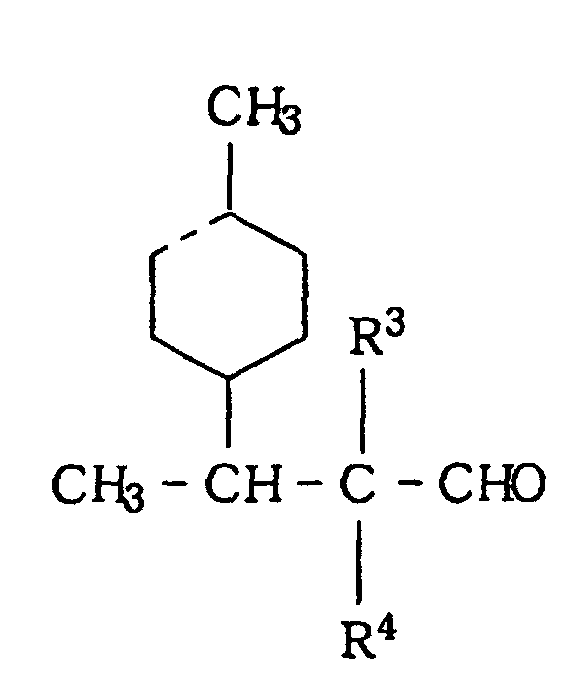
- the formyl compounds mentioned as further components for the preparation of the claimed cyclic acetals are multiply substituted propionaldehydes which contain as substituents in the 3-position a methyl-substituted cyclohexyl or cyclohexenyl group and the general formula correspond, wherein R 3 and R 4 have the meaning described above.
- Examples of such compounds are 3- (4-methyl-3-cyclohexen-1-yl) -3-methylpropionaldehyde (limonene-aldehyde), 3- (4-methyl-3-cyclohexen-1-yl) -3-methyl-2- methylenepropionaldehyde (2-methyleneallimene aldehyde), 3- (4-methylcyclohexyl) -3-methylpropionaldehyde and 3- (4-methylcyclohexyl) -2,3-dimethylpropionaldehyde.
- the formyl compounds described above are used in many cases by hydroformylation (oxo synthesis) from olefinically unsaturated precursors won. It is not a specific embodiment bound to the hydroformylation reaction. Therefore, you can the formyl compound from olefin and water gas both after the classical variant the reaction with cobalt catalysts obtained at high pressure, as well by modern methods at low pressure in the presence of (optionally modified) rhodium catalysts win. That's how you put it Limenaldehyde by hydroformylation of limonene in the presence of Rhodium as a catalyst.
- 2-Methylenlimonenaldehyd obtained by Reaction of limonenealdehyde in the presence of di-n-butylamine / butyric acid as a catalytically active agent.
- the partial hydrogenation of limonaldehyde gives 3- (4-methylcyclohexyl) -3-methyl-propionaldehyde, its methylenation by reaction with formaldehyde leads to 3- (4-methylcyclohexyl) -3-methyl-2-methylenepropionaldehyde, in turn through partial hydrogenation to give 3- (4-methylcyclohexyl) -2,3-dimethylpropionaldehyde is implemented.
- the preparation of the acetals suitable as fragrances is carried out in known By reaction of aldehyde and diol in the presence of an acidic Catalyst [cf. e.g. Houben-Weyl, Methods of Organic Chemistry, Volume E3 pages 615ff, (1983)]
- the molar ratio of the reactants can vary widely and is usually (aldehyde: diol) 1: 0.2 to 1: 5.
- the starting materials are used in a molar ratio 1: 1.2 to 1: 0.8 and especially 1: 1.
- catalysts are exclusively used acidic compounds, especially technically easy available acids such as sulfuric acid, p-toluenesulfonic acid, methanesulfonic acid and hydrogen chloride.
- catalysts too other acidic compounds Use, e.g. Ammonium chloride, Calcium chloride, zinc chloride, sodium hydrogen sulfate and in particular Iron (III) chloride (see Houben-Weyl, l.c., Volume VII, Part 1, pages 417ff (1954)).
- the catalysts usually arrive in amounts of less as 1 wt .-%, based on the aldehyde used.
- Acids such as sulfuric acid and p-toluenesulfonic acid are in Quantities of 1 to 50 mmol, in particular 1 to 10 mmol per mole of aldehyde used.
- the reaction time determined by measuring the deposited Amount of water (which theoretically corresponds to 1 mol of water per mole of acetal) In general, 1 to 10 hours, in most cases, the reaction ended after 1 to 3 hours.
- the reaction temperature depends on used aldehyde and that used to remove the water Azeotrope former (entrainer). In particular, as an entrainment agent Hydrocarbons such as cyclohexane, toluene and hexene-1 proven. In usually one works at normal pressure, the application of low negative pressure (e.g., 500 hPa) is not excluded. For workup will the reaction mixture is usually cooled to 20 to 50 ° C and with dilute aqueous alkali solution e.g.
- the acetals of the invention are characterized by a pleasant slightly earthy smell. They have high adhesion. physiological Incompatibilities, i. Damage to or in the body was not observed. Moreover, they are resistant to light, air and the surrounding Medium. They can be used alone or undiluted Solubility or homogenizability diluted with other components and optionally together with conventional excipients such as fixatives applied become. With other fragrances in different proportions mixed, they give new fragrance compositions. In general is their proportion in such compositions 0.5 to 5 wt .-%, based on the entire composition.
- fragrances according to the invention and compositions made from them can immediately as perfume serve or for the perfuming of cosmetics such as creams, lotions, Perfumed water, aerosols, soaps. With equal success They can also be used to improve the odor of technical products Detergents and cleaning agents are used.
- perfume the different Products are the new fragrances or manufactured with them Compositions in concentrations of 0.05 to 2 wt .-%, based to the product / fragrance mixture applied.
- Example 2 As in Example 1, 831.0 g (5 mol) of limonene aldehyde and 661.0 g (5.0 mol) 2-methyl-2-propyl-1,3-propanediol in the presence of 1.9 g (10 mmol) of p-toluenesulfonic acid and 450 g of cyclohexane reacted. After distillative work-up of the reaction mixture gives 1 241.7 g of the acetal. It is boiling at 5 mbar (500 Pa) in the range of 172 to 175 ° C, its purity is 99.1%, the yield 87.8%.
- Example 2 As in Example 1, 831.5 g (5 mol) of limonene aldehyde and 591.0 g (5.0 mol) 2-methyl-2,4-pentanediol in the presence of 1.9 g (10 mmol) of p-toluenesulfonic acid and 450 g of cyclohexane reacted. After distillative work-up of the reaction mixture gives 1 247.5 g of the acetal. It is boiling at 5 mbar (500 Pa) in the range of 144 to 145 ° C, its purity is 99.2 %, the yield 92.9%.
- Example 2 As in Example 1, 831.5 g (5 mol) of limonene aldehyde and 731.0 g (5.0 mol) 2-methyl-2-sec-butyl-1,3-propanediol in the presence of 1.9 g (10 mmol) P-toluenesulfonic acid and 450 g of cyclohexane reacted. After distillative Working up of the reaction mixture gives 1 372.5 g of the acetal. It boils at 5 mbar (500 Pa) in the range of 167 to 172 ° C, its purity is 98.2%, the yield 93.2%.
- Example 2 Analogously to Example 1 are 891.4 g (5 mol) Methylenlimonenaldehyd and 450.6 g (5.0 mol) of 1,3-butanediol in the presence of 1.9 g (10 mmol) of p-toluenesulfonic acid and 450 g of cyclohexane reacted. After distillative work-up of the reaction mixture is obtained 1024.5 g of the acetal. It is boiling at 5 mbar (500 Pa) in the range of 131 to 136 ° C, its purity is 98.9%, the yield 81.8%.
Landscapes
- Chemical & Material Sciences (AREA)
- Organic Chemistry (AREA)
- Life Sciences & Earth Sciences (AREA)
- Engineering & Computer Science (AREA)
- Chemical Kinetics & Catalysis (AREA)
- Oil, Petroleum & Natural Gas (AREA)
- Wood Science & Technology (AREA)
- Fats And Perfumes (AREA)
- Organic Low-Molecular-Weight Compounds And Preparation Thereof (AREA)
- Heterocyclic Compounds That Contain Two Or More Ring Oxygen Atoms (AREA)
- Cosmetics (AREA)
Description


Claims (9)
- Riechstoffe der allgemeinen Formelin der R5, R6, R7, R9 und R10 unabhängig voneinander jeweils Wasserstoff, einen Methylrest, einen Ethylrest oder einen n- oder i-Propylrest bedeuten, R3 Wasserstoff oder ein Methylrest ist, R4 Wasserstoff ist oder zusammen mit R3 einen Methylenrest (=CH2) bildet, R8 für einen geradkettigen oder verzweigten C1- bis C5-Alkylrest steht und die unterbrochenen Linie im cyclischen Rest eine Einfach- oder Doppelbindung beschreibt, und die chemischen Verbindungen 2-[2-(4-Methyl-3-cyclohexen-1-yl)-2-methylethyl]-4,4,6-trimethyl-1,3-dioxan und 2-[2-(4-Methyl-3-cyclohexen-1-yl)-1-methylen-2-methylethyl]-4-methyl-1,3-dioxan als Riechstoffe.

- Riechstoffe nach Anspruch 1 dadurch gekennzeichnet, dass R5, R7, R9 und R10 unabhängig voneinander jeweils Wasserstoff oder ein Methylrest sind.
- Verfahren zur Herstellung von Riechstoffen nach den Ansprüchen 1 oder 2 dadurch gekennzeichnet, dass man einen Aldehyd der allgemeinen Formelin der R3 Wasserstoff oder ein Methylrest ist, R4 Wasserstoff ist oder zusammen mit R3 einen Methylenrest bildet, und die unterbrochene Linie im cyclischen Rest eine Einfach- oder eine Doppelbindung beschreibt, mit einem Diol der allgemeinen Formel
 in der R5, R6, R7, R9 und R10 unabhängig voneinander jeweils Wasserstoff, einen Methylrest, einen Ethylrest oder einen n- oder i-Propylrest bedeuten und R8 für einen geradkettigen oder verzweigten C1- bis C5-Alkylrest steht, im Molverhältnis 1:0,2 bis 1:5 in Gegenwart eines saueren Katalysators und eines Schleppmittels zur Entfernung des bei der Reaktion entstehenden Wassers bei erhöhter Temperatur umsetzt, das Reaktionsgemisch auf 20 bis 50°C abkühlt, darauf verdünnte wässriger Alkalilösung bis zur Einstellung eines pH-Wertes von etwa 6,5 bis 7,5 zufügt, anschließend wässrige und organische Phase voneinander trennt, die organische Phase mit Wasser wäscht, erneut von der wässrigen Phase trennt und durch Destillation reinigt.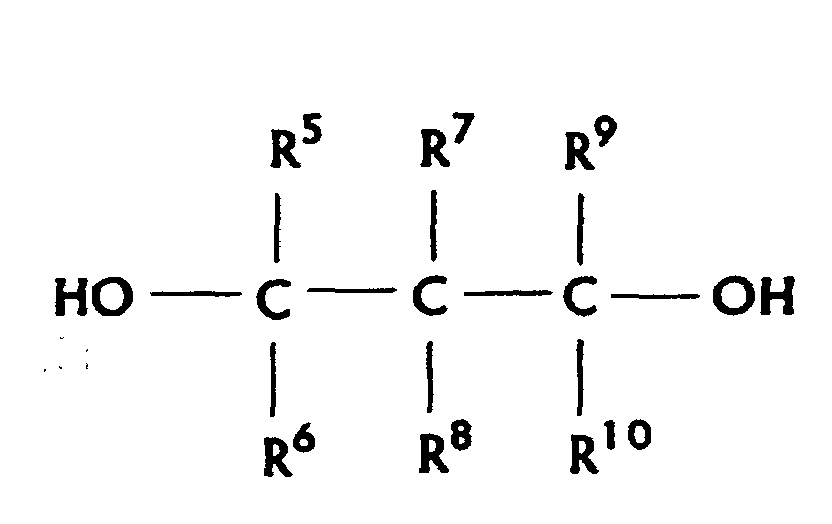
- Die chemische Verbindung 2-[2-(4-Methyl-3-cyclohexen-1-yl)-2-methylethyl]-5,5-dimethyl-1,3-dioxan.
- Die chemische Verbindung 2-[2-(4-Methyl-3-cyclohexen-1-yl)-2-methylethyl]-5-methyl-5-n-propyl-1,3-dioxan.
- Die chemische Verbindung 2-[2-(4-Methyl-3-cyclohexen-1-yl)-2-methylethyl]-5-methyl-5-(1-methylpropyl)-1,3-dioxan.
- Die chemische Verbindung 2-[2-(4-Methylcyclohexyl)-2-methylethyl]-4-isopropyl-5,5-dimethyl-1,3-dioxan.
- Die chemische Verbindung 2-[2-(4-Methylcyclohexyl)-1,2-dimethylethyl]-4-propyl-5-ethyl-1,3-dioxan.
- Riechstoffkompositionen enthaltend Riechstoffe nach einem oder mehreren der Ansprüche 1 und 2 und 4 bis 8.
Priority Applications (1)
| Application Number | Priority Date | Filing Date | Title |
|---|---|---|---|
| EP04020713A EP1481974B1 (de) | 2001-11-30 | 2002-11-21 | Riechstoffe auf Basis cyclischer Acetale |
Applications Claiming Priority (2)
| Application Number | Priority Date | Filing Date | Title |
|---|---|---|---|
| DE10158907 | 2001-11-30 | ||
| DE2001158907 DE10158907C1 (de) | 2001-11-30 | 2001-11-30 | Riechstoffe auf Basis von Cyclohexyl- und Cyclohexenyl-propyl-1,3-dioxanen, Verfahren zu deren Herstellung und diese enthaltende Riechstoffkompositionen, sowie Cyclohexyl- und Cyclohexenyl-propyl-1,3-dioxane als solche |
Related Child Applications (1)
| Application Number | Title | Priority Date | Filing Date |
|---|---|---|---|
| EP04020713A Division EP1481974B1 (de) | 2001-11-30 | 2002-11-21 | Riechstoffe auf Basis cyclischer Acetale |
Publications (2)
| Publication Number | Publication Date |
|---|---|
| EP1316553A1 EP1316553A1 (de) | 2003-06-04 |
| EP1316553B1 true EP1316553B1 (de) | 2005-06-01 |
Family
ID=7707609
Family Applications (2)
| Application Number | Title | Priority Date | Filing Date |
|---|---|---|---|
| EP20020025951 Expired - Lifetime EP1316553B1 (de) | 2001-11-30 | 2002-11-21 | Riechstoffe auf Basis cyclischer Acetale |
| EP04020713A Expired - Lifetime EP1481974B1 (de) | 2001-11-30 | 2002-11-21 | Riechstoffe auf Basis cyclischer Acetale |
Family Applications After (1)
| Application Number | Title | Priority Date | Filing Date |
|---|---|---|---|
| EP04020713A Expired - Lifetime EP1481974B1 (de) | 2001-11-30 | 2002-11-21 | Riechstoffe auf Basis cyclischer Acetale |
Country Status (2)
| Country | Link |
|---|---|
| EP (2) | EP1316553B1 (de) |
| DE (3) | DE10158907C1 (de) |
Families Citing this family (1)
| Publication number | Priority date | Publication date | Assignee | Title |
|---|---|---|---|---|
| DE10158908B4 (de) * | 2001-11-30 | 2005-08-18 | Celanese Chemicals Europe Gmbh | Riechstoffe auf Basis von 5-Methyl-5-(1-methylpropyl)-1,3-dioxanen, ein Verfahren zu deren Herstellung, 5-Methyl-5-(1-methylpropyl)-1,3-dioxane als solche sowie diese enthaltende Riechstoffkompositionen |
Family Cites Families (6)
| Publication number | Priority date | Publication date | Assignee | Title |
|---|---|---|---|---|
| NL166187C (nl) * | 1973-04-18 | 1981-07-15 | Naarden International Nv | Werkwijze ter bereiding van reukstofcomposities door een 2-gesubstitueerd 4,4,6-trimethyl-1,3-dioxan te mengen met ten minste een andere reukstof en geparfu- meerde voorwerpen. |
| JPS5587733A (en) * | 1978-12-26 | 1980-07-02 | Mitsubishi Petrochem Co Ltd | Novel 3-(1,3-dimethyl-3-cyclohexenyl)propionaldehyde acetal |
| DE3016007A1 (de) * | 1980-04-25 | 1981-11-12 | Henkel KGaA, 4000 Düsseldorf | Verwendung substituierter 2-(1-methylbutyl)-1,3-dioxane als riechstoffe sowie diese enthaltende riechstoffkompositionen |
| GB8400665D0 (en) * | 1984-01-11 | 1984-02-15 | Secr Defence | Disubstituted ethanes |
| GB8701961D0 (en) * | 1987-01-29 | 1987-03-04 | Unilever Plc | Perfumery materials |
| JP2649386B2 (ja) * | 1988-09-01 | 1997-09-03 | 花王株式会社 | 2−シクロヘキシルプロパナール誘導体及びこれを含有する香料組成物 |
-
2001
- 2001-11-30 DE DE2001158907 patent/DE10158907C1/de not_active Expired - Fee Related
-
2002
- 2002-11-21 EP EP20020025951 patent/EP1316553B1/de not_active Expired - Lifetime
- 2002-11-21 DE DE50211151T patent/DE50211151D1/de not_active Expired - Fee Related
- 2002-11-21 EP EP04020713A patent/EP1481974B1/de not_active Expired - Lifetime
- 2002-11-21 DE DE50203253T patent/DE50203253D1/de not_active Expired - Lifetime
Also Published As
| Publication number | Publication date |
|---|---|
| DE50211151D1 (de) | 2007-12-13 |
| EP1481974A1 (de) | 2004-12-01 |
| EP1481974B1 (de) | 2007-10-31 |
| DE10158907C1 (de) | 2003-08-07 |
| DE50203253D1 (de) | 2005-07-07 |
| EP1316553A1 (de) | 2003-06-04 |
Similar Documents
| Publication | Publication Date | Title |
|---|---|---|
| EP0033928B1 (de) | Verwendung alkylsubstituierter 1,3-Dioxolane als Riechstoffe, sowie diese enthaltende Riechstoffkompositionen | |
| EP0252378B1 (de) | Neue aliphatische Aldehyde, Verhahren zu deren Herstellung und deren Verwendung als Riechstoffe | |
| DE69636943T2 (de) | Verfahren zur Herstellung von Etherverbindungen | |
| EP0144815B1 (de) | Alpha-tertiäre Dimethylacetale, ihre Herstellung und Verwendung als Riechstoffe | |
| EP1481974B1 (de) | Riechstoffe auf Basis cyclischer Acetale | |
| DE2914109C2 (de) | ||
| EP1316554B1 (de) | Acetal-Derivate aus 2-Methyl-2secbutyl-1,3-propandiol und ihre Verwendung als Riechstoff | |
| DE2313017C3 (de) | Cyclopentene und Verfahren zu deren Herstellung | |
| EP0043507B1 (de) | 2,4-Dioxa-7,10-methano-spiro(5,5)undecane, deren Herstellung sowie diese enthaltende Riechstoffkompositionen | |
| EP0221445B1 (de) | Substituierte 5-Formyl-1,3-dioxepane, deren Herstellung und Verwendung als Riechstoffe | |
| WO2023031003A1 (de) | Neuartige cyclische verbindungen und deren verwendung als riechstoffe | |
| EP0021013B1 (de) | Neue 2,4-disubstituierte Pyranderivate, deren Herstellung und deren Verwendung als Riechstoffe | |
| DE10205835B4 (de) | Verfahren zur Herstellung von Terpinolenaldehyd | |
| DE2815393C2 (de) | 3-Alkoxy-4-homoisotwistane, Verfahren zu ihrer Herstellung und diese enthaltende Parfum- und Duftzusammensetzungen | |
| EP0221444B1 (de) | Substituierte 4-Methyl-4,7-dihydro-1,3-dioxepine, deren Herstellung und Verwendung als Riechstoffe | |
| EP0330995B1 (de) | Bicyclische Aether | |
| DE2815392C2 (de) | 1-Alkoxy-tricyclo[4.3.1.1↑2↑↑,↑↑5↑]undecane, Verfahren zur Herstellung hiervon und diese enthaltende Parfum- und Duftzusammensetzungen | |
| DE2541438A1 (de) | Dioxolanaldehyde und verfahren zu ihrer herstellung | |
| DE2334378C3 (de) | 2- [2"-MeAyI-P- propen-l'-yl] -1.3- dioxane sowie deren Verwendung als Duftstoffe | |
| DE2108567A1 (de) | 2-( 1 - Alkyl-substituierte-2-alkenyl) -1,3-dioxolane und -dioxane, Verfahren zu ihrer Herstellung und ihre Verwendung | |
| DE2827979A1 (de) | 13,15-dioxabicyclo eckige klammer auf 10.5.0 eckige klammer zu heptadecane, deren herstellung und verwendung als riechstoff, sowie diese enthaltende riechstoffkompositionen | |
| DE1196174B (de) | Verfahren zum Herstellen partieller Alkylaether mehrwertiger Alkohole | |
| DE19520103A1 (de) | Verfahren zur Herstellung von Alkyl-substituierten Butenolen | |
| DE2752972A1 (de) | Verwendung von 2-acetyl-1,3-dioxanen als riechstoffe sowie diese enthaltende riechstoffkompositionen | |
| DE1593442B (de) |
Legal Events
| Date | Code | Title | Description |
|---|---|---|---|
| PUAI | Public reference made under article 153(3) epc to a published international application that has entered the european phase |
Free format text: ORIGINAL CODE: 0009012 |
|
| AK | Designated contracting states |
Designated state(s): AT BE BG CH CY CZ DE DK EE ES FI FR GB GR IE IT LI LU MC NL PT SE SK TR |
|
| AX | Request for extension of the european patent |
Extension state: AL LT LV MK RO SI |
|
| 17P | Request for examination filed |
Effective date: 20031204 |
|
| AKX | Designation fees paid |
Designated state(s): CH DE GB LI NL |
|
| 17Q | First examination report despatched |
Effective date: 20040319 |
|
| GRAP | Despatch of communication of intention to grant a patent |
Free format text: ORIGINAL CODE: EPIDOSNIGR1 |
|
| GRAS | Grant fee paid |
Free format text: ORIGINAL CODE: EPIDOSNIGR3 |
|
| GRAA | (expected) grant |
Free format text: ORIGINAL CODE: 0009210 |
|
| AK | Designated contracting states |
Kind code of ref document: B1 Designated state(s): CH DE GB LI NL |
|
| REG | Reference to a national code |
Ref country code: GB Ref legal event code: FG4D Free format text: NOT ENGLISH |
|
| REG | Reference to a national code |
Ref country code: CH Ref legal event code: NV Representative=s name: BOVARD AG PATENTANWAELTE Ref country code: CH Ref legal event code: EP |
|
| REF | Corresponds to: |
Ref document number: 50203253 Country of ref document: DE Date of ref document: 20050707 Kind code of ref document: P |
|
| GBT | Gb: translation of ep patent filed (gb section 77(6)(a)/1977) |
Effective date: 20050912 |
|
| PLBE | No opposition filed within time limit |
Free format text: ORIGINAL CODE: 0009261 |
|
| STAA | Information on the status of an ep patent application or granted ep patent |
Free format text: STATUS: NO OPPOSITION FILED WITHIN TIME LIMIT |
|
| 26N | No opposition filed |
Effective date: 20060302 |
|
| PGFP | Annual fee paid to national office [announced via postgrant information from national office to epo] |
Ref country code: NL Payment date: 20071119 Year of fee payment: 6 |
|
| REG | Reference to a national code |
Ref country code: CH Ref legal event code: NV Representative=s name: BUGNION S.A. Ref country code: CH Ref legal event code: PUE Owner name: OXEA DEUTSCHLAND GMBH Free format text: CELANESE CHEMICALS EUROPE GMBH#LURGIALLEE 14#60439 FRANKFURT AM MAIN (DE) -TRANSFER TO- OXEA DEUTSCHLAND GMBH#OTTO-ROELEN-STRASSE 3#46147 OBERHAUSEN (DE) |
|
| REG | Reference to a national code |
Ref country code: GB Ref legal event code: 732E |
|
| PGFP | Annual fee paid to national office [announced via postgrant information from national office to epo] |
Ref country code: CH Payment date: 20071115 Year of fee payment: 6 |
|
| NLS | Nl: assignments of ep-patents |
Owner name: OXEA DEUTSCHLAND GMBH Effective date: 20080104 |
|
| PGFP | Annual fee paid to national office [announced via postgrant information from national office to epo] |
Ref country code: GB Payment date: 20071120 Year of fee payment: 6 |
|
| REG | Reference to a national code |
Ref country code: CH Ref legal event code: PL |
|
| GBPC | Gb: european patent ceased through non-payment of renewal fee |
Effective date: 20081121 |
|
| PG25 | Lapsed in a contracting state [announced via postgrant information from national office to epo] |
Ref country code: NL Free format text: LAPSE BECAUSE OF NON-PAYMENT OF DUE FEES Effective date: 20090601 |
|
| NLV4 | Nl: lapsed or anulled due to non-payment of the annual fee |
Effective date: 20090601 |
|
| PG25 | Lapsed in a contracting state [announced via postgrant information from national office to epo] |
Ref country code: LI Free format text: LAPSE BECAUSE OF NON-PAYMENT OF DUE FEES Effective date: 20081130 Ref country code: CH Free format text: LAPSE BECAUSE OF NON-PAYMENT OF DUE FEES Effective date: 20081130 |
|
| PG25 | Lapsed in a contracting state [announced via postgrant information from national office to epo] |
Ref country code: GB Free format text: LAPSE BECAUSE OF NON-PAYMENT OF DUE FEES Effective date: 20081121 |
|
| PGFP | Annual fee paid to national office [announced via postgrant information from national office to epo] |
Ref country code: DE Payment date: 20091130 Year of fee payment: 8 |
|
| REG | Reference to a national code |
Ref country code: DE Ref legal event code: R119 Ref document number: 50203253 Country of ref document: DE Effective date: 20110601 Ref country code: DE Ref legal event code: R119 Ref document number: 50203253 Country of ref document: DE Effective date: 20110531 |
|
| PG25 | Lapsed in a contracting state [announced via postgrant information from national office to epo] |
Ref country code: DE Free format text: LAPSE BECAUSE OF NON-PAYMENT OF DUE FEES Effective date: 20110531 |