EP1313602B1 - Procede de fabrication d'une piece de revolution par rotomoulage et piece obtenue - Google Patents
Procede de fabrication d'une piece de revolution par rotomoulage et piece obtenue Download PDFInfo
- Publication number
- EP1313602B1 EP1313602B1 EP01965358A EP01965358A EP1313602B1 EP 1313602 B1 EP1313602 B1 EP 1313602B1 EP 01965358 A EP01965358 A EP 01965358A EP 01965358 A EP01965358 A EP 01965358A EP 1313602 B1 EP1313602 B1 EP 1313602B1
- Authority
- EP
- European Patent Office
- Prior art keywords
- layer
- ethylene
- vinyl alcohol
- temperature
- alcohol copolymer
- Prior art date
- Legal status (The legal status is an assumption and is not a legal conclusion. Google has not performed a legal analysis and makes no representation as to the accuracy of the status listed.)
- Expired - Lifetime
Links
Images

Classifications
-
- B—PERFORMING OPERATIONS; TRANSPORTING
- B29—WORKING OF PLASTICS; WORKING OF SUBSTANCES IN A PLASTIC STATE IN GENERAL
- B29C—SHAPING OR JOINING OF PLASTICS; SHAPING OF MATERIAL IN A PLASTIC STATE, NOT OTHERWISE PROVIDED FOR; AFTER-TREATMENT OF THE SHAPED PRODUCTS, e.g. REPAIRING
- B29C41/00—Shaping by coating a mould, core or other substrate, i.e. by depositing material and stripping-off the shaped article; Apparatus therefor
- B29C41/02—Shaping by coating a mould, core or other substrate, i.e. by depositing material and stripping-off the shaped article; Apparatus therefor for making articles of definite length, i.e. discrete articles
- B29C41/22—Making multilayered or multicoloured articles
-
- B—PERFORMING OPERATIONS; TRANSPORTING
- B29—WORKING OF PLASTICS; WORKING OF SUBSTANCES IN A PLASTIC STATE IN GENERAL
- B29C—SHAPING OR JOINING OF PLASTICS; SHAPING OF MATERIAL IN A PLASTIC STATE, NOT OTHERWISE PROVIDED FOR; AFTER-TREATMENT OF THE SHAPED PRODUCTS, e.g. REPAIRING
- B29C41/00—Shaping by coating a mould, core or other substrate, i.e. by depositing material and stripping-off the shaped article; Apparatus therefor
- B29C41/003—Shaping by coating a mould, core or other substrate, i.e. by depositing material and stripping-off the shaped article; Apparatus therefor characterised by the choice of material
-
- B—PERFORMING OPERATIONS; TRANSPORTING
- B29—WORKING OF PLASTICS; WORKING OF SUBSTANCES IN A PLASTIC STATE IN GENERAL
- B29C—SHAPING OR JOINING OF PLASTICS; SHAPING OF MATERIAL IN A PLASTIC STATE, NOT OTHERWISE PROVIDED FOR; AFTER-TREATMENT OF THE SHAPED PRODUCTS, e.g. REPAIRING
- B29C41/00—Shaping by coating a mould, core or other substrate, i.e. by depositing material and stripping-off the shaped article; Apparatus therefor
- B29C41/02—Shaping by coating a mould, core or other substrate, i.e. by depositing material and stripping-off the shaped article; Apparatus therefor for making articles of definite length, i.e. discrete articles
- B29C41/04—Rotational or centrifugal casting, i.e. coating the inside of a mould by rotating the mould
-
- B—PERFORMING OPERATIONS; TRANSPORTING
- B29—WORKING OF PLASTICS; WORKING OF SUBSTANCES IN A PLASTIC STATE IN GENERAL
- B29K—INDEXING SCHEME ASSOCIATED WITH SUBCLASSES B29B, B29C OR B29D, RELATING TO MOULDING MATERIALS OR TO MATERIALS FOR MOULDS, REINFORCEMENTS, FILLERS OR PREFORMED PARTS, e.g. INSERTS
- B29K2029/00—Use of polyvinylalcohols, polyvinylethers, polyvinylaldehydes, polyvinylketones or polyvinylketals or derivatives thereof as moulding material
- B29K2029/04—PVOH, i.e. polyvinyl alcohol
-
- Y—GENERAL TAGGING OF NEW TECHNOLOGICAL DEVELOPMENTS; GENERAL TAGGING OF CROSS-SECTIONAL TECHNOLOGIES SPANNING OVER SEVERAL SECTIONS OF THE IPC; TECHNICAL SUBJECTS COVERED BY FORMER USPC CROSS-REFERENCE ART COLLECTIONS [XRACs] AND DIGESTS
- Y10—TECHNICAL SUBJECTS COVERED BY FORMER USPC
- Y10T—TECHNICAL SUBJECTS COVERED BY FORMER US CLASSIFICATION
- Y10T428/00—Stock material or miscellaneous articles
- Y10T428/13—Hollow or container type article [e.g., tube, vase, etc.]
- Y10T428/1352—Polymer or resin containing [i.e., natural or synthetic]
- Y10T428/139—Open-ended, self-supporting conduit, cylinder, or tube-type article
- Y10T428/1393—Multilayer [continuous layer]
Definitions
- the present invention relates to a method of manufacture of a rotating part by rotational molding and to a part obtained by said method.
- structure or piece of revolution we mean structures defining a dead volume so as to for example to form a cylinder, or a container such a tank, a box, a tank, or a tank.
- Rotational molding or rotational molding is used for the manufacture of hollow pieces of material plastics. This is an economical technique used in particular for the manufacture of parts in small series.
- Rotomolded material In rotational molding processes, the material molten moves under the effect of gravity in a mold in rotation in an oven. Rotomolded material must therefore exhibit physicochemical behavior and a particular morphology which explains the range limited rotomouldable material present to date on the market.
- type gas tank for example it is necessary to obtain seamless revolution structures and homogeneous, with improved properties of permeability to gas, mechanical strength, resistance to irradiations, and to solvents.
- Multilayer rotomoulding in industry essentially concerns structures of the type polyethylene / polyethylene or polyethylene / foam polyurethane / polyethylene.
- Thermoplastics more technical and in particular those of the family of ethylene-alcohol copolymers vinylic have never been rotomolded. These copolymers have actually been implemented by injection or extrusion for applications in packaging, for example in medium of gas barrier materials, in food or cosmetics. In these applications they were used in weak thicknesses less than 500 ⁇ m.
- Document FR-A-2 776 228 describes a body multilayer hollow of plastic material. He describes in particular the use of extrusion techniques and to prepare such structures. It also describes the use of ethylene random copolymer and of vinyl alcohol (EVOH) as a barrier to stored fluid. The examples describe the coextrusion of a three-layer tube at 215 ° C.
- EVOH vinyl alcohol
- US-A-5,567,296 discloses a reservoir transport and storage of fluid fuels hydrocarbon.
- the tank is composed of a structure laminated with a body of polymeric resin and a metal electrodeposited.
- a layer of EVOH used as barrier is described.
- this document does not not describe the use of an EVOH having a density between 0.94 and 1.4 and a melt index between 1.3 and 4.2 g / 10 minutes at a temperature from 170 to 240 ° C in a rotational molding process.
- FR-A-1 604 824 describes a process for the production of hollow molded parts. He describes a rotational molding technique.
- the materials described as being able to be used are polyolefins such as polyethylene and polypropylene, polyamides such as polyamino-undecanoamide and polycaprolactane, polyvinyl compounds such as polyvinyl chloride, and acetates such as acetobutyrate of cellulose.
- the use of EVOH is not never described.
- EP-A-0 518 354 discloses a container multilayer comprising a layer A of a resin polyolefin, an adhesive B layer of a resin polyolefin modified with an anhydride or an acid carboxylic acid, and a layer C comprising in particular a polyamide and a polyphenylene ether.
- a copolymer of vinyl acetate and ethylene is described but the use of EVOH is never described.
- US-A-5,171,346 discloses a material composite insulation and not a piece of revolution. he describes the use of an EVOH copolymer for its basic properties of gas permeability. He ... not does not describe rotational molding.
- the present invention provides a method of making a piece of revolution including a cycle of successive deposits of layers of materials thermoplastics by rotational molding, said cycle comprising at least one rotational molding deposit, at a temperature of 170 to 240 ° C, for example from 180 to 230 ° C, a layer made of a copolymer ethylene-vinyl alcohol having a density at this temperature between 0.94 and 1.4, for example between 1.10 and 1.22, and a flow index included between 1.3 and 4.2 g / 10 minutes, for example between 1.5 and 4 g / 10 minutes.
- the ethylene-vinyl alcohol copolymer can also be defined as having the following formula (I): with m between 10 and 80 mol% in the polymer, or between 20 and 80 mol%.
- melt index of the ethylene-alcohol copolymer vinyl (“Melt Flow Index”) is determined according to ASTM D 1238-88 by means of a test carried out on a machine Kayeness Galaxy 1 (brand of trade), model 7053 DE manufactured by the company Kayeness Inc., Morgantown, PA 19543. This test consists of to place a polymer charge on a tube placed at a defined temperature, higher than the temperature of melting of the polymer, and measuring the amount of polymer that flows for 30 seconds. This time is then converted to minutes.
- the EVOH polymers are thermoplastics having good mechanical properties and form a very good barrier to gases. These properties are all more interesting than the EVOH layer that can be obtained by the process of the present invention is thick.
- EVOH polymers are usually available commercially in the form of granules or pellets.
- the commercial granules or pellets of polymers will first be micronized into a powder, for example at room temperature or cryogenic, the particle size of which is chosen according to the nature of the polymers and the structure of the multilayers envisaged, preferably having a particle size distribution less than 0.7 mm, advantageously between 0.1 and 0.7 mm. This micronization allows not too much heat the EVOH later to melt it, while obtaining a homogeneous layer.
- the grade of EVOH chosen according to this invention preferably has a melt index more low, ie a higher viscosity, than those of thermoplastics such as PE, PVC, PA usually rotomoulded.
- the EVOH remains very viscous in the state melted to be rotomolded for example with thicknesses greater than 0.5 millimeters, which will against the usual rotational molding protocols in which we sought fairly fluid grades thermoplastics.
- EVOH thermoplastic absorbs a lot of water which causes a fall of its mechanical properties, rheological or gas barriers. So, the rotational molding of multilayer structures according to The present invention is preferred in order to protect the EVOH with respect to water for example by means of other layers of thermoplastic materials resistant to the water. This has not been realized in the prior art because the rheological characteristics such as the viscosity, fluidity, etc. and physico-chemical such as melting, polarity, and temperature of degradation of the layers of materials thermoplastics different from EVOH used in the prior art for rotational molding are sometimes very different from each other.
- the present invention overcomes this problem in particular by choosing an appropriate grade of EVOH which remains viscous in the molten state, by its micronization, and by the choice of its temperature of implementation is slightly above its melting temperature. This allows to obtain a thick layer of EVOH and avoids that layers of thermoplastic materials different from EVOH that are adjacent to it mix with it.
- the present invention furthermore has the advantage to be able to rotate multilayers without to be obliged to reduce the temperature of the device as and when the implementation of the successive layers of thermoplastic materials. So, for example, unlike the state of the technique, the temperature of an inner layer of thermoplastic, ie the last layer rotational molding, can be greater than that of the outer layer of thermoplastic material, that is to say the first layer made without interpenetration of the layers.
- the present invention thus makes it possible to obtain in particular by rotational molding of structures of revolution Seamless and homogeneous, with properties Improved gas permeability, mechanical strength, resistance to irradiation, and solvents. She therefore provided a method of manufacturing a piece of revolution and the piece obtained by this process which is ideally suited for storage, solvent tank type, hydrocarbons, gas for example hydrogen or oxygen under pressure etc.
- the deposition of the constituted layer ethylene-vinyl alcohol copolymer can be made for example between a deposit of a layer of a thermoplastic material A and a deposit of a layer of a thermoplastic material B, A and B being used in rotational molding, or in the art allowing a deposit of successive layers, identical or different and not being ethylene-alcohol copolymers vinyl.
- the materials thermoplastics deposited in layers, other than the ethylene-vinyl alcohol copolymer, that is to say thermoplastic materials A and B can be chosen identical or different for example in a group comprising polyethylene (PE), polyethylene grafted PE, polyethylene terephthalate (PET), polypropylene (PP), polyetheretherketone (PEEK), a polycarbonate (PC), an ethylene acetate copolymer vinyl (EVA), polystyrene (PS), polyfluoride vinylidene (PVDF), a polyester amide or a polyamide (PA) or a polyarylamide (PAA) or a mixture of these.
- PE polyethylene
- PET polyethylene terephthalate
- PP polypropylene
- PEEK polyetheretherketone
- PC polycarbonate
- EVA ethylene acetate copolymer vinyl
- PS polystyrene
- PVDF polyfluoride vinylidene
- PA polyamide
- PAA polyarylamide
- the method of the present invention allows to obtain a piece of revolution.
- the piece of revolution can successively to understand a layer of polyamide, a layer of ethylene-vinyl alcohol copolymer having a density between 0.94 and 1.4 and an index of fluidity between 1.3 and 4.2 g / 10 minutes at a temperature of 170 to 240 ° C, and an grafted polyethylene layer.
- the piece of revolution can also successively understand a first layer of polyamide, a layer of ethylene-alcohol copolymer vinylic having a density between 0.94 and 1.4 and an index of fluidity between 1.3 and 4.2 g / 10 minutes at a temperature of 170 to 240 ° C, and a second layer of polyamide, polyamide layers being the same or different.
- each layer of material can be adjusted with the amount of polymer powder introduced in view of the shape of the mold, the surface of the mold to be covered and the thickness of the desired layer.
- the thickness of the layer EVOH can be chosen for example to to increase the properties of the material according to applications envisaged, depending on the cost, weight, mechanical strength, barrier properties to gas, etc.
- This layer made of the copolymer ethylene-vinyl alcohol can be deposited by example, without being limiting, in a thickness included between 0.3 and 20 mm, for example between 0.5 and 10 mm, example between 0.5 and 5 mm.
- thermoplastic materials deposited for example by rotational molding other than ethylene-vinyl alcohol copolymer, can be deposited in adequate thickness for the intended use the manufactured part, for example without being limiting, in a thickness of between 0.1 mm and 10 mm, example between 0.1 and 5 mm.
- Thermoplastic materials, EVOH and others, can possibly be loaded by loads organic or mineral in order to improve the hold mechanical, aging resistance, or facilitate the implementation for example.
- the revolution piece of the present invention may further comprise a reinforcing structure, such as a structure of carbon threads impregnated with thermally crosslinked resin.
- the process can then further include a draping step or weaving of this reinforcing structure on the piece of revolution.
- Heating time and temperature parameters, withdrawal and cooling of the mold, for each layers, are defined according to the nature of the thermoplastic implemented. These settings as well as the biaxial rotation speeds of the mold, the nature mold for example steel, stainless steel, PTFE, etc. allow, among other things, to adjust the viscosity of the melted polymer and facilitate the departure bubbles that are eventually trapped there.
- the time of implementation of the successive layers is preferably shorter and shorter, if possible, of so as not to degrade the previous layers.
- the EVOH layer can be implemented at a slightly higher than its melting temperature, which can go up to 230/240 ° C, and with a thickness that can be greater than 0.5 mm which is original compared to the state of the art. This allows you to stack on the EVOH layer of thermoplastic layers whatever their melting and / or setting temperatures while the state of the art advocated to reduce the temperature of implementation of the layers following to avoid interpenetration of the layers.
- a weak pressure of the order of a few hectopascals and / or inert gas, for example nitrogen can facilitate the implementation of the multilayer structures according to the nature and stacking of thermoplastic layers.
- the applications of the present invention are therefore numerous, and, in addition to those mentioned above, may for example also be mentioned for fuel cells subjected to pressures of 200 to 600 ⁇ 10 5 Pa.
- a piece of revolution of a tricouche constituted an outer layer of 1 mm thick in polyamide 12 (PA12) RISLAN (trade mark), commercial grade ARVO 950 TLD manufactured by the company TOTAL-FINA-ELF, with an intermediate (internal) layer of 2 mm thick ethylene-alcohol copolymer Vinyl (EVOH)) SOARNOL (Trade Mark), commercial grade D 2908 manufactured by NIPPON GOHSEI and an inner layer of 1 mm thick grafted polyethylene (PE grafted) OREVAC (brand commercial grade), 18350 P manufactured by the company TOTAL-FINA-ELF was obtained by rotational molding according to the present invention.
- PA12 polyamide 12
- ARVO 950 TLD manufactured by the company TOTAL-FINA-ELF
- thermoplastics 170 ° C
- T EVOH 180 ° C
- T Pieved 130 ° C.
- the successive temperatures of implementation of the layers are 180 ° C, 190 ° C and 200 ° C.
- the PA12 first layer is re-melted at 200 ° C, there is no no interpenetration with the EVOH layer because this one, although also melted, remains very viscous at 200 ° C in thick thickness.
- the temperature of melting of PE grafted around 130 ° C it is necessary to implement it at high temperature, that is to say at a temperature above 180 ° C, here 200 ° C, to remove the bubbles formed.
- the granules of EVOH have been previously micronised using a WEDCO type of 400 micron powder which was later dried.
- the biaxial rotation speed of the rotomoulder is 5.4 rpm for the primary shaft and 7.3 rpm for the secondary shaft.
- the mold used is aluminum whose inner surface is covered with Teflon (trademark).
- the rotomoulder used is of type CACCIA (trade mark) provided a gas oven and ROTOLOG software (brand Mark).
- a structure consisting of a tricouche comprising in this example an outer layer of 1 mm thick grafted polyethylene (PE grafted) OREVAC (trademark), commercial grade 18350 P manufactured by the company TOTAL-FINA-ELF, a layer intermediate or internal 3 mm thick ethylene-vinyl alcohol copolymer (EVOH) SOARNOL (trademark), commercial grade D 2908 manufactured by the company NIPPON GOHSEI and a layer inside 1 mm thick polyamide 12 (PA 12) RISLAN (trademark), commercial grade ARVO 950 TLD manufactured by the company TOTAL-FINA-ELF was obtained by rotomolding according to the present invention.
- the successive temperatures of implementation of the The layers are respectively 190 ° C, 200 ° C and 205 ° C.
- the granules of EVOH have been previously micronised using a WEDCO type 300 micron powder which was later dried.
- the biaxial rotation speed of the rotomoulding is 6.2 rpm for the tree primary and 8.5 rpm for the tree secondary.
- the mold used is aluminum whose inner surface is covered with Teflon (brand Mark).
- the rotomoulder used is of the CACCIA type (trademark) equipped with a gas oven and ROTOLOG software (registered trademark).
- PA 12 polyamide
- RISLAN brand commercial
- ARVO 950 TLD manufactured by the company TOTAL-FINA-ELF
- EVOH ethylene-vinyl alcohol copolymer
- SOARNOL commercial grade D 2908 manufactured by the company NIPPON GOHSEI
- PA 6 commercial grade LE 6000 manufactured by the company TOTAL-
- the successive temperatures of implementation of the The layers are 190 ° C, 190 ° C and 210 ° C, respectively.
- the trilayer obtained has the same qualities than those obtained for Examples 1 and 2 precedents.
Landscapes
- Engineering & Computer Science (AREA)
- Mechanical Engineering (AREA)
- Moulding By Coating Moulds (AREA)
- Laminated Bodies (AREA)
- Shaping Metal By Deep-Drawing, Or The Like (AREA)
Description

- La poudre d'un premier thermoplastique ou thermoplastique A, différent de EVOH, formant par exemple la première couche déposée par rotomoulage, est introduite dans le moule de l'appareillage qui est alors mis en rotation et introduit dans un four préchauffé à une température fixe d'au moins 200°C.
- Le moule en rotation est laissé dans le four, pendant un temps adapté et jusqu'à ce que la température de l'air interne atteigne une valeur adaptée, comprise entre la température de fusion, Tf, du premier polymère et 280°C, suivant la nature du thermoplastique.
- Le moule en rotation est alors retiré du four et est refroidi pendant un temps adapté et jusqu'à ce que la température de l'air interne au moule atteigne une valeur définie, par exemple comprise entre 280°C et 130°C, suivant la nature du premier thermoplastique.
- Le thermoplastique EVOH peut alors être introduit de façon continue ou non dans le moule en rotation qui est alors réintroduit dans le four chaud. Le grade de l'EVOH barrière aux gaz est choisi de manière à ce que sa viscosité à l'état fondu soit importante, c'est à dire telle que définie selon la présente invention. Dès que la température de l'air interne au moule atteint une valeur légèrement supérieure à la température de fusion de l'EVOH, c'est-à-dire par exemple de 185°C à 200°C, et de manière générale à une température pouvant aller jusqu'à 50°C au-dessus de la température de fusion de EVOH, le moule en rotation est retiré du four et est refroidi pendant un temps adapté et jusqu'à ce que la température de l'air interne au moule atteigne une valeur définie par exemple comprise entre 200°C et 150°C, suivant la nature du troisième polymère à introduire.
- La poudre d'un deuxième thermoplastique ou thermoplastique B, différent de EVOH, peut alors être introduit de façon continue ou non dans le moule en rotation qui est alors réintroduit dans le four chaud et la procédure commence comme décrit au premier point ci-dessus, suivant la structure multicouches envisagée. Contrairement aux multicouches obtenues par rotomoulage dans l'art antérieur, la température de mise en oeuvre de cette couche peut être supérieure à la température de mise en oeuvre des couches précédentes, du fait de la forte viscosité et de l'épaisseur de l'EVOH spécifiques de la présente invention.
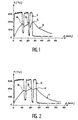
- La figure 1 est une représentation graphique de l'évolution de la température d'un capteur de température placé à l'extérieur du moule de rotomoulage et de la température de l'atmosphère à l'intérieur du four de rotomoulage en fonction du temps en minutes au cours de la fabrication d'une pièce de révolution tricouche polyamide PA12 1mm/éthylène-alcool vinylique 2mm/polyéthylène greffé 1mm, selon le procédé de la présente invention,
- La figure 2 est une représentation graphique de l'évolution de la température d'un capteur de température placé à l'extérieur du moule de rotomoulage et de la température de l'atmosphère à l'intérieur du four de rotomoulage en fonction du temps en minutes au cours de la fabrication d'une pièce de révolution tricouche polyéthylène greffé 1mm/éthylène-alcool vinylique 3mm/polyamide PA12 1mm, selon le procédé de la présente invention, et
- La figure 3 est une représentation graphique de l'évolution de la température d'un capteur de température placé à l'extérieur du moule de rotomoulage et de la température de l'atmosphère à l'intérieur du four de rotomoulage en fonction du temps en minutes au cours de la fabrication d'une pièce de révolution tricouche polyamide PA12 1mm/éthylène-alcool vinylique 2mm/ polyamide PA6 3mm, selon le procédé de la présente invention
Claims (9)
- Procédé de fabrication d'une pièce de révolution comprenant un cycle de dépôts successifs de couches de matériaux thermoplastiques par rotomoulage, ledit cycle comprenant au moins un dépôt par rotomoulage, à une température de 170 à 240°C d'une couche constituée d'un copolymère éthylène-alcool vinylique ayant une densité à cette température comprise entre 0,94 et 1,4 (c'est-à-dire une masse volumique comprise entre 0,94 et 1,4 g/cm3) et un indice de fluidité compris entre 1,3 et 4,2 g / 10 minutes.
- Procédé selon la revendication 1, dans lequel le dépôt de la couche constituée du copolymère éthylène-alcool vinylique est réalisé entre un dépôt d'une couche d'un matériau thermoplastique A et un dépôt d'une couche d'un matériau thermoplastique B, A et B étant utilisables en rotomoulage, identiques ou différents et n'étant pas des copolymères éthylène-alcool vinylique.
- Procédé selon la revendication 1 ou 2, dans lequel les matériaux thermoplastiques déposés en couches, autres que le copolymère éthylène-alcool vinylique, sont choisis dans un groupe comprenant un polyéthylène, un polyéthylène greffé, un polyéthylène téréphtalate, un polypropylène, un polyétheréthercétone, un polycarbonate, un copolymère éthylène acétate de vinyle, un polystyrène, un polyfluorure de vinylidène, un polyester amide ou un polyamide ou un polyarylamide, ou un mélange de ceux-ci.
- Procédé selon la revendication 1 ou 2, dans lequel la couche constituée du copolymère éthylène-alcool vinylique est déposée en une épaisseur comprise entre 0,3 et 20 mm.
- Procédé selon la revendication 1 ou 2, dans lequel les matériaux thermoplastiques déposés par rotomoulage, autres que le copolymère éthylène-alcool vinylique, sont déposés en une épaisseur comprise entre 0,1 mm et 10 mm.
- Procédé selon la revendication 1 ou 2, dans lequel le dépôt d'une couche de copolymère éthylène-alcool vinylique est effectué par rotomoulage, à partir d'une poudre de ce polymère ayant une granulométrie inférieure à 0,7 mm.
- Pièce de révolution susceptible d'être obtenue par un procédé selon l'une quelconque des revendications 1 à 6, ladite pièce de révolution comprenant au moins une couche constituée d'un copolymère d'éthylène-alcool vinylique ayant une densité comprise entre 0,94 et 1,4 (c'est-à-dire une masse volumique comprise entre 0,94 et 1,4 g/cm3) et un indice de fluidité compris entre 1,3 et 4,2 g/10 minutes à une température de 170 à 240°C.
- Pièce de révolution selon la revendication 7, comprenant successivement une couche de polyamide, une couche de copolymère éthylène-alcool vinylique, et une couche de polyéthylène greffé.
- Pièce de révolution selon la revendication 7, comprenant successivement une première couche de polyamide, une couche de copolymère éthylène-alcool vinylique, et une deuxième couche de polyamide, les couches de polyamide étant identiques ou différentes.
Applications Claiming Priority (3)
| Application Number | Priority Date | Filing Date | Title |
|---|---|---|---|
| FR0011072A FR2813232B1 (fr) | 2000-08-30 | 2000-08-30 | Procede de fabrication d'une piece de revolution par rotomoulage et piece obtenue |
| FR0011072 | 2000-08-30 | ||
| PCT/FR2001/002676 WO2002018117A1 (fr) | 2000-08-30 | 2001-08-27 | Procede de fabrication d'une piece de revolution par rotomoulage et piece obtenue |
Publications (2)
| Publication Number | Publication Date |
|---|---|
| EP1313602A1 EP1313602A1 (fr) | 2003-05-28 |
| EP1313602B1 true EP1313602B1 (fr) | 2005-04-27 |
Family
ID=8853819
Family Applications (1)
| Application Number | Title | Priority Date | Filing Date |
|---|---|---|---|
| EP01965358A Expired - Lifetime EP1313602B1 (fr) | 2000-08-30 | 2001-08-27 | Procede de fabrication d'une piece de revolution par rotomoulage et piece obtenue |
Country Status (9)
| Country | Link |
|---|---|
| US (1) | US7247268B2 (fr) |
| EP (1) | EP1313602B1 (fr) |
| JP (1) | JP4833497B2 (fr) |
| AT (1) | ATE294057T1 (fr) |
| CA (1) | CA2419433C (fr) |
| DE (1) | DE60110442T2 (fr) |
| ES (1) | ES2240507T3 (fr) |
| FR (1) | FR2813232B1 (fr) |
| WO (1) | WO2002018117A1 (fr) |
Families Citing this family (8)
| Publication number | Priority date | Publication date | Assignee | Title |
|---|---|---|---|---|
| US6913517B2 (en) * | 2002-05-23 | 2005-07-05 | Cabot Microelectronics Corporation | Microporous polishing pads |
| ATE554924T1 (de) * | 2002-11-21 | 2012-05-15 | Total Petrochemicals Res Feluy | Mehrschichtiges rotationsformen |
| FR2871091B1 (fr) * | 2004-06-03 | 2008-01-18 | Commissariat Energie Atomique | Procede de fabrication d'une vitesse d'etancheite d'un reservoir de type iv et reservoir de type iv |
| GB2417462A (en) * | 2004-08-31 | 2006-03-01 | Eastman Chem Co | Moulding of thermoplastic polyesters |
| FR2893622B1 (fr) | 2005-11-24 | 2007-12-21 | Commissariat Energie Atomique | Composition a base de caprolactame,procede de fabrication d'un element d'etancheite,et reservoir |
| FR2902364B1 (fr) * | 2006-06-16 | 2012-04-27 | Commissariat Energie Atomique | Procede de fabrication d'une vessie d'etancheite en polymere thermodurcissable pour un reservoir contenant un fluide sous pression, tel qu'un reservoir composite, et reservoir |
| US8597747B2 (en) | 2006-12-15 | 2013-12-03 | Centro, Inc. | Multi-layer rotationally molded low permeation vessels and method for manufacture therof |
| US10252449B1 (en) | 2015-01-23 | 2019-04-09 | Centro, Inc. | Rotational molding with pre-formed shapes |
Family Cites Families (12)
| Publication number | Priority date | Publication date | Assignee | Title |
|---|---|---|---|---|
| GB1190379A (en) * | 1966-12-08 | 1970-05-06 | Aquitaine Fisons Ltd | Moulding Plastics |
| AU549286B2 (en) * | 1981-01-22 | 1986-01-23 | Toyo Boseki K.K. | Blow moulded multiply vessel |
| JPS59143636A (ja) * | 1983-02-08 | 1984-08-17 | 東洋製罐株式会社 | 多層プラスチツク容器 |
| JPH082624B2 (ja) * | 1987-02-09 | 1996-01-17 | 株式会社クラレ | 延伸成形用多層構造パイプおよびそれを用いた多層容器の製造法 |
| US5320889A (en) * | 1989-01-17 | 1994-06-14 | Tropicana Products, Inc. | Plastic bottle for food |
| JP2826125B2 (ja) * | 1989-05-31 | 1998-11-18 | 株式会社クラレ | 回転成形容器およびその製造法 |
| JP2849439B2 (ja) * | 1990-03-29 | 1999-01-20 | 株式会社クラレ | 成形体および多層構造体 |
| US5171346A (en) * | 1991-01-22 | 1992-12-15 | Aktiebolaget Electrolux | Method of forming a composite thermal insulating material |
| JP3094513B2 (ja) * | 1991-06-12 | 2000-10-03 | 三菱化学株式会社 | 多層容器 |
| US5567296A (en) * | 1993-01-19 | 1996-10-22 | Luch; Daniel | Process for producing vehicular fuel tanks |
| US6068933A (en) * | 1996-02-15 | 2000-05-30 | American National Can Company | Thermoformable multilayer polymeric film |
| FR2776228B1 (fr) * | 1998-03-20 | 2000-05-19 | Solvay | Corps creux multicouche en matiere thermoplastique |
-
2000
- 2000-08-30 FR FR0011072A patent/FR2813232B1/fr not_active Expired - Fee Related
-
2001
- 2001-08-27 WO PCT/FR2001/002676 patent/WO2002018117A1/fr not_active Ceased
- 2001-08-27 AT AT01965358T patent/ATE294057T1/de active
- 2001-08-27 ES ES01965358T patent/ES2240507T3/es not_active Expired - Lifetime
- 2001-08-27 JP JP2002523068A patent/JP4833497B2/ja not_active Expired - Fee Related
- 2001-08-27 EP EP01965358A patent/EP1313602B1/fr not_active Expired - Lifetime
- 2001-08-27 US US10/344,558 patent/US7247268B2/en not_active Expired - Lifetime
- 2001-08-27 DE DE60110442T patent/DE60110442T2/de not_active Expired - Lifetime
- 2001-08-27 CA CA2419433A patent/CA2419433C/fr not_active Expired - Fee Related
Also Published As
| Publication number | Publication date |
|---|---|
| ES2240507T3 (es) | 2005-10-16 |
| DE60110442T2 (de) | 2006-01-19 |
| FR2813232A1 (fr) | 2002-03-01 |
| JP4833497B2 (ja) | 2011-12-07 |
| CA2419433A1 (fr) | 2002-03-07 |
| DE60110442D1 (de) | 2005-06-02 |
| CA2419433C (fr) | 2010-07-13 |
| US20030161981A1 (en) | 2003-08-28 |
| FR2813232B1 (fr) | 2002-10-11 |
| WO2002018117A1 (fr) | 2002-03-07 |
| ATE294057T1 (de) | 2005-05-15 |
| US7247268B2 (en) | 2007-07-24 |
| JP2004507382A (ja) | 2004-03-11 |
| EP1313602A1 (fr) | 2003-05-28 |
Similar Documents
| Publication | Publication Date | Title |
|---|---|---|
| EP1313612B1 (fr) | Structure multicouche thermoplastique pour reservoir a gaz | |
| CA2655639C (fr) | Procede de fabrication d'une vessie d'etancheite en polymere thermodurcissable pour un reservoir contenant un fluide sous pression, tel qu'un reservoir composite, et reservoir | |
| EP1750920B1 (fr) | Procede de fabrication d"une vessie d"etancheite d"un reservoir de type iv et reservoir de type iv | |
| CA3163649C (fr) | Structure multicouche pour le transport ou le stockage de l'hydrogene | |
| EP0786319A1 (fr) | Film ayant une faible perméabilité aux hydrocarbures | |
| CA2419433C (fr) | Procede de fabrication d'une piece de revolution par rotomoulage et piece obtenue | |
| WO2021152255A1 (fr) | Structure multicouche pour le transport ou le stockage de l'hydrogene | |
| EP1951789B1 (fr) | Composition a base de caprolactame, procede de fabrication d'un element d'etancheite, et reservoir | |
| EP1397248B1 (fr) | Tube protege en matiere plastique et procede de fabrication dudit tube | |
| WO2021152253A1 (fr) | Structure multicouche pour le transport ou le stockage de l'hydrogene | |
| EP0693650B1 (fr) | Article composite et procédé pour sa fabrication | |
| EP4097387A1 (fr) | Structure multicouche pour le transport ou le stockage de l'hydrogene | |
| FR2975042A1 (fr) | Nouveau film thermo-retractable a base de polypropylene | |
| FR2919279A1 (fr) | Cuve a paroi composite comprenant une couche organique. |
Legal Events
| Date | Code | Title | Description |
|---|---|---|---|
| PUAI | Public reference made under article 153(3) epc to a published international application that has entered the european phase |
Free format text: ORIGINAL CODE: 0009012 |
|
| 17P | Request for examination filed |
Effective date: 20030131 |
|
| AK | Designated contracting states |
Designated state(s): AT BE CH CY DE DK ES FI FR GB GR IE IT LI LU MC NL PT SE TR |
|
| AX | Request for extension of the european patent |
Extension state: AL LT LV MK RO SI |
|
| 17Q | First examination report despatched |
Effective date: 20040421 |
|
| GRAP | Despatch of communication of intention to grant a patent |
Free format text: ORIGINAL CODE: EPIDOSNIGR1 |
|
| GRAS | Grant fee paid |
Free format text: ORIGINAL CODE: EPIDOSNIGR3 |
|
| GRAA | (expected) grant |
Free format text: ORIGINAL CODE: 0009210 |
|
| AK | Designated contracting states |
Kind code of ref document: B1 Designated state(s): AT BE CH CY DE DK ES FI FR GB GR IE IT LI LU MC NL PT SE TR |
|
| PG25 | Lapsed in a contracting state [announced via postgrant information from national office to epo] |
Ref country code: FI Free format text: LAPSE BECAUSE OF FAILURE TO SUBMIT A TRANSLATION OF THE DESCRIPTION OR TO PAY THE FEE WITHIN THE PRESCRIBED TIME-LIMIT Effective date: 20050427 Ref country code: TR Free format text: LAPSE BECAUSE OF FAILURE TO SUBMIT A TRANSLATION OF THE DESCRIPTION OR TO PAY THE FEE WITHIN THE PRESCRIBED TIME-LIMIT Effective date: 20050427 Ref country code: NL Free format text: LAPSE BECAUSE OF FAILURE TO SUBMIT A TRANSLATION OF THE DESCRIPTION OR TO PAY THE FEE WITHIN THE PRESCRIBED TIME-LIMIT Effective date: 20050427 |
|
| REG | Reference to a national code |
Ref country code: GB Ref legal event code: FG4D Free format text: NOT ENGLISH |
|
| REG | Reference to a national code |
Ref country code: CH Ref legal event code: EP |
|
| REG | Reference to a national code |
Ref country code: IE Ref legal event code: FG4D Free format text: LANGUAGE OF EP DOCUMENT: FRENCH |
|
| REF | Corresponds to: |
Ref document number: 60110442 Country of ref document: DE Date of ref document: 20050602 Kind code of ref document: P |
|
| PG25 | Lapsed in a contracting state [announced via postgrant information from national office to epo] |
Ref country code: SE Free format text: LAPSE BECAUSE OF FAILURE TO SUBMIT A TRANSLATION OF THE DESCRIPTION OR TO PAY THE FEE WITHIN THE PRESCRIBED TIME-LIMIT Effective date: 20050727 Ref country code: GR Free format text: LAPSE BECAUSE OF FAILURE TO SUBMIT A TRANSLATION OF THE DESCRIPTION OR TO PAY THE FEE WITHIN THE PRESCRIBED TIME-LIMIT Effective date: 20050727 Ref country code: DK Free format text: LAPSE BECAUSE OF FAILURE TO SUBMIT A TRANSLATION OF THE DESCRIPTION OR TO PAY THE FEE WITHIN THE PRESCRIBED TIME-LIMIT Effective date: 20050727 |
|
| PG25 | Lapsed in a contracting state [announced via postgrant information from national office to epo] |
Ref country code: CY Free format text: LAPSE BECAUSE OF FAILURE TO SUBMIT A TRANSLATION OF THE DESCRIPTION OR TO PAY THE FEE WITHIN THE PRESCRIBED TIME-LIMIT Effective date: 20050827 |
|
| GBT | Gb: translation of ep patent filed (gb section 77(6)(a)/1977) |
Effective date: 20050810 |
|
| PG25 | Lapsed in a contracting state [announced via postgrant information from national office to epo] |
Ref country code: LU Free format text: LAPSE BECAUSE OF NON-PAYMENT OF DUE FEES Effective date: 20050831 Ref country code: MC Free format text: LAPSE BECAUSE OF NON-PAYMENT OF DUE FEES Effective date: 20050831 |
|
| PG25 | Lapsed in a contracting state [announced via postgrant information from national office to epo] |
Ref country code: PT Free format text: LAPSE BECAUSE OF FAILURE TO SUBMIT A TRANSLATION OF THE DESCRIPTION OR TO PAY THE FEE WITHIN THE PRESCRIBED TIME-LIMIT Effective date: 20051010 |
|
| REG | Reference to a national code |
Ref country code: ES Ref legal event code: FG2A Ref document number: 2240507 Country of ref document: ES Kind code of ref document: T3 |
|
| NLV1 | Nl: lapsed or annulled due to failure to fulfill the requirements of art. 29p and 29m of the patents act | ||
| PLBE | No opposition filed within time limit |
Free format text: ORIGINAL CODE: 0009261 |
|
| STAA | Information on the status of an ep patent application or granted ep patent |
Free format text: STATUS: NO OPPOSITION FILED WITHIN TIME LIMIT |
|
| 26N | No opposition filed |
Effective date: 20060130 |
|
| PG25 | Lapsed in a contracting state [announced via postgrant information from national office to epo] |
Ref country code: IE Free format text: LAPSE BECAUSE OF NON-PAYMENT OF DUE FEES Effective date: 20060828 |
|
| REG | Reference to a national code |
Ref country code: IE Ref legal event code: MM4A |
|
| REG | Reference to a national code |
Ref country code: IE Ref legal event code: ERR Free format text: IN JOURNAL NUMBER 2073 OF 20070530, IN THE LIST OF PATENTS LAPSED THROUGH NON-PAYMENT OF RENEWAL FEES, PATENT NUMBER 1313602 WAS LISTED IN ERROR. THIS PATENT IS STILL IN FORCE. |
|
| REG | Reference to a national code |
Ref country code: IE Ref legal event code: ERR Free format text: PATENTS LAPSED THROUGH NON-PAYMENT OF RENEWAL FEES IN JOURNAL NUMBER 2083 OF 20071017, UNDER THE HEADING ERRATA OF PATENTS LAPSED THROUGH NON-PAYMENT OF RENEWAL FEES, PATENT NUMBER 1313602 WAS LISTED INCORRECTLY AS 13136023. THIS PATENT IS STILL IN FORCE. |
|
| REG | Reference to a national code |
Ref country code: FR Ref legal event code: PLFP Year of fee payment: 16 |
|
| PGFP | Annual fee paid to national office [announced via postgrant information from national office to epo] |
Ref country code: CH Payment date: 20160822 Year of fee payment: 16 Ref country code: IE Payment date: 20160718 Year of fee payment: 16 |
|
| PGFP | Annual fee paid to national office [announced via postgrant information from national office to epo] |
Ref country code: AT Payment date: 20160721 Year of fee payment: 16 |
|
| PGFP | Annual fee paid to national office [announced via postgrant information from national office to epo] |
Ref country code: BE Payment date: 20160823 Year of fee payment: 16 |
|
| REG | Reference to a national code |
Ref country code: FR Ref legal event code: PLFP Year of fee payment: 17 |
|
| REG | Reference to a national code |
Ref country code: CH Ref legal event code: PL |
|
| REG | Reference to a national code |
Ref country code: AT Ref legal event code: MM01 Ref document number: 294057 Country of ref document: AT Kind code of ref document: T Effective date: 20170827 |
|
| PG25 | Lapsed in a contracting state [announced via postgrant information from national office to epo] |
Ref country code: CH Free format text: LAPSE BECAUSE OF NON-PAYMENT OF DUE FEES Effective date: 20170831 Ref country code: LI Free format text: LAPSE BECAUSE OF NON-PAYMENT OF DUE FEES Effective date: 20170831 |
|
| REG | Reference to a national code |
Ref country code: IE Ref legal event code: MM4A |
|
| PG25 | Lapsed in a contracting state [announced via postgrant information from national office to epo] |
Ref country code: AT Free format text: LAPSE BECAUSE OF NON-PAYMENT OF DUE FEES Effective date: 20170827 |
|
| REG | Reference to a national code |
Ref country code: BE Ref legal event code: MM Effective date: 20170831 |
|
| PG25 | Lapsed in a contracting state [announced via postgrant information from national office to epo] |
Ref country code: IE Free format text: LAPSE BECAUSE OF NON-PAYMENT OF DUE FEES Effective date: 20170827 |
|
| REG | Reference to a national code |
Ref country code: FR Ref legal event code: PLFP Year of fee payment: 18 |
|
| PG25 | Lapsed in a contracting state [announced via postgrant information from national office to epo] |
Ref country code: BE Free format text: LAPSE BECAUSE OF NON-PAYMENT OF DUE FEES Effective date: 20170831 |
|
| PGFP | Annual fee paid to national office [announced via postgrant information from national office to epo] |
Ref country code: FR Payment date: 20180830 Year of fee payment: 18 Ref country code: DE Payment date: 20180813 Year of fee payment: 18 Ref country code: ES Payment date: 20180920 Year of fee payment: 18 Ref country code: IT Payment date: 20180816 Year of fee payment: 18 |
|
| PGFP | Annual fee paid to national office [announced via postgrant information from national office to epo] |
Ref country code: GB Payment date: 20180821 Year of fee payment: 18 |
|
| REG | Reference to a national code |
Ref country code: DE Ref legal event code: R119 Ref document number: 60110442 Country of ref document: DE |
|
| GBPC | Gb: european patent ceased through non-payment of renewal fee |
Effective date: 20190827 |
|
| PG25 | Lapsed in a contracting state [announced via postgrant information from national office to epo] |
Ref country code: FR Free format text: LAPSE BECAUSE OF NON-PAYMENT OF DUE FEES Effective date: 20190831 Ref country code: DE Free format text: LAPSE BECAUSE OF NON-PAYMENT OF DUE FEES Effective date: 20200303 |
|
| PG25 | Lapsed in a contracting state [announced via postgrant information from national office to epo] |
Ref country code: GB Free format text: LAPSE BECAUSE OF NON-PAYMENT OF DUE FEES Effective date: 20190827 Ref country code: IT Free format text: LAPSE BECAUSE OF NON-PAYMENT OF DUE FEES Effective date: 20190827 |
|
| REG | Reference to a national code |
Ref country code: ES Ref legal event code: FD2A Effective date: 20210107 |
|
| PG25 | Lapsed in a contracting state [announced via postgrant information from national office to epo] |
Ref country code: ES Free format text: LAPSE BECAUSE OF NON-PAYMENT OF DUE FEES Effective date: 20190828 |