EP1312421A2 - Flexibel beschichtetes Laminat - Google Patents
Flexibel beschichtetes Laminat Download PDFInfo
- Publication number
- EP1312421A2 EP1312421A2 EP02023797A EP02023797A EP1312421A2 EP 1312421 A2 EP1312421 A2 EP 1312421A2 EP 02023797 A EP02023797 A EP 02023797A EP 02023797 A EP02023797 A EP 02023797A EP 1312421 A2 EP1312421 A2 EP 1312421A2
- Authority
- EP
- European Patent Office
- Prior art keywords
- silica sol
- water vapor
- dispersion
- coating
- dispersions
- Prior art date
- Legal status (The legal status is an assumption and is not a legal conclusion. Google has not performed a legal analysis and makes no representation as to the accuracy of the status listed.)
- Withdrawn
Links
Classifications
-
- D—TEXTILES; PAPER
- D06—TREATMENT OF TEXTILES OR THE LIKE; LAUNDERING; FLEXIBLE MATERIALS NOT OTHERWISE PROVIDED FOR
- D06M—TREATMENT, NOT PROVIDED FOR ELSEWHERE IN CLASS D06, OF FIBRES, THREADS, YARNS, FABRICS, FEATHERS OR FIBROUS GOODS MADE FROM SUCH MATERIALS
- D06M15/00—Treating fibres, threads, yarns, fabrics, or fibrous goods made from such materials, with macromolecular compounds; Such treatment combined with mechanical treatment
- D06M15/19—Treating fibres, threads, yarns, fabrics, or fibrous goods made from such materials, with macromolecular compounds; Such treatment combined with mechanical treatment with synthetic macromolecular compounds
- D06M15/21—Macromolecular compounds obtained by reactions only involving carbon-to-carbon unsaturated bonds
- D06M15/263—Macromolecular compounds obtained by reactions only involving carbon-to-carbon unsaturated bonds of unsaturated carboxylic acids; Salts or esters thereof
-
- C—CHEMISTRY; METALLURGY
- C09—DYES; PAINTS; POLISHES; NATURAL RESINS; ADHESIVES; COMPOSITIONS NOT OTHERWISE PROVIDED FOR; APPLICATIONS OF MATERIALS NOT OTHERWISE PROVIDED FOR
- C09D—COATING COMPOSITIONS, e.g. PAINTS, VARNISHES OR LACQUERS; FILLING PASTES; CHEMICAL PAINT OR INK REMOVERS; INKS; CORRECTING FLUIDS; WOODSTAINS; PASTES OR SOLIDS FOR COLOURING OR PRINTING; USE OF MATERIALS THEREFOR
- C09D133/00—Coating compositions based on homopolymers or copolymers of compounds having one or more unsaturated aliphatic radicals, each having only one carbon-to-carbon double bond, and at least one being terminated by only one carboxyl radical, or of salts, anhydrides, esters, amides, imides, or nitriles thereof; Coating compositions based on derivatives of such polymers
- C09D133/04—Homopolymers or copolymers of esters
- C09D133/06—Homopolymers or copolymers of esters of esters containing only carbon, hydrogen and oxygen, the oxygen atom being present only as part of the carboxyl radical
-
- C—CHEMISTRY; METALLURGY
- C14—SKINS; HIDES; PELTS; LEATHER
- C14C—CHEMICAL TREATMENT OF HIDES, SKINS OR LEATHER, e.g. TANNING, IMPREGNATING, FINISHING; APPARATUS THEREFOR; COMPOSITIONS FOR TANNING
- C14C11/00—Surface finishing of leather
- C14C11/003—Surface finishing of leather using macromolecular compounds
-
- D—TEXTILES; PAPER
- D06—TREATMENT OF TEXTILES OR THE LIKE; LAUNDERING; FLEXIBLE MATERIALS NOT OTHERWISE PROVIDED FOR
- D06M—TREATMENT, NOT PROVIDED FOR ELSEWHERE IN CLASS D06, OF FIBRES, THREADS, YARNS, FABRICS, FEATHERS OR FIBROUS GOODS MADE FROM SUCH MATERIALS
- D06M11/00—Treating fibres, threads, yarns, fabrics or fibrous goods made from such materials, with inorganic substances or complexes thereof; Such treatment combined with mechanical treatment, e.g. mercerising
- D06M11/77—Treating fibres, threads, yarns, fabrics or fibrous goods made from such materials, with inorganic substances or complexes thereof; Such treatment combined with mechanical treatment, e.g. mercerising with silicon or compounds thereof
- D06M11/79—Treating fibres, threads, yarns, fabrics or fibrous goods made from such materials, with inorganic substances or complexes thereof; Such treatment combined with mechanical treatment, e.g. mercerising with silicon or compounds thereof with silicon dioxide, silicic acids or their salts
-
- C—CHEMISTRY; METALLURGY
- C08—ORGANIC MACROMOLECULAR COMPOUNDS; THEIR PREPARATION OR CHEMICAL WORKING-UP; COMPOSITIONS BASED THEREON
- C08L—COMPOSITIONS OF MACROMOLECULAR COMPOUNDS
- C08L83/00—Compositions of macromolecular compounds obtained by reactions forming in the main chain of the macromolecule a linkage containing silicon with or without sulfur, nitrogen, oxygen or carbon only; Compositions of derivatives of such polymers
- C08L83/02—Polysilicates
-
- Y—GENERAL TAGGING OF NEW TECHNOLOGICAL DEVELOPMENTS; GENERAL TAGGING OF CROSS-SECTIONAL TECHNOLOGIES SPANNING OVER SEVERAL SECTIONS OF THE IPC; TECHNICAL SUBJECTS COVERED BY FORMER USPC CROSS-REFERENCE ART COLLECTIONS [XRACs] AND DIGESTS
- Y10—TECHNICAL SUBJECTS COVERED BY FORMER USPC
- Y10S—TECHNICAL SUBJECTS COVERED BY FORMER USPC CROSS-REFERENCE ART COLLECTIONS [XRACs] AND DIGESTS
- Y10S428/00—Stock material or miscellaneous articles
- Y10S428/904—Artificial leather
-
- Y—GENERAL TAGGING OF NEW TECHNOLOGICAL DEVELOPMENTS; GENERAL TAGGING OF CROSS-SECTIONAL TECHNOLOGIES SPANNING OVER SEVERAL SECTIONS OF THE IPC; TECHNICAL SUBJECTS COVERED BY FORMER USPC CROSS-REFERENCE ART COLLECTIONS [XRACs] AND DIGESTS
- Y10—TECHNICAL SUBJECTS COVERED BY FORMER USPC
- Y10S—TECHNICAL SUBJECTS COVERED BY FORMER USPC CROSS-REFERENCE ART COLLECTIONS [XRACs] AND DIGESTS
- Y10S428/00—Stock material or miscellaneous articles
- Y10S428/913—Material designed to be responsive to temperature, light, moisture
-
- Y—GENERAL TAGGING OF NEW TECHNOLOGICAL DEVELOPMENTS; GENERAL TAGGING OF CROSS-SECTIONAL TECHNOLOGIES SPANNING OVER SEVERAL SECTIONS OF THE IPC; TECHNICAL SUBJECTS COVERED BY FORMER USPC CROSS-REFERENCE ART COLLECTIONS [XRACs] AND DIGESTS
- Y10—TECHNICAL SUBJECTS COVERED BY FORMER USPC
- Y10T—TECHNICAL SUBJECTS COVERED BY FORMER US CLASSIFICATION
- Y10T428/00—Stock material or miscellaneous articles
- Y10T428/25—Web or sheet containing structurally defined element or component and including a second component containing structurally defined particles
-
- Y—GENERAL TAGGING OF NEW TECHNOLOGICAL DEVELOPMENTS; GENERAL TAGGING OF CROSS-SECTIONAL TECHNOLOGIES SPANNING OVER SEVERAL SECTIONS OF THE IPC; TECHNICAL SUBJECTS COVERED BY FORMER USPC CROSS-REFERENCE ART COLLECTIONS [XRACs] AND DIGESTS
- Y10—TECHNICAL SUBJECTS COVERED BY FORMER USPC
- Y10T—TECHNICAL SUBJECTS COVERED BY FORMER US CLASSIFICATION
- Y10T428/00—Stock material or miscellaneous articles
- Y10T428/25—Web or sheet containing structurally defined element or component and including a second component containing structurally defined particles
- Y10T428/259—Silicic material
-
- Y—GENERAL TAGGING OF NEW TECHNOLOGICAL DEVELOPMENTS; GENERAL TAGGING OF CROSS-SECTIONAL TECHNOLOGIES SPANNING OVER SEVERAL SECTIONS OF THE IPC; TECHNICAL SUBJECTS COVERED BY FORMER USPC CROSS-REFERENCE ART COLLECTIONS [XRACs] AND DIGESTS
- Y10—TECHNICAL SUBJECTS COVERED BY FORMER USPC
- Y10T—TECHNICAL SUBJECTS COVERED BY FORMER US CLASSIFICATION
- Y10T428/00—Stock material or miscellaneous articles
- Y10T428/31504—Composite [nonstructural laminate]
- Y10T428/31551—Of polyamidoester [polyurethane, polyisocyanate, polycarbamate, etc.]
- Y10T428/31645—Next to addition polymer from unsaturated monomers
-
- Y—GENERAL TAGGING OF NEW TECHNOLOGICAL DEVELOPMENTS; GENERAL TAGGING OF CROSS-SECTIONAL TECHNOLOGIES SPANNING OVER SEVERAL SECTIONS OF THE IPC; TECHNICAL SUBJECTS COVERED BY FORMER USPC CROSS-REFERENCE ART COLLECTIONS [XRACs] AND DIGESTS
- Y10—TECHNICAL SUBJECTS COVERED BY FORMER USPC
- Y10T—TECHNICAL SUBJECTS COVERED BY FORMER US CLASSIFICATION
- Y10T428/00—Stock material or miscellaneous articles
- Y10T428/31504—Composite [nonstructural laminate]
- Y10T428/31551—Of polyamidoester [polyurethane, polyisocyanate, polycarbamate, etc.]
- Y10T428/31645—Next to addition polymer from unsaturated monomers
- Y10T428/31649—Ester, halide or nitrile of addition polymer
-
- Y—GENERAL TAGGING OF NEW TECHNOLOGICAL DEVELOPMENTS; GENERAL TAGGING OF CROSS-SECTIONAL TECHNOLOGIES SPANNING OVER SEVERAL SECTIONS OF THE IPC; TECHNICAL SUBJECTS COVERED BY FORMER USPC CROSS-REFERENCE ART COLLECTIONS [XRACs] AND DIGESTS
- Y10—TECHNICAL SUBJECTS COVERED BY FORMER USPC
- Y10T—TECHNICAL SUBJECTS COVERED BY FORMER US CLASSIFICATION
- Y10T428/00—Stock material or miscellaneous articles
- Y10T428/31504—Composite [nonstructural laminate]
- Y10T428/31678—Of metal
- Y10T428/31692—Next to addition polymer from unsaturated monomers
-
- Y—GENERAL TAGGING OF NEW TECHNOLOGICAL DEVELOPMENTS; GENERAL TAGGING OF CROSS-SECTIONAL TECHNOLOGIES SPANNING OVER SEVERAL SECTIONS OF THE IPC; TECHNICAL SUBJECTS COVERED BY FORMER USPC CROSS-REFERENCE ART COLLECTIONS [XRACs] AND DIGESTS
- Y10—TECHNICAL SUBJECTS COVERED BY FORMER USPC
- Y10T—TECHNICAL SUBJECTS COVERED BY FORMER US CLASSIFICATION
- Y10T428/00—Stock material or miscellaneous articles
- Y10T428/31504—Composite [nonstructural laminate]
- Y10T428/31678—Of metal
- Y10T428/31692—Next to addition polymer from unsaturated monomers
- Y10T428/31696—Including polyene monomers [e.g., butadiene, etc.]
-
- Y—GENERAL TAGGING OF NEW TECHNOLOGICAL DEVELOPMENTS; GENERAL TAGGING OF CROSS-SECTIONAL TECHNOLOGIES SPANNING OVER SEVERAL SECTIONS OF THE IPC; TECHNICAL SUBJECTS COVERED BY FORMER USPC CROSS-REFERENCE ART COLLECTIONS [XRACs] AND DIGESTS
- Y10—TECHNICAL SUBJECTS COVERED BY FORMER USPC
- Y10T—TECHNICAL SUBJECTS COVERED BY FORMER US CLASSIFICATION
- Y10T428/00—Stock material or miscellaneous articles
- Y10T428/31504—Composite [nonstructural laminate]
- Y10T428/31855—Of addition polymer from unsaturated monomers
-
- Y—GENERAL TAGGING OF NEW TECHNOLOGICAL DEVELOPMENTS; GENERAL TAGGING OF CROSS-SECTIONAL TECHNOLOGIES SPANNING OVER SEVERAL SECTIONS OF THE IPC; TECHNICAL SUBJECTS COVERED BY FORMER USPC CROSS-REFERENCE ART COLLECTIONS [XRACs] AND DIGESTS
- Y10—TECHNICAL SUBJECTS COVERED BY FORMER USPC
- Y10T—TECHNICAL SUBJECTS COVERED BY FORMER US CLASSIFICATION
- Y10T428/00—Stock material or miscellaneous articles
- Y10T428/31504—Composite [nonstructural laminate]
- Y10T428/31855—Of addition polymer from unsaturated monomers
- Y10T428/31931—Polyene monomer-containing
-
- Y—GENERAL TAGGING OF NEW TECHNOLOGICAL DEVELOPMENTS; GENERAL TAGGING OF CROSS-SECTIONAL TECHNOLOGIES SPANNING OVER SEVERAL SECTIONS OF THE IPC; TECHNICAL SUBJECTS COVERED BY FORMER USPC CROSS-REFERENCE ART COLLECTIONS [XRACs] AND DIGESTS
- Y10—TECHNICAL SUBJECTS COVERED BY FORMER USPC
- Y10T—TECHNICAL SUBJECTS COVERED BY FORMER US CLASSIFICATION
- Y10T428/00—Stock material or miscellaneous articles
- Y10T428/31504—Composite [nonstructural laminate]
- Y10T428/31855—Of addition polymer from unsaturated monomers
- Y10T428/31935—Ester, halide or nitrile of addition polymer
-
- Y—GENERAL TAGGING OF NEW TECHNOLOGICAL DEVELOPMENTS; GENERAL TAGGING OF CROSS-SECTIONAL TECHNOLOGIES SPANNING OVER SEVERAL SECTIONS OF THE IPC; TECHNICAL SUBJECTS COVERED BY FORMER USPC CROSS-REFERENCE ART COLLECTIONS [XRACs] AND DIGESTS
- Y10—TECHNICAL SUBJECTS COVERED BY FORMER USPC
- Y10T—TECHNICAL SUBJECTS COVERED BY FORMER US CLASSIFICATION
- Y10T428/00—Stock material or miscellaneous articles
- Y10T428/31504—Composite [nonstructural laminate]
- Y10T428/31971—Of carbohydrate
- Y10T428/31993—Of paper
Definitions
- the invention relates to a water vapor permeable coating composite from coatings containing silica sol-modified aqueous polymer dispersions and flexible substrates, especially for the textile and leather sector.
- Aqueous systems are becoming increasingly popular when coating textiles and leather used. Above all, the requirements for such coating systems exist in a high resistance to chemicals and water, a high mechanical strength as well as high tensile and tear strength as well Liability. These requirements are largely built up by polymer dispersions from monomers which contain at least one double bond, for example Polyacrylate and polybutadiene dispersions met. The different options for the preparation of such dispersions e.g. by B. Vollmert in an overview article ("Outline of Macromolecular Chemistry", Volume 1, p. 44 ff., Vollmert Verlag 1988, Düsseldorf).
- JP-A 60011503 describes the use of 0.1 to 4% by weight of silica sol in aqueous polymer dispersions composed of monomers containing double bonds in the presence of an anionic surfactant, which leads to increased Adhesion and solvent resistance of paints lead.
- Aqueous polyacrylate dispersions with hydrophilized inorganic or organic Microparticles are described in US-A 5,258,424.
- Silica sols are used as inorganic microparticles. These coating agents are used to coat concrete surfaces.
- the silica sol-modified polyacrylates disclosed in US-A 5,258,424 have only very low water vapor permeability.
- the present invention was therefore based on the object of a water vapor permeable Coating composite, especially for textile and leather coating to provide the required mechanical and chemical Properties as well as a high water vapor permeability.
- the invention relates to a water vapor permeable coating composite containing one or more flexible substrates, on which one or both sides, one or several coating agents are applied, which are the same or different can, characterized in that at least one coating agent silica sol-modified aqueous polymer dispersion, built up from unsaturated Monomers, contains as a binder.
- the silica sol-modified polymer dispersions used in the composites according to the invention preferably contain a solids content in the polymer dispersion part (A) from 20 to 60% and particularly preferably from 30 to 50%.
- aqueous polymer dispersions of the State of the art, built up from unsaturated monomers, suitable as for example Polyacrylate dispersions and / or polybutadiene dispersions.
- unsaturated monomers suitable as for example Polyacrylate dispersions and / or polybutadiene dispersions.
- monomers containing hydroxyl groups suitable as for example Polyacrylate dispersions and / or polybutadiene dispersions.
- acidic monomers or monomers which have neither acid nor OH groups. It is also possible to use mixtures of the monomers mentioned.
- Suitable monomers containing hydroxyl groups are, in particular, hydroxyl alkyl esters acrylic acid or methacrylic acid, preferably having 2 to 4 carbon atoms in the alkyl radical such as 2-hydroxyethyl acrylate or methacrylate, 2- or 3-hydroxypropyl acrylate or methacrylate and the isomeric hydroxybutyl acrylates or methacrylates or any mixtures of such monomers.
- Suitable "acidic" comonomers are in principle all olefinically unsaturated, polymerizable Compounds that have at least one carboxyl and / or sulfonic acid group have, such as olefinically unsaturated mono- or dicarboxylic acid of molecular weight range 72 to 207, e.g. Acrylic acid, methacrylic acid, Maleic acid, itaconic acid or sulfonic acid groups containing olefinically unsaturated Connections, e.g. 2-acrylamido-2-methylpropanesulfonic acid or any Mixtures of such olefinically unsaturated acids.
- olefinically unsaturated monomers involved in the manufacture of the copolymers generally used those are olefinically unsaturated To name compounds that are neither acidic groups nor hydroxyl groups exhibit.
- Comonomers also containing epoxy groups, e.g. Glycidyl acrylate or methacrylate or monomers such as e.g. N-Methoxymethacrylamid or methacrylamide can be used in small quantities.
- aqueous polymer dispersions (A) are prepared in accordance with known methods Radical polymerization methods, e.g. solution polymerization, emulsion polymerization and suspension polymerization. Is preferred the process of radical emulsion polymerization in an aqueous environment.
- discontinuous polymerization processes are possible. Of the batch and the feed process are the discontinuous processes name, the latter being preferred.
- water is used alone or with part of the anionic emulsifier, optionally with admixture a nonionic emulsifier, and also with part of the monomer mixture, heated to the polymerization temperature, the polymerization in the case of a Monomer template started radically and the rest of the monomer mixture together with an initiator mixture and the emulsifier in the course of 1 to 10 hours, preferably from 3 to 6 hours. If necessary, then reactivated to achieve a polymerization of at least 99% perform.
- the emulsifiers used here are anionic and / or nonionic Nature.
- the emulsifiers with anionic nature are those with carboxylate groups, Sulfate, sulfonate, phosphate or phosphonate groups can be used.
- Prefers are emulsifiers with sulfate, sulfonate, phosphate or phosphonate groups.
- the emulsifiers can be low molecular weight or high molecular weight. The latter will be e.g. described in DE-A 3 806 066 and DE-A 1 953 349.
- Preferred anionic emulsifiers are those which consist of long-chain alcohols or substituted phenols and a polyether chain bonded to the hydroxyl group from ethylene oxide units with degrees of polymerization between 2 and 100 and a sulfuric acid or phosphoric acid group attached in the form of an ester unit are built up.
- As a neutralizing agent for the unesterified acid groups ammonia or amines are preferred.
- the emulsifiers can Emulsion batch can be added individually or in any mixtures.
- reaction products are suitable of aliphatic, araliphatic, cycloaliphatic or aromatic Carboxylic acids, alcohols, phenol derivatives or amines with epoxides, e.g. Ethylene oxide.
- Examples of this are reaction products of ethylene oxide with carboxylic acids castor oil, abietic acid, with longer-chain alcohols such as oleyl alcohol, Lauryl alcohol, stearyl alcohol, with phenol derivatives such as e.g. substituted benzyl, Phenylphenols, nonylphenols and with longer-chain amines such as e.g. dodecylamine and stearylamine.
- the reaction products with ethylene oxide are are oligo- or polyethers with degrees of polymerization between 2 and 100, preferred between 5 and 50.
- emulsifiers are used in amounts of 0.1 to 10% by weight, based on the Mixture of monomers added.
- Possible cosolvents are both water-soluble as well as water-insoluble solvents. As such come for example aromatics such as benzene, toluene, xylene, chlorobenzene, esters such as e.g.
- the radical-initiated polymerization can be water-soluble and water-insoluble Initiators or initiator systems are triggered, their half-lives of radical decomposition at temperatures from 10 ° C to 100 ° C and between 0.5 s and 7 hours.
- the polymerization is carried out in aqueous emulsion in the temperature range mentioned, preferably between 30 and 90 ° C., under a pressure of 10 3 to 2 ⁇ 10 4 mbar, the precise polymerization temperature depending on the type of initiator.
- the initiators are used in amounts of 0.05 to 6% by weight, based on the total amount of monomers.
- Suitable initiators are e.g. water-soluble and water-insoluble azo compounds such as azoisobutyronitrile or 4,4'-azo-bis (4-cyanopentanoic acid) and inorganic and organic peroxides, e.g.
- the peroxodisulfates and hydrogen peroxides are often found in Combination with reducing agents, e.g. the sodium salt of formamidine sulfinic acid, Ascorbic acid or polyalkylene polyamines used. Hereby is in Generally achieved a significant reduction in the polymerization temperature.
- Conventional regulators can be used to regulate the molecular weight of the polymers such as n-dodecyl mercaptan, t-dodecyl mercaptan, diisopropylxanthogen disulfide, Di (methylene trimethylol propane) xanthogen disulfide and thioglycol.
- those present in aqueous dispersion Polymers optionally with neutralizing agents up to degrees of neutralization from 30 to 100%, preferably from 50 to 100%.
- inorganic bases ammonia or amines are used as neutralizing agents added.
- inorganic bases which can be used include sodium hydroxide, potassium hydroxide, as amines in addition to ammonia, trimethylamine, triethylamine, dimethylethanolamine, Methyldiethanolamine, triethanolamine can be used.
- the neutralizing agents can be used both in the stoichiometric excess and in excess , the above-mentioned contents of sulfonate and / or carboxylate groups, especially on carboxyl groups and the abovementioned acid numbers result.
- a complete neutralization of the acidic substances which may be present Groups results in zero acid number, while the sulfonate and / or content Carboxylate groups the original content of sulfonic acid groups or carboxyl groups.
- the salary corresponds of sulfonate and / or carboxylate groups in the amount of neutralizing agent used.
- the aqueous dispersions obtained have the abovementioned Concentrations and viscosities. Possibly added cosolvents can in the amounts specified above remain in the aqueous dispersion or can also be removed by distillation following the polymerization reaction.
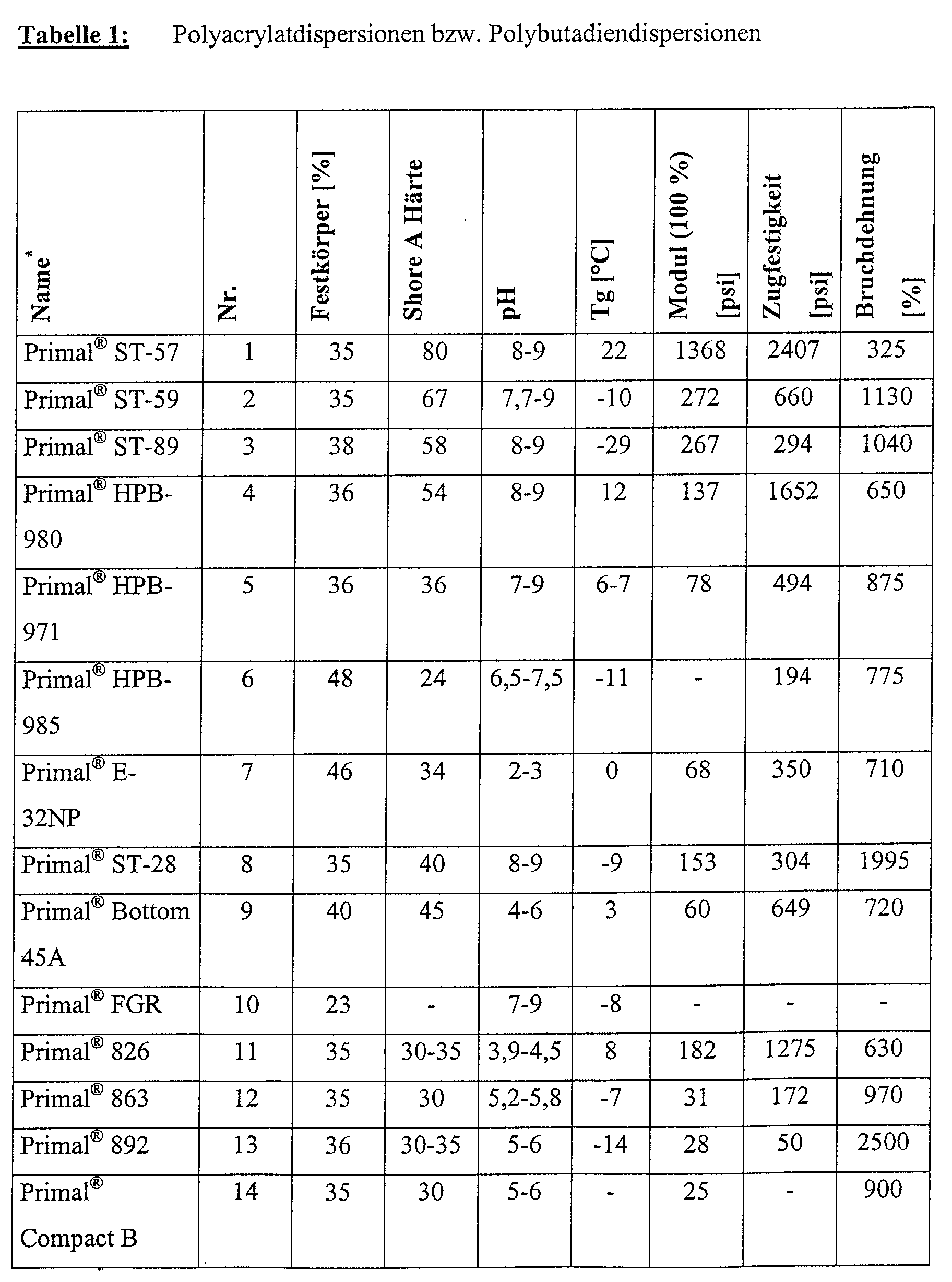
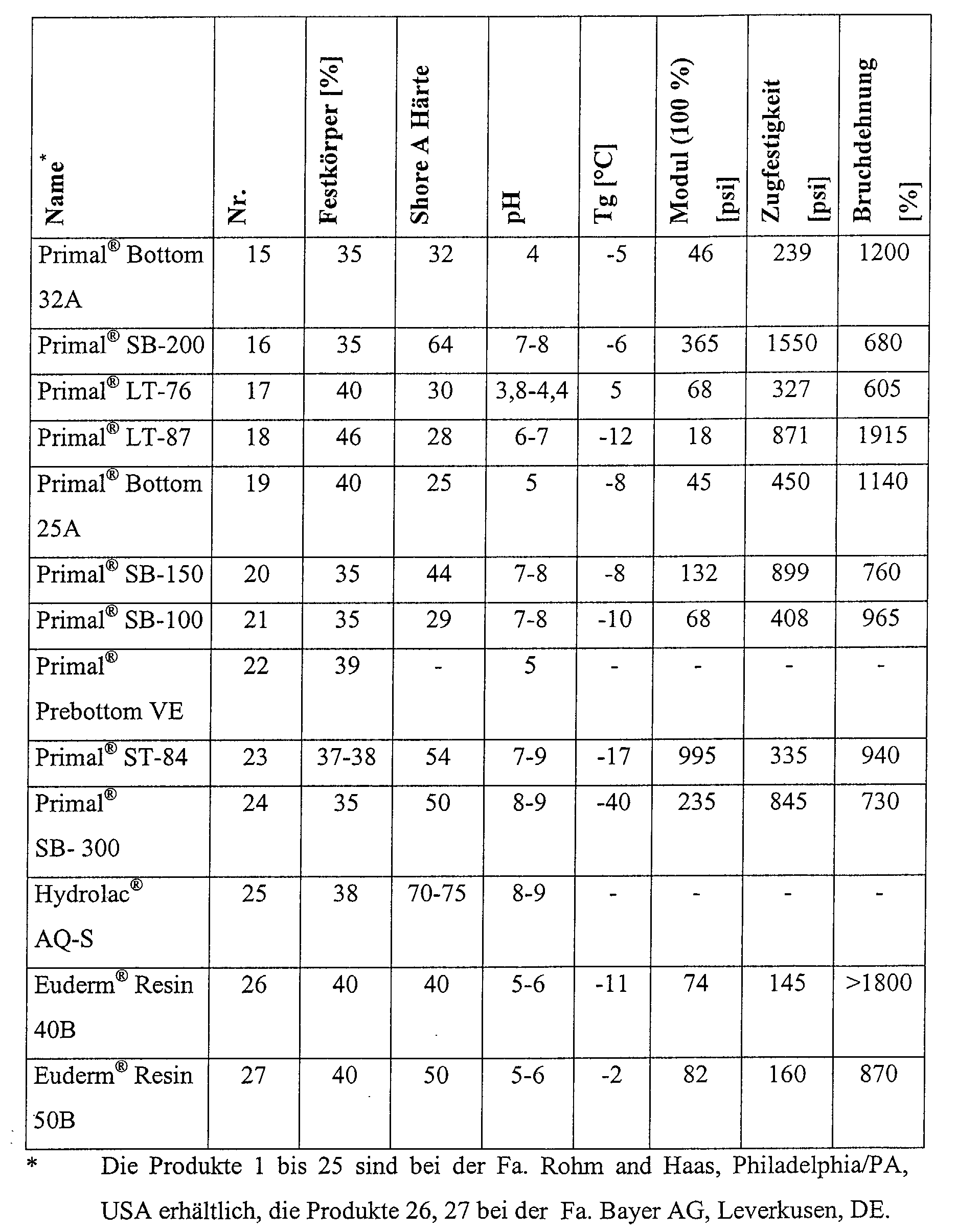
- Preferred aqueous polymer dispersions (A) are polyacrylate dispersions and / or polybutadiene dispersions of the prior art which are suitable in the field of coating flexible substrates, in particular textile and leather coating, such as, for example, polyacrylate dispersions Nos. 1 to 25 (see Table 1).
- Preferred polybutadiene dispersions are, for example, Euderm®-Resin40B and Euderm®-Resin50B (see Table 1, dispersion No. 26-27). If possible, the chemical and physical properties of the dispersions mentioned were listed in Table 1.
- Polyacrylate dispersions of the prior art which are particularly preferred are those in Area of coating of flexible substrates, in particular textile and Leather coatings are suitable, such as Primal® HPB 971, Primal® Bottom 32 A, Primal® SB 100, Primal® SB 150, Primal® SB 200, Primal® SB 300 (see table 1).
- Suitable silica sols (B) are colloidal solutions of amorphous silicon dioxide in water. They are obtained by neutralizing water glass, as described, for example, in Ullmanns Encyklopadie der Technische Chemie, Vol. 21, 4th edition, Verlag Chemie, Weinheim, 1982, Chapter 5, p. 456 ff. Silica sols are, for example, commercial under the brand names Levasil® (Bayer AG, Leverkusen, DE), Ludox® (DuPont, USA), Nalcoag® (Nalco Chemical, USA), Snowtex® (Nissan, Japan) available. The SiO 2 particles have diameters between 1 and 150 nm.
- Preferred silica sols are those whose SiO 2 particles have a diameter between 5 and 100 nm. Silica sols with an average SiO 2 particle diameter of 7 to 50 nm are particularly preferred. Silica sols can be adjusted both basic (pH> 7) and acidic (pH ⁇ 7). The solids content of silica sols is usually between 1 to 60%, preferably 20 to 50% and particularly preferably 25 to 45%.
- aqueous binders can be mixed by mixing the polymer dispersion (A) and the silica sol (B) can be produced by all known mixing techniques.
- the Emulsion polymerization can be done before or after modification with silica sols respectively.
- the possibility of the silica sols before and during the emulsion polymerization is preferred contribute. That in the sense of a solution, emulsion or Suspension polymerisation is synthesized for this purpose in silica sol or in a Silica sol / water mixture made instead of pure water.
- silica sol-modified aqueous polymer dispersions can be stored and shipped and can be processed at any later time.
- aqueous polymer dispersions can be stored and shipped and can be processed at any later time.
- coatings with different properties. So can be soft sticky layers, thermoplastic and rubber-elastic products of various degrees of hardness up to glass-hard thermosets.
- the coating compositions used in the coating composite according to the invention can in addition to the aqueous silica sol-modified polymer dispersions as binders also the auxiliaries and additives known from paint technology, e.g. non-ionic and / or anionic thickeners, fillers, pigments, waxes, gripping agents, Contain dyes, solvents, flow control agents and crosslinkers.
- auxiliaries and additives known from paint technology, e.g. non-ionic and / or anionic thickeners, fillers, pigments, waxes, gripping agents, Contain dyes, solvents, flow control agents and crosslinkers.
- the for the water vapor permeable coating composites are flexible and can be made of wood, metal, Plastic, paper, leather, textiles, felt, glass, or glass fibers are made.
- preferred Substrates are woven and non-woven textiles and leather.
- the water vapor permeable coating composite is / will be one or more flexible substrate (s), on one or both sides with one or several coating agents, which may be the same or different, either coated, coated or impregnated, at least one coating agent silica sol-modified aqueous polymer dispersion, built up from unsaturated Monomers.
- aqueous silica sol-modified polymer dispersions can, if appropriate can be brought to coating viscosity by means of a commercially available thickener and optionally further additives are added.
- the coating compositions can be applied to the substrate in known ways, e.g. by brushing, pouring, knife coating, spraying, rolling, printing or dipping.
- the paint film can be dried at room temperature or at an elevated temperature, but also by baking at up to 200 ° C.
- one or more are generally used Strokes in a row, applied, so that the total thickness of the coating Base and top coat (s) 10 to 100 microns, preferably 20 to 60 microns, is.
- the base coat can also be a paste that dries to a microporous layer can be used as described in DE-A 2 020 153.
- the one after that applied top coat protects the coating composite according to the invention one or more coating (s) and substrate against mechanical stress and abrasion.
- the coating composite according to the invention contains at least one coating agent the aqueous silica sol modified binders.
- binders e.g. Use polyurethane dispersions. are preferred these are permeable to water vapor.
- all of the coating compositions of the invention contain Coating composite the aqueous silica sol-modified polymer dispersions, built up from unsaturated monomers.
- the resulting water vapor permeability of the coating composite according to the invention leads in particular to textiles and leather at the end user significantly improved comfort compared to conventional ones Non-water vapor permeable coatings of the prior art.
- silica sol-modified polymer dispersion POLY 1
- silica sol-modified polymer dispersion POLY 2
- silica sol-modified polymer dispersion POLY 3
- silica sol-modified polymer dispersion POLY 4
- silica sol-modified polymer dispersion POLY 5
- silica sol-modified polymer dispersion POLY 7
- silica sol-modified polymer dispersion POLY 9
- silica sol-modified polymer dispersion POLY 10
- silica sol-modified polymer dispersion POLY 13
- silica sol-modified polymer dispersion POLY 14
- silica sol-modified polymer dispersion POLY 17
- the property profile of the coating composites produced according to the invention is determined in the form of free films for the coating of textile materials.
- the films are made as follows:
- a distance paper can be set in front of the rear roller inserted. With a feeler gauge, the distance between the paper and the front Roller set. This distance corresponds to the film thickness (wet) of the resulting one Coating, and can be adjusted to the desired edition of each stroke become. Coating can also be carried out consecutively in several strokes.
- the products aqueous binders are beforehand reduced by adding ammonia / polyacrylic acid to a viscosity of 4500 mPas) poured onto the gap between the paper and the front roller, the release paper is pulled vertically downwards, with the corresponding film is created. If several strokes are to be applied, each will be single line dried and the paper loaded again.
- the 100% modulus was determined in accordance with DIN 53504 on films larger than 100 ⁇ m thickness.
- the swellings were after 2 hours of storage in ethyl acetate, acetone or toluene calculated by measuring the difference in length and width.
- the water vapor permeability is measured according to the requirements as described in the DS 2109 TM1, the British Textile Technology Group, Manchester, England are deposited.
- the mean particle sizes (the number average is given) of the polymer dispersions were determined by means of laser correlation spectroscopy (device: Malvern Zetasizer 1000, Malver Inst. Limited) on the respective dispersion.
- Polymer dispersion A (polyacrylate dispersion) / silica sol blends with different silica sol types A POLY 1 POLY 2 POLY 3 POLY 4 POLY 5 Solids content [Wt .-%] 35.6 37.3 34.8 34.8 34.8 34.8 PH value 7.36 7.24 7.30 7.26 7.43 7.34 silica sol - G C D e F SiO 2 content with respect to Solids [%] 0 15.0 15.0 15.0 15.0 Average particle size [nm] 73.3 78.9 80.9 85.1 83.4 97.6
- Aqueous formulation (20% dry content) made of wool fat, starch and silicone
- the mixture is identical to the mixture in terms of color, filler and matting agent 2.1); however, only 175 parts of No. 15 acrylate and 105 parts of No. 5 acrylate are used (see table 1). There are 140 parts of silica sol E and 30 parts of water admixed.
- the resulting mixture has a binder / silica sol ratio (ff) of 7: 3.
- the solid content Binder plus silica sol in the mixture corresponds to the solids content the acrylic binder in mixture 2.1).
- the mixtures are each applied with an acrylate thickener an outlet viscosity of 40 sec (DIN cup, 6 mm).
- the water vapor permeability of the leathers produced in this way is determined according to EN 12991 after each step.
- the table shows the results obtained.
Landscapes
- Chemical & Material Sciences (AREA)
- Engineering & Computer Science (AREA)
- Organic Chemistry (AREA)
- Textile Engineering (AREA)
- Chemical Kinetics & Catalysis (AREA)
- Life Sciences & Earth Sciences (AREA)
- General Chemical & Material Sciences (AREA)
- Materials Engineering (AREA)
- Wood Science & Technology (AREA)
- Paints Or Removers (AREA)
- Chemical Or Physical Treatment Of Fibers (AREA)
- Synthetic Leather, Interior Materials Or Flexible Sheet Materials (AREA)
- Laminated Bodies (AREA)
Abstract
Description
| Polymerdispersion A (Polyacrylatdispersion)/Kieselsol Abmischungen mit unterschiedlichen Kieselsoltypen | ||||||
| A | POLY 1 | POLY 2 | POLY 3 | POLY 4 | POLY 5 | |
| Festkörpergehalt [Gew.-%] | 35,6 | 37,3 | 34,8 | 34,8 | 34,8 | 34,8 |
| pH-Wert | 7,36 | 7,24 | 7,30 | 7,26 | 7,43 | 7,34 |
| Kieselsol | - | G | C | D | E | F |
| SiO2-Gehalt bzgl. Festkörper [%] | 0 | 15,0 | 15,0 | 15,0 | 15,0 | 15,0 |
| Mittlere
Teilchengröße [nm] | 73,3 | 78,9 | 80,9 | 85,1 | 83,4 | 97,6 |
| Polymerdispersion A (Polyacrylatdispersion)/ Kieselsol C Abmischungen mit unterschiedlichen Kieselsolanteilen | |||||
| A | POLY 6 | POLY 7 | POLY 8 | POLY 9 | |
| Festkörpergehalt [Gew.-%] | 35,6 | 34,1 | 33,7 | 33,5 | 32,9 |
| pH-Wert | 7,36 | 7,64 | 7,61 | 7,62 | 7,88 |
| SiO2-Gehalt bzgl. Festkörper [%] | - | 17,0 | 22,0 | 28,0 | 45,0 |
| Mittlere Teilchengröße [nm] | 73,3 | 75,3 | 82,0 | 80,3 | 80,9 |
| Modul (100 %) | 0,7 | 2,3 | 3,0 | 4,4 | 8,0 |
| Zugfestigkeit [MPa] | 8,4 | 12,2 | 10,8 | 9,2 | 10,5 |
| Bruchdehnung [%] | 730 | 590 | 500 | 350 | 250 |
| Quellung in Essigester [%] | 955 | 342 | 280 | 266 | 91 |
| Quellung in Aceton [%] | 1139 | 463 | 463 | 284 | 195 |
| Quellung in Toluol [%] | 904 | 463 | 337 | 284 | 237 |
| Wasserdampfdurchlässigkeit [g/m2d] | 3313 | 11957 | 18119 | 19749 | 17937 |
| Polymerdispersion B (Polybutadiendispersion)/ Kieselsol Abmischungen mit unterschiedlichen Kieselsoltypen | ||||||
| B | POLY 10 | POLY 11 | POLY 12 | POLY 13 | POLY 14 | |
| Festkörpergehalt [Gew.-%] | 39,9 | 40,1 | 38,4 | 38,5 | 37,0 | 38,5 |
| pH-Wert | 6,37 | 6,61 | 7,07 | 7,16 | 4,41 | 7,78 |
| Kieselsol | - | G | C | D | H | F |
| SiO2-Gehalt bzgl. Festkörper [%] | - | 15,0 | 15,0 | 15,0 | 15,0 | 15,0 |
| Mittlere Teilchengröße [nm] | 73,6 | 73,4 | 73,3 | 106,3 | 86,0 | 71,2 |
| Polymerdispersion B (Polybutadiendispersion)/Kieselsol C Abmischungen mit unterschiedlichen Kieselsolanteilen | |||||
| B | POLY 15 | POLY 16 | POLY 17 | POLY 18 | |
| Festkörpergehalt [Gew.-%] | 39,9 | 37,9 | 37,6 | 37,5 | 30,8 |
| pH-Wert | 6,29 | 7,12 | 7,33 | 7,70 | 8,50 |
| SiO2-Gehalt bzgl. Festkörper [%] | 0 | 16,3 | 20,6 | 28,0 | 50,9 |
| Mittlere Teilchengröße [nm] | 109,4 | 266,4 | 288,3 | 268,2 | 206,1 |
| B | POLY 15 | POLY 16 | POLY 17 | POLY 18 | |
| Modul (100 %) | 1,1 | 1,3 | 2,1 | 2,8 | 5,3 |
| Zugfestigkeit [MPa] | 11,6 | 6,4 | 13,6 | 12,4 | 11,5 |
| Bruchdehnung [%] | 870 | 600 | 730 | 630 | 540 |
| Quellung in Essigester [%] | 392 | 295 | 252 | 200 | 187 |
| Quellung in Aceton [%] | 1563 | 904 | 463 | 463 | 337 |
| Quellung in Toluol [%] | 536 | 397 | 337 | 284 | 237 |
| Wasserdampfdurchläs sigkeit [g/m2d] | 150 | 5400 | 1200 | 4000 | 14000 |
- 1 Auftrag:
- Rollcoat mit 20 er Rasterwalze, trocknen
- 2 Auftrag:
- Spritzauftrag auf sichtbare Feuchte, danach trocknen und prägen (90°C, 250 bar, 3 sec).
| WDD - Resultate Zurichtung Mischung 2.1 versus Zurichtung modifizierte Mischung 2.2 (Messung nach EN 12991) | ||
| Zurichtschritt | WDD [mg cm-2 h-1] mit Rezeptur 2.1 | WDD [mg cm-2 h-1] mit Rezeptur 2.2 |
| Eingesetztes Leder | 18,1 | 18,1 |
| Nach Rollcoatauftrag | 7,7 | 8,0 |
| Nach Spritzauftrag 1 | 3,8 | 5,5 |
| Nach Prägen | 3,5 | 4,4 |
| Nach Spritzauftrag 2 | 2,3 | 4,2 |
| Nach Appretur | 2,0 | 3,9 |
Claims (8)
- Wasserdampfdurchlässiger Beschichtungsverbund enthaltend ein oder mehrere flexible Substrate, auf welche ein- oder beidseitig, ein oder mehrere Beschichtungsmittel aufgetragen sind, die gleich oder verschieden sein können, dadurch gekennzeichnet, dass mindestens ein Beschichtungsmittel eine kieselsolmodifizierte wässrige Polymerdispersion, aufgebaut aus ungesättigten Monomeren, als Bindemittel enthält.
- Wasserdampfdurchlässiger Beschichtungsverbund gemäß Anspruch 1, dadurch gekennzeichnet, dass die kieselsolmodifizierte wässrige Polymerdispersionenwobei gilt, dass die Prozentangaben sich auf das Gewicht nichtflüchtiger Anteile beziehen und sich zu 100 Gew.-% addieren.(I) 40 bis 95 Gew.-% einer wässrigen Polymerdispersion (A), aufgebaut aus ungesättigten Monomeren und(II) 5 bis 60 Gew.-% einer Kieselsol Dispersion (B) enthält,
- Wasserdampfdurchlässiger Beschichtungsverbund gemäß Anspruch 2, dadurch gekennzeichnet, dass wässrige Polymerdispersionen (A) Polyacrylatdispersionen und/oder Polybutadiendispersionen sind.
- Wasserdampfdurchlässiger Beschichtungsverbund gemäß Anspruch 2, dadurch gekennzeichnet, dass die Kieselsol Dispersionen (B) SiO2-Partikel mit einem Durchmesser zwischen 1 bis 150 nm aufweisen.
- Wasserdampfdurchlässiger Beschichtungsverbund gemäß einem oder mehreren der Ansprüche 1 bis 4, dadurch gekennzeichnet, dass flexible Substrate Holz, Metall, Kunststoff, Papier, Leder, Textilien, Filz, Glas- oder Glasfasern sind.
- Wasserdampfdurchlässiger Beschichtungsverbund gemäß Anspruch 5, dadurch gekennzeichnet, dass flexible Substrate gewebte oder nichtgewebte Textilien und Leder sind.
- Wasserdampfdurchlässiger Beschichtungsverbund gemäß einem oder mehreren der Ansprüche 1 bis 6, dadurch gekennzeichnet, dass alle Beschichtungsmittel wässrige kieselsolmodifizierte Polymerdispersionen, aufgebaut aus ungesättigten Monomeren, enthalten.
- Verfahren zur Herstellung des wasserdampfdurchlässigen Beschichtungsverbundes gemäß Anspruch 1, dadurch gekennzeichnet, dass ein oder mehrere flexible Substrat(e), ein- oder beidseitig mit einem oder mehreren Beschichtungsmittel(n), die gleich oder verschieden sein können, entweder beschichtet, überzogen oder imprägniert wird/werden, wobei mindestens ein Beschichtungsmittel kieselsolmodifizierte wässrige Polymerdispersion, aufgebaut aus ungesättigten Monomeren, enthält.
Applications Claiming Priority (2)
| Application Number | Priority Date | Filing Date | Title |
|---|---|---|---|
| DE10153950 | 2001-11-06 | ||
| DE10153950A DE10153950A1 (de) | 2001-11-06 | 2001-11-06 | Wasserdampfdurchlässiger Beschichtungsverbund |
Publications (2)
| Publication Number | Publication Date |
|---|---|
| EP1312421A2 true EP1312421A2 (de) | 2003-05-21 |
| EP1312421A3 EP1312421A3 (de) | 2004-03-03 |
Family
ID=7704451
Family Applications (1)
| Application Number | Title | Priority Date | Filing Date |
|---|---|---|---|
| EP02023797A Withdrawn EP1312421A3 (de) | 2001-11-06 | 2002-10-25 | Flexibel beschichtetes Laminat |
Country Status (4)
| Country | Link |
|---|---|
| US (1) | US7037590B2 (de) |
| EP (1) | EP1312421A3 (de) |
| JP (1) | JP2003213566A (de) |
| DE (1) | DE10153950A1 (de) |
Cited By (1)
| Publication number | Priority date | Publication date | Assignee | Title |
|---|---|---|---|---|
| WO2007121941A3 (de) * | 2006-04-21 | 2009-01-15 | Evonik Stockhausen Gmbh | Oberflächennachvernetzte superabsorber behandelt mit organischen und anorganischen feinstteilchen |
Families Citing this family (3)
| Publication number | Priority date | Publication date | Assignee | Title |
|---|---|---|---|---|
| JP2004521067A (ja) * | 2000-06-28 | 2004-07-15 | サンダース,イラ | 動物(哺乳動物)における有用な用途を目的とする破傷風毒素の使用方法 |
| GB2449306A (en) * | 2007-05-18 | 2008-11-19 | Univ Sheffield | Composite particles |
| US8709554B2 (en) | 2011-03-14 | 2014-04-29 | Hewlett-Packard Development Company, L.P. | Printable and printed articles |
Family Cites Families (13)
| Publication number | Priority date | Publication date | Assignee | Title |
|---|---|---|---|---|
| GB1447223A (en) * | 1972-07-04 | 1976-08-25 | Vinylize Systems Europ Ltd | Composition and process for colouring sheet materials |
| JPS5324106B2 (de) * | 1974-05-25 | 1978-07-19 | ||
| JPS5884938A (ja) * | 1981-11-13 | 1983-05-21 | Sumitomo Electric Ind Ltd | 電気接点材料 |
| JPS6011503A (ja) | 1983-06-30 | 1985-01-21 | Nippon Paint Co Ltd | 水分散型樹脂組成物 |
| US5258424A (en) | 1988-06-15 | 1993-11-02 | Nippon Paint Co., Ltd. | Aqueous coating composition capable of forming a coating with improved moisture permeability |
| JPH04255767A (ja) * | 1991-02-08 | 1992-09-10 | Nichiban Kenkyusho:Kk | コーティング用組成物および繊維材料 |
| DE4338619C5 (de) * | 1993-11-11 | 2007-12-27 | Saint-Gobain Isover G+H Ag | Beschichtetes Mineralwolleprodukt und Verfahren zu dessen Herstellung |
| ATE167849T1 (de) | 1993-11-11 | 1998-07-15 | Saint Gobain Isover | Mineralwolleprodukt, sowie verfahren zu seiner herstellung, beschichtungsmasse hierfür und deren verwendung |
| WO1997000134A1 (fr) * | 1995-06-19 | 1997-01-03 | Nippon Soda Co., Ltd. | Structure porteuse de photocatalyseur et materiau de revetement photocatalytique |
| US6548149B1 (en) * | 1996-04-24 | 2003-04-15 | Oji Paper Co., Ltd. | Ink jet recording material and process for producing same |
| DE19833920A1 (de) * | 1998-07-28 | 2000-02-03 | Basf Ag | Textile Flächengebilde |
| DE10015600A1 (de) * | 2000-03-29 | 2001-10-04 | Feinchemie Gmbh Sebnitz | Auswaschbeständige Kompositschicht |
| JP2002038377A (ja) * | 2000-07-31 | 2002-02-06 | Dow Corning Toray Silicone Co Ltd | 布帛処理用ジオルガノポリシロキサン/アクリル酸エステル系共重合体エマルジョン組成物および該エマルジョン組成物により処理してなる布帛 |
-
2001
- 2001-11-06 DE DE10153950A patent/DE10153950A1/de not_active Withdrawn
-
2002
- 2002-10-25 EP EP02023797A patent/EP1312421A3/de not_active Withdrawn
- 2002-11-01 US US10/285,749 patent/US7037590B2/en not_active Expired - Fee Related
- 2002-11-05 JP JP2002321627A patent/JP2003213566A/ja not_active Withdrawn
Cited By (2)
| Publication number | Priority date | Publication date | Assignee | Title |
|---|---|---|---|---|
| WO2007121941A3 (de) * | 2006-04-21 | 2009-01-15 | Evonik Stockhausen Gmbh | Oberflächennachvernetzte superabsorber behandelt mit organischen und anorganischen feinstteilchen |
| US9133342B2 (en) | 2006-04-21 | 2015-09-15 | Evonik Degussa Gmbh | Preparation of highly permeable, superabsorbent polymer structures |
Also Published As
| Publication number | Publication date |
|---|---|
| JP2003213566A (ja) | 2003-07-30 |
| US20030138640A1 (en) | 2003-07-24 |
| US7037590B2 (en) | 2006-05-02 |
| DE10153950A1 (de) | 2003-05-22 |
| EP1312421A3 (de) | 2004-03-03 |
Similar Documents
| Publication | Publication Date | Title |
|---|---|---|
| DE69229921T2 (de) | Zusammensetzung, Klebstoff sowie wässrige Emulsion | |
| DE2708442C2 (de) | Verfahren zur Herstellung von modifizierten wäßrigen Kunststoff-Dispersionen | |
| EP0773245B1 (de) | Verwendung einer wässrigen Polymerisatdispersion zur Herstellung von Wasserdampfsperren | |
| EP2791180B1 (de) | Verwendung wässriger polymerisatdispersionen zur verbesserung der resistenz gegenüber chemischen einflüssen | |
| DE69920872T2 (de) | Beschichtungszusammensetzung | |
| EP1904544A1 (de) | Verfahren zur herstellung von emulsionspolymerisaten | |
| DE69417976T2 (de) | Binder, ihre Verfahren zur Herstellung und Verwendung | |
| DE19624280A1 (de) | Verfahren zur Herstellung niedrigviskoser, wässriger Polymerisatdispersionen mit Polymervolumenkonzentrationen von wenigstens 50 Vol.-% | |
| DE69110878T2 (de) | Vernetzbare oberflächenüberzugsmittel und verfahren zu ihrer herstellung. | |
| WO2018141489A1 (de) | Einkomponenten-haftklebstoffzusammensetzung mit auf reversibler vernetzung durch metallsalze beruhenden gelgehalt | |
| EP1323740A2 (de) | Wässrige Polymerdispersionen, ihre Herstellung und ihre Verwendung | |
| EP1290074A1 (de) | Mischungen wässriger bindemittel | |
| EP1846524B1 (de) | Verwendung einer wässrigen polymerdispersion als bindemittel für cellulosische fasern sowie zur herstellung von filtermaterialien | |
| WO2007122089A1 (de) | Verwendung einer wässrigen polymerzusammensetzung als bindemittel für faserförmige oder körnige substrate | |
| EP1977042A1 (de) | Verwendung einer wässrigen polymerzusammensetzung zum imprägnieren von roh-papier | |
| EP1316567B1 (de) | Wässrige Polymerisatdispersion und ihre Verwendung als Wasserdampfsperre | |
| EP1276705B1 (de) | Verfahren zur herstellung beschichteter mineralischer formkörper | |
| DE10153950A1 (de) | Wasserdampfdurchlässiger Beschichtungsverbund | |
| DE4000976A1 (de) | Waessrige polymerisatzubereitungen | |
| EP2038358A1 (de) | Klebstoff-film mit mindestens zwei kontinuierlichen phasen | |
| DE4407842A1 (de) | Schutzkolloid-stabilisierte Polyacrylat-Dispersionen | |
| EP0960891B1 (de) | Verfahren zur Herstellung von vernetzbaren Bindemitteln | |
| EP0866811A1 (de) | Verfahren zur herstellung niedrigviskoser, wässriger polymerisatdispersionen mit polymergehalten von wenigstens 50 vol-% | |
| EP1059315B1 (de) | Verfahren zur Herstellung von Trennmitteldispersionen | |
| EP1323879B1 (de) | Bodenbelagsklebstoffe auf Basis von Emulsionspolymerisaten |
Legal Events
| Date | Code | Title | Description |
|---|---|---|---|
| PUAI | Public reference made under article 153(3) epc to a published international application that has entered the european phase |
Free format text: ORIGINAL CODE: 0009012 |
|
| AK | Designated contracting states |
Designated state(s): AT BE BG CH CY CZ DE DK EE ES FI FR GB GR IE IT LI LU MC NL PT SE SK TR |
|
| AX | Request for extension of the european patent |
Extension state: AL LT LV MK RO SI |
|
| PUAL | Search report despatched |
Free format text: ORIGINAL CODE: 0009013 |
|
| RIC1 | Information provided on ipc code assigned before grant |
Ipc: 7C 09D 133/06 B Ipc: 7C 14C 11/00 B Ipc: 7D 06M 11/79 B Ipc: 7D 06M 15/263 B Ipc: 7B 05D 7/00 A |
|
| AK | Designated contracting states |
Kind code of ref document: A3 Designated state(s): AT BE BG CH CY CZ DE DK EE ES FI FR GB GR IE IT LI LU MC NL PT SE SK TR |
|
| AX | Request for extension of the european patent |
Extension state: AL LT LV MK RO SI |
|
| RAP1 | Party data changed (applicant data changed or rights of an application transferred) |
Owner name: BAYER MATERIALSCIENCE AG |
|
| 17P | Request for examination filed |
Effective date: 20040903 |
|
| AKX | Designation fees paid |
Designated state(s): AT BE BG CH CY CZ DE DK EE ES FI FR GB GR IE IT LI LU MC NL PT SE SK TR |
|
| 17Q | First examination report despatched |
Effective date: 20061122 |
|
| STAA | Information on the status of an ep patent application or granted ep patent |
Free format text: STATUS: THE APPLICATION IS DEEMED TO BE WITHDRAWN |
|
| 18D | Application deemed to be withdrawn |
Effective date: 20070403 |