EP1311552B1 - Procede et dispositif servant a preparer des nanodispersants - Google Patents
Procede et dispositif servant a preparer des nanodispersants Download PDFInfo
- Publication number
- EP1311552B1 EP1311552B1 EP01971919A EP01971919A EP1311552B1 EP 1311552 B1 EP1311552 B1 EP 1311552B1 EP 01971919 A EP01971919 A EP 01971919A EP 01971919 A EP01971919 A EP 01971919A EP 1311552 B1 EP1311552 B1 EP 1311552B1
- Authority
- EP
- European Patent Office
- Prior art keywords
- active ingredient
- substrate
- monomers
- array
- dispersion formulations
- Prior art date
- Legal status (The legal status is an assumption and is not a legal conclusion. Google has not performed a legal analysis and makes no representation as to the accuracy of the status listed.)
- Expired - Lifetime
Links
- 238000000034 method Methods 0.000 title claims abstract description 102
- 239000000203 mixture Substances 0.000 claims abstract description 150
- 238000009472 formulation Methods 0.000 claims abstract description 124
- 239000004480 active ingredient Substances 0.000 claims abstract description 110
- 239000006185 dispersion Substances 0.000 claims abstract description 104
- 239000006104 solid solution Substances 0.000 claims abstract description 52
- 238000006116 polymerization reaction Methods 0.000 claims abstract description 48
- 238000004519 manufacturing process Methods 0.000 claims abstract description 36
- 238000001556 precipitation Methods 0.000 claims abstract description 35
- 239000000178 monomer Substances 0.000 claims description 115
- 239000000758 substrate Substances 0.000 claims description 98
- 230000015572 biosynthetic process Effects 0.000 claims description 91
- 238000003786 synthesis reaction Methods 0.000 claims description 82
- 239000002904 solvent Substances 0.000 claims description 52
- 239000000243 solution Substances 0.000 claims description 47
- 239000002245 particle Substances 0.000 claims description 38
- 238000006243 chemical reaction Methods 0.000 claims description 29
- 230000008569 process Effects 0.000 claims description 28
- 229920000642 polymer Polymers 0.000 claims description 14
- 230000002209 hydrophobic effect Effects 0.000 claims description 12
- 239000012713 reactive precursor Substances 0.000 claims description 10
- 238000005227 gel permeation chromatography Methods 0.000 claims description 9
- 230000003287 optical effect Effects 0.000 claims description 9
- 230000035484 reaction time Effects 0.000 claims description 9
- 238000010526 radical polymerization reaction Methods 0.000 claims description 8
- 230000007935 neutral effect Effects 0.000 claims description 7
- 238000001035 drying Methods 0.000 claims description 5
- 238000002296 dynamic light scattering Methods 0.000 claims description 4
- 238000005259 measurement Methods 0.000 claims description 4
- 239000002243 precursor Substances 0.000 claims description 4
- 238000001694 spray drying Methods 0.000 claims description 4
- 230000002378 acidificating effect Effects 0.000 claims description 3
- 238000004108 freeze drying Methods 0.000 claims description 3
- 238000001291 vacuum drying Methods 0.000 claims description 3
- 238000010539 anionic addition polymerization reaction Methods 0.000 claims description 2
- 230000005540 biological transmission Effects 0.000 claims description 2
- 238000006555 catalytic reaction Methods 0.000 claims description 2
- 238000010538 cationic polymerization reaction Methods 0.000 claims description 2
- 238000006068 polycondensation reaction Methods 0.000 claims description 2
- 238000007151 ring opening polymerisation reaction Methods 0.000 claims 1
- 238000011179 visual inspection Methods 0.000 claims 1
- 229920001577 copolymer Polymers 0.000 description 34
- ZMXDDKWLCZADIW-UHFFFAOYSA-N N,N-Dimethylformamide Chemical compound CN(C)C=O ZMXDDKWLCZADIW-UHFFFAOYSA-N 0.000 description 27
- 239000007787 solid Substances 0.000 description 26
- SMZOUWXMTYCWNB-UHFFFAOYSA-N 2-(2-methoxy-5-methylphenyl)ethanamine Chemical compound COC1=CC=C(C)C=C1CCN SMZOUWXMTYCWNB-UHFFFAOYSA-N 0.000 description 21
- NIXOWILDQLNWCW-UHFFFAOYSA-N 2-Propenoic acid Natural products OC(=O)C=C NIXOWILDQLNWCW-UHFFFAOYSA-N 0.000 description 21
- 239000000463 material Substances 0.000 description 21
- 238000012216 screening Methods 0.000 description 19
- 238000012360 testing method Methods 0.000 description 15
- 239000000376 reactant Substances 0.000 description 14
- JKNCOURZONDCGV-UHFFFAOYSA-N 2-(dimethylamino)ethyl 2-methylprop-2-enoate Chemical compound CN(C)CCOC(=O)C(C)=C JKNCOURZONDCGV-UHFFFAOYSA-N 0.000 description 13
- KFDVPJUYSDEJTH-UHFFFAOYSA-N 4-ethenylpyridine Chemical compound C=CC1=CC=NC=C1 KFDVPJUYSDEJTH-UHFFFAOYSA-N 0.000 description 11
- 238000003491 array Methods 0.000 description 11
- 238000002360 preparation method Methods 0.000 description 11
- 238000005160 1H NMR spectroscopy Methods 0.000 description 10
- CSCPPACGZOOCGX-UHFFFAOYSA-N Acetone Chemical compound CC(C)=O CSCPPACGZOOCGX-UHFFFAOYSA-N 0.000 description 10
- 239000002270 dispersing agent Substances 0.000 description 10
- 239000003999 initiator Substances 0.000 description 10
- 238000005755 formation reaction Methods 0.000 description 9
- KFZMGEQAYNKOFK-UHFFFAOYSA-N Isopropanol Chemical compound CC(C)O KFZMGEQAYNKOFK-UHFFFAOYSA-N 0.000 description 8
- WCUXLLCKKVVCTQ-UHFFFAOYSA-M Potassium chloride Chemical compound [Cl-].[K+] WCUXLLCKKVVCTQ-UHFFFAOYSA-M 0.000 description 8
- 239000000654 additive Substances 0.000 description 8
- 230000002776 aggregation Effects 0.000 description 8
- XLYOFNOQVPJJNP-UHFFFAOYSA-N water Substances O XLYOFNOQVPJJNP-UHFFFAOYSA-N 0.000 description 8
- 238000005054 agglomeration Methods 0.000 description 7
- ZWEHNKRNPOVVGH-UHFFFAOYSA-N 2-Butanone Chemical compound CCC(C)=O ZWEHNKRNPOVVGH-UHFFFAOYSA-N 0.000 description 6
- HEDRZPFGACZZDS-UHFFFAOYSA-N Chloroform Chemical compound ClC(Cl)Cl HEDRZPFGACZZDS-UHFFFAOYSA-N 0.000 description 6
- YMWUJEATGCHHMB-UHFFFAOYSA-N Dichloromethane Chemical compound ClCCl YMWUJEATGCHHMB-UHFFFAOYSA-N 0.000 description 6
- LFQSCWFLJHTTHZ-UHFFFAOYSA-N Ethanol Chemical compound CCO LFQSCWFLJHTTHZ-UHFFFAOYSA-N 0.000 description 6
- OKKJLVBELUTLKV-UHFFFAOYSA-N Methanol Chemical compound OC OKKJLVBELUTLKV-UHFFFAOYSA-N 0.000 description 6
- PPBRXRYQALVLMV-UHFFFAOYSA-N Styrene Chemical compound C=CC1=CC=CC=C1 PPBRXRYQALVLMV-UHFFFAOYSA-N 0.000 description 6
- YXFVVABEGXRONW-UHFFFAOYSA-N Toluene Chemical compound CC1=CC=CC=C1 YXFVVABEGXRONW-UHFFFAOYSA-N 0.000 description 6
- 230000032683 aging Effects 0.000 description 6
- 239000007864 aqueous solution Substances 0.000 description 6
- 125000004432 carbon atom Chemical group C* 0.000 description 6
- 238000013461 design Methods 0.000 description 6
- 239000012071 phase Substances 0.000 description 6
- 125000000129 anionic group Chemical group 0.000 description 5
- 125000002091 cationic group Chemical group 0.000 description 5
- 238000004587 chromatography analysis Methods 0.000 description 5
- 150000001875 compounds Chemical class 0.000 description 5
- 239000002198 insoluble material Substances 0.000 description 5
- 230000003993 interaction Effects 0.000 description 5
- 239000002195 soluble material Substances 0.000 description 5
- SYBYTAAJFKOIEJ-UHFFFAOYSA-N 3-Methylbutan-2-one Chemical compound CC(C)C(C)=O SYBYTAAJFKOIEJ-UHFFFAOYSA-N 0.000 description 4
- ZHNUHDYFZUAESO-UHFFFAOYSA-N Formamide Chemical compound NC=O ZHNUHDYFZUAESO-UHFFFAOYSA-N 0.000 description 4
- 239000004793 Polystyrene Substances 0.000 description 4
- DTQVDTLACAAQTR-UHFFFAOYSA-N Trifluoroacetic acid Chemical compound OC(=O)C(F)(F)F DTQVDTLACAAQTR-UHFFFAOYSA-N 0.000 description 4
- KGBXLFKZBHKPEV-UHFFFAOYSA-N boric acid Chemical compound OB(O)O KGBXLFKZBHKPEV-UHFFFAOYSA-N 0.000 description 4
- 239000004327 boric acid Substances 0.000 description 4
- 239000008366 buffered solution Substances 0.000 description 4
- 238000012512 characterization method Methods 0.000 description 4
- MVPPADPHJFYWMZ-UHFFFAOYSA-N chlorobenzene Chemical compound ClC1=CC=CC=C1 MVPPADPHJFYWMZ-UHFFFAOYSA-N 0.000 description 4
- 239000000084 colloidal system Substances 0.000 description 4
- 239000013078 crystal Substances 0.000 description 4
- 239000000835 fiber Substances 0.000 description 4
- -1 flame retarders Substances 0.000 description 4
- BDAGIHXWWSANSR-UHFFFAOYSA-N methanoic acid Natural products OC=O BDAGIHXWWSANSR-UHFFFAOYSA-N 0.000 description 4
- 229920002223 polystyrene Polymers 0.000 description 4
- 239000001103 potassium chloride Substances 0.000 description 4
- 235000011164 potassium chloride Nutrition 0.000 description 4
- 230000001681 protective effect Effects 0.000 description 4
- 230000006641 stabilisation Effects 0.000 description 4
- 238000011105 stabilization Methods 0.000 description 4
- 238000003756 stirring Methods 0.000 description 4
- 239000002562 thickening agent Substances 0.000 description 4
- OZAIFHULBGXAKX-UHFFFAOYSA-N 2-(2-cyanopropan-2-yldiazenyl)-2-methylpropanenitrile Chemical compound N#CC(C)(C)N=NC(C)(C)C#N OZAIFHULBGXAKX-UHFFFAOYSA-N 0.000 description 3
- 238000005481 NMR spectroscopy Methods 0.000 description 3
- HEMHJVSKTPXQMS-UHFFFAOYSA-M Sodium hydroxide Chemical compound [OH-].[Na+] HEMHJVSKTPXQMS-UHFFFAOYSA-M 0.000 description 3
- 238000010521 absorption reaction Methods 0.000 description 3
- 238000013019 agitation Methods 0.000 description 3
- 150000001408 amides Chemical class 0.000 description 3
- 239000003054 catalyst Substances 0.000 description 3
- 238000007418 data mining Methods 0.000 description 3
- 238000000113 differential scanning calorimetry Methods 0.000 description 3
- 238000007720 emulsion polymerization reaction Methods 0.000 description 3
- 239000011521 glass Substances 0.000 description 3
- 238000000227 grinding Methods 0.000 description 3
- 239000007788 liquid Substances 0.000 description 3
- 238000002156 mixing Methods 0.000 description 3
- 230000006911 nucleation Effects 0.000 description 3
- 238000010899 nucleation Methods 0.000 description 3
- 150000001451 organic peroxides Chemical class 0.000 description 3
- 230000035485 pulse pressure Effects 0.000 description 3
- WSLDOOZREJYCGB-UHFFFAOYSA-N 1,2-Dichloroethane Chemical compound ClCCCl WSLDOOZREJYCGB-UHFFFAOYSA-N 0.000 description 2
- VXNZUUAINFGPBY-UHFFFAOYSA-N 1-Butene Chemical compound CCC=C VXNZUUAINFGPBY-UHFFFAOYSA-N 0.000 description 2
- AFFLGGQVNFXPEV-UHFFFAOYSA-N 1-decene Chemical compound CCCCCCCCC=C AFFLGGQVNFXPEV-UHFFFAOYSA-N 0.000 description 2
- FPSURBCYSCOZSE-UHFFFAOYSA-N 1-ethenoxybutan-1-ol Chemical compound CCCC(O)OC=C FPSURBCYSCOZSE-UHFFFAOYSA-N 0.000 description 2
- LIKMAJRDDDTEIG-UHFFFAOYSA-N 1-hexene Chemical compound CCCCC=C LIKMAJRDDDTEIG-UHFFFAOYSA-N 0.000 description 2
- KWKAKUADMBZCLK-UHFFFAOYSA-N 1-octene Chemical compound CCCCCCC=C KWKAKUADMBZCLK-UHFFFAOYSA-N 0.000 description 2
- OSWFIVFLDKOXQC-UHFFFAOYSA-N 4-(3-methoxyphenyl)aniline Chemical compound COC1=CC=CC(C=2C=CC(N)=CC=2)=C1 OSWFIVFLDKOXQC-UHFFFAOYSA-N 0.000 description 2
- HGINCPLSRVDWNT-UHFFFAOYSA-N Acrolein Chemical compound C=CC=O HGINCPLSRVDWNT-UHFFFAOYSA-N 0.000 description 2
- XKRFYHLGVUSROY-UHFFFAOYSA-N Argon Chemical compound [Ar] XKRFYHLGVUSROY-UHFFFAOYSA-N 0.000 description 2
- KAKZBPTYRLMSJV-UHFFFAOYSA-N Butadiene Chemical compound C=CC=C KAKZBPTYRLMSJV-UHFFFAOYSA-N 0.000 description 2
- SOGAXMICEFXMKE-UHFFFAOYSA-N Butylmethacrylate Chemical compound CCCCOC(=O)C(C)=C SOGAXMICEFXMKE-UHFFFAOYSA-N 0.000 description 2
- UXVMQQNJUSDDNG-UHFFFAOYSA-L Calcium chloride Chemical compound [Cl-].[Cl-].[Ca+2] UXVMQQNJUSDDNG-UHFFFAOYSA-L 0.000 description 2
- RTZKZFJDLAIYFH-UHFFFAOYSA-N Diethyl ether Chemical compound CCOCC RTZKZFJDLAIYFH-UHFFFAOYSA-N 0.000 description 2
- MHAJPDPJQMAIIY-UHFFFAOYSA-N Hydrogen peroxide Chemical compound OO MHAJPDPJQMAIIY-UHFFFAOYSA-N 0.000 description 2
- VQTUBCCKSQIDNK-UHFFFAOYSA-N Isobutene Chemical compound CC(C)=C VQTUBCCKSQIDNK-UHFFFAOYSA-N 0.000 description 2
- RRHGJUQNOFWUDK-UHFFFAOYSA-N Isoprene Chemical compound CC(=C)C=C RRHGJUQNOFWUDK-UHFFFAOYSA-N 0.000 description 2
- BAPJBEWLBFYGME-UHFFFAOYSA-N Methyl acrylate Chemical compound COC(=O)C=C BAPJBEWLBFYGME-UHFFFAOYSA-N 0.000 description 2
- NTIZESTWPVYFNL-UHFFFAOYSA-N Methyl isobutyl ketone Chemical compound CC(C)CC(C)=O NTIZESTWPVYFNL-UHFFFAOYSA-N 0.000 description 2
- UIHCLUNTQKBZGK-UHFFFAOYSA-N Methyl isobutyl ketone Natural products CCC(C)C(C)=O UIHCLUNTQKBZGK-UHFFFAOYSA-N 0.000 description 2
- SECXISVLQFMRJM-UHFFFAOYSA-N N-Methylpyrrolidone Chemical compound CN1CCCC1=O SECXISVLQFMRJM-UHFFFAOYSA-N 0.000 description 2
- CTQNGGLPUBDAKN-UHFFFAOYSA-N O-Xylene Chemical compound CC1=CC=CC=C1C CTQNGGLPUBDAKN-UHFFFAOYSA-N 0.000 description 2
- 238000001016 Ostwald ripening Methods 0.000 description 2
- VYPSYNLAJGMNEJ-UHFFFAOYSA-N Silicium dioxide Chemical compound O=[Si]=O VYPSYNLAJGMNEJ-UHFFFAOYSA-N 0.000 description 2
- CDBYLPFSWZWCQE-UHFFFAOYSA-L Sodium Carbonate Chemical compound [Na+].[Na+].[O-]C([O-])=O CDBYLPFSWZWCQE-UHFFFAOYSA-L 0.000 description 2
- 230000002730 additional effect Effects 0.000 description 2
- 150000001298 alcohols Chemical class 0.000 description 2
- 150000007933 aliphatic carboxylic acids Chemical class 0.000 description 2
- 125000001931 aliphatic group Chemical group 0.000 description 2
- 238000004458 analytical method Methods 0.000 description 2
- 239000012736 aqueous medium Substances 0.000 description 2
- 238000000149 argon plasma sintering Methods 0.000 description 2
- 150000004945 aromatic hydrocarbons Chemical class 0.000 description 2
- 125000003118 aryl group Chemical group 0.000 description 2
- 230000000903 blocking effect Effects 0.000 description 2
- 239000001110 calcium chloride Substances 0.000 description 2
- 229910001628 calcium chloride Inorganic materials 0.000 description 2
- 238000004364 calculation method Methods 0.000 description 2
- 239000011248 coating agent Substances 0.000 description 2
- 238000000576 coating method Methods 0.000 description 2
- 238000007796 conventional method Methods 0.000 description 2
- 238000011161 development Methods 0.000 description 2
- 230000018109 developmental process Effects 0.000 description 2
- ZQMIGQNCOMNODD-UHFFFAOYSA-N diacetyl peroxide Chemical compound CC(=O)OOC(C)=O ZQMIGQNCOMNODD-UHFFFAOYSA-N 0.000 description 2
- 238000009792 diffusion process Methods 0.000 description 2
- 239000003814 drug Substances 0.000 description 2
- 239000000975 dye Substances 0.000 description 2
- 239000000839 emulsion Substances 0.000 description 2
- 238000005516 engineering process Methods 0.000 description 2
- FJKIXWOMBXYWOQ-UHFFFAOYSA-N ethenoxyethane Chemical compound CCOC=C FJKIXWOMBXYWOQ-UHFFFAOYSA-N 0.000 description 2
- 238000000105 evaporative light scattering detection Methods 0.000 description 2
- 238000005189 flocculation Methods 0.000 description 2
- 230000016615 flocculation Effects 0.000 description 2
- 238000005188 flotation Methods 0.000 description 2
- 239000012530 fluid Substances 0.000 description 2
- 235000019253 formic acid Nutrition 0.000 description 2
- 239000007789 gas Substances 0.000 description 2
- 238000004817 gas chromatography Methods 0.000 description 2
- 238000010438 heat treatment Methods 0.000 description 2
- 238000004128 high performance liquid chromatography Methods 0.000 description 2
- 238000002347 injection Methods 0.000 description 2
- 239000007924 injection Substances 0.000 description 2
- 150000002576 ketones Chemical class 0.000 description 2
- 150000003951 lactams Chemical class 0.000 description 2
- 239000007791 liquid phase Substances 0.000 description 2
- 238000011068 loading method Methods 0.000 description 2
- 239000002609 medium Substances 0.000 description 2
- 229940043265 methyl isobutyl ketone Drugs 0.000 description 2
- 239000003607 modifier Substances 0.000 description 2
- 239000002105 nanoparticle Substances 0.000 description 2
- YWAKXRMUMFPDSH-UHFFFAOYSA-N pentene Chemical compound CCCC=C YWAKXRMUMFPDSH-UHFFFAOYSA-N 0.000 description 2
- XIPFMBOWZXULIA-UHFFFAOYSA-N pivalamide Chemical compound CC(C)(C)C(N)=O XIPFMBOWZXULIA-UHFFFAOYSA-N 0.000 description 2
- USHAGKDGDHPEEY-UHFFFAOYSA-L potassium persulfate Chemical compound [K+].[K+].[O-]S(=O)(=O)OOS([O-])(=O)=O USHAGKDGDHPEEY-UHFFFAOYSA-L 0.000 description 2
- 239000011814 protection agent Substances 0.000 description 2
- 238000004062 sedimentation Methods 0.000 description 2
- 239000011734 sodium Substances 0.000 description 2
- CHQMHPLRPQMAMX-UHFFFAOYSA-L sodium persulfate Chemical compound [Na+].[Na+].[O-]S(=O)(=O)OOS([O-])(=O)=O CHQMHPLRPQMAMX-UHFFFAOYSA-L 0.000 description 2
- 238000013112 stability test Methods 0.000 description 2
- 238000012430 stability testing Methods 0.000 description 2
- 239000007858 starting material Substances 0.000 description 2
- 239000011550 stock solution Substances 0.000 description 2
- 239000000126 substance Substances 0.000 description 2
- 239000004094 surface-active agent Substances 0.000 description 2
- 239000000725 suspension Substances 0.000 description 2
- WROMPOXWARCANT-UHFFFAOYSA-N tfa trifluoroacetic acid Chemical compound OC(=O)C(F)(F)F.OC(=O)C(F)(F)F WROMPOXWARCANT-UHFFFAOYSA-N 0.000 description 2
- 229960000834 vinyl ether Drugs 0.000 description 2
- 125000000391 vinyl group Chemical group [H]C([*])=C([H])[H] 0.000 description 2
- 229920002554 vinyl polymer Polymers 0.000 description 2
- 230000000007 visual effect Effects 0.000 description 2
- 239000011782 vitamin Substances 0.000 description 2
- 229940088594 vitamin Drugs 0.000 description 2
- 229930003231 vitamin Natural products 0.000 description 2
- 235000013343 vitamin Nutrition 0.000 description 2
- 238000003260 vortexing Methods 0.000 description 2
- 239000008096 xylene Substances 0.000 description 2
- 229920002818 (Hydroxyethyl)methacrylate Polymers 0.000 description 1
- GPHWXFINOWXMDN-UHFFFAOYSA-N 1,1-bis(ethenoxy)hexane Chemical compound CCCCCC(OC=C)OC=C GPHWXFINOWXMDN-UHFFFAOYSA-N 0.000 description 1
- SKYXLDSRLNRAPS-UHFFFAOYSA-N 1,2,4-trifluoro-5-methoxybenzene Chemical compound COC1=CC(F)=C(F)C=C1F SKYXLDSRLNRAPS-UHFFFAOYSA-N 0.000 description 1
- CYIGRWUIQAVBFG-UHFFFAOYSA-N 1,2-bis(2-ethenoxyethoxy)ethane Chemical compound C=COCCOCCOCCOC=C CYIGRWUIQAVBFG-UHFFFAOYSA-N 0.000 description 1
- ZXHDVRATSGZISC-UHFFFAOYSA-N 1,2-bis(ethenoxy)ethane Chemical compound C=COCCOC=C ZXHDVRATSGZISC-UHFFFAOYSA-N 0.000 description 1
- UEIPWOFSKAZYJO-UHFFFAOYSA-N 1-(2-ethenoxyethoxy)-2-[2-(2-ethenoxyethoxy)ethoxy]ethane Chemical compound C=COCCOCCOCCOCCOC=C UEIPWOFSKAZYJO-UHFFFAOYSA-N 0.000 description 1
- UNMYKPSSIFZORM-UHFFFAOYSA-N 1-(2-ethenoxyethoxy)butane Chemical compound CCCCOCCOC=C UNMYKPSSIFZORM-UHFFFAOYSA-N 0.000 description 1
- HSOOIVBINKDISP-UHFFFAOYSA-N 1-(2-methylprop-2-enoyloxy)butyl 2-methylprop-2-enoate Chemical compound CC(=C)C(=O)OC(CCC)OC(=O)C(C)=C HSOOIVBINKDISP-UHFFFAOYSA-N 0.000 description 1
- CZAVRNDQSIORTH-UHFFFAOYSA-N 1-ethenoxy-2,2-bis(ethenoxymethyl)butane Chemical compound C=COCC(CC)(COC=C)COC=C CZAVRNDQSIORTH-UHFFFAOYSA-N 0.000 description 1
- OZCMOJQQLBXBKI-UHFFFAOYSA-N 1-ethenoxy-2-methylpropane Chemical compound CC(C)COC=C OZCMOJQQLBXBKI-UHFFFAOYSA-N 0.000 description 1
- UZKWTJUDCOPSNM-UHFFFAOYSA-N 1-ethenoxybutane Chemical compound CCCCOC=C UZKWTJUDCOPSNM-UHFFFAOYSA-N 0.000 description 1
- LAYAKLSFVAPMEL-UHFFFAOYSA-N 1-ethenoxydodecane Chemical compound CCCCCCCCCCCCOC=C LAYAKLSFVAPMEL-UHFFFAOYSA-N 0.000 description 1
- HIHSUGQNHLMGGK-UHFFFAOYSA-N 1-ethenoxyhexan-1-ol Chemical compound CCCCCC(O)OC=C HIHSUGQNHLMGGK-UHFFFAOYSA-N 0.000 description 1
- OVGRCEFMXPHEBL-UHFFFAOYSA-N 1-ethenoxypropane Chemical compound CCCOC=C OVGRCEFMXPHEBL-UHFFFAOYSA-N 0.000 description 1
- BDHGFCVQWMDIQX-UHFFFAOYSA-N 1-ethenyl-2-methylimidazole Chemical compound CC1=NC=CN1C=C BDHGFCVQWMDIQX-UHFFFAOYSA-N 0.000 description 1
- JWYVGKFDLWWQJX-UHFFFAOYSA-N 1-ethenylazepan-2-one Chemical compound C=CN1CCCCCC1=O JWYVGKFDLWWQJX-UHFFFAOYSA-N 0.000 description 1
- OSSNTDFYBPYIEC-UHFFFAOYSA-N 1-ethenylimidazole Chemical compound C=CN1C=CN=C1 OSSNTDFYBPYIEC-UHFFFAOYSA-N 0.000 description 1
- PBGPBHYPCGDFEZ-UHFFFAOYSA-N 1-ethenylpiperidin-2-one Chemical compound C=CN1CCCCC1=O PBGPBHYPCGDFEZ-UHFFFAOYSA-N 0.000 description 1
- SRPZJGLJMYOSSU-UHFFFAOYSA-N 1-hydroxybutyl 2-methylbut-2-enoate Chemical compound CCCC(O)OC(=O)C(C)=CC SRPZJGLJMYOSSU-UHFFFAOYSA-N 0.000 description 1
- FFHGJCBXRQUCED-UHFFFAOYSA-N 1-methyl-2-(2-methylphenyl)peroxybenzene Chemical compound CC1=CC=CC=C1OOC1=CC=CC=C1C FFHGJCBXRQUCED-UHFFFAOYSA-N 0.000 description 1
- ZFFMLCVRJBZUDZ-UHFFFAOYSA-N 2,3-dimethylbutane Chemical group CC(C)C(C)C ZFFMLCVRJBZUDZ-UHFFFAOYSA-N 0.000 description 1
- VBZBISQOWJYWCC-UHFFFAOYSA-N 2-(2-carboxypropan-2-yldiazenyl)-2-methylpropanoic acid Chemical compound OC(=O)C(C)(C)N=NC(C)(C)C(O)=O VBZBISQOWJYWCC-UHFFFAOYSA-N 0.000 description 1
- WULAHPYSGCVQHM-UHFFFAOYSA-N 2-(2-ethenoxyethoxy)ethanol Chemical compound OCCOCCOC=C WULAHPYSGCVQHM-UHFFFAOYSA-N 0.000 description 1
- OEPOKWHJYJXUGD-UHFFFAOYSA-N 2-(3-phenylmethoxyphenyl)-1,3-thiazole-4-carbaldehyde Chemical compound O=CC1=CSC(C=2C=C(OCC=3C=CC=CC=3)C=CC=2)=N1 OEPOKWHJYJXUGD-UHFFFAOYSA-N 0.000 description 1
- WVXLLHWEQSZBLW-UHFFFAOYSA-N 2-(4-acetyl-2-methoxyphenoxy)acetic acid Chemical compound COC1=CC(C(C)=O)=CC=C1OCC(O)=O WVXLLHWEQSZBLW-UHFFFAOYSA-N 0.000 description 1
- DPBJAVGHACCNRL-UHFFFAOYSA-N 2-(dimethylamino)ethyl prop-2-enoate Chemical compound CN(C)CCOC(=O)C=C DPBJAVGHACCNRL-UHFFFAOYSA-N 0.000 description 1
- GOXQRTZXKQZDDN-UHFFFAOYSA-N 2-Ethylhexyl acrylate Chemical compound CCCCC(CC)COC(=O)C=C GOXQRTZXKQZDDN-UHFFFAOYSA-N 0.000 description 1
- KZWQJRDCWMDUTQ-UHFFFAOYSA-N 2-[2-(2-penta-1,4-dien-3-yloxyethoxy)ethoxy]ethanol Chemical compound OCCOCCOCCOC(C=C)C=C KZWQJRDCWMDUTQ-UHFFFAOYSA-N 0.000 description 1
- HWSSEYVMGDIFMH-UHFFFAOYSA-N 2-[2-[2-(2-methylprop-2-enoyloxy)ethoxy]ethoxy]ethyl 2-methylprop-2-enoate Chemical compound CC(=C)C(=O)OCCOCCOCCOC(=O)C(C)=C HWSSEYVMGDIFMH-UHFFFAOYSA-N 0.000 description 1
- VUIWJRYTWUGOOF-UHFFFAOYSA-N 2-ethenoxyethanol Chemical compound OCCOC=C VUIWJRYTWUGOOF-UHFFFAOYSA-N 0.000 description 1
- GNUGVECARVKIPH-UHFFFAOYSA-N 2-ethenoxypropane Chemical compound CC(C)OC=C GNUGVECARVKIPH-UHFFFAOYSA-N 0.000 description 1
- JJRDRFZYKKFYMO-UHFFFAOYSA-N 2-methyl-2-(2-methylbutan-2-ylperoxy)butane Chemical compound CCC(C)(C)OOC(C)(C)CC JJRDRFZYKKFYMO-UHFFFAOYSA-N 0.000 description 1
- NDAJNMAAXXIADY-UHFFFAOYSA-N 2-methylpropanimidamide Chemical compound CC(C)C(N)=N NDAJNMAAXXIADY-UHFFFAOYSA-N 0.000 description 1
- RUMACXVDVNRZJZ-UHFFFAOYSA-N 2-methylpropyl 2-methylprop-2-enoate Chemical compound CC(C)COC(=O)C(C)=C RUMACXVDVNRZJZ-UHFFFAOYSA-N 0.000 description 1
- CFVWNXQPGQOHRJ-UHFFFAOYSA-N 2-methylpropyl prop-2-enoate Chemical compound CC(C)COC(=O)C=C CFVWNXQPGQOHRJ-UHFFFAOYSA-N 0.000 description 1
- RZVINYQDSSQUKO-UHFFFAOYSA-N 2-phenoxyethyl prop-2-enoate Chemical compound C=CC(=O)OCCOC1=CC=CC=C1 RZVINYQDSSQUKO-UHFFFAOYSA-N 0.000 description 1
- FRIBMENBGGCKPD-UHFFFAOYSA-N 3-(2,3-dimethoxyphenyl)prop-2-enal Chemical compound COC1=CC=CC(C=CC=O)=C1OC FRIBMENBGGCKPD-UHFFFAOYSA-N 0.000 description 1
- DSSAWHFZNWVJEC-UHFFFAOYSA-N 3-(ethenoxymethyl)heptane Chemical compound CCCCC(CC)COC=C DSSAWHFZNWVJEC-UHFFFAOYSA-N 0.000 description 1
- JPVNTYZOJCDQBK-UHFFFAOYSA-N 3-ethenoxypropan-1-amine Chemical compound NCCCOC=C JPVNTYZOJCDQBK-UHFFFAOYSA-N 0.000 description 1
- GNSFRPWPOGYVLO-UHFFFAOYSA-N 3-hydroxypropyl 2-methylprop-2-enoate Chemical compound CC(=C)C(=O)OCCCO GNSFRPWPOGYVLO-UHFFFAOYSA-N 0.000 description 1
- VFXXTYGQYWRHJP-UHFFFAOYSA-N 4,4'-azobis(4-cyanopentanoic acid) Chemical compound OC(=O)CCC(C)(C#N)N=NC(C)(CCC(O)=O)C#N VFXXTYGQYWRHJP-UHFFFAOYSA-N 0.000 description 1
- MKTOIPPVFPJEQO-UHFFFAOYSA-N 4-(3-carboxypropanoylperoxy)-4-oxobutanoic acid Chemical compound OC(=O)CCC(=O)OOC(=O)CCC(O)=O MKTOIPPVFPJEQO-UHFFFAOYSA-N 0.000 description 1
- DBCAQXHNJOFNGC-UHFFFAOYSA-N 4-bromo-1,1,1-trifluorobutane Chemical compound FC(F)(F)CCCBr DBCAQXHNJOFNGC-UHFFFAOYSA-N 0.000 description 1
- NDWUBGAGUCISDV-UHFFFAOYSA-N 4-hydroxybutyl prop-2-enoate Chemical compound OCCCCOC(=O)C=C NDWUBGAGUCISDV-UHFFFAOYSA-N 0.000 description 1
- FLCAEMBIQVZWIF-UHFFFAOYSA-N 6-(dimethylamino)-2-methylhex-2-enamide Chemical compound CN(C)CCCC=C(C)C(N)=O FLCAEMBIQVZWIF-UHFFFAOYSA-N 0.000 description 1
- HRPVXLWXLXDGHG-UHFFFAOYSA-N Acrylamide Chemical compound NC(=O)C=C HRPVXLWXLXDGHG-UHFFFAOYSA-N 0.000 description 1
- NIXOWILDQLNWCW-UHFFFAOYSA-M Acrylate Chemical compound [O-]C(=O)C=C NIXOWILDQLNWCW-UHFFFAOYSA-M 0.000 description 1
- NLHHRLWOUZZQLW-UHFFFAOYSA-N Acrylonitrile Chemical compound C=CC#N NLHHRLWOUZZQLW-UHFFFAOYSA-N 0.000 description 1
- CIWBSHSKHKDKBQ-JLAZNSOCSA-N Ascorbic acid Natural products OC[C@H](O)[C@H]1OC(=O)C(O)=C1O CIWBSHSKHKDKBQ-JLAZNSOCSA-N 0.000 description 1
- OMPJBNCRMGITSC-UHFFFAOYSA-N Benzoylperoxide Chemical compound C=1C=CC=CC=1C(=O)OOC(=O)C1=CC=CC=C1 OMPJBNCRMGITSC-UHFFFAOYSA-N 0.000 description 1
- WWJCRUKUIQRCGP-UHFFFAOYSA-N CC(C(OCCCN(C)C)=O)=C Chemical compound CC(C(OCCCN(C)C)=O)=C WWJCRUKUIQRCGP-UHFFFAOYSA-N 0.000 description 1
- WWJCRUKUIQRCGP-UHFFFAOYSA-O CC(C([OH+]CCCN(C)C)=O)=C Chemical compound CC(C([OH+]CCCN(C)C)=O)=C WWJCRUKUIQRCGP-UHFFFAOYSA-O 0.000 description 1
- 102000004190 Enzymes Human genes 0.000 description 1
- 108090000790 Enzymes Proteins 0.000 description 1
- VGGSQFUCUMXWEO-UHFFFAOYSA-N Ethene Chemical compound C=C VGGSQFUCUMXWEO-UHFFFAOYSA-N 0.000 description 1
- JIGUQPWFLRLWPJ-UHFFFAOYSA-N Ethyl acrylate Chemical compound CCOC(=O)C=C JIGUQPWFLRLWPJ-UHFFFAOYSA-N 0.000 description 1
- 239000005977 Ethylene Substances 0.000 description 1
- WOBHKFSMXKNTIM-UHFFFAOYSA-N Hydroxyethyl methacrylate Chemical compound CC(=C)C(=O)OCCO WOBHKFSMXKNTIM-UHFFFAOYSA-N 0.000 description 1
- 238000004566 IR spectroscopy Methods 0.000 description 1
- DGAQECJNVWCQMB-PUAWFVPOSA-M Ilexoside XXIX Chemical compound C[C@@H]1CC[C@@]2(CC[C@@]3(C(=CC[C@H]4[C@]3(CC[C@@H]5[C@@]4(CC[C@@H](C5(C)C)OS(=O)(=O)[O-])C)C)[C@@H]2[C@]1(C)O)C)C(=O)O[C@H]6[C@@H]([C@H]([C@@H]([C@H](O6)CO)O)O)O.[Na+] DGAQECJNVWCQMB-PUAWFVPOSA-M 0.000 description 1
- YIVJZNGAASQVEM-UHFFFAOYSA-N Lauroyl peroxide Chemical compound CCCCCCCCCCCC(=O)OOC(=O)CCCCCCCCCCC YIVJZNGAASQVEM-UHFFFAOYSA-N 0.000 description 1
- CERQOIWHTDAKMF-UHFFFAOYSA-N Methacrylic acid Chemical compound CC(=C)C(O)=O CERQOIWHTDAKMF-UHFFFAOYSA-N 0.000 description 1
- VVQNEPGJFQJSBK-UHFFFAOYSA-N Methyl methacrylate Chemical compound COC(=O)C(C)=C VVQNEPGJFQJSBK-UHFFFAOYSA-N 0.000 description 1
- WHNWPMSKXPGLAX-UHFFFAOYSA-N N-Vinyl-2-pyrrolidone Chemical compound C=CN1CCCC1=O WHNWPMSKXPGLAX-UHFFFAOYSA-N 0.000 description 1
- 239000007832 Na2SO4 Substances 0.000 description 1
- PMZURENOXWZQFD-UHFFFAOYSA-L Sodium Sulfate Chemical compound [Na+].[Na+].[O-]S([O-])(=O)=O PMZURENOXWZQFD-UHFFFAOYSA-L 0.000 description 1
- DWAQJAXMDSEUJJ-UHFFFAOYSA-M Sodium bisulfite Chemical compound [Na+].OS([O-])=O DWAQJAXMDSEUJJ-UHFFFAOYSA-M 0.000 description 1
- 229910003074 TiCl4 Inorganic materials 0.000 description 1
- GSEJCLTVZPLZKY-UHFFFAOYSA-N Triethanolamine Chemical compound OCCN(CCO)CCO GSEJCLTVZPLZKY-UHFFFAOYSA-N 0.000 description 1
- OKKRPWIIYQTPQF-UHFFFAOYSA-N Trimethylolpropane trimethacrylate Chemical compound CC(=C)C(=O)OCC(CC)(COC(=O)C(C)=C)COC(=O)C(C)=C OKKRPWIIYQTPQF-UHFFFAOYSA-N 0.000 description 1
- 239000012963 UV stabilizer Substances 0.000 description 1
- XTXRWKRVRITETP-UHFFFAOYSA-N Vinyl acetate Chemical compound CC(=O)OC=C XTXRWKRVRITETP-UHFFFAOYSA-N 0.000 description 1
- BZHJMEDXRYGGRV-UHFFFAOYSA-N Vinyl chloride Chemical compound ClC=C BZHJMEDXRYGGRV-UHFFFAOYSA-N 0.000 description 1
- QYKIQEUNHZKYBP-UHFFFAOYSA-N Vinyl ether Chemical compound C=COC=C QYKIQEUNHZKYBP-UHFFFAOYSA-N 0.000 description 1
- 238000002441 X-ray diffraction Methods 0.000 description 1
- KYIKRXIYLAGAKQ-UHFFFAOYSA-N abcn Chemical compound C1CCCCC1(C#N)N=NC1(C#N)CCCCC1 KYIKRXIYLAGAKQ-UHFFFAOYSA-N 0.000 description 1
- 230000000996 additive effect Effects 0.000 description 1
- 239000000443 aerosol Substances 0.000 description 1
- 238000004220 aggregation Methods 0.000 description 1
- 239000000956 alloy Substances 0.000 description 1
- 229910045601 alloy Inorganic materials 0.000 description 1
- ROOXNKNUYICQNP-UHFFFAOYSA-N ammonium persulfate Chemical compound [NH4+].[NH4+].[O-]S(=O)(=O)OOS([O-])(=O)=O ROOXNKNUYICQNP-UHFFFAOYSA-N 0.000 description 1
- 239000012935 ammoniumperoxodisulfate Substances 0.000 description 1
- 229910052786 argon Inorganic materials 0.000 description 1
- 235000010323 ascorbic acid Nutrition 0.000 description 1
- 229960005070 ascorbic acid Drugs 0.000 description 1
- 239000011668 ascorbic acid Substances 0.000 description 1
- WDIHJSXYQDMJHN-UHFFFAOYSA-L barium chloride Chemical compound [Cl-].[Cl-].[Ba+2] WDIHJSXYQDMJHN-UHFFFAOYSA-L 0.000 description 1
- 229910001626 barium chloride Inorganic materials 0.000 description 1
- 235000019400 benzoyl peroxide Nutrition 0.000 description 1
- KQNZLOUWXSAZGD-UHFFFAOYSA-N benzylperoxymethylbenzene Chemical compound C=1C=CC=CC=1COOCC1=CC=CC=C1 KQNZLOUWXSAZGD-UHFFFAOYSA-N 0.000 description 1
- 229920001222 biopolymer Polymers 0.000 description 1
- LBSPZZSGTIBOFG-UHFFFAOYSA-N bis[2-(4,5-dihydro-1h-imidazol-2-yl)propan-2-yl]diazene;dihydrochloride Chemical compound Cl.Cl.N=1CCNC=1C(C)(C)N=NC(C)(C)C1=NCCN1 LBSPZZSGTIBOFG-UHFFFAOYSA-N 0.000 description 1
- 230000003139 buffering effect Effects 0.000 description 1
- CQEYYJKEWSMYFG-UHFFFAOYSA-N butyl acrylate Chemical compound CCCCOC(=O)C=C CQEYYJKEWSMYFG-UHFFFAOYSA-N 0.000 description 1
- 230000008859 change Effects 0.000 description 1
- 239000003638 chemical reducing agent Substances 0.000 description 1
- 239000003795 chemical substances by application Substances 0.000 description 1
- NEHMKBQYUWJMIP-NJFSPNSNSA-N chloro(114C)methane Chemical compound [14CH3]Cl NEHMKBQYUWJMIP-NJFSPNSNSA-N 0.000 description 1
- 238000010668 complexation reaction Methods 0.000 description 1
- 238000004590 computer program Methods 0.000 description 1
- 238000009833 condensation Methods 0.000 description 1
- 230000005494 condensation Effects 0.000 description 1
- 239000002537 cosmetic Substances 0.000 description 1
- 238000002425 crystallisation Methods 0.000 description 1
- 230000008025 crystallization Effects 0.000 description 1
- 230000001351 cycling effect Effects 0.000 description 1
- XJOBOFWTZOKMOH-UHFFFAOYSA-N decanoyl decaneperoxoate Chemical compound CCCCCCCCCC(=O)OOC(=O)CCCCCCCCC XJOBOFWTZOKMOH-UHFFFAOYSA-N 0.000 description 1
- 238000000151 deposition Methods 0.000 description 1
- 230000000368 destabilizing effect Effects 0.000 description 1
- LSXWFXONGKSEMY-UHFFFAOYSA-N di-tert-butyl peroxide Chemical compound CC(C)(C)OOC(C)(C)C LSXWFXONGKSEMY-UHFFFAOYSA-N 0.000 description 1
- 238000010586 diagram Methods 0.000 description 1
- 125000002147 dimethylamino group Chemical group [H]C([H])([H])N(*)C([H])([H])[H] 0.000 description 1
- 238000009826 distribution Methods 0.000 description 1
- 238000000203 droplet dispensing Methods 0.000 description 1
- 239000000428 dust Substances 0.000 description 1
- SUPCQIBBMFXVTL-UHFFFAOYSA-N ethyl 2-methylprop-2-enoate Chemical compound CCOC(=O)C(C)=C SUPCQIBBMFXVTL-UHFFFAOYSA-N 0.000 description 1
- STVZJERGLQHEKB-UHFFFAOYSA-N ethylene glycol dimethacrylate Substances CC(=C)C(=O)OCCOC(=O)C(C)=C STVZJERGLQHEKB-UHFFFAOYSA-N 0.000 description 1
- 238000001704 evaporation Methods 0.000 description 1
- 239000000945 filler Substances 0.000 description 1
- 239000010408 film Substances 0.000 description 1
- 239000012847 fine chemical Substances 0.000 description 1
- 238000004401 flow injection analysis Methods 0.000 description 1
- 239000007792 gaseous phase Substances 0.000 description 1
- VOZRXNHHFUQHIL-UHFFFAOYSA-N glycidyl methacrylate Chemical compound CC(=C)C(=O)OCC1CO1 VOZRXNHHFUQHIL-UHFFFAOYSA-N 0.000 description 1
- FIKFOOMAUXPBJM-UHFFFAOYSA-N hepta-2,5-dienediamide Chemical compound NC(=O)C=CCC=CC(N)=O FIKFOOMAUXPBJM-UHFFFAOYSA-N 0.000 description 1
- 229920006158 high molecular weight polymer Polymers 0.000 description 1
- 239000004615 ingredient Substances 0.000 description 1
- 238000007641 inkjet printing Methods 0.000 description 1
- 229910001869 inorganic persulfate Inorganic materials 0.000 description 1
- 239000001023 inorganic pigment Substances 0.000 description 1
- 238000011835 investigation Methods 0.000 description 1
- TYQCGQRIZGCHNB-JLAZNSOCSA-N l-ascorbic acid Chemical compound OC[C@H](O)[C@H]1OC(O)=C(O)C1=O TYQCGQRIZGCHNB-JLAZNSOCSA-N 0.000 description 1
- 238000002898 library design Methods 0.000 description 1
- 239000004611 light stabiliser Substances 0.000 description 1
- 238000003760 magnetic stirring Methods 0.000 description 1
- FPYJFEHAWHCUMM-UHFFFAOYSA-N maleic anhydride Chemical compound O=C1OC(=O)C=C1 FPYJFEHAWHCUMM-UHFFFAOYSA-N 0.000 description 1
- 238000013507 mapping Methods 0.000 description 1
- 230000000873 masking effect Effects 0.000 description 1
- 239000011159 matrix material Substances 0.000 description 1
- 238000002844 melting Methods 0.000 description 1
- 230000008018 melting Effects 0.000 description 1
- DCUFMVPCXCSVNP-UHFFFAOYSA-N methacrylic anhydride Chemical compound CC(=C)C(=O)OC(=O)C(C)=C DCUFMVPCXCSVNP-UHFFFAOYSA-N 0.000 description 1
- XJRBAMWJDBPFIM-UHFFFAOYSA-N methyl vinyl ether Chemical compound COC=C XJRBAMWJDBPFIM-UHFFFAOYSA-N 0.000 description 1
- 239000000693 micelle Substances 0.000 description 1
- 238000003801 milling Methods 0.000 description 1
- TVMXDCGIABBOFY-UHFFFAOYSA-N n-Octanol Natural products CCCCCCCC TVMXDCGIABBOFY-UHFFFAOYSA-N 0.000 description 1
- GIHNTNGBUNQYJN-UHFFFAOYSA-N n-but-1-enoxy-n-ethylethanamine Chemical compound CCC=CON(CC)CC GIHNTNGBUNQYJN-UHFFFAOYSA-N 0.000 description 1
- PNLUGRYDUHRLOF-UHFFFAOYSA-N n-ethenyl-n-methylacetamide Chemical compound C=CN(C)C(C)=O PNLUGRYDUHRLOF-UHFFFAOYSA-N 0.000 description 1
- ZQXSMRAEXCEDJD-UHFFFAOYSA-N n-ethenylformamide Chemical compound C=CNC=O ZQXSMRAEXCEDJD-UHFFFAOYSA-N 0.000 description 1
- 230000001537 neural effect Effects 0.000 description 1
- 150000002894 organic compounds Chemical class 0.000 description 1
- 239000012860 organic pigment Substances 0.000 description 1
- 239000003960 organic solvent Substances 0.000 description 1
- PNJWIWWMYCMZRO-UHFFFAOYSA-N pent‐4‐en‐2‐one Natural products CC(=O)CC=C PNJWIWWMYCMZRO-UHFFFAOYSA-N 0.000 description 1
- 150000002978 peroxides Chemical class 0.000 description 1
- 238000005191 phase separation Methods 0.000 description 1
- 230000000704 physical effect Effects 0.000 description 1
- 239000003505 polymerization initiator Substances 0.000 description 1
- 239000000843 powder Substances 0.000 description 1
- FBCQUCJYYPMKRO-UHFFFAOYSA-N prop-2-enyl 2-methylprop-2-enoate Chemical compound CC(=C)C(=O)OCC=C FBCQUCJYYPMKRO-UHFFFAOYSA-N 0.000 description 1
- QQONPFPTGQHPMA-UHFFFAOYSA-N propylene Natural products CC=C QQONPFPTGQHPMA-UHFFFAOYSA-N 0.000 description 1
- 125000004805 propylene group Chemical group [H]C([H])([H])C([H])([*:1])C([H])([H])[*:2] 0.000 description 1
- 102000004169 proteins and genes Human genes 0.000 description 1
- 108090000623 proteins and genes Proteins 0.000 description 1
- 230000005855 radiation Effects 0.000 description 1
- 229920005604 random copolymer Polymers 0.000 description 1
- 150000003839 salts Chemical class 0.000 description 1
- 239000002455 scale inhibitor Substances 0.000 description 1
- 238000013341 scale-up Methods 0.000 description 1
- 238000010008 shearing Methods 0.000 description 1
- 239000000377 silicon dioxide Substances 0.000 description 1
- 238000001542 size-exclusion chromatography Methods 0.000 description 1
- 229910052708 sodium Inorganic materials 0.000 description 1
- 229910000029 sodium carbonate Inorganic materials 0.000 description 1
- CSMWJXBSXGUPGY-UHFFFAOYSA-L sodium dithionate Chemical compound [Na+].[Na+].[O-]S(=O)(=O)S([O-])(=O)=O CSMWJXBSXGUPGY-UHFFFAOYSA-L 0.000 description 1
- 229940075931 sodium dithionate Drugs 0.000 description 1
- 229910052938 sodium sulfate Inorganic materials 0.000 description 1
- GEHJYWRUCIMESM-UHFFFAOYSA-L sodium sulfite Chemical compound [Na+].[Na+].[O-]S([O-])=O GEHJYWRUCIMESM-UHFFFAOYSA-L 0.000 description 1
- 239000007790 solid phase Substances 0.000 description 1
- 238000007614 solvation Methods 0.000 description 1
- 238000004611 spectroscopical analysis Methods 0.000 description 1
- 230000002269 spontaneous effect Effects 0.000 description 1
- 125000004079 stearyl group Chemical group [H]C([*])([H])C([H])([H])C([H])([H])C([H])([H])C([H])([H])C([H])([H])C([H])([H])C([H])([H])C([H])([H])C([H])([H])C([H])([H])C([H])([H])C([H])([H])C([H])([H])C([H])([H])C([H])([H])C([H])([H])C([H])([H])[H] 0.000 description 1
- GJBRNHKUVLOCEB-UHFFFAOYSA-N tert-butyl benzenecarboperoxoate Chemical compound CC(C)(C)OOC(=O)C1=CC=CC=C1 GJBRNHKUVLOCEB-UHFFFAOYSA-N 0.000 description 1
- ISXSCDLOGDJUNJ-UHFFFAOYSA-N tert-butyl prop-2-enoate Chemical compound CC(C)(C)OC(=O)C=C ISXSCDLOGDJUNJ-UHFFFAOYSA-N 0.000 description 1
- CIHOLLKRGTVIJN-UHFFFAOYSA-N tert‐butyl hydroperoxide Chemical compound CC(C)(C)OO CIHOLLKRGTVIJN-UHFFFAOYSA-N 0.000 description 1
- 238000009210 therapy by ultrasound Methods 0.000 description 1
- 238000005382 thermal cycling Methods 0.000 description 1
- 239000010409 thin film Substances 0.000 description 1
- XJDNKRIXUMDJCW-UHFFFAOYSA-J titanium tetrachloride Chemical compound Cl[Ti](Cl)(Cl)Cl XJDNKRIXUMDJCW-UHFFFAOYSA-J 0.000 description 1
- 230000001960 triggered effect Effects 0.000 description 1
- 229940117958 vinyl acetate Drugs 0.000 description 1
- 125000002348 vinylic group Chemical group 0.000 description 1
- 238000009736 wetting Methods 0.000 description 1
- INRGAWUQFOBNKL-UHFFFAOYSA-N {4-[(Vinyloxy)methyl]cyclohexyl}methanol Chemical compound OCC1CCC(COC=C)CC1 INRGAWUQFOBNKL-UHFFFAOYSA-N 0.000 description 1
Classifications
-
- C—CHEMISTRY; METALLURGY
- C08—ORGANIC MACROMOLECULAR COMPOUNDS; THEIR PREPARATION OR CHEMICAL WORKING-UP; COMPOSITIONS BASED THEREON
- C08F—MACROMOLECULAR COMPOUNDS OBTAINED BY REACTIONS ONLY INVOLVING CARBON-TO-CARBON UNSATURATED BONDS
- C08F2/00—Processes of polymerisation
-
- C—CHEMISTRY; METALLURGY
- C08—ORGANIC MACROMOLECULAR COMPOUNDS; THEIR PREPARATION OR CHEMICAL WORKING-UP; COMPOSITIONS BASED THEREON
- C08F—MACROMOLECULAR COMPOUNDS OBTAINED BY REACTIONS ONLY INVOLVING CARBON-TO-CARBON UNSATURATED BONDS
- C08F212/00—Copolymers of compounds having one or more unsaturated aliphatic radicals, each having only one carbon-to-carbon double bond, and at least one being terminated by an aromatic carbocyclic ring
- C08F212/02—Monomers containing only one unsaturated aliphatic radical
- C08F212/04—Monomers containing only one unsaturated aliphatic radical containing one ring
- C08F212/06—Hydrocarbons
- C08F212/08—Styrene
Definitions
- the present invention generally relates to an array of nanoparticular dispersion formulations and a method of making said array.
- the invention can be applied, for example, to search new effective nanodispersants for a stabilization of poorly soluble or insoluble materials in application media, e.g., active ingredients as pharmaceuticals, crop protection agents, vitamins or dye stuffs.
- these nanoparticular dispersion formulations can be screened in parallel or in a rapid serial screening for stability, for example, by optical methods.
- Nanoparticular systems are of interest because of very specific advantages, e.g., coloristic, rheological, nonlinear optical properties, bioavailability, etc.
- Dispersions of particles are generally obtained in two different ways.
- Standard grinding processes starting from solid bulk materials do not typically result in particles with average diameters less than 0,5 ⁇ m.
- Particle size and distribution depends on a variety of parameters like the type of mill or the crushing parts (e.g. silica) used.
- a further problem is to remove the crushing parts after milling. If smaller grinding fractions are needed, often the smaller crushing parts and grinding dust are left in the product yielding a heterogeneous system.
- An alternative is to start from the molecular solution and to form particles by precipitation.
- This process faces problems from Ostwald ripening (crystal growth) and/or particle agglomeration again resulting in sedimentation and/or flotation.
- the precipitation process is induced in a nucleation stage by changing the compatibility with the surrounding medium (solvent system), e.g., by chemical reaction of the substrate, changing or mixing of solvents, changes in pH value, temperature, pressure, or concentration.
- surface-active additives In order to stabilize particular systems, surface-active additives have to be used to inhibit crystal growth and agglomeration in particles of nanometer size.
- Typical additives are low molecular weight tensides or oligomers yielding so-called solubilisates (micelles) with the drawback of very small content of substrate molecules. Solubilisates show no nucleation process at the beginning of particle formation but a micellar solution process of the substrate by the tenside molecules. Unfortunately, the solvation power of the tensides can induce nucleation and crystal growth because of better transportation of substrate molecules through the solvent medium.
- High molecular weight additives are e.g. protective colloids, amphiphilic copolymers, thickeners, etc.
- protective colloids stabilize particles against agglomeration by coating the particle surfaces forming a repulsive interaction (steric and/or electrostatic) between particles and inhibit growth by blocking growing sites at the particle surface
- thickeners stabilize kinetically by slowing down diffusion and particle collision rates.
- An object of the present invention is therefore to provide an experimental strategy to solve the complex precipitation problem that is individual to particular types of substrates.
- the present invention provides an array of n nanoparticular dispersion formulations and a method of making said array, wherein said nanoparticular dispersion formulations each comprise the following components
- the array of n nanoparticular dispersion formulations is made by a parallelized solid solution route.
- said array of n nanoparticular dispersion formulations is made by a parallelized general precipitation route and in a third embodiment said array is made by a parallelized reactive precipitation route.
- the present invention uses, in some embodiments, an alloy of nanodispersants, which may be made by a method of making an array of m nanodispersants by a parallel polymerization process comprising the steps
- an array of 2 or more different nanodispersants on a substrate at known locations thereon is obtained containing a (co)polymer of at least two monomers A and B.
- the present invention also provides an array of 2 or more nandispersants and a method of making an array of m nanodispersants and an array of 2 or more solid solutions and a method of making an array of n solid solutions.
- the present invention provides an array of n nanoparticular dispersion formulations and a method of making said array.
- nanoparticular dispersion formulations each comprise the following components
- the method of making an array of n nanodispersion formulations comprises the following steps
- the complex interactions between a nanodispersant, an active ingredient and an application media in the colloidal state make it impossible to predict an effective nanodispersant for a given active ingredient to stabilize, neither from theoretical calculations nor from formulation experience.
- the method of the present invention provides an experimental strategy to solve the individual complex colloidal stabilization problem of each formulation given in this disclosure. Applying said new method of the present invention the number of nanodispersants and dispersion formulations synthesized can be increased to more than 1000 a day, whereas the number of nanodispersants and dispersion formulations synthesized by conventional methods of the state of the art is about 2 per person. The probability to find an effective nanodispersant for a given active ingredient is therefore much higher by applying the method of the present invention. By said new method of the present invention new effective nanodispersants and new formulations can be discovered in a short development time.
- reaction conditions at different reaction regions can be varied in a controlled manner.
- components employed, concentration of the components, temperature, reaction time, pH-value, and solvent, if employed, etc. can be varied from reaction region to reaction region on the substrate.
- a material having a rigid or semi-rigid surface such as a parallel reactor.
- at least one surface of the substrate will be substantially flat, although in some embodiments it may be desirable to physically separate synthesis regions for different materials with, for example, dimples, wells, vials, raised regions, edged trenches, or the like.
- the substrate itself contains wells, raised regions, edged trenches, etc., which form all or part of the synthesis regions.
- the synthesis regions on said substrate are wells on a microtiter plate reactor or vials of a parallel reactor, which is especially preferred, if a solvent is used in the process of the present invention.
- the synthesis region is a predefined region which is a localized area on a substrate which is, was or is intended to be used for formation of a selected nanoparticular formulation.
- the synthesis region may have any convenient shape, e.g. linear, circular, rectangular, elliptical, cylindrical, wedge-shaped, etc.
- the array of materials is prepared by successively delivering components of materials to predefined synthesis regions on a substrate, and substantially concurrently, reacting the components to form at least two materials.
- a first component of a first material is delivered to a first synthesis region on a substrate, and a first component of a second material is delivered to a second synthesis region on the same substrate.
- Each component can be delivered in either a uniform or gradient fashion to produce either a single stoichiometry, or alternatively, a large number of stoichiometries within a single synthesis region.
- the process is repeated, with additional components, to form a vast array of components at predefined, i.e. known locations on the substrate. Thereafter, the components are concurrently reacted to form at least two materials.
- the components can be sequentially or simultaneously delivered to the synthesis regions on the substrate using any of a number of different delivery techniques.
- the array of of dispersion formulations and the array of solid solutions prepared by parallel design and synthetic techniques are obtained on a substrate of the above mentioned general meaning.
- the embodiment of said substrate may be different depending on the objective.
- a small, precisely metered amount of each reactant component is delivered into each reaction region. This may be accomplished using a variety of delivery techniques, either alone or in combination with a variety of masking techniques. Preferred delivery systems of the present invention are dispensers.
- Dispensers can be utilized to generate diverse combinations of reactant components in the form of droplets (liquids) or powder on a single substrate.
- micropipetting apparatus can be adapted to dispense droplet volumes of 5 nanoliters or smaller from a capillary. Such droplets can fit within a reaction region having a diameter of 300 ⁇ m or less when a non-wetting mask is employed.
- the micropipette is accurately and precisely positioned above the reaction region, as described below, before the reactant solution is deposited.
- the present invention employs a solution depositing an apparatus that resembles devices commonly employed in the ink-jet printing field.
- ink-jet dispensers include, for example, the pulse pressure type, the bubble-jet type and the slit-jet type.
- Such ink-jet dispensers which can be used in the present invention are described in WO 96/11878, which is incorporated herein by reference for all purposes.
- aqueous reactant solutions can for example be delivered from a reservoir of the substrate by an electrophoretic pump.
- the thin capillary connects a reservoir of the reactant with a nozzle of the dispenser.
- a suitable electrophoretic pump is described in WO 96/11878.
- the reactants can be delivered to predefined regions on a substrate either sequentially or simultaneously.
- the reactants are simultaneously delivered to either a single predefined region on the substrate or, alternatively, to multiple predefined regions on the substrate.
- a frame of reference common to the delivery instrument and the substrate is required.
- the reference coordinates of the instrument must be accurately mapped onto the reference coordinates of the substrate.
- only two reference points on the substrate are required to completely map the array of reaction regions.
- the dispenser instrument locates these reference points and then adjusts its internal reference coordinates to provide the necessary mapping. After this the dispenser can move a particular distance in a particular direction and be positioned directly over a known region. Of course, the dispenser instrument must provide precisely repeatable movements. Further, the individual regions of the array must not move with respect to the reference marks on the substrate after the reference marks have been formed.
- suitable moving techniques for moving the dispenser with respect to the substrate is given in WO 96/11878 which incorporated herein by reference for all purposes.
- the present invention relates to a method of making an array of n nanoparticular dispersion formulations, wherein said nanoparticular dispersion formulations each comprise the following components
- the nanodispersant in the present invention is a compound which is compatible with both, the active ingredient and the application media.
- Such compounds are preferably water compatible. This means that substantially no macroscopic phase separation is observed, when the nanodispersant is mixed with the active ingredient and the. application media.
- Such compounds are preferably selected from the group consisting of oligomers and low and high molecular weight polymers with a polymerization degree of more than 2.
- Said nanodispersants are for example selected from the group consisting of protective colloids, amphiphilic copolymers, and thickeners.
- Said nanodispersants may be surface-active additives, which are used to inhibit crystal growth and agglomeration in a particle size of nanometers.
- protective colloids stabilize particles against agglomeration by coating the particle surfaces forming a repulsive interaction (steric or/and electrostatic) between particles and inhibit growth by blocking growing sites at the particle surface
- thickeners stabilize kinetically by slowing down diffusion and particle collision rates.
- (Co)polymers which can act as nanodispersants are for example random copolymers of vinyl monomers, copolymers with controlled architecture/blocks, condensation polymers, etc..
- said nanodispersants are prepared by polymerization of at least 2 monomers A and B, selected from the group consisting of hydrophobic, neutral hydrophilic, cationic and anionic monomers.
- one of said monomers is a hydrophilic monomer and a second monomer is a hydrophobic monomer.
- the application media is the media wherein at least one active ingredient is formulated and employed in form of a nanoparticular system.
- the active ingredient is poorly soluble or insoluble in said application media.
- Homogeneous stable nanoparticular dispersion formulations are of interest because of very specific advantages, e.g. coloristic, rheological, bioavailability, nonlinear optical properties, and other properties.
- the preferred application media of the present invention is an aqueous system, preferably, the aqueous system is pure water or a buffered aqueous solution of pH 2 to 13, more preferably of pH 5 to 9.
- Active ingredient material of interest (in the application media poorly soluble or insoluble material)
- Such active ingredient (material of interest) in said application media is poorly soluble or insoluble.
- Said active ingredient includes solids, liquids and gases.
- said active ingredient is a low molecular weight active ingredient or a biopolymer (i.e. a polynucleotid or a protein).
- Active ingredients which are polymers obtained by emulsion polymerization are not within the scope of the present invention. More preferably, said active ingredient is selected from the group consisting of pharmaceuticals, crop protection agents, vitamins, dye stuffs, organic pigments, inorganic pigments, fine chemicals, catalysts, enzymes, fillers, flame retarders, scale inhibitors, cosmetics, UV and light stabilizers.
- Dispersed phase comprising at least one continuous phase (dispersant), which is usually a liquid phase, and at least one dispersed phase.
- Said dispersed phase may be a solid phase, a liquid phase or a gaseous phase (gas bubbles).
- said dispersed phase includes both, the active ingredient and the nanodispersant Therefore, said dispersion formulations may be emulsions, aerosols or suspensions.
- the average particle size, reported in terms of hydrodynamic radius (as explained in detail later in the specification), of the dispersed particles in said nanoparticular dispersion formulations is usually from 10 nm to 5 ⁇ m, preferably from 10 nm to 500 nm, more preferably from 20 nm to 50 nm.
- the method of the present invention of making an array of n nanoparticular dispersion formulations comprises the following steps:
- the method of making an array of n nanoparticular dispersion formulations comprises the following steps
- n and m are, independent of each other, at least 8, more preferably at least 64, most preferably at least 8 4 , and especially n and m are independent of each other at least 8 6 .
- the method of the present invention of how to find new nanodispersants can be divided in loops of the steps a) a method of making an array of m nanodispersants by a parallel polymerization process (design and synthesis of copolymer libraries), b) optionally characterizing said nanodispersants, c) making an array of n nanoparticular dispersion formulations (preparation of formulations), d) parallelized characterizing of the obtained nanoparticular dispersion formulations (characterization of nanoparticular stability).
- step e) data mining for lead structures of (co)polymers and structure-property-relationships.
- the number of loops is usually from 1 to 10. Depending on the respective dispersion formulation to be synthesized said number may be higher than 10.
- step a) the method of making an array of m nanodispersants
- libraries of potentially suitable (co)polymers are designed.
- this invention provides useful methods for an integrated combinatorial materials science research program for the discovery of novel nanodispersions for a particular active ingredient.
- the research program has the goal of creating a nanodispersion using a dispersant that will disperse a desired active ingredient in the desired media (e.g., typically water or a buffered aqueous solution).
- the active ingredient is limited to a single species or a single combination of species, in this invention and the work-flow begins with the identification of the desired active ingredient.
- One or more combinatorial libraries of polymer nanodispersants are then designed for the chosen active ingredient.
- Time is saved because the computer program transfers a recipe file of automated calculated and cross-checked concentrations of ingredients e.g. monomers, initiators, control agents, additives, etc. into an instruction protocol for a robot.
- the robot fills the individual reaction chambers of parallel reactors (synthesis regions) and controls the polymerization reaction (i.e. reaction time, temperature, etc.).
- Step a) A method of a making an array of m nanodispersants by a parallel polymerization process of at least 2 monomers A and B
- the polymerization process is a standard polymerization reaction in a solvent or in bulk selected from the group consisting of radical polymerization, cationic polymerization, anionic polymerization, polycondensation, polyaddition, polymer analogous reactions, living radical polymerization, homogeneously catalyzed reactions.
- nanodispersants are prepared by polymerization of 2 to 6 different monomers, more preferably 2 to 5 different monomers and most preferably 2 or 4 different monomers.
- adding complexity to a nanodispersant may be desirable and this invention allows, for example, starting with three monomers and adding a fourth, etc.
- the monomers A and B are preferably selected from the group consisting of hydrophobic, neutral hydrophilic, cationic and anionic monomers.
- one of said monomers is a hydrophobic monomer and a second monomer is one of said monomers selected from the group consisting of hydrophobic, neutral hydrophilic, cationic and anionic monomers. More preferably, one of said monomers is a hydrophobic monomer and a second monomer is a hydrophilic monomer which may comprise acidic or basic groups.
- Suitable monomers are for example 1,4-cyclohexane dimethanol divinyl ether, 1,4-cyclohexane dimethanol monovinyl ether, 1-butene, 1-decene, 1-hexene, 1-octene, 1-pentene, 2-methyl-N-vinylimidazole, vinyl 4-tert.-butylbenzoate, acrolein, acrylamide, acrylonitrile, acrylic acid, allyl methacrylate, ⁇ -methylstryrene, butadiene, butanediol dimethacrylate, butanediol vinylether, butanediol monoacrylate, butanediol monovinyl ether, butanediol methylmethacrylate, butylacrylate, butylmethacrylate, cyclohexyl vinyl ether, diethyleneglycole divinyl ether, dimethylamino ethylacrylate, dimethylamino
- initiators for example initiators, catalysts, starters and modifiers.
- the polymerization process is a radical polymerization to produce random radical (co)polymers.
- Preferred monomers A and B (and optionally further monomers C, D, ....) for use in the radical polymerization are non-polar monomers, for example polar monomers comprising acidic groups, for example polar monomers comprising neutral groups, for example and polar monomers comprising basic groups, for example
- Suitable initiators which may be employed in said radical polymerization are polymerization initiators known in the art, for example hydrogen peroxide, inorganic persulfates, for example sodium peroxodisulfate, potassium peroxodisulfate and ammonium peroxodisulfate, and organic compounds like organic peroxides, peroxyesters, percarbonates and organic azo compounds.
- Suitable organic peroxides are for example diacetyl peroxide, dibenzyl peroxide, succinyl peroxide, di-tert.-butyl peroxide, tert.-butyl perbenzoate, tert.-butyl pivalate, tert.-butyl permaleinate, cumene hydroperoxide, diisopropyl peroxodicarbamate, bis-(o-toluolyl) peroxide, didecanoyl peroxide, dilauroyl peroxide, tert.-butyl hydroperoxide, tert.-butyl perisobutyrate, tert.-butyl peracetate, di-tert.-amyl peroxide, dibenzoyl peroxide, tert.-butyl perpivalate, tert.-amyl perpivalate, tert.-butyl perneodecanoate and mixtures of said initiators.
- Suitable azo compounds are for example 2,2'-azo-bis-(2-amindinopropane) dihydrochloride, 2,2'-azo-bis-(N,N'-dimethylene) iso-butyramidine dihydrochloride, 2-(carbamoylazo)isobutyric nitril, 4,4'-azo-bis(4-cyanovaleric acid), 4,4'-dimethyl-2(phenylazo)-valeric nitril, 4-methoxy-2,4-dimethyl-2-(phenylazo)valeric nitril, 1,1'-azo-bis-(cyclohexane-1-carbonitril), 2,2'-azo-bis-(isobutyronitril), 2,2'-azo-bis-(2,4-dimethyl-valeric nitril), 2,2'-azo-bis-[2-(2-imidazoline-2-yl)propane] dihydrochloride, 2,2'-azo-bis
- Said peroxides may be employed in combination with reducing agents, for example Fe(SO 4 ), Na 2 SO 3 , NaHSO 3 , sodium dithionate, triethanolamin and ascorbic acid. Additionally, the poymerization reaction may initiated by a photo initiator and irradiation with UV-light or by influence of high energy radiation.
- reducing agents for example Fe(SO 4 ), Na 2 SO 3 , NaHSO 3 , sodium dithionate, triethanolamin and ascorbic acid.
- the poymerization reaction may initiated by a photo initiator and irradiation with UV-light or by influence of high energy radiation.
- polymerization reaction is conducted in an aqueous medium, preferably sodium or potassium peroxodisulfate are employed. If the polymerization reaction is conducted in bulk or in an organic solvent, preferably soluble initiators, for example organic peroxides, are employed.
- Said initiators are employed in amounts known in the art, for example in amounts of 0.2 to 20 % by weight, preferably 1.0 to 10 % by weight, relating to the amount of monomers employed.
- step a) is carried out in a solvent which is suitable to dissolve the monomers and the polymer.
- Preferred solvents are selected from the group consisting of aliphatic carboxylic acids with 1 to 3 carbon atoms, their amides, their mono-C 1 -C 4 -alkyl amides and di-C 1 -C 4 alkyl amides, aliphatic and aromatic chlorohydrocarbons, alcohols of 1 to 5 carbon atoms, for example isopropanol, ketones of 3 to 6 carbon atoms, for example acetone, aromatic hydrocarbons, N-alkylated lactams and mixtures of these.
- preferred solvents are water, methanol, ethanol, isopropanol, formic acid, formamide, dimethylformamide, dimethylpropionamide, N-methylpyrrolidone, methylene chloride, chloroform, 1,2-dichloroethane, chlorobenzene, toluene, xylene, acetone, methylethylketone, methylisopropylketone, methylisobutylketone and mixtures of these.
- step a) comprises the steps
- I and m are independent of each other at least 2 with the proviso that k is ⁇ 2.
- k and m are at least 8, more preferably at least 64, most preferably at least 8 4 , and especially n and m are independent of each other at least 8 6 .
- the number k of said physically separate synthesis regions on the substrate is larger than the number m of said nanodispersants. This means that not all of the physically separate synthesis regions on the substrate are filled up in order to leave blanks or standards.
- said physically separate synthesis regions on said substrate are wells on a microtiter plate reactor or vials of a parallel reactor.
- a parallel reactor which may be used in the present invention is described for example in WO 00/09255, which is incorporated herein by reference.
- the volume of said wells or vials is usually at most 100 ml, preferably at most 10 ml, more preferably at most 1 ml and most preferably from 200 to 1000 ⁇ l.
- Said parallel polymerization to produce said nanodispersants of the present invention provides a method to produce a high number of nanodispersants which can be synthesized in one day.
- said parallel polymerization process provides a process for the production of 100 to 100,000, preferably more than 1000 to 100,000, more preferably 10,000 to 100,000 nanodispersants a day.
- Said at least 2 monomers A and B, said solvent and optionally said other components appropriate for the employed polymerization process can be delivered to said synthesis regions on said substrate by a method for delivery of reactant components as mentioned above.
- said at least two monomers A and B, said solvent and said other useful components appropriate for the employed polymerization process are delivered to said synthesis regions on said substrate from a pipette by automated and/or parallel delivering.
- the components are delivered to said synthesis regions on said substrate from an ink-jet dispenser selected from the group consisting of a pulse pressure ink-jet dispenser, a bubble-jet ink-jet dispenser and a slit jet ink-jet dispenser.
- the moving of the dispenser with respect to the substrate is realized as mentioned above.
- step a1 the delivering of said at least 2 monomers A and B, optionally a solvent and optionally other components appropriate for the employed polymerization process to each synthesis region on a substrate having k physically separate synthesis regions for m different nanodispersants (step a1) comprises the following steps:
- the array of polymer dispersants can be cleaned, washed or otherwise treated as those of skill in the art are aware.
- the array of polymer dispersants may be used one or more times to form a nanodispersion array or library using the different routes as discussed herein.
- the nanodispersants in the array can be screened to determine if the desired material was prepared (for example through testing a random selection of the nanodispersants or "spot" testing or more complete testing) in a manner known in the art, such as using rapid chromatography techniques (see, e.g., PCT/US99/07304).
- the nanodispersants in the array can be screened for example by extended GPC (gel permeation chromatography), accelerated GPC, rapid GPC, rapid gradient HPLC (high pressure liquid chromatography), flow injection analysis or NMR (nuclear magnetic resonance spectroscopy), GC (gas chromatography) or IR (infrared spectroscopy).
- extended GPC gel permeation chromatography
- accelerated GPC rapid GPC
- rapid gradient HPLC high pressure liquid chromatography
- GC gas chromatography
- IR infrared spectroscopy
- the nanodispersants obtained are characterized for molecular weight (Mw) and monomer conversion by rapid GPC.
- Said characterization of the nanodispersants in step b) is useful to optimize the conditions of the synthesis of said nanodispersants prior to the screening process. It is also very useful to characterize the most promising leads and hits identified by the screening process.
- Step c) Method of making an array of n nanoparticular dispersion formulations, by
- a solution of at least one of said nanodispersants and a solution of one active ingredient or a combination of more than one active ingredients are mixed in the same or in compatible solvents in similar parallel geometries, i.e. microtiter plates.
- the mixing process can be assisted by moderate stirring or vortexing.
- the solvent will be evaporated e.g. by vacuum under simultaneous IR irradiation.
- the molecular disperse solid solution formed by this process can be analyzed by X-ray diffraction (missing Bragg peaks), DSC (differential scanning calorimetry) or optical transmission.
- the redispersion process is triggered by adding a non-solvent of the active ingredient, e.g. water, also potentially assisted by moderate stirring, vortexing or ultrasonic treatment A nanoparticular formulation is made by this redispersion process in a successful case.
- the parallelized solid solution route of step c1) comprises the following steps:
- Said nanodispersants as well as said active ingredient may be delivered to each synthesis region for example in form of their solutions, suspensions, emulsions, dispersions or in bulk or gaseous form, depending on their physical properties.
- the solvents to dissolve said at least one nanodispersant and said active ingredient are depending on the nature of the active ingredient and the nanodispersant.
- Suitable solvents are for example selected from the group consisting of aliphatic carboxylic acids with 1 to 3 carbon atoms, their amides, their mono-C 1 -C 4 -alkyl amides and di-C 1 -C 4 alkyl amides, aliphatic and aromatic chlorohydrocarbons, alcohols of 1 to 5 carbon atoms, for example isopropanol, ketones of 3 to 6 carbon atoms, for example acetone, aromatic hydrocarbons, N-alkylated lactams and mixtures of these.
- preferred solvents are methanol, ethanol, isopropanol, formic acid, formamide, dimethylformamide, dimethylpropionamide, N-methylpyrrolidone, methylene chloride, chloroform, 1,2-dichloroethane, chlorobenzene, toluene, xylene, acetone, methylethylketone, methylisopropylketone, methylisobutylketone and mixtures of these.
- the solid solutions are formed by evaporating the solvent e.g. by a vacuum under simultaneous IR irradiation.
- said solid solutions are formed by spray drying, vacuum drying or lyophilization or other drying techniques, for example by circulating warm dry air across the samples at ambient pressure.
- step of delivering at least one of said nanodispersants and said active ingredient (c11) to the synthesis regions on the substrate can be realized as mentioned above.
- said step of delivering said components comprises the following steps:
- the at least one nanodispersant and the active ingredient can be delivered to each synthesis region on said substrate by a method for delivery of reactant components as mentioned above.
- said at least one nanodispersant and said active ingredient are delivered to said synthesis regions on said substrate from a pipette by automated and/or parallel delivering.
- said components are delivered by an ink-jet dispenser selected from the group consisting of a pulse pressure ink-jet dispenser, a bubble-jet ink-jet dispenser and a slit jet ink-jet dispenser.
- the solution of the at least one nanodispersant in the application media and the active ingredient are mixed in a way that for the resulting mixture of solvents the saturation concentration of the active ingredient will be exceeded. This ends up in a spontaneous formation of nanoparticular structures. In this process the state of aggregation of the active ingredient will be changed, not its chemical identity. This can be achieved by two chemically different solvents or with the same solvent by changing e.g. pH value, ionic strength or temperature.
- the process conditions can vary in this parallel precipitation, e.g. droplet dispensing or injection of the solution of the at least one active ingredient with a parallel robot to the solution of the at least one nanodispersant or a mixing chamber with defined flow rates and contact times between the solutions of the at least one nanodispersant and the active ingredient.
- step c2) comprises the following step
- the solvents are depending of the nature of the active ingredient and the nanodispersant Suitable solvents are the same as mentioned under c1).
- said physically separate synthesis regions on said substrate are wells on a microtiter plate reactor or vials of a parallel reactor.
- the step of delivering a solution of at least one of said nanodispersants and a solution of said active ingredient (c21) each comprises the following steps:
- Reactive precursors of the active ingredient can be stabilized by at least one nanodispersant in a way that the reaction resulting in the final substrate occurs in nanoparticles of a nanoparticular dispersion formulation.
- first the reaction of one or more precursors of the active ingredient producing the final active ingredient is finished and afterwards the at least one nanodispersant stabilizes the substrate in form of nanoparticles of a nanoparticular dispersion formulation.
- Process conditions are similar as described in c2).
- Reactions can be chemical reactions, salt formations, or complexations.
- Active ingredients which are polymers obtained by emulsion polymerization are not within the scope of the present invention.
- the parallelized reactive precipitation route (c3) comprises the following steps
- the nanodispersant and the reactive precursors may be delivered to each synthesis region in any order.
- Suitable reactive precursors are for example CaCl 2 + Na 2 CO 3 , BaCl 2 + Na 2 SO 4 , TiCl 4 + NaOH and CaCl 2 + Na 2 C 2 O 4 .
- Active ingredients which are polymers obtained by emulsion polymerization are not within the scope of the present invention.
- said physically separate synthesis regions on said substrate are wells on a microtiter plate reactor or vials of a parallel reactor.
- the at least one nanodispersant and the precursor of said active ingredient are delivered to the synthesis regions on the substrate by methods for delivery of reactant components as mentioned above.
- Preferred methods for the delivery of reactant components are the same methods as mentioned under c1).
- the step of delivering a solution of a reactive precursor of said active ingredient and a solution of said at least one nanodispersant each comprises the following steps
- Said parallel preparation to produce said nanoparticular dispersion formulations of the present invention provides a method to produce a high number of nanoparticular dispersion formulations which can be synthesized in one day.
- said parallel preparation process provides a process for the production of 100 to 100,000, preferably more than 1000 to 100,000, more preferably 10,000 to 100,000 of nanoparticular dispersion formulations a day.
- this invention utilizes a method for screening the results of the formulation work described above.
- the general route is particularly important in combinatorial materials science where an object is to form vast arrays of different formulations for testing in different applications so that a combinatorial materials science program for nanodispersion formulation can be effectively implemented using the methods of this invention.
- a large compositional space for the nanodispersants may be rapidly explored through the preparation of compositional gradients within a binary (A,B) or ternary composition space of monomers (A, B, and C) or composition spaces of orders higher than 3.
- Such a composition space may be studied through the creation of a matrix of ratios containing 0-100% for each monomer.
- a focused second array limited to a compositional range of interest may be examined with a finer gradient. This process can continue as long as the screening can meaningfully distinguish between neighboring array elements.
- this invention provides useful methods for an integrated combinatorial materials science research program for the discovery of novel nanodispersions for a particular active ingredient.
- the research program has the goal of creating a nanodispersion using a dispersant that will disperse a desired active ingredient in the desired media (e.g., typically water or a buffered aqueous solution).
- the work-flow begins with the identification of the desired active ingredient.
- One or more combinatorial arrays of polymer nanodispersants are then designed for the chosen active ingredient.
- the useful monomers for design of the nanodispersant are typically grouped into 4 categories, including hydrophobic, neutral hydrophilic, cationic and anionic. These categories may be further sub-categorized by additional properties, for example, hydrophobic monomers may be sub-categorized into the monomers that provide the ability for ⁇ -stacking, large steric structures, etc. As discussed herein, and elsewhere (see e.g., PCT/US00/00418) the monomers for a nanodispersant array are typically prepared by parallel polymerization.
- the nanodispersants in the array can be screened to determine if the desired material was prepared (for example through testing a random selection of the nanodispersants or "spot" testing or more complete testing) in a manner known in the art, such as using rapid chromatography techniques (see, e.g., PCT/US99/07304).
- the array of polymer dispersants may be used one or more times to form a nanodispersion array using the different routes as discussed herein.
- the quantity of dispersant is large enough to be used for several preparations of nanodispersant arrays, for example, through daughtering the dispersant array into or onto several substrates (such as microtiter plates having wells).
- the preparation of the arrays or libraries of nanodispersions proceeds through one of the routes discussed in detail above, including the solid solution route, the general precipitation route and the reactive precipitation route.
- the arrays of nanodispersions are "screened" for a property of interest.
- a “screen” is a test performed on one or more members of a library of materials to determine if a property or compound of interest is present.
- a screen may be simple and provide only minimal information or data or may be more complex and provide complex information or data.
- screening is divided up into levels depending on the type and amount of information that is provided. The first level is a primary screen, which is the fastest or highest throughput screening level. A primary screen, because of the need for fast rates, should be able to screen arrays at a pace that accommodates the method of array preparation.
- the primary screen should be able to screen in a day the nanodispersion arrays that are formulated in a day, with the formulation rate begin adjusted to accommodate screening and/or vice versa.
- a primary screen will test and determine at least one property or compound in the members of the array.
- a primary screen here will typically be either a parallel visual screen, parallel optical screen or high throughput chromatography, which parallel visual or optical screening being preferred.
- the next level is secondary screening, which is testing to provide more information on array members that pass the primary screen.
- secondary screening will require preparation of larger quantities of the nanodispersions that pass the primary screen and in other embodiments, the secondary screen will be performed on arrays that have been created from those members of arrays that have passed the primary screen (e.g., an array constructed only of members from previous libraries). Since secondary screening typically is performed on fewer samples than primary screening, the secondary screen may typically take longer than the primary screen and provides additional data.
- the secondary screen can be chosen from the same list of screens discussed herein, but may also include a stability test, melting point tests (e.g., such as differential scanning calorimetry), pH testing, chromatography (e.g., size exclusion chromatography), spectroscopy (e.g., UV-VIS absorption), dynamic light scattering for measuring the average particle size, for example FOQELS and FODLS (Fiber Optic Dynamic Light Scattering) or another test to determine composition of matter or another test as is known to those of skill in the nanodispersion art.
- melting point tests e.g., such as differential scanning calorimetry
- pH testing e.g., pH testing
- chromatography e.g., size exclusion chromatography
- spectroscopy e.g., UV-VIS absorption
- dynamic light scattering for measuring the average particle size, for example FOQELS and FODLS (Fiber Optic Dynamic Light Scattering) or another test to determine composition of matter or another test as is known to those
- stability screening can be performed by observing the stability of the nanodispersion array member(s) at a first time and possibly a second time and determining any change in nanodispersion stability.
- stability is determined by testing the size of the dispersed phase (e.g., by light scattering) or the composition of the nanodispersion (e.g., by chromatography) or visually to observe whether a nanodispersion has formed.
- the first time will be near to time of nanodispersion formation and can range from 2 minutes to as much as 48 hours, with less than 24 hours being preferred.
- Stability at a first time may be a typical primary screen, e.g., it determines if a nanodispersion has formed at all.
- the second time for stability determination can be at about 24 hours from the time of nanodispersion formation to as much as 1, 2, 3 or 4 weeks from the time of formation. This provides longer term stability testing.
- Another option is aging of the nanodispersions between two or more stability tests. Aging of the nanodispersions can be accomplished through thermocycling, shearing, shaking or stirring the formulations. Thermocycling is preferred, with the temperature for cycling varying from room temperature to up to 75°C, and preferably at least about 40°C.
- a data-mining for lead structures of nanodispersants and formulation-processing-property-relationships is carried out.
- Starting from lots of recipes, preparation conditions, and stabilization characterization of such formulation-processing-property-relationships can be generated by numerical procedures, e.g. fuzzy logic or neuronal networks.
- This allows a higher level screening (next loop) in a promising region of the parameter space, e.g., a more detailed investigation of a ternary composition diagram of monomers using smaller steps in the variation of monomer composition or a slight variation of the preparation conditions, i.e. temperature of injection.
- This higher level screening loops can be refined, as long the stabilization properties will become better.
- the average particle size, reported in terms of hydrodynamic radius, of the dispersed particles in said nanoparticular dispersion formulations is usually from 10 nm to 5 ⁇ m, preferably from 10 to 500 nm, more preferably from 20 to 50 nm.
- the average particle sizes were characterized by light scattering methods, preferably Fiber Optic DLS measurements (FODLS). Therefore, samples of said dispersion formulations were diluted to approximately 0.005% solids in an appropriate carrier aqueous solution. Average particle sizes were determined by second order cumulant analysis and are reported in terms of hydrodynamic radius (r H ).
- Another embodiment of the present invention is an array of at least 8 different nanoparticular dispersion formulations on a substrate at known locations thereon, with said nanoparticular dispersion formulations containing
- the array has at least 48, more preferably at least 64, most preferably at least 8 4 different nanoparticular dispersion formulations.
- Said nanoparticular dispersion formulations are of interest because of their very specific advantages, e.g. coloristic, rheological, bioavailability, non-linear optical properties or other properties.
- Another embodiment of the present invention is a method of making an array of m nanodispersants by a parallel polymerization process comprising the steps
- Said nanodispersants can be employed in a method of making an array of n nanoparticular dispersion formulations comprising the steps c) and d) of the method of making an array of n nanoparticular dispersion formulations as mentioned above.
- This method provides an array of at least 8 different nanodispersants on a substrate at known locations thereon, wherein said nanodispersants are synthesized by polymerization of at least 2 monomers A and B, wherein one of said monomers is a hydophilic monomer and the other monomer is a hydrophobic monomer.
- Another embodiment of the present invention is a method of making an array of n solid solutions by a parallelized solid solution route comprising the following steps
- Said method of making an array of solid solutions provides an array of at least 8 different solid solutions on a substrate at known locations thereon, wherein said solid solutions containing
- Said at least one nanodispersant and said active ingredient are already mentioned above.
- the present invention provides a method for discovering new effective nanodispersants and new dispersion formulations in a very short time.
- Library 1 is a (co)polymer library comprising styrene (S) / acrylic acid (AA) / dimethylaminoethylmethacrylate (DMAEM).
- the composition parameter space includes up to 100% of each monomer. It was designed to have the following compositional makeup:
- Library 1 composition (S / AA / DMAEM [mol% offeedJ) 1 2 3 4 5 6 7 8 9 10 11 12 A 95/01/00 90/03/01 70/26/04 80/15/05 85/10/05 100/0/0 90/01/05 85/01/10 80/01/15 70/01/25 90/00/10 95/00/05 B 80/20/00 75/24/01 50/43/07 60/30/10 70/19/11 75/14/11 60/18/22 70/11/19 60/10/22 70/11/19 60/10/22 70/11/19 60/10/22 70/11/19 60/10/22 70/11/19 60/10/22 70/11/19 60/10/22 70/11/19 60/10/22 70/11/19 60/10/22 70/11/19 60/10/22 70/11/19 60/10/
- (co)polymers were found to have the following molecular weights when compared to polystyrene standards.
- the (co)polymers were dissolved to 5.0 mg/ml in dimethylformamide (DMF) with 0.1 % trifluoroacetic acid (TFA) (DMF-0.1% TFA).
- DMF dimethylformamide
- TFA trifluoroacetic acid
- Mw of library 1 Mw [Dalton x 1000] 1 2 3 4 5 6 7 8 9 10 11 12 A 10 20 74 76 75 8 73 91 100 113 90 71 B 16 36 96 100 98 96 117 112 124 132 113 109 C 19 52 108 119 115 118 131 128 137 140 127 123 D 24 66 122 126 131 128 140 143 146 148 139 135 E 27 76 120 136 135 141 148 144 149 155 146 143 F 28 82 122 113 154 153 164 153 163 162 158 154 G 33 87 52 58 216 203 188 181 173 164 172 169 H 50 154 311 403 434 334 255 221 203 195 196 18
- composition and conversion were checked using 1 H-NMR. Spot checks of composition were performed across the library. The following residual monomer was found (wt% monomer/wt% total polymer x 100): Conversion of library 1: residual monomer (S / AA / DMAEM [wt%]) - spot checked by 1 H-NMR 1 2 3 4 5 6 7 8 9 10 11 12 A 00/00/00 B 00/07 /01 C D 00/06/00 00/00/01 E 00/12/01 00/07/01 F G H 00/02/00 00/--/00 00/00/01
- Library 2 is another (co)polymer dispersing agent (nanodispersant) embodiment and is a (co)polymer library comprising the full ternary compositional space of styrene (S) / acrylic acid (AA) / 4-vinyl pyridine (4-VP).
- compositional makeup Library 2: composition (S / AA / 4-VP [mol% of feed]) 1 2 3 4 5 6 7 8 9 10 11 12 A 95/01/00 90/03/01 70/26/04 80/15/05 85/10/05 100/0/0 90/01/05 85/01/10 80/01/15 70/01/25 90/00/10 95/00/05 B 80/20/00 75/24/01 50/43/07 60/30/10 70/19/11 75/14/11 60/18/22 70/11/19 60/10/30 50/08/42 75/01/24 80/00/20 C 65/35/00 60/38/02 35/55/10 40/45/15 50/32/18 55/25/20 45/25/30 50/18/32 40/15/45 35/10/55 60/02/38 65/35 D 50/50/00 45/52/03 25/64/11 30/53/18 35/42/23 40/33/27 30/31/38 35/23/42 30/17/53 25/11/64 45/03/52 50/00/50 E 35/65/00 30/67/03 15/7
- (co)polymers were found to have the following molecular weights when compared to polystyrene standards.
- the (co)polymers were dissolved to 5.0 mg/ml in dimethylformamide (DMF) with 0.1% trifluoroacetic acid (TFA) (DMF-0.1 % TFA).
- DMF dimethylformamide
- TFA trifluoroacetic acid
- Mw of library 2 Mw [Dalton x 1000] 1 2 3 4 5 6 7 8 9 10 11 12 A 10 17.4 56 56 56 8 53 69 81 96 69 50 B 15 28.5 65 74 74 74 91 87 101 111 94 90 C 19 38 74 81 84 90 101 100 104 107 105 102 D 23 47 75 85 86 93 99 104 107 113 114 111 E 26 55 70 78.39 86 93 97 102 110 113 114 118 F 28 54.8 65 71 80 87 91 99 103 110 112 116 G 32 43 57 68 71 78 86 96 106 112 116 120 H 35 40 45 57 64 69 81 92 x x x x x
- composition and conversion were checked using 1 H-NMR. Spot checks of composition were performed across the library. The following residual monomer was found (wt% monomer/wt% total polymer x 100): Conversion of library 2: residual monomer (S / AA / 4-VP [wt%]) - spot checked by 1 H-NMR 1 2 3 4 5 6 7 8 9 10 11 12 A 00/00 /00 B 00/05 /01 C D 00/06 /00 00/00 /01 E 00/04 /00 00/06 /01 F G H 00/02 /00 00/16 /00 00/00 /01 /01
- (co)polymer synthesis was carried out under argon environment in 1 ml glass vials.
- a reaction block of 96 vials was loaded robotically at room temperature with monomer, solvent, and initiator: Total volume of reaction solution 700 ⁇ l Amount of monomer added 10% by weight Solvent used dimethylformamide (DMF) Initiator used and amount added azobisisobutyronitrile (ALBN), 2.0 mol% to total monomer
- reaction block After loading, the reaction block was sealed and heated to 60 to 80°C, preferably to 70°C under stirring with magnetic stirring bars.
- a parallel condensing mantle is placed over the top of the reactor block so that the reactions can be run at ambient pressure. The reaction was run for 4 to 8 hours, preferably 6 hours before it was allowed to cool to ambient temperature.
- Dispersions of a dye substrate of the formula I were formed by dispersing a preformed solid solution of the (co)polymers (nanodispersants) and the dye substrate of the formula I (active ingredient).
- solid solutions are formed in a spray drying process.
- arrays of parallel solid solutions were formed by drying solutions of the (co)polymer (nanodispersant) and the dye substrate (active ingredient) in glass vials to form thin films of intimately mixed solid solutions of (co)polymer (nanodispersant) and dye substrate (active ingredient).
- the preferred process to form solid solutions comprises making a stock solution of both the (co)polymer and the dye substrate in DMF for each dye : (co)polymer ratio of interest.
- the stock solutions were agitated for 5 minutes using a bench-top ultrasonic mixer and appropriate amounts of each solution were dispensed into glass vials in order to provide the desired amounts of total solids for a 500 ⁇ l dispersion of each formulation. Plates of vials were then placed in a parallel spin-vac dryer. They were dried for 2 to 14 hours, preferably for 8 hours at 1.0 torr with mild heating (40°C for the first 15 minutes). After drying, vials were left with a film of intimately mixed (co)polymer and the dye substrate of the formula I (Palanil ⁇ Brilliantrot BEL).
- Formulation 2: (Co)polymer Library 1, well C8 (S/AA/DMAEM 50/18/32 mol%) Residual monomer by 1 H-NMR 00/07/04 (S/AA/DMAEM wt%) Aqueous system 500 ⁇
- a parallel pipettor was used to dispense 500 ⁇ l of the appropriate aqueous solution into the vials containing the dye /(co)polymer solid solutions.
- Mild agitation was provided by repeatedly aspirating and dispensing fluid from the vials. Additional low energy agitation was provided using a small, bench-top ultrasonic mixer.
- additional agitation was delivered after heating the dispersions to 50°C for 20 to 60 minutes and using a parallel pipettor to repeatedly aspirate and dispense fluid from the vials.
- Samples were screened of quantity active ingredient dispersed and average particle size of dispersed particles between 12 hours and two weeks after formation of the nanodispersion.
- samples are thermally cycled.
- samples were heated at least two times to 50°C for 1 hour and allowed to cool to ambient temperature for 4 hours. Samples were then allowed to set undisturbed for the aging process to allow unstable particles to settle to the bottom of the vials.
Landscapes
- Chemical & Material Sciences (AREA)
- Health & Medical Sciences (AREA)
- Chemical Kinetics & Catalysis (AREA)
- Medicinal Chemistry (AREA)
- Polymers & Plastics (AREA)
- Organic Chemistry (AREA)
- Physical Or Chemical Processes And Apparatus (AREA)
- Polymerisation Methods In General (AREA)
- Colloid Chemistry (AREA)
- Medicinal Preparation (AREA)
- Cephalosporin Compounds (AREA)
- Agricultural Chemicals And Associated Chemicals (AREA)
- Manufacturing Of Micro-Capsules (AREA)
Claims (30)
- Procédé pour préparer une collection de n compositions de dispersions de nanoparticules, chacune de ces compositions de dispersions de nanoparticules contenant les composants suivants:le procédé comprenant les étapes opératoires suivantes :au moins un nanodispersant,au moins un milieu d'application,une substance active,n est égal au moins à 2, et au moins un facteur choisi dans le groupe consistant en la nature des composants utilisés, la concentration des composants, la température, la durée de réaction, le pH et la nature du solvant éventuel, est différent dans chacune de ces compositions de dispersions de nanoparticules.c) on forme cette collection de compositions de dispersions de nanoparticules parc1) une voie en solution solide parallélisée, ouc2) une voie par précipitation générale parallélisée, ou bienc3) une voie par précipitation réactive parallélisée,d) on procède à la caractérisation parallélisée, en série rapide ou semi-parallèle des n compositions de dispersions de nanoparticules ainsi obtenues, la substance active étant la même dans chacune des n compositions de dispersions de nanoparticules ; et
- Procédé selon la revendication 1, comprenant en outre l'étape suivante, précédant l'étape c)a) un procédé pour former une collection de m nanodispersants par une opération de polymérisation parallèle d'au moins deux monomères A et B,
m, indépendant de n, étant au moins égal à 2. - Procédé selon la revendication 1, comprenant en outre les étapes suivantes, précédant l'étape c)a) un procédé pour former une collection de m nanodispersants par une opération de polymérisation parallèle d'au moins deux monomères A et B etb) la caractérisation de ces nanodispersants,
m, indépendant de n, étant au moins égal à 2. - Procédé selon la revendication 1, dans lequel ledit milieu d'application est un milieu aqueux.
- Procédé selon la revendication 2, dans lequel l'opération de polymérisation de l'étape a) consiste en une réaction de polymérisation dans un solvant ou en masse, de préférence un procédé de polymérisation choisi dans le groupe consistant en la polymérisation radicalaire, la polymérisation cationique, la polymérisation anionique, la polycondensation, la polyaddition, des réactions analogues de polymères, la polymérisation par radicaux vivants, des réactions à catalyse homogène, des polymérisations avec ouverture de cycle.
- Procédé selon la revendication 2, dans lequel le procédé pour former une collection de m nanodispersants par une opération de polymérisation parallèle de l'étape a) est réalisée dans un solvant et comprend les étapes suivantes :au moins un facteur, choisi dans le groupe consistant en la nature des monomères ou des autres composants convenant pour le procédé de polymérisation exploité, la concentration de ces monomères ou de ces autres composants, la nature du solvant utilisé, la température et la durée de réaction, étant différent pour chacun des m nanodispersants, et k, indépendant de m, est égal au moins à 2, avec la condition que k est supérieur ou égal à m.a1) l'envoi d'au moins deux des monomères A et B, d'au moins un solvant et de façon optionnelle d'autres composants convenant pour le procédé de polymérisation utilisé dans chacune des régions de synthèse sur un substrat contenant k régions de synthèse séparées pour m nanodispersants différents,a2) la réaction subséquente ou concurrente de ces monomères et de façon optionnelle des autres composants utiles pour formation de m nanodispersants différents,a3) l'envoi optionnel desdits autres composants dans chacune des régions de synthèse,
- Procédé selon la revendication 6, dans lequel les régions de synthèse physiquement séparées dudit substrat sont des sources d'un réacteur à plaque de microtitrage ou des fioles d'un réacteur parallèle.
- Procédé selon la revendication 6, dans lequel lesdits au moins deux monomères A et B, le solvant et les autres composants éventuels convenant pour le procédé de polymérisation exploité sont envoyés dans lesdites régions de synthèse du substrat à partir d'une pipette par dosage automatique et/ou parallèle.
- Procédé selon la revendication 3, dans lequel les nanodispersants sont caractérisés au stade b) par chromatographie rapide par perméabilité de gel (GPC).
- Procédé selon la revendication 1, dans lequel la voie en solution solide parallélisée de l'étape c1) comprend les étapes suivantes :k, indépendant de n, étant au moins égal à 2, avec la condition que k est supérieur ou égal à n.c11) l'envoi d'au moins un desdits nanodispersants et d'une substance active dans chacune des régions de synthèse sur un substrat à n régions de synthèse physiquement séparées ;c12) la formation de n solutions solides d'au moins un nanodispersant et de la substance active,c13) l'envoi d'au moins un des milieux d'application dans k régions de synthèse physiquement séparées sur le substrat,
- Procédé selon la revendication 10, dans lequel lesdites régions de synthèse physiquement séparées du substrat sont les sources d'un réacteur à plaque de microtitrage ou les fioles d'un réacteur parallèle.
- Procédé selon la revendication 10, dans lequel les so lutions solides sont formées par séchage par atomisation, séchage sous vide ou lyophilisation ou une autre technique de séchage, par exemple par circulation d'air chaud sec sur les échantillons à pression ambiante.
- Procédé selon la revendication 10, dans lequel on envoie au moins un nanodispersant et la substance active lesdites régions de synthèse du substrat à partir d'une pipette par dosage automatique et/ou parallèle.
- Procédé selon la revendication 1, dans lequel la voie par précipitation générale parallélisée du stade c2) comprend l'étape suivante:les solvants de ces solutions étant miscibles et choisis en sorte que, pour leur mélange, la concentration de saturation de la substance active soit dépassée pour former n compositions différentes de dispersions de nanoparticules, k, indépendant de n, étant au moins égal à 2, avec la condition que k est supérieur ou égal à n.c21) l'envoi d'une première solution d'au moins un des milieux d'application et d'une seconde solution du composant actif, la première et/ou la deuxième de ces solutions contenant en outre au moins un nanodispersant, sur chacune des régions de synthèse d'un substrat contenant k régions de synthèse physiquement séparées,
- Procédé selon la revendication 14, dans lequel les régions de synthèse physiquement séparées du substrat sont les sources d'un réacteur à plaque de microtitrage ou les fioles d'un réacteur parallèle.
- Procédé selon la revendication 14, dans lequel au moins un des nanodispersants et la substance active sont envoyés sur les régions de synthèse du substrat à partir d'une pipette par dosage automatique et/ou parallèle.
- Procédé selon la revendication 1, dans lequel la voie de précipitation par réaction parallélisée du stade c3) comprend les étapes suivantes :c31) envoi d'une solution d'un ou plusieurs précurseurs réactifs de la substance active et d'une solution d'au moins un nanodispersant dans chacune des régions de synthèse d'un substrat à k régions de synthèse physiquement séparées,c32) réaction de ce ou ces précurseurs avec formation de la substance active, laquelle est stabilisée par le nanodispersant pour former n compositions différentes de dispersions de nanoparticules.
- Procédé selon la revendication 17, dans lequel les régions de synthèse physiquement séparées du substrat sont les sources d'un réacteur à plaque de microtitrage ou les fioles d'un réacteur parallèle.
- Procédé selon la revendication 17, dans lequel le nanodispersant et la substance active sont envoyés sur les régions de synthèse du substrat à partir d'une pipette par dosage automatique et/ou parallèle.
- Procédé selon la revendication 1, dans lequel la caractérisation parallélisée des n compositions de dispersions de nanoparticules ainsi obtenues (étape d) consiste en une méthode optique choisie dans le groupe consistant en l'examen visuel des compositions de dispersions de nanoparticules, une mesure parallèle des transmissions optiques à une longueur d'onde choisie et une diffraction de lumière quasi-élastique rapide parallèle ou en série.
- Collection d'au moins huit compositions différentes de dispersions de nanoparticules sur un substrat à des endroits connus de celui-ci, ces compositions de dispersions de nanoparticules contenantcette substance active étant identique dans chacune des compositions de dispersions de nanoparticules.au moins un nanodispersant,au moins un milieu d'application etune substance active,
- Collection selon la revendication 21, dans laquelle le milieu d'application est un milieu aqueux.
- Collection selon la revendication 21, dans laquelle la dimension de particule moyenne, exprimée en terme de rayon hydrodynamique, des particules en dispersion dans ces compositions, va de 10 nm à 5 µm, de préférence de 10 à 500 nm et plus spécialement de 20 à 50 mn.
- Procédé pour former une collection de m nanodispersants par un procédé de polymérisation parallèle contenant les étapes suivantes :au moins un facteur choisi dans le groupe consistant en la nature des monomères ou des autres composants usuels, la concentration de ces monomères ou de ces autres composants, la nature du solvant utilisé, la température, la durée de réaction, étant différent dans chacun des m nanodispersants, k et m, indépendants l'un de l'autre, sont égaux au moins à 2 et k est supérieur ou égal à m.envoi d'au moins deux monomères A et B, de façon optionnelle d'un solvant et de façon optionnelle d'autres composés usuels convenant pour le procédé de polymérisation exploité dans chacune des régions de synthèse d'un substrat à k régions de synthèse physiquement séparées pour m nanodispersants différents,réaction subséquente ou simultanée de ces monomères et des autres composants usuels avec formation de m nanodispersants différents,
- Collection d'au moins huit nanodispersants différents sur un substrat à des endroits connus de celui-ci, ces nanodispersants étant préparés par polymérisation radicalaire d'au moins deux monomères A et B, dont l'un est un monomère hydrophile et l'autre un monomère hydrophobe, ces monomères étant choisis dans le groupe consistant en les monomères non polaires eux-mêmes choisis parmiles monomères polaires portant des groupes acides choisis parmi
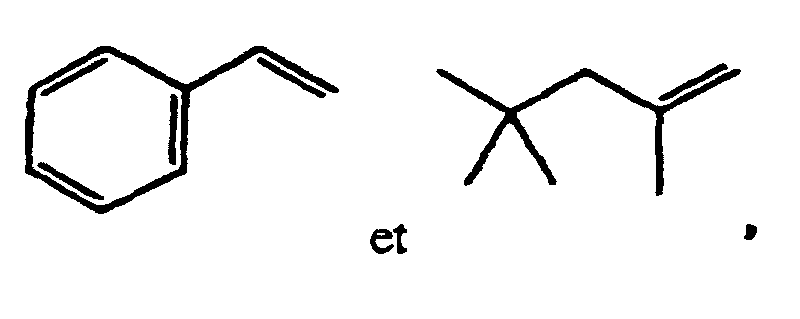 et
et les monomères polaires contenant des groupes neutres choisis parmi
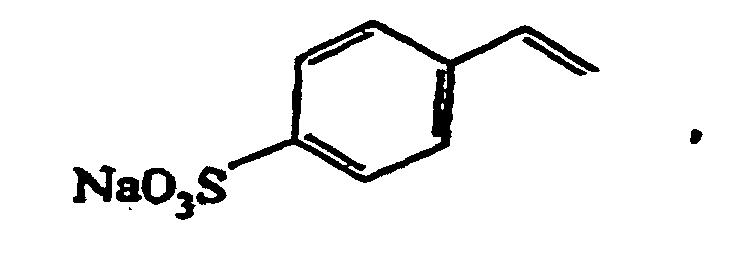 et
et et les monomères polaires contenant des groupes basiques choisis parmi
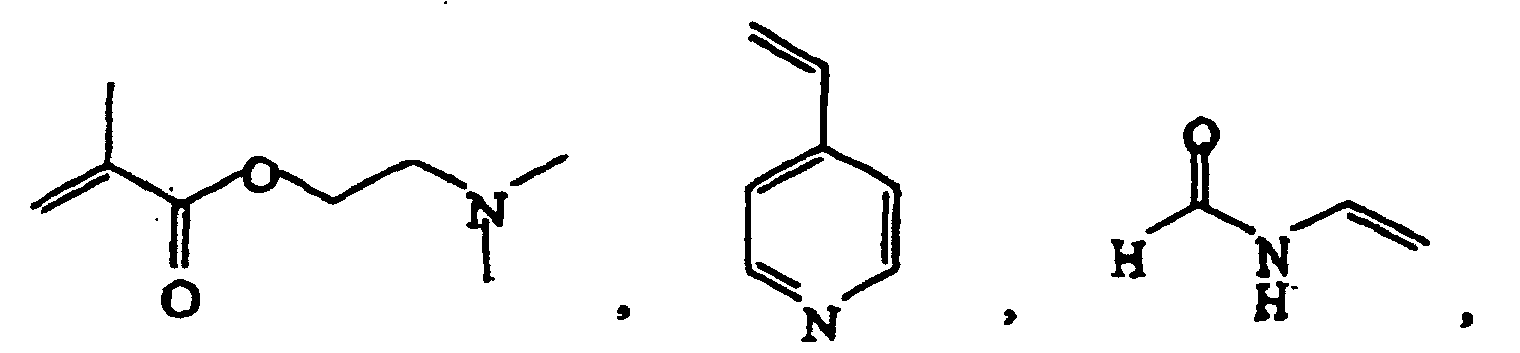 et
et
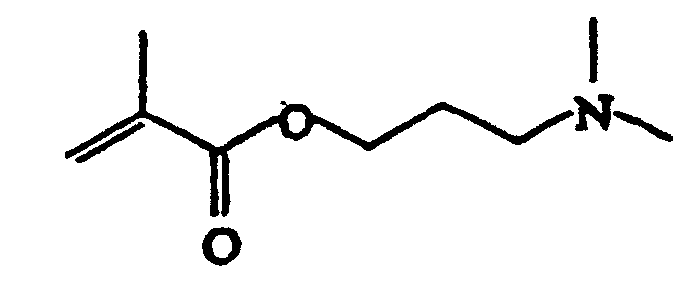
- Procédé pour former une collection de n solutions solides par une voie en solution solide parallélisée comprenant les étapes suivantes:envoi d'au moins un des nanodispersants et d'une solution d'une substance active dans chacune des régions de synthèse d'un substrat contenant k régions de synthèse physiquement séparés;formation de n solutions solides du nanodispersant et de la substance active, cette substance active étant identique dans chacune des n solutions solides ; et k et n, indépendants l'un de l'autre, sont égaux au moins à 2 et k est supérieur ou égal à n.
- Procédé selon la revendication 26, dans lequel les solutions solides sont formées par séchage par atomisation, séchage sous vide ou lyophilisation ou par d'autres techniques de séchage, par exemple par circulation d'air chaud sec sur les échantillons à pression ambiante.
- Collection d'au moins huit solutions solides différentes sur un substrat à des endroits connus de celui-ci, ces solutions solides contenant les composants suivants :cette substance active étant identique dans chacune des solutions solides.au moins un nanodispersant etune substance active ;
- Procédé pour produire 100 à 100.000, de préférence de plus de 1000 à 100.000, dans les meilleures conditions de 10.000 à 100.000 compositions de dispersions de nanoparticules par jour, chacune de celles-ci contenant les composants suivants :au moins un nanodispersant,au moins un milieu d'application,une substance active, la substance active étant la même pour toutes les compositions de dispersions de nanoparticules.
- Procédé pour la production de 100 à 100.000, de préférence de plus de 1000 à 100.000, plus spécialement de 10.000 à 100.000 nanodispersants par jour, par un procédé de polymérisation parallèle d'au moins deux monomères A et B.
Applications Claiming Priority (3)
| Application Number | Priority Date | Filing Date | Title |
|---|---|---|---|
| US64009400A | 2000-08-17 | 2000-08-17 | |
| US640094 | 2000-08-17 | ||
| PCT/EP2001/009469 WO2002014377A2 (fr) | 2000-08-17 | 2001-08-16 | Procede et dispositif servant a preparer des nanodispersants |
Publications (2)
| Publication Number | Publication Date |
|---|---|
| EP1311552A2 EP1311552A2 (fr) | 2003-05-21 |
| EP1311552B1 true EP1311552B1 (fr) | 2004-11-03 |
Family
ID=24566813
Family Applications (1)
| Application Number | Title | Priority Date | Filing Date |
|---|---|---|---|
| EP01971919A Expired - Lifetime EP1311552B1 (fr) | 2000-08-17 | 2001-08-16 | Procede et dispositif servant a preparer des nanodispersants |
Country Status (6)
| Country | Link |
|---|---|
| EP (1) | EP1311552B1 (fr) |
| JP (1) | JP2004506524A (fr) |
| AT (1) | ATE281474T1 (fr) |
| AU (1) | AU2001291769A1 (fr) |
| DE (1) | DE60106943T2 (fr) |
| WO (1) | WO2002014377A2 (fr) |
Families Citing this family (5)
| Publication number | Priority date | Publication date | Assignee | Title |
|---|---|---|---|---|
| US6867275B2 (en) * | 2001-03-30 | 2005-03-15 | Rohm And Haas Company | Solid media |
| US7024955B2 (en) | 2003-03-01 | 2006-04-11 | Symyx Technologies, Inc. | Methods and systems for dissolution testing |
| EP1591788A1 (fr) * | 2004-04-27 | 2005-11-02 | Agfa-Gevaert | Procédé pour surveiller la qualité des formules de dispersion |
| EP1591497B1 (fr) | 2004-04-27 | 2012-02-29 | Agfa Graphics N.V. | Procédé pour améliorer la qualité des formules de dispersion |
| CN116554446A (zh) * | 2023-05-16 | 2023-08-08 | 联仕(昆山)化学材料有限公司 | 一种基于苝酰亚胺的多孔材料、制备方法及其应用 |
Family Cites Families (2)
| Publication number | Priority date | Publication date | Assignee | Title |
|---|---|---|---|---|
| US5985356A (en) * | 1994-10-18 | 1999-11-16 | The Regents Of The University Of California | Combinatorial synthesis of novel materials |
| EP1073688B1 (fr) * | 1998-04-13 | 2015-03-04 | Rutgers, The State University | Construction de bibliotheques de copolymeres |
-
2001
- 2001-08-16 AT AT01971919T patent/ATE281474T1/de not_active IP Right Cessation
- 2001-08-16 JP JP2002519514A patent/JP2004506524A/ja not_active Withdrawn
- 2001-08-16 EP EP01971919A patent/EP1311552B1/fr not_active Expired - Lifetime
- 2001-08-16 AU AU2001291769A patent/AU2001291769A1/en not_active Abandoned
- 2001-08-16 DE DE60106943T patent/DE60106943T2/de not_active Expired - Lifetime
- 2001-08-16 WO PCT/EP2001/009469 patent/WO2002014377A2/fr not_active Ceased
Also Published As
| Publication number | Publication date |
|---|---|
| DE60106943D1 (de) | 2004-12-09 |
| EP1311552A2 (fr) | 2003-05-21 |
| WO2002014377A2 (fr) | 2002-02-21 |
| WO2002014377A3 (fr) | 2002-06-20 |
| JP2004506524A (ja) | 2004-03-04 |
| ATE281474T1 (de) | 2004-11-15 |
| AU2001291769A1 (en) | 2002-02-25 |
| DE60106943T2 (de) | 2005-05-04 |
Similar Documents
| Publication | Publication Date | Title |
|---|---|---|
| Cockram et al. | Optimization of the high-throughput synthesis of multiblock copolymer nanoparticles in aqueous media via polymerization-induced self-assembly | |
| Candau et al. | Polymerization in microemulsions | |
| CN102015775B (zh) | 通过自由基聚合连续生产聚合物的方法及设备 | |
| KR20020067621A (ko) | 다공성 입자, 그 수성 분산물 및 제조방법 | |
| Song et al. | Monodisperse, controlled micron-size dye-labeled polystyrene particles by two-stage dispersion polymerization | |
| Tanaka et al. | Microscale synthesis of multiblock copolymers using ultrafast RAFT polymerisation | |
| US6624219B1 (en) | Surface active random radical (co)polymer and dispersion method for using the same | |
| Wen et al. | Investigating the influence of solvent quality on RAFT-mediated PISA of sulfonate-functional diblock copolymer nanoparticles | |
| JPS58213002A (ja) | 立体的に安定化された水性重合体分散体の製造方法 | |
| EP1311552A2 (fr) | Procede et dispositif servant a preparer des nanodispersants | |
| Hu et al. | Preparation of pH-sensitive polyacrylic acid hollow microspheres and their release properties | |
| Yi et al. | Volume‐phase transition of submicron‐sized N‐isopropylacrylamide/N‐tert‐butylacrylamide particles by photon correlation spectroscopy | |
| KR100257293B1 (ko) | 다공성 중합체 입자의 제조방법 | |
| Gohy et al. | Self-aggregation of poly (methyl methacrylate)-block-poly (sulfonated glycidyl methacrylate) copolymers | |
| JPS6128434A (ja) | 分散安定剤とその使用 | |
| Karatza et al. | Poly (hydroxyl propyl methacrylate)‐b‐Poly (oligo ethylene glycol methacrylate) Thermoresponsive Block Copolymers by RAFT Polymerization | |
| Candau | Microemulsion polymerization | |
| US20030157566A1 (en) | Arrays of n aqueous polymer dispersions and m formulations of aqueous polymer dispersions | |
| Parkes et al. | Thermally triggerable, anchoring block copolymers for use in aqueous inkjet printing | |
| Voorn et al. | Potentials and limitations of automated parallel emulsion polymerization | |
| Merrington et al. | A high‐throughput method for determining the stability of pigment dispersions | |
| CN112244010A (zh) | 温度响应型纳米凝胶及其制备方法、包含该纳米凝胶的温度响应型农药载药系统的制备方法 | |
| Serkhacheva et al. | Emulsifier-Free Polymerization of Styrene and Methyl methacrylate Using an Amphiphilic Copolymer Based on N, N-Dimethylaminoethyl methacrylate | |
| EP3130617B1 (fr) | Préparation de nanoparticules de polymères par polymérisation en mini-émulsion | |
| Adler et al. | IPCG Newsletter February 2003 |
Legal Events
| Date | Code | Title | Description |
|---|---|---|---|
| PUAI | Public reference made under article 153(3) epc to a published international application that has entered the european phase |
Free format text: ORIGINAL CODE: 0009012 |
|
| 17P | Request for examination filed |
Effective date: 20030211 |
|
| AK | Designated contracting states |
Designated state(s): AT BE CH CY DE DK ES FI FR GB GR IE IT LI LU MC NL PT SE TR |
|
| AX | Request for extension of the european patent |
Extension state: AL LT LV MK RO SI |
|
| RIN1 | Information on inventor provided before grant (corrected) |
Inventor name: KUEBLER, SIGRID Inventor name: IDEN, RUEDIGER Inventor name: KOLTZENBURG, SEBASTIAN Inventor name: PETRO, MIROSLAV Inventor name: NIELSEN, RALPH, B. Inventor name: HEGER, ROBERT Inventor name: SEUFERT, MICHAEL Inventor name: HORN, DIETER Inventor name: SCHROF, WOLFGANG Inventor name: CARLSON, ERIC Inventor name: CHANG, HAN-TING |
|
| 17Q | First examination report despatched |
Effective date: 20030822 |
|
| GRAP | Despatch of communication of intention to grant a patent |
Free format text: ORIGINAL CODE: EPIDOSNIGR1 |
|
| GRAS | Grant fee paid |
Free format text: ORIGINAL CODE: EPIDOSNIGR3 |
|
| GRAA | (expected) grant |
Free format text: ORIGINAL CODE: 0009210 |
|
| AK | Designated contracting states |
Kind code of ref document: B1 Designated state(s): AT BE CH CY DE DK ES FI FR GB GR IE IT LI LU MC NL PT SE TR |
|
| PG25 | Lapsed in a contracting state [announced via postgrant information from national office to epo] |
Ref country code: IT Free format text: LAPSE BECAUSE OF FAILURE TO SUBMIT A TRANSLATION OF THE DESCRIPTION OR TO PAY THE FEE WITHIN THE PRESCRIBED TIME-LIMIT;WARNING: LAPSES OF ITALIAN PATENTS WITH EFFECTIVE DATE BEFORE 2007 MAY HAVE OCCURRED AT ANY TIME BEFORE 2007. THE CORRECT EFFECTIVE DATE MAY BE DIFFERENT FROM THE ONE RECORDED. Effective date: 20041103 Ref country code: AT Free format text: LAPSE BECAUSE OF FAILURE TO SUBMIT A TRANSLATION OF THE DESCRIPTION OR TO PAY THE FEE WITHIN THE PRESCRIBED TIME-LIMIT Effective date: 20041103 Ref country code: FI Free format text: LAPSE BECAUSE OF FAILURE TO SUBMIT A TRANSLATION OF THE DESCRIPTION OR TO PAY THE FEE WITHIN THE PRESCRIBED TIME-LIMIT Effective date: 20041103 Ref country code: TR Free format text: LAPSE BECAUSE OF FAILURE TO SUBMIT A TRANSLATION OF THE DESCRIPTION OR TO PAY THE FEE WITHIN THE PRESCRIBED TIME-LIMIT Effective date: 20041103 |
|
| REG | Reference to a national code |
Ref country code: GB Ref legal event code: FG4D |
|
| REG | Reference to a national code |
Ref country code: CH Ref legal event code: NV Representative=s name: SCHMAUDER & PARTNER AG PATENTANWALTSBUERO Ref country code: CH Ref legal event code: EP |
|
| REF | Corresponds to: |
Ref document number: 60106943 Country of ref document: DE Date of ref document: 20041209 Kind code of ref document: P |
|
| REG | Reference to a national code |
Ref country code: IE Ref legal event code: FG4D |
|
| PG25 | Lapsed in a contracting state [announced via postgrant information from national office to epo] |
Ref country code: SE Free format text: LAPSE BECAUSE OF FAILURE TO SUBMIT A TRANSLATION OF THE DESCRIPTION OR TO PAY THE FEE WITHIN THE PRESCRIBED TIME-LIMIT Effective date: 20050203 Ref country code: GR Free format text: LAPSE BECAUSE OF FAILURE TO SUBMIT A TRANSLATION OF THE DESCRIPTION OR TO PAY THE FEE WITHIN THE PRESCRIBED TIME-LIMIT Effective date: 20050203 Ref country code: DK Free format text: LAPSE BECAUSE OF FAILURE TO SUBMIT A TRANSLATION OF THE DESCRIPTION OR TO PAY THE FEE WITHIN THE PRESCRIBED TIME-LIMIT Effective date: 20050203 |
|
| PG25 | Lapsed in a contracting state [announced via postgrant information from national office to epo] |
Ref country code: ES Free format text: LAPSE BECAUSE OF FAILURE TO SUBMIT A TRANSLATION OF THE DESCRIPTION OR TO PAY THE FEE WITHIN THE PRESCRIBED TIME-LIMIT Effective date: 20050214 |
|
| PG25 | Lapsed in a contracting state [announced via postgrant information from national office to epo] |
Ref country code: LU Free format text: LAPSE BECAUSE OF NON-PAYMENT OF DUE FEES Effective date: 20050816 Ref country code: IE Free format text: LAPSE BECAUSE OF NON-PAYMENT OF DUE FEES Effective date: 20050816 Ref country code: CY Free format text: LAPSE BECAUSE OF FAILURE TO SUBMIT A TRANSLATION OF THE DESCRIPTION OR TO PAY THE FEE WITHIN THE PRESCRIBED TIME-LIMIT Effective date: 20050816 |
|
| PG25 | Lapsed in a contracting state [announced via postgrant information from national office to epo] |
Ref country code: MC Free format text: LAPSE BECAUSE OF NON-PAYMENT OF DUE FEES Effective date: 20050831 |
|
| PLBE | No opposition filed within time limit |
Free format text: ORIGINAL CODE: 0009261 |
|
| STAA | Information on the status of an ep patent application or granted ep patent |
Free format text: STATUS: NO OPPOSITION FILED WITHIN TIME LIMIT |
|
| 26N | No opposition filed |
Effective date: 20050804 |
|
| ET | Fr: translation filed | ||
| REG | Reference to a national code |
Ref country code: IE Ref legal event code: MM4A |
|
| PG25 | Lapsed in a contracting state [announced via postgrant information from national office to epo] |
Ref country code: PT Free format text: LAPSE BECAUSE OF NON-PAYMENT OF DUE FEES Effective date: 20050403 |
|
| REG | Reference to a national code |
Ref country code: CH Ref legal event code: PCAR Free format text: SCHMAUDER & PARTNER AG PATENT- UND MARKENANWAELTE VSP;ZWAENGIWEG 7;8038 ZUERICH (CH) |
|
| REG | Reference to a national code |
Ref country code: FR Ref legal event code: PLFP Year of fee payment: 15 |
|
| REG | Reference to a national code |
Ref country code: FR Ref legal event code: PLFP Year of fee payment: 16 |
|
| PGFP | Annual fee paid to national office [announced via postgrant information from national office to epo] |
Ref country code: NL Payment date: 20160819 Year of fee payment: 16 |
|
| PGFP | Annual fee paid to national office [announced via postgrant information from national office to epo] |
Ref country code: GB Payment date: 20160819 Year of fee payment: 16 Ref country code: DE Payment date: 20160822 Year of fee payment: 16 Ref country code: CH Payment date: 20160819 Year of fee payment: 16 |
|
| PGFP | Annual fee paid to national office [announced via postgrant information from national office to epo] |
Ref country code: FR Payment date: 20160822 Year of fee payment: 16 |
|
| PGFP | Annual fee paid to national office [announced via postgrant information from national office to epo] |
Ref country code: BE Payment date: 20160819 Year of fee payment: 16 |
|
| REG | Reference to a national code |
Ref country code: DE Ref legal event code: R119 Ref document number: 60106943 Country of ref document: DE |
|
| REG | Reference to a national code |
Ref country code: CH Ref legal event code: PL |
|
| REG | Reference to a national code |
Ref country code: NL Ref legal event code: MM Effective date: 20170901 |
|
| GBPC | Gb: european patent ceased through non-payment of renewal fee |
Effective date: 20170816 |
|
| PG25 | Lapsed in a contracting state [announced via postgrant information from national office to epo] |
Ref country code: LI Free format text: LAPSE BECAUSE OF NON-PAYMENT OF DUE FEES Effective date: 20170831 Ref country code: CH Free format text: LAPSE BECAUSE OF NON-PAYMENT OF DUE FEES Effective date: 20170831 |
|
| REG | Reference to a national code |
Ref country code: FR Ref legal event code: ST Effective date: 20180430 |
|
| REG | Reference to a national code |
Ref country code: BE Ref legal event code: MM Effective date: 20170831 |
|
| PG25 | Lapsed in a contracting state [announced via postgrant information from national office to epo] |
Ref country code: NL Free format text: LAPSE BECAUSE OF NON-PAYMENT OF DUE FEES Effective date: 20170901 |
|
| PG25 | Lapsed in a contracting state [announced via postgrant information from national office to epo] |
Ref country code: GB Free format text: LAPSE BECAUSE OF NON-PAYMENT OF DUE FEES Effective date: 20170816 Ref country code: DE Free format text: LAPSE BECAUSE OF NON-PAYMENT OF DUE FEES Effective date: 20180301 |
|
| PG25 | Lapsed in a contracting state [announced via postgrant information from national office to epo] |
Ref country code: FR Free format text: LAPSE BECAUSE OF NON-PAYMENT OF DUE FEES Effective date: 20170831 Ref country code: BE Free format text: LAPSE BECAUSE OF NON-PAYMENT OF DUE FEES Effective date: 20170831 |